Chapter 1: Sociology and Society
In the early nineteenth century, Europe looked to many people as though it had come loose from its moorings. Machines were doing work that hands had done for centuries. People who had been born in villages were now living in crowded factory towns, working to the beat of a clock rather than the rising and setting of the sun. Old certainties about who a person was, and where they belonged, no longer held.
A French scholar named Auguste Comte, born in 1789 — the year the French Revolution began — looked at this upheaval and asked an unusual question. Not “who is to blame?” and not “what is the right way to live?”, but something colder and more curious: can society itself be studied? Could the same patient, evidence-gathering method that was unlocking the secrets of chemistry and biology be turned on human beings living together? Comte thought it could. He gave the new study a name, and he believed it would one day help improve human life.
That new study was sociology. It was born out of enormous disruption, and it began with the suspicion that the events shaping millions of individual lives were not accidents, and not simply the sum of individual choices. They had a shape. And a shape can be examined.
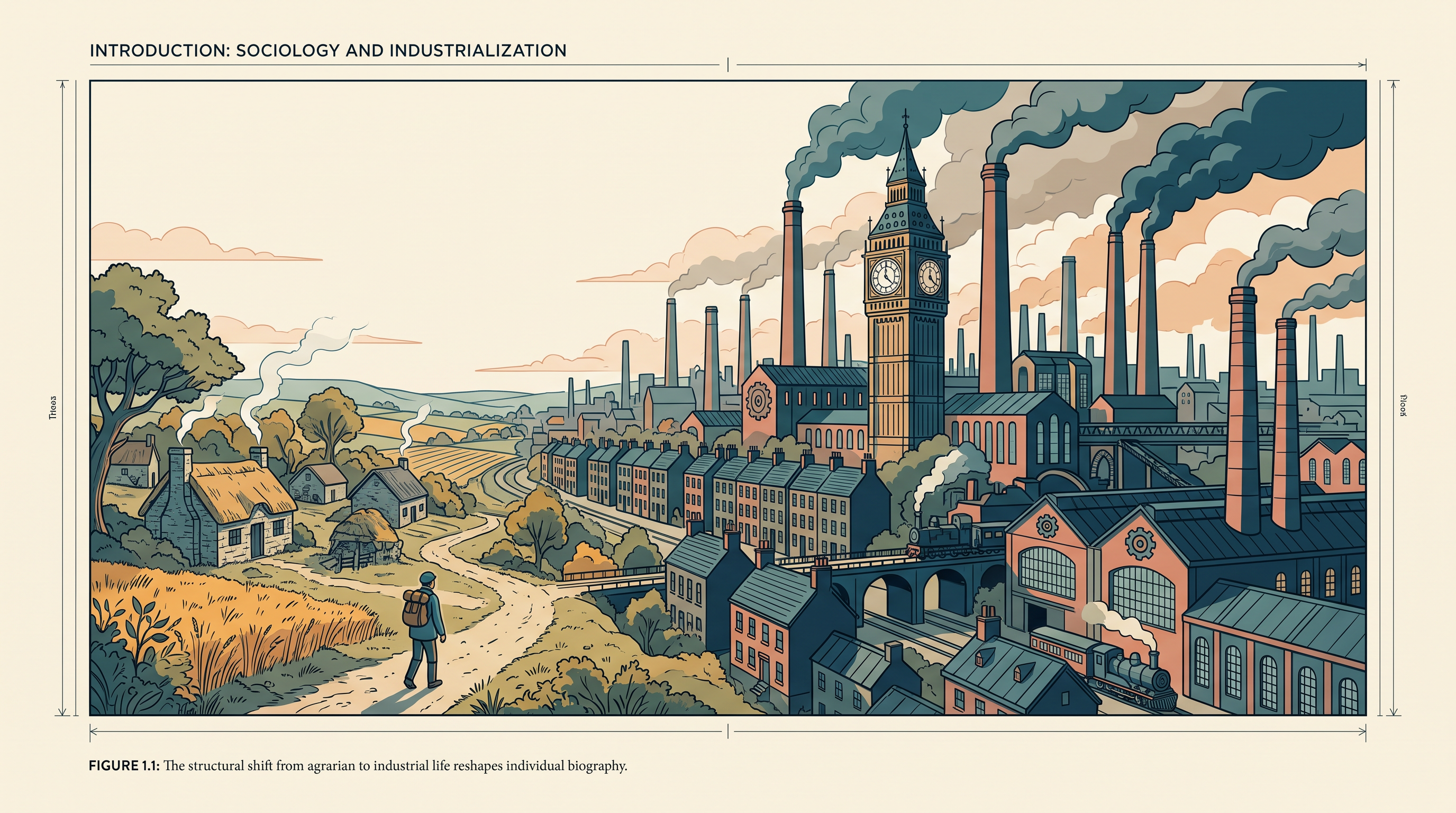
Fig. 1.1 – The transition from village to industrial town.
This chapter will help you answer each of these questions.
1.1 Introduction
Four Pieces of Advice
Think of the advice that is offered to students of your age, usually with the best of intentions. Four suggestions come up again and again.
The first is the simplest: “Study hard and you will do well in life.”
The second sounds more practical: “If you take this subject, or this set of subjects, you will have a better chance of getting a good job later.”
The third takes a different turn altogether: “As a boy, this does not seem the right choice of subject for you.” Or, said to a girl: “Do you really think your choice of subjects is a practical one?”
And the fourth: “Your family needs you to start earning soon, so why choose a profession that takes many years?” Or, said in another kind of household: “You will join the family business anyway, so why do you want this subject at all?”
Do These Four Add Up?
Now examine these suggestions side by side. Does the first advice not contradict the other three?
The first advice places the whole burden on you. It suggests that if you work hard enough, you will do well and get a good job. The outcome, on this view, rests entirely on individual effort.
The second advice quietly admits something else. It says that beyond your effort there is a job market — the range of jobs actually available, and the skills employers are looking for at a given time. Some subjects improve your chances in that market; others reduce them. Your effort alone does not decide.
The third and fourth suggestions complicate matters further. They tell you that it is not just your effort, and not just the job market. Your gender matters. Your family’s situation and its socioeconomic background matter. What is thought “suitable” for a boy or a girl matters. Whether your family can afford to wait five years for you to start earning matters.
So the same student, working equally hard, may end up in very different places depending on circumstances she did not choose. Individual effort matters a great deal — but it does not by itself define the outcome.
Who Decides What a ‘Good Job’ Is?
We have so far mentioned only three social factors: the job market, socioeconomic background, and gender. Can you think of others? Language, region, caste, the school you attended, the network of people your parents know — each of these might be added to the list.
But there is a prior question hiding inside all this advice. Who decides what counts as a “good job” in the first place?
Is money the only criterion? Or is it respect — the way people look at you when you name your work? Is it social recognition, or is it individual satisfaction? A job that carries great prestige in one setting may carry very little in another. Do culture and social norms have a role to play in deciding the worth of a job? They clearly do.
The Chain Behind a Personal Choice
Follow the chain outward and it keeps going. The individual student must indeed study hard to do well. But how well she or he does is structured by a whole set of societal factors.
The job market itself is defined by the needs of the economy. If an economy is expanding in services, it will demand one set of skills; if it is expanding in manufacturing, another. And the needs of the economy are in turn shaped by the economic and political policies pursued by the government — what it invests in, what it taxes, what it protects, what it opens up.
So the chances of one individual student are affected at once by very large forces — political and economic policy — and by very close ones, such as the social background of her or his family. Notice how the personal and the public meet in a single decision about which subject to take in Class 11. Fig. 1.2 sets out the chain.
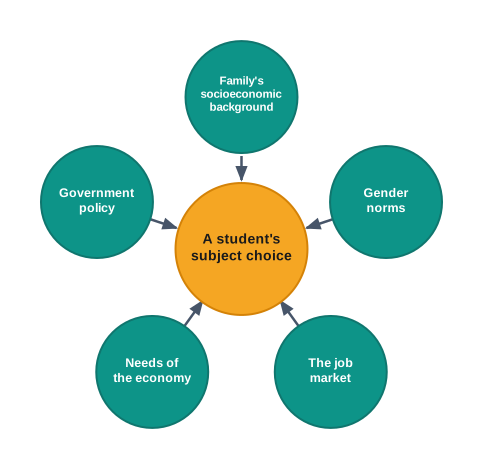
Fig. 1.2 – Social factors shaping a personal subject choice.
This gives us a first, preliminary sense of what sociology does. Sociology studies human society as an interconnected whole. It looks at how the individual and society act upon each other — how society shapes the individual, and how individuals, acting together, can also change society.
The First Theme: A Personal Problem and a Public Issue
Choosing subjects in senior secondary school is a source of real, private worry. It keeps a student awake at night. It causes arguments at home. In that sense it is a personal problem — a difficulty experienced by one individual, within the small circle of people she knows.
Yet it is obviously not hers alone. Lakhs of students face the same decision, under the same pressures, in the same year. When a difficulty is shared in this patterned way by a whole category of people, it is no longer merely private. It becomes a public issue — a matter that concerns the structure of society itself, and that cannot be solved by any one person acting alone.
One of the central tasks of sociology is to unravel the connection between the two. That is the first theme of this chapter.
Which ‘Society’ Do You Belong To?
We have already seen that a “good job” means different things to different societies. The social esteem that a particular kind of work carries — or fails to carry — depends on the culture of what we may call a person’s “relevant society”.
But what do we mean by “relevant society”? Which society does an individual actually belong to? Is it the neighbourhood? Is it the community? Is it the caste or the tribe? Is it the professional circle in which the parents move? Is it the nation?
The question is not a word game. It matters, because a person in modern times belongs to more than one society at the same time, and these societies do not always agree with one another. It matters, too, because societies are unequal — within them, and between them. That is the second theme of this chapter.
What the Rest of the Chapter Will Do
The remaining themes follow from these two.
Third, this chapter introduces sociology as a systematic study of society. It is distinct from philosophical and religious reflection about society, and it is distinct from our everyday, common sense observation about society.
Fourth, this distinct way of studying society is easier to understand if we look back historically at the intellectual ideas and the material conditions within which sociology was born and later grew. Those ideas and developments were mainly western, but they had global consequences.
Fifth, we look at that global aspect, and at the manner in which sociology emerged in India. It is worth remembering that just as each of us has a biography, so does a discipline. Understanding the history of a discipline helps us understand the discipline itself.
Finally, the chapter discusses the scope of sociology and its relationship with the other social sciences.
1.2 The Sociological Imagination: the Personal Problem and the Public Issue
We began this chapter with a set of ordinary suggestions offered to students. Those suggestions drew our attention to something important: the individual and society are dialectically linked. Neither can be understood without the other.
To say that two things are linked dialectically is to say that they act upon each other, and that they are shaped by their opposition. Society constrains the individual; the individual, acting with others, can also alter society. The relationship runs both ways at once.
This is a point that sociologists across several generations have returned to. But one sociologist gave it a name that has stayed. Writing in 1959, the American sociologist C. Wright Mills placed his whole vision of the discipline in the unravelling of how the personal and the public are related. He called this capacity the sociological imagination.
What the Sociological Imagination Does
The sociological imagination, Mills argued, enables us to grasp two things at once — history and biography — and to see the relationship between them within society. Biography is the life of one person. History is the story of a whole society over time. The sociological imagination is the ability to hold both in view together.
The most fruitful distinction it works with, in Mills’s own phrasing, is between “the personal troubles of the milieu” and “the public issues of social structure”.
Troubles, he said, occur within the character of an individual and within the range of her or his immediate relations with others. A trouble has to do with the self and with those limited areas of social life of which the person is directly and personally aware — the household, the classroom, the workplace, the neighbourhood. (The word milieu is French, and simply means a person’s immediate surroundings.)
Issues are different. Issues have to do with matters that go beyond these local environments of the individual, and beyond the range of her or his inner life. An issue belongs to the structure of society as a whole — the way work, property, family, government and inequality are arranged.
Why the Distinction Matters
Consider unemployment. When one person in a large city loses a job, we may reasonably look at that person — her skills, her health, her luck, her employer. The difficulty sits within her immediate circle. It is a trouble.
But when a very large number of people lose their jobs at the same time, in the same industry, in the same year, no account of individual character will do. Something in the structure of the economy has shifted. The same personal misery is now the visible surface of a public issue, and the remedy will not be found in advice to any single individual.
History Lived as a Personal Life
Mills pressed the point further. The facts of contemporary history, he said, are also facts about the success and the failure of individual men and women.
When a society is industrialised, a peasant becomes a worker; a feudal lord is either ruined or turns into a businessman. When classes rise or fall, a person is employed or unemployed. When the rate of investment moves up or down, one person takes fresh heart while another goes broke.
When wars break out, an insurance salesman becomes a rocket launcher and a store clerk becomes a radar man; a wife lives alone; a child grows up without a father. None of these people chose the war. Each of their lives was rewritten by it.
Neither the life of an individual nor the history of a society, Mills concluded, can be understood without understanding both.
Homelessness as a Public Issue
Take homelessness. A family without a roof is, to itself, a private hardship of the most immediate kind. The sociological imagination asks a different question: why are there so many such families, and why in these places rather than others?
Once the question is put that way, the causes that come into view are structural — the availability of employment, the movement of people from villages to cities in search of work, the cost of urban land, the supply of affordable housing. Fig. 1.3 shows the human face of a condition that is usually explained as individual misfortune.
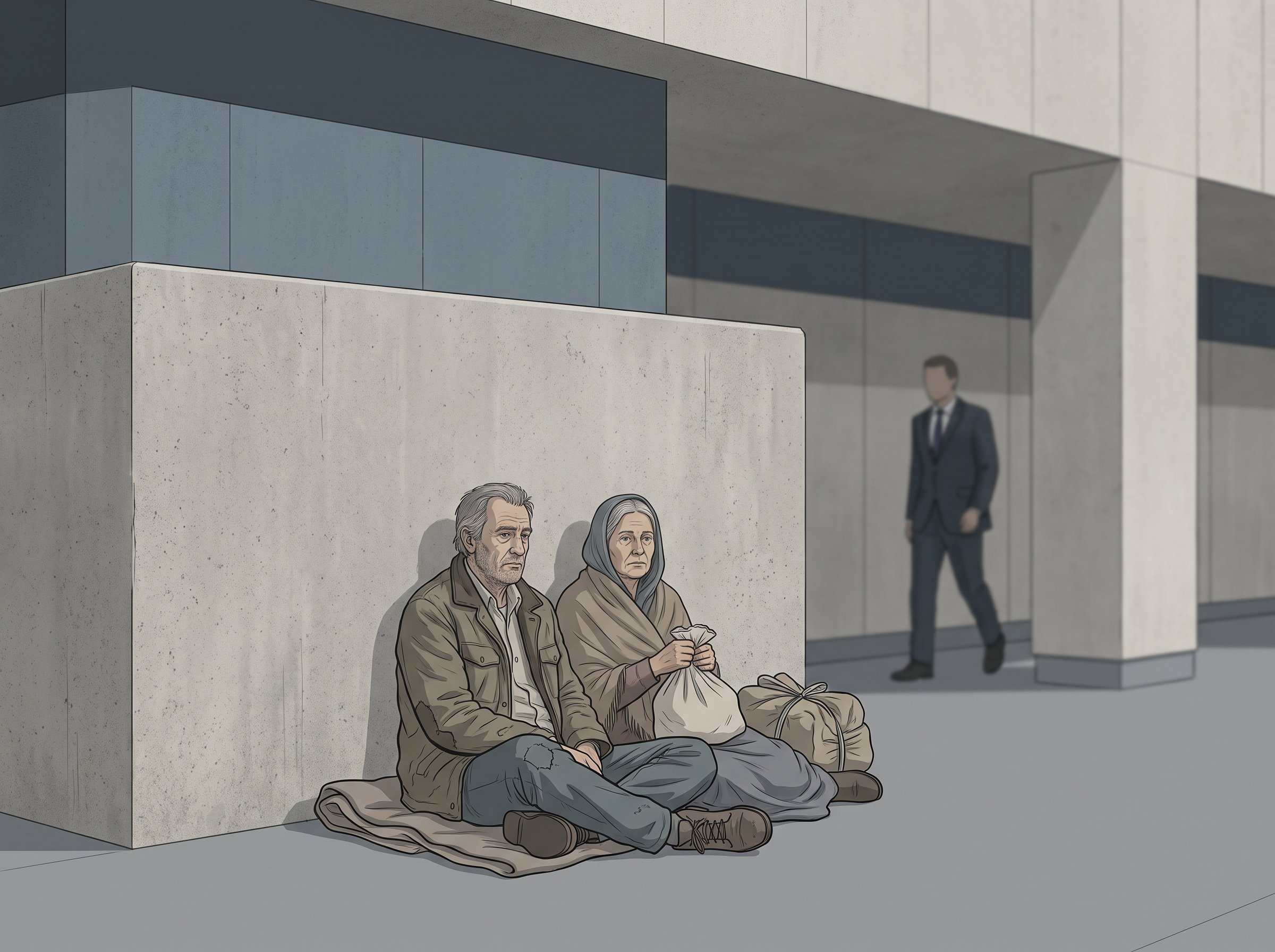
Fig. 1.3 – Homelessness as a public issue.
That the state itself treats homelessness as a public issue is clear from the fact that it responds with policy rather than with advice to individuals.
1.3 Pluralities and Inequalities among Societies
More Than One ‘Our Society’
Listen to how the phrase “our society” is actually used, and you will notice that it slides about.
Among foreigners, an Indian who says “in our society” almost certainly means Indian society as a whole. But among fellow Indians, the same speaker may use “our society” to mean something much narrower — a linguistic or ethnic community, a religious community, a caste, or a tribal society.
Neither use is wrong. Both are ordinary. What they reveal is that in the contemporary world we belong, in a sense, to more than one society at the same time. This is what is meant by the plurality of societies: a single person is simultaneously a member of several social worlds, each with its own norms and expectations.
Mapping Society is Difficult for Everyone
This diversity makes it genuinely hard to decide which “society” we are talking about. And this difficulty of mapping society is not the sociologist’s alone. Anyone who tries to represent India honestly runs into it.
The great Indian film maker Satyajit Ray once reflected on exactly this problem while thinking about what to put into his films, and what to leave out. Should a film maker leave the city behind and go to the village, where cattle graze in open fields and a shepherd plays his flute — a setting in which one could make something pure and fresh, carrying the slow rhythm of a boatman’s song? Or should he go far back in time to the Epics, where gods and demons take sides in a great battle in which brothers kill brothers? Or should he stay in the present, in the heart of the vast, teeming, bewildering city, and try to orchestrate its dizzying contrasts of sight and sound?
Ray was asking the question that is central to sociology as well: what, out of all this, should you focus on? And every choice of focus leaves something out.
Is the Village a Romance?
We can take Ray’s reflection one step further and ask an uncomfortable question of it. Is his image of the village — the grazing cattle, the shepherd’s flute — a little romantic?
It is worth setting that picture beside an account written by a researcher who lived in a village and watched what actually happened there. The anthropologist James Freeman recorded the life history of a man he calls Muli, who belonged to a community subjected to untouchability — the practice by which certain castes were kept apart as “polluting”, and denied ordinary rights of contact and access.
Freeman first saw him seated on the dusty road outside a small thatch-roofed village tea shop. His own glass and saucer were placed conspicuously beside him. The vessels were a silent signal to the shopkeeper: a man treated as an Untouchable wished to buy tea, and would not be permitted to drink from the shop’s cups.
Notice how much is packed into that ordinary scene. No one shouts. No law is broken in the eyes of the village. Inequality is doing its work quietly, through an arrangement of glasses and a place on the road.
The word Dalit is used today by many people from the communities historically subjected to untouchability. It is a term of self-respect, chosen by those communities themselves, and it is used in that sense here. It names not what a community is, but what was done to it.
Inequality is Central, Not Incidental
Once we look at Indian society this way, plurality turns out to be inseparable from inequality. Differences among Indians are not merely differences of language, dress or food. Many of them are differences of power, wealth and dignity.
The economist Amartya Sen has put the point with unusual plainness. Some Indians are rich; most are not. Some are very well educated; others cannot read at all. Some live easy lives of luxury; others work extremely hard for very little. Some are politically powerful; others can influence nothing. Some have wide opportunities for advancement; others have none. And some are treated with respect by the authorities, while others are treated as though they hardly matter. These, Sen insists, are different kinds of inequality — and each of them deserves serious attention.
That last point is worth pausing on. Social inequality is not one thing. Income is one axis. Education is another. Political influence is a third. Respect and dignity are a fourth. A person may stand high on one and low on another, and a society can reduce one form of inequality while leaving another untouched.
Reading Inequality in Images
Look at the photographs in Fig. 1.4 as a set rather than one by one. A report on hunger sits next to a report on obesity. Workers bend over a paddy field in one frame; a fully equipped operation theatre appears in another; men and women break and carry stones by hand in a third.
Nothing in any single image is remarkable. Placed together, they say something a single photograph cannot: that these lives are being lived in the same country, at the same moment, and that the distance between them is not natural but social.
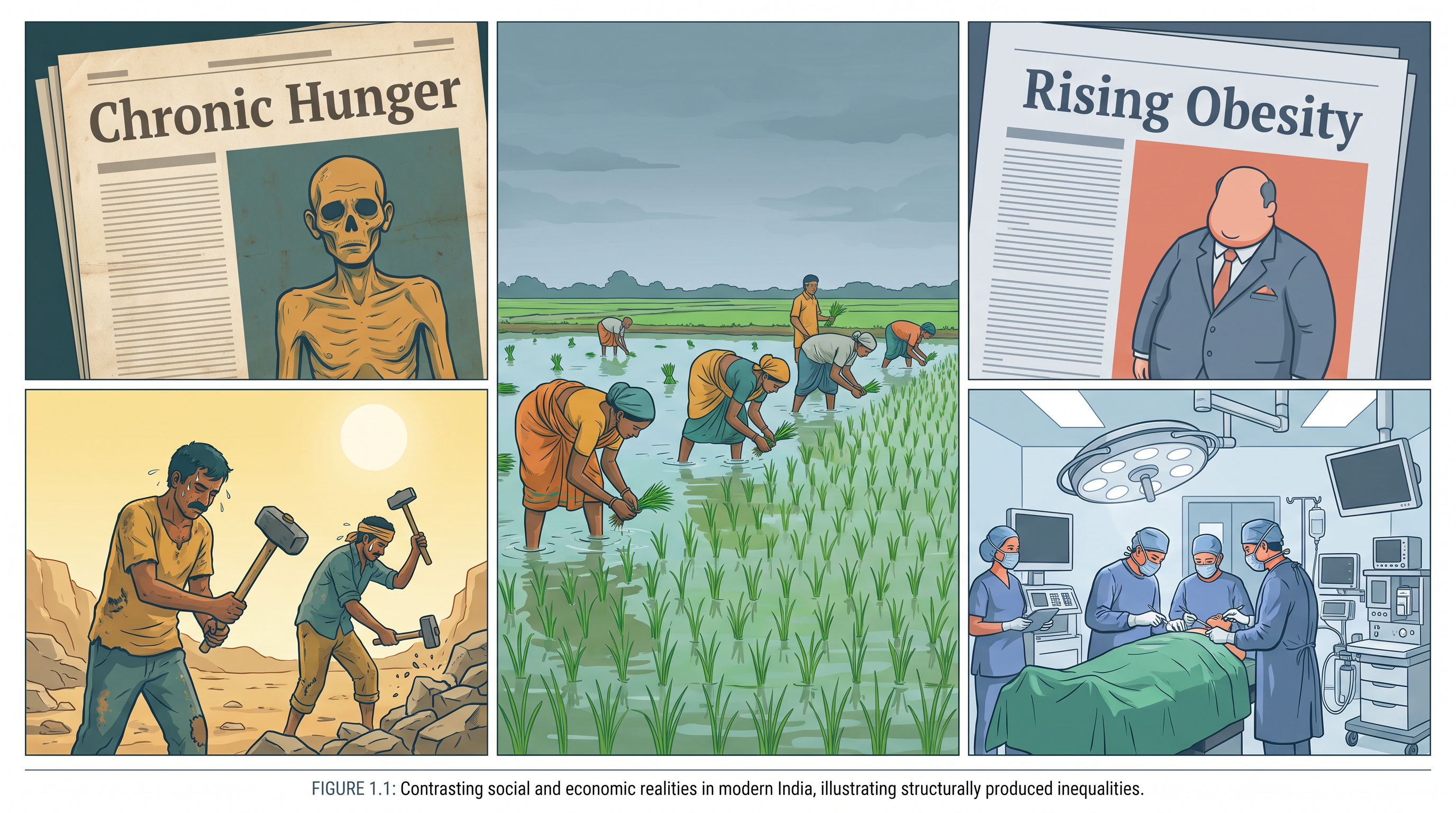
Fig. 1.4 – Pluralities and inequalities in contemporary society.
1.4 Introducing Sociology
You are now acquainted with the sociological imagination, and with the central concern of sociology: to study society as an interconnected whole.
Our discussion of the individual student’s choices and the job market showed exactly this. The economic, the political, the familial, the cultural and the educational parts of society do not sit in separate boxes. A change in one is felt in the others. Fig. 1.5 shows the individual standing not outside these institutions but inside all of them at once.
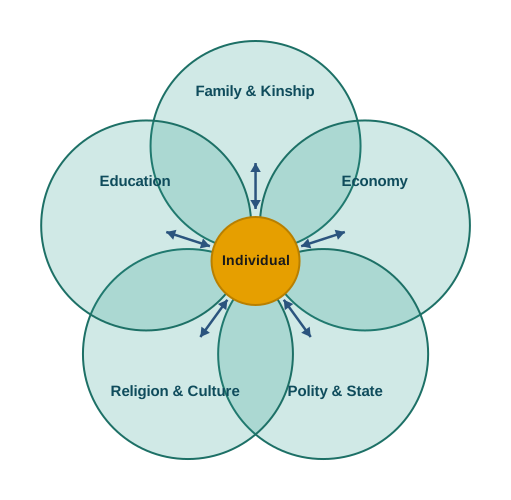
Fig. 1.5 – The dialectical relationship between individual and institutions.
Constrained, But Not Powerless
Notice the two-headed arrows. The individual is constrained by these institutions — but is not simply crushed by them, and can to an extent change them.
Sociologists call the first half of this the social constraint that society exercises. The groups and societies of which we are part condition our behaviour, usually so quietly that we do not notice it. We speak a language we did not invent, follow timings we did not set, and want things we were taught to want.
But constraint is not the whole story. Laws are changed, customs are abandoned, new demands are made and won. The dialectical relationship between individual and society, which we met in the previous section, is visible here in institutional form.
What, Then, is Sociology?
The next few chapters of this book will take up different institutions one by one, and will take up culture as well. They will also introduce the key terms and concepts that make it possible to think about society with some precision.
At its simplest, sociology is the study of human social life, of groups and of societies. Its subject matter is our own behaviour as social beings — not the individual mind, and not abstract ideals, but people as they actually live together.
Sociology Was Not the First to Look at Society
Sociology is not the first subject to reflect on society, and it would be foolish to pretend otherwise. People have always observed and thought about the societies and groups in which they live. This is evident in the writings of philosophers, religious teachers and lawgivers of every civilisation and every age.
Nor is this habit confined to philosophers and social thinkers. All of us have ideas about our own everyday life and about the lives of others, about our own “society” and about other people’s. These everyday notions are our common sense — the stock of assumptions in terms of which we actually live our lives, without usually stopping to examine them.
The observations that sociology as a discipline makes about society are different from both of these: different from philosophical reflection, and different from common sense.
How Sociology Differs from Philosophical and Religious Reflection
The observations of philosophical and religious thinkers are often about what is moral or immoral in human behaviour, about the desirable way of living, and about what a good society would look like. They ask how people ought to live.
Sociology also concerns itself with norms and values — with the shared ideas a group holds about what is desirable, proper, good or bad. But its focus is not on norms and values as they ought to be, as goals that people should pursue. Its concern is with the way norms and values actually function in real societies: who holds them, who does not, how they are enforced, and what happens when they are broken.
This is why empirical investigation — factual enquiry carried out in a given area of study, based on evidence that can be gathered and checked — is such an important part of what sociologists do. You will see in a later chapter how the sociology of religion differs from a theological study for exactly this reason: the sociologist asks what religion does in society, not whether its teachings are true.
None of this means that sociology is unconcerned with values. It means only that when sociologists study a society, they must be willing to observe and to record what they find, even when the findings are not to their personal liking.
Berger’s Uncomfortable Comparison
Peter Berger made this point with an unusual comparison. In any political or military conflict, he wrote, it is an advantage to capture the information used by the opposing side’s intelligence organs. But that is worth doing only because good intelligence consists of information free of bias.
A spy who reports what his superiors wish to hear, rather than what is actually there, produces reports that are useless — not only to the enemy who captures them, but to his own side. The sociologist, Berger suggested, is a spy in very much the same sense. The job is to report as accurately as possible about a certain terrain.
Does the comparison mean that sociologists have no social responsibility to ask about the goals of their study, or about the uses to which their findings will be put? They have such a responsibility, exactly like any other citizen of society. But this asking is not itself sociological asking.
Consider the biologist. Biological knowledge can be used to heal or to kill. That does not free the biologist from responsibility for the use her work serves. But which use it serves is not a biological question, and it cannot be settled by biological methods.
Sociology as a Science
Sociology has, from its beginnings, understood itself as a science.
Unlike commonsensical observation, philosophical reflection or theological commentary, sociology is bound by scientific canons of procedure. This means something quite specific. The statements a sociologist arrives at must be reached by observing certain rules of evidence — rules that allow other people to check the findings, or to repeat the enquiry and take it further.
There has been considerable debate within the discipline about the differences between the natural sciences and the human sciences, and between quantitative and qualitative research. We need not enter that debate here. What matters at this point is simpler: in its observation and its analysis, sociology follows rules that others can inspect.
In the next section, we compare sociological knowledge with common sense knowledge. That comparison will bring out, once again, the role of methods, procedures and rules in the way sociology looks at society. A later chapter of this book will give you a fuller account of what sociologists actually do, and how they go about studying society.
1.5 Sociology and Common Sense Knowledge
We have seen how sociological knowledge differs from theological and philosophical observation. It differs, in much the same way, from common sense observation.
How Common Sense Explains Things
Common sense explanations tend to take one of two forms — and often both at once. They are naturalistic, or they are individualistic.
A naturalistic explanation of behaviour rests on the assumption that one can identify a “natural” reason for the way people act. The behaviour is treated as flowing from the nature of the person, or of the group, and therefore as needing no further enquiry. An individualistic explanation does something similar: it locates the whole cause of an outcome inside the individual — her character, her intelligence, her willingness to work.
Notice what both moves have in common. Each stops the enquiry early. Each makes a social arrangement look like a fact of nature.
Two Ways of Explaining Poverty
Take poverty, an issue we have already touched on in discussing homelessness. Table 1.1 sets the two kinds of explanation side by side.
Table 1.1 – Naturalistic and sociological explanations of poverty | Explanation of | Naturalistic | Sociological | |—|—|—| | Poverty | People are poor because they are afraid of work, come from ‘problem families’, are unable to budget properly, suffer from low intelligence and shiftlessness. | Contemporary poverty is caused by the structure of inequality in class society and is experienced by those who suffer from chronic irregularity of work and low wages (Jayaram 1987:3). |
Read the two columns carefully and you will see that they are not merely different answers. They are different kinds of answer.
The naturalistic column describes poor people. It lists supposed qualities of theirs — fear of work, poor budgeting, low intelligence — and treats these as the cause. Every one of these claims is an assertion about the character of a category of people, and none of them is supported by evidence.
The sociological column describes something else entirely: a structure. It points to the way inequality is organised in a class society, and to the conditions that people actually face in it — irregular work and low wages. Poverty here is not a quality that poor people possess. It is a position that a society produces, and into which people are placed.
What Sociology Does Instead
Sociology thus breaks away from both common sense observation and philosophical thought.
It is worth being honest about what this costs. Sociology does not always, or even generally, lead to spectacular results. Meaningful and unsuspected connections can be reached only by sifting patiently through masses of connections, most of which turn out to lead nowhere. Great advances in sociological knowledge have generally been made incrementally, and only rarely by a dramatic breakthrough.
But sociology has something that common sense does not: a body of concepts, methods and data — however loosely coordinated it may be. That body cannot be substituted by common sense.
The deepest difference lies elsewhere, though. Common sense is unreflective. It does not question its own origins. It never asks itself the one question that would unsettle it: “Why do I hold this view?”
The sociologist, by contrast, must be prepared to ask of any of our beliefs — including beliefs about ourselves, and however cherished they may be — “is this really so?”
Both the systematic approach and the questioning approach of sociology are derived from a broader tradition of scientific investigation.
Unsuspected Connections
The phrase “unsuspected connections” is not decoration. Social measures often produce consequences that nobody intended, and these can only be traced by studying society as an interconnected whole.
Why We Must Now Look Backwards
This emphasis on scientific procedures cannot be understood in the abstract. It can be understood only if we go back in time and look at the context — the social situation — within which the sociological perspective first emerged, for sociology was greatly influenced by the great developments in modern science.
That is what the next two sections do. We look first at the intellectual ideas that went into the making of sociology, and then at the material conditions that did.
1.6 The Intellectual Ideas that Went into the Making of Sociology
A discipline is not born out of thin air. It is assembled out of the ideas available at the time, and it carries their marks — including their errors. Two bodies of ideas did most of the work in making sociology: the theory of evolution, and the Enlightenment.
Classifying Societies into Types and Stages
By the nineteenth century, two things had come together. Scientific theories of natural evolution were spreading fast. And a great deal of information — of very uneven quality — about pre-modern societies was arriving in Europe, gathered by early travellers, by colonial administrators, and later by social anthropologists.
Out of this combination came a project: to categorise societies into types, and to distinguish stages in social development. Where in the sequence, thinkers asked, does a given society stand?
These features reappear in the nineteenth century in the works of the early sociologists — Auguste Comte, Karl Marx and Herbert Spencer. Efforts were accordingly made to classify different types of societies on this basis, for instance:
- Types of pre-modern societies, such as hunters and gatherers, pastoral and agrarian societies, and agrarian and non-industrial civilisations.
- Types of modern societies, such as the industrialised societies.
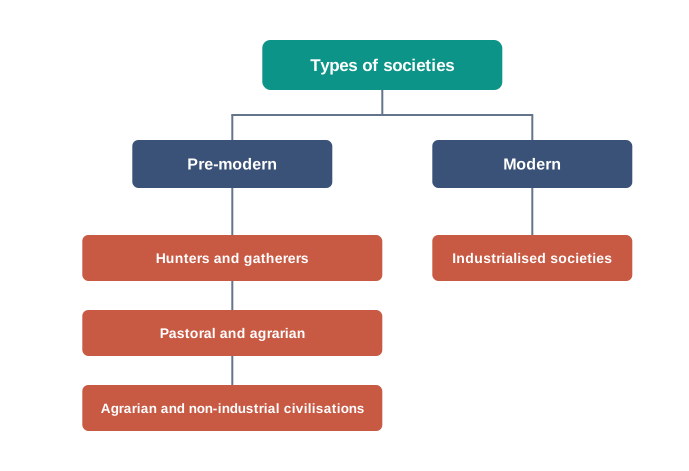
Fig. 1.6 – The evolutionary classification of societies.
The Prejudice Built into the Scheme
Look at that classification again, and notice what it quietly assumes. If societies pass through stages, and if industrial society is the last stage named, then some societies are ahead and others are behind.
This evolutionary vision assumed that the west was necessarily the most advanced and the most civilised. Non-western societies were often seen as barbaric and less developed. The scheme was not a neutral filing system. It was a ranking, and Europe had placed itself at the top.
The Indian colonial experience has to be seen in this light. Indian sociology reflects a tension whose roots, as Yogendra Singh has put it, go far back to the history of British colonialism and to the intellectual and ideological response to it. Perhaps because of this backdrop, Indian sociology has been unusually thoughtful and reflexive about its own practice — that is, it keeps asking who is doing the studying, from what position, and with what inherited assumptions.
Society as an Organism
Darwin’s ideas about organic evolution were a dominant influence on early sociological thought. Society was often compared with a living organism, and efforts were made to trace its growth through stages comparable to those of organic life.
This way of looking at society had a long afterlife. To see society as a system of parts, each part playing a given function, is to be led naturally to certain questions: what does the family do for society? what does the school do? Ideas of this kind shaped the study of social institutions, and of structures such as stratification — the arrangement of a society into layers, one above another, with unequal access to what people value.
We mention this because the intellectual ideas that went into the making of sociology have a direct bearing on how sociology goes about studying empirical reality. A discipline’s questions are inherited before they are asked.
The Enlightenment
The second great source was the Enlightenment, a European intellectual movement of the late seventeenth and eighteenth centuries which emphasised reason and individualism.
Alongside it came a great advancement of scientific knowledge, and with it a growing conviction: that the methods of the natural sciences should, and could, be extended to the study of human affairs.
The consequences of that conviction were far-reaching, and one example shows it best. Poverty had until then been seen largely as a “natural phenomenon” — as much a part of the order of things as bad weather. Now it began to be seen as a “social problem”, caused by human ignorance or exploitation. And a social problem, unlike the weather, can be studied and redressed.
You will recognise here the same move we examined in the previous section, when we set the naturalistic explanation against the sociological one. That move has a history, and this is where it begins.
One way of studying poverty was through the social survey — the systematic collection of information from a large number of people — which rested on the belief that human phenomena can be classified and measured. You will study the social survey as a research method later in this book.
1.7 The Material Issues that Went into the Making of Sociology
Ideas alone do not make a discipline. Sociology took shape in the middle of a physical transformation of European life so complete that the people living through it could hardly describe it. That transformation was the Industrial Revolution.
A New Kind of Economy
The Industrial Revolution rested upon a new and dynamic form of economic activity: capitalism. It was capitalism that became the driving force behind the growth of industrial manufacturing.
Capitalism was not merely a matter of more machines. It involved new attitudes and new institutions. Entrepreneurs now engaged in the sustained, systematic pursuit of profit — not occasional gain, but profit as the organising purpose of an entire life’s work. Markets acted as the key instrument of productive life. And goods, services and labour became commodities, whose use was determined by rational calculation.
That last point deserves a moment. To call something a commodity is to say that it is produced in order to be bought and sold. When labour itself becomes a commodity, a person’s working hours are something she sells, and an employer buys — and the relationship between them is settled by the price agreed, not by custom, kinship or obligation.
What Was Being Replaced
England was the centre of the Industrial Revolution. To understand how far-reaching the change was, it helps to look at what life in pre-industrial England was actually like.
Before industrialisation, agriculture and textiles were the chief occupations of the British, and most people lived in villages. As in our own Indian villages, there were peasants and landlords, the blacksmith and the leather worker, the weaver and the potter, the shepherd and the brewer.
Society was small in scale. It was hierarchical — that is, the status and class positions of different people were clearly defined, and everyone knew where they stood. And like all traditional societies, it was characterised by close interaction: people dealt, over a lifetime, with the same faces.
With industrialisation, every one of these features changed.
The Degradation of Labour
One of the most fundamental aspects of the new order was the degradation of labour — the wrenching of work out of the protective contexts of guild, village and family.
The word “protective” is doing important work in that sentence. A guild set standards, trained apprentices and limited competition. A village and a family absorbed a worker’s bad years. Once work was pulled out of these settings and placed in the labour market, none of that protection came with it.
The reaction was striking, and it crossed political lines. Both radical and conservative thinkers were appalled at the decline in the status of the common labourer — and still more at the decline of the skilled craftsman, whose long-acquired skill the machine had made unnecessary.
A New Kind of City
Urban centres expanded and grew. It is not that there were no cities before; cities are ancient. But their character prior to industrialisation was different.
The industrial cities gave birth to a completely new kind of urban world. It was marked by the soot and grime of factories, by the overcrowded slums of the new industrial working class, by bad sanitation and by general squalor. It was also marked, less visibly but just as importantly, by new kinds of social interaction — life among people one did not know, and would never know.
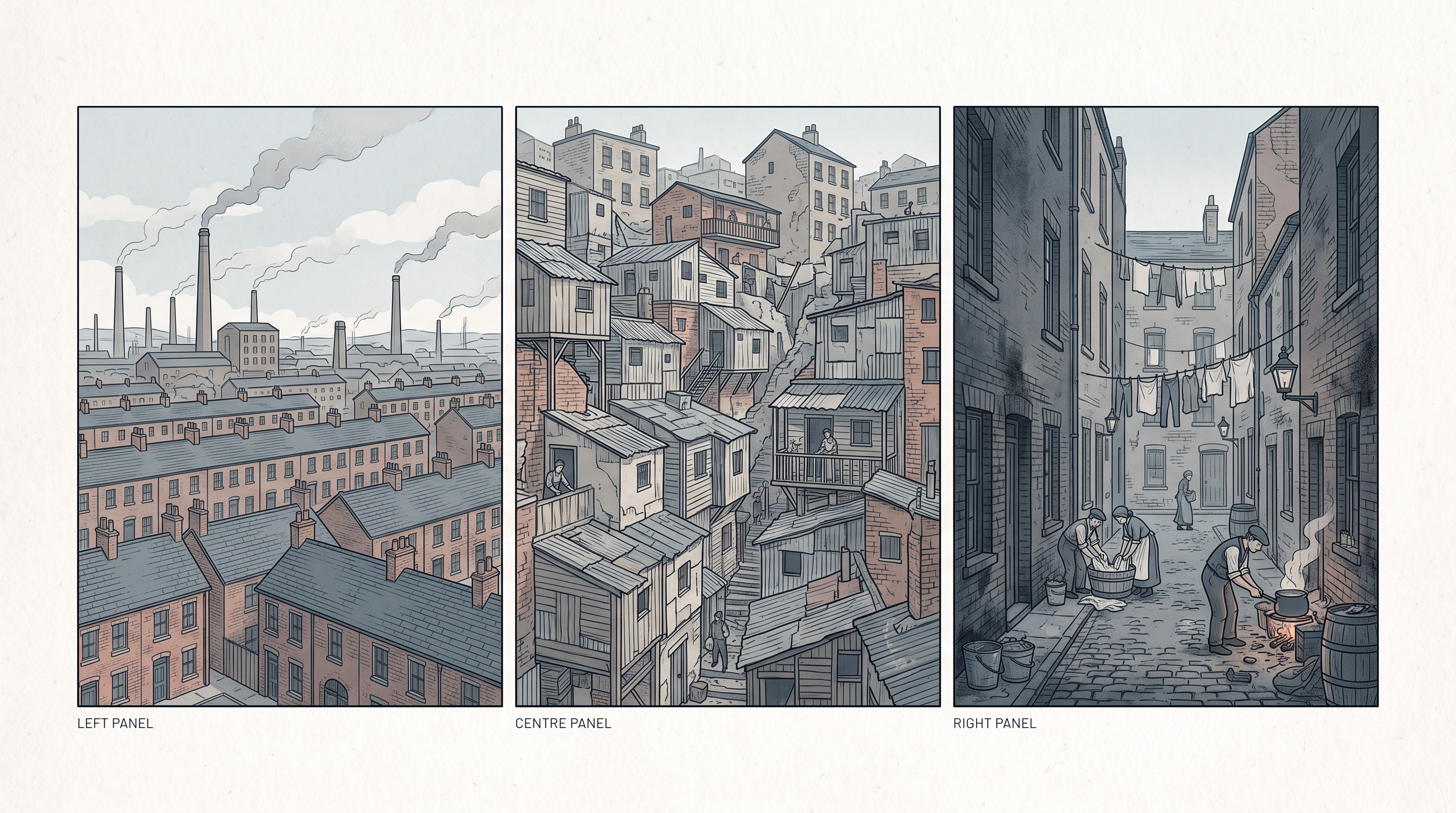
Fig. 1.7 – Industrial urbanisation and the growth of slums.
The Same Process, a Different Outcome in India
It is tempting to assume that industrialisation must do the same thing everywhere. India shows that it does not.
The Factory: Prison or School?
The factory and its mechanical division of labour — the splitting of a job into small, repeated tasks distributed among many workers — were often seen as a deliberate attempt to destroy the peasant and the artisan, and to destroy family and local community along with them.
The factory was perceived as the archetype of an economic regimentation hitherto known only in barracks and prisons: fixed hours, fixed places, supervision, discipline.
And yet the judgement was never quite so simple, even among the system’s fiercest critics.
Time Becomes Money
There is one more indicator of the emergence of modern societies, and it is easy to overlook because it is now so ordinary: the new significance of clock-time as a basis of social organisation.
In the eighteenth and nineteenth centuries, the tempo of agricultural and manufacturing labour increasingly came to be set by the clock and the calendar, in a way very different from pre-modern forms of work.
Before industrial capitalism, work-rhythms were set by other things — the period of daylight, the natural break between one task and the next, the pressure of a deadline, the demands of other social duties. Work stopped when the task was done or the light failed.
Factory production implied the synchronisation of labour. It began punctually. It moved at a steady pace. It took place for set hours, on particular days of the week. Everyone had to be doing the same thing at the same moment, or the machinery stood idle.
The clock also injected a new urgency into work. For both employer and employee, as the historians of this change put it, “time is now money: it is not passed but spent.”
1.8 Why should we Study the Beginning and Growth of Sociology in Europe?
By now a reasonable objection may have formed in your mind. If sociology emerged out of European upheavals, and if its founders were European, why should a student in India begin there at all? Why not begin with India?
The objection deserves a serious answer, and there are two.
The First Answer: The Questions Have Travelled
Most of the issues and concerns of sociology date back to the period when European society was undergoing tumultuous changes — the eighteenth and nineteenth centuries, with the advent of capitalism and industrialisation.
Many of the questions that were raised then have turned out to be pertinent to all modern societies, even though their specific features vary from place to place. Urbanisation — the growth of towns and cities, and the movement of people into them — is one such question. Factory production is another. A society that has cities and factories will sooner or later have to think about crowding, about strangers, about the discipline of the clock, and about what happens to those the new economy does not need.
That said, the answers will not be the same everywhere. Indian society, with its colonial past and its incredible diversity, is distinct. The sociology of India reflects that distinctness, as you will see repeatedly in this book. Beginning with Europe does not mean measuring India against Europe. It means starting where the questions were first framed, and then testing them against Indian material.
The Second Answer: Our Past is Tied to Theirs
The second answer is more direct, and harder to escape.
Our past, as Indians, is closely linked to the history of British capitalism and colonialism — the rule of one country over another, in which the subject territory is governed for the economic benefit of the ruling power. Capitalism in the west did not stay in the west. It entailed a world-wide expansion, and India was one of the places into which it expanded.
To understand what happened to Indian society, therefore, one must understand the system that reached it. The history of European capitalism is not a foreign subject for an Indian student. It is part of the explanation of the country she lives in.
How That Expansion Moved People
Capitalism’s global expansion was not carried out only through goods and prices. It was carried out through the movement of human beings, very often against their will. Two strands of that movement are worth setting out plainly.
Notice that these two strands, enslavement and indenture, are not simply episodes of cruelty. They are part of the economic history of capitalism. Sugar and cotton had to be grown by someone, and the plantations were built where the crops grew, not where the workers lived. The world market required the movement of people, and so people were moved.

Fig. 1.9 – Global movements of enslaved and indentured labour under capitalism.
What This Looks Like Generations Later
The consequences of these movements did not end when the ships stopped sailing. They can still be met in conversation.
The Point of the Detour
Put the two answers together, and the reason for beginning with Europe becomes clear. It is not because European society is the model of society. It is because the forces that remade Europe in the eighteenth and nineteenth centuries also reached India — not as an idea to be considered, but as a fact to be lived under. Understanding those forces is a condition of understanding ourselves.
1.9 The Growth of Sociology in India
Colonialism was not an accident that happened alongside modern capitalism and industrialisation. It was an essential part of them. That is why the writings of western sociologists on capitalism, and on other aspects of modern society, are relevant for understanding social change in India.
But relevance is not the same as identity. As we saw with urbanisation, colonialism meant that the impact of industrialisation in India was not necessarily the same as it had been in the west.
The Contrast, Stated by Marx
Karl Marx’s comments on the impact of the East India Company bring out that contrast sharply. Writing in the 1850s, he described what had happened to Indian cotton.
This is the concrete meaning of the point made in the previous section. The same world economy that pulled English workers into factories destroyed the livelihood of Indian weavers. To understand Indian society, one must understand both halves of that single process.
Correcting the Picture of India
Sociology in India also had to deal with a second inheritance, less material but no less troublesome: western writings and ideas about Indian society that were not always correct.
These ideas were expressed both in the accounts of colonial officials and in the work of western scholars. For many of them, Indian society was above all a contrast to western society — defined by what it supposedly lacked. Let us take just one example: the way the Indian village was understood and portrayed as unchanging.
In keeping with the Victorian-evolutionary ideas of the time, western writers saw in the Indian village a remnant, a survival from what they called “the infancy of society”. They believed, in other words, that they were looking at the past of European society, preserved and still functioning, in nineteenth-century India.
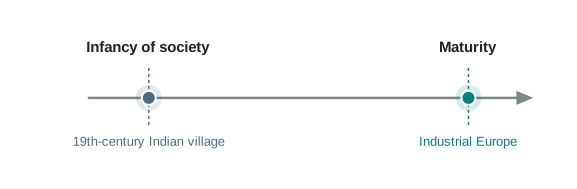
Fig. 1.10 – The Victorian-evolutionary ranking of societies.
In India the Story is Different
In India the story is quite different, and M.N. Srinivas mapped the reason for it.
In a country of India’s size and diversity — regional, linguistic, religious, sectarian, ethnic, including caste, and divided further between rural and urban areas — there are, Srinivas observed, a myriad “others”. In a culture and society such as India’s, “the other” can be encountered literally next door.
The consequence is that the western division collapses. If the “other” society lives across the street, an Indian scholar cannot be a sociologist of her own kind and an anthropologist of everyone else’s. She is studying both at once.
The discipline itself moved in the same direction. Social anthropology in India shifted gradually away from a pre-occupation with the study of “primitive people” — a colonial label, applied from outside, and rightly rejected today — towards the study of peasants, ethnic groups, social classes, features of ancient civilisations, and modern industrial societies.
The result is that no rigid divide exists between sociology and social anthropology in India, although such a divide has been a characteristic feature of the two subjects in many western countries. Perhaps the sheer intermingling of the modern and the traditional in India, of the village and the metropolitan, accounts for this.
1.10 The Scope of Sociology and its Relationship to other Social Science Disciplines
The scope of sociological study is extremely wide. This is worth taking seriously, because it explains why sociology can seem, at first, to be about everything.
From the Shopkeeper’s Counter to the Global Economy
At the smallest scale, sociology can focus its analysis on meaningful interactions between individuals: a shopkeeper with a customer, a teacher with a student, two friends, two members of the same family. A few sentences exchanged across a counter are a legitimate object of study.
It can equally focus on national issues — unemployment, caste conflict, the effect of state policies on the forest rights of the tribal population, rural indebtedness.
And it can examine global social processes: the impact of new flexible labour regulations on the working class; the effect of electronic media on the young; the consequences of foreign universities entering the education system of a country.
So what holds this enormous range together? Not the subject matter. What defines the discipline of sociology is not simply what it studies — the family, a trade union, a village — but how it studies a chosen field.
One of a Family of Disciplines
Sociology is one of a group of social sciences, which also includes anthropology, economics, political science and history.
The divisions among the various social sciences are not clearcut. All of them share a certain range of common interests, concepts and methods. It is therefore very important to understand that the distinctions between the disciplines are to some extent arbitrary, and should not be seen in a straitjacket fashion. To differentiate the social sciences too sharply would be to exaggerate the differences and to gloss over the similarities.
Feminist theories have shown the need for an interdisciplinary approach with particular force. Ask yourself: how would a political scientist or an economist study gender roles, and their implications for politics or the economy, without a sociology of the family or of the gender division of labour? The question answers itself.
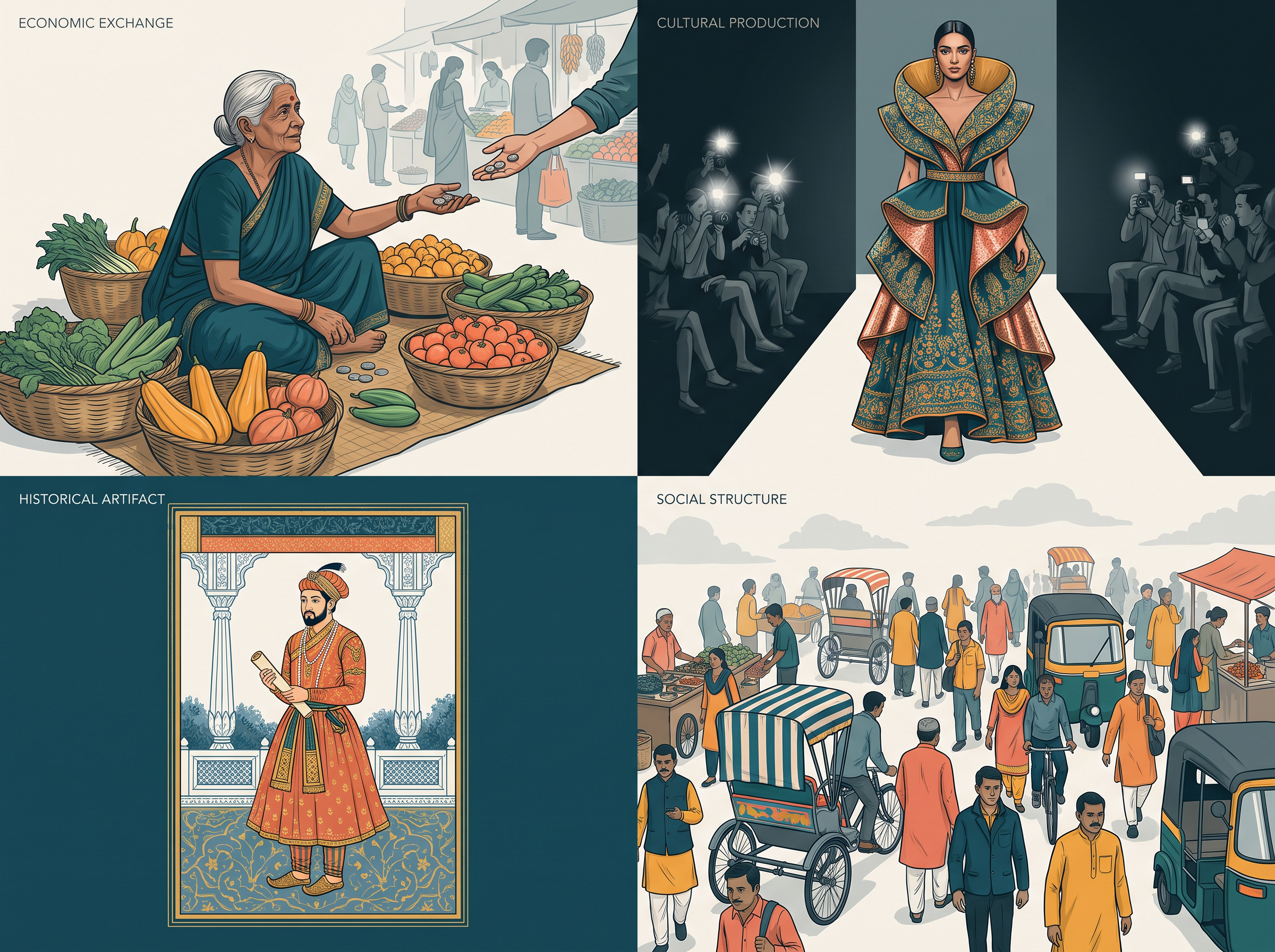
Fig. 1.11 – Everyday scenes as subjects for the social sciences.
With that caution in place — that the boundaries are useful but not natural — we can now look at each neighbouring discipline in turn.
1.10.1 Sociology and Economics
Economics is the study of production and distribution of goods and services.
The classical economic approach dealt almost exclusively with the inter-relations of pure economic variables: the relations of price, demand and supply; money flows; output and input ratios, and the like. The focus of traditional economics has been a narrow understanding of “economic activity”, namely the allocation of scarce goods and services within a society.
Not all economists work this way. Economists influenced by a political economy approach seek to understand economic activity in a broader framework — the ownership of the means of production, and people’s relationship to them. (The “means of production” are simply the land, tools, machinery and factories with which things are made; who owns them turns out to matter enormously.) The objective of the dominant trend in economic analysis, however, was to formulate precise laws of economic behaviour.
What the Sociological Approach Adds
The sociological approach looks at economic behaviour in a broader context of social norms, values, practices and interests.
The corporate sector is perfectly aware of this. The large investment made in the advertisement industry is directly linked to the need to reshape lifestyles and consumption patterns. Nobody spends that money on the assumption that consumers are calculating machines. They spend it because they know that what people want is socially made.
Trends within economics itself have moved in the same direction. Feminist economics seeks to broaden the focus by drawing in gender as a central organising principle of society. It would ask, for instance, how the unpaid work done inside the home is linked to productivity outside it — a question that a purely market-based accounting cannot even pose, because the work has no price.
The Envy and the Blind Spot
The defined scope of economics has helped it develop into a highly focused, coherent discipline. Sociologists often envy economists — for the precision of their terminology, for the exactness of their measures, and for their ability to translate theoretical work into practical suggestions with major implications for public policy.
Yet economists’ predictive abilities often suffer for precisely this reason. Their neglect of individual behaviour, of cultural norms, and of institutional resistance — the very things sociologists study — is what causes forecasts to miss. A policy that is impeccable on paper can fail because a community will not do what the model assumed it would.
Sociology, unlike economics, usually does not provide technical solutions. What it offers instead is a questioning and critical perspective. It helps to question basic assumptions, and thereby makes it possible to discuss not just the technical means towards a given goal, but the social desirability of the goal itself. Recent years have seen a resurgence of economic sociology, perhaps because of exactly this wider and more critical view.
What sociology provides, in the end, is a clearer or more adequate understanding of a social situation than existed before. This can happen at the level of factual knowledge — we simply did not know how many, or how often. Or it can happen through an improved grasp of why something is happening, which is to say through theoretical understanding.
1.10.2 Sociology and Political Science
As in the case of economics, there is today an increased interaction of methods and approaches between sociology and political science.
Conventional political science focused primarily on two elements: political theory, and government administration. Neither branch involves extensive contact with actual political behaviour. The theory part usually focuses on ideas about government from Plato to Marx, while courses on administration generally deal with the formal structure of government rather than its actual operation.
The contrast with sociology follows from this. Sociology is devoted to the study of all aspects of society, whereas conventional political science restricted itself mainly to the study of power as embodied in formal organisation. Sociology stresses the interrelationships between sets of institutions, including government; political science tends to turn its attention to the processes going on within the government.
Political Sociology
However, sociology has long shared similar research interests with political science, and the overlap has a distinguished history. Sociologists like Max Weber worked in what can be termed political sociology.
The focus of political sociology has been increasingly on the actual study of political behaviour — not what governments are supposed to do, but what people actually do politically. Even in recent Indian elections, one has seen extensive study of the political patterns of voting. Studies have also been conducted on membership of political organisations, on the process of decision-making within organisations, on the sociological reasons for support of political parties, and on the role of gender in politics.
1.10.3 Sociology and History
Historians, almost as a rule, study the past. Sociologists are more interested in the contemporary or the recent past.
The older difference went deeper than the choice of period. Historians earlier were content to delineate the actual events, to establish how things actually happened. Sociology, by contrast, sought to establish causal relationships — to explain why a pattern occurred, and to say what it was an instance of.
This produces a difference in the level of abstraction. History studies concrete details. The sociologist is more likely to abstract from concrete reality, to categorise and to generalise. Where a historian may want to know exactly what happened in one district in one decade, a sociologist wants to know what kind of thing it was.
The Distinction is Dissolving
That, at any rate, is the traditional account. It is less true every year. Historians today are equally involved in using sociological methods and concepts in their analysis.
Consider what conventional history used to be about: kings and wars. The less glamorous and less exciting matters — changes in land relations, or changes in gender relations within the family — were traditionally studied much less by historians, though they formed the core area of the sociologist’s interest.
Today history is far more sociological, and social history is the stuff of history. It looks at social patterns, at gender relations, at mores and customs, and at important institutions other than the acts of rulers, wars and monarchy.
1.10.4 Sociology and Psychology
Psychology is often defined as the science of behaviour. It involves itself primarily with the individual — with a person’s intelligence and learning, motivations and memory, nervous system and reaction time, hopes and fears.
Social psychology serves as a bridge between psychology and sociology. It maintains a primary interest in the individual, but concerns itself with the way in which the individual behaves in social groups, collectively with other individuals.
Sociology attempts something different. It tries to understand behaviour as it is organised in society — that is, the way in which personality is shaped by different aspects of society: the economic and political system, family and kinship structure, culture, norms and values.
Durkheim’s Decision
It is worth recalling one famous illustration of this difference. Émile Durkheim sought to establish a clear scope and method for sociology, and he did it through his well-known study of suicide.
His decision was a deliberate and, at the time, a startling one. He left out the individual intentions of those who take or attempt to take their own lives. In their place he put statistics concerning the various social characteristics of these individuals.
The point was not that individual intention does not exist. The point was that intention is not what sociology can explain — and that the patterning of these deaths across social categories is something an account of individual minds cannot reach.
1.10.5 Sociology and Social Anthropology
Anthropology in most countries incorporates archaeology, physical anthropology, cultural history, many branches of linguistics, and the study of all aspects of life in “simple societies”. Our concern here is with social anthropology and cultural anthropology, for it is these that lie close to the study of sociology.
The conventional division was clean. Sociology was deemed to be the study of modern, complex societies. Social anthropology was deemed to be the study of simple societies.
Each Discipline Has a Biography
As we saw earlier, each discipline has its own history — its own biography. Social anthropology developed in the west at a time when western-trained social anthropologists studied non-European societies that were often thought of as exotic, barbaric and uncivilised.
This unequal relationship — between those who studied and those who were studied — was not remarked upon too often in earlier times. But times have changed. The erstwhile “natives”, whether Indians or Sudanese, Nagas or Santhals, now speak and write about their own societies.
There is a further point, and it goes to the heart of what objectivity means. The anthropologists of the past documented the details of simple societies apparently in a neutral, scientific fashion. In practice, they were constantly comparing those societies with the model of western modern societies, which served as the benchmark. The comparison was rarely stated. It did not need to be. It was built into the questions asked.
The Bounded Society Was Never Bounded
Other changes have also redefined the nature of both disciplines. Modernity, as we saw, led to a process whereby even the smallest village was affected by global processes. The most obvious example is colonialism. The most remote village of India under British colonialism saw its land laws and administration change, its revenue extraction alter, and its manufacturing industries collapse.

Fig. 1.12 – Tea plantation workers in Assam.
Contemporary global processes have further accentuated this “shrinking of the globe”. The founding assumption behind the study of a simple society was that it was bounded — that it could be studied as a self-contained whole. We know today that this is not so, and Fig. 1.12 is one reason why: a plantation in Assam links a distant village, a colonial company and a market on the other side of the world.
What Each Tradition Actually Did
The traditional study of simple, non-literate societies had a pervasive influence on the content and subject matter of social anthropology. It tended to study societies in all their aspects, as wholes. In so far as anthropologists specialised, they specialised by area — the Andaman Islands, the Nuers, Melanesia.
Sociologists, studying complex societies, could not proceed that way. A complex society cannot be grasped whole, so sociologists have tended to focus on parts of it — the bureaucracy, religion, caste — or on a process such as social mobility.
The methods followed from this. Social anthropology was characterised by a long fieldwork tradition: living in the community studied, and using ethnographic research methods. Sociologists have often relied on the survey method and on quantitative data, using statistics and the questionnaire mode. You will study both traditions in detail in a later chapter of this book.
Why the Distinction No Longer Holds in India
Today, the distinction between a simple society and a complex one itself needs major rethinking — and in India it never fitted well in the first place.
It had once been feared that with the decline of simple societies, social anthropology would lose its specificity and simply merge into sociology. That is not what happened.
There have instead been fruitful interchanges between the two disciplines, and today methods and techniques are drawn from both. There have been anthropological studies of the state and of globalisation — subjects very far from the traditional matter of social anthropology. And sociology, on its side, has been using quantitative and qualitative techniques, and both macro and micro approaches, to study the complexities of modern societies.
In India, sociology and social anthropology have had a very close relationship. That closeness is not an accident of academic history. It is a consequence of the kind of society India is.
1.11 Summary
The individual and society (1.1)
- The advice commonly given to students — work hard; choose a subject that pays; consider what is suitable for a boy or a girl; consider what your family needs — pulls in two directions. The first places the whole outcome on individual effort; the others admit that effort works inside conditions the individual did not choose.
- A student’s chances are shaped at once by the job market, by the needs of the economy, by government policy, and by the family’s socioeconomic background and ideas about gender.
- What counts as a “good job” is not a fixed fact. It depends on culture and social norms, and it differs from one society to another.
- Sociology studies human society as an interconnected whole, and studies how the individual and society act upon each other.
- Choosing a subject is a personal problem, but because it is shared in a patterned way by lakhs of students, it is also a public issue. Unravelling that connection is a central task of sociology.
The sociological imagination (1.2)
- The individual and society are dialectically linked: society constrains the individual, and individuals acting together can change society.
- C. Wright Mills (1959) called the ability to see the connection between the two the sociological imagination — the capacity to grasp history and biography together.
- His key distinction is between “the personal troubles of the milieu” and “the public issues of social structure”. Troubles occur within the individual and her immediate relations; issues transcend that local environment and belong to the structure of society.
- Large historical changes rewrite individual lives: industrialisation turns a peasant into a worker; war turns a salesman into a soldier and leaves a child without a father. Neither an individual life nor the history of a society can be understood without the other.
- Homelessness illustrates the point: it is felt as private hardship, but its causes — employment, migration, housing — are structural, and the state responds to it with policy such as the Pradhan Mantri Awas Yojana–Gramin.
Pluralities and inequalities (1.3)
- In the contemporary world we belong to more than one “society” — the nation, but also a linguistic, ethnic, religious, caste or tribal community. This plurality makes it difficult to say which society is being studied.
- The difficulty is not the sociologist’s alone. Satyajit Ray asked the same question about what a film maker should put in and leave out.
- A romantic picture of the village must be set against what fieldwork records. James Freeman’s life history of a man subjected to untouchability shows inequality operating through quiet daily routines — a separate glass, a place outside the tea shop.
- As Amartya Sen has argued, inequality in India takes many forms at once: income, education, political influence, opportunity and respect. Each requires serious attention.
Introducing sociology (1.4)
- Society’s institutions — economic, political, familial, cultural, educational — are interconnected. The individual is constrained by them (social constraint) yet can also change them.
- Sociology is the study of human social life, groups and societies; its subject matter is our own behaviour as social beings.
- Philosophers and religious thinkers ask how people ought to live. Sociology studies how norms and values actually function in real societies, through empirical investigation.
- A sociologist must be willing to record findings even when they are not to her personal liking. Peter Berger compared the sociologist to a spy whose reports are useless unless they are free of bias.
- The sociologist has a citizen’s responsibility for how her findings are used, but that question is not itself a sociological question.
- Sociology has understood itself as a science from the beginning: its statements must rest on rules of evidence that others can check and repeat.
Sociology and common sense (1.5)
- Common sense explanations are naturalistic and individualistic: they locate the cause of behaviour in the supposed nature of people, and so stop the enquiry early.
- Poverty shows the contrast. A naturalistic account blames the character of the poor; a sociological account points to the structure of inequality in class society, and to chronic irregularity of work and low wages.
- Common sense is unreflective — it never asks “why do I hold this view?” Sociology has a body of concepts, methods and data, and turns its questioning on its own assumptions too.
- Sociology advances incrementally, by sifting through masses of connections, and it can uncover unsuspected connections. The Kargil compensation measure, meant to protect widows, was absorbed by patrilineal inheritance and produced forced marriages — an unintended consequence.
The intellectual ideas (1.6)
- Influenced by theories of natural evolution and by accounts of pre-modern societies, early sociologists — Comte, Marx, Spencer — classified societies into types and stages: pre-modern types (hunters and gatherers; pastoral and agrarian; agrarian and non-industrial civilisations) and modern types (industrialised societies).
- This evolutionary vision assumed the west was the most advanced and treated non-western societies as barbaric — an assumption inseparable from colonialism, and one that Indian sociology has had to argue with from the start.
- Darwin’s idea of organic evolution encouraged the view of society as a system of parts, each performing a function, which shaped the study of institutions and of stratification.
- The Enlightenment (late 17th and 18th centuries) emphasised reason and individualism, and extended scientific method to human affairs. Poverty ceased to be a “natural phenomenon” and became a “social problem” that could be studied — through the social survey — and redressed.
- Auguste Comte (1789–1857), the French scholar considered the founder of sociology, believed the discipline would contribute to the welfare of humanity.
The material issues (1.7)
- The Industrial Revolution rested on capitalism: the systematic pursuit of profit, markets as the key instrument of productive life, and goods, services and labour turned into commodities governed by rational calculation.
- Pre-industrial England was rural, small in scale, hierarchical and marked by close interaction. Industrialisation changed every one of these features.
- The new order degraded labour, wrenching work out of the protective contexts of guild, village and family. Radicals and conservatives alike were appalled at the decline in the status of the labourer and the craftsman.
- Industrial cities were a new kind of urban world — factories, slums, bad sanitation, and social interaction among strangers.
- In India the same process produced the opposite movement. Britain went from 20 per cent urban in 1810 to 80 per cent in 1910; in India, ruined handicraftsmen were not absorbed by indigenous industry and took to agriculture for subsistence.
- The factory was read in two ways: as oppressive regimentation, and, in Marx’s account, as potentially liberating, since it taught workers collective functioning and concerted effort for better conditions.
- Clock-time became the basis of social organisation. Work was synchronised, punctual and paid by the hour: time was now money, spent rather than passed.
Why begin with Europe (1.8)
- The issues raised by European upheaval — urbanisation, factory production — are pertinent to all modern societies, though India, with its colonial past and diversity, is distinct.
- We begin there because India’s own past is closely linked to British capitalism and colonialism, and because capitalism in the west entailed a world-wide expansion.
- That expansion moved people. An estimated 24 million Africans were enslaved between the 17th and 19th centuries, of whom 11 million survived the passage to the Americas. Slavery declined in the 1800s; in the same century indentured labour was shipped from India to plantations in Surinam, the West Indies and Fiji.
- The consequences persist. R.K. Laxman’s account of Mauritius records a man with a Tamil name and a Tamil face who speaks no Tamil at all.
Sociology in India (1.9)
- Colonialism was an essential part of modern capitalism, so western sociology is relevant to India — but the impact of industrialisation here was not the same as in the west.
- Marx described how Indian cotton manufacture was ruined: Indian goods were excluded from England while British manufactures entered India at a nominal duty.
- Indian sociology also had to correct western accounts of Indian society. Colonial writers, following Victorian-evolutionary ideas, portrayed the Indian village as unchanging — a survival from “the infancy of society”.
- The very division between sociology (the industrialised world, in Giddens’s definition) and social anthropology (simple, non-western, “other” cultures) is part of this colonial heritage.
- In India, as M.N. Srinivas observed, “the other” can be encountered literally next door, and social anthropology moved from the study of “primitive people” to peasants, classes and modern societies. No rigid divide exists between the two subjects in India.
The scope of sociology (1.10)
- Sociology’s scope runs from a conversation across a shop counter, through national issues such as unemployment and rural indebtedness, to global processes such as flexible labour regulation. What defines the discipline is not what it studies but how it studies it.
- The boundaries between the social sciences are to some extent arbitrary; feminist theories in particular have shown the need for an interdisciplinary approach.
- Economics studies production and distribution and formulates precise laws of economic behaviour; sociology places economic behaviour in the context of norms, values and interests, and questions the desirability of goals rather than only the means. Economists’ predictions suffer when they neglect culture and institutions.
- Political science conventionally studied political theory and administration, and power in formal organisation; sociology studies the interrelationships between institutions, and political sociology — in the tradition of Max Weber — studies actual political behaviour, including voting.
- History studies the past in concrete detail; sociology studies the contemporary and generalises. Today social history has narrowed the gap, and both use each other’s concepts.
- Psychology studies the individual; social psychology bridges the two; sociology studies behaviour as it is organised in society. Durkheim’s study of suicide deliberately set aside individual intentions in favour of statistics on social characteristics.
- Social anthropology studied simple societies as wholes, by area, through long fieldwork; sociology studied complex societies in parts, often by survey and questionnaire. The distinction was itself a colonial inheritance, and in India — a mix of village and metropolis, caste and class — it has never held. Today the two disciplines borrow methods freely from each other.
1.12 Key Terms
Capitalism — A system of economic enterprise based on market exchange, in which capital (money, property, machines) is used to produce commodities for sale or invested in the hope of profit; it rests on private ownership of assets and of the means of production.
Colonialism — The rule of one country over another, in which the subject territory is governed largely for the economic benefit of the ruling power.
Common sense — The stock of everyday, inherited assumptions in terms of which people live their lives, held without questioning where they came from.
Dalit — A term of self-respect used by communities historically subjected to untouchability, naming what was done to them rather than what they are.
Dialectic — The existence or action of opposing social forces upon each other, for instance social constraint and individual will.
Division of labour — The splitting of work into separate tasks distributed among different people; in the factory, into small, repeated operations.
Empirical investigation — A factual enquiry carried out in a given area of sociological study, resting on evidence that can be gathered and checked.
Enlightenment — A European intellectual movement of the late seventeenth and eighteenth centuries which emphasised reason and individualism, and sought to extend scientific method to human affairs.
Feminist theories — A sociological perspective emphasising the centrality of gender in analysing the social world; its many strands share the aim of explaining gender inequalities and working to overcome them.
Indentured labour — Labour bound by contract to work for a fixed term in a distant place in return for passage and wages; in the 1800s, Indian workers were shipped in this way to colonial plantations.
Industrial Revolution — The transformation of production by factory manufacturing, which reorganised work, cities and social relations, first in England.
Job market — The range of jobs actually available at a given time, and the skills employers are seeking; it shapes outcomes independently of individual effort.
Naturalistic explanation — An explanation of behaviour that assumes ‘natural’ reasons for it can be identified, and so treats the behaviour as needing no social explanation.
Patrilineal — A system in which descent and inheritance pass from father to son.
Personal problem — A difficulty experienced by an individual within the range of her immediate relations and surroundings.
Plurality — The condition of belonging to several social worlds at once — a nation, a language group, a religious community, a caste or tribal society.
Public issue — A difficulty that belongs to the structure of society, shared in a patterned way by many people, and not solvable by individual effort alone.
Social anthropology — Conventionally, the study of simple, small-scale societies as wholes, using long fieldwork and ethnographic methods; in India, closely intertwined with sociology.
Social constraint — The conditioning influence that the groups and societies of which we are a part exert upon our behaviour.
Social inequality — The unequal distribution among members of a society of things people value — income, education, political power, opportunity and social respect.
Social survey — The systematic collection of information from a large number of people, resting on the belief that human phenomena can be classified and measured.
Society — The interconnected whole formed by people living together; the term may refer to a nation, or to a linguistic, ethnic, religious, caste or tribal community.
Sociological imagination — The capacity, named by C. Wright Mills, to grasp history and biography together, and so to see how personal troubles are related to public issues.
Sociology — The study of human social life, groups and societies, whose subject matter is our own behaviour as social beings.
Stratification — The arrangement of a society into layers, one above another, with unequal access to what people value.
Unintended consequences — Outcomes of a social action or state measure that its makers did not anticipate, and which can be traced only by studying society as an interconnected whole.
Untouchability — The practice by which certain castes were kept apart as ‘polluting’ and denied ordinary rights of contact and access.
Urbanisation — The growth of towns and cities and the movement of population into them.
Values — Ideas held by individuals or groups about what is desirable, proper, good or bad; differing values represent key aspects of variation in human culture.
1.13 Points to Ponder
If a difficulty is felt privately by one person but shared in the same patterned way by lakhs of others, at what point does it stop being a personal trouble and become a public issue — and who decides where that point lies?
Sociology asks us to question even our most cherished beliefs about ourselves. Is it actually possible for a person to study the society she belongs to without being shaped by the position she occupies within it?
A “good job” means different things in different societies. What would a society have to look like for respect, security and satisfaction to matter as much as income in deciding the worth of work?
The Kargil compensation measure was intended to protect widows and ended by producing forced marriages. If well-meant measures can be absorbed and turned around by existing structures, what should a policymaker do differently — and what can sociology contribute before a measure is introduced rather than after?
Colonial writers saw in the Indian village “the infancy of society”. We now reject that picture. Are there ideas we hold today about other societies — or about our own villages, tribes and small towns — that a later generation may reject in the same way?
Sociology and social anthropology were once separated by the question of who was studying whom. Now that the people once described as “natives” write about their own societies, does the discipline lose objectivity, gain it, or gain something different from objectivity altogether?
1.14 NCERT Questions
Why is the study of the origin and growth of sociology important?
Discuss the different aspects of the term ‘society’. How is this sociological understanding different from your common sense understanding?
Discuss how there is a greater give and take among the disciplines today.
Identify a personal problem commonly faced by students of your age — for example, the difficulty of choosing subjects, of finding work after school, or of travelling long distances to reach a college. Attempt a sociological understanding of it.
1.15 Objective Questions
- Who is credited with the concept of the sociological imagination?
- Auguste Comte
- C. Wright Mills
- Émile Durkheim
- Herbert Spencer [1 mark]
- The French scholar (1789–1857) considered to be the founder of sociology is:
- Karl Marx
- Pierre Bourdieu
- Auguste Comte
- Peter Berger [1 mark]
- Which of the following is a naturalistic explanation of poverty?
- Poverty is produced by the structure of inequality in a class society
- Poverty is experienced by those who face chronic irregularity of work and low wages
- People are poor because they are afraid of work and cannot budget properly
- Poverty is a social problem that can be studied and redressed [1 mark]
- The Pradhan Mantri Awas Yojana–Gramin is a scheme of the:
- Ministry of Housing and Urban Affairs
- Ministry of Rural Development
- Ministry of Social Justice and Empowerment
- Ministry of Labour and Employment [1 mark]
- Which sociologist compared the sociologist’s work to that of a spy who must report accurately about a certain terrain?
- Peter Berger
- Anthony Giddens
- M.N. Srinivas
- Max Weber [1 mark]
- Assertion (A): Sociology studies norms and values as they function in actual societies, rather than as goals people ought to pursue. Reason (R): Empirical investigation is an important part of what sociologists do.
- Both A and R are true, and R is the correct explanation of A
- Both A and R are true, but R is not the correct explanation of A
- A is true, but R is false
- A is false, but R is true [1 mark]
- Assertion (A): Common sense knowledge cannot be substituted for sociological knowledge. Reason (R): Common sense is unreflective, since it does not question its own origins.
- Both A and R are true, and R is the correct explanation of A
- Both A and R are true, but R is not the correct explanation of A
- A is true, but R is false
- A is false, but R is true [1 mark]
- Assertion (A): The impact of industrial capitalism in India was not the same as in Britain. Reason (R): Indian handicraftsmen ruined by machine-made British goods were absorbed into large indigenous industries.
- Both A and R are true, and R is the correct explanation of A
- Both A and R are true, but R is not the correct explanation of A
- A is true, but R is false
- A is false, but R is true [1 mark]
- Match the following:
| Column A | Column B |
|---|---|
| a. C. Wright Mills | i. Study of suicide using social statistics |
| b. Émile Durkheim | ii. The sociological imagination |
| c. M.N. Srinivas | iii. Political sociology |
| d. Max Weber | iv. In India, ‘the other’ can be encountered next door |
[1 mark]
- Match the following:
| Column A | Column B |
|---|---|
| a. Enlightenment | i. Reason and individualism, late 17th and 18th centuries |
| b. Capitalism | ii. Descent and inheritance passing from father to son |
| c. Patrilineal system | iii. Systematic pursuit of profit through market exchange |
| d. Social survey | iv. Classification and measurement of human phenomena |
[1 mark]
Fill in the blank: The distinction between ‘the personal troubles of the milieu’ and ‘the public issues of ______’ is central to Mills’s account of the sociological imagination. [1 mark]
Fill in the blank: In Britain, ______ per cent of the population lived in towns and cities in 1810, and ______ per cent did so by 1910. [1 mark]
True or false: Social anthropology was conventionally characterised by long fieldwork and ethnographic methods, while sociologists more often relied on the survey and the questionnaire. [1 mark]
True or false: According to the chapter, a rigid divide between sociology and social anthropology has always been maintained in India. [1 mark]
1.16 Check Your Concepts
Define the sociological imagination. [2 marks]
What is meant by social constraint? Give one example. [2 marks]
State the meaning of a naturalistic explanation of behaviour. [2 marks]
Name any two intellectual ideas that went into the making of sociology. [2 marks]
What is meant by indentured labour? [2 marks]
Define values, and give one example of a value that differs between societies. [2 marks]
Differentiate between a personal trouble and a public issue, with one example of each. [4 marks]
Differentiate between common sense knowledge and sociological knowledge. [4 marks]
Why is sociology said to be different from philosophical and religious reflection on society? Explain with an example. [4 marks]
Describe the main features of pre-industrial England, and state how each of them changed with industrialisation. [4 marks]
Explain, with an Indian example, how a well-meant social or state measure can produce unintended consequences. [4 marks]
Differentiate between the conventional concerns of sociology and those of political science. [4 marks]
Why did western writers of the colonial period portray the Indian village as unchanging? Give reasons, and state why this portrayal is rejected today. [4 marks]
Explain the sociological imagination in full — its central claim, the evidence that supports it, and at least one limitation. Illustrate your answer with an Indian example. [6 marks]
“The factory was oppressive, yet potentially liberating.” Discuss both readings of the factory, and say what the two positions agree on. [6 marks]
Discuss the intellectual and the material conditions that together made the emergence of sociology possible in eighteenth- and nineteenth-century Europe. [6 marks]
“The same process of industrial capitalism had very different consequences in Britain and in India.” How far do you agree? Support your answer with evidence from the chapter. [6 marks]
Compare sociology and social anthropology as they were conventionally defined, and explain why the distinction between them has not held in India. [6 marks]
Evaluate the claim that the evolutionary classification of societies into stages was a scientific advance. What did it make visible, and what prejudice did it carry? [6 marks]
1.17 Passage-Based Questions
- Read the passage and answer the questions that follow.
Meera is in Class 11 in a small town. She wants to study a subject that requires five years of higher education. At home she is told, kindly but firmly, that the family cannot manage without a second income for that long, and that in any case the course is “not the practical choice for a girl”. Her cousin, a boy in the same class, is being encouraged to take the same subject. Meera’s teacher tells her simply to work harder and stop worrying.
a. *Identify the sociological concept that best explains Meera's situation, and justify your identification.* [2 marks]
b. *Name any two social factors, other than individual effort, that are shaping her choice.* [2 marks]
c. *Explain why the teacher's advice, though well meant, is sociologically incomplete.* [2 marks]
[6 marks]
- Read the passage and answer the questions that follow.
Two explanations of school dropout are offered at a district meeting. The first says that children drop out because their families do not value education, and because such children are not interested in studying. The second says that dropout is highest where families depend on the labour of their children, where the school is far away, and where the household income falls sharply in bad years.
a. *Which of the two explanations is naturalistic, and which is sociological? Give reasons for your answer.* [2 marks]
b. *What kind of evidence would you need to test each explanation?* [2 marks]
c. *Explain why the first explanation is likely to leave the situation unchanged.* [2 marks]
[6 marks]
- Study the information and answer the questions that follow.
In Britain, 20 per cent of the population lived in towns and cities in 1810. By 1910, 80 per cent did. In India, urban centres also grew during the nineteenth century. But with the entry of British manufactured goods, the mass of ruined handicraft workers was not absorbed into any large indigenous industry, and most of them took to agriculture for subsistence.
a. *By how many percentage points did the urban share of Britain's population rise between 1810 and 1910?* [1 mark]
b. *Describe, in your own words, how the direction of movement of workers differed between Britain and India.* [2 marks]
c. *Explain why the same world process produced these opposite movements.* [3 marks]
[6 marks]
- Read the passage and answer the questions that follow.
A researcher from a metropolitan university spends a year in a village studying a community to which she does not belong. She records long life histories, sits in on disputes, and photographs households. When she writes up her study, she uses the real name of the village and the real names of several people, believing that this makes the account more truthful.
a. *Identify two ethical problems with the way this study has been written up.* [2 marks]
b. *Explain why the earlier tradition of social anthropology has been criticised for the relationship between the researcher and the researched.* [2 marks]
c. *Suggest what the researcher should have done differently, and give reasons.* [2 marks]
[6 marks]