Chapter 4: Culture and Socialisation
On his first morning in a college hostel far from home, a student stands in the dining hall holding his plate, unsure of everything. At home, elders were greeted by touching their feet; here, seniors are greeted with a nod. At home, the family ate together on the floor after the eldest had been served; here, everyone queues, eats fast, and leaves. He does not know whether to sit at the half-empty table or wait to be invited. He does not know that the loud laughter at the corner table is friendliness rather than mockery. Nothing here is difficult, exactly — and yet nothing is obvious.
Within a few weeks, all of it becomes obvious. He learns the queue, the nod, the jokes, the unwritten rule about who cleans the water jug. Nobody hands him a rulebook. He picks it up by watching, imitating, making mistakes and being corrected — sometimes by a laugh, sometimes by an awkward silence. He begins to greet his own relatives at home slightly differently during the holidays, and his grandmother notices.
Something has happened to him that happens to every human being, everywhere, all the time. He has learnt a way of life. And in learning it, he has been quietly changed by it.
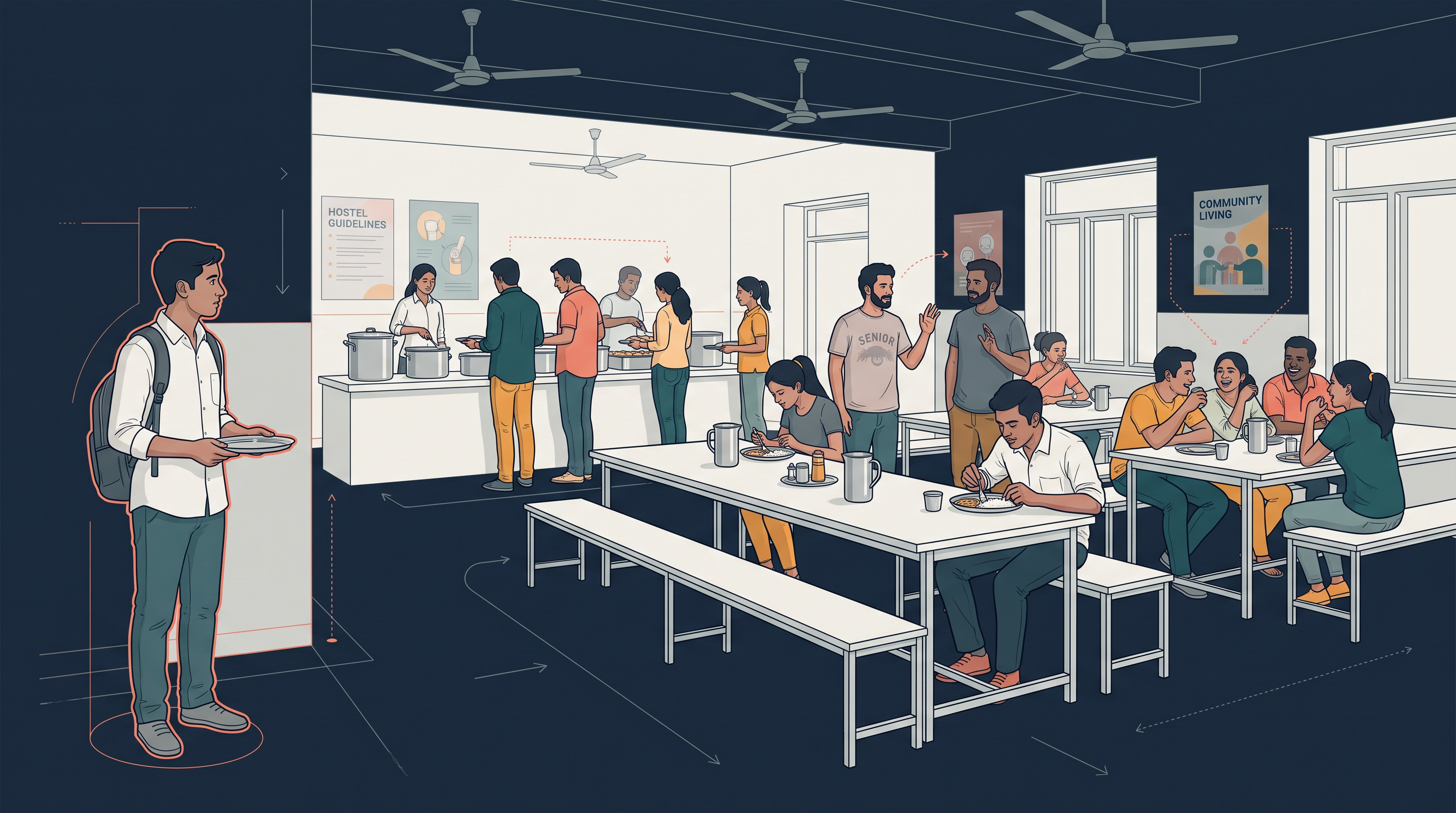
Fig. 4.1 – Learning a way of life through observation and imitation.
This chapter will help you answer each of these questions.
4.1 Introduction
‘Culture’ is one of those words we all use and few of us define. Like ‘society’, it is used often, and often vaguely. In everyday conversation the word is narrowed down to the arts — music, dance, painting — or stretched to describe the way of life of a whole class or a whole country.
Sociologists and anthropologists use the word more carefully. They study the social contexts within which culture exists, and they take culture apart, examining its different aspects and the relations between them. This chapter is meant to help you define culture more precisely, and to appreciate the several dimensions it has.
Culture as a map
Think of what happens when you enter unfamiliar territory. You need a map to find your way. Culture works in much the same way for social life: it is what allows you to conduct yourself in society, to know what to do and what is expected of you.
Culture, in this sense, is the common understanding that people in a group share. It is not something you are born with. It is learnt and developed through social interaction with others.
That common understanding does two things at once. It holds a group together, and it marks the group off from others, giving it an identity. When you can read the signals of a group correctly, you belong to it; when you cannot, you stand outside it.
Cultures are never finished
It would be a mistake, though, to picture a culture as a finished product handed down intact. Cultures are always changing and evolving.
Elements are constantly being added, deleted, expanded, shrunk and rearranged — a new word, a new festival greeting, a new food, a practice quietly abandoned. This is what makes cultures dynamic as functioning units, rather than fixed museum pieces.
What makes human beings different
Human beings are not the only creatures that live in groups. What distinguishes us from other animals is the capacity to develop a common understanding with others, and to draw the same meanings from signs and symbols.
A red light means stop; a folded hand means a greeting; a particular ringtone means your phone. None of this is obvious in itself. Creating meaning is a social virtue, in the sense that we can only learn it in the company of others — in families, in groups, in communities.
Through interaction with family members, friends and colleagues in different social settings, we learn two kinds of things. We learn the use of tools and techniques, and we learn the non-material signs and symbols by which people communicate. Much of this knowledge is systematically described and passed on, either orally or through books.
Meaning without words
Notice how much of this shared understanding travels without being spoken. Fig. 4.2 shows a short everyday exchange in which words and facial expressions do the work together.
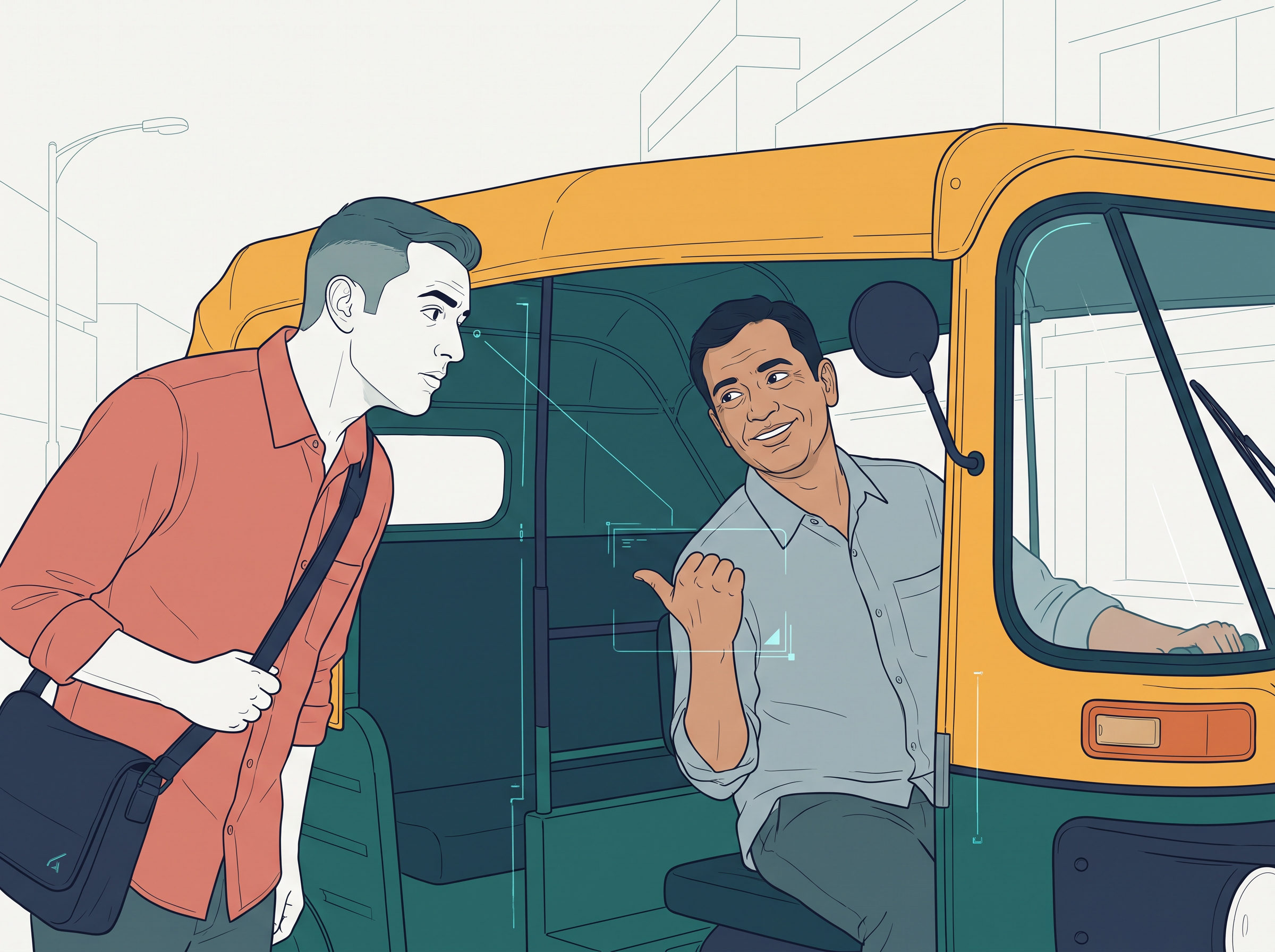
Fig. 4.2 – Meaning shared through non-verbal signs.
Learning to play our parts
This learning prepares us for carrying out our roles and responsibilities in society. You have already met the ideas of status and role in an earlier chapter; culture is what tells you how a particular role is to be performed here, in this society, among these people.
Much of this learning begins at home. What we learn in the family is primary socialisation; what we learn later in school and in other institutions is secondary socialisation. Both are part of the wider process by which a person becomes a member of society, and we shall look at that process in detail in section 4.3.
4.2 Diverse Settings, Different Cultures
Human beings do not live in one kind of place. They live in the mountains and on the plains, in forests and in cleared lands, in deserts and in river valleys, on islands and on mainlands. They also live in different social set-ups — villages, towns and cities.
Each of these settings sets its own problems. Water is scarce in one place and everywhere in another; the cold kills in one place and the heat in another; land is plentiful here and crowded there.
In different environments, people adapt different strategies to cope with the natural and the social conditions around them. Out of these strategies grow diverse ways of life — that is, diverse cultures. Look at Fig. 4.3 and ask what each way of life is a response to.
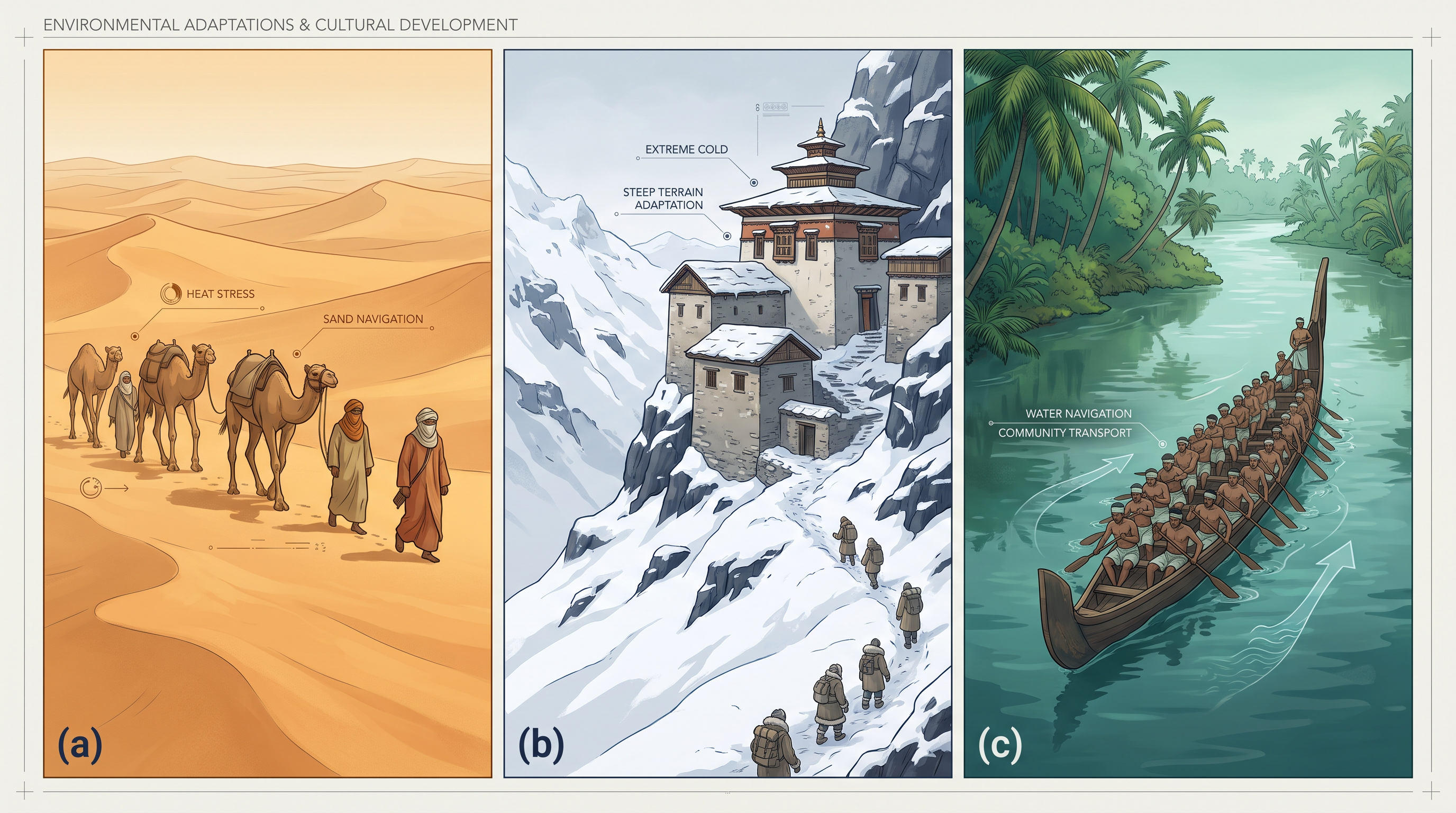
Fig. 4.3 – Diverse ways of life adapted to different environments: (a) desert, (b) mountains, and (c) backwaters.
Which culture copes better? A hard case
On 26 December 2004, a devastating tsunami struck parts of the Tamil Nadu and Kerala coast, as well as the Andaman and Nicobar Islands.
People on the mainland and on the islands are, in the main, integrated into a relatively modern way of life. Yet on the islands, the fisherfolk and the service personnel were caught unaware. They suffered large-scale devastation and much loss of life.
The tribal communities of the islands — the Onges, the Jarawas, the Great Andamanese, the Shompens — had no access to modern science and technology. Communities like these have often been labelled ‘primitive’ by outsiders. Yet, reading the signs of sea and land through knowledge built up over generations of living there, they foresaw the calamity and saved themselves by moving to higher ground.
The lesson is uncomfortable and important. Having access to modern science and technology does not make modern cultures superior to the tribal cultures of the islands.
Cultures therefore cannot be ranked. They can only be judged adequate or inadequate in terms of their ability to cope with the strains imposed by nature — and on that test, the answer varies with the situation.
4.2.1 Defining Culture
In ordinary speech, ‘culture’ often means refined taste — the ability to appreciate classical music, dance forms or painting. Refined taste of this kind was once thought to separate people from the ‘uncultured’ masses. The separation could be pushed to absurd lengths, right down to something we would today regard as a purely individual matter, such as preferring coffee to tea.
The sociologist looks at culture quite differently. Culture is not what distinguishes one individual from another; it is a way of life in which all members of a society participate. On this view every social organisation — a village, a school, an office, a cricket club — develops a culture of its own.
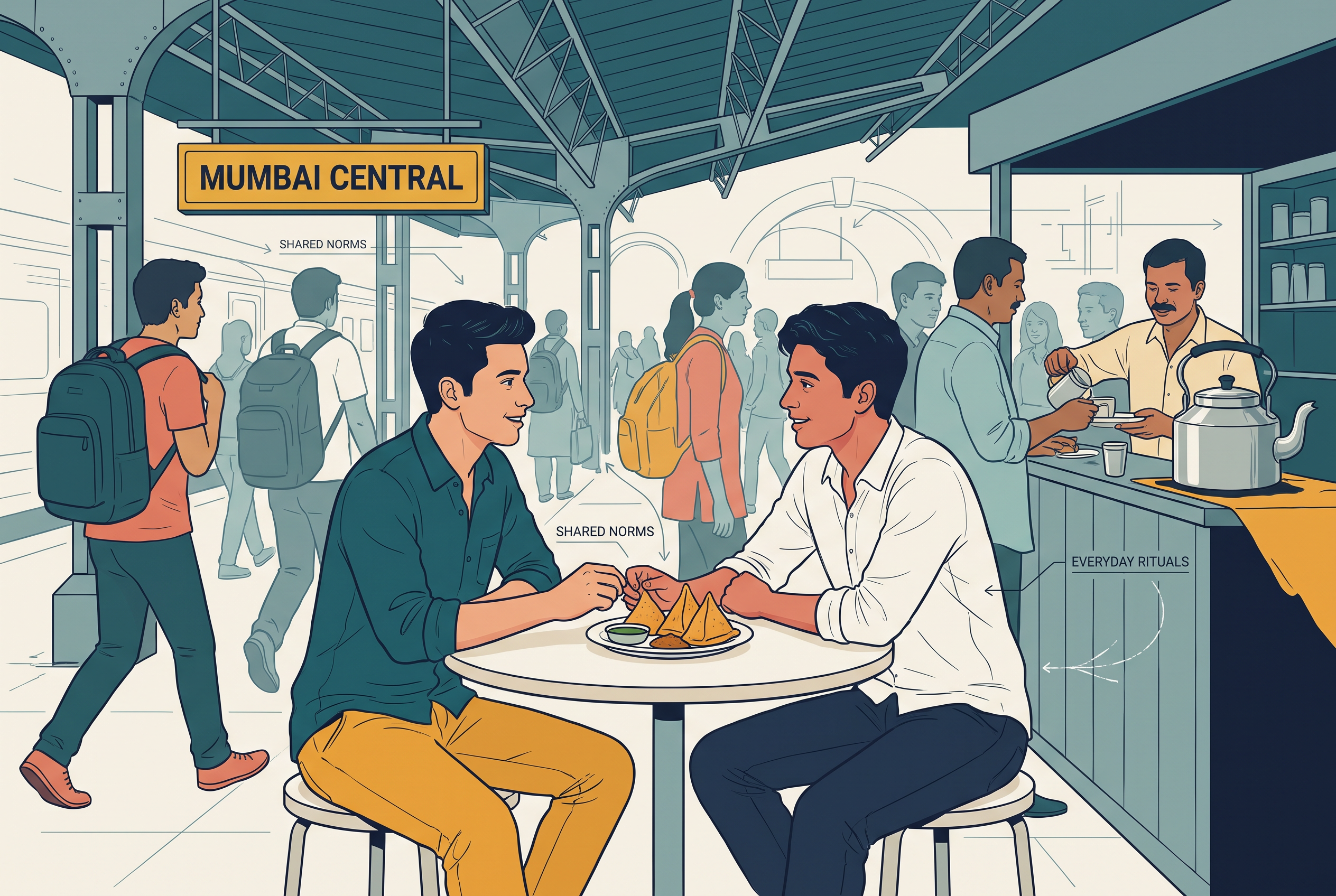
Fig. 4.4 – Culture as a shared everyday way of life.
Tylor: culture as a complex whole
One of the earliest anthropological definitions of culture comes from the British scholar Edward Tylor, writing in 1871. Culture, he said, taken in its wide ethnographic sense, is that complex whole which includes knowledge, belief, art, morals, law, custom, and any other capabilities and habits that a person acquires as a member of society.
Two things are worth noticing about this list. It is very wide — almost nothing a person learns from society is left out. And, apart from art, everything in it is non-material.
That is not because Tylor ignored material things. He was in fact a museum curator, and most of his anthropological writing was based on the examination of artifacts and tools from societies across the world, societies he had never visited. His definition is better read as an attempt to take in the intangible and abstract side of culture as well, so as to understand the societies he was studying as fully as he could.
Malinowski: culture includes things
Two generations later, Bronislaw Malinowski of Poland (1884–1942), the founder of the “functional school” of anthropology, defined culture as being made up of inherited artifacts and goods, technical processes, ideas, habits and values.
Malinowski’s own working life shaped his ideas. He happened to be stranded on an island in the Western Pacific during the First World War, and discovered in the process how much can be learnt by staying with a society for an extended period rather than visiting it briefly. Out of this grew the tradition of “field work”, which you will read about in Chapter 5.
Geertz and White: culture as meaning
Clifford Geertz suggested that we look at human actions in the same way as we look at words in a book — as conveying a message that has to be read. Human beings, he wrote, are suspended in “webs of significance” they have themselves spun, and culture is those webs.
The point of studying culture, on this view, is not to find a causal explanation but an interpretative one. The sociologist is searching for meaning: what does this act mean to the people doing it?
Leslie White placed a comparable emphasis on culture as a means of adding meaning to objective reality. Water from a particular source is chemically the same as any other water. When people regard it as holy, they have added a meaning to it that no chemical test will find.
So many definitions
The sheer number of definitions of culture in anthropological writing led two anthropologists from the United States, Alfred Kroeber and Clyde Kluckhohn, to publish a comprehensive survey of them in 1952, entitled Culture: A Critical Review of Concepts and Definitions. A sample of the definitions they gathered is given in Table 4.1.
Table 4.1 – A sample of definitions of culture, from the survey by Kroeber and Kluckhohn (1952) | | Culture is… | |—|—| | (a) | a way of thinking, feeling, believing. | | (b) | the total way of life of a people. | | (c) | an abstraction from behaviour. | | (d) | learned behaviour. | | (e) | a storehouse of pooled learning. | | (f) | the social legacy the individual acquires from his group. | | (g) | a set of standardised orientations to recurrent problems. | | (h) | a mechanism for the normative regulation of behaviour. |
Read the list slowly and you will first notice the words that keep recurring — ‘way’, ‘learn’ and ‘behaviour’.
Look next at how each is used, and the shifts in emphasis become striking. The first phrase points to mental ways of thinking and feeling; the second points to the total way of life of a people.
Definitions (d), (e) and (f) lay their stress somewhere else again — on culture as what is shared, pooled and passed on within a group and down the generations. And the last two phrases are the first in the list to speak of culture as a means of directing behaviour.
4.2.2 Dimensions of Culture
Culture is large and untidy. To study it, sociologists take it apart. Three dimensions of culture have been distinguished.
Cognitive: this refers to how we learn to process what we hear or see, so as to give it meaning — identifying the ring of a cell-phone as ours, recognising the cartoon of a politician.
Normative: this refers to rules of conduct — not opening other people’s letters, performing rituals at death.
Material: this includes any activity made possible by means of materials. Materials also include tools or machines. Examples include internet ‘chatting’, and using rice-flour paste to design kolam (a decorative floor pattern) on floors.
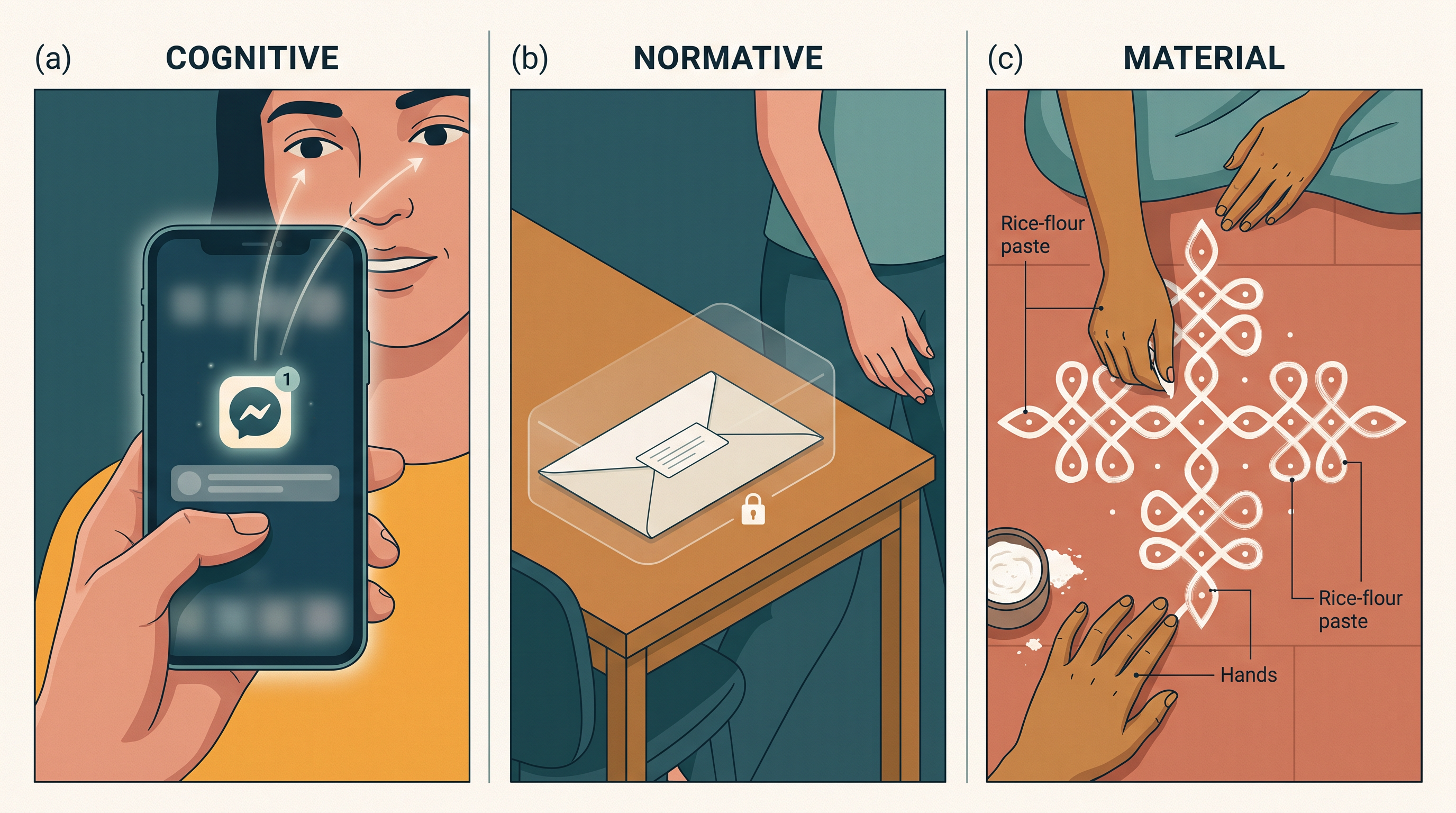
Fig. 4.5 – The three dimensions of culture: (a) cognitive, (b) normative, and (c) material.
The three are separated for study, not in life. You may already have felt that our understanding of material culture, especially art, is incomplete without knowledge drawn from the cognitive and normative areas as well.
That is quite true. Any developing understanding of a social process will draw on all three. In a community where few people have acquired the cognitive skill of literacy, it may actually become the norm for private letters to be read out by a third party — the cognitive fact reshapes the normative rule.
But focusing on each area separately, as we do below, provides many important insights.
4.2.3 Cognitive Aspects of Culture
The cognitive aspects of one’s own culture are the hardest of the three to recognise. Material aspects are tangible, visible or audible. Normative aspects are explicitly stated. Cognitive aspects are simply how you make sense of things, and they feel less like culture than like common sense.
Cognition refers to understanding — how we make sense of all the information coming to us from our environment.
Societies store and transmit that understanding in different ways. In literate societies, ideas are transcribed in books and documents, and preserved in libraries, institutions or archives. In non-literate societies, legend and lore are committed to memory and transmitted orally, and there are specialist practitioners of oral tradition, trained to remember and to narrate during ritual or festive occasions.
What writing does to knowledge
Consider how writing may affect the production and consumption of art. In his influential book Orality and Literacy, Walter Ong cites a study of 1971 which states that only 78 of the approximately 3,000 languages then existing possess a literature.
Ong suggests that material which is not written down has certain specific characteristics. There is a great deal of repetition of words, which makes the material simpler to remember. The audience of an oral performance is likely to be more receptive and involved than a reader would be of a written text from an unfamiliar culture. And texts become more elaborate once they are written.
Literacy, privilege and its uses
In societies like ours, literacy has historically been made available only to the more privileged. That history still shapes who reads and who does not.
Sociological studies are therefore often concerned with investigating how literacy can be made relevant to the lives of people whose families have never gone to school. Such studies can produce unexpected responses — like the vegetable-seller who asked why he needed to know the alphabet when he could work out in his head exactly what each customer owed him.
The contemporary world allows us to rely far more on written, audio and visual records than any earlier one. Yet students of Indian classical music are still discouraged from writing down what they learn, and are expected to carry it in memory instead.
We still do not know enough about the impact of the electronic media, of multiple channels, and of instant accessing and surfing. Whether these new forms are changing our attention span, and with it our cognitive culture, is an open question — and a good one to keep asking.
4.2.4 Normative Aspects of Culture
The normative dimension consists of folkways, mores, customs, conventions and laws. These are the values or rules that guide social behaviour in different contexts.
Why do we follow them? Most often, simply because we are used to doing so. Social norms are learnt so early, through socialisation, that following them feels natural rather than obligatory.
But they are not left to chance. All social norms are accompanied by sanctions — the rewards and punishments, from a smile or an approving word to ridicule, exclusion or a fine, that promote conformity. Social control, which you met in Chapter 2, works largely through them. Fig. 4.6 sets out the two routes by which conduct is regulated.
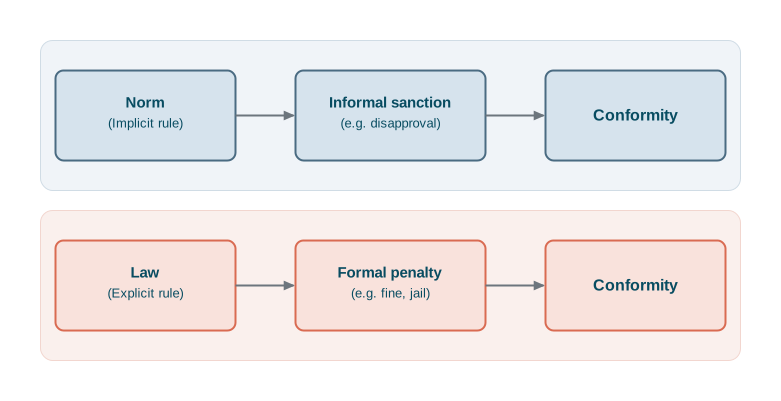
Fig. 4.6 – Two routes of social control: norms and laws.
Norms are implicit, laws are explicit
Norms are implicit rules. They are rarely written down, and often nobody can quite state them until someone breaks one.
The French sociologist Pierre Bourdieu reminded us that when we try to understand another culture’s norms, we must remember that there are certain implicit understandings at work beneath them. Suppose a person wants to show gratitude for something they have been given. If they offer a return-gift too quickly, it will not read as gratitude at all; it will seem like an attempt to get rid of a debt rather than a friendly gesture. Nobody has stated the rule. Everyone knows it.
Laws, by contrast, are explicit rules.
The difference is easy to see in an example. If in your home children are not allowed to stay outdoors after sundown, that is a norm. It is specific to your family and may not apply to any other. But if you are caught stealing a gold necklace from someone else’s home, you have violated the universally accepted law of private property, and you can be sent to jail after trial as punishment.
Laws derive from the authority of the State, and are therefore the most formal definitions of acceptable behaviour that a society has. Different schools may establish different norms for their students; the law, however, applies to all those accepting the authority of the State.
Whose norms?
There is one more difference, and it matters. Unlike laws, norms can vary according to status.
Dominant sections of society apply dominant norms, and these norms are often discriminating. Norms that did not allow dalits to draw drinking water from the same vessel, or even the same source, as others are one example. Norms that kept women from moving freely in the public sphere are another.
The point is not that norms are always unjust. It is that a norm is never simply ‘what everybody does’. It is worth asking, of any norm, who laid it down, whom it binds most tightly, and whom it serves.
4.2.5 Material Aspects of Culture
The material aspect of culture refers to tools, technologies, machines, buildings and modes of transportation, as well as instruments of production and communication.
In urban areas, the widespread use of mobile phones, music systems, cars and buses, ATMs (automated teller machines), refrigerators and computers in everyday life indicates a deep dependence on technology.
Rural life is no less material. Even in rural areas, the use of transistor radios, or of electric motor pumps for lifting water from below the surface for irrigation, demonstrates the adoption of technological devices for increasing production.
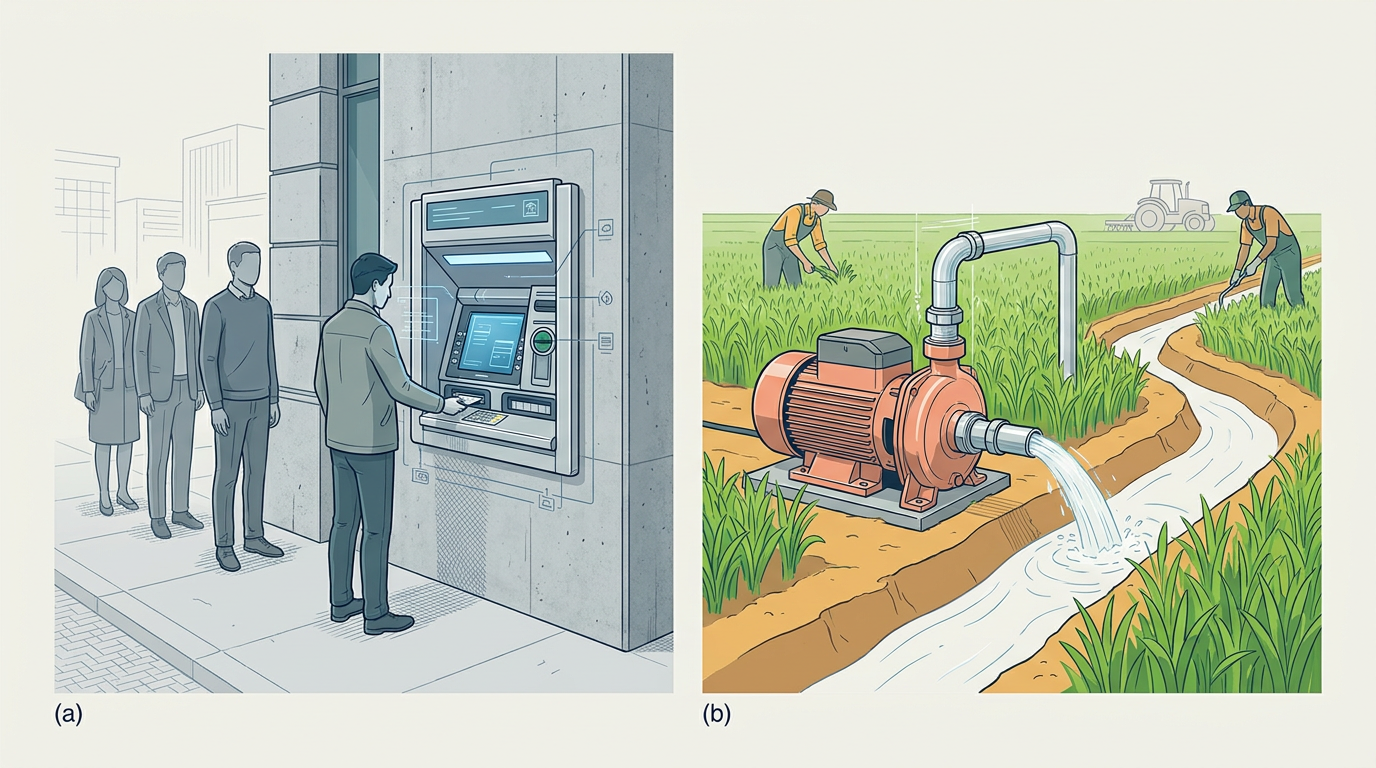
Fig. 4.7 – The material dimension of culture: (a) urban ATM and (b) rural motor pump.
Material and non-material, and the gap between them
In sum, there are two principal dimensions of culture: material and non-material. The cognitive and the normative aspects are non-material; the material dimension is crucial for increasing production and enhancing the quality of life.
For a culture to function in an integrated way, the material and the non-material dimensions must work together. Tools are useless without ideas about how and by whom they may be used.
But the two do not always change at the same speed. When the material or technological dimensions change rapidly, the non-material aspects can lag behind in terms of values and norms. This gives rise to a situation of culture lag.
4.2.6 Culture and Identity
Identities are not inherited. They are fashioned, both by the individual and by the group, through their relationship with others.
For the individual, the social roles that she or he plays impart identity. Every person in modern society plays multiple roles. Within the family the same person may be a parent or a child, and for each specific role there are particular responsibilities and powers.
But it is not sufficient to enact roles. They also have to be recognised and acknowledged by others.
The languages we make
Recognition is often achieved through the particular language used among the people who play a set of roles together.
Students in a school have their own way of referring to their teachers, to other students, and to class performances. By creating this language, which also serves as a code, they create their own world of meanings and significances — one that outsiders cannot fully enter.
Women, similarly, are known to create their own language, and through it their own private space beyond the control of men, especially where they gather: at the pond to bathe in rural areas, or across the washing lines on rooftops in urban ones.
Sub-cultures
Within a culture there can be many sub-cultures — that of the elite, for instance, and that of working class youth.
Sub-cultures are marked by style, taste and association. Particular sub-cultures are identifiable by their speech, their dress codes, their preference for a particular kind of music, or the manner in which their members interact with one another.
Sub-cultural groups can also function as cohesive units which impart an identity to all their members. Within such groups there can be leaders and followers, but the members are bound together by the purpose of the group and work together to achieve their objectives.
Take the young members of a neighbourhood who form a club to engage themselves in sports and other constructive activities. Such activities create a positive image of the members in the locality. This gives them not only a positive self-image but also inspires them to perform better in what they do.
The orientation of their identity as a group thus undergoes a transformation. The group becomes able to differentiate itself from other groups, and so to create its own identity, through the acceptance and recognition it wins in the neighbourhood.
4.2.7 Ethnocentrism
As long as a culture is alone, the question does not arise. It is only when cultures come into contact with one another that the question of ethnocentrism arises.
Ethnocentrism is the application of one’s own cultural values in evaluating the behaviour and beliefs of people from other cultures. One’s own cultural values are projected as the standard or the norm, and are considered superior to the beliefs and values of everyone else.
You have already seen, in Chapter 1 and in the discussion of religion in Chapter 3, that sociology is an empirical and not a normative discipline. It studies what people do and why; it does not hand out marks to cultures for good behaviour. Ethnocentrism is precisely the reverse habit.
Ethnocentrism in colonial situations
Underlying ethnocentric comparisons is a sense of cultural superiority, and nowhere was this more clearly demonstrated than in colonial situations.
Thomas Babbington Macaulay’s famous Minute on Education, written in 1835 for the East India Company in India, is a plain example. Its aim, he argued, must be to form a class who could act as interpreters between the rulers and the millions they governed — a class of persons “Indian in blood and colour but English in tastes, in opinions, morals and intellect”.
The assumption behind the sentence is the whole of ethnocentrism in miniature: one culture is taken as the standard, and the other is valued only to the extent that it can be remade in that image.
Cosmopolitanism
Ethnocentrism has an opposite: cosmopolitanism, which values other cultures for their difference.
A cosmopolitan outlook does not seek to evaluate the values and beliefs of other people according to one’s own. It celebrates and accommodates different cultural propensities within its fold, and it promotes cultural exchange and borrowing as a way of enriching one’s own culture.
The English language is a good illustration. It has emerged as a leading vehicle of international communication precisely because of its constant inclusion of foreign words into its vocabulary. The popularity of Hindi film music can likewise be attributed to its borrowings — from western pop music, and from different traditions of Indian folk and semi-classical forms like the bhangra and the ghazal.
Borrowing does not mean dissolving
A modern society is appreciative of cultural difference and does not close its doors to cultural influences from abroad. But such influences are always incorporated in a distinctive way, combining with elements of indigenous culture.
English, despite its foreign inclusions, does not become a separate language. Hindi film music does not lose its character through its borrowings. The absorption of diverse styles, forms, sounds and artifacts is exactly what gives a cosmopolitan culture its identity.
In a global world, where modern means of communication are shrinking the distances between cultures, a cosmopolitan outlook allows diverse influences to enrich one’s own culture rather than threaten it.
4.2.8 Cultural Change
Cultural change is the way in which societies change their patterns of culture. Since a culture is a way of life rather than a fixed object, change is not an interruption of culture; it is one of its ordinary conditions.
The impetus for change can be internal or external.
Internally, for instance, new methods of farming or agriculture can boost agricultural production, which can in turn transform the nature of food consumption and the quality of life of an agrarian community. Nobody has invaded; the change comes from within.
Externally, intervention in the form of conquest or colonisation can also bring about deep-seated changes in the cultural practices and behaviour of a society.
Three routes to change
Cultural change can occur through changes in the natural environment, through contact with other cultures, or through processes of adaptation. Fig. 4.8 sets these out.
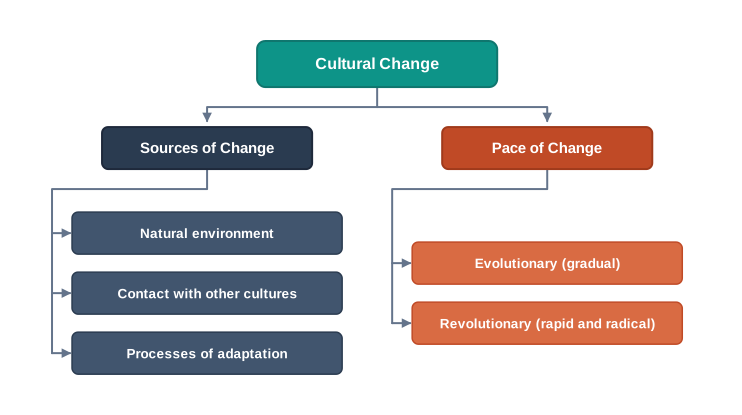
Fig. 4.8 – Sources and pace of cultural change.
Changes in the natural environment or ecology can drastically alter the way of life of a people. When forest-dwelling communities are deprived of access to the forest and its produce — whether because of legal restrictions or because the forest itself has been decimated — the effects on the dwellers and on their way of life can be disastrous. Their food, their work, their medicine, their rituals and their calendar were all built around the forest.
Tribal communities in North East India, as well as in middle India, have been the worst affected by the loss of forest resources.
Evolutionary and revolutionary change
Along with evolutionary change there can also be revolutionary change.
Evolutionary change is gradual. New elements are absorbed slowly, and the values and meaning systems of a culture shift over long stretches of time without any single dramatic break.
Revolutionary change takes place when a culture is transformed rapidly, and its values and meaning systems undergo a radical change. Revolutionary change can be initiated through political intervention, technological innovation or ecological transformation.
The French Revolution of 1789 is the classic instance. It transformed French society by destroying the estates system of ranking — the feudal arrangement in which the nobility, the clergy and the ‘third estate’ were ranked and represented separately, and in which peasants and labourers had no vote. It abolished the monarchy, and it inculcated the values of liberty, equality and fraternity among its citizens.
Notice what actually changed. Once a different understanding of who a person is, and what a person is owed, comes to prevail, culture change has occurred. The values are the change.
Is the media changing us slowly or suddenly?
Recent years have seen an amazing expansion of the media, both electronic and print. Whether this amounts to evolutionary or revolutionary change is a live question, and there is a case on each side.
We are now familiar with the various dimensions of culture — cognitive, normative and material — with the identities cultures give us, with the ethnocentrism that arises when cultures meet, and with the ways in which cultures change.
That leaves the question we began with in Chapter 1: how do the individual and society actually meet? Culture, after all, does not float above people. It has to get into them. The process by which it does so is called socialisation, and we turn to it now.
4.4 Summary
‘Culture’, like ‘society’, is used loosely in everyday speech — sometimes for the arts, sometimes for the way of life of a class or a country. Sociologists and anthropologists use it more precisely, studying the social contexts in which culture exists and examining the relations between its aspects.
Culture is the common understanding shared by a group, learnt and developed through social interaction. It binds a group together and marks it off from others, giving it an identity.
Cultures are never finished products. Elements are constantly added, deleted, expanded, shrunk and rearranged, which makes cultures dynamic as functioning units.
What distinguishes human beings from other animals is the capacity to build a common understanding with others and to draw the same meanings from signs and symbols. Meaning is created socially, in the company of others, and much of it travels without words.
What we learn in the family is primary socialisation; what we learn in school and other institutions is secondary socialisation.
People live in different natural and social settings and adapt different strategies to cope with them. Out of these strategies grow diverse ways of life — that is, diverse cultures.
The tsunami of 26 December 2004 showed that access to modern science and technology does not make a culture superior: island communities without such access read the warning signs and moved to higher ground. Cultures cannot be ranked; they can only be judged adequate or inadequate in their ability to cope with the strains imposed by nature.
Everyday usage treats culture as refined taste, separating the ‘cultured’ from the ‘uncultured’. The sociologist sees culture as a way of life in which all members of a society participate, and holds that every social organisation develops a culture of its own.
Tylor (1871) defined culture as the complex whole of knowledge, belief, art, morals, law, custom and every other capability and habit acquired by a person as a member of society. Apart from art, his list is non-material.
Malinowski (1931) added the material side — inherited artifacts and goods, technical processes, ideas, habits and values. His long stay on a Western Pacific island during the First World War helped establish the tradition of field work.
Geertz asked us to read human action as we read words in a book, searching for meaning rather than for causes. Leslie White likewise saw culture as a means of adding meaning to objective reality.
Kroeber and Kluckhohn’s survey of 1952 gathered the many competing definitions of culture. Across them the recurring words are ‘way’, ‘learn’ and ‘behaviour’, and the emphasis shifts from mental ways to the total way of life, then to what is shared and passed down, and finally to culture as a means of directing behaviour.
Culture has three dimensions: cognitive (how we process what we see and hear so as to give it meaning), normative (rules of conduct), and material (activities made possible by materials, tools and machines).
Cognitive aspects are the hardest to notice in one’s own culture. Literate societies store ideas in books and archives; non-literate societies commit legend and lore to memory and transmit them orally through trained practitioners. Ong noted that unwritten material is repetitive so as to be memorable, and that texts become more elaborate once written. In societies like ours, literacy was historically available only to the more privileged.
The normative dimension consists of folkways, mores, customs, conventions and laws. Norms are implicit rules backed by sanctions that promote conformity; laws are explicit rules defined by government, applying to the whole society and carrying penalties and punishment. Unlike laws, norms vary according to status, and dominant sections apply dominant norms — often discriminating ones.
The material dimension covers tools, technologies, machines, buildings, transport, and instruments of production and communication. Culture thus has two principal dimensions, material and non-material, and they must work together. When technology changes faster than values and norms, culture lag results.
Identities are not inherited but fashioned through relationships with others. Social roles impart identity, but roles must also be recognised and acknowledged, often through the shared language of those who play them. Sub-cultures, marked by style, taste and association, give their members identity and a positive self-image.
Ethnocentrism is the judging of other cultures by the standards of one’s own; Macaulay’s Minute on Education (1835) is a colonial example. Its opposite is cosmopolitanism, which values other cultures for their difference and welcomes exchange. Borrowing does not dissolve a culture: English absorbs foreign words without ceasing to be English, and Hindi film music absorbs many traditions without losing its character.
Cultural change may be driven internally or externally, and may come through changes in the natural environment, through contact with other cultures, or through processes of adaptation. Evolutionary change is gradual; revolutionary change transforms values and meaning systems rapidly, as the French Revolution of 1789 did in destroying the estates system, abolishing the monarchy and instilling the values of liberty, equality and fraternity.
Socialisation is the process whereby the helpless infant gradually becomes a self-aware, knowledgeable person, skilled in the ways of the culture into which she or he is born. Without it, a person would not behave like a human being, as the reported case of the ‘Wolf-children of Midnapore’ is used to suggest.
Socialisation is life-long, though the early years are the most critical. It also works both ways: the arrival of a child changes the lives of parents and grandparents too. It is not ‘cultural programming’ — even a newborn asserts its will.
Every child belongs at once to a family, a kin-group, and a wider society of caste or tribe, religion and language, each imposing norms and values and calling for multiple roles performed simultaneously. Norms and values differ across castes, classes, regions and religions, and between village and city; even the language, and the form of language, one speaks depends on the family’s location in society.
The agencies of socialisation are the family, the school, the peer group, the neighbourhood, the occupational group, the mass media, and social class or caste, region and religion.
The family is the first agency, and its ‘location’ in society shapes a child’s prospects sharply. Peer groups are friendship groups of similar age — sometimes formalised as age-grades — and are reasonably egalitarian, allowing rules of behaviour to be tested and explored rather than merely obeyed.
Schools socialise through a formal curriculum and also through a hidden curriculum, which teaches, among other things, who is expected to do which tasks. The mass media reach places other agencies cannot; the extent of their influence is certain, though its effects — such as the link between on-screen violence and aggression — remain debated. Work is a further important setting for socialisation, especially in industrial societies where people go out to work.
Socialisation can never completely reduce people to conformity, since socialising agencies conflict with one another. Nor does it rob us of free will. It is in the course of socialisation that each of us develops a sense of self-identity and the capacity for independent thought and action.
4.5 Key Terms
Age-grades — Formally recognised bands of people of the same age, who move through the stages of life together; a formalised peer group found particularly in small traditional societies.
Cognitive dimension of culture — How we learn to process what we hear or see so as to give it meaning, such as recognising a familiar ringtone or a cartoon of a public figure.
Cosmopolitanism — An outlook that values other cultures for their difference, does not judge them by one’s own standards, and welcomes cultural exchange and borrowing as enrichment.
Cultural change — The way in which societies change their patterns of culture, whether through internal causes, contact with other cultures, changes in the environment, or processes of adaptation.
Cultural evolutionism — A theory of culture which argues that, just as natural species do, culture also evolves through variation and natural selection.
Culture — The common understanding shared by the members of a group; a whole way of life, learnt and developed through social interaction, in which all members of a society participate.
Culture lag — The situation that arises when the non-material aspects of a culture, its values and norms, are unable to keep pace with rapid advances in technology.
Estates system — A system of ranking by occupation in feudal Europe, in which the nobility, the clergy and the ‘third estate’ (chiefly professional and middle class people) each elected their own representatives, while peasants and labourers had no vote.
Ethnocentrism — Judging the behaviour and beliefs of other cultures by the standards of one’s own, and treating one’s own cultural values as superior.
Evolutionary change — Gradual cultural change, in which elements are slowly added, dropped or rearranged without any single dramatic break.
Great Tradition — The cultural traits or traditions which are written down and widely accepted by the educated and learned elites of a society.
Hidden curriculum — What a school teaches without stating it in the syllabus — obedience, hierarchy, punctuality, and often ideas about what boys and girls are respectively fit to do.
Law — A formal sanction defined by government as a rule or principle that citizens must follow; laws are explicit, apply to the whole society, and their violation attracts penalties and punishment.
Little Tradition — The cultural traits or traditions which are oral and which operate at the village level.
Mass media — Newspapers, radio, television, film and the internet, through which information and images reach large numbers of people, including those beyond the reach of roads or schools.
Material dimension of culture — Any activity made possible by means of materials, including tools, machines, buildings and modes of transport and communication.
Normative dimension of culture — The rules of conduct that guide social behaviour — folkways, mores, customs, conventions and laws.
Peer group — A friendship group of people of a similar age, in which relations are relatively egalitarian and rules of behaviour can be tested out rather than simply obeyed.
Primary socialisation — The socialisation that takes place in the family in the early years of life; the most critical stage of the process.
Revolutionary change — Rapid cultural change in which the values and meaning systems of a society undergo a radical transformation, often set off by political intervention, technological innovation or ecological transformation.
Sanctions — The rewards and punishments, formal or informal, that accompany social norms and promote conformity to them.
Secondary socialisation — The socialisation that takes place outside the family, in school and other institutions, and which extends over the entire life of a person.
Self-identity — A person’s sense of who she or he is, developed in the course of socialisation, along with the capacity for independent thought and action.
Self-image — An image of a person as reflected in the eyes of others.
Social norms — The implicit rules of a group about how one ought to behave; unlike laws, they vary according to group and status.
Social roles — The rights and responsibilities associated with a person’s social position or status.
Socialisation — The process by which we learn to become members of society; the process whereby a helpless infant gradually becomes a self-aware, knowledgeable person, skilled in the ways of the culture into which she or he is born.
Sub-culture — A group of people within a larger culture who borrow from it, and often distort, exaggerate or invert its symbols, values and beliefs, in order to distinguish themselves.
4.6 Points to Ponder
If cultures cannot be ranked as higher or lower, on what grounds can they be judged at all — and who decides what counts as coping ‘adequately’ with a situation?
We now rely far more on written, audio and visual records than any earlier generation, and much less on memory. Do instant access, multiple channels and endless scrolling change our attention span, and with it our cognitive culture?
Has the expansion of the media brought about evolutionary change or revolutionary change in Indian society? What evidence would settle the question either way?
Norms vary according to status, and dominant sections of society apply dominant norms. If that is so, how does a norm that once seemed natural to almost everyone come to be seen as unjust?
A school teaches through its formal curriculum and through its hidden curriculum. Which of the two do you think you have learnt more from — and how would you find out?
Socialisation is said to be the origin of our individuality rather than its enemy. Can a person be entirely original — thinking a thought that no society gave them the means to think?
Cosmopolitanism welcomes borrowing from other cultures, and borrowing does not dissolve a culture. Where, then, would you draw the line between a culture that is enriched by outside influences and one that is losing its character?
4.7 NCERT Questions
How does the understanding of culture in social science differ from the everyday use of the word ‘culture’?
How can we demonstrate that the different dimensions of culture comprise a whole?
Compare two cultures with which you are familiar. Is it difficult not to be ethnocentric?
Discuss two different approaches to studying cultural change.
Is cosmopolitanism something you associate with modernity? Observe and give examples of ethnocentrism.
In your view, which is the most effective agent of socialisation for your generation? How do you think it was different before?
4.8 Objective Questions
- Who described culture as “that complex whole” which includes knowledge, belief, art, morals, law, custom and other capabilities acquired by a person as a member of society?
- Bronislaw Malinowski
- Edward Tylor
- Clifford Geertz
- Leslie White [1 mark]
- The survey Culture: A Critical Review of Concepts and Definitions (1952) was published by:
- Tylor and Malinowski
- Geertz and White
- Kroeber and Kluckhohn
- Ong and Bourdieu [1 mark]
- Which of the following is an example of the material dimension of culture?
- Not opening other people’s letters
- Recognising the ring of your own cell-phone
- Using rice-flour paste to design a kolam on the floor
- Performing rituals at death [1 mark]
- During the tsunami of 26 December 2004, which of the following island communities are described in the chapter as having foreseen the calamity through their experiential knowledge?
- The Onges, Jarawas, Great Andamanese and Shompens
- The fisherfolk of the mainland coast
- The service personnel posted on the islands
- The residents of the Kerala backwaters [1 mark]
- The word ‘peer’ means:
- elder
- equal
- leader
- outsider [1 mark]
- The French Revolution of 1789 is described in the chapter as an example of revolutionary change because it destroyed:
- the age-grade system
- the estates system of ranking
- the guild system of production
- the monarchy alone [1 mark]
- Culture lag refers to a situation in which:
- a society refuses to accept any technology from outside
- the material dimension of culture fails to develop at all
- values and norms are unable to keep pace with advances in technology
- two cultures come into contact and judge each other [1 mark]
- Assertion (A): Cultures cannot be ranked as superior or inferior. Reason (R): Cultures can only be judged adequate or inadequate in terms of their ability to cope with the strains imposed by nature.
- Both A and R are true, and R is the correct explanation of A.
- Both A and R are true, but R is not the correct explanation of A.
- A is true, but R is false.
- A is false, but R is true. [1 mark]
- Assertion (A): Norms are implicit rules, while laws are explicit rules. Reason (R): Laws derive from the authority of the State and apply to all those accepting that authority.
- Both A and R are true, and R is the correct explanation of A.
- Both A and R are true, but R is not the correct explanation of A.
- A is true, but R is false.
- A is false, but R is true. [1 mark]
- Assertion (A): Socialisation is a kind of cultural programming in which the child passively absorbs the influences around it. Reason (R): Even a newborn asserts its will, and the everyday schedules of a family are reorganised around it.
- Both A and R are true, and R is the correct explanation of A.
- Both A and R are true, but R is not the correct explanation of A.
- A is true, but R is false.
- A is false, but R is true. [1 mark]
- Match the thinker in Column A with the idea in Column B.
| Column A | Column B |
|---|---|
| a. Edward Tylor | i. Culture consists of inherited artifacts, goods, technical processes, ideas, habits and values |
| b. Bronislaw Malinowski | ii. Human beings are suspended in webs of significance they have themselves spun |
| c. Clifford Geertz | iii. Culture is that complex whole which includes knowledge, belief, art, morals, law and custom |
| d. Pierre Bourdieu | iv. Behind the norms of any culture lie certain implicit understandings |
[1 mark]
- Match the term in Column A with its meaning in Column B.
| Column A | Column B |
|---|---|
| a. Hidden curriculum | i. A group within a larger culture that borrows from it and distorts, exaggerates or inverts its symbols to distinguish itself |
| b. Age-grades | ii. What a school teaches without stating it in the syllabus |
| c. Sub-culture | iii. Rewards and punishments that promote conformity to norms |
| d. Sanctions | iv. Peer groups formalised into recognised bands of people of the same age |
[1 mark]
- Fill in the blanks.
- The three dimensions of culture are __________, __________ and material.
- Thomas Babbington Macaulay’s Minute on Education was written in the year __________.
- The two girls of the ‘Wolf-children of Midnapore’ were reportedly found in a wolf den in Bengal in __________.
- The normative dimension of culture consists of folkways, mores, customs, conventions and __________. [1 mark]
- State whether the following statements are true or false.
- Cognitive aspects of one’s own culture are easier to recognise than material aspects.
- Unlike laws, norms can vary according to status.
- In his 1971 study cited by Walter Ong, only 78 of approximately 3,000 existing languages possessed a literature.
- Socialisation ends with childhood. [1 mark]
4.9 Check Your Concepts
Define culture as sociologists use the term. [2 marks]
Name the three dimensions of culture and give one example of each. [2 marks]
What is meant by culture lag? Give one example. [2 marks]
What is a sub-culture? State any two features by which a sub-culture can be identified. [2 marks]
What is meant by the hidden curriculum of a school? [2 marks]
Define socialisation. [2 marks]
What are sanctions, and why does every social norm need them? [2 marks]
Differentiate between norms and laws, giving one example of each. [4 marks]
Differentiate between primary socialisation and secondary socialisation. [4 marks]
Distinguish between ethnocentrism and cosmopolitanism, with an example of each. [4 marks]
Why does the chapter conclude that cultures cannot be ranked? Explain with reference to the tsunami of 26 December 2004. [4 marks]
What does Malinowski’s definition of culture include that Tylor’s leaves out, and why does the difference matter? [4 marks]
Explain, with an Indian example, why the material and non-material dimensions of culture must work together. [4 marks]
Why is the peer group a different kind of socialising agency from the family? Give reasons. [4 marks]
Look again at Table 4.1. Sort the definitions listed there into three groups: those that stress culture as a way of thinking or a way of life; those that stress culture as what is shared and passed on down the generations; and those that stress culture as a means of directing behaviour. Give reasons for your grouping. [4 marks]
Explain the cognitive, normative and material dimensions of culture in detail, and show with examples how they comprise a single whole rather than three separate things. [6 marks]
“Socialisation robs the individual of individuality and free will.” How far do you agree? Answer with reference to the diversity of socialising agencies and to the conflicts between them. [6 marks]
Discuss the two approaches to studying cultural change — evolutionary and revolutionary — and evaluate whether the expansion of the media in India is better described as one or the other. [6 marks]
Explain ethnocentrism with reference to colonial education policy in India, and then evaluate the claim that a cosmopolitan outlook enriches a culture rather than dissolving it. [6 marks]
Describe the main agencies of socialisation, and evaluate which of them shapes children most sharply today. Support your answer with reasons drawn from the chapter. [6 marks]
Explain why norms, unlike laws, vary according to status. Discuss, with examples from the chapter, how dominant norms can be discriminating, and what this tells us about the relation between culture and power. [6 marks]
4.10 Passage-Based Questions
- Read the passage and answer the questions that follow.
A village that once depended on a single open well now has an electric pump and a piped supply that reaches a common tap near the temple. The water is plentiful and the machine is new. The order of the queue, however, is exactly the order that used to be observed at the old well: some households draw water first, and some are expected to wait until the others have finished. Nobody has written this rule down anywhere, and nobody enforces it openly. A young man who has come home from college finds the arrangement odd and says so; the silence that follows at the tea shop that evening tells him what the village thinks of his question.
a. Identify the normative aspects of culture at work in this passage, and explain how the queue is being regulated even though no law and no written rule is involved. [2 marks]
b. The technology has changed but the norms have not. Which concept from the chapter describes this situation? Explain it with reference to the passage. [2 marks]
c. What kind of sanction does the young man face, and what does it show about how norms vary according to status? [2 marks]
[6 marks]
- Read the passage and answer the questions that follow.
At the start of the new session, a school introduces a rotation for classroom cleaning. Every student, boy or girl, takes a turn with the broom and the duster on the days marked against their name. In the first week, several students say the arrangement feels strange; a few parents write to the school to ask whether this is a proper use of school time. The timetable itself has not changed at all — the same subjects are taught in the same periods. Yet the staff room agrees that something is being taught.
a. Explain what is being taught here that is not in the syllabus. Name the concept and define it. [2 marks]
b. Why do the arrangement and the objections to it both count as evidence about socialisation? [2 marks]
c. The students find at home a different expectation from the one the school now sets. Which idea from the chapter does this illustrate, and why does it matter for individual freedom? [2 marks]
[6 marks]
- Read the passage and answer the questions that follow.
A student from a hill district joins a college in a large plains city. In his first month, he finds the food strange, the festivals unfamiliar and the local way of speaking too fast, and he says openly that people back home do things properly. By the second year, he eats what his hostel mates eat, has picked up a hundred words of the local language, and has taught his friends two songs from his own district, which they now sing badly and enthusiastically. When he goes home in the holidays, his cousins tell him he has begun to talk differently.
a. Identify the outlook the student shows in his first month, and define it. [2 marks]
b. Identify the outlook he shows by the second year, and explain how it differs from the first. [2 marks]
c. His cousins say he has changed, but he still speaks his own language and sings his own songs. Using the chapter, explain why borrowing from another culture does not mean losing one's own. [2 marks]
[6 marks]
- Read the passage and answer the questions that follow.
In one household, a grandmother can recite long stretches of an epic that she never learnt from a book; she was taught it by her aunt, and she performs parts of it at festivals. Her grandson watches the same epic as a serial on a phone screen, pausing and skipping as he likes, and he cannot recite a single line of it. The two of them argue mildly about which version is the real one. The grandmother says her version has more in it. The grandson says his has better sound.
a. Which dimension of culture is chiefly at issue here? Explain your answer. [2 marks]
b. Using the chapter's discussion of oral and written transmission, explain two differences between how the grandmother's knowledge is stored and how her grandson's is. [4 marks]
[6 marks]
4.3 Socialisation
The Kannada writer Vaidehi, looking back in 1945 on the home she grew up in, described a complete life as one that included everything around her — plants, cattle, guests, feasts, festivals, quarrels, friendship, companionship, and also discrimination and scorn. All of it, she wrote, was present in that one place. Life there sometimes seemed complicated at the time; only later did she understand how complete it had been. It is thanks to such a childhood, she suggests, that a glimpse of another person’s suffering is enough for her to comprehend the whole of it. Notice what a childhood home teaches: not only warmth, but also the harsher lessons of a society.
At the time of birth, a human infant knows nothing about what we call society or social behaviour. It cannot walk, speak, feed itself or recognise a stranger.
Yet as the child grows up, she or he keeps learning — not just about the physical world, but about what it means to be a good or a bad girl or boy. The child comes to know what kind of behaviour will be applauded, and what kind will be disapproved.
That whole process has a name.
Socialisation is the process whereby the helpless infant gradually becomes a self-aware, knowledgeable person, skilled in the ways of the culture into which she or he is born.
Without socialisation, an individual would not behave like a human being at all. This is a strong claim, and it is worth pausing on it.
Children who grew up outside society
Many of you will be familiar with the story of the ‘Wolf-children of Midnapore’. Two small girls were reportedly found in a wolf den in Bengal in 1920. They walked on all fours like animals, preferred a diet of raw meat, howled like wolves, and lacked any form of speech. Similar incidents have been reported from other parts of the world too.
What such accounts suggest is that being born human is not the same as becoming human in the social sense. Walking upright, speaking, recognising a face as a mother’s face, feeling shame — these are not simply given at birth. They are learnt in the company of others.
Q4. Could a human child grow up into a human being without any society at all?
A. Not in the way we ordinarily mean. Biology gives us a human body; it does not by itself give us speech, self-awareness, or a sense of right and wrong. Those come from socialisation. The accounts of children said to have grown up outside human company are striking precisely because they show how much of what we take to be ‘natural’ in a person is in fact socially learnt.
how carefully we should read such reports Notice the word ‘reportedly’. Accounts of children found living with animals were often written down long after the event, by people who had not witnessed it, and about children who could not speak for themselves. Sociology treats such reports with caution: they illustrate an argument vividly, but they are not controlled evidence, and the children in them were vulnerable people whose stories were told by others. It is a useful early lesson in asking, of any striking claim, who observed it, when, and how.
Socialisation is a two-way, life-long process
We have so far been talking about socialisation and the new-born infant. But the birth of a child also alters the lives of those who are responsible for its upbringing. They too undergo new learning experiences.
Becoming a grandparent, and parenting itself, involves a whole set of new activities and experiences. Older people, of course, still remain parents when they become grandparents — and so another set of relationships is forged, connecting different generations with one another. In the same way, the life of a young child changes with the birth of a sibling.
Socialisation is therefore a life-long process, even though the most critical part of it happens in the early years, at the stage of primary socialisation. Secondary socialisation, as we have seen, extends over the entire life of a person. Fig. 4.9 sets out that span.
Fig. 4.9 – Socialisation as a life-long process.
Primary socialisation vs Secondary socialisation | Feature | Primary socialisation | Secondary socialisation | |—|—|—| | When it occurs | The early years of life | Later, and throughout life | | Where it occurs | Mainly in the family | School, peer group, workplace, media and other institutions | | What is learnt | Language, basic norms, the earliest sense of self | Specialised roles, rules of wider institutions, new identities | | Emotional character | Intense, close, taken for granted | More formal, more varied, more open to question | | Importance | The most critical stage | Extends over the entire life of a person |
Not cultural programming
While socialisation has an important impact on individuals, it is not a kind of ‘cultural programming’ in which the child passively absorbs whatever influences she or he comes into contact with.
Even the most recent newborn can assert her or his will. The infant cries when hungry, and keeps crying until those responsible for its care respond. You may have seen how the normal, everyday schedules of a family get completely reorganised with the birth of a child.
The infant, in other words, is not only being shaped by the household. It is also reshaping the household.
The groups that socialise us
You have already been introduced to the concepts of status and role, social control, groups, and social stratification. You are also acquainted with what culture, norms and values are. All these concepts help us understand how the process of socialisation actually takes place.
A child, in the first instance, is a member of a family. But she or he is also a member of a larger kin-group — a biradari (brotherhood or kin network), a khaandaan (an extended family line), a clan — consisting of the brothers, sisters and other relatives of the parents.
The family into which the child is born may be a nuclear family or an extended one. The child is also, from birth, a member of a larger society: a tribe or a sub-caste, a clan or a biradari, a religious and a linguistic group.
Membership of these groups and institutions imposes certain behavioural norms and values on each member. Corresponding to these memberships there are roles that have to be performed — that of a son, a daughter, a grandchild, a student. These are multiple roles, and they are performed simultaneously.
The process of learning the norms, attitudes, values and behavioural patterns of these groups begins early in life and continues throughout it.
The same society, different socialisations
It would be quite wrong to imagine that a whole society socialises its children in one uniform way.
Norms and values differ within a society between families belonging to different castes, regions, social classes or religious groups. They differ according to whether one lives in a village or a city, and whether one belongs to a tribe — and if so, to which tribe.
Even the very language one speaks depends on the region one comes from. And whether the language one grows up speaking is closer to a spoken dialect or to a standardised written form depends on the family, and on its socio-economic and cultural profile.
Q. If two children are born in the same country in the same year, are they socialised into the same culture?
A. Not exactly. They are socialised into their own corner of it — their family’s caste, class, region, religion, language and neighbourhood — and those corners can differ sharply. This is why sociologists speak of socialisation in the plural as much as in the singular.
4.3.1 Agencies of Socialisation
The child is socialised by several agencies and institutions in which she or he participates: the family, the school, the peer group, the neighbourhood, the occupational group, and by social class or caste, region and religion. Fig. 4.10 shows them together.
Fig. 4.10 – Agencies of socialisation surrounding the individual.
Family
Since family systems vary widely, the experiences of infants are by by no means standard across cultures.
Many of you may be living in what is termed a nuclear family, with your parents and siblings. Others may be living with extended family members. In the first case, parents may be the key socialising agents; in the second, grandparents, an uncle or a cousin may be more significant.
Families also have varying ‘locations’ within the overall institutions of a society. In most traditional societies, the family into which a person is born largely determines that individual’s social position for the rest of his or her life.
Even where social position is not inherited at birth in this way, the region and the social class of the family into which an individual is born affect patterns of socialisation quite sharply. Children pick up ways of behaviour characteristic of their parents, or of others in their neighbourhood or community.
Of course, few children simply take over the outlook of their parents in an unquestioning way. This is especially true in the contemporary world, in which change is so pervasive.
Moreover, the very existence of a diversity of socialising agencies leads to many differences between the outlooks of children, of adolescents, and of the parental generation. Can you identify any instance where what you learnt from the family was at variance with what you learnt from your peer group, or from the media, or even from school?
conflicting agencies of socialisation A girl in Class 11 has been taught at home that a guest must always be fed before anyone else eats. At school, she is taught that everyone in the queue is served in turn, and that fairness means no exceptions. Among her friends, the rule is different again: whoever reaches the canteen first eats first, and nobody thinks it rude. She moves between the three worlds every day without much trouble, but she has begun to notice that they do not agree, and to wonder which rule is really ‘right’. What she is experiencing is a conflict between socialising agencies — and the noticing itself is the beginning of the sociological imagination.
Think about two children of the same age growing up in the same city — one whose mother works as a domestic worker, and one in the household where she works. Suggest ways in which their everyday experience would differ, and also the things they might share or exchange. Begin with the obvious: one would have more money spent on clothes. But they might have watched the same serials and heard the same film songs, and they might pick up different kinds of slang from each other. Then follow up the harder areas — the sense of security within the family, in the neighbourhood, and on the street. Keep the discussion about social conditions, not about individuals you know.
The presence or absence of which of the following do you think would affect you most as an individual, and why? possessions — a television set or a music system space — a room of your own time — having to balance school with household or other work opportunities — travel, music classes people around you
Peer Groups
Another socialising agency is the peer group. Peer groups are friendship groups of children of a similar age.
In some cultures, particularly small traditional societies, peer groups are formalised as age-grades — recognised bands of people of the same age, who move through the stages of life together. Even without formal age-grades, children over four or five usually spend a great deal of time in the company of friends of the same age.
Fig. 4.11 – A peer group setting where rules are negotiated.
The word ‘peer’ means ‘equal’, and that is the heart of the matter. Friendly relations established between young children do tend to be reasonably egalitarian. A forceful or physically strong child may to some extent try to dominate the others; even so, there is a far greater amount of give and take than in the dependence inherent in the family situation.
Because of their power, parents are able — in varying degrees — to enforce codes of conduct upon their children. In peer groups, by contrast, a child discovers a different kind of interaction, one within which rules of behaviour can be tested out and explored rather than simply obeyed.
Peer relationships often remain important throughout a person’s life. Informal groups of people of similar ages at work, and in other contexts, are usually of enduring importance in shaping individuals’ attitudes and behaviour.
The family and the peer group as agencies of socialisation | Feature | Family | Peer group | |—|—|—| | Basis of the relationship | Kinship; the child does not choose it | Friendship; broadly chosen | | Distribution of power | Unequal — parents can enforce codes of conduct | Reasonably egalitarian; ‘peer’ means equal | | How rules are learnt | Largely handed down and obeyed | Tested out, argued over and explored | | Emotional basis | Dependence | Give and take | | Stage of life | Central in primary socialisation | Grows in importance from childhood onwards, and lasts into working life |
Reflect on your own experience. Compare the way you interact with your friends to the way you interact with your parents and other elders. What is different? Does the earlier discussion on status and roles help you understand the difference?
Schools
Schooling is a formal organisation: there is a definite number of subjects studied, a timetable, an examination.
Yet schools are agencies of socialisation in far more subtle respects too. Alongside the formal curriculum there is what some sociologists have called a hidden curriculum, which conditions children’s learning quietly and continuously.
Think about what a school teaches without ever putting it on the timetable: to sit still, to raise a hand, to accept a ranking, to treat the bell as an authority. And think about who is asked to do what.
There are schools in India, and in many other countries, where girls, but rarely boys, are expected to sweep their classroom. In some schools, deliberate efforts are made to counter this, by making boys and girls do exactly those tasks that are normally not expected of them. Can you think of examples that reflect both trends?
the formal curriculum vs the hidden curriculum The formal curriculum is the stated syllabus — the subjects, lessons and skills a school openly sets out to teach. The hidden curriculum is everything else the school teaches without announcing it: obedience, punctuality, hierarchy, and often ideas about what boys and girls are respectively fit to do.
Mass Media
Mass media — newspapers, radio, television, film, and now the internet — have increasingly become an essential part of our everyday life. While the electronic media such as television keep expanding, the print media continue to be of great importance.
The media’s socialising role is not new. Even in the early print media of nineteenth-century India, ‘conduct-books’ instructing women on how to be better house-keepers and more attentive wives were popular in many languages. A book telling a woman what a good wife does is socialisation in print.
The media can also make access to information more democratic. Electronic communication can reach a village that is not connected by road, and where no literacy centres have been set up. Fig. 4.12 makes the point.
Fig. 4.12 – The mass media reaching diverse audiences.
What research on the media does and does not show
There has been much research on the influence of television upon children and adults. A study in Britain showed that the time spent by children watching television is the equivalent of almost a hundred school days a year — and that adults are not far behind them.
Apart from such quantitative aspects, however, what emerges from this research is not always conclusive in its implications. The link between on-screen violence and aggressive behaviour among children is still debated.
A news report from some years ago recorded a disturbing consequence of a popular television serial, Shaktimaan: children imitating the hero’s leaps came to serious harm. A clinical psychologist quoted in the report observed that learning by imitation is a method people follow frequently, and that children are no different. Read the report as a sociologist would: it is one piece of evidence about imitation, not proof that the media determines behaviour.
If one cannot predict exactly how the media influences people, what is certain is the extent of the influence — both in terms of information, and in terms of exposure to areas of experience distant from one’s own.
There is a sizeable audience for Indian television serials and films in countries like Nigeria and Afghanistan, and among émigrés from Tibet. The televised Mahabharat was aired after dubbing in Tashkent; but even without dubbing, it was watched in London by children who spoke only English.
In recent years, non-print digital media through the internet have been receiving considerable attention, particularly in urban areas.
Explore how people relate to serials set in surroundings quite unlike their own. Or, if children in a household watch television with their grandparents, find out whether there are disagreements about which programmes are worth watching. If so, what differences in viewpoint emerge — and are those differences gradually modified? This would make a good small project on the media as an agency of socialisation.
Other Socialising Agencies
Besides the socialising agencies mentioned so far, there are other groups and social contexts in which individuals spend large parts of their lives.
Work is, in all cultures, an important setting within which socialisation processes operate. A workplace teaches its own norms — of time, of deference, of what counts as doing a job properly.
It is only in industrial societies, however, that large numbers of people “go out to work” — that is, go each day to a place of work quite separate from the home. In traditional communities, many people tilled land close to where they lived, or had workshops within their dwellings, so that work, family and neighbourhood socialised the child together rather than separately.
4.3.2 Socialisation and Individual Freedom
It is perhaps evident by now that socialisation, in normal circumstances, can never completely reduce people to conformity.
Many factors encourage conflict. There may be conflicts between socialising agencies — between school and home, between home and peer groups. A person standing between two rules cannot simply obey; she has to choose.
However, since the cultural settings in which we are born and come to maturity influence our behaviour so deeply, it might appear that we are robbed of any individuality or free will altogether.
Such a view is fundamentally mistaken.
The fact that from birth to death we are involved in interaction with others certainly conditions our personalities, the values we hold, and the behaviour in which we engage. Yet socialisation is also at the very origin of our individuality and freedom.
In the course of socialisation, each of us develops a sense of self-identity, and the capacity for independent thought and action. Language, reasoning, the ability to weigh one norm against another, even the vocabulary in which we express disagreement — all of these are given to us by society. Without them, there would be nothing to be free with.
Q5. If our family, school, friends and the media shape everything about us, is any part of us truly our own?
A. Socialisation does condition our personalities, our values and our behaviour. But it does not programme us. It is also what makes independence possible: it gives us language, reasoning, a sense of self, and the very ability to notice that one rule contradicts another and to decide between them. Freedom is not what remains after socialisation; it is one of the things socialisation produces.
Writing in 1986 about growing up male, Krishna Kumar recalled how differently boys and girls used the street. For boys it was a place to stand around and watch, to run and play, to test out what a bicycle could do. For girls, as he and his friends noticed all the time, the street was simply a means of getting straight home from school — and even for that limited use, they went in clusters, carrying, behind their purposeful manner, the fear of being harassed. The same street, the same town, two entirely different socialisations.
In the Malayalam story The Bell by Gita Krishnakutty, a girl announces at lunch that she intends to ring the temple bell. The grown-ups are shocked: Thangam, the temple priest’s daughter, is permitted to touch the bell — she is not. The girl protests that Thangam plays hide-and-seek with them every afternoon and behaves no differently from any of them, and that in any case all are equal in the eyes of god. The adults turn away in disgust, and she overhears them blaming “that horrid English school she goes to”. At home she must endure the ritual of having her hair oiled and tied into a tight knot, and is thankful that none of her school friends can see her like that. Escorted to the temple, she watches the boys’ football game with open delight, then pushes through the circle of women and rings the bell with one resounding clang. She is led away in disgrace, and punished with a tight-lipped silence and the conspicuous absence of her favourite pappadams at dinner.
Discuss the story using what this chapter has given you: - the relation between the individual and society in the girl’s rebellion against the grown-ups - how the normative dimensions of culture differ between the town and the village in her life - the question of ascribed status, in that the priest’s daughter is permitted to touch the bell - the conflict between socialising agencies, visible in the line about her school friends — can you find another sentence in the account that illustrates the same conflict? - how gender is socialised here: the combing of hair, the escort, and the not-playing of football - how the punishment works: tight-lipped silence and the missing pappadams — sanctions without a single word of rebuke