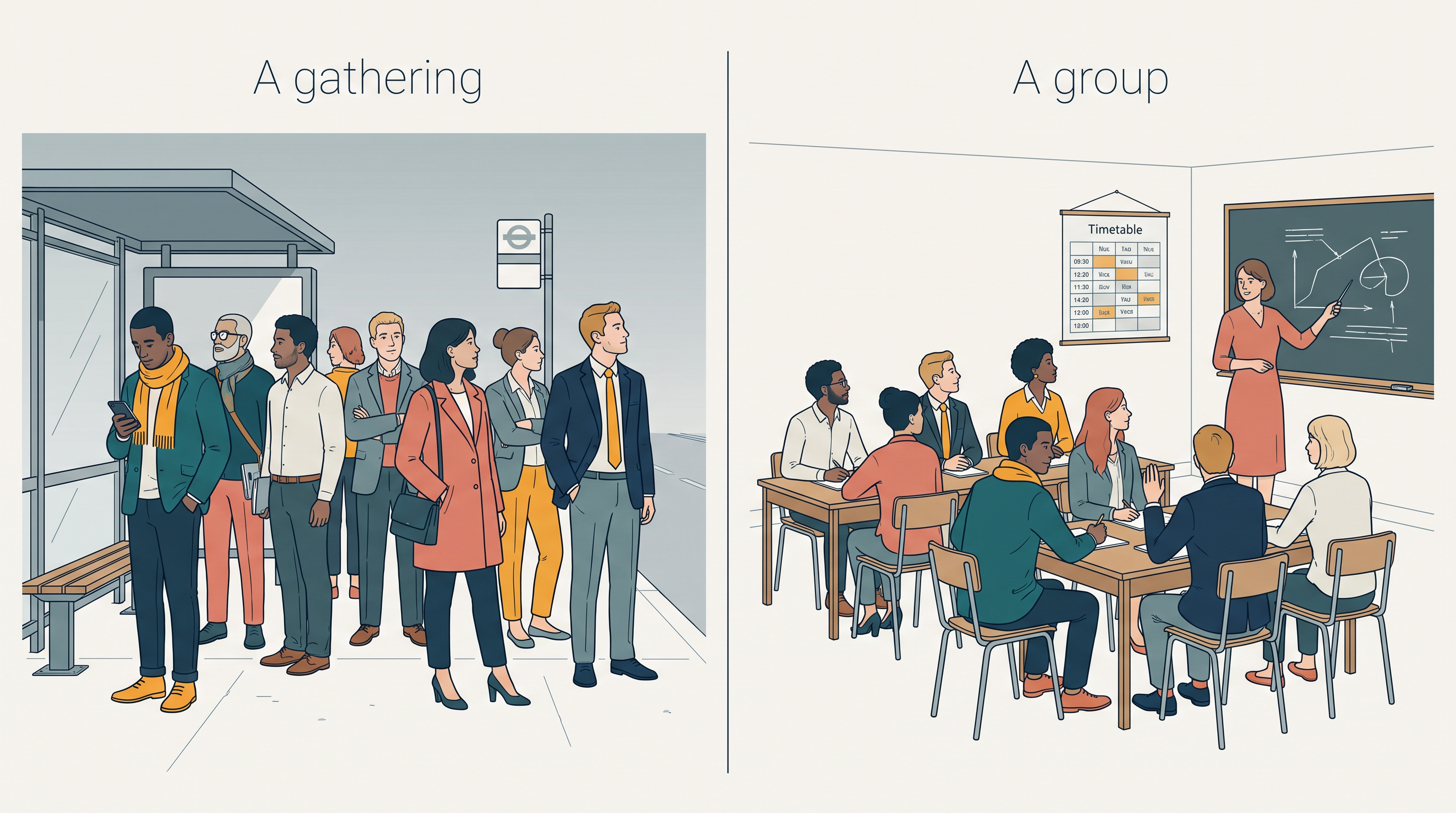
It is half past seven in the morning. At the bus stop near your school, about thirty people are standing together. Some are going to work, some to the market, one is going to a hospital. They stand shoulder to shoulder, but they do not know one another, and when the buses come they will scatter in different directions and never meet again as a set. They are together, and yet they are not a group.
Twenty minutes later, some of those same people are in a classroom. Now something has changed. They know each other’s names. They sit in familiar places. They have a monitor, a timetable, rules about who may speak when, and a shared sense of being “our class” — especially when the inter-school match is announced and the other school suddenly becomes “them”. A teacher’s raised eyebrow is enough to stop a whisper.
Nothing about the people has changed. What has changed is the kind of gathering they are in, and the invisible rules holding it together.
Sociology gives you a set of terms to describe exactly this difference — between a crowd and a group, between a position and the behaviour expected of it, between an unequal arrangement and a personal misfortune. These terms are not decoration. They are the instruments with which society becomes visible.
Q1. Sociology studies families, castes and schools — things we already live inside. So why does it need its own special vocabulary at all? Q2. Thirty strangers at a bus stop are not a group, but thirty classmates are. What exactly makes the difference? Q3. Why do sociologists disagree so sharply about the same society — some calling it harmonious, others calling it conflict-ridden? Q4. In what ways is a person’s position in society decided before they are even born? Q5. Nobody was punished in that classroom, yet the whisper stopped. What kind of power was at work?
This chapter will give you the terms and concepts you need to answer each of these questions.
2.1 Introduction
The previous chapter introduced you to two ideas at once — an idea of society, and an idea of sociology. You saw that a central task of sociology is to explore the interplay between society and the individual. You also saw that individuals do not float freely. Each of us is placed inside collective bodies: a family, a tribe, a caste, a class, a clan, a nation.
This chapter moves a step further. It asks what kinds of groups individuals form, what kinds of unequal orders they are placed within, how society keeps its members in line, and what positions people occupy and what behaviour is expected of them.
In other words, you now begin to examine how society itself works. Is it basically harmonious, or is it riddled with conflict? Are a person’s position and expected behaviour fixed for life, or can they change? How does a society control its members? What kinds of inequality run through it?
Before any of that, one question has to be settled. Why does sociology need a special set of terms at all, when we already use words like status, role and social control in everyday conversation?
Why familiar words are not enough
Take a discipline like nuclear physics. It deals with matters that most people know nothing about, and for which no words exist in ordinary speech. That such a discipline must invent a terminology seems obvious.
Sociology looks like the opposite case. Its subject matter — families, schools, markets, festivals, neighbourhoods — is the most familiar thing in the world, and everyday language already has words for all of it.
Yet terminology is arguably more important for sociology, precisely for that reason. As the sociologist Peter Berger pointed out in 1976, we are so thoroughly acquainted with the social institutions that surround us that we cannot see them clearly and precisely. Familiarity does not sharpen our vision. It blurs it.
Consider a simple example. Because we live in families, we tend to assume we know all there is to know about the family. But that assumption confuses two very different things: sociological knowledge, which is built from systematic study and comparison, and common sense or naturalistic explanation, which treats whatever is familiar as also natural and obvious. You met that distinction in Chapter 1. A precise vocabulary is what prevents sociology from sliding back into it.
Q1. Sociology studies families, castes and schools — things we already live inside. So why does it need its own special vocabulary at all?
A. Because its subject matter is familiar, and ordinary words for it already exist. Those ordinary words carry all our assumptions with them. Sociology’s terms are deliberately built to hold the familiar at arm’s length, so that it can be examined rather than simply taken for granted.
Concepts have a history
In Chapter 1 you saw that sociology as a discipline has a biography — that particular material and intellectual developments shaped its perspective and its concerns. Sociological concepts have a story to tell as well.
Many of them reflect the anxiety of early social thinkers to understand and map the enormous change involved in the shift from pre-modern to modern society. Sociologists observed that simple, small-scale, traditional societies were marked by close, often face-to-face interaction, while modern, large-scale societies were marked by formal interaction.
Out of that observation came the distinctions this chapter will examine: primary groups against secondary groups, community against society or association. Other concepts, such as stratification, grew out of a different concern — to understand the structured inequalities that exist between groups in a society, rather than the misfortunes of individuals.
The lesson is worth holding on to. Concepts arise in society. They are not timeless truths dropped from above; they are answers worked out by people trying to make sense of the world they were living through.
Two ways of seeing society
Just as there are different kinds of individuals and groups in society, there are different kinds of concepts and ideas. Sociology itself is marked by rival ways of understanding society and of interpreting the dramatic changes the modern period brought about.
You have already seen contrary and contesting understandings at sociology’s very beginning. For Karl Marx, class and conflict were the key concepts for understanding society. For Emile Durkheim, the key terms were social solidarity — the bonds that hold members of a society together — and the collective conscience, the shared body of beliefs and sentiments common to a society’s members.
In the period after the Second World War, sociology was greatly influenced by the structural functionalists, who found society essentially harmonious. They found it useful to compare society to an organism, in which different parts each have a function to play in maintaining the whole. Just as the heart and the lungs contribute to keeping a body alive, the family, the school and the legal system are seen as contributing to keeping society going.
Functionalism Proposed by: Structural functionalists, particularly influential in the decades after the Second World War Core idea: A social event or institution is best explained by the function it performs — the contribution it makes to the continuity of society, which is seen as a complex system whose parts work in relation to one another. Key terms: function, social order, social cohesion, the organic analogy Evidence: Institutions such as the family or the school do visibly perform tasks — rearing children, training members — without which a society could not reproduce itself. Limitation: It explains stability far better than change, and can end up justifying an existing arrangement simply because it happens to be working for the whole.
Others — in particular the conflict theorists, influenced by Marxism — saw society as essentially conflict-ridden. Where a functionalist sees parts co-operating, a conflict theorist sees groups competing for scarce and valuable resources, with some winning and some losing.
Conflict theory Proposed by: Conflict theorists strongly influenced by the writings of Marx Core idea: Society is marked by tensions, divisions and competing interests. Because resources are scarce and valuable, groups struggle to gain access to them and to control them, and this struggle shapes social life. Key terms: conflict, competing interests, domination, class Evidence: Deep and persistent inequalities of wealth, status and power, and the recurring conflicts over land, work and rights that accompany them. Limitation: It can underplay the co-operation, consent and shared belief that also visibly hold societies together.
Functionalism vs Conflict theory | Feature | Functionalism | Conflict theory | |—|—|—| | Basic image of society | An organism whose parts work together | An arena of competing groups | | Society is essentially | Harmonious and orderly | Unequal, unjust and exploitative | | Explains an institution by | The function it performs for the whole | Whose interests it serves | | View of social order | A shared achievement, necessary for stability | The writ of one section imposed on others | | Main blind spot | Struggle and change | Consent and co-operation |
Q3. Why do sociologists disagree so sharply about the same society — some calling it harmonious, others calling it conflict-ridden?
A. Because they begin from different questions. A functionalist asks what keeps society going and therefore notices co-operation; a conflict theorist asks who gains and who loses and therefore notices struggle. Both are looking at the same society, but through differently cut lenses — and both see something real.
Starting small, starting large
Sociologists also differ in where they begin. Some try to understand human behaviour by starting with the individual and with face-to-face interaction. This is microsociology — the study of everyday behaviour in situations of face-to-face interaction, where analysis takes place at the level of individuals or small groups.
Others begin with the large structures within which individuals are already placed: class, caste, the market, the state, even community. This is macrosociology, which concerns itself with large-scale social systems such as the political system or the economic order.
The concepts in this chapter fall on both sides of that line. Status and role begin with the individual. Social control and stratification begin from the larger context into which an individual is born. Though the two levels appear distinct, they are closely connected — a caste hierarchy is a macro structure, but it is lived out in the micro moment of who is offered a glass of water and who is not.
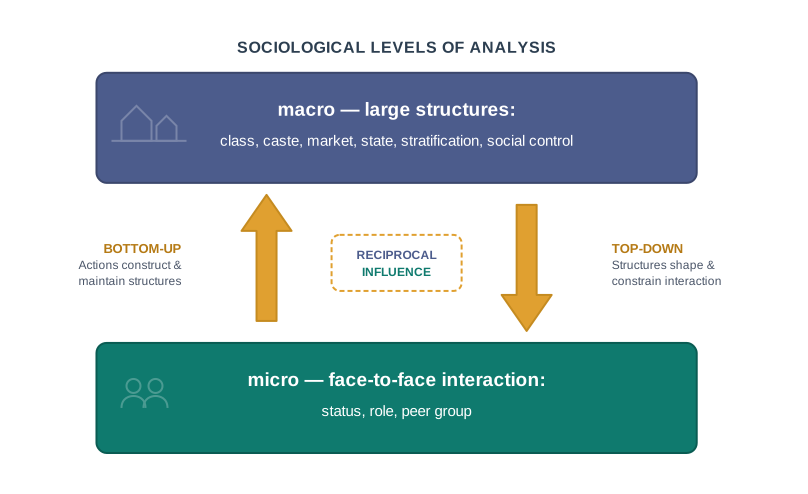
Microsociology vs Macrosociology Microsociology studies everyday behaviour in face-to-face situations, at the level of individuals and small groups; macrosociology studies large-scale systems such as the political system or the economic order. They are levels of analysis, not opposed theories, and they are closely connected.
Concepts are keys, not final answers
The classifications and types that sociology discusses are tools through which reality can be understood. They are keys that open locks. They are entry points into understanding, not the last word on it.
But a key can rust. It can bend. It can fail to fit the lock, or fit only with great effort. When that happens, the key has to be changed or modified. Sociology therefore does two things at once with its concepts: it uses them, and it constantly interrogates them.
There is often considerable unease about the coexistence of different definitions, different concepts, or simply different views about the same social entity — conflict theory set against functionalist theory, for instance. This multiplicity of approaches is particularly acute in sociology.
It cannot be otherwise, because society itself is diverse. As you work through the terms in this chapter, you will notice this divergence of views again and again. The debate is not a defect in the discipline. Discussing the differences is one of the ways sociology comes to understand society at all.
Choose any one of these topics for a class discussion: - democracy is a help, or a hindrance, to development - gender equality makes for a more harmonious, or a more divisive, society - punishment, or greater discussion, is the better way to resolve conflicts
Think of other topics of the same kind. Afterwards, ask yourselves: what kinds of differences emerged in the room? Did they reflect different visions of what a good society ought to be like? Did they reflect different notions of what a human being is?
2.2 Social Groups and Society
Sociology is the study of human social life. A defining feature of that life is that human beings interact, communicate, and out of this build social collectivities. We do not live singly, and we do not live at random.
The comparative and historical perspective of sociology brings home two facts that look innocent enough at first glance, but are not.
The first is that in every society — ancient or feudal or modern, Asian or European or African — human groups and collectivities exist. There is no known society of pure individuals. The second is that the types of groups and collectivities differ from society to society. The clan, the caste, the guild, the trade union, the residents’ welfare association: each belongs to a particular kind of society at a particular time.
Put these two facts together and a question follows. If groups are everywhere, but not the same everywhere, then a group is not a natural fact like breathing. It is a social arrangement, and it can be studied, compared, and explained.
When is a gathering not a group?
Any gathering of people does not necessarily constitute a group. Think of the passengers waiting at a railway station, or at an airport, or at a bus stop, or the audience in a cinema hall. They are in the same place at the same time. They may even face the same direction. But they share no definite connection with one another, and once the train arrives or the film ends they disperse.
Such a collection of people is an aggregate. Aggregates of this kind are often termed quasi groups.
An aggregate is a collection of people who happen to be in the same place at the same time but who share no definite connection with one another.
A quasi group is an aggregate or combination which lacks structure or organisation, and whose members may be unaware, or less aware, of the existence of the grouping.
Notice the second half of that definition, because it is easy to miss. A quasi group is not only loosely organised; its members may not even know that they form a grouping at all. Social classes, status groups, age groups, gender groups and crowds can all be seen as examples of quasi groups.
Q2. Thirty strangers at a bus stop are not a group, but thirty classmates are. What exactly makes the difference?
A. The bus stop is an aggregate: people in one place at one time, with no definite connection. The classroom has persistent and patterned interaction, a sense of belonging, shared interests, common norms, and a definable structure. It is the pattern of relationships, not the number of bodies, that makes a group.

How quasi groups become groups
As those examples suggest, quasi groups may well become social groups in time and in specific circumstances. The boundary is not a wall; it is a stage in a process.
Take people who belong to a particular social class, or caste, or community. They may not be organised as a collective body at all. They may be yet to be infused with a sense of “we” feeling — they simply share a position, without acting together on the basis of it. Yet class and caste have, over a period of time, given rise to political parties.
The same movement can be seen in the making of the nation. Over the long anti-colonial struggle, people of different communities in India developed an identity as a collectivity and a group — a nation with a shared past and a common future. What had been a scattered population became, through struggle, a “we”.
Identity is the distinctive characteristic of a person’s character, or of the character of a group, relating to who they are and what is meaningful to them. Gender, nationality or ethnicity, and social class are among its main sources.
The women’s movement is another instance: it brought into being the very idea of women’s groups and women’s organisations, where before there had been a category of persons but not an organised collectivity.
All these examples draw attention to a single point that a student of sociology should carry through the rest of this book. Social groups are not fixed furniture. They emerge, they change, and they get modified.
a quasi group turning into a social group The households of a small urban colony have been receiving water for barely an hour a day. For months, each family manages on its own, complaining privately. Then a few residents call a meeting, draw up a list of houses, elect three people to speak for the colony, and agree to contribute a small sum each month. Within a year the colony has a name, a register, a set of rules and a running dispute with the municipal office. The residents began as a quasi group — people sharing a condition without a “we” feeling — and became a social group with structure, shared interest and a sense of belonging.
What makes a social group
A social group can be said to have at least the following characteristics:
- persistent interaction, which provides continuity;
- a stable pattern of these interactions;
- a sense of belonging, that is, identification with the other members — each individual is conscious of the group itself and of its own set of rules, rituals and symbols;
- shared interest;
- acceptance of common norms and values; and
- a definable structure.
The fifth of these introduces a term you will meet repeatedly. Norms are rules of behaviour which reflect or embody a culture’s values, either prescribing a given type of behaviour or forbidding it. Norms are always backed by sanctions of one kind or another, ranging from mild disapproval to severe punishment — a point taken up in the section on social control.
Norms are rules of behaviour which express a culture’s values by prescribing or forbidding a given type of behaviour, and which are always backed by sanctions.
The sixth characteristic — a definable structure — needs unpacking too. Social structure here refers to patterns of regular and repetitive interaction between individuals or groups. When you can predict, more or less, who will speak to whom, in what manner, and with what expectations, you are looking at a structure.
Social structure refers to patterns of regular and repetitive interaction between individuals or groups.
A social group, then, refers to a collection of continuously interacting persons who share common interest, culture, values and norms within a given society.
A social group is a collection of continuously interacting persons who share common interest, culture, values and norms within a given society.
Quasi group vs Social group | Feature | Quasi group | Social group | |—|—|—| | Interaction | Absent or occasional; people merely co-present | Persistent, and following a stable pattern | | Awareness of the grouping | Members may be unaware, or only dimly aware, of it | Members are conscious of the group and of its rules, rituals and symbols | | “We” feeling | Not yet formed | Present; members identify with one another | | Norms and values | Not commonly accepted or enforced | Commonly accepted | | Structure | Lacks structure or organisation | Has a definable structure | | Examples | Crowds, cinema audiences, social classes, age and gender groups | A family, a school, a political party, a residents’ association |
Find a real name that fits under each heading below.
| Caste |
an anti-caste movement |
a caste-based political party |
| Class |
a class-based movement |
a class-based political party |
| Women |
a women’s movement |
a women’s organisation |
| Tribe |
a tribal movement |
a tribe-based political party |
| Villagers |
an environmental movement |
an environmental organisation |
Then discuss: were all of these social groups to begin with? If some were not, at what point can the term “social group”, as sociology understands it, begin to be applied to them?
2.3 Types of Groups
As you read through this section, you will find that different sociologists and social anthropologists have sorted groups into different types. What should strike you, though, is that there is a pattern running through the whole typology.
In most cases, the types contrast the way people form groups in traditional, small-scale societies with the way they form them in modern, large-scale ones. As mentioned earlier, the early sociologists were struck by the difference between close, intimate, face-to-face interaction in traditional societies and impersonal, detached, distant interaction in modern ones.
That contrast is useful. It is also, taken by itself, probably not an accurate description of reality. Modern life is full of intimacy — friendships in an office, a WhatsApp group of former classmates — and traditional life had its share of distant, formal dealings. Treat each pair below as a pair of keys, then, and keep asking whether the lock they were cut for is the one in front of you.
2.3.1 Primary and Secondary Social Groups
The groups to which we belong are not all of equal importance to us. Some of them shape many aspects of our lives at once and bring us into personal association with others.
The term primary group is used to refer to a small group of people connected by intimate and face-to-face association and co-operation. The members of primary groups have a sense of belonging. The family, the village, and a group of friends are examples.
A primary group is a small group of people connected by intimate and face-to-face association and co-operation, whose members have a sense of belonging.
Secondary groups are relatively large in size and maintain formal and impersonal relationships. Schools, government offices, hospitals and students’ associations are examples. You are known there by a role, a designation or a roll number, rather than by the whole of who you are.
A secondary group is a relatively large group whose members maintain formal and impersonal relationships.
The sharpest way to hold the two apart is this: primary groups are person-oriented, whereas secondary groups are goal-oriented. A family does not exist in order to achieve a target. A hospital does.

Primary group vs Secondary group | Feature | Primary group | Secondary group | |—|—|—| | Size | Small | Relatively large | | Kind of relationship | Intimate, face-to-face, co-operative | Formal and impersonal | | Orientation | Person-oriented | Goal-oriented | | Sense of belonging | Strong | Weak or absent | | Examples | Family, village, group of friends | School, government office, hospital, students’ association |
Discuss the age group of teenagers. Is it a quasi group or a social group? Was “teenage” always thought of as a special phase of life? In traditional societies, how was a child’s entry into adulthood marked?
Now look at advertising. Find one advertisement that clearly targets teenagers or pre-teens. Do marketing and advertising strengthen this grouping, or weaken it? After you have read the section on stratification, return to this task and discuss how “being a teenager” may mean very different things for the rich and the poor, and for those in privileged and in discriminated positions.
2.3.2 Community and Society or Association
The idea of comparing and contrasting the old, traditional, agrarian way of life with the new, modern, urban one — in terms of the different and contrasting social relationships and lifestyles they involve — dates back to the writings of the classical sociologists.
The term community refers to human relationships that are highly personal, intimate and enduring — relationships in which a person’s involvement is considerable, if not total. Life in a family, with real friends, or within a close-knit group has this character.
Community refers to highly personal, intimate and enduring human relationships, in which a person’s involvement is considerable if not total.
Society, or association, refers to everything opposite to community: the apparently impersonal, superficial and transitory relationships of modern urban life.
Society or association refers to the impersonal, superficial and transitory relationships characteristic of modern urban life, entered into for particular purposes.
Why should modern life take this form? Because commerce and industry require a more calculating, rational and self-interested approach to one’s dealings with others. When you buy a bus ticket or sign an employment letter, you make a contract or an agreement. You do not first get to know the other person.
You may draw a parallel here — carefully, not mechanically — between the community and the primary group on the one hand, and the association and the secondary group on the other.
Community vs Society or association | Feature | Community | Society / association | |—|—|—| | Typical setting | Traditional, agrarian life | Modern, urban life | | Quality of relationships | Personal, intimate, enduring | Impersonal, superficial, transitory | | Extent of involvement | Considerable, if not total | Partial, limited to a purpose | | Basis of dealing with others | Knowing one another | Contract or agreement | | Underlying attitude | Attachment and obligation | Calculating, rational, self-interested |
Get hold of a copy of the memorandum of any association you know of or can find out about — a residents’ welfare association, a women’s association (a mahila samiti), a sports club. You will find clear information in it about the association’s goals, its objectives, its membership, and the rules that govern it. Set this beside a large family gathering and contrast the two.
You may also notice something that complicates the neat contrast: over time, interaction among the members of a formal group often becomes close, and people begin to say it is “just like family”. That is a useful discovery. It brings home the point that concepts are not fixed and frozen entities. They are keys and tools for understanding society and its changes.
2.3.3 In-Groups and Out-Groups
A sense of belonging marks an in-group. This feeling separates “us” or “we” from “them” or “they”. Children belonging to a particular school may form an in-group as against those who do not belong to it. Can you think of other such groups?
An out-group, on the other hand, is one to which the members of an in-group do not belong. The members of an out-group can face hostile reactions from the members of the in-group. Migrants are often treated as an out-group in this way.
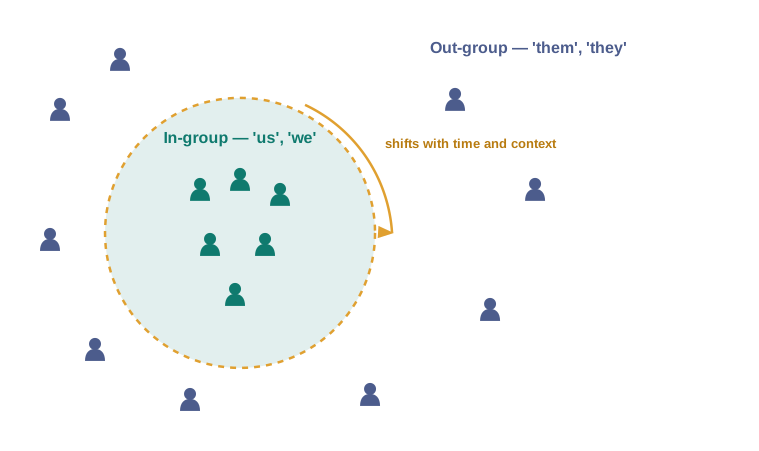
However, even here the actual definition of who belongs and who does not changes with time and with social context. The line is drawn, and then redrawn.
The sociologist M.N. Srinivas noticed exactly this while he was carrying out a census in the village of Rampura in 1948. He found that the villagers used two contrasting expressions to speak about migrants. Recent immigrants were described almost contemptuously as those who “came yesterday or the day before” (nenne monne bandavaru), while long-settled immigrants were spoken of as those who “came long ago” (arsheyinda bandavaru), or as “old lineages” (khadeem kulagalu).
Both sets of families had come from elsewhere. What separated them was time — and time, in the village’s own reckoning, could convert an outsider into one of “us”.
M.N. Srinivas — the language of belonging in Rampura, 1948 Question: How do villagers themselves distinguish between those who belong and those who do not? Method: Fieldwork in a Karnataka village while conducting a village census; close attention to the everyday expressions people used about one another. Finding: Villagers marked out recent migrants with a dismissive phrase meaning “came yesterday or the day before”, while families who had migrated generations earlier were honoured as “old lineages”. Meaning: The boundary between in-group and out-group is not fixed by an objective fact such as place of origin. It is drawn socially, in ordinary speech, and it can move over time — a caution to any researcher who assumes that a community’s own categories are permanent.
Find out about the experience of immigrants in other countries — or, for that matter, of people who have moved from one part of our own country to another. Look for cases in which people once treated as an out-group later came to be counted as members of the in-group. What made the difference: time, work, language, marriage, law?
2.3.4 Reference Group
For any group of people there are always other groups whom they look up to and aspire to be like. The groups whose lifestyles are emulated in this way are known as reference groups.
The interesting thing about a reference group is that we do not belong to it. We identify ourselves with it all the same. Reference groups are important sources of information about culture, lifestyle, aspiration and goal attainment — they tell us what a successful life is supposed to look like.
A reference group is a group to which a person does not belong, but whose lifestyle is emulated and with which the person identifies, and which therefore shapes aspirations and goals.
In the colonial period, many middle-class Indians aspired to behave like a proper Englishman. In that sense, the English could be seen as a reference group for this aspiring section.
But the process was gendered — it had different implications for men and for women. Often Indian men wanted to dress and dine like British men, while wanting Indian women to remain “Indian” in their ways. Where women were expected to change, they were expected to become a little like the proper English woman, but not quite like her. Look around you and ask whether anything of this pattern still holds today.
2.3.5 Peer Groups
A peer group is a kind of primary group, usually formed between individuals who are either of a similar age or in a common professional group. Your classmates are a peer group; so are the doctors of a hospital, among themselves.
Peer pressure refers to the social pressure exerted by one’s peers on what one ought to do, or ought not to do. It rarely arrives as a command. It arrives as a look, a laugh, or the quiet fear of being left out.
Peer pressure is the social pressure exerted by one’s peers on what one ought to do or not do.
Reference group vs Peer group A peer group is a group you belong to, made up of people of similar age or occupation; a reference group is one you do not belong to but aspire to be like. Your friends can be both at once — but that is because they are playing two different sociological parts, not because the terms mean the same thing.
Do your friends, or others of your age group, influence you? Are you concerned about their approval or disapproval — of the way you dress, of how you behave, of the music you listen to, of the films you prefer? Would you call this social pressure? Discuss it in class.
2.4 Social Stratification
Two students sit in the same classroom, write the same test and are taught by the same teacher. One goes home to a house with a study table, a quiet room and a parent who can explain the sum. The other goes home to a single room, and to work.
The difference between them is not a difference of talent. It is a difference of position — and positions of this kind come in a patterned, layered arrangement. That arrangement is what sociology calls stratification.
Social stratification refers to the existence of structured inequalities between groups in society, in terms of their access to material or symbolic rewards. Put most simply, stratification means structural inequalities between different groupings of people.
Social stratification is the existence of structured inequalities between groups in society, in terms of their access to material or symbolic rewards — that is, structural inequalities between different groupings of people.
Notice the word “structured”. A person may be unlucky; a group may be systematically placed. Sociology is interested in the second.
Social stratification is often compared to the geological layering of rock in the earth’s surface. Society can be seen as consisting of strata — layers — arranged in a hierarchy, with the more favoured at the top and the less privileged near the bottom.

Why inequality is central to sociology
Inequality of power and advantage is central to sociology, because of the crucial place stratification occupies in the organisation of society. It is not one topic among many. It runs through all of them.
Every aspect of the life of every individual and household is affected by stratification. Opportunities for health, for longevity, for security, for educational success, for fulfilment in work and for political influence are all unequally distributed — and distributed in systematic ways.
Read that list slowly. It includes how long you are likely to live. Few facts bring home the sociological imagination as sharply as this: something as personal as a lifespan turns out to have a social address.
Four historical systems of stratification
Historically, four basic systems of stratification have existed in human societies: slavery, caste, estate and class.
Slavery is an extreme form of inequality in which some individuals are literally owned by others. It has existed sporadically at many times and in many places, but there are two major examples of a system of slavery: ancient Greece and Rome, and the Southern States of the USA in the eighteenth and nineteenth centuries.
As a formal institution, slavery has gradually been eradicated. That, however, is not the end of the matter. Bonded labour — where a person is tied to an employer by a debt and cannot freely leave — continues to exist, often even in the case of children.
The estate system characterised feudal Europe, where nobility, clergy and commoners formed legally distinct orders with different rights and duties. This chapter does not go into the details of estates. It touches briefly on caste and class, which are examined at much greater length in the companion book, Understanding Society, where class, caste and gender are taken up as bases of social stratification.
2.4.1 Caste
In a caste stratification system, an individual’s position depends entirely on status attributes ascribed by birth, rather than on any attribute achieved during the course of one’s life.
This does not mean that in a class society achievement is unconstrained. There, too, status attributes such as race and gender impose systematic limits on what a person can achieve. The difference is one of degree, and it is a large one: attributes ascribed by birth define an individual’s position far more completely in a caste society than they do in a class society.
In traditional India, different castes formed a hierarchy of social precedence. Each position in the caste structure was defined in terms of its purity or pollution relative to the others.
The underlying belief was that those who are most pure — the Brahmin priestly castes — are superior to all others, and that the Panchamas, sometimes called the “outcastes”, are inferior to all other castes. That label was imposed by the hierarchy itself; it describes a social judgement, not a quality of any human being.
The traditional system is generally conceptualised in terms of the fourfold varna — Brahmins, Kshatriyas, Vaishyas and Shudras. In reality, however, there are innumerable occupation-based caste groups, called jatis.
varna vs jati Varna is the fourfold conceptual scheme in which the traditional system is usually described; jati refers to the innumerable actual, occupation-based caste groups in which people are really born, marry and live. One is the map, the other is the ground.
stratification and caste Much of the European vocabulary of stratification was built to explain inequalities of wealth and property — who owns, who works. The Indian case obliged sociologists to add another dimension. In the caste system, rank is defined not only by what a group owns but by its position on a scale of ritual purity and pollution, fixed at birth and expressed in rules about whom one may marry, eat with, or touch. A group could be poor and still ritually high, or prosperous and still treated as polluting. Any account of Indian inequality that looks only at economics will therefore miss half of what is happening.
Change, and the limits of change
The caste system in India has undergone considerable changes over the years. To see what changed, look first at what was being protected.
Endogamy — the rule that one must marry within one’s own group — and the ritual avoidance of contact with members of so-called lower castes were considered critical by so-called upper castes for maintaining purity. Both rules depend on being able to control who meets whom.
Urbanisation inevitably challenged this. The sociologist A.R. Desai commented on precisely this consequence.
Writing about the social effects of urbanisation, A.R. Desai observed that modern industry created modern cities honeycombed with cosmopolitan hotels, restaurants, theatres, trams, buses and railways. The modest hotels and eating places that served workers and the middle classes filled up with people of all castes and creeds. In trains and buses, passengers occasionally rubbed shoulders with members of the depressed classes. But, he cautioned, it should not be supposed from this that caste had vanished.
Desai’s caution matters. A crowded bus mixes bodies; it does not by itself dissolve a hierarchy. While change did take place, discrimination was not so easy to do away with — as a first-person account from a mill worker suggests.
A worker named Parmar described his experience in the mill. There was no open discrimination there of the kind found in the villages, he said, but private interactions told a different story: fellow workers would not drink water from his hands, and sometimes used abusive language when dealing with him — because they believed themselves superior, as they had for years. No matter how well he and others dressed, he said, there were things the others were not prepared to accept.
Two things are being said in that account, and both must be held together. Even today, acute caste discrimination exists. At the same time, the working of democracy has affected the caste system: castes have gained strength as interest groups, and discriminated castes have been asserting their democratic rights in society.
studying discrimination Accounts like the mill worker’s are essential evidence — the experience of discrimination is often invisible in official records and audible only in a first-person narrative. But collecting such testimony places obligations on the researcher. The speaker must know how the account will be used and must consent to it; identifying details may need to be withheld, since speaking out can carry real costs. And the researcher, who usually belongs to a different social position from the person speaking, must be careful not to turn a person into an illustration, or to claim to speak for a community rather than letting it speak.
2.4.2 Class
There have been many attempts to explain class. Three are mentioned here — the central ideas of Marx, of Weber, and of functionalism.
In Marxist theory, social classes are defined by the relation they have to the means of production. The questions to ask about any group are simple and hard: does it own the means of production — land, factories? Or does it own nothing but its own labour?
The means of production are the means by which the production of material goods is carried on in a society, including not just technology but the social relations between producers.
Marx on class Proposed by: Karl Marx, in the nineteenth century Core idea: Social classes are defined by their relationship to the means of production — some groups own productive property such as land or factories, while others own nothing but their own labour and must sell it. Key terms: class, means of production, ownership, labour Evidence: The industrial societies Marx studied did divide sharply between those who owned mills and land and those who had only their labour to sell — a division that shaped wages, conditions and political power. Limitation: Defining class solely by ownership can miss other real sources of advantage, such as prestige and political power — the very gap Weber set out to fill.
Weber used the term life-chances, which refers to the rewards and advantages afforded by market capacity — that is, by what a person has to offer in the market, such as skill, qualification or property.
Inequality, Weber argued, might well be based on economic relations. But it could also be based on prestige, or on political power. A man with little property may command great respect; a party official may command neither wealth nor prestige, and still command obedience.
Weber on inequality and life-chances Proposed by: Max Weber, writing in the early twentieth century Core idea: A person’s life-chances — the rewards and advantages available to them — depend on their capacity in the market. Inequality may rest on economic relations, but it may equally rest on prestige or on political power. Key terms: life-chances, market capacity, prestige, power Evidence: Groups with similar incomes may enjoy very different social standing, and holders of political office may wield power far beyond their wealth. Limitation: By multiplying the bases of inequality, the account can make it harder to say which of them is decisive in a given society.
The functionalist theory of social stratification begins from the general presupposition of functionalism that no society is “classless” or unstratified.
Its central claim is this. Every society faces the requirement of placing individuals in the social structure and motivating them to fill those places. Social inequality is therefore an unconsciously evolved device by which societies ensure that the most important positions are deliberately filled by the most qualified persons.
The functionalist theory of stratification Proposed by: Functionalist sociologists, developing the functionalist perspective introduced earlier in this chapter Core idea: No society is unstratified. Stratification exists because a society must place individuals in the social structure and motivate them to occupy its positions; unequal rewards are the device by which the most important positions come to be filled by the most qualified persons. Key terms: functional necessity, placement, motivation, reward Evidence: Societies do attach greater rewards to positions requiring long training or carrying heavy responsibility. Limitation: Is it true? The theory assumes that reward actually tracks importance and qualification. In a system where position is fixed at birth, the most qualified person may never reach the position at all — and the theory has little to say about that.
Caste, class and the question of mobility
In a traditional caste system, social hierarchy is fixed, rigid and transmitted across generations. A modern class system, in contrast, is open and achievement-based. In democratic societies there is nothing to legally stop a person from the most deprived class and caste from reaching the highest position.
Caste as a system vs Class as a system | Feature | Caste | Class | |—|—|—| | Basis of position | Status attributes ascribed by birth | Economic position, market capacity, achievement | | Ranking principle | Purity and pollution relative to others | Ownership, income, life-chances | | Mobility | Fixed, rigid, transmitted across generations | Open, achievement-based in principle | | Marriage rule | Endogamy — marriage within the group | No formal rule of endogamy | | Boundaries | Defined by ritual status | Defined by economic position, and blurred at the edges |
Find out more about the life of the late President K.R. Narayanan. Using his life, discuss the concepts of ascription and achievement, and the working of caste and class. (Traced through carefully, this makes a good project on stratification and mobility.)
Such stories of achievement do exist, and they are sources of immense inspiration. But a single life is not a social pattern, and sociology must ask about the pattern.
For the most part, the structure of the class system persists. Sociological studies of social mobility — the movement of individuals or groups between positions in the hierarchy — show that even in western societies, reality is far removed from the ideal model of perfect mobility.
Sociology therefore has to be sensitive to two things at once: to the challenges mounted against the caste system, and to the persistence of discrimination. And it must notice, significantly, that those at the lower levels of the system are not just disadvantaged socially. They are disadvantaged economically as well. The two forms of disadvantage hold each other in place.
Has stratification loosened its grip in modern India? View 1: It has changed substantially. Urbanisation, industry and public transport broke down many rules of ritual avoidance; democracy gave discriminated castes the vote, organisation and the capacity to assert their rights; and the law places no barrier before a person from the most deprived background. View 2: It has proved remarkably durable. Acute caste discrimination persists, as first-person accounts of humiliation at work show; studies of mobility find real movement to be far from the ideal; and disadvantage at the bottom is social and economic at once, each reinforcing the other. What both agree on: the caste system has certainly changed — the disagreement is about how deep the change goes.
2.4.3 Status and Role
Stratification describes the layers. The next two concepts describe the positions people occupy within them, and what they are expected to do there. “Status” and “role” are often seen as twin concepts, and it is worth seeing exactly how they are joined.
A status is simply a position in society or in a group. Every society and every group has many such positions, and every individual occupies many of them.
Status thus refers to a social position with defined rights and duties assigned to it. Consider “mother”. It is a status, and it carries many norms of conduct, along with certain responsibilities and prerogatives.
A status is a position in society or in a group, with defined rights and duties assigned to it.
A role is the dynamic, or behavioural, aspect of status. The neatest formulation is this: a status is occupied, but a role is played.
A role is the dynamic or behavioural aspect of a status — the pattern of behaviour expected of the person occupying that position.
We may also say that a status is an institutionalised role. It is a role that has become regularised, standardised and formalised — either in society at large, or within some specific association within it.
Status vs Role | Feature | Status | Role | |—|—|—| | What it is | A position in society or a group | The behaviour expected of that position | | Aspect | Static — the place one holds | Dynamic — the place in action | | The verb that fits | A status is occupied | A role is played | | Relation to the other | An institutionalised, standardised role | The living performance of a status | | Example | Being a teacher | Teaching, correcting, evaluating, guiding |
Status set and status sequence
It must be apparent that each individual in a modern, complex society such as ours occupies many different kinds of status in the course of a life.
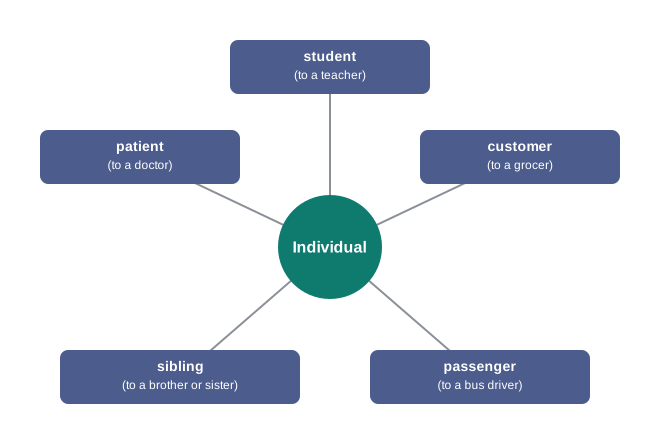
You, as a school student, may be a student to your teacher, a customer to your grocer, a passenger to the bus driver, a brother or sister to your sibling, and a patient to your doctor. The list could be extended without much effort.
This multiplicity is sociologically termed a status set. And the general rule is worth noting: the smaller and simpler the society, the fewer the kinds of status an individual can have.
Individuals also acquire different statuses at various stages of life. A son becomes a father, then a grandfather, then a great-grandfather. This is called a status sequence, because it refers to statuses attained in succession at various stages of life.
Ascribed and achieved status
An ascribed status is a social position which a person occupies because of birth, or assumes involuntarily. The most common bases for ascribed status are age, caste, race and kinship. Simple and traditional societies are marked by ascribed status.
An achieved status, on the other hand, refers to a social position that a person occupies voluntarily, by personal ability, achievement, virtue and choice. The most common bases for achieved status are educational qualifications, income, and professional expertise.
Modern societies are characterised by achievement. Their members are accorded prestige on the basis of what they have achieved. How often you must have heard the phrase, “you have to prove yourself”.
In traditional societies, your status was defined and ascribed at birth — there was nothing to prove. But, as the discussion of caste above has shown, ascribed status matters even in modern, achievement-based societies. The two do not simply replace one another.
Ascribed status vs Achieved status | Feature | Ascribed status | Achieved status | |—|—|—| | How it is obtained | By birth, or assumed involuntarily | Voluntarily, through personal effort | | Common bases | Age, caste, race, kinship | Educational qualifications, income, professional expertise | | Choice involved | None | Considerable | | Society it typifies | Simple and traditional societies | Modern societies | | Can it be changed? | Not by the individual’s own effort | In principle, yes |
Q4. In what ways is a person’s position in society decided before they are even born?
A. Through ascribed status. Age, caste, race and kinship are positions a person occupies by birth or assumes involuntarily, and in a caste system such attributes define position almost completely. Even in a modern society organised around achievement, what a person can achieve is shaped by the ascribed position they start from.
Status and prestige
Status and prestige are interconnected terms. Every status is accorded certain rights and values. The important point is where those values are attached: to the social position itself, and not to the person who occupies it, or to their performance, or to their actions.
The kind of value attached to a status or to an office is called prestige. People can rank statuses in terms of high or low prestige.
Prestige is the kind of value attached to a status or office — attached to the position itself, rather than to the person occupying it.
The prestige of a doctor may be high in comparison with that of a shopkeeper, even if the doctor earns less. Prestige and income, in other words, do not always travel together.
And it is important to keep in mind that ideas about which occupation is prestigious vary across societies and across periods. Prestige is a social judgement, and social judgements have histories.
What kinds of jobs are considered prestigious in the society you live in? Make your own list, then compare it with lists made by your friends. Discuss the similarities and the differences, and try to work out the causes of both.
Role taking, role playing and role conflict
People perform their roles according to social expectations. Sociology describes this as role taking and role playing. A child learns to behave in accordance with how her behaviour will be seen and judged by others.
Role conflict is the incompatibility among roles corresponding to one or more statuses. It occurs when contrary expectations arise from two or more roles.
Role conflict is the incompatibility among the roles corresponding to one or more statuses, arising when two or more roles make contrary demands on the same person.
A common example is that of the middle-class working woman, who has to juggle her role as mother and wife at home with that of a professional at work. Both roles are legitimate. Both make demands at the same hour of the same day.
role conflict A woman works as a nurse in a district hospital and is rostered for the night shift. Her son has an examination the next morning and wants help revising. Her supervisor expects her on the ward at ten. Her mother-in-law expects the evening meal to be cooked before she leaves. Nobody in this situation is behaving unreasonably — each is simply holding her to the expectations of a different status she occupies. This is role conflict: contrary expectations arising from two or more roles held by the same person.
It is a commonplace assumption that men do not face role conflict. Sociology, being both an empirical and a comparative discipline, suggests otherwise — and the evidence comes from a society organised very differently from most of India.
Tiplut Nongbri — role conflict in Khasi matrilineal society Question: What strains does a matrilineal system — where descent and property pass through the mother’s line — place on the men and women within it? Method: Sociological study of the Khasi family structure and of the law of succession affecting it, published in 2003. Finding: Khasi matriliny generates intense role conflict for men. They are torn between their responsibilities to their natal house and their responsibilities to their wife and children. They feel deprived of sufficient authority to command their children’s loyalty, and lack the freedom to pass on even their self-acquired property to their children. The strain affects Khasi women in a way that is, if anything, more intense: a woman can never be fully assured that her husband does not find his sister’s house a more congenial place than her own. Meaning: Role conflict is not a female problem, nor a problem of “modern” life. It arises wherever a social structure assigns a person two positions whose demands cannot both be met — and comparing societies is what allows a sociologist to see this.
Find out how a domestic worker, or a construction labourer, experiences role conflict. What are the different statuses such a person occupies in the course of a single day, and where exactly do their demands collide?
Roles are made, not merely received
Role stereotyping is the process of reinforcing some specific role for some member of society. Men and women, for example, are often socialised into stereotypical roles — as breadwinner and as homemaker respectively.
Social roles and status are often wrongly seen as fixed and unchanging. On this view, individuals learn the expectations that surround social positions in their particular culture, and then perform those roles largely as they have already been defined. Through socialisation, it is said, individuals internalise social roles and learn how to carry them out.
This view, however, is mistaken. It suggests that individuals simply take on roles, rather than creating or negotiating them.
In fact, socialisation is a process in which human beings can exercise agency. They are not passive subjects waiting to be instructed or programmed. Individuals come to understand and assume social roles through an ongoing process of social interaction — arguing, adjusting, resisting, improvising. This discussion will perhaps make you reflect again on the relationship between the individual and society, studied in Chapter 1.
Roles and status, then, are not given and fixed. People make efforts to fight against discriminatory roles and statuses — those based on caste, on race, on gender. At the same time, there are sections in society who oppose such changes.
And when an individual violates the expectations attached to a role, that violation is often punished. Society thus functions not only with roles and status, but also with social control — which is where this chapter turns next.
Collect newspaper reports in which dominant sections of society seek to impose control on, and to punish, those whom they consider to have transgressed or violated socially prescribed roles. Keep the reports for the next section, where you will be able to name the mechanisms at work in them.
2.5 Society and Social Control
Social control is one of the most generally used concepts in sociology. It refers to the various means used by a society to bring its recalcitrant or unruly members back into line — that is, to bring back into conformity those who have strayed from what is expected of them.
Social control refers to the various means used by a society to bring its recalcitrant or unruly members back into line.
Notice that the definition assumes something. It assumes that a society has expectations, that these can be broken, and that something happens when they are. This section is about that “something”.
The same fact, two readings
You will recall that sociology has different perspectives, and continuing debates about the meaning of its concepts. You will also recall that functionalist sociologists understood society as essentially harmonious, while conflict theorists saw it as essentially unequal, unjust and exploitative. Some sociologists focused on the individual and society, others on collectivities such as classes, races and castes.
Social control is a concept on which these perspectives divide sharply, and the division is instructive.
For a functionalist perspective, social control refers to two things: (i) the use of force to regulate the behaviour of individuals and groups, and (ii) the enforcing of values and patterns for maintaining order in society.
Social control here is directed, on the one hand, to restraining deviant behaviour of individuals or groups. On the other hand, it is directed to mitigating the tensions and conflicts that arise among individuals and groups, so as to maintain social order and social cohesion. Seen this way, social control is necessary to stability in society.
Conflict theorists usually see it quite differently. For them, social control is more a mechanism by which dominant social classes impose their control on the rest of society. Stability, on this reading, is simply the writ of one section running over another. Law, likewise, is the formal writ of the powerful, imposing their interests on society.
What is social control for? View 1 (the functionalist reading): Social control restrains deviance and mitigates tension, and so maintains social order and social cohesion. Its evidence is everyday: without shared rules and some means of enforcing them, traffic, contracts, examinations and family life would all break down. View 2 (the conflict reading): Social control is a mechanism by which dominant classes impose their will on the rest. Its evidence is equally visible: rules are not made by everyone equally, they are enforced more heavily on some groups than others, and what is called “order” is often an arrangement that suits those at the top. What both agree on: societies do regulate the behaviour of their members, and law and force are central to how they do it. The disagreement is over whose interest that regulation serves.
Taking both together, we can state the concept in a way neither side would reject. Social control refers to the social process, techniques and strategies by which the behaviour of an individual or a group is regulated. It refers both to the use of force to regulate the behaviour of individuals and groups, and to the enforcing of values and patterns for maintaining order in society.
Peter Berger made a blunt observation about how this regulation ultimately rests on force. The oldest and final means of social control, he argued, is physical violence: even in the politely conducted societies of modern democracies, the ultimate argument is violence, and no state can exist without a police force or its equivalent in armed might. But violence is used economically, and as a last resort — for the most part, the mere threat of it is enough for the day-to-day exercise of control. Where people live or work in compact groups in which they are personally known, and to which they are tied by feelings of personal loyalty — what sociologists call primary groups — very potent and simultaneously very subtle mechanisms of control are constantly brought to bear on the actual or potential deviant. Berger added a point worth remembering: social control is frequently based on fraudulent claims. A small boy can exercise considerable control over his peer group by having a big brother who, if need be, can be called on to deal with opponents. And if he has no such brother, he can always invent one. Whether the invention works then depends entirely on his talents in public relations. Have you ever heard a child threaten another with “I will tell my elder brother”? Can you think of other examples of control that rests on a claim nobody has actually tested?
Formal and informal social control
Social control may be formal or informal, and the difference lies in whether the mechanism is codified.
When the codified, systematic and other formal mechanisms of control are used, it is known as formal social control. There are agencies and mechanisms of formal social control — law and the state are the obvious examples. In a modern society, formal mechanisms and agencies of social control are emphasised.
In every society there is another type of social control as well, known as informal social control. It is personal, unofficial and uncodified. Its instruments include smiles, making faces, body language, frowns, criticism, ridicule and laughter.
There can be great variations in the use of these within the same society. And in day-to-day life they are quite effective — often more effective than any rule book. You may never have read your school’s regulations, but you know exactly what a certain look from a teacher means.
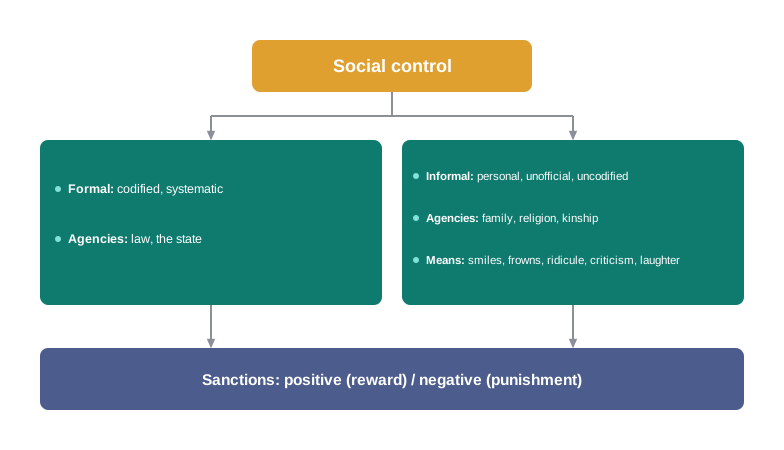
Formal vs Informal social control | Feature | Formal social control | Informal social control | |—|—|—| | Character | Codified and systematic | Personal, unofficial, uncodified | | Agencies | Law, the state | Family, religion, kinship, peer group | | Means | Rules, courts, punishment, force | Smiles, frowns, body language, criticism, ridicule, laughter | | Where emphasised | In modern societies | In everyday life, in all societies | | Consistency | Applied uniformly, at least in principle | Varies greatly, even within the same society |
Q5. Nobody was punished in that classroom, yet the whisper stopped. What kind of power was at work?
A. Informal social control. No rule was cited and no penalty imposed; a look was enough. Informal control is personal, unofficial and uncodified — a frown, a laugh, a silence — and in day-to-day life it is remarkably effective, because it draws on the wish to be accepted by a group whose regard we value.
informal control at work A young man joins a small workshop where the older workers take an hour’s break at noon. In his first week he keeps working through the break. Nobody instructs him to stop. But conversation dies when he walks past, someone remarks loudly that “some people are in a great hurry”, and by the second week he is taking his break with the others. No rule was made and no punishment given. This is informal social control, operating through ridicule and the withdrawal of warmth within a primary group.
However, informal methods of social control may in some cases not be adequate in enforcing conformity or obedience. There are various agencies of informal social control — the family, religion, kinship — and when their pressure is defied, that pressure can escalate into coercion and violence.
The practice referred to as honour killing is the extreme case. Newspapers periodically report the killing of a young woman or a young couple by members of their own family or community, after a marriage entered into against the wishes of the family — typically outside the caste. Reports of such cases often mention that a panchayat or a similar body had earlier attempted to pressurise the couple into abandoning the marriage.
Read such a report carefully, and identify the different agencies of social control involved in it: the family, kinship, caste and the local body on one side; the law, the police and the courts on the other. The case shows, in the sharpest possible way, both that informal control can be violent and that formal control exists to name that violence as a crime.
writing and speaking about deviance The word “deviant” is a sociological category, not a verdict on a person. When a society labels a group or an individual deviant, real consequences follow — exclusion, surveillance, punishment — and researchers who reproduce the label without examining it end up strengthening it. A sociologist’s first question about deviance is therefore not “what is wrong with these people?” but “who has the power to define what counts as deviant here, and what happens to those so defined?”
Sanctions and deviance
A sanction is a mode of reward or punishment that reinforces socially expected forms of behaviour.
A sanction is a mode of reward or punishment that reinforces socially expected forms of behaviour.
Social control can therefore be positive or negative. Members of a society can be rewarded for good and expected behaviour — a prize, a promotion, praise, respect. On the other hand, negative sanctions are used to enforce rules and to restrain deviance — a fine, a punishment, a rebuke, exclusion.
Deviance refers to modes of action which do not conform to the norms or values held by most of the members of a group or society.
Deviance refers to modes of action which do not conform to the norms or values held by most of the members of a group or society.
The crucial thing about this definition is what it does not say. It does not say that deviant behaviour is wrong, or harmful, or unnatural. It says only that it departs from what most members of a group hold to be right.
It follows that what is regarded as deviant is as widely variable as the norms and values that distinguish different cultures and subcultures. Change the group, and you change the definition.
Ideas of deviance are also challenged, and they change from one period to another. Consider a woman who chooses to become an astronaut. At one time such a choice might have been considered deviant; at another time, in the very same society, it is applauded.
That single example carries the whole point of this chapter. Deviance is not a quality inside the act. It is a relation between an act and the norms of a group — and both the norms and the group can change.
You are already familiar with how sociology differs from common sense. The specific terms and concepts discussed in this chapter — group and quasi group, community and association, stratification, status and role, social control, sanction and deviance — will help you move further towards a sociological understanding of society.
Can you think of examples from your own life of how this “unofficial” social control operates? In class, or in your peer group, have you noticed how a person who behaves a little differently from the rest is treated? Have you seen cases where children are pressured by their peer group into being more like everyone else?
Discuss what is being enforced in such cases, who is enforcing it, and what sanctions — positive or negative — are being used.
2.6 Summary
Why sociology needs its own terms
- Sociology studies the interplay between society and the individual, and individuals are always placed within collective bodies such as the family, tribe, caste, class, clan and nation.
- Its subject matter is familiar, and everyday words for it already exist. That is precisely why a precise vocabulary is needed: familiarity blurs our vision, and we cannot see clearly the institutions we live inside.
- Assuming we know all about the family because we live in one confuses sociological knowledge with common sense or naturalistic explanation.
- Concepts arise in society and have a history. Many were developed to map the shift from pre-modern to modern society — the contrast between close, face-to-face interaction and formal, impersonal interaction produced the distinctions between primary and secondary groups, and between community and association. Stratification arose from the concern with structured inequalities.
- Sociology is marked by contesting perspectives. For Marx, class and conflict were the key concepts; for Durkheim, social solidarity and the collective conscience. Functionalists saw society as harmonious, like an organism whose parts serve the whole; conflict theorists, influenced by Marxism, saw it as conflict-ridden.
- Microsociology begins from individuals and face-to-face interaction; macrosociology begins from large structures such as class, caste, market and state. Status and role begin with the individual; social control and stratification begin from the larger context.
- Concepts are keys to open locks — entry points, not final answers. When a key does not fit, it must be modified. Sociology both uses and interrogates its concepts, and the multiplicity of approaches reflects the diversity of society itself.
Social groups and society
- Groups and collectivities exist in every society, but the types of groups differ from society to society.
- An aggregate is a collection of people in the same place at the same time who share no definite connection — passengers at a station, a cinema audience. Such aggregates are termed quasi groups.
- A quasi group lacks structure or organisation, and its members may be unaware, or less aware, of the grouping. Social classes, status groups, age and gender groups, and crowds are examples.
- Quasi groups may become social groups over time. Class and caste have given rise to political parties; the anti-colonial struggle forged an identity as a nation; the women’s movement created women’s groups and organisations.
- A social group has at least six characteristics: persistent interaction; a stable pattern of interaction; a sense of belonging, with its own rules, rituals and symbols; shared interest; acceptance of common norms and values; and a definable structure.
- Social structure refers to patterns of regular and repetitive interaction. A social group is a collection of continuously interacting persons who share common interest, culture, values and norms.
Types of groups
- Most typologies of groups contrast traditional, small-scale societies with modern, large-scale ones — though a complete contrast is probably not an accurate description of reality.
- A primary group is small, and is connected by intimate, face-to-face association and co-operation, with a sense of belonging: the family, the village, a group of friends. A secondary group is relatively large, with formal and impersonal relationships: schools, offices, hospitals. Primary groups are person-oriented, secondary groups goal-oriented.
- Community refers to highly personal, intimate and enduring relationships in which involvement is considerable if not total. Society or association refers to the impersonal, superficial and transitory relationships of modern urban life, where dealings take the form of contracts rather than acquaintance.
- A sense of belonging marks the in-group, separating “us” from “them”; the out-group is one to which members of the in-group do not belong, and its members can face hostility. Who belongs and who does not changes with time and context — as Srinivas found in Rampura in 1948, where recent migrants were dismissed as having “come yesterday” while older migrant families were honoured as “old lineages”.
- A reference group is one we do not belong to but look up to and emulate; it is an important source of information about culture, lifestyle and aspiration. In the colonial period the English served as a reference group for sections of the Indian middle class — a process that was gendered, since men and women were expected to change in different degrees.
- A peer group is a kind of primary group formed of people of similar age or occupation. Peer pressure is the social pressure peers exert on what one ought to do or not do.
Social stratification
- Social stratification is the existence of structured inequalities between groups in their access to material or symbolic rewards. Society is pictured as consisting of strata in a hierarchy.
- Inequality of power and advantage is central to sociology because opportunities for health, longevity, security, educational success, fulfilment in work and political influence are all unequally distributed in systematic ways.
- Four historical systems of stratification: slavery, caste, estate and class. Slavery — the literal ownership of persons — is exemplified by ancient Greece and Rome and the Southern States of the USA in the 18th and 19th centuries; as a formal institution it has been eradicated, though bonded labour, even of children, persists. Estates characterised feudal Europe.
- In a caste system, position depends on status attributes ascribed by birth. Castes formed a hierarchy of social precedence defined by purity and pollution, with the Brahmin priestly castes held superior and the Panchamas or “outcastes” placed below all others. The traditional system is conceptualised through the fourfold varna — Brahmins, Kshatriyas, Vaishyas, Shudras — while in reality there are innumerable occupation-based jatis.
- Endogamy and ritual avoidance of contact were considered critical to maintaining purity. Urbanisation challenged this: as A.R. Desai noted, modern cities, hotels, trains and buses brought people of all castes into contact — but it should not be supposed that caste had vanished. A mill worker’s account shows discrimination persisting in private interactions even where open discrimination had gone.
- Acute caste discrimination still exists. At the same time, democracy has strengthened castes as interest groups, and discriminated castes have asserted their democratic rights.
- Class: for Marx, classes are defined by their relation to the means of production — whether a group owns land or factories, or owns nothing but its labour. Weber used the term life-chances, the rewards and advantages afforded by market capacity, and argued that inequality may rest on economic relations, on prestige, or on political power. Functionalism holds that no society is unstratified, and that inequality is an unconsciously evolved device by which the most important positions are filled by the most qualified persons.
- The caste hierarchy is fixed, rigid and transmitted across generations; the modern class system is open and achievement-based, and in democratic societies nothing legally bars a person from the most deprived background from reaching the highest position. Yet studies of social mobility, even in western societies, are far removed from perfect mobility, and those at the lower levels are disadvantaged both socially and economically.
Status and role
- A status is a position in society or a group, with defined rights and duties. A role is the dynamic or behavioural aspect of status: a status is occupied, a role is played. A status may be described as an institutionalised role.
- An individual occupies many statuses at once — a status set — and acquires different statuses in succession over a lifetime — a status sequence. The smaller and simpler the society, the fewer the statuses available.
- An ascribed status is occupied by birth or assumed involuntarily; its common bases are age, caste, race and kinship. An achieved status is occupied voluntarily through ability, achievement and choice; its common bases are educational qualifications, income and professional expertise. Modern societies are characterised by achievement, but ascribed status still matters within them.
- Prestige is the value attached to a status or office rather than to the person occupying it. A doctor may enjoy higher prestige than a shopkeeper even while earning less, and ideas of what is prestigious vary across societies and periods.
- People perform roles according to social expectations — role taking and role playing. Role conflict is the incompatibility among roles corresponding to one or more statuses, as with the middle-class working woman juggling home and profession. It is not confined to women: Nongbri’s study shows that Khasi matriliny generates intense role conflict for men, torn between their natal house and their wife and children, and strains women’s position as well.
- Role stereotyping reinforces a particular role for particular members of society, as when men and women are socialised as breadwinner and homemaker.
- Roles and status are not fixed. Socialisation is not passive programming: individuals exercise agency, and come to understand and negotiate roles through ongoing social interaction. People fight discriminatory roles based on caste, race or gender, while others resist such change.
Society and social control
- Social control refers to the means used by a society to bring its recalcitrant or unruly members back into line. It is the social process, techniques and strategies by which behaviour is regulated — both through the use of force and through the enforcing of values and patterns for maintaining order.
- For functionalists, social control restrains deviance and mitigates tensions and conflicts, maintaining social order and cohesion, and is therefore necessary to stability. For conflict theorists, it is a mechanism by which dominant classes impose control on the rest of society, so that stability is the writ of one section over another and law is the formal writ of the powerful.
- Formal social control is codified and systematic, exercised through agencies such as law and the state, and is emphasised in modern societies. Informal social control is personal, unofficial and uncodified, working through smiles, frowns, body language, criticism, ridicule and laughter, with the family, religion and kinship among its agencies.
- Informal control is often highly effective, but where it fails to enforce conformity it can escalate into coercion and violence — as in cases reported as honour killing, where family, kinship and caste bodies act against a marriage made against their wishes.
- A sanction is a mode of reward or punishment that reinforces socially expected behaviour. Sanctions may be positive (reward) or negative (punishment).
- Deviance refers to modes of action which do not conform to the norms or values held by most members of a group or society. What counts as deviant varies as widely as norms and values do across cultures and subcultures, and it changes over time — a woman becoming an astronaut may be judged deviant in one period and applauded in another, within the very same society.
2.7 Key Terms
Achieved status — A social position a person occupies voluntarily, through personal ability, achievement, virtue and choice; its common bases are educational qualifications, income and professional expertise.
Aggregate — A collection of people who are in the same place at the same time but who share no definite connection with one another.
Ascribed status — A social position a person occupies because of birth, or assumes involuntarily; its common bases are age, caste, race and kinship.
Association (society) — Relationships that are impersonal, superficial and transitory, typical of modern urban life, where dealings take the form of contracts rather than personal acquaintance.
Caste — A system of stratification in which an individual’s position depends on status attributes ascribed by birth, ranked in terms of purity and pollution relative to others.
Class — A system of stratification based on economic position: for Marx, defined by a group’s relation to the means of production; for Weber, by the life-chances afforded by market capacity.
Community — Human relationships that are highly personal, intimate and enduring, in which a person’s involvement is considerable if not total.
Conflict theories — A sociological perspective focusing on the tensions, divisions and competing interests present in human societies, in which the scarcity and value of resources produce conflict between groups; many conflict theorists have been strongly influenced by the writings of Marx.
Deviance — Modes of action which do not conform to the norms or values held by most of the members of a group or society.
Endogamy — The rule requiring a person to marry within their own group.
Estate — The system of stratification that characterised feudal Europe, in which legally distinct orders held different rights and duties.
Formal social control — Control exercised through codified and systematic mechanisms, such as law and the state; it is emphasised in modern societies.
Functionalism — A theoretical perspective holding that social events are best explained by the function they perform, that is, by their contribution to the continuity of society, which is seen as a complex system whose parts work in relationship to each other.
Identity — The distinctive characteristic of a person’s character, or of the character of a group, relating to who they are and what is meaningful to them; gender, nationality or ethnicity and social class are among its main sources.
In-group — A group marked by a sense of belonging, which separates “us” or “we” from “them” or “they”.
Informal social control — Control that is personal, unofficial and uncodified, working through smiles, frowns, body language, criticism, ridicule and laughter, and exercised through agencies such as the family, religion and kinship.
Jati — The innumerable actual, occupation-based caste groups into which people are born, as distinct from the fourfold conceptual scheme of varna.
Life-chances — The rewards and advantages afforded to a person by their market capacity; a term used by Weber.
Macrosociology — The study of large-scale social systems, such as the political system or the economic order.
Means of production — The means by which the production of material goods is carried on in a society, including not just technology but the social relations between producers.
Microsociology — The study of everyday behaviour in situations of face-to-face interaction, where analysis occurs at the level of individuals or small groups.
Natal — Relating to the place or time of one’s birth.
Norms — Rules of behaviour which reflect or embody a culture’s values, either prescribing a given type of behaviour or forbidding it, and always backed by sanctions of one kind or another.
Out-group — A group to which the members of an in-group do not belong, and whose members may face hostile reactions from the in-group.
Peer group — A kind of primary group, usually formed between individuals of similar age or in a common professional group.
Peer pressure — The social pressure exerted by one’s peers on what one ought to do or not do.
Prestige — The kind of value attached to a status or office, attached to the position itself rather than to the person who occupies it.
Primary group — A small group of people connected by intimate and face-to-face association and co-operation, whose members have a sense of belonging.
Quasi group — An aggregate or combination which lacks structure or organisation, and whose members may be unaware, or less aware, of the existence of the grouping.
Reference group — A group to which a person does not belong but which they look up to and emulate, and which shapes their aspirations and goals.
Role — The dynamic or behavioural aspect of status; a status is occupied, but a role is played.
Role conflict — The incompatibility among roles corresponding to one or more statuses, arising when contrary expectations come from two or more roles.
Role stereotyping — The process of reinforcing some specific role for some member of society, as when men and women are socialised as breadwinner and homemaker.
Sanction — A mode of reward or punishment that reinforces socially expected forms of behaviour; sanctions may be positive or negative.
Secondary group — A relatively large group whose members maintain formal and impersonal relationships, and which is goal-oriented rather than person-oriented.
Slavery — An extreme form of inequality in which some individuals are literally owned by others.
Social control — The various means used by a society to bring its recalcitrant or unruly members back into line; the social process, techniques and strategies by which behaviour is regulated.
Social group — A collection of continuously interacting persons who share common interest, culture, values and norms within a given society.
Social stratification — The existence of structured inequalities between groups in society in terms of their access to material or symbolic rewards.
Social structure — Patterns of regular and repetitive interaction between individuals or groups.
Status — A position in society or in a group, with defined rights and duties assigned to it.
Status sequence — The series of statuses attained in succession by a person at various stages of life.
Status set — The many different statuses an individual occupies at the same time in a complex society.
Varna — The fourfold conceptual scheme — Brahmins, Kshatriyas, Vaishyas and Shudras — in terms of which the traditional caste system is generally described.
2.8 Points to Ponder
Sociology insists that we cannot understand the family simply by living in one. If familiarity gets in the way of understanding, is a sociologist studying her own society at an advantage or a disadvantage compared with one studying a society she has never lived in?
Functionalists see social control as necessary for order; conflict theorists see it as the writ of the powerful. Take a rule you obey every day without thinking — a school regulation, a queue, a dress code. Whose order does it maintain, and whose interest does it serve? Can both answers be true at once?
If concepts are “keys to open locks”, what should a sociologist do when the key does not fit — abandon the concept, or reshape it? What might be lost either way?
Class and caste can exist for a long time as quasi groups before they become organised social groups. What does it take for people who merely share a condition to begin to say “we”?
Modern societies are said to be achievement-based, yet ascribed status continues to matter within them. Where do you see achievement and ascription working on the same person at the same time?
Deviance is defined not by the act itself but by the norms of a group. If that is so, on what grounds can a society ever justify punishing a person for being different?
2.9 NCERT Questions
Why do we need to use special terms and concepts in sociology?
As a member of society you must be interacting with, and within, different groups. How do you see these groups from a sociological perspective?
What have you observed about the stratification system existing in your society? How are individual lives affected by stratification?
What is social control? Do you think the modes of social control in different spheres of society are different? Discuss.
Identify the different roles and statuses that you play and are located in. Do you think roles and statuses change? Discuss when and how they change.
2.10 Objective Questions
Passengers waiting at a railway station are best described as:
- a primary group
- an aggregate or quasi group
- a reference group
- an in-group [1 mark]
Which of the following is NOT one of the characteristics of a social group listed in this chapter?
- persistent interaction
- acceptance of common norms and values
- equality of income among members
- a definable structure [1 mark]
The term “life-chances” was used by:
- Karl Marx
- Emile Durkheim
- Max Weber
- M.N. Srinivas [1 mark]
In sociology, a status is best described as:
- the behaviour a person actually performs
- a position in society or a group, with defined rights and duties
- the income a person earns
- the prestige attached to a person’s actions [1 mark]
Which of these is an agency of formal social control?
- kinship
- the peer group
- the state
- ridicule [1 mark]
The four basic systems of stratification that have existed historically are slavery, caste, estate and __________. [1 mark]
The social pressure exerted by one’s peers on what one ought to do or not do is called __________. [1 mark]
State whether True or False: A quasi group always remains a quasi group and can never become a social group. [1 mark]
State whether True or False: What counts as deviant behaviour can change from one period to another within the same society. [1 mark]
Match the following:
| a. Karl Marx |
i. social solidarity and collective conscience |
| b. Emile Durkheim |
ii. the language of belonging among migrants in Rampura |
| c. M.N. Srinivas |
iii. role conflict in Khasi matrilineal society |
| d. Tiplut Nongbri |
iv. class defined by relation to the means of production |
[1 mark]
- Match the following:
| a. Varna |
i. rules of behaviour backed by sanctions |
| b. Jati |
ii. the fourfold conceptual scheme of the traditional caste system |
| c. Norms |
iii. a mode of reward or punishment |
| d. Sanction |
iv. occupation-based caste groups |
[1 mark]
- Assertion (A): Secondary groups maintain formal and impersonal relationships. Reason (R): Secondary groups are goal-oriented, while primary groups are person-oriented.
- Both A and R are true, and R is the correct explanation of A
- Both A and R are true, but R is not the correct explanation of A
- A is true, but R is false
- A is false, but R is true [1 mark]
- Assertion (A): In a caste system, an individual’s position depends on status attributes ascribed by birth. Reason (R): In a class society, achievement is entirely free of any constraint imposed by status attributes such as race and gender.
- Both A and R are true, and R is the correct explanation of A
- Both A and R are true, but R is not the correct explanation of A
- A is true, but R is false
- A is false, but R is true [1 mark]
- Assertion (A): Informal social control is often very effective in day-to-day life. Reason (R): Informal social control is codified and enforced by the state.
- Both A and R are true, and R is the correct explanation of A
- Both A and R are true, but R is not the correct explanation of A
- A is true, but R is false
- A is false, but R is true [1 mark]
2.11 Check Your Concepts
Define a quasi group and give one example. [2 marks]
What is meant by social structure? [2 marks]
State any two characteristics of a social group. [2 marks]
What is a reference group? Give one example from the colonial period discussed in this chapter. [2 marks]
Define a sanction. Name its two types. [2 marks]
What is meant by prestige? Why may a doctor enjoy higher prestige than a shopkeeper even while earning less? [2 marks]
Differentiate between a primary group and a secondary group, with one example of each. [4 marks]
Differentiate between community and association. [4 marks]
Differentiate between ascribed status and achieved status, with an Indian example of each. [4 marks]
Distinguish between formal and informal social control, naming the agencies of each. [4 marks]
Explain the concept of role conflict with an example. Why is it mistaken to assume that only women experience it? [4 marks]
Why does sociology need a special vocabulary even though its subject matter is familiar to everyone? Give reasons. [4 marks]
“Concepts in sociology are keys to open locks, not final answers.” Explain what this means, with an example of a concept whose usefulness has limits. [4 marks]
Explain how a quasi group may become a social group over time. Illustrate your answer with examples from Indian history and society. [6 marks]
Explain the functionalist theory of social stratification, stating its central claim, the evidence offered for it, and one criticism it faces. [6 marks]
Compare the functionalist and the conflict understandings of social control. How far do you agree that social control is necessary for social order? [6 marks]
“Caste has changed, but caste discrimination has not disappeared.” Evaluate this claim using the evidence discussed in this chapter. [6 marks]
Discuss the view that roles and statuses are not simply received but are created and negotiated by individuals. What does this tell us about the relationship between the individual and society? [6 marks]
2.12 Passage-Based Questions
- Read the passage and answer the questions that follow.
Every winter, the residents of a large housing colony gather for a two-day fair. Nobody is compelled to attend, yet almost everyone comes. Those who stay away are teased for weeks afterwards — “too busy for us, are you?” — and their names are quietly left off the list of volunteers for the following year. Newcomers who have shifted into the colony in the last year or two are welcomed politely, but they notice that the older families call themselves “the original residents” and take the decisions. One of the newcomers, who has lived there for eighteen months, is still described at meetings as “the family that came recently”.
a. *Identify the form of social control at work in the treatment of those who stay away from the fair, and give a reason for your answer.*
b. *Which concepts from this chapter best describe the relationship between the "original residents" and the newcomers? Explain.*
c. *What does this passage suggest about how the boundary between belonging and not belonging is drawn?*
[6 marks]
- Read the passage and answer the questions that follow.
A young woman works as a supervisor in a garment unit. At work she is expected to keep the line running, report delays, and stay until the day’s target is met. At home she is expected to be back before dark, to look after her younger brother’s studies, and to seek her family’s approval before travelling for a training programme in another city. Her employer says she must be more available. Her family says she is already away too much. She is good at both sets of tasks and cannot see how to fail either.
a. *Name the concept this situation illustrates and define it.*
b. *Identify two statuses she occupies and state the role expectations attached to each.*
c. *Explain how the idea of role stereotyping helps in understanding her family's expectations.*
[6 marks]
- Read the passage and answer the questions that follow.
In a district town, a hospital advertises for a post that requires a professional degree. Two young people apply. One has studied at a school with laboratories, a library and teachers who arrived every day; the other studied at a school where three classes shared one room, and worked in the evenings to support the household. Both did well in their examinations. Only one of them was in a position to spend three further years in training without earning. The law placed no barrier before either of them.
a. *Which system of stratification does this passage illustrate, and what is its basic principle?*
b. *The chapter says that modern class systems are "open and achievement-based". How far does this passage support that description?*
c. *Use the concept of life-chances to explain what is happening here.*
[6 marks]
- Read the passage and answer the questions that follow.
A school introduces a monthly assembly at which students who have been punctual all month are given a certificate, and students who have repeatedly come late are asked to stand up and explain themselves. Within three months, lateness falls sharply. A teacher observes that most students now arrive on time not because they fear the explanation, but because they do not want to be the only one in their friends’ group without a certificate.
a. *Identify the two kinds of sanction operating in this school and distinguish between them.*
b. *The teacher's observation points to a mechanism other than the school's official one. Name it and explain how it works.*
c. *Would a functionalist and a conflict theorist describe this arrangement in the same way? Give reasons.*
[6 marks]
2.2 Social Groups and Society
Sociology is the study of human social life. A defining feature of that life is that human beings interact, communicate, and out of this build social collectivities. We do not live singly, and we do not live at random.
The comparative and historical perspective of sociology brings home two facts that look innocent enough at first glance, but are not.
The first is that in every society — ancient or feudal or modern, Asian or European or African — human groups and collectivities exist. There is no known society of pure individuals. The second is that the types of groups and collectivities differ from society to society. The clan, the caste, the guild, the trade union, the residents’ welfare association: each belongs to a particular kind of society at a particular time.
Put these two facts together and a question follows. If groups are everywhere, but not the same everywhere, then a group is not a natural fact like breathing. It is a social arrangement, and it can be studied, compared, and explained.
When is a gathering not a group?
Any gathering of people does not necessarily constitute a group. Think of the passengers waiting at a railway station, or at an airport, or at a bus stop, or the audience in a cinema hall. They are in the same place at the same time. They may even face the same direction. But they share no definite connection with one another, and once the train arrives or the film ends they disperse.
Such a collection of people is an aggregate. Aggregates of this kind are often termed quasi groups.
An aggregate is a collection of people who happen to be in the same place at the same time but who share no definite connection with one another.
A quasi group is an aggregate or combination which lacks structure or organisation, and whose members may be unaware, or less aware, of the existence of the grouping.
Notice the second half of that definition, because it is easy to miss. A quasi group is not only loosely organised; its members may not even know that they form a grouping at all. Social classes, status groups, age groups, gender groups and crowds can all be seen as examples of quasi groups.
Q. Everyone in a cinema hall is doing the same thing at the same time. Why is that still not a group?
A. Because doing the same thing is not the same as interacting. There is no continuing relationship, no shared set of rules or symbols, no sense of “we”, and no structure that survives the end of the film.
Q2. Thirty strangers at a bus stop are not a group, but thirty classmates are. What exactly makes the difference?
A. The bus stop is an aggregate: people in one place at one time, with no definite connection. The classroom has persistent and patterned interaction, a sense of belonging, shared interests, common norms, and a definable structure. It is the pattern of relationships, not the number of bodies, that makes a group.
Fig. 2.3 – Identifying aggregates and social groups.
How quasi groups become groups
As those examples suggest, quasi groups may well become social groups in time and in specific circumstances. The boundary is not a wall; it is a stage in a process.
Take people who belong to a particular social class, or caste, or community. They may not be organised as a collective body at all. They may be yet to be infused with a sense of “we” feeling — they simply share a position, without acting together on the basis of it. Yet class and caste have, over a period of time, given rise to political parties.
The same movement can be seen in the making of the nation. Over the long anti-colonial struggle, people of different communities in India developed an identity as a collectivity and a group — a nation with a shared past and a common future. What had been a scattered population became, through struggle, a “we”.
Identity is the distinctive characteristic of a person’s character, or of the character of a group, relating to who they are and what is meaningful to them. Gender, nationality or ethnicity, and social class are among its main sources.
The women’s movement is another instance: it brought into being the very idea of women’s groups and women’s organisations, where before there had been a category of persons but not an organised collectivity.
All these examples draw attention to a single point that a student of sociology should carry through the rest of this book. Social groups are not fixed furniture. They emerge, they change, and they get modified.
a quasi group turning into a social group The households of a small urban colony have been receiving water for barely an hour a day. For months, each family manages on its own, complaining privately. Then a few residents call a meeting, draw up a list of houses, elect three people to speak for the colony, and agree to contribute a small sum each month. Within a year the colony has a name, a register, a set of rules and a running dispute with the municipal office. The residents began as a quasi group — people sharing a condition without a “we” feeling — and became a social group with structure, shared interest and a sense of belonging.
What makes a social group
A social group can be said to have at least the following characteristics:
The fifth of these introduces a term you will meet repeatedly. Norms are rules of behaviour which reflect or embody a culture’s values, either prescribing a given type of behaviour or forbidding it. Norms are always backed by sanctions of one kind or another, ranging from mild disapproval to severe punishment — a point taken up in the section on social control.
Norms are rules of behaviour which express a culture’s values by prescribing or forbidding a given type of behaviour, and which are always backed by sanctions.
The sixth characteristic — a definable structure — needs unpacking too. Social structure here refers to patterns of regular and repetitive interaction between individuals or groups. When you can predict, more or less, who will speak to whom, in what manner, and with what expectations, you are looking at a structure.
Social structure refers to patterns of regular and repetitive interaction between individuals or groups.
A social group, then, refers to a collection of continuously interacting persons who share common interest, culture, values and norms within a given society.
A social group is a collection of continuously interacting persons who share common interest, culture, values and norms within a given society.
Quasi group vs Social group | Feature | Quasi group | Social group | |—|—|—| | Interaction | Absent or occasional; people merely co-present | Persistent, and following a stable pattern | | Awareness of the grouping | Members may be unaware, or only dimly aware, of it | Members are conscious of the group and of its rules, rituals and symbols | | “We” feeling | Not yet formed | Present; members identify with one another | | Norms and values | Not commonly accepted or enforced | Commonly accepted | | Structure | Lacks structure or organisation | Has a definable structure | | Examples | Crowds, cinema audiences, social classes, age and gender groups | A family, a school, a political party, a residents’ association |
Find a real name that fits under each heading below.
Then discuss: were all of these social groups to begin with? If some were not, at what point can the term “social group”, as sociology understands it, begin to be applied to them?