Chapter 3: Understanding Social Institutions
Picture an ordinary Tuesday in a small town in India. At six in the morning, in one house, a grandmother wakes first and puts the milk on the stove. Her daughter-in-law packs three tiffin boxes. Her son leaves for a factory shift that begins at seven-thirty, and her granddaughter, who is seventeen, leaves for school in a uniform that looks exactly like the uniform of the four hundred other students who will walk in through that gate. On the way she passes a construction site where a woman is carrying head-loads of bricks; nobody records that woman’s hours anywhere. At the school gate the bell rings, and eight hundred pairs of feet move in the same direction at the same moment because a principal, whom none of them elected, has decided that the day begins now. In the evening the family will attend a wedding, where a marriage is being arranged between two people from the same community but from two different villages — as marriages in that region have been arranged for generations.
Nothing in this day is remarkable. And yet almost nothing in it was freely chosen by any single person in it. Who cooks, who earns, who is paid and who is not, who obeys the bell, who marries whom — all of it is patterned. Sociology asks: who wrote the pattern?
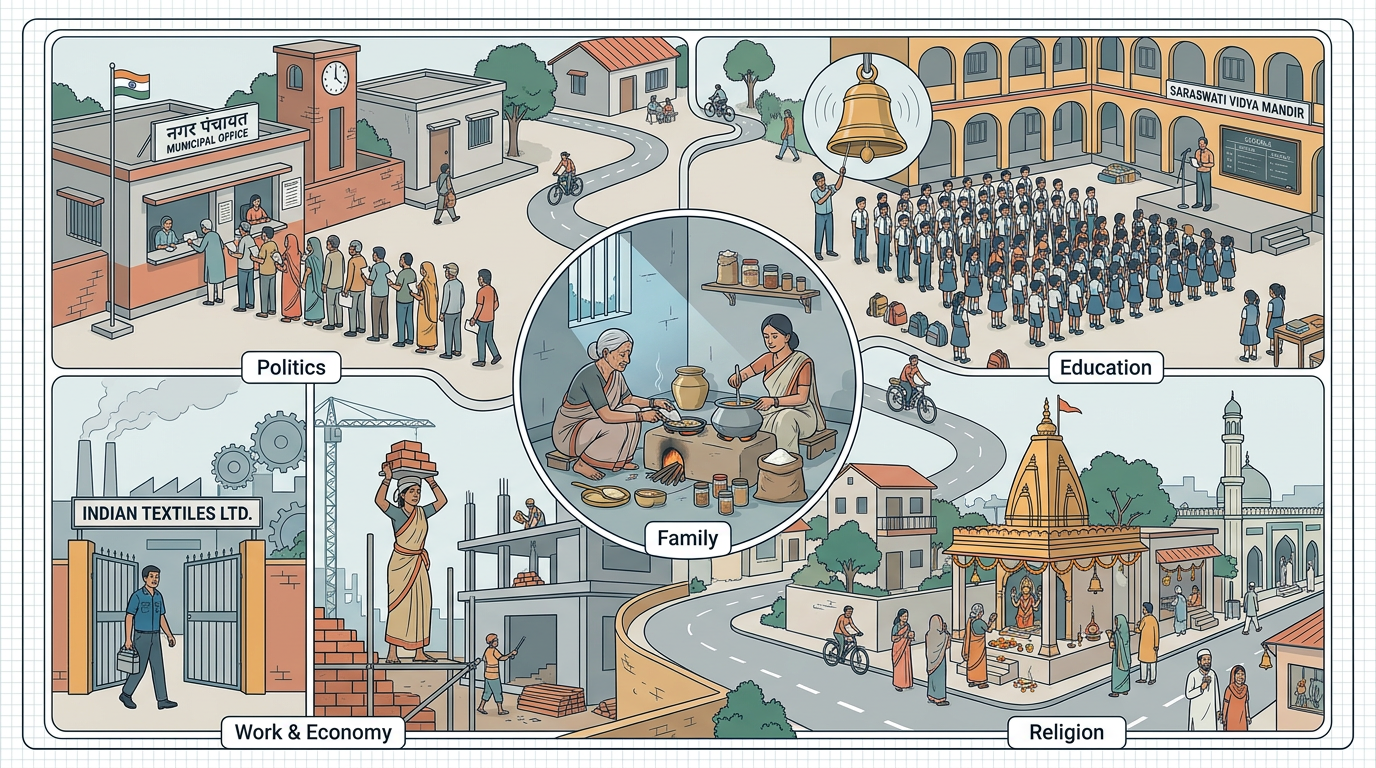
Fig. 3.1 – The social institutions structuring an ordinary day.
You cannot answer these questions yet. By the end of this chapter, you will be able to.
3.1 Introduction
This book began by asking how the individual and society are connected. You have already seen that each of us occupies a place, or a location, in society. Each of us has a status and one or more roles that go with it.
But these are not simply things we pick for ourselves. A film actor may accept or refuse a role; we cannot refuse the roles society hands us in the same easy way. A daughter, a student, a worker, a citizen — these roles come with expectations already attached.
What attaches them? The answer is that we live inside social institutions. They constrain us and control us; they punish us and they reward us. Some of them are enormous, like the state — sociologists would call these ‘macro’ institutions. Some are close and intimate, like the family — these are ‘micro’ institutions. The size differs; the patterning does not.
This chapter introduces you to social institutions, and to how sociology and social anthropology go about studying them. It gives a brief idea of five central areas in which important social institutions are located: (i) family, marriage and kinship; (ii) politics; (iii) economics; (iv) religion; and (v) education.
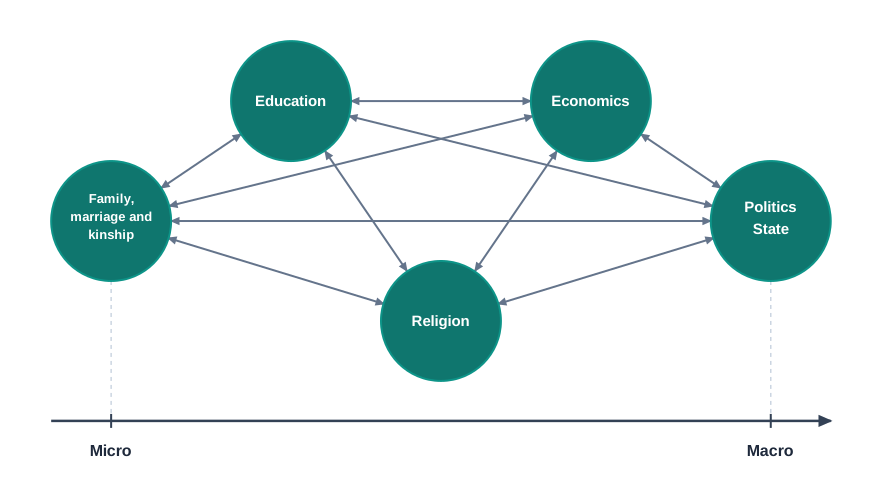
Fig. 3.2 – The five central social institutions and their connections.
What an institution is
In the broadest sense, an institution is something that works according to rules. Those rules are established, or at least acknowledged, either by law or by custom. And its regular, continuous working cannot be understood at all unless we take those rules into account.
Notice how much that definition rules out. A crowd on a railway platform is not an institution. A school is, because it runs to rules — of admission, attendance, examination, discipline — that exist before any particular child walks in and continue after that child leaves.
Institutions constrain — and enable
Institutions impose constraints on individuals. That much is obvious: the school bell decides when you may leave the classroom, and the law decides at what age you may marry.
But this is only half the story, and the half students usually remember. Institutions also provide the individual with opportunities. The same school that constrains you with a timetable is also the only route by which you can reach a degree, a qualification, a job. Constraint and opportunity are two faces of the same institution, not two different institutions.
An institution can also be viewed as an end in itself — not merely as a means to something else. People have regarded the family, religion, the state, even education, as ends in themselves, worth defending for their own sake. This is why people are willing to give up so much for them.
Two ways of seeing the same institution
You have already learnt something uncomfortable about this discipline: sociologists do not agree. Concepts are understood differently by different schools. You have met the functionalist perspective and the conflict perspective, and you have seen how differently the two look at the very same thing — at stratification, or at social control.
It should not surprise you, then, that there are also different ways of understanding social institutions. Look at Fig. 3.3: the same building, seen through two different lenses, yields two different accounts.

Fig. 3.3 – The functionalist and conflict views of the same institution.
A functionalist view understands social institutions as a complex set of social norms, beliefs, values and role relationships that arise in response to the needs of society. On this view, institutions exist because they satisfy social needs. If a need exists, an institution grows up to meet it.
Working this way, functionalists distinguish informal social institutions from formal social institutions. The family and religion are examples of informal social institutions: their rules are carried by custom, habit and belief rather than by written codes. Law and (formal) education are formal social institutions: their rules are explicitly laid down, written, and enforced by recognised officials.
A conflict view begins from precisely that objection. It holds that individuals are not placed equally in society. All social institutions — familial, religious, political, economic, legal or educational — will therefore operate in the interest of the dominant sections of society, whether that dominance rests on class, caste, tribe or gender.
The claim goes further still. The dominant social section does not only dominate political and economic institutions. It also ensures that the ruling class’s ideas become the ruling ideas of a society — that its way of seeing the world comes to look like plain common sense to everybody. This is a very different picture from the idea that a society has general needs which its institutions quietly meet.
Reading the chapter with a question in hand
As you go through the rest of this chapter, keep testing both views against what you read. See whether you can find examples that show how social institutions constrain individuals and also offer them opportunities. Notice, too, whether they affect different sections of society unequally.
Two questions are worth carrying with you from here to the last page. How does the family constrain, and also provide opportunities to, men and women? And how do political or legal institutions affect the privileged and the dispossessed differently?
3.2 Family, Marriage and Kinship
Perhaps no other social entity appears more ‘natural’ than the family. It is the first group we belong to, and we belong to it before we can think about it at all. Because of this, we are prone to assume that all families are more or less like the ones we live in.
No other social institution looks so universal and so unchanging. And this is exactly where sociology begins to be uncomfortable.
For many decades, sociology and social anthropology have conducted field research across cultures. That research shows two things at once. The institutions of family, marriage and kinship are important in every society — and their character is different in different societies. Universality of the institution, variety in the form: hold both ideas together, because the rest of this section depends on it.
That research has also shown something else. The family — what we usually think of as the private sphere — is closely linked to the economic, political, cultural and educational spheres, which we think of as public. This is one more reason why sociology has to borrow from, and share with, other disciplines, as you saw in Chapter 1.
What functionalists say the family does
According to the functionalists, the family performs important tasks. These tasks contribute to society’s basic needs and help perpetuate social order — children are cared for, values are passed on, adults are supported.
From this starting point, the functionalist perspective goes on to argue something much stronger: that modern industrial societies function best if women look after the family and men earn the family livelihood.
The nuclear family — a couple and their children — is seen by functionalists as the unit best equipped to handle the demands of industrial society. In such a family, one adult can work outside the home while the second adult cares for the home and children.
In practical terms, this specialisation of roles inside the nuclear family means the husband adopts the ‘instrumental’ role of breadwinner, and the wife assumes the ‘affective’, emotional role in domestic settings.
Now ask the sociologist’s question: is this an account of what families actually do, or a recommendation about what they ought to do? The vision is questionable — and not only because it is gender unjust. It is questionable because empirical studies across cultures and across history show that it is untrue.
You will see this for yourself in the next section on work and economy. In contemporary industries such as garment export, women form a large part of the labour force. They are not sitting at home performing an ‘affective’ role.
The functionalist picture also carries a second assumption: that men are necessarily the heads of households. That, too, is not necessarily true.
3.2.1 Variation in Family Forms
A central debate in India has been about the shift from the nuclear family to the joint family — a household in which several related married couples and their children live together, sharing a common hearth and often a common estate.
You have already seen how sociology questions common sense impressions. Here is one worth questioning. The fact is that nuclear families have always existed in India, particularly among deprived castes and classes — for households with little land and little property to hold them together, the small household was never a modern invention.
Now take the opposite common sense impression: that the joint family is fast disappearing. The sociologist A.M. Shah remarks that in post-Independence India the joint family has steadily increased.
His reasoning runs through demography. Life expectancy in India has increased — from 32.5 to 55.4 years for men, and from 31.7 to 55.7 years for women, over the period 1941–50 to 1981–85. Consequently, the proportion of aged people (60 years and above) in the total population has risen. Shah then asks the crucial question: in what kind of household do these elderly people live? His submission is that most of them live in joint households.
This too, of course, is a broad generalisation. But in the spirit of the sociological perspective, it does its work: it cautions us against blindly believing a common sense impression that the joint family is fast eroding, and it alerts us to the need for careful comparative and empirical study.
Diversity of family forms
Studies have shown how diverse family forms are in different societies. Take the rule of residence — the custom that decides where a newly married couple will live.
Some societies are matrilocal in their marriage and family customs; others are patrilocal. In the first case, the newly married couple stays with the woman’s parents. In the second, the couple lives with the man’s parents. Most of northern India follows the second rule; you can see its consequences later in this section.
Look now at Fig. 3.4, and notice how sharply families and residences differ from one another even within one country.
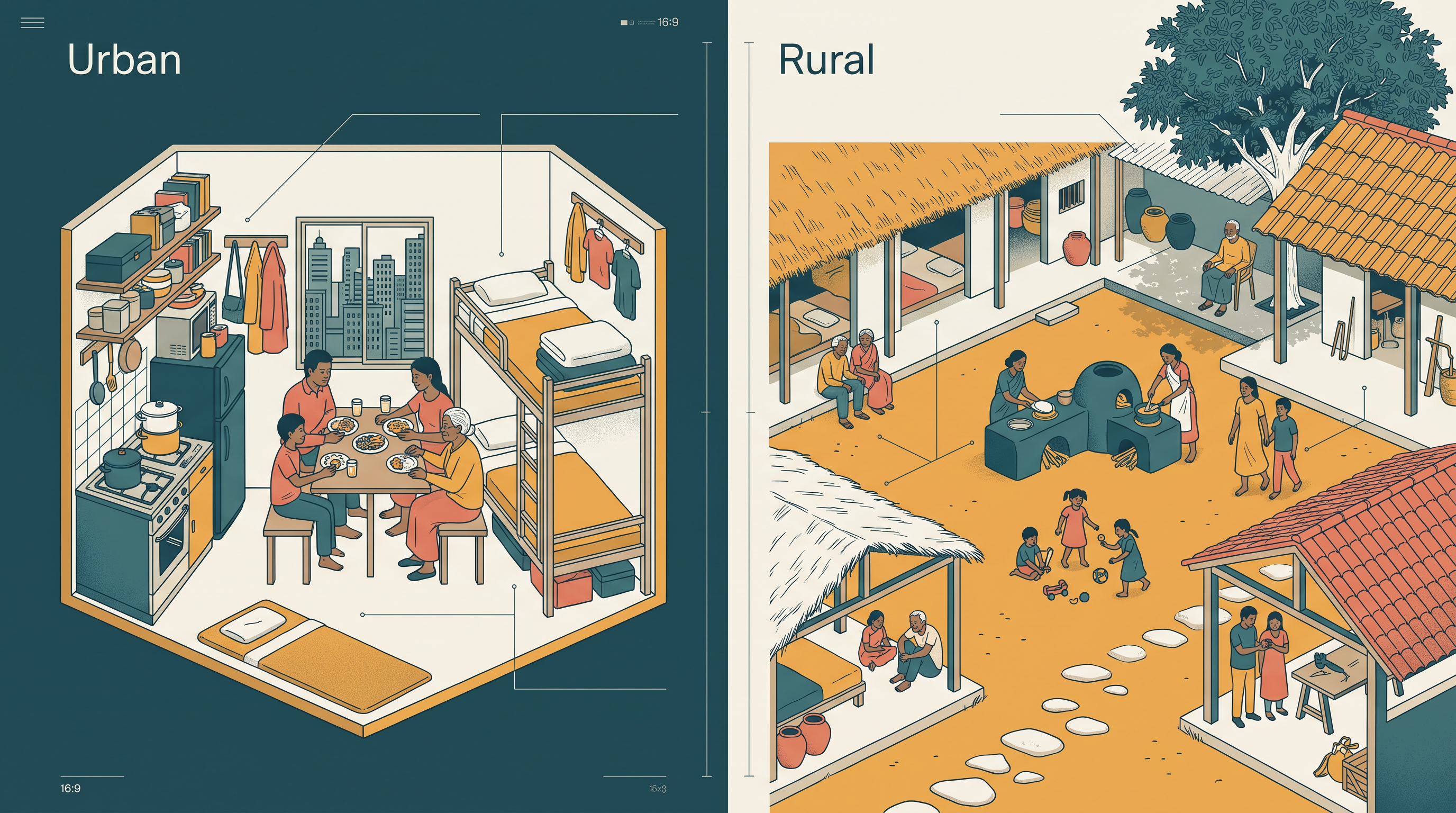
Fig. 3.4 – Diversity of family residences.
Authority is a separate question from residence. A patriarchal family structure exists where the men exercise authority and dominance. Matriarchy would exist where the women play the major role in decision-making within the family.
Here NCERT makes a careful and easily missed point. Matrilineal societies — where descent and property pass through the mother’s line — do exist. But the same cannot be claimed about matriarchal societies. Tracing descent through women is not the same thing as women holding power.
3.2.2 Families are Linked to other Social Spheres and Families Change
In everyday life we look at the family as distinct and separate from other spheres, such as the economic or the political. Yet the family, the household, its structure and its norms are closely linked to the rest of society.
An interesting example is the unintended consequence of the German unification. During the post-unification period in the 1990s, Germany witnessed a rapid decline in marriage.
Why? Because the new German state withdrew all the protection and welfare schemes that had been provided to families before unification. With a growing sense of economic insecurity, people responded by refusing to marry. Nobody had planned this; it was a case of unintended consequence, an idea introduced in Chapter 1.
Family and kinship are thus subject to change and transformation because of macro economic processes. But the direction of change need not always be similar for all countries and regions — what happened in Germany is not what must happen in India.
Moreover, change does not mean the complete erosion of previous norms and structures. Change and continuity co-exist. A household may send a son to work in a distant city and still arrange his marriage exactly as his grandfather’s was arranged.
Fig. 3.5 shows this co-existence in a single frame: work and home, still tangled together for many households, even as industrial work pulls them apart.
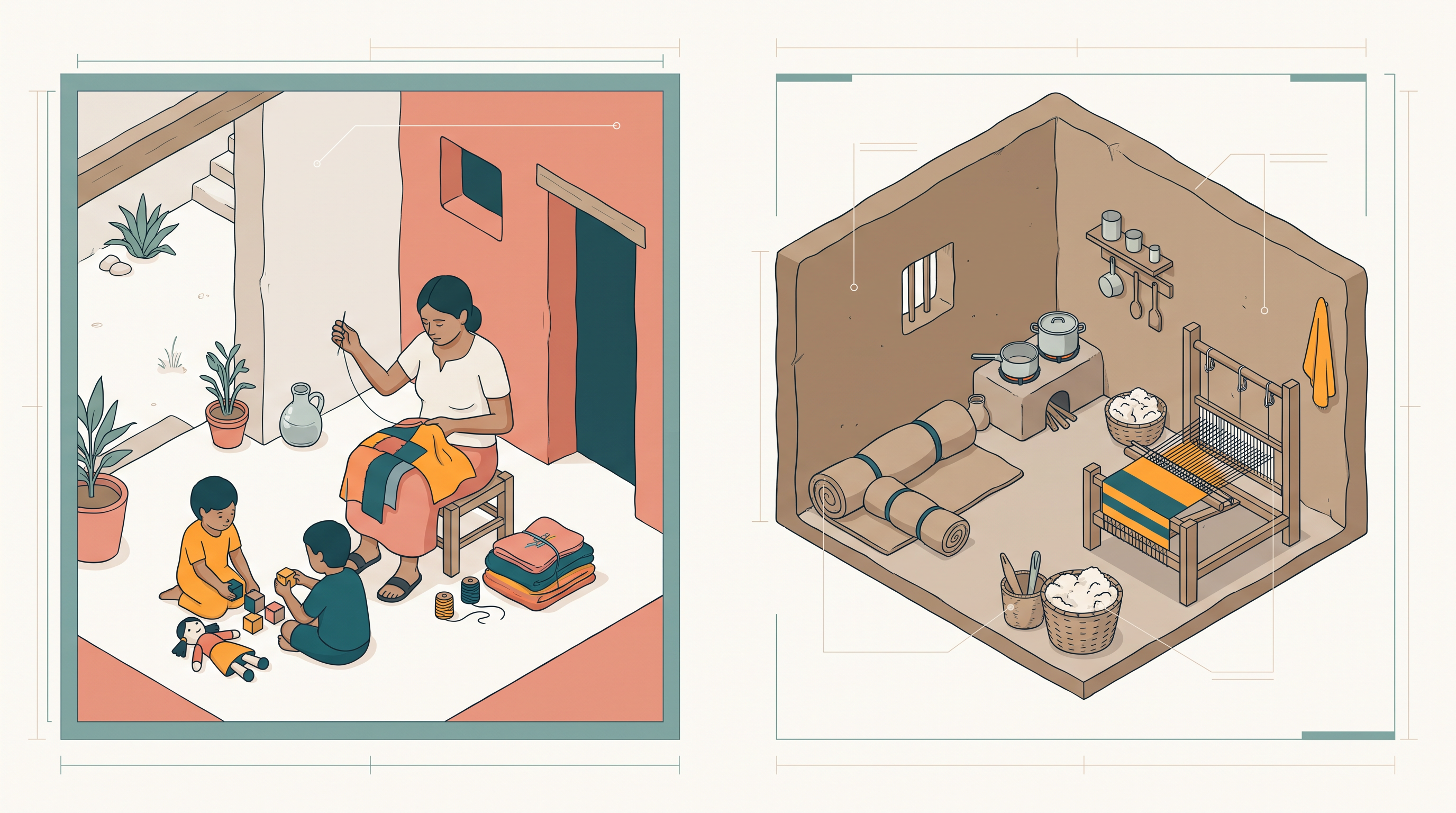
Fig. 3.5 – The co-existence of work and home.
3.2.3 How Gendered is the Family?
Gender refers not to biological sex but to the social expectations about behaviour that a society regards as appropriate for the members of each sex. It is one of the basic organising principles of society — and the family is where most of us first meet it.
Consider a widespread belief: that the male child will support the parents in their old age, and the female child will leave on marriage. If a household believes this, its spending follows the belief. Families invest more in a male child — in his food, his health care, his schooling.
Now put a biological fact beside that social belief. A female baby has better chances of survival than a male baby. Despite this, the rate of infant mortality among female children is higher than among male children in the lower age group in India.
That gap between what biology predicts and what actually happens is not an accident of nature. It is the measurable trace of an institution — a social fact, if you like, written into a mortality table.
Reading the sex ratio
The sex ratio is the tool sociologists and demographers use to see this. In India it is expressed as the number of females per 1000 males:
\[\text{Sex ratio} = \frac{\text{Number of females}}{\text{Number of males}} \times 1000\]
A figure of 940 therefore means 940 women for every 1000 men. It does not mean 94 per cent, and it is not a percentage at all — the base is 1000, not 100.
Table 3.1 – Sex ratio in India, 1901–2011 (number of females per 1000 males) | Year | Sex Ratio | Year | Sex Ratio | |—|—|—|—| | 1901 | 972 | 1961 | 941 | | 1911 | 964 | 1971 | 930 | | 1921 | 955 | 1981 | 934 | | 1931 | 950 | 1991 | 926 | | 1941 | 945 | 2001 | 933 | | 1951 | 946 | 2011 | 940 |
Read Table 3.1 slowly, because it tells a hundred-year story. In 1901 there were 972 females for every 1000 males. The figure falls almost without interruption for seventy years, reaching its lowest point of 926 in 1991. After that it recovers a little — 933 in 2001 and 940 in 2011 — but it has still not returned anywhere near the figure with which the century began. Fig. 3.6 makes the long slide visible at a glance.
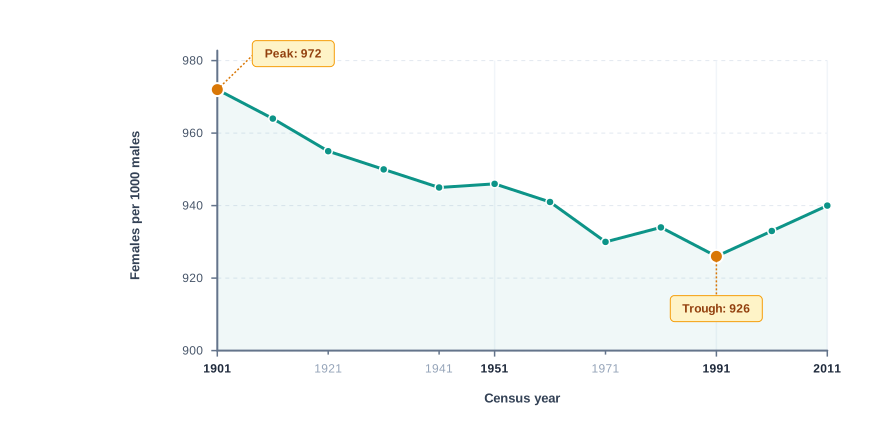
Fig. 3.6 – Sex ratio in India, 1901–2011.
That last box deserves a pause, because it destroys a comfortable assumption. The worst figures do not come from the poorest states. They come from prosperous ones. Prosperity, by itself, does not dissolve a preference for sons; it can simply make it easier to act on that preference.
3.2.4 The Institution of Marriage
Historically, marriage has been found to exist in a wide variety of forms in different societies. It has also been found to perform differing functions — it is not everywhere doing the same job.
Indeed, the manner in which marriage partners are arranged reveals an astonishing variety of modes and customs. Before you decide that any one of them is normal, it is worth finding out how many there are.
3.2.5 Forms of Marriage
Marriage has a large variety of forms. These forms can be identified on two bases: the number of partners, and the rules governing who can marry whom. This section takes the first basis; the next takes the second. Fig. 3.7 sets out the whole classification.
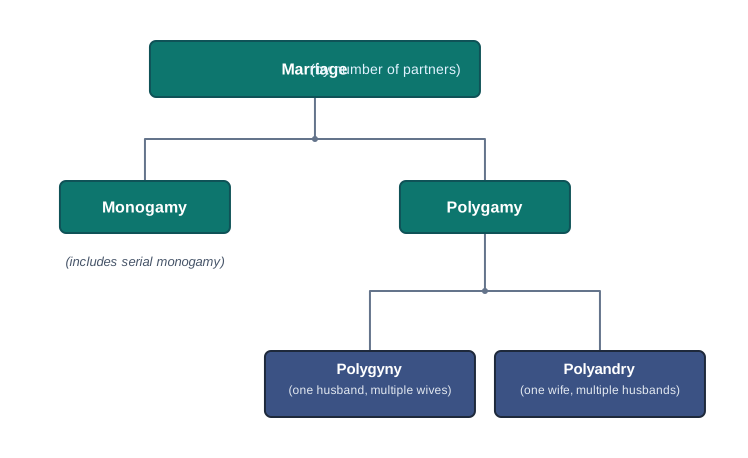
Fig. 3.7 – Classification of marriage by number of partners.
In terms of the number of partners who can legitimately enter into matrimony, there are two forms of marriage: monogamy and polygamy.
Monogamy restricts the individual to one spouse at a time. Under this system, at any given time a man can have only one wife, and a woman can have only one husband. Note the practical point that follows: even where polygamy is permitted, monogamy is in actual practice more widely prevalent.
In many societies, individuals are permitted to marry again, often on the death of the first spouse or after divorce. But they cannot have more than one spouse at one and the same time. Such monogamous marriages are termed serial monogamy — one at a time, but possibly several across a lifetime.
Here the sociologist must look at who has actually been allowed to do this. Remarriage on the death of a wife has been a norm for men, for the most part. As you are aware, the same right for upper caste Hindu widows was denied, and the campaign for widow remarriage became a major issue in the social reform movements of the nineteenth century.
What you are probably less aware of is that in modern India nearly 10 per cent of all women, and 55 per cent of women over fifty years, are widows (Chen 2000: 353). The question of how widows live is therefore not a marginal question about a few people. It concerns a very large section of Indian women.
Polygamy denotes marriage to more than one mate at one time. It takes one of two forms: polygyny, where one husband has two or more wives, and polyandry, where one wife has two or more husbands.
Why would a society practise polyandry? NCERT gives an economic answer rather than a cultural one. Usually where economic conditions are harsh, polyandry may be one response of society, since in such situations a single male cannot adequately support a wife and children. Extreme poverty also pressurises a group to limit its population, and a single wife shared among brothers produces fewer children than several wives would.
Notice what kind of explanation that is. It does not say that some people have strange customs. It says that a marriage rule is a response to the material conditions in which a group has to survive — which is exactly the sociological way of asking the question.
3.2.6 The Matter of Arranging Marriages: Rules and Prescriptions
The second basis of classification concerns who may marry whom — and who decides.
In some societies, the decisions regarding mate selection are made by parents or relatives. In some other societies, individuals are relatively free to choose their own mates. Neither arrangement is a lack of rules; both are rules, of different kinds.
3.2.7 Rules of Endogamy and Exogamy
In some societies these restrictions are subtle. In others, the individuals who can or cannot be married are much more explicitly and specifically defined. Forms of marriage based on rules governing the eligibility or ineligibility of mates are classified as endogamy and exogamy.
Endogamy requires an individual to marry within a culturally defined group of which he or she is already a member — caste, for example. Exogamy, the reverse of endogamy, requires the individual to marry outside of his or her own group.
Endogamy and exogamy are always stated with reference to some kinship unit. That unit may be the clan, the caste, or a racial, ethnic or religious grouping. So the two rules are not opposites in practice; they work together. A rule may require you to marry inside your caste and outside your clan at the same time.
Village exogamy and the pain of departure
In India, village exogamy is practised in certain parts of north India. The rule meant that daughters were married into families from villages far away from home.
The arrangement had a purpose, and it is worth naming it plainly. It ensured the smooth transition and adjustment of the bride into the affinal home — the home of her husband’s kin — without interference from her own kinsmen. Distance made interference impossible.
Now combine that geographical distance with the unequal relationship built into the patrilineal system, in which a daughter belongs to her father’s line before marriage and to her husband’s after it. The result was that married daughters did not get to see their parents too often.
Parting from the natal home — the home one is born into — was therefore a sad occasion. It is the theme of a whole body of folk song, sung by women, which dwells on the pain of departure.
3.2.8 Defining Some Basic Concepts: Family, Kinship and Marriage
You have used the words family, kinship and marriage throughout this section. Sociology now needs them defined precisely, because everyday speech uses all three loosely.
A family is a group of persons directly linked by kin connections, the adult members of which assume responsibility for caring for children.
Kinship ties are connections between individuals, established either through marriage, or through the lines of descent that connect blood relatives — mothers, fathers, siblings, offspring, and so on.
Marriage can be defined as a socially acknowledged and approved sexual union between two adult individuals. The words ‘socially acknowledged and approved’ are the heart of the definition: what makes a union a marriage is not the feeling between two people but the recognition given to it by others.
When two people marry, they become kin to one another. But the marriage bond also connects together a much wider range of people. Parents, brothers, sisters and other blood relatives become relatives of the partner through marriage. One wedding creates dozens of new relationships.
Sociology gives names to the two families each person belongs to across a lifetime. The family of birth is called the family of orientation. The family in which a person is married is called the family of procreation.
Kinship is likewise of two kinds. Kin who are related through “blood” are called consanguineous kin. Kin who are related through marriage are called affines. Fig. 3.8 shows both kinds of tie on one chart.
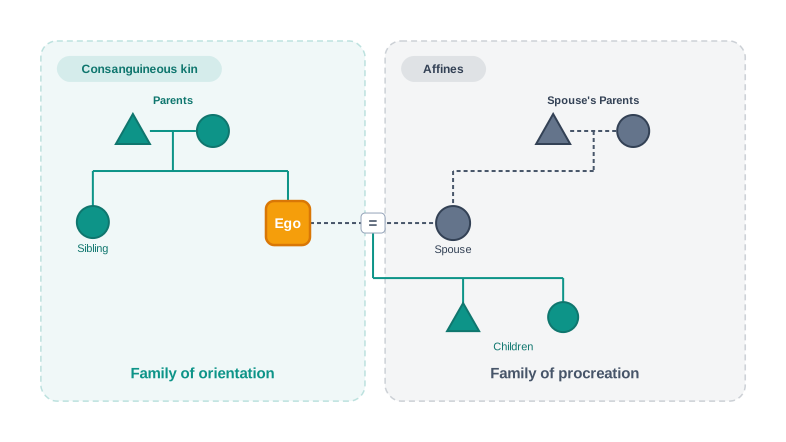
Fig. 3.8 – Consanguineous kin and affines.
As we move on to the next section, on work and economic institutions, watch for how tightly the family and economic life are interconnected. You have already had a warning of it: a man migrating for work turns his wife into the head of a household, and a welfare policy in Germany changed who got married. The private and the public are not two worlds.
3.3 Work and Economic Life
The last section ended with a household. This one begins with the same household, seen from a different angle: how does it get fed, clothed and housed? Every society has to organise the production and distribution of goods and services, and the arrangements it settles on are its economic institutions.
3.3.1 What is Work?
As children and young students, we imagine what kind of ‘work’ we will do when we grow up. Notice what the word means when we use it that way. It refers to paid employment. This is the most widely understood sense of ‘work’ in modern times.
This is in fact an oversimplified view. Many types of work do not conform to the idea of paid employment at all.
Much of the work done in the informal economy, for example, is not recorded in any direct way in the official employment statistics. The term refers to transactions outside the sphere of regular employment — sometimes involving the exchange of cash for services provided, but also often involving the direct exchange of goods or services.
Think for a moment about what that leaves out of the official record. The woman who stitches blouses at home and is paid by the piece; the man who repairs cycles on the pavement; the labourer hired for the day at a street corner; the domestic worker paid partly in cash and partly in used clothes. All of them are working. Almost none of them appear in the employment statistics as workers.
So sociology needs a definition of work wide enough to hold all of this — and wide enough to hold unpaid work too.
Test the definition against the case you already know. Cooking for a household requires the expenditure of mental and physical effort, and it produces goods and services that cater to human needs. It is work. That it earns no wage changes its position in the economy — not its status as work.
3.3.2 Modern Forms of Work and Division of Labour
In pre-modern forms of society, most people worked in the field or cared for the livestock. Work meant land and animals, and almost everyone did it.
In the industrially developed society, only a tiny proportion of the population works in agriculture — and farming itself has become industrialised. It is carried on largely by means of machines rather than by human hand.
India, however, does not fit that description neatly, and it is worth being exact about how it differs.
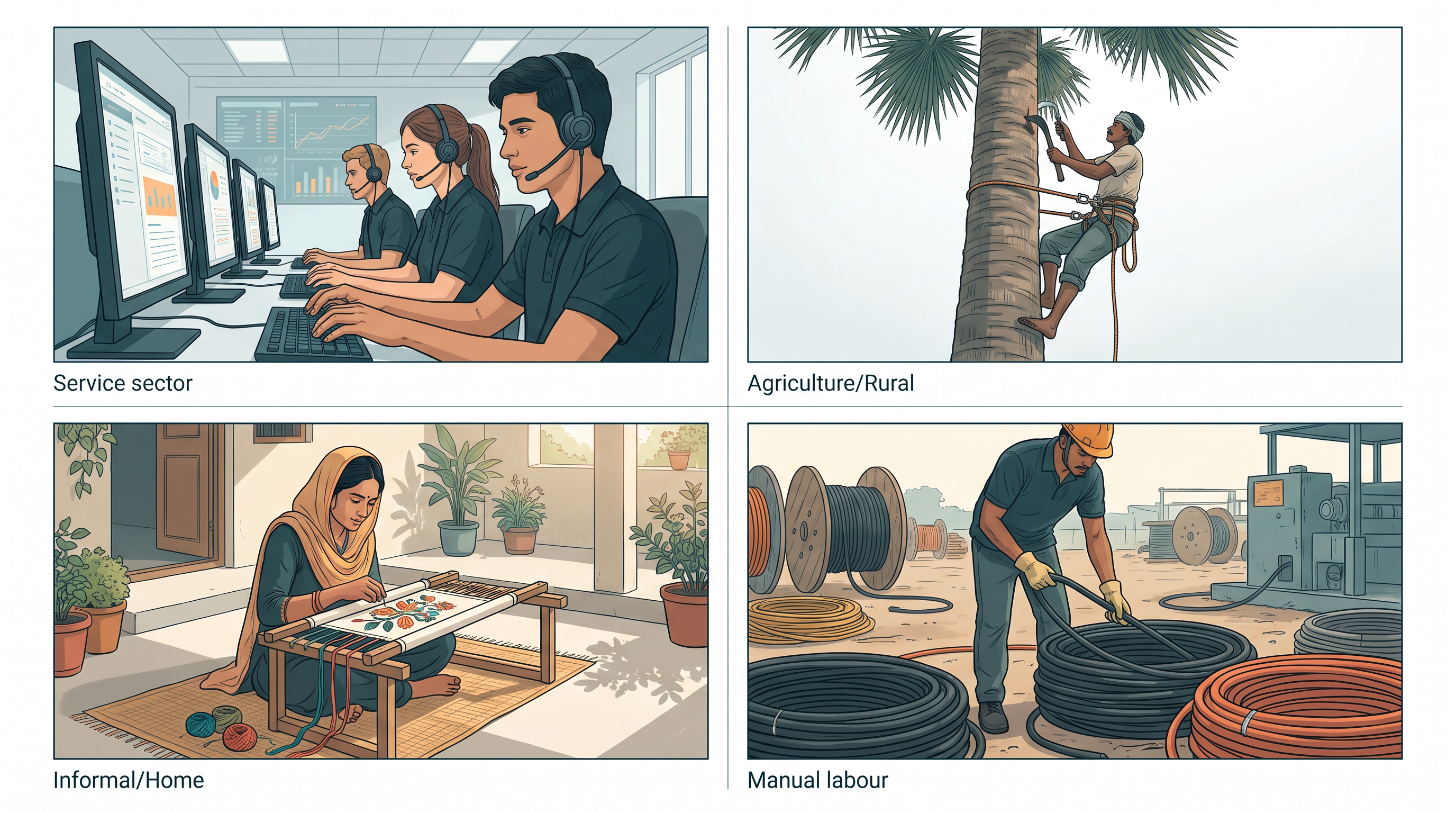
Fig. 3.9 – Different types of work and sectors.
The division of labour
One of the most distinctive characteristics of the economic system of modern societies is the existence of a highly complex division of labour. Work has been divided into an enormous number of different occupations, in which people specialise.
Compare this with what came before. In traditional societies, non-agricultural work entailed the mastery of a craft. Craft skills were learned through a lengthy period of apprenticeship, and the worker normally carried out all aspects of the production process from beginning to end.
Picture a master weaver at a loom. He has selected the yarn, set the warp, chosen the pattern and woven the cloth. The finished shawl is his work, all of it. Now picture a garment factory, where one worker attaches collars for eight hours and has never seen the finished shirt leave the building. Fig. 3.10 puts the two side by side.
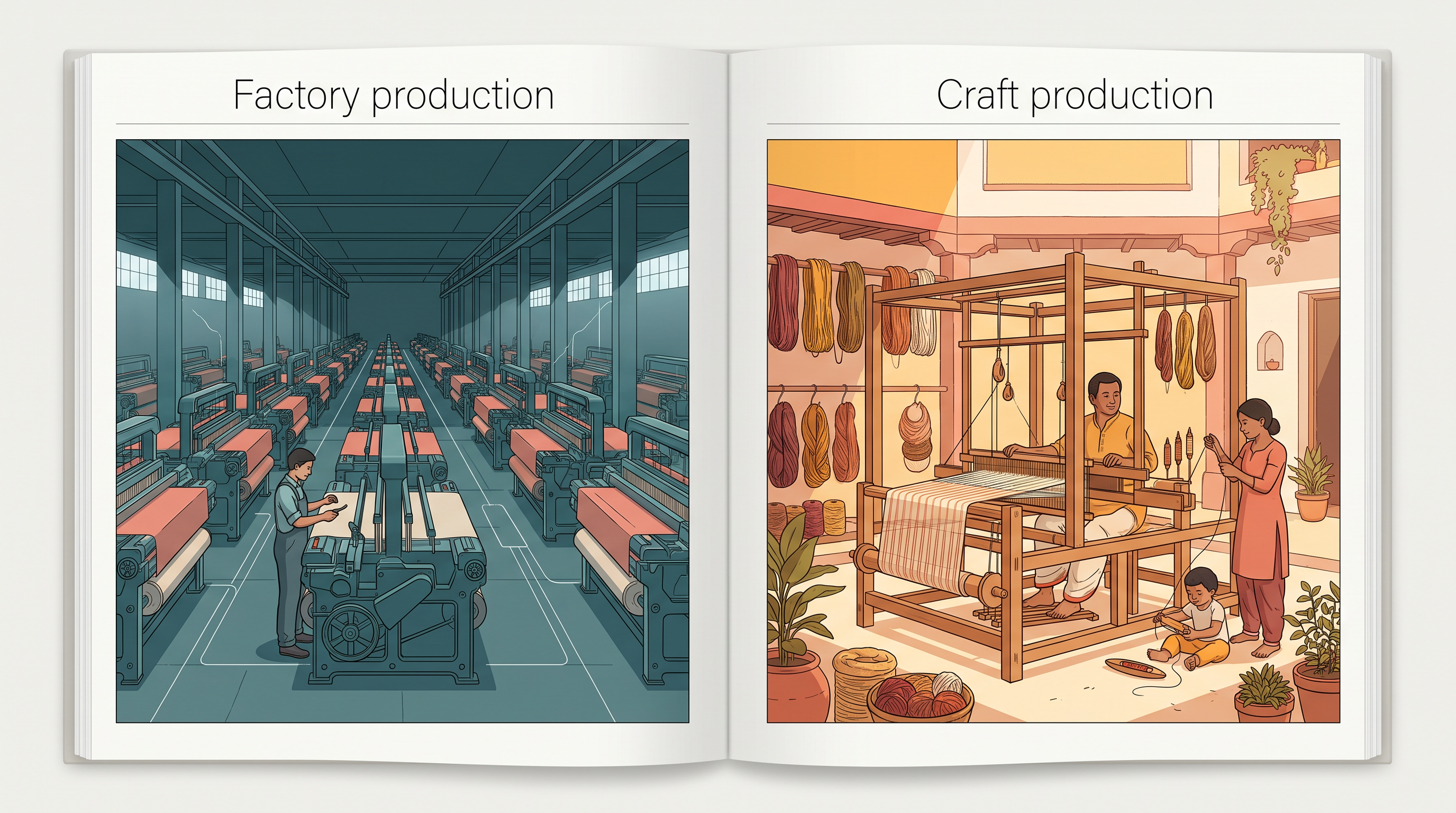
Fig. 3.10 – Craft production versus factory production.
The separation of work from home
Modern society also witnesses a shift in the location of work. This is easy to state and easy to underestimate.
Before industrialisation, most work took place at home, and was completed collectively by all the members of the household. The household was the unit of production, not merely of consumption. Fig. 3.11 still shows something of this arrangement in a village, where threshing draws in the whole household even as a machine does part of the job.
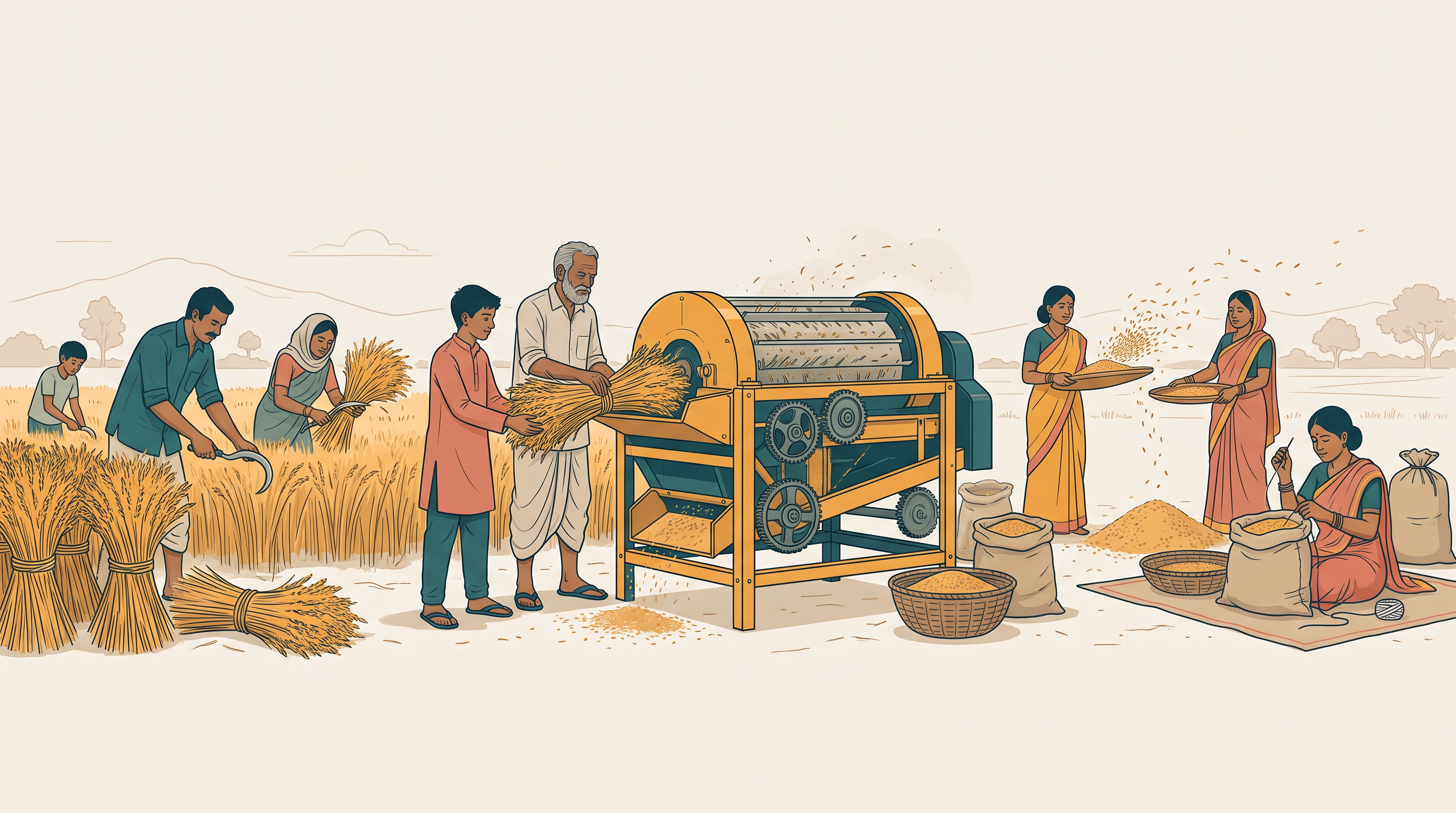
Fig. 3.11 – The household as a unit of agricultural production.
Advances in industrial technology — machinery operating on electricity and coal — contributed to the separation of work and home. Factories, owned by capitalist entrepreneurs, became the focal point of industrial development.
People seeking jobs in factories were trained to perform a specialised task, and received a wage for that work. Managers supervised them; the manager’s task was to enhance worker productivity and discipline. Notice that supervision itself becomes an occupation once work is divided.
Economic interdependence
One of the main features of modern societies is an enormous expansion of economic interdependence. We are all dependent on an immense number of other workers — stretching right across the world — for the products and services that sustain our lives.
With very few exceptions, the vast majority of people in modern societies do not produce the food they eat, the houses they live in, or the material goods they consume.
That is a startling sentence when you sit with it. Your breakfast, your shirt, your phone and your school building were made by thousands of people you will never meet, in places you will never visit, most of them working under conditions you know nothing about.
3.3.3 Transformation of Work
Once work had been divided, it could be redesigned. Industrial processes were broken down into simple operations that could be precisely timed, organised and monitored.
Mass production demands mass markets — there is no point producing ten thousand identical shirts unless ten thousand people can be found to buy them. One of the most significant innovations was the construction of a moving assembly line, along which the product travels to the worker instead of the worker moving to the product.
Modern industrial production needed expensive equipment. It also needed continuous monitoring of employees, through monitoring or surveillance systems. The timing of the task, the discipline of the worker and the machine were now parts of a single arrangement.
Flexible production and the long supply chain
Over the last few decades there has been a shift to what is often called flexible production and decentralisation of work. Production is no longer concentrated in one large factory that does everything; it is broken up, spread out, and moved about.
It is argued that in this period of globalisation, it is the growing competition between firms and between countries that makes it essential for firms to organise production to suit changing market conditions. If a buyer in another country changes an order, the production arrangement must change with it.
What does this mean for the workers at the far end of that chain? A study of the garment industry in Bangalore gives a precise answer.
Read that finding again, and notice what has happened to power. The new organisation of production, and a body of customers sitting outside the country altogether, have together altered both the economics and the politics of production. The people who can raise a Bangalore worker’s wage may be shoppers in another continent — which is a strange and rather uncomfortable thought. Fig. 3.12 traces the chain.
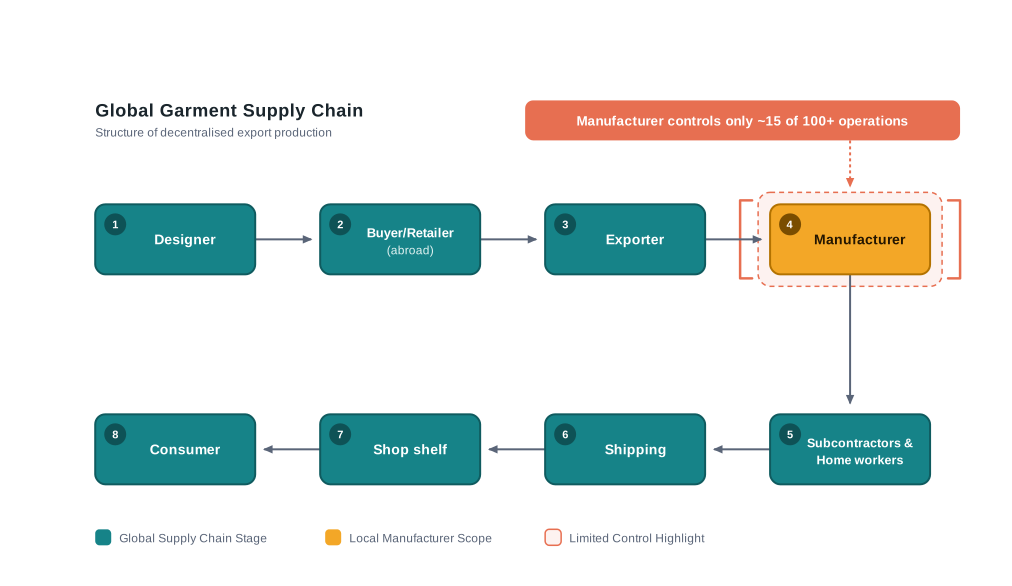
Fig. 3.12 – The decentralised garment supply chain.
3.4 Politics
Political institutions are concerned with the distribution of power in society. Two concepts are critical to understanding them: power and authority. Get these two clear, and most of what follows falls into place.
What sociologists mean by power
Power is the ability of individuals or groups to carry out their will even when they are opposed by others. The last five words are the whole point. Getting your way when everyone agrees with you requires no power at all.
It implies, further, that those who hold power do so at the cost of others. There is a fixed amount of power in a society, and if some wield power, others do not.
In other words, an individual or a group does not hold power in isolation. Power is held in relation to others. It is not a possession, like a car; it is a relationship, like a debt.
This notion of power is fairly inclusive, and it reaches much further than government. It extends from family elders assigning domestic duties to their children, to principals enforcing discipline in school. It runs from the General Manager of a factory distributing work among the executives, to political leaders regulating the programmes of their parties. Fig. 3.13 sets out these everyday scenes together.
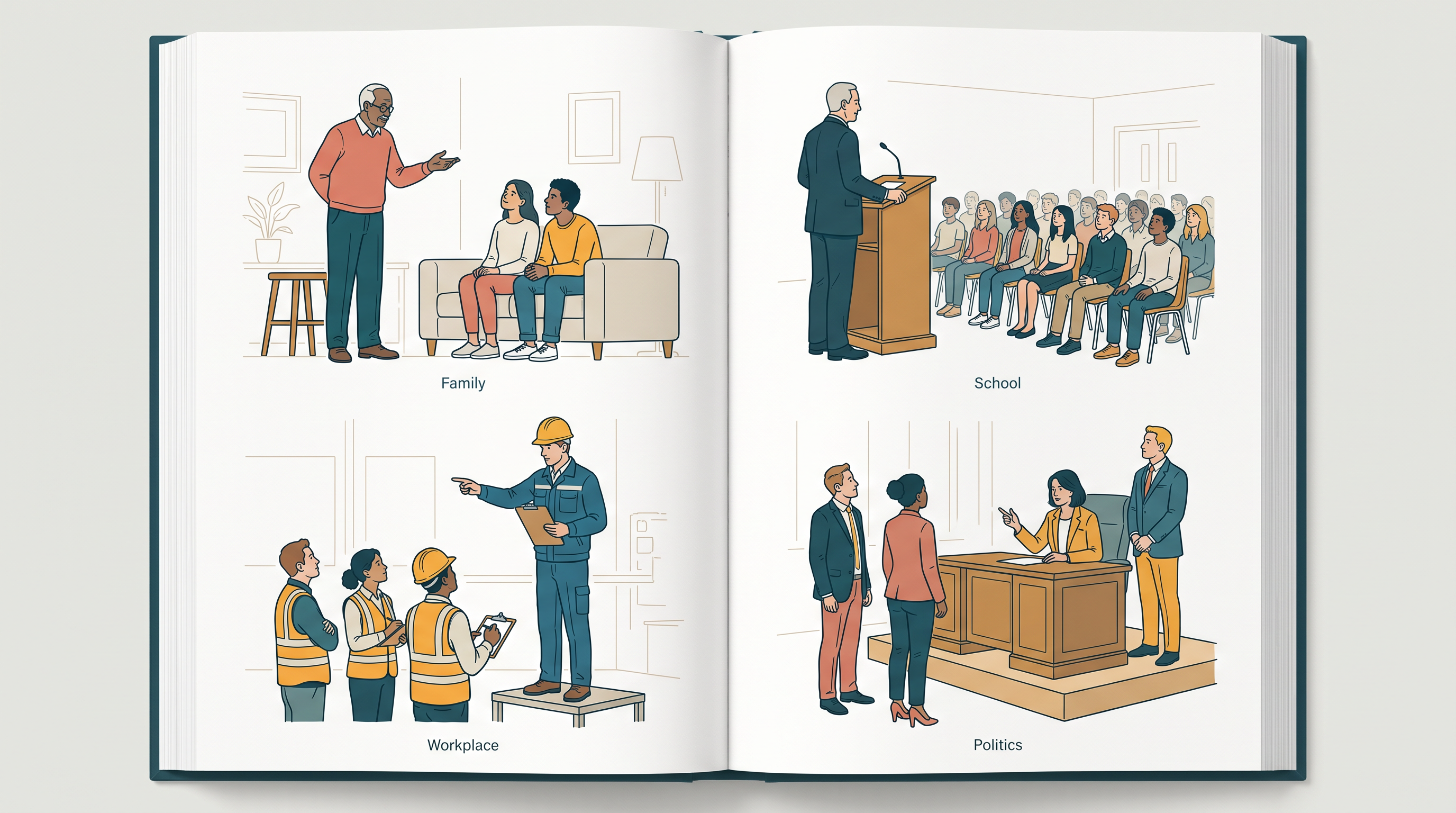
Fig. 3.13 – The exercise of power in everyday settings.
The principal has power to maintain discipline in school. The president of a political party possesses power to expel a member from the party. In each case, an individual or a group has power to the extent to which others abide by their will.
In this sense, political activity — politics — is concerned with ‘power’.
3.4.1 Stateless Societies
Empirical studies of stateless societies, carried out by social anthropologists over sixty years ago, demonstrated something that a modern citizen finds hard to imagine: how order is maintained without a modern governmental apparatus.
There was no police force, no court and no parliament. In their place there was a balanced opposition between the parts of the society, so that no part could dominate the rest. There were cross-cutting alliances, based on kinship, marriage and residence, so that a man’s relatives by marriage were often his rivals by descent, and no quarrel could easily harden into war. And there were rites and ceremonies, which required the participation of friends and foes alike.
Look at what those three mechanisms have in common. Not one of them is an office, and not one of them is written down. Order was produced by the way relationships were arranged.
Now the question NCERT leaves hanging, and it is a good one. The modern state has a fixed structure and formal procedures. Yet are not some of those informal mechanisms — the alliances, the ceremonies, the pull of kinship — present in state societies as well? Look at how a dispute in your own locality is actually settled before anyone goes to court.
3.4.2 The Concept of the State
A state exists where there is a political apparatus of government — institutions like a parliament or a congress, together with civil service officials — ruling over a given territory. Fig. 3.14 shows the parts of that apparatus.
Government authority is backed by two things: a legal system, and the capacity to use military force to implement its policies.
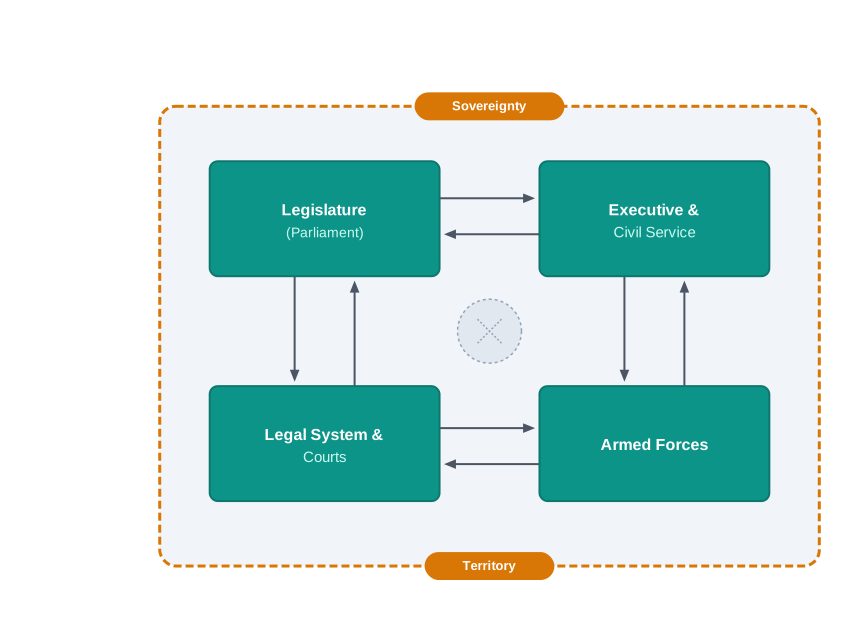
Fig. 3.14 – The apparatus of the modern state.
Whose interests does this apparatus serve? Here the two perspectives you met in section 3.1 part company again.
What makes the modern state modern
Modern states are very different from traditional states. They are defined by sovereignty, by citizenship, and most often by ideas of nationalism.
Sovereignty refers to the undisputed political rule of a state over a given territorial area. Inside the boundary, no rival authority is recognised.
The sovereign state was not, at first, one in which citizenship carried with it rights of political participation. A citizen is a member of a political community, having both rights and duties associated with that membership — but which rights, and for whom, was settled slowly and unwillingly.
These rights were achieved largely through struggles: struggles that limited the power of monarchs, or actively overthrew them. The French Revolution and our own Indian independence struggle are two instances of such movements. Rights were not granted from above. They were won.
The three kinds of citizenship rights
Citizenship rights include civil, political and social rights.
Civil rights involve the freedom of individuals to live where they choose; freedom of speech and religion; the right to own property; and the right to equal justice before the law.
Political rights include the right to participate in elections and to stand for public office. In most countries, governments were reluctant to admit the principle of universal franchise — the right of every adult to vote. In the early years, not only women but a large section of the male population was excluded, because holding a certain amount of property was an eligibility criterion. Women had to wait longer for the vote than men did.
The third type of citizenship rights are social rights. These concern the prerogative of every individual to enjoy a certain minimum standard of economic welfare and security. They include such rights as health benefits, unemployment allowance, and the setting of a minimum level of wages.
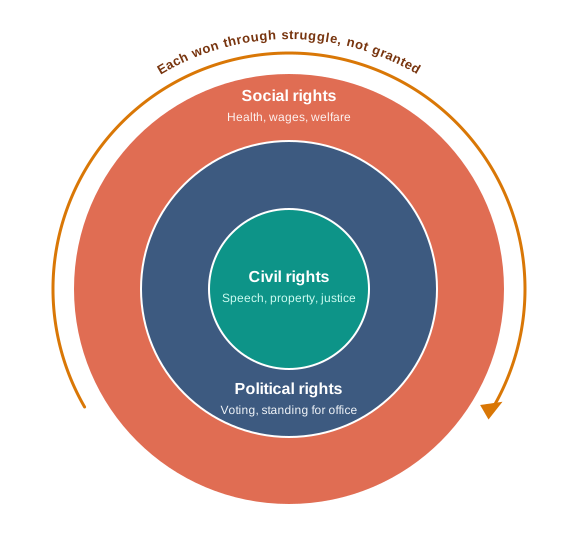
Fig. 3.15 – The three types of citizenship rights.
The broadening of social or welfare rights led to the welfare state, which was established in Western societies since the Second World War. States of the erstwhile socialist countries had far-reaching provision in this sector. In most developing countries, this was virtually non-existent.
And now a reversal, which the chapter states plainly: all over the world today, these social rights are being attacked as liabilities on the state and as hindrances to economic growth. Rights, once won, are not therefore permanent.
Nationalism
Nationalism can be defined as a set of symbols and beliefs providing the sense of being part of a single political community. It is what makes individuals feel a sense of pride and belonging in being ‘British’, ‘Indian’, ‘Indonesian’ or ‘French’.
Be careful with the history here. People have probably always felt some kind of identity with social groups of one form or another — with their family, their clan, or their religious community. Nationalism is not the same thing as that ancient sense of belonging. It made its appearance only with the development of the modern state.
The contemporary world is marked by two things at once: a rapid expansion of the global market, and intense nationalist feelings and conflicts. The two are not opposites that cancel out. They are happening together, and sociology has to explain both.
The wide scope of political sociology
Sociologists are interested in the broader study of power, not just in the formal apparatus of government. They are interested in the distribution of power between parties, between classes, between castes, and between communities based on race, language and religion.
Its focus is therefore not only on what may be called specifically political associations — state legislatures, town councils, political parties. It extends to associations such as schools, banks and religious institutions, whose aims are not primarily political at all, but inside which power is distributed all the same.
The scope of sociology here has been wide. Its range has extended from the study of international movements — such as women’s movements or environmental movements — all the way down to factions within a single village.
3.5 Religion
Religion has been a subject of study and reflection for a very long time — far longer than sociology has existed. In Chapter 1 you saw that sociological findings about society are different from religious reflections about it. That difference is worth stating carefully now, because it is easy to misunderstand.
How sociology studies religion
The sociological study of religion is different from a religious or theological study of religion in several ways.
One: it conducts empirical investigation — factual enquiry into how religions actually function in society, and into their relationship with other institutions. What people do, and with what consequences, is a question that can be studied.
Two: it uses a comparative method, setting religions and societies side by side.
Three: it investigates religious beliefs, practices and institutions in relation to other aspects of society and culture — not in isolation from them.
Each of these three has a consequence, and the consequences matter more than the labels.
The empirical method means that the sociologist does not have a judgemental approach to religious phenomena. The question is never whether a belief is true or a practice is worthy. The question is what the belief and the practice do in social life.
The comparative method is important because, in a sense, it brings all societies on to the same level with each other. Nobody’s religion is the standard against which the others are measured. This is what makes it possible to study without bias and prejudice.
And the sociological perspective means that religious life can be made intelligible only by relating it to domestic life, to economic life and to political life. Pull religion out of society, and you cannot explain it at all.
Ritual, and the making of the sacred
The rituals associated with religion are very diverse. Ritual acts may include praying, chanting, singing, eating certain kinds of food — or refraining from eating them — fasting on certain days, and so on.
Since ritual acts are oriented towards religious symbols, they are usually seen as quite distinct from the habits and procedures of ordinary life. And here is the clearest illustration of what that means. Lighting a candle or a diya to honour the divine differs completely in its significance from lighting one simply to light a room. The action is identical. The meaning is not. Look at Fig. 3.16.

Fig. 3.16 – The sacred and the profane.
Religious rituals are often carried out by an individual in his or her personal everyday life. But all religions also involve ceremonials practised collectively by believers. These regular ceremonials normally occur in special places — churches, mosques, temples, shrines.
Religion is about the sacred realm. Think of what members of different religions do before entering such a realm: covering one’s head, or deliberately not covering it; taking off one’s shoes; wearing a particular kind of clothing. The practices are not the same, and some are opposites of each other. What is common to them all is the feeling of awe, and the recognition of, and respect for, sacred places or situations.
Sociologists of religion, following Emile Durkheim, are interested in understanding this sacred realm — which every society distinguishes from the profane, the ordinary and everyday.
In most cases, the sacred includes an element of the supernatural. Often the sacred quality of a tree or a temple comes with the belief that it is sacred precisely because there is some supernatural force behind it.
Religion and the other institutions
Studying religion sociologically lets us ask questions about the relationship between religion and other social institutions. That is the payoff of the whole approach.
Religion has had a very close relationship with power and politics. Periodically in history there have been religious movements for social change — various anti-caste movements, for instance, and movements against gender discrimination.
So religion is not just a matter of the private belief of an individual. It also has a public character. And it is this public character of religion that has an important bearing on the other institutions of society.
Since sociology looks at power in a wide sense, as you saw in the last section, it is naturally of sociological interest to look at the relationship between the political and the religious spheres.
Classical sociologists believed that as societies modernised, religion would become less influential over the various spheres of life. The concept of secularisation describes this process.
But look around the contemporary world. Events suggest a persisting role of religion in many aspects of society, including public and political life. Why do you think this is so? The prediction of the classical sociologists has not been confirmed, and sociology has had to sit with that.
Weber: how a religious belief entered the economy
A pioneering work by Max Weber (1864–1920) demonstrates how sociology looks at religion in its relationship to other aspects of social and economic behaviour.
Weber argues that Calvinism — a branch of Protestant Christianity — exerted an important influence on the emergence and growth of capitalism as a mode of economic organisation. Follow the argument slowly, because each step matters.
The Calvinists believed that the world was created for the glory of God. It followed that any work in this world had to be done for His glory — which made even mundane, everyday work an act of worship.
More importantly, the Calvinists also believed in the concept of predestination: whether one would go to heaven or to hell was pre-ordained, decided in advance and beyond any human power to alter.
Now consider the position this belief puts a believer in. There is no way of knowing whether one has been assigned heaven or hell. So people sought signs of God’s will in this world — and they looked for those signs in their own occupations.
If a person, in whatever profession, was consistent and successful in his or her work, this was interpreted as a sign of God’s happiness. Success at work became evidence of salvation.
But — and this is the hinge of the whole argument — the money earned was not to be used for worldly consumption. The ethics of Calvinism was to live frugally. So the wealth could not be spent on comfort or display.
What, then, could be done with it? It could be put back into the enterprise. Investment became something like a holy creed.
And at the heart of capitalism lies exactly that concept: investment. Capital is invested to make more goods, which create more profit, which in turn creates more capital. Fig. 3.17 shows the cycle.
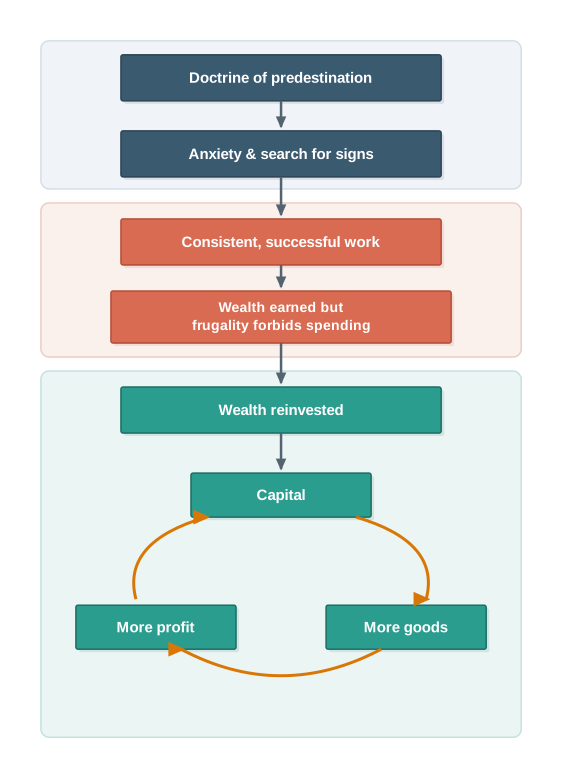
Fig. 3.17 – Weber’s argument on Calvinism and capitalism.
Thus Weber was able to argue that religion — in this case Calvinism — does have an influence on economic development. He did not say that Calvinists set out to invent capitalism. He said that a religious belief, held for entirely religious reasons, produced a way of living that capitalism happened to need.
Religion cannot be studied on its own
Religion cannot be studied as a separate entity. Social forces always and invariably influence religious institutions. Political debates, economic situations and gender norms will always influence religious behaviour.
And the influence runs the other way too. Religious norms influence, and sometimes even determine, social understanding.
Women constitute half of the world’s population. Sociologically, it therefore becomes important to ask what relationship this vast segment of humanity has with religion — as believers, as ritual specialists, as the subjects of religious norms about marriage, dress, inheritance and conduct.
Religion is an important part of society and is inextricably tied to its other parts. The task of sociologists is to unravel these various interconnections. In traditional societies, religion usually plays a central part in social life, and religious symbols and rituals are often integrated with the material and artistic culture of the society.
The study below shows exactly this kind of unravelling — and shows that religious institutions themselves change when the economy and the education system around them change.
3.6 Education
Education is a life-long process. It involves both formal and informal institutions of learning — a great deal of what you know, you learnt at home, in a playground or from a neighbour. Here, however, we shall confine ourselves to school education.
We are all aware how important getting admission into a school is. Think about why. For many of us, school is a step towards higher education and, finally, employment. For some, it may mean acquiring certain necessary social skills. What is common in all these cases is that there is a felt need for education.
Why complex societies need schools
Sociology understands this need as a process of transmission — the communication of a group’s heritage from one generation to the next. This process is common to all societies. Every society has to pass on what it knows, or it disappears within a generation.
But there is a qualitative distinction between simple societies and complex, modern societies in how they do it.
In simple societies there was no need for formal schooling. Children learnt customs, and the broader way of life, by participating in activities with the adults around them. You learnt to farm by farming beside your father; you learnt the rituals by attending them.
In complex societies, as you have seen in this very chapter, several things have changed at once. There is an increasing economic division of labour. Work has been separated from home. There is a need for specialised learning and skill attainment. State systems and nations have arisen, along with complex sets of symbols and ideas.
Now ask yourself the practical question. How would you get educated informally in such a context? How would parents or other adults informally communicate everything that has to be known to the next generation — a language, a script, a legal system, a body of science, the workings of a state? They could not. Education in such a social context has to be formal and explicit.
Furthermore, modern complex societies rest on abstract universalistic values — values that apply to everyone alike, regardless of who they are. This is precisely what distinguishes them from a simple society, which depends on particularistic values, based on family, kin, tribe, caste or religion.
Schools in modern societies are designed to promote uniformity, standardised aspirations, and these universalistic values. There are many ways of doing this. One obvious example is the uniform dress prescribed for schoolchildren. Can you think of other features of your own school that promote standardisation — the timetable, the roll number, the common syllabus, the seating in rows?
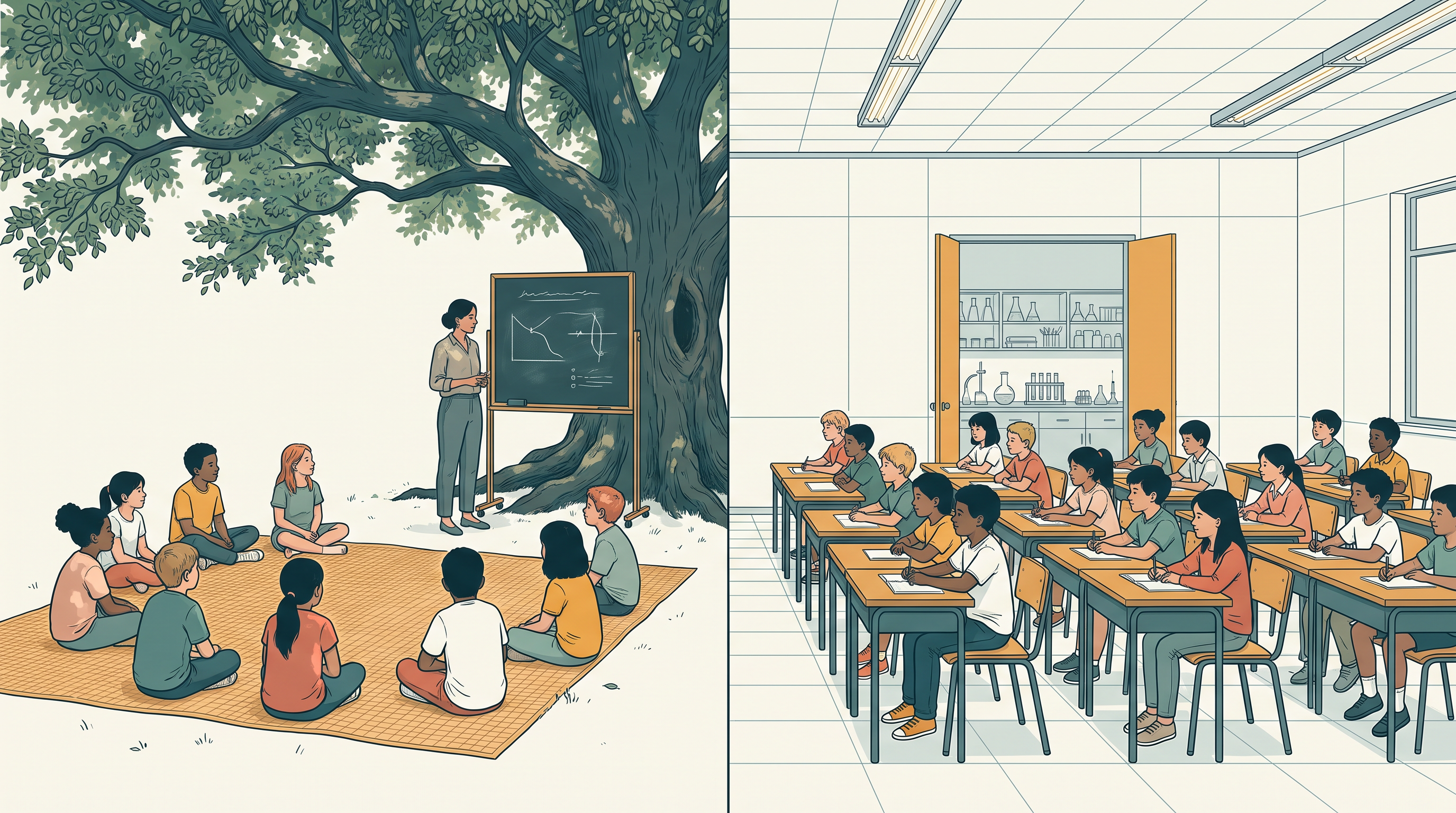
Fig. 3.18 – Two types of school environments.
The functionalist account of education
For Emile Durkheim, no society can survive without a common base — a certain number of ideas, sentiments and practices, which education must inculcate in all children indiscriminately, whatever social category they belong to.
Read that last phrase carefully: indiscriminately, to whatever social category they belong. The claim is that a society cannot hold together unless every child, without exception, is given the same common core.
Education, on this account, has two tasks at once. It must prepare the child for a special occupation — the complex division of labour demands it. And it must enable the child to internalise the core values of society.
The functionalist sociologist thus speaks in terms of general social needs and social norms. For the functionalists, education maintains and renews the social structure, and transmits and develops culture.
There is a further claim, and it is the one that matters most for a student’s own life. The educational system is an important mechanism for the selection and allocation of individuals to their future roles in society. It is regarded as the ground for proving one’s ability, and hence as a selective agency that awards different status according to ability. It is, in short, the machinery of social mobility — the movement of a person from one status or occupation to another. Recall the functionalist understanding of roles and stratification from Chapter 2.
Education as a stratifying agent
For sociologists who perceive society as unequally differentiated, education functions as a main stratifying agent. And — this is the sharper half of the claim — the inequality of educational opportunity is at the same time a product of social stratification.
Follow the circle in Fig. 3.19. We go to different kinds of schools depending on our socio-economic background. And because we go to a particular kind of school, we acquire a particular kind of privilege, and finally a particular kind of opportunity. The end of the circle is where the next generation’s beginning will be.
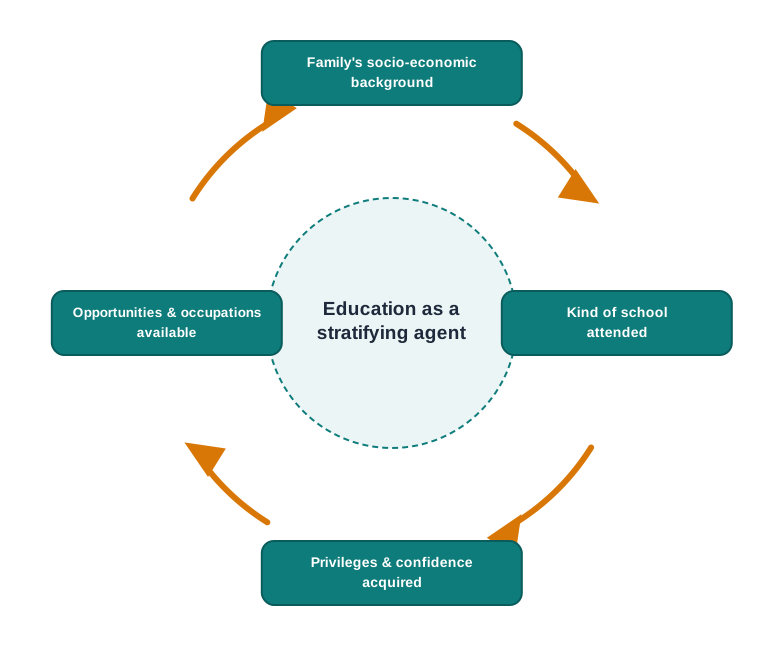
Fig. 3.19 – Education as a stratifying agent.
Some argue that schooling intensifies the existing divide between the elite and the masses. Avijit Pathak has argued that children going to privileged schools learn to be confident, while children deprived of that may feel exactly the opposite. What a school hands out is not only a syllabus. It is a sense of one’s own standing.
However, there is a group that this argument has not yet reached — and it is a very large group. There are many more children who simply cannot attend school at all, or who drop out.
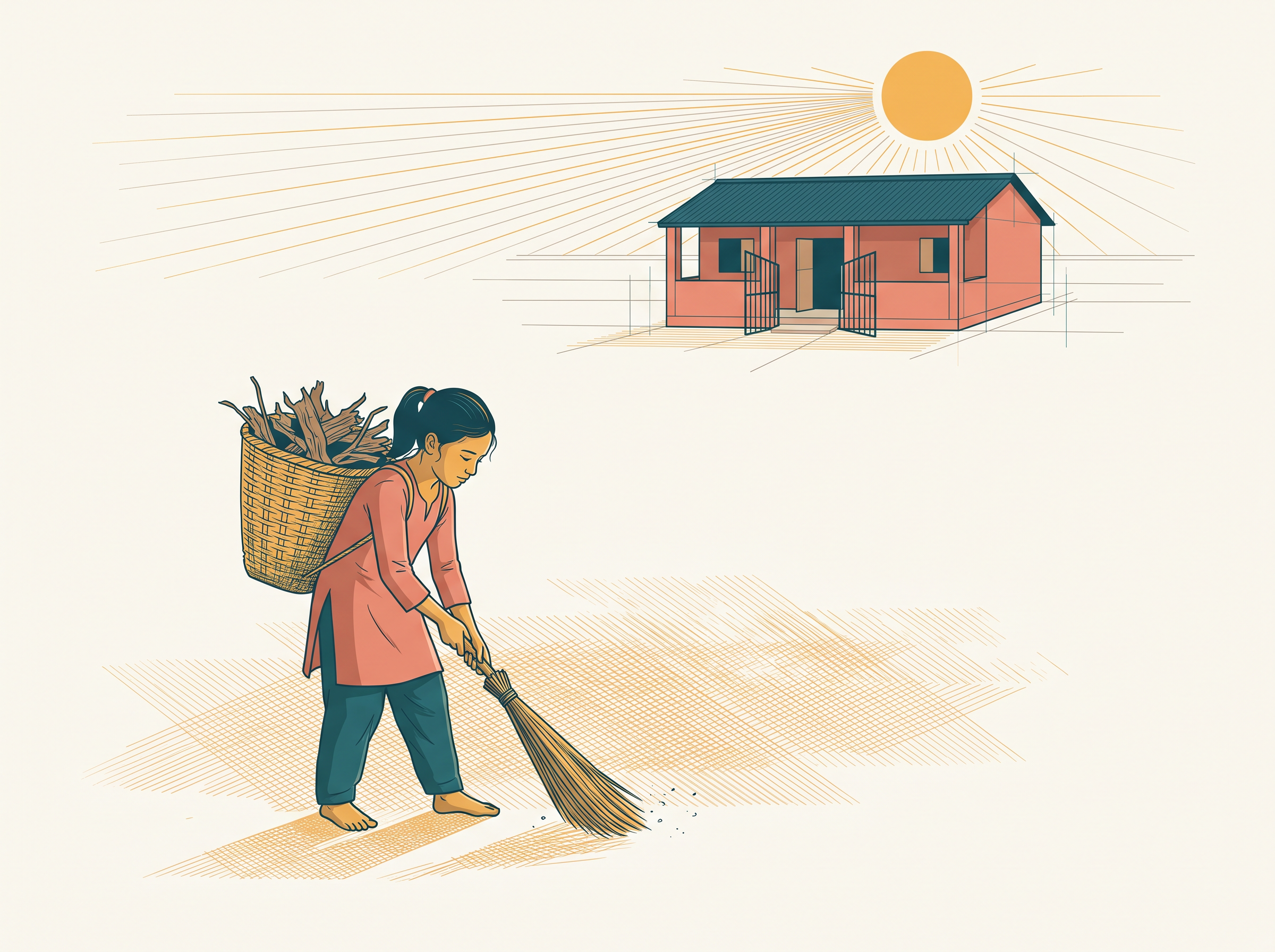
Fig. 3.20 – Household work and school absence.
Recall how this book began, in Chapter 1, with a child’s chances of getting a good job — chances shaped by a whole host of social factors. You could not have analysed that properly then. Now that you know how social institutions work — how the family invests, how the economy divides labour, how power is distributed, how belief and schooling shape a life — you can.
3.7 Summary
Introduction (3.1)
- Each of us occupies a status and plays roles, but we do not simply choose them. Social institutions constrain and control, punish and reward. They may be ‘macro’, like the state, or ‘micro’, like the family.
- An institution is something that works according to rules established or at least acknowledged by law or by custom, and whose regular, continuous operation cannot be understood without taking those rules into account.
- Institutions impose constraints on individuals, but they also provide them with opportunities. An institution can also be viewed as an end in itself — people have seen the family, religion, the state and education in this way.
- The functionalist view sees institutions as a set of norms, beliefs, values and role relationships arising in response to the needs of society. It distinguishes informal institutions (family, religion) from formal ones (law, formal education).
- The conflict view holds that individuals are not equally placed, that every institution serves the dominant sections — of class, caste, tribe or gender — and that the ideas of the dominant become the ruling ideas of the whole society.
- The chapter covers five areas: family, marriage and kinship; politics; economics; religion; education.
Family, Marriage and Kinship (3.2)
- The family looks natural and universal, but cross-cultural field research shows it exists everywhere while differing everywhere in character. The private sphere of the family is closely linked to the economic, political, cultural and educational spheres.
- Functionalists hold that the nuclear family suits industrial society, with the husband in an ‘instrumental’ breadwinner role and the wife in an ‘affective’ role. Empirical studies across cultures and history show this is not true — women form a large part of the labour force in industries such as garment export, and households are not always headed by men.
- Female headed households arise when men migrate, on widowhood, or when men remarry and stop sending remittances. Among the Kolams, a tribal community in south-eastern Maharashtra and northern Andhra Pradesh, this is an accepted norm.
- Studies in India suggest families need not become nuclear in an industrial economy — a trend from one society cannot be generalised to another.
- Nuclear families have always existed in India, particularly among deprived castes and classes. A.M. Shah argues that the joint family has steadily increased since Independence, because rising life expectancy (32.5 to 55.4 years for men, 31.7 to 55.7 for women, over 1941–50 to 1981–85) has increased the proportion of people aged 60 and above, most of whom live in joint households.
- Family forms vary: matrilocal and patrilocal residence; patriarchal and matriarchal authority. Matrilineal societies exist; matriarchal societies cannot be claimed in the same way.
- Families change with macro economic processes — the withdrawal of welfare after German unification produced a rapid decline in marriage, an unintended consequence. But the direction of change differs across countries, and change and continuity co-exist.
- The belief that a son supports parents in old age while a daughter leaves on marriage leads families to invest more in male children. Despite a female baby’s better chances of survival, female infant mortality is higher in the lower age group in India.
- The sex ratio (females per 1000 males) fell from 972 in 1901 to a low of 926 in 1991, recovering only to 940 in 2011. The child sex ratio fell from 934 in 1991 to 919 in 2011, and is graver in prosperous states — 846 in Punjab, below 800 in some districts of Haryana.
- Marriage exists in a wide variety of forms and performs differing functions. By number of partners: monogamy (one spouse at a time, including serial monogamy) and polygamy (polygyny — one husband, two or more wives; polyandry — one wife, two or more husbands). Polyandry may be a response to harsh economic conditions.
- Remarriage was a norm for men; it was denied to upper caste Hindu widows, and widow remarriage was a major issue in nineteenth-century reform movements. Nearly 10 per cent of all women, and 55 per cent of women over fifty, are widows in India.
- By rules of eligibility: endogamy requires marriage within a group one already belongs to (caste, for example); exogamy requires marriage outside one’s group (clan; village exogamy in parts of north India). Village exogamy sent daughters far from home, and the pain of that parting is a theme of women’s folk songs.
- Definitions: a family is a group of persons directly linked by kin connections, whose adult members care for children; kinship ties are connections through marriage or through lines of descent; marriage is a socially acknowledged and approved sexual union between two adult individuals. The family of birth is the family of orientation and the family of marriage the family of procreation; kin related by “blood” are consanguineous kin, and those related through marriage are affines.
Work and Economic Life (3.3)
- ‘Work’ is popularly taken to mean paid employment. This is an oversimplification: much work in the informal economy — transactions outside regular employment, involving cash for services or the direct exchange of goods and services — never enters the official statistics.
- Work, paid or unpaid, is the carrying out of tasks requiring the expenditure of mental and physical effort, with the objective of producing goods and services that cater to human needs.
- In pre-modern societies most people worked in the field or with livestock; in industrially developed societies only a tiny proportion works in agriculture, and farming itself is industrialised. In India the larger share of the population remains in rural agricultural or rural-based occupations, even as the service sector expands.
- Modern economies rest on a highly complex division of labour — the specialisation of work tasks. In traditional societies a craftsman learnt through long apprenticeship and carried out all aspects of production; in factories a worker is trained for one specialised task, is paid a wage, and is supervised by managers who exist to raise productivity and discipline.
- Industrialisation separated work from home. Machinery running on electricity and coal made this possible, and factories owned by capitalist entrepreneurs became the focal point of industrial development.
- Modern societies show an enormous expansion of economic interdependence: most people do not produce the food they eat, the houses they live in, or the goods they consume.
- Industrial processes were broken into simple operations that could be timed, organised and monitored; mass production demands mass markets; the moving assembly line was a key innovation; production requires expensive equipment and continuous surveillance of employees.
- Recent decades show a shift to flexible production and decentralisation of work, driven by competition between firms and countries under globalisation. A study of the garment export industry in Bangalore shows that the manufacturer controls only about 15 of the more than a hundred operations between designer and consumer, and that any serious agitation for higher wages leads manufacturers to shift operations beyond the reach of unionists. Pressure must therefore be brought on retailers — an international opinion forum. Production has become global, and so has the politics of production.
Politics (3.4)
- Political institutions concern the distribution of power. Power is the ability of individuals or groups to carry out their will even when opposed by others; it is held in relation to others, and those who hold it do so at the cost of those who do not.
- Power runs from family elders and school principals to factory managers and party leaders. In every case, a person has power to the extent that others abide by their will.
- Authority is that form of power which is accepted as legitimate — as right and just. It is institutionalised because it rests on legitimacy, and ideologies often assist this process of legitimation.
- Studies of stateless societies showed that order can be maintained without a modern governmental apparatus — through balanced opposition between parts, cross-cutting alliances of kinship, marriage and residence, and rites and ceremonies involving friends and foes.
- A state exists where a political apparatus of government rules over a given territory, its authority backed by a legal system and by the capacity to use military force. The functionalist perspective sees the state as representing all sections; the conflict perspective sees it as representing the dominant sections.
- Modern states are defined by sovereignty (undisputed political rule over a territorial area), citizenship, and most often nationalism.
- Citizenship rights were won through struggles that limited or overthrew monarchs — the French Revolution and the Indian independence struggle are two instances.
- Civil rights cover freedom of residence, speech and religion, the right to own property and equal justice before the law. Political rights cover voting and standing for office; universal franchise was resisted, property qualifications excluded many men, and women waited longest for the vote. Social rights cover a minimum standard of economic welfare and security — health benefits, unemployment allowance, minimum wages.
- The broadening of social rights produced the welfare state in Western societies after the Second World War; provision was far-reaching in the erstwhile socialist countries and virtually non-existent in most developing countries. Today social rights are widely attacked as liabilities on the state and hindrances to growth.
- Nationalism is a set of symbols and beliefs providing the sense of belonging to a single political community. It appeared only with the modern state. The contemporary world shows both a rapidly expanding global market and intense nationalist feeling and conflict.
- Sociologists study power far beyond government — between parties, classes, castes and communities, and inside schools, banks and religious institutions; the range runs from international movements to village factions.
Religion (3.5)
- The sociological study of religion differs from a theological one: it conducts empirical investigation of how religions actually function, uses the comparative method, and studies religious beliefs, practices and institutions in relation to other aspects of society and culture.
- The empirical method makes the sociologist non-judgemental; the comparative method brings all societies on to the same level and permits study without bias and prejudice; the sociological perspective makes religious life intelligible only by relating it to domestic, economic and political life.
- Religion exists in all known societies. All religions seem to share a set of symbols invoking reverence or awe, rituals or ceremonies, and a community of believers.
- Rituals — praying, chanting, singing, fasting, eating or refraining from certain foods — are oriented towards religious symbols and are therefore distinct from ordinary habits: lighting a diya to honour the divine is not the same act as lighting one to light a room. Religions also involve collective ceremonials in special places.
- Following Emile Durkheim, sociologists study the sacred realm that every society distinguishes from the profane. The sacred usually involves the supernatural — though early Buddhism and Confucianism had no such conception, while still holding certain things and persons sacred.
- Religion has a public character and a close relationship with power and politics; religious movements for social change include anti-caste movements and movements against gender discrimination.
- Classical sociologists expected religion to lose influence as societies modernised — the process called secularisation. Contemporary events suggest a persisting role for religion.
- Max Weber (1864–1920) argued that Calvinism influenced the growth of capitalism. Calvinists believed that work glorified God and that salvation was predestined; unable to know their fate, they read worldly success as a sign of God’s favour, and since frugality forbade spending, wealth was reinvested — and investment is the engine of capitalism.
- Religion cannot be studied as a separate entity: political debates, economic conditions and gender norms influence religion, and religious norms in turn shape social understanding. In Nasik, new employment and educational opportunities changed the way of life of priests and of the craftsmen who served pilgrims, many of whom moved into industry and business.
Education (3.6)
- Education is a life-long process involving both formal and informal institutions; here the focus is school education. Sociology understands the need for it as the transmission of a group’s heritage.
- Simple societies needed no formal schooling — children learnt by participating in adult activities. Complex societies, with an economic division of labour, work separated from home, specialised skills, state systems and complex symbol systems, require education to be formal and explicit.
- Modern societies rest on abstract universalistic values, unlike simple societies that depend on particularistic values based on family, kin, tribe, caste or religion. Schools promote uniformity and standardised aspirations — the school uniform is one example.
- For Emile Durkheim, no society can survive without a common base of ideas, sentiments and practices which education must inculcate in all children indiscriminately, whatever their social category. Education should prepare the child for an occupation and enable the internalisation of society’s core values.
- For functionalists, education maintains and renews social structure, transmits and develops culture, and selects and allocates individuals to their future roles according to ability.
- For those who see society as unequally differentiated, education is a main stratifying agent — and the inequality of educational opportunity is itself a product of social stratification. We attend different kinds of schools according to our socio-economic background, and thereby acquire different privileges and opportunities.
- Schooling has been argued to intensify the divide between the elite and the masses: privileged schools teach confidence, deprived ones the opposite. Many children cannot attend school at all — during the cultivation season attendance from Scheduled Caste and Scheduled Tribe children falls almost to zero, and girls of these communities seldom attend, because of domestic and income-generating work. Gender and caste discrimination thus shape the chances of education.
3.8 Key Terms
Affines — Kin who are related to a person through marriage.
Authority — That form of power which is accepted as legitimate, that is, as right and just.
Citizen — A member of a political community, having both rights and duties associated with that membership.
Civil rights — Rights that secure individual freedom and equality before the law: freedom to live where one chooses, freedom of speech and religion, the right to own property, and the right to equal justice.
Conflict perspective — The view that individuals are not equally placed, and that every social institution works in the interest of the dominant sections of society.
Consanguineous kin — Kin who are related to a person through “blood”, that is, by descent.
Decentralisation of work — The breaking up and spreading out of production across many separate units and localities, instead of concentrating it in one large workplace.
Division of labour — The specialisation of work tasks, by means of which different occupations are combined within a production system; in the modern world it is international in scope.
Empirical investigation — Factual enquiry carried out in any given area of sociological study.
Endogamy — When marriage is within a specific caste, class or tribal group.
Exogamy — When marriage occurs outside a certain group of relations.
Family — A group of persons directly linked by kin connections, the adult members of which assume responsibility for caring for children.
Family of orientation — The family into which a person is born.
Family of procreation — The family that a person forms through marriage.
Female headed household — A household in which a woman is the sole provider and maintainer of the family, as when men migrate, on widowhood, or when remittances stop.
Flexible production — The organisation of production so that it can be quickly rearranged to suit changing market conditions and competition between firms and countries.
Formal social institution — An institution whose rules are explicitly laid down and enforced, such as law and formal education.
Functionalist perspective — The view that social institutions are sets of norms, beliefs, values and role relationships that arise in response to the needs of society.
Gender — Social expectations about behaviour regarded as appropriate for the members of each sex; gender is seen as a basic organising principle of society.
Ideology — Shared ideas or beliefs which serve to justify the interests of dominant groups, and which help legitimise the differential power that groups hold.
Informal economy — Transactions outside the sphere of regular employment, sometimes involving cash for services and often the direct exchange of goods or services.
Informal social institution — An institution whose rules are carried by custom and belief rather than by written codes, such as the family and religion.
Joint family — A household in which several related married couples and their children live together, sharing a common hearth and often a common estate.
Kinship — Connections between individuals, established either through marriage or through the lines of descent that connect blood relatives.
Legitimacy — The belief that a particular political order is just and valid.
Marriage — A socially acknowledged and approved sexual union between two adult individuals.
Matriarchy — A family structure in which women play the major role in decision-making.
Matrilineal — Where descent, family membership and property are traced through the mother’s line.
Matrilocal — Where a newly married couple lives with the woman’s parents.
Monogamy — When marriage involves one husband and one wife alone.
Nationalism — A set of symbols and beliefs providing the sense of being part of a single political community.
Nuclear family — A family unit consisting of a couple and their children.
Particularistic values — Values applied according to who a person is — their family, kin, tribe, caste or religion.
Patriarchy — A family structure in which men exercise authority and dominance.
Patrilocal — Where a newly married couple lives with the man’s parents.
Political rights — Rights to participate in elections and to stand for public office.
Polyandry — When more than one man is married to a woman.
Polygamy — When marriage involves more than one mate at one time.
Polygyny — When more than one woman is married to a man.
Power — The ability of individuals or groups to carry out their will even when opposed by others.
Predestination — The Calvinist belief that whether a person will go to heaven or hell is pre-ordained and cannot be known.
Profane — The ordinary and everyday realm, which every society distinguishes from the sacred.
Ritual — An act oriented towards religious symbols, and therefore treated as distinct from the habits and procedures of ordinary life.
Sacred — That which a society sets apart from the ordinary and treats with awe, reverence and respect.
Secularisation — The process by which religion becomes less influential over the various spheres of social life as a society modernises.
Serial monogamy — Marrying again after the death of a spouse or after divorce, while never having more than one spouse at a time.
Service industries — Industries concerned with the production of services rather than manufactured goods, such as the travel industry.
Sex ratio — The number of females per 1000 males in a population.
Social institution — Something that works according to rules established or at least acknowledged by law or custom, and whose regular and continuous operation cannot be understood without taking those rules into account.
Social mobility — Movement from one status or occupation to another.
Social rights — Rights to a certain minimum standard of economic welfare and security, such as health benefits, unemployment allowance and a minimum level of wages.
Sovereignty — The undisputed political rule of a state over a given territorial area.
State society — A society which possesses a formal apparatus of government.
Stateless society — A society which lacks formal institutions of government.
Universal franchise — The principle that every adult has the right to vote, regardless of property or sex.
Universalistic values — Abstract values applied equally to everyone, regardless of who they are.
Village exogamy — The rule, practised in certain parts of north India, that a daughter must be married into a family from another village.
Welfare state — A state that guarantees its citizens a minimum standard of economic welfare and security; it was established in Western societies after the Second World War.
Work — The carrying out of tasks, paid or unpaid, requiring the expenditure of mental and physical effort, with the objective of producing goods and services that cater to human needs.
3.9 Points to Ponder
Every institution in this chapter both constrains people and gives them opportunities. Is it possible to have one without the other — an institution that opens doors without closing any?
The joint family was widely believed to be disappearing, and A.M. Shah’s evidence suggested the opposite. What does this tell you about the difference between a common sense impression and a sociological finding — and how would you settle such a disagreement?
Matrilineal societies exist, but matriarchal ones cannot be claimed in the same way. Why should tracing descent through women be so much easier to find than women holding authority?
Sociology defines work to include unpaid work, but no official statistic counts it. What changes — for the worker, and for the way a society sees itself — if unpaid household work were counted?
Studies of stateless societies showed that order can be maintained without any governmental apparatus at all. How much of the order in your own locality is actually produced by law, and how much by kinship, custom and the desire not to be talked about?
Classical sociologists expected religion to fade as societies modernised, and it has not. Was the prediction wrong, or has religion simply changed the sphere in which it operates?
If education selects people by ability, and yet the school a child attends is decided by the household they were born into, in what sense is the selection fair? Can a school be a ladder and a sorting machine at the same time?
3.10 NCERT Questions
Note the marriage rules that are followed in the society around you. Compare your observations with those made by other students in the class, and discuss what the differences and similarities suggest.
Find out how membership, the pattern of residence and the mode of interaction within a family change with broader economic, political and cultural changes — for instance, with migration.
Write an essay on ‘work’. Focus both on the range of occupations that exist and on how they change.
Discuss the kinds of rights that exist in your society. How do they affect your life?
How does sociology study religion?
Write an essay on the school as a social institution. Draw both on your reading and on your own observations.
Discuss how these social institutions interact with one another. You may begin from yourself as a senior school student, and move on to how you are shaped by different social institutions. Are you entirely controlled by them, or can you also resist and redefine them?
3.11 Objective Questions
- In the broadest sense, an institution is:
- any building in which people work together
- something that works according to rules established or at least acknowledged by law or by custom
- a group of people who happen to meet regularly
- a personal habit repeated over a long period [1 mark]
- According to the functionalists, the family unit best equipped to handle the demands of industrial society is the:
- joint family
- female headed household
- nuclear family
- matrilineal family [1 mark]
- Which of the following is an example of a formal social institution?
- The family
- Religion
- Kinship
- Law [1 mark]
- A marriage in which one wife has two or more husbands is called:
- polygyny
- polyandry
- serial monogamy
- endogamy [1 mark]
- According to the Census figures given in this chapter, the sex ratio of India in 2011 was:
- 919
- 926
- 933
- 940 [1 mark]
- Power that is accepted as legitimate — as right and just — is called:
- sovereignty
- authority
- ideology
- franchise [1 mark]
- Sovereignty refers to:
- the right of every adult to vote
- the undisputed political rule of a state over a given territorial area
- a set of symbols and beliefs providing a sense of belonging to a political community
- the guarantee of a minimum standard of economic welfare [1 mark]
- The concept that describes the process by which religion becomes less influential over various spheres of life as societies modernise is:
- predestination
- legitimation
- secularisation
- nationalism [1 mark]
- Which of the following was NOT a mechanism by which order was maintained in the stateless societies studied by social anthropologists?
- Balanced opposition between the parts of the society
- Cross-cutting alliances based on kinship, marriage and residence
- Rites and ceremonies involving the participation of friends and foes
- A civil service backed by a legal system [1 mark]
- Assertion (A): Matrilineal societies exist, but matriarchal societies cannot be claimed to exist in the same way. Reason (R): Tracing descent through the mother’s line is not the same thing as women exercising authority and dominance in the family.
- Both A and R are true, and R is the correct explanation of A.
- Both A and R are true, but R is not the correct explanation of A.
- A is true, but R is false.
- A is false, but R is true. [1 mark]
- Assertion (A): A.M. Shah argues that the joint family has steadily increased in post-Independence India. Reason (R): Life expectancy in India has risen, increasing the proportion of people aged 60 years and above in the total population.
- Both A and R are true, and R is the correct explanation of A.
- Both A and R are true, but R is not the correct explanation of A.
- A is true, but R is false.
- A is false, but R is true. [1 mark]
- Assertion (A): Much of the work done in the informal economy does not appear in the official employment statistics. Reason (R): Sociology defines work as paid employment alone.
- Both A and R are true, and R is the correct explanation of A.
- Both A and R are true, but R is not the correct explanation of A.
- A is true, but R is false.
- A is false, but R is true. [1 mark]
- Match the sociologist in Column A with the work associated with him or her in Column B.
| Column A | Column B |
|---|---|
| a. Max Weber | i. The changing role of religious specialists in Nasik |
| b. Emile Durkheim | ii. The joint family in post-Independence India |
| c. A.M. Shah | iii. Calvinism and the growth of capitalism |
| d. Hemlata Acharya | iv. The common base that education must inculcate in all children |
[1 mark]
- Match the term in Column A with its meaning in Column B.
| Column A | Column B |
|---|---|
| a. Endogamy | i. Kin related through marriage |
| b. Exogamy | ii. Marriage within a group to which one already belongs |
| c. Affines | iii. The family into which a person is born |
| d. Family of orientation | iv. Marriage outside one’s own group |
[1 mark]
- Fill in the blanks.
- When a newly married couple lives with the man’s parents, the rule of residence is called __________.
- The child sex ratio in India declined from 934 per thousand males in 1991 to __________ in 2011.
- __________ industries are those concerned with the production of services rather than manufactured goods. [1 mark]
- State whether the following are true or false.
- Even where polygamy is permitted, monogamy is in practice more widely prevalent.
- Nationalism made its appearance long before the development of the modern state.
- In a country like India, the larger share of the population continues to be involved in rural agricultural or other rural based occupations.
- All religions are built on a belief in the supernatural. [1 mark]
3.12 Check Your Concepts
Define a social institution, and give one example each of a ‘macro’ and a ‘micro’ institution. [2 marks]
State the three characteristics that all religions seem to share. [2 marks]
What is meant by the informal economy? Give one example. [2 marks]
What is serial monogamy? [2 marks]
What is a female headed household? Name two circumstances in which one may come into being. [2 marks]
Write the formula for the sex ratio and state the base on which it is expressed. [2 marks]
Define sovereignty and name the two things that back the authority of a government. [2 marks]
Differentiate between endogamy and exogamy, giving one Indian example of each. [4 marks]
Differentiate between power and authority. Illustrate the difference with an example from a school. [4 marks]
Compare craft production in traditional societies with production in a modern factory, with reference to skill, the share of the process each worker performs, and the location of work. [4 marks]
How did the social anthropologists’ studies of stateless societies show that order can be maintained without a modern governmental apparatus? Describe the mechanisms they identified. [4 marks]
Why is the functionalist claim that industrial society works best when men earn and women look after the home considered questionable? Give reasons drawn from empirical evidence. [4 marks]
Study Table 3.1 in this chapter and answer the following.
- In which census year was the sex ratio at its lowest, and what was the figure?
- By how many points did the sex ratio fall between 1901 and 1991?
- What trend do you notice after 1991? [4 marks]
In a certain district, the population consists of 4,80,000 females and 5,00,000 males. Calculate the sex ratio of the district. State what your answer means, and compare it with the all-India figure for 2011 given in the chapter. [4 marks]
Distinguish between civil, political and social rights, giving one example of each. Why does the chapter say that these rights were won rather than granted? [4 marks]
Explain, with an Indian example, what sociologists mean when they say that change and continuity co-exist in the family. [4 marks]
Explain the functionalist and the conflict views of social institutions. How far do you agree that a single institution can be understood from both points of view at once? Use examples from the family and from education. [6 marks]
Explain Max Weber’s argument that Calvinism influenced the growth of capitalism. Set out the steps of the argument, the evidence for it, and one criticism that can be made of it. [6 marks]
“Education is a ladder, and education is a sorting machine.” Discuss both positions with evidence from the chapter, and explain how gender and caste discrimination affect a child’s chances of schooling in India. [6 marks]
Discuss how the family is linked to the economic and political spheres. Use the case of male migration and female headed households, and the case of the withdrawal of welfare after German unification, to support your answer. [6 marks]
Describe the transformation of work from craft production to the assembly line, and then to flexible production and the decentralisation of work. Evaluate what each shift has meant for the worker’s control over the job and for the worker’s bargaining power. [6 marks]
“The joint family in India is fast disappearing.” How far does the evidence discussed in this chapter support this claim? Give reasons for your answer. [6 marks]
3.13 Passage-Based Questions
- Read the following table and answer the questions below.
| Year | Sex ratio (females per 1000 males) |
|---|---|
| 1901 | 972 |
| 1951 | 946 |
| 1991 | 926 |
| 2011 | 940 |
A district in a prosperous state records a child sex ratio of 846 girls per 1000 boys, while a much poorer neighbouring district records 960. Both districts have the same rate of school enrolment for boys.
a. *Describe the trend visible in the table between 1901 and 2011.*
b. *The lower child sex ratio is found in the prosperous district. Why does this finding unsettle the common assumption that such practices are caused by poverty?*
c. *Which beliefs about sons and daughters, discussed in this chapter, help explain a falling child sex ratio?* [6 marks]- Read the passage and answer the questions below.
A woman collects cut cloth from a supplier every week and stitches it at home, working ten hours a day. She is paid by the piece, in cash. There is no register with her name in it and no employer who admits to employing her. The garments she stitches are sent to an exporter, who has been told by a foreign buyer that the design must change by next month. When workers in a nearby unit asked for higher wages, the unit’s owner said that if wages rose he would have to move the work to another town.
a. *Identify the two concepts from this chapter that the woman's situation illustrates.*
b. *Explain why the owner's threat to move the work is so effective, using what you have learnt about long supply chains and flexible production.*
c. *According to the study of the garment export industry discussed in the chapter, on whom must pressure be brought if wages are to rise, and why?* [6 marks]- Read the passage and answer the questions below.
A new head of a village school announces that classes will begin half an hour earlier. The teachers comply, though several disagree. In the same village, a long-running dispute over a boundary between two households is settled not in a court but at a gathering of relatives from both sides, who share a meal at the end of it and agree to attend each other’s ceremonies. Neither party goes to the police.
a. *Distinguish between power and authority, and identify which of the two the head of the school is exercising.*
b. *The boundary dispute is settled without any governmental apparatus. Which mechanisms of order, described in the study of stateless societies, can you recognise here?*
c. *What does this passage suggest about the relationship between formal and informal mechanisms of order in a modern state society?* [6 marks]- Read the passage and answer the questions below.
Two schools in the same town follow the same syllabus and set the same examination. In the first, each child has a textbook and the school year runs without a break. In the second, children share textbooks, and during the harvest weeks the classroom is half empty; most of the absent children are from Scheduled Caste and Scheduled Tribe households, and the girls among them are the least likely to return. Ten years later, almost all the qualified candidates for a clerical post in the town come from the first school.
a. *Which sociological view of education does this passage support, and on what grounds?*
b. *Name two social factors described in the chapter that keep children out of school, and explain how each operates.*
c. *A functionalist would say the examination selected candidates purely on ability. How would you respond, using this passage?* [6 marks]