Chapter 5: Doing Sociology: Research Methods
On the evening before a big election result, switch between two news channels. Both will show you confident numbers. Both will say they asked “the people”. And quite often, the two sets of numbers will not agree.
You have probably watched this and wondered how such a thing is possible. Nobody on either channel spoke to the whole country. Each spoke to a few thousand people, in a handful of places, over a few days — and then announced what a hundred crore Indians were thinking. Sometimes the announcement turns out to be close to the truth. Sometimes it is badly wrong.
The difference between the two is almost never a difference of sincerity. It is a difference of method — of how the knowledge was gathered. Who was asked, how they were chosen, what exactly they were asked, and how far the answers of a few can be stretched to stand for the many.
Now notice something else. Even a perfect prediction of how people voted would not tell you why — what a voter thought she was doing, what her family said at dinner, what the neighbourhood expected of her. To reach that, you would have to sit with people, over time, and listen.
Two very different kinds of questions. Two very different ways of finding out.
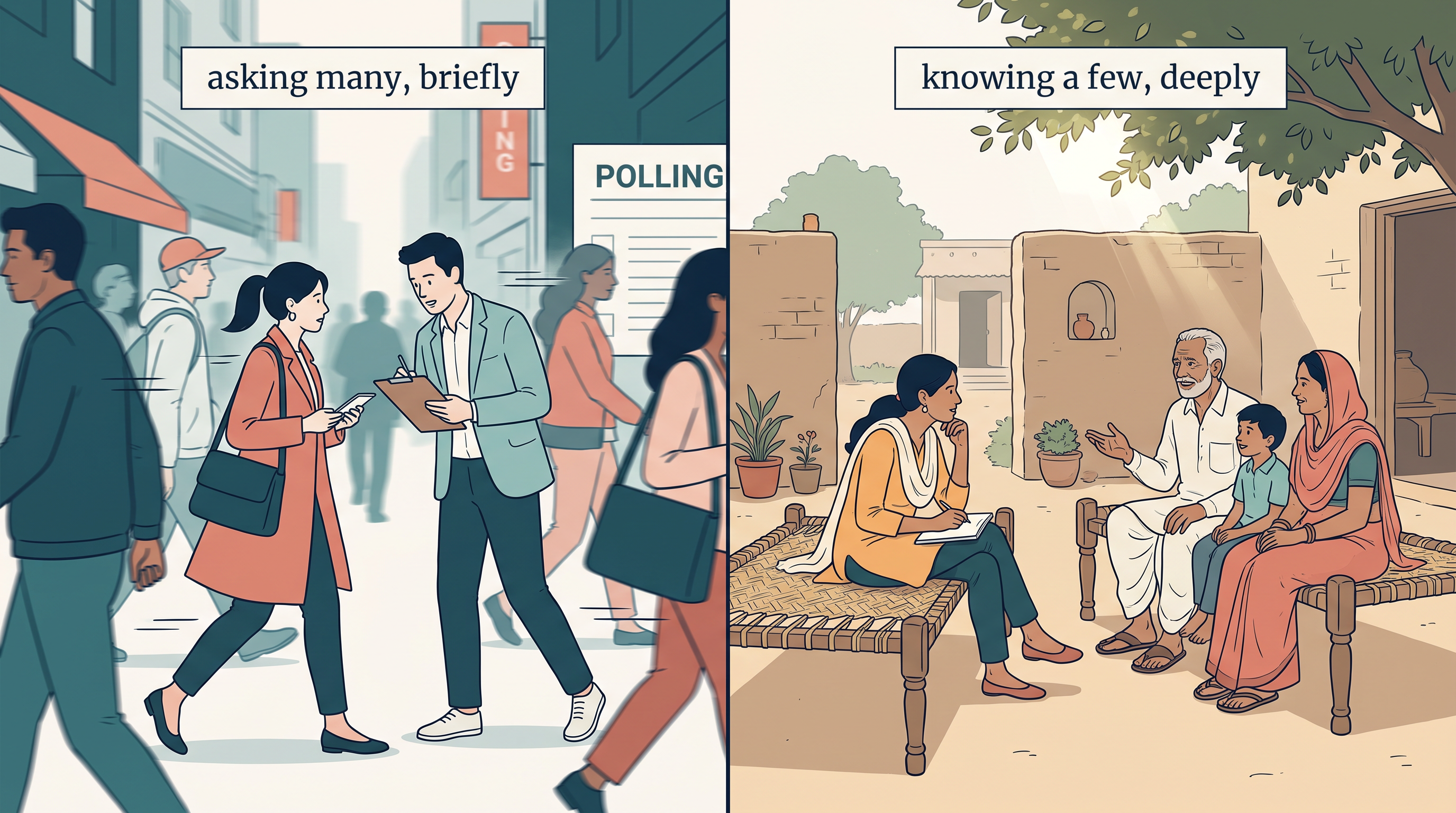
Fig. 5.1 – Two methods of sociological research.
This chapter will answer all four questions. By the end of it, you will know not only what sociologists know, but how they came to know it.
5.1 Introduction
Have you ever wondered why a subject like sociology is called a social science? The word “science” usually brings to mind a laboratory, an instrument, a formula. Sociology has none of these. It studies weddings, friendships, markets, prayers and queues — the ordinary furniture of life.
That is exactly what makes the question worth asking. More than any other discipline, sociology deals with things that are already familiar to most people. All of us live in society. All of us already know a great deal about the subject matter of sociology — social groups, institutions, norms, relationships — simply through our own experience of living.
A physicist knows things about the atom that you do not. A sociologist studies the family, and you have lived in one all your life. It seems fair, then, to ask what makes the sociologist different from any other member of society. Why should she or he be called a social scientist at all?
The difference lies in method
As with all scientific disciplines, the crucial element here is method — the set of procedures through which knowledge is gathered. This is the honest answer to the question just asked.
In the final analysis, sociologists can claim to be different from lay persons not because of how much they know, or even what they know, but because of how they acquire their knowledge. Your grandmother may understand your neighbourhood far better than a visiting researcher does. But her knowledge was gathered by living; the researcher’s has to be gathered by a stated, checkable procedure that another researcher could follow and test.
This is one reason for the special importance of method in sociology. In a subject where everybody is already an expert on the subject matter, method is what separates a finding from an opinion.
Seeing through the other’s eyes
There is a second reason, and it takes us deeper into what sociology is.
As you have seen in the previous chapters, sociology is deeply interested in the lived experience of people — the world as it is actually felt, understood and interpreted by those living inside it. When it studies a social phenomenon like friendship, or religion, or bargaining in a market, sociology wants to know more than what a bystander can see.
A bystander can see two people arguing over a price. What the bystander cannot see is what each of them thinks is happening. And that, for sociology, is half the story.
So sociologists try to adopt the point of view of the people they study — to see the world through their eyes. What does friendship mean to people in different cultures? What does a religious person think she or he is doing while performing a particular ritual? How do a shopkeeper and a customer interpret each other’s words and gestures while bargaining for a better price?
The answers to such questions are clearly part of the lived experience of the actors involved, and they are of great interest to sociology. Notice that none of them can be answered by watching from outside alone. You have to get in.
This need to understand both the outsider’s and the insider’s points of view is another reason why method is particularly important in sociology. A method that captures only what is visible will miss the meanings. A method that captures only the meanings people report will miss the larger patterns they cannot see. Choosing well between them, and combining them, is the work of the rest of this chapter.
5.2 Some Methodological Issues
The word methodology is often used simply as a substitute for, or a synonym of, ‘method’. Strictly speaking, that is not quite right. Methodology actually refers to the study of method.
Methodological issues, then, are questions about the general problems of scientific knowledge-gathering — problems that go beyond any one particular method, technique or procedure. They are the questions you have to settle before you pick up a questionnaire or walk into a village.
We begin, therefore, by looking at the ways in which sociologists try to produce knowledge that can claim to be scientific.
5.2.1 Objectivity and Subjectivity in Sociology
In everyday language, the word objective means unbiased, neutral, or based on facts alone. To be objective about something, we must set aside our own feelings or attitudes about it.
The word subjective, on the other hand, means something that is based on individual values and preferences. Two people can look at the same thing and feel differently about it; those feelings are subjective.
As you will have learnt already, every science is expected to be objective — to produce unbiased knowledge based solely on facts. But this is much harder to do in the social sciences than in the natural sciences. It is worth being clear about why.
The problem of bias
First of all, there is the obvious problem of bias. Because sociologists are also members of society, they have all the normal likes and dislikes that people have.
A sociologist studying family relations will herself be a member of a family. Her own experiences of a family are likely to influence her — what she notices, what she takes to be normal, what strikes her as odd.
Even when the sociologist has no direct personal experience of the group being studied, there is still a danger. She may be affected by the values and prejudices of her own social context. When studying a caste or religious community other than her own, for instance, she may be influenced without realising it by the attitudes about that community that were common in her own past or present social environment.
So the question becomes a practical one. How do sociologists guard against these dangers?
Reflexivity: turning the gaze on oneself
One method is to rigorously and continuously examine one’s own ideas and feelings about the subject of research. More generally, the sociologist tries to take an outsider’s perspective on her or his own work — to look at herself, and at her research, through the eyes of others.
This technique is called self-reflexivity, or sometimes just reflexivity. The sociologist constantly subjects her own attitudes and opinions to self-examination. She tries consciously to adopt the point of view of others, especially those who are the subjects of her research.
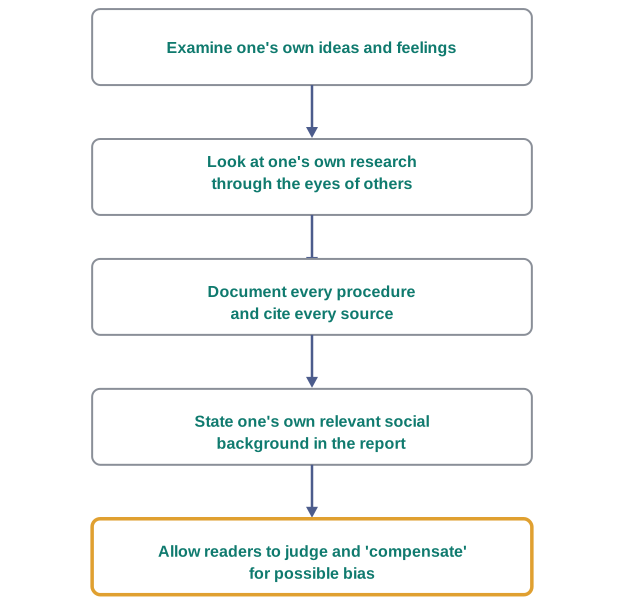
Fig. 5.2 – Guarding against bias in sociological research.
One of the practical aspects of reflexivity is the importance of carefully documenting whatever one is doing. Part of the claim to superiority that research methods make lies precisely in the documentation of all procedures and the formal citing of all sources of evidence.
Why does documentation matter so much? Because it allows others to retrace the steps we have taken to arrive at a particular conclusion, and to see for themselves whether we are right. It also helps us to check and re-check our own thinking, and our own line of argument.
But however self-reflexive the sociologist tries to be, there is always the possibility of unconscious bias. Some assumptions are so deep that we cannot see them in ourselves.
To deal with this possibility, sociologists explicitly mention those features of their own social background that might be a relevant source of bias on the topic being researched. This alerts readers to the possibility of bias, and allows them to mentally ‘compensate’ for it while reading the study. It is a form of honesty built into the method itself.
You may find it useful, at this point, to go back to Chapter 1 and re-read the discussion of the difference between common sense and sociology. Common sense is knowledge that is never asked to explain how it knows what it knows. Sociology is knowledge that must always be able to answer that question.
Many versions of the truth
Another problem with objectivity in sociology is that, generally speaking, there are many versions of the ‘truth’ in the social world.
Things look different from different vantage points. The social world therefore typically involves many competing versions, or interpretations, of reality. You have already seen this in the case of the shopkeeper and the customer, who may hold very different ideas about what counts as a ‘good’ price. In the same way, a young person and an aged person may have very different notions of ‘good’ food.
There is no simple way of judging which particular interpretation is true, or more correct. Often it is unhelpful even to think in these terms.
In fact, sociology tries not to judge in this way at all. It is really interested in what people think, and in why they think what they think. The question “who is right about good food?” is not a sociological question. The question “why do these two people mean such different things by the word?” very much is.
Sociology is multi-paradigmatic
A further complication arises from the presence of multiple points of view within the social sciences themselves. Like its sister social sciences, sociology too is a multi-paradigmatic science.
This means that competing and mutually incompatible schools of thought coexist within the discipline. You saw this in Chapter 2, in the discussion of conflicting theories of society. Not only do the people studied disagree with each other; so do the sociologists studying them.
Objectivity as a goal, not an achievement
All this makes objectivity a very difficult and complicated thing in sociology. In fact, the old notion of objectivity is now widely considered to be an outdated perspective.
Social scientists no longer believe that the traditional notion of an ‘objective, disinterested’ social science is attainable. Indeed, such an ideal can actually be misleading, because a researcher who believes she has no standpoint is simply a researcher who has stopped looking for one.
This does not mean that there is no useful knowledge to be obtained through sociology. Nor does it mean that objectivity is a useless concept. It means something more precise: objectivity has to be thought of as the goal of a continuous, ongoing process, rather than as an end result that has already been achieved.
5.2.2 Multiple Methods and Choice of Methods
Since there are multiple truths and multiple perspectives in sociology, it is hardly surprising that there are also multiple methods. There is no single unique road to sociological truth.
Of course, different methods are more or less suited to tackling different types of research questions. Moreover, every method has its own strengths and weaknesses. It is therefore futile to argue about the superiority or inferiority of different methods in the abstract.
The important question is a different one. Is the method chosen the appropriate one for answering the question that is being asked?
Take an example. If you are interested in finding out whether most Indian families are still ‘joint families’, then a census or a survey is the best method — you need to count, on a large scale.
But suppose you wish to compare the status of women in joint and nuclear families. Counting will not tell you that. Here interviews, case studies or participant observation may all be appropriate methods, because you now need to understand relationships from within.
Three ways of classifying methods
There are different ways of classifying or categorising the various methods commonly used by sociologists.
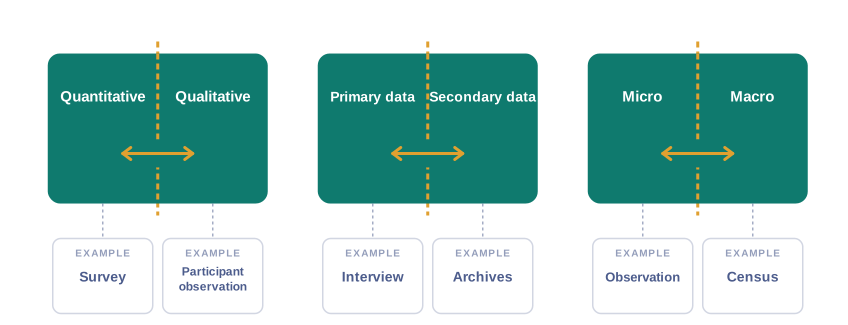
Fig. 5.3 – Three ways of classifying research methods.
It is conventional, for example, to distinguish between quantitative methods and qualitative methods. The former deal in countable or measurable variables — proportions, averages, and the like. The latter deal with more abstract and hard-to-measure phenomena, such as attitudes and emotions.
A related distinction runs alongside this one: between methods that study observable behaviour, and methods that study non-observable meanings, values and other interpretational things.
Another way of classifying methods is to distinguish those that rely on secondary data — already existing material, in the form of documents, records and artefacts — from those that are designed to produce fresh, or primary, data. Thus historical methods typically rely on secondary material found in archives, while interviews generate primary data.
Yet another way of categorising is to separate micro methods from macro methods. Micro methods are designed to work in small, intimate settings, usually with a single researcher; the interview and participant observation are thought of as micro methods.
Macro methods are those that are able to tackle large-scale research, involving large numbers of respondents and large numbers of investigators. Survey research is the most common example of a macro method, although some historical methods can also tackle macro phenomena.
The dividing lines are conventions
Whatever the mode of classification, it is important to remember that it is a matter of convention. The dividing line between different kinds of methods need not be very sharp.
It is often possible to convert one kind of method into another, or to supplement one with another. A survey can carry a few open questions; an interview can be tightened into a questionnaire. The categories are tools for thinking, not walls.
Choosing, and combining, methods
The choice of method is usually dictated by three things: the nature of the research question being addressed, the preferences of the researcher, and the constraints of time and resources. A method that would be perfect in principle is of no use if it needs three years and you have three months.
The recent trend in social science is to advocate the use of multiple methods, brought to bear on the same research problem from different vantage points. This is sometimes referred to as triangulation — a process of reiterating or pinpointing something from different directions.
In this way, different methods can be used to complement each other, and to produce a much better result than what might have been possible with each method by itself.
Because the methods most distinctive of sociology are those designed to produce primary data, these are the ones stressed in this chapter. And even within the category of field-work-based methods, you will be introduced only to the most prominent three: the survey, the interview, and participant observation.
5.2.3 Participant Observation
Popular in sociology, and specially in social anthropology, participant observation refers to a particular method by which the sociologist learns about the society, culture and people that she or he is studying. You may find it useful here to recall the discussion of sociology and social anthropology from Chapter 1.
This method is different from the others in many ways. Unlike other methods of primary data collection, such as surveys or interviews, field work involves a long period of interaction with the subjects of research.
Typically, the sociologist or social anthropologist spends many months — usually about a year, and sometimes more — living among the people being studied, as one of them. The commitment is measured in seasons, not in hours.
Becoming an insider
As a non-native ‘outsider’, the anthropologist is supposed to immerse himself or herself in the culture of the ‘natives’. This is done by learning their language and participating intimately in their everyday life.
The aim of all this immersion is to acquire the explicit and the implicit knowledge and skills of the ‘insider’ — not only what people can tell you, but what they know so well that it would never occur to them to say it.
A word about the vocabulary is needed here. Terms like ‘natives’ and ‘primitive’ belong to the language of an earlier, colonial period of the discipline, and you will see them in quotation marks throughout this chapter. They were applied to colonised peoples by Western scholars, and they are rejected today, both because they are disrespectful and because they falsely arrange whole societies on a ladder from backward to advanced.
Although the sociologist or anthropologist usually has specific areas of interest, the overall goal of participant observation field work is to learn about the ‘whole way of life’ of a community. Nothing is too ordinary to be worth noting.
Indeed, the model here is that of the child. Sociologists and anthropologists are supposed to learn everything about their adoptive communities in just the holistic way that small children learn about the world.
Why it is called ‘field work’
Participant observation is often called field work. The term originated in the natural sciences, especially in disciplines like botany, zoology and geology.
In those disciplines, scientists could not do all their work in the laboratory. They had to go out into ‘the field’ to learn about their subjects — the rocks, insects or plants they studied. Sociology and social anthropology borrowed both the practice and the word.
5.3 Field Work in Social Anthropology
Field work, as a rigorous scientific method, played a major role in establishing anthropology as a social science. Before it, the subject was not quite taken seriously. After it, it could no longer be dismissed.
The age of the armchair scholars
The early anthropologists were amateur enthusiasts, interested in what they called exotic ‘primitive’ cultures. They were ‘armchair scholars’ — a name that describes their method exactly.
They collected and organised information about distant communities, which they had never themselves visited. Where did the information come from? From the reports and descriptions written by travellers, missionaries, colonial administrators, soldiers and other ‘men on the spot’.
James Frazer’s famous book The Golden Bough, which inspired many early anthropologists, was based entirely on such second-hand accounts. So was the work of Emile Durkheim on ‘primitive’ religion. These were serious scholars and learned books. But not one of their authors had watched the rituals they wrote about.
Towards the end of the nineteenth century, and in the first decade of the twentieth, this began to change. Many early anthropologists — some of whom were natural scientists by profession — began to carry out systematic surveys and first-hand observation of tribal languages, customs, rituals and beliefs.
Reliance on second-hand accounts began to be thought of as unscholarly. The good results obtained from first-hand work helped to cement this growing prejudice against the armchair.
Field work becomes the discipline’s core
Since the 1920s, participant observation, or field work, has been considered an integral part of social anthropological training, and the principal method through which knowledge in the discipline is produced.
Almost all of the influential scholars in the discipline have done such field work. In fact, many communities and geographical places have become famous within the discipline simply because of their association with classic instances of field work. The place and the study become inseparable in the discipline’s memory.
What the field worker actually did
What did the social anthropologist actually do when doing field work? The answer is less mysterious than it sounds, and it began with counting.
Usually, she or he began by doing a census of the community being studied. This involved making a detailed list of all the people who lived in the community, including information such as their sex, age group and family.
This could be accompanied by an attempt to map the physical layout of the village or settlement — the location of houses, and of other socially relevant sites such as the well, the temple, the school or the marketplace. Where people live, and near whom, is itself a social fact.
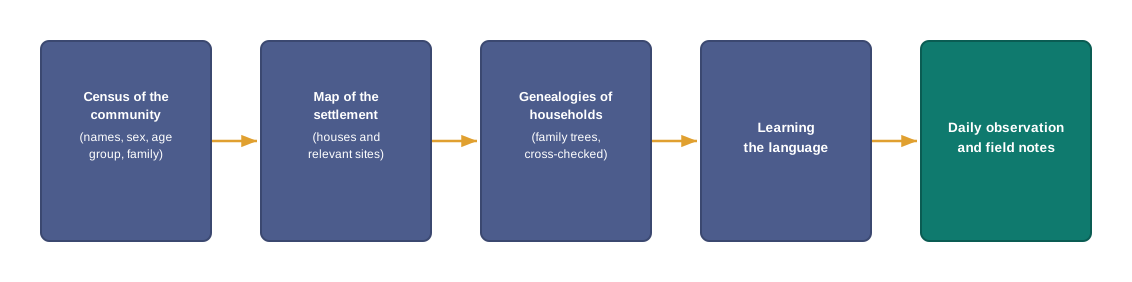
Fig. 5.4 – The opening stages of anthropological field work.
Constructing a genealogy
One of the important techniques anthropologists use, especially in the beginning stages of field work, is to construct a genealogy of the community.
The genealogy may be based on the information already obtained in the census, but it extends much further. It involves creating a family tree for individual members, and extending that tree as far back as possible.
How is it done? The head of a particular household or family would be asked about his or her relatives in his or her own generation — brothers, sisters, cousins. Then about the parents’ generation — father, mother, and their brothers and sisters. Then about the grandparents, and their brothers and sisters, and so on. This would be done for as many generations as the person could remember.
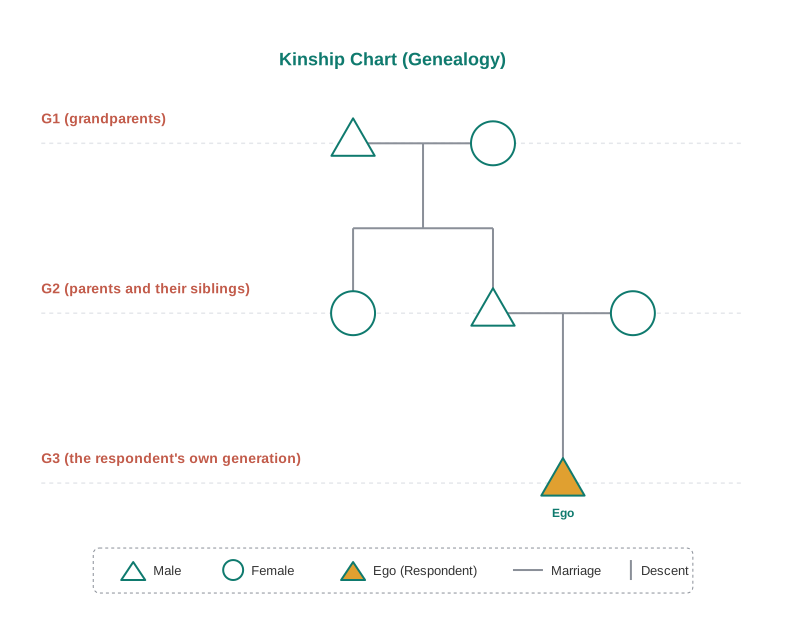
Fig. 5.5 – A simple three-generation kinship chart.
The information obtained from one person would then be cross-checked by asking other relatives the same questions. Only after such confirmation could a very detailed and reliable family tree be drawn up. Memory is fallible, and people forget or reshape their own family histories; cross-checking is the field worker’s version of verification.
This exercise helped the social anthropologist to understand the kinship system of the community — that is, the socially recognised web of relations of blood and marriage. It showed what kinds of roles different relatives played in a person’s life, and how these relations were maintained over time.
Living, listening, writing
A genealogy would help acquaint the anthropologist with the structure of the community. In a practical sense, it also enabled her or him to meet people and become familiar with the way the community lives. Drawing a family tree is an excellent excuse to sit in someone’s courtyard for an afternoon.
Building on this base, the anthropologist would constantly be learning the language of the community. She or he would also be observing life in the community, and making detailed notes describing its significant aspects.
Festivals, religious or other collective events, modes of earning a living, family relations, modes of child rearing — these are examples of the kinds of topics that anthropologists would be specially interested in.
Learning about these institutions and practices requires the anthropologist to ask endless questions about things that are taken for granted by members of the community. Why is the eldest son seated there? Why does nobody enter that lane? Members find such questions strange, because the answers are obvious to them — which is precisely why they are never stated.
This is the sense in which the anthropologist would be like a child, always asking why, and what, and how. Ignorance, honestly admitted, becomes a method.
Informants and field notes
In doing this, the anthropologist usually depends on one or two people for most of the information. Such people are called informants, or ‘principal informants’; in the early days, the term ‘native informant’ was also used.
Informants act as the anthropologist’s teachers. They are crucially important actors in the whole process of anthropological research — they explain, they interpret, they introduce the researcher to others, and they decide, quietly, how much to reveal.
Equally important are the detailed field notes that the anthropologist keeps during field work. These notes have to be written up every day without fail, because memory fades within hours. They can be supplemented by, or take the form of, a daily diary.
5.4 Field Work in Sociology
More or less the same techniques are used by sociologists when they do field work. If you have followed the previous section, you already know most of what a sociological field worker does.
Sociological field work differs from anthropological field work not so much in its content — what is done during field work — but in its context, that is, where it is done. It also differs in the distribution of emphasis across different areas or topics of research.
Thus a sociologist would also live among a community and attempt to become an ‘insider’. But unlike the anthropologist, who typically went to a remote tribal community to do field work, sociologists did their field work among all sorts of communities — city neighbourhoods, factories, villages, schools.
Moreover, sociological field work did not necessarily involve ‘living in’. It did, however, involve spending most of one’s time with the members of the community. You could go home at night; you could not go home for the day.
Two American examples
For example, William Foote Whyte, an American sociologist, did his field work among the members of a street ‘gang’ in an Italian-American slum in a large city, and wrote a famous book, Street Corner Society.
He lived in the area for three and a half years, ‘hanging out’ — just spending time together — with the members of the gang or group. They were mostly poor, unemployed young men, the first American-born generation in a community of immigrants. This example of sociological field work is very close to anthropological field work, though there are important differences.
But sociological field work need not only be of this kind. It can take different forms.
Consider the work of Michael Burawoy, another American sociologist. He worked for several months as a machinist in a Chicago factory, and wrote about the experience of work from the point of view of the workers themselves. Here the researcher did not merely watch the work; he did it.
Village studies in India
In Indian sociology, an important way in which field work methods have been used is in village studies. In the 1950s, many anthropologists and sociologists, both Indian and foreign, began working on village life and society.
Why the village? Partly for methodological reasons. The village acted as the equivalent of the tribal community studied by the earlier anthropologists. It was also a ‘bounded community’ — you could say where it began and ended — and it was small enough to be studied by a single person. The sociologist could get to know almost everyone in the village, and could observe life there over a full cycle of seasons.
But there were larger reasons too, and they had to do with the history of the country.
Anthropology, colonialism and the nationalist objection
Anthropology was not very popular with nationalists in colonial India, because of its excessive concern with the ‘primitive’. Many educated Indians felt that disciplines like anthropology carried a colonial bias, because they emphasised the non-modern aspects of colonised societies rather than their progressive or positive side.
To such critics, a discipline that portrayed India mainly through its most ‘backward’ communities was serving, however unintentionally, the colonial claim that Indians were not ready to govern themselves. Studying villages and villagers therefore seemed much more acceptable and worthwhile for a sociologist than studying tribes alone.
Questions were also being asked about the links between early anthropology and colonialism itself. After all, the classic instances of field work — Malinowski’s, Evans Pritchard’s and countless others — were made possible by the fact that the places and people where field work was done were part of colonial empires, ruled by the very countries from which the Western anthropologists came. The ship, the permit and the protection all came from the empire.
Why the village mattered to a new nation
However, more than the methodological reasons, village studies were important because they provided Indian sociology with a subject that was of great interest in newly independent India.
The government was interested in developing rural India. The national movement, and specially Mahatma Gandhi, had been actively involved in what were called ‘village uplift’ programmes — efforts to improve sanitation, education, crafts and self-reliance in the countryside.
Even urban educated Indians were interested in village life, because most of them retained some family and recent historical links to villages. A generation that had moved to the city still had a grandmother’s house to return to at harvest time.
Above all, villages were the places where most Indians lived — and still do. For all these reasons, village studies became a very important part of Indian sociology, and field work methods were very well suited for studying village society.
5.4.1 Some Limitations of Participant Observation
You have already seen what participant observation can do. Its main strength is that it provides a very rich and detailed picture of life from the perspective of the ‘insider’.
It is this insider perspective that is the greatest return on the substantial investment of time and effort that field work demands. Most other research methods cannot claim to have a detailed knowledge of the ‘field’ over a fairly long period of time; they are usually based on a short and quick field visit.
Field work allows for the correction of initial impressions, which may often be mistaken or biased. The first week in a village teaches you things that the second month proves wrong.
It also permits the researcher to track changes in the subject of interest, and to see the impact of different situations or contexts. For example, different aspects of social structure or culture may be brought out in a good harvest year and in a bad harvest year. People could behave differently when employed and when unemployed.
Because she spends a long period in ‘full time’ engagement with the field, a participant observer can avoid many of the errors or biases that surveys, questionnaires or short-term observation are inevitably subject to.
The weaknesses of field work
But like all research methods, field work also has some weaknesses — otherwise all social scientists would be using this method alone.
Field work, by its very nature, involves very long drawn out and intensive research, usually by a single scholar working alone. As such, it can only cover a very small part of the world — generally a single village or a small community.
This produces the biggest problem of all. We can never be sure whether what the anthropologist or sociologist observed during field work is really very common in the larger community — in other villages, in the region, or in the country — or whether it is exceptional. One village studied deeply tells you a great deal about that village, and nothing certain about the next one. This is probably the biggest disadvantage of field work.
Another important limitation is that we are never sure whether it is the voice of the anthropologist we are hearing, or that of the people being studied.
Of course, the aim is to represent the views of the people studied. But it is always possible that the anthropologist — whether consciously or unconsciously — is selecting what will be written down in her notes, and deciding how it will be presented to the readers of her books or articles. Because there is no other version available to us except that of the anthropologist, there is always the chance of bias or error. This risk, however, is present in most research methods.
Who speaks for ‘the people’?
More generally, field work methods are criticised because of the one-sided relationship they are based on. The anthropologist or sociologist asks the questions, presents the answers, and speaks for ‘the people’. The people themselves get no say in how they are described.
To counter this, some scholars have suggested more ‘dialogic’ formats — that is, ways of presenting field work results in which the respondents and the people studied can be more directly involved.
In concrete terms, this involves translating the work of the scholar into the language of the community, asking the community’s opinion of it, and recording their responses. The book is taken back to the people it is about.
As the social, economic and political distance or gap between the researcher and the researched becomes less wide, there is a greater and greater chance that the scholar’s version will be questioned, qualified, or corrected by the people themselves.
This will surely make sociological research more controversial, and much more difficult. But in the long run this can only be a good thing, because it will help to take social science forward and make it more democratic — allowing many more people to participate in producing, and critically engaging with, ‘knowledge’.
5.4.2 Surveys
The survey is probably the best known sociological method, and one that is now so much a part of modern public life that it has become commonplace. Today it is used all over the world, in all sorts of contexts going well beyond the concerns of sociology alone.
In India, too, we have seen the increasing use of surveys for various non-academic purposes. These include the prediction of election results, the devising of marketing strategies for selling products, and the eliciting of popular opinions on a wide variety of subjects.
As the word itself suggests, a survey is an attempt to provide an overview. It is a comprehensive or wide-ranging perspective on some subject, based on information obtained from a carefully chosen representative set of people.
Such people are usually referred to as respondents — they respond to the questions asked of them by the researchers.
Survey research is usually done by large teams. These consist of those who plan and design the study — the researchers — and their associates and assistants, the latter being called investigators or ‘research assistants’. This division of labour will matter later, when we look at what can go wrong.
How survey questions are asked
The survey questions may be asked and answered in various forms.
Often, they are asked orally during personal visits by the investigator, and sometimes through telephone conversations. Responses may also be sought in writing, on questionnaires — written lists of questions — brought by investigators or sent through the post.
Finally, with the increasing presence of computers and telecommunication technology, these days it is also possible for surveys to be conducted electronically. In this format, the respondent receives and responds to questions by email, the Internet, or a similar electronic medium. Another way is to go to an internet website through a link, and fill in the format that is digitally available there.
The great advantage: studying the many by studying the few
The survey’s main advantage as a social scientific method is that it allows us to generalise results for a large population while actually studying only a small portion of that population.
A survey thus makes it possible to study large populations with a manageable investment of time, effort and money. That is why it is such a popular method in the social sciences and in many fields.
How is this shortcut possible? The sample survey is able to provide a generalisable result, despite being selective, by taking advantage of the discoveries of a branch of statistics called sampling theory.
The key element that makes the shortcut work is the representativeness of the sample. A sample is representative when it reflects the population it is drawn from, so that what is true of the sample can be expected to be true of the population.
So the question becomes practical and urgent. How do we go about selecting a representative sample from a given population? Broadly speaking, the sample selection process depends on two main principles.
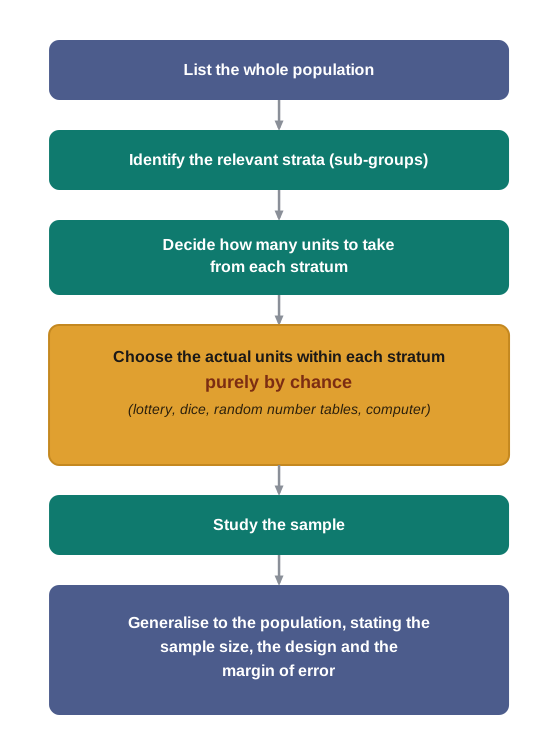
Fig. 5.6 – The process of selecting a representative sample.
The first principle: stratification
The first principle is that all the relevant sub-groups in the population should be recognised and represented in the sample.
Most large populations are not homogenous — they consist of distinct sub-categories. Recognising and representing these sub-categories is called stratification.
Consider some examples. When thinking about the population of India, we must take account of the fact that this population is divided into rural and urban sectors, which are very different from each other. When considering the rural population of any one state, we have to allow for the fact that this population lives in villages of different sizes. In the same way, the population of a single village may be stratified by class, caste, gender, age, religion or other criteria.
In short, the notion of stratification tells us that the representativeness of a sample depends on its being able to reflect the characteristics of all the relevant strata in a given population.
Which kinds of strata are considered relevant depends on the specific objectives of the research study. For example, when doing research on attitudes towards religion, it would be important to include members of all religions. When researching attitudes towards trade unions, it would be important to consider workers, managers and industrialists, and so on.
The second principle: randomisation
The second principle of sample selection is that the actual unit chosen — the person, the village, the household — should be selected purely on the basis of chance. This is referred to as randomisation.
Randomisation itself depends on the concept of probability, which you may have come across in your mathematics course. Probability refers to the chance, or the odds, of an event happening.
For example, when we toss a coin, it can fall with the ‘head’ side up or the ‘tail’ side up. With normal coins, the chance — or probability — of heads or tails appearing is exactly the same, that is, 50 per cent each. Which of the two events actually happens when you toss the coin depends purely on chance and nothing else. Events like this are called random events.
We use the same idea in selecting a sample. We try to ensure that the actual person, household or village chosen to be part of the sample is chosen purely by chance. Being selected into the sample should be a matter of luck, like winning a lottery.
It is only if this is true that the sample will be a representative sample. Consider what happens when it is not true. If a survey team chooses only the villages that lie near the main highway, the sample is not a random or chance sample but a purposive one. Similarly, if we choose mostly middle class households, or households that we happen to know, then the sample is again likely to be purposive.
The point is this: after the relevant strata in a population have been identified, the actual choosing of sample households or respondents should be a matter of pure chance.
This can be ensured in various ways. The common techniques are the drawing of lots (or a lottery), the rolling of dice, the use of random number tables specially produced for this purpose, and, more recently, random numbers generated by calculators or computers.
Selecting a sample: a worked example
To understand how a survey sample is actually selected, let us take a concrete example.
Suppose we wish to examine the hypothesis — the proposition we set out to test — that living in smaller and more intimate communities produces greater intercommunity harmony than living in larger, more impersonal communities. For the sake of simplicity, let us suppose that we are interested only in the rural sector of a single state in India.
The simplest possible sample selection process would begin with a list of all the villages in the state, along with their population. Such a list could be obtained from the census data.
Then we would decide on the criteria for defining ‘small’ and ‘large’ villages. From the original list of villages we now eliminate all the ‘medium’ villages — that is, those that are neither small nor big. We now have a revised list, stratified by size of village.
Given our research question, we want to give equal weightage to each of the strata, that is, to small and to big villages. So we decide to select 10 villages from each.
To do this, we number the list of small villages and the list of big villages, and randomly select 10 numbers from each list by drawing lots. We now have our sample, consisting of 10 big and 10 small villages from the state. We can then proceed to study those villages, to see whether our initial hypothesis was true or false.
Notice how the two principles were used in sequence. Stratification decided which kinds of villages must appear. Randomisation decided which particular villages actually appeared.
Of course, this is an extremely simple design. Actual research studies usually involve more complicated designs, with the sample selection process being divided into many stages and incorporating many strata.
But the basic principles remain the same. A small sample is carefully selected such that it is able to represent, or stand for, the entire population. The sample is then studied, and the results obtained for it are generalised to the entire population.
The margin of error
The statistical properties of a scientifically selected sample ensure that the characteristics of the sample will closely resemble the characteristics of the population it is drawn from.
There may be small differences. But the chance of such deviations occurring can itself be specified. This is known as the margin of error, or sampling error.
Note carefully what this means. Sampling error arises not because of any mistake made by the researchers, but simply because we are using a small sample to stand for a large population. It is the price of the shortcut, and it can be calculated in advance.
This is why, when reporting the results of sample surveys, researchers must specify the size and design of their sample, and the margin of error. A result reported without them cannot be judged at all.
The strengths of the survey
The main strength of the survey method is that it is able to provide a broad overview, representative of a large population, with relatively small outlays of time and money.
The bigger the sample, the more chance it has of being truly representative. The extreme case here is the census, which includes the entire population. In practice, sample sizes may vary from 30–40 to many thousands.
But it is not only the size of the sample that matters. Its mode of selection is even more important. Of course, decisions on sample selection can often be based on practical considerations as well.
In situations where a census is not feasible, the survey becomes the only available means of studying the population as a whole.
The unique advantage of the survey is that it provides an aggregated picture — that is, a picture based on a collectivity rather than on single individuals taken separately.
This matters more than it may first appear. Many social problems and issues become visible only at this aggregative level. They simply cannot be identified at the more micro levels of investigation.
Table 5.1 – Number of girls per 1,000 boys in the age group of 0–6 years, India and selected states, Census of 1991, 2001 and 2011 | | 1991 | 2001 | 2011 | |—|—|—|—| | India | 945 | 927 | 914 | | Punjab | 875 | 798 | 846 | | Haryana | 879 | 819 | 830 | | Delhi | 915 | 868 | 866 | | Gujarat | 928 | 883 | 890 | | Himachal Pradesh | 951 | 896 | 906 |
Read Table 5.1 slowly, because it teaches you what an aggregate picture looks like. For India as a whole, the ratio falls steadily across all three census years, from 945 in 1991 to 927 in 2001 and 914 in 2011. Notice, too, that the state figures do not all move in the same direction: in Punjab the ratio drops sharply between 1991 and 2001 and then rises again by 2011, while in Delhi it continues to fall across the whole period. No single family, and no single village, could ever have shown you this pattern.
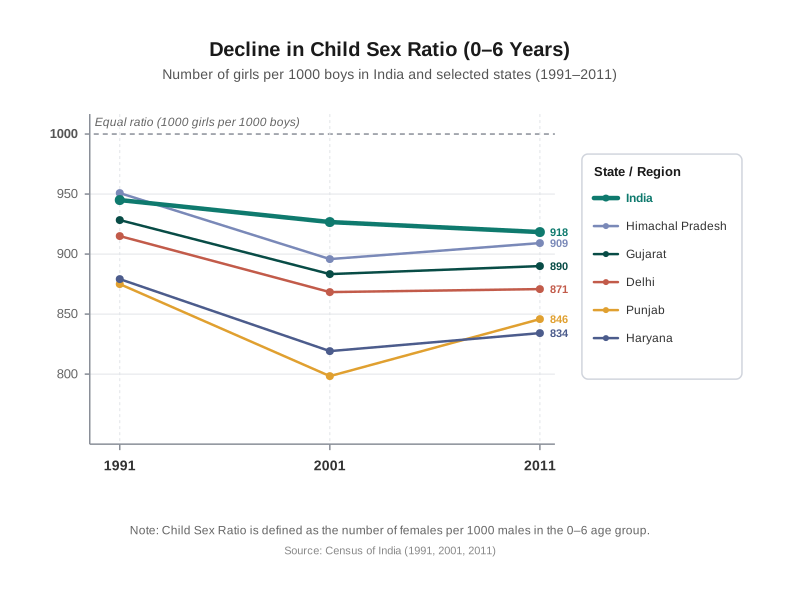
Fig. 5.7 – Child sex ratio in India and selected states, 1991–2011.
The weaknesses of the survey
However, like all research methods, the survey also has its disadvantages.
Although it offers the possibility of wide coverage, this is at the cost of depth of coverage. It is usually not possible to get in-depth information from respondents as part of a large survey. Because of the large number of respondents, the time spent on each must be limited.
Moreover, since the survey questionnaire is taken around to respondents by a relatively large number of investigators, it becomes difficult to ensure that complicated questions — or those requiring detailed prompting — will be asked of all respondents in exactly the same way. Differences in the way questions are asked, or answers recorded, could introduce errors into the survey.
That is why the questionnaire for a survey — sometimes called a ‘survey instrument’ — has to be designed very carefully. Since it will be handled by persons other than the researchers themselves, there is little chance of corrections or modifications in the course of its use. Whatever is wrong with it will stay wrong, thousands of times over.
There is a further, and subtler, problem. Given that there is no long-term relationship between investigator and respondent, and hence no familiarity or trust, the questions that can be asked in a survey have to be of the kind that can be asked and answered between strangers.
Questions of a personal or sensitive kind cannot be asked. Or, if they are asked, they are likely to be answered ‘safely’ rather than truthfully. A stranger with a clipboard is not told everything.
These kinds of problems are sometimes referred to as non-sampling errors.
Unfortunately, some of these errors are difficult to foresee and guard against. It is therefore quite possible for surveys to go wrong, and to produce misleading or false estimates of the characteristics of a population.
Ultimately, the most important limitation of the survey is that, in order to be successful, it must depend on a tightly structured, inflexible questionnaire. And howsoever well designed that questionnaire might be, its success depends finally on the nature of the interactions between investigators and respondents — and specially on the goodwill and cooperation of the latter.
5.4.3 Interview
An interview is basically a guided conversation between the researcher and the respondent. It sounds like the easiest method in the book, and it is not.
Although it has few technicalities associated with it, the simplicity of the format can be deceptive. It actually takes a great deal of practice and skill to become a good interviewer.
The interview occupies the ground between two extremes you have already met: the structured questionnaire of the type used in surveys, and the completely open-ended interactions typical of participant observation methods.
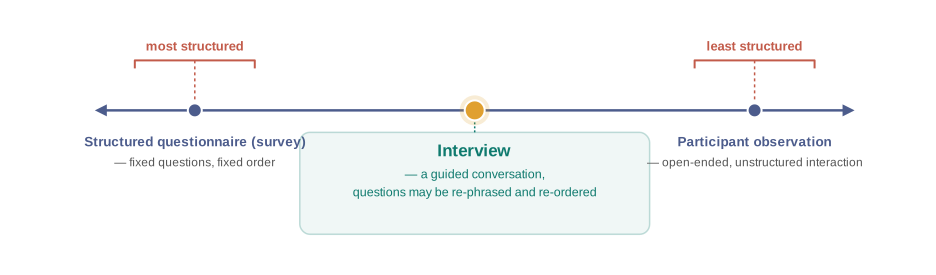
Fig. 5.8 – The structure continuum of research methods.
The advantage: flexibility
Its chief advantage is the extreme flexibility of the format.
Questions can be re-phrased, or even stated quite differently. The order of subjects or questions can be changed according to the progress — or the lack of progress — in the conversation.
Subjects that are producing good material can be extended and built upon. Others, that provoke unfavourable reactions, can be cut short or postponed to a later occasion. And all of this can be done during the course of the interview itself, without stopping to redesign anything.
The disadvantage: also flexibility
On the other hand, many of the disadvantages of the interview as a research method are also related to its advantages.
The very same flexibility can make the interview vulnerable to changes of mood on the part of the respondent, or to lapses of concentration on the part of the interviewer. It is, in this sense, an unstable and unpredictable format. It works very well when it works, and fails miserably when it doesn’t.
Styles of interviewing and ways of recording
There are different styles of interviewing, and opinions and experiences differ as to their relative advantages.
Some researchers prefer a very loosely structured format, carrying only a check-list of topics rather than actual questions. Others like to have more structure, with specific questions to be asked of all respondents.
How the interview is recorded can also differ, according to circumstances and preferences. It may range from actual video or audio recording, to detailed note taking during the interview, to relying on memory and writing up the interview after it is concluded.
Each choice has a cost. The introduction of equipment like recorders frequently makes the respondent uneasy, and introduces a degree of formality into what should be a conversation. On the other hand, important information can sometimes go unnoticed, or not be recorded at all, when less comprehensive methods of record keeping are being employed.
Sometimes the physical or social circumstances in which the interview is being conducted will themselves determine the mode of recording.
The way in which the interview is later written up for publication, or as part of a research report, can also differ widely. Some researchers prefer to edit the transcript and present a ‘cleaned up’ continuous narrative. Others wish to retain the flavour of the original conversation as much as possible, and therefore include all the asides and digressions as well.
The interview as a companion method
The interview is often used along with, or as a supplement to, other methods — specially participant observation and surveys.
Long conversations with ‘key informants’ — the main informants in a participant observation study — can often provide a concentrated account that situates and clarifies the accompanying material. Similarly, intensive interviews can add depth and detail to the findings of a survey, putting flesh on the bones of a percentage.
However, as a method, the interview is dependent on personalised access, and on the degree of rapport, or mutual trust, between the respondent and the researcher. Where that trust does not exist, no amount of technique will produce a good interview.
5.5 Summary
Why method matters (5.1)
- Sociology studies a world its readers already know from experience. What separates the sociologist from any other member of society is not how much she knows, but how she came to know it — that is, her method.
- Sociology is interested in the lived experience of people. It wants both the outsider’s view of what happens and the insider’s understanding of what it means. A method must be able to reach both.
Objectivity and subjectivity (5.2.1)
- ‘Objective’ means unbiased and based on facts alone; ‘subjective’ means based on individual values and preferences. All sciences aim at objectivity, but it is harder to achieve in the social sciences.
- The reason is structural: the geologist is not a rock, but the sociologist is a member of the society she studies. Her family, caste, religion and class can bias what she notices and how she interprets it.
- Sociologists guard against bias through reflexivity — examining their own attitudes, viewing their work through the eyes of others, documenting all procedures, citing all sources, and openly stating features of their own background that could be a source of bias.
- The social world contains many competing versions of the ‘truth’, because things look different from different vantage points. Sociology does not try to judge which version is correct; it asks what people think, and why.
- Sociology is also multi-paradigmatic: rival, mutually incompatible schools of thought coexist within it.
- The old ideal of an ‘objective, disinterested’ social science is now considered outdated and even misleading. Objectivity is best understood as the goal of a continuous, ongoing process, not as an achieved end result.
Multiple methods (5.2.2)
- Multiple truths and perspectives mean multiple methods. No method is superior in the abstract; the real question is whether the method chosen is appropriate for the question being asked.
- Methods are conventionally classified in three ways: quantitative and qualitative; primary and secondary; micro and macro. These dividing lines are matters of convention and are not sharp.
- The choice of method depends on the research question, the researcher’s preferences, and the constraints of time and resources.
- Triangulation — using several methods on the same problem from different vantage points — allows methods to complement and correct one another.
Participant observation and field work (5.2.3, 5.3)
- Participant observation involves a long period of interaction, usually a year or more, living among the people being studied and learning their language and way of life. Its model is the child, who learns holistically by asking about everything.
- Early anthropologists were ‘armchair scholars’ who wrote about communities they had never visited, relying on the accounts of travellers, missionaries, administrators and soldiers. First-hand observation replaced this from the late nineteenth century, and since the 1920s field work has been the discipline’s principal method.
- Field work typically begins with a census of the community and a map of the settlement, followed by the construction of genealogies — family trees, cross-checked with several relatives — which reveal the kinship system.
- The field worker learns the language, observes festivals, work, family relations and child rearing, depends on one or two principal informants, and writes up detailed field notes every day.
Field work in sociology and village studies (5.4)
- Sociological field work uses much the same techniques, but in different contexts: not only remote tribal communities, but slums, factories, neighbourhoods and villages. It does not necessarily involve ‘living in’.
- In India, field work took the form of village studies from the 1950s. The village was a bounded community small enough for one researcher; nationalists distrusted anthropology’s focus on the ‘primitive’; and the village mattered to a newly independent nation committed to rural development. Above all, most Indians lived — and still live — in villages.
- Questions were also raised about the link between early anthropology and colonialism, since classic field studies were conducted in territories ruled by the anthropologists’ own countries.
Strengths and limitations of participant observation (5.4.1)
- Strength: a rich, detailed, insider’s picture; the correction of first impressions over time; the ability to see the same people in different situations and contexts.
- Weakness: it covers only one village or small community, so we can never be sure whether what was found is typical or exceptional. This is its biggest disadvantage.
- Weakness: we hear the researcher’s voice, not necessarily the people’s, since the researcher selects what is recorded and how it is presented. Field work is also criticised for its one-sided relationship, which ‘dialogic’ formats attempt to correct by taking the account back to the community for its response.
The survey (5.4.2)
- A survey provides a wide-ranging overview of a subject, based on information from a carefully chosen representative set of respondents. Questions may be asked orally, by telephone, in writing, or electronically.
- Its great advantage is generalisation: results for a large population can be obtained by studying only a small part of it, at manageable cost.
- Sample selection rests on two principles — stratification (all relevant sub-groups must be represented) and randomisation (the actual unit chosen must be a matter of pure chance, ensured by lots, dice, random number tables or computers).
- Sampling error is the unavoidable margin of error that arises from using a sample rather than the whole population. Researchers must report the sample’s size, its design and the margin of error.
- The survey gives an aggregated picture, and some problems — such as the falling child sex ratio — become visible only at this aggregate level.
- Weaknesses: breadth is bought at the cost of depth; questions must be answerable between strangers, so sensitive matters are avoided or answered ‘safely’; and non-sampling errors can arise from faults of design or implementation. The survey finally depends on a rigid questionnaire and on the goodwill of respondents.
The interview (5.4.3)
- An interview is a guided conversation, occupying the ground between the structured survey questionnaire and the open-ended interaction of participant observation.
- Its chief strength is flexibility: questions can be re-phrased, re-ordered, extended or postponed during the conversation itself.
- That same flexibility is its weakness, making it vulnerable to the moods of the respondent and lapses of the interviewer.
- Styles of interviewing and modes of recording vary widely, and each choice has a cost. The interview is frequently used to supplement participant observation and surveys, and it depends finally on access and rapport.
5.6 Key Terms
Census — A comprehensive survey covering every single member of a population, not a selection from it.
Field notes — The detailed daily written record a field worker keeps of everything observed and heard in the field; it may take the form of a diary.
Field work — The name given to participant observation, borrowed from the natural sciences, where scientists had to leave the laboratory and go out into ‘the field’.
Genealogy — An extended family tree outlining relations of kinship — descent and marriage — across generations.
Hypothesis — A proposition that a study sets out to test against evidence, and that may turn out to be true or false.
Informant — A member of the community who becomes the field worker’s main source of information and, in effect, her teacher; also called a principal informant.
Interview — A guided conversation between researcher and respondent, standing between the fixed survey questionnaire and the open-ended interaction of participant observation.
Investigator — A member of the survey team who actually asks the questions and records the answers, as distinct from the researcher who designs the study.
Jajmani — The customary village arrangement by which families of different castes provided one another with goods and services on a long-standing, hereditary basis.
Lived experience — The social world as it is actually felt, understood and interpreted by the people living inside it.
Macro methods — Methods able to handle large-scale research with many respondents and many investigators; the survey is the commonest example.
Margin of error — Another name for sampling error: the stated extent to which a sample’s result may deviate from the true figure for the population.
Method — The definite, statable procedure by which a discipline gathers its knowledge.
Methodology — The study of method itself: the general questions about what makes any procedure a sound way of producing knowledge.
Micro methods — Methods designed for small, intimate settings, usually with a single researcher; the interview and participant observation are examples.
Multi-paradigmatic — Describing a discipline, such as sociology, within which competing and mutually incompatible schools of thought coexist.
Non-sampling error — Error in survey results caused not by sampling but by mistakes in the design or the application of the method.
Objectivity — The quality of being unbiased and neutral, basing knowledge on facts alone rather than on personal feelings; in sociology it is best understood as an ongoing goal rather than an achieved state.
Participant observation — The method by which a researcher lives among the people being studied, usually for a year or more, learning their language and way of life from the inside.
Population — In the statistical sense, the larger body of persons, villages or households from which a sample is drawn.
Primary data — Fresh data produced by the researcher’s own investigation, as through interviews, surveys or field work.
Probability — The likelihood, or odds, of an event occurring, in the statistical sense.
Purposive sample — A sample whose units are chosen for convenience, familiarity or interest rather than by chance, and which is therefore not representative.
Qualitative methods — Methods that deal with abstract, hard-to-measure phenomena such as attitudes, emotions and meanings.
Quantitative methods — Methods that deal with countable or measurable variables such as proportions and averages.
Questionnaire — A written list of questions to be asked in a survey or an interview.
Randomisation — Ensuring that the selection of a particular unit into the sample depends purely on chance and nothing else.
Rapport — The relationship of mutual trust and ease between researcher and respondent, on which an interview finally depends.
Reflexivity — The researcher’s ability to observe and analyse herself or himself, examining one’s own attitudes, assumptions and social position.
Representativeness — The quality of a sample that allows it to stand for the whole population, because it reflects all the population’s relevant strata.
Respondent — A person who answers the questions put by a researcher in a survey or an interview.
Sample — A subset or selection, usually small, drawn from and representing a larger population.
Sampling error — The unavoidable margin of error in a survey’s results, arising because it is based on a small sample rather than the entire population.
Sampling theory — The branch of statistics that explains how a carefully selected small sample can yield results generalisable to a large population.
Secondary data — Already existing material — documents, records, archives, artefacts — used as evidence by a researcher who did not generate it.
Stratification (statistical) — The subdivision of a population into distinct groups based on relevant criteria such as gender, location, religion or age, so that each can be represented in the sample.
Subjectivity — The quality of being based on individual values and preferences rather than on facts alone.
Survey — A method that provides a wide-ranging overview of a subject, based on information gathered from a carefully chosen representative set of respondents.
Triangulation — The use of several different methods on the same research problem, so that each can check and complete the findings of the others.
Village studies — The tradition, prominent in Indian sociology from the 1950s, of studying a single village intensively through field work.
5.7 Points to Ponder
If a sociologist can never fully escape her own social background, what exactly is the difference between a sociological account of a community and a well-informed personal opinion about it?
Objectivity has been described in this chapter as the goal of a continuous process rather than a finished achievement. Is a goal that can never be reached still worth pursuing — and what would sociology look like if it abandoned the goal altogether?
The early anthropologists went out to study people who could not read what was written about them. Today’s field worker studies people who can. Does that change what a researcher is allowed to write, or only how carefully she must write it?
A survey can show a whole country that its child sex ratio is falling, but it cannot tell us what any one family was thinking. A field study can tell us what one family was thinking, but not whether the country is like it. If you had to choose only one of these two kinds of knowledge for making public policy, which would you choose, and what would you lose?
The chapter suggests that research becomes more democratic when the people studied can question, qualify or correct the researcher’s account. Would sociology become better knowledge that way, or only more difficult to produce — and are those two things really opposed?
You have lived your whole life inside your own society, and you know a great deal about it. Does that knowledge make you a better researcher of your own community, or a worse one?
5.8 NCERT Questions
Why is the question of a scientific method particularly important in sociology?
What are some of the reasons for ‘objectivity’ being more complicated in the social sciences, particularly in disciplines like sociology?
How do sociologists deal with the difficulties of “objectivity”, and how do they strive for objectivity?
What is meant by ‘reflexivity’, and why is it important in sociology?
What are some of the things that ethnographers and sociologists do during participant observation?
What are the strengths and weaknesses of participant observation as a method?
What are the basic elements of the survey method? What is the chief advantage of this method?
Describe some of the criteria involved in selecting a representative sample.
State some of the weaknesses of the survey method.
Describe the main features of the interview as a research method.
5.9 Objective Questions
- The study of method itself, as distinct from any one particular method, is called:
- reflexivity
- methodology
- triangulation
- stratification [1 mark]
- Which of the following is usually described as a macro method?
- Participant observation
- The unstructured interview
- The survey
- The genealogy [1 mark]
- The anthropologist widely believed to have established field work as the distinctive method of social anthropology is:
- James Frazer
- Emile Durkheim
- Michael Burawoy
- Bronislaw Malinowski [1 mark]
- The juvenile, or child, sex ratio is expressed as the number of girls per 1,000 boys in the age group:
- 0–5 years
- 0–6 years
- 0–14 years
- 6–14 years [1 mark]
- A survey team selects only those villages that lie close to the main highway. The sample it obtains is best described as:
- a random sample
- a stratified sample
- a purposive sample
- a representative sample [1 mark]
- Assertion (A): Objectivity is more difficult to achieve in sociology than in the natural sciences. Reason (R): The sociologist is herself a member of the society she studies.
- Both A and R are true, and R is the correct explanation of A
- Both A and R are true, but R is not the correct explanation of A
- A is true, but R is false
- A is false, but R is true [1 mark]
- Assertion (A): Sampling error arises because of mistakes made by the researchers who design a survey. Reason (R): In a sample survey, a small sample is used to stand for a large population.
- Both A and R are true, and R is the correct explanation of A
- Both A and R are true, but R is not the correct explanation of A
- A is true, but R is false
- A is false, but R is true [1 mark]
- Assertion (A): Participant observation allows a researcher to correct her initial impressions of a community. Reason (R): Participant observation involves a long period of interaction with the people being studied.
- Both A and R are true, and R is the correct explanation of A
- Both A and R are true, but R is not the correct explanation of A
- A is true, but R is false
- A is false, but R is true [1 mark]
- Match the scholar in Column A with the work in Column B.
| Column A | Column B |
|---|---|
| a. M.N. Srinivas | i. Street Corner Society |
| b. William Foote Whyte | ii. Behind Mud Walls |
| c. S.C. Dube | iii. The Remembered Village |
| d. William and Charlotte Wiser | iv. Indian Village |
[1 mark]
- Match the term in Column A with its meaning in Column B.
| Column A | Column B |
|---|---|
| a. Reflexivity | i. Ensuring that selection depends purely on chance |
| b. Triangulation | ii. Subdividing a population into distinct groups |
| c. Randomisation | iii. The researcher’s ability to observe and analyse herself |
| d. Stratification | iv. Using several methods on the same research problem |
[1 mark]
Fill in the blank: Every five years, the National Statistical Organisation conducts a bigger survey involving about ______ lakh households and covering more than ______ lakh persons all over India. [1 mark]
Fill in the blank: Data that already exist in the form of documents, records or artefacts, and that the researcher has not generated herself, are called ______ data. [1 mark]
True or False: Sociology is called a multi-paradigmatic science because competing and mutually incompatible schools of thought coexist within it. [1 mark]
True or False: The chief advantage of the interview is the extreme flexibility of its format. [1 mark]
5.10 Check Your Concepts
Define reflexivity. [2 marks]
What is a genealogy, and why does a field worker construct one? [2 marks]
State the two main principles on which the selection of a representative sample depends. [2 marks]
Name any two forms in which survey questions may be asked and answered. [2 marks]
What is meant by a purposive sample? Give one example. [2 marks]
Differentiate between quantitative and qualitative methods, giving one example of each. [4 marks]
Differentiate between sampling error and non-sampling error. [4 marks]
Why is objectivity more complicated for a sociologist than for a geologist? Explain with an example. [4 marks]
“There is no single unique road to sociological truth.” Explain, with an example, why the choice of method depends on the question being asked. [4 marks]
Look again at Table 5.1. By how many points did the child sex ratio for India fall between 1991 and 2011? Which of the listed states shows a fall between 1991 and 2001 followed by a rise by 2011? What does this table tell you about the value of aggregate data? [4 marks]
In the 0–6 age group of a particular village, investigators counted 468 girls and 540 boys. Calculate the child sex ratio for the village. Explain why this figure could not have been discovered by studying any one household. [4 marks]
Why did the early anthropologists come to be called ‘armchair scholars’, and why did their method come to be rejected? [4 marks]
Give reasons why village studies became so important a part of Indian sociology after Independence. [4 marks]
Explain participant observation as a research method. Describe what a field worker actually does, and evaluate the method’s strengths and its limitations. [6 marks]
“In sociology, objectivity is best understood as the goal of a continuous process rather than an achieved result.” Explain this statement, discussing the difficulties objectivity faces and the safeguards sociologists use against them. [6 marks]
Describe the survey method. What are its basic elements, what is its chief advantage, and what are its main weaknesses? [6 marks]
A researcher wishes to test the idea that people in small villages get along better with neighbours of other communities than people in large villages do. Explain, step by step, how she would select a representative sample, and state where stratification ends and randomisation begins. [6 marks]
How far do you agree that depth of knowledge is more valuable to sociology than breadth of coverage? Argue your case with reference to both participant observation and the survey. [6 marks]
Field work has been criticised for resting on a one-sided relationship between the researcher and the researched. Explain this criticism, describe the ‘dialogic’ response to it, and discuss what such a change would cost and gain. [6 marks]
5.11 Passage-Based Questions
- Read the passage and answer the questions that follow.
A researcher arrives in a small village in the last week of June. She rents a room near the school and spends her first fortnight doing nothing that looks like research: she lists every household, notes the age group and sex of each member, and sketches a rough map showing the houses, the well, the temple and the weekly market ground. In the third week she begins asking an elderly resident about his brothers, his cousins, his parents and his grandparents, drawing the answers as a tree; the next day she asks his sister the same questions and finds two names missing. Every night she writes up what she has seen, however trivial. She stays until the following June.
a. Name the research method the researcher is using, and identify the two techniques she uses in her first three weeks.
b. Why does she ask the sister the same questions she had already asked her brother?
c. State one important limitation of the method she has chosen. [6 marks]- Read the passage and answer the questions that follow.
A television channel announces the likely winner of a state election. Its team has spoken to 800 people, all of them interviewed at three bus stops in the state capital between nine and eleven in the morning. Everyone approached who agreed to talk was included. The channel reports the percentages to one decimal place. It does not mention how the 800 were chosen, and it does not report a margin of error.
a. Identify two ways in which this sample fails to be representative, and name the principle of sample selection that each failure violates.
b. Why does the absence of a stated margin of error make the findings impossible to evaluate?
c. Would increasing the sample from 800 to 8,000 people, chosen in the same way, solve problem? Give reasons. [6 marks]- Study the table and answer the questions that follow.
A team wishes to survey households in a district about the use of public transport. Before selecting respondents, it prepares the following description of the district’s households.
| Sub-group of households | Share of all households in the district |
|---|---|
| Rural | 62 per cent |
| Urban | 38 per cent |
| Households owning a two-wheeler or car | 29 per cent |
| Households owning no vehicle | 71 per cent |
The team’s first draft plan is to interview 500 households, all of them in the district headquarters town, because it is easier to reach them there.
a. What is the statistical term for dividing the district's households into the sub-groups shown in the table, and why is it done?
b. Explain what is wrong with the team's first draft plan.
c. Suggest a better sample design, showing how you would use both principles of sample selection. [6 marks]- Read the passage and answer the questions that follow.
A student researcher visits a small workshop to talk to a machine operator about his working day. She brings a check-list of topics rather than a fixed list of questions, and a recorder. The moment she switches the recorder on, the operator’s answers become short and careful, and he begins speaking as though addressing an official. She switches it off, puts her notebook away, and lets the conversation wander; he begins to talk freely about the shifts, the noise and the overtime. She writes it all up that evening from memory.
a. Name the method being used, and explain what its position is between the survey questionnaire and participant observation.
b. Identify one advantage and one disadvantage of this method that the passage illustrates.
c. What has been gained, and what has been lost, by writing up the conversation from memory instead of recording it? [6 marks]