Chapter 1: Social Structure, Stratification and Social Processes in Society
Before six in the morning, the milk collection centre of a small town in western India is already busy. Men and women arrive with steel cans, some on foot, some on cycles, a few in small vans. There is a register, a weighing machine, a fat-testing device, and a queue. Nobody has been told what to do today. Everybody knows.
The queue itself is a small society. It works only because people cooperate — the centre would collapse if households did not pool their milk, keep the timings, and accept the rate the society sets. Yet these same people compete. A household with four animals and irrigated fodder land will bring more milk, of better quality, and earn more than a household with one thin buffalo. And there is conflict, though it rarely explodes here. Who sits on the managing committee? Whose can gets tested first when the tester is in a hurry? Why does the woman who milks the animal so often send her husband to collect the payment?
Look again the next morning, and the same queue forms. People come and go, but the pattern stays. Something is holding it in place, and that something is not visible in any one person standing there.
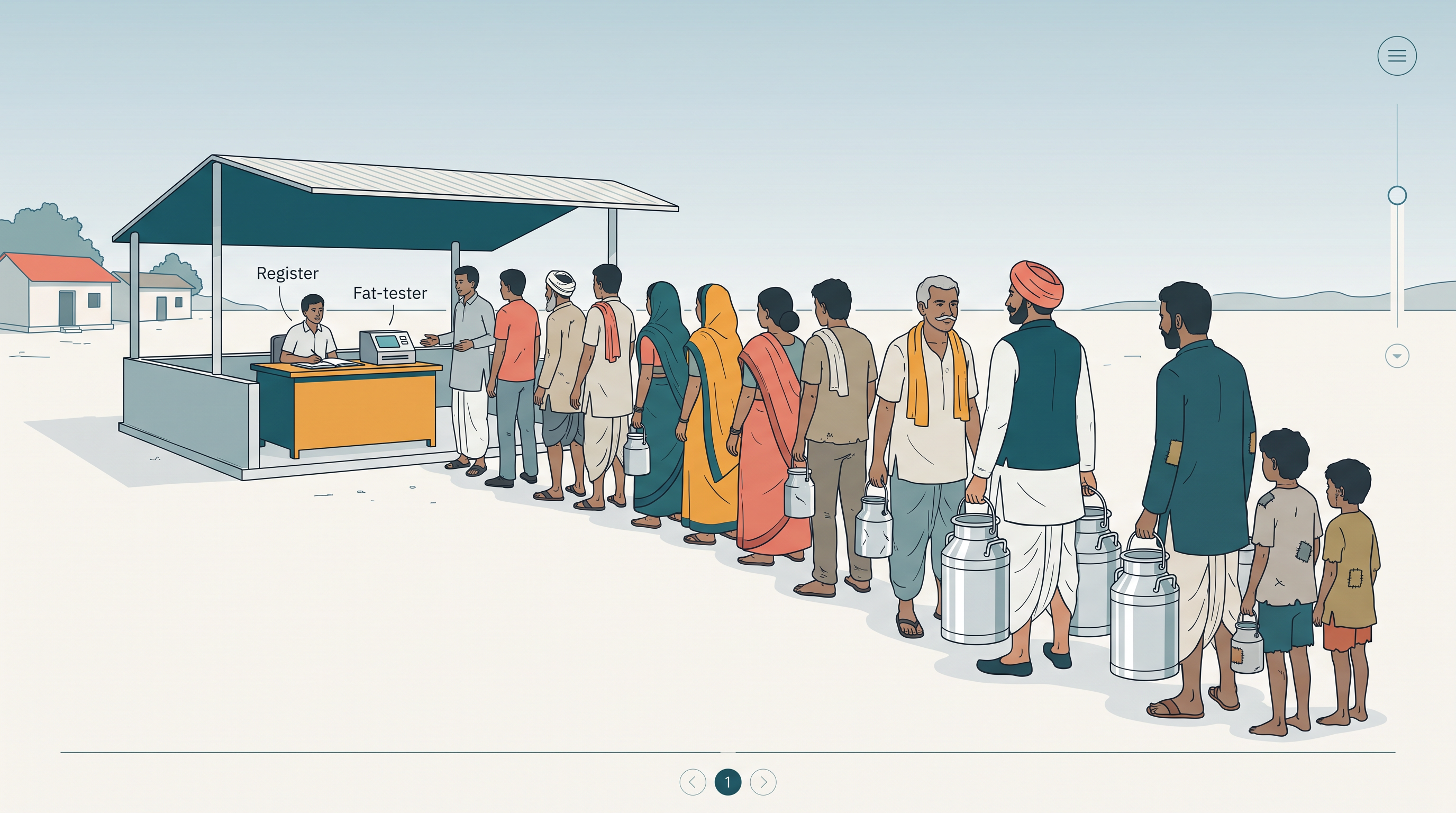
Fig. 1.1 – A village milk collection centre.
This chapter will help you answer each of these questions.
1.1 Introduction
You have already spent a year with sociology. In the earlier book, Introducing Sociology, the subject opened with a simple but unsettling idea: that a personal problem is often also a social issue. A student who drops out of school feels it as her own failure. The sociologist asks a different question — why do so many students, of a particular kind, drop out at the same stage?
That book also showed that no individual stands alone. Each of us is located inside collectivities — groups, classes, castes, tribes, and the categories of gender and region. A collectivity is simply a set of people who are treated, and who often act, as a group.
You belong to many circles at once
Notice that you are not a member of one collectivity but of many, and that they overlap. You belong to a peer group, to a family and a wider circle of kin, to a class and a gender, to a region and a country. None of these memberships cancels the others out.

Fig. 1.2 – Overlapping memberships in social collectivities.
Each individual therefore has a specific location in the social structure — the patterned, repeated arrangement of a society — and in its system of social stratification, the arrangement of groups into layers that are unequal. You will study both terms closely in the next section.
Location decides what is within reach
Where you are placed in that arrangement decides what you can reach. Levels and types of access to social resources are not the same for everybody, and this is the point at which sociology becomes uncomfortable but honest.
Think of schooling. Which school a young person attends — or whether she goes to school at all — depends heavily on the social stratum to which she belongs. The same is true of the clothes she wears, the food she eats, the leisure she can afford, and the health care she can get. Together these add up to a whole lifestyle.
Social stratification, in other words, does what social structure does: it constrains individual action. It quietly narrows the range of things a person can even consider doing.
Biography and history
One of the central concerns of the sociological perspective has been to understand the dialectical relationship between the individual and society — a two-way relationship, in which society shapes individuals and individuals in turn remake society. Neither side is simply the product of the other.
You will recall C. Wright Mills and his idea of the sociological imagination, which seeks to unfold the interplay between an individual’s biography and society’s history. Your life story is yours alone; but it is lived inside a history you did not choose.
The question this chapter asks
It is in order to understand this dialectical relationship that we must take up three central concepts together: structure, stratification, and social processes — the recurring ways in which people and groups act towards one another.
The central question of the chapter can be put plainly. To what extent is the individual constrained by the social structure, and to what extent is she free of it? Does one’s position in society, one’s location in the stratification system, govern individual choice? Do social structure and stratification influence the manner in which people act — the way they cooperate, compete and conflict with one another?
How the chapter proceeds
The chapter deals briefly with the terms ‘social structure’ and ‘social stratification’. Stratification you have already discussed in some detail in Chapter 2 of Introducing Sociology, Class XI (NCERT, 2006), so it is recalled here rather than built from scratch.
It then moves on to three social processes: cooperation, competition and conflict. With each of them, the same question returns. How do social structure and stratification impinge on the process? In other words, how do individuals and groups cooperate, compete and conflict depending upon their position within the social structure and the stratification system?
1.3 Two Ways of Understanding Social Processes in Sociology
In the earlier book, Introducing Sociology, you saw the limitations of commonsense knowledge. The problem with commonsense knowledge is not that it is necessarily false. Much of it works well enough in daily life.
The problem is that it is unexamined and taken for granted. It is inherited rather than tested, and it is believed precisely because everybody around us believes it.
By contrast, the sociological perspective questions everything and accepts nothing as a given. That is a demanding rule, and it applies with full force to the three processes this chapter studies.
“It is human nature” is not an explanation
Sociology would therefore not rest content with an explanation which suggests that humans compete, or cooperate, or conflict, as the case may be, because it is human nature to do so.
Look carefully at what what such an explanation assumes. It assumes that there is something intrinsic and universal in human nature that accounts for these processes — something present in every person, everywhere, in every age.
As you have seen earlier, sociology is not satisfied with either psychological or naturalist explanations. Psychological explanations locate the cause inside the individual mind; naturalist explanations locate it in nature or biology. Both remove society from the picture.
Sociology instead seeks to explain the processes of cooperation, competition and conflict in terms of the actual social structure of society — the arrangement of groups, resources and relationships that people actually live in.

Fig. 1.5 – Cooperation, competition and conflict in everyday settings.
Look at the photographs in Fig. 1.5. A protest march, a union meeting, a football match, a school basketball game. Each shows people acting together, and each shows people acting against each other. The processes are rarely found in a pure form.
Two perspectives, one starting point
In Introducing Sociology we discussed how there are differences and plural understandings of society. You saw how the functionalist perspective and the conflict perspective varied in their understanding of different institutions — the family, the economy, social stratification, social control.
Not surprisingly, therefore, these two perspectives seek to understand cooperation, competition and conflict a bit differently as well.
But notice where they agree. Both Karl Marx, usually associated with a conflict perspective, and Emile Durkheim, usually identified with a functionalist perspective, presume that human beings have to cooperate to meet their basic needs, and to produce and reproduce themselves and their world.
Cooperation, in other words, is not in dispute between them. What is in dispute is what cooperation contains.
The conflict perspective: cooperation with an edge
The conflict perspective emphasises how the forms of cooperation changed from one historical society to another. It is a historical argument, not a psychological one.
It would recognise that in simple societies, where no surplus was produced, there was cooperation between individuals and groups who were not divided on class or caste or race lines. A surplus is whatever is produced over and above what is needed for immediate survival — the grain left after everyone has eaten.
Once a surplus exists, it can be taken. In societies where surplus is produced — whether feudal or capitalist — the dominant class appropriates the surplus, and cooperation would necessarily involve potential conflict and competition.
The conflict view thus emphasises that groups and individuals are placed differentially and unequally within the system of production relations — the relationships people enter into in the course of producing goods, above all the relationship between those who own the means of production and those who work for them.
Consider a factory. The factory owner and the factory worker do cooperate in their everyday work; the machines run only because both play their part. But a certain conflict of interests would define their relationship. Higher wages for one are lower profits for the other.
The understanding that informs the conflict perspective is that in societies divided by caste, or class, or patriarchy, some groups are disadvantaged and discriminated against. Patriarchy here means a social arrangement in which men hold most of the authority and property, and women are subordinated to them.
Furthermore, the dominant groups sustain this unequal order by a series of cultural norms — the shared beliefs that make an unequal arrangement look normal and even right, which sociologists call the dominant ideology — and often by coercion or even violence.
The functionalist perspective: what a system needs
It is not that the functionalist perspective fails to appreciate the role of such norms or sanctions. It sees them clearly. But it understands their function in terms of the society as a whole, and not in terms of the dominant sections who control society.
The functionalist perspective is mainly concerned with the ‘system requirements’ of society — with certain functional imperatives, functional requisites and prerequisites. These terms all refer to the fulfilment of the broadest conditions which are necessary for a system’s existence, and which therefore keep it alive and prevent its destruction, such as:
the socialisation of new members;
a shared system of communication;
methods of assigning individuals to roles.
Read that list again. Every society must teach its children how to be members; must have a language its members share; and must have some way of deciding who does what work.
You are well aware how the functionalist perspective rests upon the assumption that different parts, or organs, of society have a function or a role to play for the broader maintenance and functioning of the whole society.
Seen from this perspective, cooperation, competition and conflict can be seen as universal features of all societies. They are explained as the result of the inevitable interactions among human beings who live in society and pursue their ends.
And since the focus is on the sustenance of the system, competition and conflict are looked at with the understanding that in most cases they tend to get resolved without too much distress — and that they may even help society in various ways.
When cooperation is not what it looks like
Sociological studies have also shown how norms and patterns of socialisation often ensure that a particular social order persists, even though that order is skewed in the interests of one section.
In other words, the relationship between cooperation, competition and conflict is often complex, and not easily separable. What looks like harmony may be a settled arrangement in which one side has quietly given up its claim.
To understand how cooperation may entail conflict, and to grasp the difference between enforced cooperation and voluntary cooperation, let us look at the very contentious issue of women’s right to property in their natal family — the family a woman is born into, as distinct from the family she marries into.
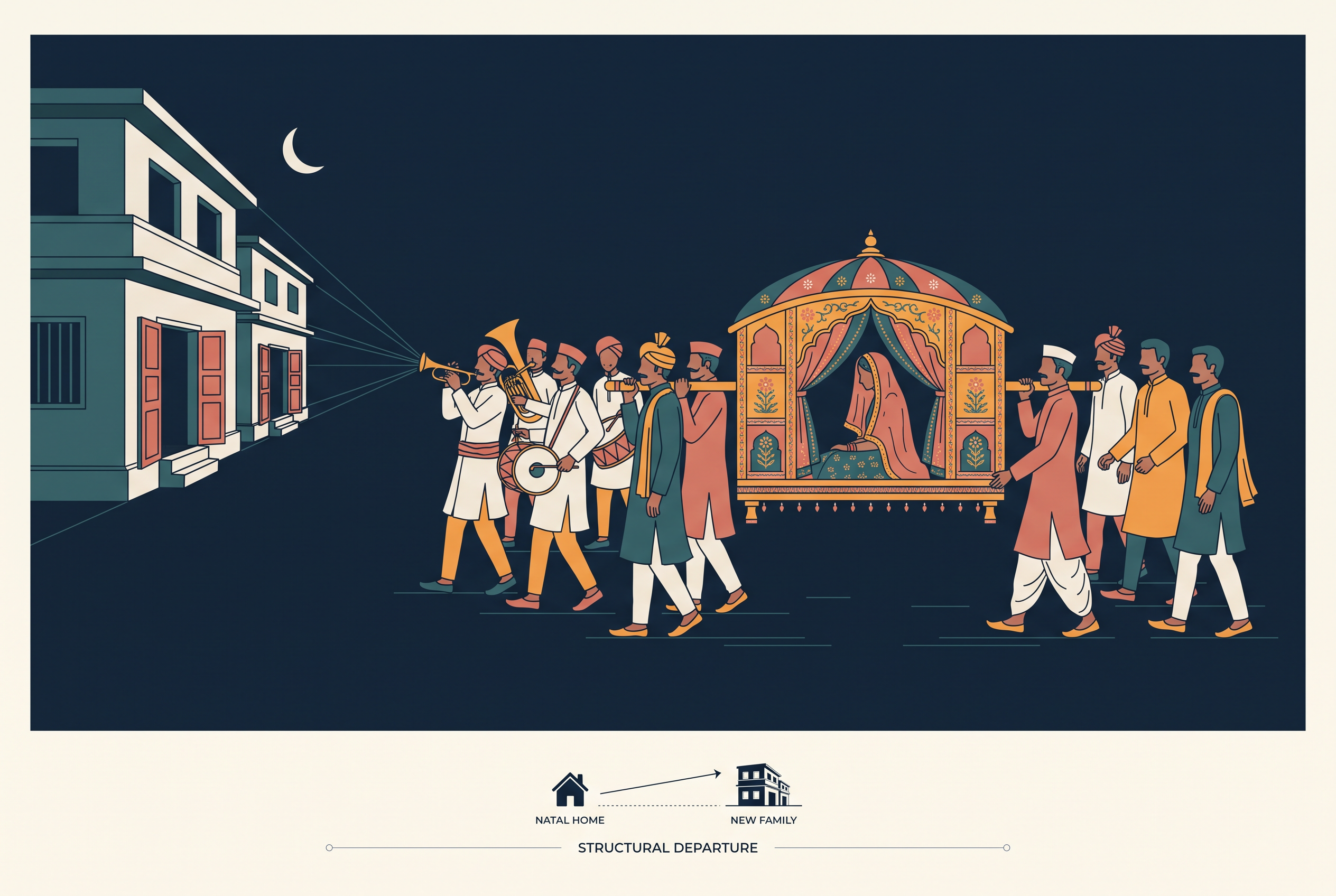
Fig. 1.6 – A traditional wedding procession.
A study was conducted among different sections of society to understand attitudes towards taking property from the natal family. A significant number of women — 41.7 per cent — evoked the theme of a daughter’s love, and of love for a daughter, when speaking about their rights to property.
But listen to what they actually emphasised. It was apprehension rather than affection. They said they would not claim a full share, or any share, of natal property, because they were afraid this would sour relations with their brothers, or cause their brothers’ wives to hate them.
The consequence they feared was concrete: that as a result they would no longer be welcome in their natal homes. The house one is born in can be closed to a daughter who asks for her share of it.
This attitude represents one of the dominant metaphors mediating women’s refusal of property. A woman demanding her share is cast as the greedy shrew, the hak lene wali — literally, the one who takes her right, said as an accusation.
There was also a close connection between these feelings and the apparently obverse ones — the desire to continue to be part of the natal family by actively contributing to its prosperity, or by being available to deal with its crises. The same woman who does not claim her share is often the one who arrives when the family is in trouble.
Accommodation
Recall the activity above, on constraint and defiance. It should help you appreciate how apparently cooperative behaviour can also be seen as a product of deep conflicts in society.
But when these conflicts are not expressed openly, and are not challenged, the impression remains that there is no conflict at all — that there is only cooperation.
A functionalist view often uses the term accommodation to explain situations such as the one described above, in which women would prefer not to claim property rights in their natal home. It would be seen as an effort to compromise and to co-exist despite conflict.
Keep both perspectives in view as you read on. The next three sections take cooperation, competition and conflict in turn — and in each, you will find these two ways of seeing at work.
1.4 Cooperation and Division of Labour
The idea of cooperation rests on certain assumptions about human behaviour. The first is easy to accept: it is argued that without human cooperation it would be difficult for human life to survive at all. No one of us produces our own food, cloth, medicine and shelter.
A second argument is often added — that even in the animal world we witness cooperation, whether among ants, or bees, or mammals. The bee-hive and the ant-hill are held up as proof that cooperation is simply natural.
Comparison with the animal world should, however, be done carefully. To see why, we look at two very different theoretical traditions in sociology — those represented by Emile Durkheim and by Karl Marx.
Durkheim: society is not a war of all against all
Sociology, for the most part, did not agree with the assumption that human nature is necessarily nasty and brutish. Emile Durkheim argued directly against a vision of “primitive humanity whose hunger and thirst, always badly satisfied, were their only passions”.
Such a picture, he said, overlooks the essential element of moral life — the moderating influence that society exercises over its members. That influence tempers and neutralises the brutal action of the struggle for existence and of selection.
His conclusion is a striking one. Wherever there are societies, there is altruism, because there is solidarity. Altruism, on this view, is not a rare virtue that appears late in history; it is found from the beginning of humanity, and even in extravagant form (Durkheim 1933).
For Durkheim, solidarity — the moral force of society — is fundamental to our understanding of cooperation, and therefore to our understanding of how society functions at all.
The role of the division of labour, which implies cooperation, is precisely to fulfil certain needs of society. Notice Durkheim’s double claim about it: the division of labour is at the same time a law of nature and a moral rule of human conduct. It is how work gets done, and it is also how people are bound to one another.
Two kinds of solidarity
Durkheim distinguished between mechanical solidarity and organic solidarity, which characterised pre-industrial and complex industrial societies respectively. Both are forms of cooperation in society; they are not stages of virtue, but different ways of being held together.
Mechanical solidarity is the form of cohesion that is based fundamentally on sameness. Most of the members of such societies live very similar lives, with little specialisation or division of labour beyond that associated with age and sex.
What bonds them is not need but likeness. Members feel bonded together essentially by their shared beliefs and sentiments — their common conscience and consciousness.
Organic solidarity is that form of social cohesion which is based on the division of labour and the resulting interdependence of the members of society. As people become more specialised, they also become more dependent upon each other.
Take an example. A family engaged in subsistence farming may survive with little or no help from similar homesteaders nearby; each household does much the same work, and can manage on its own. But specialised workers in a garment factory or a car manufacturing factory cannot survive without a host of other specialised workers supplying their basic needs.
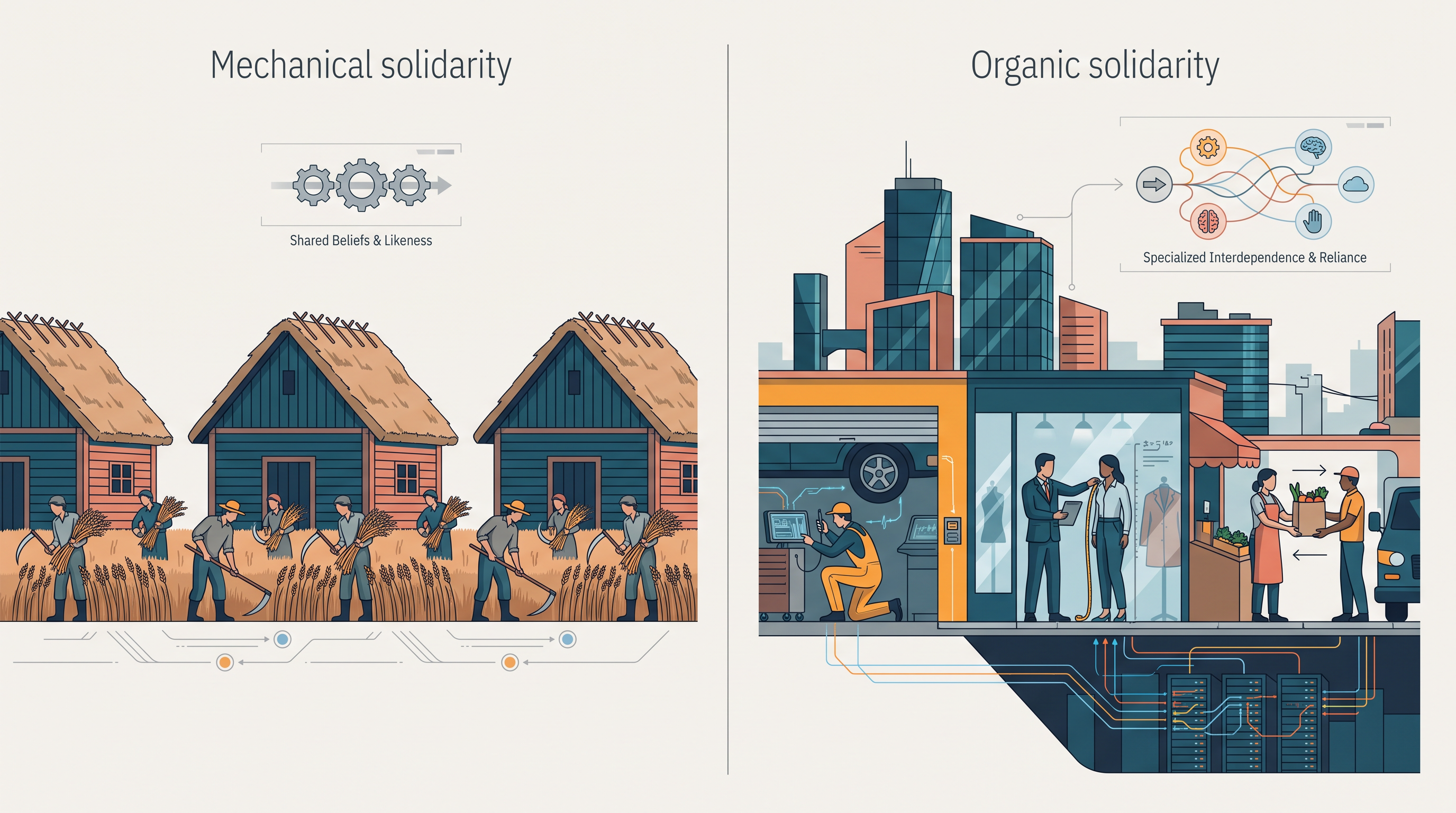
Fig. 1.7 – (a) Mechanical solidarity and (b) organic solidarity.
Marx: what makes human cooperation human
Karl Marx too distinguishes human life from animal life, but he draws the line elsewhere. Where Durkheim emphasised altruism and solidarity as distinctive of the human world, Marx emphasised consciousness.
Human beings, Marx wrote, may be distinguished from animals by consciousness, or by religion, or by anything else one likes. But they begin to distinguish themselves from animals as soon as they begin to produce their means of subsistence — a step conditioned by their physical organisation. In producing their means of subsistence, human beings are indirectly producing their material life (Marx 1972:37).
The passage may appear difficult, but it helps us understand how cooperation in human life differs from cooperation in animal life. Humans do not only adjust and accommodate in order to cooperate; they also alter society in that very process.
Consider how men and women over the ages had to adjust to natural constraints — to drought, to distance, to darkness. Various technological innovations over time not only transformed human life but, in some sense, transformed nature too.
Humans in cooperating thus do not passively adjust and accommodate. They also change the natural or social world to which they adjust. This is the point that a comparison with the bee-hive would have missed entirely.
Where Durkheim and Marx part company
While Durkheim, from a functionalist view, and Marx, from a conflict perspective, both emphasise cooperation, they also differ — and the difference matters.
For Marx, cooperation is not voluntary in a society where class exists. He argued that the social power which arises through the cooperation of different individuals — the multiplied productive force created by the division of labour — does not appear to those individuals as their own united power at all.
Because their cooperation is not voluntary, but has come about naturally, this power appears to them instead as an alien force existing outside them (Marx 1972:53). They make it, and it stands over them.
Marx used the term alienation to refer to the loss of control on the part of workers over the concrete content of labour, and over the products of their labour. In other words, workers lose control over how to organise their own work; and they lose control over the fruits of that work.
Contrast two working lives. A weaver, a potter or an ironsmith works on the whole object, decides how the day’s work will go, and can see the finished thing as his or her own. A worker in a factory whose sole task may be to pull a lever or press a button throughout the day has neither the design, nor the pace, nor the product.
Cooperation in such a situation, Marx would say, is enforced. The worker cooperates — the assembly line depends on it — but the cooperation is not freely given.
1.5 Competition as an Idea and Practice
As in the case of cooperation, discussions on the concept of competition often proceed with the idea that competition is universal and natural. Everyone competes, it is said, and everyone always has.
But go back to our discussion of how sociological explanation differs from naturalistic ones. It is important to understand competition as a social entity — something that emerges, and becomes dominant in society, at a particular historical point of time.
In the contemporary period competition is a predominant idea. It is so predominant that we often find it difficult to think that there could be any society in which competition is not a guiding force. That difficulty is itself worth examining.
A teacher, a race, and a chocolate
An anecdote of a school teacher who recounted her experience with children in a remote area in Africa draws attention to the fact that competition itself has to be explained sociologically, and not as a natural phenomenon.
The teacher assumed that the children would naturally rejoice at the idea of a competitive race, in which the winner would get a chocolate as a prize. It seemed to her an obviously attractive proposal.
To her surprise, the suggestion not only did not evoke any enthusiasm — it seemed to cause considerable anxiety and distress. Something had gone wrong, and it was not with the children.
On probing further, they expressed their distaste for a game in which there would be ‘winners’ and ‘losers’. This went against their idea of fun, which for them meant a necessarily cooperative and collective experience, and not a competitive one in which the rewards necessarily exclude some and reward one or a few.
Read the anecdote carefully. It does not say that some people are by nature competitive and others by nature cooperative — that would only be the same naturalist explanation turned upside down. It says that what counts as fun, as fair, and as normal is learnt, and differs with the society one learns it in.
Competition and capitalism
In the contemporary world, however, competition is the dominant norm and practice. It is not merely permitted; it is expected, praised, and taught.
Classical sociological thinkers such as Emile Durkheim and Karl Marx have noted the growth of individualism and of competition respectively in modern societies. Both developments are intrinsic to the way modern capitalist society functions.
The stress in such a system falls on greater efficiency and greater profit maximisation. The underlying assumptions of capitalism are:
expansion of trade;
division of labour;
specialisation; and
hence rising productivity.
These processes of self-sustaining growth are fuelled by the central theme of capitalism: rational individuals in free competition in the marketplace, each striving to maximise profits. Follow that chain in Fig. 1.8 and notice that competition is not one item on the list — it is the engine assumed to drive the whole sequence.
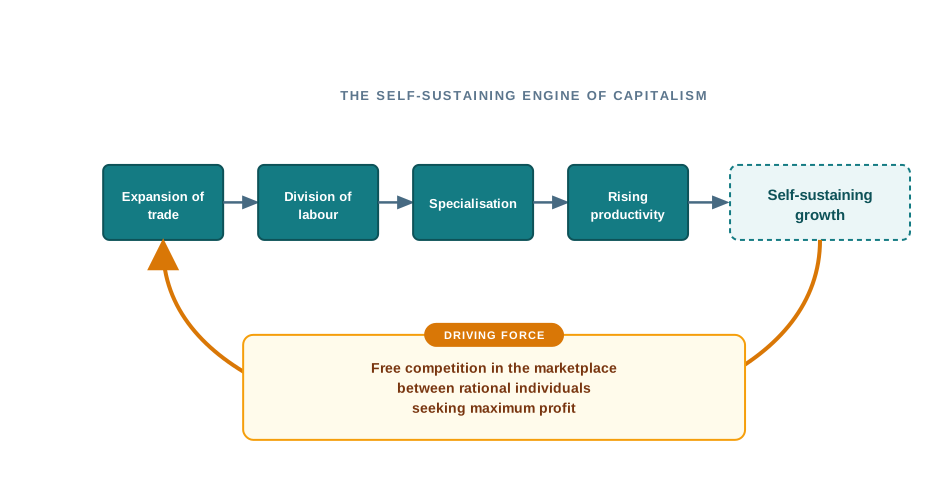
Fig. 1.8 – The assumptions and logic of capitalist growth.
The ideology of competition
The ideology of competition is the dominant ideology in capitalism. Recall that a dominant ideology is a set of shared beliefs that justifies the interests of dominant groups and makes an arrangement appear natural and right.
The logic of this ideology is that the market operates in a manner that ensures the greatest efficiency. Competition, it is said, ensures that the most efficient firm survives.
The same logic is applied far beyond the market. Competition ensures that the students with higher marks — the “best” students — get admission into prestigious colleges. And then get the best jobs.
Look closely at that word. In all these cases, the “best” refers to that which ensures the greatest material rewards. Efficiency and reward define merit; nothing else is counted.
Views that humans naturally like to compete have to be understood critically, like all other naturalist explanations. Competition as a desirable value flourished with the onset of capitalism; it did not fall from the sky.
Does competition deliver what it promises?
Competition, and the whole laissez-faire economy of nineteenth-century capitalism, may well have been important in promoting economic growth. The exceptionally rapid development of the American economy may be attributable to the greater scope of competition in the United States.
But — and this is where the sociologist becomes cautious — we still cannot produce any exact correlations between the extent of competition, or the intensity of the competitive spirit, and the rate of economic growth in different societies. The connection is asserted more often than it is demonstrated.
And on the other hand, there are grounds for supposing that competition has other, less welcome effects (Bottomore 1975: 174-5).
The assumption of an equal starting line
This ideology assumes that individuals compete on an equal basis — that is, that all individuals are positioned equally in the competition for education, jobs, or resources. The race is imagined as beginning for everyone at the same line.
But as the earlier discussion of stratification and inequality showed, individuals are placed differentially in society. They arrive at the starting line carrying very different amounts of land, income, schooling, contacts and confidence.
The consequence is blunt. If the greater number of children in India do not go to school, or drop out sooner rather than later, then they remain out of the competition entirely. They have not lost the race; they were never in it.
1.6 Conflict and Cooperation
The term conflict implies a clash of interests. Two parties want the same thing, and both cannot have it — or one party’s gain is built out of the other’s loss.
We have already seen how conflict theorists believe that the scarcity of resources in society produces conflict, as groups struggle to gain access to and control over those resources. Land, water, jobs, seats, offices, respect: none of these is available without limit.
The bases of conflict vary. It could be class or caste, tribe or gender, ethnicity or religious community. As young students, you are well aware of the range of conflicts that exist in society.
The scale and the nature of different conflicts, however, are not the same. A quarrel over a field boundary and a war between nations are both conflicts, but they are not the same kind of thing, and sociology asks what makes them differ.
Are conflicts new?
A widely held commonsense perception is that conflicts in society are new — that an older, calmer world has recently been disturbed.
Sociologists have drawn attention to the fact that conflicts change in nature and in form at different stages of social development. What people fight over, and how they fight, is historically variable.
But conflicts have always been part of any society. Social change, and the greater assertion of democratic rights by disadvantaged and discriminated groups, make conflict more visible. That is a very different thing from making it exist.
The distinction is worth pausing on. When a group that was long silent begins to speak, it can look as though a new conflict has appeared. In fact an old conflict has become audible.
Conflict that is not visible
It is also important to understand that conflict appears as a discord, or an overt clash, only when it is openly expressed.
Take an example. The existence of a peasant movement is an overt expression of a deep-rooted conflict over land resources. Processions, meetings, slogans — the conflict has taken a public form.
But the absence of a movement does not imply the absence of a conflict. Silence may mean that the weaker party cannot afford to speak. This is why the chapter has emphasised the relationship between conflict, involuntary cooperation, and also resistance.
Let us now examine some of the conflicts that exist in society, and the close relationship between competition, cooperation and conflict. We take two instances. The first is the family and the household. The second is land.
Inside the household
Traditionally, the family and the household were often seen as harmonious units, in which cooperation was the dominant process and altruism the driving principle of human behaviour. The household appeared to be the one place where people gave without counting.
The last three decades have seen a great deal of questioning of this assumption by feminist analysis. Scholars such as Amartya Sen have noted the possibility of enforced cooperation within the family itself.
Sen’s argument runs as follows. The different parties in a household do have much to gain from cooperation — that much is true. But their individual activities have to take the form of being overtly cooperative, even when substantial conflicts exist.
The nature of family organisation, he suggests, requires that serious conflicts of interest be moulded into a general format of cooperation, with conflict treated as an aberration or as deviant behaviour (Sen 1990:147). A household is expected to look united, whatever it contains.
Covert conflict, overt cooperation
Since conflict is often not overtly expressed, it has been found that subaltern or subordinate sections — those placed below others in the social order, whether women in households or peasants in agrarian societies — develop different strategies to cope with conflict and to ensure cooperation.
The findings of many sociological studies suggest that covert conflict together with overt cooperation is common. What appears as agreement is often a managed silence.
Studies of women’s behaviour and interaction within households make the point sharply. Material pressures and incentives to cooperate extend to the way things are distributed inside the home, and there is little evidence of open conflict over distribution.
What exists instead is a hierarchy of decision-making, needs and priorities — associated with age, gender and stage of life — and it is a hierarchy to which both men and women appear to subscribe.
Thus women appear to acquiesce in, and indeed actively perpetuate, discriminatory practices in intra-household distribution, in order to assure their own longer-term security. Read that sentence again: the woman is not a passive victim here, but an actor making a calculation under bad conditions.
Denied access to relationships and resources outside the household, it is in their material interests to subscribe to the general son-preference which characterises this culture. They therefore invest in a great deal of ‘selfless’ devotion in order to win their sons as allies, and as insurance against an uncertain future.
‘Maternal altruism’ in the northern Indian plain is, in this analysis, likely to be biased towards sons — and can be seen as women’s response to patriarchal risk, the danger a woman faces in a system where her security depends on the men of her family (Kabeer 1996:129).
Women are not entirely powerless, of course. But their subversion of male decision-making power tends to be covert.
The strategies are ordinary and quiet: the use of trusted allies, such as relatives or neighbours, to conduct small businesses on their behalf; the secret lending and borrowing of money; and negotiations around the meaning of gender ideologies such as purdah — the practice of veiling and of secluding women from men outside the family — and motherhood (Abdullah and Zeidenstein 1982; White 1992).
That their resistance takes this clandestine form is itself the finding. It reflects their lack of options outside household cooperation, and the high risks that accompany open conflict.
Land, technology and the need to cooperate
In keeping with the sociological tradition of questioning taken-for-granted commonsense assumptions, this chapter has critically examined the processes of cooperation, competition and conflict. The sociological approach does not see these processes as ‘natural’.
It further relates them to other social developments — to power, to law, to property, and, as we shall now see, to technology. The following account comes from a sociological study of land relations and the Bhoodan-Gramdan movement in India, in which villagers were persuaded to donate land, and in some cases a whole village’s land, for redistribution.
Read the account slowly and ask sociological questions of it, not moral ones. Why was there no legal remedy? Because the transaction was informal and unrecorded — which is how a great deal of rural credit worked. Why did the outcome go the way it did? Because one party had access to the police, and the other did not.
Notice too that the settlement was finally made in a village meeting, and that it looked, in the end, like an agreement. Cooperation was restored. But it was restored by power.
When technology changes, does cooperation change?
The same study makes a further point, and it is an unexpected one. The advent of technology had also reduced the necessity for cooperation.
Consider the charas, an indigenous device for well irrigation. Its operation requires 2 pairs of bullocks and four men. An ordinary peasant cannot afford the cost of four bullocks, and an average household may not have the required manpower.
In such situations they resort to borrowing bullocks and men from other households — kin, neighbours, friends — assuring similar services in return. The cooperation here is not a sentiment; it is a solution to a technical problem.
But suppose the charas is replaced by a rehat, the Persian wheel, which calls for a heavier capital investment. Now one needs only one pair of bullocks and one person to operate it.
The necessity of cooperation in the context of irrigation is thereby reduced — by a heavier capital investment and a more efficient technology. Thus the level of technology in a system may determine the need for cooperation between people and groups.
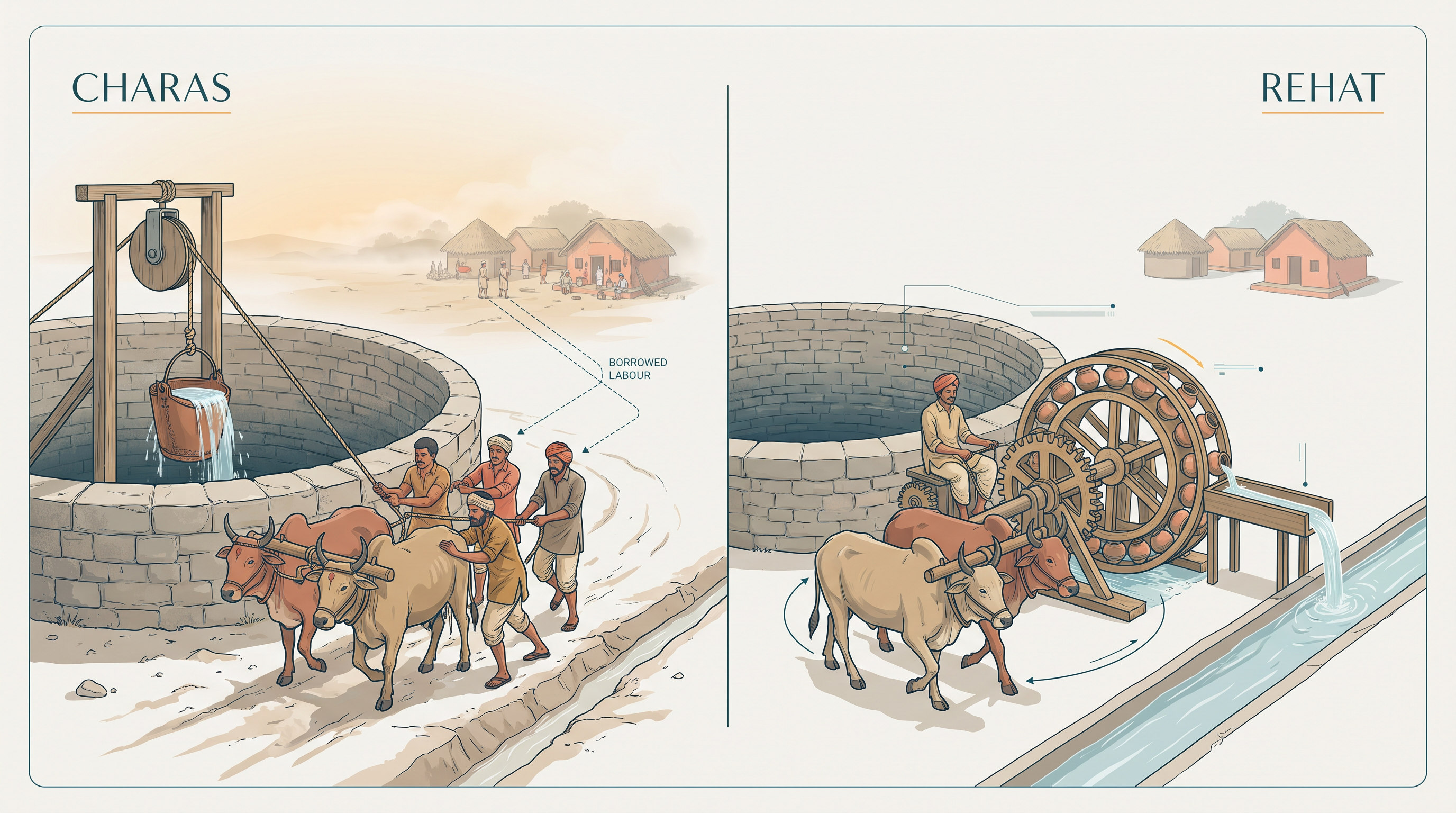
Fig. 1.9 – Changing technology and the need for cooperation.
1.7 Conclusion
The effort in this chapter has been to understand the relationship between structure and stratification on the one hand, and the social processes of cooperation, competition and conflict on the other.
You would have noticed that the three social processes are different from one another. Cooperation is not competition, and competition is not conflict.
Yet they often co-exist. They overlap. And sometimes one of them exists in a concealed fashion inside another — as was evident in the discussion of forced cooperation, where what looked like agreement was found to be a conflict that could not be voiced.
That is the sociological habit this chapter has tried to build. Do not ask only what people are doing together. Ask also on what terms, and from what position, they are doing it.
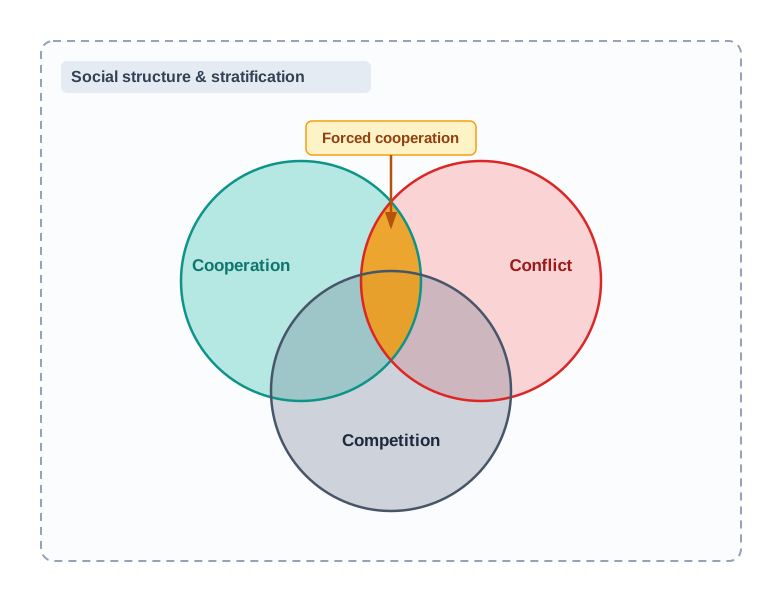
Fig. 1.10 – Overlap of social processes within social structure.
1.8 Summary
Introduction
- Every individual belongs not to one collectivity but to many overlapping ones — peer group, family and kin, class, gender, caste or tribe, region and nation.
- Each person therefore has a specific location in the social structure and in the system of social stratification, and this location decides the levels and types of access she has to social resources — schooling, clothing, food, leisure, health, and lifestyle in general.
- Social stratification, like social structure, constrains individual action.
- The sociological perspective is concerned with the dialectical relationship between the individual and society. C. Wright Mills’s sociological imagination unfolds the interplay between an individual’s biography and society’s history.
- The chapter’s central question is: to what extent is the individual constrained by social structure and stratification, and to what extent is she free of them?
Cooperation and the division of labour
- Without cooperation human life could scarcely survive; but comparison with cooperation in the animal world must be made carefully, since human cooperation is organised by norms and can be changed by people.
- Durkheim rejected the view that human nature is nasty and brutish. Wherever there are societies there is altruism, because there is solidarity.
- The division of labour implies cooperation and fulfils the needs of society; it is at once a law of nature and a moral rule of human conduct.
- Mechanical solidarity is cohesion based on sameness, found in pre-industrial societies with little specialisation, where members are bonded by shared beliefs and sentiments.
- Organic solidarity is cohesion based on the division of labour and the resulting interdependence, found in complex industrial societies, where specialised workers cannot survive without one another.
- Marx distinguished human from animal life by consciousness: human beings begin to distinguish themselves from animals as soon as they produce their means of subsistence. In cooperating, humans do not merely adjust to the world — they change it, as the emergence of Hinglish out of a colonial encounter with English shows.
- For Marx, cooperation is not voluntary in a class society. The collective power created by cooperation returns to workers as an alien force, and alienation is the loss of workers’ control over the content of their labour and over its products.
Competition as an idea and practice
- Competition is often assumed to be universal and natural, but it must be understood as a social entity that emerges and becomes dominant at a particular historical point of time.
- The anecdote of the teacher whose pupils were distressed by a race with winners and losers shows that what counts as fun and fair is learnt, not given by nature.
- Durkheim and Marx noted the growth of individualism and of competition respectively in modern societies; both are intrinsic to capitalism, whose assumptions are the expansion of trade, the division of labour, specialisation, and hence rising productivity — driven by rational individuals competing freely in the market to maximise profit.
- The ideology of competition is the dominant ideology of capitalism: the market is held to ensure the greatest efficiency, and the “best” is defined as that which secures the greatest material rewards.
- J.S. Mill thought competition generally harmful, yet described modern competition as a fight of all against all which is at the same time a fight for all.
- Competition and the laissez-faire economy may have promoted growth, but no exact correlation between competitive spirit and economic growth has been established, and competition has less welcome effects (Bottomore).
- The ideology assumes that all individuals compete on an equal basis. Stratification denies this: children who do not go to school, or who drop out early, remain out of the competition entirely.
Conflict and cooperation
- Conflict implies a clash of interests, produced as groups struggle for access to and control over scarce resources. Its bases may be class or caste, tribe or gender, ethnicity or religious community.
- Conflicts are not new. They change in form at different stages of social development, and become more visible as disadvantaged groups assert democratic rights — but the causes existed earlier. Srinivas warned that treating conflict as abnormal is a handicap in studying developing societies, and that the old order was neither peaceful nor free of cruelty.
- Conflict appears as overt discord only when openly expressed. A peasant movement is the open expression of a deep-rooted conflict over land; the absence of a movement does not mean the absence of conflict.
- The family was traditionally seen as a harmonious unit governed by altruism. Feminist analysis, and scholars such as Amartya Sen, have shown the possibility of enforced cooperation: family organisation requires conflicts to be moulded into a general format of cooperation, with conflict treated as deviance.
- Subaltern sections — women in households, peasants in agrarian societies — develop strategies to cope with conflict while maintaining cooperation, so that covert conflict with overt cooperation is common. Women acquiesce in unequal intra-household distribution to secure long-term security, invest in sons as insurance against patriarchal risk, and resist covertly through trusted allies, secret lending and borrowing, and negotiation around gender ideologies such as purdah and motherhood.
- A study of land relations and the Bhoodan-Gramdan movement shows how an informal, unrecorded mortgage produced a dispute that law could not settle, and how access to power decided its outcome.
- The same study shows that technology shapes the need to cooperate: a charas requires two pairs of bullocks and four men, and so requires borrowing from kin and neighbours, while a rehat requires heavier capital but only one pair of bullocks and one person. Higher capital investment and more efficient technology reduce the necessity of cooperation.
Conclusion
- Structure and stratification on the one hand, and cooperation, competition and conflict on the other, are closely related.
- The three processes are distinct, yet they co-exist, overlap, and sometimes exist in a concealed fashion — as forced cooperation shows.
1.9 Key Terms
Accommodation — An adjustment by which people with conflicting interests go on living and working together, the conflict being contained rather than resolved.
Agency — The capacity of human beings to act, and in acting to reproduce or change the social structure they live in.
Alienation — Marx’s term for the loss of control by workers over the nature of the labour task and over the products of their labour.
Altruism — The principle of acting to benefit others without any selfishness or self-interest.
Anomie — For Durkheim, a social condition in which the norms guiding conduct break down, leaving individuals without social restraint or guidance; a situation of normlessness.
Capitalism — An economic system in which the means of production are privately owned and organised to accumulate profits within a market framework, and in which labour is provided by waged workers.
Charas — An indigenous device for well irrigation, worked with two pairs of bullocks and four men, and therefore requiring cooperation between households.
Collectivity — A set of people who are treated, and who often act, as a group; each individual belongs to several overlapping collectivities.
Commonsense knowledge — Everyday knowledge that is taken for granted and unexamined, and which sociology therefore subjects to questioning.
Competition — A struggle between parties for the same reward, carried on within accepted rules; a dominant norm of modern capitalist society rather than a natural instinct.
Conflict — A clash of interests between individuals or groups, arising as they struggle for access to and control over scarce resources.
Conflict perspective — The view, associated with Marx, that society is made up of unequally placed groups with opposed interests, so that cooperation always carries a conflict of interests within it.
Cooperation — Working together to achieve a shared end; it may be voluntary, or enforced by norms, dependence or power.
Dialectical relationship — A two-way relationship, in which society shapes individuals and individuals in turn remake society.
Division of Labour — The specialisation of work tasks, by means of which different occupations are combined within a production system; in the modern world it is international in scope.
Dominant Ideology — Shared ideas or beliefs which serve to justify the interests of dominant groups and to legitimise the unequal power they hold.
Enforced cooperation — Cooperation produced by norms, sanctions, dependence or fear, in which the weaker party gives up a claim in exchange for continued security.
Functionalist perspective — The view, associated with Durkheim, that society is a system whose parts each perform a function for the maintenance of the whole.
Hak lene wali — Literally, “the one who takes her right”; a phrase used as an accusation against a woman who claims her share of natal property.
Individualism — Doctrines or ways of thinking that focus on the autonomous individual rather than on the group.
Institution — An established, recognised and repeated way of doing things, which continues even as its members change.
Laissez-faire Liberalism — A political and economic approach based on the general principle of non-interference in the economy by government, and of freedom for markets and property owners.
Life chances — All those material advantages which improve the quality of life of the recipient, including wealth and income as well as health, job security and recreation.
Mechanical Solidarity — According to Durkheim, the cohesion of traditional cultures with a low division of labour, whose members are bound together by common experience and shared beliefs.
Modernity — A term designed to capture the distinctiveness, complexity and dynamism of the social processes unleashed during the eighteenth and nineteenth centuries, which mark a break from traditional ways of living.
Organic Solidarity — According to Durkheim, the cohesion of societies held together by economic interdependence and the recognition of the importance of others’ contributions, as the division of labour becomes more complex.
Political influence — The ability of one group to dominate others, to have preponderant influence over decision-making, or to benefit advantageously from decisions.
Purdah — The practice of veiling and of secluding women from men outside the family; a gender ideology whose meanings women may also negotiate.
Rehat — The Persian wheel, a capital-intensive device for irrigation needing only one pair of bullocks and one person, and therefore reducing the need for cooperation.
Social Constraint — The conditioning influence that the groups and societies of which we are a part exert on our behaviour; regarded by Durkheim as a distinctive property of social facts.
Social processes — The recurring ways in which individuals and groups act towards one another, chiefly cooperation, competition and conflict.
Social reproduction — The process by which a pattern of social life is carried forward, day after day and generation after generation.
Social status — Prestige, or high standing, in the eyes of other members of society.
Social stratification — The existence of structured inequalities between groups in society, in terms of their access to material or symbolic rewards.
Social structure — The underlying regularities or patterns in how people behave and in the relationships they have with one another, which give a society its particular arrangement.
Sociological imagination — C. Wright Mills’s term for the ability to see the connection between an individual’s biography and the history and structure of the society in which it is lived.
Solidarity — The moral force of society that binds its members to one another; for Durkheim, the ground of all cooperation.
Structures — Constructed frameworks and patterns of organisation which in some way constrain or direct human behaviour.
Subaltern — Those placed below others in the social order, such as women within households or peasants in agrarian societies.
Surplus — Whatever is produced over and above what is needed for immediate survival, and which can therefore be appropriated by a dominant class.
Voluntary cooperation — Cooperation freely given, resting on willing agreement rather than on norms, dependence or fear.
1.10 Points to Ponder
If a social structure is made of nothing but human actions and relationships, why is it so hard for any one person to change it?
Durkheim says society constrains us; Marx says we make our own history, though not in conditions of our choosing. Are these two claims really opposed to each other, or are they two halves of the same argument?
When a family looks harmonious, what would you need to observe before concluding that there is no conflict inside it?
Competition assumes that everyone begins at the same starting line. If that assumption is false, can the result of a competition still be called merit?
The charas was replaced by the rehat, and neighbours needed each other less. Does every improvement in technology weaken cooperation — or does it only change who has to cooperate with whom?
Is a society without competition imaginable? Try to describe how such a society would decide who does which work, and who gets what.
1.11 NCERT Questions
Discuss the different tasks that demand cooperation, with reference to agricultural or industrial operations.
Is cooperation always voluntary, or is it enforced? If it is enforced, is it sanctions, or the strength of norms, that ensures cooperation? Discuss with examples.
Can you find illustrative examples of conflict drawn from Indian society? Discuss the causes that led to conflict in each instance.
Write an essay, based on examples, to show how conflicts get resolved.
Imagine a society in which there is no competition. Is it possible? If not, why not?
Talk to your parents and elders, your grandparents and their contemporaries, and discuss whether modern society is really more competitive or more conflict-ridden than it used to be. If you think it is, how would you explain this sociologically?
1.12 Objective Questions
- Social constraint was regarded as one of the distinctive properties of social facts by:
- Karl Marx
- Emile Durkheim
- C. Wright Mills
- M.N. Srinivas [1 mark]
- Mechanical solidarity is a form of social cohesion based fundamentally on:
- the division of labour
- the interdependence of specialists
- sameness among members
- enforced cooperation [1 mark]
- In Marx’s use, alienation refers to:
- a situation of normlessness
- the loss of workers’ control over the labour task and over the products of their labour
- the moral force that binds society together
- the appropriation of the surplus by a dominant class [1 mark]
- Which of the following is NOT one of the three basic forms of advantage that privileged groups may enjoy?
- Life chances
- Social status
- Political influence
- Social constraint [1 mark]
- In the study of attitudes towards claiming property in the natal family, the proportion of women who evoked the theme of a daughter’s love was:
- 14.7 per cent
- 27.0 per cent
- 41.7 per cent
- 47.1 per cent [1 mark]
- The replacement of the charas by the rehat (Persian wheel) had which of the following consequences?
- It increased the number of bullocks required
- It reduced the necessity for cooperation between households
- It made irrigation cheaper for the ordinary peasant
- It ended land conflict in the village [1 mark]
- Which of the following is listed as a ‘system requirement’ of society by the functionalist perspective?
- The appropriation of the surplus
- The socialisation of new members
- The maximisation of profit
- The abolition of the division of labour [1 mark]
- Assertion (A): The absence of a peasant movement does not mean that there is no conflict over land. Reason (R): Conflict appears as an overt clash only when it is openly expressed.
- Both A and R are true, and R is the correct explanation of A
- Both A and R are true, but R is not the correct explanation of A
- A is true, but R is false
- A is false, but R is true [1 mark]
- Assertion (A): For Marx, cooperation in a society where class exists is not voluntary. Reason (R): The collective power created by cooperation appears to the individuals concerned as an alien force existing outside them.
- Both A and R are true, and R is the correct explanation of A
- Both A and R are true, but R is not the correct explanation of A
- A is true, but R is false
- A is false, but R is true [1 mark]
- Assertion (A): The functionalist perspective holds that competition and conflict usually get resolved without too much distress. Reason (R): The functionalist perspective is concerned with the requirements of the system and with the maintenance of society as a whole.
- Both A and R are true, and R is the correct explanation of A
- Both A and R are true, but R is not the correct explanation of A
- A is true, but R is false
- A is false, but R is true [1 mark]
- Match the thinker in Column I with the idea in Column II.
| Column I | Column II |
|---|---|
| a. Emile Durkheim | i. Alienation |
| b. Karl Marx | ii. The sociological imagination |
| c. C. Wright Mills | iii. Conflict between the old and the new in developing societies |
| d. M.N. Srinivas | iv. Organic solidarity |
[1 mark]
- Match the term in Column I with its meaning in Column II.
| Column I | Column II |
|---|---|
| a. Surplus | i. Prestige or high standing in the eyes of others |
| b. Accommodation | ii. What is produced over and above immediate survival needs |
| c. Social status | iii. Shared beliefs that justify the interests of dominant groups |
| d. Dominant ideology | iv. An adjustment by which conflicting parties co-exist despite conflict |
[1 mark]
Fill in the blank: The specialisation of work tasks, by means of which different occupations are combined within a production system, is called the ______. [1 mark]
Fill in the blank: C. Wright Mills used the term ______ for the ability to see the connection between an individual’s biography and society’s history. [1 mark]
State whether True or False: Inequality in society is randomly distributed between individuals, and is unconnected to membership of social groups. [1 mark]
State whether True or False: Both Durkheim and Marx presume that human beings have to cooperate in order to meet their basic needs and to produce and reproduce their world. [1 mark]
1.13 Check Your Concepts
Define social structure. [2 marks]
What is meant by social constraint? Give one example. [2 marks]
Name the three basic forms of advantage that privileged groups may enjoy. [2 marks]
What did Marx mean by alienation? [2 marks]
What is accommodation, as the term is used by a functionalist view? [2 marks]
State the four underlying assumptions of capitalism listed in the chapter. [2 marks]
Give one example each of voluntary cooperation and enforced cooperation. [2 marks]
Differentiate between mechanical solidarity and organic solidarity. [4 marks]
Differentiate between social structure and social stratification, using one example of each. [4 marks]
Why does sociology refuse to explain competition as a part of human nature? Give reasons, drawing on the account of the teacher whose pupils were distressed by the idea of a race. [4 marks]
Explain, with an example, how the level of technology in a system may determine the need for cooperation between people and groups. [4 marks]
“Inequality is not something which is randomly distributed between individuals in society.” Give reasons for this statement. [4 marks]
In the study of attitudes to natal property, 41.7 per cent of the women spoke of the theme of a daughter’s love. Explain what this figure, taken by itself, does not tell us — and what the women’s own reasons revealed instead. [4 marks]
The building is a common metaphor for social structure. Explain why the metaphor is useful, and why it can be misleading if applied too strictly. [4 marks]
Explain how the ideology of competition assumes an equal starting line, and how social stratification in India denies it. Use one Indian example. [4 marks]
Compare the functionalist and the conflict perspectives on cooperation, competition and conflict. In your answer, bring out what the two perspectives agree on, and state one criticism of each. [6 marks]
Explain Durkheim’s account of solidarity and the division of labour in full, with the evidence he offers and one limitation of his account. [6 marks]
“Cooperation may conceal conflict.” Discuss this claim with reference to women’s rights to property in the natal family. [6 marks]
How far do you agree that the individual is constrained by social structure? Discuss with reference to the positions of Durkheim and Marx. [6 marks]
Evaluate the claim that competition promotes economic growth. In your answer, use both the arguments made in its favour and the doubts raised about it in the chapter. [6 marks]
Discuss the causes and the consequences of covert conflict in the household, and explain why subordinate sections may resist covertly rather than openly. [6 marks]
1.14 Passage-Based Questions
- Read the passage and answer the questions that follow.
For as long as anyone can remember, four households at the edge of a village have irrigated their fields by pooling their bullocks and their labour. No single household owns enough animals to work the well on its own, so each helps the others in turn, and the arrangement is repaid in kind rather than in cash. Last year, one of the four bought a pump set on a bank loan. That household now irrigates on its own, at hours of its own choosing, and no longer joins the pool. The remaining three find the work harder, and one of them has begun paying wages to a labourer to make up the numbers.
a. Identify the social process at work among the four households before the pump set arrived, and explain what made it necessary.
b. Using the chapter's discussion of technology and cooperation, explain what changed after one household acquired the pump set.
c. What does this passage suggest about the relationship between capital, technology and dependence in a village?
[6 marks]
- Read the passage and answer the questions that follow.
A daughter in a farming household is entitled by law to a share of the family land. When the property is divided after her father’s death, she tells her brothers that she wants nothing. She says she would rather keep the affection of the family than take what is hers. Her brothers are relieved, and at the next festival she is welcomed home with unusual warmth. In private, she says she cannot afford to be the woman who is spoken of as having taken her share.
a. Which concept from the chapter best explains the daughter's decision? Justify your choice.
b. Distinguish between voluntary and enforced cooperation, using this passage.
c. A functionalist would describe this outcome as accommodation. What does that description capture, and what does it leave out?
[6 marks]
- Read the passage and answer the questions that follow.
Two students appear for the same entrance examination. One attends a school with a full set of teachers and a coaching class in the evening, and is not expected to do any work at home. The other studies in a school where two teachers manage five classes, works in a shop after school, and prepares from a borrowed book. The first student wins the seat. The result is announced, and everyone involved describes it as a matter of merit.
a. Identify the ideology at work in the way the result is described.
b. Explain why sociologists question the assumption that individuals compete on an equal basis.
c. Would you say that the second student lost the competition? Answer sociologically.
[6 marks]
- Read the passage and answer the questions that follow.
In a garment unit, thirty workers sit at machines along a line. Each stitches one part of a shirt — a collar, a cuff, a seam — and passes it on. The line runs only if every worker keeps to the pace. None of them has ever made a whole shirt. At the end of the month, the workers ask for a rise in the piece rate; the owner replies that the order was priced months ago and there is nothing to spare. Work resumes the next morning exactly as before.
a. Which form of solidarity does the organisation of work on this line illustrate? Explain.
b. Explain the concept of alienation with reference to this passage.
c. How would a conflict perspective describe the relationship between the owner and the workers here?
[6 marks]
1.2 Social Structure and Stratification
The term social structure points to a plain fact: society is structured. It is organised, or arranged, in particular ways. The social environments in which we exist do not consist of random assortments of events or actions.
Look closely at any social setting and you will find underlying regularities — patterns in how people behave and in the relationships they have with one another. It is to these regularities that the concept of social structure refers.
Social structure refers to the underlying regularities or patterns in how people behave and in the relationships they have with one another, which give a society its particular arrangement.
The building metaphor, and its limits
Up to a point it is helpful to think of the structural characteristics of a society as resembling the structure of a building. A building has walls, a floor and a roof, and these together give it a particular ‘shape’ or form (Giddens 2004: 667). Society, likewise, seems to have a shape that holds.
Fig. 1.3 – Comparing the structures of rural and urban dwellings.
But the metaphor can be a very misleading one if it is applied too strictly. A building is made of brick and cement, which stay where they are placed. Social structures are made up of human actions and relationships, which are alive.
What gives these actions and relationships their patterning is their repetition — across periods of time, and across distances of space. A structure exists because people keep doing the same things, in the same way, in the same relation to each other.
For this reason the ideas of social reproduction and social structure are very closely related in sociological analysis. Social reproduction is the process by which a pattern of social life is carried forward, day after day and generation after generation.
Why a school and a family are structures
Consider a school. Certain ways of behaving are repeated over the years and become institutions — established, recognised ways of doing things. Admission procedures, codes of conduct, annual functions, daily assemblies, and in some cases even school anthems.
Likewise in families. Certain ways of behaving are set, along with marriage practices, notions of relationship, duties and expectations. A child grows up knowing who may be addressed how, who eats first, who may go out after dark.
Now notice something remarkable. Even as old members of the family or the school pass away and new members enter, the institution goes on. The persons change; the pattern survives them.
Yet we also know that changes do take place within families and within schools. The pattern is not frozen. It is held in place by people, and people can shift it.
Q. If everyone in a school is replaced over ten years, in what sense is it the same school?
A. In the sense that the pattern of relationships — how a class is conducted, how the assembly is held, who reports to whom — is reproduced by each new set of members. The structure lives in the repetition, not in the persons.
Ask your grandparents, and others of that generation, about the ways in which families and schools have changed, and the ways in which they have remained the same. Compare how families were shown in old films, television serials or novels with how they are shown today. Can you observe patterns and regularities of social behaviour in your own family — that is, can you describe its structure? Then ask your teachers how they understand the school as a structure. Do students, teachers and staff have to act in certain ways to maintain or reproduce that structure? Can you think of any change in your school or family that was resisted — who resisted it, and why? A careful written comparison of “then” and “now”, based on such conversations, would make a good short project.
Societies rebuilt by their own bricks
This discussion should help you see human societies as buildings that are at every moment being reconstructed by the very bricks that compose them. It is an odd image, and deliberately so.
For as we have just seen for ourselves, human beings in schools or families do bring changes even while they reproduce the structure. They cooperate at various levels in their everyday lives towards this reproduction.
No less true is the fact that they also compete with each other, often viciously and ruthlessly. Along with cooperative behaviour we also witness serious conflict.
And, as this chapter will show later, cooperation can be enforced. Where it is, it does not remove conflict; it conceals it.
Durkheim: society constrains us
A major theme pursued by Emile Durkheim — and by many sociologists since — is that societies exert social constraint over the actions of their members. Durkheim argued that society has primacy over the individual person.
Society, on this view, is far more than the sum of individual acts. It has a ‘firmness’ or ‘solidity’ that is comparable to structures in the material environment.
Social constraint refers to the fact that the groups and societies of which we are a part exert a conditioning influence on our behaviour. Durkheim regarded social constraint as one of the distinctive properties of social facts.
Think of a person standing in a room with several doors. The structure of the room constrains the range of his or her possible activities. The placing of the walls and the doors defines the routes of exit and entry.
Fig. 1.4 – Social structure as a constraining framework.
Social structure, according to Durkheim, constrains our activities in a parallel way, setting limits to what we can do as individuals. It is ‘external’ to us, just as the walls of the room are external to the person standing inside it.
Durkheim put this in a famous passage in The Division of Labour in Society (1933). When he performs his duties as a brother, a husband or a citizen, he wrote, he fulfils obligations that are defined in law and custom — obligations that exist outside himself and outside his own actions. The believer, similarly, finds the beliefs and practices of religious life ready-made at birth; since they existed before he did, they must exist outside him. The system of signs he uses to express his thoughts, the money he uses to pay his debts, the credit instruments of his trade, the practices of his profession — all of these function independently of the use any one person makes of them. And, Durkheim added, the same could be said of every single member of society.
Marx: constrained, but not helpless
Other social thinkers, such as Karl Marx, would emphasise the constraints of social structure but would at the same time stress human creativity, or agency — the capacity of people to act, and to change the world they act in.
Marx argued that human beings make history, but not as they wish to, and not in conditions of their own choice. They make it within the constraints and the possibilities of the historical and structural situation they are in.
The difference between the two positions is one of emphasis rather than a flat contradiction, and it is worth holding on to as you read the rest of this chapter.
If society constrains us, are we free to choose? View 1: Durkheim stresses constraint. Society is prior to the individual and external to her; its rules, its money, its language and its duties were all there before she arrived. The evidence lies in the sheer regularity of social life — patterns of marriage, work and worship persist even as individuals come and go. View 2: Marx stresses constraint and agency. People are placed within a historical and structural situation they did not choose. But they act upon it, and in acting they alter it — human beings make their own history. The evidence lies in the fact that structures do change, and are changed by people. What both agree on: no one chooses freely in a vacuum; the situation into which a person is born sets the terms on which she acts.
Q1. If society sets limits on what we may do, are we then free to make our own choices at all?
A. Sociology answers on both sides. Society is genuinely constraining — like the walls and doors of a room, it makes some routes available and closes others, and it does this before we are old enough to consent. But the structure is made of nothing except human actions and relationships, which is why it has to be reproduced every day and can therefore be altered. We choose, but we choose from a position we did not choose.
Think of examples that reveal how human beings are constrained by social structure — and also of examples where individuals defy that structure and transform it. It will help to recall the discussion of socialisation in Introducing Sociology.
Stratification: inequality with a pattern
To recall the concept of social stratification from Chapter 2 of Introducing Sociology, Class XI: stratification refers to the existence of structured inequalities between groups in society, in terms of their access to material or symbolic rewards.
Social stratification refers to the existence of structured inequalities between groups in society, in terms of their access to material or symbolic rewards.
Material rewards are things like land, income, property and secure work. Symbolic rewards are things like honour, respect and prestige — rewards that cannot be counted, but are keenly felt.
All societies involve some forms of social stratification. Modern societies, however, are often marked by wide differences in wealth and power.
The most evident forms of stratification in modern societies involve class divisions. But others — race and caste, region and community, tribe and gender — also continue to matter as bases of social stratification.
the bases of stratification Western sociology built its account of stratification largely around class, because in industrial Europe the division between owners and workers was the most visible fault line. In India, class is real but it is never the only axis. Caste, tribe, gender, region, language and religious community continue to shape who owns land, who gets educated, who is respected, and who marries whom. This is why Indian sociologists have insisted that stratification here must be studied as several overlapping systems at once, rather than as one ladder.
Inequality is not scattered at random
You will recall that social structure implied a certain patterning of social behaviour. Social stratification, being part of the broader social structure, is likewise characterised by a certain pattern of inequality.
Inequality is not something which is randomly distributed between individuals in society. It is systematically linked to membership in different kinds of social groups.
Members of a given group will have features in common. And if they are in a superior position, they will usually see to it that their privileged position is passed on to their children — through property, through schooling, through marriage, through contacts.
The concept of stratification, then, refers to the idea that society is divided into a patterned structure of unequal groups, and it usually implies that this structure tends to persist across generations (Jayaram 1987:22).
Following Jayaram, stratification is the division of society into a patterned structure of unequal groups, a structure that usually persists across generations.
inequality vs stratification Inequality can be a difference between two individuals — one runs faster, another earns more. Stratification is inequality that has become patterned between groups and is handed down across generations.
social structure vs social stratification | Feature | Social structure | Social stratification | |—|—|—| | What it refers to | The regularities and patterns in behaviour and relationships that give society its arrangement | The structured inequalities between groups in access to material or symbolic rewards | | Central question | How is society arranged and held together? | How are advantages and disadvantages distributed, and among whom? | | Relationship between them | The wider concept | A part of the broader social structure | | Example | Admission procedures, assemblies and codes of conduct that make a school what it is | Which children reach that school at all, and which are out of school entirely | | What it does to the individual | Sets limits to what one can do | Sets limits to what one can obtain |
Three forms of advantage
It is necessary to distinguish between the different advantages that can be distributed unequally, because they do not always travel together. A group may be rich and still not be respected; another may be respected and still have little say in decisions. Sociologists therefore separate three basic forms of advantage which privileged groups may enjoy.
Life chances: all those material advantages which improve the quality of life of the recipient. This may include not only economic advantages of wealth and income, but also benefits such as health, job security and recreation.
Social status: prestige, or high standing, in the eyes of other members of the society.
Political influence: the ability of one group to dominate others, or to have preponderant influence over decision-making, or to benefit advantageously from decisions.
the three advantages, separated In a small town, a trading family owns three shops and sends its children to a private school in the district headquarters. A second family, of a landless labouring household, has none of this. A third family owns little land but its head is respected as a learned person, and people come to him before a wedding is fixed. A fourth has neither wealth nor much learning, but its members sit on every committee that decides where the new road will go. The vignette demonstrates that life chances, social status and political influence are three distinct forms of advantage, and that a group may hold one without holding the others.
Why this matters for what follows
The discussion of the three social processes in the rest of this chapter will repeatedly draw attention to the manner in which different bases of social stratification — gender, or class — constrain social processes.
The opportunities and the resources available to individuals and groups to engage in cooperation, competition or conflict are shaped by social structure and social stratification. Who can afford to compete, and who is already out of the race, is not decided on the day of the contest.
At the same time — and this is Marx’s point returning — humans do act to modify the structure and the system of stratification that exists. Neither structure nor stratification is a fate.