Chapter 5: Indian Sociologists
In 1919, the University of Bombay began teaching a subject that almost no one in India had heard of. It was called sociology. Within a few years, Calcutta and Lucknow started programmes of their own in sociology and anthropology. The buildings were old, the classes were small, and the subject itself was barely a century old anywhere in the world.
Imagine sitting in one of those first classrooms. Your teacher tells you that this new discipline was invented in Europe to make sense of a world being turned upside down by factories, cities and machines. Then a difficult thought arrives. India is not Europe. India is a colony. Its first taste of modernity came wrapped inside foreign rule. What, then, is an Indian sociologist supposed to study, and for whom?
There were more awkward questions. In Europe, social anthropology had grown out of curiosity about distant “primitive” peoples. But India was an ancient civilisation that also contained communities the anthropologists called tribes. Were they to be studied as outsiders, or understood as part of the same society? And after 1947, when a sovereign nation set out on planned development and democracy, what use would sociology be to it at all?
Nobody handed the first Indian sociologists a set of answers. They had to build the questions themselves, one piece of fieldwork at a time.
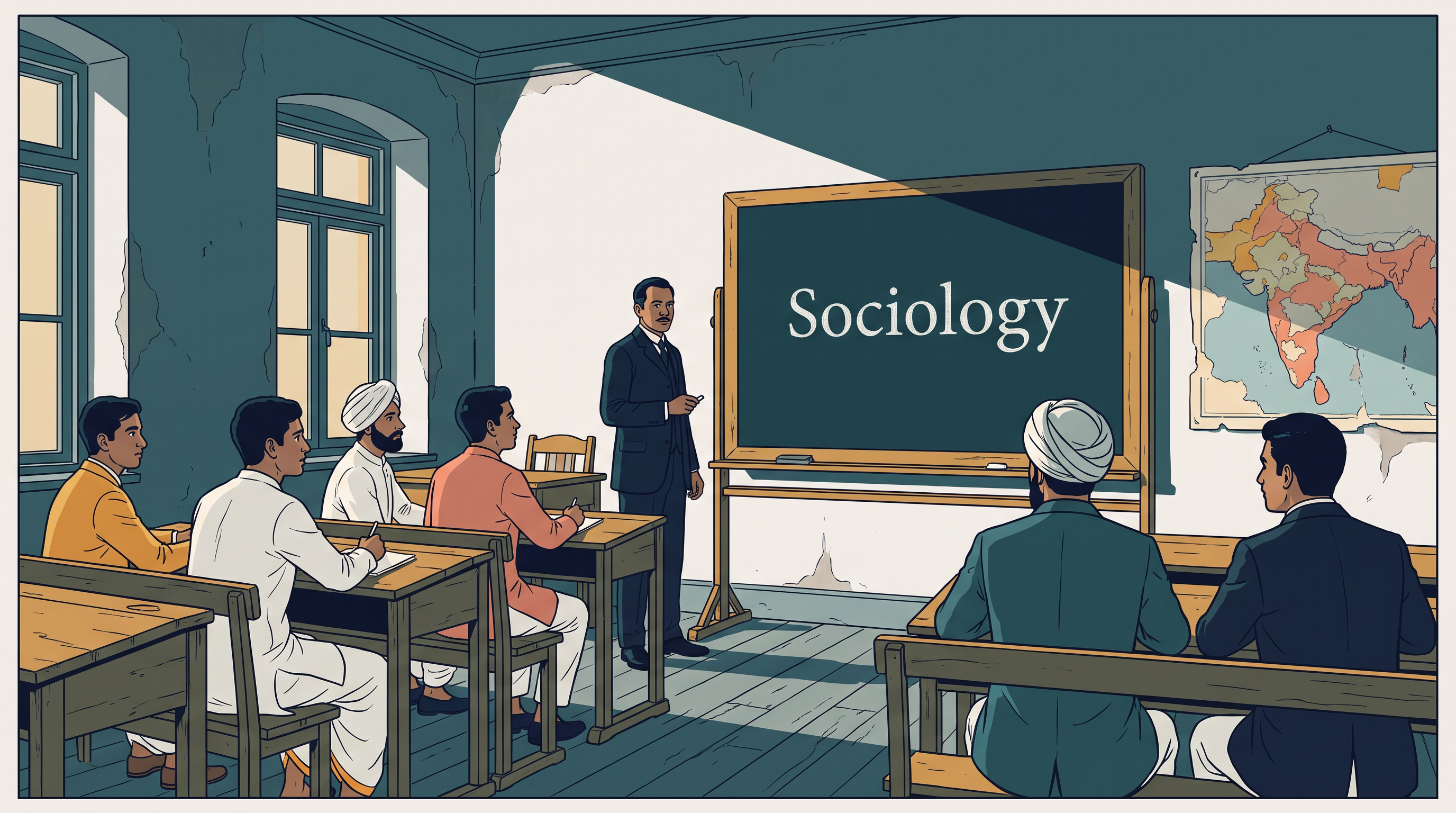
Fig. 5.1 – An early sociology classroom in India.
This chapter will help you answer each of these questions.
5.1 The Beginnings of Sociology in India
A Young Discipline in an Old Society
You have already read, in the opening chapter of your first book, that sociology is a relatively young discipline. Even in Europe, where it began, it was established only about a century ago. Measured against the age of the societies it studies, that is a very short life.
In India, interest in sociological ways of thinking is a little more than a century old. But interest is not the same thing as a discipline. Formal university teaching of sociology began only in 1919, at the University of Bombay. In the 1920s, two other universities — Calcutta and Lucknow — also began programmes of teaching and research in sociology and anthropology.
A discipline needs more than curiosity. It needs departments, teachers, degrees, students, journals in which findings can be published, and a community of scholars who argue with one another. All of this had to be built from nothing. Today the work is done: every major university in India has a department of sociology, social anthropology or anthropology, and often more than one of these disciplines is represented.
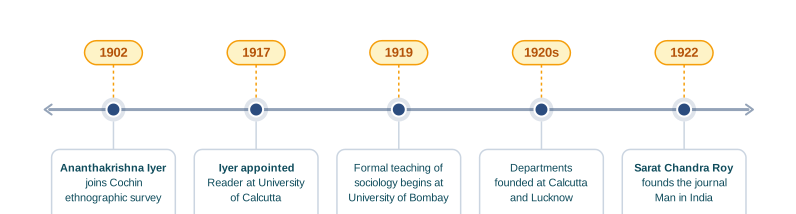
Fig. 5.2 – Earliest institutional landmarks of Indian sociology.
Nowadays sociology tends to be taken for granted in India, as most established things are. Its textbooks exist, its examinations are held, its degrees are recognised. It is easy to forget that this was not always so.
In the early days it was not clear at all what an Indian sociology would look like. It was not even clear whether India really needed something like sociology. In the first quarter of the twentieth century, those who became interested in the discipline had to decide for themselves what role it could play in India.
This chapter introduces you to some of the founding figures of Indian sociology. These scholars helped to shape the discipline and to adapt it to our own historical and social context.
Three Awkward Questions
The specificity of the Indian context raised many questions. Three of them were particularly awkward, and everything that follows in this chapter is, in one way or another, an attempt to answer them.
The first question concerned modernity. Western sociology had emerged as an attempt to make sense of modernity — of the enormous changes brought by industry, cities, machines, markets and new forms of state power. India, too, was of course experiencing the changes brought about by modernity. But there was an important difference. India was a colony.
That difference mattered a great deal. The first experience of modernity in India was closely intertwined with the experience of colonial subjugation. Railways, courts, printing presses, censuses and universities all arrived in India, but they arrived in the hands of a foreign ruler. A discipline built to explain modernity in Europe could not simply be imported and switched on here.
The second question concerned social anthropology, the study of societies through close, first-hand observation of their everyday life. In the west, social anthropology had arisen largely out of the curiosity that European society felt about what it called ‘primitive’ cultures — small, distant societies quite unlike Europe’s own.
What role could such a discipline have in India? India was an ancient and advanced civilisation with its own classical texts, cities and states. Yet it also had within it societies that were described as ‘primitive’. The anthropologist in India was therefore not a traveller studying a far-off people. He was studying communities that lived inside his own country.
The word ‘primitive’ is placed in quotation marks here for a reason. It was a colonial label, applied from outside to communities the rulers considered simple and backward, and it is rejected today. Keeping the word visible, rather than quietly deleting it, lets you see the assumptions the early anthropologists had to work with — and, in some cases, argue against.
The third question could only be asked as independence came near. What useful role could sociology have in a sovereign, independent India — a nation about to begin its adventure with planned development and democracy? A colonial administration had wanted information in order to govern. What would a free country want from its sociologists?
The Questions Were Not Readymade
The pioneers of Indian sociology not only had to find their own answers to questions like these. They also had to formulate new questions for themselves.
This is an important point about how a discipline actually grows. The questions were not available ‘readymade’ in any European textbook. It was only through the experience of ‘doing’ sociology in an Indian context — surveying, observing, interviewing, reading, arguing — that the questions took their shape at all.
The Accidental Anthropologists
As is often the case at the beginning of anything, Indians became sociologists and anthropologists mostly by accident. Nobody could take a degree in a subject that was not yet taught.
Consider one of the earliest and best known pioneers of social anthropology in India, L.K. Ananthakrishna Iyer (1861–1937). He began his career as a clerk, moved on to become a school teacher, and later became a college teacher in Cochin state, in present-day Kerala. Nothing in that career pointed towards anthropology.
In 1902, he was asked by the Dewan of Cochin — the chief minister of the princely state — to assist with an ethnography, or ethnographic survey, of the state. The British government wanted similar surveys done in all the princely states, as well as in the presidency areas that were directly under its own control.
Ananthakrishna Iyer did this work on a purely voluntary basis. He taught at the Maharajah’s College at Ernakulam during the week, and functioned as the unpaid Superintendent of Ethnography at the weekends. It was, in the most literal sense, a hobby that became a discipline.
It is worth pausing on who wanted these surveys, and why. The colonial state was collecting systematic information about the castes and communities it ruled — their customs, their occupations, their numbers. Knowledge of this kind was not neutral. It helped a foreign government classify, tax, police and administer a population it did not otherwise understand.
His work was much appreciated by the British anthropologists and administrators of the time, and he was later invited to help with a similar ethnographic survey in Mysore state. Ananthakrishna Iyer was probably the first self-taught anthropologist to receive both national and international recognition as a scholar and an academician.
He was invited to lecture at the University of Madras. He was appointed Reader at the University of Calcutta, where he helped to set up the first post-graduate anthropology department in India, and he remained at Calcutta from 1917 to 1932. Though he had no formal qualifications in anthropology, he was elected President of the Ethnology section of the Indian Science Congress. He was awarded an honorary doctorate by a German university during a lecture tour of European universities, and was conferred the titles of Rao Bahadur and Dewan Bahadur by Cochin state.
A Lawyer in Ranchi
The lawyer Sarat Chandra Roy (1871–1942) was another ‘accidental anthropologist’ and pioneer of the discipline in India. Before taking his law degree at Calcutta’s Ripon College, Roy had already done graduate and post-graduate degrees in English.
Soon after he had begun practising law, he decided, in 1898, to go to Ranchi to take up a job as an English teacher at a Christian missionary school. That decision changed his life. He remained in Ranchi for the next forty-four years and became the leading authority on the culture and society of the tribal peoples of the Chhotanagpur region, in present-day Jharkhand.
Roy’s interest in anthropological matters began when he gave up his school job and began practising law at the Ranchi courts, eventually being appointed official interpreter in the court. Interpreting is not merely translating words. To explain a dispute over land, marriage or inheritance to a judge, Roy had to explain the customs and laws of the community the dispute came from.
He became deeply interested in tribal society as a byproduct of this professional need. He travelled extensively among tribal communities and did intensive fieldwork among them — that is, he studied them by living and moving among them, watching and asking, rather than by reading about them.
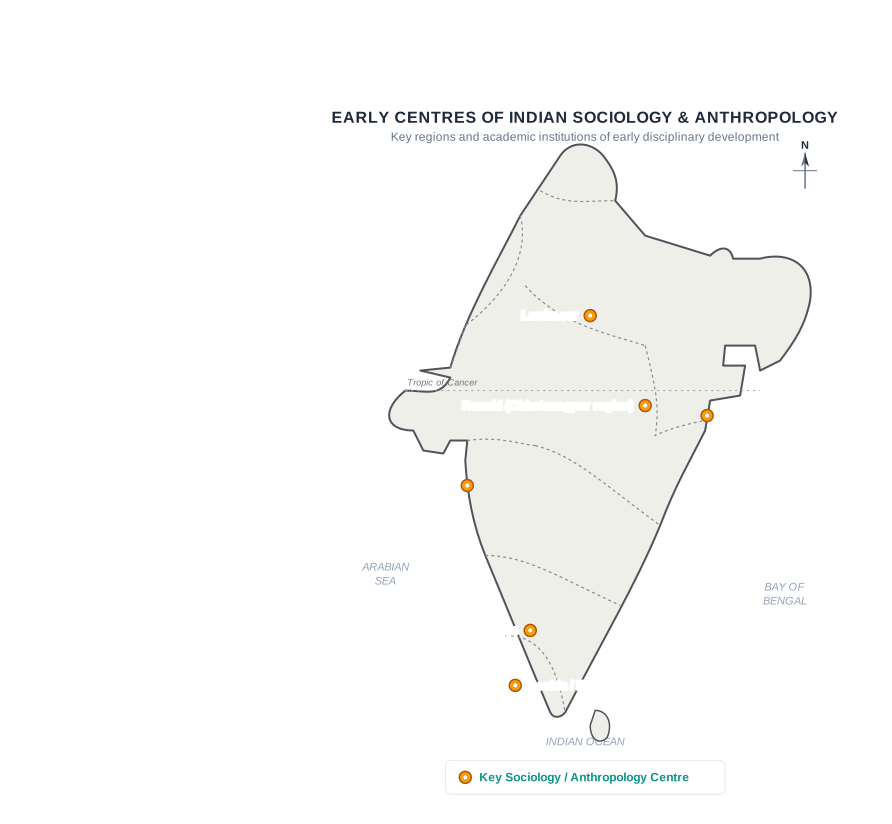
Fig. 5.3 – Early centres of Indian sociology and anthropology.
All of this was done on an ‘amateur’ basis, in time taken from a full legal practice. Yet Roy’s diligence and his keen eye for detail resulted in valuable monographs — book-length studies of a single community — and research articles.
Roy soon became very well known amongst anthropologists in India and Britain. In 1922 he founded the journal Man in India, the earliest journal of its kind in India, and one that is still published. Founding a journal is a quiet but decisive act: it gives a subject a place of its own to argue in.
From Pioneers to Founders
Both Ananthakrishna Iyer and Sarat Chandra Roy were true pioneers. In the early 1900s they began practising a discipline that did not yet exist in India, and which had no institutions to promote it. Both were born, lived and died in an India that was ruled by the British.
The four Indian sociologists you will meet in this chapter were born one generation later than Iyer and Roy. They came of age in the colonial era, but their careers continued into the era of independence, and they helped to shape the first formal institutions that established Indian sociology.
G.S. Ghurye and D.P. Mukerji were born in the 1890s. A.R. Desai and M.N. Srinivas were about fifteen years younger, having been born in the second decade of the twentieth century.
All four were deeply influenced by western traditions of sociology; none of them rejected that inheritance. But because they worked in India, and lived through the transition from colony to republic, they were able to offer some initial answers to the question that the pioneers could only begin to ask: what shape should a specifically Indian sociology take?
5.2 G.S. Ghurye and the Debate on Tribal Societies
The Man Who Built a Department
If one person can be called the founder of institutionalised sociology in India, it is G.S. Ghurye. The word “institutionalised” is the important one. Ghurye’s achievement was not only to think about Indian society, but to build the machinery through which others could go on thinking about it long after him.
He headed India’s very first post-graduate teaching department of Sociology, at Bombay University, for thirty-five years. He guided a large number of research scholars, many of whom went on to occupy prominent positions in the discipline. He also founded the Indian Sociological Society, along with its journal Sociological Bulletin.
Consider the conditions in which this was done. At that time, financial and institutional support for university research in India was very limited. There were few grants, few posts, and no tradition of research to fall back on. Working with these constraints, Ghurye managed to nurture sociology as an increasingly Indian discipline.
Two features of Ghurye’s Bombay department were later taken up enthusiastically by his successors, and his was the first to implement both successfully. The first was the active combining of teaching and research within the same institution — the same scholars who taught classes also carried out original research, so that students learned from people who were producing knowledge, not merely passing it on. The second was the merger of social anthropology and sociology into a single composite discipline. In many western universities these were kept apart; in India, from the beginning, they were taught together.
The Range of His Writing
Ghurye is best known, perhaps, for his writings on caste and race, which you will study in the next section. But his academic writing was not only prolific, it was also very wide-ranging in the subjects it covered.
He wrote on tribes; on kinship, family and marriage; on culture, civilisation and the historic role of cities; on religion; and on the sociology of conflict and integration. Few sociologists since have attempted so many fields.
Where did his questions come from? Among the intellectual and contextual concerns that influenced Ghurye, the most prominent are perhaps four. The first is diffusionism, the perspective he absorbed at Cambridge, which explains cultural similarities between societies by the spread of cultural traits from one group to another through contact, migration and borrowing, rather than by each society inventing them separately. The second is Orientalist scholarship on Hindu religion and thought — the body of work, largely European, that studied India through its classical texts and languages. The third is nationalism, then reshaping Indian public life. The fourth is a concern with the cultural aspects of Hindu identity.
You can already see how an intellectual position is formed. A scholar trained in Sanskrit, taught diffusionism in England, and living through the nationalist movement will ask certain questions about Indian society — and not others.
The Debate on Tribal Societies
One of the major themes that Ghurye worked on was that of ‘tribal’ or ‘aboriginal’ cultures. In fact, it was his writings on this subject, and especially his debate with Verrier Elwin, that first made him known outside sociology and the academic world.
In the 1930s and 1940s there was much debate on the place of tribal societies within India, and on how the state should respond to them. This was not a quarrel about words. It was a question about what the government should actually do — protect, or develop, and at what cost.
On one side stood many of the British administrator–anthropologists, who were specially interested in the tribes of India. They believed the tribes to be primitive peoples with a distinctive culture far removed from mainstream Hinduism. They also believed that innocent and simple tribals would suffer exploitation and cultural degradation through contact with Hindu culture and society.
From this belief followed a policy conclusion. If contact was harmful, then the state had a duty to protect the tribes, and to help them sustain their way of life and their culture — both of which, in this view, faced constant pressure to assimilate with mainstream Hindu culture.
Nationalist Indians took the opposite view, and were equally passionate about it. They believed in the unity of India and in the need to modernise Indian society and culture. To them, attempts to preserve tribal culture were misguided, and resulted only in maintaining tribals in a backward state, as ‘museums’ of primitive culture — kept intact for outsiders to admire, but denied the schools, roads and opportunities everyone else was demanding.
Their position was consistent with their view of Hinduism itself. Many features of Hinduism, too, they felt to be backward and in need of reform. If Hindu society needed to change, they argued, then tribes, too, needed to develop.
Ghurye became the best-known exponent of this nationalist view. He insisted on characterising the tribes of India as ‘backward Hindus’ rather than as distinct cultural groups. He cited detailed evidence from a wide variety of tribal cultures to show that they had been involved in constant interaction with Hinduism over a long period. They were thus not separate; they were simply further behind in the same process of assimilation that all Indian communities had gone through.
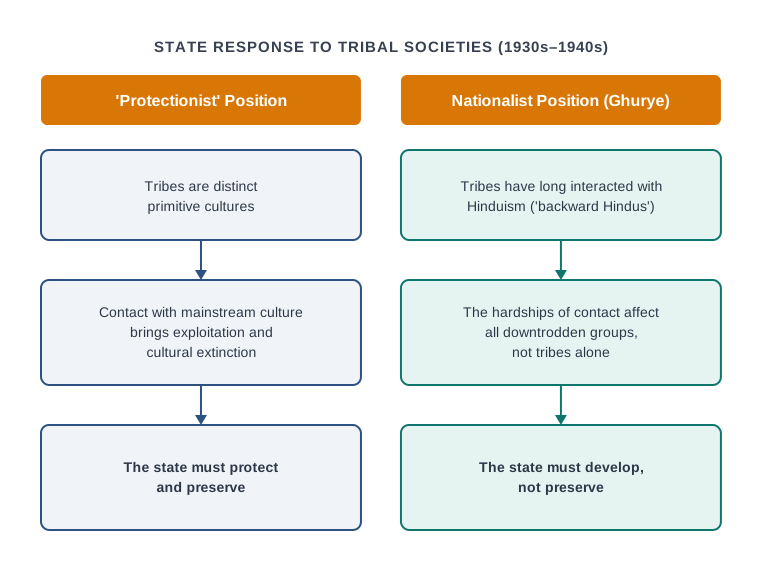
Fig. 5.4 – The debate on tribal societies.
What Was, and Was Not, Disputed
It is easy to misread this debate as a straightforward quarrel about facts. It was not.
Ghurye’s central factual argument — that Indian tribals were hardly ever isolated primitive communities of the kind written about in the classical anthropological texts — was not really disputed. Both sides could see that tribal communities traded, worshipped, married, fought and negotiated with their neighbours, and had done so for centuries.
The differences lay in how the impact of mainstream culture was evaluated. The ‘protectionists’ believed that assimilation would result in the severe exploitation and the cultural extinction of the tribals. Ghurye and the nationalists argued that these ill-effects were not specific to tribal cultures, but were common to all the backward and downtrodden sections of Indian society. In their view, these were the inevitable difficulties on the road to development.
5.3 Ghurye on Caste and Race
A Book Built on a Dissertation
G.S. Ghurye’s academic reputation was built on the basis of his doctoral dissertation at Cambridge, which was later published as Caste and Race in India (1932). The book attracted attention because it addressed the major concerns of Indian anthropology at that time.
In it, Ghurye provides a detailed critique of the then dominant theories about the relationship between race and caste. To follow his argument, you first have to understand the theory he was arguing with.
The Dominant View: Risley and the Racial Theory of Caste
Herbert Risley, a British colonial official who was deeply interested in anthropological matters, was the main proponent of the dominant view. Risley belonged to that group of administrator–anthropologists you met in the previous section — men who governed and studied the same population.
The view he held began with a claim about human beings in general. It held that human beings can be divided into distinct and separate races on the basis of their physical characteristics — the circumference of the skull, the length of the nose, or the volume, that is the size, of the cranium, the part of the skull where the brain is located.
Measuring the body in this way had a name. It was called anthropometry, and in the late nineteenth and early twentieth centuries it was regarded as a serious scientific technique.
Risley and others believed that India was a unique ‘laboratory’ for studying the evolution of racial types. Their reasoning was that caste strictly prohibits inter-marriage among different groups, and had done so for centuries. If groups had not married one another for that long, they argued, their physical differences would have been preserved intact.
From this came Risley’s main argument: caste must have originated in race, because different caste groups seemed to belong to distinct racial types. In general, he claimed, the higher castes approximated Indo-Aryan racial traits, while the lower castes seemed to belong to non-Aryan aboriginal, Mongoloid or other racial groups.
On the basis of differences between groups in terms of average measurements for the length of the nose, the size of the cranium, and so on, Risley and others suggested that the lower castes were the original aboriginal inhabitants of India. These people, in their account, had been subjugated by an Aryan people who had come from elsewhere and settled in India.
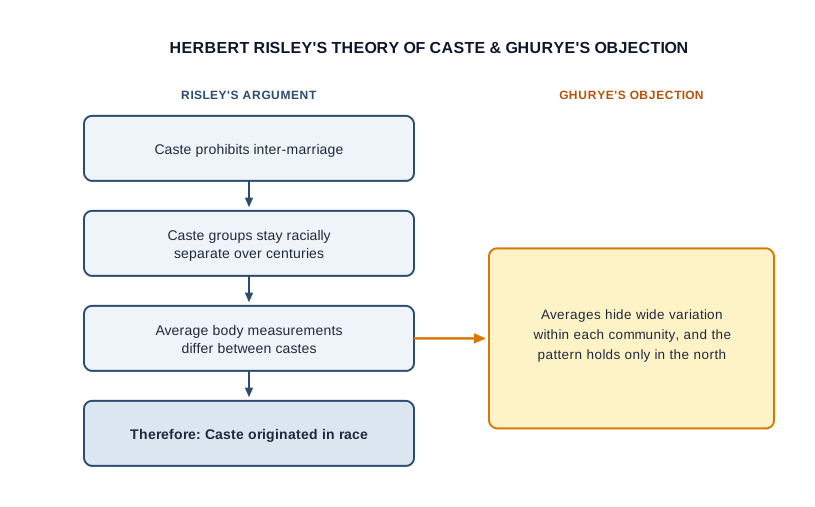
Fig. 5.5 – Risley’s racial theory of caste and Ghurye’s objection.
Ghurye’s Critique
Ghurye did not disagree with the basic argument put forward by Risley, but he believed it to be only partially correct. His criticism was made from inside the discipline, using its own tools, and it was made carefully.
His first objection was methodological. He pointed out the problem of using averages alone, without considering the variation in the distribution of a particular measurement for a given community. An average tells you where the middle of a group lies. It says nothing about how widely spread the members of that group are around that middle — and if two groups overlap almost completely, an average difference between them means very little.
His second objection was geographical. Ghurye believed that Risley’s thesis of the upper castes being Aryan and the lower castes being non-Aryan was broadly true only for northern India. In other parts of India, the inter-group differences in the anthropometric measurements were not very large, nor were they systematic.
This suggested something important. In most of India, except the Indo-Gangetic plain, different racial groups had been mixing with each other for a very long time. Thus ‘racial purity’ had been preserved by the prohibition on inter-marriage only in ‘Hindustan proper’, that is, north India.
In the rest of the country, the practice of endogamy — marrying only within a particular caste group — may have been introduced into groups that were already racially varied. Notice how this reverses Risley’s story. Caste did not preserve pre-existing races; caste rules were laid over populations that had long since mixed.
Reading a Theory in its Own Time
Today, the racial theory of caste is no longer believed. But in the first half of the twentieth century it was still considered to be true, and it is only in that setting that Ghurye’s book makes sense.
There are also conflicting opinions among historians about the Aryans and their arrival in the subcontinent, and these disagreements have not been settled. What matters for our purposes is that at the time Ghurye was writing, these were among the central concerns of the discipline — which is precisely why his writings attracted attention.
This is a useful lesson about how knowledge grows. A scholar is judged partly by the questions available to him, and partly by what he does with them. Ghurye took a theory that his contemporaries accepted, tested it against evidence from across India, and showed that it did not hold everywhere. That is how a discipline corrects itself, one argument at a time.
Ghurye’s Definition of Caste
Ghurye is also known for offering a comprehensive definition of caste. Rather than defining it in a single sentence, he set out six features — and it is the combination of all six, not any one of them, that makes caste what it is.
(i) Caste is based on segmental division. This means that caste is divided into a number of closed, mutually exclusive segments or compartments. Each caste is one such compartment. It is closed because caste is decided by birth: the children born to parents of a particular caste will always belong to that caste. There is no way other than birth of acquiring caste membership. In short, a person’s caste is decided by birth, at birth; it can neither be avoided nor changed.
(ii) Caste is based on hierarchical division. Each caste is strictly unequal to every other caste — that is, every caste is either higher or lower than every other one. In theory, though not in practice, no two castes are ever equal.
(iii) Caste necessarily involves restrictions on social interaction, especially the sharing of food. There are elaborate rules prescribing what kind of food may be shared between which groups. These rules are governed by ideas of purity and pollution. The same applies to social interaction more generally, most dramatically in the institution of untouchability, where even the touch of people of particular castes is thought to be polluting.
(iv) Caste involves differential rights and duties for different castes. This follows from the principles of hierarchy and restricted social interaction. These rights and duties pertain not only to religious practices but extend into the secular, everyday world. As ethnographic accounts of life in caste society have shown, interactions between people of different castes are governed by these rules.
(v) Caste restricts the choice of occupation, which, like caste itself, is decided by birth and is hereditary. At the level of society as a whole, caste functions as a rigid form of the division of labour, with specific occupations being allocated to specific castes.
(vi) Caste involves strict restrictions on marriage. Caste endogamy — marriage only within the caste — is often accompanied by rules about exogamy, or whom one may not marry. This combination of rules about eligible and non-eligible groups helps to reproduce the caste system, generation after generation.
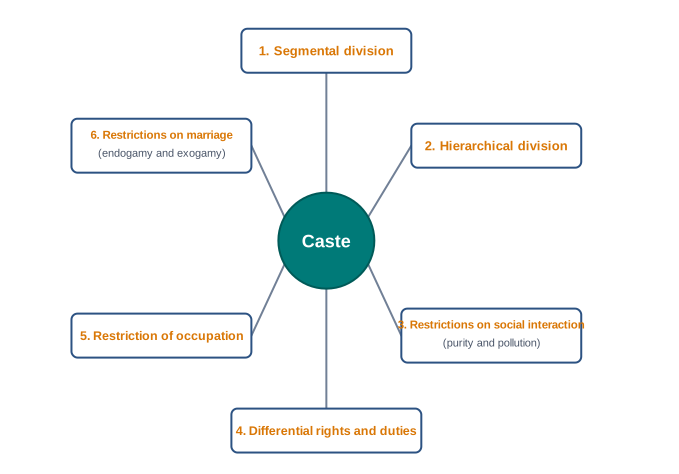
Fig. 5.6 – Ghurye’s six features of caste.
What the Definition Achieved, and What It Missed
Ghurye’s definition helped to make the study of caste more systematic. Before it, caste could be described endlessly; after it, caste could be analysed feature by feature, and different regions and periods could be compared on the same terms.
But the definition had a limitation, and it is one Ghurye’s successors seized upon. His conceptual definition was based on what the classical texts prescribed — on what caste was supposed to be, according to the shastras, or ancient authoritative texts.
In actual practice, many of these features of caste were changing, although all of them continue to exist in some form. A definition drawn from texts can tell you the rules; it cannot tell you how far people are keeping them.
That gap is where the next generation went to work. Ethnographic fieldwork over the next several decades helped to provide valuable accounts of what was actually happening to caste in independent India — in villages, in towns, in courts and in elections.
5.4 D.P. Mukerji on Tradition and Change
Two Departments, One Discipline
Between the 1920s and the 1950s, sociology in India was more or less equated with two major departments — Bombay and Lucknow. Both began as combined departments of sociology and economics, which tells you something about how uncertain the boundaries of the new subject still were.
The Bombay department in this period was led by G.S. Ghurye. The Lucknow department had three major figures, the famous ‘trinity’ of Radhakamal Mukerjee, who founded it, D.P. Mukerji, and D.N. Majumdar.
All three were well known and widely respected. But D.P. Mukerji was perhaps the most popular. In fact, D.P. Mukerji — or D.P., as he was generally known — was among the most influential scholars of his generation, not only in sociology but in intellectual and public life beyond the academy.
His influence and popularity came not so much from his scholarly writings as from his teaching, his speaking at academic events, and his work in the media, including newspaper articles and radio programmes. He was, in a phrase we would use today, a public intellectual.
A Sociologist of Many Interests
D.P. came to sociology through history and economics, and he never lost interest in either. He retained an active interest in an unusually wide range of subjects: literature, music, film, western and Indian philosophy, Marxism, political economy, and development planning.
He was strongly influenced by Marxism, though with an important reservation. He had more faith in Marxism as a method of social analysis than as a political programme for action. It was, for him, a way of asking questions about society, not a set of instructions for changing it.
D.P. wrote many books, in English and in Bengali. His Introduction to Indian Music is a pioneering work and is considered a classic in its genre — a reminder that for him music was not a hobby outside sociology, but part of the social life he studied.
Why He Turned to Sociology
It was through his dissatisfaction with Indian history and economics that D.P. turned to sociology. Neither, he felt, was reaching the thing that mattered most.
He felt very strongly that the crucial distinctive feature of India was its social system, and that therefore it was important for each social science to be rooted in this context. The decisive aspect of the Indian context was the social aspect. History, politics and economics in India were less developed in comparison with the west; the social dimensions, however, were ‘over-developed’.
He put the point sharply in 1955. Writing of his own intellectual journey, he said that his conviction grew that “India had had society, and very little else.” A country in which almost everything — its history, its economics, even its philosophy — had always centred on social groups was, in his view, a country whose scholars had no excuse for ignoring society.
Tradition as a Living Tradition
Given the centrality of society in India, it became the first duty of an Indian sociologist to study and to know the social traditions of India.
For D.P., this study of tradition was not oriented only towards the past. It included a sensitivity to change. Tradition, in his account, was a living tradition: it maintained its links with the past, but it also adapted to the present, and so evolved over time.
This is why D.P. insisted that it is not enough for the Indian sociologist to be a sociologist. He must, D.P. argued, be an Indian first — sharing in the folk-ways, the customs and the traditions of his own society, because only from inside them can he understand the social system, what lies beneath it, and what lies beyond it.
The demand was practical as well as philosophical. In keeping with this view, D.P. believed that sociologists should learn and be familiar with both ‘high’ and ‘low’ languages and cultures — not only Sanskrit, Persian or Arabic, the languages of the classical texts, but also the local dialects in which most people actually live their lives.
A Society Oriented Towards the Group
D.P. argued that Indian culture and society are not individualistic in the western sense. This was a claim about how people actually decide things.
The average Indian individual’s pattern of desires, he wrote, is more or less rigidly fixed by his socio-cultural group pattern, and he hardly deviates from it. Thus the Indian social system is basically oriented towards group, sect or caste-action, rather than towards ‘voluntaristic’ individual action — action freely chosen by an individual on his or her own account.
D.P. did not claim this would last for ever. Voluntarism was beginning to influence the urban middle classes even as he wrote. But his response to this was characteristic of a good sociologist: the appearance of voluntarism, he said, ought itself to be an interesting subject of study for the Indian sociologist. A change in how people choose is not a nuisance for the theory; it is the next research question.
What the Word ‘Tradition’ Actually Means
D.P. pointed out that the root meaning of the word tradition is to transmit. Everything else follows from that.
Its Sanskrit equivalents carry the same sense. One is parampara, meaning succession — one thing following another in an unbroken line. The other is aitihya, which comes from the same root as itihas, or history.
Traditions are thus strongly rooted in a past that is kept alive through the repeated recalling and retelling of stories and myths. But — and this is D.P.’s central point — this link with the past does not rule out change. It indicates a process of adaptation to change.
Where Change Comes From
Internal and external sources of change are always present in every society. The question is which of them does the real work.
The most commonly cited internal source of change in western societies is the economy. When new machines, new markets and new forms of work appear, classes form, class conflict sharpens, and society is pushed into change. This source, D.P. believed, has not been as effective in India.
The reason he gave was caste. Class conflict, he argued, had been “smoothed and covered by caste traditions” in the Indian context, where new class relations had not yet emerged very sharply. A worker who is also a member of a caste, and who thinks and acts first as a member of that caste, is unlikely to line up simply as a worker against employers.
Based on this understanding, he concluded that one of the first tasks for a dynamic Indian sociology would be to provide an account of the internal, non-economic causes of change.
Three Principles of Change
D.P. believed that there were three principles of change recognised in Indian traditions: shruti, smriti and anubhava. The first two are the principles of the high, textual traditions — the revealed and the remembered authoritative texts. The third, anubhava, means personal experience.
Of these three, the last is the revolutionary principle. A text can only repeat what it says; an experience can contradict it. Someone who has felt something for himself may refuse what the authorities have laid down.
However, in the Indian context, personal experience soon flowered into collective experience. One person’s experience became the shared experience of a group. This meant that the most important principle of change in Indian society was generalised anubhava — the collective experience of groups.
The high traditions were centred in smriti and shruti. But they were periodically challenged by the collective experience of groups and sects — as, for example, in the bhakti movement, in which devotion and personal love of god were placed above ritual and textual authority.
D.P. emphasised that this was true not only of Hindu culture but also of Muslim culture in India. In Indian Islam, the Sufis stressed love and experience rather than holy texts, and they have been important in bringing about change.
Thus, for D.P., the Indian context is not one in which discursive reason — buddhi-vichar, or reasoned argument — is the dominant force for change. Anubhava and prem, experience and love, have been historically superior as agents of change.
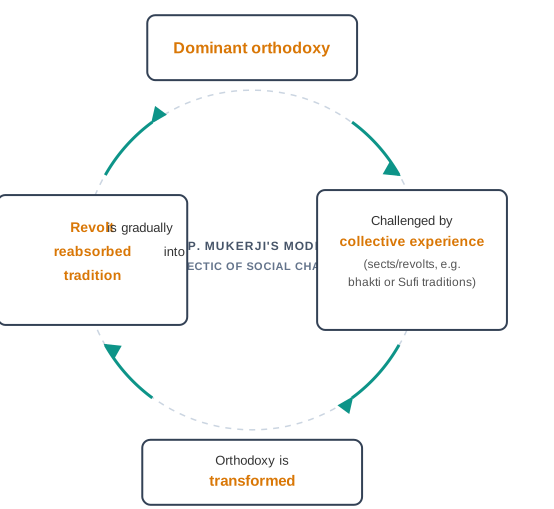
Fig. 5.7 – D.P. Mukerji’s cycle of change.
Rebellion Contained Within Tradition
Conflict and rebellion in the Indian context have tended to work through collective experiences. But the resilience of tradition ensures that the pressure of conflict produces change in the tradition without breaking it.
So, D.P. argued, we get repeated cycles. A dominant orthodoxy is challenged by a popular revolt. The revolt succeeds in transforming that orthodoxy. And then the revolt is itself eventually reabsorbed into the transformed tradition, and settles down as part of it.
This process of change — of rebellion contained within the limits of an overarching tradition — is typical of a caste society, where the formation of classes and of class consciousness has been inhibited. Notice how the argument closes on itself: caste holds back class, class conflict therefore does not do the work of change, and change instead takes the shape of revolts that tradition absorbs.
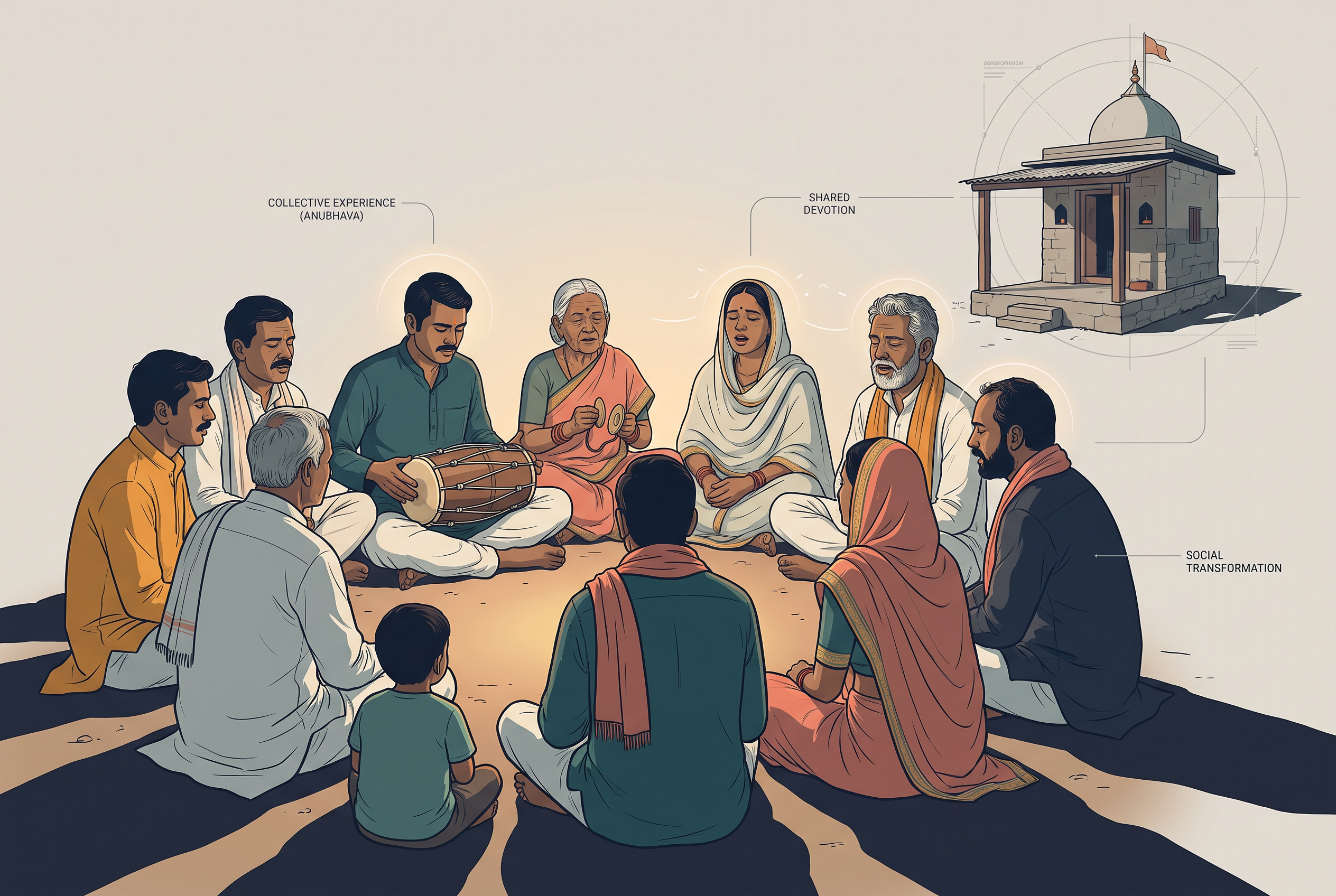
Fig. 5.8 – Collective devotion as a source of social change.
Neither Worship nor Rejection
D.P.’s views on tradition and change led him to criticise all instances of unthinking borrowing from western intellectual traditions — including in such contexts as development planning, where models designed elsewhere were applied to Indian conditions without asking whether they fitted.
His position was balanced, and it is worth stating precisely. Tradition was neither to be worshipped nor ignored. Modernity was needed, but was not to be blindly adopted.
D.P. was, therefore, simultaneously a proud but critical inheritor of tradition, and an admiring critic of the modernity that he acknowledged had shaped his own intellectual perspective. He belonged to both, and was uncomfortable in each — which is often where the most interesting sociology comes from.
5.5 A.R. Desai on the State
A Sociologist in Politics
A.R. Desai is one of the rare Indian sociologists who was directly involved in politics as a formal member of political parties. Most scholars study political life from a distance; Desai spent much of his own life inside it.
He was a life-long Marxist. He became involved in Marxist politics during his undergraduate days at Baroda, though he later resigned his membership of the Communist Party of India. For most of his career he was associated with various kinds of non-mainstream Marxist political groups.
His background helps to explain the direction he took. Desai’s father was a middle-level civil servant in the Baroda state, but was also a well-known novelist, with sympathy both for socialism and for Indian nationalism of the Gandhian variety. Having lost his mother early in life, Desai was brought up by his father, and lived a migratory life because of his father’s frequent transfers to different posts in the Baroda state.
After his undergraduate studies in Baroda, Desai eventually joined the Bombay department of sociology to study under Ghurye — so that the most Marxist of the four sociologists in this chapter was trained by the man who founded the discipline’s most textual and classical tradition.
The Question of the Modern Capitalist State
The modern capitalist state was one of the significant themes that interested A.R. Desai. As always, his approach to this issue was from a Marxist perspective.
His most famous intervention came in an essay called “The myth of the welfare state”. In it, Desai provides a detailed critique of the notion of the welfare state and points to its many shortcomings.
Notice how he proceeds, because the method matters as much as the conclusion. Desai does not begin by attacking the idea. He begins by taking it seriously. After considering the prominent definitions available in the sociological literature, he first sets out what a welfare state is supposed to be, and only then asks whether any actual state lives up to it.
What a Welfare State Claims to Be
From the existing definitions, Desai identifies three unique features of the welfare state.
(i) A welfare state is a positive state. This means that, unlike the laissez-faire of classical liberal political theory, the welfare state does not seek to do only the minimum necessary to maintain law and order. It is an interventionist state, and it actively uses its considerable powers to design and implement social policies for the betterment of society.
(ii) The welfare state is a democratic state. Democracy was considered an essential condition for the emergence of the welfare state. Formal democratic institutions, and especially multi-party elections, were thought to be a defining feature of it. This is precisely why liberal thinkers excluded socialist and communist states from the definition, however much those states might spend on their citizens.
(iii) A welfare state involves a mixed economy. A mixed economy is an economy in which both private capitalist enterprises and state or publicly owned enterprises exist side by side. A welfare state does not seek to eliminate the capitalist market, nor does it prevent public investment in industry and other fields. By and large, the state sector concentrates on basic goods and social infrastructure — steel, power, roads, schools, hospitals — while private industry dominates the consumer goods sector.
Five Questions to Put to a Welfare State
Desai then goes on to suggest some test criteria against which the performance of the welfare state can be measured. This is the move that turns an opinion into an argument: he states, in advance, what evidence would count.
The criteria are these:
Does the welfare state ensure freedom from poverty, social discrimination and security for all its citizens?
Does the welfare state remove inequalities of income, through measures to redistribute income from the rich to the poor, and by preventing the concentration of wealth?
Does the welfare state transform the economy in such a way that the capitalist profit motive is made subservient to the real needs of the community?
Does the welfare state ensure stable development, free from the cycle of economic booms and depressions?
Does it provide employment for all?

Fig. 5.9 – Desai’s five criteria for a welfare state.
The Verdict
Using these criteria, Desai examines the performance of those states that are most often described as welfare states — Britain, the USA and much of Europe — and finds their claims to be greatly exaggerated.
His findings run down the list. Most modern capitalist states, even in the most developed countries, fail to provide minimum levels of economic and social security to all their citizens. They are unable to reduce economic inequality, and often seem to encourage it instead. The so-called welfare states have also been unsuccessful at enabling stable development free from market fluctuations. And the presence of excess economic capacity alongside high levels of unemployment is yet another failure — the capacity to produce and the people who need work exist at the same time, and the system does not bring them together.
Based on these arguments, Desai concludes that the notion of the welfare state is something of a myth.
A Marxist Who Criticised Communist States
A.R. Desai also wrote on the Marxist theory of the state, and here something unexpected appears. In these writings we can see that Desai does not take a one-sided view. He openly criticises the shortcomings of Communist states.
He cites many Marxist thinkers to emphasise the importance of democracy even under communism, arguing strongly that political liberties and the rule of law must be upheld in all genuinely socialist states.
This is worth pausing over, because it tells you what a scholarly commitment looks like. Desai held a political position for his whole life, and he applied the same tests to the states he sympathised with as to the states he opposed. A sociologist who only finds fault with the other side is not doing sociology.
5.6 M.N. Srinivas on the Village
Trained in Two Worlds
M.N. Srinivas is probably the best known Indian sociologist of the post-independence era. Part of the reason lies in his unusual training: he earned two doctoral degrees, one from Bombay University and one from Oxford.
At Bombay he was a student of Ghurye, and so of the classical, text-centred tradition you met earlier in this chapter. His intellectual orientation was then transformed during the years he spent at the department of social anthropology in Oxford.
The timing mattered. British social anthropology was at that time the dominant force in western anthropology, and Srinivas shared in the excitement of being at the ‘centre’ of the discipline. He came home with a different way of looking.
Srinivas’ doctoral dissertation was published as Religion and Society among the Coorgs of South India. The book established his international reputation, through its detailed ethnographic application of the structural–functional perspective that was then dominant in British social anthropology.
The Institution Builder
Srinivas was appointed to a newly created lectureship in Indian sociology at Oxford. He resigned it in 1951 to return to India, as head of a newly created department of sociology at the Maharaja Sayajirao University at Baroda.
In 1959 he moved to Delhi to set up yet another department, at the Delhi School of Economics, which soon became known as one of the leading centres of sociology in India. Building departments, it turned out, was to be a large part of his life’s work.
He was not always happy about this. Srinivas often complained that most of his energies were taken up in institution building, leaving him with little time for his own research. There is a real cost here that students rarely think about: the hours a scholar spends on committees, syllabi and appointments are hours not spent in the field.
Despite these difficulties, Srinivas produced a significant body of work on themes such as caste, modernisation and other processes of social change, village society, and many other issues.
He also helped to establish Indian sociology on the world map, through his international contacts and associations. He had strong connections in British social anthropology as well as in American anthropology, particularly at the University of Chicago, which was then a powerful centre in world anthropology.
And, like G.S. Ghurye and the Lucknow scholars, Srinivas succeeded in training a new generation of sociologists who were to become leaders of the discipline in the following decades. A discipline survives by reproducing itself, and all three centres — Bombay, Lucknow, Delhi — did precisely that.
The Year That Changed His Mind
The Indian village and village society remained a life-long focus of interest for Srinivas.
He had made short visits to villages before, to conduct surveys and interviews. But a short visit produces answers to the questions you already thought of asking. It was not until he did fieldwork for a year at a village near Mysore that he really acquired first-hand knowledge of village society, and the experience proved decisive for his career and his intellectual path.
Srinivas went further than his own fieldwork. He helped to encourage and coordinate a major collective effort at producing detailed ethnographic accounts of village society during the 1950s and 1960s. Along with other scholars like S.C. Dube and D.N. Majumdar, he was instrumental in making village studies the dominant field in Indian sociology during this time.
Two Kinds of Writing on the Village
Srinivas’ writings on the village were of two broad types, and it is worth keeping them apart.
The first consisted of ethnographic accounts of fieldwork done in villages, or discussions of such accounts. This is description, based on observation.
The second kind of writing included historical and conceptual discussions about the Indian village as a unit of social analysis. This is argument, about whether the village is even the right thing to study. In this second kind of writing, Srinivas became involved in a debate about the usefulness of the village as a concept.
Against the Myth of the ‘Little Republic’
Srinivas also criticised the British administrator–anthropologists, who had put forward a picture of the Indian village as unchanging, self-sufficient, and made up of “little republics” — small, self-contained worlds, each complete in itself and untouched by the world outside.
Using historical and sociological evidence, Srinivas showed that this picture was false in two ways. First, the village had in fact experienced considerable change; it had never stood still. Second, villages were never self-sufficient. They had always been involved in various kinds of economic, social and political relationships at the regional level — trading in markets beyond their boundaries, marrying into other villages, paying revenue to distant rulers, worshipping at shrines that drew people from a whole region.
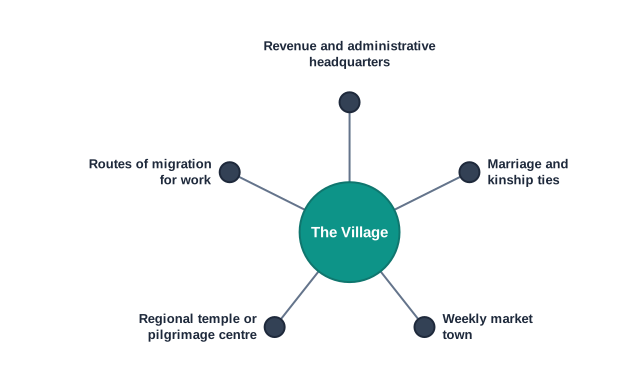
Fig. 5.10 – The village and its regional links.
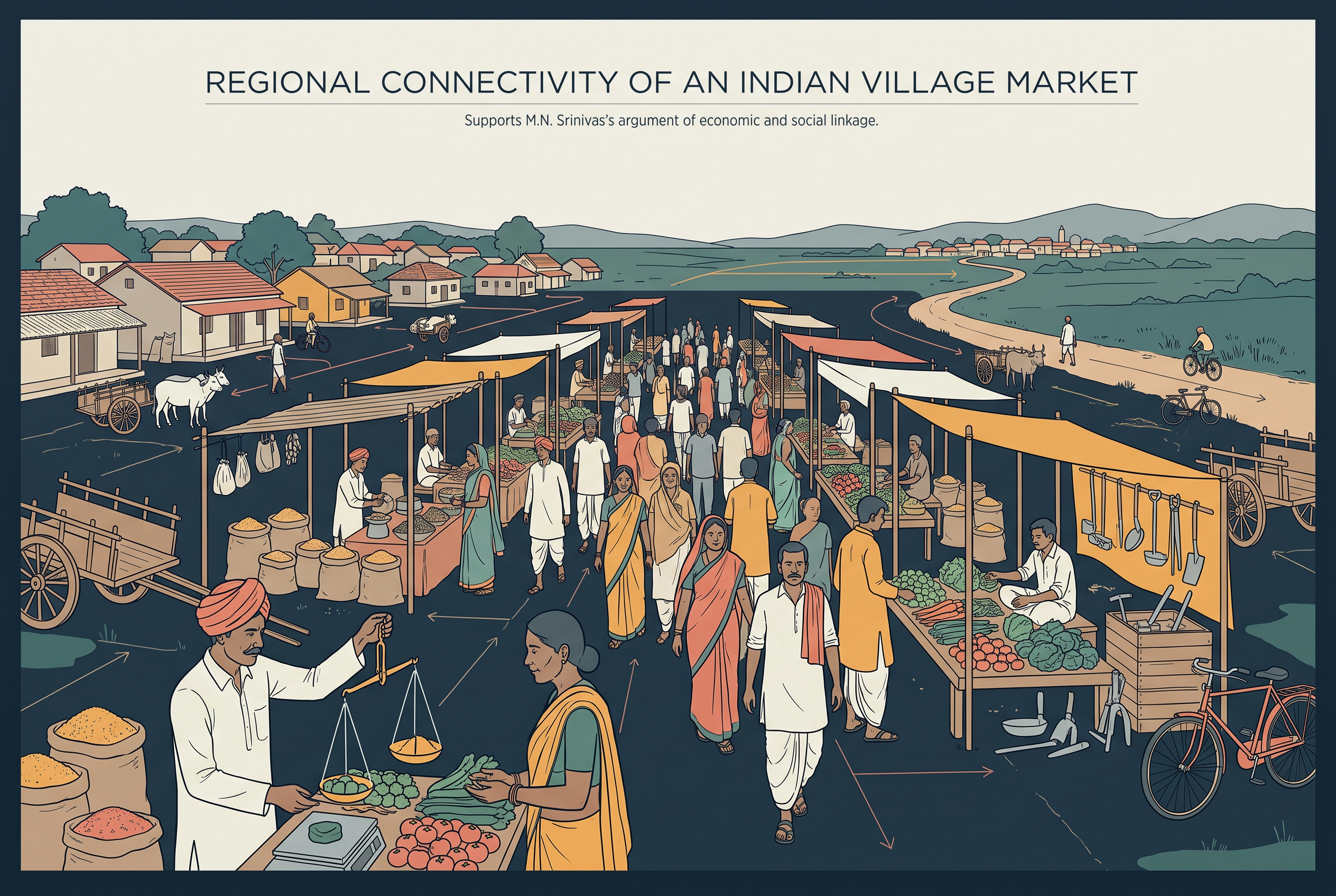
Fig. 5.11 – A weekly village market.
What Village Studies Did for Indian Sociology
The village as a site of research offered several advantages to Indian sociology, and they were not only academic.
It provided an opportunity to illustrate the importance of ethnographic research methods — to show, in practice, what long, patient, first-hand observation could reveal that a questionnaire could not.
It offered eye-witness accounts of the rapid social change that was taking place in the Indian countryside, just as the newly independent nation began its programme of planned development. Someone had to say what was actually happening out there, and sociologists were the ones who had been living in it.
These vivid descriptions of village India were greatly appreciated at the time. Urban Indians, as well as policy makers, were able to form impressions of what was going on in the heartland of India — a country most of them governed, wrote about, or argued over without ever having lived in it.
Village studies thus provided a new role for a discipline like sociology in the context of an independent nation. Rather than being restricted to the study of ‘primitive’ peoples, as it had been in the colonial period, sociology could now be made relevant to a modernising society. The discipline had found its use.
5.7 Conclusion
Four Routes to an Indian Sociology
These four Indian sociologists helped to give a distinctive character to the discipline, in the context of a newly independent and modernising country. They are offered here as examples of the diverse ways in which sociology was ‘Indianised’ — not as a single method that everyone followed, but as four different answers to the same question.
Ghurye began with the questions that had been defined by western anthropologists. What he brought to them was his own: an intimate knowledge of the classical texts, and a sense of educated Indian opinion.
D.P. Mukerji came from a very different background. A thoroughly westernised modern intellectual, he rediscovered the importance of Indian tradition — and did so without being blind to its shortcomings.
Like Mukerji, A.R. Desai was strongly influenced by Marxism. He offered a critical view of the Indian state at a time when such criticism was rare, and he applied that criticism impartially, to states he supported as well as to states he opposed.
M.N. Srinivas was trained in the dominant centres of western social anthropology. He adapted that training to the Indian context, and helped to design a new agenda for sociology in the late twentieth century.
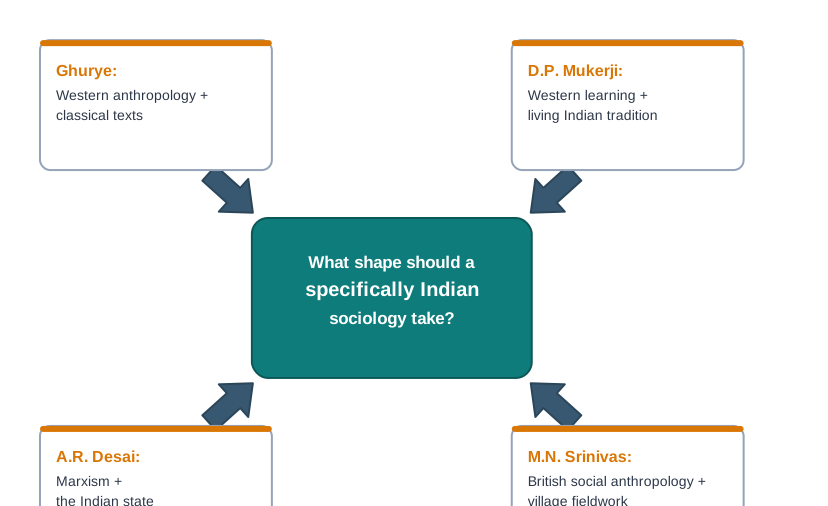
Fig. 5.12 – Four routes to an Indian sociology.
Learning, and Going Beyond
It is a sign of the health and strength of a discipline when succeeding generations learn from their predecessors — and eventually go beyond them.
This has also been happening in Indian sociology. Succeeding generations have subjected the work of these pioneers to constructive criticism, in order to take the discipline further. You have seen several such criticisms already in this chapter: that a definition drawn from classical texts cannot tell you how people actually live, that an account built on tradition can underplay economic forces, that a standard no state could meet settles an argument in advance, that one village cannot stand for rural India.
None of this diminishes the four. It is what they would have wanted, because it is how the subject works. The signs of this process of learning and critique are visible not only in this book, but all over Indian sociology.
5.8 Summary
The Beginnings of Sociology in India (5.1)
- Sociology is a young discipline even in Europe. In India, interest in sociological ways of thinking is a little more than a century old, but formal university teaching of sociology began only in 1919, at the University of Bombay. Calcutta and Lucknow began programmes in sociology and anthropology in the 1920s.
- In the early years it was not clear what an Indian sociology would look like, or whether India needed one. Those who took up the subject in the first quarter of the twentieth century had to decide for themselves what role it could play.
- Three questions defined the Indian situation: what could a discipline built to explain modernity do in a country whose modernity arrived along with colonial rule; what could social anthropology, born of European curiosity about ‘primitive’ cultures, mean in an ancient civilisation that also contained societies described as ‘primitive’; and what use would sociology be to a sovereign India embarking on planned development and democracy.
- The questions were not available ‘readymade’. They took shape only through the experience of doing sociology in an Indian context.
- The earliest Indians became anthropologists mostly by accident, since no Indian university taught the subject. L.K. Ananthakrishna Iyer (1861–1937) moved from clerk to school teacher to college teacher, and in 1902 was asked by the Dewan of Cochin to assist an ethnographic survey of the state — work he did voluntarily, at weekends. He later helped set up the first post-graduate anthropology department in India, at Calcutta, where he remained from 1917 to 1932.
- Sarat Chandra Roy (1871–1942), a lawyer, went to Ranchi in 1898 and stayed for forty-four years. As court interpreter he had to explain tribal custom to judges, and became the leading authority on the tribal peoples of the Chhotanagpur region. He wrote monographs on the Oraon, the Munda and the Kharia, published more than a hundred articles, and founded the journal Man in India in 1922.
- The four sociologists studied in this chapter were born a generation later. Ghurye and D.P. Mukerji were born in the 1890s; Desai and Srinivas in the second decade of the twentieth century. All were shaped by western sociology, and all had to answer the question the pioneers could only ask: what shape should a specifically Indian sociology take?
G.S. Ghurye and the Debate on Tribal Societies (5.2)
- G.S. Ghurye (1893–1983) can be considered the founder of institutionalised sociology in India. He headed India’s first post-graduate department of Sociology, at Bombay University, for thirty-five years, guided a large number of research scholars, and founded the Indian Sociological Society and its journal Sociological Bulletin.
- His Bombay department was the first to combine teaching and research within one institution, and the first to merge social anthropology and sociology into a single composite discipline.
- His writing ranged over caste and race, tribes, kinship, family and marriage, culture and cities, religion, and the sociology of conflict and integration. He was influenced by diffusionism, by Orientalist scholarship on Hindu religion and thought, by nationalism, and by a concern with the cultural aspects of Hindu identity.
- In the 1930s and 1940s there was a major debate on the place of tribal societies in India. Many British administrator–anthropologists held that tribes were primitive peoples whose distinctive culture would be destroyed by contact with Hindu society; the state, they said, should protect them.
- Nationalist Indians replied that preserving tribal culture would keep tribal people backward, as ‘museums’ of primitive culture, and that tribes, like Hindu society itself, needed reform and development.
- Ghurye became the best-known exponent of the nationalist view, characterising the tribes of India as ‘backward Hindus’ rather than as distinct cultural groups, and citing evidence of long and continuous interaction between tribal cultures and Hinduism.
- The fact of that long contact was not really disputed. What was disputed was how the effects of contact should be judged — as exploitation and cultural extinction, said the protectionists; as the inevitable difficulties on the road to development, said Ghurye and the nationalists.
Ghurye on Caste and Race (5.3)
- Ghurye’s reputation rested on his Cambridge dissertation, published as Caste and Race in India (1932), which criticised the dominant theories about race and caste.
- Herbert Risley, a British colonial official, was the main proponent of the dominant view. It held that humans can be divided into distinct races on the basis of physical measurements — the circumference of the skull, the length of the nose, the volume of the cranium. This measuring of the body was called anthropometry.
- Risley argued that India was a unique ‘laboratory’ of race, because caste had prohibited inter-marriage for centuries. From average measurements he concluded that the higher castes approximated Indo-Aryan racial traits while the lower castes belonged to non-Aryan aboriginal, Mongoloid or other groups, and that the lower castes were the original inhabitants, subjugated by Aryans who came from elsewhere.
- Ghurye did not reject the argument outright, but held it to be only partially correct. Averages alone, he showed, ignore the variation within a community. And Risley’s pattern held broadly only for northern India; elsewhere the differences between groups were neither large nor systematic.
- Ghurye concluded that in most of India, outside the Indo-Gangetic plain, different racial groups had been mixing for a very long time. ‘Racial purity’ had been preserved by the ban on inter-marriage only in ‘Hindustan proper’. Elsewhere, endogamy may have been introduced into groups that were already racially varied.
- Today the racial theory of caste is no longer believed, though it was still considered true in the first half of the twentieth century — which is why Ghurye’s book attracted attention at the time.
- Ghurye also offered a comprehensive definition of caste, emphasising six features: (i) segmental division into closed, birth-based compartments; (ii) hierarchical division, in which no two castes are equal even in theory; (iii) restrictions on social interaction, especially the sharing of food, governed by ideas of purity and pollution, and most dramatically in untouchability; (iv) differential rights and duties, religious and secular; (v) restriction of the choice of occupation, which is hereditary, making caste a rigid form of the division of labour; and (vi) strict restrictions on marriage, through endogamy combined with rules of exogamy, which help reproduce the caste system.
- The definition made the study of caste systematic. Its limitation was that it was based on what the classical texts prescribed, whereas in practice many features of caste were changing, though all continue to exist in some form. Ethnographic fieldwork in later decades described what was actually happening to caste in independent India.
D.P. Mukerji on Tradition and Change (5.4)
- Between the 1920s and the 1950s, sociology in India was equated with two departments, Bombay and Lucknow, both of which began as combined departments of sociology and economics. Lucknow had a ‘trinity’: Radhakamal Mukerjee, who founded it, D.P. Mukerji, and D.N. Majumdar.
- D.P. Mukerji (1894–1961) was among the most influential scholars of his generation, in public life as well as in the academy, more through his teaching, lecturing, newspaper writing and radio work than through his scholarly books. He came to sociology from history and economics, was strongly influenced by Marxism as a method of analysis rather than as a programme of action, and wrote widely, including a pioneering Introduction to Indian Music.
- He held that the crucial distinctive feature of India was its social system. History, politics and economics in India were less developed than in the west, but the social dimensions were ‘over-developed’ — India, he wrote, had had society and very little else.
- The first duty of an Indian sociologist was therefore to study Indian traditions — not as a dead past, but as a living tradition, one that keeps its links with the past while adapting to the present. He insisted that the Indian sociologist must be an Indian first, sharing in the customs and traditions he studies, and familiar with both ‘high’ and ‘low’ languages and cultures.
- D.P. argued that Indian society is not individualistic in the western sense: the individual’s desires are largely fixed by the socio-cultural group, so that action is oriented to group, sect or caste rather than to voluntaristic individual choice. The rise of voluntarism among the urban middle classes was itself a subject worth studying.
- The root meaning of tradition is to transmit; its Sanskrit equivalents are parampara (succession) and aitihya (from the same root as itihas, history). Traditions are rooted in a past kept alive by retelling — but this does not rule out change; it indicates adaptation to it.
- In western societies the main internal source of change is the economy. In India, D.P. believed, class conflict had been smoothed and covered by caste traditions, so that class relations had not emerged sharply. A dynamic Indian sociology therefore had to account for internal, non-economic causes of change.
- Indian traditions recognise three principles of change: shruti, smriti and anubhava. Anubhava, or personal experience, is the revolutionary principle; but in India personal experience soon becomes collective, so the most important principle of change is generalised anubhava, the collective experience of groups — as in the bhakti movement, and in the Sufi emphasis on love and experience within Indian Islam. Reasoned argument (buddhi-vichar) has been less powerful than anubhava and prem.
- Conflict in India therefore works through collective experience, but the resilience of tradition means change occurs within tradition rather than breaking it: orthodoxy is challenged by revolt, is transformed, and reabsorbs the revolt. This is typical of a caste society, where class consciousness has been inhibited.
- D.P. criticised unthinking borrowing from the west, including in development planning. Tradition was neither to be worshipped nor ignored; modernity was needed but not to be blindly adopted.
A.R. Desai on the State (5.5)
- A.R. Desai (1915–1994) was a life-long Marxist and one of the rare Indian sociologists formally involved in party politics. He studied under Ghurye at Bombay, and his 1946 dissertation was published in 1948 as The Social Background of Indian Nationalism, a Marxist analysis giving prominence to economic processes and divisions within the specific conditions of British colonialism.
- He also wrote on peasant movements, rural sociology, modernisation, urban issues, political sociology, forms of the state and human rights. Because Marxism was not influential within Indian sociology, he was better known outside the discipline than within it, and remained a somewhat unusual figure despite being elected President of the Indian Sociological Society.
- In his essay “The myth of the welfare state”, Desai first identifies three features of a welfare state as defined in the literature: it is a positive, interventionist state rather than a laissez-faire one; it is a democratic state, with multi-party elections (which is why liberal thinkers excluded socialist and communist states); and it involves a mixed economy, in which private and publicly owned enterprises co-exist, with the state sector concentrating on basic goods and social infrastructure.
- He then proposes five test criteria: does the welfare state ensure freedom from poverty, social discrimination and security for all; does it remove inequalities of income by redistribution and by preventing the concentration of wealth; does it make the capitalist profit motive subservient to the real needs of the community; does it ensure stable development free from booms and depressions; and does it provide employment for all?
- Applying these tests to Britain, the USA and much of Europe, Desai finds their claims greatly exaggerated: they fail to provide minimum economic and social security, do not reduce inequality and often encourage it, cannot free development from market fluctuations, and combine excess capacity with high unemployment. The welfare state, he concludes, is something of a myth.
- Desai also wrote on the Marxist theory of the state, and did not take a one-sided view. He openly criticised the shortcomings of Communist states, citing Marxist thinkers to argue that political liberties and the rule of law must be upheld in all genuinely socialist states.
M.N. Srinivas on the Village (5.6)
- M.N. Srinivas (1916–1999) is probably the best known Indian sociologist of the post-independence era. He took doctorates at Bombay, under Ghurye, and at Oxford, where British social anthropology transformed his intellectual orientation. His dissertation was published as Religion and Society among the Coorgs of South India, applying the structural–functional perspective, and established his international reputation.
- He resigned his Oxford lectureship in 1951 to found the sociology department at the Maharaja Sayajirao University at Baroda, and in 1959 set up another at the Delhi School of Economics, which became a leading centre. He often complained that institution building left him little time for research, but produced significant work on caste, modernisation, social change and village society, and trained a new generation of sociologists.
- Short visits to villages had given him surveys and interviews; a year of fieldwork in a village near Mysore gave him first-hand knowledge of village society, and proved decisive for his career. With scholars such as S.C. Dube and D.N. Majumdar, he made village studies the dominant field in Indian sociology in the 1950s and 1960s.
- His writings on the village were of two kinds: ethnographic accounts of fieldwork, and historical and conceptual discussion of the village as a unit of social analysis.
- In that debate, Louis Dumont argued that caste matters more than the village: villages may live or die and people may move, but caste and religion follow people wherever they go, so the village is a misleading category. Srinivas argued the opposite — historical evidence showed that villages served as a unifying identity, and village unity was significant in rural social life.
- Srinivas also criticised the British administrator–anthropologists’ picture of the village as unchanging, self-sufficient “little republics”. Using historical and sociological evidence he showed that villages had changed considerably, had never been self-sufficient, and had always been involved in economic, social and political relationships at the regional level.
- Village studies gave Indian sociology a new role: they demonstrated the value of ethnographic methods, offered eye-witness accounts of rapid rural change as planned development began, and allowed urban Indians and policy makers to see what was happening in the countryside. Sociology was no longer confined to the study of ‘primitive’ peoples; it could speak to a modernising society.
Conclusion (5.7)
- The four sociologists are examples of the diverse ways in which sociology was ‘Indianised’ in a newly independent, modernising country. Ghurye brought classical learning and educated Indian opinion to questions set by western anthropology; D.P. Mukerji, a westernised intellectual, rediscovered Indian tradition without ignoring its shortcomings; Desai brought Marxism to a critical study of the state when such criticism was rare; Srinivas adapted western social anthropology to Indian conditions and set a new agenda for the discipline.
- A discipline is healthy when later generations learn from their predecessors and go beyond them. Indian sociologists after these four have subjected their work to constructive criticism, and that process of learning and critique continues.
5.9 Key Terms
Administrator–anthropologists — British administrative officials in the Indian government of the nineteenth and early twentieth centuries who took a great interest in anthropological research, especially surveys and censuses; some became well known anthropologists after retirement, among them Edgar Thurston, William Crooke, Herbert Risley and J.H. Hutton.
Aitihya — a Sanskrit word for tradition, coming from the same root as itihas, or history.
Anthropometry — the branch of anthropology that studied human racial types by measuring the body, particularly the volume of the cranium, the circumference of the head, and the length of the nose.
Anubhava — personal experience; in D.P. Mukerji’s account, the revolutionary principle of change in Indian traditions, which becomes powerful when it grows into the shared or generalised experience of a group.
Assimilation — the process by which one culture, usually the larger or more dominant one, gradually absorbs another, so that the absorbed culture merges into it and is no longer alive or visible at the end.
Caste — in Ghurye’s definition, an institution of closed, birth-based segments, arranged in a strict hierarchy, with restricted social interaction, differential rights and duties, hereditary occupation, and marriage confined within the group.
Diffusionism — the perspective that explains cultural similarities between societies by the spread of cultural traits from one group to another through contact, migration and borrowing, rather than by separate invention.
Endogamy — the rule that marriage must take place within a defined social or kin group; caste endogamy, marriage only within one’s own caste, is the most common example.
Ethnography — the detailed, first-hand description of the life of a community — its customs, beliefs, work, kinship and rituals — usually written after long residence among the people studied.
Exogamy — the rule that marriage must take place outside a defined social or kin group; common examples are the prohibition of marriage with blood relatives (sapind exogamy), with members of the same lineage (sagotra exogamy), or with residents of the same village or region.
Fieldwork — the study of a community by living and moving among its members, watching and asking, rather than by reading about them or surveying them from a distance.
Laissez-faire — a French phrase meaning ‘let be’ or ‘leave alone’; the doctrine that the state should intervene as little as possible in the economy, usually joined to a belief in the efficiency of the free market.
Living tradition — a tradition that keeps its link with the past by retaining something from it while also taking in new elements, and so changes without losing its continuity.
Mixed economy — an economy in which private capitalist enterprises and state or publicly owned enterprises exist side by side.
Parampara — a Sanskrit word for tradition, meaning succession — one thing handed on to the next in an unbroken line.
Purity and pollution — the ideas that govern caste rules about food and social contact, marking some persons, foods and acts as pure and others as polluting.
Shruti — the revealed, authoritative texts of the high Hindu tradition; for D.P. Mukerji, one of the three principles of change recognised in Indian traditions.
Smriti — the remembered, authoritative texts of the high Hindu tradition; the second of D.P. Mukerji’s three principles of change.
Social anthropology — the study of societies through close, first-hand observation of their everyday life.
Structural–functional perspective — the approach that studies a society by asking how its parts fit together as a structure, and what each part contributes to holding the whole together.
Untouchability — the institution in which the touch of people of particular castes is treated as polluting, and social contact with them is severely restricted; the most extreme form of caste-based restriction on interaction.
Village studies — the field of ethnographic research on Indian village society that became dominant in Indian sociology in the 1950s and 1960s.
Voluntarism — action freely chosen by an individual on his or her own account, rather than fixed by the pattern of the group; D.P. Mukerji saw its growth among the urban middle classes as a subject worth studying.
Welfare state — a positive, interventionist and democratic state, working through a mixed economy, which uses its powers to design and implement social policies for the betterment of society; A.R. Desai argued that, measured against its own claims, it is largely a myth.
5.10 Points to Ponder
The first Indian anthropologists came to the subject through a government survey and a courtroom, not through a classroom. Does a discipline gain something when its founders are outsiders to it — or does it only lose?
Ghurye argued that tribal communities had always been in contact with the wider society, and therefore needed development rather than protection. His opponents used the same evidence to argue that contact was exactly what endangered them. When two sides agree on the facts and still disagree completely, what is the argument really about?
D.P. Mukerji held that a tradition stays alive only by changing. At what point does a tradition change so much that it is no longer the same tradition?
Ghurye built his definition of caste from what the classical texts prescribed; Srinivas built his understanding of village society from a year of living in one village. What can each way of knowing see that the other cannot?
Desai judged the welfare state against the promises it made about itself, and found it wanting. Is that a fair way to judge an institution — or does every institution fail when measured against its own ideals?
D.P. Mukerji said that the Indian sociologist must be an Indian first. Does belonging to the society you study make you a better observer of it, or a worse one?
5.11 NCERT Questions
How did Ananthakrishna Iyer and Sarat Chandra Roy come to practise social anthropology?
What were the main arguments on either side of the debate about how to relate to tribal communities?
Outline the positions of Herbert Risley and G.S. Ghurye on the relationship between race and caste in India.
Summarise the social anthropological definition of caste.
What does D.P. Mukerji mean by a ‘living tradition’? Why did he insist that Indian sociologists be rooted in this tradition?
What are the specificities of Indian culture and society, and how do they affect the pattern of change?
What is a welfare state? Why is A.R. Desai critical of the claims made on its behalf?
What arguments were given for and against the village as a subject of sociological research by M.N. Srinivas and Louis Dumont?
What is the significance of village studies in the history of Indian sociology? What role did M.N. Srinivas play in promoting village studies?
5.12 Objective Questions
Formal university teaching of sociology in India began in 1919 at:
- the University of Calcutta
- the University of Bombay
- the University of Lucknow
- the University of Madras [1 mark]
The journal founded by Sarat Chandra Roy in 1922, the earliest of its kind in India and still published, is:
- Sociological Bulletin
- Man in India
- Caste and Race in India
- Views and Counterviews [1 mark]
G.S. Ghurye’s doctoral dissertation was published in 1932 as:
- Religion and Society among the Coorgs of South India
- The Social Background of Indian Nationalism
- Caste and Race in India
- Rural Transition in India [1 mark]
Anthropometry is the branch of anthropology that studied racial types by measuring:
- the size of village populations
- the human body — the volume of the cranium, the circumference of the head, the length of the nose
- the rate of inter-caste marriage
- the level of literacy in a community [1 mark]
The famous ‘trinity’ of the Lucknow department consisted of:
- G.S. Ghurye, A.R. Desai and M.N. Srinivas
- L.K. Ananthakrishna Iyer, Sarat Chandra Roy and Herbert Risley
- Radhakamal Mukerjee, D.P. Mukerji and D.N. Majumdar
- M.N. Srinivas, S.C. Dube and Louis Dumont [1 mark]
Which of the following is NOT one of the three features of the welfare state identified by A.R. Desai?
- It is a positive, interventionist state
- It is a democratic state
- It has a mixed economy
- It follows a policy of laissez-faire [1 mark]
In each of the following, an Assertion (A) is followed by a Reason (R). Choose the correct option. Assertion (A): Ghurye insisted on describing the tribes of India as ‘backward Hindus’ rather than as distinct cultural groups. Reason (R): He cited detailed evidence from a wide variety of tribal cultures showing constant interaction with Hinduism over a long period.
- Both A and R are true, and R is the correct explanation of A
- Both A and R are true, but R is not the correct explanation of A
- A is true, but R is false
- A is false, but R is true [1 mark]
Assertion (A): D.P. Mukerji held that the economy was the most effective internal source of social change in India. Reason (R): He believed that class conflict in India had been smoothed and covered by caste traditions.
- Both A and R are true, and R is the correct explanation of A
- Both A and R are true, but R is not the correct explanation of A
- A is true, but R is false
- A is false, but R is true [1 mark]
Assertion (A): M.N. Srinivas argued that Indian villages were never self-sufficient. Reason (R): Villages had long been involved in economic, social and political relationships at the regional level.
- Both A and R are true, and R is the correct explanation of A
- Both A and R are true, but R is not the correct explanation of A
- A is true, but R is false
- A is false, but R is true [1 mark]
Assertion (A): A.R. Desai’s criticism of the state was directed only at capitalist welfare states. Reason (R): He cited Marxist thinkers to argue that political liberties and the rule of law must be upheld in all genuinely socialist states.
- Both A and R are true, and R is the correct explanation of A
- Both A and R are true, but R is not the correct explanation of A
- A is true, but R is false
- A is false, but R is true [1 mark]
Match the sociologist in Column A with the work or idea in Column B. | Column A | Column B | |—|—| | a. G.S. Ghurye | i. “The myth of the welfare state” | | b. D.P. Mukerji | ii. Religion and Society among the Coorgs of South India | | c. A.R. Desai | iii. Caste and Race in India | | d. M.N. Srinivas | iv. The idea of a ‘living tradition’ | [1 mark]
Match the term in Column A with its meaning in Column B. | Column A | Column B | |—|—| | a. Parampara | i. Personal experience | | b. Anubhava | ii. Minimum state intervention in the economy | | c. Laissez-faire | iii. Succession | | d. Assimilation | iv. The absorption of one culture by a dominant one | [1 mark]
Fill in the blank: G.S. Ghurye remained Head of the Department of Sociology at Bombay University for ______ years. [1 mark]
Fill in the blank: The rule that a person must marry only within his or her own caste is called ______. [1 mark]
State whether the following is true or false: Ghurye rejected Risley’s argument entirely, holding that it had no truth in it for any part of India. [1 mark]
5.13 Check Your Concepts
Name the two pioneers described in this chapter as ‘accidental anthropologists’, and state in one line each how each came to the subject. [2 marks]
Define anthropometry. [2 marks]
What is meant by a ‘mixed economy’? [2 marks]
State any two of the six features of caste in Ghurye’s definition. [2 marks]
What did D.P. Mukerji mean by parampara* and aitihya?* [2 marks]
Name the two institutions G.S. Ghurye founded, and give one example of what each did for the discipline. [2 marks]
Differentiate between endogamy and exogamy, giving one Indian example of each. [4 marks]
Ghurye described Risley’s thesis as only “partially correct”. Give reasons for his judgement. [4 marks]
Explain, with one example from your own surroundings, what D.P. Mukerji meant when he called a tradition a ‘living’ one. [4 marks]
Describe any two of the five test criteria A.R. Desai used to judge the welfare state, and explain why he thought these were the right tests to apply. [4 marks]
Why did M.N. Srinivas reject the colonial picture of the Indian village as an unchanging, self-sufficient “little republic”? What evidence did he use? [4 marks]
The Bombay department merged social anthropology and sociology into a single composite discipline, and combined teaching with research in the same institution. Explain why each of these decisions mattered for the growth of sociology in India. [4 marks]
Why did the racial theory of caste appear scientific to those who believed it, and why is it rejected today? What does this tell you about how sociological knowledge changes? [6 marks]
Explain Ghurye’s six-feature definition of caste. Then explain one important limitation of building a definition out of what the classical texts prescribe. [6 marks]
“In India, the most important principle of change has been generalised anubhava.” Explain D.P. Mukerji’s argument, using the examples he gave, and evaluate how far it accounts for social change. [6 marks]
A.R. Desai judged the welfare state by criteria drawn from the claims of its own defenders. Explain his method, state his conclusion, and evaluate whether the test he set was a fair one. [6 marks]
In the debate about the village as a unit of sociological analysis, whose argument do you find stronger — Louis Dumont’s or M.N. Srinivas’s? Explain both positions and support your answer with Indian examples. [6 marks]
5.14 Passage-Based Questions
- Read the passage and answer the questions that follow.
In a princely state in the early 1900s, the ruler’s office asked a college teacher to prepare an account of the customs, occupations and marriage rules of the communities living within its borders. The teacher had no training for the work. He taught his classes on weekdays, and on Sundays he travelled to villages with a notebook, writing down what people told him about their kinship rules, their festivals and their work. The completed volumes were sent to the government, which found them useful for its own administration. The communities described in them were never asked whether they wished to be studied, and never saw what had been written about them.
a. Name the method of research being described, and give its defining features. [2 marks]
b. The teacher's work was widely praised at the time. What ethical questions would a sociologist today raise about it? [2 marks]
c. Explain why knowledge of this kind was valuable to a colonial administration. [2 marks]
[6 marks]
- Read the passage and answer the questions that follow.
A visitor to a village in the plains is told that it has “always been the same”. But when she looks closely, she finds that most households sell part of their grain in the weekly market of a town eight kilometres away; that almost every married woman in the village came from another village, and every daughter has left for one; that the village shrine attracts worshippers from a dozen surrounding settlements at its annual fair; that land records are kept at a district office far away; and that a third of the young men work for part of the year on building sites in a distant city.
a. Which widely held picture of the Indian village does this evidence contradict? Name it and explain it. [2 marks]
b. Which sociologist criticised that picture, and what kinds of evidence did he use against it? [2 marks]
c. Using this passage, explain what is meant by saying that villages were never self-sufficient. [2 marks]
[6 marks]
- Read the passage and answer the questions that follow.
At a neighbourhood festival, the older residents say the songs sung at the shrine are the same ones their grandparents sang. The younger ones point out that the shrine now has electric lights, that the songs are broadcast through loudspeakers, that some verses were added within living memory by a local singer, and that women now sing in the procession, which they did not do fifty years ago. Both groups insist that the festival is the same festival it always was.
a. Which concept from this chapter does this situation best illustrate? Explain it. [2 marks]
b. How would D.P. Mukerji explain the fact that both groups are, in a sense, right? [2 marks]
c. D.P. Mukerji said that change in India works through the collective experience of groups rather than through reasoned argument alone. Explain what he meant, with one example from the chapter. [2 marks]
[6 marks]
- Read the passage and answer the questions that follow.
A state government announces that it will run free bus services, expand a public hospital and open new schools, while also inviting private companies to build and run a set of toll roads. In a classroom debate about the announcement, one group of students argues that the state is still not doing enough, because families in the poorer parts of the city remain without steady work or security. Another group argues that the state is already doing too much, and that private enterprise would run these services more efficiently.
a. Which of the three features of a welfare state, as identified by A.R. Desai, does the mixture of public services and private toll roads illustrate? Explain it. [2 marks]
b. Which of Desai's five test criteria would the first group of students be using? State any two and explain how they apply here. [2 marks]
c. Set out, fairly, the strongest argument each group of students could make, and say what evidence would help settle the disagreement between them. [2 marks]
[6 marks]