Chapter 3: Environment and Society
Anyone who has walked through the Delhi Ridge knows the feeling: rocky ground, thorny trees pressing close, birds calling, the noise of the city suddenly far away. It looks like a piece of wild nature that the city somehow forgot to swallow. It is nothing of the kind.
The dominant tree of the Ridge, Prosopis juliflora — known locally as vilayati kikar or vilayati babul — is not native to this region at all. It came from South America, and the British planted it heavily around 1915 to green what they saw as a barren, rocky hillside. It grew fast, spread easily, and today it has naturalised across much of north India. A forest that looks ancient and untouched is, in fact, a little over a hundred years old, and it exists because officials in a colonial government made a decision about which trees a city ought to have.
Once you notice this, you begin to notice it everywhere. The wheat field, the canal, the reservoir behind a dam, the neat park at the end of your street — each looks like a fact of nature, and each carries a human decision inside it. Sociologists ask a further question, and it is the question this chapter turns on: whose decision, and who lives with the result?
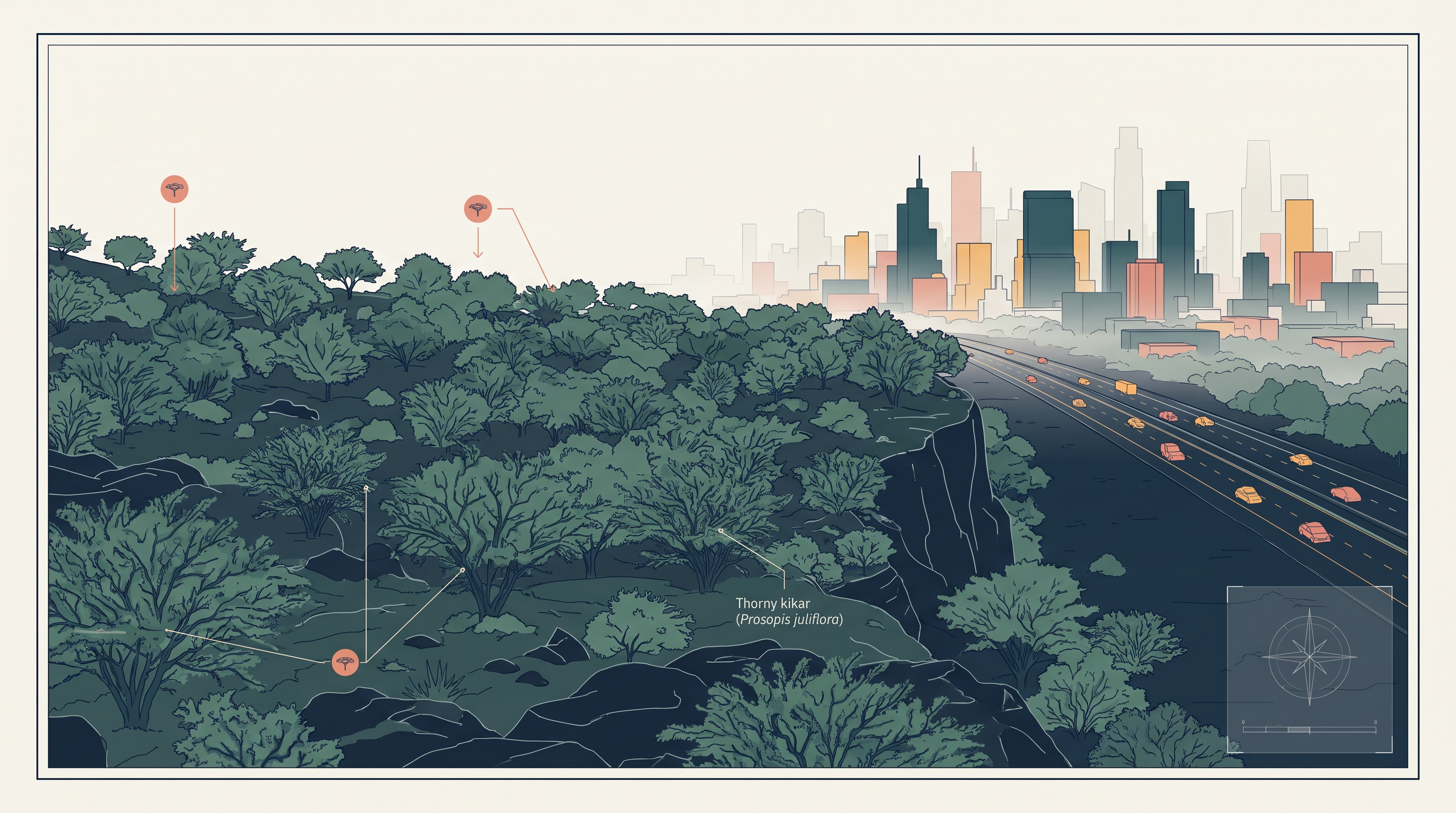
Fig. 3.1 – The planted kikar forest of the Delhi Ridge.
This chapter will help you answer each of these questions.
3.1 Environment, Ecology and Society
Where do your things come from?
Look around the room you are sitting in. If you are in a classroom, you can probably see students in uniform, chairs and desks, open books, school bags with lunch boxes and pencil boxes, and a ceiling fan turning overhead.
Have you ever asked where these things come from? Not the shop that sold them — the source. Trace any material object back far enough and you arrive at nature.
Take the chair you are sitting on. It may be made of wood, held together with iron nails, glue and varnish. The wood began as a tree in a forest or a plantation. Iron began as ore in a mine. To reach you, that wood had to be cut, moved, cut again, shaped, polished, transported and sold.
That journey needed electricity to run the saws, diesel to run the trucks, arrangements for trade, and telecommunications to place and confirm orders. It passed through the hands of loggers, carpenters, supervisors and managers, transporters and traders, and finally through the hands of the people in charge of buying furniture for your school.
Now notice something further. Each of those producers and distributors, in order to do their part, used other goods and services — and every one of those, too, was ultimately drawn from nature. Try to map these resource flows on a sheet of paper and you will quickly see how far they spread, and how complicated the map becomes.
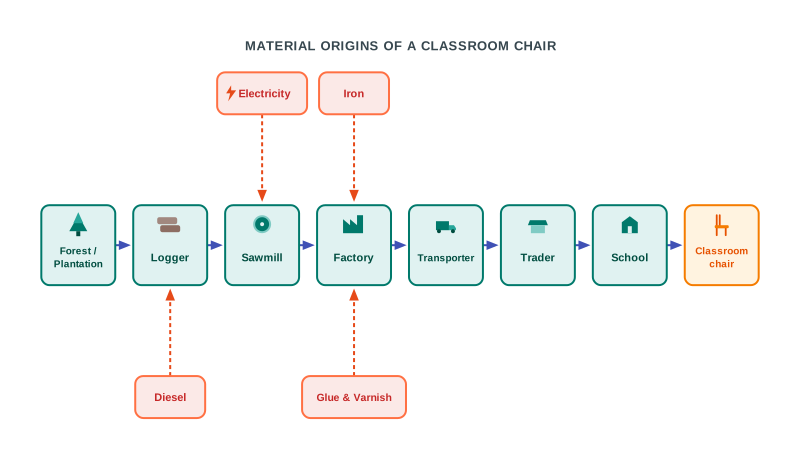
Fig. 3.2 – The resource flow of a classroom chair.
What this chapter studies
This chapter studies the social relationships that human beings have with the environment: how these relationships have changed over time, and how they vary from one place to another.
Those variations are not random, and sociology tries to analyse and interpret them systematically. There are many urgent environmental problems demanding our attention, and to address them effectively we need a sociological framework — one that explains why such crises occur and how they might be prevented or resolved.
The ecological basis of society
Every society rests on an ecological base. The term ecology refers to the web of physical and biological systems and processes of which human beings are one element — one element, not the centre.
The ecology of a place is shaped by the interaction of its geography with its hydrology — that is, with the science and structure of its water and water flows. A desert illustrates this well. The plants and animals unique to a desert are adapted to its scarce rainfall, its rocky or sandy soil, and its extreme temperatures.
Such ecological factors limit and shape how human beings can live in any particular place. Where water is scarce, dense farming settlements are hard to sustain; where soil is deep and rivers are perennial, they are not.
Ecology modified by human action
Ecology, however, does not stay still. Over time it has been modified by human action, and modified so thoroughly that we often mistake the result for nature itself.
What looks like a natural feature of the environment is frequently produced by human intervention. Aridity is one example; flood-proneness is another. When the forests in the upper catchment of a river are cut down, the soil holds less water, run-off increases, and the river below becomes more flood-prone. The flood then appears to be nature’s doing.
Deforestation — the loss of forest area because trees are cut down, or the land is taken over for some other purpose, usually cultivation — is thus not only a loss of trees. It reorganises how water moves across a landscape.
Climate change brought about by global warming is a second, much larger instance of human activity reshaping nature. Its effects are felt everywhere, including in places that contributed almost nothing to it.
The important sociological point follows from this. Over time, it becomes genuinely difficult to separate and distinguish the natural from the human factors in ecological change. A “natural disaster” may have a long human history behind it.
Environments that are obviously human-made
Some transformed environments hide their origins; others announce them.
An agricultural farm is plainly a human transformation of nature. Its soil and water conservation works were built; its plants were cultivated and its animals domesticated; its synthetic fertilisers and pesticides were manufactured and applied.
The built environment of a city announces itself even more loudly. Concrete, cement, brick, stone, glass and tar all draw upon natural resources, but the city they make is very much a human artefact.
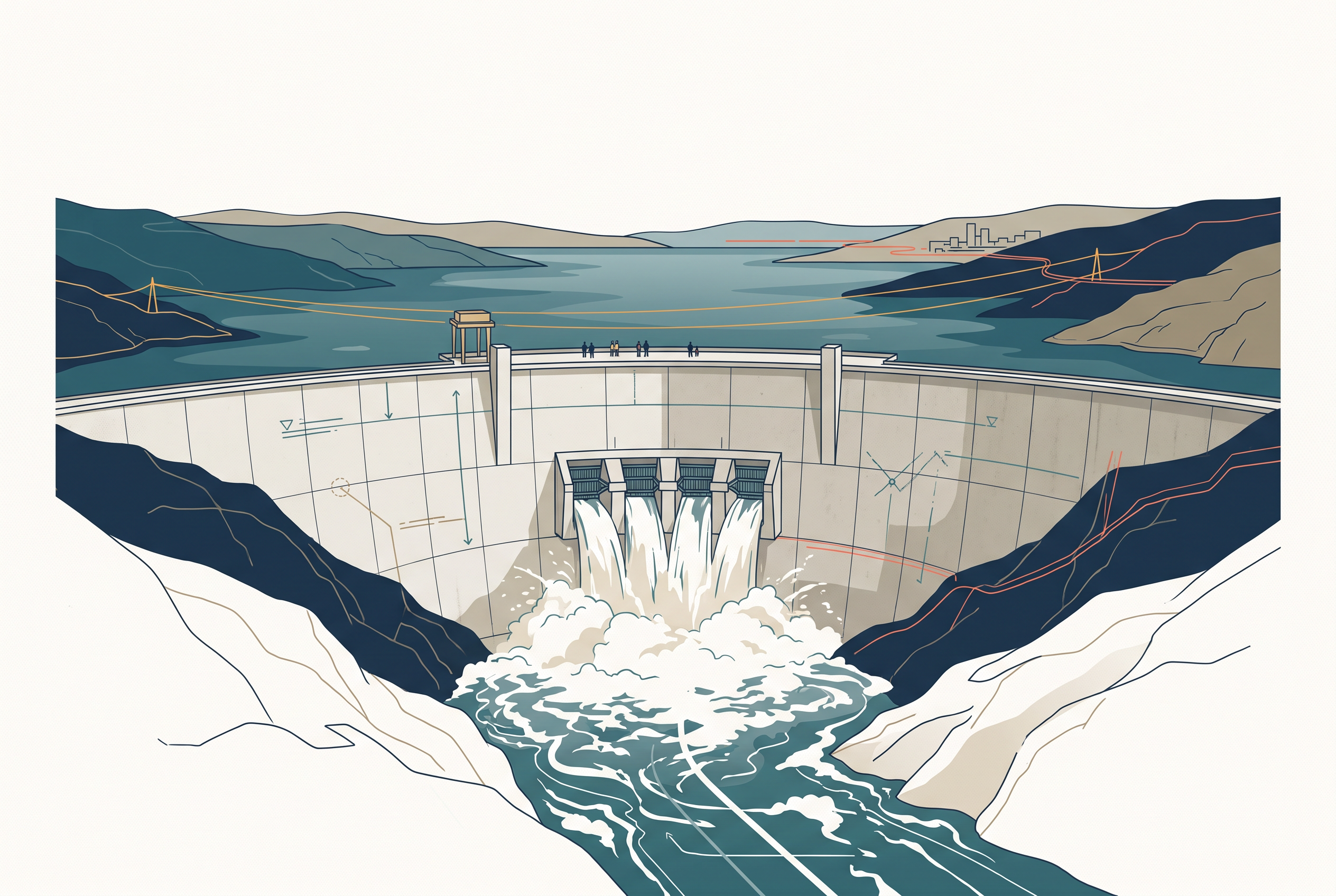
Fig. 3.3 – A large concrete dam altering a river valley.
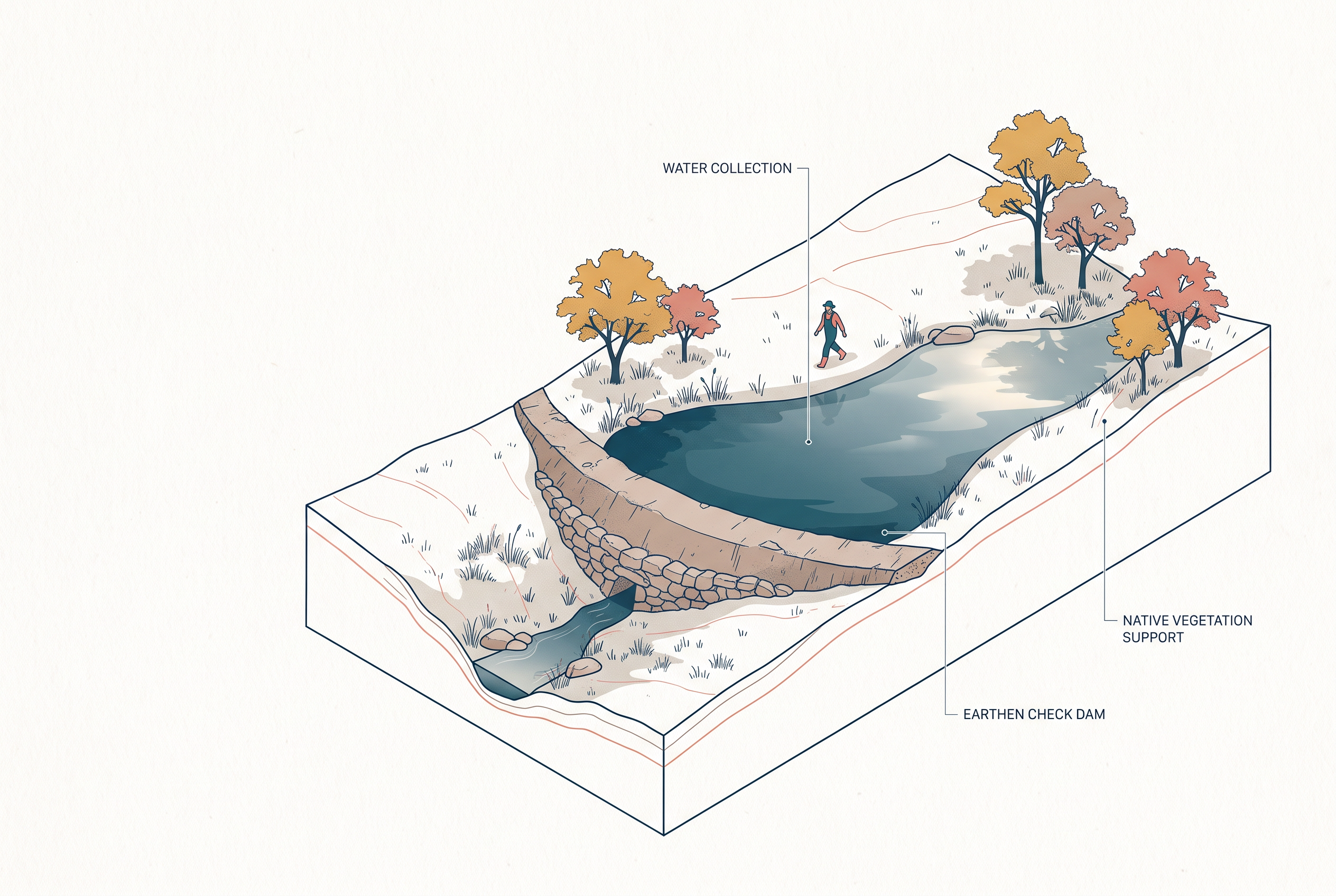
Fig. 3.4 – An earthen check dam in a village landscape.
Values, norms and knowledge systems
Different relationships with the environment also reflect different social values and norms, and different knowledge systems. What a society believes nature is for shapes what it does to nature.
The values underlying capitalism have supported the commodification of nature — turning nature into objects that can be bought and sold for profit. A river, for instance, carries many meanings at once: ecological, utilitarian, spiritual, aesthetic. For an entrepreneur selling water, all of these are stripped down to a single set of calculations about profit and loss.
Socialist values of equality and justice have led, in a number of countries, to the seizure of land from large landlords and its redistribution among landless peasants — a different answer to the question of who should control nature.
Religious values have pulled in more than one direction. Some social groups have protected and conserved sacred groves and sacred species. Others have held that they have divine sanction to change the environment to suit their needs.
Perspectives on the environment, and the knowledge that produced them
There are many different perspectives on the environment and its relationship to society, and they disagree with one another.
One long-running disagreement is the ‘nature–nurture’ debate: are individual characteristics innate, or are they influenced by environmental factors? Put in a social form, the question becomes uncomfortable. Are people poor because they are innately less talented or less hard-working — or because they are born into a situation of disadvantage and lack of opportunity?
Notice what such a question does. If disadvantage is said to be innate, then nothing needs to change. If it is said to be produced by circumstances, then the circumstances come under scrutiny.
Theories and data about environment and society are themselves influenced by the social conditions under which they emerge. The notions that women are intrinsically less able than men, and that Blacks are naturally less able than Whites, were widely asserted in their time and were challenged only as ideas of equality became more widespread during the social and political revolutions of the 18th century. Ideas about nature, in other words, have a history — and a politics.
Colonialism generated a great deal of knowledge about environment and society, and it compiled that knowledge systematically, in order to make resources available to the imperial powers. Geology, geography, botany, zoology, forestry and hydraulic engineering were among the many disciplines that were created and institutionalised in this period to facilitate the management of natural resources for colonial purposes.
This is worth pausing on. Knowledge that we now think of as neutral and technical — a soil survey, a forest map, a river gauge — was often first assembled to serve a particular set of interests.
Environmental management and the risk society
If nature is so thoroughly shaped by society, can society not simply manage it well? In practice, environmental management is a very difficult task.
First, not enough is known about biophysical processes to predict and control them. Our science is incomplete, and nature does not wait for it to catch up.
Second, human relations with the environment have become increasingly complex. With the spread of industrialisation, resource extraction has expanded and accelerated, affecting ecosystems in unprecedented ways.
Third, complex industrial technologies and modes of organisation require sophisticated management systems — and such systems are often fragile and vulnerable to error. The more elaborate the machinery, the more ways there are for it to fail.
The result is that we live in risk societies: we use technologies and products that we do not fully grasp. Very few of the people who depend daily on a chemical plant, a nuclear reactor, a pesticide or a processed food can say precisely what would happen if it went wrong.
The nuclear disaster at Chernobyl, industrial accidents such as Bhopal, and Mad Cow disease in Europe all show the dangers that are built into industrial environments. These were not acts of nature. They were failures inside human systems.
Union Carbide’s arrival in Bhopal in 1977 was welcomed by all, because it meant jobs and money for the city, and savings in foreign exchange for the country, with the demand for pesticides rising after the Green Revolution. The MIC plant was troublesome from the start, and there were several leakages — including one that caused the death of a plant operator — before the big disaster. The government nonetheless ignored the warnings. The head of the Bhopal Municipal Corporation issued a notice to Union Carbide to move out of Bhopal in the late 1970s; the officer was transferred, and the company donated Rs 25,000 to the Corporation for a park.
The warnings kept coming. In May 1982, three experts from the Union Carbide Corporation in the USA surveyed safety measures and pointed out alarming lapses. Those fears were reported in a local weekly, Rapat, in a series of articles in 1982 that proved prophetic. The factory’s employees’ union wrote to Central ministers and to the chief minister warning them of the situation. The state Labour Minister repeatedly reassured legislators that the factory was safe. Only a few weeks before the gas leak, the factory was granted an environmental clearance certificate by the state pollution control board. The Central government was no less casual: it ignored the plant’s safety record when granting permission, and ignored the Department of Environment’s guidelines on the siting of hazardous plants.
Why the guidelines and warnings were ignored, the report argued, is clear enough. The company employed the relatives of powerful politicians and bureaucrats. Its legal adviser was an important political leader and its public relations officer the nephew of a former minister. Its guesthouse was always at the disposal of politicians. The chief minister’s wife had reportedly received lavish hospitality from the company during visits to the USA, and the company had donated Rs 1.5 lakh to a welfare organisation in the chief minister’s home town.
The corporation played its own full part in the run-up to the tragedy. The Bhopal plant was under-designed and lacked several safety features. It had no computerised early warning system, though this was standard in the company’s factories in the US. No emergency evacuation procedures had been worked out with the local community. The plant was not being maintained or operated at the required level of efficiency. Morale was low because sales were dropping and the plant was running at a third of its capacity. Staff strength had been cut, many engineers and operators had left, and the remaining staff could not monitor all the tasks. Many instruments were simply out of order.
Notice what the Bhopal account demonstrates. A “technological” disaster turns out, on inspection, to be a social one: a matter of who owned the plant, who regulated it, who was listened to, who was transferred, and who lived next door. That insight — that environmental crises are social crises — is what the rest of this chapter builds on.
3.2 Major Environmental Problems and Risks
Which environmental hazard matters most depends on where you stand. The urgency of a problem varies from country to country and from context to context: a farmer in a drought-prone district and a resident of a congested city will not name the same danger first.
Even so, some hazards are recognised globally as the main ones. The five that follow are the categories sociologists most often work with, and each of them, as you will see, is as much about social arrangements as about physical processes.
3.2.1 Resource Depletion
Using up non-renewable natural resources is one of the most serious environmental problems. Resource depletion means drawing down a stock of nature faster than it can be replaced — and in many cases, faster than it can ever be replaced.
Fossil fuels, and especially petroleum, take up most of the headlines. But the depletion and destruction of water and land is probably even more rapid, and it attracts far less attention.
Water
The rapid decline in groundwater levels is an acute problem all over India, and especially in the states of Punjab, Haryana and Uttar Pradesh. Aquifers — the natural underground formations in the geology of a region where water gets stored — have accumulated their water over hundreds and thousands of years.
That patient accumulation is now being emptied in a matter of a few decades, to meet the growing demands of intensive agriculture, industry and urban centres. A resource built up over millennia is being spent within a single lifetime.
Rivers, too, have been dammed and diverted, causing irreversible damage to the ecology of whole water basins. And in urban areas, many water bodies have simply been filled up and built upon, destroying the natural drainage of the landscape — which is one reason a modern city floods after a heavy shower where an older, wetter landscape did not.
Soil
Like groundwater, topsoil too is created over thousands of years. It is not a surface but an achievement — the slow product of rock, water, plants and organisms working on one another.
This agricultural resource is also being destroyed, largely through poor environmental management. Erosion strips it away, water-logging drowns it, and salinisation — the build-up of salts, often after years of heavy irrigation — poisons it for cultivation. The production of bricks for building houses is another reason for the loss of topsoil, since brick-makers dig up precisely the fertile upper layer.
Biodiversity habitats
Biodiversity habitats — forests, grasslands and wetlands — are the other major resource facing rapid depletion, largely because the area under agriculture keeps expanding into them. Where a mixed habitat is replaced by a single crop, the plant life of a whole locality can be reduced to one variety, a condition called monoculture.
The picture is not uniform. Various parts of the globe, including some parts of India, appear to have seen some re-forestation, or an increase in vegetative cover, in recent decades. But the overall trend is still towards the loss of biodiversity.
The shrinking of these habitats has endangered many species, several of them unique to India. You may have read of the crisis that came to light when it was discovered that the tiger population had fallen sharply — and this despite strict laws and large sanctuaries. Law on paper and habitat on the ground are not the same thing.
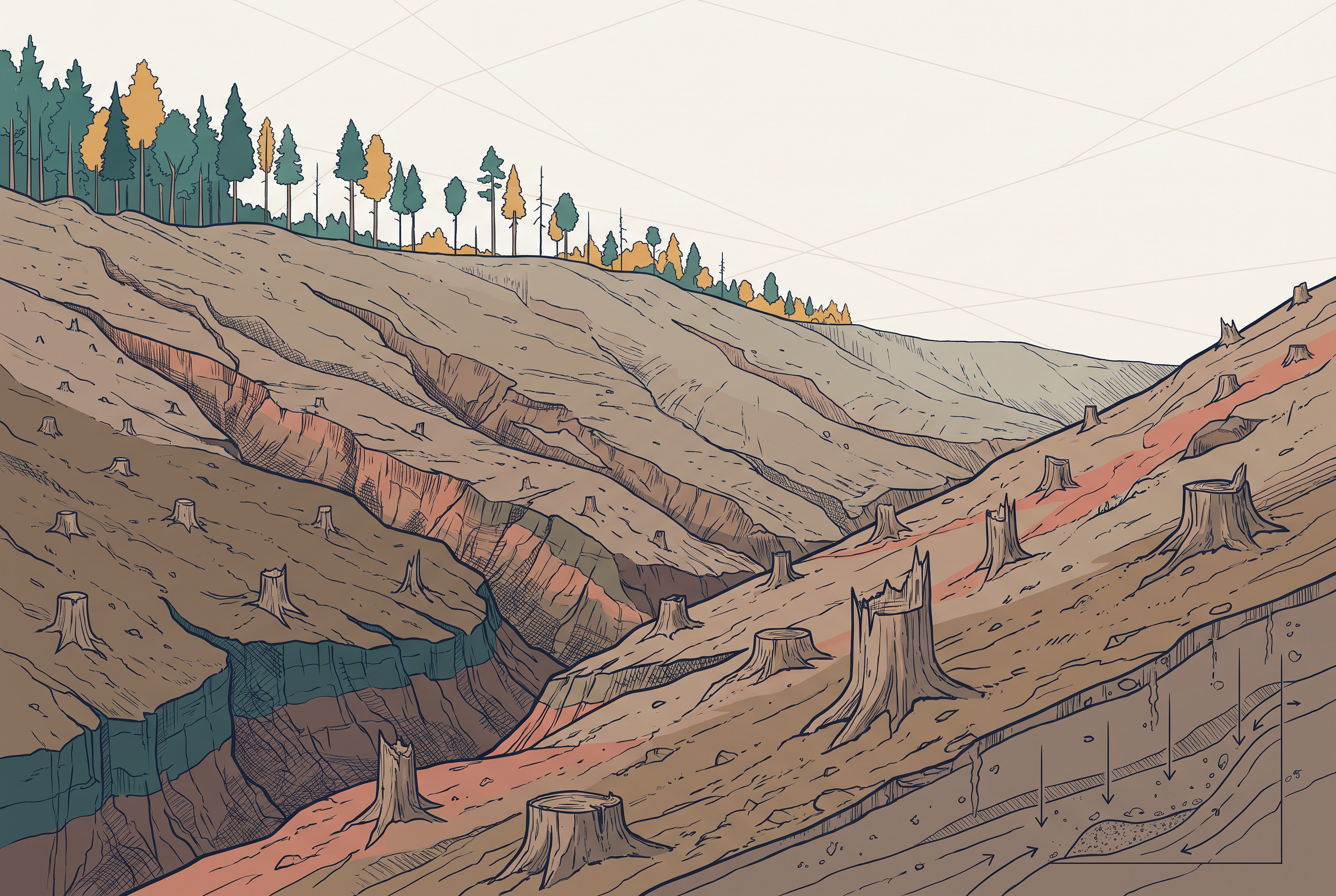
Fig. 3.6 – Deforestation and soil erosion on a hillside.
3.2.2 Pollution
Pollution is the second great category of environmental problems, and it takes three forms in this chapter: air, water and noise.
Air pollution
Air pollution is considered to be a major environmental problem in urban and rural areas, causing respiratory and other problems that result in serious illness and death.
Its sources include emissions — the waste gases given off by human-initiated processes — from industries and vehicles, as well as the burning of wood and coal for domestic use. We have all heard about pollution from vehicles and factories, and we have all seen pictures of smoking chimneys and exhaust pipes.
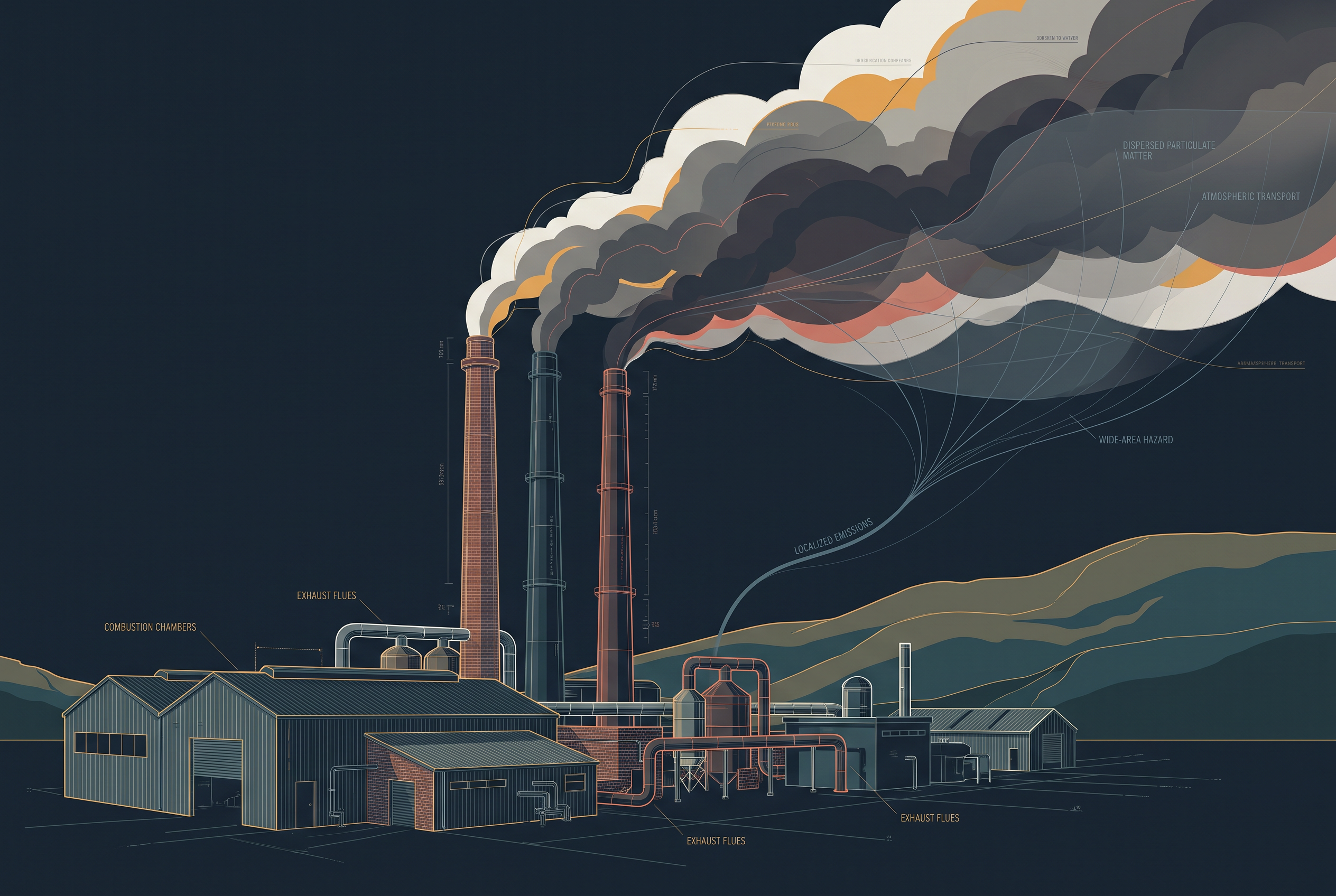
Fig. 3.7 – Industrial emissions polluting the air.
What we often do not realise is that indoor pollution from cooking fires is also a serious source of risk. This is particularly true of rural homes, where wood fires burning green or poorly seasoned wood, badly designed fireplaces (chulhas — traditional cooking stoves) and poor ventilation combine to fill a small kitchen with smoke.
And here the health risk falls where the work falls. Village women are at serious risk from indoor pollution because they are the ones who do the cooking. The hazard is distributed by the division of labour inside the household.
The scale of this problem is easy to underestimate. The World Health Organization reported that in 2012 around 7 million people died — one in eight of all deaths worldwide — as a result of exposure to air pollution. This finding more than doubled previous estimates, and it confirmed that air pollution is now the world’s largest single environmental health risk. Reducing air pollution could save millions of lives.
It also allowed scientists to analyse health risks across a wider demographic spread, one that now includes rural as well as urban areas. Table 3.1 sets out the WHO’s figures for that year.
Table 3.1 – Deaths linked to air pollution exposure, world, 2012 (WHO estimates, in millions) | Type of air pollution | Deaths in 2012 (millions) | |—|—| | Indoor air pollution | 3.3 | | Outdoor air pollution | 2.6 | | Total deaths from exposure to air pollution | around 7 |
Read Table 3.1 slowly. The single largest share of these deaths is linked not to factory chimneys or exhaust pipes but to indoor air pollution — that is, to cooking smoke inside people’s own homes. The most lethal form of air pollution in the world, on these figures, is also the least visible and the least discussed.
Water pollution
Water pollution is also a very serious issue, and it affects surface water and groundwater alike.
Its major sources include domestic sewage and factory effluents — the waste materials in fluid form that industrial processes produce. But they also include the runoff from farms where large amounts of synthetic fertilisers and pesticides are used, which drains off the fields and into the nearest channel.
The pollution of rivers and waterbodies is a particularly important problem, partly because a river carries the damage downstream to people who had no part in causing it.
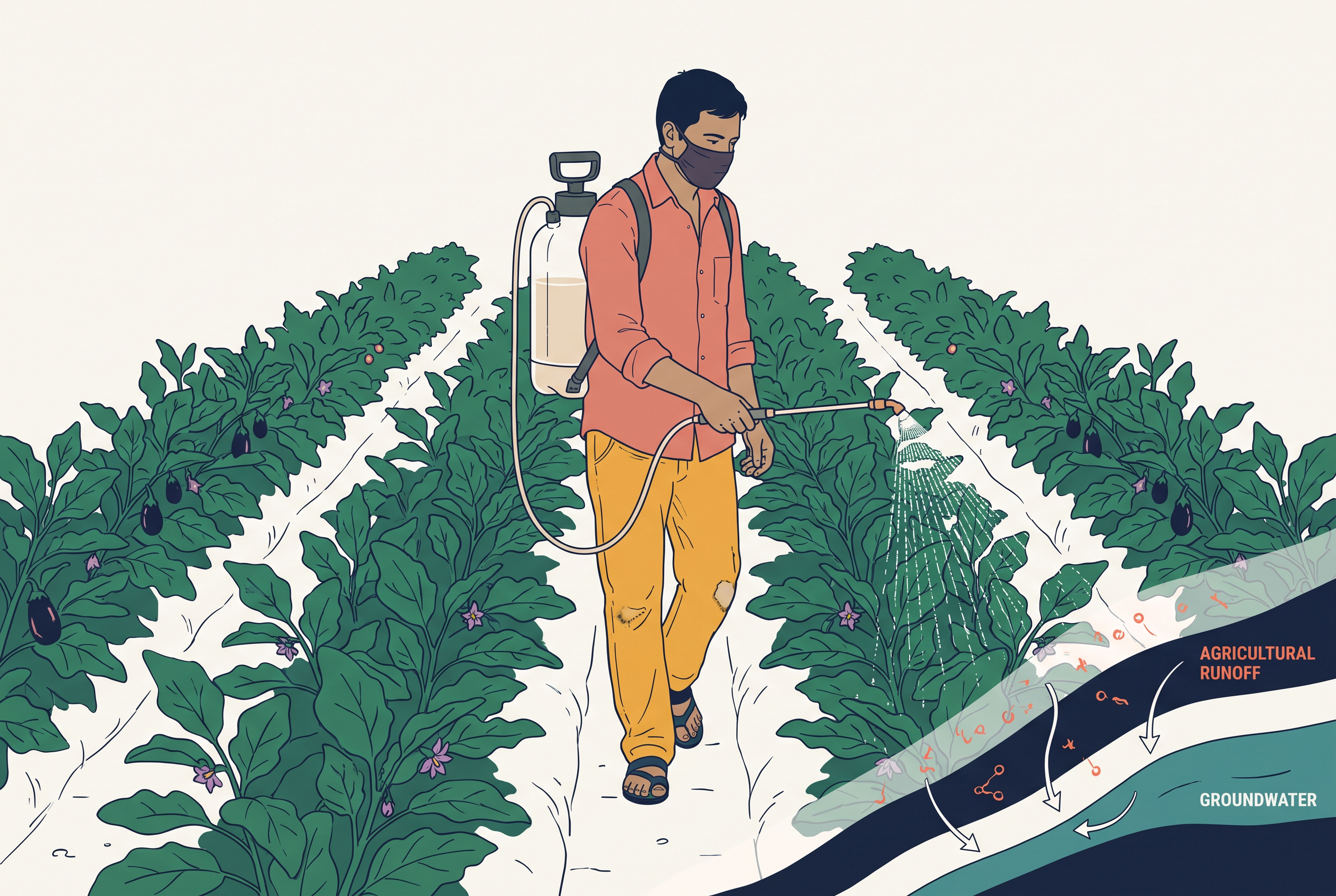
Fig. 3.8 – A farmer spraying pesticide in a field.
Noise pollution
Cities also suffer from noise pollution, which has been the subject of court orders in many cities.
Its sources are ordinary and everywhere: amplified loudspeakers used at religious and cultural events, loudspeakers used in political campaigns, vehicle horns and traffic, and construction work. Noise pollution is a useful reminder that an environmental problem need not involve any chemical at all — it can be produced simply by the way people organise their public life.
3.2.3 Global Warming
The release of particular gases — carbon dioxide, methane and others — creates a greenhouse effect. Just as a green house is a covered structure that traps warmth and keeps the plants inside it warmer than the air outside, these gases trap the sun’s heat in the atmosphere and do not allow it to dissipate.
This has caused a small but significant rise in global temperatures. The word “small” misleads: a change of a degree or two in an average is not like a warm afternoon, because it shifts the behaviour of entire systems.
The resulting climate change is projected to melt polar ice-fields and raise the sea level, submerging low-lying coastal areas — and, more important still, affecting the ecological balance. Global warming is also likely to result in greater fluctuations and greater uncertainty in climates across the world, so that a farmer can no longer rely on the rains arriving when they have always arrived.
China and India are increasingly significant contributors to world carbon and greenhouse gas emissions. This is one reason why global warming has become an international political question and not merely a scientific one: the countries that emit, the countries that suffer and the countries that must pay to change are not the same countries.
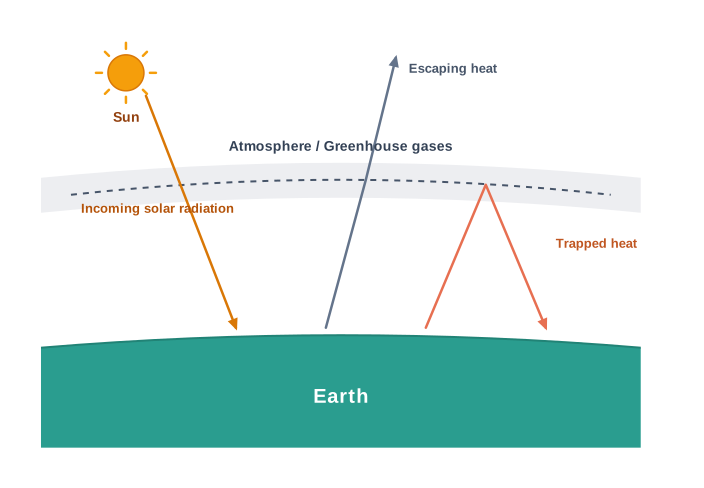
Fig. 3.9 – The greenhouse effect.
3.2.4 Genetically Modified Organisms
New techniques of gene-splicing allow scientists to import genes from one species into another, introducing new characteristics into the receiving species. The organisms so produced are called genetically modified organisms.
The best-known Indian example is cotton. Genes from Bacillus thuringiensis have been introduced into cotton species, making the plant resistant to the bollworm, a major pest. Genetic modification may also be used to shorten the growing time of a crop, to increase its size, or to extend its shelf-life.
The gains, then, are real. So are the doubts.
Little is known about the long-term effects of genetic modification — either on the people who eat these foods or on ecological systems into which the modified plants are released.
There is also a question of control, and it is a sociological one. Agricultural companies can use genetic modification to create sterile seeds. A sterile seed cannot be saved from this year’s harvest and sown next year, which means the farmer must buy fresh seed every season. The seed remains the company’s profit-yielding property, and the farmer is made dependent on the company — a reversal of a practice as old as agriculture itself, in which the farmer kept back part of the crop as next year’s seed.
3.2.5 Natural and Man-made Environmental Disasters
This is a self-explanatory category, and both halves of its name matter.
The Bhopal disaster of 1984, described earlier in this chapter, killed about 4,000 people when a toxic gas leaked from the Union Carbide factory. It is the standard example of a man-made environmental disaster: nothing about it was inevitable, and at every stage a different human decision could have prevented it.
The tsunami of 2004 killed thousands of people, and is the standard example of a natural environmental disaster: no human being caused the earthquake beneath the sea.
But the line between the two is thinner than it looks. How many die in a “natural” disaster depends on where people were living, what their houses were built of, whether a warning reached them, and whether anyone came to help — and every one of those is a social question. This is the point the next section takes up.
3.3 Why Environmental Problems are also Social Problems
The same crisis, unequal consequences
A drought falls on a village. The rain fails for everybody in it. Yet within a few months, some households are managing and others are not.
How an environmental problem affects different groups is a function of social inequality. Social status and power determine the extent to which people can insulate themselves from an environmental crisis, or recover from one once it has struck.
Worse, the ‘solutions’ that some groups can afford may actually widen the gap. Consider Kutch in Gujarat, where water is scarce. Richer farmers there have invested in deep bore tubewells, tapping groundwater far below the surface to irrigate their fields and grow cash crops.
When the rains fail, the earthen wells of the poorer villagers — shallow, unlined, dependent on the water table close to the surface — run dry. Those villagers then do not even have water to drink. Meanwhile, across the boundary, the fields of the rich farmers stay moist and green.
The green field is not a coincidence. It is green partly because the water beneath the poorer households has been drawn away. One group’s solution has become another group’s problem.
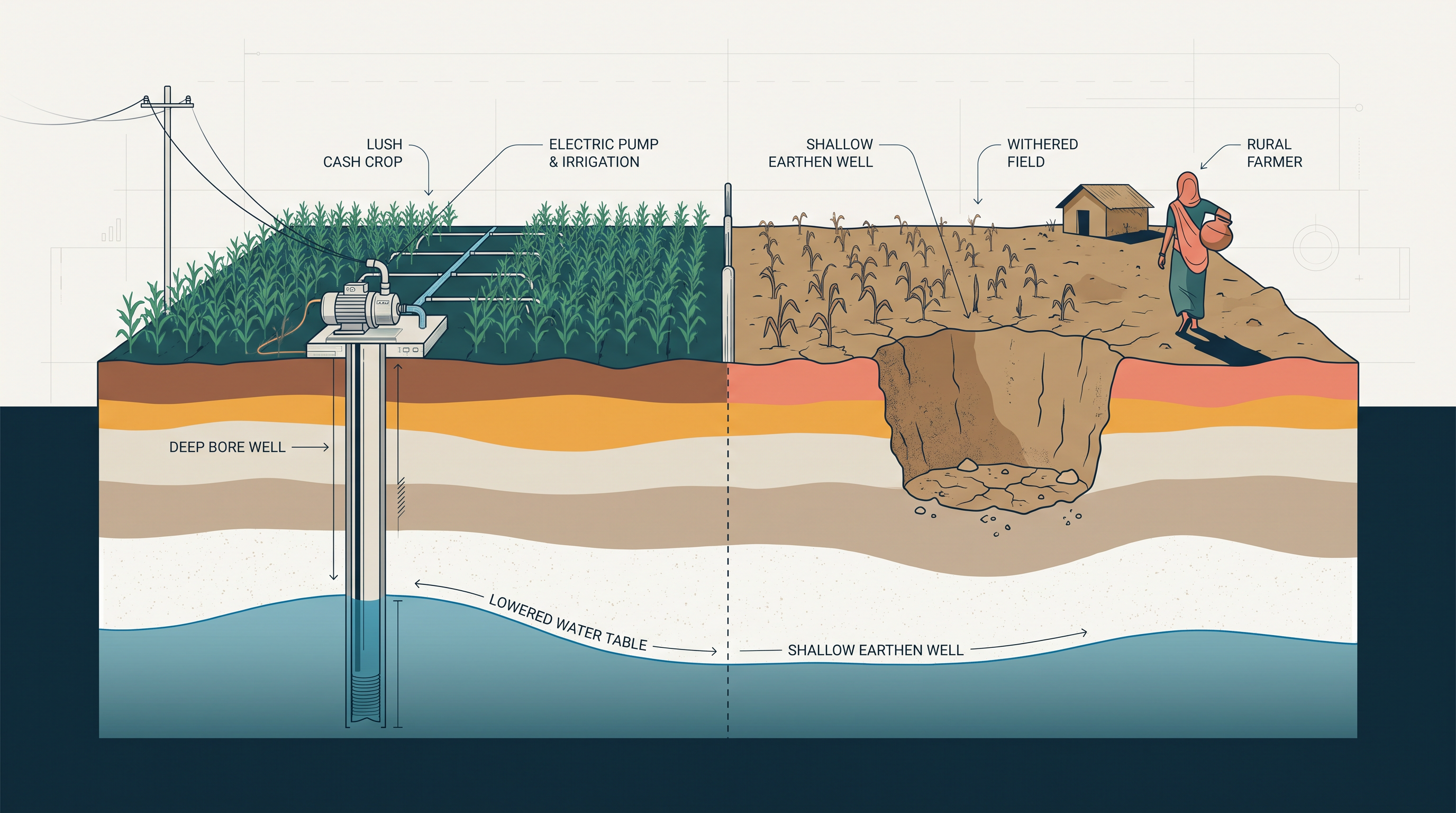
Fig. 3.10 – Unequal consequences of a falling water table.
Whose “public interest”?
Some environmental concerns look entirely universal. Reducing air pollution, protecting biodiversity — surely these are in everybody’s interest, the public interest, with no losers at all?
A sociological analysis complicates that comfortable picture. It asks how public priorities are set and how they are pursued, and it finds that the answers are not always universally beneficial.
Securing the “public interest” may in practice serve the interests of particular politically and economically powerful groups. It may also hurt the interests of the poor and the politically weak — who are rarely the people setting the priorities.
The debates over large dams, and the debates around protected areas, show this clearly. In both, one group’s gain is another group’s displacement. The environment as a public interest is, as the evidence shows, a hotly contested arena.
3.3.1 Sustainable Development
The relation between ecology and economy has been a complex one. But one thing is certain: unless there is a balance between the two, the future of humanity will remain bleak.
For the last 300 years, economic development has proceeded by emphasising control over nature and exploiting it ruthlessly for the benefit of one section of the population. This has led to the extinction of thousands of species of flora and fauna.
The emphasis on non-renewable energy, and the introduction of large numbers of new species ostensibly to meet the growing demand of the industrial world, has played havoc with ecology. There is growing concern worldwide that if the present pace of depletion of natural resources and extinction of biodiversity continues for much longer, it is future generations who will pay the price.
Out of that concern came a definition that has organised the debate ever since. It was set out in the Brundtland Report of October 1987, presented at a press conference organised by the World Commission on Environment and Development.
Read that definition carefully, because both halves of it are easily forgotten. Sustainability is not only about the future — it gives overriding priority to the essential needs of the world’s poor in the present. And the limits it speaks of are not fixed by nature alone; they are set by technology and by social organisation, which means they can be altered by changing how a society is organised.
Consumption, inequality and aspiration
Today the basis of capitalist development is consumption. Old things must be destroyed simply so that new things can be introduced, and people keep consuming new industrial products.
Writing in Down to Earth in January 2016, the environmentalist Sunita Narain argued that growth and prosperity are no longer thought sufficient, because — in her phrase — “aspiration is the new God”. Anyone who is poor is then treated as marginalised simply because they have not “made the grade”; failure has no place in this brave new world, which turns social life into a survival of the fittest that would have astonished Darwin himself.
We are living in an unequal world, in which we all want to control resources and opportunities. The system of social stratification that already exists makes it only too easy for some sections of people to control most of the available resources and opportunities.
The task, then, is to make the world worth living in not only for ourselves but for the generations to come. We cannot be ignorant of the needs of the present, nor oblivious of the needs of the future. We need to build a society in which people are on a par with one another; in which resources are distributed equitably; in which the aim is development, but development that is inclusive and not exclusive. That is what will make us sustainable.
The Global Goals
In this light, and spearheaded by the 193 member states of the United Nations together with global civil society, a deliberative process has arrived at the 17 “Global Goals” of sustainable development, with 169 targets between them.
These goals derive, to a large extent, from a sentiment often expressed by the former United Nations Secretary-General Ban Ki Moon: that there can be no Plan B, because there is no Planet B.
Conflict over water
Consider what sustainability looks like from inside a cotton field.
Over the last six years, reports have indicated that thousands of farmers in Andhra Pradesh, Karnataka and Maharashtra have taken their own lives. What drives farmers — people who deal stoically with the uncertainties inherent in agriculture — to such an extreme step?
The investigation of the journalist P. Sainath shows that this recent distress arises from a fusion of environmental and economic factors. Agrarian conditions have become more volatile as farmers are exposed to the fluctuations of the world market, and as government support for small farmers declines under liberalisation policies.
Cotton is a high-risk, high-return crop. It needs some irrigation, and it is very susceptible to pest infestation. Cotton growers therefore need capital to invest in irrigation and in pest control.
Both of these inputs have become more expensive over the years, and the reasons are environmental. High levels of extraction have depleted water reserves, so farmers must drill deeper for water. Pests have become resistant to many pesticides, so farmers must spray new pesticides, more frequently.
Farmers who need credit to purchase these inputs end up approaching private moneylenders and traders, who charge them high rates of interest. If the crop then fails, the farmer cannot repay the money. Not only can such a family not feed itself, it cannot fulfil family obligations such as arranging children’s marriages. Facing financial and social ruin together, many farmers have felt they had nowhere left to turn.
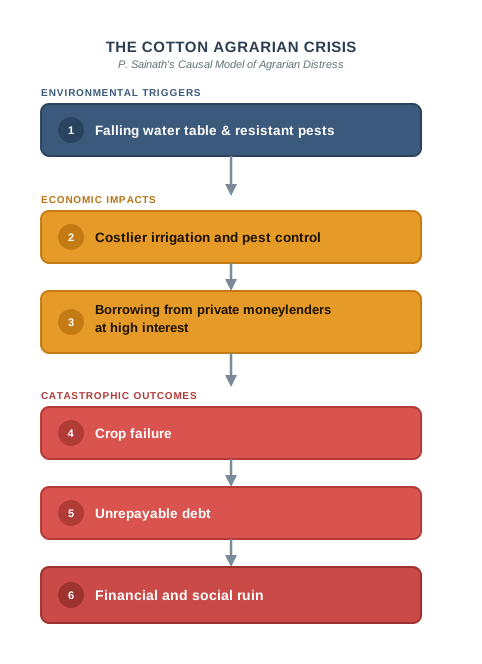
Fig. 3.11 – The chain of agrarian distress.
Conflict over urban space
The second conflict is over land — and it is being fought in every growing Indian city.
As cities grow, the conflict over urban space becomes more acute. Migrants come to the city in search of work, but they cannot afford the scarce legal housing available, and so they are forced to settle on public land.
That public land is now in great demand for building infrastructure for affluent residents and visitors — malls and multiplexes, hotels and tourist sites. As a result, poor workers and their families are being evicted to the outskirts of the city and their homes demolished.
And land is not the only contested resource. Air and water, too, have become highly contested resources in the urban environment: who gets piped water and how many hours a day, whose neighbourhood the sewage flows through, whose street the traffic and the dust settle on. (This account draws on the work of the sociologist Amita Baviskar on space, power and identity in the making of metropolitan Delhi, published in the International Social Science Journal in 2003.)
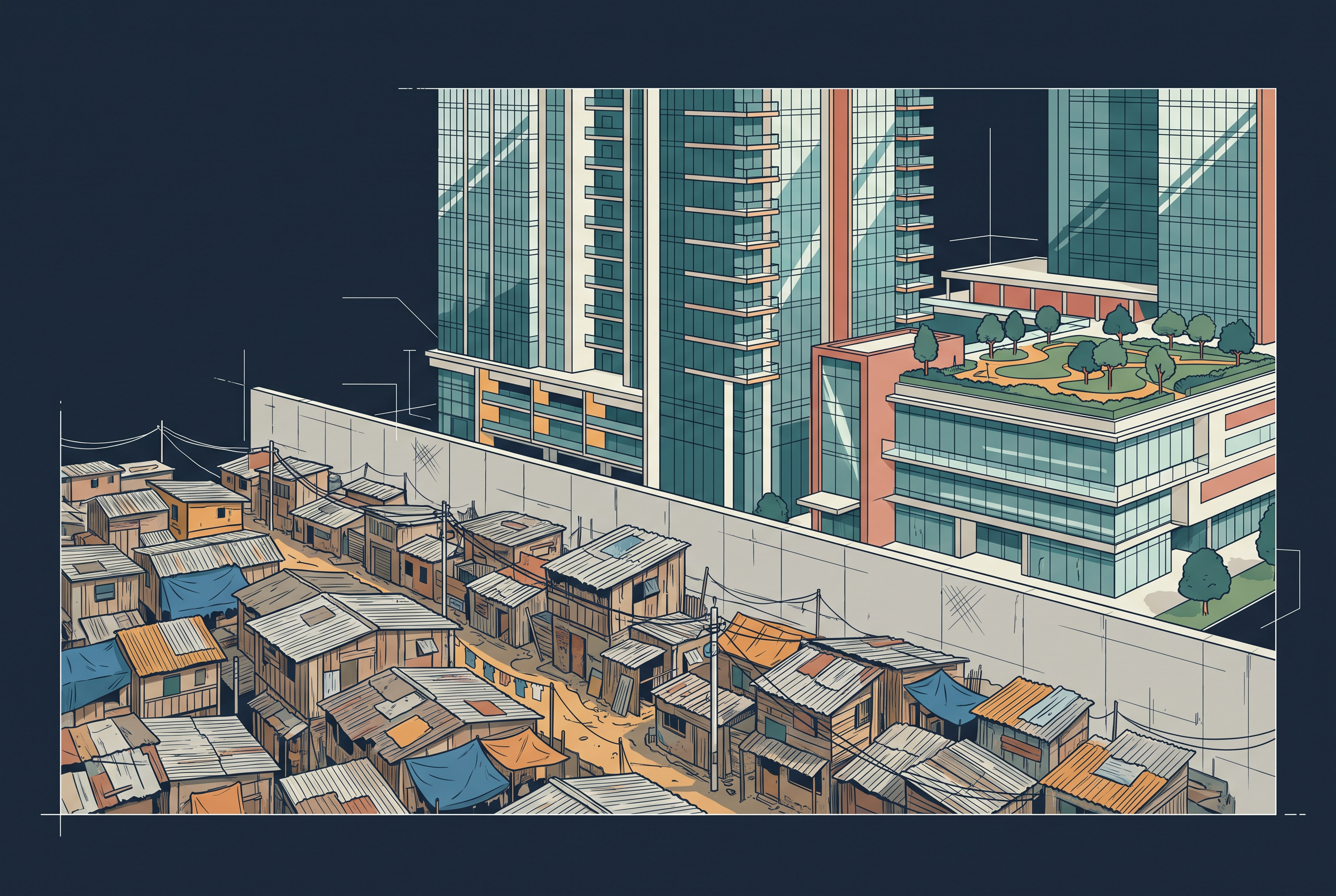
Fig. 3.12 – The conflict over urban space.
What the two conflicts have in common
Water in a cotton field and land at the edge of a city look like different problems. Sociologically they are the same problem in two settings.
In each, an environmental resource is scarce; in each, the scarcity is at least partly produced by how the resource has been used; and in each, the burden of the scarcity falls on the group with the least power to shape the decision. That is what it means to say that environmental problems are simultaneously social problems.
3.4 Summary
Environment, ecology and society
Every material object we use — a chair, a fan, a lunch box — can be traced back to nature through a long chain of extraction, processing, transport and trade. Society is continuously made out of the environment.
Ecology is the web of physical and biological systems and processes of which human beings are one element. It is shaped by the interaction of a place’s geography and hydrology, and it limits and shapes how people can live there.
Ecology has itself been modified by human action. Aridity, flood-proneness, deforestation and climate change show how what looks natural is often produced by human intervention. Over time, natural and human factors in ecological change become hard to separate.
Some environments are obviously human-made: the agricultural farm with its conservation works, cultivated plants, domesticated animals, fertilisers and pesticides; and the built environment of the city, made of concrete, brick, glass and tar.
Social environments emerge from the interaction between biophysical ecology and human intervention. This is a two-way process: nature shapes society (the fertile Indo-Gangetic floodplain supports intensive agriculture, surplus and complex states; the Rajasthan desert supports mobile pastoralists), and society shapes nature (capitalism and the private automobile bring congestion, air pollution, conflicts over oil and global warming).
The interaction is shaped by social organisation. Property relations decide who may use a resource and on what terms; the division of labour decides who works with it. In rural India, women feel resource scarcity more acutely because fetching fuel and water is treated as their task, though they do not control these resources.
It is also shaped by social values, norms and knowledge systems. Capitalist values support the commodification of nature, reducing a river’s ecological, utilitarian, spiritual and aesthetic meanings to profit and loss. Socialist values of equality have led to redistribution of land. Religious values have led some groups to conserve sacred groves and species, and others to claim divine sanction to change nature.
Perspectives on the environment differ, including the ‘nature–nurture’ debate over whether disadvantage is innate or produced by circumstances. Theories and data are themselves shaped by the social conditions in which they emerge: claims about the inferiority of women and of Blacks were challenged as ideas of equality spread in the 18th century’s social and political revolutions, and colonialism systematically produced knowledge — geology, geography, botany, zoology, forestry, hydraulic engineering — to make resources available to the imperial powers.
Environmental management is difficult: biophysical processes are imperfectly understood, industrialisation has accelerated extraction, and complex technologies need management systems that are fragile and error-prone. We therefore live in risk societies, using technologies we do not fully grasp — as Chernobyl, Bhopal and Mad Cow disease showed.
Major environmental problems and risks
Resource depletion. Non-renewable resources are being used up. Groundwater is falling sharply in Punjab, Haryana and Uttar Pradesh, as aquifers built over thousands of years are emptied in decades. Rivers are dammed and diverted, urban water bodies filled in. Topsoil, also made over thousands of years, is lost to erosion, water-logging, salinisation and brick-making. Biodiversity habitats — forests, grasslands, wetlands — shrink as agriculture expands, endangering species unique to India, as the sharp fall in the tiger population showed despite strict laws and large sanctuaries.
Pollution. Air pollution, from industrial and vehicular emissions and the domestic burning of wood and coal, is a major health hazard in rural as well as urban areas. Indoor pollution from cooking fires puts village women at particular risk because they do the cooking. WHO reported around 7 million deaths from air pollution exposure in 2012 — one in eight of all deaths worldwide — with 3.3 million linked to indoor and 2.6 million to outdoor air pollution. Water pollution comes from sewage, factory effluents and farm runoff carrying fertilisers and pesticides. Noise pollution comes from loudspeakers at religious, cultural and political events, from traffic and horns, and from construction.
Global warming. Carbon dioxide, methane and other gases trap the sun’s heat, causing a small but significant rise in global temperatures. Climate change is projected to melt polar ice-fields, raise sea levels, submerge low-lying coasts, disturb the ecological balance, and make climates more uncertain. China and India are increasingly significant contributors to world carbon and greenhouse gas emissions.
Genetically modified organisms. Gene-splicing transfers genes across species — genes from Bacillus thuringiensis make cotton resistant to the bollworm — and can shorten growing time or extend shelf-life. But long-term effects on human health and ecological systems are little known, and sterile seeds force farmers to buy fresh seed each season, making them dependent on agricultural companies.
Natural and man-made disasters. The Bhopal disaster of 1984, in which about 4,000 people died when toxic gas leaked from the Union Carbide factory, is a man-made disaster; the tsunami of 2004, which killed thousands, is a natural one.
3.5 Key Terms
Aquifers — Natural underground formations in the geology of a region where water gets stored.
Commodification of nature — The turning of nature into objects that can be bought and sold for profit, so that a river’s ecological, spiritual and aesthetic meanings are reduced to calculations of profit and loss.
Deforestation — The loss of forest area due to the cutting down of trees, or the taking over of forest land for other purposes, usually cultivation.
Ecology — The web of physical and biological systems and processes of which human beings are one element.
Effluents — Waste materials in fluid form produced from industrial processes.
Emissions — Waste gases given off by a human-initiated process, usually in the context of industries or vehicles.
Genetically modified organisms — Organisms into which genes from another species have been introduced by gene-splicing, giving them new characteristics such as resistance to a pest.
Green House — A covered structure for protecting plants from extremes of climate, usually from excessive cold; it maintains a warmer temperature inside than outside. The ‘greenhouse effect’ is named after it: gases such as carbon dioxide and methane trap the sun’s heat in the atmosphere in a similar way.
Human action — Human intervention that modifies ecology over time, so that features which appear natural — aridity, flood-proneness, a forest, a meadow — are often the product of past human decisions.
Hydrology — The science of water and its flows; or the broad structure of water resources in a country or region.
Monoculture — When the plant life in a locality or region is reduced to a single variety.
Perspectives on the environment — The different and competing ways of understanding the environment and its relation to society, including the ‘nature–nurture’ debate about whether human characteristics are innate or produced by circumstances.
Pollution — The contamination of air, water or the acoustic environment by emissions, effluents, smoke, sewage, farm runoff or noise, causing illness and ecological damage.
Resource depletion — The using up of non-renewable natural resources, such as fossil fuels, groundwater, topsoil and biodiversity habitats, faster than they can be replaced.
Risk societies — Societies in which people live with, and depend upon, complex technologies and products whose workings and dangers they do not fully understand or control.
Social ecology — The school of thought which holds that social relations, especially the organisation of property and production, shape environmental perceptions and practices, so that ecological problems arise from — and cannot be resolved apart from — problems within society.
Social environments — The environments that emerge from the interaction between biophysical ecology and human intervention; neither purely natural nor purely social.
Social inequality — The unequal distribution of status, power and resources between social groups, which determines who can insulate themselves from an environmental crisis and who bears its burden.
Social organisation — The arrangement of property relations and the division of labour in a society, which determines how and by whom natural resources can be used.
Social values and norms — The shared beliefs and rules — capitalist, socialist, religious — through which a society decides what nature is for and how it may be treated.
Sustainable development — Development that meets the needs of the present, giving overriding priority to the essential needs of the world’s poor, without compromising the ability of future generations to meet their own needs.
3.6 Points to Ponder
If a forest was planted, a meadow was cleared and a river was dammed, is there anything left in our surroundings that can honestly be called “natural”? And if the answer is no, does the word “environment” still mean anything useful to a sociologist?
Air pollution harms everyone who breathes. Does that make it a shared problem, or does the ability to buy distance from it — a home away from the traffic, a filtered room, a doctor when the cough begins — turn even a shared problem into an unequal one?
Social ecology argues that ecological problems arise from social problems. If a society removed every inequality within it, would its environmental problems disappear — or would the limits of soil, water and climate still remain?
Sustainable development asks us to consider people not yet born. How can a society weigh the essential needs of the poor who are alive today against the needs of generations who cannot yet speak for themselves?
The same forest is revenue to a department, raw material to an industry, and a livelihood to an artisan. When these ways of seeing collide, whose knowledge of the forest should count as knowledge — and who decides?
Technology has made us safer in a hundred ways and, sociologists argue, more exposed in a few enormous ones. Is a “risk society” the price of modern comfort, or the result of choices that could have been made differently?
3.7 NCERT Questions
Describe, in your own words, what you understand by the term ‘ecology’.
Why is ecology not limited only to the forces of nature?
Describe the two-way process by which ‘social environments’ emerge.
Why and how does social organisation shape the relationship between the environment and society?
Why is environmental management a complex and huge task for society?
What are some of the important forms of pollution-related environmental hazards?
What are the major environmental issues associated with resource depletion?
Explain why environmental problems are simultaneously social problems.
What is meant by social ecology?
Describe some environment-related conflicts that you know of or have read about, other than the examples given in the text.
3.8 Objective Questions
Ecology may best be described as:
- the study of plants and animals alone
- the web of physical and biological systems and processes of which humans are one element
- the surroundings created entirely by human beings
- the science of water and its flows [1 mark]
Natural underground formations in the geology of a region where water gets stored are called:
- effluents
- chaurs
- aquifers
- catchments [1 mark]
Which of the following is a source of indoor air pollution?
- Factory chimneys
- Vehicle exhaust
- Cooking fires using green or poorly burning wood
- Construction work [1 mark]
Genes from Bacillus thuringiensis have been introduced into cotton in order to make the plant resistant to:
- drought
- the bollworm
- salinisation
- water-logging [1 mark]
The definition of sustainable development quoted in this chapter is taken from:
- the Brundtland Report of October 1987
- the Second Citizens’ Report of the Centre for Science and Environment
- the 17 Global Goals
- a report of the World Health Organization [1 mark]
According to the WHO figures given in this chapter, the number of deaths in 2012 linked to indoor air pollution was:
- 2.6 million
- 3.3 million
- 7 million
- 4,000 [1 mark]
Fill in the blank: The reduction of the plant life in a locality or region to a single variety is called __________. [1 mark]
Fill in the blank: Waste materials in fluid form produced from industrial processes are called __________, while waste gases given off by a human-initiated process are called __________. [1 mark]
True or False: The desert of Rajasthan supports intensive settled agriculture and dense population settlements, while the Indo-Gangetic floodplain supports mobile pastoralism. [1 mark]
Match the following:
| Column A | Column B |
|---|---|
| a. Murray Bookchin | i. Investigation of agrarian distress in cotton-growing regions |
| b. P. Sainath | ii. Space, power and identity in the making of metropolitan Delhi |
| c. Amita Baviskar | iii. Social ecology and the Institute for Social Ecology |
| d. Brundtland Report, 1987 | iv. The definition of sustainable development |
[1 mark]
- Assertion (A): In rural India, women often experience resource scarcity more acutely than men. Reason (R): Gathering fuel and fetching water are generally treated as women’s tasks, although women do not control these resources.
- Both (A) and (R) are true, and (R) is the correct explanation of (A)
- Both (A) and (R) are true, but (R) is not the correct explanation of (A)
- (A) is true, but (R) is false
- (A) is false, but (R) is true [1 mark]
- Assertion (A): A river becoming more flood-prone is always a purely natural occurrence. Reason (R): Deforestation in the upper catchment of a river can increase its flood-proneness.
- Both (A) and (R) are true, and (R) is the correct explanation of (A)
- Both (A) and (R) are true, but (R) is not the correct explanation of (A)
- (A) is true, but (R) is false
- (A) is false, but (R) is true [1 mark]
- Assertion (A): We are said to live in “risk societies”. Reason (R): Complex industrial technologies require sophisticated management systems that are often fragile and vulnerable to error, and we use products whose workings we do not fully grasp.
- Both (A) and (R) are true, and (R) is the correct explanation of (A)
- Both (A) and (R) are true, but (R) is not the correct explanation of (A)
- (A) is true, but (R) is false
- (A) is false, but (R) is true [1 mark]
3.9 Check Your Concepts
Define ecology and name any two elements that form part of the ecology of a place. [2 marks]
What is meant by a social environment? Give one example. [2 marks]
State the meaning of resource depletion and give one Indian example of it. [2 marks]
What is meant by the commodification of nature? [2 marks]
Name the two key concepts contained within the Brundtland Report’s definition of sustainable development. [2 marks]
Differentiate between emissions and effluents, giving one example of each. [4 marks]
“Nature shapes society, and society shapes nature.” Explain this two-way process with one Indian example of each direction. [4 marks]
Why is indoor air pollution described in this chapter as a gendered health risk? Give reasons. [4 marks]
Explain, with an Indian example, how property relations shape who may use a natural resource and on what terms. [4 marks]
Study the WHO figures given in the chapter for deaths linked to air pollution in the year 2012: 3.3 million deaths linked to indoor air pollution and 2.6 million linked to outdoor air pollution, with a total of around 7 million deaths from exposure to air pollution — one in eight of all deaths worldwide. What proportion of all deaths in the world that year is one in eight, expressed as a percentage? What does the relative size of the indoor figure suggest about which social groups are most exposed, and why? [4 marks]
Describe any two features of genetically modified crops that may benefit farmers, and any two that may make farmers more dependent on agricultural companies. [4 marks]
Explain what sociologists mean by a “risk society”. Illustrate your answer with examples given in the chapter, and state one limitation of managing such risks through technical expertise alone. [6 marks]
Explain the perspective of social ecology in full: its central claim, the evidence offered for it in this chapter, and one honest criticism that may be made of it. [6 marks]
“Environmental problems are simultaneously social problems.” Evaluate this claim with at least two Indian examples drawn from this chapter. [6 marks]
Discuss the causes and consequences of agrarian distress in India’s cotton-growing regions, showing how environmental and economic factors combine. [6 marks]
How far do you agree that reducing air pollution and protecting biodiversity are concerns that benefit everybody equally? Support your answer with sociological reasoning and examples of contested environmental decisions. [6 marks]
“Sustainable development is as much a claim about justice as it is a claim about ecology.” Discuss this statement, explaining both concepts contained in the Brundtland definition. [6 marks]
3.10 Passage-Based Questions
A wide grassland inside a national park in the hills draws visitors from across the country, who photograph the wildlife grazing on it and describe the place as untouched wilderness. The park’s information board says nothing about the fact that these grasslands were once cultivated fields. Some decades ago, the villages that farmed the land were relocated so that the park could be created, and the fields, left unploughed, gradually turned to meadow. The families who moved out now live in settlements outside the boundary and are not permitted to graze their cattle inside it.
- Which idea from this chapter does the “untouched wilderness” of this park illustrate? Explain your answer. [2 marks]
- Identify the environmental conflict at work here, and state which two groups stand on either side of it. [2 marks]
- Using the perspective of social ecology, explain why the park authority and the relocated villagers are likely to describe the same grassland in very different terms. [4 marks]
In a dry district, most farmers once irrigated their fields from open earthen wells fed by shallow groundwater. Over the last twenty years, a number of larger landholders have installed deep bore tubewells and powerful electric pumps, and have shifted to a water-intensive cash crop. The water table has fallen steadily since. This summer, after a weak monsoon, the earthen wells of the smaller cultivators have gone dry, and several households are walking to a distant hand pump for drinking water. The tubewell-irrigated fields nearby remain green.
- Identify the process of resource depletion described in the passage. [2 marks]
- Explain why the same failure of rainfall has produced very different outcomes for the two groups of farmers. [4 marks]
- Would you describe the water scarcity in this district as natural or as socially produced? Justify your answer with reasons drawn from the passage. [4 marks]
A chemical factory on the edge of a town has had a series of small leaks over the years. The workers’ union has written twice to the authorities; a local newspaper has carried reports; an inspecting officer who recommended stricter action was moved to another posting. The factory holds a valid clearance certificate. Its safety equipment is older than the equipment used in the same company’s plants elsewhere, staff numbers have been cut, and no evacuation plan has been discussed with the settlements immediately outside the boundary wall — which are where most of the factory’s own workers live.
- Name the concept from this chapter that best describes the situation of the people living beside this factory, and explain why it applies. [2 marks]
- List any three social institutions or organisations whose decisions have shaped the risk described above, and state the role each has played. [4 marks]
- “A technological accident is, on inspection, a social one.” Explain this statement using the details of the passage. [4 marks]
The table below shows a simplified account of what four different users want from the same stretch of forest on the edge of a growing town.
| User | What the forest is used for |
|---|---|
| Forest Department | Revenue from supplying bamboo in bulk to the paper industry |
| Paper mill | Cheap and steady raw material |
| Basket-weaving artisans | Bamboo of the right kind, cut selectively, available year after year |
| Nearby households | Firewood, fodder and a shaded path to the fields |
a. *Using the table, explain what is meant by saying that different social groups stand in different relationships to the same environment.* [2 marks]
b. *Which two users are most likely to come into direct conflict, and why?* [2 marks]
c. *The town council announces that the forest will be fenced and declared a protected area, and that no cutting of any kind will be allowed. Who gains and who loses from this decision? Discuss whether it can properly be called a decision taken "in the public interest".* [4 marks]
Social environments: a two-way process
We can now name the central idea of this chapter. Social environments emerge from the interaction between biophysical ecology and human interventions.
A social environment is what emerges from the interaction between biophysical ecology and human intervention. It is neither purely natural nor purely social, but the product of the two acting on each other.
The crucial word is interaction. This is a two-way process: just as nature shapes society, society shapes nature.
Fig. 3.5 – The emergence of the social environment.
Nature shaping society. Consider the Indo-Gangetic floodplain. Its soil is deep and fertile, and it supports intensive agriculture. High agricultural productivity allows dense settlement, and it generates enough surplus food to support people who are not farmers — artisans, traders, priests, soldiers, officials. Out of that surplus grow complex hierarchical societies and states.
Now consider the desert of Rajasthan. It can support pastoralists who move from place to place to keep their livestock supplied with fodder, but not the same dense, settled, surplus-producing agriculture. The ecology has shaped the form of human life and culture that is possible there.
Society shaping nature. The influence runs just as strongly the other way. The social organisation of capitalism has reshaped nature across the world.
Take one ordinary object: the private automobile. It is a capitalist commodity that has transformed both lives and landscapes. Air pollution and congestion in cities, regional conflicts and wars over oil, and global warming are only a few of the environmental effects of cars — and none of them was anybody’s intention when the car was designed.
Human interventions increasingly have the power to alter environments, and to alter them permanently. A drained wetland or an extinct species does not come back.
nature shaping society vs society shaping nature | Feature | Nature shaping society | Society shaping nature | |—|—|—| | Direction of influence | Ecology sets limits and possibilities for human life | Human organisation and technology remake the ecology | | Example in the chapter | Fertile Indo-Gangetic floodplain permits intensive agriculture, surplus, dense settlement and states; the Rajasthan desert permits mobile pastoralism | Capitalism and the private automobile bring congestion, air pollution, conflicts over oil and global warming | | What varies | Soil, rainfall, water, terrain | Property relations, technology, values, patterns of consumption | | Sociological lesson | Human life is ecologically conditioned, not ecologically determined | Environmental damage is socially produced, not accidental |
The ecological effects of the Industrial Revolution in Britain were felt all over the world. Large areas of southern North America and the Caribbean were converted into plantations to feed the demand for cotton in the mills of Lancashire. Young West Africans were forcibly transported to America to work as slave labour on those plantations. The depopulation of West Africa caused its agricultural economy to decline, and fields there reverted to fallow wasteland. In Britain itself, smoke from the coal-burning mills fouled the air, while farmers and labourers displaced from the countryside came into the cities for work and lived in wretched conditions. The ecological footprints of a single industry — cotton — could be found across urban and rural environments on three continents.