Chapter 2: Social Change and Social Order in Rural and Urban Society
On the edge of a growing city, there is a settlement that its older residents still call “the village”. Forty years ago it had fields on three sides, one bus a day, and a single shop that sold everything from kerosene to school notebooks. The fields are now a housing colony with a boundary wall and a guard at the gate. The bus has become a route with a bus every ten minutes. The shop has a card machine.
The older residents will tell you that everything has changed. And then, in the same conversation, they will tell you that nothing has changed. The families who owned the land still own most of the new shops. The households that were poor still send their sons to work as helpers on construction sites. Marriages are still arranged within the same circle of families, even if the invitation now goes out on WhatsApp. Whoever has the loudest voice at the local meeting is, more or less, whoever had it before.
Both statements are true. Something has been transformed, and something has held firm. Sociology takes this double fact seriously. It asks what makes a society change, what makes a society hold still, and why the answers are so different in a village and in a city.
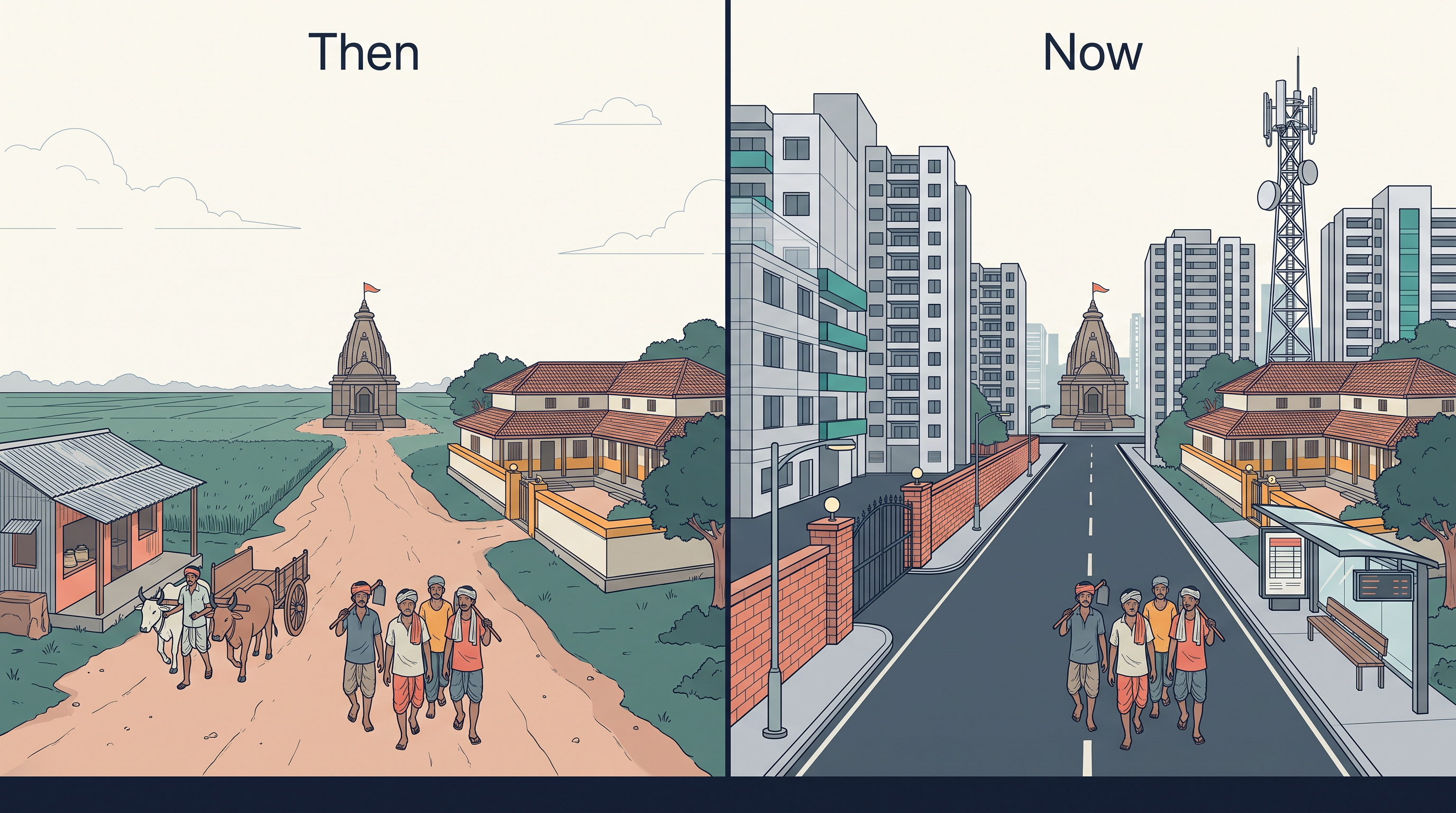
Fig. 2.1 – Change and continuity in a single settlement over time.
Keep these questions in mind. By the end of this chapter, you will be able to answer each of them.
2.2 Social Order
The meaning of social events or processes often becomes clear through contrasts. The letters on the page you are reading become legible only because they contrast against the background. Remove the contrast and you can see nothing at all.
In the same way, social change as a process acquires meaning against the backdrop of continuity, or the lack of change. It may sound odd, but change makes sense as a concept only if there are also some things that are not changing, so that they offer the possibility of comparison or contrast.
In other words, social change has to be understood together with social order, which is the tendency within established social systems that resists and regulates change.
Why does a society need to hold still?
Another way of looking at the relationship between social change and social order is to think about the possible reasons why a society needs to prevent, discourage, or at least control change.
In order to establish itself as a strong and viable social system, every society must be able to reproduce itself over time and maintain its stability. A society that could not reproduce itself would not survive a single generation.
Stability requires that things continue more or less as they are. It requires that people continue to follow the same rules, that similar actions produce similar results, and, more generally, that individuals and institutions behave in a fairly predictable manner.
Predictability sounds dull. But without it, nothing you did today could be planned on tomorrow — not a bus route, not an examination, not a wage, not a promise.
Who wants things to stay as they are?
The argument above was an abstract and general one about why societies may need to resist change. But there are usually more concrete and specific reasons why societies do in fact resist change.
Remember what you read about social structure and social stratification in Chapter 1. Most societies, most of the time, are stratified in unequal ways. That is, the different strata are differently positioned with respect to command over economic resources, social status and political power.
It is not surprising, then, that those who are favourably placed wish for things to continue as they are, while those who are suffering disadvantages are anxious for change. Where you stand on change depends a good deal on where you are standing.
So the ruling or dominant groups in society generally resist any social changes that may alter their status, because they have a vested interest in stability. On the other hand, the subordinated or oppressed groups have a vested interest in change.
‘Normal’ conditions usually favour the rich and the powerful, and they are able to resist change. This is another broad reason why societies are generally stable. Stability is not neutral: it protects an arrangement that already exists, and somebody always benefits from that arrangement more than others.
The two roads to social order
However, the notion of social order is not restricted to the idea of resistance to change. It also has a more positive meaning. It refers to the active maintenance and reproduction of a particular pattern of social relations, and of values and norms.
Broadly speaking, social order can be achieved in one of two ways. Either people spontaneously wish to abide by a set of rules and norms, or people are compelled in various ways to obey such norms. Every society employs a combination of these two methods to sustain social order, as Fig. 2.9 shows.
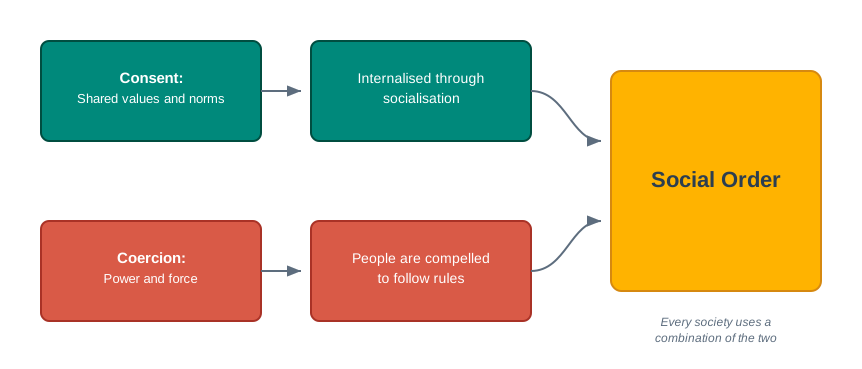
Fig. 2.9 – The two roads to social order: consent and coercion.
Consent, and its limits
Spontaneous consent to social order derives ultimately from shared values and norms which are internalised by people through the process of socialisation — the process, which you studied in Introducing Sociology, by which an individual learns the ways, values and expectations of the society into which she or he is born.
Socialisation may be more or less efficient in different contexts. But however efficient it is, it can never completely erase the will of the individual. Socialisation cannot turn people into programmed robots; it cannot produce complete and permanent consent for all norms at all times.
You may have experienced this in your own life. Rules or beliefs which seemed very natural and right at one point of time do not seem so obviously correct at other times. We question things we believed in the past, and we change our minds about what we regard as right or wrong.
Sometimes we may even return to beliefs we once held and then abandoned, only to rediscover them afresh at some later stage of life, or in different circumstances. So, while socialisation does take on much of the burden of producing social order, it is never enough by itself.
Power, domination and the ‘smoothness’ of everyday life
Thus, most modern societies must also depend on some form of power or coercion to ensure that institutions and individuals conform to established social norms.
Power is usually defined as the ability to make others do what you want, regardless of what they themselves want. Notice how blunt that definition is. It says nothing about whether the power is deserved, or fair, or lawful.
When a relationship of power is stable and settled, and the parties involved have become accustomed to their relative positions, we have a situation of domination. If a social entity — a person, an institution or a group — is routinely or habitually in a position of power, it is said to be dominant.
In normal times, dominant institutions, groups or individuals exercise a decisive influence on society. It is not as though they are never challenged, but this happens only in abnormal or extraordinary times.
Here is the part that is easy to miss. Even though domination implies that people are being made to do things they do not necessarily want to do, domination in normal times can be quite ‘smooth’ — in the sense that it appears to be without friction or tension. Nobody is shouting. Nothing looks like force. And yet the arrangement holds.
(Revisit the discussion of ‘forced cooperation’ from Chapter 1. Why, for example, did women often not want to claim their rights in their families of birth? Why did they ‘consent’ to the patriarchal norm?)
2.2.1 Domination, Authority and Law
How is it that domination can be non-confrontational, even when it clearly involves unequal relationships in which costs and benefits are unevenly distributed?
Part of the answer we already have from the previous chapter: dominant groups extract cooperation in unequal relationships because of their power. But why does this power work? Does it work purely because of the threat of the use of force?
Force is expensive, exhausting and unreliable. No society could be run by holding a stick over every citizen every day. This is where we come to an important concept in sociology — that of legitimation.
Legitimacy: when power is accepted as proper
In social terms, legitimacy refers to the degree of acceptance that is involved in power relations. Something that is legitimate is accepted as proper, just and fitting.
In the broadest sense, it is acknowledged to be part of the social contract that is currently prevailing. In short, legitimacy implies conformity to existing norms of right, propriety and justice.
We have already seen how power is defined in society. Power in itself is simply a fact — it can be either legitimate or not. A gang leader has power; so does a judge. What separates them is not the amount of power but its acceptance.
Authority is defined by Max Weber as legitimate power — that is, power that is considered to be justified or proper.
Where authority ends: the idea of a domain
For example, a police officer, a judge, or a school teacher all exercise different kinds of authority as part of their jobs. This authority is explicitly provided to them by their official job description — there are written documents specifying their authority, and what they may and may not do.
The fact that they have authority automatically implies that other members of society — who have agreed to abide by its rules and regulations — must obey this authority within its proper domain. That last phrase is the crucial one, as Fig. 2.10 illustrates.
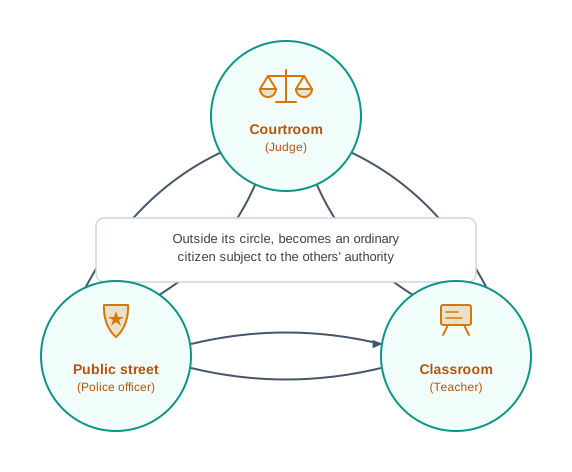
Fig. 2.10 – The bounded domains of authority.
The domain of the judge is the court room. When citizens are in the court, they are supposed to obey the judge, or defer to her or his authority. Outside the courtroom, the judge is supposed to be like any other citizen. So, on the street, the judge must obey the lawful authority of the police officer.
When on duty, the police officer has authority over the public actions of all citizens except her or his superior officers. But police officers do not have jurisdiction over the private activities of citizens, as long as they are not suspected of being unlawful.
In a different way — different because the nature of the authority involved is less strictly or explicitly defined — the teacher has authority over her or his pupils in the classroom. The authority of the teacher does not extend into the home of the pupil, where parents or guardians have primary responsibility and authority over their children.
Law
The difference between explicitly codified and more informal authority is relevant to the notion of the law.
A law is an explicitly codified norm or rule. It is usually written down, and there are laws that specify how laws are to be made or changed, and what is to be done if someone violates them.
A modern democratic society has a given body of laws created through its legislature, which consists of elected representatives. The laws of the land are enacted in the name of the people of that land, by the people’s representatives.
This law forms the formal body of rules according to which society will be governed. Laws apply to all citizens. Whether or not I as an individual agree with a particular law, it has binding force on me as a citizen, and on all other citizens similarly, regardless of their beliefs.
So, domination works through power; but much of this power is actually legitimate power, or authority; and a large part of that authority is codified in law. Consent and cooperation are obtained on a regular and reliable basis because of the backing of this structure of legitimation and formal institutional support.
This does not exhaust the domain of power or domination. There are many kinds of power that are effective in society even though they are illegitimate, or, if legitimate, are not codified in law. It is the mix of legitimate, lawful authority and other kinds of power that determines the nature of a social system, and also its dynamics.
2.2.2 Contestation, Crime and Violence
The existence of domination, power, legitimate authority and law does not imply that they always meet with obedience and conformity. Order is maintained, but it is also constantly tested.
You have already read about the presence of conflict and competition in society. In a similar way, we need to recognise more general forms of contestation in society.
Contestation is used here simply as a word for broad forms of insistent disagreement. Competition and conflict are more specific than this, and they leave out other forms of dissent that may not be well described by such terms.
The many faces of disagreement
One example is that of ‘counter cultures’ among youth, or ‘youth rebellion’. These are protests against, or refusals to conform to, prevalent social norms. The content of these protests may involve anything from hairstyles and clothing fashions to language or lifestyle.
More standard or conventional forms of contestation include elections — which are a form of political competition. Contestations also include dissent or protest against laws, or against lawful authorities.
Open and democratic societies allow this kind of dissent to different degrees. There are both explicit and implicit boundaries defined for such dissent, and crossing these boundaries invites some form of reaction from society, usually from the law enforcement authorities.
As you know very well, being united as Indians does not prevent us from disagreeing with each other. Different political parties may have very different agendas, even though they may respect the same Constitution. Belief in, or knowledge of, the same set of traffic rules does not prevent heated arguments on the road.
In other words, social order need not mean sameness or unanimity. A society is not disorderly merely because its members disagree loudly.
On the other hand, how much difference or dissent is tolerated in society is an important question. The answer depends on social and historical circumstances, but it always marks an important boundary in society — the boundary between the legitimate and the illegitimate, the legal and the illegal, and the acceptable and the unacceptable. Fig. 2.11 sets out that boundary.
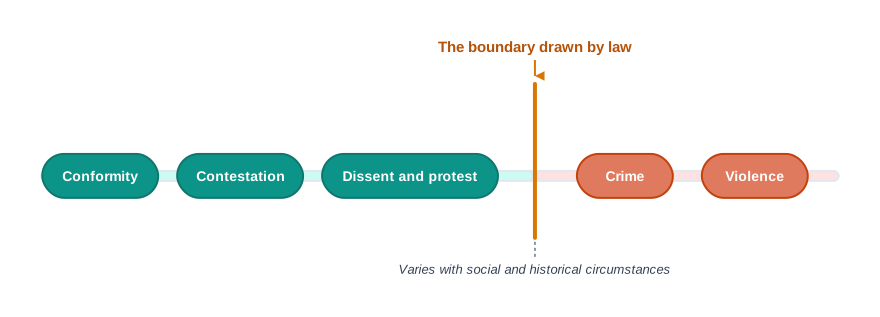
Fig. 2.11 – The spectrum from conformity to violence.
Crime
Although it generally carries a strong moral charge, the notion of crime is strictly derived from the law. A crime is an act that violates an existing law — nothing more, nothing less.
The moral worth of the act is not determined solely by the fact that it violates existing law. If the existing law is believed to be unjust, for example, a person may claim to be breaking it for the highest moral reasons.
This is exactly what the leaders of the Freedom Movement in India were doing as part of their ‘Civil Disobedience’ campaign. When Mahatma Gandhi broke the salt law of the British government at Dandi, he was committing a crime, and he was arrested for it. But he committed this crime deliberately and proudly, and the Indian people were also proud of him and of what he stood for.
Of course, these are not the only kinds of crime that are committed. There are many other kinds of crime that cannot claim any great moral virtue. But the important point is that a crime is the breaking of the law — going beyond the boundary of legitimate dissent as defined by the law.
Violence
The question of violence relates, at the broadest level, to the basic definition of the state. One of the defining features of the modern state is that it is supposed to have a monopoly over the use of legitimate violence within its jurisdiction.
In other words, only the state, through its authorised functionaries, may lawfully use violence. All other instances of violence are by definition illegal. (There are exceptions like self-defence, meant for extraordinary and rare situations.)
Thus, technically, every act of violence is seen as being directed against the state. Even if I assault or murder some other individual, it is the state that prosecutes me — for violating its monopoly over the legitimate use of violence.
It is obvious that violence is the enemy of social order, and an extreme form of contestation that transgresses not only the law, but important social norms as well.
Violence in society is the product of social tensions, and it indicates the presence of serious problems. It is also a challenge to the authority of the state. In this sense, it also marks the failure of the regime of legitimation and consent, and the open outbreak of conflicts.
Read that sentence sociologically rather than dramatically. Violence is not, for a sociologist, simply a shocking event. It is a signal — evidence that consent has broken down somewhere, and that a question of power has not been settled.
2.3 Social Order and Change in Village, Town and City
Most societies can be divided into rural and urban sectors. The conditions of life, and therefore the forms of social organisation in these sectors, are very different from each other.
It follows that the forms of social order that prevail in the two sectors are also different — and so are the kinds of social change that matter most in each. Everything you have read so far in this chapter now has to be asked twice: once of the village, and once of the city.
How villages came into being
We all think we know what is meant by a village, and by a town or city. But how exactly do we differentiate between them? (See also the discussion in Chapter 5 on Village Studies, in the section on M.N. Srinivas.)
From a sociological point of view, villages emerged as part of the major changes in social structure brought about by the transition from nomadic ways of life — based on hunting, gathering food and transient agriculture — to a more settled form of life.
With the development of sedentary forms of agriculture — that is, forms that did not involve moving from place to place — social structure also changed. Once people stayed put, everything about how they lived together had to be reorganised.
Investment in land and technological innovations in agriculture created the possibility of producing a surplus — something over and above what was needed for survival. That word ‘surplus’ is doing a great deal of work, so hold on to it.
Because settled agriculture produced a surplus, wealth could now be accumulated. And once wealth can be accumulated, it can be accumulated unequally. So settled agriculture also brought social differences with it.
At the same time, the more advanced division of labour created the need for occupational specialisation. Not everybody now had to produce food; some could weave, some could build, some could keep records, some could rule.
All of these changes together shaped the emergence of the village as a population settlement based on a particular form of social organisation, as traced in Fig. 2.12.
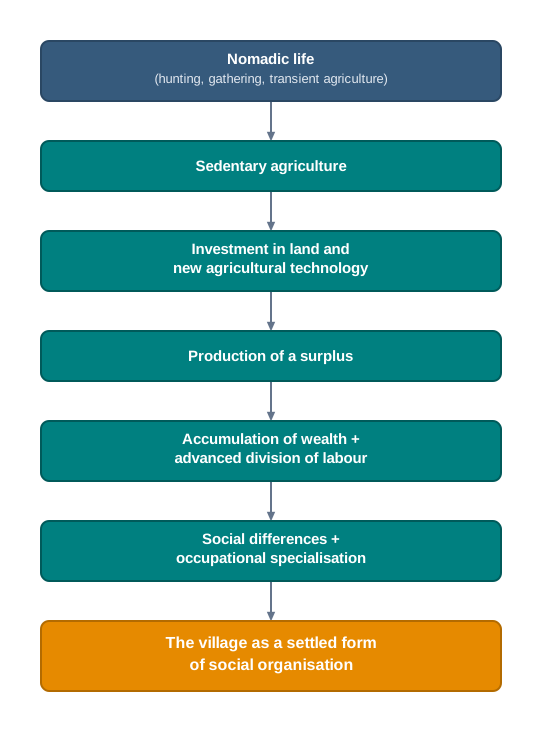
Fig. 2.12 – How sedentary agriculture led to the village settlement.
Telling a village from a town
In economic and administrative terms, the distinction between rural and urban settlements is usually made on the basis of two major factors: population density, and the proportion of agriculture-related economic activities.
Contrary to appearances, size alone is not always decisive. It becomes difficult to separate large villages and small towns on the basis of population size by itself.
Thus, cities and towns have a much higher density of population — that is, a much higher number of persons per unit area, such as a square kilometre — than villages do. Although they are smaller in terms of absolute numbers of people, villages are spread out over a relatively larger area.
\[\text{Population density} = \frac{\text{Number of persons}}{\text{Unit of area (e.g., one square kilometre)}}\]
Villages are also distinguished from towns and cities by the larger share of agricultural activities in their economic profile. In other words, a village will have a significant proportion of its population engaged in agriculture-linked occupations, much of what is produced there will be agricultural products, and most of its income will come from agriculture. Fig. 2.13 shows the work that still defines the rural economic profile.
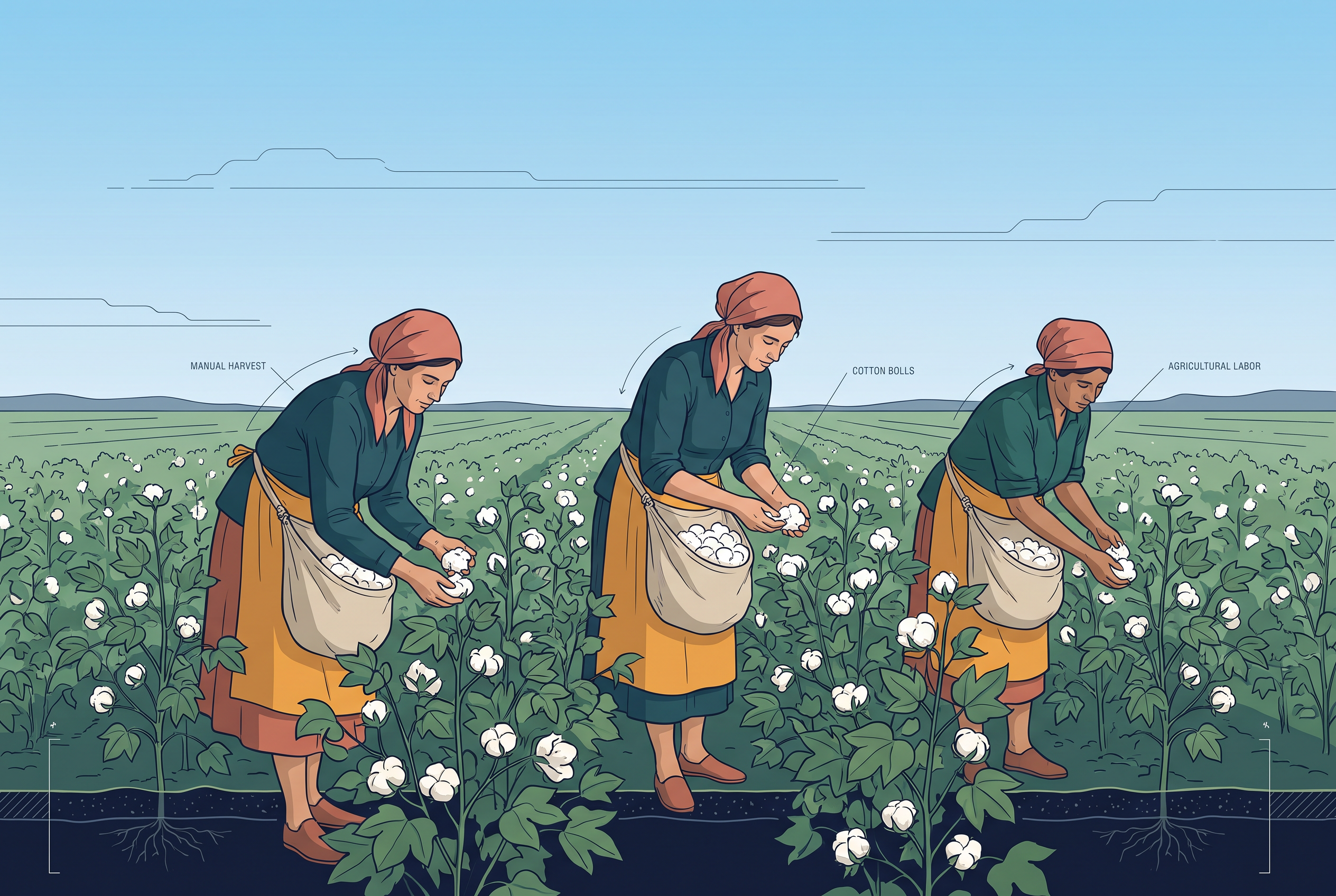
Fig. 2.13 – The rural economic profile: agriculture-linked occupations.
The distinction between a town and a city is much more a matter of administrative definition. A town and a city are basically the same sort of settlement, differentiated by size.
An ‘urban agglomeration’ — a term used in Censuses and official reports — refers to a city along with its surrounding sub-urban areas and satellite settlements. A ‘metropolitan area’ includes more than one city, or a continuous urban settlement many times the size of a single city.
Urbanisation
Given the directions in which modern societies have developed, the process of urbanisation has been experienced in most countries. This is the process by which a progressively larger and larger proportion of a country’s population lives in urban rather than rural areas.
Most developed countries are now overwhelmingly urban. Urbanisation is also the trend in developing countries; it can be faster or slower, but unless there are special reasons blocking it, the process does seem to occur in most contexts.
According to a United Nations report (2014), 54 per cent of the world’s population lives in urban areas, a proportion that is expected to increase to 66 per cent by 2050 (United Nations, Department of Economic and Social Affairs, Population Division, 2014, World Population Prospects).
Indian society is also experiencing urbanisation. The percentage of the population living in urban areas has increased from a little less than 11 per cent in 1901 to a little more than 17 per cent in 1951, soon after independence. The 2001 Census shows that almost 28 per cent of the population lives in urban areas, and according to the 2011 Census report, 37.7 per cent of India’s population lives in urban areas.
Table 2.1 – Population living in urban areas, India, 1901–2011 (per cent of total population) | Year | Population living in urban areas (per cent) | |—|—| | 1901 | A little less than 11 | | 1951 | A little more than 17 | | 2001 | Almost 28 | | 2011 | 37.7 |
Read Table 2.1 slowly, because it contains a story. In the first half of the twentieth century, the urban share rose by only about six percentage points in fifty years. In the next fifty years it rose much faster, and by 2011 more than a third of the country lived in towns and cities. India is not yet a predominantly urban society — but the direction, and the acceleration, are unmistakable. Fig. 2.14 shows the same figures as a curve.
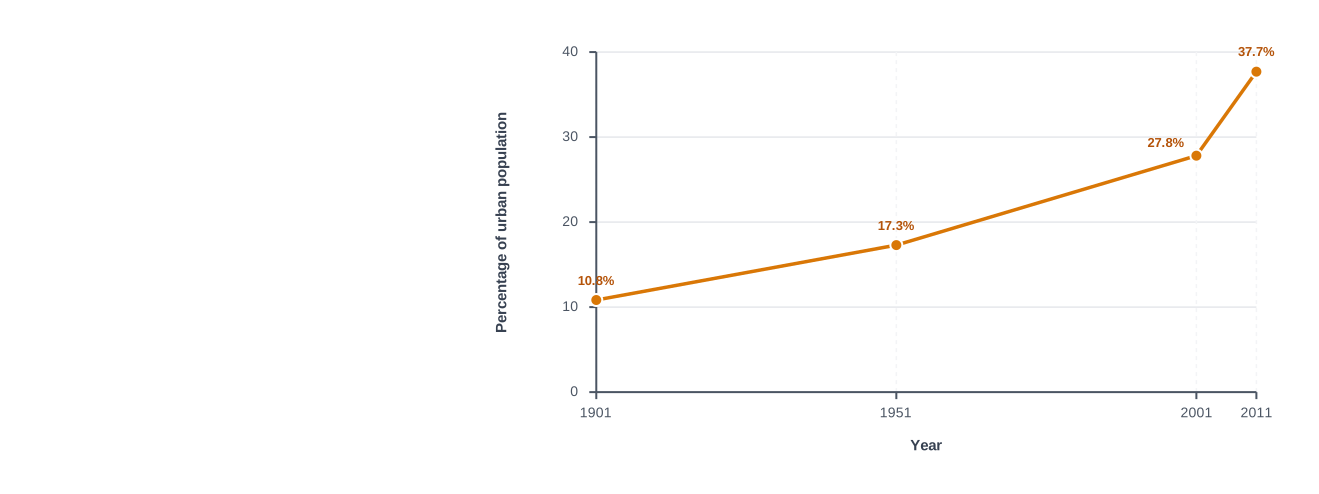
Fig. 2.14 – Percentage of India’s population living in urban areas (1901–2011).
2.3.2 Social Order and Social Change in Urban Areas
It is well known that though the city itself is very old — even ancient societies had cities — urbanism as a way of life for large segments of the population is a modern phenomenon. Cities are ancient; a predominantly urban society is not.
Before the modern era, trade, religion and warfare were some of the major factors that decided the location and importance of cities.
Cities that were located on major trade routes, or that had suitable harbours and ports, had a natural advantage. So did cities that were well located from the point of view of military strategy. Finally, religious places attracted large numbers of pilgrims, and thus supported an urban economy.
In India too we have examples of such old cities. They include the well-known medieval trading towns of Tezpur on the Brahmaputra river in Assam, and Kozhikode (formerly known as Calicut) on the Arabian Sea in northern Kerala.
We also have many examples of temple towns and places of religious pilgrimage, such as Ajmer in Rajasthan, Varanasi (also known as Benaras or Kashi) in Uttar Pradesh, and Madurai in Tamil Nadu. In each case, a steady stream of visitors supported traders, priests, innkeepers, artisans and transporters — an economy built on the movement of people.
The city and the individual
As sociologists have pointed out, city life and modernity go very well together. In fact, each may be considered an intimate expression of the other.
Though it houses large and very dense populations, and though it has been known throughout history as the site for mass politics, the city is also the domain of the modern individual.
In its combination of anonymity, and of the amenities and institutions that only large numbers can support, the city offers the individual boundless possibilities for fulfilment. Anonymity is not only loneliness; it is also freedom from the constant, knowing gaze of people who have known you since birth.
Unlike the village, which discourages individuality and cannot offer much, the city nurtures the individual.
But while the many artists, writers and scholars who have celebrated the city as the haven of the individual are not wrong, it is also true that freedom and opportunity are available only to some individuals.
More accurately, only a socially and economically privileged minority can have the luxury of a predominantly free and fulfilling life. Most people who live in cities have only limited and relative freedoms, within larger constraints.
These are the familiar economic and social constraints imposed by membership in social groups of various kinds, already known to you from the previous chapter.
The city, too, fosters the development of group identities — based on factors like race, religion, ethnicity, caste, region, and of course class — which are all well represented in urban life.
In fact, the concentration of large numbers in a relatively small space intensifies identities, and makes them integral to strategies of survival, resistance and assertion. In a city, who you are is also how you find housing, work, credit and safety.
Space: the central problem of urban social order
Most of the important issues and problems of social order in towns and cities are related to the question of space. High population density places a great premium on space, and creates very complex problems of logistics.
It is the primary task of the urban social order to ensure the spatial viability of the city. If a city cannot be lived in, moved through and supplied, it cannot function at all.
This means the organisation and management of things like: housing and residential patterns; mass transit systems for transporting large numbers of workers to and fro for work; arranging for the coexistence of residential, public and industrial land-use zones; and finally all the public health, sanitation, policing, public safety and monitoring needs of urban governance. These tasks are set out in Fig. 2.15.
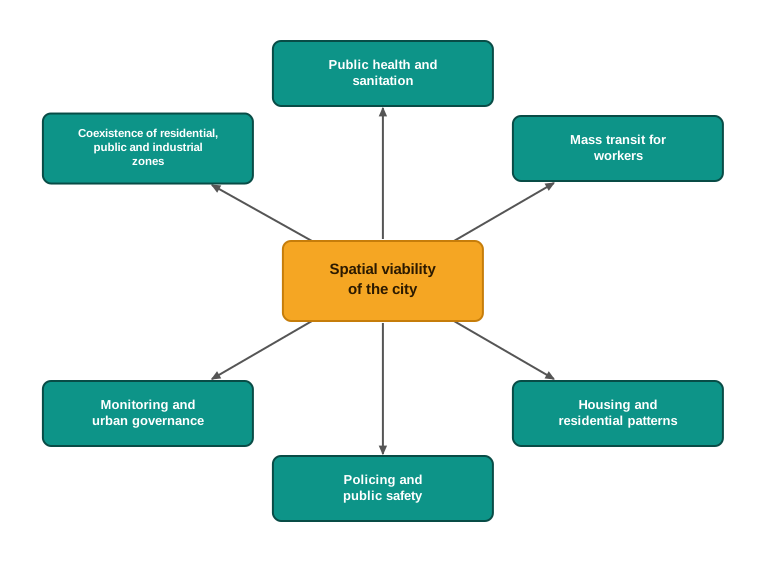
Fig. 2.15 – The tasks of the urban social order.
Each of these functions is a huge undertaking in itself, and presents formidable challenges of planning, implementation and maintenance. Fig. 2.16 shows one of them at work.

Fig. 2.16 – Urban health centres and the civic management of dense populations.
What adds to the complexity is that all of these tasks have to be performed in a context where the divisions and tensions of class, ethnicity, religion, caste and so on are also present and active. A decision about where a road or a housing colony goes is never only a technical decision.
Housing, homelessness and slums
For example, the question of urban housing brings with it a whole host of problems.
Shortage of housing for the poor leads to homelessness, and to the phenomenon of ‘street people’ — those who live and survive on the streets and footpaths, under bridges and flyovers, in abandoned buildings and other empty spaces.
It is also the leading cause for the emergence of slums. Though official definitions vary, a slum is a congested, overcrowded neighbourhood with no proper civic facilities — sanitation, water supply, electricity and so on — and with homes made of all kinds of building materials, ranging from plastic sheets and cardboard to multi-storeyed concrete structures.
Because of the absence of ‘settled’ property rights of the kind seen elsewhere, slums are the natural breeding ground for ‘dadas’ and strongmen, who impose their authority on the people who live there. Where the law does not reliably reach, some other power fills the gap — and it is rarely a gentle one.
Control over slum territory then becomes the natural stepping stone to other kinds of extra-legal activities, including criminal and real estate-related gangs.
Look back at section 2.2 for a moment, because this is that argument in concrete form. Where legitimate authority is absent or weak, power does not disappear; it simply takes an illegitimate form.
Gated communities and ghettoisation
At the other end of the urban class scale is the worldwide phenomenon of gated communities, which is also found in Indian cities.
This refers to the creation of affluent neighbourhoods that are separated from their surroundings by walls and gates, with controlled entry and exit. Most such communities also have their own parallel civic facilities, such as water and electricity supply, policing and security.
Put the two side by side. In one part of the city, people live without water, electricity or policing because the civic order does not reach them. In another, people arrange their own water, electricity and policing because they have chosen to seal themselves off from it. Both are ways in which urban space is divided, and both weaken the idea of a single shared city.
A related term you should know is ghettoisation. A ghetto — originally the word for the locality in which Jews lived in medieval European cities — today refers to any neighbourhood with a heavy concentration of people of a particular religion, ethnicity, caste or other common identity. Ghettoisation is the process by which mixed-composition neighbourhoods are converted into single-community neighbourhoods.
Transport, commuting and the shape of the day
Finally, housing patterns are linked to the economy of the city in crucial ways.
The urban transport system is directly and severely affected by the location of residential areas relative to industrial and commercial workplaces. If these are far apart, as is often the case, an elaborate mass transit system — modes of fast city transport for large numbers of people — must be created and maintained.
Commuting then becomes a way of life, and an ever-present source of possible disruption. The transport system has a direct impact on the ‘quality of life’ of working people in the city. Two hours in a bus, twice a day, is two hours subtracted from sleep, study, family and rest.
Reliance on road transport, and specially on private rather than public modes — cars rather than buses — creates problems of traffic congestion and vehicular pollution, as Fig. 2.17 suggests.
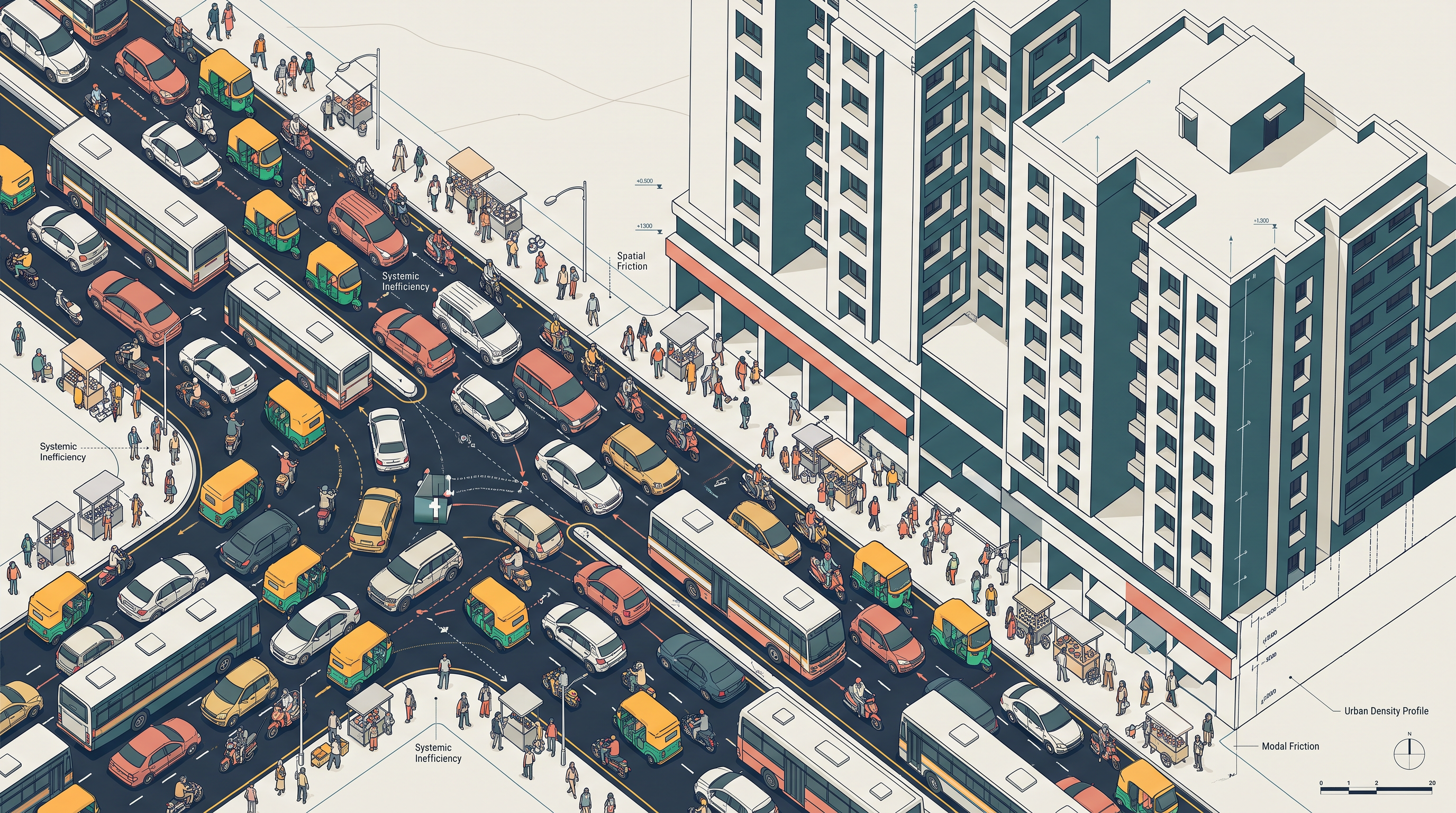
Fig. 2.17 – High population density and the competition for urban space.
As will be clear to you from the above discussion, the apparently simple issue of the distribution of living space is actually a very complex and multi-dimensional aspect of urban society.
How neighbourhoods rise and fall
The form and content of social change in urban areas is also best understood in relation to the central question of space.
One very visible element of change is the ups and downs experienced by particular neighbourhoods and localities. Across the world, the city centre — or the core area of the original city — has had many changes of fortune.
After being the power centre of the city in the nineteenth and early twentieth century, the city centre went through a period of decline in the latter half of the twentieth century. This was also the period of the growth of suburbs, as the affluent classes deserted the inner city for the suburbs for a variety of reasons.
City centres are experiencing a revival now in many major western cities, as attempts to regenerate community life and the arts bear fruit.
A related phenomenon is gentrification, which refers to the conversion of a previously lower class neighbourhood into a middle and upper class one.
As real estate prices rise, it becomes more and more profitable for developers to try and effect such a conversion. At some point, the campaign becomes self-fulfilling, as rental values increase and the locality acquires a critical minimum of prosperous businesses and residents.
But sometimes the effort may fail, and the neighbourhood goes back down the class scale and returns to its previous status.
Mass transport and the character of a city
Changes in modes of mass transport may also bring about significant social change in cities.
Affordable, efficient and safe public transport makes a huge difference to city life, and can shape the social character of a city quite apart from influencing its economic fortunes. Who can reach a college, a hospital or a job — and at what cost in money and hours — is decided largely by what runs on the roads and rails.
Many scholars have written on the difference between cities based on public transport, like London or New York, and cities that depend mainly on individualised, car-based transport, like Los Angeles.
It remains to be seen, for example, whether the new Metro Rail in Delhi will significantly change social life in that city.
But the main issue regarding social change in cities, specially in rapidly urbanising countries like India, is how the city will cope with the constant increase in population, as migrants keep streaming in to add to its natural growth.
That is the question this chapter leaves you with. Every one of the problems just described — housing, water, transport, sanitation, safety, land — becomes harder each year that the city grows, and the city is going to grow. Fig. 2.18 shows one face of what that growth produces.
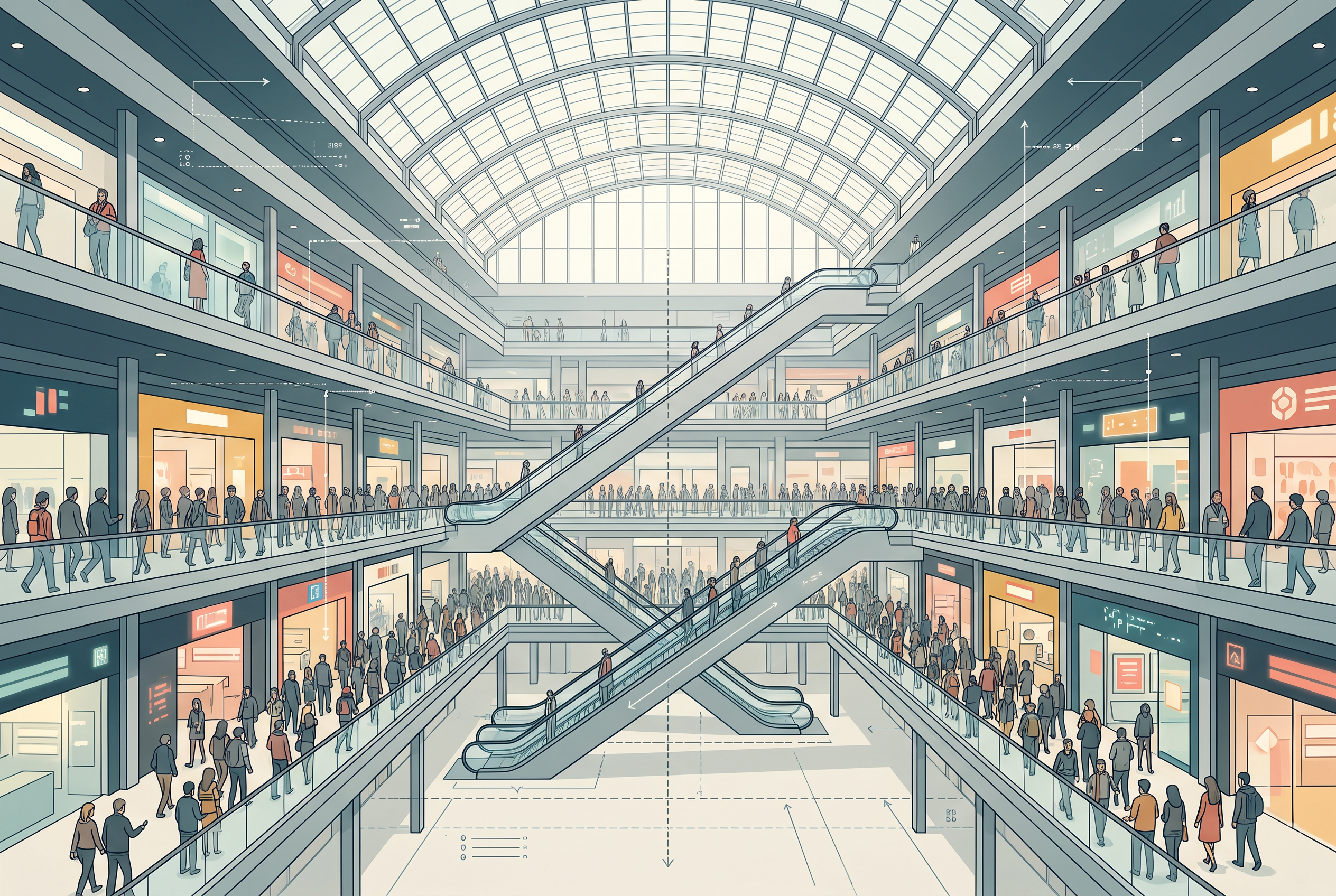
Fig. 2.18 – The density and consumption of urban life.
2.4 Summary
Change is old, but rapid change is new
- Constant change is one of the most permanent features of modern society, and sociology itself emerged to make sense of the rapid changes in Western Europe between the seventeenth and nineteenth centuries.
- Human beings have existed for about 500,000 years, but have had a civilised existence for only about 6,000. Constant, rapid change belongs only to the last 400 years, and has accelerated sharply in the last 100.
What counts as social change
- Social change is not any and every change. It is change that is significant enough to alter the underlying structure of an object or situation over a period of time.
- To qualify, a change must be both intensive and extensive — deep in its impact and spread across a large section of society.
Three ways of classifying social change
- By pace: evolutionary change is slow and gradual; revolutionary change is rapid and sudden, used mainly in the political context, as in the French Revolution (1789–93) and the Russian revolution of 1917, and by extension in phrases like ‘industrial revolution’.
- Darwin’s theory of evolution, with its idea of ‘the survival of the fittest’, was carried over to society as social Darwinism — a transfer that is easily misused to make inequality look natural.
- By nature or impact: structural change transforms institutions and the rules by which they run (paper money reorganised banking, credit and economic life). Changes in ideas, values and beliefs also transform society — the modern idea of childhood led to laws banning child labour and to compulsory education.
- By source or cause: causes may be internal (endogenous) or external (exogenous), and fall into five broad types — environmental, technological, economic, political and cultural.
The five sources of change
- Environment: nature shaped where and how societies could live; technology has reduced that dependence but also altered nature, so the effect of nature on society is changing rather than simply declining. Disasters like the tsunami of December 2004 can transform societies irreversibly; discoveries like oil in West Asia can transform them constructively.
- Technology and economy: steam power, the railway (introduced in India in 1853) and the steamship remade the economy and social geography of the world. Some inventions, like gunpowder and paper in China, matter only when a later economic context gives them significance. British textile machinery, combined with market forces and imperial power, destroyed the Indian handloom industry.
- Economic change need not be technological: plantation agriculture created a demand for labour that supported slavery and the slave trade, and drew forced migration into the tea plantations of Assam. Changes in customs duties and tariffs can still wipe out whole occupations today.
- Politics: war, conquest and occupation change societies, as the post-war relationship between the United States and Japan shows. Political change works through the redistribution of power — the Indian independence movement changed Indian society, not only its rulers. Universal adult franchise, the ‘one person, one vote’ principle, is probably the single biggest political change in history, and was won only through long struggles.
- Culture: Weber’s study of the Protestant ethic showed religious values shaping the rise of capitalism; Buddhism and the Bhakti Movement reshaped Indian social life; changing ideas about women, reinforced by their work during the Second World War and their role as consumers, changed society; the history of cricket shows how sport carries national and racial pride and shifts commercial power.
- No single factor or theory can explain social change. Causes are internal and external, deliberate and accidental, and usually interrelated.
Social order
- Social change makes sense only against social order — the tendency within established social systems that resists and regulates change.
- Every society must reproduce itself and remain predictable, or it cannot survive. But since most societies are stratified, those favourably placed have a vested interest in stability, while subordinated groups have a vested interest in change.
- Social order is achieved in two ways, and every society combines them: consent, which comes from values and norms internalised through socialisation; and coercion, which rests on power.
- Socialisation is never enough by itself, because it cannot turn people into programmed robots or produce permanent consent.
- Power is the ability to make others do what you want regardless of what they want. When a power relation is stable and settled, we have domination — and in normal times domination can look quite ‘smooth’.
Domination, authority and law
- Legitimation is the process by which power comes to be accepted as proper, just and right. Power itself is simply a fact; it may be legitimate or not.
- Weber defined authority as legitimate power. Authority operates within a domain — the judge in the courtroom, the police officer on the street, the teacher in the classroom — and outside that domain it ceases to apply.
- Some authority is never formalised: that of a religious leader, a respected scholar or artist, even a criminal gang leader.
- A law is an explicitly codified norm or rule, made in a democracy by an elected legislature, and binding on all citizens whether or not they agree with it. Domination works through power, much of which is authority, much of which is codified in law — but illegitimate and uncodified power also exists, and the mix determines the character of a social system.
Contestation, crime and violence
- Contestation is the broad term for insistent disagreement; conflict and competition are narrower. Counter-cultures, elections, dissent and protest are all forms of contestation.
- Social order does not require sameness or unanimity. What matters is where the boundary of permitted dissent is drawn — between the legitimate and the illegitimate, the legal and the illegal.
- A crime is an act that violates an existing law, nothing more and nothing less. Its moral worth is a separate question: Gandhi’s breaking of the salt law at Dandi was a crime, deliberately and proudly committed.
- The modern state is defined by its monopoly over the legitimate use of violence. All other violence is by definition illegal, and every act of violence is technically directed against the state. Violence is the enemy of social order, a product of social tensions, and a sign that the regime of legitimation and consent has failed.
Village, town and city
- Villages emerged when nomadic life gave way to settled agriculture, which produced a surplus, allowed wealth to be accumulated unequally, and encouraged occupational specialisation through the division of labour.
- Rural and urban settlements are distinguished mainly by population density and by the share of agriculture-related activity, not by size alone. A town and a city differ mainly by size; an urban agglomeration is a city with its suburbs and satellites, and a metropolitan area is larger still.
- Urbanisation is the process by which a growing proportion of a population lives in urban areas. A United Nations report (2014) puts 54 per cent of the world’s population in urban areas, expected to rise to 66 per cent by 2050. In India the urban share rose from a little less than 11 per cent in 1901 to a little more than 17 per cent in 1951, almost 28 per cent in the 2001 Census, and 37.7 per cent according to the 2011 Census.
Social order and change in rural areas
- Villages permit personalised relationships and follow a more traditional social structure, so change arrives more slowly.
- Dissent is harder in a village: there is no anonymity, dissenters are easily identified, and the dominant sections control employment and resources, so the poor depend on them. A strong rural power structure is difficult to dislodge.
- Better communication, roads and rail have shortened the cultural ‘lag’ between village and town.
- Land reform after independence removed proprietary rights from absentee landlords and gave them to those managing cultivation — mostly intermediate castes, whose landholding plus numbers produced political power. M.N. Srinivas named these the ‘dominant castes’; they are now challenged by assertive castes below them in states such as Andhra Pradesh, Bihar, Uttar Pradesh and Tamil Nadu.
- Labour-saving machinery, new cropping patterns, price fluctuations, drought and flood all reshape rural bargaining power; development programmes such as MGNREGA (2005) can also have an enormous impact.
Social order and change in urban areas
- Cities are ancient, but urbanism as a way of life for large numbers is modern. Trade, ports, military position and pilgrimage once decided which cities mattered — Tezpur, Kozhikode, Ajmer, Varanasi, Madurai.
- The city and modernity belong together: anonymity and large-scale institutions make it the domain of the modern individual. But a fully free and fulfilling city life is available only to a socially and economically privileged minority, and density intensifies group identities based on class, caste, religion, ethnicity and region.
- The central problem of urban social order is space: housing, mass transit, land-use zoning, public health, sanitation, policing and governance — all carried out amid active social divisions.
- Housing shortage produces homelessness, ‘street people’ and slums, where the absence of settled property rights allows strongmen and gangs to impose authority. At the other extreme, gated communities wall off affluent localities with their own parallel civic facilities, and ghettoisation concentrates single communities in single neighbourhoods.
- Transport shapes the social character of a city, and gentrification shows how a neighbourhood’s class composition can be transformed. The central question for rapidly urbanising countries like India is how cities will cope with continuing migration on top of natural growth.
2.5 Key Terms
Authority — Legitimate power; power that is accepted as proper and justified, and that operates within a recognised domain.
Contestation — A broad term for insistent disagreement in society, wider than conflict or competition, and covering dissent, protest and refusal.
Crime — An act that violates an existing law; its legal definition is separate from its moral worth.
Customs Duties, Tariffs — Taxes imposed on goods entering or leaving a country, which raise their price and make them less competitive relative to domestically produced goods.
Dominant Castes — A term attributed to M.N. Srinivas; landowning intermediate castes that are numerically large and therefore enjoy political dominance in a given region.
Domination — A settled and stable relationship of power, in which the parties have become accustomed to their relative positions.
Endogenous causes — Causes of social change that arise from within the society itself.
Evolution — Change that takes place slowly and gradually over a long period of time, through adaptation to circumstances.
Exogenous causes — Causes of social change that come from outside the society.
Gated Communities — Urban localities, usually affluent, sealed off from their surroundings by walls, fences and gates, with controlled entry and exit, and often with their own parallel civic facilities.
Gentrification — The conversion of a low class urban neighbourhood into a middle or upper class neighbourhood.
Ghetto, Ghettoisation — Originally the locality where Jews lived in medieval European cities; today, any neighbourhood concentrated around people of one religion, ethnicity, caste or other common identity. Ghettoisation is the process by which mixed neighbourhoods become single-community neighbourhoods.
Law — An explicitly codified norm or rule, usually written down, made through a recognised procedure, and binding on all citizens.
Legitimation — The process of making something legitimate, or the grounds on which something is considered legitimate — proper, just and right.
Mass Transit — Modes of fast city transport designed to carry large numbers of people.
Population density — The number of persons living in a unit of area, such as one square kilometre; higher in towns and cities than in villages.
Power — The ability to make others do what you want them to do, regardless of what they themselves want.
Revolutionary change — Change that occurs rapidly, even suddenly, most often through the overthrow of a ruling class or group; also used for other sharp, total transformations.
Social change — Change significant enough to alter the underlying structure of a society or situation over time; it must be both intensive and extensive.
Social Darwinism — The adaptation of Darwin’s theory of evolution to the social world, emphasising adaptive change and ‘the survival of the fittest’.
Social order — The tendency within established social systems that resists and regulates change, and actively maintains a particular pattern of social relations, values and norms.
Socialisation — The process by which an individual learns and internalises the values, norms and ways of the society into which she or he is born.
Structural change — Change that transforms the structure of society — its institutions, or the rules by which they are run.
Urbanisation — The process by which a progressively larger proportion of a country’s population comes to live in urban rather than rural areas.
Violence — An extreme form of contestation that breaks both the law and important social norms; in the modern state, only the state, through its authorised functionaries, may lawfully use it.
2.6 Points to Ponder
Sociologists say that social change must be both intensive and extensive. But who decides how deep or how wide a change has to be before it counts? Is there a point at which a change in fashion, food or language stops being trivial and starts being structural?
The chapter argues that social order is actively maintained, and that stability usually favours those who are already favourably placed. Does it follow that every demand for order is really a defence of privilege — or can order also be what protects the weakest members of a society?
Authority works because it is accepted as legitimate. But arrangements that were once accepted as entirely proper — child labour, the exclusion of women from the vote — are now considered unjust. What makes a society withdraw legitimacy from something it once took for granted?
Gandhi broke the salt law and was arrested for a crime, yet the act is remembered with pride. If law defines crime, and morality lies outside the law, how should a society decide how much dissent it can tolerate before it must call it a crime?
Villages are said to discourage individuality while cities are said to nurture it. Yet the chapter also says that a free and fulfilling city life belongs mainly to a privileged minority. In what sense, then, is the city freer than the village — and for whom?
Improved roads, telephones and television have shortened the cultural ‘lag’ between village and town. Has this made the rural social order weaker, or has it simply given the same power structure new tools to work with?
Gated communities seal an affluent locality off from the city around it; slums exist because the city’s services never reached them. Both are ways in which urban space is divided. Can a city remain a single society if the experience of living in it differs so completely from one neighbourhood to the next?
2.7 NCERT Questions
Would you agree with the statement that rapid social change is a comparatively new phenomenon in human history? Give reasons for your answer.
How is social change to be distinguished from other kinds of change?
What do you understand by ‘structural change’? Explain with examples other than those given in the text.
Describe some kinds of environment-related social change.
What are some kinds of changes brought about by technology and the economy?
What is meant by social order, and how is it maintained?
What is authority, and how is it related to domination and the law?
How are a village, a town and a city distinguished from each other?
What are some features of social order in rural areas?
What are some of the challenges to social order in urban areas?
2.8 Objective Questions
- Social change, according to Giddens, refers to change that alters the:
- surface appearance of everyday life
- underlying structure of an object or situation over a period of time
- personal habits of individuals
- fashions and tastes of a generation [1 mark]
- For a change to qualify as social change, it must be:
- intensive only
- extensive only
- both intensive and extensive
- neither intensive nor extensive [1 mark]
- The idea of ‘the survival of the fittest’ is associated with the theory of evolution proposed by:
- Max Weber
- Charles Darwin
- M.N. Srinivas
- Anthony Giddens [1 mark]
- Which of the following pairs is correctly matched with revolutionary change?
- The French Revolution — 1789–93
- The Russian revolution — 1789
- The French Revolution — 1917
- The Russian revolution — 1853 [1 mark]
- Causes of social change that arise from within a society are called:
- exogenous
- endogenous
- evolutionary
- structural [1 mark]
- Authority is defined as legitimate power by:
- Émile Durkheim
- Karl Marx
- Max Weber
- M.N. Srinivas [1 mark]
- According to the 2011 Census report, the percentage of India’s population living in urban areas is:
- 17 per cent
- 28 per cent
- 37.7 per cent
- 54 per cent [1 mark]
- The two major factors on which the distinction between rural and urban settlements is usually made are:
- population size and literacy
- population density and the proportion of agriculture-related economic activities
- income and caste composition
- administrative status and religion [1 mark]
- Assertion (A): In normal times, domination can appear quite ‘smooth’, without friction or tension. Reason (R): Much of the power involved in domination is legitimate power, or authority, a large part of which is codified in law.
- Both A and R are true, and R is the correct explanation of A.
- Both A and R are true, but R is not the correct explanation of A.
- A is true, but R is false.
- A is false, but R is true. [1 mark]
- Assertion (A): Change in the sense of shifts in power is slow to arrive in rural areas. Reason (R): The lack of anonymity in villages makes it difficult to dissent, and the dominant sections control most avenues of employment and resources.
- Both A and R are true, and R is the correct explanation of A.
- Both A and R are true, but R is not the correct explanation of A.
- A is true, but R is false.
- A is false, but R is true. [1 mark]
- Assertion (A): Socialisation alone is sufficient to produce social order. Reason (R): Socialisation can never completely erase the will of the individual, and cannot produce complete and permanent consent for all norms at all times.
- Both A and R are true, and R is the correct explanation of A.
- Both A and R are true, but R is not the correct explanation of A.
- A is true, but R is false.
- A is false, but R is true. [1 mark]
- Match the thinker in Column I with the idea in Column II.
| Column I | Column II |
|---|---|
| a. M.N. Srinivas | i. Authority as legitimate power |
| b. Max Weber | ii. The clock of human history |
| c. Charles Darwin | iii. The dominant caste |
| d. Anthony Giddens | iv. Evolution and ‘the survival of the fittest’ |
[1 mark]
- Match the term in Column I with its meaning in Column II.
| Column I | Column II |
|---|---|
| a. Gentrification | i. Modes of fast city transport for large numbers of people |
| b. Ghettoisation | ii. A city together with its suburbs and satellite settlements |
| c. Mass transit | iii. Conversion of a low class neighbourhood into a middle or upper class one |
| d. Urban agglomeration | iv. Conversion of mixed neighbourhoods into single-community neighbourhoods |
[1 mark]
Fill in the blank: The railways were introduced in India in the year __________. [1 mark]
Fill in the blank: The Mahatma Gandhi National Rural Employment Guarantee Act was passed in the year __________. [1 mark]
Fill in the blank: According to a United Nations report of 2014, __________ per cent of the world’s population lives in urban areas, a proportion expected to rise to 66 per cent by 2050. [1 mark]
True or False: Social order requires sameness and unanimity among the members of a society. [1 mark]
True or False: One of the defining features of the modern state is that it is supposed to have a monopoly over the use of legitimate violence within its jurisdiction. [1 mark]
True or False: A town and a city are basically the same sort of settlement, differentiated by size. [1 mark]
2.9 Check Your Concepts
Define social change. State the two conditions a change must satisfy before sociologists will call it social change. [2 marks]
What is meant by evolutionary change? Give one example. [2 marks]
Define power, and state what distinguishes it from authority. [2 marks]
What is legitimation? [2 marks]
Name the five broad sources or causes of social change. [2 marks]
What is meant by an ‘urban agglomeration’? How does it differ from a ‘metropolitan area’? [2 marks]
Who coined the term ‘dominant caste’, and what does it mean? [2 marks]
State the formula for population density, explaining what each term stands for and the unit in which it is usually expressed. [2 marks]
Differentiate between evolutionary change and revolutionary change, giving one example of each. [4 marks]
Differentiate between consent and coercion as the two bases of social order. Why does no society rely on either one alone? [4 marks]
Distinguish between a village and a city, using at least three sociological criteria. [4 marks]
Explain, with an example, what is meant by structural change. [4 marks]
Why is it said that authority always operates within a domain? Illustrate your answer with two examples. [4 marks]
Why is dissent more difficult in a village than in a city? Give reasons. [4 marks]
A crime is defined by the law, not by morality. Explain this statement with reference to the Civil Disobedience campaign. [4 marks]
Study Table 2.1 in this chapter, which gives the percentage of India’s population living in urban areas in 1901, 1951, 2001 and 2011. By approximately how many percentage points did the urban share rise between 1901 and 1951, and by how many between 1951 and 2011? What does the comparison tell you about the pace of urbanisation in India? [4 marks]
Why do changes in the technological organisation of agriculture have an immediate impact on rural society? Explain with an Indian example. [4 marks]
“The effect of nature on society is changing rather than simply declining.” Explain this claim with examples. [6 marks]
Explain the relationship between power, domination, authority and law. Why is force alone never a sufficient basis for social order? [6 marks]
“Culture is a major source of social change.” Discuss this statement with reference to religion, the changing position of women, and the history of sport. [6 marks]
Discuss how political change brings about social change. In your answer, explain why universal adult franchise is described as probably the single biggest political change in history. [6 marks]
How far do you agree that social order always works in favour of those who are already favourably placed? Support your answer with arguments and evidence from both sides. [6 marks]
Describe the main challenges to social order in urban areas, and explain why they are all, in one way or another, problems of space. [6 marks]
Evaluate the claim that the city sets the individual free. Use Indian examples in your answer. [6 marks]
2.10 Passage-Based Questions
- Read the passage and answer the questions that follow.
For three generations, the potters of a small town supplied earthen water pots to households across the district. Twenty years ago, a factory in a nearby city began producing cheap plastic and steel containers, and traders brought them to the weekly market. Within a decade, most households had switched. Several potter families now work as daily-wage labourers on construction sites; a few have opened small shops selling the very containers that replaced their pots. The kilns behind the houses have not been lit in years.
a. Identify the source of social change at work in this passage, and give a reason for your answer.
b. Would this change qualify as social change in the sociological sense? Justify your answer using the criteria of intensity and extent.
c. Explain how this passage illustrates the argument that technological change works only in combination with the market.
[6 marks]
- Read the passage and answer the questions that follow.
A government school in a small town has a rule that no student may leave the campus during school hours. One afternoon, a teacher stops a student at the gate, and the student turns back without argument. The same evening, the same teacher sees the same student cycling past a shop with three friends after dark, and says nothing to him. The next morning, on his way to school, the teacher stops his scooter because a traffic constable raises a hand at a crossing.
a. Which sociological concept explains why the student obeys the teacher inside the school but not outside it?
b. Explain why the teacher obeys the constable, using the ideas of power, authority and legitimation.
c. What does this passage tell us about the difference between an individual and a position in a structure of authority?
[6 marks]
- Read the passage and answer the questions that follow.
A district in a plains state has seen two changes over thirty years. First, an old law transferred proprietary rights from landlords who lived in the city and never farmed, to the families who actually managed cultivation in the villages. These families were numerous and, once they owned land, their votes began to decide who won the local elections. Second, in the last ten years, the households whose members work as labourers on that same land have begun to organise, contest panchayat seats and demand higher wages. Meetings that could not have been held twenty years ago now take place openly.
a. Name the concept that describes the groups who gained land, numbers and political power in the first change, and name the sociologist associated with it.
b. Explain how a change in law produced a change in the structure of power in these villages.
c. What does the second change suggest about the relationship between social order and contestation in rural society?
[6 marks]
- Study the data and answer the questions that follow.
| Year | Population of India living in urban areas (per cent) |
|---|---|
| 1901 | A little less than 11 |
| 1951 | A little more than 17 |
| 2001 | Almost 28 |
| 2011 | 37.7 |
a. Describe the trend shown by the data, paying attention to the pace of change in different periods.
b. Name the process the data measures, and define it.
c. A municipal corporation in a rapidly growing city has to plan for the next ten years. Using this chapter, explain two problems of urban social order it should expect, and why each of them is a problem of space.
[6 marks]
- Read the passage and answer the questions that follow.
On one side of a city road stands a walled residential colony with a gate, a guard, its own water tank and its own generator. On the other side is an older locality of small houses and narrow lanes, where the municipal water supply arrives for two hours a day. Rents in the older locality have risen sharply in the last three years, because a metro station opened nearby; several long-standing tenants have moved out to cheaper areas further from the city, and two cafés and a gym have opened in their place.
a. Identify the two urban phenomena described in the passage, and define each.
b. Explain who gains and who loses from the change taking place in the older locality.
c. Using this passage, explain why sociologists say that the problems of urban social order are problems of space.
[6 marks]
2.1 Social Change
It is often said that change is the only unchanging aspect of society. Anyone living in a modern society hardly needs to be reminded of this. Constant change is one of the most permanent features of the world you have grown up in.
Sociology itself was born out of this experience. The discipline emerged as an attempt to make sense of the rapid changes that Western European society went through between the seventeenth and the nineteenth centuries. Old ways of living were breaking up, and thinkers wanted to understand what was replacing them, and why.
But here is something worth pausing over. Although constant change feels like the most ordinary fact about modern life, it is, comparatively speaking, a very new and recent fact. Human beings are estimated to have existed on planet earth for approximately 500,000 (five lakh) years. Of these, they have had a civilised existence for only about 6,000 years.
And of those civilised years, it is only in the last 400 years that we see constant and rapid change. Even within these 400 years, the pace has picked up sharply in the last 100. Because the speed of change has itself been increasing steadily, it is probably true that in the last hundred years, change has been faster in the last fifty years than in the first fifty — and within the last fifty years, the world may have changed more in the last twenty years than in the first thirty.
Read that last sentence again. It is not just saying that things are changing. It is saying that the rate at which things change is itself changing. That is what makes the modern period unusual in human history.
The Clock of Human History The sociologist Anthony Giddens offers a way of feeling this scale. Imagine the whole span of human existence so far as a single day, running from midnight to midnight. Human beings have been on earth for about half a million years. Agriculture, which is the necessary basis of fixed settlements, is only about twelve thousand years old, so on this clock it would appear at 11:56 pm. Civilisations, no more than six thousand years old, would arrive at 11:57. Modern societies would only begin to develop at 11:59 and 30 seconds. Yet perhaps as much change has taken place in the last thirty seconds of this human day as in all the time before it. (Adapted from Anthony Giddens, 2004, Sociology, 4th edition, p. 40.)
Talk to your elders and make two lists. First, list things in your life that (a) did not exist when your parents were your age, and (b) did not exist when your grandparents were your age. Think of black-and-white and colour television, milk sold in plastic bags, zip fasteners on clothes, plastic buckets. Second, make a list of things that existed in your parents’ or grandparents’ time but do not exist in yours. Compare the two lists — which one was harder to make, and why?
What sociologists mean by ‘social change’
‘Social change’ is such a general term that it can be, and often is, used for almost any change that has not already been labelled something else — economic change, political change, and so on. Sociologists have had to work hard to narrow this broad meaning down. A term that refers to everything ends up explaining nothing.
At the most basic level, social change refers to changes that are significant. Giddens describes it as change which alters the “underlying structure of an object or situation over a period of time” (Giddens 2005:42). The key word is underlying. A change that leaves the deeper arrangement of society intact is simply a change; it is not social change.
Social change is change that is significant enough to alter the underlying structure of a society or a situation over a period of time — not any and every change, but change that transforms things fundamentally.
So social change does not include all changes, but only big ones — changes which transform things fundamentally. And ‘bigness’ here is measured in two ways at once, not one.
The first measure is depth: how much change is brought about. The second is scale: how large a section of society is affected. In sociological language, a change has to be both intensive and extensive — it must have a big impact, spread over a large sector of society — before it qualifies as social change.
Q. A family in your neighbourhood buys its first car. Is that social change?
A. No. It changes one household deeply but affects almost nobody else, so it is intensive without being extensive. But if car ownership spreads across a whole city, roads are widened, buses lose passengers, shops move to the highway and people begin to live far from where they work — then the underlying structure of urban life has shifted. That is social change.
Q1. Everything around us keeps changing. Why, then, do sociologists refuse to call most of these changes “social change”?
A. Because most changes are neither deep enough nor wide enough. Sociologists reserve the term for changes that alter the underlying structure of society and affect a large section of it — changes that are intensive and extensive. A new hairstyle, a new phone model, or a new shop in the market changes the surface of life without changing its structure.
Three ways of classifying change
Even after this narrowing down, social change remains a very broad term. Attempts to qualify it further usually go in one of three directions.
Some classifications go by the pace or speed of change — is it slow or sudden? Some go by its nature or impact — what kind of thing does it change? And the most common of all go by its sources or causes — where did the change come from in the first place? We will take these in turn, as shown in Fig. 2.2.
Fig. 2.2 – Three ways of classifying social change.
Classifying by pace: evolution and revolution
Evolution is the name given to a kind of change that takes place slowly, over a long period of time. The term was made famous by the natural scientist Charles Darwin, who proposed a theory of how living organisms evolve — that is, change slowly over several centuries or even millennia, by adapting themselves to natural circumstances.
Darwin’s theory emphasised the idea of ‘the survival of the fittest’. Only those life forms manage to survive which are best adapted to their environment. Those that are unable to adapt, or are too slow to do so, die out in the long run.
Darwin suggested that human beings evolved from sea-borne life forms, or varieties of fish, into land-based mammals. They passed through various stages, the highest of which were the various varieties of monkeys and chimpanzees, until finally the homo sapiens or human form was evolved.
Now notice what happened next, because it matters. Darwin’s theory referred to natural processes — to plants, animals and their habitats. But it was soon adapted to the social world, and this adaptation was termed social Darwinism, a theory which emphasised the importance of adaptive change in society. The vocabulary of nature was borrowed to talk about human societies.
Social Darwinism Proposed by: Applied to society in the late nineteenth century, borrowing from the theory of evolution proposed by the natural scientist Charles Darwin. Core idea: Societies, like living organisms, change slowly by adapting to their circumstances; those best adapted survive and flourish, while those that cannot adapt fall behind. Key terms: evolution, adaptation, ‘survival of the fittest’. Evidence: The long, slow transformation of human societies — from nomadic groups to settled agricultural communities to industrial societies — does look like a story of gradual adaptation. Limitation: The theory takes an idea from biology and stretches it onto society, where it does not fit. It is easily misused to suggest that whichever group is powerful must be the ‘fittest’, and therefore that inequality between societies or groups is natural rather than the product of history, conquest and unequal power. Sociologists today treat it as a warning about what happens when a scientific idea is carried into a field where it does not belong.
In contrast to evolutionary change, change that occurs comparatively quickly, even suddenly, is sometimes called revolutionary change. It is used mainly in the political context, when the power structure of society changes very rapidly through the overthrow of a former ruling class or group by its challengers.
The clearest examples are the French Revolution (1789–93) and the Soviet or Russian revolution of 1917. In both, a ruling order that had seemed permanent was displaced within a few years.
But the term has also been used more generally, to refer to sharp, sudden and total transformations of other kinds as well. That is what people mean when they speak of the ‘industrial revolution’ or the ‘telecommunications revolution’. Here nobody is overthrown, but the transformation is deep and rapid enough for the word to stick.
Evolutionary change vs Revolutionary change | Feature | Evolutionary change | Revolutionary change | |—|—|—| | Pace | Slow, gradual, spread over centuries or millennia | Rapid, sometimes sudden — over a few years | | Typical context | Long-term adaptation of a society to its circumstances | Mainly political: the overthrow of a ruling class or group | | Visibility to those living through it | Usually invisible; recognised only much later | Highly visible; people know something enormous is happening | | Continuity with the past | The old order shades gradually into the new | The old order is broken sharply | | Examples | The shift from nomadic life to settled agriculture | The French Revolution (1789–93); the Russian revolution of 1917 | | Extended use of the term | — | ‘Industrial revolution’, ‘telecommunications revolution’ |
Look back at the discussions of the French Revolution and the Industrial Revolution that you have come across in your other textbooks. What major kinds of change did each bring about? Would these changes qualify as social change? Were they fast enough and far-reaching enough to be called revolutionary change? Now think of other changes you have read about which would not qualify as revolutionary change — and be ready to say why not.
Classifying by nature: structure, ideas and beliefs
Types of change that are identified by their nature or impact include structural change, and changes in ideas, values and beliefs.
Structural change refers to transformations in the structure of society — in its institutions, or in the rules by which these institutions are run. (Recall the discussion of social structure in the previous chapter: the arrangement of parts, relations and rules that gives a society its shape and sets limits on what individuals can do.)
Take an example that is in your pocket right now. The emergence of paper money as currency marked a major change in the organisation of financial markets and transactions. Until this change came about, most forms of currency involved precious metals like gold and silver, and the value of a coin was directly linked to the value of the metal it contained.
A paper currency note is completely different. Its value has no relationship to the value of the paper it is printed on, or to the cost of printing it. The paper is worth almost nothing; the note is worth what it says.
The idea behind paper money was that a medium for facilitating the exchange of goods and services need not itself be intrinsically valuable. As long as it represents value convincingly — that is, as long as it inspires trust — almost anything can function as money.
That single idea had enormous consequences. It became the foundation for the credit market and helped change the structure of banking and finance, and these changes in turn produced further changes in the organisation of economic life. A change in what money is ended up reorganising how an entire economy works. That is why it counts as structural change.
Changes in values and beliefs can also lead to social change. Ideas are not merely opinions floating above society; they shape what people think is right, natural and unthinkable, and therefore they shape what people do.
Consider the ideas people hold about children and childhood. There was a time when children were simply considered small adults. There was no special concept of childhood as such, with its associated notions of what is right or wrong for children to do.
As late as the nineteenth century, for example, it was considered good and proper that children should start to work as soon as they were able to. Children were often helping their families at work from the age of five or six, and the early factory system depended on the labour of children.
It was during the nineteenth and early twentieth centuries that ideas about childhood as a special stage of life gained influence. Once that idea took hold, it then became unthinkable for small children to be at work, and many countries passed laws banning child labour.
At the same time, there emerged ideas about compulsory education. Children were now supposed to be in school rather than at work, and many laws were passed for this as well. The classroom, as in Fig. 2.3, became the place where a child was expected to be found during the day.
Fig. 2.3 – The classroom as the modern space for childhood.
Although there are some industries in our country that even today depend on child labour at least partially — such as carpet weaving, small tea shops or restaurants, matchstick making, and so on — child labour is illegal, and employers can be punished as criminals.
Look carefully at what happened in that sequence. An idea changed; then the law changed; then the place where millions of children spend their day changed. The chain runs from belief to institution.
Classifying by cause: where change comes from
But by far the most common way of classifying social change is by its causes or sources. Sometimes the causes are pre-classified into internal and external ones. Internal causes are called endogenous, meaning that they arise from within the society itself. External causes are called exogenous, meaning that they come from outside it — from another society, another region, or from nature.
Within this way of thinking, there are five broad types of sources or causes of social change: environmental, technological, economic, political and cultural. These are shown in Fig. 2.4, and the sections that follow take up each of them in turn. Technology and economy are treated together, because in the modern world they rarely act separately.
Fig. 2.4 – Five sources of social change.
Endogenous vs Exogenous causes Endogenous causes arise from within a society — a law, a new belief, a new machine developed at home. Exogenous causes come from outside it — a conquest, an imported technology, a tsunami, an international trade agreement. The same change can have both kinds of cause at once.
2.1.1 Environment
Nature, ecology and the physical environment have always had a significant influence on the structure and shape of society. This was particularly true in the past, when human beings were unable to control or overcome the effects of nature.
For example, people living in a desert environment were unable to practise settled agriculture of the sort that was possible in the plains, near rivers and so on. So the kind of food they ate, the clothes they wore, the way they earned their livelihood, and their patterns of social interaction were all determined to a large extent by the physical and climatic conditions of their environment.
The same was true of people living in very cold climates, or in port towns, along major trade routes or mountain passes, or in fertile river valleys. Where a society sat on the map shaped almost everything about how it lived.
Does technology set society free from nature?
But the extent to which the environment influences society has been decreasing over time, with the increase in technological resources. Technology allows us to overcome or adapt to the problems posed by nature, and thus reduces the differences between societies living in very different sorts of environments. A house in a desert city and a house in a cold hill town can now both be kept comfortable.
On the other hand, technology also alters nature, and alters our relationship to it, in new ways. (You will read more about this in the chapter on environment in this book.) Drilling, damming, mining and clearing do not remove nature from the picture; they change what nature does to us and what we do to it.
So it is perhaps more accurate to say that the effect of nature on society is changing rather than simply declining.
Has technology freed society from nature? View 1: Its influence is declining. Irrigation, refrigeration, air-conditioning, air travel and modern construction have loosened the grip of climate and terrain. Societies in deserts, mountains and river plains now live far more alike than they once did, and can survive conditions that would earlier have destroyed them. View 2: Its influence is only changing form. Technology has not taken society out of nature; it has entangled the two more deeply. A society dependent on groundwater, coal or a long supply chain is exposed to nature in new ways, and its own actions on the environment now come back to it as floods, scarcity and pollution. What both agree on: The relationship between nature and society is not fixed — it is itself historical, and technology is what keeps rewriting it.
Disasters, discoveries and social change
But how, you might ask, does any of this produce social change? The environment may have shaped societies, but what role does it play in changing them?
The easiest and most powerful answer is found in natural disasters. Sudden and catastrophic events such as earthquakes, volcanic eruptions, floods, or tidal waves can change societies quite drastically. The tsunami that hit Indonesia, Sri Lanka, the Andaman Islands and parts of Tamil Nadu in December 2004 is one such event.
These changes are often irreversible — that is, they are permanent, and they do not allow a return to the way things were. It is quite possible that many of those whose livelihoods were destroyed by the tsunami will never be able to return to them again, and that many of the coastal villages will have their social structure completely altered.
History offers numerous instances of natural disasters leading to a total transformation, and sometimes the total destruction, of societies. Fig. 2.5 shows what a single spell of heavy flooding can do to the ordinary ground people walk on.
Fig. 2.5 – Physical disruption of infrastructure by a natural disaster.
Environmental or ecological factors need not only be destructive in order to cause change; they can be constructive as well. A good example is the discovery of oil in the desert regions of West Asia (also called the Middle East).
Like the discovery of gold in California in the nineteenth century, oil reserves in the Middle East have completely transformed the societies in which they were found. Countries like Saudi Arabia, Kuwait or the United Arab Emirates would be very different today without their oil wealth.
Notice that in both kinds of case — the disaster and the discovery — nature does not act on society directly. It acts through livelihoods, settlements, wealth and power. A wave destroys boats, and therefore destroys an occupation. Oil is found, and therefore a state becomes rich, and therefore its cities, its labour force and its place in the world are remade.
2.1.2 Technology and Economy
The combination of technological and economic change has been responsible for immense social changes, specially in the modern period. It is difficult to separate the two, because a machine changes society only when an economy puts it to work.
Technology affects society in a wide variety of ways. As we have just seen, it can help us to resist, control, adapt to or harness nature. And in combination with the very powerful institution of the market, technological change can be as impressive in its social impact as natural factors like a tsunami or the discovery of oil.
The most famous instance of massive and immediately visible social change brought about by technological change is the Industrial Revolution itself, which you have already read about.
Steam, rails and ships
You will surely have heard of the massive social impact made by the steam engine. The discovery of steam power allowed emerging forms of large-scale industry to use a source of energy that was not only far stronger than animals or human beings, but was also capable of continuous operation without the need for rest. A machine does not tire, and does not stop at sunset.
When harnessed to modes of transport like the steam ship and the railway, steam power transformed the economy and social geography of the world. The railroad enabled the westward expansion of industry and trade on the American continent, and in Asia.
In India too, the railways have played a very important role in shaping the economy, specially in the first century after their introduction in 1853. Steamships made ocean voyages much faster and much more reliable, thereby changing the dynamics of international trade and migration.
Both these developments created gigantic ripples of change, which affected not only the economy but also the social, cultural and demographic dimensions of world society. Fig. 2.6 traces one such ripple.
Fig. 2.6 – The social ripple effects of steam power.
Why some inventions take a century to matter
The importance and impact of steam power became visible relatively quickly. Sometimes, however, the social impact of a technological change becomes visible only retrospectively — that is, only when we look back at it.
A technological invention or discovery may produce limited immediate effects, as though it were lying dormant. Some later change in the economic context may suddenly change the social significance of the very same invention, and give it recognition as a historic event.
Examples of this are the discovery of gunpowder and writing paper in China. Both had only limited impact for centuries, until they were inserted into the context of a modernising Western Europe. From that vantage point, given the advantage of enabling circumstances, gunpowder helped to transform the technology of warfare, and the paper-print revolution changed society forever.
Q. If the same invention exists in two societies, why does it transform one and not the other?
A. Because a technology has social effects only through the economic and social arrangements it lands in. Gunpowder and paper existed in China for centuries with limited social consequence. Placed within a modernising European economy — with markets, armies, printers and buyers waiting for them — the same two inventions reshaped warfare and communication. The invention is only half the story; the context is the other half.
Another example is closer to home. Technological innovations in the textile industry in Britain — the new spinning and weaving machines — combined with market forces and imperial power to destroy the handloom industry of the Indian subcontinent, which was, until then, the largest and most advanced in the world.
technology, the market and the handloom Read that example carefully, because it complicates the cheerful story that technology simply brings progress. The same machines that built a new industrial society in Britain unmade an older, highly skilled industry in India. What did the damage was not the machine by itself, but the machine plus a market and plus imperial power — cheap mill cloth, a colonial administration and trade rules that Indian weavers did not write. For an Indian sociologist, technological change can never be studied apart from the question: who controlled the market into which the technology arrived?
Have you noticed other such technological changes with social consequences in your own life? Think of the photocopying machine and its impact. Have you ever thought about what things were like before photocopying became so cheap and freely available? Another example could be the STD telephone booth. Try to find out how people communicated before these booths appeared and when very few homes had telephone connections. Make a list of other such examples. Fig. 2.7 shows one setting in which young people learn to work with new technology.
Fig. 2.7 – Learning to operate new technology in a vocational laboratory.
Economic change without new machines
Sometimes changes in economic organisation that are not directly technological can also change society. No new invention is involved; what changes is how work, land and labour are organised.
In a well-known historical example, plantation agriculture — that is, the growing of single cash crops like sugarcane, tea or cotton on a large scale — created a heavy demand for labour. This demand helped to establish the institution of slavery and the slave trade between Africa, Europe and the Americas between the seventeenth and nineteenth centuries.
In India, too, the tea plantations of Assam involved the forced migration of labour from Eastern India, specially the Adivasi areas of Jharkhand and Chhattisgarh. A crop grown for a distant market pulled thousands of people hundreds of kilometres from their homes, and permanently altered the societies at both ends of that journey.
Today, in many parts of the world, changes in customs duties or tariffs — the taxes imposed on goods entering or leaving a country — brought about by international agreements and institutions like the World Trade Organisation, can lead to entire industries and occupations being wiped out, or, less often, to sudden booms or periods of prosperity for other industries and occupations. A decision taken in a conference hall abroad can close a workshop in a small Indian town.
2.1.3 Politics
In the old ways of writing and recounting history, the actions of kings and queens seemed to be the most important forces of social change. Battles were won, thrones changed hands, and history was told as the story of rulers.
But as we know now, kings and queens were the representatives of larger political, social and economic trends. Individuals may indeed have had roles to play, but they were part of a larger context. In this sense, political forces have surely been among the most important causes of social change.
The clearest examples are found in the history of warfare. When one society waged war on another and conquered, or was conquered, social change was usually an immediate consequence.
Sometimes conquerors brought the seeds of change and planted them wherever they went. At other times, the conquered were actually successful in planting seeds of change among the conquerors, and transformed their societies.
A modern instance: the United States and Japan
Although there are many such examples in history, it is interesting to consider a modern instance — that of the United States and Japan.
The United States won a famous victory over Japan in the Second World War, partly through the use of a weapon of mass destruction never seen before in human history, the nuclear bomb. After the Japanese surrender, the United States occupied and ruled over Japan for several years, bringing about many changes, including land reform in Japan.
Japanese industry, at that time, was trying very hard to copy American industry and learn from it. The direction of influence seemed obvious, and it seemed permanent.
By the 1970s, however, Japanese industrial techniques, specially in fields like car manufacturing, had gone far ahead of the Americans. Between the 1970s and 1990s, Japanese industry dominated the world and forced changes in the industrial organisation of Europe, and specially the United States.
The industrial landscape of the United States in particular was decisively altered by the impact of Japanese industrial technology and production organisation. Large, traditionally dominant industries like steel, automobiles and heavy engineering suffered major setbacks, and had to restructure themselves according to Japanese technological and management principles. Emerging fields like electronics were also pioneered by the Japanese.
In short, within the space of four decades, Japan had turned the tables on the United States — but through economic and technological means rather than warfare.
Political change at home
Political changes need not only be international. They can have enormous social impact even at home.
Although you may not have thought of it this way, the Indian independence movement did not only bring about political change in the form of the end of British rule. It also decisively changed Indian society. A more recent instance is to be found in the Nepali people’s rejection of monarchy in 2006.
More generally, political changes bring about social change through the redistribution of power across different social groups and classes. That is the mechanism to hold on to: politics matters sociologically because it moves power from some hands into others.
The biggest political change of all
Considered from this viewpoint, universal adult franchise — or the ‘one person, one vote’ principle — is probably the single biggest political change in history.
Universal adult franchise is the principle that every adult citizen has one vote, of equal weight, regardless of their wealth, property, gender, caste, race or social standing.
Until modern democracies formally empowered the people with the vote, and until elections became mandatory for exercising legitimate power, society was structured very differently. Kings and queens claimed to rule by divine right, and they were not really answerable to the common people.
Even when democratic principles of voting were first introduced, they did not include the whole population. In fact only a small minority could vote, or had any say in the formation of the government.
In the beginning, the vote was restricted to those who were born into high status social groups of a particular race or ethnicity, or to wealthy men who owned property. All women, men of lower classes or subordinated ethnicities, and the poor and working people in general were not allowed to vote. The ‘people’ in whose name governments ruled was, for a long time, a very small group of people.
It is only through long struggles that universal adult franchise came to be established as a norm. Fig. 2.8 shows what that norm looks like on an ordinary polling day.
Fig. 2.8 – Voters waiting at a polling booth.
Of course, this did not abolish all the inequalities of previous eras. Even today, not all countries follow democratic forms of rule. Even where elections are held, they can be manipulated; and people can continue to be powerless to influence the decisions of their government.
But despite all this, it cannot be denied that universal adult franchise serves as a powerful norm that exerts pressure on every society and every government. Governments must now at least appear to seek the approval of the people in order to be considered legitimate. That single requirement has brought massive social changes in its wake.
2.1.4 Culture
Culture is used here as a short label for a very wide field of ideas, values and beliefs that are important to people and help shape their lives. Changes in such ideas and beliefs lead naturally to changes in social life.
The commonest example of a socio-cultural institution that has had enormous social impact is religion. Religious beliefs and norms have helped organise society, and it is hardly surprising that changes in these beliefs have helped transform society.
So important has religion been that some scholars have tended to define civilisations in religious terms, and to see history as the process of interaction between religions. However, as with other important factors of social change, religion too is contextual — it is able to produce effects in some contexts but not in others.
Religion and social change
Max Weber’s study ‘The Protestant Ethic and the Spirit of Capitalism’ showed how the religious beliefs of some Christian Protestant sects helped to establish the capitalist social system. It remains one of the most famous examples of the impact of cultural values on economic and social change.
Max Weber — ‘The Protestant Ethic and the Spirit of Capitalism’ Question: Why did modern capitalism take root in some parts of Europe and not others? Weber asked whether religious beliefs, and not only economic conditions, had something to do with it. Method: Historical and documentary study. Weber examined the teachings and writings of certain Christian Protestant sects, and compared the values they encouraged with the conduct that a capitalist economy demands. Finding: These sects encouraged disciplined work, thrift, methodical living and the reinvestment of profit rather than its enjoyment. Such an outlook, Weber argued, fitted the requirements of a capitalist system and helped it to establish itself. Meaning: It is one of the most influential demonstrations that ideas and values are not merely by-products of the economy — they can themselves be causes of economic and social change. The argument has also been criticised: capitalism developed in places where these sects were weak or absent, and religion alone can never be a sufficient explanation of so large a transformation.
In India too we find many examples of religion bringing about social change. Among the best known are the impact of Buddhism on social and political life in ancient India, and the widespread influence of the Bhakti Movement on medieval social structure, including the caste system.
Changing ideas about women
A different example of cultural change leading to social change can be seen in the evolution of ideas about the place of women in society. In the modern era, as women have struggled for equality, they have helped change society in many ways.
Women’s struggles have also been helped or hindered by other historical circumstances. For example, during the Second World War, women in western countries started to work in factories, doing jobs that they had never done before — jobs which had always been done by men.
The fact that women were able to build ships, operate heavy machinery, manufacture armaments and so on helped establish their claims to equality. The argument that they could not do such work had been answered by the work itself. But it is equally true that, had it not been for the war, they would have had to struggle for much longer.
A very different instance of change produced by the position of women can be seen in consumer advertising. In most urban societies, it is women who take most of the everyday decisions about what to buy for their households.
This has made advertisers very sensitive to the views and perspectives of women as consumers. Significant proportions of advertising expenditure are now directed at women, and this in turn has effects on the media.
In short, the economic role of women starts a chain of changes which can have a larger social impact. Advertisements may tend to show women as decision-makers and as important people, in ways that would not have been considered or encouraged before.
More generally, most advertisements used to be addressed to men. Now they are addressed as much to women, or, in some sectors like household appliances and consumer goods, mainly to women. So it is now economically important for advertisers and manufacturers to pay attention to what women think and feel.
Sport as a mirror of society
Yet another instance of cultural change bringing about social change can be found in the history of sports. Games and sports have always been expressions of popular culture that sometimes acquire a lot of importance.
The game of cricket began as a British aristocratic pastime. It spread to the middle and working classes of Britain, and from there to British colonies across the world.
As the game acquired roots outside Britain, it often turned into a symbol of national or racial pride. The very different history of intense rivalry in cricket shows the social importance of sport in a very telling manner.
The England–Australia rivalry expressed the resentment of the socially subordinated colony (Australia) against the dominant upper-class centre of authority (England). Similarly, the complete world dominance of the West Indies cricket team during the 1970s and 1980s was also an expression of racial pride on the part of a colonised people.
In India, too, beating England at cricket was always seen as something special, particularly before independence. At another level, the immense popularity of cricket in the Indian sub-continent has altered the commercial profile of the game, which is now driven by the interests of South Asian fans, specially Indians. A game invented in one society is now financed by the enthusiasm of another.
culture as a source of social change In a small town, the only sports ground was used every evening by boys playing cricket. Three years ago, a few girls from the local school asked for two evenings a week. There was an argument, then a compromise, then a schedule pinned to the gate. Today a girls’ team travels to district matches, and the shop near the ground stocks kit in their sizes. Nothing was invented, and no law was passed. What changed first was an idea about who belongs on a field — and the timetable, the shop and the school followed. This illustrates how a change in ideas, values and beliefs works its way outward into institutions and economic life.
No single cause
As will be clear from the discussion above, no single factor or theory can account for social change. This is the most important conclusion of this whole section, and it is worth stating plainly.
The causes of social change may be internal or external. They may be the result of deliberate actions, or of accidental events. Moreover, the causes of social change are often interrelated: economic and technological causes may also have a cultural component, and politics may be influenced by the environment.
It is important to be aware of the many dimensions of social change and its varied forms. Change is an important subject for us because the pace of change in modern, and specially contemporary, times is much faster than it used to be.
And although social change is better understood retrospectively — after it has already occurred — we also need to be aware of it as it happens, and to prepare for it in whatever ways we can. That is not an easy demand. But it is exactly what the sociological study of change is for.