Chapter 4: Introducing Western Sociologists
Imagine a weaver in an English village around the year 1800. He works at a handloom in his own home. He decides when to start, when to rest, and what to make. He knows the man who buys his cloth, and he knows every family in his village. His father wove cloth in the same room, in much the same way.
Within one generation, that life ends. A machine in a distant town can now spin thread faster than any village hand. The cloth he weaves cannot be sold at a price he can live on. So he walks to the town, and takes work in a factory. There he does one small task, again and again, for twelve hours a day, beside strangers whose names he will never learn. A manager decides when he begins and when he stops. He is paid in wages, he is free to leave — and yet he controls almost nothing about his own working day.
Multiply that weaver by millions, across Europe, in less than a hundred years. Villages emptied. Cities swelled. Old certainties about God, king and custom were questioned.
Out of this upheaval came a new question, and then a new subject. Not “why is this man unhappy?”, but “what has happened to society itself?” Three thinkers — Karl Marx, Emile Durkheim and Max Weber — each answered that question differently. This chapter is about their answers.
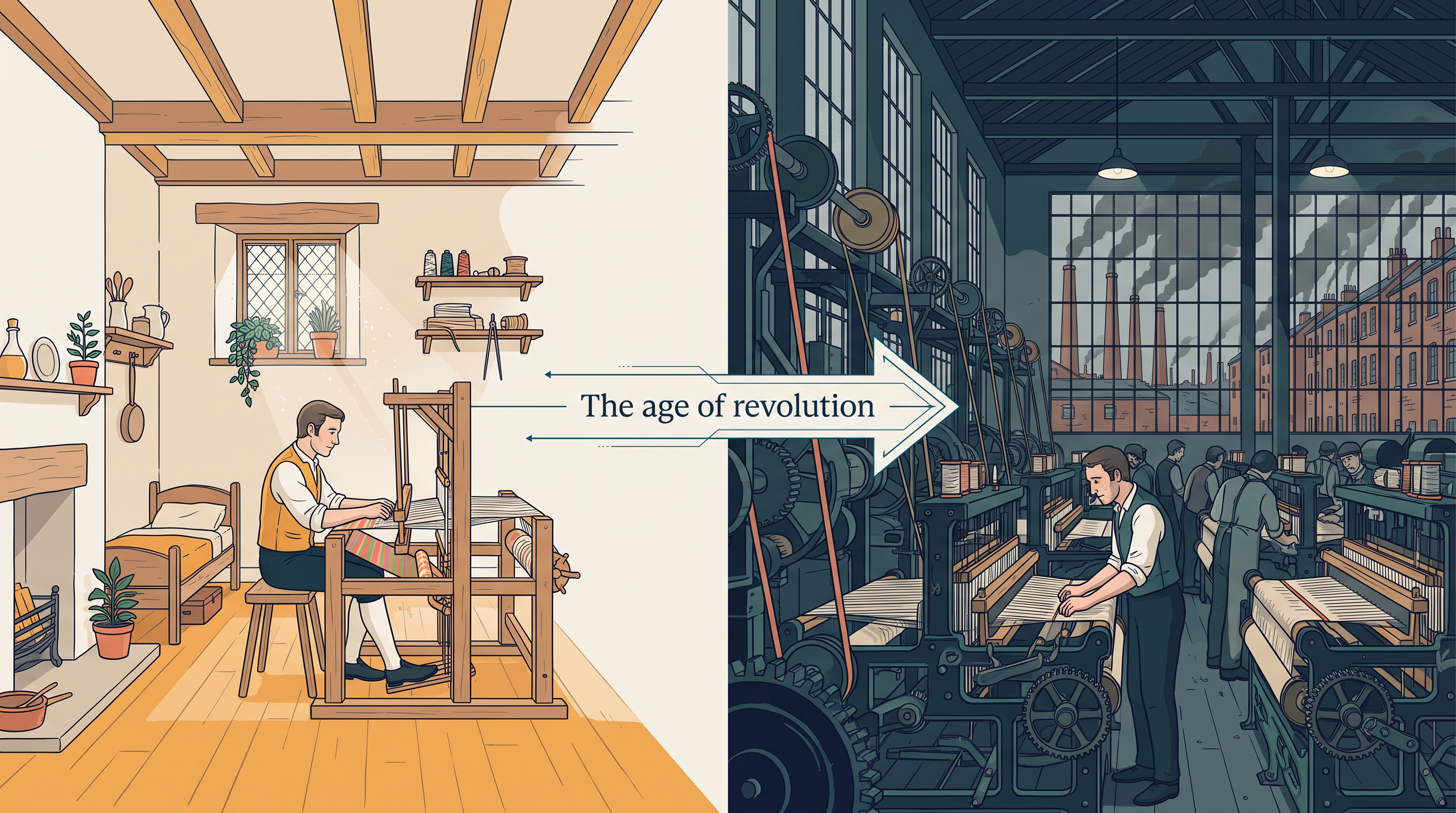
Fig. 4.1 – The transition from village handloom to industrial factory.
By the end of this chapter you will be able to answer each of these questions.
4.1 The Context of Sociology
Sociology is sometimes called the child of the “age of revolution”. The phrase is worth pausing over. It tells you that sociology did not appear because someone one morning decided that society would make an interesting subject. It appeared because society itself had changed so violently that the old ways of explaining it no longer worked.
Sociology was born in nineteenth-century Western Europe. In the three centuries before that, a series of revolutionary changes had decisively altered the way people lived — how they worked, what they believed, who ruled them, and where they made their homes. Three of these changes prepared the ground for the new subject: the Enlightenment, or the scientific revolution; the French Revolution; and the Industrial Revolution.
These processes did not stop at Europe’s borders. They transformed European society, and then transformed the rest of the world as it came into contact with Europe. Colonial rule carried European institutions, European technology and European ideas into Asia and Africa, so the questions raised in a London factory town eventually reached a Bengal village too.
The thinkers this chapter introduces
In this chapter you will meet the key ideas of three sociological thinkers: Karl Marx, Emile Durkheim and Max Weber. They belong to what is called the classical tradition of sociology — the founding body of work on which the subject was built.
Their ideas and insights have remained relevant even in our own time. That does not mean they were right about everything. All three have been sharply criticised, and their theories have undergone major modifications since. You are not being asked to accept them; you are being asked to understand them and to weigh them.
But there is a reason for beginning with their world before beginning with their ideas. Ideas about society are themselves shaped by social conditions. A thinker asks the questions his times force upon him. So we begin with a few words about the context in which sociology emerged.
The three processes
The modern era in Europe, and the conditions of modernity that we now take completely for granted, were brought about by three major processes.
The first was the Enlightenment, or the dawning of the “age of reason”. The second was the quest for political sovereignty, which found its clearest expression in the French Revolution. The third was the system of mass manufacture set in motion by the Industrial Revolution.
You have already studied these three processes at length in Chapter 1 of Introducing Sociology, where they were discussed as historical events. Here our purpose is narrower. We will look only at some of the intellectual consequences of these momentous changes — at what they did to the way human beings thought about their own social world.
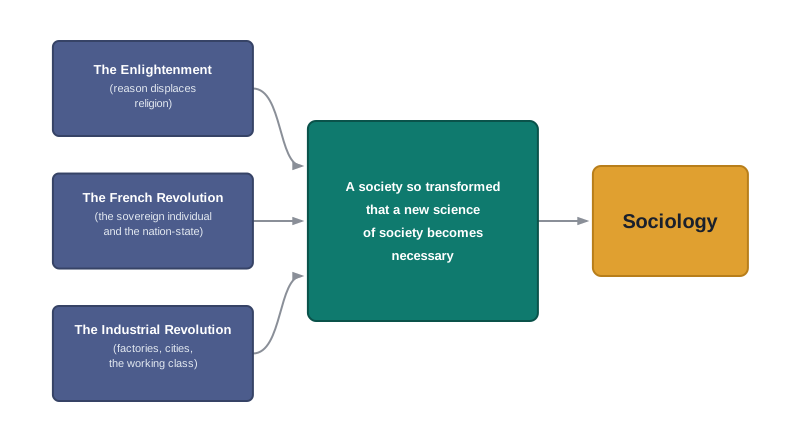
Fig. 4.2 – The three processes that led to the emergence of sociology.
4.1.1 The Enlightenment
During the late seventeenth and eighteenth centuries, Western Europe saw the emergence of radically new ways of thinking about the world. These new philosophies came to be referred to as “The Enlightenment”.
Their central move was to place the human being at the centre of the universe, and rational thought at the centre of the human being. What made a person a person, on this view, was the capacity to reason.
This capacity did something powerful. The ability to think rationally and critically transformed the individual human being into both the producer and the user of all knowledge — into what was called the “knowing subject”. Knowledge was no longer something handed down by scripture or authority. It was something a thinking person could produce for herself.
If society is made by human beings, it follows that society can be understood by human beings. Being the handiwork of humans, society was amenable to rational analysis and therefore comprehensible to other humans. That single sentence is the seed of every social science, sociology included.
But for reason to become the defining feature of the human world, something had to be pushed aside. Nature, religion and the divine acts of gods had occupied the central position in earlier ways of understanding the world; they now had to be displaced from it. Events were to be explained by causes that human beings could investigate, not by fate or divine will.
The Enlightenment was thus made possible by, and in turn helped to develop, certain attitudes of mind that we today call secular, scientific and humanistic. Secular here means “of this world” — explaining worldly things by worldly causes.
The dark side of reason
There is an uncomfortable side to this new confidence, and NCERT does not hide it. If reason is what makes a human being fully human, then whoever is judged not to reason is judged not fully human.
That is exactly the conclusion many Enlightenment thinkers drew. Only persons who could think and reason were considered fully human. Those who could not remained, in their eyes, deficient as human beings, and were considered not fully evolved humans — as in the case of the peoples of what they called “primitive” societies, or “savages”.
Notice who was doing the judging. These labels were applied by European writers, using European standards of what counted as reason, to societies they barely knew and often ruled. The categories are rejected today, and no sociologist uses them as descriptions of any people. They survive in your textbook only in quotation marks, as evidence of how the thinkers of that age thought.
4.1.2 The French Revolution
The French Revolution of 1789 announced the arrival of political sovereignty — the right to be the final authority over oneself — at two levels at once: the level of individuals, and the level of nation-states.
The Declaration of Human Rights asserted the equality of all citizens. In doing so it questioned the legitimacy of privileges inherited by birth. Before the Revolution, France was dominated by religious and feudal institutions; the Revolution signalled the emancipation of the individual from their oppressive rule.
From serf to citizen
To see what this meant on the ground, you have to know what a feudal society looked like. Land was owned by members of the aristocracy — noble families whose position came from birth. The peasants who worked that land were mostly serfs, that is, bonded labourers tied to the estate they worked on. They could not simply leave.
The Revolution freed the peasants of these bonds. The numerous taxes they had been paying to the feudal lords and to the church were cancelled.
In their place stood a new figure: the citizen. As free citizens of the republic, sovereign individuals were invested with rights, and were equal before the law and before the other institutions of the state. Equality before the law does not mean everyone becomes equally rich; it means the law does not ask who your father was.
The public and the private
A second, quieter change followed. The state now had to respect the privacy of the autonomous individual. Its laws could not intrude upon the domestic life of the people.
A separation was thus built between the public realm of the state and a private realm of the household. New ideas developed about what properly belonged to each sphere. Religion and the family became more “private” matters; education, and especially schooling, became more “public”.
This division is so familiar to you that it may seem natural. It is not. It is a historical achievement, and much of modern sociology — on the family, on religion, on gender — is an argument about where the line between public and private should fall.
The nation-state itself was also redefined in this period, as a sovereign entity with a centralised government ruling a defined territory. And the ideals of the French Revolution — liberty, equality and fraternity — became the watchwords of the modern state.
4.1.3 The Industrial Revolution
The foundations of modern industry were laid by the Industrial Revolution, which began in Britain in the late eighteenth and early nineteenth centuries. It had two major aspects, and both matter.
The first was the systematic application of science and technology to industrial production — in particular, the invention of new machines and the harnessing of new sources of power. The second, less obvious but just as important, was that the industrial revolution evolved new ways of organising labour and markets, on a scale larger than anything in the past.
Machines, power and the factory
New machines such as the Spinning Jenny, which greatly increased the productivity of the textile industry, and new methods of obtaining power, such as the various versions of the steam engine, facilitated the production process. Together they gave rise to the factory system and to the mass manufacture of goods.
Goods were now produced on a gigantic scale, and not for the neighbouring village. They were produced for distant markets across the world. The raw materials used in their production were likewise obtained from all over the world — cotton from one continent, dyes from another.
Modern large-scale industry thus became a worldwide phenomenon from the start. A machine in Manchester was connected to a field in India, and both were connected to a market somewhere else again.
What the factory did to social life
These changes in the production system also resulted in major changes in social life.
The factories were set up in urban areas. They were manned by workers who had been uprooted from the rural areas and had come to the cities in search of work. Low wages at the factory meant that men, women and even children had to work long hours in hazardous circumstances simply to eke out a living.
Modern industry enabled the urban to dominate over the rural. Cities and towns became the dominant forms of human settlement, housing large and unequal populations in small, densely populated urban areas.
Look closely at the word “unequal”. The rich and powerful lived in the cities — but so did the working classes, who lived in slums amidst poverty and squalor. For the first time, extreme wealth and extreme want were packed into the same few square kilometres, visible to each other every day.
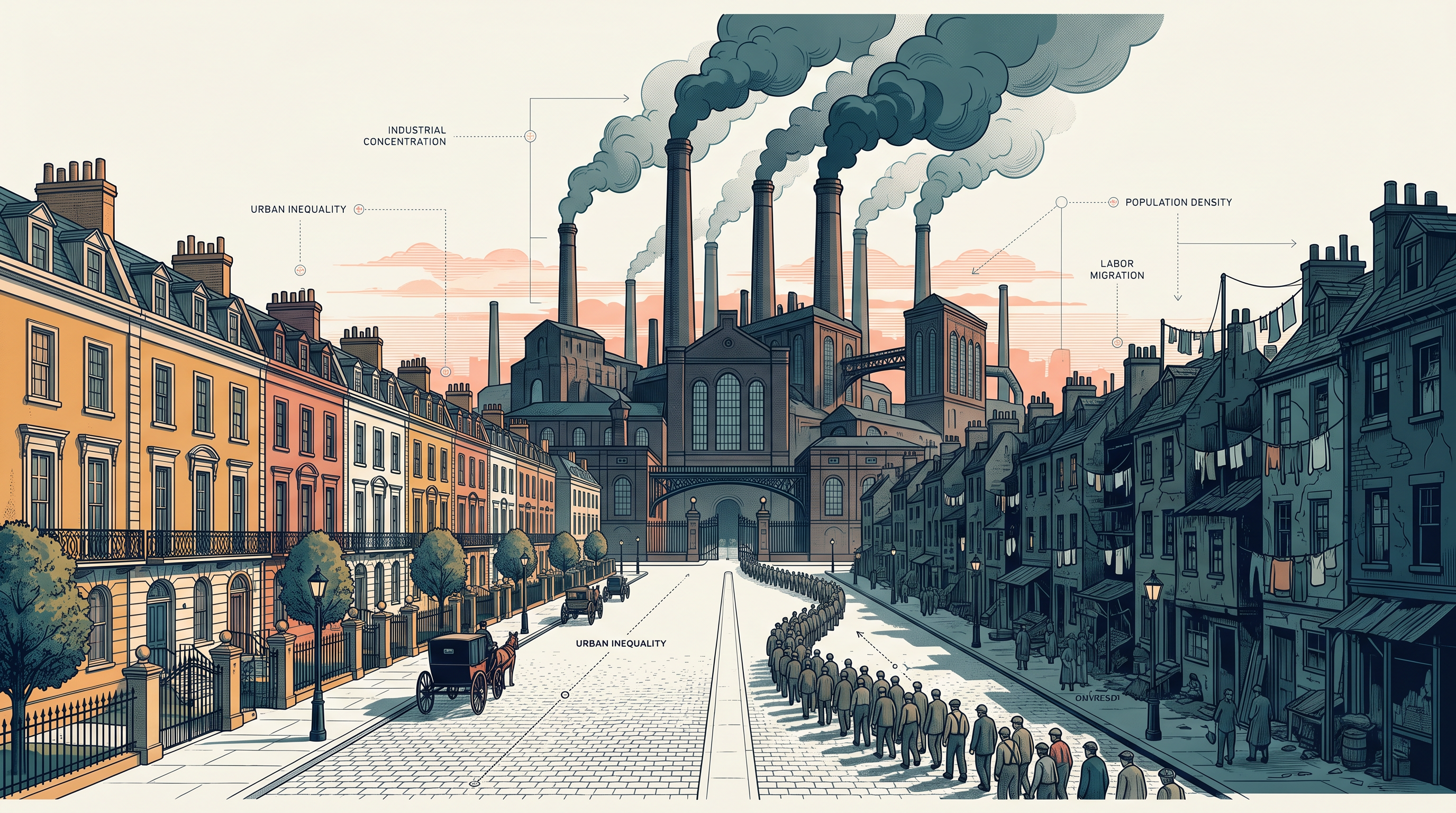
Fig. 4.3 – A nineteenth-century European industrial city.
Why the state needed a new kind of knowledge
A city like this cannot be left to run itself. Modern forms of governance developed in response, with the state assuming control of health, sanitation, crime control and general “development”.
But you cannot control what you have not counted. To manage a city’s health the state needs to know who dies, of what, and where. To manage crime it needs to know where crime is concentrated. This created a demand for new kinds of knowledge about the population.
The social sciences, and sociology in particular, emerged partly as a response to this need. The subject was not invented in a study; it grew out of a practical problem.
Sociology as the science of industrial society
From the outset, sociological thought was concerned with the scientific analysis of developments in industrial society. This has prompted observers to argue that sociology was the “science of the new industrial society”.
There is a deeper point here about method. Empirically informed scientific discussion about trends in social behaviour only became possible with the advent of modern industrial society — because only then did anyone systematically collect the numbers such discussion needs. Before that, one could speculate about society; one could not measure it.
4.2 Karl Marx
A thinker in exile
Karl Marx was from Germany, but he spent most of his intellectually productive years in exile in Britain. That was not by choice. His radical political views led him to be exiled from Germany, from France and from Austria in turn.
Though Marx had studied philosophy, he was not a philosopher. He was a social thinker who advocated an end to oppression and exploitation, and who believed that scientific socialism would achieve this goal.
To that end he engaged in a critical analysis of capitalist society. His purpose in studying capitalism — the economic system in which factories, land and capital are privately owned and goods are produced for profit — was to expose its weaknesses and to bring about its downfall. He was not a neutral observer, and never pretended to be one.
Marx argued that human society had progressed through different stages. These were: primitive communism, slavery, feudalism and capitalism. Capitalism was the latest phase of human advancement — but Marx believed it would in its turn give way to socialism.
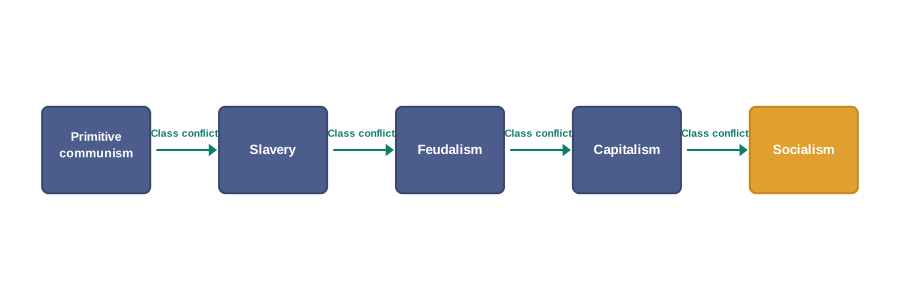
Fig. 4.4 – Marx’s stages of human society.
Alienation in capitalist society
Capitalist society, Marx said, was marked by an ever-intensifying process of alienation. The word is worth slowing down over, because in everyday speech it only means feeling lonely, and Marx meant something much more precise: being separated from, or made a stranger to, something that ought to belong to you.
Alienation, in his account, operates at several levels at once.
First, modern capitalist society is one where human beings are more alienated from nature than ever before. The factory worker no longer sees the field, the forest or the season; raw material simply arrives.
Second, human beings are alienated from each other. Capitalism individualises previously collective forms of social organisation, and relationships become more and more market-mediated — that is, they run through buying and selling rather than through custom, kinship or community.
Third, the large mass of working people is alienated from the fruits of its labour, because workers do not own the products they produce. The cloth the weaver makes belongs to the mill.
Moreover, workers have no control over the work process itself. In the days when skilled craftsmen controlled their own labour, a weaver decided how and when he worked. Today the content of the factory worker’s working day is decided by the management.
Finally, as the combined result of all these alienations, human beings are also alienated from themselves. They struggle to make their lives meaningful in a system where they are, at the same time, more free than before and yet more alienated and less in control of their own lives.
Why capitalism was still, for Marx, a step forward
Here is where students most often misread Marx. He detested capitalism — and he still called it progress.
Even though it was an exploitative and oppressive system, Marx believed that capitalism was nevertheless a necessary and progressive stage of human history. It was necessary because it created the preconditions for an egalitarian future free from both exploitation and poverty: large-scale production, immense wealth, and a huge working class concentrated in cities.
Capitalist society, he argued, would be transformed by its own victims. The working class would unite, collectively bring about a revolution to overthrow it, and establish a free and equal socialist society.
If that was the destination, the route had to be studied carefully. In order to understand the working of capitalism, Marx undertook an elaborate study of its political, social and especially its economic aspects.
The mode of production
Marx’s conception of the economy was built on the notion of a mode of production. This stood for a broad system of production associated with an epoch, or historical period.
Primitive communism, slavery, feudalism and capitalism were all modes of production. At this general level, the mode of production defines an entire way of life characteristic of an era — not merely how goods are made, but how people live, marry, worship and rule.
The building: base and superstructure
At a more specific level, we can think of the mode of production as being something like a building. A building consists of a foundation, or base, and a superstructure — something erected on top of the base.
The base, or economic base, is primarily economic. It includes the productive forces and the production relations.
Productive forces refer to all the means or factors of production: land, labour, technology, and sources of energy such as electricity, coal and petroleum.
Production relations refer to all the economic relationships and forms of labour organisation involved in production. They are also property relations — relationships based on the ownership or control of the means of production.
Take primitive communism as an example. There the productive forces consisted mostly of nature — forests, land, animals — along with very rudimentary forms of technology such as simple stone tools and hunting weapons. The production relations were based on community property, since individual private property did not yet exist, and included the tribal forms of hunting or gathering which were the prevalent forms of labour organisation.
The economic base thus consists of productive forces together with relations of production.
What rests on the base
On this base rested all the social, cultural and political institutions of society. Institutions like religion, art, law and literature, and the different forms of beliefs and ideas that go with them, were all part of the superstructure built on top of the base.
Marx argued that people’s ideas and beliefs originated from the economic system of which they were part. How human beings earned their livelihood determined how they thought. Material life shaped ideas; ideas did not shape material life.
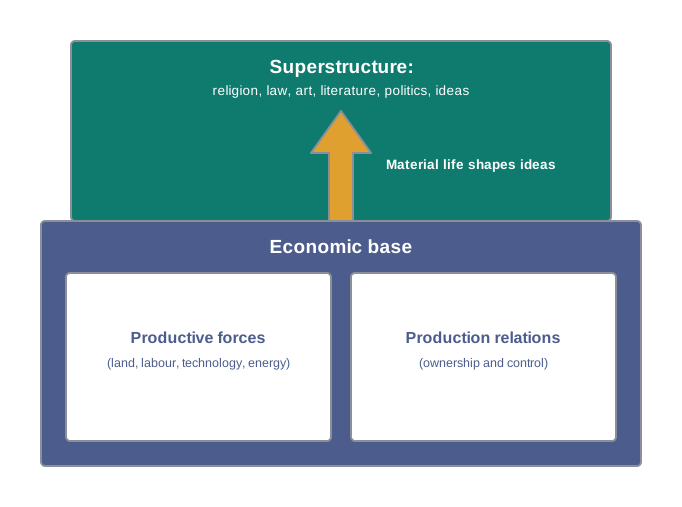
Fig. 4.5 – Marx’s base and superstructure model.
From economy to change
Marx placed great emphasis on economic structures and processes because he believed that they formed the foundations of every social system throughout human history.
His interest, though, was never purely academic. If we understand how the economy works, and how it has been changing in the past, he argued, we can learn how to change society in the future.
But how can such change be brought about? Marx’s answer was a single phrase, and it is the subject of the next section: through class struggle.
4.3 Class Struggle
How Marx decides who belongs together
Human beings can be sorted into groups in many ways. You could sort them by religion, by language, by nationality, by the region they come from. For Marx, none of these was the most important method.
The most important method of classifying people into social groups, he argued, was with reference to the production process. What matters most about a person is where she stands in the making of society’s wealth: whether she owns the means of production, or must work for someone who does.
People who occupy the same position in the social production process will, Marx said, eventually form a class. By virtue of their common location in the production process and in property relations, they share the same interests and objectives — even though they may not recognise this immediately.
That last clause is easy to skim past, and it is the whole hinge of Marx’s argument. A class can exist without knowing that it exists. We will return to this in a moment.
How classes are made
Classes are not fixed categories handed down by nature. They are formed through historical processes.
Those historical processes are in turn shaped by two things: transformations in the conditions and forces of production, and the conflicts that break out between classes that already exist.
As the mode of production changes — that is, as the production technology and the social relations of production change — conflicts develop between different classes, and these conflicts result in struggles.
The making of the working class
Take the clearest example, the one Marx watched happen. The capitalist mode of production creates the working class: a new urban, property-less group, brought into being by the destruction of the feudal agricultural system.
Serfs and small peasants were thrown off their lands and deprived of their earlier sources of livelihood. Having nothing to live on, they congregated in the cities looking for ways to survive.
They did not, however, drift peacefully into the factories. The pressure of the laws and the police forced them to work in the newly built factories. The point is worth stating plainly: the making of a working class was not simply an economic event, it was also a legal and political one.
Thus a large new social group was created, consisting of property-less people who were forced to work for their living. It is this shared location within the production process — not shared religion, region or language — that makes workers into a class.
Class struggle as the motor of history
Marx was a proponent of class struggle. He believed that class struggle was the major driving force of change in society.
He set out this view, together with Engels, in The Communist Manifesto — a work that was not only an analysis but also a programme of action. Its opening lines declare, “The history of all hitherto existing societies is the history of class struggle”.
Marx and Engels then traced the course of human history and described how the nature of the class struggle varied in different historical epochs. As society evolved from the primitive to the modern through distinct phases, each phase was characterised by a particular kind of conflict between an oppressor class and an oppressed class.
They listed the pairs: the free man and the slave in the ancient world, the patrician and the plebeian, the lord and the serf under feudalism, the guild master and the journeyman in the medieval towns. The names change from epoch to epoch. The relationship — oppressor above, oppressed below, locked in a fight that is sometimes hidden and sometimes open, but never stops — does not.
How were these pairs identified? The major opposing classes of each stage were identified from the contradictions of the production process itself. In capitalism, the two are the bourgeoisie and the working class, and the contradiction is that one owns everything needed to produce while the other owns nothing but the capacity to work.
Why opposed classes do not always fight
Here Marx’s argument becomes more careful than his reputation suggests.
Even when two classes are objectively opposed to each other, they do not automatically engage in conflict. Shared hardship is not the same thing as shared struggle.
For conflict to occur, the classes must become subjectively conscious of their class interests and identities — and therefore also conscious of their rivals’ interests and identities. A worker must come to see that her problem is not her bad luck but her position, and that thousands of others share it.
It is only after this kind of class consciousness is developed, through political mobilisation, that class conflicts occur. Consciousness does not descend from the sky; it is built through organisation, argument and action.
Such conflicts can lead to the overthrow of a dominant or ruling class, or a coalition of classes, by the classes that were previously dominated or subordinated. This is what is called a revolution.
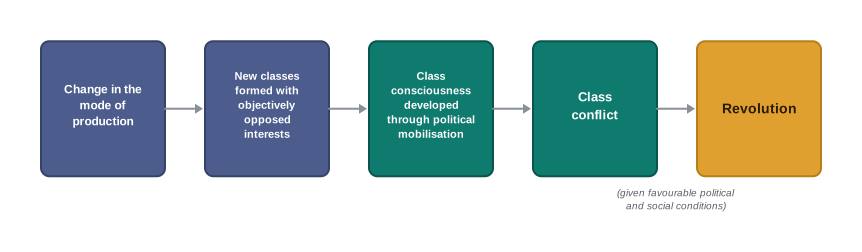
Fig. 4.6 – Marx’s path from economic change to revolution.
Why the economy is not the whole story
In Marx’s theory, economic processes created contradictions, and those contradictions in turn generated class conflict.
But — and this qualification matters — economic processes did not automatically lead to revolution. Social and political processes were also needed to bring about a total transformation of society. A crisis in the economy is an opportunity, not a guarantee.
The work of ideology
The presence of ideology is one reason why the relationship between economic and socio-political processes becomes complicated.
In every epoch, Marx argued, the ruling classes promote a dominant ideology — a way of seeing the world that tends to justify the domination of the ruling class and the existing social order. It does not announce itself as propaganda. It appears as plain common sense.
Consider how it works. A dominant ideology may encourage people living in poverty to believe that they are poor not because they are exploited by the rich, but because of “fate”, or because of bad deeds in a previous life. If poverty is explained by destiny, then nobody is responsible for it, and nothing needs to change. That, on Marx’s argument, is precisely the work the belief is doing.
Yet dominant ideologies are not always successful. They can be challenged by alternative worldviews or by rival ideologies. People are not simply containers for the ideas of their rulers.
And because consciousness spreads unevenly among classes, how a class will act in a particular historical situation cannot be pre-determined. Some sections of a class may see their position clearly while others do not.
Hence, according to Marx, economic processes generally tend to generate class conflicts — but whether those conflicts erupt, and what they achieve, also depends on political and social conditions. Given favourable conditions, class conflicts culminate in revolutions.
4.4 Emile Durkheim
The first professor of sociology
Emile Durkheim may be considered the founder of sociology as a formal discipline. The reason is precise rather than sentimental: he was the first person to become a Professor of Sociology, in Paris, in 1913. Before him, people wrote sociology; after him, universities taught it.
His own path to that chair was an unusual one. Born into an orthodox Jewish family, Durkheim was sent for his early education to a rabbinical school — a Jewish religious school — because his family expected him to become a priest, as his father and grandfather had been.
He did not. By the time he entered the Ecole Normale Superieure in 1876, he had broken with his religious orientation and declared himself an agnostic — someone who holds that we cannot know whether God exists.
Yet the break was not total, and this is the interesting part. His moral upbringing had an enduring influence on his sociological thinking. Having grown up inside a community held together by a strict code of conduct, he never lost the conviction that codes of this kind are what hold any society together.
Moral codes — the shared rules about what one ought and ought not to do — were, in his view, the key characteristics of a society. They determined the behaviour patterns of individuals.
Coming from a religious family, Durkheim also cherished the idea of developing a secular understanding of religion: an account of religion that explains it by its social functions rather than by the truth of its doctrines. It was in his last book, The Elementary Forms of the Religious Life, that he was finally able to fulfil this wish.
Society as a moral community
For Durkheim, society was a social fact — something real, existing as a moral community over and above the individual. Not merely a crowd of persons, but a thing in its own right, with a life that outlasts any of them.
What made this community real was the ties that bound people into groups. These ties, or social solidarities, were crucial to the very existence of society.
Solidarities are not just warm feelings. They exert pressure on individuals to conform to the norms and expectations of the group. Think of how much of your own behaviour — how you dress at a wedding, how you address a teacher, when you fall silent — is decided for you by expectations you never agreed to and cannot easily break.
This pressure constrains the individual’s behaviour pattern, limiting variation within a small range. Out of all the things a person could conceivably do in a given situation, only a few are socially thinkable.
Why constraint makes a science possible
Now follow the chain of reasoning, because it is the argument that made sociology a science.
If choice in social action is constricted, then behaviour becomes patterned. And if behaviour is patterned, it can be predicted.
Run the argument backwards and you get a method. By observing behaviour patterns, it becomes possible to identify the norms, codes and social solidarities which govern them.
This is Durkheim’s answer to the deepest objection facing his new subject. Ideas, norms and values are “invisible” things; you cannot photograph a norm. But their existence can be empirically verified — not by looking at them directly, but by studying the patterns of social behaviour of people as they relate to each other in a society.
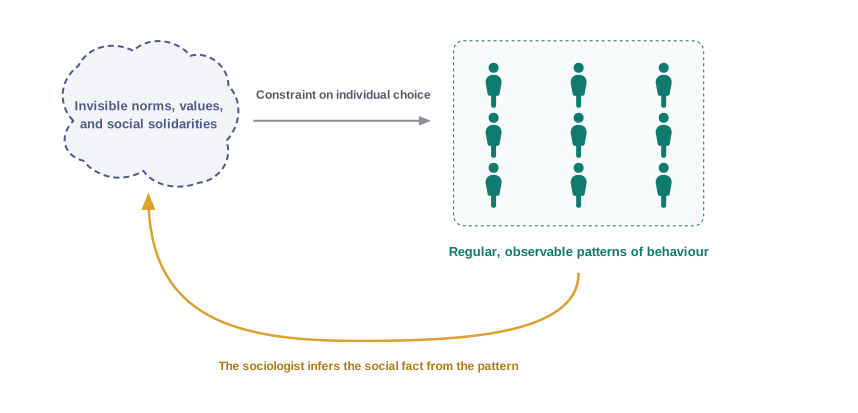
Fig. 4.7 – Durkheim’s method for observing social facts.
Moral facts, and the making of a science
For Durkheim, the social was to be found in the codes of conduct imposed on individuals by collective agreement. And these codes are not locked away in law books. They are evident in the practices of everyday life — in how you greet, eat, mourn and marry.
The scientific understanding of society that Durkheim sought to develop rested on the recognition of moral facts. He insisted that “moral facts are phenomena like others” — that is, they are as much a part of the observable world as a chemical reaction is.
His reasoning was straightforward. Moral facts consist of rules of action, and those rules can be recognised by certain distinctive characteristics. If they can be recognised, they can be observed. If they can be observed, they can be described, and classified — and finally, laws can be sought that explain them.
Morality without a universal standard
One consequence of this position deserves attention, because students often find it startling.
Moral codes, for Durkheim, were manifestations of particular social conditions. Different social conditions therefore throw up different moral codes.
It follows that the morality appropriate for one society was inappropriate for another. There is no single moral rulebook against which all societies can be marked.
And here Durkheim turns that thought into a tool. If moral codes are produced by social conditions, then the prevailing social conditions of a society can be deduced from its moral codes. Tell me what a society forbids, and I will tell you what it fears for.
This move made sociology akin to the natural sciences: it gave the subject observable data, a method of inference, and the ambition of arriving at general laws. It was entirely in keeping with Durkheim’s larger objective — to establish sociology as a rigorous scientific discipline.
4.5 Durkheim’s Vision of Sociology
Durkheim’s vision of sociology as a new scientific discipline was characterised by two defining features. The first concerns what sociology studies; the second concerns how it studies it. Take them one at a time.
The first feature: a distinct subject matter
The first feature was that the subject matter of sociology — the study of social facts — was different from that of the other sciences.
Sociology concerned itself exclusively with what Durkheim called the emergent level: the level of complex collective life at which social phenomena can emerge. These phenomena — social institutions such as religion or the family, and social values such as friendship or patriotism — were only possible in a complex whole that was larger than, and different from, its constituent parts.
The word “emergent” is doing precise work. Something is emergent when it appears only once the parts are combined, and cannot be found in any part on its own.
The cricket team argument
Durkheim’s illustration is one you can test for yourself. A cricket or football team is composed entirely of individuals — and yet a team becomes something other than, and much more than, just a collection of eleven persons.
The team has a reputation, a style of play, a history, a set of rivalries. None of these belongs to any one player. They exist at the level of the team, and they persist even as players retire and new ones arrive.
Social entities such as teams, political parties, street gangs, religious communities and nations therefore belong to a different level of reality from the level of individuals. It is this emergent level that sociology studies.
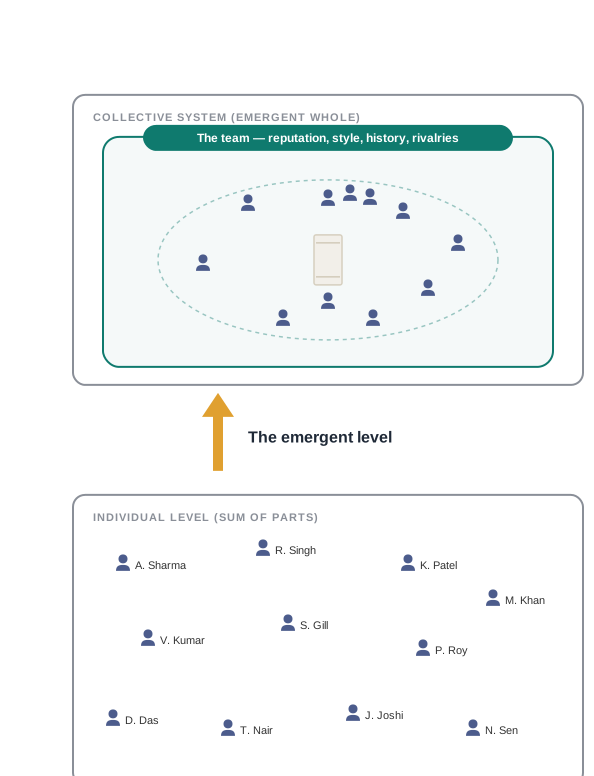
Fig. 4.8 – Durkheim’s concept of the emergent level.
The second feature: an empirical discipline
The second defining feature of Durkheim’s vision was that sociology, like most of the natural sciences, was to be an empirical discipline — one that rests on evidence gathered by observation.
This was actually a difficult claim to make, and Durkheim knew it. Social phenomena are by their very nature abstract.
We cannot “see” a collective entity like the Jain community, or the Bengali, Malayalam or Marathi speaking community, or the Nepalese or Egyptian national communities. At least, we cannot see them in the same straightforward way that we can see a tree, or a boy, or a cloud.
The difficulty does not disappear even when the social phenomenon is small. Take a family, or a theatre group. We can directly see only the individuals who make up the collectivity. The collectivity itself is never in front of our eyes.
How he solved it
One of Durkheim’s most significant achievements is his demonstration that sociology — a discipline dealing with abstract entities like social facts — could nevertheless be a science founded on observable, empirically verifiable evidence.
His solution was the one you met in the previous section, now applied at full scale. Although not directly observable, social facts were indirectly observable through patterns of behaviour.
The most famous example of his use of a new kind of empirical data is in his study, Suicide.
4.5.1 Division of Labour in Society
In his first book, Division of Labour in Society, Durkheim demonstrated his method of analysis by using it on a large question: how has society evolved from the primitive to the modern?
His answer classified a society by the nature of the social solidarity that existed in it. A primitive society was organised according to mechanical solidarity; modern society was based on organic solidarity.
Notice what he has done. Solidarity — an invisible, moral tie — is being used as the observable basis of a classification. This is the method of the previous section, put to work.
Mechanical solidarity
Mechanical solidarity is founded on the similarity of its individual members, and is found in societies with small populations.
It typically involves a collection of different self-sufficient groups, where each person within a particular group is engaged in similar activities or functions. People are bound together because they are alike, and because they know one another personally.
Because the ties between people rest on similarity and on personal relationships, such societies are not very tolerant of differences. Any violation of the norms of the community attracts harsh punishment.
In other words, societies based on mechanical solidarity have repressive law — law designed to prevent deviation from community norms by punishing it severely. The individual and the community were so tightly integrated that it was feared any violation of the codes of conduct could result in the disintegration of the community itself.
That fear is the key to understanding the harshness. Punishment here is not calculation; it is a community defending its own existence.
Organic solidarity
Organic solidarity characterises modern society, and is based on the heterogeneity — the diversity — of its members.
It is found in societies with large populations, where most social relationships necessarily have to be impersonal. You cannot personally know the farmer who grew your rice, the driver who brought it to the city, or the clerk who processes your school records.
Such a society is based on institutions. Each of its constituent groups or units is not self-sufficient, but dependent on other units and groups for its survival. Interdependence is the essence of organic solidarity.
The word “organic” is borrowed from the body. A heart and a lung are not alike; they hold together precisely because each does something the other cannot.
Organic solidarity therefore celebrates individuals. It allows for their need to be different from each other, and recognises their multiple roles and their organic ties.
The law changes accordingly. The laws of modern society are restitutive in nature rather than repressive. This means that in modern societies, the law aims to repair or correct the wrong that is done by a criminal act. By contrast, in primitive societies the law sought to punish wrongdoers, and enforced a sort of collective revenge for their acts.
The place of the individual changes too. In modern society the individual was given some autonomy, whereas in primitive societies the individual was totally submerged in the collectivity.
Groups, associations and many identities
There is a further characteristic of modern societies that follows from all this.
In them, individuals with similar goals come together voluntarily to form groups and associations — a reading club, a trade union, a residents’ welfare body, a coaching-class batch.
Because these are groups oriented towards specific goals, they remain distinct from each other, and do not seek to take over the entire life of their members. A cricket club does not tell you whom to marry.
Consequently, individuals have many different identities in different contexts. This enables an individual to emerge from the shadow of the community and to establish a distinct identity in terms of the functions she performs and the roles she plays.
Meanwhile, since all individuals have to depend on others for the fulfilment of basic needs such as food, clothing, shelter and education, the intensity of their interaction with others increases. Modern life is not more solitary; it is more crowded with strangers.
That is precisely why impersonal rules and regulations are required to govern social relations in such societies. Personalised relations can no longer be maintained across a large population, so trust must be carried by rules instead of by acquaintance.
What the book established
The Division of Labour in Society provides a good preview of Durkheim’s enduring concerns.
His effort to create a new scientific discipline, with a distinct subject that can be empirically validated, is clearly manifested in the way he discusses the different types of social solidarity as social facts. Solidarity is not preached about; it is classified, and evidenced.
His objective and secular analysis of the social ties that underlie different types of society laid the foundation of sociology as the new science of society.
4.6 Max Weber and Interpretive Sociology
The range of Weber’s work
Max Weber was one of the leading German social thinkers of his time. Despite long periods of physical and mental ill health, he left behind a rich legacy of sociological writing.
He wrote extensively on many subjects, but his work has a centre of gravity. He focused on developing an interpretive sociology of social action, and of power and domination.
A second major concern ran alongside it: the process of rationalisation in modern society — the steady spread of calculation, rules and efficiency into more and more areas of life — and the relationship of the various religions of the world with this process.
What kind of science can a science of society be?
Weber argued that the overall objective of the social sciences was to develop an “interpretive understanding of social action”.
That single phrase sets him apart from Durkheim, and it is worth seeing why. The natural sciences aim to discover objective “laws of nature” governing the physical world. A stone does not have a reason for falling; it simply falls, and the law of gravity is a complete account of it.
Human beings are not stones. The central concern of the social sciences is social action, and human actions necessarily involve subjective meanings — the meaning the person herself attaches to what she is doing. A raised hand may be a greeting, a bid at an auction, a vote or a threat, and nothing in the physics of the raised hand will tell you which.
It follows that the methods of enquiry of social science also had to be different from the methods of natural science. You cannot explain an action without recovering its meaning.
For Weber, “social action” included all human behaviour that was meaningful — that is, action to which actors attached a meaning. A cough is behaviour; a cough intended as a warning is social action.
Empathetic understanding
If meanings are what must be explained, then the sociologist’s task in studying social action is to recover the meanings attributed by the actor.
To accomplish this, the sociologist had to put herself in the actor’s place, and imagine what these meanings were, or could have been. Sociology, on Weber’s account, was thus a systematic form of empathetic understanding.
The word “empathetic” is chosen with care. It is an understanding based not on “feeling for” — which is sympathy — but on “feeling with”, which is empathy.
The empathetic understanding that sociologists derive from this exercise is what enables them to access the subjective meanings and motivations of social actors.
Objectivity about subjective things
Weber was among the first to discuss the special and complex kind of “objectivity” that the social sciences had to cultivate.
Here is the problem in a sentence. The social world is founded on subjective human meanings, values, feelings, prejudices and ideals. In studying this world, the social sciences inevitably have to deal with these subjective meanings — and yet the study itself must be objective.
In order to capture these meanings and describe them accurately, social scientists had to constantly practise empathetic understanding, putting themselves imaginatively in the place of the people whose actions they were studying. But this investigation had to be done objectively, even though it was concerned with subjective matters.
Empathetic understanding therefore required the sociologist to faithfully record the subjective meanings and motivations of social actors, without allowing her own personal beliefs and opinions to influence the process in any way.
Sociologists, in short, were meant to describe, not judge, the subjective feelings of others. Weber called this kind of objectivity value neutrality.
Weber did not pretend this was easy. He recognised that it was very difficult to do, because social scientists were themselves members of society, and always had their own subjective beliefs and prejudices. A researcher does not stop being a citizen, a believer or a neighbour when she opens her notebook.
His answer was not a trick but a demand. Sociologists had to practise great self-discipline — to exercise an “iron will”, as he puts it — in order to remain value neutral when describing the values and worldviews of others.
The ideal type
Apart from empathetic understanding, Weber suggested another methodological tool for doing sociology: the ideal type.
An ideal type is a logically consistent model of a social phenomenon that highlights its most significant characteristics. It is built by the sociologist, deliberately, in order to think with.
Being a conceptual tool designed to help analysis, an ideal type is not meant to be an exact reproduction of reality. This is the point students most often miss, so state it plainly: an ideal type may exaggerate some features of a phenomenon that are considered analytically important, and may ignore or downplay others.
Obviously an ideal type should correspond to reality in a broad sense — an ideal type of the village that resembles no village would be useless. But its main job is to assist analysis by bringing out the important features and connections of the social phenomenon being studied.
Hence the test of an ideal type is unusual. An ideal type is to be judged by how helpful it is for analysis and understanding, not by how accurate or detailed a description it provides.
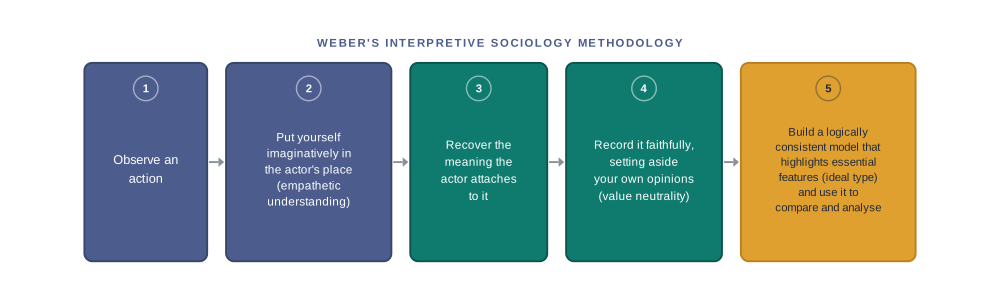
Fig. 4.9 – Weber’s method of interpretive sociology.
The ideal type at work: religion and capitalism
Weber put the ideal type to work on one of the largest questions he asked: what is the relationship between the ethics of the “world religions” and the rationalisation of the social world in different civilisations?
It was in this context that Weber suggested that the ethics of certain Protestant sects within Christianity had a deep influence on the development of capitalism in Europe.
4.7 Bureaucracy
What kind of thing is a bureaucracy?
Bureaucracy was a mode of organisation premised on the separation of the public from the domestic world. That separation, which you first met as an achievement of the French Revolution, now becomes the organising principle of an institution.
What does the separation mean in practice? It means that behaviour in the public domain was regulated by explicit rules and regulations — written down, known in advance, and applying to everyone alike. How an official behaves at home is his own affair; how he behaves at his desk is not.
Moreover, as a public institution, bureaucracy restricted the power of officials in regard to their responsibilities. It did not provide absolute power to them.
That last sentence deserves emphasis, because it runs against the everyday use of the word. In ordinary speech, “bureaucracy” suggests officials with too much power and too little sense. In Weber’s analysis, the bureaucracy is precisely the device by which an official’s power is limited — fenced in by rules that say exactly what he may and may not do.
Recall where this section comes from. Weber identified three types of authority, and said that rational-legal authority — authority grounded in the legal demarcation of powers — is what prevails in modern times. Bureaucracy is where that type of authority is seen in its purest form.
(i) Functioning of Officials
Within the bureaucracy, officials have fixed areas of “official jurisdiction”, governed by rules, laws and administrative regulations. An official’s authority stops at the boundary of his jurisdiction, and he cannot decide matters that lie outside it.
The regular activities of the bureaucratic organisation are distributed in a fixed way, as official duties. Nothing is left to be settled by whoever happens to be nearest.
Commands are issued by higher authorities for implementation by subordinates in a stable way. But the responsibilities of officials are strictly delimited by the authority available to them — a superior may command only what the rules allow him to command.
Because duties have to be fulfilled on a regular basis, only those who have the requisite qualifications to perform them are employed. Recruitment rests on qualification, not on birth or favour.
Finally — and this is the feature that most sharply distinguishes a bureaucracy from a royal court — official positions in a bureaucracy are independent of the incumbent. They continue beyond the tenure of any occupant.
(ii) Hierarchical Ordering of Positions
Authority and office are placed on a graded hierarchy, in which higher officials supervise the lower ones.
The purpose is not merely command. A hierarchy allows scope of appeal to a higher official in case of dissatisfaction with the decisions of lower officials. If a clerk refuses your application, there is someone above the clerk who can be asked to look again.
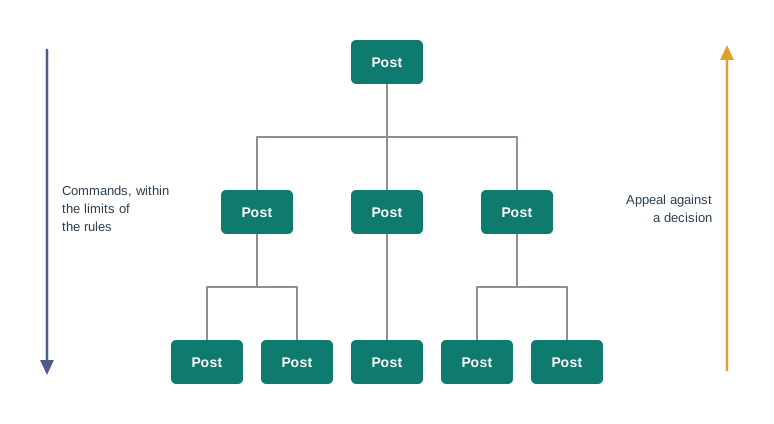
Fig. 4.10 – Hierarchical ordering of positions in a bureaucracy.
(iii) Reliance on Written Document
The management of a bureaucratic organisation is carried out on the basis of written documents — the files — which are preserved as records.
Writing does something that memory cannot. It creates cumulation in the decision-making of the “bureau”, or office: each decision is recorded, and later decisions are taken in the light of the earlier ones. A bureaucracy therefore remembers, even after everyone who took the original decision has gone.
The file is also part of the public domain, which is separate from the private life of the officials. It can, in principle, be produced, checked and questioned.
(iv) Office Management
Since office management is a specialised and modern activity, it requires trained and skilled personnel to conduct operations. Running an office is itself a competence to be learnt, not something anyone can be expected to do simply because he is senior or respected.
(v) Conduct in Office
Official activity demands the full-time attention of officials, irrespective of the delimited hours they spend in the office. Hence an official’s conduct in office is governed by exhaustive rules and regulations.
These rules separate the official’s public conduct from her behaviour in the private domain. What she may accept, whom she may favour, what she may say in her official capacity — all this is prescribed, and none of it depends on her private friendships.
And because these rules and regulations have legal recognition, officials can be held accountable. A rule that is merely a custom can be quietly ignored; a rule that is law cannot.
What Weber’s account demonstrated
Weber’s characterisation of bureaucracy as a modern form of political authority demonstrated something about the position of the individual within it.
An individual actor was, on the one hand, recognised for her skills and training — she is appointed because she is qualified, not because of who her family is. On the other hand, she was given responsibilities together with the requisite authority to implement them, so that the job carries the powers needed to do it.
And the legal delimitation of tasks and authority did two things at once. It constrained unbridled power, and it made officials accountable to their clients, because the work was carried out in the public domain where it could be seen and questioned.
That is the modern world Marx, Durkheim and Weber were each trying to explain — a world of factories and classes, of new solidarities and impersonal rules, of files, offices and rights. They disagreed profoundly about what held it together and where it was going. Learning to hold their three answers side by side, and to weigh them, is what it means to begin thinking sociologically.
4.8 Summary
The context of sociology (4.1)
- Sociology is called the child of the “age of revolution”. It was born in nineteenth-century Western Europe, after three centuries of revolutionary change had transformed how people lived — first in Europe, then in the rest of the world as it came into contact with Europe.
- Three processes prepared the ground: the Enlightenment (the scientific revolution), the French Revolution, and the Industrial Revolution. Together they produced the conditions of modernity.
- The Enlightenment (late seventeenth and eighteenth centuries) placed the human being at the centre of the universe and reason at the centre of the human being. Society, being made by humans, could therefore be analysed rationally. Nature, religion and the divine were displaced from the centre of explanation, producing attitudes we call secular, scientific and humanistic.
- Its dark side: only those judged capable of reason were counted fully human. Peoples of so-called “primitive” societies were labelled “savages” — a judgement made by Europeans, applying European standards, to societies they often ruled. Sociology rejects these labels today.
- The French Revolution (1789) announced political sovereignty at two levels — the individual and the nation-state. The Declaration of Human Rights asserted the equality of all citizens and questioned privileges inherited by birth. Serfs were freed of their bonds; feudal and church taxes were cancelled; citizens became equal before the law.
- It also built a separation between the public realm of the state and the private realm of the household: religion and the family became more “private”, schooling more “public”. Liberty, equality and fraternity became the watchwords of the modern state.
- The Industrial Revolution (Britain, late eighteenth and early nineteenth centuries) had two aspects: the systematic application of science and technology to production (the Spinning Jenny, the steam engine), and new ways of organising labour and markets on an unprecedented scale. These produced the factory system and mass manufacture for distant world markets.
- Socially, it uprooted rural workers into cities, imposed long hours and low wages on men, women and children, and made the urban dominate the rural. Cities housed great wealth and great poverty side by side.
- To govern such cities, the state took charge of health, sanitation, crime control and “development” — and to do so it had to count and record. This demand for new knowledge is one reason the social sciences, and sociology in particular, emerged. Sociology has been called the “science of the new industrial society”.
Karl Marx (4.2)
- Marx (1818–1883), German, spent most of his productive years exiled in Britain. He was a social thinker, not a philosopher, who studied capitalism in order to expose and overturn it.
- He argued that human society had progressed through stages: primitive communism, slavery, feudalism and capitalism — and that capitalism would give way to socialism.
- Alienation, in capitalism, operates at several levels: humans are alienated from nature; from each other, as relations become market-mediated; from the fruits of their labour, since workers do not own what they produce; from the work process, since management now decides the content of the working day; and finally from themselves.
- Yet Marx held capitalism to be a necessary and progressive stage, because it created the preconditions for an egalitarian future. It would be transformed by its own victims — the working class, uniting to make a revolution.
- The mode of production is a broad system of production associated with a historical epoch, defining an entire way of life. It is like a building: an economic base, and a superstructure erected upon it.
- The base consists of productive forces (land, labour, technology, sources of energy) and production relations (the economic relationships and forms of labour organisation, which are also property relations based on ownership of the means of production).
- The superstructure consists of religion, art, law, literature, beliefs and ideas. Marx argued that material life shapes ideas, not the other way round — a claim that went against the dominant thinking of his time.
Class struggle (4.3)
- For Marx the most important way of classifying people is by their position in the production process, not by religion, language or nationality. Those who share a position share interests — even if they do not yet recognise it.
- Classes are formed through historical processes. The capitalist mode of production created the working class: serfs and small peasants thrown off the land, driven into cities, and pressed by law and police into the new factories.
- In capitalism the bourgeoisie own all the means of production; the working class owns nothing and must sell its labour for wages in order to survive.
- Objectively opposed classes do not automatically fight. Conflict requires class consciousness — subjective awareness of one’s own class interests and of one’s rivals’ — developed through political mobilisation. Conflict may then culminate in revolution: the overthrow of a ruling class by a subordinated one.
- Economic processes generate contradictions, but do not by themselves produce revolutions; social and political processes are also needed.
- In every epoch the ruling class promotes a dominant ideology that makes its domination appear natural — for instance, by explaining poverty as fate or as the result of deeds in a previous life. But dominant ideologies can be challenged by rival ideologies, and consciousness spreads unevenly, so outcomes cannot be pre-determined.
Emile Durkheim (4.4)
- Durkheim (1858–1917) may be considered the founder of sociology as a formal discipline: he was the first Professor of Sociology, in Paris in 1913. Raised in an orthodox Jewish family and sent to a rabbinical school, he became an agnostic — but his moral upbringing shaped his sociology.
- Moral codes were, for him, the key characteristics of a society, determining individual behaviour. He sought a secular understanding of religion, achieved in his last book, The Elementary Forms of the Religious Life.
- Society was a social fact, existing as a moral community over and above the individual. Social solidarities — the ties binding people into groups — exert pressure on individuals to conform, constricting choice and thus producing patterned, predictable behaviour.
- This is what makes a science of society possible. Norms and values are invisible, but by observing patterns of behaviour we can identify the norms, codes and solidarities that govern them.
- Durkheim’s science rests on moral facts: rules of action that can be observed, described, classified and explained. Because moral codes are manifestations of particular social conditions, the morality of one society is inappropriate for another — and the social conditions of a society can be deduced from its moral codes.
Durkheim’s vision of sociology (4.5)
- Two defining features. First, a distinct subject matter: sociology studies social facts at the emergent level — the level of complex collective life, where phenomena appear that are not present in the parts. A cricket team is more than eleven individuals; so are political parties, religious communities and nations.
- Second, sociology was to be an empirical discipline. This was hard, because collectivities cannot be seen directly. Durkheim’s achievement was to show that social facts, though not directly observable, are indirectly observable through patterns of behaviour.
- His study Suicide demonstrated this. Each individual case is unique, but the average rate of suicide aggregated across a whole community is stable and characteristic of it — and is therefore a social fact.
- Social facts are like things: external to the individual but constraining behaviour. Law, education and religion are social facts. They are collective representations, emerging from the association of people, general in nature and independent of any individual.
- In Division of Labour in Society, Durkheim classified societies by the type of solidarity holding them together.
- Mechanical solidarity: small populations, self-sufficient groups doing similar work, ties based on similarity and personal relationships, little tolerance of difference, repressive law that punishes deviation, the individual submerged in the collectivity.
- Organic solidarity: large populations, heterogeneous members, impersonal relationships, specialised units dependent on one another. Interdependence is its essence. It celebrates individual difference and multiple roles, and its law is restitutive — repairing the wrong rather than avenging it.
- In modern societies people form voluntary associations around specific goals; these do not take over their members’ whole lives, so individuals carry many identities. Because everyone depends on others for basic needs, interaction intensifies, and impersonal rules become necessary where personal relations cannot reach.
- Where Durkheim saw the deepening division of labour producing solidarity, Marx saw it producing conflict. Both agreed that it produces interdependence.
Max Weber and interpretive sociology (4.6)
- Weber (1864–1920) developed an interpretive sociology of social action and of power and domination, and studied the rationalisation of modern society and its relationship with the world religions.
- The social sciences differ from the natural sciences because their subject matter — social action, meaning all behaviour to which actors attach a meaning — carries subjective meaning. Their methods must therefore differ too.
- The sociologist’s task is to recover the meanings the actor attaches to her action, by imaginatively putting herself in the actor’s place. This is empathetic understanding: not “feeling for” (sympathy) but “feeling with” (empathy).
- The investigation must nonetheless be objective. Value neutrality means faithfully recording the subjective meanings of others without letting one’s own beliefs or opinions intrude — describing, not judging. Weber admitted this is very difficult, since social scientists are themselves members of society, and demanded an “iron will”.
- The ideal type is a logically consistent model of a social phenomenon that highlights its most significant features. It is a tool for analysis, not an exact reproduction of reality; it may exaggerate what is analytically important and downplay the rest. It is judged by how useful it is, not by how accurate a description it gives.
- Using the ideal type, Weber argued that the ethics of certain Protestant sects had a deep influence on the development of capitalism in Europe — an argument that, unlike Marx’s, lets an idea shape an economy.
- He also used it to define three types of authority: traditional (custom and precedence), charismatic (divine sources, the “gift of grace”) and rational-legal (legal demarcation of authority). Rational-legal authority prevails in modern times and is epitomised in the bureaucracy.
Bureaucracy (4.7)
- Bureaucracy rests on the separation of the public from the domestic world: conduct in the public domain is regulated by explicit rules. As a public institution it restricts officials’ power rather than granting them absolute power.
- Its five features: (i) Functioning of Officials — fixed jurisdictions, duties distributed by rule, appointment by qualification, and offices that continue beyond any occupant; (ii) Hierarchical Ordering of Positions — a graded hierarchy in which higher officials supervise lower ones, allowing appeal; (iii) Reliance on Written Document — the files, preserved as records, giving cumulation to decision-making; (iv) Office Management — a specialised modern activity requiring trained personnel; (v) Conduct in Office — exhaustive rules that separate public conduct from private behaviour and, having legal recognition, make officials accountable.
- An office is a post of impersonal, formal authority with specified powers, existing independently of the person appointed to it.
- Weber’s account showed the individual official as both recognised for skill and training and constrained by the legal delimitation of tasks — power fenced in, and accountability owed to the public.
4.9 Key Terms
Alienation — A process in capitalist society by which human beings are separated and distanced from (or made strangers to) nature, other human beings, their work and its product, and their own nature or self.
Association — A group formed voluntarily by individuals with a similar goal, oriented to a specific purpose, and therefore not claiming the whole life of its members.
Authority — Power that those subject to it accept as legitimate; Weber distinguished three types — traditional, charismatic and rational-legal.
Bourgeoisie — In Marx’s account of capitalism, the class of capitalists who own the means of production, such as investible capital, factories, machinery and land.
Bureaucracy — A mode of organisation, resting on the separation of the public from the domestic world, in which official conduct is regulated by explicit rules and the power of officials is restricted rather than absolute.
Capitalism — The mode of production in which the means of production are privately owned and goods are produced for sale and profit by workers who sell their labour for wages.
Charismatic authority — Authority derived from divine sources or the “gift of grace”, obeyed because of the extraordinary personal qualities followers see in an individual.
Class — In Marx’s sense, a group of people who occupy the same position in the production process and in property relations, and who therefore share common interests, whether or not they yet recognise it.
Class consciousness — A class’s subjective awareness of its own interests and identity, and of those of its rivals; developed through political mobilisation, and necessary before class conflict can occur.
Class struggle — The conflict between opposed classes which, for Marx, is the major driving force of change in society.
Classical tradition — The founding body of sociological work, including that of Marx, Durkheim and Weber, on which the discipline was built.
Collective representations — Beliefs, feelings and collective practices that emerge from the association of people; general in nature and independent of any individual.
Dominant ideology — The way of seeing the world promoted by the ruling class of an epoch, which makes its domination and the existing social order appear natural, deserved or inevitable.
Economic base — In Marx’s model, the primarily economic foundation of a society, consisting of its productive forces and its production relations.
Emergent level — The level of complex collective life at which social phenomena appear that are not present in, and cannot be reduced to, the individuals who compose the collectivity; the level Durkheim said sociology studies.
Empathetic understanding — Weber’s method of grasping social action by imaginatively placing oneself in the actor’s position; an understanding based on “feeling with” (empathy) rather than “feeling for” (sympathy).
Enlightenment — A period in eighteenth-century Europe when philosophers rejected the supremacy of religious doctrines, established reason as the means to truth, and treated the human being as the sole bearer of reason.
Factory system — The system of production, arising from the Industrial Revolution, in which large numbers of workers are brought together under one roof to work with machines under managerial control.
Ideal type — A logically consistent model of a social phenomenon that highlights its most significant characteristics; a tool for analysis rather than an exact reproduction of reality.
Ideology — A way of seeing the world that shapes what people take to be natural, just or inevitable.
Industrial Revolution — The transformation of production that began in Britain in the late eighteenth and early nineteenth centuries, combining the systematic application of science and technology to production with new ways of organising labour and markets.
Mechanical solidarity — The social cohesion of small, simple societies, founded on the similarity of their members and on personal relationships; associated with repressive law.
Means of production — The factors used to produce, such as land, factories, machinery and capital; ownership or control of them defines a person’s position in production relations.
Mode of production — A system of material production which persists over a long period of time, distinguished by its means of production (technology and forms of production organisation) and its relations of production (slavery, serfdom, wage labour).
Modernity — The conditions of social life brought about in Europe by the Enlightenment, the French Revolution and the Industrial Revolution, and now widely taken for granted.
Moral codes — The shared rules of a society about what one ought and ought not to do; for Durkheim, the key characteristics of a society and the determinants of individual behaviour.
Moral facts — Rules of action, recognisable by distinctive characteristics, which can therefore be observed, described, classified and explained like other phenomena.
Nation-state — A sovereign political entity with a centralised government ruling a defined territory.
Office — In the context of bureaucracy, a public post of impersonal and formal authority with specified powers and responsibilities, having an existence independent of the person appointed to it. (This differs from the everyday meaning of the word, which refers to an actual institution or its physical location — the post office, the panchayat office, and so on.)
Organic solidarity — The social cohesion of large, complex modern societies, founded not on similarity but on the interdependence of members and groups performing specialised functions; associated with restitutive law.
Production relations — All the economic relationships and forms of labour organisation involved in production; also property relations, based on the ownership or control of the means of production.
Productive forces — All the means or factors of production, such as land, labour, technology and sources of energy.
Rational-legal authority — Authority based on the legal demarcation of powers, obeyed because of the office a person holds and the rules defining it; the type that prevails in modern times.
Rationalisation — The spread of calculation, rules and efficiency into more and more areas of social life in modern society.
Repressive law — Law that punishes deviation from community norms harshly, enforcing a kind of collective revenge; characteristic of mechanical solidarity.
Restitutive law — Law that aims to repair or correct the wrong done by an act rather than to avenge it; characteristic of organic solidarity.
Revolution — The overthrow of a dominant or ruling class (or coalition of classes) by the classes previously subordinated to it.
Secular — Of this world; explaining worldly things by worldly causes rather than by religious or divine ones.
Serf — A bonded labourer tied to a landed estate, unable to leave it; the typical condition of the peasantry in feudal Europe before the French Revolution.
Social action — All human behaviour that is meaningful, that is, action to which the actor attaches a subjective meaning.
Social fact — Aspects of social reality related to collective patterns of behaviour and belief, which are not created by individuals but exert pressure on them and influence their behaviour.
Social solidarity — The ties that bind people into groups and exert pressure on them to conform to the group’s norms and expectations.
Sovereignty — The status of being the final authority over oneself; asserted by the French Revolution both for the individual citizen and for the nation-state.
Superstructure — In Marx’s model, the social, cultural and political institutions — religion, art, law, literature, beliefs and ideas — erected upon the economic base and shaped by it.
Traditional authority — Authority whose source is custom and precedence, obeyed because it has always been obeyed.
Value neutrality — The discipline of neutrally recording the subjective values of the people one studies, without being affected by one’s own feelings or opinions about those values; describing rather than judging.
Working class — The urban, property-less class created by the capitalist mode of production, which owns no means of production and must sell its labour for wages in order to survive.
4.10 Points to Ponder
Marx argued that material life shapes ideas — that how people earn their livelihood determines how they think. Weber suggested that the ethics of certain religious sects helped shape the development of capitalism. Can both claims be partly right at the same time? What kind of evidence would help you decide which way the influence mainly runs in a particular case?
Durkheim held that organic solidarity gives individuals more room to be different from one another. Yet young people across countries, states and regions increasingly listen to the same songs and wear the same clothes. Is such standardisation the opposite of individuality — or is it what individuality looks like in a large, impersonal society?
If a class can share the same objective interests and still not know it, then somebody must first tell it what those interests are. Who is entitled to do that, and how would we ever know if they had got it wrong?
Weber says the rules of a bureaucracy restrict what any single official may do. Yet a well-run bureaucracy can be more powerful than any individual ruler ever was. What does this suggest about where power actually resides in a modern society?
Value neutrality asks the sociologist to record other people’s values without judging them. Can you think of a practice that a sociologist should refuse to describe neutrally? If you can, what happens to Weber’s method — and if you cannot, what happens to the sociologist as a citizen?
The Enlightenment made reason the mark of the fully human, and then used that very standard to rank some peoples below others. Can a way of thinking be genuinely liberating and genuinely dangerous at the same time? What should sociology do with such an inheritance?
Marx, Durkheim and Weber were all writing about nineteenth-century Europe. What does an Indian student gain by studying them — and what might she miss if she reads Indian society only through their categories?
4.11 NCERT Questions
Why is the Enlightenment important for the development of sociology?
How was the Industrial Revolution responsible for giving rise to sociology?
What are the various components of a mode of production?
Why do classes come into conflict, according to Marx?
What are social facts? How do we recognise them?
What is the difference between ‘mechanical’ and ‘organic’ solidarity?
Show, with examples, how moral codes are indicators of social solidarity.
What are the basic features of bureaucracy?
What is special or different about the kind of objectivity needed in social science?
Can you identify any ideas or theories which have led to the formation of social movements in India in recent times?
Try to find out what Marx and Weber wrote about India.
Can you think of reasons why we should study the work of thinkers who died long ago? What could be some reasons not to study them?
4.12 Objective Questions
- Sociology is sometimes described as the child of the “age of revolution”. Which three revolutions are meant?
- The Enlightenment, the French Revolution and the Industrial Revolution
- The French Revolution, the Russian Revolution and the Industrial Revolution
- The Enlightenment, the Green Revolution and the French Revolution
- The Industrial Revolution, the Russian Revolution and the Enlightenment [1 mark]
- Which of the following was NOT part of the economic base in Marx’s model?
- Land and technology
- Sources of energy such as coal and petroleum
- Religion, art and law
- The relationships based on ownership of the means of production [1 mark]
- According to Marx, a revolution occurs when —
- the ruling class voluntarily surrenders its property
- a subordinated class, having developed class consciousness, overthrows the dominant class
- the economy collapses, automatically and by itself
- the dominant ideology becomes more persuasive than its rivals [1 mark]
- Durkheim’s study of suicide is famous in sociology chiefly because it —
- explained why each individual took his or her own life
- showed that the aggregated rate of suicide in a community is a social fact
- proved that suicide has no social causes at all
- established that suicide rates cannot be measured [1 mark]
- Restitutive law is characteristic of —
- mechanical solidarity
- organic solidarity
- charismatic authority
- primitive communism [1 mark]
- An ideal type, in Weber’s sense, is to be judged by —
- how accurately and completely it describes reality
- how morally desirable the phenomenon it models is
- how useful it is for analysis and understanding
- how many exceptions to it can be found [1 mark]
- Which of the following is NOT one of the five features of bureaucratic authority listed by Weber?
- Hierarchical Ordering of Positions
- Reliance on Written Document
- Inheritance of Office
- Conduct in Office [1 mark]
- Assertion (A): In societies based on mechanical solidarity, any violation of community norms attracts harsh punishment. Reason (R): In such societies the individual and the community are so tightly integrated that a violation of the codes of conduct is feared to threaten the community’s very existence.
- Both A and R are true, and R is the correct explanation of A.
- Both A and R are true, but R is not the correct explanation of A.
- A is true, but R is false.
- A is false, but R is true. [1 mark]
- Assertion (A): For Marx, two classes that are objectively opposed to each other will automatically come into conflict. Reason (R): Class conflict requires class consciousness, which is developed through political mobilisation.
- Both A and R are true, and R is the correct explanation of A.
- Both A and R are true, but R is not the correct explanation of A.
- A is true, but R is false.
- A is false, but R is true. [1 mark]
- Assertion (A): Weber held that the methods of the social sciences must differ from those of the natural sciences. Reason (R): Social action carries subjective meaning, which the sociologist must recover, whereas the objects of the natural sciences attach no meaning to what they do.
- Both A and R are true, and R is the correct explanation of A.
- Both A and R are true, but R is not the correct explanation of A.
- A is true, but R is false.
- A is false, but R is true. [1 mark]
- Match the thinker in Column I with the concept in Column II.
| Column I | Column II |
|---|---|
| a. Karl Marx | i. Ideal type |
| b. Emile Durkheim | ii. Alienation |
| c. Max Weber | iii. Organic solidarity |
[1 mark]
- Match the work in Column I with its author in Column II.
| Column I | Column II |
|---|---|
| a. The Elementary Forms of the Religious Life | i. Karl Marx and Friedrich Engels |
| b. The Protestant Ethic and the Spirit of Capitalism | ii. Emile Durkheim |
| c. The Communist Manifesto | iii. Max Weber |
[1 mark]
- Match the type of authority in Column I with its source in Column II.
| Column I | Column II |
|---|---|
| a. Traditional authority | i. Legal demarcation of authority |
| b. Charismatic authority | ii. Custom and precedence |
| c. Rational-legal authority | iii. Divine sources, or the “gift of grace” |
[1 mark]
Fill in the blank: The ties that bind people into groups and exert pressure on them to conform to the group’s norms were called ______________ by Durkheim. [1 mark]
Fill in the blank: In Marx’s model, the institutions of religion, art, law and literature form the ______________ , which rests upon the economic base. [1 mark]
Fill in the blank: Weber called the objectivity required of a sociologist — recording others’ values without being affected by one’s own opinions about them — ______________ . [1 mark]
True or False: According to Marx, capitalism was a purely destructive stage of history with nothing progressive about it. [1 mark]
True or False: In Weber’s sense, an office continues to exist independently of the person appointed to it. [1 mark]
True or False: Durkheim argued that social facts, being abstract, cannot be studied empirically. [1 mark]
True or False: Empathy, in Weber’s usage, means “feeling for” another person, while sympathy means “feeling with” them. [1 mark]
4.13 Check Your Concepts
Define a social fact in Durkheim’s sense, and give one example. [2 marks]
What is meant by a mode of production? Name any two modes of production Marx identified. [2 marks]
State two features of the Enlightenment as a way of thinking about the world. [2 marks]
What is class consciousness? Why is it necessary for class conflict? [2 marks]
Define an ideal type. State one thing it is not meant to be. [2 marks]
Name the three types of authority defined by Weber, and state the source of each. [2 marks]
What is meant by an “office” in the context of bureaucracy? [2 marks]
Name any two changes in social life that followed from the setting up of factories in urban areas. [2 marks]
Distinguish between productive forces and production relations, with one example of each. [4 marks]
Differentiate between mechanical and organic solidarity on any four points. [4 marks]
Explain, with an example, the difference between sympathy and empathy, and say why Weber’s method requires the second and not the first. [4 marks]
“An ideal type is not an ideal.” Explain this statement with reference to Weber’s methodology. [4 marks]
Why did the French Revolution matter for the way modern people think about the individual? Answer with reference to sovereignty, equality before the law, and the separation of the public and the private. [4 marks]
Marx argued that a dominant ideology tends to justify the existing social order. Explain this with an example, and say why he nevertheless held that dominant ideologies do not always succeed. [4 marks]
Explain any four features of bureaucratic authority. In each case, state what that feature prevents an official from doing. [4 marks]
Why is a cricket team, in Durkheim’s argument, more than a collection of eleven persons? Use this example to explain what he meant by the “emergent” level. [4 marks]
Explain Marx’s concept of alienation in full. Describe the several levels at which it operates in capitalist society, and state one criticism that can be made of the concept. [6 marks]
Explain how Durkheim demonstrated that sociology could be an empirical science even though social facts cannot be directly seen. Refer to his study of suicide in your answer, and mention one limitation of his method. [6 marks]
Marx and Durkheim both saw the division of labour deepen in modern society, but drew opposite conclusions from it. Compare the two positions, state what they agree on, and evaluate which account you find more persuasive, giving reasons. [6 marks]
“Sociology emerged as the science of the new industrial society.” Discuss the causes and consequences of the Industrial Revolution that made a new science of society both possible and necessary. [6 marks]
Explain Weber’s idea of interpretive sociology. In your answer, discuss social action, empathetic understanding and value neutrality, and explain why Weber admitted that value neutrality is very difficult to achieve. [6 marks]
“Marx held that material life shapes ideas; Weber suggested that a religious ethic influenced the rise of capitalism.” How far do you agree that these two claims cannot both be correct? Argue your case with reference to what each thinker actually claimed. [6 marks]
Marx believed that class position matters more than religion, language or nationality in explaining how people act. Evaluate this claim with Indian examples. [6 marks]
4.14 Passage-Based Questions
- Read the passage and answer the questions that follow.
A woman joins a large bakery on the edge of a city. Her work is to place the same cardboard tray on a moving belt, once every few seconds, through the whole of her shift. She never learns which shops the biscuits go to. The speed of the belt is set by a supervisor she rarely meets, and the order of tasks was decided long before she arrived. She is paid on the first of every month and may resign whenever she wishes. On the bus home, she says that she cannot think of a single thing in the day that was hers.
a. Identify the concept from this chapter that the passage illustrates, and name the thinker associated with it. [1 mark]
b. Explain any two levels at which this concept is operating in the passage. [2 marks]
c. The woman is legally free and is paid regularly. Explain why this does not settle the question. [3 marks]
[6 marks]
- Read the passage and answer the questions that follow.
In a small hill settlement, disputes are settled by an assembly of elders. Almost everyone farms, and everyone knows everyone. When a young man is found to have broken a long-standing rule about the use of common grazing land, the assembly imposes a heavy penalty and requires a public apology, though the actual loss to the village is small. An officer visiting from the district town is puzzled: in the town, she says, such a matter would end with the man paying compensation for the grass, and nothing more.
a. Name the type of social solidarity found in the settlement and the type found in the district town. [1 mark]
b. Identify the two kinds of law at work in the passage, and explain the difference between them. [2 marks]
c. Why does the settlement punish so heavily for so small a loss? Answer using Durkheim's argument about the relationship between the individual and the community. [3 marks]
[6 marks]
- Read the passage and answer the questions that follow.
A student is sent to observe how a municipal ward office handles complaints about water supply. She notices that every complaint is entered in a register and given a number; that the clerk can accept the complaint but cannot decide it; that a supervisor above him decides, and that a resident who is dissatisfied may take the matter to a still higher officer. The clerk is transferred during her study. His successor opens the same register, applies the same rules, and the complaints already filed move on without being begun again.
a. Which type of authority, in Weber's classification, is being exercised in this ward office? [1 mark]
b. Identify any two features of bureaucratic authority visible in the passage, and point to the line in the passage that shows each. [2 marks]
c. Explain what the transfer of the clerk demonstrates about the relationship between an office and its occupant. [3 marks]
[6 marks]
- Read the passage and answer the questions that follow.
A researcher spends three months in a weekly market, studying how buyers decide whom to trust. She herself thinks that bargaining is a waste of everyone’s time. In her notebook, however, she records what the traders say bargaining means to them: that it is how a stranger becomes a customer, that a price accepted too quickly is thought to hide a defect, and that a long negotiation is a sign of respect rather than of suspicion. She writes down these meanings exactly as they are given to her, and keeps her own view out of the record.
a. Name the two elements of Weber's method that the researcher is practising. [1 mark]
b. Explain how she is able to enter the traders' world without agreeing with them. [2 marks]
c. Weber said that this kind of objectivity requires an "iron will". Using the passage, explain why he thought it so difficult, and state one criticism that has been made of the idea. [3 marks]
[6 marks]