Chapter 1: Introducing Indian Society
In the late 1950s, the American sociologist C. Wright Mills asked a deceptively simple question about a very ordinary misfortune: losing a job. Imagine a man in a large city who cannot find work. He is likely to blame himself — his marks, his interview, his luck, his family’s contacts. His neighbours may agree. The problem looks personal, and its solution looks personal too: try harder, learn a new skill, apply again.
Now change only one thing — the number. Suppose it is not one man but millions of people, across a whole country, who cannot find work in the same year. No amount of trying harder will produce jobs that do not exist. Something in the structure of the economy and society has shifted, and the private worry of one household is now the public face of a much larger arrangement.
Mills argued that the capacity to move between these two views — to see the private worry and the public structure in the same glance — is a special quality of mind, and that learning to use it is what studying society really means. It is also, quietly, unsettling. It asks you to look again at things you thought you already understood: your family, your school, your street, your own place in the crowd.
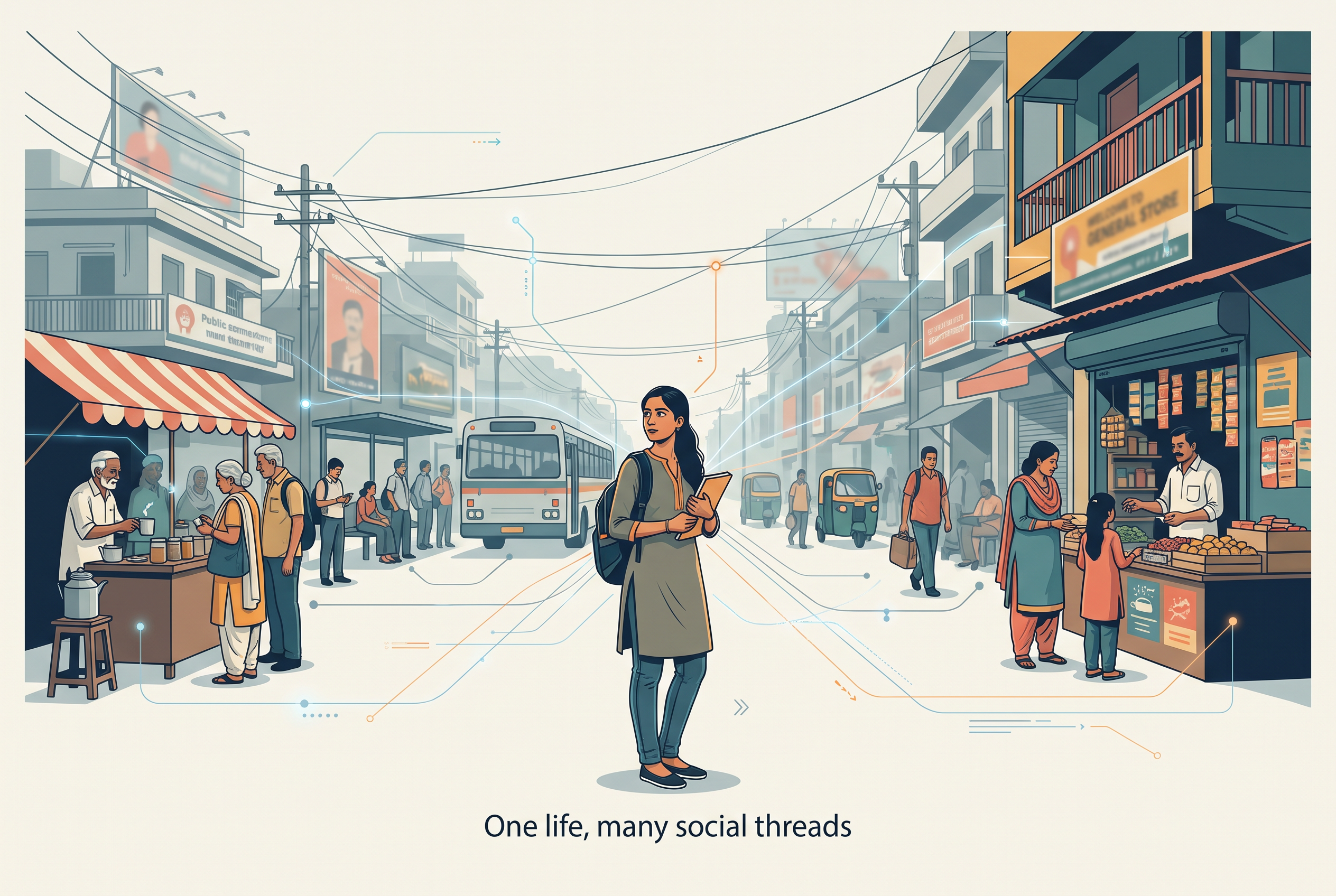
Fig. 1.1 – One life, many social threads.
These are the questions this chapter will answer.
1.1 Sociology, Common Sense and the Social Map
Starting from Somewhere, Not from Zero
In one important respect, sociology is unlike every other subject you have studied. It is a subject in which nobody begins at zero. Everyone who walks into a sociology class already knows something about society.
Think about how you learnt your other subjects. History, Geography, Psychology and Economics were taught to you — in a classroom, from a book, by a teacher. No child is expected to arrive at school already knowing them.
Knowledge of society is different. It is not usually taught in this explicit way. It is picked up in the ordinary business of growing up: at home, on the street, in the bus, at weddings and festivals, in the marketplace, among friends.
Because it comes to us woven into daily life, this knowledge seems to be acquired “naturally” or “automatically”. Even a six-year-old already knows a good deal about society and about social relationships — who may be spoken to in what tone, who is a relative and who is a stranger, what happens at a wedding, who is expected to serve the food. If a six-year-old knows this much, then you, as a young adult of eighteen, know a very great deal about the society you live in — without ever having studied it.
Why Prior Knowledge Cuts Both Ways
This familiarity with society is both an advantage and a disadvantage for the discipline that studies society.
The advantage is easy to see. Students are rarely frightened of sociology. It does not look like a forbidding subject, because its subject matter is already familiar.
The disadvantage is less obvious, and more serious. To learn sociology, you have to “unlearn” a good deal of what you already know about society. In fact, the first stage of learning sociology consists mainly of such unlearning.
Why should this be necessary? Because the knowledge you bring with you — your common sense about society — was not acquired from nowhere. It was acquired from a particular viewpoint: the viewpoint of the social group and the social environment into which you were socialised. Your social context has shaped your opinions, your beliefs and your expectations about how society works and how people should behave.
Now, these beliefs are not necessarily wrong. Sometimes common sense is perfectly accurate. The problem lies elsewhere. The problem is that common-sense knowledge is partial.
Two Meanings of “Partial”
The word “partial” is doing double duty here, and both meanings matter.
In the first sense, partial means incomplete — the opposite of whole. Common sense lets us see only a part of social reality, the part visible from where we happen to stand.
In the second sense, partial means biased — the opposite of impartial. Common sense tends to tilt towards the viewpoints and the interests of our own social group.
So our unlearnt knowledge of society is partial twice over: it shows us a fragment, and it shows us that fragment from a slanted angle. Sociology begins by making us suspicious of exactly this comfortable, ready-made knowledge, as Fig. 1.2 sets out.
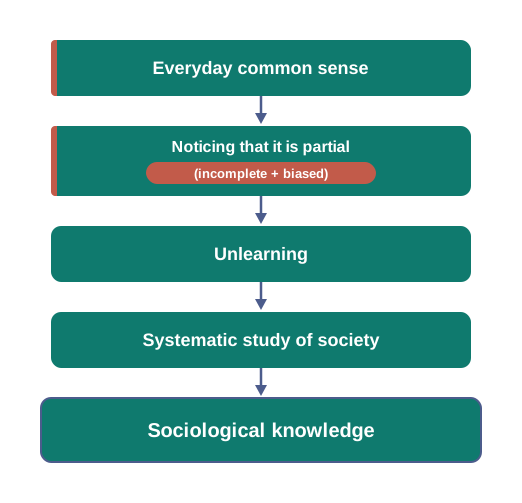
Fig. 1.2 – The path to sociological knowledge.
Turning the Gaze Inward
There is something else sociology can do, and it may interest you even more. It can show you what you look like to others. It can teach you to look at yourself “from the outside”.
This ability is called self-reflexivity, or simply reflexivity. Our gaze is normally directed outward, at other people and other groups. Reflexivity turns that gaze back upon ourselves.
But this self-inspection has to be critical. It is not an exercise in admiring yourself. A reflexive person is quick to criticise and slow to praise oneself.
Locating Yourself on a Social Map
A map tells you where a place is. A social map would tell you where you are located in society. Look at Fig. 1.3 and try placing yourself on it.
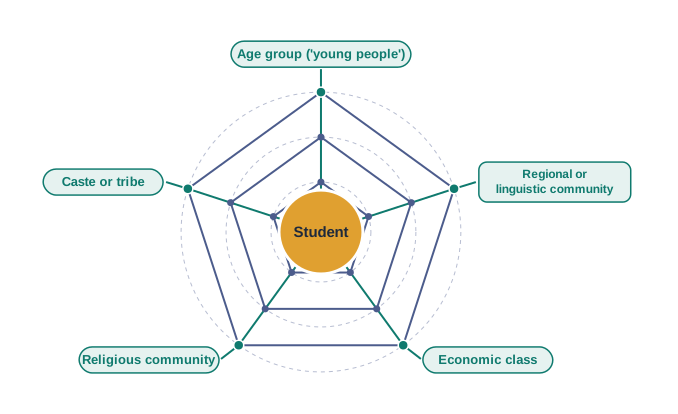
Fig. 1.3 – Locating yourself on a social map.
Consider your own case. As a seventeen- or eighteen-year-old, you belong to the social group called “young people”. People of your age or younger account for about forty per cent of India’s population — a very large share, and a fact with consequences for schooling, jobs and politics.
You might also belong to a particular regional or linguistic community — a Gujarati speaker from Gujarat, say, or a Telugu speaker from Andhra Pradesh. Depending on your parent’s occupation and your family income, you are a member of an economic class as well, such as the lower middle class or the upper class. You could belong to a particular religious community, and to a caste or tribe, or to some other such social group.
Each of these identities locates you on the social map, and places you within a web of social relationships. None of them is chosen by you in the way a hobby is chosen. Most are simply where you find yourself.
This is the first thing sociology offers: it tells you what kinds of groups and groupings exist in a society, how they stand in relation to one another, and what that might mean for your own life.
Why This Book Exists
This entire book is meant to introduce you to Indian society from a sociological rather than a common-sense point of view. That is a larger claim than it may appear. It means that the familiar — your street, your family, your school, the queue at the ration shop — will be made strange, examined, and then understood afresh.
What can be said by way of an introduction to such an introduction? Perhaps the most useful thing is to indicate in advance the larger processes that have been at work in shaping Indian society — processes you will meet in detail in the chapters that follow.
1.2 A Preview of this Book
This is the first of two textbooks on sociology that you will study this year. Its task is to introduce you to the basic structure of Indian society — the groups, institutions and inequalities out of which it is built. The second textbook takes up a different task: the specifics of social change and development in India.
The distinction is worth holding on to. This book asks what Indian society is made of and how its parts fit together. The other asks how those parts have been changing, and with what consequences. A short walk through the chapters ahead will show how the argument is put together, as summarised in Fig. 1.4.
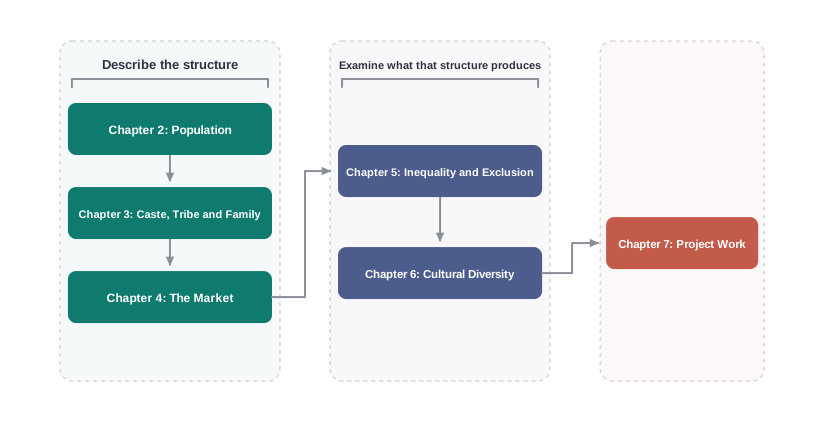
Fig. 1.4 – A preview of this book.
Chapter 2: The People Themselves
We begin with the demographic structure of the Indian population. Demography is the systematic study of a population — its size, its growth, its composition by age and sex, and the way these change over time.
As you know, India is currently the second most populous country in the world, and in a few decades is projected to overtake China and become the most populous country in the world. That single fact raises a series of questions.
What are the ways in which sociologists and demographers actually study a population? Which aspects of a population are socially significant — and why should a sociologist care about a ratio or a rate at all? What has been happening on these fronts in the Indian case?
And then the question that has divided opinion for two centuries: is our population simply an obstacle to development, a burden of mouths to feed — or can a large young population also be seen as helping development in some ways? Chapter 2 takes up these questions.
Chapter 3: The Building Blocks
Chapter 3 revisits the basic building blocks of Indian society: the institutions of caste, tribe and family. These are called building blocks because so much else in Indian social life presupposes them — who marries whom, who lives with whom, who does which work, who is thought to belong where.
Caste, as a feature of the Indian subcontinent, has always attracted a great deal of scholarly attention. How has this institution been changing over the centuries? And what, in plain terms, does caste really mean today — is it the same thing it was two hundred years ago, or something that has altered its shape while keeping its grip?
Tribe raises a different set of questions, and the chapter begins with the sharpest one: in what context was the concept of ‘tribe’ introduced into India in the first place? What sorts of communities are tribes supposed to be, and what is at stake — politically, legally, materially — in defining them as such? And how do tribal communities define themselves in contemporary India, which need not be how others have defined them?
Finally, the family. As an institution, the family has been subjected to tremendous pressure in these times of rapid and intense social change. What changes do we see in the diverse forms of the family that exist in India? By addressing questions like these, Chapter 3 builds the base for everything that follows, since caste, tribe and family are presupposed by the rest of the book.
Chapter 4: The Market
Chapter 4 explores the socio-cultural dimensions of the market. We are used to thinking of the market as an economic thing — a place where prices are fixed and goods change hands. Sociology treats it as a powerful institution, one that has been the vehicle of change throughout world history.
In India, the most sweeping and rapid economic changes were brought about first by colonialism — the long period of foreign rule under which the economy was reorganised to serve the needs of the ruling power — and then by developmental policies after Independence.
So the chapter looks at how markets of different kinds have evolved in India, and at the chain reactions they set in motion. A market does not merely sell things. It rearranges who works for whom, who moves where, and what people come to value.
Chapter 5: Inequality and Exclusion
Among the features of our society that have been the cause of greatest concern is its seemingly unlimited capacity for generating inequality and exclusion — the process by which some groups are systematically kept out of the opportunities, resources and respect that others enjoy. Chapter 5 is devoted to this important subject.
It looks at inequality and exclusion in the context of caste, tribe, gender and the ‘disabled’. (The word appears here in quotation marks because it is a label applied to people, and one that the chapter itself examines; the respectful usage is a person with a disability.)
Notorious as an instrument of division and injustice, the caste system has been the object of concerted attempts, both by the state and by the oppressed castes themselves, to reform or even abolish it. What were the concrete problems and issues that this attempt faced? How successful have movements to resist caste exclusion been in our recent past?
Tribal movements raise their own difficulties. What have been their special problems, and in what context are tribal identities reasserting themselves today? Similar questions are asked about gender relations, and about persons with disabilities. To what extent is our society responsive to the needs of the disabled? And how much of an impact has the women’s movement had on the social institutions that have oppressed women?
Chapter 6: The Challenges of Diversity
Chapter 6 deals with the difficult challenges posed by the immense diversity of Indian society. This chapter invites us to step outside our normal, comfortable ways of thinking — which is, as you now know, exactly what sociology asks of us.
The familiar cliches and slogans about India being a land of unity in diversity have a hard and complex side to them. Diversity is not only a matter of festivals and languages and food; it is also a matter of competing claims, unequal recognition and real conflict.
Despite all the failures and inadequacies, India has not done too badly on this front. What have been our strengths and our weaknesses? How may young adults face issues like communal conflict, regional or linguistic chauvinism, and casteism — without either wishing them away or being overwhelmed by them? And why is it important for our collective future as a nation that every minority in India not feel that it is insecure or at risk?
Chapter 7: Doing Sociology Yourself
Finally, Chapter 7 offers some suggestions for you and your teachers to think about the practical component of your course. Sociology is not only read; it is done — observed, asked about, recorded, argued over. This part of the course, as you will discover, can be quite interesting and enjoyable.
1.3 Summary
Sociology begins with what you already know (1.1)
- Sociology is unlike other subjects in one important respect: nobody starts from zero. Everyone already knows something about society, because knowledge of society is picked up while growing up rather than taught explicitly.
- No child is expected to arrive at school knowing History, Geography, Psychology or Economics. But even a six-year-old knows a great deal about society and social relationships — so an eighteen-year-old knows a very great deal, without ever having studied it.
Prior knowledge is both an advantage and a disadvantage
- The advantage: students are rarely afraid of sociology, since its subject matter feels familiar.
- The disadvantage: to learn sociology one must first “unlearn” what one already knows. The initial stage of learning sociology consists mainly of such unlearning.
- Unlearning is necessary because common sense is acquired from a particular viewpoint — that of the social group and social environment into which a person is socialised. Our social context shapes our opinions, beliefs and expectations.
- Common-sense beliefs are not necessarily wrong. The problem is that they are partial, in two senses at once: incomplete (the opposite of whole), and biased (the opposite of impartial). Common sense shows us only a part of social reality, tilted towards the interests of our own group.
Reflexivity
- Sociology can also show you what you look like to others — it teaches you to look at yourself “from the outside”.
- This is called self-reflexivity, or simply reflexivity: the ability to turn the gaze, which is normally directed outward, back upon oneself.
- The inspection must be critical: quick to criticise and slow to praise oneself.
The social map
- A social map locates a person within society. A seventeen- or eighteen-year-old belongs to the social group called “young people” — a group that, with those younger, accounts for about forty per cent of India’s population.
- Other locations on the map include a regional or linguistic community (a Gujarati speaker from Gujarat, a Telugu speaker from Andhra Pradesh); an economic class, depending on the parent’s occupation and family income; and a religious community, a caste or a tribe.
- Each identity places a person on the social map and within a web of social relationships. Sociology tells us what groups exist, how they relate to one another, and what this means for an individual life.
Personal troubles and social issues
- C. Wright Mills, the well-known American sociologist, argued that sociology maps the links between “personal troubles” and “social issues”.
- Personal troubles are the individual worries, problems and concerns everyone has — about family, friends, one’s future job, one’s identity. They concern one person and take their meaning from that personalised perspective.
- A social issue is about large groups, and not about the individuals who make them up. Recognising the difference prevents us from mistaking a public pattern for a private failing.
- The purpose of this book is to introduce Indian society from a sociological rather than a common-sense point of view.
A preview of the book (1.2)
- This is the first of two textbooks. It introduces the basic structure of Indian society; the second is focused on social change and development in India.
- Chapter 2 takes up the demographic structure of the Indian population. India is currently the second most populous country in the world and is projected to overtake China. The chapter asks how sociologists and demographers study a population, which aspects of it are socially significant, and whether population is only an obstacle to development or can also help it.
- Chapter 3 revisits the building blocks of Indian society — caste, tribe and family. It asks how caste has changed and what it means today; in what context the concept of ‘tribe’ was introduced into India, what is at stake in defining communities as tribes, and how tribal communities define themselves today; and what changes the family, under intense social change, is undergoing across its diverse Indian forms.
- Chapter 4 explores the socio-cultural dimensions of the market as a powerful institution and a vehicle of change in world history. In India the most sweeping economic changes came first through colonialism and then through developmental policies, so the chapter traces how different kinds of markets evolved and the chain reactions they set off.
- Chapter 5 is devoted to inequality and exclusion, in the context of caste, tribe, gender and the ‘disabled’. It examines attempts by the state and by the oppressed castes to reform or abolish the caste system, the record of movements against caste exclusion, the special problems of tribal movements and the reassertion of tribal identities, the position of women and the impact of the women’s movement, and how far society responds to the needs of persons with disabilities.
- Chapter 6 deals with the challenges posed by India’s immense diversity. Slogans about unity in diversity have a hard and complex side. The chapter asks what our strengths and weaknesses have been, how young adults can face communal conflict, regional or linguistic chauvinism and casteism without either wishing them away or being overwhelmed, and why it matters that no minority feel insecure or at risk.
- Chapter 7 offers suggestions for the practical component of the course.
1.4 Key Terms
Biased — Tilted towards a particular viewpoint or interest; the opposite of impartial. One of the two senses in which common-sense knowledge is said to be partial.
Colonialism — Rule of a country and its people by a foreign power, under which the economy and society of the ruled country are reorganised to serve the interests of the ruler.
Common sense — The knowledge about society that people acquire informally while growing up, without explicit teaching; it is not always wrong, but it is partial — incomplete and biased.
C. Wright Mills — The well-known American sociologist who argued that sociology maps the links and connections between personal troubles and social issues.
Demography — The systematic study of a population: its size, growth, and composition, and how these change over time.
Exclusion — The process by which certain groups are systematically kept out of the resources, opportunities and respect available to others.
Incomplete — Only a part of the whole; the opposite of whole. The other sense in which common-sense knowledge is said to be partial.
Personal troubles — The individual worries, problems and concerns of a single person, which take their meaning from that person’s own point of view.
Reflexivity — Self-reflexivity; the ability to turn one’s gaze back upon oneself and inspect one’s own position critically rather than admiringly.
Social group — A collection of people who share a social position or identity — such as “young people”, a linguistic community, an economic class, a religious community, a caste or a tribe.
Social issue — A matter concerning large groups and social arrangements, not the individuals who make up those groups.
Social map — A way of picturing where an individual is located in society, through the several groups and identities to which he or she belongs.
Socialisation — The process through which a person, growing up in a particular social group and social environment, acquires its beliefs, expectations and ways of seeing the world.
Sociology — The discipline that studies society; unlike other subjects, no one begins learning it from zero, since everyone already knows something about society.
1.5 Points to Ponder
If the first stage of learning sociology is “unlearning”, what exactly is being unlearnt — the facts we hold about society, or the confidence with which we hold them?
Common sense is said to be partial in two senses: incomplete and biased. Can a person become less biased without first becoming less incomplete — that is, is it possible to correct one’s slant without widening one’s view?
Reflexivity asks us to be “quick to criticise and slow to praise oneself”. Is there a point at which such self-criticism stops being useful for understanding society and starts getting in the way of it?
You belong to several social groups at once — an age group, a language community, a class, a locality. When these locations pull in different directions, which one shapes your view of society most strongly, and how would you know?
Mills distinguished personal troubles from social issues. Are there troubles that remain purely personal, untouched by any social arrangement? Try to think of one, and then test it.
This book proposes to make the familiar strange — to treat your own street and your own family as objects of study. What is gained by looking at the familiar in this way, and is anything lost?
1.6 Objective Questions
- The initial stage of learning sociology consists mainly of:
- memorising definitions
- unlearning what we already know about society
- collecting statistics about the population
- reading the history of India [1 mark]
- In the chapter, common-sense knowledge is described as ‘partial’. The two senses in which the word is used are:
- short and long
- true and false
- incomplete and biased
- personal and social [1 mark]
- The ability to reflect upon oneself, and to turn one’s gaze back towards oneself, is called:
- socialisation
- demography
- exclusion
- reflexivity [1 mark]
- According to the chapter, people of the age of a Class 12 student, or younger, account for about ______ per cent of India’s population.
- twenty
- thirty
- forty
- sixty [1 mark]
- C. Wright Mills was a well-known:
- British historian
- American sociologist
- Indian demographer
- French philosopher [1 mark]
- Assertion (A): Students are generally not afraid of sociology. Reason (R): Everyone already knows something about society before beginning to study it.
- Both A and R are true, and R is the correct explanation of A
- Both A and R are true, but R is not the correct explanation of A
- A is true, but R is false
- A is false, but R is true [1 mark]
- Assertion (A): Common-sense beliefs about society are always wrong. Reason (R): Common sense is acquired from the viewpoint of the social group into which a person is socialised.
- Both A and R are true, and R is the correct explanation of A
- Both A and R are true, but R is not the correct explanation of A
- A is true, but R is false
- A is false, but R is true [1 mark]
- Match the terms in Column I with their meanings in Column II.
| Column I | Column II |
|---|---|
| a. Reflexivity | i. An individual worry, understood from one person’s point of view |
| b. Personal trouble | ii. The process by which a person absorbs the beliefs and expectations of the group she grows up in |
| c. Social issue | iii. Turning one’s gaze critically back upon oneself |
| d. Socialisation | iv. A matter concerning large groups, not the individuals who make them up |
[1 mark]
Fill in the blank: Chapter 4 of this book explores the socio-cultural dimensions of the ______ as a powerful institution that has been a vehicle of change throughout world history. [1 mark]
Fill in the blank: India is currently the ______ most populous country in the world, and is projected in a few decades to overtake China. [1 mark]
True or False: The second of the two Class 12 sociology textbooks is focused on the basic structure of Indian society, while the first deals with social change and development. [1 mark]
1.7 Check Your Concepts
Define reflexivity, and state the one condition the chapter attaches to it. [2 marks]
State the two senses in which our common-sense knowledge of society is said to be ‘partial’. [2 marks]
What is meant by a social map? Give one example of a location on it. [2 marks]
Name any two social groups to which a seventeen- or eighteen-year-old Indian student is likely to belong. [2 marks]
Differentiate between common-sense knowledge and sociological knowledge, with reference to how each is acquired and how reliable each is. [4 marks]
Differentiate between a personal trouble and a social issue. Illustrate each with one Indian example of your own. [4 marks]
“Prior familiarity with society is both an advantage and a disadvantage for sociology.” Give reasons for both halves of this statement. [4 marks]
Why does the chapter insist that self-inspection must be critical — “quick to criticise and slow to praise oneself”? Explain what would go wrong if it were not. [4 marks]
Explain, with examples, why the first stage of learning sociology consists mainly of unlearning. How far do you agree that common sense is not necessarily wrong, but is always partial? [6 marks]
Explain Mills’s distinction between personal troubles and social issues in full. Using an Indian example, show how a worry that appears entirely private may in fact be one instance of a public pattern, and state one difficulty in drawing the line between the two. [6 marks]
“Sociology can show you what you look like to others.” Explain the idea of reflexivity, discuss what a sociologist gains from it, and point out one honest difficulty in practising it. [6 marks]
1.8 Passage-Based Questions
Read the passage and answer the questions that follow.
A student is asked to describe her neighbourhood for a school assignment. She writes that it is a quiet, decent locality where families keep to themselves and everyone gets along. Her teacher asks her to walk the same street again, this time at six in the morning and at nine at night, and to note who is on it at each hour. She discovers that the street is not quiet at all: sanitation workers pass at dawn, domestic workers arrive on foot by seven, delivery riders criss-cross it until late, and a group of construction workers sleeps at the far end near the site. None of these people had appeared in her first description. She had described the locality entirely from the window of her own flat.
- Identify the feature of common-sense knowledge that this passage illustrates, and name both senses in which it applies here.
- Explain how “unlearning” operated in this student’s second walk down the same street.
- What does this episode suggest about the value of reflexivity for a sociologist? [6 marks]
Read the passage and answer the questions that follow.
In a small industrial town, a mill that had employed several thousand people shuts down. A young man who worked there begins looking for another job. Months pass. He starts to believe that the fault lies in himself — that his skills are poor, that he did not study long enough, that he interviews badly. His neighbours, many of them also out of work, reach much the same conclusion about themselves. In the same year, similar closures occur across the region, and the number of people seeking work rises sharply.
- Is the young man’s difficulty a personal trouble or a social issue? Justify your answer using the chapter’s distinction.
- Explain why self-blame is a predictable response here, and what it prevents him from seeing.
- What follows for the way such a situation ought to be addressed? [6 marks]
Read the passage and answer the questions that follow.
Two students in the same class are asked to write down which social groups they belong to. The first writes: “I am a student. That is all.” The second writes: “I am seventeen; I speak Marathi at home and English at school; my father runs a small shop, so we are somewhere in the middle; I live in a colony where most families do the same kind of work.” Their teacher tells the class that the second answer is not more personal than the first — it is more sociological.
- Explain what the teacher means, using the idea of the social map.
- Why does the chapter argue that sociology can tell you something about your own life that you could not have worked out on your own? [4 marks]