Chapter 4: The Market as a Social Institution
Picture two markets on the same Friday morning.
The first is a stretch of open ground in a forested district. It is empty for six days of the week, but today trucks are parked along the road, cloth is spread out under the trees, and thousands of people have walked in from villages all around. Some have come to sell tamarind and oil-seeds; some to buy salt, bangles or a knife. But if you asked them why they came, many would not talk about buying and selling at all. They came to meet a cousin, to settle a marriage, to hear the news, to watch the crowd.
The second market is a screen. On it, prices of shares in Indian companies rise and fall in response to something that happened overnight in New York or Frankfurt. No one is standing anywhere. Nothing is being carried home in a cloth bag. And yet a slump on that screen can close down an office in Bengaluru and send a young worker looking for another job.
Both are markets. Both are governed by rules — but the rules are not only economic. Who is allowed to trade, whom you trust with credit, what a purchase says about you: these are social questions. Economics can tell you how a price is fixed. It takes sociology to ask who is standing on which side of the stall, and why.
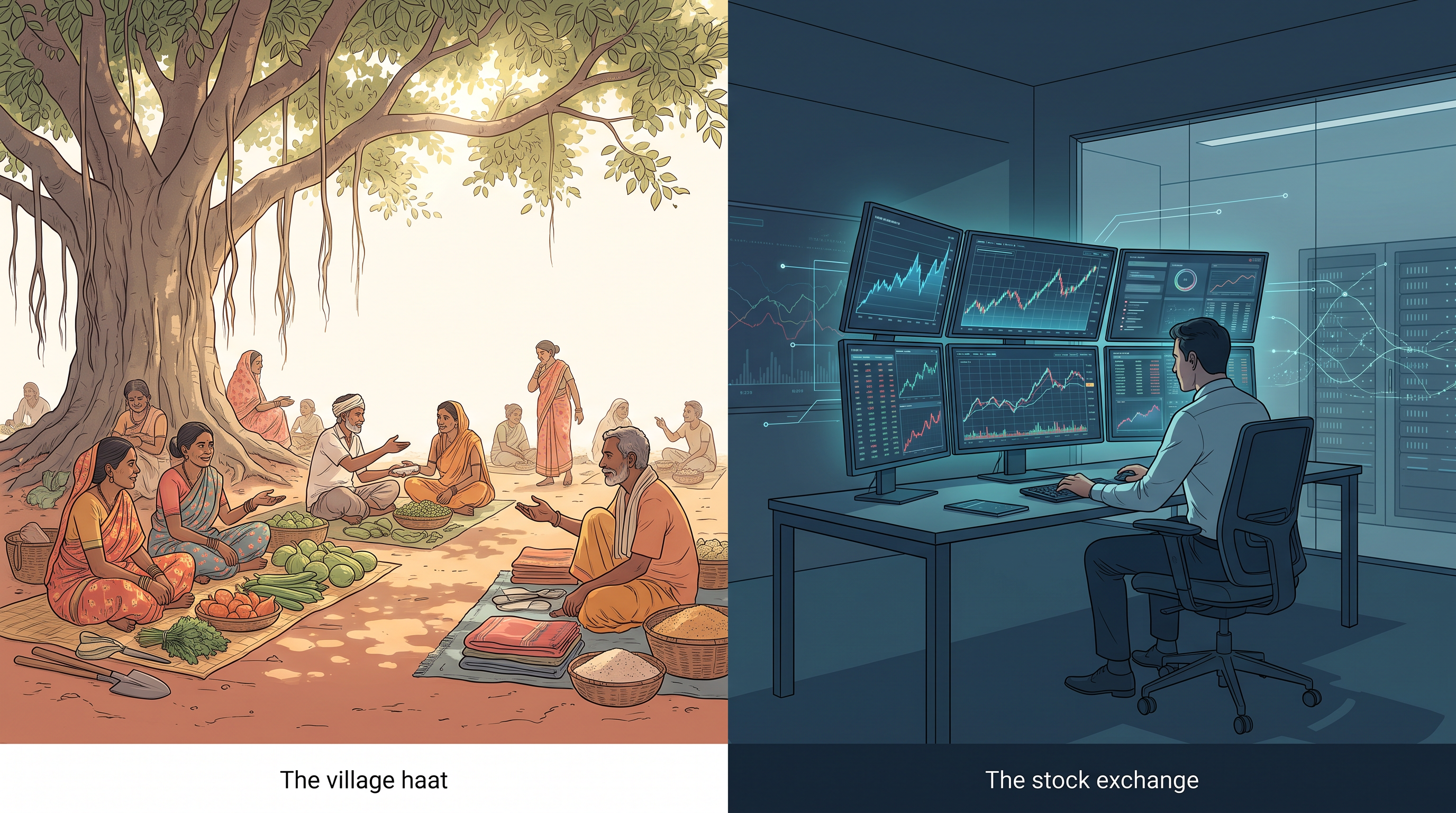
Fig. 4.1 – Two markets: the village haat and the stock exchange.
Each of these questions will be answered as the chapter goes along. Keep them in mind as you read.
4.1 Sociological Perspectives on Markets and the Economy
What we mean by “the market”
Begin with the word itself. When we say market, most of us first think of a place where things are bought and sold — the market next to the railway station, the fruit market, the wholesale market. The word points to a location you could walk to.
But we also use the word without meaning a place at all. Sometimes we mean the people — the buyers and the sellers who together make the market. A weekly vegetable market, for instance, may sit in a different village or a different neighbourhood on each day of the week. The gathering is the market; the ground it stands on keeps changing.
In a third sense, “market” means an area or category of trade — the market for cars, the market for readymade clothes. In a fourth, closely related sense, it means the demand for a particular product or service: when people speak of the market for computer professionals, they are talking about how many such workers employers want to hire.
All four of these senses have something in common. Each refers to a specific market, and the context tells you which one is meant. But what are we doing when we speak of “the market” in general, with no place, no crowd and no particular line of business in mind?
Used this way, the term takes in all the senses above and something much larger besides: the whole spectrum of economic activities and institutions. In this very broad sense, “the market” is almost the same thing as “the economy”.
We are used to thinking of the market as an economic institution. This chapter will show you that it is also a social institution — comparable, in its own way, to caste, tribe and family, the institutions you studied in the previous chapter.
What sociology adds to the study of markets
Economics already studies markets, and studies them closely. It asks how prices are determined, what a particular kind of investment is likely to do, and what makes people save rather than spend. So what can sociology add that economics does not already tell us?
To see the answer, it helps to go back to eighteenth-century England, where modern economics began. It was not called economics then; it was called political economy. Its most famous early figure was Adam Smith, whose book The Wealth of Nations tried to make sense of the market economy that was only then coming into existence around him.
Smith’s argument was strikingly simple and, for its time, daring. A market economy, he said, is nothing but a series of individual exchanges — millions of separate transactions, each made by a person pursuing his or her own interest. And yet out of all this, an ordered and functioning system emerges. Nobody plans it. Nobody intends it. It assembles itself.
Modern economics grew out of the ideas of Smith and other early thinkers. It rests on the assumption that the economy can be studied as a separate part of society, operating by laws of its own. On this assumption, the larger social and political setting in which markets actually work can be left to one side.
Sociologists have taken a different route. Instead of cutting the economy out of society for the purposes of study, they have tried to build an alternative approach that examines economic institutions and processes within the larger social framework.
For a sociologist, markets are social institutions, and they are constructed in culturally specific ways. Look closely at any real market and you will find that it is often controlled or organised by particular social groups or classes, and that it is connected to other institutions, processes and structures in the society around it. Sociologists have a word for this. They say that economies are socially embedded.
That claim can sound abstract. NCERT therefore illustrates it with two very different examples: a weekly tribal haat, and a “traditional business community” with its trading networks in colonial India. We take them in turn.
4.1.1 A weekly “tribal market” in Dhorai village, Bastar, Chattisgarh
In most agrarian or “peasant” societies anywhere in the world, periodic markets are a central feature of social and economic organisation. A weekly market brings together people from all the surrounding villages. They come to sell what they have grown or gathered, and to buy the manufactured goods and other items that their own village does not produce.
Such a market draws in more than farmers. It attracts traders from outside the local area, and along with them moneylenders, entertainers, astrologers and a whole range of other specialists offering their services and their wares. In rural India there are also specialised markets held at longer intervals — cattle markets, for instance.
These periodic markets do quiet but important work. They link different local and regional economies to one another, and link all of them upward to the wider national economy and to towns and metropolitan centres.
The weekly haat is a common sight in rural, and even in urban, India. Its importance is greatest in hilly and forested areas, particularly those inhabited by adivasis, where settlements are scattered far apart, roads and communications are poor, and the economy is relatively undeveloped. There, the weekly market is the major institution both for the exchange of goods and for social intercourse.
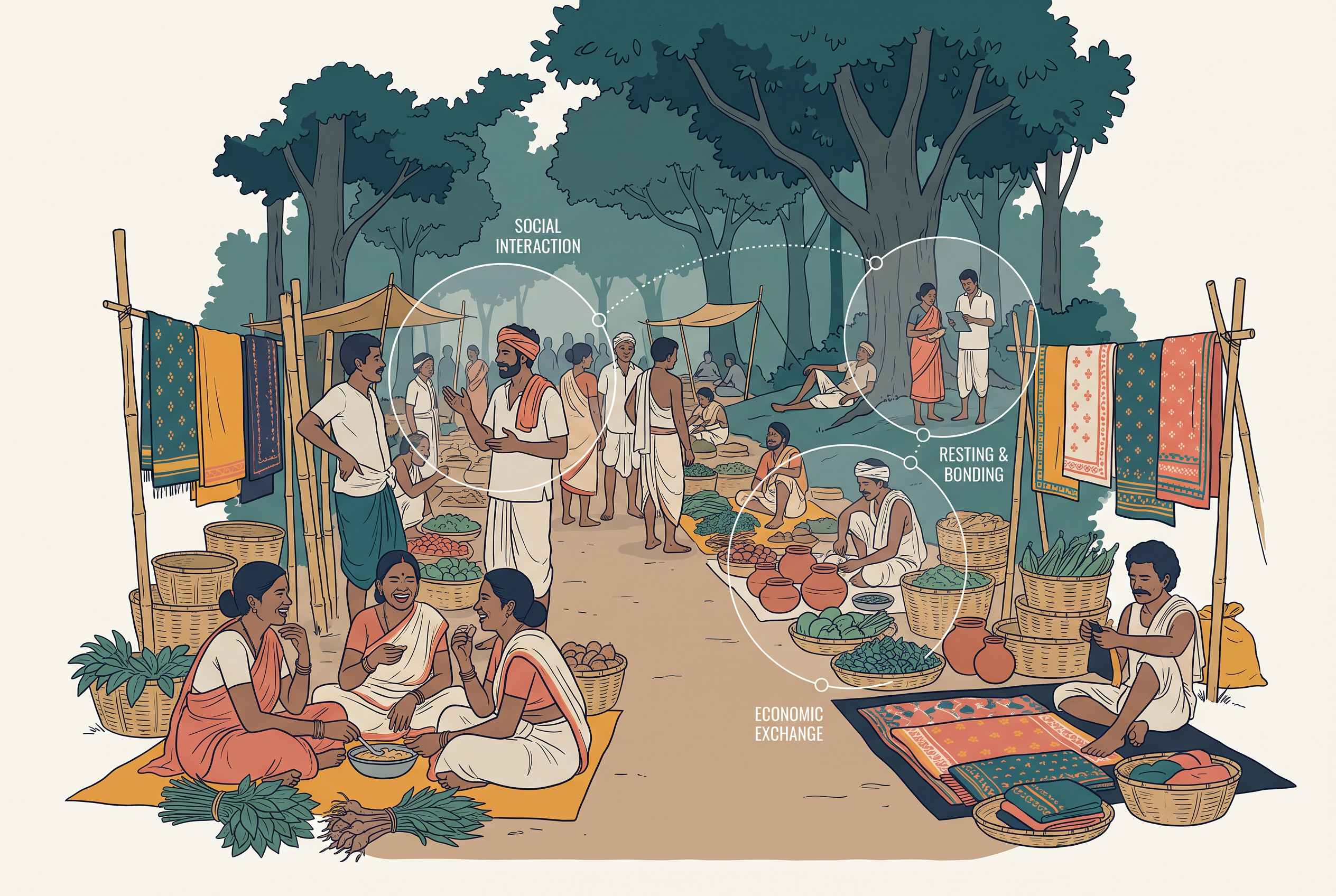
Fig. 4.2 – A weekly market in a tribal area.
Look at what people actually do there, as shown in Fig. 4.2. Local people sell their agricultural or forest produce to traders, who will carry it away to the towns for resale. With the cash they earn, they buy essentials such as salt and agricultural implements, and consumption items such as bangles and jewellery.
But ask the visitors why they came, and the economic answer is often not the first one. For many of them the primary reason to come to the market is social — to meet kin, to arrange marriages, to exchange gossip. The buying and selling is real, but it is wrapped inside a social occasion.
How colonialism changed the tribal market
The weekly market in tribal areas may be a very old institution, but its character has changed over time, and it is worth being clear about how.
Once these remote areas were brought under the control of the colonial state, they were gradually incorporated into the wider regional and national economies. Tribal areas were “opened up”: roads were built, and the local population was “pacified” — many of them had resisted colonial rule through what were called the “tribal rebellions” — so that the rich forest and mineral resources of these areas could be exploited.
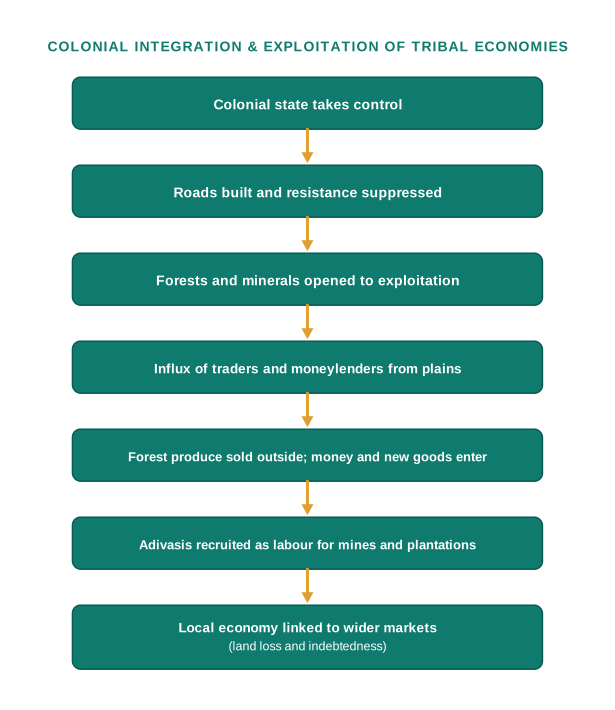
Fig. 4.3 – Colonial incorporation of tribal economies.
The consequences followed one from another, as Fig. 4.3 sets out. Traders, moneylenders and other non-tribal people from the plains moved into these areas. The local tribal economy was transformed as forest produce began to be sold to outsiders, and as money and new kinds of goods entered a system that had done largely without them.
Adivasis were also recruited as labourers for the plantations and mines that colonialism established. In other words, a “market” for tribal labour itself developed during the colonial period — labour, which had been part of village and kin obligation, now became something bought and sold.
Through all these changes, local tribal economies became linked into much wider markets. The consequences for local people were usually very negative. The entry of traders and moneylenders from outside the area led to the impoverishment of adivasis, many of whom lost their land to outsiders.
Notice how the argument works. Nothing here is explained by the supposed character of any community. What changed the tribal economy was a structure — colonial control, new roads, a demand for forest and mineral wealth, and outsiders arriving with capital and credit that local people did not have.
What a study of the Bastar market shows
All three things — the weekly market as a social institution, the links between the local tribal economy and the outside world, and the exploitative economic relationships between adivasis and others — are illustrated by a study of a weekly market in Bastar district. This district is populated mainly by Gonds, an adivasi group.
Who is present at that market? Local people, both tribal and non-tribal (the non-tribals mostly Hindus); outsiders, mainly Hindu traders of various castes; forest officials, who come to conduct business with the adivasis who work for the Forest Department; and a variety of specialists selling goods and services.
What changes hands? Manufactured goods, such as jewellery and trinkets, pots and knives. Non-local foods, such as salt and haldi (turmeric). Local food, agricultural produce and locally manufactured items, such as bamboo baskets. And forest produce, such as tamarind and oil-seeds.
Now watch the direction of the flow, because this is the sociological point. The forest produce brought by the adivasis is purchased by traders, who carry it to the towns. In the market, the buyers are mostly adivasis while the sellers are mainly caste Hindus. Adivasis earn cash from the sale of forest and agricultural produce and from wage labour, and they spend it in the market mainly on low-value trinkets and jewellery, and on consumption items such as manufactured cloth.
A market that looks, at first glance, like an open meeting of equals turns out on inspection to have a shape: one set of people sells the low-value goods, another set buys up the produce that will be sold again, at a higher price, elsewhere.
4.1.2 Caste-based markets and trading networks in precolonial and colonial India
Some traditional accounts of Indian economic history rest on a picture that is worth stating plainly, because the rest of this section will dismantle it. In that picture, India’s economy and society were essentially unchanging. Economic transformation was thought to have begun only with the arrival of colonialism. India was assumed to have consisted of ancient village communities, relatively self-sufficient, whose economies ran mainly on non-market exchange.
On this account, it was under colonialism and in the early years after Independence that the commercial money economy penetrated local agrarian economies and drew them into wider networks of exchange — and that this penetration produced radical social and economic change in both rural and urban society.
What recent historical research shows
Colonialism certainly did bring major economic transformations. One clear instance is the colonial demand that land revenue be paid in cash, which forced cultivators to sell produce for money whether they wished to or not.
But recent historical research has shown that much of India’s economy was already extensively monetised — that is, trade was already being carried out using money — in the late pre-colonial period. Non-market exchange systems certainly existed: the jajmani system, under which service castes in a village received a customary share of the harvest rather than a wage for their work, was found in many villages and regions. Yet even in the precolonial period, villages were incorporated into wider networks of exchange through which agricultural products and other goods circulated.
The conclusion historians now draw is that the sharp line so often drawn between the “traditional” and the “modern” economy — or between the pre-capitalist and the capitalist — is actually rather fuzzy.
The trading networks of pre-colonial India
Once you drop the picture of the changeless village, the evidence for pre-colonial commerce is not hard to find. For centuries India was a major manufacturer and exporter of handloom cloth — ordinary cotton as well as luxury silks — and the source of other goods, such as spices, that were in great demand in the global market, especially in Europe.
An export trade on that scale cannot run on nothing. So it is not surprising that pre-colonial India had well-organised manufacturing centres, indigenous merchant groups, trading networks, and banking systems that enabled trade to take place within India, and between India and the rest of the world.
These traditional trading communities or castes had their own systems of banking and credit. An important instrument of exchange and credit was the hundi, or bill of exchange — something like a credit note. A merchant in one part of the country could issue a hundi that a merchant in another place, hundreds of kilometres away, would honour.
Stop and consider what that requires. To accept a piece of paper from a stranger in place of money is an act of trust, and trust needs a basis. Here the basis was social: trade took place primarily within the caste and kinship networks of these communities, and a man’s standing within his community was his credit rating.
4.1.4 Colonialism and the emergence of new markets
The advent of colonialism in India produced major upheavals in the economy, disrupting production, trade and agriculture. The best-known example is the demise of the handloom industry, as the market was flooded with cheap manufactured textiles from England.
We have already seen that pre-colonial India had a complex monetised economy. Nevertheless, most historians consider the colonial period to be the turning point — the moment at which India began to be far more fully linked to the world capitalist economy.
The nature of that link is the crucial thing. Before colonisation, India was a major supplier of manufactured goods to the world market. After colonisation, it became a source of raw materials and agricultural products, and a consumer of manufactured goods — both largely for the benefit of an industrialising England. India’s position in world trade was not merely reduced; it was inverted.
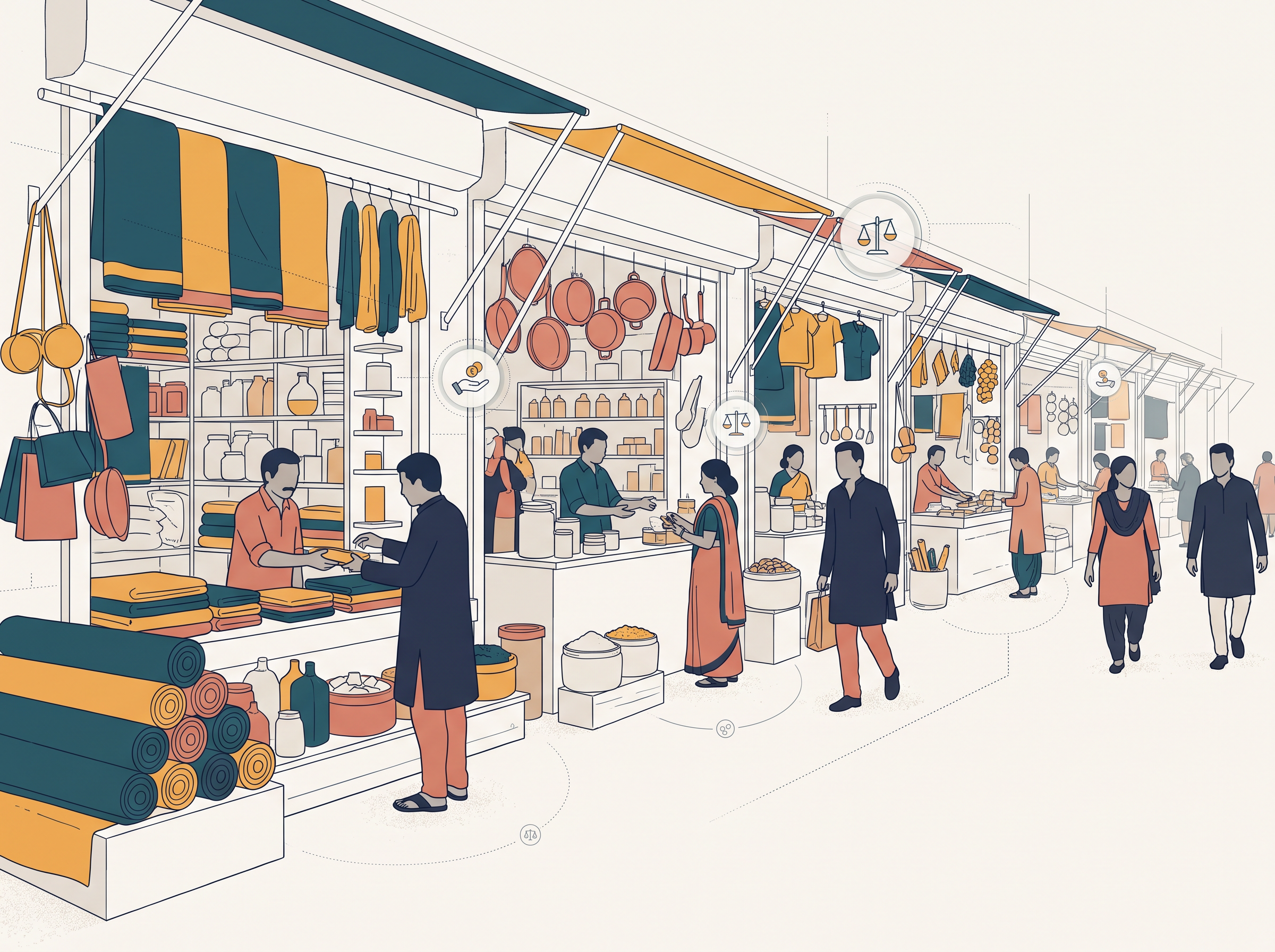
Fig. 4.5 – A busy street bazaar.
Who gained, who lost
At the same time, new groups — especially the Europeans — entered trade and business. Sometimes they did so in alliance with existing merchant communities; in some cases they forced those communities out.
But the expansion of the market economy did not simply overturn India’s existing economic institutions. It also opened new opportunities to some merchant communities, which were able to improve their position by re-orienting themselves to changing economic circumstances. And in some cases, entirely new communities emerged to take advantage of the opportunities colonialism created — and went on holding economic power even after Independence.
The clearest example of this process is provided by the Marwaris, probably the most widespread and best-known business community in India. The name covers a great range: it is represented at the top by leading industrial families such as the Birlas, but it also includes shopkeepers and small traders in the bazaars of towns throughout the country.
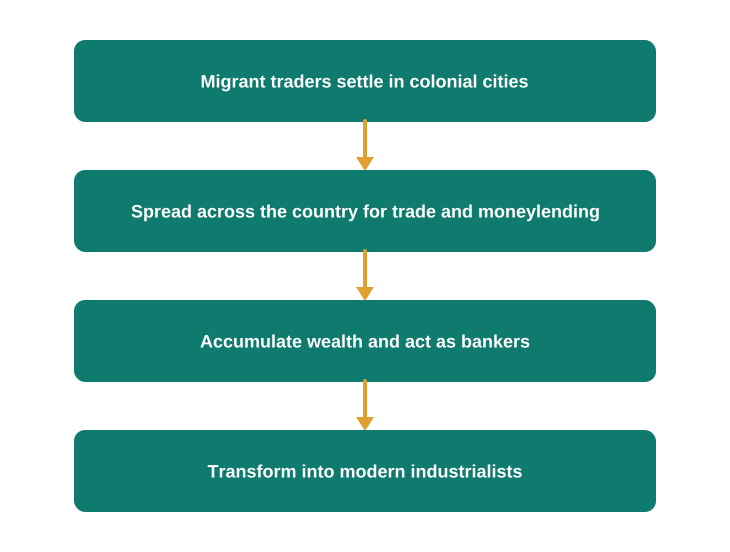
Fig. 4.6 – Trajectory of a business community.
The Marwaris became a successful business community only during the colonial period, when they took advantage of the new opportunities in colonial cities such as Calcutta, and settled throughout the country to carry out trade and moneylending. Their trajectory, traced in Fig. 4.6, is the sociological lesson of this section in miniature.
Like the Nakarattars, the success of the Marwaris rested on their extensive social networks, which created the relations of trust necessary to operate their banking system. Many Marwari families accumulated enough wealth to become moneylenders, and by acting as bankers they also helped the commercial expansion of the British in India. In the late colonial period and after Independence, some Marwari families transformed themselves into modern industrialists; even today Marwaris control more of India’s industry than any other community.
Follow that story once more from the beginning: small migrant traders become merchant bankers, and merchant bankers become industrialists. At no point was this a story about individual talent alone. What made the transformation possible was a social context — a community with dense networks, a shared reputation system, and the capacity to move capital and people across a subcontinent.
4.2 Understanding Capitalism as a Social System
One of the founders of modern sociology, Karl Marx, was also one of the sharpest critics of modern capitalism. His starting point was a definition. Capitalism, he said, is a system of commodity production — that is, production for the market — carried on through the use of wage labour.
Read that definition slowly, because both halves of it matter. Goods are not made to be used by the people who make them; they are made to be sold. And the work of making them is not done by the owner or by his household; it is done by workers who are hired for a wage.
The economy is made of relations, not things
As you have already learned, Marx argued that all economic systems are also social systems. Each mode of production consists of particular relations of production, and these relations in turn give rise to a specific class structure.
This is where he parts company with the everyday way of thinking about the economy. When we imagine “the economy”, we usually picture things — goods piled up in a warehouse, trucks on a highway, money changing hands. Marx insisted that the economy does not consist of things at all. It is made up of relations between people, who are connected to one another through the process of production.
The owner of a factory and the worker on its floor are not two isolated individuals who happen to meet. They stand in a relationship — one owns, the other is employed — and it is that relationship, repeated across a whole society, that constitutes the economic system.
Why labour becomes a commodity
Under the capitalist mode of production, something happens that had not happened before on this scale: labour itself becomes a commodity.
It becomes one because workers do not own the means of production — the factories, the machines, the land — and therefore have no way of producing anything on their own account. What they do own is their capacity to work. To live, they must sell that capacity, their labour power, in the market in exchange for a wage.
From this single fact two basic classes arise. There are capitalists, who own the means of production, such as the factories. And there are workers, who sell their labour to the capitalists.
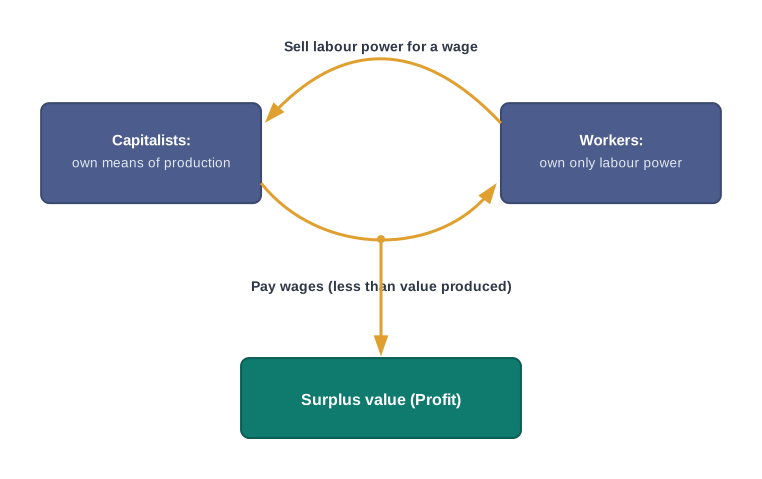
Fig. 4.7 – Marx’s model of capitalist production and surplus value.
Fig. 4.7 shows how profit is generated in this system. The capitalist class is able to profit by paying workers less than the value of what they actually produce. The difference between the two — between what the worker’s labour creates and what the worker is paid — is what Marx called surplus value, and it is extracted from the worker’s labour.
4.2.1 Commoditisation and consumption
The growth of capitalism around the world has meant something more than the growth of factories. It has meant the extension of markets into places, and into spheres of life, that this system had previously left untouched.
Commodification occurs when things that were earlier not traded in the market become commodities. Labour is the obvious case: a person’s capacity to work, or a skill, becomes a thing that can be bought and sold.
According to Marx and other critics of capitalism, commodification has negative social effects. The commodification of labour is one instance, but contemporary society offers many others.
Consider a debated example. There is a controversy about the sale of kidneys by the poor to cater to rich patients who need kidney transplants. Many people hold that human organs should not become commodities at all — that certain things must remain outside the reach of the market, whatever price is offered for them.
History shows how the boundary moves. In earlier times, human beings themselves were bought and sold as slaves; today it is considered immoral to treat people as commodities. Yet in modern society almost everyone accepts the idea that a person’s labour can be bought, and that services or skills can be provided in exchange for money. This, Marx argued, is a situation found only in capitalist societies.
Commodification in contemporary India
Look around you and you can watch the process happening now, in things or processes that were earlier not part of market exchange.
Traditionally, marriages were arranged by families. Today there are professional marriage bureaus and websites that will find a bride or a groom for a fee. Something once done through kinship is now done through a service purchased in a market.
Or take the private institutes that offer courses in “personality development” and spoken English, teaching students — mostly middle-class youth — the cultural and social skills required to succeed in the contemporary world. In earlier times, social skills such as good manners and etiquette were imparted mainly through the family. They are now taught for a price.
We could think in the same way about the growth of privately owned schools and colleges, and of coaching classes, as a process of commodification of education.
Consumption and the making of social distinctions
Another important feature of capitalist society is that consumption becomes more and more important — and not only for economic reasons. It becomes important because it carries symbolic meaning.
In modern societies, consumption is an important way in which social distinctions are created and communicated. By buying and displaying certain goods, a consumer conveys a message about his or her socio-economic status or cultural preferences. Companies, for their part, try to sell their goods by appealing to symbols of status or culture.
Think of the advertisements you see every day on television and on roadside hoardings, and of the meanings that advertisers work to attach to consumer goods in order to sell them. Very few of them are really telling you about the product. Most are telling you what kind of person you would become by owning it.

Fig. 4.8 – Advertising and the sale of aspirational lifestyles.
One of sociology’s founders, Max Weber, was among the first to point out that the goods people buy and use are closely related to their status in society. He coined the term status symbol to describe this relationship.
The Indian middle class supplies ready examples: the brand of cell phone one carries, or the model of car one owns, are important markers of socio-economic status. The phone makes calls; but it also makes a statement.
Weber also wrote about how classes and status groups are differentiated on the basis of their lifestyles — the whole pattern of what people consume, wear, eat, and do with their leisure, which marks off one social group from another.
4.3 Globalisation – Interlinking of Local, Regional, National and International Markets
Since the late 1980s, India has entered a new era in its economic history. The turning point was a change of economic policy: the state had led development for four decades after Independence, deciding what would be produced, protecting Indian industry, and running large public enterprises of its own. From the late 1980s, that approach gave way to liberalisation.
This shift also ushered in the era of globalisation — a period in which the world is becoming increasingly interconnected, not only economically but also culturally and politically.
The term takes in a number of trends. The most important is the increase in the international movement of commodities, money, information and people. Alongside it goes the development of technology — in computers, telecommunications and transport — and of other infrastructure, without which such movement would not be possible at all.
When markets are joined, distance stops protecting you
A central feature of globalisation is the increasing extension and integration of markets around the world. Integration has a consequence that is easy to state and hard to escape: a change in a market in one part of the globe may have a profound impact somewhere else, far away.
Take an example close to home. India’s booming software industry may face a slump if the U.S. economy does badly — as happened after the 9/11 attacks on the World Trade Centre in New York — leading to a loss of business and of jobs here.
The software services industries and the business process outsourcing (BPO) industries, such as call centres, are some of the major avenues through which India is being connected to the global economy. Companies based in India provide low-cost services and labour to customers located in the developed countries of the West. We can say that there is now a global market for Indian software labour and other services.
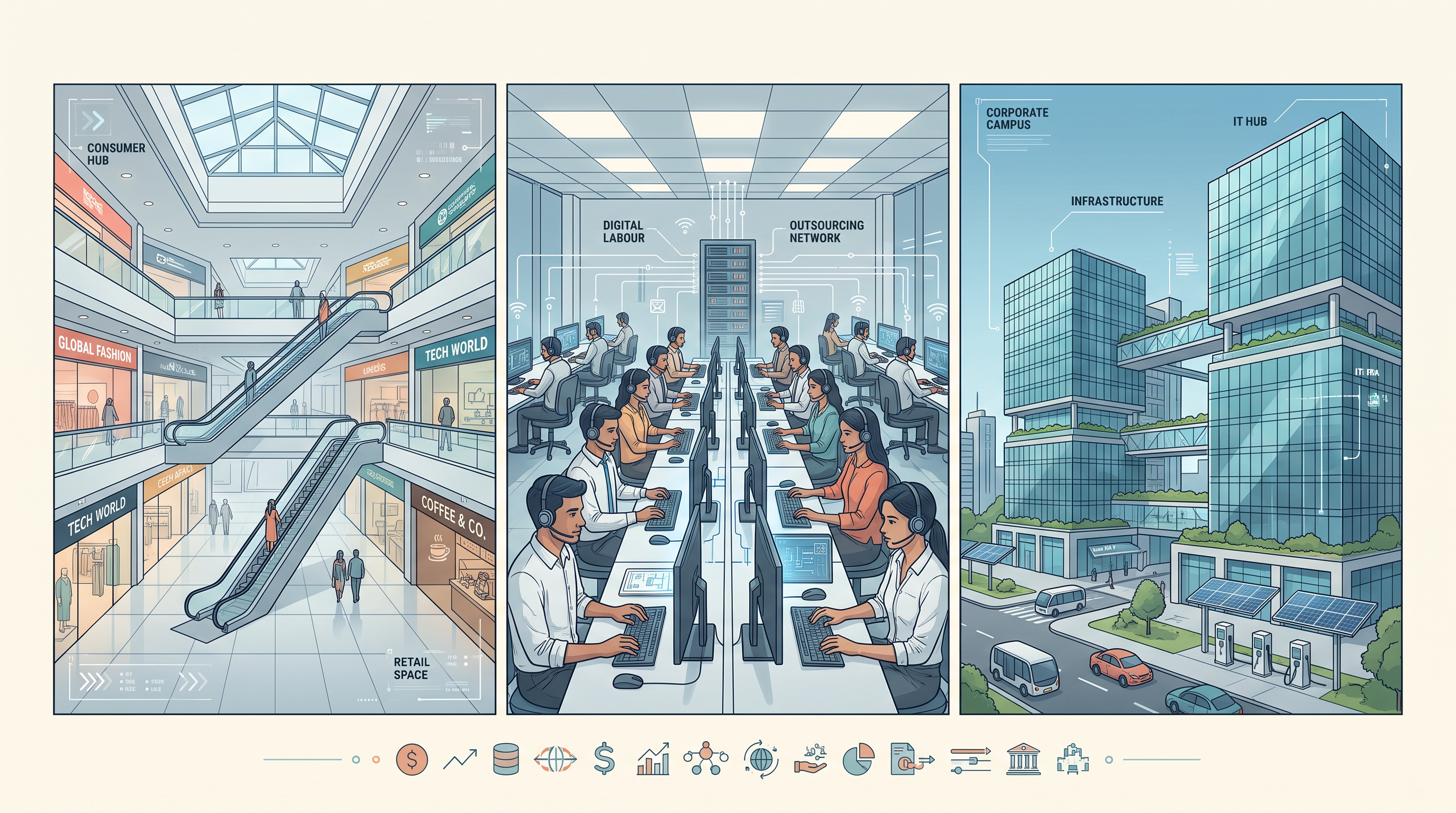
Fig. 4.9 – Spaces of globalisation: the mall, the call centre, and the commercial complex.
When culture itself is drawn into the market
Under globalisation, it is not only money and goods that move. People, cultural products and images also circulate rapidly around the world, enter new circuits of exchange, and create new markets. Products, services, or elements of culture that were earlier outside the market system are drawn into it.
One example is the marketing of Indian spirituality and knowledge systems, such as yoga and ayurveda, in the West. Practices that were transmitted through teachers, texts and families are now packaged, priced and sold in a global market.
The growing market for international tourism suggests something similar: that culture itself may become a commodity. Consider the famous annual fair at Pushkar, in Rajasthan, to which pastoralists and traders come from distant places to buy and sell camels and other livestock.
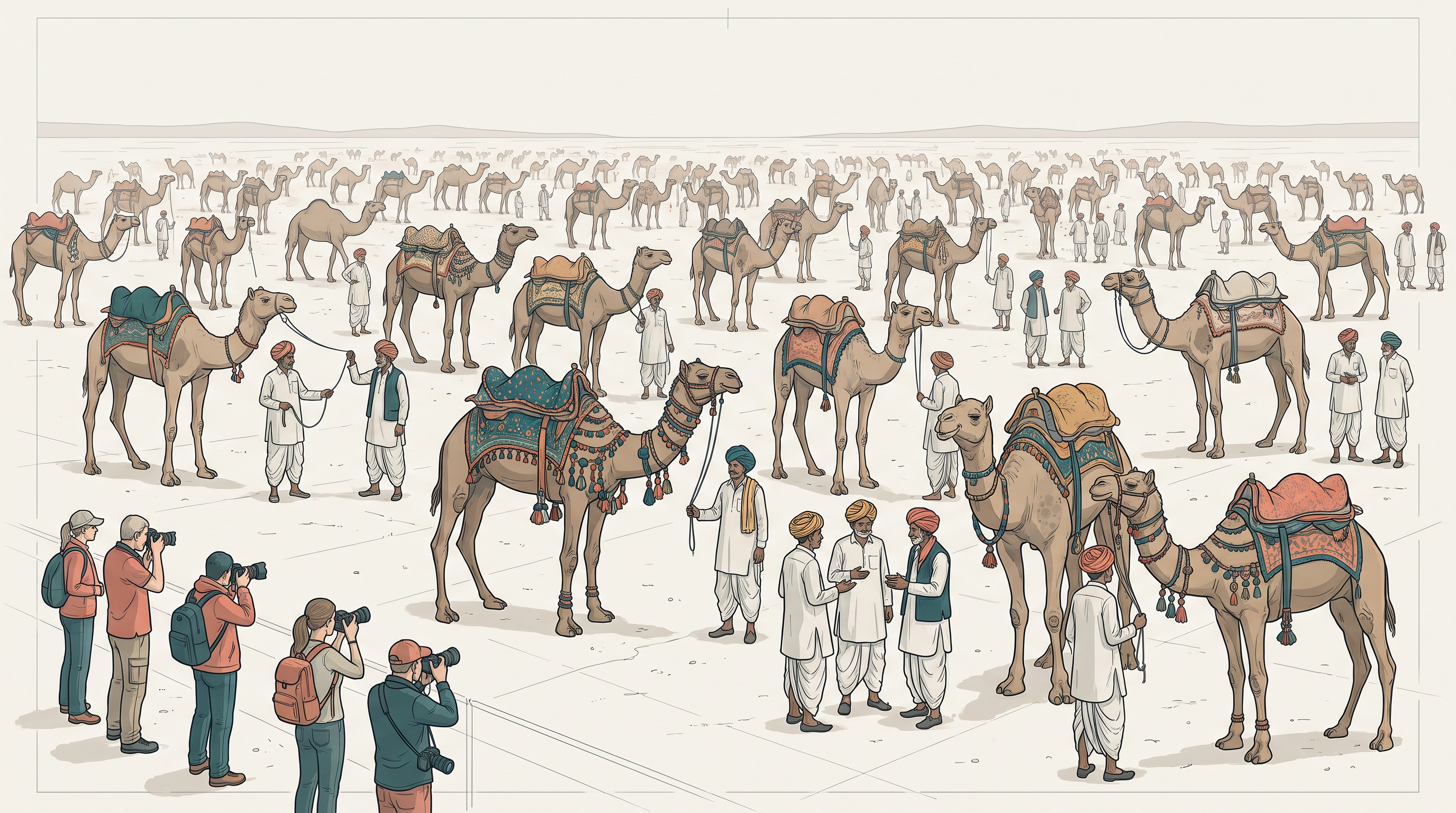
Fig. 4.10 – The Pushkar fair: traditional market and tourist spectacle.
The Pushkar fair continues to be a major social and economic event for local people, as Fig. 4.10 suggests. But it is now also marketed internationally as a major tourist attraction. It is all the more attractive to tourists because it falls just before Kartik Purnima, a major Hindu religious festival, when pilgrims come to bathe in the holy Pushkar Lake.
The result is a striking mingling. Hindu pilgrims, camel traders and foreign tourists meet at the same event, exchanging not only livestock and money but also cultural symbols and religious merit.
4.3.1 Debate on liberalisation – market versus state
The globalisation of the Indian economy has been due primarily to the policy of liberalisation, which was started in the late 1980s. It is worth being precise about what that policy actually contains, since the word is often used loosely.
Liberalisation includes a range of measures:
- the privatisation of public sector enterprises — that is, the selling of government-owned companies to private companies;
- the loosening of government regulations on capital, labour and trade;
- a reduction in tariffs and import duties, so that foreign goods can be imported more easily;
- easier access for foreign companies wishing to set up industries in India.
Another word for such changes is marketisation.
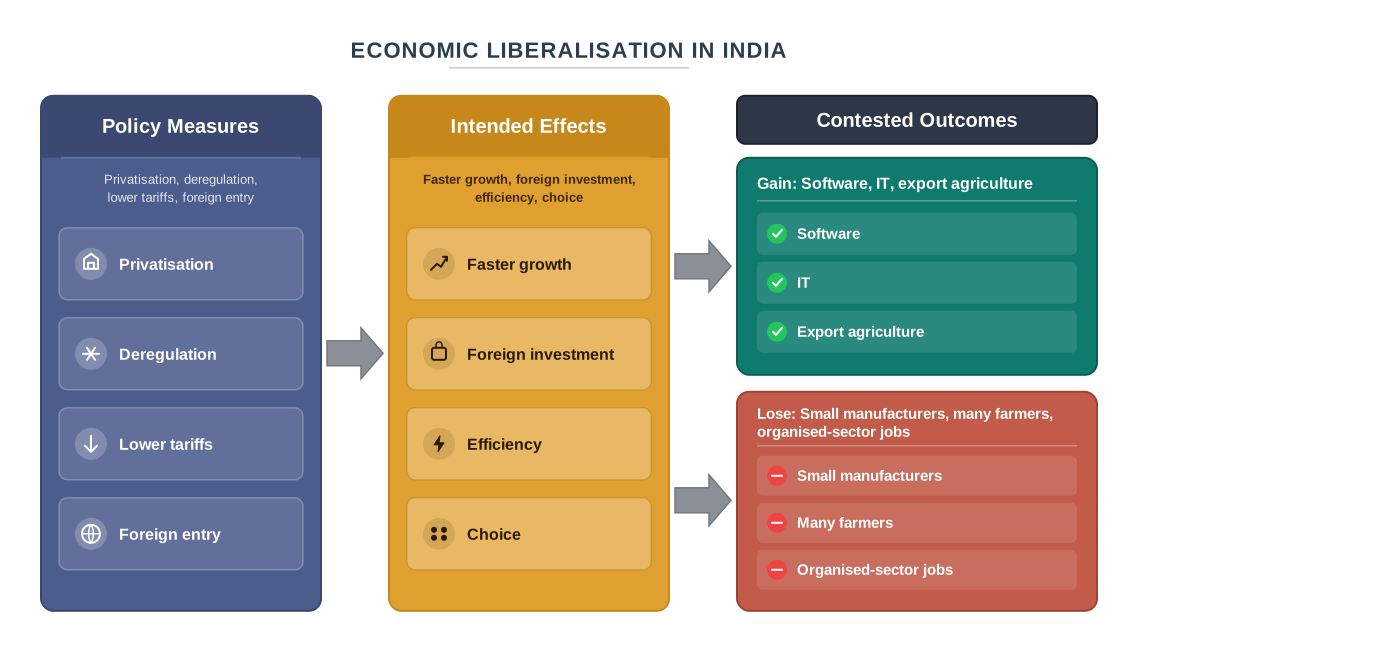
Fig. 4.11 – The liberalisation debate: policies, intentions and outcomes.
Those who advocate marketisation believe that these steps will promote economic growth and prosperity, because private industry is more efficient than government-owned industry. That is the case for the market, and Fig. 4.11 sets out both what it promises and what its critics point to.
The case that liberalisation has worked
The changes made under the liberalisation programme have stimulated economic growth and opened up Indian markets to foreign companies. Many foreign branded goods are now sold in India which were not previously available at all.
Increasing foreign investment is supposed to help economic growth and employment. And the privatisation of public companies is supposed to increase their efficiency, while reducing the government’s burden of running them.
The case that the costs outweigh the benefits
However, the impact of liberalisation has been mixed, and many people argue that liberalisation and globalisation have had — or will have — a negative net impact on India. Their claim is precise: that the costs and disadvantages will be more than the advantages and benefits.
The reason is that the gains and losses are not spread evenly. Some sectors of Indian industry, such as software and information technology, and some parts of agriculture, such as fish or fruit, may benefit from access to a global market. Other sectors — automobiles, electronics, oilseeds — will lose, because they cannot compete with foreign producers.
Take agriculture, where the argument is easiest to follow. Indian farmers are now exposed to competition from farmers in other countries, because the import of agricultural products is allowed. Earlier, Indian agriculture was protected from the world market by support prices and subsidies.
Liberalisation is against this kind of government interference in markets. So support prices and subsidies are reduced or withdrawn. The consequence is that many farmers are not able to make a decent living from agriculture.
The same logic reaches small manufacturers. They have been exposed to global competition as foreign goods and brands have entered the market, and some of them have simply not been able to compete.
There is a further consequence, this time for workers. The privatisation or closing of public sector industries has led to a loss of employment in some sectors, and to the growth of unorganised sector employment at the expense of the organised sector. This is not good for workers, because the organised sector generally offers better paid and more regular or permanent jobs. (The chapters on agrarian change and on industry, in the other Class XII textbook, Social Change and Development in India, take this further.)
Looking back at the chapter
Step back now and see what the chapter has shown.
There are many different kinds of markets in contemporary India, running all the way from the village haat to the virtual stock exchange. These markets are themselves social institutions, and they are connected in various ways to other aspects of the social structure, such as caste and class.
We have also learned that exchange carries a social and symbolic significance that goes far beyond its immediate economic purpose — a purchase can announce a status, a fair can become a tourist product, a credit note can travel on the strength of a community’s reputation.
And the ways in which goods and services are exchanged or circulate are changing rapidly, because of the liberalisation of the Indian economy and globalisation. Goods, services, cultural symbols and money now circulate at many levels at once — from the local market in a village or town right up to a global trading network such as the Nasdaq.
In a world changing this fast, it matters that we understand how markets are constantly being transformed, and what the broader social and economic consequences of those transformations are.
4.4 Summary
The many meanings of “market”
- The word “market” is used in several senses: a place where things are bought and sold; the gathering of buyers and sellers; an area or category of trade, such as the market for cars; and the demand for a product or service, such as the market for computer professionals.
- “The market”, used in a general way, takes in all of these and the whole spectrum of economic activities and institutions. In this broad sense it is almost equivalent to “the economy”.
- The market is usually thought of as an economic institution. It is also a social institution, comparable to caste, tribe and family.
Sociological perspectives on markets (4.1)
- Economics studies how markets work in modern capitalist economies — how prices are set, what investment does, why people save or spend. Sociology asks a different set of questions.
- Modern economics grew from eighteenth-century political economy. Adam Smith, in The Wealth of Nations, argued that the market economy is made up of millions of individual exchanges which automatically create an ordered system, although no one intended to create one.
- Modern economics therefore treats the economy as a separate part of society, operating by its own laws, leaving out the larger social and political context.
- Sociologists instead study economic institutions within the larger social framework. They see markets as social institutions constructed in culturally specific ways — often controlled by particular social groups or classes, and connected to other institutions and structures. This is what is meant by saying that economies are socially embedded.
The weekly tribal market (4.1.1)
- In agrarian societies, periodic markets are central to social and economic organisation. Weekly markets bring villagers together to sell produce and buy goods, and attract traders, moneylenders, entertainers, astrologers and other specialists. They link local and regional economies to the national economy and to towns.
- The weekly haat is especially important in hilly and forested areas inhabited by adivasis, where settlements are scattered and the economy is relatively undeveloped. For many visitors the main reason for coming is social — to meet kin, arrange marriages, exchange news.
- Under colonialism, tribal areas were “opened up” through road-building and the suppression of tribal rebellions, so that forest and mineral wealth could be exploited. Traders and moneylenders entered from the plains; forest produce was sold outside; money and new goods came in; adivasis were recruited as labourers for mines and plantations, and a market for tribal labour developed.
- Local tribal economies became linked to wider markets, usually with very negative consequences: many adivasis were impoverished and lost land to outsiders.
- A study of the weekly market in Bastar district, populated mainly by the Gonds, shows this clearly. Present there are adivasis, non-tribal locals, Hindu traders from outside, and forest officials. Goods exchanged include manufactured items, non-local foods such as salt and haldi, local produce and bamboo baskets, and forest produce such as tamarind and oil-seeds. The buyers are mostly adivasis and the sellers mainly caste Hindus; adivasis earn cash from produce and wage labour and spend it on low-value trinkets, jewellery and cloth.
Caste-based markets and trading networks (4.1.2)
- Traditional accounts pictured India as an unchanging society of self-sufficient villages, whose economies ran on non-market exchange, and held that economic transformation began only with colonialism.
- Recent historical research shows that much of India’s economy was already extensively monetised in the late pre-colonial period. Non-market systems such as the jajmani system existed, but villages were also incorporated into wider networks of exchange.
- The sharp line between the “traditional” and the “modern” (or pre-capitalist and capitalist) economy is therefore rather fuzzy.
- Pre-colonial India was a major manufacturer and exporter of handloom cloth and of goods such as spices, and it had well-organised manufacturing centres, merchant groups, trading networks and banking systems.
- These trading communities had their own banking and credit systems. The hundi, or bill of exchange, allowed long-distance trade: a merchant in one place could issue a hundi that a merchant elsewhere would honour, because trade ran within caste and kinship networks.
- The Nakarattars of Tamil Nadu ran a caste-based banking system, in which confidence rested not on a central bank but on reputation, decisions and reserves shared within caste-defined relationships of territory, residence, descent, marriage and common worship.
Traditional business communities (4.1.3)
- There is a close connection between the caste system and the economy, and this holds for trade as well. “Vaisyas” are one of the four varnas, showing the importance of the merchant in Indian society since ancient times.
- “Vaisya” is often a status claimed or aspired to rather than a fixed identity. Some communities, such as the banias of North India, have traded for a long time; other caste groups entering trade tend to claim Vaisya status as they move upward.
- Traditional business communities include not only Vaisyas but groups with distinctive identities such as Parsis, Sindhis, Bohras and Jains. Merchant communities did not always have high status: in the colonial period the long-distance salt trade was controlled by the Banjaras, a marginalised “tribal” group.
- Because businessmen trust others of their own community or kin group, trade tends to run within such networks, which creates a caste monopoly in certain areas of business.
Colonialism and new markets (4.1.4)
- Colonialism disrupted production, trade and agriculture. The handloom industry declined as cheap manufactured textiles from England flooded the market.
- India was more fully linked to the world capitalist economy. From being a major supplier of manufactured goods, it became a source of raw materials and agricultural products and a consumer of manufactures, largely for the benefit of an industrialising England.
- New groups, especially Europeans, entered trade, sometimes in alliance with existing merchant communities and sometimes forcing them out. But existing institutions were not simply overturned: some merchant communities re-oriented themselves and improved their position, and new communities emerged.
- The Marwaris are the clearest example. They became successful during the colonial period by taking up opportunities in colonial cities such as Calcutta and settling across the country for trade and moneylending. Like the Nakarattars, they relied on extensive social networks and relations of trust. Some families became bankers and later modern industrialists, and Marwaris today control more of India’s industry than any other community.
Capitalism as a social system (4.2)
- Karl Marx understood capitalism as a system of commodity production — production for the market — through the use of wage labour.
- All economic systems are also social systems. Each mode of production consists of particular relations of production, which give rise to a specific class structure. The economy is made up not of things but of relations between people connected through production.
- Under capitalism, labour itself becomes a commodity, because workers must sell their labour power in the market to earn a wage.
- This gives rise to two basic classes: capitalists, who own the means of production, and workers, who sell their labour. Capitalists profit by paying workers less than the value of what they produce, extracting surplus value from their labour.
Commoditisation and consumption (4.2.1)
- Commodification occurs when things not previously traded become commodities — labour and skills, for instance.
- Marx and other critics hold that commodification has negative social effects. The controversy over the sale of kidneys by the poor to rich patients reflects the view that human organs should not become commodities. Human beings were once bought and sold as slaves; today that is considered immoral, yet almost everyone now accepts that labour, services and skills can be bought — a situation, Marx argued, found only in capitalist societies.
- In contemporary India, marriage bureaus and matrimonial websites, private institutes teaching “personality development” and spoken English, and the spread of private schools, colleges and coaching classes all show processes once handled by family or community being drawn into the market.
- Consumption becomes increasingly important in capitalist society, not only economically but symbolically. It is a major way in which social distinctions are created and communicated, and advertisers work to attach meanings of status and culture to goods.
- Max Weber was among the first to note that goods are closely related to status. He coined the term status symbol — the brand of cell phone or model of car, for example, marks socio-economic status among the Indian middle class. Weber also wrote about how classes and status groups are differentiated by their lifestyles.
Globalisation (4.3)
- Since the late 1980s India has moved from state-led development to liberalisation, ushering in the era of globalisation — growing worldwide interconnection, economic, cultural and political.
- Globalisation involves the increased international movement of commodities, money, information and people, supported by technology in computers, telecommunications and transport.
- Its central feature is the extension and integration of markets, so that a change in one market can profoundly affect another far away: India’s software industry can slump if the U.S. economy does badly, as after the 9/11 attacks. Software services and BPO industries such as call centres connect India to the global economy by supplying low-cost services and labour to the developed West. There is now a global market for Indian software labour.
- Culture too enters new circuits of exchange: Indian spirituality and knowledge systems such as yoga and ayurveda are marketed in the West, and international tourism can turn culture itself into a commodity. The Pushkar fair remains a livestock market and a social event for local people, but is also marketed internationally as a tourist attraction, drawing pilgrims (it precedes Kartik Purnima), camel traders and foreign tourists into one event.
The debate on liberalisation (4.3.1)
- Liberalisation includes privatisation of public sector enterprises, loosening of regulations on capital, labour and trade, reduction of tariffs and import duties, and easier access for foreign companies. Another word for such changes is marketisation — using markets rather than government regulation to solve problems, including deregulation, privatisation, and removal of controls over wages and prices.
- Advocates argue that private industry is more efficient than government-owned industry, so these steps will promote growth and prosperity. Liberalisation has stimulated growth, brought foreign branded goods, and is expected to raise investment, employment and efficiency.
- But the impact has been mixed. Many argue the net impact is negative. Some sectors gain (software and IT; fish and fruit), others lose (automobiles, electronics, oilseeds).
- Farmers now face competition from imports, while support prices and subsidies — which guaranteed a minimum income and lowered input costs — are reduced or withdrawn, so many cannot make a decent living. Small manufacturers cannot compete with foreign brands. Privatisation and closure of public sector industry has cost jobs and shifted employment from the organised sector, with its better paid and more regular jobs, to the unorganised sector.
The chapter’s conclusion
- India contains many kinds of markets, from the village haat to the virtual stock exchange. All are social institutions, connected to caste, class and the rest of the social structure.
- Exchange carries social and symbolic significance far beyond its economic purpose, and the ways in which goods, services, symbols and money circulate are changing rapidly under liberalisation and globalisation.
4.5 Key Terms
adivasi — A member of one of India’s tribal communities; the term is used for the original or indigenous inhabitants of a region.
BPO (business process outsourcing) — The practice by which companies in developed countries contract out business services, such as call-centre work, to companies in other countries; a major channel connecting India to the global economy.
Commodification (commoditisation) — The process by which something that was not previously a commodity is turned into one, acquiring a price and entering the market economy.
Commodity — Anything produced not for the producer’s own use but for exchange in the market; it may be an object or a service.
Consumption — The buying and use of goods and services; in modern societies it also carries symbolic meaning, and is a way in which social distinctions are created and communicated.
Deregulation — The relaxation or removal of government controls over economic activity.
Embeddedness — The idea that economic activity is not separate from society but takes place within a web of social relationships, institutions and cultural understandings.
Globalisation — The growing interconnection of the world — economic, cultural and political — through the increased international movement of commodities, money, information and people.
haat — A periodic (usually weekly) market held in rural and even urban India, and the major institution of exchange and social interaction in many forested and hilly areas.
hundi — A bill of exchange, similar to a credit note, used by Indian merchants to carry out long-distance trade and credit within caste and kinship networks.
Invisible hand — Adam Smith’s phrase for the way in which countless self-interested exchanges produce an ordered economic system that no individual intended to create.
jajmani system — A non-market system of exchange in the village, in which service castes received a customary share of the produce instead of a wage.
Labour power — A worker’s capacity to work, which under capitalism must be sold in the market in exchange for a wage, and so itself becomes a commodity.
Liberalisation — A change in economic policy involving privatisation of public sector enterprises, loosening of regulations on capital, labour and trade, reduction of tariffs and import duties, and easier entry for foreign companies.
Lifestyle — The pattern of consumption, taste and conduct by which, according to Weber, classes and status groups are differentiated from one another.
Market — In its specific sense, a place, a gathering of buyers and sellers, an area of trade, or the demand for a product; in its general sense, the whole spectrum of economic activities and institutions, close to the meaning of “the economy”.
Marketisation — The use of markets and market-based processes, rather than government regulation, to solve social, political or economic problems.
Mode of production — In Marx’s theory, an economic system understood as a set of relations of production, which gives rise to a particular class structure.
Organised sector — The part of the economy in which employment is generally better paid, more regular and more often permanent.
Political economy — The name by which the study of the economy was known in the eighteenth century, when modern economics began.
Privatisation — The sale of government-owned enterprises to private companies.
Status symbol — Max Weber’s term for a good that is bought and displayed because it signals the owner’s position in society.
Subsidy — A payment by which the government meets part of the cost of an input, such as fertiliser or diesel oil, thereby lowering the cost of farming.
Support price — The price at which the government agrees to buy an agricultural commodity, helping to assure farmers a minimum income.
Surplus value — In Marx’s theory, the difference between the value that workers produce and the wage they are paid, which is appropriated by the capitalist as profit.
Traditional business communities — Communities and castes long associated with trade and commerce in India, including “Vaisya” groups such as the banias, and others such as the Parsis, Sindhis, Bohras and Jains.
Unorganised sector — The part of the economy in which work is more irregular, less secure and generally less well paid than in the organised sector.
4.6 Points to Ponder
Adam Smith argued that a market economy organises itself out of millions of self-interested exchanges, without anyone planning it. If that is so, why does sociology still insist on asking who controls a market, and who is kept out of it?
At the weekly market, buying and selling goes on alongside meeting kin, arranging marriages and exchanging news. Does this mean the economic and the social are two different activities happening in the same place — or that they were never separate to begin with?
Trade among the Nakarattars and the Marwaris ran on trust, and that trust ran along caste and kinship lines. Trust makes business possible; the same trust makes a caste monopoly. Can a market be built on trust without also being built on exclusion?
If a skill that was once passed on freely within a family — good manners, spoken English, matchmaking — can now be bought from an institute, is something gained, something lost, or both? What decides which things a society is willing to put a price on?
Weber pointed out that goods signal status. Yet the same phone or car may say quite different things in different settings. Where does the meaning of a status symbol actually come from — the object, the owner, or the audience?
The Pushkar fair is both a livestock market for pastoralists and a product sold in the global market for tourism. When a cultural event becomes a commodity, does it stop being what it was?
Under liberalisation, some sectors and groups have gained and others have lost. If a policy raises overall growth while pushing secure organised-sector workers into insecure unorganised work, on what sociological grounds could you judge whether it has succeeded?
4.7 NCERT Questions
What is meant by the phrase ‘invisible hand’?
How does a sociological perspective on markets differ from an economic one?
In what ways is a market – such as a weekly village market – a social institution?
How do caste and kin networks contribute to the success of a business?
In what ways did the Indian economy change after the coming of colonialism?
Explain the meaning of ‘commoditisation’ with the help of examples.
What is a ‘status symbol’?
What are some of the processes included under the label ‘globalisation’?
What is meant by ‘liberalisation’?
In your opinion, will the long-term benefits of liberalisation exceed its costs? Give reasons for your answer.
4.8 Objective Questions
The book The Wealth of Nations was written by:
- Karl Marx
- Max Weber
- Adam Smith
- Alfred Gell [1 mark]
In the eighteenth century, the study of the economy was known as:
- political economy
- social economy
- market sociology
- economic anthropology [1 mark]
When sociologists say that economies are socially ‘embedded’, they mean that:
- markets exist only in modern societies
- economic activity takes place within social relationships and institutions
- the economy obeys laws of its own, separate from society
- all markets are located in fixed physical places [1 mark]
The weekly market studied in Bastar district is located in a region populated mainly by:
- Banjaras
- Nakarattars
- Marwaris
- Gonds [1 mark]
The hundi was:
- a tax collected by the colonial state
- a bill of exchange used by merchants for long-distance trade
- a weekly market held in forested areas
- a share traded on the stock exchange [1 mark]
According to Marx, the difference between the value that workers produce and the wage they are paid is called:
- labour power
- commodity value
- surplus value
- status value [1 mark]
The term ‘status symbol’ was coined by:
- Émile Durkheim
- Max Weber
- Adam Smith
- Karl Marx [1 mark]
Which of the following is NOT a component of liberalisation as described in the chapter?
- privatisation of public sector enterprises
- reduction of tariffs and import duties
- increase in support prices and subsidies for farmers
- easier access for foreign companies to set up industries in India [1 mark]
Fill in the blank: The use of markets or market-based processes, rather than government regulation, to solve social, political or economic problems is called __________. [1 mark]
Fill in the blank: Under the capitalist mode of production, workers must sell their __________ in the market in order to earn a wage. [1 mark]
True or False: Recent historical research suggests that much of India’s economy was already extensively monetised in the late pre-colonial period. [1 mark]
True or False: The Marwaris were an established industrial community long before the colonial period. [1 mark]
Match the following:
| Column A | Column B |
|---|---|
| a. Nakarattars | i. business community that rose in colonial Calcutta |
| b. Marwaris | ii. caste-based banking system in Tamil Nadu |
| c. Banjaras | iii. traditional trading community of North India |
| d. banias | iv. marginalised ‘tribal’ group controlling the colonial salt trade |
[1 mark]
- Match the following:
| Column A | Column B |
|---|---|
| a. Adam Smith | i. surplus value |
| b. Karl Marx | ii. invisible hand |
| c. Max Weber | iii. study of a weekly market in Bastar |
| d. Alfred Gell | iv. status symbol |
[1 mark]
- Assertion (A): In many Indian towns a single line of business is dominated by one community. Reason (R): Trade and commerce often operate through caste and kinship networks, within which businessmen are more likely to trust one another.
- Both A and R are true, and R is the correct explanation of A.
- Both A and R are true, but R is not the correct explanation of A.
- A is true, but R is false.
- A is false, but R is true. [1 mark]
- Assertion (A): Under liberalisation, support prices and subsidies for agriculture are reduced or withdrawn. Reason (R): Liberalisation opposes this kind of government interference in markets.
- Both A and R are true, and R is the correct explanation of A.
- Both A and R are true, but R is not the correct explanation of A.
- A is true, but R is false.
- A is false, but R is true. [1 mark]
- Assertion (A): For a sociologist, a purchase is never a purely economic act. Reason (R): Goods carry symbolic meaning, and consumption is one of the ways in which social distinctions are created and communicated.
- Both A and R are true, and R is the correct explanation of A.
- Both A and R are true, but R is not the correct explanation of A.
- A is true, but R is false.
- A is false, but R is true. [1 mark]
4.9 Check Your Concepts
State any two of the different senses in which the word ‘market’ is used in everyday language. [2 marks]
What is meant by saying that economies are socially ‘embedded’? [2 marks]
Define a commodity, and give one example of something that has been commodified in contemporary India. [2 marks]
What was the hundi, and why could it be honoured by a merchant in another part of the country? [2 marks]
Name any two ‘traditional business communities’ of India mentioned in the chapter. [2 marks]
What is meant by ‘marketisation’? [2 marks]
State two ways in which the organised sector differs from the unorganised sector for a worker. [2 marks]
Explain, with an example, why a weekly haat is described as a social institution and not merely as a site of exchange. [4 marks]
Differentiate between the economic approach and the sociological approach to the study of markets. [4 marks]
Explain how the coming of the colonial state changed the economy of tribal areas, and give reasons why the consequences for local people were largely negative. [4 marks]
Why do sociologists say that the sharp line drawn between the ‘traditional’ and the ‘modern’ Indian economy is rather fuzzy? Support your answer with evidence from the chapter. [4 marks]
Explain, with an Indian example, how caste and kinship networks can produce a monopoly over a particular line of business. [4 marks]
Distinguish between a commodity and commodification, and explain with two examples why some people object to the commodification of certain things. [4 marks]
What would happen to the meaning of a status symbol if everyone in a society could afford it? Use Weber’s ideas about status and lifestyle in your answer. [4 marks]
Trace the trajectory of the Marwaris from small migrant traders to modern industrialists, and explain what this story shows about the importance of social context to economic processes. [6 marks]
Explain Marx’s understanding of capitalism as a social system. Bring out the meaning of mode of production, labour power and surplus value, and state one limitation of this perspective. [6 marks]
“Under globalisation, culture itself may become a commodity.” Discuss this claim with reference to the Pushkar fair and to the marketing of Indian knowledge systems abroad. [6 marks]
“The long-term benefits of liberalisation will exceed its costs.” How far do you agree? Evaluate the argument with Indian examples of sectors and groups that have gained and lost. [6 marks]
Discuss the causes and the consequences of the growth of unorganised sector employment at the expense of the organised sector after liberalisation. [6 marks]
4.10 Passage-Based Questions
Read the passage and answer the questions that follow.
Every Thursday, an open patch of ground on the edge of a forested block fills up before dawn. Villagers walk in from several kilometres away carrying tamarind, oil-seeds and bundles of firewood. Traders arrive by truck from the district town with salt, cloth, cheap ornaments and steel utensils. A clerk from the forest office sets up a table and pays out wages to a line of labourers. Beside the stalls, two families sit under a tree and settle the details of a marriage. By evening the produce has been loaded onto the trucks, and the ground is empty again for another week.
- Identify two ways in which this market works as a social institution, and not only as an economic one. [2 marks]
- Describe the direction in which goods and cash move here, and explain what this suggests about the relationship between local sellers and outside traders. [2 marks]
- Explain how such a weekly market links a local economy to the wider regional and national economy. [2 marks] [6 marks]
Read the passage and answer the questions that follow.
In the wholesale cloth market of a north Indian town, almost all the established firms belong to a handful of families connected by marriage. Goods are supplied on credit, with no written contract; one supplier says that he lends on a man’s name, and that a name is known through relatives. Young men entering the trade learn it in the shops of their uncles. A trader from outside these families, who has capital but no such connections, finds that suppliers will deal with him only for cash, and that no established firm will take him on to learn the business.
- Name and explain the sociological process at work in this market. [2 marks]
- Explain why trust in such a market is said to flow along caste and kinship lines, and what this does to outsiders. [2 marks]
- “Nothing illegal has happened here, and yet the market is closed.” Comment on this statement in the light of the chapter. [2 marks] [6 marks]
Read the passage and answer the questions that follow.
A small factory in a western Indian town made metal fittings for two decades, selling to buyers within the state. After import duties were lowered, similar fittings began arriving from abroad at prices the owner could not match, and orders fell away. Half the workforce, who had held regular jobs at fixed wages, was let go; several of them now do piece-work at home or look for daily work at construction sites. In the same town, a new office employs young graduates to handle customer calls for a foreign company, at salaries higher than the factory ever paid.
- Identify the policy change referred to in the passage, and explain what it involves. [2 marks]
- Explain what has happened to the workers of the factory, using the distinction between the organised and the unorganised sector. [2 marks]
- Using this passage, explain why the impact of liberalisation is described as “mixed” rather than simply good or bad. [2 marks] [6 marks]
Read the passage and answer the questions that follow.
An old fair, held every year after the harvest, once brought together herders who came to buy and sell animals. Today it appears in guidebooks printed abroad. Tour operators sell packages built around it; hotels quote high tariffs for the week; local residents rent out rooms and hire out camels for tourist rides; a market has grown up in photographs of the fair. The herders still trade animals, and pilgrims still come for the religious bathing that falls at the same time. But the fair is now also something to be sold — an experience, purchased by visitors from another country.
- Identify and name the process by which the fair has been drawn into a new market. [2 marks]
- Explain what is meant by saying that a market has itself become a commodity in another market. [2 marks]
- Explain, with reference to the chapter, how globalisation creates “new circuits of exchange” of the kind described here. [2 marks] [6 marks]
4.1.3 Social organisation of markets — “traditional business communities”
Many sociological studies of the Indian economy have focused on “traditional merchant communities” or castes, of which the Nakarattars are one example. The reason is not hard to see. You have already learned that there is a close connection between the caste system and the economy — in landholding, in occupational differentiation, and so on. That connection holds for trade and markets too.
Indeed, “Vaisyas” constitute one of the four varnas. That a whole varna is defined by trade and business is itself an indication of how important the merchant has been in Indian society since ancient times.
Fig. 4.4 – Agricultural work in a village.
Caste status is claimed, not simply inherited
Here a complication has to be introduced, and it is one students often miss. Like the other varnas, “Vaisya” is often a status that is claimed or aspired to, rather than a fixed identity or social position that a group simply possesses.
There certainly are “Vaisya” communities — the banias of North India, for example — whose traditional occupation has been trade or commerce for a very long time. But there are also caste groups that have entered trade later, and such groups tend to acquire or claim “Vaisya” status in the process of moving upward. As with the history of all caste communities, the relationship between caste status or identity on the one hand, and caste practices including occupation on the other, is complex rather than neat.
Traditional business communities in India, moreover, are not only “Vaisyas”. They include groups with distinctive religious or other community identities — the Parsis, Sindhis, Bohras and Jains among them.
Nor did merchant communities always enjoy high status. During the colonial period, the long-distance trade in salt was controlled by the Banjaras, a marginalised group classified as “tribal”. Wealth in trade and rank in the ritual hierarchy did not always travel together.
The general point is that in each case, the particular nature of a community’s institutions and ethos gives rise to a different organisation and practice of business. There is no single Indian way of doing business; there are many, and each is shaped by the community that carries it.
Why business runs along caste and kin lines
To understand how markets operate in India — in earlier periods and at present — we can examine how specific arenas of business come to be controlled by particular communities.
One reason for this caste-based specialisation is the one we saw with the Nakarattars: trade and commerce often operate through caste and kinship networks. A businessman is more likely to trust others of his own community or kin group, and so he tends to do business within such a network rather than with outsiders.
The consequence follows almost mechanically. If credit, information, partnerships and apprenticeships all flow within a community, then people outside that community find it very hard to enter that line of business at all. This tends to create a caste monopoly within certain areas of business.
how a line of business closes A young man wants to set up as a wholesaler in a grain market where almost every established firm belongs to one community. He can find the capital, but not the credit: suppliers extend goods on trust to men whose fathers and uncles they have dealt with for thirty years, and he has no such uncle. He cannot learn the trade either, since apprenticeships in the market’s firms go to nephews and sons-in-law. Nothing illegal has occurred, and no one has been openly turned away. The market is simply organised through networks he is not part of. This demonstrates how trust running along caste and kinship lines produces a caste monopoly in a line of business — an economic outcome with a purely social cause.
Q2. Why is it that in many Indian towns, one line of business — jewellery, grain, cloth — is often in the hands of one particular community?
A. Because trade runs on trust, and trust in Indian markets has historically flowed through caste and kinship networks. Credit, information, partners and training all circulate within the community, which makes it easy for insiders and hard for outsiders to enter. Over time this produces a caste monopoly over particular arenas of business — not because one community is naturally suited to a trade, but because the social organisation of trust excludes others from it.