Chapter 3: Social Institutions: Continuity and Change
In the 1860s the British Indian government began counting the people it ruled. From 1881 the count became regular — once every ten years, a vast machinery of clerks and enumerators moving from door to door across the subcontinent. In 1901, under the direction of Herbert Risley, the census set itself an ambitious new task. It would not merely record which caste a person belonged to. It would try to fix the rank order of castes: which stood above which, region by region.
What followed surprised the administration. Hundreds of petitions began arriving at the office of the Census Commissioner. Representatives of caste after caste wrote in, arguing that their community had been placed too low, offering historical accounts and scriptural evidence for a higher position on the official list.
Think about what that means. A ritual hierarchy thousands of years old, once fluid and locally understood, was now being written into government registers — and people were fighting over their entry in it. Many scholars believe the counting did not simply record caste. It changed caste. Once caste identities were officially listed, they hardened, and caste began a new life.
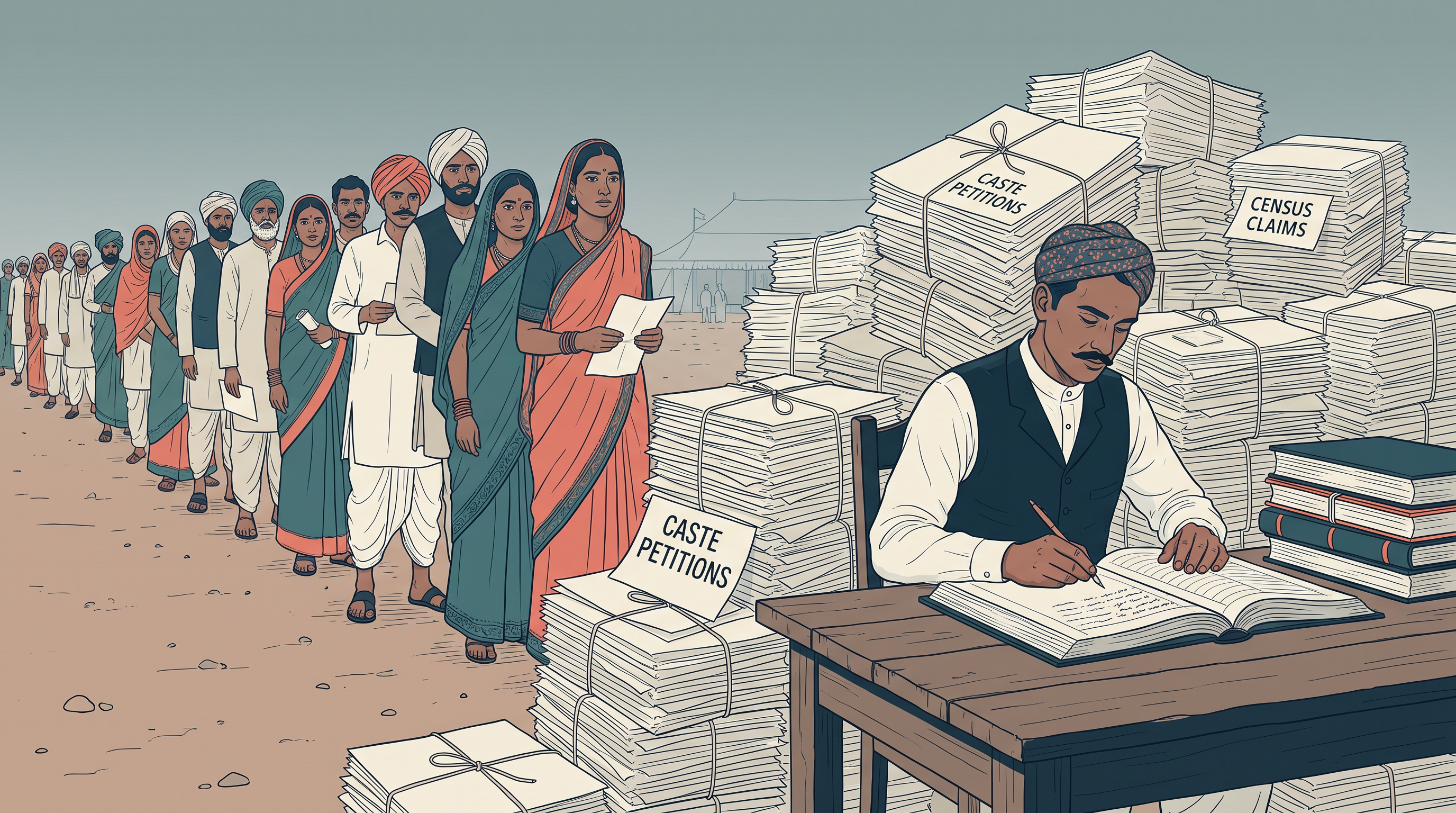
Fig. 3.1 – A colonial-era census enumerator and caste petitions.
You cannot answer these questions yet. By the end of this chapter — after studying caste, tribe and family as social institutions that both continue and change — you will be able to.
3.1 Caste and the Caste System
From population to society
In the previous chapter you studied the structure and dynamics of India’s population — how many people there are, how they are distributed by age and sex, how fast their numbers grow. But a population is never simply a heap of separate, unrelated individuals. It is a society, made up of distinct but interlinked classes and communities of many kinds.
What holds those communities together, and what regulates the way they behave towards one another? Sociologists answer: social institutions — the established, patterned arrangements through which a society organises important areas of life, such as marriage, worship, work, government or education. Social institutions, along with the web of social relationships they support, sustain and regulate community life.
This chapter looks closely at three institutions that are central to Indian society: caste, tribe and family. Each of them shows, in its own way, the double character that gives the chapter its title — a stubborn continuity alongside deep and continuing change.
Two castes, or one?
Like any Indian, you already know that caste is the name of an ancient social institution, one that has been part of Indian history and culture for thousands of years. And like any Indian living in the twenty-first century, you also know that something called ‘caste’ is very much part of Indian society today — in marriage negotiations, in electoral arithmetic, in the reservation debate, in a surname noticed on an admission list.
To what extent are these two ‘castes’ — the one that is supposed to belong to India’s past, and the one that belongs to its present — the same thing? That is the question this section sets out to answer.
The answer, as you will see, is neither a simple yes nor a simple no. Caste has survived, but it has not survived unchanged. Some of its rules have weakened almost to vanishing point; others have been quietly rebuilt in new settings. Sociology’s task is to trace exactly which parts changed, which parts remained, and why.
3.1.1 Caste in the Past
Caste is an institution uniquely associated with the Indian sub-continent. Social arrangements producing similar effects — rigid ranks, hereditary occupations, restrictions on marriage — have existed in other parts of the world, but the exact form of caste has not been found elsewhere.
Although it is an institution characteristic of Hindu society, caste has spread to the major non-Hindu communities of the Indian sub-continent as well. This is specially true of Muslims, Christians and Sikhs. That fact alone should warn you against treating caste as a purely religious matter.
Where the words come from
As is well known, the English word ‘caste’ is not an Indian word at all. It is a borrowing from the Portuguese casta, meaning pure breed — a word the early Portuguese traders used for the closed birth-groups they saw in western India.
The English word refers to a broad institutional arrangement that Indian languages, beginning with ancient Sanskrit, describe using two distinct terms: varna and jati. Keeping the two apart is the first step towards understanding caste.
Varna, literally ‘colour’, is the name given to a four-fold division of society into brahmana, kshatriya, vaishya and shudra. This four-fold scheme, however, excludes a significant section of the population — the ‘outcastes’, foreigners, slaves, conquered peoples and others, sometimes referred to as the panchamas, or fifth category.
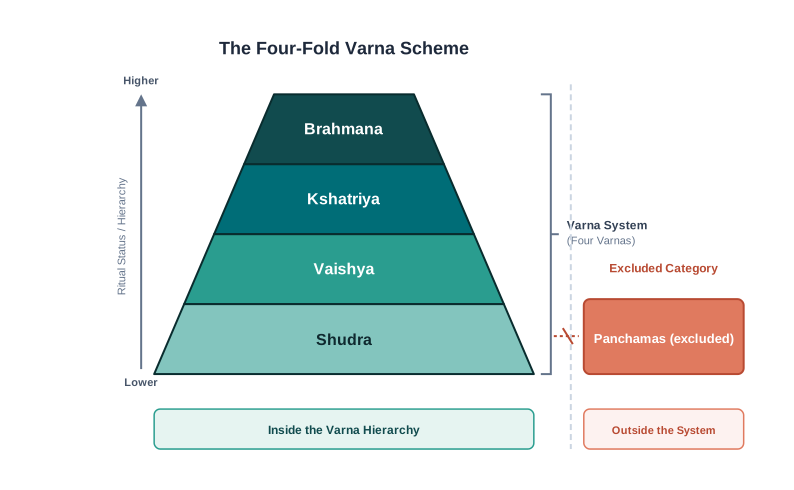
Fig. 3.2 – The four-fold varna scheme and the excluded panchamas.
Jati is a generic term referring to species or kinds of anything at all — it can be used of inanimate objects, of plants, of animals and of human beings. It is the word most commonly used to refer to the institution of caste in Indian languages. It is interesting to note, though, that Indian language speakers are increasingly using the English word ‘caste’ itself.
How old is caste?
Opinions also differ on the exact age of the caste system. It is generally agreed, though, that the four varna classification is roughly three thousand years old.
But — and this is the point students most often miss — the ‘caste system’ stood for different things in different time periods. It is therefore misleading to think of one and the same system simply continuing for three thousand years.
In its earliest phase, in the late Vedic period roughly between 900 and 500 BC, the caste system was really a varna system, and consisted of only four major divisions. These divisions were not very elaborate or very rigid, and they were not determined by birth. Movement across the categories seems to have been not only possible but quite common.
It is only in the post-Vedic period that caste became the rigid institution that is familiar to us from well-known definitions. Rigidity, in other words, is not the oldest feature of caste. It is a later development — which is exactly why sociologists insist that caste has a history rather than an unchanging essence.
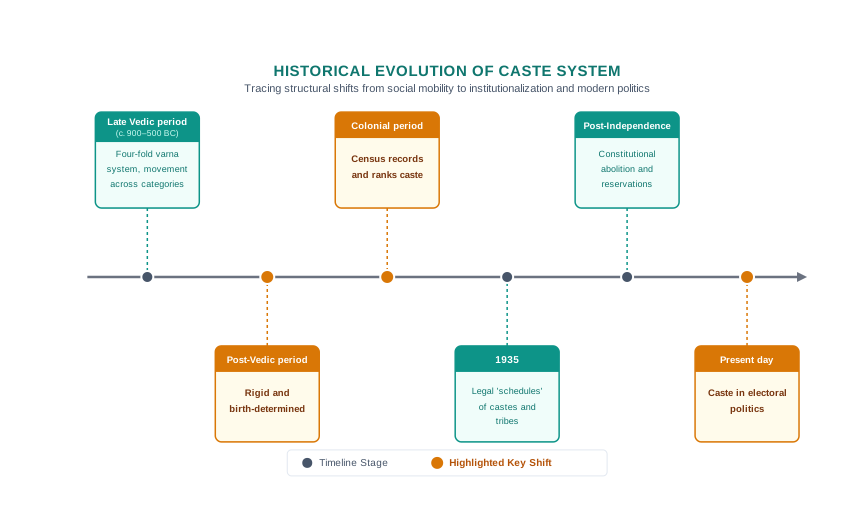
Fig. 3.3 – Historical shifts in the caste system.
The defining features of caste
The most commonly cited defining features of caste are the following. Read them as a set: no single one of them, taken alone, would produce a caste system.
Caste is determined by birth. A child is “born into” the caste of its parents. Caste is never a matter of choice. One can never change one’s caste, leave it, or choose not to join it — although there are instances where a person may be expelled from their caste.
Membership in a caste involves strict rules about marriage. Caste groups are “endogamous”: marriage is restricted to members of the group. Endogamy is the practice of marrying only within one’s own group, and it is the rule that guards the boundary of a caste more effectively than any other.
Caste membership involves rules about food and food-sharing. What kinds of food may or may not be eaten is prescribed, and who one may share food with is also specified.
Caste involves a system of many castes arranged in a hierarchy of rank and status. In theory, every person has a caste, and every caste has a specified place in the hierarchy of all castes. The hierarchical position of many castes, particularly in the middle ranks, may vary from region to region — but there is always a hierarchy.
Castes involve sub-divisions within themselves. Castes almost always have sub-castes, and sometimes sub-castes may themselves have sub-castes. This is referred to as a segmental organisation — a group made up of smaller groups, each of the same general kind.
Castes were traditionally linked to occupations. A person born into a caste could only practise the occupation associated with that caste, so that occupations were hereditary, passed on from generation to generation. The rule worked in both directions: a particular occupation could only be pursued by the caste associated with it, and members of other castes could not enter that occupation.
Prescription is not the same as practice
Here a note of caution is needed, and NCERT is careful to sound it. These six features are the prescribed rules found in ancient scriptural texts. They tell us what the texts demanded — not necessarily what people did.
Since these prescriptions were not always practised, we cannot say to what extent the rules actually determined the empirical reality of caste, that is, its concrete meaning for the people living at that time. A rule written in a text and a rule obeyed in a village are two different kinds of fact, and a sociologist must not confuse them.
As you can see, most of the prescriptions involved prohibitions or restrictions of various sorts. Caste told people what they could not eat, could not marry, could not touch, could not become.
It is also clear from the historical evidence that caste was a very unequal institution. Some castes benefited greatly from the system, while others were condemned to a life of endless labour and subordination.
Most important of all, once caste became rigidly determined by birth, it was in principle impossible for a person ever to change their life circumstances. Whether they deserved it or not, an upper caste person would always have high status, while a lower caste person would always be of low status. Merit, effort and ability had nothing to do with it.
The two principles behind the system
Theoretically, the caste system can be understood as the combination of two sets of principles: one based on difference and separation, and the other on wholism and hierarchy.
Take difference and separation first. Each caste is supposed to be different from — and is therefore strictly separated from — every other caste. Many of the scriptural rules of caste are designed precisely to prevent the mixing of castes: rules ranging from marriage, food-sharing and social interaction to occupation.
Now take wholism and hierarchy. These different and separated castes do not have an individual existence. They can only exist in relation to a larger whole — the totality of society, consisting of all castes together. A caste is not a free-standing group; it is a part of a system, and it makes sense only within that system.
Further, this societal whole is a hierarchical rather than an egalitarian system. Each individual caste occupies not just a distinct place, but also an ordered rank — a particular position in a ladder-like arrangement going from highest to lowest.
Purity and pollution
On what basis is the ladder built? The hierarchical ordering of castes rests on the distinction between ‘purity’ and ‘pollution’.
This is a division between something believed to be closer to the sacred — and therefore connoting ritual purity — and something believed to be distant from, or opposed to, the sacred, and therefore considered ritually polluting. Castes that are considered ritually pure have high status, while those considered less pure or impure have low status.
But ritual rank has never floated entirely free of worldly power. As in all societies, material power — that is, economic or military power — is closely associated with social status, so that those in power tend to be of high status, and vice versa. Historians believe that those who were defeated in wars were often assigned low caste status.
This is an important corrective. It suggests that the ritual ladder did not descend from the heavens fully formed; it reflected, at least partly, who held land, arms and wealth on the ground.
A division of labour without mobility
Finally, castes are not only unequal to each other in ritual terms. They are also supposed to be complementary and non-competing groups.
In other words, each caste has its own place in the system, which cannot be taken by any other caste. The barber’s work is the barber caste’s work; the potter’s work is the potter caste’s work; and no one is expected to compete for another’s occupation.
Since caste is also linked with occupation, the system functions as a social division of labour — society’s work is divided out among specialised groups. Except that, unlike a modern division of labour, this one allows, in principle, no mobility at all. You do not choose your work; your work is given to you at birth, along with your name.
3.1.2 Colonialism and Caste
Compared to the ancient past, we know a great deal more about caste in our recent history — because far more of it was written down, counted, argued over and printed.
If modern history is taken to begin with the nineteenth century, then Indian Independence in 1947 offers a natural dividing line between the colonial period — roughly 150 years, from around 1800 to 1947 — and the post-Independence or post-colonial period, the seven decades from 1947 to the present day.
The present form of caste as a social institution has been shaped very strongly by both: by the colonial period, and by the rapid changes that have come about in independent India. Neither half of that story can be dropped.
Governing a society you do not understand
Scholars have agreed that all major social institutions, and specially the institution of caste, underwent major changes during the colonial period. In fact, some scholars argue that what we know today as caste is more a product of colonialism than of ancient Indian tradition.
Not all of the changes brought about were intended or deliberate. That is worth pausing on. A colonial administration did not sit down and decide to redesign caste; much of what it did to caste, it did while trying to do something else.
Initially, the British administrators began by trying to understand the complexities of caste in an effort to learn how to govern the country efficiently. Some of these efforts took the shape of very methodical and intensive surveys and reports on the ‘customs and manners’ of various tribes and castes all over the country. Many British administrative officials were also amateur ethnologists — untrained enthusiasts of the study of peoples — and took great interest in pursuing such surveys and studies.
Counting caste: the census
But by far the most important official effort to collect information on caste was through the census, the government’s complete count of the population.
First begun in the 1860s, the census became a regular ten-yearly exercise conducted by the British Indian government from 1881 onwards. The 1901 Census, under the direction of Herbert Risley, was particularly important, because it sought to collect information on the social hierarchy of caste — the social order of precedence in particular regions, that is, the position of each caste in the rank order.
You met the consequence in the story that opened this chapter. This effort had a huge impact on social perceptions of caste. Hundreds of petitions were addressed to the Census Commissioner by representatives of different castes claiming a higher position in the social scale, and offering historical and scriptural evidence for their claims.
Overall, scholars feel that this kind of direct attempt to count caste, and to officially record caste status, changed the institution itself. Before this kind of intervention, caste identities had been much more fluid and less rigid. Once they began to be counted and recorded, caste began to take on a new life.
The ‘depressed classes’ and the schedules
The administration also took an interest in the welfare of downtrodden castes, referred to as the ‘depressed classes’ at that time. Note the phrase, and note the quotation marks: it is the label the colonial state used, not a description sociology would accept today.
It was as part of these efforts that the Government of India Act of 1935 was passed, which gave legal recognition to the lists — or ‘schedules’ — of castes and tribes marked out for special treatment by the state. This is how the terms Scheduled Castes and Scheduled Tribes came into being.
Castes at the bottom of the hierarchy that suffered severe discrimination, including all the so-called ‘untouchable’ castes, were included among the Scheduled Castes. Untouchability — the practice of treating certain castes as ritually polluting, and excluding them from ordinary social contact — and the long struggles against it are studied in detail in Chapter 5, on social exclusion.
What colonialism did
Thus colonialism brought about major changes in the institution of caste. Perhaps it would be more accurate to say that the institution of caste underwent fundamental changes during the colonial period.
And it was not only India that was changing. Not just India, but the whole world was undergoing rapid change during this period, due to the spread of capitalism and modernity — new machines, new markets, new cities, new ideas about the individual. Caste was reshaped inside that larger transformation, not apart from it.
3.1.3 Caste in the Present
Indian independence in 1947 marked a big, but ultimately only partial, break with the colonial past. Understanding that word ‘partial’ is the key to this whole section.
Caste considerations had inevitably played a role in the mass mobilisations of the nationalist movement. A movement that wished to speak for all Indians had to reckon with the fact that Indians were divided by caste before they were united by nationality.
The struggle against caste before Independence
Efforts to organise the “depressed classes”, and particularly the untouchable castes, actually predated the nationalist movement, having begun in the second half of the nineteenth century.
This was an initiative taken from both ends of the caste spectrum — by upper caste progressive reformers, as well as by members of the lower castes such as Mahatma Jotiba Phule and Babasaheb Ambedkar in western India, and Ayyankali, Sri Narayana Guru, Iyotheedass and Periyar (E.V. Ramaswamy Naickar) in the South.
Both Mahatma Gandhi and Babasaheb Ambedkar began organising protests against untouchability from the 1920s onwards. Anti-untouchability programmes became a significant part of the Congress agenda, so that by the time Independence was on the horizon there was a broad agreement across the spectrum of the nationalist movement to abolish caste distinctions.
The dominant view in the nationalist movement was to treat caste as a social evil, and as a colonial ploy to divide Indians. But the movement also had to hold a coalition together. The nationalist leaders, above all Mahatma Gandhi, were able to work simultaneously for the upliftment of the lower castes and to advocate the abolition of untouchability and other caste restrictions, while at the same time reassuring the landowning upper castes that their interests, too, would be looked after.
A state with contradictions
The post-Independence Indian state inherited and reflected these contradictions.
On the one hand, the state was committed to the abolition of caste, and explicitly wrote this commitment into the Constitution. On the other hand, it was both unable and unwilling to push through radical reforms that would have undermined the economic basis of caste inequality — above all, the unequal ownership of land.
At yet another level, the state assumed that if it simply operated in a caste-blind manner, this would automatically lead to the undermining of caste-based privileges and the eventual abolition of the institution.
Consider what caste-blindness meant in practice. Appointments to government jobs took no account of caste — thus leaving the well-educated upper castes and the ill-educated, or often illiterate, lower castes to compete on “equal” terms. Notice the quotation marks around ‘equal’. A race is not fair merely because the rules are the same for everyone, if some runners have been made to start a hundred metres behind.
The only exception to this caste-blind approach was in the form of reservation — the setting aside of a proportion of seats and posts — for the Scheduled Castes and Scheduled Tribes.
Industry, the city and the resilience of caste
The development activity of the state, and the growth of private industry, also affected caste indirectly, by speeding up and intensifying economic change.
Modern industry created all kinds of new jobs for which there were no caste rules at all. No scripture says who may repair a turbine or operate a telephone exchange. Urbanisation, and the conditions of collective living in the cities — the shared bus, the shared tap, the shared queue — made it difficult for the caste-segregated patterns of social interaction to survive.
At a different level, modern educated Indians, attracted to the liberal ideas of individualism and meritocracy, began to abandon the more extreme caste practices.
On the other hand, it was remarkable how resilient caste proved to be. Recruitment to industrial jobs — whether in the textile mills of Mumbai (then Bombay), the jute mills of Kolkata (then Calcutta), or elsewhere — continued to be organised along caste and kinship-based lines.
The mechanism was simple. The middlemen who recruited labour for the factories tended to recruit them from their own caste and region, so that particular departments or shop floors were often dominated by specific castes. A modern factory can be filled by pre-modern networks. And prejudice against the untouchables remained quite strong: it was not absent from the city, though it was not as extreme as it could be in the village.
Where caste has proved strongest
Not surprisingly, it is in the cultural and domestic spheres that caste has proved strongest.
Endogamy — the practice of marrying within the caste, which you met among the six defining features — has remained largely unaffected by modernisation and change. Even today, most marriages take place within caste boundaries, although there are more intercaste marriages than before.
Some boundaries may have become more flexible or porous. But the borders between groups of castes of similar socio-economic status are still heavily patrolled. A family that would tolerate a marriage across a nearby jati line may still refuse one across the line that really matters to it.

Fig. 3.4 – Endogamy in a newspaper matrimonial page.
Caste and democratic politics
Perhaps the most eventful and important sphere of change has been that of politics. From its very beginnings in independent India, democratic politics has been deeply conditioned by caste.
Its functioning has become more and more complex and hard to predict. But it cannot be denied that caste remains central to electoral politics. Since the 1980s we have also seen the emergence of explicitly caste-based political parties.
In the early general elections, it seemed as though caste solidarities were decisive in winning elections. But the situation soon got very complicated, as parties competed with each other in using the same kind of caste calculus. When everybody plays the same game, no one holds a monopoly on it.
Sociologists and social anthropologists coined many new concepts to try and understand these processes of change. Perhaps the most common of these are ‘sanskritisation’ and ‘dominant caste’, both contributed by M.N. Srinivas — and both discussed extensively, and criticised, by other scholars.
Sanskritisation
Sanskritisation refers to a process whereby members of a — usually middle or lower — caste attempt to raise their own social status by adopting the ritual, domestic and social practices of a caste, or castes, of higher status.
Notice what this concept implies. It describes mobility of a very particular kind: a group climbs, but the ladder itself is left standing. The hierarchy is not challenged; it is accepted, and imitated more carefully.
The dominant caste
Dominant caste is a term used to refer to those castes which had a large population and were granted land rights by the partial land reforms effected after Independence.
To see how this worked, follow the transfer of land. The land reforms took away rights from the erstwhile claimants — the upper castes who were ‘absentee landlords’, in the sense that they played no part in the agricultural economy other than claiming their rent. They frequently did not even live in the village, but were based in towns and cities.
These land rights now came to be vested in the next layer of claimants: those who were involved in the management of agriculture, but were not themselves the cultivators. These intermediate castes in turn depended on the labour of the lower castes — including specially the ‘untouchable’ castes — for tilling and tending the land.
However, once they got land rights, they acquired considerable economic power. Their large numbers also gave them political power in the era of electoral democracy based on universal adult franchise — the right of every adult citizen to vote, regardless of property, education, caste or sex.
Thus these intermediate castes became the ‘dominant’ castes in the countryside, and played a decisive role in regional politics and the agrarian economy. Examples of such dominant castes include the Yadavs of Bihar and Uttar Pradesh, the Vokkaligas of Karnataka, the Reddys and Khammas of Andhra Pradesh, the Marathas of Maharashtra, the Jats of Punjab, Haryana and Western Uttar Pradesh, and the Patidars of Gujarat.
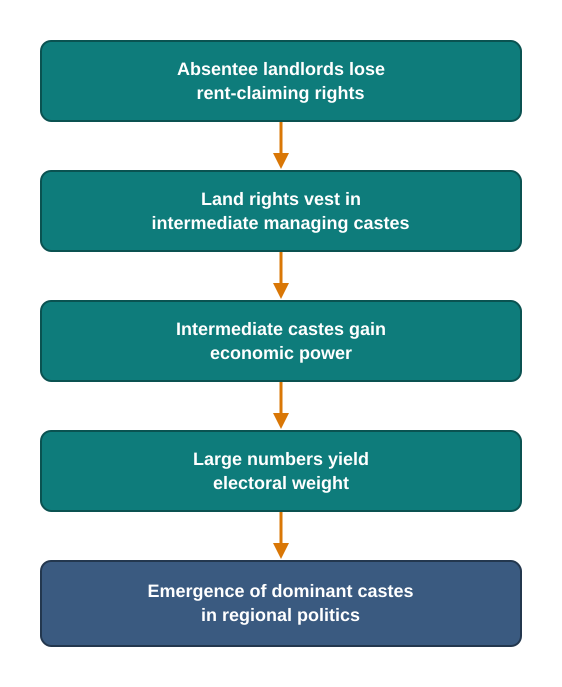
Fig. 3.5 – How partial land reform produced dominant castes.
The paradox of invisible caste
One of the most significant yet paradoxical changes in the caste system in the contemporary period is that it has tended to become ‘invisible’ for the upper caste, urban middle and upper classes.
For these groups — who have benefited the most from the developmental policies of the post-colonial era — caste has appeared to decline in significance precisely because it has done its job so well. Read that sentence twice. Caste looks unimportant to them because it worked.
Their caste status had been crucial in ensuring that these groups had the necessary economic and educational resources to take full advantage of the opportunities offered by rapid development. In particular, the upper caste elite were able to benefit from subsidised public education, specially professional education in science, technology, medicine and management.
At the same time, they were also able to take advantage of the expansion of public sector jobs in the early decades after Independence. In this initial period, their lead over the rest of society in terms of education ensured that they did not face any serious competition.
As their privileged status got consolidated in the second and third generations, these groups began to believe that their advancement had little to do with caste. And, in a narrow sense, they were not wrong about the present: certainly for the third generations from these groups, their economic and educational capital alone is quite sufficient to ensure that they will continue to get the best in terms of life chances.
For this group, it now seems that caste plays no part in their public lives, being limited to the personal sphere of religious practice, or of marriage and kinship. The advantage has been converted into something that no longer looks like caste at all — it looks like merit.
A further complication is introduced by the fact that this is a differentiated group. Although the privileged as a group are overwhelmingly upper caste, not all upper caste people are privileged — some being poor. Caste and class overlap heavily in India, but they are not identical, and a good sociological answer never assumes that they are.
And the paradox of hypervisible caste
For the Scheduled Castes, the Scheduled Tribes and the backward castes, exactly the opposite has happened. For them, caste has become all too visible — indeed, their caste has tended to eclipse the other dimensions of their identities.
Why can they not simply set caste aside? Because they have no inherited educational and social capital, and because they must compete with an already entrenched upper caste group, they cannot afford to abandon their caste identity. It is one of the few collective assets they have.
Moreover, they continue to suffer from discrimination of various kinds. The policies of reservation, and other forms of protective discrimination instituted by the state in response to political pressure, serve as their lifelines.
But there is a price. Using this lifeline tends to make their caste the all-important, and often the only, aspect of their identity that the world recognises. A student may be a mathematician, a cricketer, a daughter, a Malayalam speaker — and be seen, first and last, as a category.
Continuity and change
Return now to the question with which this section began. Are the caste of India’s past and the caste of India’s present the same thing?
They are not. The caste of the scriptural texts — with its hereditary occupations, its prohibitions on food-sharing, its ladder of ritual purity, its absolute denial of mobility — has been substantially weakened by industry, by the city, by law and by education.
But they are not two unrelated things either. Endogamy survives. Hierarchy survives, in altered form. Caste has moved out of the ritual sphere and into the electoral one; it has moved out of the shop floor’s rules and into the shop floor’s recruitment networks; it has moved out of sight for those it favoured and into the foreground for those it harmed.
That is what sociologists mean by continuity and change. An institution rarely dies. More often, it migrates.
3.2 Tribal Communities
Tribe is a modern term for communities that are very old — among the oldest inhabitants of the sub-continent. There is an oddity here worth noticing at the outset: a new word for a very old people, and a word that the people themselves did not choose.
That oddity runs through the whole of this section. Tribes in India have generally been defined not by what they are, but in terms of what they were not.
Tribes were communities that did not practise a religion with a written text; did not have a state, or a political form of the normal kind; and did not have sharp class divisions.
Look carefully at that definition and you will see the problem it creates. Every clause is a negative. A community is being described entirely by the things it lacks, and the standard against which it is found lacking is somebody else’s society. Much of the sociological debate you will meet in this section grows out of exactly this difficulty.
3.2.1 Classifications of Tribal Societies
If defining tribes by absences is unsatisfactory, what happens when we try to define them by presences? In terms of positive characteristics, tribes have been classified according to their permanent traits and their acquired traits.
Permanent traits include region, language, physical characteristics and ecological habitat — the things a community does not choose and cannot easily alter. Acquired traits, as you will see, are those that arise from how a community lives and what it has come into contact with.
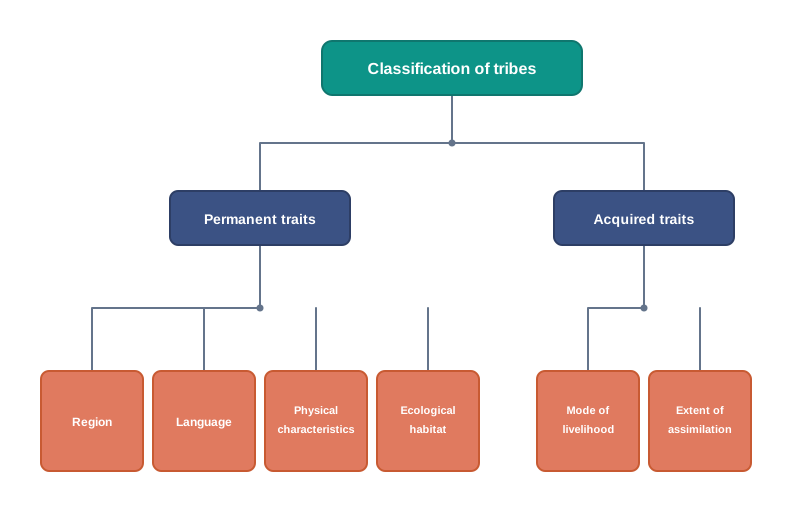
Fig. 3.6 – Classification of tribal societies.
3.2.1.1 Permanent Traits
The tribal population of India is widely dispersed, but there are also concentrations in certain regions. About 85% of the tribal population lives in ‘middle India’ — a wide band stretching from Gujarat and Rajasthan in the west to West Bengal and Odisha in the east, with Madhya Pradesh, Jharkhand, Chattisgarh and parts of Maharashtra and Andhra Pradesh forming the heart of this region.
Of the remaining 15%, over 11% is in the North Eastern states, leaving only a little over 3% living in the rest of India. As Fig. 3.7 shows, the tribal population of India is not spread evenly at all; it is gathered in two great blocks with a thin scatter elsewhere.
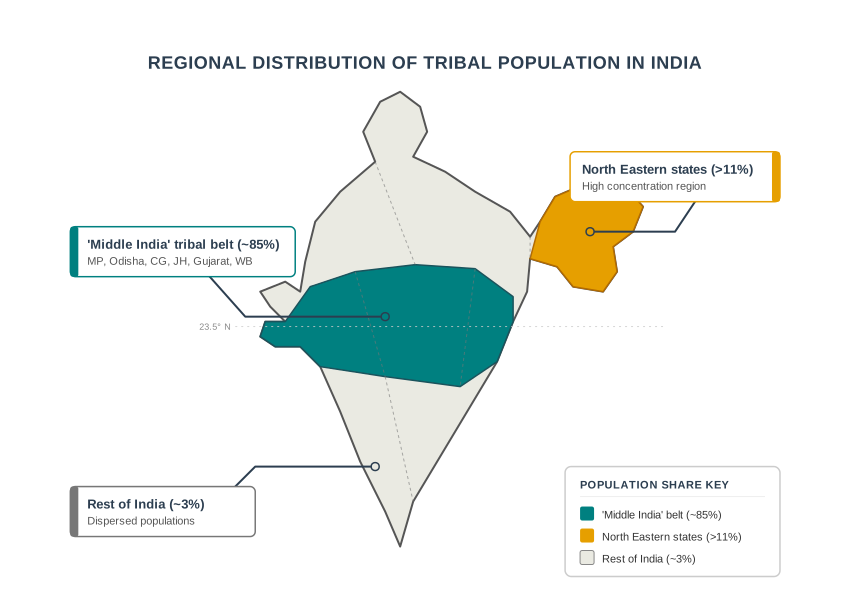
Fig. 3.7 – Regional distribution of India’s tribal population.
Now turn the question around and ask, not where tribal people live, but what share of a state’s population they form. Here the picture changes completely.
If we look at the share of tribals in the state population, then the North Eastern states have the highest concentrations. All the North Eastern states except Assam have concentrations of more than 30%, and some — like Arunachal Pradesh, Meghalaya, Mizoram and Nagaland — have more than 60%, and up to 95%, of tribal population.
In the rest of the country, however, the tribal population is very small, being less than 12% in all states except Odisha and Madhya Pradesh.
The ecological habitats covered include hills, forests, rural plains and urban industrial areas. That last item deserves attention: tribal India is not only a forest India. Tribal people live in industrial towns too — a fact that quietly demolishes the picture of the tribe as a community sealed away from modern life.
Language gives a second permanent trait. In terms of language, tribes are categorised into four categories. Two of them, Indo-Aryan and Dravidian, are shared with the rest of the Indian population, and tribes account for only about 1% of the former and about 3% of the latter. The other two language groups, the Austric and Tibeto-Burman, are primarily spoken by tribals, who account for all of the first and over 80% of the second group.
In physical-racial terms, tribes are classified under the Negrito, Australoid, Mongoloid, Dravidian and Aryan categories. The last two are again shared with the rest of the population of India.
Finally there is size, where the variation is extraordinary. In terms of size, tribes vary a great deal, ranging from about seven million to some Andamanese islanders who may number less than a hundred persons.
The biggest tribes are the Gonds, Bhils, Santhals, Oraons, Minas, Bodos and Mundas, all of whom are at least a million strong. A single ‘tribe’, in other words, may be larger than the population of many countries.
The total population of tribes amounts to about 8.2% of the population of India, or about 84 million persons, according to the 2001 Census. According to Census Report 2011, it is 8.6% of the population of India, or about 104 million tribal persons in the country.
Read Table 3.2 carefully. Both the share and the absolute number rose between the two censuses — from about 8.2% to 8.6%, and from about 84 million to about 104 million persons. A rise in the share means the tribal population grew somewhat faster than the population of the country as a whole over that decade.
3.2.1.2 Acquired Traits
Classifications based on acquired traits use two main criteria — mode of livelihood, and extent of incorporation into Hindu society — or a combination of the two.
On the basis of livelihood, tribes can be categorised into fishermen, food gatherers and hunters, shifting cultivators, peasants, and plantation and industrial workers. Notice again the range: from hunting and gathering at one end to factory work at the other.
However, the dominant classification, both in academic sociology and in politics and public affairs, is the degree of assimilation into Hindu society — the process by which a group is absorbed into a larger society and comes to share its practices.
Assimilation can be seen either from the point of view of the tribes, or — as has most often been the case — from the point of view of the dominant Hindu mainstream. Which vantage point you take is not a technical detail. It decides whose experience counts as the story.
From the tribes’ point of view, apart from the extent of assimilation, attitude towards Hindu society is also a major criterion, with a differentiation between tribes that are positively inclined towards Hinduism and those who resist or oppose it.
From the mainstream point of view, tribes may be viewed in terms of the status accorded to them in Hindu society, ranging from the high status given to some, to the generally low status accorded to most.
3.2.2 Tribe — The Career of a Concept
Concepts, like institutions, have histories. The idea of ‘tribe’ has had a career of its own in Indian sociology, and it has not been a comfortable one.
During the 1960s scholars debated whether tribes should be seen as one end of a continuum with caste-based (Hindu) peasant society, or whether they were an altogether different kind of community.
Those who argued for the continuum saw tribes as not being fundamentally different from caste-peasant society, but merely less stratified — that is, having fewer levels of hierarchy — and having a more community-based rather than individual notion of resource ownership.
Opponents argued that tribes were wholly different from castes, because they had no notion of purity and pollution, which is central to the caste system. Since the ritual ranking of pure and impure is what makes caste a caste, a society without it cannot be placed on the same scale at all.
In short, the argument for a tribe–caste distinction was founded on an assumed cultural difference: between Hindu castes, with their beliefs in purity and pollution and their hierarchical integration, and ‘animist’ tribals, with their more egalitarian and kinship-based modes of social organisation. The word ‘assumed’ is doing a great deal of work in that sentence — and the next decade tested the assumption to destruction.
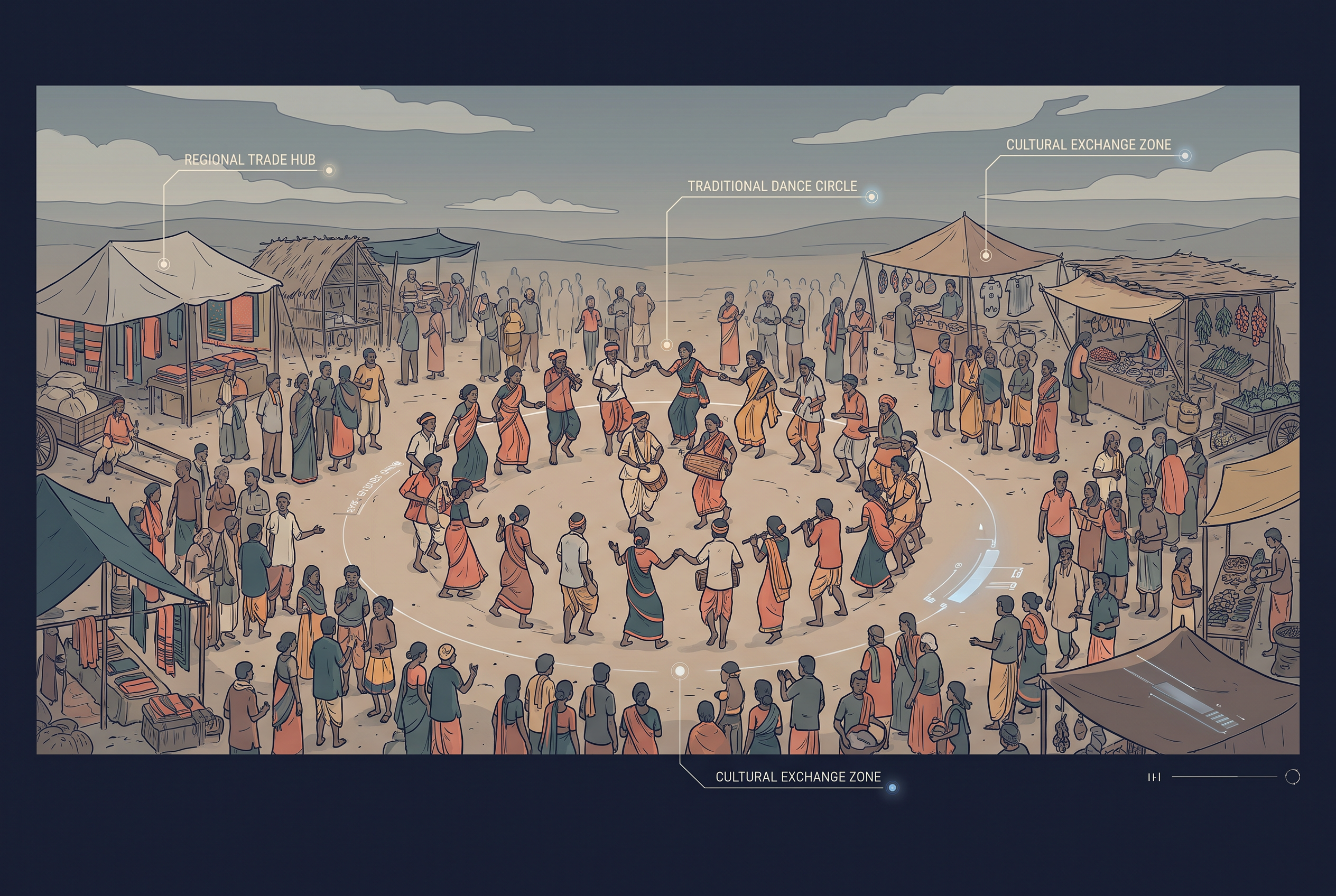
Fig. 3.8 – A tribal village fair.
The definitions collapse
By the 1970s all the major definitions of tribe were shown to be faulty. It was pointed out that the tribe–peasantry distinction did not hold in terms of any of the commonly advanced criteria: size, isolation, religion, and means of livelihood.
Take size. Some Indian “tribes”, like the Santhal, Gonds and Bhils, are very large and spread over extensive territory — hardly the small, self-contained band the definition imagines.
Take means of livelihood. Certain tribes, like the Munda, Hos and others, have long since turned to settled agriculture. And even hunting-gathering tribes, like the Birhors of Bihar, employ specialised households to make baskets, press oil and so on — a division of labour of exactly the kind the definition said tribes did not have.
The criterion also fails from the other direction. It has been pointed out, in a number of cases, that in the absence of other alternatives, “castes” — that is, non-tribals — have turned to hunting and gathering. If hunting and gathering makes a community a tribe, then these caste groups would have to be reclassified as tribes, which nobody proposes to do.
Absorption into Hindu society
The discussion on caste–tribe differences was accompanied by a large body of literature on the mechanisms through which tribes were absorbed into Hindu society throughout the ages — through sanskritisation, through acceptance into the Shudra fold following conquest by caste Hindus, through acculturation (the taking on of another culture’s practices through prolonged contact), and so on.
The whole span of Indian history is often seen as an absorption of different tribal groups into caste Hindu society at varying levels of the hierarchy, as their lands were colonised and the forests cut down.
This absorption has been read in two quite different registers. It is seen as either natural — parallel to the process by which all groups are assimilated into Hinduism as sects — or as exploitative.
The split runs along a generation of scholarship. The early school of anthropologists tended to emphasise the cultural aspects of tribal absorption into the mainstream, while the later writers have concentrated on the exploitative and political nature of the incorporation.
Are tribes ‘pristine’ societies?
Some scholars have also argued that there is no coherent basis for treating tribes as “pristine” — that is, original or pure — societies, uncontaminated by civilisation.
They propose instead that tribes should really be seen as “secondary” phenomena, arising out of the exploitative and colonialist contact between pre-existing states and non-state groups like the tribals.
On this argument, the contact itself creates an ideology of “tribalism”: the tribal groups begin to define themselves as tribals precisely in order to distinguish themselves from the newly encountered others. Tribal identity, in other words, is not what existed before contact — it is partly a product of contact.
Tribes were never outside history
Nevertheless, the idea that tribes are like stone age hunting and gathering societies that have remained untouched by time is still common, even though this has not been true for a very long time.
To begin with, adivasis were not always the oppressed groups they are now. There were several Gond kingdoms in Central India, such as that of Garha Mandla, or Chanda. Many of the so-called Rajput kingdoms of central and western India actually emerged through a process of stratification among adivasi communities themselves.
Adivasis often exercised dominance over the plains people, through their capacity to raid them and through their services as local militias. They also occupied a special trade niche, trading forest produce, salt and elephants. These are not the activities of an isolated people; they are the activities of a people at the centre of a regional economy.
Moreover, the capitalist economy’s drive to exploit forest resources and minerals, and to recruit cheap labour, brought tribal societies into contact with mainstream society a long time ago. The contact is not new. What is new is the terms on which it now takes place.
3.2.3 National Development versus Tribal Development
The imperatives of ‘development’ have governed attitudes towards tribes and shaped the policies of the state. Ask who benefits from a project, and who pays for it, and the sociology of tribal India comes sharply into focus.
National development, particularly in the Nehruvian era, involved the building of large dams, factories and mines. These were seen — and by many were welcomed — as the temples of a new nation.
But projects have to stand somewhere. Because the tribal areas were located in the mineral rich and forest covered parts of the country, tribals have paid a disproportionate price for the development of the rest of Indian society. This kind of development has benefited the mainstream at the expense of the tribes.
The process of dispossessing tribals of their land has occurred as a necessary byproduct of the exploitation of minerals, and of the utilisation of favourable sites for setting up hydroelectric power plants — many of which were in tribal areas.
The loss of the forest
The loss of the forests, on which most tribal communities depended, has been a major blow. A forest is not scenery to a community that lives in it; it is food, fuel, fodder, medicine, building material and a source of cash.
Forests started to be systematically exploited in British times, and the trend continued after Independence. Here again is a continuity across 1947 that the political break does not capture.
The coming of private property in land has also adversely affected tribals, whose community-based forms of collective ownership were placed at a disadvantage. When the law recognises only the individual title deed, a community that holds its land in common finds that, in the eyes of the state, it does not own anything at all.
3.2.4 Tribal Identity Today
Forced incorporation of tribal communities into mainstream processes has had its impact on tribal culture and society as much as on their economy. You cannot take a people’s land and leave their sense of themselves untouched.
Tribal identities today are formed by this interactional process, rather than by any primordial — that is, original, ancient — characteristics peculiar to tribes. Identity here is an outcome of a relationship, not an inheritance from a distant past.
And because the interaction with the mainstream has generally been on terms unfavourable to the tribal communities, many tribal identities today are centred on ideas of resistance and opposition to the overwhelming force of the non-tribal world.
Successes, and their limits
The positive impact of successes — such as the achievement of statehood for Jharkhand and Chattisgarh after a long struggle — is moderated by continuing problems.
Many of the states of the North-East, for example, have been living for decades under special laws that limit the civil liberties of citizens. A political gain at one level, then, sits alongside a restriction at another.
A new tribal middle class
Another significant development is the gradual emergence of an educated middle class among tribal communities.
Most visible in the North-eastern states, this is now a segment beginning to be seen in the rest of the country as well, particularly among members of the larger tribal communities. In conjunction with policies of reservation — about which you will learn more in Chapter 5 — education is creating an urbanised professional class.
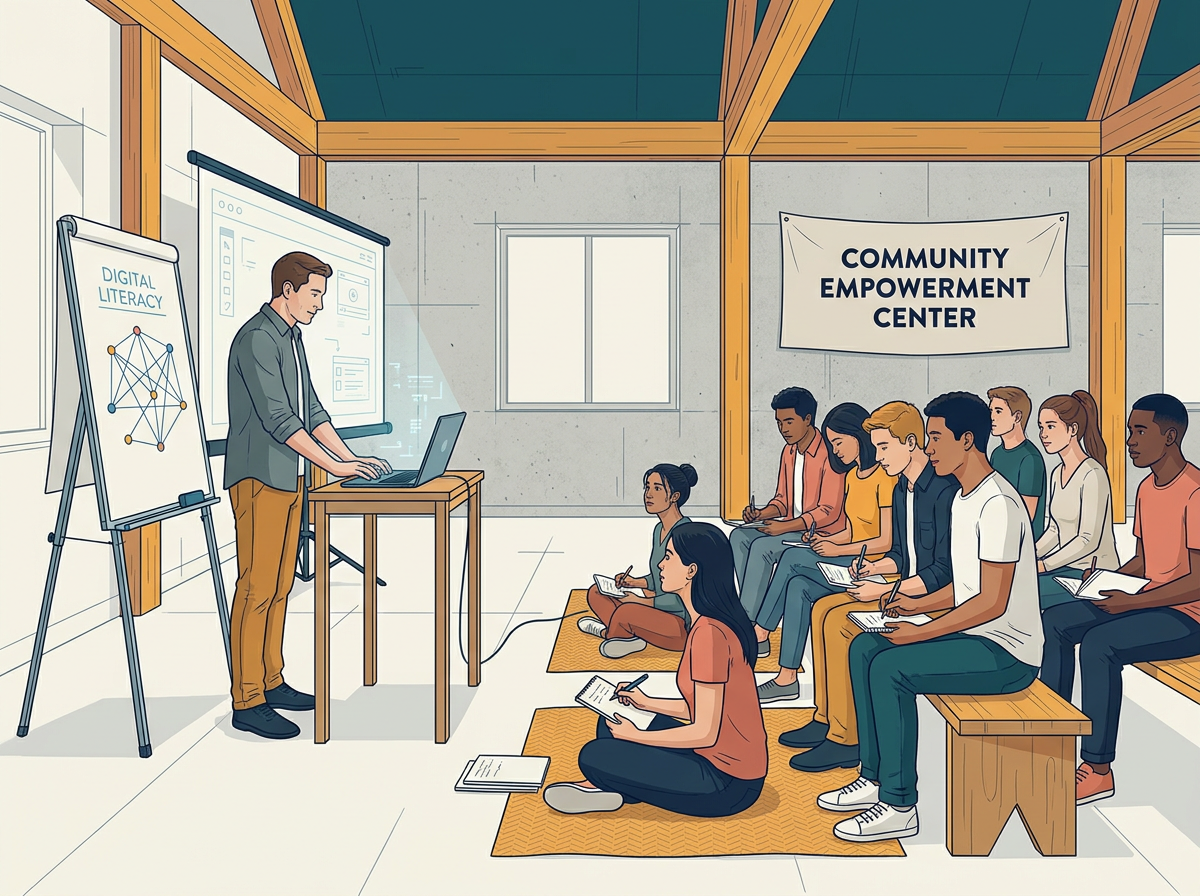
Fig. 3.9 – Skills training in a tribal community.
As tribal societies get more differentiated — that is, as they develop class and other divisions within themselves — different bases are growing for the assertion of tribal identity. A tribe is no longer, if it ever was, a single undifferentiated community with a single interest.
Why tribal movements arise
Two broad sets of issues have been most important in giving rise to tribal movements. The first concerns control over vital economic resources, like land and specially forests. The second concerns matters of ethnic-cultural identity — language, custom, religion, the right to be recognised as a distinct people.
The two can often go together. A struggle over a forest is very often also a struggle over who a people are. But with the differentiation of tribal society, the two may also diverge.
The reasons why the middle classes within tribal societies may assert their tribal identity may be different from the reasons why poor and uneducated tribals join tribal movements. One may be seeking recognition, a share in professional opportunity and cultural respect; the other may be fighting to keep a field or a forest.
As with any other community, it is the relationship between these kinds of internal dynamics and external forces that will shape the future. Neither the pressure from outside nor the divisions within can explain a tribal movement by itself.
3.3 Family and Kinship
Each one of us is born into a family, and most of us spend long years within it. Usually we feel very strongly about our family.
Sometimes we feel very good about our parents, grandparents, siblings, uncles, aunts and cousins — and at other times we don’t. On the one hand we resent their interference; on the other, we miss their overbearing ways when we are away from them.
The family is a space of great warmth and care. It has also been a site of bitter conflicts, injustice and violence. Female infanticide, violent conflicts between brothers over property and ugly legal disputes are as much a part of family and kinship — the web of relationships created by birth, marriage and descent — as are stories of compassion, sacrifice and care.
Sociology asks you to hold both of these together. A romantic view of the family, and a wholly bleak one, are equally unsociological, because each ignores half the evidence.
The family as structure, and as part of a structure
The structure of the family can be studied in two ways: both as a social institution in itself, and in its relationship to the other social institutions of society.
Taken in itself, a family can be defined as nuclear or extended. It can be male-headed or female-headed. And its line of descent can be matrilineal or patrilineal — traced through the mother or through the father.
But this internal structure of the family is usually related to other structures of society: political, economic, cultural and so on. This is where the sociological imagination begins to work.
Consider two examples. The migration of men from the villages of the Himalayan region can lead to an unusual proportion of women-headed families in the village. Or the work schedules of young parents in the software industry in India may lead to an increasing number of grandparents moving in as care-givers to young grandchildren.
In both cases the composition of the family and its structure change — and those changes can only be understood in relation to other changes in society. The family, which we think of as the private sphere, is linked to the economic, political, cultural and educational spheres, which we think of as public.
Why family change is resisted
The family is an integral part of our lives, and we take it for granted. We also assume that other people’s families must be like our own. As we have just seen, however, families have different structures, and these structures change.
Sometimes these changes occur accidentally, as when a war takes place, or when people migrate in search of work. Nobody plans them; they are the by-product of something else.
Sometimes these changes are purposely brought about — as when young people decide to choose their spouses instead of letting the elders decide, or when same sex love is expressed openly in society.
It is evident from the kind of changes that take place that not only have family structures changed, but cultural ideas, norms and values also change. Structure and belief move together.
These changes are, however, not so easy to bring about. Both history and contemporary times suggest that change in family and marriage norms is often resisted violently. That word — violently — is deliberate, and it is a reminder that the family is not only where a society is gentlest, but also where it guards its rules most fiercely.
The family has many dimensions to it. In India, however, discussions on the family have often revolved around the nuclear and the extended family, and it is to that distinction that we now turn.
3.3.1 Nuclear and Extended Family
A nuclear family consists of only one set of parents and their children.
An extended family — commonly known as the ‘joint family’ — can take different forms, but it has more than one couple, and often more than two generations, living together. This could be a set of brothers with their individual families, or an elderly couple with their sons and grandsons and their respective families.
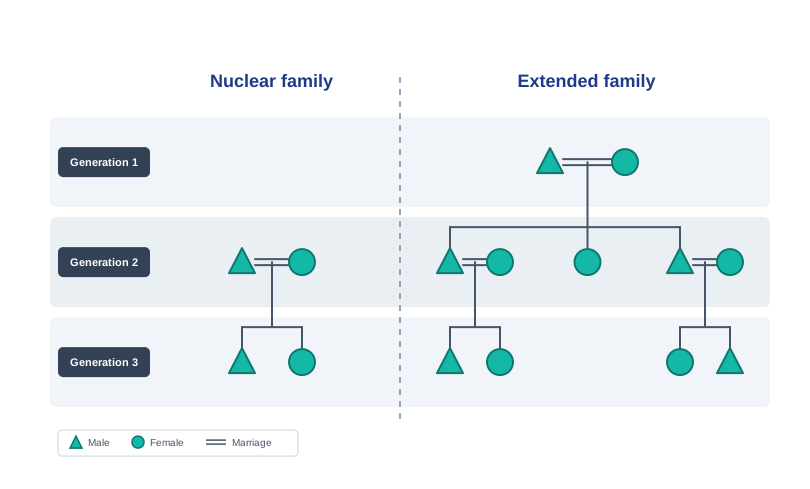
Fig. 3.10 – Kinship charts: nuclear and extended families.
The extended family is often seen as symptomatic of India — the form that supposedly expresses something essentially Indian. Yet this is by no means the dominant form now, and it was not the dominant form earlier either. It was confined to certain sections and certain regions of the community.
Indeed, the term ‘joint family’ is not even a native category. As the sociologist I.P. Desai observed, “the expression ‘joint family’ is not the translation of any Indian word”. It is interesting to note that the words used for joint family in most of the Indian languages are the equivalents of translations of the English phrase itself.
3.3.2 The Diverse Forms of the Family
Studies have shown how diverse family forms are found in different societies. Three rules in particular vary from society to society: the rule of residence, the rule of inheritance, and the location of authority. Keeping the three apart is essential, because in ordinary speech they are constantly confused.
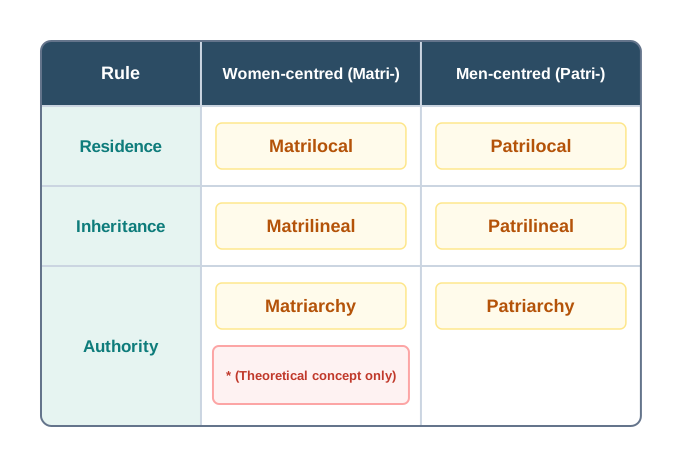
Fig. 3.11 – Three rules of family organisation.
Residence: where the couple lives
With regard to the rule of residence, some societies are matrilocal in their marriage and family customs, while others are patrilocal.
In the first case, the newly married couple stays with the woman’s parents. In the second case, the couple lives with the man’s parents.
Inheritance: how property passes
With regard to the rules of inheritance, matrilineal societies pass on property from mother to daughter, while patrilineal societies do so from father to son.
Notice that this rule concerns descent and property, not power. Who inherits a field is a different question from who decides what is done with it.
3.4 Summary
Social institutions
- A population is not a heap of separate individuals but a society of interlinked classes and communities, sustained and regulated by social institutions and social relationships. This chapter studies three of them: caste, tribe and family.
Caste in the past (3.1)
- Caste is an institution uniquely associated with the Indian sub-continent. Though characteristic of Hindu society, it has spread to Muslims, Christians and Sikhs.
- The English word ‘caste’ comes from the Portuguese casta, meaning pure breed. Indian languages use two terms: varna — the four-fold division into brahmana, kshatriya, vaishya and shudra, which excludes the panchamas or fifth category — and jati, the local birth-group.
- The common interpretation treats varna as a broad all-India classification and jati as a regional sub-classification of hundreds or thousands of castes and sub-castes.
- The four varna scheme is roughly three thousand years old, but the caste system meant different things in different periods. In the late Vedic period (roughly 900–500 BC) the divisions were few, not rigid and not determined by birth; movement across them was common. Rigidity came in the post-Vedic period.
- The defining features of caste: determination by birth; endogamy; rules about food and food-sharing; a hierarchy of rank and status; segmental organisation into sub-castes; and hereditary occupations, which no other caste could enter.
- These features are scriptural prescriptions and were not always practised, so they cannot be read as a description of everyday reality. What is clear is that caste was a very unequal institution: some castes gained greatly, others were condemned to endless labour and subordination.
- Theoretically the system combines two sets of principles: difference and separation, and wholism and hierarchy. The hierarchy is ordered by purity and pollution, though material power has always been closely associated with ritual status.
- Castes are also complementary and non-competing, so the system works as a social division of labour — one that in principle allows no mobility.
Colonialism and caste (3.1)
- All major social institutions, and specially caste, changed fundamentally in the colonial period; some scholars argue that caste as we know it is more a product of colonialism than of ancient tradition.
- The British conducted intensive surveys of the ‘customs and manners’ of castes and tribes. The census, begun in the 1860s and held every ten years from 1881, was the most important such effort.
- The 1901 Census under Herbert Risley tried to fix the rank order of castes. Hundreds of petitions followed from castes claiming higher positions. Counting and recording caste hardened identities that had been more fluid.
- The Government of India Act of 1935 gave legal recognition to the ‘schedules’ of castes and tribes — the origin of the terms Scheduled Castes and Scheduled Tribes.
Caste in the present (3.1)
- 1947 was a big but only partial break. Anti-caste efforts predated the nationalist movement, led from both ends of the caste spectrum — by upper caste reformers and by Jotiba Phule, Ambedkar, Ayyankali, Sri Narayana Guru, Iyotheedass and Periyar. Gandhi and Ambedkar organised against untouchability from the 1920s.
- The post-Independence state wrote the abolition of caste into the Constitution, but was unable and unwilling to alter the economic basis of caste inequality. Its caste-blind approach made the well-educated upper castes and the ill-educated lower castes compete on “equal” terms; reservation for the Scheduled Castes and Scheduled Tribes was the only exception.
- Industry, urbanisation and the ideas of individualism and meritocracy weakened caste. Yet caste proved resilient: factory recruitment ran along caste and kinship lines, and prejudice followed people into the city.
- Caste has proved strongest in the cultural and domestic spheres. Endogamy remains largely unaffected, and most marriages still take place within caste boundaries.
- Caste remains central to electoral politics, with explicitly caste-based parties emerging since the 1980s.
- M.N. Srinivas contributed two much-discussed concepts. Sanskritisation is the process by which a usually middle or lower caste raises its status by adopting the ritual, domestic and social practices of a higher caste. Dominant caste refers to castes with large populations that gained land rights through the partial land reforms after Independence — such as the Yadavs, Vokkaligas, Reddys, Khammas, Marathas, Jats and Patidars — and thereby gained economic and, under universal adult franchise, political power.
- The paradox of the present: caste has become ‘invisible’ for the upper caste urban middle and upper classes, precisely because it did its job so well and converted itself into educational and economic capital. For the Scheduled Castes, Scheduled Tribes and backward castes it has become all too visible, eclipsing every other dimension of their identity.
Tribal communities (3.2)
- ‘Tribe’ is a modern term for very old communities, and tribes have generally been defined by what they were not: no religion with a written text, no state of the normal kind, no sharp class divisions.
- Positively, tribes have been classified by permanent traits (region, language, physical characteristics, ecological habitat) and acquired traits (mode of livelihood, and extent of incorporation into Hindu society).
- About 85% of the tribal population lives in ‘middle India’; over 11% in the North Eastern states; a little over 3% elsewhere. But the highest concentrations are in the North East, where all states except Assam are over 30% tribal and some reach 60–95%.
- Tribes speak Indo-Aryan, Dravidian, Austric and Tibeto-Burman languages, and have been classified in physical-racial terms as Negrito, Australoid, Mongoloid, Dravidian and Aryan.
- The biggest tribes — Gonds, Bhils, Santhals, Oraons, Minas, Bodos and Mundas — are each at least a million strong. Tribes were about 8.2% of India’s population, or about 84 million persons, in the 2001 Census, and 8.6%, or about 104 million persons, in Census Report 2011.
- In the 1960s scholars debated whether tribes lay on a continuum with caste-peasant society or were an altogether different kind of community — the latter argument resting on the absence of purity and pollution among tribes.
- By the 1970s all major definitions of tribe had been shown to be faulty: the criteria of size, isolation, religion and livelihood all failed. Some tribes are very large; Munda and Ho have long practised settled agriculture; the Birhors employ specialised households; and some non-tribal castes have turned to hunting and gathering.
- Tribes were absorbed into Hindu society over the ages through sanskritisation, acceptance into the Shudra fold after conquest, and acculturation. Early anthropologists stressed the cultural side of this absorption; later writers stressed its exploitative and political nature.
- Some scholars deny that tribes are ‘pristine’ societies, seeing them instead as ‘secondary’ phenomena produced by exploitative and colonialist contact, which itself generated an ideology of ‘tribalism’.
- Tribes were never outside history. There were Gond kingdoms such as Garha Mandla and Chanda; several Rajput kingdoms emerged through stratification among adivasi communities; adivasis raided the plains, served as militias and traded forest produce, salt and elephants.
- National development — dams, factories and mines, especially in the Nehruvian era — was concentrated where the minerals and forests were, which is where tribal people lived. Tribals paid a disproportionate price through dispossession of land, loss of forests, and the disadvantage of collective ownership under a law of private property.
- Heavy in-migration of non-tribals has diluted the tribal share of population — in the industrial areas of Jharkhand, and most dramatically in the North-East, where Tripura’s tribal share halved within a decade.
- Tribal identity today is formed by this interaction with the mainstream rather than by any primordial characteristics, and is often centred on resistance. Statehood for Jharkhand and Chattisgarh was a success, but many North-Eastern states live under special laws limiting civil liberties.
- An educated tribal middle class has emerged, aided by education and reservation. Tribal movements arise from two sets of issues — control over land and forests, and ethnic-cultural identity — and these may increasingly diverge as tribal society becomes internally differentiated.
Family and kinship (3.3)
- The family is a space of warmth and care, and also a site of conflict, injustice and violence. Both belong to its sociology.
- A family can be studied in itself — as nuclear or extended, male-headed or female-headed, matrilineal or patrilineal — and in relation to other institutions. Male migration from Himalayan villages produces women-headed families; the work schedules of software-industry parents bring grandparents in as care-givers. The private sphere is linked to the public.
- Family structures change accidentally (war, migration) and purposely (young people choosing spouses, same sex love expressed openly). Cultural ideas, norms and values change with them, and such change is often violently resisted.
- A nuclear family has one set of parents and their children; an extended or ‘joint’ family has more than one couple and often more than two generations. The extended family is seen as symptomatic of India but has never been the dominant form, and, as I.P. Desai noted, ‘joint family’ is not the translation of any Indian word.
- Family forms vary by rules of residence (matrilocal, patrilocal), inheritance (matrilineal, patrilineal) and authority (patriarchal, matriarchal).
- Matriarchy, unlike patriarchy, is a theoretical rather than an empirical concept: no historical or anthropological evidence of it has been found. Matrilineal societies do exist, but there women inherit property without controlling it, and are not the decision makers in public affairs.
3.5 Key Terms
Acculturation — the process by which a community takes on the cultural practices of another society through prolonged contact with it.
Acquired traits — the criteria used to classify tribes by what they have come to do or become: mode of livelihood, and extent of incorporation into Hindu society.
Assimilation — the process by which a group is absorbed into a larger society and comes to share its practices; in Indian sociology, most often used of the absorption of tribes into Hindu society.
Caste — an ancient Indian social institution of birth-determined, endogamous, hierarchically ranked groups traditionally linked to hereditary occupations. The English word comes from the Portuguese casta, meaning pure breed.
Census — the government’s complete count of the population, held every ten years in India from 1881; its recording of caste from the 1860s onwards helped harden caste identities.
Dominant caste — Srinivas’s term for a caste with a large population that gained land rights through the partial land reforms after Independence, and thereby acquired economic and, under universal adult franchise, political power in the countryside.
Endogamy — the rule that marriage must take place within one’s own group; the rule that most effectively guards a caste boundary.
Extended family — a household with more than one couple, and often more than two generations, living together; commonly called the ‘joint family’.
Family — the social institution formed by a group of people related by marriage, birth or adoption, who usually live together and share resources.
Jati — the local or regional birth-group; the term ordinarily used for caste in Indian languages, of which there are hundreds or even thousands, with sub-castes within them.
Kinship — the web of social relationships created by birth, marriage and descent.
Matriarchy — a structure in which women exercise authority and dominance; a theoretical concept, since no historical or anthropological evidence of such a society has been found.
Matrilineal — a rule of descent and inheritance under which property passes from mother to daughter.
Matrilocal — a rule of residence under which a newly married couple lives with the woman’s parents.
Nuclear family — a household consisting of only one set of parents and their children.
Panchamas — the ‘fifth category’: the outcastes, foreigners, slaves, conquered peoples and others excluded from the four-fold varna scheme.
Patriarchal — describing a family or social structure in which men exercise authority and dominance.
Patrilineal — a rule of descent and inheritance under which property passes from father to son.
Patrilocal — a rule of residence under which a newly married couple lives with the man’s parents.
Permanent traits — the criteria used to classify tribes by what they are and where they are: region, language, physical characteristics and ecological habitat.
Primordial — original or ancient; used of characteristics supposed to belong to a community from the beginning, as against identities formed through interaction.
Purity and pollution — the ritual distinction on which the caste hierarchy is ordered: what is thought close to the sacred is pure and ranks high, what is thought distant from or opposed to the sacred is polluting and ranks low.
Reservation — the setting aside of a proportion of seats and posts for specified groups, notably the Scheduled Castes and Scheduled Tribes.
Sanskritisation — Srinivas’s term for the process by which members of a usually middle or lower caste raise their social status by adopting the ritual, domestic and social practices of a caste of higher status.
Scheduled Castes — the castes at the bottom of the hierarchy, including all the so-called ‘untouchable’ castes, listed in the official schedules for special treatment by the state; the term originates in the Government of India Act of 1935.
Scheduled Tribes — the tribes listed in the official schedules for special treatment by the state; the term also originates in the Government of India Act of 1935.
Segmental organisation — the arrangement by which castes contain sub-castes, and sub-castes may themselves contain further sub-castes.
Social division of labour — the distribution of a society’s work among specialised groups; in the caste system, occupations are complementary and non-competing but allow, in principle, no mobility.
Social institution — a stable, organised pattern of rules, roles and relationships through which a society regularly meets an important social need, and which continues beyond the individuals who make it up.
Tribe — a modern term for very old communities, conventionally defined by three absences: no religion with a written text, no state of the normal kind, and no sharp class divisions.
Tribalism — the ideology by which tribal groups come to define themselves as tribals in order to distinguish themselves from the outsiders they encounter; on some accounts, a product of colonial contact rather than of ancient identity.
Untouchability — the practice of treating certain castes as ritually polluting and excluding them from ordinary social contact.
Varna — literally ‘colour’; the four-fold division of society into brahmana, kshatriya, vaishya and shudra, treated as a broad all-India classification.
3.6 Points to Ponder
If the caste system in the late Vedic period was neither rigid nor determined by birth, what does it mean to call caste a ‘three-thousand-year-old’ institution? Can an institution keep its name while changing almost everything else about itself?
Scholars disagree about whether caste as we know it today is more a product of colonialism than of ancient tradition. What kind of evidence would settle such a disagreement — and is it the sort of evidence a sociologist can ever fully obtain?
Caste has become ‘invisible’ for those it advantaged and inescapable for those it disadvantaged. What does this tell you about how privilege in general — of caste, class, language or gender — manages to present itself as merit?
Endogamy has survived industrialisation, urbanisation and mass education almost intact, while hereditary occupation has not. Why should the rule about whom one marries prove so much tougher than the rule about what work one does?
If every definition of ‘tribe’ has been shown to be faulty, should sociology go on using the word at all? What would be lost — for the study of Indian society, and for the communities themselves — if it were abandoned?
The ‘joint family’ turned out not to be a native Indian category, yet Indians came to believe it described them. How much of what a society believes about itself is borrowed from the way outsiders once described it?
Matriliny exists but matriarchy does not. What does that single fact suggest about the relationship between owning property and holding power?
3.7 NCERT Questions
What is the role of the ideas of separation and hierarchy in the caste system?
What are some of the rules that the caste system imposes?
What changes did colonialism bring about in the caste system?
In what sense has caste become relatively ‘invisible’ for the urban upper castes?
How have tribes been classified in India?
What evidence would you offer against the view that ‘tribes are primitive communities living isolated lives untouched by civilisation’?
What are the factors behind the assertion of tribal identities today?
What are some of the different forms that the family can take?
In what ways can changes in social structure lead to changes in the family structure?
Explain the difference between matriliny and matriarchy.
3.8 Objective Questions
- The English word ‘caste’ is a borrowing from the Portuguese word:
- jati
- casta
- varna
- panchama [1 mark]
- The section of the population excluded from the four-fold varna scheme — the ‘outcastes’, foreigners, slaves and conquered peoples — is sometimes referred to as the:
- shudras
- adivasis
- panchamas
- jatis [1 mark]
- The 1901 Census, which sought to record the rank order of castes in particular regions, was conducted under the direction of:
- Herbert Risley
- G.S. Ghurye
- M.N. Srinivas
- I.P. Desai [1 mark]
- The terms ‘Scheduled Castes’ and ‘Scheduled Tribes’ came into being through the:
- Census of 1881
- Census of 1901
- Government of India Act of 1935
- Land reforms after Independence [1 mark]
- According to Census Report 2011, tribes form what proportion of the population of India?
- 8.2%
- 8.6%
- 11%
- 15% [1 mark]
- The concepts of ‘sanskritisation’ and ‘dominant caste’ were both contributed by:
- Virginius Xaxa
- I.P. Desai
- M.N. Srinivas
- Jotirao Phule [1 mark]
- Which of the following is NOT a permanent trait used in the classification of tribes?
- Region
- Language
- Ecological habitat
- Mode of livelihood [1 mark]
- In the late Vedic period, roughly between 900 and 500 BC, the caste system:
- consisted of four major divisions that were not determined by birth
- consisted of thousands of jatis fixed by birth
- had already become rigid and hereditary
- did not exist in any form [1 mark]
- Assertion (A): Matriarchy has remained a theoretical rather than an empirical concept. Reason (R): There is no historical or anthropological evidence of societies in which women exercise dominance.
- Both A and R are true, and R is the correct explanation of A
- Both A and R are true, but R is not the correct explanation of A
- A is true, but R is false
- A is false, but R is true [1 mark]
- Assertion (A): Caste appears to have declined in significance for the upper caste, urban middle and upper classes. Reason (R): Their caste status secured them the educational and economic resources whose advantage now sustains itself without caste.
- Both A and R are true, and R is the correct explanation of A
- Both A and R are true, but R is not the correct explanation of A
- A is true, but R is false
- A is false, but R is true [1 mark]
- Assertion (A): The tribe–peasantry distinction collapsed as a scientific classification. Reason (R): Tribes are small, isolated communities that live entirely by hunting and gathering.
- Both A and R are true, and R is the correct explanation of A
- Both A and R are true, but R is not the correct explanation of A
- A is true, but R is false
- A is false, but R is true [1 mark]
Match the following: | Column A | Column B | |—|—| | a. Jotirao Govindrao Phule | i. ‘One Caste, One Religion, One God for all men’ | | b. Ayyankali | ii. The Remembered Village | | c. Sri Narayana Guru | iii. Satyashodhak Samaj (Truth Seekers Society) | | d. M.N. Srinivas | iv. Freedom for Dalits to walk on public roads and for Dalit children to join schools | [1 mark]
Match the following: | Column A | Column B | |—|—| | a. Matrilocal | i. Property passes from father to son | | b. Patrilineal | ii. Castes contain sub-castes, which may contain further sub-castes | | c. Endogamy | iii. The married couple lives with the woman’s parents | | d. Segmental organisation | iv. Marriage is restricted to members of one’s own group | [1 mark]
Fill in the blank: About ______ per cent of India’s tribal population lives in ‘middle India’, the belt stretching from Gujarat and Rajasthan in the west to West Bengal and Odisha in the east. [1 mark]
Fill in the blank: The process by which a middle or lower caste raises its social status by adopting the ritual, domestic and social practices of a caste of higher status is called ______. [1 mark]
Fill in the blank: The two language groups spoken primarily by tribals are the Austric and the ______. [1 mark]
True or False: The extended or ‘joint’ family has been the dominant family form in India, both today and in the past. [1 mark]
True or False: In matrilineal societies, women inherit property from their mothers but do not exercise control over it. [1 mark]
3.9 Check Your Concepts
Define endogamy, and state why it is described as the rule that most effectively guards the boundary of a caste. [2 marks]
What is meant by the segmental organisation of caste? Give one example. [2 marks]
Name any two permanent traits and any two acquired traits used in the classification of tribes. [2 marks]
Define the term ‘dominant caste’. Name any two dominant castes and the states with which they are associated. [2 marks]
What does ‘primordial’ mean? State briefly why sociologists say that tribal identity today is not primordial. [2 marks]
Using Table 3.2, state the share of tribal persons in India’s population according to the 2001 Census and according to Census Report 2011, and calculate the increase in the number of tribal persons between the two counts. [2 marks]
Differentiate between varna and jati. [4 marks]
Explain the two sets of principles — difference and separation, and wholism and hierarchy — on which the caste system rests. [4 marks]
Explain, with an example, how the colonial census changed the institution of caste rather than merely recording it. [4 marks]
Give reasons why the caste-blind approach of the post-Independence Indian state failed to remove caste inequality. [4 marks]
How can a caste be ‘dominant’ in a region without standing highest in the ritual hierarchy? Explain with Indian examples. [4 marks]
Give reasons why, by the 1970s, all the major definitions of tribe were shown to be faulty. [4 marks]
Differentiate between the rule of residence and the rule of inheritance in the family, using the terms matrilocal, patrilocal, matrilineal and patrilineal. [4 marks]
Explain, with an Indian example, how a change in the economy can change the structure of a family. [4 marks]
Study the distribution of India’s tribal population given in Table 3.1 and Table 3.2. Why do the North Eastern states have the highest tribal concentrations even though ‘middle India’ contains most of India’s tribal people? What does the change in the tribal share between 2001 and 2011 suggest? [4 marks]
Explain the concept of sanskritisation in full — what it claims, what evidence supports it, and what criticisms have been made of it. [6 marks]
“Caste has not disappeared in modern India; it has changed its form.” How far do you agree? Support your answer with evidence from industry, the city, marriage and politics. [6 marks]
Discuss the causes and the consequences of the dispossession of tribal communities in the name of national development. [6 marks]
Compare the two positions taken in the 1960s debate on whether tribes lie at one end of a continuum with caste-peasant society, or are an altogether different kind of community. Which criticisms of the tribe–caste distinction emerged in the following decade? [6 marks]
Explain how caste has become ‘invisible’ for one section of Indian society and hypervisible for another. What does this paradox tell us about the way privilege is experienced? [6 marks]
“The family, though thought of as the private sphere, is shaped by the public spheres of economy, politics and culture.” Evaluate this claim with examples from the chapter. [6 marks]
Why is the extended or ‘joint’ family wrongly believed to be the typical Indian family? Discuss what this belief reveals about how sociological categories can create the reality they claim to describe. [6 marks]
3.10 Passage-Based Questions
Read the passage and answer the questions that follow.
In a district of a northern state, most agricultural land was once held by a small number of landlords who lived in the nearby town and never worked the fields, drawing only their rent. After the land reforms, ownership passed to a numerous cultivating community that had long managed the farming without owning the land. This community does not stand highest in the ritual order of the district, and its members are not priests. Yet today it controls the cooperative society, wins most seats in the local body elections, and sets the wage paid to the labourers — largely from Scheduled Caste households — who work the fields. Candidates of every party court its support before an election.
- Identify the sociological concept illustrated by this community, and name the sociologist who developed it.
- Explain how land rights and numbers together converted this community’s position into political power.
- What does this passage show about the relationship between ritual rank and material power in the caste system? [6 marks]
Read the passage and answer the questions that follow.
A forest district rich in minerals has seen a large mine and a processing plant come up over the last two decades. The land on which the community had grazed cattle and collected produce for generations was held in common, with no individual title deeds; when the project was cleared, the record showed no owners to compensate. Workers, traders and contractors from outside the district have since moved in, and the share of tribal residents in the district’s population has fallen sharply. Two kinds of demand are now heard at public meetings: one for rights over land and forest, and another for recognition of the community’s language and customs in local schools.
- Explain why the community’s form of ownership placed it at a disadvantage.
- Identify the two broad sets of issues that give rise to tribal movements, and locate both in this passage.
- What sociological point does the fall in the tribal share of the district’s population illustrate? [6 marks]
Read the passage and answer the questions that follow.
In a hill village, most men of working age have left for jobs in distant cities and return once or twice a year. Fields, cattle, school admissions and village meetings are managed by the women who remain, and a large number of households are now headed by them. In a city several hundred kilometres away, a couple who both work long and irregular hours in the software industry have asked the husband’s parents to move in and look after their young child. Neither household planned to change its shape; each did so because of the work available to it.
- Name the family forms found in the two households described, and state the rule of residence followed in the second.
- Explain how each change in family structure is linked to a change outside the family.
- What does this passage illustrate about the relationship between the private sphere and the public sphere? [6 marks]
Study the data and answer the questions that follow.
Census Tribal share of India’s population Number of tribal persons 2001 Census About 8.2% About 84 million Census Report 2011 8.6% About 104 million - Calculate the increase in the number of tribal persons between the two censuses.
- The tribal share of the population rose over the decade. What does a rise in the share, as distinct from a rise in the number, indicate?
- About 85% of these tribal people live in ‘middle India’ and over 11% in the North East, yet it is the North Eastern states that have the highest tribal concentrations. Explain this apparent contradiction. [4 marks]