Chapter 6: The Challenges of Cultural Diversity
When India became independent in 1947, many observers abroad did not expect it to last. A country of that size, they argued, could not hold together. Its people prayed in different ways, ate different food, wrote in different scripts, and spoke hundreds of languages. Most of the successful nations of the world at that time were built on a single language and a single dominant culture. A country made of so many communities, it was said, would soon pull apart into fragments.
The prediction was wrong, and the reason is worth thinking about. India did not try to melt its communities into one standard type. Its Constitution promised every group the right to keep its own language, script and culture. Within a decade of Independence, the map of the country was actually redrawn to give large language communities their own States — a step that many leaders at the time feared would break the nation, and which in fact helped to hold it together.
None of this means the challenge has disappeared. Communities still compete for jobs, water and recognition. Identities still harden, and sometimes turn violent. This chapter asks how a nation can live with its differences instead of erasing them.
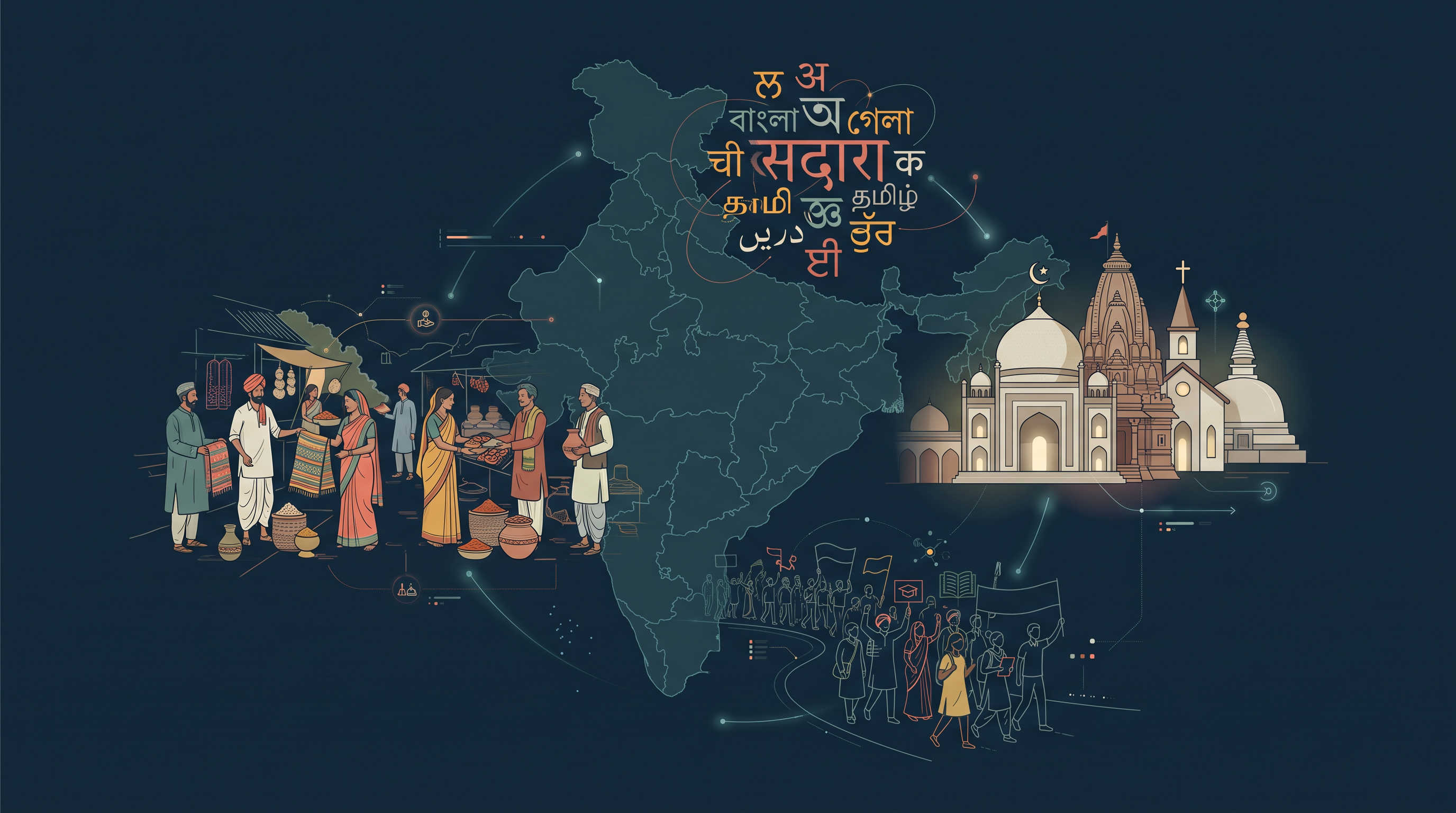
Fig. 6.1 – Cultural diversity in India.
Keep these questions in mind as you read. Each one will be answered somewhere in this chapter.
6.1 Cultural Diversity as a Challenge
In the earlier chapters of this book you met social institutions of many kinds, from the family at one end to the market at the other. Such institutions bring people together. They give members a shared way of life, a common set of expectations, and a strong sense of collective identity. In doing so they strengthen social cohesion — the bonds of belonging and mutual obligation that hold a society together.
But the same institutions have another face. Chapters on the market and on patterns of inequality showed how institutions that unite some people can simultaneously rank, exclude and disadvantage others. An institution is rarely purely a source of unity or purely a source of division; usually it is both at once.
This chapter takes up the tensions that arise from difference itself. What exactly does ‘cultural diversity’ mean? And why should mere difference be described as a challenge at all?
What ‘Diversity’ Means
The word ‘diversity’ points to differences rather than to inequalities. Two communities may speak different languages, follow different faiths, or celebrate different festivals without either standing above the other in rank. Difference, by itself, says nothing about who is higher and who is lower.
When we say that India is a country of great cultural diversity, we are saying something quite specific: that a very large number of different social groups and communities live within its borders. These communities are marked off from one another by cultural markers such as language, religion, sect, race or caste.
Notice that a cultural marker is simply a visible or claimed sign of belonging — the tongue you speak at home, the place you worship at, the community name that appears on a form. The same person usually carries several such markers at the same time. As shown in Fig. 6.2, they are best pictured as overlapping circles rather than as separate boxes.
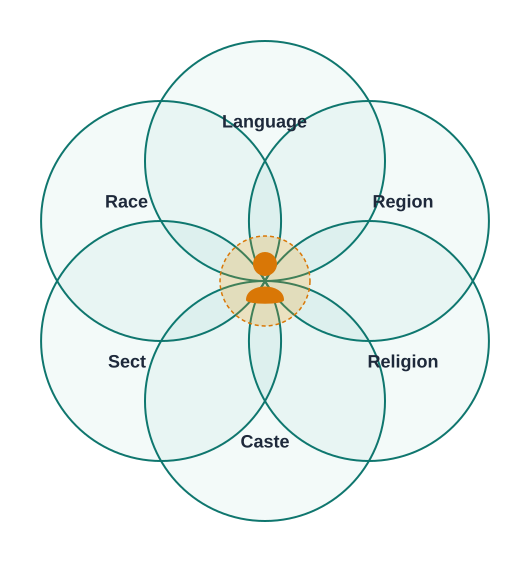
Fig. 6.2 – Overlapping cultural markers.
Why Difference Becomes a Challenge
Difference in itself is not a problem. The difficulty appears when diverse communities are also parts of a larger entity — a nation — within which they must live together, compete and share. Competition or conflict between them can then create serious trouble for the whole.
The first reason is the sheer power of cultural identities. They are not casual preferences that people hold lightly. They can arouse intense passions, and they are often able to mobilise very large numbers of people very quickly — far more quickly than an appeal to economic interest usually can.
The second reason is that cultural differences do not always stand alone. Very often they come accompanied by economic and social inequalities, so that one community is not merely different from another but also poorer, less educated, or less well represented in positions of power. The two axes then reinforce each other, and the situation becomes much harder to disentangle.
The third reason follows from the second. When the state or society attempts to correct the injustices suffered by one community, the measures adopted may provoke opposition from other communities, who see in them an unfair advantage granted to a rival. What is offered as a remedy for exclusion is received by others as a loss.
When resources are scarce
The situation is made worse when scarce resources have to be shared. River waters, jobs and government funds are finite; if one group gets more of them, another appears to get less. A dispute of this kind is really about resources, but it is very easily expressed in the language of community — as one people being cheated by another.
6.2 The Importance of Community Identity
Every human being needs a stable sense of who they are in order to function in the world. Questions such as — Who am I? How am I different from others? How do other people understand me? What should I want out of life? — begin to press on us from childhood onwards, and they never entirely go away.
We are able to answer most of these questions not by working them out alone, but because of the way we are brought up. Socialisation is the process by which we are taught how to live in society — first by our immediate family, and then by our community in its various senses.
Socialisation is not a one-way transmission. It is a continuous dialogue, a negotiation, and sometimes even a struggle with significant others — the people directly involved in our lives, such as parents, family, the wider kin group and the community. Our community hands us the language we think in, our mother tongue, and the cultural values through which we make sense of the world. It anchors our self-identity.
Identity by Birth: The Ascriptive Kind
Community identity is based on birth and ‘belonging’ rather than on any acquired qualification or ‘accomplishment’. It is a matter of what we are, not of what we have become.
You did nothing to be born into your family, your community or your country. No one is consulted beforehand, and no one chooses. Identities of this kind are called ascriptive identities: they are determined by birth and involve no choice on the part of the individual concerned.
Here is the odd thing about social life. People feel a deep sense of security and satisfaction in belonging to communities in which their membership is entirely accidental. We identify intensely with groups we have done nothing to deserve — we passed no examination for them, and demonstrated no skill or competence.
Compare this with membership of a profession or a team. A doctor or an architect must pass examinations and prove competence. Even a place in a school cricket team requires a certain level of skill and performance as a pre-condition. Membership of our family, our religious community or our regional community demands no such pre-condition — and yet it is total.
Most ascriptive identities are also extremely hard to shake off. Even when a person chooses to disown such an identity, others may go on identifying them by exactly those markers of belonging.
Why Community Conflicts Are So Difficult
A second feature of ascriptive identities and community feeling is that they are, broadly speaking, universal. Everyone has a motherland, a mother tongue, a family, a faith. This is not strictly true of every single individual, but it holds in a general sense.
And we are all more or less equally committed and loyal to our own identities. Certainly one can find people who are not particularly attached to one or another aspect of their identity, but the possibility of that commitment is available to almost everyone.
This is what makes conflicts involving communities — of nation, language, religion, caste or region — so hard to handle. Each side comes to see the other as a hated enemy. Each side exaggerates the virtues of its own people and the vices of its opponents.
Think of what happens when two nations go to war. Patriots in each country see the other as the aggressor. Each side is confident that God and truth are on its side. In the heat of the moment it is very difficult for people on either side to notice that they are constructing matching but reversed mirror images of each other, as suggested in Fig. 6.3.

Fig. 6.3 – Mirror images in community conflict.
6.2.1 Communities, Nations and Nation-States
At the simplest level, a nation is a kind of large-scale community — a community of communities. What its members share is the desire to belong to the same political collectivity. That desire for political unity usually takes a particular form: the aspiration to have a state of their own.
In its most general sense, the state is an abstract entity: a set of political-legal institutions that claim control over a particular geographical territory and over the people living in it. In Max Weber’s well-known definition, a state is a body that successfully claims “a monopoly of legitimate force in a particular territory”.
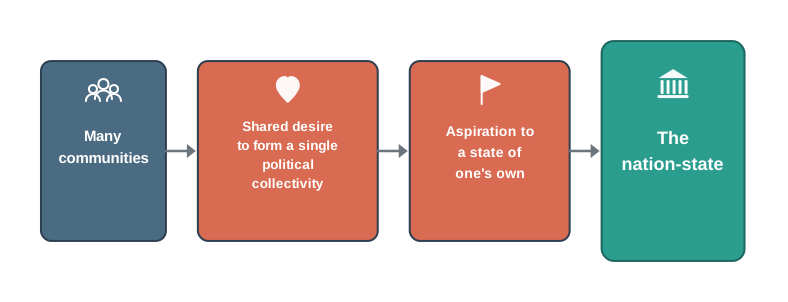
Fig. 6.4 – The path to the nation-state.
A community that is easy to describe but hard to define
A nation is a peculiar sort of community: we can describe many particular nations quite easily, and yet we cannot say what a nation must have. Specific nations have been founded on common cultural, historical and political institutions — a shared religion, language, ethnicity, history or regional culture.
But no such feature works as a defining criterion, because for every criterion there are exceptions. Many nations do not share a single common language, religion or ethnicity. And many languages, religions and ethnicities are shared across several nations without producing a single unified nation of, say, all English speakers or all Buddhists.
So how do we distinguish a nation from other kinds of community — from an ethnic group (based on common descent, in addition to shared language or culture), from a religious community, or from a regionally defined community? Conceptually, there is no hard distinction. Any of these communities may one day become a nation, and no particular kind of community is guaranteed to become one.
The state as the deciding criterion
The criterion that comes closest to marking off a nation is the state. Unlike the other kinds of community, nations are communities that possess a state of their own. That is why the two words are joined with a hyphen into a single term: the nation-state.
In recent times there has been a broadly one-to-one bond between the two — one nation, one state; one state, one nation. But this is a new development, and it was not always the case.
The Soviet Union, when it existed, explicitly recognised that the peoples it governed belonged to different ‘nations’, and more than one hundred such internal nationalities were acknowledged within a single state. Conversely, the people who make up one nation may be citizens or residents of several different states. There are more Jamaicans living outside Jamaica than in it, so that the ‘non-resident’ population exceeds the ‘resident’ one.
‘Dual citizenship’ laws provide another example. They allow the citizens of one state to be, simultaneously, citizens of another. Jewish Americans, for instance, may be citizens of Israel as well as of the USA, and can serve in the armed forces of one country without losing their citizenship of the other.
Why states ‘need’ nations
In short, it is hard today to define a nation in any way other than this: a community that has succeeded in acquiring a state of its own. Interestingly, the reverse has also become increasingly true.
Just as aspiring nationalities work towards forming a state, existing states find it more and more necessary to claim that they represent a nation. One characteristic feature of the modern era is the establishment of democracy and nationalism as the dominant sources of political legitimacy.
This means that ‘the nation’ is today the most accepted justification for having a state at all, while ‘the people’ are the ultimate source of the nation’s legitimacy. Put bluntly, states ‘need’ the nation quite as much as — perhaps more than — nations need states.
How should a state treat its communities?
As we have seen, there is no historically fixed or logically necessary relationship between a nation-state and the varied forms of community it could be built on. It follows that there is no ready-made answer to a very practical question: how should the ‘state’ part of the nation-state treat the different kinds of community that make up the ‘nation’ part?
The historical record, summarised in the United Nations Development Programme’s report of 2004 on culture and democracy, is not encouraging. Most states have been suspicious of cultural diversity and have tried to reduce or eliminate it. Yet there are successful counter-examples — India among them — which show that a strong nation-state need not ‘homogenise’ its community identities into one standard type.
Policies promoting assimilation aim at persuading, encouraging or outright forcing all citizens to adopt a uniform set of cultural values and norms. Those values and norms are usually, entirely or largely, those of the dominant social group. Other, non-dominant groups are expected — or required — to give up their own culture and adopt the prescribed one.
Policies promoting integration differ in style but not in overall objective. They insist that the public culture must follow a single common national pattern, while all ‘non-national’ cultures are relegated to the private sphere. Here too there is a real danger: the dominant group’s culture quietly comes to be treated as the ‘national’ culture.
The cost of suppressing diversity
You can probably see the problem by now. There is no necessary relationship between any specific form of community and the modern form of the state. Any of the bases of community identity — language, religion, ethnicity and so on — may or may not lead to the formation of a nation. There are no guarantees.
But precisely because community identities can become the basis of nation-formation, existing states tend to view every form of community identity as a dangerous rival. This is why states so often favour a single, homogenous national identity: a uniform identity looks easier to control and manage.
The strategy carries heavy costs. Suppressing cultural diversity alienates the minority or subordinated communities whose culture is stamped as ‘non-national’. Worse, the act of suppression frequently produces the opposite of its intended effect, intensifying the very community identity it set out to erase. Encouraging cultural diversity — or at the very least allowing it — is therefore good policy on both practical and principled grounds.
6.2.2 Cultural Diversity and India as a Nation-state
The Indian nation-state is socially and culturally one of the most diverse countries in the world. According to the Census of India 2011, it has a population of about 1.21 billion people — currently the second largest, and soon to become the largest, national population in the world.
These billion-plus people speak about 1,632 different languages and dialects. Twenty-two of these languages have been officially recognised and placed under the Eighth Schedule of the Constitution, which guarantees their legal status.
In terms of religion, about 80% of the population are Hindus — who are themselves regionally specific, plural in their beliefs and practices, and divided by caste and language. About 14.2% of the population are Muslims, which makes India the world’s second largest Muslim country after Indonesia and Pakistan. The other major religious communities are Christians (2.3%), Sikhs (1.7%), Buddhists (0.7%) and Jains (0.4%).
Read Table 6.1 with India’s population size in mind. Because the base is so large, even a small percentage translates into a very large absolute number of people — a community that is 2% of India is still counted in the tens of millions.
Neither assimilationist nor integrationist
Where does India stand in relation to the two models just described? The Indian case fits neither of them. From its very beginning, the independent Indian state ruled out an assimilationist model — although the demand for such a model has been expressed by some sections of the dominant Hindu community.
‘National integration’ has certainly been a constant theme in state policy. But India has not been ‘integrationist’ in the sense described earlier. The Constitution declares the state to be secular, yet religion, language and similar factors are not banished from the public sphere. On the contrary, these communities have been explicitly recognised by the state, and by international standards the constitutional protection offered to minority religions is very strong.
India’s difficulties, in other words, have lain more in the sphere of implementation and practice than in its laws or principles. On the whole, India can be considered a good example of a state-nation — though it is not entirely free from the problems common to nation-states.
6.3 Regionalism in the Indian Context
Regionalism in India grows out of the country’s diversity of languages, cultures, tribes and religions. But diversity by itself is not enough to produce it. Two further conditions matter.
The first is geographical concentration. When a language, a tribal identity or a religious tradition is not scattered evenly across the country but is clustered in a particular territory, that territory begins to look like a natural political unit to the people who live in it.
The second is a sense of regional deprivation — the feeling that one’s own region has been neglected, exploited, or denied its fair share of development and power. This is what turns a cultural identity into a political demand.
Indian federalism — the constitutional division of power between a central government and the governments of the States — has been the principal means of accommodating these regional sentiments (Bhattacharyya 2005). It offers a region something short of a separate country but considerably more than nothing: a government of its own within a shared union.
From Presidencies to Linguistic States
After Independence, the Indian state at first simply continued with the British-Indian arrangement, which had divided the country into large provinces, also called ‘presidencies’. Madras, Bombay and Calcutta were the three major presidencies; all three cities after which they were named have since changed their names.
These provinces were large, multi-ethnic and multilingual. They formed the main political-administrative units of a semi-federal state called the Union of India — units drawn for the administrative convenience of a colonial power, not for the cultural coherence of the people inside them.
Soon after the Constitution was adopted, all these colonial-era units had to be reorganised into ethno-linguistic States within the Indian union. This did not happen because the leadership planned it that way. It happened in response to strong popular agitations. Fig. 6.5 sets out the sequence.
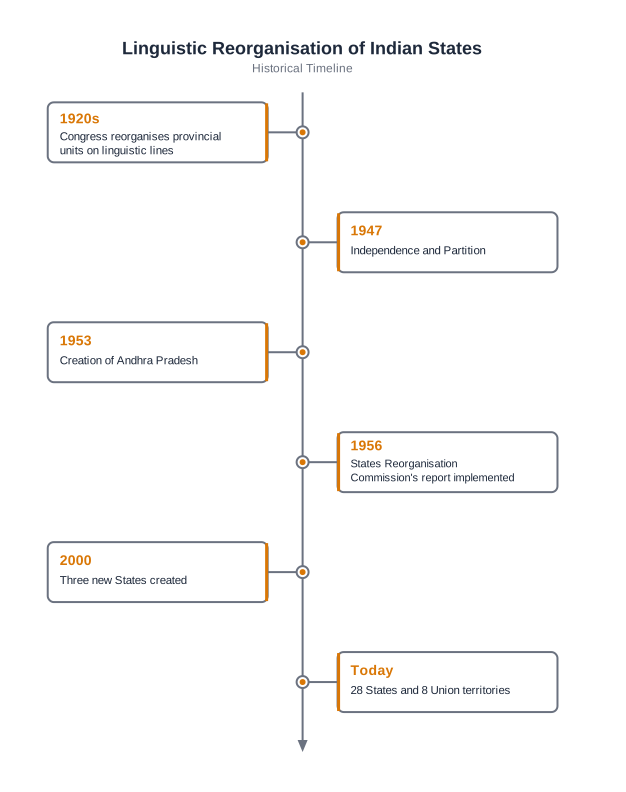
Fig. 6.5 – The reorganisation of Indian States.
Not Language Alone
Language, coupled with regional and tribal identity — and not religion — has therefore been the most powerful instrument for the formation of ethno-national identity in India. That is a striking fact in a country where religion is otherwise so charged a marker.
But this does not mean that every linguistic community has obtained statehood, or that language explains every new State. Consider the three States created in 2000 — Chhatisgarh, Uttaranchal and Jharkhand. Language played no prominent role in any of them. What produced them was a combination of ethnicity based on tribal identity, language, regional deprivation and ecology, which together generated an intense regionalism that ended in statehood.
At present there are 28 States (federal units) and 8 Union territories (which are centrally administered) within the Indian nation-state.
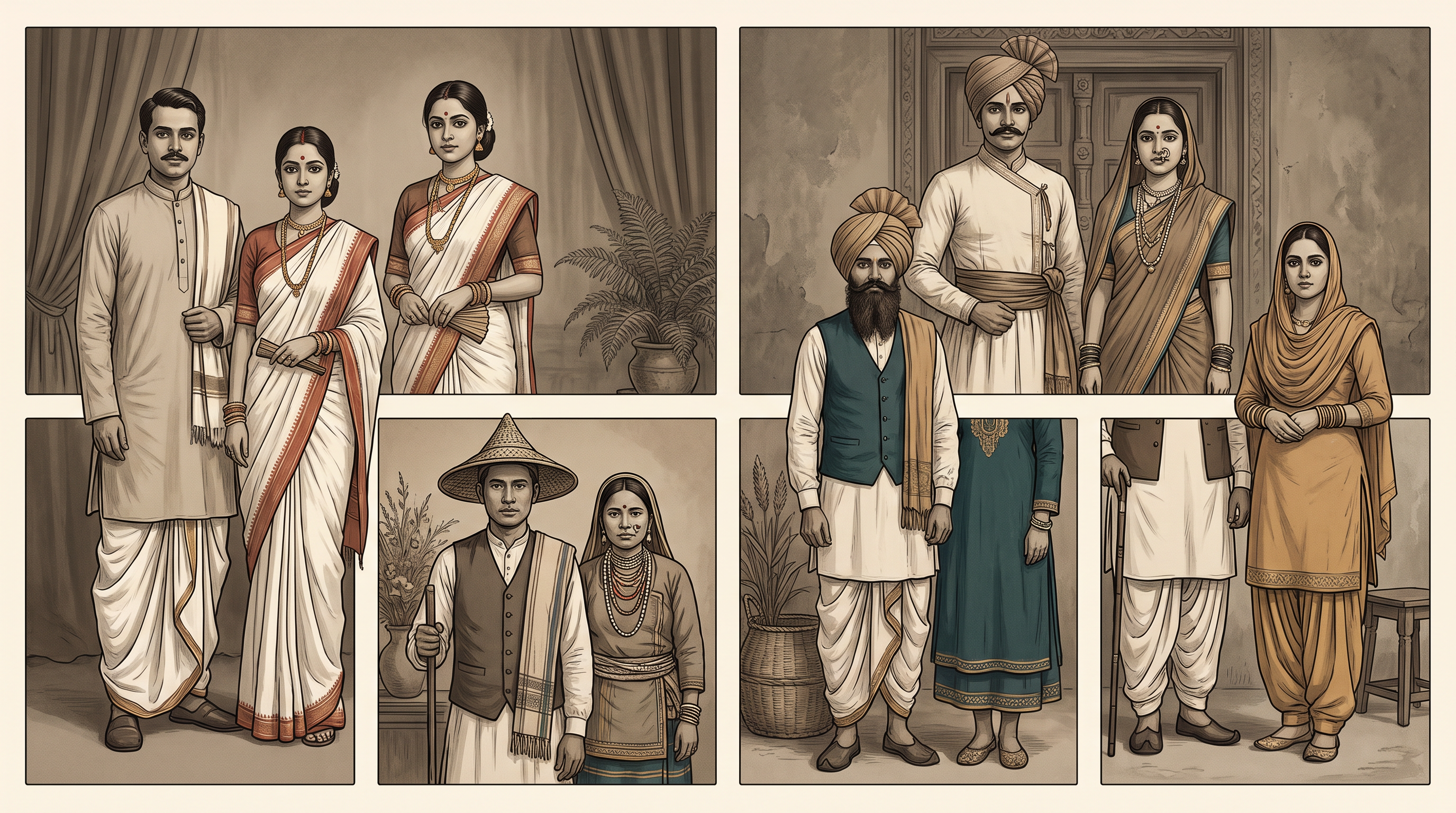
Fig. 6.6 – Historical regional variation in dress.
Making Federalism Work
Respecting regional sentiment is not merely a matter of drawing new State boundaries. A State is of little use if it has no real powers. The new units had to be backed by an institutional structure that made them viable as relatively autonomous parts of a larger federal system.
In India this is done through constitutional provisions that define the powers of the States and of the Centre. There are lists of ‘subjects’, or areas of governance, that are the exclusive responsibility of either the State or the Centre, along with a Concurrent List of areas in which both are permitted to operate.
The States are also built into the structure of the Centre itself. The State legislatures determine the composition of the upper house of Parliament, the Rajya Sabha, so that the States have a voice in national law-making.
Beyond this, periodic committees and commissions decide on Centre-State relations. The Finance Commission, for example, is set up every five years to decide how tax revenues are to be shared between the Centre and the States. Up to 2017, each Five Year Plan also involved detailed State Plans prepared by the State Planning Commissions of each State. The Goods and Services Tax (GST) Council includes State members.
6.4 Religion-related Issues and Identities
Of all the aspects of cultural diversity, the ones connected with religious communities and religion-based identities are perhaps the most contentious. They provoke the sharpest arguments and, at times, the worst violence.
Sociologically, these issues fall into two related groups. The first is the secularism–communalism set: questions about the state’s relationship with religion, and with political groupings that make religion their primary identity. The second is the minority–majority set: questions about how the state should treat religious, ethnic and other communities that are unequal in numbers and/or in power — social, economic and political.
The two sets are related but not identical. The first asks what the state should do about religion; the second asks what the state should do about inequality between communities.
6.4.1 Minority Rights and Nation Building
The dominant trend in Indian nationalism was marked by an inclusive and democratic vision. It was inclusive because it recognised diversity and plurality rather than wishing them away. It was democratic because it set out to do away with discrimination and exclusion, and to bring about a just and equitable society.
One consequence followed directly from this. The term ‘people’ was never understood in exclusive terms — as referring to some particular group defined by religion, ethnicity, race or caste. Ideas of humanism influenced Indian nationalists deeply, and the ugly features of exclusive nationalism were commented on at length by leading figures such as Mahatma Gandhi and Rabindranath Tagore.
Writing inclusion into the Constitution
Fine sentiments are not enough. To be effective, the ideas of inclusive nationalism had to be built into the Constitution — and there was a strong practical reason for this.
As you saw in section 6.2, dominant groups have a powerful tendency to assume that their culture, their language and their religion are synonymous with the nation-state itself. Left to itself, the ordinary working of politics will tend to produce this result, because the dominant group is also the largest bloc of voters.
For a strong and democratic nation, therefore, special constitutional provisions are required to secure the rights of all groups, and of minority groups in particular. Before we can see why, we need to be clear about what sociologists mean by a minority.
What sociologists mean by ‘minority’
The notion of the minority group is widely used in sociology, and it means considerably more than a numerical distinction. It usually carries with it some sense of relative disadvantage.
Extremely wealthy people are, numerically, a very small group — yet they are not usually called a minority. If the term is applied to them at all, it is qualified in some way, as in the phrase ‘privileged minority’. When ‘minority’ is used without qualification, it generally implies a group that is both relatively small and disadvantaged.
The sociological sense of minority also implies that its members form a collectivity — that they have a strong sense of group solidarity, a feeling of togetherness and belonging. This is closely linked to disadvantage, because the experience of being subjected to prejudice and discrimination usually heightens feelings of loyalty and shared interest within the group (Giddens 2001:248).
It is possible, however, to find anomalous cases — where a minority group is disadvantaged in one sense but not in another. Religious minorities such as the Parsis or the Sikhs may be relatively well-off in economic terms. They may nevertheless be disadvantaged in a cultural sense, simply because their numbers are so small relative to the overwhelming majority of Hindus.
This is why religious or cultural minorities need special protection: not necessarily because they are poor, but because of the sheer demographic dominance of the majority. In a system where numbers decide, a small community can be permanently outvoted on questions about its own culture.
The size and spread of India’s religious communities
Hindus constitute an overwhelming majority in India. According to the 2011 Census they number about 966 million and account for 80% of the total population — four times larger than the combined population of all the minority religions put together, and about six times larger than the largest minority group, the Muslims.
That figure can also mislead, and it is worth saying why. Hindus are not a homogenous group; they are divided by caste — as indeed are all the other major religions of India, though to differing extents. A majority defined on paper may be deeply divided in social practice.
Table 6.2 makes one pattern very clear. A community that is a small minority at the national level may be a comfortable majority within a particular State — Sikhs in Punjab, Christians in Nagaland or Mizoram. Majority and minority are therefore not fixed properties of a community; they depend on the territorial unit you are counting within.
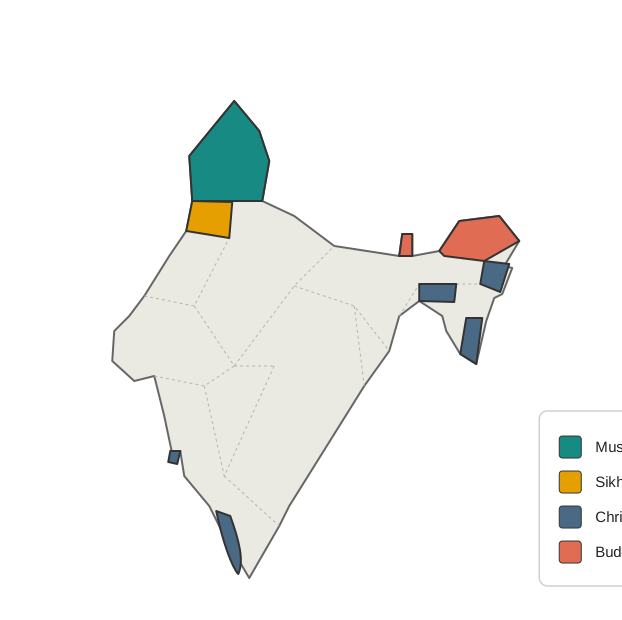
Fig. 6.7 – State-wise concentration of religious minorities.
‘Unity in diversity’ and the Constitution
Through the long years of the struggle against British colonialism, Indian nationalists came to understand that India’s diversity had to be recognised and respected, not overcome. ‘Unity in diversity’ became the shorthand for the plural and diverse character of Indian society.
Discussions of minority and cultural rights run through many of the deliberations of the Indian National Congress, and they find their final expression in the Indian Constitution (Zaidi 1984). The makers of the Constitution understood that a strong and united nation could be built only if all sections of the people had the freedom to practise their religion and to develop their culture and language.
Ambedkar’s warning was not an abstract one. In the last three decades we have seen how the non-recognition of the rights of different groups can have grave implications for national unity. You have already met two of these cases in section 6.3 — the refusal of the Pakistani state to recognise the cultural and linguistic rights of the people of what became Bangladesh, and the imposition of Sinhalese as a national language in Sri Lanka, which formed part of the backdrop to that country’s ethnic conflict.
The lesson applies equally to India. Any forcible imposition of a language or a religion on any group of people weakens a national unity that rests, in the first place, on the recognition of differences. Indian nationalism recognises this, and the Constitution affirms it.
Minorities are everywhere
Finally, it is worth noting that minorities are not an Indian peculiarity. In most nation-states there tends to be a dominant social group — cultural, ethnic, racial or religious.
Nowhere in the world is there a nation-state made up exclusively of a single homogenous cultural group. Even in countries where this was once almost true, such as Iceland, Sweden or South Korea, modern capitalism, colonialism and large-scale migration have brought in a plurality of groups. Even the smallest state will have minorities of some kind — religious, ethnic, linguistic or racial.
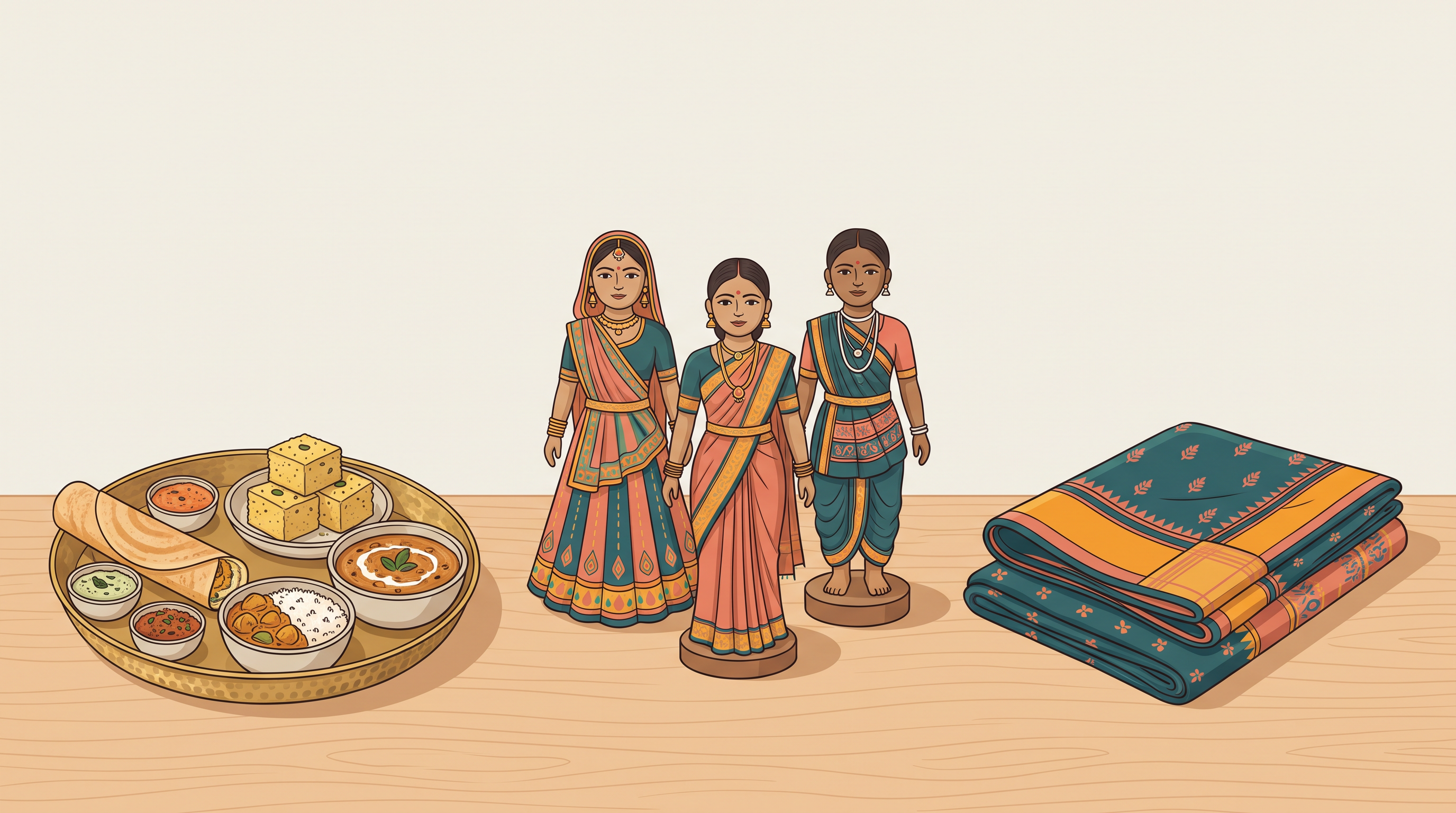
Fig. 6.8 – Everyday markers of cultural diversity.
6.4.2 Communalism, Secularism and the Nation-state
6.4.2.1 Communalism
In everyday Indian usage, the word communalism refers to aggressive chauvinism based on religious identity. Chauvinism, in turn, is an attitude that treats one’s own group as the only legitimate or worthy group, while other groups are seen — by definition — as inferior, illegitimate and opposed.
Put simply, then, communalism is an aggressive political ideology linked to religion.
This is a peculiarly Indian — or perhaps South Asian — meaning, and it differs from the sense of the ordinary English word. In English, “communal” simply means something relating to a community or collectivity as distinct from an individual, and the word is neutral. The South Asian meaning is strongly charged: positively charged for someone sympathetic to communalism, negatively charged for someone opposed to it.
It is important to emphasise that communalism is about politics, not about religion. Communalists are intensely involved with religion, and yet there is no necessary relationship between personal faith and communalism.
A communalist may or may not be a devout person; devout believers may or may not be communalists. What all communalists share is a belief in a political identity based on religion. The decisive factor is the attitude taken towards those who hold other kinds of identity — including other religion-based identities. Communalists cultivate an aggressive political identity, and are prepared to condemn or attack everyone who does not share it.
One characteristic feature of communalism is its claim that religious identity overrides everything else. Whether a person is poor or rich, whatever their occupation, caste or political beliefs, on this view it is religion alone that counts.
The consequence is a peculiar kind of flattening. All Hindus are said to be the same, as are all Muslims, all Sikhs and so on. Large and internally diverse groups — divided by caste, class, region, language and belief — are thus constructed as singular and homogenous, which is precisely what, sociologically, they are not.
Communalism is an especially important issue in India because it has been a recurrent source of tension and violence. India has had a history of communal riots from pre-Independence times, often as a result of the divide-and-rule policy adopted by the colonial rulers.
But the historical record must be read carefully. Colonialism did not invent inter-community conflict — there is a long history of pre-colonial conflicts as well — and it certainly cannot be blamed for riots and killings after Independence. If we go looking for instances of religious, cultural, regional or ethnic conflict, we can find them in almost every phase of our history.
We should not forget, however, that we also have a long tradition of religious pluralism, ranging from peaceful co-existence to actual inter-mixing, or syncretism. This syncretic heritage is clearly visible in the devotional songs and poetry of the Bhakti and Sufi movements. In short, history offers us both good and bad examples; what we choose to learn from it is up to us.
6.4.2.2 Secularism
Secularism is among the most complex terms in social and political theory, and much confusion comes from the fact that it does not mean the same thing everywhere.
In the Western context, the main sense of the term has to do with the separation of church and state. The separation of religious and political authority marked a major turning point in the social history of the West.
That separation was tied to a longer process called secularisation — the progressive retreat of religion from public life, as religious observance was converted from a mandatory obligation into a voluntary personal practice. Secularisation was itself linked to the arrival of modernity and the rise of science and rationality as alternatives to religious ways of understanding the world.
The Indian meanings of ‘secular’ and ‘secularism’ include the Western sense, but they also involve others. The most common use of ‘secular’ in everyday Indian language is as the opposite of communal.
In this sense, a secular person or a secular state is one that does not favour any particular religion over others. Secularism here is the opposite of religious chauvinism, and it need not imply any hostility to religion as such.
For the state-religion relationship this makes a real difference. This sense of secularism implies equal respect for all religions rather than separation or distancing from them. That is why the secular Indian state declares public holidays to mark the festivals of all religions — an act that would look distinctly odd under the strict separation model.
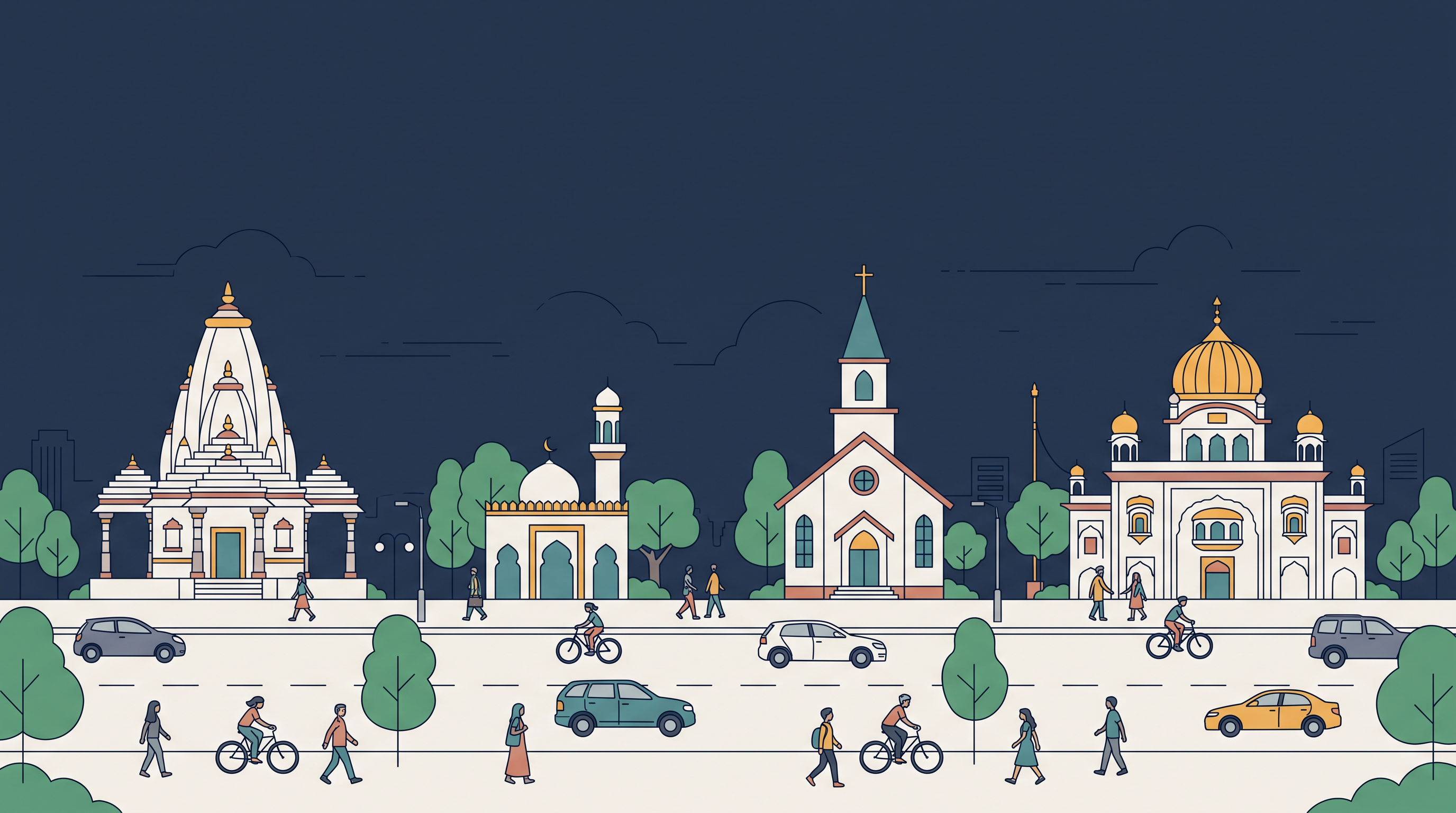
Fig. 6.9 – Shared public space in Indian secularism.
Some genuine complications arise from the tension between two commitments the Indian state holds simultaneously: to secularism, and to the protection of minorities.
Protecting minorities requires that they be given special consideration, precisely because the normal working of the political system places them at a disadvantage in relation to the majority community. Yet the moment such protection is provided, it invites the accusation of favouritism, or of the ‘appeasement’ of minorities.
6.5 State and Civil Society
You may have noticed that much of this chapter has been concerned with the state. That is no accident. When it comes to the management of cultural diversity in a nation, the state is the crucial institution: it decides which communities are recognised, which languages are official, which rights are protected and which resources are shared.
But there is a difficulty built into this arrangement. Although the state claims to represent the nation, it can also become somewhat independent of the nation and of its people.
The state, remember, is not an abstraction. It is a structure of concrete institutions — the legislature, the bureaucracy, the judiciary, the armed forces, the police and other arms of the state. To the extent that this structure becomes insulated from the people, it carries the potential of turning authoritarian.
When the State Fails Its People
An authoritarian state is the opposite of a democratic one. It is a state in which the people have no voice, and in which those who hold power are accountable to no one.
Authoritarian states typically limit or abolish civil liberties — freedom of speech, freedom of the press, freedom of political activity, the right to protection from the wrongful use of authority, the right to the due processes of law, and so on. These are precisely the liberties that allow ordinary people to question those in power, which is why they are the first to go.
Authoritarianism is not the only way a state can fail. State institutions may also become unable or unwilling to respond to the needs of the people because of corruption, inefficiency, or simply a lack of resources. A ration shop that never opens, a police station that will not register a complaint, a school with no teachers — none of this requires a dictatorship.
In short, there are many reasons why a state may not be all that it should be. It is in this context that non-state actors and institutions become important. They can keep a watch on the state, protest against its injustices, or supplement its efforts where it falls short.
What Civil Society Is
Civil society is the name given to the broad arena that lies beyond the private domain of the family, but outside the domain of both the state and the market. It is the non-state and non-market part of the public domain, in which individuals come together voluntarily to create institutions and organisations.
It is, above all, the sphere of active citizenship. Here individuals take up social issues, try to influence the state or make demands on it, pursue their collective interests, or seek support for a cause they believe in.
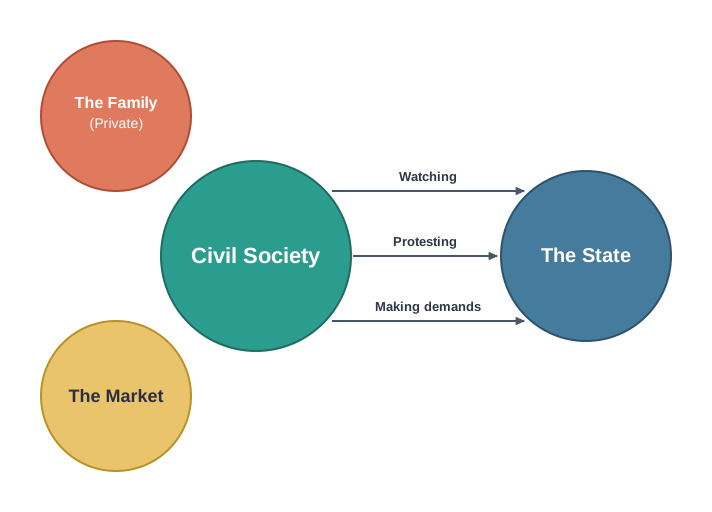
Fig. 6.10 – Civil society and other social domains.
Civil society consists of voluntary associations, organisations and institutions formed by groups of citizens. It includes political parties, media institutions, trade unions, non-governmental organisations (NGOs), religious organisations and other kinds of collective entities.
Two criteria decide what belongs here. The organisation should not be state-controlled, and it should not be a purely commercial, profit-making entity. Anything that satisfies both conditions is part of civil society.
What Civil Society Does
The activities of civil society organisations today have an even wider range than before. They include advocacy and lobbying with national and international agencies, as well as active participation in a variety of movements.
The issues taken up are strikingly diverse. They range from tribal struggles for land rights, devolution in urban governance and campaigns against rape and violence against women, to the rehabilitation of those displaced by dams and other developmental projects, fishermen’s struggles against mechanised fishing, the rehabilitation of hawkers and pavement dwellers, campaigns against slum demolitions and for housing rights, primary education reform, and the distribution of land to dalits.
Two kinds of actor deserve special mention. Civil liberties organisations have been particularly important in keeping a watch on the state and forcing it to obey its own laws. The media, too, has taken an increasingly active role — especially its emergent visual and electronic segments.
The Campaign for the Right to Information
Among the most significant recent initiatives of Indian civil society is the campaign for the Right to Information. It began modestly, with an agitation in rural Rajasthan demanding the release of information about government funds spent on village development — how much money had come, and where it had gone.
From that local demand the effort grew into a nation-wide campaign. Despite resistance from the bureaucracy, the government was eventually forced to respond and to pass a new law formally acknowledging the citizens’ right to information.
Examples of this sort illustrate the crucial importance of civil society. It is through such organisation, pressure and publicity that the state can be held accountable to the nation and its people — which is, in the end, what a democracy claims to be.
6.6 Summary
Cultural diversity as a challenge (6.1)
- Social institutions both unite people and divide them; they build social cohesion, but they can also produce inequality and exclusion.
- Diversity means difference, not inequality. Cultural diversity refers to the presence, in one society, of many communities marked off by cultural markers such as language, religion, sect, race or caste.
- Difference becomes a challenge because cultural identities are powerful and can mobilise large numbers; because cultural differences are often accompanied by economic and social inequalities; because measures to help one community can provoke opposition from others; and because scarce resources such as river waters, jobs and government funds must be shared.
Community identity (6.2)
- We acquire our sense of who we are through socialisation, in a continuous dialogue and negotiation with significant others — parents, family, kin group and community — who give us our mother tongue and our cultural values.
- Community identity is ascriptive: it rests on birth and belonging, not on accomplishment. It demands no qualification, yet it is total, and it is hard to shake off because others go on identifying us by it.
- Ascriptive identities are near-universal and command deep loyalty. This is why community conflicts are so intractable: each side treats the other as a hated enemy and builds a mirror image of it.
- A nation is a community of communities whose members wish to form a single political collectivity, usually by acquiring a state. Weber defined the state as a body that successfully claims a monopoly of legitimate force in a territory.
- A nation is easy to describe but hard to define: for every criterion — language, religion, ethnicity, history — there are exceptions. The criterion that comes closest is possession of a state, which gives us the term nation-state.
- The nation–state bond is recent, not necessary. The Soviet Union recognised over a hundred nationalities; dual citizenship and large diasporas show that nation and state need not coincide.
- Today ‘the nation’ is the main source of political legitimacy, so states need nations as much as nations need states.
- Because community identities can become the basis of new nations, states tend to see them as rivals and try to impose a single identity — through assimilation (forcing all citizens to adopt one, usually dominant, culture) or integration (restricting public culture to one national pattern, allowing difference only in private). Both assume a singular national identity.
- Suppression is costly: it alienates minorities and often intensifies the very identities it targets. Allowing diversity is sound policy, practically and in principle.
- India is among the most diverse countries in the world — about 1.21 billion people (Census 2011), some 1,632 languages and dialects, 22 of them in the Eighth Schedule; about 80% Hindus, 14.2% Muslims, 2.3% Christians, 1.7% Sikhs, 0.7% Buddhists and 0.4% Jains.
- India is neither assimilationist nor integrationist. Its Constitution declares a secular state, yet recognises communities and protects minority religions. India is best described as a state-nation, in which several ‘nations’ coexist within one polity; its problems have lain more in implementation than in law or principle.
Regionalism (6.3)
- Regionalism grows from India’s diversity of languages, cultures, tribes and religions, is encouraged by the geographical concentration of these markers, and is fuelled by a sense of regional deprivation. Federalism has been India’s means of accommodating it.
- After Independence India continued with the colonial provinces or ‘presidencies’ — large, multilingual, drawn for administrative convenience. Strong popular agitations forced their reorganisation into ethno-linguistic States.
- The States Reorganisation Commission’s report was implemented on 1 November 1956, after the death of Potti Sriramulu in 1953 and the creation of Andhra Pradesh. Nehru and others feared linguistic States would break India up; instead they strengthened its unity, since one can be Kannadiga, Bengali, Tamil or Gujarati and Indian.
- The neighbouring cases point the other way: the imposition of Sinhala in Sri Lanka and the refusal of the Pakistani state to respect Bengali sentiment both ended in conflict and division.
- Language, joined to regional and tribal identity — not religion — has been the strongest basis of ethno-national identity in India. But not every State is linguistic: Chhatisgarh, Uttaranchal and Jharkhand (2000) rested on tribal identity, regional deprivation and ecology. There are now 28 States and 8 Union territories.
- Creating States is not enough; they must be viable. The Constitution divides subjects between Centre and State with a Concurrent List, the State legislatures determine the composition of the Rajya Sabha, the Finance Commission decides tax-sharing every five years, and the GST Council includes State members.
Religion-related issues (6.4)
- Religion-related issues fall into two sets: secularism–communalism (the state’s relation to religion) and minority–majority (how the state treats communities unequal in number or power).
- Indian nationalism was inclusive and democratic; Gandhi and Tagore criticised exclusive nationalism. To be effective, inclusiveness had to be written into the Constitution, because dominant groups tend to equate their own culture with the nation.
- In sociology, a minority is not merely a small number: it implies relative disadvantage and a collectivity with a sense of solidarity. Left-handed people are a statistical minority, not a sociological one. Some minorities, such as Parsis or Sikhs, may be economically well-off yet culturally disadvantaged.
- Articles 29 and 30 protect the right of any section of citizens to conserve its language, script or culture, and the right of religious and linguistic minorities to establish and administer educational institutions of their choice.
- Minorities exist in every nation-state; nowhere is there a state of a single homogenous cultural group.
- Communalism is an aggressive political ideology linked to religion — a chauvinism that treats one’s own religious community as the only legitimate one. It is about politics, not piety: a communalist need not be devout, and a devout person need not be communal.
- Communalism claims that religious identity overrides everything else, and so constructs large, internally divided communities as singular and homogenous.
- India has a long history of communal riots, aggravated by colonial divide-and-rule but neither invented by it nor confined to the colonial period. India also has a long tradition of religious pluralism and syncretism, visible in the Bhakti and Sufi traditions and in the poetry of Kabir.
- Secularism in the Western sense means the separation of church and state, linked to secularisation and modernity. In common Indian usage it means the opposite of communal: the state favours no religion and shows equal respect to all — which is why it marks the festivals of all religions.
- Protecting minorities while remaining secular creates tension: critics call it favouritism or ‘appeasement’; supporters reply that without it, secularism becomes a cover for imposing majority norms.
State and civil society (6.5)
- The state manages cultural diversity, but it can become insulated from the people and turn authoritarian — a state in which people have no voice, those in power are unaccountable, and civil liberties are curtailed. It may also simply fail through corruption, inefficiency or lack of resources.
- Civil society is the non-state, non-market part of the public domain, beyond the private world of the family: voluntary associations of citizens — political parties, media, trade unions, NGOs, religious organisations. The two tests are that a body is neither state-controlled nor purely profit-making.
- Civil society organisations take up land rights, urban governance, violence against women, displacement by dams, housing, education and land for dalits; civil liberties organisations and the media hold the state to its own laws.
- The Right to Information campaign — beginning with an agitation in rural Rajasthan over village development funds and ending in the Right to Information Act 2005 — shows how civil society can force the state to make itself accountable.
6.7 Key Terms
Ascriptive identity — An identity determined by birth, in which the individual has no choice, such as family, caste, region, religion or nation.
Assimilation — A state policy that persuades, encourages or forces all citizens to adopt one uniform set of cultural values and norms, usually those of the dominant group.
Authoritarianism — A form of rule in which the people have no voice, those in power are accountable to no one, and civil liberties are limited or abolished.
Chauvinism — An attitude that treats one’s own group as the only legitimate or worthy group, and all other groups as inferior, illegitimate and opposed.
Civil society — The non-state, non-market part of the public domain, in which citizens voluntarily form associations, take up social issues and make demands on the state.
Communalism — An aggressive political ideology linked to religion, which holds that religious identity overrides all else and treats other communities as hostile.
Community identity — An identity based on birth and belonging to a community, rather than on any acquired qualification or accomplishment.
Cultural diversity — The presence within one society of many communities distinguished from one another by cultural markers such as language, religion, sect, race or caste.
Ethnic group — A community based on common descent, in addition to shared features such as language or culture.
Federalism — The constitutional division of powers between a central government and the governments of the States, allowing regions genuine authority within one union.
Integration — A state policy that restricts public culture to a single common national pattern while permitting other cultures only in the private sphere.
Minority — In the sociological sense, a group that is relatively small, generally disadvantaged, and forms a collectivity with a shared sense of solidarity.
Nation — A large-scale community — a community of communities — whose members share the desire to belong to the same political collectivity.
Nation-state — A state that claims to represent a single nation, on the assumption of one nation and one state.
Regionalism — The assertion of a distinct regional identity built on language, tribe, culture or religion concentrated in a territory, usually fuelled by a sense of regional deprivation.
Secularisation — The historical process by which religion progressively retreats from public life and becomes a voluntary personal practice rather than a mandatory obligation.
Secularism — In the Western sense, the separation of religious and political authority; in common Indian usage, the principle that the state favours no religion and shows equal respect to all.
Significant others — The people directly involved in our lives — parents, family, kin group, community — through whom socialisation takes place.
Social cohesion — The bonds of belonging and mutual obligation that hold the members of a society together.
Socialisation — The process by which a person is taught how to live in society, first by the family and then by the wider community.
State — An abstract entity consisting of political-legal institutions that claim control over a territory and its people; in Weber’s definition, a body that successfully claims a monopoly of legitimate force within a territory.
State-nation — A polity in which several ‘nations’ — ethnic, religious, linguistic or indigenous — coexist peacefully within a single state, so that citizens hold multiple and complementary identities.
Syncretism — The actual inter-mixing of religious traditions, as distinct from mere co-existence; seen in India in the Bhakti and Sufi traditions.
6.8 Points to Ponder
We take pride in communities we did nothing to join and could not have chosen. Is there anything strange about feeling loyal to an identity that was given to us rather than earned — and would a society be better or worse off if such loyalties disappeared?
Suppressing cultural diversity often sharpens the very identities it tries to erase. Why should pressure on a community make its members cling harder to what marks them out?
Nehru feared that States drawn on the lines of language would pull India apart, and the opposite happened. What does this tell us about the relationship between recognising an identity and containing it?
Sociologists say that communalism is about politics rather than about faith. If that is so, why is religion — rather than, say, occupation or class — so often the identity that political mobilisation reaches for?
Communalism works by treating a large, internally divided community as though it were one homogenous block. Where else in social life do you see this flattening at work, and who gains from it?
Civil society is defined by what it is not — neither the state nor the market nor the family. Can an organisation that depends on state funding, or on selling its services, still perform civil society’s work of holding the state to account?
6.9 NCERT Questions
What is meant by cultural diversity? Why is India considered to be a very diverse country?
What is community identity, and how is it formed?
Why is it difficult to define the nation? How are nation and state related in modern society?
Why are states often suspicious of cultural diversity?
What is regionalism? What factors is it usually based on?
In your opinion, has the linguistic reorganisation of States helped or harmed India?
What is a ‘minority’? Why do minorities need protection from the state?
What is communalism?
What are the different senses in which ‘secularism’ has been understood in India?
What is the relevance of civil society organisations today?
6.10 Objective Questions
- The term ‘diversity’ emphasises:
- inequalities of wealth between groups
- differences between social groups
- the ranking of communities by status
- the disappearance of community identities [1 mark]
- An identity determined by birth, in which the individual has no choice, is called:
- an achieved identity
- a professional identity
- an ascriptive identity
- a legal identity [1 mark]
- According to Max Weber, a state is a body that successfully claims:
- the loyalty of a single ethnic group
- a monopoly of legitimate force in a particular territory
- ownership of all land within its borders
- the right to represent every nation within it [1 mark]
- According to the Census of India 2011, the number of languages and dialects spoken in India is about:
- 122
- 632
- 1,632
- 2,632 [1 mark]
- The report of the States Reorganisation Commission was implemented on:
- 26 January 1950
- 1 November 1956
- 15 June 2005
- 13 October 2005 [1 mark]
- Which of the following is NOT a part of civil society?
- A trade union
- A non-governmental organisation
- A government department
- A political party [1 mark]
- Assertion (A): Groups such as left-handed people are not regarded as minorities in sociology. Reason (R): The sociological sense of ‘minority’ requires that the members form a collectivity with a sense of solidarity, and usually experience relative disadvantage.
- Both A and R are true, and R is the correct explanation of A.
- Both A and R are true, but R is not the correct explanation of A.
- A is true, but R is false.
- A is false, but R is true. [1 mark]
- Assertion (A): States often try to suppress the cultural identities of minority communities. Reason (R): Suppression reliably weakens community identity and produces a homogenous national identity.
- Both A and R are true, and R is the correct explanation of A.
- Both A and R are true, but R is not the correct explanation of A.
- A is true, but R is false.
- A is false, but R is true. [1 mark]
- Assertion (A): Communalism is not the same thing as personal religious devotion. Reason (R): A communalist may or may not be a devout person, since communalism is a political identity based on religion.
- Both A and R are true, and R is the correct explanation of A.
- Both A and R are true, but R is not the correct explanation of A.
- A is true, but R is false.
- A is false, but R is true. [1 mark]
- Match the items in Column A with those in Column B.
| Column A | Column B |
|---|---|
| a. Article 29 | i. Right to Information Act |
| b. Article 30 | ii. Right of a section of citizens to conserve its language, script or culture |
| c. 2005 | iii. States Reorganisation Commission report implemented |
| d. 1956 | iv. Right of minorities to establish and administer educational institutions |
[1 mark]
Fill in the blank: A policy of ____________ seeks to restrict public culture to a single common national pattern, while allowing other cultures only in the private sphere. [1 mark]
Fill in the blank: The actual inter-mixing of religious traditions, as seen in the Bhakti and Sufi traditions, is called ____________. [1 mark]
True or false: In its common Indian usage, ‘secular’ is understood as the opposite of ‘communal’. [1 mark]
True or false: The three States created in 2000 — Chhatisgarh, Uttaranchal and Jharkhand — were formed mainly on the basis of language. [1 mark]
True or false: The Finance Commission is set up every five years to decide the sharing of tax revenues between the Centre and the States. [1 mark]
6.11 Check Your Concepts
Define cultural diversity, and name any two cultural markers by which communities are distinguished. [2 marks]
What is meant by an ascriptive identity? Give one example. [2 marks]
State Weber’s definition of the state, and identify the two conditions it contains. [2 marks]
What is a state-nation? [2 marks]
Name any two institutions or arrangements through which Indian federalism gives the States a real share of power. [2 marks]
What are the two tests an organisation must satisfy in order to count as part of civil society? [2 marks]
Differentiate between diversity and inequality, with one example of each. [4 marks]
Differentiate between policies of assimilation and policies of integration. What assumption do both share? [4 marks]
Why is it difficult to define a nation? Give reasons, with examples of criteria that fail the test. [4 marks]
Explain, with an Indian example, why a group that is numerically small is not necessarily a minority in the sociological sense. [4 marks]
Distinguish between secularism and secularisation, and explain how the Indian sense of ‘secular’ differs from the Western sense. [4 marks]
Why is it said that communalism is about politics rather than about religion? Explain with reference to the communalist claim that religious identity overrides everything else. [4 marks]
Study Table 6.2 in this chapter. (i) What proportion of the population did Muslims form in 2011, and what was their number? (ii) Name the three Christian-majority States. (iii) Explain, using the table, why a community that is a small minority nationally may be a majority within a particular State. [4 marks]
Using the figures given in the chapter for the religious composition of India in 2011, explain why small percentages can still translate into very large absolute numbers. Illustrate your answer with one calculation of your own, using an approximate total population of 1.21 billion. [4 marks]
“Suppressing cultural diversity is costly for a state.” Explain this claim fully, giving the reasons why states nevertheless attempt such suppression, and the consequences that follow from it. [6 marks]
“Far from undermining Indian unity, linguistic States have helped strengthen it.” How far do you agree with this claim? Discuss with evidence from the Indian experience and from the experience of India’s neighbours. [6 marks]
Explain why minorities require special protection in a democracy, and describe the provisions the Indian Constitution makes for them. What is the criticism made of such protection, and what is the reply to it? [6 marks]
Discuss the causes and consequences of communalism in India. In your answer, distinguish the role of colonial policy from that of pre-colonial and post-Independence developments, and refer to India’s traditions of religious pluralism. [6 marks]
What is civil society, and why does it matter in a democracy? Evaluate its importance with reference to the campaign for the Right to Information. [6 marks]
6.12 Passage-Based Questions
Read the passage and answer the questions that follow.
Two districts lie on either side of a river that both depend on for irrigation. In a year of poor rain, the upstream district releases less water, and farmers downstream watch their standing crop fail. Public meetings are held in both districts. Within a few weeks, the newspapers on each side are no longer discussing cropping seasons and water-sharing agreements. They are discussing which language community has been cheated, and which has always looked down on the other. Old grievances that had nothing to do with water are recalled on both sides.
- Identify the sociological process at work in this passage.
- Explain why a dispute over a scarce resource so easily takes on the language of community identity.
- What does this passage suggest about the relationship between cultural difference and material inequality? [6 marks]
Read the passage and answer the questions that follow.
A newly independent country decides that it will have a single official language, that all courts and government offices will use it, and that all state-run schools will teach through it. The language chosen is the mother tongue of the largest community. Leaders explain that the measure is necessary to build one nation out of many peoples. Within a decade, communities that speak other languages find that they cannot address a court, sit an examination, or enter public employment in their own tongue. Their leaders begin to argue that they are not, after all, part of this nation.
- Which model of state policy described in this chapter does this country follow?
- Explain why such a policy tends to produce the opposite of its intended effect.
- How did India’s approach to language differ from the one described here? [6 marks]
Read the passage and answer the questions that follow.
In a small town, a speaker at a public meeting tells the audience that whatever their occupation, however rich or poor they may be, and whatever their caste, only one thing about them finally counts: the religion they were born into. He tells them that all the people of the neighbouring locality think and act as one, and that they are therefore to be regarded as opponents. Nothing is said about scripture, prayer or belief.
- Name the ideology being expressed by the speaker, and give its definition.
- Explain why sociologists insist that this ideology is about politics rather than about faith.
- What sociological error is contained in the claim that the people of the neighbouring locality “think and act as one”? [6 marks]
Read the passage and answer the questions that follow.
For two years the residents of a low-income colony have received piped water for barely twenty minutes a day. The municipal office says the matter is under consideration. The residents form an association, keep a written daily record of the supply, and file an application asking the municipality to disclose how the ward’s water budget was spent. A local newspaper prints the record. A delegation of residents meets the ward officer, and the supply improves within a month. Nobody in the association is a government official, and the association earns nothing from its work.
- Identify the sphere of social life to which the residents’ association belongs, and state the two tests by which you decided.
- Which law made the residents’ application for information possible, and what does that law require a public authority to do?
- What does this episode show about the relationship between the state and citizens in a democracy? [6 marks]