Chapter 2: Rights In The Indian Constitution
In 1982 the government of India was preparing to host the Asian Games. Stadiums had to be built. Flyovers had to be thrown across the roads. The work was given to contractors, and the contractors went looking for hands.
They found them among the poorest people in the country. Workers came from different parts of India to dig, carry and build. They were kept in poor working conditions. And they were paid less than the minimum wage that the government itself had fixed.
None of this was hidden. It was simply not anyone’s problem — until a team of social scientists studied the condition of these workers and did something unusual. They did not write a report and leave it there. They went to the Supreme Court.
Their argument was sharp. To employ a person for less than the minimum prescribed wage, they said, is not merely underpayment. It is begar — forced labour. And forced labour is banned by the Constitution itself, under the Fundamental Right against exploitation. A worker with no other way to eat has not really agreed to anything.
The Court accepted the plea. It directed the government to make sure that thousands of workers received the wages prescribed for their work.
Notice what happened here. A group of the poorest people in the country, with no votes to bargain with and no money to spend, held a government to a promise. The promise was written in the Constitution. That is what a right is for.
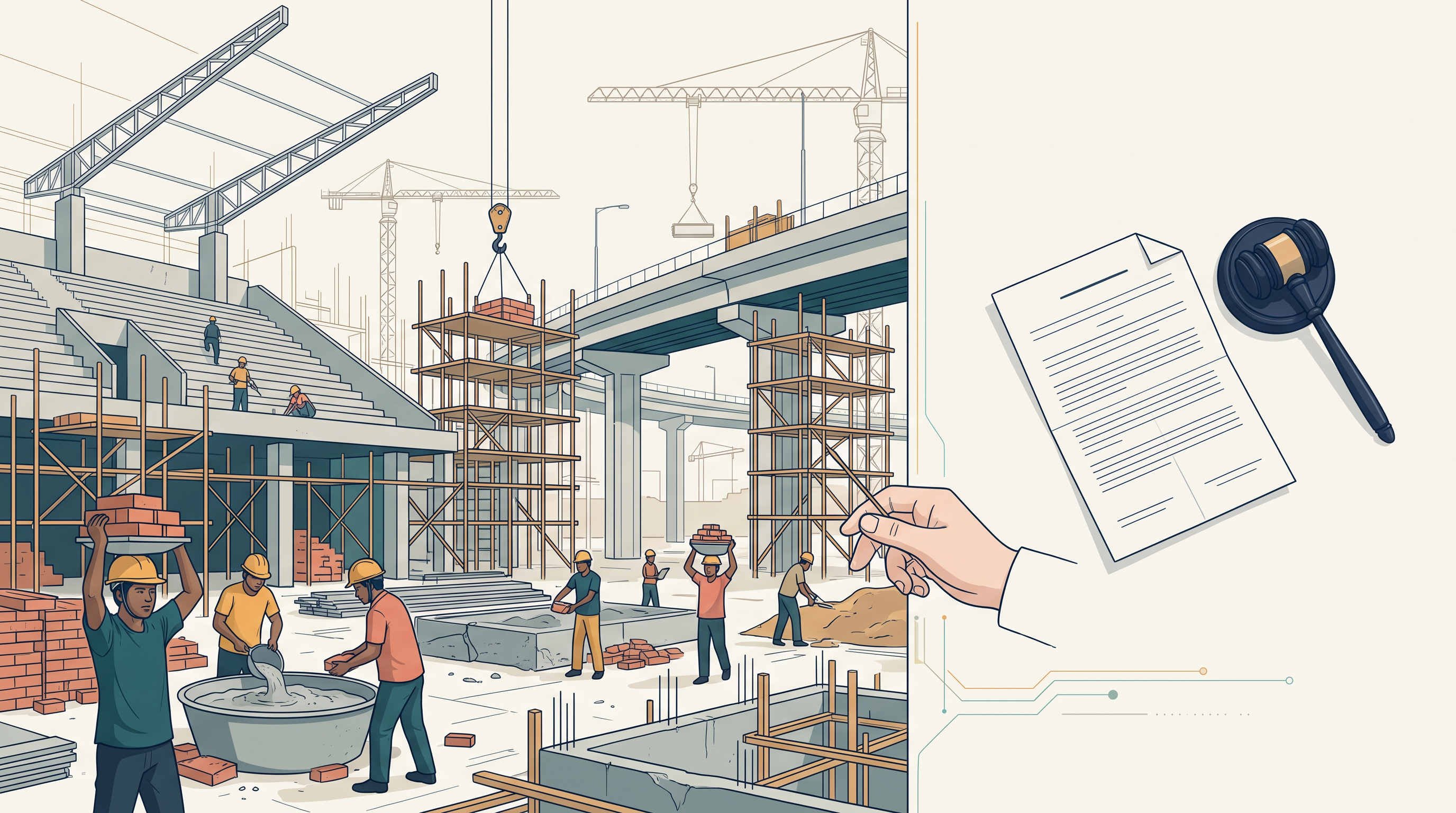
Fig. 2.0 – Construction of the Asian Games stadiums and the Supreme Court petition.
2.1 Introduction
A constitution is not only a map of who governs. It tells us how the organs of government are composed — the legislature that makes laws, the executive that runs the administration, the judiciary that decides disputes — and how they deal with one another.
But that is only half of what a constitution does. As the previous chapter showed, a constitution is also a document that sets limits on the powers of the government. It creates a democratic system in which all persons enjoy certain rights, and it tells the government where it may not go.
This chapter is about that second half. We shall study the Fundamental Rights contained in the Indian Constitution — the rights that the Constitution itself lists, guarantees and specially protects. Part three of the Constitution of India sets them out. In the same breath, it also mentions the limits on these rights.
That last point is worth pausing on. The Constitution does not simply announce freedom and walk away. It grants a right and, in the very same Part, marks the boundary of that right. Much of the argument in this chapter lives on that boundary.
Rights Do Not Stand Still
Rights are also not frozen. In the past six decades, the scope of rights in India has changed, and in some respects it has expanded. The words in the document stayed the same; what those words were held to mean did not. Judges reading a single sentence about life and liberty have found more inside it than the sentence appears to say.
What This Chapter Will Answer
After studying this chapter, you would know:
- what are the various Fundamental Rights listed in the Constitution of India;
- how these rights are protected;
- what role the judiciary has played in protecting and interpreting these rights; and
- what is the difference between the Fundamental Rights and the Directive Principles of State Policy — a separate list of policy guidelines in the Constitution which, unlike Fundamental Rights, no court can force a government to carry out.
Keep the last of these in mind from the start. A right you can take to court and a promise you cannot are two very different things, and the difference has been fought over for decades.
2.2 The Importance Of Rights
Rights are easiest to understand when you look at what happens to people who do not have them, or who have them only on paper. This section puts two real situations side by side. In one, the Constitution reached a person. In the other, it did not.
You have already read the first. The workers who built the flyovers and stadiums for the Asian Games in 1982 were paid less than the minimum wage the government itself had fixed, and the Supreme Court held that this amounted to forced labour. Here too there was a violation of rights provided in the Constitution. The difference was that it was challenged in the court. As a result, the workers could get what was due to them in the form of their rightful wages. The constitutional guarantee of the right against exploitation ensured justice to these workers.
The second situation ended very differently.
Fifty-Four Years Without A Trial
Machal Lalung was 23 when he was arrested. A resident of Chuburi village of Morigaon district of Assam, Machal was charged of causing grievous injuries.
He was found mentally too unstable to stand trial. He was therefore sent as an under trial to the Lok Priya Gopinath Bordoloi Mental Hospital in Tejpur for treatment. An under trial is a person held in custody while the case against them is still pending — someone the law has not yet found guilty of anything.
Machal was treated successfully. Doctors wrote twice to the jail authorities, in 1967 and again in 1996, saying that he was fit to stand trial. But no one paid any attention. Machal Lalung remained in ‘judicial custody’.
Machal Lalung was released in July 2005. He was 77 then. He had spent 54 years under custody, during which his case never came up for hearing. He was freed when a team appointed by the National Human Rights Commission intervened after an inspection of undertrials in the State.
Read that sequence again. No court ever convicted him. No court ever acquitted him. No court ever heard him. The letters that could have freed him were written — twice — and simply lay in a file. Machal’s entire life was wasted because a proper trial against him never took place.
Our Constitution gives every citizen the right to ‘life and liberty’. Read seriously, that must mean more than a right not to be killed. It has to mean that every citizen also has the right to a fair and speedy trial. A trial that never happens is not a delay; it is a punishment handed down without a verdict.
Machal’s case shows what happens when rights granted by the Constitution are not available in practice. Nobody had to repeal his rights. It was enough that nobody acted on them.
Now ask yourself a harder question. What if Machal had been a rich and powerful man? What if those working with the construction contractor had been engineers rather than the poorest labourers in the country? Would their rights have been violated in the same way — and if not, why not? A right that in practice reaches only those who can already command attention is not yet a right for everyone.
2.2.1 Bill Of Rights
Both these examples show the importance of having rights, and of the actual implementation of these rights. A democracy must ensure two things at once: that individuals have certain rights, and that the government will always recognise these rights.
That is why it is often a practice in most democratic countries to list the rights of the citizens in the constitution itself, rather than leave them to ordinary law. Such a list of rights mentioned and protected by the constitution is called a bill of rights.
A bill of rights does two jobs. It prohibits the government from acting against the rights of the individuals. And it ensures a remedy in case there is a violation of these rights. A guarantee without a remedy is only an opinion.
A Warranty Card?
It is tempting to think of a bill of rights as a warranty card — the slip you get when you buy a television or a fan, promising that if the thing fails, someone is bound to put it right. The comparison is useful, and its limit is worth noticing too. A warranty is a promise from a seller you could have chosen not to buy from. A bill of rights is a promise made by the state, and the state is the one body you cannot walk away from.
Protected From Whom?
From whom, exactly, does a constitution protect the rights of the individual? There are two answers, and they pull in opposite directions.
The rights of a person may be threatened by another person or by a private organisation — an employer, a contractor, a landlord, a group in the neighbourhood. In such a situation, the individual would need the protection of the government. So it is necessary that the government is bound to protect the rights of the individual. Here the state is the shield.
On the other hand, the organs of the government — the legislature, the executive, the bureaucracy, or even the judiciary — may, in the course of their functioning, violate the rights of the person. Here the state is the danger. Machal Lalung was not harmed by a private enemy. He was held by the state’s own jails and forgotten by the state’s own courts.
A bill of rights therefore has to face in both directions at once. It asks the government to defend you, and it tells the government where it must stop. Holding those two demands together is the problem the rest of this chapter is about.
2.3 Fundamental Rights In The Indian Constitution
The demand for rights in India did not begin with the Constitution. It began with the freedom struggle.
The leaders of the freedom movement had realised the importance of rights, and they demanded that the British rulers should respect the rights of the people. The Motilal Nehru committee had demanded a bill of rights as far back as in 1928 — long before Independence, and long before there was any Indian constitution to put such a list into. Indians were asking a foreign government to accept limits on itself.
By the time India became independent and the Constitution was being prepared, this idea had a history of two decades behind it. It was therefore natural that there were no two opinions on the inclusion and protection of rights in the Constitution. The argument in the Constituent Assembly was about how far the rights should go, not about whether to have them.
The Constitution listed the rights that would be specially protected and called them ‘fundamental rights’.
Why ‘Fundamental’?
The word fundamental suggests that these rights are so important that the Constitution has separately listed them and made special provisions for their protection. They are not scattered through ordinary law, to be found by a lawyer who knows where to look. They sit in one Part of the founding document, in the open.
The Fundamental Rights are so important that the Constitution itself ensures that they are not violated by the government. That is the promise. What makes the promise more than words is the machinery attached to it, and that machinery is what the rest of this chapter examines.
Fundamental Rights And Ordinary Rights
You have many rights that are not fundamental rights. You have a right to be paid the wage you agreed to. You have a right to be given the goods you paid for. These are ordinary legal rights — rights protected and enforced by ordinary law, that is, by laws the legislature passes in the normal way.
Fundamental Rights are different in three ways, and each difference matters.
First, in where they come from. Ordinary legal rights are protected and enforced by ordinary law. Fundamental Rights are protected and guaranteed by the constitution of the country itself.
Second, in how easily they can be taken away. Ordinary rights may be changed by the legislature by the ordinary process of law making — a majority in the House on an ordinary afternoon is enough. But a fundamental right may only be changed by amending the Constitution itself, which is a far harder thing to do.
Third, in who is bound by them. No organ of the government can act in a manner that violates a Fundamental Right. As we shall study below in this chapter, the judiciary has the powers and the responsibility to protect the fundamental rights from violations by the actions of the government. Executive as well as legislative actions can be declared illegal by the judiciary if these violate the fundamental rights, or restrict them in an unreasonable manner.
Read that last sentence slowly. A law passed by an elected legislature can be struck down by judges who were never elected — because the law breaks a promise the Constitution made to every individual. That is a serious power, and this chapter will keep returning to the question of when it is rightly used.
Fundamental, But Not Unlimited
One warning before we go further, because students lose marks and — more importantly — lose the argument by forgetting it. Fundamental rights are not absolute or unlimited rights. The government can put reasonable restrictions on the exercise of our fundamental rights.
That single word, ‘reasonable’, is doing an enormous amount of work. Who decides what is reasonable? Not the government alone: an unreasonable restriction is exactly the kind of thing the judiciary can declare illegal. So the boundary of a right is not fixed by the Constitution once and for all. It is argued over, case by case.
A Bill Of Rights In South Africa
India is not the only country that has thought hard about this. South Africa, at the southern tip of the African continent, wrote a new constitution after the end of Apartheid — the system under which the law itself had separated people by race and denied rights to the black majority.
The South African Constitution was inaugurated in December 1996. Its creation and promulgation took place at a time when South Africa still faced the threat of a civil war after the dissolution of the Apartheid government. A country that had just used law to divide people was now trying to use law to hold them together.
The South African Constitution says that its ‘Bill of Rights is a cornerstone of democracy in South Africa’. It forbids discrimination on the grounds of ‘race, gender, pregnancy, marital status, ethnic or social origin, colour, age, disability, religion, conscience, belief, culture, language and birth’. It grants perhaps the most extensive range of rights to the citizens of any constitution in the world. A special constitutional court enforces the rights enshrined in the constitution.
Some of the rights included in the constitution of South Africa are:
- Right to Dignity
- Right to Privacy
- Right to fair labour practices
- Right to healthy environment and right to protection of environment
- Right to adequate housing
- Right to health care, food, water and social security
- Children’s rights
- Right to basic and higher education
- Right of cultural, religious and linguistic communities
- Right to information
Look carefully at that list. Several of these are promises about what people should have — housing, food, water, health care — and not only limits on what the government may do to them. Whether such promises belong among enforceable rights at all is one of the deepest questions in this chapter, and it returns when we reach the Directive Principles of State Policy.
2.4 Right To Equality
Start with two situations. Both are imaginary. But similar things do happen and can happen, and as you read them, ask yourself one question: do they involve a violation of fundamental rights?
Swadesh Kumar is visiting his village. He is accompanied by one of his friends. They decide to have a cup of tea at the village roadside hotel. The shopkeeper knows Swadesh Kumar, but asks the name of his friend in order to know his caste. After this, the shopkeeper serves tea to Swadesh Kumar in a nice mug, while his friend is given tea in an earthen cup, because he is a dalit — a member of a community historically treated as ‘untouchable’.
An order is served to four newsreaders of a television channel that they would no longer read the news on screen. They are all women. The reason given is that they are above the age of forty-five. Two male newsreaders above the same age are not barred from presenting the news.
Do such things really happen in our country, or are these purely imaginary? That is a fair question to ask, and it is worth asking it honestly rather than comfortably. The Constitution did not create these guarantees in a vacuum. It created them because the country it was written for had a long record of exactly this kind of treatment.
Before we go further, it helps to see the whole of Part three laid out at once. The chart below lists every Fundamental Right the Constitution grants, and what each one contains. This chapter takes them one by one, in this order.
Read the chart for what it is: a list of six guarantees, each with its contents spelt out. Now notice what it cannot tell you. It does not show the restrictions that sit alongside almost every one of these rights, and you have already been warned that they exist. It does not show what the words have come to mean in the hands of judges — ‘right to life’ looks like a single short phrase here, and it is not. And it says nothing about whether any of this reaches the Machal Lalungs of the country. A list of rights is a starting point for reading a constitution, never the finish.
What Equality Forbids
Return to the two situations. These are examples of clear discrimination. In one instance the discrimination is based on caste, and in the other it is based on gender. Do you think that such discrimination is justified?
The right to equality tries to do away with such and other discriminations. It provides for equal access to public places like shops, hotels, places of entertainment, wells, bathing ghats and places of worship. There cannot be any discrimination in this access on the grounds only of religion, race, caste, sex, or place of birth. It also prohibits any discrimination in public employment on any of the above mentioned basis.
This right is very important because our society did not practice equal access in the past. A well is only a well. But who could draw water from it, and who had to wait, was for centuries decided by birth.
The practice of untouchability — the exclusion of certain castes from ordinary social contact, from wells, temples, homes and shared utensils — is one of the crudest manifestations of inequality. It has been abolished under the right to equality. The Constitution does not merely disapprove of it. It ends it.
The same right also provides that the state shall confer no title on a person, except on those who excel themselves in the military or the academic field. A title is a mark of rank; a state that hands out ranks is a state that quietly agrees some citizens stand above others. Thus the right to equality strives to make India a true democracy by ensuring a sense of equality of dignity and status among all its citizens.
Two Kinds Of Equality
Have you read the Preamble to our Constitution — the short declaration at its head, which sets out what the whole document is for? How does it describe equality?
You will find that the Preamble mentions two things about equality: equality of status and equality of opportunity. The first says that no citizen ranks above another. The second says that all sections of the society enjoy equal opportunities.
But in a society where there are various kinds of social inequalities, what does equal opportunity actually mean? Two candidates may face the same interview board. If one of them was kept out of school, out of the well, and out of the shop with the good mug, they did not arrive at that board from the same place.
The Constitution answers this directly. The government can implement special schemes and measures for improving the conditions of certain sections of society: children, women, and the socially and educationally backward classes.
Reservation And The Right To Equality
You may have heard about ‘reservations’ in jobs and in admissions. And you would have wondered why there are reservations at all, if we follow the principle of equality. It is a serious objection, and it deserves a serious answer rather than an irritated one.
The Constitution supplies that answer in its own words. Article 16(4) explicitly clarifies that a policy like reservation will not be seen as a violation of the right to equality.
Read the words closely, because they are more careful than the arguments usually made about them. The clause does not command reservation; it says nothing shall ‘prevent’ the State from providing for it. It applies to appointments or posts — that is, to public employment. It speaks of a ‘backward class of citizens’, not of any group at all. And the test it lays down is representation in the services under the State, judged ‘in the opinion of the State’.
Now the limit. Those last five words carry a great deal of weight and settle very little. Who forms that opinion, on what evidence, and how a court is to review it, the text does not say. The Article tells you that reservation is permitted by the Constitution. It does not tell you how much, for whom, or for how long — and every political fight about reservation has been fought in the space the Article leaves open.
If you read the spirit of the Constitution, this provision is required for the fulfilment of the right to equality of opportunity. Equality of opportunity, in a society that has been systematically unequal, cannot mean simply pretending on the day of the interview that the past did not happen.
You Are The Judge
Now you decide one. Imagine that a postcard reaches you, from a man named Hadibandhu, who identifies himself as a member of the dalit community in Puri district in Odisha, on India’s eastern coast.
Men from this community refused to follow a custom that required them to wash the feet of the groom and the guests of the ‘upper caste’ during marriage ceremonies. In revenge, four women from this community were beaten up, and another was paraded naked. What was punished was not a crime. What was punished was a refusal to serve.
Take the postcard apart before you answer. Hadibandhu is not asking for a favour or a scheme. He is reporting a refusal, and he explains it by one thing: education. The people who were expected to wash the feet have been to school, and will not do it. The violence followed the refusal.
Notice also what the postcard cannot give you. It is one side’s account, written by a man who is himself a party to the dispute, and it names no witness, no date and no police record. The Constitution’s equality provisions — equal access, the abolition of untouchability, equality of dignity and status — tell you what the law demands. Whether the law reached Puri, and what it would take to make it reach, the postcard cannot say. That is exactly the gap between a right on paper and a right in practice that this chapter keeps returning to.
2.5 Right To Freedom
Equality and freedom, or liberty, are the two rights that are most essential to a democracy. It is not possible to think of the one without thinking of the other. Equal citizens who are not free are subjects. Free citizens who are not equal are a hierarchy with good manners.
Liberty means freedom of thought, expression and action. However, it does not mean freedom to do anything that one desires or likes. If that were to be permitted, then a large number of people would not be able to enjoy their freedom at all.
So the freedoms in the Constitution are defined in a particular way. They are defined in such a manner that every person will enjoy her freedom without threatening the freedom of others, and without endangering the law and order situation. Freedom, in a constitution, is always freedom among other people.
2.5.1 Right To Life And Personal Liberty
The foremost right among the rights to freedom is the right to life and personal liberty. The Constitution states it in a single sentence, and that sentence has done more work than any other in Part three.
Read the words with care. The Article does not say that life and liberty can never be taken away. It says they cannot be taken away except according to procedure established by law. The protection lies in the procedure.
That phrasing should make you uncomfortable, and it is meant to. Does it mean that in some cases a person’s life or liberty can be taken away by law? Yes — a person convicted after a trial can be imprisoned, and a court may pass the sentences the law allows. The Constitution’s answer to the danger of arbitrary power is not to forbid the state from ever acting against a person. It is to insist that the state may act only by a laid-down procedure, and never on a whim.
So: no citizen can be denied his or her life except by procedure as laid down under the law. And similarly, no one can be denied his or her personal liberty.
What does that mean when a police officer puts a hand on someone’s shoulder?
It means that no one can be arrested without being told the grounds for such an arrest. It means that, if arrested, the person has the right to defend himself by a lawyer of his choice. And it means that it is mandatory for the police to take that person to the nearest magistrate within 24 hours. A magistrate is a judicial officer who hears cases at the first level — and, crucially, who is not part of the police. The magistrate will decide whether the arrest is justified or not.
Notice the design. The people who make the arrest are not the people who get to decide whether the arrest was lawful. Within a day, the case leaves their hands.
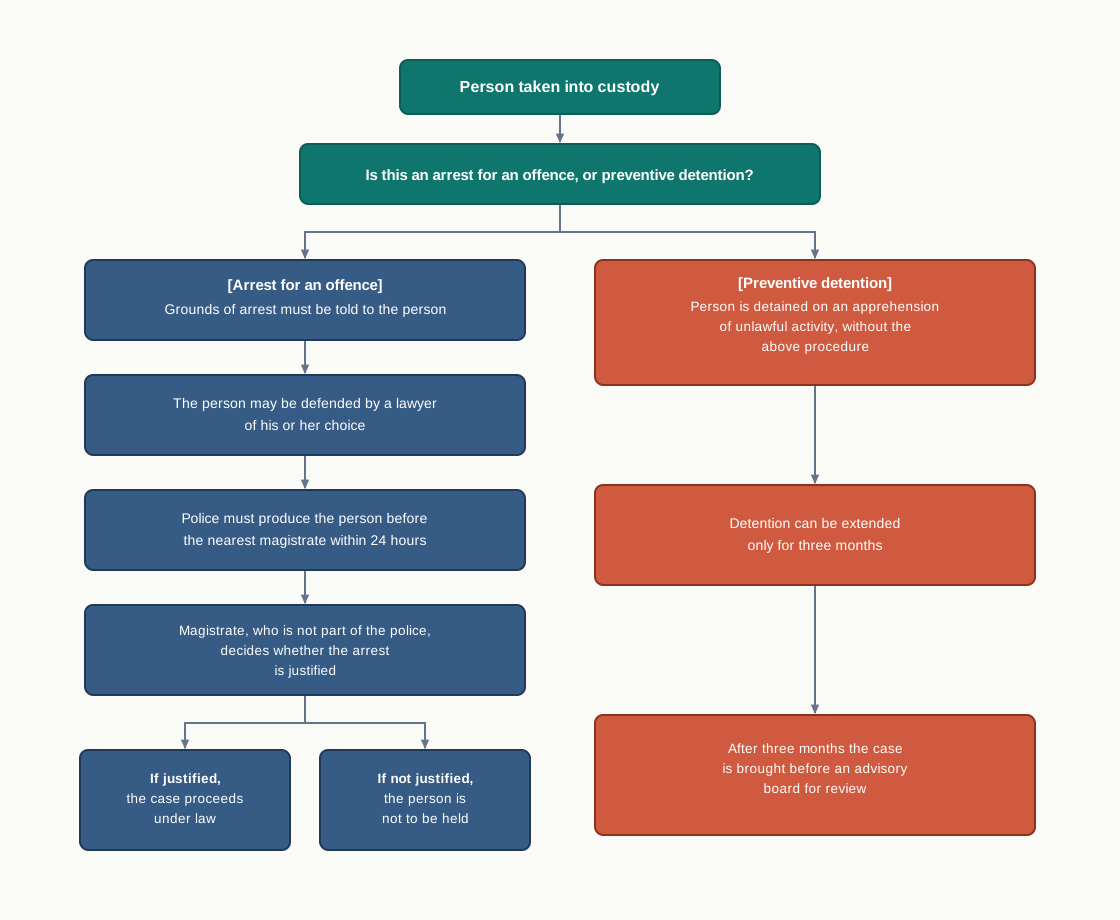
Fig. 2.1 – What the constitution requires when a person is taken into custody.
How Far Does ‘Life’ Reach?
This right is not just confined to a guarantee against the taking away of an individual’s life. It has a much wider application, and that width was not written into the Article. It was read into it.
Various judgments of the Supreme Court have expanded the scope of this right. The court has ruled that this right also includes the right to live with human dignity, free from exploitation. The court has held that the right to shelter and the right to livelihood are also included in the right to life — because no person can live without the means of living, that is, the means of livelihood.
Follow the reasoning, because it is the finest piece of argument in this chapter. Article 21 protects life. A person with no shelter and no livelihood does not merely have a worse life; over time, that person may not have a life at all. So a state that does nothing while people are stripped of the means of living is not simply failing to be generous. It is coming close to depriving them of life — and Article 21 says it may not do that except by procedure established by law.
This is how the construction workers of the Asian Games and Machal Lalung belong to the same chapter. Both were denied something Article 21 was eventually held to contain.
2.5.2 Preventive Detention
Ordinarily, a person would be arrested after he or she has reportedly committed some offence. That is the sequence assumed by everything you have just read: an offence, then an arrest, then a magistrate.
However, there are exceptions to this. Sometimes a person can be arrested simply out of an apprehension that he or she is likely to engage in unlawful activity, and imprisoned for some time without following the above mentioned procedure. This is known as preventive detention. The word ‘preventive’ is the whole of it: the person is held not for what they have done, but for what the government fears they may do.
It means that if the government feels that a person can be a threat to law and order, or to the peace and security of the nation, it can detain or arrest that person. This preventive detention can be extended only for three months. After three months, such a case is brought before an advisory board for review.
On the face of it, preventive detention looks like an effective tool in the hands of the government to deal with anti-social elements or subversives — people working to overthrow lawful authority. A government that must wait for the bomb before it may act is a government that has already failed the people the bomb will kill.
But this provision has often been misused by the government. Many people think that there must be greater safeguards in this law, so that it may not be misused against people for reasons other than those which are really justified. Detention on suspicion is a power that can be turned against an inconvenient critic as easily as against a genuine danger, and the person detained has, for those months, none of the protections that Article 21 promised.
In fact, there is a clear tension between the right to life and personal liberty and the provision for preventive detention. Do not resolve that tension too quickly in either direction. The Constitution itself did not.
2.5.3 Other Freedoms
You can see from the chart of Part three that under the right to freedom there are several other rights as well: to speak and express, to assemble peacefully, to form associations and unions, to move freely throughout the territory of India, to reside and settle in any part of India, and to practise any profession or carry on any occupation, trade or business.
These rights, however, are not absolute. Each of these is subject to restrictions imposed by the government.
For example, the right to freedom of speech and expression is subject to restrictions such as public order, peace and morality. Freedom to assemble too is to be exercised peacefully and without arms. The government may impose restrictions in certain areas, declaring the assembly of five or more persons as unlawful.
Such powers can be easily misused by the administration. Think about what that order actually does: in the area where it applies, five people standing together are breaking the law, whatever they came to say. The genuine protest against an act or policy of government by the people may be denied permission — and denied it in perfectly correct legal language.
What is the safeguard? Partly the courts, which may hold a restriction unreasonable. But the chapter offers another, and it is not a legal one. If the people are aware and vigilant in regard to their rights, and choose to protest against such acts of administration, such misuse becomes rare. Rights are not self-enforcing. They are held up by citizens who notice.
An Objection From The Constituent Assembly
This unease is not an afterthought of later critics. In the Constituent Assembly itself, some members had expressed their dissatisfaction about the restrictions on rights, even as the rights were being written.
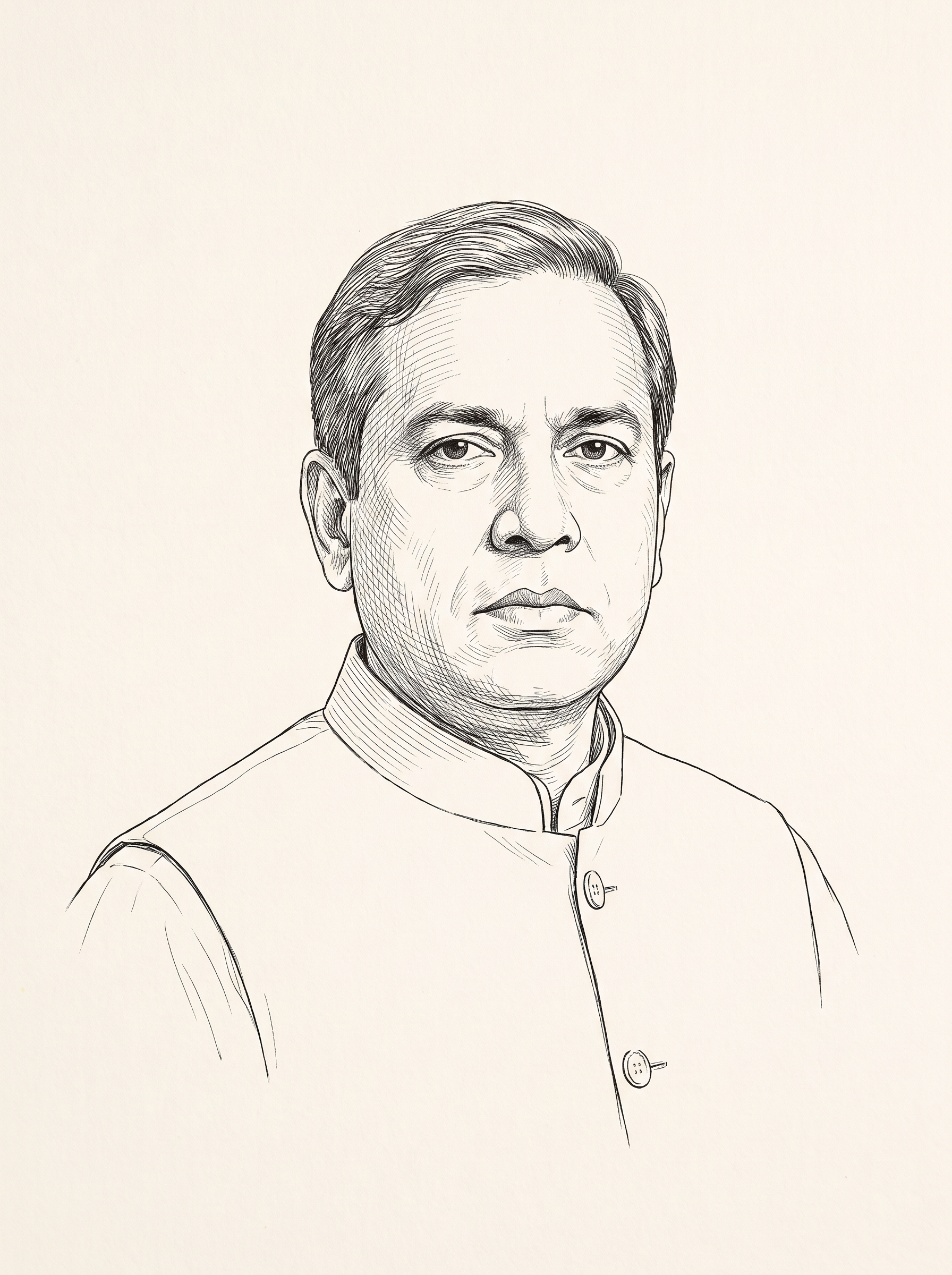
Fig. 2.2 – Somnath Lahiri.
Unpack the charge. A proviso is a clause attached to a provision that carves an exception out of it. Lahiri’s claim is that the drafters wrote each right generously and then attached a proviso that quietly withdrew most of it — and that they did so with a policeman’s question in mind, namely: what will the administration need to be able to do? A right drafted around the convenience of those who enforce order, he is saying, is not really a right of the people at all.
Now weigh it fairly. Lahiri is a member of the Assembly arguing for a stronger list, and he speaks in April 1947, while the drafting is still open — this is a speech meant to change minds, not a neutral description. It records what one member thought at one moment. It cannot tell you what the provisos would come to mean once courts began striking down restrictions as unreasonable, because none of that had happened yet.
2.5.4 Rights Of Accused
Our Constitution ensures that persons accused of various offences would also get sufficient protection. This is the part of the chapter students most often skip, and it is the part Machal Lalung most needed.
We often tend to believe that anyone who is charged with some offence is guilty. Newspapers name the accused; neighbours stop speaking to the family. However, no one is guilty unless the court has found that person guilty of an offence. It is also necessary that a person accused of any crime should get adequate opportunity to defend herself or himself.
To ensure a fair trial in courts, the Constitution has provided three rights:
- no person would be punished for the same offence more than once;
- no law shall declare any action as illegal from a backdate; and
- no person shall be asked to give evidence against himself or herself.
Each one blocks a specific abuse. The first stops the state from trying a person again and again until it finally wins. The second stops it from passing a law today that makes yesterday’s lawful act a crime — nobody can obey a rule that did not exist. The third stops it from making the accused the chief witness for the prosecution, which is what torture is for.
2.6 Right Against Exploitation
In our country there are millions of people who are underprivileged and deprived. Poverty does not merely mean having less. It means having no choice, and a person with no choice is easy to use.
Such people may be subjected to exploitation by their fellow human beings. Notice the phrase carefully: by their fellow human beings, not by the government. This is a right that the Constitution turns towards private power — the employer, the contractor, the landlord — and not only towards the state.
Forced Labour And Its Forms
One such form of exploitation in our country has been begar, or forced labour without payment. A person works, and nothing is paid. Another closely related form of exploitation is the buying and selling of human beings and using them as slaves. Both of these are prohibited under the Constitution.
Forced labour was imposed by landlords, moneylenders and other wealthy persons in the past. It was not usually enforced with chains. It was enforced with debt and dependence — a loan that could never be cleared, a field that had to be worked, a village where there was nowhere else to go.
Some form of bonded labour — labour a person is compelled to keep giving in return for a debt or an obligation, rather than for wages freely agreed — still continues in the country, specially in brick kiln work. It has now been declared a crime and it is punishable. That last sentence is important, and so is the one before it. The law forbids it. It has not yet ended it.
Fig. 2.3 shows one form this exploitation takes. Look at it, and then answer the question the chapter asks under it.
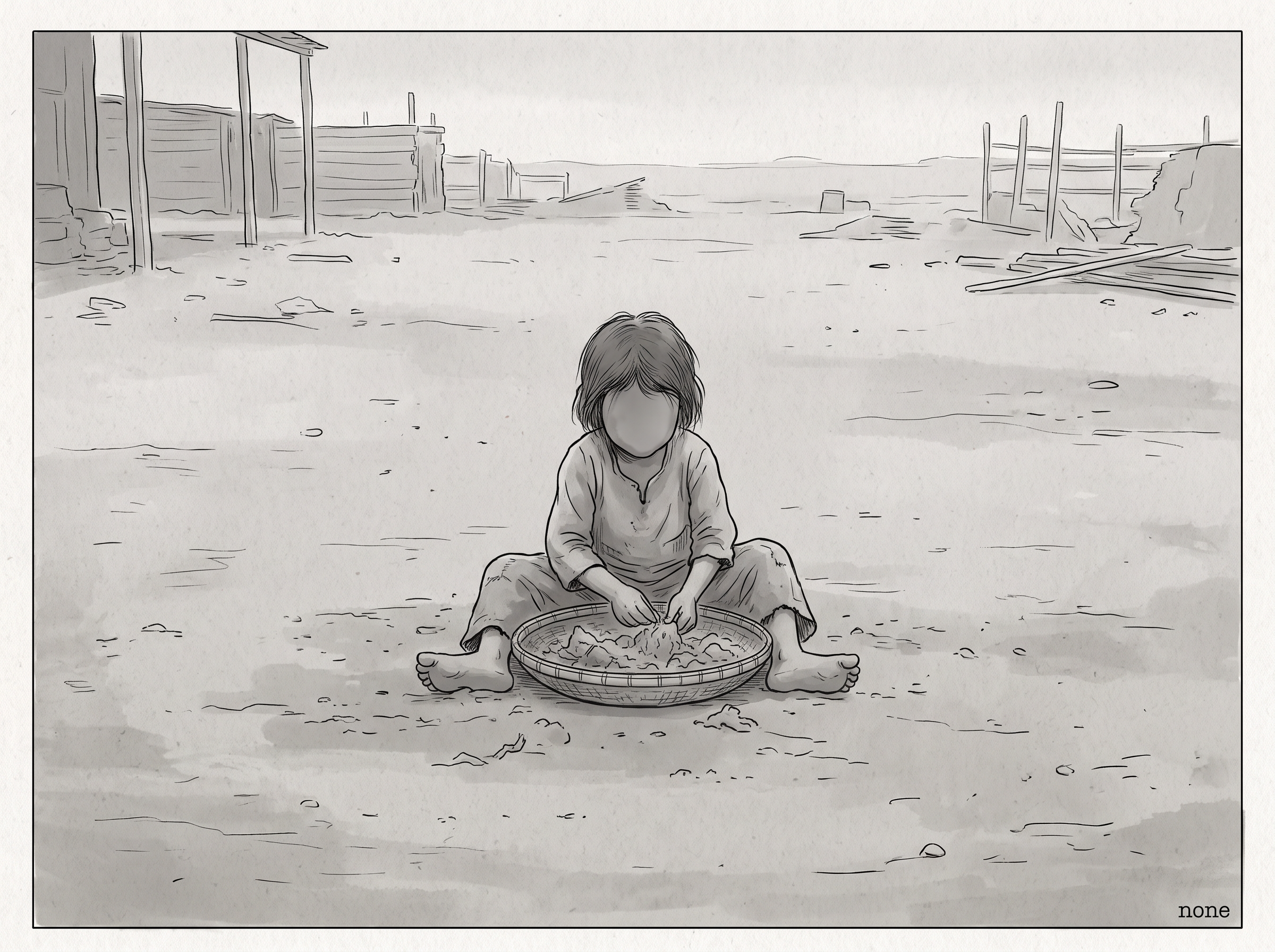
Fig. 2.3 – A child at work.
Children, Work And School
The Constitution also forbids the employment of children below the age of 14 years in dangerous jobs like factories and mines. The age is not decorative. Below it, the Constitution treats a child as someone who cannot be asked to carry the risks an adult may choose to carry.
But a ban on its own only removes one door. It does not open another. That is why the second half of the sentence matters as much as the first: with child labour being made illegal, and the right to education becoming a fundamental right for children, this right against exploitation has become more meaningful. A child who is barred from the kiln and has nowhere to go is not much better off. A child who is barred from the kiln and is in a classroom is.
2.7 Right To Freedom Of Religion
According to our Constitution, everyone enjoys the right to follow the religion of his or her choice. This freedom is considered as a hallmark of democracy — one of the marks by which you can tell a democracy from something that only looks like one.
To see why, look at what came before it. Historically, there were rulers and emperors in different parts of the world who did not allow the residents of their countries to enjoy the right to freedom of religion. Persons following a religion different from that of the ruler were either persecuted or forced to convert to the official religion of the rulers.
That is the arrangement democracy broke with. A ruler with an official faith needs everyone else’s faith to be a problem. Therefore, democracy has always incorporated the freedom to follow the religion of one’s choice as one of its basic principles.
2.7.1 Freedom Of Faith And Worship
In India, everyone is free to choose a religion and practice that religion. Freedom of religion also includes the freedom of conscience. This means that a person may choose any religion, or may choose not to follow any religion at all. The right protects the believer and the non-believer with the same words.
Freedom of religion includes the freedom to profess, follow and propagate any religion — to declare what you believe, to live by it, and to spread it.
The Limits On This Freedom
Freedom of religion is subject to certain limitations. The government can impose restrictions on the practice of freedom of religion in order to protect public order, morality and health. This means that the freedom of religion is not an unlimited right. By now you will recognise the pattern: the Constitution grants, and in the same breath it draws the edge.
The government can also interfere in religious matters for rooting out certain social evils. For example, in the past, the government has taken steps banning practices like sati, bigamy — marrying a second time while a first marriage still subsists — or human sacrifice. Such restrictions cannot be opposed in the name of interference in the right to freedom of religion. A practice does not become protected merely because it is old, or because it is sincerely believed in.
The limitations on the right to freedom of religion always produce tensions between followers of various religions and the government. This is not a failure of the arrangement; it is built into it. When the government seeks to restrict some activities of any religious group, people of that religion feel that this is interference in their religion. Both feelings are real, and both have to be lived with.
Propagation And Conversion
Freedom of religion becomes a matter of political controversy for yet another reason. The Constitution has guaranteed the right to propagate one’s religion. Propagation is not merely private belief; it means speaking about your faith to others. And that necessarily includes persuading people to convert from one religion to another.
However, some people resent conversions, on the ground that these are based on intimidation or inducement — that the convert was frightened into it, or paid for it, and did not really choose at all.
Here the Constitution is precise. It does not allow forcible conversions. It only gives us the right to spread information about our religion and thus attract others to it. The line it draws is the line between persuasion and pressure. Where exactly that line falls in a real case — a school, a hospital, a village meeting, an offer of help — is what the argument is actually about.
2.7.2 Equality Of All Religions
Being a country which is home to several religions, it is necessary that the government must extend equal treatment to different religions. What does equal treatment actually require of a state?
Negatively, it means that the government will not favour any particular religion. India does not have any official religion. That single fact carries a great deal. We don’t have to belong to any particular religion in order to be a prime minister, or president, or judge, or any other public official. The highest offices in the country are not reserved for the majority faith.
We have also seen, under the right to equality, that there is a guarantee that the government will not discriminate on the basis of religion in giving employment. The same principle runs through both rights.
The institutions run by the state will not preach any religion, or give religious education, nor will they favour persons of any religion. A government school is not a place of worship, and a government hospital does not ask which god you pray to.
The objective of all these provisions is to sustain and nurture the principle of secularism — the arrangement in which the state has no religion of its own, does not favour or penalise any religion, and leaves the question of faith to the citizen.
2.8 Cultural And Educational Rights
When we talk of the Indian society, the image of diversity comes before our minds. India is not made up of a monolithic society — a single block, one language, one faith, one way of living. We are a society that has vast diversity.
In such a society that is full of diversity, there would be social sections which are small in numbers compared to some other groups. And that raises a question a democracy cannot avoid. If a group is in minority, will it have to adopt the culture of the majority?
Diversity As A Right, Not A Problem
A democracy counts heads. So there is always a danger that whatever the largest group does comes to be treated as what everybody should do — its language in the offices, its calendar on the wall, its script in the schools. Nobody has to pass a law for this. It happens simply by weight of numbers.
Our Constitution believes that diversity is our strength. Therefore, one of the fundamental rights is the right of the minorities to maintain their culture. Not a permission granted by the majority in a generous mood, but a right the majority cannot vote away.
Who Is A Minority?
This minority status is not dependent only upon religion. Linguistic and cultural minorities are also included in this provision.
Minorities are groups that have a common language or religion and, in a particular part of the country or in the country as a whole, they are outnumbered by some other social section. Read that definition slowly, because it has two units of measurement inside it: a part of the country, and the country as a whole. A group can be a minority by one measure and not by the other.
Such communities have a culture, language and a script of their own, and have the right to conserve and develop these. Note the two verbs. They may keep what they have, and they may let it grow. A culture kept in a museum is not being conserved; it is being embalmed.
It is fair to press on this definition, as students often do. I am in a minority in my locality but a majority in the town; a minority if you look at my language, but a majority if you go by my religion. Aren’t we all minorities? The question is a good one, and the Constitution’s answer is contained in the definition itself: the unit you count in decides the answer, which is exactly why the provision names both a part of the country and the country as a whole.
Schools Of Their Own
All minorities, religious or linguistic, can set up their own educational institutions. By doing so, they can preserve and develop their own culture. A language survives where it is taught; a script survives where it is written by children.
The government will not, while granting aid to educational institutions, discriminate against any educational institution on the basis that it is under the management of a minority community. This second half matters as much as the first. A right to open a school, coupled with a rule that such schools get no public money, would be a right only for those who could already afford it.
A Voice From The Constituent Assembly
This was argued out while the Constitution was being written. Sardar Hukam Singh, a member of the Constituent Assembly, spoke on 26 May 1949 about what the majority owed the minorities. Fig. 2.4 shows him; his words are printed below.
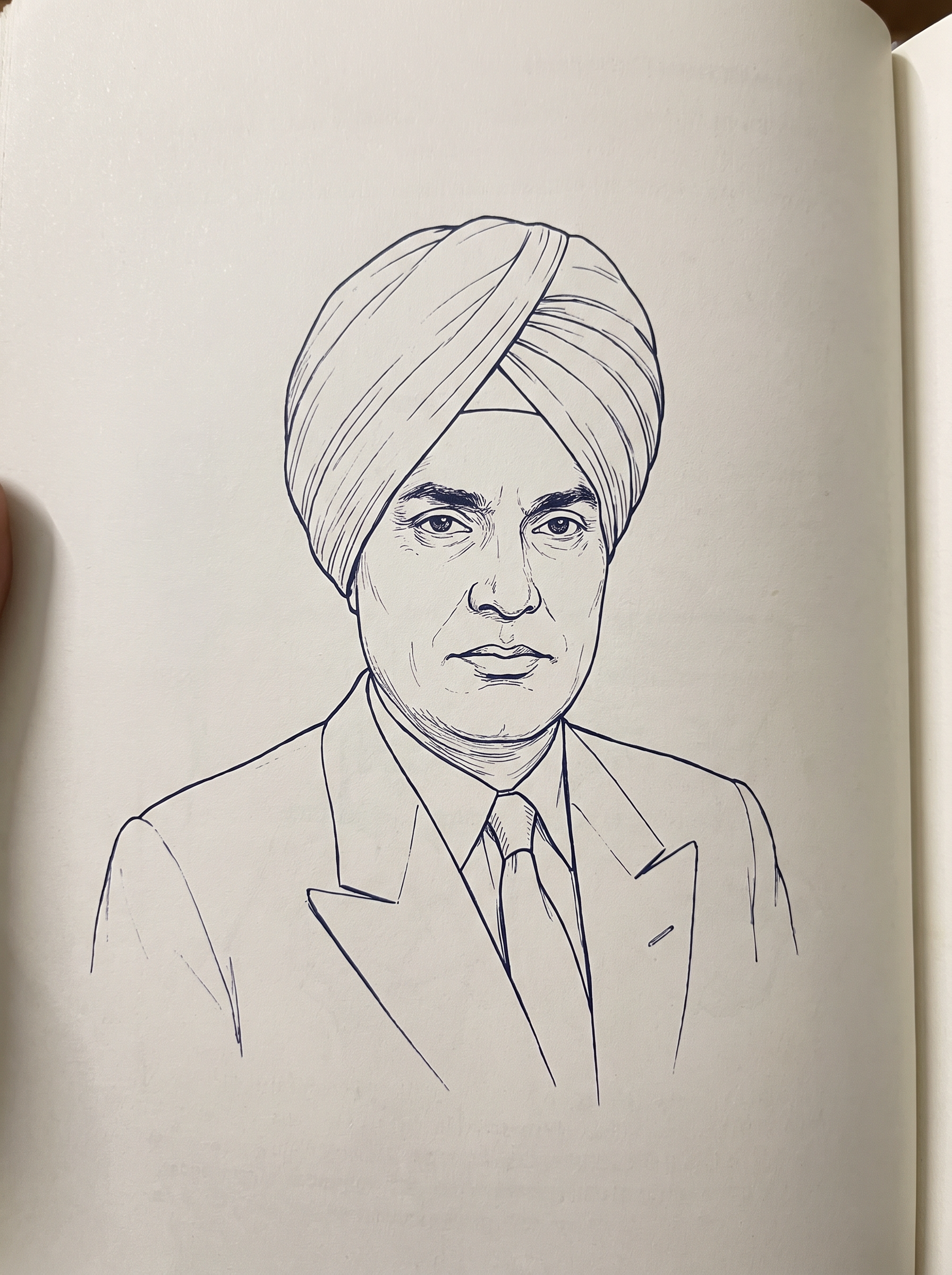
Fig. 2.4 – Sardar Hukam Singh.
Take the argument apart. He makes a claim about where safeguards come from: not from greed, and not from disloyalty, but from fear — fear about language, about script, and about a fair share in the services, meaning government employment. He then places the duty on the majority, and he is careful about how he does it. It is not enough for the majority to feel fair. The minorities must in fact feel secure, and only the majority can make that happen.
His last move is the sharpest, and it is easy to miss. He warns the majority community not to boast of their national outlook. A majority that is confident it has no prejudice does not have to check whether it does.
Now the limit of this source. It is one member’s speech, made on one day in 1949, and it records how the demand for safeguards was defended in the Assembly. It does not tell us how many members agreed, whether the minorities themselves would have put their fears in these words, or whether the safeguards finally written into the Constitution have made anyone feel secure. A speech records an argument. It does not record a result.
2.9 Right To Constitutional Remedies
One would agree that our Constitution contains a very impressive list of Fundamental Rights. You have now read all five of them. But merely writing down a list of rights is not enough.
Any government could print a fine list. What separates a constitution from a poster is the next question. There has to be a way through which the rights could be realised in practice, and defended against any attack on these rights. A right with no remedy is an opinion.
The Heart And Soul
The right to constitutional remedies is the means through which this is to be achieved. Dr. Ambedkar considered the right to constitutional remedies as the ‘heart and soul of the constitution’. That is a strong phrase from the man who piloted the document, and he meant it structurally, not sentimentally. Remove this right and every other right in Part three becomes decorative.
It is so because this right gives a citizen the right to approach a High Court or the Supreme Court to get any of the fundamental rights restored in case of their violation. The citizen does not have to persuade a minister, or wait for an election. She goes to a court.
And the courts are not limited to expressing disapproval. The Supreme Court and the High Courts can issue orders and give directives to the government for the enforcement of rights.
The Five Writs
The courts can issue various special orders known as writs. A writ is a written order from a court to an authority — a government office, an official, a lower court — telling it to do something, or to stop doing something. There are five, and each answers a different kind of wrong.
Habeas corpus. A writ of habeas corpus means that the court orders that the arrested person should be presented before it. It can also order to set free an arrested person if the manner or grounds of arrest are not lawful or satisfactory. This is the writ that reaches into a cell. It asks the state a question it must answer: on what authority are you holding this person?
Mandamus. This writ is issued when the court finds that a particular office holder is not doing his legal duty, and thereby is infringing on the right of an individual. Rights are violated by inaction as often as by action — the file that is never moved, the permission never given, the complaint never registered.
Prohibition. This writ is issued by a higher court — a High Court or the Supreme Court — when a lower court has considered a case going beyond its jurisdiction, that is, beyond the range of matters it is legally allowed to decide. A court that decides what it has no business deciding is itself acting without authority.
Quo Warranto. If the court finds that a person is holding office but is not entitled to hold that office, it issues the writ of quo warranto and restricts that person from acting as an office holder. The name of the writ is itself the question: by what authority do you hold this post?
Certiorari. Under this writ, the court orders a lower court or another authority to transfer a matter pending before it to the higher authority or court. The case is lifted upward, out of the hands that were holding it.
Notice what the five have in common. Every one of them is aimed at an authority — a jailer, an official, a lower court, an office holder. This is the right that turns the Constitution’s warning to the state into something the state can actually be made to obey. Fig. 2.5 shows how a citizen reaches it.
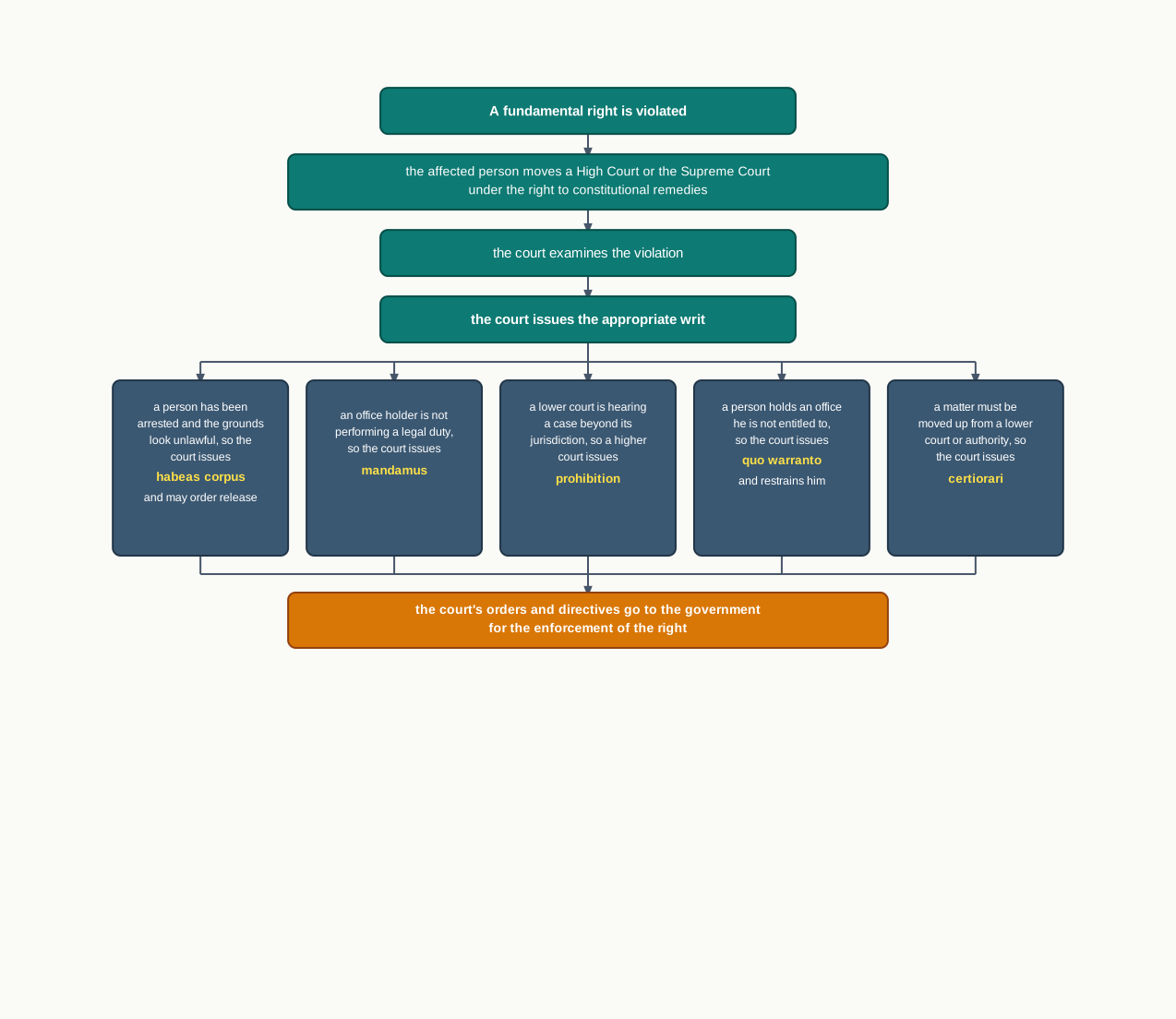
Fig. 2.5 – How a citizen enforces a fundamental right.
Other Guardians Of Rights
Apart from the judiciary, many other mechanisms have been created in later years for the protection of rights. You may have heard about the National Commission on Minorities, the National Commission on Women, the National Commission on Scheduled Castes, and others like them. These institutions protect the rights of women, minorities or Dalits.
Besides these, the National Human Rights Commission has also been established by law to protect the fundamental and other kinds of rights. It is worth spending a page on this body, because it shows both what such institutions can do and where they stop.
The National Human Rights Commission
Start from the principle behind it. The real test of the rights given by any constitution is in their actual implementation. The poor, the illiterate and the deprived sections of the society must be able to exercise their rights — not merely possess them.
Before the state built anything, citizens had built something. Independent organisations like the People’s Union for Civil Liberties (PUCL) or the People’s Union for Democratic Rights (PUDR) have been working as watchdogs against the violations of rights. In this background, the government established in 1993 an institution, the National Human Rights Commission.
The National Human Rights Commission (NHRC) is composed of a former chief justice of the Supreme Court of India, a former judge of the Supreme Court, a former chief justice of a High Court, and two other members who have knowledge and practical experience in matters relating to human rights. Read that composition again. It is built out of retired judges — people trained to weigh evidence, and no longer dependent on the government for their careers.
The Commission’s functions include inquiry into a complaint of violation of human rights, either at its own initiative or on a petition presented to it by a victim. It also includes visits to jails to study the condition of the inmates, and undertaking and promoting research in the field of human rights. That power to enter a jail is not a small one; it was such an inspection of undertrials that ended Machal Lalung’s long wait in Assam.
The Commission receives complaints in thousands every year. These relate to custodial death, custodial rape, disappearances, police excesses, failure in taking action, indignity to women, and other such matters. Its most significant intervention has been on disappeared youth in Punjab, and on the investigation and trial of Gujarat riot cases, where its intervention proved effective.
Where The Commission Stops
Now the limit, and the chapter states it plainly. The Commission does not have the power of prosecution. It can merely make recommendations to the government, or recommend to the courts to initiate proceedings based on the inquiry that it conducts.
So the NHRC can investigate, publish and press. It cannot itself put anyone on trial. Whether that makes it a weak body or a wisely designed one is a fair question to argue about — and you now have both halves of the argument in front of you. Further details are published by the Commission itself at http://www.nhrc.nic.in.
2.10 Directive Principles Of State Policy
The makers of our Constitution knew that independent India was going to face many challenges. Foremost among these was the challenge to bring about equality and the well-being of all citizens. A country that had just won political freedom was still, for most of its people, a country of poverty, illiteracy and hunger.
They also thought that certain policy direction was required for handling these problems. Rights alone would not build a school or fix a wage. Somebody would have to govern in a particular direction.
But here they ran into a difficulty, and it is worth naming it precisely. At the same time, the Constitution did not want future governments to be bound by certain policy decisions. A constitution written in the 1940s cannot decide what a government elected in the 1990s should spend its money on. That is what elections are for.
A Deliberate Half-Measure
So the makers did something that looks, at first, like a compromise, and is in fact a considered choice. Some guidelines were incorporated in the Constitution, but they were not made legally enforceable.
This means that if a government did not implement a particular guideline, we cannot go to the court asking the court to instruct the government to implement that policy. Thus, these guidelines are ‘non-justiciable’ — parts of the Constitution that cannot be enforced by the judiciary. You may point to them. You may not sue on them.
Then why write them at all? Those who framed our Constitution thought that the moral force behind these guidelines would ensure that the government would take them seriously. Besides, they expected that the people would also hold the governments responsible for implementing these directives. The enforcing body, in other words, was meant to be the voter.
So a separate list of policy guidelines is included in the Constitution. The list of these guidelines is called the Directive Principles of State Policy.
A student is entitled to be sceptical at this point, and many are. Tell me, they say, what is the point of saying nice things in the Constitution if these cannot be implemented by any court? Keep that objection with you. It is a serious one, and the rest of this section is an attempt to answer it honestly rather than to talk you out of it.
2.10.1 What Do The Directive Principles Contain?
The chapter on Directive Principles lists mainly three things:
- the goals and objectives that we as a society should adopt;
- certain rights that individuals should enjoy apart from the Fundamental Rights; and
- certain policies that the government should adopt.
Notice the middle item, because it is easy to read past. The Constitution names some things as rights, and then places them where no court can reach them. Adequate livelihood, equal pay for equal work for men and women, the right against economic exploitation, the right to work — these are called rights in the Directive Principles, and they are not enforceable. The word ‘right’ is doing two different jobs in the same document.
You may get some idea of the vision of the makers of our Constitution by looking at some of the Directive Principles shown in Fig. 2.6.
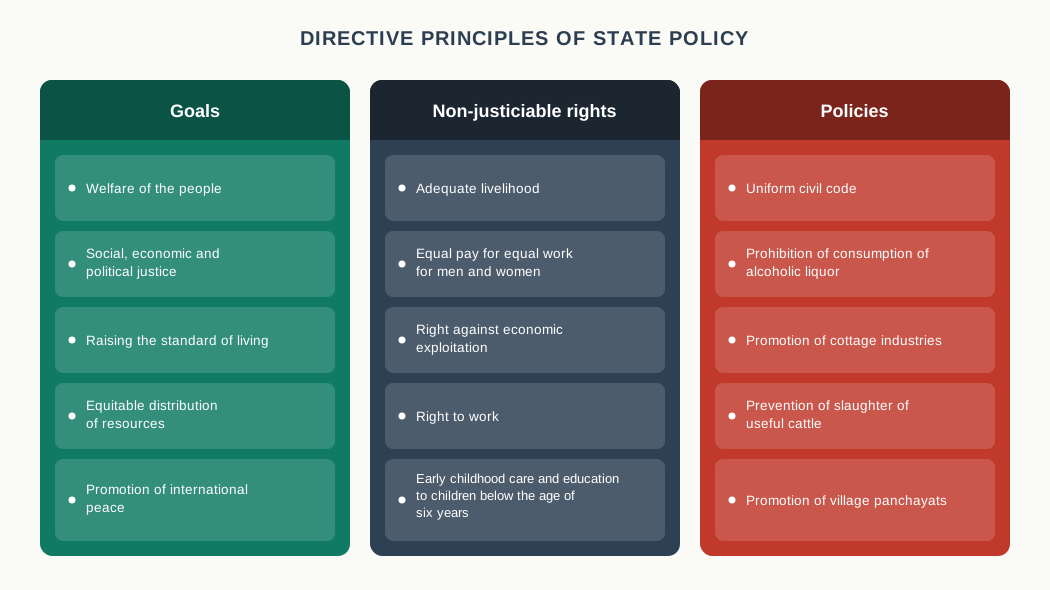
Fig. 2.6 – The Directive Principles of State Policy.
What Governments Actually Did
Now test the sceptical objection against the record, because the chapter gives us one. The governments from time to time tried to give effect to some Directive Principles of State Policy.
They passed several zamindari abolition bills, ending the system in which large landholders held rights over land that others tilled. They nationalised banks, bringing them under government ownership. They enacted numerous factory laws and fixed minimum wages. Cottage and small industries were promoted. Provisions for reservation for the uplift of the scheduled castes and scheduled tribes were made.
Such efforts to give effect to the Directive Principles include the right to education, the formation of panchayati raj institutions all over the country, a partial right to work under the employment guarantee programme, and the mid-day meal scheme — the cooked meal served to children in government schools.
Read that list against the objection. Not one of those measures could have been ordered by a court. Every one of them happened. The Directive Principles were not enforced; they were, in these instances, obeyed. Whether they were obeyed because of the Constitution, or because governments found it politically useful to obey them, the chapter does not tell us — and that is exactly the question the objection was pointing at.
A Petition To Write
Before moving on, put the last two sections together — the right to constitutional remedies, and the promises no court can enforce. Here are some facts.
It is estimated that there are about three million urban homeless in India. Night shelters are not available for more than five per cent of this population. Hundreds of these old, sick homeless people are killed by cold wave during winter.
They cannot have ration and voting cards in the absence of any ‘proof of residence’. Without these documents, they also cannot avail government help as needy patients. A large number of these homeless people are casual workers, who earn very low wages. They travel to the city in search of work from different parts of the country.
Look closely at the trap in the second of those paragraphs. To get help you need a document; to get the document you need an address; to get an address you need the help. Now use these facts to write a petition to the Supreme Court of India under the Right to Constitutional Remedies.
2.11 Relationship Between Fundamental Rights And Directive Principles
It is possible to see both Fundamental Rights and Directive Principles as complementary to each other. They are not two rival documents. They are two halves of one instruction to the state.
Look at what each half does. Fundamental Rights restrain the government from doing certain things, while Directive Principles exhort the government to do certain things. One says stop; the other says go. Fundamental Rights mainly protect the rights of individuals, while directive principles ensure the well-being of the entire society.
Held together, the two answer the question every state must answer: what may you not do to me, and what must you do for us? A government that only obeyed the first would be harmless and useless. A government that only obeyed the second could do anything at all, so long as it said it was for the general good.
When The Two Halves Collide
However, at times, when the government intends to implement the Directive Principles of State Policy, it can come in conflict with the Fundamental Rights of the citizen. The instruction to stop and the instruction to go can point at the same act.
This problem arose when the government sought to pass laws to abolish the zamindari system. These measures were opposed on the ground that they violated the right to property — which, at that time, was itself a Fundamental Right.
Follow the shape of the clash. The Directive Principles pointed towards an equitable distribution of resources. Abolishing zamindari was a way of moving towards it. But the landholders whose land was being taken had a Fundamental Right, and they said so in court.
However, keeping in mind the societal needs that are greater than the individual interests, the government amended the Constitution to give effect to the Directive Principles of State Policy. This led to a long legal battle.
The executive and the judiciary took different positions, and it is worth stating each position in its strongest form.
The government claimed that rights can be abridged for giving effect to Directive Principles. This argument assumed that rights were a hindrance to the welfare of the people — that the guarantee held by a few was standing in the way of what the many needed.
On the other hand, the court held the view that Fundamental Rights were so important and sacred that they cannot be limited even for the purposes of implementing Directive Principles. On this view, a right that may be set aside whenever the government has a good reason is not a right at all, because governments always have reasons.
The Right To Property
Behind the controversy about the relationship between rights and directive principles, there was one important reason, and it can be named exactly. In the Constitution, originally, there was a fundamental right to ‘acquire, possess and maintain’ property.
But even then the Constitution made it clear that property could be taken away by the government for public welfare. The right was there; so was the exception.
Since 1950, the government made many laws that limited this right to property. This right was at the centre of the long debate over the relationship between rights and directive principles. It was the ground on which the whole argument was actually fought.
Finally, in 1973, the Supreme Court gave a decision that the right to property was not part of the basic structure of the Constitution, and therefore, parliament had the power to abridge this right by an amendment.
Then, in 1978, the 44th amendment to the Constitution removed the right to property from the list of Fundamental Rights, and converted it into a simple legal right under article 300 A. The right did not disappear. It changed rank.
Before you answer, go back to Table 2.A1 in this chapter and read what separates a fundamental right from an ordinary legal right. That is precisely the distance the right to property travelled in 1978.
Can Parliament Amend Anything?
This generated another complicated debate. This one related to the amendment of the Constitution itself, and it went to the root of the whole system.
The government was saying that Parliament can amend any part of the Constitution. If the elected representatives of the people cannot change the document, who can? The court was saying that Parliament cannot make an amendment that violated Fundamental Rights. If a majority can amend away the limits on itself, then there are no limits.
This controversy was settled by an important decision of the Supreme Court in the Kesavananda Bharati case. In this case, the court said that there are certain basic features of the Constitution, and these cannot be changed by Parliament. Parliament may amend; it may not dismantle. We shall discuss this in greater detail in Chapter 9 on ‘Constitution as a Living Document’.
Rights In The Newspapers
None of this stays inside law reports. The violation of rights, and the intervention of courts, is daily news, as Fig. 2.7 shows.
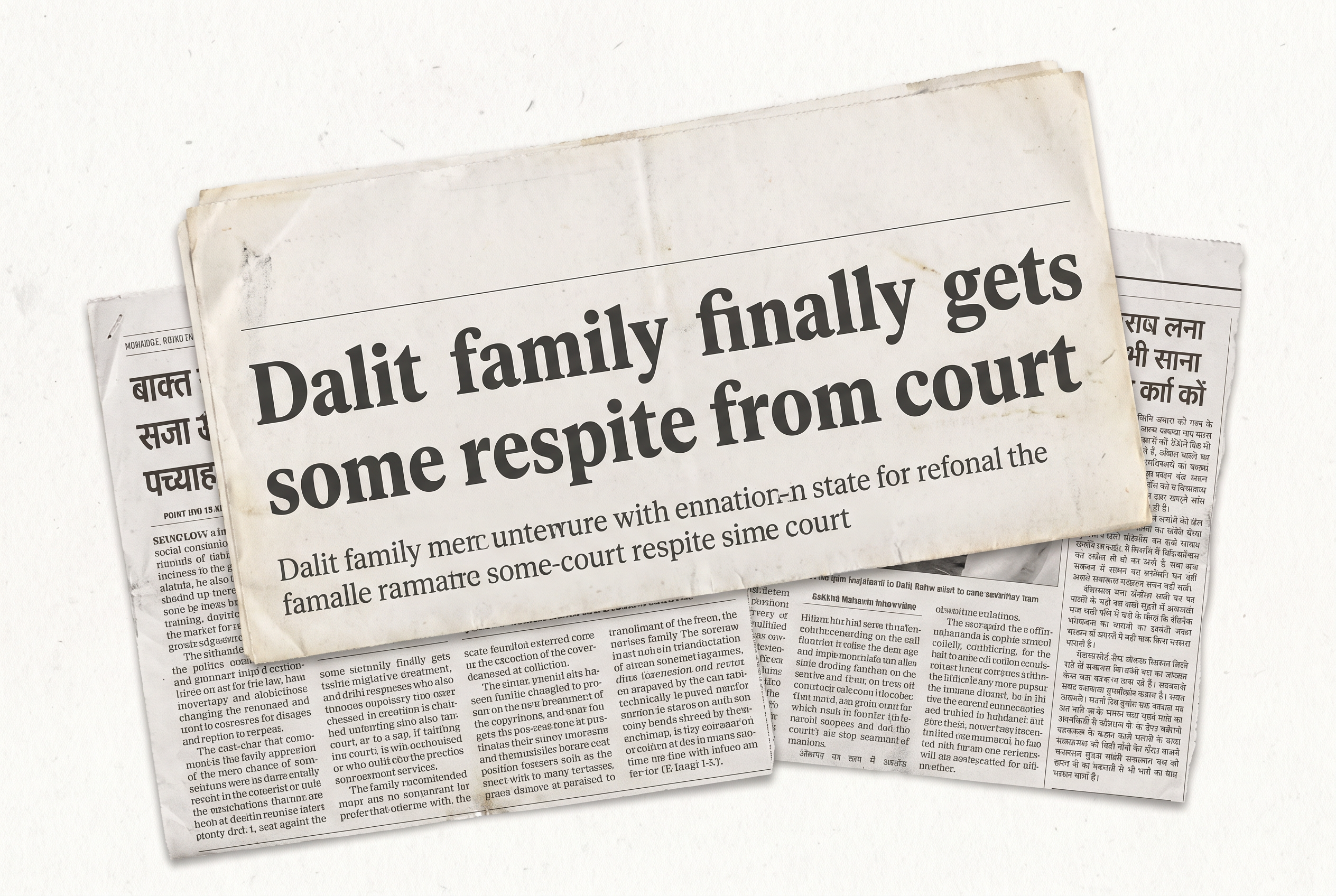
Fig. 2.7 – Newspaper reports on court interventions.
Read a collage like this as evidence, and read it carefully. It tells you that violations occur, that they are reported, and that courts are sometimes moved. It cannot tell you how many such cases never reach a newspaper, how many reported cases end in a remedy, or how long the remedy took. A clipping records the cases that got noticed. The silence of a newspaper is not the absence of a wrong.
2.12 Summary
What This Chapter Taught
- Rights matter twice over: once when they are written down, and again when they actually reach the person who needs them. The Constitution failed Machal Lalung for 54 years and won the construction workers their wages within a single case.
- A bill of rights is a list of rights mentioned and protected by the constitution. It obliges the government to protect the individual from other persons and private organisations, and it restrains the organs of government themselves — legislature, executive, bureaucracy, even the judiciary.
- The demand for rights was old: the Motilal Nehru committee asked for a bill of rights as far back as 1928. When the Constitution was framed, there were no two opinions on including them.
- Fundamental Rights are listed in Part three. They differ from ordinary legal rights: they can be changed only by amending the Constitution, no organ of government may act against them, and the judiciary can declare executive and legislative actions illegal if they violate them. They are not, however, absolute — the government may place reasonable restrictions on them.
- The South African Constitution, inaugurated in December 1996, took a different path, placing housing, health care, food, water, education and information inside its Bill of Rights.
- Right to equality: equal access to public places, no discrimination on grounds only of religion, race, caste, sex or place of birth, equality of opportunity in public employment, abolition of untouchability, abolition of titles. The Preamble promises equality of status and equality of opportunity, and Article 16(4) makes clear that reservation is not a violation of equality but a means to it.
- Right to freedom: liberty means freedom of thought, expression and action, exercised without threatening the freedom of others. Article 21 protects life and personal liberty except according to procedure established by law — grounds of arrest must be given, a lawyer of one’s choice is allowed, and the person must be produced before a magistrate within 24 hours. The Supreme Court has read into this right the right to live with human dignity, and the right to shelter and livelihood.
- Preventive detention allows arrest on the apprehension of unlawful activity, for up to three months, after which an advisory board reviews the case. The chapter records that it has often been misused, and that it stands in clear tension with the right to personal liberty.
- The other freedoms — speech, assembly, association, movement, residence, occupation — are all subject to restrictions, and those powers can be easily misused. Persons accused of offences have three protections: no punishment twice for the same offence, no law made illegal from a backdate, and no compulsion to give evidence against oneself.
- Right against exploitation: begar or forced labour, and the buying and selling of human beings, are prohibited. Bonded labour still continues, specially in brick kiln work, and is now a punishable crime. Children below 14 may not be employed in dangerous jobs like factories and mines, and education has become a fundamental right for children.
- Right to freedom of religion: freedom of conscience, and the freedom to profess, practise and propagate religion — restricted only for public order, morality and health, and open to state intervention against social evils such as sati, bigamy or human sacrifice. Forcible conversion is not allowed. India has no official religion, and state institutions preach none: this is the principle of secularism.
- Cultural and educational rights: minorities, religious or linguistic, may conserve and develop their culture, language and script, and may establish their own educational institutions, which the government may not discriminate against while granting aid.
- Right to constitutional remedies: Dr. Ambedkar called it the heart and soul of the constitution. A citizen may move a High Court or the Supreme Court, which can issue five writs — habeas corpus, mandamus, prohibition, quo warranto and certiorari. Commissions on minorities, women and Scheduled Castes, and the National Human Rights Commission set up in 1993, add further protection, though the NHRC can only recommend and cannot prosecute.
- Directive Principles of State Policy are non-justiciable: no court can order a government to implement them. They contain goals, certain rights outside the Fundamental Rights, and policies. Governments have nonetheless acted on them — zamindari abolition, bank nationalisation, factory laws, minimum wages, the right to education, panchayati raj, the employment guarantee programme and the mid-day meal scheme.
- The 42nd amendment of 1976 inserted ten Fundamental Duties, which are not enforceable, and which do not make the enjoyment of rights conditional on their fulfilment.
- Fundamental Rights and Directive Principles are complementary — one restrains the government, the other exhorts it — but they have collided. The clash over zamindari abolition and the right to property led to a long legal battle, to the Supreme Court’s decision of 1973, and to the 44th amendment of 1978, which made property a legal right under article 300 A. In the Kesavananda Bharati case the Court held that the Constitution has basic features that Parliament cannot amend away.
- The idea that rights include both freedom and equality is older than the Constitution. One of its earliest expressions is found in the writings of Jotirao Phuley (1827-1890), a radical social reformer from Maharashtra. During the national movement, this idea of rights was sharpened and expanded into constitutional rights, and our Constitution reflected that long tradition.
- Since 1950 the judiciary has functioned as an important protector of rights, and judicial interpretations have expanded their scope in many respects. The government and administration function within this overall framework: rights enforce limitations on the functioning of the government and ensure democratic governance of the country.
The Arguments In One Place
The chapter’s central claim is that rights are limits on power. A democracy does not merely let the people choose a government; it fences what any government — however large its majority — may do to any person. The fence is written into the Constitution, and a citizen can ask a court to enforce it.
Against this stands the objection the government itself made in the long battle over property: that rights protect individuals while the Directive Principles serve the welfare of everyone, and that when the two collide, the interests of society are greater than the interests of one. On this view, an unbreachable right can become a shield for privilege.
There is a second objection, and it comes from inside the Constituent Assembly. Somnath Lahiri argued that the rights had been framed from the point of view of a police constable — conceded in one line and taken back by a proviso in the next. If that is right, the fence has a gate in it, and the state holds the key.
The chapter does not settle either objection. It records the Supreme Court’s answer — that Fundamental Rights are too important to be limited even for the Directive Principles, and that some basic features of the Constitution are beyond amendment — and it leaves you to judge whether the answer is the right one.
What Remains Contested
The safeguards on preventive detention — three months, then an advisory board — either restrain a determined government or merely delay it, and the chapter admits the provision has often been misused. Where the line falls between propagation and pressure, between a religious practice and a social evil, between reasonable restriction and convenient censorship, is not settled anywhere in Part three; it is settled case by case, by whoever is judging.
And notice whose voices this chapter’s evidence carries. We hear members of the Constituent Assembly, and we hear the courts. We do not hear Machal Lalung, or the child in the photograph, or the family whose land was taken, or the three million people sleeping without an address. Speeches and judgments record what the powerful said about the powerless. Whether the rights worked is a question those records were never designed to answer.
2.13 NCERT Questions
Write true or false against each of these statements:
- A Bill of Rights lays down the rights enjoyed by the people of a country.
- A Bill of Rights protects the liberties of an individual.
- Every country of the world has a Bill of Rights.
- The Constitution guarantees remedy against violation of Rights.
Which of the following is the best description of Fundamental Rights?
- All the rights an individual should have.
- All the rights given to citizens by law.
- The rights given and protected by the Constitution.
- The rights given by the Constitution that cannot ever be restricted.
Read the following situations. Which Fundamental Right is being used or violated in each case and how?
- Overweight male cabin crew are allowed to get promotion in the national airlines but their women colleagues who gain weight are penalised.
- A director makes a documentary film that criticises the policies of the government.
- People displaced by a big dam take out a rally demanding rehabilitation.
- Andhra society runs Telugu medium schools outside Andhra Pradesh.
Which of the following is a correct interpretation of the Cultural and Educational Rights?
- Only children belonging to the minority group that has opened educational institution can study there.
- Government schools must ensure that children of the minority group will be introduced to their belief and culture.
- Linguistic and religious minorities can open schools for their children and keep it reserved for them.
- Linguistic and religious minorities can demand that their children must not study in any educational institution except those managed by their own community.
Which of the following is a violation of Fundamental Rights and why?
- Not paying minimum wages
- Banning of a book
- Banning of loudspeakers after 9 pm.
- Making a speech
An activist working among the poor says that the poor don’t need Fundamental Rights. What they need are Directive Principles to be made legally binding. Do you agree with this? Give your reasons.
Several reports show that caste groups previously associated with scavenging are forced to continue in this job. Those in positions of authority refuse to give them any other job. Their children are discouraged from pursuing education. Which of their Fundamental Rights are being violated in this instance?
A petition by a human rights group drew attention of the court to the condition of starvation and hunger in the country. Over five crore tonnes of food grains was stored in the godowns of the Food Corporation of India. Research shows that a large number of ration cardholders do not know about the quantity of food grains they can purchase from fair price shops. It requested the court to order the government to improve its public distribution system.
- Which different rights does this case involve? How are these rights interlinked?
- Should these rights form part of the right to life?
Read the statement by Somnath Lahiri in the Constitutent Assembly quoted in this chapter. Do you agree with him? If yes, give instances to prove it. If not, give arguments against his position.
Which of the Fundamental Rights is in your opinion the most important right? Summarise its provisions and give arguments to show why it is most important.
2.14 Check Your Concepts
Read Source 2.4, the words of Sardar Hukam Singh. According to him, what are all demands for safeguards the product of? What responsibility does he place on the majority community, and why does he warn it against boasting of its national outlook?
Name the writ a court would issue in each of these situations, and explain in one line why that writ fits:
- a person has been arrested, and the manner and grounds of the arrest do not appear lawful;
- an office holder is not performing his legal duty, and an individual’s right is suffering as a result;
- a person is acting as an office holder although he is not entitled to hold that office.
The Constitution requires that an arrested person be produced before the nearest magistrate within 24 hours, and it points out that the magistrate is not part of the police. Explain what protection each of these two requirements gives. Then explain what preventive detention does to that protection.
Look again at Source 2.1. Article 16(4) permits reservation for a backward class ‘which, in the opinion of the State, is not adequately represented in the services under the State’. What question does this Article settle, and what does it leave for the State to decide? Why does that make it a source of continuing argument rather than the end of one?
Reconstruct, in order, the chain of events that took the right to property from the list of Fundamental Rights to article 300 A: begin with the laws to abolish the zamindari system and end with the 44th amendment. What does this chain show about the relationship between Fundamental Rights and Directive Principles?
Fig. 2.6 places adequate livelihood, the right to work and equal pay for equal work under the heading ‘non-justiciable rights’. In what sense are these rights, and in what sense are they not? Explain why the makers of the Constitution chose to place them there rather than in Part three.
The chapter states that the National Human Rights Commission does not have the power of prosecution, and can only make recommendations to the government or to the courts. Using only what the chapter tells you about how the Commission works, set out the case for saying this makes it weak, and the case for saying it does not. What evidence would you need to decide between them?
Every source printed in this chapter is either a provision of the Constitution or a speech made in the Constituent Assembly. Taking any one of them, explain what such evidence can reliably tell you, and what it can never tell you about whether a right actually reached the person who needed it.