Chapter 8: Local Governments
In the closing months of 1948, the Constituent Assembly — the body that wrote India’s Constitution — argued about a question that sounds small and is not. Who should govern a village?
During the freedom movement, Mahatma Gandhi had pleaded for the decentralisation of economic and political power. Independence, he held, must begin at the bottom, in villages able to manage their own affairs. Many members of the Assembly agreed. They wanted village panchayats to be the base on which Indian democracy stood.
Others were uneasy, and they were not careless people. Jawaharlal Nehru looked upon extreme localism as a threat to the unity and integration of a nation just torn by Partition. Dr B.R. Ambedkar led a powerful voice in the Assembly which argued that rural society was faction-ridden and caste-ridden, and that a village left to govern itself would simply be governed by whoever already dominated it. Give power to the village, and you might only be handing it to the strong.
The Assembly did not settle this argument. It set it aside. Local government was left to the States to legislate on, and given a mention among the Directive Principles — advice to governments, which no court could enforce.
For more than four decades, that is where the village stood: outside the structure of the Constitution, holding a piece of advice. Then, in 1992, Parliament amended the Constitution itself.
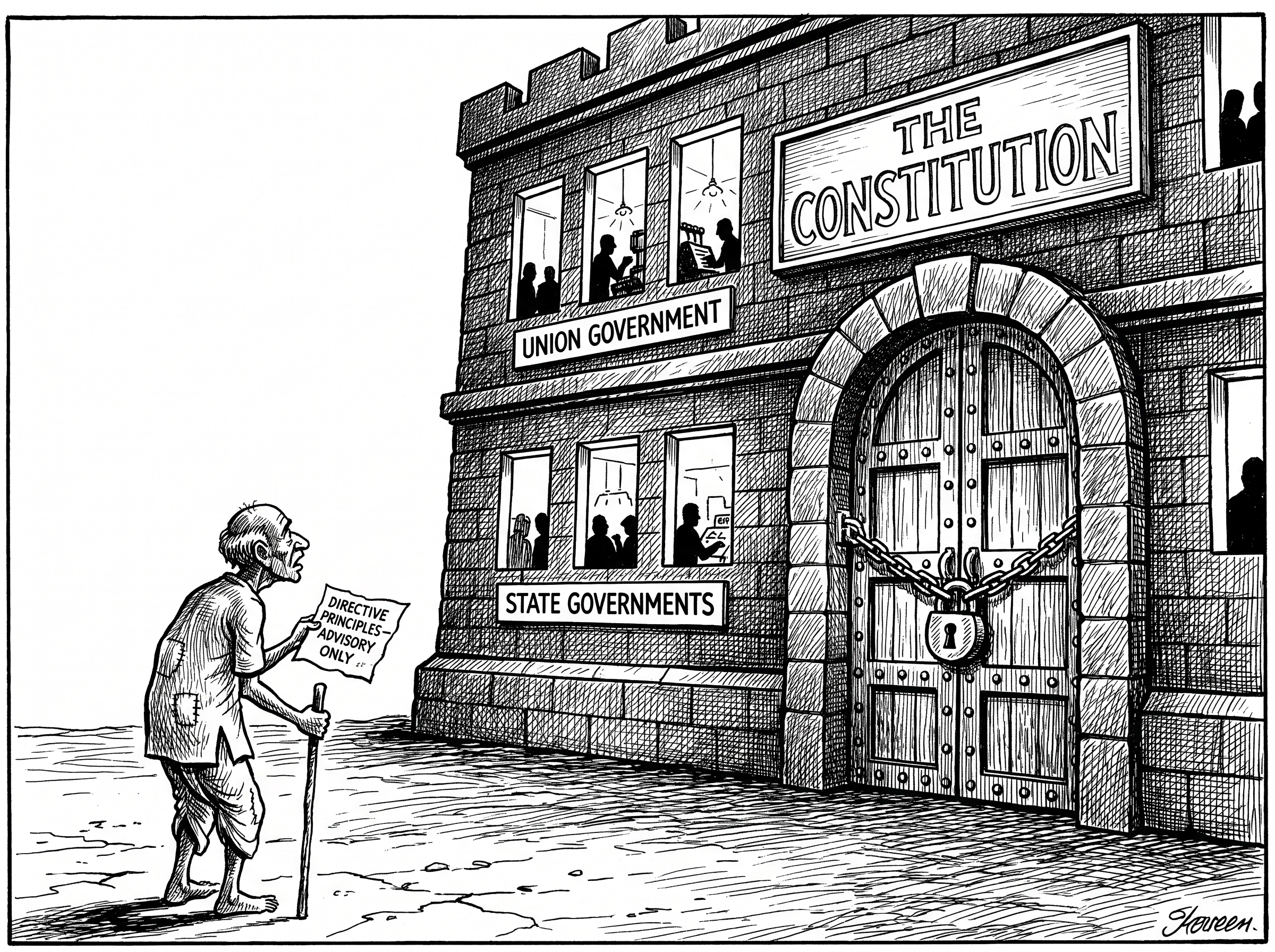
Fig. 8.0 – The village outside the Constitution’s structure.
Discuss: What is the cartoonist saying about the place of local government in the Constitution as it was originally written?
8.1 Introduction
In a democracy, it is not enough to have an elected government at the centre and an elected government in each State. It is also necessary that at the local level — the village, the town, the district — there should be an elected government to look after local affairs.
You already know two of these levels. The Union government sits in New Delhi and legislates for the country as a whole. Each State government legislates for its own State from its own capital. Neither of them sits anywhere near the street you live on.
This chapter is about a third level, the one closest to where people actually live, and the one where roads, drinking water, drains, schools and street lights are looked after day by day.
What This Chapter Will Do
You will study the structure of local government in our country. You will study why local government matters, and how it can be given powers of its own instead of merely carrying out what the levels above it decide.
By the end of the chapter you will know:
- why local government bodies are important;
- what provisions the 73rd and 74th amendments to the Constitution made; and
- what functions and responsibilities local government bodies carry.
8.2 Why Local Governments?
Begin with two women and two villages, a thousand kilometres apart. Both stories were reported in Panchayati Raj Update, a newsletter that follows the working of village councils across India. Read them first as they were printed, and then ask what they show.
Two Stories From Two Villages
The first comes from Jamonia Talab, in Sehore district of Madhya Pradesh. A Gram Panchayat is the elected council of a village or a group of villages, and its elected head is called the Sarpanch. Some seats in these councils are set aside — reserved — for particular groups, so that people who rarely won elections earlier get in. Keep that word ‘reserved’ in view as you read; the story turns on it.
Notice the sequence. In 1995 Geeta Rathore won a seat that had been reserved. In 2000 she won again — this time on a seat open to anyone, competing without that protection. The village had watched her work and returned her on her record.
Notice also the range of what she did. Water tanks, a school building, village roads, afforestation and water management are the ordinary business of a village council. Fighting domestic violence and atrocities against women is not something any law obliged her to take up. She chose it, and she had a platform from which to act.
The second story is about land. When a State government allots land, the papers move through the office of the District Collector — the senior official in charge of a district’s administration. A Gram Panchayat, meanwhile, is an elected body with its own standing in that same area. What happens when the two disagree?
Walk through what happened, because the language is legal and the steps matter. The Collector, acting on instructions from higher authorities, told the Gram Panchayat to pass a resolution approving an allotment that had, in his words, already been decided. The council was being asked to rubber-stamp a decision taken elsewhere.
It refused. The Collector then ordered the land to be acquired anyway. The Gram Panchayat filed a writ petition — a formal request to a High Court to examine whether an official has acted beyond his legal power — in the Madras High Court.
It lost the first round. A case in a High Court is first heard by a single judge; an appeal against that judge goes to a Division Bench, a bench of two or more judges of the same court. The single judge held that the Collector was within his rights and that the Panchayat’s consent was not required. On appeal, the Division Bench reversed him. The government’s order, the judges held, infringed the powers of Panchayats and gravely violated their constitutional status.
Both these stories are not isolated incidents. They are representative of a larger transformation taking place across India, especially after constitutional status was given to local government institutions in 1993. What that status is, and how it arrived, is the business of the rest of this chapter.
Reading The Two Stories Honestly
Before going further, ask what these two extracts can and cannot tell you. Both come from the same publication, Panchayati Raj Update, which exists to follow and encourage the working of Panchayati Raj. A newsletter devoted to a cause is far more likely to print the village that succeeded than the thousands that did not. Two successes are evidence that success is possible. They are not evidence that it is common.
The extracts are also silent on what these two women faced inside their own councils. There are places where male members of a village panchayat harass a woman Sarpanch, and where men resent women taking positions of responsibility. Why that resentment exists is worth thinking about, and neither story here tells you. A source records what happened in one place; it cannot report the places it never visited.
What Local Government Is
Local government is government at the village and district level. It is government closest to the common people, dealing with the day-to-day life and problems of ordinary citizens.
Behind it lies a claim about knowledge. Local knowledge and local interest are essential ingredients of democratic decision making, and they are necessary for efficient, people-friendly administration too. The people of a village know which pond has silted up and which lane floods; a file in the State capital does not.
The advantage of local government is that it is so near the people. It is convenient for people to approach it, and their problems can be solved quickly and at minimum cost — no long journeys, no waiting on distant offices.
Both stories show this. Geeta Rathore brought a significant change to Jamonia Talab because of her pro-active role as Sarpanch of the Gram Panchayat. Vengaivasal still retains its land, and the right to decide what to do with it, because of the relentless efforts of its Gram Panchayat President and members. Local governments, then, can be very effective in protecting the local interests of the people.
Participation And Accountability
Democracy is about meaningful participation — ordinary people taking an active part in decisions, not merely voting once in five years. It is also about accountability, which means that those who hold power must answer for what they do and can be called to account by the people they serve.
Strong and vibrant local governments deliver both. Geeta Rathore’s story is one of committed participation. Vengaivasal’s fight to secure its rights over its own land was a mission to ensure accountability — a demand that officials justify a decision instead of merely announcing it.
It is at the level of local government that common citizens can be involved in decisions concerning their lives, their needs and, above all, their development.
Why This Strengthens Democracy
It is necessary in a democracy that tasks which can be performed locally should be left in the hands of local people and their representatives. This is a principle about where a decision belongs, not merely about convenience.
Common people are more familiar with their local government than with the government at the State or national level. They are also more concerned with what it does, or has failed to do, because its work has a direct bearing on their day-to-day life. A citizen who never writes to a minister will still stop the Sarpanch on the road.
Strengthening local government, therefore, is like strengthening democratic processes themselves. It multiplies the number of people who take part, and the number of decisions that can be argued about in public.
8.3 Growth Of Local Government In India
Let us now discuss how local government grew in India, and what our Constitution says about it. The story runs from village assemblies in the distant past, through British-era boards, into the arguments of the Constituent Assembly — and it does not end where you might expect.
Village Assemblies And Panchayats
It is believed that self-governing village communities existed in India from the earliest times, in the form of ‘sabhas’ — village assemblies. In the course of time these village bodies took the shape of Panchayats, which literally means an assembly of five persons, and these Panchayats resolved issues at the village level.
Their role and functions kept changing at different points of time. This matters. A panchayat of the past is not the same institution as the elected council you read about in the last section, and the older ones were not elected at all.
That difference is worth pausing on. A village body that nobody votes for is likely to be dominated by the village elders, the rich, and men from the upper strata of society — the people who already hold power in the village. Antiquity is not, by itself, an argument for democracy.
The Local Boards Of British India
In modern times, elected local government bodies were created after 1882. Lord Rippon, who was the Viceroy of India at that time — the British Crown’s chief representative, governing India from Delhi — took the initiative in creating these bodies. They were called the local boards.
Progress was slow. The Indian National Congress urged the government to take the necessary steps to make all local bodies more effective. Following the Government of India Act 1919, village panchayats were established in a number of provinces, and this trend continued after the Government of India Act of 1935.
Gandhi And The Case For Decentralisation
During India’s freedom movement, Mahatma Gandhi strongly pleaded for the decentralisation of economic and political power — the transfer of power from a single high authority downwards, to smaller units closer to the people. He believed that strengthening village panchayats was a means of effective decentralisation.
His reasoning was practical as well as moral. All development initiatives must have local involvement in order to be successful. Panchayats were therefore looked upon as instruments of decentralisation and of participatory democracy, in which citizens themselves take part in decisions rather than only choosing someone to take decisions for them.
There was also a hard political memory behind this. Our national movement was troubled by the enormous concentration of powers in the hands of the Governor General sitting at Delhi — the head of the colonial administration, answerable not to Indians but to Britain. For our leaders, therefore, independence meant an assurance that decision making, executive and administrative powers would be decentralised.
Gandhi put the idea in an image that is easier to remember than any definition.
Read the picture carefully, because the argument is in the picture. An ordinary pyramid rests its weight on the bottom and is commanded from the apex. Gandhi inverts the direction of authority: the apex is sustained by the bottom. Power flows upward from villages that manage their own affairs, and the national government is what those circles finally add up to.
Two claims are packed in here. One is that a village can be self-sustained and capable of managing its affairs. The other is that it should be. The extract asserts both and argues for neither, which is what a rousing statement of principle does. It tells you what Gandhi wanted; it cannot tell you whether Indian villages, as they actually were in 1947, could carry the weight he wished to place on them. That question was about to be put to the Constituent Assembly.
What The Constitution Did — And Did Not Do
When the Constitution was prepared, the subject of local government was assigned to the States. It was also mentioned in the Directive Principles, as one of the policy directives addressed to all governments in the country.
As you read in Chapter 2, the Directive Principles of State Policy are non-justiciable: a citizen cannot go to a court to have them enforced. This provision was therefore primarily advisory in its nature. It told the States what they ought to do about local government. It did not require them to do it.
Why The Village Was Left Out
It is felt that the subject of local government, including panchayats, did not receive adequate importance in the Constitution. Why did this happen? A few reasons can be advanced.
Firstly, the turmoil caused by the Partition produced a strong unitary inclination in the Constitution — a pull towards a strong centre holding the country together. Nehru himself looked upon extreme localism as a threat to the unity and integration of the nation.
Secondly, a powerful voice in the Constituent Assembly, led by Dr B.R. Ambedkar, held that the faction- and caste-ridden nature of rural society would defeat the noble purpose of local government at the rural level. On this view, handing power to the village would not hand it to the villagers; it would hand it to whoever already dominated the village.
However, nobody denied the importance of people’s participation in development planning. Many members of the Constituent Assembly wanted Village Panchayats to be the basis of democracy in India, but they were concerned about factionalism and many other ills present in the villages.
One of those members was Ananthasayanam Ayyangar, speaking in the Assembly in November 1948.
Fig. 8.1 – Ananthasayanam Ayyangar.
Notice how carefully this is phrased. Ayyangar does not say the villages are ready for self-government; he says they may be trained in it. He does not say the village is already democratic; he says democratic principles must be introduced there, and that the village must be reformed.
This is a position between Gandhi’s and Ambedkar’s, and it accepts something from each. The village should govern itself — but not as it stands. Yet the extract is one short passage from one speech in a long debate. It records what one member said on one afternoon. It cannot tell you how many members agreed with him, or how the Assembly finally voted, and a single quotation should never be read as the view of a whole house.
8.3.1 Local Governments In Independent India
Local governments got a fillip — a push forward — after the 73rd and 74th Constitution Amendment Acts. But even before that, some efforts in the direction of developing local government bodies had already taken place.
The First Four Decades
First in the line was the Community Development Programme in 1952, which sought to promote people’s participation in local development across a range of activities. Against this background, a three-tier Panchayati Raj system of local government was recommended for the rural areas: a council at the village, an intermediate level above it, and a district body at the top.
Some States, such as Gujarat and Maharashtra, adopted the system of elected local bodies around 1960. But in many States those local bodies did not have enough powers and functions to look after local development. They were very much dependent on the State and central governments for financial assistance — a body that cannot raise its own money must ask, and a body that must ask can be refused.
Many States did not think it necessary to establish elected local bodies at all. In many instances local bodies were dissolved and the local government was handed over to government officers, who are appointed and are not answerable to any village electorate. Many States held indirect elections to most local bodies, meaning the members were chosen by other elected representatives rather than by the people directly. And in many States, elections to local bodies were simply postponed from time to time.
Read that list again and notice what it adds up to. Every one of these was legal. Nothing in the Constitution stopped a State from dissolving a council or delaying an election, because the Constitution had only advised, and advice cannot be enforced in a court.
Factions — Always A Bad Thing?
The fear of factionalism ran through all of this, and it deserves a hard look. Political parties have factions. Organisations have factions. Even a school class divides into groups. Why, then, is factionalism at the village level treated as so dangerous?
The chapter’s own answer, from the Constituent Assembly debate, is not that groups are bad in themselves, but that in a village the groups may follow the fault lines of caste and dominance — and a group that already controls land, credit and custom does not compete on equal terms with one that does not. Whether that is a reason to withhold power from villages, or a reason to design village institutions carefully, is a question you can now argue on both sides.
The Review Of 1987 And The Thungon Committee
After 1987, a thorough review of the functioning of local government institutions was initiated. In 1989, the P.K. Thungon Committee recommended constitutional recognition for local government bodies.
Look closely at what it asked for. A constitutional amendment was recommended to provide for periodic elections to local government institutions, and for the enlistment of appropriate functions to them, along with funds. Elections, functions, funds: each of these was precisely what the previous four decades had shown could otherwise be withheld.
8.4 73rd And 74th Amendments
In 1989, the central government introduced two constitutional amendments. These amendments aimed at strengthening local governments, and at ensuring an element of uniformity in their structure and functioning across the country.
That word uniformity deserves attention. Until then, whether a district had an elected council at all depended on which State you lived in. The amendments were an attempt to make the basic shape of local government the same everywhere, so that it could not simply be dropped.
Other federal countries have solved this problem in their own ways.
Later, in 1992, the 73rd and 74th constitutional amendments were passed by Parliament. The 73rd Amendment is about rural local governments, which are also known as Panchayati Raj Institutions or PRIs. The 74th amendment made the provisions relating to urban local government, the Nagarpalikas. The 73rd and 74th Amendments came into force in 1993.
Decentralisation From Above
We noticed earlier that local government is a ‘State subject’ — a matter on which States make their own laws. States were free to legislate on it as they wished.
But once the Constitution itself was amended, the States had to change their laws about local bodies to bring them in conformity with the amended Constitution. They were given one year’s time to make the necessary changes in their respective State laws.
There is something odd about this, and it is worth naming. The centre used a central instrument — an amendment to the Constitution — to compel the States to hand power downwards. Decentralisation was adopted through a centralised process. Whether that is a contradiction or simply the only way it could have been done is a fair question to hold in mind: the previous four decades had shown what many States did when the choice was left to them.
8.4.1 73rd Amendment
Let us now examine the changes brought about by the 73rd amendment in Panchayati Raj institutions.
8.4.1.1 Three Tier Structure
All States now have a uniform three tier Panchayati Raj structure. At the base is the Gram Panchayat, which covers a village or a group of villages.
The intermediary level is the Mandal, also referred to as the Block or the Taluka. These bodies are called Mandal or Taluka Panchayats. This middle body need not be constituted in smaller States, where a village and a district may be close enough not to need a rung between them.
At the apex is the Zilla Panchayat, covering the entire rural area of the District. Note the word ‘rural’: the towns and cities inside that district are governed by a different set of bodies, which the 74th amendment deals with.
The amendment also made a provision for the mandatory creation of the Gram Sabha. The Gram Sabha is not a council of representatives at all. It comprises all the adult members registered as voters in the Panchayat area — the whole electorate of the village, meeting as itself. Its role and functions are decided by State legislation.
So the Gram Sabha is, on paper, the democratic forum of the entire village: the body before which the elected Panchayat can be made to explain itself. Whether Gram Sabhas actually meet regularly, and how many villagers attend when they do, is a separate question — and the Constitution, which can require a body to exist, cannot require people to come.
The three tiers, and the assembly of voters that sits beneath them, are set out in Fig. 8.3.
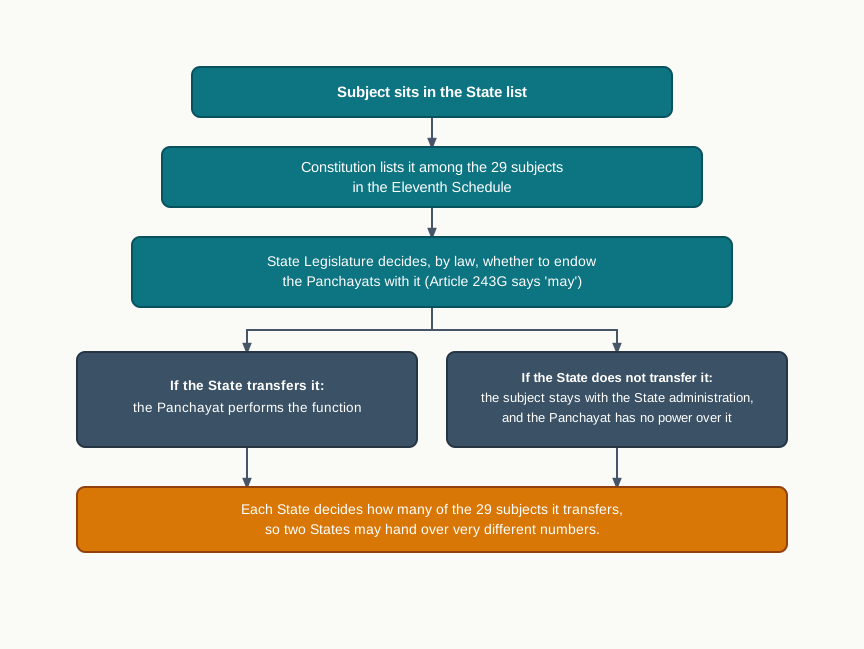
Fig. 8.2 – How a subject reaches a panchayat.
8.4.1.2 Elections
All the three levels of Panchayati Raj institutions are elected directly by the people. The term of each Panchayat body is five years.
If the State government dissolves the Panchayat before the end of its five year term, fresh elections must be held within six months of such dissolution. This is an important provision, because it ensures the continued existence of elected local bodies.
Compare this with what came before. Prior to the 73rd amendment, many States held indirect elections to the district bodies — the members were chosen by other elected representatives, not by the voters. And there was no provision for immediate elections after a dissolution, which meant a dissolved body could simply stay dissolved.
The six-month rule closes that door. A State may still dissolve a Panchayat, but it can no longer replace it with silence.
8.4.1.3 Reservations
One third of the positions in all panchayat institutions are reserved for women. Reservations for Scheduled Castes and Scheduled Tribes are also provided for at all three levels, in proportion to their population. If the States find it necessary, they can also provide for reservations for the other backward classes (OBCs).
It is important to note that these reservations apply not merely to ordinary members in Panchayats but also to the positions of Chairpersons, or Adhyakshas, at all three levels. A body can be full of women members and still be run entirely by men if every chair is a man’s; this provision prevents that.
Further, the reservation of one-third of the seats for women is not merely within the general category of seats. It also applies within the seats reserved for Scheduled Castes, Scheduled Tribes and backward castes. This means a seat may be reserved simultaneously for a woman candidate and for one belonging to the Scheduled Castes or Scheduled Tribes. Thus a Sarpanch would have to be a Dalit woman or an Adivasi woman.
Read that last sentence slowly, because it is doing something unusual. A woman from a Scheduled Caste faces two disadvantages at once, and a reservation for women alone might be filled by women from dominant groups, while a reservation for Scheduled Castes alone might be filled by men. Reserving within the reservation is a design meant to reach the person who would otherwise fall through both nets.
One puzzle is worth carrying with you. A bill for reserving seats for women in the State Assemblies and in Parliament could not be passed. Yet reservation for women in local bodies was accepted, written into the Constitution, and implemented across the country. Why the resistance in one place and not in the other? The chapter does not answer this, and you should notice that it does not.
8.4.1.4 Transfer Of Subjects
Twenty-nine subjects, which were earlier in the State list of subjects, are identified and listed in the Eleventh Schedule of the Constitution. A Schedule is a list attached to the end of the Constitution; the Eleventh Schedule is simply the list of what panchayats may be asked to handle.
These subjects are to be transferred to the Panchayati Raj institutions. They are mostly linked to development and welfare functions at the local level. But the actual transfer of these functions depends upon State legislation. Each State decides how many of these twenty-nine subjects would be transferred to the local bodies.
The Constitution’s own words on this are printed in the chapter, and they repay close reading.
The decisive word is ‘may’. The Legislature of a State may endow the Panchayats with powers. It does not say ‘shall’. The Constitution names the subjects, and then leaves the handing over of them to each State’s own law.
So the Eleventh Schedule is a list of what a panchayat could be given, not a list of what it has. Do not read it as a list of powers. This is the difference between a menu and a meal, and it is the reason the last section of this chapter has to ask how much power local bodies really hold.
Here are some of the subjects the chapter reproduces from that Schedule, with their numbers as they appear in the Constitution:
- Agriculture, …
- Minor irrigation, water management and watershed development.
- Small scale industries, including food processing industries.
- Rural housing.
- Drinking water.
- Roads, culverts,….
- Rural electrification,….
- Poverty alleviation programme.
- Education, including primary and secondary schools.
- Technical training and vocational education.
- Adult and non-formal education.
- Libraries.
- Cultural activities.
- Markets and fairs.
- Health and sanitation, including hospitals, primary health centres and dispensaries.
- Family welfare.
- Women and child development.
- Social welfare, …
- Welfare of the weaker sections, and in particular, of the Scheduled Castes and the Scheduled Tribes.
- Public distribution system.
Look at what is on this list: water, roads, schools, health centres, libraries, the public distribution system through which subsidised food reaches poor households. This is the machinery of ordinary life. It is also, almost entirely, machinery that a village can see working or failing.
Why are only subjects from the State list to be transferred, and not some from the Union List? The Union List holds subjects that the Constitution assigns to Parliament — defence, foreign affairs, currency and the like — matters that must be decided for the country as a whole. The subjects a village can genuinely manage are, by their nature, the ones the State was already handling nearby. The question of whether the boundary is drawn in exactly the right place is one you are free to argue about.
The path from the Schedule to an actual power is traced in Fig. 8.2.
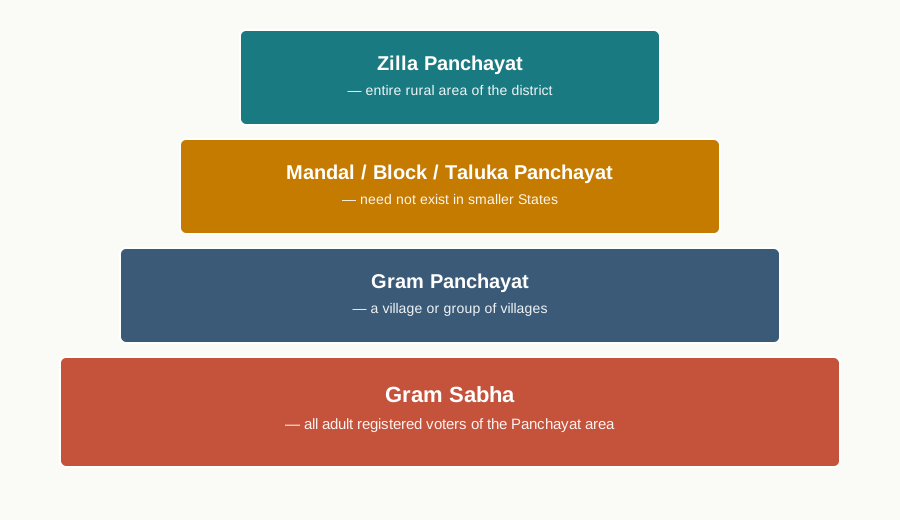
Fig. 8.3 – The three tiers of Panchayati Raj.
The provisions of the 73rd amendment were not made applicable to the areas inhabited by the Adivasi populations in many States of India. In 1996, a separate act was passed extending the provisions of the Panchayat system to these areas.
The reason for treating these areas separately is not neglect but respect for an existing practice. Many Adivasi communities have their own traditional customs of managing common resources such as forests and small water reservoirs. The new act protects the right of these communities to manage their resources in ways acceptable to them.
For this purpose, more powers are given to the Gram Sabhas of these areas, and the elected village panchayats have to obtain the consent of the Gram Sabha in many respects. The idea behind the act is that local traditions of self government should be protected while modern elected bodies are introduced. That is only consistent with the spirit of diversity and decentralisation.
8.4.1.5 State Election Commissioners
The State government is required to appoint a State Election Commissioner, who is responsible for conducting elections to the Panchayati Raj institutions.
Earlier, this task was performed by the State administration, which was under the control of the State government. That is a plain conflict of interest: the government of the day was, in effect, running the elections in which its own party’s candidates were standing.
Now the office of the State Election Commissioner is autonomous, like the Election Commissioner of India — able to take decisions without instructions from the government that appointed the holder. However, the State Election Commissioner is an independent officer and is neither linked to, nor under the control of, the Election Commission of India, which conducts elections to Parliament and the State legislatures.
8.4.1.6 State Finance Commission
The State government is also required to appoint a State Finance Commission once in five years. This Commission examines the financial position of the local governments in the State.
It also reviews the distribution of revenues between the State and local governments on the one hand, and between rural and urban local governments on the other. This innovation ensures that the allocation of funds to rural local governments will not be a political matter — not something a minister can grant to a friendly district and withhold from an unfriendly one.
One objection arises immediately. State governments are themselves short of money, and they ask the central government for funds. How can they then give money to local governments? Notice, though, what the Commission actually does. It does not create new money. It reviews how the money that already flows through a State is divided — and the question of how a small pool is shared is exactly the question that gets settled politically if nobody settles it by rule.
8.4.2 74th Amendment
As mentioned earlier, the 74th amendment dealt with urban local bodies, or Nagarpalikas.
What Counts As Urban
What is an urban area? It is very easy to identify a big city like Mumbai or Kolkata. It is not so easy to say this about some very small urban areas that are somewhere between a village and a town.
The Census of India — the count of the entire population carried out every ten years — settles the matter with three tests. An urban area must have: (i) a minimum population of 5,000; (ii) at least 75 per cent of the male working population engaged in non-agricultural occupations; and (iii) a density of population of at least 400 persons per sq. km.
Read the tests together and you can see the reasoning. A place is urban if enough people live there, if they are packed closely enough, and if they have largely stopped farming for a living. As per the 2011 Census, about 31% of India’s population lives in urban areas.
The Same Design, Applied To Towns
In many ways the 74th amendment is a repetition of the 73rd amendment, except that it applies to urban areas. All the provisions of the 73rd amendment relating to direct elections, reservations, transfer of subjects, the State Election Commission and the State Finance Commission are incorporated in the 74th amendment also, and thus apply to Nagarpalikas.
The Constitution also mandated the transfer of a list of functions from the State government to the urban local bodies. These functions have been listed in the Twelfth Schedule of the Constitution — the urban counterpart of the Eleventh.
Because the two amendments share a design, students often blur them. Table 8.A1 sets the difference out, but read it only after you have understood the paragraphs above: the grid is a way of remembering an argument you have already followed, not a substitute for following it.
The hopes attached to the urban amendment were as concrete as those attached to the rural one. Can an elected town body do something about housing for people living in slums, or at the very least provide them with toilets? That is precisely the kind of question the 74th amendment was meant to give someone the power, and the duty, to answer.
8.5 Implementation Of 73rd And 74th Amendments
All States have now passed a legislation to implement the provisions of the 73rd and 74th amendments. That much the Constitution could compel, and it did.
During the ten years since these amendments came into force (1994-2004), most States have had at least two rounds of elections to the local bodies. States like Madhya Pradesh, Rajasthan and a few others have in fact held three elections so far. Elections that States once postponed at will are now held on time.
The people of the villages had their own way of stating what they expected from all this.
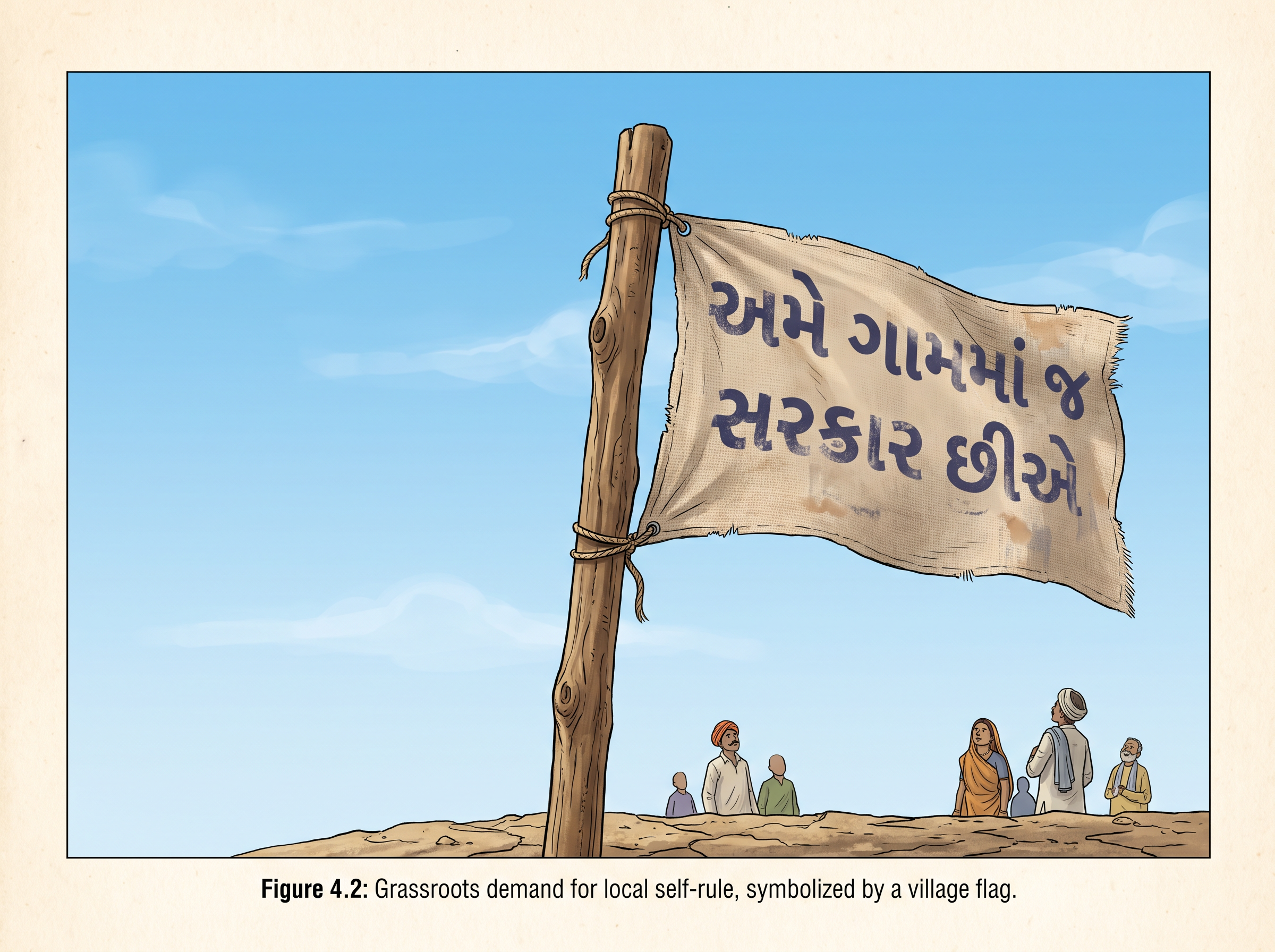
Fig. 8.4 – A village flag demanding local self-government.
This flag is a symbol of the expectations of the people about local governments. People do not want only formal laws; they want the genuine implementation of those laws. A law that creates a council is not the same thing as a village that governs itself, and the villagers who made this flag knew the difference.
The Sheer Scale Of It
Begin with the numbers, because the scale of what was built is easy to miss.
Today there are more than 600 Zilla Panchayats, about 6,000 block or intermediary Panchayats, and 2,40,000 Gram Panchayats in rural India. In urban India there are over 100 city Corporations, which govern the largest cities, 1400 town Municipalities for smaller towns, and over 2000 Nagar Panchayats for the smallest urban settlements.
More than 32 lakh members are elected to these bodies every five years. Of these, at least 13 lakhs are women.
Now set that against the levels above. In the State Assemblies and Parliament put together, we have fewer than 5000 elected representatives. With local bodies, the number of elected representatives in India has increased significantly — the country now elects several hundred times more people at the local level than at the State and national levels combined.
The 73rd and 74th amendments have created uniformity in the structures of Panchayati Raj and Nagarpalika institutions across the country. The presence of these local institutions is by itself a significant achievement. It creates an atmosphere and a platform for people’s participation in government — a place where an ordinary citizen can stand for office, and a body an ordinary citizen can hold to account.
Women In The Local Bodies
The provision for reservation for women at the Panchayats and Nagarpalikas has ensured the presence of a significant number of women in local bodies. Because this reservation also applies to the positions of Sarpanch and Adhyaksha, a large number of women have come to occupy those chairs, and not merely seats in the room.
The figures the chapter gives are these. There are at least 200 women Adhyakshas in Zilla Panchayats. Another 2000 women are Presidents of block or taluka panchayats. More than 80,000 women are Sarpanchas in Gram Panchayats.
In the urban bodies the pattern repeats. We also have more than 30 women Mayors in Corporations — a Mayor heads a city Corporation — over 500 women Adhyakshas of Town Municipalities, and nearly 650 Nagar Panchayats headed by women.
What has this done to the women themselves? They have gained more power and confidence by asserting control over resources. Their presence in these institutions has given many women a greater understanding of the working of politics. In many cases they have brought a new perspective and a greater sensitivity to the discussions at local bodies.
The chapter is careful not to stop there, and neither should you. In many cases women were unable to assert their presence, or were mere proxies — they held the office in name while the male members of their family, who had sponsored their election, took the decisions. Such instances, however, are becoming fewer.
Local government is not only what its laws say; it is also what the newspapers report of it.
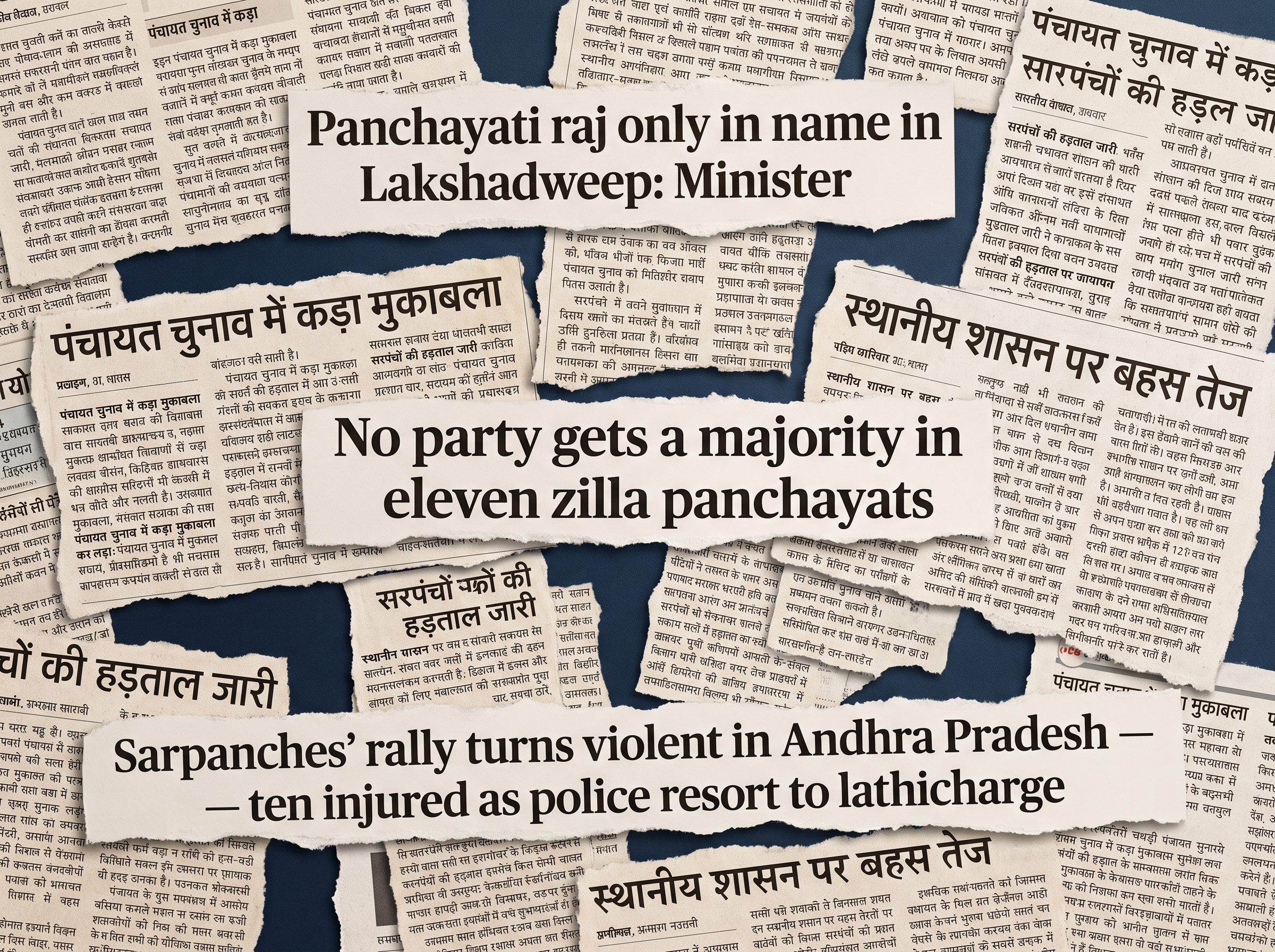
Fig. 8.5 – Newspaper reports on the working of local governments.
Read across those headlines and you get a rough map of local government at work. A minister says Panchayati Raj exists only in name in one place. A round of zilla panchayat results leaves no party with a majority in eleven districts — local elections are now fought by parties, and fought hard. Elected Sarpanches march in a State capital with demands, and the police use force against them.
Then ask what a page of clippings cannot tell you. Newspapers report the rally that turned violent, not the thousand Gram Panchayats that met that week and dispersed quietly. Conflict is news; routine is not. These clippings are evidence that local government has become worth fighting over. They are not a measure of how well it usually works.
Here is a photograph of the ordinary kind of meeting that rarely makes a headline.
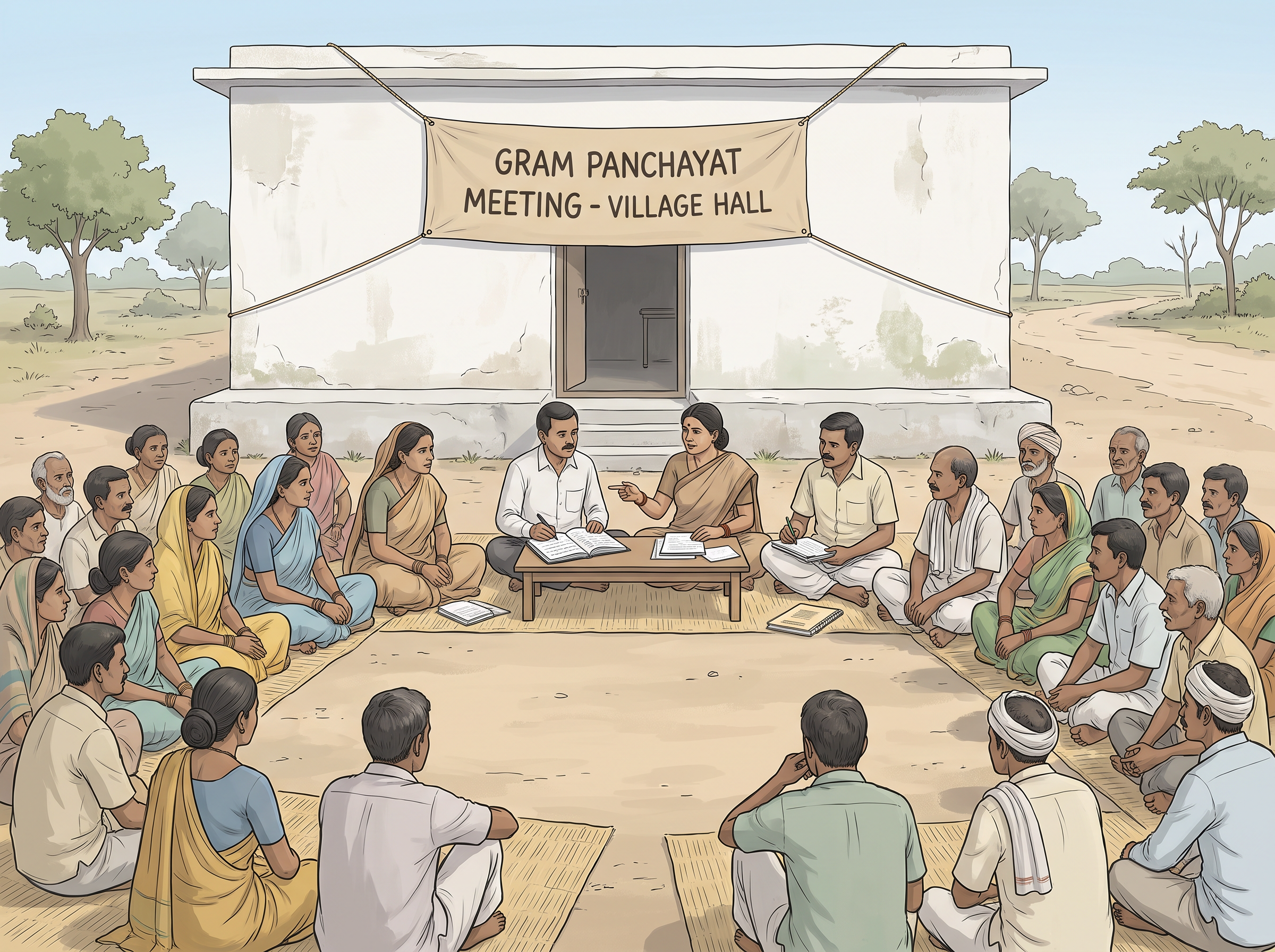
Fig. 8.6 – A local Gram Panchayat meeting.
Look carefully before you answer the question below. Notice who is seated where, who sits at the centre with the papers, and who sits at the edges with their backs to the camera.
Power On Paper, Power In Practice
The constitutional amendments assigned as many as 29 subjects to the local governments, all of them linked to local welfare and development needs. So what has the experience of the past decade shown?
It has shown that local governments in India enjoy limited autonomy — limited freedom to act on their own judgement — in performing the functions assigned to them. Many States have not transferred most of the subjects to the local bodies. This means the local bodies cannot really function in an effective manner.
Follow that to its conclusion, because it is uncomfortable. If an elected body has no subjects to decide upon, then the entire exercise of electing so many representatives becomes somewhat symbolic. Some people therefore criticise the formation of local bodies, because it has not changed the way in which decisions are taken at the central and the State level. People at the local level do not enjoy much power of choosing welfare programmes or of allocating resources.
Is this the gap between theory and practice that people speak of? It is, and it is worth being precise about where the gap lies. The law is not weak in what it establishes — elections, tiers, reservations, commissions. It is weak in what it leaves to the goodwill of States: the subjects, and the money.
Other countries have closed that second gap by rule rather than by goodwill.
Notice the word ‘automatic’ in the Bolivian law. The share is fixed by rule and arrives by formula, so it does not have to be requested, negotiated or granted. Compare that with the Indian position.
Local bodies here have very little funds of their own. Their dependence on the State and central governments for financial support has greatly eroded their capacity to operate effectively.
The two figures the chapter gives make the point sharply. Rural local bodies raise \(0.24\%\) of the total revenues collected in the country, but they account for \(4\%\) of the total expenditure made by the government. Here, revenue raised means money the body itself collects, and expenditure means money it spends. They earn far less than they spend — and the difference has to come from somewhere. It comes as grants, and a body that lives on grants is dependent on whoever gives them.
8.5.1 Conclusion
This experience suggests that local governments continue to be agencies implementing the welfare and development schemes of the central and State governments. They carry out what is decided elsewhere.
Giving more power to local government means that we should be prepared for the real decentralisation of power. Ultimately, democracy means that power should be shared by the people. People in the villages and in urban localities must have the power to decide what policies and programmes they want to adopt — not merely to administer the ones sent to them.
As you have studied earlier, democracy means the decentralisation of power, and giving more and more power to the people. The laws about local governments are an important step in the direction of democratisation.
But the true test of democracy is not merely in the legal provisions. It is in the practice of those provisions.
8.6 Summary
The Chapter In Short
- In a democracy, elected government at the centre and in the States is not enough. Local affairs need an elected government too.
- Local government is government at the village and district level — the government closest to the day-to-day life of ordinary citizens.
- Its case rests on local knowledge, easy access, low cost, meaningful participation and real accountability.
- Village assemblies, or ‘sabhas’, are believed to have existed from the earliest times, and later took the shape of Panchayats. These bodies were not elected.
- Elected local boards were created after 1882 on the initiative of Lord Rippon. Village panchayats spread after the Government of India Acts of 1919 and 1935.
- Mahatma Gandhi pleaded for decentralisation, holding that independence must begin at the bottom and that every village should be a republic.
- The Constitution made local government a State subject and mentioned it only in the Directive Principles — non-justiciable, and therefore advisory.
- Two objections lay behind this: Nehru’s fear that extreme localism threatened national unity, and Ambedkar’s fear that faction- and caste-ridden villages would be captured by the dominant.
- The Community Development Programme of 1952 and the elected bodies adopted by States like Gujarat and Maharashtra around 1960 did not fix the problem. Many States gave local bodies no powers, no funds, indirect elections, or no elections at all.
- The P.K. Thungon Committee recommended constitutional recognition in 1989 — periodic elections, listed functions, and funds.
- Parliament passed the 73rd and 74th amendments in 1992. They came into force in 1993, and States were given one year to change their own laws.
- The 73rd amendment created a uniform three tier structure — Gram Panchayat, Mandal or Taluka Panchayat, Zilla Panchayat — and made the Gram Sabha of all adult voters mandatory.
- All three levels are directly elected for five years. If a Panchayat is dissolved early, fresh elections must be held within six months.
- One third of positions are reserved for women, including the chairpersons; Scheduled Castes and Scheduled Tribes are reserved for in proportion to population, and States may reserve for OBCs.
- Twenty-nine subjects are listed in the Eleventh Schedule, but Article 243G says a State legislature may endow Panchayats with them. The actual transfer depends on State law.
- A separate act in 1996 extended the Panchayat system to Adivasi areas, giving greater powers to their Gram Sabhas and protecting traditional ways of managing common resources.
- Each State must appoint an autonomous State Election Commissioner, and a State Finance Commission once in five years.
- The 74th amendment applies the same design to urban areas and the Nagarpalikas, with functions listed in the Twelfth Schedule.
- Implementation has been real in one sense: more than 32 lakh members are elected every five years, at least 13 lakhs of them women, against fewer than 5000 representatives in Parliament and all State Assemblies together.
- The social profile of local bodies has changed, which has brought both new representation and new conflict with groups that held power earlier.
- But most States have not transferred the subjects, and rural local bodies raise only 0.24% of revenues while accounting for 4% of expenditure. Their autonomy remains limited.
- The true test of democracy lies not in the legal provisions but in the practice of those provisions.
The Chapter’s Chronology
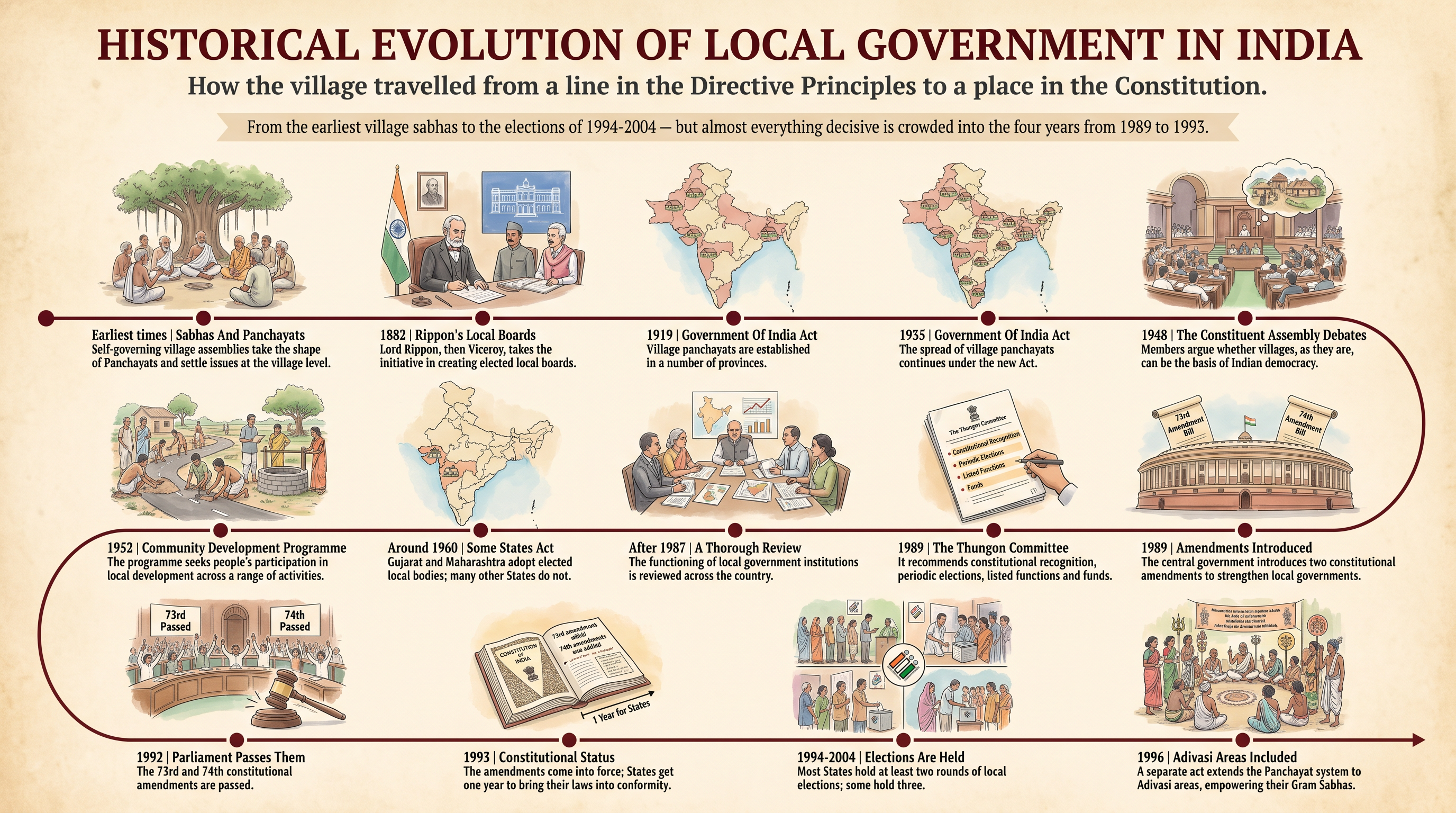
Fig. 8.7 – Local Government In India.
What Remains Contested
The Constitution can compel a State to hold an election. It has not compelled any State to hand over the twenty-nine subjects or the money — and until it does, whether an elected Panchayat is a government or an agency remains an open question.
Ambedkar’s warning has never been fully answered either. Reservation has changed who sits in these bodies, but whether power inside a village has actually moved, or only the seating, is something the chapter’s own figures cannot settle.
And notice whose voice is missing from the evidence you have read. A newsletter reported two successful women. Newspapers reported a violent rally and a hung zilla panchayat. Nobody wrote up the Gram Sabha that was never called, or the villager who stayed silent in it.
8.7 NCERT Questions
Constitution of India visualised village panchayats as units of self-government. Think over the situation described in the following statements and explain how do these situations strengthen or weaken the panchayats in becoming units of self-government.
- Government of a State has allowed a big company to establish a huge steel plant. Many villages would be adversely affected by the steel plant. Gram Sabha of one of the affected villages passed a resolution that before establishing any big industries in the region, village people must be consulted and their grievances should be redressed.
- The government has decided that 20 % of all its expenditure would be done through the panchayats.
- A village panchayat kept on demanding funds for a building for village school, the government officials turned down their proposal saying that funds are allocated for certain other schemes and cannot be spent otherwise.
- The government divided a village Dungarpur into two and made a part of village Jamuna and Sohana. Now village Dungarpur has ceased to exist in government’s books.
- A village panchayat observed that water sources of their region are depleting fast. They decided to mobilise village youth to do some voluntary work and revive the old village ponds and wells.
Suppose you are entrusted to evolve a local government plan of a State, what powers would you endow to the village panchayats to function as units of self-government? Mention any five powers and the justification in two lines for each of them for giving those powers.
What are the provisions for the reservations for the socially disadvantaged groups as per the 73rd amendment? Explain how these provisions have changed the profile of the leadership at the village level.
What were the main differences between the local governments before 73rd amendment and after that amendment?
Read the following conversation. Write in two hundred words your opinion about the issues raised in this conversation. Alok: Our Constitution guarantees equality between men and women. Reservations in local bodies for women ensure their equal share in power. Neha: But it is not enough that women should be in positions of power. It is necessary that the budget of local bodies should have separate provision for women. Jayesh: I don’t like this reservations business. A local body must take care of all people in the village and that would automatically take care of women and their interests.
Read the provisions of the 73rd Amendment. Which of the following concerns does this amendment address?
- Fear of replacement makes representatives accountable to the people.
- The dominant castes and feudal landlords dominate the local bodies.
- Rural illiteracy is very high. Illiterate people cannot take decisions about the development of the village.
- To be effective the village panchayats need resources and powers to make plans for the village development.
The following are different justifications given in favour of local government. Give them ranking and explain why you attach greater significance to a particular rationale than the others. According to you, on which of these rationales the decision of the Gram panchayat of Vengaivasal village was based? How?
- Government can complete the projects with lesser cost with the involvement of the local community.
- The development plans made by the local people will have greater acceptability than those made by the government officers.
- People know their area, needs problems and priorities. By collective participation they should discuss and take decisions about their life.
- It is difficult for the common people to contact their representatives of the State or the national legislature.
Which of the following according to you involve decentralisation? Why are other options not sufficient for decentralisation?
- To hold election of the Gram Panchayat.
- Decision by the villagers themselves about what policies and programmes are useful for the village.
- Power to call meeting of Gram Sabha.
- A Gram Panchayat receiving the report from the Block Development Officer about the progress of a project started by the State government.
8.8 Check Your Concepts
What three tests does the Census of India use to decide whether a place is an urban area? Why is such a rule needed at all, when a city like Mumbai is obvious to everyone?
What is a Gram Sabha, and who belongs to it? Explain how it differs from a Gram Panchayat, and why the 73rd amendment made its creation mandatory.
Look again at Source 8.5. Article 243G says that the Legislature of a State ‘may’ endow the Panchayats with powers with respect to the matters listed in the Eleventh Schedule. Explain why that one word decides how much power a panchayat actually holds.
Read Source 8.3 and Source 8.4 together. Both speakers favour village self-government, yet they say different things about the village as it actually is. What is that difference, and why does it matter?
Local government was placed in the Directive Principles rather than made enforceable. Trace the chain of consequences that followed from this single decision, up to the year 1992.
Rural local bodies raise 0.24% of the total revenues collected, but account for 4% of the total expenditure made by the government. Explain what this gap does to their independence, and how a State Finance Commission is meant to help.
Why was a separate act passed in 1996 for the Adivasi areas, instead of simply applying the 73rd amendment to them? What does the chapter say this act protects, and how does it change the position of the Gram Sabha?
Fig. 8.5 reproduces newspaper reports about local governments. What kinds of things about local government do such reports show well, and what are they unlikely ever to record? Explain why this matters when you use them as evidence.