Chapter 3: Election And Representation
It is counting day in a constituency somewhere in India. The hall is full of long tables, sealed machines and tired officials. Four candidates are in the race. Their agents sit on plastic chairs, watching every number that goes up on the board.
The counting ends by mid-afternoon. The first candidate has 31 out of every 100 votes. The second has 29. The third has 22. The fourth has 18. Nobody in that hall is surprised by the announcement that follows: the first candidate is declared elected and will sit in Parliament for the next five years.
Now look at the same numbers again. Sixty-nine voters out of every hundred did not want that candidate. They chose somebody else. Their votes were counted, recorded, and then, in effect, set aside — because in our system only the leading candidate wins the seat, and the votes given to everyone else earn no seat at all.
Was anything unfair done here? Not one rule was broken. The machines worked. The officials were honest. The count was accurate. And still, the person who will speak for this constituency was the first choice of fewer than one voter in three.
That is not an accident. It is a rule — a rule chosen deliberately, written into our Constitution, and defended by the people who wrote it. This chapter asks why.
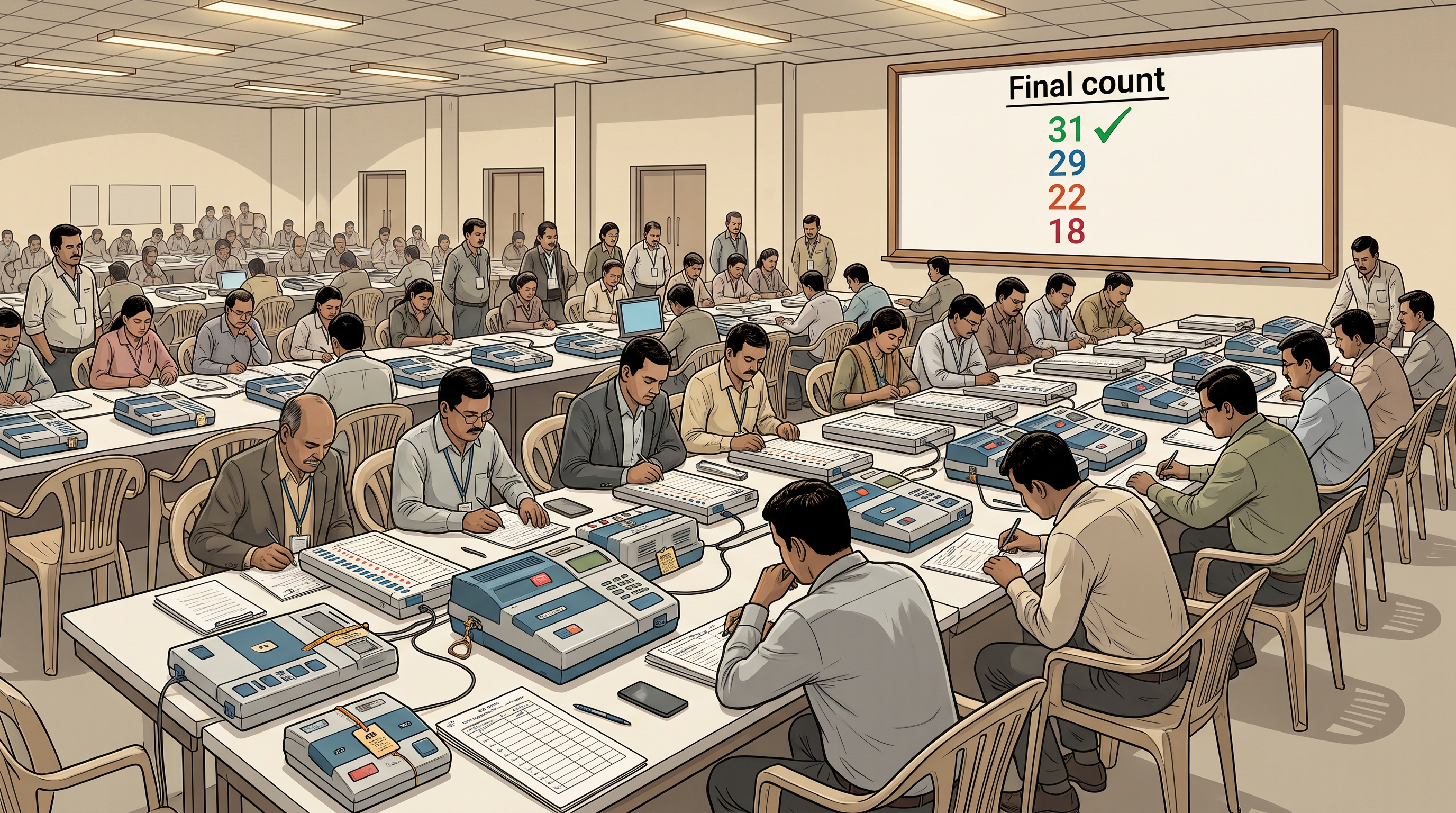
Fig. 3.0 – Vote counting in an Indian election constituency.
3.1 Introduction
Have you ever played chess? Imagine that in the middle of a game, the black knight suddenly began moving straight ahead instead of two and a half squares. Or imagine a cricket match played with no umpires at all. In either case, something more than the game would collapse. The result itself would stop meaning anything.
Every sport runs on two things. It runs on rules, and it runs on an impartial umpire whose decisions the players accept even when the decision goes against them. Change the rules and the outcome of the game changes with them. Take away the umpire and the strongest player simply decides what happened.
The Rules Come First
Notice when the rules and the umpire are agreed upon. They are settled before the first ball is bowled, not after. Nobody would accept a match in which the winning side got to choose the rules once it had already won.
What is true of a game is also true of elections. There are different rules, and different systems, for conducting elections. The outcome of an election depends on which of those rules a country has adopted. And elections, like games, need machinery — some authority to run them in an impartial manner.
Both of these decisions have to be taken before the game of electoral politics begins. That is exactly why they cannot be left to any government. A government is itself one of the players in the contest. If it could write the rules and appoint the umpire, it would be playing and refereeing the same match.
So the basic decisions about elections are written down in the constitution of a democratic country — the country’s highest law, which no ordinary government can rewrite at will. Putting them there takes them out of the reach of whoever happens to hold power this year.
What This Chapter Will Do
In this chapter we shall study the provisions our Constitution makes about elections and representation. We shall look closely at the method of election it chose, and at why that choice matters so much.
We shall also study the provisions meant to give India an impartial machinery for conducting elections. Finally, we shall look at the suggestions that have been made for amending these constitutional provisions — because the choices made in the 1940s have not gone unchallenged since.
By the end of the chapter, you should understand:
- different methods of election;
- the characteristics of the system of election adopted in our country;
- the importance of the provisions for free and fair elections; and
- the debate on electoral reforms.
Keep the chess board in mind as you read. Every rule in this chapter was picked out of several possible rules, by people who knew perfectly well that a different choice would have produced a different India.
3.2 Elections And Democracy
Before we look at what our Constitution says, it is worth asking two very simple questions about elections and democracy. They sound almost too simple. They are not.
Discuss both of these in class, using examples from whatever you have already learnt in earlier years. Do not rush to a yes or a no. Try to describe an actual country, or an actual situation, that would fit each answer.
What The First Question Teaches
The first question reminds us why representation is necessary in a large democracy. All the citizens of a country cannot take direct part in making every decision. There are simply too many of them, and far too many decisions. So the people choose representatives, and elections become the way they choose.
Whenever we think of India as a democracy, our mind turns almost at once to the last elections. Elections have become the most visible symbol of the democratic process — the part of it you can actually see happening, in queues outside polling booths and in results on a screen.
It helps to distinguish two kinds of democracy here. A direct democracy is one where the citizens themselves take part in day-to-day decision-making and in the running of the government. The ancient city-states of Greece — small self-governing towns of the ancient Mediterranean world — are usually offered as examples of it.
In India, many would say the closest thing we have to direct democracy is local government, and especially the gram sabha, the assembly of all the adult voters of a village, which meets to discuss and approve what the village panchayat does. There, the citizens are not choosing someone to decide for them. They are deciding.
But this kind of direct democracy cannot be practised when a decision has to be taken by lakhs and crores of people. You cannot assemble a nation in one hall. That is why rule by the people usually means, in practice, rule by the people’s representatives.
In such an arrangement, citizens choose their representatives, and those representatives are the ones actively involved in governing and administering the country. The method followed to choose them is what we call an election.
This means that the citizens’ own role in major decisions is a limited one. Ordinary people are not very actively involved in making policies. They are involved only indirectly, through the people they have elected.
And that is exactly why the method of election matters so much. If all the major decisions are going to be taken by elected representatives, then the rule by which those representatives are picked is not a technical detail. It shapes who gets to decide everything else.
What The Second Question Teaches
The second question points at something uncomfortable. Not all elections are democratic. A large number of non-democratic countries also hold elections, and hold them regularly.
In fact, rulers who are not democratic are often very keen to present themselves as democratic. So they hold elections — but they hold them in such a way that the result does not threaten their own rule. The voting happens; the outcome was never really in doubt.
That last question is where the constitution comes in. The constitution of a democratic country lays down some basic rules about elections. The details — how nominations are filed, how many polling stations are set up, how expenses are reported — are usually left to be worked out by laws passed by the legislatures.
The basic rules written into a constitution are usually about five things:
- Who is eligible to vote?
- Who is eligible to contest?
- Who is to supervise elections?
- How do the voters choose their representatives?
- How are the votes to be counted and representatives elected?
Why Put These Rules Beyond Reach
A fair objection can be raised here. Why must these rules sit in the constitution at all? Why can’t Parliament simply pass a law about them? Or why can’t all the parties agree on them together before every election?
Think about who Parliament is. A majority in Parliament belongs to the party or coalition that won the last election under the existing rules. Letting it rewrite the rules for the next election is letting one player redraw the boundary line during the match. And leaving the rules to be settled by the parties before each election means they would be bargained over by exactly the people who stand to gain or lose from them.
A constitution places these rules out of the reach of the ordinary majority of the day. That is not a way of avoiding politics. It is a way of making sure that the side which loses still has a reason to accept the result.
Like most democratic constitutions, the Constitution of India answers all five questions. Look at the list once more and you will see that it falls into two halves. The first three — who votes, who contests, who supervises — are about ensuring that elections are free and fair, and can therefore be called democratic. The last two — how voters choose, and how the votes are counted — are about ensuring fair representation. This chapter deals with both halves.
Reading A Cartoon From 1957
Political cartoons are evidence in this book, not decoration. A cartoonist makes an argument in a single image, and you are expected to argue back at it. Here is the first, drawn by Shankar and published on 17 February 1957 — in the season of India’s second general election, less than ten years after Independence.
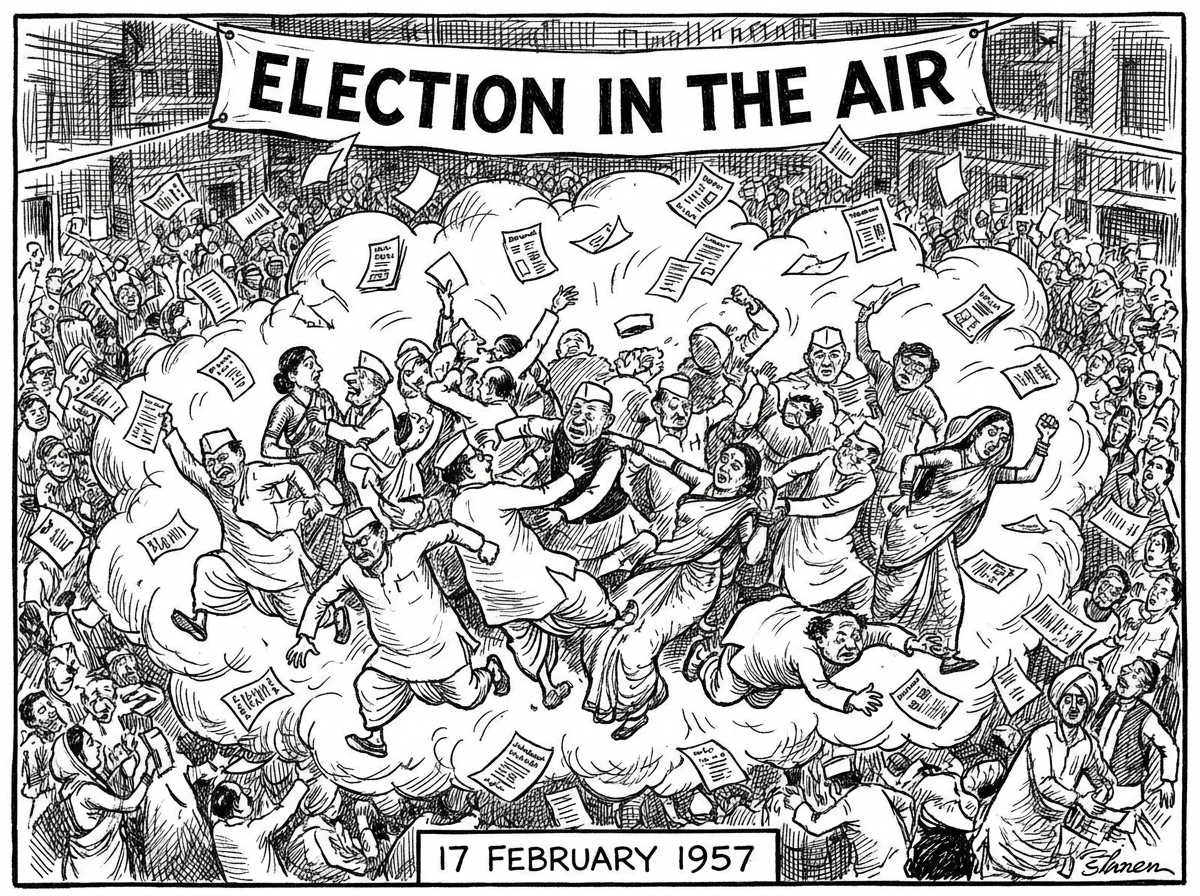
Fig. 3.1 – The chaos of an Indian election season. Inspiration: Shankar, 17 February 1957.
Look at what the cartoonist has actually done. There is no calm queue, no polling officer, no sealed box. He has drawn an election as a scramble — bodies in mid-air, paper everywhere, everybody pushing at once. The exaggeration is the argument. He is saying that an Indian election is less a solemn civic ritual than an enormous, noisy free-for-all.
Now ask whether that is a criticism or a compliment. A carnival is noisy too. Crowds, shouting and disorder can be what it looks like when a very large number of people care intensely about who governs them. A silent, orderly, uneventful election is exactly what a non-democratic ruler would prefer to stage.
And now the limit. A cartoon states one opinion in one image, and it cannot draw the counter-argument beside it. Shankar could not show, in the same frame, the crores who voted without incident, or the officials who counted honestly. He is not reporting a fact about all elections; he is offering a view of one. What the cartoon cannot tell you is how widespread that chaos was, or whether it changed a single result.
Do This Yourself
Collect newspaper clippings about elections — in India and in at least one other country. Sort them into three piles: those about the system of representation, those about voter eligibility, and those about the role of the Election Commission, the body that conducts elections in India. If you have access to the internet, visit the website of the Election Commission of India, https://eci.gov.in, and the ACE project, The Electoral Knowledge Network, http://aceproject.org, and gather the same three kinds of information for at least four countries.
Keep the clippings. You will find, as this chapter goes on, that almost every argument in it turns up somewhere in that pile.
3.3 Election System In India
You will have noticed the reference in the last section to different methods, or systems, of election. What exactly are they?
You may have seen or read about different methods of electioneering — of campaigning, canvassing, holding rallies. But that is not what we mean here. An election system is the set of authorities that run the poll, the rules about what may and may not be done, and, above all, the rule by which votes are turned into seats.
Why should a constitution bother to write down how votes are to be counted and representatives elected? Isn’t that obvious? People go and vote; the candidate who gets the highest number of votes is elected; that is what elections are, all over the world. Why do we need to think about it at all?
We need to, because the question is not as simple as it appears. We have grown so used to our own system of elections that we think there cannot be any other way. In a democratic election people vote, and their preference decides who wins the contest. But there can be very different ways in which people make their choices, and very different ways in which those preferences can be counted.
These different rules of the game can make a difference to who the winner will be. Some rules can favour bigger parties. Some rules can help the smaller players. Some rules can favour the majority community; others can protect minorities. The votes stay the same; the winners change.
Try It In Your Classroom
Hold a mock election in your class to elect four class representatives, and hold it in three different ways.
- In the first round, each student gives one vote. The four highest vote-getters are elected.
- In the second round, each student has four votes, and may give them all to one candidate or split them among different candidates. Again, the four highest vote-getters are elected.
- In the third round, each voter gives a preference ranking to the candidates, and the counting follows the method of election of Rajya Sabha members, described later in this section.
Then ask the only question that matters. Did the same four persons win the election under each of these methods? If not, what was the difference, and why? Nobody’s opinion changed between the rounds. Only the rule changed.
Let us look at one dramatic instance from India’s own history to see how this happens.
3.3.1 First Past The Post System
Look at the newspaper clipping reproduced here. It reports one historic moment in India’s democracy.
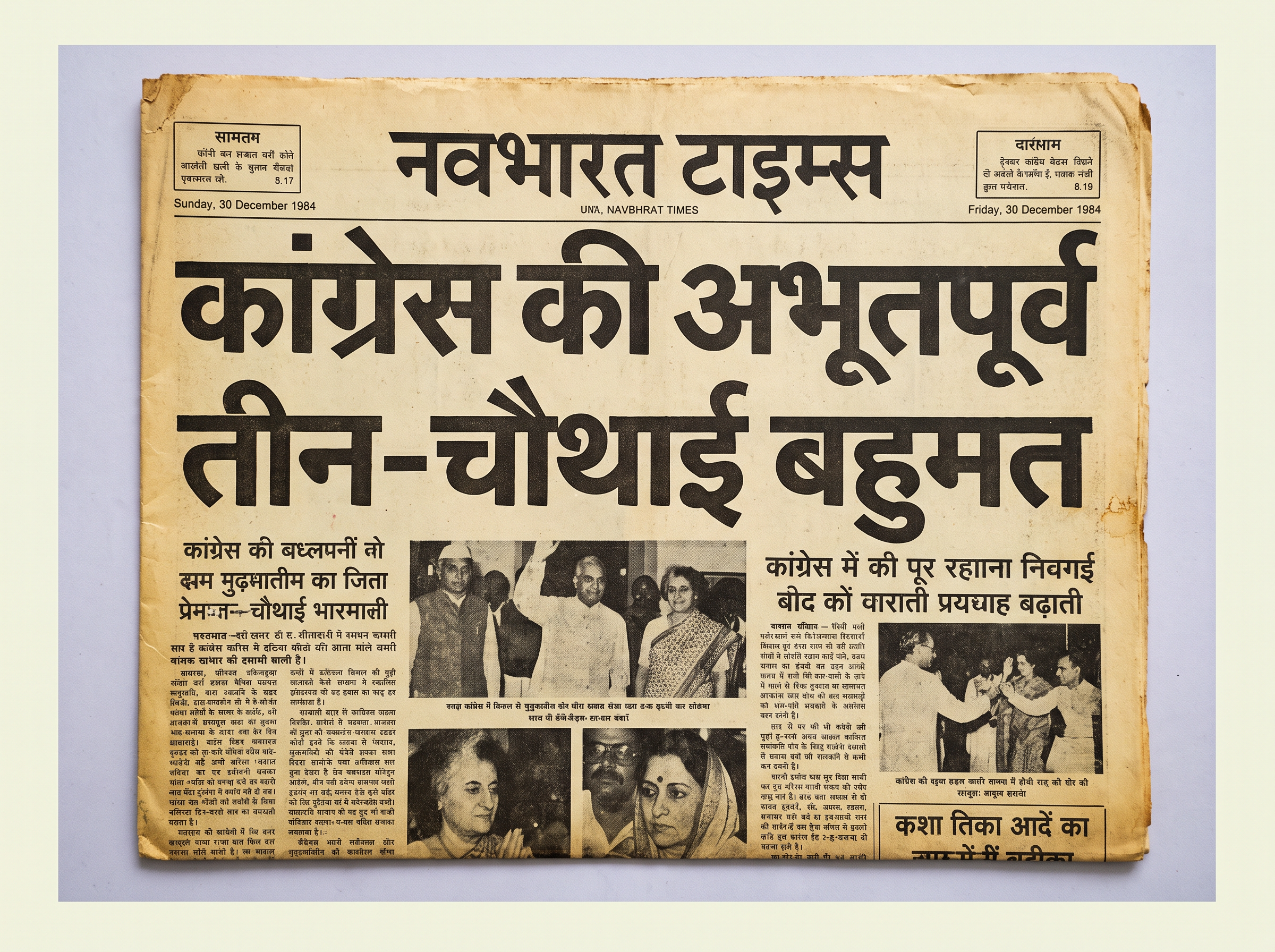
Fig. 3.2 – Front page of Navbharat Times reporting the 1984 election results.
In the Lok Sabha elections of 1984, the Congress party came to power winning 415 of the 543 Lok Sabha seats — more than 80% of the seats. Such a victory had never been achieved by any party in the Lok Sabha. What did this election show?
The Congress party won four-fifths of the seats. Does that mean four out of five Indian voters voted for the Congress party? Actually not. Look at the table.
Read the first row slowly. The Congress party got 48% of the votes. This means that only 48% of those who voted, voted in favour of candidates put up by the Congress party — and the party still won more than 80% of the seats in the Lok Sabha.
Now look at the other parties. The BJP got 7.4 per cent of the votes and won 2 seats. Two seats out of 543 is fewer than one seat in every hundred, which is why the chapter says it got less than one per cent of the seats. How did that happen?
Then read across the rows, and something stranger appears. The Lok Dal and the CPI (M) each polled 5.7 per cent of the votes. The Lok Dal won 3 seats; the CPI (M) won 22. The same vote share; seven times as many seats. And the Telugu Desam, with 4.1 per cent of the votes, won 30 seats — more than the Janata, the Lok Dal, the DMK and the AIADMK managed between them.
Less than 50 per cent votes and more than 80 per cent seats. Isn’t that unfair? How could our Constitution makers accept such an unfair system? Hold on to that objection. It is a serious one, and this chapter will answer it. But first, understand how the result was produced.
How The Rule Works
This happened because in our country we follow a special method of elections. Under this system:
- the entire country is divided into 543 constituencies — small geographical units, each of which sends one member to the Lok Sabha;
- each constituency elects one representative; and
- the candidate who secures the highest number of votes in that constituency is declared elected.
It is important to note exactly what the third rule says. Whoever has more votes than all the other candidates is declared elected. The winning candidate need not secure a majority of the votes — that is, need not cross the halfway mark.
This method is called the First Past the Post (FPTP) system. In the electoral race, the candidate who is ahead of the others, who crosses the winning post first of all, is the winner. It is also called the Plurality System, because a plurality — the largest share, not necessarily more than half — is enough to win. This is the method of election prescribed by the Constitution.
Let us now go back to our example. The Congress party won a greater share of seats than its share of votes because in many of the constituencies in which its candidates won, they secured less than 50% of the votes. If there are several candidates, the winning candidate often gets much less than 50% of the votes.
And here is the consequence. The votes that go to all the losing candidates go ‘waste’, for those candidates or parties get no seat from those votes. The vote is counted, and then it earns nothing.
Push that logic to its limit, as the chapter does. Suppose a party gets only 25 per cent of the votes in every constituency, but everyone else gets even fewer votes. In that case, the party could win all the seats with only 25 per cent of the votes, or even less.
Now the limit of this evidence. Table 3.1 counts votes and seats. It does not count reasons. It cannot tell you why any voter chose as they did in 1984, or whether they were voting for a party, a candidate or a leader. Nor does it show what happened inside each constituency, which is where every one of those seats was actually decided. The table shows you the gap between votes and seats. It does not explain the gap. The counting rule does.
3.3.2 Proportional Representation
Let us compare this to how elections take place in Israel, a small country in west Asia, which follows a very different system of elections.
In Israel, once the votes are counted, each party is allotted a share of seats in the parliament in proportion to its share of votes. Each party then fills its quota of seats by picking that many of its nominees from a preference list — a ranked list of its candidates, declared before the elections.
This system of elections is called the Proportional Representation (PR) system. In this system, a party gets the same proportion of seats as its proportion of votes. Win a fifth of the votes, and you get roughly a fifth of the seats.
Proportional Representation In Israel
Israel’s legislature is called the Knesset, and elections to it take place every four years. Every party declares a list of its candidates, but the voters vote for the party and not for the candidates.
A party gets seats in the legislature in proportion to the votes polled by it. This allows even smaller parties, with a very small support base, to get representation in the legislature. There is one condition: a party must get a minimum of 3.25% votes to be eligible to get seats. Because the seats are spread across many parties, this often leads to a multi-party coalition government — a government formed by several parties together, because no single party has a majority of its own.
The table below shows the result of the 2015 elections to the Knesset. The last column has been left blank on purpose. Work out, for each party, what percentage of the total seats it got, and set that figure beside its percentage of votes.
Here is the working for the first row, so that you can do the rest yourself. The Knesset has 120 seats in all, and Likud won 30 of them. So its share of seats is
\[\text{Seat share} = \frac{30}{120} \times 100 = 25\%\]
where 30 is the number of seats Likud won and 120 is the total number of seats. Set that beside its vote share of 23.40 per cent, and the two figures sit close together. That closeness is the whole purpose of proportional representation. Work through the other rows and you will meet it again and again.
Then look at the row marked ‘Other Parties’. Those parties polled 4.51 per cent of the votes between them and won no seats at all. That is the 3.25% rule at work: taken separately, none of them crossed the bar.
And now the limit. This table tells you how votes were turned into seats. It cannot tell you what happened next — which of these parties joined together to form a government, which stayed out, and what each had to concede in order to get in. Under PR, a great deal of the real bargaining happens after the result is declared, and no table of results records it.
Two Ways Of Running PR
In the PR system there could be two variations. In some countries, like Israel or the Netherlands, the entire country is treated as one constituency, and seats are allocated to each party according to its share of votes in the national election.
The other method is when the country is divided into several multi-member constituencies, as in Argentina and Portugal. Each party prepares a list of candidates for each constituency, depending on how many members have to be elected from that constituency.
In both these variations, voters exercise their preference for a party and not for a candidate. The seats in a constituency are distributed on the basis of the votes polled by each party. Thus the representatives from a single constituency would, and do, belong to different parties.
In India, we have adopted the PR system on a limited scale, and only for indirect elections. The Constitution prescribes a third and complex variation of the PR system for the election of the President and the Vice President, and for elections to the Rajya Sabha and the Vidhan Parishads — the upper house of Parliament and the upper houses of some State legislatures, whose members are not chosen directly by the voters.
FPTP And PR Side By Side
NCERT sets the two systems out against each other in the comparison below. Read it as a consolidation of the argument, not as a replacement for it.
What the grid cannot show you is the politics that comes after the counting. Under FPTP the winner is usually known within hours, and a government follows; under PR the parties may bargain for weeks before anyone can command a majority in the house. The table compares two sets of rules. It does not compare the governments they produce, or the price each system asks a voter to pay.
How PR Works In Rajya Sabha Elections
A third variant of PR, the Single Transferable Vote system (STV), is followed for Rajya Sabha elections. Every State has a specific quota of seats in the Rajya Sabha, and the members are elected by the respective State legislative assemblies. The voters here are not ordinary citizens at all. They are the MLAs of that State.
Every voter is required to rank the candidates according to her or his preference. To be declared the winner, a candidate must secure a minimum quota of votes, which is determined by a formula:
\[\left( \frac{\text{Total votes polled}}{\text{Total number of candidates to be elected} + 1} \right) + 1\]
In this formula, ‘total votes polled’ is the number of MLAs who actually voted, and ‘total number of candidates to be elected’ is the number of Rajya Sabha seats being filled from that State.
Take the chapter’s own example. If 4 Rajya Sabha members have to be elected by the 200 MLAs in Rajasthan, the winner would require \((200 \div (4+1)) + 1 = 40 + 1 = 41\) votes. Notice how the quota is designed: it is small enough for four candidates to reach it, and large enough that a fifth cannot.
When the votes are counted, it is done on the basis of the first preference votes secured by each candidate. If, after the counting of all first preference votes, the required number of candidates fail to fulfil the quota, the candidate who secured the lowest votes of first preference is eliminated. His or her votes are transferred to those who are mentioned as second preference on those ballot papers. This process continues till the required number of candidates are declared elected.
The whole procedure, including what happens when the first count is not enough, is set out in Fig. 3.3.
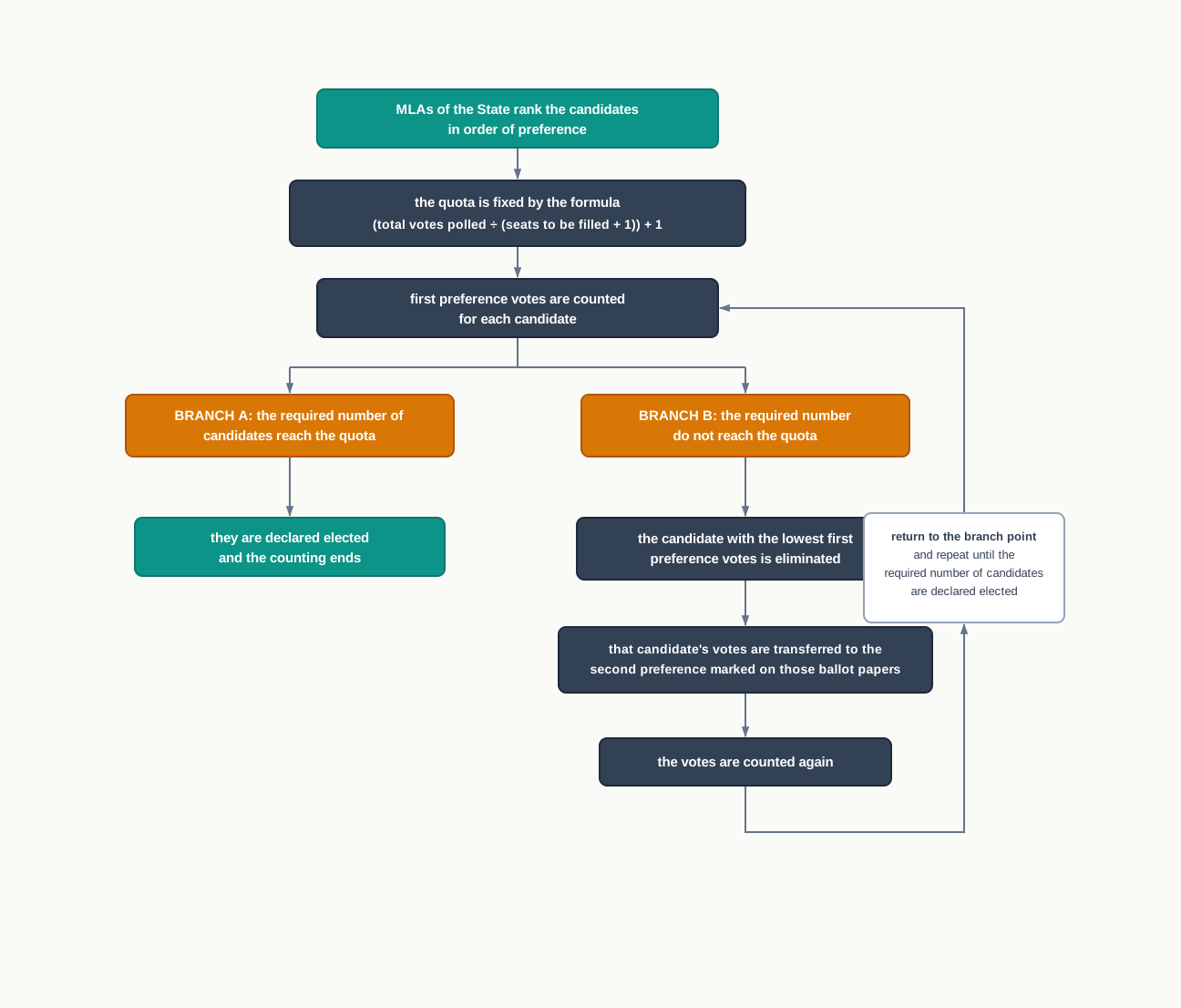
Fig. 3.3 – How a Rajya Sabha seat is won.
3.3.3 Why Did India Adopt The FPTP System?
The answer is not very difficult to guess. If you have carefully read the account of the Rajya Sabha election, you would have noticed that it is a complicated system, which may work in a small country, but would be difficult to work in a sub-continental country like India.
The reason for the popularity and success of the FPTP system is its simplicity. The entire election system is extremely simple to understand, even for common voters who may have no specialised knowledge about politics and elections. You mark one name; the person with the most marks wins.
There is also a clear choice presented to the voters at the time of elections. Voters have simply to endorse a candidate or a party while voting. Depending on the nature of actual politics, voters may give greater importance to the party, or to the candidate, or balance the two.
One Locality, One Representative
The FPTP system offers voters a choice not simply between parties but between specific candidates. In other electoral systems, especially PR systems, voters are often asked to choose a party, and the representatives are elected on the basis of party lists.
As a result, under PR there is no one representative who represents, and is responsible for, one locality. In a constituency-based system like FPTP, the voters know who their own representative is, and can hold him or her accountable.
Here is a cartoon from 29 May 1949, drawn while the Constituent Assembly was still writing the Constitution. It is about what an electoral system can do to the size of an opposition.
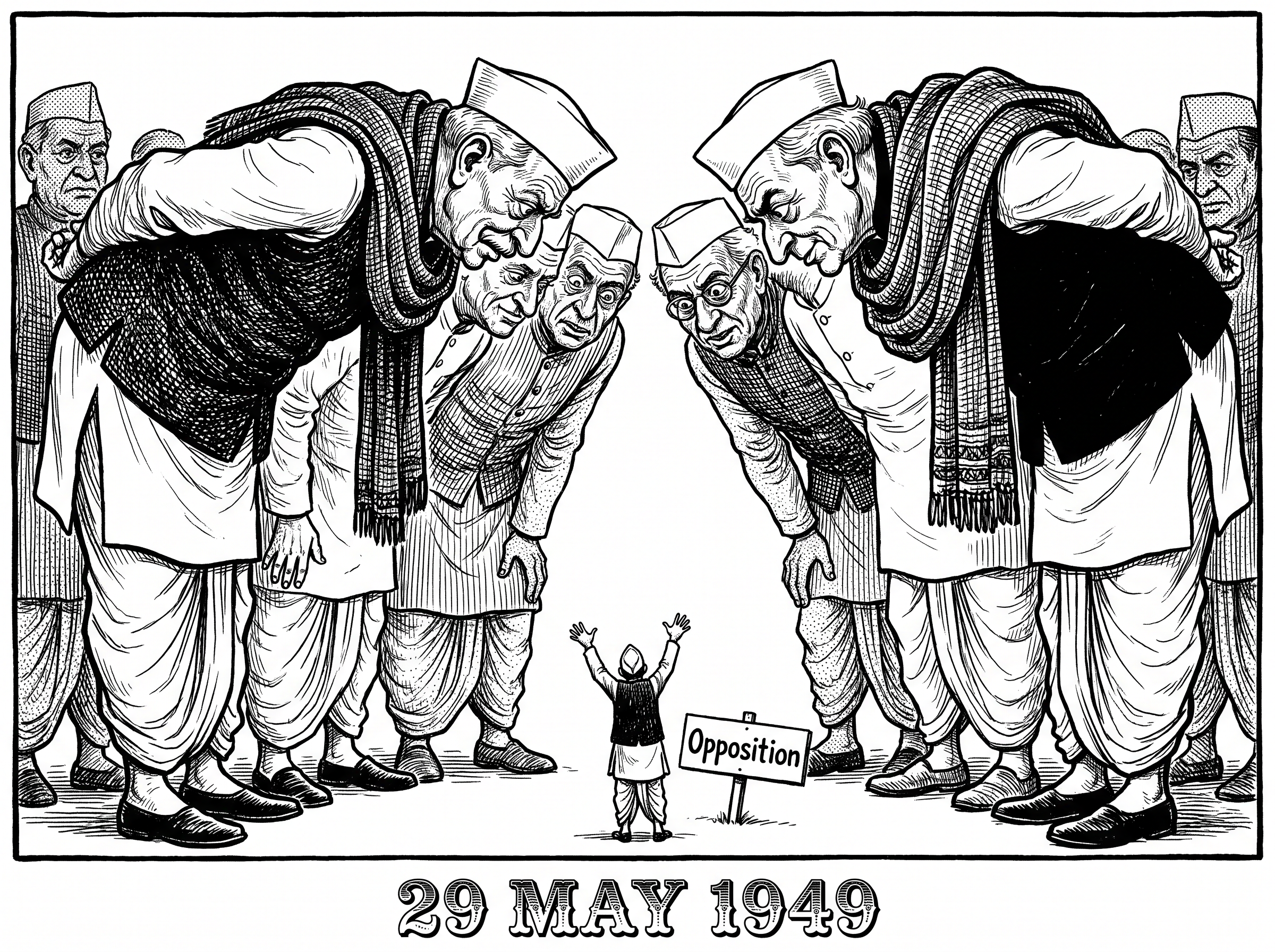
Fig. 3.4 – The size of the opposition in the legislature. Inspiration: Shankar, 29 May 1949.
Look at what the exaggeration is doing. The opposition is not merely outnumbered; it has been drawn as a child among adults, shouting upward, while the ruling party members must stoop even to hear it. The claim being made is that the imbalance has grown so extreme that listening to the opposition is now an act of condescension rather than an ordinary part of debate.
Set that beside Table 3.1. FPTP can turn a lead in votes into a landslide in seats — and the other face of a landslide is an opposition too small to hold the government to account inside the House.
And now the limit. The cartoon asserts that the electoral system produced the tiny opposition. It does not show it. A small opposition may also mean that few people voted for opposition parties, or that the opposition was split among many parties. A drawing can put a question to you sharply; it cannot settle it. And this one was published in 1949, before a single general election had been held under the Constitution.
Stable Government
More importantly, the makers of our Constitution also felt that PR-based election may not be suitable for giving a stable government in a parliamentary system. We shall study the parliamentary system of executive in the next chapter. For the moment, one feature of it is enough: it requires that the executive — the Prime Minister and the Council of Ministers — must have a majority in the legislature, and must resign if it loses that majority.
You will notice that the PR system may not produce a clear majority, because seats in the legislature would be divided on the basis of share of votes. The FPTP system generally gives the largest party or coalition some extra bonus seats, more than their share of votes would allow.
Thus this system makes it possible for parliamentary government to function smoothly and effectively, by facilitating the formation of a stable government. The bonus that looked so unfair in Table 3.1 is the very thing that keeps a government standing.
Finally, the FPTP system encourages voters from different social groups to come together to win an election in a locality. A candidate who appeals only to one community cannot win a constituency in which that community is in a minority. In a diverse country like India, a PR system would encourage each community to form its own nation-wide party. This may also have been at the back of the mind of our Constitution makers.
Check Your Progress
Here are the results of the Tamil Nadu Assembly election held in 2016. The last column is blank; work it out for yourself.
For the first of these, take each party’s share of votes and apply it to the seats that were actually filled. Then place your answer beside the real result, and see which parties gain and which lose. Look hard at the PMK, which polled 5.32 per cent of the votes and won no seat at all.
Note the last row before you draw any conclusion. NOTA — ‘none of the above’, the option on the voting machine by which a voter records that they reject every candidate on offer — took 1.30 per cent of the votes and, by design, elects nobody. Those votes cannot be converted into seats under any system, which is why a dash appears against them.
What Actually Happened
The experience of the working of the Constitution has confirmed the expectation of the Constitution makers. The FPTP system has proved to be simple and familiar to ordinary voters. It has helped larger parties to win clear majorities at the centre and the State level. The system has also discouraged political parties that get all their votes only from one caste or community.
Normally, the working of the FPTP system results in a two-party system. This means that there are two major competitors for power, and power is often shared by these two parties alternately. It is difficult for new parties, or a third party, to enter the competition and share power.
In this respect, the experience of FPTP in India has been slightly different. After Independence, though we adopted the FPTP system, there emerged a one-party dominance, and along with it there existed many smaller parties. After 1989, India is witnessing the functioning of multi-party coalitions. At the same time, gradually, in many States a two-party competition is emerging.
But the distinguishing feature of India’s party system is that the rise of coalitions has made it possible for new and smaller parties to enter into electoral competition in spite of the FPTP system. The rule pushed in one direction. Indian politics did not go entirely where it pushed.
3.4 Reservation Of Constituencies
We have noticed that in the FPTP election system, the candidate who secures the highest votes in a particular constituency is declared elected. Now think about what that rule does to a group that is nowhere in a majority.
Such a group can lose every constituency in the country. This often works to the disadvantage of the smaller social groups — and in the Indian social context it is even more significant, because we have had a history of caste-based discrimination.
In such a social system, the FPTP electoral system can mean that the dominant social groups and castes win everywhere, and the oppressed social groups continue to remain unrepresented. Not under-represented. Unrepresented — absent from the House altogether.
Our Constitution makers were aware of this difficulty, and of the need to provide a way to ensure fair and just representation to the oppressed social groups. The question was what that way should be.
The Rejected Answer: Separate Electorates
This issue was debated even before Independence, and the British government had introduced a system called separate electorates. It meant that for electing a representative from a particular community, only those voters would be eligible who belonged to that community. Candidate and voter both had to come from the same community; nobody else took part in that election at all.
The Constituent Assembly — the body of representatives that wrote India’s Constitution between 1946 and 1949 — heard strong opposition to any return of this arrangement. Here is one member, speaking in the Assembly in May 1949.
Read what this speaker is actually claiming. He does not say that Muslims were well represented under British rule. He says that the method used to represent them did harm — that fencing a community into an electorate of its own kept it apart from the nation instead of bringing it in. And he goes further: he asks that reservation of any kind be kept away from his community.
In the Constituent Assembly, many members expressed a fear that separate electorates would not suit our purposes. Therefore it was decided to adopt the system of reserved constituencies instead. In this system, all the voters in a constituency are eligible to vote, but the candidates must belong to only the particular community or social section for which the seat is reserved.
Hold the two systems apart in your mind, because they are easily confused. In a separate electorate, a community votes alone for its own representative. In a reserved constituency, the whole constituency votes — but it must choose from among candidates of that community. In the first, the community is sealed off. In the second, its representative must still win the confidence of neighbours who do not belong to it.
Why Reserve At All
There are certain social groups which may be spread across the country. In a particular constituency, their numbers may not be sufficient to be able to influence the victory of a candidate. However, taken across the country, they are a significantly sizeable group. Scattered, they count for little; added up, they are large. To ensure their proper representation, a system of reservation becomes necessary.
The Constitution provides for reservation of seats in the Lok Sabha and the State Legislative Assemblies for the Scheduled Castes and the Scheduled Tribes. This provision was made initially for a period of 10 years and, as a result of successive constitutional amendments, has been extended up to 2030. Parliament can take a decision to further extend it when the period of reservation expires.
How many seats? The number of seats reserved for both of these groups is in proportion to their share in the population of India. Of the 543 elected seats in the Lok Sabha, 84 are reserved for Scheduled Castes and 47 are reserved for Scheduled Tribes (as on 26 January 2019).
Now hear the case for reservation made in the Assembly by a member speaking on behalf of the Adivasis, the tribal communities of India.
Follow that argument closely, because it is not the one you might expect. The speaker does not ask to be kept apart. He complains of having been kept apart — isolated, he says, as though in a zoo. Reservation, in his telling, is not a wall. It is the way in: the means by which Adivasis can mix with the rest by sitting in the same legislature as everyone else.
Then he gives his evidence. Under the 1935 Act, across all the legislatures in India, there were 24 Adivasi MLAs out of a total of 1585 — and not one representative at the Centre. That is the fact on which the whole demand rests. And note carefully what he says he never asked for: separate electorates.
Now the limit of these two sources. Each is a speech, made in a public assembly, by a member arguing a case. A speech records what a leader chose to say aloud, and to whom — not what everyone in that community believed. Neither extract tells you what ordinary Muslims or ordinary Adivasis wanted in the 1940s, and neither can tell you whether reservation has since worked. The debates give you the reasons the Assembly weighed. They do not give you the result.
Who Decides Which Seat Is Reserved
Who decides which constituency is to be reserved? On what basis is this decision taken? It is taken by an independent body called the Delimitation Commission, which is appointed by the President of India and works in collaboration with the Election Commission of India. It is appointed for the purpose of drawing up the boundaries of constituencies all over the country.
Its work has two stages. First, a quota of constituencies to be reserved in each State is fixed, depending on the proportion of SC or ST population in that State. Then, after drawing the boundaries, the Delimitation Commission looks at the composition of the population in each constituency.
For the Scheduled Tribes the rule is simple. Those constituencies that have the highest proportion of Scheduled Tribe population are reserved for ST.
In the case of the Scheduled Castes, the Delimitation Commission looks at two things. It picks constituencies that have a higher proportion of Scheduled Caste population. But it also spreads these constituencies across different regions of the State. This is done because the Scheduled Caste population is generally spread evenly throughout the country, rather than gathered in a few pockets. These reserved constituencies can be rotated each time the delimitation exercise is undertaken, so that the same seats are not reserved for ever.
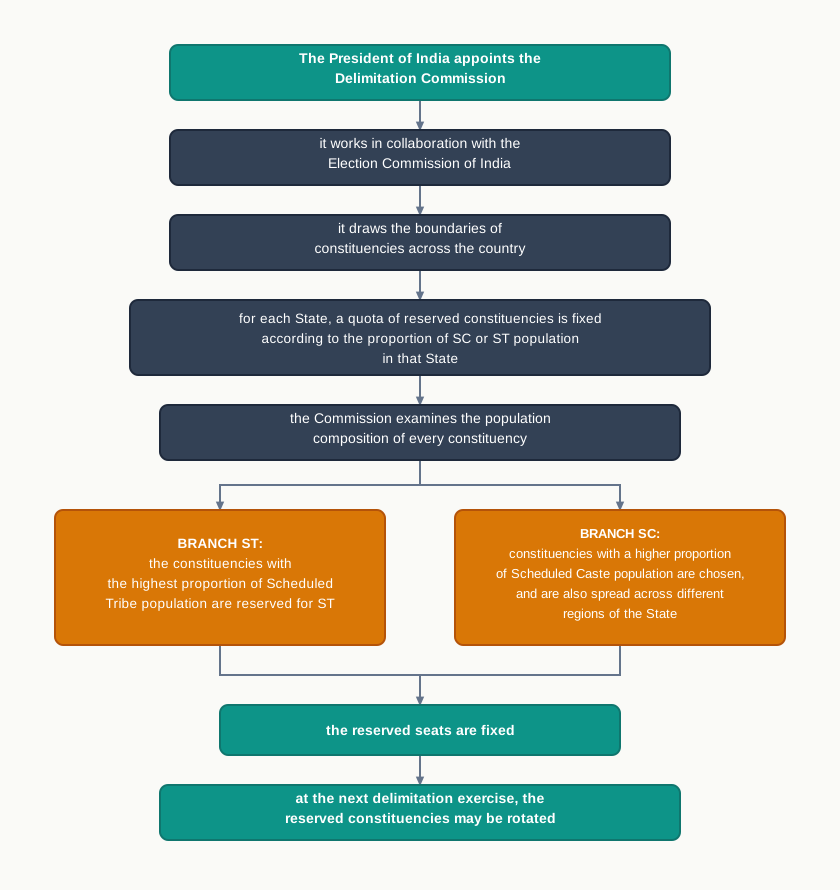
Fig. 3.5 – How a constituency becomes reserved.
What Is Not Reserved
The Constitution does not make similar reservation for other disadvantaged groups. That absence has been argued over ever since.
Of late there has been a strong demand seeking reservation of seats in the Lok Sabha and State Assemblies for women. Given the fact that very few women are elected to representative bodies, the demand for reserving one-third of the seats for women was articulated for many years.
Reservation of seats for women has already been provided for rural and urban local bodies — the panchayats and municipalities you will meet in the chapter on Local Governments. A similar provision for the Lok Sabha and the Vidhan Sabhas has been provided through the Nari Shakti Vandan Adhiniyam (Women’s Reservation Act, 2023).
Notice the shape of the argument running through this whole section. A rule that treats every voter identically can still leave entire groups of voters with nobody to speak for them. Reservation is the Constitution’s answer to that problem — and it is an answer that has had to be argued for, group by group, and is still being argued for.
3.5 Free And Fair Elections
The true test of any election system is its ability to ensure a free and fair electoral process. A rule for counting votes, however clever, is worth nothing if the votes themselves were never freely cast.
If we want democracy to be translated into reality on the ground, it is important that the election system is impartial and transparent. Impartial means that it takes nobody’s side. Transparent means that anyone can see how it works, and check it.
The system of election must also allow the aspirations of the voter to find legitimate expression through the electoral results. What people actually want must be able to show up in who actually wins.
Check Your Progress
The proportion of Muslims in the population of India is about 14.2 per cent. But the number of Muslim MPs in the Lok Sabha has usually been less than 6 per cent — less than half of their share in the population. A similar situation prevails in most State Assemblies.
Three students drew different conclusions from this one fact. Write down whether, and why, you agree or disagree with each of them.
Notice that all three students accept the same figure. They disagree about what follows from it — about which system produced it, and which remedy would answer it. That is what political argument usually looks like. It is rarely a quarrel about the number. It is a quarrel about what the number means.
3.5.1 Universal Franchise And Right To Contest
Apart from laying down a method of elections, the Constitution answers two basic questions about elections. Who are the voters? Who can contest elections? In both these respects our Constitution follows the well-established democratic practices.
You already know that democratic elections require that all adult citizens of the country must be eligible to vote in the elections. This is known as universal adult franchise — the right of every adult citizen to vote, whatever their wealth, education, caste, religion or gender.
It is worth remembering how recently this became ordinary anywhere. In many countries, citizens had to fight long battles with their rulers to get this right. In many countries, women could get this right very late, and only after struggle. One of the important decisions of the framers of the Indian Constitution was to guarantee every adult citizen in India the right to vote — from the very first election, with no period of apprenticeship.
Till 1989, an adult Indian meant an Indian citizen above the age of 21. An amendment to the Constitution in 1989 reduced the eligibility age to 18. Adult franchise ensures that all citizens are able to participate in the process of selecting their representative. This is consistent with the principle of equality and non-discrimination that we studied in the chapter on rights.
Why No Qualification For Voting?
Many people thought, and many think so even today, that giving the right to vote to everyone irrespective of educational qualification was not right. The argument sounds reasonable enough. Should someone who cannot read a manifesto really help to choose a government?
But our Constitution makers had a firm belief in the ability and worth of all adult citizens as equals, in the matter of deciding what is good for the society, the country and for their own constituencies. A farmer who has never been to school knows what a failed crop is, what a school without a teacher is, what an MLA who never visits looks like. Knowing that is knowing something no written test would ever measure.
You may still feel the line is drawn in a strange place. At sixteen or seventeen you are thought mature enough to choose a career, and old enough to hold a driving licence, but not old enough to vote. If the laws apply to you, why can you not have a say in who makes them? Ask the question seriously — and then ask what age you would fix instead, on what ground, and why that ground would not equally justify a test of education.
The Right To Contest
What is true of the right to vote is also true of the right to contest an election. All citizens have the right to stand for election and become the representative of the people.
However, there are different minimum age requirements for contesting elections. For example, in order to stand for a Lok Sabha or an Assembly election, a candidate must be at least 25 years old.
There are some other restrictions also. For instance, there is a legal provision that a person who has undergone imprisonment for two or more years for some offence is disqualified from contesting elections.
But there are no restrictions of income, education, class or gender on the right to contest elections. In this sense, our system of election is open to all citizens. A landless labourer and a millionaire fill in the same nomination form.
Here is a cartoon from 21 October 1951, drawn as India prepared for its first general election under the new Constitution — at that time the largest exercise of adult franchise the world had ever attempted.
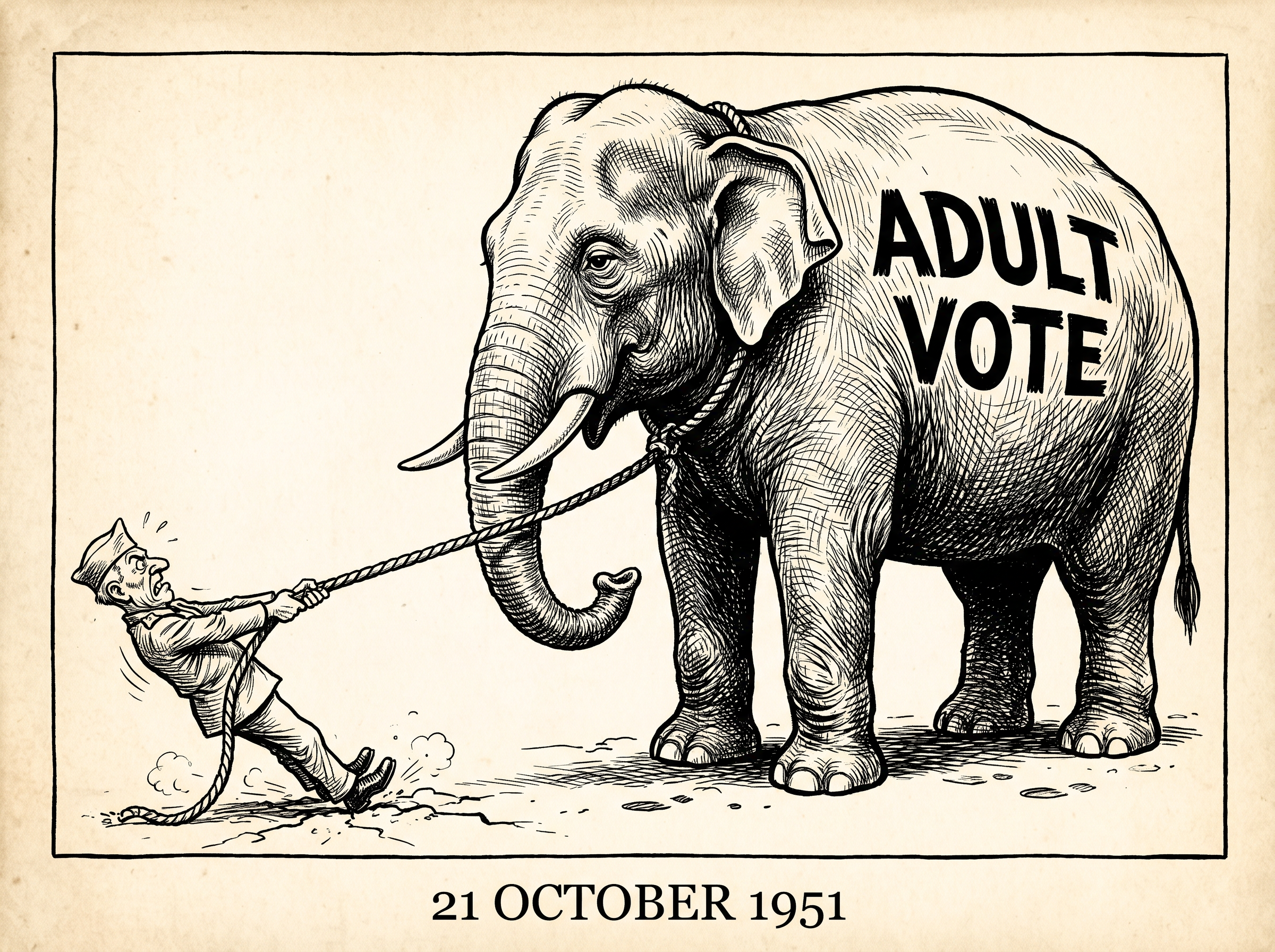
Fig. 3.6 – The arrival of universal adult franchise in India. Inspiration: Shankar, 21 October 1951.
Decode the drawing before judging it. The elephant is huge, slow and completely beyond the strength of the small man tugging at the rope. The cartoonist’s claim is about scale and control: adult franchise has released something so vast that the people who are supposed to manage it can only hold on.
But an elephant is not a monster. It is powerful, valuable, and can be guided. So the same image carries a second reading — that the newly enfranchised Indian voter is a giant whom no politician can simply drag wherever he pleases. The cartoon does not tell you which reading to take. That is exactly what makes it worth arguing with.
And now the limit. A cartoon published in 1951 is a prediction, not a report. Shankar drew it before a single vote had been cast under universal adult franchise in independent India. The image records what one observer feared, or hoped, in 1951. It cannot tell you what actually happened at the polls, and no drawing can.
3.5.2 Independent Election Commission
Several efforts have been made in India to ensure a free and fair election system and process. The most important among these is the creation of an independent Election Commission to ‘supervise and conduct’ elections. Did you know that in many countries there is no independent mechanism for conducting elections at all — the government of the day runs the election and counts the votes itself?
The Constitution establishes the Election Commission in Article 324. Read the words closely, because a great deal turns on them.
Article 324 of the Indian Constitution provides for an independent Election Commission for the ‘superintendence, direction and control of the electoral roll and the conduct of elections’ in India. Three words carry the weight: superintendence, direction and control. Superintendence is overall supervision. Direction is the power to instruct. Control is the power to command, and to correct.
These words in the Constitution are very important, for they give the Election Commission a decisive role in virtually everything to do with elections. Notice also what the Article does not do. It does not list the Commission’s powers one by one. The Supreme Court has agreed with this broad interpretation of the Constitution.
And now the limit of this source. The Article tells you where the authority is vested. It does not tell you how far that authority reaches in any particular case — whether the Commission may postpone a poll, transfer an officer, or cancel a result. Those questions had to be settled afterwards, by a Commission willing to assert its powers and by courts willing to rule on them. A constitutional text marks out a field. It rarely draws the line.
To assist the Election Commission of India, there is a Chief Electoral Officer in every State. The Election Commission is not responsible for the conduct of local body elections. As we shall study in the chapter on Local Government, the State Election Commissioners work independently of the Election Commission of India, and each has its own sphere of operation.
One Member Or Many?
The Election Commission of India can either be a single-member or a multi-member body. Till 1989, the Election Commission was single-member — one Chief Election Commissioner, and nobody else.
Just before the 1989 general elections, two Election Commissioners were appointed, making the body multi-member. Soon after the elections, the Commission reverted to its single-member status. In 1993, two Election Commissioners were once again appointed, the Commission became multi-member, and it has remained multi-member since then.
Initially there were many apprehensions about a multi-member Commission. There was a sharp difference of opinion between the then Chief Election Commissioner and the other Commissioners about who had how much power. The matter had to be settled by the Supreme Court. Now there is a general consensus that a multi-member Election Commission is more appropriate, as power is shared and there is greater accountability.
But look again at that history. The size of the Commission was altered twice within four years, and each time by the government of the day. Has this now been settled for good? Or could a government go back to a single-member Election Commission? Does the Constitution stop this game — or does Article 324, which speaks only of ‘a Commission’, leave the question open?
The Chief Election Commissioner (CEC) presides over the Election Commission, but does not have more powers than the other Election Commissioners. The CEC and the two Election Commissioners have equal powers to take all decisions relating to elections, as a collective body.
Appointment, Tenure And The Fear Behind Them
They are appointed by the President of India on the advice of the Council of Ministers — which means, in effect, on the advice of the government of the day. It is therefore possible for a ruling party to appoint a partisan person to the Commission, who might favour it in the elections.
This fear has led many to suggest that the procedure should be changed. Many persons have suggested that a different method should be followed, one that makes consultation with the leader of the opposition and the Chief Justice of India necessary for the appointment of the CEC and the Election Commissioners.
If appointment is the weak point, tenure is where the Constitution pushes back. The Constitution ensures the security of the tenure of the CEC and the Election Commissioners. They are appointed for a six-year term, or continue till the age of 65, whichever is earlier.
The CEC can be removed before the expiry of the term by the President, but only if both Houses of Parliament make such a recommendation with a special majority. This is done to ensure that a ruling party cannot remove a CEC who refuses to favour it in elections. The Election Commissioners can be removed by the President of India.
What A Special Majority Means
A special majority means two conditions, and both must be met:
- a two-thirds majority of those present and voting, and
- a simple majority of the total membership of the House.
Work it out on a smaller scale. Suppose you have to pass a resolution in your class with a special majority. Your class has a total strength of 57 students. On the day of voting, only 51 students are present, and 50 students participate in the voting.
Now test both conditions. The first asks for two-thirds of those present and voting — that is, two-thirds of 50. The second asks for a simple majority of the total membership — that is, more than half of 57. Calculate both numbers, take the larger of the two, and you have the point at which the resolution is passed with a special majority. Then ask yourself why a rule for removing a CEC should insist on both conditions instead of just one.
You will find ‘special majority’ mentioned in at least three other chapters of this book. One is the next chapter, on the Executive, where we discuss the impeachment of the President of India. Find out the other two places where special majority is discussed.
What The Election Commission Actually Does
The Election Commission of India has a wide range of functions.
- It supervises the preparation of an up-to-date voters’ list. It makes every effort to ensure that the list is free of errors — such as the names of registered voters going missing from it, or the names of people who are not eligible, or who do not exist, appearing on it.
- It determines the timing of elections and prepares the election schedule. The schedule includes the notification of elections, the date from which nominations can be filed, the last date for filing nominations, the last date of scrutiny, the last date of withdrawal, the date of polling, and the date of counting and declaration of results.
- During this entire process, the Election Commission has the power to take decisions to ensure a free and fair poll. It can postpone or cancel the election in the entire country, or in a specific State or constituency, on the grounds that the atmosphere is vitiated and a free and fair election may therefore not be possible. It also implements a model code of conduct for parties and candidates. It can order a re-poll in a specific constituency. It can also order a recount of votes when it feels that the counting process has not been fully fair and just.
- The Election Commission accords recognition to political parties and allots symbols to each of them.
The Commission does all of this with a very limited staff of its own. It conducts the elections with the help of the administrative machinery — the ordinary officials of the State and central governments.
However, once the election process has begun, the Commission has control over the administration as far as election-related work is concerned. During the election process, the administrative officers of the State and central governments are assigned election-related duty, and in this respect the Election Commission has full control over them. The EC can transfer the officers, or stop their transfers. It can take action against them for failing to act in a non-partisan manner.
That last power is the one that matters most. Without it, a State government could simply post obliging officers into a district before polling day, and the Commission would be an umpire without a whistle.
Powers Tested In Practice
Over the years, the Election Commission of India has emerged as an independent authority which has asserted its powers to ensure fairness in the election process. It has acted in an impartial and unbiased manner in order to protect the sanctity of the electoral process.
Its record also shows something worth pausing over. Every improvement in the functioning of institutions does not require legal or constitutional change. It is widely agreed that the Election Commission is more independent and assertive now than it was till 25 years ago. This is not because the powers and constitutional protection of the Election Commission have increased. The Commission has simply started using more effectively the powers it always had in the Constitution.
Since 1951–52, seventeen Lok Sabha elections have been held. Many more State assembly elections and by-elections have been conducted by the Election Commission.
The EC has faced many difficult situations. It has had to hold elections in militancy-affected areas like Assam, Punjab or Jammu and Kashmir. It also faced the difficult situation of having to postpone the election process mid-way, in 1991, when the ex-Prime Minister Rajiv Gandhi was assassinated during campaigning.
Here, finally, is a cartoonist’s view of what such a Commission looks like from a politician’s chair.
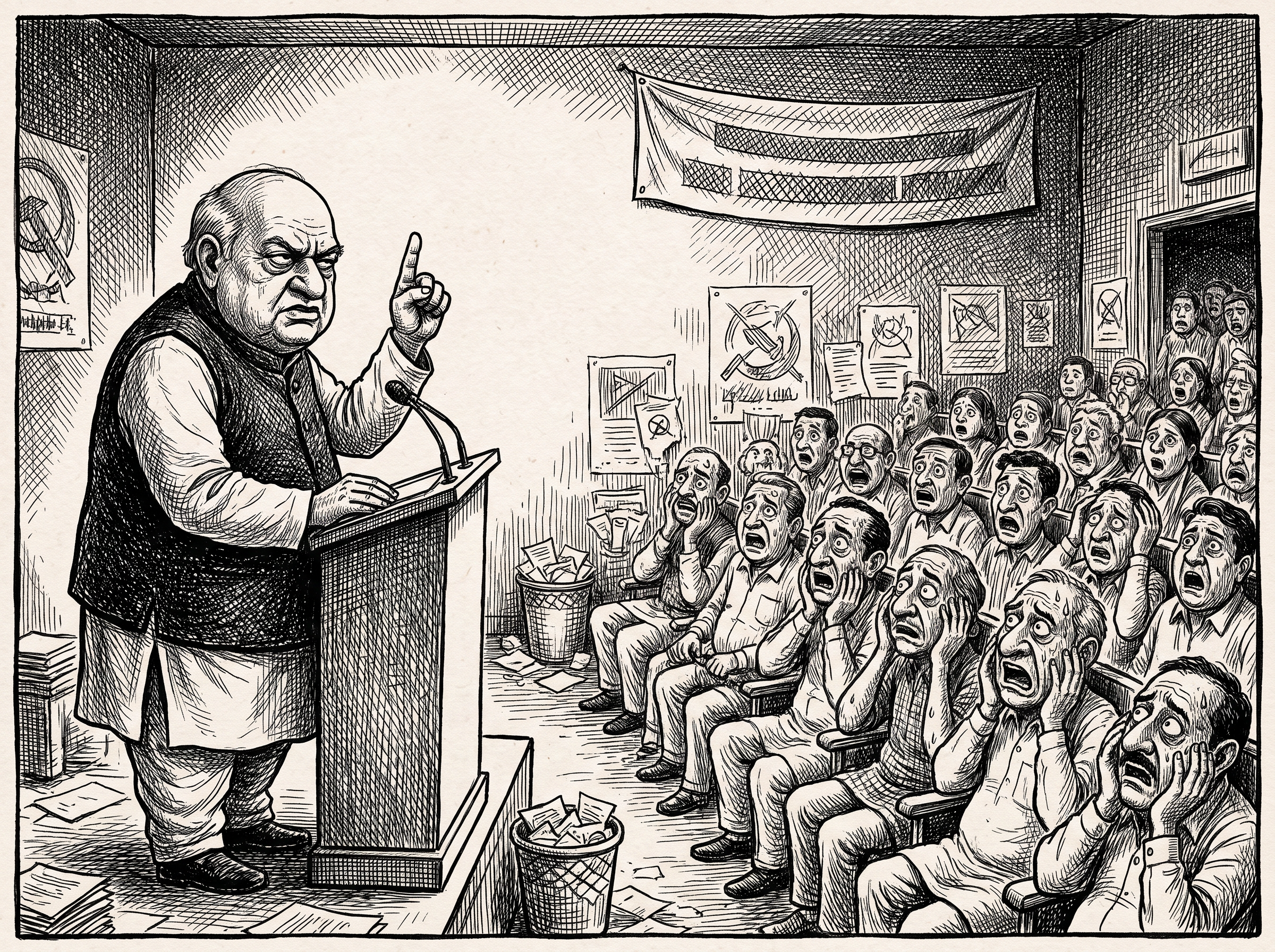
Fig. 3.7 – Politicians and the Election Commission. Inspiration: R K Laxman, The Times of India.
The joke works by reversal. The ‘new situations’ the leader dreads — a code of conduct, fair and free polling, strict enforcement — are simply the ordinary conditions of a democratic election. The cartoonist’s claim is that these had become frightening to politicians precisely because they had at last become real.
So is a frightened politician good for democracy? If leaders fear the Commission because they can no longer rig a booth, intimidate a voter or overspend, then that fear is the system working exactly as designed. And now the limit: the cartoon records an impression, not a record. It cannot show you a single rigged booth actually prevented, or a single voter actually protected. For that you would need the Commission’s record, not a drawing of a nervous leader.
3.6 Electoral Reforms
No system of election can ever be perfect. And in the actual election process, there are bound to be many flaws and limitations. That is not a confession of failure. It is the reason democratic societies keep working at it.
Any democratic society has to keep searching for mechanisms to make elections free and fair to the maximum. With the acceptance of adult suffrage, the freedom to contest elections, and the establishment of an independent Election Commission, India has tried to make its election process free and fair.
However, the experience of the past 72 years has given rise to many suggestions for reforming our election system. The Election Commission, political parties, various independent groups, and many scholars have come up with proposals for electoral reform. Notice who is on that list. The umpire, the players and the spectators have all asked for changes — and they do not all want the same changes.
What Has Been Proposed
Some of these suggestions are about changing the constitutional provisions discussed in this chapter.
- Our system of elections should be changed from FPTP to some variant of the PR system. This would ensure that parties get seats, as far as possible, in proportion to the votes they get.
- There should be a special provision to ensure that at least one-third women are elected to Parliament and the assemblies.
- There should be stricter provisions to control the role of money in electoral politics. The election expenses should be paid by the government out of a special fund.
- Candidates with any criminal case should be barred from contesting elections, even if their appeal is pending before a court.
- There should be a complete ban on the use of caste and religious appeals in the campaign.
- There should be a law to regulate the functioning of political parties, and to ensure that they function in a transparent and democratic manner.
Read that list again and you will find this whole chapter folded into it. The first proposal is the argument of Table 3.1 turned into a demand. The second is the case Jaipal Singh made, carried across to a group the Constitution did not originally cover — and this chapter has already told you that a similar provision for the Lok Sabha and the Vidhan Sabhas has since been made through the Nari Shakti Vandan Adhiniyam. The remaining four are about something the earlier sections barely touched: what happens between the writing of a rule and the casting of a vote.
The Question Of Money And Muscle
Two of those proposals — paying election expenses out of a public fund, and barring candidates with criminal cases — point at the same anxiety. An election can satisfy every constitutional requirement and still be shaped by whoever has the most money to spend and the most people willing to intimidate.
So a hard question has to be asked, and this chapter asks it. Can we reduce the influence of money and muscle power by changing the law? Does anything change in reality by changing the law?
Look at the cartoon below before you answer it.
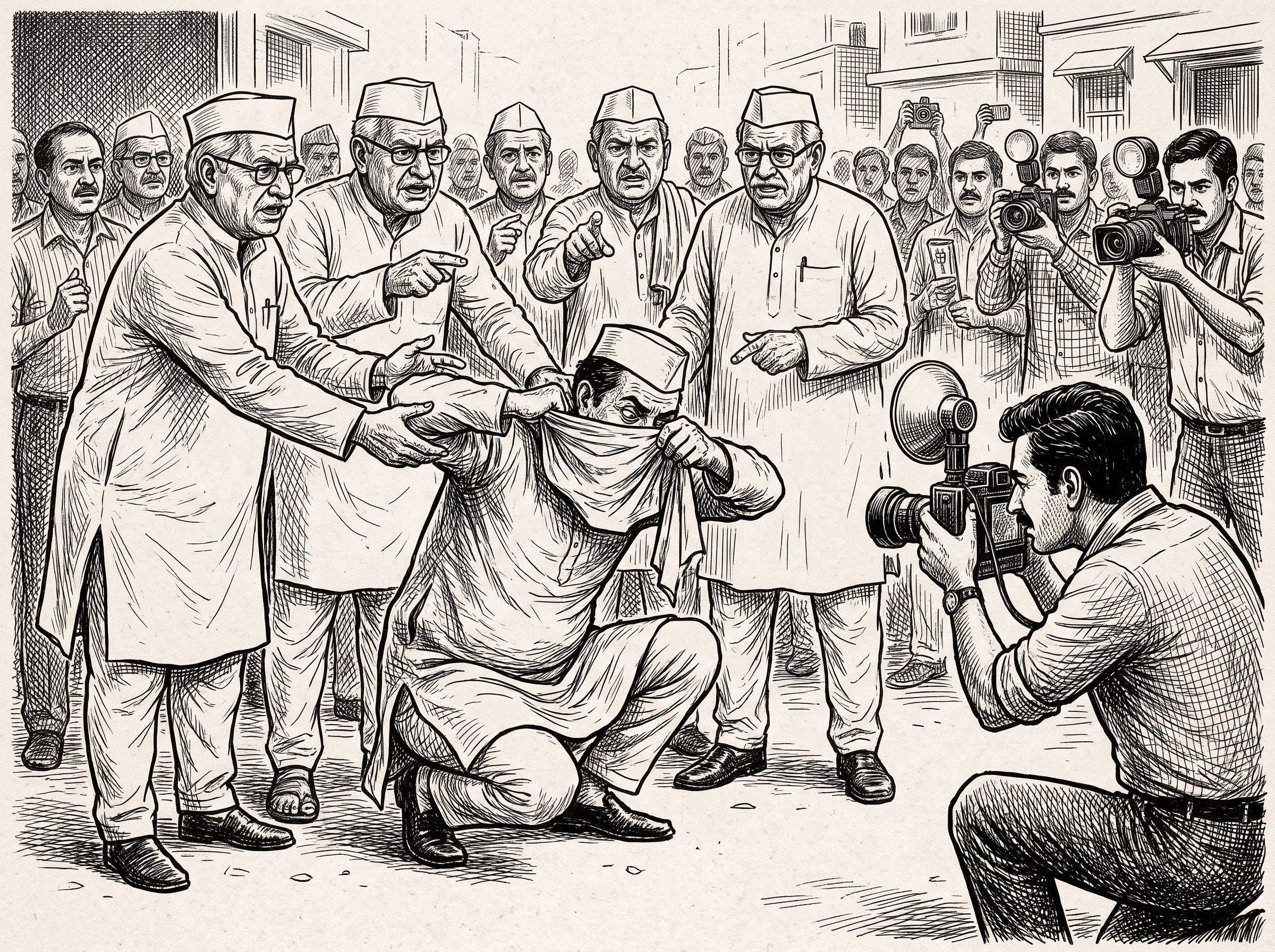
Fig. 3.8 – Candidates facing criminal charges. Inspiration: R K Laxman, The Times of India.
The joke turns on one word: habit. A man who instinctively hides his face from a camera learnt that reflex somewhere, and the cartoonist trusts you to know where. Now the same face has to be photographed, printed on posters and shown to voters — because his party has nominated him.
The claim being made is not that one particular candidate is a criminal. It is that the two worlds have drawn close enough for the same man to move from one into the other without even changing his clothes.
And now the limit. A cartoon is an accusation drawn in ink. It names nobody, proves nothing, and tells you nothing about how many candidates it might actually fit. It cannot tell you whether such candidates win, or whether voters mind. And it cannot answer the question printed beneath it — which is genuinely hard, because being accused is not the same as being convicted.
What Reform Cannot Do
These are but a few suggestions. There is no consensus about them — not among the parties, not among scholars, not even among the groups that campaign for them.
And even if there was a consensus, there are limits to what the laws and formal provisions can do. Free and fair elections can be held only if the candidates, the parties and those involved in the election process agree to abide by the spirit of democratic competition. A rule can be enforced against the few who break it. It cannot be enforced against everybody at once.
Remember, too, the evidence from the last section. The Election Commission became far more assertive without any increase in its powers; it simply began using the powers it always had. That cuts both ways for a reformer. It shows that an institution can change without a new law — and it warns that a new law, in unwilling hands, may change nothing at all.
The Two Other Ways
Apart from legal reforms, there are two other ways of ensuring that elections reflect the expectations and democratic aspirations of the people.
One is, of course, that people themselves have to be more vigilant, and more actively involved in political activities. A citizen who watches only on polling day is a citizen who can be managed on all the other days.
But there are limits to the extent to which ordinary people can engage in politics on a regular basis. Most people have work, families and lives of their own. Nobody can be a full-time watchman of democracy.
Therefore it is necessary that various political institutions and voluntary organisations are developed, and are active in functioning as watchdogs for ensuring free and fair elections. Somebody has to be watching during the long stretches when nobody is voting.
Notice where this leaves the argument. The chapter began with a constitution writing down the rules of the game so that no player could bend them. It ends by admitting that no set of written rules, however carefully drafted, can carry a democracy on its own.
3.7 Summary
What The Chapter Established
- Rule by the people, in a country of lakhs and crores, has to mean rule by the people’s representatives. Direct democracy survives only where the deciding body is small enough to assemble, as in a gram sabha.
- Elections are not proof of democracy. Non-democratic rulers hold elections too, arranged so that the result cannot threaten them. What matters is how the election is run.
- The rules of an election, and the machinery that runs it, decide who wins. Because a government is itself a player, these basic decisions are written into the Constitution and not left to whoever is in power.
- India uses the First Past the Post system: the country is divided into 543 constituencies, each elects one representative, and the candidate with the highest votes wins — even without a majority of the votes.
- FPTP can therefore give a party far more seats than its share of votes. In 1984 the Congress won 415 of 543 seats with 48% of the votes; the BJP won 2 seats with 7.4%.
- Under Proportional Representation, seats go to parties in proportion to their votes, and the voter chooses a party rather than a candidate. India uses a variant of PR only for indirect elections — the President, the Vice President, the Rajya Sabha and the Vidhan Parishads — where the Single Transferable Vote is used.
- The Constitution makers chose FPTP because it is simple, because it gives every locality a representative who can be held accountable, because it helps produce stable majorities in a parliamentary system, and because it pushes candidates to seek votes across communities.
- Under FPTP, dominant social groups could win everywhere. To prevent this, the Constitution reserves constituencies for the Scheduled Castes and the Scheduled Tribes — 84 SC and 47 ST seats of the 543 elected Lok Sabha seats (as on 26 January 2019). All voters vote; only candidates of that group may contest.
- Separate electorates, under which only the voters of a community elected its representative, were rejected by the Constituent Assembly. The Delimitation Commission decides which constituencies are reserved, and they may be rotated at each delimitation exercise.
- Every adult citizen has the right to vote, and since 1989 the voting age is 18. Every citizen may contest, subject to a minimum age of 25 for the Lok Sabha and Assemblies, with no bar of income, education, class or gender.
- Article 324 vests the superintendence, direction and control of elections in an independent Election Commission. It is multi-member; the CEC has no more power than the other Commissioners; and the CEC cannot be removed without a special majority in both Houses of Parliament.
- Many reforms have been proposed — a move to PR, one-third of seats for women, state funding of elections, barring accused candidates, a ban on caste and religious appeals, a law to regulate parties. There is no consensus on any of them.
Why India’s Election System Is Judged A Success
In countries where representative democracy is practised, elections — and the representative character of those elections — are what make democracy effective and trustworthy. The chapter judges India’s system by five tests.
- Voters have been able not only to choose representatives freely, but also to change governments peacefully, at both the State and the national level.
- Voters have consistently taken a keen interest in elections and participated in them, and the number of candidates and parties contesting has been rising.
- The system has proved accommodative and inclusive. The social composition of our representatives has changed gradually, and they now come from many different social sections — though the number of women legislators has not increased satisfactorily.
- In most parts of the country, the election outcome does not reflect malpractice and rigging. Attempts at rigging do take place, and there are complaints of violence, of voters’ names disappearing from the list, and of intimidation. Yet such instances rarely change the result.
- Most importantly, elections have become part and parcel of our democratic life. No one can imagine a government disrespecting the verdict of an election, or a government being formed without one.
All this has earned respect for our election system inside and outside the country. The voter has gained confidence, and the legitimacy of the Election Commission has risen in the eyes of the people. This vindicates the basic decisions taken by our Constitution makers. The more flawless the process becomes, the more effectively we, as voters and citizens, can share in this carnival of democracy and make it mean something.
The Arguments In One Place
The chapter’s central claim is that the FPTP system was the right choice for India: it is simple enough for every voter to understand, it gives each locality a representative who can be named and held to account, it produces governments with working majorities in a parliamentary system, and it forces candidates to build support across communities rather than within one.
The strongest position against it is stated in the chapter itself, in its own figures. A rule under which 48% of the votes can become more than 80% of the seats, and 7.4% of the votes can become two seats, does not turn the country’s preferences into a legislature that resembles them. On this view, an election ought to reproduce the voters’ choices in proportion, and ours does not.
The chapter does not settle the disagreement, and neither of the two positions is foolish. What separates them is not a fact but a value: whether fairness in an election means proportionality between parties, or accountability to a place.
What Remains Contested
Should the counting rule itself be changed? Should reservation be extended to groups the Constitution left out? Should the appointment of the Election Commissioners be taken out of the government’s hands? The chapter records the demands and the objections, and leaves the questions open.
Notice, too, whose voices this chapter’s evidence was never designed to carry. The sources are speeches made inside the Constituent Assembly, and the cartoons are the work of observers in the press. Not one of them is the voice of a voter — of the person who stood in the queue, marked a ballot, and watched the seat go to somebody two-thirds of the constituency had voted against.
3.8 NCERT Questions
Which of the following resembles most a direct democracy?
- Discussions in a family meeting
- Election of the class monitor
- Choice of a candidate by a political party
- Decisions taken by the Gram Sabha
- Opinion polls conducted by the media
Which of the following tasks are not performed by the Election Commission?
- Preparing the Electoral Rolls
- Nominating the candidates
- Setting up polling booths
- Implementing the model code of conduct
- Supervising the Panchayat elections
Which of the following is common to the method of election of the members of Rajya Sabha and Lok Sabha?
- Every citizen above the age of 18 is an eligible voter
- Voter can give preference order for different candidates
- Every vote has equal value
- The winner must get more than half the votes
In the First Past the Post system, that candidate is declared winner who
- Secures the largest number of postal ballots
- Belongs to the party that has highest number of votes in the country
- Has more votes than any other candidate in the constituency
- Attains first position by securing more than 50% votes
What is the difference between the system of reservation of constituencies and the system of separate electorate? Why did the Constitution makers reject the latter?
Which of the following statements are incorrect? Identify and correct them by substituting, adding or rearranging only one word or phrase.
- FPTP system is followed for all the elections in India.
- Election Commission does not supervise Panchayat and Municipal elections.
- President of India cannot remove an Election Commissioner.
- Appointment of more than one Election Commissioner in the Election Commission is mandatory.
Indian electoral system aims at ensuring representation of socially disadvantaged sections. However we have only 12 per cent women members in our legislatures. What measures would you suggest to improve the situation?
Here are some wishes expressed in a conference to discuss a constitution for a new country. Write against each of these whether FPTP or Proportional Representation system is more suited to meet each of these wishes.
- People should clearly know who is their representative so that they can hold him or her personally accountable.
- We have small linguistic minorities who are spread all over the country; we should ensure fair representation to them.
- There should be no discrepancy between votes and seats for different parties.
- People should be able to elect a good candidate even if they do not like his or her political party.
A former Chief Election Commissioner joined a political party and contested elections. There are various views on this issue. One view is that a former Election Commissioner is an independent citizen and has a right to join any political party and to contest election. According to the other view, leaving this possibility open can affect the impartiality of the Election Commission. So, former Election Commissioners must not be allowed to contest any elections. Which position do you agree with and why?
“Indian democracy is now ready to shift from a crude First Past the Post system to a system of Proportional Representation”. Do you agree with this statement? Give your reasons for or against this statement.
3.9 Check Your Concepts
Look again at Table 3.1. The BJP polled 7.4 per cent of the votes and won 2 seats; the Telugu Desam polled 4.1 per cent and won 30 seats. Which party had the larger share of votes, which won more seats, and what feature of the FPTP system explains the reversal?
In Table 3.2, the parties grouped as ‘Other Parties’ polled 4.51 per cent of the votes in the 2015 Knesset election and won no seats at all. Explain why this happened, and what it shows about the claim that a PR system wastes no votes.
Read Source 3.1 and Source 3.2 together. Both members reject separate electorates, yet Jaipal Singh demands reserved seats in the legislatures. Explain how a member could ask for the one while refusing the other.
Suppose 4 Rajya Sabha members are to be elected by the 200 MLAs of a State. Show the working by which the quota of 41 votes is arrived at. Then explain what happens to the votes of the candidate who is eliminated first, and why the system is called a ‘transferable’ vote.
Set out, step by step, how the Delimitation Commission decides which constituencies are to be reserved. Why does it use a different test for Scheduled Tribe seats from the one it uses for Scheduled Caste seats?
Source 3.3 gives the words of Article 324 (1). The clause does not say who shall appoint the members of the Election Commission or how many there shall be. What problem has followed from this silence, and what change in the method of appointment has been suggested?
Look again at Fig. 3.7. What claim is the cartoonist making about the Election Commission and the politicians of the day? Now state two things this cartoon cannot tell you about how the Commission actually behaved.
The chapter says that the Election Commission became far more assertive without any increase in its powers — it began using the powers it always had. What does this suggest about the limits of reforming elections by changing the law? Use one of the reform proposals listed in the chapter to make your point.