Chapter 4: Executive
Picture a quiet room in Rashtrapati Bhavan. A file has just arrived from the Council of Ministers. It carries a decision the ministers have taken, and it now needs the President’s signature before it can take effect.
The President reads it slowly. Something in it seems wrong — perhaps a legal gap, perhaps a cost the country will pay later. The President does not sign. Instead, the file goes back to the ministers with a note: think about this again.
In the Cabinet room the ministers reconsider. A request from the President is not a small thing, and it carries weight. But after discussion, they send the file back unchanged. Their advice is the same as before.
Now the President has run out of choices. Under the Constitution, once the Council of Ministers has reconsidered and repeated its advice, the President must act on it. The signature goes on the page. The decision becomes the government’s decision.
So who governed in that room? The Constitution says the executive power of the Union is vested in the President. Yet the person holding that power could not finally refuse. The people who could decide were never in the room at all — they were ministers, and behind them stood a majority in the Lok Sabha, and behind that majority stood voters.
This chapter is about that gap between who holds power on paper and who exercises it in practice.
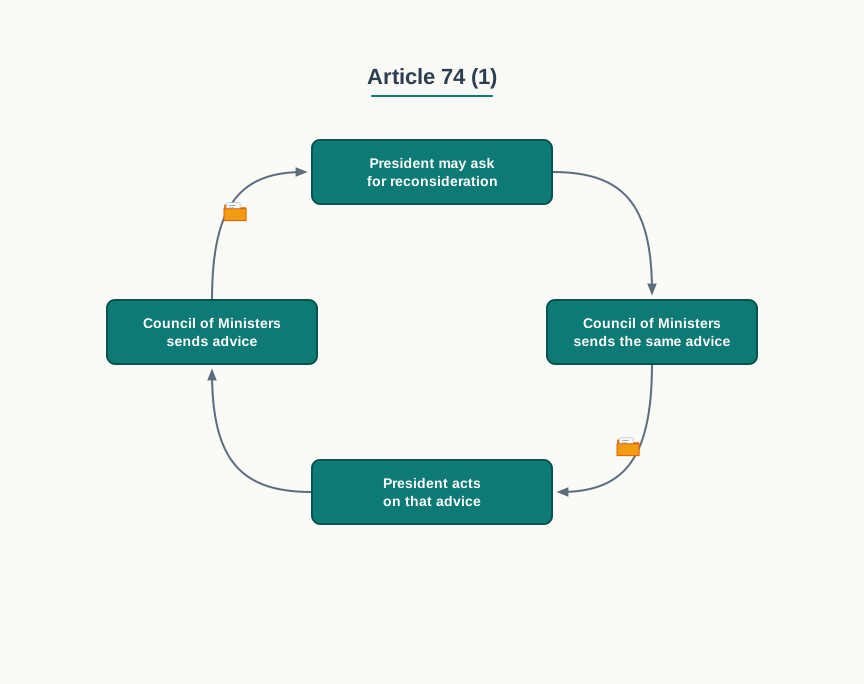
Fig. 4.0 – The Article 74 (1) loop of advice and reconsideration.
4.1 Introduction
The Three Organs Of Government
Every government works through three organs: the legislature, the executive and the judiciary. The legislature is the body that makes the laws — in India, Parliament at the national level and the State legislatures in the States. The executive is the organ that puts those laws into effect and runs the day-to-day administration of the country. The judiciary is the system of courts that settles disputes and decides what the law means when people disagree about it.
These three organs are not three separate governments. Together they perform the functions of government, maintain law and order, and look after the welfare of the people. A law that Parliament passes is worth nothing until the executive carries it out, and worth little if the courts cannot enforce it.
The Constitution ensures that the three organs work in coordination with each other. It also ensures that they maintain a balance among themselves, so that no single organ can act without any check on it. Coordination and balance are both required, and they pull in slightly different directions — one asks the organs to work together, the other asks them to watch each other.
Interdependence In A Parliamentary System
India has a parliamentary system, which means that the executive is drawn from the legislature and stays in office only as long as the legislature supports it. In such a system the executive and the legislature are interdependent.
The relationship runs both ways. The legislature controls the executive, questioning it and holding it answerable. In turn, the legislature is controlled by the executive, because the ministers who lead the executive also lead the majority in the House and shape what it does. Neither is simply the master of the other.
What This Chapter Will Do
This chapter discusses the composition, the structure and the functions of the executive organ of the government. Composition means who sits in it; structure means how those people are arranged in relation to one another; functions means what they actually do.
The chapter also looks at the changes that have occurred in recent times because of political practice. A constitution sets out rules on paper. How those rules work in practice depends on politics — on how many parties there are, on whether one of them wins a clear majority, and on how governments are formed. The same written provision can behave very differently in different political conditions.
After reading this chapter, you will be able to:
- make a distinction between the parliamentary and the presidential executive;
- understand the constitutional position of the President of India;
- know the composition and functioning of the Council of Ministers and the importance of the Prime Minister; and
- understand the importance and functioning of the administrative machinery.
4.2 What Is An Executive?
Start With Your School
Who is in charge of the administration of your school? Who takes the important decisions in a school or a university? Somebody has to decide the timetable, the fee structure, the rules about attendance — and somebody has to see that those decisions are actually carried out from Monday morning onwards.
In any organisation, some office holder has to take decisions and then implement those decisions. We call this activity administration or management. But administration needs something more than clerks and files. It requires a body at the top that will take the policy decisions — the big decisions — and then supervise and coordinate the routine administrative functioning that follows from them.
This is not peculiar to schools. You may have heard about the executives of big companies, banks or industrial units. Every formal group has a body of people who function as its chief administrators, or its executives. Some office holders decide the policies and the rules and regulations; other office holders implement those decisions in the actual day-to-day functioning of the organisation.
What The Word Means
So the word executive means a body of persons that looks after the implementation of rules and regulations in actual practice. The emphasis is on practice. A rule that exists only on paper has not yet been executed.
In the case of government also, one body may take policy decisions and decide about rules and regulations, while another body would be in charge of implementing those rules. The organ of government that primarily looks after the function of implementation and administration is called the executive.
That aside about company executives is worth pausing on. You have probably heard that the executive in a democracy is accountable to the people. Is that also true of the executives who run big companies? They are usually called Chief Executive Officers, or CEOs. Who are they accountable to? Asking the question carefully will tell you something about what is distinctive in a democratic executive — that it answers, in the end, to people who did not appoint it and can remove it.
What The Executive Actually Does
What, then, are the principal functions of the executive? The executive is the branch of government responsible for the implementation of the laws and policies adopted by the legislature. Parliament passes a law on, say, food security; the executive is the machinery that must actually deliver grain to a ration shop in a district.
But it would be wrong to think the executive only carries out what others have decided. The executive is often involved in the framing of policy as well. Ministers propose most of the laws that legislatures pass, and the officials who serve them draft the details. Implementation and policy-making are not sealed off from one another.
The official designations of the executive vary from country to country. Some countries have presidents; others have chancellors. The name tells you less than the powers do, and this chapter will keep returning to that point.
The Political And The Permanent Executive
The executive branch is not just about presidents, prime ministers and ministers. It also extends to the administrative machinery — the civil servants who staff the offices, the departments and the districts.
This gives us two halves of one organ. The heads of government and their ministers, who carry the overall responsibility for government policy, are together known as the political executive. Those responsible for day-to-day administration are called the permanent executive.
The two words are chosen with care. The political executive is political because it comes out of party politics and elections, and it goes when the voters send it away. The permanent executive is permanent because it stays: officers remain in their posts across changes of government. You will meet each half again in this chapter.
4.3 What Are The Different Types Of Executive?
Same Titles, Different Powers
Every country may not have the same type of executive. You may have heard about the President of the USA and the Queen of England. But the powers and functions of the President of the USA are very different from the powers of the President of India, even though both offices carry the same name.
Similarly, the powers of the Queen of England are different from the powers of the King of Bhutan, the Himalayan kingdom on India’s northern border. Both India and France have prime ministers, but their roles are different from each other. Why is this so?
Here is a way of testing the question for yourself. Find a photograph of a SAARC summit meeting, or of a meeting of the G-7 countries, and list those who attended it. Some countries sent a president; some sent a prime minister; some sent a chancellor. Can you imagine why those people, and not some others, are attending the meeting? Whoever a country sends to such a meeting is usually the person who actually runs its government — and that person is not always the one with the grandest title.
Head Of State And Head Of Government
To answer the question we must separate two ideas that the same person sometimes holds and sometimes does not.
The head of state is the person who formally stands for the whole country — who signs, appoints, receives ambassadors and represents the nation. The head of government is the person who actually runs the administration and takes the political decisions of the day. In some systems these are one person; in others they are two.
A Tour Of Some Countries
The USA has a presidential system, and executive powers are in the hands of the president. Canada has a parliamentary democracy with a constitutional monarchy — a system in which a monarch remains the formal head of state while the real decisions are taken by an elected government. In Canada, Queen Elizabeth II is the formal chief of state and the prime minister is the head of government.
In France, both the president and the prime minister are a part of the semi-presidential system. The president appoints the prime minister as well as the ministers, but cannot dismiss them, as they are responsible to the parliament. Note the asymmetry: the power to appoint is not the power to remove.
Japan has a parliamentary system, with the Emperor as the head of the state and the prime minister as the head of government. Italy has a parliamentary system with the president as the formal head of state and the prime minister as the head of government. Russia has a semi-presidential system, where the president is the head of state and the prime minister, who is appointed by the president, is the head of government. Germany has a parliamentary system in which the president is the ceremonial head of state and the chancellor is the head of government.
Read that list again and a pattern appears. Japan has an Emperor and Italy has a president, yet both are parliamentary. Russia and France both have presidents and prime ministers, yet neither is like the USA. The title on the door tells you very little.
The Presidential System
In a presidential system, the president is the Head of state as well as head of government. Both roles sit in one pair of hands.
In this system the office of president is very powerful, both in theory and in practice. Countries with such a system include the United States, Brazil — the largest country in South America — and most nations in Latin America.
The chapter’s own chart, Fig. 4.1, sets out the whole family of executives and the branches within it.
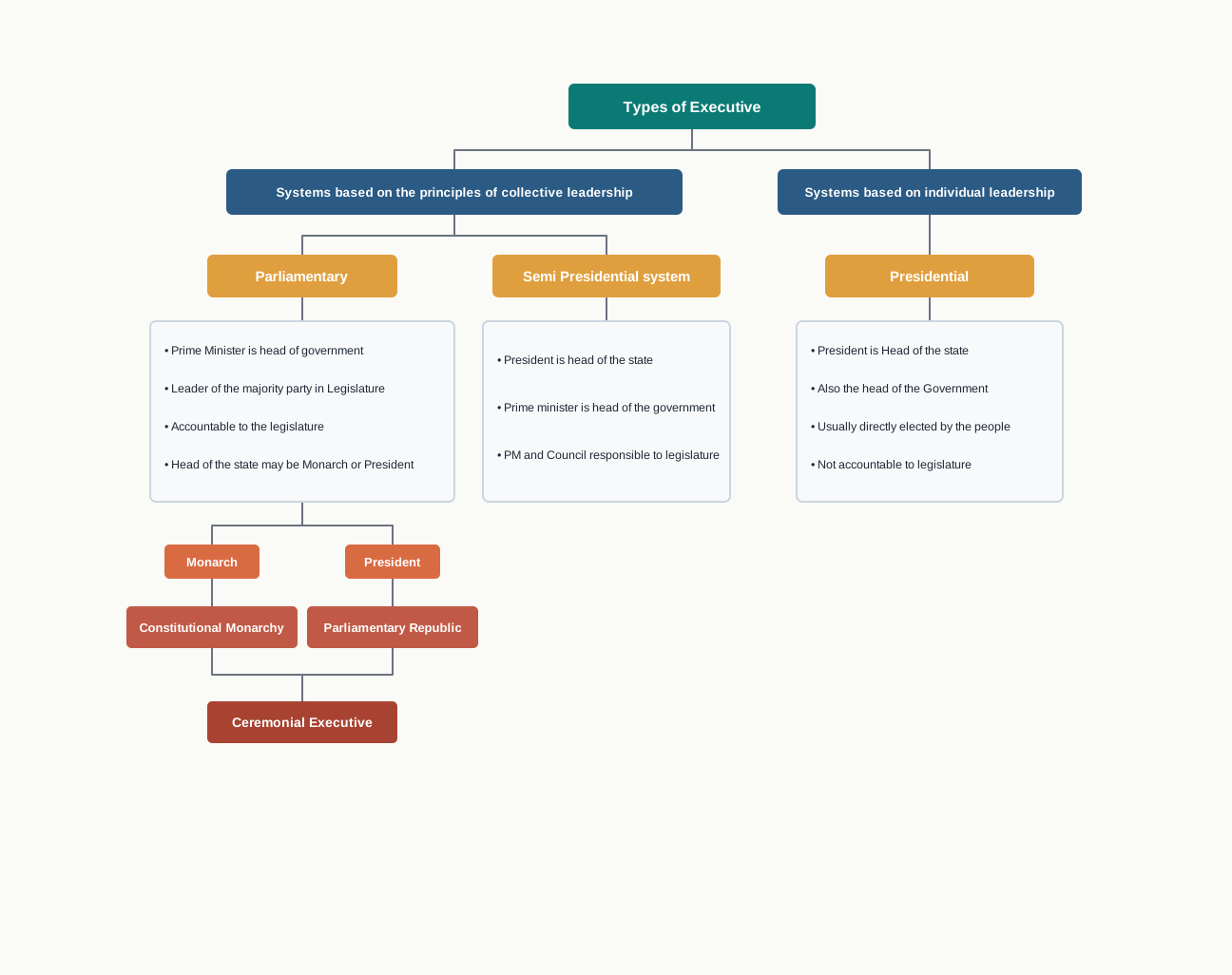
Fig. 4.1 – Types of executive.
Read the chart from the top down and one distinction organises everything below it: whether the system rests on collective leadership or on individual leadership. A parliamentary executive is collective — a Council of Ministers decides together and answers together. A presidential executive is individual — power is concentrated in one elected office. The semi-presidential system sits with the collective family, because its prime minister and Council still answer to the legislature.
What the chart cannot show you is how much difference political practice makes. It gives you the design of each system, not the strength of the person occupying the office. Two countries with identical boxes on this chart may be governed very differently, depending on whether one party holds a clear majority or several parties must bargain with each other. Keep that limit in mind: the chart is a map of rules, not of politics.
The Semi-Presidential Executive In Sri Lanka
Sri Lanka, the island country to the south of India, is worth looking at closely, because it shows how far a president can be pushed inside a system that still has a prime minister.
In 1978 the constitution of Sri Lanka was amended and the system of Executive Presidency was introduced. Under the system of Executive Presidency, people directly elect the President. It may happen that both the President and the Prime Minister belong to the same political party, or to different political parties.
The President has vast powers under the constitution. The President chooses the Prime Minister from the party that has a majority in the Parliament. Though ministers must be members of the Parliament, the President has the power to remove the Prime Minister, or ministers. Apart from being the elected Head of State and the Commander-in-Chief of the Armed Forces, the President is also the Head of the Government.
Elected for a term of six years, the President cannot be removed except by a resolution in the parliament passed by at least two-thirds of the total number of Members of Parliament. If it is passed by not less than one-half of the total number of Members of Parliament and the Speaker — the presiding officer of the House — is satisfied that such allegations merit inquiry, then the Speaker can report the matter to the Supreme Court.
Two questions are worth working through here. How is the position of the President and the Prime Minister in Sri Lanka different from India? And compare the role of the Supreme Court in the impeachment of the President in India and in Sri Lanka. Hold on to both; the next section gives you the Indian half of the answer.
The Parliamentary And The Semi-Presidential Systems
In a parliamentary system, the prime minister is the head of government. Most parliamentary systems have a president or a monarch who is the nominal Head of state. In such a system, the role of the president or monarch is primarily ceremonial, and the prime minister along with the cabinet wields effective power. Countries with such a system include Germany, Italy, Japan, the United Kingdom as well as Portugal.
A semi-presidential system has both a president and a prime minister, but unlike the parliamentary system the president may possess significant day-to-day powers. In this system, it is possible that sometimes the president and the prime minister may belong to the same party, and at times they may belong to two different parties and thus would be opposed to each other. Countries with such a system include France, Russia, Sri Lanka, and others.
That last possibility is the interesting one. In a parliamentary system, the head of state and the head of government cannot easily be political rivals, because the head of state has no independent power to fight with. In a semi-presidential system they can be, because both have real power and each may have come to office by a different route.
The distinction the chapter most wants you to hold is the one between the parliamentary and the presidential executive, and Table 4.A1 gathers it in one place — after, and not instead of, the explanation above.
4.4 Parliamentary Executive In India
Why India Chose It
When the Constitution of India was written, India already had some experience of running the parliamentary system under the Acts of 1919 and 1935. These were laws made by the British government that had allowed Indians a limited share in running the administration. Limited as it was, the experience taught a lesson.
That experience had shown that in the parliamentary system, the executive can be effectively controlled by the representatives of the people. The makers of the Indian Constitution wanted to ensure that the government would be sensitive to public expectations, and would be responsible and accountable.
The other alternative to the parliamentary executive was the presidential form of government. But the presidential executive puts much emphasis on the president as the chief executive and as the source of all executive power. There is always the danger of a personality cult in a presidential executive — a situation in which one leader is treated as being above criticism, and loyalty to the person replaces judgement about the policy.
So the makers of the Constitution faced a genuine problem, and not a simple choice between good and bad. They wanted a government that would have a strong executive branch, because a weak executive cannot govern a large and poor country. But at the same time, enough safeguards should be there to check against the personality cult.
The parliamentary form answered that problem. In it there are many mechanisms that ensure that the executive will be answerable to and controlled by the legislature, or the people’s representatives. So the Constitution adopted the parliamentary system of executive for the governments both at the national and State levels.
Does the choice settle the matter? Not entirely. Haven’t we had very strong Prime Ministers? Does that mean that even the parliamentary system is not foolproof against a personality cult? If it is not, then the safeguard is not in the design alone: people and the legislatures have to be constantly vigilant. A mechanism only works when somebody uses it.
What The System Looks Like
According to this system, there is a President who is the formal Head of the state of India, and the Prime Minister and the Council of Ministers, who run the government at the national level. The Council of Ministers is the body of ministers, headed by the Prime Minister, that takes the decisions of the government.
At the State level, the executive comprises the Governor — the formal head of the State executive — and the Chief Minister and the Council of Ministers of that State. The design at the top is repeated in every State.
The Constitution of India vests the executive power of the Union formally in the President. In reality, the President exercises these powers through the Council of Ministers headed by the Prime Minister. Hold on to the two words that carry the whole distinction: formally, and in reality.
How The President Is Elected And Removed
The President is elected for a period of five years. But there is no direct election by the people for the office of President.
The President is elected indirectly. This means that the President is elected not by the ordinary citizens, but by the elected MLAs and MPs — the members of the State legislative assemblies and of Parliament. Together they form the electoral college, the body of representatives that casts the votes. This election takes place in accordance with the principle of proportional representation with a single transferable vote, the method you have already met, in which a voter ranks the candidates in order of preference and the votes are counted so that the winner reflects a broad spread of support rather than a bare plurality.
The President can be removed from office only by Parliament, by following the procedure for impeachment — the formal process by which a legislature tries and removes a holder of high office. This procedure requires a special majority, as explained in the last chapter: a threshold higher than an ordinary majority, which is deliberately hard to reach.
The only ground for impeachment is violation of the Constitution. That is a narrow gate. A President cannot be removed for being unpopular, or for taking an unwise decision, or for annoying the government of the day.
4.4.1 Power And Position Of President
The Constitution does not leave the relationship between the President and the ministers to convention. It writes it down. Read the provision itself, and read it slowly, because a single word in it carries the weight of the whole office.
What The Word ‘Shall’ Is Doing
Do you know what the word shall means here? It is not a suggestion and not a hope. It indicates that the advice is binding on the President.
The wording did not arrive by accident. In view of the controversy about the scope of the President’s powers, a specific mention was made in the Constitution by an amendment that the advice of the Council of Ministers will be binding on the President. By another amendment made later, it was decided that the President can ask the Council of Ministers to reconsider its advice, but has to accept the reconsidered advice of the Council of Ministers.
Notice what the second amendment gives and what it takes away. It gives the President a genuine power — the power to make the ministers think again. It takes away the power to make them think differently. The last word still belongs to the Council.
There is also a limit to what this extract can tell you. It fixes who must yield at the end of an argument. It says nothing about how often such an argument happens, how much weight a President’s objection carries inside a Cabinet room, or whether ministers quietly change course rather than force the question. A constitutional provision records the rule for the final step, not the pressure applied at every step before it.
A Great Figurehead
We have already seen that the President is the formal head of the government. In this formal sense, the President has wide-ranging executive, legislative, judicial and emergency powers.
In a parliamentary system, these powers are in reality used by the President only on the advice of the Council of Ministers. The Prime Minister and the Council of Ministers have the support of the majority in the Lok Sabha, and they are the real executive. In most of the cases, the President has to follow the advice of the Council of Ministers.
The chapter prints, beside this discussion, a drawing of a figure bent over a desk, writing — the image of an office that signs.
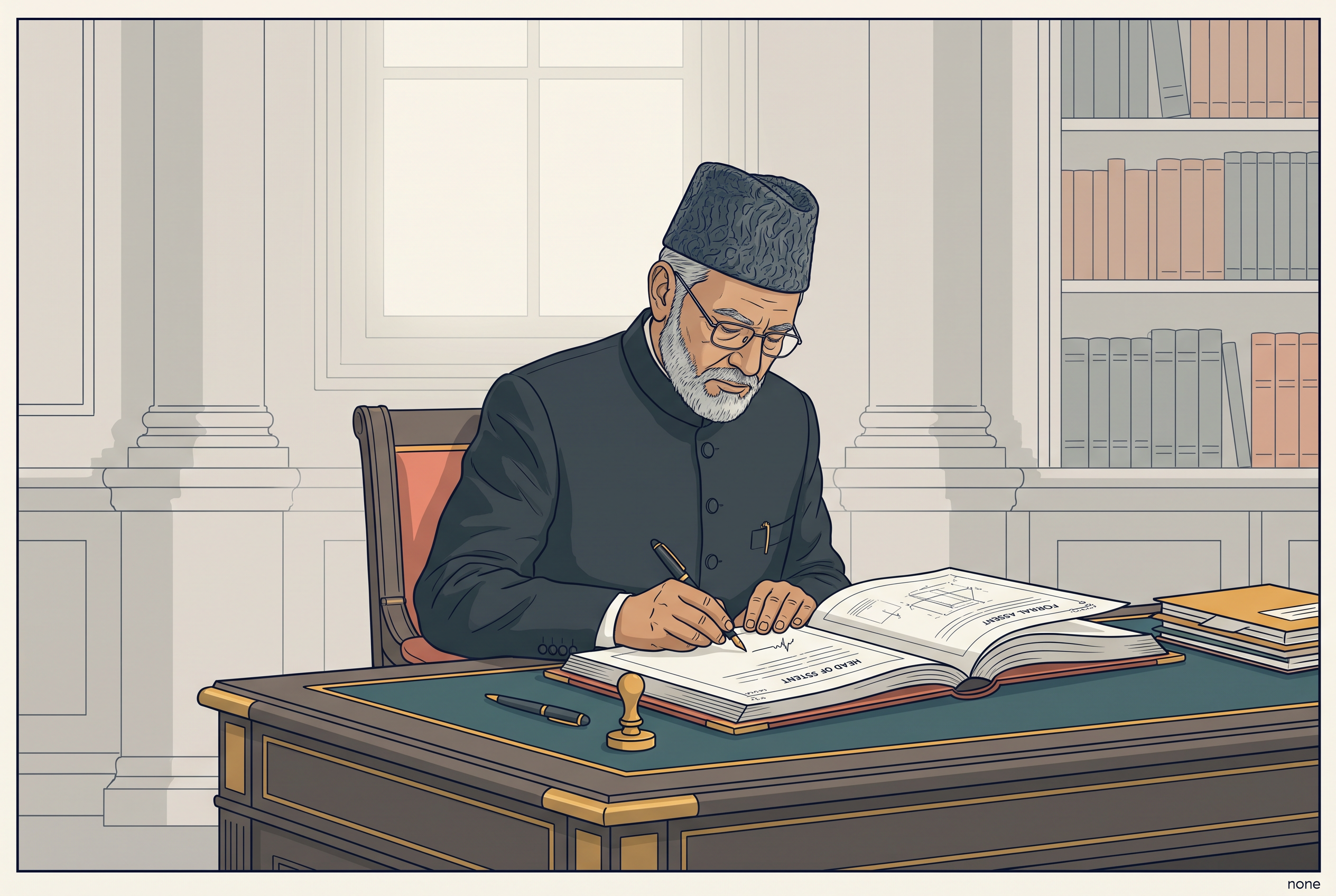
Fig. 4.2 – The office of the President.
Jawaharlal Nehru put the point in the Constituent Assembly while the Constitution was being framed.
Unpack the phrases. ‘Neither reigns nor governs’ rules out two familiar models at once — a monarch who reigns without governing, and a president who governs. ‘A great figurehead’ sounds like a contradiction, and is meant to. Nehru is claiming that an office can matter enormously without being able to decide anything by itself: it can advise, warn, delay, and stand for the whole country when the government of the day stands only for a majority.
Now the limit. This is a speech made in a debate, by a leader arguing for a design he supported, before that design had ever been tested. It tells you what the framers intended the office to be. It cannot tell you what the office became once real Presidents met real Prime Ministers and real coalitions — and this chapter will show you that the office did not stay still.
The textbook’s cartoon character asks a fair question at this point: am I just a figurehead, or am I asking real questions? Did the textbook writers give me the power to ask the questions I wish to ask, or am I asking the questions they already have in their mind? It is exactly the question to ask about the President — whether the space to raise a question is itself a form of power.
4.4.2 Discretionary Powers Of The President
On the basis of the above discussion, can we infer that the President has no discretionary power under any circumstances? This will be an incorrect assessment. Discretion means the space to decide for oneself, and the President has some of it.
The Right To Be Informed
Constitutionally, the President has a right to be informed of all important matters and deliberations of the Council of Ministers. The Prime Minister is obliged to furnish all the information that the President may call for.
The President often writes to the Prime Minister and expresses his views on matters confronting the country. A letter is not an order. But a Prime Minister who must answer the President’s questions in writing is a Prime Minister who has to think twice, and information is the raw material of every other power the office has.
The chapter’s margin character raises a pointed question here: it is very well to talk of the President as He or She, but has a woman ever become the President? It is worth finding out, and worth asking why the answer took as long as it did.
Besides this, there are at least three situations where the President can exercise powers using his or her own discretion.
First: Sending Advice Back
In the first place, we have already noted that the President can send back the advice given by the Council of Ministers and ask the Council to reconsider the decision. In doing this, the President acts on his or her own discretion.
When the President thinks that the advice has certain flaws or legal lacunae — gaps that the law has not covered — or that it is not in the best interests of the country, the President can ask the Council to reconsider the decision.
Although the Council can still send back the same advice, and the President would then be bound by that advice, such a request by the President to reconsider the decision would naturally carry a lot of weight. Ministers must justify themselves in writing to the head of state, and few governments enjoy doing that twice. So this is one way in which the President can act in his own discretion.
Second: The Veto And The Pocket Veto
Secondly, the President also has veto power, by which he can withhold or refuse to give assent to Bills — other than a Money Bill, which is the special class of Bill dealing with taxation and government spending — passed by the Parliament. A veto is the power to block a decision that others have taken.
Every bill passed by the Parliament goes to the President for assent before it becomes a law. The President can send the bill back to the Parliament, asking it to reconsider the bill.
This ‘veto’ power is limited, because if the Parliament passes the same bill again and sends it back to the President, then the President has to give assent to that bill. On its face, therefore, the President can delay a law but cannot kill it.
However, there is no mention in the Constitution about the time limit within which the President must send the bill back for reconsideration. This means that the President can just keep the bill pending with him without any time limit. This gives the President an informal power to use the veto in a very effective manner. It is sometimes referred to as the ‘pocket veto’ — the bill goes into the President’s pocket and simply does not come out. Follow the whole route in Fig. 4.3.
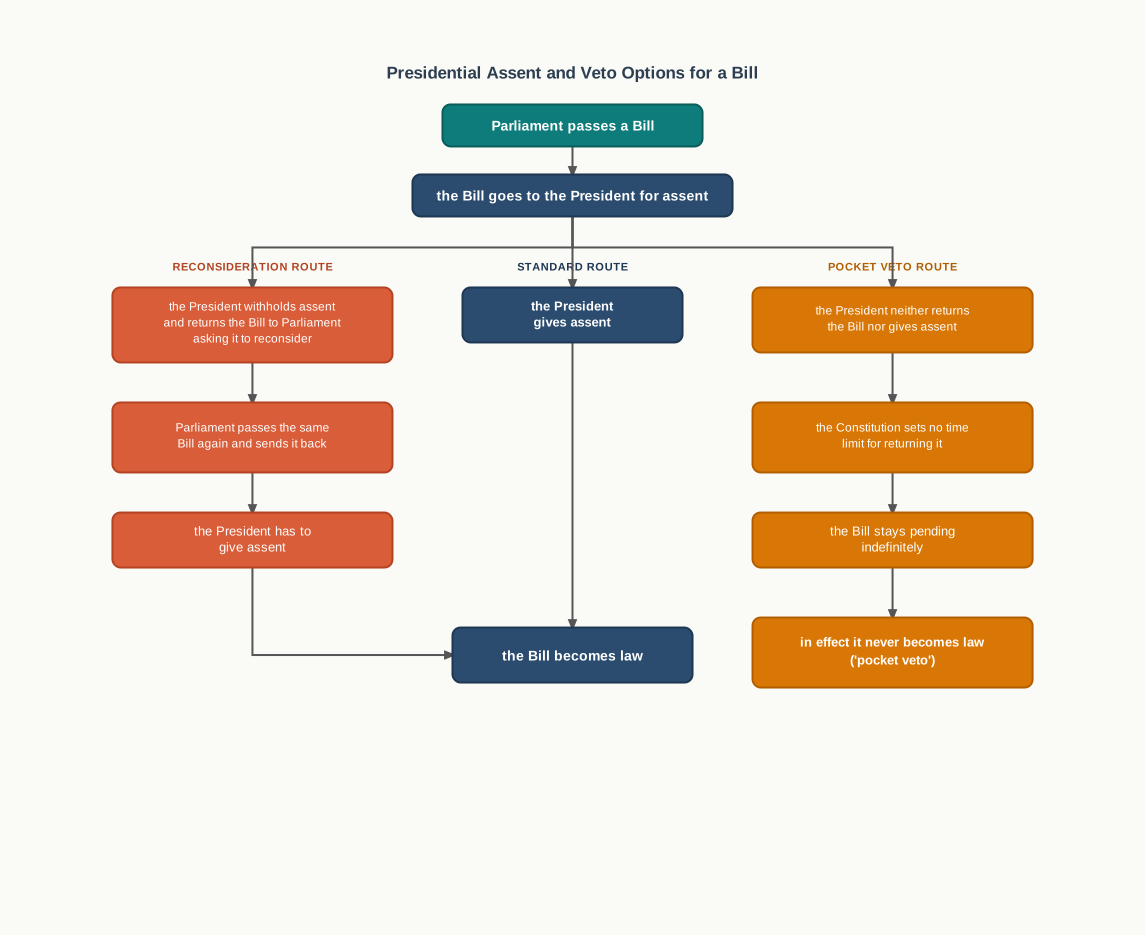
Fig. 4.3 – The path of a Bill and the pocket veto.
Has such a thing already happened? It has. In 1986, the Parliament passed a bill known as the Indian Post Office (amendment) bill. This bill was widely criticised by many, for it sought to curtail the freedom of the press.
The then President, Gyani Zail Singh, did not take any decision on this bill. After his term was over, the next President, Venkataraman, sent the bill finally back to the Parliament for reconsideration. By that time, the government that brought the bill before the Parliament had changed, and a new government was elected in 1989. This government belonged to a different coalition and did not bring the bill back before the Parliament.
Thus, Zail Singh’s decision to postpone giving assent to the bill effectively meant that the bill could never become a law. Notice what actually did the work here. No power was exercised in the ordinary sense; a signature was simply not given, for long enough that an election came and swept the question away.
Third: Choosing A Prime Minister
Then, the third kind of discretion arises more out of political circumstances than out of the text of the Constitution. Formally, the President appoints the Prime Minister.
Normally, in the parliamentary system, a leader who has the support of the majority in the Lok Sabha would be appointed as Prime Minister, and the question of discretion would not arise. The election has already answered the question, and the President only records the answer.
But imagine a situation when, after an election, no leader has a clear majority in the Lok Sabha. Imagine further that after attempts to forge alliances, two or three leaders are claiming that they have the support of the majority in the house. Now, the President has to decide whom to appoint as Prime Minister. In such a situation, the President has to use his own discretion in judging who really may have the support of the majority, or who can actually form and run the government.
This is not a hypothetical exercise. After 1977, party politics in India became more competitive, and there have been many instances when no party had a clear majority in the Lok Sabha. What does the President do in such situations?
No political party or coalition secured a majority in the elections held in March 1998. The BJP and its allies secured 251 seats, 21 short of a majority. President Narayanan adopted an elaborate procedure. He asked the leader of the alliance, Atal Behari Vajpayee, ‘to furnish documents in support of his claim from concerned political parties.’ Not stopping at this, the President also advised Vajpayee to secure a vote of confidence within ten days of being sworn in — a vote in the Lok Sabha in which the House says whether or not it supports the government.
Look closely at what the President did there. He did not choose a Prime Minister according to his own preference. He designed a procedure that forced the claim to be proved — first on paper, and then on the floor of the House. Discretion was used to hand the decision back to the elected majority.
Since 1989 major political changes have considerably increased the importance of the presidential office. In the four parliamentary elections held from 1989 to 1998, no single party or coalition attained a majority in the Lok Sabha.
These situations demanded presidential intervention, either in order to constitute governments, or to grant a request for dissolution of the Lok Sabha by a Prime Minister who could not prove a majority in the House. It may thus be said that presidential discretion is related to political conditions. There is greater scope for presidential assertiveness when governments are not stable and coalitions occupy power.
Why We Need A President At All
For the most part, the President is a formal power holder and a ceremonial head of the nation. You may wonder why then do we need a President at all.
The answer lies in the nature of the parliamentary system itself. In a parliamentary system, the Council of Ministers is dependent on the support of the majority in the legislature. This also means that the Council of Ministers may be removed at any time, and a new Council of Ministers will have to be put in place.
Such a situation requires a Head of the state who has a fixed term, who may be empowered to appoint the Prime Minister, and who may symbolically represent the entire country. A government can fall on a Tuesday afternoon; the state cannot. This is exactly the role of the President in ordinary circumstances.
Besides, when no party has a clear majority, the President has the additional responsibility of making a choice and appointing the Prime Minister to run the government of the country. The office that looks least powerful in normal times becomes indispensable in abnormal ones.
4.5 Prime Minister And Council Of Ministers
One Office That Cannot Be Left Out
Begin with a cartoon drawn more than seventy years ago, in the early years of the Republic, when the shape of the new government was still being watched with curiosity.
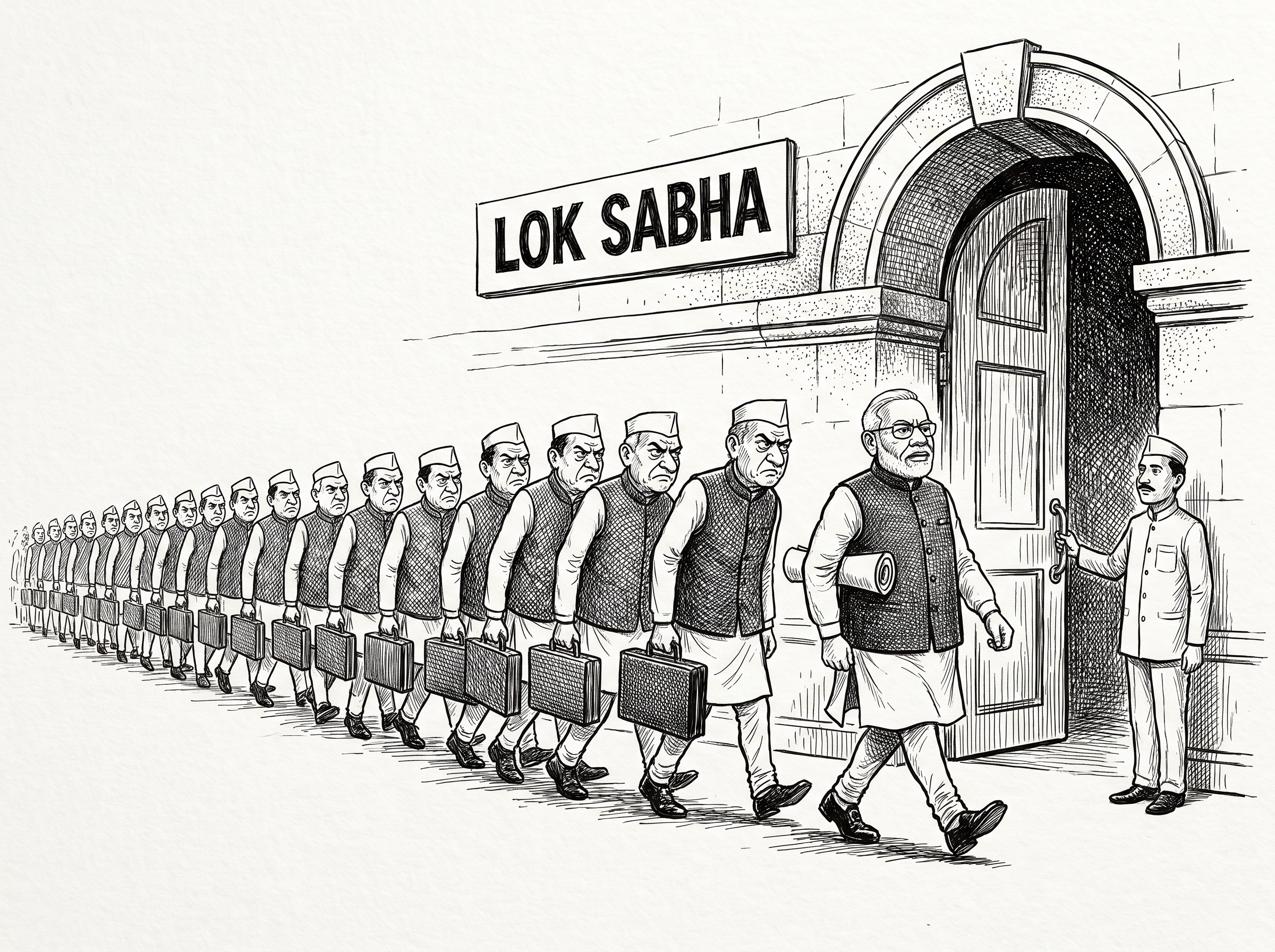
Fig. 4.4 – The Prime Minister leads the Council of Ministers. Inspiration: Shankar, 22 August 1954 (Children’s Book Trust).
Look at what the drawing does. It takes a constitutional relationship and turns it into a physical fact: one man in front, everybody else behind him, all of them walking through the same door. The exaggeration is in the length of the queue — the Council is drawn as a procession that exists only because someone is leading it.
What the cartoon cannot show is why the ministers follow. It gives you the picture of leadership, not its source. A Prime Minister leads because of a majority in the Lok Sabha, and a cartoon cannot draw a majority. Keep that missing piece in mind, because the rest of this section is about it.
No discussion of government or politics in India would normally take place without mentioning one office: the Prime Minister of India. Can you imagine why this is so?
We have already seen earlier in this chapter that the President exercises his powers only on the advice of the Council of Ministers. The Council of Ministers is headed by the Prime Minister. Therefore, as head of the Council of Ministers, the Prime Minister becomes the most important functionary of the government in our country.
How A Prime Minister Reaches Office
In the parliamentary form of executive, it is essential that the Prime Minister has the support of the majority in the Lok Sabha. This support by the majority also makes the Prime Minister very powerful.
The same sentence contains the vulnerability. The moment this support of the majority is lost, the Prime Minister loses the office. Power and dependence come from exactly the same source.
For many years after independence, the Congress party had the majority in the Lok Sabha, and its leader would become the Prime Minister. In those conditions the question of who would be Prime Minister was settled inside one party.
Since 1989, there have been many occasions when no party had a majority in the Lok Sabha. Various political parties have come together and formed a coalition — an alliance of parties that together command a majority in the House, because none of them can command one alone. In such situations, a leader who is acceptable to most partners of the coalition becomes the Prime Minister.
Formally, a leader who has the support of the majority is appointed by the President as Prime Minister. Notice the word formally once again: the President performs the appointment, but the majority makes the choice.
Choosing The Ministers
The Prime Minister then decides who will be the ministers in the Council of Ministers. The Prime Minister allocates ranks and portfolios to the ministers. A portfolio is the department a minister is put in charge of — finance, defence, education, and so on.
Depending upon the seniority and political importance of each person, the ministers are given the ranks of cabinet minister, minister of State, or deputy minister. In the same manner, Chief Ministers of the States choose ministers from their own party or coalition.
There is one condition that binds them all. The Prime Minister and all the ministers have to be members of the Parliament. If someone becomes a minister or Prime Minister without being an MP, such a person has to get elected to the Parliament within six months.
That six-month rule is the parliamentary system in miniature. It allows a government to bring in a person who is not yet an MP, and then insists that the person face an election. Nobody may hold executive office indefinitely without a seat won from voters.
Why do people want to be ministers at all? A cartoonist offers one blunt answer.
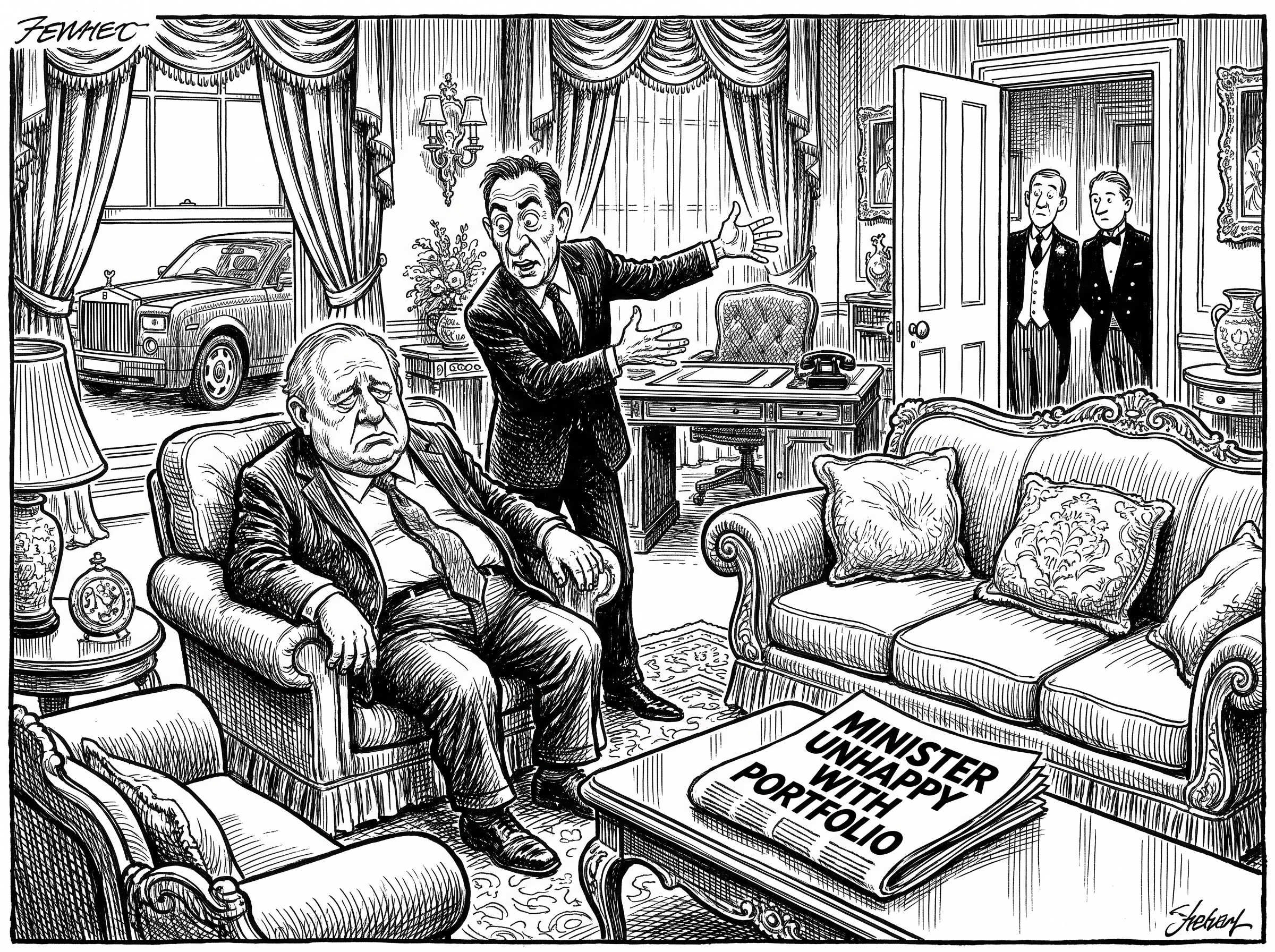
Fig. 4.5 – The perks of a ministerial portfolio. Inspiration: R K Laxman, The Times of India.
The joke works by listing everything except the job. House, car, servants, foreign trips, security, secretaries — the cartoonist piles up the comforts of office to suggest that the office itself is beside the point.
But the Discuss question turns the joke back on itself, and this is the part worth thinking through. If ministers wanted only perks, every portfolio would do equally well, since the car and the house come with all of them. The fact that some portfolios are fought over tells you that ministers also want power over decisions — over money, over policy, over appointments. The cartoon states the cynical half of the truth loudly, and leaves the other half for you to supply.
And that is the limit of any cartoon. It makes one claim in one image, sharply. It cannot draw the counter-argument, and it offers no evidence for its charge — no names, no cases, no numbers. It is an opinion, powerfully expressed.
Should Ministers Be Elected Instead?
The Prime Minister’s power to pick ministers was not accepted without argument. There were some members in the Constituent Assembly who felt that ministers should be elected by the legislature and not selected by the Prime Minister or Chief Minister.
Take the argument seriously, because it is a real alternative and not a stray remark. Begum Aizaz Rasul is proposing that the legislature as a whole should elect the ministers, using the single transferable vote — the same method you met when reading how the President is elected. Her reason is representation: if all members vote and preferences are counted, then all interests will be represented, and no party will be able to say it has been shut out of the executive.
Set against that the system India actually adopted. There, ministers are chosen by the Prime Minister, and the Council of Ministers is therefore a team that can be held responsible together — which is the point of the next few paragraphs.
The limit of this extract is worth stating plainly. It is one speech, by one member, on one day in July 1947, recorded in the debates. It tells you that the alternative was argued for. It does not tell you how many members agreed, why the Assembly finally decided otherwise, or how the Swiss arrangement would have worked in Indian conditions. A record of a debate preserves the arguments made, not the reasons that persuaded.
How Big Can The Council Be?
Before the 91st Amendment Act (2003), the size of the Council of Ministers was determined according to the exigencies of time and the requirements of the situation. In plain words, a Prime Minister or Chief Minister could appoint as many ministers as seemed necessary.
But this led to a very large size of the Council of Ministers. Besides, when no party had a clear majority, there was a temptation to win over the support of the members of the Parliament by giving them ministerial positions, as there was no restriction on the number of members of the Council of Ministers. This was happening in many States also.
Therefore, an amendment was made that the Council of Ministers shall not exceed 15 percent of the total number of members of the House of the People — or of the Assembly, in the case of the States. The cap does not change who chooses the ministers. It only limits how many chairs there are to hand out, and therefore how far ministerial office can be used as a currency for buying support.
Collective Responsibility
In the chapter on the legislature you will study in detail the various mechanisms through which the Parliament controls the executive. But remember that the most important feature of the parliamentary executive is that the executive is routinely under the control and supervision of the legislature. Routinely — not only at election time.
The Council of Ministers is collectively responsible to the Lok Sabha. This provision means that a Ministry which loses the confidence of the Lok Sabha is obliged to resign.
The principle indicates that the ministry is an executive committee of the Parliament, and that it collectively governs on behalf of the Parliament. Collective responsibility is based on the principle of the solidarity of the cabinet — the ministers stand or fall together.
It implies that a vote of no confidence even against a single minister leads to the resignation of the entire Council of Ministers. A vote of no confidence is a motion by which the Lok Sabha declares that it no longer supports the government; one minister cannot be sacrificed to save the rest.
It also indicates that if a minister does not agree with a policy or decision of the cabinet, he or she must either accept the decision or resign. It is binding on all ministers to pursue or agree to a policy for which there is collective responsibility. Disagreement is allowed inside the room; once the decision is taken, a minister either owns it in public or leaves.
The Linchpin Of Government
Is it that a person becomes Prime Minister because he or she is powerful, or is it that you become powerful once you have become the Prime Minister? Hold the question while you read what the office actually carries.
In India, the Prime Minister enjoys a pre-eminent place in the government. The Council of Ministers cannot exist without the Prime Minister. The Council comes into existence only after the Prime Minister has taken the oath of office.
The asymmetry is sharp. The death or resignation of the Prime Minister automatically brings about the dissolution of the Council of Ministers. But the demise, dismissal or resignation of a minister only creates a ministerial vacancy — one chair to be filled, not a government to be rebuilt.
The Prime Minister acts as a link between the Council of Ministers on the one hand, and the President as well as the Parliament on the other. It is this role of the Prime Minister which led Pt. Nehru to describe him as ‘the linchpin of Government’. A linchpin is the small pin that holds a wheel on its axle: remove it, and the wheel comes off.
It is also the constitutional obligation of the Prime Minister to communicate to the President all decisions of the Council of Ministers relating to the administration of the affairs of the Union, and proposals for legislation. The Prime Minister is involved in all crucial decisions of the government and decides on the policies of the government.
Thus, the power wielded by the Prime Minister flows from various sources: control over the Council of Ministers, leadership of the Lok Sabha, command over the bureaucratic machine, access to media, projection of personalities during elections, and projection as national leader during international summitry as well as foreign visits.
Read that list again and notice that only some of it is constitutional. Control over the Council and leadership of the Lok Sabha come from the system’s design. Access to media, and the projection of a personality during an election campaign, do not. They come from politics — which is why the answer to the question we began with is: both. A person becomes Prime Minister by being powerful in a party, and becomes far more powerful by becoming Prime Minister.
The Coalition Era Changes Things
However, the power which the Prime Minister wields and actually puts into use depends upon the prevailing political conditions. The same office is not equally strong at all times.
The position of the Prime Minister and the Council of Ministers has been unassailable whenever a single political party has secured a majority in the Lok Sabha. However, this has not been the case when governments have been led by coalitions of political parties.
Since 1989, we have witnessed many coalition governments in India. Many of these governments could not remain in power for the full term of the Lok Sabha. They were either removed, or they resigned due to loss of the support of the majority. These developments have affected the working of the parliamentary executive, in four ways.
In the first place, these developments have resulted in a growing discretionary role of the President in the selection of Prime Ministers — the third kind of discretion you met in the last section.
Secondly, the coalitional nature of Indian politics in this period has necessitated much more consultation between political partners, leading to the erosion of prime ministerial authority. Thirdly, it has also brought restrictions on various prerogatives of the Prime Minister, like choosing the ministers and deciding their ranks and portfolios — the very powers that made the office pre-eminent.
Fourthly, even the policies and programmes of the government cannot be decided by the Prime Minister alone. Political parties of different ideologies come together, both as pre-poll and post-poll allies, to form a government. Policies are framed after a lot of negotiations and compromises among the allies. In this entire process, the Prime Minister has to act more as a negotiator than as leader of the government.
Winning a majority is not the end of the difficulty, as a cartoonist noticed.
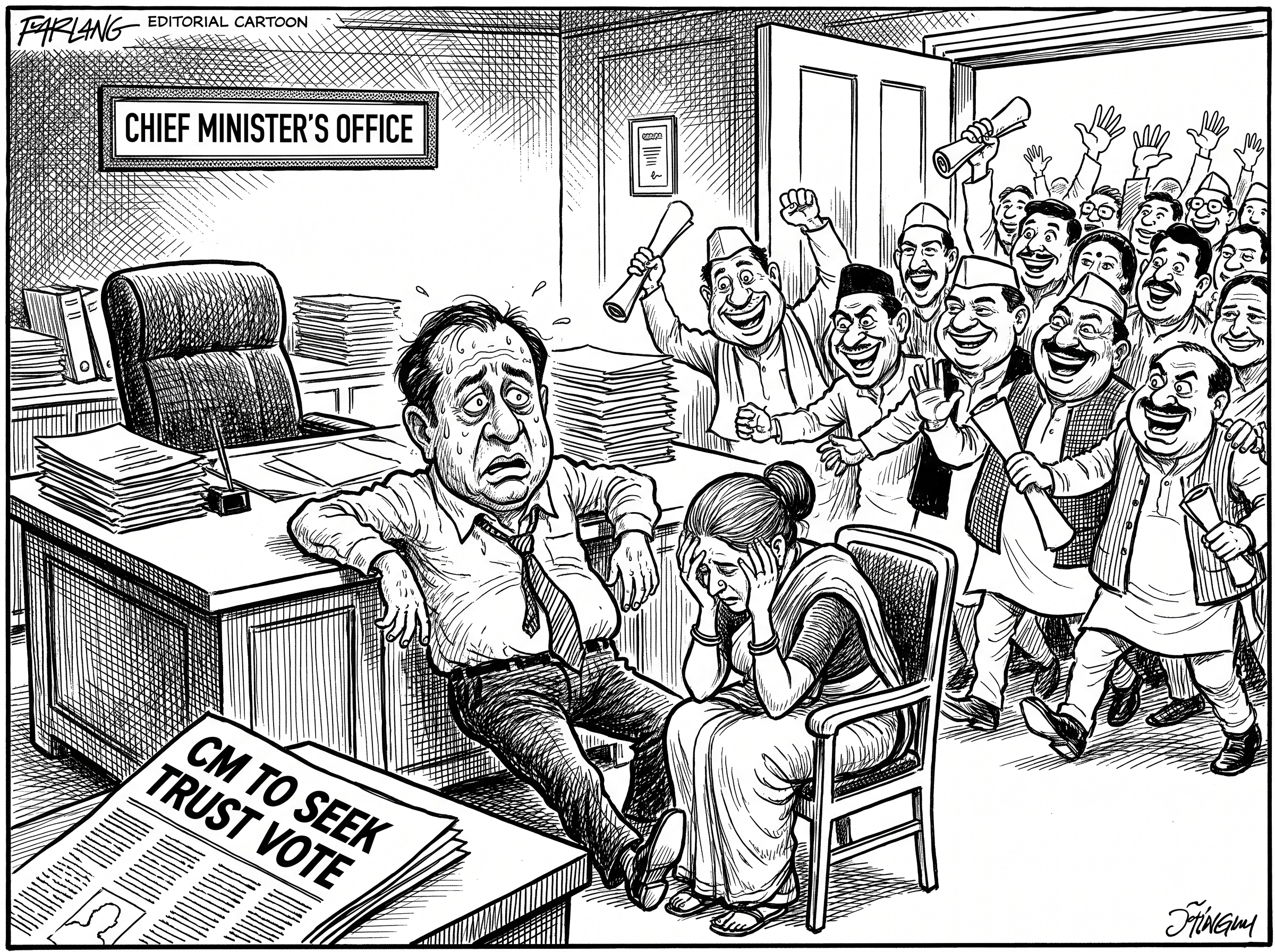
Fig. 4.6 – The pressure of coalition politics. Inspiration: R K Laxman, The Times of India.
The cartoonist is drawing the coalition era. Winning a vote of confidence proves that a majority exists today; it does not buy a single day of peace. Each ally that voted for the leader now has a claim to press — a portfolio, a policy, a demand — and the leader must keep them all satisfied until the next test comes.
The limit is the same limit as before. The cartoon captures a mood and makes a claim about coalition politics. It offers no evidence about any particular government, and it cannot tell you whether coalition governments in fact governed worse, or merely governed with more difficulty. Those are different things, and the chapter itself does not settle the question.
The Parliamentary Executive In The States
At the State level, a similar parliamentary executive exists, though with some variations. The design travels down, but not unchanged.
The most important variation is that there is a Governor of the State appointed by the President — on the advice of the central government. The President of India is elected; the Governor of a State is appointed, and appointed on the advice of ministers sitting in Delhi.
Though the Chief Minister, like the Prime Minister, is the leader of the majority party in the Assembly, the Governor has more discretionary powers than the President. However, the main principles of the parliamentary system operate at the State level too: the Chief Minister and the Council of Ministers are the real executive, and they hold office as long as the Assembly supports them.
4.6 Permanent Executive: Bureaucracy
Who Implements The Decisions Of The Ministers?
A minister announces a scheme. A file moves. Somewhere, months later, a school gets a building or a farmer gets a payment. Who did that?
The executive organ of the government includes the Prime Minister, the ministers, and a large organisation called the bureaucracy, or the administrative machinery. It is by far the biggest part of the executive, and it is the part an ordinary citizen actually meets.
To underline the difference between this machinery and the military service, it is described as the civil service. Trained and skilled officers who work as permanent employees of the government are assigned the task of assisting the ministers in formulating policies and in implementing these policies.
Read that sentence again. The officers do not only implement. They also assist in formulating policy — because ministers arrive with intentions and officers hold the information, the files and the memory of what was tried last time.
Under Political Control
In a democracy, the elected representatives and the ministers are in charge of the government, and the administration is under their control and supervision. This is the whole point of the arrangement: officers are appointed, ministers are elected, and the appointed must answer to the elected.
In the parliamentary system, the legislature also exercises control over the administration. The administrative officers cannot act in violation of the policies adopted by the legislature. It is the responsibility of the ministers to retain political control over the administration.
India has established a professional administrative machinery. At the same time, this machinery is made politically accountable. Both halves matter, and the rest of this section is about how uneasily they sit together.
What Political Neutrality Means
The bureaucracy is also expected to be politically neutral. This means that the bureaucracy will not take any political position on policy matters.
Why insist on this? In a democracy, it is always possible that a party is defeated in elections, and that the new government wants to opt for new policies in the place of the policies of the previous government. That is what an election is for.
In such a situation, it is the responsibility of the administrative machinery to faithfully and efficiently participate in drafting the policy and in its implementation. An officer who worked on the old scheme on Friday must work on the new scheme on Monday, with the same energy. Neutrality is not indifference; it is the discipline of serving whichever government the voters have chosen.
Recruitment By Merit
The Indian bureaucracy today is an enormously complex system. It consists of the All-India services, State services, employees of the local governments, and the technical and managerial staff running public sector undertakings — the companies and enterprises owned by the government.
The makers of our Constitution were aware of the importance of a non-partisan and professional bureaucracy. They also wanted the members of the civil services to be impartially selected on the basis of merit, and not chosen as a reward for political loyalty.
So the Union Public Service Commission has been entrusted with the task of conducting the process of recruitment of the civil servants for the government of India. Similar public service commissions are provided for the States also.
The Commissions are protected so that they can protect merit. Members of the Public Service Commissions are appointed for a fixed term. Their removal or suspension is subject to a thorough enquiry made by a judge of the Supreme Court. A government that dislikes a Commission’s decisions cannot simply replace the Commission.
Making The Bureaucracy Representative
While efficiency and merit are the norms for recruitment, the Constitution also ensures that all sections of society, including the weaker sections, have an opportunity to be part of the public bureaucracy.
For this purpose, the Constitution has provided reservation in jobs for Scheduled Castes and Scheduled Tribes — the setting aside of a proportion of posts for groups that have long been excluded. Subsequently, reservations have also been provided for women, Other Backward Classes (OBC) and Economically Weaker Sections (EWS).
These provisions ensure that the bureaucracy would be more representative, and that social inequalities will not come in the way of recruitment to the civil service. The argument behind them is that a purely open examination does not begin from an equal starting line, and that an administration drawn from every section of society is more likely to understand, and to reach, every section of society.
The Shape Of The Civil Services
The services are not one single body. Fig. 4.7 sets out how they are classified.
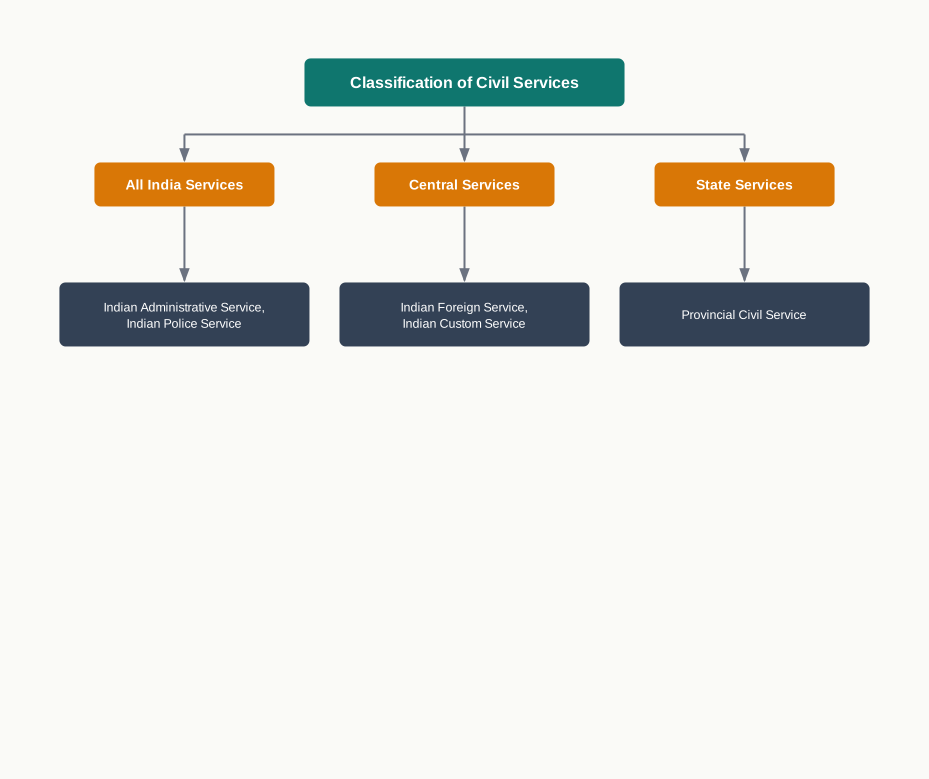
Fig. 4.7 – Classification of civil services.
The chart is a map of recruitment and posting, and it explains a great deal about how India is actually administered. What it cannot show is the relationship of power between the three columns — and that relationship is the interesting part.
The Collector, And Who Controls Whom
Persons selected by the UPSC for the Indian Administrative Service and the Indian Police Service constitute the backbone of the higher level bureaucracy in the States.
You may know that the collector of a district is the most important officer of the government at the district level — the officer in charge of the administration of a whole district, and the person a citizen with a grievance is most likely to petition. Do you know that the collector is normally an IAS officer, and that the officer is governed by the service conditions laid down by the central government?
Follow the chain of authority carefully, because it produces a surprising result. An IAS or IPS officer is assigned to a particular State, where he or she works under the supervision of the State government. So far, the officer looks like a State officer.
However, the IAS or IPS officers are appointed by the central government. They can go back into the service of the central government. And, most importantly, only the central government can take disciplinary action against them. This means that the key administrative officers of the States are under the supervision and control of the central government.
Apart from the IAS and the IPS officers appointed by the UPSC, the administration of the State is looked after by officers appointed through the State Public Service Commissions. As we shall study later in the chapter on federalism, this feature of the bureaucracy strengthens the control of the central government over the administration of the States.
The Political And The Permanent Executive Compared
You have now met both halves of the executive organ. The political executive — the Prime Minister and the ministers — comes out of elections, takes the policy decisions, and answers to the legislature and to the voters. It is temporary by design: it leaves when the majority leaves it.
The permanent executive — the civil service — is recruited by examination, stays across changes of government, and carries the decisions into practice. It answers to the ministers, not to the voters, and it is not supposed to have a political position at all.
The two need each other. Ministers have democratic authority but not the machinery; officers have the machinery but no democratic authority. Table 4.A2 places the contrast side by side, after the explanation and not instead of it.
The Instrument And Its Problems
The bureaucracy is an instrument through which the welfare policies of the government must reach the people. Every scheme you have heard of arrives, in the end, through an officer.
But most often it is so powerful that people are afraid of approaching a government officer. It is a common experience of the people that the bureaucracy is insensitive to the demands and expectations of the ordinary citizen. The textbook’s own margin character says it plainly: the officers are there to serve the people, yet people are always afraid of these officers, and the officers behave as if they were the masters.
Only if the democratically elected government controls the bureaucracy can some of these problems be effectively handled. On the other hand, too much political interference turns the bureaucracy into an instrument in the hands of the politician. Notice that these are not two different worries. They are the same worry, approached from opposite ends, and moving away from one takes you towards the other.
Though the Constitution has created independent machinery for recruitment, many people think that there is no provision for protecting the civil servants from political interference in the performance of their duties. It is also felt that enough provisions are not there to ensure the accountability of the bureaucracy to the citizen.
There is an expectation that measures like the Right to Information — under which a citizen can ask a public office for information about its decisions and its work — may make the bureaucracy a little more responsive and accountable. Notice where that hope is placed. It is not placed in ministers controlling officers, or in officers being protected from ministers, but in the citizen being able to ask both of them a question.
4.7 Summary
The Chapter In Short
- The legislature makes law, the judiciary interprets it, and the executive implements it and runs the administration. The Constitution asks the three organs to coordinate with one another and to balance one another.
- The executive is a body of persons that looks after the implementation of rules and regulations in actual practice. It is also involved in framing policy.
- The executive has two halves. The political executive — the heads of government and their ministers — carries overall responsibility for policy. The permanent executive — the civil servants — runs day-to-day administration.
- Countries organise the executive differently, and the title of an office tells you little. In a presidential system, one person is head of state and head of government. In a parliamentary system, a prime minister heads the government while a president or monarch is the nominal head of state. In a semi-presidential system there are both, and the president holds real day-to-day powers.
- India adopted the parliamentary system, at the national and the State levels. The makers of the Constitution wanted a strong executive, but one that could be controlled by the people’s representatives, and safeguarded against a personality cult.
- The Constitution formally vests the executive power of the Union in the President. In reality the President exercises it through the Council of Ministers headed by the Prime Minister, who are the real executive.
- The President is elected indirectly, for five years, by the elected MPs and MLAs, through proportional representation with the single transferable vote. The only ground for impeachment is violation of the Constitution.
- Under Article 74 (1), the advice of the Council of Ministers is binding on the President. The President may ask the Council to reconsider, but must act on the advice tendered after reconsideration.
- The President still has discretion in three situations: sending advice back for reconsideration; withholding assent to a Bill, with no time limit fixed for returning it — the ‘pocket veto’; and choosing a Prime Minister when no leader has a clear majority.
- A head of state with a fixed term is needed precisely because a Council of Ministers can fall at any time.
- The Prime Minister is the most important functionary of the government. The Council of Ministers cannot exist without the Prime Minister, who selects the ministers and allots their ranks and portfolios. Ministers must be members of Parliament, or become members within six months.
- The Council of Ministers is collectively responsible to the Lok Sabha. A ministry that loses the confidence of the House must resign, and a minister who cannot accept a cabinet decision must resign instead.
- Since 1989, coalition governments have changed how the parliamentary executive works: the President’s discretion has grown, and the Prime Minister has had to act more as a negotiator than as a commander.
- The bureaucracy is recruited on merit through the Union Public Service Commission and the State Public Service Commissions, is expected to be politically neutral, and is made more representative through reservation for Scheduled Castes and Scheduled Tribes, and for women, OBCs and EWS.
- Key State officers such as the collector are IAS officers appointed and disciplined by the central government, which strengthens central control over State administration.
The Chapter’s Conclusion
The modern executive is a very powerful institution of government. It enjoys greater powers than the other organs of the government, and that is exactly why there is a greater need for democratic control over it.
The makers of our Constitution thought with foresight that the executive must be put firmly under regular supervision and control. That is why a parliamentary executive was chosen.
Periodic elections, constitutional limits over the exercise of powers, and democratic politics have together ensured that the executive organ cannot become unresponsive.
The Arguments In One Place
The chapter’s central claim is that the most powerful organ of government must also be the most closely watched, and that a parliamentary executive does this better than the alternatives, because the government survives only as long as the people’s representatives support it.
The strongest position against it, as the chapter itself records, is the presidential alternative: a single elected chief executive, powerful in theory and in practice, who can act decisively without being at the mercy of shifting majorities. The makers rejected it for fear of the personality cult.
The chapter also preserves a third position, argued in the Constituent Assembly by Begum Aizaz Rasul — that the legislature should elect the ministers, so that all interests are represented and no party feels shut out of the executive.
And the chapter concedes the objection to its own answer: strong Prime Ministers have appeared within the parliamentary system, so the design alone is no guarantee. The safeguard finally rests on vigilant legislatures and vigilant citizens.
What Remains Contested
Is the ‘pocket veto’ a safeguard against a majority that may be abusing its power, or an unelected office quietly killing a law passed by elected representatives? The chapter shows what happened; it does not tell you what should happen.
How much political control over the bureaucracy is the right amount? Too little, and officers are insensitive to citizens; too much, and they become instruments of politicians. The chapter names both dangers and settles neither.
And notice whose voices these sources were never designed to record. The Constituent Assembly debates record the framers; the cartoons record the cartoonists. Nobody in this chapter’s evidence speaks for the citizen waiting at the counter of a government office — the person for whom the whole machinery was built.
4.8 NCERT Questions
- A parliamentary executive means:
- Executive where there is a parliament
- Executive elected by the parliament
- Where the parliament functions as the Executive
- Executive that is dependent on support of the majority in the parliament
- Read this dialogue. Which argument do you agree with? Why?
Amit: Looking at the constitutional provisions, it seems that the President is only a rubber stamp.
Shama: The President appoints the Prime Minister. So, he must have the powers to remove the Prime Minister as well.
Rajesh: We don’t need a President. After the election, the Parliament can meet and elect a leader to be the Prime Minister.
- Match the following
| Column A | Column B |
|---|---|
| a. Works within the particular State in which recruited | i. Indian Foreign Service |
| b. Works in any central government office located either at the national capital or elsewhere in the country | ii. State Civil Services |
| c. Works in a particular State to which allotted; can also be sent on deputation to the centre | iii. All India Services |
| d. Works in Indian missions abroad | iv. Central Services |
- Identify the ministry which may have released the following news items. Would this be a ministry of the central government or the State government? Why?
- An official release said that in 2004-05 the Tamil Nadu Textbooks Corporation would release new versions for standards VII, X and XI.
- A new railway loop line bypassing the crowded Tiruvallur-Chennai section to help iron ore exporters. The new line, likely to be about 80 km long, will branch off at Puttur and then reach Athipattu near the port.
- The three-member sub-divisional committee formed to verify suicide by farmers in Ramayampet mandal has found that the two farmers who committed suicide this month have had economic problems due to failure of crops.
- While appointing the Prime Minister, the President selects
- Leader of the largest party in the Lok Sabha
- Leader of the largest party in the alliance which secures a majority in the Lok Sabha
- The leader of the largest party in the Rajya Sabha
- Leader of the alliance or party that has the support of the majority in Lok Sabha
- Read this discussion and say which of these statements applies most to India.
Alok: Prime Minister is like a king, he decides everything in our country.
Shekhar: Prime Minister is only ‘first among equals’, he does not have any special powers. All ministers and the PM have similar powers.
Bobby: Prime Minister has to consider the expectations of the party members and other supporters of the government. But after all, the Prime Minister has a greater say in policy making and in choosing the ministers.
Why do you think is the advice of the Council of Ministers binding on the President? Give your answer in not more than 100 words.
The parliamentary system of executive vests many powers in the legislature for controlling the executive. Why, do you think, is it so necessary to control the executive?
It is said that there is too much political interference in the working of the administrative machinery. It is suggested that there should be more and more autonomous agencies which do not have to answer to the ministers.
- Do you think this will make administration more people-friendly?
- Do you think this will make administration more efficient?
- Does democracy mean full control of elected representatives over the administration?
Write an essay of two hundred words on the proposal to have an elected administration instead of an appointed administration.
4.9 Check Your Concepts
How is the election of the Vice President different from the election of the President? In what circumstances does the Vice President take over the office of the President, and for how long?
Trace the path of a Bill after Parliament has passed it and sent it to the President. Then explain how a President can prevent a Bill from becoming law without ever formally refusing assent to it.
Why was the size of the Council of Ministers capped at 15 percent by the 91st Amendment Act (2003)? What problem was the amendment responding to?
Read Source 4.2 again. What does Nehru mean by ‘a head that neither reigns nor governs’? State one thing this extract cannot tell you about how the office of President has actually worked.
In Source 4.3, Begum Aizaz Rasul argues that the legislature, and not the Prime Minister, should elect the ministers. What reason does she give? How does the system India finally adopted deal with the same worry differently?
Fig. 4.5 suggests that people want to be ministers only for the perks and the status. If that were the whole truth, why would there be competition for particular portfolios? What does the cartoon leave out of the picture?
In the four parliamentary elections held from 1989 to 1998, no single party or coalition attained a majority in the Lok Sabha. Reconstruct the chain of consequences that followed from this — first for the role of the President, and then for the authority of the Prime Minister.
Hold the political executive and the permanent executive side by side. How does each reach office, how long does each remain, and to whom is each answerable? Use your answer to explain why an IAS officer serving in a State is finally controlled by the central government.