Chapter 5: Legislature
On the morning of 4 June 1998, the Lok Sabha — the directly elected House of India’s Parliament — was in no mood to listen quietly.
The Union Budget is the government’s annual statement of what it will earn and what it will spend. In that year’s budget proposal, the finance minister had suggested raising the price of urea by 50 paisa per kilogram. Urea is the fertiliser Indian farmers use more than any other. Its price is held down by a subsidy, which means the government pays part of the cost so that the farmer pays less. Cutting the subsidy would save the government money. It would also make every bag of urea dearer for millions of cultivators.
The House erupted. Scenes turned acrimonious. The entire opposition walked out — that is, members left the chamber together, in protest, refusing to take part in the proceedings. The issue rocked the House for two days.
The government had a majority. It had already announced the increase. And still, at the end of those two days, the finance minister, Mr. Yashwant Sinha, rolled back the hike in urea prices.
No court had ordered him to. No election was due. What made a government reverse its own budget decision was a House full of elected members who refused to let it pass — and who could not simply be ignored.
That is the power this chapter is about.
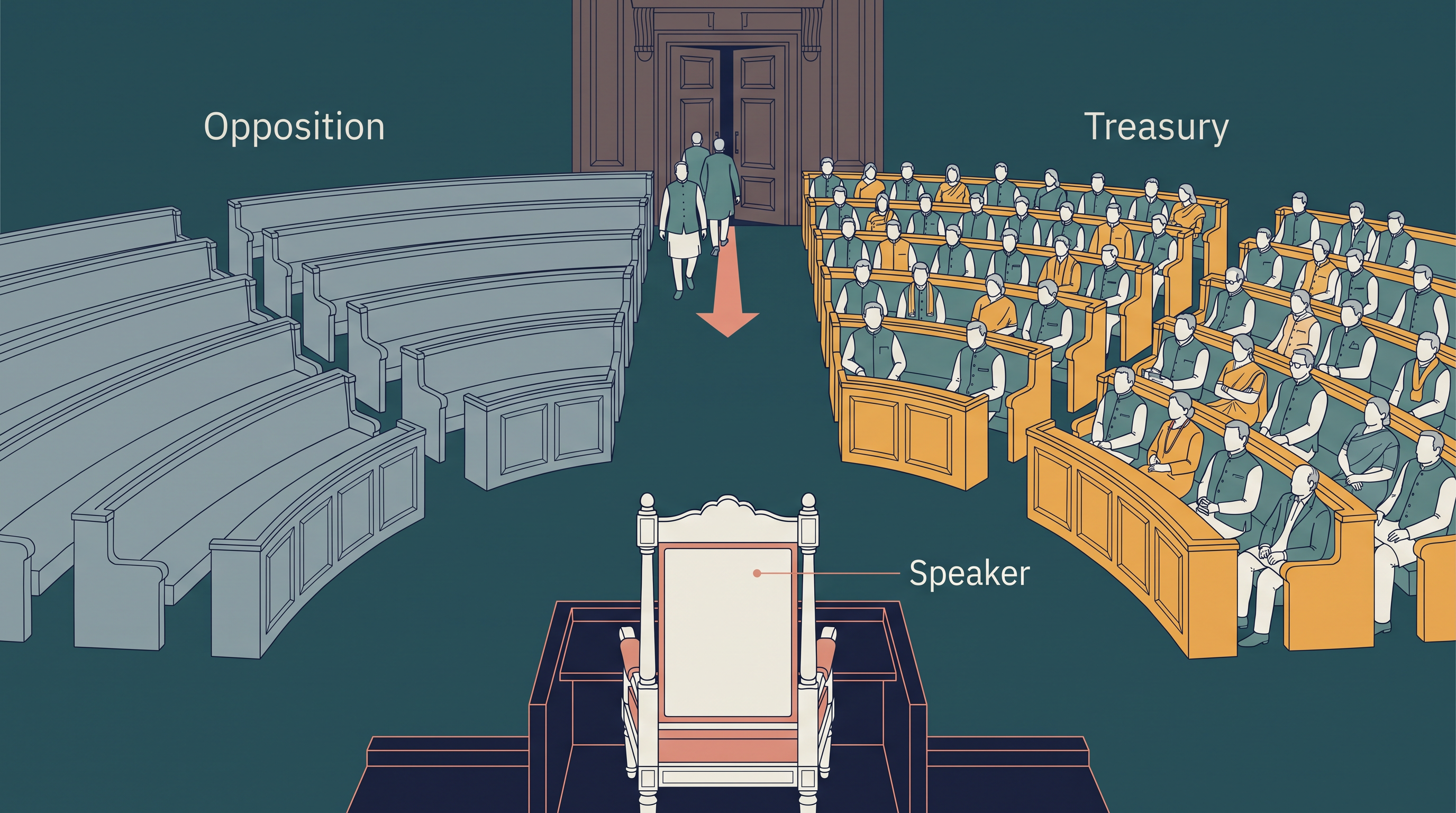
Fig. 5.0 – A walkout empties the opposition benches.
5.1 Introduction
You have already studied why elections matter and how elections are conducted in India. This chapter takes the next step. It asks what happens to the people we elect once the voting is over and the counting is done.
A legislature is the body of elected representatives that makes laws and holds the government answerable on behalf of the people. Its members do not sit there in their own name. They sit there because voters sent them, and they can be sent home again.
What This Chapter Will Answer
In this chapter you will study how elected legislatures actually function, and how they help keep a government democratic. You will look closely at how the Parliament of India and the State legislatures are composed, what they do from day to day, and why they matter to democratic government.
By the end of the chapter you should know:
- why a legislature is important at all;
- the functions and powers of the Parliament of India;
- the procedure by which a law is made;
- how the Parliament controls the executive — that is, the Prime Minister, the Council of Ministers and the administration that carries out the laws; and
- how the Parliament regulates its own conduct and its own members.
5.2 Why Do We Need A Parliament?
Not Merely A Law-Making Body
It is easy to assume that a legislature exists in order to make laws, and that once the laws are made its work is done. That assumption is too narrow. Lawmaking is only one of the functions of the legislature.
The legislature is the centre of the whole democratic political process. It is packed with action — walkouts, protests, demonstrations, moments of complete unanimity, expressions of concern, and stretches of genuine co-operation across party lines. None of this is noise. Each of these serves a very vital purpose, because each is a way in which disagreement is brought into the open instead of being settled quietly somewhere else.
A genuine democracy is inconceivable without a representative, efficient and effective legislature. Take away the House, and there is no place where the government must explain itself in public. The legislature is also what allows people to hold their own representatives accountable. This is indeed the very basis of representative democracy — a system in which citizens do not take decisions themselves, but choose representatives to take decisions on their behalf, and can remove those representatives if they are not satisfied.
Has The Parliament Declined?
And yet, in most democracies, legislatures are losing their central place to the executive. India is no exception. The Cabinet — the group of senior ministers led by the Prime Minister that takes the government’s main policy decisions — initiates policies, sets the agenda for governance, and carries them through. The House often finds itself responding to decisions that have already been shaped elsewhere.
This has led some critics to remark that the Parliament has declined. It is a serious charge, and the chapter does not brush it aside. But it is not the whole picture either.
Even very strong cabinets must retain a majority in the legislature. A strong leader has to face the Parliament and answer to the satisfaction of the Parliament. Herein lies the democratic potential of the Parliament. It is recognised as one of the most democratic and open forums of debate in the country. On account of its composition — members drawn from every region, language and social background — it is the most representative of all organs of government. And it is, above all, vested with the power to choose and dismiss the government.
Reading The News Reports
The chapter now asks you to test all this against real reports from newspapers. Read each one, and ask yourself what would have happened if there had been no legislature at all.
The first is from 28 February 2002. The Union Finance Minister, Jaswant Singh, announced in the Union budget proposal an increase of Rs. 12 in the price of a 50 kg bag of urea, and a smaller increase in the price of two other fertilizers, which together constituted about a 5 per cent rise in prices. The report added that the current urea price of Rs. 4,830 a tonne carries a subsidy of as much as 80 per cent — that is, for every hundred rupees the fertiliser actually costs, the farmer was paying about twenty.
The second report is dated 11 March 2002, less than two weeks later. The Finance Minister had to roll back the increases in fertilizer prices under intense opposition pressure (The Hindu, 12 March 2002). Nothing had changed in the arithmetic of the subsidy. What had changed was that the proposal had to survive a House in which the opposition was determined not to let it pass quietly.
The third report you have already read at the start of this chapter: the walkout of 4 June 1998 over the hike in urea and petroleum prices, which ended with the finance minister rolling back the increase (Hindustan Times, 4 and 5 June 1998).
The fourth is from 22 February 1983. In a rare move, the Lok Sabha unanimously decided to suspend official business and give precedence to a debate on Assam. Home Minister P.C. Sethi made a statement: ‘I seek the cooperation of all members whatever their views and policies, in promoting harmony among different communities and groups living in Assam. What is needed now is not acrimony but a healing touch.’ (Hindustan Times, 22 February 1983). Here the House was not blocking the government at all. It was setting aside its own timetable so that a matter of the gravest public concern could be discussed at once, and it did so unanimously.
The fifth report is from 3 March 1985. Congress Members voiced protest against atrocities on Harijans in Andhra Pradesh (The Hindu, 3 March 1985). Harijan was a term then in use for people of the Scheduled Castes. Notice what the report shows: violence in one State, raised on the floor of the national Parliament, by members of the party that was in office. A wrong done far from Delhi was made the business of the whole House.
Read together, these reports do not all say the same thing. In two of them, pressure inside the House forced a government to reverse itself. In the third, the House used its own time to seek calm rather than to score a point. In the last, the House was used as a place to name a wrong, though the report does not tell us whether anything was done afterwards. That gap matters. A newspaper report records what was said in the House on a given day; it cannot tell you what happened to the demand once the House rose.
5.3 Why Do We Need Two Houses Of Parliament?
The term ‘Parliament’ refers to the national legislature — the one that sits in Delhi and makes law for the whole country. The legislature of a State is described as the State legislature.
The Parliament in India has two houses. When there are two houses of the legislature, it is called a bicameral legislature. The two Houses of the Indian Parliament are the Council of States, or the Rajya Sabha, and the House of the People, or the Lok Sabha.
The Constitution does not force the same design on the States. It has given the States the option of establishing either a unicameral legislature — a single house — or a bicameral one. At present only six States have a bicameral legislature. They are marked on Map 5.1.
Map
Map 5.1 Caption: Six States in India have chosen a bicameral legislature; the rest have a single house. Brief: Political map of India showing all States and Union Territories with their capitals, redrawn from the map printed in the chapter. The map must show the full extent of India as officially defined by the Government of India, including Jammu and Kashmir and Ladakh, with boundaries as officially recognised by the Government of India, and no part of India shown as disputed. Shade only the six States named in the text — Andhra Pradesh, Bihar, Karnataka, Maharashtra, Telangana and Uttar Pradesh — and give a key explaining that the shading marks States with a bicameral legislature. Show international and State boundaries, and label no claim the text does not make.
States having a bicameral legislature are given below:
- Andhra Pradesh
- Bihar
- Karnataka
- Maharashtra
- Telangana
- Uttar Pradesh
Read that list against the map and one thing stands out at once. Most States in India manage with one house. A second chamber is an option, not a requirement — which means a country has to give reasons for having one.
The Case For A Second Chamber
Countries that are large in size and rich in diversity usually prefer to have two houses in the national legislature. One house alone cannot easily carry every kind of voice. A second chamber allows representation to be given to all sections in society, and to all the geographical regions or parts of the country.
A bicameral legislature has one more advantage, and it is a practical one. It makes it possible to have every decision reconsidered. Every decision taken by one house goes to the other house for its decision. This means that every bill and every policy would be discussed twice, which ensures a double check on every matter. Even if one house takes a decision in haste, that decision will come up for discussion in the other house, and reconsideration will be possible.
This was argued at the very moment the Constitution was being written. In the Constituent Assembly — the body that framed the Constitution — Purnima Banerji set out what she thought a second chamber was for.
Look carefully at what she is claiming. A revising body is one that goes over work already done and improves it. Her Upper House is not meant to be a rival to the elected House; its views may count, she says, but not its votes. And it is meant to bring in people who could not enter into the rough and tumble of active politics — people who would never win an election, but whose advice is worth having.
Now the limit. This is a speech, made by one member, in the middle of an argument she was trying to win. It tells you what a case for the second chamber sounded like in 1949. It cannot tell you whether the Rajya Sabha has in fact worked as a calm revising body, or whether it has become as political as the House it was meant to advise. For that you would need evidence about how the Rajya Sabha has actually behaved — evidence a speech from 1949 could not possibly contain.
5.3.1 Rajya Sabha
Each of the two Houses of Parliament has a different basis of representation. That difference is the whole point of having two.
The Rajya Sabha represents the States of India. It is an indirectly elected body, which means the people do not vote for its members themselves. Residents of a State elect members to the State Legislative Assembly. The elected members of the State Legislative Assembly in turn elect the members of the Rajya Sabha.
Two Ways To Represent The States
We can imagine two different principles of representation in the second chamber, and they lead to very different Houses.
One way is to give equal representation to all the parts of the country, irrespective of their size or population. We may call this symmetrical representation. On the other hand, parts of the country may be given representation according to their population. This second method means that regions or parts having a larger population would have more representatives in the second chamber than regions having less population.
The first method is not imaginary. In the USA, every state has equal representation in the Senate, the upper house of the American Congress. This ensures equality of all the states. But it also means that a small state would have the same representation as the larger states.
The system of representation adopted for the Rajya Sabha is different from that in the USA. The number of members to be elected from each State has been fixed by the fourth schedule of the Constitution.
What would happen if we were to follow the American system of equality of representation in the Rajya Sabha? Uttar Pradesh, with a population of 1998.12 lakhs, would get seats equal to those of Sikkim, whose population is only 6.10 lakhs. Work the comparison out slowly: Uttar Pradesh has more than three hundred times as many people as Sikkim, and yet the two would speak with exactly the same voice in the second chamber. The framers of the Constitution wanted to prevent such discrepancy.
So States with larger populations get more representatives than States with smaller populations get. Thus a more populous State like Uttar Pradesh sends 31 members to the Rajya Sabha, while a smaller and less populous State like Sikkim has one seat in the Rajya Sabha.
Bicameralism In Germany
India is not the only federation that had to solve this problem, and it is worth seeing how differently it can be solved. Germany, a federation in central Europe, also has a bicameral legislature. Its two Houses are known as the Federal Assembly (Bundestag) and the Federal Council (Bundesrat). The Assembly is elected by a complex system combining direct and proportional representation, for a period of four years.
The 16 federal states of Germany are represented in the Federal Council. The 69 seats of the Bundesrat are divided among the states on the basis of a range of populations. These members are generally the ministers in the governments at the state level, and they are appointed, not elected, by the governments of the federal states.
According to the German law, all the members from one state have to vote as a bloc, as per the instructions of the state government. To vote as a bloc means the whole group must vote the same way; they cannot split. Sometimes, because there is a coalition government at the state level — a government formed by more than one party together — they fail to reach an agreement, and may have to abstain, that is, refuse to vote either way.
The Bundesrat does not vote on all legislative initiatives. But all the policy areas on which the federal states have concurrent powers, and are responsible for federal regulations, must be passed by it. It can also veto such legislation — that is, block it outright.
Notice the contrast with India. In Germany the members of the second chamber are sent by state governments and must vote as their state instructs them. In India the members are elected by the elected members of the State Legislative Assembly, and once elected they vote as individuals.
A House That Never Dies
Members of the Rajya Sabha are elected for a term of six years. They can get re-elected. But all members of the Rajya Sabha do not complete their terms at the same time. Every two years, one third of the members of the Rajya Sabha complete their term, and elections are held for those one-third seats only.
The consequence is important. The Rajya Sabha is never fully dissolved. It is therefore called the permanent House of the Parliament. The advantage of this arrangement is that even when the Lok Sabha is dissolved and elections are yet to take place, a meeting of the Rajya Sabha can be called and urgent business can be conducted. The country is never left without a sitting House.
Apart from the elected members, the Rajya Sabha also has twelve nominated members. The President nominates these members. These nominations are made from among those persons who have made their mark in the fields of literature, science, art and social service.
That provision has always attracted a question, and you should ask it too. Why nominate artists and scientists at all? Whom do they represent — no constituency has voted for them — and do they really contribute much to the proceedings of the Rajya Sabha? Hold the question against Purnima Banerji’s argument above: she wanted exactly such people, those who could not enter the rough and tumble of active politics, brought in to advise. Whether that hope has been realised is a matter on which you must look at the record and decide.
The chapter now sets you a task. Find out the number of representatives elected to the Rajya Sabha from different States. Prepare a chart showing the number of representatives and the population of the State according to the 2011 census. Set the two columns side by side and see how closely the seats track the people.
5.3.2 Lok Sabha
The Lok Sabha and the State Legislative Assemblies are directly elected by the people. There is no middle step here: your vote goes straight to choosing the member.
For the purpose of election, the entire country — or the State, in the case of a State Legislative Assembly — is divided into territorial constituencies of roughly equal population. A constituency is simply a marked-out area whose voters together elect one representative. One representative is elected from each constituency through universal adult suffrage, in which every adult citizen has a vote and the value of the vote of every individual is equal to that of another.
At present there are 543 constituencies. This number has not changed since the 1971 census. Read that sentence again with the previous paragraph in mind. Constituencies are meant to hold roughly equal populations, and India’s population has grown enormously since 1971 — yet the number of seats has stayed where it was.
The Lok Sabha is elected for a period of five years. This is the maximum, not a guarantee. We have seen in the chapter on the executive that before the completion of five years, the Lok Sabha can be dissolved if no party or coalition can form the government, or if the Prime Minister advises the President to dissolve the Lok Sabha and hold fresh elections.
The Two Houses Side By Side
The two Houses now stand clearly apart: one directly elected by the people for a fixed maximum term and dissolvable, the other indirectly elected by State Legislative Assemblies, renewed in thirds and never dissolved. Table 5.A1 puts the contrast in one place, but the reasoning above is what matters — the grid is only a way of holding it steady.
5.4 What Does The Parliament Do?
What exactly is the function of the legislature? Do both Houses of the Parliament have similar functions? And is there a difference in the powers of the two Houses?
Apart from law making, the Parliament is engaged in many other functions. Let us list the functions of the Parliament one by one, because each of them is a different kind of power.
The Functions Of The Parliament
Legislative function. The Parliament enacts legislations for the country. But notice what the chapter says next, because it is uncomfortable. Despite being the chief law making body, the Parliament often merely approves legislations. The actual task of drafting the bill is performed by the bureaucracy — the permanent body of officials who run the administration — under the supervision of the minister concerned. The substance, and even the timing, of the bill are decided by the Cabinet. No major bill is introduced in the Parliament without the approval of the Cabinet. Members other than ministers can also introduce bills, but these have no chance of being passed without the support of the government.
Control of the executive and ensuring its accountability. Perhaps the most vital function of the Parliament is to ensure that the executive does not overstep its authority and remains responsible to the people who have elected them. This function is discussed in greater detail later in this chapter.
Financial function. Government is about spending a lot of money on various matters. Where does this money come from? Every government raises resources through taxation. However, in a democracy, the legislature controls taxation and the way in which money is used by the government. If the Government of India proposes to introduce any new tax, it has to get the approval of the Lok Sabha.
The financial powers of the Parliament involve the grant of resources to the government to implement its programmes. The government has to give an account to the legislature about the money it has spent and the resources that it wishes to raise. The legislature also ensures that the government does not misspend or overspend. This is done through the budget and the annual financial statements — the yearly documents in which a government sets out, item by item, what it expects to earn and what it intends to spend.
That power was already being drawn in the 1950s. Look at Fig. 5.1.
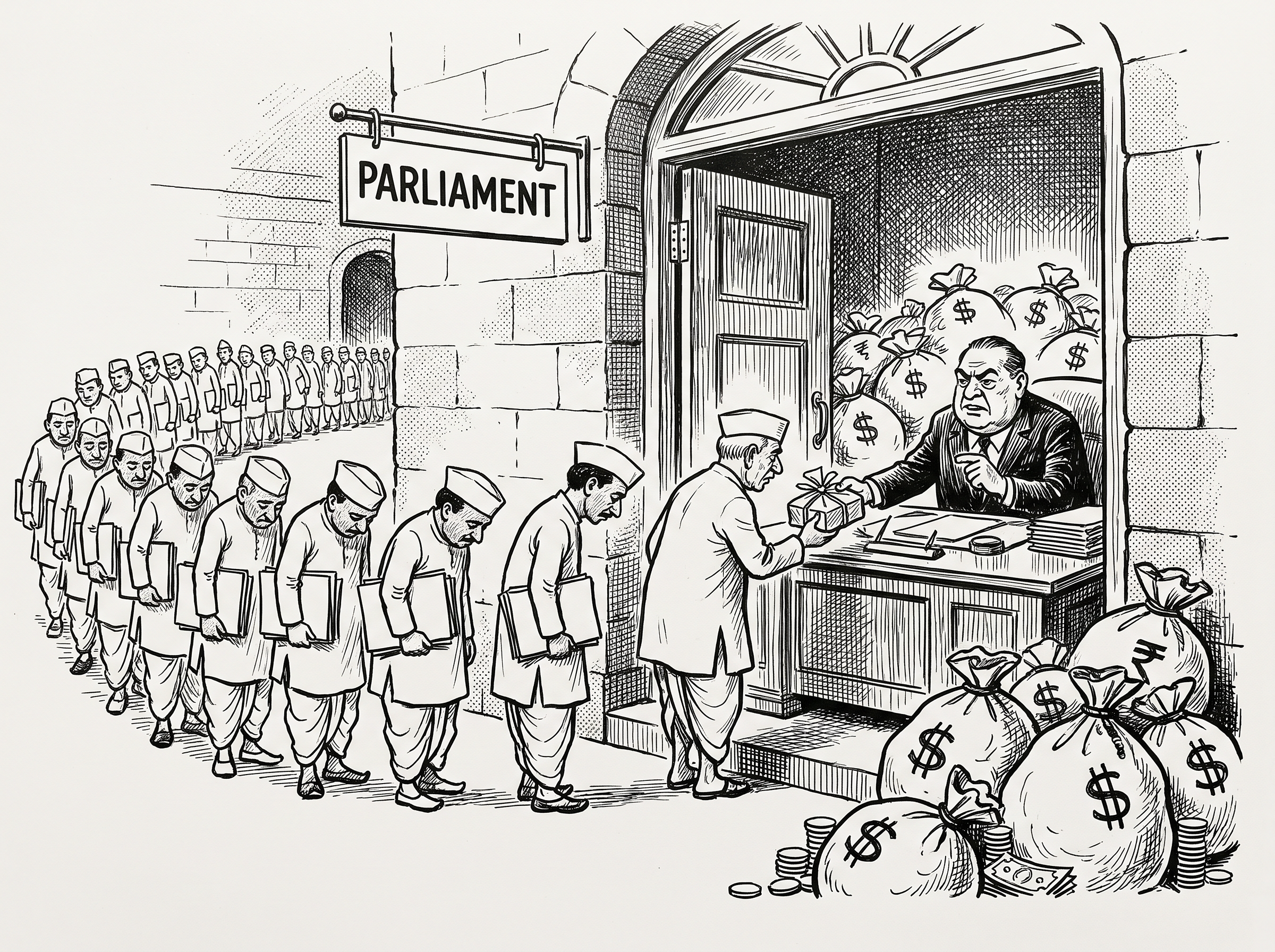
Fig. 5.1 – The Parliament controls the government’s purse strings. Inspiration: Shankar, Children’s Book Trust, 3 April 1955.
The joke lies in the reversal. In the ordinary run of things ministers give orders and others wait. Here the ministers are the ones queuing, cap in hand, because the money is not theirs to take. The cartoonist has exaggerated their humility in order to make a claim: the House that sanctions the money is the House that is really in charge.
Now the limit. A cartoon makes one point in one image, and it cannot draw the counter-argument. It cannot show you that the government normally commands a majority in the House, so that the money it asks for is rarely refused. It cannot show that the Cabinet had already decided the substance and the timing of the demand long before it reached that door. A cartoon can show where the formal power lies. It cannot show how often that power is actually used.
Representation. The Parliament represents the divergent views of members from different regional, social, economic and religious groups, from different parts of the country.
Debating function. The Parliament is the highest forum of debate in the country. There is no limitation on its power of discussion. Members are free to speak on any matter without fear. This makes it possible for the Parliament to analyse any or every issue that faces the nation. These discussions constitute the heart of democratic decision making.
Constituent function. The Parliament has the power of discussing and enacting changes to the Constitution. The constituent powers of both the houses are similar. All constitutional amendments have to be approved by a special majority of both Houses — a level of agreement fixed higher than the ordinary majority needed for other laws.
Electoral functions. The Parliament also performs some electoral functions. It elects the President and the Vice President of India.
Judicial functions. The judicial functions of the Parliament include considering the proposals for removal of the President, the Vice-President and the Judges of the High Courts and the Supreme Court.
5.4.1 Powers Of Rajya Sabha
We discussed above the functions that are performed by the Parliament in general. However, in a bicameral legislature, there is some difference between the powers of the two Houses. Look at the charts showing the powers of the Lok Sabha and the Rajya Sabha.
Before you read them, one term must be pinned down. A money bill is a bill that deals with taxation and with the raising and spending of government money; a non-money bill is everything else. Keep that distinction in view, because almost every difference between the two Houses turns on it. The Union List, the State List and the Concurrent List, which you met in earlier classes, divide subjects between the two levels of government: the Union alone legislates on the first, the States alone on the second, and both may legislate on the third.
Read the two charts against each other and a pattern comes out. On the Constitution, on the removal of high constitutional officers, and on non-money bills, the two Houses look much alike. On money — taxation, budgets, annual financial statements — and on the survival of the government, only one chart carries the entry. The Rajya Sabha may suggest amendments to a money bill; the Lok Sabha introduces and enacts it.
Now the limit, and it matters more than the lists themselves. These charts set out powers on paper. They cannot tell you how often each power is actually used, or with what result. A chart which says that the Lok Sabha approves proposals for taxation does not tell you whether it has ever refused one. And neither chart shows the single fact that shapes almost every vote in both Houses: that nearly every member belongs to a political party.
5.4.2 Special Powers Of Rajya Sabha
As you know, the Rajya Sabha is an institutional mechanism to provide representation to the States. Its purpose is to protect the powers of the States. Therefore, any matter that affects the States must be referred to it for its consent and approval.
Thus, if the Union Parliament wishes to remove a matter from the State list — over which only the State Legislature can make law — to either the Union List or the Concurrent List in the interest of the nation, the approval of the Rajya Sabha is necessary. Think about what that means. The Union cannot quietly help itself to a subject that belongs to the States. It must first persuade the House in which the States are represented. This provision adds to the strength of the Rajya Sabha.
However, experience shows that the members of the Rajya Sabha represent their parties more than they represent their States. The design and the practice have parted company, and the chapter says so plainly.
Powers Exercised Only By The Lok Sabha
Then there are powers that only the Lok Sabha exercises. The Rajya Sabha cannot initiate, reject or amend money bills. The Council of Ministers is responsible to the Lok Sabha and not to the Rajya Sabha. Therefore the Rajya Sabha can criticise the government, but it cannot remove it.
Can you explain why? The reasoning is not arbitrary. The Rajya Sabha is elected by the MLAs — the members of the State Legislative Assemblies — and not directly by the people. Therefore the Constitution stopped short of giving certain powers to the Rajya Sabha. In a democratic form as adopted by our Constitution, the people are the final authority. By this logic, the representatives who are directly elected by the people should have the crucial powers of removing a government and controlling the finances.
So the Lok Sabha controls the purse, and the government’s survival. Does that make it simply the more powerful House? Be careful before agreeing. In all other spheres — including the passing of non-money bills, constitutional amendments, and impeaching the President and removing the Vice President — the powers of the Lok Sabha and the Rajya Sabha are co-equal. Neither can act alone. The Lok Sabha is stronger where money and the government’s life are concerned; elsewhere it must carry the other House with it.
5.5 How Does The Parliament Make Laws?
The basic function of any legislature is to make laws for its people. It does not do so casually. A definite procedure is followed in the process of making a law. Some of the procedures of law making are mentioned in the Constitution, while some have evolved from conventions — settled practices that no document commands, but that everyone follows.
Follow a bill through the legislative process, as Fig. 5.2 sets it out, and you will clearly see that the law making process is technical and even tedious. That is not a flaw in the design. A law binds everyone in the country, and a procedure with many stages is a procedure with many chances to catch a mistake.
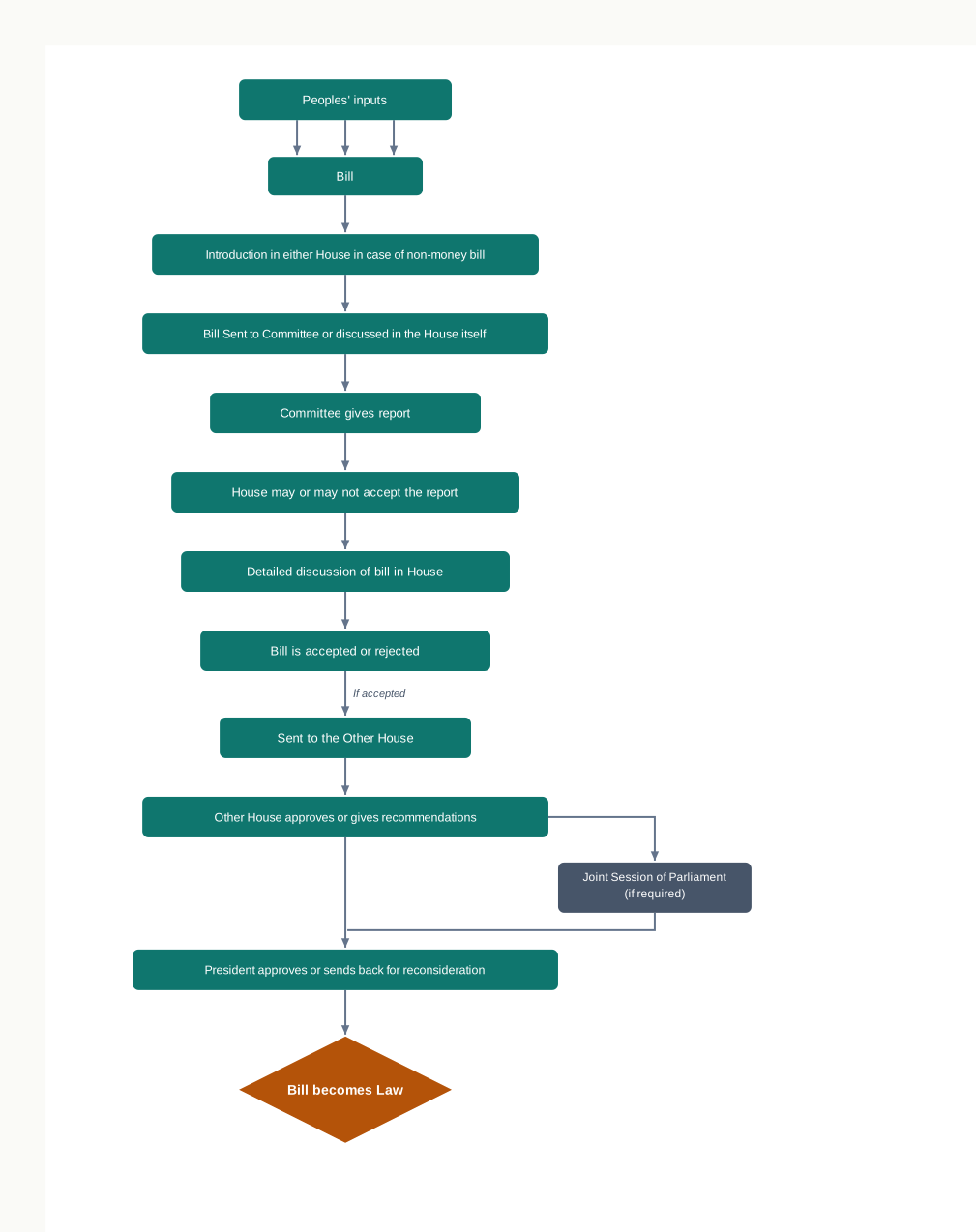
Fig. 5.2 – The journey of a bill from introduction to law.
What Is A Bill?
A bill is a draft of the proposed law. It is not law yet, and it may never become law. There can be different types of bills, and Fig. 5.3 shows how they are classified.
When a non-minister proposes a bill, it is called a private member’s Bill. A bill proposed by a minister is described as a Government Bill. The difference matters, as you saw earlier: a bill without the support of the government has almost no chance of being passed.
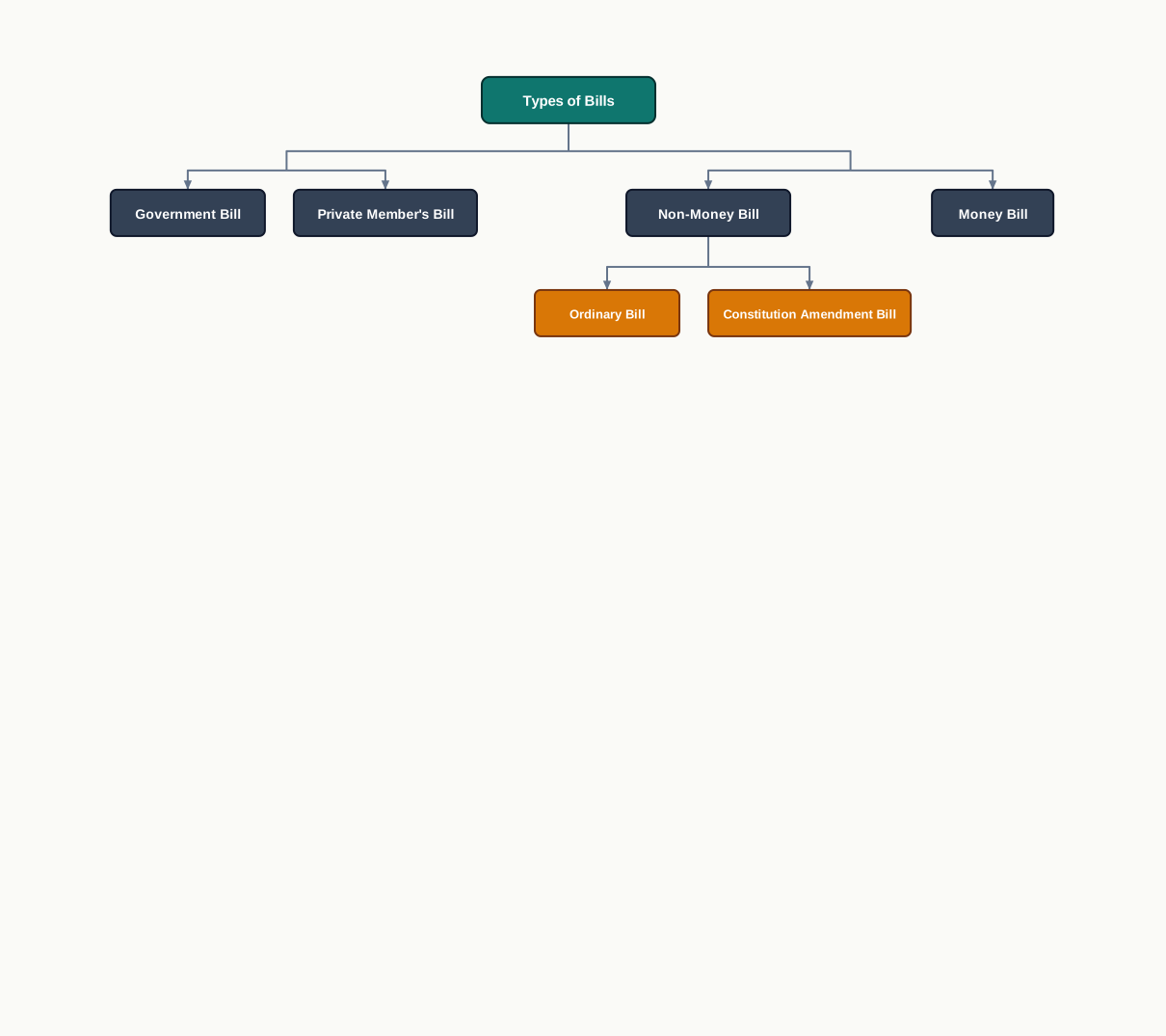
Fig. 5.3 – Classification of legislative bills.
Let us now see the different stages in the life of a bill.
Before The Bill Is Written
Even before a bill is introduced in the Parliament there may be a lot of debate on the need for introducing such a bill. A political party may pressurise the government to initiate a bill in order to fulfil its election promises, or to improve its chances of winning forthcoming elections. Interest groups, the media and citizens’ forums may also persuade the government to bring in a particular legislation.
Law making is thus not merely a legal procedure but also a political course of action. Read that sentence slowly. The steps in the diagram are the legal part. What decides whether a bill is ever drafted at all is the political part.
The preparation of a bill itself involves many considerations: the resources required to implement the law, the support or opposition that the bill is likely to produce, the impact that the law may have on the electoral prospect of the ruling party, and so on. In the era of coalition politics especially, a bill proposed by the government has to be acceptable to all the partners of the coalition. Such practical considerations can hardly be ignored. The Cabinet considers all these before arriving at a decision to enact a law.
Once the Cabinet approves the policy behind the legislation, the task of drafting the legislation begins. The draft of any bill is prepared by the concerned ministry. For instance, a bill raising the marriageable age of girls from 18 to 21 will be prepared by the law ministry, and the ministry of women and child welfare may also be involved in it.
The Three Stages Inside The House
Within the Parliament, a bill may be introduced in the Lok Sabha or the Rajya Sabha by a member of the House, though often it is a minister responsible for the subject who introduces the bill. A money bill can be introduced only in the Lok Sabha. Once passed there, it is sent to the Rajya Sabha.
A large part of the discussion on bills takes place in the committees. The recommendation of the committee is then sent to the House. That is why committees are referred to as miniature legislatures. This is the second stage in the law making process.
In the third and final stage, the bill is voted upon. If a non-money bill is passed by one House, it is sent to the other House, where it goes through exactly the same procedure — introduction, committee, discussion, vote.
As you know, a bill has to be passed by both Houses for enactment. If there is disagreement between the two Houses on the proposed bill, an attempt is made to resolve it through a Joint Session of Parliament — a sitting of both Houses together, in which the members of the two Houses vote as one body. In the few instances when joint sessions of the parliament were called to resolve a deadlock, the decision has always gone in favour of the Lok Sabha.
Ask yourself why that should be so, before you read on. The Lok Sabha has far more members than the Rajya Sabha. When the two Houses vote together in one chamber, the larger House carries the count.
Money Bills Travel Differently
If it is a money bill, the Rajya Sabha can either approve the bill or suggest changes, but it cannot reject it. If it takes no action within 14 days, the bill is deemed to have been passed. Amendments to the bill, suggested by the Rajya Sabha, may or may not be accepted by the Lok Sabha.
The Constitution says this in the plainest possible words.
Notice how little the provision says and how much it settles. It does not describe a debate or weigh an argument. It simply closes a door: the money bill’s journey cannot begin in the Rajya Sabha. Everything else about money bills — the 14 days, the power to suggest but not to reject — follows from the same idea you met earlier, that the House directly elected by the people should control the finances.
And notice what the extract cannot tell you. It does not tell you what counts as a Money Bill, or who decides whether a particular bill is one. The words of a single clause fix a rule; they do not tell you how the rule works when someone disputes its application. Fig. 5.4 traces the whole route.
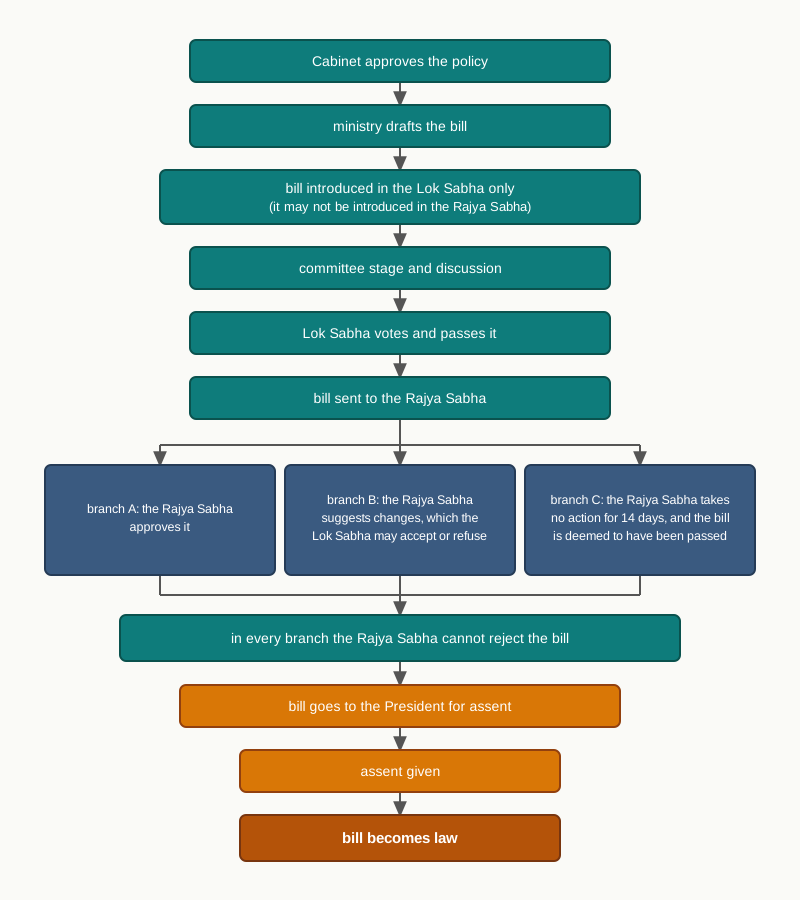
Fig. 5.4 – How a money bill becomes law.
Is The Debate Real?
The procedure assumes that members argue about a bill because they have views about it. Fig. 5.5 asks whether that assumption always holds.
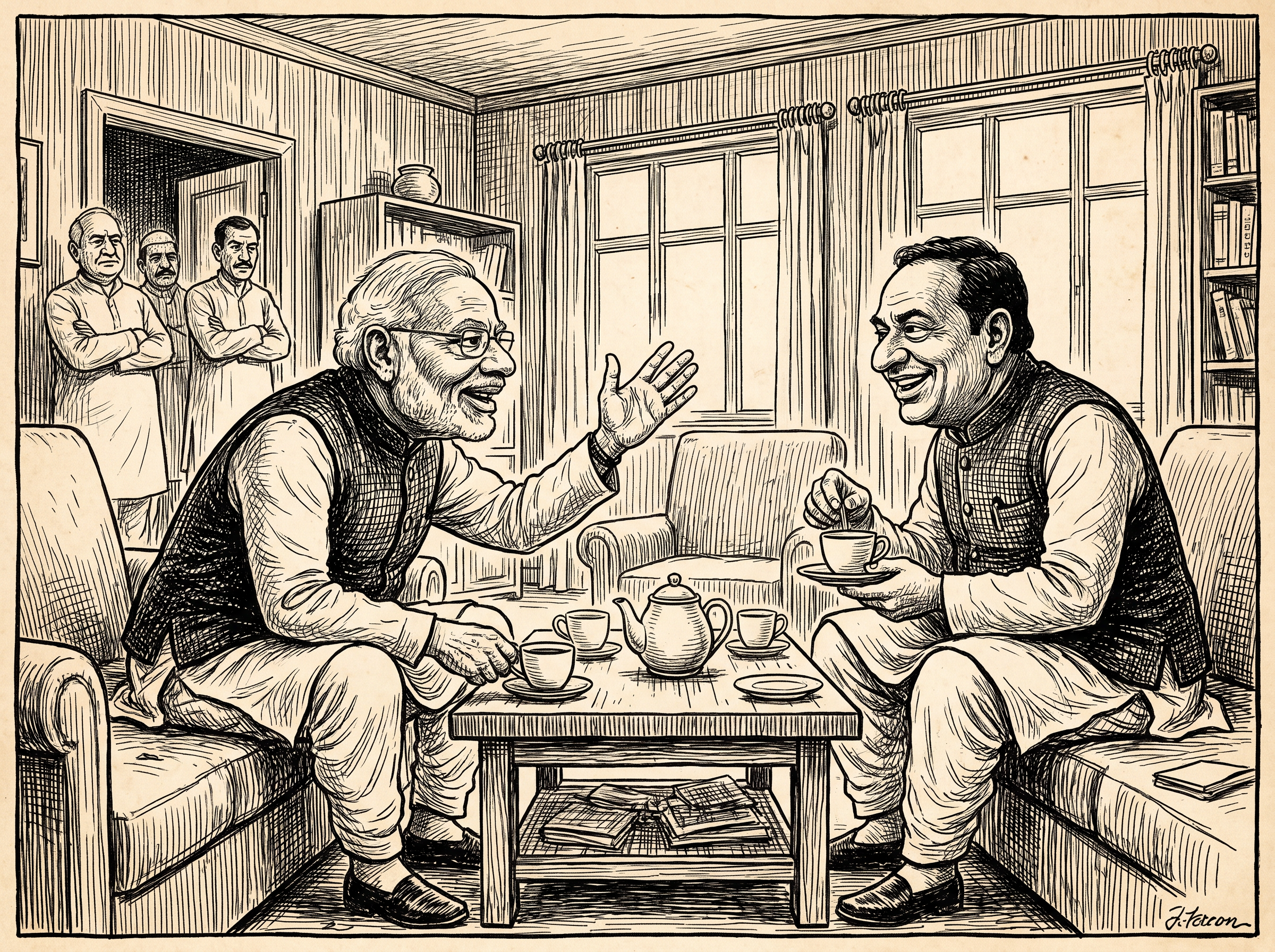
Fig. 5.5 – Staging a parliamentary debate over tea. Inspiration: R K Laxman, published in The Times of India.
Unpack the joke. Two politicians are dividing up the roles in a debate that has not happened yet. One will support the bill; the other will oppose it. Consensus, in the cartoonist’s hands, has been turned upside down — instead of agreeing on the merits, they are agreeing on the performance. The exaggeration makes a sharp claim: that positions in the House are sometimes taken by role rather than by conviction, and that the argument is scripted before it begins.
Now the limit. A cartoon is an opinion drawn in one frame, and it is designed to sting. It cannot tell you how many bills are in fact examined seriously, or what happens in the committee rooms where the cartoonist’s pen never goes. It records a suspicion about the Parliament. It is not a measurement of it.
The Last Step
When a bill is passed by both Houses, it is sent to the President for his assent. The assent of the President results in the enactment of a bill into a law. Only at that moment does the draft you have been following stop being a bill and start binding every one of us.
5.6 How Does The Parliament Control The Executive?
In a parliamentary democracy, the executive is drawn from the party, or the coalition of parties, that has a majority in the Lok Sabha. Read that sentence again and you will see the difficulty hidden inside it. The people who are supposed to be checked are sitting in the very House that is supposed to check them, and they are sitting there with the numbers on their side.
It is therefore not difficult for the executive to exercise unlimited and arbitrary powers with the support of the majority party. In such a situation, parliamentary democracy may slip into Cabinet dictatorship, where the Cabinet leads and the House merely follows. The forms would all still be there — the sittings, the votes, the speeches — and the substance would be gone.
Only if the Parliament is active and vigilant can it keep a regular and effective check on the executive. There are many ways in which the Parliament can control the executive. But basic to them all is the power and the freedom of the legislators, as the people’s representatives, to work effectively and fearlessly.
The Freedom To Speak Without Fear
For instance, no action can be taken against a member for whatever the member may have said in the legislature. This is known as parliamentary privilege. A member who names a wrong, accuses a minister, or reads out an inconvenient fact cannot be prosecuted for having said it in the House. The presiding officer of the legislature — the Speaker in the Lok Sabha — has the final powers in deciding matters of breach of privilege.
Students often ask a sharp question here. With so many sting operations, and with cameras and recordings everywhere, are MPs still free to speak anything anywhere? It is worth being precise about what the privilege covers. It protects what a member says inside the legislature, in the course of its business. It was never meant to be a general licence, and it is not one.
The main purpose of such privileges is to enable the members of the legislature to represent the people and exercise effective control over the executive. So: how does the Parliament exercise such control? What are the means available at its disposal? And is parliamentary control actually successful in curbing executive excesses?
5.6.1 Instruments Of Parliamentary Control
The legislature in a parliamentary system ensures executive accountability at various stages — when policy is being made, when a law or policy is being implemented, and during and after the implementation stage. The legislature does this through the use of a variety of devices:
- Deliberation and discussion
- Approval or refusal of laws
- Financial control
- No confidence motion
Notice that these are not four names for one thing. They bite at different moments. Deliberation catches a policy while it is still being argued about; refusal stops it becoming law; financial control decides whether it is ever paid for; and the no-confidence motion removes the government that proposed it.
Deliberation And Discussion
During the law making process, members of the legislature get an opportunity to deliberate on the policy direction of the executive and the ways in which policies are implemented. Apart from deliberating on bills, control may also be exercised during the general discussions in the House.
The most important of these is the Question Hour, which is held every day during the sessions of Parliament, and in which Ministers have to respond to searching questions raised by the members. There is also Zero Hour, where members are free to raise any matter that they think is important, though the ministers are not bound to reply. Add to these the half-an-hour discussion on matters of public importance, and the adjournment motion — a proposal to set aside the day’s listed business in order to debate an urgent matter at once. All of these are instruments of exercising control.
Perhaps the question hour is the most effective method of keeping vigil on the executive and the administrative agencies of the government. Members of Parliament have shown great interest in question hour, and maximum attendance is recorded during this time. That fact alone tells you something: members turn up for the hour in which the government can be made to answer.
Most of the questions aim at eliciting information from the government on issues of public interest, such as price rise, availability of food grains, atrocities on weaker sections of the society, riots, black-marketing, and so on. This gives the members an opportunity to criticise the government, and to represent the problems of their constituencies. It is one of the few moments when a village or a town far from Delhi becomes, for a few minutes, the business of the whole nation.
The discussions during the question hour are so heated that it is not uncommon to see members raise their voice, walk to the well of the house — the open space in front of the Speaker’s chair — or walk out in protest to make their point. This results in considerable loss of legislative time.
At the same time, we must remember that many of these actions are political techniques to gain concessions from the government, and in the process they force executive accountability. And spare a thought for the person on the other side of the exchange. It must be difficult to be a minister; it is rather like giving an examination almost every day.
Approval And Ratification Of Laws
Parliamentary control is also exercised through the power of ratification. A bill can become a law only with the approval of the Parliament. To ratify simply means to give the final approval that makes a decision binding.
A government that has the support of a disciplined majority may not find it difficult to get the approval of the legislature. Such approvals, however, cannot be taken for granted. They are the products of intense bargaining and negotiations amongst the members of the ruling party or coalition of parties, and even between the government and the opposition.
Financial Control
As mentioned earlier, financial resources to implement the programmes of the government are granted through the budget. The preparation and presentation of the budget for the approval of the legislature is a constitutional obligation of the government. It is not a courtesy the government extends; it is a duty it cannot escape.
This obligation allows the legislature to exercise control over the purse strings of the government. The legislature may refuse to grant resources. This seldom happens, because the government ordinarily enjoys the support of the majority in the parliamentary system.
Nevertheless, before granting money, the Lok Sabha can discuss the reasons for which the government requires money. It can enquire into cases of misuse of funds on the basis of the report of the Comptroller and Auditor General — the constitutional officer who audits the accounts of the government — and of the Public Accounts committees.
But legislative control is not only aimed at financial propriety, that is, at whether the money was spent honestly and correctly. The legislature is concerned about the policies of the government that are reflected in the budget. Every rupee in a budget is a policy decision written as a number. Through financial control, therefore, the legislature controls the policy of the government.
No Confidence Motion
The most powerful weapon that enables the Parliament to ensure executive accountability is the no-confidence motion — a proposal moved in the Lok Sabha stating that the House no longer has confidence in the Council of Ministers. If it is carried, the government must resign.
Be honest about how strong that weapon usually is. As long as the government has the support of its party, or of a coalition of parties that have a majority in the Lok Sabha, the power of the House to dismiss the government is fictional rather than real. The members who could vote it out are the very members who put it in.
However, after 1989, several governments have been forced to resign due to lack of confidence of the house. Each of these governments lost the confidence of the Lok Sabha because they failed to retain the support of their coalition partners. The weapon became real the moment no single party commanded the House on its own.
Does The Control Actually Work?
Thus the Parliament can effectively control the executive and ensure a more responsive government. But the chapter attaches conditions to that sentence, and they are demanding. There must be adequate time at the disposal of the House. The members must be interested in discussion and must participate effectively. And there must be a willingness to compromise between the government and the opposition.
Measured against those conditions, the record is uncomfortable. In the last two decades, there has been a gradual decline in the sessions of the Lok Sabha and the State Legislative Assemblies, and in the time spent on debates. Moreover, the Houses of the Parliament have been plagued by the absence of quorum — the minimum number of members who must be present for the House to transact business — and by the boycott of sessions by members of the opposition. Both deprive the House of the power to control the executive through discussion.
That is the paradox to hold on to. The instruments are strong, but each one of them needs a House that is sitting, full, and willing to argue.
The chapter now sets you a task, and it is worth doing. Watch the Doordarshan telecast of Parliament sessions for three continuous days. Or collect the newspaper reports for three continuous days and make a wallpaper. Take care to observe the issues being discussed, the role of the speaker, the questions being asked, the political parties of the representatives, the representatives from your own region, and the nature of the issues under discussion — whether they were all national or regional in character.
Fig. 5.6 asks the question that your three days of watching will probably raise.
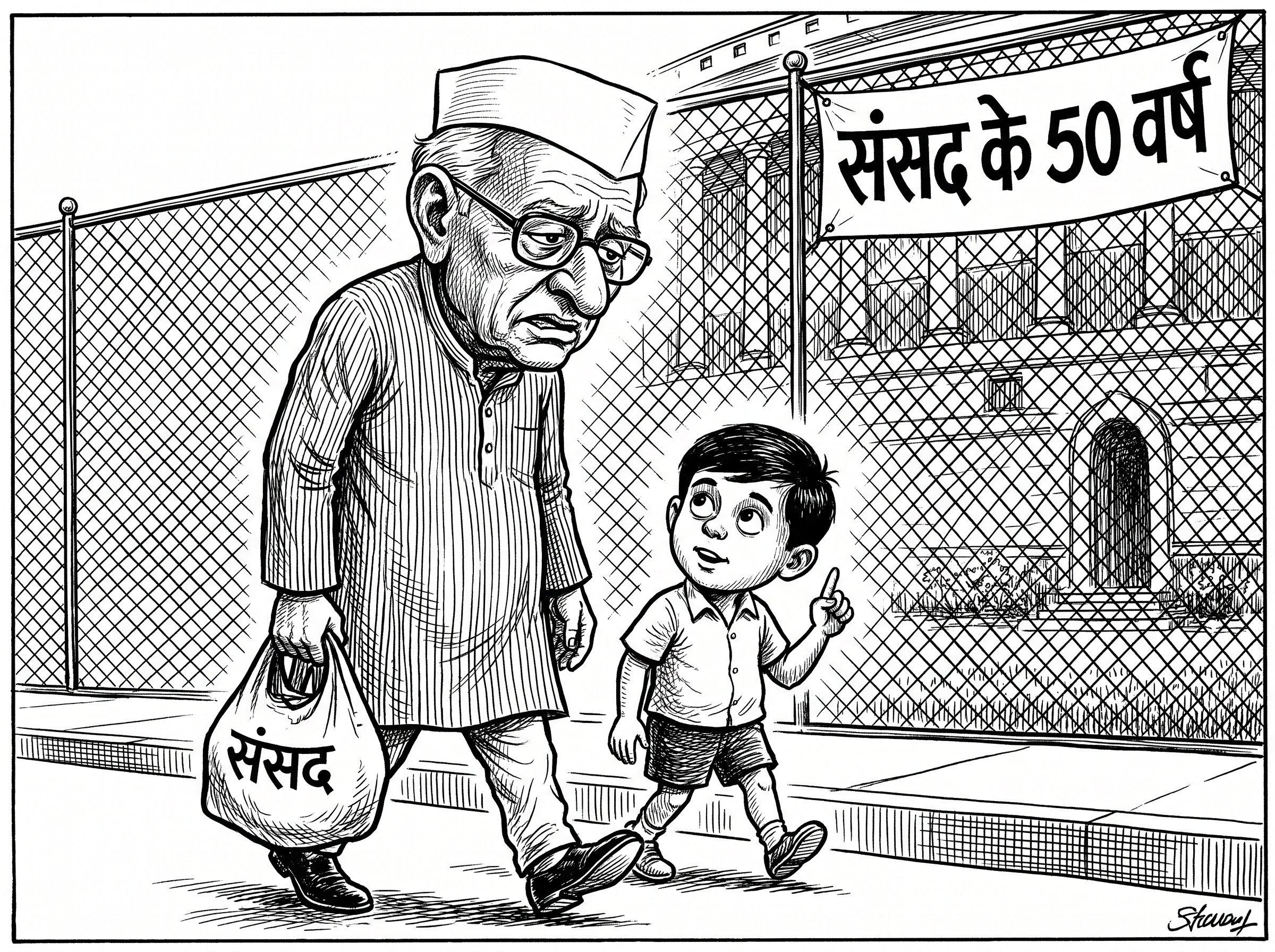
Fig. 5.6 – Walkouts as the defining memory of Parliament. Inspiration: Irfan, printed in the chapter.
The cartoonist has set up a trap and let a child spring it. The natural question about fifty years of Parliament would be about laws passed, or debates held. The boy asks instead for the count of walkouts — as though that were the true measure of the institution’s life. The exaggeration carries the charge: absence, not argument, has become the memorable thing.
Now the limit, and it is the same limit as before. One frame can make an accusation; it cannot supply the evidence for it. The cartoon does not tell us how many walkouts there actually were, nor how many of them won a concession of the kind you read about earlier in this chapter. It tells you what a cartoonist thought was worth asking. Whether the answer would embarrass the Parliament is a question the drawing leaves wide open.
5.7 What Do The Committees Of Parliament Do?
A significant feature of the legislative process is the appointment of committees for various legislative purposes. These committees play a vital role not merely in law making, but also in the day-to-day business of the House.
Why Committees Exist At All
Begin with the constraint, because the committee system is an answer to it. The Parliament meets only during sessions. It therefore has very limited time at its disposal, and the demands on that time are enormous.
The making of a law, for instance, requires an in-depth study of the issue under consideration. This in turn demands more attention and time than a busy House sitting for a few weeks can possibly give. Similarly, there are other important functions — studying the demands for grants made by various ministries, looking into the expenditure incurred by various departments, investigating cases of corruption, and so on. Parliamentary committees perform such functions.
Standing Committees And Joint Committees
Since 1983, India has developed a system of parliamentary standing committees. There are over twenty such departmentally related committees. A standing committee is a permanent one: it does not wind up when a particular job is done. Standing Committees supervise the work of various departments, their budget, their expenditure, and the bills that come up in the house relating to the department. Each committee, in other words, keeps watch on one patch of the government all year round.
Apart from standing committees, the Joint Parliamentary Committees have occupied a position of eminence in our country. Joint Parliamentary Committees (JPCs) can be set up for the purpose of discussing a particular bill, like the joint committee to discuss a bill, or for the purpose of investigating financial irregularities. Members of these committees are selected from both Houses. A JPC, unlike a standing committee, is created for a job and exists for that job.
Hold the two side by side. One is permanent and departmental; the other is occasional and specific. Table 5.A2 sets the contrast out, but the reason behind it is what matters: some scrutiny has to go on continuously, and some has to be summoned when something has gone wrong.
What The Committee System Has Changed
The committee system has reduced the burden on the Parliament. Many important bills have been referred to committees. The Parliament has merely approved the work done in the committees, with few occasional alterations.
Of course, legally speaking, no bill can become law, and no budget will be sanctioned, unless approved by the Parliament. The formal power has not moved an inch. But the Parliament rarely rejects the suggestions made by the committees.
That last sentence deserves your attention rather than your agreement. It can be read two ways. It may mean that the committees do their work so thoroughly that there is nothing left to object to. It may also mean that the real examination of a law now happens in a small room, off the floor of the House, and that the House has become the place where the result is registered rather than reached.
The Sovereignty Of The Legislature
It is worth setting all this against what was expected of the legislature when the Constitution was being written. In the Constituent Assembly, N.V. Gadgil described the legislature’s position in the strongest terms available.
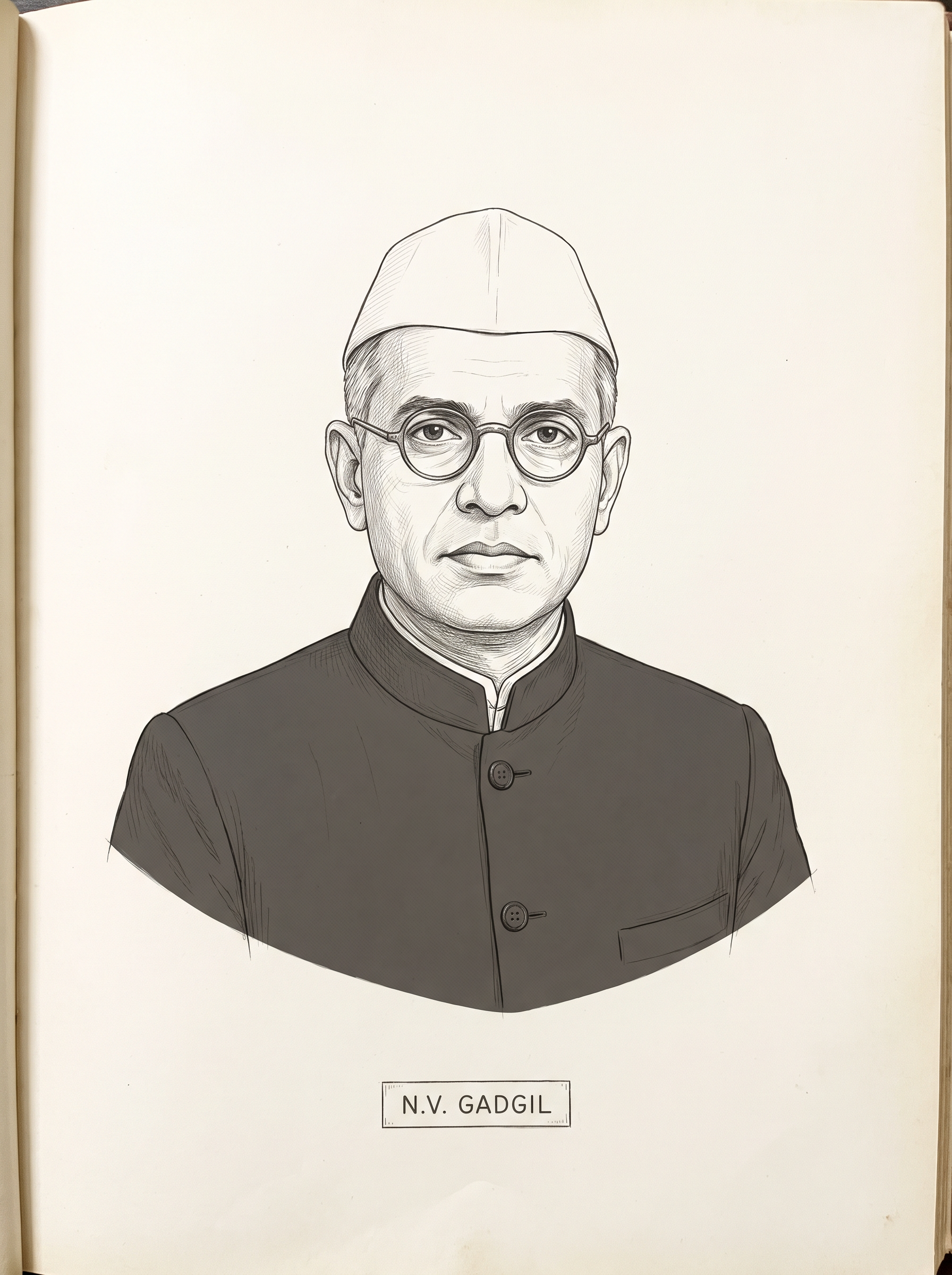
Fig. 5.7 – N.V. Gadgil in the Constituent Assembly, November 1949.
Take the claim apart. Gadgil is distinguishing between procedure and substance. Procedure — how a bill must travel, which House it starts in, how many readings it gets — is regulated. Substance — what the legislature may decide, once it follows that procedure — is, in his account, unrestricted. Sovereignty here means final decision-making authority: the power to settle a matter with nobody above you to overrule it.
Now the limit, and it is important. This is one member speaking in 1949, in a body that was still designing the institution, and it is a statement of what he believed the legislature’s position ought to be. It cannot tell you how that sovereignty has actually been exercised. Nothing in the extract shows what you have learnt in this chapter: that the Cabinet decides the substance and the timing of a bill, and that the detailed work is done in committees whose suggestions are rarely rejected. Sovereignty on paper tells you where the last word rests. It does not tell you who wrote the words.
5.8 How Does The Parliament Regulate Itself?
The Parliament, as mentioned earlier, is a debating forum. It is through debates that the Parliament performs all its vital functions. Take away orderly debate, and the question hour, the passage of a bill and the vote of confidence all become impossible.
Such discussions must therefore be meaningful and orderly, so that the functions of the Parliament are carried out smoothly and its dignity is intact. The Constitution itself has made certain provisions to ensure the smooth conduct of business. The presiding officer of the legislature is the final authority in matters of regulating the business of the legislature.
So the lawmakers too are subject to some laws. That is not an irony; it is the point. A House that could not discipline itself could not discipline anybody else.
The Power To Remove A Member From The House
The presiding officer’s authority is not confined to deciding who speaks next. Fig. 5.8 shows it at its sharpest.
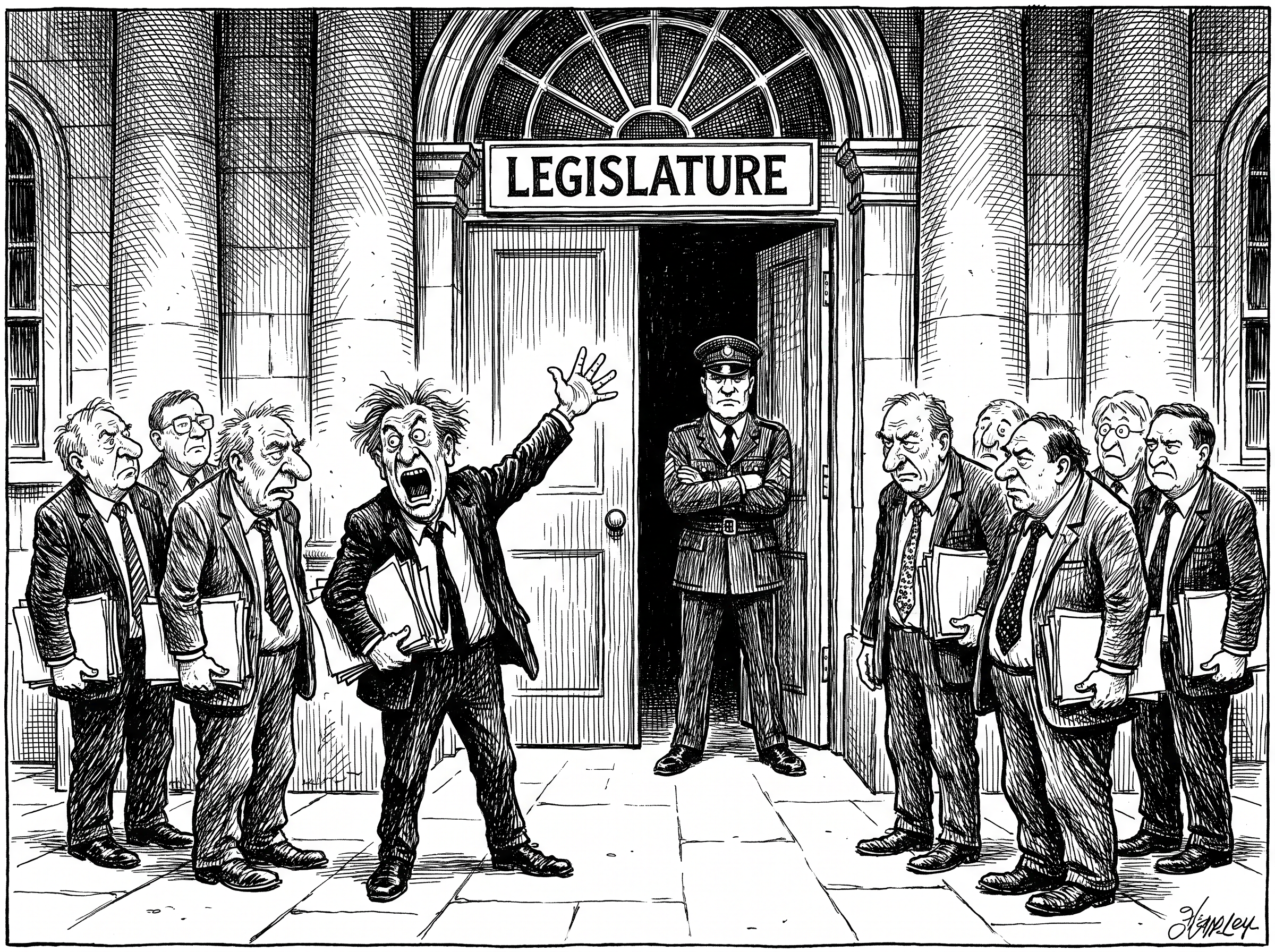
Fig. 5.8 – We are not walking out, we have been ordered out. Inspiration: Irfan, printed in the chapter.
The joke turns on a single word. A walkout, as you have already seen, is something members choose — a protest, a weapon, a way of forcing a concession. Being ordered out is the opposite: it is something done to them, by the authority of the chair. The MPs in the cartoon are standing outside either way, and the cartoonist is asking you to notice how alike defiance and expulsion can look from the pavement.
The claim behind the drawing is that the presiding officer’s control over members is real, and that it can be used to clear the House of the very people who were making a noise in it.
Now the limit. The cartoon cannot tell you whether, on any particular day, the members were ordered out for good reason or bad. It cannot tell you how often it happens. And it cannot show the other half of the picture that this chapter has already given you — that the presiding officer’s powers exist precisely so that debate can go on at all.
The Anti-Defection Law
There is one more way in which the presiding officers control the behaviour of the members. You may have heard about the anti-defection law.
Start from the fact that makes the problem possible. Most of the members of the legislatures are elected on the ticket of some political party — that is, as the party’s official candidate, carrying its symbol and its promises. What would happen if they decide to leave the party after getting elected?
For many years after independence, this issue was unresolved. People asked, and still ask, why legislators change parties at all, and whether they ever return to the party they once left. Finally there was an agreement among the parties that a legislator who is elected on one party’s ticket must be restricted from ‘defecting’ to another party.
An amendment to the Constitution was made — the 52nd amendment act — in 1985. This is known as the anti-defection amendment. It has also been subsequently modified by the 91st amendment.
The presiding officer of the House is the authority who takes final decisions on all such cases. If it is proved that a member has ‘defected’, then such member loses the membership of the House. Besides, such a person is also disqualified from holding any political office, like ministership, and so on.
What Counts As Defection?
The word covers more than crossing the floor. Defection is deemed to have occurred if a member remains absent in the House when asked by the party leadership to remain present, or votes against the instructions of the party, or voluntarily leaves the membership of the party.
Read those three tests again. Only the third is what an ordinary person would call changing sides. The first two catch a member who stays exactly where they are and simply refuses to obey.
Now weigh the result. Experience of the past twenty years shows that the anti-defection amendment has not been able to curb defections. But it has given additional powers to the party leadership and to the presiding officers of the legislatures over the members.
That is a striking finding, and it is worth stating plainly. A law brought in to protect the mandate of the voter has, on the chapter’s own account, ended up strengthening the people at the top of the parties — while the behaviour it was meant to stop has continued.
5.9 Summary
The Chapter In Short
- A legislature is not merely a law making body. It is the centre of the democratic political process, the place where representatives can be held accountable, and the basis of representative democracy.
- In most democracies, including India, legislatures are losing ground to the executive: the Cabinet initiates policy, sets the agenda and carries it through. Yet no Cabinet survives without a majority, and every leader must answer to the House.
- The Parliament is bicameral. Large, diverse countries prefer two Houses so that all sections and regions are represented, and so that every decision is discussed twice. States may choose either form; at present only six have a bicameral legislature.
- The Rajya Sabha represents the States. It is indirectly elected by the elected members of the State Legislative Assemblies, with seats fixed by the fourth schedule according to population — Uttar Pradesh sends 31 members, Sikkim one. Members serve six years, one-third retire every two years, and the House is never dissolved. Twelve members are nominated by the President from literature, science, art and social service.
- The Lok Sabha is directly elected through universal adult suffrage from 543 territorial constituencies, a number unchanged since the 1971 census. It is elected for a maximum of five years and may be dissolved earlier.
- The Parliament’s functions are legislative, control of the executive, financial, representative, debating, constituent, electoral and judicial.
- On money bills and on the life of the government, only the Lok Sabha decides. Elsewhere the two Houses are co-equal. The Rajya Sabha alone can allow the Union Parliament to legislate on a State list subject — though in practice its members represent their parties more than their States.
- A bill passes through introduction, committee study and a final vote in each House. A money bill starts only in the Lok Sabha; the Rajya Sabha may suggest changes but cannot reject it, and after 14 days of inaction it is deemed passed. Disagreement between the Houses may go to a Joint Session, which has always gone in favour of the Lok Sabha. The President’s assent makes a bill law.
- Parliament controls the executive through deliberation and discussion — Question Hour, Zero Hour, half-an-hour discussions, adjournment motions — through approving or refusing laws, through financial control of the budget, and through the no-confidence motion, which became a real weapon after 1989.
- That control depends on conditions the chapter says are weakening: enough time, members who participate, and a willingness to compromise. Sessions and debating time have declined; quorum failures and boycotts cost the House its power to control through discussion.
- Since 1983 a system of over twenty departmentally related standing committees, together with Joint Parliamentary Committees, has taken on the detailed work. The burden on the House is lighter — and the House rarely rejects what the committees suggest.
- The Parliament regulates itself. Parliamentary privilege protects what a member says in the House. The presiding officer is the final authority on the House’s business. The anti-defection amendment — the 52nd amendment act of 1985, later modified by the 91st amendment — costs a defecting member their seat.
What The Chapter Concludes
Watch a live telecast of the proceedings of the Parliament and the first thing you notice is the sheer variety. The House is a rainbow of colourful dresses symbolising different regions of the country. Members speak different languages in the course of the proceedings. They come from various castes, religions and sects. They often fight bitterly, and many times an impression is created that they are wasting the time and money of the nation.
But this chapter has shown you the other half of that picture. These same parliamentarians can effectively control the executive, and they can express the interests of various sections of our society. On account of its composition, the legislature is the most representative of all the organs of government. The sheer presence of members from diverse social backgrounds makes legislatures more representative, and potentially more responsive to people’s expectations.
In a parliamentary democracy, the legislature, as the body representing the wishes of the people, occupies a high position of power and responsibility. Herein lies the democratic potential of the Parliament.
The Arguments In One Place
The chapter’s central claim is that the Parliament, because of how it is composed and what it may do, is the most democratic organ of government: it alone chooses and dismisses the government, controls the money, and forces the executive to answer in public.
The strongest position against it is drawn from the chapter’s own pages. The Cabinet decides the substance and the timing of every major bill; committees do the detailed work and are rarely overruled; a disciplined majority makes the power to dismiss a government fictional rather than real; sessions and debating time have declined; and the anti-defection law has handed still more control to the party leaderships.
What the two positions really disagree about is not the facts but their weight. Does having to face the House change what a government does — or does a government that commands the House face nothing at all?
What Remains Contested
The chapter does not settle whether the Rajya Sabha protects the States or merely reproduces the parties. Nor does it settle whether 543 constituencies, frozen since the 1971 census, can still hold roughly equal numbers of people.
And notice whose voices its evidence was never designed to record. The sources are speeches by framers arguing in 1949, and cartoons drawn by observers looking in from outside. Nowhere in them do you hear from a voter whose question was asked in the House and then forgotten, or from a member who obeyed a party instruction they believed to be wrong.
5.10 NCERT Questions
Alok thinks that a country needs an efficient government that looks after the welfare of the people. So, if we simply elected our Prime Minister and Ministers and left to them the task of government, we will not need a legislature. Do you agree? Give reasons for your answer.
A class was debating the merits of a bicameral system. The following points were made during the discussion. Read the arguments and say if you agree or disagree with each of them, giving reasons.
- Neha said that bicameral legislature does not serve any purpose.
- Shama argued that experts should be nominated in the second chamber.
- Tridib said that if a country is not a federation, then there is no need to have a second chamber.
Why can the Lok Sabha control the executive more effectively than the Rajya Sabha can?
Rather than effective control of the executive, the Lok Sabha is a platform for the expression of popular sentiments and people’s expectations. Do you agree? Give reasons.
The following are some proposals for making the Parliament more effective. State if you agree or disagree with each of them and give your reasons. Explain what would be the effect if these suggestions were accepted.
- Parliament should work for longer period.
- Attendance should be made compulsory for members of Parliament.
- Speakers should be empowered to penalise members for interrupting the proceedings of the House.
Arif wanted to know that if ministers propose most of the important bills and if the majority party often gets the government bills passed, what is the role of the Parliament in the law making process? What answer would you give him?
Which of the following statements you agree with the most? Give your reasons.
- Legislators must be free to join any party they want.
- Anti-defection law has contributed to the domination of the party leaders over the legislators.
- Defection is always for selfish purposes and therefore, a legislator who wants to join another party must be disqualified from being a minister for the next two years.
Dolly and Sudha are debating about the efficiency and effectiveness of the Parliament in recent times. Dolly believed that the decline of Indian Parliament is evident in the less time spent on debate and discussion and increase in the disturbances of the functioning of the House and walkouts etc. Sudha contends that the fall of different governments on the floor of Lok Sabha is a proof of its vibrancy. What other arguments can you provide to support or oppose the positions of Dolly and Sudha?
Arrange the different stages of passing of a bill into a law in their correct sequence:
- A resolution is passed to admit the bill for discussion
- The bill is referred to the President of India – write what happens next if s/he does not sign it
- The bill is referred to other House and is passed
- The bill is passed in the house in which it was proposed
- The bill is read clause by clause and each is voted upon
- The bill is referred to the subcommittee – the committee makes some changes and sends it back to the house for discussion
- The concerned minister proposes the need for a bill
- Legislative department in ministry of law, drafts a bill
How has the system of parliamentary committee affected the overseeing and appraisal of legislation by the Parliament?
5.11 Check Your Concepts
Read Table 5.1 and Table 5.2 together. Which powers appear in only one of the two charts? What do those exclusive powers have in common, and what does that tell you about the difference between the two Houses?
Distinguish between the Question Hour and the Zero Hour. Why does the chapter call the question hour perhaps the most effective method of keeping vigil on the executive?
Uttar Pradesh sends 31 members to the Rajya Sabha and Sikkim has one seat. Explain what would change if India adopted symmetrical representation, as the United States does in its Senate, and why the framers of the Constitution chose not to.
Look again at Fig. 5.1, in which the ministers stand humbly before the Parliament. What claim is the cartoonist making about financial power? Now state one thing this chapter has told you about how budgets actually pass, which the cartoon cannot show.
Source 5.2 prints Article 109. State precisely what the Article settles about money bills, and one thing about money bills that the words of the Article do not settle.
The chapter says the Rajya Sabha can criticise the government but cannot remove it. Reconstruct, step by step, the reasoning by which the Constitution arrived at this position. Begin from the way the Rajya Sabha is elected.
In Source 5.1, Purnima Banerji hoped that the Upper House would be a revising body whose views may count but not its votes. Using what you have learnt about the Rajya Sabha’s actual powers and actual behaviour, say where her expectation has been met and where it has not.