Chapter 7: Federalism
In 1947 the map of India was a patchwork stitched from two very different fabrics. There were the provinces the British had drawn, organised only for their own administrative convenience, with little regard for what language the people of a district spoke or what they called themselves. Beside them lay more than 500 princely states, which now had to be integrated into existing States or gathered into new ones.
The men and women who framed the Constitution faced a harder question than where the lines should run. They had to decide how much power a region would keep and how much would sit in Delhi. They knew that India held more than 20 major languages and several hundred smaller ones, several major religions, and several million indigenous peoples. They also knew the country had just been partitioned, and they feared it could break again.
So they built two sets of government — one for the nation, one for each State — and wrote down who could decide what. Then politics went to work on that design. Mysore became Karnataka and Madras became Tamil Nadu, because that is what the people of those States wanted. Gujarat and Maharashtra were created in 1960. Punjab and Haryana were separated in 1966. Telangana was carved out of Andhra Pradesh in 2014.
The map on your classroom wall is not the map India started with. Every line on it was argued over first.
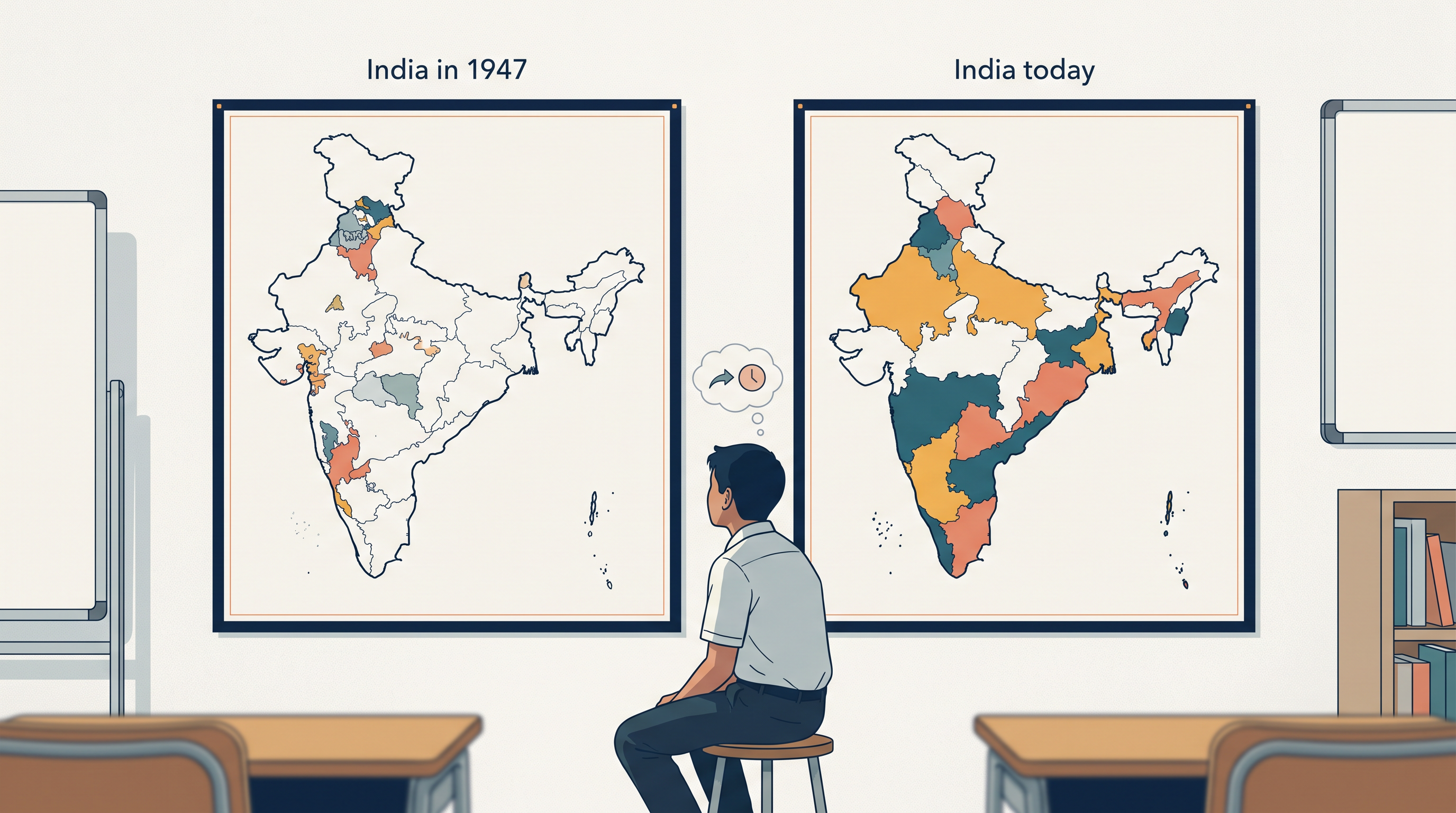
Fig. 7.0 – Two political maps of India: 1947 and today.
7.1 Introduction
Two Maps, Seventy Years Apart
Political Science usually begins with an argument. This chapter begins with a picture. Look carefully at the two political maps of India printed here, one from 1947 and one from 2017, and hold them side by side.
They are maps of the same country, and they do not match. The boundaries of States have shifted. The names of States have changed. Even the number of States is different.
The reason lies in how India was put together. When India became independent, the country was divided into a number of provinces — large administrative units that the British government had organised only for its own convenience, not because the people inside them shared a language or a culture. Alongside them lay the princely states, territories ruled by hereditary princes under British paramountcy, which now merged with the newly independent Indian union and were joined to the existing provinces. That is the arrangement you see in the first map.
Map
Map 7.1 Caption: India in 1947, showing the British provinces and the princely states as they stood at Independence. Brief: Reproduce the chapter’s map of India in 1947. Show the British provinces and the princely states, with the shading key printed in the book. Boundaries and shading exactly as the chapter prints them; add nothing and label nothing beyond what the chapter’s map carries. The caption must state that this is a historical map of 1947 and not the map of India today.
Since 1947, the boundaries of States have been reorganised many times. Across this whole period it was not only boundaries that moved. In some cases the names of States were changed as well, according to the wishes of the people who lived in them: Mysore became Karnataka, and Madras became Tamil Nadu. The second map shows what those large-scale changes, spread over more than seventy years, have added up to.
Map
Map 7.2 Caption: The political map of India today, showing the States and Union Territories. Brief: Reproduce the chapter’s current political map of India, showing States, Union Territories, State boundaries, capital cities and the national capital, with the same reference key the book prints. The map must show the full extent of India as officially defined by the Government of India, including Jammu and Kashmir and Ladakh. No part of India is to be shown as disputed, ceded or belonging to any other state. International boundaries follow the official position of the Government of India.
What The Maps Can And Cannot Tell You
Read together, the two maps are evidence. They tell you that in India the internal map is not fixed — that lines drawn at Independence could be, and were, redrawn. In a way, they tell the story of how federalism has actually worked in this country.
But a map is a photograph of a result, not a record of how the result was reached. It cannot show you who demanded a new State, who resisted it, which body took decision, or how long the argument lasted. It cannot show you the disputes that were never settled, or the demands that were refused. For that you need the rest of the chapter.
What This Chapter Will Do
After studying this chapter you will be able to understand the following:
- what federalism is;
- the federal provisions in the Indian Constitution;
- the issues involved in the relations between the centre and the States; and
- the special provisions for certain States having a distinct composition and historical features.
7.2 What Is Federalism?
A Puzzle Worth Starting With
The USSR — the Union of Soviet Socialist Republics, a vast federation stretching from eastern Europe across northern Asia — was one of the world’s super powers. Yet after 1989 it simply broke up into several independent countries.
One of the major reasons for the break up was excessive centralisation and concentration of power. Power sat at the top, and one region, Russia, dominated other regions that had independent languages and cultures of their own, such as Uzbekistan in Central Asia. Some other countries, like Czechoslovakia in central Europe, Yugoslavia in south-eastern Europe, and Pakistan, also had to face a division of the country. Canada came very close to a break up between its English-speaking and its French-speaking regions.
Set beside that record, India’s survival is worth pausing over. India emerged as an independent nation-state in 1947 after a painful partition, and it has remained united across more than seven decades of independent existence. What accounts for this achievement?
Does A Federal Constitution Explain It?
The obvious answer is the federal structure of governance that India adopted through its Constitution. But look again at the list above. All the countries just mentioned were federations too. Yet they could not remain united.
So a federal constitution cannot be the whole explanation. If the same institutional device produced unity in one place and collapse in another, then something besides the device must be doing the work. Apart from adopting a federal constitution, the nature of that federal system and the everyday practice of federalism must also be important factors.
Federalism In West Indies
You may have heard of the cricket team of West Indies. But is there a country called West Indies?
Like India, West Indies was also colonised by the British. In 1958 the federation of West Indies came into being. It had a weak central government, and the economy of each unit was independent of the others. These features, together with political competition among the units, led to the formal dissolution of the federation in 1962.
The story does not end there. Later, in 1973, by the Treaty of Chiguaramas, the independent islands established joint authorities: a common legislature, a supreme court, a common currency and, to a degree, a common market known as the Caribbean Community. The Caribbean Community even has a common executive, and the heads of the governments of member countries are members of this executive.
Thus, the units could neither live together as one country, nor can they live separately. That is a useful warning to carry into this chapter. Breaking apart is not the same thing as being able to do without one another.
Unity In Diversity
India is a land of continental proportions and immense diversities. There are more than 20 major languages and several hundred minor ones. It is the home of several major religions. There are several million indigenous peoples living in different parts of the country.
In spite of all these diversities we share a common land mass. We have also participated in a common history, especially when we fought for independence, and we share many other important features besides. This led our national leaders to visualise India as a country where there is unity in diversity — a unity that does not ask people to become the same. Sometimes it is described as unity with diversity.
A student reading this chapter put the idea in a way worth keeping. It is like our school, she said. We have our identity as students of class XI or class XII, and there is competition among the various divisions, but we all belong to the school and are proud of it.
The Key Ideas Of Federalism
Federalism does not consist of a set of fixed principles that are simply applied to different historical situations. Rather, federalism as a principle of government has evolved differently in different situations. American federalism — one of the first major attempts to build a federal polity — is different from German or Indian federalism.
But there are also a few key ideas and concepts associated with federalism, and they run through all of them.
- Essentially, federalism is an institutional mechanism to accommodate two sets of polities — one at the regional level and the other at the national level. Each government is autonomous in its own sphere, which means it decides certain matters on its own authority and not as anyone’s agent. In some federal countries there is even a system of dual citizenship, where a person is a citizen both of the country and of the unit. India has only a single citizenship.
- The people likewise have two sets of identities and loyalties. They belong to the region as well as the nation — we are Gujaratis or Jharkhandis as well as Indians. Each level of the polity has distinct powers and responsibilities, and has a separate system of government.
- The details of this dual system of government are generally spelt out in a written constitution, which is considered to be supreme and which is also the source of the power of both sets of government. Certain subjects, which concern the nation as a whole — for example, defence or currency — are the responsibility of the union or central government. Regional or local matters are the responsibility of the regional or State government.
- To prevent conflicts between the centre and the State, there is an independent judiciary to settle disputes. The judiciary has the power to resolve disputes between the central government and the States on legal matters about the division of power.
Notice what the third point quietly settles. Neither government hands power down to the other. Both draw their power from the same written document, and neither can rewrite that document on its own. This is the idea met in the first chapter — that a constitution decides who should have how much power — now doing a very particular job.
Why Practice Matters As Much As Parchment
Real politics, culture, ideology and history determine the actual working of a federation. A culture of trust, cooperation, mutual respect and restraint helps federations to function smoothly. Political parties also determine the way a constitution would work, because it is parties that form the governments at both levels and decide how far a quarrel is pushed.
If any single unit or State or linguistic group or ideology comes to dominate the entire federation, it could generate deep resentment among the people or the units that do not share the dominant voice. These situations could lead to demands for secession by the aggrieved units, or could even result in civil wars. Many countries are embroiled in such conflict situations.
That is why federalism in a working democracy shows up not only in the Constitution, but in the daily newspaper.
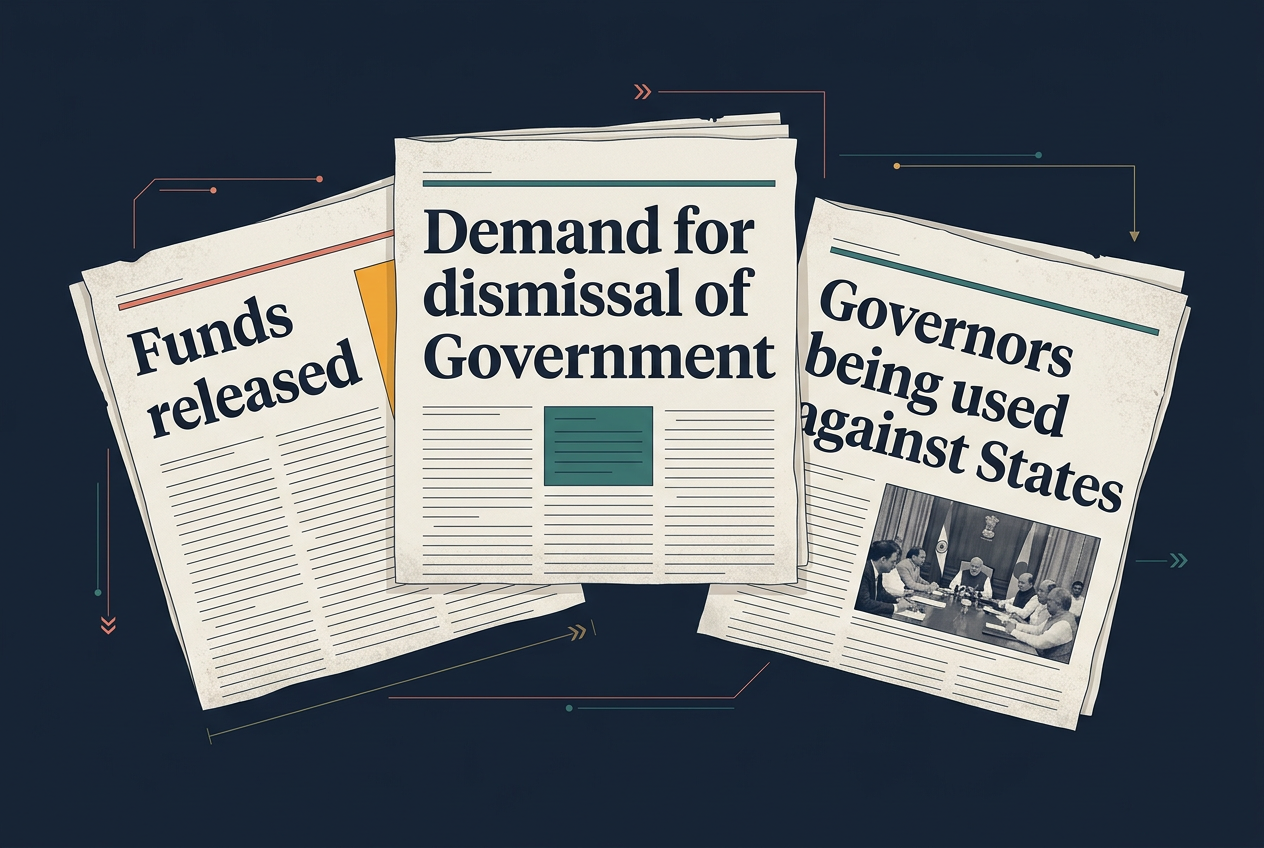
Fig. 7.1 – Newspaper reports on centre-State relations.
Read the clippings together and a pattern appears. One is about money — how much a State is given from the centre, and whether its government says it is satisfied. The others are about an office, the Governor, and the charge that the office is being used to unsettle State governments. Both are federal quarrels: who controls the resources, and who controls the machinery.
Now read them under their limit. A headline records what a politician chose to say in public, on a particular day, in the middle of a political fight. It does not establish that the charge is true, and a rival politician on the same page would say the opposite. A newspaper page can show you that a dispute exists and that it matters enough to print. It cannot tell you who was right.
Federalism In Nigeria
If the regions and various communities do not trust each other, even a federal arrangement can fail to produce unity. The example of Nigeria, a large country in West Africa, is instructive.
Till 1914, Northern and Southern Nigeria were two separate British colonies. At the Ibadan Constitutional Conference of 1950, Nigerian leaders decided to form a federal constitution. The three major ethnic groups of Nigeria — Yoruba, Ibo and Hausa-Fulani — controlled the regions of the West, the East and the North respectively.
Their attempt to spread their influence to other regions led to fears and conflicts. These led to a military regime. In the 1960 constitution, both federal and regional governments jointly controlled the Nigerian police. In the military-supervised constitution of 1979, no state was allowed to have any civil police.
Though democracy was restored in Nigeria in 1999, religious differences, along with conflicts over who will control revenues from the oil resources, continue to present problems before the Nigerian federation. Local ethnic communities resist centralised control of the oil resources. Thus, Nigeria is an example of an overlap of religious, ethnic and economic differences among the units.
That overlap is the danger. When the same line divides people by religion, by ethnic group and by who receives the money, every quarrel becomes the same quarrel — and no loyalty is left running across the divide to hold the units together.
7.3 Federalism In The Indian Constitution
Why The Powers Had To Be Divided
Even before Independence, most leaders of our national movement were aware that to govern a large country like ours, it would be necessary to divide the powers between the provinces and the central government. A country of this size could not sensibly be run from a single set of offices in one capital city.
There was also awareness that Indian society had regional diversity and linguistic diversity, and that this diversity needed recognition. People of different regions and languages had to share power, and in each region the people of that region should govern themselves. This was only logical if we wanted a democratic government. A democracy that let a distant majority decide everything for a region would be a democracy only in name.
The Question Of How Much
Nobody seriously disputed that powers should be divided. The only question was what should be the extent of powers to be enjoyed by the regional governments.
In view of the agitation of the Muslim League for greater representation to the Muslims, a compromise formula to give very large powers to the regions was discussed during the negotiations before Partition. Once the decision to partition India was taken, that formula was no longer the one on the table. The Constituent Assembly — the body elected to write India’s Constitution — decided instead to frame a government that would be based on the principles of unity and cooperation between the centre and the States, with separate powers for the States.
This is the most important feature of the federal system adopted by the Indian Constitution: the principle that relations between the States and the centre would be based on cooperation, not on rivalry or bargaining between equals. Thus, while recognising diversity, the Constitution emphasised unity. The purpose of living together, after all, must be that all of us are happier for it, and that each of us helps make the others happy.
What Article 1 Actually Says
Do you know, for example, that the Constitution of India does not even use the word ‘federation’ anywhere? This is how the Constitution describes India.
Two words in that short passage are doing heavy work. India is called a Union of States — a union, not a league or an agreement that its members entered into and might one day leave. And the States themselves are said to be whatever the First Schedule, a list attached to the Constitution, says they are. The States are named by the Constitution; they do not name themselves.
So India is federal in substance without using the word. There are two sets of government, each with its own sphere, both created by a written constitution that is supreme over both. What the framers avoided was the suggestion that the Union was a bargain among States that could be renegotiated.
Read Article 1 under its limit, though. These two clauses tell you what India is called and where the list of States is kept. They tell you nothing at all about who may decide what — nothing about defence, or police, or education, or money. For that, you have to turn to the division of powers.
7.3.1 Division Of Powers
There are two sets of government created by the Indian Constitution: one for the entire nation, called the union government or central government, and one for each unit or State, called the State government. Both of these have a constitutional status and a clearly identified area of activity.
If there is any dispute about which powers come under the control of the union and which under the States, this can be resolved by the judiciary on the basis of the constitutional provisions. Notice the design here. The umpire is not the centre and not the States, but a court reading a document that neither of them can rewrite alone.
The Three Lists
The Constitution clearly demarcates the subjects that are under the exclusive domain of the Union and those under the States. It does this through lists of subjects, and the chart below shows how the powers are distributed.
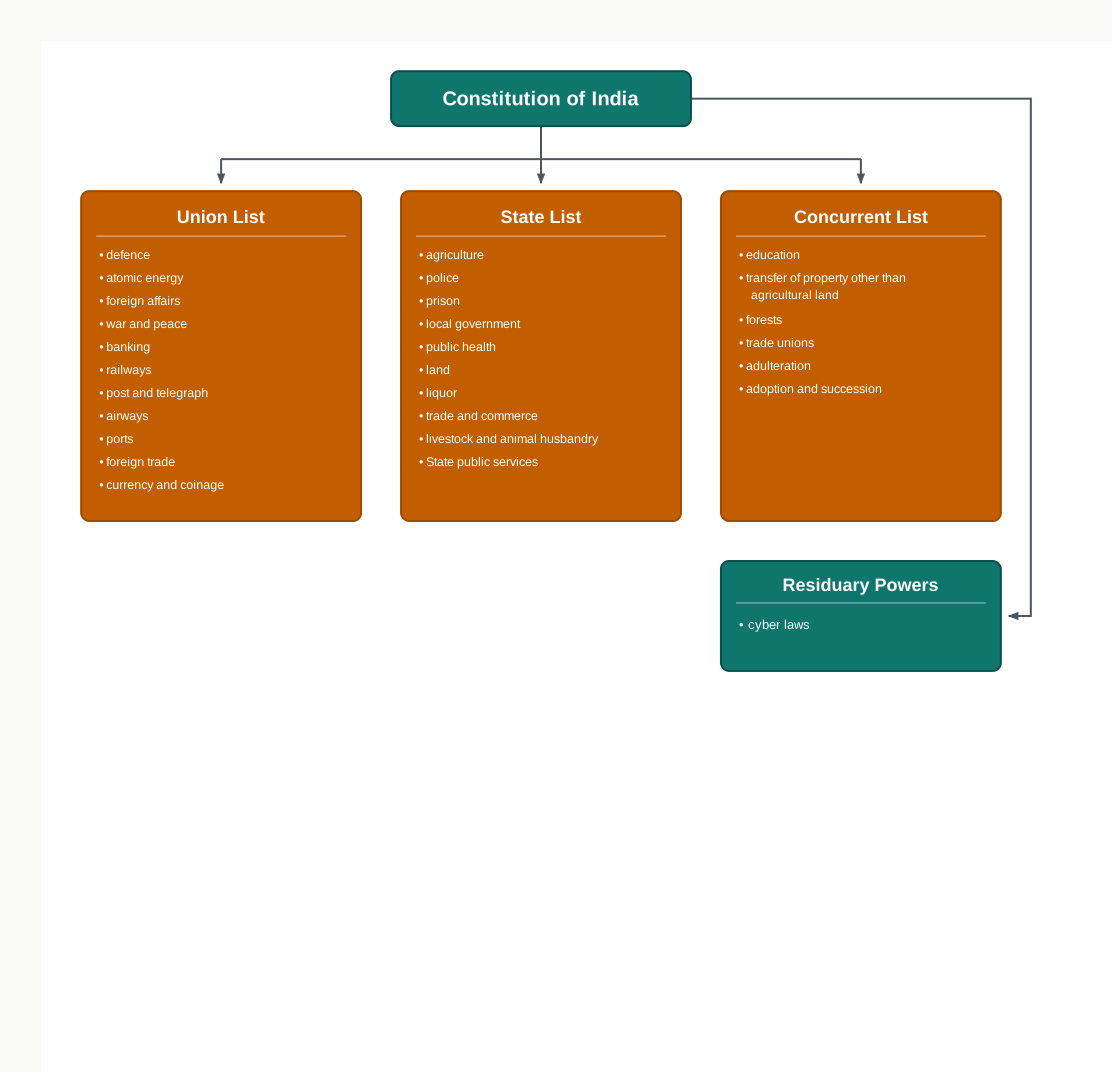
Fig. 7.2 – The three lists dividing law-making powers.
The Union List includes subjects like defence, atomic energy, foreign affairs, war and peace, banking, railways, post and telegraph, airways, ports, foreign trade, and currency and coinage. The Union Legislature — Parliament — alone can make laws on these matters. Look at what they have in common: they concern the country as a whole, and a separate law for each State would make no sense.
The State List includes subjects like agriculture, police, prison, local government, public health, land, liquor, trade and commerce, livestock and animal husbandry, and State public services. Normally, only the State Legislature can make laws on these matters. These are the subjects that touch daily life in a particular place, and that people in that place are best placed to decide.
The Concurrent List includes subjects like education, transfer of property other than agricultural land, forests, trade unions, adulteration, and adoption and succession. Both the Union Legislature and the State Legislature can make laws on these matters.
Finally, there are the residuary powers. These include all other matters not mentioned in any of the lists — cyber laws, for instance, a subject nobody could have listed in 1950. The Union Legislature alone has the power to legislate on such matters. The framers knew that the world would throw up subjects they had not thought of, and decided in advance who would get them.
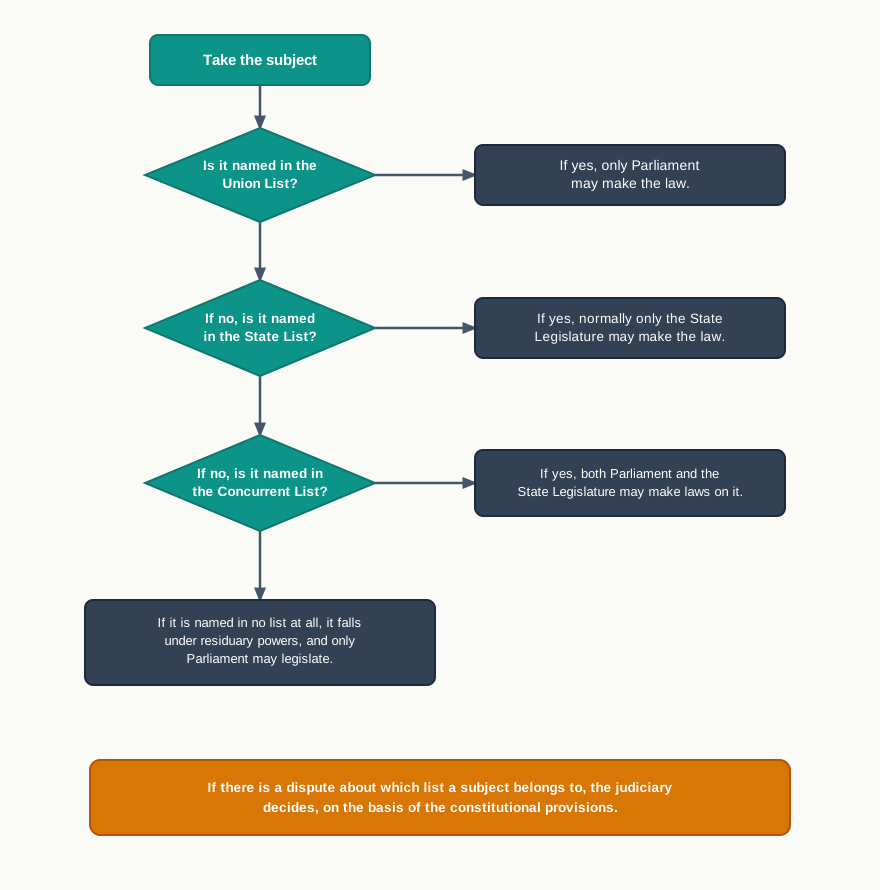
Fig. 7.3 – Who can make a law on a subject.
Responsibilities Without Resources
One of the important aspects of this division of powers is that economic and financial powers are centralised in the hands of the central government by the Constitution. The States have immense responsibilities but very meagre revenue sources.
Set the two lists side by side and the squeeze becomes visible. Police, prisons, public health, agriculture and local government are all with the States — and every one of them costs money to run. Banking, currency and foreign trade are with the centre. It is a little like a household where one member controls the earnings while another is expected to run the home.
7.4 Federalism With A Strong Central Government
Why The Framers Wanted A Strong Centre
It is generally accepted that the Indian Constitution has created a strong central government. This was a choice, not an accident, and the reasons for it were argued out openly.
India is a country of continental dimensions, with immense diversities and social problems. The framers of the Constitution believed that we required a federal constitution that would accommodate those diversities. But they also wanted to create a strong centre, for two reasons: to stem disintegration, and to bring about social and political change.
It was necessary for the centre to have such powers because of the state the country was in. At the time of independence India was not only divided into provinces created by the British; there were also more than 500 princely states, which had to be integrated into existing States or gathered into new States that had to be created from scratch. A weak centre could not have done that work.
A Voice From The Constituent Assembly
The debates of the Constituent Assembly show that the drift towards the centre was defended in the Assembly itself, and defended on grounds of what a modern state was expected to do.
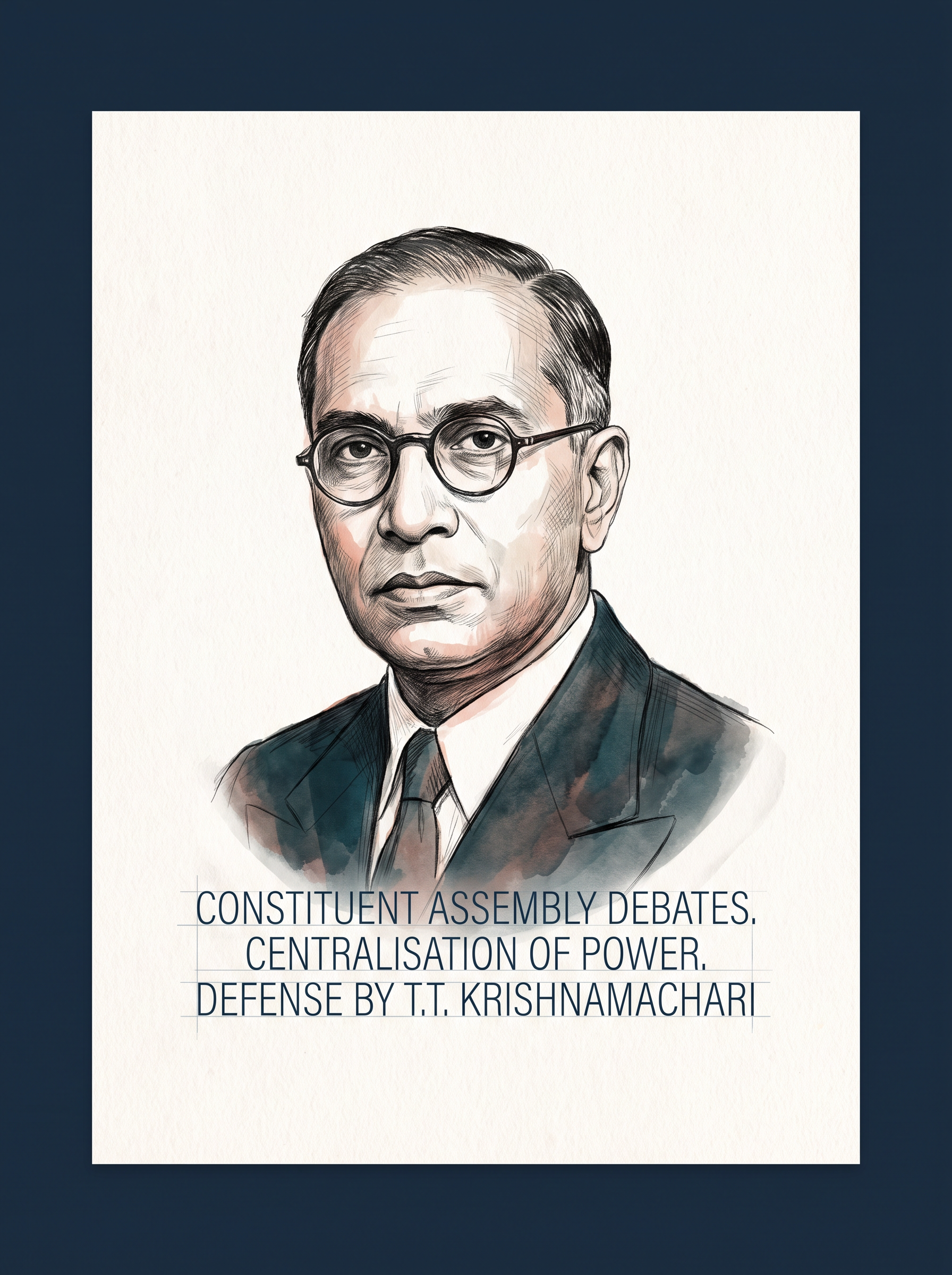
Fig. 7.4 – T.T. Krishnamachari.
Unpack the argument. A police state, in the old sense used here, is a state whose main business is keeping order. A welfare state takes on much more: it accepts responsibility for the economic well-being of its people. The speaker’s claim is that once states everywhere took on that larger job, power everywhere drifted to the centre — in federal and unitary constitutions alike. A unitary system, unlike a federal one, has only one level of government with real authority; the units, where they exist, are its creatures.
Read the extract under its limit. It is a speech, made on the floor of the Assembly, by a member arguing for a position while the Constitution was still being settled. It tells you what one framer said in public and how he justified a strong centre. It does not tell you what the members who disagreed with him said, nor whether the drift he described was inevitable rather than chosen. A speech is evidence of an argument, not proof of it.
Besides the concern for unity, the makers of the Constitution also believed that the socio-economic problems of the country needed to be handled by a strong central government in cooperation with the States. Poverty, illiteracy and inequalities of wealth were some of the problems that required planning and coordination. Thus, the concerns for unity and for development together prompted the makers of the Constitution to create a strong central government.
The Provisions That Make The Centre Strong
Let us look at the important provisions that create a strong central government.
The Existence Of A State
The very existence of a State, including its territorial integrity, is in the hands of Parliament. Parliament is empowered to ‘form a new State by separation of territory from any State or by uniting two or more States…’. It can also alter the boundary of any State, or even its name. The Constitution provides for some safeguards by way of securing the view of the concerned State legislature — but a view is not a veto.
Emergency Provisions
The Constitution has certain very powerful emergency provisions, which can turn our federal polity into a highly centralised system once an emergency is declared. During an emergency, power becomes lawfully centralised: the centralisation is not a violation of the Constitution but something the Constitution itself permits. Parliament also assumes the power to make laws on subjects within the jurisdiction of the States.
Financial Powers
Even during normal circumstances, the central government has very effective financial powers and responsibilities.
In the first place, items generating revenue are under the control of the central government. Thus the central government has many revenue sources, and the States are mostly dependent on grants and financial assistance from the centre.
Secondly, India adopted planning as the instrument of rapid economic progress and development after independence. Planning led to considerable centralisation of economic decision making. The Planning Commission, appointed by the union government, is the coordinating machinery that controls and supervises the resources management of the States.
Besides, the Union government uses its discretion to give grants and loans to States. This distribution of economic resources is considered lopsided, and has led to charges of discrimination against States ruled by an opposition party. That is a serious allegation to sit inside a federal system: it says that money meant for governance is being used as a reward and a punishment.
The Governor’s Powers
As you will study later, the Governor has certain powers to recommend dismissal of the State government and the dissolution of the Assembly. The Governor is the constitutional head of a State, appointed by the central government.
Besides, even in normal circumstances, the Governor has the power to reserve a bill passed by the State legislature for the assent of the President. This gives the central government an opportunity to delay the State legislation, and also to examine such bills and veto them completely — that is, to refuse assent, so that the bill never becomes law.
Instructions To The States
There may be occasions when the situation may demand that the central government needs to legislate on matters from the State List. This is possible if the move is ratified by the Rajya Sabha — the upper House of Parliament, whose members are elected by the elected members of the State legislatures and which is therefore the House where the States are represented.
The Constitution clearly states that executive powers of the centre are superior to the executive powers of the States. Furthermore, the central government may choose to give instructions to the State government. The following extract from an article of the Constitution makes this clear.
Read the words closely. The first half tells a State how it must not use its own power. The second half tells the Union that it may issue directions to a State whenever it appears necessary for that purpose — and the article leaves the judgment of what is necessary with the Government of India.
Its limit is that the text says nothing about what happens if a State disagrees, or who decides whether a direction was really necessary. A clause can settle who may give an order; it cannot settle how the order will be received.
The Administrative Machinery
You have already studied in the chapter on the executive that we have an integrated administrative system. The all-India services are common to the entire territory of India, and officers chosen for these services serve in the administration of the States.
Thus an IAS officer who becomes the collector of a district, or an IPS officer who serves as the Commissioner of Police, are under the control of the central government. States can neither take disciplinary action against these officers nor can they remove them from service. The State government directs their work every day; it does not control their careers.
Protection Under Martial Law
Articles 33 and 34 authorise Parliament to protect persons in the service of the union or a state in respect of any action taken by them during martial law to maintain or restore order. Martial law is the temporary rule of an area by military authority when ordinary administration has broken down. These provisions further strengthen the powers of the union government.
The Armed Forces Special Powers Act has been made on the basis of these provisions. This Act has created tensions between the people and the armed forces on some occasions.
How It Looks From Each Chair
Put the seven provisions together and one student’s reaction is understandable: the central government appears to be all-powerful — so do the States not complain about it? They do, and the rest of this chapter is largely about those complaints.
Another student, reading the same list, drew a different conclusion: that our Constitution is not merely a matter of borrowing from other countries, and that federalism here was designed for India’s own needs. Both reactions are worth holding at once.
7.5 Conflicts In India’s Federal System
Why Conflict Is Built In
In the previous section we saw that the Constitution has vested very strong powers in the centre. Thus the Constitution recognises the separate identity of the regions, and yet gives more powers to the centre. Those two facts do not sit comfortably together.
Once the principle of the identity of the State is accepted, it is quite natural that the States would expect a greater role and greater powers in the governance of the State and of the country as a whole. This leads to various demands from the States. From time to time, States have demanded that they should be given more powers and more autonomy.
This leads to tensions and conflicts in the relations between the centre and the States. Note carefully how such conflicts get settled, because the answer is not always the same. Legal disputes between the centre and the States, or between States, can be resolved by the judiciary. Demands for autonomy are of a political nature and need to be resolved through negotiations.
7.5.1 Centre-State Relations
The Constitution is only a framework or a skeleton; its flesh and blood is provided by the actual processes of politics. Hence federalism in India has to a large extent been influenced by the changing nature of the political process. The same Constitution has produced very different federal practice in different decades.
The First Phase: Congress Dominance
In the 1950s and early 1960s the foundation of our federalism was laid under Jawaharlal Nehru, India’s first Prime Minister. It was also a period of Congress dominance over the centre as well as the States — one party governed at both levels, so disagreements between the two were largely settled inside the party.
Except on the issue of the formation of new States, the relations between the centre and the States remained quite normal during this period. The States were hopeful that they would be making progress with the help of the grants-in-aid from the centre — that is, money given by the centre to a State for its expenses. Besides, there was considerable optimism about the policies of socio-economic development designed by the centre.
The Second Phase: Different Parties, Different Levels
In the middle of the 1960s Congress dominance declined somewhat, and in a large number of States opposition parties came to power. This resulted in demands for greater powers and greater autonomy for the States.
In fact, these demands were a direct fallout of the fact that different parties were ruling at the centre and in many States. The State governments were protesting against what they saw as unnecessary interference in their governments by the Congress government at the centre. The Congress too was not very comfortable with the idea of dealing with governments led by opposition parties.
This peculiar political context gave birth to a discussion about the concept of autonomy under a federal system. It is worth pausing on that. The Constitution had not changed at all; what had changed was who held office where.
The Third Phase: Coalitions
Finally, since the 1990s, Congress dominance has largely ended and we have entered an era of coalition politics, especially at the centre. A coalition is a government formed by two or more parties together, because no single party has enough seats to rule alone.
In the States too, different parties, both national and regional, have come to power. This has resulted in a greater say for the States, a respect for diversity, and the beginning of a more mature federalism. Thus it is in the second phase that the issue of autonomy became very potent politically, and in the third that the States found real bargaining strength.
So laws and constitutions alone do not decide everything. Actual politics decides a great deal about the nature of our government.
7.5.2 Demands For Autonomy
Many States, and even many political parties, have from time to time demanded that States should have more autonomy vis-à-vis the central government. However, ‘autonomy’ refers to different things for different States and parties. It is not one demand but at least four.
More Powers
Sometimes these demands expect that the division of powers should be changed in favour of the States, and that more powers, and more important powers, be assigned to the States. Many States — Tamil Nadu, Punjab, West Bengal — and many parties — the DMK, the Akali Dal, the CPI-M — have made demands of autonomy from time to time.
Financial Autonomy
Another demand is that States should have independent sources of revenue and greater control over the resources. This is also known as financial autonomy.
In 1977, the Left Front Government in West Bengal brought out a document demanding a restructuring of centre-State relations in India. In the autonomy demands of Tamil Nadu and Punjab also, there was an implicit support to the idea of greater financial powers. Remember what makes this demand so persistent: the States carry immense responsibilities but hold very meagre revenue sources of their own.
Administrative Autonomy
The third aspect of the autonomy demands relates to the administrative powers of the States. States resent the control of the centre over the administrative machinery — over the very officers who run the districts and the police forces of the State.
Cultural And Linguistic Demands
Fourthly, autonomy demands may also be related to cultural and linguistic issues. The opposition to the domination of Hindi in Tamil Nadu, or the demand for advancing the Punjabi language and culture, are instances of this.
Some States also feel that there is a domination of the Hindi-speaking areas over the others. In fact, during the decade of the 1960s, there were agitations in some States against the imposition of the Hindi language. A student might reasonably say: Hindi is India’s official language, and yet many of my friends from different parts of the country do not know Hindi.
The argument is older than the agitations of the 1960s. It was already alive in the Constituent Assembly, and a cartoonist caught it while the Assembly was still sitting.
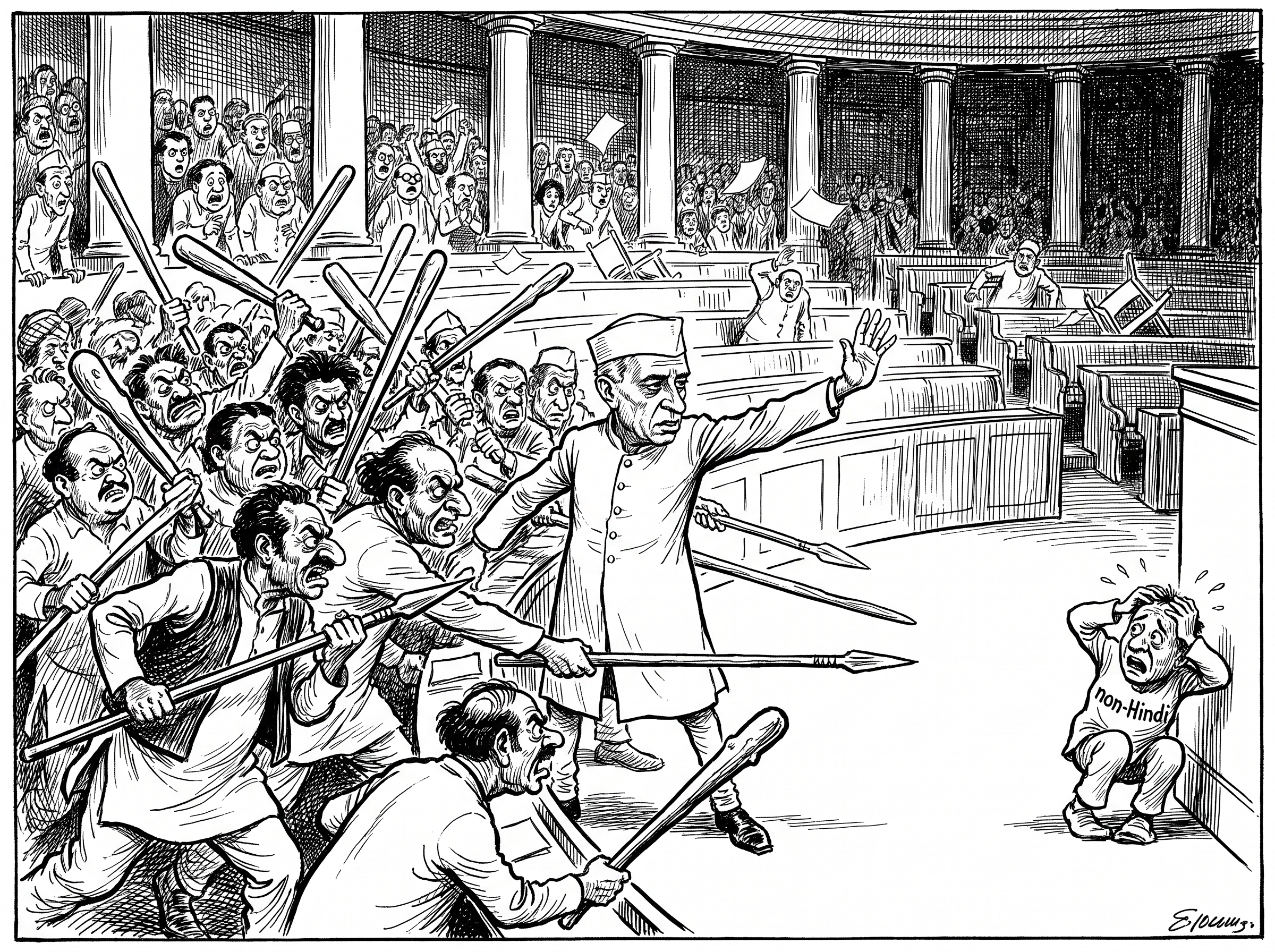
Fig. 7.5 – The language debate in the Constituent Assembly. Inspiration: Shankar cartoon dated 18 September 1949, from Don’t spare me Shankar, p.24 (Copyright: Children’s Book Trust).
Decode the drawing. Nehru is the calm figure with his hand out; the raised sticks are the exaggeration, standing for the heat of the language debate, not for actual violence in the Assembly. The cartoonist’s claim is that the pressure was coming from one side — that the Hindi-speaking provinces had to be asked to hold back — and that the Prime Minister’s authority was being spent to hold them back.
Its limit is the limit of every cartoon. It states one opinion, in one image, on one day. It cannot show you what the Hindi-speaking members thought they were arguing for, and it cannot tell you whether the appeal worked. A cartoon makes a case; it does not test it.
7.5.3 Role Of Governors And President’s Rule
The role of Governors has always been a controversial issue between the States and the central government. The Governor is the constitutional head of a State, but the Governor is not an elected office-holder. Many Governors have been retired military officers, or civil servants, or politicians.
Besides, the Governor is appointed by the central government. Therefore, actions of the Governor are often viewed as interference by the central government in the functioning of the State government. When two different parties are in power at the centre and in the State, the role of the Governor becomes even more controversial.
The Sarkaria Commission, appointed by the central government in 1983 to examine the issues relating to centre-State relations, submitted its report in 1988. It recommended that appointments of Governors should be strictly non-partisan — that is, that the person appointed should not be chosen for loyalty to the ruling party at the centre.
That the office was seen as a political reward, and not only as a constitutional post, is an old charge.
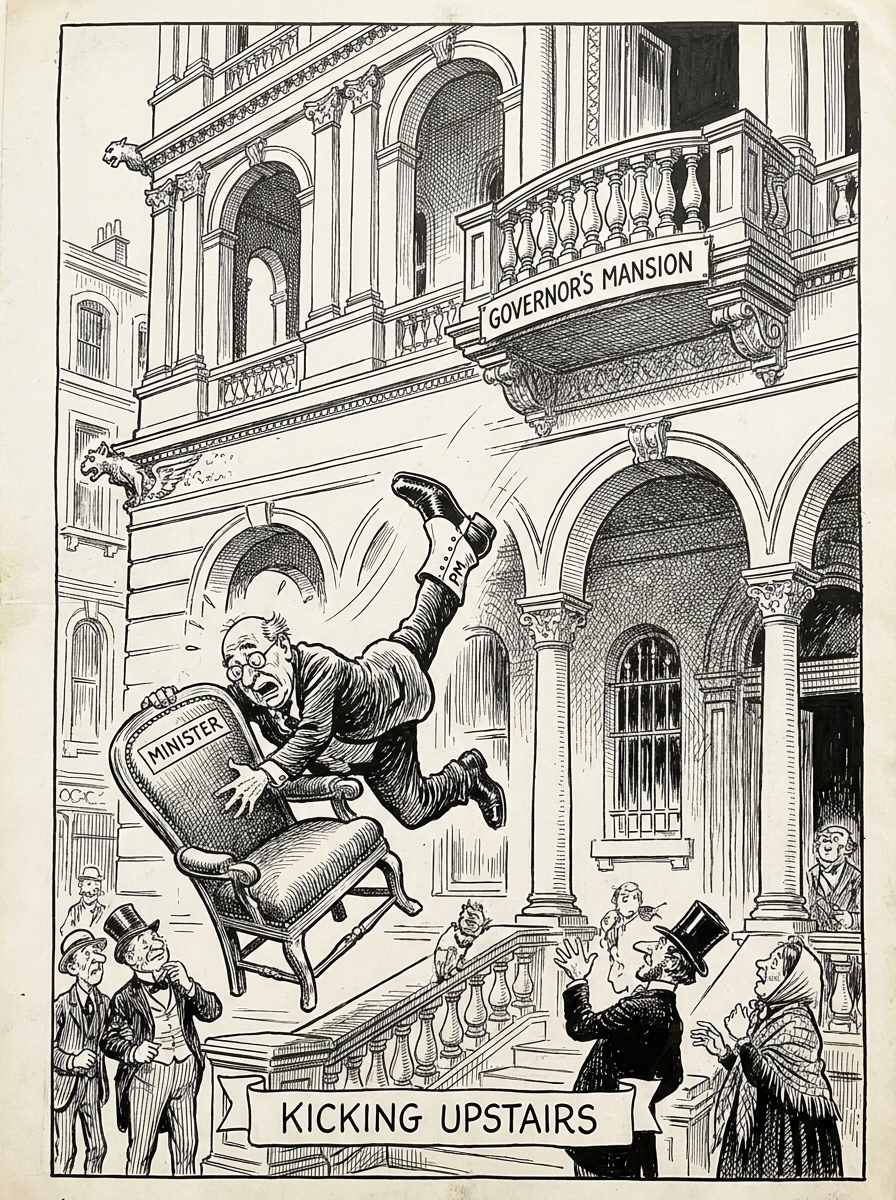
Fig. 7.6 – Governors and political appointments. Inspiration: Shankar cartoon dated 27 April 1952, from Don’t spare me Shankar, p.89 (Copyright: Children’s Book Trust).
‘Kicking upstairs’ is the joke, and it is a precise one. It means promoting someone to a grander-sounding post in order to move them out of a job with real power. The cartoonist’s claim is that Governorships were being used to park politicians, and that the politicians themselves knew a Governor’s chair was not a minister’s chair.
Read it under its limit, though. A cartoon published in 1952 records what one cartoonist thought about appointments made that year. It is not evidence about every Governor since, and it cannot tell you how any particular Governor behaved in office.
Article 356 And President’s Rule
Powers and role of the Governor become controversial for one more reason. One of the most controversial articles in the Constitution is Article 356, which provides for President’s rule in any State.
This provision is to be applied when ‘a situation has arisen in which the Government of the State cannot be carried on in accordance with the provisions of this Constitution.’ It results in the takeover of the State government by the Union government. The President’s proclamation has to be ratified by Parliament, and President’s rule can be extended till three years.
The Governor has the power to recommend the dismissal of the State government and the suspension or dissolution of the State assembly. This has led to many conflicts. In some cases, State governments were dismissed even when they had a majority in the legislature, as had happened in Kerala in 1959, or without testing their majority, as happened in several other States after 1967.
Some cases went to the Supreme Court, and the Court has ruled that the constitutional validity of the decision to impose President’s rule can be examined by the judiciary. The decision, in other words, is political but not beyond question.
The words of Article 356 leave one question wide open: who judges when a government ‘cannot be carried on in accordance with the Constitution’? The Constitution does not answer it, and the history of the provision is largely the history of that gap being filled by politics — and, later, by the courts.
Article 356 was very sparingly used till 1967. After 1967 many States had non-Congress governments while the Congress was in power at the centre. The centre has often used this provision to dismiss State governments, or has used the office of the Governor to prevent the majority party or coalition from assuming office. For instance, the central government removed elected governments in Andhra Pradesh and Jammu and Kashmir in the decade of the 1980s.
The charge that governments were being toppled for political reasons was made openly, and mocked openly.
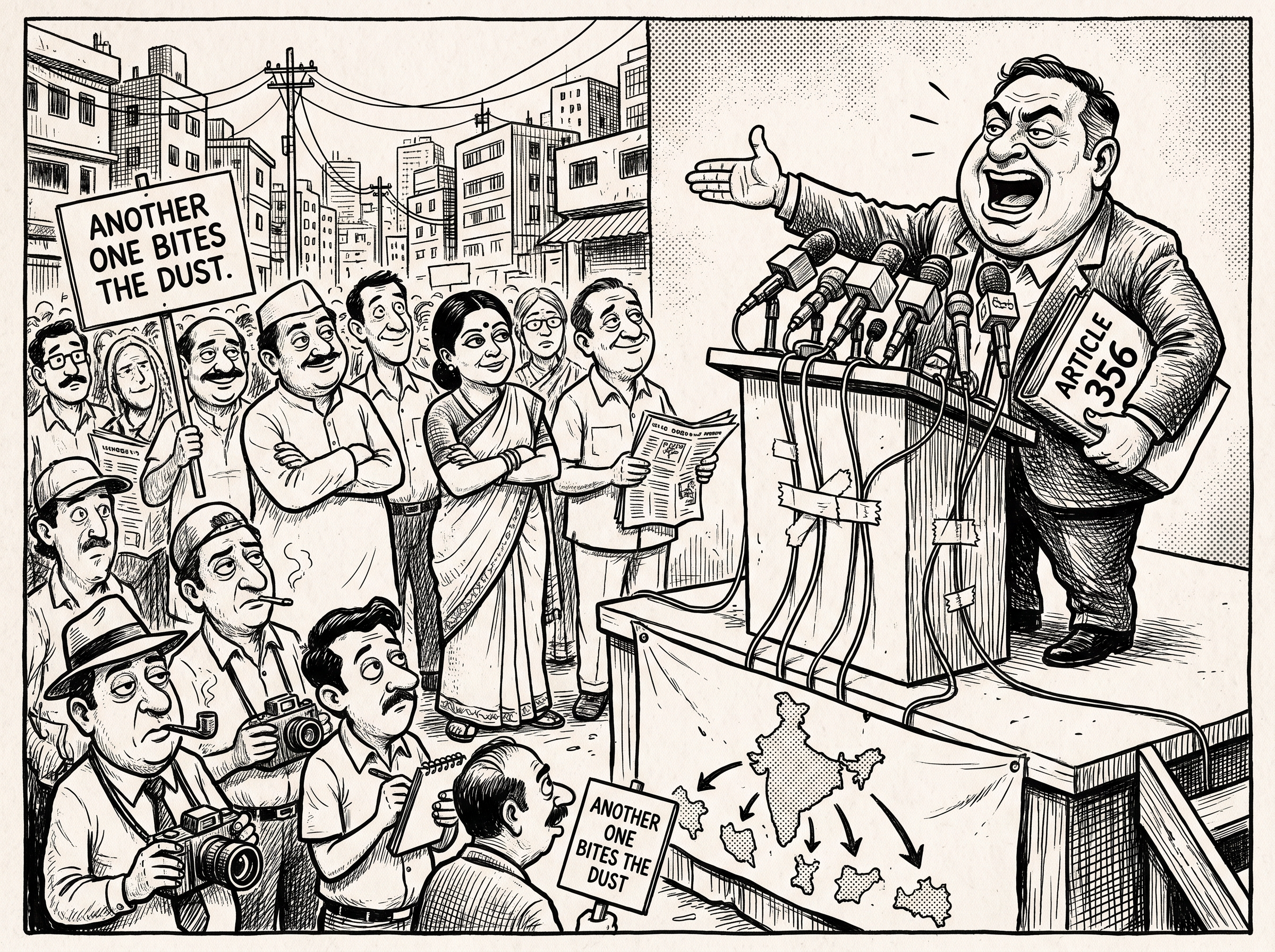
Fig. 7.7 – Toppling State governments. Inspiration: R K Laxman cartoon from The Times of India.
The humour works by having the speaker defend himself with an admission. He denies the charge of partisanship and, in the same breath, boasts that his party topples its own State governments as well. The cartoonist’s claim is that the toppling of State governments had become normal politics for everyone, not the constitutional last resort it was meant to be.
Its limit: a cartoon caption is not a count. It does not tell you how many governments fell, in which States, for what stated reason, or which of those dismissals a court later found valid.
7.5.4 Demands For New States
The other dimension of tension in our federal system has been the demand to create new States. Here the pressure comes not from a State against the centre, but from a region against the State it is placed in.
The national movement not only created a pan-Indian national unity; it also generated distinct unity around a common language, region and culture. Our national movement was also a movement for democracy. Therefore, in the course of the national movement itself, it was decided that as far as possible, States would be created on the basis of common cultural and linguistic identity.
This ultimately led to the demand for the creation of linguistic States after Independence — States drawn so that the people who share a language live in one State and govern themselves in it. The demands came in a rush, and the cartoonists noticed.
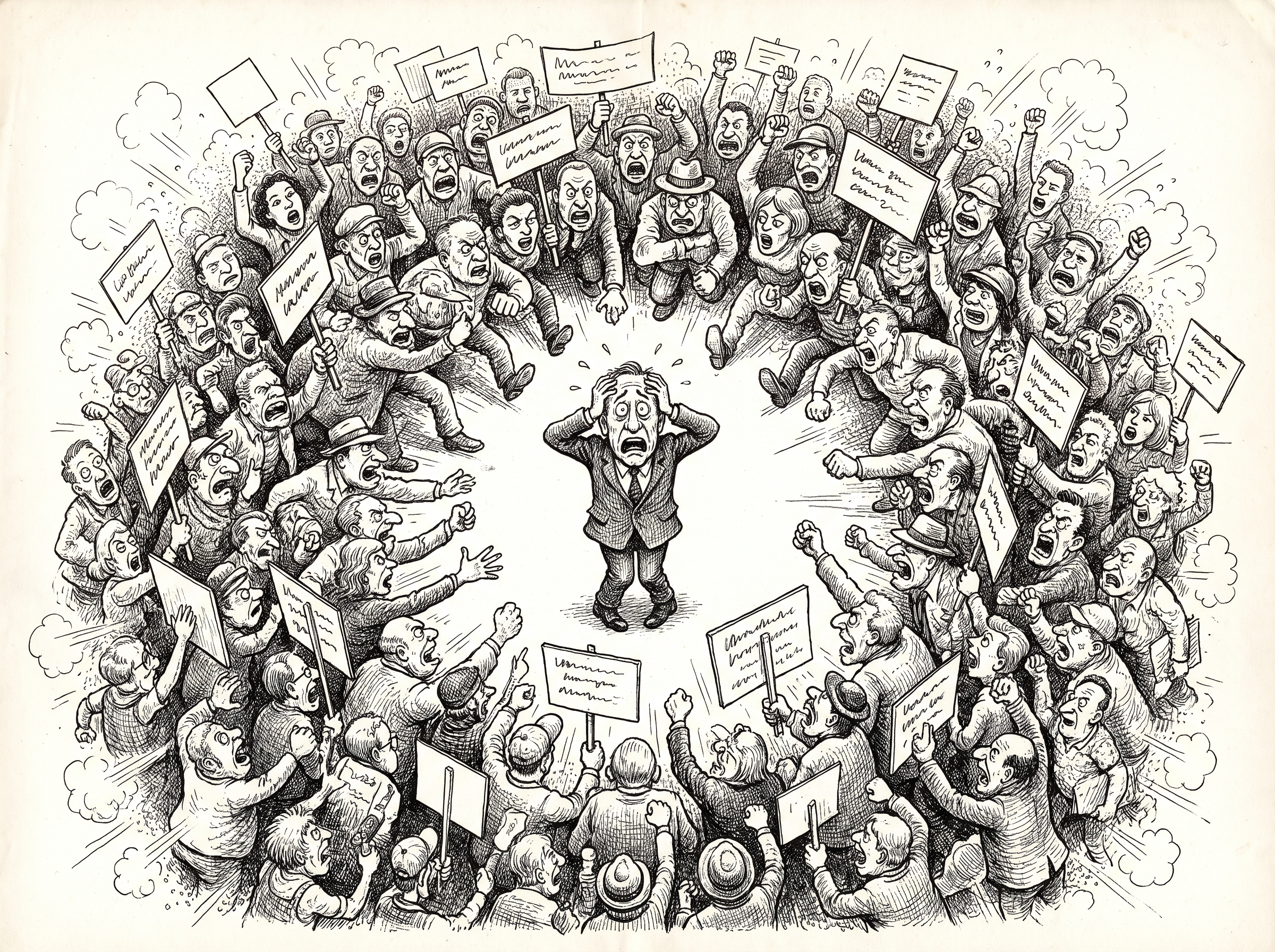
Fig. 7.8 – The rush of demands for new States. Inspiration: Shankar cartoon dated 26 July 1953 (Copyright: Children’s Book Trust).
The exaggeration is the crowd. One lone figure at the centre is being swamped by claimants, each with a name and a case, and the drawing suggests that whoever must answer them cannot possibly satisfy them all. The cartoonist’s claim is about volume: that the demand for new States, once conceded in principle, arrived as a flood rather than a queue.
The limit is that a drawing cannot separate the strong claim from the weak one. It shows the pressure; it says nothing about which demands rested on a distinct language and culture, and which did not.
How The Map Was Redrawn
In December 1953, the States Reorganisation Commission was set up, and it recommended the creation of linguistic States, at least for the major linguistic groups. In 1956, reorganisation of some States took place. This saw the beginning of the creation of linguistic States, and the process is still continuing.
Gujarat and Maharashtra were created in 1960. Punjab and Haryana were separated from each other in 1966. Later, the North Eastern region was reorganised, and new States like Manipur, Tripura, Meghalaya, Mizoram and Arunachal Pradesh were created.
In 2000, some of the larger States were further divided, both to meet the demands for a separate State and to meet the need for greater administrative efficiency. Thus Madhya Pradesh, Uttar Pradesh and Bihar were divided to create three new States: Chhattisgarh, Uttarakhand and Jharkhand respectively. In 2014, the State of Telangana was formed by dividing Andhra Pradesh. Some regions and linguistic groups are still struggling for separate statehood, like Vidarbha in Maharashtra.
Notice that the reasons changed over time. The early reorganisation was argued on language; the divisions of 2000 were argued partly on administrative efficiency as well. The sequence is set out in Fig. 7.9.
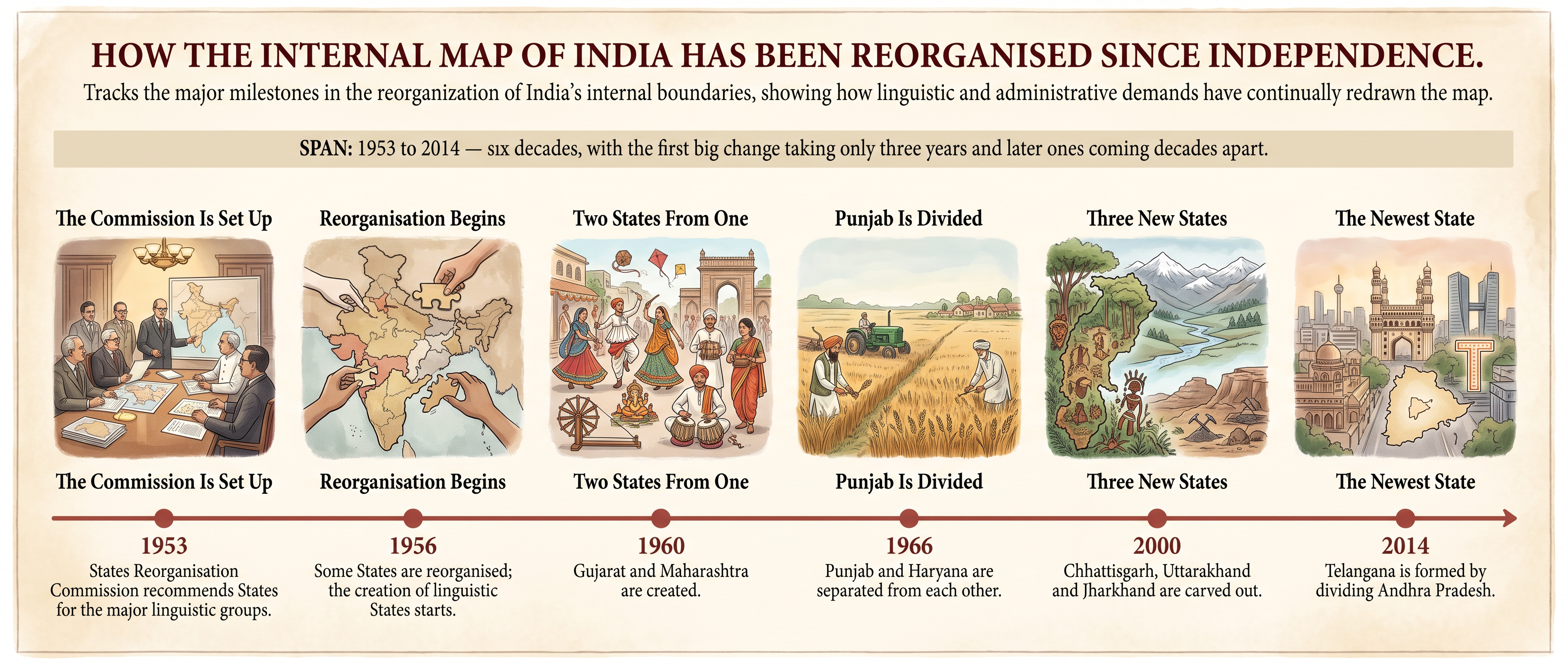
Fig. 7.9 – Redrawing the map of India.
Try this for yourself. Make a list of the States of India, and find out the year in which each of the States was created. You will find that the list you learnt in a junior class has a history behind every entry.
7.5.5 Interstate Conflicts
While the States keep fighting with the centre over autonomy and other issues like the share in revenue resources, there have also been many instances of disputes between two States, or among more than two States.
It is true that the judiciary acts as the arbitration mechanism on disputes of a legal nature. But these disputes are in reality not just legal. They have political implications, and therefore they can best be resolved only through negotiations and mutual understanding. A court can say who is entitled to what; it cannot make two governments trust each other.
Border Disputes
Broadly, two types of disputes keep recurring. One is the border dispute. States have certain claims over territories belonging to neighbouring States.
Though language is the basis of defining boundaries of the States, border areas would often have populations speaking more than one language. So it is not easy to resolve this dispute merely on the basis of linguistic majority. The rule that drew the map cannot always settle the quarrel at its edges.
One of the long-standing border disputes is the dispute between Maharashtra and Karnataka over the city of Belgaum. Manipur and Nagaland too have a long-standing border dispute.
The carving out of Haryana from the erstwhile State of Punjab has led to a dispute between the two States not only over border areas, but over the capital city of Chandigarh. This city today houses the capital of both these States. In 1985, the then Prime Minister Rajiv Gandhi reached an understanding with the leadership of Punjab, according to which Chandigarh was to be handed over to Punjab. But this has not happened yet.
River Water Disputes
While border disputes are more about sentiment, the disputes over the sharing of river waters are even more serious, because they are related to problems of drinking water and agriculture in the concerned States.
You might have heard about the ‘Kaveri’ water dispute. This is a major issue between Tamil Nadu and Karnataka, and farmers in both the States are dependent on Cauvery waters. Though there is a river water tribunal — a body set up specially to settle water disputes — this dispute has reached the Supreme Court. In another similar dispute, Gujarat, Madhya Pradesh and Maharashtra are battling over sharing the waters of the Narmada river.
Rivers are a major resource, and therefore disputes over river waters test the patience and cooperative spirit of the States. Collect information about at least one dispute about river waters involving two or more States, and see for yourself how long it has run and how many institutions have handled it.
At this point a student may throw up her hands: conflict over Governors, over language, over borders and over water — and yet we manage to live together. That is exactly the puzzle. Notice what none of these quarrels has been about. However bitter the demands, they have been demands for a bigger share inside the Union.
Autonomy Is Not Secession
The distinction matters, and it is easy to blur. A demand for autonomy asks for more powers, more revenue or more administrative freedom within the federation; the State continues to be a State of India, and the Constitution continues to bind it. A demand for secession asks to leave the federation altogether and become a separate country.
The two also travel differently. Autonomy demands are made through documents, party manifestos, agitations and negotiations with the centre — the Left Front Government’s 1977 document is an example. Secession, as the chapter’s foreign examples showed, is what aggrieved units turn to when a federation stops accommodating them, and it can end in the break-up of the country or in civil war.
7.6 Special Provisions
Not Every State Is Treated Identically
The most extraordinary feature of the federal arrangement created in India is that many States get a differential treatment. Federalism, one might assume, means the same deal for every unit. In India it does not, and that was deliberate.
We have already noted in the chapter on the Legislature that, the size and population of each State being different, an asymmetrical representation is provided in the Rajya Sabha. Asymmetrical representation means that States do not send equal numbers of members: while ensuring a minimum representation to each of the smaller States, the arrangement also ensures that larger States would get more representation.
In the case of division of powers, too, the Constitution provides a division of powers that is common to all the States. Every State works with the same three lists. And yet, the Constitution has some special provisions for some States, given their peculiar social and historical circumstances.
Where The Special Provisions Apply
Most of the special provisions pertain to the north eastern States — Assam, Nagaland, Arunachal Pradesh, Mizoram, and others — largely due to their sizeable indigenous tribal population with a distinct history and culture. The reasoning is the reasoning of the whole chapter: an arrangement that ignores a distinct identity is more likely to be resented than obeyed.
However, these provisions have not been able to stem alienation and the insurgency in parts of the region. That sentence should not be read past quickly. The Constitution’s most generous design has not, by itself, settled the region’s politics.
Special provisions also exist for hilly States like Himachal Pradesh, and for some other States like Andhra Pradesh, Goa, Gujarat, Maharashtra, Sikkim and Telangana.
This is what the first chapter meant by an intelligent and balanced design: the same Constitution treats different States differently, because their situations differ.
7.6.1 Jammu And Kashmir
How The State Joined The Union
The other State which had a special status was Jammu and Kashmir (J&K), under Article 370.
Jammu and Kashmir was one of the large princely States, which had the option of joining India or Pakistan or remaining independent. However, immediately after independence, in October 1947, Pakistan sent tribal infiltrators from its side to capture Kashmir. This forced the Maharaja, Hari Singh, to ask for Indian help, and he acceded to the Indian Union — that is, he signed the State over to India, as the rulers of the other princely states did.
Many of the Muslim majority areas in the Western and Eastern parts joined Pakistan, but J&K was an exception. Under these circumstances, it was given much greater autonomy by the Constitution.
What Article 370 Did
According to Article 370, the concurrence of the State was required for making any laws in matters mentioned in the Union and Concurrent lists. Concurrence here means the consent of the State government.
This was different from the position of other states. In the case of the other States, the division of powers as listed through the three lists automatically applies. In the case of Jammu and Kashmir, the central government had only limited powers, and other powers listed in the Union list and the Concurrent list could be used only with the consent of the State government. This gave greater autonomy to the State of Jammu and Kashmir.
Earlier, there was a constitutional provision that allowed the President, with the concurrence of the State government, to specify which parts of the Union list should apply to the State. The President had issued two Constitutional orders, in concurrence with the government of J&K, making large parts of the Constitution applicable to the State.
As a result, though J&K had a separate constitution and a flag, the Parliament’s power to make laws on subjects in the Union List was fully accepted. The autonomy on paper and the autonomy in practice were, by then, not the same thing.
The Remaining Differences
The remaining differences between the other States and the State of J&K were these. No emergency due to internal disturbances could be declared in J&K without the concurrence of the State. The Union government could not impose a financial emergency in the State. The Directive Principles — the guidelines for policy set out in the Constitution — did not apply in J&K. And amendments to the Indian Constitution, made under Article 368, could apply in concurrence with the government of J&K.
Set beside the position of any other State, the contrast is easy to see in a grid.
Read the grid under its limit. It sets out the rules as they stood, and rules are only half the story. It cannot show that two Presidential orders had already made large parts of the Constitution applicable to the State, so that the gap between J&K and the other States was narrower in practice than the left and right columns suggest. Nor does the grid describe the position today.
The Position Today
At present, the special status given under Article 370 no longer exists. By the Jammu and Kashmir reorganisation Act 2019, the State has been bifurcated into two Union Territories: (i) Jammu and Kashmir, and (ii) Ladakh. A Union Territory is a unit administered by the central government, rather than one with the full status of a State. The new arrangement has come into effect from 31 October, 2019.
7.7 Conclusion
A Rainbow, Not A Single Colour
Federalism is like a rainbow, where each colour is separate, yet together they make a harmonious pattern. The image is worth taking seriously, because it says two things at once: the colours do not merge, and they do not clash.
Federalism has to continuously maintain a difficult balance between the centre and the States. This chapter has shown how hard that balance is to hold — over money, over Governors, over language, over boundaries, over rivers. The balance is never struck once and for all; it has to be struck again in every decade, by whoever happens to hold office.
No Formula Can Do The Work Alone
No legal or institutional formula can guarantee the smooth functioning of a federal polity. That is the lesson the chapter opened with, and it is the lesson it closes with. Other countries had federal constitutions and still came apart.
Ultimately, the people and the political process must develop a culture, and a set of values and virtues: mutual trust, toleration and a spirit of cooperation. These are not clauses that can be inserted into a document. They are habits, and habits are built by how governments actually behave when they disagree.
Unity Is Not Sameness
Federalism celebrates both unity as well as diversity. It does not ask anyone to choose between the two.
National unity cannot be built by streamlining differences — by rubbing out what makes regions, languages and communities distinct in order to make the country look uniform. Such forced unity only generates greater social strife and alienation, and tends finally to destroy the very unity it was meant to create.
A responsive polity, sensitive to diversities and to the demands for autonomy, can alone be the basis of a cooperative federation. That is the claim this chapter finally rests on: that accommodation is not a concession made to the regions, but the way a large and diverse country stays whole.
7.8 Summary
What This Chapter Established
- The political map of India has been redrawn many times since 1947: boundaries have moved, names have changed, and the number of States has changed. Each change was a political decision.
- Federations can fail. The USSR broke up after 1989 because of excessive centralisation and the domination of one region over others; Czechoslovakia, Yugoslavia and Pakistan divided; Canada came close. The West Indies federation dissolved in 1962. So a federal constitution by itself does not guarantee unity.
- Federalism is an institutional mechanism to accommodate two sets of polities, national and regional. Each is autonomous in its own sphere; people hold two identities; the arrangement is set out in a supreme written constitution; and an independent judiciary settles disputes about the division of power.
- India’s leaders chose federalism before Independence because a large, diverse, democratic country could not be governed from one place. After Partition, the Constituent Assembly built a system based on unity and cooperation between the centre and the States.
- The Constitution never uses the word ‘federation’. Article 1 calls India a Union of States, with the States specified in the First Schedule.
- Powers are divided through three lists — Union, State and Concurrent — with residuary powers going to Parliament. Economic and financial powers are centralised, so the States carry immense responsibilities on meagre revenue sources.
- The Constitution deliberately created a strong centre, to stem disintegration and to drive development. Parliament can alter a State’s boundary or name; emergency provisions centralise power lawfully; the centre controls revenue and planning; the Governor can reserve State bills; the Union may direct a State under Article 257(1); the all-India services stay under central control; and Articles 33 and 34 protect those acting under martial law.
- Federal practice has changed with politics: Congress dominance in the 1950s, opposition governments in the States after the mid-1960s, and coalition politics since the 1990s, which gave the States a greater say.
- Autonomy demands take four forms — more powers, financial autonomy, administrative autonomy, and cultural or linguistic demands, including opposition to the imposition of Hindi.
- The Governor’s office and Article 356 are the sharpest flashpoints. President’s rule has been used to dismiss elected governments, sometimes with a majority intact. The Supreme Court has held that its constitutional validity can be examined by the judiciary; the Sarkaria Commission recommended non-partisan appointments.
- New States have been demanded and created continuously, first on linguistic grounds, later also for administrative efficiency.
- States also fight each other, over borders such as Belgaum and Chandigarh, and over river waters such as the Cauvery and the Narmada. These are political as much as legal, and negotiation matters more than judgment.
- Many States are treated differently by design: asymmetrical representation in the Rajya Sabha, and special provisions for the north eastern and hilly States. Jammu and Kashmir had a special status under Article 370, which no longer exists after the reorganisation of 2019.
- Finally, no formula guarantees a federation. Trust, toleration and cooperation, and a polity responsive to diversity, are what hold it together.
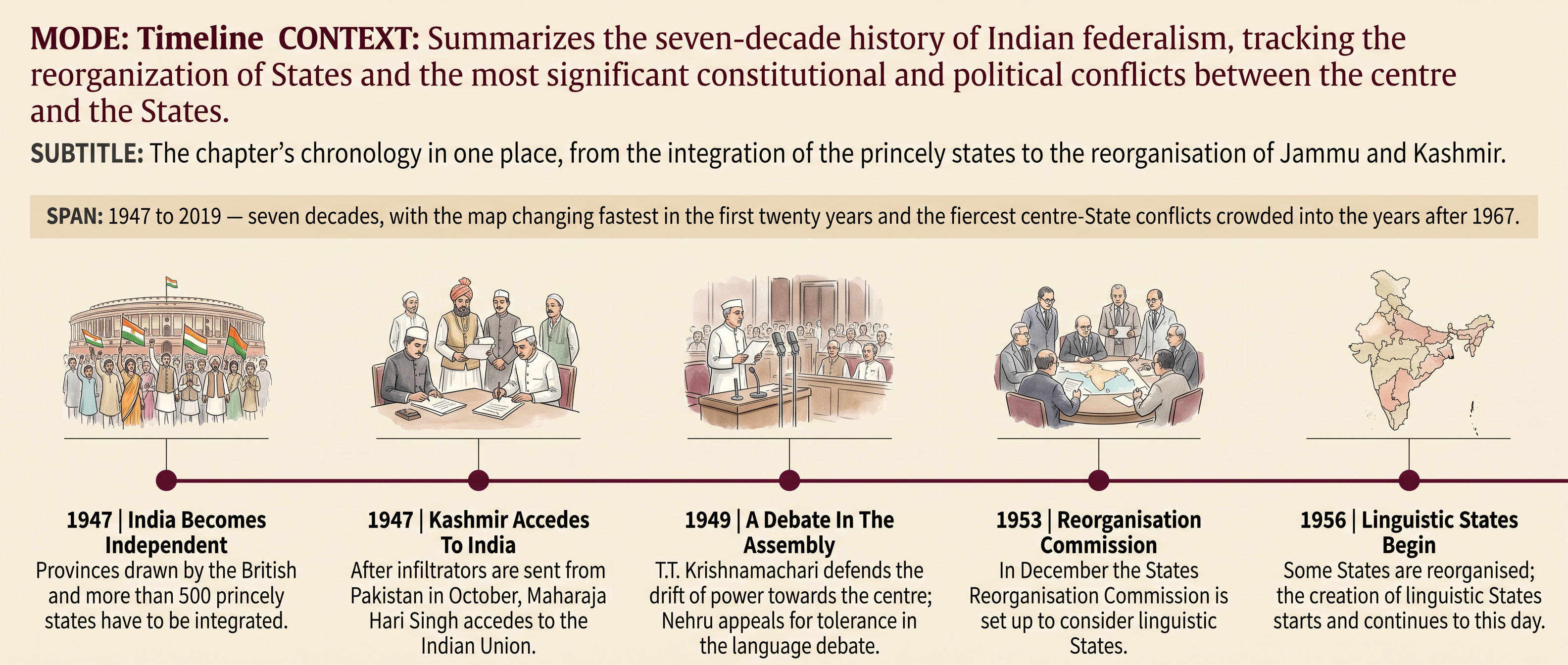
Fig. 7.10 – Federalism in India, 1947 to 2019.
What Remains Contested
The chapter never settles how strong a centre a democracy of this size needs. It records the framers’ reasons for a strong centre, and it records the charge that the same powers — grants, Governors, Article 356 — have been used against governments the centre did not like. Both are left standing.
Nor does it settle what a State should be made of: a language, a culture, an economy, or an administrative convenience. The map keeps being redrawn, and Vidarbha is still asking.
And notice whose voices its evidence was never designed to record. A Constituent Assembly speech, a Prime Minister’s understanding with a State’s leadership, a cartoon in a national newspaper — these are the words of people at the top of the system. The farmer waiting on the Cauvery, and the citizen living where alienation and insurgency have not been stemmed, are spoken about in this chapter far more often than they speak in it.
7.9 NCERT Questions
- From the list of following events, which ones would you identify with the functioning of federalism? Why?
- The Centre on Tuesday announced Sixth Schedule status to GNLF-led Darjeeling Gorkha Hill Council, which would ensure greater autonomy to the governing body in the Hill district of West Bengal. A tripartite Memorandum of Settlement was signed in New Delhi between the Centre, the West Bengal government and the Subhas Ghising-led Gorkha National Liberation Front (GNLF) after two days of hectic deliberations.
- Government for action plan for rain-hit States: Centre has asked the rain-ravaged States to submit detailed plans for reconstruction, to enable it to respond to their demands for extra relief expeditiously.
- New Commissioner for Delhi: The Capital is getting a new municipal commissioner. Confirming this, present MCD Commissioner Rakesh Mehta said he has received his transfer orders and that he is likely to be replaced by IAS officer Ashok Kumar, who is serving as the Chief Secretary in Arunachal Pradesh. Mehta, a 1975 batch IAS officer, has been heading the MCD for about three-and-a-half years.
- CU Status for Manipur University: Rajya Sabha on Wednesday passed a Bill to convert the Manipur University into a Central University, with the Human Resource Development Minister promising such institutions in the North Eastern States of Arunachal Pradesh, Tripura and Sikkim as well.
- Funds released: The Centre has released Rs. 553 lakh to Arunachal Pradesh under its rural water supply scheme. The first instalment was of Rs. 466.81 lakh.
- We’ll teach the Biharis how to live in Mumbai: Around 100 Shiv Sainiks stormed J. J. Hospital, disrupted daily operations, raised slogans and threatened to take matters into their own hands if no action was taken against non-Maharashtrian students.
- Demand for dismissal of Government: The Congress Legislature Party (CLP), in a representation submitted to the State Governor recently, has demanded dismissal of the ruling Democratic Alliance of Nagaland (DAN) government for its alleged financial mismanagement and embezzlement of public money.
- NDA government asks naxalites to surrender arms: Amid a walkout by opposition RJD and its allies Congress and CPI (M), the Bihar government today appealed to the naxalites to shun the path of violence and reaffirmed its pledge to root out unemployment to usher in a new era of development in Bihar.
- Think which of the following statements would be correct. State why.
- Federalism enhances the possibility of people from different regions to interact without the fear of one’s culture being imposed upon them by others.
- Federal system will hinder easier economic transaction between two different regions that have distinct types of resources.
- A federal system will ensure that the powers of those at the centre will remain limited.
- Based on the first few articles of the Belgian constitution — given below — explain how federalism is visualised in that country. Try and write a similar Article for the Constitution of India.
Title I: On Federal Belgium, its components and its territory.
Article 1: Belgium is a Federal State made up of communities and regions.
Article 2: Belgium is made up of three communities: The French Community, the Flemish Community and the German Community.
Article 3: Belgium is made up of three regions: The Walloon region, the Flemish region and the Brussels region.
Article 4: Belgium has four linguistic regions: The French-speaking region, the Dutch-speaking region, the bilingual region of Brussels Capital and the German-speaking region. Each ‘commune’ (county borough) of the Kingdom is part of one of these linguistic regions. ……..
Article 5: The Walloon region is made up of the following provinces: The Walloon Brabant, Hainault, Liege, Luxemburg and Namur. The Flemish region is made up of the following provinces: Antwerp, the Flemish Brabant, West Flanders, East Flanders and Limburg. ……
Imagine that you were to rewrite the provisions regarding federalism. Write an essay of not more than 300 words making your suggestions about:
- division of powers among the centre and the States,
- distribution of financial resources,
- methods of resolving inter-State disputes, and
- appointment of Governors.
Which of the following should be the basis for formation of a State? Why?
- Common Language
- Common economic interests
- Common religion
- Administrative convenience
Majority of people from the States of north India — Rajasthan, Madhya Pradesh, Uttar Pradesh, Bihar — speak Hindi. If all these States are combined to form one State, would it be in tune with the idea of federalism? Give arguments.
List four features of the Indian Constitution that give greater power to the central government than the State government.
Why are many States unhappy about the role of the Governor?
President’s rule can be imposed in a State if the government is not being run according to the provisions of the Constitution. State whether any of the following conditions are a fit case for imposition of President’s rule in the State. Give reasons.
- Two members of the State legislative assembly belonging to the main opposition party have been killed by criminals, and the opposition is demanding dismissal of the State government.
- Kidnapping of young children for ransom is on the rise. The number of crimes against women is increasing.
- No political party has secured a majority in the recent elections of the State Legislative Assembly. It is feared that some MLAs from the other parties may be lured to support a political party in return for money.
- Different political parties are ruling in the State and at the centre, and they are bitter opponents of each other.
- More than 2000 people have been killed in the communal riots.
- In the water dispute between the two States, one State government refused to follow the decision of the Supreme Court.
What are the demands raised by States in their quest for greater autonomy?
Should some States be governed by special provisions? Does this create resentment among other States? Does this help in forging greater unity among the regions of the country?
7.10 Check Your Concepts
Using Fig. 7.2, say which legislature may make a law on each of these subjects, and give the reason in one line: defence, police, education, cyber laws.
Read Source 7.1. The Constitution calls India a Union of States and never uses the word ‘federation’. Does it follow that India is not a federal country? Answer using the key ideas of federalism set out in this chapter.
Read Source 7.2. What reason does the speaker give for power drifting towards the centre in all constitutions? Now state one thing this extract cannot tell you about the Constituent Assembly’s view of a strong centre.
Look again at Fig. 7.7. The speaker denies the charge against him and, in the same breath, makes it worse. Explain how the joke works, and state one thing the cartoon cannot tell you about the use of Article 356.
Fig. 7.5 and Fig. 7.8 were both drawn in the 1950s. What pressure on the federal system does each record? Why can a cartoon show you that a demand existed, but not how strong or how justified it was?
Read Source 7.3. What does Article 257 (1) permit the central government to do, and who decides when it is necessary? What does the article leave unsettled?
The Constitution did not change in the mid-1960s, yet centre-State relations did. Reconstruct the chain of events that turned autonomy from a constitutional footnote into a live political demand.
The USSR, Yugoslavia, Pakistan, Nigeria and the West Indies all had federal arrangements. Using what the chapter says about them, argue whether a federal constitution, by itself, can keep a country united — and say what else the chapter suggests is needed.