Chapter 9: Constitution As A Living Document
Some benches in Parliament were empty, and everybody in the chamber knew why.
An internal emergency had been declared in the country from June 1975. In the months that followed, the Parliament of India took up an amendment bill so wide-ranging that people at the time said it amounted to a rewriting of large parts of the Constitution. It was the 42nd amendment. It changed the Preamble. It changed the seventh schedule. It changed 53 articles. It stretched the life of the Lok Sabha from five years to six. It put restrictions on the review powers of the Judiciary, and it tried to override a ruling the Supreme Court had given in the Kesavananda case.
Many MPs belonging to the opposition parties were in jail while it was being passed.
Every constitution has to answer one question before it can answer any other: who is allowed to change it, and how hard should that be? Make change too easy and the document becomes an ordinary law that each new majority rewrites to suit itself. Make it too hard and the document freezes, until a society that has outgrown it simply throws it away — as several countries have done, more than once.
In 1977 elections were held, the ruling party was defeated, and the new government used the 43rd and 44th amendments to cancel most of what the 38th, 39th and 42nd had done. The balance was restored.
This chapter is about how a document written in 1949 survived that, and why it is still working.
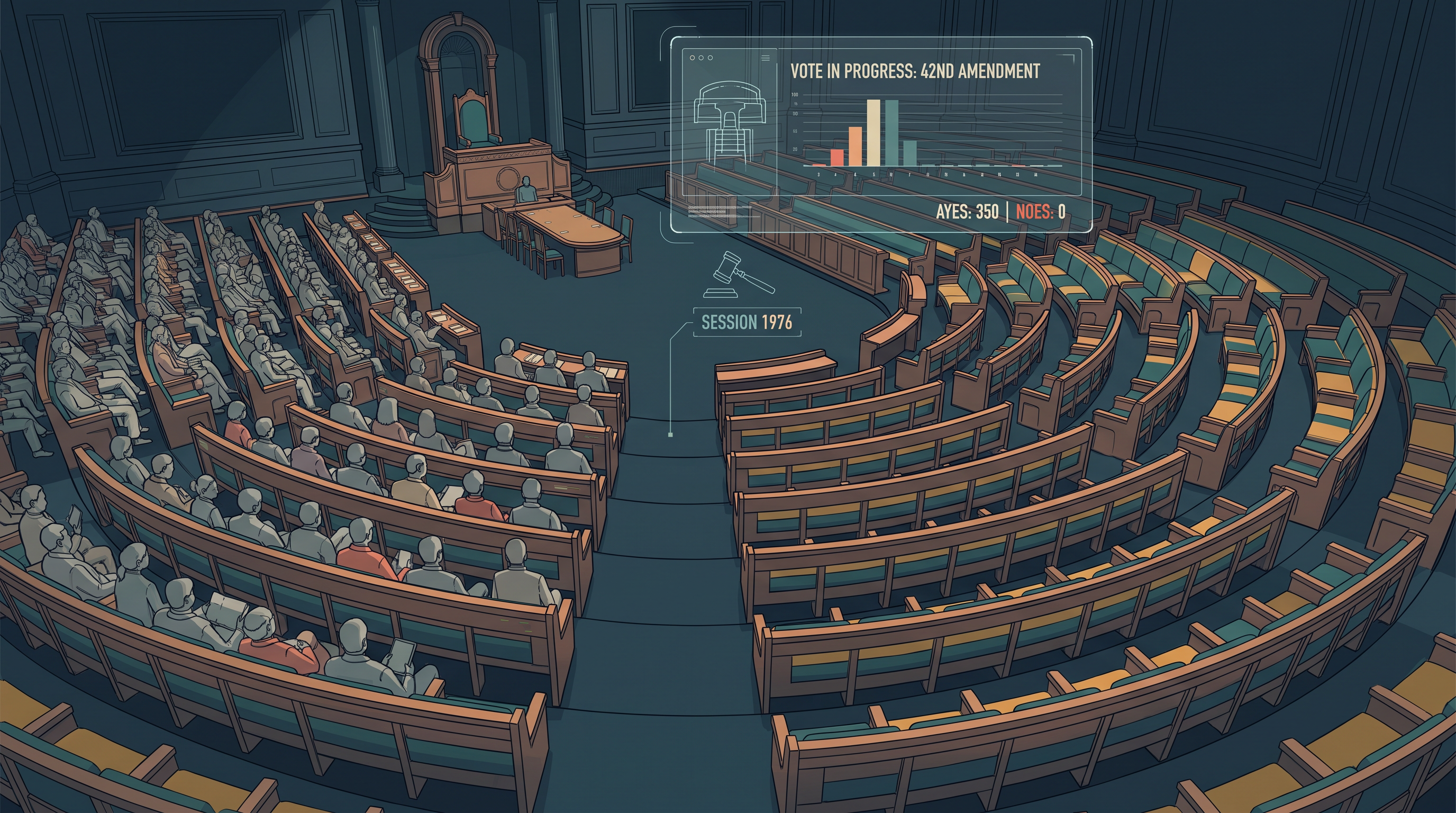
Fig. 9.0 – The Lok Sabha chamber during the 42nd amendment vote.
9.1 Introduction
A constitution is the basic law of a country. It sets out how the government is to be formed, what powers each part of it has, what it may not do to citizens, and how the document itself may be changed.
This chapter looks at how the Indian Constitution has worked over the last 69 years. The striking fact is not that India has a constitution. It is that India is still being governed by the same one, while the society it governs has changed almost beyond recognition.
What This Chapter Will Show
By the end of the chapter you will have found out four things.
- The Indian Constitution can be amended according to the needs of the time. An amendment is a formal change made to the text of the Constitution itself, following a procedure the Constitution lays down.
- Though many such amendments have already taken place, the Constitution has remained intact. Its basic premises have not changed.
- The judiciary — the system of courts, headed by the Supreme Court, whose task is to decide what the law means and whether it has been broken — has played an important role both in protecting the Constitution and in interpreting it.
- The Constitution is a document that keeps evolving and responding to changing situations.
Notice how the second point sits against the first. The document has been changed many times, and yet it has not been replaced or hollowed out. Holding those two facts together is the whole problem this chapter sets out to explain.
9.2 Are Constitutions Static?
Start with a fact that surprises most people. It is not at all unusual for a nation to throw away its constitution and write a new one. Countries do this when circumstances change, when ideas within the society change, or when there is a political upheaval — a sudden overturning of the existing political order.
Countries That Have Rewritten Their Constitutions
Take the Soviet Union, the federation centred on Russia that stretched across eastern Europe and northern Asia. In a life of 74 years it had four constitutions — in 1918, 1924, 1936 and 1977. Then, in 1991, the rule of the Communist Party of Soviet Union came to an end and the Soviet federation soon disintegrated. After this political upheaval, the newly formed Russian federation adopted a new constitution in 1993.
France, in western Europe, tells the same story at greater length. It has had numerous constitutions in the last two centuries. After its revolution, and during the Napoleonic period, France went through continuous experimentation about a constitution. The post-revolution constitution of 1793 is called the period of the first French republic. The second French republic commenced in 1848. The third French republic was formed with a new constitution in 1875. In 1946, with a new constitution, the fourth French republic came into being. Finally, in 1958, the fifth French republic came into being with yet another constitution.
Set out in order, as in Fig. 9.1, the pattern is hard to miss. Each new constitution in France arrives with a new political order, and each new political order arrives with a new constitution. Constitutional change, it seems, is very closely linked to political developments. That is worth holding on to, because it is a claim this whole chapter will keep testing.
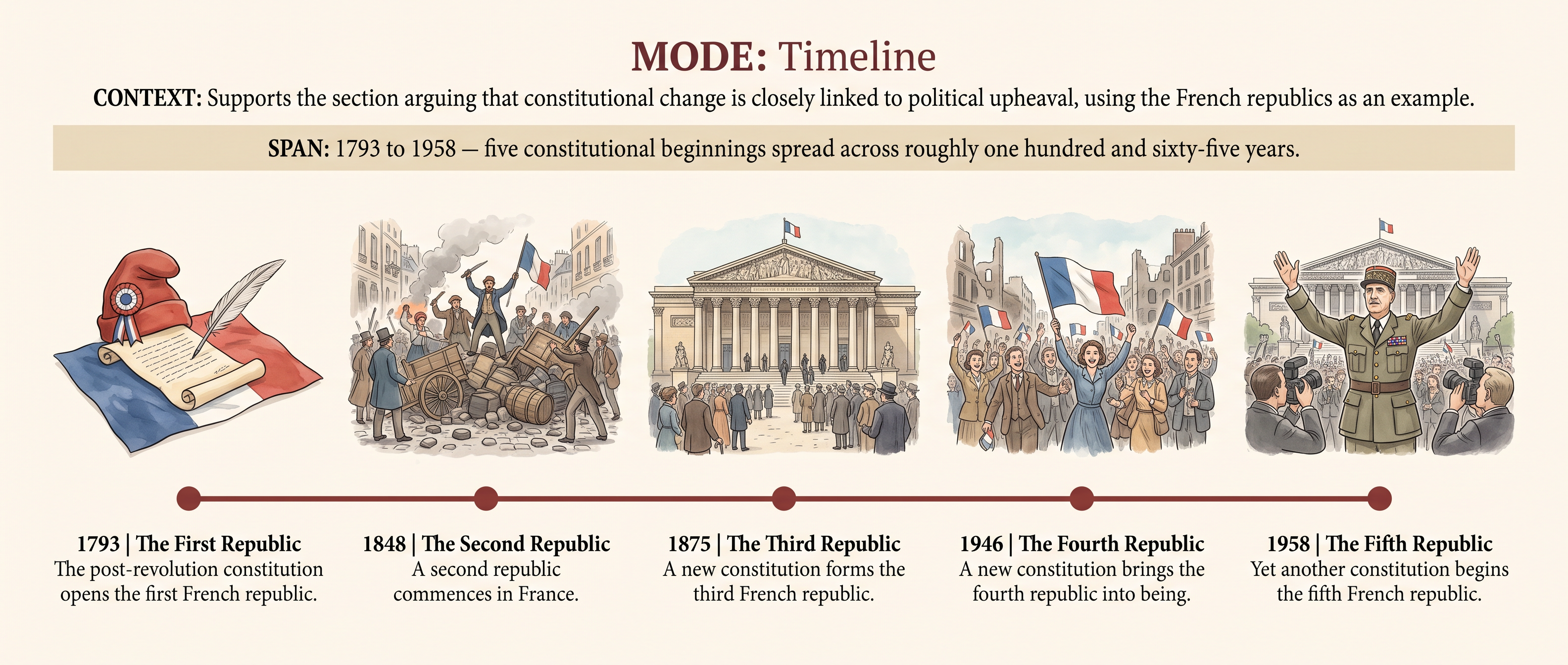
Fig. 9.1 – The Republics Of France.
But Look At India
The Constitution of India was adopted on 26 November 1949. Its implementation formally started from 26 January 1950. More than 69 years after that, the same constitution continues to function as the framework within which the government of our country operates.
That is a long stretch of time. It covers wars, famines, an economy transformed, a population more than trebled, and generations of Indians who never knew colonial rule. Through all of it, one document. And India is not alone in this kind of endurance: the Constitution of the United States came into existence more than 200 years ago, and so far it has been amended only 27 times.
So what explains our own record? Is it that our Constitution is so good that it needs no change? Was it that our Constitution makers were so farsighted and wise that they had foreseen all the changes that would take place in the future?
In some sense both the answers are correct. We have inherited a very robust Constitution, and its basic framework is very much suited to our country. It is also true that the Constitution makers were very farsighted and provided many solutions for future situations. But no constitution can provide for all eventualities. No document can be such that it needs no change.
Why The Same Constitution Still Works
Then how does the same Constitution continue to serve the country? One answer is that our Constitution itself accepts the necessity of modifications according to the changing needs of the society. It does not pretend to be finished.
The second answer lies not in the text but in the working of it. In the actual working of the Constitution there has been enough flexibility of interpretations. Both political practice and judicial rulings have shown maturity and flexibility in implementing the Constitution.
These two factors together have made our Constitution a living document rather than a closed and static rulebook. A living document is one that keeps responding to new situations — through formal amendment, through interpretation by the courts, and through the practices that politics builds up around it.
The Two Jobs Every Constitution Has To Do
In any society, those responsible for drafting a constitution at a particular time face one common challenge. The provisions they write will naturally reflect their efforts to tackle the problems the society is facing at that moment. That is unavoidable; they are human beings, living in their own present.
At the same time, the constitution must be a document that provides the framework of the government for the future as well. It has to be able to respond to challenges that may arise long after its authors are dead. In this sense, a constitution will always have something in it that is contemporary, and something that has a more durable importance.
And a constitution is not a frozen and unalterable document. It is made by human beings, and it may need revisions, changes and re-examination. It is true that a constitution reflects the dreams and aspirations of the society concerned. It must also be kept in mind that it is a framework for the democratic governance of that society. In this sense, it is an instrument that societies create for themselves.
Sacred Document Or Ordinary Instrument?
This dual role always leads to a difficult question about the status of a constitution. Is it so sacred that nobody can ever change it? Or is it so ordinary an instrument that it can be modified just like any other law?
Both answers have a cost, and the cost is worth stating plainly. Treat the document as untouchable and each generation is ruled by the dead hand of the last. Treat it as ordinary and it stops being a limit on power at all, because whoever commands a majority today can simply rewrite the rules to suit themselves tomorrow.
The makers of the Indian Constitution were aware of this problem and sought to strike a balance. They placed the Constitution above ordinary law, and expected that future generations would respect this document. At the same time, they recognised that in the future it may require modifications.
They had good reason to expect this. Even at the time of writing the Constitution, they knew that on many matters there were differences of opinion among themselves. Whenever society would veer towards any particular opinion, a change in the constitutional provisions would be required.
Thus the Indian Constitution is a combination of both the approaches: that the constitution is a sacred document, and that it is an instrument that may require changes from time to time. In other words, our Constitution is not a static document, it is not the final word about everything, and it is not unalterable.
Check Your Progress
After reading the section above, a number of students in the class were confused, and made the four statements below. What would you say about each of them? For each one, decide whether it is right, wrong, or partly right — and be ready to say which part is wrong and why.
9.3 How To Amend The Constitution?
The Constitution does not leave the question of its own alteration to chance. It contains an article that says who may change it and by what procedure. That article is Article 368, and the chapter prints part of it below.
Read the words slowly, because each phrase is doing work. Constituent power is the power to make or change a constitution itself, as distinct from the ordinary power to make laws. Parliament holds both — but it does not exercise them in the same way. To amend ‘by way of addition, variation or repeal’ means Parliament may add something new, alter what is already there, or delete it altogether. And all of it must be done ‘in accordance with the procedure laid down in this article’: the power is real, but it is not free.
What the extract does not tell us is what that procedure actually is. The article is quoted here only in part, and the words that matter most in practice — the majorities required, the role of the States — lie in the rest of it. The section below supplies them.
Flexible And Rigid At The Same Time
We have already seen that the makers of our Constitution wanted to strike a balance. The Constitution must be amended if so required. But it must also be protected from unnecessary and frequent changes.
In other words, they wanted the Constitution to be ‘flexible’ and at the same time ‘rigid’. Flexible means open to changes; a constitution that can be very easily changed or modified is often called flexible. Rigid means resistant to changes; constitutions that are very difficult to amend are described as rigid. The Indian Constitution combines both these characteristics.
That sounds like a contradiction and is not one. Different parts of the same document are made easy or hard to change, depending on what is at stake in that part.
Why should that be? The makers had four distinct considerations in mind.
- They were aware that there may be some faults or mistakes in the Constitution. They knew it could not be totally free of errors. Whenever such mistakes came to light, they wanted the Constitution to be easily amended, so that the errors could be got rid of.
- Some provisions in the Constitution were of a temporary nature. It was decided that these could be altered later on, once the new Parliament was elected.
- But the Constitution was framing a federal polity. Federalism is the arrangement in which power is divided between a central government and the governments of the States, so that each has a sphere of its own. Therefore the rights and powers of the States could not be changed without the consent of the States.
- Some other features were so central to the spirit of the Constitution that the makers were anxious to protect them from change. These provisions had to be made rigid.
These considerations led to different ways of amending the Constitution — the three routes set out in the chart the chapter prints as Fig. 9.2.
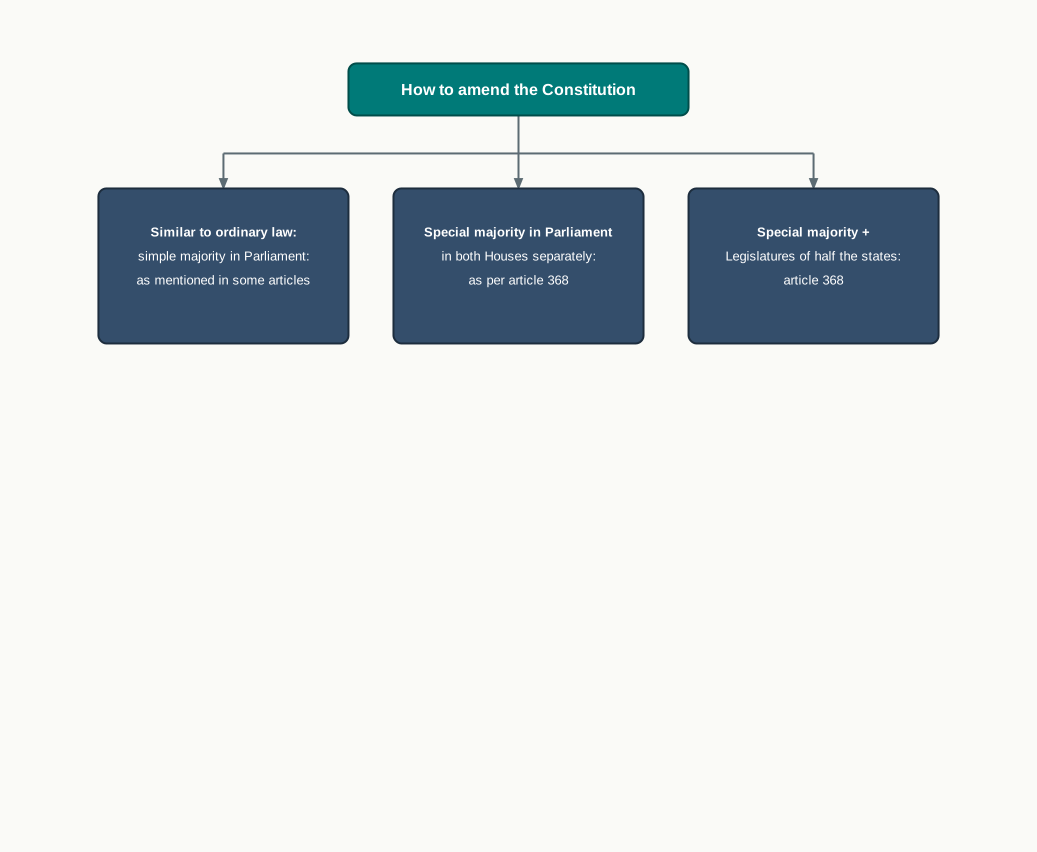
Fig. 9.2 – The three methods of amending the Constitution.
Notice what the chart is really saying. It is not that the Constitution is flexible or that it is rigid. It is that the same Constitution is flexible in some parts and rigid in others, and the difficulty of changing a provision rises with how much that provision carries.
It is also fair to ask, as a student in the class did, whether this is a matter of law at all — whether it is not the politics of a period that makes a constitution rigid or flexible in practice. Keep the question. By the end of this chapter you will have evidence on both sides of it.
The Flexible Parts
There are many articles in the Constitution which say that they can be amended by a simple law of the Parliament. No special procedure for amendment is required in such cases, and there is no difference at all between an amendment and an ordinary law. These parts of the Constitution are very flexible.
Read the text of the two articles below carefully. In both of them the wording ‘by law’ is the signal. It indicates that these articles can be modified by Parliament without recourse to the procedure laid down in Article 368.
Two short phrases, and a very large consequence. The Union of India can admit a new State, or increase the area of an existing one, through the same kind of law that Parliament passes on any ordinary working day. Many other articles of the Constitution can be modified by Parliament in this simple manner.
There is a limit to what these two extracts can show you. They are examples, not a list — the chapter never tells us how many articles fall in this flexible group, or which ones. And the extracts are themselves trimmed: the dots mark words that have been left out. A student who wants the full scope of the simple-majority route has to go to the Constitution itself, not to these two lines.
The Two Methods Under Article 368
For amending the remaining parts of the Constitution, provision has been made in Article 368. Within this one article there are two methods of amending, and they apply to two different sets of articles.
One method is that the amendment can be made by a special majority of the two houses of the Parliament. The other method is more difficult: it requires a special majority of the Parliament and the consent of half of the State legislatures.
Around these two methods, notice everything the Constitution does not require.
- All amendments to the Constitution are initiated only in the Parliament. Besides the special majority in Parliament, no outside agency — such as a constitution commission or a separate body — is required for amending the Constitution.
- After passage in the Parliament, and in some cases in the State legislatures, no referendum is required for ratification of the amendment. A referendum is a direct vote by the people on a single question. Ratification is the formal approval that makes a decision binding. Neither is asked of the Indian voter.
- An amendment bill, like all other bills, goes to the President for assent. But in this case the President has no powers to send it back for reconsideration.
These details show how rigid and complicated the amending process could have been. Our Constitution avoids these complications, and that makes the amendment procedure relatively simple.
But more importantly, this process underlines a principle. Only the elected representatives of the people are empowered to consider and take final decisions on the question of amendments. Thus the sovereignty of elected representatives — parliamentary sovereignty — is the basis of the amendment procedure.
You may already be objecting. If the States matter so much to a federal polity, why can a State not propose an amendment at all? Is this not one more example of favouring the centre against the States? Hold on to that objection. Section 9.3.2 gives an answer, and it is only a partial one.
Fig. 9.3 sets out the whole path an amendment bill has to travel — including the places where it can fail.
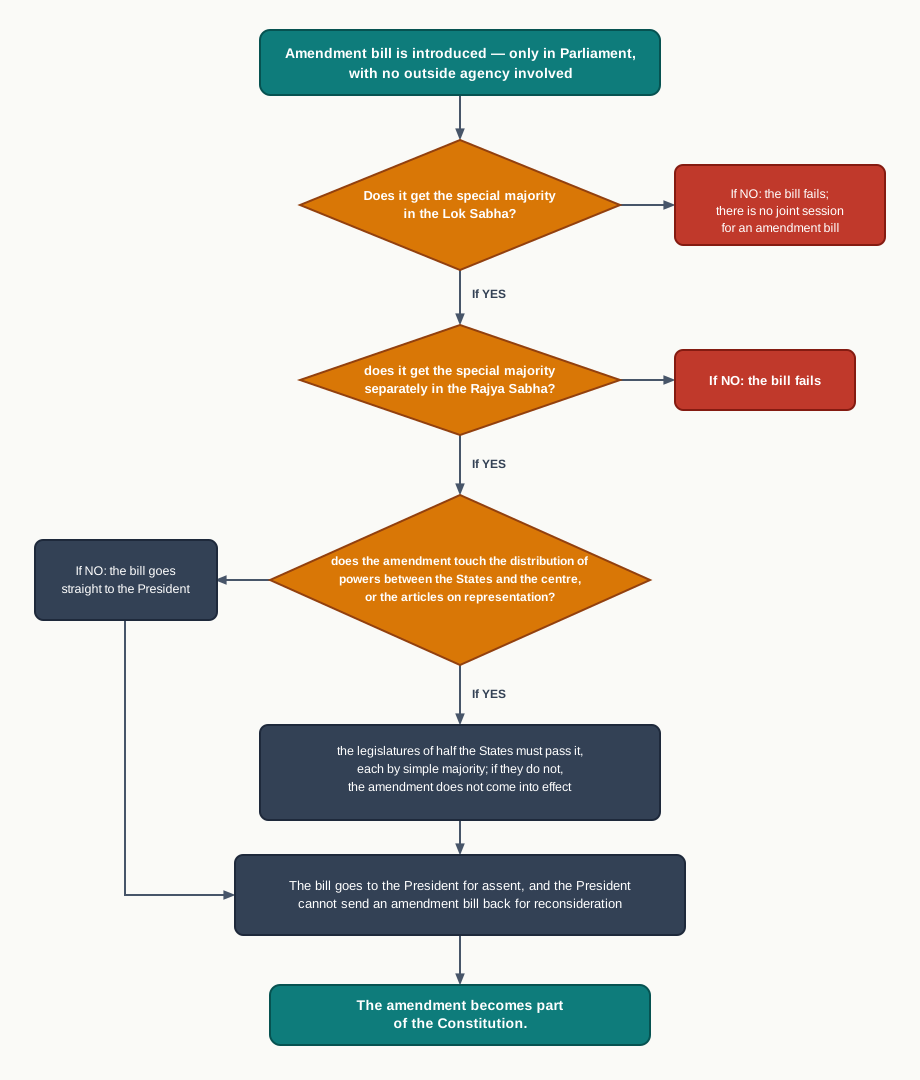
Fig. 9.3 – The path of an amendment bill.
9.3.1 Special Majority
In the chapters on Election, Executive and Judiciary, we have already come across provisions that require a ‘special majority’. Let us repeat what it means, because the whole amendment procedure rests on it.
Ordinarily, all business of the legislature requires that a motion, a resolution or a bill should get the support of a simple majority of the members voting at that time. Suppose that at the time of voting on a bill, 247 members were present in the house and all of them participated in the voting on the bill. Then the bill would be passed if at least 124 members voted in favour of it, since
\[\frac{247}{2} = 123.5\]
and more than half of 247 means at least 124 votes. Notice that this threshold depends entirely on how many members happened to turn up and vote that day.
Not so in the case of an amendment bill. Amendment to the Constitution requires two different kinds of special majorities at the same time.
- In the first place, those voting in favour of the amendment bill should constitute at least half of the total strength of that House — that is, of every seat in the House, whether the member came to vote or not.
- Secondly, the supporters of the amendment bill must also constitute two-thirds of those who actually take part in the voting.
Both Houses of the Parliament must pass the amendment bill separately in this same manner. There is no provision for a joint session. For every amendment bill, this special majority is required.
Working It Out In The Lok Sabha
Can you see the significance of this requirement? In the Lok Sabha there are 545 members. Half of the total strength is
\[\frac{545}{2} = 272.5\]
so any amendment must be supported by a minimum of 273 members. That figure does not move with attendance. Even if only 300 members are present at the time of voting, the amendment bill must still get the support of 273 out of them.
Now do the arithmetic yourself. Imagine that 400 members of the Lok Sabha have voted on an amendment bill. Apply both tests — two-thirds of those actually voting, and at least half of the total strength of 545 — and see which of the two demands the larger number. The larger of the two is the one the bill must reach. How many members should support the bill to get the bill passed?
How Other Constitutions Do It
Two principles dominate the various procedures of amending the constitutions in most modern constitutions.
One is the principle of special majority. The constitutions of U.S., South Africa, Russia and others have employed this principle. In the case of the constitution of US it is a two-thirds majority, while in South Africa and Russia a three-fourths majority is required for some amendments.
The other principle, popular among many modern constitutions, is that of people’s participation in the process of amending the constitution. In Switzerland, a federal country in central Europe, people can even initiate an amendment themselves. Other examples of countries where people initiate or approve amendments to the constitution are Russia and Italy, among others.
India has taken the first principle and not the second. That is a choice, and like every choice in this book it carries a cost as well as a reason.
The Politics Behind The Arithmetic
At this point it is fair to feel fed up with special majorities, and to ask whether this is politics or mathematics. It is politics. The arithmetic only makes the politics visible.
Unless there is sufficient consensus over the proposed amendment, it cannot be passed. If the party in power enjoys a very thin majority, it can still pass legislation of its choice, and can get the budget approved, even if the opposition does not agree. But it would need to take at least some opposition parties into confidence if it wanted to amend the Constitution.
So the basic principle behind the amending procedure is that it should be based on broad support among the political parties and parliamentarians. Dr Ambedkar put the point to the Constituent Assembly in November 1949, in the closing days of the drafting; Fig. 9.4 shows him at that work.

Fig. 9.4 – Dr B. R. Ambedkar at work on the draft Constitution.
Note what Ambedkar is doing here. He is talking not only of a parliamentary majority. He refers to the sharing of the views by the general public. Behind the majority in the House, he is saying, stands the principle of public opinion, and it is public opinion that governs decision-making in the end. A group that cannot persuade two-thirds of the elected House has probably not persuaded the country either.
That is the argument. Now its limit. Ambedkar is speaking in the Constituent Assembly, defending a draft he had himself piloted; he is making the strongest case for the procedure, not weighing it. The extract cannot tell us whether a two-thirds majority in Parliament really does track public opinion — whether, for instance, a House elected years earlier still reflects what people think today. It records what one of the makers expected the arithmetic to achieve. Whether it achieved it is a question for the rest of this chapter.
9.3.2 Ratification By States
For some articles of the Constitution, special majority is not sufficient.
When an amendment aims to modify an article related to the distribution of powers between the States and the central government, or articles related to representation, it is necessary that the States must be consulted and that they give their consent. We have studied the federal nature of the Constitution. Federalism means that the powers of the States must not be at the mercy of the central government.
The Constitution has ensured this by providing that the legislatures of half the States have to pass the amendment bill before the amendment comes into effect. We can say that for some parts of the Constitution, a greater or wider consensus in the polity is expected. This provision also respects the States and gives them participation in the process of amendment.
The Softening Of The Rule
At the same time, care is taken to keep this procedure somewhat flexible even in its more rigid format. The consent of only half the States is required, not of all of them. And within each State legislature, a simple majority is sufficient — no special majority is demanded there. Thus the amendment process is not impracticable even after taking this more stringent condition into consideration.
Two things follow, and they pull against each other. The States are given a real say, which is what federalism demands. But the say is a limited one: they cannot start an amendment, and half of them agreeing is enough to bind all the rest.
We may summarise that the Constitution of India can be amended through large-scale consensus and limited participation of the States. The founding fathers took care that the Constitution would not be open to easy tampering. And yet future generations were given the right to amend and modify it according to the needs and requirements of the time.
Check Your Progress
Now put the whole of section 9.3 to work. For each subject listed below, decide which route an amendment would have to take: special majority in Parliament alone, or special majority together with ratification by the States. In each case, ask yourself the one question that decides it — would this change touch the powers of the States or the question of representation? Copy the chart into your notebook, with a column for ‘Special majority’ and a column for ‘Ratification by States’, and place a tick mark wherever applicable.
9.4 Why Have There Been So Many Amendments?
On 26 January 2024, the Constitution of India completed 74 years of its existence. In these years, it has been amended 106 times.
Set that against what you have just learnt. Every one of those 106 changes had to clear a special majority in both Houses separately, and some of them had to clear half the State legislatures as well. Given the relatively difficult method of amending the Constitution, the number of amendments appears quite high. So let us try to find out how it is that so many amendments took place, and what it means.
The obvious suspicion is that something must be wrong — either with our society, which keeps changing its mind, or with the Constitution, which perhaps was not written well enough to last. Hold that suspicion up to the evidence, and watch it come apart.
Reading The Two Graphs
The chapter gives us the brief history of the amendments in two graphs. The same information is presented in two different ways, and each way tells a different story.
The first graph depicts the number of constitution amendments made every ten years. Each bar indicates the number of amendments in that period.
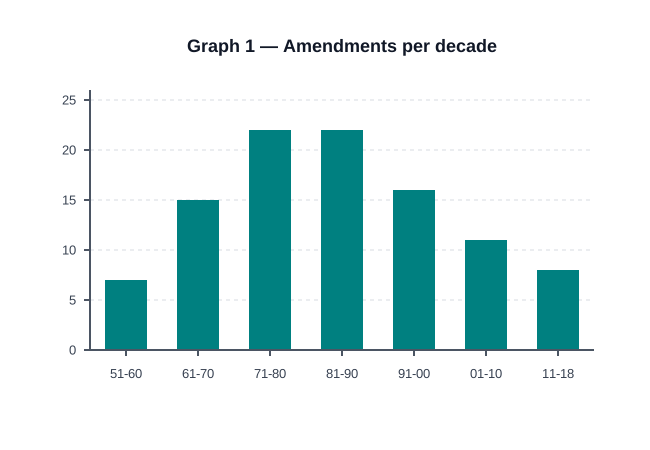
Fig. 9.5 – Amendments per decade.
The second graph depicts the time taken for every ten amendments. Here each bar depicts the years taken for ten amendments — so a short bar means ten changes came very fast, and a tall bar means the Constitution stood untouched for long stretches.
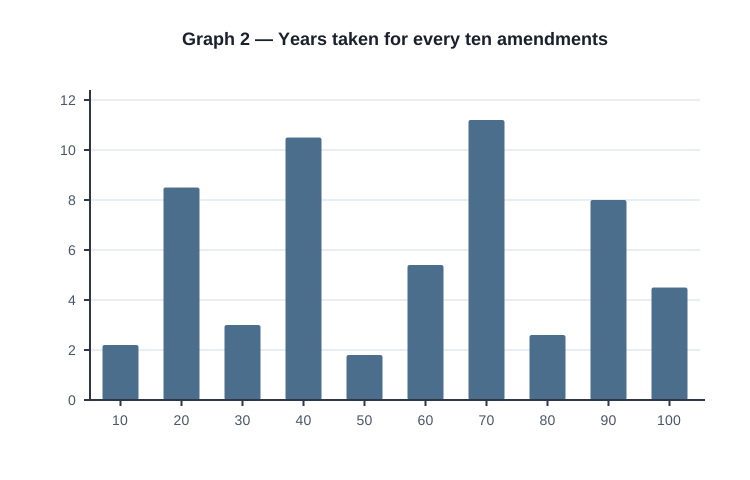
Fig. 9.6 – Years taken for every ten amendments.
From the first graph you will notice that the two decades from 1970 to 1990 saw a large number of amendments. That much is the familiar story: a period of intense constitutional conflict.
The second graph tells one more story. Ten amendments took place in a short span of three years between 1974 and 1976. And again, in just three years, from 2001 to 2003, ten amendments took place.
Two Bursts, Two Very Different Politics
In the political history of our country, these two periods are remarkably different, and that is exactly why the comparison is useful.
The first was a period of Congress domination. The Congress party had a vast majority in Parliament — it had 352 seats in the Lok Sabha — and a majority in most State Assemblies. If amendments came fast because one party could do as it liked, this is what you would expect to see.
The period between 2001 and 2003 was the opposite. It was marked by coalition politics. A coalition government is one formed by several parties together, because no single party has a majority of its own; every decision has to be negotiated. It was also a period when different parties were in power in different States. The bitter rivalry between the BJP and its opponents is another feature of this period.
And yet this period saw as many as ten amendments in just three years. So the incidence of amendments is not dependent merely on the nature of the majority of the ruling party alone. A dominant single party amends the Constitution; a quarrelling coalition amends it just as fast. Whatever is driving the number, it is not simply the strength of the government.
What The Graphs Cannot Tell You
There is always a criticism about the number of amendments. It is said that there have been far too many amendments to the Constitution of India. On the face of it, the fact that 106 amendments took place in 74 years does seem to be somewhat odd.
But the two graphs suggest that amendments are not only due to political considerations. Barring the first decade after the commencement of the Constitution, every decade has witnessed a steady stream of amendments. This means that irrespective of the nature of politics and the party in power, amendments were required to be made from time to time.
Was this because of the inadequacies of the original Constitution? Is the Constitution too flexible?
Before you answer, notice the limit of this evidence. A bar chart counts amendments; it cannot weigh them. On these graphs, an amendment that raised the retirement age of a judge by two years is exactly the same size as an amendment that rewrote 53 articles. A number tells you how often the document was touched. It cannot tell you what was done to it. To answer the question, we have to stop counting the amendments and start reading them.
9.4.1 Contents Of Amendments Made So Far
The amendments made so far may be classified in three groups. The first group is the one that dissolves the criticism almost entirely.
The First Group: Technical Amendments
In the first group there are amendments which are of a technical or administrative nature. They were only clarifications, explanations, and minor modifications of the original provisions. They are amendments in the legal sense, but in matter of fact they made no substantial difference to the provisions.
This is true of the amendment that increased the age of retirement of High Court judges from 60 to 62 years — the 15th amendment. Similarly, the salaries of judges of the High Courts and the Supreme Court were increased by an amendment, the 54th.
We may also take the example of the provision regarding reserved seats in the legislatures for scheduled castes and scheduled tribes. The original provision said that these reservations were for a period of ten years. However, in order to ensure fair representation of these sections, it was necessary to extend this period by ten years. Thus, after every ten years an amendment is made to extend the period by another ten years. This has led to six amendments so far.
Look closely at what that means for our count. Six of the 106 amendments made no difference whatever to the original provision — each simply renewed it. In this sense, they are only technical amendments. Yet in Graph 1 they stand as six bars’ worth of constitutional change.
Do you remember the discussion in chapter four about the role of the President? In the original Constitution, it was assumed that in our parliamentary government the President would normally abide by the advice of the Council of Ministers — the Prime Minister and the other ministers who actually run the government. This was only reiterated by a later amendment, when Article 74 (1) was amended to clarify that the advice of the Council of Ministers will be binding on the President: the President shall act in accordance with the advice of the Council of Ministers. In reality, this amendment did not make any difference, because that is exactly what had been happening all through. The amendment was only by way of explanation.
9.4.1.1 Differing Interpretations
A number of amendments are a product of different interpretations of the Constitution given by the judiciary and the government of the day. When these clashed, the Parliament had to insert an amendment underlining one particular interpretation as the authentic one.
You may reasonably be confused here. If there is a written constitution, where is the scope for different interpretations at all? Do people simply read into the Constitution what they want to be there?
The answer is that a constitution is written in general words, and general words have to be applied to particular cases that the writers never saw. It is part of democratic politics that various institutions would interpret the Constitution — and particularly the scope of their own powers — in a different manner. Many times the Parliament did not agree with the judicial interpretation, and therefore sought to amend the Constitution to overcome the ruling of the judiciary. In the period between 1970 and 1975 this situation arose frequently.
In the chapter on the Judiciary you have already studied the issues of difference between the Judiciary and the Parliament. There were three of them: the relationship between fundamental rights and directive principles; the scope of the right to private property; and the scope of Parliament’s power to amend the Constitution. In the period 1970-1975, the Parliament repeatedly made amendments to overcome the adverse interpretations by the judiciary.
It may be kept in mind that during this period (1970-75) many political events were unfolding, and thus this history of our constitutional development can be fully understood only in the context of the politics of that period. You will know more about these issues in the next year, when you study the political history of independent India.
9.4.1.2 Amendments Through Political Consensus
Thirdly, there is another large group of amendments that have been made as a result of the consensus among the political parties. We may say that this consensus made it necessary that some changes had to be made, in order to reflect the prevailing political philosophy and aspirations of the society.
In fact, many of the amendments of the post-1984 period are instances of this trend. Remember the puzzle above — that even when there were coalition governments, this period saw so many amendments? Here is the answer. Many of these amendments were based on an evolving consensus on certain issues. Starting with the anti-defection amendment, the 52nd, this period saw a series of amendments in spite of the political turbulence. Defection is the act of an elected member abandoning the party on whose ticket he or she was elected.
Apart from the anti-defection amendments, the 52nd and the 91st, these amendments include the 61st amendment, which brought down the minimum age for voting from 21 to 18 years, and the 73rd and the 74th amendments, and others. In this same period there were some amendments clarifying and expanding the scope of reservations in jobs and admissions. After 1992-93 an overall consensus emerged in the country about these measures, and therefore amendments regarding these measures were passed without much difficulty — the 77th, 81st, and 82nd amendments.
So politicians do agree on some matters. It is worth holding this group and the previous one side by side. In the first, institutions fought over the meaning of what was written. In this one, parties that fight over everything else found enough common ground to change the Constitution together. Both are democratic politics.
9.4.1.3 Controversial Amendments
Our discussion so far should not create an impression that there has never been any controversy over amending the Constitution.
In fact, amendments during the period 1970 to 1980 generated a lot of legal and political controversy. The parties that were in opposition during the period 1971-1976 saw many of these amendments as attempts by the ruling party to subvert the Constitution. In particular, the 38th, 39th and 42nd amendments have been the most controversial amendments so far. These three amendments were made in the background of the internal emergency declared in the country from June 1975, and they sought to make basic changes in many crucial parts of the Constitution.
The 42nd amendment, which you met on the opening page of this chapter, was particularly seen as a wide-ranging amendment affecting large parts of the Constitution. Consider what a single amendment act did.
- It was an attempt to override the ruling of the Supreme Court given in the Kesavananda case — a ruling we take up in section 9.5.
- The duration of the Lok Sabha was extended from five to six years, so that the House sat a year longer before facing the voters.
- Fundamental Duties, which you have read about in the chapter on Rights, were included in the Constitution by this amendment act.
- It put restrictions on the review powers of the Judiciary — that is, on the courts’ power to examine whether a law or an act of government is constitutional.
- It made changes to the Preamble, to the seventh schedule of the Constitution, and to 53 articles.
It was said at that time that this amendment was practically a rewriting of many parts of the original Constitution. Many MPs belonging to the opposition parties were in jail when this amendment was passed in Parliament.
In this backdrop, elections were held in 1977 and the ruling party, the Congress, was defeated. The new government thought it necessary to reconsider these controversial amendments. Through the 43rd and 44th amendments, it cancelled most of the changes that were effected by the 38th, 39th and the 42nd amendments. The constitutional balance was restored by these amendments.
Read that last sentence carefully, because it is doing something remarkable. The instrument used to undo the damage was the same instrument that had done it. Amendments were reversed by amendments — through the same procedure, the same special majority, the same Parliament. Whatever else this episode proves, it does not prove that the amending power is by nature dangerous.
So it looks, in the end, as though this whole business of constitutions and amendments is linked to politics rather than to law. That is one conclusion a reader might draw from this section, and it is half right. Amendments are political; the reasons for them come out of the politics of their period. But notice that the politics had to travel through legal channels to get anywhere — and that when politics tried to overrun those channels, it was politics itself, at the 1977 election, that pulled it back.
Activity
9.5 Basic Structure And Evolution Of The Constitution
One thing has had a long lasting effect on the evolution of the Indian Constitution: the theory of the basic structure of the Constitution. It holds that certain features are so essential to the Constitution that Parliament may not destroy them, even by a validly passed amendment.
You already know that the Judiciary advanced this theory in the famous case of Kesavananda Bharati. The Supreme Court gave the Kesavananda ruling in 1973 — at the height of the very conflict between Parliament and the courts that you read about in section 9.4.
What The Ruling Did
The ruling has contributed to the evolution of the Constitution in three ways, and it is worth separating them, because they pull in different directions.
- It has set specific limits to Parliament’s power to amend the Constitution. It says that no amendment can violate the basic structure of the Constitution.
- It allows Parliament to amend any and all parts of the Constitution — within this limitation.
- It places the Judiciary as the final authority in deciding whether an amendment violates the basic structure, and in deciding what constitutes the basic structure.
Read the first two together and you will see that the Court did not simply take power away from Parliament. It confirmed a very wide amending power and drew one line around it. The third point is the one that unsettles people: the Court kept for itself the power to say where that line runs.
A Theory That Is Not In The Constitution
In the past four decades, this decision has governed all interpretations of the Constitution, and all institutions in the country have accepted the theory of basic structure.
Now notice something strange about it. The theory of basic structure is itself an example of a living constitution. There is no mention of this theory anywhere in the Constitution. It has emerged from judicial interpretation. Thus the Judiciary, through its interpretation, has practically amended the Constitution without a formal amendment.
So it is the judiciary that has the final word — and a student is right to ask whether this is judicial activism, the courts taking an active hand in shaping the law rather than merely applying it. It is a fair question, and the chapter does not close it. What can be said is that the other institutions did not merely submit to the doctrine. Over time, they accepted it.
All living documents evolve in this manner — through debates, arguments, competition and practical politics. Since 1973 the Court has, in many cases, elaborated upon this theory of basic structure and given instances of what constitutes the basic structure of the Constitution of India.
In a sense, the basic structure doctrine has further consolidated the balance between rigidity and flexibility that section 9.3 described. By saying that certain parts cannot be amended, it has underlined the rigid nature of the Constitution. By allowing amendments to all the others, it has underlined the flexible nature of the amending process.
When The Constitution Was Put Up For Review
How much does the doctrine really weigh in our constitutional practice? One episode, at the end of the nineties, gives us a measure of it.
The point of that episode is not the controversy. It is the boundary. A body set up to look at the whole Constitution, appointed by the government of the day, did not propose to cross a line that no Constitution, no statute and no amendment had ever written down.
Other Ways The Courts Have Changed The Constitution
The basic structure doctrine is the largest example, but not the only one. There are many other instances of how judicial interpretation changed our understanding of the Constitution.
In many decisions, the Supreme Court had held that reservations in jobs and educational institutions cannot exceed fifty per cent of the total seats. This has now become an accepted principle.
Similarly, in the case involving reservations for other backward classes, the Supreme Court introduced the idea of the creamy layer — a category within those classes whose members, the Court ruled, were not entitled to benefits under reservations.
In the same manner, the Judiciary has contributed to an informal amendment of the Constitution by interpreting various provisions concerning the right to education, the right to life and liberty, and the right to form and manage minority educational institutions. These are instances of how rulings by the Court contribute to the evolution of the Constitution.
It is easy to feel that something has gone wrong here. First we are told that an amendment requires consensus among elected representatives. Now we find that judges, whom nobody elected, can change the whole meaning of the Constitution. Both statements are true, and the tension between them is not a mistake in the design. It is the design. Section 9.6 is about how that tension has actually been handled.
Check Your Progress
State whether the following statements are correct or not, and in each case give the reason for your answer.
9.6 Constitution As A Living Document
We have described our Constitution as a living document. It is time to say exactly what that means, because the phrase is easy to repeat and easy to misunderstand.
Almost like a living being, this document keeps responding to the situations and circumstances arising from time to time. Like a living being, the Constitution responds to experience. It is not that the words on the page change by themselves. It is that they are put to work in new conditions, by people who must decide what they require in a situation their authors never imagined.
In fact that is the answer to the riddle we began with — the riddle of durability. Even after so many changes in society, the Constitution continues to work effectively, and it does so because of this ability to be dynamic, to be open to interpretations, and to respond to the changing situation.
Why This Is A Democratic Quality
This is a hallmark of a democratic constitution, and not merely a convenient one. In a democracy, practices and ideas keep evolving over time, and the society keeps experimenting according to them. A document that could not absorb any of that would soon be at war with the people it governs.
A constitution which protects democracy, and yet allows for the evolution of new practices, becomes not only durable but also an object of respect from the citizens. Durability alone is nothing to boast of; a document can survive by being ignored. The important point is a harder one: has the Constitution been able to protect itself and to protect democracy?
The Question That Kept Coming Back
In the past six decades some very critical situations arose in the politics and constitutional development of the country. We have already made brief reference to some of them in this chapter.
In terms of constitutional-legal issues, the most serious question that came up again and again from 1950 was about the supremacy of the Parliament. The argument for it is strong. In a parliamentary democracy, the Parliament represents the people, and therefore it is expected to have an upper hand over both the Executive and the Judiciary.
At the same time, there is the text of the Constitution, and that text has given powers to the other organs of the government. Therefore the supremacy of the Parliament has to operate within this framework.
Behind this lies a claim about democracy itself. Democracy is not only about votes and people’s representation. It is also about the principle of the rule of law — the principle that everyone, including the government, is bound by law, and that power is used through settled procedures rather than at will. Democracy is also about developing institutions and working through these institutions. All the political institutions must be responsible to the people, and must maintain a balance with each other.
Is this, then, a see-saw between Parliament and the courts, or a game of tug of war? Neither image quite works. In a tug of war one side wins by pulling the other over. What the rest of this section describes is something harder: two institutions, each convinced it was right, being forced to find a settlement that both could live with.
9.6.1 Contribution Of The Judiciary
During the controversy between the Judiciary and the Parliament, each side had a serious argument, and it is worth stating both at full strength before judging either.
The Parliament thought that it had the power and the responsibility to make laws — and amendments — for furthering the interests of the poor, the backward and the needy. It had been elected to do exactly that.
The Judiciary insisted that all this has to take place within the framework provided by the Constitution, and that pro-people measures should not bypass legal procedures. Its reason is one every student of politics should hold on to: once you bypass laws, even with good intentions, that can give an excuse to the power holders to use their power arbitrarily. And democracy is as much about checks on the arbitrary use of power as it is about the well-being of the people.
The Letter And The Spirit
The success of the working of the Indian Constitution lies in resolving these tensions. The Judiciary, in its famous Kesavananda ruling, found a way out of the existing complications by turning to the spirit of the Constitution rather than its letter.
The problem is obvious the moment you state it. If you read the Constitution, you will not find any mention of the ‘basic structure’ of the Constitution. Nowhere does the Constitution say that such and such are part of the basic structure. In this sense, the ‘basic structure’ theory is the invention of the Judiciary. How did it invent such a non-existent thing? And how is it that all the other institutions have accepted this during the past four decades?
Therein lies the distinction between the letter and the spirit. The Court came to the conclusion that in reading a text or a document, we must respect the intent behind that document. A mere text of the law is less important than the social circumstances and the aspirations that have produced that law or document. The Court was looking at the basic structure as something without which the Constitution cannot be imagined at all. This is an instance of trying to balance the letter and the spirit of the Constitution.
Think about what that means concretely. If there were no rights and no elections, the Constitution would not make much sense. And if there were no well-being, then elections and rights would not make much sense either. That is the kind of reasoning the word ‘spirit’ is pointing at — the things without which the document would be a shell.
9.6.2 Maturity Of The Political Leadership
Our discussion of the role of the Judiciary brings out one more fact, and it is easy to miss, because nothing dramatic happened.
In the background of the fierce controversy that raged between 1967 and 1973, the Parliament and the Executive also realised that a balanced and long term view was necessary. That realisation did not come at once. It came only after the argument had been fought to its end.
What deserves attention here is not that the Court won. It is that the losing side stopped fighting and accepted the outcome, and went on governing within it. Constitutions survive on exactly this kind of restraint, and it is worth remembering that restraint is a choice, made by people, and that it can also not be made.
The Vision Behind The Document
When the Constitution was made, the leaders and the people of our country shared a common vision of India. In Nehru’s famous speech at the time of independence, this vision was described as a tryst with destiny. In the Constituent Assembly also, all the leaders mentioned this vision: dignity and freedom of the individual, social and economic equality, well-being of all people, and unity based on national integrity.
That does not mean the Assembly was of one mind. Even within the Constituent Assembly, there were some members who felt that this Constitution was not suited to the Indian situation.
This is a prediction, and it was made a week before the Constitution was adopted. Sahu is saying two things: that the ideals of the draft are foreign to the fundamental spirit of India, and that a document so framed will break down soon in practice. The second claim is the one history has tested. Nearly seventy years later, the same Constitution is still in operation.
But be careful about what the extract can and cannot tell us. It records that a member of the Assembly dissented, and it records his reasons in his own words — no more. It cannot tell us how many members shared his view, or which parts of the draft he had in mind, or what he would have put in its place. And that the Constitution did not break down does not by itself answer his first charge, about ideals and the spirit of India. That is a question about values, and no length of survival settles it.
This vision has not disappeared. People and leaders alike hold to the vision and hope to realise it. Therefore the Constitution, based on this vision, has remained an object of respect and authority even after half a century. The basic values governing our public imagination remain intact.
That is the case for the maturity of our political leadership. It should not be turned into flattery. There are many instances of political immaturity as well, and a serious student is entitled to list them and to weigh them against the record above. The chapter’s claim is narrower than it first sounds: on this question — the limits of the amending power — the leadership eventually accepted a settlement it had resisted.
9.6.3 Conclusion
There can still be debates about what constitutes the basic structure. There is nothing wrong in such debates.
We must remember that politics in a democracy is necessarily full of debates and differences. That is a sign of diversity, liveliness and openness. Democracy welcomes debates.
At the same time, our political parties and leadership have shown maturity in setting limits to these debates — because politics is also about compromises and give-and-take. Extreme positions may be theoretically very correct and ideologically very attractive, but politics demands that everyone is prepared to moderate their extreme views and sharp positions, and to reach a common minimum ground. Only then does democratic politics become possible. Politicians and the people of India have understood and practised these skills, and that has made the experience of working of the democratic Constitution quite successful.
Among the different organs of the government, there will always be competition over which one is more important than the others. They will also always fight over what constitutes the welfare of the people. Neither of those fights is going to end, and neither of them should.
But in the last instance, the final authority lies with the people. People, their freedoms and their well-being constitute the purpose of democracy — and also the outcome of democratic politics.
9.7 Summary
What This Chapter Established
- Nations often rewrite their constitutions. The Soviet Union had four in 74 years, and France has had a series of them, each arriving with a new republic. Constitutional change is closely linked to political developments.
- India is different. The Constitution adopted on 26 November 1949, and implemented from 26 January 1950, is still the framework within which our government operates more than 69 years later.
- No constitution can provide for all eventualities. Ours survives because it accepts the necessity of change, and because political practice and judicial rulings have interpreted it with flexibility. That is what makes it a living document rather than a closed rulebook.
- The makers struck a balance. They placed the Constitution above ordinary law, yet made it amendable — sacred document and working instrument at once.
- There are three routes of amendment: simple majority, as some articles themselves allow; special majority in both Houses separately, under Article 368; and special majority together with ratification by the legislatures of half the States.
- Special majority is a double test — at least half the total strength of the House, and two-thirds of those actually voting. It forces a government with a thin majority to take opposition parties into confidence.
- Amendments are initiated only in Parliament. No outside commission, no referendum, and no power in the President to return an amendment bill. Parliamentary sovereignty is the basis of the procedure.
- Where an amendment touches the powers of the States or the question of representation, half the State legislatures must pass it — a real but limited federal check.
- By 26 January 2024 the Constitution had been amended 106 times in 74 years. But amendments came under single-party dominance and under coalition governments alike. The number cannot be explained by the strength of the ruling party.
- Reading the amendments matters more than counting them. Many are technical (the 15th, the 54th, the repeated extensions of reserved seats). Some settled clashes of interpretation between Parliament and the judiciary. Many, after 1984, rested on consensus between parties.
- The most controversial were the 38th, 39th and 42nd, made during the internal emergency declared from June 1975. After the 1977 elections, the 43rd and 44th amendments cancelled most of their changes and restored the constitutional balance.
- The Kesavananda ruling of 1973 set limits to the amending power: Parliament may amend any part of the Constitution, but no amendment may violate its basic structure, and the Judiciary decides what that structure is.
- The basic structure doctrine appears nowhere in the text. It is itself an example of a living constitution, and of the Court reading the Constitution for its spirit and not only its letter.
- The Court repeated its stand in the Minerva Mills case in 1980, and the political leadership accepted the settlement. Even the commission appointed in 2000 to review the working of the Constitution did not cross the line the doctrine had drawn.
- Democracy is not only votes and representation. It is also the rule of law, working institutions and checks on the arbitrary use of power. In the last instance, the final authority lies with the people.
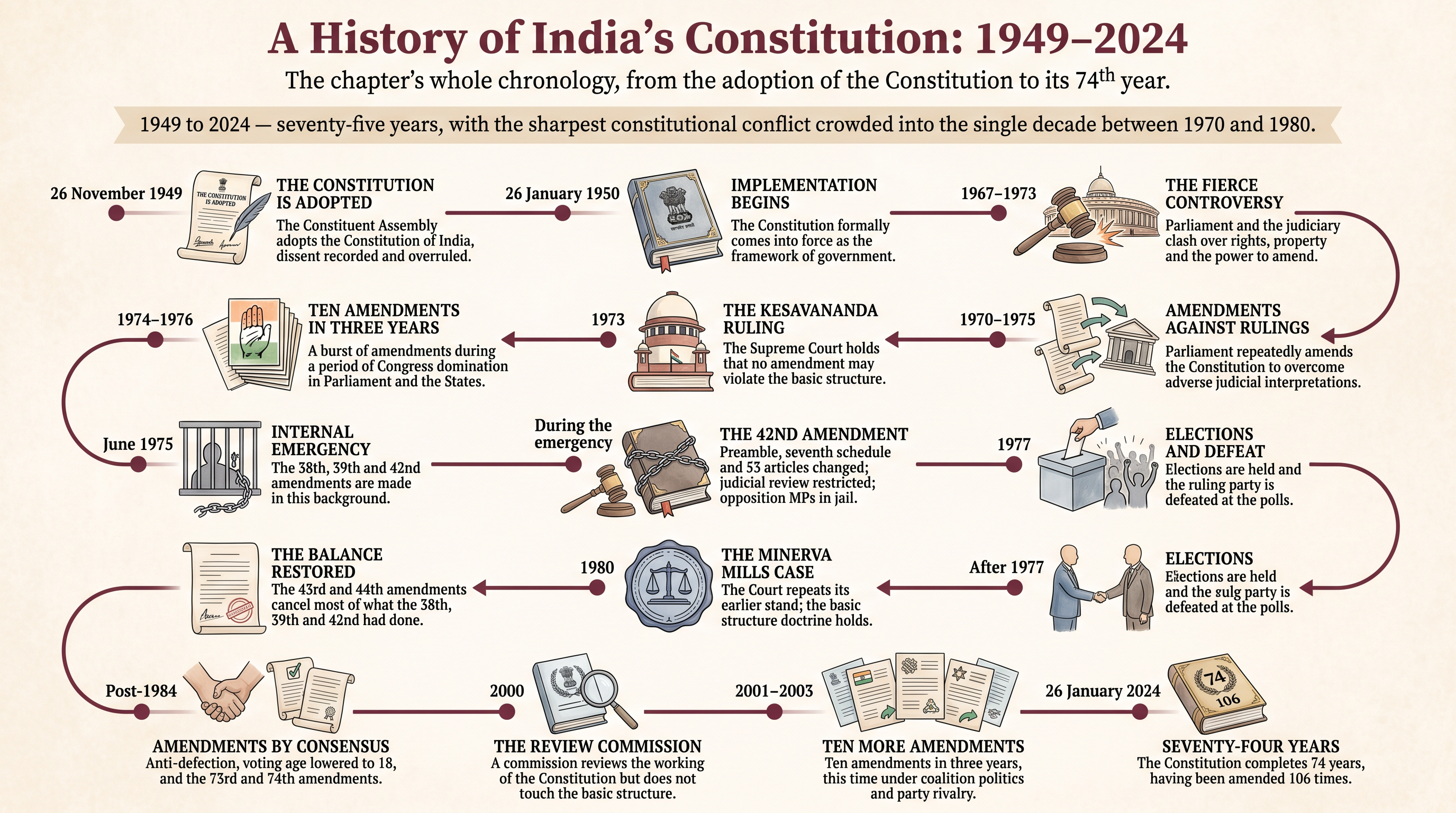
Fig. 9.7 – The Life Of The Constitution.
What Remains Contested
The chapter does not settle what the basic structure actually is, and the Supreme Court has never given a closed list of it. Every future dispute about an amendment will therefore begin with the same unanswered question.
Nor does it settle who should have the last word. Parliament is elected and the judges are not; but a majority cannot be the judge of the limits on its own power. This chapter shows how the tension was managed in one period. It does not show that it has been resolved.
And notice whose voices our evidence records. The extracts here come from the Constituent Assembly, and the graphs count amendments. Neither can tell us what the people in whose name all of it was done — the ordinary voter, the person detained in 1975, the citizen whose rights an amendment enlarged or narrowed — made of any of it.
9.8 NCERT Questions
Choose the correct statement from the following. A constitution needs to be amended from time to time because,
- Circumstances change and require suitable changes in the constitution.
- A document written at one point of time becomes outdated after some time.
- Every generation should have a constitution of its own liking.
- It must reflect the philosophy of the existing government.
Write True / False against the following statements.
- The President cannot send back an amendment bill for reconsideration of Parliament.
- Elected representatives alone have the power to amend the Constitution.
- The Judiciary cannot initiate the process of constitutional amendment but can effectively change the Constitution by interpreting it differently.
- Parliament can amend any section of the Constitution.
Which of the following are involved in the amendment of the Indian Constitution? In what way are they involved?
- Voters
- President of India
- State Legislatures
- Parliament
- Governors
- Judiciary
You have read in this chapter that the 42nd amendment was one of the most controversial amendments so far. Which of the following were the reasons for this controversy?
- It was made during national emergency, and the declaration of that emergency was itself controversial.
- It was made without the support of special majority.
- It was made without ratification by State legislatures.
- It contained provisions, which were controversial.
Which of the following is not a reasonable explanation of the conflict between the legislature and the judiciary over different amendments?
- Different interpretations of the Constitution are possible.
- In a democracy, debates and differences are natural.
- Constitution has given higher importance to certain rules and principles and also allowed for amendment by special majority.
- Legislature cannot be entrusted to protect the rights of the citizens.
- Judiciary can only decide the constitutionality of a particular law; cannot resolve political debates about its need.
Identify the correct statements about the theory of basic structure. Correct the incorrect statements.
- Constitution specifies the basic tenets.
- Legislature can amend all parts of the Constitution except the basic structure.
- Judiciary has defined which aspects of the Constitution can be termed as the basic structure and which cannot.
- This theory found its first expression in the Kesavananda Bharati case and has been discussed in subsequent judgments.
- This theory has increased the powers of the judiciary and has come to be accepted by different political parties and the government.
From the information that many amendments were made during 2000-2003, which of the following conclusions would you draw?
- Judiciary did not interfere in the amendments made during this period.
- One political party had a strong majority during this period.
- There was strong pressure from the public in favour of certain amendments.
- There were no real differences among the parties during this time.
- The amendments were of a non-controversial nature and parties had an agreement on the subject of amendments.
Explain the reason for requiring special majority for amending the Constitution.
Many amendments to the Constitution of India have been made due to different interpretations upheld by the Judiciary and Parliament. Explain with examples.
If amending power is with the elected representatives, judiciary should NOT have the power to decide the validity of amendments. Do you agree? Give your reasons in 100 words.
9.9 Check Your Concepts
The Indian Constitution is described as both ‘flexible’ and ‘rigid’. Explain what each word means, and use Source 9.2 and Source 9.3 to show which parts of the Constitution are flexible. What is it about a provision that decides how hard it should be to change?
Look again at Graph 1 (Fig. 9.5) and Graph 2 (Fig. 9.6). State one thing each graph shows clearly. Then state what neither graph can tell you about the changes made to the Constitution, and explain why that limit matters when someone says there have been ‘too many amendments’.
The 15th amendment, the 54th amendment, and the six amendments extending reserved seats for the scheduled castes and scheduled tribes are all called technical amendments. Explain why. What does this group of amendments suggest about the difference between counting amendments and reading them?
Read Source 9.4 again. What is Dr Ambedkar’s argument for the two-thirds majority, and what does he mean by referring to the general public? Now state one thing this extract cannot tell us about how the amendment procedure actually works.
Reconstruct, step by step, the sequence of events from the declaration of the internal emergency in June 1975 to the restoration of the constitutional balance. At which points in that sequence did politics do the work, and at which points did constitutional procedure do it?
In Source 9.5, Lakshminarayan Sahu made two distinct claims about the draft Constitution. Separate them. Which one has been tested by what has happened since 1950, and which one cannot be settled by the passage of time? Give reasons.
The commission appointed in 2000 to review the working of the Constitution was boycotted and surrounded by controversy, yet it did not suggest any measure that would endanger the basic structure. What does its conduct tell us about the standing of a doctrine that appears nowhere in the text of the Constitution?
‘The basic structure theory is the invention of the Judiciary.’ Set out the strongest case for this charge, and then the Court’s own answer to it, using the distinction between the letter and the spirit of a document. Do not settle the question; state clearly what the disagreement finally turns on.