Chapter 1: Structural Change
Begin with something as ordinary as the first cup of tea of the day. The leaves in it were almost certainly grown in Assam or the Nilgiris — on plantations that did not exist in India before the middle of the nineteenth century, and that were opened up by British planters who needed thousands of workers and brought them from provinces hundreds of kilometres away.
Now step outside. In hundreds of Indian towns, the same pattern repeats itself: a railway line and a station near the old market, a straight grid of wide roads with bungalows and a club on one side, and the crowded older settlement on the other. The railway line was not laid where villagers most needed it. It usually ran towards a port, because raw cotton, jute and tea had to reach the sea, and finished goods had to travel inland from it.
None of this was accidental. A cup of tea, a railway timetable and the layout of a town are the visible remains of an economic and political system that reorganised where Indians lived, what they produced, and what work they did. Sociologists call such deep, lasting rearrangements of society structural change.
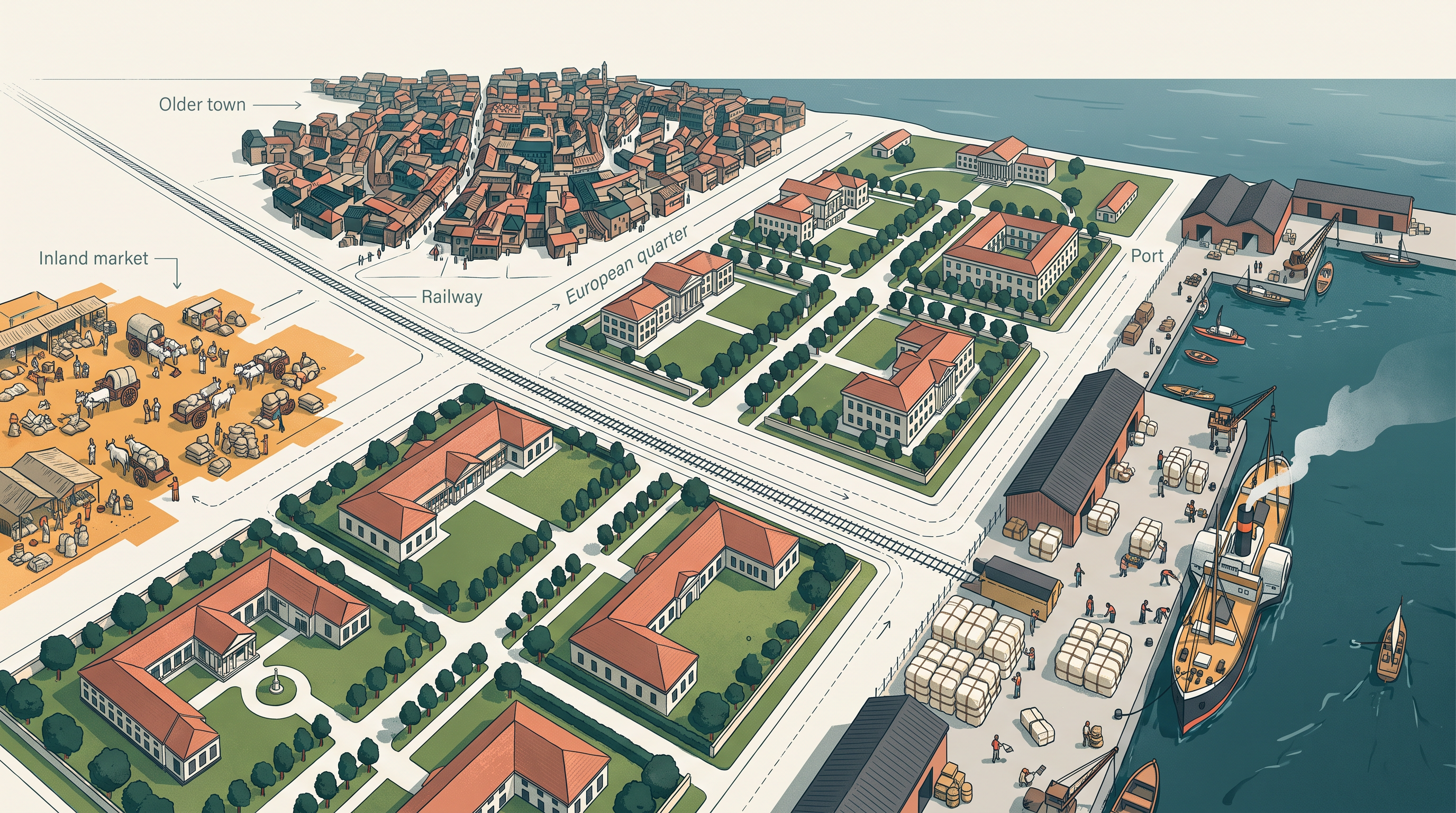
Fig. 1.1 – A colonial-era Indian port town.
This chapter will answer each of these questions.
1.1 Understanding Colonialism
Why the Colonial Past Still Matters
To understand where a society stands today, you usually need some grasp of where it has come from. This is as true of a person or a social group as it is of an entire country such as India.
India has a long and rich history, and its ancient and medieval past matters enormously. But for understanding modern India, one period is particularly significant: the colonial period. Many of the ideas and institutions we now think of as ordinary — a parliament, a police force, a school system, a census, a railway — reached India through colonial rule.
That, however, is only half the story. The other half is that this exposure to modern ideas was contradictory, or paradoxical. Indians in the colonial period read about western liberalism and freedom. Yet they lived under a western, colonial rule that denied Indians liberty and freedom.
Hold on to that contradiction, because it is not a small detail. It is the engine of much of what follows. The structural and cultural changes discussed in this chapter and the next were shaped by exactly this kind of paradox.
The Colonial Imprint on Everyday Life
Our social reform and nationalist movements, our laws, our political life and our Constitution, our industry and agriculture, our cities and our villages have all been shaped by this paradoxical experience with colonialism. It has had lasting implications for the particular kind of modernity India came to have.
Some of the evidence is very close at hand. We have a parliamentary and a legal system, a police and an educational system built very much on the British model. We drive on the left side of the road, as the British do. Roadside eateries and canteens offer ‘bread-omlette’ and ‘cutlets’. A very popular manufacturer of biscuits is actually named after Britain. Many school uniforms include neck-ties.
And notice the emotional register too: we often admire the west, and as often resent it. Admiration and resentment together — that mixture is itself a colonial inheritance. These are only some of the many and complex ways in which British colonialism lives on in contemporary India.
The Case of English
Take the English language as an example of how many-sided and paradoxical the colonial impact has been. The point is not merely that shop signboards sometimes carry wrong spellings, amusing though those are.
English is not only widely used in India; we now have an impressive body of literary writing by Indians in English. This knowledge of English has given Indians an edge in the global market, in a world where much of business, science and the internet runs in English.
But English continues to be a mark of privilege. Not knowing English is a disadvantage that tells in the job market, in interviews, in college classrooms. It quietly sorts people into those who are heard and those who are not.
At the same time, the very same language can work the other way. For those who were traditionally deprived of access to formal education, such as the Dalits, knowledge of English may open doors of opportunity that were formerly closed. Because English lies outside the older hierarchy of learning, it can be claimed by anyone who acquires it.
So English is a disadvantage and an opportunity, an instrument of exclusion and a means of escape from exclusion — often for different people at the same moment. That is what “paradoxical” means in practice.
From Impressions to Structure
So far we have been collecting impressions — a menu, a necktie, a signboard, a language. Impressions are a good starting point, but sociology cannot stop there. We now need to shift from this broad impressionistic view to a clearer understanding of colonialism as a structure and a system: a set of arrangements that shaped what people could own, produce, buy, sell and become.
Colonialism brought into being new political, economic and social structural changes. This chapter takes up only two of them — industrialisation and urbanisation. The focus is on the specific colonial context, though we shall also briefly touch on developments after Independence.
All these structural changes were accompanied by cultural changes, which the next chapter examines. Any strict separation of the two is difficult. As you will see, the structural changes are hard to discuss without some mention of the cultural changes as well: a new factory is also a new way of living, and a new city is also a new way of thinking.
What Colonialism Means
At one level, colonialism simply means the establishment of rule by one country over another. In the modern period, western colonialism has had the greatest impact of all.
India’s past has been marked by the entry of numerous groups of people at different times who established their rule over different parts of what constitutes modern India today. Conquest is not new. Yet sociologists insist that the impact of colonial rule is distinguishable from all other earlier rules, because the changes it brought in were far-reaching and deep.
Two Kinds of Empire
Why should one conquest differ so much from another? History is full of examples of the annexation of foreign territory and the domination of weaker peoples by stronger powers. Nevertheless, as Hamza Alavi and Teodor Shanin argued, there is a vital difference between the empire building of pre-capitalist times and that of capitalist times.
Apart from outright pillage, the pre-capitalist conquerors benefited from their domination by exacting a continuous flow of tribute. On the whole they did not interfere with the economic base. They simply took the tribute that was skimmed off the economic surplus that was produced traditionally in the subjugated areas. The village went on cultivating as it always had; the weaver went on weaving; only a share of what they produced was carried away.
In contrast, British colonialism, which was based on a capitalist system, directly interfered to ensure the greatest profit and benefit to British capitalism. Every policy was geared towards the strengthening and expansion of British capitalism. It did not merely take a share of the harvest; it reorganised the field, the crop and the cultivator.
How Colonial Policy Entered Everyday Life
Consider how far this interference went. British colonialism changed the very laws of the land. It changed not just land ownership laws but decided even what crops ought to be grown and what ought not to be. It meddled with the manufacturing sector. It altered the way production and distribution of goods took place.
It also entered the forests. Trees were cleared and tea plantations were started. Forest Acts were brought in that changed the lives of pastoralists, who were prevented from entering many forests that had earlier provided valuable forage for their cattle.
Read that last sentence slowly, because it captures the whole argument in miniature. A pastoral community had not been defeated in battle, and no one had confiscated its herds. A law had simply redefined a forest as government property with a commercial purpose. The herders’ livelihood collapsed anyway. That is what it means to say that colonialism worked as a structure.
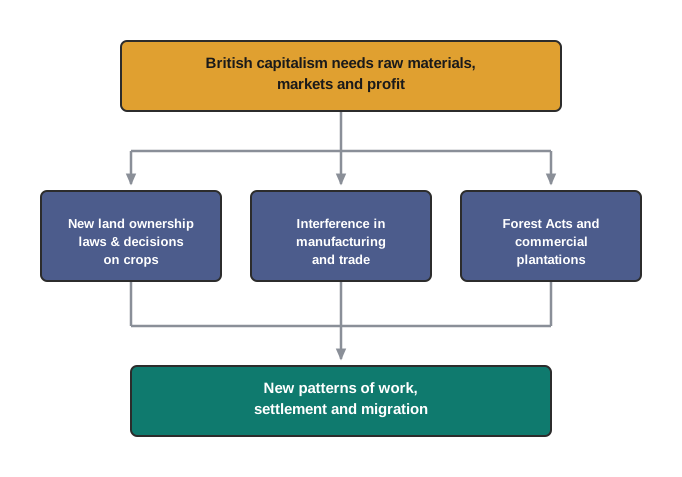
Fig. 1.2 – Colonialism as a structural change.
Colonialism and the Movement of People
Colonialism also led to considerable movement of people, both within India and far beyond it.
Within India, people from present-day Jharkhand moved to Assam to work on the tea plantations. A newly emerging middle class, particularly from the British Presidency regions of Bengal and Madras, moved as government employees, and professionals like doctors and lawyers moved to different parts of the country. New kinds of work created new kinds of migrants — some pushed by need, some pulled by opportunity.
Beyond India, the movement was harsher. People were carted in ships from India to work on other colonised lands in distant Asia, Africa and the Americas. Many died on their way. Most could never return. Today many of their descendants are known as people of Indian origin, and the fact that they are found in the Caribbean, in Fiji, in Mauritius and in East Africa is a direct map of where the plantations of one empire happened to be.
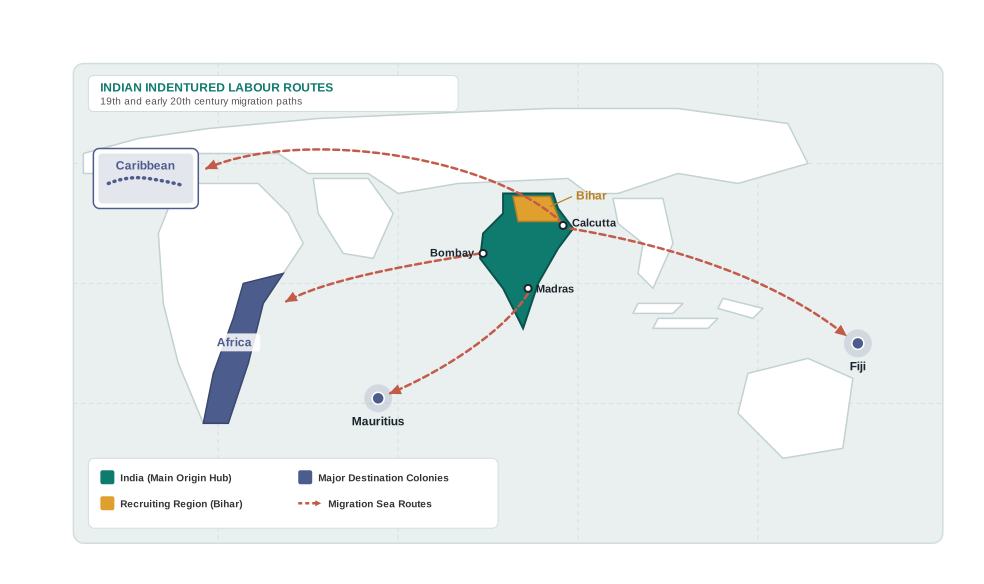
Fig. 1.3 – Indentured labour migration from Indian ports.
Deliberate and Unintended Changes
To facilitate the smooth functioning of its rule, colonialism introduced a wide array of changes in every sphere — legal, cultural, even architectural. It was a story apart in the very scale and intensity of the changes it brought about.
But not all of these changes were planned. Some were deliberate, while some took place in an unintended fashion. The clearest example is western education, which was introduced to create Indians who would help manage British colonialism. Instead, it contributed to the growth of a nationalist and anti-colonial consciousness. The clerks the empire trained read the political philosophy the empire had taught them, and asked why it did not apply to India.
This is a general lesson worth carrying beyond this chapter: large institutions regularly produce consequences their designers neither intended nor wanted.
Capitalism: The System Behind the Changes
The magnitude and depth of the structural changes that colonialism unleashed can be better grasped if we understand some basic features of capitalism.
Capitalism is an economic system in which the means of production — land, factories, machines, raw materials — are privately owned and organised to accumulate profits within a market system. (You have already studied the capitalist market in the first book, Indian Society.)
Capitalism in the west emerged out of a complex process: European exploration of the rest of the world, the plunder of wealth and resources, an unprecedented growth of science and technology, and the harnessing of that knowledge to industry and agriculture. It did not appear from nowhere; it was assembled out of conquest and invention together.
What marked capitalism from the very beginning was its dynamism — its potential to grow, expand, innovate, and use technology and labour in whatever way best assured the greatest profit. And what marked it too was its global nature. It could never be contained within one country, because its raw materials, its markets and its profits lay elsewhere.
Western colonialism was therefore inextricably connected to the growth of western capitalism. The two were not separate stories that happened to overlap. This had a lasting impact on the way capitalism itself developed in a colonised country like India — a point the next section pursues through industrialisation and urbanisation.
The Nation State and Nationalism
If capitalism became the dominant economic system of the modern world, the nation state became its dominant political form.
That we all live in nation states, and that we all have a nationality or a national citizenship, may appear entirely natural today. It was not always so. Before the First World War, passports were not widely used for international travel, and in most areas few people had one. Societies were not always organised along these lines.
A nation state is a particular type of state, characteristic of the modern world. A government has sovereign power — that is, supreme authority answerable to no higher power — within a defined territorial area, and the people are citizens of a single nation.
Nation states are closely associated with the rise of nationalism. The principle of nationalism assumes that any set of people have a right to be free and to exercise sovereign power. It is an important part of the rise of democratic ideas, which you will read more about in Chapter 3.
The Irony the Nationalists Seized
It must have struck you that the practice of colonialism and the principle of nationalism and democratic rights are contradictory. Colonial rule implied foreign rule, such as British rule over India. Nationalism implied that the people of India, or of any colonised society, have an equal right to be sovereign.
Indian nationalist leaders were quick to grasp this irony. They declared that freedom, or swaraj — self-rule — was their birthright, and they fought for both political and economic freedom. The word carried both meanings deliberately: a country could hardly be called free if its land, crops, forests and factories were still being organised for someone else’s profit.
The paradox we began with has thus come full circle. The colonial state taught liberty and withheld it. The demand for swaraj was, in a sense, the empire’s own lesson returned to it.
1.2 Urbanisation and Industrialisation
1.2.1 The Colonial Experience
Industrialisation refers to the emergence of machine production, based on the use of inanimate power resources like steam or electricity. The word “inanimate” matters here: power that does not come from the muscles of humans or animals, and therefore does not tire.
In most standard western textbooks of sociology we learn that in even the most advanced of traditional civilisations, most people were engaged in working on the land. The relatively low level of technological development did not permit more than a small minority to be freed from the chores of agricultural production. If it takes nine families in the fields to feed ten, only one family can do anything else.
By contrast, a prime feature of industrial societies today is that a large majority of the employed population work in factories, offices or shops rather than in agriculture. Over 90 per cent of people in the west live in towns and cities, where most jobs are to be found and where new job opportunities are created.
Not surprisingly, therefore, we usually associate urbanisation — the growth in the proportion of a population living in towns and cities — with industrialisation. The two often do occur together. But, as this chapter will show, not always.
The British Pattern
For instance Britain, the first society to undergo industrialisation, was also the earliest to move from being a rural to a predominantly urban country. Factories needed hands in one place, and people went where the work was. The countryside emptied as the mill towns filled.
Notice, in Fig. 1.4, how steeply that line climbs within a single century. Britain’s industrialisation and Britain’s urbanisation are, in effect, the same curve drawn twice.
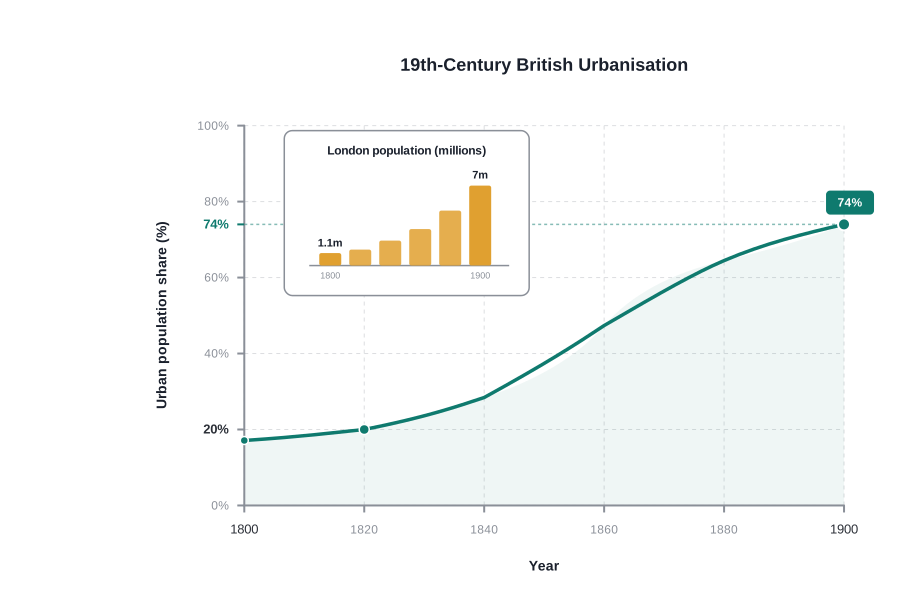
Fig. 1.4 – Urbanisation in Britain, 1800–1900.
The Indian Pattern: Deindustrialisation
In India the impact of the very same British industrialisation led to deindustrialisation in some sectors, and to the decline of old urban centres. This is the crucial asymmetry of the whole chapter: one industrial revolution, two opposite social results, depending on which side of the colonial relationship a society stood.
Just as manufacturing boomed in Britain, traditional exports of cotton and silk manufactures from India declined in the face of Manchester competition. Machine-made cloth, produced cheaply and in enormous quantities, undercut goods that had taken an Indian weaver weeks to make.
This period also saw the further decline of cities such as Surat and Masulipatnam, while Bombay and Madras grew. When the British took over Indian states, towns like Thanjavur, Dhaka and Murshidabad lost their courts, and therefore lost some of their artisans and court gentry as well.
That last point is easy to pass over, so make sure you have it. A pre-colonial court was not merely a political institution; it was also a market. Kings, nobles and their households bought fine silks, jewellery, ornamental metalwork and the services of musicians and scholars. When the court disappeared, so did the demand that had kept a whole quarter of the town in work.
From the end of the nineteenth century, however, with the installation of mechanised factory industries, some towns became much more heavily populated. So the picture is not one of simple decline; it is one of redistribution, in which some places were hollowed out and others were swollen, according to the needs of an empire.
Backwards into Agriculture
Unlike Britain, where the impact of industrialisation led to more people moving into urban areas, in India the initial impact of the same British industrialisation led to more people moving into agriculture. The Census of India Report shows this clearly.
Read that report sociologically. The artisan did not choose farming because farming had become attractive in itself; the artisan turned to farming because the craft no longer paid. A society in which people move out of manufacturing and into the land is a society whose occupational structure is being pushed backwards.
Cities as the Machinery of Empire
Cities had a key role in the economic system of empires. Coastal cities such as Mumbai, Kolkata and Chennai were favoured. From these ports primary commodities — raw materials and agricultural produce — could be easily exported, and manufactured goods could be cheaply imported.
Colonial cities were thus the prime link between the economic centre, or core, in Britain, and the periphery, or margins, in colonised India. Cities in this sense were the concrete expression of global capitalism: you can see the shape of an entire world economy in the layout of a dock.
In British India, for example, Bombay was planned and re-developed so that by 1900 over three-quarters of India’s raw cotton were shipped through the city. Calcutta exported jute to Dundee, while Madras sent coffee, sugar, indigo dyes and cotton to Britain. Trace those routes on a map, as in Fig. 1.5, and you are tracing the anatomy of the empire.
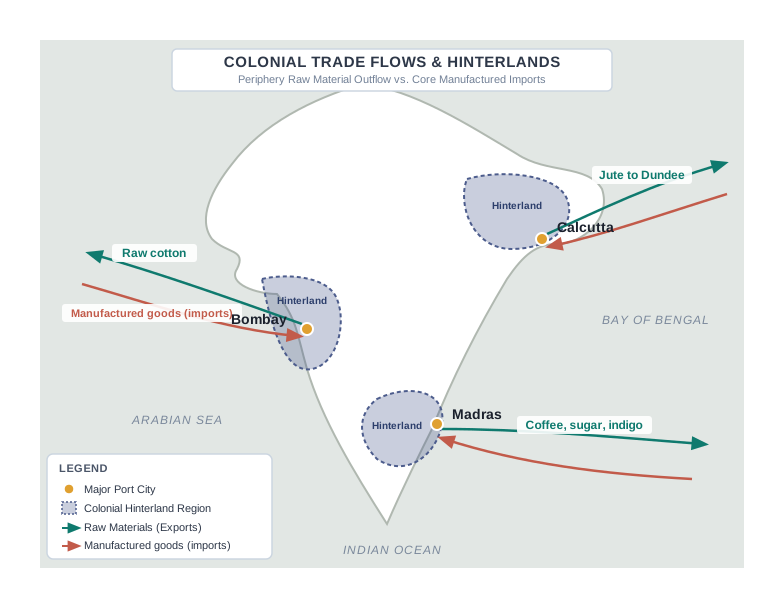
Fig. 1.5 – Colonial port cities linking core and periphery.
The Emergence of New Colonial Cities
Urbanisation in the colonial period thus saw both the decline of some earlier urban centres and the emergence of new colonial cities. Kolkata was one of the first of such cities.
In 1690, an English merchant named Job Charnock arranged to lease three villages — Kolikata, Gobindapur and Sutanuti — by the river Hugli, in order to set up a trading post. In 1698, Fort William was established by the river for defensive purposes, and a large open area was cleared around the fort for military engagements. The fort and the open area, called the Maidan, formed the core of the city that emerged rather rapidly.
It is worth noticing what the city grew around. Not a temple, not a palace, not a market square, but a fort and a field of fire. The colonial city was, from its first plan, an arrangement for trade backed by force.
Fig. 1.6 sets out that model. The colonial city was a divided city, and the division was written into its drains, its lamps and its lawns — not merely into the attitudes of the people who lived there.
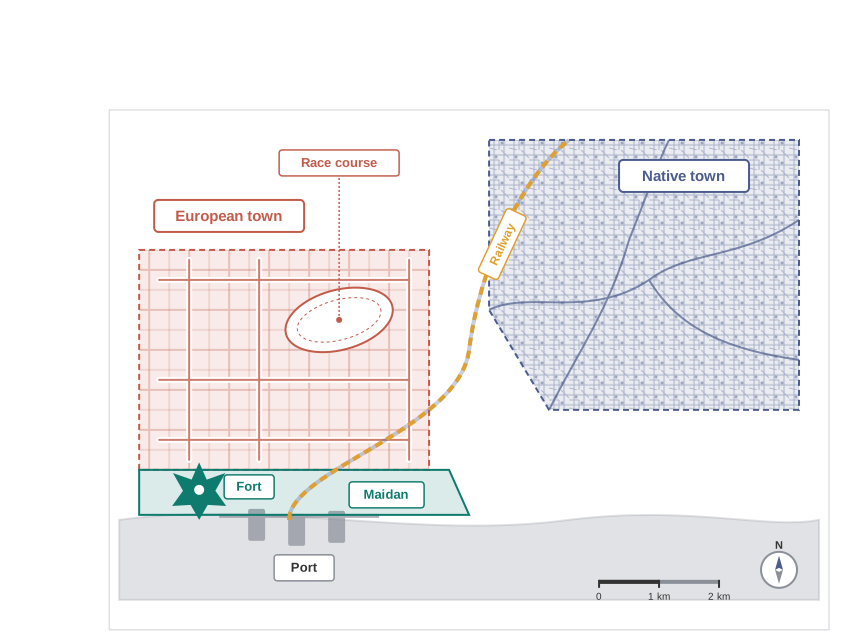
Fig. 1.6 – Plan of a typical South Asian colonial city.
1.2.2 The Tea Plantations
We have already seen that industrialisation and urbanisation did not happen in India quite the way they did in Britain. More importantly, this was not because India began industrialising late. It was because India’s early industrialisation and urbanisation in the modern period were governed by colonial interests.
We cannot go into details about different industries here. We take the case of the tea industry in India as an example — an industry that was, from the first, an entirely colonial creation, growing a crop the planters wanted for a market they controlled.
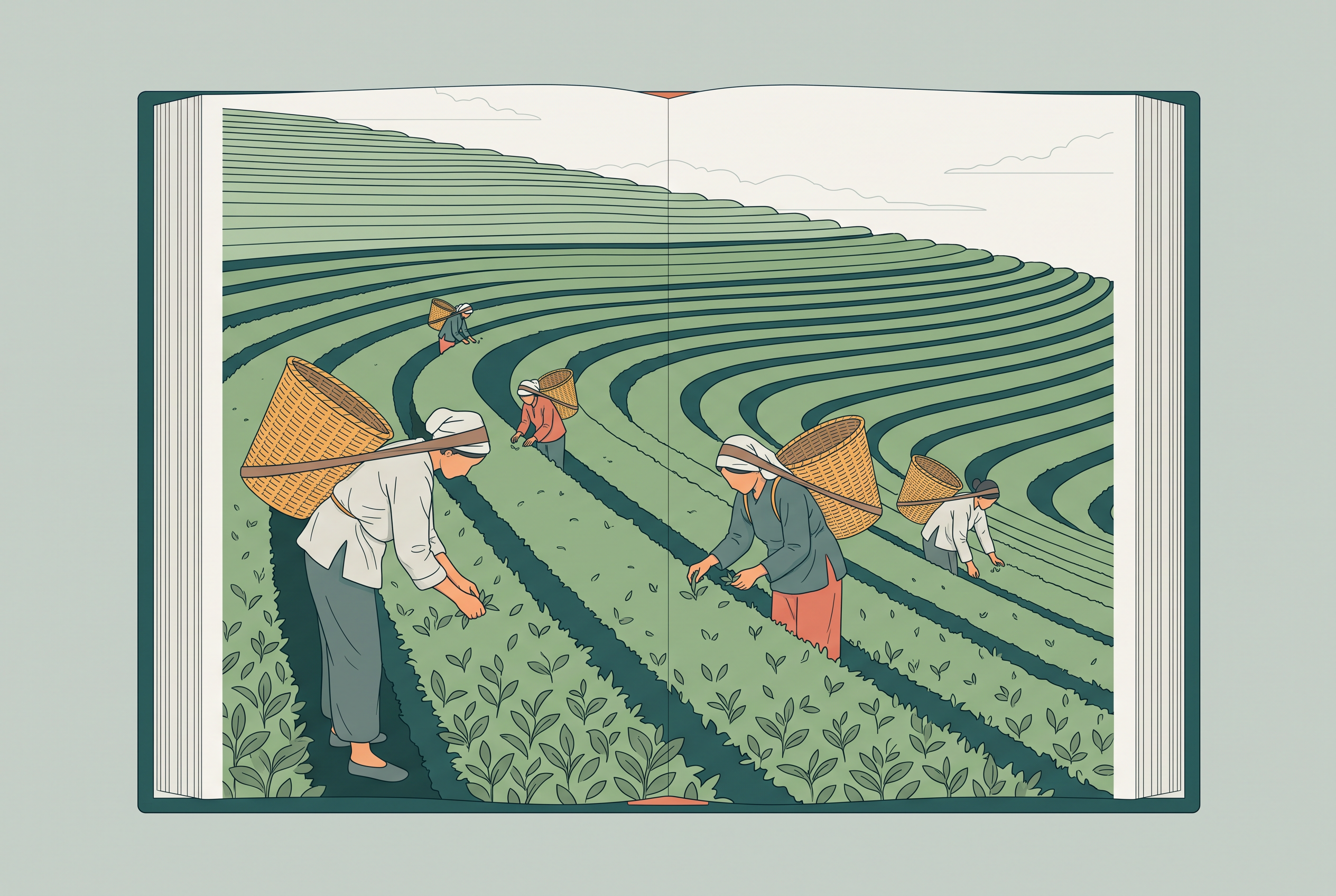
Fig. 1.7 – Workers on a colonial tea plantation.
Official reports show how the colonial government often used unfair means to hire labourers and to forcibly keep them, acting clearly on behalf of the British planters. From fictional and other accounts, we also get a glimpse of what life was like for the planters themselves.
Follow the logic step by step, because it explains a great deal about colonial industry. Labour was scarce where the gardens were. Scarce labour, in an ordinary market, commands higher wages. The planters did not want to pay higher wages. So the shortfall was made up not by money but by deception in recruitment and by law in retention — and the state supplied the law.
Significantly, the colonial administrators were clear that harsh measures were taken against the labourers to make sure that the planters benefited. They were also fully aware that the laws of a colonised country did not have to stick to the democratic norms that the British back home had to follow in Britain.
That awareness is the paradox of colonial modernity in its sharpest form. The same state that governed by consent at home governed by coercion abroad, and knew that it did so.
You now have a sense of the lives of the labourers. Let us see how the planters lived.
Set the two descriptions side by side and the plantation appears for what it sociologically was: a single production unit containing two utterly different ways of living, connected by the same steamer route — one bringing lace tablecloths upriver, the other bringing recruited labour.
1.2.3 Industrialisation in Independent India
We saw in the earlier subsection how the colonial state shaped the way industrialisation and urbanisation took place in India. Here we very briefly touch upon how the independent Indian state played an active role in promoting industrialisation — and in some sense was responding to the impact that colonialism had had on the growth of industry in India. Chapter 5 will deal with Indian industrialisation in detail, and with its shift from the early years of Independence to the developments after 1990 with liberalisation.
For Indian nationalists, the issue of economic exploitation under colonial rule was a central issue. Images of the fabled riches of pre-colonial India were contrasted with the poverty of British India, and the contrast demanded an explanation.
The Swadeshi movement strengthened loyalty to the national economy, urging Indians to buy what Indians made. Modern ideas, meanwhile, made people realise that poverty was preventable — that it was the outcome of an economic arrangement, not a fixed fate.
From this came a clear programme. Indian nationalists saw rapid industrialisation of the economy as the path towards both growth and social equity. The development of heavy and machine-making industries, the expansion of the public sector, and the holding of a large cooperative sector were all considered very important.
Notice how directly the colonial experience shaped that list. A country whose machine goods had been supplied by someone else’s factories now wanted industries that made machines. A country whose economy had been run for private foreign profit now wanted a large public sector. The independent state’s economic ambitions were, in part, an answer to a colonial complaint.
1.2.4 Urbanisation in Independent India
You would be more than aware of increasing urbanisation in India. Recent years of globalisation have led to an enormous expansion and change of cities. In the twenty-first century India will witness a fast pace of urbanisation, with the ambitious ‘Smart City’ scheme initiated by the Government of India; Chapter 6 deals with that. Here we draw on a sociological account of the different kinds of urbanisation in India.
M.S.A. Rao on the Urban Impact
Writing on the different kinds of urbanisation witnessed in the first two decades after Independence, the sociologist M.S.A. Rao argued that villages all over India are becoming increasingly subject to the impact of urban influences. But — and this is his real contribution — the nature of the urban impact varies according to the kind of relation a village has with a city or town.
In other words, “urbanisation” is not one thing happening uniformly to every village. It is at least three different things, depending on where a village stands in relation to the city. Rao described three such situations, shown in Fig. 1.8.
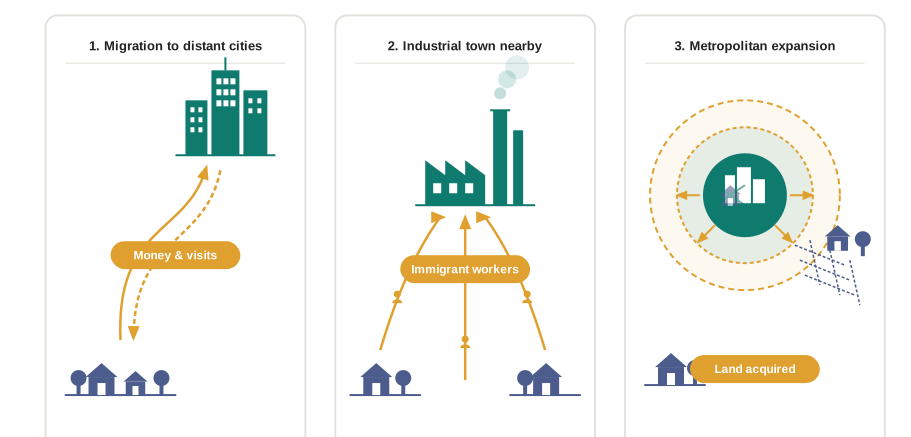
Fig. 1.8 – Three situations of urban impact on Indian villages.
Reading the Numbers
The urban story after Independence can also be read directly from the census. Look first at Fig. 1.9, which plots the urban population and the number of urban agglomerations and towns.
An urban agglomeration is a continuous urban spread — a city together with its adjoining outgrowths and satellite towns — counted as a single urban unit, because the built-up area does not stop where the municipal boundary does.
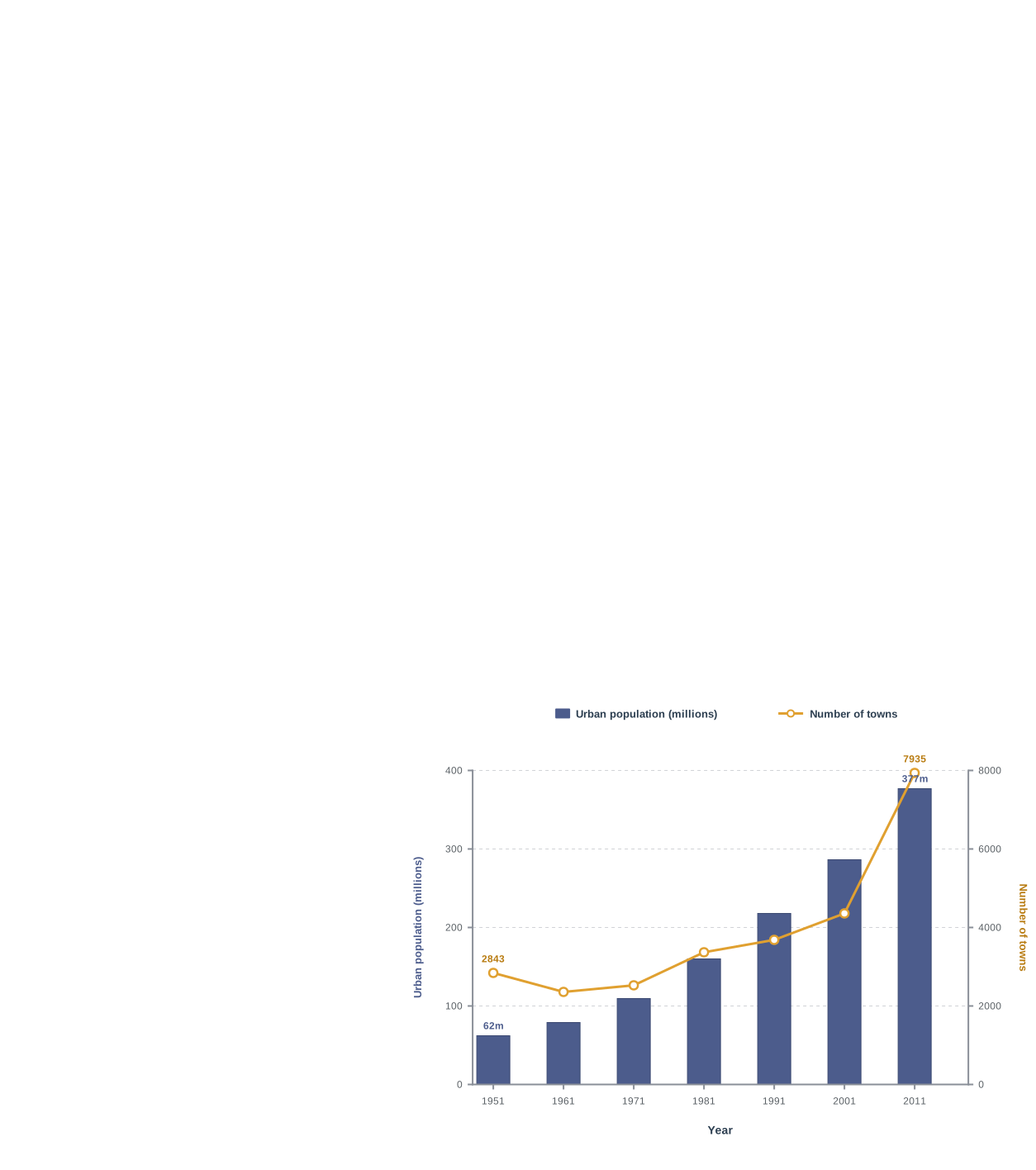
Fig. 1.9 – Urban population and number of towns in India, 1951–2011.
Both lines in Fig. 1.9 rise: there are more urban people, and more urban places. Fig. 1.10, however, adds a complication that a careless reader would miss.
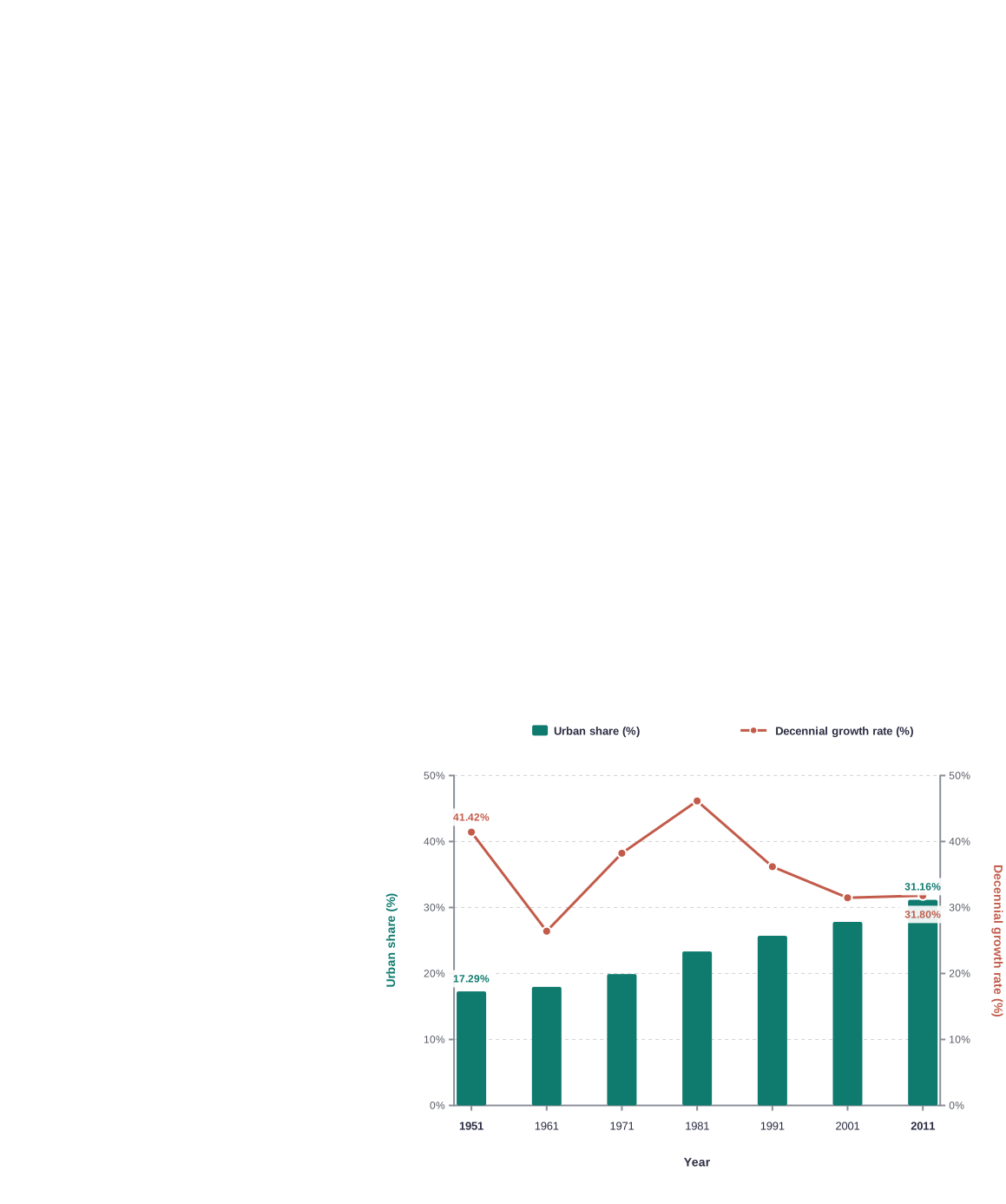
Fig. 1.10 – Urban population share and decennial growth rate, 1951–2011.
The bars in Fig. 1.10 show the per cent share of the urban population increasing steadily. The line, which shows the decennial growth rate, does not climb with them; its overall trend is downward.
The decennial growth rate is simply the percentage by which a population has grown over one decade:
\[\text{Decennial growth rate} = \frac{P_{2} - P_{1}}{P_{1}} \times 100\]
where \(P_{1}\) is the population at the beginning of the decade and \(P_{2}\) the population ten years later. It is expressed as a percentage of the earlier population — which is exactly why a falling rate is compatible with a rising number of people.
Read Table 1.1 across each row. In 1951, 17.29 per cent of India’s population — that is, 62.44 million people — were living in 2,843 towns. In 2011, 31.16 per cent of India’s population, or 377.10 million people, were living in 7,935 towns.
This shows a steady increase on three counts at once: in absolute numbers, in the number of urban agglomerations and towns, and in the per cent share of the urban population. Yet the decennial growth rate of the urban population showed a declining trend during 1981–2001, before reversing the trend and showing a marginal increase in 2011. In 1951 that growth rate was 41.42 per cent; in 2011 it was 31.80 per cent.
A Turning Point
There is one further fact in these numbers, and it is a landmark. For the first time since Independence, the absolute increase in population is more in urban areas than in rural areas.
The reason is worth stating precisely, because it is easy to get wrong. It is not that cities suddenly began growing faster. It is due to a sharp decline in the growth rate in rural areas, while the growth rate in urban areas remains almost the same. India is becoming an urban country partly by the growth of its towns, and partly by the slowing of its villages.
1.3 Conclusion
It will be obvious to you by now that colonialism is not just a topic in history. It lives on, in complex ways, in our lives even today — in the laws we are governed by, the languages we work in, the crops our fields carry, and the shape of the cities we travel through.
It is also evident from the account above that industrialisation and urbanisation are not merely economic or technical matters. They imply changes not just in production systems, technological innovations and the density of settlements, but also in what Louis Wirth called ‘a way of life’ (Wirth, 1938). A city alters how people earn, but it also alters whom they meet, whom they marry, how they spend an evening and how well they know their neighbours.
That is precisely why a sociologist, and not only an economist or a historian, has something to say about a factory and a town. You will read more about industrialisation and urbanisation in independent India in Chapters 5 and 6.
1.4 Summary
Colonialism and modern India
Understanding present-day India requires some grasp of its colonial past, because many modern ideas and institutions — parliament, courts, police, schools, the census, the railways — reached India through colonial rule.
That exposure to modernity was paradoxical. Indians read about western liberalism and freedom while living under a western colonial rule that denied them both.
The colonial imprint survives in ordinary life: a parliamentary and legal system on the British model, driving on the left, school uniforms with neck-ties, and a mixture of admiration and resentment towards the west.
English illustrates the paradox exactly. It gives Indians an edge in the global market, yet remains a mark of privilege; at the same time, for communities long denied formal education, such as the Dalits, it can open doors that were formerly closed.
Understanding colonialism
Colonialism means the establishment of rule by one country over another. India had known earlier conquests, but colonial rule was distinguishable because the changes it brought were far-reaching and deep.
Alavi and Shanin drew a vital distinction between pre-capitalist and capitalist empire building. Pre-capitalist conquerors, apart from outright pillage, extracted a continuous flow of tribute and largely left the economic base untouched.
British colonialism, resting on a capitalist system, directly interfered to secure the greatest profit for British capitalism. It rewrote land ownership laws, decided which crops were grown, meddled with manufacturing, altered production and distribution, cleared forests for tea plantations, and passed Forest Acts that deprived pastoralists of grazing grounds.
Colonialism also moved people on a large scale — within India, and by ship to plantations in Asia, Africa and the Americas. Many died on the voyage; most never returned; their descendants are today known as people of Indian origin.
Some colonial changes were deliberate and some unintended. Western education, introduced to produce Indians who would help manage colonial rule, instead nourished a nationalist and anti-colonial consciousness.
Capitalism — an economic system in which the means of production are privately owned and organised to accumulate profit within a market system — was marked from the beginning by its dynamism and its global reach. Western colonialism was inextricably tied to the growth of western capitalism.
The nation state, in which a government exercises sovereign power over a defined territory whose people are citizens of a single nation, became the dominant political form, and is closely linked to nationalism. Colonialism and nationalism are contradictory principles, and Indian leaders seized on that irony, claiming swaraj as their birthright and fighting for political as well as economic freedom.
Industrialisation and urbanisation under colonialism
Industrialisation is the emergence of machine production based on inanimate power such as steam or electricity. Urbanisation is the growth in the share of a population living in towns and cities. The two often occur together, but not always.
Britain, the first society to industrialise, was also the first to become predominantly urban: under 20 per cent of its people lived in towns of more than 10,000 in 1800, and 74 per cent by 1900, with London growing from about 1.1 million to over 7 million.
In India the same British industrialisation produced deindustrialisation in some sectors and the decline of old urban centres. Cotton and silk exports fell before Manchester competition; Surat and Masulipatnam declined; Thanjavur, Dhaka and Murshidabad lost their courts and hence their artisans and court gentry, while Bombay and Madras grew.
Sumit Sarkar noted that urban luxury manufactures were hit first, as court demand and export markets collapsed together, while village crafts in the interior survived longer and were seriously affected only with the spread of railways.
The Census of India Report of 1911 recorded the reverse of the British pattern: cheap imported goods and Western-type factories destroyed village industries, and artisans abandoned hereditary crafts for agriculture.
D.P. Mukherjee argued that the substitutes the colonial state offered — land ownership and English education — could not create a genuine middle class: zamindars became parasites on the land and graduates became job hunters. Industrialisation is therefore about new social groups and relationships, not only new machines.
Colonial cities were the machinery of empire. Coastal cities were favoured because primary commodities could be exported and manufactured goods cheaply imported, making these cities the link between the core in Britain and the periphery in India. By 1900 over three-quarters of India’s raw cotton was shipped through Bombay; Calcutta sent jute to Dundee; Madras sent coffee, sugar, indigo dyes and cotton to Britain.
New colonial cities emerged as older centres declined. Kolkata grew from three villages leased by Job Charnock in 1690, around Fort William (1698) and the open ground called the Maidan. A.K. Dutt’s model shows the colonial city as a divided city: a spacious, well-serviced European town and a crowded native town with restricted access to water, electricity and sewerage.
The tea plantations
The tea industry, begun in India in 1851 and concentrated in Assam, shows that India’s early industrialisation was governed by colonial interests rather than delayed by any late start. In 1903 it employed 4,79,000 permanent and 93,000 temporary workers.
Because Assam was sparsely populated, labour had to be brought from other provinces. The planters were unwilling to pay the incentives such migration required, and turned instead to fraud and coercion, with recruitment conducted by contractors under penal legislation such as the Transport of Native Labourers Act (No. III) of 1863 of Bengal, amended in 1865, 1870 and 1873.
Colonial administrators knew that harsh measures were being used to benefit the planters, and knew too that the laws of a colonised country need not observe the democratic norms the British followed at home. The luxurious life of the planters, supplied by steamer with everything from lace tablecloths to cast-iron bathtubs, existed on the same estates as the recruited labour force.
Independent India
Nationalists treated colonial economic exploitation as a central issue. The Swadeshi movement strengthened loyalty to the national economy, and modern ideas established that poverty was preventable.
Independent India therefore pursued rapid industrialisation as a route to both growth and social equity, emphasising heavy and machine-making industries, an expanded public sector, and a large cooperative sector.
M.S.A. Rao showed that urban influence reaches villages in three different ways: through villages that send migrants to far-off cities (as in Madhopur, where 77 of 298 households had migrants, about 75 per cent of whom sent money home regularly); through villages beside a new industrial town such as Bhilai, where land is acquired and immigrant workers arrive; and through metropolitan expansion, which absorbs some villages entirely and takes the farmland of others.
The census records steady urban growth: in 1951, 17.29 per cent of Indians (62.44 million) lived in 2,843 towns; in 2011, 31.16 per cent (377.10 million) lived in 7,935 towns.
The decennial growth rate of the urban population, however, declined during 1981–2001 and rose only marginally in 2011, falling from 41.42 per cent in 1951 to 31.80 per cent in 2011. A rising share can go with a falling rate, because the rate is measured against an ever-larger base.
For the first time since Independence, the absolute increase in population is greater in urban than in rural areas — because rural growth has slowed sharply while urban growth has stayed almost the same.
Conclusion
Colonialism is not merely a chapter of history; it survives in laws, languages, industries and cities.
Industrialisation and urbanisation change production systems, technology and settlement density — but also, as Louis Wirth put it, ‘a way of life’.
1.5 Key Terms
Capitalism — An economic system in which the means of production are privately owned and are organised to accumulate profit within a market system.
Colonialism — The establishment of rule by one country over another, so that the subjugated territory is governed in the interests of the ruling country.
Core — The economic centre of a wider system, such as Britain in the colonial economy, where manufacturing, capital and profit were concentrated.
Decennial growth rate — The percentage by which a population increases over one decade, measured against the population at the start of that decade.
Deindustrialisation — The decline of existing manufacturing and craft production in a region, so that fewer of its people live by manufacturing than before.
Industrialisation — The emergence of machine production based on inanimate power resources such as steam or electricity, in place of human and animal energy.
Nation state — A modern form of state in which a government exercises sovereign power within a defined territory, and the people within it are citizens of a single nation.
Nationalism — The principle that any set of people has the right to be free and to exercise sovereign power over itself.
Periphery — The margins of an economic system, such as colonised India, which supplied raw materials to the core and absorbed its manufactured goods.
Structural change — A deep and lasting rearrangement of a society’s institutions and relationships — of who owns what, who works at what, and who lives where.
Swadeshi movement — A nationalist movement that urged Indians to support the national economy by using goods produced in India.
Swaraj — Self-rule; the nationalist demand for freedom, understood as both political and economic independence.
Urban agglomeration — A continuous urban spread, made up of a town or city together with its adjoining outgrowths, counted as a single urban unit.
Urbanisation — The growth in the proportion of a population that lives in towns and cities.
1.6 Points to Ponder
The same language can exclude one person and open doors for another. If English works in both these ways at once, is it more useful to call it an instrument of privilege or an instrument of mobility — and does the answer depend on whom you ask?
Colonial rule introduced western education in order to produce Indians who would help administer the empire, and instead helped produce Indians who demanded its end. How often do large institutions — schools, courts, factories, the media — end up producing consequences their designers never intended?
If pre-capitalist conquerors took a share of the surplus while capitalist colonialism reorganised how the surplus was produced, which kind of domination is harder for a society to recover from — and why?
A colonial city separated a spacious, well-serviced quarter from a crowded one that had far less water, light and drainage. Can you think of ways in which contemporary Indian cities still sort people by neighbourhood, and what would count as evidence that they do?
Sociologists say that a city is not only a density of settlement but ‘a way of life’. What would you have to observe about people — their work, their neighbours, their leisure, their sense of trust — to decide whether a place has become urban in this second sense?
India’s urban share keeps rising while the growth rate of the urban population has, on the whole, declined. What does this pattern suggest about where India’s cities are actually growing — and about whether “urbanisation” means the same thing in a metropolis, a small town and a village on a city’s edge?
1.7 NCERT Questions
How has colonialism impacted our lives? You may focus on a single aspect, such as culture or politics, or discuss them together.
Industrialisation and urbanisation are linked processes. Discuss.
Identify any town or city with which you are familiar. Find out both the history of its growth and its contemporary status.
You may be living in a very small town, in a very big city, in a semi-urban settlement, or in a village.
- Describe the place where you live.
- What are the features that make you think it is a town and not a city, a village and not a town, or a city and not a village?
- Is there any factory where you live?
- Is agriculture the main work that people do?
- Is it the nature of occupations that has a determining influence?
- Is it the buildings?
- Is it the availability of educational opportunities?
- Is it the way people live and behave?
- Is it the way people talk and dress?
1.8 Objective Questions
- Industrialisation refers to the emergence of machine production based on:
- the growth of towns and cities
- inanimate power resources such as steam or electricity
- an increase in agricultural productivity
- the private ownership of land [1 mark]
- Which of the following cities declined during the colonial period?
- Bombay
- Madras
- Surat
- Calcutta [1 mark]
- The tea industry began in India in:
- 1834
- 1851
- 1863
- 1903 [1 mark]
- By 1900, the proportion of Britain’s population living in towns or cities of more than 10,000 inhabitants had risen to about:
- 20 per cent
- 41 per cent
- 74 per cent
- 90 per cent [1 mark]
- Colonial port cities such as Bombay, Calcutta and Madras are described by sociologists as the concrete expression of global capitalism because they:
- had the largest populations in colonial India
- linked the economic core in Britain with the periphery in colonised India
- were the first Indian cities to have factories
- were built entirely by Indian merchants [1 mark]
- In 2011, the share of India’s population living in urban areas was:
- 17.29 per cent
- 25.00 per cent
- 31.16 per cent
- 41.42 per cent [1 mark]
- Assertion (A): In colonial India, the initial impact of British industrialisation was to increase the number of people dependent on agriculture. Reason (R): Cheap imported goods and Western-type factories destroyed many village industries, and artisans abandoned their hereditary crafts.
- Both A and R are true, and R is the correct explanation of A.
- Both A and R are true, but R is not the correct explanation of A.
- A is true, but R is false.
- A is false, but R is true. [1 mark]
- Assertion (A): Pre-capitalist conquerors, on the whole, did not interfere with the economic base of the societies they ruled. Reason (R): They benefited chiefly by exacting a continuous flow of tribute skimmed off the surplus that was already being produced.
- Both A and R are true, and R is the correct explanation of A.
- Both A and R are true, but R is not the correct explanation of A.
- A is true, but R is false.
- A is false, but R is true. [1 mark]
- Assertion (A): The practice of colonialism and the principle of nationalism are contradictory. Reason (R): Nationalism assumes that any set of people has the right to be free and to exercise sovereign power, whereas colonial rule means rule by a foreign power.
- Both A and R are true, and R is the correct explanation of A.
- Both A and R are true, but R is not the correct explanation of A.
- A is true, but R is false.
- A is false, but R is true. [1 mark]
- Match the following:
| Column A | Column B |
|---|---|
| a. M.S.A. Rao | i. Difference between pre-capitalist and capitalist empire building |
| b. Louis Wirth | ii. Three situations of urban impact on villages |
| c. Alavi and Shanin | iii. Lease of three villages by the river Hugli in 1690 |
| d. Job Charnock | iv. Urbanism as ‘a way of life’ |
[1 mark]
- Match the colonial city with what it chiefly handled:
| Column A | Column B |
|---|---|
| a. Bombay | i. Jute exported to Dundee |
| b. Calcutta | ii. Coffee, sugar, indigo dyes and cotton sent to Britain |
| c. Madras | iii. Tea gardens |
| d. Assam | iv. Over three-quarters of India’s raw cotton shipped out by 1900 |
[1 mark]
Fill in the blank: Recruitment of labourers for the tea gardens of Assam was carried on for years, mostly by contractors, under the provisions of the Transport of Native Labourers Act (No. III) of __________ of Bengal. [1 mark]
Fill in the blank: In 1951, __________ million people lived in India’s 2,843 towns. [1 mark]
True or False: Urbanisation and industrialisation always occur together. [1 mark]
True or False: Western education was introduced in colonial India in order to create a nationalist consciousness among Indians. [1 mark]
1.9 Check Your Concepts
Define colonialism. [2 marks]
What is meant by deindustrialisation? Give one example from colonial India. [2 marks]
What is an urban agglomeration? [2 marks]
State any two features of capitalism as an economic system. [2 marks]
Name any two old urban centres that declined under colonial rule, and state one reason for their decline. [2 marks]
Differentiate between industrialisation and urbanisation, using one Indian example to show that the two need go together. [4 marks]
How did the empire building of pre-capitalist times differ from that of capitalist times? Explain with reference to the economic base of the subjugated society. [4 marks]
“The impact of English in India has been many-sided and paradoxical.” Explain this statement with examples from the chapter. [4 marks]
Why were the tea planters of Assam obliged to bring labour from other provinces, and what means did they use to recruit and retain it? Give reasons for their choice of these means. [4 marks]
Describe the main features of the South Asian colonial city, and explain what its layout reveals about colonial society. [4 marks]
Study the following figures for India’s urban population and answer the questions below.
| Indicator | 1951 | 2011 |
|---|---|---|
| Urban population (million) | 62.44 | 377.10 |
| Urban share of total population | 17.29% | 31.16% |
| Number of towns | 2,843 | 7,935 |
| Decennial growth rate of urban population | 41.42% | 31.80% |
- By how many million did the urban population grow between 1951 and 2011?
- The urban share of the population rose while the decennial growth rate fell. Explain how both statements can be true at the same time. [4 marks]
“Colonialism was not merely a change of rulers; it was a structure and a system.” Explain this claim with examples of the changes colonialism brought to land, crops, manufacturing and forests. [6 marks]
The same British industrialisation urbanised Britain and deindustrialised parts of India. Explain why one process produced two opposite outcomes, and discuss how far the evidence shows that deindustrialisation affected all regions of India equally. [6 marks]
Explain M.S.A. Rao’s account of the three situations of urban impact on Indian villages, and state one limitation of that account. [6 marks]
How far do you agree with D.P. Mukherjee’s argument that the substitutes offered by colonial rule — land ownership and education in English — failed to create a genuine middle class in India? Support your answer with reasons. [6 marks]
Discuss the causes and the consequences of the emergence of new colonial cities in India. In your answer, explain why coastal cities were favoured and what this meant for the towns of the interior. [6 marks]
Indian nationalists saw rapid industrialisation as the path to both growth and social equity. Explain how the colonial experience shaped this view, and describe the priorities that followed from it. [6 marks]
1.10 Passage-Based Questions
For three generations, the families of a small inland town had woven fine cloth for the court that sat a short distance away, and for merchants who carried their goods to distant ports. Within a few decades of the court being dissolved, the merchants stopped coming; cheaper machine-made cloth was arriving in the local market at a price no weaver could match. Some households sold their looms. Others took land on rent at the edge of the town and began to grow grain. The town’s population fell, its lanes of workshops emptied, and a nearby port city, which had never been more than a fishing settlement, grew rapidly in the same period.
- Identify the process described in the first half of the passage, and define it.
- Explain why the weaving households moved into agriculture rather than into another craft or into factory work.
- What does the simultaneous decline of the inland town and the growth of the port city tell you about how the colonial economy organised space? [6 marks]
In a village of about three hundred households, nearly a quarter of the families have at least one member working in a distant city. Most of these men live in shared rooms near their workplaces and return home for festivals and for the harvest. Money orders arrive regularly, and much of the money is spent on building pucca houses, repairing the village school and buying land. A few families have relatives who went overseas a generation ago; their houses are the largest in the village, though they stand locked for most of the year.
- Which of M.S.A. Rao’s three situations of urban impact does this village illustrate? Give reasons for your answer.
- Explain two ways in which urban influence reaches this village even though it has no factory and no town nearby.
- Would you describe this village as becoming urban? Justify your answer sociologically. [6 marks]
A colonial port town, seen from above, falls clearly into two halves. On one side stand wide, tree-lined streets, bungalows set in gardens, a club, and a large open ground used for races and cricket. Piped water, street lighting and drains were laid here first. On the other side of the railway line lies the older settlement — narrow lanes, closely packed houses, a crowded market, and public taps at the street corners. The docks lie beyond, and the rail line runs straight from the cotton-growing districts of the interior to the wharves, without stopping anywhere in between.
- Identify two features of this town that mark it as a colonial city.
- Explain what the route of the railway line reveals about the relationship between core and periphery.
- “The colonial city expressed inequality in its very layout.” Discuss this statement with reference to the passage. [6 marks]
Consider the following figures on urban India.
Year Urban population (million) Number of towns Urban share of population 1951 62.44 2,843 17.29% 2011 377.10 7,935 31.16% Over the same period, the decennial growth rate of the urban population fell from 41.42 per cent in 1951 to 31.80 per cent in 2011, having declined during 1981–2001 before rising marginally in 2011. For the first time since Independence, the absolute increase in population is now greater in urban than in rural areas.
- State two trends that the table shows.
- Explain why the absolute increase in population can be greater in urban areas even though the urban growth rate has not risen.
- What do these figures suggest about the pace at which India is becoming an urban society? Support your answer with the data. [6 marks]