Chapter 5: Change and Development in Industrial Society
Look at the shirt you are wearing. It reached you through a long chain of workers, and almost none of them ever met one another.
The cotton in it was picked in a field, probably by a woman paid a daily wage that no register recorded. The yarn was spun in a mill; the cloth may have been woven on a powerloom in a small town, in a shed of ten or twelve machines where the owner knows every worker by name and pays them in cash. The buttons were made somewhere else again. The stitching might have been done in a large garment factory with a security gate and a punch-in card — or handed over to a woman working on a machine at home, paid for each piece she finishes, with her daughter helping in the evenings. Then a truck, a warehouse, a shop, a bill.
One ordinary shirt, and already we have crossed a farm, a factory, a workshop and a kitchen. We have crossed different wages, different levels of safety, and very different degrees of security. Some of these workers can be dismissed tomorrow without notice. Some belong to a union. Most do not.
Sociologists study exactly this: who produces what, who works where, under what conditions, and who decides. Work is not only how people earn. It shapes where they live, whom they marry, and what they can hope for.
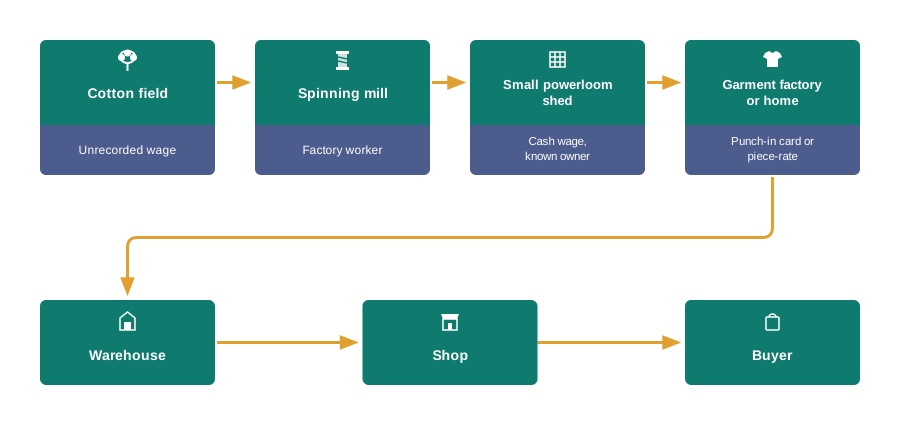
Fig. 5.1 – The journey of a shirt as a chain of workplaces.
This chapter will let you answer each of these questions for yourself.
5.1 Work, Industry and Social Life
Bollywood, in Mumbai, Maharashtra, is for most of us a place of dreams. For a great many people, it is simply the place they go to work.
Like any other industry, the film industry runs on organised labour. The dancers, the stunt artists and the extras belong to a junior artists association — a trade union of the kind that workers form to bargain collectively with those who employ them. Its demands are the ordinary demands of working people everywhere: shifts of eight hours, wages paid properly, and conditions that do not put a body at risk.
The films themselves are products that must be advertised and marketed. They reach audiences through film distributors and cinema hall owners, and through shops, in the form of music cassettes and videos. Notice the chain of workers hidden behind a single evening’s entertainment.
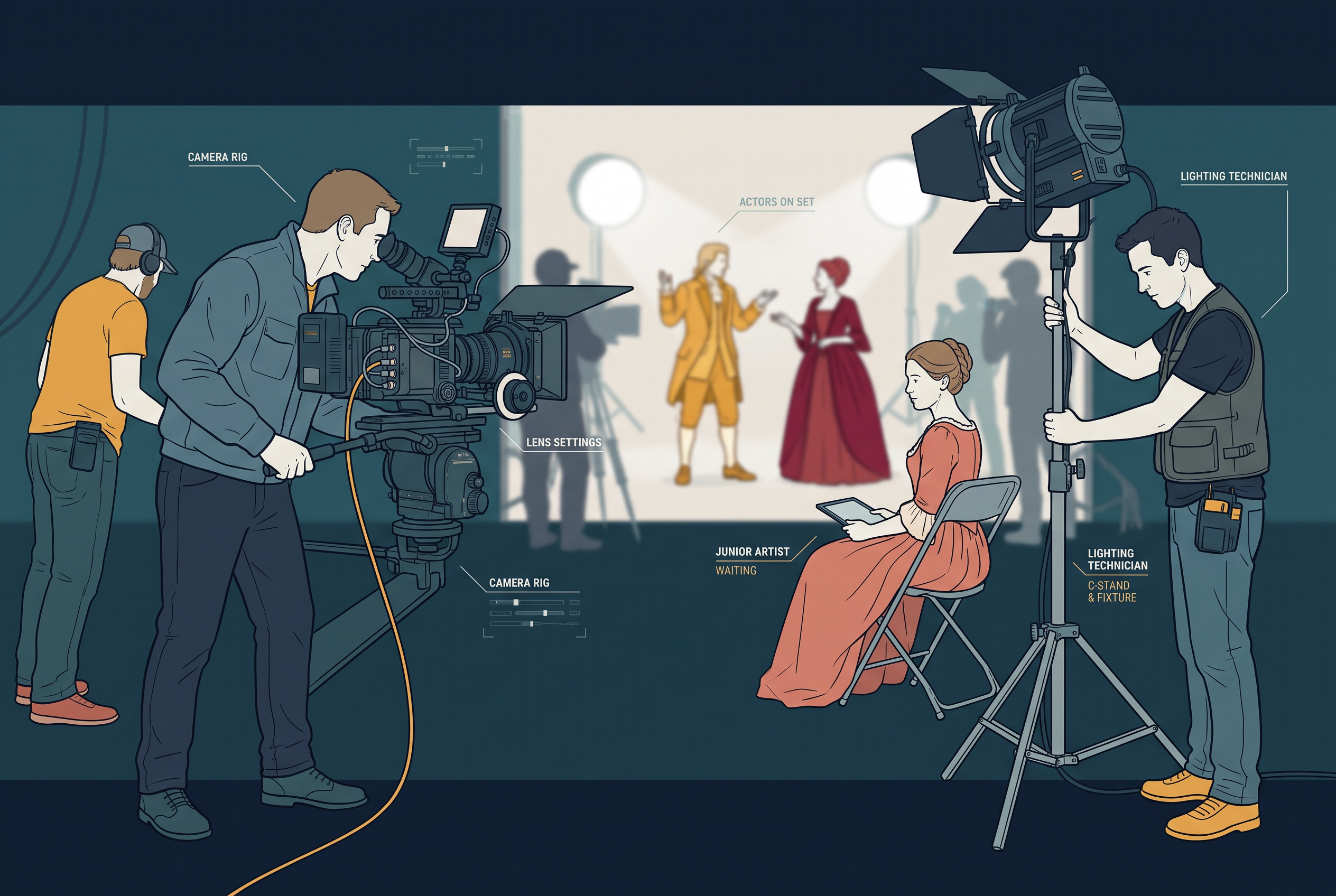
Fig. 5.2 – The dream factory as a workplace.
One city, many lives
The people who work in this industry, as in any other, live in the same city. What they do in that city, however, depends on who they are and how much they earn.
Film stars and textile mill owners live in places like Juhu. Extras and textile workers may live in places like Girangaon. Some eat Japanese sushi in five-star hotels; some eat vada pav — a fried potato patty in a bun — from a handcart on the street. The residents of Mumbai are divided by where they live, what they eat, and how much their clothes cost.
Yet they are also united by what a city gives everybody. They watch the same films and the same cricket matches. They breathe the same polluted air. And they all want their children to do well.
This double truth — deeply divided, and yet sharing a common life — is what makes a modern city such rich material for sociology. Inequality is not a wall between separate worlds. It runs through a world that people hold in common.
Work as identity
How and where people work, and what kind of job they hold, is an important part of who they are. Ask an adult who they are, and you will usually be told what they do.
That is why this chapter asks two questions at once. First, how have changes in technology, and changes in the kind of work available, altered social relations in India? Second, and just as important, how do social institutions — caste, kinship networks, gender and region — shape the way work is organised in the first place, and the way products are marketed? Influence runs in both directions, and mapping it is a major area of research for sociologists.
Why sociologists ask about work
Consider a familiar pattern. Why do we find more women in jobs like nursing and teaching than in a field like engineering?
Is this a coincidence? Or is it because society believes that women are suited to caring and nurturing work, as against jobs thought of as “tough” and masculine? The belief does not survive much scrutiny: nursing is physically far harder work than designing a bridge. And if more women do move into engineering, the interesting question is what happens to the profession itself — does it change its hours, its image, its idea of what an engineer looks like?
Now consider something smaller. Why do some coffee advertisements in India show two cups on the package, when in America they show one?
Because for many Indians, drinking coffee is not a solitary wake-up activity. It is an occasion to sit with someone. Even a package design carries an assumption about how people live.
Sociologists, then, are interested in who produces what, who works where, who sells to whom, and how. What looks like a string of individual choices — her subject, his job, their brand of coffee — turns out to follow visible social patterns. And in turn, the choices people make feed back into the way society itself works.
5.2 Images of Industrial Society
Sociology grew up alongside the factory. Many of the great works of the discipline were written at a time when industrialisation was new and machinery was assuming great importance, and the thinkers of that period were trying to make sense of a world changing in front of them.
Thinkers like Karl Marx, Max Weber and Emile Durkheim associated a number of social features with industry. One was urbanisation — the growth of towns and cities as people left the countryside to look for work.
Another was a change in the very texture of human relationships. In rural areas, people worked on their own farms, or for a landlord they knew — badly treated, perhaps, but known, and known in return. In the modern factory and workplace, those face-to-face relationships were replaced by anonymous professional ones. You are hired by a firm, supervised by a manager, and paid by an accounts department, and none of them need know anything about you beyond your work.
Producing a part, never the whole
Industrialisation involves a detailed division of labour — the splitting of a job into many small, separate, specialised tasks.
The consequence is that people often do not see the end result of their work, because they are producing only one small part of a product. The work is often repetitive and exhausting. Yet even this, most workers will tell you, is better than having no work at all — that is, than being unemployed.
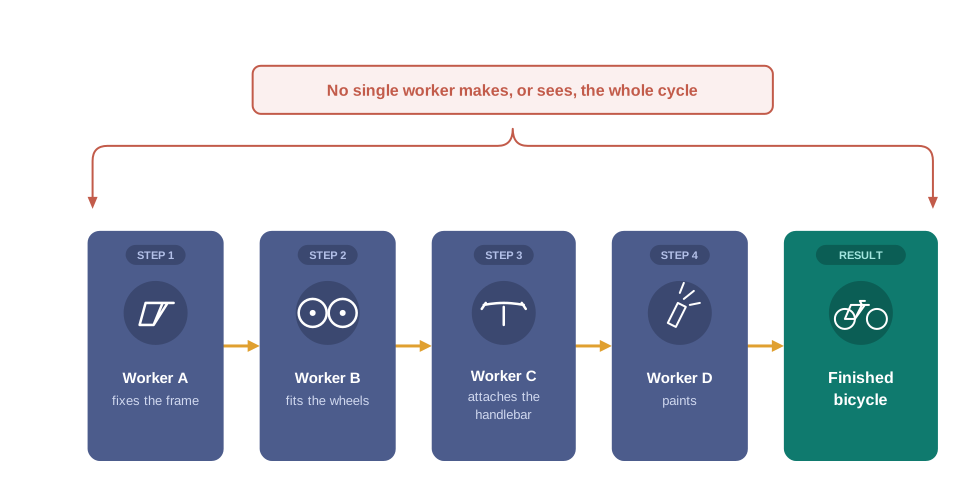
Fig. 5.3 – Division of labour on an assembly line.
It was this situation that Marx called alienation. Notice that alienation is not the same as tiredness or boredom. It is a structural condition, produced by how work itself is organised.
That last clause is the sharpest part of the idea. The worker is not merely unhappy; the worker is dispensable.
Does industry make us more equal?
Industrialisation does lead to greater equality, at least in some spheres. Caste distinctions do not matter any more on trains, on buses, or in cyber cafes, where people sit and stand next to whoever happens to be there.
On the other hand, older forms of discrimination may persist even in new factory or workplace settings. The setting is modern; the reflexes brought into it are not always so.
And there is a second twist. Even as social inequalities are reducing, economic or income inequality is growing in the world. Often the two overlap. Upper caste men dominate well-paying professions like medicine, law and journalism, and women are often paid less than men for similar work.
5.3 Industrialisation in India
5.3.1 The Specificity of Indian Industrialisation
The experience of industrialisation in India is in many ways similar to the western model, and in many ways different from it.
That sentence is more important than it looks. Comparative analysis of different countries suggests that there is no standard model of industrial capitalism. There is no single road that every industrialising society must travel, with India merely running late on it.
Let us begin with one clear point of difference: what kind of work people actually do.
Where India works, and where India earns
Economists divide work into three broad sectors. The primary sector covers agriculture and mining — work that draws directly on nature. The secondary sector covers manufacturing, construction and utilities — work that transforms raw materials into goods. The tertiary sector covers services — trade, transport, financial services and the like.
In developed countries, the majority of people are in the services sector, followed by industry, and less than 10% are in agriculture (ILO figures).
India looks quite different. In 2018–19, nearly 43% of Indians were employed in the primary sector, 17% in the secondary sector, and 32% in the tertiary sector.
Now hold that picture alongside a second one. If we look at the contribution of these sectors to economic growth, the share of agriculture has declined sharply, while services contribute approximately more than half.
Put the two facts together and you have the central puzzle of Indian industrialisation. The sector where the maximum number of people are employed is not the sector that generates much income for them. This is a very serious situation: it means the largest group of workers in the country is concentrated where the earnings are thinnest.
Self-employed, salaried, casual
A second major difference between developing and developed countries is the number of people in regular salaried employment. In developed countries, the majority are formally employed.
In India, over 52% of workers are self-employed, only about 24% are in regular salaried employment, and approximately 24% are in casual labour.
Self-employment means working for oneself rather than for an employer — the vegetable seller, the tailor, the small farmer, the auto driver who owns his vehicle. Regular salaried employment means a fixed job with a fixed wage paid at fixed intervals. Casual wage labour means being hired by the day or the task, with no assurance of work tomorrow.
Table 5.2 sets out how these proportions have shifted over nearly half a century.
Read the table carefully. Self-employment has fallen substantially, and regular salaried employment has risen — that is real change, and it is the change industrialisation is supposed to bring. But casual wage labour has barely moved. Roughly a quarter of India’s workers were being hired by the day in 1972–73, and roughly a quarter still are.
The organised and the unorganised sector
Economists and others often make a distinction between the organised or formal sector and the unorganised or informal sector. There is a genuine debate over how these sectors should be defined at all, and you should not treat the boundary as though it were precise.
According to one definition, the organised sector consists of all units employing ten or more people throughout the year.
Everything else is the unorganised sector — the small workshop, the roadside stall, the farm, the construction site, the home-based worker. And in India, over 90% of the work, whether it is in agriculture, industry or services, is in the unorganised or informal sector.
What follows from a small organised sector
So the organised sector is small. What are the social implications of that? NCERT draws out three, and each is worth taking slowly.
First, most Indians never work alongside strangers. Very few people have the experience of employment in large firms where they meet people from other regions and backgrounds. Urban settings do provide some corrective to this — your neighbours in a city may be from a different place — but by and large, work for most Indians is still in small-scale workplaces.
In such workplaces, personal relationships determine many aspects of work. If the employer likes you, you may get a salary raise. If you have a fight with him or her, you may lose your job. This is quite different from a large organisation with well-defined rules, where recruitment is more transparent, and where there are mechanisms for complaints and redressal if you disagree with your immediate superior.
Notice what this means sociologically. Where there are no rules, there is not freedom — there is dependence.
Second, secure jobs are scarce, and the state holds most of them. Very few Indians have access to secure jobs with benefits, and of those who do, two-thirds work for the government. This is why people strive so hard to get into government jobs, and why a single vacancy can attract thousands of applications. The rest are forced to depend on their children in their old age.
Government employment in India has played a major role in overcoming boundaries of caste, religion and region. Because it recruits by examination and posts people across the country, it mixes those who would otherwise never meet.
One sociologist has argued that the reason there have never been communal riots in a place like Bhilai is that the public sector Bhilai Steel Plant employs people from all over India who work together, and that shared work makes such divisions harder to mobilise. Others may question this.
Third, very few workers can act collectively. Union membership is a feature of the organised sector. Since so few people are members of unions, unorganised or informal sector workers do not have the experience of collectively fighting for proper wages and safe working conditions.
The government does have laws to monitor conditions in the unorganised sector. But in practice, these workers are left to the whims and fancies of the employer or the contractor. A law that no inspector ever enforces is, for the worker, no law at all.
5.3.2 Globalisation, Liberalisation and Changes in Indian Industry
Since the 1990s, the government has followed a policy of liberalisation.
Private companies, and especially foreign firms, are encouraged to invest in sectors earlier reserved for the government, including telecom, civil aviation and power. Licences are no longer required to open industries. Foreign products are now easily available in Indian shops.
Who owns Indian industry now?
As a result of liberalisation, many Indian companies, small and large, have been bought over by multinational companies — firms that own and operate businesses in more than one country. At the same time, some Indian companies are themselves becoming multinationals.
Take the first kind of case. Parle drinks was bought by Coca Cola. Parle’s annual turnover was ₹250 crores, while Coca Cola’s advertising budget alone was ₹400 crores.
Sit with those two figures for a moment. A company whose entire yearly sales were 250 crores was absorbed by a company that spent 400 crores merely on persuading people to buy. That level of advertising has naturally increased the consumption of coke across India, replacing many traditional drinks. Ownership, advertising and taste are not separate stories.
The next major area of liberalisation is in retail. Will Indians prefer to shop in the grocery stores and small textile shops of their own neighbourhoods and small towns, or in departmental stores — and if the latter, what happens to the small shops?
Disinvestment and the shrinking public sector
The government is trying to sell its share in several public sector companies, a process known as disinvestment. Many government workers are afraid that after disinvestment they will lose their jobs.
Their fear is not imaginary. ‘Modern Foods’ was set up by the government to make healthy bread available at cheap prices, and was the first company to be privatised. In the first five years after privatisation, 60% of its workers were forced to retire.
Fig. 5.4 shows what has been happening to organised sector employment itself, and the shape of the two bars is the point.
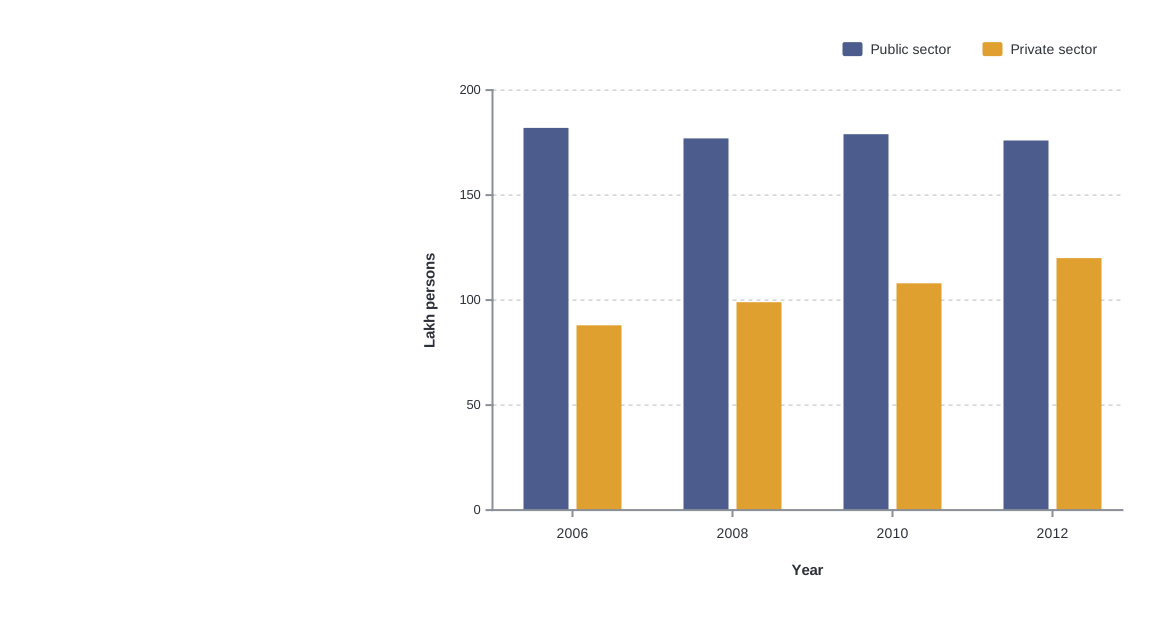
Fig. 5.4 – Organised sector employment, 2006–2012.
Employment in the private sector has been climbing; employment in the public sector, still the larger of the two, has not. The state, which was for decades the great provider of secure jobs, is slowly stepping out of that role.
Outsourcing and contract work
More and more companies are reducing the number of permanent employees and outsourcing their work to smaller companies, or even to homes.
For multinational companies, this outsourcing is done across the globe, with developing countries like India providing cheap labour. And because small companies have to compete against one another for orders from the big companies, they keep wages low, and working conditions are often poor. It is also more difficult for trade unions to organise in smaller firms — a scattered workforce is a weak one.
Almost all companies, even government ones, now practise some form of outsourcing and contracting. But the trend is especially visible in the private sector.
Taking stock
To summarise, India is still largely an agricultural country.
The service sector — shops, banks, the IT industry, hotels and other services — is employing more people, and the urban middle class is growing, along with urban middle class values of the kind we see in television serials and films.
But we also see that very few people in India have access to secure jobs. Even the small number in regular salaried employment are becoming more insecure, because of the rise in contract labour. So far, employment by the government was a major avenue for increasing the well-being of the population; now even that is coming down.
Some economists debate this, but liberalisation and privatisation worldwide appear to be associated with rising income inequality. Globalisation — the growing interconnection of economies and societies across the world — is the subject of the next chapter, and you will read more about this there.
Land for industry, and who pays for it
At the same time as secure employment in large industry is declining, the government is embarking on a policy of land acquisition for industry.
Here is the difficulty. These industries do not necessarily provide employment to the people of the surrounding areas, but they do cause major pollution. So the land is taken locally, while the jobs and the profits go elsewhere.
Many farmers, and especially adivasis, who constitute approximately 40% of those displaced, are protesting. Their objections are specific: the rates of compensation are low, and once the land is gone they will be forced to become casual labour, living and working on the footpaths of India’s big cities. A landholder becomes a daily wager in a single transaction.
You will recall the discussion on competing interests from Chapter 3. The point returns here in its sharpest form: development is never simply “good” or “bad”. It always raises the question — good for whom, and at whose cost?
In the following sections, we will look at how people find work, what they actually do in their workplaces, and what kind of working conditions they face.
5.4 How People Find Jobs
Think of how you imagine getting a job: you see an advertisement, you apply, you are called for an interview. In India, only a small percentage of people get jobs that way, or through the employment exchange.
Word of mouth and the self-employed
Consider the self-employed. At one end are plumbers, electricians and carpenters; at the other are teachers who give private tuitions, architects and freelance photographers. Very different levels of education and income — and exactly the same method of finding work.
All of them rely on personal contacts. They hope that the work they have already done will be an advertisement for them: a repaired tap, a child who scored well, a house that looks good. Reputation travels by word of mouth, from one household to the next.
Technology has widened that circle without changing its logic. Mobile phones have made life much easier for plumbers and others, who can now be reached by a far wider circle of people than the few streets they could once walk.
The jobber and the factory
Job recruitment as a factory worker takes a different pattern.
In the past, many workers got their jobs through contractors or jobbers. In the Kanpur textile mills, these jobbers were known as mistris. The mistri was himself a worker, and came from the same region and community as the men he hired.
That double position is the interesting part. Because he had the owner’s backing, the mistri bossed over the workers. And because he was one of them, he could also put community-related pressures on a worker — an appeal to kinship, to village, to the shame of letting one’s own people down. Authority at work and obligation within the community reinforced each other.
Nowadays the importance of the jobber has come down. Both management and unions now play a role in recruiting their own people, and many workers also expect that they can pass on their jobs to their children.
Working for years without becoming permanent
Many factories employ badli workers, who substitute for regular permanent workers who are on leave.
The word suggests someone temporary. Very often that is not what they are. Many badli workers have actually worked for many years for the same company, doing the same work, without ever being given the same status and security as the permanent workers beside them. This is what is called contract work in the organised sector.
Two components of employment
Employment opportunities, taken as a whole, have two important components:
- a job in an organisation, either as a casual wage labourer or as a regular salaried employee;
- self-employment.
Recently the Government of India floated many schemes, such as ‘MUDRA’, ‘Aatmanirbhar Bharat’ and ‘Make in India’, in order to generate employment and self-employment, and to support all sections including the marginalised sections of society, such as Scheduled Castes, Scheduled Tribes and other backward classes. These are seen as positive signs for creating economic potential amongst the demographic dividend of India — the advantage a country enjoys when a large share of its population is of working age.
The contractor and the advance
The contractor system, however, is most visible in the hiring of casual labour for work at construction sites, brickyards and similar places.
The pattern is a settled one. The contractor goes to a village and asks whether people want work. He then loans them some money, and this loan includes the cost of transport to the work site. The loaned money is treated as an advance wage, and the worker works without wages until the loan has been repaid.
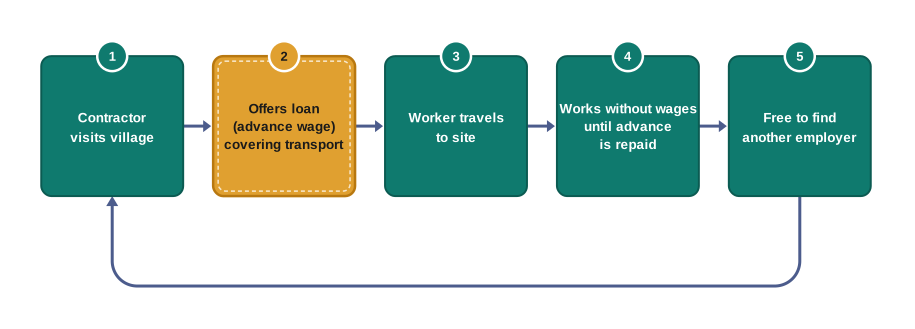
Fig. 5.5 – Recruitment of casual labour.
You may find this uncomfortably familiar. In the past, agricultural labourers were tied to their landlord by debt, and could not leave. Debt did the work that a chain would have done.
So has anything changed? NCERT’s answer is careful. By moving to casual industrial work, the worker is still in debt — but is not bound by the other social obligations that once tied a labourer to a landlord. The relationship with the contractor is narrower. In that sense, the worker is more free in an industrial society: the contract can be broken, and another employer found.
Sometimes whole families migrate for such work, and the children help their parents. A brick kiln or a building site is therefore not only a workplace. It is where a childhood is spent.
5.5 How is Work Carried Out?
In this section we go inside the workplace. How are all the products we see around us actually manufactured? What is the relationship between managers and workers, in a factory or in an office?
India offers an extraordinary range of settings. At one end are large companies where work is automated; at the other, small home-based production, where the workshop is a corner of a room.
The manager’s problem
Strip away the job titles and the basic task of a manager is simple to state: to control workers, and to get more work out of them.
There are two main ways of making workers produce more. One is to extend the working hours. The other is to increase the amount that is produced within a given time period — to make the same hour yield more.
Mechanisation — the replacement of human effort by machines — serves the second purpose. Machinery helps to increase production. But it also creates a danger: eventually, machines will replace workers altogether.
This danger was seen from two very different directions. Both Marx and Mahatma Gandhi saw mechanisation as a threat to employment.
The worker as an extension of the machine
Workers in textile mills — one of the oldest industries in India — often described themselves as extensions of the machine.
Ramcharan, a weaver who had worked in the Kanpur cotton mills since the 1940s, described the work in terms of the body. Weaving demanded energy from every part of him at once: eyes, neck, legs, hands, all moving together under a continuous gaze that could never leave the loom. When four machines were running, all four had to move together — and none of them could be allowed to stop.
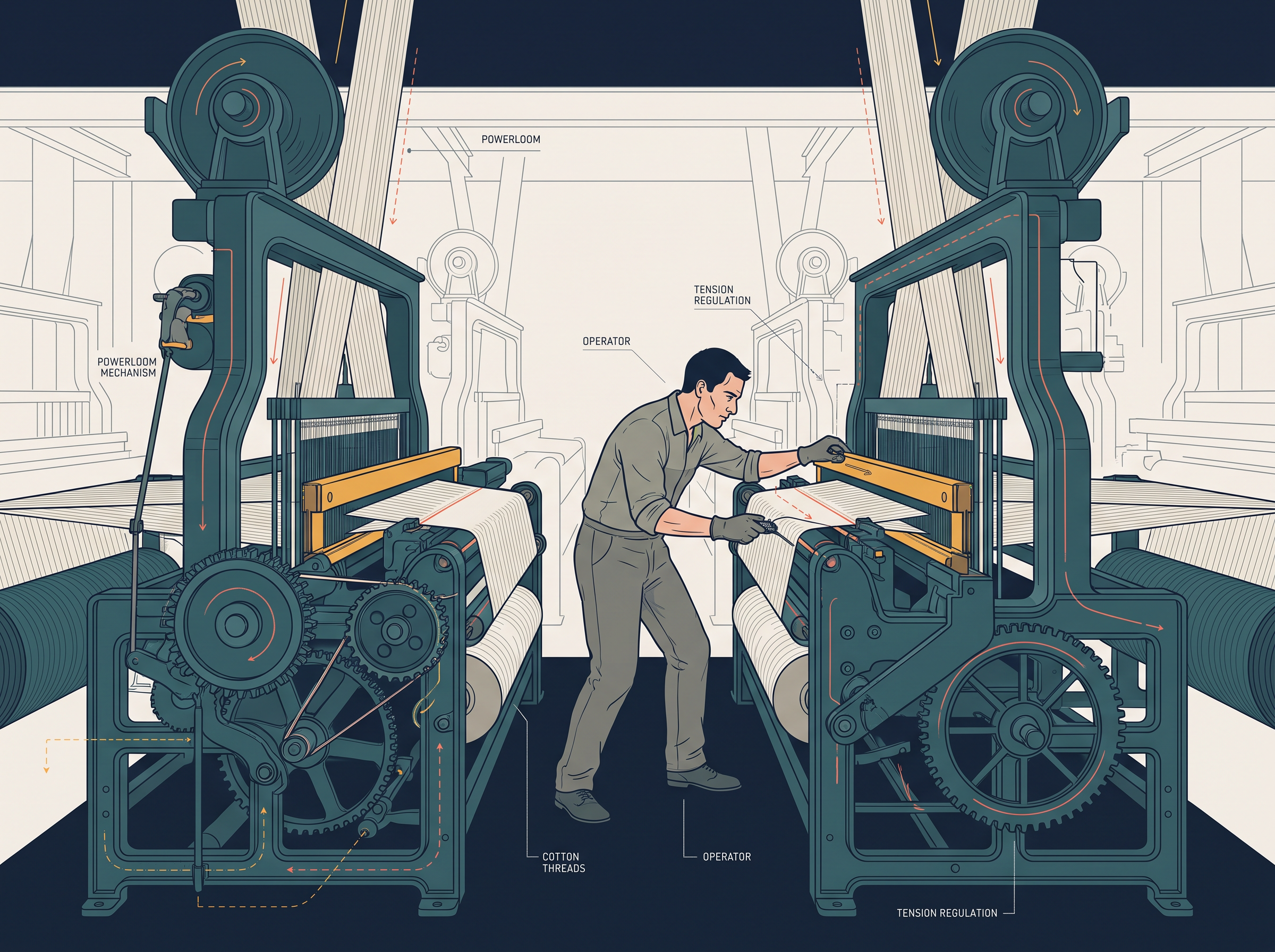
Fig. 5.6 – A weaver at work in a cotton mill.
Read that description again and notice what has happened to the relationship between the worker and the machine. The machine is not a tool that the worker picks up and puts down. The worker has become the part of the machine that happens to be made of flesh.
Speed, exhaustion, and just-in-time
The more mechanised an industry gets, the fewer people it employs — and those who remain must work at the pace of the machine.
At Maruti Udyog Ltd., two cars roll off the assembly line every minute. Workers get only 45 minutes of rest in the entire day: two tea breaks of 7.5 minutes each and one lunch break of half an hour. Most of them are exhausted by the age of 40 and take voluntary retirement.
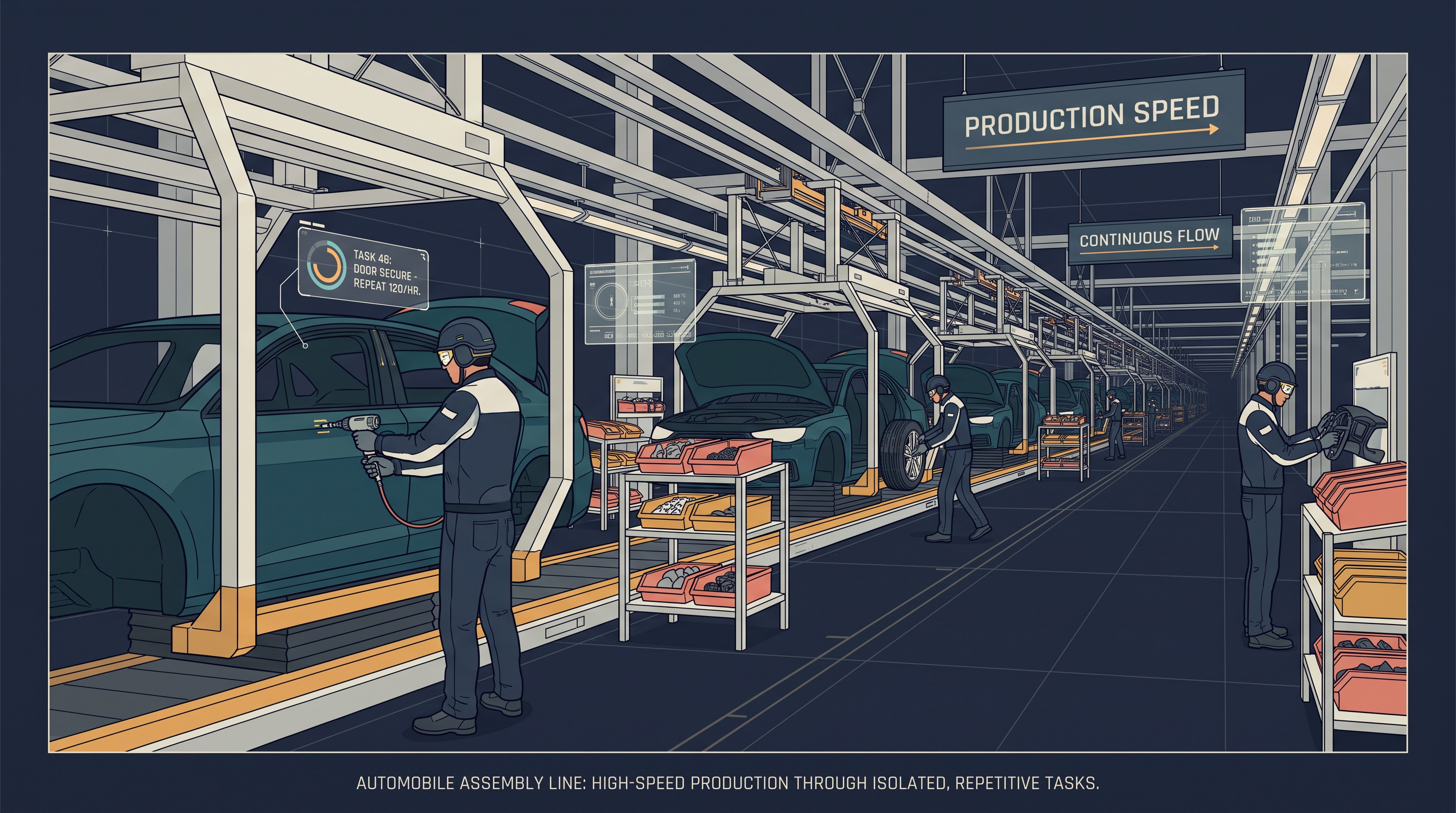
Fig. 5.7 – An automobile assembly line.
Notice the shape of the change. Production has gone up. The number of permanent jobs in the factory has gone down.
The firm has outsourced all its services — cleaning, security — as well as the manufacture of parts. The parts suppliers are located around the factory and send the parts every two hours, or just-in-time: components arrive exactly when they are needed, so that the company holds almost no stock.
For the company, outsourcing and just-in-time keep costs low. For the workers, they are a source of constant tension. If the supplies fail to arrive, their production targets get delayed; and when the supplies do arrive, they have to run to keep up. No wonder they get exhausted. The efficiency of the system is paid for out of the worker’s nerves.
Does the office escape the machine?
Now let us look at the services sector, and at its most admired workers. Software professionals are middle class and well educated, and their work is supposed to be self-motivated and creative — the opposite of the assembly line.
Yet their work too is subject to Taylorist labour processes: work broken down into measured, standardised, timed tasks, planned in advance by management and closely monitored, so that the pace and method of work are decided somewhere other than by the person doing it.
When work reorganises the family
Working hours of this kind do not stop at the office door.
In places like Bengaluru, Hyderabad and Gurugram, where many IT firms and call centres are located, shops and restaurants have changed their opening hours and stay open late. A city’s rhythm is reset by the shifts of its workers.
Households have been reorganised too. If both husband and wife work, children have to be put in crèches. And here is a genuine sociological surprise: the joint family, which was supposed to have disappeared with industrialisation, seems to have re-emerged — because grandparents are roped in to help with the children.
This is worth pausing on. The classical expectation was that industry would dissolve the extended family into small nuclear households. In India, the demands of industrial work have instead given the older generation a new function. Modern work has not destroyed the joint family; it has found a use for it.
Does industry make a society more skilled?
One important debate in sociology is whether industrialisation, and the shift to services and knowledge-based work like IT, leads to greater skills in society. We often hear the phrase knowledge economy used to describe the growth of the IT sector in India.
But how would you compare skills across such different worlds? A farmer knows how to grow many hundreds of crops, reading the weather, the soil and the seeds. A software professional knows how to build a system. Both are skilled, but in quite different ways — and the moment we call one of them “skilled work” and the other merely “manual”, we have made a judgement rather than an observation.
The sociologist Harry Braverman goes further, and argues that the use of machinery actually deskills workers. Earlier, architects and engineers had to be skilled draughtsmen; now the computer does a great deal of that work for them.
5.6 Working Conditions
We all want electric power, a solid house, clothes and other goods. It is easy to forget that each of these reaches us because someone is working to produce it — and often working in very bad conditions.
The government has passed a number of laws to regulate working conditions. Whether those laws reach the worker is a separate question, and it is the question this section is really about.
Mining: the law and the reality
Take mining, where a large number of people are employed. Coal mines alone employ 5.5 lakh workers.
So the protection exists on paper. What happens to it in practice?
These rules may be followed in big companies. They are not followed in smaller mines and quarries. And sub-contracting — the practice of a company passing work on to a contractor, who may pass it on again — is widespread.
That practice has a specific and devastating consequence. Many contractors do not maintain proper registers of workers. If there is no register, there is no proof that a person ever worked there; and if there is no proof, no one is responsible for their accidents or their benefits.
There is a further obligation that goes unmet. After mining has been finished in an area, the company is supposed to cover up the open holes and restore the land to its earlier condition. They do not do this. The land, like the worker, is used and left.
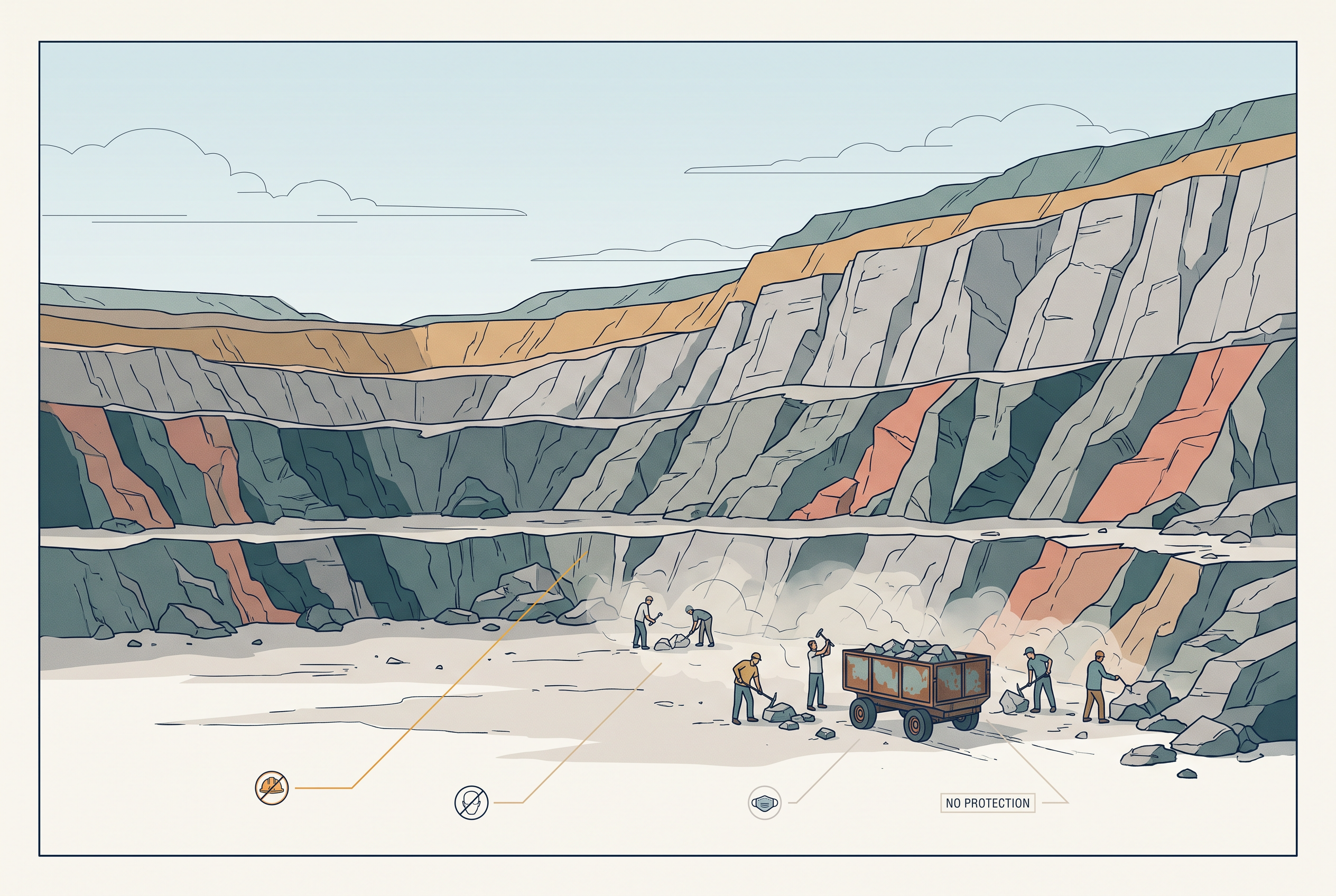
Fig. 5.8 – An open quarry and manual stone loading.
What the work does to the body
Workers in underground mines face very dangerous conditions: flooding, fire, the collapse of roofs and sides, the emission of gases, and failures of ventilation.
The damage is not only sudden. Many workers develop breathing problems and diseases such as tuberculosis and silicosis — an incurable lung disease caused by years of breathing fine dust. The injury arrives slowly, over a working life, and shows up long after the shift has ended.
Those working in overground mines are exposed to the hot sun and the rain, and face injuries from mine blasting and falling objects.
The overall picture is stark: the rate of mining accidents in India is very high compared to other countries.
The migrant worker
In many industries, the workers are migrants.
The fish processing plants along the coastline employ mostly single young women, from Tamil Nadu, Karnataka and Kerala. Ten or twelve of them are housed together in small rooms, and sometimes one shift has to make way for another in the same room — the bed is occupied continuously even when the woman in it changes.
Employers hire them, in part, because young women are seen as submissive workers. That belief is worth naming for what it is: an assumption about gender that is useful to an employer, not a fact about young women.
Many men also migrate singly, either unmarried, or leaving their families behind in the village. These migrants have little time to socialise, and the little time and money they can spend is spent with other migrant workers.
Here we return to a theme from the beginning of this chapter. From a nation of interfering joint families, the nature of work in a globalised economy is taking people in the direction of loneliness and vulnerability.
And yet the same movement carries something else with it. For many young women, migration for work also represents some independence and economic autonomy — a wage of one’s own, and a distance from the household that decided everything.
5.7 Home-based Work
Not all industrial work happens in factories. A great deal of it happens in rooms where people also cook, sleep and raise children.
Home-based work is an important part of the economy. It includes the manufacture of lace, zari or brocade, carpets, bidis, agarbattis and many such products. This work is mainly done by women and children.
The arrangement is simple. An agent provides the raw materials and later picks up the finished product. The home workers are paid on a piece-rate basis — that is, according to the number of pieces they make.
Think about what a piece rate does. It shifts every risk onto the worker. If the light fails, if a child falls ill, if the raw material is poor, the hours are still spent — but nothing is earned for them.
Following a bidi from the forest to the pan shop
The bidi industry shows how long the chain behind a home-based worker can be.
The process begins in forested villages, where villagers pluck tendu leaves and sell them to the forest department, or to a private contractor who in turn sells them to the forest department. On an average day, a person can collect 100 bundles of 50 leaves each.
The government then auctions the leaves to bidi factory owners, who give them to the contractors. The contractor, in turn, supplies both the tobacco and the leaves to home-based workers.
These workers, mostly women, roll the bidis. They first dampen the leaves, then cut them, then fill in the tobacco evenly, and finally tie each bidi with thread. It is skilled work, done with the fingers, and it is paid by the piece.
The contractor picks up the finished bidis and sells them to the manufacturer, who roasts them and puts his own brand label on them. The manufacturer sells them to a distributor, who distributes the packed bidis to wholesalers, who in turn sell them to your neighbourhood pan shop.
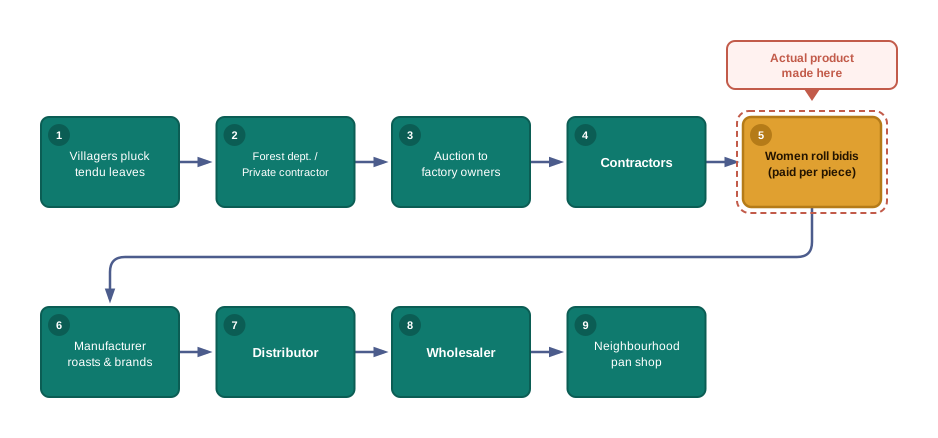
Fig. 5.9 – The bidi supply chain.
Now count the hands the bidi passes through, and ask which of them is paid least, and which one carries the brand name. The woman who made the product is the only person in this chain who is not an employee of anyone, has no register, no wage, no benefit — and whose name appears nowhere on the packet.
5.8 Strikes and Unions
We have seen how much power an employer holds over an individual worker. A single worker who protests can simply be replaced. The one resource workers have is each other — and the strike is the sharpest form that collective action takes.
In response to harsh working conditions, workers have sometimes gone on strike.
Why calling a strike is so hard
To call a strike is a difficult decision, and it is worth understanding why.
Managers may try to use substitute labour. In a country where a very large number of people are looking for work, there is almost always someone willing to take the striking worker’s place.
And the workers themselves find it hard to sustain themselves without wages. A strike is a contest in which the employer loses profit and the worker loses food. The two sides are not losing the same thing.
The Bombay Textile strike of 1982
The most famous strike in modern Indian industrial history began in Mumbai in 1982.
Led by the trade union leader Dr. Datta Samant, the Bombay Textile strike affected nearly a quarter of a million workers and their families. It lasted nearly two years.
The demands were two. The workers wanted better wages. They also wanted the right to form their own union — that is, they were fighting not only over pay but over the question of who would be allowed to represent them at all.
Slowly, after two years, people started going back to work, because they were desperate. Hunger, in the end, decided the matter.
The consequences were enormous. Nearly one lakh workers lost their jobs. Some went back to their villages; some took up casual labour. Others moved to smaller towns such as Bhiwandi, Malegaon and Icchalkaranji, to work in the powerloom sector — where the mills were smaller, the wages lower, and unions almost absent.
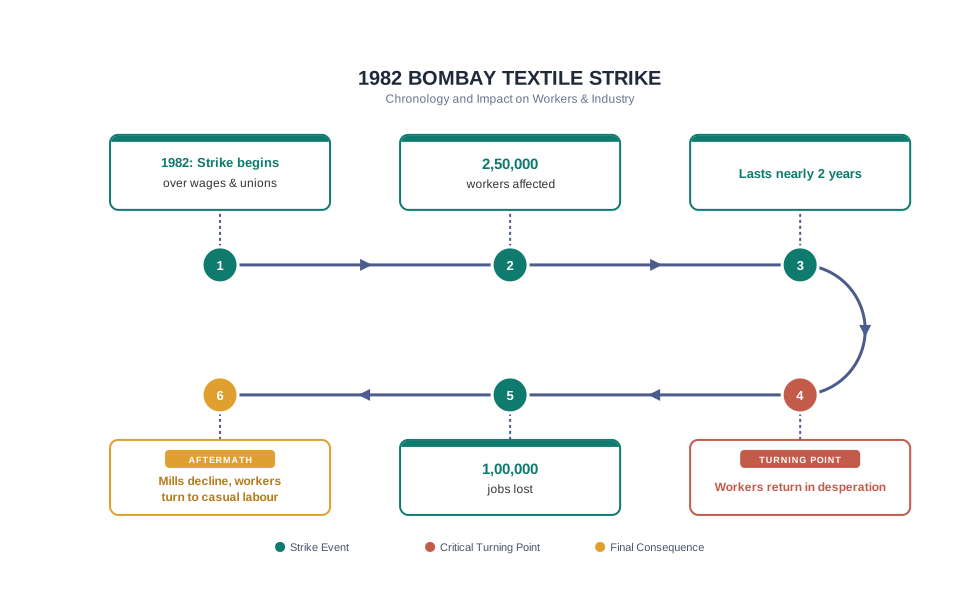
Fig. 5.10 – Timeline of the Bombay Textile strike.
Notice what the strike did to the industry itself. The mill owners did not invest in machinery and modernisation. The mills that the workers had struck against slowly stopped being places of production at all.
Who owns the future of a city?
Today the mill owners are trying to sell off the mill land to real estate dealers, to build luxury apartments.
This has led to a battle over who will define the future of Mumbai: the workers who built the city, or the mill owners and the real estate agents.
That question — who gets to decide — is where this chapter has been heading all along. Work is not only how goods are made. It is how a society settles who counts.
5.9 Summary
Work, industry and social life (5.1)
Work is not only how people earn; it is a large part of who they are. A film industry, like any other industry, has workers, unions, products and markets.
A modern city divides people — by where they live, what they eat, what they wear — and at the same time gives them a common life: the same films, the same cricket, the same polluted air, the same hopes for their children.
Influence runs both ways. Technology and the kind of work available reshape social relations; and social institutions such as caste, kinship, gender and region shape how work is organised and how products are sold.
Sociologists therefore ask who produces what, who works where, and who sells to whom. What look like individual choices — a woman’s entry into nursing, a package showing two coffee cups — follow social patterns.
Images of industrial society (5.2)
Sociology grew up alongside industrialisation. Marx, Weber and Durkheim linked industry with urbanisation, and with the replacement of known, face-to-face rural relationships by anonymous professional ones.
Industrialisation involves a detailed division of labour: a worker makes one small part and never sees the finished product. Work becomes repetitive and exhausting — though still preferable to unemployment.
Marx called this condition alienation: work is endured only in order to survive, and even survival depends on whether technology still has room for human labour.
Industry brings some equality (caste distinctions cannot be enforced on a train or in a cyber cafe) but older discriminations persist in new workplaces, and income inequality is growing.
Clark Kerr’s convergence thesis holds that industrial societies come to resemble one another. Its weakness is that it underestimates how culture shapes the way people take up new technology.
Industrialisation in India (5.3)
There is no single model of industrial capitalism; India’s path is its own, not a delayed western one.
In 2018–19, nearly 43% of Indian workers were in the primary sector, 17% in the secondary and 32% in the tertiary. Yet agriculture’s share of economic growth has fallen sharply and services contribute more than half. The sector employing most people generates least income for them.
Over 52% of workers are self-employed, about 24% are regular salaried and about 24% are casual labour. Between 1972–73 and 2018–19 self-employment fell and salaried work rose, but casual labour barely changed.
The organised sector consists of units employing ten or more people through the year, registered with the government, with wages, pension and benefits. Over 90% of Indian work is unorganised.
Three consequences follow: most Indians work in small workplaces where personal relationships, not rules, decide everything; secure jobs are scarce, and two-thirds of those who hold them work for the government; and very few workers are unionised, so the laws meant to protect informal workers are rarely enforced.
Since the 1990s, liberalisation has opened sectors to private and foreign investment and removed licensing. Many Indian firms have been bought by multinationals — Parle drinks by Coca Cola, whose advertising budget alone exceeded Parle’s entire turnover.
Disinvestment and privatisation have shrunk secure public employment; in Modern Foods, 60% of workers were forced to retire within five years of privatisation.
Outsourcing and contract labour spread everywhere, keeping wages low and making unions hard to build. Liberalisation and privatisation appear to be associated with rising income inequality.
Land acquisition for industry displaces farmers and adivasis, who form about 40% of those displaced, often without local jobs in return.
How people find jobs (5.4)
Very few jobs come through advertisements or the employment exchange. The self-employed rely on personal contacts and reputation; mobile phones have widened that circle.
Factory recruitment once ran through jobbers — the mistris of the Kanpur mills — who were workers themselves, backed by the owner, and able to use community pressure on those they hired.
Badli workers substitute for absent permanent workers, sometimes for years, without ever gaining permanent status. This is contract work inside the organised sector.
Employment has two components: a job in an organisation (casual or regular salaried) and self-employment. Schemes such as MUDRA, Aatmanirbhar Bharat and Make in India aim to generate both.
Casual labour is recruited by contractors who visit villages and give an advance that must be worked off. The old bond of debt to a landlord has become a narrower, monetary tie to a contractor — freer in one sense, but still deeply unequal.
How is work carried out? (5.5)
A manager’s basic task is to control workers and raise output, either by extending hours or by producing more within the same time. Mechanisation serves the second aim — and threatens jobs. Both Marx and Gandhi saw it as a danger to employment.
Textile mill workers described themselves as extensions of the machine, their pace set entirely by the loom.
At Maruti Udyog Ltd., two cars leave the line every minute and workers get 45 minutes of rest in a whole day; most are exhausted by 40. Production rose while permanent jobs fell, as services and parts were outsourced and supplied just-in-time.
Even software work, supposed to be creative, follows Taylorist labour processes. Long hours are built into the IT industry’s culture through time differences, underestimated project timelines and ‘flexi-time’.
Such hours reshape cities and households: shops stay open late, children go to crèches, and the joint family reappears as grandparents are drawn in to help.
Braverman argues that machinery deskills workers — the draughtsman’s skill now sits in the computer. Others reply that new skills are created. What counts as skill, and whose skill is recognised, is itself in dispute.
Working conditions (5.6)
The Mines Act 1952, now part of the Occupational Safety, Health and Working Condition Code, 2020, sets maximum weekly hours, overtime and safety rules. Coal mines alone employ 5.5 lakh workers.
Big companies may follow the rules; small mines and quarries do not. Widespread sub-contracting means many contractors keep no register — and a worker who is not recorded cannot claim protection or compensation.
Underground mining brings flooding, fire, roof collapse, gas and ventilation failure, and diseases such as tuberculosis and silicosis; overground work brings heat, rain and injury from blasting. India’s rate of mining accidents is very high.
Many industrial workers are migrants. Fish processing plants employ mostly single young women, housed ten or twelve to a room, and hired partly because they are assumed to be submissive.
Migration pulls people away from joint families towards loneliness and vulnerability — and yet, for many young women, also towards independence and economic autonomy.
Home-based work (5.7)
Home-based work — lace, zari, carpets, bidis, agarbattis — is a substantial part of the economy and is done mainly by women and children. An agent supplies materials and collects the product; payment is by piece-rate.
The bidi chain runs from tendu leaves plucked in forest villages, through the forest department and a government auction, to factory owners, contractors, home-based women who roll the bidis, the manufacturer who brands them, and finally the neighbourhood pan shop.
The person who actually makes the product is the one with no register, no wage and no name on the packet.
Strikes and unions (5.8)
In a strike, workers refuse to work; in a lockout, management shuts them out. Striking is costly: employers can use substitute labour, while workers must live without wages.
The Bombay Textile strike of 1982, led by Dr. Datta Samant, involved nearly a quarter of a million workers and lasted almost two years. Workers wanted better wages and the right to form their own union.
Nearly one lakh workers eventually lost their jobs, returning to villages, casual work, or the powerloom towns of Bhiwandi, Malegaon and Icchalkaranji. Owners did not modernise the mills.
The mill lands are now sought by real estate developers, raising a question the chapter leaves open: who defines the future of a city — the workers who built it, or those who own its land?
5.10 Key Terms
Alienation — Marx’s term for the condition in which people do not enjoy their work and endure it only in order to survive, while even that survival depends on whether technology still has room for human labour.
Badli worker — a worker employed to substitute for a regular permanent worker who is on leave, often for years together, without ever receiving the status or security of a permanent employee.
Casual wage labour — work hired by the day or by the task, with no assurance of employment the following day.
Contract work — work done for an organisation through a contractor or on a temporary basis, so that the worker lacks the status, security and benefits of a permanent employee.
Convergence thesis — Clark Kerr’s claim that as societies industrialise they come to resemble one another more than they resemble their own past.
Demographic dividend — the economic advantage a country may enjoy when a large share of its population is of working age.
Deskilling — Braverman’s argument that the use of machinery strips skill from the worker and transfers it into the machine and the manager’s plan.
Disinvestment — the government selling off part of its shareholding in a public sector company.
Division of labour — the splitting of production into many small, separate, specialised tasks, so that each worker makes only one part of a product.
Globalisation — the growing interconnection of economies and societies across the world.
Home-based work — production carried out in the worker’s own home, using materials supplied by an agent who collects the finished product; common in lace, zari, carpets, bidis and agarbattis.
Industrialisation — the process by which machine-based production in factories becomes the dominant form of economic activity.
Jobber — an intermediary who recruited workers for factory owners, known in the Kanpur textile mills as the mistri.
Just-in-time — a system in which parts are delivered exactly when they are needed on the production line, so that the firm holds almost no stock.
Knowledge economy — a phrase used to describe an economy in which growth comes from knowledge-based work such as the IT sector.
Liberalisation — the policy, followed in India since the 1990s, of removing licensing and opening sectors of the economy to private and foreign investment.
Lockout — the closing of the workplace by management, preventing workers from entering.
Mechanisation — the replacement of human effort by machines in the process of production.
Mistri — the jobber of the Kanpur textile mills; himself a worker, from the same region and community as those he recruited, but backed by the owner.
Multinational company — a firm that owns and operates businesses in more than one country.
Organised (formal) sector — units employing ten or more people throughout the year, registered with the government and required to provide proper wages, pension and other benefits.
Outsourcing — a company giving out part of its work — services, or the making of parts — to smaller firms or to home-based workers, instead of employing people to do it.
Piece-rate — payment based on the number of items a worker produces rather than on the hours worked.
Primary sector — agriculture and mining; work that draws directly on nature.
Privatisation — the transfer of ownership and control of a public sector enterprise to private hands.
Regular salaried employment — a fixed job in which a wage is paid at fixed intervals.
Secondary sector — manufacturing, construction and utilities; work that transforms raw materials into goods.
Self-employment — working for oneself rather than for an employer.
Social institution — an established pattern of social organisation, such as caste, kinship, gender or region, which shapes how work is organised and how products are marketed.
Strike — the collective refusal of workers to go to work, in order to press a demand upon the employer.
Sub-contracting — the passing on of work by a company to a contractor, who may pass it on again, so that responsibility for the worker becomes difficult to fix.
Taylorist labour process — a way of organising work in which tasks are broken into small, standardised, measured units whose timing and method are set and supervised by management.
Tertiary sector — services, such as trade, transport and financial services.
Trade union — an organisation of workers formed to protect and improve their wages, hours and conditions of work by acting collectively.
Unorganised (informal) sector — the very large part of the economy — over 90% of Indian work — that lies outside registered units, where wages, hours and security are not guaranteed.
Urbanisation — the growth of towns and cities as people move from the countryside, often in search of work.
5.11 Points to Ponder
If a badli worker has done the same job in the same factory for fifteen years, in what sense is that work still “temporary” — and what does the answer tell us about how security at work is actually decided?
Clark Kerr expected industrial societies to grow more alike. Yet in Indian cities the joint family has reappeared because grandparents are needed to mind the children of working couples. Does this mean technology adapts to culture, or that culture is quietly being reorganised by technology?
A farmer who can read the soil, the seed and the sky is rarely called “skilled”, while a software engineer always is. Who decides what counts as skill, and what is at stake in that decision?
Machines make work faster, and faster work exhausts the people who do it. Why does higher productivity so often arrive together with greater tiredness rather than greater leisure?
A woman who rolls bidis at home for ten hours a day is often described as “helping the family”. If the same hours were spent in a factory, no one would describe it that way. What makes work visible as work?
Migration for industrial work has been described as bringing both loneliness and independence to young women workers. Can a single social change be genuinely liberating and genuinely damaging at the same time — and how would a sociologist decide which effect weighs more?
When a mill closes and its land becomes valuable, whose claim on that land should a sociologist take seriously — and what kinds of evidence would help you judge?
5.12 NCERT Questions
Choose any occupation you see around you, and describe it along the following lines: (a) the social composition of the workforce — caste, gender, age and region; (b) the labour process — how the work actually takes place; (c) wages and other benefits; (d) working conditions — safety, rest times, working hours, and so on. Use what you can observe, or what is available in newspapers and published reports.
How has liberalisation affected employment patterns in India?
5.13 Objective Questions
- Alienation, as Marx used the term, refers to a situation in which:
- a worker migrates to a city far from home
- a worker does not enjoy work and does it only in order to survive
- a worker is dismissed from a factory without notice
- a worker is not allowed to join a trade union [1 mark]
- According to one definition, the organised sector consists of all units employing:
- five or more people throughout the year
- ten or more people throughout the year
- twenty or more people throughout the year
- fifty or more people throughout the year [1 mark]
- In India in 2018–19, the share of employment in agriculture was:
- 12.1%
- 23.8%
- 42.5%
- 52.1% [1 mark]
- The convergence thesis was put forward by:
- Harry Braverman
- Clark Kerr
- Carol Upadhya
- Emile Durkheim [1 mark]
- In the Kanpur textile mills, the jobbers who recruited workers were known as:
- badli workers
- mistris
- tendu collectors
- draughtsmen [1 mark]
- “Just-in-time” in an automobile factory means that:
- workers must clock in exactly on time
- parts are delivered only as and when they are needed on the line
- production targets are announced at the start of each shift
- wages are paid on the last working day of the month [1 mark]
- Home-based workers who roll bidis or make lace are paid:
- a monthly salary
- a daily wage
- on a piece-rate basis
- an annual bonus [1 mark]
- Assertion (A): Very few Indian workers have the experience of collectively fighting for proper wages and safe working conditions. Reason (R): Union membership is a feature of the organised sector, and over 90% of work in India is in the unorganised sector.
- Both A and R are true, and R is the correct explanation of A
- Both A and R are true, but R is not the correct explanation of A
- A is true, but R is false
- A is false, but R is true [1 mark]
- Assertion (A): In Indian cities where many IT professionals work, the joint family appears to have re-emerged. Reason (R): Long and irregular working hours mean that grandparents are drawn in to help look after children.
- Both A and R are true, and R is the correct explanation of A
- Both A and R are true, but R is not the correct explanation of A
- A is true, but R is false
- A is false, but R is true [1 mark]
- Assertion (A): Laws on working hours and safety often fail to protect workers in small mines and quarries. Reason (R): Sub-contracting is widespread, and many contractors do not maintain proper registers of workers.
- Both A and R are true, and R is the correct explanation of A
- Both A and R are true, but R is not the correct explanation of A
- A is true, but R is false
- A is false, but R is true [1 mark]
- Assertion (A): The number of permanent jobs at Maruti Udyog Ltd. has fallen even though production has risen. Reason (R): The firm has outsourced services and the manufacture of parts, and increased mechanisation.
- Both A and R are true, and R is the correct explanation of A
- Both A and R are true, but R is not the correct explanation of A
- A is true, but R is false
- A is false, but R is true [1 mark]
- Match the following:
| Column A | Column B |
|---|---|
| a. Karl Marx | i. the deskilling of workers by machinery |
| b. Clark Kerr | ii. ‘time slavery’ in the IT sector |
| c. Harry Braverman | iii. alienation |
| d. Carol Upadhya | iv. the convergence thesis |
[1 mark]
- Match the following:
| Column A | Column B |
|---|---|
| a. Disinvestment | i. management shuts the gate and keeps workers out |
| b. Lockout | ii. a worker who substitutes for a permanent worker on leave |
| c. Badli | iii. payment according to the number of items produced |
| d. Piece-rate | iv. the government selling its share in a public sector company |
[1 mark]
- Fill in the blanks:
- The Mines Act ________ has now been included in the Occupational Safety, Health and Working Condition Code, 2020.
- Parle drinks was bought over by ________.
- The Bombay Textile strike of 1982 was led by the trade union leader ________. [1 mark]
- State whether the following are true or false:
- In a lockout, workers collectively refuse to come to work.
- Coal mines alone employ 5.5 lakh workers.
- In India, the majority of workers are in regular salaried employment.
- Adivasis constitute approximately 40% of those displaced by land acquisition for industry. [1 mark]
5.14 Check Your Concepts
Define alienation as Marx used the term. [2 marks]
What is meant by piece-rate payment? Give one example of work that is paid in this way. [2 marks]
Name the two components of employment opportunities mentioned in the chapter. [2 marks]
What is disinvestment? Name the first company to be privatised in India, as mentioned in the chapter. [2 marks]
State any two features of the organised sector. [2 marks]
Differentiate between the organised and the unorganised sector on any four points. [4 marks]
Differentiate between a strike and a lockout. Why is calling a strike such a difficult decision for workers? [4 marks]
Explain, with an example, how sub-contracting weakens the protection that labour laws are meant to provide. [4 marks]
Study the table below and answer the questions that follow.
Employment status 1972–73 2018–19 Self-employed 61.4 52.1 Regular salaried employees 15.4 23.8 Casual wage labour 23.2 24.1 - Which category has changed the most, and which has changed the least?
- What does the near-constant share of casual wage labour over nearly fifty years suggest about the security of work in India? [4 marks]
In 2018–19, 42.5% of Indian workers were employed in agriculture and 12.1% in manufacturing. Roughly how many times larger was the agricultural workforce than the manufacturing workforce? Read this figure alongside the sharp decline in agriculture’s share of economic growth, and explain why sociologists call this a serious situation. [4 marks]
Describe how a contractor recruits casual labour from a village. In what sense is such a worker “more free” than the indebted agricultural labourer of the past — and in what sense is that freedom limited? [4 marks]
Trace the labour process in the bidi industry, from the plucking of tendu leaves to the neighbourhood pan shop. At which point is the product actually made, and how is that worker paid? [4 marks]
Why do the self-employed — from plumbers to freelance photographers — depend so heavily on personal contacts to find work? What difference have mobile phones made? [4 marks]
Explain the convergence thesis. Evaluate it with Indian examples, and state one important limitation of the argument. [6 marks]
“Industrialisation reduces some inequalities while deepening others.” Discuss this claim with reference to caste, gender and income, using examples from the chapter. [6 marks]
Discuss the social implications of the small size of India’s organised sector. Explain all three consequences set out in the chapter. [6 marks]
How far do you agree that the shift to services and knowledge-based work has raised the skill level of Indian society? Present both sides of the debate, including Braverman’s argument, before stating your own reasoned position. [6 marks]
Describe the causes and the consequences of the Bombay Textile strike of 1982. What does its aftermath tell us about the balance of power between workers and employers? [6 marks]
5.15 Passage-Based Questions
A tailoring unit in a small town has eight workers, all of whom were hired because someone in the unit knew them or their families. There is no written contract and no register of employment. Wages are decided by the owner and handed over in cash each week; a worker who has been useful may be given a little extra before a festival, and a worker who argues with the owner may be told not to come the following day. None of the eight belongs to any union, and none has heard of a place to take a complaint.
- Identify the sector of the economy this unit belongs to, and give two features from the passage that support your answer. [2 marks]
- The chapter says that in such workplaces “personal relationships determine many aspects of work”. Explain how the passage illustrates this. [2 marks]
- What difference would well-defined rules of recruitment and redressal make to these workers? [2 marks]
An electronics factory on the edge of a city assembles television sets. Its machines are new and fast, and output has doubled in five years, but the number of workers on the company’s own rolls has fallen. Cleaning, canteen and security work is now handled by a contractor. Components arrive from small suppliers nearby every two hours, exactly as they are needed, and the company keeps almost no stock. When a supplier’s truck is delayed, the assembly workers must make up the lost time by working faster once it arrives.
- Name and explain the system of parts delivery described in the passage. [2 marks]
- Explain how this factory has raised its output while employing fewer permanent workers. [2 marks]
- The passage says the workers “must make up the lost time”. Whose interest does this arrangement serve, and what does it cost the worker? [2 marks]
In a lane of a small town, several women spend the day doing fine embroidery on cloth. An agent brings the cloth and thread each week and takes away the finished pieces, paying for each piece completed. There are no fixed hours; the work is fitted around cooking, cleaning and caring for children, and in the evenings the older daughters help. When neighbours are asked what these women do, they say the women are at home and are helping the family. The embroidered cloth is later stitched, labelled and sold in city showrooms at many times the price paid to the women.
- Identify the type of work described and the basis on which it is paid. [2 marks]
- Explain why this work is described as “helping the family” rather than as employment. [2 marks]
- Using the passage, explain one reason why such workers find it very hard to bargain for better rates. [2 marks]
A stone quarry employs about forty people, but the register kept on the site lists only twelve names. The rest were brought by a sub-contractor from villages some distance away; each was given an advance that covered the cost of the journey, and the advance is being worked off. The quarry is required by law to observe limits on working hours and to follow safety rules. When an inspector visits, the sub-contractor produces the register, and the inspection is completed in twenty minutes.
- Identify two practices in the passage that place these workers outside the protection of the law. [2 marks]
- Explain the role played by the advance given to the workers. [2 marks]
- “A law protects a recorded worker.” Using the passage, explain why a law can exist and still not reach the person it was written for. [2 marks]