Chapter 2: Cultural Change
In 1914, a motor car arrived at the railway station in Dehra Dun, and the town came out to look at it.
The story begins with a bicycle. The first bicycle ever seen in that hill town had arrived dismantled, packed in a box, and was put together by a man named Alfred Massey. The excitement it caused was so great that Massey decided to go one better and bring in a Ford Model T — the first car the local people had ever seen. When word spread that it was coming, people travelled in by train and by bullock cart simply to be present. A crowd gathered at the station to watch the “engine” with its rubber tyres being unloaded. It took an hour to fit the wheels and open the hood. The huge wooden packing case did not go to waste: a hawker bought it and turned it into a shop. Fourteen men, women and children then climbed aboard and were given their first motor ride, up the road to Massey’s garage.
Notice what is happening in that crowd. A machine has arrived, but so has a new idea of what is impressive, what is modern, what is worth travelling a day to see. Colonial rule brought India railways, printing presses and telegraph wires. It also brought new ideas — of liberty, of education, of what a marriage or a widow’s life should be — and Indians did not simply accept them. They argued with them, reworked them, and sometimes answered them by returning to their own traditions with fresh eyes. That argument is what this chapter is about.
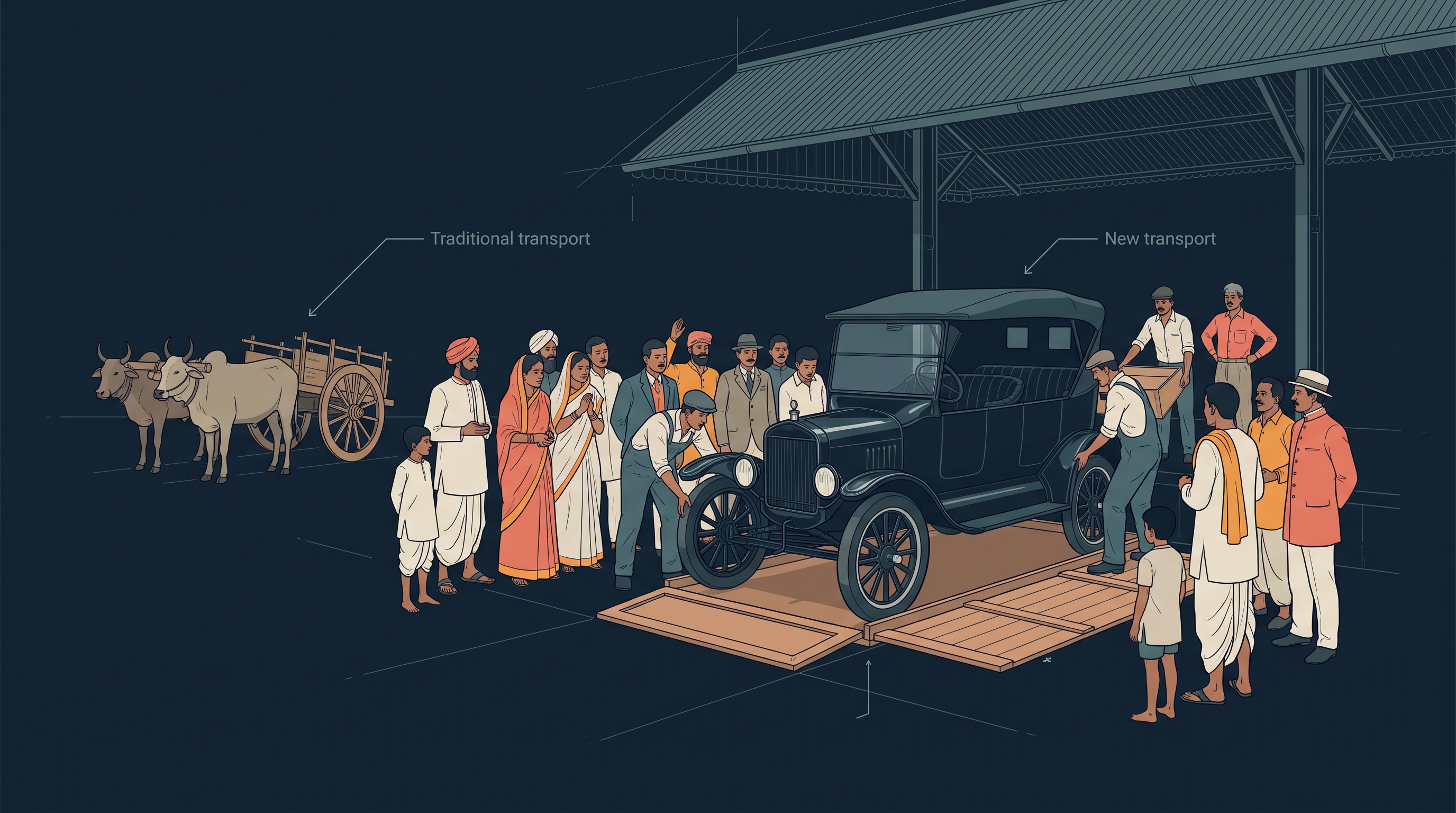
Fig. 2.1 – An early motor car arrives in a hill town.
This chapter will help you answer each of these questions.
2.1 Introduction: Structure, Culture and Colonial Change
In the last chapter you saw how colonialism altered the arrangement of Indian society itself. Industrialisation and urbanisation reorganised the lives of ordinary people. For some, factories replaced fields as the place where the working day was spent. For many, cities replaced villages as the place where life was lived.
When the place of work changes, a great deal else changes with it. A weaver who becomes a mill hand no longer works beside kin, at his own pace, in his own courtyard. He works beside strangers, to the discipline of a clock and a supervisor. Living arrangements and working arrangements — what sociologists call the structure of society — were remade.
But something less visible also shifted. Ways of life changed. So did norms, values, fashions, tastes in music, even body language — how people stood, greeted one another, sat at a table or on the floor. These are changes in culture.
Structure and culture: two ways of looking at the same society
Sociologists use two connected ideas here, and it is worth being precise about both. Social structure refers to a continuing arrangement of persons in relationships that are defined or controlled by institutions. Think of the caste order, the joint family, the factory, the school. Each of these places people in relationships that outlast the particular individuals who occupy them.
Culture, by contrast, refers to socially established norms or patterns of behaviour — the shared, learnt ways of doing, thinking, feeling and valuing that a group treats as normal.
The two developments this chapter follows
This chapter looks at two related developments. Both are complex products of the impact of colonial rule, and neither can be understood as a simple case of India “receiving” the West.
The first concerns the deliberate and conscious efforts made by nineteenth-century social reformers, and by early twentieth-century nationalists, to change social practices that discriminated against women and against ‘lower’ castes. These were intentional campaigns: people argued, wrote, petitioned and organised in order to bring a change about.
The second concerns changes that were far less deliberate but no less decisive — shifts in cultural practice that sociologists have grouped under four processes: sanskritisation, modernisation, secularisation and westernisation. Nobody sat down and planned these. They happened as millions of people responded, over generations, to a world that was being rearranged around them.
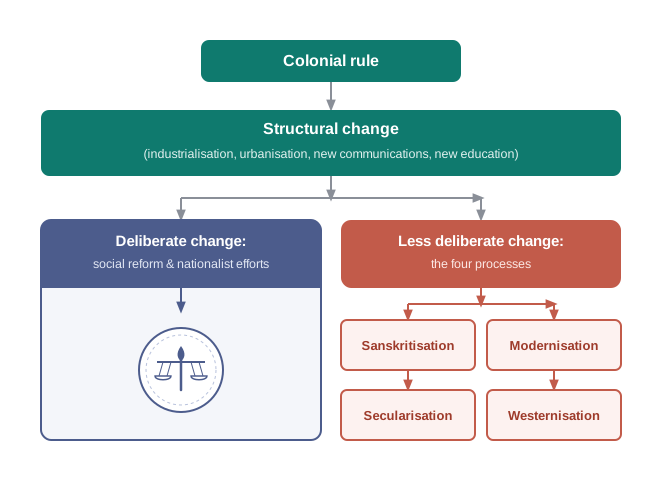
Fig. 2.2 – Colonial rule and the paths of cultural change.
One point of chronology matters here, and students often get it wrong. Of the four processes, sanskritisation pre-dates the coming of colonial rule; it was at work in Indian society long before the British arrived. The other three — modernisation, secularisation and westernisation — are better understood as the complex responses of the people of India to the changes that colonialism brought about. Each of the four is taken up in its own place later in the chapter.
The word responses is doing serious work in that sentence. A response is not the same as an imitation. As you read on, you will see Indians accepting some new ideas, rejecting others, and — most interestingly — reinterpreting their own traditions in the light of the new ideas in order to argue against the colonial ruler on his own ground.
2.3 Different Kinds of Social Change
In this chapter each of the four concepts — sanskritisation, modernisation, secularisation and westernisation — is dealt with in a separate section. That is a convenience for study, not a claim about how they work.
As the discussion unfolds it will become obvious to you that in many ways these processes overlap, and that in many situations they co-exist. In other situations they operate very differently from one another. It is not at all surprising to find the same person being modern in some ways and traditional in another.
This co-existence is often seen as natural to India, and to many other non-western countries. You may have heard it said in exactly that tone: “that’s just how we are.”
Why “it’s just natural” is not an explanation
But you know by now that sociology does not rest content with a naturalist explanation — that is, with the claim that something is simply the nature of a people and needs no further account. (Recall the discussion in Chapter 1 of the Class XI book, Introducing Sociology.) A sociologist’s next question is always: how did this come about?
And as the last chapter showed, the answer here lies in history. Colonial modernity — modernity as it arrived in India, under foreign rule rather than through internal transformation — had its own paradoxes built into it.
Take the example of western education. Colonialism led to the growth of an English educated Indian middle class. Its members read the thinkers of the western enlightenment and the philosophers of liberal democracy, and they dreamt of ushering in a liberal and progressive India. And yet, humiliated by colonial rule, these same people asserted their pride in traditional learning and scholarship. You have already seen this trend at work in the nineteenth century reform movements.
So the co-existence of the modern and the traditional in one person is not a national peculiarity. It is the predictable result of a particular history, in which the ideas of freedom and equality arrived in the baggage of a ruler who denied both.
Culture and tradition are living things
As this chapter will show, modernity spelled not merely new ideas but also a rethinking and reinterpretation of tradition. Both culture and tradition are living entities. People learn them, and in turn modify them.
Take the everyday example of how the sari, the jain sem or the sarong is worn in India today. Traditionally the sari — a loose unstitched piece of cloth — was worn differently in different regions. The standard way in which the modern middle class woman wears it is a novel combination of the traditional sari with the western ‘petticoat’ and ‘blouse’.
Look closely at that garment. It is neither traditional nor western. It is a new thing, made by joining the two, and it is now so ordinary that nobody notices the join.
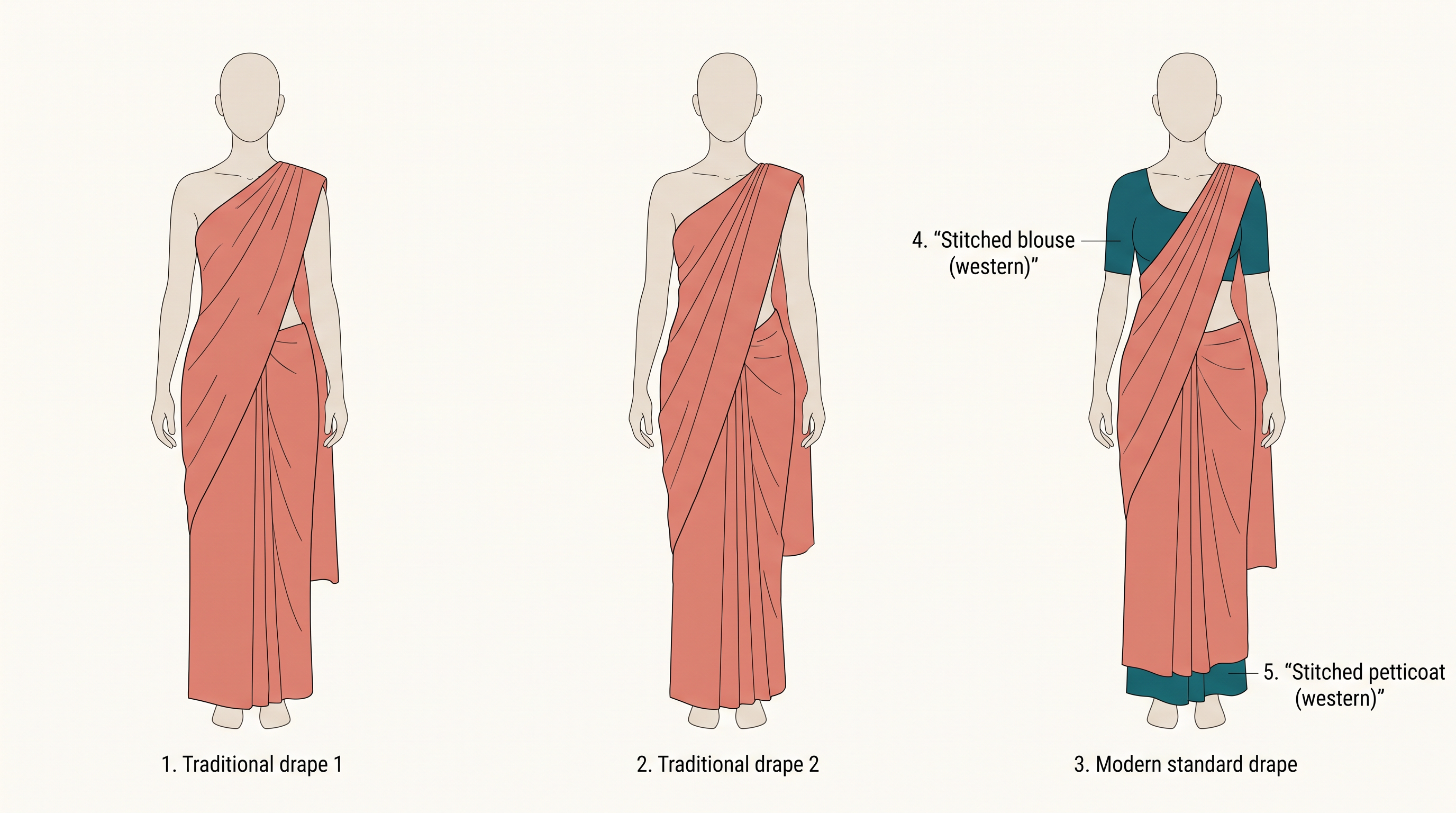
Fig. 2.6 – The modern sari as a hybrid garment.
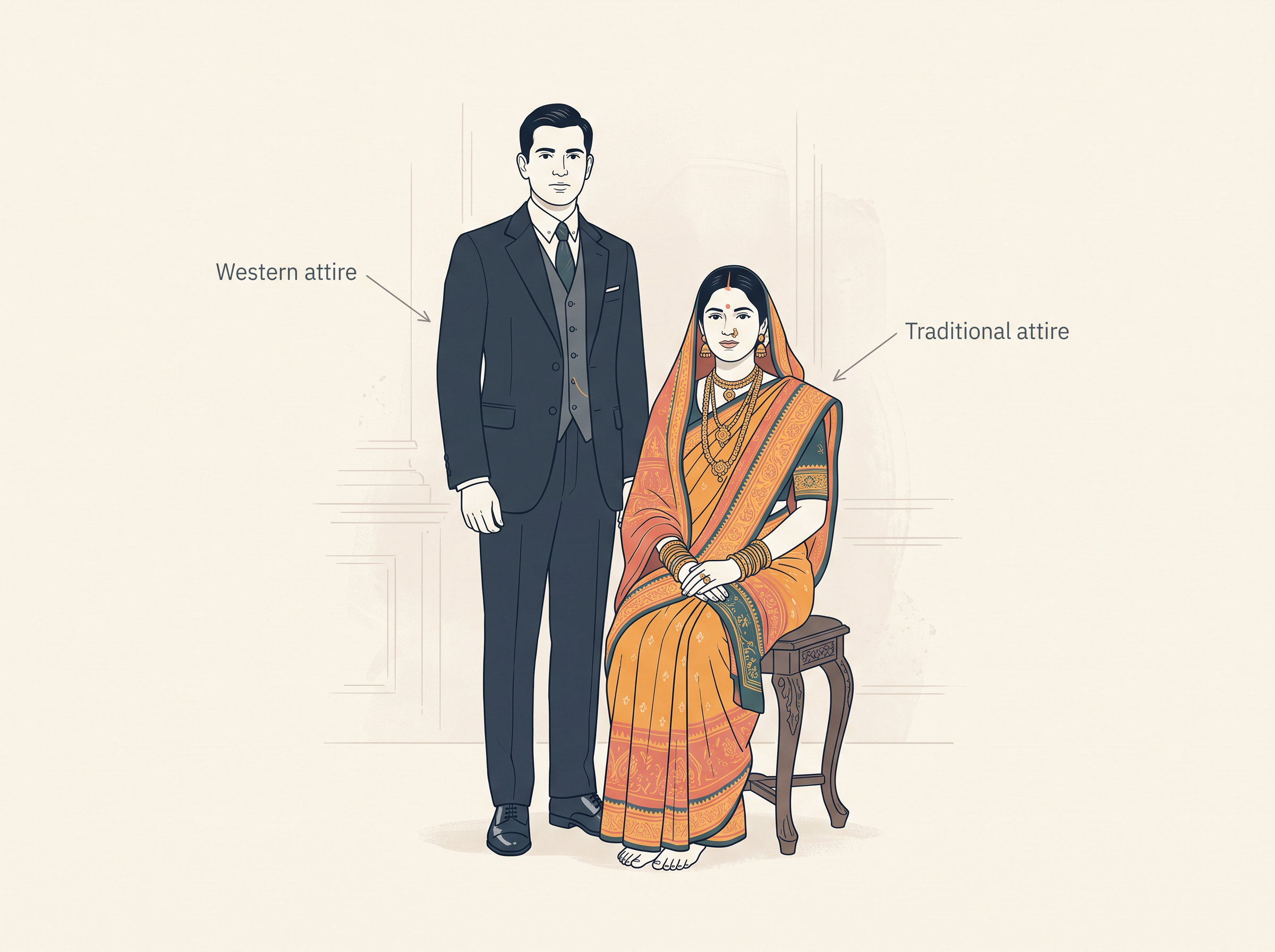
Fig. 2.7 – The mix and match of traditional and modern attire.
Diversity means the processes work unevenly
India’s structural and cultural diversity is self-evident. That diversity shapes the different ways in which modernisation or westernisation, sanskritisation or secularisation affect — or fail to affect — different groups of people.
The pages that follow try to capture some of these differences, though the constraint of space prevents a fuller detailing. It is up to you to explore and identify the complex ways in which modernisation touches people in different parts of the country, or touches different classes and castes within the same region — and even women and men from the same class and the same community.
That last point deserves emphasis. A change that liberates the men of a household may increase the work, or tighten the restrictions, on its women. “How did this affect people?” is never a complete question in sociology until you have asked: which people?
2.4 Sanskritisation, Westernisation, Modernisation and Secularisation
The four processes named in the heading are the analytical heart of this chapter. Each has a definition, a history, and a set of criticisms attached to it. Read them as four different answers to a single question: when Indian society changed, in which direction did people believe they were moving, and who was doing the moving?
2.4.1 Sanskritisation
The term sanskritisation was coined by M.N. Srinivas. It may be briefly defined as the process by which a ‘low’ caste or tribe or other group takes over the customs, ritual, beliefs, ideology and style of life of a high caste and, in particular, of a ‘twice-born’ (dwija) caste.
Before going further, be clear about that phrase. The ‘twice-born’ castes are those traditionally entitled to the sacred thread ceremony — a second, ritual birth. They stand at the upper end of the ritual order, and it is their practices that become the model to be copied.
The impact of sanskritisation is many-sided. Its influence can be seen in language, in literature, in ideology, in music, dance and drama, and in style of life and ritual. A group that sanskritises may change what it eats, whom it allows to eat with whom, how it conducts a wedding, what names it gives its children, and what songs are sung at festivals.
Where it happens, and where it does not
Sanskritisation is primarily a process that takes place within the Hindu space, though Srinivas argued that it was visible even in sects and religious groups outside Hinduism.
Studies of different areas, however, show that it operated differently in different parts of the country. In those areas where a highly Sanskritised caste was dominant, the culture of the entire region underwent a certain amount of sanskritisation. Here you need the idea of the dominant caste — a caste that holds decisive economic and political power in a local area, whatever its exact ritual rank. Its way of life becomes the local model, simply because it is the caste that everyone else must deal with.
In regions where the non-Sanskritic castes were dominant, it was their influence that was stronger. This can be termed the process of de-Sanskritisation — the local model to be copied is not a Sanskritic one at all.
There were other regional variations too. In Punjab, culturally Sanskritic influence was never very strong. For many centuries, until the third quarter of the nineteenth century, the Persian influence was the dominant one.
What makes a group sanskritise
Srinivas argued that the sanskritisation of a group usually has the effect of improving its position in the local caste hierarchy. But — and this is the part students most often miss — it does not happen on its own.
It normally presupposes one of two things. Either the group has already improved its economic or political position, or it has developed a higher group self-consciousness through contact with a source of the ‘Great Tradition’ of Hinduism — a pilgrim centre, a monastery, or a proselytising sect.
In other words, sanskritisation typically follows a gain in wealth or power; it does not cause it. Sanskritisation suggests a process in which people want to improve their status through adopting the names and customs of culturally high-placed groups, and the ‘reference model’ being copied is usually financially better off. The aspiration to be like the higher-placed group tends to arise only once people have themselves become wealthier.
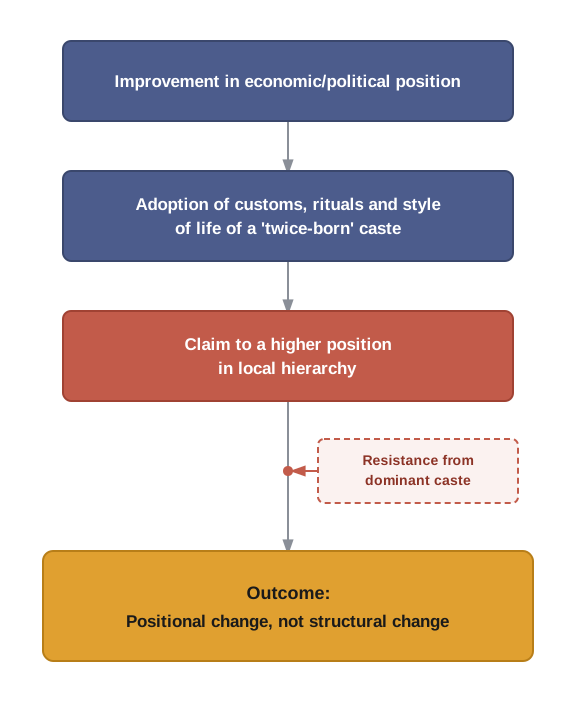
Fig. 2.8 – The process and limits of sanskritisation.
The obstacles
But in a highly unequal society such as India, there were and still are obstacles to any easy taking over of the customs of the higher castes by the lower. Traditionally, the dominant caste punished those low castes which were audacious enough to attempt it. The copying of a ritual was not read as flattery. It was read as a claim — and claims were resisted.
The autobiography of Kumud Pawade records how a Dalit woman — the term Dalit, meaning ‘broken’ or ‘oppressed’, is the name that communities formerly treated as untouchable have chosen for themselves — became a teacher of Sanskrit. As a student she is drawn towards the study of Sanskrit, perhaps because it is the means by which she can break into a field she could not otherwise enter, on grounds of both gender and caste. Perhaps, too, because it would allow her to read in the original what the classical texts have to say about women and about Dalits.
As she proceeds with her studies she meets varied reactions: surprise, hostility, guarded acceptance, and brutal rejection. Her own conclusion is the sharpest statement of the obstacle in this whole chapter. Try as she might to forget her caste, she writes, it is impossible to forget; and she recalls a saying she once heard — “What comes by birth, but can’t be cast off by dying – that is caste.”
The criticisms of sanskritisation
Sanskritisation as a concept has been criticised at different levels. There are five distinct criticisms, and they build on one another.
One, it has been criticised for exaggerating social mobility — that is, the scope for ‘lower castes’ to move up the social ladder. It leads to no structural change, but only to positional change for some individuals. Inequality continues to persist, even though a few individuals may improve their position within the unequal structure.
Two, it has been pointed out that the ideology of sanskritisation accepts the ways of the ‘upper caste’ as superior and those of the ‘lower caste’ as inferior. The desire to imitate the ‘upper caste’ is thereby made to seem natural and desirable.
Three, sanskritisation seems to justify a model that rests on inequality and exclusion. It appears to suggest that believing in the pollution and purity of groups of people is justifiable, or at any rate all right.
Four, since sanskritisation results in the adoption of upper caste rites and rituals, it leads to practices such as the secluding of girls and women, the adoption of dowry practices in place of bride-price, and the practice of caste discrimination against other groups. A group that rises in ritual status may therefore make life more restricted for its own daughters.
Five, the effect of such a trend is that the key characteristics of Dalit culture and society are eroded. For example, the very worth of the labour that ‘lower castes’ do is degraded and rendered ‘shameful’. Identities based on work, on crafts and artisanal ability, and on knowledge forms in medicine, ecology, agriculture and animal husbandry come to be regarded as useless in the industrial era.
The turn away from sanskritisation
The story does not end with imitation. With the growth of the anti-Brahminical movement and the development of regional self-consciousness in the twentieth century, there was an attempt in several Indian languages to drop Sanskrit words and phrases altogether.
A crucial result of the Backward Classes Movement was to emphasise the role of secular factors — education, employment, political representation, organisation — in the upward mobility of caste groups and individuals. Status was to be won in the world, not borrowed from ritual.
In the case of the dominant castes, there was no longer any desire to pass for Vaisyas, Kshatriyas or Brahmins. On the contrary, it became prestigious to be a member of the dominant caste. And recent years have seen similar assertions among Dalits, who now take pride in their identity as Dalits.
That is a genuine reversal, and worth naming. Where sanskritisation asked a group to become more like those above it, these later movements asked it to value what it already was.
2.4.2 Westernisation
You have already read about our western colonial past, and you have seen how often it brought about changes that were paradoxical and strange.
M.N. Srinivas defined westernisation as the changes brought about in Indian society and culture as a result of over 150 years of British rule — a term that takes in changes at several different levels: technology, institutions, ideology and values.
The kinds of westernisation
There were different kinds of westernisation. One kind refers to the emergence of a westernised sub-cultural pattern among a minority section of Indians who first came into contact with Western culture. This included the sub-culture of Indian intellectuals, who not only adopted many cognitive patterns — that is, ways of thinking — and styles of life, but actively supported their expansion. Many of the early nineteenth century reformers were of this kind.
There were, therefore, small sections of people who adopted western life styles, or who were affected by western ways of thinking.
Apart from this, there has also been the general spread of Western cultural traits: the use of new technology, of western dress and food, and changes in the habits and styles of people at large. Across the country, a very wide section of middle class homes have a television set, a fridge, some kind of sofa set, and a dining table and chair in the living room.
Notice how differently these two operate. The first changes how a small group thinks. The second changes how a very large number of people live, without necessarily changing what they believe at all.
Outward form is not inward value
Westernisation does involve the imitation of external forms of culture. It does not necessarily mean that people adopt modern values of democracy and equality.
This is one of the most important sentences in the chapter, and it cuts against common sense. We tend to read clothes, gadgets and interiors as evidence of a whole outlook. Sociologically, they are evidence of nothing of the kind.
Westernisation in art and literature
Apart from ways of life and thinking, the west influenced Indian art and literature. Artists and writers such as Ravi Varma, Abanindranath Tagore, Chandu Menon and Bankimchandra Chattopadhya were all grappling with the colonial encounter.
The account below shows how the style, the technique and even the subject of an artist like Ravi Varma were shaped by western and indigenous traditions together. It concerns a portrait of a family from a matrilineal community of Kerala — a community in which descent and property pass through the mother’s line — yet the family in the painting is arranged to resemble the typical patrilineal nuclear family of the modern west: father, mother and children.
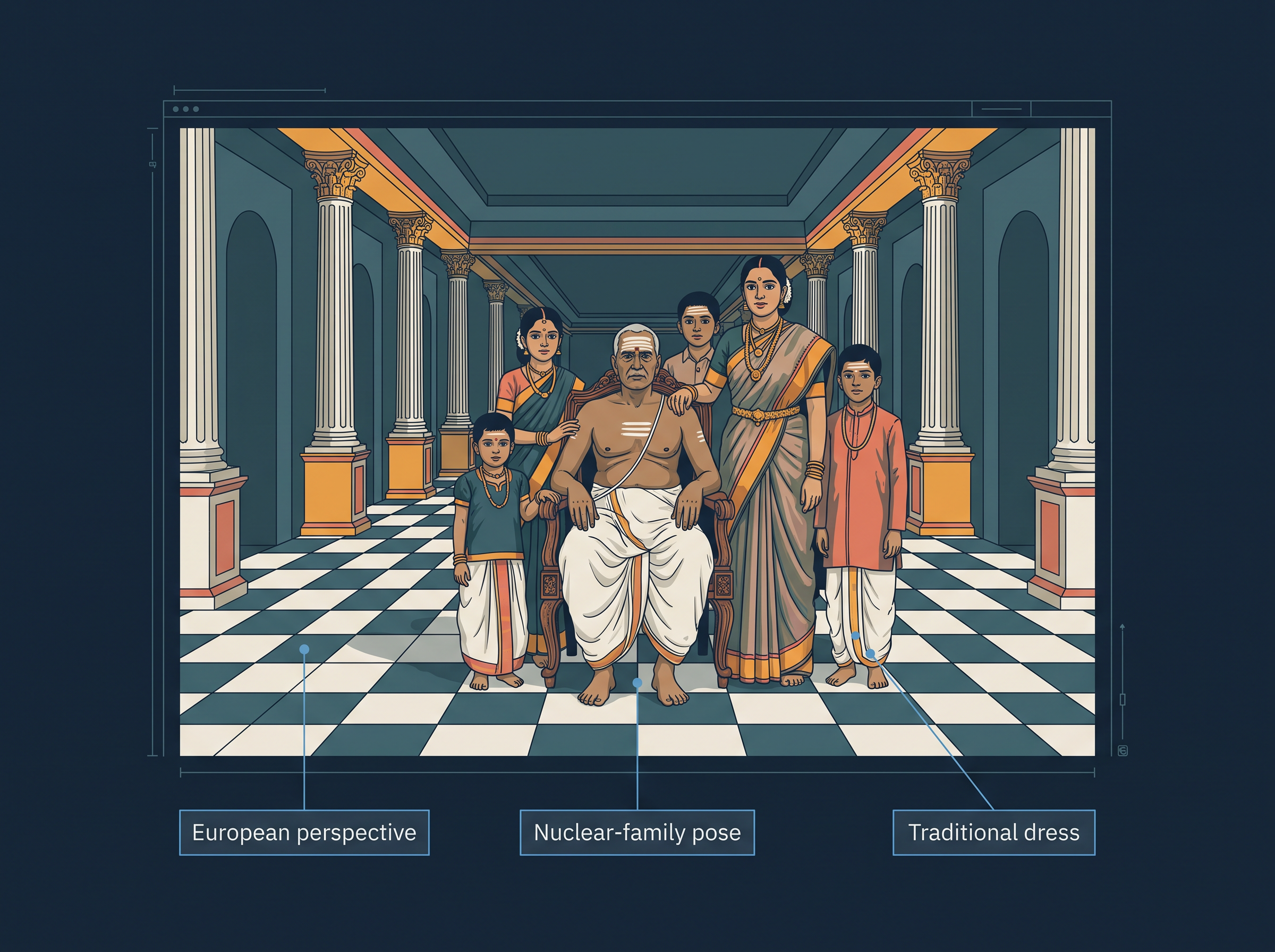
Fig. 2.9 – Western forms and Indian subjects in portraiture.
A portrait, then, is not merely a picture. It is a proposal about what a family looks like — and this one quietly proposed a form of family that its own subjects did not live in.
Westernisation and the generations
You can see the many diverse levels at which cultural change, resulting from our colonial encounter with the west, took place.
In the contemporary context, conflicts between generations are often seen as cultural conflicts resulting from westernisation. Have you seen this, or faced it? It is worth asking two further questions before accepting the explanation. Is westernisation the only reason for conflict between generations? And are such conflicts necessarily a bad thing?
A generalisation that does not hold
Srinivas suggested that while ‘lower castes’ sought to be sanskritised, ‘upper castes’ sought to be westernised. In a country as diverse as India, that generalisation is difficult to maintain.
For instance, studies of the Thiyyas of Kerala — by no means considered an ‘upper caste’ — show conscious efforts to westernise. Elite Thiyyas appropriated British culture as a move towards a more cosmopolitan life, and one that criticised caste. Westernisation here was not imitation of one’s social superiors. It was an escape route around them.
Likewise, western education often meant an opening up of new opportunities for different groups of people in the North-East.
2.4.3 Modernisation and Secularisation
The term modernisation has a long history. From the nineteenth century, and even more from the twentieth, the term began to be associated with positive and desirable values. People and societies wanted to be modern.
In its early years, modernisation referred to improvement in technology and in production processes. Increasingly, however, the term acquired a wider usage. It came to refer to the path of development that much of west Europe and North America had taken — and it carried the suggestion that other societies both have to and ought to follow the same path.
Notice the two words in that definition that a sociologist will not let pass: have to and ought to. The first is a prediction. The second is a judgement. Bundling them together is exactly what made the idea of modernisation so powerful — and so open to challenge.
Why India’s story is different
In India, the beginnings of capitalism, as you saw in Chapter 1, took place within the colonial context. The story of our modernisation and secularisation is therefore quite distinct from their growth in the west. You have already seen this in the discussion of westernisation and of the nineteenth century social movements earlier in this chapter.
The two processes of modernisation and secularisation are taken up here together, because they are linked. They are both part of a single set of modern ideas.
What sociologists mean by modernity
Sociologists have tried to define what exactly constitutes the modernisation process. One influential account, by Rudolph and Rudolph, sets out a series of assumptions built into the idea of modernity.
In plainer words: it means that people are influenced not just by local but by universal contexts. How you behave, and what you think, is no longer decided by your family, your tribe, your caste or your community.
What job you wish to do is decided not by the job your parent does, but by what you wish to do. Work gets based on choice, not birth. Your standing depends on what you achieve, not on what is ascribed to you — that is, not on the position you were simply born into. And a scientific attitude gains ground.
Secularisation
In the modern west, secularisation has usually meant a process of decline in the influence of religion. It has been an assumption of all theorists of modernisation that modern societies become increasingly secular.
Those three indicators are worth holding on to, because they let you check the claim rather than merely assert it. Are people joining religious organisations less? Do those organisations command less land, money and social weight? Do fewer people believe?
And here the theory runs into trouble. Recent years have seen an unprecedented growth of religious consciousness, and of religious conflict, the world over.
Even in the past, the view that modern ways would necessarily lead to a decline in religious ways has not been entirely true. You will recall from earlier in this chapter how western and modern forms of communication, organisation and ideas led to the emergence of new kinds of religious reform organisations. The printing press did not only spread liberalism. It spread religious argument too.
Rituals with secular ends
Furthermore, a considerable part of ritual in India has direct reference to the pursuit of secular ends — that is, worldly rather than religious purposes.
The secularisation of caste
There has also been considerable debate about what some sociologists describe as the secularisation of caste. What does this mean?
In traditional India the caste system operated within a religious framework. Belief systems of purity and pollution were central to its practice. A caste’s position was, in principle, a matter of ritual standing.
Today, caste often functions as a political pressure group. Contemporary India has seen the formation of caste associations and of caste-based political parties, which seek to press their demands upon the state. This changed role of caste has been described as the secularisation of caste.
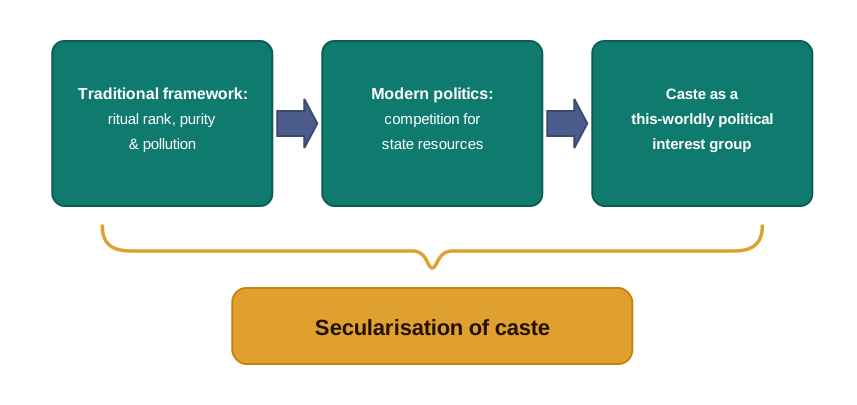
Fig. 2.10 – The secularisation of caste.
2.5 Conclusion
This chapter has sought to show the distinct ways in which social change has taken place in India. Set the four processes side by side and one thing becomes clear: none of them describes a society simply receiving something from outside.
The colonial experience had lasting consequences, and many of them were unintended and paradoxical. Rulers who denied Indians political equality brought with them a vocabulary of liberty. Schools set up to produce clerks produced critics.
Western ideas of modernity shaped the imagination of Indian nationalists. In some, those ideas prompted a fresh look at traditional texts, read again with new questions in mind. In others, they prompted a rejection of those very texts.
Western cultural forms found a place across a wide range of life — in how families lived and furnished their homes, in the codes of conduct expected of men, women and children, and in artistic expression itself.
The ideas of equality and democracy made a huge impact, evident in both the reform movements and the nationalist movement that followed them.
The result, then, was not merely the adoption of western ideas. It was also an active questioning and reinterpretation of tradition — which is why, at the end of this chapter, tradition and modernity in India look less like opposites than like two things that have been arguing with each other for two centuries, and changing each other in the process.
2.6 Summary
Structure and culture (2.1)
Colonialism brought industrialisation and urbanisation: factories replaced fields as places of work for some, cities replaced villages as places to live for many. This was change in social structure — the continuing arrangement of persons in relationships defined or controlled by institutions.
Culture — socially established norms or patterns of behaviour — changed alongside it: ways of life, values, fashions, even body language. Structural change and cultural change are distinct, but the first constantly drives the second.
The chapter follows two developments, both products of colonial rule: the deliberate efforts of nineteenth-century reformers and early twentieth-century nationalists against practices that discriminated against women and ‘lower’ castes; and the less deliberate processes of sanskritisation, modernisation, secularisation and westernisation.
Sanskritisation pre-dates colonial rule. The other three are better understood as complex responses of the people of India to the changes colonialism brought.
Social reform movements (2.2)
The reform movements of the nineteenth century arose in response to the challenges of colonial Indian society. The well-known issues were sati, child marriage, the ban on widow remarriage and caste discrimination.
Fighting social discrimination was not new: it was central to Buddhism and to the Bhakti and Sufi movements. What was new in the nineteenth century was the modern context and the mix of ideas — a creative combination of western liberalism with a fresh reading of traditional literature.
Satish Saberwal identifies three aspects of the modern framework of change in colonial India: modes of communication, forms of organisation, and the nature of ideas.
Modes of communication: the printing press, telegraph, microphone, steamship and railway carried ideas rapidly. Reformers in Punjab and Bengal exchanged ideas with those in Madras and Maharashtra; Keshav Chandra Sen visited Madras in 1864; Pandita Ramabai travelled widely; missionaries reached present-day Nagaland, Mizoram and Meghalaya.
Forms of organisation: the Brahmo Samaj in Bengal, the Arya Samaj in Punjab, and the All-India Muslim Ladies Conference (founded 1914). Newspapers, journals and translations spread arguments — Vishnu Shastri published a Marathi translation of Vidyasagar’s book in Indu Prakash in 1868.
Nature of ideas: liberalism and freedom, new ideas of marriage and homemaking, new roles for mothers and daughters, and a self-conscious pride in tradition. Education was valued both as the road to becoming modern and as a way of retaining ancient heritage.
Female education was intensely debated. Jotiba Phule opened the first school for women in Pune. Both modern and traditional arguments were used to justify it, and reformers debated the meanings of tradition and modernity — Phule recalling the pre-Aryan age, Tilak the glory of the Aryan period.
Reform movements shared themes but also differed. For some, concerns were confined to upper caste, middle class women and men; for others, the injustices suffered by the discriminated castes were central. For some, social evils came from a decline of the true spirit of Hinduism; for others, caste and gender oppression was intrinsic to the religion.
Muslim reformers debated polygamy and purdah. Jahanara Shah Nawas moved a resolution against polygamy at the All India Muslim Ladies Conference, arguing from the spirit of the Quran; Tahsib-e-Niswan supported it, others disapproved.
Debates ran within communities, not only between them: sati was opposed by the Brahmo Samaj, while the Dharma Sabha petitioned the British that reformers had no right to interpret sacred texts.
Different kinds of social change (2.3)
The four processes overlap and co-exist. The same person may be modern in some ways and traditional in another. This co-existence is often called natural to India — but sociology does not accept naturalist explanations.
Colonial modernity had its own paradoxes. An English educated middle class read the western enlightenment and dreamt of a liberal India, yet, humiliated by colonial rule, asserted its pride in traditional learning.
Culture and tradition are living entities: people learn them and modify them. The way the modern middle class woman wears the sari — a traditional unstitched cloth combined with the western petticoat and blouse — is a new creation, neither purely traditional nor purely western.
India’s structural and cultural diversity means the four processes affect different regions, classes, castes — and women and men within the same community — very differently.
The four processes (2.4)
Sanskritisation
Coined by M.N. Srinivas: the process by which a ‘low’ caste, tribe or other group takes over the customs, ritual, beliefs, ideology and style of life of a high, particularly a ‘twice-born’ (dwija), caste.
Its influence appears in language, literature, ideology, music, dance, drama, style of life and ritual. It is primarily a process within the Hindu space, though Srinivas argued it was visible in groups outside Hinduism too.
It works differently in different regions. Where a highly Sanskritised caste was dominant, the whole region underwent some sanskritisation; where non-Sanskritic castes were dominant, their influence prevailed — a process of de-Sanskritisation. In Punjab, Persian influence was dominant for centuries until the third quarter of the nineteenth century.
Sanskritisation usually improves a group’s position in the local caste hierarchy, but it presupposes a prior improvement in economic or political position, or a higher group self-consciousness from contact with a source of the ‘Great Tradition’ such as a pilgrim centre, monastery or proselytising sect.
Obstacles were and remain real: the dominant caste traditionally punished low castes that attempted it. Kumud Pawade’s autobiography records a Dalit woman’s entry into the study of Sanskrit and the hostility she met.
Five criticisms: (1) it exaggerates mobility and produces only positional, not structural, change; (2) its ideology accepts upper caste ways as superior; (3) it makes a model resting on inequality and exclusion appear justifiable; (4) it spreads the seclusion of women, dowry in place of bride-price, and caste discrimination; (5) it erodes Dalit culture, degrading the worth of manual labour, crafts and indigenous knowledge.
In the twentieth century, the anti-Brahminical movement and regional self-consciousness led to attempts to drop Sanskrit words from Indian languages. The Backward Classes Movement emphasised secular factors in mobility. Dominant castes no longer wished to pass as Vaisyas, Kshatriyas or Brahmins, and Dalits increasingly take pride in their identity as Dalits.
Westernisation
Srinivas defined it as the changes brought about in Indian society and culture by over 150 years of British rule, covering technology, institutions, ideology and values.
One kind is the westernised sub-cultural pattern of a minority — including Indian intellectuals who adopted western ways of thinking; many early nineteenth century reformers were of this kind. Another is the general spread of western traits: technology, dress, food, and the television set, fridge, sofa, dining table and chair of middle class homes.
Westernisation involves imitation of external forms. It does not necessarily mean people adopt modern values of democracy and equality.
The west influenced Indian art and literature — Ravi Varma, Abanindranath Tagore, Chandu Menon, Bankimchandra Chattopadhya. Ravi Varma’s 1870 portrait of Krishna Menon’s family blends Indian and European technique, and depicts a matrilineal Nayar family arranged like a patrilineal western nuclear one.
Generational conflict is often explained as a cultural conflict caused by westernisation — but westernisation is not the only cause of such conflict, and conflict is not necessarily bad.
Srinivas suggested that ‘lower castes’ sought to be sanskritised while ‘upper castes’ sought to be westernised; the generalisation is hard to maintain. Elite Thiyyas in Kerala, not an ‘upper caste’, consciously westernised as a move towards a cosmopolitan life critical of caste, and western education opened new opportunities in the North-East.
Modernisation and secularisation
Modernisation first meant improvement in technology and production; it came to mean the path of development taken by west Europe and North America, which other societies were held both bound and obliged to follow.
In India, capitalism began within the colonial context, so modernisation and secularisation here have a story quite distinct from their growth in the west.
Rudolph and Rudolph describe modernity as assuming that local ties give way to universal commitments; that utility, calculation and science take precedence over emotion and the sacred; that the individual replaces the group as the unit of society; that association rests on choice not birth; that mastery replaces fatalism; that identity is achieved rather than ascribed; and that work is separated from family and community in bureaucratic organisation.
Secularisation in the modern west has meant a decline in the influence of religion. Its indicators are involvement with religious organisations, the social and material influence of those organisations, and the degree to which people hold religious beliefs.
The assumption that modernity brings secularisation has not held. Recent years have seen an unprecedented growth of religious consciousness and conflict worldwide; modern communication and organisation produced new religious reform organisations; and much ritual in India serves secular ends, offering occasions for socialising and for display of wealth and status.
Secularisation of caste: traditionally caste operated within a religious framework of purity and pollution; today it often functions as a political pressure group, through caste associations and caste-based parties pressing demands on the state. Rajni Kothari argued that the right question is not whether caste is disappearing, but what form caste takes under modern politics and what form politics takes in a caste-oriented society.
Conclusion (2.5)
The colonial experience had lasting, often unintended and paradoxical, consequences. Western ideas of modernity shaped nationalist imagination, prompting some to re-read traditional texts and others to reject them.
Western cultural forms entered family life, codes of conduct and artistic expression. The ideas of equality and democracy made a huge impact, visible in the reform movements and the nationalist movement.
The outcome was not merely the adoption of western ideas, but an active questioning and reinterpretation of tradition.
2.7 Key Terms
Achieved status — a position earned through one’s own effort, such as a qualification, an occupation or an office.
Ascribed status — a position given at birth and not chosen, such as caste, sex or the family one is born into.
Colonial modernity — modernity as it arrived in India, under foreign rule rather than through internal transformation, and therefore carrying its own paradoxes.
Cultural change — change in the socially established norms and patterns of behaviour of a society: in its ways of life, values, tastes, dress and everyday conduct.
Culture — socially established norms or patterns of behaviour; the shared, learnt ways of doing, thinking and valuing that a group treats as normal.
Dalit — meaning ‘broken’ or ‘oppressed’; the name chosen by communities formerly treated as untouchable, now increasingly asserted with pride as an identity.
De-Sanskritisation — the process in regions where non-Sanskritic castes are dominant and it is their customs and style of life, rather than Sanskritic ones, that others take up.
Dwija — ‘twice-born’; the castes traditionally entitled to the sacred thread ceremony, whose practices become the model in sanskritisation.
Dominant caste — a caste that holds decisive economic and political power in a local area, whatever its exact ritual rank, and whose way of life therefore becomes the local model.
Liberalism — the belief in individual liberty, equal rights and reasoned argument, which nineteenth-century reformers combined with a fresh reading of traditional texts.
Modernisation — originally, improvement in technology and production processes; later, the path of development taken by much of west Europe and North America, which other societies were held both bound and obliged to follow.
Modernity — the outlook that local ties give way to universal commitments; that science and calculation take precedence over the sacred; that the individual replaces the group; that association rests on choice not birth; and that identity is achieved rather than ascribed (Rudolph and Rudolph).
Positional change — movement of a group or individual to a different place within an existing hierarchy, leaving the hierarchy itself intact.
Purdah — the seclusion of women, including veiling and the restriction of women’s movement in public; debated by Muslim social reformers.
Sanskritisation — the process, named by M.N. Srinivas, by which a ‘low’ caste, tribe or other group takes over the customs, rituals, beliefs, ideology and style of life of a high, and particularly a ‘twice-born’, caste.
Sati — the practice by which a widow was burnt on her husband’s funeral pyre; one of the central targets of nineteenth-century social reform.
Secularisation — the process by which the influence of religion in social life declines, measured by involvement with religious organisations, the social and material influence of those organisations, and the degree to which people hold religious beliefs.
Secularisation of caste — the change by which caste, once operating within a religious framework of purity and pollution, comes to function as a this-worldly interest group, forming associations and political parties and pressing demands on the state.
Social reform movements — the organised nineteenth- and early twentieth-century efforts to change social practices that discriminated against women and ‘lower’ castes.
Social structure — a continuing arrangement of persons in relationships defined or controlled by institutions.
Tradition — the inherited practices, texts and beliefs of a society, which the reform period showed to be not fixed but continually reinterpreted and argued over.
Westernisation — the changes brought about in Indian society and culture as a result of over 150 years of British rule, covering technology, institutions, ideology and values (M.N. Srinivas).
2.8 Points to Ponder
Nineteenth-century reformers argued for change by appealing to modern ideas of liberty and to the authority of ancient texts. Was this a strength of their argument or a weakness in it? Can a movement rely on tradition to justify breaking with tradition?
The Dharma Sabha did not defend sati by defending the practice itself; it argued that reformers had no right to interpret sacred texts. Who, in any community, gets to decide what a tradition means — and how would a sociologist study that question rather than settle it?
Sanskritisation is said to produce positional change without structural change. If a group’s rank improves but the hierarchy stays intact, has anything of sociological importance actually happened?
A family may fill its home with western furniture and still expect its daughters to obey rules its sons need not. Why do external cultural forms travel so much faster than the values that produced them?
Can a society become modern without becoming western? What would that look like in food, in dress, in family life, in law — and who in the chapter tried to argue for exactly such a possibility?
Every theorist of modernisation expected religion to lose its hold, and it has not. Does this mean the theory of secularisation was wrong, or that it was measuring the wrong things?
If caste today works through associations and political parties rather than through purity and pollution, is caste weakening, surviving, or changing into something new? What evidence would settle the question, and what evidence never could?
2.9 NCERT Questions
Write a critical essay on sanskritisation.
Westernisation is often understood as being only about the adoption of western attire and lifestyle. Are there other aspects to being westernised? Or is that really about modernisation? Discuss.
Write short notes on:
- Rites and secularisation
- Caste and secularisation
- Gender and sanskritisation
2.10 Objective Questions
The term ‘sanskritisation’ was coined by:
- Satish Saberwal
- M.N. Srinivas
- Rajni Kothari
- G.S. Ghurye [1 mark]
In the definition of sanskritisation, the customs and style of life that are taken over are those of a:
- dominant but ritually low caste
- ‘twice-born’ (dwija) caste
- western-educated middle class
- tribe outside the caste order [1 mark]
Which of the following is NOT one of the three aspects of the modern framework of change in colonial India identified by Satish Saberwal?
- Modes of communication
- Forms of organisation
- The nature of ideas
- Levels of industrial production [1 mark]
The All-India Muslim Ladies Conference (Anjuman-E-Khawatn-E-Islam) was founded in:
- 1864
- 1868
- 1870
- 1914 [1 mark]
In which region does the chapter say that Sanskritic cultural influence was never very strong, Persian influence having been dominant for many centuries until the third quarter of the nineteenth century?
- Bengal
- Punjab
- Kerala
- Maharashtra [1 mark]
Fill in the blank: The process by which the customs and style of life of non-Sanskritic dominant castes, rather than Sanskritic ones, come to influence a region is termed ____________. [1 mark]
Fill in the blank: The changed role of caste, in which it operates through caste associations and caste-based political parties that press demands upon the state, has been described as the ____________ of caste. [1 mark]
True or False: According to the chapter, sanskritisation produces structural change in Indian society by dismantling the hierarchy of purity and pollution. [1 mark]
True or False: The first school for women in Pune was opened by the social reformer Jotiba Phule. [1 mark]
Match the following:
| Column A | Column B |
|---|---|
| a. M.N. Srinivas | i. Three aspects of the modern framework of change in colonial India |
| b. Satish Saberwal | ii. The form caste takes under the impact of modern politics |
| c. Rajni Kothari | iii. Sanskritisation and westernisation |
| d. Rudolph and Rudolph | iv. The assumptions built into the idea of modernity |
[1 mark]
- Assertion (A): Sanskritisation normally presupposes an earlier improvement in the economic or political position of the group concerned. Reason (R): The ‘reference model’ that a group seeks to imitate is usually financially better off than itself.
- Both (A) and (R) are true, and (R) is the correct explanation of (A).
- Both (A) and (R) are true, but (R) is not the correct explanation of (A).
- is true, but (R) is false.
- is false, but (R) is true. [1 mark]
- Assertion (A): A family that furnishes its home in a western style has necessarily adopted modern values of democracy and equality. Reason (R): Westernisation involves the imitation of external forms of culture.
- Both (A) and (R) are true, and (R) is the correct explanation of (A).
- Both (A) and (R) are true, but (R) is not the correct explanation of (A).
- is true, but (R) is false.
- is false, but (R) is true. [1 mark]
- Assertion (A): Theorists of modernisation expected modern societies to become increasingly secular. Reason (R): Recent decades have seen an unprecedented growth of religious consciousness and conflict across the world.
- Both (A) and (R) are true, and (R) is the correct explanation of (A).
- Both (A) and (R) are true, but (R) is not the correct explanation of (A).
- is true, but (R) is false.
- is false, but (R) is true. [1 mark]
- Which of the following was NOT among the indicators of secularisation mentioned in the chapter?
- The level of people’s involvement with religious organisations
- The social and material influence of religious organisations
- The degree to which people hold religious beliefs
- The number of religious texts printed each year [1 mark]
2.11 Check Your Concepts
Define sanskritisation in the sense in which M.N. Srinivas used the term. [2 marks]
What is meant by de-Sanskritisation? Give the condition under which it occurs. [2 marks]
State any two indicators that sociologists have used to measure secularisation. [2 marks]
Name the three aspects of the modern framework of change in colonial India identified by Satish Saberwal. [2 marks]
What is meant by ‘positional change’? Give one example from the chapter. [2 marks]
Give one example from the chapter of the “mix and match” of the traditional and the modern in everyday life. [2 marks]
Differentiate between sanskritisation and westernisation, with one example of each. [4 marks]
Differentiate between modernisation and westernisation. Why does the chapter insist that the two must not be treated as the same thing? [4 marks]
Explain, with an example, why the reformers of the nineteenth century argued for social change by appealing to traditional texts as well as to modern liberal ideas. [4 marks]
“Debates were as much within communities as between them.” Explain this statement with reference to the reform movements discussed in the chapter. [4 marks]
What is meant by the secularisation of caste? Describe the shift it involves. [4 marks]
Give reasons why the co-existence of the modern and the traditional in the same person cannot be explained simply by saying that it is “natural to India”. [4 marks]
Explain how new modes of communication and new forms of organisation shaped the social reform movements of the nineteenth century. Illustrate your answer with examples from the chapter. [4 marks]
Write a critical account of sanskritisation. Explain the process, the conditions under which it occurs, and set out the criticisms that have been made of it. [6 marks]
“Westernisation does involve the imitation of external forms of culture. It does not necessarily mean that people adopt modern values of democracy and equality.” Discuss this claim with Indian examples, and evaluate how far the evidence in the chapter supports it. [6 marks]
How far do you agree that modernisation must lead to secularisation? Present the evidence on both sides, drawing on the Indian material in the chapter. [6 marks]
Srinivas suggested that ‘lower castes’ sought to be sanskritised while ‘upper castes’ sought to be westernised. Evaluate this generalisation, using the evidence the chapter offers about Kerala and the North-East. [6 marks]
Discuss the causes and the consequences of the debate over female education in nineteenth-century India. What does that debate reveal about the relationship between tradition and modernity in the period? [6 marks]
2.12 Passage-Based Questions
In a village in a dry, cotton-growing district, a group of families who had for generations worked as leather workers began, some twenty years ago, to lease land and later to buy it. Their incomes rose. Within a decade the families gave up eating meat, adopted a new set of rituals at weddings, engaged a priest for ceremonies they had earlier performed themselves, and began to withdraw their grown daughters from work in the fields. Some of the landowning families of the village objected loudly to these changes, and for a time refused to let the group draw water from a particular well. The group’s position in the local ranking of castes did gradually improve. The ranking itself did not alter.
- Identify the process at work in this account, and state who named it.
- The account says the group’s incomes rose before its customs changed. Why is that sequence sociologically important?
- Two of the criticisms of this process are illustrated in the passage. Identify them and explain each briefly. [6 marks]
A family in a large city lives in a flat furnished with a sofa set, a dining table and chairs, and a large television. Both parents were educated in English-medium schools and speak English at work. The son is encouraged to choose any career he likes and to move to another city for it. The daughter, who has the same marks, is told that she may study nearby, that her working hours must allow her to be home by evening, and that a match will be found for her from within the community. When a neighbour marries outside the community, the family privately disapproves.
- Which of the four processes discussed in the chapter does this family clearly illustrate? Give reasons.
- The chapter says that the adoption of external forms of culture does not necessarily bring modern values. Show how this passage supports that claim.
- Name the distinction between kinds of status that this family’s treatment of its son and its daughter brings out. [6 marks]
In a district town, a caste that was once known chiefly by its traditional occupation now runs a registered association. The association manages a hostel for students of the community, publishes a magazine, holds an annual meeting, and sends a delegation to the district administration each year with a list of demands: a college in the area, better roads to their villages, and reservation of seats in the local body. At election time, candidates from several parties call on the association’s office-bearers. Rituals of purity and pollution are rarely mentioned at these meetings; posts, scholarships and roads are mentioned at every one of them.
- Identify the process this passage illustrates and define it.
- Explain, using the argument of Rajni Kothari discussed in the chapter, why it would be a mistake to conclude from this passage that caste is simply disappearing.
- What form has caste taken here, and what does the passage suggest politics has taken in return? [6 marks]
A Class XII student surveys forty households in her neighbourhood for a school project. She records, for each household, whether it owns certain items and whether it reports certain attitudes. Her results are set out below. She then writes in her report: “Most of these households are western in their goods. Fewer are modern in their views.”
What was recorded Number of households (out of 40) Owns a television set and a sofa set 34 Uses a dining table and chairs for daily meals 27 Says a daughter should choose her own occupation 19 Says a marriage outside the community is acceptable 11 - Read the table. What is the gap between the number of households that own western furnishings and the number that accept a marriage outside the community?
- Which sociological distinction made in this chapter does the student’s concluding sentence rest on? Explain it.
- Suggest one limitation of drawing conclusions about westernisation and modernisation from a survey of this kind. [6 marks]
2.2 Social Reform Movements in the 19th and Early 20th Century
You have already seen how far colonial rule reached into Indian lives. The social reform movements that emerged in India in the nineteenth century did not appear out of nowhere. They arose as responses to the challenges that colonial Indian society now faced — challenges to its practices, its texts, its confidence and its idea of itself.
You are probably familiar with what were then termed the social evils of Indian society. The best known are sati, the practice by which a widow was burnt on her husband’s funeral pyre; child marriage; the ban on widow remarriage; and caste discrimination. These were the practices around which the arguments of the period turned.
Fig. 2.3 – Reformers from different religious and regional traditions.
Not the first attempts
It would be quite wrong to imagine that Indians began questioning social discrimination only when the British arrived. Attempts to fight it were made in pre-colonial India too. They were central to Buddhism, and to the Bhakti and Sufi movements — devotional traditions which insisted that closeness to God did not depend on birth, ritual purity or the mediation of a priestly class.
So what was new about the nineteenth century? Not the impulse to reform, but the context and the mix of ideas. The reform attempts of this period were shaped by a modern setting — new technologies, new organisations, new schooling — and they drew, creatively, on two sources at once: modern ideas of western liberalism (the belief in individual liberty, equal rights and reasoned argument) and a fresh reading of traditional Indian literature.
That combination is the key to the whole period, and it is easy to miss. A reformer who wanted to end a practice rarely said simply, “this is against modern reason.” He was far more likely to say: “this is against modern reason and it is not sanctioned by our own sacred texts, properly read.” The past was not abandoned. It was re-read.
liberalism and reform in colonial India In Europe, liberal arguments for individual rights were typically made against religious authority. In colonial India, reformers were arguing under a foreign ruler who justified his rule by calling Indian society backward. To simply adopt the ruler’s reasoning would have been to concede that charge. So Indian reformers argued on two grounds at once — humanitarian and rational on the one hand, scriptural and traditional on the other. The result was not imported liberalism but a distinctively Indian argument in which tradition itself was mobilised for change.
Q1. Why did nineteenth-century reformers argue against practices like sati and child marriage by quoting ancient texts, when they could simply have quoted modern ideas of liberty?
A. Because an argument drawn only from western liberalism could be dismissed as foreign, and because the reformers themselves valued their traditions and believed the objectionable practices were later corruptions of them. Arguing from the shastras — the classical texts of religious and legal authority — allowed them to say that reform was not a betrayal of Indian tradition but a return to its true spirit, while modern humanitarian and natural-rights arguments gave the same case a second, universal foundation.
The mix of ideas - Raja Ram Mohun Roy attacked the practice of sati on two grounds at once: appeals to humanitarian and natural rights doctrines, and appeals to the Hindu shastras. - Ranade’s writings, The Texts of the Hindu Law on the Lawfulness of the Remarriage of Widows and Vedic Authorities for Widow Marriage, worked out the shastric sanction for the remarriage of widows — that is, the authority for it within the classical texts themselves. - The content of the new education was modernising and liberal. The literary content of courses in the humanities and social sciences was drawn from the literature of the European Renaissance, Reformation and Enlightenment, and its themes were humanistic, secular and liberal. - Sir Syed Ahmed Khan’s interpretation of Islam emphasised the validity of free enquiry (ijtihad, independent reasoning on a question of law or doctrine) and the alleged similarities between Koranic revelations and the laws of nature discovered by modern science. - Kandukiri Viresalingam’s The Sources of Knowledge reflected his familiarity with navya-nyaya logic, the classical Indian school of reasoning. At the same time he translated the works of Julius Huxley, an eminent biologist.
Saberwal’s three aspects
The sociologist Satish Saberwal gives us a way of seeing this modern context clearly. He sketches three aspects to the modern framework of change in colonial India: modes of communication, forms of organisation, and the nature of ideas.
the modern framework of change in colonial India Proposed by: Satish Saberwal (Indian sociologist, writing on colonial Indian society) Core idea: The nineteenth-century reform movements were “modern” less because of what they demanded than because of the framework within which they could be made at all — a framework with three parts: modes of communication, forms of organisation, and the nature of ideas. Key terms: modes of communication; forms of organisation; nature of ideas Evidence: the printing press, the telegraph and the railway, which carried arguments across the subcontinent; associations such as the Brahmo Samaj and the Arya Samaj; and the new liberal vocabulary of freedom, rights and education. Limitation: The framework explains how new ideas could travel and organise, but not who was left out of that circuit. Print, English education and formal associations were available mainly to a small, largely urban and largely upper-caste and middle-class public.
Fig. 2.4 – Saberwal’s modern framework of change.
Modes of communication
New technologies speeded up various forms of communication. The printing press, the telegraph and, later, the microphone allowed an argument made in one place to be heard in another. The movement of people and goods by steamship and railway helped new ideas move quickly.
The effect within India was to knit reformers together across enormous distances. Social reformers from Punjab and Bengal exchanged ideas with reformers from Madras and Maharashtra. Keshav Chandra Sen of Bengal visited Madras in 1864. Pandita Ramabai travelled to different corners of the country. Some reformers went to other countries altogether. Christian missionaries reached remote corners of what is today Nagaland, Mizoram and Meghalaya.
Think about what this meant in practice. Before print and rail, a debate about widow remarriage in Bengal stayed largely in Bengal. Afterwards, it could be read, argued over and answered in Pune or Madras within weeks. Reform became a conversation on a subcontinental scale.
Forms of organisation
Modern social organisations were set up: the Brahmo Samaj in Bengal, the Arya Samaj in Punjab. The All-India Muslim Ladies Conference (Anjuman-E-Khawatn-E-Islam) was founded in 1914.
These are what sociologists call associations — bodies you join on the basis of shared conviction, rather than groups you are simply born into. That is precisely what made them modern instruments of change. Indian reformers now debated not only in public meetings but through public media such as newspapers and journals.
Translations moved arguments from one Indian language into another. For instance, Vishnu Shastri published a Marathi translation of Vidyasagar’s book in Indu Prakash in 1868. A Bengali case for widow remarriage could now be read by a Marathi reader.
The nature of ideas
New ideas of liberalism and freedom emerged, along with new ideas of homemaking and marriage, new roles for mothers and daughters, and a new, self-conscious pride in culture and tradition. That last item is important: pride in tradition was itself something new, in the sense that it was now consciously asserted, defended and argued for, rather than simply lived.
The value of education became very important. Education was seen as crucial if a nation was to become modern — and, at the same time, if it was to retain its ancient heritage. Both hopes were placed on the same institution.
The debate over female education
The idea of female education was debated intensely. Significantly, it was the social reformer Jotiba Phule who opened the first school for women in Pune.
Reformers argued that for a society to progress, women have to be educated. But how was that claim to be justified? Some of them believed that in pre-modern India women were educated, and that female education was therefore a restoration, not an innovation. Others contested this, on the grounds that it had been true only of a privileged few.
So attempts to justify female education were made by recourse to both modern and traditional ideas — exactly the mix you have already seen. In doing this, reformers actively debated the meanings of tradition and modernity themselves. Jotiba Phule recalled the glory of the pre-Aryan age, while others, like Bal Gangadhar Tilak, emphasised the glory of the Aryan period.
Notice that these two men were not disagreeing about a date in the past. They were disagreeing about which past should serve as the model for the future. In other words, nineteenth-century reform initiated a period of questioning, of reinterpretation, and of both intellectual and social growth.
Fig. 2.5 – Key social reformers and their causes.
Find out about some of the social reformers named below. What issues did each of them fight for? How did they conduct their campaign? Was there any opposition to them? - Viresalingam - Pandita Ramabai - Vidyasagar - Dayanand Saraswati - Jyotiba Phule - Sri Narayan Guru - Sir Syed Ahmed Khan - Any other
A comparison of any three of these reformers — their issue, their method, and the opposition they met — would make a good CBSE project.
Common themes, real differences
The varied social reform movements did have common themes. But there were also significant differences between them, and a student who remembers only the common themes has missed half the story.
For some reformers, the concerns were confined to the problems faced by upper caste, middle class women and men. For others, the injustices suffered by the discriminated castes were the central question. The difference is not a detail; it determines who a movement speaks for.
There was a deeper disagreement still, about where the social evils came from.
where did caste and gender oppression come from? View 1: Social evils had emerged because of a decline of the true spirit of Hinduism. On this reading, the religion in its authentic form did not sanction such practices; the remedy is therefore to purify and restore the tradition — which is why reformers of this persuasion went back to the shastras and the Vedas to make their case. View 2: Caste and gender oppression was intrinsic to the religion — not a corruption of it but part of its structure. On this reading, no amount of restoration will help, because the texts and the ritual order are themselves the source of the hierarchy; the remedy must be a rejection or a radical remaking of that order. What both agree on: that the practices in question caused real and serious injustice to women and to the discriminated castes, and that they had to end.
Q. Why does it matter which of these two views a reformer held?
A. Because it decides the method. If the evil is a corruption of the religion, you argue from within the sacred texts and appeal to the community’s own authorities. If the evil is intrinsic to the religion, you look outside it — to education, to law, to political mobilisation, to a separate identity. The same injustice produces two very different campaigns.
Debates among Muslim reformers
The same pattern of argument ran through other communities. Muslim social reformers actively debated the meaning of polygamy and purdah — the seclusion of women, including the practice of veiling and of restricting women’s movement in public.
At the All India Muslim Ladies Conference, Jahanara Shah Nawas proposed a resolution against the evils of polygamy. Her argument, notably, was not that the practice was un-modern but that the form of polygamy practised by certain sections of Muslims went against the true spirit of the Quran — and that educated women had a duty to use their influence within their own families to bring it to an end. Once again, the case for change was made from inside the tradition.
The resolution condemning polygamy caused considerable debate in the Muslim press. Tahsib-e-Niswan, the leading journal for women in the Punjab, came out in favour of the resolve. Others disapproved.
Debates within communities
Debates of this kind, within communities rather than between them, were common during this period. It is worth pausing on that word “within”. Reform was not a matter of one community being enlightened and another resisting; every community argued with itself.
For instance, sati was opposed by the Brahmo Samaj. In response, orthodox members of the Hindu community in Bengal formed an organisation called the Dharma Sabha and petitioned the British, arguing that the reformers had no right to interpret sacred texts.
Read that objection carefully, because it is a sociologically interesting one. The Dharma Sabha’s petition was not, on its face, a defence of the practice itself. It was a claim about authority — about who is entitled to say what the tradition means. The reform movements provoked exactly this question everywhere, and it has not gone away.
pre-colonial protest vs 19th-century social reform | Feature | Pre-colonial protest (Buddhism, Bhakti, Sufi) | 19th-century social reform | |—|—|—| | Main target | Ritual hierarchy and priestly mediation; birth-based inequality before God | Specific social practices: sati, child marriage, the ban on widow remarriage, caste discrimination, polygamy, purdah | | Source of ideas | Devotional and religious traditions | A mix of modern western liberalism and a fresh reading of traditional texts | | Means used | Preaching, devotional song, personal example, community of followers | Print, newspapers and journals, public meetings, formal associations, petitions to the state | | Reach | Regional, spread by travel and oral transmission | Subcontinental, carried by railway, steamship, telegraph and translation | | Relation to the state | Largely outside the state | Frequently addressed to the colonial state and its law |
speaking for others Much of nineteenth-century reform consisted of men debating, in public, what should be done about women’s lives — and of upper caste reformers debating what should be done about caste discrimination they had never suffered. This raises a question that still faces sociology: who has the right to describe a community’s problems, and whose voice counts as evidence? It is worth noticing that when Jahanara Shah Nawas rose to speak at a women’s conference, and when Pandita Ramabai travelled and wrote, the people most affected were beginning to speak for themselves rather than being spoken about — a shift that matters both ethically and for the accuracy of what gets said.