Chapter 3: The Constitution and Social Change
In the late 1940s, the members of the Constituent Assembly sat down to write a constitution for a country in which most people lived in villages. When the draft was read out, many members were startled by what was missing. The village panchayat — the small local council that Indians had known for centuries — did not appear in it at all. Some members were openly angry and disappointed.
The argument that followed was not a quarrel about drafting. It was a quarrel about Indian society. Gandhiji had long imagined every village as a self-sufficient unit managing its own affairs. Dr. Ambedkar, drawing on his own experience of rural India, warned that village life was tightly controlled by local elites and upper castes, and that handing power to the village might simply hand it to them. One member, K. Santhanam, moved an amendment, and the village panchayat entered the Constitution — not as a right, but as a Directive Principle, a goal the state should work towards.
Then nothing much happened for forty-odd years. Only in 1992, through the 73rd Amendment, did that quiet line become a binding constitutional command, with elections every five years and reserved seats for women and for Scheduled Castes and Scheduled Tribes.
A sentence written in 1949 changed village India in the 1990s. This chapter asks how.
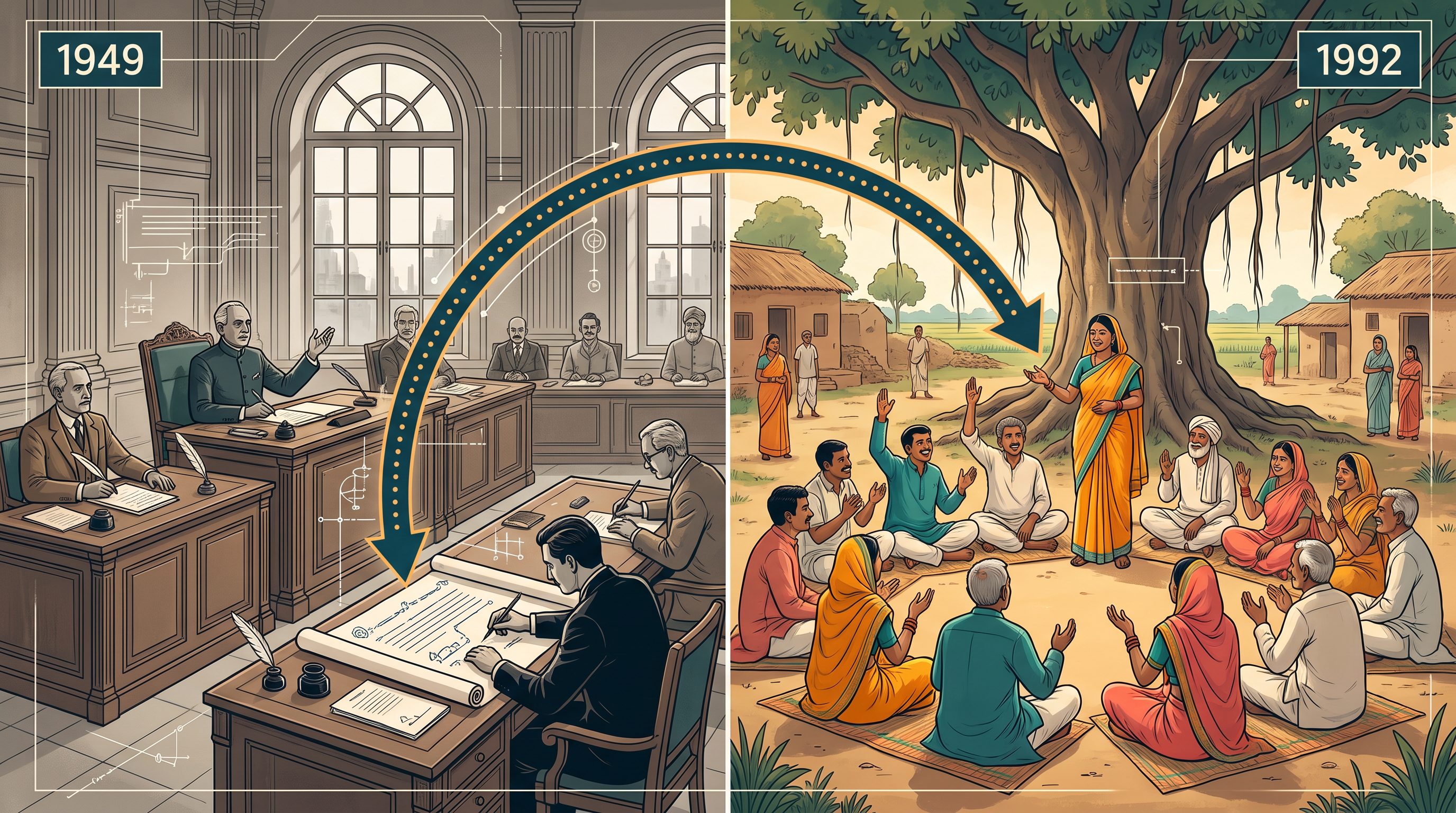
Fig. 3.1 – The Constituent Assembly (1949) and a modern Gram Sabha (1992).
Keep these questions in mind. By the end of this chapter, you will be able to answer each of them.
3.1 Constitutional Norms and Social Justice
You have probably heard the Constitution described as a rule book — a list of what the state may do and what it may not. That description is true, but it is far too small. A rule book only settles disputes. The Indian Constitution was written to do something more ambitious: to change an unequal society into a more just one, slowly and lawfully, over decades.
It can attempt this because it rests on the basic norms of social justice — the idea that the benefits and burdens of living together should be shared fairly, and that no group should be left permanently disadvantaged.
Consider a single line. The Directive Principles of State Policy include one on village panchayats, moved as an amendment in the Constituent Assembly by K. Santhanam. For over forty years it remained an unfulfilled aim. Then, with the 73rd Amendment in 1992, it hardened into a constitutional imperative that every state had to obey.
That is the point worth holding on to. The Constitution is not merely a ready referencer of do’s and don’ts. It carries the potential to extend the meaning of social justice as society’s own understanding of justice changes. Courts and authorities have often been pushed towards that extension by social movements, which raise a grievance until it can no longer be read out of the Constitution.
Law and Justice Are Not the Same
It is useful to begin with a distinction that students often blur. Law and justice are not the same thing.
The essence of law is force. A law is a law because it carries the means to coerce or compel obedience; the power of the state stands behind it. The essence of justice is fairness. Justice asks not “will this be enforced?” but “is this right?”
Most of the time the two travel together. Sometimes they part company. A law can be enforced perfectly and still be unfair, which is precisely why societies argue about laws, amend them, and occasionally strike them down.
The Constitution as the Basic Norm
Any system of law works through a hierarchy of authorities, and the Constitution sits at the top of it. It is the document that constitutes a nation’s tenets — the source from which every other rule draws its validity.
The Indian Constitution is therefore India’s basic norm. All other laws must be made following the procedures the Constitution prescribes, and they are made and implemented by the authorities the Constitution specifies. A law that ignores those procedures is not merely a bad law; it is no law at all.
When a dispute arises over what a law means, courts settle it. Courts too are authorities created by the Constitution, and they are arranged in a hierarchy. At its apex stands the Supreme Court, which is both the highest court and the ultimate interpreter of the Constitution. Fig. 3.2 sets out this chain.
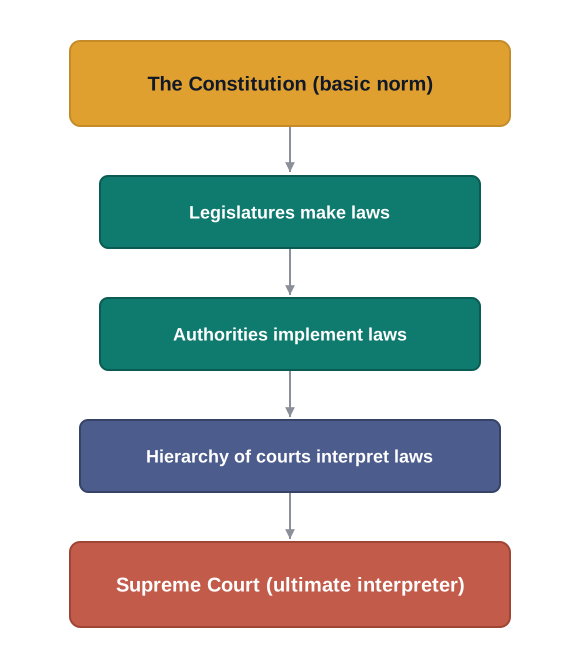
Fig. 3.2 – The hierarchy of constitutional authority.
How Rights Grow: The Courts and Fundamental Rights
This is not an abstract point. The Supreme Court has enhanced the substance of the Fundamental Rights in many important ways, and the clearest example is the right to life and liberty in Article 21.
The Court has held that a Fundamental Right includes all that is incidental to it. The terse words of Article 21 have therefore been read as covering everything that goes into a life of quality — livelihood, health, shelter, education and dignity. In various pronouncements the attributes of “life” have been expanded, and “life” has been explained to mean more than mere animal existence.
Read that phrase carefully. A person who is alive but starving, bonded, homeless or unschooled is alive in an animal sense only. Once the Court accepts that reasoning, Article 21 becomes a lever.
The same expansive method has reached beyond Article 21. In 1993 the Supreme Court held that the Right to Information is a part of, and incidental to, the Right to Freedom of Speech and Expression under Article 19(1)(a) — reasoning that speech is hollow if citizens cannot know what is being done in their name.
The Court has also blurred the old wall between the Fundamental Rights, which are enforceable, and the Directive Principles, which were meant only to guide the state.
Notice what this tells you sociologically. A constitutional text is not a fixed object; it is a living relationship between a document, the courts that read it, and a society whose sense of injustice keeps shifting. Law supplies the force. Society keeps supplying the argument about fairness.
3.2 The Panchayati Raj and the Challenges of Rural Social Transformation
3.2.1 Ideals of Panchayati Raj
The word Panchayati Raj translates literally as ‘governance by five individuals’. Behind that modest phrase lies an ambitious aim: to make democracy work not only in Parliament and the state assemblies, but at the village or grassroot level, where most people actually live their lives.
The idea itself is not an alien import. Village assemblies of one kind or another have a long history in India. What is difficult is not the idea but the setting in which it has to work.
In a society marked by sharp inequalities, democratic participation is hindered on grounds of gender, caste and class. A meeting may be open to everyone in principle, and yet the same few people may speak at it every time, while others attend, listen and go home.
There is a further complication. Villages have traditionally had caste panchayats, and these have usually represented the dominant groups. They have often held conservative views, and they have taken — and in places continue to take — decisions that go against both democratic norms and democratic procedures. A body that meets in a village is not automatically a democratic body.
The Argument in the Constituent Assembly
This is exactly why the framers of the Constitution disagreed so sharply about panchayats. When the Constitution was being drafted, the panchayat did not find a mention in it at all, and a number of members expressed their sorrow, anger and disappointment at the omission.
Dr. Ambedkar, drawing on his own rural experience, argued the other way. Local elites and upper castes, he said, were so well entrenched in society that local self-government would only mean a continuing exploitation of the downtrodden masses of Indian society; the upper castes would no doubt silence that segment of the population further. To hand power to the village, on this reading, was to hand it to those who already held the village.
The concept of local government was dear to Gandhiji too. He envisaged each village as a self-sufficient unit conducting its own affairs, and saw gram-swarajya — village self-rule — as an ideal model to be continued after Independence.
1992: The 73rd Amendment
It was, however, only in 1992 that grassroot democracy — or decentralised governance — was ushered in, by the 73rd Constitutional Amendment.
The Act gave constitutional status to the Panchayati Raj Institutions (PRIs). Local self-government bodies in rural and municipal areas must now compulsorily be elected every five years. And, more importantly, control of local resources is given to the elected local bodies. Power without resources is decoration; the Amendment tried to supply both.
The structure of the system is like a pyramid, and it is worth reading from the bottom up rather than the top down. At the base stands the unit of democracy, the Gram Sabha. This consists of the entire body of citizens in a village, or grama. It is this general body that elects the local government and charges it with specific responsibilities.
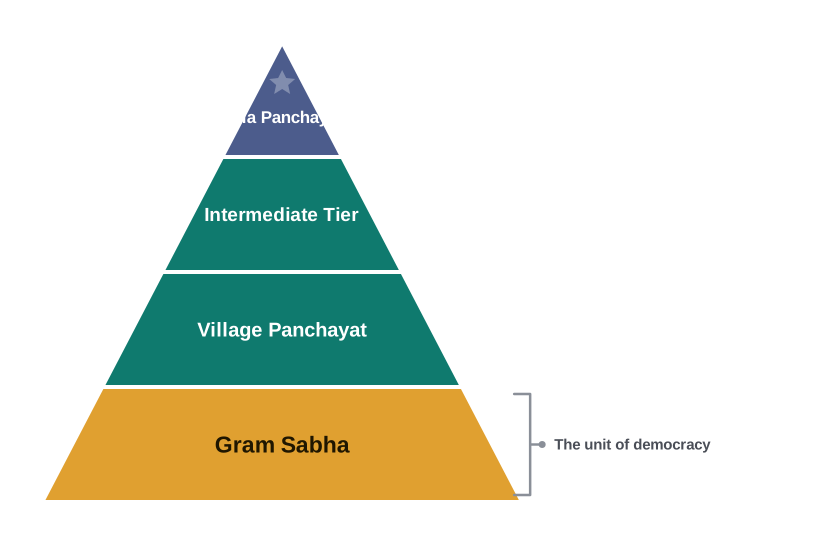
Fig. 3.3 – The three-tier structure of Panchayati Raj.
Ideally, Gram Sabhas ought to provide an open forum for discussion and for village-level development activities, and ought to play a crucial role in ensuring the inclusion of the weaker sections in decision-making. Whether they do is a separate question, and section 3.2.4 returns to it.
Bringing Women into Elected Bodies
The 73rd and 74th Amendments together ensured the reservation of one third of the total seats for women in all elected offices of local bodies, in both rural and urban areas. Out of this, 17 per cent of seats are reserved for women belonging to the scheduled castes and tribes.
This was significant because, for the first time, it brought women into elected bodies which also bestowed decision-making powers on them. One third of the seats in gram panchayats, village panchayats, municipalities, city corporations and district boards are reserved for women.
The scale of the change is easy to underestimate. The 1993–94 elections, held soon after the 73rd Amendment, brought 800,000 women into the political process in a single election. That was a big step indeed in enfranchising women. A constitutional amendment prescribed this three-tier system of local self-governance for the entire country, effective since 1992–93.
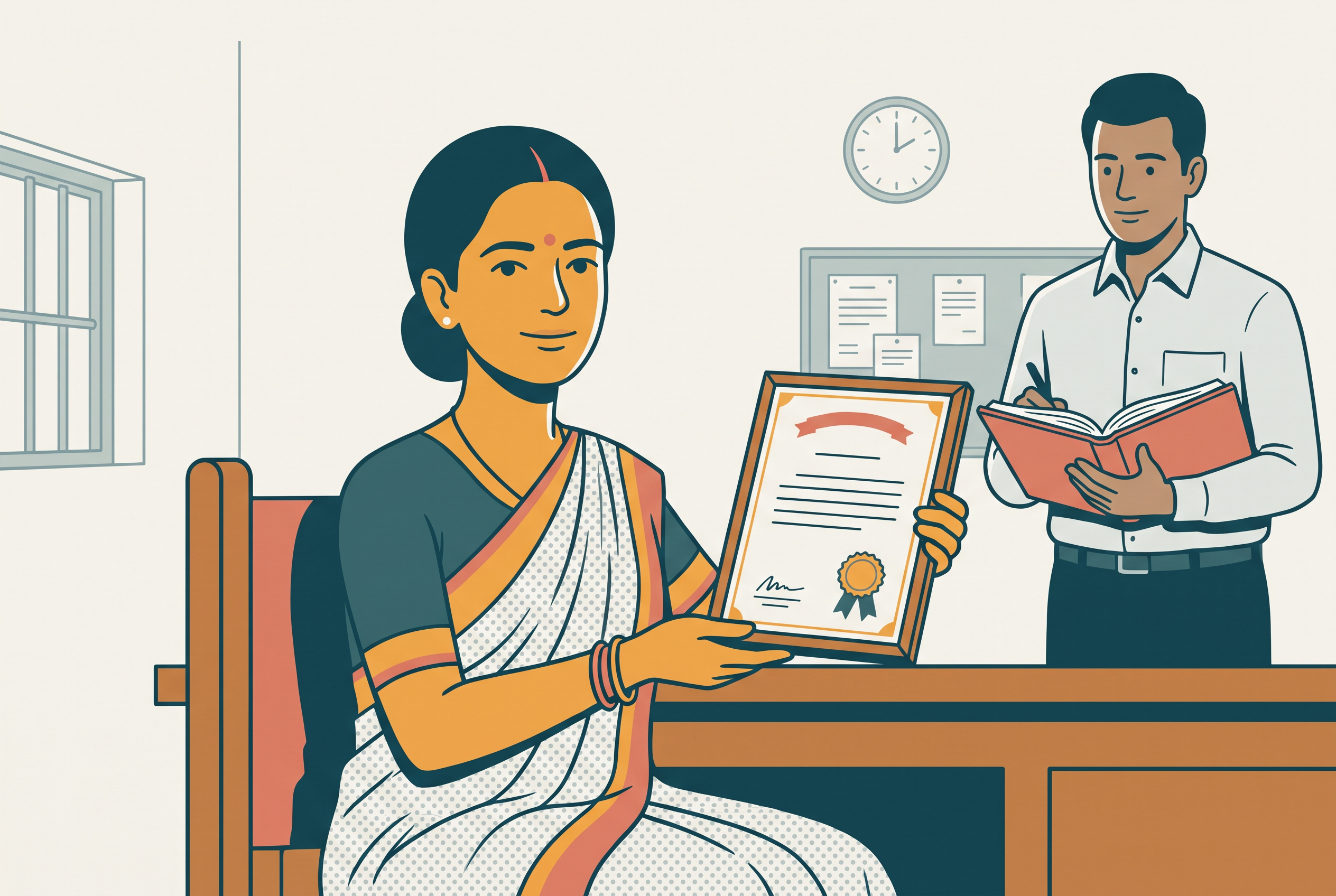
Fig. 3.4 – A woman panch receives an award.
Notice what Kalavati is describing. Reservation gave her a seat; what the seat gave her was a public identity of her own, separate from her relationship to a man. Sociologically, that is a shift in status — from a position defined entirely by kinship to one held in her own right.
3.2.2 Powers and Responsibilities of Panchayats
According to the Constitution, panchayats should be given powers and authority to function as institutions of self-government. This requires all state governments to revitalise local representative institutions — a panchayat that must ask permission for everything is not a government at all.
The following powers and responsibilities were delegated to the panchayats:
- to prepare plans and schemes for economic development
- to promote schemes that will enhance social justice
- to levy, collect and appropriate taxes, duties, tolls and fees
- to help in the devolution of governmental responsibilities, especially that of finances, to local authorities
What a Panchayat Actually Does
Read that list again and it can seem abstract. The everyday work is not abstract at all.
The social welfare responsibilities of the panchayats include the maintenance of burning and burial grounds, the recording of statistics of births and deaths, the establishment of child welfare and maternity centres, the control of cattle pounds, the propagation of family planning and the promotion of agricultural activities.
The development activities include the construction of roads, public buildings, wells, tanks and schools. Panchayats also promote small cottage industries and take care of minor irrigation works. Many government schemes, such as the Integrated Rural Development Programme (IRDP) and the Integrated Child Development Scheme (ICDS), are monitored by members of the panchayat.
Money, and the Right to Ask About It
Powers cost money. The main income of the panchayats comes from taxes levied on property, professions, animals and vehicles, and from cess on land revenue and rentals. These resources are further increased by grants received through the Zilla Panchayat, the district-level body at the apex of the three tiers.
Where money goes, so does the possibility of misuse — and this is where an idea you met in section 3.1 becomes concrete. It is considered compulsory for panchayat offices to put up boards outside their offices, listing the break-up of funds received and the utilisation of the financial aid received.
The purpose was to ensure that people at the grassroot level should have the right to information — opening all functioning to the public eye. People had the right to scrutinise the allocation of money, and to ask reasons for the decisions taken for the welfare and development activities of the village. A board on a wall is a small thing. It converts a citizen from a spectator into an auditor.
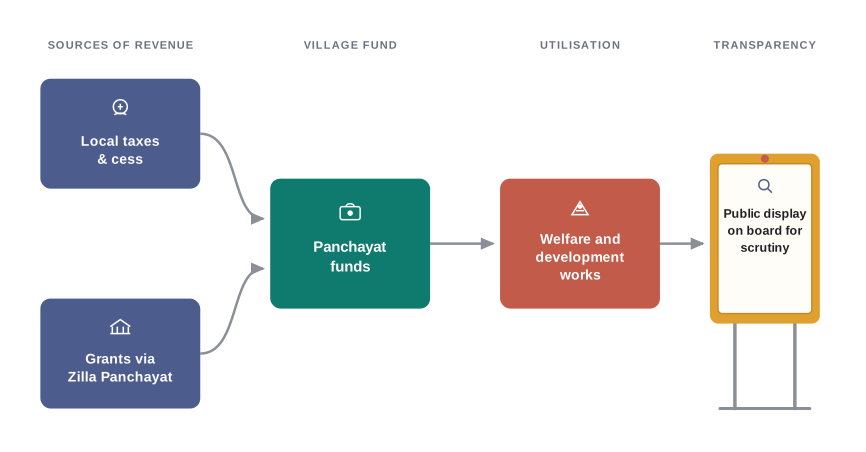
Fig. 3.5 – The flow of panchayat finances.
Village Courts
Nyaya Panchayats have been constituted in some states. They possess the authority to hear some petty civil and criminal cases. They can impose fines, but they cannot award a sentence.
These village courts have often been successful in bringing about an agreement amongst contending parties — an important thing in a setting where a formal court may be distant, slow and expensive. They have been particularly effective in punishing men who harass women for dowry and perpetrate violence against them.
3.2.3 Panchayati Raj in Tribal Areas
Many tribal areas have had a rich tradition of grassroot democratic functioning long before the 73rd Amendment existed. Meghalaya offers an illustrative example.
All three major ethnic tribal groups there — the Khasis, the Jaintias and the Garos — have their own traditional political institutions, which have existed for hundreds of years. These institutions were fairly well-developed and functioned at various tiers: the village level, the clan level and the state level. In the traditional political system of the Khasis, for instance, each clan had its own council, known as the ‘Durbar Kur’, presided over by the clan headman.
Yet, despite this long tradition of grassroot political institutions, a large chunk of tribal areas lies outside the provisions of the 73rd Amendment. One likely reason is that the policymakers concerned did not wish to interfere with the traditional tribal institutions already in place.
Is Tradition Always Democratic?
Here the sociologist Tiplut Nongbri enters a caution. Tribal institutions, she remarks, need not necessarily be democratic in their structure and functioning.
Commenting on the Bhuria Committee Report, which examined this issue, Nongbri observes that while the Committee’s concern for traditional tribal institutions is appreciable, it fails to take stock of the complexity of the situation. Notwithstanding the strong egalitarian ethos that characterised tribal societies, the element of stratification is not altogether absent.
Her criticism goes further. Tribal political institutions are not only marked by open intolerance towards women; the process of social change has also introduced sharp distortions into the system, making it difficult to identify which practice is traditional and which is not (Nongbri 2003: 220).
That last point should return you to something you met in Chapters 1 and 2: tradition is not a fixed inheritance sitting outside history. It changes, absorbs, and is reinvented — which is why “protecting tradition” is never as simple a policy as it sounds.
The van panchayat is worth a second look. It shows a community creating a democratic institution for itself, around a resource its own labour depends on — and it shows how a division of labour by gender can turn women into the group with the strongest stake in a forest.
3.2.4 Democratisation and Inequality
By now it should be clear that democratisation is not easy in a society that has had a long history of inequality based on caste, community and gender. Rules can be changed in a single sitting of Parliament. Social structures cannot.
You have already dealt with different kinds of inequality in the earlier book, and Chapter 4 will give you a fuller sense of the structure of rural India. Set the 73rd Amendment against that structure and the difficulty becomes visible.
Given an unequal and undemocratic social structure, it is not surprising that in many cases certain members — belonging to particular groups, communities or castes of the village — are not included in, or even informed about, the meetings and activities of the village. Exclusion here does not require a rule barring anyone. It requires only that the news of the meeting does not reach a particular hamlet.
Gram Sabha members are often controlled by a small coterie of rich landlords, usually hailing from the upper castes or the landed peasantry. They make the decisions on development activities and allocate the funds, leaving the silent majority as mere onlookers.
And yet the picture is not one of failure. A woman who was called only “Ramu’s mother” now signs her name on a panchayat resolution; a forest council run by women plants and guards trees; villagers can read a board that tells them what was spent. Democratisation, in a society structured by inequality, is not an event that occurred in 1992. It is a slow, contested process — and it is precisely the sort of process sociology exists to study.
3.3 Political Parties, Pressure and Interest Groups in Democratic Politics
Open any newspaper in the morning and you will find, somewhere in it, a group trying to be heard. A delegation has met a minister. A union has announced a strike. A farmers’ body has demanded a change in prices. An association has written to the government about a new rule.
All of these are attempts to draw the attention of the government to a grievance. Democracy does not consist only of voting once in five years. Between elections, organised groups keep pressing their claims — and how they press them is a sociological question.
Who Organises, and As What
Look first at how different economic interests come to be organised.
Industrialists form associations such as the Federation of Indian Chambers and Commerce (FICCI) and the Association of Chambers of Commerce (ASSOCHAM). Workers form trade unions, such as the Indian Trade Union Congress (INTUC) or the Centre for Indian Trade Unions (CITU). Farmers form agricultural unions, such as the Shetkari Sangathan. Agricultural labourers have unions of their own.
Notice the pattern. People who share a position in the economic structure — as owners, as employees, as cultivators, as landless labourers — tend to organise along that shared position. Their organisations are not accidents of personality; they follow the lines along which society is divided. Other kinds of organisation exist too, including social movements such as tribal and environmental movements, which you will study in the last chapter.
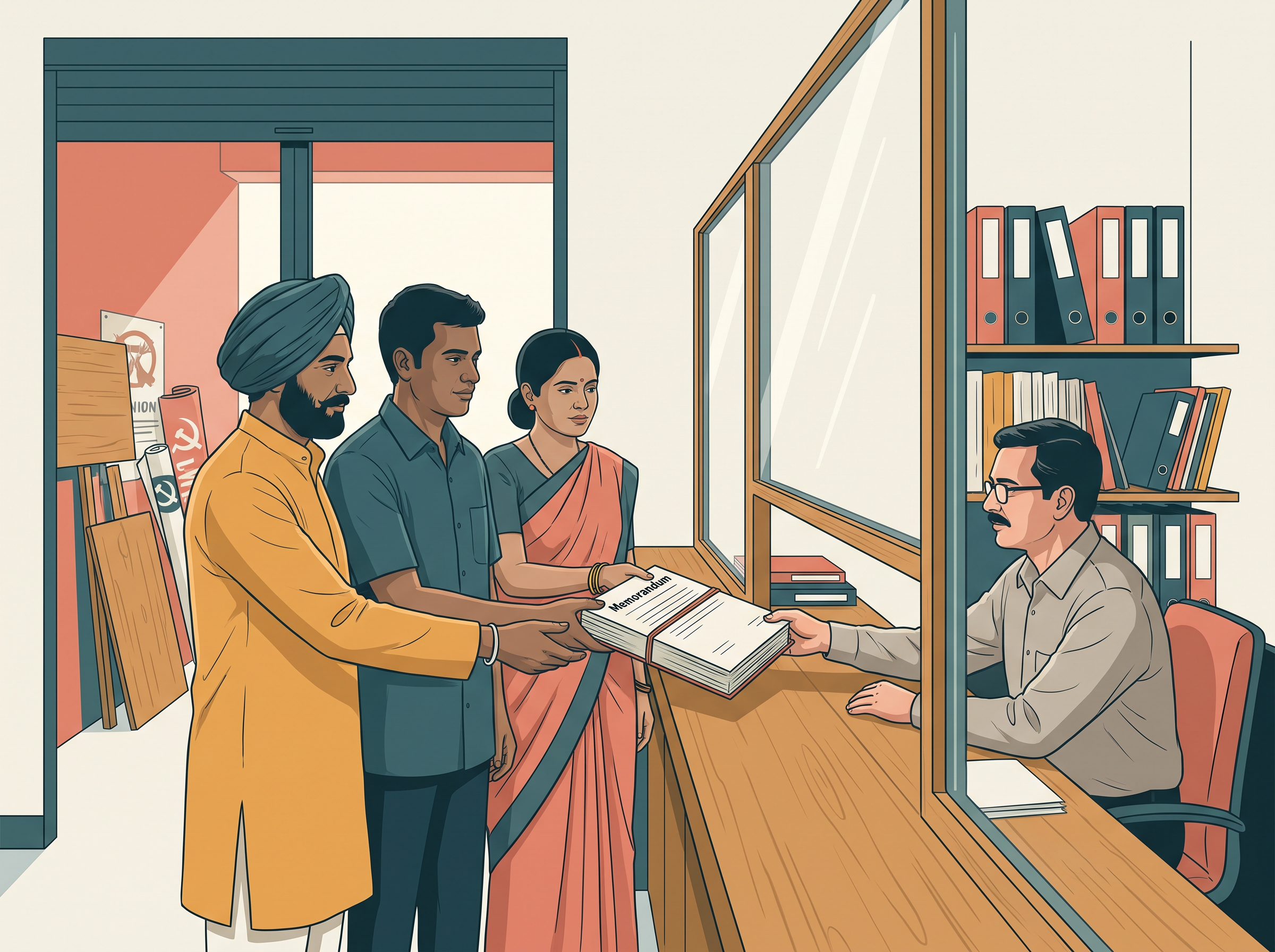
Fig. 3.6 – An interest group submitting a memorandum.
Political Parties
In a democratic form of government, political parties are the key actors.
Two words in that definition carry weight. “Legitimate” — the party seeks power by means the system accepts as lawful. “Electoral” — it seeks that power by contesting elections, not by capturing the state in some other way.
A political party, then, is an organisation established with the aim of achieving governmental power and using that power to pursue a specific programme. And a programme is never merely a list of schemes. Political parties are based on a certain understanding of society and of how it ought to be — a picture of what is wrong and what a good society would look like.
Interest Groups and Pressure Groups
In a democratic system the interests of different groups are also represented by political parties, who take up their case. But a party has to assemble a broad programme and win a majority, so it cannot take up every claim.
What happens to a group whose interest is not taken up? It has three options, and Fig. 3.7 sets them out.
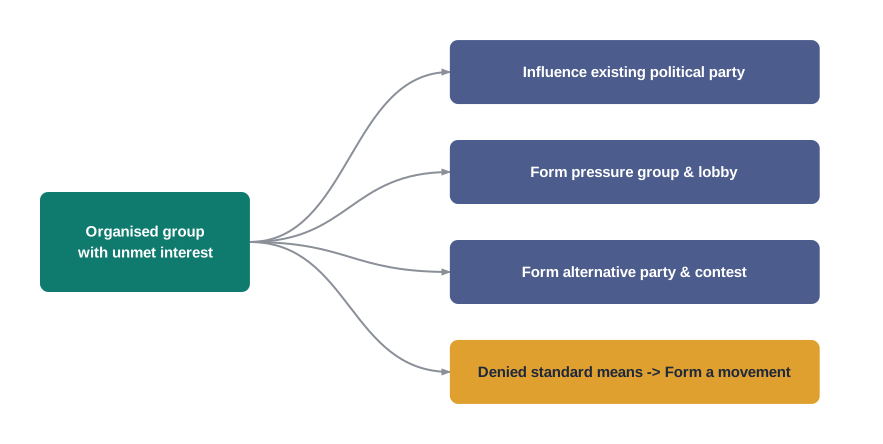
Fig. 3.7 – Paths available to groups with an unmet interest.
Different interest groups work towards influencing political parties. When certain groups feel that their interests are not being taken up, they may move to form an alternative party. Or they may form pressure groups, which lobby with the government.
Lobbying simply means the sustained effort to persuade those who make or implement law — through meetings, memoranda, data, publicity and the quiet reminder of how many people a group speaks for.
There is a fourth possibility, and it is the one that connects this chapter to the last. In some situations there may be political organisations that seek to achieve power but are denied the opportunity to do so through standard means. Such organisations, NCERT notes, are best regarded as movements until they achieve recognition.
Do Pressure Groups Explain Power?
Here the chapter turns from description to argument, and you should follow it carefully.
It is obvious that all groups will not have the same access, or the same ability to pressurise the government. An association of industrialists and an association of agricultural labourers may both write to a ministry. They will not be read with the same attention.
Some, therefore, argue that the very concept of pressure groups underestimates the power that dominant social groups — of class, caste or gender — hold in society. On this view, it would be more accurate to say that the dominant class or classes control the state, and that lobbying is simply the visible surface of a power that already exists.
This does not negate the fact that social movements and pressure groups continue to play a very important role in a democracy, as Chapter 8 will show.
3.4 Summary
The Constitution is not merely a rule book of do’s and don’ts. Because it rests on the basic norms of social justice, it has the capacity to help people, and the potential to extend what social justice means as society’s understanding of fairness changes.
The Directive Principle on village panchayats was moved as an amendment in the Constituent Assembly by K. Santhanam. It remained only a goal for over forty years, and became a constitutional imperative with the 73rd Amendment in 1992.
Social movements have aided courts and authorities in interpreting rights and principles in keeping with contemporary understandings of social justice.
Law and justice are not the same thing. The essence of law is force: a law carries the means to coerce obedience, and the power of the state stands behind it. The essence of justice is fairness.
Every legal system works through a hierarchy of authorities. The Constitution is the basis of all rules and authorities — the document that constitutes a nation’s tenets — and the Indian Constitution is India’s basic norm.
All other laws must be made by the procedures the Constitution prescribes, and are made and implemented by the authorities it specifies. When there is a dispute, a hierarchy of courts interprets the law. The Supreme Court is the highest court and the ultimate interpreter of the Constitution.
The Supreme Court has enhanced the substance of the Fundamental Rights. A Fundamental Right includes all that is incidental to it, so the terse words of Article 21 on the right to life and liberty have been read as including all that goes into a life of quality — livelihood, health, shelter, education and dignity. Life has been explained to mean more than mere animal existence.
These interpretations have provided relief to prisoners subjected to torture and deprivation, secured the release and rehabilitation of bonded labourers, acted against environmentally degrading activities, and required the provision of primary healthcare and primary education.
In 1993 the Supreme Court held that the Right to Information is a part of, and incidental to, the Right to Freedom of Speech and Expression under Article 19(1) (a).
The Supreme Court has read the Directive Principle of Equal Pay for Equal Work into the Fundamental Right to Equality under Article 14, providing relief to many plantation and agricultural labourers and to others.
Panchayati Raj means, literally, governance by five individuals. Its purpose is a functioning and vibrant democracy at the village or grassroot level.
Grassroot democracy is not an alien import, but in a society of sharp inequalities, democratic participation is hindered on grounds of gender, caste and class. Caste panchayats have traditionally represented dominant groups, have often held conservative views, and have taken decisions that go against democratic norms and procedures.
Panchayats found no mention in the Constitution when it was being drafted, and several members expressed sorrow, anger and disappointment. Ambedkar argued that local elites and upper castes were so well entrenched that local self-government would only mean the continuing exploitation of the downtrodden masses. Gandhiji envisaged each village as a self-sufficient unit and saw gram-swarajya as an ideal model.
Decentralised governance came only in 1992, with the 73rd Constitutional Amendment. It gave constitutional status to the Panchayati Raj Institutions, made elections to rural and municipal local bodies compulsory every five years, and gave control of local resources to the elected local bodies.
The structure is like a pyramid. At its base stands the Gram Sabha, the unit of democracy, consisting of the entire body of citizens in a village. It elects the local government and charges it with specific responsibilities, and ideally provides an open forum for discussion, for village-level development and for the inclusion of weaker sections in decision-making.
The 73rd Amendment provided a three-tier system of Panchayati Raj for all states with a population of over twenty lakhs, made elections mandatory every five years, provided reservation of seats for the Scheduled Castes and Scheduled Tribes and thirty-three per cent of seats for women, and constituted a District Planning Committee to plan for the district as a whole.
The 73rd and 74th Amendments reserved one third of the total seats for women in all elected offices of local bodies, rural and urban; out of this, 17 per cent of seats are reserved for women belonging to the scheduled castes and tribes. The 1993–94 elections brought 800,000 women into the political process in a single election. The system has been effective since 1992–93.
Panchayats are to be given powers and authority to function as institutions of self-government, and state governments are required to revitalise local representative institutions.
The powers delegated to panchayats are to prepare plans and schemes for economic development; to promote schemes that enhance social justice; to levy, collect and appropriate taxes, duties, tolls and fees; and to help in the devolution of governmental responsibilities, especially finances, to local authorities.
Their social welfare responsibilities include burning and burial grounds, the recording of births and deaths, child welfare and maternity centres, cattle pounds, family planning and the promotion of agriculture. Their development activities include roads, public buildings, wells, tanks and schools, small cottage industries and minor irrigation works. Panchayat members monitor schemes such as the Integrated Rural Development Programme and the Integrated Child Development Scheme.
The main income of panchayats comes from taxes on property, professions, animals and vehicles, and cess on land revenue and rentals, with resources increased by grants through the Zilla Panchayat. Panchayat offices must display boards listing the break-up of funds received and utilised, so that people at the grassroot level have the right to information, can scrutinise the allocation of money, and can ask the reasons for decisions.
Nyaya Panchayats, set up in some states, hear petty civil and criminal cases and can impose fines but cannot award a sentence. They have often brought contending parties to agreement, and have been particularly effective in punishing men who harass women for dowry and perpetrate violence against them.
Many tribal areas have a long tradition of grassroot democratic functioning. In Meghalaya, the Khasis, Jaintias and Garos have had well-developed political institutions for hundreds of years, working at village, clan and state level; among the Khasis, each clan had its own council, the ‘Durbar Kur’, presided over by the clan headman.
A large chunk of the tribal areas lies outside the provisions of the 73rd Amendment, possibly because policymakers did not wish to interfere with traditional tribal institutions.
Tiplut Nongbri cautions that tribal institutions need not themselves be democratic in structure or functioning. Commenting on the Bhuria Committee Report, she notes that despite a strong egalitarian ethos, stratification is not altogether absent; that tribal political institutions are marked by open intolerance to women; and that social change has introduced sharp distortions, making it difficult to identify what is traditional. Tradition, in short, is itself changing.
Democratisation is not easy in a society with a long history of inequality based on caste, community and gender. Members of particular groups, communities and castes are often not included in, or even informed about, the meetings and activities of the village.
Gram Sabhas are often controlled by a small coterie of rich landlords, usually from the upper castes or the landed peasantry, who take the decisions on development activities and allocate the funds, leaving the silent majority as onlookers.
Groups constantly seek to make their voices heard and to draw the government’s attention to their grievances. Industrialists form associations such as FICCI and ASSOCHAM; workers form trade unions such as INTUC and CITU; farmers form unions such as the Shetkari Sangathan; agricultural labourers have unions of their own.
A political party may be defined as an organisation oriented towards achieving legitimate control of government through an electoral process. It aims at governmental power and uses that power to pursue a specific programme, and it rests on a particular understanding of society and of how it ought to be.
Interest groups are organised to pursue specific interests in the political arena, operating primarily by lobbying the members of legislative bodies. Groups whose interests are not taken up by parties may work to influence them, form pressure groups that lobby the government, or form an alternative party.
Political organisations that seek power but are denied the opportunity to achieve it through standard means are best regarded as movements until they achieve recognition.
Weber placed classes within the economic order and status groups within the social order, but held that parties live in a house of power. Party action is always directed in a planned manner towards a goal, which may be a ‘cause’ or may be a personal one.
All groups do not have the same access to government, or the same ability to pressurise it. Some therefore argue that the concept of pressure groups underestimates the power that dominant social groups of class, caste and gender hold, and that it is more accurate to say that the dominant class or classes control the state. This does not deny that pressure groups and social movements continue to play a very important role in a democracy.
3.5 Key Terms
Basic norm — The founding rule of a legal system, from which all other rules draw their validity; in India, the Constitution.
Caste panchayat — A customary village body of a caste group, without legal standing, which has usually represented dominant groups and has often taken decisions contrary to democratic norms and procedures.
Constitution — The document that constitutes a nation’s tenets: it creates the authorities of the state and prescribes the procedure by which all other laws must be made.
Decentralised governance — The transfer of decision-making powers and control of resources from higher levels of government to elected local bodies.
Democratisation — The process by which participation in decision-making is extended to those who were previously excluded from it.
Directive Principles of State Policy — Constitutional principles that are not directly enforceable in court but which the state is expected to work towards, such as village panchayats and Equal Pay for Equal Work.
Fundamental Rights — The rights guaranteed and enforceable under the Constitution, held to include everything that is incidental to them.
Gram Sabha — The general body of all the citizens of a village; the base of the Panchayati Raj pyramid, which elects the local government and charges it with responsibilities.
Gram-swarajya — Village self-rule; Gandhiji’s ideal of each village as a self-sufficient unit conducting its own affairs.
Interest group — An organisation formed to pursue a specific interest in the political arena, operating primarily by lobbying members of legislative bodies.
Justice — Fairness in the sharing of benefits and burdens in society; distinct from law, which rests on force.
Law — A rule backed by the power of the state, carrying the means to coerce or compel obedience.
Lobbying — The sustained effort by a group to persuade legislators and government officials to decide in its favour.
Nyaya Panchayat — A village court set up in some states, empowered to hear petty civil and criminal cases and to impose fines, but not to award a sentence.
Panchayati Raj — Literally, governance by five individuals; the system of elected local self-government in rural India, given constitutional status by the 73rd Amendment.
Panchayati Raj Institutions (PRIs) — The elected bodies of the three-tier Panchayati Raj system, from the village panchayat up to the Zilla Panchayat.
Political party — An organisation oriented towards achieving legitimate control of government through an electoral process, in order to pursue a specific programme.
Pressure group — A group that seeks to influence government decisions in favour of its own interests without itself contesting elections for office.
Social justice — The principle that the benefits and burdens of living together should be shared fairly, so that no group is left permanently disadvantaged; the basic norm on which the Constitution rests.
Trade union — An organisation of workers formed to protect and advance their interests, such as INTUC or CITU.
Van panchayat — A forest council, set up by women in Uttarakhand, that raises nurseries, plants saplings on hill slopes and guards nearby forests against illegal felling.
Zilla Panchayat — The district-level body at the apex of the three-tier Panchayati Raj system, through which grants reach the village panchayats.
3.6 Points to Ponder
The Constitution promised village self-government in 1949, but it became binding only in 1992. What does a gap of forty-odd years tell you about the relationship between a written norm and the society it is meant to change?
Ambedkar feared that local self-government would hand the village to those who already controlled it; Gandhiji saw the village as the natural home of democracy. Reading the evidence in this chapter, which fear and which hope have been borne out — and can both be true at once?
A meeting can follow every rule of procedure and still exclude most of a village. If no rule has been broken, in what sense has democracy failed?
Reservation gave one third of local seats to women, and a Dalit panchayat member said that what changed most was that “she has a name”. Can a change in the law alter something as personal as how a person is addressed and how she sees herself?
Tribal institutions are old, local and rooted — but Tiplut Nongbri warns that they are not therefore democratic. When a practice is called “traditional”, what work is that word doing, and who benefits from it?
If dominant groups already shape what the state does, are pressure groups and lobbying a genuine channel of democratic influence, or a polite name for the power some groups hold anyway?
3.7 NCERT Questions
Have you heard of Bal Panchayats and the Mazdoor Kissan Sanghathan? If not, find out about them and write a note of about 200 words.
“The 73rd Amendment has been monumental in bringing a voice to the people in the villages.” Discuss.
Write an essay on the ways in which the Indian Constitution touches people’s everyday life, drawing upon different examples.
What is the significance of political parties in a democracy?
How are pressure groups formed?
What is the role of interest groups in a democratic system?
3.8 Objective Questions
The essence of law is force, while the essence of justice is:
- procedure
- fairness
- authority
- custom [1 mark]
Which of the following is described in the Constitution as India’s basic norm?
- The Supreme Court
- Parliament
- The Constitution itself
- The Gram Sabha [1 mark]
In 1993, the Supreme Court held that the Right to Information is a part of, and incidental to, which Fundamental Right?
- The Right to Equality under Article 14
- The Right to Life and Liberty under Article 21
- The Right to Freedom of Speech and Expression under Article 19(1)(a)
- The Right against Exploitation [1 mark]
Under the 73rd Amendment, a three-tier system of Panchayati Raj was provided for all states having a population of over:
- five lakhs
- ten lakhs
- twenty lakhs
- fifty lakhs [1 mark]
Which body forms the base of the Panchayati Raj pyramid and consists of the entire body of citizens in a village?
- The Zilla Panchayat
- The Gram Sabha
- The District Planning Committee
- The Nyaya Panchayat [1 mark]
A Nyaya Panchayat has the authority to:
- award a sentence of imprisonment
- impose fines but not award a sentence
- amend the Constitution
- levy taxes on land revenue [1 mark]
Fill in the blank: The 73rd and 74th Amendments reserved one third of the total seats in elected local bodies for women, and of these, ______ per cent are reserved for women belonging to the scheduled castes and tribes. [1 mark]
Fill in the blank: An organisation oriented towards achieving legitimate control of government through an electoral process is known as a ______. [1 mark]
True or False: Interest groups contest elections in order to form the government, and are therefore a type of political party. [1 mark]
Assertion (A): The 73rd Amendment made elections to Panchayati Raj Institutions compulsory every five years. Reason (R): Democratic participation in Indian villages has often been hindered on grounds of gender, caste and class.
- Both (A) and (R) are true, and (R) is the correct explanation of (A).
- Both (A) and (R) are true, but (R) is not the correct explanation of (A).
- is true, but (R) is false.
- is false, but (R) is true. [1 mark]
- Assertion (A): A large part of tribal India lies outside the provisions of the 73rd Amendment. Reason (R): Tribal political institutions are always more democratic in structure and functioning than elected panchayats.
- Both (A) and (R) are true, and (R) is the correct explanation of (A).
- Both (A) and (R) are true, but (R) is not the correct explanation of (A).
- is true, but (R) is false.
- is false, but (R) is true. [1 mark]
- Match the following:
| Column A | Column B |
|---|---|
| a. Tiplut Nongbri | i. Moved the amendment on village panchayats in the Constituent Assembly |
| b. K. Santhanam | ii. Gram-swarajya as an ideal model for independent India |
| c. Max Weber | iii. Commented on the Bhuria Committee Report and on stratification in tribal institutions |
| d. Gandhiji | iv. Placed classes in the economic order, status groups in the social order, and parties in the house of power |
[1 mark]
3.9 Check Your Concepts
Define social justice in your own words. [2 marks]
What is meant by the statement that the Constitution is India’s basic norm? [2 marks]
What is a Gram Sabha? Who are its members? [2 marks]
Name any two associations or unions mentioned in the chapter, and state whose interests each of them represents. [2 marks]
State any two powers or responsibilities that were delegated to the panchayats. [2 marks]
Differentiate between law and justice, giving one example of a situation in which the two might not agree. [4 marks]
Differentiate between a caste panchayat and an elected gram panchayat on the basis of membership, source of authority and accountability. [4 marks]
Differentiate between a political party and a pressure group. Use an example of each from the chapter. [4 marks]
Why is it compulsory for panchayat offices to display boards listing the funds they have received and how these have been used? Explain how this connects to the right to information. [4 marks]
“A Fundamental Right includes all that is incidental to it.” Explain this statement with reference to the interpretation of the right to life and liberty. [4 marks]
Explain, with reasons, why Dr. Ambedkar was doubtful about handing power to village self-government, while Gandhiji supported it. What does this disagreement reveal about the structure of rural Indian society? [6 marks]
Discuss the main provisions of the 73rd Amendment and evaluate how far it has succeeded in bringing a voice to those who were previously excluded from village decision-making. Support your answer with examples from the chapter. [6 marks]
“Tradition is not the same as democracy.” Examine this claim with reference to traditional tribal political institutions and Tiplut Nongbri’s criticism of the Bhuria Committee Report. [6 marks]
Some sociologists argue that the concept of pressure groups underestimates the power of dominant social groups, and that it is the dominant class or classes that control the state. How far do you agree? Present both sides of the argument and support each with evidence from the chapter. [6 marks]
3.10 Passage-Based Questions
Read the passage and answer the questions that follow.
The Gram Sabha of a village is announced for a Sunday morning. Word is passed near the temple and along the main lane, but not in the hamlet at the far edge of the village where the agricultural labourers live, and the meeting is fixed at an hour when they are still in the fields. Forty people attend. The five who speak are large landowners. A woman elected on a reserved seat sits through the meeting and is not asked for her view. A new road is sanctioned, running past the fields of those who spoke. Every rule of procedure has been followed, and no law has been broken.
- Identify the sociological process at work in this meeting, and explain how it operates without any rule being broken.
- Which two features of the 73rd Amendment were meant to prevent exactly this outcome, and why have they not been enough here?
- What does this passage tell you about the difference between the legal right to participate and the social capacity to participate? [6 marks]
Read the passage and answer the questions that follow.
The auto-rickshaw drivers of a district town form an association after the municipality restricts where they may park. The association does not put up candidates in the municipal election. It elects office-bearers, collects a membership fee, gathers figures on how many households depend on the trade, submits a memorandum to the district administration, and persuades a sympathetic legislator to raise the matter in the assembly. Two months later, the rule is modified. Meanwhile, a body of daily-wage porters in the same town, with no office, no funds and no spokesperson, is affected by the same rule and is not heard at all.
- Name the kind of organisation the drivers have formed, and explain how it seeks to influence government.
- What would have to change for this organisation to become a political party instead?
- Using the second half of the passage, explain the criticism that the concept of pressure groups underestimates the power that dominant social groups already hold. [6 marks]
Study the table and answer the questions that follow.
Village panchayat Total seats Seats held by women Meetings of the Gram Sabha held in the year Panchayat P 12 4 4 Panchayat Q 12 4 1 Panchayat R 15 2 2 - Under the 73rd and 74th Amendments, one third of the total seats in elected local bodies are reserved for women. Which of the three panchayats does not appear to meet this requirement, and how many seats would women need to hold in it for the requirement to be met?
- Panchayats P and Q have the same number of women members, but very different numbers of Gram Sabha meetings. Why might a sociologist regard this difference as important?
- Explain, using the chapter, why holding a reserved seat does not by itself guarantee that a woman member influences the decisions of a panchayat. [6 marks]