Chapter 6: Globalisation and Social Change
It is an ordinary Sunday evening in a district town in India. In one small flat, a family sits down to eat. The pressure cooker on the stove was made in a factory a few hundred kilometres away, but the steel in it may have travelled much further. The television in the corner is playing a serial dubbed into the local language, made by a channel whose head office is in another country. The mother is checking a message on a phone that was designed in one place, assembled in another, and sold here at a price fixed by competition between firms in several continents.
The father’s work has changed too. The small unit where he worked for years shut down when cheaper goods began arriving from abroad. His nephew, on the other hand, has just found a job in a call centre in a nearby city, working through the night while customers in a distant country begin their morning.
Nothing in this room looks dramatic. There is no factory closing on the news, no ship arriving at a port. Yet almost everything on that table — the work, the food, the phone, the programme on the screen — connects this family to decisions taken far away, by people they will never meet.
Sociology asks the obvious question that nobody in the room is asking. How did the world get inside this house?
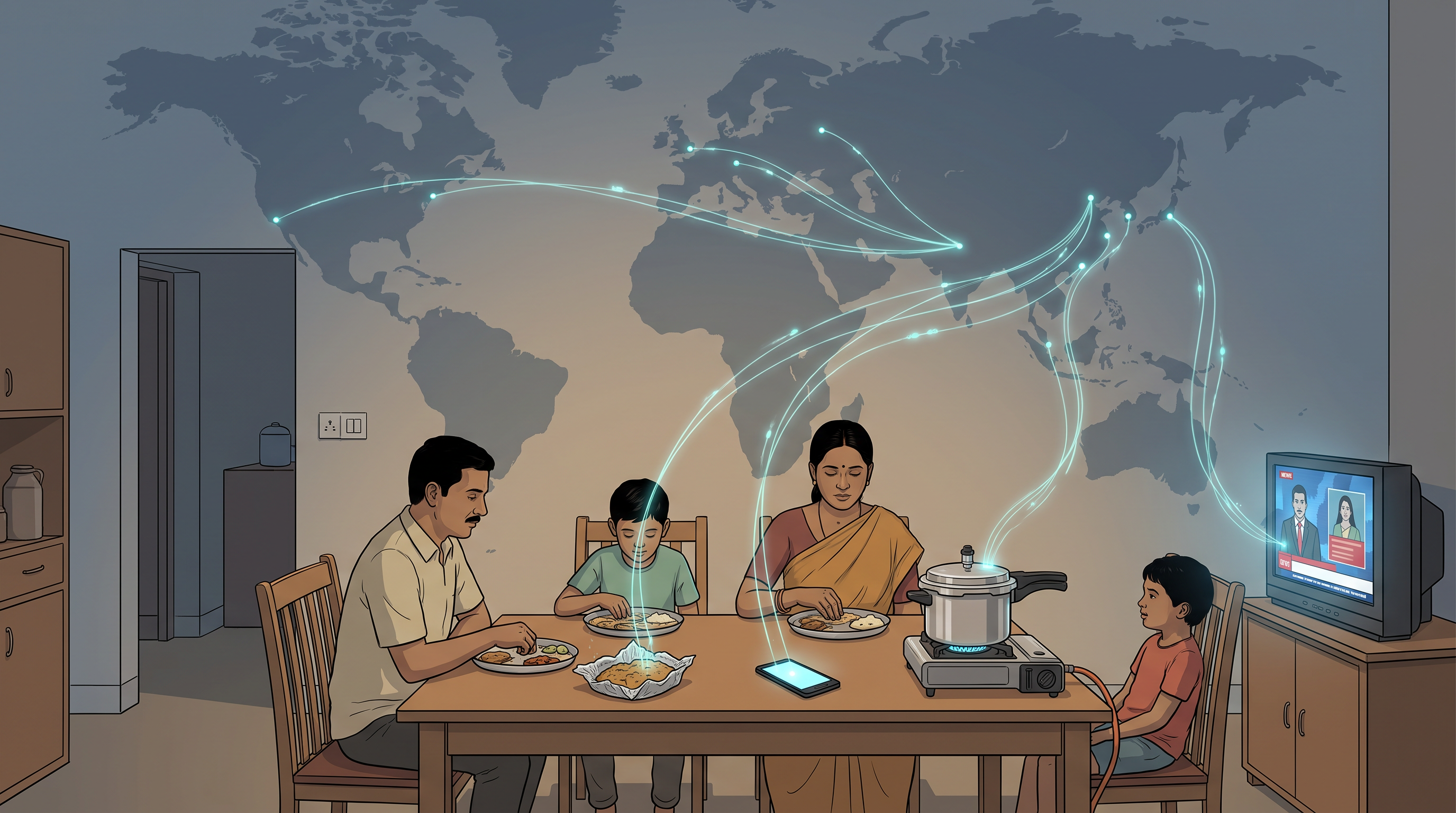
Fig. 6.1 – Everyday household objects and their global connections.
Keep these questions in mind as you read. By the end of this chapter you will be able to answer each of them in the language of sociology.
6.1 Globalisation and the Sociological Imagination
No discussion of social change in the twenty-first century can go very far without the word globalisation. In its ordinary working sense, globalisation means the growing interconnection between people, regions and countries — the fact that what happens far away increasingly shapes what happens here. It is a word you have already met more than once in this book.
You met it in the chapter on rural society, where the opening of agriculture to world markets changed what farmers grew and what they earned. You met it again in the chapter on industrial society, when the Indian government’s policy of liberalisation — the set of decisions taken since 1991 to open the Indian economy to the world market — was seen to reshape Indian industry. It appeared once more in the discussion of visions for global cities, where a city’s future was imagined in relation to other cities of the world rather than to its own hinterland.
The word also travels far beyond your school books. It is in the newspaper headline about a global city of tomorrow, in the television debate about foreign investment, in the shopkeeper’s remark that his customers now ask for a brand he had never heard of ten years ago.
One Word, Many Meanings
The fact that a word is used everywhere does not mean that it is used precisely. Before we can study globalisation, we must be clear about what it is we are studying. That is what this chapter sets out to do: to understand the meaning of globalisation, its different dimensions, and its social consequences.
This does not mean that there is only one correct definition of globalisation, or only one way of understanding it. Different academic disciplines look at the same process through different windows. Economics is likely to concentrate on economic dimensions such as the movement of capital across borders. Political science is likely to ask how the role of governments is changing when so many decisions are taken outside the country.
Yet the process is so far-reaching that no discipline can now afford to stay within its own boundaries. To explain both the causes and the consequences of globalisation, disciplines have to borrow from one another. An economist studying imported yarn will sooner or later have to ask who the spinners were and what happened to their households; a sociologist studying those households will have to understand the trade rules that let the yarn in.
Seeing the Global in the Local
What, then, does sociology bring to the table? Its distinctive contribution is the sociological imagination — the ability to see the connection between the individual and society, between the micro and the macro, between the local and the global.
Used on globalisation, this imagination generates a whole series of questions. How is a peasant in a remote village affected by decisions taken in distant capitals, and how exactly is she connected to them? How have the chances of employment for the middle class changed? What are the possibilities for big Indian companies of growing into corporations that operate across many countries? What does it mean for the neighbourhood grocer if the retail trade is opened up to giant firms from abroad? Why are there so many shopping malls in our cities and towns today? How has the way young people spend their leisure time changed?
These are only a few examples. Once you begin to ask such questions, you will find many more instances in which developments elsewhere in the world are reshaping people’s lives here — and therefore reshaping the way sociology has to study society.
When the Market Opens
Consider one concrete policy change. Independent India had for decades restricted how much of various goods could be brought into the country. These were quantitative restrictions — limits on the quantity of imports, used to shelter Indian producers from foreign competition. Since 1 April 2001, all types of quantitative restrictions (QR) on imports were withdrawn.
The result is visible in the most ordinary places. It is no surprise now to find a Chinese pear and an Australian apple competing for attention at the local fruit stall. The neighbourhood store stocks Australian orange juice and ready-to-fry chips in frozen packets. Slowly, what we eat and drink at home with family and friends changes.
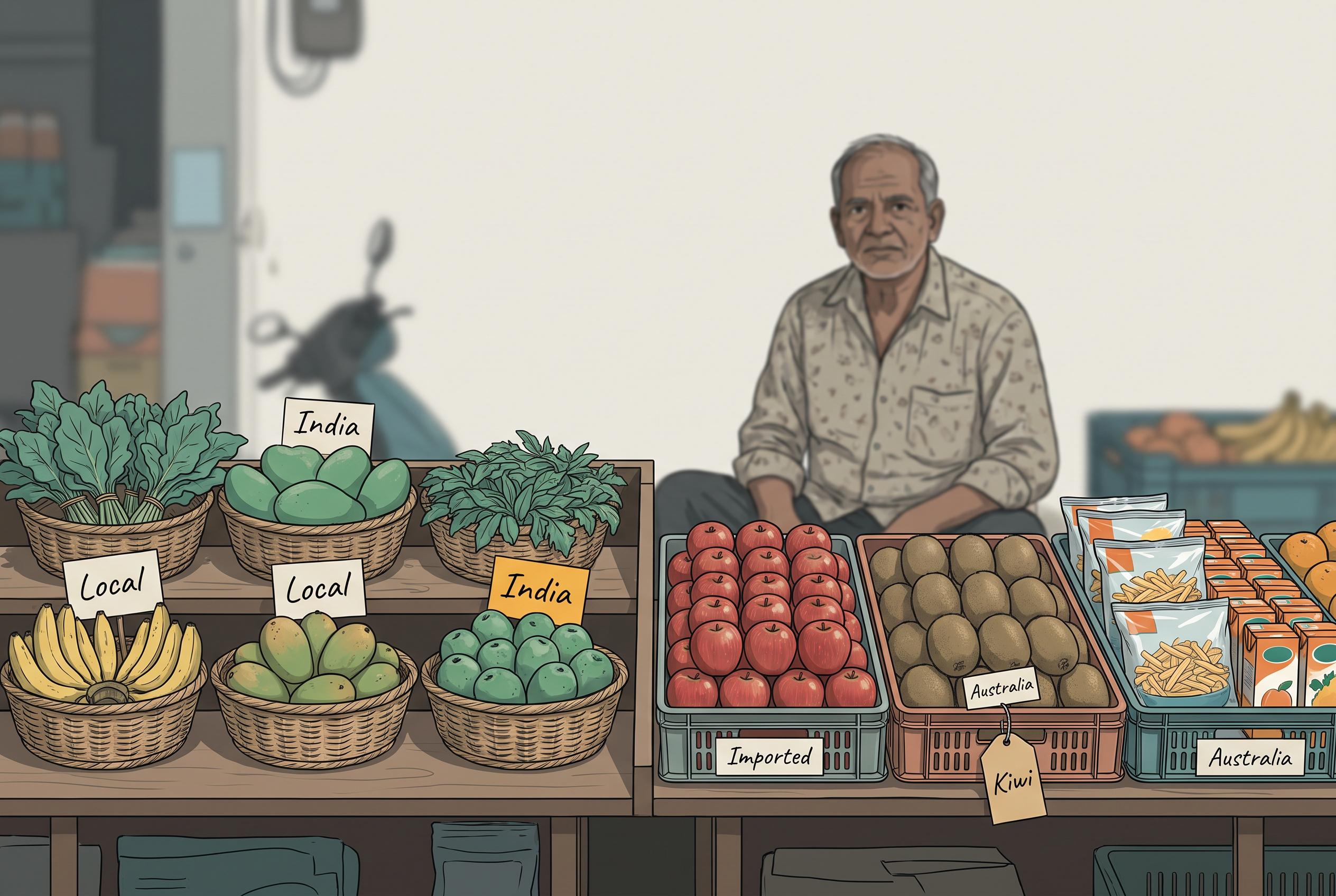
Fig. 6.2 – Local and imported goods side by side in a neighbourhood stall.
Now look at the same change from two sides of the counter. For an urban, affluent consumer, the withdrawal of restrictions means greater choice and often lower prices. For a farmer whose crop must now compete with produce grown in another country, the same decision may mean a crisis of livelihood. One set of policies; two entirely different experiences.
Notice what has just happened to the boundary between the personal and the public. What appears on a family’s plate looks like a private matter of taste and budget. It is in fact linked to public policies adopted by the government and to its agreements with the World Trade Organisation (WTO). In the same way, macro policy changes explain why a household that once had a single television channel now has scores of them. The dramatic changes in the media are perhaps the most visible effect of globalisation, and the next chapter is devoted to them.
These are random examples, but they help you appreciate the close interconnection between your personal life and the apparently remote policies of globalisation. The sociological imagination is precisely what makes that connection between the micro and the macro, the personal and the public.
Society Can No Longer Be Studied as an Island
There is a methodological consequence here, and it is a serious one. The sociologist or social anthropologist can no longer study a society as though it were an isolated entity, complete in itself. The compression of space and time — the shrinking of the distance and the delay that once separated places, so that events far away are felt almost at once — has put an end to that.
Villages, families, movements, child-rearing practices, work and leisure, bureaucratic organisations, castes: all of these must now be studied with global interconnection taken into account. A study of a farming household that ignores the impact of WTO rules on agriculture — and therefore on the farmer — is an incomplete study.
Who Gains and Who Loses
The effect of globalisation is far-reaching. It affects us all, but it does not affect us all in the same way. For some it means new opportunities; for others, the loss of a livelihood.
The examples are not hard to find. Women silk spinners and twisters in Bihar lost their work once Chinese and Korean silk yarn entered the market; weavers and consumers preferred the imported yarn because it was somewhat cheaper and had a shine. Similar displacement followed the entry of large fishing vessels into Indian waters: these vessels take away fish that were earlier caught by Indian fishing vessels, and the livelihoods of women fish sorters, dryers, vendors and net makers are affected as a result. In Gujarat, women gum collectors who picked gum from the julifera (Baval trees) lost their employment when cheaper gum began to be imported from Sudan. In almost all cities of India, rag pickers lost part of their earnings because waste paper was imported from developed countries. Later in this chapter you will see how traditional entertainers were affected.
Read that list again with the sociological imagination switched on. In each case, a decision about trade — taken in an office, recorded in an agreement — travels down to a specific set of hands: hands that spun, sorted, picked or collected. And in each case, those hands belonged mostly to women working in the least protected parts of the economy.
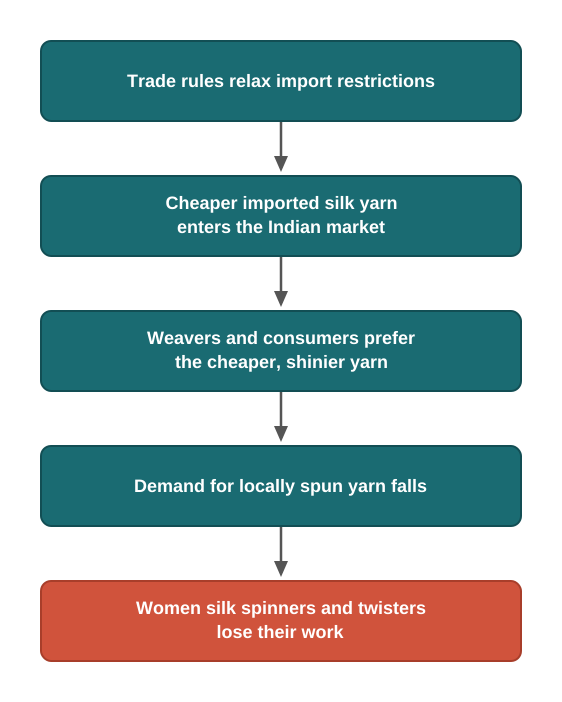
Fig. 6.3 – The impact of import relaxation on local spinners.
6.2 Are Global Interconnections New to World and to India
If globalisation is about global interconnections, then a sceptic is entitled to ask an awkward question. Is such interconnection really new? Were India and the different parts of the world not interacting with one another in earlier times?
The question matters. If people, goods and ideas have always crossed borders, then perhaps globalisation is only a fashionable name for something very old.
The Early Years
India was not isolated from the world even two thousand years ago. From your history textbooks you already know the famous Silk route, which centuries ago connected India to the great civilisations that existed in China, Persia, Egypt and Rome. Silk, spices, metals and ideas moved along it, and so did people.
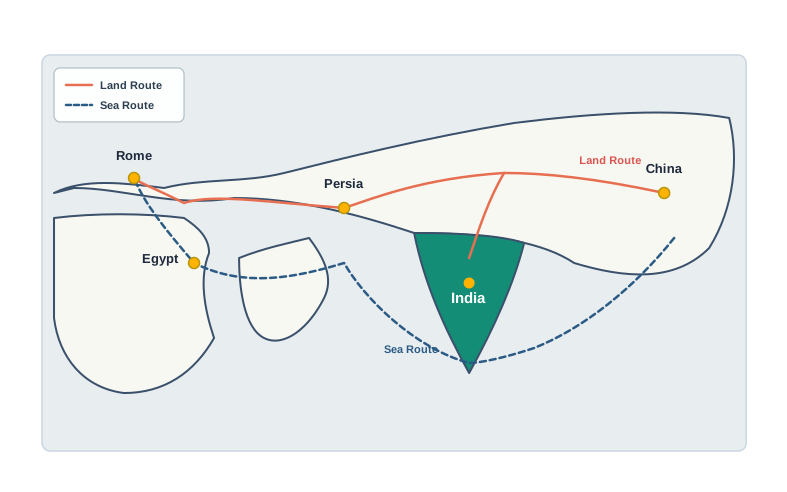
Fig. 6.4 – The ancient Silk route linking India to the world.
Movement was not only outward. Throughout India’s long past, people from different parts of the world came here — sometimes as traders, sometimes as conquerors, sometimes as migrants in search of new lands — and settled down. Migration, the movement of people from one place to another to live and work, is not an invention of our times.
Its traces survive in memory. In remote Indian villages, people often ‘recall’ a time when their ancestors lived elsewhere, and can name the place from which they came before settling where they now live. A village that looks entirely rooted in its own soil often turns out, in its own telling, to be the result of a journey.
Global interactions, and even a global outlook, are therefore not novel developments unique to the modern period, or unique to modern India.
Colonialism and the Global Connection
Our story of social and economic development in modern India began with the colonial period, and for good reason. You will recall from the chapter on structural change that modern capitalism — an economic system based on private ownership, wage labour and production for profit — had a global dimension from its very inception.
Colonialism was part of the system that sustained it. Expanding capitalism required new sources of capital, new raw materials, new sources of energy, new markets, and a global network to tie them together; colonial rule supplied all of these. The connection between Britain and India was not a friendly exchange between equals. It was a structured relationship in which one economy was reorganised to serve another.
Globalisation today often identifies the large-scale movement of people as one of its defining features. Yet the greatest movement of people in modern history was, arguably, the migration of Europeans who settled in the Americas and in Australia.
Nor was all movement voluntary — and this is the point that the cheerful language of ‘global mobility’ tends to hide. You will remember how indentured labourers were taken away in ships from India, bound by long contracts, to work in distant parts of Asia, Africa and the Americas. And the slave trade carted thousands of Africans away to distant shores. Movement across the world, then, has been driven as much by force and need as by opportunity.
Independent India and the World
Independent India did not turn its back on the world. It retained a global outlook, and in many senses this was inherited from the Indian nationalist movement, whose vision included a commitment to liberation struggles throughout the world and solidarity with people from different parts of it.
That outlook had practical expression. Many Indians travelled overseas for education and for work, and migration remained an ongoing process. The export and import of raw material, goods and technology was very much a part of the country’s development after independence. Foreign firms did operate in India.
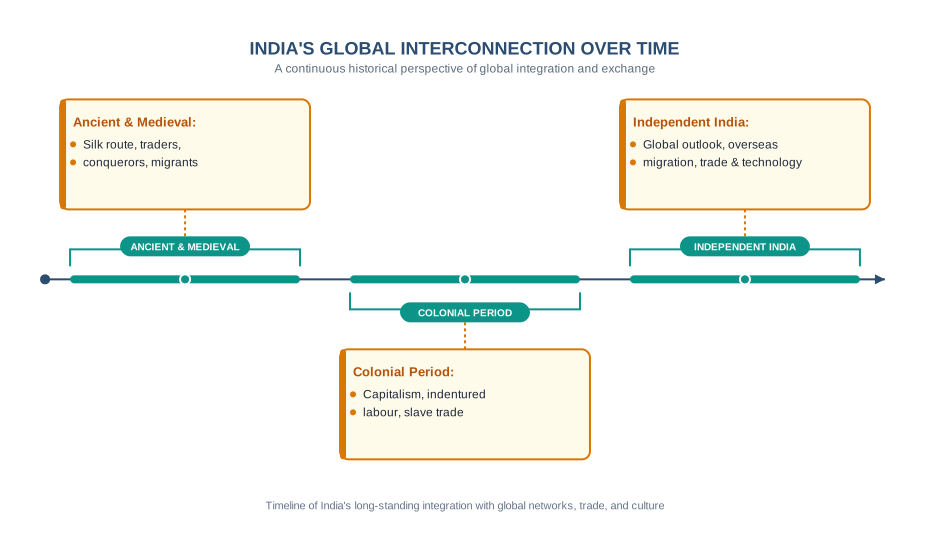
Fig. 6.5 – Timeline of India’s historical global connections.
So the sceptic’s question has some force behind it. Interconnection is old; migration is old; trade in goods and technology is old; even foreign firms operating on Indian soil are not new. We are therefore obliged to ask ourselves honestly whether the current process of change is radically different from anything we have seen in the past.
6.3 Understanding Globalisation
We have seen that India had significant links with the wider world from very early times. We also know that western capitalism, as it emerged in Europe, was both built upon and maintained by global control over the resources of other countries — most obviously through colonialism. So far, the sceptic seems to be winning.
But the important question is a sharper one. Is globalisation only about global interconnections? Or is it about significant changes in the capitalist system itself — in production and communication, in the organisation of labour and capital, in technological innovation and cultural experience, in ways of governance, and in the character of social movements?
If it is the second, then globalisation is not simply more of an old thing. It is a change in the kind of thing it is.
Why ‘More Contact’ Is Not Enough
These changes are significant even though some of the patterns were already evident in the early stages of capitalism. A merchant in the seventeenth century traded across oceans; so does a firm today. But the merchant waited months for news of his own cargo. Today a fund manager moves money between continents in the time it takes to read this sentence.
Some of the changes — above all those flowing from the communication revolution, the transformation brought about by satellites, computers, the Internet and mobile telephony — have in countless ways transformed the way we work and live. They have changed not only how much contact there is, but how quickly it happens, how far it reaches, and how deeply it enters daily life.
This is why a simple definition of ‘global interconnection’ will not do. It does not capture the intensity and the complexity of what is going on. As you work through the distinctive features set out in the sections that follow, you will see why.
A Working Definition
We can now state what sociology means by the term.
Read that definition carefully, because two of its implications are easily missed.
First, economic forces are an integral part of globalisation, but it would be wrong to suggest that they alone produce it. Trade and investment are not the whole story. Globalisation has been driven forward above all by the development of information and communication technologies, which have intensified the speed and the scope of interaction between people all over the world. A trade agreement can open a border; only a satellite link can put a customer in one country and a call-centre worker in another into the same conversation at two o’clock in the morning.
Second, globalisation did not simply happen. There was a political context within which it grew — a set of political changes and choices that made these economic and technological developments possible, and gave them the particular shape they now have. We return to that context when we look at political changes.
The Different Dimensions of Globalisation
To make the discussion manageable, we deal with the economic, the political and the cultural aspects of globalisation separately, taking each in turn in the sections that follow.
This separation is a convenience, not a claim about reality. You will soon realise how closely connected and interconnected these dimensions are. The economic opening of a market brings foreign television channels; those channels carry advertisements; the advertisements shape what people want to buy; what people want to buy alters what is produced and who is employed to produce it. Pull one thread, and the others move.
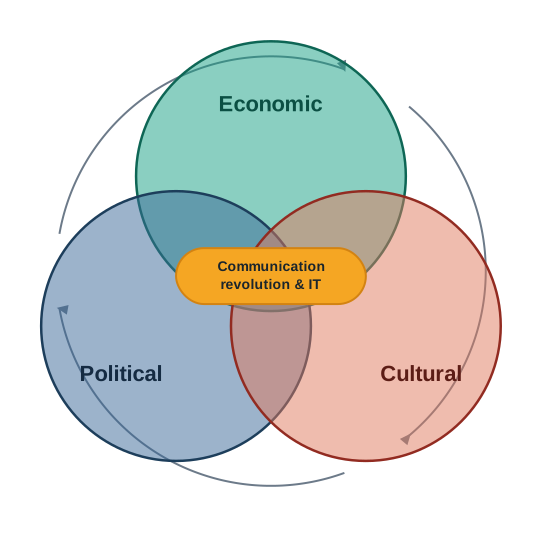
Fig. 6.6 – The interconnected dimensions of globalisation.
6.4 The Different Dimensions of Globalisation: The Economic
In India we often use the terms liberalisation and globalisation as though they were the same thing. They are indeed related, but they are not the same. Keeping them apart is the first step to understanding the economic dimension of globalisation.
Globalisation, as we have defined it, involves a stretching of social and economic relationships throughout the world. That stretching does not happen by itself. It is pushed along by certain economic policies. In India, this set of policies is very broadly termed liberalisation, and it dates from a decision taken by the state in 1991.
The Economic Policy of Liberalisation
Liberalisation refers to the range of policy decisions that the Indian state has taken since 1991 to open up the Indian economy to the world market.
This marked a break with the government’s earlier stated policy of exercising greater control over the economy. After independence, the state had put in place a large number of laws which ensured that the Indian market and Indian indigenous business were protected from the competition of the wider world.
The reasoning behind that protection deserves to be understood rather than dismissed. The underlying assumption was that a country only recently released from colonial rule, with weak industry and little capital, would be at a disadvantage in a free market situation. A young firm competing against an established foreign giant does not lose because it is inefficient; it loses because it started later and started smaller.
What liberalisation actually changed
Liberalisation of the economy meant the steady removal of the rules that regulated Indian trade and finance. These measures are also described as economic reforms.
What are these reforms? Since July 1991, the Indian economy has witnessed a series of reforms in all the major sectors of the economy — agriculture, industry, trade, foreign investment and technology, the public sector, financial institutions, and others. The basic assumption of these reforms was that greater integration into the global market would be beneficial to the Indian economy.
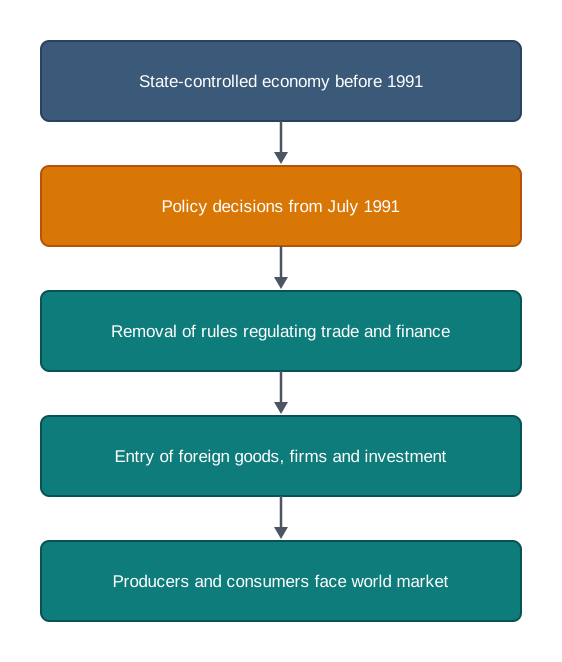
Fig. 6.7 – The process of economic liberalisation in India.
Loans, conditions and structural adjustment
The process of liberalisation also involved taking loans from international institutions such as the International Monetary Fund (IMF). Such loans are not given unconditionally. In return, the government makes commitments to pursue certain kinds of economic measures, which involve a policy of structural adjustment.
Here is where a sociologist begins to pay close attention. Structural adjustment usually means cuts in state expenditure on the social sector — on health, on education, on social security. A cut in a budget line is an economic fact; a village school without a teacher and a hospital without medicines are social facts. The two are the same event seen at different distances.
Alongside this, there is a greater say by international institutions such as the World Trade Organisation (WTO) in decisions that were once taken nationally.
The Transnational Corporations
Among the many economic factors driving globalisation, the role of transnational corporations (TNCs) is particularly important.
They vary enormously in size. A TNC may be a relatively small firm with one or two factories outside the country in which it is based. It may equally be a gigantic international enterprise whose operations criss-cross the globe. Some of the biggest such companies are known all around the world: Coca Cola, General Motors, Colgate-Palmolive, Kodak, Mitsubishi and many others.
What defines them is not their address but their orientation. They are oriented to global markets and global profits, even when they have a clear national base. Some Indian corporations, too, are becoming transnational. What this trend may mean for the people of India as a whole is not something we can be sure about at this point of time.
The Electronic Economy
The electronic economy is another factor that underpins economic globalisation. Banks, corporations, fund managers and individual investors are able to shift funds internationally with the click of a mouse.
This new ability to move ‘electronic money’ instantaneously carries great risks with it. In India, this is often discussed with reference to rising stock markets — and to sudden dips, when foreign investors buy stocks, make a profit and then sell them off. A market can be lifted, and dropped, by decisions taken by people who have never set foot in the country whose companies they are trading in.
Such transactions can happen only because of the communication revolution, which we discuss later in this chapter.
The Weightless Economy or Knowledge Economy
In contrast to previous eras, the global economy is no longer primarily agricultural or industrial in its basis.
The weightless economy is one in which products have their base in information — as is the case with computer software, media and entertainment products, and internet-based services. Nothing is mined, grown or carried; and yet a great deal is bought and sold.
The knowledge economy is one in which much of the workforce is involved not in the physical production or distribution of material goods, but in their design, development, technology, marketing, sale and servicing. It can range from the neighbourhood catering service to large organisations that provide a host of services for professional meets like conferences and for family events like weddings.
The result is a whole set of new occupations that were unheard of a few decades ago — the event manager, for instance. Have you heard of them? What exactly do they do?
The Globalisation of Finance
It should also be noted that, for the first time, and mainly due to the information technology revolution, there has been a globalisation of finance.
Globally integrated financial markets undertake transactions worth billions of dollars within seconds in electronic circuits. There is 24-hour trading in capital and security markets: as one market closes, another opens, so that money is never asleep. Cities such as New York, Tokyo and London are the key centres for financial trading. Within India, Mumbai is known as the financial capital of the country.
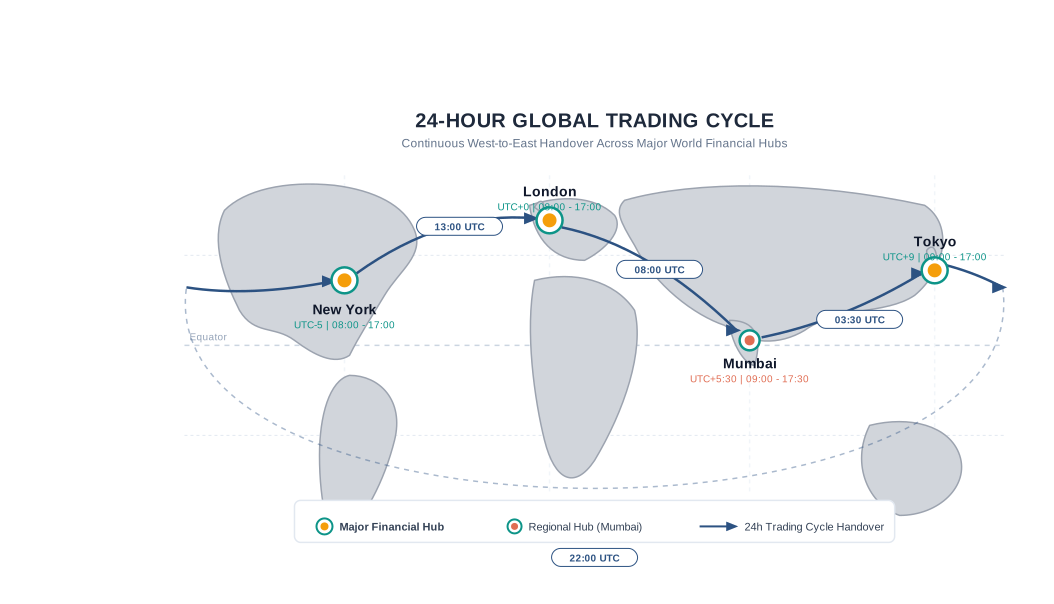
Fig. 6.8 – The 24-hour cycle of global financial trading.
6.5 Global Communications
Important advances in technology, and in the world’s telecommunications infrastructure, have led to revolutionary changes in global communication. Some homes and many offices now have multiple links to the outside world: telephones, both landlines and mobiles, fax machines, digital and cable television, electronic mail and the Internet.
Read that sentence again and notice the two small words that carry the sociology: some homes, many offices. Some of you will be able to think of many such places around you. Some of you will not.
The Digital Divide
That difference is what is often termed the digital divide in our country.
The divide follows lines you already know. It runs between town and village, between rich and poor households, between the literate and those denied education. A technology that is supposed to connect everyone to everything ends up reproducing the inequalities of the society it enters.
Table 6.1 shows two things at once. Globally, the use of the Internet increased phenomenally in the 1990s — from 70 million users in 1998 to 325 million by 2000. But look at how those users were distributed: in 1998, the USA and Canada alone accounted for 62 per cent of the world’s Internet users, while the whole of Asia accounted for 12 per cent. India’s own numbers have since risen enormously, from 15 million users in 2000 to 700 million. (Singhal and Rogers 2001: 235)
Growth, however, is not the same as equality. According to a study in 2017–18, only one in ten households had a computer at home, and about a quarter of all homes had Internet connectivity through a mobile phone or another device. These figures indicate the digital divide that continues to prevail in the country, despite the rapid spread of computers. Cyber connectivity had largely remained an urban phenomenon, though widely accessible through cyber cafés; rural areas, with their erratic power supply, widespread illiteracy and lack of infrastructure such as telephone connections, still remain largely unconnected.
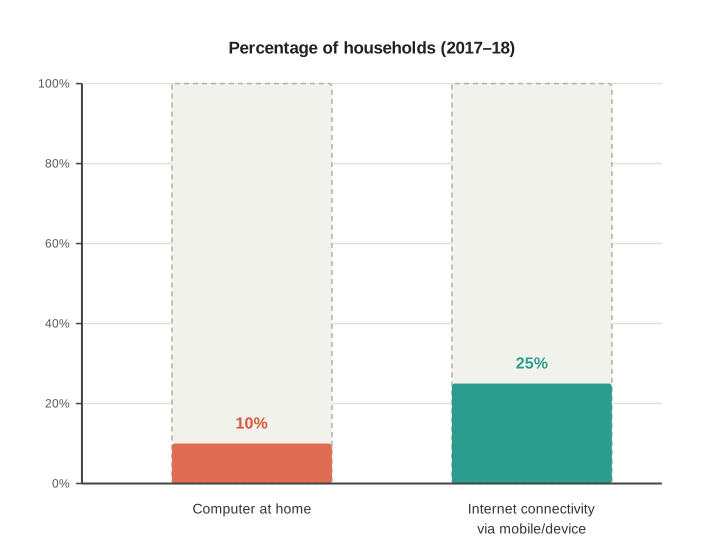
Fig. 6.9 – The digital divide in Indian households, 2017–18.
Distance Without Delay
Despite the digital divide, these forms of technology do make possible the ‘compression’ of time and space that we met earlier. Two individuals located on opposite sides of the planet — in Bengaluru and in New York — can not only talk to each other, but also send documents and images to one another with the help of satellite technology.
Out of this grows what may be called a network and media society: a society whose work, information and relationships increasingly run along electronic networks rather than along roads.
The state has been an active participant in this. To create global interconnectedness more efficiently, the Government of India has initiated an ambitious programme in the form of ‘Digital India’, in which every exchange will incorporate digitisation, with the stated aim of transforming India into a ‘digitally empowered society’ and a ‘knowledge economy’.
This is also the infrastructure on which outsourcing rests — the practice by which a firm in one country has part of its work, such as customer service or data processing, done by workers in another. You have already seen how outsourcing operates in your earlier chapters. Without satellite links and cheap data, a customer in one continent and a worker in another could not be placed in the same conversation.
The Telephone and the Family
India’s telephone story is worth telling in numbers, because the numbers make the transformation visible.
Read Table 6.2 slowly. For the first three decades after Independence, telephone provision barely moved: the population doubled between 1947 and 1980, while telephones remained few and villages remained almost entirely without them. Then, in the late 1990s, a sea change occurred. Within a decade, half of all Indian villages had some kind of telephone facility, and by 2000 some 650,000 public call offices had mushroomed all over India — including in remote, rural, hilly and tribal areas — where a person could simply walk in, make a call, and pay the metered charges.
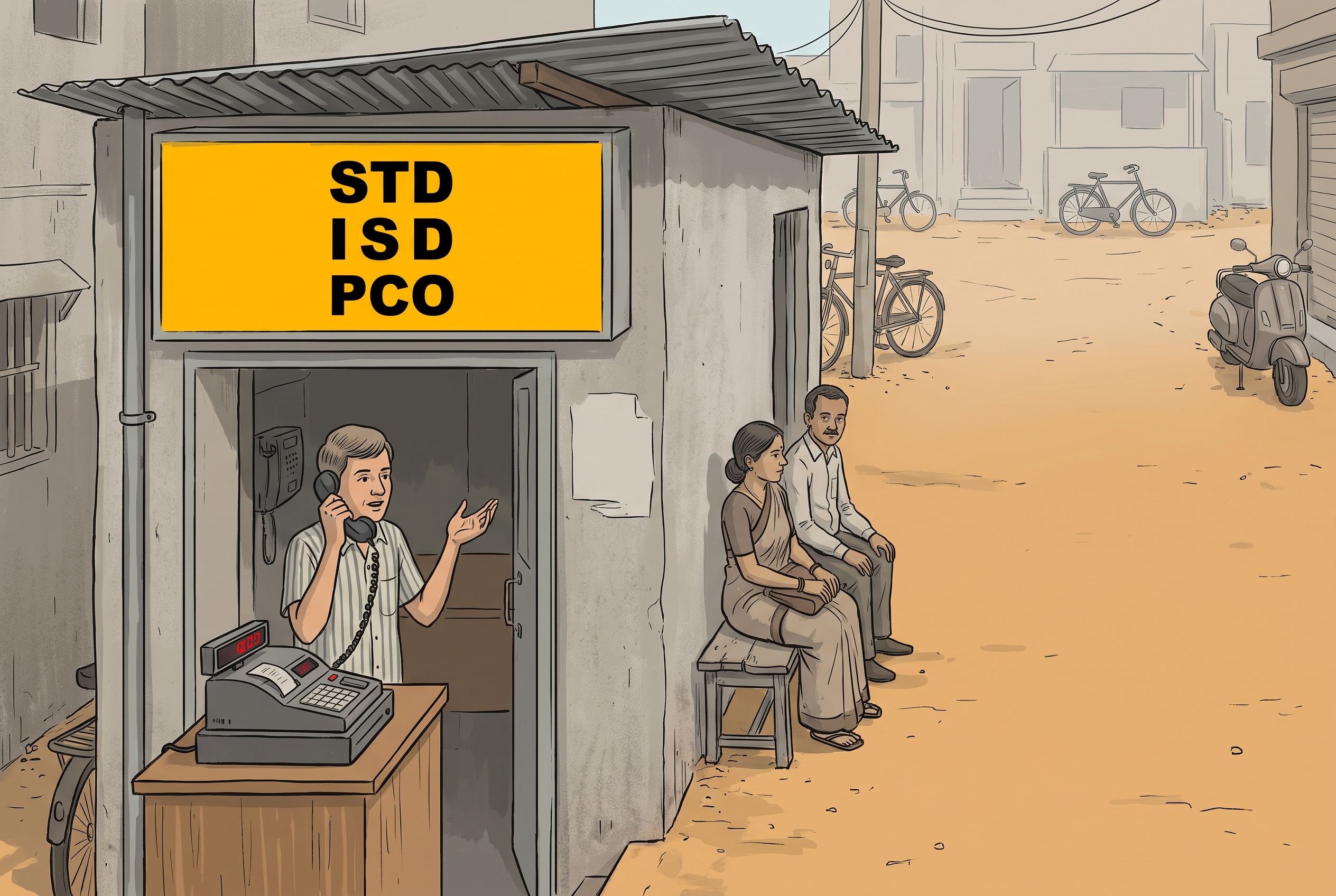
Fig. 6.10 – A public call office (PCO) in a small town.
Why did the PCO spread so fast? A purely commercial answer is incomplete.
The Cell Phone and the Self
Cellular telephony has grown enormously, and the cell phone has become part of the self for most urban-based middle class youth. There has been a tremendous growth in the usage of cell phones, and — just as important for a sociologist — a marked change in how that use is seen.
The change in meaning is as striking as the change in numbers. In the late 1980s, cell phones were looked at with distrust, as devices misused by criminal elements. As late as 1998 they were perceived as luxury items — only the rich could own one, and it was argued that owners should therefore be taxed. By 2006, India had become the country with the fourth largest usage of cell phones. They had become so much a part of everyday life that students were ready to go on strike, and to appeal to the President of the country, when denied the use of cell phones in their colleges.
In roughly twenty years, then, the same object travelled from suspect, to luxury, to necessity, to right. Nothing changed in the instrument; everything changed in the society around it.
6.6 Globalisation and Labour
Capital has become mobile. Work has therefore become movable, and workers have become insecure. That, compressed into three sentences, is what globalisation has done to labour — and this section unpacks it.
Globalisation and a New International Division of Labour
A new international division of labour has emerged, in which more and more routine manufacturing production and employment is done in Third World cities.
You have already dealt with outsourcing in the chapter on rural society, and with contract farming in the chapter on industrial society. Here we simply take one company, Nike, to illustrate how the arrangement works.
The travels of a shoe
Nike grew enormously from its inception in the 1960s. It began as an importer of shoes: the founder, Phil Knight, imported shoes from Japan and sold them at athletics meetings. From this the company grew into a multinational enterprise — a transnational corporation. Its headquarters are in Beverton, just outside Portland, Oregon.
Now note a striking fact. Only two US factories ever made shoes for Nike. In the 1960s the shoes were made in Japan. As costs increased, production shifted to South Korea in the mid-1970s. Labour costs then grew in South Korea, so in the 1980s production widened to Thailand and Indonesia. Since the 1990s, we in India produce Nike.
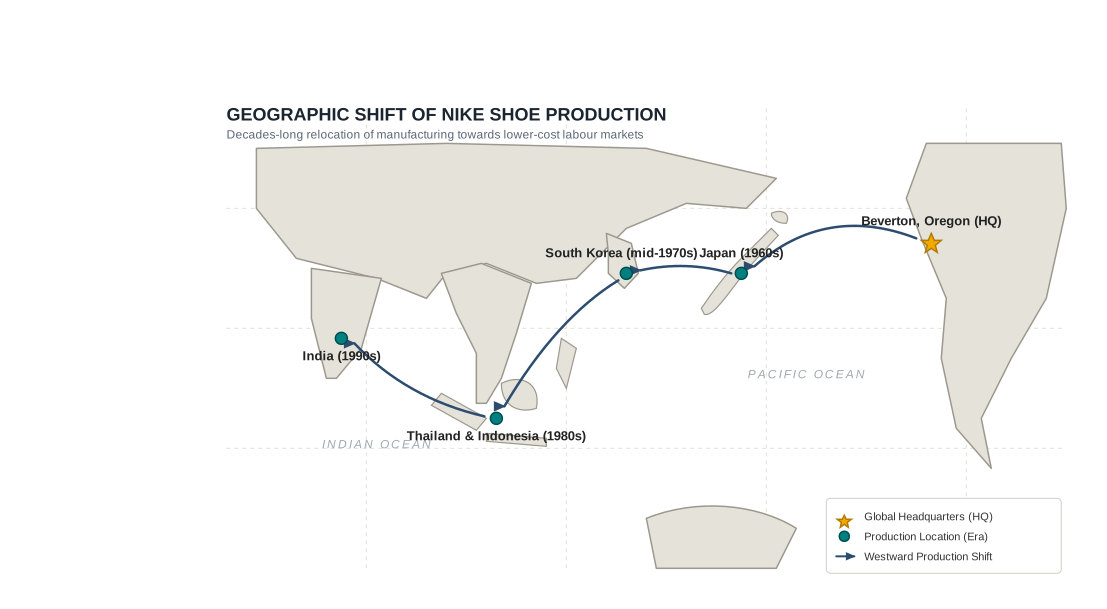
Fig. 6.11 – The movement of Nike’s production centres over time.
The logic is not hidden; it is stated openly. If labour is cheaper elsewhere, production centres will move somewhere else. The company follows the lowest cost, and the map of the world is simply the ground it walks on.
For the people who do the work, this entire process makes the labouring population very vulnerable and insecure. A job is no longer attached to a place; it is attached to a cost comparison that may be revised next year. This flexibility of labour often works in favour of the producers.
Behind the change lies a shift in the whole system of production. Instead of mass production of goods at a centralised location, which is called Fordism, we have moved to a system of flexible production at dispersed locations, which is called post-Fordism.
Where the money goes
A single car makes the new division of labour visible. General Motors produces an ostensibly American car such as the Pontiac Le Mans. Of its showroom price of $20,000, only $7,600 goes to Americans — to workers and management in Detroit, lawyers and bankers in New York, lobbyists in Washington, and General Motors shareholders all over the country.
Table 6.3 rewards close reading. The largest single share, 48 per cent, goes for labour and assembly — the physical making of the car — and it goes to South Korea. The tasks that carry knowledge, design and finance are distributed among the richer economies. An ‘American’ car is in fact a product of at least seven countries, and the country that supplies most of the muscle is not the country whose name the car carries. (Reich 1991)
Globalisation and Employment
Another key issue in the relationship between globalisation and labour is employment. Here too we see the uneven impact of globalisation.
For middle class youth from urban centres, globalisation and the IT revolution have opened up new career opportunities. Instead of routinely picking up a B.Sc., B.A. or B.Com. degree from a college, many young persons now learn computer languages at computer institutes, take up jobs at call centres or at Business Process Outsourcing (BPO) companies, work as sales persons in shopping malls, or find jobs in the many restaurants that have opened up.
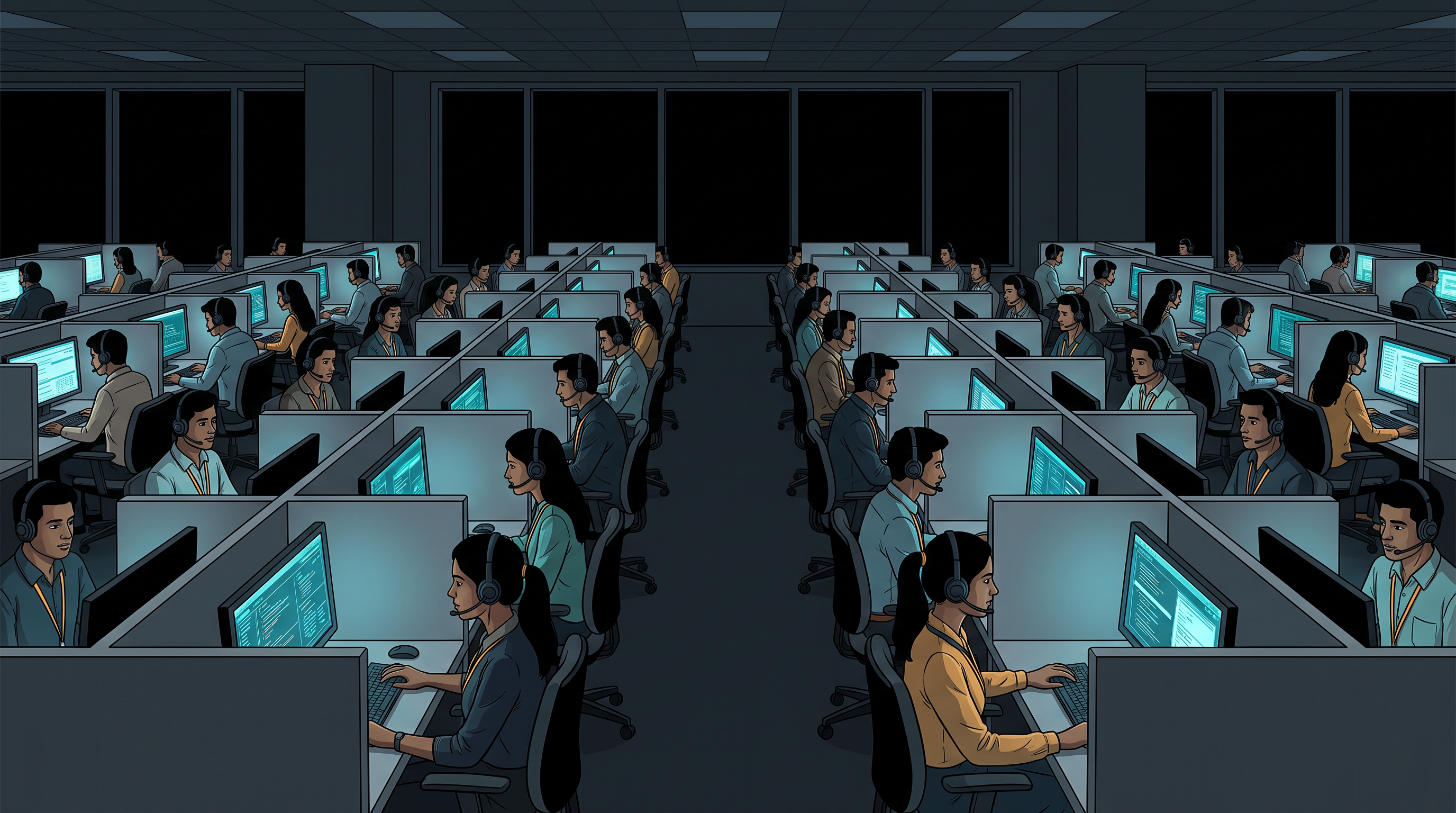
Fig. 6.12 – A call centre operating on the night shift.
This is a real gain, and it should not be dismissed. But it is the experience of one section of one class in one kind of settlement, and it is a poor guide to what is happening to employment as a whole.
Hold those two numbers together: growth of over 7 per cent, employment growth of 1.6 per cent. An economy can expand handsomely while producing very few additional jobs. This is why sociology refuses to read a growth figure as a report on people’s lives.
6.7 Globalisation and Political Changes
It is tempting to think of globalisation as something that simply happened to the world — a natural consequence of better technology and cheaper transport. It is not. In many ways it was a major political change that hastened it.
The Political Vision Behind the Economics
The change was the collapse of the erstwhile socialist world. That collapse not only hastened globalisation; it also gave a specific economic and political approach to the policies that underpin it. These changes are often termed neo-liberal economic measures.
You have already seen the concrete steps that this approach took in India, in the liberalisation policies begun in 1991. Broadly, such policies reflect a political vision of free enterprise: the conviction that markets, left to themselves, allocate resources better than governments can, and that the state’s regulations and subsidies get in the way.
That is a vision, not a law of nature. And once you see it as a vision, an important sociological point follows: the existing process of globalisation has a political vision as much as an economic one. What looks like a technical decision about tariffs or subsidies rests on a prior belief about what the state is for.
If globalisation carries a political vision, then a different vision is possible. The possibility of a globalisation which is different does exist, and this is the point of the idea of inclusive globalisation.
Notice what the term concedes and what it asserts. It concedes that globalisation is here; it asserts that its present shape is a choice and not a destiny.
New Levels of Political Collaboration
A second significant political development accompanying globalisation is the growth of international and regional mechanisms for political collaboration. States increasingly act together, in groupings that sit above the individual nation.
The European Union (EU), the Association of South East Asian Nations (ASEAN) and the South Asian Association for Regional Cooperation (SAARC) are only some of the examples that indicate the greater role of regional associations. Countries that once dealt with one another purely as separate sovereign units now negotiate as members of a bloc.
Two Kinds of Global Organisation
The other political dimension has been the rise of International Governmental Organisations (IGOs) and International Non-Governmental Organisations (INGOs).
The World Trade Organisation, which you have met more than once in this chapter, is the clearest example. It increasingly has a major say in the rules that govern trade practices — rules which then reach, as we have seen, all the way down to a farmer’s field and a spinner’s household.
As the name suggests, INGOs differ from intergovernmental organisations in that they are not affiliated to government institutions. They are independent organisations, which make their own policy decisions and address international issues. Some of the best known INGOs are Greenpeace, whose work you will meet again in the chapter on social movements, the Red Cross, Amnesty International, and Medecins Sans Frontieres (Doctors Without Borders).
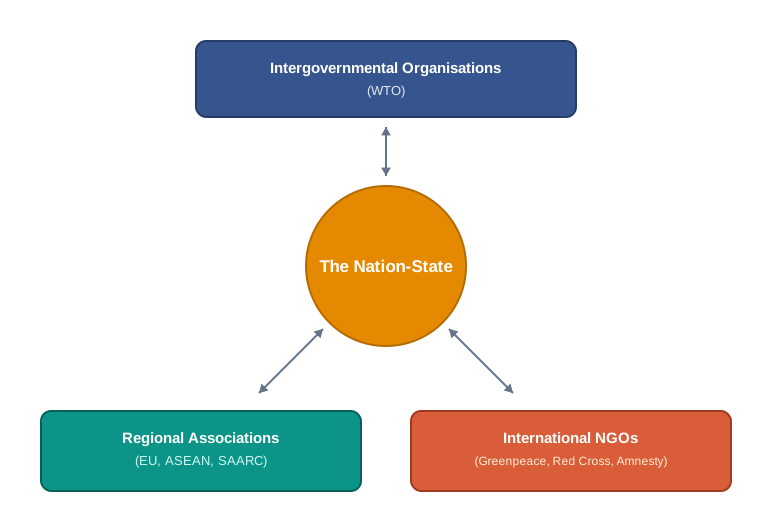
Fig. 6.13 – The nation-state and the new global political actors.
Put the two developments together and a sociological question emerges. If trade rules are written in one forum, regional agreements in another, and campaigns run by organisations answerable to no electorate, then where exactly does a citizen go to argue about a decision that has changed her life? Globalisation has not abolished the state, but it has crowded the space in which the state used to stand alone.
6.8 Globalisation and Culture
There are many ways in which globalisation affects culture, and this is the dimension about which people in India argue most fiercely. Debates about tariffs are left to experts. Debates about clothes, music, films, language and manners are conducted by everybody.
We have already seen that over the ages India has had an open approach to cultural influences, and has been enriched because of it. The last decade, however, has seen cultural changes on a scale that has led to a fear that our local cultures will be overtaken.
That fear deserves to be taken seriously rather than mocked — and also examined. Recall the kupamanduka, the well-frog of the old Sanskrit texts, of which our own cultural tradition has been wary: the creature that knows nothing beyond its well and suspects everything outside it. Fortunately for us, we retain that ‘traditional’ open-ended attitude to this day.
So there are heated debates in our society, not only about political and economic issues, but about changes in clothes, styles, music, films, languages and even body language. You will recall from the chapters on structural and cultural change how nineteenth-century reformers and early nationalists also argued about culture and tradition. The issues today are in some ways the same, in some ways different. What is perhaps most different is the scale and the intensity of change.
Homogenisation Versus Glocalisation of Culture
A central contention is that all cultures will become similar — that is, homogeneous. On this view, the same films, the same brands, the same food and the same music are spreading everywhere, and local ways of life are being flattened into one global way of life.
Others argue that what is actually happening is an increasing tendency towards glocalisation of culture.
Read the second sentence of that definition carefully, because it is the sociological part. Glocalisation is not simply a happy meeting of two cultures. It is often a strategy adopted by foreign firms while dealing with local traditions, in order to enhance their marketability. The local is not merely respected; it is used.
The examples are all around you. In India, all the foreign television channels — Star, MTV, Channel V, Cartoon Network — use Indian languages. McDonald’s sells only vegetarian and chicken products in India, and not the beef products that are popular abroad; it goes vegetarian during the Navaratri festival. In music, one can see the growth in popularity of ‘Bhangra pop’, ‘Indi pop’, fusion music and remixes.

Fig. 6.14 – Examples of glocalisation in media, food and music.
Culture is not a museum piece
We have already seen that the strength of Indian culture has been its open-ended approach, and that through the modern period our reformers and nationalists actively debated tradition and culture.
The mistake in the whole ‘will our culture survive?’ debate is a hidden assumption: that a culture is an unchanging, fixed entity, which, when faced with social change, must either collapse or remain exactly as it was. Cultures do neither. They change, and they have always changed, which is precisely what the history of reform in India demonstrates.
What is more likely today is that globalisation will lead to the creation not just of new local traditions, but of global ones too.
Gender and Culture
There is a use of ‘culture’ in these debates that a sociologist must watch closely.
Very often, defenders of a fixed traditional idea of cultural identity use it to defend undemocratic and discriminating practices against women in the name of cultural identity. Such defences have ranged from a defence of sati to a defence of the exclusion of women from education and from participation in public matters.
Globalisation can then be taken up as a bogey — a convenient external threat — to defend unjust practices against women. The argument runs: any change in the position of women is a foreign import, and resisting it is a defence of our culture.
Notice how the argument works. It first freezes culture into a single fixed thing, then declares that anything which alters it comes from outside, and finally treats the women who ask for change as agents of that outside. Every step is contestable, and the first step is where the trick is done.
Fortunately for us in India, we have been able to retain and develop a democratic tradition and culture, one that allows us to define culture in a more inclusive and democratic fashion — a definition in which women’s equality is not an import but a demand made from within.
Culture of Consumption
Often, when we speak of culture, we refer to dresses, music, dances and food. But culture, as you know, refers to a whole way of life. Two uses of the word deserve special mention in any discussion of globalisation: the culture of consumption and corporate culture.
Look first at the crucial role that cultural consumption now plays in shaping the growth of cities. Till the 1970s, it was manufacturing industry that played the major role in a city’s growth: a city grew where the mills were. At present, cultural consumption — of art, food, fashion, music and tourism — shapes the growth of cities to a large extent.
This is evident in the spurt in the growth of shopping malls, multiplex cinema halls, amusement parks and ‘water worlds’ in every major city in India. The city is increasingly built around what people do with their leisure and their money, not around what they produce.
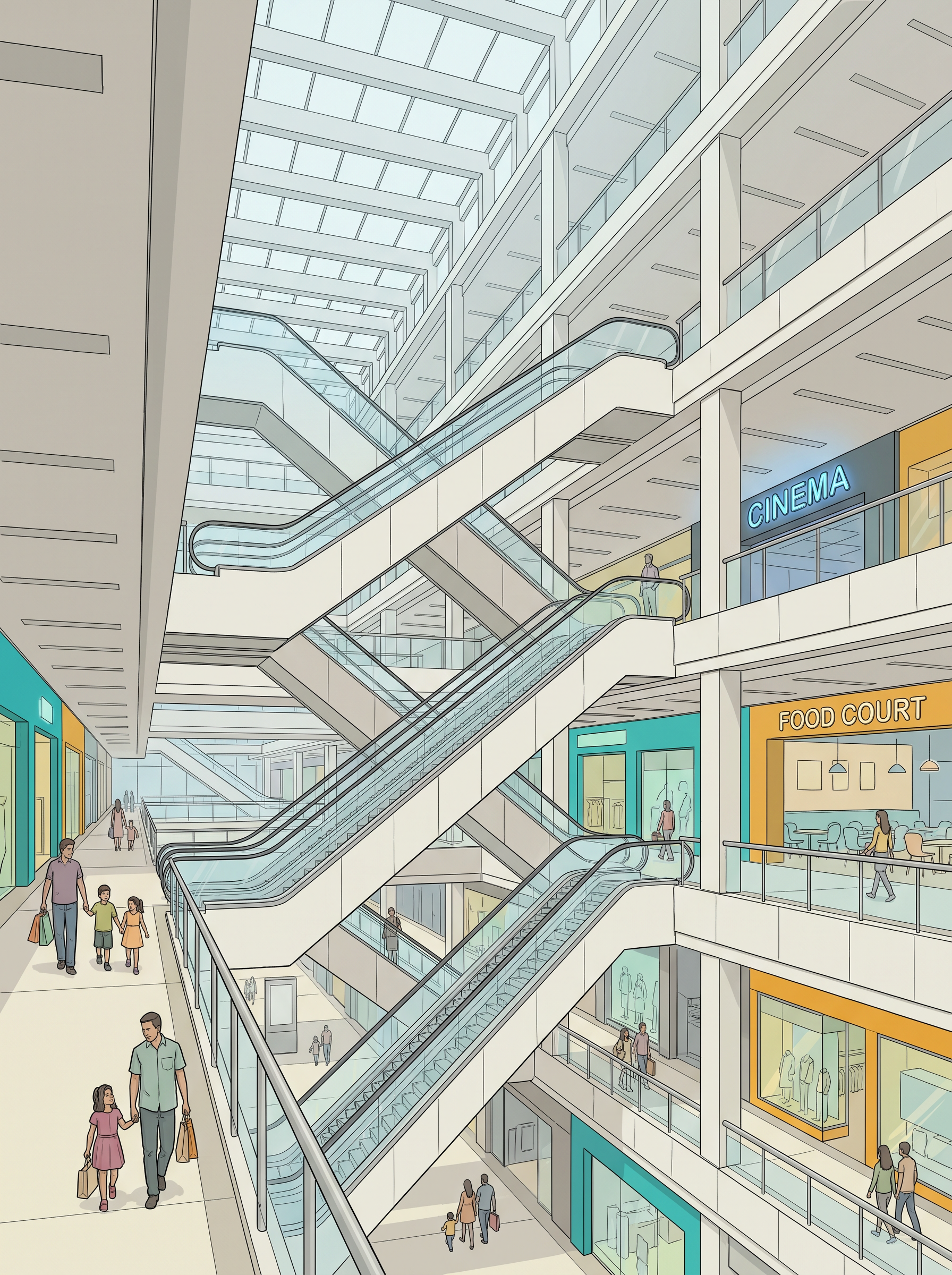
Fig. 6.15 – The interior of a modern shopping mall.
Most significantly, advertisements and the media in general promote a culture in which spending is important. Look at the moral reversal involved. To be careful with money was once a virtue, praised in every household; it is a virtue no longer. Shopping has been turned into a pastime, and one that is actively encouraged.
The reach of this culture can be traced. Successive successes in fashion pageants such as Miss Universe and Miss World led to a tremendous growth in the industries of fashion, cosmetics and health. Young girls began to dream of being an Aishwarya Rai or a Sushmita Sen. Popular game shows such as Kaun Banega Crorepati made it seem possible that one’s fortunes could turn over a few games — that wealth was a matter of luck and nerve rather than of work, inheritance or the structure of the economy.
Corporate Culture
A dynamic corporate culture — involving company events, rituals and traditions — is thought to enhance employee loyalty and to promote group solidarity. The term also refers to a way of doing things: the style of promoting and packaging products.
Notice what is happening here. Loyalty and solidarity are among the oldest concerns of sociology, and were once studied in families, villages and religious communities. Management theory now sets out to manufacture them deliberately inside a firm.
The spread of multinational companies, and the opportunities opened up by the information technology revolution, have created in India’s metropolitan cities a class of upwardly mobile professionals — in software companies, multinational banks, chartered accountancy firms, stock markets, travel, fashion designing, entertainment, media and allied fields. These high-flying professionals work to highly stressful schedules, receive exorbitant salaries, and are the main clientele of the booming consumer industry.
The two cultures thus meet in the same person. The professional produced by corporate culture is the consumer on whom the culture of consumption depends.
Threat to Indigenous Craft and Literary Traditions and Knowledge Systems
There is one more link between cultural forms and globalisation, and it is the least cheerful. It concerns the condition of many indigenous craft and literary traditions and knowledge systems.
Two things must be said in the same breath. It is important to remember that modern development, even before the stage of globalisation, had already made inroads into traditional cultural forms and into the occupations based on them. But the sheer scale and intensity of the change now is enormous.
Consider what happens to an art form when the audience that sustained it disappears. About 30 theatre groups, which were active around the textile mill areas of Parel and Girgaum in Mumbai city, have become defunct, because most of the mill workers in those areas are out of jobs. The theatre did not lose its skill. It lost its public.
The pressure on traditional crafts has in some places been severe. Some years back, there were reports of a large number of suicides by traditional weavers in Sircilla village of Karimnagar district and in Dubakka village of Medak district, both in Andhra Pradesh. These weavers, with no means to invest in new technology, were unable to adapt to changing consumer tastes and to competition from power looms.
The sociological point is a structural one, and it should be stated plainly. The weaver was not overtaken by a personal failing. A household that had for generations exchanged its skill for a livelihood found that the market no longer wanted what it made, and that the capital needed to make something else was out of reach. When an occupation dies, a whole way of life — its training, its status, its arrangements between generations — dies with it.

Fig. 6.16 – A handloom weaver facing competition from power looms.
Who owns knowledge?
Various forms of traditional knowledge systems, especially in the fields of medicine and agriculture, have been preserved and passed on from one generation to the next. They belong to no single person; they are the accumulated work of communities over centuries.
This is exactly why recent attempts by some multinational companies to patent the use of Tulsi, Haldi (turmeric), Rudraksha and Basmati rice caused such disquiet. A patent gives a company the exclusive right to a use. When the use in question has been common knowledge in India for generations, the patent does not reward an invention; it encloses a commons. These attempts highlighted the need to protect the base of India’s indigenous knowledge systems.
Where This Leaves You
It is no easy task to sum up the diverse and complex ways in which globalisation is affecting our lives, and this chapter will not attempt it. That task is left to you.
Note also what has been left out here. The impact of globalisation on industry and on agriculture has not been discussed in any detail in this chapter; you have to draw on the chapters on rural society and on industrial society to build up the full story of globalisation and social change in India.
In the recounting of that story, use your sociological imagination — which, as you now know, means refusing to treat any private trouble as if it had no public cause.
6.9 Summary
Globalisation and the sociological imagination (6.1)
Globalisation means the growing interconnection between people, regions and countries; the term is used loosely in public debate, and sociology begins by asking what it actually refers to.
Different disciplines study different aspects of it — economics looks at capital flows, political science at the changing role of governments — but the process is so far-reaching that disciplines must now borrow from one another.
Sociology’s distinctive contribution is the sociological imagination: the ability to connect the micro with the macro, the personal with the public, the local with the global.
Since 1 April 2001, all quantitative restrictions on imports were withdrawn, and imported goods appeared in ordinary neighbourhood shops. The same policy gives an affluent urban consumer more choice and may give a farmer a crisis of livelihood.
Society can no longer be studied as an isolated entity: the compression of space and time means that villages, families, work, castes and organisations must all be studied with global interconnection in view.
The impact of globalisation is uneven. Women silk spinners and twisters in Bihar lost work to cheaper Chinese and Korean yarn; large fishing vessels displaced Indian fishing vessels, affecting women fish sorters, dryers, vendors and net makers; women gum collectors in Gujarat lost work to cheaper gum imported from Sudan; rag pickers in Indian cities lost earnings to imported waste paper.
Views on globalisation are sharply divided: some see it as heralding a better world; others see the already excluded getting worse off; still others argue it is not new at all.
Are global interconnections new? (6.2)
India was not isolated even two thousand years ago: the Silk route linked it to China, Persia, Egypt and Rome, and people arrived as traders, conquerors and migrants.
Amartya Sen’s examples — Panini’s Afghan origin, Yi Jing learning Sanskrit in Java — and the parable of the kupamanduka, the well-frog, show a long tradition of openness and a long warning against isolationism.
Modern capitalism had a global dimension from its inception; colonialism supplied it with capital, raw materials, energy, markets and a global network.
Large-scale movement of people is not new either: European settlement in the Americas and Australia, indentured labour taken from India to Asia, Africa and the Americas, and the slave trade that carried thousands of Africans away.
Independent India retained a global outlook inherited from the nationalist movement: overseas education and work, ongoing migration, trade in goods and technology, and foreign firms operating in India.
Understanding globalisation (6.3)
The question is not whether interconnection existed, but whether today’s changes in production, communication, labour, capital, technology, culture, governance and social movements are significant. They are — even though some patterns appeared in the early stages of capitalism.
Globalisation refers to the growing interdependence between different people, regions and countries in the world, as social and economic relationships come to stretch world-wide.
Economic forces are integral but not sufficient; the process has been driven above all by information and communication technologies, and it grew within a political context.
Its economic, political and cultural dimensions are separated only for convenience; in reality they are closely interconnected.
The economic dimension (6.4)
Liberalisation is the set of policy decisions taken by the Indian state since 1991 to open the economy to the world market; it broke with the earlier policy of protecting Indian business, which assumed that a former colony would be at a disadvantage in a free market.
Since July 1991 there have been reforms in all major sectors — agriculture, industry, trade, foreign investment and technology, the public sector and financial institutions — on the assumption that integration with the world market would benefit India.
Liberalisation involved loans from institutions such as the IMF, given on conditions of structural adjustment, which usually means cuts in state spending on health, education and social security; institutions such as the WTO gained a greater say.
Liberalisation is a policy; globalisation is the wider process. They are related but not the same.
Transnational corporations produce goods or market services in more than one country; they are oriented to global markets and profits even when they have a clear national base. Some Indian corporations are becoming transnational.
The electronic economy allows banks, corporations, fund managers and investors to move money internationally at the click of a mouse — with great risks, as sudden stock market dips show.
The weightless economy has its products based in information (software, media and entertainment, internet services); the knowledge economy employs people in design, development, technology, marketing, sale and servicing rather than in physical production. New occupations such as the event manager have appeared.
Mainly due to the information technology revolution, finance has been globalised: globally integrated markets trade billions of dollars within seconds, round the clock, with New York, Tokyo and London as key centres and Mumbai as India’s financial capital.
Global communications (6.5)
Advances in telecommunications have transformed global communication, but access is unequal — this is the digital divide.
In 1998 there were 70 million Internet users worldwide, of whom the USA and Canada accounted for 62 per cent and Asia 12 per cent; by 2000 there were 325 million, with India having 3 million subscribers and 15 million users, now grown to 700 million.
A study in 2017–18 found that one in ten households had a computer and about a quarter had Internet connectivity through a mobile phone or other device; rural areas, with erratic power, widespread illiteracy and poor infrastructure, remain largely unconnected.
These technologies allow the compression of time and space, giving rise to a network and media society; the Government of India’s ‘Digital India’ programme aims at a ‘digitally empowered society’ and a ‘knowledge economy’.
India’s telephone network expanded from 84,000 lines in 1947 to over 25 million lines by 1999 — the ninth largest in the world — with about 650,000 PCOs by 2000. The PCO met a strong sociocultural need to stay in touch with family, not merely a commercial one.
The cell phone moved in about twenty years from being an object of distrust, to a taxable luxury, to a necessity that students went on strike to defend.
Globalisation and labour (6.6)
A new international division of labour has emerged, in which routine manufacturing production is done increasingly in Third World cities.
Nike’s production moved from Japan in the 1960s to South Korea in the mid-1970s, to Thailand and Indonesia in the 1980s, and to India since the 1990s — following cheaper labour, and making workers vulnerable and insecure.
Production has shifted from mass production at a centralised location (Fordism) to flexible production at dispersed locations (post-Fordism).
Of the $20,000 showroom price of a Pontiac Le Mans, only $7,600 goes to Americans; 48 per cent of the rest goes to South Korea for labour and assembly, 28 per cent to Japan, 12 per cent to Germany, 7 per cent to Taiwan and Singapore, 4 per cent to the United Kingdom and about 1 per cent to Barbados or Ireland.
Globalisation has opened new careers for urban middle class youth — call centres, BPO firms, malls, restaurants — but the broader employment trend is disappointing: between 2003 and 2004 employment in Asia and the Pacific grew by only 1.6 per cent, against economic growth of over 7 per cent.
Globalisation and political changes (6.7)
The collapse of the erstwhile socialist world hastened globalisation and shaped the neo-liberal economic measures that underpin it — a political vision of free enterprise, critical of both state regulation and state subsidies.
Because globalisation carries a political vision, a different globalisation is possible: hence the idea of inclusive globalisation, which includes all sections of society.
International and regional mechanisms for political collaboration have grown: the EU, ASEAN and SAARC.
Intergovernmental organisations are established by participating governments to regulate a transnational domain — the WTO increasingly governs trade rules. INGOs, such as Greenpeace, the Red Cross, Amnesty International and Medecins Sans Frontieres, are independent of governments and set their own policies.
Globalisation and culture (6.8)
India’s culture has long been open to influences; today’s fear is that local cultures will be overtaken, and the debates cover clothes, styles, music, films, languages and body language. What is different now is the scale and intensity of change.
One view holds that all cultures will become homogeneous; the other holds that glocalisation — the mixing of the global with the local — is occurring. Glocalisation is neither spontaneous nor free of commercial interest: foreign channels use Indian languages, McDonald’s sells vegetarian and chicken products and goes vegetarian during Navaratri, and ‘Bhangra pop’, ‘Indi pop’, fusion and remixes flourish.
Culture is not a fixed entity that must either collapse or stay unchanged; globalisation is likely to produce new local and new global traditions.
A fixed idea of cultural identity is often used to defend undemocratic and discriminating practices against women, with globalisation raised as a bogey; India’s democratic tradition allows culture to be defined more inclusively.
Cultural consumption — art, food, fashion, music, tourism — now shapes the growth of cities more than manufacturing does, visible in malls, multiplexes, amusement parks and water worlds; advertising promotes spending, and thrift is no longer treated as a virtue.
Corporate culture is a branch of management theory that seeks productivity and competitiveness by creating a distinctive organisational culture, with company events, rituals and traditions to build employee loyalty.
Indigenous crafts, performing traditions and knowledge systems are under pressure: theatre groups around Parel and Girgaum became defunct as mill workers lost jobs; traditional weavers in Sircilla and Dubakka could not compete with power looms; and attempts to patent Tulsi, Haldi, Rudraksha and Basmati rice showed the need to protect indigenous knowledge systems.
The chapter does not cover globalisation’s impact on industry and agriculture; that story must be built from the chapters on rural and industrial society, using the sociological imagination.
6.10 Key Terms
Business Process Outsourcing (BPO) — Firms that carry out business processes, such as customer service or data handling, on behalf of companies located in other countries.
Capitalism — An economic system based on private ownership, wage labour and production for profit, which has had a global dimension from its very inception.
Colonialism — The system of rule by which one country controls another and reorganises its economy, resources and markets to serve its own; historically, part of the global network that sustained modern capitalism.
Communication revolution — The transformation of communication brought about by satellites, computers, the Internet and mobile telephony, which has enormously increased the speed and scope of interaction.
Compression of space and time — The shrinking of the distance and delay that once separated places, so that people far apart can interact almost instantaneously.
Corporate culture — A branch of management theory that seeks to raise productivity and competitiveness by creating a distinctive organisational culture — company events, rituals and traditions — to build employee loyalty and group solidarity.
Culture of consumption — A way of life in which shopping, spending and leisure become central values, and which increasingly shapes the growth of cities.
Digital divide — The gap between those who have access to computers, the Internet and reliable connectivity and those who do not, and who are therefore excluded from the opportunities these carry.
Electronic economy — The economy in which banks, corporations, fund managers and individual investors shift funds internationally at the click of a mouse.
Fordism — A system of mass production of standardised goods at a large, centralised location.
Globalisation — The growing interdependence between different people, regions and countries in the world, as social and economic relationships come to stretch world-wide.
Globalisation of finance — The emergence, mainly due to the information technology revolution, of globally integrated financial markets that trade round the clock, with key centres in New York, Tokyo and London.
Glocalisation — The mixing of the global with the local; often a strategy used by foreign firms to adapt to local traditions and enhance their marketability.
Homogenisation of culture — The claim that cultures across the world are becoming similar, as the same products, images and styles spread everywhere.
Inclusive globalisation — A globalisation that includes all sections of society, rather than benefiting only those already advantaged.
Indentured labour — Workers bound by long contracts and carried in ships from India to distant parts of Asia, Africa and the Americas to work under colonial rule.
Indigenous knowledge systems — Bodies of knowledge, especially in medicine and agriculture, developed and passed on across generations within communities, and now in need of protection against patenting by outside firms.
Knowledge economy — An economy in which much of the workforce is engaged not in physically producing or distributing goods but in their design, development, technology, marketing, sale and servicing.
Kupamanduka — The well-frog of old Sanskrit texts, which lives its whole life in a well, knows nothing else and suspects everything outside it; a traditional Indian warning against isolationism.
Liberalisation — The range of policy decisions taken by the Indian state since 1991 to open the Indian economy to the world market by removing the rules that regulated trade and finance.
Migration — The movement of people from one place to another to live and work, whether as traders, settlers, workers or refugees.
Neo-liberal economic measures — Policies that give free rein to market forces in the belief that markets are both efficient and fair, and that are therefore critical of state regulation and state subsidies.
Network and media society — A society in which work, information and relationships increasingly run along electronic and media networks.
New international division of labour — The arrangement in which routine manufacturing production is done increasingly in Third World cities, while design, finance and marketing remain concentrated in richer countries.
Outsourcing — The practice by which a firm in one country has part of its work, such as customer service or data processing, carried out by workers in another country.
Post-Fordism — A system of flexible production at dispersed locations, in which firms can shift production to wherever costs are lower, making labour vulnerable and insecure.
Sociological imagination — The capacity, named by C. Wright Mills, to connect personal experience to wider social structures and historical processes — the micro to the macro, the personal to the public.
Structural adjustment — The set of economic measures a government commits to when taking loans from international institutions such as the IMF; it usually involves cuts in state expenditure on health, education and social security.
Transnational corporations (TNCs) — Companies that produce goods or market services in more than one country, oriented to global markets and global profits even when they have a clear national base.
Weightless economy — An economy in which products have their base in information, as with computer software, media and entertainment products, and internet-based services.
6.11 Points to Ponder
If global interconnection is two thousand years old, what exactly would have to be true for us to say that globalisation is genuinely new? Is speed alone enough to make a difference in kind rather than a difference in degree?
The chapter shows that the same policy can mean greater choice for one household and the loss of a livelihood for another. Can a society ever adopt a change that has no losers — and if not, what does it owe to the people who lose?
Glocalisation is described as neither entirely spontaneous nor entirely free of commercial interest. When a global firm adapts to Indian languages, festivals and food, is that a genuine cultural synthesis, or is it the market wearing local clothes?
The well-frog of the Sanskrit texts stands for a closed mind. But is there a defensible difference between being closed to the world and being cautious about what one takes from it? Where would you draw that line, and on what sociological grounds?
A culture is often defended as though it were a fixed thing that must be protected from change. Yet the reformers of the nineteenth century changed it from within. Who, then, has the authority to say what a culture is — and whose voices within a community tend to be left out of that decision?
Advertising has made thrift look old-fashioned and shopping look like a pastime. If a society’s idea of a good life can be reshaped this thoroughly by an industry, how much of what we call ‘personal taste’ is actually social?
The weaver who could not invest in new technology and the software designer working for clients abroad both live in the same economy. What does it tell us about that economy that it can expand rapidly while offering security to so few?
6.12 NCERT Questions
Choose any topic that interests you — cinema, work, marriage, or any other — and discuss how you think globalisation has affected it.
What are the distinctive features of a globalised economy? Discuss.
Briefly discuss the impact of globalisation on culture.
What is glocalisation? Is it simply a market strategy adopted by multinational companies, or is a genuine cultural synthesis taking place? Discuss.
6.13 Objective Questions
- All types of quantitative restrictions (QR) on imports were withdrawn in India from:
- 1 July 1991
- 1 April 2001
- 1 January 1998
- 1 April 1991 [1 mark]
- The policy decisions taken by the Indian state since 1991 to open the economy to the world market are known as:
- Structural adjustment
- Glocalisation
- Liberalisation
- Post-Fordism [1 mark]
- A transnational corporation is best defined as a company that:
- is owned jointly by several governments
- produces goods or markets services in more than one country
- works only in the weightless economy
- has no national base at all [1 mark]
- Which of the following is an International Non-Governmental Organisation (INGO)?
- The World Trade Organisation
- The International Monetary Fund
- The Association of South East Asian Nations
- Medecins Sans Frontieres [1 mark]
- The mixing of the global with the local is termed:
- homogenisation
- glocalisation
- structural adjustment
- outsourcing [1 mark]
- Mass production of goods at a centralised location is called:
- post-Fordism
- the knowledge economy
- Fordism
- the electronic economy [1 mark]
- Within India, the city known as the financial capital of the country is:
- New Delhi
- Bengaluru
- Mumbai
- Kolkata [1 mark]
- An economy in which much of the workforce is engaged in design, development, technology, marketing, sale and servicing rather than in physical production is called:
- an industrial economy
- a knowledge economy
- a subsistence economy
- a colonial economy [1 mark]
- Assertion (A): Liberalisation and globalisation are related but are not the same thing. Reason (R): Liberalisation refers to a set of policy decisions taken by the Indian state, while globalisation refers to the worldwide stretching of social and economic relationships.
- Both A and R are true, and R is the correct explanation of A
- Both A and R are true, but R is not the correct explanation of A
- A is true, but R is false
- A is false, but R is true [1 mark]
- Assertion (A): The rapid spread of computers has ended the digital divide in India. Reason (R): According to a study in 2017–18, one in ten households had a computer at home and about a quarter of all homes had Internet connectivity through a mobile phone or other device.
- Both A and R are true, and R is the correct explanation of A
- Both A and R are true, but R is not the correct explanation of A
- A is true, but R is false
- A is false, but R is true [1 mark]
- Assertion (A): Post-Fordism makes the labouring population vulnerable and insecure. Reason (R): Under a system of flexible production at dispersed locations, production centres can be shifted to wherever labour is cheaper.
- Both A and R are true, and R is the correct explanation of A
- Both A and R are true, but R is not the correct explanation of A
- A is true, but R is false
- A is false, but R is true [1 mark]
- Assertion (A): Structural adjustment is purely an economic matter with no social consequences. Reason (R): Structural adjustment usually involves cuts in state expenditure on health, education and social security.
- Both A and R are true, and R is the correct explanation of A
- Both A and R are true, but R is not the correct explanation of A
- A is true, but R is false
- A is false, but R is true [1 mark]
- Match the term in Column A with its meaning in Column B.
| Column A | Column B |
|---|---|
| a. Weightless economy | i. The well-frog of old Sanskrit texts, a warning against isolationism |
| b. Structural adjustment | ii. Products that have their base in information |
| c. Kupamanduka | iii. Management theory that builds a distinctive organisational culture within a firm |
| d. Corporate culture | iv. Commitments to economic measures, usually including cuts in social sector spending, made when taking loans from international institutions |
[1 mark]
- Match the organisation in Column A with its type in Column B.
| Column A | Column B |
|---|---|
| a. World Trade Organisation | i. Regional association |
| b. Greenpeace | ii. Intergovernmental organisation with a major say in trade rules |
| c. SAARC | iii. International lending institution whose loans carry conditions |
| d. International Monetary Fund | iv. International non-governmental organisation |
[1 mark]
Fill in the blank: In 1998, of the 70 million Internet users worldwide, the USA and Canada accounted for ______ per cent, while Asia accounted for 12 per cent. [1 mark]
Fill in the blank: Of the showroom price of a Pontiac Le Mans, ______ per cent of the amount that does not go to Americans goes to South Korea for labour and assembly. [1 mark]
Fill in the blank: The programme initiated by the Government of India to digitise every exchange and create a ‘digitally empowered society’ is called ______. [1 mark]
True or False: Nike shoes were first manufactured in India in the 1960s. [1 mark]
True or False: The large-scale movement of people across the world began only with globalisation. [1 mark]
True or False: An intergovernmental organisation is established by participating governments to regulate or oversee a domain of activity that is transnational in scope. [1 mark]
6.14 Check Your Concepts
Define globalisation as sociologists understand it. [2 marks]
What is meant by the digital divide? [2 marks]
State what makes a company a transnational corporation, and name any two such corporations mentioned in the chapter. [2 marks]
What is the weightless economy? Give one example. [2 marks]
What is meant by inclusive globalisation? [2 marks]
Name any two ways in which the livelihoods of women workers in India were affected by the entry of cheaper imported goods. [2 marks]
Differentiate between liberalisation and globalisation. [4 marks]
Differentiate between Fordism and post-Fordism, with an example of each. [4 marks]
Explain what is meant by glocalisation, using two Indian examples. [4 marks]
Give reasons why independent India protected its market and its indigenous business from foreign competition. [4 marks]
Explain how a policy of structural adjustment, agreed to in return for a loan, can change the everyday life of an ordinary household. [4 marks]
Differentiate between an intergovernmental organisation (IGO) and an international non-governmental organisation (INGO), with one example of each. [4 marks]
Study Table 6.2 in this chapter, on the expansion of telephone services in India. Describe the change between 1947 and 1999, and give two social reasons for the rapid spread of public call offices. [4 marks]
Study Table 6.3 in this chapter. Of the $20,000 showroom price of a Pontiac Le Mans, $7,600 goes to Americans. Calculate what percentage of the showroom price this is, and explain what the distribution of the remainder tells us about the new international division of labour. [4 marks]
Why does sociology insist that a rise in the growth rate of an economy is not the same as an improvement in people’s lives? Answer with reference to employment trends discussed in the chapter. [4 marks]
“Globalisation affects us all, but it affects us differently.” Explain this statement in full, using examples from the chapter of those who gained and those who lost. [6 marks]
How far do you agree with the view that globalisation is not a new phenomenon? Support your answer with evidence from India’s past, and state what, if anything, is genuinely new today. [6 marks]
Evaluate the claim that globalisation is leading to the homogenisation of culture. Present the evidence on both sides and state what the two positions agree upon. [6 marks]
Examine the political dimension of globalisation, explaining the neo-liberal vision that underpins it and the new levels of political collaboration that have grown alongside it. [6 marks]
Discuss the impact of globalisation on labour in India, explaining the new international division of labour, the shift to flexible production, and the consequences for workers. [6 marks]
“Culture cannot be seen as an unchanging, fixed entity.” Discuss this statement with reference to the debate over cultural identity and the position of women. [6 marks]
Describe the pressures that globalisation has placed on indigenous crafts, performing traditions and knowledge systems in India, and explain why sociologists treat these as structural rather than individual failures. [6 marks]
6.15 Passage-Based Questions
Read the passage and answer the questions that follow.
In a weaving cluster in a small town, families have made cotton saris on handlooms for three generations. The skill passes from parent to child, and the loom stands in the front room of the house. Over the last decade, buyers have begun asking for lighter fabrics and printed designs that a power loom can produce far more cheaply and quickly. A few households borrow to buy a power loom; most cannot. Orders fall, and some younger members leave for construction work in the city. The weavers say that they have not forgotten how to weave; it is the market that has stopped asking for what they weave.
- Identify the sociological process at work in this passage, and explain what it means. (2 marks)
- Explain why sociologists describe the weavers’ situation as a structural problem rather than an individual failure. (2 marks)
- What is likely to happen to the skills, the status and the family arrangements of this community if the trend continues? (2 marks) [6 marks]
Read the passage and answer the questions that follow.
A large mall opens on the outskirts of a district town. It has a multiplex, a food court and outlets of national and foreign brands. Families begin to spend their Sunday evenings there; young people meet there rather than at the old market square. The mall’s advertisements describe shopping as a way of relaxing. In the same town, an old covered market continues, where buyers bargain, know the shopkeepers by name, and go only when they need something. Within two years, three shops in the old market close.
- Which use of the term ‘culture’ discussed in the chapter does the mall illustrate? Explain it. (2 marks)
- The passage says that the meaning of shopping itself has changed. Explain what has changed, and why a sociologist finds this significant. (2 marks)
- Suggest two reasons why the growth of cities today is shaped by cultural consumption more than by manufacturing. (2 marks) [6 marks]
Study the table and answer the questions that follow.
The table below gives figures collected in a survey of two blocks of a district — one urban, one rural.
Facility Urban block Rural block Households with a computer at home 18 per cent 3 per cent Households with Internet on a mobile phone 46 per cent 14 per cent Households reporting more than 6 hours of power cuts a day 6 per cent 41 per cent - Name the concept that this table illustrates, and define it. (1 mark)
- Using the figures, explain how infrastructure, and not merely the price of a device, produces this pattern. (2 marks)
- During a period of online classes, which children in this district would be at a disadvantage, and why? Answer sociologically. (3 marks) [6 marks]
Read the passage and answer the questions that follow.
A firm in another country closes its customer service department and contracts the work to a company in an Indian city. Two hundred young graduates are hired, trained to speak to callers in a distant time zone, and put on night shifts. The pay is better than anything else available to them locally, and there is no long apprenticeship. The contract with the foreign firm runs for three years. If costs rise, the work may be moved to another country when the contract ends.
- Identify two processes discussed in the chapter that this passage illustrates. (2 marks)
- Explain why this arrangement is described as offering opportunity and insecurity at the same time. (2 marks)
- “Globalisation has been good for India’s youth.” How far does this passage support that claim? Give reasons for your answer. (2 marks) [6 marks]