Chapter 3: Chemical Kinetics
In the closing years of the 1880s, chemists were troubled by a simple laboratory observation. Warm a reaction mixture by just ten degrees, and the reaction often ran about twice as fast. This looked far too big an effect for such a small change. Raising the temperature of a gas from 298 K to 308 K speeds up its molecules only slightly — nowhere near enough, on its own, to double the number of collisions taking place every second. Something else had to be going on.
The Dutch chemist J. H. van’t Hoff proposed a mathematical relation linking the rate constant to temperature. The Swedish chemist Svante Arrhenius then supplied the physical picture that made sense of it. His idea was that a collision by itself is not enough: only those molecules carrying more than a certain minimum energy — an energy barrier that must be climbed before old bonds can break and new ones form — are able to react at all. At any temperature, only a small fraction of molecules clear that barrier. Warm the mixture a little, and that small fraction grows steeply. A modest rise in temperature therefore produces a dramatic rise in rate.
That single insight turned the study of reaction speeds into a quantitative science, and it is the backbone of this chapter.
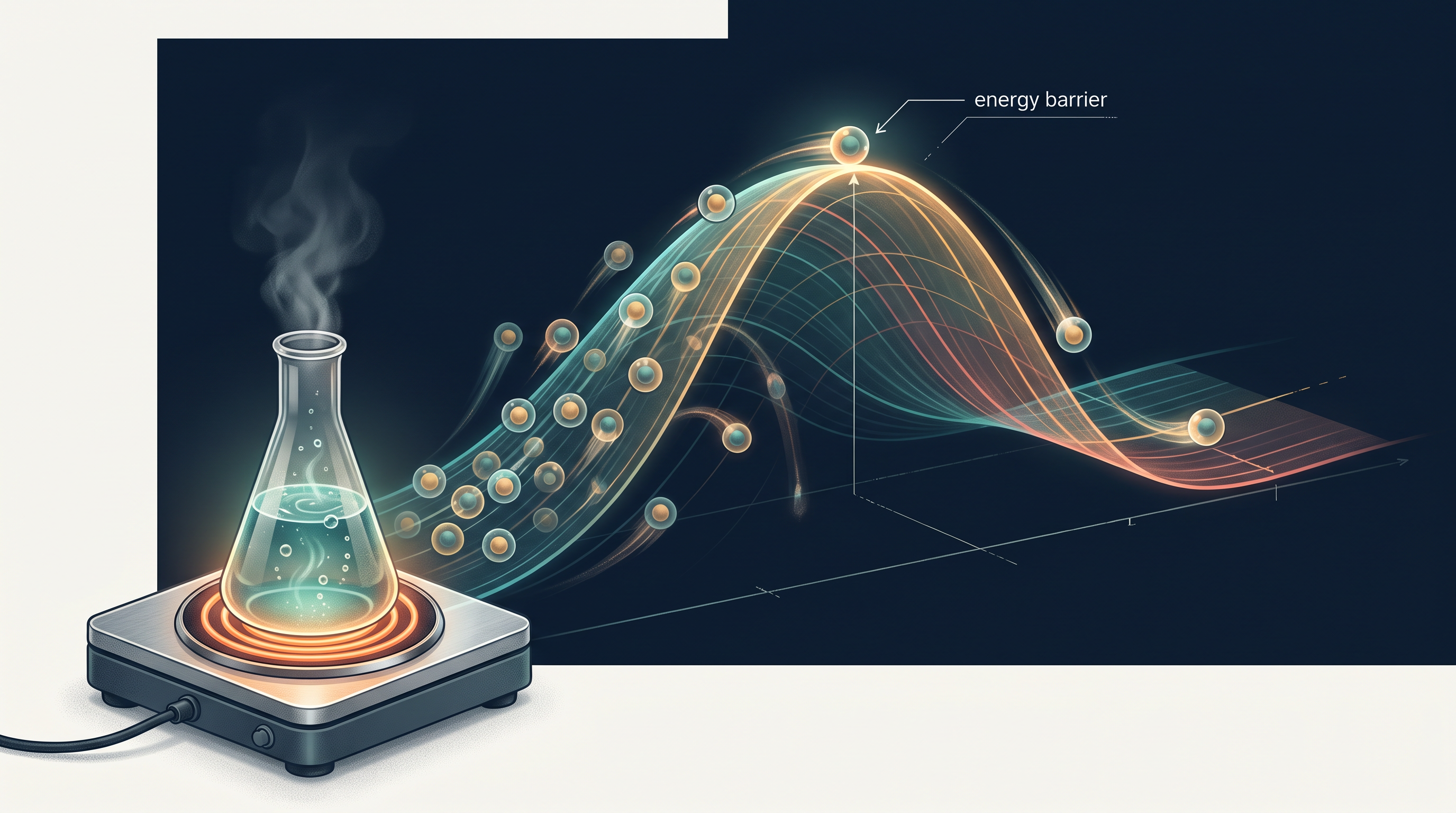
Fig. 3.0 – Reaction mixture and the activation energy barrier.
Keep these questions in mind as you read: each one will be answered at the point in this chapter where you have the tools to reason it out for yourself.
3.1 Rate of a Chemical Reaction
What Chemical Kinetics Studies
Chemistry is, by its very nature, the science of change. Substances with well defined properties are converted by chemical reactions into other substances with quite different properties. For any chemical reaction, a chemist wants to settle three separate questions.
Is the reaction feasible? This is answered by thermodynamics. You already know that a reaction for which \(\Delta G < 0\) at constant temperature and pressure is feasible.
How far will it go? The extent to which a reaction proceeds is decided by chemical equilibrium.
How fast will it go? This is the speed of the reaction — the time it takes to reach equilibrium.
Feasibility and extent alone are not enough. To understand a reaction completely, we must also know its rate and the factors that control that rate. Which parameters decide how rapidly food gets spoiled? How does one design a material for a dental filling that sets quickly? What controls the rate at which fuel burns inside an automobile engine? Questions like these are answered by the branch of chemistry that studies reaction rates and their mechanisms, called chemical kinetics.
Feasible Is Not the Same as Fast
Thermodynamics tells us only whether a reaction can happen; chemical kinetics tells us how quickly it does happen. The two answers can be startlingly different. Thermodynamic data indicate that diamond should convert into graphite. In reality the conversion is so slow that the change is not perceptible at all — which is why most people believe that diamond is forever.
Kinetic studies do more than measure speed. They also describe the conditions under which reaction rates can be altered. Factors such as concentration, temperature, pressure and the presence of a catalyst all affect the rate of a reaction. At the macroscopic level we are interested in the amounts of substance reacted or formed and in the rates of their consumption or formation. At the molecular level we look deeper, at reaction mechanisms — the orientation and the energy of the molecules that collide with one another.
In this Chapter we shall deal with the average and the instantaneous rate of a reaction and the factors affecting them, and we shall also look at some elementary ideas of the collision theory of reaction rates. To understand all of this, we must first learn what the reaction rate actually means.
Fast, Slow and Moderate Reactions
Reactions differ enormously in how fast they run. Some, such as ionic reactions, occur very fast: precipitation of silver chloride is instantaneous when aqueous solutions of silver nitrate and sodium chloride are mixed. Some are very slow: rusting of iron in the presence of air and moisture takes days and months. In between lie reactions of moderate speed, such as the inversion of cane sugar and the hydrolysis of starch. Can you think of more examples in each category?
Defining the Rate of a Reaction
You know that the speed of an automobile is expressed as the change in its position, or the distance it covers, in a certain period of time. The rate of a chemical reaction is defined in exactly the same spirit — as the change in concentration of a reactant or a product in unit time. To be more specific, it can be expressed in terms of:
- the rate of decrease in concentration of any one of the reactants, or
- the rate of increase in concentration of any one of the products.
Consider a hypothetical reaction, assuming that the volume of the system remains constant.
\[\mathrm{R} \rightarrow \mathrm{P}\]
One mole of the reactant R produces one mole of the product P. If \([\mathrm{R}]_1\) and \([\mathrm{P}]_1\) are the concentrations of R and P respectively at time \(t_1\), and \([\mathrm{R}]_2\) and \([\mathrm{P}]_2\) are their concentrations at time \(t_2\), then
\[\Delta t = t_2 - t_1\] \[\Delta[\mathrm{R}] = [\mathrm{R}]_2 - [\mathrm{R}]_1\] \[\Delta[\mathrm{P}] = [\mathrm{P}]_2 - [\mathrm{P}]_1\]
The square brackets in these expressions stand for molar concentration — that is, moles of the species per litre of solution or of reaction mixture.
Rate of disappearance of R
\[= \frac{\text{Decrease in concentration of R}}{\text{Time taken}} = -\frac{\Delta[\mathrm{R}]}{\Delta t} \qquad (3.1)\]
Rate of appearance of P
\[= \frac{\text{Increase in concentration of P}}{\text{Time taken}} = +\frac{\Delta[\mathrm{P}]}{\Delta t} \qquad (3.2)\]
Since \(\Delta[\mathrm{R}]\) is a negative quantity (the concentration of a reactant is decreasing, so the later value is smaller than the earlier one), it is multiplied by \(-1\) to make the rate of the reaction a positive quantity. A rate is a speed, and a speed is never reported as a negative number.
Equations (3.1) and (3.2) given above represent the average rate of a reaction, \(r_{\text{av}}\).
The average rate therefore depends on two things: the change in concentration of reactants or products, and the time taken for that change to occur. Both quantities can be read directly off a concentration–time curve, as shown in Fig. 3.1.
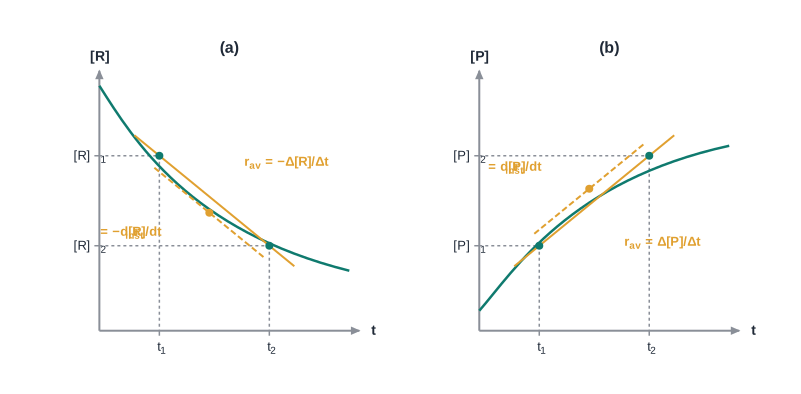
Fig. 3.1 – Concentration versus time plots for (a) a reactant and (b) a product.
Units of Rate of a Reaction
From equations (3.1) and (3.2) it is clear that the units of rate are concentration \(\times\) time\(^{-1}\). For example, if concentration is in mol L\(^{-1}\) and time is in seconds, then the units will be \(\text{mol L}^{-1}\text{s}^{-1}\). However, in gaseous reactions, when the concentration of gases is expressed in terms of their partial pressures, then the units of the rate equation will be \(\text{atm s}^{-1}\).
Instantaneous Rate of a Reaction
It can be seen from Table 3.1 that the average rate falls from \(1.90 \times 10^{-4}\ \text{mol L}^{-1}\text{s}^{-1}\) to \(0.4 \times 10^{-4}\ \text{mol L}^{-1}\text{s}^{-1}\) as the reaction proceeds. This fall is the clue to a limitation of the average rate: it is a single number smeared over a whole time interval, and so it cannot be used to predict the rate of a reaction at a particular instant, as it would be constant for the time interval for which it is calculated.
So, to express the rate at a particular moment of time we determine the instantaneous rate. It is obtained when we consider the average rate at the smallest time interval, say \(\mathrm{d}t\) (i.e. when \(\Delta t\) approaches zero). Hence, mathematically, for an infinitesimally small \(\mathrm{d}t\), the instantaneous rate is given by
\[r_{\text{av}} = \frac{-\Delta[\mathrm{R}]}{\Delta t} = \frac{\Delta[\mathrm{P}]}{\Delta t} \qquad (3.3)\]
\[\text{As } \Delta t \rightarrow 0 \quad \text{or} \quad r_{\text{inst}} = \frac{-\mathrm{d}[\mathrm{R}]}{\mathrm{d}t} = \frac{\mathrm{d}[\mathrm{P}]}{\mathrm{d}t}\]
The symbols \(\mathrm{d}[\mathrm{R}]\) and \(\mathrm{d}t\) simply mean a vanishingly small change in concentration over a vanishingly small stretch of time; the ratio of the two is the slope of the curve at that single point.
The instantaneous rate can be determined graphically by drawing a tangent at time \(t\) on either of the curves of concentration of R or P versus time \(t\), and calculating its slope (Fig. 3.1). So in problem 3.1, \(r_{\text{inst}}\) at 600 s, for example, can be calculated by plotting the concentration of butyl chloride as a function of time. A tangent is drawn that touches the curve at \(t = 600\ \text{s}\), as shown in Fig. 3.2.
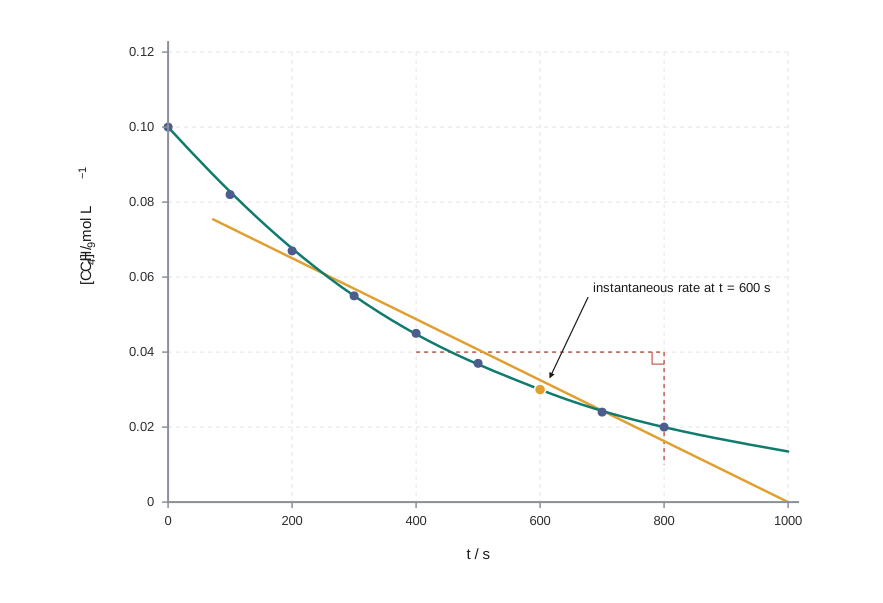
Fig. 3.2 – Instantaneous rate from a concentration–time curve.
The slope of this tangent gives the instantaneous rate.
So, \(r_{\text{inst}}\) at 600 s \(= -\left(\dfrac{0.0165 - 0.037}{(800 - 400)\ \text{s}}\right)\ \text{mol L}^{-1} = 5.12 \times 10^{-5}\ \text{mol L}^{-1}\text{s}^{-1}\)
At \(t = 250\ \text{s}\), \(\quad r_{\text{inst}} = 1.22 \times 10^{-4}\ \text{mol L}^{-1}\text{s}^{-1}\)
\(t = 350\ \text{s}\), \(\quad r_{\text{inst}} = 1.0 \times 10^{-4}\ \text{mol L}^{-1}\text{s}^{-1}\)
\(t = 450\ \text{s}\), \(\quad r_{\text{inst}} = 6.4 \times 10^{-5}\ \text{mol L}^{-1}\text{s}^{-1}\)
Notice how the instantaneous rate keeps falling as time passes. This is exactly what we should expect: as the reactant is consumed its concentration drops, and a reaction that depends on reactant concentration must slow down.
Rate and Stoichiometric Coefficients
Now consider a reaction
\[\mathrm{Hg}\text{(l)} + \mathrm{Cl_2}\text{(g)} \rightarrow \mathrm{HgCl_2}\text{(s)}\]
Here the stoichiometric coefficients of the reactants and the products are all the same (each is one). The rate of the reaction is then given as
\[\text{Rate of reaction} = -\frac{\Delta[\mathrm{Hg}]}{\Delta t} = -\frac{\Delta[\mathrm{Cl_2}]}{\Delta t} = \frac{\Delta[\mathrm{HgCl_2}]}{\Delta t}\]
That is, the rate of disappearance of any of the reactants is the same as the rate of appearance of the product. But look at the following reaction, in which two moles of HI decompose to produce one mole each of \(\mathrm{H_2}\) and \(\mathrm{I_2}\).
\[2\,\mathrm{HI}\text{(g)} \rightarrow \mathrm{H_2}\text{(g)} + \mathrm{I_2}\text{(g)}\]
Here HI is used up twice as fast as \(\mathrm{H_2}\) is formed, so the three “rates” would not be numerically equal, and the rate of the reaction would become an ambiguous quantity. For expressing the rate of such a reaction — where the stoichiometric coefficients of reactants or products are not equal to one — the rate of disappearance of any of the reactants, or the rate of appearance of any of the products, is divided by its respective stoichiometric coefficient. Since the rate of consumption of HI is twice the rate of formation of \(\mathrm{H_2}\) or \(\mathrm{I_2}\), the term \(\Delta[\mathrm{HI}]\) is divided by 2 to make them equal. The rate of this reaction is given by
\[\text{Rate of reaction} = -\frac{1}{2}\frac{\Delta[\{HI\}]}{\Delta t} = \frac{\Delta[\mathrm{H_2}]}{\Delta t} = \frac{\Delta[\mathrm{I_2}]}{\Delta t}\]
Similarly, for the reaction
\[5\,\mathrm{Br^-}\text{(aq)} + \mathrm{BrO_3^{-}}\text{(aq)} + 6\,\mathrm{H^+}\text{(aq)} \rightarrow 3\,\mathrm{Br_2}\text{(aq)} + 3\,\mathrm{H_2O}\text{(l)}\]
\[\text{Rate} = -\frac{1}{5}\frac{\Delta[\mathrm{Br^-}]}{\Delta t} = -\frac{\Delta[\mathrm{BrO_3^{-}}]}{\Delta t} = -\frac{1}{6}\frac{\Delta[\mathrm{H^+}]}{\Delta t} = \frac{1}{3}\frac{\Delta[\mathrm{Br_2}]}{\Delta t} = \frac{1}{3}\frac{\Delta[\mathrm{H_2O}]}{\Delta t}\]
Rate in Terms of Partial Pressure
For a gaseous reaction at constant temperature, concentration is directly proportional to the partial pressure of a species. This follows from the ideal gas equation \(PV = nRT\), which rearranges to \(P = (n/V)RT\), and \(n/V\) is precisely the molar concentration. Hence the rate can also be expressed as the rate of change in partial pressure of the reactant or the product — a great convenience in the laboratory, since pressure is far easier to measure in a sealed vessel than concentration.
Intext Questions
3.2 Factors Influencing Rate of a Reaction
The rate of a reaction depends upon the experimental conditions under which the reaction is carried out — the concentration of the reactants (pressure, in the case of gases), the temperature, and the presence of a catalyst. In this section we take up the first of these, concentration; temperature and catalyst are dealt with later in the chapter.
3.2.1 Dependence of Rate on Concentration
The rate of a chemical reaction at a given temperature may depend on the concentration of one or more reactants and products. The representation of the rate of a reaction in terms of the concentration of the reactants is known as the rate law. It is also called the rate equation or the rate expression.
3.2.2 Rate Expression and Rate Constant
The results in Table 3.1 clearly show that the rate of a reaction decreases with the passage of time, as the concentration of the reactant decreases. Conversely, rates generally increase when reactant concentrations increase. So the rate of a reaction depends upon the concentration of the reactants.
Consider a general reaction
\[a\mathrm{A} + b\mathrm{B} \rightarrow c\mathrm{C} + d\mathrm{D}\]
where \(a\), \(b\), \(c\) and \(d\) are the stoichiometric coefficients of the reactants and the products.
The rate expression for this reaction is
\[\text{Rate} \propto [\mathrm{A}]^x[\mathrm{B}]^y \qquad (3.4)\]
where the exponents \(x\) and \(y\) may or may not be equal to the stoichiometric coefficients (\(a\) and \(b\)) of the reactants. This is the single most important warning in the whole topic: the powers in the rate law are experimental facts, not copies of the coefficients. The above equation can also be written as
\[\text{Rate} = k[\mathrm{A}]^x[\mathrm{B}]^y \qquad (3.4a)\]
\[-\frac{\mathrm{d}[\mathrm{R}]}{\mathrm{d}t} = k[\mathrm{A}]^x[\mathrm{B}]^y \qquad (3.4b)\]
This form of equation (3.4b) is known as the differential rate equation, where \(k\) is a proportionality constant called the rate constant. It is written as a differential because \(-\mathrm{d}[\mathrm{R}]/\mathrm{d}t\) is the instantaneous rate you met in Section 3.1 — the rate at one particular moment, when the concentrations still have the values written on the right-hand side.
An equation like (3.4), which relates the rate of a reaction to the concentration of the reactants, is called the rate law or the rate expression.
Reading a Rate Law from Experiment
For example, consider
\[2\,\mathrm{NO}\text{(g)} + \mathrm{O_2}\text{(g)} \rightarrow 2\,\mathrm{NO_2}\text{(g)}\]
We can measure the rate of this reaction as a function of the initial concentrations, either by keeping the concentration of one of the reactants constant and changing the concentration of the other reactant, or by changing the concentration of both the reactants. The following results are obtained (Table 3.2).
Table 3.2: Initial rate of formation of NO₂
| Experiment | Initial [NO]/ mol L\(^{-1}\) | Initial [O₂]/ mol L\(^{-1}\) | Initial rate of formation of NO₂/ mol L\(^{-1}\)s\(^{-1}\) |
|---|---|---|---|
| 1. | 0.30 | 0.30 | 0.096 |
| 2. | 0.60 | 0.30 | 0.384 |
| 3. | 0.30 | 0.60 | 0.192 |
| 4. | 0.60 | 0.60 | 0.768 |
It is obvious, after looking at the results, that when the concentration of NO is doubled and that of \(\mathrm{O_2}\) is kept constant, the initial rate increases by a factor of four, from 0.096 to 0.384 mol L\(^{-1}\)s\(^{-1}\). This indicates that the rate depends upon the square of the concentration of NO. When the concentration of NO is kept constant and the concentration of \(\mathrm{O_2}\) is doubled, the rate also gets doubled, indicating that the rate depends on the concentration of \(\mathrm{O_2}\) to the first power. Hence, the rate equation for this reaction will be
\[\text{Rate} = k[\mathrm{NO}]^2[\mathrm{O_2}]\]
The differential form of this rate expression is given as
\[-\frac{\mathrm{d}[\mathrm{R}]}{\mathrm{d}t} = k[\mathrm{NO}]^2[\mathrm{O_2}]\]
Now, we observe that for this reaction, in the rate equation derived from the experimental data, the exponents of the concentration terms are the same as their stoichiometric coefficients in the balanced chemical equation. That agreement, however, is a coincidence of this particular reaction, not a rule.
Some other examples are given below.
| Reaction | Experimental rate expression |
|---|---|
| 1. \(\mathrm{CHCl_3} + \mathrm{Cl_2} \rightarrow \mathrm{CCl_4} + \mathrm{HCl}\) | \(\text{Rate} = k[\mathrm{CHCl_3}][\mathrm{Cl_2}]^{1/2}\) |
| 2. \(\mathrm{CH_3COOC_2H_5} + \mathrm{H_2O} \rightarrow \mathrm{CH_3COOH} + \mathrm{C_2H_5OH}\) | \(\text{Rate} = k[\mathrm{CH_3COOC_2H_5}]^1[\mathrm{H_2O}]^0\) |
In these reactions the exponents of the concentration terms are not the same as their stoichiometric coefficients. In the first, chlorine appears to the power one-half — a value no balanced equation could ever have suggested. Thus we can say that:
Rate law for any reaction cannot be predicted by merely looking at the balanced chemical equation, i.e., theoretically, but must be determined experimentally.
3.2.3 Order of a Reaction
In the rate equation (3.4)
\[\text{Rate} = k[\mathrm{A}]^x[\mathrm{B}]^y\]
\(x\) and \(y\) indicate how sensitive the rate is to a change in the concentration of A and of B. The sum of these exponents, i.e. \(x + y\) in (3.4), gives the overall order of the reaction, whereas \(x\) and \(y\) represent the order with respect to the reactants A and B respectively.
The order of a reaction can be 0, 1, 2, 3 and even a fraction. A zero order reaction means that the rate of the reaction is independent of the concentration of the reactants — the reaction simply plods along at the same speed whether the reactant is plentiful or scarce.
Elementary and Complex Reactions
A balanced chemical equation never gives us a true picture of how a reaction takes place, since rarely does a reaction get completed in one step. The reactions taking place in one step are called elementary reactions. When a sequence of elementary reactions (called the mechanism) gives us the products, the reactions are called complex reactions.
These may be consecutive reactions (e.g., the oxidation of ethane to \(\mathrm{CO_2}\) and \(\mathrm{H_2O}\) passes through a series of intermediate steps in which alcohol, aldehyde and acid are formed), reverse reactions, and side reactions (e.g., nitration of phenol yields o-nitrophenol and p-nitrophenol).
Units of Rate Constant
The rate constant \(k\) is not a pure number; its units adjust themselves so that the right-hand side of the rate law comes out with the units of a rate. For a general reaction
\[a\mathrm{A} + b\mathrm{B} \rightarrow c\mathrm{C} + d\mathrm{D}\]
\[\text{Rate} = k[\mathrm{A}]^x[\mathrm{B}]^y\]
where \(x + y = n =\) order of the reaction
\[k = \frac{\text{Rate}}{[\mathrm{A}]^x[\mathrm{B}]^y} = \frac{\text{concentration}}{\text{time}} \times \frac{1}{(\text{concentration})^n} \qquad (\text{where } [\mathrm{A}] = [\mathrm{B}])\]
Taking SI units of concentration, mol L\(^{-1}\), and of time, s, the units of \(k\) for different reaction orders are listed in Table 3.3.
Table 3.3: Units of rate constant
| Reaction | Order | Units of rate constant |
|---|---|---|
| Zero order reaction | 0 | \(\dfrac{\text{mol L}^{-1}}{\text{s}} \times \dfrac{1}{(\text{mol L}^{-1})^0} = \text{mol L}^{-1}\text{s}^{-1}\) |
| First order reaction | 1 | \(\dfrac{\text{mol L}^{-1}}{\text{s}} \times \dfrac{1}{(\text{mol L}^{-1})^1} = \text{s}^{-1}\) |
| Second order reaction | 2 | \(\dfrac{\text{mol L}^{-1}}{\text{s}} \times \dfrac{1}{(\text{mol L}^{-1})^2} = \text{mol}^{-1}\text{L s}^{-1}\) |
Because each order has its own signature units, the units of \(k\) can be read backwards to reveal the order — a trick that appears again and again in examinations.
3.2.4 Molecularity of a Reaction
Another property of a reaction, called molecularity, helps in understanding its mechanism.
The reaction can be unimolecular when one reacting species is involved, for example, decomposition of ammonium nitrite.
\[\mathrm{NH_4NO_2} \rightarrow \mathrm{N_2} + 2\,\mathrm{H_2O}\]
Bimolecular reactions involve simultaneous collision between two species, for example, dissociation of hydrogen iodide.
\[2\,\mathrm{HI} \rightarrow \mathrm{H_2} + \mathrm{I_2}\]
Trimolecular or termolecular reactions involve simultaneous collision between three reacting species, for example,
\[2\,\mathrm{NO} + \mathrm{O_2} \rightarrow 2\,\mathrm{NO_2}\]
The probability that more than three molecules can collide and react simultaneously is very small. Picture three molecules arriving at the same point in space, at the same instant, with the right energy and the right orientation — already an unlikely event; four is far less likely still. Hence reactions with molecularity three are very rare and slow to proceed.
Why Complex Reactions Need a Mechanism
It is, therefore, evident that complex reactions involving more than three molecules in the stoichiometric equation must take place in more than one step.
\[\mathrm{KClO_3} + 6\,\mathrm{FeSO_4} + 3\,\mathrm{H_2SO_4} \rightarrow \mathrm{KCl} + 3\,\mathrm{Fe_2(SO_4)_3} + 3\,\mathrm{H_2O}\]
This reaction, which apparently seems to be of tenth order, is actually a second order reaction. This shows that the reaction takes place in several steps. Which step controls the rate of the overall reaction? The question can be answered if we go through the mechanism of the reaction. Chances of winning a relay race depend upon the slowest person in the team; similarly, the overall rate of the reaction is controlled by the slowest step in the reaction, called the rate determining step.
Consider the decomposition of hydrogen peroxide, which is catalysed by iodide ion in an alkaline medium.
\[2\,\mathrm{H_2O_2} \xrightarrow{\ \mathrm{I^-},\ \text{Alkaline medium}\ } 2\,\mathrm{H_2O} + \mathrm{O_2}\]
The rate equation for this reaction is found to be
\[\text{Rate} = \frac{-\mathrm{d}[\mathrm{H_2O_2}]}{\mathrm{d}t} = k[\mathrm{H_2O_2}][\mathrm{I^-}]\]
This reaction is first order with respect to both \(\mathrm{H_2O_2}\) and \(\mathrm{I^-}\). Notice that \(\mathrm{I^-}\) appears in the rate law even though it is a catalyst and does not appear in the overall balanced equation — one more proof that a rate law cannot be written from the equation alone. Evidence suggests that this reaction takes place in two steps.
\(\mathrm{H_2O_2} + \mathrm{I^-} \rightarrow \mathrm{H_2O} + \mathrm{IO^-}\)
\(\mathrm{H_2O_2} + \mathrm{IO^-} \rightarrow \mathrm{H_2O} + \mathrm{I^-} + \mathrm{O_2}\)
The sequence is set out in FC 3.1.
Flowchart
FC 3.1 – Iodide-catalysed decomposition of H₂O₂: H₂O₂ + I⁻ → (slow, rate determining step) → H₂O + IO⁻ (intermediate) → IO⁻ + second H₂O₂ → (fast) → H₂O + I⁻ + O₂; note that I⁻ is regenerated, so it acts as a catalyst; overall: 2H₂O₂ → 2H₂O + O₂.
Both the steps are bimolecular elementary reactions. The species \(\mathrm{IO^-}\) is called an intermediate, since it is formed during the course of the reaction but does not appear in the overall balanced equation. The first step, being slow, is the rate determining step. Thus, the rate of formation of the intermediate will determine the rate of this reaction — which is exactly why the experimental rate law contains \([\mathrm{H_2O_2}]\) and \([\mathrm{I^-}]\), the two species that meet in that slow first step.
Order and Molecularity Compared
Thus, from the discussion till now, we conclude the following:
Order of a reaction is an experimental quantity. It can be zero and even a fraction, but molecularity cannot be zero or a non-integer.
Order is applicable to elementary as well as complex reactions, whereas molecularity is applicable only for elementary reactions. For a complex reaction, molecularity has no meaning.
For a complex reaction, order is given by the slowest step, and the molecularity of the slowest step is the same as the order of the overall reaction.
Intext Questions
3.3 Integrated Rate Equations
We have already noted that the concentration dependence of rate is called the differential rate equation. It is not always convenient to determine the instantaneous rate, as it is measured by determining the slope of the tangent at a point ‘\(t\)’ in a concentration versus time plot (Fig. 3.1). Drawing a tangent by hand is an awkward, error-prone business, and this makes it difficult to determine the rate law and hence the order of the reaction.
In order to avoid this difficulty, we can integrate the differential rate equation. Integration converts a statement about how fast the concentration is changing at an instant into a statement about what the concentration actually is at any time \(t\). The result is a relation between directly measured experimental data — concentrations at different times — and the rate constant.
The integrated rate equations are different for reactions of different reaction orders. We shall determine these equations only for zero and first order chemical reactions.
3.3.1 Zero Order Reactions
Zero order reaction means that the rate of the reaction is proportional to the zero power of the concentration of the reactants. Consider the reaction,
\[\mathrm{R} \rightarrow \mathrm{P}\]
\[\text{Rate} = -\frac{\mathrm{d}[\mathrm{R}]}{\mathrm{d}t} = k[\mathrm{R}]^0\]
As any quantity raised to the power zero is unity,
\[\text{Rate} = -\frac{\mathrm{d}[\mathrm{R}]}{\mathrm{d}t} = k \times 1\]
\[\mathrm{d}[\mathrm{R}] = -k\,\mathrm{d}t\]
Integrating both sides,
\[[\mathrm{R}] = -k\,t + \mathrm{I} \qquad (3.5)\]
where I is the constant of integration. Every indefinite integration leaves such a constant behind, and we fix its value from a condition we already know — the concentration at the start.
At \(t = 0\), the concentration of the reactant \(\mathrm{R} = [\mathrm{R}]_0\), where \([\mathrm{R}]_0\) is the initial concentration of the reactant.
Substituting in equation (3.5),
\[[\mathrm{R}]_0 = -k \times 0 + \mathrm{I}\] \[[\mathrm{R}]_0 = \mathrm{I}\]
Substituting the value of I in equation (3.5),
\[[\mathrm{R}] = -kt + [\mathrm{R}]_0 \qquad (3.6)\]
Reading the Zero Order Plot
Comparing (3.6) with the equation of a straight line, \(y = mx + c\), we see that if we plot \([\mathrm{R}]\) against \(t\), we get a straight line (Fig. 3.3) with slope \(= -k\) and intercept equal to \([\mathrm{R}]_0\).
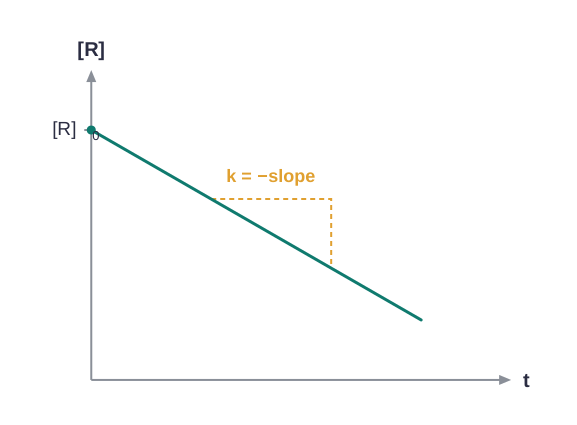
Fig. 3.3 – Concentration against time for a zero order reaction.
Further simplifying equation (3.6), we get the rate constant, \(k\), as
\[k = \frac{[\mathrm{R}]_0 - [\mathrm{R}]}{t} \qquad (3.7)\]
Zero order reactions are relatively uncommon, but they occur under special conditions. Some enzyme-catalysed reactions, and reactions which occur on metal surfaces, are a few examples of zero order reactions. The decomposition of gaseous ammonia on a hot platinum surface is a zero order reaction at high pressure.
\[2\,\mathrm{NH_3}\text{(g)} \xrightarrow{\ 1130\ \text{K},\ \mathrm{Pt}\ \text{catalyst}\ } \mathrm{N_2}\text{(g)} + 3\,\mathrm{H_2}\text{(g)}\]
\[\text{Rate} = k[\mathrm{NH_3}]^0 = k\]
In this reaction, platinum metal acts as a catalyst. At high pressure, the metal surface gets saturated with gas molecules. So a further change in reaction conditions is unable to alter the amount of ammonia on the surface of the catalyst, making the rate of the reaction independent of its concentration. The thermal decomposition of HI on a gold surface is another example of a zero order reaction.
3.3.2 First Order Reactions
In this class of reactions, the rate of the reaction is proportional to the first power of the concentration of the reactant R. For example,
\[\mathrm{R} \rightarrow \mathrm{P}\]
\[\text{Rate} = -\frac{\mathrm{d}[\mathrm{R}]}{\mathrm{d}t} = k[\mathrm{R}]\]
or
\[\frac{\mathrm{d}[\mathrm{R}]}{[\mathrm{R}]} = -k\,\mathrm{d}t\]
Integrating this equation, we get
\[\ln[\mathrm{R}] = -kt + \mathrm{I} \qquad (3.8)\]
A natural logarithm appears here for a purely mathematical reason: the integral of \(\mathrm{d}[\mathrm{R}]/[\mathrm{R}]\) is \(\ln[\mathrm{R}]\). That single fact is the source of every logarithm you will meet in first order kinetics.
Again, I is the constant of integration, and its value can be determined easily.
When \(t = 0\), \(\mathrm{R} = [\mathrm{R}]_0\), where \([\mathrm{R}]_0\) is the initial concentration of the reactant.
Therefore, equation (3.8) can be written as
\[\ln[\mathrm{R}]_0 = -k \times 0 + \mathrm{I}\] \[\ln[\mathrm{R}]_0 = \mathrm{I}\]
Substituting the value of I in equation (3.8),
\[\ln[\mathrm{R}] = -kt + \ln[\mathrm{R}]_0 \qquad (3.9)\]
Rearranging this equation,
\[\ln\frac{[\mathrm{R}]}{[\mathrm{R}]_0} = -kt\]
\[\text{or} \quad k = \frac{1}{t}\ln\frac{[\mathrm{R}]_0}{[\mathrm{R}]} \qquad (3.10)\]
Rate Constant Between Two Times
At time \(t_1\), from equation (3.8),
\[\ln[\mathrm{R}]_1 = -kt_1 + \ln[\mathrm{R}]_0 \qquad (3.11)\]
At time \(t_2\),
\[\ln[\mathrm{R}]_2 = -kt_2 + \ln[\mathrm{R}]_0 \qquad (3.12)\]
where \([\mathrm{R}]_1\) and \([\mathrm{R}]_2\) are the concentrations of the reactant at times \(t_1\) and \(t_2\) respectively.
Subtracting (3.12) from (3.11),
\[\ln[\mathrm{R}]_1 - \ln[\mathrm{R}]_2 = -kt_1 - (-kt_2)\]
\[\ln\frac{[\mathrm{R}]_1}{[\mathrm{R}]_2} = k(t_2 - t_1)\]
\[k = \frac{1}{(t_2 - t_1)}\ln\frac{[\mathrm{R}]_1}{[\mathrm{R}]_2} \qquad (3.13)\]
This form is useful when we do not know the initial concentration but do know two concentrations at two recorded times.
Equation (3.9) can also be written as
\[\ln\frac{[\mathrm{R}]}{[\mathrm{R}]_0} = -kt\]
Taking antilog of both sides,
\[[\mathrm{R}] = [\mathrm{R}]_0\,e^{-kt} \qquad (3.14)\]
This exponential form says something important: a first order reactant never quite reaches zero. It falls by the same fraction in every equal interval of time, halving and halving again.
Comparing equation (3.9) with \(y = mx + c\), if we plot \(\ln[\mathrm{R}]\) against \(t\) (Fig. 3.4), we get a straight line with slope \(= -k\) and intercept equal to \(\ln[\mathrm{R}]_0\).
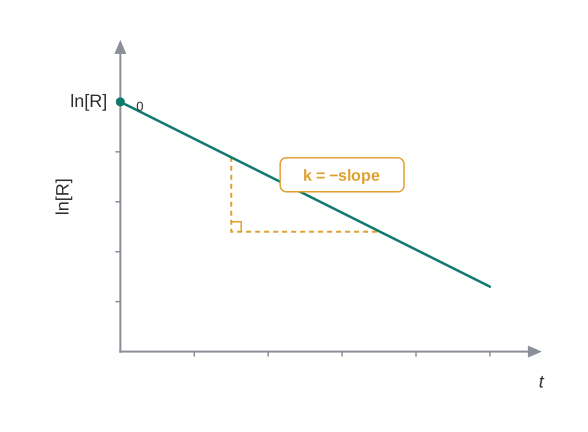
Fig. 3.4 – Plot of ln[R] against time for a first order reaction.
Working with Common Logarithms
In practice, chemists prefer common logarithms (base 10) to natural logarithms, since log tables and calculators handle them easily. The two are connected by \(\ln x = 2.303\log x\), and this is the only place the number 2.303 comes from. The first order rate equation (3.10) can therefore also be written in the form
\[k = \frac{2.303}{t}\log\frac{[\mathrm{R}]_0}{[\mathrm{R}]} \qquad (3.15)\]
\[\log\frac{[\mathrm{R}]_0}{[\mathrm{R}]} = \frac{kt}{2.303}\]
If we plot a graph between \(\log\dfrac{[\mathrm{R}]_0}{[\mathrm{R}]}\) versus \(t\) (Fig. 3.5), the slope \(= k/2.303\).
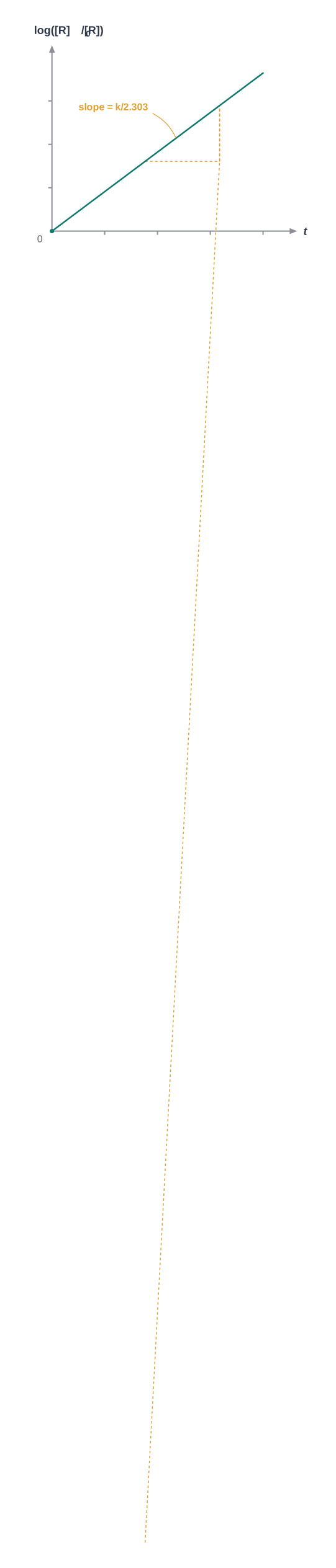
Fig. 3.5 – Plot of log([R]₀/[R]) against time for a first order reaction.
Hydrogenation of ethene is an example of a first order reaction.
\[\mathrm{C_2H_4}\text{(g)} + \mathrm{H_2}\text{(g)} \rightarrow \mathrm{C_2H_6}\text{(g)}\]
\[\text{Rate} = k[\mathrm{C_2H_4}]\]
All natural and artificial radioactive decay of unstable nuclei takes place by first order kinetics.
\[^{226}_{\ 88}\mathrm{Ra} \rightarrow\ ^{4}_{2}\mathrm{He} +\ ^{222}_{\ 86}\mathrm{Rn}\]
\[\text{Rate} = k[\mathrm{Ra}]\]
Decomposition of \(\mathrm{N_2O_5}\) and of \(\mathrm{N_2O}\) are some more examples of first order reactions.
First Order Gas Phase Reactions
Let us consider a typical first order gas phase reaction
\[\mathrm{A}\text{(g)} \rightarrow \mathrm{B}\text{(g)} + \mathrm{C}\text{(g)}\]
Let \(p_i\) be the initial pressure of A and \(p_t\) the total pressure at time ‘\(t\)’. The integrated rate equation for such a reaction can be derived as follows. In a closed vessel we cannot easily measure the partial pressure of A directly, but we can read the total pressure on a gauge, so the trick is to express \(p_\mathrm{A}\) in terms of \(p_t\).
Total pressure \(p_t = p_\mathrm{A} + p_\mathrm{B} + p_\mathrm{C}\) (pressure units)
\(p_\mathrm{A}\), \(p_\mathrm{B}\) and \(p_\mathrm{C}\) are the partial pressures of A, B and C, respectively.
If x atm be the decrease in pressure of A at time \(t\), and one mole each of B and C is being formed, the increase in pressure of B and C will also be x atm each.
| A(g) | \(\rightarrow\) | B(g) | + | C(g) | |
|---|---|---|---|---|---|
| At \(t = 0\) | \(p_i\) atm | 0 atm | 0 atm | ||
| At time \(t\) | \((p_i - \mathrm{x})\) atm | x atm | x atm |
where \(p_i\) is the initial pressure at time \(t = 0\).
\[p_t = (p_i - \mathrm{x}) + \mathrm{x} + \mathrm{x} = p_i + \mathrm{x}\]
\[\mathrm{x} = (p_t - p_i)\]
where,
\[p_\mathrm{A} = p_i - \mathrm{x} = p_i - (p_t - p_i)\]
\[= 2p_i - p_t\]
\[k = \left(\frac{2.303}{t}\right)\left(\log\frac{p_i}{p_\mathrm{A}}\right) \qquad (3.16)\]
\[= \frac{2.303}{t}\log\frac{p_i}{(2p_i - p_t)}\]
Since concentration is proportional to partial pressure at constant temperature, the ratio \(p_i/p_\mathrm{A}\) can replace \([\mathrm{R}]_0/[\mathrm{R}]\) inside the logarithm without changing anything.
3.3.3 Half-Life of a Reaction
The half-life of a reaction is the time in which the concentration of a reactant is reduced to one half of its initial concentration. It is represented as \(t_{1/2}\).
For a zero order reaction, the rate constant is given by equation 3.7.
\[k = \frac{[\mathrm{R}]_0 - [\mathrm{R}]}{t}\]
\[\text{At } t = t_{1/2},\quad [\mathrm{R}] = \frac{1}{2}[\mathrm{R}]_0\]
The rate constant at \(t_{1/2}\) becomes
\[k = \frac{[\mathrm{R}]_0 - 1/2\,[\mathrm{R}]_0}{t_{1/2}}\]
\[t_{1/2} = \frac{[\mathrm{R}]_0}{2k}\]
It is clear that \(t_{1/2}\) for a zero order reaction is directly proportional to the initial concentration of the reactants and inversely proportional to the rate constant.
For the first order reaction,
\[k = \frac{2.303}{t}\log\frac{[\mathrm{R}]_0}{[\mathrm{R}]} \qquad (3.15)\]
\[\text{at } t_{1/2}\quad [\mathrm{R}] = \frac{[\mathrm{R}]_0}{2} \qquad (3.16)\]
So, the above equation becomes
\[k = \frac{2.303}{t_{1/2}}\log\frac{[\mathrm{R}]_0}{[\mathrm{R}]/2}\]
\[\text{or}\quad t_{1/2} = \frac{2.303}{k}\log 2\]
\[t_{1/2} = \frac{2.303}{k} \times 0.301\]
\[t_{1/2} = \frac{0.693}{k} \qquad (3.17)\]
It can be seen that for a first order reaction, the half-life period is constant, i.e., it is independent of the initial concentration of the reacting species. The half-life of a first order equation is readily calculated from the rate constant, and vice versa.
For a zero order reaction \(t_{1/2} \propto [\mathrm{R}]_0\). For a first order reaction \(t_{1/2}\) is independent of \([\mathrm{R}]_0\).
Summary of the Two Integrated Rate Laws
Table 3.4 summarises the mathematical features of the integrated laws of zero and first order reactions.
Table 3.4: Integrated Rate Laws for the Reactions of Zero and First Order
| Order | Reaction type | Differential rate law | Integrated rate law | Straight line plot | Half-life | Units of \(k\) |
|---|---|---|---|---|---|---|
| 0 | R \(\rightarrow\) P | d[R]/d\(t\) = \(-k\) | \(kt\) = [R]\(_0\) \(-\) [R] | [R] vs \(t\) | [R]\(_0\)/2\(k\) | conc time\(^{-1}\) or mol L\(^{-1}\)s\(^{-1}\) |
| 1 | R \(\rightarrow\) P | d[R]/d\(t\) = \(-k\)[R] | [R] = [R]\(_0\)e\(^{-kt}\) or \(kt\) = ln{[R]\(_0\)/[R]} | ln[R] vs \(t\) | ln 2/\(k\) | time\(^{-1}\) or s\(^{-1}\) |
Pseudo First Order Reactions
The order of a reaction is sometimes altered by conditions. There are many reactions which obey the first order rate law although they are higher order reactions.
Consider the hydrolysis of ethyl acetate, which is a chemical reaction between ethyl acetate and water. In reality, it is a second order reaction, and the concentrations of both ethyl acetate and water affect the rate of the reaction. But water is taken in large excess for hydrolysis; therefore, the concentration of water is not altered much during the reaction. Thus, the rate of the reaction is affected by the concentration of ethyl acetate only.
For example, during the hydrolysis of 0.01 mol of ethyl acetate with 10 mol of water, the amounts of the reactants and products at the beginning (\(t = 0\)) and at completion (\(t\)) of the reaction are given as under.
\[\mathrm{CH_3COOC_2H_5} + \mathrm{H_2O} \xrightarrow{\ \mathrm{H^+}\ } \mathrm{CH_3COOH} + \mathrm{C_2H_5OH}\]
| \(\mathrm{CH_3COOC_2H_5}\) | \(\mathrm{H_2O}\) | \(\mathrm{CH_3COOH}\) | \(\mathrm{C_2H_5OH}\) | |
|---|---|---|---|---|
| \(t = 0\) | 0.01 mol | 10 mol | 0 mol | 0 mol |
| \(t\) | 0 mol | 9.99 mol | 0.01 mol | 0.01 mol |
The concentration of water does not get altered much during the course of the reaction — it drops only from 10 mol to 9.99 mol, a change of one part in a thousand. So the reaction behaves as a first order reaction. Such reactions are called pseudo first order reactions.
Inversion of cane sugar is another pseudo first order reaction.
\[\mathrm{C_{12}H_{22}O_{11}} + \mathrm{H_2O} \xrightarrow{\ \mathrm{H^+}\ } \mathrm{C_6H_{12}O_6} + \mathrm{C_6H_{12}O_6}\]
Cane sugar \(\rightarrow\) Glucose + Fructose
\[\text{Rate} = k[\mathrm{C_{12}H_{22}O_{11}}]\]
Intext Questions
3.4 Temperature Dependence of the Rate of a Reaction
Most chemical reactions are accelerated by an increase in temperature. For example, in the decomposition of \(\mathrm{N_2O_5}\), the time taken for half of the original amount of material to decompose is 12 min at 50 °C, 5 h at 25 °C and 10 days at 0 °C. Look carefully at those numbers: a change of only 50 degrees stretches the same chemical change from a coffee break to a fortnight.
You also know that in a mixture of potassium permanganate (\(\mathrm{KMnO_4}\)) and oxalic acid (\(\mathrm{H_2C_2O_4}\)), potassium permanganate gets decolourised faster at a higher temperature than at a lower one — a reaction you may well have watched in the laboratory.
It has been found that for a chemical reaction, with a rise in temperature by 10°, the rate constant is nearly doubled.
The temperature dependence of the rate of a chemical reaction can be accurately explained by the Arrhenius equation (3.18). It was first proposed by the Dutch chemist J. H. van’t Hoff, but the Swedish chemist Arrhenius provided its physical justification and interpretation.
\[k = A\,e^{-E_a/RT} \qquad (3.18)\]
where \(A\) is the Arrhenius factor or the frequency factor. It is also called the pre-exponential factor. It is a constant specific to a particular reaction. \(R\) is the gas constant and \(E_a\) is the activation energy measured in joules per mole (J mol\(^{-1}\)).
The Energy Barrier and the Activated Complex
The equation can be understood clearly using the following simple reaction:
\[\mathrm{H_2}\text{(g)} + \mathrm{I_2}\text{(g)} \rightarrow 2\,\mathrm{HI}\text{(g)}\]
According to Arrhenius, this reaction can take place only when a molecule of hydrogen and a molecule of iodine collide to form an unstable intermediate, as drawn in Fig. 3.6. It exists for a very short time and then breaks up to form two molecules of hydrogen iodide.
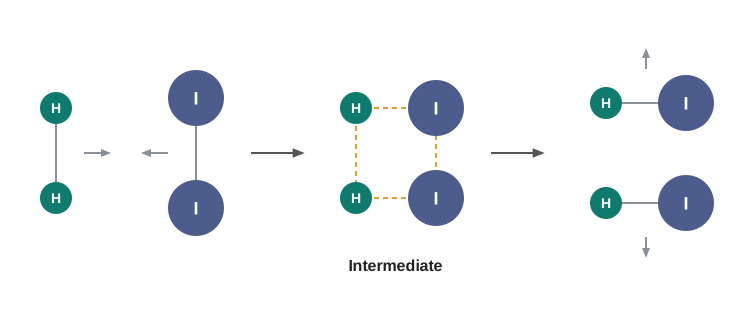
Fig. 3.6 – Formation of hydrogen iodide through an activated complex.
The energy required to form this intermediate, called the activated complex (C), is known as the activation energy (\(E_a\)). Fig. 3.7 is obtained by plotting potential energy versus reaction coordinate. The reaction coordinate represents the profile of energy change when reactants change into products — think of it as a map of the journey from reactants to products, with height standing for potential energy.
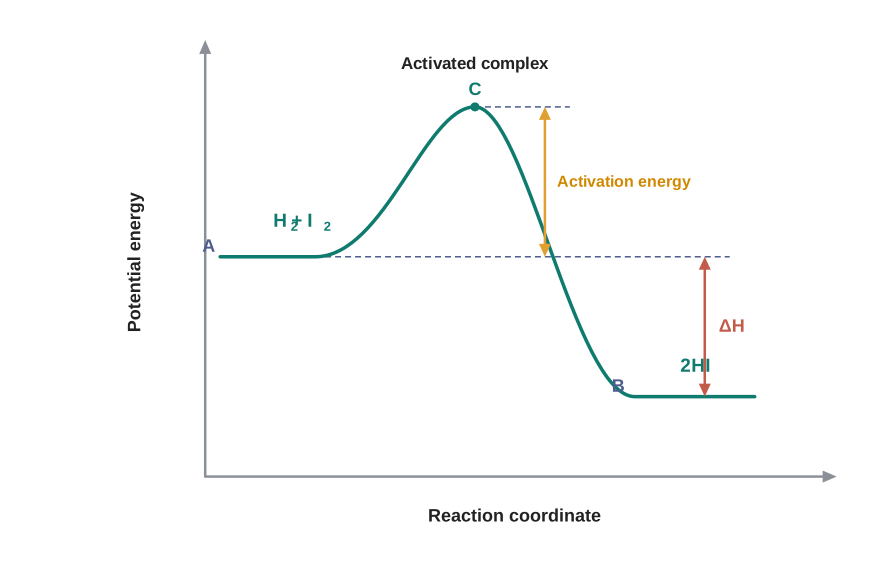
Fig. 3.7 – Potential energy profile for an exothermic reaction.
Some energy is released when the complex decomposes to form the products. So the final enthalpy of the reaction depends upon the nature of the reactants and the products — the height of the hill in between does not appear in \(\Delta H\) at all. This is worth pausing on: activation energy tells you how hard the reaction is to start; \(\Delta H\) tells you how much energy the reaction gives out or takes in overall. A strongly exothermic reaction can still have a large \(E_a\) and therefore be extremely slow.
Distribution of Molecular Energies
All the molecules in a reacting species do not have the same kinetic energy. Since it is difficult to predict the behaviour of any one molecule with precision, Ludwig Boltzmann and James Clark Maxwell used statistics to predict the behaviour of a large number of molecules. According to them, the distribution of kinetic energy may be described by plotting the fraction of molecules (\(N_E/N_T\)) with a given kinetic energy (\(E\)) versus kinetic energy, as shown in Fig. 3.8. Here \(N_E\) is the number of molecules with energy \(E\) and \(N_T\) is the total number of molecules.
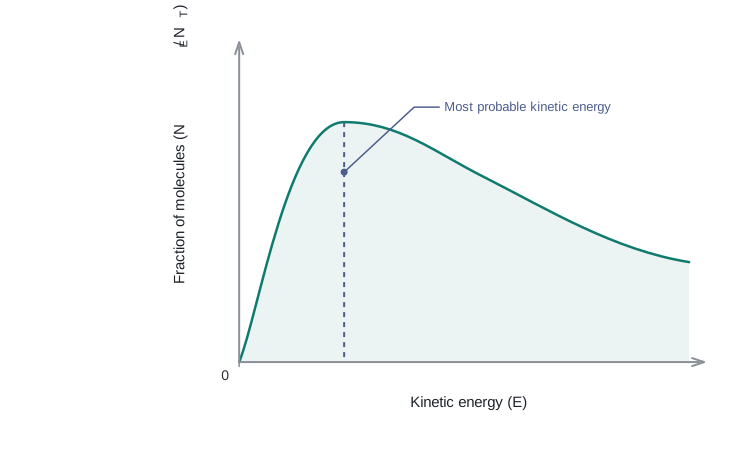
Fig. 3.8 – Maxwell–Boltzmann distribution of kinetic energy.
The peak of the curve corresponds to the most probable kinetic energy, i.e., the kinetic energy of the maximum fraction of molecules. There are decreasing numbers of molecules with energies higher or lower than this value.
When the temperature is raised, the maximum of the curve moves to a higher energy value (Fig. 3.9) and the curve broadens out, i.e., it spreads to the right, such that there is a greater proportion of molecules with much higher energies. The area under the curve must be constant, since the total probability must be one at all times. We can mark the position of \(E_a\) on the Maxwell–Boltzmann distribution curve (Fig. 3.9).
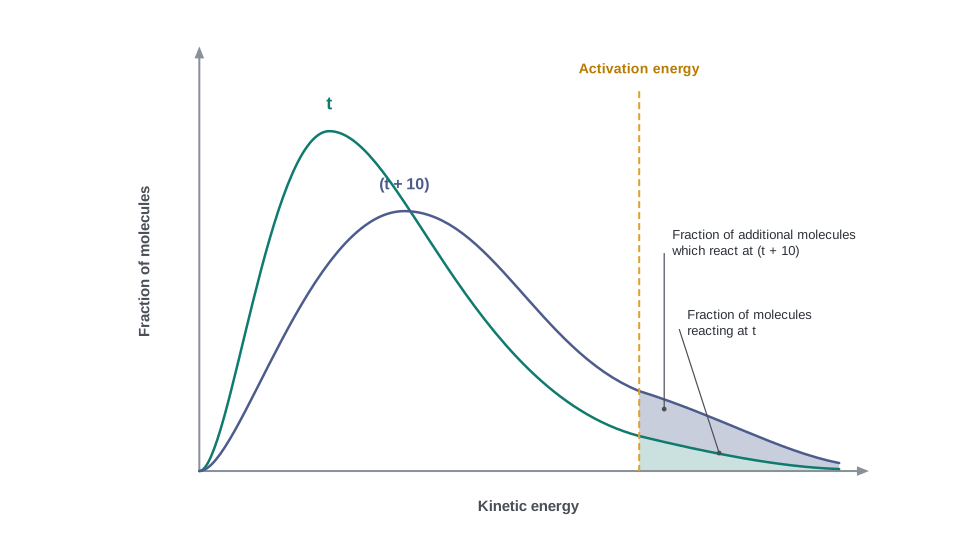
Fig. 3.9 – Effect of temperature on the Maxwell–Boltzmann distribution.
Increasing the temperature of the substance increases the fraction of molecules which collide with energies greater than \(E_a\). It is clear from the diagram that in the curve at (\(t\) + 10), the area showing the fraction of molecules having energy equal to or greater than the activation energy gets doubled, leading to a doubling of the rate of the reaction.
The Logarithmic Forms of the Arrhenius Equation
In the Arrhenius equation (3.18), the factor \(e^{-E_a/RT}\) corresponds to the fraction of molecules that have kinetic energy greater than \(E_a\). Taking the natural logarithm of both sides of equation (3.18),
\[\ln k = -\frac{E_a}{RT} + \ln A \qquad (3.19)\]
Taking logarithms is simply a way of pulling the exponent down, so that an exponential relation becomes a straight line — and a straight line is something we can draw and measure.
The plot of \(\ln k\) versus \(1/T\) gives a straight line according to equation (3.19), as shown in Fig. 3.10.
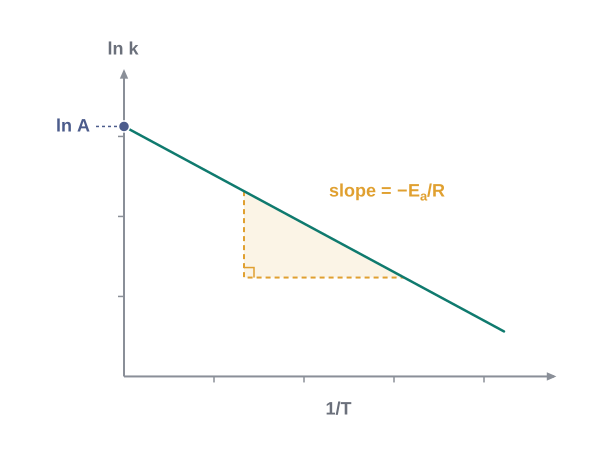
Fig. 3.10 – Arrhenius plot of ln k versus 1/T.
Thus, it has been found from the Arrhenius equation (3.18) that increasing the temperature, or decreasing the activation energy, will result in an increase in the rate of the reaction and an exponential increase in the rate constant.
In Fig. 3.10, slope \(= -\dfrac{E_a}{R}\) and intercept \(= \ln A\). So we can calculate \(E_a\) and \(A\) using these values.
At temperature \(T_1\), equation (3.19) is
\[\ln k_1 = -\frac{E_a}{RT_1} + \ln A \qquad (3.20)\]
At temperature \(T_2\), equation (3.19) is
\[\ln k_2 = -\frac{E_a}{RT_2} + \ln A \qquad (3.21)\]
(since \(A\) is constant for a given reaction)
\(k_1\) and \(k_2\) are the values of rate constants at temperatures \(T_1\) and \(T_2\) respectively.
Subtracting equation (3.20) from (3.21), we obtain
\[\ln k_2 - \ln k_1 = \frac{E_a}{RT_1} - \frac{E_a}{RT_2}\]
\[\ln\frac{k_2}{k_1} = \frac{E_a}{R}\left[\frac{1}{T_1} - \frac{1}{T_2}\right]\]
\[\log\frac{k_2}{k_1} = \frac{E_a}{2.303\,R}\left[\frac{1}{T_1} - \frac{1}{T_2}\right] \qquad (3.22)\]
\[\log\frac{k_2}{k_1} = \frac{E_a}{2.303\,R}\left[\frac{T_2 - T_1}{T_1T_2}\right]\]
The last form is the one most often used in problems, because it needs only two rate constants at two temperatures — and the unknown \(A\) has cancelled out.
3.4.1 Effect of Catalyst
A catalyst is a substance which increases the rate of a reaction without itself undergoing any permanent chemical change. For example, \(\mathrm{MnO_2}\) catalyses the following reaction so as to increase its rate considerably.
\[2\,\mathrm{KClO_3} \xrightarrow{\ \mathrm{MnO_2}\ } 2\,\mathrm{KCl} + 3\,\mathrm{O_2}\]
The word catalyst should not be used when the added substance reduces the rate of a reaction. The substance is then called an inhibitor.
How a Catalyst Works
The action of the catalyst can be explained by the intermediate complex theory. According to this theory, a catalyst participates in a chemical reaction by forming temporary bonds with the reactants, resulting in an intermediate complex. This has a transitory existence and decomposes to yield the products and the catalyst back again.
It is believed that the catalyst provides an alternate pathway, or reaction mechanism, by reducing the activation energy between reactants and products, and hence lowering the potential energy barrier, as shown in Fig. 3.11.
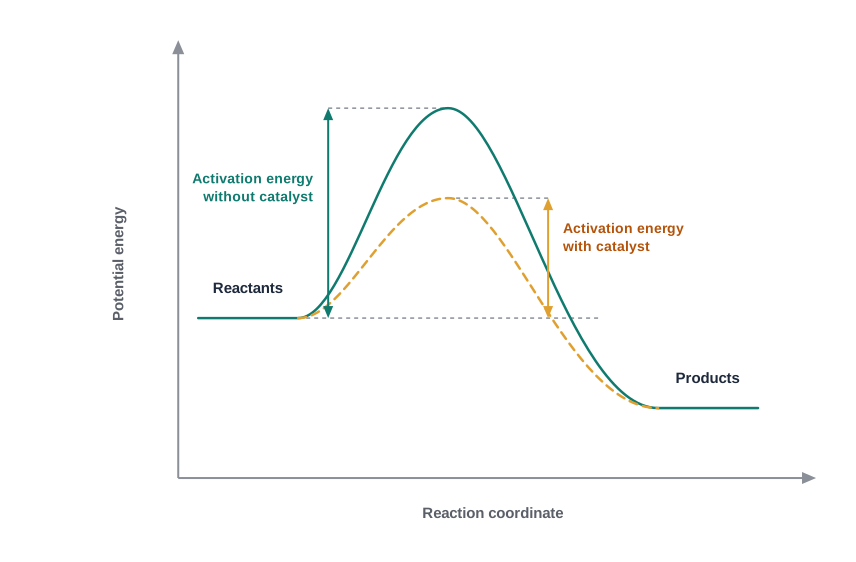
Fig. 3.11 – Effect of a catalyst on the activation energy path.
It is clear from the Arrhenius equation (3.18) that the lower the value of the activation energy, the faster will be the rate of a reaction. The catalyst does not push the molecules over the barrier; it digs a lower pass through the mountain, so that a much larger fraction of molecules can get across.
A small amount of the catalyst can catalyses a large amount of reactants, because it is regenerated at the end of each cycle. A catalyst does not alter the Gibbs energy, \(\Delta G\), of a reaction. It catalyses the spontaneous reactions but does not catalyses non-spontaneous reactions. It is also found that a catalyst does not change the equilibrium constant of a reaction; rather, it helps in attaining the equilibrium faster. That is, it catalyses the forward as well as the backward reactions to the same extent, so that the equilibrium state remains the same but is reached earlier.
Intext Questions
3.5 Collision Theory of Chemical Reactions
Though the Arrhenius equation is applicable under a wide range of circumstances, collision theory, which was developed by Max Trautz and William Lewis in 1916–18, provides a greater insight into the energetic and mechanistic aspects of reactions. It is based on the kinetic theory of gases.
According to this theory, the reactant molecules are assumed to be hard spheres, and the reaction is postulated to occur when molecules collide with each other. This is a deliberately simple picture — the molecules are treated like tiny billiard balls with no internal structure — and its strengths and its failures both follow from that simplification.
Collision Frequency and Energy
Another factor which affects the rate of chemical reactions is activation energy, as we have already studied. For a bimolecular elementary reaction
\[\mathrm{A} + \mathrm{B} \rightarrow \text{Products}\]
the rate of reaction can be expressed as
\[\text{Rate} = Z_{\mathrm{AB}}\,e^{-E_a/RT} \qquad (3.23)\]
where \(Z_{\mathrm{AB}}\) represents the collision frequency of the reactants A and B, and \(e^{-E_a/RT}\) represents the fraction of molecules with energies equal to or greater than \(E_a\).
Read the equation as a product of two conditions: how often do they meet multiplied by what fraction of those meetings is energetic enough. Comparing (3.23) with the Arrhenius equation, we can say that \(A\) is related to collision frequency.
Why Not Every Collision Works
Equation (3.23) predicts the value of rate constants fairly accurately for reactions that involve atomic species or simple molecules, but for complex molecules significant deviations are observed. The reason could be that all collisions do not lead to the formation of products.
The collisions in which molecules collide with sufficient kinetic energy (called threshold energy) and proper orientation, so as to facilitate the breaking of bonds between reacting species and the formation of new bonds to form products, are called effective collisions.
Threshold energy = Activation energy + energy possessed by the reacting species.
For example, the formation of methanol from bromoethane depends upon the orientation of the reactant molecules, as shown in Fig. 3.12.
\[\mathrm{CH_3Br} + \mathrm{\overset{-}{O}H} \rightarrow \mathrm{CH_3OH} + \mathrm{\overset{-}{B}r}\]
The proper orientation of reactant molecules leads to bond formation, whereas improper orientation makes them simply bounce back and no products are formed.
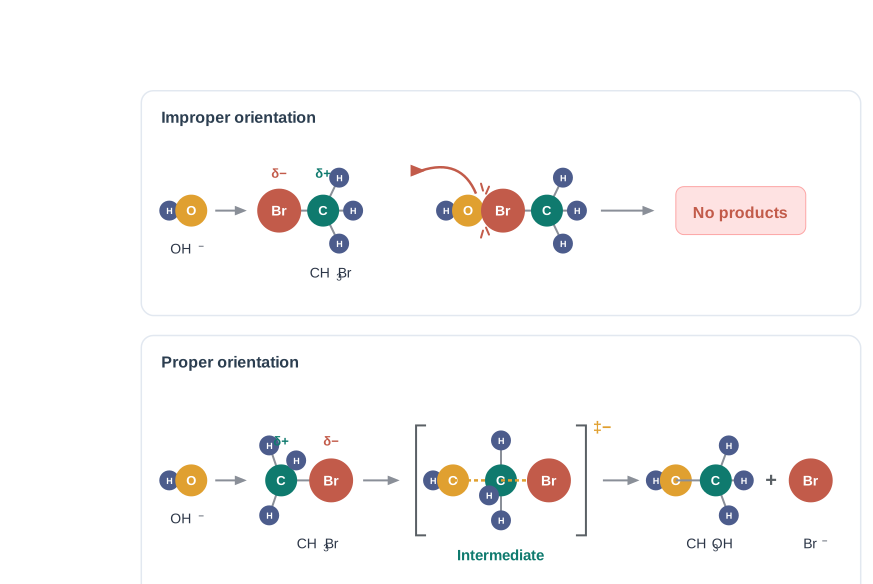
Fig. 3.12 – Proper and improper molecular orientation in a collision.
To account for effective collisions, another factor \(P\), called the probability or steric factor, is introduced. It takes into account the fact that in a collision, molecules must be properly oriented, i.e.,
\[\text{Rate} = P\,Z_{\mathrm{AB}}\,e^{-E_a/RT}\]
Thus, in collision theory, activation energy and proper orientation of the molecules together determine the criteria for an effective collision, and hence the rate of a chemical reaction. The three-factor picture is easiest to remember in order, as set out in FC 3.2.
Flowchart
FC 3.2 – Conditions for a chemical reaction in collision theory: reactant molecules → collide (collision frequency Z_AB) → branch: energy less than threshold → bounce back, no reaction; energy ≥ threshold → next test → branch: improper orientation (steric factor P small) → bounce back, no reaction; proper orientation → effective collision → activated complex → products.
Where Collision Theory Falls Short
Collision theory also has certain drawbacks, as it considers atoms and molecules to be hard spheres and ignores their structural aspect. Real molecules are not featureless balls: they have bonds, lone pairs, bulky groups and shapes, and it is precisely these features that decide whether a collision at a given angle can lead to reaction. The steric factor \(P\) is really an admission of this gap — a correction bolted on to a model that cannot predict orientation from first principles. You will study details about this theory, and more about other theories, in higher classes.
3.6 Summary
Chemical kinetics is the study of chemical reactions with respect to reaction rates, the effect of various variables, the rearrangement of atoms and the formation of intermediates.
The rate of a reaction is concerned with the decrease in concentration of reactants, or the increase in concentration of products, per unit time. Where stoichiometric coefficients are not unity, each concentration change is divided by its own coefficient so that the reaction has a single rate.
Rate can be expressed as the instantaneous rate at a particular instant of time (the slope of the tangent to the concentration–time curve), or as the average rate over a larger interval of time.
A number of factors — temperature, concentration of reactants, and the presence of a catalyst — affect the rate of a reaction.
The mathematical representation of the rate of a reaction is given by the rate law. It has to be determined experimentally and cannot be predicted merely by looking at the balanced equation.
Order of a reaction with respect to a reactant is the power of its concentration which appears in the rate law equation. The order of the reaction is the sum of all such powers of the concentration terms for the different reactants. It can be 0, 1, 2, 3 or even a fraction.
Rate constant (\(k\)) is the proportionality factor in the rate law. Its units depend on the order of the reaction, so the units of \(k\) can be used to identify the order. The rate constant and the order of a reaction can be determined from the rate law or from its integrated rate equation.
Molecularity is defined only for an elementary reaction. Its values are limited from 1 to 3. Molecularity and order of an elementary reaction are the same; for a complex reaction, molecularity has no meaning, and the order is decided by the slowest (rate determining) step.
Integrated rate equations relate concentration directly to time:
- Zero order: \([\mathrm{R}] = -kt + [\mathrm{R}]_0\), with \(t_{1/2} = \dfrac{[\mathrm{R}]_0}{2k}\)
- First order: \(k = \dfrac{2.303}{t}\log\dfrac{[\mathrm{R}]_0}{[\mathrm{R}]}\), or \([\mathrm{R}] = [\mathrm{R}]_0 e^{-kt}\), with \(t_{1/2} = \dfrac{0.693}{k}\) For a zero order reaction \(t_{1/2} \propto [\mathrm{R}]_0\), while for a first order reaction \(t_{1/2}\) is independent of the initial concentration.
A reaction of higher order that behaves as first order, because one reactant (such as water) is present in large excess and its concentration stays effectively constant, is called a pseudo first order reaction — for example, the acid hydrolysis of ethyl acetate and the inversion of cane sugar.
The temperature dependence of rate constants is described by the Arrhenius equation, \(k = A\,e^{-E_a/RT}\). \(E_a\) corresponds to the activation energy and is given by the energy difference between the activated complex and the reactant molecules, while \(A\) (the Arrhenius factor or pre-exponential factor) corresponds to the collision frequency.
The logarithmic form \(\ln k = -\dfrac{E_a}{RT} + \ln A\) gives a straight line when \(\ln k\) is plotted against \(1/T\), with slope \(-E_a/R\). For two temperatures, \(\log\dfrac{k_2}{k_1} = \dfrac{E_a}{2.303\,R}\left[\dfrac{T_2 - T_1}{T_1T_2}\right]\).
The equation clearly shows that an increase of temperature, or a lowering of \(E_a\), will lead to an increase in the rate of reaction. The presence of a catalyst lowers the activation energy by providing an alternate path for the reaction. A catalyst does not alter \(\Delta G\) or the equilibrium constant; it only helps equilibrium to be attained faster.
According to collision theory, the rate depends on the collision frequency \(Z_{\mathrm{AB}}\) and on the fraction of molecules having energy equal to or greater than \(E_a\). Another factor \(P\), called the steric factor, refers to the orientation of the molecules which collide and contributes to effective collisions, thus modifying the equation to
\[k = P\,Z_{\mathrm{AB}}\,e^{-E_a/RT}\]
- The overall logic of the chapter is summarised in FC 3.3.
Flowchart
FC 3.3 – The chapter at a glance: reaction rate (average, instantaneous) → depends on concentration → rate law (experimental) → order and rate constant → integrate the differential rate law → integrated rate equations for zero and first order → half-life → depends on temperature → Arrhenius equation (activation energy, frequency factor) → depends on catalyst → lower Eₐ, alternate path → molecular picture → collision theory (collision frequency, threshold energy, orientation/steric factor) → effective collisions → products.
3.7 NCERT Questions
From the rate expression for the following reactions, determine their order of reaction and the dimensions of the rate constants.
\(3\,\mathrm{NO}\text{(g)} \rightarrow \mathrm{N_2O}\text{(g)}\) — Rate \(= k[\mathrm{NO}]^2\)
\(\mathrm{H_2O_2}\text{(aq)} + 3\,\mathrm{I^-}\text{(aq)} + 2\,\mathrm{H^+} \rightarrow 2\,\mathrm{H_2O}\text{(l)} + \mathrm{I_3^-}\) — Rate \(= k[\mathrm{H_2O_2}][\mathrm{I^-}]\)
\(\mathrm{CH_3CHO}\text{(g)} \rightarrow \mathrm{CH_4}\text{(g)} + \mathrm{CO}\text{(g)}\) — Rate \(= k[\mathrm{CH_3CHO}]^{3/2}\)
\(\mathrm{C_2H_5Cl}\text{(g)} \rightarrow \mathrm{C_2H_4}\text{(g)} + \mathrm{HCl}\text{(g)}\) — Rate \(= k[\mathrm{C_2H_5Cl}]\)
For the reaction:
\[2\mathrm{A} + \mathrm{B} \rightarrow \mathrm{A_2B}\]
the rate \(= k[\mathrm{A}][\mathrm{B}]^2\) with \(k = 2.0 \times 10^{-6}\ \text{mol}^{-2}\text{L}^2\text{s}^{-1}\). Calculate the initial rate of the reaction when \([\mathrm{A}] = 0.1\ \text{mol L}^{-1}\), \([\mathrm{B}] = 0.2\ \text{mol L}^{-1}\). Calculate the rate of reaction after \([\mathrm{A}]\) is reduced to \(0.06\ \text{mol L}^{-1}\).
The decomposition of \(\mathrm{NH_3}\) on platinum surface is a zero order reaction. What are the rates of production of \(\mathrm{N_2}\) and \(\mathrm{H_2}\) if \(k = 2.5 \times 10^{-4}\ \text{mol}^{-1}\text{L s}^{-1}\)?
The decomposition of dimethyl ether leads to the formation of \(\mathrm{CH_4}\), \(\mathrm{H_2}\) and \(\mathrm{CO}\), and the reaction rate is given by
\[\text{Rate} = k[\mathrm{CH_3OCH_3}]^{3/2}\]
The rate of reaction is followed by the increase in pressure in a closed vessel, so the rate can also be expressed in terms of the partial pressure of dimethyl ether, i.e.,
\[\text{Rate} = k\left(p_{\mathrm{CH_3OCH_3}}\right)^{3/2}\]
If the pressure is measured in bar and time in minutes, then what are the units of rate and rate constant?
Mention the factors that affect the rate of a chemical reaction.
A reaction is second order with respect to a reactant. How is the rate of reaction affected if the concentration of the reactant is (i) doubled (ii) reduced to half?
What is the effect of temperature on the rate constant of a reaction? How can this effect of temperature on rate constant be represented quantitatively?
In a pseudo first order reaction in water, the following results were obtained:
| \(t\)/s | 0 | 30 | 60 | 90 |
|---|---|---|---|---|
| [A]/ mol L\(^{-1}\) | 0.55 | 0.31 | 0.17 | 0.085 |
Calculate the average rate of reaction between the time interval 30 to 60 seconds.
A reaction is first order in A and second order in B.
- Write the differential rate equation.
- How is the rate affected on increasing the concentration of B three times?
- How is the rate affected when the concentrations of both A and B are doubled?
In a reaction between A and B, the initial rate of reaction (\(r_0\)) was measured for different initial concentrations of A and B as given below:
| A/ mol L\(^{-1}\) | 0.20 | 0.20 | 0.40 |
|---|---|---|---|
| B/ mol L\(^{-1}\) | 0.30 | 0.10 | 0.05 |
| \(r_0\)/mol L\(^{-1}\)s\(^{-1}\) | \(5.07 \times 10^{-5}\) | \(5.07 \times 10^{-5}\) | \(1.43 \times 10^{-4}\) |
What is the order of the reaction with respect to A and B?
- The following results have been obtained during the kinetic studies of the reaction:
\[2\mathrm{A} + \mathrm{B} \rightarrow \mathrm{C} + \mathrm{D}\]
| Experiment | [A]/mol L\(^{-1}\) | [B]/mol L\(^{-1}\) | Initial rate of formation of D/mol L\(^{-1}\) min\(^{-1}\) |
|---|---|---|---|
| I | 0.1 | 0.1 | \(6.0 \times 10^{-3}\) |
| II | 0.3 | 0.2 | \(7.2 \times 10^{-2}\) |
| III | 0.3 | 0.4 | \(2.88 \times 10^{-1}\) |
| IV | 0.4 | 0.1 | \(2.40 \times 10^{-2}\) |
Determine the rate law and the rate constant for the reaction.
- The reaction between A and B is first order with respect to A and zero order with respect to B. Fill in the blanks in the following table:
| Experiment | [A]/ mol L\(^{-1}\) | [B]/ mol L\(^{-1}\) | Initial rate/ mol L\(^{-1}\) min\(^{-1}\) |
|---|---|---|---|
| I | 0.1 | 0.1 | \(2.0 \times 10^{-2}\) |
| II | – | 0.2 | \(4.0 \times 10^{-2}\) |
| III | 0.4 | 0.4 | – |
| IV | – | 0.2 | \(2.0 \times 10^{-2}\) |
- Calculate the half-life of a first order reaction from their rate constants given below:
- \(200\ \text{s}^{-1}\) (ii) \(2\ \text{min}^{-1}\) (iii) \(4\ \text{years}^{-1}\)
The half-life for radioactive decay of \(^{14}\mathrm{C}\) is 5730 years. An archaeological artifact containing wood had only 80% of the \(^{14}\mathrm{C}\) found in a living tree. Estimate the age of the sample.
The experimental data for decomposition of \(\mathrm{N_2O_5}\)
\[[2\,\mathrm{N_2O_5} \rightarrow 4\,\mathrm{NO_2} + \mathrm{O_2}]\]
in gas phase at 318 K are given below:
| \(t\)/s | 0 | 400 | 800 | 1200 | 1600 | 2000 | 2400 | 2800 | 3200 |
|---|---|---|---|---|---|---|---|---|---|
| \(10^2 \times [\mathrm{N_2O_5}]\)/ mol L\(^{-1}\) | 1.63 | 1.36 | 1.14 | 0.93 | 0.78 | 0.64 | 0.53 | 0.43 | 0.35 |
a. Plot $[\mathrm{N_2O_5}]$ against $t$.
b. Find the half-life period for the reaction.
c. Draw a graph between $\log[\mathrm{N_2O_5}]$ and $t$.
d. What is the rate law?
e. Calculate the rate constant.
f. Calculate the half-life period from $k$ and compare it with b.
The rate constant for a first order reaction is \(60\ \text{s}^{-1}\). How much time will it take to reduce the initial concentration of the reactant to its 1/16th value?
During nuclear explosion, one of the products is \(^{90}\mathrm{Sr}\) with half-life of 28.1 years. If 1 μg of \(^{90}\mathrm{Sr}\) was absorbed in the bones of a newly born baby instead of calcium, how much of it will remain after 10 years and 60 years if it is not lost metabolically?
For a first order reaction, show that the time required for 99% completion is twice the time required for the completion of 90% of the reaction.
A first order reaction takes 40 min for 30% decomposition. Calculate \(t_{1/2}\).
For the decomposition of azoisopropane to hexane and nitrogen at 543 K, the following data are obtained.
| \(t\) (sec) | P (mm of Hg) |
|---|---|
| 0 | 35.0 |
| 360 | 54.0 |
| 720 | 63.0 |
Calculate the rate constant.
- The following data were obtained during the first order thermal decomposition of \(\mathrm{SO_2Cl_2}\) at a constant volume.
\[\mathrm{SO_2Cl_2}\text{(g)} \rightarrow \mathrm{SO_2}\text{(g)} + \mathrm{Cl_2}\text{(g)}\]
| Experiment | Time/s\(^{-1}\) | Total pressure/atm |
|---|---|---|
| 1 | 0 | 0.5 |
| 2 | 100 | 0.6 |
Calculate the rate of the reaction when total pressure is 0.65 atm.
- The rate constant for the decomposition of \(\mathrm{N_2O_5}\) at various temperatures is given below:
| \(T\)/°C | 0 | 20 | 40 | 60 | 80 |
|---|---|---|---|---|---|
| \(10^5 \times k\)/s\(^{-1}\) | 0.0787 | 1.70 | 25.7 | 178 | 2140 |
Draw a graph between \(\ln k\) and \(1/T\) and calculate the values of \(A\) and \(E_a\). Predict the rate constant at 30° and 50 °C.
The rate constant for the decomposition of hydrocarbons is \(2.418 \times 10^{-5}\ \text{s}^{-1}\) at 546 K. If the energy of activation is 179.9 kJ/mol, what will be the value of the pre-exponential factor?
Consider a certain reaction \(\mathrm{A} \rightarrow \text{Products}\) with \(k = 2.0 \times 10^{-2}\ \text{s}^{-1}\). Calculate the concentration of A remaining after 100 s if the initial concentration of A is \(1.0\ \text{mol L}^{-1}\).
Sucrose decomposes in acid solution into glucose and fructose according to the first order rate law, with \(t_{1/2} = 3.00\) hours. What fraction of a sample of sucrose remains after 8 hours?
The decomposition of a hydrocarbon follows the equation
\[k = (4.5 \times 10^{11}\ \text{s}^{-1})\,e^{-28000\,\mathrm{K}/T}\]
Calculate \(E_a\).
- The rate constant for the first order decomposition of \(\mathrm{H_2O_2}\) is given by the following equation:
\[\log k = 14.34 - 1.25 \times 10^4\,\mathrm{K}/T\]
Calculate \(E_a\) for this reaction and at what temperature will its half-period be 256 minutes?
The decomposition of A into product has value of \(k\) as \(4.5 \times 10^{3}\ \text{s}^{-1}\) at 10 °C and energy of activation 60 kJ mol\(^{-1}\). At what temperature would \(k\) be $1.5 {4} {-1}?
The time required for 10% completion of a first order reaction at 298 K is equal to that required for its 25% completion at 308 K. If the value of \(A\) is \(4 \times 10^{10}\ \text{s}^{-1}\), calculate \(k\) at 318 K and \(E_a\).
The rate of a reaction quadruples when the temperature changes from 293 K to 313 K. Calculate the energy of activation of the reaction, assuming that it does not change with temperature.
3.8 Check Your Concepts
Why is the rate of a reaction always expressed as a positive quantity, even though the concentration of a reactant decreases with time? Explain the role of the negative sign in \(-\Delta[\mathrm{R}]/\Delta t\).
For the reaction \(4\,\mathrm{NH_3}\text{(g)} + 5\,\mathrm{O_2}\text{(g)} \rightarrow 4\,\mathrm{NO}\text{(g)} + 6\,\mathrm{H_2O}\text{(g)}\), write the rate of the reaction in terms of the rate of change of concentration of each species. Why must each term be divided by its stoichiometric coefficient?
Distinguish between average rate and instantaneous rate of a reaction. Why can the average rate not be used to describe the rate at a particular moment?
Assertion (A): The rate law of a reaction cannot be written from its balanced chemical equation. Reason (R): The exponents in the rate law are always equal to the stoichiometric coefficients. Choose whether A and R are true or false, and whether R correctly explains A. Justify your choice.
The experimental rate law for the reaction \(\mathrm{CHCl_3} + \mathrm{Cl_2} \rightarrow \mathrm{CCl_4} + \mathrm{HCl}\) is \(\text{Rate} = k[\mathrm{CHCl_3}][\mathrm{Cl_2}]^{1/2}\). What does the fractional order with respect to \(\mathrm{Cl_2}\) tell you about the mechanism of this reaction?
Give three points of difference between order and molecularity of a reaction. Why can molecularity never be zero or a fraction?
The reaction \(\mathrm{KClO_3} + 6\,\mathrm{FeSO_4} + 3\,\mathrm{H_2SO_4} \rightarrow \mathrm{KCl} + 3\,\mathrm{Fe_2(SO_4)_3} + 3\,\mathrm{H_2O}\) appears to be of tenth order but is actually second order. What does this tell you about the way the reaction proceeds?
In the iodide-catalysed decomposition of hydrogen peroxide, the rate law is \(\text{Rate} = k[\mathrm{H_2O_2}][\mathrm{I^-}]\), although \(\mathrm{I^-}\) does not appear in the overall balanced equation. Explain this observation, and identify the intermediate and the rate determining step.
What happens to the half-life of a zero order reaction if the initial concentration of the reactant is doubled? What happens to the half-life of a first order reaction under the same change? Explain the difference.
Why is the decomposition of gaseous ammonia on a hot platinum surface zero order at high pressure? What would you expect the order to become at very low pressure, and why?
Explain why the hydrolysis of ethyl acetate in dilute aqueous acid is called a pseudo first order reaction. What experimental change would reveal its true order?
Assertion (A): A rise of 10 K nearly doubles the rate of many reactions. Reason (R): A rise of 10 K nearly doubles the average kinetic energy of the molecules. State whether A and R are true, and whether R is the correct explanation of A. Support your answer using the Maxwell–Boltzmann distribution.
Sketch and label a potential energy versus reaction coordinate diagram for an exothermic reaction, marking the activation energy, the activated complex and \(\Delta H\). Why does a large activation energy not prevent a reaction from being exothermic?
Distinguish between threshold energy and activation energy. Which of the two is lowered by a catalyst?
A catalyst increases the rate of both the forward and the backward reaction to the same extent. Use this fact to explain why a catalyst cannot change the equilibrium constant or the Gibbs energy of a reaction.
Why is the steric factor \(P\) needed in collision theory? Give one example of a reaction in which orientation of the colliding molecules decides whether products are formed.
The rate constant of a reaction has the unit \(\text{mol}^{-1}\text{L s}^{-1}\). What is the order of the reaction? Explain how the unit of \(k\) can be used to deduce the order.
Match the following:
| Column I | Column II |
|---|---|
| a. Slope of \([\mathrm{R}]\) vs \(t\) plot | i. \(-E_a/R\) |
| b. Slope of \(\ln k\) vs \(1/T\) plot | ii. \(0.693/k\) |
| c. Half-life of a first order reaction | iii. \(-k\) |
| d. Slope of \(\log([\mathrm{R}]_0/[\mathrm{R}])\) vs \(t\) plot | iv. \(k/2.303\) |
Arrange the following in the order stated, giving a reason in each case: (a) the effect on rate of (i) doubling the concentration of a reactant in a second order reaction, (ii) doubling it in a first order reaction, (iii) doubling it in a zero order reaction.
Two reactions have the same frequency factor \(A\), but reaction I has \(E_a = 40\ \text{kJ mol}^{-1}\) and reaction II has \(E_a = 80\ \text{kJ mol}^{-1}\). Which reaction is faster at 300 K, and which one is helped more by a 10 K rise in temperature? Give reasons.
3.9 Practice With Numericals
For the reaction \(2\,\mathrm{N_2O_5}\text{(g)} \rightarrow 4\,\mathrm{NO_2}\text{(g)} + \mathrm{O_2}\text{(g)}\), the rate of disappearance of \(\mathrm{N_2O_5}\) is \(1.4 \times 10^{-3}\ \text{mol L}^{-1}\text{s}^{-1}\). Calculate (i) the rate of the reaction, (ii) the rate of formation of \(\mathrm{NO_2}\) and (iii) the rate of formation of \(\mathrm{O_2}\).
The initial rate data for the reaction \(\mathrm{A} + 2\mathrm{B} \rightarrow \text{Products}\) are given below.
| Experiment | [A]/mol L\(^{-1}\) | [B]/mol L\(^{-1}\) | Initial rate/mol L\(^{-1}\)s\(^{-1}\) |
|---|---|---|---|
| I | 0.10 | 0.10 | \(1.2 \times 10^{-3}\) |
| II | 0.20 | 0.10 | \(2.4 \times 10^{-3}\) |
| III | 0.20 | 0.20 | \(9.6 \times 10^{-3}\) |
Determine the order with respect to A and B, the overall order, the rate law, and the value of \(k\) with its units.
A zero order reaction has \(k = 1.5 \times 10^{-2}\ \text{mol L}^{-1}\text{s}^{-1}\) and an initial reactant concentration of \(0.60\ \text{mol L}^{-1}\). Calculate (i) the concentration remaining after 20 s and (ii) the half-life of the reaction.
A first order reaction is 25% complete in 40 minutes. Calculate (i) the rate constant and (ii) the time taken for the reaction to be 80% complete.
The half-life of a first order reaction is 20 minutes. What fraction of the reactant will remain unreacted after 1 hour?
For a first order gas phase reaction \(\mathrm{A}\text{(g)} \rightarrow \mathrm{B}\text{(g)} + \mathrm{C}\text{(g)}\) carried out at constant volume, the initial pressure of A is 0.40 atm and the total pressure after 200 s is 0.55 atm. Calculate the rate constant of the reaction.
The rate constant of a first order reaction is \(2.31 \times 10^{-3}\ \text{s}^{-1}\). Calculate (i) the half-life, (ii) the time required for 99.9% completion, and (iii) verify that (ii) is ten times (i).
The rate constant of a reaction is \(3.0 \times 10^{-4}\ \text{s}^{-1}\) at 300 K and \(3.0 \times 10^{-3}\ \text{s}^{-1}\) at 320 K. Calculate the activation energy of the reaction. (\(R = 8.314\ \text{J K}^{-1}\text{mol}^{-1}\))
The activation energy of a reaction is 80 kJ mol\(^{-1}\) and its rate constant at 300 K is \(5.0 \times 10^{-4}\ \text{s}^{-1}\). Calculate the rate constant at 320 K. (\(R = 8.314\ \text{J K}^{-1}\text{mol}^{-1}\))
A catalyst lowers the activation energy of a reaction from 90 kJ mol\(^{-1}\) to 60 kJ mol\(^{-1}\) at 500 K. Assuming the frequency factor stays the same, calculate the factor by which the rate constant increases. (\(R = 8.314\ \text{J K}^{-1}\text{mol}^{-1}\))
Calculate the fraction of molecules of a gaseous reactant possessing energy equal to or greater than the activation energy of 120 kJ mol\(^{-1}\) at (i) 300 K and (ii) 600 K. Comment on the ratio of the two fractions. (\(R = 8.314\ \text{J K}^{-1}\text{mol}^{-1}\))
The half-life of a radioactive isotope that decays by first order kinetics is 12.5 hours. Calculate the rate constant of the decay and the time in which the activity of a sample falls to one-eighth of its initial value.
For a reaction, the rate constant at 300 K is doubled when the temperature is raised to 310 K. Calculate the activation energy of the reaction. (\(R = 8.314\ \text{J K}^{-1}\text{mol}^{-1}\))