Chapter 2: Forms of Business Organisation
Every business begins with a decision that is easy to overlook: the legal form under which it will operate. A neighbourhood bakery run by one person, a family jewellery shop passed down through generations, a firm of two chartered accountants, a milk society owned by its farmer members, and a large manufacturer whose shares are traded on a stock exchange are all businesses. What separates them is who owns the business, who manages it, who bears the risk, and how far that risk extends to personal property.
The choice matters because it fixes the amount of capital that can be raised, the legal formalities to be completed, the speed at which decisions can be taken, and the extent of the owner’s liability. A form that suits a small local venture may become unworkable once the business expands.
This chapter explains the five forms of business organisation used in India, their features, merits and limitations, and the factors that decide which form is appropriate for a given business.

Fig. 2.0 – Different forms of business in one market street.
2.1 Introduction
Anyone planning to start a business, or to expand a business that already exists, has to take an early and important decision — the form of organisation under which the business will be run. This decision is taken by weighing the advantages and disadvantages of each form against the requirements of the particular business.
The requirements differ from case to case. The amount of capital needed, the number of persons willing to invest, the level of risk the owners are prepared to bear, the degree of control they wish to retain, and the legal formalities they are able to complete all pull the decision in different directions. No single form is best for every business.
The Five Forms In India
The forms of business organisation from which one may choose are as follows.
Sole proprietorship
Joint Hindu family business
Partnership
Cooperative society
Joint stock company
These five forms are shown together in Fig. 2.1.
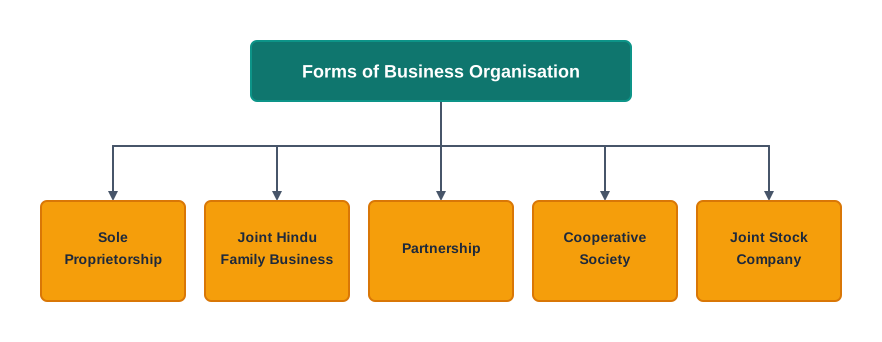
Fig. 2.1 – Forms of business organisation.
The discussion begins with sole proprietorship, which is the simplest form of business organisation, and then moves on to the more complex forms in order of increasing size, legal formality and separation between ownership and management.
2.2 Sole Proprietorship
A small stationery shop in a neighbourhood, a beauty parlour, a hair salon or a local retail store is usually run by one person who has invested the money, takes the decisions and keeps whatever is earned. Such a business is a sole proprietorship, and the person running it is a sole proprietor.
Sole proprietorship refers to a form of business organisation which is owned, managed and controlled by a single individual, who receives all the profits and bears all the risks. The term itself explains the idea — ‘sole’ means only, and ‘proprietor’ means owner. A sole proprietor is therefore the only owner of a business.
This form is the most suitable one for small businesses, particularly in their initial years of operation, when the capital required is small and the owner is able to look after the entire work personally. It is especially common in areas of personalised service, such as beauty parlours and hair salons, and in small scale activities such as running a retail shop in a locality.
2.2.1 Features
The salient characteristics of the sole proprietorship form of organisation are as follows.
Formation and closure — there is no separate law that governs sole proprietorship. Hardly any legal formalities are required to start the business, though in some cases a licence may be needed. Closure of the business can also be done easily. There is thus ease in both formation and closure.
Liability — sole proprietors have unlimited liability. This means that if the assets of the business are not sufficient to meet all the debts, the owner is personally responsible for paying them. The owner’s personal possessions, such as a personal car or other assets, could be sold to repay the debt. Suppose the total outside liabilities of a sole proprietorship dry cleaning firm are Rs. 80,000 at the time of dissolution, while its assets are only Rs. 60,000. The proprietor will have to bring in the remaining Rs. 20,000 from personal sources, even if this means selling personal property to repay the firm’s debts.
Sole risk bearer and profit recipient — the risk of failure of the business is borne entirely by the proprietor. If the business succeeds, the proprietor enjoys all the benefits and receives all the profits, which become a direct reward for bearing that risk.
Control — the right to run the business and to make all decisions lies absolutely with the sole proprietor. Plans can be carried out without interference from others.
No separate entity — in the eyes of the law, no distinction is made between the sole trader and the business, as the business does not have an identity separate from the owner. The owner is therefore held responsible for all the activities of the business.
Lack of business continuity — since the business is owned and controlled by one person, the death, insanity, imprisonment, physical ailment or bankruptcy of the sole proprietor has a direct and damaging effect on the business, and may even cause its closure.
The second and fifth features are closely linked. Because the law does not treat the business as separate from the owner, the debts of the business remain the debts of the owner, and liability cannot be limited to the amount invested.
2.2.2 Merits
Sole proprietorship offers many advantages. Some of the important ones are as follows.
Quick decision making — a sole proprietor enjoys a considerable degree of freedom in making business decisions. Decision making is also prompt because there is no need to consult others. This may lead to timely capitalisation of market opportunities as and when they arise.
Confidentiality of information — sole decision making authority enables the proprietor to keep all information relating to business operations confidential and to maintain secrecy. A sole trader is also not bound by law to publish the firm’s accounts.
Direct incentive — a sole proprietor directly reaps the benefits of his or her efforts, being the sole recipient of all the profit. The need to share profits does not arise, as there is only one owner. This provides the maximum incentive to work hard.
Sense of accomplishment — there is a personal satisfaction involved in working for oneself. The knowledge that one is responsible for the success of the business contributes to self-satisfaction and instils a sense of accomplishment and confidence in one’s own abilities.
Ease of formation and closure — an important merit is the possibility of entering into business with minimal legal formalities. There is no separate law that governs sole proprietorship, and as it is the least regulated form of business, it is easy to start and to close the business as per the wish of the owner.
2.2.3 Limitations
Notwithstanding these advantages, the sole proprietorship form of organisation is not free from limitations. Some of the major limitations are as follows.
Limited resources — the resources of a sole proprietor are limited to personal savings and borrowings from others. Banks and other lending institutions may hesitate to extend a long term loan to a sole proprietor. Lack of resources is one of the major reasons why the size of such a business rarely grows much and generally remains small.
Limited life of a business concern — as the business is owned and controlled by one person, the death, insanity, imprisonment, physical ailment or bankruptcy of the proprietor affects the business and can lead to its closure.
Unlimited liability — a major disadvantage is that the owner has unlimited liability. If the business fails, creditors can recover their dues not merely from the business assets but also from the personal assets of the proprietor. A poor decision or an unfavourable circumstance can create a serious financial burden on the owner. That is why a sole proprietor is less inclined to take risks in the form of innovation or expansion.
Limited managerial ability — the owner has to assume responsibility for varied managerial tasks such as purchasing, selling and financing. It is rare to find an individual who excels in all these areas, so decision making may not be balanced in every case. Also, because of limited resources, a sole proprietor may not be able to employ and retain talented and ambitious employees.
Though sole proprietorship suffers from these shortcomings, many entrepreneurs still opt for this form of organisation because of its inherent advantages. It requires a smaller amount of capital, and it is best suited to businesses that are carried on at a small scale and where customers demand personalised services.
2.3 Joint Hindu Family Business
Joint Hindu family business is a specific form of business organisation found only in India, and it is one of the oldest forms of business organisation in the country. It refers to a form of organisation in which the business is owned and carried on by the members of a Hindu Undivided Family, usually written in short as HUF.
This form is governed by Hindu Law. Membership is not obtained by investing money or by signing an agreement; the basis of membership is birth in a particular family. Three successive generations can be members of the business at the same time.
The business is controlled by the head of the family, who is the eldest member and is called the karta. All members have an equal ownership right over the property inherited from an ancestor, and they are known as co-parceners.
2.3.1 Features
The following points highlight the essential characteristics of the joint Hindu family business.
Formation — for a joint Hindu family business there should be at least two members in the family and ancestral property to be inherited by them. The business does not require any agreement, as membership is by birth. It is governed by the Hindu Succession Act, 1956.
Liability — the liability of all members except the karta is limited to their share of the co-parcenary property of the business. The karta, however, has unlimited liability.
Control — the control of the family business lies with the karta. He takes all the decisions and is authorised to manage the business, and his decisions are binding on the other members.
Continuity — the business continues even after the death of the karta, as the next eldest member takes up the position of karta, leaving the business stable. The business can, however, be terminated with the mutual consent of the members.
Minor members — the inclusion of an individual into the business occurs by birth in a Hindu Undivided Family. Hence, minors can also be members of the business.
The fifth feature marks an important difference from most other forms of business, where membership depends on a contract. Since a minor is not competent to contract, a minor cannot ordinarily be admitted as a full member of a business; here, birth alone confers membership.
2.3.2 Merits
The advantages of the joint Hindu family business are as follows.
Effective control — the karta has absolute decision making power. This avoids conflicts among members, as no one can interfere with his right to decide, and it also leads to prompt and flexible decision making.
Continued business existence — the death of the karta does not affect the business, as the next eldest member then takes up the position. Operations are not terminated and the continuity of business is not threatened.
Limited liability of members — the liability of all the co-parceners except the karta is limited to their share in the business, and consequently their risk is well defined and precise.
Increased loyalty and cooperation — since the business is run by the members of one family, there is a greater sense of loyalty towards one another. Pride in the growth of the business is linked to the achievements of the family, and this helps in securing better cooperation from all the members.
2.3.3 Limitations
The following are some of the limitations of a joint Hindu family business.
Limited resources — the business faces the problem of limited capital, as it depends mainly on ancestral property. This limits the scope for expansion of the business.
Unlimited liability of the karta — the karta is burdened not only with the responsibility of decision making and management of the business, but also suffers the disadvantage of unlimited liability. His personal property can be used to repay business debts.
Dominance of the karta — the karta manages the business individually, which may at times not be acceptable to the other members. This may cause conflict amongst them and may even lead to the breakdown of the family unit.
Limited managerial skills — since the karta cannot be an expert in all areas of management, the business may suffer as a result of unwise decisions. An inability to decide effectively may result in poor profits or even losses for the organisation.
The joint Hindu family business is on the decline in India, because the number of joint Hindu families in the country is itself diminishing.
2.4 Partnership
A sole proprietor is limited by the money he or she can arrange and by the range of skills one person can command. As a business expands, these two limits begin to bite. The inherent disadvantage of the sole proprietorship in financing and managing an expanding business paved the way for partnership as a viable option. Partnership serves as an answer to the needs of greater capital investment, varied skills and sharing of risks.
The Indian Partnership Act, 1932 defines partnership as the relation between persons who have agreed to share the profit of the business carried on by all or any one of them acting for all.
2.4.1 Features
The definitions given above point to the following major characteristics of the partnership form of business organisation.
Formation — the partnership form of business organisation is governed by the Indian Partnership Act, 1932. It comes into existence through a legal agreement in which the terms and conditions governing the relationship among the partners, the sharing of profits and losses, and the manner of conducting the business are specified. The business must be lawful and must be run with the motive of profit. Two people coming together for charitable purposes will therefore not constitute a partnership.
Liability — the partners of a firm have unlimited liability. Personal assets may be used for repaying debts if the business assets are insufficient. Further, the partners are jointly and individually liable for payment of debts. Jointly, all the partners are responsible for the debts and contribute in proportion to their share in the business. Individually too, each partner can be held responsible for repaying the debts of the business, though such a partner can later recover from the other partners an amount equivalent to their shares in the liability as defined in the partnership agreement.
Risk bearing — the partners bear the risks involved in running the business as a team. The reward comes in the form of profits, which are shared in an agreed ratio. They also share losses in the same ratio in the event of the firm incurring losses.
Decision making and control — the partners share amongst themselves the responsibility of decision making and control of day to day activities. Decisions are generally taken with mutual consent, so the activities of the firm are managed through the joint efforts of all the partners.
Continuity — partnership is characterised by a lack of continuity of business, since the death, retirement, insolvency or insanity of any partner can bring an end to the business. However, the remaining partners may, if they so desire, continue the business on the basis of a new agreement.
Number of partners — the minimum number of partners needed to start a partnership firm is two. According to section 464 of the Companies Act, 2013, the maximum number of partners in a partnership firm can be 100, subject to the number prescribed by the government. As per Rule 10 of The Companies (Miscellaneous) Rules, 2014, at present the maximum number of members can be 50.
Mutual agency — the definition of partnership highlights the fact that it is a business carried on by all or any one of the partners acting for all. In other words, every partner is both an agent and a principal. A partner is an agent because he represents the other partners and binds them through his acts, and a principal because he too can be bound by the acts of the other partners.
Mutual agency explains why the choice of partners matters so much. An agreement signed by one partner in the ordinary course of business binds the whole firm, so every partner carries the consequences of the judgement of the others.
2.4.2 Merits
The following points describe the advantages of a partnership firm.
Ease of formation and closure — a partnership firm can be formed easily by putting an agreement between the prospective partners into place, whereby they agree to carry out the business of the firm and share risks. There is no compulsion with respect to registration of the firm. Closure of the firm too is an easy task.
Balanced decision making — the partners can oversee different functions according to their areas of expertise. Because an individual is not forced to handle different activities, this not only reduces the burden of work but also leads to fewer errors in judgement. As a consequence, decisions are likely to be more balanced.
More funds — in a partnership, the capital is contributed by a number of partners. This makes it possible to raise a larger amount of funds as compared to a sole proprietor and to undertake additional operations when needed.
Sharing of risks — the risks involved in running a partnership firm are shared by all the partners. This reduces the anxiety, burden and stress on individual partners.
Secrecy — a partnership firm is not legally required to publish its accounts and submit its reports. Hence it is able to maintain confidentiality of information relating to its operations.
2.4.3 Limitations
A partnership firm of business organisation suffers from the following limitations.
Unlimited liability — partners are liable to repay debts even from their personal resources if the business assets are not sufficient to meet the debts. The liability of partners is both joint and several, which may prove to be a drawback for those partners who have greater personal wealth, as they will have to repay the entire debt if the other partners are unable to do so.
Limited resources — there is a restriction on the number of partners, and hence the contribution in terms of capital investment is usually not sufficient to support large scale business operations. As a result, partnership firms face problems in expansion beyond a certain size.
Possibility of conflicts — partnership is run by a group of persons in which decision making authority is shared. A difference in opinion on some issues may lead to disputes between partners. Further, the decisions of one partner are binding on the others, so an unwise decision by one may result in financial ruin for all. If a partner desires to leave the firm, this can result in termination of the partnership, as there is a restriction on transfer of ownership.
Lack of continuity — partnership comes to an end with the death, retirement, insolvency or lunacy of any partner. It may result in lack of continuity. However, the remaining partners can enter into a fresh agreement and continue to run the business.
Lack of public confidence — a partnership firm is not legally required to publish its financial reports or make other related information public. It is therefore difficult for any member of the public to ascertain the true financial position of a partnership firm, and as a result the confidence of the public in partnership firms is generally low.
2.4.4 Types of Partners
A partnership firm can have different types of partners with different roles and liabilities. An understanding of these types is important for a clear understanding of their rights and responsibilities. These are described as follows.
Active partner — an active partner is one who contributes capital, participates in the management of the firm, shares its profits and losses, and is liable to an unlimited extent to the creditors of the firm. Such partners take actual part in carrying out the business of the firm on behalf of the other partners.
Sleeping or dormant partner — partners who do not take part in the day to day activities of the business are called sleeping partners. A sleeping partner, however, contributes capital to the firm, shares its profits and losses, and has unlimited liability.
Secret partner — a secret partner is one whose association with the firm is unknown to the general public. Other than this distinct feature, in all other aspects he is like the rest of the partners. He contributes to the capital of the firm, takes part in the management, shares its profits and losses, and has unlimited liability towards the creditors.
Nominal partner — a nominal partner is one who allows the use of his or her name by a firm but does not contribute to its capital. Such a partner does not take an active part in managing the firm and does not share its profits or losses, but is liable, like the other partners, to third parties for the repayment of the firm’s debts.
Partner by estoppel — a person is considered a partner by estoppel if, through his or her own initiative, conduct or behaviour, he or she gives an impression to others of being a partner of the firm. Such partners are held liable for the debts of the firm, because in the eyes of the third party they are considered partners, even though they do not contribute capital or take part in management. Suppose Rani is a friend of Seema, who is a partner in a software firm. On Seema’s request, Rani accompanies her to a business meeting, actively participates in the negotiations for a business deal and gives the impression that she too is a partner in the firm. If credit is extended to the firm on the basis of these negotiations, Rani would also be liable for repayment of such debt, as if she were a partner of the firm.
Partner by holding out — a partner by holding out is a person who, though not a partner in a firm, knowingly allows himself or herself to be represented as a partner in the firm. Such a person becomes liable to outside creditors for the repayment of any debts which have been extended to the firm on the basis of such representation. If the person is not really a partner and wants to be saved from such liability, he should immediately issue a denial, clarifying that he is not a partner in the firm. If he does not do so, he will be responsible to the third party for any such debts.
The six types are compared in Table 2.1.
2.4.5 Types of Partnerships
Partnerships can be classified on the basis of two factors, namely duration and liability. On the basis of duration there can be two types of partnerships — ‘partnership at will’ and ‘particular partnership’. On the basis of liability the two types are one ‘with limited liability’ and the other ‘with unlimited liability’. The classification is summarised in Fig. 2.2.
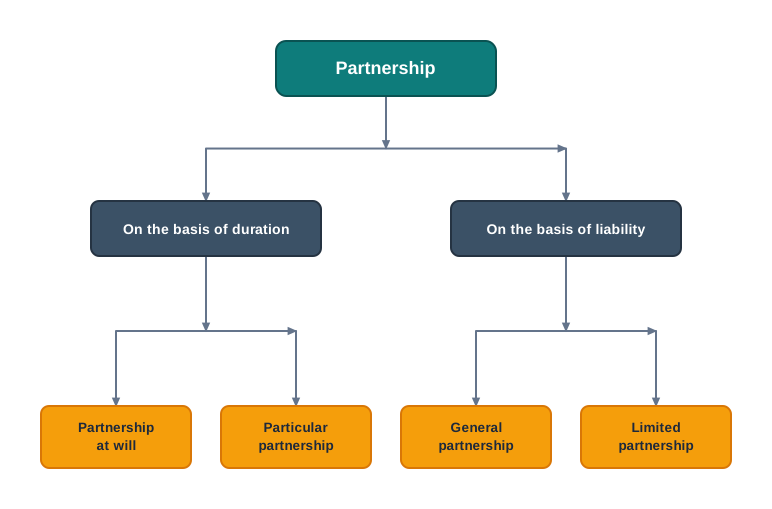
Fig. 2.2 – Types of partnerships.
Classification On The Basis Of Duration
Partnership at will — this type of partnership exists at the will of the partners. It can continue as long as the partners want and is terminated when any partner gives a notice of withdrawal from partnership to the firm.
Particular partnership — a partnership formed for the accomplishment of a particular project, such as the construction of a building, or for an activity to be carried on for a specified time period, is called a particular partnership. It dissolves automatically when the purpose for which it was formed is fulfilled or when the time duration expires.
Classification On The Basis Of Liability
General partnership — in a general partnership the liability of partners is unlimited and joint. The partners enjoy the right to participate in the management of the firm, and their acts are binding on each other as well as on the firm. Registration of the firm is optional. The existence of the firm is affected by the death, lunacy, insolvency or retirement of the partners.
Limited partnership — in a limited partnership the liability of at least one partner is unlimited, whereas the rest may have limited liability. Such a partnership does not get terminated with the death, lunacy or insolvency of the limited partners. The limited partners do not enjoy the right of management, and their acts do not bind the firm or the other partners. Registration of such a partnership is compulsory.
This form of partnership was not permitted in India earlier. Permission to form partnership firms with limited liability was granted after the introduction of the New Small Enterprise Policy in 1991. The idea behind the move was to enable partnership firms to attract equity capital from friends and relatives of small scale entrepreneurs, who were earlier reluctant to help because of the unlimited liability clause in the partnership form of business.
2.4.6 Partnership Deed
A partnership is a voluntary association of people who come together to achieve common objectives. In order to enter into partnership, a clear agreement with respect to the terms, conditions and all aspects concerning the partners is essential, so that there is no misunderstanding later among the partners.
Such an agreement can be oral or written. Even though it is not essential to have a written agreement, it is advisable to have one, as it constitutes evidence of the conditions agreed upon. The written agreement which specifies the terms and conditions that govern the partnership is called the partnership deed.
The partnership deed generally includes the following aspects.
Name of firm
Nature of business and location of business
Duration of business
Investment made by each partner
Distribution of profits and losses
Duties and obligations of the partners
Salaries and withdrawals of the partners
Terms governing admission, retirement and expulsion of a partner
Interest on capital and interest on drawings
Procedure for dissolution of the firm
Preparation of accounts and their auditing
Method of solving disputes
2.4.7 Registration
Registration of a partnership firm means the entering of the firm’s name, along with the relevant prescribed particulars, in the Register of Firms kept with the Registrar of Firms. It provides conclusive proof of the existence of a partnership firm.
It is optional for a partnership firm to get registered. In case a firm does not get registered, it is deprived of many benefits. The consequences of non-registration of a firm are as follows.
A partner of an unregistered firm cannot file a suit against the firm or other partners.
The firm cannot file a suit against third parties.
The firm cannot file a case against the partners.
In view of these consequences, it is advisable to get the firm registered. According to the Indian Partnership Act, 1932, the partners may get the firm registered with the Registrar of Firms of the state in which the firm is situated. The registration can be done at the time of formation or at any time during the existence of the firm. The procedure is summarised in Fig. 2.3.
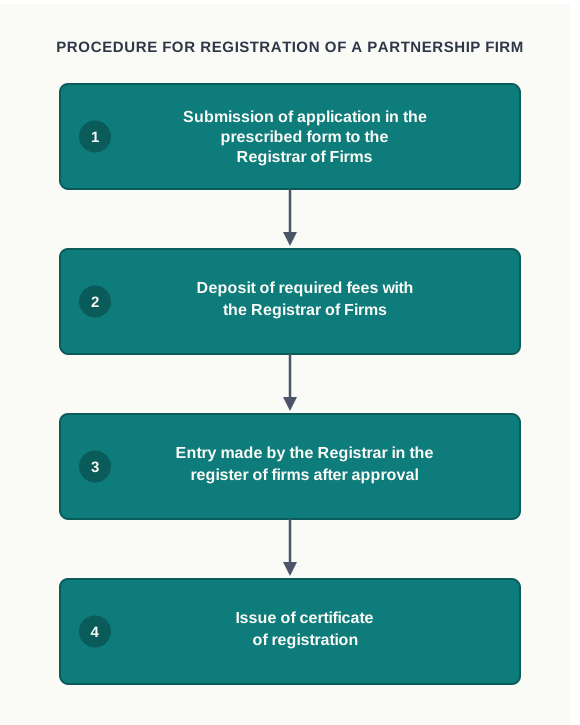
Fig. 2.3 – Procedure for registration of a partnership firm.
The application submitted at the first step should contain the following particulars.
Name of the firm
Location of the firm
Names of other places where the firm carries on business
The date when each partner joined the firm
Names and addresses of the partners
Duration of partnership
This application should be signed by all the partners.
Both the joint Hindu family business and the partnership firm are owned by more than one person, and students often confuse the two. They are compared in Table 2.2.
2.5 Cooperative Society
The word cooperative means working together and with others for a common purpose. A cooperative society is a voluntary association of persons who join together with the motive of welfare of the members. They are driven by the need to protect their economic interests in a democratic way.
Small producers, small consumers and borrowers of small sums often find themselves at a disadvantage when they deal individually with large traders, middlemen or lenders. By pooling their strength, they are able to buy inputs, sell output or obtain credit on much better terms. This is the practical problem that the cooperative form of organisation is designed to solve.
A cooperative society is required to be registered under law. After registration, it acquires a distinct legal identity, can enter into contracts, hold property in its own name, and the liability of its members is limited to the amount they contribute as capital.
In India, cooperative societies that operate within a single state are governed by the Cooperative Societies Act of that state, while those that operate in more than one state are governed by the Multi-State Cooperative Societies Act, 2002. The Multi-State Cooperative Societies Act has also been updated through recent amendments.
2.5.1 Features
The characteristics of a cooperative society are listed below.
Voluntary membership — the membership of a cooperative society is voluntary. A person is free to join a cooperative society and can also leave it at any time as per his desire. There cannot be any compulsion to join or to quit a society. Although procedurally a member is required to serve a notice before leaving the society, there is no compulsion to remain a member. Membership is open to all, irrespective of religion, caste and gender.
Legal status — registration of a cooperative society is compulsory. This accords a separate identity to the society, distinct from its members. The society can enter into contracts and hold property in its name, and can sue and be sued by others. As a result of being a separate legal entity, it is not affected by the entry or exit of its members.
Limited liability — the liability of the members of a cooperative society is limited to the extent of the amount contributed by them as capital. This defines the maximum risk that a member can be asked to bear.
Control — in a cooperative society, the power to take decisions lies in the hands of an elected managing committee. The right to vote gives the members a chance to choose the members who will constitute the managing committee, and this lends the cooperative society a democratic character.
Service motive — the cooperative society, through its purpose, lays emphasis on the values of mutual help and welfare. Hence the motive of service dominates its working. If any surplus is generated as a result of its operations, it is distributed amongst the members as dividend in conformity with the bye-laws of the society.
2.5.2 Merits
The cooperative society offers many benefits to its members. Some of the advantages of the cooperative form of organisation are as follows.
Equality in voting status — the principle of ‘one man one vote’ governs the cooperative society. Irrespective of the amount of capital contribution made by a member, each member is entitled to equal voting rights.
Limited liability — the liability of members is limited to the extent of their capital contribution. The personal assets of the members are therefore safe from being used to repay business debts.
Stable existence — death, bankruptcy or insanity of the members does not affect the continuity of a cooperative society. A society therefore operates unaffected by any change in the membership.
Economy in operations — the members generally offer honorary services to the society. As the focus is on the elimination of middlemen, this helps in reducing costs. The customers or producers themselves are members of the society, and hence the risk of bad debts is lower.
Support from government — the cooperative society exemplifies the idea of democracy and hence finds support from the Government in the form of low taxes, subsidies and low interest rates on loans.
Ease of formation — the cooperative society is a voluntary association of persons who join together with the motive of welfare of the members. The registration procedure is simple, involving a few legal formalities as per the Acts enacted by the Government of India.
2.5.3 Limitations
The cooperative form of organisation suffers from the following limitations.
Limited resources — the resources of a cooperative society consist of the capital contributions of members with limited means. The low rate of dividend offered on investment also acts as a deterrent in attracting membership or more capital from the members.
Inefficiency in management — cooperative societies are unable to attract and employ expert managers because of their inability to pay them high salaries. The members who offer honorary services on a voluntary basis are generally not professionally equipped to handle the management functions effectively.
Lack of secrecy — as a result of open discussions in the meetings of members, as well as the disclosure obligations under the Societies Act, it is difficult to maintain secrecy about the operations of a cooperative society.
Government control — in return for the privileges offered by the government, cooperative societies have to comply with several rules and regulations relating to auditing of accounts and submission of accounts. Interference in the functioning of the cooperative organisation through the control exercised by the state cooperative departments also negatively affects its freedom of operation.
Differences of opinion — internal quarrels arising as a result of contrary viewpoints may lead to difficulties in decision making. Personal interests may start to dominate the welfare motive, and the benefit of other members may take a backseat if personal gain is given preference by certain members.
2.5.4 Types of Cooperative Societies
Cooperative societies differ according to the nature of their operations and the kind of member they serve. The main types are shown in Fig. 2.4 and described below.
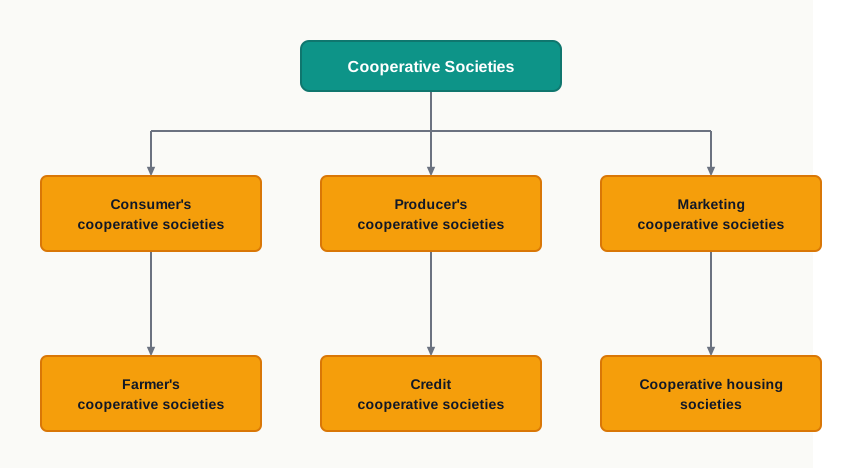
Fig. 2.4 – Types of cooperative societies.
Consumer’s cooperative societies — these societies are formed to protect the interests of consumers. The members comprise consumers desirous of obtaining good quality products at reasonable prices. The society aims at eliminating middlemen to achieve economy in operations. It purchases goods in bulk directly from the wholesalers and sells them to the members, thereby eliminating the middlemen. Profits, if any, are distributed on the basis of either the capital contributions made to the society or the purchases made by individual members.
Producer’s cooperative societies — these societies are set up to protect the interest of small producers. The members comprise producers desirous of procuring inputs for the production of goods to meet the demands of consumers. The society aims to fight against the big capitalists and to enhance the bargaining power of the small producers. It supplies raw materials, equipment and other inputs to the members and also buys their output for sale. Profits among the members are generally distributed on the basis of their contributions to the total pool of goods produced or sold by the society.
Marketing cooperative societies — such societies are established to help small producers in selling their products. The members consist of producers who wish to obtain reasonable prices for their output. The society aims to eliminate middlemen and to improve the competitive position of its members by securing a favourable market for the products. It pools the output of individual members and performs marketing functions such as transportation, warehousing and packaging, in order to sell the output at the best possible price. Profits are distributed according to each member’s contribution to the pool of output.
Farmer’s cooperative societies — these societies are established to protect the interests of farmers by providing better inputs at a reasonable cost. The members comprise farmers who wish to jointly take up farming activities. The aim is to gain the benefits of large scale farming and to increase productivity. Such societies provide better quality seeds, fertilisers, machinery and other modern techniques for use in the cultivation of crops. This helps not only in improving the yield and returns to the farmers, but also solves the problems associated with farming on fragmented land holdings.
Credit cooperative societies — credit cooperative societies are established for providing easy credit on reasonable terms to the members. The members comprise persons who seek financial help in the form of loans. The aim of such societies is to protect the members from the exploitation of lenders who charge high rates of interest on loans. Such societies provide loans to members out of the amounts collected as capital and deposits from the members, and charge low rates of interest.
Cooperative housing societies — cooperative housing societies are established to help people with limited income to construct houses at reasonable costs. The members of these societies consist of people who are desirous of procuring residential accommodation at lower costs. The aim is to solve the housing problems of the members by constructing houses and giving the option of paying in instalments. These societies construct flats or provide plots to members on which the members themselves can construct the houses as per their choice.
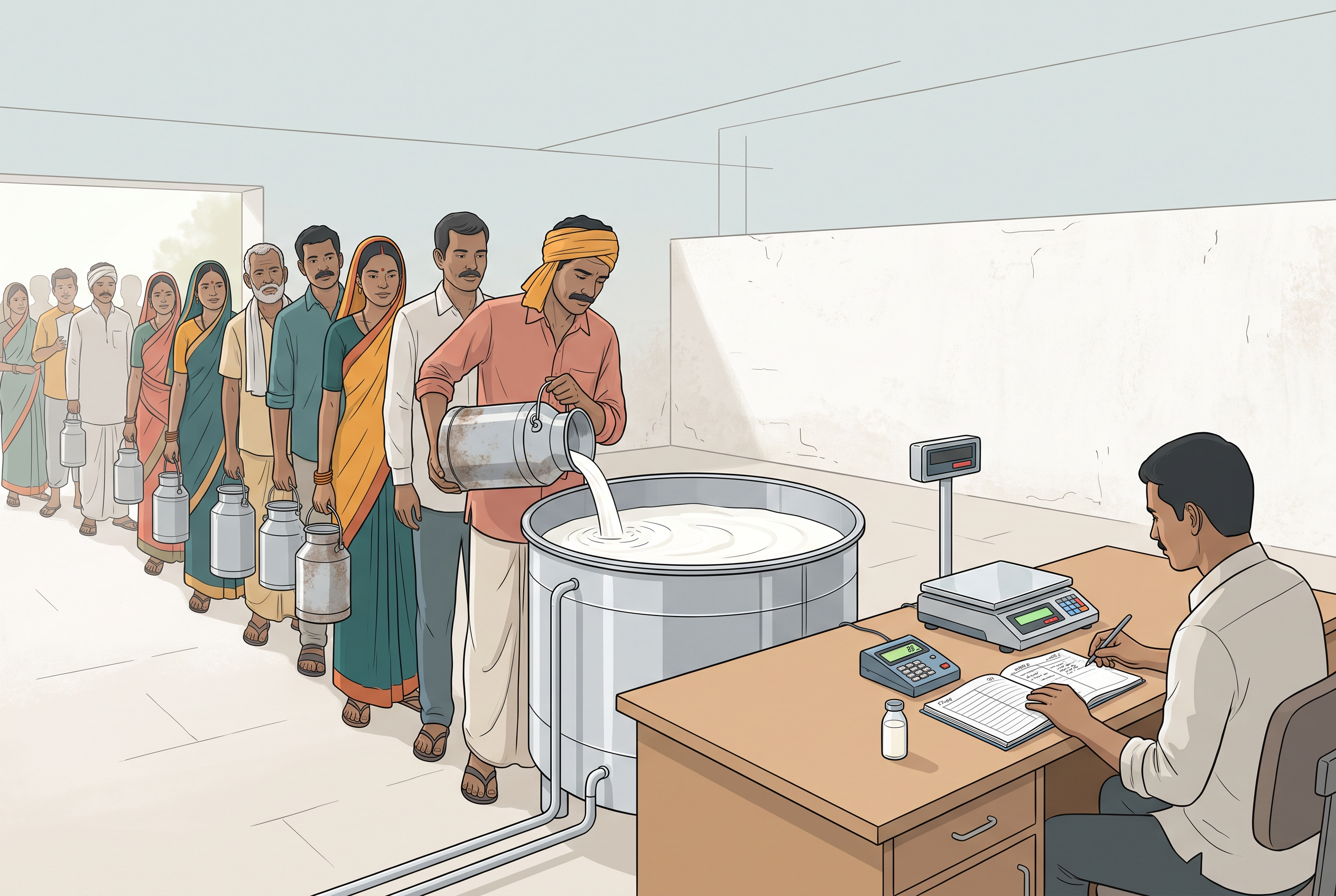
Fig. 2.5 – A village milk collection centre.
2.6 Joint Stock Company
A company is an association of persons formed for carrying out business activities and having a legal status independent of its members. A company can be described as an artificial person having a separate legal entity, perpetual succession and a common seal.
The company form of organisation is governed by The Companies Act, 2013. As per section 2(20) of the Act, a company means a company incorporated under this Act or under any previous company law.
The shareholders are the owners of the company, while the Board of Directors is the chief managing body elected by the shareholders. Usually the owners exercise an indirect control over the business. The capital of the company is divided into smaller parts called shares, which can be transferred freely from one shareholder to another person, except in a private company.
This separation of ownership from management is what allows a company to grow far beyond the resources or skills of the people who founded it. Money can be collected from a large number of investors who have no wish to manage the business, while day to day control rests with directors and professional managers appointed for the purpose.
2.6.1 Features
The definition of a joint stock company highlights the following features of a company.
Artificial person — a company is a creation of law and exists independent of its members. Like natural persons, a company can own property, incur debts, borrow money, enter into contracts, and sue and be sued. Unlike them, it cannot breathe, eat, run or talk. It is therefore called an artificial person.
Separate legal entity — from the day of its incorporation, a company acquires an identity distinct from its members. Its assets and liabilities are separate from those of its owners. The law does not recognise the business and the owners to be one and the same.
Formation — the formation of a company is a time consuming, expensive and complicated process. It involves the preparation of several documents and compliance with several legal requirements before the company can start functioning. Incorporation of companies is compulsory under The Companies Act, 2013 or under any of the previous company law. Companies which were incorporated under the Companies Act, 1956 or any company law are included in the list of companies.
Perpetual succession — a company, being a creation of the law, can be brought to an end only by law. It will cease to exist only when a specific procedure for its closure, called winding up, is completed. Members may come and members may go, but the company continues to exist.
Control — the management and control of the affairs of the company is undertaken by the Board of Directors, which appoints the top management officials for running the business. The directors hold a position of immense significance, as they are directly accountable to the shareholders for the working of the company. The shareholders, however, do not have the right to be involved in the day-to-day running of the business.
Liability — the liability of the members is limited to the extent of the capital contributed by them in a company. The creditors can use only the assets of the company to settle their claims, since it is the company and not the members that owes the debt. Members can be asked to contribute to the loss only to the extent of the unpaid amount on the shares held by them. Suppose a shareholder holds 2,000 shares of Rs. 10 each on which he has already paid Rs. 7 per share. His liability in the event of losses or of the company’s failure to pay debts can be only up to Rs. 6,000, which is the unpaid amount of his share capital, being Rs. 3 per share on 2,000 shares. Beyond this he is not liable to pay anything towards the debts or losses of the company.
Risk bearing — the risk of losses in a company is borne by all the shareholders. This is unlike the case of sole proprietorship or a partnership firm, where one or a few persons respectively bear the losses. In the face of financial difficulties, all shareholders in a company have to contribute to the debts to the extent of their shares in the company’s capital. The risk of loss thus gets spread over a large number of shareholders.
2.6.2 Merits
The company form of organisation offers a multitude of advantages, some of which are discussed below.
Limited liability — the shareholders are liable only to the extent of the amount unpaid on the shares held by them. Also, only the assets of the company can be used to settle its debts, leaving the owner’s personal property free from any charge. This reduces the degree of risk borne by an investor.
Transfer of interest — the ease of transfer of ownership adds to the advantage of investing in a company, as the share of a public limited company can be sold in the market and can therefore be easily converted into cash in case the need arises. This avoids blockage of investment and presents the company as a favourable avenue for investment purposes.
Perpetual existence — the existence of a company is not affected by the death, retirement, resignation, insolvency or insanity of its members, as it has a separate entity from its members. A company will continue to exist even if all the members die. It can be liquidated only as per the provisions of the Companies Act, 2013.
Scope for expansion — as compared to the sole proprietorship and partnership forms of organisation, a company has large financial resources. Further, capital can be attracted from the public as well as through loans from banks and financial institutions. There is thus greater scope for expansion. Investors are inclined to invest in shares because of the limited liability, transferable ownership and possibility of high returns in a company.
Professional management — a company can afford to pay higher salaries to specialists and professionals, and can therefore employ people who are experts in their areas of specialisation. The scale of operations in a company leads to division of work, where each department deals with a particular activity and is headed by an expert. This leads to balanced decision making as well as greater efficiency in the company’s operations.
2.6.3 Limitations
The major limitations of the company form of organisation are as follows.
Complexity in formation — the formation of a company requires greater time, effort and extensive knowledge of legal requirements and the procedures involved. As compared to the sole proprietorship and partnership forms of organisation, formation of a company is more complex.
Lack of secrecy — the Companies Act requires each public company to provide, from time to time, a great deal of information to the office of the registrar of companies. Such information is available to the general public as well. It is therefore difficult to maintain complete secrecy about the operations of a company.
Impersonal work environment — separation of ownership and management leads to situations in which there is a lack of effort as well as of personal involvement on the part of the officers of a company. The large size of a company further makes it difficult for the owners and the top management to maintain personal contact with the employees, customers and creditors.
Numerous regulations — the functioning of a company is subject to many legal provisions and compulsions. A company is burdened with numerous restrictions in respect of matters including audit, voting, filing of reports and preparation of documents, and is required to obtain various certificates from different agencies such as the registrar and SEBI. This reduces the freedom of operations of a company and takes away a lot of time, effort and money.
Delay in decision making — companies are democratically managed through the Board of Directors, which is followed by the top management, middle management and lower level management. Communication as well as approval of various proposals may cause delays not only in taking decisions but also in acting upon them.
Oligarchic management — in theory, a company is a democratic institution in which the Board of Directors are representatives of the shareholders who are the owners. In practice, however, in most large sized organisations having a multitude of shareholders, the owners have minimal influence in terms of controlling or running the business. This is so because the shareholders are spread all over the country and a very small percentage attend the general meetings. The Board of Directors as such enjoy considerable freedom in exercising their power, which they sometimes use even contrary to the interests of the shareholders. Dissatisfied shareholders in such a situation have no option but to sell their shares and exit the company. As the directors virtually enjoy the right to take all major decisions, it leads to rule by a few.
Conflict in interests — there may be a conflict of interest amongst various stakeholders of a company. The employees, for example, may be interested in higher salaries, consumers desire higher quality products at lower prices, and the shareholders want higher returns in the form of dividends and an increase in the intrinsic value of their shares. These demands pose problems in managing the company, as it often becomes difficult to satisfy such diverse interests.
2.6.4 Types of Companies
A company can be either a private company or a public company. The two types are shown in Fig. 2.6 and discussed below.
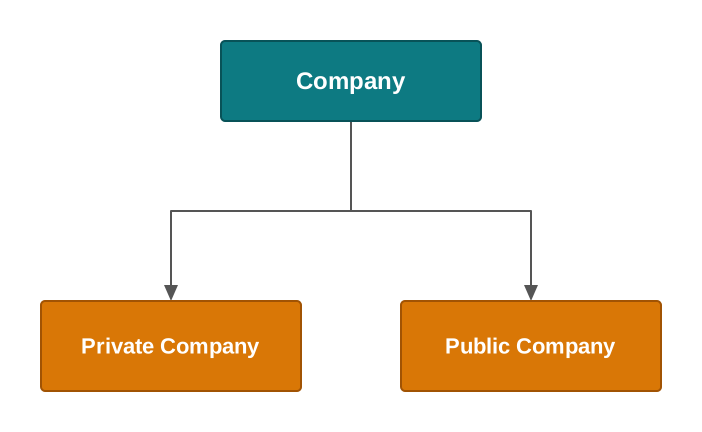
Fig. 2.6 – Types of companies.
Private Company
A private company means a company which:
restricts the right of members to transfer its shares;
has a minimum of 2 and a maximum of 200 members, excluding the present and past employees; and
does not invite the public to subscribe to its securities.
It is necessary for a private company to use the words private limited after its name. If a private company contravenes any of the aforesaid provisions, it ceases to be a private company and loses all the exemptions and privileges to which it is entitled.
The following are some of the privileges of a private limited company as against a public limited company.
A private company can be formed by only two members, whereas seven people are needed to form a public company.
There is no need to issue a prospectus, as the public is not invited to subscribe to the shares of a private company.
Allotment of shares can be done without receiving the minimum subscription. A private limited company can start business as soon as it receives the certificate of incorporation.
A private company needs to have only two directors, as against the minimum of three directors in the case of a public company. However, the maximum number of directors for both types of companies is fifteen.
A private company is not required to keep an index of members, while the same is necessary in the case of a public company.
Public Company
A public company means a company which is not a private company. As per the Companies Act, a public company is one which:
has a minimum of 7 members and no limit on maximum members;
has no restriction on transfer of securities; and
is not prohibited from inviting the public to subscribe to its securities.
However, a private company which is a subsidiary of a public company is also treated as a public company.
The main points of difference between the two are given in Table 2.3.

Fig. 2.7 – Where shares of public companies change hands.
2.7 Choice of Form of Business Organisation
After studying the various forms of business organisation, it is evident that each form has certain advantages as well as disadvantages. It therefore becomes vital that certain basic considerations are kept in mind while choosing an appropriate form of organisation. The important factors determining the choice are listed in Table 2.4 and are discussed below.
Cost and ease in setting up the organisation — as far as initial business setting-up costs are concerned, sole proprietorship is the most inexpensive way of starting a business, since the legal requirements are minimum and the scale of operations is small. In the case of partnership also, there is the advantage of fewer legal formalities and lower cost, because of the limited scale of operations. Cooperative societies and companies have to be compulsorily registered, and the formation of a company involves a lengthy and expensive legal procedure. From the point of view of initial cost, therefore, sole proprietorship is the preferred form as it involves the least expenditure, while the company form is more complex and involves greater costs.
Liability — in the case of sole proprietorship and partnership firms, the liability of the owners or partners is unlimited. This may call for paying the debt from the personal assets of the owners. In a joint Hindu family business, only the karta has unlimited liability. In cooperative societies and companies, however, liability is limited, and creditors can force payment of their claims only to the extent of the assets of the organisation. Hence, from the point of view of investors, the company form of organisation is more suitable, as the risk involved is limited.
Continuity — the continuity of sole proprietorship and partnership firms is affected by such events as the death, insolvency or insanity of the owners. However, such factors do not affect the continuity of business in the case of organisations like the joint Hindu family business, cooperative societies and companies. In case the business needs a permanent structure, the company form is more suitable. For short term ventures, proprietorship or partnership may be preferred.
Management ability — a sole proprietor may find it difficult to have expertise in all functional areas of management. In other forms of organisation such as partnership and company, there is no such problem. Division of work among the members in such organisations allows managers to specialise in specific areas, leading to better decision making. But this may lead to situations of conflict because of differences of opinion amongst people. Further, if the operations of the organisation are complex in nature and require professionalised management, the company form of organisation is a better alternative. Proprietorship or partnership may be suitable where simplicity of operations allows even people with limited skills to run the business. Thus, the nature of operations and the need for professionalised management affect the choice of the form of organisation.
Capital considerations — companies are in a better position to collect large amounts of capital by issuing shares to a large number of investors. Partnership firms also have the advantage of the combined resources of all partners, but the resources of a sole proprietor are limited. Thus, if the scale of operations is large, the company form may be suitable, whereas for medium and small sized business one can opt for partnership or sole proprietorship. Further, from the point of view of expansion, a company is more suitable because of its capability to raise more funds and invest in expansion plans. It is precisely for this reason that a proprietary business which has begun to grow rapidly is often advised to convert into the company form.
Degree of control — if direct control over operations and absolute decision making power is required, proprietorship may be preferred. But if the owners do not mind sharing control and decision making, the partnership or company form of organisation can be adopted. The added advantage in the case of the company form is that there is complete separation of ownership and management, and it is professionals who are appointed to independently manage the affairs of a company.
Nature of business — if direct personal contact is needed with the customers, as in the case of a grocery store, proprietorship may be more suitable. For large manufacturing units, however, where direct personal contact with the customer is not required, the company form of organisation may be adopted. Similarly, in cases where services of a professional nature are required, the partnership form is much more suitable.
2.8 Summary
Forms of business organisation refers to the types of organisations which differ in terms of ownership and management. The major forms of organisation include sole proprietorship, partnership, joint Hindu family business, cooperative society and company.
Sole proprietorship refers to a form of organisation where the business is owned, managed and controlled by a single individual who bears all the risks and is the only recipient of all the profits.
The merits of sole proprietorship include quick decision making, direct incentive, personal satisfaction, and ease of formation and closure. Its limitations are limited resources, an unstable life span of the business, unlimited liability of the sole proprietor and limited managerial ability.
Partnership is defined as an association of two or more persons who agree to carry on a business together and share the profits as well as bear the risks collectively.
The major advantages of partnership are ease of formation and closure, benefits of specialisation, greater funds and reduction of risk. Its major limitations are unlimited liability, possibility of conflicts, lack of continuity and lack of public confidence.
A partnership firm may have different types of partners, such as active, sleeping, secret and nominal partners, along with a partner by estoppel and a partner by holding out. Partnerships themselves vary from general partnership and limited partnership to partnership at will and particular partnership.
Joint Hindu family business is a business owned and carried on by the members of a Hindu Undivided Family, governed by Hindu Law. The karta, the eldest member of the family, controls the business.
The strong points of joint Hindu family business include effective control, stability in existence, limited liability of the other members and increased loyalty among family members. Its limitations are limited resources, lack of incentives, dominance of the karta and limited managerial ability.
A cooperative society is a voluntary association of persons who get together to protect their economic interests.
The major advantages of a cooperative society are equality in voting, limited liability of members, stable existence, economy in operations, support from government and ease of formation. Its weaknesses are limited resources, inefficiency in management, lack of secrecy, government control and differences among members regarding the way the society should be managed and organised.
Based on their purpose and the nature of their members, the types of cooperative societies that can be formed include consumers cooperative society, producers cooperative society, marketing cooperative society, farmers cooperative society, credit cooperative society and cooperative housing society.
A company may be defined as an artificial person, existing only in the eyes of the law, with perpetual succession and a separate legal identity.
The major advantages of a company form of organisation are limited liability of members, transfer of interest, stable existence, scope for expansion and professional management. Its key limitations are complexity in formation, lack of secrecy, an impersonal work environment, numerous regulations, delay in decision making, oligarchic management and conflict of interests among different shareholders.
Companies can be of two types, private and public. A private company restricts the transfer of shares and does not invite the public to subscribe to its securities. A public company is allowed to raise its funds by inviting the public to subscribe to its securities, and there is free transferability of securities in the case of a public company.
The selection of an appropriate form of organisation can be made after taking various factors into consideration. Initial costs, liability, continuity, capital considerations, managerial ability, degree of control and nature of business are the key factors that need to be taken into account while deciding the suitable form of organisation for one’s business.
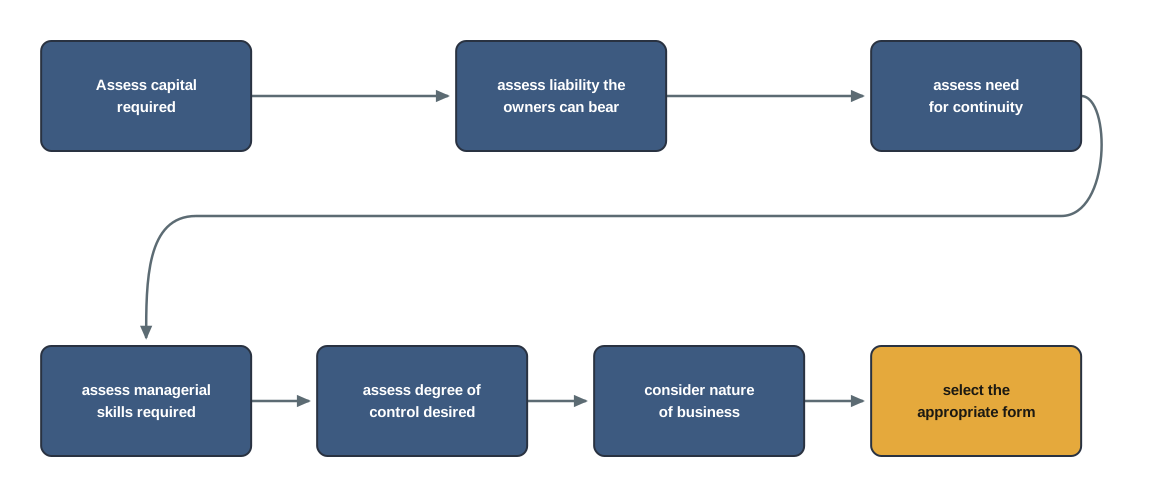
Fig. 2.8 – Deciding the form of organisation.
2.9 Key Terms
Forms of business organisation The types of business organisation that differ from one another in terms of ownership, management, liability and continuity.
Sole proprietorship A form of business organisation owned, managed and controlled by a single individual who receives all the profits and bears all the risks.
Unlimited liability A liability under which the personal assets of the owner can be used to repay business debts if the business assets are insufficient.
Joint Hindu family business A form of organisation, found only in India, in which the business is owned and carried on by the members of a Hindu Undivided Family and is governed by Hindu Law.
Hindu Undivided Family A family unit recognised under Hindu Law whose members acquire an interest in ancestral property by birth.
Karta The eldest member of the Hindu Undivided Family, who controls and manages the joint Hindu family business and has unlimited liability.
Co-parceners The members of a Hindu Undivided Family who have an equal ownership right by birth over the property inherited from an ancestor.
Partnership The relation between persons who have agreed to share the profit of the business carried on by all or any one of them acting for all.
Mutual agency The feature of partnership by which every partner is both an agent of the other partners and a principal bound by their acts.
Partnership deed The written agreement that specifies the terms and conditions governing a partnership.
Registration The entering of a firm’s name and prescribed particulars in the Register of Firms kept with the Registrar of Firms, which is conclusive proof of the firm’s existence.
Partnership at will A partnership that continues as long as the partners wish and ends when any partner gives notice of withdrawal.
Particular partnership A partnership formed for a specific project or for a specified time period, which dissolves once the purpose is fulfilled or the period expires.
Cooperative society A voluntary association of persons who join together with the motive of welfare of the members and protection of their economic interests in a democratic way.
Limited liability A liability restricted to the amount of capital contributed, or the amount unpaid on shares held, beyond which personal assets cannot be used to repay business debts.
Joint stock company An association of persons formed for carrying out business activities, having a legal status independent of its members.
Artificial person A person created by law that can own property, incur debts, enter into contracts and sue or be sued, but has no physical existence.
Separate legal entity The status of a company by which its identity, assets and liabilities are distinct from those of its members.
Perpetual succession The feature by which a company continues to exist irrespective of changes in its membership and can be brought to an end only by law.
Common seal The official seal that acts as the signature of a company, which itself cannot sign documents.
Shares The smaller parts into which the capital of a company is divided, which are freely transferable except in a private company.
Board of Directors The chief managing body of a company, elected by the shareholders and accountable to them for the working of the company.
Incorporation of a company The legal process of registering a company under the Companies Act, from which day it acquires a separate legal identity.
Private company A company that restricts the transfer of its shares, has 2 to 200 members and does not invite the public to subscribe to its securities.
Public company A company that is not a private company, has a minimum of 7 members, places no restriction on transfer of securities and may invite the public to subscribe to them.
2.10 NCERT Questions
Short Answer Questions
- Compare the status of a minor in a joint Hindu family business with that in a partnership firm.
- If registration is optional, why do partnership firms willingly go through this legal formality and get themselves registered? Explain.
- State the important privileges available to a private company.
- How does a cooperative society exemplify democracy and secularism? Explain.
- What is meant by ‘partner by estoppel’? Explain.
- Briefly explain the following terms.
- Perpetual succession
- Common seal
- Karta
- Artificial person
Long Answer Questions
- What do you understand by a sole proprietorship firm? Explain its merits and limitations.
- Why is partnership considered by some to be a relatively unpopular form of business ownership? Explain the merits and limitations of partnership.
- Why is it important to choose an appropriate form of organisation? Discuss the factors that determine the choice of form of organisation.
- Discuss the characteristics, merits and limitations of the cooperative form of organisation. Also describe briefly the different types of cooperative societies.
- Distinguish between a joint Hindu family business and partnership.
- Despite limitations of size and resources, many people continue to prefer sole proprietorship over other forms of organisation. Why?
Application Questions
- In which form of organisation is a trade agreement made by one owner binding on the others? Give reasons to support your answer.
- The business assets of an organisation amount to Rs. 50,000 but the debts that remain unpaid are Rs. 80,000. What course of action can the creditors take if
- The organisation is a sole proprietorship firm.
- The organisation is a partnership firm with Anthony and Akbar as partners. Which of the two partners can the creditors approach for repayment of debt? Explain giving reasons.
- Kiran is a sole proprietor. Over the past decade, her business has grown from operating a neighbourhood corner shop selling accessories such as artificial jewellery, bags, hair clips and nail art to a retail chain with three branches in the city. Although she looks after the varied functions in all the branches, she is wondering whether she should form a company to better manage the business. She also has plans to open branches countrywide.
- Explain two benefits of remaining a sole proprietor.
- Explain two benefits of converting to a joint stock company.
- What role will her decision to go nationwide play in her choice of form of the organisation?
- What legal formalities will she have to undergo to operate the business as a company?
2.11 Check Your Concepts
- Why does a sole proprietor have unlimited liability, while a shareholder of a company does not? Explain the reason behind the difference.
- What happens to a joint Hindu family business on the death of the karta, and why does this differ from what happens to a partnership firm on the death of a partner?
- Distinguish between a partnership deed and registration of a partnership firm.
- Distinguish between an active partner and a sleeping partner on the basis of capital contribution, management and liability.
- Why is a minor not permitted to become a partner in a firm, although a minor can be a member of a joint Hindu family business?
- Identify the term: the feature of partnership by which every partner is both an agent and a principal.
- Identify the term: the smaller parts into which the capital of a company is divided.
- Arrange the following steps in the correct sequence: entry made by the Registrar in the register of firms; issue of certificate of registration; submission of application in the prescribed form; deposit of required fees.
- Assertion: A company is said to have perpetual succession. Reason: The shareholders of a company have limited liability. Choose the correct option.
- Both assertion and reason are true, and the reason is the correct explanation of the assertion.
- Both assertion and reason are true, but the reason is not the correct explanation of the assertion.
- The assertion is true but the reason is false.
- The assertion is false but the reason is true.
- Match the type of cooperative society in Column A with its purpose in Column B:
| Column A | Column B |
|---|---|
| a. consumer’s cooperative society | i. providing loans at low rates of interest |
| b. marketing cooperative society | ii. selling the pooled output of small producers |
| c. credit cooperative society | iii. supplying goods to members at reasonable prices |
| d. cooperative housing society | iv. constructing houses for members at reasonable cost |
- Why is the cooperative form of organisation said to be democratic in character? Support your answer with two features.
- What happens if a private company allows its shares to be freely transferred to the public?
- Why does the company form of organisation suffer from delay in decision making, when it employs professional managers?
- Explain why oligarchic management is described as a limitation of the company form of organisation, even though a company is democratic in theory.
- Why may two businesses of the same nature but of different sizes choose different forms of organisation? Explain with reference to any two factors.
2.12 Case-Based Questions
- Sunita began stitching school uniforms at home with her own savings. She takes every decision herself, keeps the entire profit and does not publish any accounts. Last year she borrowed from a supplier and could not repay on time, and the supplier claimed the amount from her personal savings.
- Name the form of business organisation Sunita has adopted.
- State the feature of this form under which the supplier’s claim was valid.
- State any two merits that this form offers Sunita.
- Farid, Gagan and Harish run an interior design firm. Farid manages the work at the sites, Gagan has invested capital but never comes to the office, and Harish has allowed the firm to use his well-known name although he has neither invested any money nor taken part in the work. A client has now filed a claim against the firm for a defective contract.
- Identify the type of partner each of the three is.
- State whether Harish can be held liable to the client, and give a reason.
- Name the feature of partnership under which the acts of Farid bind the other two.
- Fifty weavers in a small town are unable to obtain yarn at reasonable rates and are forced to sell their cloth to traders at low prices. They register an association, contribute capital in small amounts, buy yarn in bulk for all the members and sell the finished cloth through the association. Each member has one vote and the surplus is distributed in proportion to the cloth supplied.
- Identify the form of business organisation the weavers have adopted.
- Name the two types of cooperative society whose functions the association is performing.
- State any two limitations this form of organisation may face.
- Sunrise Enterprises, a growing partnership firm making packaged snacks, needs a large amount of capital to set up a modern plant. The partners are unwilling to risk their personal property any further, wish to hire professional managers, and want the business to continue even after they leave it. They are, however, concerned about the time and cost of formation and the information they will have to disclose.
- Name the form of organisation the partners should adopt.
- Explain any two merits of this form that meet their requirements.
- Explain any two limitations of this form that justify their concerns.