Chapter 4: Business Services
A garment unit in Tiruppur that stitches shirts for buyers in other states does far more than cut and sew cloth. It borrows money from a bank to buy yarn, insures its stock and its factory building against fire, books a transporter to move finished shirts to distant markets, stores goods in a warehouse until orders are despatched, and stays in touch with buyers by telephone and internet. Not one of these activities produces a shirt, yet without them the unit could not function for a single week.
Activities of this kind are called services. They are not physical products that can be owned or stored; they are performed, experienced and consumed. Some services are used mainly by business enterprises, and these are known as business services.
This chapter explains what services are and how they differ from goods, classifies services into their broad types, and then examines the major business services in detail — banking and e-banking, insurance and its principles and types, communication services, transportation and warehousing.
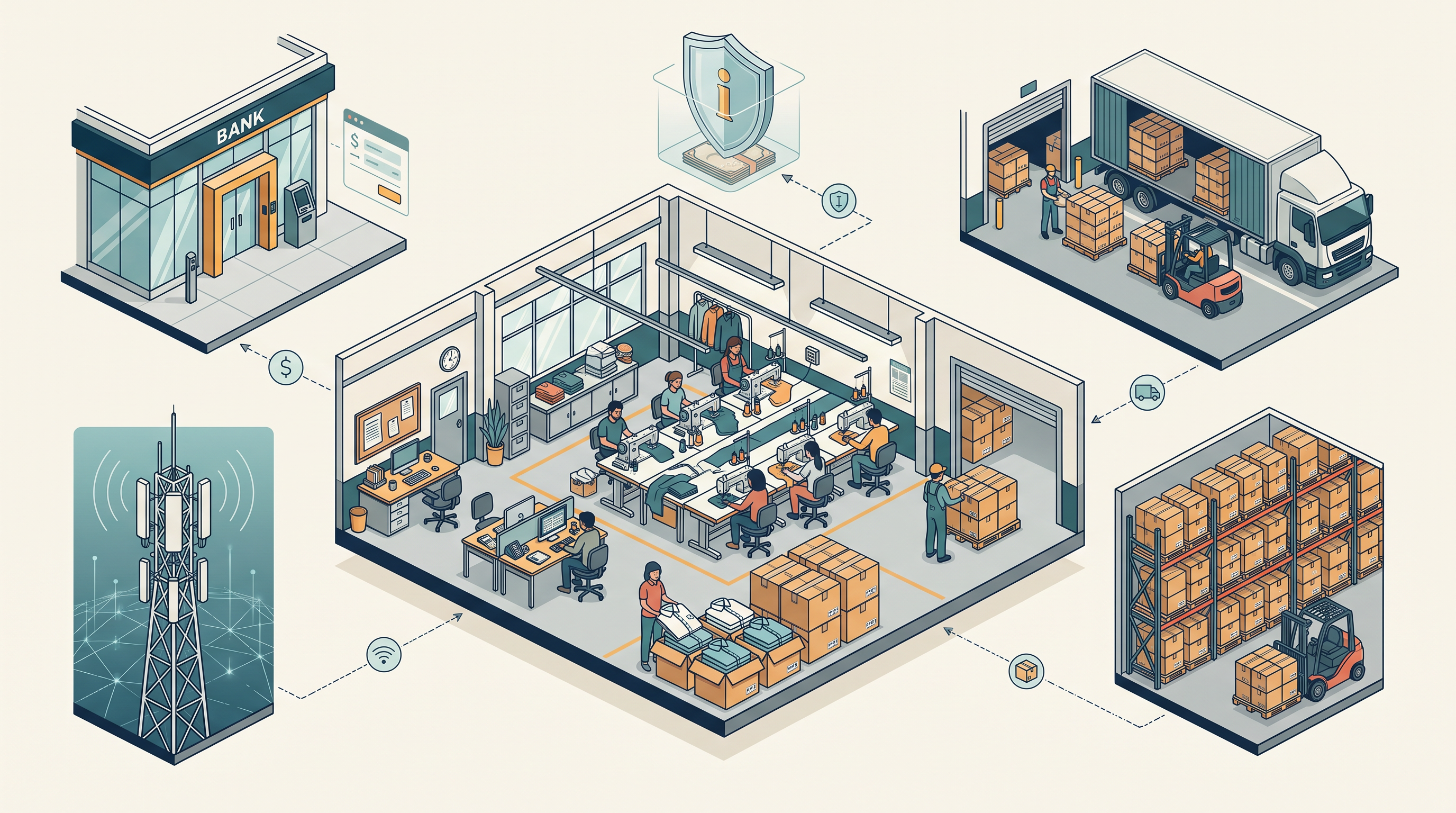
Fig. 4.0 – Business services supporting a manufacturing unit.
4.1 Introduction
Every person experiences the effects of business activity in daily life, often without noticing it. Consider a few ordinary situations: buying a tub of ice cream from a store and eating ice cream in a restaurant, watching a film in a cinema hall, purchasing a school bus and hiring a bus from a transporter.
If these activities are examined closely, a pattern appears. In each pair, one action involves buying an item, while the other involves having something done for you. Buying is not the same as eating; buying is not the same as watching; buying is not the same as leasing. There is a clear difference between the item purchased and the act performed for the customer.
Why Services Are Different
To an ordinary buyer, services are essentially intangible. Paying for a service does not give the buyer ownership of anything physical. A patient can seek advice and treatment from a doctor, but cannot purchase the doctor. What the patient pays for is the performance, not an object.
Services are therefore all those economic activities that are intangible and that require an interaction between the service provider and the consumer before they can be realised. Because the consumer must be present or involved in some form, a service exists only while it is being performed.
Services are also separately identifiable. Although a service satisfies a want just as a product does, it need not be attached to the sale of any product or to another service. A haircut, a bank transfer and a bus ride each stand on their own as an activity for which a customer pays.
What A Good Is
A good, in contrast, is a physical product that can be handed over to a purchaser. Because it has a physical existence, its sale involves the transfer of ownership from the seller to the customer. Once the transaction is complete, the buyer owns the item and may keep it, use it or resell it.
In trade and commerce, the term ‘goods’ is used broadly to cover commodities and items of every kind, except services. This distinction between what is owned and what is merely experienced is the foundation of the whole chapter, because the special features of services described in the next section all follow from it.
4.2 Nature Of Services
Services have five basic features. These features not only describe what a service is, they also separate services from goods, and since the name of each feature begins with the letter I, they are together known as the five Is of services. The five features are set out in Fig. 4.1 and explained below.
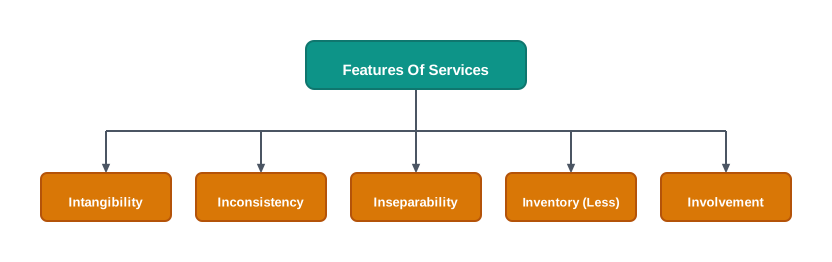
Fig. 4.1 – The five Is of services.
Intangibility — services are intangible, which means they cannot be touched. They are experiential in nature. A person cannot taste a doctor’s treatment or touch entertainment; these can only be experienced. An important implication follows from this. Because there is nothing physical to inspect, the quality of the offer often cannot be judged before it is consumed, and therefore before it is purchased. Service providers must consciously work at creating the desired service so that the customer goes through a favourable experience. Treatment by a doctor, for instance, should leave the patient with a favourable experience.
Inconsistency — the second important characteristic of services is inconsistency. Since there is no standard tangible product being turned out, the service has to be performed afresh and exclusively each time. Different customers come with different demands and expectations. Service providers therefore need the opportunity to alter their offer so that it closely meets the requirements of each customer. This is what is happening, for example, in the case of mobile services, where plans and packages are varied to suit different users.
Inseparability — another important characteristic of services is that production and consumption take place simultaneously. This makes the production and consumption of services seem inseparable. A car can be manufactured today and sold a month later, but this is often not possible with services, which have to be consumed as and when they are produced. Service providers may use technology to design a substitute for the person delivering the service, yet the interaction with the customer remains a key feature. Automated Teller Machines may replace the banking clerk for front office activities such as cash withdrawal and cheque deposit, but the presence of the customer is still required and the interaction with the process still has to be managed.
Inventory (less) — services have little or no tangible component and therefore cannot be stored for future use. In other words, services are perishable. A provider can at best store some associated goods, but not the service itself. This means demand and supply have to be carefully managed, because the service must be performed as and when the customer asks for it. It cannot be performed earlier and consumed later. A railway ticket can be stored, but the railway journey will be experienced only when the railways actually provide it.
Involvement — one of the most important characteristics of services is the participation of the customer in the service delivery process. Since the customer is present while the service is being performed, there is an opportunity to get the service modified according to specific requirements.

Fig. 4.2 – A service being performed for a customer.
4.2.1 Difference Between Services And Goods
From the five features discussed above, it is clear that the two main differentiating characteristics of services and goods are non-transferability of ownership and the presence of both the provider and the consumer at the time of delivery.
Goods are produced, whereas services are performed. A service is an act, and an act cannot be taken home. What the customer takes home is the effect of the service, not the service itself. And because services are sold at the point of consumption, no inventories of services can be built up.
On the basis of the features already studied, the points of distinction between goods and services are summarised in Table 4.1.
4.3 Types Of Services
When the service sector as a whole is considered, services can be classified into three broad categories, namely business services, social services and personal services. The classification is shown in Fig. 4.3 and each category is explained below.
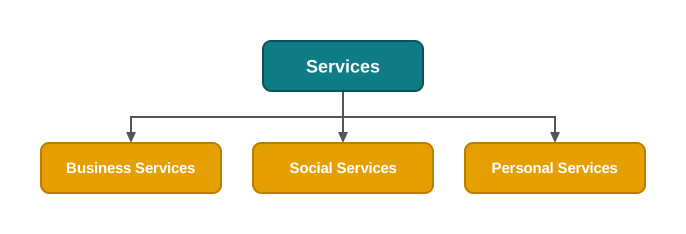
Fig. 4.3 – Types of services.
Business services — these are the services used by business enterprises for the conduct of their activities. Banking, insurance, transportation, warehousing and communication services are the common examples. A firm buys these services not for personal enjoyment but because its own operations depend on them.
Social services — these are the services generally provided voluntarily in pursuit of certain social goals. Such goals may be to improve the standard of living of weaker sections of society, to provide educational services to their children, or to provide health care and hygienic conditions in slum areas. These services are usually provided voluntarily but for some consideration, so that the cost of providing them is covered. Health care and education services provided by certain non-government organisations and by government agencies are examples.
Personal services — these are the services experienced differently by different customers. They cannot be consistent in nature. They differ depending upon the service provider, and they also depend upon the preferences and demands of the customer. Tourism, recreational services and restaurants fall in this category.
For a better understanding of the business world, the discussion in the rest of this chapter is limited to the first category of the service sector, that is, business services.
4.3.1 Business Services
Today’s world is one of tough competition, where the survival of the fittest is the rule. There is no room for non-performance, and hence companies tend to stick to what they can do best. In order to remain competitive, business enterprises are becoming more and more dependent on specialised business services rather than attempting to perform every activity themselves.
The pattern of this dependence is easy to trace. Business enterprises look towards banks for the availability of funds; towards insurance companies for getting their plant, machinery, goods and other assets insured; towards transport companies for carrying raw material and finished goods; and towards telecom and postal services for staying in touch with vendors, suppliers and customers.
Today’s globalised world has ushered in a rapid change in the service industry in India. India has been gaining a highly competitive edge over other countries when it comes to providing services to the developed economies of the world. Many foreign companies now look to India for performing a host of business services, and are even transferring a part of their business operations to be performed in India. These arrangements are discussed in detail in the next chapter.
4.4 Banking
Commercial banks are an important institution of the economy because they provide institutional credit to their customers. Without an organised source of credit, an enterprise would have to depend on personal savings or on informal lenders, both of which are limited and expensive.
A banking company in India is one which transacts the business of banking. Banking means accepting deposits of money from the public for the purpose of lending and investment, where such deposits are repayable on demand or otherwise and are withdrawable by cheque, draft, order or otherwise.
In simple terms, a bank accepts money on deposit, repays it on demand, and earns a margin of profit by lending that money to others. The margin arises because the rate of interest charged on loans is higher than the rate paid on deposits.
A bank stimulates economic activity in the market by dealing in money. It mobilises the savings of people and makes those funds available to business for financing capital expenditure and revenue expenditure. It also deals in financial instruments and provides financial services for a price, that is, interest, discount and commission.
4.4.1 Type Of Banks
The focus of banking is varied, the needs of customers are diverse and the methods of meeting them differ. Distinctive kinds of banks are therefore needed to cater to these complexities. Banks can be classified into the four types shown in Fig. 4.4.
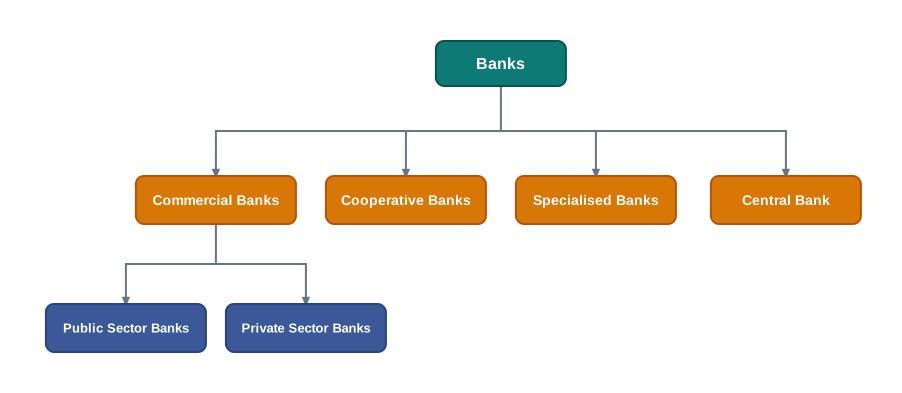
Fig. 4.4 – Types of banks.
Commercial banks — commercial banks are institutions dealing in money. They are governed by the Indian Banking Regulation Act 1949, and according to it banking means accepting deposits of money from the public for the purpose of lending or investment. There are two types of commercial banks, public sector banks and private sector banks. Public sector banks are those in which the government has a major stake, and they usually need to place greater emphasis on social objectives than on profitability. Private sector banks are owned, managed and controlled by private promoters and are free to operate as per market forces. There are a number of public sector banks such as SBI, PNB and IOB, while private sector banks are represented by HDFC Bank, ICICI Bank, Kotak Mahindra Bank and Jammu and Kashmir Bank.
Cooperative banks — cooperative banks are governed by the provisions of the State Cooperative Societies Act and are meant essentially for providing cheap credit to their members. They are an important source of rural credit, that is, of agricultural financing in India.
Specialised banks — specialised banks are foreign exchange banks, industrial banks, development banks and export-import banks, each catering to the specific needs of these unique activities. These banks provide financial aid to industries, to heavy turnkey projects and to foreign trade.
Central bank — the central bank of any country supervises, controls and regulates the activities of all the commercial banks of that country. It also acts as banker to the government, and it controls and coordinates the currency and credit policies of the country. The Reserve Bank of India is the central bank of our country.
4.4.2 Functions Of Commercial Banks
Banks perform a variety of functions. Some of them are the basic or primary functions of a bank, while others are agency services or general utility services in nature. The important functions are discussed below.
Acceptance of deposits — deposits are the basis of all loan operations, since banks are both borrowers and lenders of money. As borrowers they pay interest, and as lenders they grant loans and receive interest. These deposits are generally taken through current accounts, savings accounts and fixed deposits. Current account deposits can be withdrawn to the extent of the balance at any time without prior notice. Savings accounts are meant to encourage savings by individuals, and banks pay a rate of interest as decided by RBI on these deposits; withdrawal from these accounts carries some restrictions on the amount as well as on the number of times money may be withdrawn in a given period. Fixed accounts are time deposits carrying a higher rate of interest than savings accounts, and a premature withdrawal is permissible with a percentage of interest being forfeited.
Lending of funds — the second major activity of commercial banks is to provide loans and advances out of the money received through deposits. These advances can be made in the form of overdrafts, cash credits, discounting of trade bills, term loans, consumer credits and other miscellaneous advances. The funds lent out by banks contribute a great deal to trade, industry, transport and other business activities.
Cheque facility — banks render a very important service to their customers by collecting cheques drawn on other banks. The cheque is the most developed credit instrument, a unique feature and function of banks for the withdrawal of deposits, and it is the most convenient and inexpensive medium of exchange. There are mainly two types of cheques: bearer cheques, which are encashable immediately at bank counters, and crossed cheques, which are to be deposited only in the payee’s account.
Remittance of funds — another salient function of commercial banks is providing the facility of transferring funds from one place to another, made possible by the interconnectivity of branches. The transfer of funds is administered by using bank drafts, pay orders or mail transfers on nominal commission charges. The bank issues a draft for the amount on its own branches at other places, or on other banks at those places, and the payee can present the draft on the drawee bank at his place and collect the amount.
Allied services — in addition to the above functions, banks also provide allied services such as bill payments, locker facilities and underwriting services. They also perform other services such as buying and selling of shares and debentures on instructions, and personal services such as payment of insurance premium and collection of dividend.
4.4.3 e-Banking
The growth of the Internet and of e-commerce is dramatically changing everyday life, with the world wide web and e-commerce transforming the world into a digital global village. The latest wave in information technology is internet banking. It is a part of virtual banking and another delivery channel for customers.
In simple terms, internet banking means that any user with a computer and a browser can get connected to the bank’s website, perform any of the virtual banking functions and avail of any of the bank’s services. There is no human operator responding to the needs of the customer. The bank maintains a centralised database that is web-enabled, and all the services the bank has permitted on the internet are displayed on a menu. Any service can be selected, and the further interaction is dictated by the nature of that service.
In this new digital marketplace, banks and financial institutions have started providing services over the internet. Such services provided by banks on the internet are called e-banking. They lower the transaction cost, add value to the banking relationship and empower customers.
e-Banking is electronic banking, that is, banking using electronic media. It is a service provided by many banks that allows a customer to conduct banking transactions such as managing savings, checking accounts, applying for loans or paying bills over the internet, using a personal computer, a mobile telephone or a handheld computer, that is, a personal digital assistant.
Range Of Services Offered
The services offered through e-banking include Automated Teller Machines and Point of Sales, Electronic Data Interchange and Credit Cards, Electronic or Digital cash, and Electronic Fund Transfer. The two ways in which EFT can be done are NEFT, that is, National Electronic Fund Transfer, and RTGS, that is, Real Time Gross Settlement. The place of these instruments within the wider system of payments is set out in Fig. 4.5.
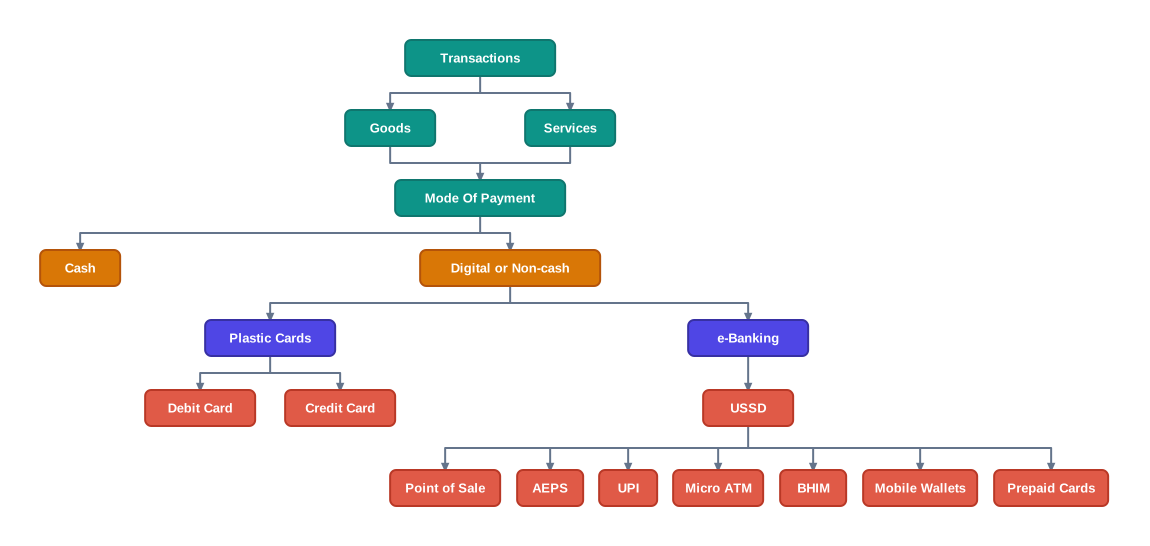
Fig. 4.5 – Types of digital payments.
Benefits To Customers
There are various benefits of e-banking provided to customers, which are as follows.
e-Banking facilitates digital payments and promotes transparency in financial statements.
e-Banking provides services to the customers of the bank for 24 hours a day and 365 days a year.
Customers can make some of the permitted transactions from the office or the house, or while travelling, through a mobile telephone.
It inculcates a sense of financial discipline by recording each and every transaction.
It gives greater customer satisfaction by offering unlimited access to the bank, not limited by the walls of the branch, and there is less risk and greater security to the customer as travelling with cash can be avoided.
Benefits To Banks
The banks also stand to gain by e-banking. The benefits to them are as follows.
e-Banking provides competitive advantage to the bank.
e-Banking provides an unlimited network to the bank and is not limited to the number of branches. Any computer connected to a modem and a telephone having an internet connection can meet the cash withdrawal needs of the customer.
Load on branches can be considerably reduced by establishing a centralised database and by taking over some of the accounting functions.
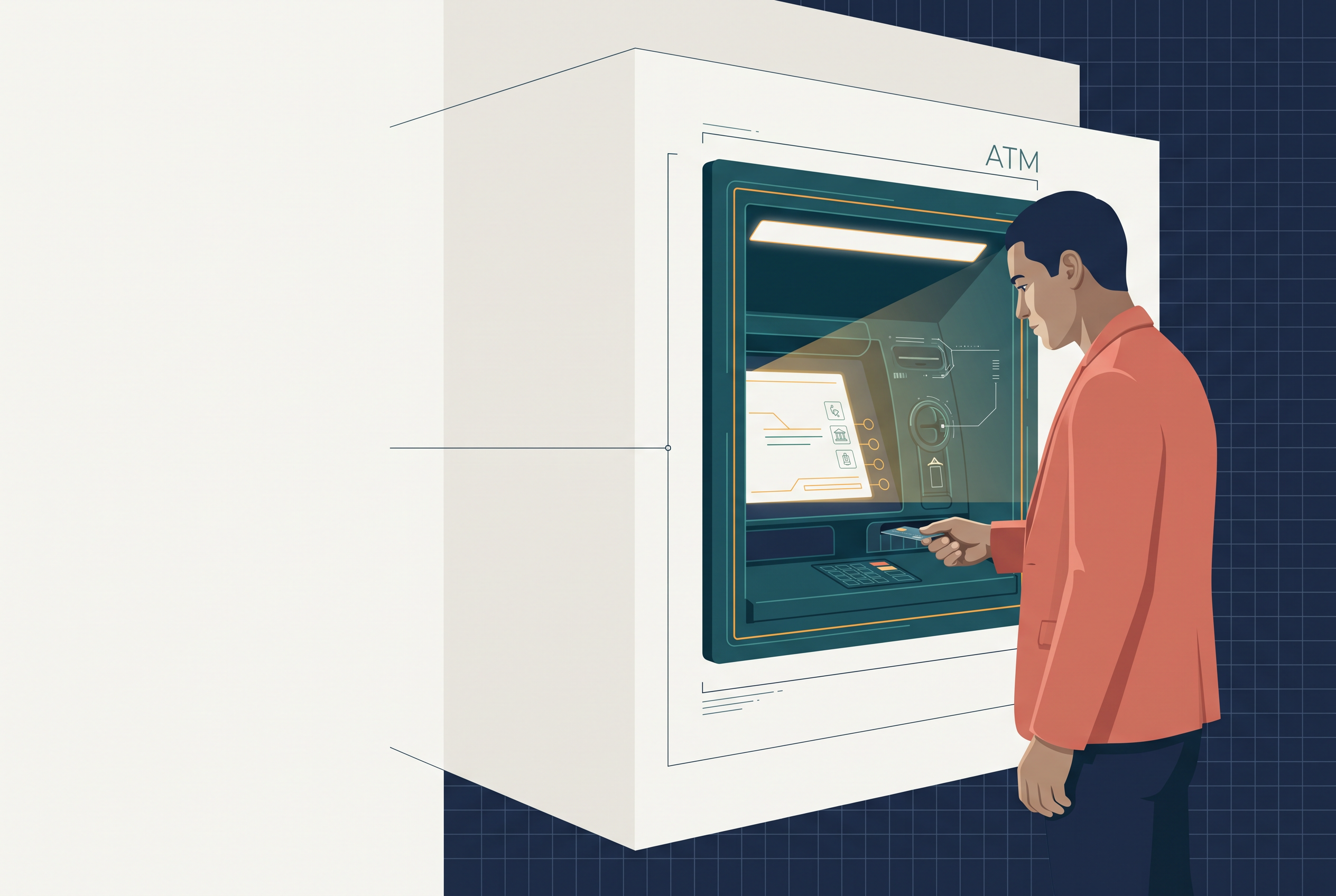
Fig. 4.6 – A customer using an automated teller machine.
4.5 Insurance
Life is full of uncertainties. The chances of an event occurring and causing losses are quite uncertain. There are risks of death and disability for human life, risks of fire and burglary for property, perils of the sea for the shipment of goods, and so on. If any of these takes place, individuals or organisations may suffer a great loss, sometimes beyond their capacity to bear it.
It is to minimise the impact of such uncertainties that there is a need for insurance. Investment in factory buildings, heavy equipment or other assets is not possible unless there is an arrangement for covering the risks attached to them. No enterprise would sink large sums into an asset that a single fire could wipe out.
Keeping this in mind, people facing common risks come together and make small contributions to a common fund. This fund helps to spread the loss caused to an individual by a particular risk over the many persons who are exposed to the same risk.
Insurance is thus a device by which the loss likely to be caused by an uncertain event is spread over a number of persons who are exposed to it and who prepare to insure themselves against such an event. It is a contract or agreement under which one party agrees, in return for a consideration, to pay an agreed amount of money to another party to make good a loss, damage or injury to something of value in which the insured has a pecuniary interest as a result of some uncertain event.
The agreement or contract is put in writing and is known as the policy. The person whose risk is insured is called the insured, and the firm which insures the risk of loss is known as the insurer, also called the assurance underwriter.
4.5.1 Fundamental Principle Of Insurance
The basic principle of insurance is that an individual or a business concern chooses to spend a definitely known sum in place of a possible huge amount involved in an indefinite future loss. Insurance is thus the substitution of a small periodic payment, called the premium, for the risk of a large possible loss.
The risk of loss still remains, but the loss is spread over a large number of policyholders exposed to the same risk. The premiums paid by them are pooled, and out of this pool the loss sustained by any policyholder is compensated. Risks are in this way shared with others.
From the analysis of past events, the insurer, which may be an insurance company or an underwriter, knows the probable losses caused by each type of risk covered by insurance. This knowledge is what allows the premium to be fixed at a level that is small for each policyholder and yet sufficient for the fund as a whole.
Insurance, therefore, is a form of risk management primarily used to safeguard against the risk of a potential financial loss. Ideally, insurance is defined as the equitable transfer of the risk of a potential loss from one entity to another in exchange for a reasonable fee. An insurance company, therefore, is an association, corporation or organisation engaged in the business of paying all legitimate claims that may arise, in exchange for a fee known as the premium.
Insurance is a social device in which a group of individuals, the insured, transfers risk to another party, the insurer, in order to combine loss experience, which provides for the payment of losses from funds contributed by all members. Insurance is meant to protect the insured against uncertain events which may cause disadvantage to him.
4.5.2 Functions Of Insurance
The various functions of insurance are as follows.
Providing certainty — insurance provides certainty of payment for the risk of loss. There are uncertainties about the time at which a loss may happen and about the amount of that loss. Insurance removes these uncertainties and the assured receives payment of the loss. The insurer charges a premium for providing this certainty.
Protection — the second main function of insurance is to provide protection from probable chances of loss. Insurance cannot stop the happening of a risk or event, but it can compensate for the losses arising out of it.
Risk sharing — on the happening of a risk event, the loss is shared by all the persons exposed to it. The share is obtained from every insured member by way of premiums.
Assist in capital formation — the accumulated funds of the insurer, received by way of premium payments made by the insured, are invested in various income generating schemes. In this way the savings of a large number of policyholders are channelled into productive investment in the economy.
4.5.3 Principles Of Insurance
The principles of insurance are the rules of action or conduct adopted by the stakeholders involved in the insurance business. The specific principles of utmost significance to a valid insurance contract are the following.
Utmost good faith — a contract of insurance is a contract of uberrimae fidei, that is, a contract founded on utmost good faith. Both the insurer and the insured should display good faith towards each other in regard to the contract. It is the duty of the insured to voluntarily make a full and accurate disclosure of all facts material to the risk being proposed, and it is the duty of the insurer to make clear all the terms and conditions in the insurance contract. It is thus binding on the proposer to disclose all material facts about the subject matter of the proposed insurance. Any fact which is likely to affect the mind of a prudent insurer in deciding to accept the proposal of insurance, or in fixing the rate of premium, is material for this purpose. Failure to disclose material facts by the insured makes the contract of insurance voidable at the discretion of the insurer.
Insurable interest — the insured must have an insurable interest in the subject matter of insurance. One fundamental fact of this principle is that ‘it is not the house, ship, machinery, potential liability of life that is insured, but it is the pecuniary interest of the insured in them, which is insured.’ Insurable interest means some pecuniary interest in the subject matter of the insurance contract. The insured must have an interest in the preservation of the thing or life insured, so that he or she will suffer financially on the happening of the event against which he or she is insured. In the case of insurance of property, the insurable interest of the insured in the subject matter must exist at the time of happening of the event. In order to claim insurable interest, however, it is not necessary that one should be the owner of the property. For example, a trustee holding property on behalf of others has an insurable interest in that property.
Indemnity — all insurance contracts of fire or marine insurance are contracts of indemnity. According to this principle, the insurer undertakes to put the insured, in the event of loss, in the same position that he occupied immediately before the happening of the event insured against. In other words, the insurer undertakes to compensate the insured for the loss caused to him or her due to damage or destruction of the property insured. The compensation payable and the loss suffered are to be measured in terms of money. The principle of indemnity is not applicable to life insurance.
Proximate cause — according to this principle, an insurance policy is designed to provide compensation only for such losses as are caused by the perils which are stated in the policy. When the loss is the result of two or more causes, the proximate cause means the direct, the most dominant and the most effective cause of which the loss is the natural consequence. In case of loss arising out of any mishap, the most proximate cause of the mishap should be taken into consideration.
Subrogation — this refers to the right of the insurer to stand in the place of the insured after settlement of a claim, as far as the right of the insured in respect of recovery from an alternative source is involved. After the insured is compensated for the loss or damage to the property insured, the right of ownership of such property passes on to the insurer. This is because the insured should not be allowed to make any profit by selling the damaged property, or in the case of lost property being recovered.
Contribution — as per this principle, it is the right of an insurer who has paid a claim under an insurance to call upon other liable insurers to contribute for the loss of payment. It implies that in case of double insurance the insurers are to share the losses in proportion to the amount assured by each of them. In case there is a loss when there is more than one policy on the same property, the insured will have no right to recover more than the full amount of the actual loss. If the full amount is recovered from one insurer, the right to obtain further payment from the other insurer will cease.
Mitigation — this principle states that it is the duty of the insured to take reasonable steps to minimise the loss or damage to the insured property. Suppose goods kept in a store house catch fire; the owner of the goods should try to recover the goods and save them from fire in order to minimise the loss or damage. The insured must behave with great prudence and must not be careless simply because there is an insurance cover. If reasonable care is not taken, as any prudent person would take, then the claim from the insurance company may be lost.
4.5.4 Types Of Insurance
Various types of insurance exist by virtue of the practice of insurance companies and the influence of legal enactments controlling the insurance business. Broadly speaking, insurance may be classified as shown in Fig. 4.7.
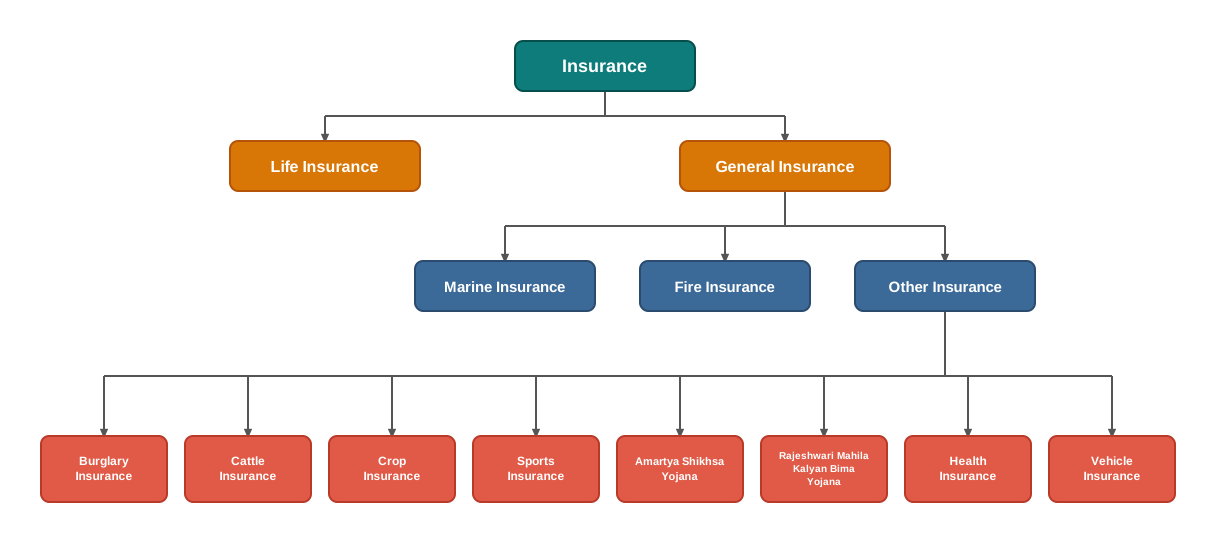
Fig. 4.7 – Types of insurance.
4.5.4.1 Life Insurance
Since life itself is uncertain, all individuals try to assure themselves of a certain sum of money in the future to take care of unforeseen events or happenings. Individuals in the course of their life are always exposed to some kind of risk.
The risk may be of an event which is certain, that is, death. In that case, the question is what will happen to the other members of the family who are dependent on that individual’s income. The other risk may be that of living too long, in which an individual may become too old to earn, that is, retirement. In this case also the earnings will decline or end. Under such circumstances individuals seek protection against these risks, and life insurance companies offer protection against such risks.
A life insurance policy was introduced as a protection against the uncertainty of life. Gradually its scope has widened, and various types of insurance policies are now available to suit the requirements of an individual, for example disability insurance, health or medical insurance, annuity insurance and life insurance proper.
Life insurance may be defined as a contract in which the insurer, in consideration of a certain premium, either in a lump sum or by other periodical payments, agrees to pay to the assured, or to the person for whose benefit the policy is taken, the assured sum of money on the happening of a specified event contingent on human life, or at the expiry of a certain period.
Thus, the insurance company undertakes to insure the life of a person in exchange for a sum of money called premium. This premium may be paid in one lump sum, or periodically, that is, monthly, quarterly, half yearly or yearly. At the same time the company promises to pay a certain sum of money either on the death of the person, or on his attaining a certain age, that is, on the expiry of a certain period. The person is therefore sure that a specified amount will be given to him when he attains a certain age, or that his dependents will get that sum in the event of his death.
This agreement or contract, which contains all the terms and conditions, is put in writing, and such a document is called the policy. The person whose life is insured is called the assured, the insurance company is the insurer, and the consideration paid by the assured is the premium, which can be paid periodically in instalments.
This insurance provides protection to the family at the premature death of the insured, or gives an adequate amount at old age when earning capacities are reduced. The insurance is not only a protection but is also a sort of investment, because a certain sum is returnable to the insured at the time of death or at the expiry of a certain period. Life insurance also encourages savings, as the amount of premium has to be paid regularly. It thus provides a sense of security to the insured and his dependents.
Elements Of A Life Insurance Contract
The general principles of insurance discussed in the previous section apply to life insurance also, with a few exceptions. The main elements of a life insurance contract are as follows.
The life insurance contract must have all the essentials of a valid contract. Certain elements such as offer and acceptance, free consent, capacity to enter into a contract, lawful consideration and lawful object must be present for the contract to be valid.
The contract of life insurance is a contract of utmost good faith. The assured should be honest and truthful in giving information to the insurance company. He must disclose all material facts about his health to the insurer. It is his duty to disclose accurately all material facts known to him, even if the insurer does not ask him.
In life insurance, the insured must have an insurable interest in the life assured. Without insurable interest the contract of insurance is void. In the case of life insurance, insurable interest must be present at the time when the insurance is effected. It is not necessary that the assured should have insurable interest at the time of maturity also. For example, a person is presumed to have an interest in his own life and every part of it, a creditor has an insurable interest in the life of his debtor, and the proprietor of a drama company has an insurable interest in the lives of the actors.
A life insurance contract is not a contract of indemnity. The life of a human being cannot be compensated, and only a specified sum of money is paid. That is why the amount payable in life insurance on the happening of the event is fixed in advance. The sum of money payable is fixed at the time of entering into the contract. A contract of life insurance, therefore, is not a contract of indemnity.
Types Of Life Insurance Policies
The document containing the written contract between the insurer and the insured, along with the terms and conditions of insurance, is called the policy. After the proposal form is filled in by the insured, also called the proposer, and the insurer accepts the form and the premium, a policy is issued.
People have different requirements and would therefore like a policy that fulfils all their needs. The needs of people for life insurance can be family needs, children’s needs, old age needs and special needs. To meet these needs, insurers have developed different types of products such as Whole Life Assurance, Endowment type plans, combinations of Whole Life and Endowment type plans, Children’s Assurance plans and Annuity plans. Some of these are explained below.
Whole Life Policy — in this kind of policy the amount payable to the insured will not be paid before the death of the assured. The sum then becomes payable only to the beneficiaries or heirs of the deceased. The premium will be payable for a fixed period of 20 or 30 years, or for the whole life of the assured. If the premium is payable for a fixed period, the policy will continue till the death of the assured.
Endowment Life Assurance Policy — the insurer undertakes to pay a specified sum when the insured attains a particular age or on his death, whichever is earlier. The sum is payable to his legal heirs or to the nominee named in the policy in case of the death of the assured. Otherwise the sum will be paid to the assured after a fixed period, that is, when he or she attains a particular age. The endowment policy thus matures after a limited number of years.
Joint Life Policy — this policy is taken up by two or more persons. The premium is paid jointly or by either of them, in instalments or in a lump sum. The assured sum or policy money is payable upon the death of any one person to the other survivor or survivors. Usually this policy is taken by a husband and wife jointly, or by two partners in a partnership firm, where the amount is payable to the survivor on the death of either of the two.
Annuity Policy — under this policy the assured sum or policy money is payable after the assured attains a certain age, in monthly, quarterly, half yearly or annual instalments. The premium is paid in instalments over a certain period, or a single premium may be paid by the assured. This policy is useful to those who prefer a regular income after a certain age.
Children’s Endowment Policy — this policy is taken by a person for his or her children to meet the expenses of their education or marriage. The agreement states that a certain sum will be paid by the insurer when the children attain a particular age. The premium is paid by the person entering into the contract. However, no premium will be paid if he dies before the maturity of the policy.
4.5.4.2 Fire Insurance
Fire insurance is a contract whereby the insurer, in consideration of the premium paid, undertakes to make good any loss or damage caused by fire during a specified period, up to the amount specified in the policy.
Normally the fire insurance policy is for a period of one year, after which it is to be renewed from time to time. The premium may be paid either in a lump sum or in instalments. A claim for loss by fire must satisfy the two following conditions.
There must be actual loss.
Fire must be accidental and non-intentional.
The risk covered by a fire insurance contract is the loss resulting from fire or some other cause which is the proximate cause of the loss. If overheating without ignition causes damage, it will not be regarded as a fire loss within the meaning of fire insurance, and the loss will not be recoverable from the insurer.
Elements Of A Fire Insurance Contract
A fire insurance contract is based on certain fundamental principles which have already been discussed under the general principles. The main elements of a fire insurance contract are as follows.
In fire insurance the insured must have an insurable interest in the subject matter of the insurance. Without insurable interest the contract of insurance is void. In the case of fire insurance, unlike life insurance, insurable interest must be present both at the time of insurance and at the time of loss. For example, a person has an insurable interest in the property he owns, a businessman has an insurable interest in his stock, plant, machinery and building, an agent has an insurable interest in the property of his principal, a partner has an insurable interest in the property of the partnership firm, and a mortgagee has an insurable interest in the property which is mortgaged.
Similar to the life insurance contract, the contract of fire insurance is a contract of utmost good faith, that is, uberrimae fidei. The insured should be truthful and honest in giving information to the insurance company regarding the subject matter of the insurance. He is duty-bound to disclose accurately all facts regarding the nature of the property and the risks attached to it. The insurance company should also disclose the facts of the policy to the proposer.
The contract of fire insurance is a contract of strict indemnity. The insured can, in the event of loss, recover the actual amount of loss from the insurer, subject to the maximum amount for which the subject matter is insured. For example, if a person has insured his house for ₹ 4,00,000, the insurer is not necessarily liable to pay that amount, although the house may have been totally destroyed by fire; he will pay the actual loss after deducting depreciation, within the maximum limit of ₹ 4,00,000. The purpose is that a person should not be allowed to gain by insurance.
The insurer is liable to compensate only when fire is the proximate cause of the damage or loss.
4.5.4.3 Marine Insurance
A marine insurance contract is an agreement whereby the insurer undertakes to indemnify the insured in the manner and to the extent thereby agreed against marine losses. Marine insurance provides protection against loss by marine perils, or perils of the sea.
Marine perils include collision of the ship with a rock, the ship being attacked by enemies, fire, capture by pirates, and the actions of the captain and crew of the ship. These perils cause damage to, destruction of or disappearance of the ship and cargo, and non-payment of freight. Marine insurance therefore insures ship hull, cargo and freight.
It is thus a device wherein the insurer undertakes to compensate the owner of a ship or cargo for complete or partial loss at sea. The insurer guarantees to make good the losses due to damage to the ship or cargo arising out of the risks incidental to sea voyages. The insurer in this case is known as the underwriter, and a certain sum of money is paid by the insured in consideration for the guarantee or protection he gets.
Marine insurance is slightly different from other types, because there are three things involved, that is, the ship or hull, the cargo or goods, and the freight.
Ship or hull insurance — since the ship is exposed to many dangers at sea, the insurance policy is for indemnifying the insured for losses caused by damage to the ship.
Cargo insurance — the cargo, while being transported by ship, is subject to many risks. These may be at the port, that is, the risk of theft or lost goods, or on the voyage. An insurance policy can therefore be issued to cover against such risks to cargo.
Freight insurance — if the cargo does not reach the destination due to damage or loss in transit, the shipping company is not paid the freight charges. Freight insurance is for reimbursing the loss of freight to the shipping company, that is, the insured.
Elements Of A Marine Insurance Contract
The fundamental principles of marine insurance are the same as the general principles. The main elements of a marine insurance contract are as follows.
Unlike life insurance, the contract of marine insurance is a contract of indemnity. The insured can, in the event of loss, recover the actual amount of loss from the insurer. Under no circumstances is the insured allowed to make a profit out of the marine insurance contract. But cargo policies provide commercial indemnity rather than strict indemnity, the insurers promising to indemnify the insured “in the manner and to the extent agreed.” In the case of a ‘Hull Policy’, the amount insured is fixed at a level above the current market value.
Similar to life and fire insurance, the contract of marine insurance is a contract of utmost good faith. Both the insured and the insurer must disclose everything which is in their knowledge and can affect the insurance contract. The insured is duty-bound to accurately disclose all facts, which include the nature of the shipment and the risk of damage it is exposed to.
Insurable interest must exist at the time of loss, but it is not necessary at the time when the policy was taken.
The principle of causa proxima will apply to it. The insurance company will be liable to pay only if that particular or nearest cause is covered by the policy. For example, if a loss is caused by several reasons, then the nearest cause of loss will be considered.
The points on which life, fire and marine insurance differ from one another are summarised in Table 4.2.
Other Types Of Insurance
Besides life, fire and marine insurance, several other policies are offered under general insurance to meet particular kinds of risk.
Health insurance — health insurance is a safeguard against rising medical costs. A health insurance policy is a contract between an insurer and an individual or group, in which the insurer agrees to provide specified health insurance at an agreed-upon price, the premium. Depending upon the policy, the premium may be payable either in a lump sum or in instalments. Health insurance usually provides either direct payment or reimbursement for expenses associated with illness and injuries. The cost and range of protection provided depend on the provider and the policy purchased. In India the health insurance exists primarily in the form of the Mediclaim policy, offered to an individual or to any group, association or corporate body.
Motor vehicle insurance — motor vehicle insurance falls under the classification of general insurance. This insurance is becoming very popular and its importance is increasing day by day. In motor insurance, the owner’s liability to compensate people who were killed or injured through the negligence of the motorists or drivers is passed on to the insurance company. The rate of premium under motor insurance is standardised.
Burglary insurance — burglary insurance falls under the classification of insurance of property. In the case of a burglary policy, the loss or damage of household goods, properties and personal effects due to theft, larceny, burglary, house-breaking and acts of such nature are covered. The actual loss is compensated. Insurable interest must exist at the time of loss but not necessarily at the time when the policy was taken, and the principle of causa proxima will apply, so that the insurance company will be liable to pay only for that particular or nearest cause that is covered by the policy. For example, if a loss is caused by several reasons, then the nearest cause of loss will be considered.
Cattle insurance — a contract of cattle insurance is a contract whereby a sum of money is secured to the assured in the event of death of animals such as bulls, buffaloes, cows and heifers. It is a contract against death resulting from accident, disease or pregnant condition, as the case may be. The insurer usually undertakes to pay the excess in the event of loss.
Crop insurance — a contract of crop insurance is a contract to provide a measure of financial support to farmers in the event of a crop failure due to drought or flood. This insurance covers against all risks of loss or damage relating to the production of rice, wheat, millets, oil seeds and pulses.
Sports insurance — this policy assures a comprehensive cover available to amateur sportsmen, covering their sporting equipment, personal effects, legal liability and personal accident risks. If desired, the cover can also be made available in respect of a named member of the insured’s family residing with him. This cover is not available to professional sportsmen. The cover is available in respect of any one or more of the following sports: angling, badminton, cricket, golf, lawn tennis, squash and the use of sporting guns.
Amartya Sen Siksha Yojana — this policy, offered by the General Insurance Company, secures the education of dependent children. If the insured parent or legal guardian sustains any bodily injury resulting solely and directly from an accident caused by external, violent and visible means, and if such injury is, within twelve calendar months of its occurrence, the sole and direct cause of his or her death or permanent total disablement, the insurer shall indemnify the insured student in respect of all covered expenses to be incurred from the date of occurrence of such accident till the expiry date of the policy or the completion of the duration of the covered course, whichever occurs first. Such indemnity shall not exceed the sum insured as stated in the policy schedule.
Rajeswari Mahila Kalyan Bima Yojana — this policy has been designed to provide relief to the family members of insured women in case of their death or disablement arising due to all kinds of accidents, or death or disablement arising out of problems incidental to women only.
4.6 Communication Services
Communication services are helpful to a business for establishing links with the outside world, that is, with suppliers, customers and competitors. Business does not exist in isolation; it has to communicate with others for the transmission of ideas and information.
Communication services need to be very efficient, accurate and fast for them to be effective. An order confirmed late, or a price quoted wrongly, costs a firm both money and goodwill, which is why speed and accuracy matter as much as reach.
In this fast moving and competitive world it is essential to have advanced technology for the quick exchange of information. The electronic media is mainly responsible for this transformation. The main services which help business can be classified into postal and telecom, as shown in Fig. 4.9.
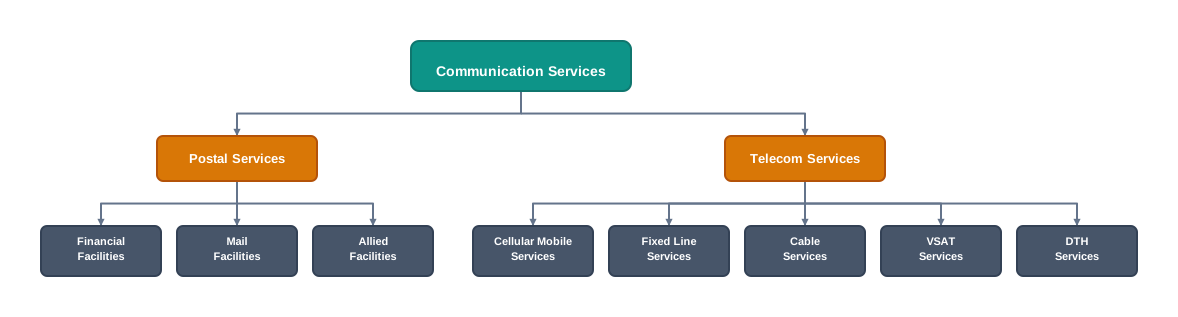
Fig. 4.9 – Communication services.
Postal Services
The Indian post and telegraph department provides various postal services across India. For providing these services, the whole country has been divided into 22 postal circles. These circles manage the day-to-day functioning of the various head post offices, sub-post offices and branch post offices. Through their regional and divisional level arrangements, the facilities provided by the postal department are broadly categorised into the following.
Financial facilities — these facilities are provided through the post office’s savings schemes such as the Public Provident Fund, Kisan Vikas Patra and National Saving Certificates, in addition to normal retail banking functions of monthly income schemes, recurring deposits, savings accounts, time deposits and the money order facility.
Mail facilities — mail services consist of parcel facilities, that is, the transmission of articles from one place to another; the registration facility, which provides security for the transmitted articles; and the insurance facility, which provides insurance cover for all risks in the course of transmission by post.
Allied Facilities Of The Postal Department
The postal department also offers allied facilities of the following types.
Greeting post — a range of greeting cards for every occasion.
Media post — an innovative and effective vehicle for Indian corporates to advertise their brand through postcards, envelopes, aerograms and telegrams, and also through letterboxes.
Direct post — this is meant for direct advertising, and it can be both addressed as well as unaddressed.
International money transfer — this is offered through collaboration with Western Union financial services, USA, which enables the remittance of money from 185 countries to India.
Passport facilities — a unique partnership with the ministry of external affairs for facilitating passport applications.
Speed post — it has over 1000 destinations in India and links with 97 major countries across the globe.
e-Bill post — this is the latest offering of the department, to collect bill payments across the counter for BSNL and Bharti Airtel.
Telecom Services
World class telecommunications infrastructure is the key to the rapid economic and social development of the country. It is in fact the backbone of every business activity. In today’s world the dream of doing business across continents will remain a dream in the absence of telecom infrastructure.
There have been far reaching developments in the convergence of the telecom, IT, consumer electronics and media industries worldwide. Recognising the potential of telecom in enhancing quality of life, and to facilitate India’s vision of becoming an IT super power by the year 2025, the new Telecom Policy Framework 1999 and the Broadband Policy 2004 were developed by the Government of India. Through this framework the government intends to provide both universal services to all uncovered areas and high-level services for meeting the needs of the country’s economy.
The various types of telecom services are as follows.
Cellular mobile services — these are all types of mobile telecom services including voice and non-voice messages, data services and PCO services, utilising any type of network equipment within their service area. They can also provide direct inter connectivity with any other type of telecom service provider.
Fixed line services — these are all types of fixed services including voice and non-voice messages and data services, to establish linkages for long distance traffic. These utilise any type of network equipment primarily connected through fibre optic cables laid across the length and breadth of the country. They also provide inter connectivity with other types of telecom services.
Cable services — these are linkages and switched services within a licensed area of operation, to operate media services which are essentially one-way entertainment related services. The two-way communication including voice, data and information services through cable network would emerge significantly in the future. Offering services through the cable network would be similar to providing fixed services.
VSAT services — VSAT, that is, Very Small Aperture Terminal, is a satellite-based communications service. It offers businesses and government agencies a highly flexible and reliable communication solution in both urban and rural areas. Compared to land-based services, VSAT offers the assurance of reliable and uninterrupted service that is equal to or better than land-based services. It can be used to provide innovative applications such as tele-medicine, newspapers-on-line, market rates and tele-education even in the most remote areas of our country.
DTH services — DTH, that is, Direct to Home, is again a satellite-based media service provided by cellular companies. One can receive media services directly through a satellite with the help of a small dish antenna and a set top box. The service provider of DTH services provides a bouquet of multiple channels. It can be viewed on a television without being dependent on the services provided by the cable network services provider.
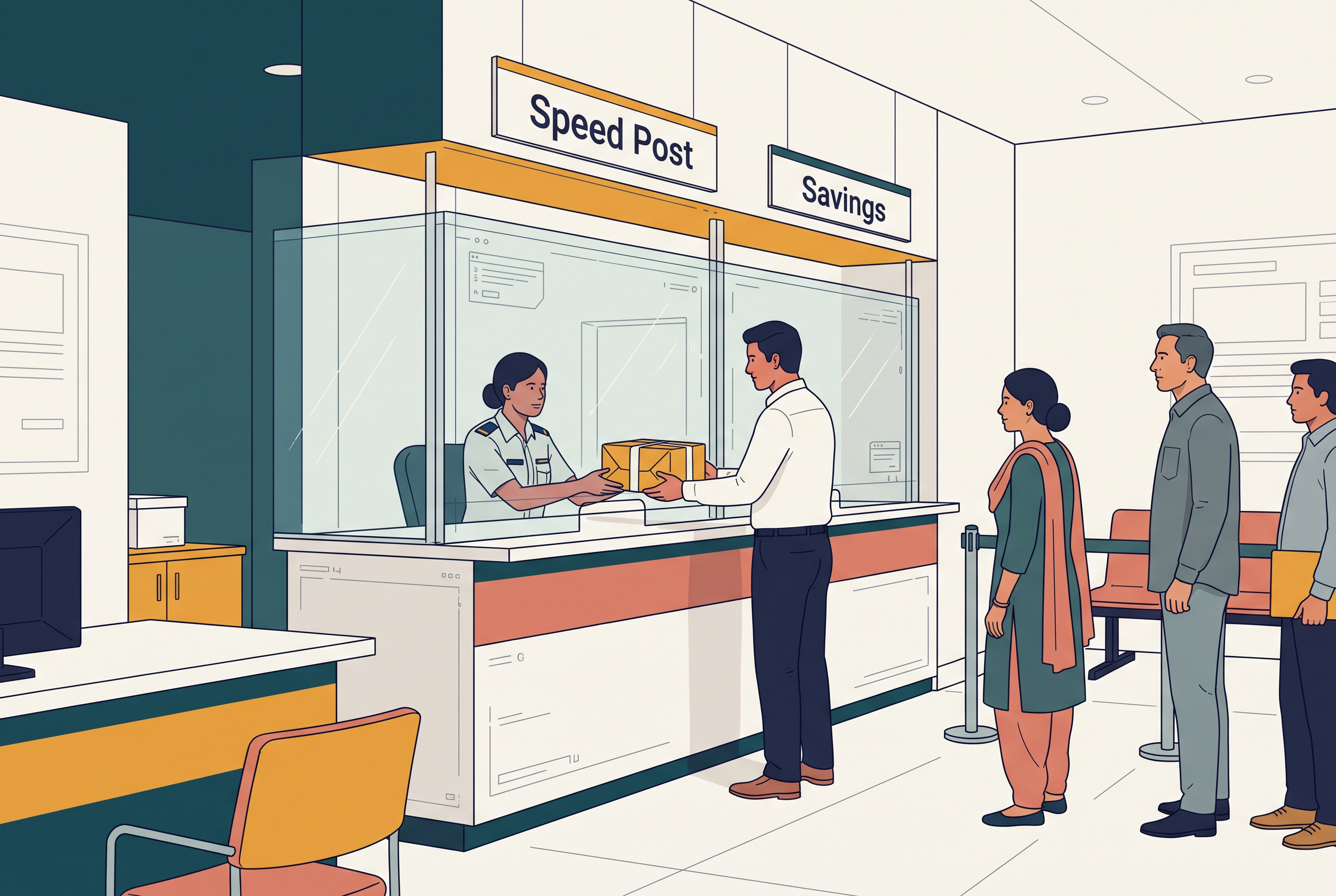
Fig. 4.10 – A post office counter in India.
4.7 Transportation
Transportation comprises freight services together with supporting and auxiliary services by all modes of transportation, that is, rail, road, air and sea, for the movement of goods and for the international carriage of passengers. The four modes and their comparative advantages and disadvantages have already been studied in earlier classes; the concern here is with transportation as a business service. The modes are set out in Fig. 4.11.
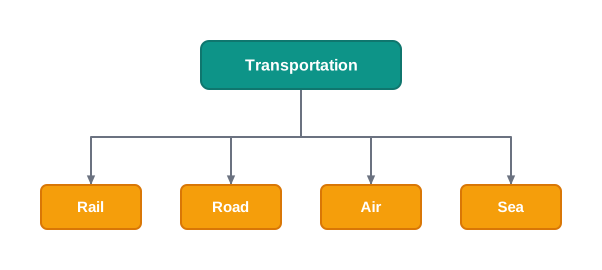
Fig. 4.11 – Modes of transportation.
The services of transport are considered important for business because speed is of the essence in any business transaction. An order accepted today must reach the buyer while the need still exists, and a delay in delivery can cost a firm both the sale and the customer.
Transportation also removes the hindrance of place, that is, it makes goods available to the consumer at the place where they are wanted, away from the place of production. Goods lying in a factory yard are of no use to a buyer in another state; it is transport that carries the utility of place to them.
Need To Develop Transport Infrastructure
Our transportation system needs to be developed to keep pace with the requirements of the economy. Better infrastructure of roads with sufficient width and high quality is needed. The country has few ports and even these are congested, which slows down the movement of goods meant for export and import.
Both government and industry need to be proactive and to view the effective functioning of this service as a necessity, because transport provides the lifeline to all other business services. In sectors such as agriculture and food, there are massive losses of product in the very process of transportation and storage, and these losses reduce both the earnings of the producer and the supply available to the consumer.
The Government of India is also serious about ensuring better and more facilities at seaports and airports, so as to provide an impetus to business activities. The government plans not only to enhance the capacities of existing ports but also to develop modern and new ports at strategic locations.
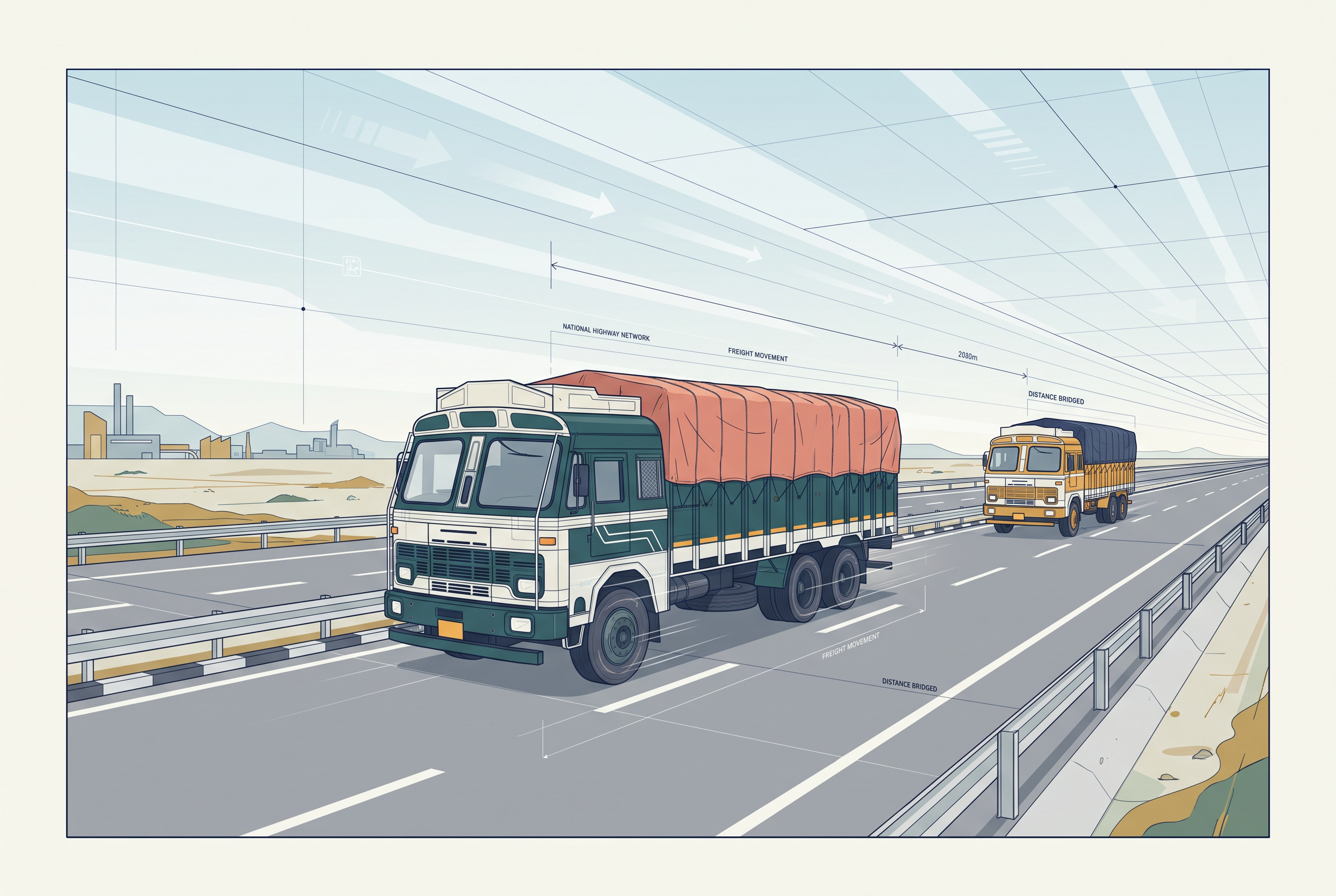
Fig. 4.12 – Goods being moved by road.
4.8 Warehousing
Storage has always been an important aspect of economic development. Goods are rarely produced and consumed at the same moment, and the gap between the time of production and the time of sale has to be bridged by somebody. This is the work of warehousing.
The warehouse was initially viewed as a static unit for keeping and storing goods in a scientific and systematic manner, so as to maintain their original quality, value and usefulness. The typical warehouse received merchandise by rail, truck or bullock cart. The items were moved manually to a storage space within the warehouse and hand piled in stacks on the floor. Warehouses are used in India by manufacturers, importers, exporters, wholesalers, transport businesses and customs authorities.
Today’s warehouses have ceased to be mere storage service providers and have really become logistical service providers in a cost efficient manner. That is, they make available the right quantity, at the right place, in the right time, in the right physical form and at the right cost.
Modern warehouses are automated with automatic conveyors, computer operated cranes and forklifts for moving goods, and they also use logistics automation software for warehouse management.
Types Of Warehouses
Warehouses differ according to who owns them and whom they serve. The five types are shown in Fig. 4.13 and explained below.
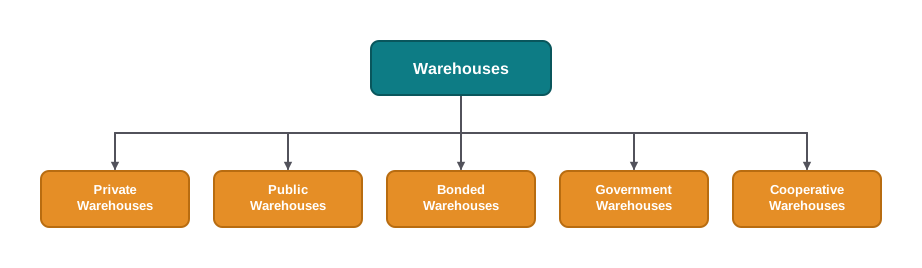
Fig. 4.13 – Types of warehouses.
Private warehouses — private warehouses are operated, owned or leased by a company handling its own goods, such as retail chain stores or multi-brand multi-product companies. As a general rule, an efficient warehouse is planned around a material handling system in order to encourage maximum efficiency of product movement. The benefits of private warehousing include control, flexibility and other benefits such as improved dealer relations.
Public warehouses — public warehouses can be used for the storage of goods by traders, manufacturers or any member of the public after the payment of a storage fee or charges. The government regulates the operation of these warehouses by issuing licences for them to private parties. The owner of the warehouse stands as an agent of the owner of the goods and is expected to take appropriate care of the goods. These warehouses provide other facilities also, such as transportation by rail and road, and they are responsible for the safety of the goods. Small manufacturers find them convenient as they cannot afford to construct their own warehouses. The other benefits include flexibility in the number of locations, no fixed cost, and the capability of offering value added services such as packaging and labelling.
Bonded warehouses — bonded warehouses are licensed by the government to accept imported goods prior to the payment of tax and customs duty. These are goods which are imported from other countries, and importers are not permitted to remove them from the docks or the airport till customs duty is paid. At times importers are not in a position to pay the duty in full, or do not require all the goods immediately. Such goods are kept in bonded warehouses by the customs authorities till the customs duty is paid, and these goods are said to be in bond. These warehouses have facilities for branding, packaging, grading and blending; importers may bring their buyers for inspection of goods and repackage them according to requirements, and thus marketing of goods is facilitated. Goods can be removed in part as and when required by the importers and buyers, and import duty can be paid in instalments. The importer therefore need not block funds for the payment of import duties before the goods are sold or used. Even if he wishes to export the goods kept in the bonded warehouse, he may do so without payment of customs duty. Bonded warehouses thus facilitate entrepot trade.
Government warehouses — these warehouses are fully owned and managed by the government. The government manages them through organisations set up in the public sector, for example the Food Corporation of India, the State Trading Corporation and the Central Warehousing Corporation.
Cooperative warehouses — some marketing cooperative societies or agricultural cooperative societies have set up their own warehouses for the members of their cooperative society.
Functions Of Warehousing
The functions of warehousing go well beyond simple storage, and are discussed below. They are listed in Fig. 4.14.
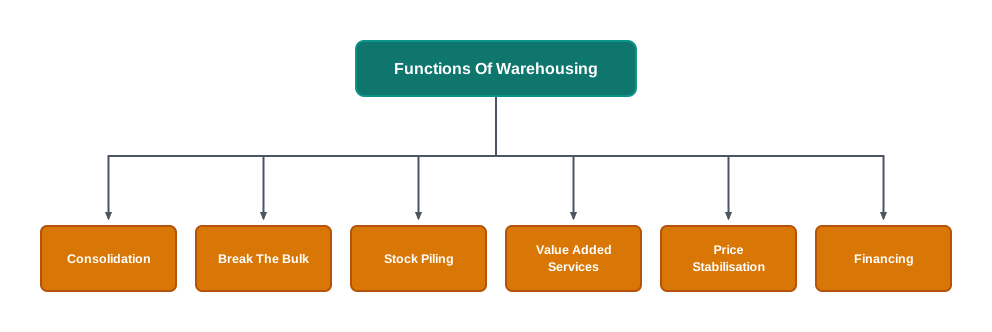
Fig. 4.14 – Functions of warehousing.
- Consolidation — in this function the warehouse receives and consolidates materials and goods from different production plants and despatches the same to a particular customer on a single transportation shipment. The customer thus receives one consignment instead of several, and the transport cost per unit falls. The movement is shown in Fig. 4.15.
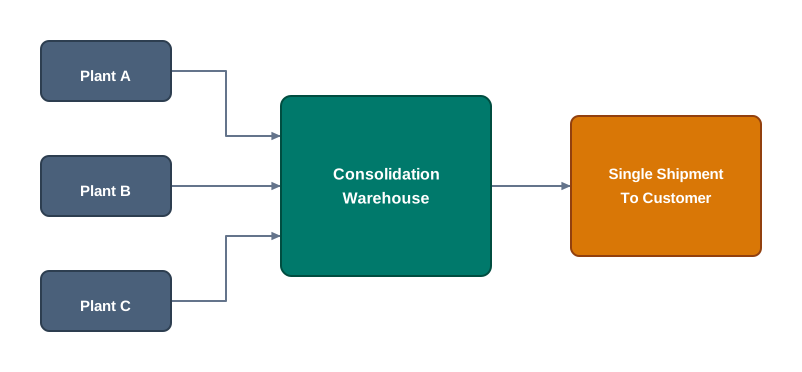
Fig. 4.15 – The consolidation function.
- Break the bulk — the warehouse performs the function of dividing the bulk quantity of goods received from the production plants into smaller quantities. These smaller quantities are then transported according to the requirements of clients to their places of business. This movement is shown in Fig. 4.16.
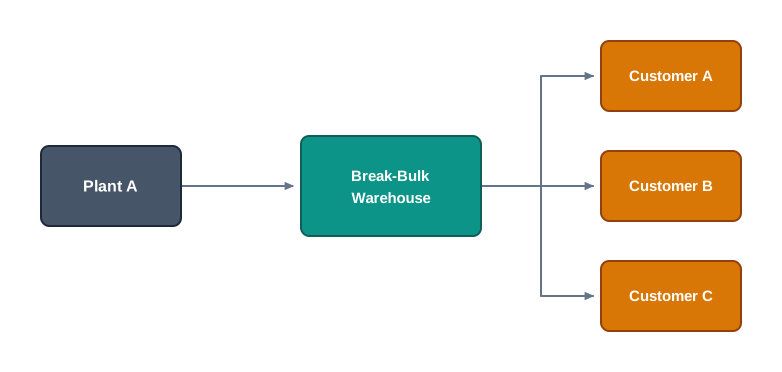
Fig. 4.16 – The break-bulk function.
Stock piling — the next function of warehousing is the seasonal storage of goods for select businesses. Goods or raw materials which are not required immediately for sale or manufacturing are stored in warehouses, and are made available to business depending on customers’ demand. Agricultural products, which are harvested at specific times but consumed throughout the year, also need to be stored and released in lots.
Value added services — certain value added services are also provided by warehouses, such as in-transit mixing, packaging and labelling. Goods sometimes need to be opened, repackaged and labelled again at the time of inspection by prospective buyers. Grading according to quantity and dividing goods into smaller lots is another such function. In in-transit mixing, goods arriving from different plants are mixed at a transit point so that each customer receives the particular combination of products it has ordered.
Price stabilisation — by adjusting the supply of goods to the demand situation, warehousing performs the function of stabilising prices. Prices are thus controlled when supply is increasing and demand is slack, and the reverse is done when supply is short.
Financing — warehouse owners advance money to the owners of goods on the security of those goods, and further supply goods on credit terms to customers. The owner of the goods therefore does not have to wait for a sale before he has funds to work with.
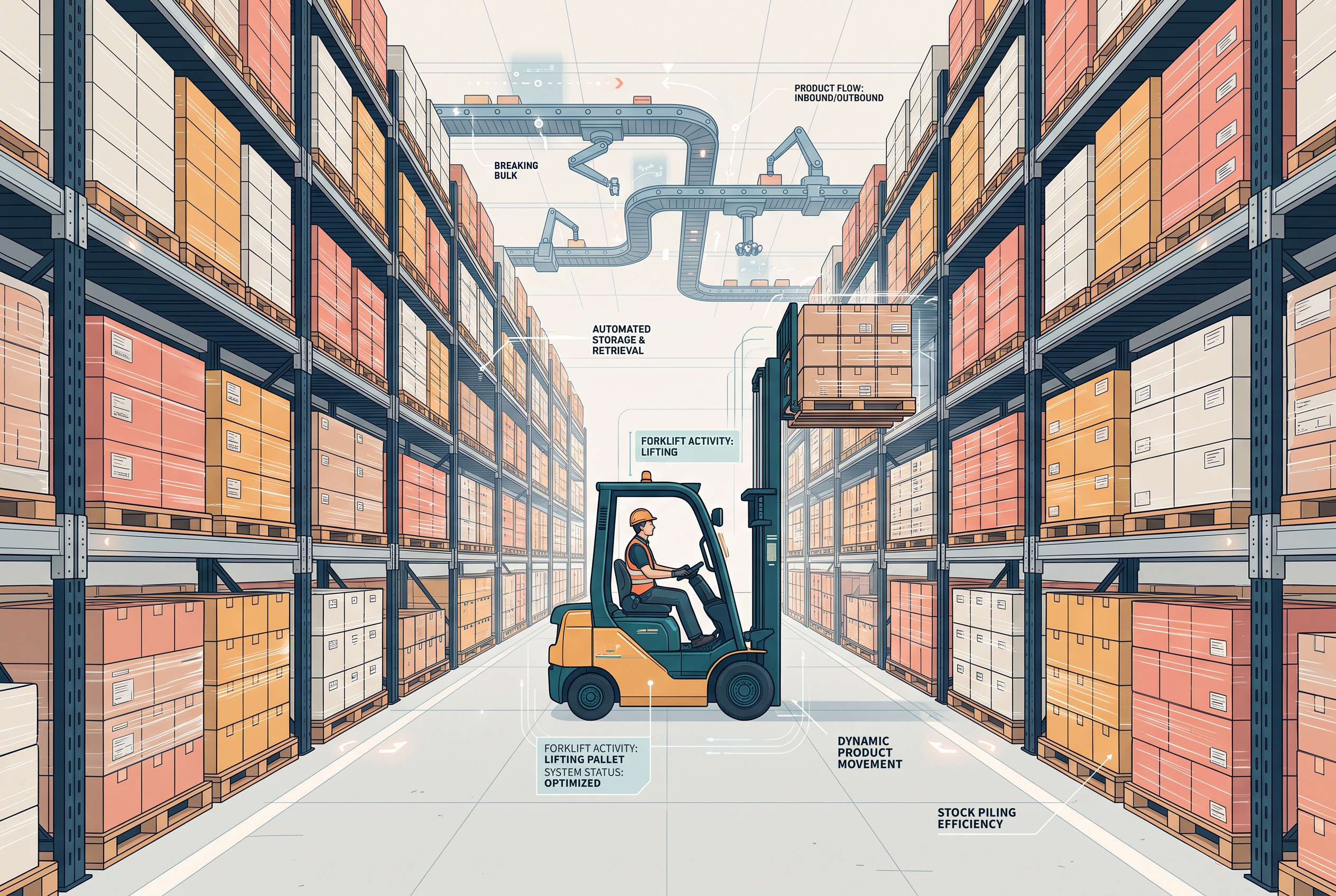
Fig. 4.17 – Inside a modern warehouse.
4.9 Summary
Nature of services — services are those separately identifiable, essentially intangible activities that provide satisfaction of wants and are not necessarily linked to the sale of a product or another service. They have five basic features, which also distinguish them from goods and are known as the five Is of services, that is, intangibility, inconsistency, inseparability, inventory (less) and involvement.
Difference between services and goods — goods are produced, whereas services are performed. A service is an act which cannot be taken home; what can be taken home is the effect of the service. And since services are sold at the point of consumption, there are no inventories of services.
Types of services — services are of three broad types: business services, social services and personal services.
Business services — in order to be competitive, business enterprises are becoming more and more dependent on specialised business services. They look towards banks for the availability of funds, towards insurance companies for getting their plant, machinery and goods insured, towards transport companies for carrying raw material and finished goods, and towards telecom and postal services for staying in touch with vendors, suppliers and customers.
Banking — a banking company in India is one which transacts the business of banking, which means accepting, for the purpose of lending and investment, deposits of money from the public, repayable on demand or otherwise and withdrawable by cheque, draft, order or otherwise.
Type of banks — banks can be classified into commercial banks, cooperative banks, specialised banks and the central bank.
Functions of commercial banks — some functions are the basic or primary functions of a bank while others are agency services or general utility services in nature. They are acceptance of deposits, lending of funds, cheque facility, remittance of funds and allied services.
e-Banking — the latest wave in information technology is internet banking. It is a part of virtual banking and another delivery channel for customers. e-Banking is electronic banking, or banking using electronic media, and it is a service provided by many banks that allows a customer to conduct banking transactions such as managing savings, operating accounts, applying for loans or paying bills over the internet, using a personal computer, mobile telephone or handheld computer.
Insurance — insurance is a device by which the loss likely to be caused by an uncertain event is spread over a number of persons who are exposed to it and who are prepared to insure themselves against such an event. It is a contract under which one party agrees, in return for a consideration, to pay an agreed amount of money to another party to make good a loss, damage or injury to something of value in which the insured has a pecuniary interest as a result of some uncertain event.
Fundamental principle of insurance — an individual or a business concern chooses to spend a definitely known sum in place of a possible huge amount involved in an indefinite future loss. Insurance is therefore a form of risk management used to safeguard against the risk of potential financial loss.
Functions of insurance — providing certainty, protection, risk sharing, and assistance in capital formation.
Utmost good faith — a contract of insurance is a contract of uberrimae fidei, that is, a contract founded on utmost good faith. Both the insurer and the insured must display good faith towards each other in regard to the contract.
Insurable interest — the insured must have an insurable interest in the subject matter of insurance, which means some pecuniary interest in that subject matter.
Indemnity — the insurer undertakes to put the insured, in the event of loss, in the same position that he occupied immediately before the happening of the event insured against.
Proximate cause — when the loss is the result of two or more causes, the proximate cause means the direct, the most dominant and the most effective cause of which the loss is a natural consequence.
Subrogation — this refers to the right of the insurer to stand in the place of the insured, after settlement of a claim, as far as the right of the insured in respect of recovery from an alternative source is involved.
Contribution — it is the right of an insurer who has paid a claim under an insurance to call upon other liable insurers to contribute for the loss payment.
Mitigation — it is the duty of the insured to take reasonable steps to minimise the loss or damage to the insured property.
Life insurance — life insurance is a contract in which the insurer, in consideration of a certain premium, either in a lump sum or by other periodical payments, agrees to pay to the assured, or to the person for whose benefit the policy is taken, the assured sum of money on the happening of a specified event contingent on human life or at the expiry of a certain period. It provides protection to the family at the premature death of an individual, or gives an adequate amount at old age when earning capacities are reduced, and it is therefore a protection as well as a sort of investment, because a certain sum is returnable to the insured at the time of death or at the expiry of a certain period.
Elements of a life insurance contract — the contract must have all the essentials of a valid contract; it is a contract of utmost good faith; the insured must have insurable interest in the life assured; and it is not a contract of indemnity.
Types of life insurance policies — people have different requirements and would like a policy that fulfils all their needs, which may be family needs, children’s needs, old age needs and special needs. Insurers have therefore developed different products such as Whole Life Assurance, Endowment type plans, combinations of Whole Life and Endowment type plans, Children’s Assurance plans and Annuity plans.
Fire insurance — fire insurance is a contract whereby the insurer, in consideration of the premium paid, undertakes to make good any loss or damage caused by fire during a specified period, up to the amount specified in the policy.
Elements of a fire insurance contract — the insured must have insurable interest in the subject matter; the contract is one of utmost good faith, that is, uberrimae fidei; it is a contract of strict indemnity; and the insurer is liable to compensate only when fire is the proximate cause of the damage or loss.
Marine insurance — a marine insurance contract is an agreement whereby the insurer undertakes to indemnify the insured, in the manner and to the extent thereby agreed, against marine losses. It provides protection against loss by marine perils, or perils of the sea, and there are three things involved, that is, ship or hull, cargo or goods, and freight.
Elements of a marine insurance contract — unlike life insurance it is a contract of indemnity; like life and fire insurance it is a contract of utmost good faith; insurable interest must exist at the time of loss; and the principle of causa proxima applies to it.
Communication services — communication services are helpful to business for establishing links with the outside world, that is, with suppliers, customers and competitors. The main services which help business are classified into postal and telecom.
Postal services — the various facilities provided by the postal department are broadly categorised into financial facilities and mail facilities, along with allied facilities such as greeting post, media post, direct post, international money transfer, passport facilities, speed post and e-bill post.
Telecom services — the various types of telecom services are cellular mobile services, fixed line services, cable services, VSAT services and DTH services.
Transportation — transportation comprises freight services together with supporting and auxiliary services by all modes of transportation, that is, rail, road, air and sea, for the movement of goods and the international carriage of passengers.
Warehousing — the warehouse was initially viewed as a static unit for keeping and storing goods in a scientific and systematic manner so as to maintain their original quality, value and usefulness. Today’s warehouses have ceased to be mere storage service providers and have really become logistical service providers in a cost efficient manner.
Types of warehouses — private warehouses, public warehouses, bonded warehouses, government warehouses and cooperative warehouses.
Functions of warehousing — consolidation, break the bulk, stock piling, value added services, price stabilisation and financing.
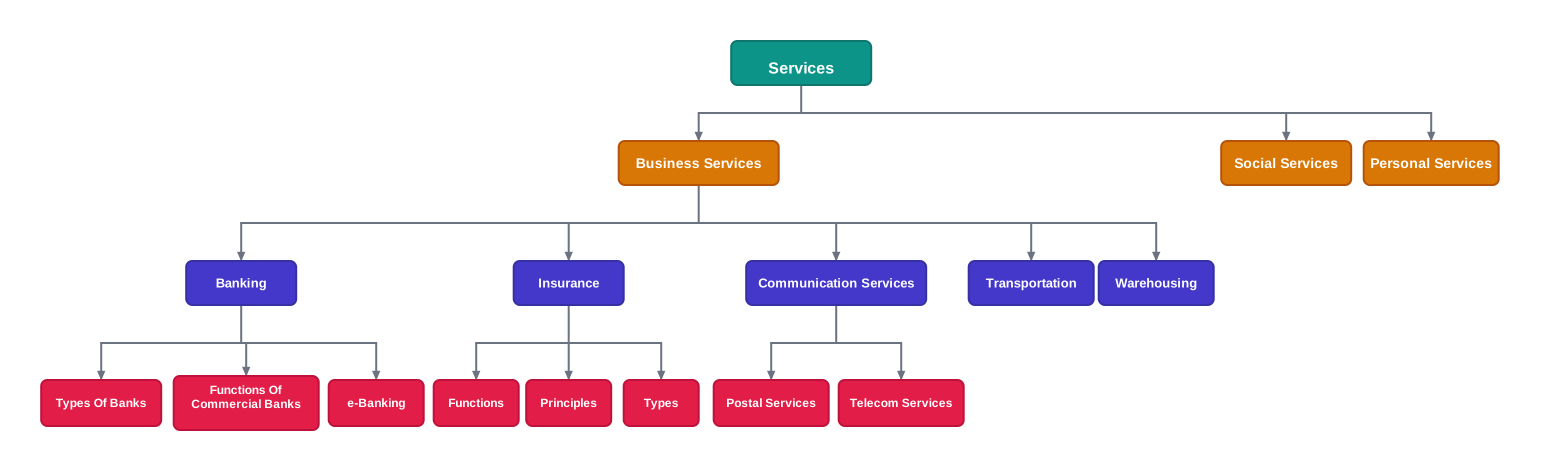
Fig. 4.18 – Structure of the chapter.
4.10 Key Terms
- Services Separately identifiable, essentially intangible activities that provide satisfaction of wants and are not necessarily linked to the sale of a product or another service.
- Goods A physical product capable of being delivered to a purchaser, whose sale involves the transfer of ownership from seller to customer.
- Five Is of services The five basic features of services, namely intangibility, inconsistency, inseparability, inventory (less) and involvement.
- Business services Services used by business enterprises for the conduct of their activities, such as banking, insurance, transportation, warehousing and communication.
- Social services Services generally provided voluntarily in pursuit of certain social goals, usually for a consideration that covers their cost.
- Personal services Services experienced differently by different customers, differing with the provider and with the customer’s preferences.
- Banking Accepting, for the purpose of lending and investment, deposits of money from the public, repayable on demand or otherwise and withdrawable by cheque, draft, order or otherwise.
- Commercial banks Institutions dealing in money, governed by the Indian Banking Regulation Act 1949, and comprising public sector and private sector banks.
- Cooperative banks Banks governed by the State Cooperative Societies Act, meant essentially for providing cheap credit to their members.
- Specialised banks Banks such as foreign exchange, industrial, development and export-import banks that cater to the specific needs of unique activities.
- Central bank The bank that supervises, controls and regulates the activities of all the commercial banks of a country and acts as banker to the government.
- e-Banking Electronic banking, or banking using electronic media, in which a customer conducts banking transactions over the internet using a computer, mobile telephone or handheld computer.
- Insurance A device by which the loss likely to be caused by an uncertain event is spread over a number of persons exposed to it, under a contract to make good that loss for a consideration.
- Policy The written agreement containing all the terms and conditions of the contract of insurance.
- Insured The person whose risk is insured.
- Insurer The firm which insures the risk of loss, also called the assurance underwriter.
- Premium The small periodic payment made by the insured to the insurer in consideration for the cover provided.
- Utmost good faith The principle that both parties to an insurance contract must make a full and accurate disclosure of all material facts to each other.
- Insurable interest Some pecuniary interest of the insured in the subject matter of the insurance contract, such that the insured suffers financially if the insured event occurs.
- Indemnity The principle by which the insurer undertakes to put the insured, in the event of loss, in the same position that he occupied immediately before the happening of the event insured against.
- Proximate cause Where a loss results from two or more causes, the direct, most dominant and most effective cause of which the loss is the natural consequence.
- Subrogation The right of the insurer to stand in the place of the insured, after settlement of a claim, in respect of recovery from an alternative source.
- Contribution The right of an insurer who has paid a claim to call upon other liable insurers to contribute proportionately to the loss payment.
- Mitigation The duty of the insured to take reasonable steps to minimise the loss or damage to the insured property.
- Life insurance A contract in which the insurer, for a certain premium, agrees to pay the assured sum on the happening of a specified event contingent on human life or at the expiry of a certain period.
- Fire insurance A contract whereby the insurer, for the premium paid, undertakes to make good any loss or damage caused by fire during a specified period up to the amount specified in the policy.
- Marine insurance An agreement whereby the insurer undertakes to indemnify the insured, in the manner and to the extent agreed, against marine losses to ship, cargo and freight.
- Communication services Services that help a business establish links with the outside world, classified into postal and telecom services.
- Telecom services Services such as cellular mobile, fixed line, cable, VSAT and DTH services that carry voice, data and media over telecommunication networks.
- Transportation Freight services together with supporting and auxiliary services by rail, road, air and sea for the movement of goods and the international carriage of passengers.
- Warehousing The storage of goods in a scientific and systematic manner so as to maintain their quality, value and usefulness, and to make them available in the right quantity, place and time.
4.11 NCERT Questions
Short Answer Questions
- Define services and goods.
- What is e-banking? What are the advantages of e-banking?
- Write a note on various telecom services available for enhancing business.
- Explain briefly the principles of insurance with suitable examples.
- Explain warehousing and its functions.
Long Answer Questions
- What are services? Explain their distinct characteristics.
- Explain the functions of commercial banks with an example of each.
- Write a detailed note on various facilities offered by the Indian Postal Department.
- Describe various types of insurance and examine the nature of risks protected by each type of insurance.
- Explain in detail the warehousing services.
4.12 Check Your Concepts
- Why can the quality of a service usually not be judged before it is purchased? State the implication of this for a service provider.
- A railway ticket can be stored but a railway journey cannot. Which feature of services does this illustrate, and why does it force a provider to manage demand and supply carefully?
- Distinguish between services and goods on any four bases.
- Why does a public sector bank place greater emphasis on social objectives than on profitability?
- Arrange the following in the correct sequence in which they occur in a fire insurance claim: loss occurs; premium is paid; proposal is accepted and policy is issued; insurer verifies that fire was the proximate cause; actual loss is compensated after deducting depreciation.
- Identify the term: the right of an insurer who has settled a claim to take over ownership of the damaged property.
- Why is the principle of indemnity not applicable to life insurance?
- What happens to an insurance contract if the insured fails to disclose a material fact at the time of taking the policy?
- Assertion — insurable interest in fire insurance must exist both at the time of taking the policy and at the time of loss. Reason — fire insurance is a contract of strict indemnity under which the insured can recover only the actual loss suffered. State whether the assertion and the reason are true, and whether the reason correctly explains the assertion.
- Distinguish between a bonded warehouse and a public warehouse on any three bases.
- Why do agricultural products in particular require the stock piling function of warehousing?
- Match each function of warehousing with the situation that illustrates it:
| Column A | Column B |
|---|---|
| a. Consolidation | i. A warehouse advances money to the owner of the goods on the security of those goods |
| b. Break the bulk | ii. Goods received from three different plants are despatched to one customer in a single shipment |
| c. Value added services | iii. Goods are opened, repackaged, labelled and graded before delivery |
| d. Financing | iv. One large consignment received from a plant is divided into smaller lots for several customers |
- What would happen to a business enterprise if communication services were unavailable to it for a month? Explain with reference to any two parties with whom it must remain in contact.
- Identify the term: a satellite-based communication service that provides reliable links to businesses and government agencies even in remote areas.
- Why is transportation described as a service that removes the hindrance of place?
4.13 Case-Based Questions
- Shreyas Ceramics Ltd. manufactures tiles at two plants and sells across the country. It borrows working capital from a bank, gets its kiln and stock covered against fire, hires a transporter to move tiles to dealers, keeps unsold stock in rented storage space near each market, and confirms dealer orders over the telephone and internet.
- Name the category of services that Shreyas Ceramics Ltd. is using.
- Identify any four such services referred to in the passage.
- State one reason why a manufacturing firm prefers to buy these services from outside rather than perform them itself.
- Ritika opens an account in which she can withdraw money up to the balance available at any time without prior notice, since she needs to make frequent payments to suppliers. Her brother opens another account for a fixed period of three years at a higher rate of interest, and is told that if he withdraws early, a part of the interest will be forfeited. Both use the bank’s website to transfer money to other cities.
- Name the two types of deposit accounts referred to in the passage.
- Name the function of a commercial bank under which both accounts fall.
- State any two benefits the brother and sister get from using the bank’s internet facility.
- Kartik takes a policy on the warehouse in which he stores his stock. A fire breaks out in the adjoining unit and spreads to his warehouse. Kartik notices the fire early but does nothing to move the stock that could easily have been shifted to safety. He later claims the full value of the destroyed stock, which is more than the actual loss he has suffered.
- Name the principle of insurance that Kartik has failed to observe in not moving the stock.
- Name the principle under which he cannot recover more than the actual loss suffered.
- State whether the insurer would be liable if the damage had been caused by overheating without ignition, and give a reason.
- Nandini Exports imports fittings from abroad and lands them at the port. It does not need all the fittings at once and cannot pay the entire customs duty immediately, so the consignment is kept in a licensed storage facility from which goods are withdrawn in lots. A part of the consignment is later re-exported directly from that facility.
- Identify the type of warehouse being used.
- State two benefits the importer gets from storing goods in this type of warehouse.
- Name the trade that such warehouses are said to facilitate.
Social Security Schemes
The Government of India also operates schemes that extend insurance and pension cover to people who might otherwise remain outside the formal system.
Atal Pension Yojana — this scheme is offered to individuals in the age group of 18 to 40 years. The individual is expected to contribute to the scheme until he or she attains the age of 60 years. The scheme acts as an investment for availing an old-age pension.
Pradhan Mantri Suraksha Bima Yojana — this scheme offers accidental and disability cover of Rs. 2 lakh at a premium of Rs. 12 per year. Any individual holding a savings account can be enrolled under this scheme.
Pradhan Mantri Jan Dhan Yojana — the scheme offers a savings account with no minimum balance. The Rupay ATM-cum-Debit card carries an in-built accident cover of Rs. 1,00,000 and life cover of Rs. 30,000. The scheme is suitable for economically weaker sections of society.
Pradhan Mantri Jeevan Jyoti Bima Yojana — the scheme offers a protection term insurance cover of Rs 2,00,000 to the dependents of the policy holder in the event of his or her death, at a premium of Rs. 330 per year. Any individual in the age group of 18-70 years having a savings account can opt for this scheme.
Case 4.4 — Two Policies On One Godown Kailash Cotton Mills insures its godown with two different insurance companies for the same period. A fire destroys stock worth a part of the insured value. The mill claims the full loss from the first insurer, which settles it and then approaches the second insurer. Q. Name the principle of insurance under which the first insurer can approach the second, and state what it prevents the insured from doing.
Fig. 4.8 – Cargo being loaded at an Indian port.