Chapter 8: Sources of Business Finance
Every business, from a single-owner grocery store to a large manufacturing company, needs money before it can begin work and more money to keep that work going. Land has to be bought, machines installed, raw materials purchased, salaries paid and stocks built up before the first rupee of sale is received. The owner’s own savings rarely cover all of this.
Consider a small food-processing unit that has been selling steadily in one district and now wants to supply three more. It needs a larger plant, more raw material and more staff. The owner must decide where the additional money will come from — retained profit, a bank loan, credit from suppliers, or, if it is a company, an issue of shares or debentures. Each of these carries a different cost, a different repayment obligation and a different effect on ownership and control.
This chapter explains what business finance means, why funds are needed, how the sources of funds are classified, what each source offers and costs, what international sources are available, and which factors guide the final choice of a source.

Fig. 8.0 – Raising funds for a growing business.
8.1 Introduction
Money is needed at every stage of a business. It is needed before the business starts, when the owner has to buy assets and arrange stock, and it is needed continuously afterwards, when wages, rent and bills have to be paid. It is needed again when the business grows and wants to produce more, sell in new places or replace old machinery.
The person who owns the business cannot always supply all of this money from personal savings. Funds therefore have to be obtained from outside — from suppliers, lenders, investors or the public. Each of these routes is called a source of finance.
This chapter gives an overview of the various sources from which funds can be obtained, both for starting a business and for running it. It also explains the advantages and limitations of each source, and points out the factors that decide which source is suitable in a given situation.
Why This Knowledge Matters
Anyone planning to start a business must know where money can be raised from, because a business that cannot arrange funds on time is forced to stop work even when its product is selling well.
It is equally important to know the relative merits and demerits of the different sources. No source is free of drawbacks. A loan has to be repaid with interest whether or not the business earns a profit, while funds raised from owners do not have to be repaid but reduce the original owner’s share of control. Comparing sources on such points is what allows an appropriate choice to be made.
8.2 Meaning, Nature And Significance Of Business Finance
Business is concerned with the production and distribution of goods and services to satisfy the needs of society. To carry out these activities a business must buy assets, employ people, purchase materials and meet running expenses. All of this requires money. For this reason finance is called the life blood of any business — like blood in the body, it must keep flowing for every other part to work.
The money required by a business to carry out its various activities is called business finance.
A business cannot function unless adequate funds are made available to it. The initial capital contributed by the entrepreneur is not always sufficient to take care of all the financial requirements of the business. The business person therefore has to look for other sources from which the need for funds can be met. A clear assessment of the financial needs, together with the identification of the sources available, is thus a significant part of running a business organisation.
The need for funds arises from the very stage at which an entrepreneur decides to start a business. Some funds are needed immediately, for example to purchase plant and machinery, furniture and other fixed assets. Some funds are required for day-to-day operations, such as buying raw materials and paying salaries to employees. Funds are needed once again when the business expands.
8.2.1 Financial Needs Of A Business
The financial needs of a business can be placed in two categories, described below.
Fixed capital requirements — in order to start a business, funds are required to purchase fixed assets like land and building, plant and machinery, and furniture and fixtures. This is known as the fixed capital requirement of the enterprise. The funds invested in fixed assets remain locked in the business for a long period of time. Different business units need varying amounts of fixed capital depending on factors such as the nature of the business. A trading concern, for example, may require a small amount of fixed capital as compared to a manufacturing concern. Similarly, the need for fixed capital investment would be greater for a large enterprise than for a small one.
Working capital requirements — the financial requirements of an enterprise do not end with the purchase of fixed assets. No matter how small or large a business is, it needs funds for its day-to-day operations. This is known as the working capital of an enterprise. It is used for holding current assets such as stock of material and bills receivables, and for meeting current expenses like salaries, wages, taxes and rent.
The amount of working capital required varies from one business concern to another depending on various factors. A business unit that sells goods on credit, or has a slow sales turnover, would require more working capital than a concern selling its goods and services on a cash basis or having a speedier turnover. The reason is straightforward: when money is tied up in unsold stock or in amounts due from customers, the firm must find funds elsewhere to meet its running expenses in the meantime.
Growth Increases The Need
The requirement for both fixed and working capital increases as the business grows and expands. At times additional funds are required for upgrading the technology employed, so that the cost of production or operations can be reduced.
Larger funds may also be required for building higher inventories for the festive season, for meeting current debts, for expanding the business, or for shifting to a new location. Since these needs differ in size, purpose and duration, it is important to evaluate carefully the different sources from which funds can be raised.
8.3 Classification Of Sources Of Funds
In the case of proprietary and partnership concerns, funds may be raised either from the personal sources of the owners or by borrowing from banks, friends and others. In the case of the company form of organisation, a much wider set of sources becomes available.
These sources are not studied one after another in a random order. They are grouped, because grouping makes comparison possible. The same source can be looked at in three different ways — how long the money stays with the business, who supplies it, and whether it comes from inside or outside the organisation. The three bases of classification are shown in Fig. 8.1.
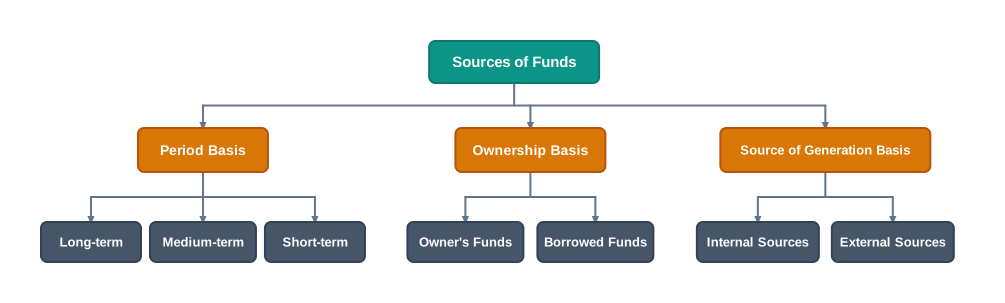
Fig. 8.1 – Bases of classifying sources of funds.
A brief explanation of these classifications, and of the sources falling under each, is given below.
8.3.1 Period Basis
On the basis of period, the different sources of funds can be categorised into three parts. These are long-term sources, medium-term sources and short-term sources. The logic behind this grouping is simple — funds needed for a long time should be raised from a source that does not demand quick repayment, otherwise the business will face a repayment date long before the asset it bought has earned anything.
Long-term sources fulfil the financial requirements of an enterprise for a period exceeding five years. They include shares and debentures, long-term borrowings and loans from financial institutions. Such financing is generally required for the acquisition of fixed assets such as equipment and plant.
Medium-term sources are used where funds are required for a period of more than one year but less than five years. These sources include borrowings from commercial banks, public deposits, lease financing and loans from financial institutions.
Short-term sources provide funds required for a period not exceeding one year. Trade credit, loans from commercial banks and commercial papers are some examples of sources that provide funds for a short duration.
Short-term financing is most common for financing current assets such as accounts receivable and inventories. Seasonal businesses that must build inventories in anticipation of selling requirements often need short-term financing for the interim period between seasons. Wholesalers and manufacturers with a major portion of their assets tied up in inventories or receivables also require large amounts of funds for a short period.
The sources falling under each period category are summarised in Fig. 8.2.
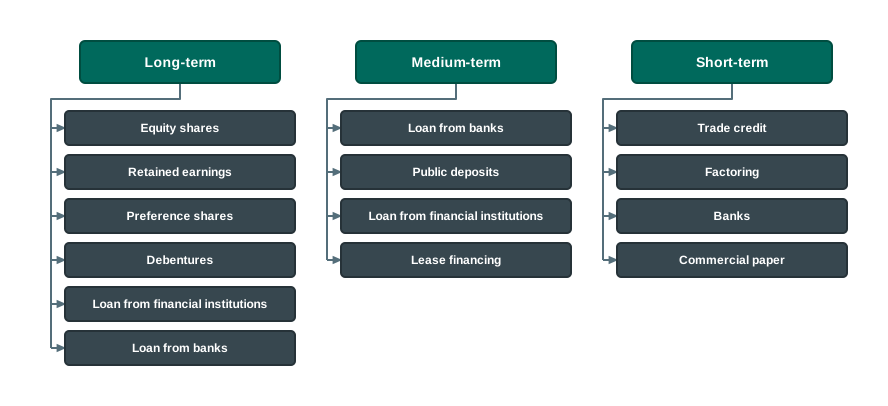
Fig. 8.2 – Sources classified on the basis of period.
8.3.2 Ownership Basis
On the basis of ownership, the sources can be classified into ‘owner’s funds’ and ‘borrowed funds’.
Owner’s funds means funds that are provided by the owners of an enterprise, who may be a sole trader, partners or the shareholders of a company. Apart from the capital they bring in, owner’s funds also include profits reinvested in the business.
The owner’s capital remains invested in the business for a longer duration and is not required to be refunded during the life period of the business. Such capital forms the basis on which owners acquire their right of control over management — the money is at risk, so the right to decide goes with it. Issue of equity shares and retained earnings are the two important sources from which owner’s funds can be obtained.
Borrowed funds, on the other hand, refer to funds raised through loans or borrowings. The sources for raising borrowed funds include loans from commercial banks, loans from financial institutions, issue of debentures, public deposits and trade credit.
Such sources provide funds for a specified period, on certain terms and conditions, and have to be repaid after the expiry of that period. A fixed rate of interest is paid by the borrowers on such funds. At times this puts a heavy burden on the business, because interest has to be paid even when earnings are low or a loss is incurred. Borrowed funds are generally provided on the security of some fixed assets.
The two are compared in Table 8.1.
8.3.3 Source Of Generation Basis
Another basis of categorising the sources of funds is whether the funds are generated from within the organisation or from external sources.
Internal sources of funds are those that are generated from within the business. A business, for example, can generate funds internally by accelerating the collection of receivables, disposing of surplus inventories, and ploughing back its profit. Internal sources can fulfil only limited needs of the business, since the amounts involved depend on how much the business itself has earned or can release.
External sources of funds include those sources that lie outside the organisation, such as suppliers, lenders and investors. When a large amount of money has to be raised, it is generally done through external sources.
External funds may be costly as compared to those raised through internal sources, because the outsider supplying them expects a return for parting with the money and for accepting risk. In some cases the business is required to mortgage its assets as security while obtaining funds from external sources. Issue of debentures, borrowing from commercial banks and financial institutions, and accepting public deposits are some common examples of external sources of funds.
8.4 Sources Of Finance
A business can raise funds from a number of different sources. Each source has its own characteristics, which must be properly understood so that the best available source of raising funds can be identified.
There is no single best source of funds for all organisations. Depending on the situation, the purpose, the cost and the risk involved, a choice may be made about the source to be used. If a business wants to raise funds for meeting fixed capital requirements, long-term funds are required, and these may be raised in the form of owned funds or borrowed funds. If the purpose is to meet day-to-day requirements, short-term sources may be tapped.
A brief description of the various sources, along with their advantages and limitations, is given below.
8.4.1 Retained Earnings
A company generally does not distribute all its earnings among the shareholders as dividends. A portion of the net earnings may be kept back in the business for use in the future. This is known as retained earnings. It is a source of internal financing, also called self-financing or ‘ploughing back of profits’.
The profit available for ploughing back in an organisation depends on many factors such as net profits earned, the dividend policy followed and the age of the organisation. An older, well-established firm usually has larger accumulated profits than a newly formed one.
Merits
The merits of retained earnings as a source of finance are as follows:
Permanent source — retained earnings are a permanent source of funds available to an organisation.
No explicit cost — they do not involve any explicit cost in the form of interest, dividend or floatation cost.
Operational freedom — as the funds are generated internally, there is a greater degree of operational freedom and flexibility.
Cushion against losses — they enhance the capacity of the business to absorb unexpected losses.
Higher market price — retained earnings may lead to an increase in the market price of the equity shares of a company.
Limitations
Retained earnings as a source of funds have the following limitations:
Shareholder dissatisfaction — excessive ploughing back may cause dissatisfaction among the shareholders, as they would get lower dividends.
Uncertain source — it is an uncertain source of funds, as the profits of a business keep fluctuating.
Opportunity cost ignored — the opportunity cost associated with these funds is not recognised by many firms. This may lead to sub-optimal use of the funds.
8.4.2 Trade Credit
Trade credit is the credit extended by one trader to another for the purchase of goods and services. It allows a firm to obtain supplies without making immediate payment. Such credit appears in the records of the buyer of goods as ‘sundry creditors’ or ‘accounts payable’.
Trade credit is commonly used by business organisations as a source of short-term financing. It is granted to those customers who have a reasonable amount of financial standing and goodwill, since the seller is in effect lending goods and must be confident of payment.
The volume and period of credit extended depend on factors such as the reputation of the purchasing firm, the financial position of the seller, the volume of purchases, the past record of payment and the degree of competition in the market. Terms of trade credit vary from one industry to another and from one person to another, and a firm may offer different credit terms to different customers.
Merits
The important merits of trade credit are as follows:
Convenient source — trade credit is a convenient and continuous source of funds.
Ready availability — trade credit may be readily available where the credit worthiness of the customer is known to the seller.
Promotion of sales — trade credit helps to promote the sales of an organisation.
Support for higher inventory — if an organisation wants to increase its inventory level to meet an expected rise in sales volume in the near future, it may use trade credit to finance the same.
No charge on assets — it does not create any charge on the assets of the firm while providing funds.
Limitations
Trade credit as a source of funds has certain limitations, given as follows:
Risk of overtrading — the availability of easy and flexible trade credit facilities may induce a firm to indulge in overtrading, which may add to the risks of the firm.
Limited funds — only a limited amount of funds can be generated through trade credit.
Costly source — it is generally a costly source of funds as compared to most other sources of raising money.
8.4.3 Factoring
Factoring is a financial service under which an agency known as the ‘factor’ renders various services to a business. These services are of two broad kinds.
Discounting of bills and collection of the client’s debts — under this, the receivables arising from the sale of goods or services are sold to the factor at a certain discount. The factor becomes responsible for all credit control and debt collection from the buyer and provides protection against bad debt losses to the firm. There are two methods of factoring — recourse and non-recourse. Under recourse factoring the client is not protected against the risk of bad debts. Under non-recourse factoring the factor assumes the entire credit risk, that is, the full amount of the invoice is paid to the client even if the debt becomes bad.
Providing information about credit worthiness of prospective clients — factors hold large amounts of information about the trading histories of firms. This can be valuable to those using factoring services, as it helps them avoid doing business with customers having a poor payment record. Factors may also offer relevant consultancy services in the areas of finance, marketing and similar fields.
The factor charges fees for the services rendered. Factoring appeared on the Indian financial scene only in the early nineties as a result of initiatives taken by the Reserve Bank of India. Organisations providing such services include SBI Factors and Commercial Services Ltd., Canbank Factors Ltd., Foremost Factors Ltd., State Bank of India, Canara Bank, Punjab National Bank and Allahabad Bank. In addition, many non-banking finance companies and other agencies provide factoring services.
Merits
The merits of factoring as a source of finance are as follows:
Cheaper source — obtaining funds through factoring is cheaper than financing through other means such as bank credit.
Prompt payment of liabilities — with the cash flow accelerated by factoring, the client is able to meet his or her liabilities promptly as and when these arise.
Flexibility and certainty — factoring is flexible and ensures a definite pattern of cash inflows from credit sales. It provides security for a debt that a firm might otherwise be unable to obtain.
No charge on assets — it does not create any charge on the assets of the firm.
Freedom to focus elsewhere — the client can concentrate on other functional areas of business, as the responsibility of credit control is shouldered by the factor.
Limitations
The limitations of factoring as a source of finance are as follows:
Expensive for small invoices — this source is expensive when the invoices are numerous and smaller in amount.
Higher interest cost — the advance finance provided by the factor firm is generally available at a higher interest cost than the usual rate of interest.
Third party involvement — the factor is a third party to the customer, who may not feel comfortable while dealing with it.
8.4.4 Lease Financing
A lease is a contractual agreement whereby one party, the owner of an asset, grants the other party the right to use that asset in return for a periodic payment. In other words, it is the renting of an asset for a specified period.
The owner of the asset is called the lessor, while the party that uses the asset is known as the lessee. The lessee pays a fixed periodic amount called lease rental to the lessor for the use of the asset. The terms and conditions regulating the lease arrangement are set out in the lease contract. At the end of the lease period the asset goes back to the lessor.
Lease finance provides an important means of modernisation and diversification to a firm, because it allows the firm to use an asset without paying its full price. Such financing is more common in the acquisition of assets such as computers and electronic equipment, which become obsolete quickly because of fast changing technology. While making the leasing decision, the cost of leasing an asset must be compared with the cost of owning the same asset.
Merits
The important merits of lease financing are as follows:
Lower investment — it enables the lessee to acquire the asset with a lower investment.
Simple documentation — simple documentation makes it easier to finance assets.
Tax deduction — lease rentals paid by the lessee are deductible for computing taxable profits.
No dilution of ownership — it provides finance without diluting the ownership or control of the business.
Debt capacity unaffected — the lease agreement does not affect the debt raising capacity of an enterprise.
Protection from obsolescence — the risk of obsolescence is borne by the lessor. This allows greater flexibility to the lessee to replace the asset.
Limitations
The limitations of lease financing are given below:
Restrictions on use — a lease arrangement may impose certain restrictions on the use of assets. For example, it may not allow the lessee to make any alteration or modification in the asset.
Risk of non-renewal — normal business operations may be affected in case the lease is not renewed.
Higher payout on early termination — it may result in a higher payout obligation if the equipment is not found useful and the lessee opts for premature termination of the lease agreement.
No ownership — the lessee never becomes the owner of the asset. This deprives the lessee of the residual value of the asset.
8.4.5 Public Deposits
The deposits that are raised by organisations directly from the public are known as public deposits. Rates of interest offered on public deposits are usually higher than those offered on bank deposits.
Any person interested in depositing money with an organisation can do so by filling up a prescribed form. The organisation in return issues a deposit receipt as acknowledgment of the debt. Public deposits can take care of both medium-term and short-term financial requirements of a business.
The deposits are beneficial to both the depositor and the organisation. While depositors get a higher interest rate than that offered by banks, the cost of deposits to the company is less than the cost of borrowings from banks. Companies generally invite public deposits for a period of up to three years. The acceptance of public deposits is regulated by the Reserve Bank of India.
Merits
The merits of public deposits are as follows:
Simple procedure — the procedure of obtaining deposits is simple and does not contain restrictive conditions of the kind generally found in a loan agreement.
Lower cost — the cost of public deposits is generally lower than the cost of borrowings from banks and financial institutions.
No charge on assets — public deposits do not usually create any charge on the assets of the company. The assets remain free to be used as security for raising loans from other sources.
No dilution of control — as the depositors do not have voting rights, the control of the company is not diluted.
Limitations
The major limitations of public deposits are as follows:
Difficult for new companies — new companies generally find it difficult to raise funds through public deposits.
Unreliable source — it is an unreliable source of finance, as the public may not respond when the company needs money.
Difficulty in collection — collection of public deposits may prove difficult, particularly when the size of the deposits required is large.
8.4.6 Commercial Paper
Commercial paper, usually written as CP, is an unsecured money market instrument issued in the form of a promissory note. It was introduced in India in 1990 to enable highly rated corporate borrowers to diversify their sources of short-term borrowings and to provide an additional instrument to investors.
Subsequently, primary dealers and all-India financial institutions were also permitted to issue commercial paper, so that they could meet the short-term funding requirements of their operations.
Individuals, banking companies, other corporate bodies registered or incorporated in India, unincorporated bodies, Non-Resident Indians and Foreign Institutional Investors can invest in commercial paper. It can be issued for maturities between a minimum of seven days and a maximum of up to one year from the date of issue, in denominations of Rs. 5 lakh or multiples thereof. However, the maturity date of the commercial paper should not go beyond the date up to which the credit rating of the issuer is valid.
Merits
The merits of commercial paper are as follows:
No restrictive conditions — commercial paper is sold on an unsecured basis and does not contain any restrictive conditions.
High liquidity — as it is a freely transferable instrument, it has high liquidity.
Larger and cheaper funds — it provides more funds compared to other sources, and generally the cost of commercial paper to the issuing firm is lower than the cost of commercial bank loans.
Continuous source — commercial paper provides a continuous source of funds, because its maturity can be tailored to suit the requirements of the issuing firm. Further, maturing commercial paper can be repaid by selling new commercial paper.
Use of surplus funds — companies can park their excess funds in commercial paper and thereby earn a good return on the same.
Limitations
The limitations of commercial paper are as follows:
Available only to sound firms — only financially sound and highly rated firms can raise money through commercial paper. New and moderately rated firms are not in a position to raise funds by this method.
Limited size — the amount of money that can be raised through commercial paper is limited to the excess liquidity available with the suppliers of funds at a particular time.
Impersonal method — commercial paper is an impersonal method of financing. As such, if a firm is not in a position to redeem its paper due to financial difficulties, extending the maturity of a commercial paper is not possible.
8.4.7 Issue Of Shares
The capital obtained by the issue of shares is known as share capital. The capital of a company is divided into small units called shares, and each share has its nominal value. For example, a company can issue 1,00,000 shares of Rs. 10 each for a total value of Rs. 10,00,000. The person holding the share is known as a shareholder.
There are two types of shares normally issued by a company. These are equity shares and preference shares. The money raised by the issue of equity shares is called equity share capital, while the money raised by the issue of preference shares is called preference share capital.
8.4.7.2 Preference Shares
The capital raised by the issue of preference shares is called preference share capital. The preference shareholders enjoy a preferential position over equity shareholders in two ways: they receive a fixed rate of dividend out of the net profits of the company before any dividend is declared for equity shareholders, and they receive their capital after the claims of the company’s creditors have been settled at the time of liquidation.
In other words, as compared to equity shareholders, preference shareholders have a preferential claim over dividend and over the repayment of capital.
Preference shares resemble debentures, as they bear a fixed rate of return. At the same time, since the dividend is payable only at the discretion of the directors and only out of profit after tax, to that extent they resemble equity shares. Preference shares therefore have some characteristics of both equity shares and debentures. Preference shareholders generally do not enjoy any voting rights.
A company can issue different types of preference shares, as shown in Fig. 8.3.
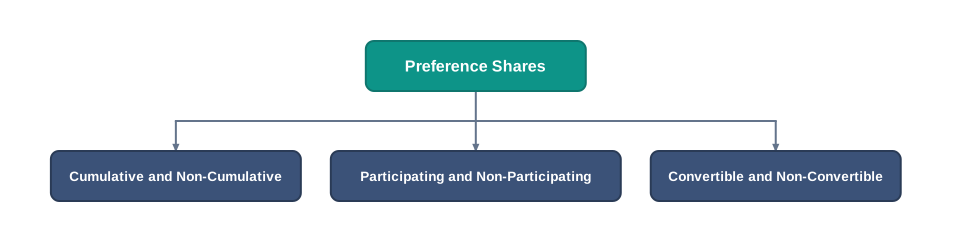
Fig. 8.3 – Types of preference shares.
Cumulative preference shares enjoy the right to accumulate unpaid dividends in future years if the dividend is not paid during a year. On non-cumulative shares, dividend is not accumulated if it is not paid in a particular year.
Participating preference shares have a right to participate in the further surplus of a company after dividend at a certain rate has been paid on equity shares. Non-participating preference shares do not enjoy such rights of participation in the profits of the company.
Convertible preference shares are those that can be converted into equity shares within a specified period of time. Non-convertible preference shares cannot be converted into equity shares.
Merits
The merits of preference shares are given as follows:
Steady income — preference shares provide reasonably steady income in the form of a fixed rate of return and safety of investment.
Suitable for cautious investors — preference shares are useful for those investors who want a fixed rate of return with comparatively low risk.
Control unaffected — they do not affect the control of equity shareholders over the management, as preference shareholders do not have voting rights.
Higher equity dividend possible — payment of a fixed rate of dividend to preference shares may enable a company to declare higher rates of dividend for the equity shareholders in good times.
Preference in repayment — preference shareholders have a preferential right of repayment over equity shareholders in the event of liquidation of a company.
No charge on assets — preference capital does not create any sort of charge against the assets of a company.
Limitations
The major limitations of preference shares as a source of business finance are as follows:
Not for risk takers — preference shares are not suitable for those investors who are willing to take risk and are interested in higher returns.
Dilution of equity claims — preference capital dilutes the claims of equity shareholders over the assets of the company.
Costlier than debentures — the rate of dividend on preference shares is generally higher than the rate of interest on debentures.
No assured return — as the dividend on these shares is to be paid only when the company earns a profit, there is no assured return for the investors. Thus these shares may not be very attractive to investors.
No tax saving — the dividend paid is not deductible from profits as an expense. Thus there is no tax saving of the kind available in the case of interest on loans.
The two types of shares are compared in Table 8.2.
8.4.8 Debentures
Debentures are an important instrument for raising long-term debt capital. A company can raise funds through the issue of debentures, which bear a fixed rate of interest.
A debenture issued by a company is an acknowledgment that the company has borrowed a certain amount of money, which it promises to repay at a future date. Debenture holders are therefore termed as creditors of the company, not owners. They are paid a fixed stated amount of interest at specified intervals, say six months or one year.
A public issue of debentures requires that the issue be rated by a credit rating agency such as CRISIL, that is, Credit Rating and Information Services of India Ltd. The rating takes into account the track record of the company, its profitability, its debt servicing capacity, its credit worthiness and the perceived risk of lending. Such a rating exists so that an investor who cannot examine the company’s accounts personally still has a reliable signal of how safe the investment is.
A company can issue different types of debentures, as shown in Fig. 8.4. The issue of Zero Interest Debentures, which do not carry any explicit rate of interest, has also become popular in recent years. In their case the difference between the face value of the debenture and its purchase price is the return to the investor.
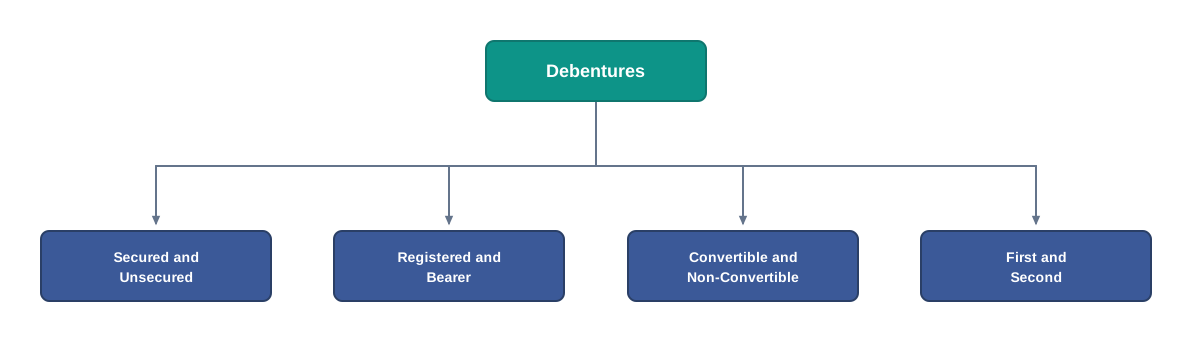
Fig. 8.4 – Types of debentures.
Secured debentures create a charge on the assets of the company, thereby mortgaging those assets. Unsecured debentures do not carry any charge or security on the assets of the company.
Registered debentures are those duly recorded in the register of debenture holders maintained by the company, and can be transferred only through a regular instrument of transfer. Bearer debentures are transferable by mere delivery.
Convertible debentures can be converted into equity shares after the expiry of a specified period. Non-convertible debentures cannot be converted into equity shares.
First debentures are those repaid before other debentures. Second debentures are those paid after the first debentures have been paid back.
Merits
The merits of raising funds through debentures are given as follows:
Preferred by cautious investors — debentures are preferred by investors who want a fixed income at lesser risk.
No share in profits — debentures are fixed charge funds and do not participate in the profits of the company.
Suitable with stable earnings — the issue of debentures is suitable in a situation where sales and earnings are relatively stable.
No dilution of control — as debentures do not carry voting rights, financing through debentures does not dilute the control of equity shareholders over management.
Lower cost — financing through debentures is less costly as compared to the cost of preference or equity capital, as the interest payment on debentures is tax deductible.
Limitations
Debentures as a source of funds have certain limitations. These are given as follows:
Permanent burden — as fixed charge instruments, debentures put a permanent burden on the earnings of a company. There is a greater risk when the earnings of the company fluctuate.
Repayment obligation — in the case of redeemable debentures, the company has to make provisions for repayment on the specified date, even during periods of financial difficulty.
Reduced borrowing capacity — each company has a certain borrowing capacity. With the issue of debentures, the capacity of the company to borrow further funds is reduced.
The difference between shares and debentures is a frequent point of confusion and is set out in Table 8.3.
8.4.9 Commercial Banks
Commercial banks occupy a vital position as a source of finance, as they provide funds for different purposes and for different time periods. Banks extend loans to firms of all sizes and in many ways, such as cash credit, overdraft, term loans, purchase or discounting of bills, and the issue of a letter of credit.
The rate of interest charged by banks depends on various factors, such as the characteristics of the firm and the level of interest rates in the economy. The loan is repaid either in a lump sum or in instalments.
Bank credit is not a permanent source of funds. Though banks have started extending loans for longer periods, generally such loans are used for medium to short periods. The borrower is required to provide some security or create a charge on the assets of the firm before a loan is sanctioned by a commercial bank.
Merits
The merits of raising funds from a commercial bank are as follows:
Timely assistance — banks provide timely assistance to business by providing funds as and when needed.
Secrecy — secrecy of business can be maintained, as the information supplied to the bank by borrowers is kept confidential.
Easier procedure — formalities such as the issue of a prospectus and underwriting are not required for raising loans from a bank. This therefore is an easier source of funds.
Flexibility — a loan from a bank is a flexible source of finance, as the loan amount can be increased according to business needs and can be repaid in advance when funds are not needed.
Limitations
The major limitations of commercial banks as a source of finance are as follows:
Short availability — funds are generally available for short periods, and their extension or renewal is uncertain and difficult.
Detailed investigation — banks make a detailed investigation of the company’s affairs, financial structure and similar matters, and may also ask for security of assets and personal sureties. This makes the procedure of obtaining funds slightly difficult.
Difficult terms — in some cases difficult terms and conditions are imposed by banks for the grant of a loan. For example, restrictions may be imposed on the sale of mortgaged goods, thus making normal business working difficult.

Fig. 8.5 – A commercial bank branch.
8.4.10 Financial Institutions
The government has established a number of financial institutions all over the country to provide finance to business organisations. These institutions are established by the central as well as state governments.
They provide both owned capital and loan capital for long and medium-term requirements, and supplement the traditional financial agencies such as commercial banks. As these institutions aim at promoting the industrial development of a country, they are also called ‘development banks’.
In addition to providing financial assistance, these institutions also conduct market surveys and provide technical assistance and managerial services to people who run enterprises. This source of financing is considered suitable when large funds for a longer duration are required for expansion, reorganisation and modernisation of an enterprise.
Merits
The merits of raising funds through financial institutions are as follows:
Long-term finance — financial institutions provide long-term finance, which is not normally provided by commercial banks.
Advice and consultancy — besides providing funds, many of these institutions provide financial, managerial and technical advice and consultancy to business firms.
Increased goodwill — obtaining a loan from a financial institution increases the goodwill of the borrowing company in the capital market. Consequently, such a company can raise funds easily from other sources as well.
Easy instalments — as repayment of the loan can be made in easy instalments, it does not prove to be much of a burden on the business.
Availability in depression — the funds are made available even during periods of depression, when other sources of finance are not available.
Limitations
The major limitations of raising funds from financial institutions are given below:
Rigid criteria — financial institutions follow rigid criteria for the grant of loans. Too many formalities make the procedure time consuming and expensive.
Restrictions imposed — certain restrictions, such as a restriction on dividend payment, are imposed on the powers of the borrowing company by the financial institutions.
Nominees on the Board — financial institutions may have their nominees on the Board of Directors of the borrowing company, thereby restricting the powers of the company.
8.5 International Financing
In addition to the sources discussed so far, there are various avenues for organisations to raise funds internationally. With the opening up of the economy and the operations of business organisations becoming global, Indian companies now have access to funds in global capital markets.
The reason a company looks abroad is practical. A large modernisation or overseas expansion may need more money than the domestic market can supply at a reasonable cost, and funds raised abroad may carry a lower interest rate. The main international sources are shown in Fig. 8.6.
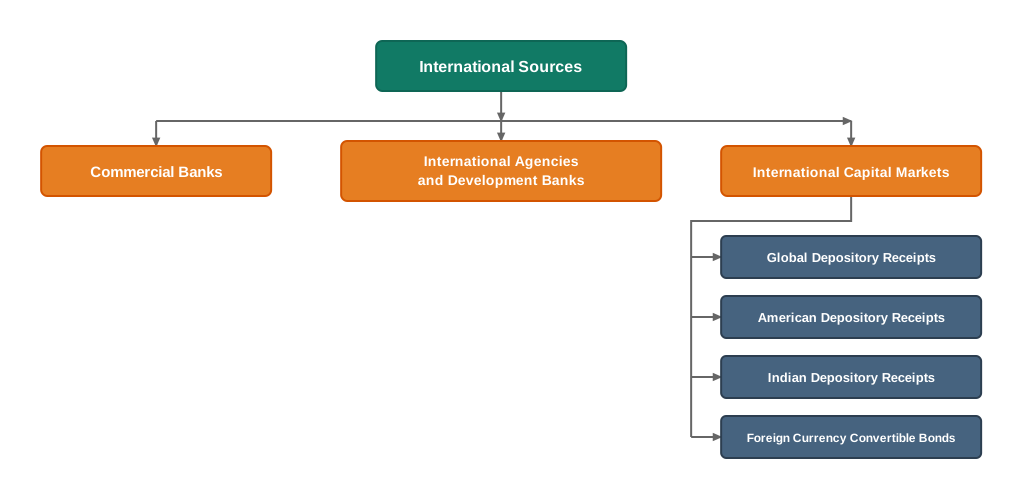
Fig. 8.6 – International sources of finance.
8.5.1 Commercial Banks
Commercial banks all over the world extend foreign currency loans for business purposes. They are an important source of financing non-trade international operations, that is, international activities other than the direct import and export of goods.
The types of loans and services provided by banks vary from country to country. Standard Chartered, for example, emerged as a major source of foreign currency loans to Indian industry.
8.5.2 International Agencies And Development Banks
A number of international agencies and development banks have emerged over the years to finance international trade and business. These bodies provide long and medium-term loans and grants to promote the development of economically backward areas in the world.
These bodies were set up by the Governments of developed countries at national, regional and international levels for funding various projects. The more notable among them include the International Finance Corporation, the EXIM Bank and the Asian Development Bank.
8.5.3 International Capital Markets
Modern organisations, including multinational companies, depend upon sizeable borrowings both in rupees and in foreign currency. The prominent financial instruments used for this purpose are described below.
8.5.3.1 Global Depository Receipts
When a company wants to raise funds abroad, the local currency shares of the company are delivered to a depository bank. The depository bank then issues depository receipts against these shares. Such depository receipts denominated in US dollars are known as Global Depository Receipts, usually written as GDRs.
A GDR is a negotiable instrument and can be traded freely like any other security. In the Indian context, a GDR is an instrument issued abroad by an Indian company to raise funds in some foreign currency, and it is listed and traded on a foreign stock exchange.
A holder of a GDR can at any time convert it into the number of shares it represents. Holders of GDRs carry rights on dividend and capital appreciation. Many Indian companies such as Infosys, Reliance, Wipro and ICICI have raised money through the issue of GDRs.
8.5.3.2 American Depository Receipts
The depository receipts issued by a company in the USA are known as American Depository Receipts, usually written as ADRs. ADRs are bought and sold in American markets like regular stocks.
An ADR is similar to a GDR, except that it can be issued only to American citizens and can be listed and traded on a stock exchange of the USA.
8.5.3.3 Indian Depository Receipts
An Indian Depository Receipt, usually written as IDR, is a financial instrument denominated in Indian rupees in the form of a depository receipt. It is created by an Indian Depository to enable a foreign company to raise funds from the Indian securities market. The IDR is the specific Indian version of the similar global depository receipts.
The foreign company issuing an IDR deposits shares with an Indian Depository, which is a custodian of securities registered with the Securities and Exchange Board of India. In turn, the depository issues receipts to investors in India against these shares. The benefits of the underlying shares, such as bonus and dividends, accrue to the IDR holders in India.
According to SEBI guidelines, IDRs are issued to Indian residents in the same way as domestic shares are issued. The issuer company makes a public offer in India, and residents can bid in exactly the same format and method as they bid for Indian shares.
Standard Chartered PLC was the first company that issued an Indian Depository Receipt in the Indian securities market, in June 2010.
8.5.3.4 Foreign Currency Convertible Bonds
Foreign Currency Convertible Bonds, usually written as FCCBs, are equity linked debt securities that are to be converted into equity or depository receipts after a specific period.
A holder of an FCCB therefore has the option either of converting the bonds into equity shares at a predetermined price or exchange rate, or of retaining the bonds as they are. This choice is what makes the instrument attractive — the investor keeps a safe fixed return but can move to ownership if the company performs well.
FCCBs are issued in a foreign currency and carry a fixed interest rate which is lower than the rate of any other similar non-convertible debt instrument. They are listed and traded in foreign stock exchanges. FCCBs are very similar to the convertible debentures issued in India.
8.6 Factors Affecting The Choice Of The Source Of Funds
The financial needs of a business are of different types — long term and short term, fixed and fluctuating. For this reason business firms resort to different types of sources for raising funds rather than depending on one alone.
Short-term borrowings offer the benefit of reduced cost, because funds are taken only for as long as they are actually needed and idle capital is reduced. Long-term borrowings, however, are considered a necessity on many grounds, since assets that will serve the business for years cannot safely be financed by money that must be returned within months. Equity capital too has a role to play in the scheme for raising funds in the corporate sector.
As no source of funds is free of limitations, it is advisable to use a combination of sources instead of relying only on a single source. A number of factors affect the choice of this combination, which makes it a complex decision for the business. These factors are discussed below.
Cost — there are two types of cost, namely the cost of procurement of funds and the cost of utilising the funds. Both these costs should be taken into account while deciding about the source of funds that will be used by an organisation.
Financial strength and stability of operations — the financial strength of a business is a key determinant. In choosing a source of funds the business should be in a sound financial position so as to be able to repay the principal amount and the interest on the borrowed amount. When the earnings of the organisation are not stable, fixed charged funds such as preference shares and debentures should be selected carefully, as these add to the financial burden of the organisation.
Form of organisation and legal status — the form of business organisation and its legal status influence the choice of a source for raising money. A partnership firm, for example, cannot raise money by the issue of equity shares, as these can be issued only by a joint stock company.
Purpose and time period — a business should plan according to the time period for which the funds are required. A short-term need, for example, can be met by borrowing funds at a low rate of interest through trade credit or commercial paper. For long-term finance, sources such as the issue of shares and debentures are more appropriate. Similarly, the purpose for which funds are required needs to be considered so that the source is matched with the use. A long-term business expansion plan, for example, should not be financed by a bank overdraft which will have to be repaid in the short term.
Risk profile — a business should evaluate each source of finance in terms of the risk involved. There is least risk in equity, as the share capital has to be repaid only at the time of winding up and dividends need not be paid if no profits are available. A loan, on the other hand, has a repayment schedule for both the principal and the interest, and the interest is required to be paid irrespective of whether the firm earns a profit or incurs a loss.
Control — a particular source of funds may affect the control and power of the owners over the management of a firm. The issue of equity shares may mean dilution of control, since equity shareholders enjoy voting rights. Similarly, financial institutions may take control of the assets or impose conditions as part of the loan agreement. A business firm should therefore choose a source keeping in mind the extent to which it is willing to share control over the business.
Effect on credit worthiness — the dependence of a business on certain sources may affect its credit worthiness in the market. For example, the issue of secured debentures may affect the interest of unsecured creditors of the company and may adversely affect their willingness to extend further loans as credit to the company.
Flexibility and ease — another aspect affecting the choice of a source of finance is the flexibility and ease of obtaining funds. Restrictive provisions, detailed investigation and documentation, as in the case of borrowings from banks and financial institutions, may be the reason why a business organisation does not prefer such a source if other options are readily available.
Tax benefits — various sources may also be weighed in terms of their tax benefits. For example, while the dividend on preference shares is not tax deductible, interest paid on debentures and loans is tax deductible, and such sources may therefore be preferred by organisations seeking a tax advantage.
How This Is Tested
Application questions in the board paper usually describe a firm’s situation — its legal form, the period for which funds are needed, the stability of its earnings, or the owners’ wish to retain control — and ask which source should be chosen. The expected answer names the source and links it to the specific factor visible in the case, rather than listing all nine factors.
8.7 Summary
Meaning and significance of business finance — the finance required by a business to establish and run its operations is known as business finance. No business can function without an adequate amount of funds for undertaking its various activities. Funds are required for purchasing fixed assets, which is the fixed capital requirement, for running day-to-day operations, which is the working capital requirement, and for undertaking growth and expansion plans.
Classification of sources of funds — the various sources of funds available to a business can be classified on three major bases, namely time period, covering long, medium and short term; ownership, covering owner’s funds and borrowed funds; and source of generation, covering internal sources and external sources.
Long, medium and short-term sources of funds — sources that provide funds for a period exceeding five years are called long-term sources. Sources that fulfil financial requirements for a period of more than one year but not exceeding five years are called medium-term sources. Sources that provide funds for a period not exceeding one year are termed short-term sources.
Owner’s funds and borrowed funds — owner’s funds refer to the funds provided by the owners of an enterprise. Borrowed capital refers to funds generated through loans or borrowings from other individuals or institutions.
Internal and external sources — internal sources of capital are those generated within the business, for example through ploughing back of profits. External sources are those that lie outside the business, such as finance provided by suppliers, lenders and investors.
Sources of business finance — the sources of funds available to a business include retained earnings, trade credit, factoring, lease financing, public deposits, commercial paper, issue of shares and debentures, loans from commercial banks, loans from financial institutions, and international sources of finance.
Retained earnings — the portion of the net earnings of a company that is not distributed as dividend is known as retained earnings. The amount available depends on the dividend policy of the company, and it is generally used for growth and expansion.
Trade credit — the credit extended by one trader to another for purchasing goods or services is known as trade credit. It facilitates the purchase of supplies on credit. Its terms vary from one industry to another and are specified on the invoice. Small and new firms are usually more dependent on trade credit, as they find it relatively difficult to obtain funds from other sources.
Factoring — factoring has emerged as a popular source of short-term funds in recent years. It is a financial service whereby the factor is responsible for all credit control and debt collection from the buyer and provides protection against bad-debt losses to the firm. There are two methods of factoring, namely recourse and non-recourse factoring.
Lease financing — a lease is a contractual agreement whereby the owner of an asset, the lessor, grants the right to use the asset to the other party, the lessee. The lessor charges a periodic payment for renting the asset for a specified period, called lease rent.
Public deposits — a company can raise funds by inviting the public to deposit their savings with the company. Public deposits may take care of both long and short-term financial requirements of a business. The rate of interest on such deposits is usually higher than that offered by banks and other financial institutions.
Commercial paper — it is an unsecured promissory note issued by a firm to raise funds for a short period. The maturity period of commercial paper usually ranges from 90 days to 364 days. Being unsecured, only firms having a good credit rating can issue it, and its regulation comes under the purview of the Reserve Bank of India.
Issue of equity shares — equity shares represent the ownership capital of a company. Due to their fluctuating earnings, equity shareholders are called the risk bearers of the company. They enjoy higher returns during prosperity and have a say in the management of the company through exercising their voting rights.
Issue of preference shares — these shares provide a preferential right to the shareholders with respect to the payment of earnings and the repayment of capital. Investors who prefer steady income without undertaking higher risks prefer these shares. A company can issue different types of preference shares.
Issue of debentures — a debenture represents the loan capital of a company, and the holders of debentures are its creditors. These are fixed charged funds that carry a fixed rate of interest. The issue of debentures is suitable in a situation where the sales and earnings of the company are relatively stable.
Commercial banks — banks provide short and medium-term loans to firms of all sizes. The loan is repaid either in a lump sum or in instalments. The rate of interest charged by a bank depends upon factors including the characteristics of the borrowing firm and the level of interest rates in the economy.
Financial institutions — both central and state governments have established a number of financial institutions all over the country to provide industrial finance to companies engaged in business. They are also called development banks. This source of financing is considered suitable when large funds are required for expansion, reorganisation and modernisation of the enterprise.
International financing — a business may also raise funds abroad through foreign currency loans from commercial banks, through international agencies and development banks, and through international capital markets using instruments such as Global Depository Receipts, American Depository Receipts, Indian Depository Receipts and Foreign Currency Convertible Bonds.
Choice of the source of funds — since no source is free of limitations, a combination of sources is generally used. The choice is guided by cost, financial strength and stability of operations, form of organisation and legal status, purpose and time period, risk profile, control, effect on credit worthiness, flexibility and ease, and tax benefits.
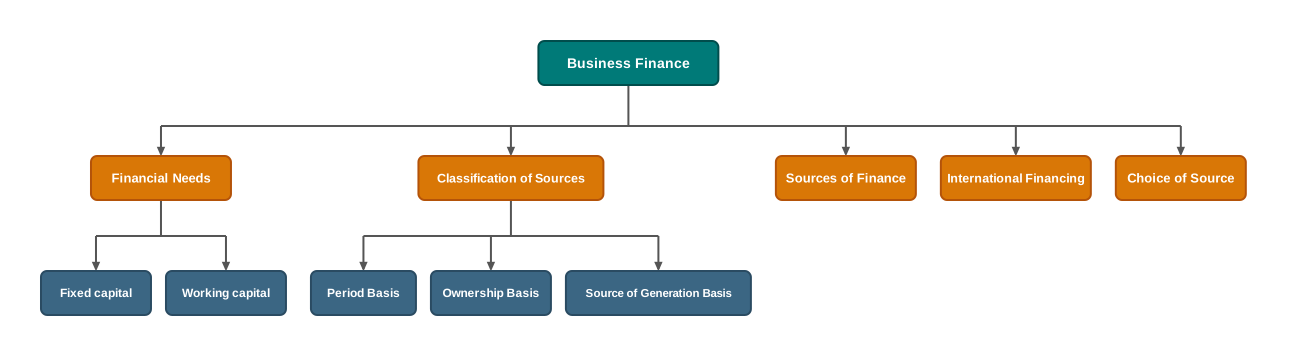
Fig. 8.7 – Structure of the chapter.
8.8 Key Terms
- Business finance The requirement of funds by a business to carry out its various activities.
- Fixed capital Funds invested in fixed assets such as land, buildings and machinery, which remain in the business for a long period.
- Working capital Funds used for day-to-day operations, held in current assets and used to meet current expenses.
- Owner’s funds Funds provided by the owners of an enterprise, which are not repayable during the life of the business and carry the right of control.
- Borrowed funds Funds raised through loans and borrowings, repayable after a specified period and carrying a fixed rate of interest.
- Internal sources Sources of funds generated from within the business, such as ploughing back of profits.
- External sources Sources of funds lying outside the organisation, such as suppliers, lenders and investors.
- Retained earnings That portion of the net earnings of a company which is not distributed as dividend but kept in the business for future use.
- Trade credit Credit extended by one trader to another for the purchase of goods and services, allowing supplies to be obtained without immediate payment.
- Factoring A financial service under which the factor takes over the receivables of a client, handles credit control and debt collection, and provides protection against bad-debt losses.
- Lease A contractual agreement under which the owner of an asset grants another party the right to use it for a specified period in return for a periodic payment.
- Lessor The owner of the asset who grants the right to use it under a lease agreement.
- Lessee The party that obtains the right to use the asset under a lease agreement.
- Lease rental The fixed periodic amount paid by the lessee to the lessor for the use of the asset.
- Public deposits Deposits raised by an organisation directly from the public, acknowledged by a deposit receipt.
- Commercial paper An unsecured money market instrument issued in the form of a promissory note to raise short-term funds.
- Share capital The capital of a company obtained by the issue of shares.
- Share One of the small units into which the capital of a company is divided.
- Shareholder A person who holds shares in a company.
- Equity shares Shares that represent the ownership capital of a company, carry voting rights, and entitle holders to the residual income and assets.
- Preference shares Shares carrying a preferential right to a fixed rate of dividend and to the repayment of capital ahead of equity shareholders.
- Debentures Instruments acknowledging a company’s borrowing, repayable at a future date and carrying a fixed rate of interest.
- Financial institutions Institutions established by central and state governments to provide long and medium-term finance to business, also called development banks.
- Global Depository Receipts Dollar-denominated negotiable receipts issued abroad against the shares of a company, listed and traded on a foreign stock exchange.
- American Depository Receipts Depository receipts issued by a company in the USA, which can be issued only to American citizens.
- Indian Depository Receipts Rupee-denominated depository receipts created by an Indian Depository to enable a foreign company to raise funds from the Indian securities market.
- Foreign Currency Convertible Bonds Equity linked debt securities issued in a foreign currency, convertible into equity shares or depository receipts after a specified period.
8.9 NCERT Questions
Short Answer Questions
- What is business finance? Why do businesses need funds? Explain.
- List sources of raising long-term and short-term finance.
- What is the difference between internal and external sources of raising funds? Explain.
- What preferential rights are enjoyed by preference shareholders? Explain.
- Name any three special financial institutions and state their objectives.
- What is the difference between GDR and ADR? Explain.
Long Answer Questions
- Explain trade credit and bank credit as sources of short-term finance for business enterprises.
- Discuss the sources from which a large industrial enterprise can raise capital for financing modernisation and expansion.
- What advantages does the issue of debentures provide over the issue of equity shares?
- State the merits and demerits of public deposits and retained earnings as methods of business finance.
8.10 Check Your Concepts
- Why is finance described as the life blood of a business?
- Why does a trading concern generally require less fixed capital than a manufacturing concern?
- Why would a business that sells goods on credit need more working capital than one selling on a cash basis?
- Distinguish between owner’s funds and borrowed funds on any four bases.
- Distinguish between equity shares and preference shares on any four bases.
- Distinguish between shares and debentures on any four bases.
- Why do owner’s funds carry the right of control over management while borrowed funds do not?
- What happens to a company that finances a ten-year expansion plan through a bank overdraft?
- Why is retained earnings called an uncertain source of funds even though it involves no explicit cost?
- Why can new companies generally not raise funds through public deposits or commercial paper?
- Why is the risk of obsolescence considered a merit of lease financing for the lessee?
- Explain why interest on debentures is a burden on a company whose earnings fluctuate.
- Identify the term: the transfer of a firm’s receivables to an agency that takes over credit control and debt collection.
- Identify the term: the portion of net earnings kept back in the business instead of being distributed as dividend.
- Identify the term: an unsecured promissory note issued by a highly rated firm to raise short-term funds.
- Arrange in the correct sequence the steps in a factoring arrangement: the factor collects payment from the buyer; the firm sells goods on credit; the factor pays the firm after deducting a discount; the firm sells its receivables to the factor.
- Mention the period category to which each of the following sources belongs:
- trade credit
- equity shares
- lease financing
- commercial paper
- Assertion: preference shareholders are generally not given voting rights. Reason: preference shareholders receive a fixed rate of dividend before equity shareholders. State whether the assertion and the reason are true, and whether the reason correctly explains the assertion.
- Assertion: a partnership firm cannot raise funds through the issue of equity shares. Reason: equity shares can be issued only by a joint stock company. State whether the assertion and the reason are true, and whether the reason correctly explains the assertion.
- Why is it considered advisable for a business to use a combination of sources of finance rather than a single source?
8.11 Case-Based Questions
- Aarohi Furnishings Ltd. earns a steady profit every year. Instead of distributing the whole of it as dividend, the directors keep a part of it in the business to fund a new showroom. Some shareholders have objected that their dividend has become smaller.
- Name the source of finance being used by the company.
- State two merits of this source.
- Identify the limitation of this source that the objecting shareholders are pointing to.
- Tanmay Spares Ltd. buys components from a supplier and is allowed to pay for them sixty days after delivery. The finance manager finds this arrangement convenient but has noticed that the firm has begun buying far more stock than it can sell.
- Name the source of short-term finance being used here.
- State the limitation of this source that the finance manager is observing.
- State one other limitation of this source.
- Sanchi Diagnostics Ltd. needs advanced imaging equipment that becomes outdated within four years. It does not want to lock up a large sum in purchasing the equipment, and it does not want to bring in new owners.
- Name a suitable source of finance for the company.
- State two merits of that source in this situation.
- State one limitation the company must accept.
- Prerna Foods Ltd. requires long-term funds for a new plant. Its earnings have been stable for many years and the existing owners are unwilling to give up any voting power. The finance manager also wishes to reduce the company’s tax liability.
- Name the source of long-term finance the company should choose.
- State the two factors from the chapter that support this choice.
- State one risk the company takes on by choosing this source.
- Rudraksh Pharma Ltd., an Indian company, wants to raise funds from investors located outside India. Its shares are handed over to a depository bank abroad, which issues dollar-denominated negotiable receipts against them. These receipts are listed on a foreign stock exchange.
- Name the instrument being used.
- State one feature of this instrument.
- Name one other instrument through which the company could have raised funds from international capital markets.