Chapter 5: Emerging Modes of Business
The way business is carried on has changed sharply over the last few decades. A customer today can compare prices at midnight, place an order from a mobile phone, pay without handling cash, and track the consignment until it reaches the door. A firm, on its side, can receive that order, pass it to its warehouse, alert its supplier and record the payment without a single sheet of paper moving between offices. The manner in which business is conducted is called the ‘mode of business’, and the word ‘emerging’ indicates that these changes are taking place now and are likely to continue.
Three trends are reshaping business at present: digitisation, outsourcing, and internationalisation and globalisation. This chapter deals with the first of these in detail. Emerging modes are not new kinds of business; they are new ways of doing the same business of creating utility and delivering value, adopted because customers now expect better quality, lower prices, faster delivery and better service.
This chapter explains the meaning and scope of e-business, its benefits and limitations, how it differs from traditional business, the process of online transactions, the security risks involved, and the resources a firm needs to move to the electronic mode.

Fig. 5.0 – Shopping on a mobile phone late at night.
5.1 Introduction
The way business is done has undergone fundamental changes over the last decade or so. The manner of conducting business is referred to as the mode of business, and the prefix ‘emerging’ underlines the fact that these changes are happening here and now, and that these trends are likely to continue.
If one were to list the three strongest trends that are shaping business today, these would be digitisation, outsourcing, and internationalisation and globalisation. The three trends are set out in Fig. 5.1.
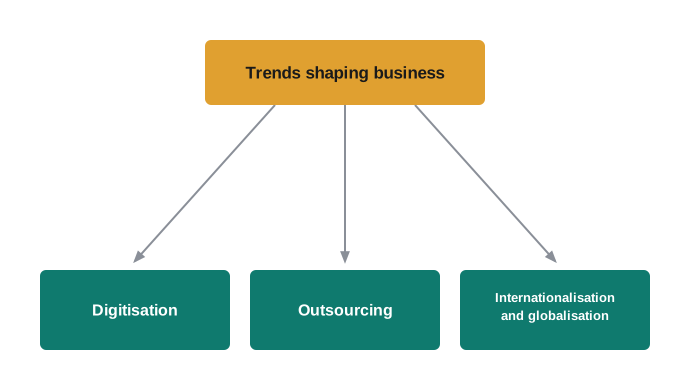
Fig. 5.1 – Trends shaping modern business.
Digitisation is a term borrowed from electronics. It means the conversion of text, sound, images, video and other content into a series of ones and zeroes that can be transmitted electronically. Once content is in this form, it can be stored, copied and sent across computer networks at very high speed and at very low cost. The digitisation of business is also referred to as electronic business, or e-business.
The second trend is outsourcing, under which a firm gets a part of its work done by an outside agency instead of performing it in-house. Where the work handed over is a business process, the arrangement is called Business Process Outsourcing, commonly written as BPO. The third trend, internationalisation and globalisation, is studied separately in the chapter on international business. This chapter deals with the first two developments.
Why These Modes Are Emerging
The newer modes of business are not new business. They are simply new ways of doing business, and they can be traced to a number of factors.
Business as an activity is aimed at creating utility or value in the form of goods and services, which household buyers and industrial buyers purchase to meet their needs and wants. In an effort to improve their business processes — whether purchase and production, marketing, finance or human resources — business managers and business thinkers keep evolving newer and better ways of doing things.
Business firms also have to strengthen their capability to create utility and deliver value. They must do this to survive competitive pressure and to satisfy the ever-growing demands of consumers for better quality, lower prices, speedier deliveries and better customer care. A firm that cannot match these expectations loses its customers to one that can.
Alongside this, the quest for benefiting from emerging technologies means that business as an activity keeps evolving. A technology that reduces cost or time is quickly adopted by one firm, and the rest of the industry is then forced to adopt it in order to stay in the race. This is why e-business and outsourcing are described as emerging, and not settled, modes of business.
5.2 e-Business
If the term business is taken to mean a wide range of activities comprising industry, trade and commerce, then e-business may be defined as the conduct of industry, trade and commerce using computer networks.
The network a student or consumer is most familiar with is the internet. The internet is a public thoroughfare, open to anyone. For managing their internal functions more effectively and efficiently, firms therefore use more private, and hence more secure, networks of their own.
e-Business And e-Commerce
The terms e-business and e-commerce are often used interchangeably, but a more precise definition distinguishes between the two. Just as the term ‘business’ is broader than ‘commerce’, e-business is the more elaborate term.
E-business comprises the various business transactions and functions that are conducted electronically. This includes the more popular set of transactions called e-commerce, which covers a firm’s interactions with its customers and suppliers over the internet.
E-business, however, includes not only e-commerce but also other electronically conducted business functions such as production, inventory management, product development, accounting and finance, and human resource management. E-business is therefore clearly much more than buying and selling over the internet.
5.2.1 Scope of e-Business
The scope of e-business is quite vast. Almost all types of business functions, such as production, finance, marketing and personnel administration, as well as managerial activities like planning, organising and controlling, can be carried out over computer networks.
The other way of looking at the scope of e-business is to examine it in terms of the people or parties involved in electronic transactions. Viewed from this perspective, a firm’s electronic transactions and networks extend in three directions: B2B, which is a firm’s interactions with other businesses; B2C, which is a firm’s interactions with its customers; and intra-B, which covers a firm’s internal processes.
A brief discussion of the various constituents of e-business, and of the inter-transactions and intra-transactions among them, is given below.
B2B Commerce
In B2B commerce, both the parties involved in the e-commerce transaction are business firms, and hence the name business-to-business. The flow of such a transaction is shown in Fig. 5.2.
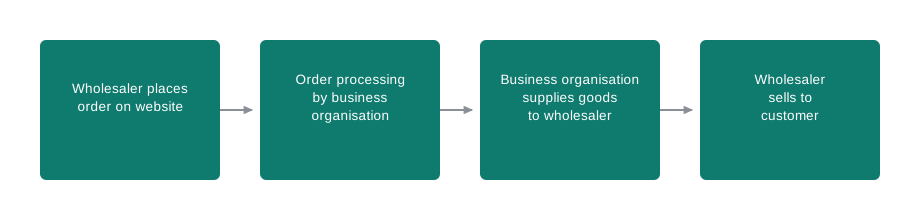
Fig. 5.2 – Business to business e-commerce.
Creating utility or delivering value requires a business to interact with a number of other business firms. These may be suppliers or vendors of diverse inputs, or they may form part of the channel through which the firm distributes its products to consumers.
For example, the manufacture of an automobile requires the assembly of a large number of components, which in turn are manufactured elsewhere, either near the automobile factory or even overseas. To reduce dependence on a single supplier, the automobile factory has to cultivate more than one vendor for each component. A network of computers is used for placing orders, monitoring the production and delivery of components, and making payments.
Likewise, a firm may strengthen and improve its distribution system by exercising real time control, that is control as it happens, over its stock-in-transit as well as over the stock lying with different middlemen in different locations. Each consignment of goods from a warehouse and the stock-at-hand can be monitored, and replenishments and reinforcements can be set in motion as and when needed.
A customer’s specifications may also be routed through the dealers to the factory and fed into the manufacturing system for customised production. The use of e-commerce expedites the movement of information and documents, and of late, of money transfers as well.
Historically, the term e-commerce originally meant the facilitation of B2B transactions using Electronic Data Interchange (EDI) technology to send and receive commercial documents such as purchase orders or invoices.
B2C Commerce
As the name implies, B2C commerce, or business-to-customers commerce, has business firms at one end and their customers at the other end.
What comes to mind instantly is online shopping, but it must be appreciated that selling is only the outcome of the marketing process. Marketing begins well before a product is offered for sale and continues even after the product has been sold. B2C commerce therefore covers a wide range of marketing activities, such as identifying the customer’s requirement, promotion, and sometimes even delivery of products such as music or films that can be carried out online. E-commerce permits these activities to be conducted at a much lower cost but at higher speed.
Customers these days are becoming very choosy and desire individual attention. They require not only that product features be tailor-made to suit their requirements, but also the convenience of delivery and payment at their pleasure. With the onset of e-commerce, all this has become a reality.
Further, the B2C variant of e-commerce enables a business to be in touch with its customers on a round-the-clock basis. Companies can conduct online surveys to ascertain who is buying what, and what the level of customer satisfaction is.
Benefits To Business Organisations
Expansion of the marketplace — the market of the firm widens to national and international markets.
Gradual decline in the cost of operations.
Facilitation of ‘pull’ supply chain management, in which supply is drawn by actual customer demand.
Competitive advantage over competitors.
Proper time management and support to business processes.
Co-existence of small firms with big firms, so that both gain from the arrangement.
Benefits To Consumers And Society
Flexibility in the time and place of buying.
Competitive prices, discounts and waive-offs.
More options and choices, and customised products.
Quick and timely delivery, especially of digitised products.
Employment potential.
Facilitation of e-auctions and e-tenders.
Interaction with consumers.
Wider outreach.
C2B Commerce
B2C may appear to be one-way traffic, running from business to customers. Its corollary, C2B commerce, is very much a reality and gives consumers the freedom of shopping at will.
Customers can also make use of call centres set up by companies to make toll-free calls, raise queries and lodge complaints round the clock at no extra cost to themselves. A firm need not set up these call centres or help lines itself; they may be outsourced to an outside agency.
Intra-B Commerce
In intra-B commerce, the parties involved in the electronic transaction are from within a given business firm, and hence the name.
As noted earlier, one critical difference between e-commerce and e-business is that e-commerce comprises a business firm’s interaction with its suppliers and distributors or other business firms, which is B2B, and with its customers, which is B2C, over the internet. E-business is a much wider term and also includes the use of an intranet for managing interactions and dealings among various departments and persons within a firm.
It is largely due to intra-B commerce that firms today can go in for flexible manufacturing. The use of computer networks makes it possible for the marketing department to interact constantly with the production department and obtain customised products made as per the requirements of the individual customer.
In a similar vein, closer computer-based interaction among the other departments makes it possible for the firm to reap the advantages of efficient inventory and cash management, greater utilisation of plant and machinery, effective handling of customers’ orders, and effective human resource management.
Just as the intercom facilitated voice communication within an office, the intranet facilitates multimedia and even three-dimensional graphic communication among organisational units. This permits better coordination, faster decisions and speedier workflows.
A firm’s interactions with its employees are sometimes referred to as B2E commerce. Companies are resorting to personnel recruitment, interviewing and selection, training, development and education through e-commerce, all of which are captured in the catch-all phrase e-learning. Employees can use electronic catalogues and ordering forms and can access inventory information for better interaction with customers. They can send field reports by e-mail, and the management can receive them on a real time basis.
Virtual Private Network (VPN) technology means that employees do not have to come to office at all. In a way, the office goes to them, and they can work from wherever they are, at their own speed and time convenience. Meetings can be held online through tele-conferencing or video conferencing.
C2C Commerce
In C2C commerce, the business originates from the consumer and the ultimate destination is also a consumer. The flow of such a transaction is shown in Fig. 5.3.
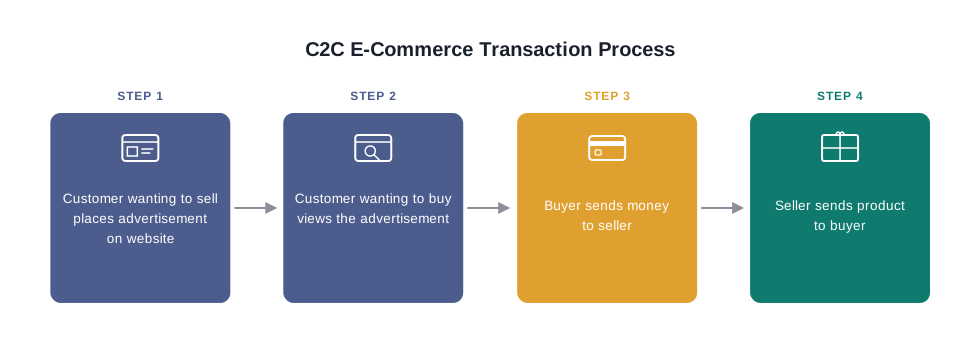
Fig. 5.3 – Consumer to consumer e-commerce.
This type of commerce is best suited to dealing in goods for which there is no established market mechanism, for example the sale of used books or clothes, either for cash or on a barter basis. The vast space of the internet allows persons to search globally for potential buyers.
E-commerce technology also provides market system security to such transactions, which would otherwise be missing when buyers and sellers interact in the anonymity of one-to-one dealings. An excellent example of this is eBay, where consumers sell their goods and services to other consumers.
To make this activity more secure and robust, several technologies have emerged. Firstly, eBay allows all sellers and buyers to rate one another. In this manner, a future purchaser may see that a particular seller has sold to more than two thousand customers, all of whom rate the seller as excellent. In another instance, a prospective purchaser may see a seller who has previously sold only four times, and all four buyers rate the seller poorly. This type of information is helpful in deciding whom to deal with.
Another technology that has emerged to support C2C activities is the payment intermediary. PayPal is a good example of this kind. Instead of purchasing items directly from an unknown, untrusted seller, the buyer sends the money to PayPal. PayPal then notifies the seller that it will hold the money until the goods have been shipped and accepted by the buyer.
An important C2C area of interactive commerce is the formation of consumers’ forums and pressure groups. Just as a vehicle owner stuck in a traffic jam can alert others about the traffic situation through a message on radio, an aggrieved customer can share an experience with a product, a service or a vendor and warn others by writing a single message to an entire group. It is quite possible that the resulting group pressure leads to a solution of the problem.
From the foregoing discussion of the scope of e-business, it is clear that e-business applications are varied and many.
e-Business Versus Traditional Business
E-enabling has radically transformed the mode of doing business. Table 5.1 compares traditional business with e-business on the main points of distinction. A comparative assessment of these features points towards the distinct benefits and limitations of e-business, which are discussed in the sections that follow.
Flexible Manufacturing And Mass Customisation
Customised products have traditionally been made to order by craftsmen, and have therefore been expensive with long delivery times. The industrial revolution allowed organisations to engage in mass production and to sell homogeneous products at a lower cost because of economies of scale, but the individual buyer’s preference was lost in the process.
E-commerce brings the two together. Because the customer’s specification travels instantly to the production system, organisations can now offer customised products and services at the low costs that were earlier possible only for mass-produced commodity items.
5.3 Benefits of e-Business
The comparison drawn in Table 5.1 points to several distinct advantages that the electronic mode offers over the traditional mode of doing business. These benefits are discussed below.
- Ease of formation and lower investment requirements — unlike the host of procedural requirements involved in setting up an industry, an e-business is relatively easy to start. The benefits of internet technology accrue to big and small businesses alike. The internet is responsible for the popularity of the phrase ‘networked individuals and firms are more efficient than networthed individuals’, which means that even a person without much investment, that is net worth, can do substantial business if he or she has contacts, that is a network.
Consider a restaurant that requires no physical space of its own. It may carry an online menu representing the best cuisines from the best restaurants the world over with which it has networked. The customer visits the website, decides the menu and places the order, which is in turn routed to the restaurant located closest to the customer. The food is delivered and the payment collected by that restaurant’s staff, and the amount due to the firm as the solicitor of the order is credited to its account through an electronic clearing system.
Convenience — the internet offers the convenience of a business that works twenty-four hours a day, seven days a week, three hundred and sixty-five days a year. A buyer may therefore shop well after midnight. Such flexibility is available to organisational personnel as well, who can work from wherever they are and whenever they wish to. E-business is truly business as enabled and enhanced by electronics, and it offers the advantage of accessing anything, anywhere, anytime.
Speed — much of buying and selling involves the exchange of information, which the internet allows at the click of a mouse. This benefit becomes all the more attractive in the case of information-intensive products such as software, movies, music, e-books and journals, which can even be delivered online. Cycle time, that is the time taken to complete a cycle from the origin of demand to its fulfilment, is substantially reduced, because business processes are transformed from being sequential to becoming parallel or simultaneous. In the digital era, money itself is defined as electronic pulses moving at the speed of light, thanks to the electronic funds transfer technology of e-commerce.
Global reach and access — the internet is truly without boundaries. On the one hand it allows the seller access to the global market, and on the other it affords the buyer the freedom to choose products from almost any part of the world. It would not be an exaggeration to say that in the absence of the internet, globalisation would have been considerably restricted in scope and speed.
Movement towards a paperless society — the use of the internet has considerably reduced dependence on paperwork and the attendant red tape. Maruti Udyog, for instance, does the bulk of its sourcing of materials and components in a paperless fashion. Even government departments and regulatory authorities are increasingly moving in this direction by allowing the electronic filing of returns and reports. E-commerce tools are thus bringing about administrative reforms aimed at speeding up the process of granting permissions, approvals and licences. In this respect, the provisions of the Information Technology Act 2000 are quite noteworthy.
Some e-Business Applications
The benefits listed above are realised through specific applications of the electronic mode. The important applications are given below.
e-Procurement — it involves internet-based sales transactions between business firms. It includes reverse auctions, which facilitate online trade between a single business purchaser and many sellers, and digital marketplaces, which facilitate online trading between multiple buyers and sellers.
e-Bidding or e-auction — most shopping sites have a ‘quote your price’ facility whereby a buyer can bid for goods and services, such as airline tickets. It also includes e-tendering, whereby one may submit tender quotations online.
e-Communication or e-promotion — beginning with e-mail, it includes the publication of online catalogues displaying images of goods, and advertisement through banners, pop-ups, opinion polls and customer surveys. Meetings and conferences may also be held by means of video conferencing.
e-Delivery — it includes the electronic delivery of computer software, photographs, videos, books, journals and other multimedia content to the user’s computer. It also includes the rendering of legal, accounting, medical and other consulting services electronically. The internet thus provides firms with opportunities for outsourcing a host of Information Technology Enabled Services (ITES), which are discussed under business process outsourcing. Airline and railway tickets can now be printed at home.
e-Trading — it involves securities trading, that is the online buying and selling of shares and other financial instruments through the website of a broking firm.
Fig. 5.4 – A paperless office workstation.
5.4 Limitations of e-Business
E-business is not all that rosy. Doing business in the electronic mode suffers from certain limitations, and it is advisable to be aware of these as well.
Low personal touch — high-tech as it is, e-business lacks the warmth of interpersonal interaction. To this extent it is a relatively less suitable mode of business for product categories that require a high personal touch, such as garments and toiletries, where the buyer wishes to see, feel or try the product before purchase.
Incongruence between the speed of order taking or giving and the speed of order fulfilment — information can flow at the click of a mouse, but the physical delivery of the product takes time. This mismatch may play on the patience of customers. At times, for technical reasons, websites take unusually long to open, which frustrates the user further.
Need for technology capability and competence of the parties to e-business — apart from the traditional three R’s of reading, writing and arithmetic, e-business requires a fairly high degree of familiarity of the parties with the world of computers. This requirement is responsible for what is known as the digital divide, that is the division of society on the basis of familiarity and non-familiarity with digital technology.
Increased risk due to anonymity and non-traceability of parties — internet transactions occur between cyber personalities. It therefore becomes difficult to establish the identity of the parties, and one does not even know the location from which the other party may be operating. Transacting through the internet is therefore riskier. E-business is riskier also in the sense that there are additional hazards of impersonation, where someone else may transact in a person’s name, and of leakage of confidential information such as credit card details. There are also the problems of virus and hacking, which are dealt with in the section on security and safety.
People resistance — the process of adjusting to a new technology and a new way of doing things causes stress and a sense of insecurity. As a result, people within the organisation may resist its plans of entry into e-business.
Ethical fallouts — companies today use an ‘electronic eye’ to keep track of the computer files an employee uses, the employee’s e-mail account and the websites visited. Whether such monitoring of an employee’s private communication is ethical is a question that e-business has brought to the fore.
Despite Limitations, e-Commerce Is The Way
Most of the limitations discussed above are in the process of being overcome, and none of them is severe enough to restrict the scope of e-business.
Websites are becoming more and more interactive in order to overcome the problem of low touch. Communication technology is continually evolving to increase the speed and quality of communication through the internet, which reduces the gap between order and fulfilment.
Efforts are also on to overcome the digital divide, for example by setting up community telecentres in villages and rural areas in India, with the involvement of government agencies, non-governmental organisations and international institutions. In order to diffuse e-commerce into all nooks and corners, India has undertaken about 150 such projects.
It is therefore clear that e-business is here to stay and is poised to reshape businesses, governance and economies. It is appropriate, then, to familiarise ourselves with how e-business is actually conducted.
5.5 Online Transactions
Operationally, one may visualise three stages in an online transaction. The first is the pre-purchase or pre-sale stage, which includes advertising and information seeking. The second is the purchase or sale stage, comprising steps such as price negotiation, closing of the purchase or sales deal, and payment. The third is the delivery stage. The sequence is set out in Fig. 5.5.
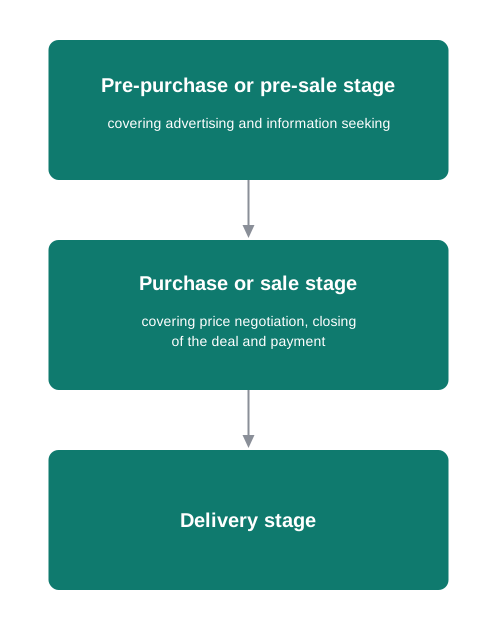
Fig. 5.5 – Stages in an online transaction.
Except for the stage relating to delivery, all the other stages involve a flow of information. Information is exchanged in the traditional business mode too, but under severe time and cost constraints.
In face-to-face interaction in the traditional mode, one needs to travel in order to talk to the other party, which requires effort, greater time and cost. The exchange of information through the telephone is also cumbersome, since it requires the simultaneous presence of both parties for a verbal exchange. Information can be transmitted by post as well, but this again is a time consuming and expensive process.
The internet comes in as the fourth channel, and it is free from most of these problems. In the case of information-intensive products and services such as software and music, even delivery can take place online.
Shortening Of The Distribution Channel
Because the parties deal with each other directly, e-business also shortens the chain through which goods reach the buyer. The conventional channel and the two shortened forms are shown in Fig. 5.6.
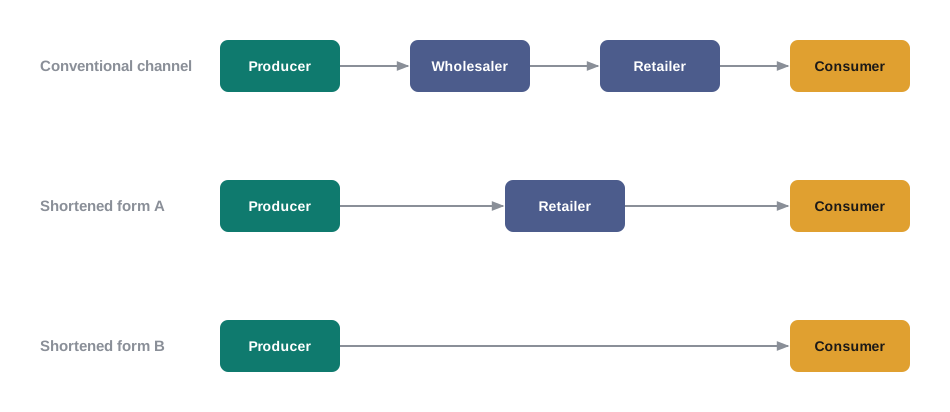
Fig. 5.6 – Distribution channel shortened by e-business.
Steps In Online Shopping
What is described below is the process of online trading from a customer’s standpoint. The seller’s perspective is taken up in the section on resources required for e-business.
Registration — before shopping online, one has to register with the online vendor by filling up a registration form. Registration means that the buyer has an account with the online vendor. Among the various details to be filled in is a password, because the sections relating to the account and the shopping cart are password protected. Without this protection anyone could log in using the buyer’s name and shop in that name, which could put the buyer in trouble.
Placing an order — the buyer can pick and drop items in the shopping cart. The shopping cart is an online record of what the buyer has picked up while browsing the online store. Just as in a physical store one can put items into a cart and take them out again, the same can be done while shopping online. After being sure of what is to be bought, the buyer can ‘checkout’ and choose the payment option.
Payment mechanism — payment for purchases made through online shopping may be made in a number of ways, which are described below.
Payment Mechanisms
Cash-on Delivery, written as CoD — as the name makes clear, payment for goods ordered online is made in cash at the time of physical delivery of the goods.
Cheque — the online vendor may arrange for the pickup of a cheque from the customer’s end. Delivery of the goods is made once the cheque is realised.
Net-banking transfer — modern banks provide their customers the facility of electronic transfer of funds over the internet using Immediate Payment Services, or IMPS, as well as NEFT and RTGS. The buyer transfers the agreed price of the transaction to the account of the online vendor, who then proceeds to arrange for delivery of the goods.
Credit or debit cards — popularly referred to as plastic money, these cards are the most widely used medium for online transactions. A credit card allows its holder to make a purchase on credit. The amount due from the card holder to the online seller is assumed by the card issuing bank, which later transfers the amount involved to the credit of the seller. The buyer’s account is debited, and the buyer often enjoys the freedom to deposit the amount in instalments and at convenience. A debit card allows its holder to make purchases only to the extent of the amount lying in the corresponding account. The moment a transaction is made, the amount due is deducted electronically from the card.
Digital cash — this is a form of electronic currency that exists only in cyberspace. It has no real physical properties, but it offers the ability to use real currency in an electronic format. The buyer first pays a bank, by cheque or draft, an amount equivalent to the digital cash to be issued. The bank dealing in e-cash then sends a special software, which can be downloaded on the hard disk, that allows the buyer to draw digital cash from the account with the bank. These digital funds may then be used to make purchases over the web.
To accept a credit card as an online payment type, the seller first needs a secure means of collecting credit card information from the customer. Payments through credit cards can be processed either manually or through an online authorisation system such as a Secure Sockets Layer certificate.
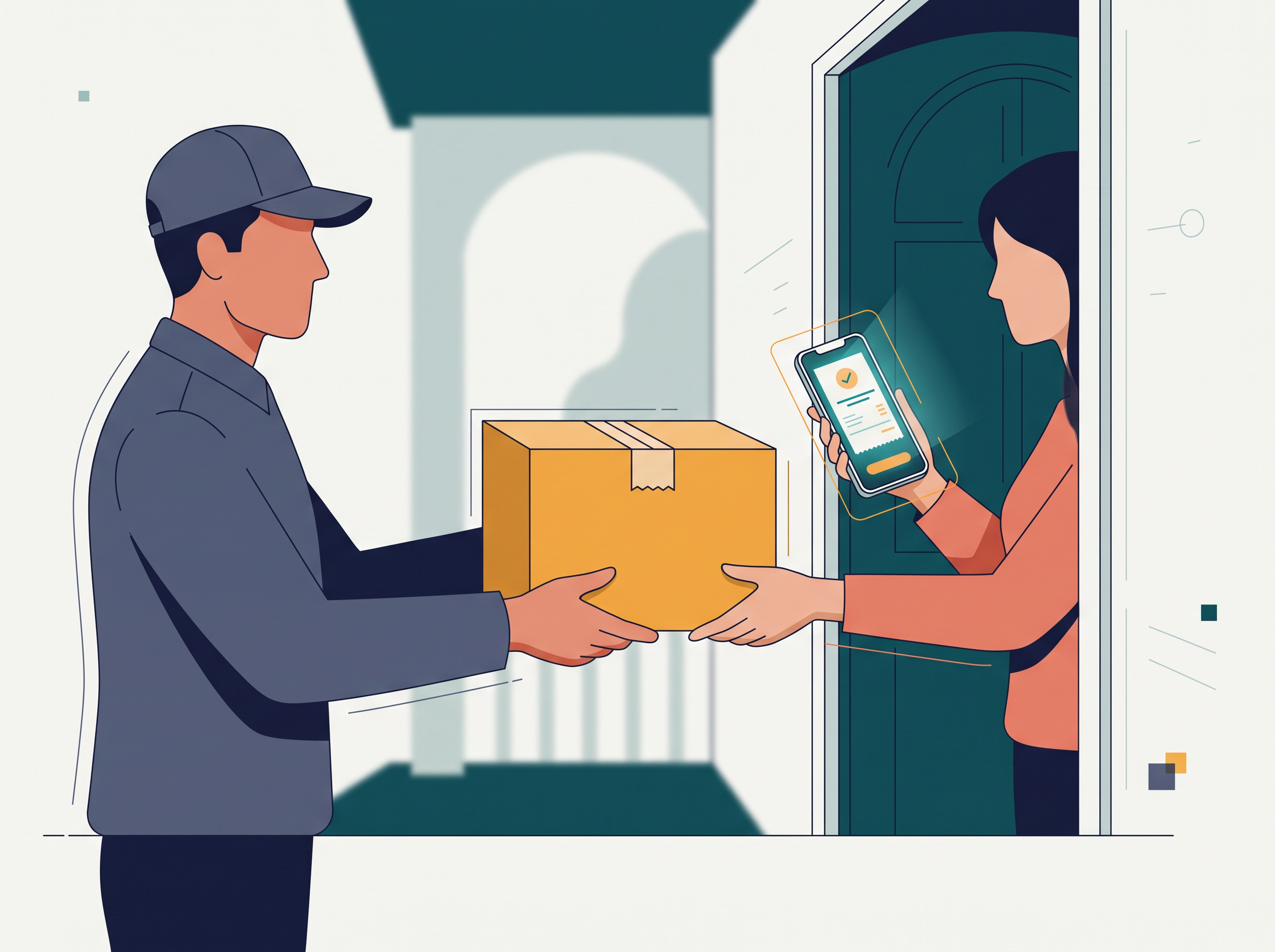
Fig. 5.7 – Goods handed over at the delivery stage.
5.6 Security and Safety of e-Transactions: e-Business Risks
Online transactions, unlike arm’s length transactions in a physical exchange, are prone to a number of risks. Risk refers to the probability of any mishappening that can result in financial, reputational or psychological loss to the parties involved in a transaction.
Because the probability of such mishappening is greater in the case of online transactions, security and safety become the most crucial concern in e-business. These issues may broadly be discussed under three headings, as shown in Fig. 5.8.
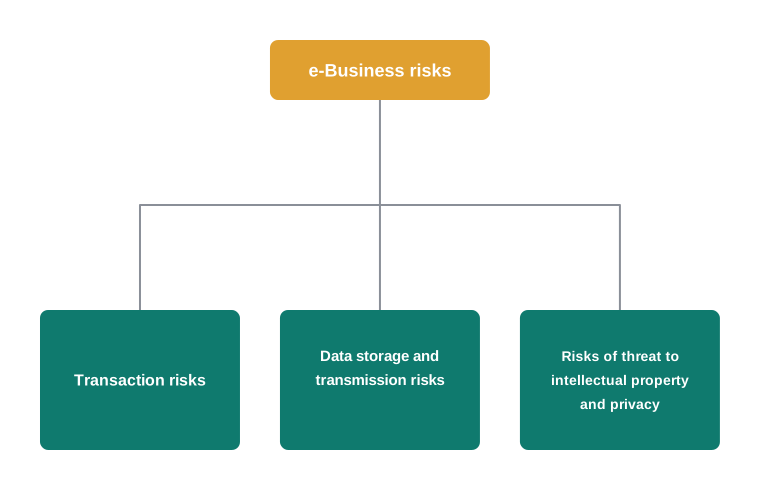
Fig. 5.8 – Types of e-business risks.
5.6.1 Transaction Risks
Online transactions are vulnerable to the following types of transaction risks.
Default on order taking or giving — the seller denies that the customer ever placed the order, or the customer denies ever having placed it.
Default on delivery — the intended delivery does not take place, the goods are delivered at the wrong address, or goods other than those ordered are delivered.
Default on payment — the seller does not receive payment for the goods supplied, whereas the customer claims that the payment was made.
In e-business, therefore, risk may arise for the seller or for the buyer on account of default in order taking or giving, in delivery, and in payment.
How Transaction Risks Are Reduced
Such situations can be averted by providing for identity and location or address verification at the time of registration, and by obtaining authorisation with regard to order confirmation and payment realisation.
For example, in order to confirm that the customer has correctly entered the details in the registration form, the seller may verify them from the cookies. Cookies are very similar to caller identification on a telephone, which provides telemarketers with relevant information such as the consumer’s name, address and previous purchase payment record.
As for the customer’s protection from anonymous sellers, it is always advisable to shop from well-established shopping sites. While allowing advertisers to sell their products online, such sites assure customers of the sellers’ identities, locations and service records. Some sites even provide for the rating of sellers by buyers. These sites protect customers against default on delivery and reimburse the payments made, up to some extent.
As for payments, in almost 95 per cent of cases people use credit cards for their online purchases. At the time of confirming the order, the buyer is required to furnish details such as the card number, the card issuer and the card validity online. These details may be processed offline, and only after satisfying himself or herself about the availability of credit limits and similar matters, the seller may go ahead with the delivery of goods. Alternatively, e-commerce technology today permits even online processing of credit card information.
For protecting credit card details from being misused, shopping sites use encryption technology such as the Secure Sockets Layer, or SSL, developed by Netscape.
5.6.2 Data Storage and Transmission Risks
Information is power, and the danger arises when that power goes into the wrong hands. Data stored in the systems, as well as data en route, is exposed to a number of risks. Vital information may be stolen or modified to pursue some selfish motive, or simply for fun or adventure.
A virus is a program, that is a series of commands, which replicates itself on other computer systems. The word is an acronym for Vital Information Under Siege.
The effect of computer viruses can range from mere annoyance in the form of an on-screen display, which is a Level-1 virus, to disruption of functioning, which is a Level-2 virus, to damage to target data files, which is a Level-3 virus, to complete destruction of the system, which is a Level-4 virus. Installing and timely updating of anti-virus programmes, and scanning files and disks with them, provides protection to data files, folders and systems from virus attacks.
Data may also be intercepted in the course of transmission. For this, one may use cryptography. It refers to the art of protecting information by transforming it, that is encrypting it, into an unreadable format called ‘cyphertext’. Only those who possess a secret key can decipher, or decrypt, the message back into ‘plaintext’. This is similar to using code words with someone so that others do not understand the conversation.
5.6.3 Risks of Threat to Intellectual Property and Privacy
The internet is an open space. Once information is available over the internet, it moves out of the private domain, and it then becomes difficult to protect it from being copied. This exposes creative work and business information to unauthorised use.
Data furnished in the course of online transactions may also be supplied to others, who may then start dumping a host of advertising and promotional literature into the user’s e-mail box. The user is at the receiving end, with little respite from junk mail.
5.7 Resources Required for Successful e-Business Implementation
Setting up any business requires money, men and machines, that is hardware. E-business is no exception to this. What it requires in addition is a set of resources for developing, operating, maintaining and enhancing a website.
The word ‘site’ means location and the word ‘web’ means the world wide web, written in short as www. Simply speaking, a website is a firm’s location on the world wide web. Obviously, a website is not a physical location. It is rather an online embodiment of all the content that a firm may like to provide to others.
This is why the website occupies the same place in e-business that a shop or an office occupies in traditional business. It is the point at which the firm meets its customers, and it is through the website that the firm displays its offerings, receives orders and answers queries. A firm that moves to the electronic mode therefore has to plan for the cost of building the site, the cost of keeping it running, and the cost of improving it as the volume of business grows.
The customer, on the other side, reaches this location through a browser, which is the software used to view pages on the world wide web. What the customer sees on the screen, and how easily the required information can be found there, becomes the firm’s substitute for the display window and the salesperson of a physical shop.
5.8 Summary
The world of business is changing, and e-business and outsourcing are the two most obvious expressions of this change. Together with internationalisation and globalisation, they are the trends that are reshaping the mode of doing business.
The trigger for the change owes its origin to both internal and external forces. Internally, it is the business firm’s own quest for improvement and efficiency that has propelled it into e-business and outsourcing. Externally, ever mounting competitive pressure and ever more demanding customers have been the force behind the change.
E-business is the conduct of industry, trade and commerce using computer networks. E-commerce is narrower and covers a firm’s electronic dealings with its customers and suppliers, while e-business covers e-commerce as well as internal functions such as production, inventory management, product development, accounting and finance, and human resource management.
The scope of e-business is seen in its constituents, namely B2B commerce between business firms, B2C and C2B commerce between a firm and its customers, intra-B commerce within a firm, and C2C commerce between consumers.
E-business differs from traditional business in ease of formation, physical presence, locational requirements, cost of setting up and operation, nature of contact and internal communication, response time, shape of the organisational structure, length of the business process cycle, personal touch, pre-sampling, ease of going global, government patronage, nature of human capital and transaction risk.
The electronic mode presents the firm with the opportunity of serving anything, anywhere and anytime to its customers, thereby dismantling the constraints of time and location on its performance. Its benefits are ease of formation with lower investment, convenience, speed, global reach and access, and movement towards a paperless society.
Though e-business is high-tech, it suffers from the limitation of being low in personal touch, so customers are not attended to on an interpersonal basis. Its other limitations are the mismatch between order taking and order fulfilment, the need for technology capability which creates a digital divide, increased risk due to anonymity of parties, people resistance, and ethical fallouts.
An online transaction passes through three stages, namely the pre-purchase or pre-sale stage, the purchase or sale stage, and the delivery stage. For the buyer, online shopping involves registration, placing an order, and payment through cash-on delivery, cheque, net-banking transfer, credit or debit cards, or digital cash.
There are concerns over the security of e-transactions and the privacy of those who transact business over the internet. These risks fall into three groups, namely transaction risks, data storage and transmission risks, and risks of threat to intellectual property and privacy. Identity verification, authorisation, anti-virus programmes and cryptography are the main safeguards.
The benefits of e-commerce have accrued unevenly across countries and across regions within a country. Efforts such as community telecentres in rural areas are aimed at reducing this gap.
For successful implementation of e-business, a firm needs, apart from money, men and machines, the resources to develop, operate, maintain and enhance a website, which is the firm’s location on the world wide web.
Apart from becoming digital, firms are also departing from the earlier ‘do it all by yourself’ mindset. They increasingly contract out business processes, whether these are information technology enabled or not, and services such as call centres are commonly outsourced.
Both e-business and outsourcing are continuing to evolve, and that is why they are referred to as the emerging modes of business.
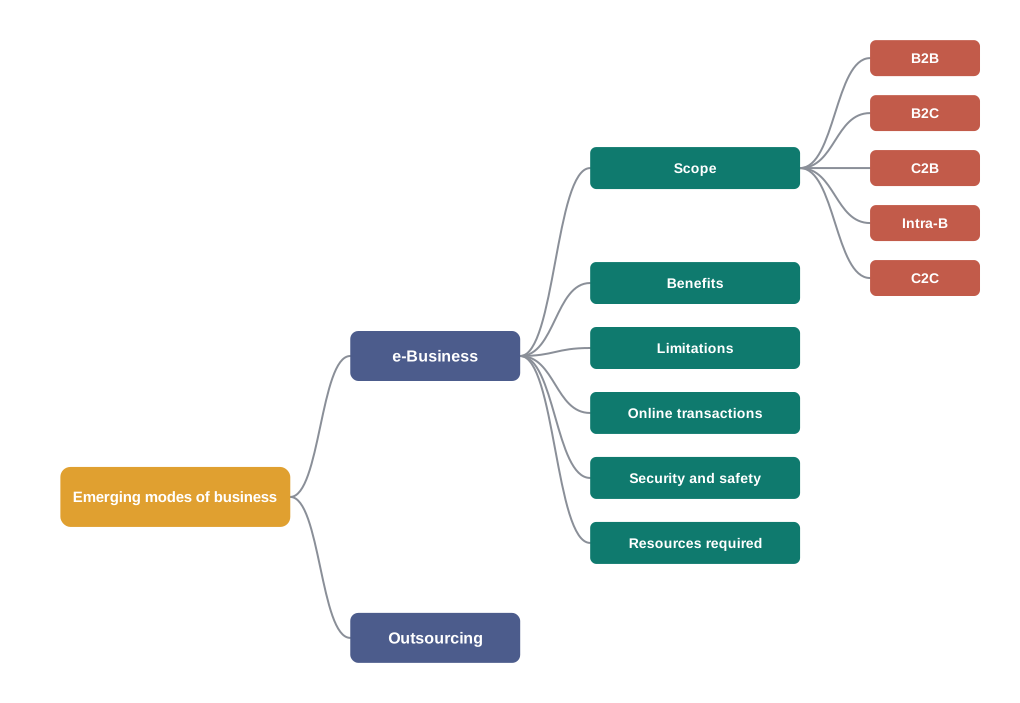
Fig. 5.9 – Structure of the chapter.
5.9 Key Terms
- Mode of Business The manner in which business is conducted.
- Digitisation The conversion of text, sound, images, video and other content into a series of ones and zeroes that can be transmitted electronically.
- e-Business The conduct of industry, trade and commerce using computer networks.
- Business Process Outsourcing The practice of contracting out a business process to an outside agency instead of performing it within the firm.
- e-Commerce A firm’s electronic interactions with its customers and suppliers over the internet.
- B2B Commerce Electronic transactions in which both the parties involved are business firms.
- Electronic Data Interchange The technology used to send and receive commercial documents such as purchase orders and invoices electronically between firms.
- B2C Commerce Electronic transactions that have a business firm at one end and its customers at the other end.
- C2B Commerce Electronic transactions that originate from the customer and are directed at the business firm.
- Intra-B Commerce Electronic transactions in which the parties involved are from within the same business firm.
- B2E Commerce A firm’s electronic interactions with its own employees.
- e-Learning Recruitment, training, development and education of employees carried out electronically.
- Virtual Private Network A secure network arrangement that allows employees to work from outside the office as if they were connected to it.
- C2C Commerce Electronic transactions in which the business originates from a consumer and the ultimate destination is also a consumer.
- e-Procurement Internet-based sales transactions between business firms through reverse auctions and digital marketplaces.
- e-Bidding The facility of quoting a price online for goods and services, including the online submission of tender quotations.
- e-Trading The online buying and selling of shares and other financial instruments.
- Digital Divide The division of society on the basis of familiarity and non-familiarity with digital technology.
- Online Trading The process of buying and selling carried out by a customer over the internet.
- Shopping Cart An online record of the items a buyer has picked up while browsing an online store.
- Plastic Money The popular name for credit and debit cards used as a medium of payment.
- Digital Cash A form of electronic currency that exists only in cyberspace and allows real currency to be used in an electronic format.
- Risk The probability of any mishappening that can result in financial, reputational or psychological loss to the parties to a transaction.
- Cookies Records that give a seller relevant information about a consumer, such as name, address and previous purchase payment record.
- Secure Sockets Layer An encryption technology used to protect credit card and other details furnished during an online transaction.
- Virus A program that replicates itself on other computer systems and can damage data or destroy the system.
- Cryptography The art of protecting information by encrypting it into cyphertext, which only a holder of the secret key can decrypt into plaintext.
- Website A firm’s location on the world wide web, being an online embodiment of the content it wishes to provide to others.
- Browser The software used to view pages on the world wide web.
5.10 NCERT Questions
Short Answer Questions
- State any three differences between e-business and traditional business.
- Describe briefly any two applications of e-business.
- Describe briefly the data storage and transmission risks in e-business.
Long Answer Questions
- Why are e-business and outsourcing referred to as the emerging modes of business? Discuss the factors responsible for the growing importance of these trends.
- Elaborate the steps involved in online trading.
- Evaluate the need for outsourcing and discuss its limitations.
- Discuss the salient aspects of B2C commerce.
- Discuss the limitations of the electronic mode of doing business. Are these limitations severe enough to restrict its scope? Give reasons for your answer.
5.11 Check Your Concepts
- Why is e-business described as a wider term than e-commerce? Support your answer with two functions that fall within e-business but outside e-commerce.
- Identify the term: the conversion of text, sound, images and video into a series of ones and zeroes that can be transmitted electronically.
- Identify the term: an online record of the items a buyer has picked up while browsing an online store.
- Identify the term: the division of society on the basis of familiarity and non-familiarity with digital technology.
- Distinguish between B2B commerce and C2C commerce on the basis of the parties involved and the nature of goods usually dealt in.
- Distinguish between a credit card and a debit card as a mode of online payment.
- Why does the shape of the organisational structure tend to become flat when a firm shifts to the electronic mode?
- Why is the business process cycle shorter in e-business than in traditional business?
- What happens to a firm’s transaction risk when the identity and address of the buyer are not verified at the time of registration? Explain with one example.
- What happens if an online seller ignores the incongruence between the speed of order taking and the speed of order fulfilment?
- Arrange the following stages of an online transaction in the correct sequence: delivery stage; pre-purchase or pre-sale stage; purchase or sale stage.
- Arrange the following steps of online shopping in the correct sequence: choosing the payment option; registration with the online vendor; placing items in the shopping cart; checkout.
- Match each term with its correct description.
| Column A | Column B |
|---|---|
| a. cookies | i. a program that replicates itself on other computer systems |
| b. cryptography | ii. an encryption technology used to protect card details |
| c. virus | iii. records that give the seller information such as the consumer’s name, address and previous purchase record |
| d. Secure Sockets Layer | iv. the transformation of information into cyphertext readable only with a secret key |
- Assertion (A): e-Business is relatively unsuitable for products such as garments and toiletries. Reason (R): e-Business lacks the warmth of interpersonal interaction. Choose the correct option:
- Both A and R are true, and R is the correct explanation of A.
- Both A and R are true, but R is not the correct explanation of A.
- A is true but R is false.
- A is false but R is true.
- Assertion (A): The Information Technology Act, 2000 has helped in the movement towards a paperless society. Reason (R): The Act denies legal recognition to records kept in electronic form. Choose the correct option:
- Both A and R are true, and R is the correct explanation of A.
- Both A and R are true, but R is not the correct explanation of A.
- A is true but R is false.
- A is false but R is true.
- Why does a firm need to spend on a website even though it owns no shop, and what does the website do for the firm that a physical shop would otherwise do?
- State the four levels of damage that a computer virus may cause, and name one protection against virus attacks.
- Why does the internet create a threat to intellectual property that did not exist to the same extent in traditional business?
5.12 Case-Based Questions
- Rooprekha Furnishings manufactures curtains and cushion covers. It places orders for cloth with three mills through a common online platform, tracks each consignment while it is in transit, and settles payments through electronic transfer. Separately, it has put up a website through which households order finished furnishings directly, and its own design and accounts departments exchange files over an internal network.
- Identify the three constituents of e-business being used by Rooprekha Furnishings.
- State one advantage the firm gains from tracking consignments in real time.
- Nandan runs a small unit making leather belts and sells only through a shop in the local market. His nephew suggests that he set up a website so that buyers from other states can order directly. Nandan is worried that his workers, who have never used a computer, will resist the change, and that customers will not buy a belt without handling it first.
- Name the two limitations of e-business that Nandan is describing.
- State two benefits Nandan would gain if he adopted the electronic mode.
- Ayesha ordered a wall clock from a website and paid by card. The clock delivered to her was of a different model, and when she complained, the seller stated that no such order had been received. She had bought from a newly set up site that carried no seller ratings.
- Name the two types of transaction risk that Ayesha has faced.
- State two measures that could have prevented this situation.
- Sanchit Ltd. has decided to shift its recruitment, interviewing and training of employees to an online system, and to allow its field staff to send reports from wherever they are instead of coming to the office. The management expects faster decisions and better coordination between departments.
- Identify the form of commerce described in the first sentence.
- Name the technology that allows the field staff to work without coming to the office.
- State one benefit of this arrangement for the company.