Chapter 11: International Business
A small manufacturer of automobile components in India finds that demand in the home market has slowed down. Some of the firm’s competitors have begun selling to buyers in South-East Asia and the Middle East, where the market for such components is large. The owner now has to decide whether to sell abroad at all, and if so, whether to contact overseas customers directly, route the goods through an export house, or set up a factory closer to those customers.
Decisions of this kind belong to the area of international business. This chapter deals with business activity that crosses national frontiers — the trade in goods and services, and also the production, investment and contractual arrangements that firms undertake outside their home country. Operating across borders brings wider markets, better prices and fuller use of capacity, but it also brings unfamiliar laws, currencies, customer preferences and political conditions.
The chapter explains the meaning, reasons, scope and benefits of international business, how it differs from domestic business, the main modes of entering foreign markets, and the procedures and documents used in export and import transactions.
Fig. 11.0 – Containers awaiting shipment at an Indian port.
11.1 Introduction
Countries across the world have changed the way they produce and market goods and services. National economies that once aimed at self-reliance now depend on one another, both for obtaining what they need and for selling what they produce in surplus. Because cross-border trade and investment have grown so rapidly, no country today is truly isolated.
The main reason behind this change is the development of communication, technology and infrastructure. Newer modes of communication and faster, more efficient means of transport have brought nations closer to one another. Countries that were once cut off by geographical distance and socio-economic differences now interact with each other regularly.
Institutional changes have supported this shift. The World Trade Organisation and the economic reforms carried out by the governments of different countries have both contributed to greater interaction and closer business relations among nations.
The obstacles to the cross-border movement of goods and persons have come down substantially. National economies are becoming increasingly borderless and are getting integrated into the world economy. It is for this reason that the world today is often described as a ‘global village’. Business is no longer confined within the boundaries of the domestic country, and more and more firms are entering international markets, which offer them opportunities for growth and higher profits.
India has traded with other countries for a very long time. In recent decades, however, it has considerably speeded up the process of integrating with the world economy and expanding its foreign trade and investment.
11.1.1 Meaning of International Business
Business transactions that take place within the geographical boundaries of a nation are known as domestic or national business. The same activity is also called internal business or home trade. Manufacturing and trade that go beyond the boundaries of one’s own country are known as international business, which is also referred to as external business.
International business therefore covers those business activities that take place across national frontiers. It involves not only the movement of goods and services from one country to another, but also the movement of capital, personnel, technology and intellectual property such as patents, trademarks, know-how and copyrights.
People often treat international business and international trade as the same thing, but this is not correct. International trade, which consists of the export and import of goods, has historically been an important part of international business, yet it is only one part of it.
The scope of international business has widened considerably in recent decades. Trade in services such as international travel and tourism, transportation, communication, banking, warehousing, distribution and advertising has grown a great deal. Equally important is the growth of foreign investment and of overseas production, where companies invest in foreign countries and manufacture goods or provide services there so as to come closer to foreign customers and serve them more effectively at lower costs.
All these activities form part of international business. International business is thus a much broader term, and it covers both the trade and the production of goods and services across frontiers.
11.1.2 Reason for International Business
The fundamental reason behind international business is that no country can produce all that it needs equally well or equally cheaply. This happens because natural resources are unequally distributed among countries and because productivity levels differ from one country to another.
The availability of factors of production such as labour, capital and raw materials required for producing different goods and services differs among nations. Labour productivity and production costs also differ, because of socio-economic, geographical and political reasons.
Owing to these differences, one country is often in a better position to produce better quality goods, or to produce them at lower cost, than other countries can. In other words, some countries hold an advantage in producing select goods and services that other countries cannot produce as effectively or efficiently, and the reverse is equally true.
Each country therefore finds it advantageous to produce those goods and services that it can produce more effectively and efficiently at home, and to procure the rest through trade with countries that can produce them at lower cost. This is precisely why countries trade with one another and engage in international business.
Specialisation Within And Across Nations
International business as it exists today is largely the result of geographical specialisation. The same reason explains why trade takes place between two states or regions within a single country. Most regions specialise in producing the goods and services for which they are best suited. In India, for example, West Bengal specialises in jute products, while Mumbai and the neighbouring areas of Maharashtra are more involved in the production of cotton textiles.
The same principle of territorial division of labour applies at the international level. Most developing countries, which have abundant labour, specialise in producing and exporting garments. Since they lack capital and technology, they import textile machinery from developed nations, which are in a position to produce such machinery more efficiently.
What is true for a nation is broadly true for a firm as well. Firms engage in international business to import what is available at lower prices in other countries, and to export goods to countries where they can fetch better prices. Besides price considerations, nations and firms derive several other benefits from international business, and these benefits themselves act as a further impetus to go international.
11.1.3 International Business vs. Domestic Business
Conducting and managing international business operations is more complex than undertaking domestic business. Because political, social, cultural and economic environments vary across countries, business firms find it difficult to simply extend their domestic business strategy to foreign markets.
To succeed in overseas markets, firms need to adapt their product, pricing, promotion and distribution strategies, and their overall business plans, to suit the specific requirements of the target foreign markets. The key aspects in which domestic and international businesses differ from each other are given below.
Nationality of buyers and sellers — in domestic business, both buyers and sellers belong to the same country, which makes it easier for the two parties to understand each other and enter into deals. In international business, buyers and sellers come from different countries, and differences in language, attitudes, social customs, business goals and practices make it relatively more difficult for them to interact and finalise transactions.
Nationality of other stakeholders — the two also differ in the nationality of other stakeholders such as employees, suppliers, shareholders or partners, and the general public who deal with the firm. In domestic business all of them belong to one country and therefore show greater consistency in their value systems and behaviour. In international business, decision making becomes far more complex, because the firm has to take into account a wider set of values and aspirations of stakeholders belonging to different nations.
Mobility of factors of production — the degree of mobility of factors such as labour and capital is generally less between countries than within a country. These factors move freely within a country, but various restrictions exist on their movement across nations. Apart from legal restrictions, differences in socio-cultural environments, geographic influences and economic conditions also come in the way. This is especially true of labour, which finds it difficult to adjust to climatic, economic and socio-cultural conditions that differ from country to country.
Customer heterogeneity across markets — since buyers in international markets come from different countries, they differ in socio-cultural background. Differences in tastes, fashions, languages, beliefs and customs, attitudes and product preferences cause variations not only in the demand for different products and services but also in communication patterns and purchase behaviour. Because of such differences, people in one country may prefer a particular mode of transport or a particular style of vehicle that people in another country do not, and the frequency with which consumer durables are replaced also varies widely from one country to another. These variations greatly complicate the task of designing products and evolving strategies suited to customers in different countries. Customers within a country too differ in their tastes and preferences, but the differences become far more striking when customers are compared across nations.
Differences in business systems and practices — business systems and practices vary much more among countries than within a country. Countries differ in their level of socio-economic development, in the availability, cost and efficiency of economic infrastructure and market support services, and in business customs and practices arising from their socio-economic setting and historical experience. Such differences make it necessary for firms entering international markets to adapt their production, finance, human resource and marketing plans to the conditions prevailing there.
Political system and risks — political factors such as the type of government, the political party system, political ideology and political risks have a deep impact on business operations. A business person is familiar with the political environment of his or her own country and can predict its effect on business, but this is not the case abroad. Since the political environment differs from country to country and keeps changing, firms must monitor political developments continuously and devise strategies to deal with diverse political risks. A further difficulty is the tendency among nations to favour products and services originating in their own country. This is not a problem for firms operating domestically, but it often becomes a severe problem for firms exporting to other nations or setting up plants overseas.
Business regulations and policies — along with its socio-economic environment and political philosophy, each country evolves its own set of business laws and regulations. Such laws, regulations and economic policies apply more or less uniformly within a country, but they differ widely among nations. Tariff and taxation policies, the import quota system, subsidies and other controls adopted by one nation are not the same as those of another, and they often discriminate against foreign products, services and capital.
Currency used in business transactions — international business involves the use of different currencies. The exchange rate, that is, the price of one currency expressed in relation to another country’s currency, keeps fluctuating. This adds to the problems of international firms in fixing the prices of their products and in hedging against foreign exchange risks.
The main points of difference are brought together in Table 11.1.
11.1.4 Scope of International Business
International business is much broader than international trade. It includes not only the export and import of goods and services but also a wide variety of other ways in which firms operate internationally. The major forms of business operations that constitute international business are set out in Fig. 11.1 and explained below.
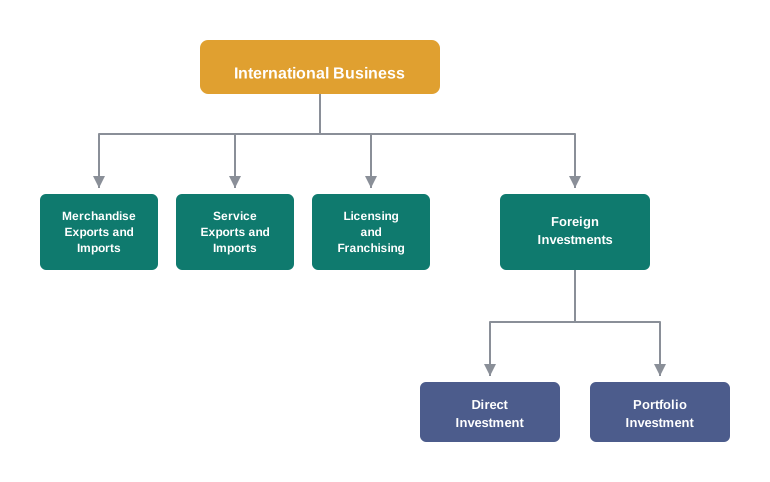
Fig. 11.1 – Scope of international business.
Merchandise Exports And Imports
Merchandise means goods that are tangible, that is, goods that can be seen and touched. Merchandise exports means sending tangible goods abroad, while merchandise imports means bringing tangible goods from a foreign country into one’s own country. Merchandise exports and imports, also known as merchandise trade or trade in goods, cover only tangible goods and exclude trade in services.
Service Exports And Imports
Service exports and imports involve trade in intangibles. It is because services cannot be seen or touched that trade in services is also known as invisible trade.
A wide variety of services are traded internationally. These include tourism and travel; boarding and lodging through hotels and restaurants; entertainment and recreation; transportation; professional services such as training, recruitment, consultancy and research; communication services such as postal, telephone, fax, courier and other audio-visual services; construction and engineering; marketing services such as wholesaling, retailing, advertising, marketing research and warehousing; and educational and financial services such as banking and insurance. Of these, tourism, transportation and business services are the major constituents of world trade in services.
Licensing And Franchising
Permitting another party in a foreign country to produce and sell goods under one’s trademarks, patents or copyrights in return for a fee is another way of entering international business. This arrangement is known as licensing. It is under the licensing system that soft drink brands such as Pepsi and Coca-Cola are produced and sold in many countries by local bottlers.
Franchising is similar to licensing, but the term is used in connection with the provision of services rather than goods.
Foreign Investments
Foreign investment is another important form of international business. It involves the investment of funds abroad in exchange for a financial return. Foreign investment can be of two types, direct investment and portfolio investment.
Direct investment takes place when a company directly invests in properties such as plant and machinery in a foreign country with a view to undertaking the production and marketing of goods and services there. Such investment provides the investor a controlling interest in the foreign company, and is known as foreign direct investment or FDI. It can take the form of a joint venture on a public-private partnership basis. A company may also, if it so desires, set up a wholly owned subsidiary abroad by making a hundred per cent investment in the foreign venture, thereby acquiring full control over the subsidiary’s operations in that market.
A portfolio investment, on the other hand, is an investment that a company makes in another company by acquiring its shares or by providing loans to it, and earns income in the form of dividends or interest. Unlike direct investment, the investor here does not get directly involved in production and marketing operations. The income is earned simply by investing in shares, bonds, bills or notes in a foreign country, or by lending to foreign business firms.
11.1.5 Benefits of International Business
Despite the greater complexity and risk involved, international business is important both to nations and to business firms, and it offers each of them several benefits. The growing realisation of these benefits over time has itself contributed to the expansion of trade and investment among nations, resulting in the phenomenon of globalisation.
Benefits To Countries
Earning of foreign exchange — international business helps a country earn foreign exchange, which it can later use to pay for its imports of capital goods, technology, petroleum products and fertilisers, pharmaceutical products and a host of other consumer products that might otherwise not be available at home.
More efficient use of resources — international business operates on a simple principle: produce what your country can produce more efficiently, and trade the surplus with other countries to procure what they can produce more efficiently. When countries trade on this principle, they together produce much more than they would if each attempted to produce every good and service on its own. If this enlarged pool of goods and services is distributed equitably among nations, all the trading nations gain.
Improving growth prospects and employment potentials — producing solely for domestic consumption severely restricts a country’s prospects for growth and employment. Many countries, especially developing ones, could not produce on a large scale and create employment because their domestic market was not large enough to absorb the extra production. Countries such as Singapore, South Korea and China, which saw markets for their products abroad, adopted the strategy of exporting and flourishing, and soon became star performers on the world map. This improved their growth prospects and also created employment opportunities for their people.
Increased standard of living — in the absence of international trade in goods and services, it would not have been possible for the world community to consume goods and services produced in other countries. Such trade allows people to consume a wider range of goods and services and thus to enjoy a higher standard of living.
Benefits To Firms
Prospects for higher profits — international business can be more profitable than domestic business. When domestic prices are lower, firms can earn higher profits by selling their products in countries where prices are high.
Increased capacity utilisation — many firms set up production capacities that exceed the demand in the domestic market. By planning overseas expansion and procuring orders from foreign customers, they can make use of this surplus capacity and improve the profitability of their operations. Production on a larger scale often leads to economies of scale, which in turn lowers production cost and improves the profit margin per unit.
Prospects for growth — firms find it frustrating when demand for their products becomes saturated in the domestic market. Such firms can considerably improve their growth prospects by entering overseas markets. This is precisely what has prompted many multinationals from developed countries to enter the markets of developing countries, where demand for their products was picking up fast even as demand at home had almost reached saturation.
Way out to intense competition in domestic market — when competition in the domestic market is very intense, internationalisation often seems the only way to achieve significant growth. A highly competitive home market drives many companies to go international in search of markets for their products. International business thus acts as a catalyst of growth for firms facing tough market conditions at home.
Improved business vision — the growth of international business is, for many companies, essentially a part of their business policy or strategic management. The vision to become international comes from the urge to grow, the need to become more competitive, the need to diversify, and the desire to gain the strategic advantages of internationalisation.
11.2 Modes of Entry into International Business
The term mode simply means the manner or way of doing something. The phrase ‘modes of entry into international business’ refers to the various ways in which a company can enter international business. Some of these ways have already been referred to while discussing the meaning and scope of international business.
A firm going abroad must choose between merely selling across the border, getting goods made abroad by someone else, allowing another firm to use its name and technology, sharing ownership with a foreign partner, or owning its foreign operations outright. Each of these choices differs in the amount of investment required, the degree of control obtained and the risk carried. The main modes are shown in Fig. 11.2 and are discussed below along with their advantages and limitations, so that it becomes clear which mode is more suitable under what conditions.
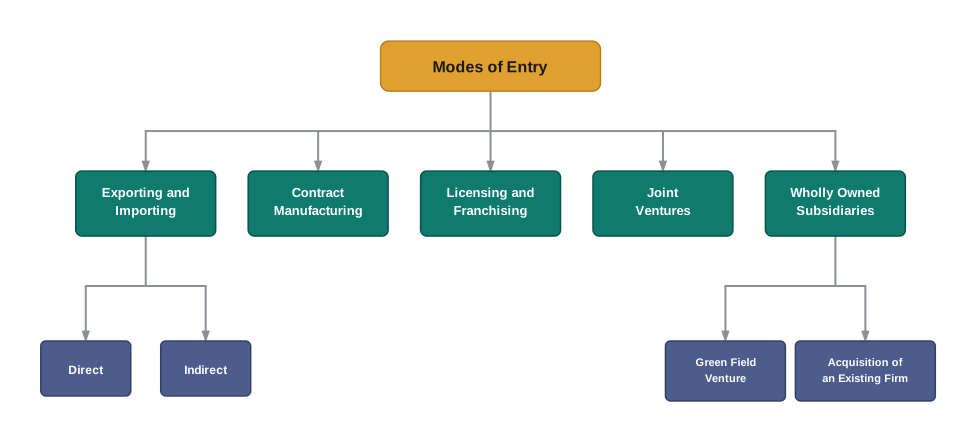
Fig. 11.2 – Modes of entry into international business.
11.2.1 Exporting and Importing
Exporting refers to sending goods and services from the home country to a foreign country. Importing, in a similar way, is the purchase of foreign products and bringing them into one’s own country. There are two important ways in which a firm can export or import products: directly and indirectly.
In the case of direct exporting or importing, the firm itself approaches the overseas buyers or suppliers and looks after all the formalities relating to export and import, including those connected with the shipment and financing of the goods.
Indirect exporting or importing is one in which the firm’s participation in the operations is minimum. Most of the tasks relating to the export or import of goods are carried out by middlemen such as export houses, or the buying offices of overseas customers located in the home country, or wholesale importers in the case of import operations. Such firms do not deal directly with overseas customers in the case of exports, or with suppliers in the case of imports.
Advantages
The major advantages of exporting and importing are as follows.
Easiest mode of entry — compared with other modes, exporting and importing is the easiest way of gaining entry into international markets. It is a less complex activity than setting up and managing joint ventures or wholly owned subsidiaries abroad.
Less involving — exporting and importing is less involving in the sense that business firms are not required to invest as much time and money as they would need to when entering joint ventures or setting up manufacturing plants and facilities in host countries.
Lower exposure to foreign investment risks — since exporting and importing does not require much investment in foreign countries, exposure to foreign investment risks is either nil or much lower than in the other modes of entry.
Limitations
The major limitations of exporting and importing as an entry mode are as follows.
Higher costs of moving goods — since the goods physically move from one country to another, additional packaging, transportation and insurance costs arise. In the case of heavy items, transportation costs alone can become an inhibiting factor. On reaching foreign shores the products attract customs duty and a variety of other levies and charges. Taken together, these expenses substantially increase product costs and make the goods less competitive.
Not feasible where import restrictions exist — exporting is not a workable option when a foreign country imposes import restrictions. In such a situation a firm has no alternative but to opt for other entry modes such as licensing, franchising or joint venture, which make it possible to produce and market the product locally in that country.
Limited contact with foreign markets — export firms basically operate from their home country. They produce at home and then ship the goods abroad. Except for a few visits by executives to promote their products, export firms generally do not have much contact with foreign markets. This puts them at a disadvantage against local firms, which are close to the customers and can understand and serve them better.
Despite these limitations, exporting and importing remains the most preferred way for firms that are getting involved with international business for the first time. Firms usually begin overseas operations with exports and imports, and after gaining familiarity with foreign market conditions they switch over to other forms of international business.
11.2.2 Contract Manufacturing
Contract manufacturing refers to a type of international business in which a firm enters into a contract with one or a few local manufacturers in foreign countries to get certain components or goods produced according to its specifications. Contract manufacturing is also known as outsourcing.
It can take three major forms.
Production of certain components, such as automobile components or shoe uppers, which are used later for producing final products such as cars and shoes.
Assembly of components into final products, such as the assembly of a hard disk, mother board, disk drive and modem chip into computers.
Complete manufacture of the products, such as garments.
The goods are produced or assembled by the local manufacturers using the technology and management guidance provided to them by the foreign company. The goods so produced are delivered to the international firm for use in its final products, or are sold outright as finished products by the international firm under its own brand names in various countries, including its home country, the host country and other countries. Major international companies such as Nike, Reebok, Levis and Wrangler get their products or components produced in developing countries under contract manufacturing.
Advantages
Contract manufacturing offers several advantages to both the international company and the local producers in the foreign country.
Large scale production without investment — contract manufacturing permits international firms to get goods produced on a large scale without investing in production facilities of their own. These firms make use of production facilities already existing in the foreign country.
Hardly any investment risk — since there is no or very little investment in the foreign country, there is hardly any investment risk involved there.
Lower production costs — contract manufacturing also gives the international company the advantage of getting products manufactured or assembled at lower cost, especially where the local producers are situated in countries with lower material and labour costs.
Gains to local producers — local producers in foreign countries also gain from contract manufacturing. If they have idle production capacity, manufacturing jobs obtained on a contract basis provide a ready market for their output and ensure fuller utilisation of their capacity. This is how the Godrej group has benefited from contract manufacturing in India, manufacturing soaps under contract for several multinationals and thereby making use of its excess soap manufacturing capacity.
Access to international business and incentives — the local manufacturer also gets an opportunity to become involved with international business and to avail of incentives, if any, available to export firms, in case the international firm wants the goods so produced to be delivered to its home country or to some other foreign country.
Limitations
The major disadvantages of contract manufacturing, to the international firm and to the local producer, are as follows.
Risk to quality — local firms might not adhere to production design and quality standards, which can cause serious product quality problems for the international firm.
Loss of control for the local firm — the local manufacturer loses control over the manufacturing process, because the goods have to be produced strictly as per the terms and specifications of the contract.
No freedom to sell — the local firm producing under contract manufacturing is not free to sell the contracted output as it wishes. It has to sell the goods to the international company at predetermined prices. This results in lower profits for the local firm if the open market prices for such goods happen to be higher than the prices agreed upon under the contract.
11.2.3 Licensing and Franchising
Licensing is a contractual arrangement in which one firm grants access to its patents, trade secrets or technology to another firm in a foreign country for a fee called royalty. The firm that grants such permission is known as the licensor, and the firm in the foreign country that acquires the rights to use the technology or patents is called the licensee.
It is not only technology that is licensed. In the fashion industry, for instance, a number of designers license the use of their names. In some cases there is an exchange of technology between the two firms, and where there is a mutual exchange of knowledge, technology or patents between them, the arrangement is known as cross-licensing.
Franchising is a term very similar to licensing. One major distinction between the two is that while licensing is used in connection with the production and marketing of goods, franchising applies to service business. The other point of difference is that franchising is relatively more stringent than licensing, since franchisers usually lay down strict rules and regulations about how the franchisees should operate while running their business.
Barring these two differences, franchising is much the same as licensing. Like a licensing agreement, a franchising agreement involves the grant of rights by one party to another for the use of technology, trademark and patents in return for an agreed payment for a certain period of time. The parent company is called the franchiser and the other party to the agreement is called the franchisee.
The franchiser can be any service provider — a restaurant, hotel, travel agency, bank, wholesaler or even a retailer — that has developed a unique technique for creating and marketing services under its own name and trade mark. It is the uniqueness of this technique that gives the franchiser an edge over its competitors in the field, and makes would-be service providers interested in joining the franchising system. McDonald’s, Pizza Hut and Wal-Mart are examples of leading franchisers operating worldwide.
Advantages
Compared with joint ventures and wholly owned subsidiaries, licensing and franchising is a much easier mode of entering foreign markets with a proven product or technology, without heavy business risk or investment. The specific advantages are as follows.
Almost no investment abroad — under this system it is the licensee or franchisee who sets up the business unit and invests his or her own money in the business. The licensor or franchiser therefore has to make virtually no investment abroad, which makes it a less expensive mode of entering international business.
No share in losses — since no or very little foreign investment is involved, the licensor or franchiser is not a party to the losses, if any, occurring to the foreign business. The licensor or franchiser is paid by the licensee or franchisee by way of a fee fixed in advance as a percentage of production or sales turnover. This royalty or fee keeps accruing so long as production and sales continue in the licensee’s or franchisee’s business unit.
Lower political risk — since the business in the foreign country is managed by the licensee or franchisee, who is a local person, there are lower risks of business takeovers or government intervention.
Benefit of local knowledge — being a local person, the licensee or franchisee has greater market knowledge and contacts, which can prove very helpful to the licensor or franchiser in successfully conducting its marketing operations.
Protection of intellectual property — as per the terms of the agreement, only the parties to it are legally entitled to make use of the licensor’s or franchiser’s copyrights, patents and brand names in the foreign country. As a result, other firms in that market cannot make use of such trademarks and patents.
Limitations
Licensing and franchising as a mode of international business suffers from the following weaknesses.
Risk of creating a competitor — when a licensee or franchisee becomes skilled in the manufacture and marketing of the licensed or franchised product, there is a danger that it may start marketing an identical product under a slightly different brand name. This can cause severe competition to the licensor or franchiser.
Leakage of trade secrets — if not maintained properly, trade secrets can get divulged to others in the foreign market. Such lapses on the part of the licensee or franchisee can cause severe losses to the licensor or franchiser.
Conflicts between the parties — over time, conflicts often develop between the two parties over issues such as the maintenance of accounts, payment of royalty and non-adherence to norms relating to the production of quality products. These differences often result in costly litigation, causing harm to both parties.
11.2.4 Joint Ventures
A joint venture is a very common strategy for entering foreign markets. It means establishing a firm that is jointly owned by two or more otherwise independent firms. In the widest sense of the term, it can also be described as any form of association that implies collaboration for more than a transitory period.
A joint ownership venture may be brought about in three major ways.
A foreign investor buying an interest in a local company.
A local firm acquiring an interest in an existing foreign firm.
Both the foreign and local entrepreneurs jointly forming a new enterprise.
Advantages
The major advantages of a joint venture are as follows.
Lower financial burden — since the local partner also contributes to the equity capital of the venture, the international firm finds it financially less burdensome to expand globally.
Execution of large projects — joint ventures make it possible to execute large projects that require huge capital outlays and manpower.
Benefit of the local partner’s knowledge — the foreign business firm benefits from the local partner’s knowledge of the host country in respect of competitive conditions, culture, language, political systems and business systems.
Sharing of costs and risks — entering a foreign market is in many cases very costly and risky. This can be avoided by sharing the costs and the risks with a local partner under a joint venture agreement.
Limitations
The major limitations of a joint venture are as follows.
Sharing of technology and trade secrets — foreign firms entering into joint ventures share their technology and trade secrets with local firms, and thus always run the risk of such technology and secrets being disclosed to others.
Conflicts over control — the dual ownership arrangement may lead to conflicts, resulting in a battle for control between the investing firms.
11.2.5 Wholly Owned Subsidiaries
This entry mode is preferred by companies that want to exercise full control over their overseas operations. The parent company acquires full control over the foreign company by making a hundred per cent investment in its equity capital.
A wholly owned subsidiary in a foreign market can be established in either of two ways.
Setting up a new firm altogether to start operations in a foreign country, which is also referred to as a green field venture.
Acquiring an established firm in the foreign country and using that firm to manufacture or promote its products in the host nation.
Advantages
The major advantages of a wholly owned subsidiary in a foreign country are as follows.
Full control over operations — the parent firm is able to exercise complete control over its operations in the foreign country.
No sharing of technology — since the parent company itself looks after the entire operations of the foreign subsidiary, it is not required to disclose its technology or trade secrets to others.
Limitations
The limitations of setting up a wholly owned subsidiary abroad are as follows.
Heavy investment required — the parent company has to make a hundred per cent equity investment in the foreign subsidiary. This form of international business is therefore not suitable for small and medium size firms, which do not have enough funds to invest abroad.
Entire losses to be borne alone — since the parent company owns the whole of the equity in the foreign company, it alone has to bear the entire losses resulting from the failure of its foreign operations.
Higher political risk — some countries are averse to the setting up of hundred per cent wholly owned subsidiaries by foreigners in their territory. This form of international business operation therefore becomes subject to higher political risk.
The contrast between the least demanding of the production-based modes and the most demanding one is summarised in Table 11.2.
11.3 Export-Import Procedures and Documentation
A major distinction between domestic and international operations lies in the complexity of the latter. The export and import of goods is not as straightforward as buying and selling in the domestic market. Since foreign trade transactions involve the movement of goods across frontiers and the use of foreign exchange, a number of formalities have to be completed before the goods leave the boundaries of one country and enter those of another.
These formalities exist to serve three purposes: to ensure that the government can regulate what leaves and enters the country, to ensure that the exporter is paid and the importer receives what was ordered, and to create documentary proof of ownership as the goods change hands between shipping companies, banks and customs authorities. The sections that follow discuss the major steps involved in completing export and import transactions.
11.3.1 Export Procedure
The number of steps, and the sequence in which they are taken, vary from one export transaction to another. The steps involved in a typical export transaction are summarised in Fig. 11.3 and explained below.
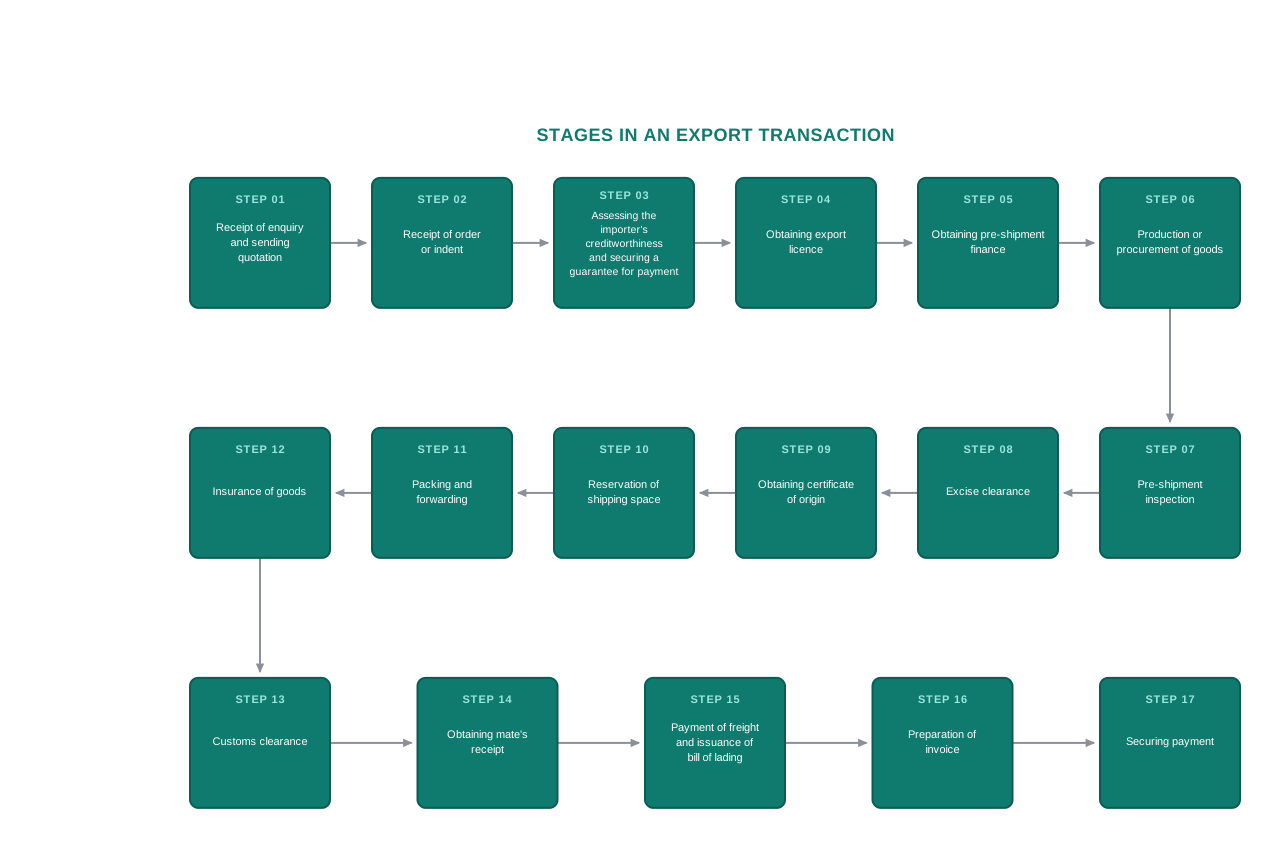
Fig. 11.3 – Steps in a typical export transaction.
Receipt of enquiry and sending quotations — the prospective buyer of a product sends an enquiry to different exporters requesting information about price, quality, and the terms and conditions for the export of goods. Exporters may also come to know of such an enquiry through an advertisement placed in the press by the importer. The exporter replies to the enquiry in the form of a quotation, referred to as a proforma invoice. The proforma invoice states the price at which the exporter is ready to sell the goods, and also gives information about quality, grade, size, weight, mode of delivery, type of packing and payment terms.
Receipt of order or indent — if the prospective buyer finds the export price and the other terms and conditions acceptable, it places an order for the goods to be despatched. This order, also known as an indent, contains a description of the goods ordered, the prices to be paid, delivery terms, packing and marking details, and delivery instructions.
Assessing the importer’s creditworthiness and securing a guarantee for payments — after receiving the indent, the exporter makes the necessary enquiry about the creditworthiness of the importer. The purpose is to assess the risk of non-payment once the goods reach the import destination. To minimise such risk, most exporters demand a letter of credit from the importer. A letter of credit is a guarantee issued by the importer’s bank that it will honour payment up to a certain amount of export bills to the bank of the exporter. It is the most appropriate and secure method of payment adopted to settle international transactions.
Obtaining export licence — having become assured about payment, the exporting firm begins the steps relating to compliance with export regulations. The export of goods in India is subject to customs laws, which require that the export firm must have an export licence before it proceeds with exports.
The important pre-requisites for obtaining an export licence are as follows.
Opening a bank account in any bank authorised by the Reserve Bank of India and obtaining an account number.
Obtaining an Import Export Code number, commonly called the IEC number, from the Directorate General of Foreign Trade or the Regional Import Export Licensing Authority.
Registering with the appropriate export promotion council.
Registering with the Export Credit and Guarantee Corporation in order to safeguard against the risk of non-payment.
An export firm needs the IEC number because it has to be filled in on various export and import documents. To obtain it, a firm applies to the Directorate General of Foreign Trade with documents such as the exporter or importer profile, a bank receipt for the requisite fee, a certificate from the banker on the prescribed form, two copies of photographs attested by the banker, details of non-resident interest, and a declaration that the applicant has no association with caution-listed firms.
It is obligatory for every exporter to get registered with the appropriate export promotion council. Councils such as the Engineering Export Promotion Council and the Apparel Export Promotion Council have been set up by the Government of India to promote and develop the exports of different categories of products. The exporter must become a member of the appropriate council and obtain a Registration cum Membership Certificate, known as the RCMC, in order to avail of the benefits available to export firms from the government.
Registration with the Export Credit and Guarantee Corporation is necessary in order to protect overseas payments against political and commercial risks. Such registration also helps the export firm obtain financial assistance from commercial banks and other financial institutions.
Obtaining pre-shipment finance — once a confirmed order and a letter of credit have been received, the exporter approaches the banker for pre-shipment finance to undertake export production. Pre-shipment finance is the finance the exporter needs for procuring raw materials and other components, for processing and packing the goods, and for transporting them to the port of shipment.
Production or procurement of goods — having obtained pre-shipment finance from the bank, the exporter proceeds to get the goods ready as per the specifications of the importer. The firm either produces the goods itself or buys them from the market.
Pre-shipment inspection — the Government of India has taken many steps to ensure that only good quality products are exported from the country. One such step is the compulsory inspection of certain products by a competent agency designated by the government. The government has passed the Export Quality Control and Inspection Act, 1963 for this purpose and has authorised some agencies to act as inspection agencies. If the product to be exported falls in such a category, the exporter contacts the Export Inspection Agency or another designated agency to obtain an inspection certificate. This pre-shipment inspection report has to be submitted along with the other export documents at the time of export. Such inspection is not compulsory where the goods are being exported by star trading houses, trading houses, export houses, industrial units set up in export processing zones or special economic zones, and hundred per cent export oriented units.
Excise clearance — as per the Central Excise Tariff Act, excise duty is payable on the materials used in manufacturing goods. The exporter therefore applies to the concerned Excise Commissioner in the region with an invoice, and if the Commissioner is satisfied, the excise clearance is issued. In many cases, however, the government exempts payment of excise duty, or refunds it later, if the goods so manufactured are meant for export. The idea behind such exemption or refund is to encourage exporters to export more and to make export products more competitive in world markets. The refund of excise duty is known as duty drawback. The duty drawback scheme is presently administered by the Directorate of Drawback under the Ministry of Finance, which fixes the rates of drawback for different products. The work relating to the sanction and payment of drawback is looked after by the Commissioner of Customs or the Central Excise Incharge of the concerned port, airport or land customs station from where the export of goods is considered to have taken place.
Obtaining certificate of origin — some importing countries provide tariff concessions or other exemptions to goods coming from a particular country. To avail of such benefits, the importer may ask the exporter to send a certificate of origin. This certificate acts as proof that the goods have actually been manufactured in the country from where the export is taking place, and can be obtained from the trade consulate located in the exporter’s country.
Reservation of shipping space — the exporting firm applies to the shipping company for shipping space, specifying the types of goods to be exported, the probable date of shipment and the port of destination. On accepting the application, the shipping company issues a shipping order, which is an instruction to the captain of the ship that the specified goods, after customs clearance at a designated port, be received on board.
Packing and forwarding — the goods are then properly packed and marked with the necessary details such as the name and address of the importer, gross and net weight, port of shipment and destination, and country of origin. The exporter then arranges for the transportation of the goods to the port. On loading the goods into the railway wagon, the railway authorities issue a ‘railway receipt’, which serves as a title to the goods. The exporter endorses the railway receipt in favour of the agent so as to enable the agent to take delivery of the goods at the port of shipment.
Insurance of goods — the exporter then gets the goods insured with an insurance company to protect against the risk of loss of or damage to the goods due to the perils of the sea during transit.
Customs clearance — the goods must be cleared from customs before they can be loaded on the ship. For obtaining customs clearance, the exporter prepares the shipping bill. The shipping bill is the main document on the basis of which the customs office grants permission for export. It contains particulars of the goods being exported, the name of the vessel, the port at which the goods are to be discharged, the country of final destination, and the exporter’s name and address.
Five copies of the shipping bill, along with the following documents, are then submitted to the Customs Appraiser at the Customs House.
Export contract or export order
Letter of credit
Commercial invoice
Certificate of origin
Certificate of inspection, where necessary
Marine insurance policy
After the submission of these documents, the Superintendent of the concerned port trust is approached for the carting order, which is the instruction to the staff at the gate of the port to permit the entry of the cargo inside the dock. After obtaining it, the cargo is physically moved into the port area and stored in the appropriate shed. Since the exporter cannot remain available at all times to perform all these formalities, these tasks are entrusted to an agent referred to as the Clearing and Forwarding agent, or C&F agent.
Obtaining mate’s receipt — the goods are then loaded on board the ship, for which the mate or the captain of the ship issues a mate’s receipt to the port superintendent. A mate’s receipt is a receipt issued by the commanding officer of the ship when the cargo is loaded on board, and it contains information about the name of the vessel, the berth, the date of shipment, the description of packages, the marks and numbers, and the condition of the cargo at the time of receipt on board. The port superintendent, on receipt of port dues, hands over the mate’s receipt to the C&F agent.
Payment of freight and issuance of bill of lading — the C&F agent surrenders the mate’s receipt to the shipping company for the computation of freight. After receiving the freight, the shipping company issues a bill of lading, which serves as evidence that the shipping company has accepted the goods for carriage to the designated destination. Where the goods are being sent by air, this document is referred to as an airway bill.
Preparation of invoice — after sending the goods, an invoice of the despatched goods is prepared. The invoice states the quantity of goods sent and the amount to be paid by the importer. The C&F agent gets it duly attested by the customs.
Securing payment — after the shipment of goods, the exporter informs the importer about the shipment. The importer needs various documents to claim title to the goods on their arrival in his or her country and to get them customs cleared. The documents needed for this purpose include a certified copy of the invoice, the bill of lading, the packing list, the insurance policy, the certificate of origin and the letter of credit. The exporter sends these documents through the banker with the instruction that they may be delivered to the importer after acceptance of the bill of exchange, a document that is sent along with the documents mentioned above. The submission of the relevant documents to the bank for the purpose of obtaining payment is called ‘negotiation of the documents’.
The Bill Of Exchange And Its Two Forms
A bill of exchange is an order to the importer to pay a certain amount of money to, or to the order of, a certain person, or to the bearer of the instrument. It can be of two types: document against sight, known as a sight draft, and document against acceptance, known as a usance draft.
In the case of a sight draft, the documents are handed over to the importer only against payment. The moment the importer agrees to sign the sight draft, the relevant documents are delivered. In the case of a usance draft, the documents are delivered to the importer against his or her acceptance of the bill of exchange for making payment at the end of a specified period, say three months.
On receiving the bill of exchange, the importer releases the payment in the case of a sight draft, or accepts the usance draft for making payment on its maturity. The exporter’s bank receives the payment through the importer’s bank, and the amount is credited to the exporter’s account.
The exporter, however, need not wait for payment until the importer releases the money. The exporter can obtain immediate payment from the bank on the submission of documents by signing a letter of indemnity, through which the exporter undertakes to indemnify the bank in the event of non-receipt of payment from the importer, along with accrued interest.
Having received the payment for exports, the exporter needs to obtain a bank certificate of payment. This is a certificate stating that the necessary documents, including the bill of exchange, relating to the particular export consignment have been negotiated, that is, presented to the importer for payment, and that the payment has been received in accordance with the exchange control regulations.
11.3.2 Import Procedure
Import trade refers to the purchase of goods from a foreign country. The import procedure differs from country to country, depending on the country’s import and customs policies and other statutory requirements. The steps involved in a typical import transaction for bringing goods into Indian territory are summarised in Fig. 11.4 and explained below.
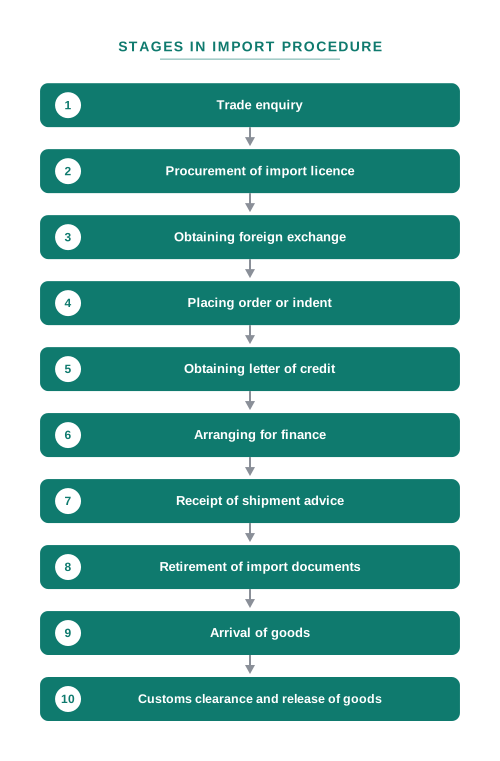
Fig. 11.4 – Steps in a typical import transaction.
Trade enquiry — the first thing the importing firm has to do is gather information about the countries and firms that export the given product. Such information can be gathered from trade directories, trade associations and organisations. Having identified the countries and firms that export the product, the importing firm approaches the export firms with a trade enquiry for collecting information about their export prices and terms of export. A trade enquiry is a written request by an importing firm to the exporter for the supply of information regarding the price and the various terms and conditions on which the latter is ready to export goods. After receiving a trade enquiry, the exporter prepares a quotation, known as a proforma invoice, and sends it to the importer.
Procurement of import licence — certain goods can be imported freely, while others need licensing. The importer needs to consult the Export Import (EXIM) policy in force to know whether the goods to be imported are subject to import licensing. Where goods can be imported only against a licence, the importer must procure an import licence. In India, it is obligatory for every importer, and also for every exporter, to get registered with the Directorate General of Foreign Trade or the Regional Import Export Licensing Authority and to obtain an IEC number, which has to be mentioned on most import documents.
Obtaining foreign exchange — since the supplier in an import transaction resides in a foreign country, payment is demanded in a foreign currency, which requires the exchange of Indian currency into foreign currency. In India, all foreign exchange transactions are regulated by the Exchange Control Department of the Reserve Bank of India. As per the rules in force, every importer is required to secure the sanction of foreign exchange. For this, the importer applies to a bank authorised by the Reserve Bank of India to issue foreign exchange. The application is made in a prescribed form along with the import licence, as per the provisions of the Exchange Control Act. After proper scrutiny of the application, the bank sanctions the necessary foreign exchange for the import transaction.
Placing order or indent — after obtaining the import licence, the importer places an import order or indent with the exporter for the supply of the specified products. The import order contains information about the price, quantity, size, grade and quality of the goods ordered, and instructions relating to packing, shipping, ports of shipment and destination, delivery schedule, insurance and mode of payment. It should be carefully drafted so as to avoid ambiguity and consequent conflict between the importer and the exporter.
Obtaining letter of credit — if the payment terms agreed between the importer and the overseas supplier require a letter of credit, the importer obtains the letter of credit from its bank and forwards it to the overseas supplier. The exporter wants this document in order to be sure that there is no risk of non-payment.
Arranging for finance — the importer should make arrangements in advance to pay the exporter on the arrival of the goods at the port. Advance planning for financing imports is necessary so as to avoid heavy demurrage, that is, penalties, on imported goods lying uncleared at the port for want of payment.
Receipt of shipment advice — after loading the goods on the vessel, the overseas supplier despatches a shipment advice to the importer. A shipment advice contains information about the shipment of goods, including the invoice number, the bill of lading or airway bill number and date, the name of the vessel with date, the port of export, the description of goods and quantity, and the date of sailing of the vessel.
Retirement of import documents — having shipped the goods, the overseas supplier prepares a set of necessary documents as per the terms of the contract and the letter of credit, and hands them over to the banker for onward transmission and negotiation to the importer in the manner specified in the letter of credit. This set of documents normally contains the bill of exchange, the commercial invoice, the bill of lading or airway bill, the packing list, the certificate of origin and the marine insurance policy.
The bill of exchange accompanying these documents is known as the documentary bill of exchange. As mentioned in connection with the export procedure, it can be of two types, documents against payment, which is the sight draft, and documents against acceptance, which is the usance draft. In the case of a sight draft the drawer instructs the bank to hand over the relevant documents to the importer only against payment, while in the case of a usance draft the drawer instructs the bank to hand them over against acceptance of the bill of exchange. The acceptance of the bill of exchange for the purpose of getting delivery of the documents is known as retirement of import documents. Once the retirement is over, the bank hands over the import documents to the importer.
Arrival of goods — the goods are shipped by the overseas supplier as per the contract. The person in charge of the carrier, whether ship or aircraft, informs the officer in charge at the dock or the airport about the arrival of goods in the importing country, and provides a document called the import general manifest. This document contains the details of the imported goods and is the document on the basis of which the unloading of cargo takes place.
Customs clearance and release of goods — all goods imported into India have to pass through customs clearance after they cross the Indian borders. Customs clearance is a somewhat tedious process and calls for the completion of a number of formalities. It is therefore advisable for importers to appoint C&F agents, who are well versed with such formalities and play an important role in getting the goods customs cleared.
Steps In Customs Clearance Of Imported Goods
The importer first has to obtain a delivery order, otherwise known as an endorsement for delivery. Generally, when the ship arrives at the port, the importer obtains this endorsement on the back of the bill of lading from the concerned shipping company. In some cases, instead of endorsing the bill, the shipping company issues a delivery order. This order entitles the importer to take delivery of the goods. The importer must, of course, first pay the freight charges, if these have not been paid by the exporter, before taking possession of the goods.
The importer then has to pay dock dues and obtain a port trust dues receipt. For this, two copies of a duly filled form known as an ‘application to import’ are submitted to the Landing and Shipping Dues Office. This office levies a charge for the services of the dock authorities, which has to be borne by the importer. After payment of the dock charges, one copy of the application is returned to the importer as a receipt, and this receipt is known as the port trust dues receipt.
The importer then fills in a form called the bill of entry for the assessment of customs import duty. An appraiser examines the document carefully and gives the examination order. The importer procures the document prepared by the appraiser and pays the duty, if any.
After payment of the import duty, the bill of entry has to be presented to the dock superintendent, who marks it, and an examiner is then asked to physically examine the goods imported. The examiner gives a report on the bill of entry. The importer or the agent presents the bill of entry to the port authority, and after receiving the necessary charges the port authority issues the release order.
11.3.3 Major Documents Used in Export and Import Transactions
The documents used in foreign trade are not mere paperwork. Each one either proves ownership, proves quality or origin, or secures payment, and the absence of any one of them can hold up a consignment at a port. The major documents are grouped below according to what they relate to.
Additional Documents Used In An Import Transaction
Trade enquiry — a written request by an importing firm to the exporter for the supply of information regarding the price and the various terms and conditions on which the latter exports goods.
Proforma invoice — a document that contains details as to the quality, grade, design, size, weight and price of the export product, and the terms and conditions on which the export will take place.
Import order or indent — a document in which the buyer, that is the importer, orders the supply of requisite goods from the supplier, that is the exporter. It contains information such as the quantity and quality of goods to be imported, the price to be charged, the method of forwarding the goods, the nature of packing and the mode of payment.
Shipment advice — a document that the exporter sends to the importer informing him that the shipment of goods has been made. It contains the invoice number, the bill of lading or airway bill number and date, the name of the vessel with date, the port of export, the description of goods and quantity, and the date of sailing of the vessel.
Bill of entry — a form supplied by the customs office to the importer. It is to be filled in by the importer at the time of receiving the goods, has to be in triplicate, and is to be submitted to the customs office. It contains information such as the name and address of the importer, the name of the ship, the number of packages, the marks on the package, the description of goods, the quantity and value of goods, the name and address of the exporter, the port of destination, and the customs duty payable.
Import general manifest — a document that contains the details of the imported goods, and on the basis of which the unloading of cargo takes place.
Dock challan — dock charges are to be paid when all the customs formalities are completed. While paying the dock dues, the importer or the clearing agent specifies the amount of dock dues in a challan or form, which is known as the dock challan.
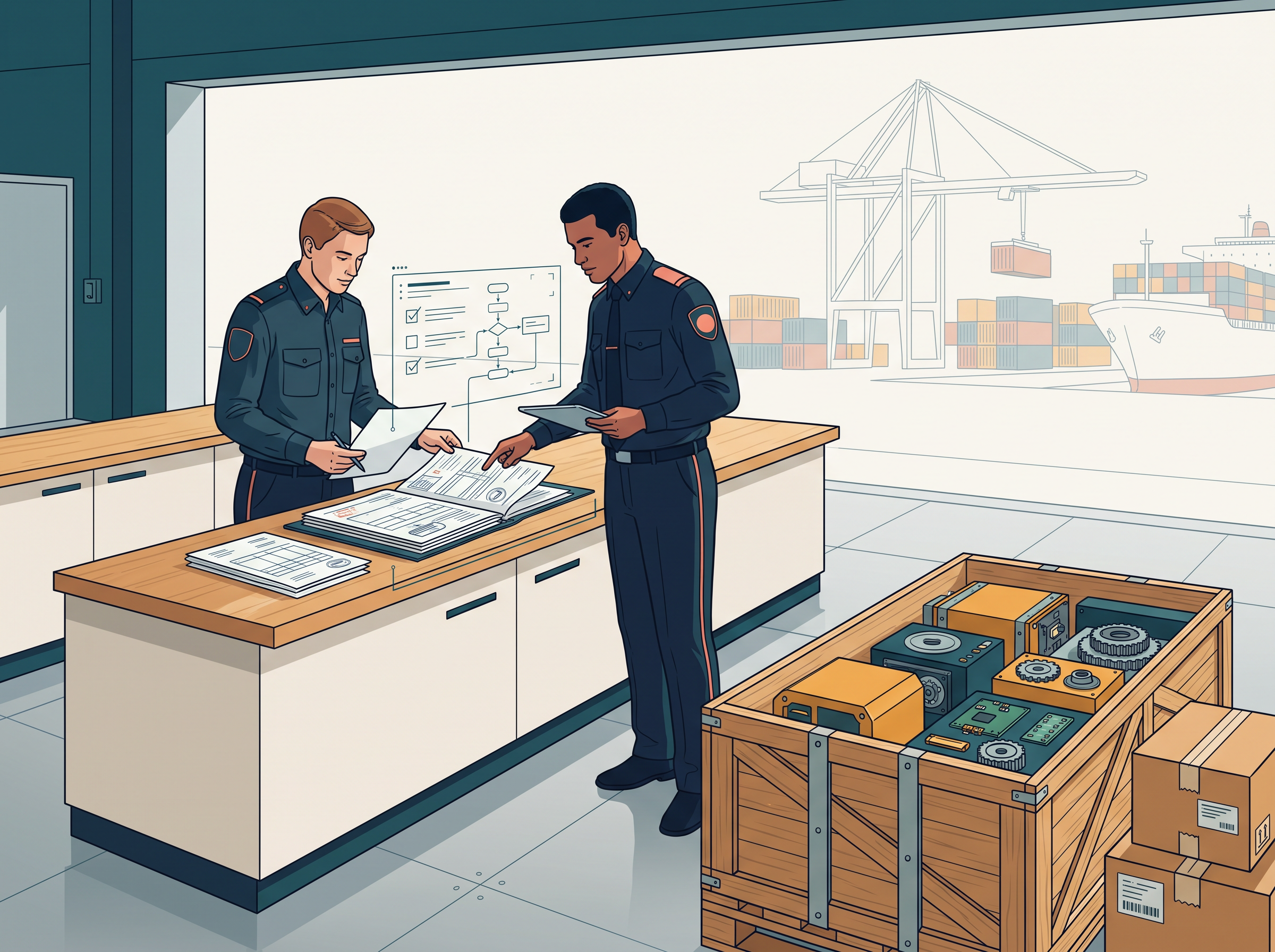
Fig. 11.5 – Customs clearance at an Indian sea port.
11.4 Summary
International business refers to business activities that take place across national frontiers. Although many people use the terms international business and international trade to mean the same thing, the former is a much broader term. International business involves not only trade in goods and services but also other operations, such as the production and marketing of goods and services in foreign countries.
Countries engage in international business because none of them can produce everything equally well or equally cheaply. Differences in natural resources, in the availability of factors of production and in productivity levels lead each country to specialise in what it produces most efficiently and to obtain the rest through trade.
Conducting and managing international business operations is more complex than undertaking domestic business. Differences in the nationality of the parties involved, the relatively lower mobility of factors of production, customer heterogeneity across markets, variations in business practices and political systems, varied business regulations and policies, and the use of different currencies are the key aspects that distinguish international business from domestic business. These same factors make international business a much more complex and difficult activity.
The scope of international business covers merchandise exports and imports, service exports and imports or invisible trade, licensing and franchising, and foreign investment, which may take the form of direct investment or portfolio investment.
International business benefits countries through the earning of foreign exchange, more efficient use of resources, improved growth prospects and employment potential, and a higher standard of living. It benefits firms through prospects of higher profits, increased capacity utilisation, prospects for growth, an escape from intense domestic competition, and an improved business vision.
A firm can enter international business through exporting and importing, contract manufacturing, licensing and franchising, joint ventures, or wholly owned subsidiaries. These modes differ in the investment required, the degree of control obtained and the risk carried, and each carries its own advantages and limitations.
Export and import transactions involve a number of formalities relating to licensing, finance, inspection, excise and customs clearance, shipping and payment. The documents used at each stage either prove ownership of the goods, certify their quality or origin, or secure payment between the two parties.
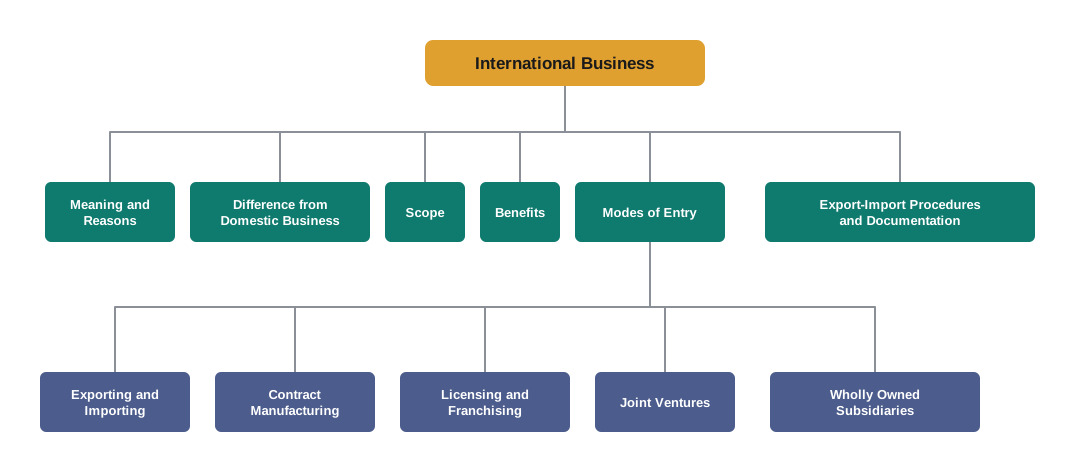
Fig. 11.6 – Structure of the chapter.
11.5 Key Terms
- Internal business Business transactions taking place within the geographical boundaries of a nation, also called domestic or home trade.
- International business Business activities that take place across national frontiers, including the cross-border movement of goods, services, capital, personnel, technology and intellectual property.
- International trade The export and import of goods between countries, which forms one part of international business.
- Merchandise trade Export and import of tangible goods, excluding trade in services.
- Invisible trade Export and import of services, so called because services are intangible.
- Licensing A contractual arrangement in which one firm grants another firm in a foreign country access to its patents, trade secrets or technology for a fee.
- Franchising An arrangement similar to licensing but used for service business, in which the franchiser lays down strict rules on how the franchisee must operate.
- Foreign investment Investment of funds abroad in exchange for a financial return.
- Foreign direct investment Investment in properties such as plant and machinery abroad that gives the investor a controlling interest in the foreign company.
- Wholly owned subsidiary A foreign unit in which the parent company makes a hundred per cent equity investment and thereby acquires full control.
- Portfolio investment Investment in the shares of, or loans to, a foreign company, earning dividends or interest without any direct involvement in its operations.
- Exporting Sending goods and services from the home country to a foreign country.
- Importing Purchase of foreign products and bringing them into one’s own country.
- Contract manufacturing An arrangement in which a firm gets components or goods produced by local manufacturers in a foreign country as per its specifications.
- Outsourcing Another name for contract manufacturing.
- Royalty The fee paid by the licensee to the licensor for the use of patents, trade secrets or technology.
- Licensor The firm that grants another firm the right to use its patents, trade secrets or technology.
- Licensee The firm in the foreign country that acquires the right to use the licensor’s technology or patents.
- Cross-licensing Mutual exchange of knowledge, technology or patents between two firms.
- Franchiser The parent company that grants franchise rights over its technology, trademark and patents.
- Franchisee The party that acquires franchise rights and runs the business as per the franchiser’s rules.
- Joint venture A firm that is jointly owned by two or more otherwise independent firms.
- Green field venture Setting up an altogether new firm to start operations in a foreign country.
- Proforma invoice A quotation sent by the exporter stating the price and the quality, grade, size, weight, delivery, packing and payment terms of the goods.
- Indent The order placed by the importer, containing a description of the goods, prices, delivery terms, packing and marking details and delivery instructions.
- Letter of credit A guarantee issued by the importer’s bank that it will honour payment up to a certain amount of export bills to the exporter’s bank.
- Export licence The permission an export firm must obtain under customs laws before it proceeds with exports.
- Import Export Code number A number issued by the Directorate General of Foreign Trade that has to be filled in on most export and import documents.
- Registration cum Membership Certificate The certificate obtained from an export promotion council, needed to avail of government benefits available to export firms.
- Pre-shipment finance Finance obtained from a bank for procuring raw materials, and for processing, packing and transporting the goods to the port of shipment.
- Pre-shipment inspection Compulsory inspection of certain products by a designated agency before export, to ensure quality.
- Excise clearance Clearance issued by the Excise Commissioner in respect of excise duty payable on materials used in manufacturing the goods.
- Duty drawback The refund of excise duty on goods manufactured for export.
- Certificate of origin A certificate specifying the country in which the goods have been produced, used to claim tariff concessions or exemptions.
- Shipping order An instruction from the shipping company to the captain of the ship to receive the specified goods on board after customs clearance.
- Shipping bill The main document on the basis of which the customs office grants permission for export.
- Carting order The instruction to the port gate staff to permit the entry of the cargo inside the dock.
- Clearing and Forwarding agent The agent entrusted with completing shipping and customs formalities on behalf of the exporter or importer.
- Mate’s receipt A receipt issued by the commanding officer of the ship when the cargo is loaded on board.
- Bill of lading A document in which the shipping company acknowledges receipt of the goods on board and undertakes to carry them to the port of destination; it is also a document of title.
- Airway bill The equivalent of a bill of lading issued by an airline company for goods carried by air.
- Bill of exchange A written order to the importer to pay a certain amount to, or to the order of, a certain person or to the bearer of the instrument.
- Sight draft A bill of exchange under which the bank hands over the documents to the importer only against payment.
- Usance draft A bill of exchange under which the documents are handed over against the importer’s acceptance, payment being made at the end of a specified period.
- Letter of indemnity A letter by which the exporter undertakes to indemnify the bank, with interest, if payment is not received from the importer.
- Bank certificate of payment A certificate stating that the documents relating to the consignment have been negotiated and payment received as per exchange control regulations.
- Trade enquiry A written request by an importing firm to an exporter for information about price and terms of export.
- Import licence The licence required for importing goods that cannot be imported freely under the EXIM policy in force.
- Shipment advice A document sent by the exporter informing the importer that the shipment of goods has been made.
- Documentary bill of exchange A bill of exchange accompanied by the documents of title to the goods.
- Retirement of import documents Acceptance of the bill of exchange by the importer in order to obtain delivery of the import documents from the bank.
- Import general manifest A document containing details of the imported goods, on the basis of which the cargo is unloaded.
- Delivery order An endorsement or order entitling the importer to take delivery of the goods from the shipping company.
- Port trust dues receipt The receipt issued to the importer after payment of dock charges.
- Bill of entry A form filled in by the importer for the assessment of customs import duty.
- Export invoice The seller’s bill for merchandise, giving quantity, value, packages, marks, destination and terms of delivery and payment.
- Packing list A statement of the number of cases or packs and the details of the goods contained in them.
- Certificate of inspection A certificate stating that the consignment has been inspected as required and is export worthy.
- Marine insurance policy A certificate of the insurance contract indemnifying the insured against loss of goods exposed to the perils of the sea.
- Cart ticket A gate pass prepared by the exporter giving details of the export cargo and the vehicle carrying it.
- Dock challan The form in which the importer or the clearing agent specifies the amount of dock dues payable.
11.6 NCERT Questions
Short Answer Questions
- Differentiate between international trade and international business.
- Discuss any three advantages of international business.
- What is the major reason underlying trade between nations?
- Differentiate between contract manufacturing and setting up a wholly owned production subsidiary abroad.
- Why is it necessary for an export firm to go in for pre-shipment inspection?
- What is a bill of lading? How does it differ from a bill of entry?
- What is a letter of credit? Why does an exporter need this document?
- Discuss the process involved in securing payment for exports.
Long Answer Questions
- ‘International business is more than international trade.’ Comment.
- What benefits do firms derive by entering into international business?
- In what ways is exporting a better way of entering international markets than setting up wholly owned subsidiaries abroad?
- Rekha Garments has received an order to export 2000 men’s trousers to Swift Imports Ltd., located in Australia. Discuss the procedure that Rekha Garments would need to go through for executing the export order.
- Your firm is planning to import textile machinery from Canada. Describe the procedure involved in importing.
11.7 Check Your Concepts
- Why is it said that no country can produce equally well or equally cheaply everything that it needs?
- Explain why the mobility of labour between two countries is generally lower than the mobility of labour between two states of the same country.
- What happens to an exporting firm’s competitiveness when transportation costs, customs duty and other levies are added to the price of its goods?
- Distinguish between direct investment and portfolio investment.
- Distinguish between direct exporting and indirect exporting.
- Distinguish between licensing and franchising.
- Why is trade in services called invisible trade?
- A firm wishes to enter a foreign market that has imposed heavy import restrictions. Which modes of entry remain open to it, and why?
- Why does a local manufacturer producing under contract manufacturing sometimes earn lower profits than it could have earned by selling in the open market?
- State two reasons why a small firm may find a wholly owned subsidiary unsuitable as a mode of entry.
- Arrange the following steps of the export procedure in their correct sequence: obtaining mate’s receipt, receipt of indent, customs clearance, obtaining pre-shipment finance, issuance of bill of lading.
- Arrange the following steps of the import procedure in their correct sequence: arrival of goods, trade enquiry, obtaining foreign exchange, retirement of import documents, placing the indent.
- Identify the term: the refund of excise duty on goods manufactured for export.
- Identify the term: the document in which a shipping company acknowledges receipt of goods on board and undertakes to carry them to the port of destination.
- Identify the term: the fee paid by a firm in a foreign country for the right to use another firm’s patents or technology.
- Match the following documents with what each one does:
| Column A | Column B |
|---|---|
| a. bill of entry | i. Proves the country in which the goods were produced |
| b. certificate of origin | ii. Enables the customs office to grant permission for export |
| c. mate’s receipt | iii. Is issued when the cargo is loaded on board the ship |
| d. shipping bill | iv. Enables the assessment of customs import duty |
- Assertion (A): A firm entering a foreign market through licensing has to make almost no investment abroad. Reason (R): Under licensing, it is the licensee who sets up the business unit and invests its own money in the business. Choose the correct option:
- Both A and R are true, and R is the correct explanation of A
- Both A and R are true, but R is not the correct explanation of A
- A is true but R is false
- A is false but R is true
- Assertion (A): A usance draft gives the importer time before payment has to be made. Reason (R): Under a usance draft, the bank hands over the documents to the importer only against immediate payment. Choose the correct option:
- Both A and R are true, and R is the correct explanation of A
- Both A and R are true, but R is not the correct explanation of A
- A is true but R is false
- A is false but R is true
- Why must the exporter obtain an inspection certificate before shipment for certain categories of goods, when the goods have already been produced as per the importer’s specifications?
11.8 Case-Based Questions
- Sanchari Tools Ltd. manufactures hand tools in Rajasthan. Its capacity is far greater than the demand in the Indian market, and prices at home have stopped rising because of severe competition. The company decides to seek buyers in East Africa, where its products can fetch better prices. It is unwilling, at this stage, to put any money into facilities outside India.
- Identify the mode of entry into international business that suits Sanchari Tools Ltd.
- State any two benefits the firm is likely to gain from this decision.
- State any one limitation it may face in this mode of entry.
- Mridang Apparel Ltd., a well-known international clothing brand, does not own a single factory in India. It signs agreements with several Indian garment units to produce shirts exactly as per its designs and quality standards, and then sells them abroad under its own brand name. One Indian unit finds that it must sell the entire output to Mridang Apparel at a price fixed in the agreement, even though open market prices have risen.
- Name the mode of entry into international business being used by Mridang Apparel Ltd.
- State any two advantages that this mode offers to Mridang Apparel Ltd.
- Explain the limitation being faced by the Indian unit.
- Trisandhya Beverages Ltd. of India and a bottling company based in Vietnam decide to set up a new company together, in which both contribute to the equity capital. The Vietnamese partner brings knowledge of local competitive conditions, language and business practices, while the Indian partner brings its formula and production technology.
- Name the mode of entry into international business adopted here.
- State any two advantages that Trisandhya Beverages Ltd. gains from this arrangement.
- State any one risk that Trisandhya Beverages Ltd. runs by entering this arrangement.
- Anveshi Exports Ltd. has received a confirmed order from a buyer in Europe along with a letter of credit. The firm approaches its bank for funds to buy raw material and to pack and move the goods to the port. Before the consignment can be loaded, the firm must also obtain permission from the customs office and arrange for the cargo to enter the dock.
- Name the finance obtained by Anveshi Exports Ltd. from its bank.
- Name the document on the basis of which the customs office grants permission for export.
- Name the order that permits the entry of the cargo inside the dock, and state who issues it.
- Ojaswini Traders Ltd. has imported a consignment of machine parts. The carrier informs the officer in charge at the dock about the arrival of the goods and provides the document on the basis of which the cargo is unloaded. The firm then pays the dock charges, obtains a receipt, and fills in a form for the assessment of customs duty.
- Name the document provided by the person in charge of the carrier.
- Name the receipt obtained after payment of dock charges.
- Name the form filled in for the assessment of customs import duty and state one item of information it contains.