Chapter 1: Introduction: Human Ecology and Family Sciences
A College Changes Its Name
In 1969, a well-known college at Cornell University in the United States changed its name. For decades it had been called the College of Home Economics. That year it became the College of Human Ecology, and it has carried that name ever since.
Nothing was taken out of the classrooms. The same staff went on teaching nutrition, child development, textiles and family resources. What changed was the label on the door, and the change was made because the old label had stopped describing the work honestly. ‘Home economics’ suggested a subject that stayed indoors, ran a household, and belonged to women. By the 1960s the field was studying how human beings interact with everything around them — food supply, income, clothing, communication, ageing, the health of whole communities. That is a much larger claim than a kitchen can hold.
Over the following decades, universities and professional bodies in several countries went through the same argument. The subject you are about to study is the Indian result of it. Its full name, Human Ecology and Family Sciences, was chosen with care, and every word of it is doing a job.
Before you decide whether the new name is an improvement, it is worth knowing what the old one had come to mean, and how it got there.
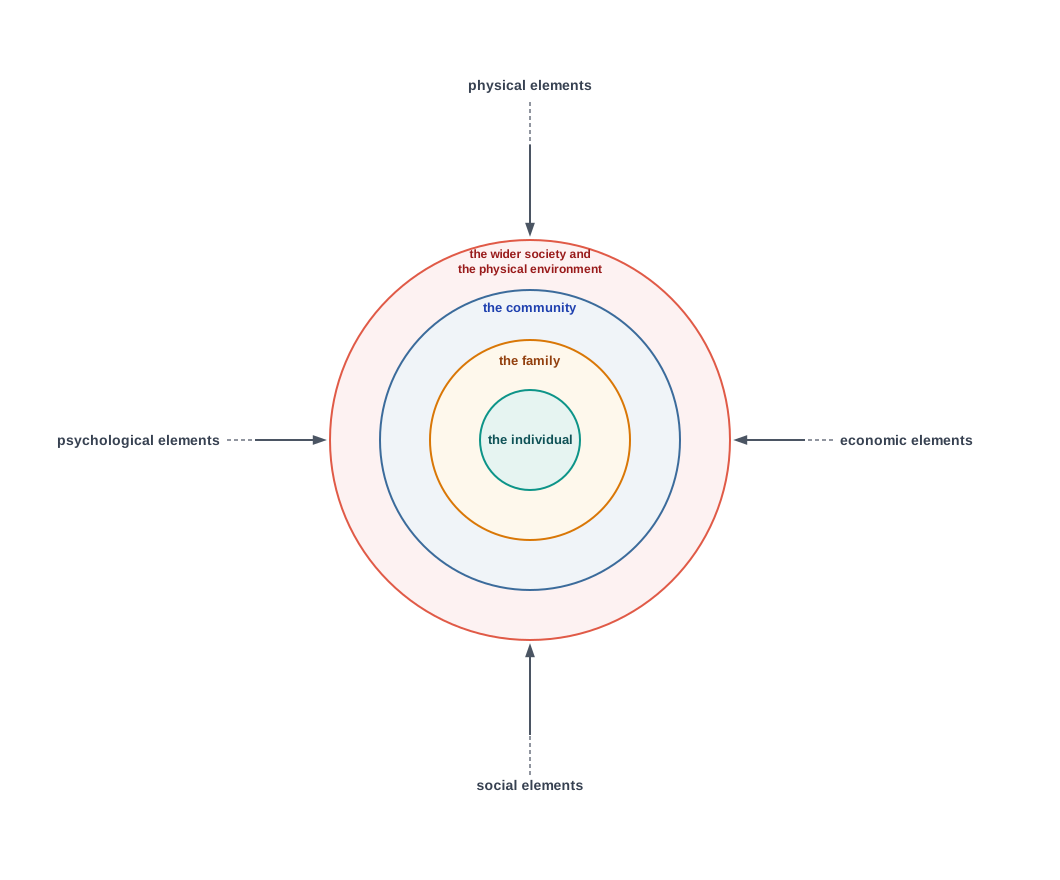
Fig. 1.0 – The individual at the centre of an ecology.
1.1 Understanding The Name Of The Subject
The name of a school subject is usually a description of it. ‘Geography’ tells you that the earth is being written about; ‘Economics’ tells you that management of resources is at issue. The name of this subject works the same way, but it is a long name, and each part of it has been chosen deliberately.
The title is ‘Human Ecology and Family Sciences’, shortened in this book to HEFS. It has two halves joined by ‘and’, and neither half can be dropped without changing what the subject is. Take the halves one at a time.
1.1.1 What ‘Ecology’ Means
The dictionary explains ecology in two ways. Firstly, it is a branch of biology that deals with the relations between living organisms and their environment. Secondly, it is the complex of relationships between an organism and its environment.
Notice that these two senses are not the same. The first names a field of study; the second names the thing being studied. A pond has an ecology in the second sense — the fish, the weed, the water temperature and the birds that feed there all act on one another. A scientist who studies that pond is doing ecology in the first sense.
An organism’s environment is everything outside it that acts on it and that it acts on in turn. For the fish, that includes the water, the weed, the temperature and the other fish. Neither sense of ecology is interested in the organism alone. Both are interested in the traffic between the organism and what surrounds it.
1.1.2 Why The Word ‘Human’ Comes First
Ecology in biology covers every living organism — bacteria, banyan trees, blue whales. This subject borrows the idea but narrows the organism. In our context, the living organism is the human being, and that is why the word ‘Human’ is placed before ‘Ecology’.
The narrowing does real work, because a human being’s environment is unusually complicated. A fish is surrounded by water, weed and temperature. A person is surrounded by all of those and also by money, family, language, work, custom, opinion and mood. Human ecology is the study of human beings in relation to that whole environment, and the elements that make it up are taken apart in section 1.2.
1.1.3 What ‘Family Sciences’ Means
The second half of the title is equally significant. A family is a group of people bound by ties of marriage, birth or adoption who share a household and take responsibility for one another. For most individuals it is the setting in which life is actually lived.
It is within the family that children are nurtured, so that they develop and acquire independent identities as adults. A child learns a language there, learns what to eat and how, learns what is expected of her and what she may expect. That is why this subject never studies an individual in isolation. It guides you to understand the individual in the context of the family.
The family is also a critical social unit of society. It sits between the single person and the wider community, and much of what a society does — feeding people, raising children, caring for the ill and the old — is actually done inside families. Study the family well and you have a working view of both levels at once.
The plural in ‘Sciences’ is not an accident either. Several distinct fields of study are pooled here, and they are named in section 1.6.
1.2 What This Subject Studies
Having read the title, you can now state the subject’s business in one sentence. Through HEFS you will be studying human beings in relation to their environment.
That sentence is short but it is not narrow. It covers people at every stage of life — children, adolescents and adults — and the relationships it studies are dynamic, meaning they keep changing on both sides. A person shapes her surroundings and is shaped by them, and neither stays still.
1.2.1 The Individual And The Elements Around Her
The environment a person lives in is not made of one kind of thing. It is made of physical, economic, social and psychological elements, and this subject studies a person’s relationship with all four. Table 1.1 sets them out with an ordinary instance of each.
Read the last column across and you will see the point of studying all four together. A single decision — what to cook tonight — is at once physical (what is in the house), economic (what it cost), social (who is eating) and psychological (whether anyone has the energy to cook). Pull the four apart and you have four half-answers.
The relationships also run in both directions. Prices act on a household, and the household’s buying acts on demand. This two-way traffic is what the word ‘ecology’ promised in section 1.1, and it is why the subject rarely accepts a single cause for anything.
1.2.2 The Family As A Social Unit
HEFS follows an integrated approach in the teaching-learning process — that is, it deals with its topics as a connected whole rather than as separate compartments. More importantly, it deals with the interaction of human beings, as members of their families and of society, with the environment.
This forms a synergistic relationship with their ecology. Synergy means that things working together produce more than they would separately. A family’s ecology amalgamates within it physical, psychological, socio-cultural and economic resources, and those resources support one another: a small income used with skill and cooperation goes further than a larger one used carelessly.
Because of this, almost every topic in the book sits somewhere on a ladder of scale, shown in Fig. 1.1. A decision about one person’s meal sits at the first rung; planning a household’s month sits at the second; a village’s water supply at the third; a national nutrition programme at the fourth. Whenever you meet a new topic, ask which rung it belongs to.

Fig. 1.1 – The ladder of scale in HEFS.
1.2.3 Why Adolescence Receives Special Attention
In the Class XI curriculum you will notice that particular attention has been paid to the stage of adolescence — the years of transition between childhood and adulthood, in which a person grows rapidly in body, thinking and social life. This period is known to be a turning point in one’s life.
It is a turning point because so much is settled, or at least started, during it. Habits of eating, sleeping and spending form now. So do a sense of one’s own identity, the shape of one’s friendships, and views about work and study. Choices made in these years carry a long way forward, which is why a subject about living well pays them close attention.
You will therefore study how adolescents develop an understanding of themselves, and what role food and other resources, fabric and clothing, and communications play in their lives. Each of those is a chapter or more in this book, and each is treated with the adolescent reader in view.
1.3 Home Science And Its Relation To This Subject
You may have met this subject before under another name. Home Science is a subject close to HEFS, though not exactly like it. It has been taught under that title at both the higher secondary and the university levels, in different parts of the country, for many decades.
The relationship between the two names is not a rivalry. The fields of study are largely the same ones — food and nutrition, human development, fabric and apparel, communication, resource management. What differs is where the name puts the emphasis. ‘Home Science’ points at a place. ‘Human Ecology and Family Sciences’ points at a relationship: a person, and everything she lives among.
Why Names Change
Disciplines rename themselves more often than students expect. With changing times, many fields of study have taken new forms and assumed a more contemporary nomenclature — that is, a more up-to-date set of names for themselves. The term Life Sciences, for instance, is now widely used to refer to the biological sciences.
A change of name is worth making when the old name has begun to mislead. It is not worth making otherwise. The test is simple: does the name still describe the work? Where the answer is no, the name is quietly costing the subject readers, students and respect, because people decide what a subject is from its title long before they open its book.
By that test, there was a need to modernise the content of Home Science at the school level, and to give it a title that would release it from being associated mainly with the home, and with the tasks traditionally done by girls and women. Why that association had formed at all, and what it did to the subject, is taken up in section 1.5.
At the university level this exercise was undertaken many years ago by the University Grants Commission. Departments across the country were renamed, and their curricula reset, well before the school syllabus followed. The change you are reading about is therefore the last stage of a long shift, not a sudden one.
1.4 How The Discipline Grew In India
A subject’s present shape is usually the result of its history, and this one is no exception. A brief account of how Human Ecology and Family Sciences grew out of the field of Home Science in India is in order here.
1.4.1 The Early Twentieth Century
In the early twentieth century there were many institutions in different parts of the country that had introduced courses in Foods and Nutrition, Clothing and Textiles, and extension education — the work of carrying useful knowledge out of institutions and into households and villages, through demonstration, training and advice.
Read those three names together and a pattern appears. Each course took one everyday household concern and taught it as a matter for study rather than for imitation: what people eat, what they wear, and how sound practice spreads from one household to the next.
What these courses did not yet have was a common name or a common home. They were run separately, in separate institutions, by teachers who might never have met. A student could learn nutrition in one place and textiles in another without anyone treating the two as parts of a single field.
1.4.2 The Founding Of Lady Irwin College In 1932
These different disciplines were brought under the rubric of Home Science in 1932, when an institution by the name of Lady Irwin College was set up in Delhi to promote women’s education. Fig. 1.2 traces the sequence from scattered courses to a single named discipline.
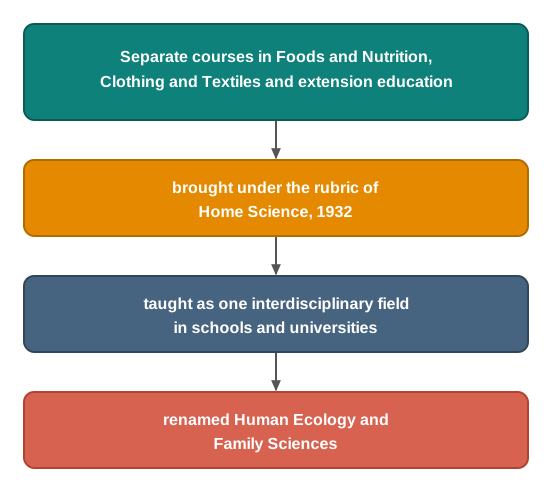
Fig. 1.2 – From scattered courses to one discipline.
To see why the founding mattered, place it in its time. This was well before India’s independence from British rule, when very few girls attended school and hardly any institutions for women’s higher education existed. A college that admitted women to a serious course of study was, in that setting, an unusual thing to build.
The college carries the name of Lady Dorothy Irwin, who supported its establishment. Her husband, Lord Irwin, served as Viceroy of India from 1926 to 1931, the years in which the proposal was taking shape.
1.4.3 The Women Who Led The Effort
A few eminent women were in the vanguard of the movement to liberate India, and the same women stood behind this college. Among them were Sarojini Naidu, Rajkumari Amrit Kaur and Kamaladevi Chattopadhyay. They were stalwarts of the All India Women’s Conference, an organisation founded in 1927 to work for women’s education and welfare, and it was they who conceived of and established Lady Irwin College.
Their goal was stated plainly: to serve the home and society with equal resolve, so as to remove the social and educational inequalities that prevented women from reaching their potential. Notice that the two purposes were given equal weight. The college was not built to make better housekeepers. It was built to open a closed door.
That founding intention explains something about the subject you are studying. It was designed from the start to work at more than one rung of the ladder in Fig. 1.1 — the household and the society together — and it was designed by people who were arguing about the position of women in India, not merely about a syllabus.
1.5 Gender-Typing And What It Cost The Subject
Home Science, as its founders designed it, was not intended to be a subject only about the ‘home’. It was meant to be an interdisciplinary field — one that draws on several subjects at once and joins their findings — able to equip its students to improve their own lives and the lives of other individuals and families.
That is not, however, what the label came to mean outside the field. Over time, in the mind-set of lay people and of professionals from other disciplines, Home Science became associated primarily with learning culinary skills, laundry and child-care. The name was read as a description of household chores, and the science in it went unnoticed.
How A Wrong Idea Took Hold
Two things then happened at different speeds. At the higher education level, an upgrading of the curricula and a resetting of professional standards took place several years ago, so the university version of the subject moved on. At the high school level, its gender-typing — the treating of a subject, task or occupation as belonging naturally to one gender — and its association with ‘cooking and laundry’ remained.
The consequences were practical. Boys were either not admitted to this area by their schools, or they shied away from studying it themselves, because it was seen as a subject only for girls. Alongside this ran a second and equally mistaken belief: that the subject was lacking in rigour.
Both beliefs cost the subject something real, and Table 1.2 sets the popular idea of it against its actual content.
Read the third row again, because it answers the charge of low rigour directly. A student who can say why a woollen garment must not go into hot water is reasoning from the behaviour of a fibre. A student who can plan a week’s meals within an income is balancing several requirements against a constraint. Neither is an act of memory.
The loss ran in both directions. The subject lost half its possible students, and those students lost a subject whose skills every adult uses. Food, clothing, money and care are not one gender’s business, and a course that teaches them is not one gender’s course.
1.6 The Five Fields Within The Subject
The curriculum that has guided the preparation of this book is contemporary in its content and in its approach. It has been designed and presented so that you will identify with the issues discussed — that is, recognise them as questions from your own life rather than someone else’s. The title ‘Human Ecology and Family Sciences’ was considered most appropriate to reflect the spirit of that course.
As you read the chapters, you will realise that the subject is multi-disciplinary — made up of several distinct fields of study, each with its own methods, brought together under one name. There are five of them, shown around the centre in Fig. 1.3.
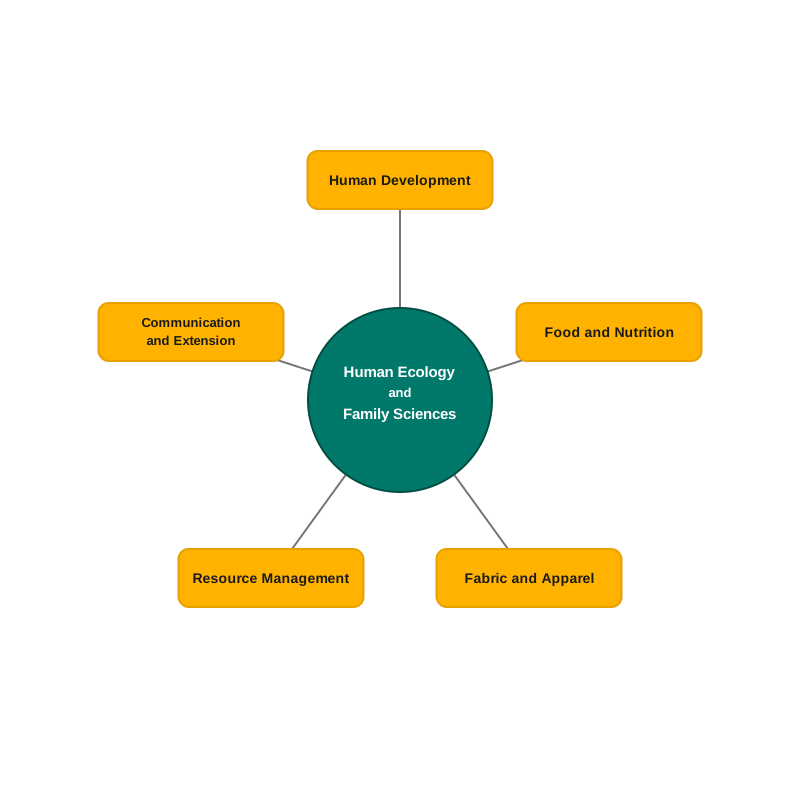
Fig. 1.3 – The five fields within HEFS.
Human Development studies how a person changes from infancy to old age — in body, in thinking, in feeling and in social life — and what helps or hinders that change. It is the field that explains how a toddler comes to speak in sentences, and why an older person’s needs are not simply a child’s needs in reverse.
Food and Nutrition studies what food is made of, what the body does with it, and how meals are selected, cooked and served so that a person actually gets what she needs. It answers questions such as why an infant needs far more protein for each kilogram of body weight than an adult does.
Fabric and Apparel studies fibres, yarns, fabrics and finished garments — how they are made, how they behave, and how they are chosen and cared for. It is the field that explains why a cotton shirt feels cool in summer while a synthetic one of the same thickness does not.
Communication and Extension studies how information and ideas travel between people, and how sound practice is carried from where it is known to where it is needed. It asks how a message about safe drinking water actually reaches a household that is not reading about it in a book.
Resource Management studies the resources a household has — money, time, energy, skills, materials and space — and how they are planned, allotted and used to reach goals. It is the field behind the question of how a family with one crowded hour before school gets four people fed and out of the door.
Table 1.3 sets the five side by side. Read it across rather than down, and notice how often a single household situation would need more than one row.
These five are not studied one after another and then set aside. A single question — how should a household feed and clothe a growing child on a fixed income — draws on four of them at once. That is what the integrated approach described in section 1.2 amounts to in practice.
1.7 The Subject And The Quality Of Life
Everything in the last section adds up to a single claim, and it is the claim on which this subject rests. Knowledge in these five areas is essential to sustain and augment one’s quality of life — the general condition of a person’s living, judged not by income alone but by health, food, shelter, work, security, relationships and the ability to make one’s own choices.
The two verbs in that sentence do different work. To sustain is to keep a level of living from slipping — food that stays adequate, clothes that last, money that reaches the end of the month. To augment is to raise it — a better-planned meal, a garment chosen well, an hour recovered from a badly arranged routine. Most households need both, and both depend on knowing why things work as they do.
This claim holds whether one lives in a village or a town. The resources differ and so do the constraints, but a person in either place eats, dresses, spends, cares for others and is cared for. It holds equally whether the person is female or male, for the same plain reason: these are the requirements of being alive in a household, not the duties of one half of it.
Knowledge Turned Into Decisions
Notice that knowledge only reaches a person’s quality of life through decisions. A fact about protein sitting in a notebook changes nothing; the same fact used while planning a week’s meals changes what a growing child gets. The whole design of this book follows from that, which is why each topic ends in something you can do, decide or judge.
That is what the subject is for. This book, it is hoped, will answer some of the questions young people already have about their own lives — about their bodies, their food, their clothes, their money and the people they live with — and will leave you able to work out the answers to a few it never asked.
1.8 Summary
- The name of this subject is a description of it, and each part of the title does a job.
- Ecology has two dictionary senses:
- a branch of biology dealing with the relations between living organisms and their environment;
- the complex of relationships between an organism and its environment.
- An organism’s environment is everything outside it that acts on it and is acted on by it.
- The word ‘Human’ precedes ‘Ecology’ because in this subject the living organism studied is the human being.
- A family is a group bound by marriage, birth or adoption who share a household and take responsibility for one another.
- Family Sciences is part of the title because children are nurtured within the family, where they develop and acquire independent identities as adults.
- The family is a critical social unit of society, so the subject studies the individual in the context of the family.
- The subject studies human beings in relation to their environment, across childhood, adolescence and adulthood.
- These relationships are dynamic, and they involve four kinds of elements:
- physical;
- economic;
- social;
- psychological.
- HEFS follows an integrated approach, dealing with human beings as members of families and of society in interaction with the environment.
- This forms a synergistic relationship with their ecology, which amalgamates physical, psychological, socio-cultural and economic resources.
- Topics in the subject sit on a ladder of scale: individual, family, community and nation.
- The Class XI curriculum pays particular attention to adolescence, because this stage is a turning point in one’s life.
- Adolescents are studied in terms of how they understand themselves, and the roles that food and other resources, fabric and clothing, and communications play in their lives.
- Home Science is a subject close to HEFS, taught at higher secondary and university levels in different parts of the country.
- Disciplines adopt a more contemporary nomenclature as they change, as when Life Sciences came to be used for the biological sciences.
- Home Science at the school level needed a modernised content and a title that released it from being associated mainly with the home and with tasks traditionally done by girls and women.
- The University Grants Commission carried out this exercise at the university level many years ago.
- In the early twentieth century, institutions in different parts of India offered separate courses in Foods and Nutrition, Clothing and Textiles, and extension education.
- These disciplines were brought under the rubric of Home Science in 1932, when Lady Irwin College was set up in Delhi to promote women’s education.
- At that time, before independence, very few girls attended school and hardly any institutions for women’s higher education existed.
- Lady Irwin College was conceived of and established by Sarojini Naidu, Rajkumari Amrit Kaur and Kamaladevi Chattopadhyay, stalwarts of the All India Women’s Conference.
- Its goal was to serve the home and society with equal resolve, and to remove the social and educational inequalities that prevented women from reaching their potential.
- Home Science was never intended to be about the ‘home’ alone, but to be an interdisciplinary field that improved the lives of its students and of other individuals and families.
- Over time the label came to be associated, in the mind-set of lay people and of non-Home Science professionals, mainly with culinary skills, laundry and child-care.
- Curricula and professional standards were upgraded at the higher education level, but gender-typing persisted at the school level.
- Gender-typing is the treating of a subject, task or occupation as belonging naturally to one gender.
- Because of it, boys were either not admitted to the subject by schools or shied away from it, and the subject was wrongly perceived as lacking in rigour.
- The subject is multi-disciplinary and contains five fields:
- Human Development;
- Food and Nutrition;
- Fabric and Apparel;
- Communication and Extension;
- Resource Management.
- Knowledge in these areas is essential to sustain and augment one’s quality of life.
- Quality of life is the overall condition of a person’s living, taking together health, nutrition, shelter, clothing, economic security, relationships and freedom of choice.
- This holds whether a person lives in a village or a town, and whether the person is female or male.
1.9 Key Terms
- Adolescence — the stage of transition between childhood and adulthood, marked by rapid change in body, thinking and social life.
- Communication and Extension — the field that studies how information and ideas travel between people and how sound practice is carried to those who need it.
- Ecology — the study of the relations between living organisms and their environment; also, the complex of relationships between an organism and its environment.
- Environment — everything outside an organism that acts on it and is acted on by it.
- Extension education — the work of carrying useful knowledge out of institutions into households and villages through demonstration, training and advice.
- Fabric and Apparel — the field that studies fibres, yarns, fabrics and garments, how they behave, and how they are chosen and cared for.
- Family — a group of people bound by ties of marriage, birth or adoption who share a household and take responsibility for one another.
- Food and Nutrition — the field that studies what food contains, what the body does with it, and how meals are selected, cooked and served.
- Gender-typing — the treating of a subject, task or occupation as belonging naturally to one gender.
- Home Science — the title under which this field of study has been taught at higher secondary and university levels in different parts of India.
- Human Development — the field that studies how a person changes from infancy to old age and what shapes that change.
- Human ecology — the study of human beings in relation to their whole environment, physical, economic, social and psychological.
- Integrated approach — teaching and learning that deals with topics as a connected whole rather than as separate compartments.
- Interdisciplinary — drawing on several subjects at once and joining their findings into a single account.
- Multi-disciplinary — made up of several distinct fields of study, each with its own methods, brought together under one name.
- Nomenclature — the set of names used for a field of study or for the things within it.
- Quality of life — the overall condition of a person’s living, taking together health, nutrition, shelter, clothing, economic security, relationships and freedom of choice.
- Resource Management — the field that studies a household’s money, time, energy, skills, materials and space, and how they are planned and used.
1.10 Points To Ponder
- If a subject’s name changes but its content stays the same, has anything really changed? Consider what a name does before anyone reads the syllabus.
- Ecology means both a field of study and the thing being studied. Does keeping both senses in one word help thinking about human beings, or does it blur two different ideas?
- Gender-typing kept boys out of this subject in many schools. What else does a society lose when a useful skill is treated as belonging to one gender rather than to everyone?
- Adolescence is described as a turning point. Would a person living through a stage be a better or a worse judge of it than someone looking back on it years later?
- The ladder of scale runs from individual to nation. Choose any everyday household activity and argue for the rung on which it should be placed — and then for the rung above it.
- Quality of life is said to depend on more than income. What could a household improve using knowledge alone, and where would knowledge stop being enough?
1.11 Objective Questions
- The word ‘Human’ is placed before ‘Ecology’ in the title of this subject because (1 mark)
- human beings are the only organisms with an environment
- the organism whose relationship with the environment is studied here is the human being
- ecology is not a term used in biology
- the subject is taught only to human development students
- The different disciplines that later formed this field were brought under the rubric of Home Science in 1932, when a college was set up in (1 mark)
- Mumbai
- Chennai
- Delhi
- Kolkata
- Which of the following is not one of the five fields contained within Human Ecology and Family Sciences? (1 mark)
- Fabric and Apparel
- Communication and Extension
- Resource Management
- Veterinary Science
- Choose the correct option. (1 mark) Assertion (A): This subject studies the individual in the context of the family. Reason (R): The family is the setting in which children are nurtured and acquire independent identities as adults.
- Both A and R are true, and R is the correct explanation of A.
- Both A and R are true, but R is not the correct explanation of A.
- A is true, but R is false.
- A is false, but R is true.
- Choose the correct option. (1 mark) Assertion (A): Home Science came to be wrongly perceived as a subject lacking in rigour. Reason (R): Its label had become associated in the popular mind with culinary skills, laundry and child-care.
- Both A and R are true, and R is the correct explanation of A.
- Both A and R are true, but R is not the correct explanation of A.
- A is true, but R is false.
- A is false, but R is true.
- Match each field in Column A with the question it answers in Column B. (1 mark)
| Column A | Column B |
|---|---|
| a. Human Development | i. Which fabric suits this use, this climate and this budget? |
| b. Food and Nutrition | ii. What does a five-year-old need that a fifteen-year-old does not? |
| c. Fabric and Apparel | iii. Which foods together make a meal adequate? |
At the university level, the exercise of modernising the discipline and its nomenclature was undertaken by the ____________. (1 mark)
State whether each statement is true or false. (1 mark)
- An organism’s environment includes only the physical things around it.
- Lady Irwin College was set up before India’s independence from British rule.
- Name the following: (1 mark)
- The organisation whose stalwarts conceived of and established the first Home Science college in India.
- The stage of life to which the Class XI curriculum pays particular attention.
- Pick the odd one out and give a reason for your choice. (1 mark) Physical, economic, agricultural, social, psychological
1.12 Check Your Concepts
Define ecology, giving both the senses in which the term is used. (2 marks)
State any two reasons why a subject that studies individuals also studies the family. (2 marks)
Give a reason why a discipline may need to change its nomenclature even when its content remains largely the same. (3 marks)
Differentiate between gender-typing and the actual content of this subject, stating the basis of difference. (3 marks)
Explain, with one example, how physical, economic, social and psychological elements can act together on a single household decision. (4 marks)
Why is adolescence described as a turning point in one’s life? Explain with reference to what this subject studies about adolescents. (4 marks)
What would happen to a subject like this one if a school continued to offer it only to girls? Discuss the effects on the students and on the subject itself. (5 marks)
1.13 Identify & Label
Study Fig. 1.3. Name the five fields shown around the centre, and state for any two of them one question that field answers. (3 marks)
Study Fig. 1.0. Name the four levels shown by the rings, in order from the centre outwards, and identify the four kinds of elements shown entering from outside. (3 marks)
1.14 Case & Application Based Questions
- A co-educational school in Coimbatore has offered Human Ecology and Family Sciences to its Class XI students for the first time this year. Of the sixty students who chose it, four are boys. At the parents’ meeting, one parent asks why a boy should study a subject about running a home. Another asks whether the subject is demanding enough to be taken alongside the sciences. (4 marks)
- Explain to the first parent why the tasks the subject deals with are not the responsibility of one gender.
- Answer the second parent by naming two fields of the subject and stating what each requires a student to reason about.
- Give one reason why such questions came to be asked about this subject in the first place.
- A household in Guwahati has four members: two adults who work full time, a student in Class XI, and a grandparent who has recently moved in. The household is deciding how the week’s cooking, washing and marketing will be shared, and whether to buy a washing machine or continue paying for washing to be done outside. (5 marks)
- Identify the two fields of Human Ecology and Family Sciences most directly involved in this decision, and say what each contributes to it.
- Name the rung of the ladder of scale at which this decision sits, and state one decision by the same household that would sit at a different rung.
- The grandparent’s arrival changes the household’s routine. Explain how this illustrates the statement that relationships within an ecology are dynamic.
- State one way in which this decision, if taken well, could augment the household’s quality of life without any rise in its income.