Chapter 2: Understanding the Self
The Man Who Named Himself
In 1902 a boy was born in Frankfurt, in Germany, and given the name Erik. He grew up in the house of his stepfather, a children’s doctor named Theodor Homburger, and carried his stepfather’s surname. At the synagogue the other children thought he looked like an outsider — tall and fair, unlike them. At school the other children thought of him as a Jewish boy, and an outsider there too. He did not know who his own father had been, and no one in the family would tell him.
He finished school without a settled plan. For some years he wandered through Europe, drawing and painting for a living. Later he came to Vienna to teach in a small school, and there he began to train in the study of the mind under Anna Freud. In 1933 he moved to the United States, and in Boston he became the first person to work as a psychoanalyst with children.
Then, in 1939, taking the citizenship of his new country, he did something unusual. He chose a new surname for himself — Erikson, a name that means Erik’s son. Having never been told whose son he was, he answered the question himself.
Erik H. Erikson spent the rest of his long life on a single question: how does a person arrive at a settled answer to ‘Who am I?’ His answer was that nobody is born with one. It is built.
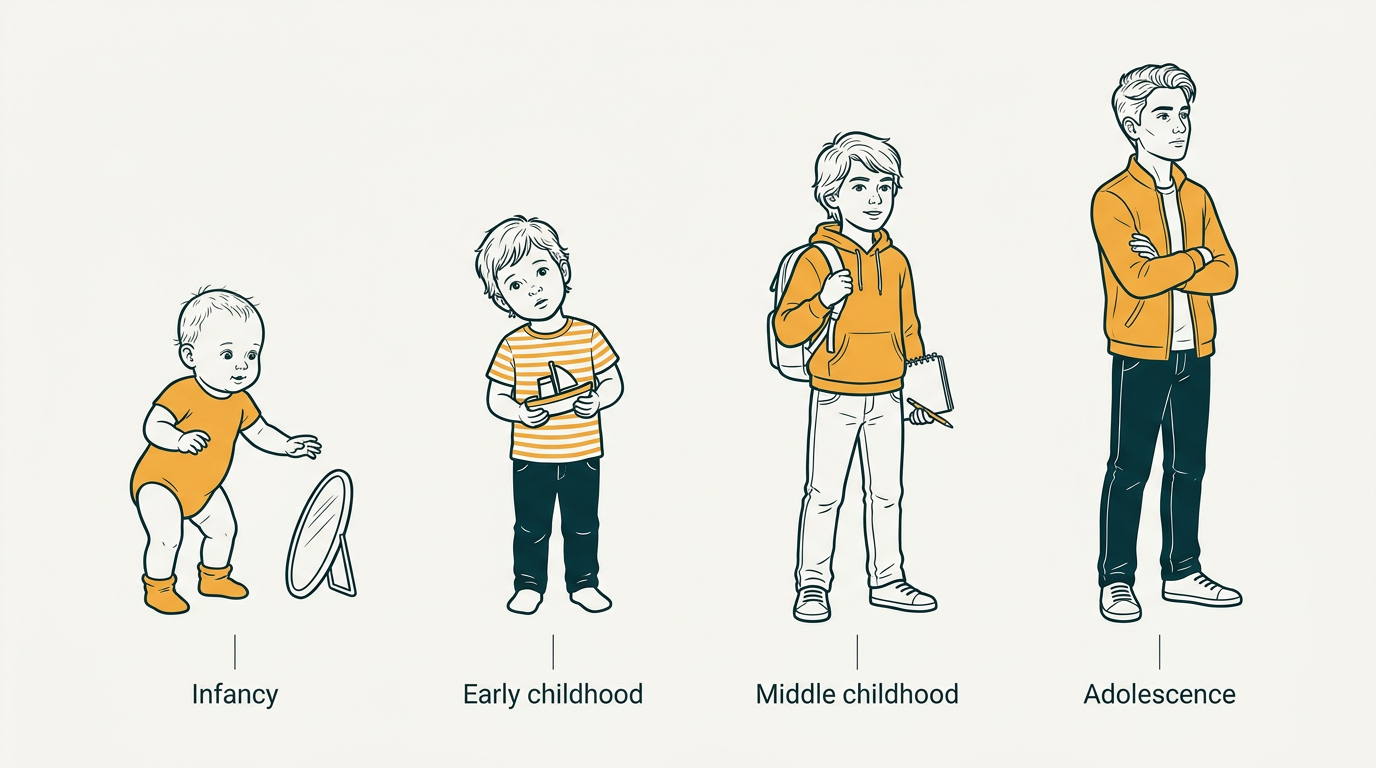
Fig. 2.0 – One person at four stages of growth.
2.1 Why We Study The Self
Look at a family photograph taken a few years ago. You may have your father’s height, your grandmother’s way of laughing, a cousin’s taste in music. Yet nobody who knows you would mistake you for any of them.
That is the first thing worth noticing about a person. We are made largely out of what we share with the people around us, and even so, each of us is unmistakably one particular person. The sense of being that one person — the sense of ‘I’ as against ‘you’, ‘them’ and ‘others’ — is what we mean by a sense of self.
This chapter is about where that sense comes from. It is not a small question, and it has more than one part to it. What exactly are we describing when we describe ourselves? Does the description hold steady over the years, or does it change? And why does it seem to matter so much at your age in particular?
Why Knowing Yourself Matters
The picture you hold of yourself is not an ornament kept aside for quiet moments. It works on you all day. It settles what you are willing to attempt, how you read a remark made by a friend, and how quickly you get up after something goes wrong.
Consider a student who has decided that she is simply not a mathematics person. She stops asking questions in class, because asking would confirm what she already believes about herself. A few months later she is genuinely behind — the belief has quietly manufactured the evidence for itself.
This is why studying the self is practical work rather than idle reflection. You cannot examine a belief you have never noticed, and you cannot correct one you cannot examine. A person who knows the picture she holds of herself is in a position to ask whether it is accurate, and to change it where it is not.
There is a second reason. The self looks like the most private thing a person owns, and yet it is assembled in company — inside a family, a school, a neighbourhood and a wider community. Understanding how those layers shape a person tells you a great deal about why people differ, and makes it much harder to dismiss someone whose upbringing was not yours.
Three Words That Overlap
Two other ideas sit very close to the self, and you will meet both in this chapter. One is identity, which Section 2.3 takes up in full. The other is personality — the characteristic and fairly steady pattern of thinking, feeling and behaving by which other people come to recognise a person.
Psychologists define these three terms separately and carefully. In ordinary conversation we swap them about quite freely, and no harm is usually done. Keep in mind, though, that they are not the same word wearing three coats.
2.2 What Is Self?
English is unusually well stocked with words built on this one small syllable. A large dictionary carries hundreds of entries that begin with ‘self’ — self-respect, self-control, self-doubt, self-reliance, self-pity. A language does not build that many words around an idea unless people spend a great deal of time on it.
The sense of self is the sense of who we are and of what makes us different from everybody else. It is not new to you. What is new is how loudly the question arrives during adolescence, the period you are passing through now. At no earlier stage do people try so hard to pin down what ‘me’ is and how it differs from ‘others’.
Some of you will have turned this over in your mind many times. Others will have been thinking about it for months without ever quite noticing that this is what they were doing.
Before you read further, take a rough sheet and finish the sentence ‘I am…’ ten times over, quickly and without editing yourself. The sheet is for you alone; nobody needs to see it. The rest of this section will make much more sense if you have your own ten answers in front of you.
2.2.1 The Dimensions Of The Self
Now look at what you wrote. Some of the statements almost certainly described your body — your height, your build, your hair. That is your bodily or physical self, and it is usually the easiest to reach for.
Some others will have referred to your feelings and emotions: that you are cheerful, or short-tempered, or easily moved. A few will have named mental abilities — that you are quick at figures, or that you remember tunes after hearing them once.
Several of your statements probably placed you in relation to other people. Son or daughter, sister or brother, student, member of a team — these define you through the roles you perform and the relationships you live inside every day, in the family and in the community.
Others may have named your potential or your capabilities, that is, what you are able to do and what you could become. Some will have named your beliefs, the things you hold to be right and worth doing.
There is one more distinction hidden in the list. In some statements you described yourself as a doer — a person who acts, who cooks, plays, repairs, organises. In others you described yourself as a thinker, a person who wonders and judges and decides. Both are you.
So the self is not one thing. It has several dimensions, and any honest description of a person has to reach into more than one of them.
2.2.2 The Personal Self And The Social Self
These many dimensions can be gathered under two broad headings, as Fig. 2.1 shows.
The personal self holds those aspects that relate only to you — your body, your feelings, your abilities, your beliefs, your sense of what you are capable of. They belong to you whether or not anyone else is in the room.
The social self holds those aspects in which you are involved with others. It covers the roles you occupy and the groups you belong to, and it takes in qualities that only appear in company — sharing, cooperation, support and unity.
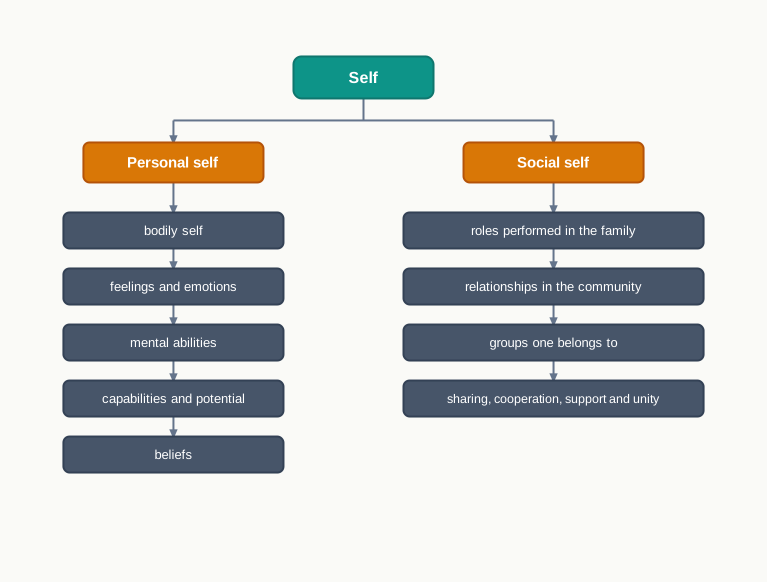
Fig. 2.1 – The dimensions of the self.
Notice that the two headings do not cut a person in half. The same quality can sit in both: patience is yours whether or not it is on show, and it is also the thing your younger brother relies on when he brings you a broken toy.
Pulling all of this together, we can now say what the term means. The self is the totality of a person’s experiences, ideas, thoughts and feelings with regard to herself or himself. It is the characteristic way in which we define ourselves — put most simply, the idea that we hold of ourselves is the notion of the self.
2.2.3 Self-Concept And Self-Esteem
You have heard both these words used about yourself and about others. They are elements of identity, and they are not the same thing, though they are constantly confused.
Self-concept is a description of oneself. It answers the question ‘Who am I?’ It gathers up your qualities, your feelings, your thoughts and what you are capable of doing. A boy who says he is quiet, good with small children and hopeless at remembering names is giving you his self-concept.
An important aspect of the self-concept is self-esteem. Self-esteem is your judgment of yourself, measured against standards you have set for yourself — and those standards are largely handed to you by the society you live in. It is, in short, one’s evaluation of oneself.
The difference is the difference between a description and a verdict. Description: I am the slowest runner in my class. Verdict: and so I am not much good. The second sentence does not follow from the first. It follows from a standard about running that somebody, somewhere, taught you to apply.
That is worth holding on to. Because the yardstick is learned, it can be examined. A student who notices that she is judging herself by a standard she never chose is already in a position to ask whether it is a fair one. Table 2.1 sets the two ideas side by side.
2.3 What Is Identity?
Are you the same person you were five years ago? Take a moment over it before reading on, because the answer is not as simple as it looks.
In one plain sense, no. Your body has altered a great deal. You know many more people now than you did then, and you have built relationships with them. Your way of responding to events and of understanding them has shifted. Some of your beliefs and values have changed, and so have your likes and dislikes. Measured that way, you are not the same person you were even a year ago.
And yet you have an unmistakable sense of having been the same person for as far back as you can remember. When you recall a birthday from Class V, you do not think of that child as somebody else. You think, that was me.
Most of us manage to hold on to this sense of continuity and sameness right through our lives, in spite of all the changes and breaks that mark the decades. That steady thread has a name. We say that each of us has a sense of identity — a sense of who we are, which we carry with us throughout our lives.
Identity, like the self, has a private side and a shared side. We speak of personal identity and social identity, and every person has both at once.
2.3.1 Personal Identity
Personal identity refers to those attributes of a person that make her different from others. It is the part of the answer to ‘Who am I?’ that nobody else could give in quite the same words.
A young man may think of himself as the one in his household who is unusually patient with his grandfather, the one who fixes the cycle when it breaks, the one who cannot sit through a long film. None of these traits is rare in the world. It is the particular bundle that is his alone.
2.4 Development Of The Self From Infancy To Middle Childhood
The self is not something you are born with. It is something you create and develop as you grow, and the growing takes years.
That is easiest to see if you watch it happen. In this section we follow the self through three stages — infancy, the first two years or so of life; early childhood, roughly the pre-school years from three to six; and middle childhood, roughly six to eleven. Adolescence, the stage you are in yourself, is taken up in Section 2.5.
At each stage, ask the same question of the child: what does she know about herself, and how would she describe herself if she could? The answers change beyond recognition.
2.4.1 Self During Infancy
At birth we are not aware of our own separate existence. This may surprise you, but the newborn does not realise that she is separate and distinct from the world outside her.
In technical terms, the newborn has no self-awareness, no self-understanding and no self-recognition. By each of these terms we mean the same thing — a mental representation, that is, a mental picture, of the self.
Watch a small infant bring her hand in front of her face and study it. She looks at it with real interest, but she does not realise that the hand belongs to her, or that she is separate from the people and objects around her.
The sense of self then emerges gradually through infancy. Self-image recognition — knowing one’s own face in a mirror — appears at around 18 months of age.
The Mirror Test
How could anyone know this about a child too young to be asked? Researchers worked it out with a simple experiment, carried out with infants in the age range of 14 to 24 months. It is set out in Fig. 2.2 and in the method below, and you can try it yourself with an infant at home.
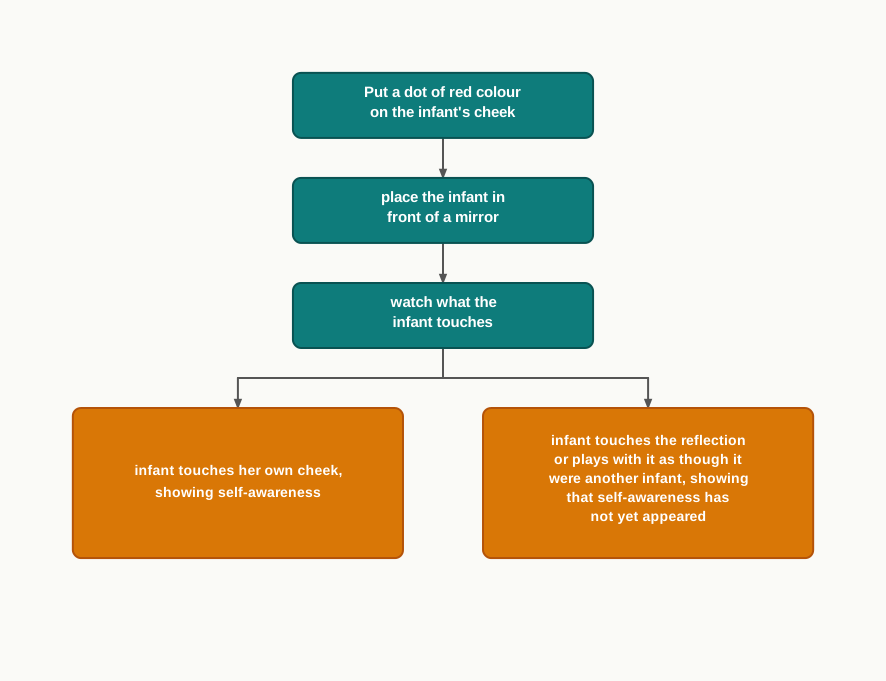
Fig. 2.2 – The mirror test for self-recognition.
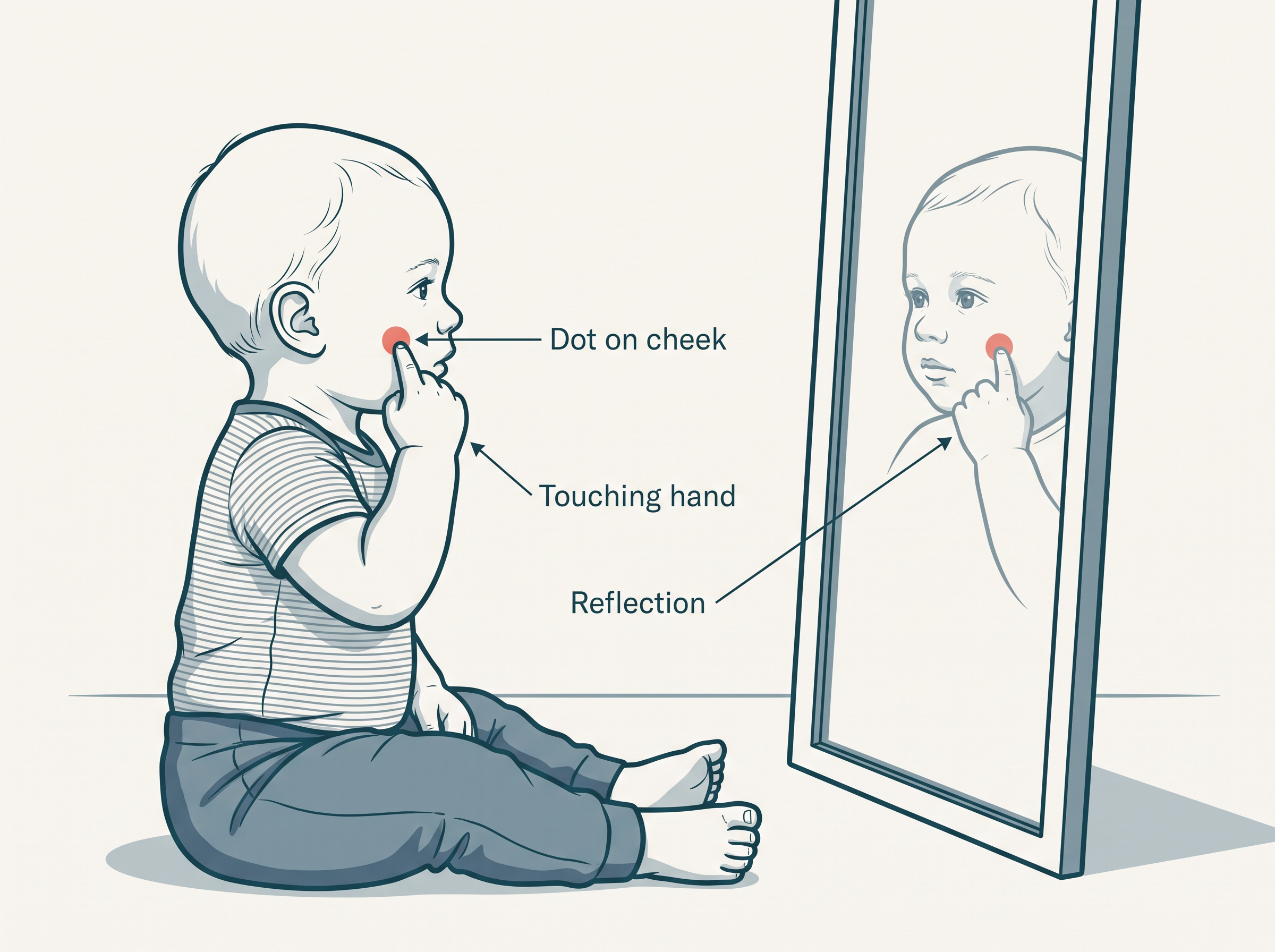
Fig. 2.3 – An infant taking the mirror test.
The Arrival Of I, Me And Mine
Towards the latter half of the second year, infants begin to use the personal pronouns — I, me and mine. This is a large step, because a pronoun of this kind can only be used by someone who has a self to point to.
Infants use these words to indicate possession of persons or objects, as in ‘my ball’ or ‘my mother’. They also use them to describe themselves or the actions and experiences they are having, as in ‘me eating’. At about this same time, infants also begin to recognise themselves in photographs.
2.4.2 Self During Early Childhood
By the age of three, children talk quite fluently. So we no longer have to depend on self-recognition alone to find out what a young child understands about herself. We can simply involve her in conversation about herself and listen carefully.
Researchers who have done this have found five main characteristics in young children’s understanding of themselves.
- They use physical descriptions of themselves, or of their material possessions, to mark themselves off from others. A child may use words like tall or big, or refer to the clothes she is wearing or the toys she owns. These self-descriptions are in absolute terms — that is, the child does not see herself in comparison with anyone else. She will not say that she is taller than her cousin; she will simply say that she is tall.
- They describe themselves in terms of things they can do, usually their play activities — that they can climb the stairs alone, or build a tower, or count. Their self-understanding is full of active descriptions of this kind.
- Their self-descriptions are in concrete terms. They define themselves by things they can do or by what is visible to them, as in saying that they have a bicycle at home.
- They often overestimate themselves. A child may announce that she is never frightened of anything, or that she knows every song she has been taught, and yet be unable to sing one right through.
- They are unable to recognise that a person can hold different attributes at different times — that the same child can be good and bad, kind and unkind, at different points in time.
Read those five together and a pattern appears. The young child’s self is a list of visible, present, positive facts, with nothing behind it and nothing in tension. Listen to a real conversation and you can hear all five at once.
2.4.3 Self During Middle Childhood
During middle childhood, children’s evaluations of themselves become far more complex. Five key changes mark this growing complexity.
- The child shifts towards describing herself in terms of her internal characteristics. She is now more likely to name psychological characteristics, such as her preferences or her personality traits, and less likely to name physical ones. She may say that she is good at making friends, or that she works hard and finishes what she has begun.
- Her descriptions now include social descriptions and identity. She may define herself by the groups she belongs to, as in saying that she is in the school choir.
- Children begin to make social comparisons. They distinguish themselves from others in comparative rather than absolute terms, thinking about what they can do as measured against what others can do — that one of them runs faster than the other.
- They begin to distinguish between their real self and their ideal self. The real self is what a person actually is; the ideal self is what she would like to be, or what she thinks it is most important to be. The child can now hold both pictures at once and see the gap between them.
- Their self-descriptions become more realistic than those of the pre-school child. This is probably because the older child can see things and situations from another person’s point of view, and so can guess how she looks from outside.
Table 2.3 sets the two stages side by side, so that the direction of the change is easy to see.
Notice the direction of travel across the whole section. The self begins as something the child cannot even locate, becomes a list of visible facts, and then turns inward and becomes a judgment. Adolescence carries that judgment much further.
2.5 Self During Adolescence
Self-understanding becomes steadily more complex during adolescence — the stage between childhood and adulthood, which the World Health Organization takes to run from 10 to 19 years of age. Adolescence is also seen as a critical time for the development of identity.
Two questions follow from that, and this section takes them in order. Why should this stage in particular be the critical one? And what does the more complex self-understanding of an adolescent actually look like?
2.5.1 Why Adolescence Is Critical For Identity Development
The psychologist Erik H. Erikson held that development runs through a series of stages, from infancy to old age. At each stage there is a certain task to be accomplished, and accomplishing it is what allows a person to move on to the next stage.
The tasks are ordinary and practical. In late infancy and early childhood, for instance, the task is to achieve control of the bowel and the bladder. It sounds like a small thing until you consider what follows from it, because without that control a child could not take part in most social and community activities at all.
The task of adolescence, according to Erikson, is to develop a sense of identity — a satisfactory self-definition. The stage is critical because there is now an enhanced focus on the development of the self, and because the adolescent is believed to face an identity crisis. Three reasons are usually given.
- This is the time when a person, more than at any earlier point in life, is preoccupied with trying to know herself. She is intensely concerned with understanding who she is.
- Towards the end of adolescence the individual creates a relatively lasting sense of selfhood and identity, and becomes able to say — this is who I am.
- This is also the time when a person’s identity is being influenced by rapid biological changes and by changing social demands, both at once.
The third reason is the one that makes the other two hard work. The body is changing faster than at any time since infancy, and the expectations of everyone around are changing at the same time — and neither is waiting for the other.
2.5.2 Identity Crisis And Role Confusion
The adolescent is now expected to behave in an adult-like manner, and to begin taking on responsibilities connected with family, work or marriage. This social transformation, from dependent child to independent person, happens differently in different cultures.
Western cultures generally emphasise independence, understood as separation from parents — physical as well as psychological. Non-western cultures, such as the Indian, focus instead on interdependence within the family. Neither arrangement is a failed version of the other; they answer the same question differently.
In every culture, however, adolescence is reported to be accompanied by dilemmas and disagreements. It is common for an adolescent to rebel against being treated like a child, and then, an hour later, to want exactly the comfort a child would want. Parents may tell an adolescent to behave like a grown up, while their other actions show that they do not think she is quite grown up yet.
You have probably met this in your own household. The family may expect adult-like behaviour in how you talk and dress in front of guests, and still think you are too young to sit in on a discussion about the family budget. What families expect may also differ somewhat for girls and for boys, depending on the expectations of that family within its particular culture.
So the adolescent has conflicting feelings of her own, and receives conflicting messages and social expectations from the people around her. Individuals differ, and they respond to all this differently.
When The Newly Emerging Selves Do Not Fit Together
These conflicting expectations from family and society, together with one’s own changing needs and contradictory emotions, may interfere with the work of integrating the newly emerging selves. When that happens, the adolescent may experience role confusion, also called identity confusion. Fig. 2.4 sets out the chain.
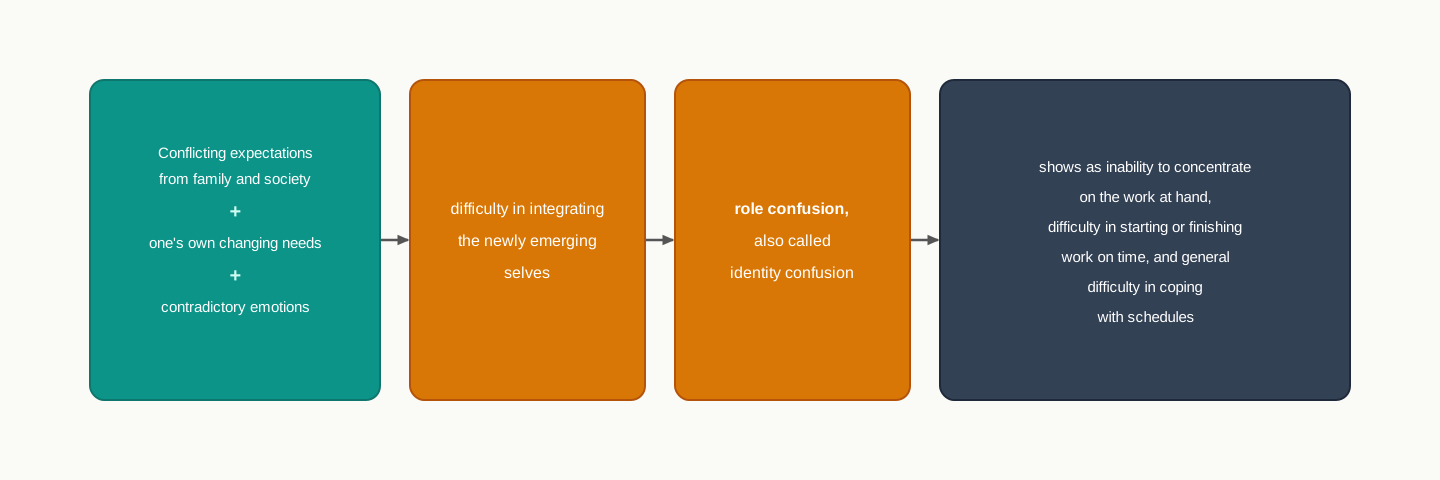
Fig. 2.4 – How role confusion arises.
It is important to stress one thing here. The difficulties an adolescent meets while developing an identity are a normal part of development. There is nothing wrong or inappropriate about the contradictory feelings and emotions of this period, and they are not a sign that anything has gone wrong with the person having them.
The feeling of identity crisis or role confusion arises when the adolescent senses a significant gap between what she is expected to do and how she is expected to behave now, as against what was expected of her earlier. It is the size of the jump that produces the trouble, not the age itself.
That is why the experience is not universal. For many adolescents, especially those involved in family occupations, the break is not distinct and does not cause much emotional upheaval. A young person in a village who has been assisting the family in agriculture finds that the role at sixteen is much the same as it was at twelve, except that more responsibility now comes with it.
2.5.3 Characteristics Of The Adolescent’s Self
We can now describe the adolescent’s sense of self directly. Five characteristics mark it out.
- Self-descriptions during adolescence are abstract. Adolescents place less weight on describing themselves in physical terms, and emphasise instead the inner aspects of their personality. They may describe themselves as quiet, sensitive, cool headed, brave, emotional or truthful.
- The self during adolescence carries several contradictions. An adolescent may say that she is calm and yet gets easily disturbed, or that she is quiet and also talkative.
- The adolescent experiences a fluctuating sense of self. As she meets diverse situations and responds to different experiences, her understanding of her own self shifts from situation to situation and over time.
- The self of the adolescent contains both the real self and the ideal self, and the ideal self becomes far more prominent now. Each of us has some idea of what we would ideally like to be — perhaps someone more organised, or braver in front of a crowd — and it is towards that picture that we try to move.
- Adolescents, much more than children, are self-conscious and preoccupied with themselves. This gives them a feeling of always being on stage, of being noticed at every moment. It is the reason most adolescents are so concerned about their physical appearance.
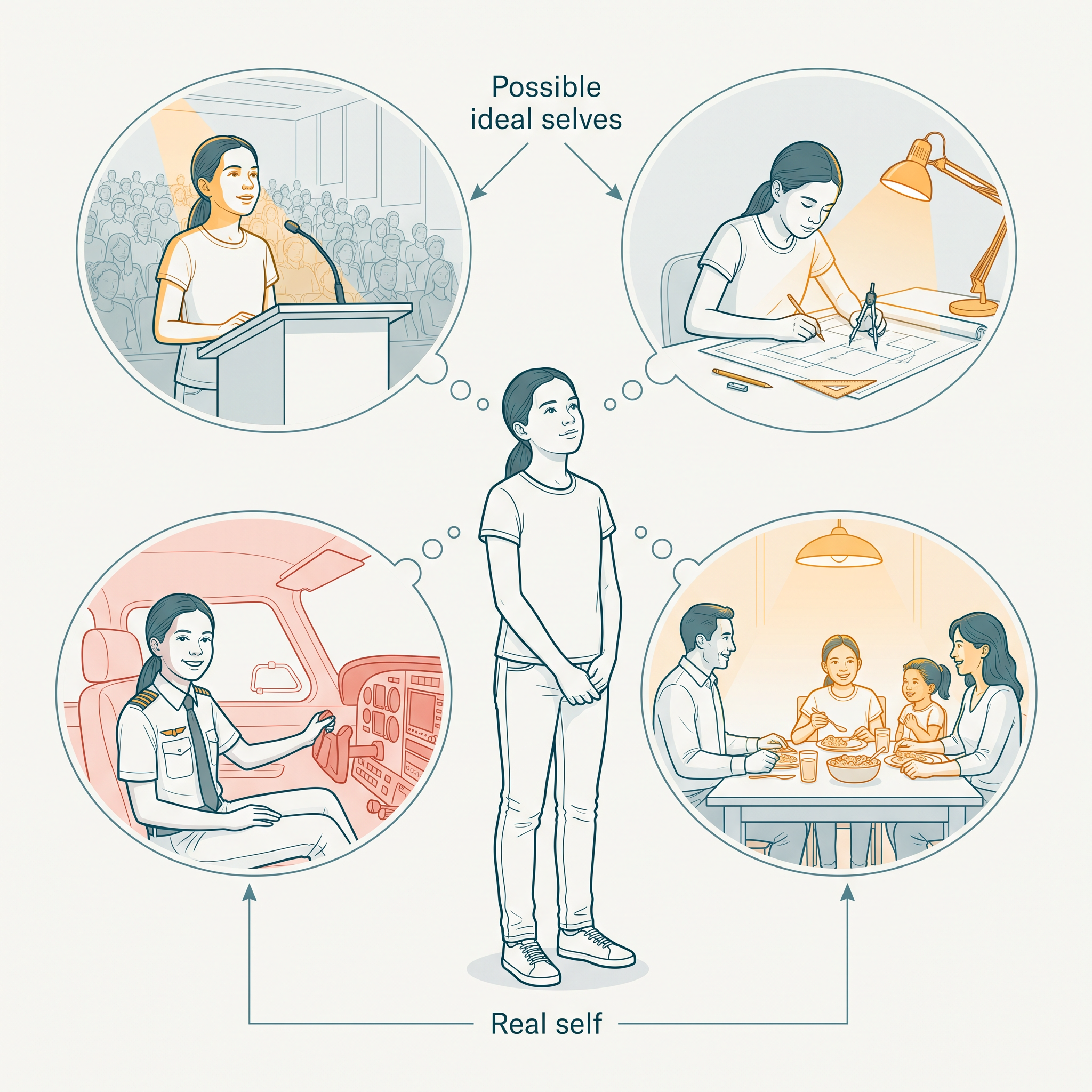
Fig. 2.5 – The adolescent’s many pictures of herself.
The fourth characteristic deserves a second look, because the two selves in it are easily muddled. Table 2.4 separates them.
2.6 How A Sense Of Self Is Constructed
You have read that we are not born with a sense of selfhood or identity. So how does it develop at all, and how does it go on evolving and changing over time?
The self develops out of two things — what you learn about yourself through the experiences you have, and what others tell you about yourself. Neither works without the other.
Each person lives inside a web of relationships. Those relationships are in the family, the school, the workplace and the community, as Fig. 2.6 shows. The sense of self develops through your interaction with the people in that web, and through your own actions.
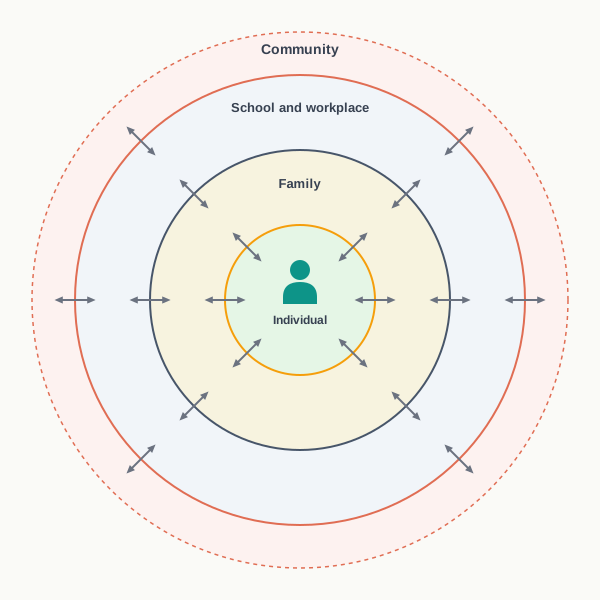
Fig. 2.6 – The web of relationships shaping the self.
So many people shape the development of your self that it is never the work of one person, and it is never finished. The word used for this is construction, and it is chosen carefully. To construct something is to build it, which means the self is not handed to you at birth — you create and develop it as you grow.
This process of building and rebuilding a sense of who one is, over the whole course of growing up, is called identity development.
2.6.1 Early Interactions That Shape The Self
The building begins long before a child could tell you anything about it. Four kinds of early interaction do most of the early work, and Fig. 2.7 sets them in order.
- From the earliest days, parents address the child by a particular name, in every sort of situation. The child begins to associate that name with herself. The adults also point to the child in the mirror and in photographs and use the same name. They use the pronouns ‘you’ and ‘your’ to her, and once she can speak, ‘me’ and ‘mine’ appear in her own speech. She works out that ‘you’ and ‘your’ refer to another person. Parents also play various body games, pointing to and naming the parts of the child’s body and asking her to point them out in turn. All of this gradually helps the child to see herself as distinct and separate from others.
- As the child grows through infancy, she begins to realise that her actions have an effect on the environment. She touches a toy and it moves; she pushes a bowl and it slides. Experiences of this kind give her a sense of being separate from the people and objects around her. This is also the period, at around 18 months, when she can identify that the spot of red is on her own face and stops treating the reflection in the mirror as another child.
- As the child grows older and can talk, parents encourage her to make statements about herself and ask her to give reasons. They ask why she did something, or how she feels about it. Such questions help her understand what she is experiencing and why she acted as she did, and in this way they help her define the self.
- Through the day the child has many encounters with people and objects, and these build up an idea of what she is able to do. People also give her feedback about her behaviour and her abilities. To a six-year-old who helps clear the eating area after a meal, a parent may say that this was a good thing to have done. All of it feeds into the child’s beliefs about herself.
Read together, these four show how the thing actually happens. The child constructs and re-constructs her selfhood and her sense of identity through the ordinary verbal and social exchanges she has with caregivers and with everybody else.
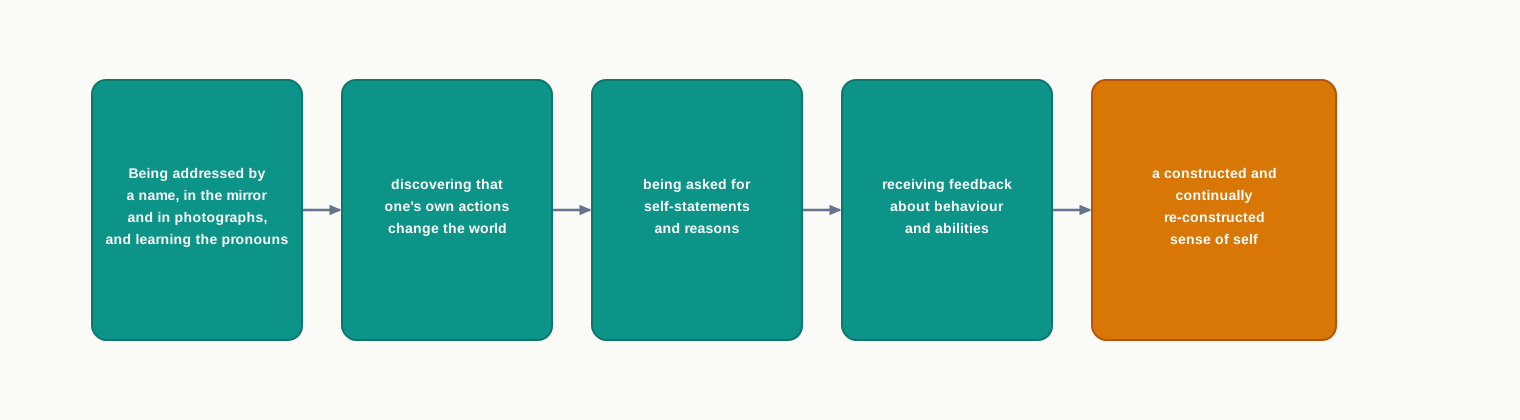
Fig. 2.7 – Four steps in the early construction of the self.
2.6.2 Why Every Identity Is Unique
If the self is built out of interactions, and millions of children have broadly similar interactions, why does no two people’s identity come out the same? There are three reasons.
- Each one of us, apart from identical twins, carries a unique combination of genes.
- Each one of us has different experiences.
- Even where two people have similar experiences, they respond to them in different ways.
The third reason is the strongest of the three, and the easiest to overlook. Two brothers can be raised in one house, taught by the same teachers and scolded for the same things, and still take away opposite lessons about what kind of people they are.
2.6.3 The Four Influences On Identity
The rest of this chapter studies the influences that shape the formation of identity. They can be classified under four headings.
- Biological and physical changes.
- Socio-cultural contexts, including family and peer relationships.
- Emotional changes.
- Cognitive changes.
The four are taken up in that order in Sections 2.7 to 2.10. Keep in mind while reading them that they do not act one at a time. A single week in an adolescent’s life will carry all four at once, and much of the difficulty of the stage comes from exactly that.
2.7 Biological And Physical Changes
The period of adolescence is marked by certain physical and biological changes in the body. These changes are universal — they happen to everybody, everywhere — and they take place in particular sequences rather than all at once.
Taken together, they lead to the attainment of sexual maturity, that is, to the body becoming capable of reproduction. This section deals with the changes themselves. What they mean to the person going through them is a separate matter, and the two sections after this one take it up.
2.7.1 Puberty And Pubescence
The time when sexual maturity is reached is called puberty. It is a point rather than a period — the moment at which the body has arrived.
For girls, menarche, the first menstruation, is usually taken as the point of sexual maturity. For boys there is no corresponding definite event that marks puberty, although a criterion sometimes used is the production of spermatozoa, the male reproductive cells.
Puberty occurs at different average ages in different cultures, so no single age can be given for it. One criterion that has been found useful for both boys and girls is the maximum yearly increase in height — the year in which a young person grows more than in any other year of life. This age of most rapid growth comes just before menarche in girls, and before certain adult characteristics appear in boys.
The changes do not begin on the day maturity is reached. The period during which the physical and biological changes occur, leading up to puberty, is called pubescence. For most girls this period ranges from 11 years to 13 years, and for boys from 13 years to 15 years, as Fig. 2.8 shows.
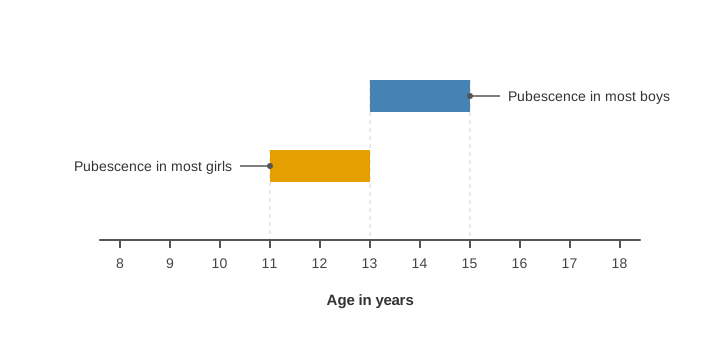
Fig. 2.8 – The period of pubescence in girls and boys.
Because the two words sound alike and are used loosely in ordinary speech, they are easily confused. Table 2.5 separates them.
2.7.2 The Sequence Of Changes During Pubescence
The changes of pubescence arrive in a normal sequence, and the sequence is more dependable than the timing. Two young people of the same age may be at quite different points, and both be developing perfectly normally.
Table 2.6 gives the normal sequence of development during pubescence in girls and in boys. Read each column downwards, as an order of arrival rather than as a set of fixed ages.
Two things in the table are worth reading closely. In girls, the age of maximum growth comes before menarche, so the fastest growing is over before sexual maturity is reached. In boys, the age of maximum growth comes later in the order, and the beard is the last of the changes to appear — which is why a boy may be fully grown in height and still be waiting for it.
While the physical changes that take place in the body with the onset of puberty are universal, their psychological and social impact varies enormously — from one culture to another, and within a single culture from person to person. The same event can be marked with a celebration in one household and passed over in silence in another.
That impact is what the next two sections deal with, under the headings of socio-cultural contexts and emotional changes.
2.8 Socio-Cultural Contexts
Physical changes in the body and changing social expectations are the two main aspects that influence the process of identity formation during adolescence. You have now read about the first of them.
But how far those physical and social changes actually affect a person’s identity varies a great deal. It depends on cultural, social and familial contexts. This section takes those contexts in order — first the wider culture and society, and then the family and the group of friends.
2.8.1 Culture And Society
Different sections of a society respond differently to the physical changes of adolescence. The change is in the body; the response is in the society around the body.
In traditional Indian society, the onset of puberty places many restrictions on girls, while boys retain their freedom of movement. Certain avenues of entertainment or of work are not seen as appropriate for girls. The elements of the self and the identity of a girl growing up in a traditional community would therefore be very different from those of a girl living in an urban area, although the bodily change that set the difference in motion was the same in both.
Two Patterns Of Growing Up
Compare our culture now with Western cultures. In most Western countries, such as the United States and the United Kingdom, adolescents are expected to be fairly independent, and in many cases are expected to move away from the family to set up a home of their own.
In the Indian context, a large majority of adolescents continue to be fairly dependent on their parents, as they are expected to be, and the family continues to exercise control over them. Many adolescents in India, especially in rural and tribal settings, begin to contribute towards the family income, and in that sense begin to assume adult roles. Yet they do not break away from the family. Their earnings are often directed at the welfare of family members.
The self of an adolescent develops quite differently in these two settings. Neither setting is a defective version of the other; they answer the same question about how a young person joins the adult world, and they answer it differently.
Even within India the experiences of adolescents differ considerably from community to community. In traditional communities and regions where technology is not yet advanced, and where occupational opportunity and the choices for alternative ways of living are limited, children are trained in the traditional family occupations — weaving, for instance — up to the time they reach adolescence.
Such adolescents are therefore ready to assume adult roles. They are seen as persons who carry the responsibilities of beginning work, getting married and bearing children, as adults do. In these communities the identity of the adolescent is drawn more from familial sources. The adolescent may not come into much conflict with elders, since she is largely doing what adults expect of her, and so there are likely to be fewer confusions and doubts while a sense of self develops.
The picture is different in communities and families where a variety of occupational choices are open to the adolescent, and where technology makes many experiences and options available. Here the young person may need to enter an extended period of training to prepare for a chosen occupation, and remains dependent on parents throughout it. Fig. 2.9 traces what follows.
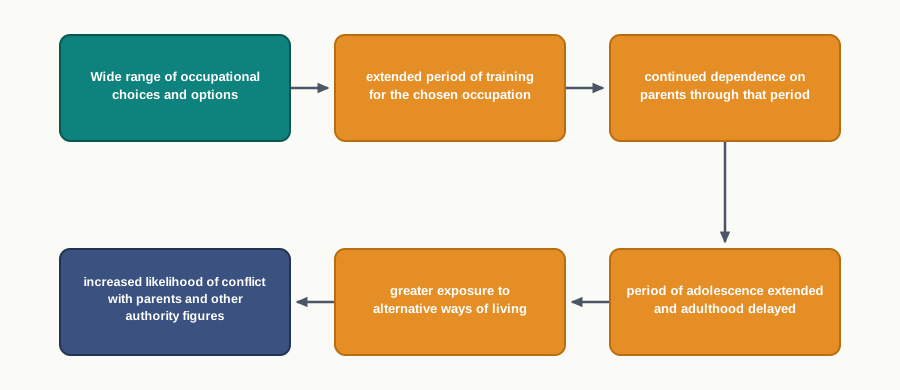
Fig. 2.9 – Why adolescence is longer where choices are many.
Read the flowchart alongside the paragraph before it and a useful conclusion appears. More choice is not simply a gain. It lengthens the stage, delays independence, and gives the adolescent and her elders more to disagree about.
Talking About Oneself
There is a second reason why the development of identity varies between traditional cultures and those of the West. In traditional Indian communities, open reflection on oneself, and the idea of talking about oneself, are not common activities among adolescents. Such an attitude is often neither encouraged nor tolerated.
Many Indians define themselves primarily by one or another of the roles they occupy — son or daughter, mother or father, sister or brother. Put differently, they speak of themselves in terms of the family and the community, as ‘we’, rather than as ‘I’.
You can hear the difference in a single sentence. Asked for her views on marriage, an adolescent girl is more likely to say that in her family marriages are arranged by parents, than to say that she would prefer her parents to arrange her marriage. The first sentence reports a practice; the second states a preference. The socio-cultural context decides which one comes naturally.
How strongly these cultural influences work will of course vary from family to family and from person to person.
2.8.2 The Family
Having seen how culture and society shape adolescent identity, we can look at the family more closely, since it is the setting in which most of that shaping actually happens.
Identity formation during adolescence is enhanced by family relationships in which adolescents are encouraged to hold their own point of view. It is also enhanced where relationships between family members are secure, because a secure relationship gives the adolescent a base from which to go out and explore her widening social world.
It has also been found that firm and affectionate parenting fosters the healthy development of identity. Affectionate parenting means that the parents are warm, loving and supportive of the young person’s effort and accomplishment. They praise her, show enthusiasm for her activities, respond sensitively to her feelings, and take the trouble to understand her personality and her point of view.
The word firm matters as much as the word affectionate. Such parents are also firm in disciplining, and it is the combination that does the work. A style of this kind fosters independence and self-reliance.
2.8.3 Peers, Individuality And Connectedness
Adolescence is the period in which a growing person develops a strong need for support and acceptance from peers, that is, from others of her own age.
At times the values of parents and the values of friends conflict with one another, and the adolescent may lean more towards her friends. This can cause disharmony in the relationship between parent and child, and it is one of the most common sources of friction in households with adolescents.
Going along with what one’s group does is called conforming to peer pressure, and it can work in either direction. The negative effects become evident when adolescents take up harmful behaviours such as smoking, consuming drugs or alcohol, or bullying. If you or a friend are being pulled towards any of these, the useful step is to talk to a trusted adult, a school counsellor or a doctor rather than to handle it alone.
Just as often, peers and parents serve complementary functions and meet different needs of the adolescent. Neither replaces the other.
It has been seen that a family atmosphere promoting both individuality and connectedness is important for the identity development of the adolescent. Individuality means greater opportunity and greater ability to hold one’s own point of view. Connectedness means greater sensitivity to and respect for the views of others, and openness to those views. Table 2.7 sets them side by side.
The two are not alternatives, and a family does not have to choose between them. It is the presence of both together that supports the development of identity.
2.9 Emotional Changes
The adolescent goes through many emotional changes in the process of growing up. A good number of them are a direct consequence of the biological and physical changes described in Section 2.7 — the body alters, and the feelings follow the body.
It is true that adolescents are preoccupied with their physical bodies. They imagine that other people are noticing every single aspect of their body and their behaviour. A young person with pimples on the face may be convinced that this is the first and only thing anybody sees.
The Same Change, Different Reactions
There are, however, large individual differences in the way adolescents react to bodily change. A boy whose facial hair has not come in as fully as that of others of his age may feel peculiar about it. The same lack of facial hair may not trouble another boy in the slightest.
This matters more than it may appear, because it tells you that the feeling does not come from the body. It comes from what the person makes of the body, and that is learned rather than given. Fig. 2.10 sets out the two directions this can take.
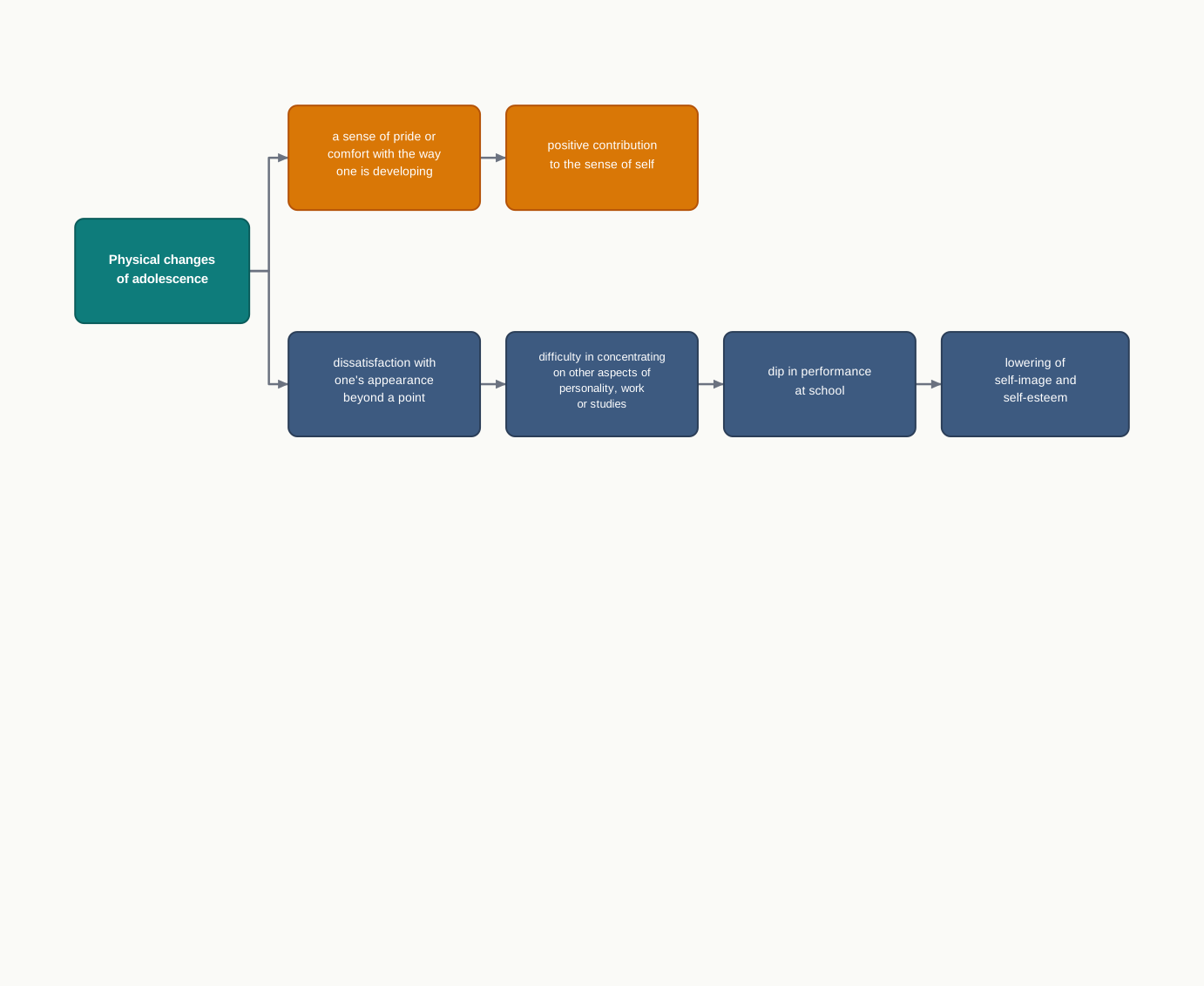
Fig. 2.10 – Two responses to the same physical change.
A sense of pride or comfort with the way one is developing physically contributes positively to an adolescent’s sense of self. Where, on the other hand, a person is dissatisfied with her appearance beyond a point, it can stop her attending to other aspects of her personality, her work or her studies. That can cause a dip in performance at school and a lowering of self-image — the picture a person holds of herself, particularly of her own body — and of self-esteem. A negative self-image can leave a person feeling insecure and can generate further negative feelings about the body.
Notice that the two branches begin at exactly the same place. There is nothing in the physical change itself that decides which way a person goes.
The point is made most clearly by two people who do not fit the expected pattern at all. An adolescent with a physical disability may not experience herself as any less than others in any respect. A well-built adolescent boy may feel conscious and inadequate because he has decided that his body is not good enough.
If a dissatisfaction of this kind settles in and begins to occupy most of a person’s day, it is worth talking to a trusted adult, a school counsellor or a doctor. It is a common difficulty, and it responds well to being spoken about rather than carried alone.
Mood Swings
Emotional change during adolescence is not confined to the body. Adolescents also experience mood swings — sharp shifts in feeling over short periods, for no obvious outward reason.
You may want the company of your family and your friends at one hour, and want to be left entirely alone at the next. There may also be sharp bursts of anger that surprise even the person having them.
A great deal of this happens because the adolescent is trying to make sense of a variety of changes that are arriving at several levels at once — in the body, in what others expect, in what she wants for herself. The swings are the sound of that work being done, and they settle as the work proceeds.
2.10 Cognitive Changes
The last of the four influences is a change in thinking itself. Cognition means thinking, knowing and understanding — everything the mind does when it works on information. You will study how cognition develops from infancy to adolescence in detail later in the course, in the unit on childhood. What is described here is only the part of that change which bears on the development of a sense of identity.
The Ladder Of Self-Description
Put the stages you have already read about into a line, and a steady progression appears.
The child begins as a person with no sense of a separate identity at all. By the early childhood years she describes the self in concrete and absolute terms. In middle childhood the descriptions are still concrete, but they are now made in comparative terms. By the age of about 11 the self-descriptions are fairly realistic, which is what allows the child to tell the real self from the ideal self. Fig. 2.11 sets out the whole ladder.
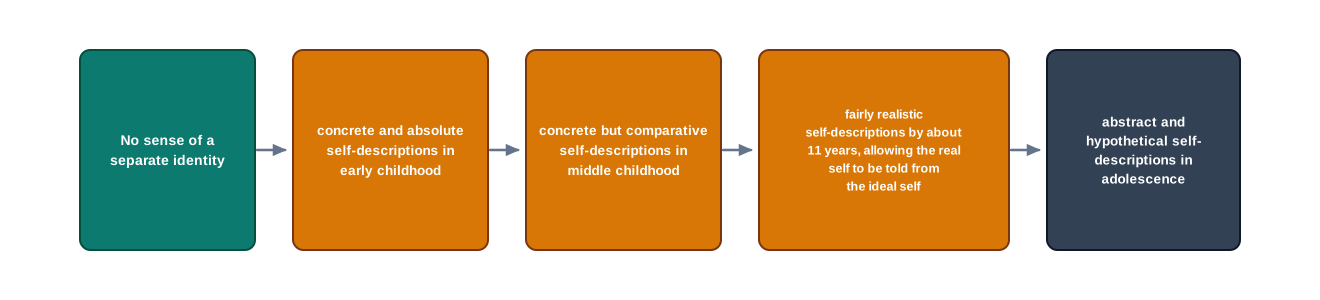
Fig. 2.11 – How self-description changes with thinking.
The Leap Made In Adolescence
During adolescence a genuine leap occurs. Adolescents become able to think in abstract terms — that is, to think beyond what is present, beyond what they can see and have actually experienced.
Thought also becomes flexible, and this allows something new: thinking about hypothetical situations. A person can now imagine various possibilities and their outcomes without having to live through them or act out any of the steps.
The implication for identity formation is large. Adolescents can imaginatively link their present with a future they have imagined for themselves. An adolescent can think about the occupations she might take up as an adult, weigh which of them suit her situation and her temperament, and then plan the direction of her present studies accordingly.
Notice what has happened there. A decision taken today has been settled by a comparison between two futures, neither of which exists. No younger child can do this, and it is the single most useful piece of equipment the stage brings with it.
Looking Ahead
Adolescence is thus a crucial stage for the development of identity. It is a significant period of development, carrying many changes and, with them, many opportunities.
A healthy adolescent is in the best position to deal with those changes and to realise her full potential. Appropriate food and nutrition are among the key elements of that good health, and they are where the next chapter begins.
2.11 Summary
- Each of us shares a great deal with the people around us and is still one particular person; the sense of being that person is the sense of self.
- The idea a person holds of herself decides what she attempts, how she reads others and how she recovers from failure, which is why studying the self is practical work.
- Two ideas sit close to the self — identity, and personality, which is the characteristic and fairly steady pattern of thinking, feeling and behaving by which others recognise a person.
- The self has several dimensions: the bodily self, feelings and emotions, mental abilities, roles and relationships, capabilities and potential, beliefs, and the self as doer and as thinker.
- These dimensions fall under two broad headings:
- the personal self, holding aspects that relate only to the person;
- the social self, holding aspects in which the person is involved with others, including sharing, cooperation, support and unity.
- The self is the totality of a person’s experiences, ideas, thoughts and feelings with regard to herself or himself.
- Self-concept and self-esteem are elements of identity:
- self-concept is a description of oneself and answers the question ‘Who am I?’;
- self-esteem is one’s evaluation of oneself, judged against standards largely drawn from society.
- Identity is the sense of who one is, held with a feeling of continuity and sameness across time despite the many changes of a lifetime.
- Personal identity refers to the attributes that make a person different from others; social identity refers to the aspects that link her to a professional, social or cultural group.
- The self is not present at birth but develops through infancy, early childhood, middle childhood and adolescence.
- The newborn has no self-awareness, self-understanding or self-recognition, each of which means a mental picture of the self; self-image recognition appears at around 18 months of age, and personal pronouns appear in the latter half of the second year.
- Young children’s understanding of themselves has five characteristics:
- they use physical descriptions and possessions, in absolute terms;
- they describe themselves by things they can do;
- their descriptions are concrete;
- they overestimate themselves;
- they cannot recognise that a person may hold different attributes at different times.
- During middle childhood, self-evaluation becomes more complex through five key changes:
- a shift to internal characteristics;
- the inclusion of social descriptions and identity;
- the beginning of social comparisons;
- the separation of the real self from the ideal self;
- more realistic self-descriptions.
- According to Erik H. Erikson, each stage of development sets a task that must be accomplished before a person moves on, and the task of adolescence is to develop a sense of identity, that is, a satisfactory self-definition.
- Adolescence is critical for identity development for three reasons:
- the person is preoccupied as never before with knowing herself;
- a relatively lasting sense of selfhood is created towards the end of the stage;
- identity is being influenced by rapid biological changes and changing social demands at the same time.
- Conflicting expectations, changing needs and contradictory emotions may interfere with integrating the newly emerging selves, producing role confusion, which shows as difficulty in concentrating, in starting or finishing work, and in coping with schedules.
- These difficulties are a normal part of development, and they are less marked where the break from earlier expectations is small, as for adolescents already working in family occupations.
- The adolescent’s sense of self is abstract, carries contradictions, fluctuates over situations and time, contains a prominent ideal self alongside the real self, and is highly self-conscious, giving the feeling of always being on stage.
- The self is constructed, not given: it is built continuously through interaction with others and through one’s own actions, and the process never stops.
- Four early interactions do most of the early building — being addressed by a name and learning pronouns, discovering that one’s actions change the world, being asked for self-statements and reasons, and receiving feedback about behaviour and abilities.
- Every identity is unique because each person has a unique combination of genes, has different experiences, and responds differently even to similar experiences.
- Four influences shape the formation of identity: biological and physical changes, socio-cultural contexts including family and peer relationships, emotional changes, and cognitive changes.
- Puberty is the time when sexual maturity is reached; pubescence is the period of change leading up to it, ranging from 11 to 13 years in most girls and 13 to 15 years in most boys.
- Menarche is usually taken as the point of sexual maturity in girls; there is no corresponding definite event in boys, though the production of spermatozoa is sometimes used, and maximum yearly increase in height serves as a criterion for both.
- The changes of pubescence arrive in a normal sequence, which is more dependable than their timing.
- The physical changes of puberty are universal, but their psychological and social impact varies from culture to culture and from person to person.
- Cultures differ in how a young person joins the adult world, Western cultures emphasising independence and separation from parents, and the Indian context emphasising interdependence within the family.
- Within India, adolescents trained in traditional family occupations assume adult roles early and meet fewer confusions, while a wide range of occupational choices extends adolescence, delays adulthood and increases conflict with elders.
- In traditional Indian communities, open reflection on oneself is not commonly encouraged, and many people define themselves through their roles and speak of themselves as ‘we’ rather than as ‘I’.
- Identity formation is enhanced by secure family relationships, by encouragement to hold one’s own point of view, and by parenting that is both firm and affectionate.
- Adolescents develop a strong need for acceptance from peers; conforming to peer pressure can be positive or negative, and peers and parents often serve complementary functions.
- A family atmosphere that promotes both individuality and connectedness supports the development of identity.
- Adolescents are preoccupied with the body and imagine that others notice every aspect of it, but reactions to the same bodily change differ widely from person to person.
- Pride or comfort in one’s physical development contributes positively to the sense of self, while dissatisfaction beyond a point can disturb work and studies and lower self-image and self-esteem.
- Mood swings and sharp bursts of anger are common during adolescence, as the person works to make sense of changes arriving at several levels at once.
- Cognition means thinking, knowing and understanding, and self-descriptions move from concrete and absolute, to concrete and comparative, to realistic, and finally to abstract.
- Adolescents can think abstractly and hypothetically, imagining possibilities and their outcomes without living through them.
- This allows adolescents to link their present with a future they imagine, choosing occupations suited to their situation and temperament and planning present studies accordingly.
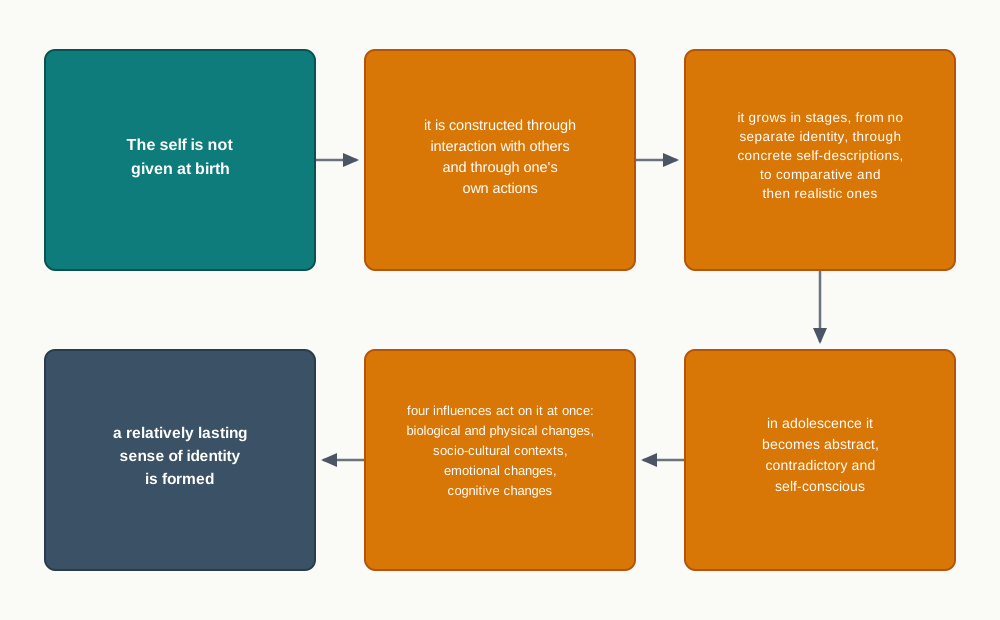
Fig. 2.12 – The argument of the chapter.
2.12 Key Terms
- Abstract thinking — thinking that goes beyond what is present and directly experienced, allowing a person to consider ideas and possibilities in themselves.
- Adolescence — the stage between childhood and adulthood, taken by the World Health Organization to run from 10 to 19 years of age.
- Cognition — thinking, knowing and understanding; everything the mind does when it works on information.
- Connectedness — sensitivity to and respect for the views of others, together with openness to those views.
- Early childhood — roughly the pre-school years, from about three to six years of age.
- Ideal self — the picture of what a person would like to be, or thinks it most important to be.
- Identity — a person’s sense of who she or he is, held with a feeling of continuity and sameness across time.
- Identity crisis — the struggle over self-definition believed to be faced during adolescence, when expectations change sharply from what they were before.
- Identity development — the building and rebuilding of a sense of who one is, over the whole course of growing up.
- Individuality — the opportunity and the ability to hold one’s own point of view.
- Infancy — the first two years or so of life.
- Menarche — the first menstruation, usually taken as the point of sexual maturity in girls.
- Middle childhood — roughly the years from six to eleven.
- Mood swings — sharp shifts in feeling over short periods, common during adolescence.
- Personal identity — those attributes of a person that make her different from others.
- Personal self — those aspects of the self that relate only to the person herself.
- Personality — the characteristic and fairly steady pattern of thinking, feeling and behaving by which others recognise a person.
- Puberty — the time when sexual maturity is reached.
- Pubescence — the period during which the physical and biological changes leading to puberty take place.
- Real self — what a person actually is at present, as against what she would like to be.
- Role confusion — the difficulty in integrating the newly emerging selves of adolescence; also called identity confusion.
- Self — the totality of a person’s experiences, ideas, thoughts and feelings with regard to herself or himself.
- Self-awareness — a mental picture of oneself; the knowledge that one is separate and distinct from the world outside.
- Self-concept — a description of oneself, answering the question ‘Who am I?’
- Self-esteem — one’s evaluation of oneself, judged against standards largely drawn from society.
- Self-image — the picture a person holds of herself, particularly of her own body.
- Self-recognition — a mental picture of oneself, shown in an infant by knowing her own face in a mirror.
- Self-understanding — a mental picture of oneself; what a person knows and can say about who she is.
- Social comparison — describing oneself by measuring one’s abilities against those of other people.
- Social identity — those aspects of a person that link her to a professional, social or cultural group.
- Social self — those aspects of the self in which a person is involved with others.
2.13 Points To Ponder
- Self-esteem is a judgment made against standards that are largely handed to us by society. If those standards were to change, would a person’s self-esteem simply change along with them, or is there some part of the judgment that a person genuinely sets for herself?
- Adolescents growing up inside a family occupation often meet little role confusion, while those with many occupational choices meet a great deal of it. Is the smoother passage always the better one, or does the confusion itself do some useful work in forming an identity?
- The chapter treats self-awareness, self-understanding and self-recognition as three names for one thing — a mental picture of the self. Could an infant pass the mirror test and still have very little self-understanding? What would that suggest about keeping the three terms separate?
- A family atmosphere is said to need both individuality and connectedness. What would a household look like that had a great deal of one and almost none of the other, and what would be missing from the identity of an adolescent growing up in it?
- Many people speak of themselves as ‘we’ rather than as ‘I’, placing themselves inside a family or community before placing themselves as individuals. Does this make the task of forming an identity easier, harder, or simply different?
2.14 Objective Questions
- Self-image recognition in an infant appears at around: (1 mark)
- 6 months of age
- 12 months of age
- 18 months of age
- 30 months of age
- Which of the following is not a characteristic of a young child’s understanding of herself? (1 mark)
- Self-descriptions in absolute terms
- Descriptions in terms of things she can do
- Comparison of her abilities with those of others
- Overestimation of herself
- For most boys, the period of pubescence ranges from: (1 mark)
- 11 years to 13 years
- 12 years to 14 years
- 13 years to 15 years
- 14 years to 16 years
- According to Erik H. Erikson, the task to be accomplished during adolescence is to: (1 mark)
- develop a sense of identity
- achieve control of the bowel and the bladder
- make social comparisons with others of the same age
- separate physically from the family
- The ability to think of hypothetical situations, imagining possibilities and their outcomes without living through them, appears during: (1 mark)
- infancy
- early childhood
- middle childhood
- adolescence
- Assertion (A): An adolescent may rebel against being treated like a child, and an hour later want exactly the comfort a child would want. (1 mark) Reason (R): The self during adolescence carries several contradictions.
- Both A and R are true, and R is the correct explanation of A.
- Both A and R are true, but R is not the correct explanation of A.
- A is true, but R is false.
- A is false, but R is true.
- Assertion (A): The onset of puberty affects two adolescents of the same age very differently. (1 mark) Reason (R): The physical changes of puberty differ from one culture to another.
- Both A and R are true, and R is the correct explanation of A.
- Both A and R are true, but R is not the correct explanation of A.
- A is true, but R is false.
- A is false, but R is true.
- Match the terms in Column A with their meanings in Column B: (1 mark)
| Column A | Column B |
|---|---|
| a. Menarche | i. Openness to and respect for the views of others |
| b. Social identity | ii. Aspects of a person that link her to a group |
| c. Connectedness | iii. Usually taken as the point of sexual maturity in girls |
- Fill in the blanks: (1 mark)
- The period during which the physical and biological changes leading to puberty occur is called ____________.
- ____________ is a description of oneself and answers the question ‘Who am I?’
- State whether the following are true or false: (1 mark)
- At birth, an infant realises that she is separate and distinct from the world outside.
- Children begin to describe themselves in comparative terms during middle childhood.
- Name the following: (1 mark)
- The sense of who one is, carried with a feeling of sameness throughout life.
- The criterion of puberty that has been found useful for both boys and girls.
- Odd one out, and give a reason: mental abilities, beliefs, cooperation, capabilities. (1 mark)
2.15 Check Your Concepts
Define identity, and state one way in which it differs from personality. (2 marks)
Give a reason why the sequence of changes during pubescence is more dependable than the age at which they occur. (2 marks)
List the four influences on the formation of identity. (2 marks)
Differentiate between self-concept and self-esteem, stating the basis of difference. (3 marks)
Explain, with an example, how an infant comes to realise that her own actions have an effect on the environment, and why this matters for the development of the self. (3 marks)
Why does a wide range of occupational choices tend to lengthen the period of adolescence? (3 marks)
Describe, with examples, the five characteristics of a young child’s understanding of herself. (4 marks)
What would happen to the identity development of an adolescent in a household that promoted individuality but very little connectedness? (4 marks)
Two boys of the same age notice the same change in their bodies. One feels comfortable about it and the other is troubled by it. Explain how the same physical change can produce two such different outcomes. (4 marks)
‘Adolescence is a critical period for the development of identity.’ Explain this statement, giving three reasons, and describe one situation in which the break from earlier expectations may be far less marked. (5 marks)
Describe the four kinds of early interaction through which a child constructs a sense of self, giving one example of each. (5 marks)
2.16 Identify & Label
Look at Fig. 2.3. Identify the test being carried out, and state what the infant’s action tells you about her sense of self. (2 marks)
Look at Fig. 2.8. Identify which of the two shaded bands belongs to girls and which to boys, and state what period each band represents. (2 marks)
Look at Fig. 2.6. Label the four parts of the drawing from the centre outwards, and state what the two-headed arrows crossing the rings are meant to show. (3 marks)
Look at Fig. 2.0. Identify the four stages shown, and state one characteristic of the self at each stage. (4 marks)
2.17 Case & Application Based Questions
- Ravindra is sixteen. He has worked alongside his father in the family’s tailoring unit since he was twelve, and this year he has been given charge of taking customers’ measurements. His cousin Aparna is also sixteen. She lives in a city, has just chosen her subjects, and is preparing for a course that will take three more years before she can begin to earn. (5 marks)
- Which of the two is more likely to experience role confusion? Give a reason for your answer. (2 marks)
- Name the influence on identity that is chiefly at work in this situation. (1 mark)
- State one advantage that each of the two settings offers for the development of identity. (2 marks)
- In one Class XI section, a group of four friends stays back after school to finish assignments together, and expects each member to turn up. In the same section, another group of four dares one another to skip the last class of the day. (4 marks)
- Name the process at work in both groups. (1 mark)
- Explain why the same process produces opposite results in the two groups. (2 marks)
- Suggest one step a student who feels pulled towards the second group could take. (1 mark)
- A nine-year-old finishes her homework before going out to play. Her father tells her that this was a sensible thing to have done, and then asks her why she chose to do it in that order. She replies that she finishes her work faster than her younger brother does. (4 marks)
- Which two of the four early interactions that build the self is the father using here? (2 marks)
- Which key change of middle childhood is visible in the child’s reply? (1 mark)
- Name the two selves that a child of this age is able to tell apart. (1 mark)
2.3.2 Social Identity
Social identity refers to those aspects of a person that link her to a group — professional, social or cultural. Here you are not marking yourself off from others; you are placing yourself among them.
When you think of yourself as an Indian, you have linked yourself with a group of people living in one country. When you describe yourself as a Gujarati or a Mizo, you are saying that you share some characteristics with the people living in that state, and that these characteristics seem to you to be different from those of people living in other states of India.
Being a Gujarati is one dimension of social identity in exactly the same way as being a Hindu, a Muslim, a Sikh or a Christian, or as being a teacher, a farmer or a lawyer. Each of these names a group a person belongs to, and each supplies one thread of who that person takes herself to be.
Two things are worth noticing here. First, nobody has only one social identity; the same woman may be a Mizo, a Christian, a doctor and a mother, all at once and without contradiction. Second, a social identity tells you which group a person places herself in — it does not tell you what that person is like. Table 2.2 sets the two kinds of identity side by side.
Table 2.2 — Personal Identity And Social Identity | Feature | Personal identity | Social identity | |—|—|—| | What it refers to | Attributes that make a person different from others | Aspects that link a person to a group | | What it does | Marks a person off | Places a person among others | | Kind of group involved | None; it is particular to the individual | Professional, social or cultural | | Example | Being the one at home who is patient with an elderly relative | Being an Indian, a Mizo, a Sikh, a farmer | | Number a person holds | One bundle, unique to her | Several at the same time |
Identity is a legal idea as well as a psychological one. An Aadhaar number, a school admission number and a passport all exist to answer one question — is this the same person as before? The problem the state solves with documents is the same problem you solve from the inside, without any paperwork at all.
The self, then, is many-sided, and it does not stand still. It takes shape and changes as a person grows from an infant into an adolescent. The next section follows that growth stage by stage.