Chapter 6: Media And Communication Technology
One Year Of Television In 2,400 Villages For most of the twentieth century, a village that lay far from a city heard the country’s news days after it happened. That changed for one year, beginning on 1 August 1975, when the Satellite Instructional Television Experiment — usually shortened to SITE — brought television directly to around 2,400 villages spread across six states.
The idea was unusual. Instead of laying cable or raising transmitters across hundreds of kilometres, India borrowed an American satellite, ATS-6, and beamed programmes straight down to community television sets installed in village schools and panchayat buildings. Many of these sets picked up the signal through a plain mesh antenna that a technician could bolt together on the roof.
For a few hours each day, people watched programmes on farming, health, hygiene, child care and schooling, made in the languages they actually spoke. In the evening a whole village would collect around a single set. Researchers travelled with the experiment, sat with the audiences and recorded what viewers understood, what they questioned and what they ignored — because a message that is transmitted is not automatically a message that has been received.
SITE ended on 31 July 1976, when the satellite was moved away. But it settled an argument. A communication technology is judged not by how clever the machine is, but by whether an idea actually reaches people and changes something in the way they live.
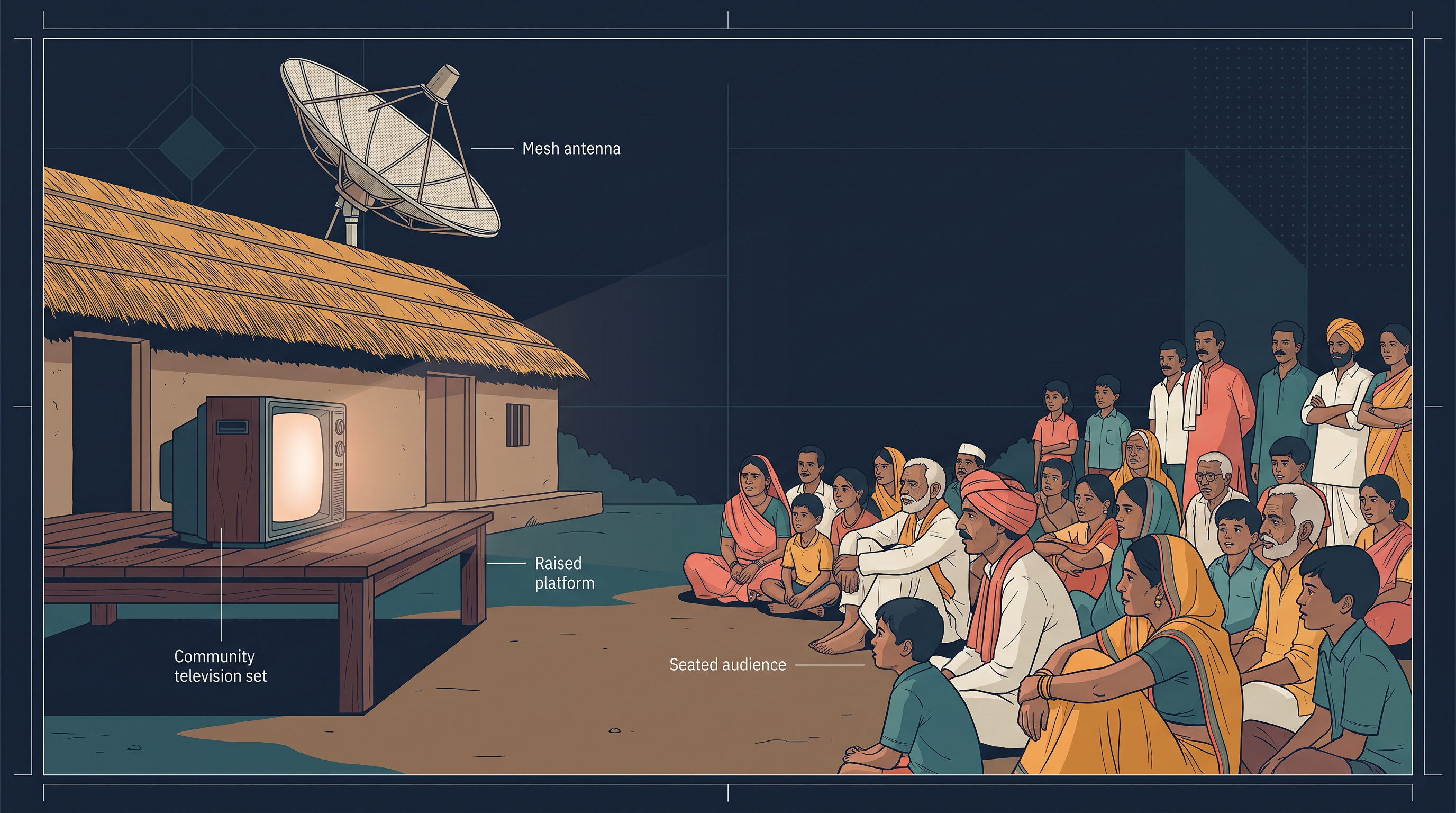
Fig. 6.0 – A community television set in a village, 1975.
6.1 What Is Communication?
Think of an ordinary morning. A grandfather asks what time the bus leaves, a younger brother shakes his head without speaking, a neighbour calls out a greeting from the gate. None of this feels like a subject to be studied. Yet every one of these exchanges is communication, and human life would not hold together for a day without them.
Communication is the process of sharing meaning with oneself or with others. It covers thinking, observing, understanding and analysing, and then transmitting feelings, ideas and information through some medium. Seeing and watching, listening and hearing, and the exchange of thoughts, experiences, facts, knowledge, impressions and emotions all fall inside it.
Communication is as old as life itself. What keeps changing is the equipment. New methods and gadgets reach the market almost every week, and only some of them survive — the ones that turn out to be cheap enough and useful enough for ordinary people to keep using.
Where The Word Comes From
The word communication comes from the Latin word communis, meaning common. That root tells you what the process is actually for. It is not enough for the sender to push out a message; the meaning of that message must become common to the sender and the receiver alike.
This is why sharing information and communicating are not the same thing. A notice pasted on a wall shares information. It communicates only when the person reading it takes from it the meaning the writer intended.
The word to notice in that definition is ‘conscious’. Meaning does not become common by accident. The sender chooses words, tone and medium with a particular receiver in mind, and checks whether the meaning has in fact carried across.
A Process That Never Stops
Communication is continuous. It does not begin when you decide to speak and end when you stop, because silence, expression and posture keep carrying meaning even when nobody is talking.
It also runs through every level of social life. You communicate with yourself while deciding something, with your family at home, with teachers and classmates at school, with shopkeepers and neighbours in the community, and — through newspapers, radio and the internet — with an audience spread across the country. The same basic process is at work at each of these levels; only its scale and its equipment change.
That range is what makes communication a Home Science concern rather than a language one. How a household divides its work, how a child is taught to be careful near a stove, how a family agrees on what it can afford this month — each of these succeeds or fails on whether meaning became common.
6.2 Classification Of Communication
Communication takes so many forms that a single description will not hold them all. A whispered word, a class lecture, a national news bulletin and a memo between two offices are all communication, yet they work in visibly different ways.
To handle this range, communication is sorted on four different bases. Each basis asks a different question of the same event:
- the type of interaction — can the receiver reply?
- the level — how many people are involved, and in what setting?
- the means or mode — is the meaning carried by words, or by something other than words?
- the number of senses involved — how much of the receiver is being reached?
These are not rival systems, and a single event usually has an answer under each of them. A television news bulletin is one-way by interaction, mass by level, verbal and non-verbal by mode, and audio-visual by the senses it uses.
6.2.1 Classification Based On The Type Of Interaction
The first question to ask of any communication is a simple one: can the person at the receiving end answer back? The two possible answers give the two types shown in Fig. 6.1.
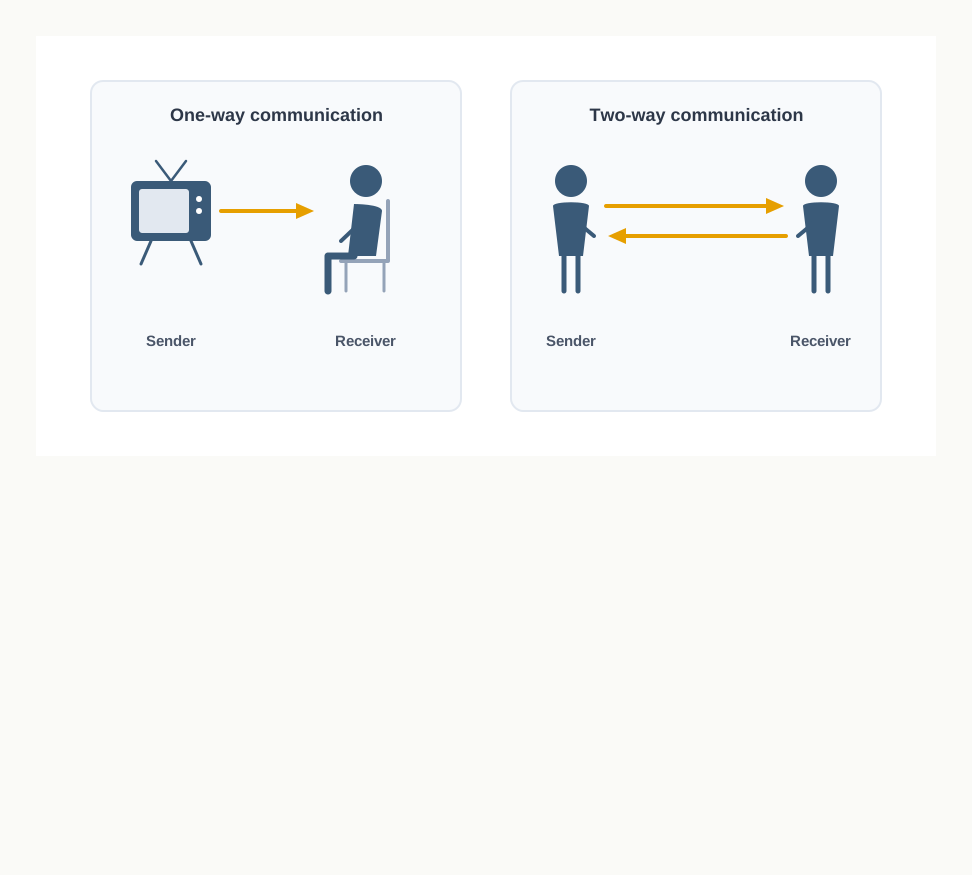
Fig. 6.1 – One-way and two-way communication.
One-Way Communication
In one-way communication, the receiver takes in the information but either never reciprocates to the sender, or cannot respond immediately. The channel carries meaning in one direction only.
A speech at a public meeting, a lecture, a sermon, music heard on the radio or a music system, an entertainment programme watched on television, and a search for information on a website are all one-way. In each case you receive fully and reply not at all, or not at the moment it would make a difference.
Notice that one-way communication is not failed communication. Meaning does become common — a listener understands the sermon, a viewer follows the programme. What is missing is the return path.
Two-Way Communication
Two-way communication takes place between two or more persons where all the parties share or exchange ideas, thoughts and information with each other. The exchange may be spoken or silent.
Talking to a friend on a mobile phone, sitting down with a parent to work out plans for next year, and chatting over the internet are all two-way. So is a conversation carried entirely in gestures across a noisy room.
An infant’s cry is a good test case. The child cannot use words, yet the cry is a message that reports hunger, and whoever is caring for the child answers it by feeding her. A message went out, it was understood, and a response came back — which makes this two-way communication, and for an infant it is communication on which survival depends.
6.2.2 Classification Based On The Levels Of Communication
The second basis asks who is involved and in what setting. As the level rises, the number of people grows, the setting becomes less personal, and feedback becomes harder to get. Six levels are recognised.
Intra-Personal Communication
Intra-personal communication is communicating with oneself. It is a mental process of observing, analysing and drawing conclusions that are meaningful to a person’s own past, present and future behaviour and life.
This process transpires inside an individual and never stops. Running an interview or an oral examination through your mind beforehand, and deciding what you will say and how, is intra-personal communication at work.
Inter-Personal Communication
Inter-personal communication is the sharing of thoughts and ideas with one or more people in a face-to-face situation. It may be formal, as in an interview, or informal, as in a conversation over tea.
It draws on every means available at close range — body movements, facial expressions, gestures, postures, written text, and verbal modes such as words and sounds. Telling a friend what went wrong in an experiment, or joining a panel discussion that ends in a question-answer session, are both examples.
Of all the levels, inter-personal communication is the most effective, and for two clear reasons.
- There is proximity and direct contact between the communicator and the communicatee, so it is easier to persuade, motivate and convince the other person to accept an idea.
- Feedback is instantaneous and strong, because the receiver’s response to the idea comes back at once.
Group Communication
Group communication is as direct and personal as inter-personal communication, but with more than two persons taking part in the process.
Its value lies in what a group makes possible. It supports a participatory approach and collective decision-making, gives each member an opportunity for self-expression, and increases an individual’s impact in a gathering, thereby raising her standing within the group. It also serves recreation and relaxation, socialising and motivating. A range of audio-visual aids may be used to strengthen it.
Mass Communication
Considerable advancement in technology has made it possible for thoughts, ideas and innovations to reach a much larger section of society. That is the work of mass communication — the process of multiplying messages with the help of a mechanical device and disseminating them to the masses.
Its means and media are radio, television, satellite communication, newspapers and magazines. Its audiences are very large in size, heterogeneous and anonymous, spread over a large area, and separated from the communicator in both time and space.
This distance has a cost. Correct, complete, direct and immediate feedback is not possible at this level; the feedback that does arrive is slow, cumulative, expensive and delayed.
Intra-Organisational Communication
Organisational communication takes place in highly structured settings. Just as people build and maintain relationships, organisations establish and maintain relationships too, using several levels of communication within their own environment and among their departments or sections.
Intra-organisational communication is communication inside one organisation. Every organisation has levels, or a hierarchy of ranks, working together towards common goals, and the information flow follows that hierarchy: it is expected to be two-way at the same level, and one-way across levels.
Inter-Organisational Communication
Inter-organisational communication is the system one organisation develops to communicate with other organisations, so that the two can work in cooperation and coordination with each other.
Development work in the country runs on exactly this. Technical and financial support for developmental activities is provided by international agencies, while administrative support comes from the Central government and the State governments. Fig. 6.2 sets out how these bodies are linked.
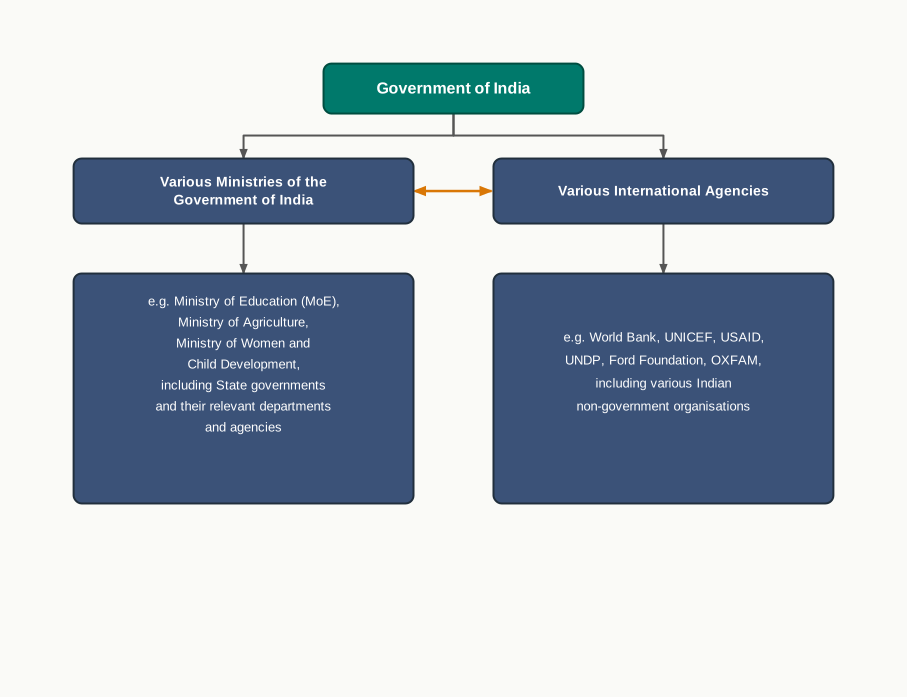
Fig. 6.2 – Communication system among various organisations.
One point holds for both of these organisational levels. Departments do not talk to departments, and organisations do not talk to organisations. It is always human beings working inside them who communicate with each other, which is why understanding the human factor matters as much as understanding the structure.
6.2.3 Classification Based On The Means Or Modes Of Communication
The third basis asks how the meaning is carried. Here ‘verbal’ means spoken — carried by the voice — so everything else, including writing, falls on the non-verbal side.
Verbal Communication
Verbal communication uses auditory means: speaking, singing, and sometimes the tone of the voice itself. The same three words can be a request or an accusation depending on how the voice shapes them.
A large part of a person’s active time goes into verbal communication of one kind or another — listening, speaking and reading aloud. This is worth pausing on, because a skill you use for so much of the day is worth improving deliberately.
Non-Verbal Communication
Non-verbal communication carries meaning without the spoken word. Its means are gestures, facial expressions, disposition, posture, eye contact, touch, para-language, writing, clothing, hair styles, and even architecture, symbols and sign language, such as the smoke signals long used to carry messages across open country.
That list is worth reading slowly, because it includes things people do not think of as messages at all. A building’s entrance tells a visitor where to walk. Clothing tells a stranger what occasion you are dressed for.
6.2.4 Classification Based On The Number Of Senses Involved
Have you noticed that watching a folk or classical dance performance, live or on television, teaches you more about it than reading a description of the same dance? The steps, the rhythm and the expression arrive together, through more than one sense at a time.
That is the fourth basis of classification. Communication may reach the receiver through hearing alone, through sight alone, or through both together, and the more senses that are involved, the more clearly the content is understood and the longer it stays. Doing the thing as well as seeing and hearing it holds best of all, which is why a practical class teaches what a description cannot. Table 6.1 sets out the three types.
This has a practical use whenever you have to get a message across. If a message matters, choose a medium that reaches more than one sense — and where you can, give the receiver something to do with it as well.
6.3 How Communication Takes Place
Knowing the types of communication does not yet tell you how a single act of communication actually runs. Something has to start it, something has to travel, and something has to come back before anyone can say it worked.
The process of communication is the transfer of information or content from a sender to a receiver through a medium. It is flexible, because the same information can be exchanged by several methods, and the test of any of them is the same: the information must be understood correctly, clearly and completely by the sender and the receiver alike.
The process also takes in the audience’s feedback on the message that was sent, and uses it for further planning. A company carries out a market survey before launching a product for exactly this reason — it wants the response before it commits, not after.
6.3.1 The SMCRE Model Of Communication
One useful way to describe the sequence in which communication events occur is to ask a chain of questions of the event: who says, what, to whom, when, in what manner, under what circumstances, and with what effect.
Each question in that chain points to one element of the process, and the elements are arranged in a definite order that completes a cycle. Five elements have to be handled skilfully for communication to succeed, and they are set out in the SMCRE model — Source, Message, Channel, Receiver, Effect — shown in Fig. 6.3.
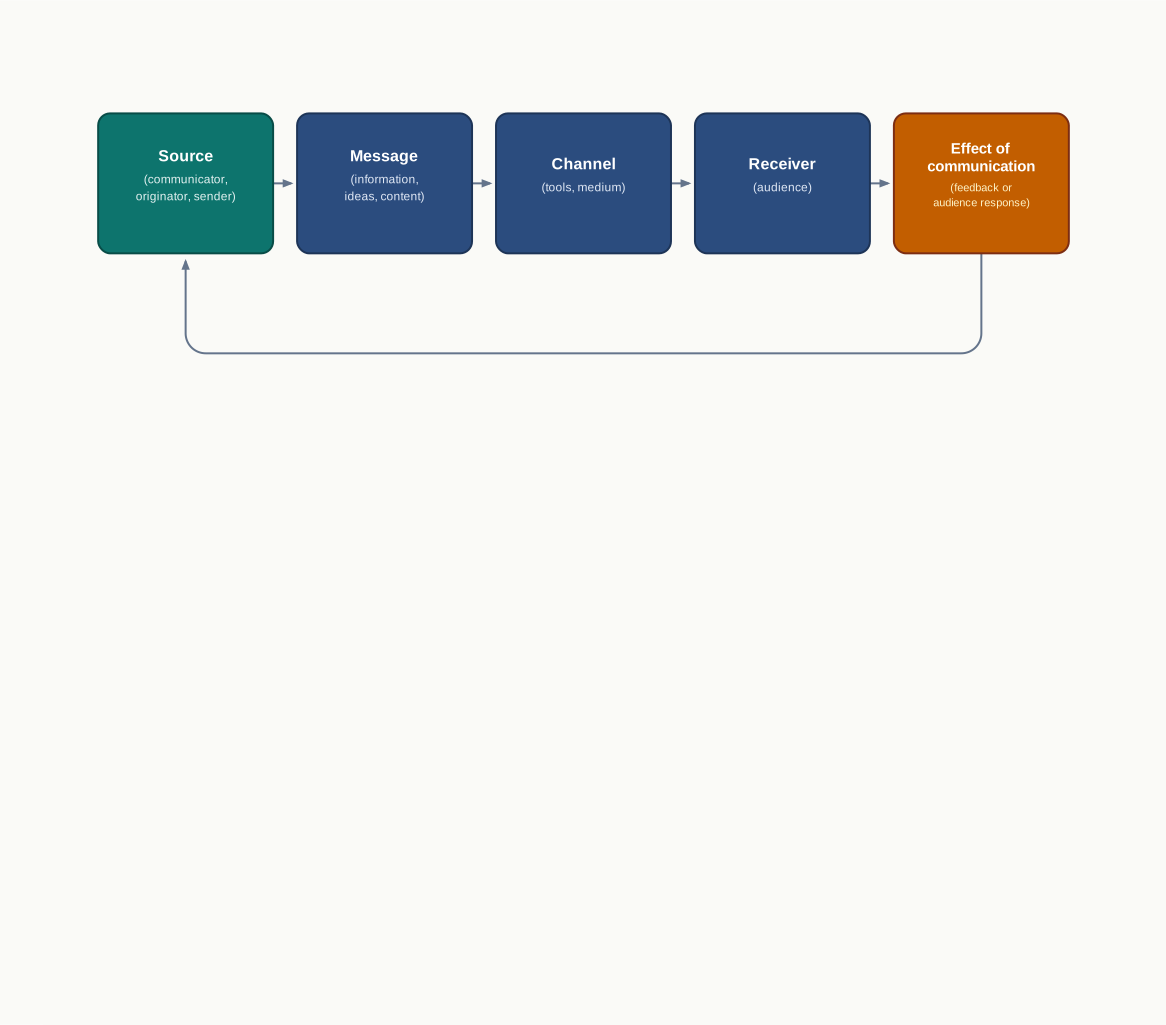
Fig. 6.3 – The SMCRE model of communication.
The arrow that returns from Effect to Source is what makes this a cycle rather than a line. Until it closes, the sender has no way of knowing whether anything was achieved. The five sections that follow take the elements one at a time.
6.3.2 Source
The source is the person who initiates the process of communication. She or he is the key factor responsible for the effectiveness of the whole process, because every later element is shaped by choices made here.
The source frames the message for a specific group of audience, and frames it so that it does two things at once: it is interpreted correctly, and it yields the desired response. Getting one without the other is not enough — a message can be perfectly understood and still move nobody.
A source may be your teacher, a parent, a friend or a classmate, an extension worker, a leader, an administrator, a writer, a farmer, or a person from a remote part of the country who holds indigenous knowledge that others need. The last of these is worth noticing: a source has authority because of what she knows, not because of her position.
6.3.3 Message
The message is the content or information that the communicator wishes the receiver to receive, accept or act upon. It may be technical, scientific or simply generalised information or ideas, specific or general to any field of knowledge or to the day-to-day life of an individual, a group or a much larger section of people.
A good message has a definite set of qualities. It should be:
- simple, yet appealing and clear;
- very specific;
- authentic;
- timely;
- appropriate and applicable to the channel that has been selected;
- suited to the nature and type of the receiver group.
The last two qualities are the ones most often forgotten. A message written for a printed pamphlet will not survive being read aloud on the radio, and a message pitched at trained health workers will not carry to a general audience without being rebuilt.
6.3.4 Channel
The channel is the medium of communication through which the information flows from the sender to the receiver.
Face-to-face, word-of-mouth communication is the simplest and one of the most effective channels there is, and it is perhaps the most widely used medium in a majority of developing and less-developed countries of the world. It needs no equipment, and it carries tone, expression and gesture along with the words. With the passage of time and social change, however, the emphasis has shifted towards advanced mass media and multi-media technologies.
Channels fall into two types:
- inter-personal communication channels, such as individuals and groups;
- mass media communication channels, for example satellite, wireless and sound waves.
Choosing between them is a real decision, not a formality. An inter-personal channel reaches few people but persuades strongly; a mass media channel reaches many but persuades weakly. The message and the audience together decide which one the situation needs.
6.3.5 Receiver
The receiver is the intended audience of the message, and the target of the whole communication function. A receiver may be an individual or a group, men or women, rural or urban, old or young.
One feature of the receiver group matters more than any other. The more homogeneous the group — the more its members share in age, language, occupation or level of knowledge — the greater are the chances of successful communication, because one message can then fit everybody in it.
A heterogeneous group is harder to reach, and this is precisely the difficulty of mass communication, where the audience is large and mixed. The way around it is not to shout louder but to segment: prepare different versions of a message for different sections of the audience.
6.3.6 Effect Of Communication
The effect of communication, or feedback, is the response to the message coming back from the receiver. A communication process is incomplete unless that response is received.
Feedback occupies an unusual position, because it is both the initiating step and the terminating element of the process. Termination occurs when the response to the message is the same as the one expected; the objective has been achieved and the cycle is complete. Where the response of the intended audience does not yield the desired results, rethinking and recasting of the message occurs, and the entire process is repeated.
Feedback takes many everyday forms:
- When a teacher finishes a lesson and asks the class questions, the whole activity of finding out which parts were understood and which need explaining again is feedback.
- Letters from readers printed in newspapers and magazines are feedback to the editor and the writers.
- Television Rating Points (TRPs), which estimate how many viewers watched a programme, are feedback from the audience to the broadcaster.
6.4 What Is Media?
If you listen to the radio or watch television, you are probably aware that what you hear or see influences you in one way or another. That is media influence, and it is worth understanding how it reaches you.
Look for the common element in this set: the advertisements and programmes you see on television, a film watched on television or in a theatre, the news you read in a newspaper, a politician’s speech, the instructions a teacher gives in class, the complaint you register when an appliance stops working, and the shopping you do on the internet while sitting at home.
The common element is that in each case some medium has been used to pass on or share a message. A medium is simply the carrier that takes content from one point to another. When you speak to someone, even the air is a medium — sound waves travel through it, and no sound can be transmitted through a vacuum at all.
Media And Communication Are Not The Same Thing
If communication is a process, then media is the means. It uses various methods of communication for disseminating and sharing ideas, thoughts, feelings, innovations and experiences.
Mass media essentially uses modern technology, but the presence of technology does not by itself mean that mass communication is taking place. A video call between two cousins uses satellite and wireless technology and is still inter-personal. Mass media is always meant for audience groups that are heterogeneous, anonymous and large.
Does media mean only radio and television, then? No. All types of satellite transmission, computer technology and wireless technology are included in it as well. Media has gone through a great deal of change and development, and numerous modern technologies are now available for communication purposes. Broadly, they fall into two categories — traditional and modern — set side by side in Table 6.2.
6.4.1 Traditional Media
Until very recently, most rural extension work was completely dependent on traditional media such as fairs and radio, and the situation is no different even today. Inter-personal communication media largely remains the most used and the most effective medium of communication in rural and remote areas.
The reason is the one you met in the last section. A message that arrives face to face, in a familiar form and a familiar language, is understood and trusted in a way that a broadcast from far away is not.
Traditional folk media include puppetry, folk dances, folk theatre, oral literature, fairs and festivals, rituals and symbols, and print media such as charts, posters, newspapers, magazines and other local publications that have circulated since ancient times. Many of these continue to serve as indigenous channels of communication.
Folk Theatre And Drama
Traditional folk theatre carries a story, and with the story it carries instruction, argument and news. Popular forms include Jatra (West Bengal), Ramleela and Nautanki (Uttar Pradesh), Bidesia (Bihar), Tamasha (Maharashtra), Yakshagana and Dashavatar (Karnataka), and Bhavai (Gujarat).
Each of these is a performance held in the open, before an audience that already knows the conventions. That shared knowledge is what makes the form efficient: the performer does not have to explain the frame, and can spend the whole evening on the content.
Oral Literature And Musical Forms
Oral literature-cum-musical forms are mainly folk and tribal songs and dances. They include Baul and Bhatiali (West Bengal), Sua and Dadaria (Madhya Pradesh), Duha and Garba (Gujarat), Chakri (Kashmir), Bhangra and Giddha (Punjab), Kajri and Chaiti (Uttar Pradesh), Alha (Uttar Pradesh and Bihar), Powada and Lavani (Maharashtra), Bihu (Assam), and Mand and Panihari, along with the songs sung by the Charans and Bhaat of Rajasthan.
There are also drum festivals with strongly rhythmic drum beats, followed by dance and song, among the communities of the North-eastern states and elsewhere in the country. A song of this kind is a communication technology of its own sort: it is memorable, it needs no equipment, and it travels wherever the singer goes.
Puppetry
Puppetry has long been a common medium for carrying messages while entertaining at the same time. The two most common forms are the string puppets or Sutradharika, used mainly in Rajasthan and Gujarat, and Chhaya Putli or shadow puppets, which are more common in the southern parts of the country. The two are compared in Fig. 6.4.
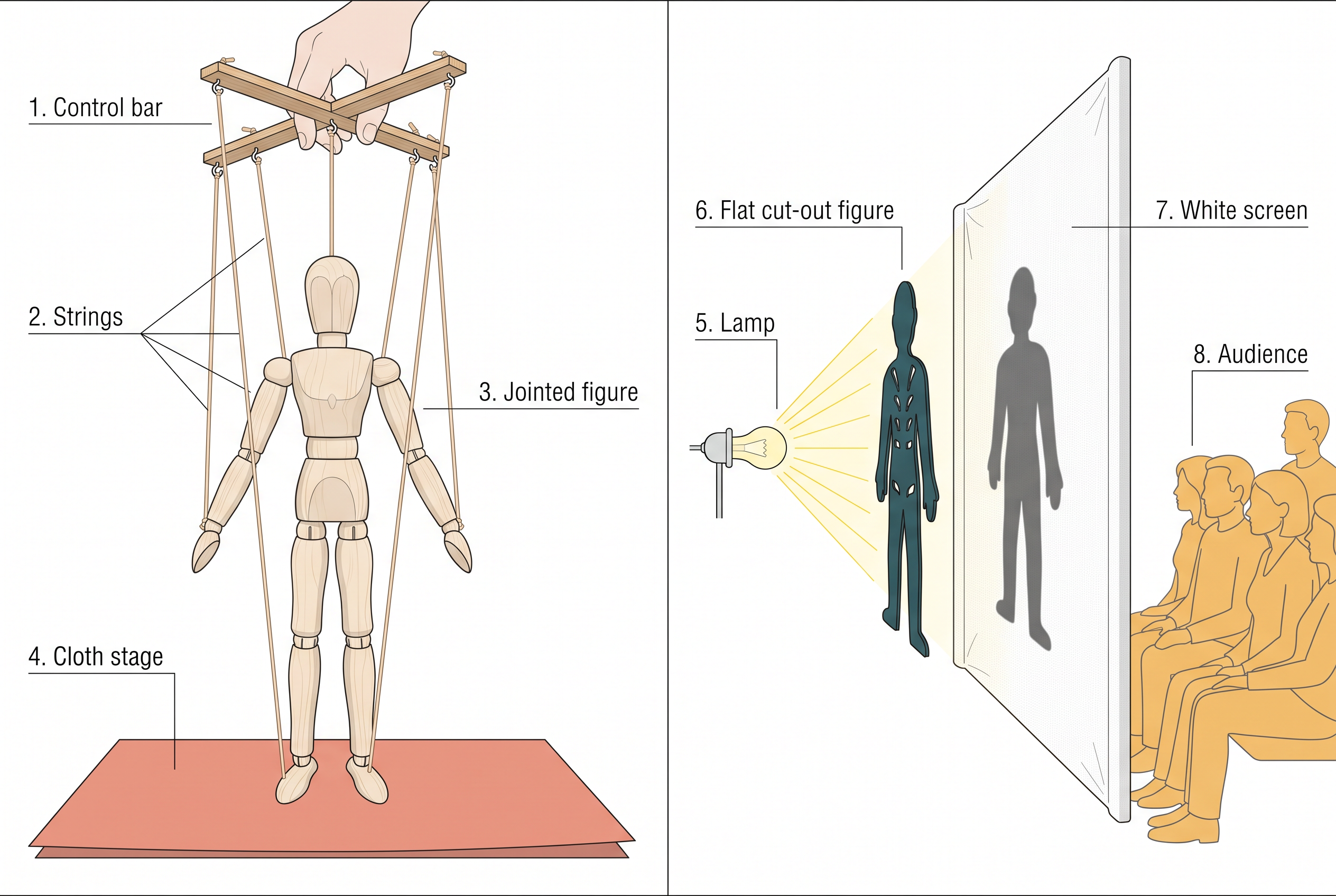
Fig. 6.4 – String puppets and shadow puppets.
Besides these, festivals, fairs, social rituals, ceremonies and yatras all carry messages, expressions, feelings and traditions of the many communities across the country.
With changing times it became apparent that traditional communication media were neither sufficient nor well equipped to meet the diverse information needs of modern audiences. New media technologies were popularised to fill that gap.
6.4.2 Modern Media
With the advent of modern technology the range of communication media has expanded tremendously. Modern media are the media that depend on electronic and mechanical technology to record, transmit and reproduce a message.
New communication technologies, such as the mobile phone, keep emerging with features that improve the quality and the capacity of broadcast. Two changes matter most for reach. Equipment has become handy in size, which makes it convenient to use in rural and remote areas; and the availability of computers, particularly with an internet facility, has ushered in a completely new era of communication media.
Examples of modern media are radio, satellite television, modern print media, films projected through various types of projectors, audio cassette and compact disk technology, cable and wireless technology, the mobile phone, video film and video conferencing.
Traditional media have not been replaced by these, and the two are often used together. A health message may be broadcast on radio and then performed at a village fair, so that the reach of the first is joined to the trust of the second.
6.4.3 Functions Of Media
By now you will have realised that as an adolescent you are likely to be influenced by media a good deal. It helps to know what media is actually doing when it influences you. Media performs nine functions.
- Information: It both provides information and allows information to be exchanged. Information is a form of power, and radio, television, magazines and newspapers are what put it within reach.
- Persuasion or motivation: We are not always convinced by an idea when we first meet it. Suitable media can be used to persuade an audience to accept one, but this requires a deeper understanding of audience psychology and of their socio-cultural background.
- Entertainment: Traditional and modern media together provide a wide variety of entertainment, from folk media and oral tradition to Direct to Home (DTH) telecast. Even educational content is often presented in an entertaining form to make learning easy and interesting.
- Interpretation: Pictographic presentations, facts and figures make difficult and complicated ideas easy to grasp. A geographical area is far easier to locate and understand from a cartographic map or a globe than from a description in a textbook.
- Transmission of values: Media is expected to foster a healthy society by transmitting wholesome values, for instance through puppetry and cartoon films that teach values in a story format.
- Education or training: New learning experiences built with suitable media, in the local language and focussed on local problems, enrich the teaching-learning experience. These include interactive instructional video, audio recordings and printed teaching-learning material on various concepts.
- Coordination: Modern interactive technologies have made distance and physical proximity less important. The pace, scope and accuracy of communication have expanded so far that a large project spread over a vast geographical area can now be coordinated from one place.
- Behavioural change: Extension activities in health, literacy, environmental issues, empowerment programmes and the adoption of innovations all depend on the art and technique of effective communication. Media remains the main vehicle for such messages, and their acceptance leads to direct and indirect changes in behaviour.
- Development: Media acts as a catalyst in national development, mediating between specialists and lay persons. It has accelerated the pace of development and made the world smaller by bringing people closer.
Read down that list and you will notice the scale ladder at work. Information and entertainment reach you as an individual; transmission of values and education work through the family and the school; coordination and behavioural change operate at the level of the community; and development is a national function. The same medium does all of this at once, which is why what media chooses to carry matters.
Both communication and media rely on technology to reach people. The next section takes up that technology directly.
6.5 What Is Communication Technology?
The world is passing through a communication revolution, and communication technologies are changing very fast. What is new today may be obsolete tomorrow. People want to know everything within a very short span of time, and there is now such an overflow of information that it is easily available and accessible to almost everyone through a wide variety of traditional and modern mediums. It is here that communication technology plays its key role.
We have used different mediums and technologies for communicating at different times, in the past and in the present, and in very different settings — rural, urban and tribal. What changes across those settings is not the need to communicate but the equipment available for it.
Communication technology refers to the various technologies that are developed and used to handle information and aid communication. It includes the modern technologies used to transmit data, which may be either analogue or digital.
That distinction is worth a moment. Analogue transmission carries information as a continuously varying electrical signal, of the kind a landline telephone once used. Digital transmission first converts the information into numbers, which can then be copied, stored and sent without losing quality.
Communication technology is not only machinery. It also includes the organisational structures that run the machinery and the social values that decide how people use it — and individuals draw on all three to collect, process and exchange information.
6.5.1 Classification Of Communication Technologies
A wide range of communication technologies is available, and they fall into two broad groups, compared in Table 6.3 and shown in Fig. 6.5.
- Cable (land) based technologies carry the signal along a physical line. They are comparatively cheap and less complicated. A landline telephone, or a personal computer without an internet connection, is an example.
- Wireless technologies carry the signal through the air, with no line between the two ends. They generally require less infrastructure, but can be more expensive to use than cable-based technologies. Radio, microwave and satellite communication, wireless telephony, and the use of Bluetooth technology in mobile phones and computers are examples.
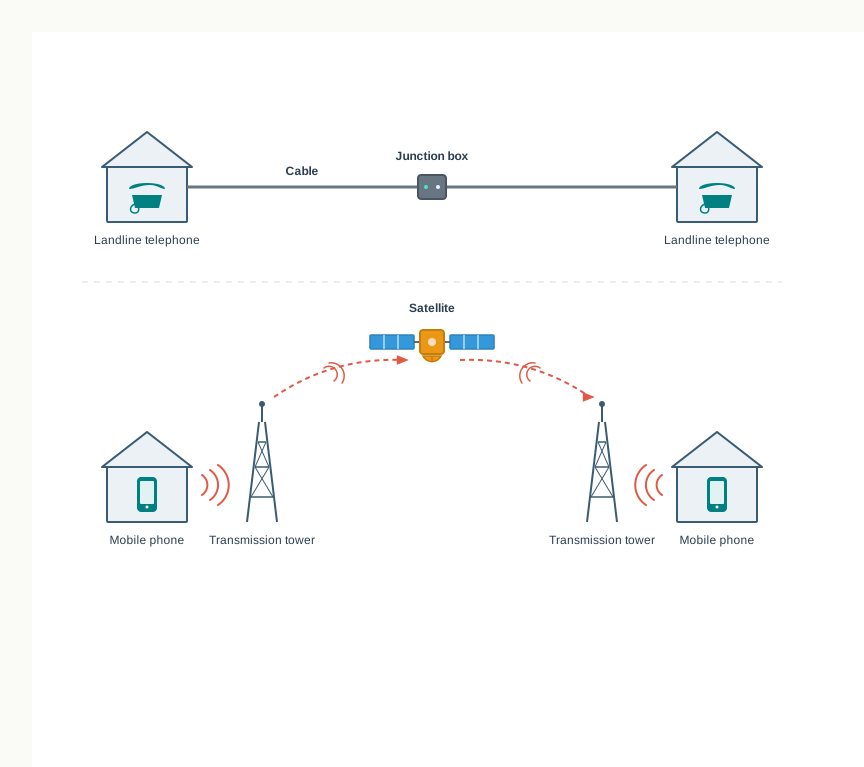
Fig. 6.5 – Cable-based and wireless links.
Bluetooth technology belongs to the second group. It is a low-cost, short-range radio frequency link between mobile computers, mobile phones and other portable devices, capable of carrying voice and data over a few metres, and able to transmit through solid non-metal objects such as a wall or a bag. It is what allows a phone to control and communicate with a hands-free headset or a car kit without any wire between them.
6.5.2 Radio And Television
Two communication technologies acted as media and changed the whole communication scenario: the radio and the television.
Radio
Radio commands a universal audience. It reaches across geographical spread, income, education, age, sex and religion, because a listener needs no literacy and very little money to use it.
Through on-the-spot or simulated broadcast, radio overcomes the barriers of both time and space. The arrival of small transistor sets made it possible to receive communication in the remotest parts of the country, where no cable would ever be laid.
Television
Television was introduced in India in 1959, primarily to make an impact on education and to promote rural development. Its purpose from the beginning, in other words, was instructional rather than commercial.
Television programmes are planned and produced using a range of techniques — visual magnification, sound amplification, super-imposition, split screen processes, fading and zooming. Each of these does a job. Visual magnification lets a whole class see a detail that only one person could see in the room; a split screen puts two things side by side for comparison. Together they make the medium more effective and strengthen its impact on the viewer.
6.5.3 Modern Communication Technologies
The list of modern communication technologies is long, and innovations in existing technology appear almost every other day. The five described here are the major types used primarily for extension purposes — that is, for the work of carrying practical knowledge in agriculture, health, nutrition and household management out to the people who can use it.
Micro Computers
Computers are classified as mainframes, which are large and costly; mini computers, which are less powerful; and micro-computers, which are based on microchip technology. The classification rests on their power, the speed at which they execute a set of instructions, the amount of memory available to store data, and the degree of inter-connectivity the computer offers.
For extension work, the functions of a micro-computer include processing, keeping records of all kinds of information, performing accounting functions, acting as a repository of cases and experiences for research and field purposes in a very small space, and publishing information material at a reasonable cost. Computers linked together can also communicate with each other and source information from across the globe.
Video Text
Video text, also called view-data, is an electronic text service transmitted from a central computer to a home television set through a telephone network or a cable system.
It is interactive in one specific sense: the viewer has the option of choosing which data to call up, instead of waiting for it in a fixed sequence.
Electronic Mail
Electronic mail, or e-mail, is the system that passes written information electronically from a sender to a receiver. It works like surface mail: a message is typed and addressed, and it is delivered to the receiver’s mail box.
The message is stored on a mail server, which acts as the post office, and it waits there until the receiver opens it on a computer or a phone. This storage is what makes e-mail useful — the sender and the receiver never have to be free at the same moment.
Interactive Video
Interactive video is a video system that combines a computer with video. It uses a multi-media approach, drawing on text, still photographs, video, audio and slides.
Messages stored in these different forms are received by users according to their choice, and the user’s own response to the system determines the path that is followed next. Two people can therefore take two different routes through the same material.
Teleconferencing
Teleconferencing is interactive group communication. It is a system meant for creating a dialogue between participants who are geographically dispersed and physically distant from one another.
Advances in telecommunication have made it possible to hold a meeting without anyone travelling a long distance. In terms of the levels you met earlier, teleconferencing takes group communication and removes its one hard requirement — that everybody be in the same room.
Technology Does Not Replace The Human Touch
Communication technology greatly facilitates communication, and more and more people across the world are using it. Even so, the human element cannot be ignored. In everyday life we still have to speak face to face with different people, and no equipment does that for us.
Every individual therefore needs certain basic skills to communicate effectively — how to listen, how to say a difficult thing clearly, how to read what a face is telling you. The next chapter, on effective communication skills, takes up exactly this.
6.6 Summary
- Communication is the process of sharing meaning with oneself or with others, through thinking, observing, understanding, analysing and transmitting ideas, information and feelings by some medium.
- The word communication comes from the Latin communis, meaning common, because the meaning of a message must become common to the sender and the receiver.
- Effective communication is a conscious effort to create a shared understanding of the intended meaning of a message among all the people involved in it.
- Communication is continuous, and it runs through every level of social life — the self, the home, the school, the community and beyond.
- Communication is classified on four bases: the type of interaction, the level, the means or mode, and the number of senses involved.
- By the type of interaction there are two types:
- one-way communication, in which the receiver never reciprocates or cannot respond immediately, as in a lecture, a sermon or an entertainment programme on television;
- two-way communication, in which two or more parties exchange ideas, silently or verbally, as in a telephone conversation or an infant’s cry answered by a caregiver.
- By the level of communication there are six types:
- intra-personal communication, which is communicating with oneself;
- inter-personal communication, which is face-to-face sharing with one or more people;
- group communication, which is direct and personal but involves more than two persons;
- mass communication, which multiplies messages by a mechanical device and disseminates them to the masses;
- intra-organisational communication, which takes place within one organisation along its hierarchy;
- inter-organisational communication, which links one organisation with others for cooperation and coordination.
- Inter-personal communication is the most effective level, because of proximity and direct contact, and because feedback is instantaneous and strong.
- Mass communication reaches audiences that are large, heterogeneous, anonymous and separated in time and space, so its feedback is slow, cumulative, expensive and delayed.
- In organisational settings it is always the human beings working in the organisations who communicate, not the departments or organisations themselves.
- By the means or mode, communication is verbal, using speech, song and tone of voice, or non-verbal, using gestures, expressions, posture, eye contact, touch, para-language, writing, clothing, symbols and sign language.
- By the senses involved, communication is audio, visual or audio-visual, and the more senses a message reaches, the more clearly it is understood and the longer it is retained.
- The process of communication transfers information from a sender to a receiver through a medium, and is complete only when the receiver’s response returns to the sender.
- The SMCRE model sets out the five elements of this process in order: source, message, channel, receiver, and effect of communication.
- The source initiates the process and is the key factor in its effectiveness, because the message must be both correctly interpreted and productive of the desired response.
- A good message is simple yet appealing and clear, specific, authentic, timely, and suited to the channel selected and to the receiver group.
- Channels are of two types, inter-personal channels such as individuals and groups, and mass media channels such as satellite, wireless and sound waves.
- The more homogeneous the receiver group, the greater are the chances of successful communication.
- Feedback is both the initiating step and the terminating element of the process; where the response is not the one desired, the message is recast and the process repeated.
- Media is the means that uses various methods of communication for disseminating and sharing ideas, thoughts, feelings, innovations and experiences.
- Mass media uses modern technology and is always meant for heterogeneous, anonymous and large audience groups, but the presence of technology does not by itself make communication a mass communication.
- Traditional media include folk theatre, folk song and dance, puppetry, oral literature, fairs, festivals, rituals and symbols, and local print material, and they remain the most used media in rural and remote areas.
- Modern media include radio, satellite television, modern print media, projected films, cable and wireless technology, the mobile phone, video film and video conferencing.
- Media performs nine functions: information, persuasion or motivation, entertainment, interpretation, transmission of values, education or training, coordination, behavioural change, and development.
- Communication technology refers to the technologies developed and used to handle information and aid communication, and includes hardware, organisational structures and social values.
- Data transmitted by these technologies may be analogue, carried as a continuously varying signal, or digital, carried as numbers.
- Communication technologies fall into two groups:
- cable (land) based technologies, which are comparatively cheap and less complicated, such as a landline telephone;
- wireless technologies, which need less infrastructure but can cost more to use, such as radio, microwave, satellite communication and Bluetooth technology.
- Radio commands a universal audience and, with small transistor sets, reaches the remotest parts of the country.
- Television was introduced in India in 1959, primarily to impact education and promote rural development.
- The major modern communication technologies used for extension purposes are micro computers, video text, electronic mail, interactive video and teleconferencing.
- Communication technology facilitates communication but does not replace the human touch, and every individual still needs basic skills for effective face-to-face communication.
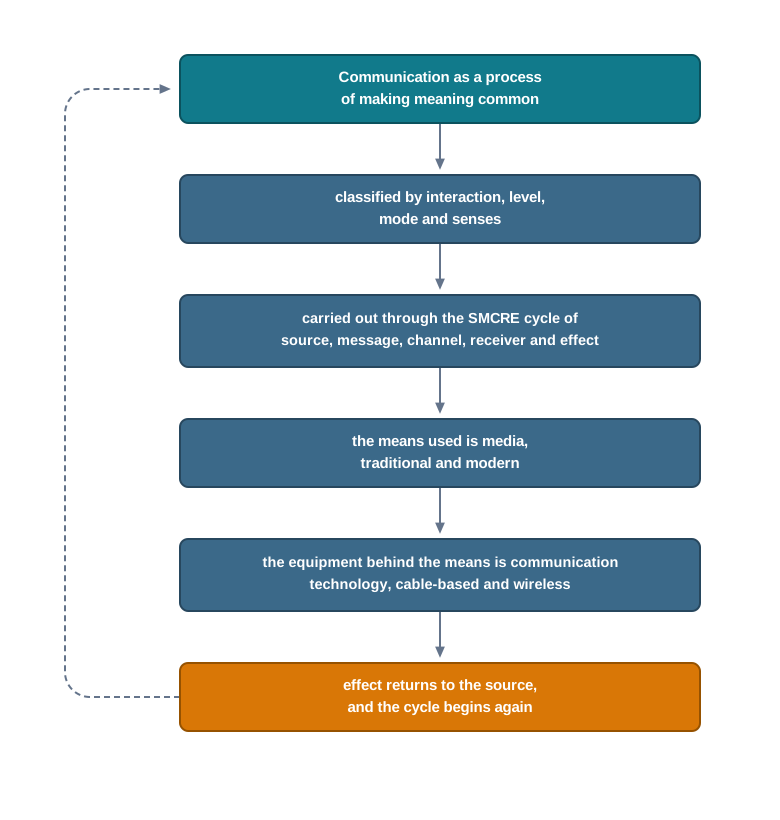
Fig. 6.6 – The chapter in one chain.
6.7 Key Terms
- Bluetooth technology — a low-cost, short-range radio frequency link that lets nearby portable devices exchange voice and data without a wire.
- Cable (land) based technologies — communication technologies that carry the signal along a physical wire or cable, such as a landline telephone.
- Channel — the medium through which information flows from the sender to the receiver.
- Communication — the process of sharing meaning with oneself or with others by transmitting ideas, information and feelings through some medium.
- Communication technology — the technologies developed and used to handle information and aid communication, together with the organisational structures and social values that govern their use.
- Effect of communication — the response of the receiver returning to the sender, which completes the communication cycle.
- Effective communication — a conscious effort to create a shared understanding of the intended meaning of a message among everyone involved in it.
- Electronic mail — a system that delivers a typed message electronically to a mail box, where it is stored until the receiver opens it.
- Feedback — the receiver’s response to a message, which tells the sender whether the message worked.
- Group communication — direct, personal communication involving more than two persons.
- Inter-organisational communication — the system one organisation uses to communicate with other organisations for cooperation and coordination.
- Inter-personal communication — the sharing of thoughts and ideas with one or more people in a face-to-face situation.
- Intra-organisational communication — communication within a single organisation, following its levels or hierarchy of ranks.
- Intra-personal communication — communicating with oneself, by observing, analysing and drawing conclusions about one’s own life and behaviour.
- Mass communication — the process of multiplying messages with the help of a mechanical device and disseminating them to the masses.
- Mass media — media meant for audience groups that are large, heterogeneous and anonymous.
- Media — the means that uses various methods of communication for disseminating and sharing ideas, thoughts, feelings, innovations and experiences.
- Medium — the carrier that takes content from one point to another, such as air, print, cable or a broadcast signal.
- Message — the content or information that the communicator wishes the receiver to receive, accept or act upon.
- Modern media — media that depend on electronic and mechanical technology to record, transmit and reproduce a message.
- Non-verbal communication — communication that carries meaning without the spoken word, through gestures, expression, posture, touch, para-language, writing, symbols and the like.
- One-way communication — communication in which the receiver takes in the message but never reciprocates, or cannot respond immediately.
- Process of communication — the transfer of information from a sender to a receiver through a medium, understood correctly and completely by both, with the response returning to the sender.
- Receiver — the intended audience of a message and the target of the communication function.
- Satellite communication — wireless communication in which the signal is relayed between distant points by way of a satellite.
- SMCRE model — a model that sets out the five elements of the communication process in order: source, message, channel, receiver and effect.
- Source — the person who initiates the process of communication and frames the message for a particular audience.
- Teleconferencing — interactive group communication that creates a dialogue between participants who are geographically dispersed.
- Traditional media — media rooted in local custom and performed or made by hand, such as folk theatre, folk song, puppetry, fairs and local print material.
- Two-way communication — communication in which two or more parties share or exchange ideas with each other, silently or verbally.
- Verbal communication — communication that uses auditory means, including speech, song and the tone of the voice.
- Wireless technologies — communication technologies that carry the signal through the air with no physical line between the two ends.
6.8 Points To Ponder
- A message posted on a public web page can be replied to by anyone who reads it, yet the sender may never see those replies. Does the possibility of a reply make communication two-way, or does only a reply that reaches the sender count?
- Traditional folk media reach fewer people than a broadcast does, but they carry immediate feedback in the local idiom. Where a message must change a household habit, which of the two would you rely on, and why?
- The more homogeneous a receiver group, the greater the chances of successful communication. What does this suggest about the difficulty of designing a single health message for the whole country?
- Media is expected to transmit wholesome values and also to entertain. What happens to a message when these two functions of media pull in different directions?
- Communication technology is described as including hardware, organisational structures and social values. Take away the third of these and what fails — the technology, or the communication?
- Non-verbal signs such as posture, tone and expression are the first to be lost when a conversation moves from a room to a screen. What kinds of message become harder to send once they are gone?
6.9 Objective Questions
- Which of the following is an example of one-way communication? (1 mark)
- Two friends talking on a mobile phone
- Listening to music on the radio
- A panel discussion followed by a question-answer session
- A family working out plans for the coming year
- The word communication comes from a Latin word that means (1 mark)
- to carry
- to hear
- common
- together
- Which element of the SMCRE model is described as both the initiating step and the terminating element of the process? (1 mark)
- Source
- Message
- Receiver
- Effect of communication
- Which of the following is a cable (land) based technology? (1 mark)
- Satellite wireless telephony
- A landline telephone
- A microwave link
- A Bluetooth headset
- Assertion (A): Mass communication cannot obtain correct and immediate feedback. Reason (R): The audience of mass communication is large, heterogeneous and separated from the communicator in time and space. (1 mark)
- Both A and R are true, and R is the correct explanation of A.
- Both A and R are true, but R is not the correct explanation of A.
- A is true, but R is false.
- A is false, but R is true.
- Assertion (A): Bluetooth technology is classified as a wireless technology. Reason (R): Wireless technologies require a cable to be laid along the whole route between the two ends. (1 mark)
- Both A and R are true, and R is the correct explanation of A.
- Both A and R are true, but R is not the correct explanation of A.
- A is true, but R is false.
- A is false, but R is true.
- Match the folk form in Column A with its region in Column B. (3 marks)
| Column A | Column B |
|---|---|
| a. Yakshagana | i. Punjab |
| b. Giddha | ii. Bihar |
| c. Bidesia | iii. Karnataka |
Fill in the blank: Communication in which the receiver takes in the message but cannot respond immediately is called ____________ communication. (1 mark)
Fill in the blank: The more ____________ the receiver group, the greater are the chances of successful communication. (1 mark)
State whether true or false: The presence of modern technology always shows that mass communication is taking place. (1 mark)
Name the two types of channels through which a message may flow from a sender to a receiver. (1 mark)
Pick the odd one out and give a reason: radio, newspapers, Nautanki, satellite television. (1 mark)
6.10 Check Your Concepts
Define effective communication. (2 marks)
State the two reasons why inter-personal communication is considered the most effective level of communication. (2 marks)
Differentiate between analogue and digital transmission, stating the basis of difference. (2 marks)
Give a reason why the feedback received in mass communication is described as slow, cumulative and delayed. (3 marks)
Explain, with an example, how the cry of an infant is an instance of two-way communication. (3 marks)
Differentiate between traditional media and modern media, stating three bases of difference. (3 marks)
Why does a message that reaches more than one sense stay with a receiver longer than one that reaches a single sense? Explain with one example drawn from a classroom. (4 marks)
Explain any four functions of media, giving one example of each. (4 marks)
Describe the SMCRE model of communication, naming each element and stating the work it does in the process. (5 marks)
What would happen to the communication process if the element of effect were removed from it? Explain with an example, and state what the sender would be unable to do. (5 marks)
6.11 Identify & Label
Look at Fig. 6.1. Identify which of the two panels shows one-way communication, and give a reason for your answer based on the arrows drawn. (2 marks)
Identify the two forms of puppetry shown in Fig. 6.4, and state the part of the country in which each is more commonly found. (3 marks)
In Fig. 6.5, name the parts that make the lower link a wireless one, and state one advantage this link has over the upper one. (3 marks)
Fig. 6.0 shows a single television set placed before a village audience. Identify the type of communication this represents by the number of senses involved, and by the level of communication. (2 marks)
6.12 Case & Application Based Questions
- A district agriculture office has to inform farmers in fifteen villages that a seed distribution camp has been shifted by one week. Three means are available: an announcement on the local radio station, a printed poster put up at each panchayat office, and the extension worker who visits every village once a fortnight. (7 marks)
- Classify each of the three means as one-way or two-way communication, giving a reason for each. (3 marks)
- The camp is now only nine days away. Which means would you place the greatest reliance on, and which quality of a good message decides your answer? (2 marks)
- Suggest one way in which the office can find out whether the message actually reached the farmers. (2 marks)
- A residents’ committee in a colony wants to stop the burning of dry leaves in the lanes. It plans three things: a meeting of about twenty residents in the park, a poster at the main gate, and a message circulated on the colony’s phone group. (7 marks)
- Name the level of communication involved in the meeting and in the phone group message, giving a reason for each. (3 marks)
- Which function of media is the poster at the gate performing? (2 marks)
- The poster has been printed in one language, although the colony’s residents speak three. Which quality of a good message does it fail to meet, and what should the committee do about it? (2 marks)