Chapter 7: Concerns And Needs In Diverse Contexts
The Pump On Broad Street
In the late summer of 1854 CE, cholera broke out in the crowded Soho district of London. Within days, hundreds of people in a few narrow streets were dead. The accepted explanation at the time was bad air rising from filth and drains, and against bad air there was nothing much anyone could do.
A physician named John Snow doubted that explanation. Instead of arguing about air, he walked the district and made a map. He marked every death as a small bar on the street where it had happened, and he asked each surviving household one plain question: where do you fetch your drinking water? The marks were not spread evenly. They gathered tightly around a single public water pump on Broad Street. Households that drew water from a different pump were largely untouched.
Snow took his map to the parish authorities and asked them to remove the handle of the Broad Street pump. They agreed. The outbreak, already fading, ended shortly afterwards.
The map mattered more than the handle. It showed that a disease could be traced to something ordinary and fixable — the water a neighbourhood drank — and that what protects health is not only what a person does for herself, but what a community arranges for everyone. That idea runs through everything this chapter takes up: the food we eat, the water and waste around us, the hours in a day, the rooms of a house, and the cloth made by hand across this country.
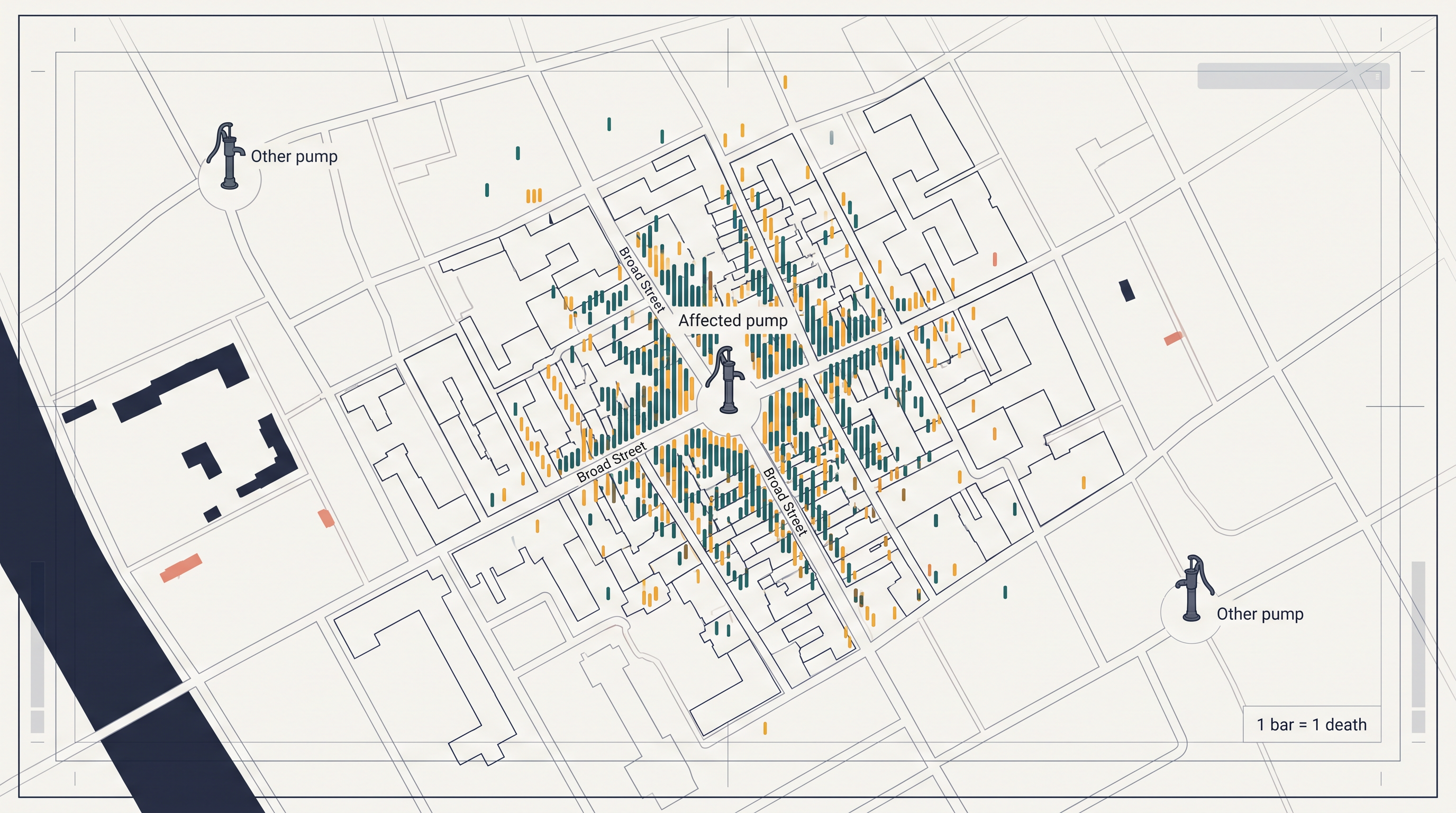
Fig. 7.0 – Cholera deaths mapped around the Broad Street pump.
7.1 What Health Means
Ask a classmate how she is, and she will often say she is fine because nothing is hurting. Most of us use the word in exactly that way. Being free of illness is taken as proof of being well.
Every person wants a good quality of life and a settled sense of well-being. Yet the conditions we live in and the habits we keep both act on the body, and not always kindly. Polluted air, unsafe water, long hours without rest and poor food all leave their mark.
So the word needs a firmer meaning than everyday use gives it. The World Health Organisation, the world’s leading body concerned with health, describes health as a state of complete physical, mental and social well-being — not merely the absence of disease. Three things are being claimed at once here. Health is positive, not just an empty space where illness is not; it is complete only when the body, the mind and a person’s social life are all sound; and the absence of disease alone is not enough to establish it.
The other half of the definition needs stating too. Disease means an impairment of body health — an alteration or disruption in the working of some part or organ, which interrupts normal function and moves the person away from a state of complete well-being. Notice that disease is defined by what stops working, not by how much it hurts.
Health As A Right
Health is not a favour granted to some people. It is a fundamental human right. As far back as 1948, the Universal Declaration of Human Rights recognised that every person is entitled to a standard of living adequate for the health and well-being of herself and her family, food included.
That right does not stop at any boundary. Whatever a person’s age, gender, caste, religion, nationality, or place of stay — urban, rural or tribal — she should have the opportunity to reach and hold the highest state of health she is capable of, at every stage of her life.
This is why health work is not only about curing. Health professionals are the people who deal with the various aspects of health, and their aim is to promote it: to build and maintain wellness, which is well-being and quality of life sustained over time, rather than to wait for illness and treat it.
The practical use of all this comes when you judge a claim. If an advertisement, a scheme or a person tells you that someone is healthy, you now have three questions to put to that claim rather than one.
7.2 The Dimensions Of Health
The definition you have just read names three dimensions of health — social, mental and physical. They are not three separate states of being. They are three directions in which the same person’s well-being is measured.
We will look at all three here, and then take the physical dimension further through the rest of this part of the chapter, since food, infection and hygiene act on it most directly.
7.2.2 Mental Health
Mental health refers to emotional and psychological well-being. A person who experiences a sense of well-being can use her cognitive and emotional capabilities, function well in society, and meet the ordinary demands of daily life.
Because feelings cannot be weighed on a scale, mental health is described through indicators — the things generally seen in a person whose mental health is positive. A person with positive mental health:
- feels capable and competent;
- can handle the normal levels of stress met in daily life;
- has satisfying relationships;
- can lead an independent life;
- can cope with mental or emotional stress and events, and recover from them;
- is not held back by fear;
- does not feel defeated or low for unusually long periods when small difficulties arise.
Read these as indicators, not as a test to pass. Mental health, like physical health, moves up and down over a lifetime, and it can be supported and treated. Where the low periods are long or heavy, the sensible step is the same as for any other health concern — speak to a trusted adult, a school counsellor or a doctor.
7.2.3 Physical Health
Physical health covers physical fitness and the functioning of the body. A physically healthy person is able to undertake her normal activities, does not feel unusually fatigued, and has adequate resistance to infection and disease.
Each of those three signs is a test you can actually apply, which is why physical health is the dimension most often assessed. Unusual fatigue, in particular, is a signal worth attending to, because it appears early and in a wide range of conditions.
The three dimensions are compared feature by feature in Table 7.1.
Taken together, the three dimensions explain why the same word cannot mean the same thing for every person. A student, a construction worker and an older person in the same street may each be sound in one dimension and stretched in another.
7.3 Health Care And Its Assessment
Every individual is responsible for her own health. Yet health is also a major public concern, and for good reason. Illness spreads, and the cost of poor health is carried by whole families and neighbourhoods, not only by the person who is unwell.
This is why the government takes on considerable responsibility and provides health services at various levels to the citizens of the country. Good health is the foundation of a good quality of life and standard of living for the individual and the family. It is also the key to the social, economic and human development of a community and a nation.
Notice the ladder in that sentence — individual, family, community, nation. The same subject sits on all four rungs, and a measure taken on one rung shows up on the others.
Health care is the whole set of services provided to individuals or to communities by agents of health services or by the health professions. Its purposes are four: promoting health, maintaining it, monitoring it, and restoring it when it has been lost.
Those four purposes are usually grouped under three kinds of care. Preventive care keeps a disease from occurring at all, as immunisation does. Promotive care builds health further in people who are already well, as nutrition and hygiene advice does. Therapeutic care treats a condition that has already appeared.
7.3.1 Levels Of Health Care
Health care services are delivered at three levels — primary, secondary and tertiary. The three are not three grades of quality. They are three stages of a path, and a person moves along it only as far as her condition requires. That path is set out in Fig. 7.1.
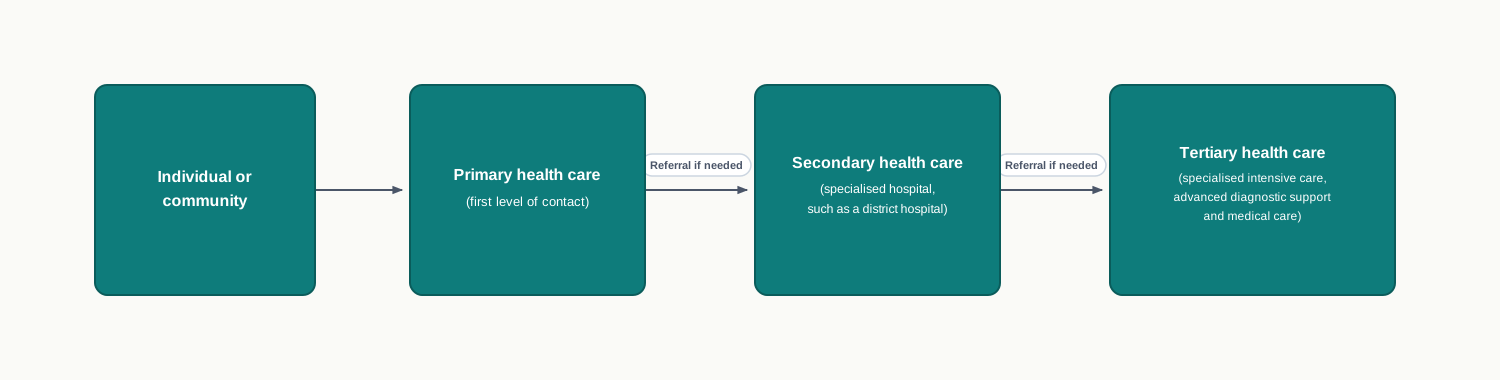
Fig. 7.1 – The three levels of health care.
Primary health care is the first level of contact between individuals and the health care system. Most health needs begin and end here.
Secondary health care is what a person receives when she is referred from primary health care to a specialised hospital, such as a district hospital.
Tertiary health care is reached when a person is referred on from the primary and secondary systems for specialised intensive care, advanced diagnostic support and medical care.
Because the levels work by referral, the first level carries the heaviest load. A strong primary system keeps small problems small; a weak one sends them upward, where treatment is slower and costlier for everyone.
7.3.2 Indicators Of Health
Health is multidimensional, and each dimension is influenced by several factors. It cannot, therefore, be measured by one number. Instead, several indicators of health are employed to assess it, each showing one face of the picture. These include indicators of:
- mortality — deaths in a population;
- morbidity — the illness or disease present in a population;
- disability rates;
- nutritional status;
- health care delivery;
- utilisation of health services;
- environment;
- health policy;
- quality of life.
Two of these deserve a second look, because they are easily confused. Health care delivery asks what services exist and how far they reach. Utilisation asks how many people actually use them. A district can score well on the first and poorly on the second, and the reason for the gap — distance, cost, timings, or plain lack of information — is exactly what a health worker needs to know.
Used together, the indicators let one district be compared with another, or one year with the next. That is the practical value of a set of indicators: it turns an argument about whether health is improving into a question that evidence can settle.
7.4 Nutrition And Health
Nutrition and health are intimately interlinked. In the global campaign of ‘Health for All’, the promotion of nutrition is one of the primary elements, and not by accident — food is the one input that reaches every cell of the body every day.
Nutrition is concerned with the maintenance of the body’s organs and tissues, both in their structure and in their working. It is also concerned with the growth and development of the body, which is why it matters most in the years when the body is still being built.
Good nutrition allows a person to enjoy good health, to resist infection, to hold adequate energy levels, and to carry out daily tasks without feeling fatigued. Each of those four is a return on what was eaten, and each of them fails first when eating fails.
The return differs by stage of life. For children and adolescents, nutrition is vital for growth, for mental development, and for reaching the potential they are capable of. For adults, adequate nutrition is what makes a socially and economically productive and healthy life possible.
The Link Runs Both Ways
So far we have looked in one direction — from food to health. The arrow also points back.
A person’s health status determines her nutrient requirements and her food intake. During illness, nutrient requirements go up, and the breakdown of nutrients in the body is higher than usual. At the very time that the body needs more, appetite is usually less.
Illness and disease therefore harm nutritional status, and not only through what is eaten. Nutritional status is the condition of the body that results from the intake of nutrients and the body’s use of them, and it can fall even when the food on the plate has not changed.
For this reason nutrition is called a fundamental pillar of human life, health and development. A pillar is a fair image: it is not one service among many, but a support that other things stand on.
The practical consequence is worth carrying with you. When someone in a household is recovering from an illness, the meal planned for her is not a courtesy. It is the repair of a loss that the illness has already caused.
7.5 Nutrients
Food is not eaten for its own sake. It is eaten for the substances it carries, and there are more than fifty of these nutrients in the food we eat — the components of food that the body uses to build tissue, to run its processes and to supply energy.
Not all of them are needed in the same quantity. That single fact is the basis on which nutrients are classified.
7.5.1 Macronutrients And Micronutrients
Nutrients are broadly classified into two groups, based on the amounts the human body requires. Macronutrients are required in relatively larger amounts. Micronutrients are required in small quantities.
The macronutrients are generally fat, protein, carbohydrate and fibre. The micronutrients include the minerals — such as iron, zinc and selenium — and the various fat-soluble and water-soluble vitamins.
Do not read ‘small quantity’ as ‘small importance’. Each micronutrient performs important functions, and some of them work as co-factors and co-enzymes in the metabolic reactions that occur in the body. A co-enzyme is a helper substance without which an enzyme cannot complete its reaction, so a tiny shortage can stall a large process. Nutrients can also influence gene expression and transcription — that is, they affect which instructions in a cell are read and acted upon.
The two groups are compared in Table 7.2.
No one organ handles nutrients on its own. Different organs and systems play a critical role in the digestion, absorption, metabolism, storage and excretion of nutrients and of the end products left after the body has used them. In essence, every single cell in every part of the body requires nutrients.
7.5.2 Why Nutrient Requirements Differ
Even in the normal healthy state, two people do not need the same amounts. Nutrient requirements vary according to age, sex and physiological state.
By physiological state we mean the condition the body is in at that time, particularly the periods when it is building tissue rapidly. These are infancy, childhood and adolescence, and, in women, pregnancy and lactation. During each of them the body is making new tissue, so its demand for the raw material rises.
The level of physical activity also determines requirements. It raises the need for energy, and with it the need for the nutrients involved in energy metabolism — vitamin B₁ (thiamine) and vitamin B₂ (riboflavin) among them.
This is worth pausing on. Those two vitamins are not needed for the work itself; they are needed to release energy from the food that fuels the work. As the work rises, the requirement rises with it.
7.5.3 The Balanced Diet
Knowledge of nutrients, of their sources, their functions and their metabolism, is vital for one practical purpose: choosing what goes on the plate. That choice is guided by the idea of a balanced diet.
A balanced diet is one made up of foods that together provide all the necessary nutrients, in the amounts required. Two conditions are packed into that sentence — all the nutrients, and enough of each. A diet can fail either test, and a diet that is generous in one nutrient does not make up for a shortfall in another.
No single food carries everything. This is why a balanced meal is built by combination — a cereal, a pulse, a vegetable, a fruit, milk or curd, and a little fat — as shown in Fig. 7.2.
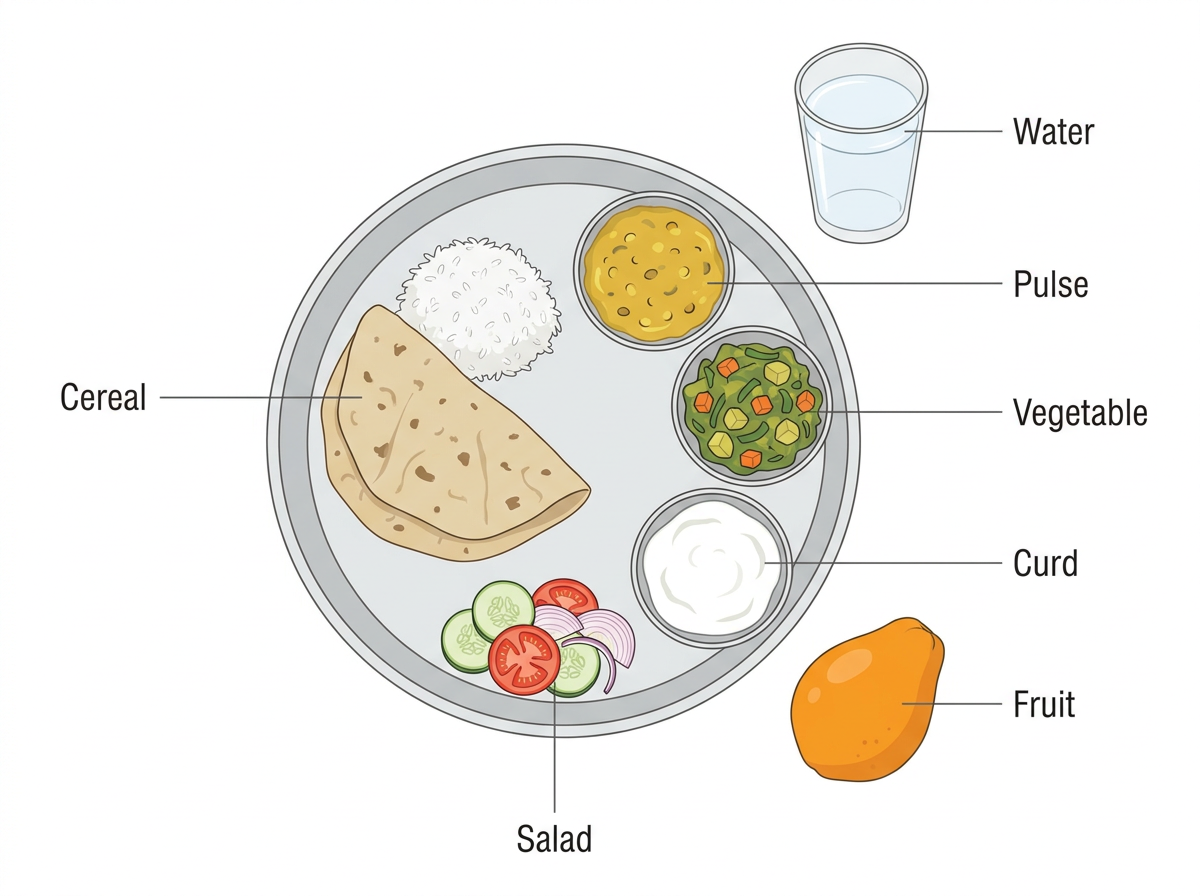
Fig. 7.2 – A balanced meal served on a thali.
Because a balanced diet is defined by the eater’s own requirements, it is not one fixed menu. The same combination of foods, in different quantities, can be balanced for an adolescent and inadequate for a labourer, or balanced for one person and more than another needs.
7.6 Nutrition As A Field Of Study And Practice
So far we have treated nutrition as something that happens inside one body. It is also a field of study, with people who work in it and questions it tries to answer for whole populations.
7.6.1 What The Science Of Nutrition Covers
The science of nutrition is concerned with access to food and nutrients, with their availability, and with their utilisation for life, growth, development and well-being. Those three words mark three different failures. Food may not be within reach, or it may be within reach but not obtainable, or it may be eaten and still not used well by the body.
Nutritionists are the professionals who work in this field, and their concerns run from one end of the subject to the other. At one end are the biological and metabolic aspects — what the body does with a nutrient once it is inside. At the other end is what happens in disease states and how the body is nourished then, which is the area called clinical nutrition.
As a discipline, nutrition also studies the nutritional needs of whole populations and the nutritional problems they face. This includes the health problems caused by a lack of nutrients, which is the field of public health nutrition, and the prevention of diseases such as heart disease, diabetes, cancer and hypertension.
Read across those two paragraphs and you will see the scale ladder again. The same subject is studied in a single cell, in one person on a hospital bed, and in a district of several lakh people.
7.6.2 What Shapes Food Choices And Food Intake
We all know that when one is ill, one may not feel like eating. Appetite is only the most obvious of the things that decide what reaches a plate.
What and how much a person eats depends not only on taste, but on the availability of food — that is, on food security, the reliable access a person has to enough safe and nourishing food. Food security is itself shaped by purchasing power, which is an economic factor; by the environment, particularly water and irrigation; and by policies at the national and international levels.
Then there are the influences that decide which of the available foods are eaten at all. Culture, religion, social status, beliefs and taboos all shape food choices, food intake and, through them, nutritional status.
None of these is a small factor sitting on top of a biological one. A grain that is grown, affordable and available may still not be eaten in a particular household, and the reason will not be found in a chemistry book.
7.6.3 What Good Health And Nutrition Make Possible
Look around you. People in good health are generally in a happier frame of mind and are more productive than others. Adults in good health are able to give the children in their care proper attention, and children who are well nourished are generally cheerful and do well in school.
A person in good health is more constructive for herself, and can take an active part in the life of her community. The reverse also holds: good health, productivity and an active social life are out of reach for a person who is starving and undernourished.
What optimum nutritional status does for a person can be set out plainly. It:
- maintains body weight;
- maintains muscle mass;
- decreases the risk of disability;
- provides resistance to infection;
- helps the person cope with physical and mental stress;
- improves productivity.
Productivity, though, is never the work of nutrition alone. It rests on several inputs together, as Fig. 7.3 shows.
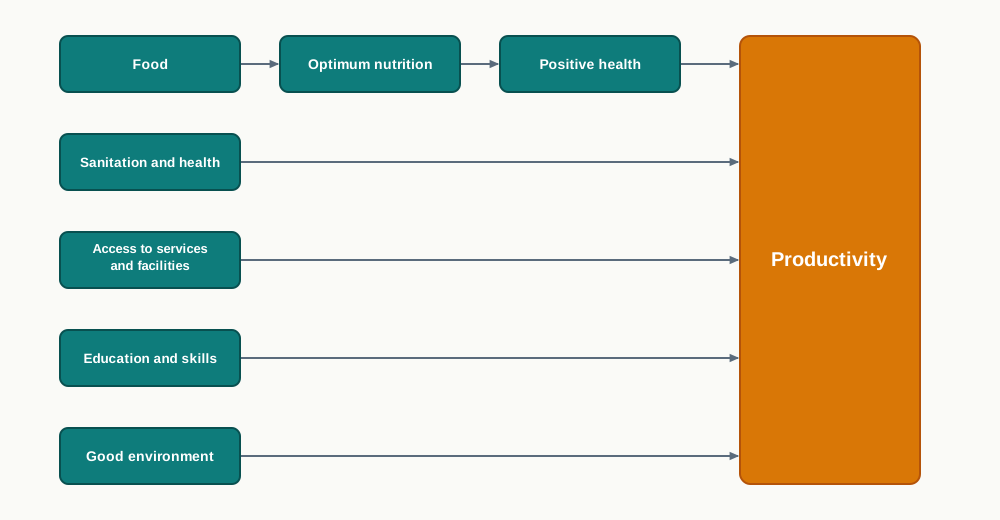
Fig. 7.3 – Inputs required for productivity.
The effect on a child’s schooling is worth following step by step, because it is often missed. Fig. 7.4 traces it.
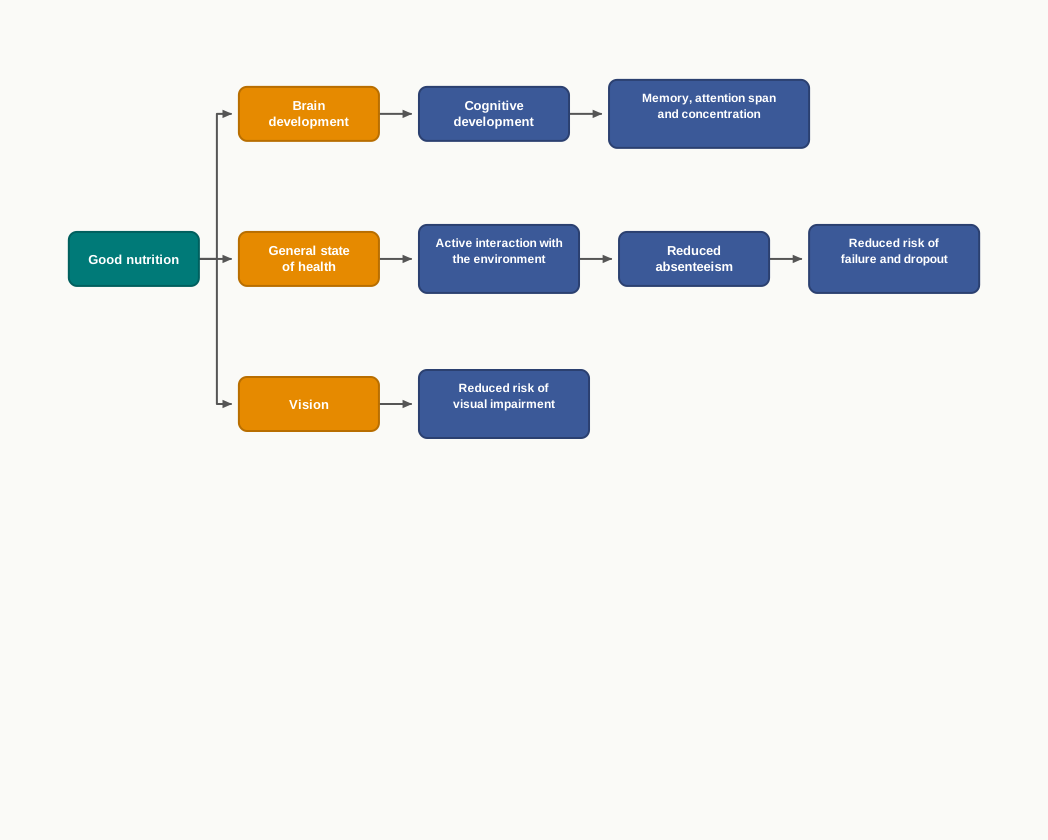
Fig. 7.4 – Benefits of good nutrition for education.
Each branch of Fig. 7.4 ends somewhere a teacher can see. A child who is absent, who cannot hold attention, or who cannot see the blackboard clearly is usually described as weak at studies. The chart shows that the cause may lie a long way back, in what she has been eating.
7.7 Malnutrition
The word looks as though it must mean too little food. It does not. Malnutrition is a deviation from the normal state of nutrition, and a deviation can go in either direction.
Malnutrition results when the intake of nutrients is less than the amount the body requires, and equally when the intake is in excess of the requirement. The measure in both cases is the same — not the size of the meal, but the size of the meal against what that particular body needs.
Malnutrition therefore takes two forms. Inadequate intake results in undernutrition; intake in excess of requirements results in overnutrition. The two are not opposites in their causes, and, as you will see later in this chapter, a single country can carry a great deal of both at the same time.
Among adolescents, wrong food choices and wrong combinations of foods can be a very significant cause of malnutrition. This is a period when the body is growing quickly and requirements are high, and when a good deal of eating happens away from a planned family meal.
The point to hold on to is that malnutrition is defined against a requirement. Before you can judge whether a diet is adequate, you have to know whose diet it is.
7.8 Factors Affecting Nutritional Well-being
If malnutrition is a deviation from the normal state, the sensible next question is what holds a population at the normal state in the first place. The World Health Organisation has listed four main factors that are important for nutritional well-being. They are set out in Fig. 7.5.
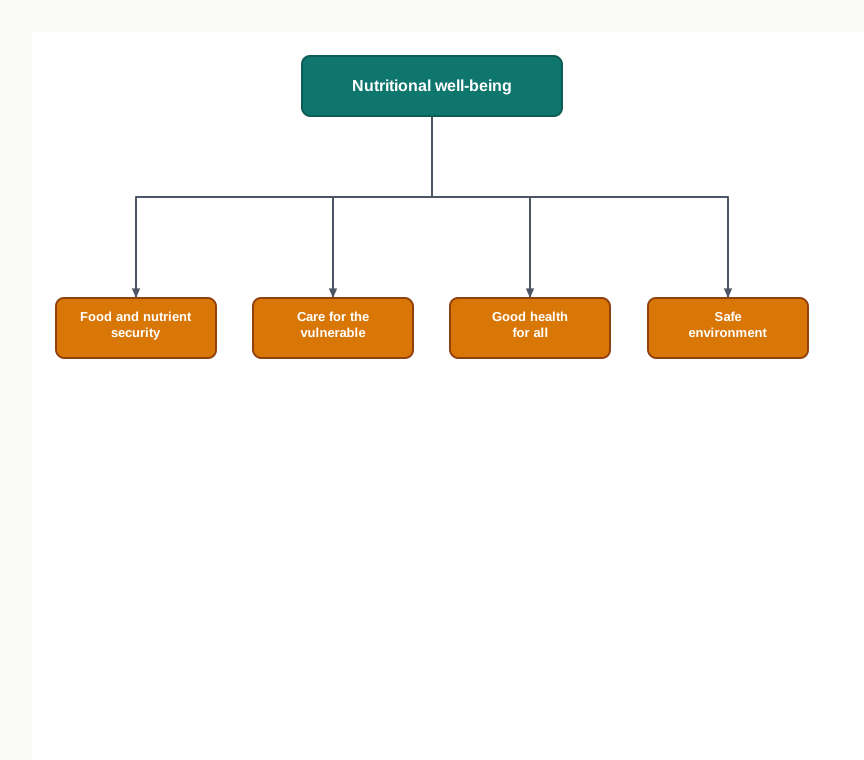
Fig. 7.5 – The four factors in nutritional well-being.
The four are best read as four conditions that must hold together. Any one of them failing is enough to pull nutritional well-being down, however well the other three are managed.
7.8.1 Food And Nutrient Security
You met food security earlier as one influence on what a person eats. Stated in full as a factor in nutritional well-being, food and nutrient security means that each and every person, regardless of age, has access to adequate food and nutrients and can obtain them throughout the year, as her own requirements demand, so that she can lead a healthy life.
Three conditions are doing work in that sentence. The food must be reachable; it must be obtainable, not merely present in the market; and it must be available through the whole year, not only in the months after a harvest.
7.8.2 Care For Those Who Are Vulnerable
Care for those who are vulnerable means that each individual needs attention and caring behaviour from the people around her. Food that is available but not actually given, prepared and fed is of no use to the person who needs it, and this is where the second factor does its work.
For babies, this means whether the baby receives the correct type and amount of food, and the care and attention that go with feeding. An infant cannot fetch, choose or ask for food, so every part of her intake depends on somebody else’s attention.
For expectant mothers, it means whether they receive the care and support they need — from the household, from the community, and, in the case of those in employment, from their employers. Support here is practical: lighter physical work, rest, and food eaten on time.
Persons who are ill and suffering from any disease also require care and support in various ways, including food, nourishment and medication. Their requirements are higher, and their appetite is usually lower, so the care given decides the outcome.
7.8.3 Health For All
Good health for all includes both the prevention of disease and the curing of disease when it does occur.
Special attention has to be paid to infectious diseases, and here the reason is nutritional rather than merely medical. An infection depletes the body of nutrients, and so leads to poor health and poor nutritional status even in a person who was eating adequately before falling ill.
Every citizen should get a minimum amount of health care, because health is a basic human right and not a service bought by those who can afford it. Among the diseases that take their toll in India, especially among young children, are diarrhoea, respiratory infections, measles, malaria and tuberculosis.
7.8.4 Safe Environment
A safe environment focuses on all aspects of the environment that may influence health — physical, biological and chemical substances alike.
In practice this means safe, potable drinking water, meaning water that is fit to drink; hygienic food; and the prevention of environmental pollution and degradation.
The link back to nutrition is direct. Water carrying disease-producing organisms causes repeated infections, each infection drains nutrients, and the loss shows up as poor nutritional status in a household where the cooking has not changed at all. This is why safe water belongs in a list about nutrition and not only in a list about disease.
7.9 Nutritional Problems And Their Consequences
In India, several nutritional problems exist in the population at the same time. They are not evenly spread, and the same district can carry two problems that appear to be opposites.
7.9.1 Undernutrition
Undernutrition is a major problem, and it is visible at the very start of life. It shows in the high numbers of pregnant women who are undernourished and who give birth to small babies with low birth weight, and in young children who are underweight and stunted.
Three terms in that sentence need to be exact.
- Low birth weight means a birth weight below 2500 grams (g), whatever the length of the pregnancy.
- Underweight means weighing less than the expected weight for a child of that age.
- Stunted means being shorter than the expected height for that age, which points to a shortage lasting over a long period.
Low birth weight remains common in India, and a considerable percentage of women are themselves underweight. The National Family Health Survey (NFHS-5, 2019–21) found that 35.5 per cent of children under five years of age were stunted and 32.1 per cent were underweight.
Alongside these are the deficiencies of particular nutrients: iron deficiency anaemia, vitamin A deficiency with the blindness that can follow it, and iodine deficiency.
Undernutrition does not only reduce body weight. It has devastating effects on children’s cognitive development and on immunity, and it can result in disability — blindness caused by vitamin A deficiency is one example.
Iodine deficiency is a threat to health and development, particularly for young children and for pregnant women. In women it results in goitre, still birth and miscarriage. In children it can cause hearing and speech impairment, intellectual disability, and the condition long known as cretinism, in which growth and mental development are both severely affected from birth.
Iron deficiency has its own list of consequences. In infants and young children it impairs psychomotor and cognitive development, which in turn affects performance at school, and it decreases physical activity. Iron deficiency during pregnancy affects the growth of the foetus and increases the risk of illness and death for the mother.
Notice what these two deficiencies have in common. Neither of them announces itself with pain, and both do their damage during exactly the periods when the body is being built.
7.9.2 Overnutrition And The Double Burden Of Malnutrition
Overnutrition is the other deviation, and it is not the safer one. Intake in excess of requirements leads to several health problems. In the case of some nutrients it may lead to toxicity, and a person may become overweight or develop obesity.
Obesity in turn increases the risk of several conditions, among them diabetes, heart disease and hypertension. It is a health condition, and it is managed with medical help, in the same way as any other.
India faces problems at both ends of the spectrum at once — undernutrition, appearing as nutritional deficiencies, and overnutrition, appearing as diet-related chronic non-communicable diseases. This situation has been termed the double burden of malnutrition.
The figures show how substantial the second end has become. The National Family Health Survey (NFHS-5, 2019–21) found that 24.0 per cent of women and 22.9 per cent of men aged 15–49 years were overweight or living with obesity. In both groups the proportion was distinctly higher in urban areas than in rural ones.
The double burden is what makes nutrition planning in India difficult. A single district may need to add food for one set of households and change the composition of what is eaten in another, and a message aimed at one group can do harm if it reaches the other.
7.9.3 Nutrition And Infection
Providing enough food to fulfil nutritional requirements is not, by itself, adequate. The influence of the environment matters too, because nutritional status depends not only on a sufficient supply of food and nutrients but also, to a great extent, on the person’s health status.
Nutrition and infection are intimately interlinked, and they push each other in a circle. Poor nutritional status decreases resistance and immunity, and so increases the risk of infection. Then, during an infection, the body loses a considerable amount of its nutrient reserves — through vomiting and diarrhoea — at the very time when its nutrient requirements have actually increased.
If intake falls short of the requirement, because appetite is lost or because nausea and vomiting make eating impossible, the infection worsens nutritional status further. The risk of another infection then rises, and the circle turns again. Fig. 7.6 traces it.
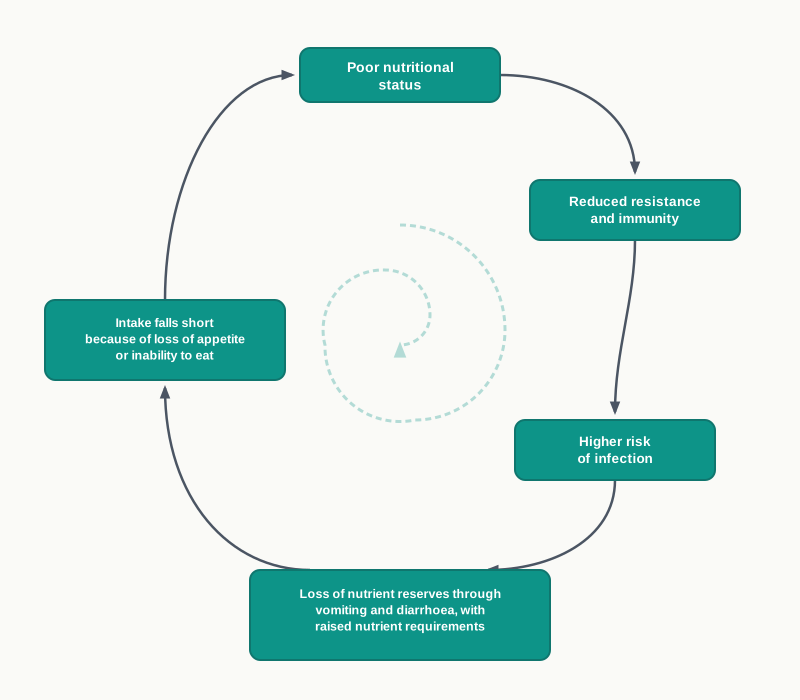
Fig. 7.6 – The malnutrition and infection cycle.
All persons are affected, but not equally. Children, older people and those already undernourished are at the greatest risk of contracting further infections and diseases, because each of them begins with smaller reserves.
In developing countries, food-borne illnesses such as diarrhoea and dysentery are major problems, since they can lead to dehydration and death. Many of these infectious and communicable diseases arise from poor environmental sanitation and from poor household, personal and food hygiene. The key question, then, is how such diseases can be prevented — and that is where the next section begins.
7.10 Hygiene And Sanitation
The last section ended with a question: how are these diseases prevented? Prevention and control of disease has to address two sets of factors — those belonging to the person, and those belonging to the surroundings.
7.10.1 Factors Linked With Disease
Intrinsic factors, also called host factors, are the ones carried by the person herself. Extrinsic factors, also called environmental factors, are the ones that act on her from outside. Both sets are set out in Table 7.3.
Two words in that table are worth pinning down. A reservoir of infection is a living being in which a disease agent survives and multiplies between one human case and the next. A vector is a living carrier, usually an insect, that transports the agent from one host to another — the mosquito that carries malaria is the familiar example.
Among all these factors, four are the key inputs that can actually be improved: sanitation and hygiene, nutrition, and immunisation. Health depends to a great extent on the social environment, and on lifestyle and behaviour, including food intake — all of which are closely related to hygiene.
Hygiene is the set of practices that keep a person and her surroundings free of the agents that cause disease. It has two aspects, personal and environmental, and both are needed. Poor hygiene leads to several infections and infestations, such as worm infestations.
7.10.2 Personal Hygiene
Personal hygiene covers what a person does with her own body, clothing and immediate habits. Bathing, washing the hands before handling food and after using the toilet, keeping the nails cut short and clean, covering the mouth and nose while coughing or sneezing, and wearing clean clothes are its everyday content. These are shown in Fig. 7.7.
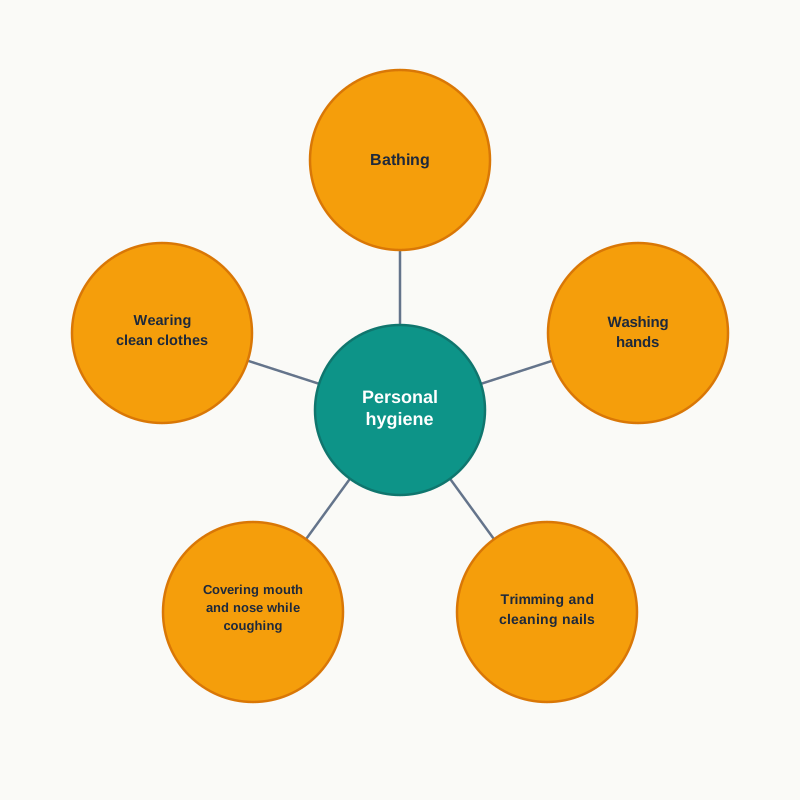
Fig. 7.7 – Personal aspects of hygiene.
Each of these acts is a break in a chain. Hands carry organisms from a surface to the mouth; short clean nails leave them nowhere to lodge; a covered cough keeps droplets out of the air another person breathes. None of it works occasionally — the value is in doing it every time.
7.10.3 Environmental Hygiene
Environmental hygiene comprises external matter, both organic and inorganic, at the level of domestic hygiene in the home and at the level of the community. It includes physical factors such as water, air, housing and radiation, as well as biological factors such as plants, bacteria, viruses, insects, rodents and animals.
Its practical content is shown in Fig. 7.8.
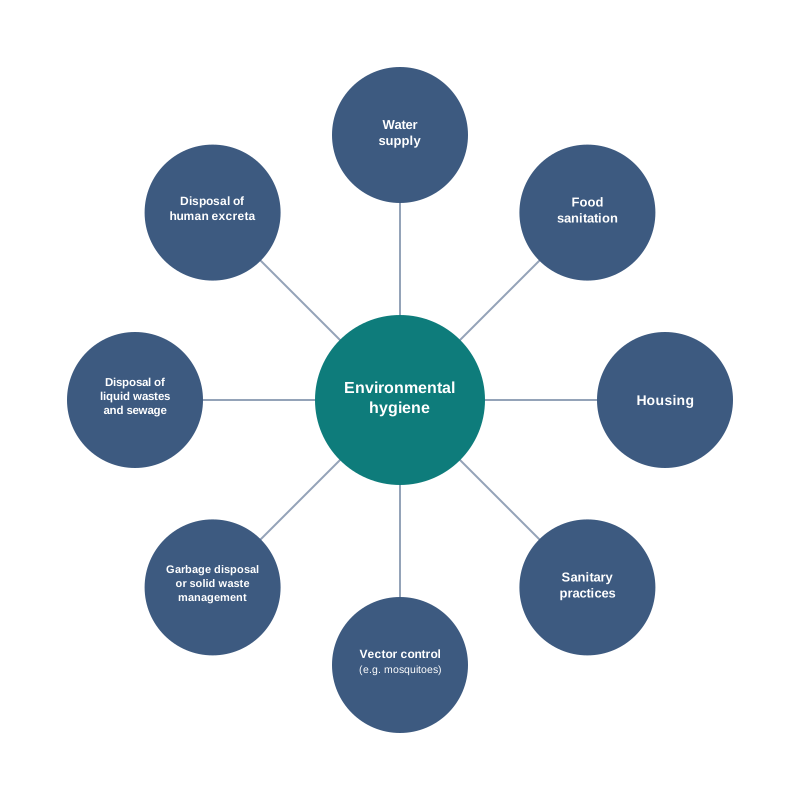
Fig. 7.8 – Environmental aspects of hygiene.
Environmental health needs attention so that ecological conditions which promote health and prevent disease are created and then maintained. Among these, safe drinking water and sanitation — especially the disposal of faeces — are of the greatest importance. Air and water pollution are of concern for the same reason.
Water quality deserves particular care, because contaminated water is the cause of many diseases: diarrhoea, worm infestations, skin and eye infections, and guinea worm among them. Guinea worm disease is a useful illustration of what sustained work on water can achieve — India was certified free of it in 2000, after a long programme of protecting and treating village water sources.
7.10.4 Food Hygiene
Food hygiene is the part of hygiene that keeps food safe from the point of purchase to the point of eating. Food-borne illnesses occur when we consume food that contains disease-causing, or pathogenic, micro-organisms.
An important point often missed is that the presence of an organism is not by itself enough. Three conditions must be met together before a food-borne illness occurs.
This principle is what every rule of food handling rests on. Keeping numbers low — by cooling quickly, storing correctly and cooking thoroughly — prevents illness even when a few organisms are present, because the second condition is never reached.
The illnesses caused include diarrhoea, dysentery, amoebiasis, infective hepatitis, typhoid, listeriosis, botulism, cholera and gastroenteritis. Most of them can be traced back to poor personal and food-handling practices, which are set out below.
- Use of food items that are spoiled, infected or otherwise unsafe, including water, spices, seasonings and mixes.
- Improper storage, which allows disease-causing micro-organisms to multiply.
- Not practising insect and vermin control.
- Use of contaminated equipment, utensils, plates, spoons and glasses.
- Inadequate cooking.
- Storage of foods at temperatures favourable to the growth of micro-organisms, that is, between 4 °C and 60 °C.
- Improper cooling.
- Improper or inadequate heating and reheating of cooked foods and leftovers.
- Cross contamination, in which organisms pass from one food to another, usually through a shared board, knife, cloth or pair of hands.
- Leaving food uncovered.
- Use of contaminated substances for garnishing.
- Poor hygiene and sanitation of the persons handling food — unclean clothes, hands that are not washed, and dirt and grime under the nails.
Read the list again against the principle above, and you will see that every item on it does one of two things. It either introduces organisms into the food, or it gives the organisms already present the time and warmth they need to multiply.
Effective practices in nutrition, health and hygiene are what make it possible to be productive in the work one does, whether that work is inside the home or outside it. Work itself, and the resources it uses, are where this chapter turns next.
7.11 Time As A Resource
You have already learnt that resources are the possessions, materials or funds that can be used to achieve goals, and that money, time, space and energy are among them. Every one of these is an asset. Every one of them is also in short supply.
Resources are rarely available in abundance, and they are not equally available to everyone. If they are wasted, or simply not used well, we are held back from the goals we set. Managing them properly is therefore not a virtue added on top of the work — it is part of doing the work at all.
This part of the chapter deals with two of these resources, time and space. Money as a resource, and its management, are taken up later in the book.
What Makes Time Unusual
Time is limited and irreversible. We measure it in years, months, days, hours, minutes and seconds, and each of us is given twenty-four hours in a day to use as we like.
The unusual thing about time is that the supply cannot be altered at all. No matter how important or valuable an individual may be, she cannot stop time, slow it down or speed it up. Once it has passed, it can never be regained.
Compare that with any other resource. Money can be earned, saved or borrowed; energy returns after rest; space can sometimes be rearranged or added to. Time allows none of this. The only thing that can be changed about time is how it is used — which is exactly why it has to be planned.
Why Managing Time Has Become Urgent
In today’s fast-changing lifestyle, our demands and responsibilities at home, at school and at work have all increased. This has made the need for managing time far more pressing than it was for earlier generations.
Time management is the planned and deliberate use of one’s available time to accomplish what one has set out to do. People who use these techniques become high achievers in every walk of life — in agriculture, in business, in sport, in public service, in other professions and in personal life.
The gain is not only more work done. Time management is what allows a person to have adequate rest and recreation alongside her work, instead of treating rest as what is left over when the work runs out. It never does run out.
The Principle It Rests On
This single sentence separates two things that look alike. A person can spend a whole day getting anxious about an unfinished task — turning it over, dreading it, mentioning it to everyone — and reach the evening with the task exactly where it was that morning. She has been busy the entire day, and she has produced nothing.
Anxiety about work consumes the one thing the work itself needs, which is time. So the test of a well-spent day is not how full it felt, but what stands finished at the end of it.
7.12 Planning The Use Of Time
All time management begins with planning. Without a plan, the hours are still spent — they are simply spent by whatever happens to arrive first.
7.12.1 The Time Plan
A time plan is an advance schedule of the activities to be performed in a given time period. The words ‘in advance’ carry the weight here: a list written at the end of the day is a record, not a plan.
An activity plan goes with it, setting out which activities are to be done and in what order, so that the schedule has something to schedule. In practice the two are made together, and are usually spoken of as a time and activity plan.
Before making one, it is worth looking honestly at how your hours currently go — how often the task you planned is actually finished, and how often the day ends with the work untouched. That review is what tells you where the plan needs to be firm.
Plans Differ From Person To Person
Time plans are made according to the individual needs of a person. Every individual has different goals and requirements, and therefore a different routine. A student’s plan looks nothing like the plan of a person who goes out to work, and neither looks like the plan of someone caring for a small child at home.
Table 7.4 sets two such days side by side.
Compare the last two rows. Both plans have to defend something against the rest of the day, and in each case it is defended by being written in — not by being hoped for.
7.12.2 Steps In A Time And Activity Plan
- Start your work as quickly as possible. Time wasted in avoiding or delaying a task is time gone from the task itself. A student who reaches home may relax for a while and have a meal, and then begin her school work rather than postponing it to the end of the day.
- Get into a routine every day. Choose a fixed time for particular tasks — school work, household chores — and then keep to it. A routine removes the daily decision about when to begin, which is where much of the delay happens.
- Prioritise your tasks. Before picking up anything new, make sure it does not disturb what is already planned, and do not take on too many activities at one time. When time is short and work is heavy, complete the compulsory activities first and hold the optional ones for later.
- Do not commit yourself to unimportant and low-priority tasks. Learn to say no. If you have less time and more tasks in hand, some requests have to be declined, and saying so early is fairer to everyone than agreeing and failing.
- Divide big tasks into a series of small manageable activities. A day’s school work is easier to begin when it is split subject by subject, because each part has a visible end.
- Do not waste energy and time on tasks which do not need much attention. Not everything deserves your best effort; some things only need to be done.
- Deal with a task one at a time until it is completed, or decide when you will deal with it. Do not put it aside half-finished, because picking it up again costs the time of starting afresh.
- Arrange start and stop times for your activities. Allot an appropriate stretch to each, so that no single task quietly eats the time meant for the rest.
- Make a schedule of your activities and tasks for the whole day, and always include leisure time in it. Leisure written into the plan is protected; leisure left over at the end never arrives.
Read those nine steps together and the order in them becomes clear. The first four decide what will be done, the next three decide how each task will be handled, and the last two decide when.
7.12.3 Types Of Activities
A plan is only workable if the activities in it have been sorted first, because not all of them can be moved. Activities are of two kinds — compulsory and optional — and the compulsory ones recur over different cycles of time. Fig. 7.9 sets out the types.
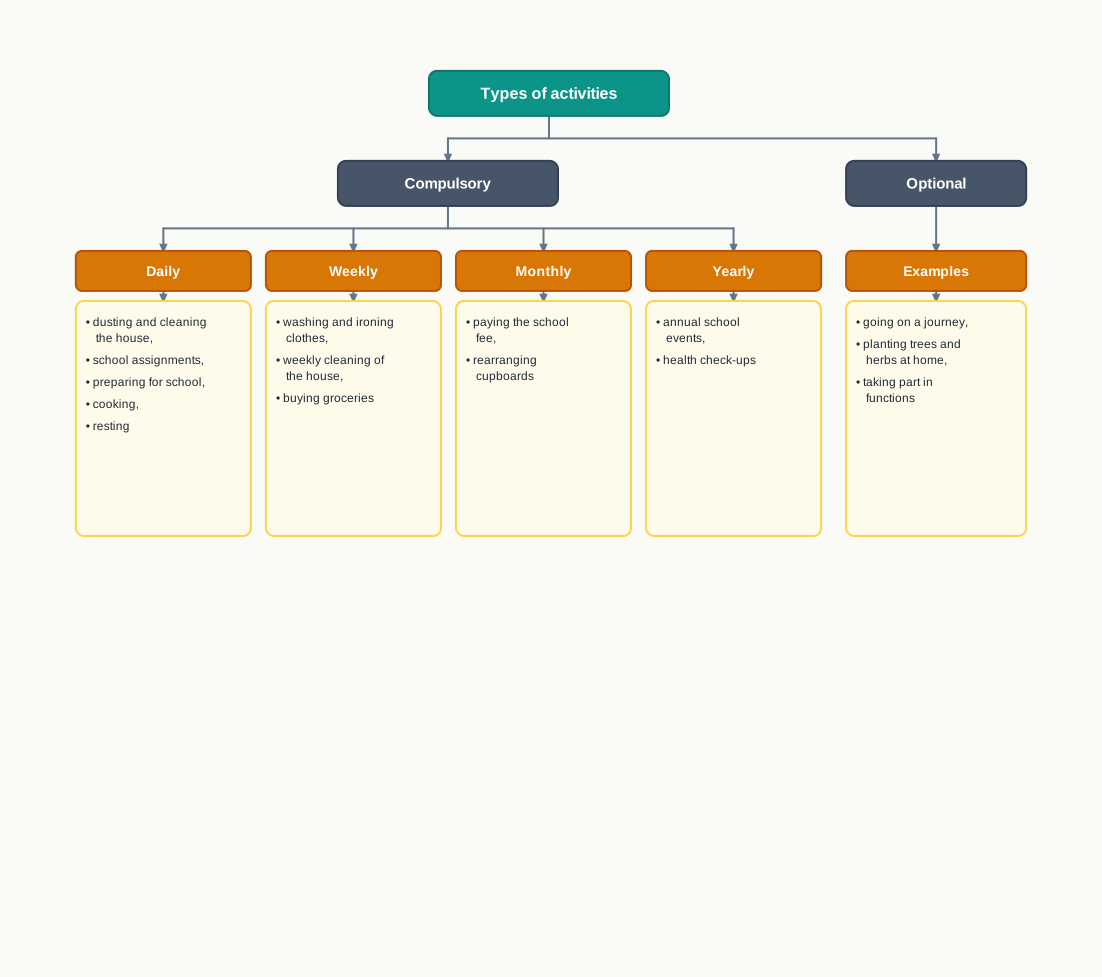
Fig. 7.9 – Types of activities in a time schedule.
The distinction is practical, not moral. Optional does not mean unimportant — a journey or a planting may matter a great deal — but it is the category that can be shifted when the day is tight, and knowing that in advance saves an argument with yourself later.
7.12.4 Aids For Recording A Plan
A plan kept in the head is easily rewritten by the day’s events. Three simple aids keep it on paper.
- A to-do list. Rule four columns — serial number, activity, day or date of completion, and the reason for carrying out the activity — and fill one row per task. The last column is the one people leave out, and it is the most useful, because a task with no reason behind it is usually a task that can be dropped.
- A daily or weekly planner. Rule a grid with the days of the week down the side and the hours across the top, and enter activities in the boxes. Seeing the week as a block shows at a glance which days are already loaded.
- A long-term planner. Use a monthly chart, one row per month, so that you can plan well ahead. A long-term planner also serves as a reminder to set aside time constructively for yourself.
7.13 Tools In Time Management
A plan tells you what to do and when. The tools in this section tell you something a plan cannot — how work and energy actually behave across the hours of a day, and how the work itself can be made lighter.
7.13.1 Peak Load Period
The peak load period is the period during which the load of work is at its maximum within a specified stretch of time. In most households the peak comes early in the morning and again at dinner time, when cooking, cleaning, getting people out of the house and putting a meal on the table all fall together.
Knowing where the peak lies is what makes the rest of the plan realistic. A task added into a peak period does not simply take its own time; it delays everything already crowded there.
7.13.2 Work Curve
The work curve is a device to trace the work done against time. It is drawn with time along the horizontal axis and the amount of work along the vertical one, so that the shape of the line shows how output changes as the hours pass. Fig. 7.10 shows a work curve for two working spells separated by a break.
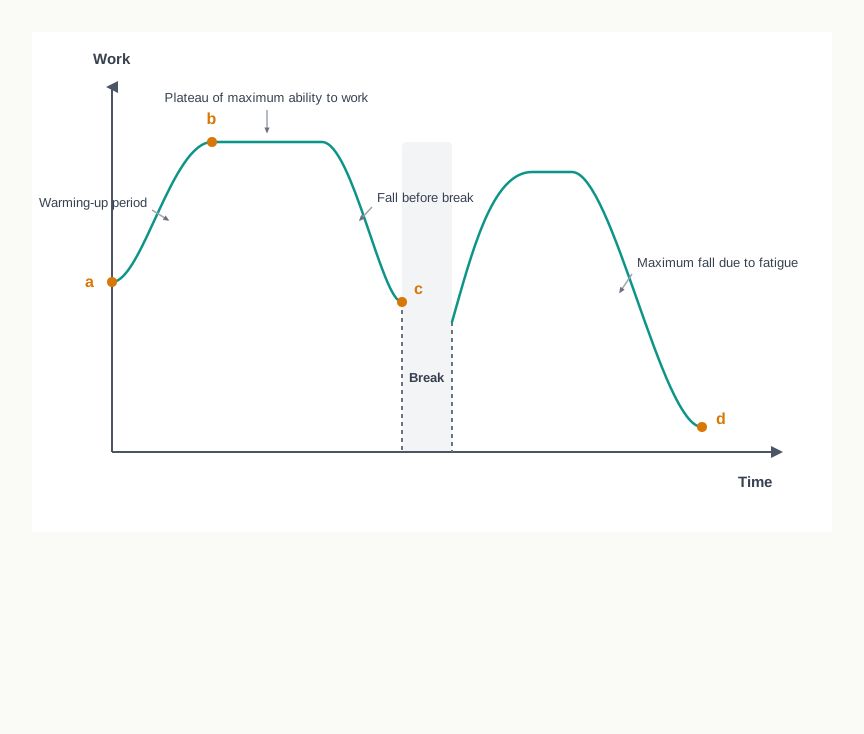
Fig. 7.10 – Work curve across two working spells.
7.13.3 Rest Periods
Rest periods, or break periods, are unproductive interruptions of working time. The word unproductive describes only what happens during them, not what they achieve — as the work curve shows, the output after a break is higher than it would have been without one.
Both the frequency and the duration of rest periods are very important. A rest period should be neither too long nor too short. Too short, and the fall due to fatigue is not reversed; too long, and the worker has to warm up all over again.
7.13.4 Work Simplification
Work simplification is the conscious seeking of the simplest, easiest and quickest method of doing a piece of work. It implies the proper blending and management of two important resources — time and human energy.
Notice that the definition allows two different gains. You may do more with the same effort, or the same with less effort. Which one you want decides which change you make.
To bring about a change in work procedure, and so to simplify it, three levels of change are important.
7.13.4.1 Change In Hand And Body Motions
This is the first and cheapest level. It involves changes in hand and body motion only, keeping the same work tools and the same product. Many tasks can be completed with less effort in the following ways.
- By eliminating and combining certain processes. Allowing washed dishes to dry on a utensil rack removes the need to wipe them at all. Making one list of everything required from the market, and buying it together, replaces several separate trips.
- By improving the sequence and rhythm of work. Doing like tasks together helps here: while cleaning the house, all the dusting, then all the sweeping, then all the mopping, carried through the rooms in continuation, rather than finishing one room completely before starting the next. Working this way also maintains rhythm, so the hands keep repeating a movement they have just made.
- By developing skills at work. Knowing and mastering a job eliminates the extra motions of the beginner — the reaching for the wrong thing, the second look, the correction — and so saves both time and energy.
- By improving body posture, which is treated below.
Posture deserves a closer look because it decides how much of the body’s own weight the muscles have to carry.
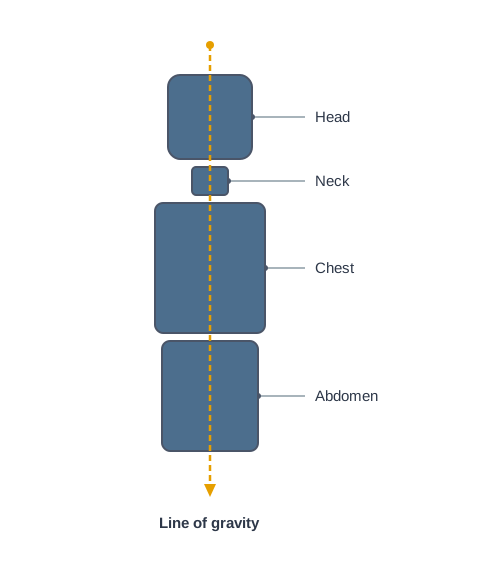
Fig. 7.11 – Alignment of body parts with gravity.
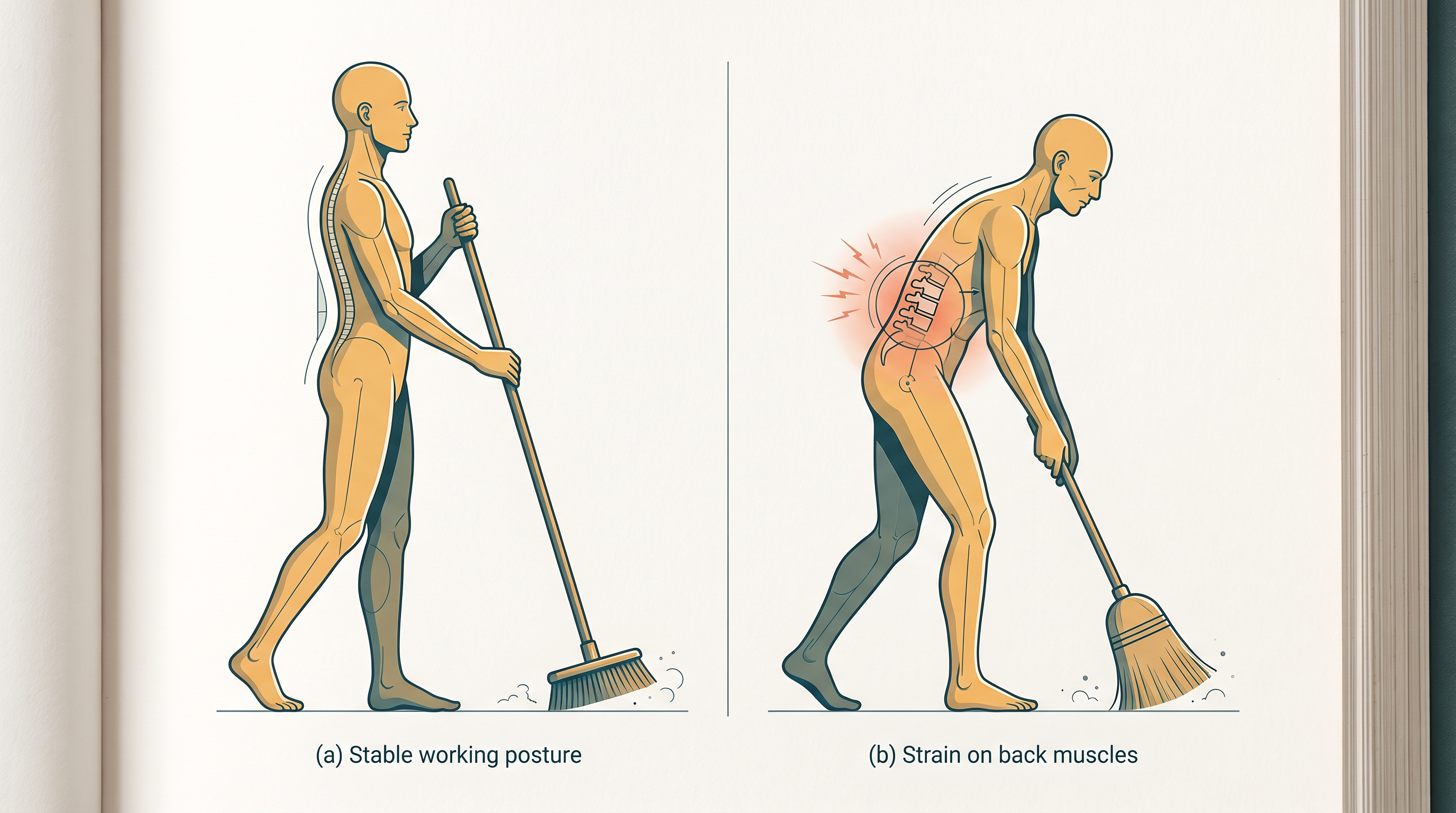
Fig. 7.12 – Working postures: (a) stable and (b) strained.
7.13.4.2 Change In Work, Storage Space And Equipment
The second level changes the setting rather than the movement. It requires organising storage spaces, rearranging kitchen equipment, and planning work surfaces with a height and width suited to the person who will use them.
It also includes the use of labour-saving devices — that is, equipment that does part of the work in place of the hands — such as pressure cookers, washing machines and microwave ovens. These save time, and they save hand motions, which is the reason they reduce fatigue as well.
A surface planned for the wrong height is worth noticing here. If a working platform is too low, the worker bends over it for every task performed there, and the strain returns with every meal.
7.13.4.3 Change In The End Product
The third level changes what is being made. These changes result from the use of:
- different raw materials — for example, using readymade ground spices instead of whole spices, or using organic seeds to grow produce;
- different products made from the same raw materials — for example, making kulfi instead of ice-cream, or lauki paranthas instead of kofta curry;
- changes in both the raw material and the finished product — for example, using a ball pen instead of an ink pen.
This level is the one people resist, because it alters the result and not merely the route to it. It is worth applying only where the changed product is genuinely acceptable to the household, since a saving that nobody will eat is not a saving at all.
7.14 Space As A Resource
Space is used by people to carry out activities — at home, outside the home and at the workplace. Like time, it is a resource in limited supply, and like time, what matters is not how much of it there is but how it is used.
You must have noticed that a well-designed room gives a sense of spaciousness, while a room of very similar dimensions, if it is not managed well, ends up looking cramped or cluttered. The floor area of the two rooms may be identical. The difference lies entirely in what has been put where.
7.14.1 What Space Management Involves
Space management is not a single act of arranging furniture. It runs through four stages, and it is set out in Fig. 7.13.
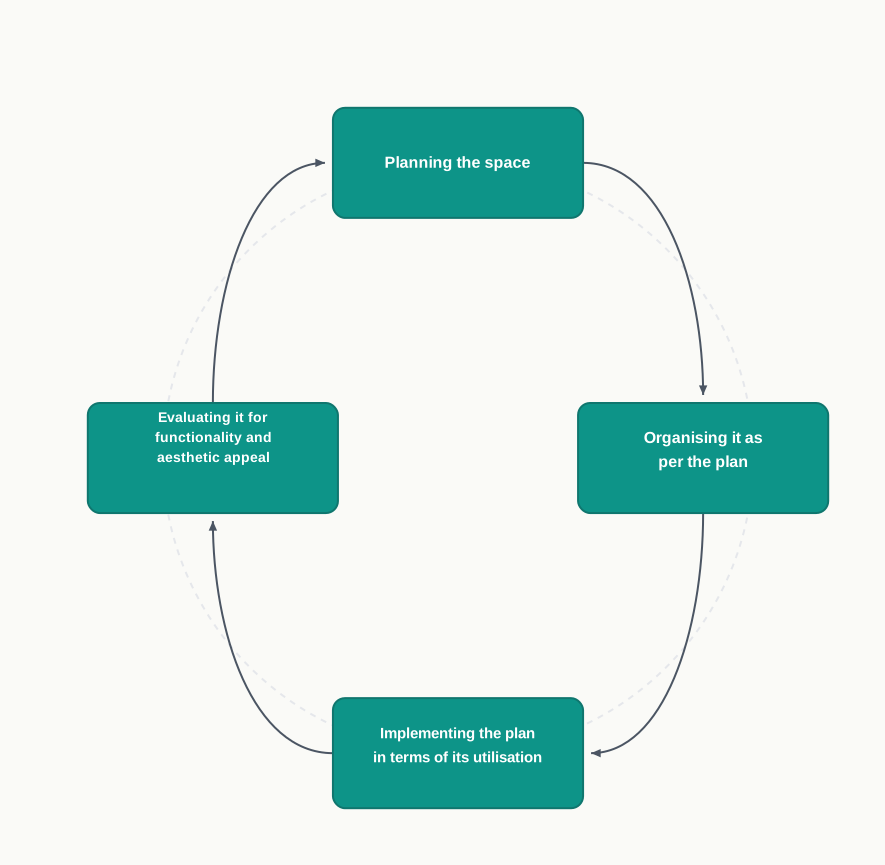
Fig. 7.13 – The space management process.
The last stage carries two tests, and both have to be met. Functionality asks whether the activities meant to happen there can actually happen there. Aesthetic appeal asks whether the space is pleasant to be in. A well-managed space offers comfort while working and also looks attractive; a space that scores on only one of these has not been managed, only decorated or only filled.
Notice that the process returns to its start. Households change — a child begins studying, an older person needs a room on the ground floor, a member starts working from home — and each change sends the plan back for revision.
7.14.2 Space And The Home
Sitting, sleeping, studying, cooking, bathing, washing and entertainment are the major activities carried out in a home. For each of these, and for the actions that follow from them, particular areas are usually identified within the house.
Wherever space is available, specified rooms are built for such activities. In many urban homes of middle socio-economic status, this produces a familiar set: a sitting room or area, one or more bedrooms, a kitchen, a store room, a bathroom and toilet, and often a verandah or courtyard.
Some homes may additionally have a dining room, a study room, an entertainment room, a dressing room, a guest room, a children’s room, a garage for a scooter or car, stairs, passages, a puja room, a garden or a terrace.
Where fewer rooms are available, the activities do not disappear — they share. The same room may be a sitting area through the day, a study in the evening and a bedroom at night. This is a difference in the space available, not in how well the household lives, and it makes planning more important rather than less, because a shared room has to be re-set several times a day.
The starting point for planning any home, then, is not a list of rooms. It is a list of activities, paired with the question of where each one can best be carried out. The principles that guide that pairing are taken up next.
7.15 Principles Of Space Planning
Space must be planned for its optimum use. The principles that follow are the points kept in mind while assigning and designing the work and living areas of a house.
They are not ten separate rules to be memorised in order. Each one names a different way in which a room can succeed or fail, and a plan is tested against all of them together.
7.15.1 Aspect
Aspect indicates the arrangement of doors and windows in the external walls of a building, which allows the occupants to enjoy nature in the form of sunshine, breeze and scenery.
Aspect is decided by direction as much as by design. The same window, moved to another wall, may bring in morning sun or the afternoon heat, so the arrangement is planned against the path of the sun and the direction of the prevailing wind.
7.15.2 Prospect
Prospect, in its proper sense, is the impression or impact that a house is likely to make on a person who looks at it from outside.
It therefore includes the attainment of a pleasing appearance using natural beauty, the positioning of doors and windows, and the covering up of undesirable views. Aspect looks outward from inside the house; prospect looks inward at the house from outside. The two are easily confused, and a single window is usually serving both.
7.15.3 Privacy
Privacy is one of the most important principles in space planning, and it requires consideration in two ways.
Internal privacy is the privacy of one room from another. It is attained by careful planning of the house with respect to grouping, the positioning of doors, and the provision of a small corridor or lobby. It can also be achieved by setting up screens and curtains. In a home with a large household, a separate sitting area may be provided so that different members can have space of their own when they need it.
External privacy means the privacy of all parts of a house from neighbouring buildings and houses, public streets and by-ways. It can be secured by planning the entrance carefully and screening it — with a fence, shrubs, a tree or creepers — as shown in Fig. 7.14.
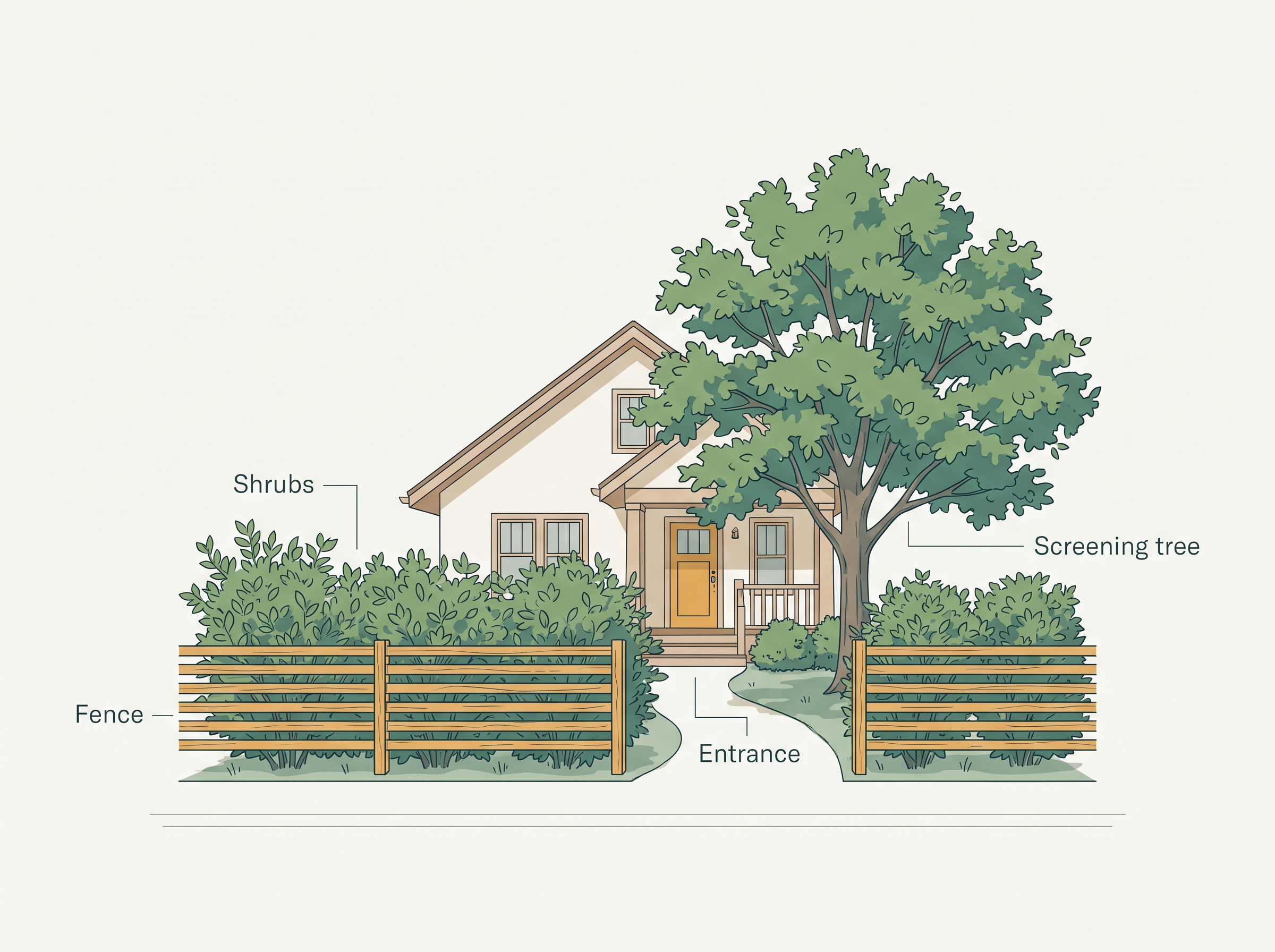
Fig. 7.14 – External privacy secured by a fence and shrubs.
7.15.4 Grouping
Grouping refers to the placing of rooms with respect to their relative position to one another. In a building, for instance, the dining area must be close to the kitchen, and the kitchen must be away from the toilet.
Both those examples follow from one idea. Rooms linked by frequent movement are placed near each other to shorten the work; rooms linked by a hygiene risk are placed apart. A house plan showing such grouping is given in Fig. 7.15.
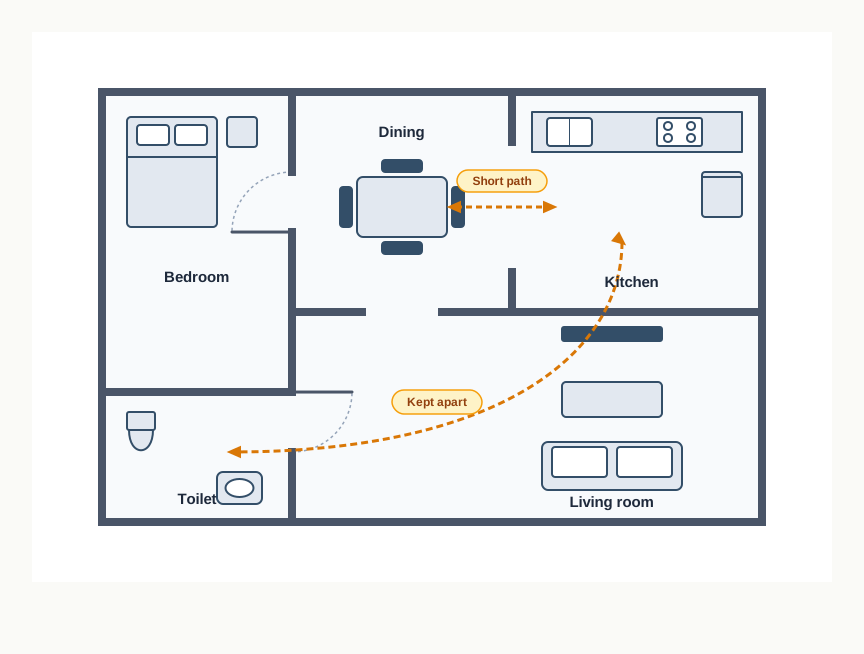
Fig. 7.15 – Grouping of rooms in a house plan.
7.15.5 Roominess
Roominess is the spacious effect a room gives to those who live in it. The available space should be made full use of — built-in wall cupboards, shelves and storage areas keep belongings off the floor, so that the floor is left free for various activities.
Three further things bear on roominess: the size and shape of the room, the arrangement of the furniture, and the colour scheme used. A well-proportioned rectangular room looks more spacious than a square room of similar dimensions, and light colours make a room look more spacious than dark ones do.
7.15.6 Furniture Requirements
Rooms must be planned with due thought to the furniture that will be placed in them, so that every room in a building serves its purpose well.
Care must be taken to place only the required pieces of furniture, and to arrange them so that free circulation spaces are left. A room crowded with furniture loses on two counts at once — it becomes harder to move through, and it looks smaller than it is.
7.15.7 Sanitation
Sanitation, as a principle of space planning, consists of providing ample light and ventilation, along with facilities for cleaning and sanitary conveniences.
- Light. Light has a two-fold significance: it illuminates, and it helps maintain hygiene, since dirt is seen and dealt with in a well-lit room. Light in a building may be provided from natural or artificial sources — windows, bulbs and tube-lights among them.
- Ventilation. Ventilation is the supply of outside air into a building, and it is an important factor affecting comfort in a building or a room. It is generally achieved by placing the windows, doors and ventilators so that they admit as much breeze as possible; windows placed opposite each other provide good ventilation. A lack of fresh air may lead to headaches, sleepiness and an inability to focus attention. Ventilation may be natural, or mechanical using an exhaust fan.
- Cleanliness and sanitary conveniences. The general cleaning and upkeep of a building is the responsibility of its occupants, but some provision to make cleaning easier and to prevent the collection of dust is necessary at the planning stage itself. Sanitary conveniences include the provision of bathrooms, water closets and lavatories. In many rural houses these are constructed as a separate unit, usually in the backyard or the frontyard and away from the other rooms, which helps maintain hygiene.
The arrangement that produces good ventilation is shown in Fig. 7.16.
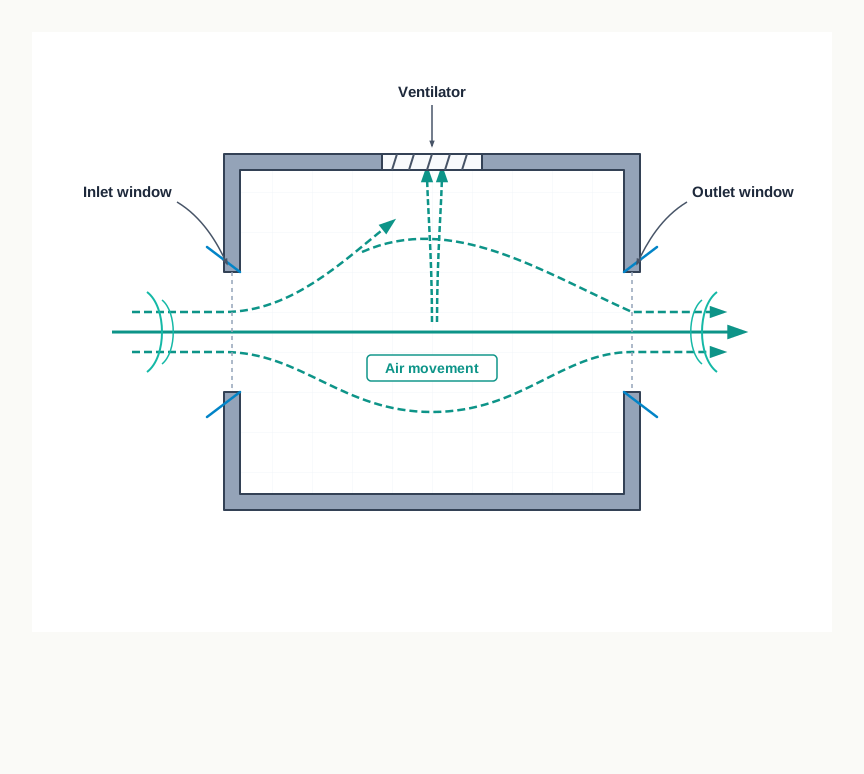
Fig. 7.16 – Cross ventilation in a room.
7.15.8 Circulation
Circulation means that movement of air from room to room should be possible. Good circulation also includes an independent entry to each living space through a common space.
Planning entries in this way does a second job as well. When each room is reached from a shared passage rather than through another room, the occupants gain privacy without any screen or curtain being needed.
7.15.9 Practical Considerations
While planning spaces, one may consider practical points such as the strength and stability of the structure, convenience and comfort for the household, simplicity, beauty, and provision for expansion in the future.
One rule holds above the others here: one should never economise by creating a weak structure. Every other saving can be revisited later; this one cannot.
7.15.10 Elegance
Elegance is the effect produced by the general layout of the plan. Without compromising on economy, a space plan should be aesthetically appealing.
Elegance is therefore not the same as expense. It is the result of proportion, order and restraint in the layout itself, which cost nothing beyond the thought given to them.
Taken together, these principles are what turn an available area into a planned space. A house judged against all ten will not be the largest one on the street, but it will be the one in which the work is easy, the air moves, and each person has somewhere to be.
7.16 The Antiquity Of Indian Textiles
In an earlier chapter you looked at the range of textile products around us and at what each is used for. This part of the chapter asks a different question: how did those traditions come to exist, and why are they treated in India as heritage rather than as merely useful things?
7.16.1 What The Evidence Tells Us
If you have visited a museum, you may have noticed that the section displaying fabrics and apparel is small, and that its exhibits are not as old as the pots, tools and sculptures in the other rooms. The reason is not that cloth was made later. It is that fabric decays far more quickly than bone, stone or metal, so most of it has simply not survived.
Evidence therefore has to be gathered indirectly, and there is plenty of it. Archaeological records showing clothed human figures on walls and in sculpture indicate that humans knew the art of making cloth even 20,000 years ago. References in ancient literature, and paintings on the walls of caves and buildings, tell us more.
Textile materials have fascinated human beings since ancient times and have been an essential part of civilisation. The people of all the ancient civilisations developed techniques and technologies for using the raw material available in their own region, and each created its own distinctive designs and elaborately patterned products.
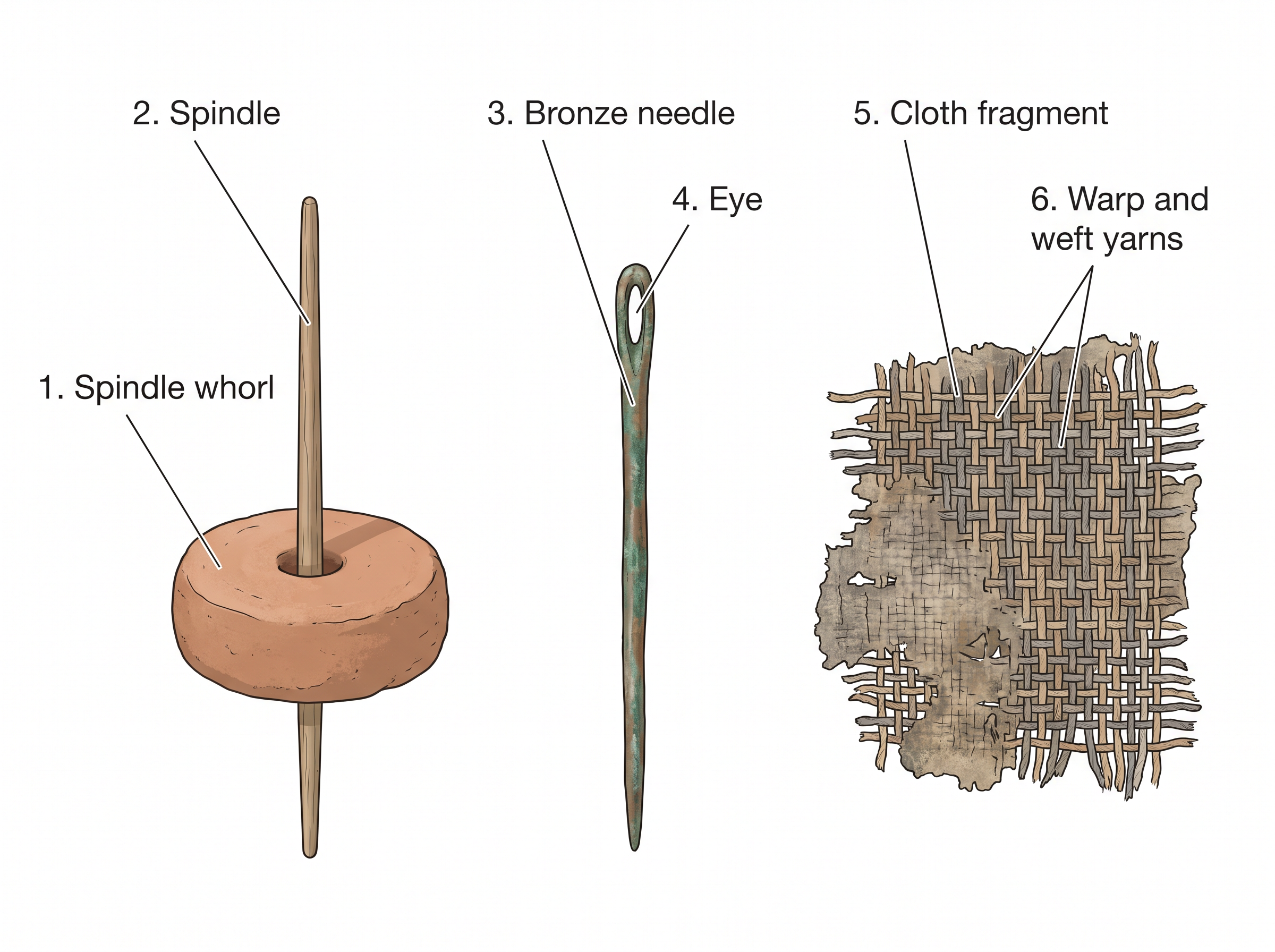
Fig. 7.17 – Evidence of early textile work.
7.16.2 Textiles In India’s Recorded History
The manufacture of sophisticated textiles in India is as ancient as Indian civilisation itself. Cloth appears in the Rig Veda and the Upanishads as an image for the making of the universe, which those texts describe as a fabric woven by the gods. The coming of day and night, bringing light and darkness over the earth in turn, is compared to the movement of the weaver’s shuttle in the loom.
An image of that kind only works if everyone hearing it already knows the loom well. The comparison is itself evidence of how ordinary weaving was.
Weaving is among the oldest of the arts, and fine fabrics have been made here from very early times. Cloth fragments, terracotta spindles and bronze needles found at the excavation site at Mohenjo-daro are evidence that the traditions of cotton spinning, weaving, dyeing and embroidery in India are at least 5000 years old.
India was the first among the ancient civilisations to discover colour and to perfect the technique of applying it to textile materials, especially to cotton. Dyed and printed cotton fabrics were exported to other nations, and they were valued for their colourfastness — the ability of a dyed fabric to hold its colour without fading or bleeding during washing, wear and exposure to light. Classical Greek and Latin writers remarked on it, comparing the lastingness of colour on Indian cloth to the lastingness of wisdom.
Throughout the period of recorded history there are references extolling the excellence of Indian fabrics made from cotton, silk and wool. They were known both for the character of the fabric itself and for the designs produced on it — through weaving, resist dyeing, printing and embroidery.
Cloth of this quality did not stay at home. Indian textiles became coveted items of trade, helped form political linkages, and influenced the establishment of textile industries in other countries. From around the 15th century CE onwards, India was the greatest exporter of textiles the world had known, and the setting up of the various East India Companies by the European nations was bound up with the textile trade from India.
Keep that last point in view as you read the sections that follow. The crafts described there are not decorative survivals. For several centuries they were the basis of India’s largest export industry, and the reason ships were sent here at all.
7.17 The Three Main Fibres
Traditional Indian fabric production is associated with three main natural fibres — cotton, silk and wool. Each one settled where its raw material grew or its climate demanded it, and the crafts of each region follow from that starting point.
7.17.1 Cotton
India is the home of cotton. Its cultivation, and its use in weaving, have been known here since prehistoric times, and the spinning and weaving techniques developed in this country produced fabrics famous for their extreme fineness and their decoration.
Cotton travelled from India to the rest of the world. That it was an item of trade is known from material recovered in archaeological digs in the ancient land of Babylon, found there together with Harappan seals. When the Romans and the Greeks first saw cotton, they described it as wool that grew on trees — the only comparison their own experience offered them.
The Finest Muslins
Many legends are associated with cotton weaving. Dacca, now in Bangladesh, produced the finest fabric of all — the mulmul khas, or royal muslin. It was so fine that it was almost invisible, and it collected poetic names to match: baft-hava, meaning woven air; abe-rawan, meaning flowing water; and shabnam, meaning evening dew.
The Jamdani, or figured muslin, is traditionally woven in Bengal and parts of North India using cotton, and it is one of the finest brocade products of Indian weaving. Its patterns appear to float on a transparent ground, which is what the extra patterning yarn makes possible.
This is the point at which the word brocade needs explaining, because it names a structure rather than a material.
In regular weaving, the filling yarn passes over and under the warp yarn in a fixed sequence, and the pattern comes from that sequence alone. In a brocade, extra designs in silk, cotton, or gold and silver yarns are transfixed in between the regular weaving. Depending on the fibre used for patterning, there may be cotton brocades, silk brocades, or zari brocades, zari being metallic yarn.
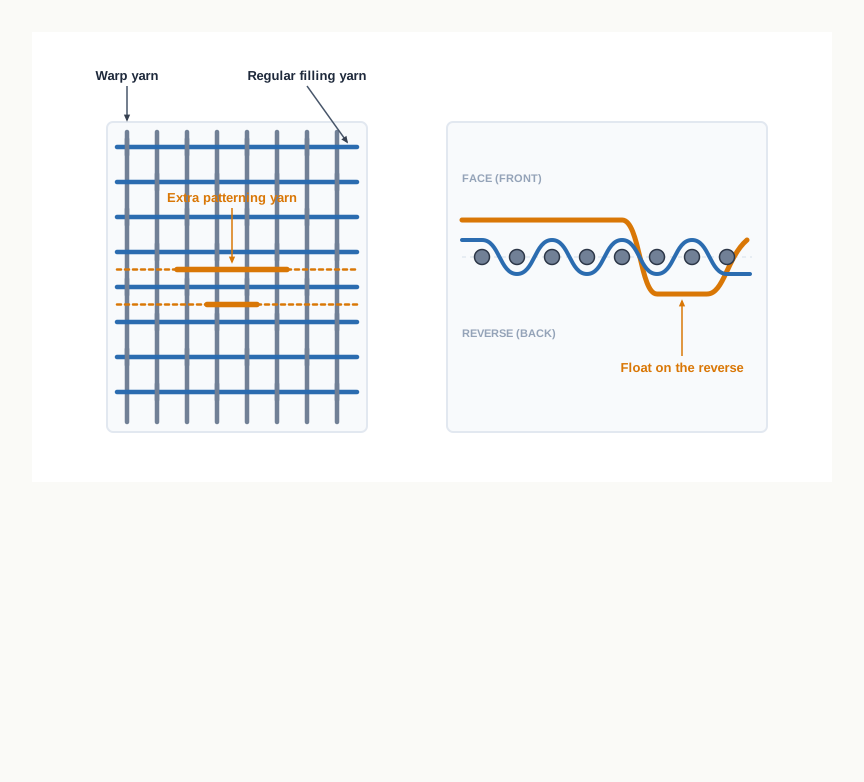
Fig. 7.18 – Brocade weaving structure.
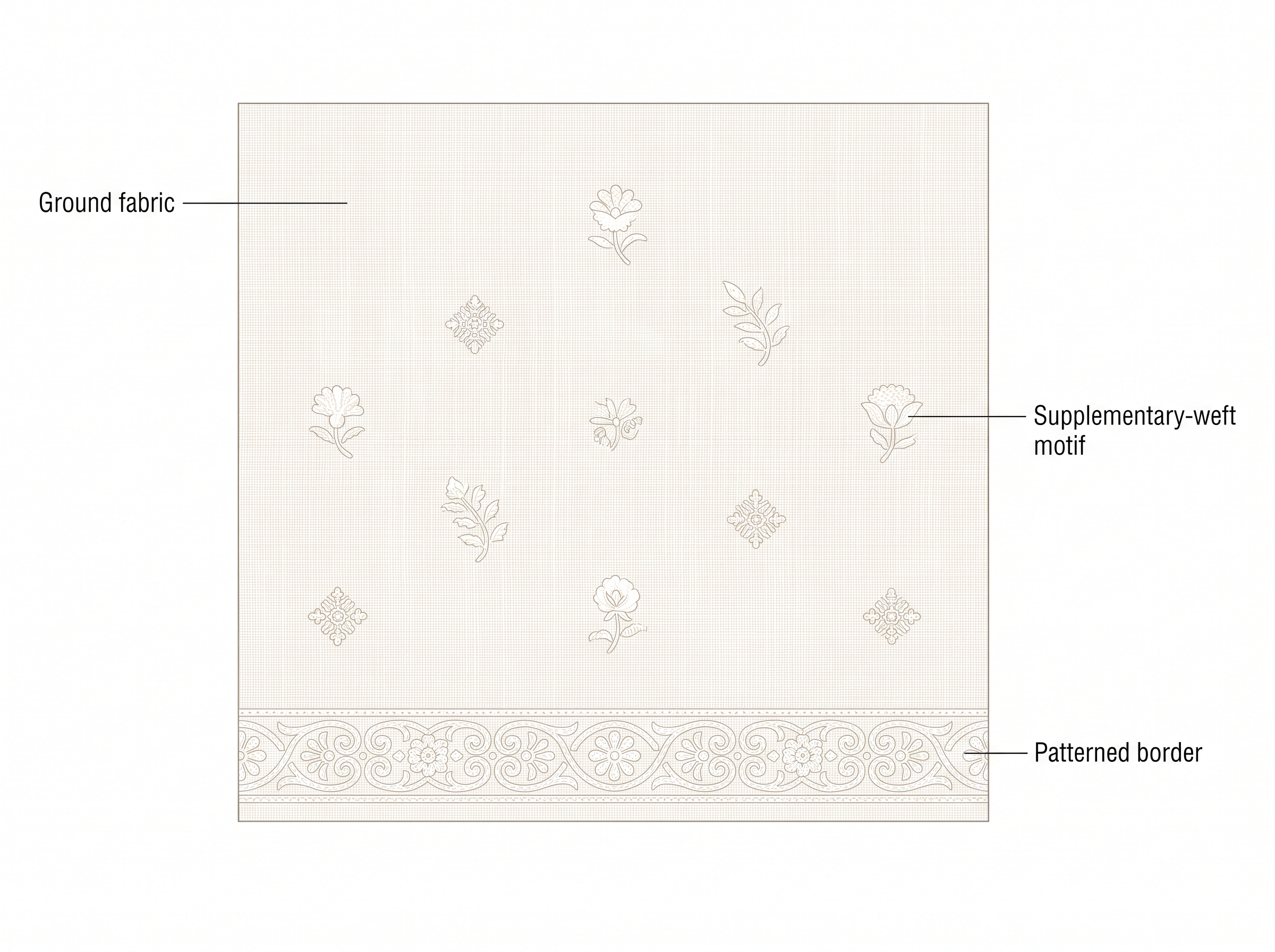
Fig. 7.19 – Jamdani figured muslin.
The Master Dyers To The World
Besides its skill in making cotton fabrics, India’s crowning textile accomplishment was the creation of pattern in cotton cloth using brilliant fast dyes. Until the 17th century CE, Indians alone had mastered the complicated chemistry of cotton dyeing. This was not the mere application of pigment to the surface of the cloth, which rubs and washes away, but a process that produced fast and lasting colour.
Indian chintz — printed and painted cotton cloth — revolutionised European fashion and the European market. Indian craftspersons were known as the master dyers to the world, and the title was earned on chemistry rather than on decoration.
Cotton is woven everywhere in India. Superfine yarn is still spun and woven in many places, though bulk production may be thicker, and the materials are made in a variety of designs and colours that find specific uses in different parts of the country.
7.17.2 Silk
Silk fabrics have been made in India since ancient times. You have learnt earlier that silk originated in China; some silk must nevertheless have been in use in India as well. Silk weaving is mentioned here as early as the 3rd century BCE, and a distinction is made in those references between Indian and Chinese silk.
Silk weaving centres grew up in and around the capitals of kingdoms, holy cities and trade centres — that is, wherever there were buyers who could afford the cloth. As weavers migrated, they carried the craft with them and helped create new centres. Different regions of the country developed their own silk weaving styles, and some of the important centres are described below.
Varanasi
Varanasi in Uttar Pradesh has an old tradition of weaving special styles, and its best-known product is the brocade, or kinkhwab. The name records what people felt about the fabric: its splendour, its elegance and its high cost made it something a person could not even dream of, a fabric seldom seen even in a dream — kin meaning golden and khwab meaning dream.
West Bengal
West Bengal is traditionally famous for its silk weaving. Using a loom similar to that of the Jamdani weavers, the weavers of West Bengal produce a silk brocaded sari called Baluchar Butedar. The style originated at a place called Baluchar in Murshidabad district, and it is now successfully produced in Varanasi as well. Here a plain-woven fabric is brocaded with untwisted silk thread.
The most characteristic feature of these saris is the pallav, or end piece. It carries unique designs depicting scenes from the epics, from the royal court, and domestic or travel scenes complete with riders and palanquins. The mango motif is the one most commonly used in the borders and pallavs.
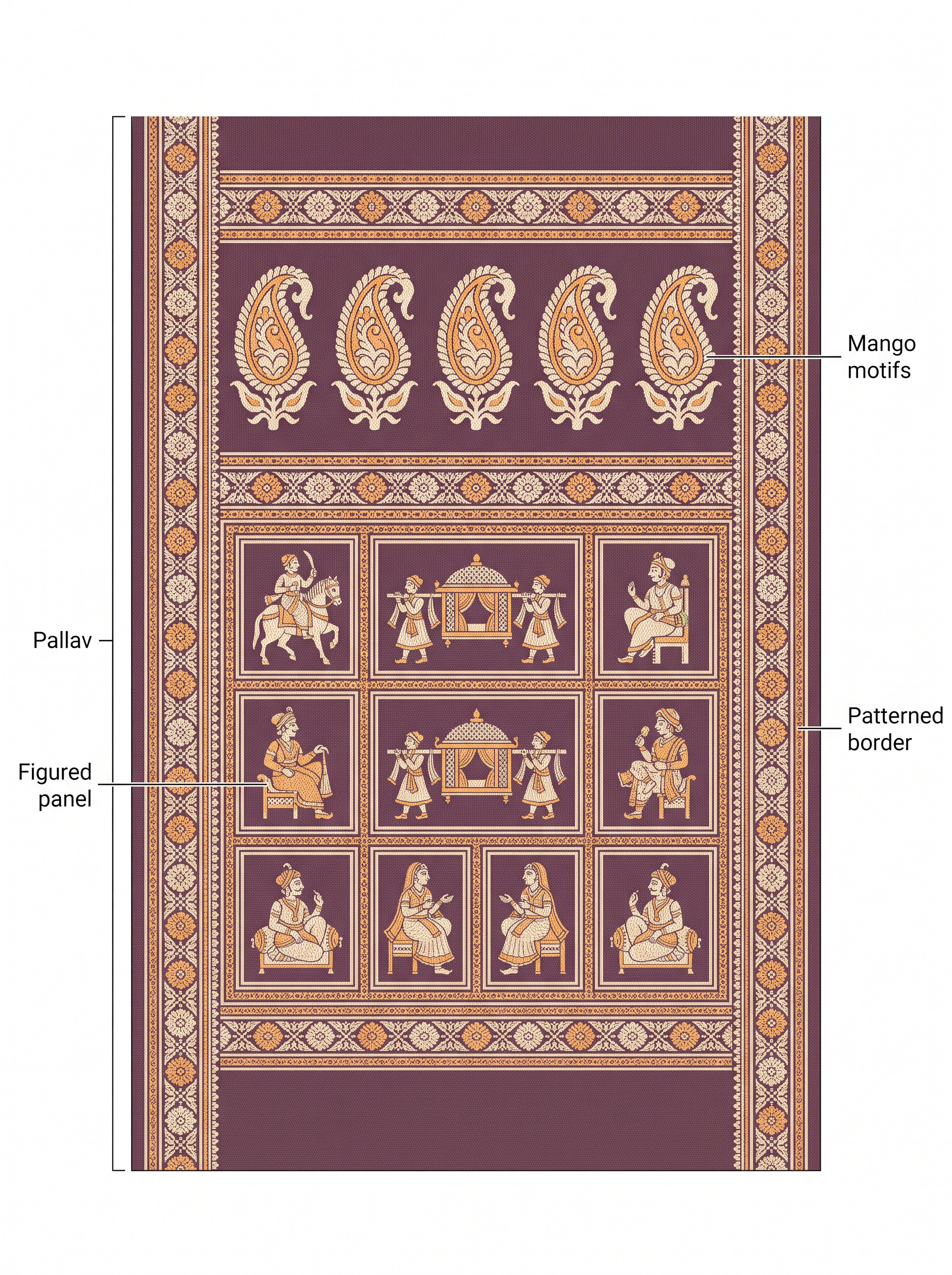
Fig. 7.20 – Pallav of a Baluchar Butedar sari.
Gujarat
Gujarat developed its own style of kinkhwabs. Very fine textiles were produced at Bharuch and Cambay, and were popular in the courts of Indian rulers.
The Ashavali saris of Ahmedabad are known for their beautiful brocade borders and pallavs. They have a rich gold or silver metallic background on which patterns are woven in coloured threads, which gives the fabric an enamelled appearance. Human, animal and bird motifs are frequently worked into the pattern, since these are an integral part of Gujarati folk tradition.
Kanchipuram
Kanchipuram in Tamil Nadu has been a famous brocade weaving centre in South India since ancient times. Its traditional saris display bird and animal motifs with a richly brocaded pallav. Dark colours — red, purple, orange, yellow, green and blue — predominate in South Indian fabrics.
Paithan
Paithan, on the banks of the Godavari river near Chhatrapati Sambhajinagar in Maharashtra, is one of the oldest cities of the Deccan region. It is famous for a special silk sari with gold inlay weaving in the borders and motifs, and it is known for its closely woven golden fabric. Against the shimmering gold ground, patterns are worked in red, green, pink and purple so that they glow like jewels — butas, the tree of life, stylised buds and floral borders among them.
The technique used at Paithan is the tapestry weave, the oldest technique of decorative weaving.
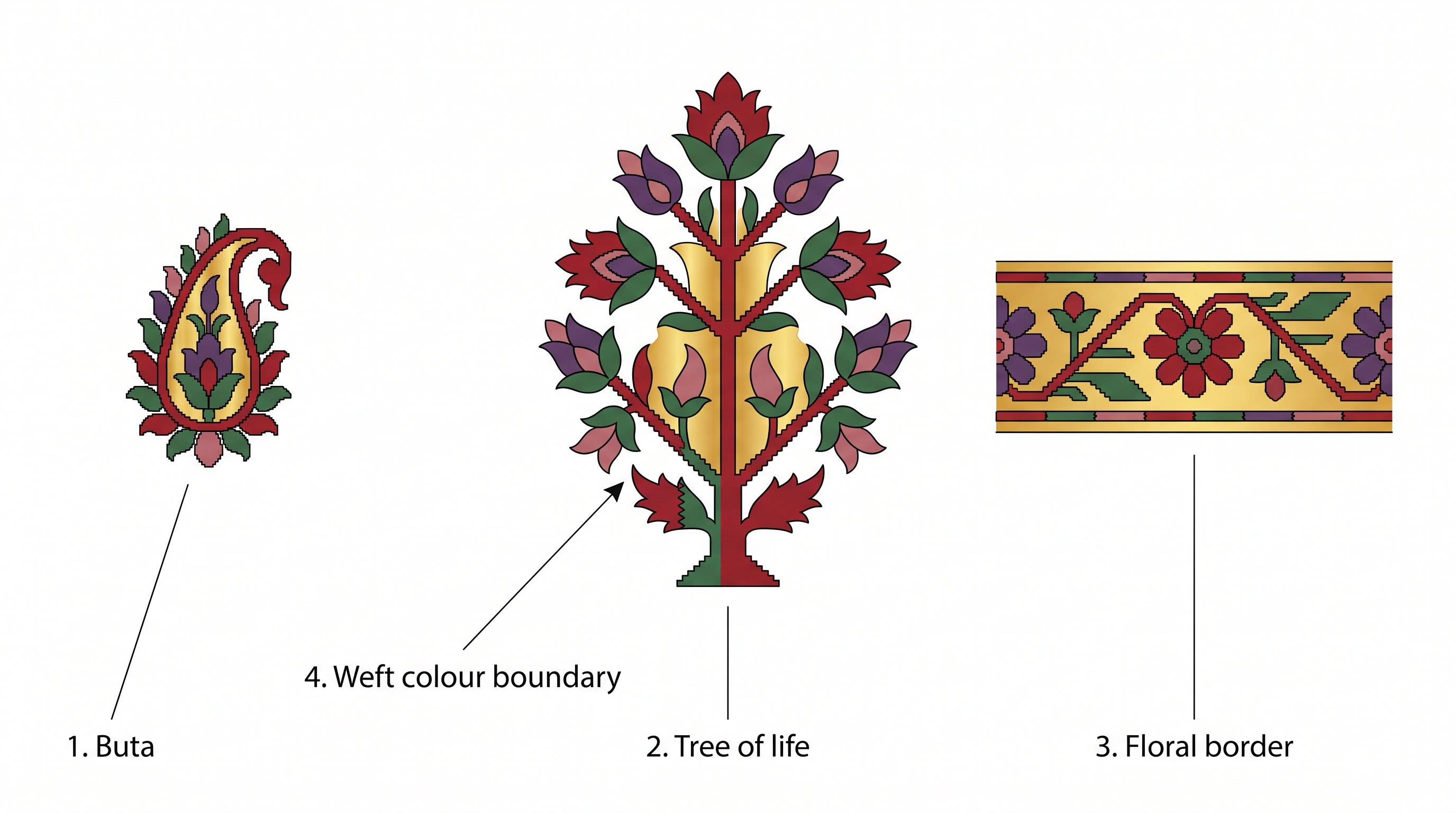
Fig. 7.21 – Paithani motifs and tapestry weave.
Surat, Ahmedabad, Agra, Delhi, Burhanpur, Tiruchirapalli and Thanjavur are the other traditionally renowned centres of zari brocade weaving.
The five silk centres described above are set side by side in Table 7.5.
7.17.3 Wool
The development of wool is associated with the colder regions — the hills of Ladakh, Jammu and Kashmir, Himachal Pradesh and Uttar Pradesh, the hills of West Bengal, some of the north-eastern states, Punjab, Rajasthan, and a few places in Central and West India.
Speciality hair, that is, the hair of animals other than sheep, has also been used in India. Mountain goats, rabbits and camels all supply it, and the earliest references to wool here mention the very fine hair obtained from mountain goats and from some deer-like animals.
Kashmir
Kashmiri literature of the 11th century CE confirms that multicoloured woollen fabrics were being woven in that period. From the 14th century CE, Persian influence led to the production of shawls, which used the most complex tapestry weave in a multitude of colours and intricate patterns.
The best shawls were made from pashmina and from shahtoosh. Pashmina is the fine soft undercoat of the Changthangi mountain goat, reared at high altitude in Ladakh; shahtoosh comes from the Tibetan antelope, a wild animal that must be killed to obtain it, and both the animal and any trade in its hair are protected by law in India.
The Mughal emperors were responsible for promoting this art, and the shawls of Kashmir became world famous. Like printed cotton, they were a major export item from the 18th century CE onwards. Embroidery was introduced on shawls later, and you will meet it again in the next section.
The designs of the shawls copy the beauty of the natural landscape of Kashmir. The mango motif, also known as paisley, appears in countless varieties and colour combinations.
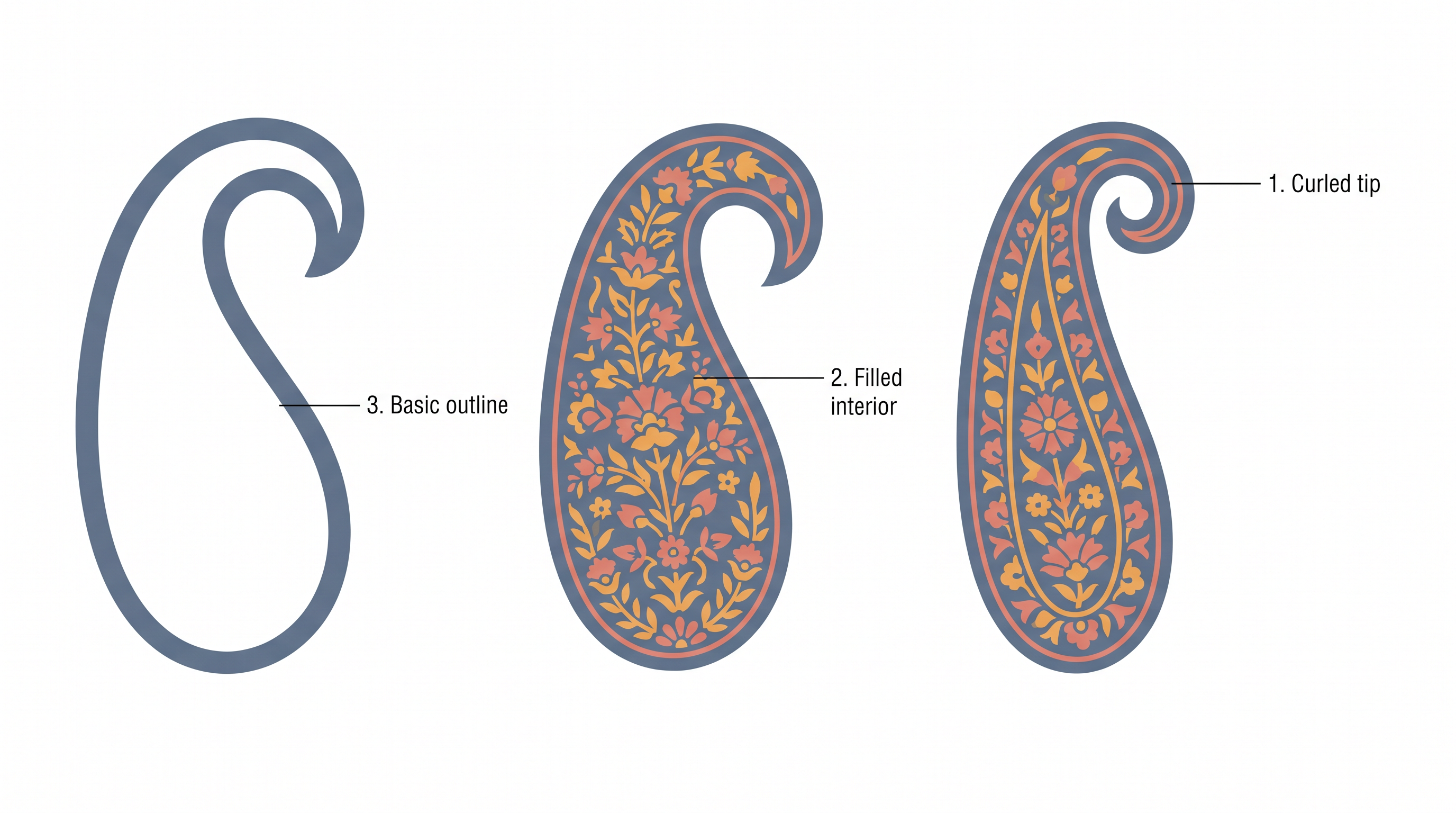
Fig. 7.22 – Variations of the mango or paisley motif.
Akbar is said to have introduced the style of jamawar shawls. These were large shawls designed so that they were also suitable for making garments — jama meaning a cloak, and war meaning yardage. If you look at Mughal paintings in museums, or their illustrations in books, you will usually find the rulers wearing large shoulder wraps in intricate designs.
Himachal Pradesh
The shawls of Himachal Pradesh are mostly woven in angular geometrical motifs, grouped in straight horizontal lines, bands and stripes, with one or two placed vertically as well. The contrast with Kashmir is worth noting: curved and natural forms there, angular and geometric forms here.
The Kullu valley in particular is known for shawl weaving and for several other woollen fabrics, such as pattu and dohru, which are wraps worn by men.
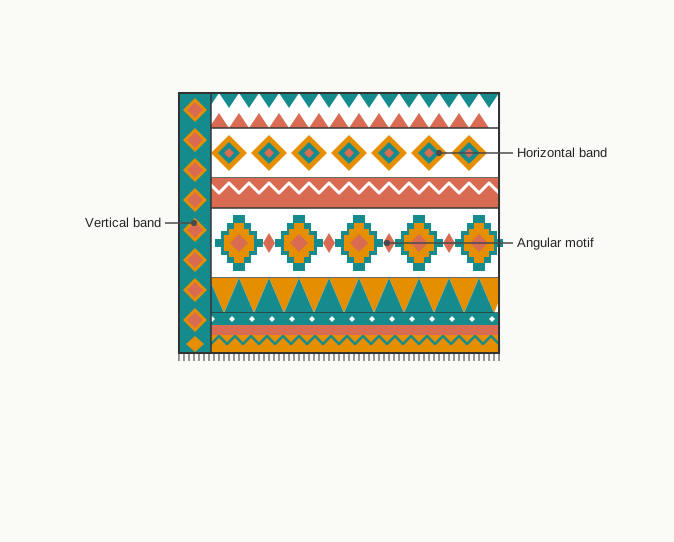
Fig. 7.23 – Geometrical border of a Kullu shawl.
In recent years shawl weaving in other places has also gained importance. Amritsar and Ludhiana in Punjab, Uttarakhand and Gujarat all deserve special mention.
7.18 Dyeing
The history of dyeing in India is very old, and you have already seen that it was the dyeing, more than the weaving, that made Indian cotton famous abroad.
7.18.1 Dyes And Their Sources
Before the middle of the 19th century CE, dyes were obtained only from natural sources. Most of the dyes used came from plants — from roots, bark, leaves, flowers and seeds. Some insects and some minerals also yielded colour.
Analysis of old samples confirms that Indians had a deep knowledge of the chemistry of dyes and of the techniques of applying them, and that this is what produced fabrics renowned for their colourfastness. A natural dye by itself does not fix on cotton; making it fast calls for preparing the cloth, for the correct mordant, and for control of the dye bath. That knowledge, and not the plant, was the achievement.
7.18.2 Resist Dyeing
The oldest form of designing with colour is resist dyeing. Having perfected the art of dyeing, it must have been discovered that if certain parts of the material were prevented from absorbing the dye, those parts would retain their original colour, and the cloth would come out of the dye bath already patterned.
The resist material may be thread, pieces of fabric, or substances such as clay and wax that offer physical resistance. The most common method of resist in India is tying with thread.
Two methods of tie and dye fabric are produced in India — fabric tie and dye, and yarn tie and dye. In both, the part where the design is required is tied up by winding a thread tightly around it before dyeing. During the dyeing process the tied areas retain the original colour of the ground.
On drying, some of the tied parts are opened and some further parts are tied, and the material is dyed again. The process can be repeated for more colours, always proceeding from the light colours to the dark ones.
That order is not a matter of custom. A light dye cannot cover a dark ground, but a dark dye laid over a light one gives a third colour, so working from light to dark is the only sequence in which each successive bath adds rather than destroys.
Tie and dye also carries ritual significance. Among Hindus, the thread tied around the wrist before a religious ceremony is tie-dyed in white, yellow and red. Tie and dyed fabrics are considered auspicious for marriage ceremonies, and the dress of the bride and the turbans worn by the men of the family are generally of these fabrics.
7.18.3 Fabric Tie And Dye
In fabric tie and dye, the pattern is created by tie-dyeing the fabric after it has been woven. Bandhani, chunari and laheria are among the names of materials made in this way, and Gujarat and Rajasthan are the homes of this type of fabric.
The two typical designs are easy to tell apart. In bandhej, the pattern is made up of innumerable small dots, each one the mark of a single tied point. In laheria, the pattern takes the form of diagonal stripes, produced by rolling the cloth diagonally before it is bound.
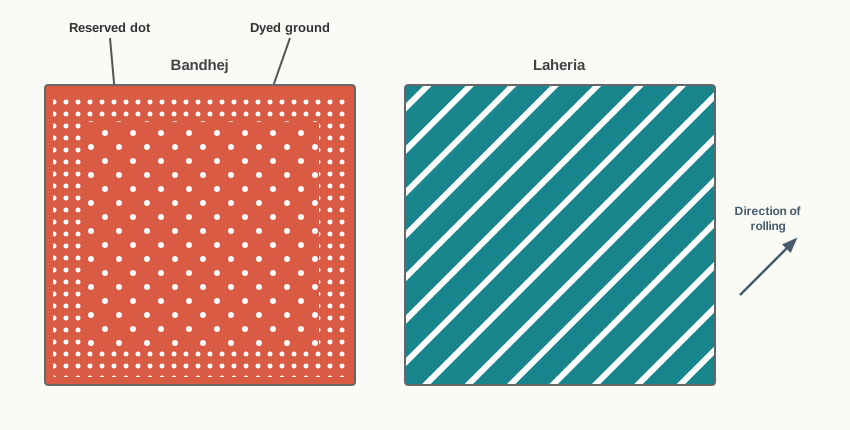
Fig. 7.24 – Bandhej and laheria tie-and-dye patterns.
7.18.4 Yarn Tie And Dye: Ikat
Yarn tie and dye is a far more complicated process of producing designed fabrics, and the fabrics made by it are known as Ikat.
Here the tying and dyeing are done before weaving. The warp yarns, or the filling and weft yarns, or both, are tie-dyed first. When the fabric is then woven, a specific pattern appears, depending on where the dyed and reserved spaces fall along the yarns.
The type of ikat is named by how many of the yarn sets have been treated.
- If only one set of yarns — the warp or the weft — is tie-dyed, it is called single ikat.
- If both sets are treated so that each creates a separate pattern, it is combined ikat.
- If both are treated so that a single unified pattern is created where they meet, it is double ikat.
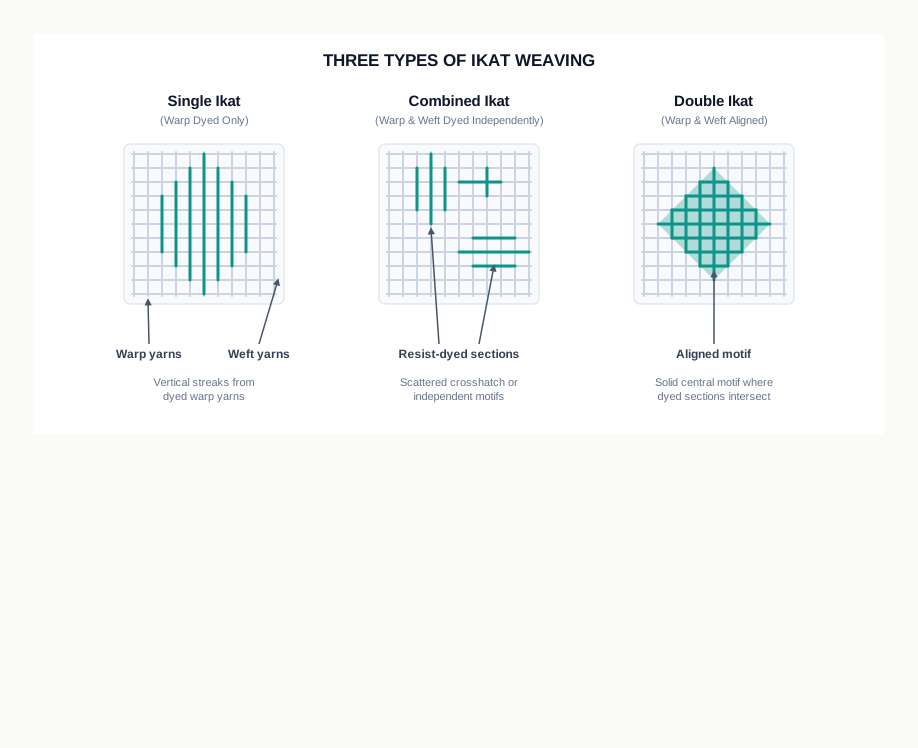
Fig. 7.25 – Single, combined, and double ikat.
Gujarat
Gujarat has the richest tradition of Ikat weaving. Patola is the most colourful double ikat sari, made in silk, and its manufacture is concentrated at Patan in Gujarat. Apart from geometrical design patterns inspired by local architecture, its designs include flowers, birds, animals and dancing dolls. The colours most commonly used are red, yellow, green, black and white, and they tend to flow into one another without any harshness of outline.
That soft edge is the signature of double ikat. Because the colour boundaries are dyed into the yarn rather than drawn on the surface, a motif never has the hard line that printing gives.
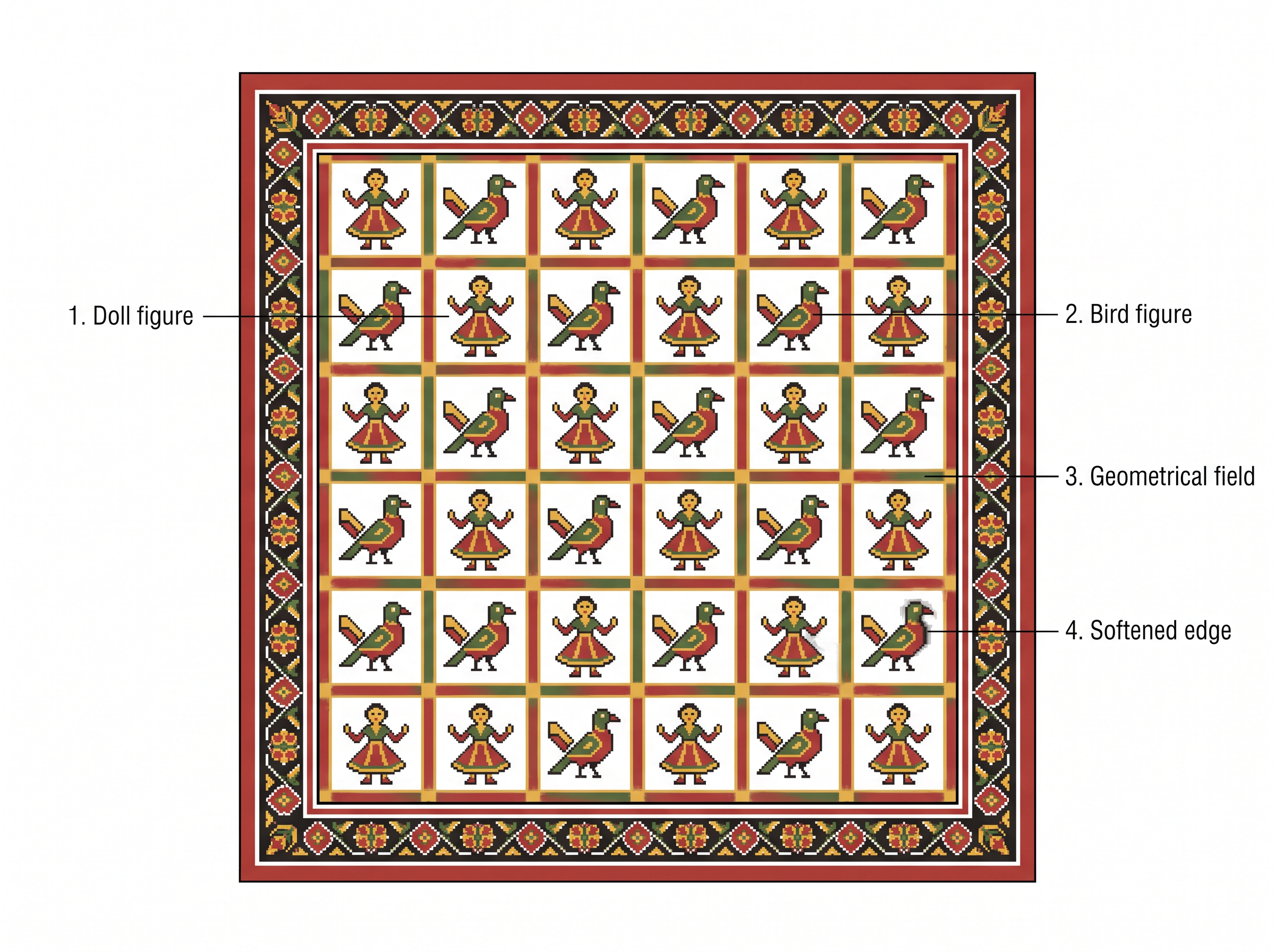
Fig. 7.26 – A Patola double ikat motif.
Odisha
Odisha is another region where ikat saris and fabrics of cotton and silk are produced. The process here is known as Bandha, and it may be single or combined ikat.
Compared with Patola, the designs here have a softer and more curvilinear quality. They are also characterised by the addition of an extra weft yarn woven in to form small figurative designs.
Pochampalli And Chirala
Pochampalli in Telangana and Chirala in Andhra Pradesh have the tradition of producing cotton ikat fabrics called Telia Rumals. These were square pieces of fabric measuring 75 to 90 centimetres (cm), usually woven as a pair.
The two grades had two different users. The coarser ones were used as lungis, shoulder cloths or loincloths by the fishermen community, and the finer ones as dupattas or veils.
The three ikat traditions are compared in Table 7.6.
7.19 Embroidery
Embroidery is the art of surface ornamentation of fabric, worked with threads of silk, cotton, gold or silver using a needle or a needle-like tool. It has been called painting with a needle, and it was practised in many parts of the world.
In India it has been practised from very early times, and the evidence shows how completely it spread. Embroidery was prevalent:
- at all socio-economic levels — from nomadic cattle-rearing communities to the members of royal households;
- on all kinds of fabrics — from the coarsest cotton and camel wool to the finest silks and pashminas;
- with all materials and threads — cotton, wool, silk or zari, along with cowrie shells, bits of mirror and glass, beads, gems and coins;
- in making varied articles — personal clothing, articles of household use, home decoration, offerings for religious places, and decorative pieces for animals and cattle.
Embroidery has generally been regarded as a household handicraft, taken up in the hours left free from other work, and in most regions it was women who carried the tradition. Certain embroideries nevertheless became items of trade, within the country and in different parts of the world, and the styles described below are among those produced commercially today.
Read the descriptions with one question in mind: what would let you identify each one at sight? In almost every case the answer is the base fabric, the thread and the stitch, taken together.
7.19.1 Phulkari
Phulkari is the embroidery of Punjab. The term is used both for the embroidery itself and for the chaddar or shawl made with it. Phulkari means flower work, or a bed of flowers; the other term, bagh, literally a garden, carries the same sense.
Phulkari was mainly a domestic craft, worked by the girls and women of the household. The embroidery is done on coarse cotton, called khaddar, with an untwisted silk floss called pat, and the stitch used is a long darning stitch worked from the reverse side of the cloth.
That method explains its appearance. Because the stitch is worked from the back, the floss lies on the face in long floats that catch the light, and the geometrical pattern is built up entirely from the direction in which those floats run.
In the heavily embroidered baghs, the embroidery covers the fabric so completely that the base colour can be seen only on the reverse side. Traditionally the embroidery was associated with wedding ceremonies, and baghs were made by the maternal grandmother for her granddaughter, or by the paternal grandmother for her granddaughter-in-law.
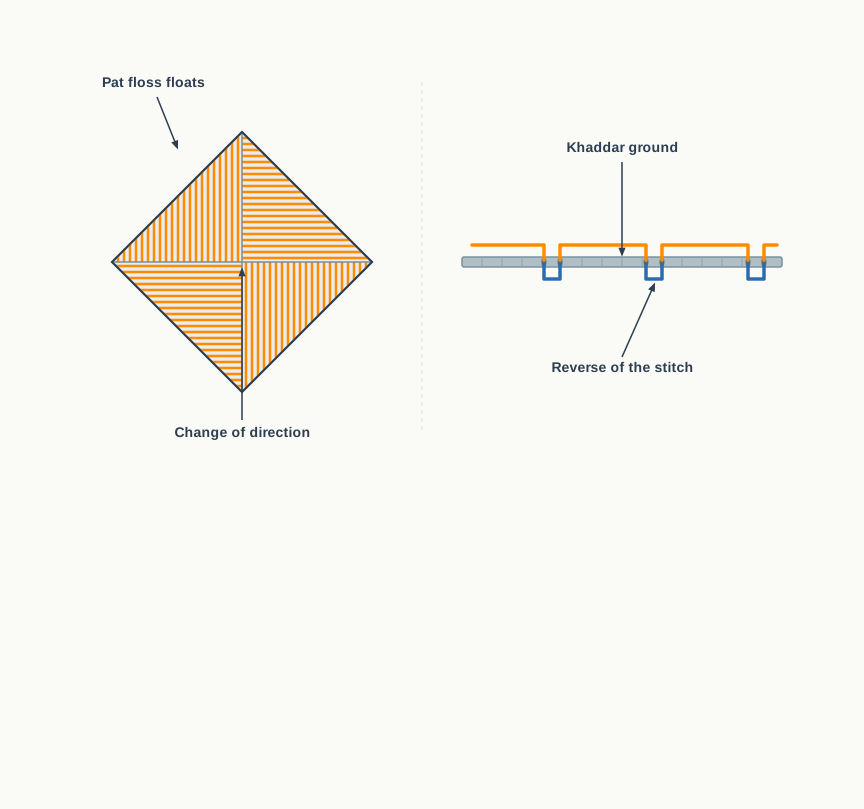
Fig. 7.27 – Phulkari worked in darning stitch.
7.19.2 Kasuti
Kasuti is the term used for the embroidery of Karnataka. The name is commonly explained from the Kannada words for hand and for cotton thread. Like phulkari, it was a domestic craft, mainly worked by women.
This is the most subtle form of embroidery of all those described here, because the embroidery threads follow the pattern of the weave of the fabric itself. The worker counts the threads of the ground and places each stitch against them, which is why the finished motif sits so exactly on the cloth.
It is done on silk material with fine strands of silk thread, and even the colours used tend to blend with the background material rather than stand away from it. The main designs appear to be inspired by the temple architecture of the area.
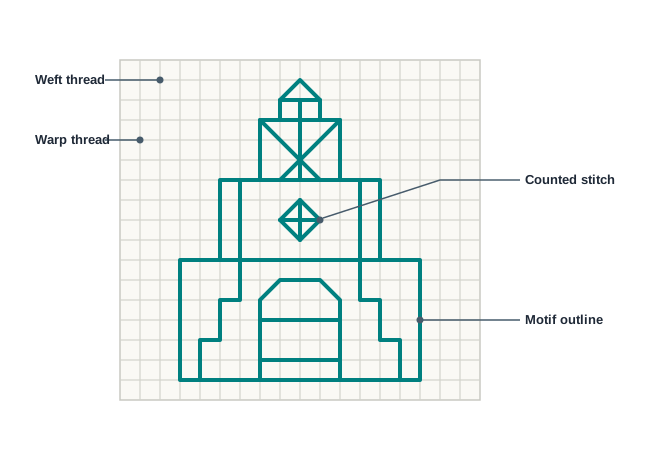
Fig. 7.28 – A counted-thread Kasuti motif.
7.19.3 Kantha
Kantha embroidery of Bengal is worked on a base prepared from three or four layers of old cotton saris or dhotis. The embroidery is like quilting — small running stitches passing through all the layers of the base material — and the article thus produced is also known as a kantha.
This embroidery may well have had its origin in darning, done to strengthen worn-out areas of cloth. Now the stitches fill up shapes that have been drawn on it, but the underlying logic has not changed: the running stitch both decorates the cloth and holds its layers together.
It generally has a white base with embroidery in multicoloured threads, and these threads were originally pulled out from the borders of the old saris themselves. The articles made vary from a small comb case or wallet to shawls of various sizes. There are also kanthas of ritual importance, made for presentation to religious places or for use on special occasions.
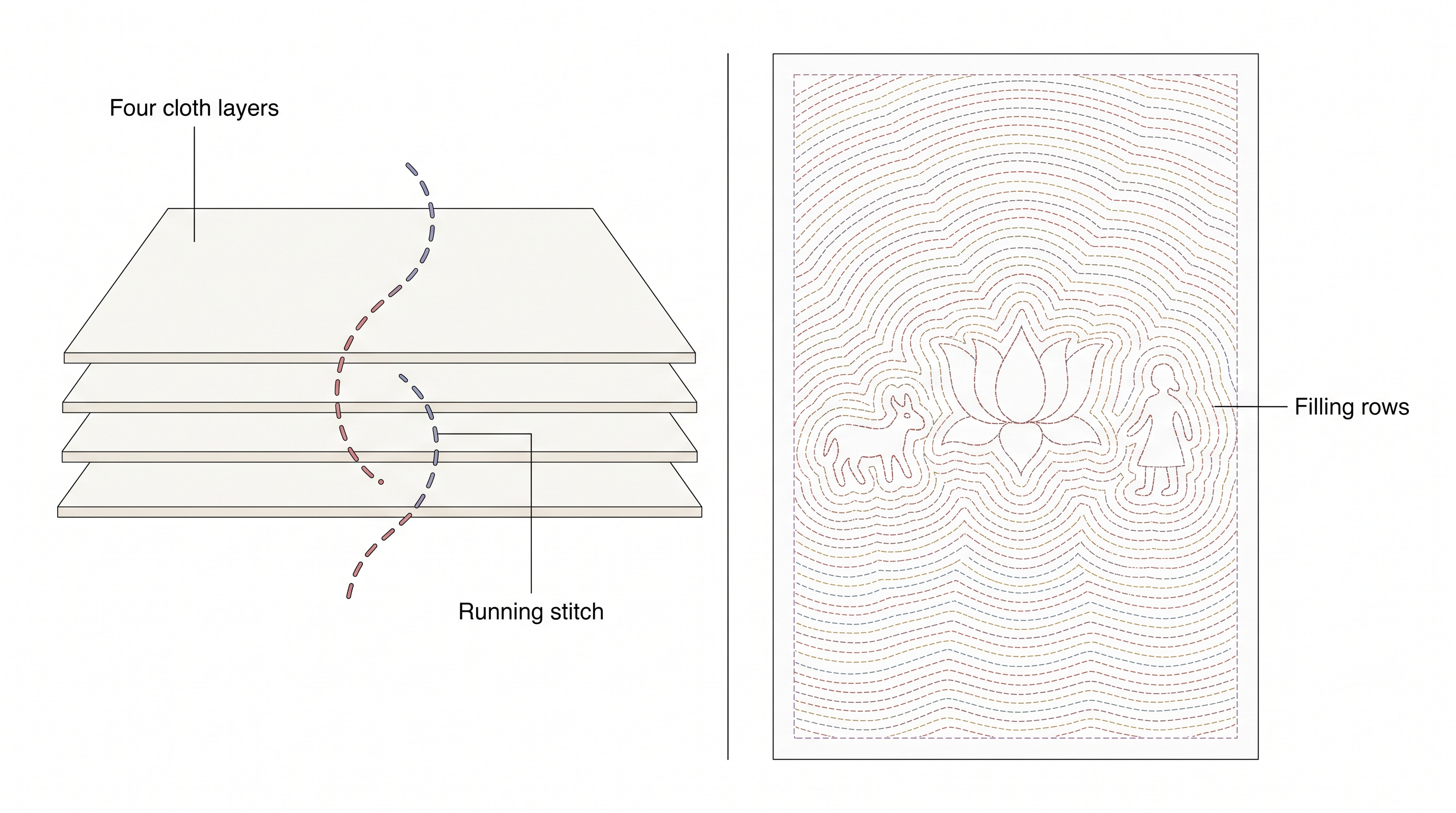
Fig. 7.29 – Kantha embroidery and running stitch.
7.19.4 Kashida
Kashida is the general term used for embroidery in Kashmir. Its two most important forms are suzani and zalakdozi.
Kashmir being the land of wool, the embroidery is done on woollen fabrics — from the finest shawls, to cloaks of medium thickness called pherans, to the thick namdas used as floor coverings.
On shawls and fine woollens the embroidery perhaps had its origin in repairing the defects that occurred during weaving. Later, the multicoloured weaving patterns themselves were copied in thread, and to these were added the styles of Chinese embroidery — the satin stitch and the long and short stitch.
Suzani embroidery includes all the stitches that lie flat on the surface and show uniformity on both sides of the material. It is done with silk threads, in a multitude of colours and shades, so that the designs look natural.
Zalakdozi is chain stitch embroidery done with an ari — a hook like the one cobblers use, rather than a needle. Originally it was worked mainly on namdas, but it is now done on all kinds of material, including shawls. A hook lays down chain stitch far faster than a needle can, which is one reason this form suits work made for sale.
Unlike the other embroideries described here, Kashmir embroidery is a commercial activity, worked by men, and it therefore follows the demand of its buyers.
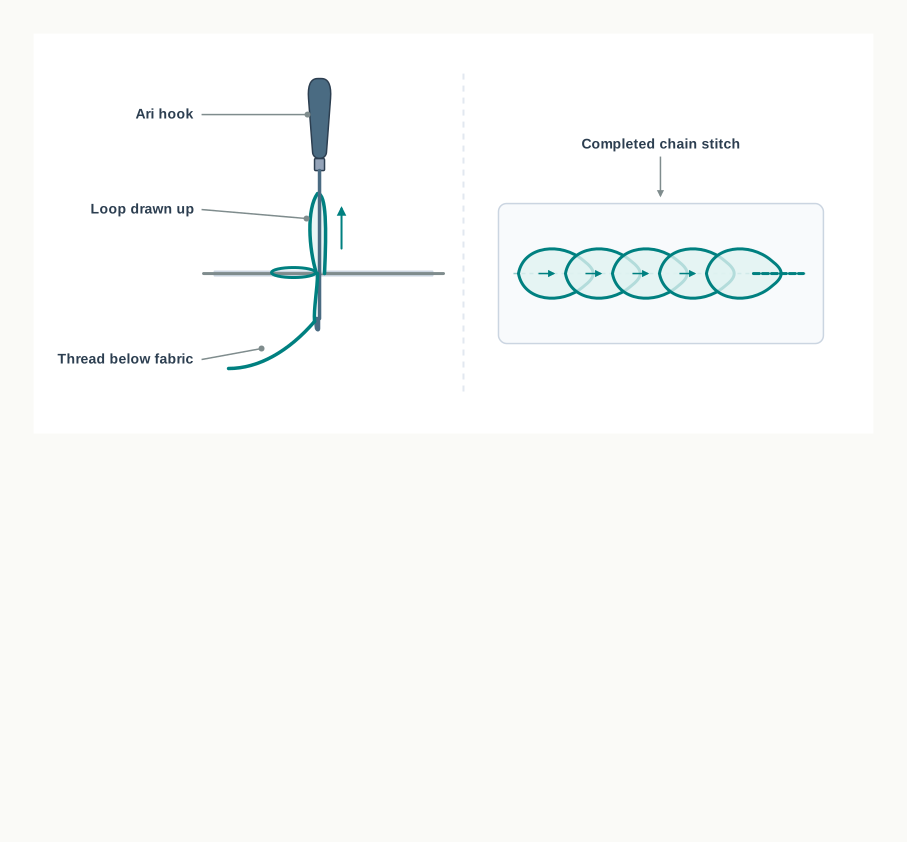
Fig. 7.30 – Zalakdozi worked with an ari hook.
7.19.5 Chikankari
Chikankari of Uttar Pradesh is the embroidery that was commercialised at a very early stage. The main needlework is done by women, while the master craftpersons and the organisers of the trade are mainly men. Lucknow is considered the main centre for the work.
Originally it was done on white material with white thread, so that the whole design had to be produced by texture rather than by colour. Three main effects do this work.
- Shadow work, produced by embroidering on the wrong side of the material, so that the thread shows softly through a fine fabric.
- A net-like surface, produced by tightening the yarns of the fabric with the embroidery so that small openings are formed.
- Raised patterns on the face of the fabric, produced by a knotting stitch that resembles grains of rice or millet.
The past few years have also seen the inclusion of zari threads, small beads and shiny discs, called sitara, in the designs. Since it is a commercial activity, the designs and styles keep changing with fashion.
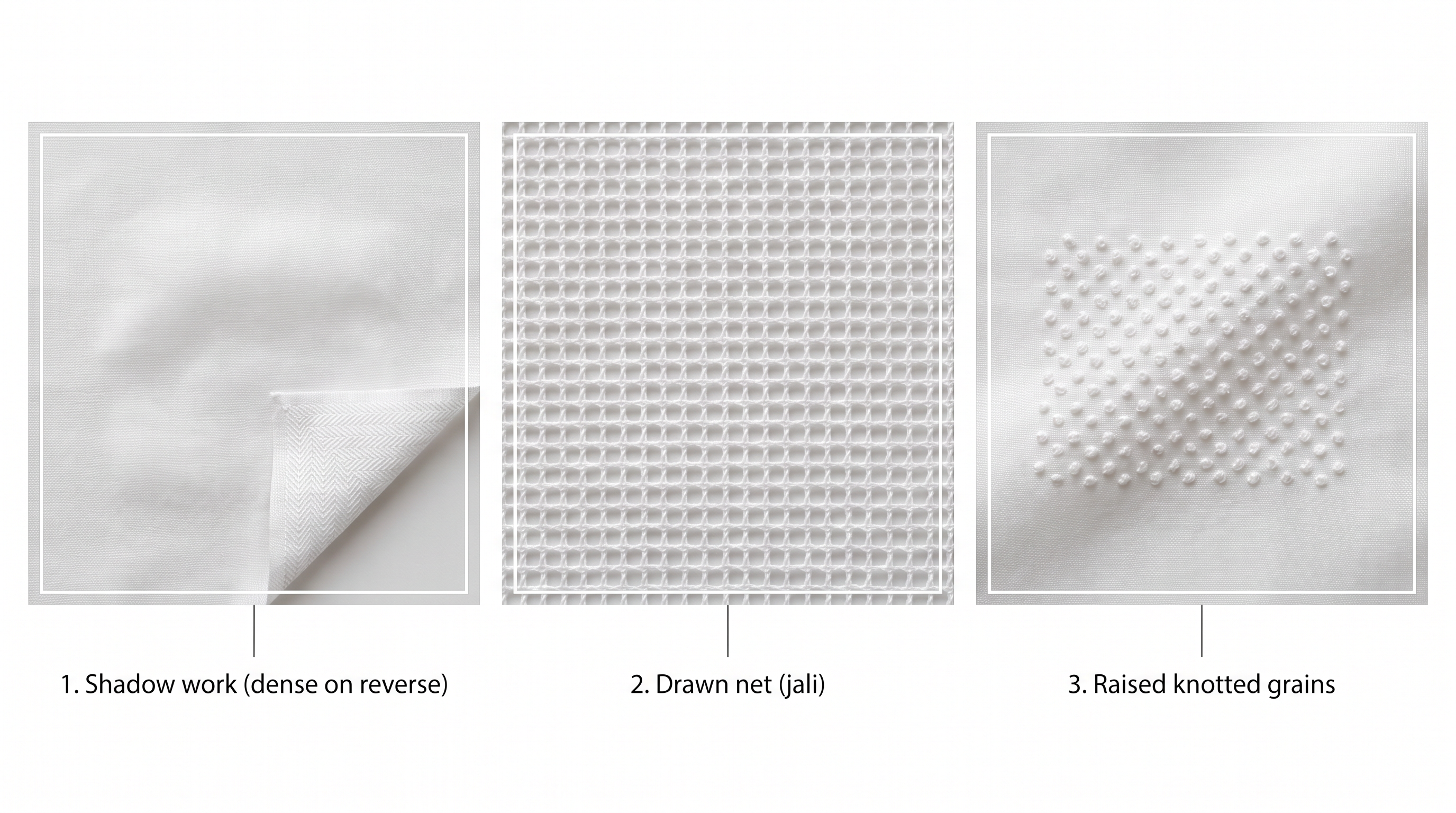
Fig. 7.31 – The three effects of Chikankari embroidery.
7.19.6 The Embroideries Of Gujarat And Rajasthan
Gujarat has a very rich tradition in embroidery. It has been a land of nomadic communities, and this has made it responsible for the amalgamation of designs and techniques drawn from various cultures.
Here embroidery is used for every aspect of life. Doorways are decorated with torans or pachipattis, and walls with chaklas or chandrawas and ganesh sthapnas — all of them portable, which matters in a nomadic way of life. Garments are embroidered for men, women and children in styles specific to different communities, and coverings are made for cattle, horses and elephants. Many of the embroideries are known by the names of the communities that work them — Mahajan, Rabari, Mochibharat, Kanbibharat and Sindhi. Most of the colours used are bright.
Appliqué work in Gujarat has its own style. It is a patchwork, in which pieces of fabric carrying different designs are cut into different sizes and shapes and sewn onto a plain background, and it is used mainly on household items.
Bead work, of Saurashtra and Kutch, is an important art of the region though it is not an embroidery at all. It is the interlacing of differently coloured beads through a network of threads, worked to create coverlets for utensils, hangings and purses.
The closeness of Gujarat and Rajasthan, and the presence of tribal communities in Rajasthan as well, has resulted in embroidery of a similar style there. The colours and the motifs used vary from one community to another, and with the occasion for which the piece is made.
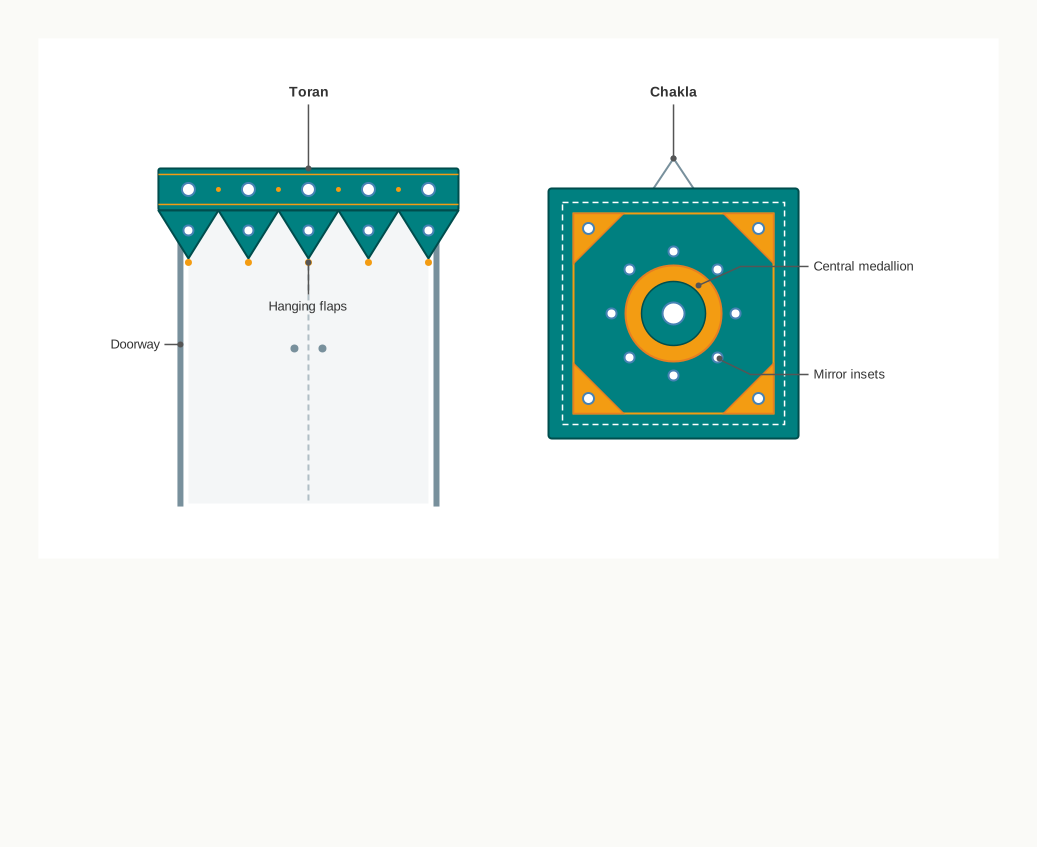
Fig. 7.32 – A toran doorway hanging and a square chakla.
7.19.7 Chamba Rumals
Chamba rumals, from the erstwhile hill state of Chamba in Himachal Pradesh, were made mainly for covering trays of gifts when these were presented to dignitaries or special guests.
They depicted mythological scenes similar to those of Pahadi paintings, using running stitch for the outline and darn stitch for the filling. At their best, the scenes appeared the same on either side of the textile — which is what a cloth laid over a tray and seen from every direction requires.
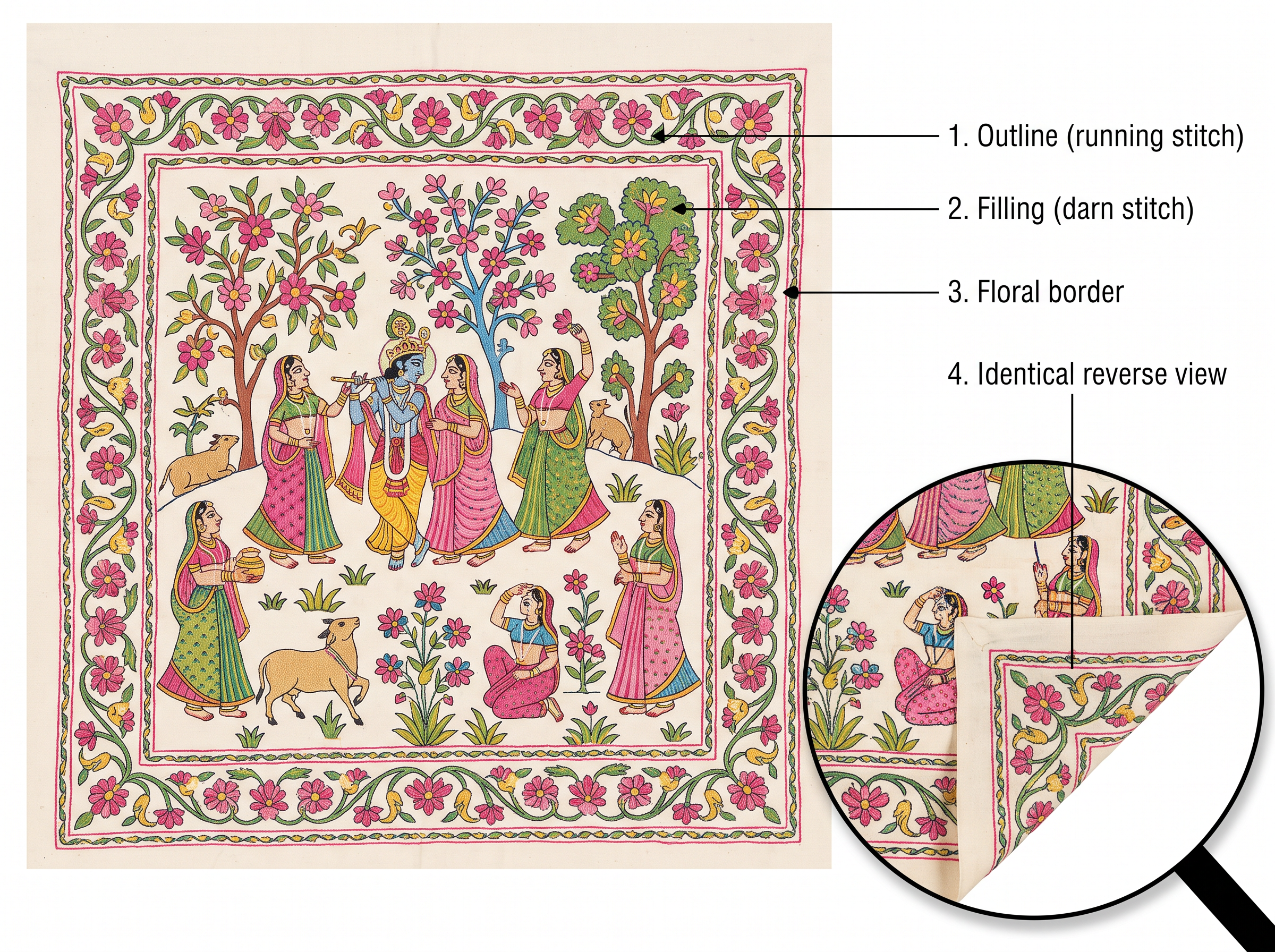
Fig. 7.33 – A Chamba rumal.
The seven traditions are compared in Table 7.7.
7.20 Textile Traditions Today
India has beautiful textiles, recognised the world over for their beauty and craftsmanship. What is less often noticed is where that richness came from.
Repeated and persistent invasions, migrations, political upheavals and many other ups and downs led to a synthesis that enriched the textile craft of India. The richness and diversity of the contemporary forms practised here owe a great deal to the coexistence of numerous cultural strains on its soil. Almost every craft you have read about in this chapter carries more than one tradition inside it.
Specific geographical regions have age-long traditions associated with fabric production. These traditions differ by fibre group — cotton, silk and wool — and by process: spinning, weaving, dyeing and printing, and surface ornamentation.
With changing times, the production centres have evolved their own grammar of colour, design and ornamentation, and their own conventions about which products each pattern belongs on. That is what allows a length of cloth to be identified by region at a glance, and it is also what makes change difficult, because the grammar is what the buyer recognises.
Old Crafts, New Products
A large number of these centres continue to be important in the social and economic life of their regions. They matter not only for producing the items associated with religious and social rites, but also for their effort to make a statement that fits contemporary usage.
This is why craftspersons have turned to product diversification — making a wider range of articles from the same craft — and to alternate uses of traditional textiles. Gradually, the emphasis is also shifting from customised products made for a particular household to mass production for a wider market.
Almost all the traditions of Indian textiles have survived, and new design development has only enriched these age-old traditions rather than displacing them. Numerous government and non-government organisations, along with many academic institutions, have joined hands to preserve, revive and contemporarise them.
Whether a tradition survives is finally settled in the market, not in a museum. A craft continues where the person who makes it can earn from it, and every one of these efforts is aimed at that single point.
7.21 Summary
- The World Health Organisation defines health as a state of complete physical, mental and social well-being, and not merely the absence of disease.
- Disease is an impairment of body health — an alteration or disruption in the function of some part or organ, which interrupts normal functioning.
- Health is a fundamental human right, recognised in the Universal Declaration of Human Rights of 1948, and it belongs to every person irrespective of age, gender, caste, religion, nationality or place of stay.
- Health has three dimensions:
- social health — how a person gets along with other people and social institutions, and whether a society gives all its citizens equal access to what health requires;
- mental health — emotional and psychological well-being, shown in the ability to use one’s capabilities, cope with ordinary stress and recover from setbacks;
- physical health — physical fitness and the functioning of the body, shown in normal activity, absence of unusual fatigue and resistance to infection.
- Social support helps a person cope with problems and stress, and persons who are socially well adjusted tend to live longer and recover faster from disease.
- The social determinants of health include employment status, safety in workplaces, access to health services, cultural and religious beliefs and taboos, and socio-economic and environmental conditions.
- Health care consists of all services provided to individuals or communities for promoting, maintaining, monitoring or restoring health, and it includes preventive, promotive and therapeutic care.
- Health care is delivered at three levels:
- primary health care, the first level of contact;
- secondary health care, reached on referral to a specialised hospital such as a district hospital;
- tertiary health care, reached on referral for specialised intensive care and advanced diagnostic support.
- Because health is multidimensional, it is assessed through several indicators — mortality, morbidity, disability rates, nutritional status, health care delivery, utilisation, environment, health policy and quality of life.
- Nutrition maintains the structure and functioning of the body’s organs and tissues, and supports growth and development.
- The link between nutrition and health runs both ways, since health status in turn determines nutrient requirements and food intake.
- There are more than fifty nutrients in food, classified by the amounts the body requires:
- macronutrients — fat, protein, carbohydrate and fibre;
- micronutrients — minerals such as iron, zinc and selenium, and the fat-soluble and water-soluble vitamins.
- Nutrient requirements vary with age, sex and physiological state, and the level of physical activity raises the requirement for energy and for the nutrients involved in energy metabolism.
- A balanced diet includes foods that together provide all the necessary nutrients in the amounts the person requires.
- The science of nutrition covers access to, availability of and utilisation of food and nutrients; clinical nutrition deals with the body in disease states, and public health nutrition with the nutritional problems of populations.
- What and how much a person eats depends on taste, on food security, on purchasing power, on the environment, on national and international policies, and on culture, religion, social status, beliefs and taboos.
- Optimum nutritional status maintains body weight and muscle mass, decreases the risk of disability, provides resistance to infection, helps a person cope with stress, and improves productivity.
- Malnutrition is a deviation from the normal state of nutrition, resulting either from intake below the requirement, which is undernutrition, or from intake in excess of it, which is overnutrition.
- Four factors are important for nutritional well-being — food and nutrient security, care for those who are vulnerable, good health for all, and a safe environment.
- Undernutrition in India is seen in low birth weight, which is a birth weight below 2500 g, and in underweight and stunted young children, alongside iron deficiency anaemia, vitamin A deficiency and iodine deficiency.
- Undernutrition damages cognitive development and immunity and can cause disability; iodine deficiency causes goitre, still birth and miscarriage in women, and impaired hearing, speech and mental development in children; iron deficiency impairs development in children and raises risk for the mother in pregnancy.
- Overnutrition may cause toxicity of some nutrients and lead to overweight and obesity, which increase the risk of diabetes, heart disease and hypertension; India carries undernutrition and overnutrition together, which is called the double burden of malnutrition.
- Nutrition and infection form a cycle — poor nutritional status lowers resistance, infection raises requirements and drains reserves, and intake falls at the same time, so each turn leaves the person worse nourished.
- Diseases are linked with intrinsic or host factors, which belong to the person, and extrinsic or environmental factors, which act from outside; sanitation and hygiene, nutrition and immunisation are the key inputs.
- Hygiene has two aspects — personal hygiene, covering the body, clothing and daily habits, and environmental hygiene, covering water supply, food sanitation, disposal of excreta, sewage and garbage, housing, sanitary practices and vector control.
- A food-borne illness occurs only when three conditions hold together: the organism or its toxin is present in the food, the pathogenic organisms are present in sufficient numbers, and the contaminated food is consumed in sufficient quantity.
- Micro-organisms multiply fastest between 4 °C and 60 °C, so food kept standing in this range, cooled improperly or reheated inadequately becomes unsafe.
- Time is a limited and irreversible resource; its supply cannot be altered, so only its use can be planned.
- The principle of time management is to concentrate on results, not on being busy.
- A time plan is an advance schedule of activities to be performed in a given period, and it is made according to the individual needs, goals and routine of the person concerned.
- A time and activity plan is built by starting work promptly, keeping a routine, prioritising, declining low-priority tasks, dividing big tasks, handling one task at a time, fixing start and stop times, and scheduling the whole day with leisure included.
- Activities are compulsory — daily, weekly, monthly or yearly — or optional, and only the optional ones can be shifted when time is short.
- Plans are recorded through a to-do list, a daily or weekly planner, and a long-term monthly planner.
- The tools in time management are:
- the peak load period, the stretch carrying the maximum load of work;
- the work curve, which traces work against time and shows the warming-up period, the plateau of maximum ability and the fall due to fatigue;
- rest periods, which should be neither too long nor too short;
- work simplification.
- Work simplification is the conscious seeking of the simplest, easiest and quickest method of doing work, blending the resources of time and human energy.
- Work is simplified at three levels of change:
- change in hand and body motions — eliminating and combining processes, improving sequence and rhythm, developing skill, and improving body posture;
- change in work, storage space and equipment, including the use of labour-saving devices;
- change in the end product, through different raw materials, different products from the same materials, or both.
- Good posture keeps the body parts in alignment so that the skeleton carries the weight and the muscles are released from strain.
- Space management is the planning of space, organising it as per the plan, implementing the plan in use, and evaluating it for functionality and aesthetic appeal.
- Homes identify particular areas for particular activities, and where fewer rooms are available the same room serves several activities in turn.
- The principles of space planning are aspect, prospect, privacy, grouping, roominess, furniture requirements, sanitation, circulation, practical considerations and elegance.
- Privacy is of two kinds — internal privacy of one room from another, and external privacy of the house from neighbouring buildings and public streets.
- Sanitation in space planning covers light, ventilation, and cleanliness with sanitary conveniences; windows placed opposite each other give good ventilation.
- Fabric decays faster than bone, stone or metal, so early textiles are known largely from sculpture, literature, paintings and surviving tools such as spindle whorls and needles.
- Cloth fragments, terracotta spindles and bronze needles from Mohenjo-daro show that spinning, weaving, dyeing and embroidery in India are at least 5000 years old.
- India was the first civilisation to master fast dyes on cotton, which made Indian chintz famous abroad and earned Indian craftspersons the name of master dyers to the world; from the 15th century CE India was the greatest exporter of textiles known.
- Indian fabric production rests on three main natural fibres — cotton, silk and wool.
- The finest cotton was the mulmul khas of Dacca, and the Jamdani of Bengal and North India is among the finest brocade products of Indian weaving.
- In a brocade, extra patterning yarns of silk, cotton or metallic zari are transfixed between the regular weaving.
- The important silk centres are Varanasi for kinkhwab, West Bengal for Baluchar Butedar, Gujarat for Ashavali, Kanchipuram for brocaded silk saris, and Paithan for the tapestry-woven Paithani.
- Tapestry weave uses discontinuous weft yarns, which allows many colours in a row and makes the fabric look the same on both faces.
- Kashmir shawls are woven in pashmina, the fine undercoat of the mountain goat, and are patterned with the mango or paisley motif; the shawls of Himachal Pradesh, and of Kullu in particular, use angular geometrical motifs in bands.
- Until the middle of the 19th century CE all dyes came from natural sources — mainly plants, and also some insects and minerals.
- In resist dyeing, selected parts of yarn or fabric are prevented from absorbing dye and so keep the colour of the ground; dyeing always proceeds from light colours to dark.
- In fabric tie and dye, the woven cloth is tied and dyed, giving bandhej with its innumerable dots and laheria with its diagonal stripes; Gujarat and Rajasthan are the homes of these fabrics.
- In yarn tie and dye, or ikat, the yarns are tie-dyed before weaving:
- single ikat, where one set of yarns is treated;
- combined ikat, where both sets are treated and create separate patterns;
- double ikat, where both are treated to create one unified pattern.
- Patola of Patan in Gujarat is a double ikat silk sari; Bandha of Odisha is single or combined ikat with curvilinear designs; the Telia Rumals of Pochampalli and Chirala are square cotton ikat cloths woven in pairs.
- Embroidery is the surface ornamentation of fabric with threads worked by a needle or needle-like tool, and in India it was practised at every socio-economic level, on every fabric, with every kind of thread and material.
- The main embroidery traditions are:
- Phulkari of Punjab, worked in untwisted silk floss on coarse khaddar;
- Kasuti of Karnataka, worked by counting the threads of the weave;
- Kantha of Bengal, running stitch quilting layers of old cotton;
- Kashida of Kashmir, including flat suzani work and ari-worked zalakdozi chain stitch;
- Chikankari of Lucknow, using shadow work, drawn net and knotted grains;
- the embroideries of Gujarat and Rajasthan, with appliqué and bead work;
- Chamba rumals of Himachal Pradesh, worked alike on both faces.
- Almost all these traditions have survived, and craft centres are today diversifying their products and shifting from customised work towards production for a wider market, supported by government and non-government organisations and academic institutions.
7.22 Key Terms
- Activity plan — a plan setting out which activities are to be carried out and in what order, made together with the time plan.
- Aspect — the arrangement of doors and windows in the external walls of a building, which lets the occupants enjoy sunshine, breeze and scenery.
- Ashavali — the brocade sari of Ahmedabad, patterned in coloured threads on a gold or silver metallic ground.
- Bagh — a phulkari so heavily embroidered that the base fabric shows only on the reverse; the word means a garden.
- Balanced diet — a diet of foods that together supply all the nutrients a person needs, in the amounts she requires.
- Baluchar Butedar — the silk brocaded sari of Baluchar in West Bengal, with figured scenes worked in untwisted silk in its pallav.
- Bandha — the ikat tradition of Odisha, single or combined, with curvilinear designs and small figures in extra weft.
- Bandhani — fabric tie and dye of Gujarat and Rajasthan in which the pattern is made of innumerable small reserved dots.
- Brocade — a fabric in which extra patterning yarns of silk, cotton or metallic thread are transfixed between the regular weaving.
- Chamba rumal — an embroidered square cover from Chamba, Himachal Pradesh, worked in running and darn stitch so that the scene reads alike on both faces.
- Chikankari — the white-on-white embroidery of Lucknow, combining shadow work, drawn net surfaces and raised knotted grains.
- Chintz — printed and painted Indian cotton cloth, whose fast colours transformed European fashion in the 17th century CE.
- Circulation — the movement of air from room to room, and the arrangement by which each living space is entered independently through a common space.
- Clinical nutrition — the branch of nutrition concerned with what happens in disease states and with how the body is nourished then.
- Colourfastness — the ability of a dyed fabric to keep its colour without fading or bleeding during washing, wear and exposure to light.
- Disease — an impairment of body health, in which the function of some part or organ is altered or disrupted so that normal functioning is interrupted.
- Double burden of malnutrition — the presence of undernutrition and overnutrition together in the same population.
- Elegance — the aesthetic effect produced by the general layout of a space plan, achieved without compromising on economy.
- Embroidery — the surface ornamentation of fabric with threads of silk, cotton, gold or silver, worked with a needle or needle-like tool.
- Environmental hygiene — hygiene of the surroundings at the domestic and community levels, covering water, air, housing, waste disposal and the control of pests and vectors.
- External privacy — the privacy of a house from neighbouring buildings, public streets and by-ways.
- Extrinsic factors — the environmental factors linked with disease, which act on a person from outside her body.
- Food and nutrient security — the condition in which every person can obtain adequate food and nutrients throughout the year, as her own requirements demand.
- Food hygiene — the practices that keep food safe from contamination and from the multiplication of micro-organisms in it.
- Food security — a person’s reliable access to enough safe and nourishing food.
- Grouping — the placing of rooms in relation to one another, so that connected rooms are near and incompatible ones apart.
- Health — a state of complete physical, mental and social well-being, and not merely the absence of disease.
- Health care — all the services provided to individuals or communities for promoting, maintaining, monitoring or restoring health.
- Hygiene — the set of practices that keep a person and her surroundings free of the agents that cause disease.
- Ikat — fabric made by tie-dyeing the yarns in measured sections before weaving, so that the pattern forms as the cloth is woven.
- Indicators of health — the several measures used to assess health, such as mortality, morbidity, nutritional status and quality of life.
- Internal privacy — the privacy of one room in a house from another.
- Intrinsic factors — the host factors linked with disease, which belong to the person herself.
- Jamdani — figured muslin of Bengal and North India, in which motifs are added to a fine transparent cotton ground by an extra patterning yarn.
- Kantha — the embroidery of Bengal, worked in small running stitches through three or four layers of old cotton cloth.
- Kashida — the general term for the embroidery of Kashmir, worked in silk on woollen fabrics.
- Kasuti — the embroidery of Karnataka, worked by counting the threads of the weave so that the stitches follow the fabric’s own pattern.
- Kinkhwab — the rich silk brocade of Varanasi, patterned densely with gold or silver zari.
- Laheria — fabric tie and dye in which the cloth is rolled diagonally before binding, producing diagonal stripes.
- Low birth weight — a birth weight below 2500 grams, whatever the length of the pregnancy.
- Macronutrients — the nutrients required in relatively larger amounts: fat, protein, carbohydrate and fibre.
- Malnutrition — a deviation from the normal state of nutrition, caused by intake either below or above the body’s requirement.
- Mental health — emotional and psychological well-being, seen in the ability to use one’s capabilities, cope with ordinary stress and recover from setbacks.
- Micronutrients — the nutrients required in small quantities: minerals such as iron, zinc and selenium, and the fat-soluble and water-soluble vitamins.
- Morbidity — the illness or disease present in a person or a population.
- Mulmul khas — the royal muslin of Dacca, the finest cotton fabric of the Indian tradition.
- Nutrients — the components of food that the body uses to build tissue, run its processes and supply energy.
- Nutrition — the process by which the body obtains and uses food for growth, development and the maintenance of its tissues and organs.
- Nutritional status — the condition of the body resulting from the intake of nutrients and the body’s use of them.
- Nutritionist — a professional who works in the field of nutrition, from its metabolic aspects to nutrition in disease and in populations.
- Overnutrition — malnutrition caused by an intake of nutrients in excess of the body’s requirements.
- Paisley — the mango motif of the Kashmir shawl, seen in countless varieties and colour combinations.
- Pashmina — the fine soft undercoat of the Changthangi mountain goat, used for the best Kashmir shawls.
- Patola — the double ikat silk sari of Patan, Gujarat, in which motifs have softened rather than sharp edges.
- Peak load period — the period during which the load of work is at its maximum within a specified stretch of time.
- Personal hygiene — hygiene of a person’s own body, clothing and daily habits.
- Phulkari — the embroidery of Punjab, worked in untwisted silk floss on coarse khaddar in long darning-stitch floats.
- Physical health — physical fitness and the functioning of the body, shown in normal activity, absence of unusual fatigue and resistance to disease.
- Potable water — water that is fit to drink.
- Primary health care — the first level of contact between an individual and the health care system.
- Product diversification — making a wider range of articles from the same craft, so that its market is not limited to one traditional product.
- Prospect — the impression a house makes on a person looking at it from outside.
- Public health nutrition — the branch of nutrition concerned with the nutritional needs and problems of whole populations.
- Resist dyeing — dyeing in which selected parts of yarn or fabric are barred from absorbing the dye, so that they keep the colour of the ground and form the design.
- Rest period — an unproductive interruption of working time, which restores output when its frequency and duration are correctly judged.
- Roominess — the spacious effect a room gives to those who live in it, which depends on storage, furniture, proportion and colour rather than on floor area alone.
- Sanitation — in space planning, the provision of ample light, ventilation, facilities for cleaning and sanitary conveniences.
- Secondary health care — the care received when a person is referred from primary health care to a specialised hospital, such as a district hospital.
- Shawl — a woven wrap for the shoulders, made in Kashmir in fine pashmina and in Himachal Pradesh in geometrically patterned wool.
- Social determinants of health — the conditions of a person’s life, such as employment, workplace safety and access to services, that shape her health before any illness appears.
- Social health — the health of individuals within a society and of the society itself, seen in relationships with people and institutions and in equal access to what health requires.
- Social support — the help and comfort available from the people around a person, which allows her to cope with problems and stress.
- Space management — the planning of space, organising it as per the plan, implementing the plan in use, and evaluating it for functionality and aesthetic appeal.
- Stunted — shorter than the expected height for one’s age, indicating a shortage of nutrients over a long period.
- Suzani — the Kashmir embroidery worked in flat surface stitches that look uniform on both sides of the material.
- Tapestry weave — a weave using discontinuous weft yarns, which allows many colours in a row and makes the fabric look the same on both faces.
- Telia Rumal — the square cotton ikat cloth of Pochampalli and Chirala, of 75 to 90 cm, woven in pairs.
- Tertiary health care — the care received on referral from the primary and secondary systems for specialised intensive care and advanced diagnostic support.
- Tie and dye — resist dyeing in which thread is wound tightly around parts of the yarn or fabric to bar the dye from them.
- Time management — the planned and deliberate use of one’s available time to accomplish what one has set out to do.
- Time plan — an advance schedule of the activities to be performed in a given period of time.
- Undernutrition — malnutrition caused by an intake of nutrients below the body’s requirements.
- Underweight — weighing less than the expected weight for one’s age.
- Wellness — well-being and quality of life sustained over time, which health work aims to promote.
- Work curve — a device that traces work done against time, showing the warming-up period, the plateau of maximum ability and the fall due to fatigue.
- Work simplification — the conscious seeking of the simplest, easiest and quickest method of doing work, blending the resources of time and human energy.
- Zalakdozi — the chain stitch embroidery of Kashmir, worked with a hook called an ari instead of a needle.
- Zari — metallic yarn of gold or silver, used for brocade patterning and in embroidery.
7.23 Points To Ponder
The definition of health you have studied sets a standard of complete physical, mental and social well-being. Almost nobody meets it entirely, at all times. Is a definition that so few people fully satisfy still a useful one to work with, and what would be lost if it were narrowed to the absence of disease?
A district carries undernutrition in some households and overnutrition in others at the same time. A single public message about food must therefore reach two groups whose needs point in opposite directions. How would you frame such a message so that it helps one group without harming the other?
The principle of time management asks a person to concentrate on results rather than on being busy. Some work — sitting with a young child, looking after an older person who is unwell, listening to someone who is upset — produces no result that can be shown at the end of the day. How should such work be counted in a time plan?
In a home with few rooms, the principles of privacy and of circulation can pull against each other, since every additional passage or partition takes away floor area. When the two conflict, on what basis would you decide which to favour?
Craft centres are shifting from customised products made for a particular household towards mass production for a wider market. At what point does such a shift stop being the survival of a tradition and become the making of a different product altogether? What would you look at to decide?
Most food-borne illness is traced to handling practices rather than to a lack of information — the practices are widely known and still not followed. What is it about the way a kitchen actually works, in a household or in a food stall, that makes safe practice difficult to sustain, and what change in the setting rather than in the person would help most?
7.24 Objective Questions
- Which of the following is not one of the dimensions of health named in the definition given by the World Health Organisation? (1 mark)
- Physical
- Financial
- Mental
- Social
- A person is sent on from a district hospital for advanced diagnostic support and specialised intensive care. She has been referred to: (1 mark)
- primary health care
- promotive care
- secondary health care
- tertiary health care
- Which group contains only micronutrients? (1 mark)
- Protein, fat, fibre
- Iron, zinc, selenium
- Carbohydrate, iron, water
- Fibre, thiamine, protein
- Cooked food should not be left standing within which temperature range? (1 mark)
- 0 °C to 4 °C
- 4 °C to 60 °C
- 60 °C to 100 °C
- Above 100 °C
- The double ikat sari woven in silk at Patan in Gujarat is known as: (1 mark)
- Bandha
- Baluchar Butedar
- Patola
- Telia Rumal
- The technique in which discontinuous weft yarns allow many colours in a single row, giving a fabric that looks the same on both faces, is: (1 mark)
- brocade weaving
- tapestry weave
- appliqué
- shadow work
- For the assertion and reason given below, choose the correct option. (1 mark) Assertion (A): In tie and dye, the areas bound with thread keep the colour of the ground. Reason (R): Tightly bound areas cannot absorb the dye from the dye bath.
- Both A and R are true, and R is the correct explanation of A.
- Both A and R are true, but R is not the correct explanation of A.
- A is true, but R is false.
- A is false, but R is true.
- For the assertion and reason given below, choose the correct option. (1 mark) Assertion (A): The heaviest task of a working spell should be placed on the plateau of the work curve. Reason (R): Output is at its highest during the warming-up period at the start of a spell.
- Both A and R are true, and R is the correct explanation of A.
- Both A and R are true, but R is not the correct explanation of A.
- A is true, but R is false.
- A is false, but R is true.
- For the assertion and reason given below, choose the correct option. (1 mark) Assertion (A): A person who eats a large quantity of food every day may still be undernourished. Reason (R): Malnutrition is judged against the body’s requirement for each nutrient, not against the size of the meal.
- Both A and R are true, and R is the correct explanation of A.
- Both A and R are true, but R is not the correct explanation of A.
- A is true, but R is false.
- A is false, but R is true.
Match the embroidery in Column A with its region in Column B. (1 mark) | Column A | Column B | |—|—| | a. Phulkari | i. Bengal | | b. Kasuti | ii. Punjab | | c. Kantha | iii. Karnataka |
Match the principle of space planning in Column A with its meaning in Column B. (1 mark) | Column A | Column B | |—|—| | a. Aspect | i. The relative position of rooms with respect to one another | | b. Prospect | ii. The arrangement of doors and windows in the external walls | | c. Grouping | iii. The impression a house makes on a person looking at it from outside |
Fill in the blank: The first level of contact between an individual and the health care system is called ______. (1 mark)
Fill in the blank: A birth weight below ______ grams is termed low birth weight. (1 mark)
Fill in the blank: The fine soft undercoat of the mountain goat, used for the best Kashmir shawls, is called ______. (1 mark)
State whether the following statement is true or false: Micronutrients matter less than macronutrients because the body needs them in small quantities. (1 mark)
State whether the following statement is true or false: A rectangular room looks more spacious than a square room of similar dimensions. (1 mark)
Name the metallic yarn used for patterning in brocade weaving. (1 mark)
Name the tool, used in place of a needle, with which zalakdozi chain stitch is worked. (1 mark)
Odd one out, and give a reason: Bandhani, Laheria, Patola, Chikankari. (1 mark)
Odd one out, and give a reason: peak load period, work curve, rest period, long-term planner. (1 mark)
7.25 Check Your Concepts
Define malnutrition and name its two forms. (2 marks)
List any four social determinants of health. (2 marks)
Give a reason why, in tie and dye, the dyeing is always carried out from the lighter colours towards the darker ones. (2 marks)
State the four purposes for which health care services are provided. (2 marks)
Differentiate between primary health care and tertiary health care, stating the basis of difference. (3 marks)
Explain, with one example, how a change in the end product can simplify work. (3 marks)
Why is a rest period described as an unproductive interruption of working time, when the work done after it is greater than it would otherwise have been? (3 marks)
Explain what is meant by a balanced diet, and give a reason why the same day’s menu may be balanced for one person and inadequate for another. (3 marks)
Differentiate between single ikat, combined ikat and double ikat, stating the basis of difference. (4 marks)
State the three conditions that must hold together for a food-borne illness to occur, and explain how correct storage and thorough cooking act on these conditions. (4 marks)
What would happen to the nutritional status of a child who suffers repeated episodes of diarrhoea over several months? Explain the cycle involved. (5 marks)
Define space management and explain any four principles that guide the planning of space inside a home. (5 marks)
Explain the three levels of change through which work is simplified, giving one example of each. (5 marks)
7.26 Identify & Label
Study Fig. 7.27. Identify the embroidery shown, name the stitch used, and state the ground fabric and the thread with which it is worked. (2 marks)
Study Fig. 7.25. Identify the three types of ikat shown, and state the basis on which they are distinguished from one another. (3 marks)
Study Fig. 7.34. Label the warming-up period, the plateau of maximum ability and the point of maximum fall due to fatigue, and state where in a working spell the heaviest task should be placed. (3 marks)
Study Fig. 7.35. Name the principle of space planning illustrated, label the inlet and the outlet, and state one effect on the occupants when this principle is ignored. (2 marks)
Study Fig. 7.22. Name the motif shown and the textile tradition in which it is most closely associated. (1 mark)
Study Fig. 7.36. Identify the aspect of hygiene shown, and name any three practices illustrated in it. (2 marks)
7.27 Case & Application Based Questions
- A two-year-old child in a household has had three episodes of diarrhoea in four months. The household draws its drinking water from a hand pump, and the water is stored uncovered in the kitchen. Cooked food is kept on the kitchen shelf and eaten again in the evening without reheating. The child has recovered each time, but is now shorter and lighter than the other children of her age in the neighbourhood.
- Identify two practices in this household that could be causing repeated infection, and state the reason in each case. (2 marks)
- Explain why the child’s growth has been affected even though she eats the same food as the rest of the household. (3 marks)
- Suggest two changes in food handling, and state the principle each one works on. (2 marks)
- Which factor of nutritional well-being is weakest in this household? Give a reason for your answer. (1 mark)
- A household of five lives in two rooms with a small kitchen. One member studies late at night, one leaves for work at five in the morning, and an older member of the family sleeps early and finds it difficult to climb steps. The single window of the inner room faces a wall of the neighbouring house, and the kitchen has no ventilator. Most belongings are stored in trunks on the floor.
- Name two principles of space planning that are not being met here, and state how each is being violated. (2 marks)
- Suggest one change that would improve roominess in the inner room without any construction work, and explain why it would work. (2 marks)
- Explain why the kitchen needs attention before the other rooms do. (2 marks)
- Suggest one arrangement that would give the studying member and the older member privacy from each other, using the means available in a small home. (2 marks)
- A shopkeeper shows a customer two shawls. The first is described as woven in Kullu, and carries bands of angular geometrical motifs at both ends. The second is described as a Kashmir shawl, is very fine and soft, and is patterned with a repeated curved motif with a curled tip. The shopkeeper adds that the second shawl is shahtoosh, and that it is a rare bargain at the price offered.
- Name the motif on the second shawl and the fibre a genuine shawl of this kind is woven from. (2 marks)
- State two features by which the first shawl can be identified as coming from Himachal Pradesh rather than from Kashmir. (2 marks)
- Comment on the shopkeeper’s claim about the second shawl, giving a reason. (2 marks)
- Name one certification mark the customer could look for, and state what it certifies. (2 marks)
- A person works a six-hour shift in a small canteen, with the busiest stretches between 8:00 am and 10:00 am and again between 1:00 pm and 2:00 pm. She washes the utensils and wipes each one dry, sweeps the floor with a short-handled broom, and by the end of the shift has a persistent ache in her back. She takes one long break of fifty minutes in the middle of the shift.
- Identify the peak load periods in this shift. (1 mark)
- Suggest one change at the level of hand and body motions, and one at the level of work, storage space and equipment, that would reduce her fatigue. State the reason for each. (4 marks)
- Comment on her pattern of rest, using what you know about the work curve. (2 marks)
- Explain the principle by which a long-handled broom reduces strain. (1 mark)
7.28 Practice With Data
- The record below shows how one working day of twenty-four hours was spent by a member of a household.
| Activity | Hours |
|---|---|
| Sleep | 7 |
| Cooking and serving meals | 4 |
| Cleaning, washing and other household work | 3 |
| Paid work outside the home | 5 |
| Travel to and from work | 1 |
| Care of a family member who is unwell | 2 |
| Personal activities, including meals | 1 |
| Leisure and rest | 1 |
- Add the hours spent on all household work, and state what fraction of the waking day this represents. (2 marks)
- Which two entries would you expect to fall within the peak load periods of this day? Give a reason. (2 marks)
- Classify any four of these activities as compulsory daily, compulsory weekly, or optional. (2 marks)
- This person reports that she is always tired by evening. Suggest two changes to the plan, drawn from work simplification and from the placing of rest periods, and give the reason for each. (4 marks)
- Suppose the output of a worker packing dry goods was counted at the end of every hour of a six-hour shift, with a break taken after the third hour. The counts were as follows.
| Hour of the shift | Packets completed |
|---|---|
| 1 | 34 |
| 2 | 46 |
| 3 | 38 |
| 4 | 44 |
| 5 | 40 |
| 6 | 29 |
- In which hour is the warming-up period visible, and how do the figures show it? (2 marks)
- State the hour of highest output before the break and the hour of highest output after it, and comment on the difference between the two. (2 marks)
- Calculate the fall in output between the second hour and the sixth hour, and express it as a percentage of the second hour’s output. (2 marks)
- Using these figures, suggest a change in the timing or number of breaks in this shift, and give a reason for your suggestion. (2 marks)
7.2.1 Social Health
Social health refers to the health of individuals and of a society, and it has to be read at both levels. Take the wider level first.
A socially healthy society is one in which there is equal opportunity and access for all citizens to the goods and services essential for good health. Clean water, food, schooling, transport and medical care all count here. Where these reach only some people, the society itself is not in good health, however well its richest members may be doing.
At the level of the individual, social health means how well a person gets along with other people and with social institutions. It covers her social skills and her ability to function as a member of society — in a family, a classroom, a workplace, a neighbourhood.
This matters most when things go wrong. When we face problems and stress, social support — the help and comfort available from the people around us — allows us to cope with the difficulty and work out a solution. Social support measures contribute to positive adjustment in both children and adults, and encourage personal growth.
Emphasis on social health is gaining importance, because scientific studies have shown that persons who are socially well adjusted tend to live longer and to recover faster from disease. The company a person keeps is therefore not merely pleasant; it is protective.
Certain conditions of a person’s life shape her health long before any doctor sees her. These are called the social determinants of health. A few of them are:
Look at that list again and notice where the power to change each item lies. Almost none of it sits with the individual alone.
The phrase ‘social determinants of health’ is used by the World Health Organisation for the conditions in which people are born, grow, work and age. It was coined to make a simple point: two people with the same body may face very different health outcomes because of where and how they live.