Chapter 10: Financial Management And Planning
Ten Rupees Each
In Ahmedabad, in the early 1970s, thousands of people earned their living as vegetable vendors, cart pullers, waste collectors and home-based stitchers. They earned in coins, every day, and spent the same coins by evening. When a cart needed repair, or a wholesaler had to be paid in advance, they borrowed from moneylenders at rates that swallowed a whole day’s earnings.
In 1972 these workers organised themselves into the Self-Employed Women’s Association (SEWA), a trade union of self-employed workers. They approached banks for loans. The banks turned them away. The workers owned no land or gold to pledge, they kept no written accounts, and many of them could not sign their names.
So in 1974 they built a bank of their own. About four thousand members each put in ten rupees as share capital, and the Shri Mahila SEWA Sahakari Bank opened as a cooperative bank owned by its own depositors. Passbooks carried photographs, so that a member who could not sign could still be identified. Savings were collected in very small amounts, often daily. Loans were given against a member’s record of repayment rather than against property.
The bank worked, and it is still working. Ten rupees is not a large sum. Four thousand people saving ten rupees each, every one of them clear about what the money was for, is.
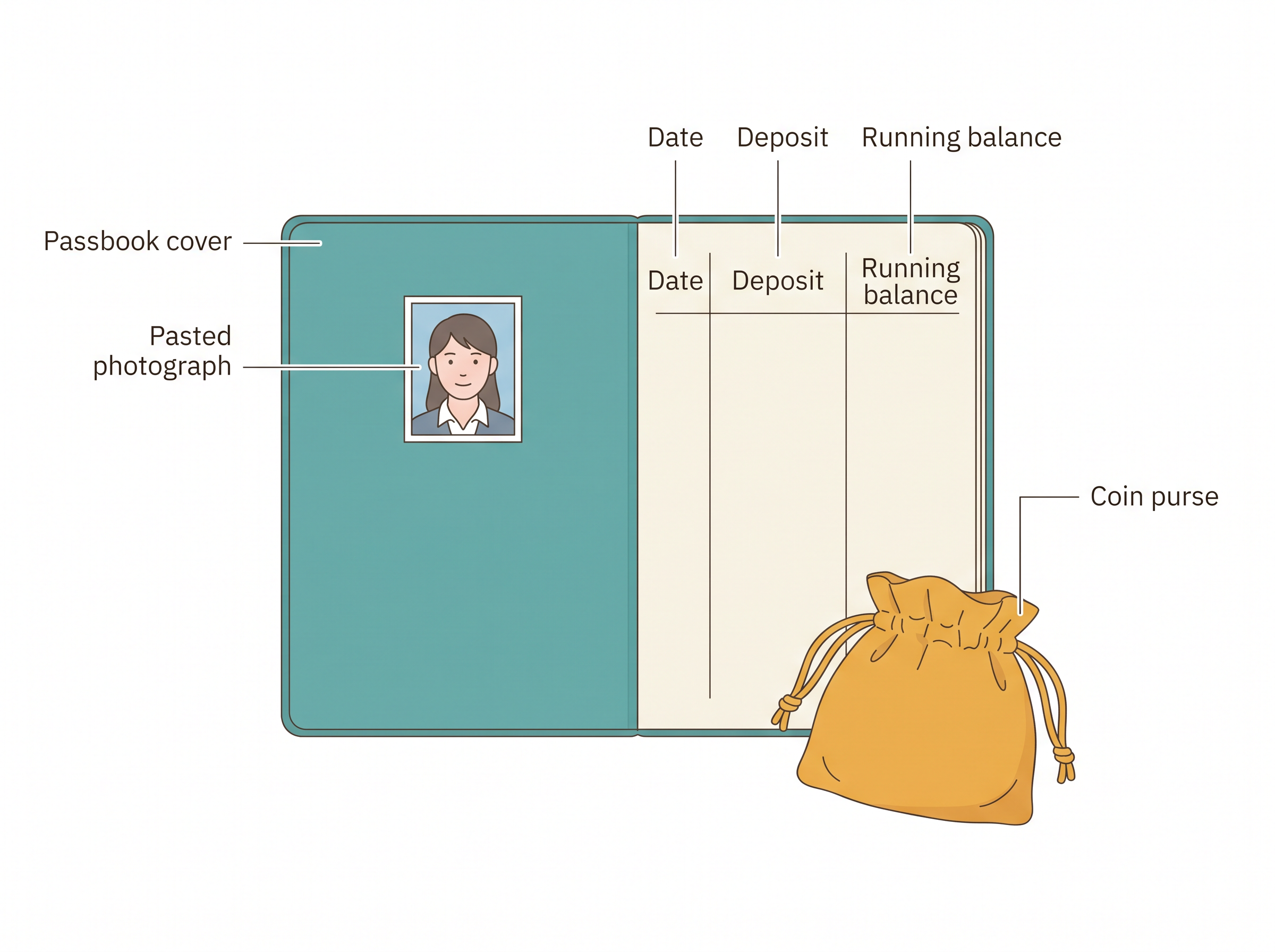
Fig. 10.0 – A daily savings passbook.
10.1 Introduction
Every household handles money. Rent is paid, vegetables are bought, a cousin’s wedding gift is arranged, a scooter is repaired, and something is put away for the fees due in June. Some households do all this with a plan, and some do it as each demand arrives.
The difference between the two is not usually the size of the income. It is whether the money is being managed. This chapter is about that skill, and about the tools a family uses to exercise it.
10.1.1 Financial Management
Financial management, in the context of a family, simply means the management of its finances. Finances here are all the types of income available to a family. They include salary, wages, rent, interest, dividends, bonus, retirement benefits and every other form of monetary receipt.
Managing these incomes means doing three things with them. The family plans how they will be used, controls the use as it happens, and afterwards evaluates whether the use was worth it. The three stages are set out in Fig. 10.1.
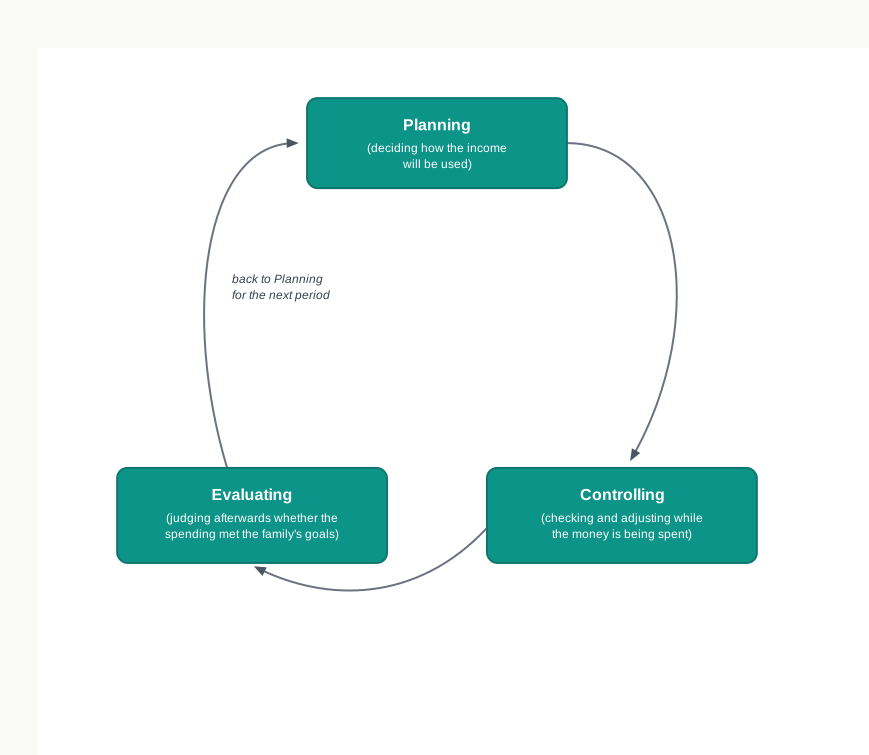
Fig. 10.1 – The three stages of financial management.
Notice that the arrow returns to the start. What a family learns from one month’s evaluation is exactly what improves the next month’s plan.
The phrase ‘greatest satisfaction’ is doing real work in that definition. The test of good financial management is not how much money is left over. It is whether the money did what the family most wanted done.
Why The Pattern Of An Income Matters
The quality of living a family can obtain in exchange for its money depends on how much income there is. But it depends just as much on how regular and how stable that income is.
An income that arrives in a predictable amount at a predictable time can be planned against. An income that arrives in uncertain amounts at uncertain times has to be managed with far more care, even when the yearly total is the same. This is why managing money is a skill to be learnt, and not simply a matter of earning more.
10.1.2 Financial Planning
Financial planning is one component of financial management — the first stage of the three. It is the stage at which a family decides, in advance, what its money will be used for.
The everyday word for a financial plan is a budget, a written statement of expected income and intended expenditure for a period ahead. When a family makes a budget, it is checking that the income will cover the present needs of every member and still leave something for the family’s long-term goals.
Planning does three things for a family that unplanned spending cannot do. It helps the family reach its objectives by making the best possible use of the resources it has. It cuts down money lost on non-essentials. And because a share of the income is set aside before it can be spent, it makes saving possible at all.
None of this happens by writing the plan alone. The family has to watch how the plan is running and review it from time to time, and every member has to be committed to it. A budget that one member follows and the others ignore will not show results.
10.1.3 Management And Family Resources
Management is using what you have to achieve what you want. What you have are resources; what you want are goals and objectives.
Family resources are the resources available to an individual or a family at a particular time, which help them reach their family goals. The phrase ‘at a particular time’ matters — a resource a family cannot call upon today is not, today, a resource. Family resources fall into three groups, set side by side in Table 10.1.
A family that has listed only its material resources has under-counted itself badly. The hours a member can give, the cooking or stitching or accounting she or he knows how to do, and the free reading room down the road are all resources, and all of them stretch the money further.
The Family As A Consumption Unit
A family is a social unit, but it is also a consumption unit: it buys, uses and consumes goods and services together, and its finances are handled for the well-being of all its members.
Money is one of the important resources a family holds, and a family cannot live comfortably without enough of it. Managing that money well enough to meet present needs and still reach future goals is a learned skill, not an instinct. The rest of this chapter takes that skill apart, beginning with the income itself.
10.2 Family Income
Family income means the sum total of the income of all types, and from all sources, of all the members of a family in a given time period. Two things in that sentence are easy to miss.
The first is ‘all the members’. A grandmother’s pension and a son’s part-time earnings belong in the family income exactly as a salary does. The second is ‘a given time period’. Income only means something when it is attached to a stretch of time, so it may be counted as annual, monthly, weekly or daily income.
For official purposes, family income is taken as the annual income earned in a financial year. In India the financial year generally runs from 1 April of one year to 31 March of the next. Tax records, salary statements and most government forms use this year, so a family that keeps its accounts on the same cycle finds them far easier to fill.
10.2.1 The Forms In Which Income Comes
Income does not reach a family in one shape. It may be in the form of
- Wages
- Salary
- Profits from business
- Commissions
- Rent from properties
- Interest on cash loans
- Dividends
- Pensions
- Gifts
- Royalties
- Tips and donations
- Bonus
- Subsidies, charities, etc.
Some of these are earned by working, some by owning something, and some are received without either. A wage is paid for hours worked; rent and dividends are paid to whoever owns a property or a share; a pension is paid for work already done in the past. Grouping them this way is useful when a family later has to sort its income into what is certain and what is not.
10.2.2 Money And Its Functions
Before the types of family income can be separated from one another, it is worth asking what money itself is. Economists answer that question in an odd-sounding way: money is whatever performs the functions of money. Anything a society generally accepts in exchange for goods, and against which the value of other goods is measured, is money — cowries, silver coins, paper notes or a balance in a bank account.
Two of its functions are the most important.
- It serves as a medium of exchange.
- It serves as a measurement of value.
Importance Of Money
Those two functions, and two more that follow from them, are what make a modern household possible.
- As a medium of exchange, money removes the problem of matching two people who each happen to have what the other wants. Without it, a weaver wanting rice must find a rice grower who wants cloth, and much time is lost before any exchange takes place at all.
- As a standard of value, money is a common denominator. The value of a kilogram of dal, an hour of a tailor’s work and a year’s school fees can all be expressed in the same unit and therefore compared.
- As a standard of deferred payment, money lets a payment agreed today be made later. This is what makes savings, lending and investment possible, and these in turn are the basis of capital formation and of a better standard of living.
- As a store of value, money keeps for long periods without spoiling. A family can therefore accumulate it, which a family storing its wealth as vegetables plainly cannot.
10.2.3 Types Of Family Income
Family income is of three types — money income, real income and psychic income. They are not three separate incomes arriving in three separate envelopes. They are the same earnings seen at three stages, as Fig. 10.2 shows.
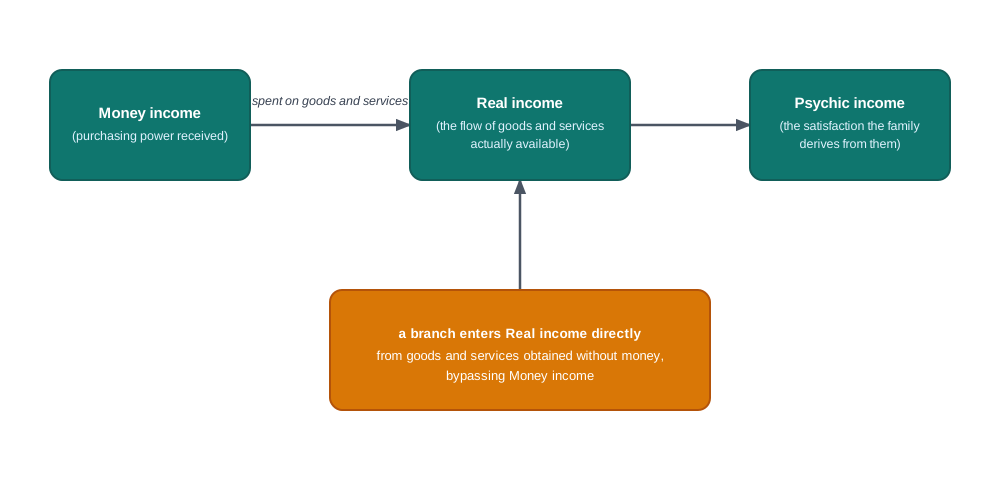
Fig. 10.2 – Relationship between the types of family income.
Read the chain from the left and each type explains the next. Money is received, money buys goods and services, and goods and services give satisfaction. The branch matters too: some of what a family enjoys never passes through money at all.
10.2.3.1 Money Income
Money income is the purchasing power, in rupees and paise, that comes into the family treasury in a given period of time. It reaches the family as wages, salary, bonus, commission, rent, dividends, interest, retirement income, royalties and any other allowance paid to any member.
Money income does not stay as money. Part of it is converted into the goods and services needed for daily living, and part is usually diverted into savings, to be used later or invested.
The frequency and the pattern of this flow differ sharply from family to family. In rural areas, where agriculture is the main occupation, a farmer’s income is not regular: she or he receives money when a crop is sold, which may happen twice a year, after the rabi and the kharif harvests. A person in a job, by contrast, receives income every month.
Neither pattern is better than the other, but they demand different management. An income arriving twice a year has to be stretched across twelve months by the family itself, and the discipline that requires is considerable.
10.2.3.2 Real Income
Economists define real income as a flow of commodities and services available for the satisfaction of human wants and needs over a given period of time. Three points are packed into that definition.
- Real income is a flow of goods and services, not a stock lying still.
- It consists of goods and services that might or might not be obtainable with money — the produce of your own land, or the services performed within a household, are real income although no money changed hands.
- A time period is always involved, whether a month or a year.
Real income is of two types, direct income and indirect income.
- Direct income consists of those goods and services available to family members without the use of money. The services members render one another — cooking, laundering, stitching, maintaining a kitchen garden — are direct income. So is a house that is fully paid for, and so are community facilities such as parks, roads and libraries.
- Indirect income consists of those material goods and services that become available to the family only after some means of exchange, ordinarily money, has been obtained. Buying good quality vegetables is indirect income, and note that it draws on the buyer’s skill and judgement in selecting them.
Direct income is easy to overlook precisely because no rupee figure is attached to it. A family that cooks at home rather than buying prepared food, or repairs its own clothes, is enlarging its real income without enlarging its money income at all.
Table 10.2 sets the three types of income against one another.
10.2.3.3 Psychic Income
Psychic income is the satisfaction that results from owning and using goods and services. Put the other way round, it is the satisfaction derived from real income.
It is difficult to quantify psychic income in rupees, which is why it is sometimes called a hidden income. It is intangible and subjective: the same meal, the same shawl, the same evening in a park yields different satisfaction to different people, and to the same person at different times.
Yet in terms of the quality of living, psychic income is the most important of the three. Money income and real income are only the means. The satisfaction a family actually derives from them is the end, and a family that spends heavily but derives little is not managing its finances well, however large its income.
10.3 Income Management
Once a family knows what its income is and where it comes from, the next question is what is to be done with it. That is income management.
You will recognise the three stages from Fig. 10.1. Income management is financial management seen from the side of the income — the same process, applied to whatever comes in.
No Two Families Spend Alike
Two families may earn exactly the same amount and still need to spend it in completely different ways. Their members are of different ages, their health is different, their obligations are different, and what they hope to achieve in five years is different.
There is therefore no standard plan of expenditure that can be handed to a family. Every family has to devise its own, holding its goals, its needs and its desires together in one plan.
Counting Everything The Family Has
Efficient income management asks one thing of a family before any plan is drawn up: that it recognises and analyses all the resources available to it, not only the money.
Recall the three kinds of family resources from Table 10.1. A skill a member already has, an hour that is genuinely free, a community library or a health centre nearby — each of these reduces what the income has to be stretched to cover. A family that overlooks them plans against a smaller resource base than it actually possesses, and ends up believing it can afford less than it can.
10.4 The Family Budget
A budget is the most common planning device for the use of money. It is simply a plan for future expenditure, written before the money is spent rather than worked out afterwards from what is left.
In the managerial process applied to money, the budget is the first step. Everything in the rest of this chapter — checking, adjusting, evaluating, saving, investing — is easier if a plan exists, and largely guesswork if it does not.
Whether A Budget Will Work
Not every budget succeeds. Three things decide whether a particular one will.
- It must be realistic and flexible. A plan that assumes prices no shop actually charges, or that cannot absorb an unexpected repair, will be abandoned within a month.
- It must suit the group it is prepared for. A budget suited to a household of two working adults is not suited to one supporting three children and a grandparent.
- The control and evaluation steps that follow it must be of good quality. A plan nobody checks against actual spending is a piece of paper, not a budget.
A family budget sets out in detail the income and the expenditure of a family for a month or a year. It names all the sources of income during that period, and all the items of expenditure under separate headings — food, clothing, housing, entertainment, travel, education, health and medicine, and savings.
10.4.1 Steps In Making A Budget
There are mainly five steps in making a budget. They run in the order shown in Fig. 10.3, and the order is not arbitrary: each step supplies the information the next one needs.
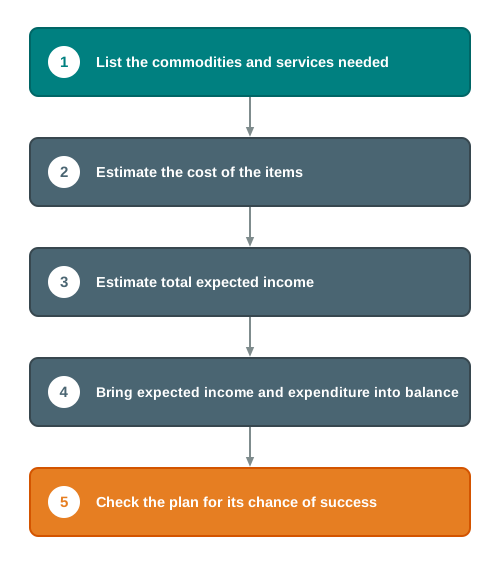
Fig. 10.3 – Five steps in making a family budget.
Step One: List The Commodities And Services Needed
Begin by listing what the family members will need throughout the period the budget is being made for. Related goods and services are then grouped together, so that the list can be handled a dozen headings at a time instead of a hundred items at a time. The following grouping may be helpful.
- Food and related costs
- Housing
- Household operations — fuel, utilities
- Education
- Transportation
- Clothing
- Income tax
- Medical
- Personal allowances
- Miscellaneous — recreation, house furnishings
- Provision for future — saving, retirement
Two of these headings deserve a second look. Personal allowances give each member a small sum to use without accounting for it, which keeps the budget from becoming a source of friction. Provision for the future is listed as an item of expenditure precisely so that saving is planned for, and not left to whatever survives the month.
Step Two: Estimate The Cost
Next, put a figure against each item, total each classification, and total the budget as a whole. These are estimates, and they must be made against general market trends rather than against last year’s prices.
If prices are showing an upward trend, allow a sufficient margin to cover the increase. A budget that estimates the year’s cooking oil at today’s price and is short by the third month has not failed in its arithmetic; it has failed in its reading of the market.
Step Three: Estimate Total Expected Income
Now estimate what is expected to come in. It is helpful to list income under two headings — assured income and possible income — because the two cannot safely be used for the same purposes.
The rule that follows is short. Necessities are met from assured income, and desirable extras are met from possible income. A family that reverses this has committed its rent to a bonus that may not come.
Step Four: Bring Income And Expenditure Into Balance
Very often the first draft shows expenses exceeding income. There are only two ways to bring the two into balance.
- Increase the income, for instance by a member taking up additional work.
- Cut the expenditure, for instance by fewer outings or a smaller outlay at festivals.
Both are legitimate, and most families use some of each. What is not legitimate is leaving the gap in the plan and hoping it will close by itself, because the gap will then be closed by borrowing, and at a cost.
Step Five: Check The Plan
Finally, check whether the plan has a reasonable chance of succeeding. It is examined in the light of the following factors.
- The needs of the family have been met.
- The budget allows for emergencies. A joint fund may be kept aside for an emergency period.
- Solvency is assured. Solvency is the ability to pay bills or debts as they fall due — a family may own a great deal and still be unable to pay a bill this week, and it is this week’s bill that a budget must answer for.
- National and world-wide conditions have been considered, such as a global economic recession.
- The long-term goals of the family are recognised.
10.4.2 Advantages Of Planning A Family Budget
Making a budget takes an evening’s work, so it is fair to ask what a family gets in return.
- Planning lets a family take an overview of the use of its income, seeing the whole year at once instead of one demand at a time.
- The amount allocated to each category can be studied in relation to the total income, which is the only way to see that one heading has quietly grown too large.
- The budget helps a family use its income to attain first those goals it considers most important. Spending without a plan frequently results in wastage of income, because the money is gone before the important goal is reached.
- Family members are less likely to be swayed by a sudden offer or a persuasive shop, since a plan already exists against any new spending can be judged. Decisions made this way are rational and reflect the long-term goals of the family.
10.5 Control In Money Management
After planning, controlling is the next step in money management. Control is what happens while the money is actually being spent, and it is the step families most often skip.
Control in financial management is usually of two kinds: checking to see how well the plan is progressing, and adjusting it wherever necessary. Evaluation then closes the cycle at the end of the period.
10.5.1 Checking The Plan
Checking tells a family how its plans are progressing and where adjustments are needed. It has to happen during the period, not after it, because a gap discovered on the last day of the month can no longer be corrected.
There can be two kinds of checks.
10.5.1.1 Mental And Mechanical Checks
A mental check is made by breaking an allocation into the units it will actually have to cover, and holding those units in mind while spending.
Suppose ₹1,000 is available to a student. On its own the figure looks large. But when the same student realises that it must cover a pair of shoes, a new outfit for a festival and a few books, all at one time, it becomes obvious that both the selection and the price of each item need care. That act of visualising clearly the items a specific amount must cover is the whole of mental checking.
A mechanical check is one in which a certain amount of money is actually set aside in cash for a particular item. Many households keep a food purse, into which the month’s allocation for food is put; all food expenses are then met from that envelope alone. Nothing has to be calculated. If the purse empties in the third week, the family can see how rapidly the money is being spent.
Table 10.4 sets the two against each other.
10.5.1.2 Records And Accounts
The two checks above work while money is going out. Records and accounts work afterwards: they show how the money was distributed once the expenditure has been made.
Such records can be quite casual — an everyday written account, or a spike of receipted bills — or they can be formal and detailed. For a family the purpose is the same in either case. The records show where the money that has been spent actually went, and they allow the amounts spent to be compared with the amounts that were allocated to each group of items.
That comparison is what turns a record into a tool. A list of what was spent tells a family its history; a list set beside the plan tells it what to do next month.
Keeping records has three clear advantages for a family.
- Monthly expenditure can be compared with the spending plan, showing where adjustments must be made to avoid excessive expenditure.
- It helps identify the categories or sub-categories in which expenditure is too high or too low, which in turn makes the next budget a better one.
- Some methods of record keeping require bills and receipts to be maintained. Proof of payment is then at hand if a product or service turns out to be poor and a complaint has to be lodged.
The single sheet method is a simple and flexible way of keeping such records: the whole month’s expenses are entered on one sheet. Records may equally be kept on double or multiple sheets, which can hold more detail, but a well worked out single sheet already carries the essential data. The sheet can be tacked to the back of a door or a cabinet with a pencil hanging beside it, which is what makes it likely to be filled in at all. A worked example is shown in Fig. 10.4.
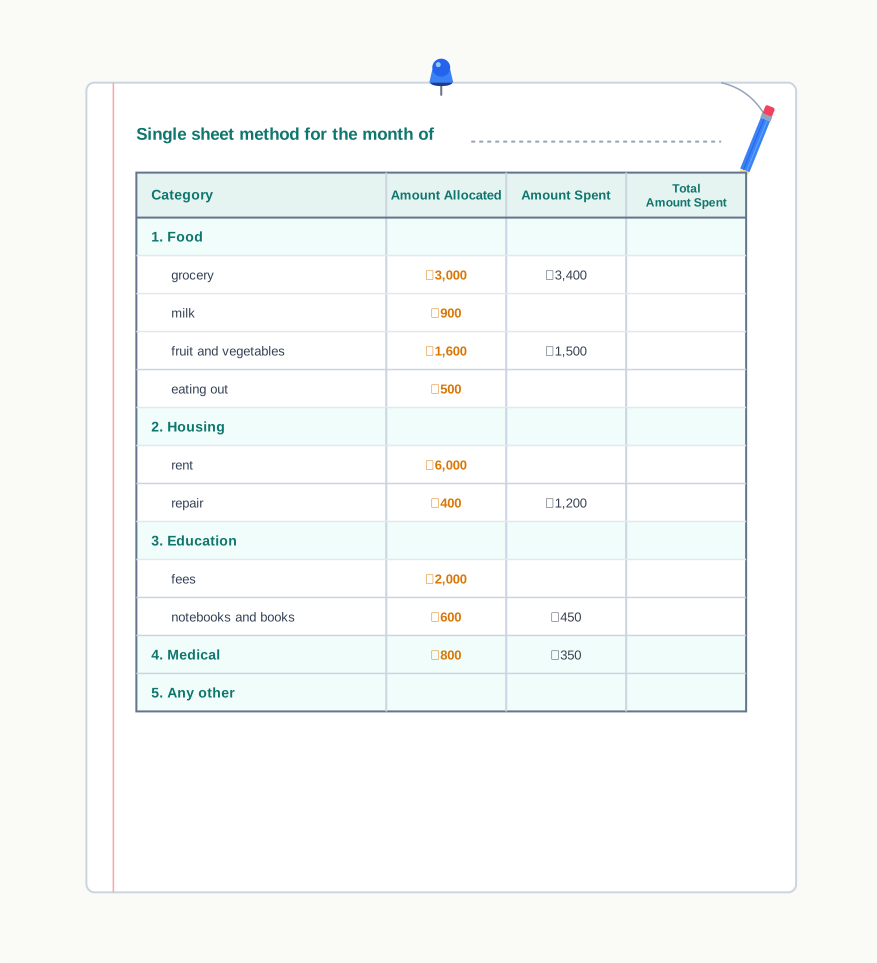
Fig. 10.4 – A single sheet record of household expenses.
10.5.2 Adjusting The Plan
Adjusting the plan is what keeps it on track once checking has shown that it has drifted.
Adjustment becomes necessary for three sorts of reasons. The original planning may have been poor. Something beyond the family’s control may have happened, such as an emergency. Or the family may have gone on an unplanned shopping spree, or its checking mechanisms may have been so weak that nobody noticed a considerable gap opening between the plan and its execution.
Notice that adjusting does not mean abandoning. The plan is altered so that it still reaches the same goals by a different route — a heading trimmed here, a purchase postponed there — and the family goes on managing rather than giving up on the budget altogether.
10.5.3 Evaluation
Evaluation is the final step in money management. It is done at the end of the period, when the whole of the plan and the whole of the spending can be seen together.
The single most important test is the satisfaction the family derived from what it spent. That takes you straight back to psychic income: money well managed is money that bought what the family actually valued.
Evaluation is carried out in the light of specific goals, such as
- obtaining fair value for the money spent;
- being able to pay bills when they fall due;
- providing for the future;
- improving the economic status of the family.
What evaluation yields is not a verdict but a better next plan. Having planned, controlled and evaluated the use of the family income, the family knows how much of it can be spared. The question that follows is what to do with the part that is spared.
10.6 Savings
Savings means keeping aside a part of your money, or of any other resource, for use in the future or for further production.
Notice the two purposes in that definition. Money set aside for a future need is being stored. Money set aside for further production is being put to work. The second is what makes savings matter far beyond the household that saves.
Why Savings Matter Beyond The Family
For a family, savings are what meet a need that has not yet arrived — a fee, a repair, an illness, an old age.
For an economy, savings are what allow it to survive and grow, because savings lead to capital formation and accumulation. This happens only when the money is put to productive use: when someone starts a business with it, or deposits it in a bank or another financial institution. Banks and financial institutions mobilise the savings of the public and lend them out for productive purposes, so that money resting in one household’s account is at that moment building a workshop somewhere else. Fig. 10.5 traces the path.
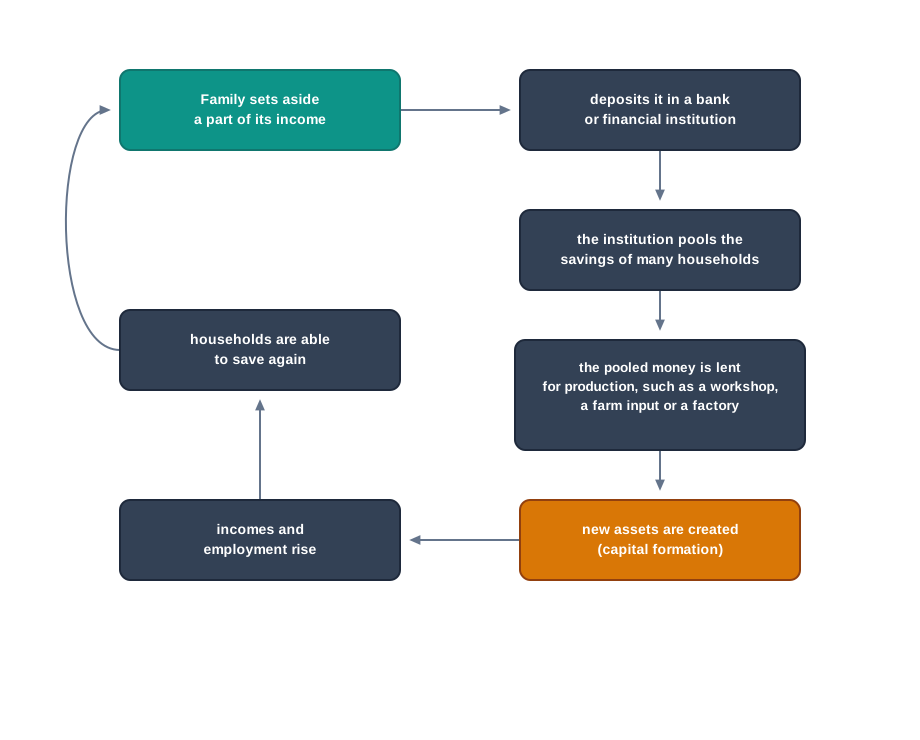
Fig. 10.5 – From household savings to capital formation.
This is the scale ladder at work in one diagram. The decision is taken by an individual, the purpose is set by a family, and the effect is felt by the nation.
Ability And Willingness To Save
How much a family actually saves depends on two quite different things: its ability to save and its willingness to save.
Ability to save depends on per capita income — the income available per person in the household. A family with a higher income has a higher potential to save, because a smaller share of what it earns is claimed by basic needs. A family with a low income has little left to save once food, rent, fuel and school costs have been met.
Willingness to save depends on the long-term goals the family has set, and on how far it is prepared to sacrifice some present luxuries to secure the future. Two families with identical ability may save very different amounts, because one has a goal it can name and the other has not.
Ability without willingness saves nothing, and willingness without ability saves very little. It is worth being plain about the second case: a household whose income is fully claimed by necessities has not failed at anything. Ability is set by circumstances, and no amount of resolve manufactures a surplus that does not exist.
10.7 Investment
Investment implies using money for further production. That single phrase separates it from saving.
Money kept aside in the folds of a garment, or hidden in a pitcher at the back of a cupboard, has certainly been saved. It has not been invested, because it is producing nothing while it lies there. Savings have to be put to productive use, in the economic sense, before they become an investment.
10.7.1 Financial Assets And Physical Assets
Investments may be made in two types of assets.
Financial assets are created when savings are placed with an institution or in a security — a bank account, a post office, a financial credit society, shares and securities, or an insurance policy. These provide financial security to the family and are productive in economic terms, because the money is passed on to someone who uses it in production.
Physical assets are created when savings are used to buy land, property, a house, gold or household durables. This kind of investment is not productive in the economic sense of the term and does not result in capital formation, since nothing new is produced merely because the ownership of a piece of land or a chain of gold has changed hands. It usually does, however, give long-term positive returns to the family that holds it.
Both have a place in a family’s plan. The point of the distinction is not that one is good and the other bad, but that they behave differently when the family needs its money back in a hurry.
10.7.2 Principles Underlying Sound Investments
A family spends a lifetime accumulating its savings. Those savings must be invested wisely, so that they give a good return and are still safe and available when the family needs them. Ten principles govern that choice.
- Safety of the principal amount. The principal is the sum originally invested, and it has to be safe if it is to earn interest or dividends at all. It is the most important factor in sound investing, because a return on money that has been lost is meaningless. Safety can be improved by
- owning securities in both the government and the private sector, such as the National Savings Certificate (NSC), the Public Provident Fund (PPF), the Kisan Vikas Patra (KVP) and fixed deposits in banks;
- investing in companies located in different geographical zones;
- owning shares and bonds in different companies;
- studying the market reputation of those who issue the securities;
- varying the kind of securities purchased — agricultural land, real estate, stocks, bonds, fixed deposits;
- understanding the prevailing phase of the business cycle. Read those six together and one idea runs through all of them: do not let everything the family owns depend on the fortunes of one company, one industry or one district.
Reasonable rate of return. In general, the higher the rate of return offered on an investment, the greater the risk attached to it. Safety of the principal and rate of return are inversely related, and any scheme promising both a very high return and complete safety should be treated with suspicion. For some people — particularly those who depend on their investments as a major source of income — regularity of income matters more than a higher but fluctuating return. This is settled by the selection of securities, so before investing, compare the rate of interest and the risk that goes with it across the various schemes and options.
Liquidity. Liquidity is the ability to convert a security into cash without sacrificing its value. Highly liquid investments generally carry a lower return, because the investor is paying, in return foregone, for the convenience of getting the money back at short notice. Income and liquidity must therefore be balanced: some of the family’s money should be where it can be reached quickly, and the rest where it earns more.
Recognition of the effect of world conditions. Changes in business trends affect how much protection a family needs, how easily that protection can be arranged, and which methods are chosen. Looking at long-term business trends, a family should also recognise that its savings have an effect on the whole economy: whether households are willing or unwilling to invest in business enterprises at different stages of the cycle can itself soften the extremes of that cycle.
Easy accessibility and convenience. While choosing where to place family funds, consider the knowledge the investment demands of the investor. A family may lose money on a perfectly sound investment simply because it did not foresee the problems involved in managing the security or the property acquired.
Investing in needed commodities. The date on which an investment matures matters greatly to a family that is putting money away for a known future need. Securities should therefore be chosen with lengths and durations such that they mature close to the time the money will be wanted — for a child’s higher education, for instance.
Tax efficiency. Investments should be made, where possible, in instruments that also reduce the tax payable. Several provisions of the Income Tax Act allow this, and instruments such as insurance policies, the Employees’ Provident Fund and the PPF carry built-in tax rebates up to a specified ceiling limit.
After-investment service. The customer care offered by the institution is a real decision-making factor, not a courtesy. Good service means securities that can be encashed easily, a sound communication network, interest and dividend warrants dispatched on time, the due amount disbursed promptly when the investment period ends, and the customer kept informed of changes in policies and interest rates.
Time period. The lock-in period — the stretch during which the money cannot be withdrawn — must be considered before deciding. As a rule, the longer the period of investment, the higher the rate of return; in most fixed schemes the rate of interest offered on long-term deposits is higher than on short-term ones. The investor has to choose between a higher return after a longer wait and a lower return with a short lock-in, according to what the family will need and when.
Capacity. One should not invest beyond one’s capacity, so that the investments never become a source of undue hardship. Present needs have to be balanced against future needs and security. An investment that leaves the family unable to meet this month’s essential expenses has defeated its own purpose.
10.8 Savings And Investment Avenues
The ten principles in the last section tell a family how to judge an investment. This section says what there is to judge. The following saving and investment options are available to an Indian consumer.
- Post Office — accepts deposits and runs the government’s small savings accounts through its branches, including those in villages where no bank has reached.
- Banks — savings accounts, recurring deposits and fixed deposits, kept with a commercial, cooperative or regional rural bank.
- UTI Mutual Fund — the oldest of India’s mutual fund houses, which pools money from many small investors and invests it in a spread of securities.
- National Savings Scheme — the family of small savings schemes offered through post offices, in which the deposit is backed by the Government of India.
- National Savings Certificates — a certificate bought for a fixed sum, held for a fixed term, and repaid with accumulated interest at maturity.
- Shares and Debentures — a share is a unit of ownership in a company, which earns a dividend when the company profits; a debenture is a loan to the company, which earns a fixed rate of interest whether or not it profits.
- Bonds — loans made to a government or a large institution, repaid on a stated date with interest at a stated rate.
- Mutual Funds — a mutual fund collects money from many investors and buys a spread of shares and bonds with it, so that a small investor gets the safety of a spread that she could not buy alone.
- Provident Fund — a retirement fund to which an employee and the employer both contribute each month, withdrawn as a lump sum on retirement.
- Public Provident Fund — the same idea opened to everyone, including people who are self-employed, through banks and post offices, with a long lock-in period.
- Chit Fund — a chit fund is a group of members who contribute a fixed sum at fixed intervals into a common pool, which is handed to one member at each turn until every member has received it once; registered chit funds are governed by the Chit Funds Act, 1982.
- Life Insurance and Medical Insurance — regular premiums buy protection against a loss the family could not otherwise absorb, and a life policy also returns a sum at maturity.
- Pension Schemes — contributions made during working life, returned as a regular income after retirement.
- Gold, House, Land — the physical assets of the previous section, held for use and for their long-term rise in value.
Reading The List Against The Principles
No avenue in that list is best. Each one is strong on some of the ten principles and weak on others, which is exactly why a family spreads its savings across several. Table 10.7 compares four very different avenues on the four principles that separate them most sharply.
Read the table down each column and you can see the trade-off the principles predicted. The account that gives the money back instantly pays the least; the certificate that pays more will not release the money early; the share that might pay most guarantees nothing at all.
10.9 Credit
Families save and invest their money income, and yet almost every family, at some point, also uses credit. It is used to obtain goods and services whose initial cost is too high to bear all at once.
The word comes from the Latin word credo, meaning ‘I believe’. That origin is exact, because the whole arrangement rests on the lender’s belief that the borrower will pay.
Credit means getting money, goods or services in the present and paying for them in the future. It is, in reality, a process of postponed payment — a privilege for which a family sometimes pays a very high rate.
At any given moment, the use of credit increases a family’s purchasing power. It makes possible the provision of more goods or services than the cash in hand would allow. But the amount borrowed, together with the interest charged for its use, must eventually be repaid, so families need to understand how credit works before they use it.
10.9.1 The Need For Credit
Families use credit to meet needs or obligations, and the need may be real or imaginary. The distinction is worth making early: a family that borrows for a purchase it did not need has still to repay every rupee, with interest.
Where the initial cost of a commodity is too large to be saved up before the purchase is made, a family may borrow in order to possess the commodity immediately — land, for instance. The cost is then spread over a long period, and the family has the advantage of using the good throughout the payment period rather than after it.
A second reason for borrowing is a family emergency, such as the sickness of a member, where the money is needed at once and cannot wait for savings to accumulate. Families also borrow to meet obligations, such as the marriage of children or the performance of rituals on the death of a member.
A family that is self-supporting and self-sufficient in the ordinary run of things can turn to credit in an emergency and do so with confidence, because its regular income can carry the repayment once the emergency has passed.
10.9.2 The Four Cs Of Credit
A lender will make a loan only when it believes that the borrower will repay the money borrowed. The lender may be a bank or any other financial institution, and its decision to give credit to an individual or a family is governed by four considerations, known as the four Cs of credit.
- Character means the willingness and determination to repay a loan as agreed, even when doing so proves more costly and more inconvenient than the borrower had anticipated.
- Capacity means the ability to meet an obligation when it falls due. Capacity ordinarily depends on income, but not on total income: what matters is the margin available over and above necessary expenses. A family’s capacity to repay is the difference between what it receives and what it spends.
- Capital means net worth — the difference between what a family owns and what it owes. Capital gives the lender a margin of safety, since a family whose income proves inadequate can draw upon its invested capital to repay.
- Collateral consists of specific units of capital pledged as security for a given loan. These are usually placed in the lender’s possession, on the understanding that if the borrower fails to repay as agreed, the lender may recover what it can from the sale of the pledged asset.
10.9.3 Sources Of Credit
Commercial banks, cooperative banks, agricultural banks and credit unions are the main sources from which credit is taken. All of them lend under the four Cs, and all of them require the loan and its terms to be set down in writing.
Credit may also be taken from a self-help group of which one is a member. The members of such a group contribute some money every month and build up a corpus amount. Credit is then given from that corpus to a member who needs it, on the basis of her or his requirement and repaying capacity.
Two features of this arrangement are worth noticing. Because the members are known to each other, no collateral is needed — the group’s knowledge of a member’s character and capacity does the work that a pledged asset does elsewhere. And because the money being lent is the members’ own, the interest rate is nominal.
10.9.4 Using Credit Wisely
Before using credit, a family should weigh two things and not one. The first is the satisfaction gained from possessing the good or service now. The second is the adjustment that repayment will force on the family budget for months or years afterwards.
Managing credit means deciding when to use it and recognising when its use has become excessive. Handled with an understanding of both its potential and its cost, credit is a useful resource. Used indiscriminately, it can be disastrous for a family, because instalments do not adjust themselves when income falls.
For most families, therefore, two targets follow: to avoid using credit where it can reasonably be avoided, and to take it at the lowest possible cost where it cannot. Following a single borrowed sum through a household budget shows why the second target is worth taking seriously.
Money and other financial resources can be multiplied and used to their fullest if the measures set out in this chapter are adopted — income understood, expenditure planned, spending controlled, results evaluated, savings invested and credit used with care. Adult life asks all of this of most people, and it asks it alongside a great deal else. One such area of daily living is the care of the clothes and fabrics used at home, and it is a skill best begun early. That is the subject of the next chapter.
10.10 Summary
- Financial management is the planning, controlling and evaluating of the use of all types of income available to a family, so that the family gets the greatest satisfaction from the resources at hand.
- The quality of living a family obtains depends not only on the size of its income but on the regularity and stability of that income.
- Financial planning is the first component of financial management, and the plan it produces is called a budget.
- Management is using what you have to achieve what you want.
- Family resources are of three kinds:
- human resources such as knowledge, skills, health, time and energy;
- material resources such as housing, money and investments;
- community resources such as libraries, parks, community centres and hospitals.
- A family is a consumption unit as well as a social unit, and money is one of its important resources.
- Family income is the sum total of the income of all types and from all sources of all family members in a given time period.
- For official purposes family income is taken as the annual income of a financial year, which in India generally runs from 1 April to 31 March of the next year.
- Income may be in the form of wages, salary, profits from business, commissions, rent from properties, interest on cash loans, dividends, pensions, gifts, royalties, tips and donations, bonus, and subsidies and charities.
- Money is whatever a society generally accepts in exchange for goods and against which the value of other goods is measured; its two most important functions are serving as a medium of exchange and measuring value.
- Money is also a standard of deferred payment and a store of value, which is what makes savings, investment and capital formation possible.
- Family income is of three types:
- money income, the purchasing power in rupees and paise that comes into the family treasury in a given period;
- real income, the flow of commodities and services available for the satisfaction of wants and needs over a given period;
- psychic income, the satisfaction that results from owning and using goods and services.
- Real income is of two types — direct income, which reaches the family without the use of money, and indirect income, which becomes available only after money has been obtained.
- Psychic income cannot be quantified in rupees and is intangible and subjective, yet it is the most important of the three in terms of the quality of living.
- Income management is the planning, controlling and evaluating of the use of all types of income; no two families with identical incomes have identical needs, so each must devise its own plan of expenditure.
- A budget is a plan for future expenditure and is the first step in the managerial process applied to money.
- The success of a budget depends on its being realistic and flexible, on its suitability to the group it is prepared for, and on the quality of the control and evaluation steps that follow.
- There are five steps in making a budget:
- list the commodities and services needed, grouped under headings;
- estimate the cost of the items, allowing for market trends;
- estimate the total expected income, separating assured income from possible income;
- bring expected income and expenditure into balance, by raising income or cutting expenditure;
- check the plan for its chance of success.
- Necessities should be met from assured income, and items that are nice but not necessary from possible income.
- A plan is checked against the needs of the family, provision for emergencies, solvency, national and world-wide conditions, and the long-term goals of the family.
- Solvency is the ability to pay bills or debts as they fall due.
- Planning a budget lets a family take an overview of its income, study each allocation against the total, reach its most important goals first, and make decisions that are not swayed by the moment.
- Control in money management is of two kinds — checking how the plan is progressing, and adjusting it wherever necessary.
- Checking may be done in two ways:
- mental and mechanical checks, made while the money is being spent;
- records and accounts, which show the distribution of money after the expenditure has been made.
- A mental check breaks an allocation into the items it must cover, while a mechanical check sets aside cash for one purpose alone.
- Record keeping allows expenditure to be compared with the plan, shows which categories are too high or too low, and keeps bills as proof of payment in case a complaint has to be lodged.
- The single sheet method keeps the record of a month’s expenses on one sheet, and is simple and flexible.
- Adjusting keeps a plan on track when the original planning was poor, when an emergency arises, or when checking has been inadequate.
- Evaluation is the final step in money management and is done in the light of specific goals — fair value for money spent, bills paid when due, provision for the future, and improvement in the economic status of the family.
- Savings means keeping aside a part of one’s money or other resources for use in the future or for further production.
- Savings lead to capital formation when they are put to productive use, which is why they matter to the economy as well as to the family.
- The savings of a family depend on its ability to save, which rests on per capita income, and on its willingness to save, which rests on its long-term goals.
- Savings have meaning only when the purpose is well planned, understood by all family members, and the money wisely invested.
- Investment is the use of savings for further production; money merely kept aside is not invested.
- Investments may be in financial assets, which are productive in economic terms and lead to capital formation, or in physical assets, which are not, though they usually give long-term positive returns.
- Ten principles underlie sound investment:
- safety of the principal amount;
- a reasonable rate of return;
- liquidity;
- recognition of the effect of world conditions;
- easy accessibility and convenience;
- investing in needed commodities;
- tax efficiency;
- after-investment service;
- time period;
- capacity.
- Safety of principal and rate of return are inversely related, and greater liquidity is generally paid for by a lower return.
- The savings and investment avenues open to an Indian consumer include the post office, banks, UTI Mutual Fund, the National Savings Scheme, National Savings Certificates, shares and debentures, bonds, mutual funds, provident fund, public provident fund, chit fund, life and medical insurance, pension schemes, and gold, house and land.
- Credit means getting money, goods or services in the present and paying for them in the future; it is a process of postponed payment.
- Families use credit when the initial cost of a commodity is too large to save for, in emergencies such as the sickness of a member, and to meet obligations.
- A lender’s decision is governed by the four Cs of credit — character, capacity, capital and collateral.
- Commercial, cooperative and agricultural banks and credit unions are the main sources of credit; a self-help group lends from its members’ own corpus, without collateral and at a nominal rate of interest.
- Credit is a useful resource when its potential and its cost are understood, and can be disastrous when used indiscriminately, so most families should avoid credit where they can and take it at the lowest possible cost where they cannot.
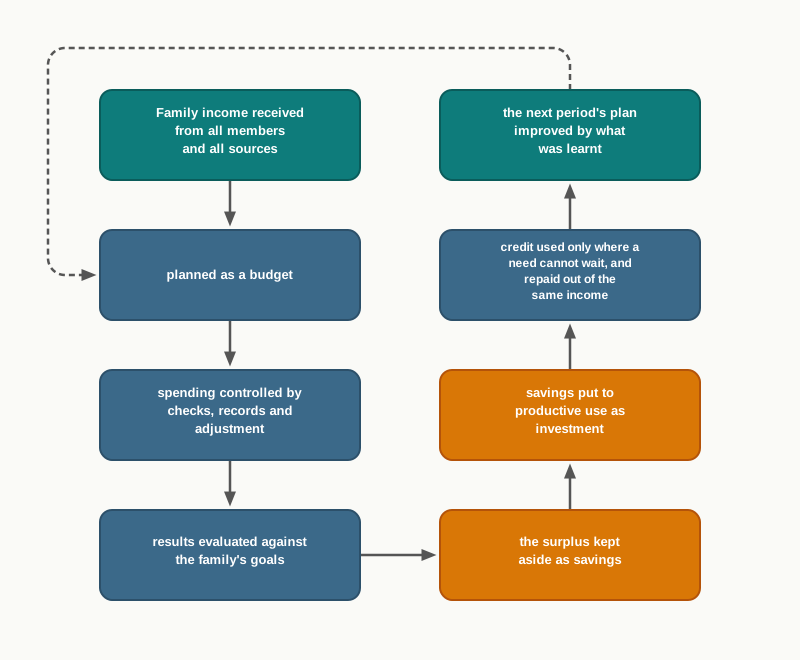
Fig. 10.6 – The chapter in one chain.
10.11 Key Terms
- Ability to save — how much a family can set aside, decided by its per capita income and the size of its essential needs.
- Adjusting — altering a plan while it is running, so that it still reaches the family’s goals after a gap has appeared.
- Budget — a written plan of expected income and intended expenditure for a period ahead.
- Capacity — the ability to meet an obligation when it falls due, measured by the margin of income over necessary expenses.
- Capital — net worth; the difference between what a family owns and what it owes.
- Character — the willingness and determination of a borrower to repay a loan as agreed.
- Chit fund — a group whose members contribute a fixed sum at fixed intervals into a common pool, which is handed to one member at each turn.
- Collateral — specific units of capital pledged as security for a loan.
- Credit — getting money, goods or services in the present and paying for them in the future.
- Debenture — a loan made to a company, which earns a fixed rate of interest whether or not the company profits.
- Direct income — goods and services available to family members without the use of money.
- Evaluation — the final step in money management, judging at the end of a period whether the spending met the family’s goals.
- Family budget — a detailed statement of a family’s income and expenditure for a month or a year.
- Family income — the sum total of the income of all types and from all sources of all family members in a given time period.
- Family resources — everything available to an individual or family at a particular time that helps them reach their goals, whether human, material or community.
- Financial assets — savings placed with an institution or in a security, such as deposits, shares, certificates and insurance policies.
- Financial management — the planning, controlling and evaluating of the use of all types of income available to a family.
- Financial planning — the first stage of financial management, in which the family decides in advance how its money will be used.
- Financial year — the twelve-month period used for official accounts, running in India generally from 1 April to 31 March.
- Income management — the planning, controlling and evaluating of the use of all types of income, for the greatest satisfaction from the resources at hand.
- Indirect income — goods and services that become available to a family only after money or another means of exchange has been obtained.
- Investment — the use of savings for further production, so that the money employed earns a return.
- Management — using what you have, that is resources, to achieve what you want, that is goals and objectives.
- Mechanical check — a control in which cash is physically set aside for one particular item of expenditure.
- Medium of exchange — the function of money that allows goods to be exchanged without matching two people who each want what the other has.
- Mental check — a control in which an allocation is broken into the items it must cover and kept in mind while spending.
- Money — anything a society generally accepts in exchange for goods and against which the value of other goods is measured.
- Money income — the purchasing power in rupees and paise that comes into the family treasury in a given period.
- Mutual fund — an institution that pools money from many investors and buys a spread of shares and bonds with it.
- Physical assets — savings used to buy land, property, a house, gold or household durables.
- Psychic income — the satisfaction that results from owning and using goods and services.
- Real income — the flow of commodities and services available for the satisfaction of wants and needs over a given period.
- Records and accounts — entries kept after expenditure, showing where money went and allowing it to be compared with the amounts allocated.
- Savings — the part of income or resources kept aside for future use or for further production.
- Single sheet method — a simple and flexible way of keeping a whole month’s record of expenses on one sheet.
- Solvency — the ability to pay bills or debts as they fall due.
- Standard of deferred payment — the function of money that allows a payment agreed today to be made at a later date.
- Standard of value — the function of money that expresses the value of all goods and services in one common unit.
- Store of value — the function of money that allows purchasing power to be kept over long periods without spoiling.
- Willingness to save — how much a family chooses to set aside, decided by its long-term goals and its readiness to postpone present comforts.
10.12 Points To Ponder
Psychic income is described as the most important of the three types in terms of the quality of living, yet it is the only one that cannot be entered in a budget. Can a family plan for it at all, and what would such a plan look like?
Direct income never appears in any account book, because no money changes hands. If the cooking, laundering, stitching and repair done within a household were costed at market rates, how would the picture of that household’s real income change — and might counting them alter how the work is shared out?
Safety of principal and rate of return move in opposite directions, and so do liquidity and return. Is there anything among the ten principles that helps a family decide how much of its savings belongs in the safest, lowest-earning place?
A self-help group lends without collateral because its members know one another. What is taking the place of the pledged asset in that arrangement, and what happens to it as the group grows larger?
A budget is said to fail if it is not flexible, yet its whole purpose is to hold spending to a plan. Where does a flexible budget end and no budget at all begin?
Credit lets a family use a good while it is still paying for it, but commits a share of income that has not yet been earned. In what circumstances would waiting until the purchase can be paid for outright be the worse decision?
10.13 Objective Questions
- Which of the following is an example of direct income? (1 mark)
- Interest received on a fixed deposit
- Vegetables grown in the household’s own kitchen garden
- A bonus paid at the end of the year
- Rent received from a shop
- The financial year followed for official purposes in India generally runs from (1 mark)
- 1 January to 31 December
- 1 April to 31 March
- 1 July to 30 June
- 1 October to 30 September
- Which step comes immediately after estimating the cost of the desired items while making a budget? (1 mark)
- Listing the commodities and services needed
- Checking the plan for its chance of success
- Estimating the total expected income
- Bringing income and expenditure into balance
- Setting aside the month’s food money in a separate purse is an example of (1 mark)
- a mental check
- a mechanical check
- evaluation
- record keeping
- Which of the following results in the formation of a physical asset? (1 mark)
- Buying units of a mutual fund
- Opening a public provident fund account
- Buying a plot of land
- Purchasing a National Savings Certificate
- Assertion (A): Necessities should be met out of assured income rather than possible income. (1 mark) Reason (R): Possible income may or may not be received during the budget period.
- Both A and R are true, and R is the correct explanation of A.
- Both A and R are true, but R is not the correct explanation of A.
- A is true but R is false.
- A is false but R is true.
- Assertion (A): A highly liquid investment usually earns a lower return. (1 mark) Reason (R): The investor gives up some return in exchange for being able to get the money back quickly.
- Both A and R are true, and R is the correct explanation of A.
- Both A and R are true, but R is not the correct explanation of A.
- A is true but R is false.
- A is false but R is true.
- Assertion (A): A self-help group can lend to its members without asking for collateral. (1 mark) Reason (R): The members of such a group are known to one another and their repaying capacity can be judged directly.
- Both A and R are true, and R is the correct explanation of A.
- Both A and R are true, but R is not the correct explanation of A.
- A is true but R is false.
- A is false but R is true.
Match the terms in Column A with their meanings in Column B. (1 mark) | Column A | Column B | |—|—| | a. Solvency | i. Net worth of a family | | b. Capital | ii. Satisfaction derived from real income | | c. Psychic income | iii. Ability to pay bills as they fall due |
Fill in the blanks. (1 mark)
- The ability of a family to save depends upon its ________ income.
- The period during which money invested cannot be withdrawn is called the ________ period.
- State whether the following statements are true or false. (1 mark)
- Real income is a flow of goods and services and not a stock lying still.
- Savings kept in a box at home amount to an investment.
- Character is one of the four Cs of credit.
- Name the following. (1 mark)
- The function of money that allows a payment agreed today to be made at a later date.
- The method of record keeping in which a whole month’s expenses are entered on one sheet.
- Identify the odd one out and give a reason for your choice. (1 mark) Knowledge, skills, health, housing, energy
10.14 Check Your Concepts
Define family income and state the two things that must be specified before an income figure means anything. (2 marks)
Differentiate between direct income and indirect income, stating the basis of difference. (2 marks)
Give a reason why a budget must be flexible as well as realistic. (2 marks)
State the two most important functions of money, and explain each in one sentence. (3 marks)
Differentiate between a mental check and a mechanical check, stating the basis of difference, and give one example of each. (3 marks)
Why is psychic income difficult to quantify, and why is it still considered the most important type of income in terms of the quality of living? (3 marks)
Explain, with an example, the difference between the ability to save and the willingness to save. (4 marks)
Describe the five steps involved in making a family budget, in order. (4 marks)
What would happen if a family drew up a budget but kept no records of its actual expenditure? (4 marks)
Explain any five principles underlying sound investments, and state in each case what a family risks by ignoring that principle. (5 marks)
Explain the four Cs of credit, and state which of them a lender can rely on even if the borrower’s income stops. (5 marks)
10.15 Identify & Label
- Study the record sheet shown in Fig. 10.4. (2 marks)
- Name the method of record keeping shown.
- Name the two columns that must be read together before any judgement can be made about the family’s spending.
Look at Fig. 10.4 again. Identify one category in which expenditure has exceeded the allocation and one in which it has fallen short, and label each with the heading it belongs to. (2 marks)
Study Fig. 10.0. (3 marks)
- Identify the document shown.
- Name any two entries that such a document must carry for a depositor to check her account.
- State why a photograph was pasted inside the cover of such passbooks.
10.16 Case & Application Based Questions
- A household of four has a monthly money income of ₹32,000, of which ₹28,000 is a salary and ₹4,000 is commission that is earned in some months and not in others. Its fixed monthly commitments are rent ₹9,000, school fees ₹3,500 and a loan instalment ₹2,500. The household wants to enrol a member in a six-month computer course costing ₹9,000, payable in six monthly instalments. (4 marks)
- Sort the household’s income into assured income and possible income.
- State whether the course instalment should be met from assured or from possible income, and give a reason.
- Which one of the five steps in making a budget is the household carrying out when it decides this?
- Two households live on the same street and each has a monthly income of ₹40,000. In the first, one member is preparing for a competitive examination and another takes medicine that must be bought every month. In the second, both adults earn, there are no dependants, and they intend to buy a two-wheeler within a year. (4 marks)
- Explain why the two households cannot use the same plan of expenditure.
- Suggest one heading that must be protected in the first household’s budget, and give a reason.
- The second household is offered a scheme with a five-year lock-in and a high rate of interest. State one principle of sound investment that should make it hesitate, and explain why.
- A shopkeeper offers a washing machine priced at ₹18,000 either for cash or on credit, the credit terms being 18 monthly instalments of ₹1,150. A household has ₹12,000 saved and a margin of ₹1,600 a month over its necessary expenses. (5 marks)
- Calculate the total amount payable under the credit offer and the cost of the credit.
- Which of the four Cs is the household examining when it looks at its monthly margin?
- State one consequence for the household budget if it takes the credit and its income falls for two months.
- Suggest one alternative to taking the full credit, using the savings the household already holds.
10.17 Practice With Data
- A family’s budget for a month allocates the following amounts: food ₹8,000, housing ₹9,000, household operations ₹2,000, education ₹4,000, transport ₹1,500, clothing ₹1,000, medical ₹1,000, personal allowances ₹1,000, miscellaneous ₹1,500 and provision for the future ₹2,000. The expected income for the month is ₹30,000. (4 marks)
- Total the budget and state whether income and expenditure are in balance.
- Calculate the gap, if any, and express it as a percentage of the expected income.
- Suggest two ways of bringing the budget into balance, one from each of the two methods available, and state which heading you would not touch and why.
- The table below shows the amount allocated and the amount spent by a household in one month. (4 marks)
| Category | Amount allocated (₹) | Amount spent (₹) |
|---|---|---|
| Food | 7,500 | 8,200 |
| Household operations | 2,200 | 1,900 |
| Transport | 1,800 | 2,600 |
| Education | 3,000 | 3,000 |
| Provision for the future | 2,500 | 1,000 |
- Calculate the total allocated and the total spent, and state the difference.
- Identify the category with the largest overspending and the category with the largest shortfall against its allocation.
- Give a reason why a shortfall under ‘provision for the future’ is more serious than a shortfall under ‘household operations’.
- State one adjustment the family could make in the next month’s budget, and the check it should use to keep that adjustment on track.
- A household can place ₹50,000 in one of three ways: a savings account from which money may be withdrawn at any time, a five-year certificate that pays a stated rate at maturity, or shares whose value may rise or fall. (3 marks)
- Arrange the three in order of liquidity, from highest to lowest.
- Arrange the same three in order of the safety of the principal amount.
- The household expects to need ₹20,000 within eight months for a known expense. State how you would divide the ₹50,000 between the three, and justify your division using two principles of sound investment.