Chapter 11: Care and Maintenance of Fabrics
From Ash And Fat To The Modern Wash
Long before anyone could explain why it worked, people knew that fat and ash together would clean.
Clay tablets from Babylon, dated to about 2800 BCE, carry one of the oldest surviving washing recipes. Fats were boiled with the ashes of burnt wood, and the mixture that formed lifted grease from cloth and skin. In Egypt, the Ebers Papyrus of about 1550 BCE records animal and plant oils combined with alkaline salts, used for washing and for treating the skin.
For thousands of years this was the only cleaning agent households had. Chemistry explained it much later. Ash contains alkali, and when alkali is boiled with a fat or an oil, the reaction produces soap. Soap molecules attach themselves to grease, break it into tiny droplets and let water carry it away.
The same chemistry set a limit. Where water carries dissolved calcium and magnesium salts, soap reacts with them first and forms a scum instead of a lather. Cloth washed in such water stays grey, and the soap is wasted.
During the First World War, Germany was cut off from imported fats and oils. Chemists there were asked to build a cleaning agent that used neither. What they produced were the first synthetic detergents — and unlike soap, they worked in hard water.
Everything in this chapter turns on that kind of reasoning: knowing what a material does, so that you know how to treat it.
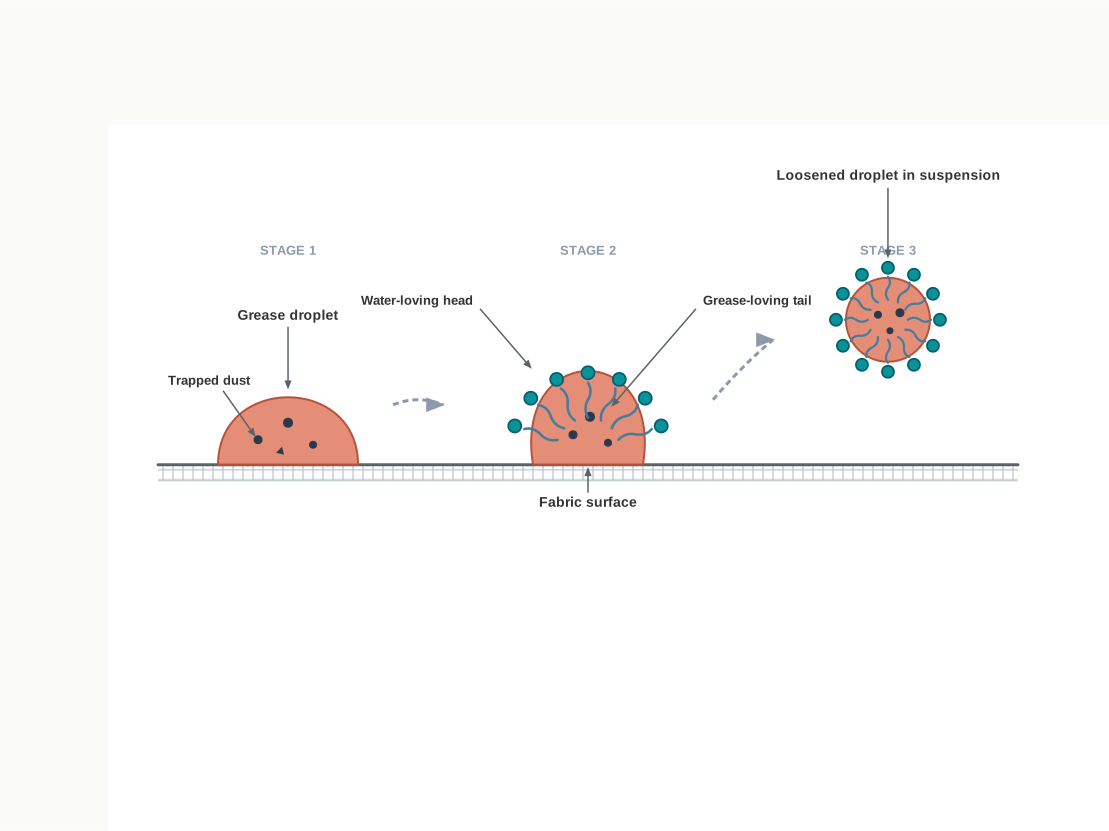
Fig. 11.0 – How a soap molecule lifts grease from cloth.
11.1 Introduction: What Care And Maintenance Mean
You have already read about the fibres and fabrics that surround you at home. Fabrics do two jobs at once. They protect the people and the surfaces they cover, and they add to the way both look.
Think of what decides a purchase. You look at the colour and the texture, you judge the quality of the material, and you ask whether it will do the job you want. A curtain must cut the light, a school shirt must survive a hot afternoon, a razai cover must wash easily.
Those three qualities — appearance, quality and functionality — are what the money was spent on. Use begins to take them away almost at once. Dirt settles into the weave, sunlight and washing dull the colour, a seam gives way, a crease appears where none was wanted.
Care and maintenance is the whole set of practices by which those qualities are held on to. It is not one activity but many, running from the moment a fabric product enters the house to the day it is finally set aside.
What Care And Maintenance Include
Every one of these practices falls under one of two broad aims.
Keeping the material free of physical damage.
Retaining its appearance, which in turn means:
removing stains and dirt without damaging the colour of the fabric;
retaining or refurbishing its brightness and its textural characteristics, such as softness, stiffness or crispness;
keeping it free of wrinkles, or retaining the creases that are wanted — removing wrinkles and adding creases where the article requires them.
Read that list again and you will see the shape of this chapter. The first aim is answered by mending, which repairs damage as it occurs. The second is answered by laundering, which cleans the fabric, restores its finish and presses it, and by dry-cleaning where water would do harm.
Care Is A Household Skill
A single garment is cared for by the person who uses it. A household, though, has to plan for everything it owns at once — what gets washed together, where it dries, where the winter clothes go in June.
That planning is a household skill, and it belongs to whoever is doing the work, not to any one member of the family. Done well, it stretches the life of what the household has already paid for.
11.2 Mending
Cloth in daily use takes small injuries all the time. A nail catches a sleeve, a button works loose over months of buttoning, the stitching at a hem gives way. Mending is the general term for all the work done to keep a material free of such damage, whether it has come from ordinary use or from an accident.
Mending covers the following.
Repairing cuts, tears and holes.
Replacing buttons and fasteners, ribbons, laces or fancy attachments.
Restitching seams and hems if they open up.
None of this is difficult work, and it is easiest when it is done at once. A tear of one centimetre is a few minutes with a needle; the same tear after a month of wear is a patch.
Why Mending Comes First
Mending must be finished before an article is laundered. This is not a matter of tidiness — washing puts the fabric under real strain.
A garment soaked in water is heavy, and wet fibres in cotton pull against each other as the article is rubbed, wrung or turned in a machine. That force finds the weakest point in the cloth. Where a seam has already opened or a hole has already started, the strain concentrates there and the damage grows.
So a torn kurta that goes into the wash unmended usually comes out torn further. Attend to the repair first, then wash.
11.3 Laundry: The Sequence Of Operations
Day-to-day care of fabrics is mostly two things — washing, to keep the article clean, and ironing, to give it a smooth, wrinkle-free look. For a lightly used cotton napkin that may be all that is ever needed.
Most articles, though, bring three further problems with them. An accidental stain will not come out in an ordinary wash. Repeated washing leaves white cottons yellow and synthetics grey. And a fabric that once stood up crisply goes limp after twenty launderings.
Each of these needs its own treatment, and the treatments have to be done in a fixed order. Laundering is the name for that whole ordered sequence, not for the washing alone.
The Order Of Operations
The steps in laundering are set out in Fig. 11.1.
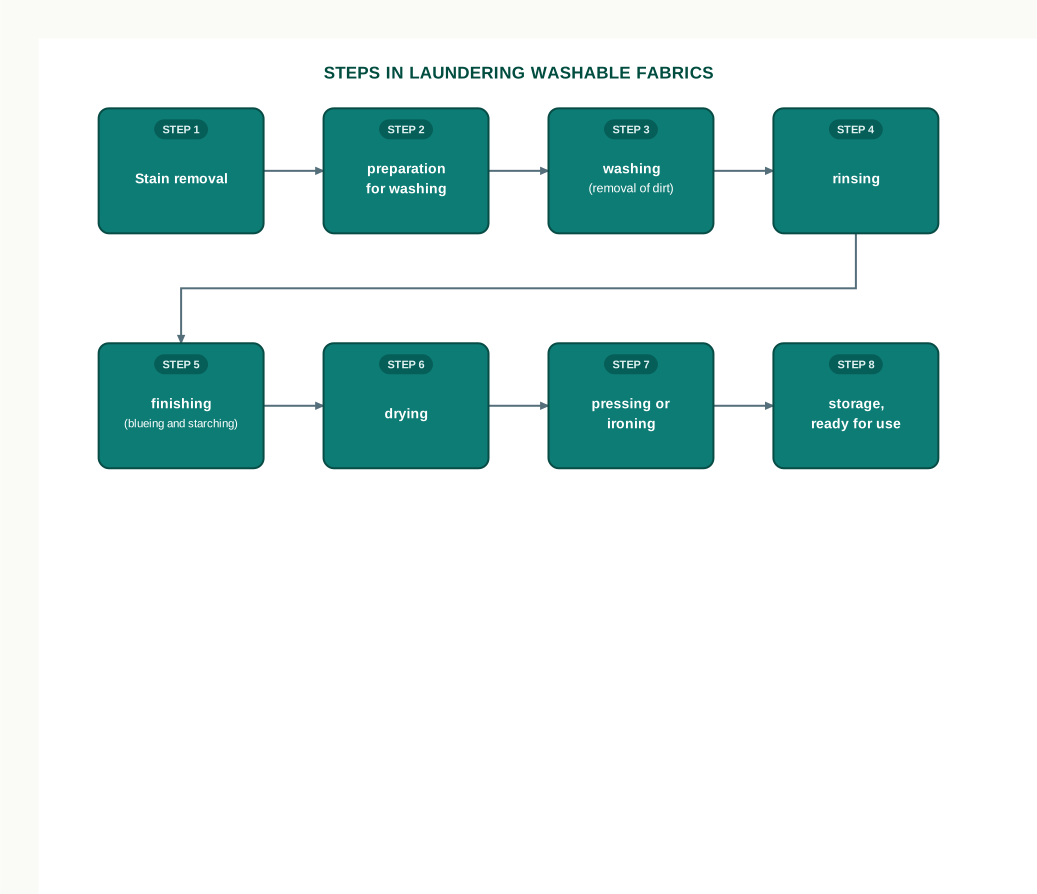
Fig. 11.1 – The sequence of operations in laundering.
Preparation for washing is the step the eye tends to skip. It means the mending is already done, pockets are emptied and turned out, and articles are sorted by fibre and by colour so that a fabric needing gentle treatment is not washed with one that needs hard rubbing. It also usually includes steeping, that is, leaving the article to soak in water so that the loosely held dirt lets go before any rubbing begins.
The order matters at every join. Stains are treated before washing, because washing can fix them permanently in the cloth. Blueing and starching come after the last rinse, because the soap must be out of the fabric before anything is added to it. Ironing comes after drying, because a hot iron on a soiled or unfinished article sets the fault into the fibre.
The rest of this chapter follows Fig. 11.1 step by step.
11.4 Stain Removal
11.4.1 What A Stain Is
Dirt sits on and between the fibres of a cloth, and water and soap can float it away. A stain behaves differently. The staining matter is absorbed into the fibre itself, and holds there after an ordinary wash has finished.
That is what separates the two. A muddy hem is soiled; a drop of ink on a pocket is stained. The first needs washing, the second needs a treatment chosen for what caused it.
11.4.2 Types Of Stains
The right treatment depends entirely on what the staining matter is, so the first step is always identification. You have three clues, and you use them before you touch any reagent — the colour of the mark, its smell, and how it feels under the fingers. A greasy stain feels slightly raised and smooth; a dried protein stain feels stiff.
Stains are classified into five kinds.
Vegetable stains — tea, coffee, fruits and vegetables. These stains are acidic in nature, and are therefore removed in an alkaline medium.
Animal stains — blood, milk, meat, eggs and the like. These are protein in nature, and are removed by detergents in cold water only.
Oil stains — oils, ghee, butter. These are removed by the use of grease solvents and absorbents.
Mineral stains — ink, rust, coal tar, medicine. These are washed first in an acidic medium and then in an alkaline medium.
Dye bleeding — colour that has run from another fabric. Depending on the fabric type, these are removed either by dilute alkalies or by dilute acids.
Two of these rules deserve their reason, because a student who knows the reason will not misapply them.
An acidic stain is neutralised by an alkali, and an alkaline stain by an acid. That is why vegetable stains go into an alkaline medium: the treatment works against the chemical nature of the stain, not with it.
The rule about protein is different, and it is about heat rather than chemistry. Protein sets when it is heated, in exactly the way the white of an egg turns solid in a pan. Hot water on a blood or milk stain coagulates the protein inside the fibre and locks it there permanently. Cold water keeps it soft enough to be lifted out.
11.4.3 General Considerations In Removing A Stain
Whatever the stain, a small set of working rules applies to all of them.
A stain is best removed when it is fresh.
Identify the stain first, and then use the procedure that suits it.
For an unknown stain, begin with the simplest process and move to a more complex one only if it fails.
Repeated use of a milder reagent is better than one application of a strong agent.
After stain removal, wash the article in soapy solution so that no trace of the chemical is left in the fabric.
Dry the fabric in the sun, since sunlight acts as a natural bleach.
On a delicate fabric, test the chemical on a small portion first — on an inside seam or a hem allowance. If it damages the fabric there, do not use it.
The first rule carries the most weight. A fresh stain is still sitting near the surface of the fibre, and it has not yet reacted with the air or with anything else. Given a few days it oxidises, darkens and binds, and the same reagent that would have lifted it easily now barely moves it.
Rule (e) is not a formality either. Oxalic acid, hypochlorite bleach and the grease solvents all go on damaging the fibre for as long as they remain in it, and a residue left in the cloth will show up later as a weak patch or a hole.
11.4.4 Techniques Of Stain Removal
Four techniques cover almost all household stain removal. Which one you use depends on how the staining matter is sitting on the cloth — piled on the surface, spread thinly through it, or concentrated in one small spot. The four are shown in Fig. 11.2.
Scraping — built-up surface stains, such as hardened wax or gum, are scraped off lightly with a blunt knife.
Dipping — the stained material is dipped into the reagent and scrubbed.
Sponging — the stained area is placed on a flat surface over blotting paper. The reagent is applied to the stain with a sponge, and the blotting paper underneath absorbs the loosened stain as it comes through.
Drop method — the stained cloth is stretched over the mouth of a bowl and the reagent is put on it drop by drop with a dropper.
Notice the logic of the last two. In sponging and in the drop method the stain is pushed out through the back of the cloth and taken away, instead of being spread sideways into clean fabric. That is why a sponged stain does not leave a ring.
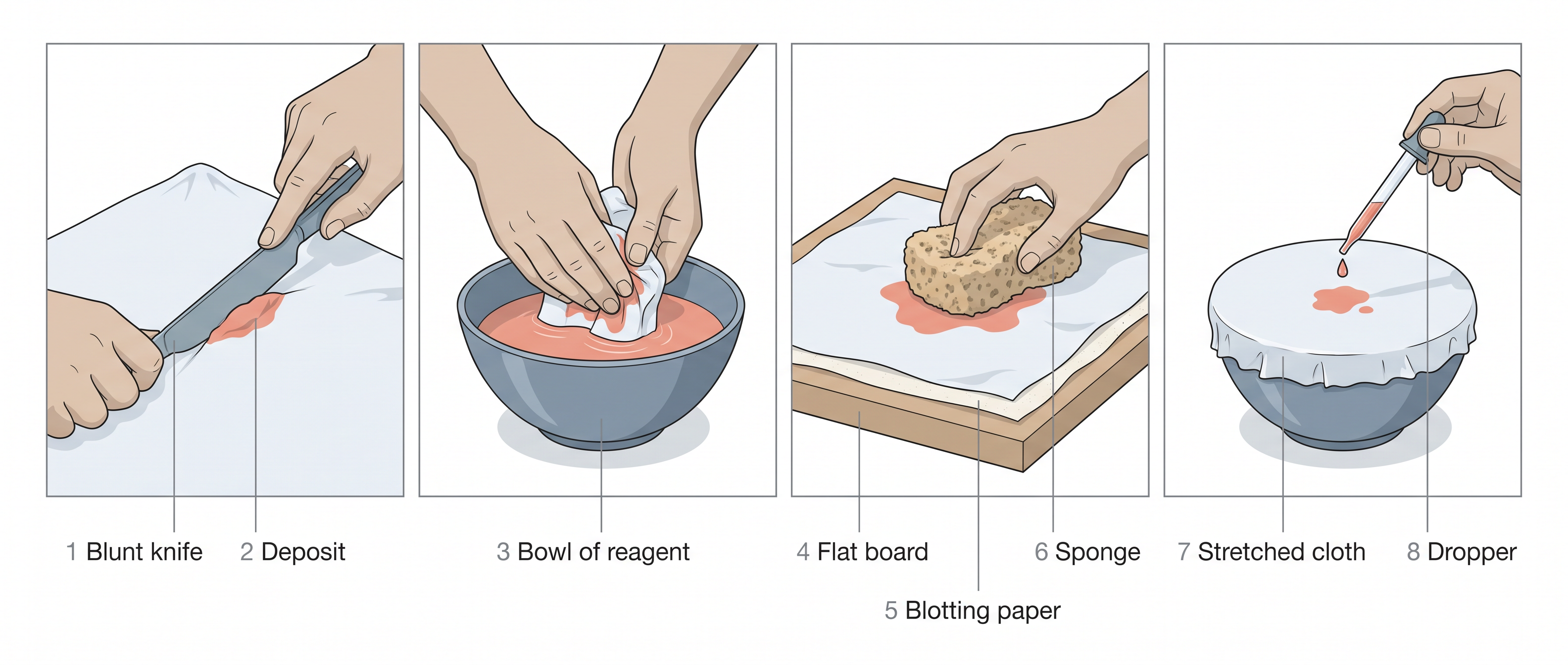
Fig. 11.2 – Four techniques of stain removal.
11.4.5 Reagents Used For Stain Removal
A reagent is the chemical substance used to act on a stain. Reagents are used in liquid form and in the concentrations recommended for their use — a stronger solution does not work better, it only damages the fibre faster.
The reagents used in stain removal fall into six groups.
Grease solvents — turpentine, kerosene, white petrol, methylated spirit, acetone, carbon tetrachloride. These dissolve grease, so that the fat leaves the fibre in solution.
Grease absorbents — bran, Fuller’s earth, talcum powder, starch, French chalk. These are dry powders that draw liquid fat out of the cloth into themselves and are then brushed away.
Emulsifiers — soaps and detergents. These break the grease into fine droplets that water can carry off.
Acidic reagents — acetic acid (vinegar), oxalic acid, lemon, tomato, sour milk, curds.
Alkaline reagents — ammonia, borax, baking soda.
Bleaching agents, of two kinds:
oxidising bleaches — sunlight, sodium hypochlorite \(NaOCl\) (javelle water), sodium perborate, hydrogen peroxide \(H_2O_2\);
- reducing bleaches — sodium hydrosulphite, sodium bisulphite, sodium thiosulphate \(Na_2S_2O_3\).
The first three groups are all answers to the same problem — grease will not dissolve in water — and they answer it in three different ways. A solvent dissolves the grease, an absorbent soaks it up, an emulsifier splits it into droplets that water can hold. Which one you choose depends on the fabric and on how much grease there is.
The last group works on colour rather than on grease. A bleach destroys the colouring matter of a stain by changing it chemically, so that the mark stops reflecting colour. An oxidising bleach does this by adding oxygen to the stain; a reducing bleach does it by removing oxygen. Neither can tell the stain from the dye of the fabric, which is why bleaches are used with great care on anything but white cotton.
11.4.6 Removing Common Stains From Cotton
Table 11.1 sets out the treatment for the stains a household meets most often. Read it with the reagent groups of 11.4.5 in mind, and you will see the same few ideas repeating: scrape or harden what is solid, dissolve what is greasy, bleach what is coloured, and keep protein cold.
Two cautions go with the whole table.
These are methods for white cotton fabric. On other fibres, and on any coloured material, the same reagents may take the colour or weaken the fibre, so suitable precautions must be taken and the test on a small portion becomes essential.
Stain removal is only the preparatory step of laundry. It must be followed by washing or dry-cleaning, and every trace of the chemical used must be removed from the article.
The entry for a curry stain repays a closer look, because it is really two stains in one. Fig. 11.1 put stain removal first in the sequence; here is what that first step actually involves.
11.5 Removal Of Dirt: The Cleaning Process
Dirt is the general name for the grease, grime and dust that get jammed into the structure of a fabric. It is not one thing, and it is not held in one way.
Some dirt lies loosely on the cloth. Dust that has settled on a curtain, or sand picked up on a walk, can be shaken or brushed off, and whatever is left will come away when the article is steeped in water.
The rest is held tightly, and what holds it is sweat and grease from the skin. Steeping loosens this grease a little, but it will not release it. For that you need a reagent that acts on the grease itself.
There are three ways of dealing with grease, and you have already met all three among the stain-removal reagents — solvents, absorbents and emulsifiers. Which pair of them a cleaning process uses decides what the process is called.
When cleaning is done with solvents or absorbents, it is called dry cleaning — cleaning without water. Normal cleaning, or washing, is done in water with the help of soaps and detergents, which emulsify the grease, that is, break it into very small particles. The article is then rinsed with water.
Three things therefore have to work together in a wash: the water, the cleansing agent, and the method by which the article is handled.
11.5.1 Water
Water is the most valuable single agent in laundry work, and it does more than carry the soap.
There is a natural adhesion between a fabric and water. During steeping, water penetrates into the fabric and wets it, which is the first condition for any cleaning to happen at all. Once it is inside, the particles of water are in constant random motion. This movement is called pedesis, and it is what nudges the non-greasy dirt out of the spaces between the fibres.
Water alone, with agitation provided by the hand or a machine, will therefore remove a fair amount of loose dirt and particulate soil. Raising the temperature of the water increases its pedesis and its penetrating power, and it is more helpful still when the dirt is greasy, since warmth softens fat.
Two limits stop water there. It cannot remove dirt that will not dissolve in it — and grease will not. And it has no ability to hold the dirt it has removed in suspension. The loosened dirt therefore settles back onto the cloth as the article is moved about.
This settling back is called redeposition, and it is the main reason fabrics turn grey over many launderings. Nothing looks obviously wrong at the end of any single wash; the cloth simply gets a little duller each time.
11.5.2 Soaps And Detergents
Soaps and detergents are the most important cleansing agents used in laundry work, and they exist to solve exactly the two problems that defeat water.
Soap is the product of a reaction between a natural oil or fat and an alkali. If the alkali has been used in excess during manufacture, the surplus is released when the soap is used, and it is that free alkali which harms a delicate fibre. Detergents are synthesised from chemicals rather than from fats. Both are sold in powder, flake, bar and liquid form, and the choice between them depends on the fibre content of the article, its colour and the kind of dirt on it.
What The Two Have In Common
Soaps and detergents share the property that makes them work. Both are surface-active agents, or surfactants — substances that reduce the surface tension of water.
Surface tension is what keeps water standing up in a drop instead of spreading. Reduce it, and the water soaks into the cloth instead of sitting on it, so it reaches the dirt faster and takes it away faster.
The surfactant then does the second job. Its molecules surround each loosened particle of soil and keep it suspended in the wash water, so that it does not settle back onto the clean fabric. This is what prevents the greying that water alone cannot prevent.
Where The Two Differ
Soaps have real advantages over detergents, and the differences are set out in Table 11.2. They are natural products, gentler on the skin and on the environment. They are biodegradable, which means living organisms break them down, so they do not build up as pollution in rivers and streams.
Against that, soap is not effective in hard water — water carrying dissolved salts of calcium and magnesium. In hard water much of the soap is used up before any cleaning begins, and that is straightforward wastage. Soap is also less powerful than a synthetic detergent, and it loses its cleaning power over time in storage. A detergent, being built rather than boiled, can be engineered for a particular cleaning task and for a particular type of washing machine.
11.5.3 Methods Of Washing
The soap or detergent has emulsified the grease that was holding the dirt. Two things still have to happen. The dirt that is closely adhering to the fabric has to be disassociated from it, and all of the loosened dirt has to be held in suspension until it is rinsed out.
That is the work of the method of washing. The method chosen depends on the fibre content, the type of yarn and fabric construction, and the size and weight of the article being washed. A thick cotton bedsheet and a silk dupatta cannot be handled in the same way.
There are four methods.
Friction Washing
In friction washing, dirt is loosened by rubbing. One part of the garment is rubbed against another part with the hands, or a brush is worked over the dirty parts with the article held on the palm. A large article is laid on a scrubbing board.
This is the most commonly used method, and it is the most effective on heavy soil. It suits strong fabrics such as cottons, which are actually stronger when wet.
Friction is not used on delicate fabrics such as silk and wool, and not on surfaces like pile, looped fabrics or embroidery. On these, rubbing flattens the surface, breaks the loops or wears the threads through.
Kneading And Squeezing
Kneading and squeezing works by gently rubbing the article between the hands while it lies in soap solution, then squeezing the solution through it.
The pressure applied is very low, so the texture, colour and weave of the fabric are not harmed. This is what makes it the method for wool, silk, rayon and coloured fabrics. The trade-off is that it will not shift heavy soil.
Suction Washing
Suction washing is used for articles that a brush cannot be used on, and that are too big or too heavy to be kneaded and squeezed by hand — a bath towel is the standard example.
The article is placed in soap solution in a tub. A suction washer, shown in Fig. 11.3, is pressed down onto it and lifted repeatedly. Each press and lift creates a partial vacuum inside the cup, and the rush of solution through the fabric loosens the dirt particles. The fabric itself is never rubbed.
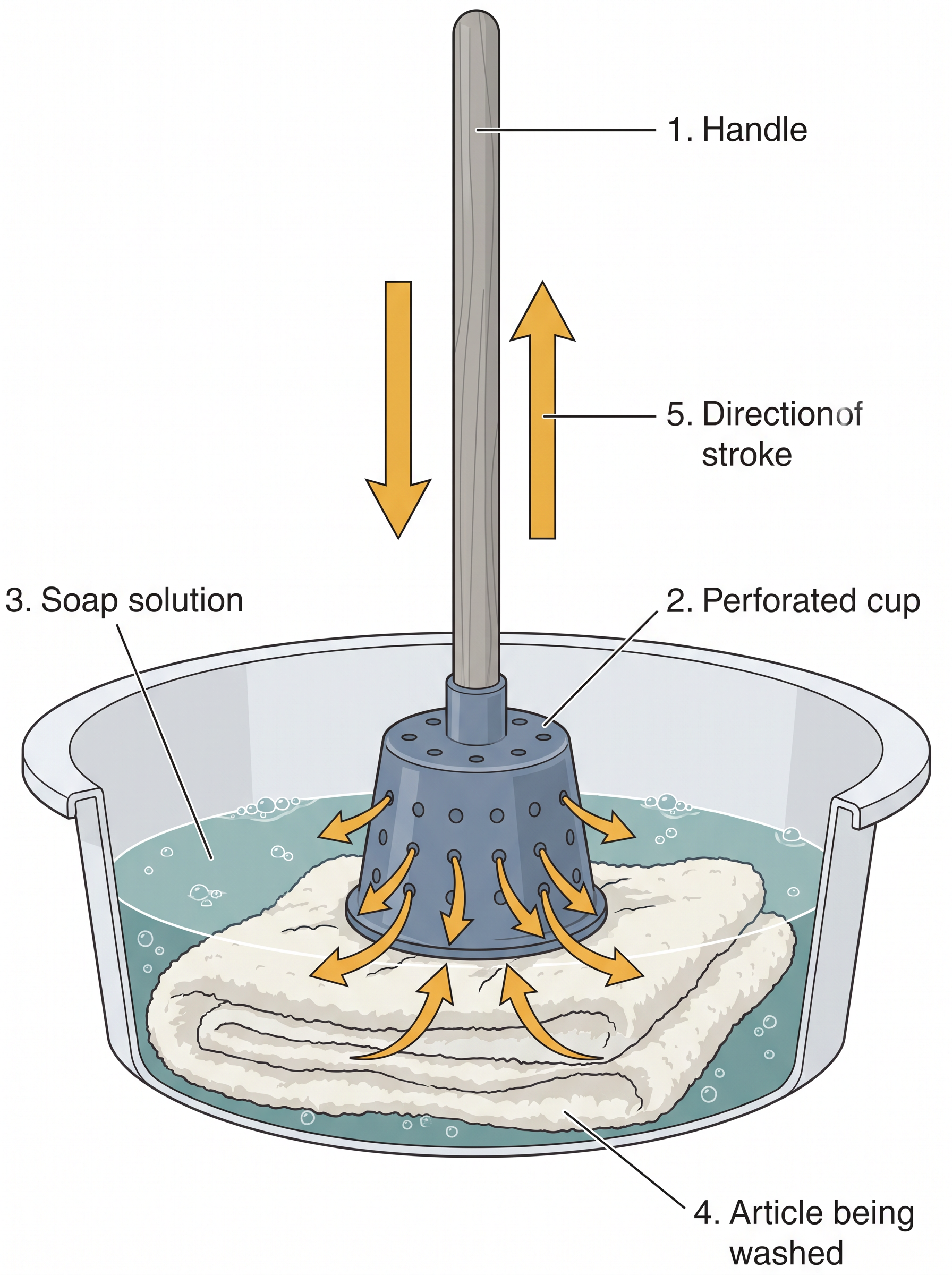
Fig. 11.3 – A suction washer in use.
Machine Washing
A washing machine is a labour-saving device, and it is especially useful in large institutions such as hotels and hospitals where the volume of washing is beyond hand work.
Many kinds are sold by different companies, but the principle behind every one of them is the same — to create agitation in the clothes so that the dirt is loosened. The pressure is supplied by the movement of either the tub itself or a central rod fixed inside it. The washing time is set according to the type of fabric and the amount of soiling.
Machine washing comes in three grades of automation. A manual machine washes but leaves the filling, draining and rinsing to the user; a semi-automatic machine has separate tubs for washing and drying and the article is moved between them by hand; a fully automatic machine carries out washing, rinsing and spinning in one tub without being attended.
Table 11.3 places the four methods side by side.
11.6 Finishing
The wash is over, but the article is not yet finished. First it must be rinsed in clean water until it is absolutely free of soap or detergent, because any cleansing agent left behind will attract dirt and, over time, weaken the fibre.
Finishing is what happens in and after that last rinse. Certain reagents are added to the final rinse water to restore the freshness or brightness of the fabric. Others are applied to add body to it, and to bring back the stiffness or crispness it had when new.
The order is fixed and it is worth seeing why. The fabric has to be clean and free of soap before anything is added to it, because a blue or a starch applied over a residue of detergent will go on unevenly and will not hold.
11.6.1 Blues And Optical Brighteners
You will have noticed that white cotton articles do not stay white. With repeated use and washing they lose their whiteness and turn yellow. Synthetic and manufactured fabrics and their blends discolour too, but towards grey rather than yellow.
The two faults have different causes, and therefore different treatments. Yellowing is a change in the colour cast of the fabric. Greyness is redeposited dirt, the effect you met in 11.5.1.
Blues
The use of blues is recommended to counteract yellowness and restore whiteness. They cannot remedy greyness.
The reason lies in how the eye reads colour. Blue and yellow are opposite each other on the colour wheel, and a very small amount of blue laid over a yellow cast cancels it, so that the cloth is seen as white again. Nothing has been removed from the fabric; a trace of colour has been added to correct what is already there. Dirt, having no yellow cast to cancel, is untouched.
Blue is sold in two forms — as ultramarine blue, which is a fine powdered pigment, and as a liquid chemical dye. The right amount is used in the last rinse.
Powder blue must be handled with care. It is first pasted with a little water, and that paste is then added to more water. The solution is used immediately, because on standing the powder settles to the bottom and the result is patchy. Liquid blues are easier to use and give a more even result.
Two conditions decide whether blueing looks even. The article must be thoroughly wet, though not dripping, and it must be free of the folds left by wringing — a fold holds more solution than the surface beside it and dries as a streak. Move the article about in the blue solution for a short time only, remove the excess moisture and put it out to dry.
Optical Brighteners
Optical brightening agents, also called fluorescent brightening agents, work in a completely different way. They are compounds carrying low-grade or weak dyes that possess the property of fluorescence.
A fluorescent compound absorbs light at a shorter wavelength and re-emits it at a longer one. Here it takes in the ultraviolet light present in daylight, which the eye cannot see, and gives it back as visible blue light. The fabric is therefore returning slightly more visible light than falls on it, and it looks intensely, brilliantly white. This is shown in Fig. 11.4.
Because the effect is an addition of light rather than a cancelling of yellow, an optical brightener counteracts both yellowness and greyness. It can also be used on coloured printed fabrics, which a blue could not be.
Optical brighteners are sometimes referred to as whiteners, and that name causes a common confusion. They cannot destroy a colour. A bleach chemically breaks down the coloured matter in a stain; a brightener leaves every molecule of it exactly where it was and merely makes the cloth send more light back to your eye. The two must never be confused.
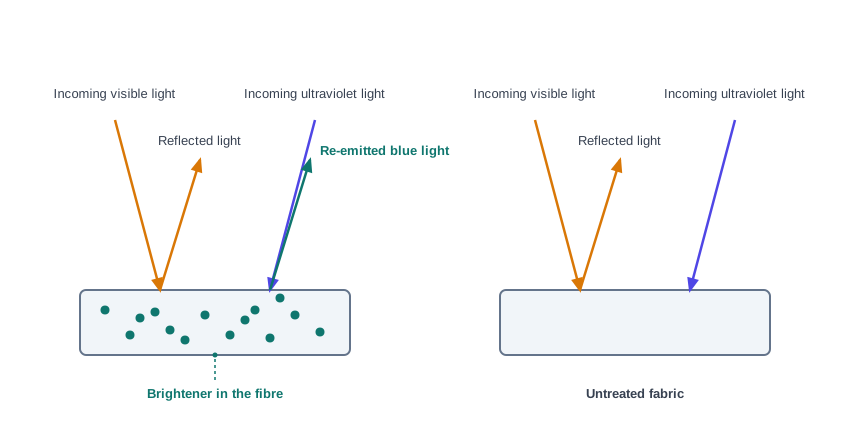
Fig. 11.4 – How an optical brightener whitens a fabric.
11.6.2 Starches And Stiffening Agents
Repeated launderings cost a fabric its body, and with it the gloss and shine it had when new. A new cotton kurta stands away from the shoulder; the same kurta after a year hangs limp.
Starching, or the use of a stiffening agent, is the commonest way of putting that back. It makes the fabric firm, smooth and shiny, and it does two further jobs that are less obvious.
The layer of starch sits between the dirt and the fabric, so the dirt never reaches the fibre directly. And because dirt clings to the starch rather than to the cloth, the next wash is easier — the starch dissolves and takes the dirt away with it.
Stiffening agents are derived from nature, from either plants or animals. The four in common use are starch, gum acacia, gelatin and borax, and they are compared in Table 11.4.
Starch is obtained from wheat (maida), rice, arrow-root, tapioca and similar sources. It is sold as a powder and must be cooked before use. Its consistency is decided by the thickness of the fabric being starched — thick cottons need light starching, thin fabrics need heavy starching. As a stiffening agent it is used only for cotton and linen. Commercially prepared starches sold in the market are easier to use and do not necessarily need hot water for preparation.
Gum acacia, also called gum arabic, is the natural gum obtained from the acacia plant, the babool tree, and comes in granulated lumps. The solution is made by soaking the lumps overnight to dissolve them and then sieving to get a lump-free liquid. It gives only light stiffening, closer to crispness than to firmness, and it suits silks, very fine cottons, rayons, and silk and cotton blends.
Gelatin is easy to make and easy to use, but it is expensive compared with the other homemade starches.
Borax is not really a starch at all. A small quantity added to the starch solution improves its stiffening action. When the starched fabric is ironed, the borax melts and forms a thin film on the surface of the cloth. That film is water repellent, and so the crispness survives even in a humid climate.
Which agent is used depends on the fibre content of the article and on what the article is for. For personal clothing it is often simply the user’s preference — how crisp a person likes a collar to be.
11.6.3 Drying
Once the articles have been washed, blued and starched, they have to be dried before they can be ironed or stored.
The best way to dry most fabrics is to hang them outside in the sun, with the wrong side facing out. The sun dries clothes faster than shade, acts as an antiseptic on the fabric, and works as a bleaching agent on whites. Turning the wrong side out means that this same strong light falls on the inside of the garment, and any fading it causes is on the surface that will not be seen.
Not every fibre can take it, though, and this is one of the places where a general rule has clear exceptions.
Delicate fabrics such as silk and woollens must not be hung in the sun for long, because strong sunlight damages them.
Synthetic fibres lose strength when exposed to sunlight, and they also tend to turn yellow. That yellowing is irreversible — no bleach or blue will take it out afterwards.
So silks, woollens and synthetics are best dried indoors, in shade, where the air does the work and the light does no damage.
11.7 Ironing And Pressing
Take a washed and dried article off the line and you will find wrinkles all over it, and creases in places where no crease was wanted. Ironing gets rid of these, and puts creases where they are wanted instead.
Good ironing needs three things together — high temperature, moisture and pressure. Any one of them alone does almost nothing, and it is worth knowing why before looking at each in turn.
Water entering a fibre swells it and loosens the hold the fibre has on its own shape. Heat and pressure then flatten the swollen fibre into the shape you want, and the heat drives the water out again. The fibre dries in its new position and stays there. Take away the moisture and the fabric will not yield; take away the heat and it will not dry in place; take away the pressure and nothing has been shaped.
Temperature
An iron is simply a controlled source of heat. It may be a charcoal iron or an electric iron.
The charcoal iron is cheap, but it has two clear disadvantages. The coal burnt inside it may stain the article being ironed. More important, its temperature cannot be controlled.
That matters because different fibre groups have different thermal properties, and each has to be ironed at its own temperature. Cotton and linen take high heat and need it, since they crease deeply. Silk and wool scorch — that is, they are burnt at the surface — well below the temperature cotton needs. The synthetic fibres do not burn at first; being thermoplastic, they soften and melt, and a melted patch cannot be repaired.
An electric iron allows the temperature to be set, which is exactly what these differences demand. So where electricity is not a problem, an automatic electric iron is the best option.
Moisture
If you begin ironing while the clothes are still damp from the wash, the moisture is already there and nothing more is needed.
For an article that has dried completely, sprinkle some water over it and roll it in a towel for a while. The rolling lets the moisture spread evenly right flow through the article, which sprinkling alone does not do. Water may also be applied with an ordinary spray bottle.
Pressure
Pressure is supplied by hand, through the movement of the iron over the article.
The iron is generally moved along the length of the cloth. A fabric gives most when it is pulled diagonally, so an iron pushed across or at an angle can stretch the article permanently out of shape.
Some articles will stretch or lose their shape under any movement of the iron. Laces are the standard example. These are pressed rather than ironed.
Pressing means keeping the hot iron in one place on the cloth, then lifting it clear and setting it down in another place. The iron never travels over the fabric, so it cannot drag it. Pressing is also the way folds are set — creases, hems, pockets, plackets and pleats. The difference between the two actions is set out in Table 11.5 and shown in Fig. 11.5.
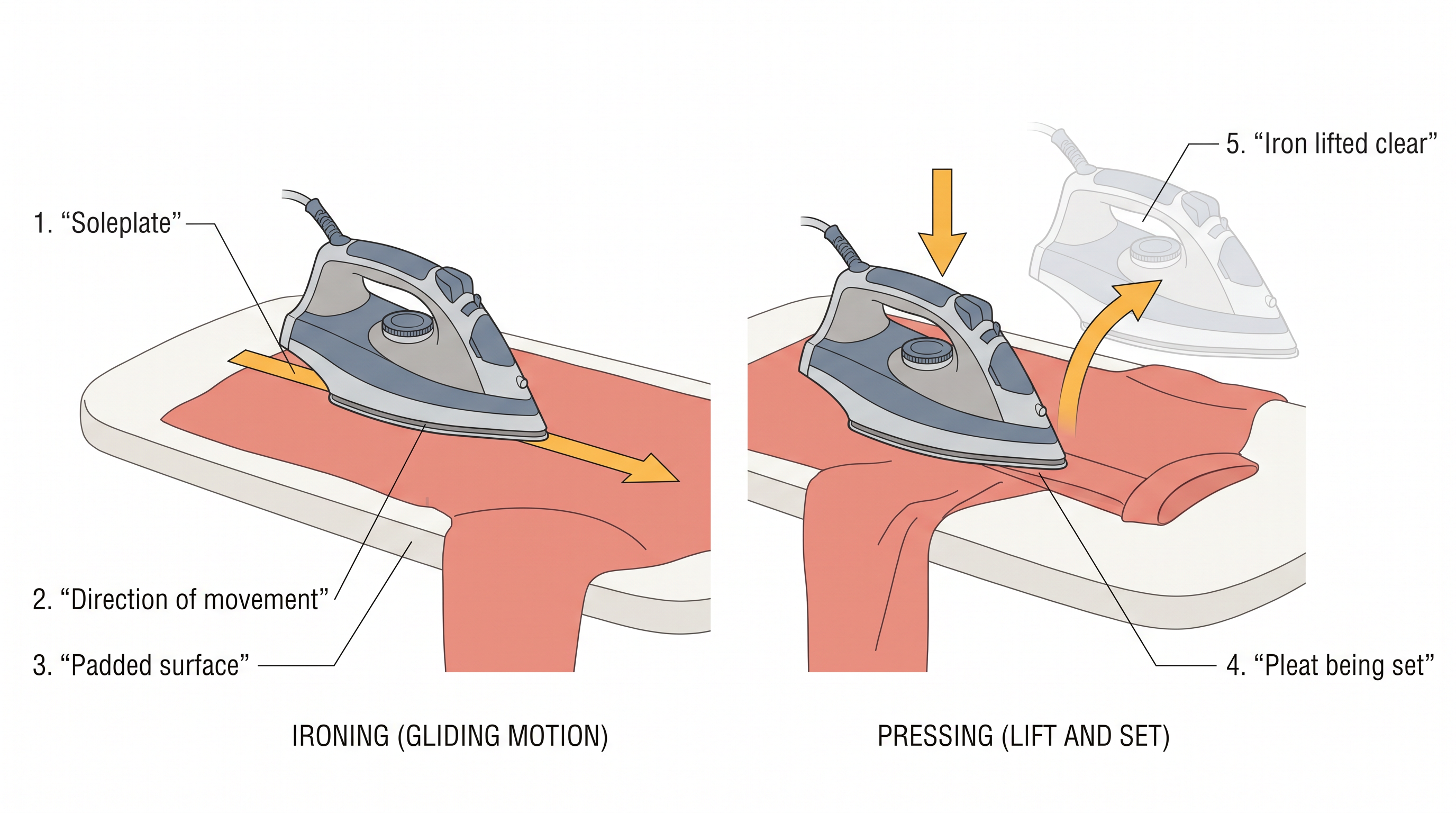
Fig. 11.5 – Ironing and pressing.
The Ironing Surface
The table used for ironing should be well padded and yet firm. Padding lets the fabric sink slightly so that seams and buttons do not print through; firmness gives the pressure something to work against.
The top should have an even surface, and should be of a size and height that is comfortable for the person working. Padded ironing boards are sold in the market. Where one is not available, three or four layers of thick fabric spread over any levelled surface will serve.
After Ironing
Once ironed, articles are either folded in a particular way or hung on hangers, depending on the storage space the household has.
Either way, the point of the whole sequence is that the article should be sitting in its finished state when it is next needed — clean, mended, crisp and unwrinkled, ready to be taken out and used.
11.8 Dry-Cleaning
You met dry cleaning in 11.5 as one of the two ways of dealing with grease — cleaning by solvents and absorbents rather than by water and soap. It is now worth looking at properly, because it is the only route open for a large class of articles.
Dry-cleaning is not dry in the ordinary sense. The article is fully immersed in a liquid and moved about in it, exactly as it would be in a wash. The liquid simply is not water.
Why A Solvent Is Gentler Than Water
The whole case for dry-cleaning rests on one difference between the two kinds of liquid.
Water is absorbed by the fibres themselves. As it enters, each fibre swells, and a swollen fibre shifts its position in the yarn. When the article dries, the fibres do not all return to where they were. This is what produces shrinkage and wrinkle formation, and it is also what lets a water-soluble dye leave one part of a garment and settle on another, which is colour bleeding.
The dry solvents are not taken up by the fibre in this way, so they do not cause fibre swelling. The grease dissolves and leaves; the fibre itself is barely disturbed. That is why dry-cleaning is a safe method for cleaning delicate textiles.
The solvents most commonly used are perchloroethylene, a petroleum solvent, or a fluorocarbon solvent. Fluorocarbon solvents have largely been withdrawn from use since they were found to damage the ozone layer, and perchloroethylene now does most of the work.
How A Dry-Cleaning Establishment Works
Dry-cleaning is generally done in industrial establishments and not at the domestic level. The plant, the solvent and its recovery all need equipment no household has.
The path an article takes is shown in Fig. 11.6. It is brought to the cleaner’s and identified with a tag that carries any special instructions for it. It is then inspected and treated at a spot board — a working surface where individual marks are dealt with by hand before the article goes into the machine.
The spot board exists because of the very property that makes the solvent gentle. A solvent lifts grease, but it will not touch a water-soluble stain such as tea, fruit juice or perspiration. Those, and any other hard-to-remove spots, must be treated separately at this stage or they will still be there at the end.
This is where the customer can make a real difference. A customer who points out the stains, and says what caused them, lets the cleaner choose the right treatment at the spot board, and is far more likely to be satisfied with what comes back.
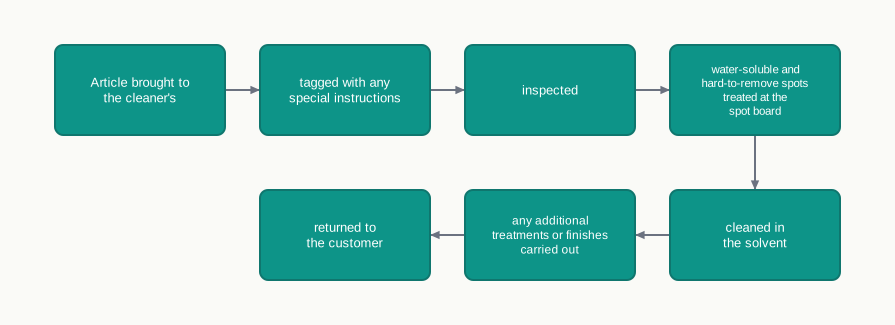
Fig. 11.6 – The path of an article through a dry-cleaning establishment.
What Else A Dry Cleaner Does
Many dry cleaners are equipped to do a good deal more than clean. The additional treatments include:
replacing buttons and doing minor repairs to the article;
replacing sizing, and applying finishes such as water repellency and permanent creases;
moth proofing, and cleaning fur and leather.
Some also clean and sanitise feather pillows, blankets, quilts and carpets, and clean and press draperies. For a household, that makes the dry cleaner the place where the year’s heavy articles are dealt with before they are put away.
11.9 Storage Of Textile Products
The weather in our country is not the same all the year round, and clothing has to match every part of it. A woollen shawl is essential in January and useless in May; a thin cotton is the reverse.
So at any time of the year a household is using only part of what it owns, and the rest has to be put away. Storage is not a pause in the care of a fabric — it is one more stage of it, and articles are lost in storage more often than in use.
The governing rule is short. Whatever the article, it must be clean and dry before it is packed away.
Why Clean And Dry
Three things are at work in a closed box over four or five months, and all three feed on what is left in the cloth.
A stain that survives the last wash goes on reacting with the air in the dark. What was a faint mark in March is a set brown patch in October, and by then no reagent will lift it.
Insects come next. They are not attracted to clean cloth but to what is on it — food spills, perspiration and, in the case of clothes moths, the protein of the wool fibre itself. An article stored soiled feeds them.
Third is mildew, the growth of fungus on a fabric, which shows as musty grey or brown spots and weakens the fibre underneath. Mildew needs moisture to grow. This is why packing must be done in an atmosphere of very low humidity, and why an article that is even slightly damp should never be put away.
Preparing An Article For Storage
The steps are set out in Fig. 11.7.
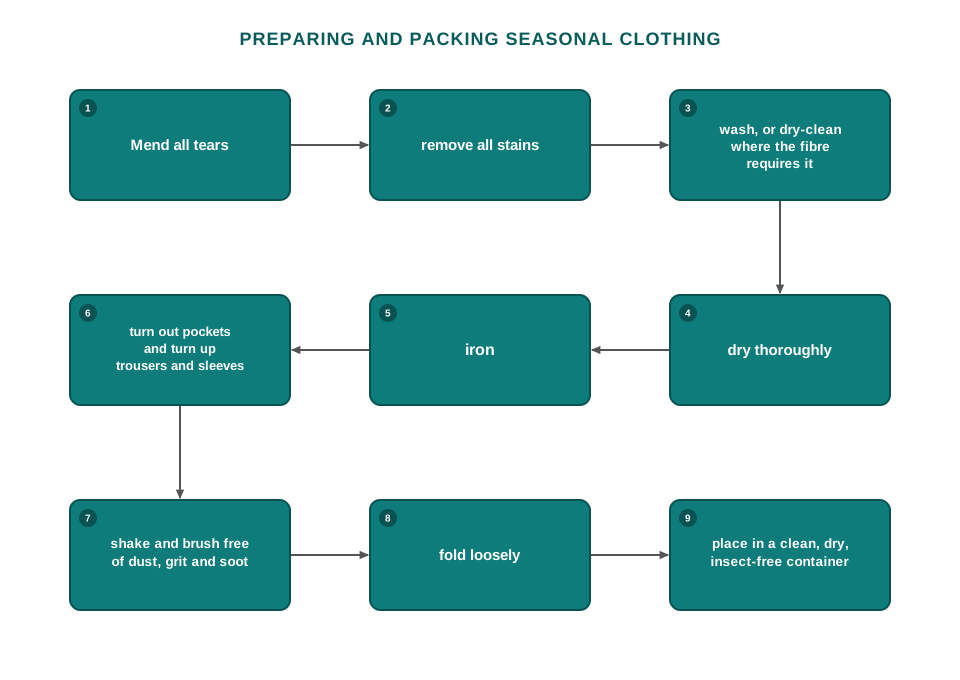
Fig. 11.7 – Preparing a textile article for storage.
A few of these steps deserve a word.
Woollens are brushed well and dry cleaned rather than washed before they are stored, since water is what damages wool most. Pockets are turned inside out, and trousers and sleeves turned up, because that is where crumbs, grit and soot collect unnoticed.
Pack loosely, in whatever the household stores its clothes in — cupboards, shelves, boxes or trunks. Packing that is too compact and tight leaves the fabric held hard in one position for months, and permanent creases set along the folds. Where an article is to be stored for a long time, it is worth refolding it along different lines halfway through.
The shelves, boxes or closets chosen must themselves be clean, dry and insect free, and away from dust and dirt. A spotless saree in a dusty trunk is no better protected than a soiled one.
Finally, storage is not one instruction for all fabrics. Each fibre is susceptible to a different set of organisms and to different insects, and what protects a cotton will not protect a wool. Those differences are set out fibre by fibre in the section that follows.
11.10 Factors Affecting Fabric Care
Everything so far in this chapter has described what can be done to a fabric. This section is about what a particular fabric will allow.
The selection, use and care of a fabric depend on five factors, and every one of them is decided before the article ever reaches the household.
Fibre content — what the fabric is made of.
Yarn structure — how the fibres were twisted into yarn.
Fabric construction — how the yarns were made into cloth.
Colour application — how the colour was put on.
Finishing — what treatments were given to the finished cloth.
Each type of fabric therefore has its own individual characteristics, and needs its own specific care.
11.10.1 Fibre Content
The fibre decides more about care than all the other factors together. Table 11.7 sets out, fibre by fibre, the properties that matter and the care each one demands.
Cotton And Linen
These two behave almost identically in the wash, and they are the easiest fibres a household deals with.
They are strong fibres, and — unusually — they are stronger when wet than when dry. They can withstand hard friction. They resist alkalis, so they can be washed with strong detergents, and they withstand high temperatures, so a white cotton can be boiled where that is necessary.
They also resist organic solvents and bleaches. What weakens them is acid, so any acidic reagent used on a cotton must be rinsed out and neutralised afterwards.
Their weaknesses are of a different kind. Cotton and linen crush easily and must be ironed properly to take the wrinkles out, and they must be damp when ironed or they will scorch. Fungus and mildew attack them, so they are stored completely dry and in a low-humidity atmosphere. And a heavily starched cotton attracts silverfish, which feed on the starch — so an article that has been starched should be de-starched before it is stored for a long period.
Rayon
Rayon is chemically identical to cotton, and a student often expects it to be laundered like cotton. It cannot be.
The strength of most rayons is relatively low, and it falls further when the fibres are wet, so rayon requires careful handling in laundering. Strong alkalis may damage it, which makes mild soaps and detergents the safer choice. It shrinks on washing, so care is needed there too.
It is resistant to dry-cleaning solvents and to stain-removing agents. Its elastic recovery and resilience are low, so it wrinkles and stretches easily — though for the same reason it is easy to iron.
Mildew and silverfish are harmful to rayon, and rot-producing bacteria attack it, so it must be stored in absolutely clean and dry conditions.
Wool
Wool is a protein fibre, and every one of its care requirements follows from that.
It is a weak fibre, and it weakens further when wet, so it is handled gently throughout laundering. It is easily damaged by alkaline substances, which means strong detergents and soaps must be avoided.
Its most characteristic fault is felting. When wet wool is subjected to mechanical action such as agitation, the fibres lock together and the article felts and shrinks — irreversibly. Washing in cold water with the minimum of handling is therefore the advice for all wool.
Knitted articles in wool bring a second problem: they stretch out of shape while being washed. The remedy is to trace an outline of the garment on a sheet of paper before washing, and after washing to stretch the article back to that outline while it dries. This is called re-blocking, and it is shown in Fig. 11.8.
Wool has good resilience and does not wrinkle, so it may not need ironing at all. Where it does, it is not ironed directly but steam pressed. Dry-cleaning solvents and stain-removing agents have no harmful effect on it, but bleaches must be used with care.
Finally, wool protein is particularly attractive to insects — clothes moths and carpet beetles — so a stored woollen needs protection against infestation.
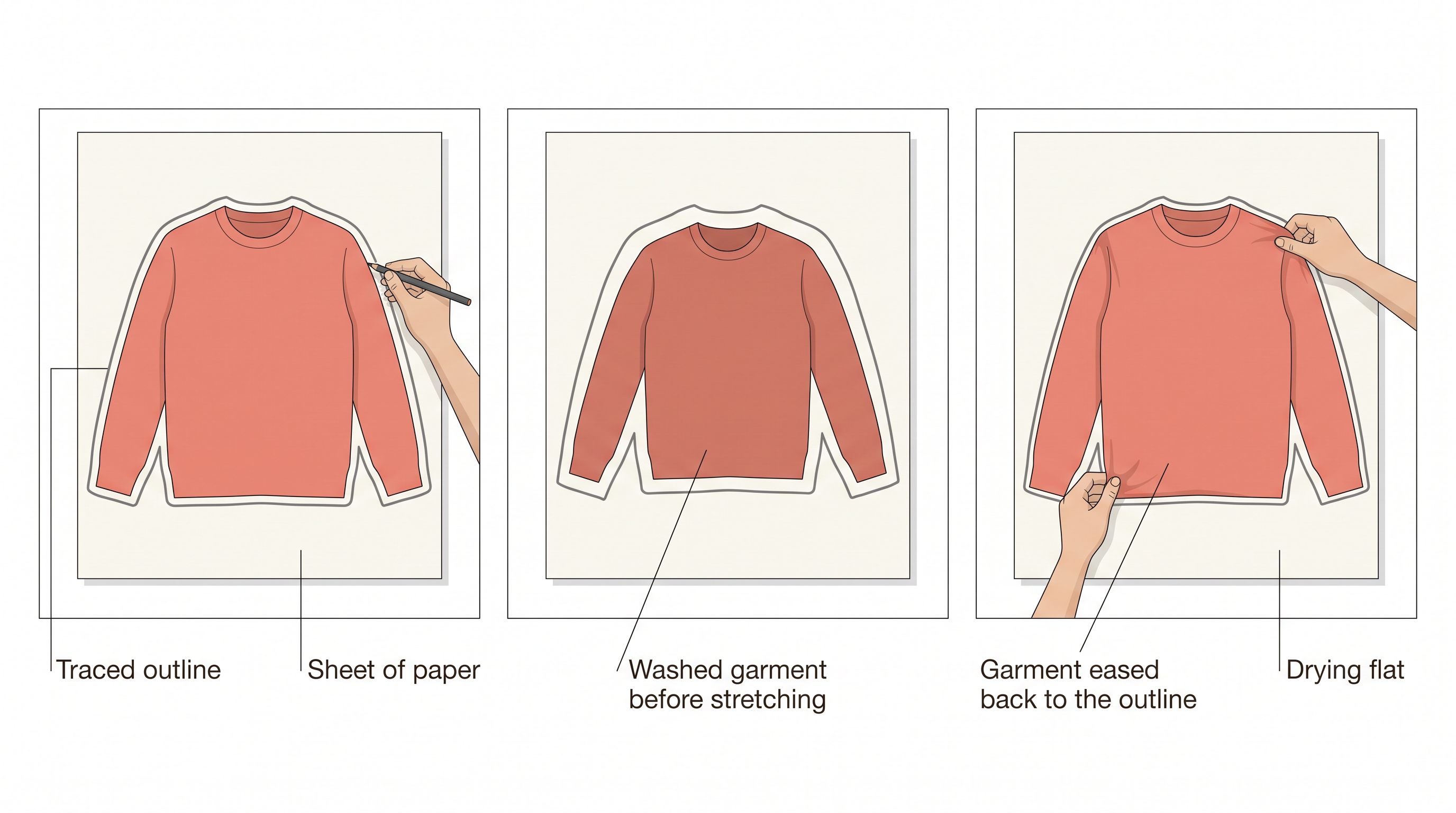
Fig. 11.8 – Re-blocking a knitted woollen garment.
Silk
Silk is also a protein fibre, but it behaves quite differently from wool.
It is a strong fibre, though weaker when wet, and it needs careful handling in washing — only gentle friction. Strong alkalis damage it, so mild detergents are used. It does not stretch or shrink on washing, which is one anxiety fewer, but its resilience is only medium, so it wrinkles during use and needs to be ironed.
The ironing is where silk is most often ruined. It scorches easily under high temperature and dry heat, so a silk article should be thoroughly damp and ironed at a low temperature.
Three further points concern storage. Perspiration damages silk, so a silk garment is dry-cleaned and aired properly before it is put away, and it should not be stored soiled. Silk is weakened by long exposure to sunlight, so it is never dried in the sun. And although it resists mildew and bacteria, carpet beetles will eat it.
The Synthetic Fibres
Nylon, polyester and acrylic are all manufactured fibres, and as a group they share a set of care advantages. They do not absorb much water, so they dry quickly and lose little or no strength when wet. They resist microorganisms and most insects. None of them needs the careful treatment that wool and silk demand.
They share a set of limits too, and the limits are thermal. Being thermoplastic, they soften with heat, so hot ironing is either unnecessary or damaging.
Beyond that, each has its own character.
Nylon has very good strength and retains much of it when wet, so it requires no special care. It is not affected by alkalis, but acids may destroy the fibre, so any acidic reagent must be rinsed out well. Dry-cleaning solvents, stain-removing agents, detergents and bleaches can all be used on it safely. It has one awkward habit — it absorbs dirt from other soiled articles washed with it, and so should be washed separately. Sunlight is destructive to nylon and causes a marked loss of strength after extended exposure, which is why it is not recommended for window curtains or draperies.
Polyester loses no strength when wet and is easily washed. Its elastic recovery and resilience are good, so it does not need hot ironing. Its moisture regain — the amount of water the fibre takes up from the air around it — is very low, which is what accounts for the discomfort of wearing polyester in a hot climate. It also has two faults that cannot be undone. It develops small balls on its surface, called pills, which cannot be removed; and if oil drips onto it, the fabric refuses to part with it, so oily stains on polyester must be attended to carefully and at once.
Acrylic has strength similar to cotton and can be washed easily without any special care. Its elongation and elastic recovery are high, so it does not wrinkle easily, and its moisture regain is low, so it dries quickly. It resists most alkalis and acids, and dry-cleaning solvents do not damage it. It has excellent resistance to sunlight, to all types of soaps and synthetic detergents, and to bleaches, and moths do not attack it.
Against all that stands one serious property. Acrylic catches fire readily, and unlike other synthetic fibres it goes on melting and burning once alight. This makes it hazardous around children, and it is a reason to think carefully before choosing acrylic for a child’s nightwear or for furnishing near a flame.
11.10.2 Yarn Structure
The twist and type of yarn affect maintenance as well.
Yarns with a high twist tend to shrink. Novelty and complex yarns, which have loops, slubs or projecting ends, may catch, snag or get abraded in the wash.
A blended yarn brings its own arithmetic: both the fibre contents in it have to be cared for, and the care must satisfy the more demanding of the two. Take a polyester and cotton blend. You cannot use very hot water on it, because the polyester would shrink — even though the cotton in it would have taken boiling water quite happily. Set against that, the blend does not wrinkle much, and so it is easier to iron than pure cotton.
11.10.3 Fabric Construction
How the yarns are put together is closely related to maintenance.
Simple, closely woven fabrics are the easiest to maintain. There is little for anything to catch on, and the structure holds its shape.
Fancy weaves are more troublesome. Satins, piles, and weaves with long floats — lengths of yarn lying loose across the surface — may snag during washing, and a pulled float shows.
Knitted fabrics stretch out of shape and may therefore require re-blocking, in the way described for knitted woollens. Sheer fabrics, laces and nets have to be handled carefully because there is so little structure holding them together, and felts and non-wovens because they have no yarn structure at all.
11.10.4 Colour And Finishes
Colour is an important aspect of care. Dyed and printed fabrics may lose colour during cleaning, and the colour they lose may stain other materials washed with them. So the colour of a fabric may be tested before use, and proper care taken accordingly.
Many finishing treatments alter the behaviour of a fabric. Some of these changes are improvements and some cause problems, and a few finishes have to be renewed after every wash — starching, which you met in 11.6.2, is the household example of exactly that.
Putting The Five Factors Together
Fibre content, yarn structure, fabric construction, colour application and finishing are the important factors for every fabric product. They do not act separately. Together they determine the appearance, comfort, durability and maintenance requirements of the article.
Which of those four matters most is relative, and it depends on the article. Durability decides a school uniform; appearance decides a wedding saree; comfort decides a summer shirt; low maintenance decides a curtain that is hard to take down.
That is the judgement this chapter has been building towards. It is your responsibility to evaluate the qualities of a fabric in terms of its ultimate end-use, and then to make the decisions about its use and its care.
11.11 Care Labels
Everything in this chapter comes down to one question at the moment a garment is in your hands: what may I do to this particular article? The care label is the manufacturer’s answer to it.
The label carries the regular care information and instructions for that product. It is attached or affixed in such a way that it will not separate from the product, and so that it stays legible for the useful life of the garment. Both conditions matter — an instruction that falls off after two washes, or fades until it cannot be read, has not done its job.
Why The Label Is Worth Trusting
The manufacturer knows things about the article that you cannot see. What the fibre content actually is, whether the dye is fast, what finish has been applied, whether the interfacing inside a collar will survive hot water.
You have spent this chapter learning to reason about fibres and constructions. The label is where that reasoning has already been done for one specific garment, by the people who made it. It is worth reading before the first wash, not after the first accident.
The Five Groups Of Symbols
A care label carries its instructions both in words and in standard symbols, so that they can be read whatever language the buyer speaks. The symbols fall into five groups, always in the same order, as shown in Fig. 11.9.
Washing — a wash tub, with the temperature marked inside it.
Bleaching — a triangle.
Drying — a square.
Ironing — an iron, with dots for the temperature.
Dry-cleaning — a circle, with a letter inside it for the solvent.
In every group, a cross drawn over the symbol means the same thing: do not do this at all. That single convention lets you read half a label at a glance.
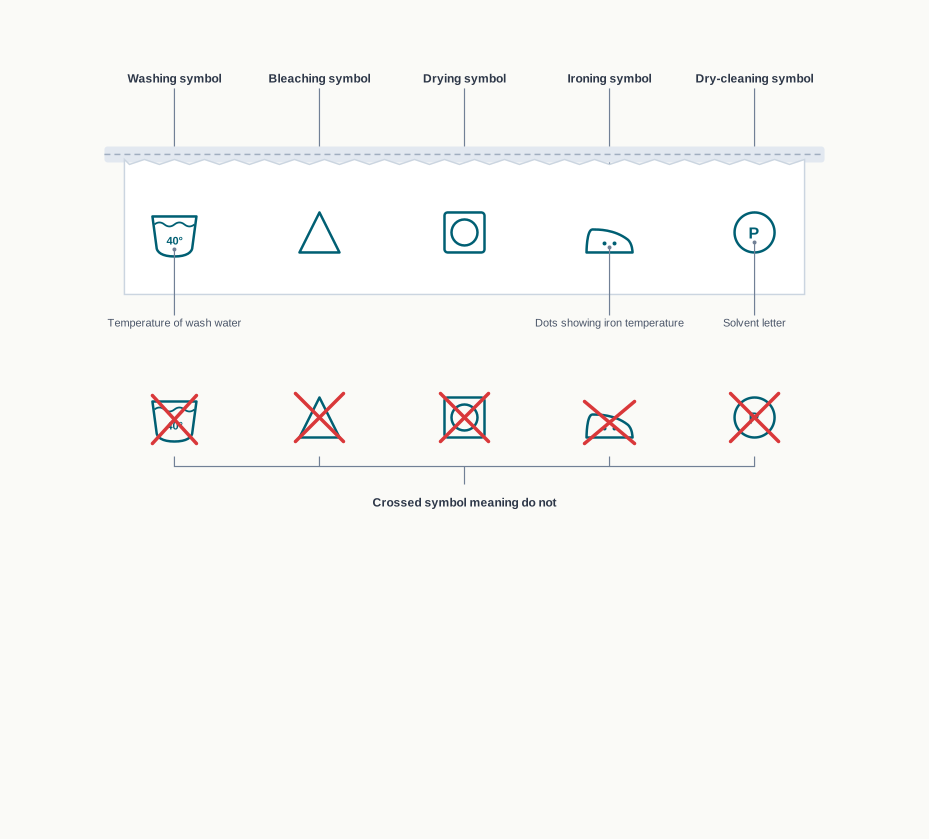
Fig. 11.9 – The five symbol groups on a care label.
Reading The Instructions
Table 11.8 sets out the instructions that appear on care labels and what each of them means.
Notice how much of the table you can now predict. A label reading ‘dry flat’ and ‘do not wring’ is almost certainly on a knitted woollen, and you know from 11.10.1 exactly why both instructions are there. A label reading ‘dry in shade’ is on something whose dye or fibre sunlight would damage.
11.12 Summary
Care and maintenance are the practices by which a fabric product is kept free of damage, and kept looking and performing as it did when new, for the expected life of the material.
Care and maintenance have two aims:
- keeping the material free of physical damage;
- retaining its appearance — removing stains and dirt without harming the colour, retaining or refurbishing brightness and texture, and controlling wrinkles and creases.
Mending is the repair of damage from ordinary use or accident, and it covers cuts, tears and holes, buttons and fasteners, and seams and hems that have opened.
Mending is done before laundering, because washing puts the fabric under strain and the strain concentrates at damage that already exists.
Laundering is the whole ordered sequence of cleaning and restoring a washable article: stain removal, preparation for washing, washing, rinsing, finishing, drying, pressing and storage.
A stain is an unwanted mark or colouration caused by contact with and absorption of foreign matter, which normal washing will not remove.
A stain is identified by its colour, smell and feel before any reagent is used, and stains are classified as:
- vegetable stains, which are acidic and are removed in an alkaline medium;
- animal stains, which are protein and are removed by detergents in cold water only;
- oil stains, which are removed by grease solvents and absorbents;
- mineral stains, which are washed first in an acidic and then in an alkaline medium;
- dye bleeding, which is removed by dilute alkalies or acids according to the fabric.
Protein stains are treated in cold water because heat coagulates protein and sets it permanently in the fibre.
A stain is best removed fresh, by the simplest process that will work, using a mild reagent repeatedly rather than a strong one once, and always testing on a small portion of a delicate fabric first.
Every trace of the reagent must be washed out afterwards, since a residue goes on damaging the fibre.
The four techniques of stain removal are scraping, dipping, sponging and the drop method; sponging and the drop method push the stain out through the back of the cloth instead of spreading it.
Stain-removal reagents fall into six groups: grease solvents, grease absorbents, emulsifiers, acidic reagents, alkaline reagents, and bleaching agents, which are either oxidising or reducing.
Dirt is the grease, grime and dust jammed into a fabric. Loosely held dirt is brushed off or removed by steeping; tightly held dirt is bound by sweat and grease and needs a reagent.
Grease is removed in three ways — by solvents, by absorbents or by emulsifiers. Cleaning by solvents or absorbents is dry cleaning; washing uses water with soaps or detergents, which emulsify the grease.
Water wets the fabric and its particle movement, called pedesis, removes non-greasy dirt. Raising its temperature increases both. Water alone cannot dissolve grease or hold dirt in suspension, so removed dirt is redeposited and the fabric greys.
Soap is made by reacting a natural oil or fat with an alkali; detergents are synthesised from chemicals. Both are surfactants: they lower the surface tension of water and hold the removed soil in suspension.
Soap is biodegradable and gentler on skin, but it is wasted in hard water, is less powerful than detergent and loses cleaning power in storage; detergent works in hard water and can be engineered for a task or a machine.
The four methods of washing are friction, kneading and squeezing, suction, and machine washing. The method is chosen by fibre content, yarn and fabric construction, and the size and weight of the article.
Friction suits strong cottons and heavy soil but not silk, wool, pile, loops or embroidery; kneading and squeezing suits delicate and coloured fabrics but not heavy soil; suction suits large heavy articles; machines work by agitation and may be manual, semi-automatic or fully automatic.
Finishing follows a rinse that has left the article free of soap. Blues, optical brighteners, starches and stiffening agents are all applied at this stage.
Blues counteract yellowness in white articles by cancelling a yellow cast with its opposite colour; they cannot remedy greyness.
Optical brighteners absorb ultraviolet light and re-emit it as visible blue light, so they counteract both yellowness and greyness, and may be used on coloured prints. They do not destroy colour and are not bleaches.
Stiffening agents restore body, gloss and shine, and keep dirt off the fibre. The four in use are starch, gum acacia, gelatin and borax.
Starch is used only for cotton and linen and must be cooked; gum acacia gives light crispness and suits silks, fine cottons and rayons; gelatin is easy but expensive; borax is added to starch and melts on ironing to leave a water-repellent film.
Clothes are dried in the sun with the wrong side out, since sunlight dries fast, acts as an antiseptic and bleaches whites. Silk, wool and synthetics are dried indoors, because sunlight damages them and yellows synthetics irreversibly.
Good ironing requires high temperature, moisture and pressure together. An electric iron allows the temperature to be set, which matters because each fibre group has its own thermal limit.
Ironing glides the iron along the length of the fabric; pressing sets the iron down, lifts it and sets it down again, and is used for laces and for setting creases, hems, pockets, plackets and pleats.
Dry-cleaning is the cleaning of fabrics in a non-aqueous liquid medium. The solvents do not swell the fibre, so there is no shrinkage, wrinkling or colour bleeding, which makes it safe for delicate textiles.
Dry-cleaning is done industrially. Articles are tagged, inspected, and their water-soluble and hard-to-remove spots treated at a spot board before the solvent cleaning, since solvent alone will not lift them.
Articles are stored clean and dry, mended and unstained, packed loosely in clean, dry, insect-free containers in a low-humidity atmosphere; tight packing sets permanent creases and moisture invites mildew.
Five factors decide how a fabric must be cared for: fibre content, yarn structure, fabric construction, colour application and finishing.
Fibre content decides most of the care:
- cotton and linen are strong, stronger wet, and take friction, alkali and heat, but are weakened by acid and attacked by mildew and by silverfish where starched;
- wool is weak, weaker wet, damaged by alkali, felts and shrinks under agitation, and is eaten by clothes moths and carpet beetles;
- silk is strong but weaker wet, damaged by strong alkali, scorched by dry heat, and weakened by sunlight and perspiration;
- rayon is chemically identical to cotton but weak, especially when wet, shrinks on washing and is attacked by mildew, silverfish and rot-producing bacteria;
- nylon is strong and needs little care, but is destroyed by acids and weakened by sunlight;
- polyester washes easily but pills, holds oil stains and has very low moisture regain;
- acrylic needs little care and resists sunlight and moths, but catches fire readily and goes on melting and burning.
High-twist yarns shrink and novelty yarns snag; a blended yarn must be cared for according to the more demanding of its two fibres.
Closely woven fabrics are easiest to maintain; fancy weaves with long floats snag, knits need re-blocking, and sheers, laces, nets, felts and non-wovens need careful handling.
Dyed and printed fabrics may lose colour in cleaning and stain other articles, and some finishes have to be renewed after every wash.
The five factors together determine appearance, comfort, durability and maintenance, and which of these matters most depends on the end-use of the article.
A care label is a permanent, legible label carrying care information for a product, and its symbols cover washing, bleaching, drying, ironing and dry-cleaning, with a cross over any symbol meaning that the treatment must not be used.
The whole cycle of care is shown in Fig. 11.10.
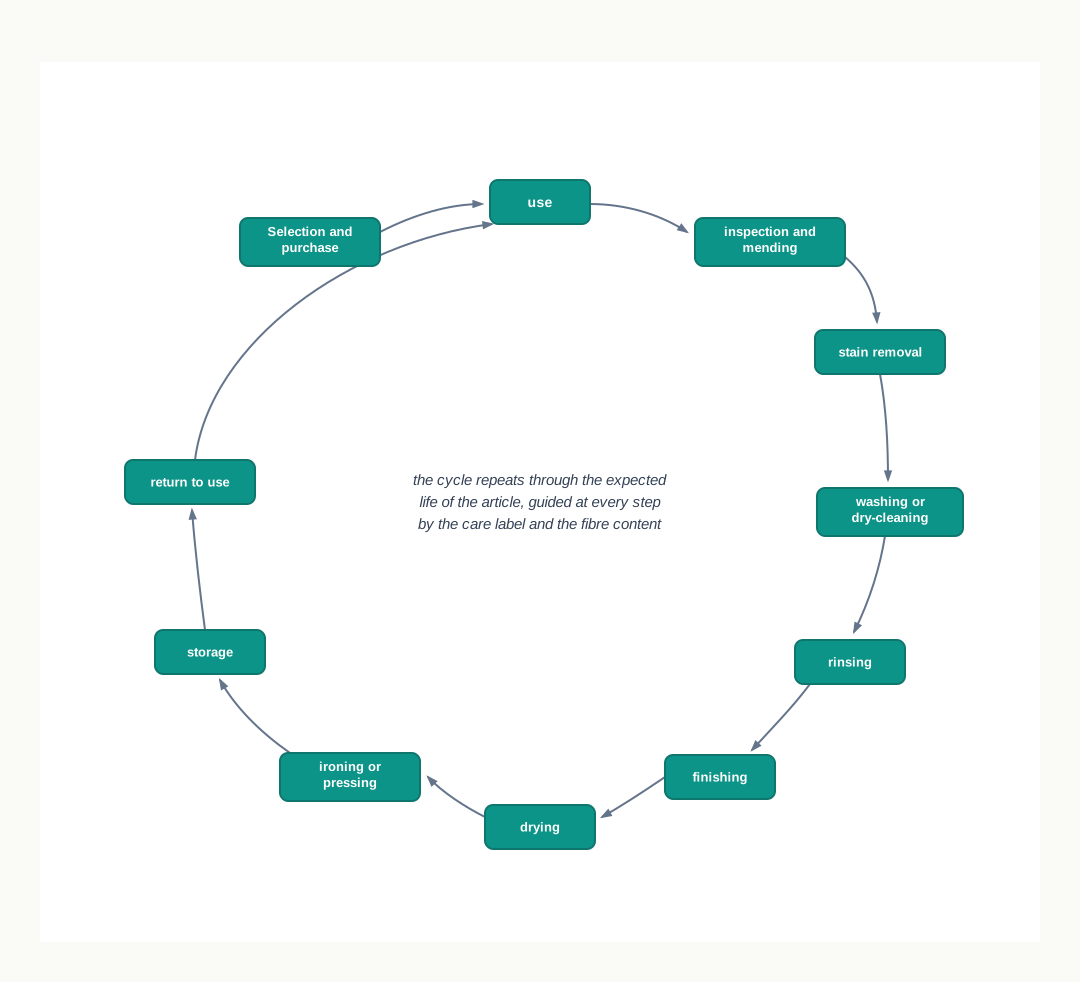
Fig. 11.10 – The cycle of care and maintenance of a fabric article.
11.13 Key Terms
Acrylic — a synthetic fibre that needs little special care and resists sunlight and moths, but catches fire readily and continues to melt and burn.
Animal stains — stains such as blood, milk, meat and egg, which are protein in nature and are removed by detergents in cold water only.
Blue — a pigment or dye added to the last rinse in a very small quantity, which cancels the yellow cast of white articles and makes them look white again.
Borax — a substance added in small quantity to a starch solution to improve its stiffening action, which melts on ironing to leave a water-repellent film.
Care and maintenance — the practices by which a fabric product is kept free of damage, and kept looking and performing as it did when new, for the expected life of the material.
Care label — a permanent label or tag carrying care information and instructions, attached so that it cannot separate from the article and stays legible through its useful life.
Detergent — a cleansing agent synthesised from chemicals, which acts as a surfactant and works even in hard water.
Dirt — the grease, grime and dust jammed into the structure of a fabric, held either loosely or tightly by sweat and grease.
Dry cleaning — the cleaning of fabrics in a non-aqueous liquid medium, that is, in a solvent containing no water.
Dye bleeding — a stain formed by colour that has run from another fabric, removed by dilute alkalies or acids according to the fabric type.
Finishing — the treatments given in and after the last rinse to restore the brightness, body, stiffness or crispness of a washed article.
Friction washing — a method of washing in which dirt is loosened by rubbing the fabric against itself, a brush or a scrubbing board.
Gelatin — a stiffening agent of animal origin, easy to make and use but expensive compared with other homemade starches.
Gum acacia — the natural gum of the acacia or babool tree, used as a light stiffening agent for silks, fine cottons and rayons; also called gum arabic.
Hard water — water carrying dissolved calcium and magnesium salts, which react with soap and waste it before any cleaning can begin.
Ironing — the removal of wrinkles by gliding a heated iron over a damp fabric, generally along its length.
Kneading and squeezing — a method of washing in which the article is gently rubbed and squeezed in soap solution, used for delicate and coloured fabrics.
Laundering — the complete ordered process of cleaning and restoring a washable article, from stain removal to storage ready for use.
Machine washing — washing in which agitation is created mechanically by a moving tub or a central rod; machines may be manual, semi-automatic or fully automatic.
Mending — the repair of damage to a fabric article arising from ordinary use or accident, always done before laundering.
Mildew — the growth of fungus on a stored fabric in the presence of moisture, showing as musty spots and weakening the fibre.
Mineral stains — stains such as ink, rust, coal tar and medicine, which are washed first in an acidic and then in an alkaline medium.
Moisture regain — the amount of water a fibre takes up from the air around it, which largely decides how comfortable a fabric feels in heat.
Nylon — a strong synthetic fibre that needs no special care and dries quickly, but is destroyed by acids and weakened by sunlight.
Oil stains — stains such as oil, ghee and butter, removed by grease solvents and grease absorbents.
Optical brightening agents — fluorescent compounds that absorb ultraviolet light and re-emit it as visible blue light, counteracting both yellowness and greyness without destroying any colour.
Pedesis — the random movement of water particles, which helps dislodge non-greasy dirt from between the fibres of a fabric.
Polyester — a synthetic fibre that washes easily and resists wrinkling, but pills, holds oily stains and has very low moisture regain.
Pressing — setting a hot iron down on the cloth, lifting it and setting it down elsewhere, used for articles that would stretch under a moving iron and for setting folds.
Reagent — a chemical substance used in liquid form, at a recommended concentration, to act on a stain.
Soap — a cleansing agent formed by the reaction of a natural oil or fat with an alkali, biodegradable but ineffective in hard water.
Spot board — the working surface in a dry-cleaning establishment where water-soluble and hard-to-remove spots are treated by hand before solvent cleaning.
Stain — an unwanted mark or colouration caused by contact with and absorption of foreign matter, which normal washing will not remove.
Starch — a stiffening agent obtained from wheat, rice, arrow-root or tapioca, cooked before use and applied only to cotton and linen.
Stiffening agent — a plant or animal substance applied after washing to restore firmness, smoothness and shine to a fabric.
Suction washing — a method of washing in which a suction washer is pressed down and lifted repeatedly, loosening dirt by the vacuum created, without rubbing the fabric.
Surfactant — a surface-active agent that lowers the surface tension of water and keeps removed soil suspended so that it is not redeposited.
Vegetable stains — stains such as tea, coffee, fruit and vegetable, which are acidic in nature and are removed in an alkaline medium.
11.14 Points To Ponder
Sunlight is the cheapest bleach and antiseptic a household has, and it is also what weakens silk, damages wool and yellows synthetics beyond repair. How should a household decide, article by article, whether the sun is an ally or a hazard?
A detergent cleans better than soap and works where soap is wasted, but soap is biodegradable and does not build up in rivers and streams. What should weigh in the choice between them, and does the answer change according to where a household’s waste water finally goes?
A care label is usually read after the article has been bought, not before. If the fibre content, the construction and the care requirements were displayed as plainly as the price, how might that change what people choose to buy?
This chapter places mending before laundering and treats it as ordinary work. As cloth has become cheaper, households mend less and replace more. What is lost when an article is replaced rather than repaired, and who bears that loss?
Blueing corrects only the way a fabric looks, while bleaching acts on the staining matter itself. Is a treatment that changes appearance without removing anything a genuine part of care and maintenance, or is it something else?
Stain removal rests on one discipline — identify first, treat afterwards. Where else in Home Science does the same discipline decide whether a procedure succeeds or fails?
11.15 Objective Questions
- Animal stains are removed by detergents in: (1 mark)
- hot water only
- cold water only
- an alkaline medium
- a grease solvent
- The movement of water particles that helps dislodge non-greasy dirt from a fabric is called: (1 mark)
- emulsification
- redeposition
- pedesis
- fluorescence
- Which stiffening agent melts on ironing and leaves a water-repellent film on the fabric? (1 mark)
- Gum acacia
- Gelatin
- Arrow-root starch
- Borax
- Which fibre catches fire readily and, unlike other synthetic fibres, continues to melt and burn? (1 mark)
- Nylon
- Polyester
- Acrylic
- Rayon
- Assertion (A): A blood stain on a cotton shirt is treated in cold water. Reason (R): Protein coagulates when it is heated and is then set permanently inside the fibre. (1 mark)
- Both A and R are true, and R is the correct explanation of A.
- Both A and R are true, but R is not the correct explanation of A.
- A is true but R is false.
- A is false but R is true.
- Assertion (A): An optical brightener can counteract greyness in a white article, while a blue cannot. Reason (R): An optical brightener chemically destroys the colouring matter of the soil in the fabric. (1 mark)
- Both A and R are true, and R is the correct explanation of A.
- Both A and R are true, but R is not the correct explanation of A.
- A is true but R is false.
- A is false but R is true.
- Match the reagent in Column A with its group in Column B. (4 marks)
| Column A | Column B |
|---|---|
| a. Fuller’s earth | i. Alkaline reagent |
| b. Javelle water | ii. Grease solvent |
| c. Methylated spirit | iii. Grease absorbent |
| d. Borax | iv. Oxidising bleach |
Fill in the blank: The working surface on which a dry cleaner treats water-soluble and hard-to-remove spots by hand, before the article goes into the solvent, is called the ________. (1 mark)
Fill in the blank: Soaps and detergents both act as ________, that is, substances that reduce the surface tension of water. (1 mark)
State whether true or false: Cotton is a weaker fibre when it is wet than when it is dry. (1 mark)
State whether true or false: An article whose care label reads ‘dry flat’ should be hung on a line by its shoulders. (1 mark)
Name the following. (3 marks)
- The method of washing used for a large bath towel that a brush cannot be used on.
- Any two reducing bleaches.
- The fibre whose knitted articles need re-blocking after washing.
- Pick the odd one out and give a reason: bran, French chalk, talcum powder, acetone. (1 mark)
11.16 Check Your Concepts
Define a stain, and state how it differs from dirt. (2 marks)
Give a reason why mending must be completed before an article is laundered. (2 marks)
State the three requirements of good ironing, and say what each of them contributes. (2 marks)
Why is it better to use a mild reagent several times than a strong agent once? (3 marks)
Differentiate between ironing and pressing, stating the basis of difference. (3 marks)
Explain with an example why a blended fabric must be cared for according to the more demanding of its two fibre contents. (3 marks)
Differentiate between soaps and detergents on any four bases. (4 marks)
What would happen to a woollen sweater washed in hot water with a strong detergent and brisk rubbing? Explain each of the effects. (4 marks)
Explain how a blue and an optical brightener each restore whiteness to a washed article, and why only one of them can act on greyness. (4 marks)
Describe the four techniques of stain removal, and state the kind of stain each of them suits. (5 marks)
List the steps of laundering in order, and give a reason for the position of any three of them in the sequence. (5 marks)
11.17 Identify & Label
Fig. 11.2 shows four techniques of stain removal. Identify each technique, and name one stain for which each would be the right choice. (4 marks)
Identify the equipment shown in Fig. 11.3. Label its parts, and state the kind of article it is used for and why. (3 marks)
Fig. 11.9 shows the five groups of symbols on a care label. Identify each group, and state what a cross drawn over any symbol means. (4 marks)
Fig. 11.8 shows a process carried out on a knitted woollen garment. Name the process, state at which stage the outline is traced, and give the property of wool that makes the process necessary. (3 marks)
11.18 Case & Application Based Questions
- A white cotton table runner is brought out after a family lunch with two marks on it — a spilt tea stain near the centre, and a ballpoint pen mark along one edge where a bill was signed. When the runner is put to soak, the soap gives almost no lather and a grey scum floats on the bucket. (7 marks)
- Classify each of the two stains, and state the medium or reagent group each one calls for. (2 marks)
- Describe, in order, how you would remove the ballpoint pen mark, giving a reason for each step. (3 marks)
- Explain why the soap has given no lather in this household’s water, and state what should be used instead. (2 marks)
- A customer is choosing between two shirts of identical design, one in polyester and one in cotton. The work is outdoors, in a hot and humid month, and the customer says the shirt must need as little looking after as possible. (5 marks)
- Name the property of polyester that accounts for discomfort in a hot climate, and explain how it produces that discomfort. (2 marks)
- State one clear care advantage that each of the two shirts has over the other. (2 marks)
- The customer adds that any oil spot picked up at work can be dealt with at the weekend. Why is that a poor plan for the polyester shirt? (1 mark)
- In April a household is putting away three winter articles — two woollen shawls, an acrylic cardigan belonging to a five-year-old, and a heavily starched cotton bedcover. The trunk they are to be stored in stands in a room that turns damp through the monsoon. (6 marks)
- State the preparation each of the three articles needs before it is packed away, and give a reason in each case. (3 marks)
- Explain why the position of the trunk is a problem, and what it is likely to cause. (2 marks)
- Which of the three articles carries a hazard in use rather than in storage, and what precaution follows from it? (1 mark)