Chapter 1: What is Psychology?
In 1879, in a modest room at the University of Leipzig in Germany, a professor named Wilhelm Wundt did something that had never been done before. He set aside a space, brought in instruments, and began to study the human mind the way a physicist studies falling bodies — by measuring it.
The questions Wundt asked look small. How long does it take a person to notice a sound? How long does it take to notice the sound and then decide to press a key? Subtract one time from the other, and you have something remarkable: a number attached to an act of thinking.
Wundt also trained his students to observe their own minds under strict conditions — to report exactly what they experienced when a light flashed or a metronome ticked, and nothing more. Students came to Leipzig from across Europe and America, learned the methods, and carried them home to start laboratories of their own.
For centuries, questions about the mind had belonged to philosophers, who argued about them. Wundt’s laboratory did not settle those arguments. What it did was change how they would be handled from then on: by observation, by measurement, by evidence that another person could check.
That is the moment most historians treat as the birth of modern psychology. The subject you are about to study is a little over a century old — and still arguing about what kind of science it is.
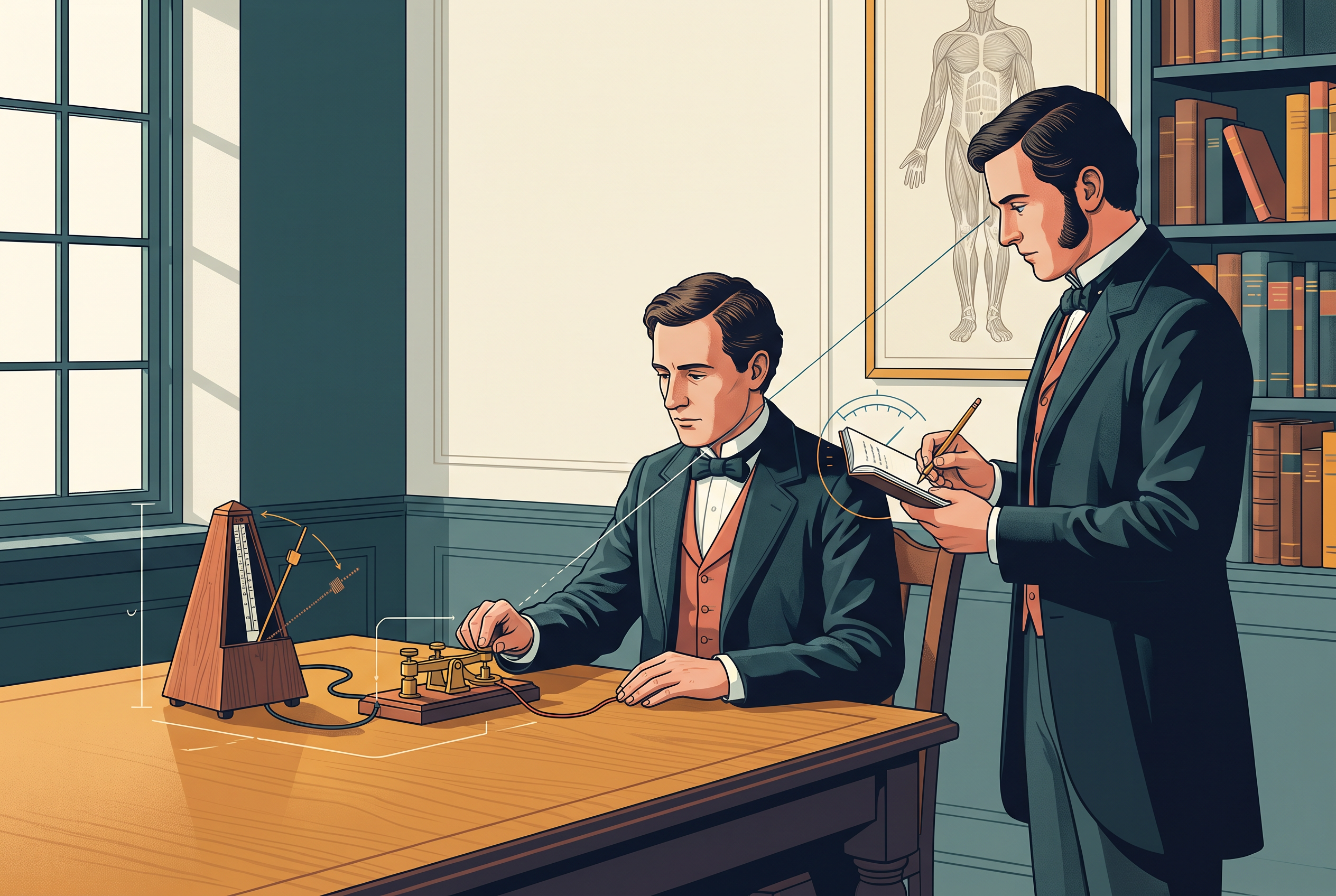
Fig. 1.2 – The first psychology laboratory, Leipzig, 1879.
This chapter will answer each of these questions. Keep them in mind as you read.
1.1 Introduction
On the first day of class, a teacher often asks a simple question: why did you choose psychology? The answers that come back are surprisingly varied. Some students say they want to know what other people are thinking. Others say they want to understand themselves better, or their friends, or their family.
Some answers are more specific. Why do we dream? Why does one person go out of the way to help a stranger, while another gets into a fight over nothing? These are ordinary questions. They are also, in a more careful form, the questions this subject is built on.
An Old Set of Questions
Human beings have asked such questions for a very long time. Every ancient tradition has tried to say something about human nature — what people are like, and why they act as they do.
The Indian philosophical traditions have been particularly concerned with these questions. They ask why human beings are so often unhappy, and what a person must change within themselves if they wish to live well. That concern tells you something important about knowledge of the mind: like all knowledge, it is meant to serve human well-being.
Two Sides of Human Nature
Much of the misery in the world is caused by human beings themselves. You have probably wondered why bombs go off in cities like Delhi, Mumbai or Srinagar, or in the North-East; why an event like 9/11 or a war in Iraq happens at all. Psychologists ask a narrower and more answerable version of that question: what is it in the experience of some young people that turns them towards violence and revenge?
But human nature has another side, and psychology studies that too. You may have heard of Major H.P.S. Ahluwalia, who was among the first Indians to stand on the summit of Mount Everest, and who was later injured in war and paralysed below the waist — after which he went on to build a life of remarkable achievement. What moves a person to such heights? That question is as psychological as the first one, and far less often asked.
The Very Large and the Very Small
You may expect psychology to deal only with big, dramatic questions of this kind. It does not. Modern psychology is just as interested in small, hard-to-pin-down processes.
It studies consciousness — your awareness of your own experiences and mental states. It studies how you manage to focus on one voice in a noisy room. It studies why a crowd of supporters, minutes after their team has won, may set fire to a shopping complex.
The scale ranges from a single person’s flicker of attention to the behaviour of a whole crowd. That range is one reason psychology is difficult to define, as you will see in the very next section.
What Makes Psychology Unusual
Psychology cannot claim that it has solved these problems. What it can claim is that it has improved our understanding of them, and given us better ways of making sense of them.
There is one feature that sets psychology apart from the other sciences. A physicist studies objects that lie outside the observer. A psychologist studies processes that are largely internal — thinking, feeling, remembering, wanting — and these are available for observation to the very person in whom they occur. You are, in a sense, both the student of this subject and one of its subjects.
1.2 What is Psychology?
Every knowledge discipline is hard to define, and psychology is harder than most. There are two reasons for this.
The first is that a discipline keeps evolving. What psychologists studied a hundred years ago is not quite what they study today, and a definition written then would not fit the subject now.
The second is that the range of phenomena psychology studies is enormous. It stretches from a flicker of attention lasting a fraction of a second to the behaviour of a crowd of thousands. No single sentence can hold all of that comfortably.
Where the Word Comes From
For a long time, students like you were told that the word psychology comes from two Greek words: psyche, meaning soul, and logos, meaning science or the study of a subject. Put together, psychology was described as the study of the soul, or of the mind.
That is where the word came from. It is not where the subject has stayed. Over the last century and a half, psychology has moved a long way from the study of the soul and established itself as a scientific discipline that deals with the processes underlying human experience and behaviour.
Notice what makes that shift possible. A discipline is defined not only by what it studies, but by how it studies — in fact, more by its methods than by its subject matter. Astrology and psychology are both interested in why people behave as they do. What separates them is method.
The Levels at Which Psychology Works
The phenomena psychology studies are spread across several levels. Some are individual — how you remember a formula. Some are dyadic, meaning they involve two persons — how you and your closest friend read each other’s moods. Some belong to a group — how a class behaves when a substitute teacher walks in. Some are organisational — how a company’s work culture shapes what its employees do.
These phenomena also have biological as well as social bases. Fear has a heartbeat and a hormone; it also has a history and a culture. Naturally, then, the methods needed to study them vary greatly depending on what is being studied. A researcher measuring reaction times and a researcher interviewing flood survivors are both doing psychology, but they cannot use the same tools.
Keeping all this in view, psychologists have settled on a formal definition.
Three terms in that definition carry the weight: mental processes, experience, and behaviour. Each needs unpacking, and we take them one at a time. The phrase “in different contexts” matters too — it is the reminder that the same behaviour may mean different things in a classroom, a hospital and a village.
Mental Processes
When we say that experiences are internal to the person experiencing them, we are pointing to states of consciousness or awareness — that is, to mental processes.
You use your mental processes constantly. You use them when you think, when you try to solve a problem, when you come to know something, when you remember. Remembering, learning, knowing, perceiving and feeling are all mental processes, and all of them interest psychologists.
One level at which these processes are reflected is brain activity. As you think through a mathematics problem, your brain is doing something, and that something can now be observed using techniques of brain imaging.
Why the mind is not simply the brain
It is tempting to conclude from this that mental processes and brain activities are the same thing. They are not, although they are closely interdependent. Mental activities and neural activities overlap; they are not identical.
The mind and the brain differ in a basic way. The brain is a physical organ: you can hold it, weigh it, point to its parts. The mind has no physical structure and no location you can point to. Mind emerges and evolves as our interactions and experiences in the world get dynamically organised into a system — and it is this system that is responsible for the occurrence of our various mental processes.
So brain activity gives us important clues about how the mind functions. But our conscious experience of our own mental life is much more than the neural activity underlying it. Watching a brain scan light up tells you that something is happening; it does not tell you what the person is thinking about.
Even sleep does not switch mental life off. We dream. We take in some information while asleep — a knock on the door reaches us. Some psychologists have shown that we also learn and remember during sleep.
Psychologists study these processes for two reasons: to understand how the mind works, and to help us improve the uses and applications of these mental capacities — better learning, better remembering, better problem solving.
Experiences
Psychologists also study people’s experiences. An experience is subjective in nature. That single word carries a large difficulty.
You cannot directly observe or know someone else’s experience. Only the person having the experience can be aware or conscious of it. Experiences, in other words, are embedded in our awareness or consciousness, and awareness is private.
This does not put experience beyond study; it changes how it must be studied. Psychologists have studied the pain felt by terminally ill patients, and the psychological pain felt in bereavement. They have studied experiences that lead to positive feelings, such as those of a romantic relationship.
Some experiences studied by psychologists are unusual. A yogi in deep meditation may enter a different level of consciousness and create a new kind of experience. So, in a very different way, does a person who uses drugs to alter their state of mind — although such drugs are extremely harmful, and the altered state comes at a serious cost to health.
Experience depends on conditions, inside and out
Experiences are shaped by the internal and the external conditions of the experiencer, working together.
Think of travelling in a crowded bus on a hot summer afternoon. The usual reaction is discomfort. But if you are on that same bus with close friends, on your way to a picnic, you may hardly notice the heat and the crowd. The external conditions have not changed at all. Something internal has.
The nature of an experience, therefore, can only be understood by analysing a complex set of internal and external conditions together. Neither alone explains it.
Behaviours
Behaviours are the responses or reactions we make, and the activities we engage in. They are the most publicly available part of psychology’s subject matter.
Behaviours vary enormously. When something is hurled towards you, your eyes blink — a simple reflex action, over in a moment. You sit down for an examination and feel your heart pounding. You decide, after some thought, to go for a particular film with a friend. Some behaviours are simple, some complex; some are brief, some endure for years.
Some behaviours are overt. They can be outwardly seen or sensed by an observer — running, speaking, writing, blinking.
Others are covert, or internal. Sitting over a difficult position in a game of chess, you may almost feel your hand muscles twitching as you mentally try out a move you have not yet made. Nothing has happened that a spectator could see, yet something has happened.
All behaviour, overt or covert, is associated with or triggered by something. Either by a stimulus in the environment, or by a change that happens internally. You may see a tiger and run. Or you may merely think there is a tiger and decide to flee — no tiger required.
This is why some psychologists study behaviour as an association between a stimulus (S) and a response (R). Both the stimulus and the response can be external or internal.
1.2.1 Psychology as a Discipline
We have seen that psychology studies behaviour, experience and mental processes. As a discipline, it seeks to understand and explain how the mind works, and how different mental processes result in different behaviours.
You do something like this every day. When you watch a classmate lose their temper, you form an explanation for it almost at once. But your explanation is coloured by your own point of view — your assumptions, your history with that person, your way of understanding the world. As ordinary observers, our interpretations of other people’s behaviour and experience are full of such bias.
How psychologists try to reduce bias
Psychologists try to minimise these biases, and they do it in more than one way.
Some do so by making their analysis scientific and objective — by defining terms precisely, measuring carefully, and testing claims against data rather than against intuition.
Others take a different route. They try to explain behaviour from the point of view of the person actually having the experience, because they believe subjectivity is a necessary aspect of human experience and cannot be thrown away without losing what matters. A grief that has been reduced to a score on a scale is no longer quite grief.
In the Indian tradition, self-reflection and the analysis of one’s own conscious experiences is held to be a major source of psychological understanding — not an obstacle to it. Many Western psychologists, too, have now begun to emphasise the role of self-reflection and self-knowledge in understanding human behaviour and experience.
These are real differences in approach. But underneath them lies a common commitment: whichever route they take, psychologists seek to understand and explain behaviour, mental processes and experiences in a systematic and verifiable manner. Systematic means the enquiry follows a plan; verifiable means someone else can check it.
An old subject, a young science
Psychology is a very old knowledge discipline. Questions about the mind are as old as philosophy. But it is a young science, if we date it from the founding of the first laboratory of psychology in 1879 in Leipzig.
Exactly what kind of science it is remains a matter of debate — and the debate has grown livelier because of the new interfaces psychology has developed in recent times.
Psychology is generally categorised as a social science. Yet it should not surprise you that in India, as in other countries, it is also offered in the faculty of science, at both undergraduate and postgraduate levels. Many students go on to earn a B.Sc. or an M.Sc. in psychology.
Two of the most sought-after emerging disciplines borrow continuously from psychology. One is Neuroscience. Brain imaging techniques such as fMRI and EEG now make it possible to study brain processes in real time — that is, while they are actually taking place. The other is Computer Science: neither human–computer interaction nor artificial intelligence could possibly grow without psychological knowledge of cognitive processes.
Two parallel streams
Because of all this, psychology today runs as two parallel streams.
One stream uses the methods of the physical and biological sciences. The other uses the methods of the social and cultural sciences to study psychological and social phenomena. The two sometimes converge, only to drift apart again and go their separate ways.
In the first case, psychology treats itself as a discipline that leans largely on biological principles to explain human behaviour. It assumes that all behavioural phenomena have causes, and that those causes can be discovered if we collect data systematically under controlled conditions. The researcher’s aim here is to establish a cause-and-effect relationship, so that the behaviour can be predicted — and, where necessary, controlled.
In the second case, psychology as a social science focuses on how behavioural phenomena can be explained in terms of the interaction between the person and the socio-cultural context of which he or she is a part. Here, each behavioural phenomenon is assumed to have multiple causes, not one.
Let us take these two streams separately.
1.2.2 Psychology as a Natural Science
Psychology has its roots in philosophy. But modern psychology developed because of something philosophy did not have: the application of the scientific method to psychological questions.
Science places a great deal of emphasis on objectivity. Objectivity is possible when there is consensus — agreement — on two things: how a concept is defined, and how it can be measured. If two researchers mean different things by “aggression”, or measure it in incompatible ways, their findings cannot be compared, and no knowledge accumulates.
Psychology was influenced by the philosopher Descartes, and later by developments in physics. From these influences it has grown by following what is called the hypothetico-deductive model.
How the hypothetico-deductive model works
The model says that scientific advancement takes place when you begin with a theory that explains a phenomenon. Physicists, for example, have the Big Bang theory to explain how the universe came to be formed.
A theory is nothing more mysterious than a set of statements about how a certain complex phenomenon can be explained, with the help of propositions that are related to one another.
From a theory, scientists deduce or propose a hypothesis — a tentative explanation of how a certain phenomenon takes place. A hypothesis is a prediction that sticks its neck out: it says what we should observe if the theory is right.
The hypothesis is then tested, and proved true or false, on the basis of empirical data that the researcher has gathered. If the data point in a direction different from the one the hypothesis suggested, the theory is revised. As shown in Fig. 1.3, this is a cycle rather than a straight line — each round of testing feeds back into the theory.
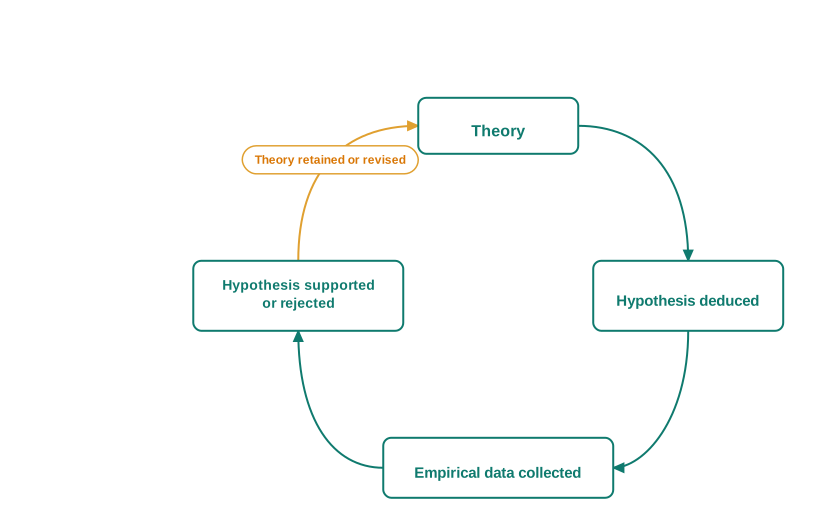
Fig. 1.3 – The hypothetico-deductive model.
Using this approach, psychologists have developed theories of learning, memory, attention, perception, motivation and emotion, among others, and have made significant progress. To this day, most research in psychology follows this approach.
Psychologists have also been considerably influenced by the evolutionary approach, which is dominant in the biological sciences. It has been used to explain diverse psychological phenomena — attachment and aggression, to mention only two.
There is, however, an honest limitation to reading psychology as a natural science. Controlled conditions strip away exactly the context — family, culture, history — that often does the explaining. A finding that holds neatly in a laboratory may behave quite differently in a village during a flood. Which is where the second stream comes in.
1.3 Understanding Mind and Behaviour
You will recall that psychology was once defined as the science of the mind. What is less well known is that, for many decades afterwards, the mind became almost a forbidden word inside the discipline.
The reason was methodological. The mind could not be defined in concrete behavioural terms, and its location could not be pointed to anywhere in the body. A science that prized observation found itself with a subject matter it could not observe, and so it quietly set the word aside.
If the term “mind” has returned to psychology, we owe that partly to work done outside psychology itself — to neuroscientists such as Sperry, whose research on the two halves of the brain forced the question of conscious experience back into the open, and to physicists such as Penrose, who argued that consciousness is not a trivial by-product to be explained away. Between them, they gave the concept the respect it deserved and now has.
Scientists in several disciplines, psychology included, now think that a unified theory of the mind is a possibility — although it is still a long way off.
What is Mind? Is it the Same as Brain?
We have already drawn the distinction: the mind cannot exist without the brain, yet the mind is a separate entity. That claim sounds abstract until you look at the cases that led scientists to make it.
Consider some patients whose occipital lobes — the part of the brain responsible for vision — had been surgically removed. By every ordinary standard they could not see. Yet they were found to respond correctly to the location and configuration of visual cues placed in front of them. Something was registering what the eyes delivered, even though the visual brain that was supposed to do the registering was gone.
Consider next an amateur athlete who lost his arm in a motorcycle accident. He continued to feel an “arm”, and to feel it moving. When he was offered a cup of coffee, his phantom arm reached out towards the cup, and when someone pulled the cup away, he protested. The limb was not there. The experience of the limb was. This is shown in Fig. 1.4.
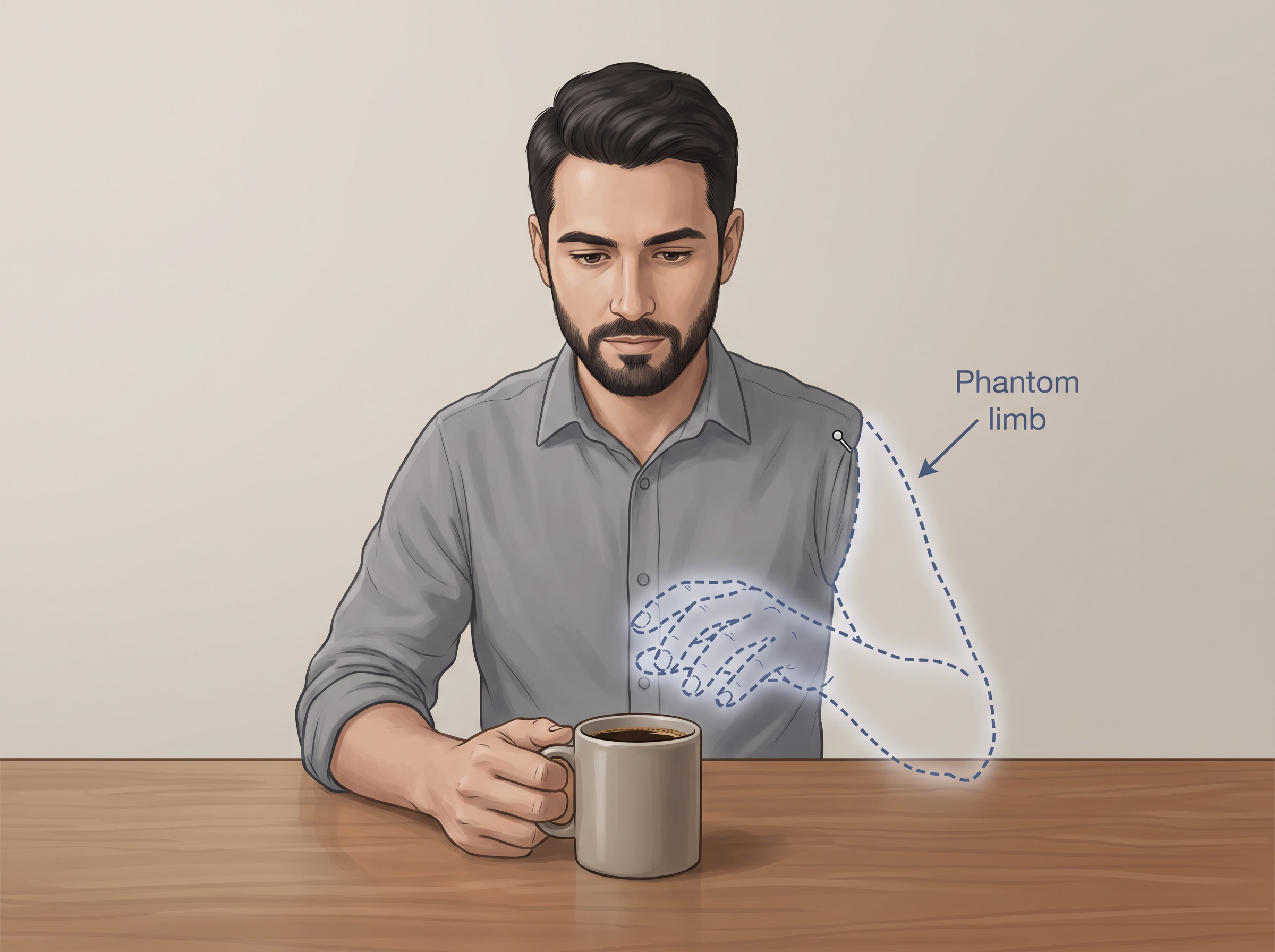
Fig. 1.4 – The experience of a phantom limb.
Consider, finally, a young man who suffered a brain injury in an accident. After he returned home from hospital, he insisted that his parents had been replaced by their “duplicates”. They looked exactly like his parents. He was convinced they were imposters.
In each of these cases, a part of the brain had been damaged. And yet, in each case, the person’s “mind” — the organised system of experience and interpretation — had remained intact, and went on working, sometimes in strange and revealing ways.
The Mind and the Body
It was earlier believed by scientists that there is no relationship between the mind and the body — that the two ran parallel to each other, like two tracks that never meet.
Recent studies in affective neuroscience, which studies the brain basis of emotion, have clearly shown a relationship between mind and behaviour. Using positive visualisation techniques and feeling positive emotions, a person can bring about significant changes in bodily processes.
The lesson for you as a student of psychology is not that thinking positively cures illness. It is subtler and more interesting: what happens in the mind does not stay in the mind. It shows up in the arteries, in the immune system, in behaviour.
1.4 Popular Notions about the Discipline of Psychology
Almost every day, and without noticing it, each of us acts like a psychologist. Someone behaves in a way that puzzles us, and within seconds we have produced an explanation for it.
Not only that. Most of us have quietly built our own theory of human behaviour, and we apply it with some confidence. Suppose you want a worker to perform better than he has in the past. You “know” that he will have to be pushed — perhaps even threatened — because people are basically lazy. That belief is a theory. It has assumptions, it makes predictions, and it guides action.
Such popular theories, based on common sense, may or may not turn out to be true when they are investigated scientifically. The trouble is that we rarely investigate them at all.
The Problem of Hindsight
Common-sense explanations of human behaviour have a particular weakness: they are based on hindsight, and so they explain very little.
Take an example. A friend you are close to moves away to a distant place. What will happen to your attachment to that friend? Two familiar sayings offer answers. One says, “Out of sight, out of mind.” The other says, “Distance makes the heart grow fonder.”
Notice that the two say exactly opposite things. So which one is true?
The honest answer is that the saying you reach for will depend on what actually happens in your life after your friend leaves. Suppose you find a new friend and slowly stop thinking about the old one. Then you — or others — will explain your behaviour by saying, “Out of sight, out of mind.” Suppose instead that you find no new friend and keep remembering your old friend fondly. Then the saying “Distance makes the heart grow fonder” will be produced to explain your behaviour.
In both cases the explanation arrives after the behaviour. Common sense always has an answer ready, because it is allowed to choose its answer once the result is known. It never has to commit itself in advance, and therefore it never risks being wrong.
Psychology as a science works the other way round. It looks for patterns of behaviour that can be predicted, rather than explanations that are supplied after the behaviour has already occurred. A prediction can fail. That is precisely what makes it worth something.
When Science Contradicts Common Sense
Scientific knowledge generated by psychology often runs directly against common sense. One classic example concerns children who give up too easily.
Other Beliefs That Do Not Survive Testing
There are many other common-sense notions you may not find to be true.
Not too long ago it was believed in some cultures that men are more intelligent than women, or that women cause more accidents than men. Empirical studies have shown both of these to be untrue. Beliefs of this kind survive not because there is evidence for them, but because nobody troubles to look for evidence against them.
Common sense also tells us that one cannot give one’s best when asked to perform before a large audience. Psychological studies have shown that if you have practised well, you may actually perform better — the presence of others can help your performance.
Psychology and the Astrologer
It is hoped that as you go through this textbook, many of your beliefs about human behaviour will change. Some of them will be corrected; others will simply become more careful.
You will also come to see why psychologists are different from astrologers, tantriks and palm readers. The difference is not that psychologists are cleverer, or that they never make mistakes. It is that they systematically examine propositions on the basis of data, and use those data to develop principles about human behaviour and other psychological phenomena. A palm reader’s claim cannot be shown to be wrong; a psychologist’s claim can — and often is.
1.5 Evolution of Psychology
Psychology as a modern discipline — the one shaped largely by Western developments — has a surprisingly short history. It grew out of ancient philosophy, which had long concerned itself with questions of psychological significance without ever putting them to the test.
The formal beginning is traced back to 1879, when the first experimental laboratory was established at Leipzig in Germany by Wilhelm Wundt. Wundt was interested in the study of conscious experience. What he wanted was to analyse the constituents — the building blocks — of the mind, rather as a chemist analyses a compound into its elements.
Fig. 1.5 sets out the schools of thought that followed, and it is worth glancing at before you read on: much of what came next was a reaction against what came just before.
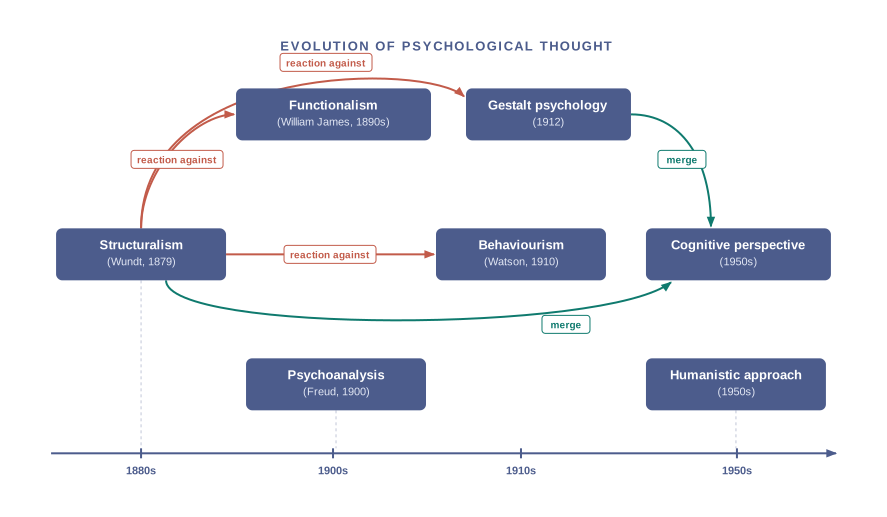
Fig. 1.5 – Evolution of the major schools of psychology.
Structuralism: Analysing the Mind
Psychologists working during Wundt’s time analysed the structure of the mind through introspection, and were therefore called structuralists. Structuralism is the name given to this approach.
The appeal of introspection is obvious. Who could possibly know your experience better than you? But as a scientific method it did not satisfy many psychologists, and its weakness is worth understanding, because it shaped everything that followed.
The problem is verification. An introspective report cannot be checked by an outside observer. If you report three distinct sensations and another participant reports two, no third person can settle the matter. Introspection was therefore considered less scientific, and this dissatisfaction led directly to the development of new perspectives in psychology.
Functionalism: What Does the Mind Do?
An American psychologist, William James, set up a psychological laboratory at Cambridge, Massachusetts, soon after the Leipzig laboratory was established. From his work came what was called the functionalist approach.
James believed that instead of focusing on the structure of the mind, psychology should study what the mind does, and how behaviour functions in helping people deal with their environment. Functionalists therefore focused on how behaviour enables people to satisfy their needs.
For James, consciousness was not a set of building blocks at all. It was an ongoing stream of mental process, continuously interacting with the environment — and this stream formed the core of psychology.
The idea travelled quickly into education. John Dewey, a very influential educational thinker of the time, used functionalism to argue that human beings seek to function effectively by adapting to their environment — an argument that changed how schools thought about what a child is doing when she learns.
Gestalt Psychology: The Whole is Not the Sum
In the early twentieth century a new perspective called Gestalt psychology emerged in Germany, as a reaction to the structuralism of Wundt. It focused on the organisation of perceptual experiences.
Instead of looking at the components of the mind, the Gestalt psychologists argued that when we look at the world, our perceptual experience is more than the sum of the components of that perception. What we experience is more than the inputs received from our environment.
Two everyday examples make the claim concrete. When light from a series of flashing bulbs falls on our retina, we do not experience a row of separate flashes — we experience movement of light. When we watch a film, what actually falls on the retina is a series of still pictures presented in rapid succession; what we experience is smooth, continuous motion.
Our perceptual experience, then, is more than the elements it is built from. Experience is holistic — it is a Gestalt, an organised whole. You will learn more about Gestalt psychology when the nature of perception is discussed in Chapter 5.
Behaviourism: Study Only What Can Be Seen
Yet another reaction to structuralism came in the form of behaviourism. Around 1910, John Watson rejected mind and consciousness as the subject matter of psychology altogether.
Watson was greatly influenced by the work of physiologists such as Ivan Pavlov on classical conditioning — work that showed how a response could be systematically attached to a new stimulus, with no need to ask what the animal was thinking.
His argument was short and hard to answer. Mind is not observable. Introspection is subjective, and cannot be verified by another observer. A scientific psychology, therefore, must confine itself to what is observable and verifiable.
Accordingly, Watson defined psychology as the study of behaviour — of responses to stimuli — which can be measured and studied objectively. Behaviourism was further developed by many influential psychologists, who came to be known as behaviourists. The most prominent among them was Skinner, who applied behaviourism to a wide range of situations and popularised the approach. His work will be discussed later in this textbook.
Psychoanalysis: The Unconscious
Although behaviourists dominated the field for several decades after Watson, other approaches and views about psychology and its subject matter were developing at the same time. One person shook the world with his radical view of human nature: Sigmund Freud.
Freud viewed human behaviour as a dynamic manifestation of unconscious desires and conflicts — that is, as the surface expression of forces the person is not aware of. He founded psychoanalysis as a system both to understand and to cure psychological disorders.
Freudian psychoanalysis viewed human beings as motivated by an unconscious desire for the gratification of pleasure-seeking, and often sexual, desires. It is worth pausing on how large a claim that is. It says that the reasons you give for your own actions may not be the real ones — and that you would be the last person to know it.
The Humanistic Perspective: Freedom and Growth
Against this rather dark picture, the humanistic perspective — also called the humanistic approach — took a far more positive view of human nature.
Humanists such as Carl Rogers and Abraham Maslow emphasised the free will of human beings, and their natural striving to grow and to unfold their inner potential. People, on this view, are not driven; they choose.
They also had a sharp criticism to make of behaviourism. By treating behaviour as determined by environmental conditions, they argued, behaviourism undermines human freedom and dignity, and takes a mechanistic view of human nature — as though a person were a machine that the environment operates.
What These Approaches Left Us
These different approaches filled the history of modern psychology and gave its development multiple perspectives. Each has its own focus, and each draws our attention to a different part of the complexity of psychological processes.
None of them is simply right, and none simply wrong. There are strengths as well as weaknesses in every approach — which is why contemporary psychology draws on several of them at once instead of choosing one and discarding the rest.
The Cognitive Perspective
Some of these approaches led to further developments within the discipline. Aspects of the Gestalt approach and of structuralism were combined, and out of that combination grew the cognitive perspective, or cognitive approach, which focuses on how we come to know about the world.
At the centre of it stands one term.
Some cognitive psychologists view the human mind as an information processing system, rather like a computer. On this view, the mind receives information, processes it, transforms it, stores it, and retrieves it when it is needed. The comparison has been fruitful: it gave psychologists a precise vocabulary for talking about the invisible steps that lie between a stimulus and a response.
Constructivism: The Mind Builds Itself
Modern cognitive psychology takes a further step. It views human beings as actively constructing their minds through their exploration of the physical and the social world. This view is sometimes called constructivism.
A child, on this view, is not a container waiting to be filled. She is building an understanding of the world by acting on it, and revising that understanding whenever it fails her. Piaget’s view of child development, which will be discussed later, is considered a constructivist theory of the development of the mind.
Another Russian psychologist, Vygotsky, went even further. He suggested that the human mind develops through social and cultural processes, and that the mind is culturally constructed through joint interaction between adults and children.
The contrast is worth holding on to. For Piaget, children actively construct their own minds. For Vygotsky, mind is a joint cultural construction, and emerges as a result of interaction between children and adults.
1.6 Development of Psychology in India
The Indian philosophical tradition is remarkably rich in exactly the material a psychologist should want. It reflects at length on mental processes, on human consciousness, on the self, on the relationship between mind and body, and on a range of mental functions — cognition, perception, illusion, attention, reasoning.
Given that inheritance, you might expect modern psychology in India to have grown out of it. It did not. The philosophical roots of the Indian tradition have not, unfortunately, influenced the development of modern psychology in India, and the discipline here continues to be dominated by Western psychology.
Some attempts have been made — both within the country and abroad — to find points of departure from that dominance. These attempts have tried to establish the truth value of various assertions in the Indian philosophical traditions through scientific studies, rather than accepting or dismissing them on faith.
How the Discipline Began Here
The modern era of Indian psychology began, appropriately enough, inside a Department of Philosophy — at Calcutta University. It was there that the first syllabus of experimental psychology was introduced, and there that the first psychology laboratory in India was established, in 1915.
Calcutta University went on to start the first Department of Psychology in the year 1916, and another Department of Applied Psychology in 1938.
The beginning of modern experimental psychology at Calcutta University was greatly influenced by the Indian psychologist Dr N.N. Sengupta, who was trained in the USA in the experimental tradition of Wundt. So the Leipzig laboratory reaches Calcutta within a few decades, through a student of the tradition it founded.
A second influence came from a very different direction. Professor G. Bose was trained in Freudian psychoanalysis, which shaped the early development of psychology in India alongside the experimental tradition. Professor Bose established the Indian Psychoanalytical Association in 1922.
The Departments of Psychology in the Universities of Mysore and Patna were other early centres of teaching and research.
From these modest beginnings, modern psychology has grown into a strong discipline in India, with a large number of centres of teaching, research and application. Two centres of excellence in psychology are supported by the UGC — at Utkal University, Bhubaneswar, and at the University of Allahabad. About 70 universities now offer courses in psychology.
Four Phases: Durganand Sinha’s Account
How did the discipline develop after that? Durganand Sinha, in his book Psychology in a Third World Country: The Indian Experience, published in 1986, traced the history of modern psychology as a social science in India through four phases.
The first phase, lasting till independence, emphasised experimental research, psychoanalytic research and psychological testing. What was being done here primarily reflected the development of the discipline in Western countries — Indian psychologists were doing Western psychology on Indian soil.
The second phase, running till the 1960s, was a phase of expansion. Psychology in India spread into its different branches. During this phase Indian psychologists showed a desire to have an Indian identity, and tried to link Western psychology to the Indian context. The strategy, however, was still to use Western ideas in order to understand the Indian situation.
The third phase, after the 1960s, was one of problem-oriented research. Psychology in India now sought to become relevant for Indian society. Psychologists became more focused on addressing the problems of Indian society — poverty, education, social change — and the limitations of an excessive dependence on Western psychology for our own social context were realised. Leading psychologists emphasised the significance of research that is of relevance to our situation.
The fourth phase, beginning in the late 1970s, was the phase of indigenisation. The search for a new identity for psychology in India led to it. Besides rejecting the Western framework, Indian psychologists stressed the need for developing an understanding based on a framework that was culturally and socially relevant.
This trend was also reflected in attempts to develop psychological approaches based on traditional Indian psychology, drawn from our ancient texts and scriptures. The phase is therefore characterised by two related developments: indigenous psychology, which originates from the Indian cultural context and is relevant for our society, and Indian psychology, which is based on the Indian traditional knowledge system.
Where Indian Psychology Stands Today
These developments continue, and in the meantime psychology in India has begun making significant contributions to the field of psychology in the world.
The discipline here has become more contextual. It emphasises the need for developing psychological principles that are rooted in our own social and cultural context, rather than borrowed and then adjusted. Alongside this, new research studies involving interfaces with the neuro-biological and health sciences are being carried out — so the two streams you met earlier are both alive in India.
Psychology in India is also now applied in diverse professional areas. Psychologists work with children having special problems. They are employed in hospitals as clinical psychologists, in corporate organisations in HRD and advertising departments, in sports directorates, in the development sector, and in the IT industry.
That list is worth pausing over. It tells you that psychology in India is no longer only a university subject. It has become an occupation, and the next section will show you the range of fields in which it is practised.
1.7 Branches of Psychology
Over the years, various fields of specialisation have emerged within psychology. A psychologist today does not study “behaviour” in general, any more than a doctor treats “the body” in general. Some of these fields are discussed below.
As shown in Fig. 1.6, it helps to hold two loose groups in mind: branches that work out how basic psychological processes operate, and branches that apply psychological knowledge in a particular setting. The line between them is not a wall — a health psychologist uses what a cognitive psychologist discovers — but it makes the list easier to organise.
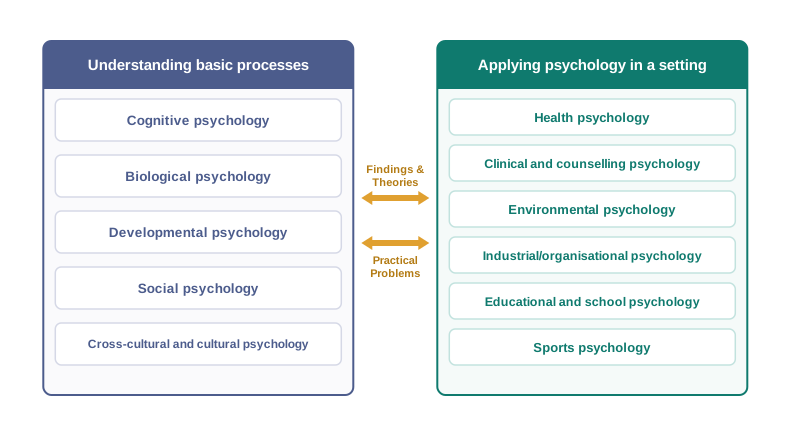
Fig. 1.6 – Branches of psychology: basic and applied.
Cognitive Psychology
Cognitive psychology investigates the mental processes involved in the acquisition, storage, manipulation and transformation of information received from the environment, along with the use and communication of that information.
The major cognitive processes are attention, perception, memory, reasoning, problem solving, decision-making and language. You will be studying each of these topics later in this textbook.
In order to study these processes, psychologists conduct experiments in laboratory settings, where conditions can be controlled precisely. Some of them also follow an ecological approach — an approach that focuses on environmental factors and studies cognitive processes in a natural setting, such as how a shopkeeper actually does mental arithmetic. Cognitive psychologists often collaborate with neuroscientists and computer scientists.
Biological Psychology
Biological psychology, also called physiological psychology, focuses on the relationship between behaviour and the physical system — the brain, the rest of the nervous system, the immune system, and genetics. Biological psychologists often collaborate with neuroscientists, zoologists and anthropologists.
Neuropsychology has emerged as a field of research in which psychologists and neuroscientists work together. Researchers here study the role of neurotransmitters — chemical substances responsible for neural communication — in different areas of the brain, and therefore in the mental functions associated with those areas.
They do their research both on people whose brains are functioning normally and on people with brain damage, using advanced technologies such as EEG, PET and fMRI, about which you will study later.
Developmental Psychology
Developmental psychology studies the physical, social and psychological changes that occur at different ages and stages over the life-span, from conception to old age. Its primary concern can be put in a single question: how do we become what we are?
For many years the major emphasis was on child and adolescent development. Today, an increasing number of developmental psychologists show strong interest in adult development and ageing — a shift that reflects the fact that people are living longer and changing throughout life.
Developmental psychologists focus on the biological, socio-cultural and environmental factors that influence psychological characteristics such as intelligence, cognition, emotion, temperament, morality and social relationships. They collaborate with anthropologists, educationists, neurologists, social workers, counsellors, and almost every branch of knowledge concerned with the growth and development of a human being.
Cross-cultural and Cultural Psychology
Cross-cultural and cultural psychology examines the role of culture in understanding behaviour, thought and emotion.
It assumes that human behaviour is not only a reflection of our human-biological potential, but also a product of culture. Behaviour, therefore, should be studied in its socio-cultural context. As you will see in different chapters of this book, culture influences human behaviour in many ways and in varying degrees.
Environmental Psychology
Environmental psychology studies the interaction of physical factors — such as temperature, humidity, pollution and natural disasters — with human behaviour. The influence of the physical arrangement of a workplace on health, emotional state and interpersonal relations is also investigated.
Current topics of research in this field include the extent to which the disposal of waste, population explosion, conservation of energy and the efficient use of community resources are associated with, and are functions of, human behaviour.
Health Psychology
Health psychology focuses on the role of psychological factors — for example, stress and anxiety — in the development, prevention and treatment of illness.
Areas of interest for a health psychologist include stress and coping, the relationship between psychological factors and health, the patient–doctor relationship, and ways of promoting health-enhancing behaviour.
Clinical and Counselling Psychology
Clinical and counselling psychology deals with the causes, treatment and prevention of different types of psychological disorders, such as anxiety, depression, eating disorders and chronic substance abuse.
A related area is counselling, which aims to improve everyday functioning by helping people solve problems in daily living and cope more effectively with challenging situations.
The work of clinical psychologists does not differ from that of counselling psychologists, although a counselling psychologist sometimes deals with people who have less serious problems. In many instances, counselling psychologists work with students, advising them on personal problems and career planning.
Psychologist and psychiatrist
Like clinical psychologists, psychiatrists also study the causes, treatment and prevention of psychological disorders. How, then, are the two different?
A clinical psychologist has a degree in psychology, which includes intensive training in treating people with psychological disorders. A psychiatrist, in contrast, has a medical degree, with years of specialised training in the treatment of psychological disorders. One important distinction follows from this: psychiatrists can prescribe medications and give electroshock treatments, whereas a clinical psychologist cannot.
Industrial/Organisational Psychology
Industrial/organisational psychology deals with workplace behaviour, focusing both on the workers and on the organisations that employ them.
Industrial and organisational psychologists are concerned with training employees, improving work conditions, and developing criteria for selecting employees. For example, an organisational psychologist might recommend that a company adopt a new management structure that would increase communication between managers and staff.
The background of industrial and organisational psychologists often includes training in cognitive and social psychology — which tells you how closely the applied branches lean on the basic ones.
Educational Psychology
Educational psychology studies how people of all ages learn. Educational psychologists primarily help develop the instructional methods and materials used to train people in both educational and work settings.
They are also concerned with research on issues of relevance for education, counselling and learning problems.
A related field, school psychology, focuses on designing programmes that promote the intellectual, social and emotional development of children, including those with special needs. School psychologists try to apply the knowledge of psychology within a school setting.
Sports Psychology
Sports psychology applies psychological principles to improve sports performance by enhancing the motivation of players. It is a relatively new field, but it is gaining acceptance worldwide — and, as you will have noticed, in Indian sport as well.
Other Emerging Branches of Psychology
The interdisciplinary focus of research and application in psychology has led to the emergence of varied areas: aviation psychology, space psychology, military psychology, forensic psychology, rural psychology, engineering psychology, managerial psychology, community psychology, psychology of women, and political psychology, to name only a few.
The list keeps growing, and it grows for a simple reason. Wherever human beings do something — fly a plane, give evidence in court, farm a field, vote — there is behaviour to be understood, and a branch of psychology forms around it.
1.8 Psychology and Other Disciplines
Any discipline that deals with people will, sooner or later, recognise the relevance of psychology. And psychologists, in turn, acknowledge how much they need other disciplines in order to understand human behaviour.
This mutual dependence has led to the emergence of an interdisciplinary approach in the field of psychology. Researchers and scholars in the sciences, the social sciences and the humanities have all felt the significance of psychology as a discipline.
Fig. 1.1 shows the relationship of psychology with the other disciplines around it.
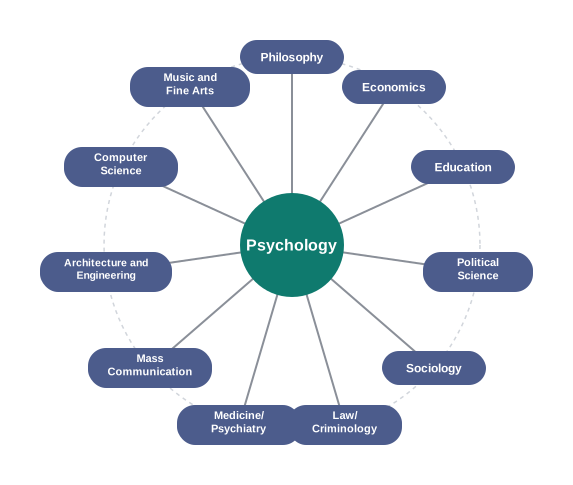
Fig. 1.1 – Psychology and other disciplines.
The connections fall into three broad bundles. In studying the brain and behaviour, psychology shares its knowledge with neurology, physiology, biology, medicine and computer science. In studying human behaviour — its meaning, growth and development — within a socio-cultural context, it shares its knowledge with anthropology, sociology, social work, political science and economics. And in studying the mental activities involved in the creation of literary texts, music and drama, it shares its knowledge with literature, art and music.
Some of the major disciplines linked to the field of psychology are discussed below.
Philosophy
Until the end of the nineteenth century, certain concerns that are now part of contemporary psychology belonged to philosophers. What is the nature of the mind? How do human beings come to know their own motivations and emotions? These were philosophical questions, argued about rather than tested.
In the later part of the nineteenth century, Wundt and other psychologists adopted an experimental approach to these very questions, and contemporary psychology emerged.
But the parting was never complete. Despite its emergence as a science, psychology continues to draw greatly from philosophy — particularly with respect to methods of knowing, and to the various domains of human nature. Every time a psychologist asks what would count as evidence for a claim about the mind, a philosophical question is being answered.
Medicine
Doctors have realised that the old maxim — a healthy body requires a healthy mind — is actually true. A large number of hospitals now employ psychologists.
Two contributions matter especially. Psychologists help prevent people from engaging in health-hazardous behaviours, and they help patients adhere to the regimen their doctor has prescribed. A prescription that is not followed cures nothing, and whether it is followed is a psychological question, not a pharmacological one.
The need is felt most sharply in difficult settings: while treating patients suffering from cancer or AIDS, while working with persons with physical disabilities, while handling patients in the Intensive Care Unit, and during post-operative care. In all of these, doctors have felt the need for psychological counselling. A successful doctor attends to the psychological as well as the physical well-being of the patient.
Economics, Political Science and Sociology
These three are sister social science disciplines. They have drawn considerably from psychology, and have enriched it in return.
Psychology has contributed a great deal to the study of micro-level economic behaviour — particularly to understanding consumer behaviour, savings behaviour and decision-making. Economists in America have used data on consumer sentiments to predict economic growth: what people feel about the future turns out to shape what the economy does. Three scholars who worked on such problems have received the Nobel Prize in Economics — H. Simon, D. Kahneman and T. Schelling.
Like economics, political science too draws considerably from psychology, particularly in understanding issues related to the exercise of power and authority, the nature of political conflicts and their resolution, and voting behaviour.
Sociology and psychology come together to explain and understand the behaviour of individuals within different socio-cultural contexts. Issues related to socialisation, group and collective behaviour, and intergroup conflict gain from both these disciplines. The difference in emphasis is one of level: sociology looks first at the group and the institution, psychology first at the individual within them.
Computer Science
From the very beginning, the effort of computer science has been to mimic the human mind. You can see it in the vocabulary: in how a computer is structured, how its memory is organised, how it carries out sequential and simultaneous — that is, parallel — processing of information.
Computer scientists and engineers are now seeking to make computers not only more and more intelligent, but also machines that can sense and feel.
Developments in both these disciplines have brought about significant advancement in the field of cognitive sciences. Each borrows from the other: psychology lent computing a model of the mind, and computing lent psychology a model of the mind in return.
Law and Criminology
A skilled lawyer and a criminologist both require a knowledge of psychology, because the questions their work turns on are psychological questions.
How well does a witness remember an accident, a street fight, or a murder? How well can that witness report those facts while standing in the witness box, weeks or months later? What factors influence the decision taken by a jury? What are the dependable signs of guilt and falsehood — and are the signs people trust actually dependable? What factors are held important in holding a culprit responsible for her or his action? What degree of punishment is considered just for a criminal act?
Psychologists seek to answer these questions. A number of psychologists are currently involved in research on such issues, and the answers would help the legal system of the country in the future.
Mass Communication
The print and the electronic media have entered our lives in a very big way. They have a major influence on our thinking, our attitudes and our emotions. If they have brought us closer together, they have also reduced cultural diversities.
The impact of media on the formation of children’s attitudes and behaviour is a domain where psychology and mass communication clearly come together. Psychology also helps in developing strategies for better and more effective communication.
A journalist reporting news must know the reader’s interests in the story. Since most stories deal with human events, a knowledge of people’s motives and emotions is very important. A story will have more impact if it is built on a background of psychological knowledge and insight.
Music and Fine Arts
Music and psychology have converged in many areas. Scientists have made use of music in raising work performance. Music and emotion is another area in which a number of studies have been carried out.
Musicians in India have recently started experimenting with what they call ‘Music Therapy’, in which different Ragas are used for curing certain physical ailments. The efficacy of music therapy, however, still remains to be proven.
Architecture and Engineering
At first glance, a relationship between psychology on the one hand and architecture and engineering on the other seems improbable. It is not.
Ask any architect. He or she must satisfy clients by providing mental as well as physical space through the design, and must satisfy them aesthetically. A building that is structurally sound but oppressive to live in has failed.
Engineers, too, must take human habits into account in their plans for safety — for example, on streets and highways, where a sign is useless if drivers do not notice it in time. Psychological knowledge helps in a big way in the design of all mechanical devices and displays.
To sum up, psychology is located at the intersection of many fields of knowledge concerned with human functioning. That position is not accidental. Wherever human beings are involved, psychology has something to contribute — and something to learn.
1.9 Psychology in Everyday Life
The discussion so far may have made one thing clear. Psychology is not only a subject that satisfies some of our curiosity about human nature. It is also a subject that can offer solutions to a wide variety of problems.
The Range of Problems Psychology Speaks To
Some of these problems are purely personal. A daughter has to cope with a father who has a drinking problem. A mother struggles with a child whose behaviour she cannot manage.
Others are rooted within the family set-up — a lack of communication and interaction among family members, so that people live in the same house and share almost nothing.
Others again belong to a larger group or a community: socially isolated communities, or the groups that turn to terrorism. And some problems have national or international dimensions altogether.
Problems related to education, health, the environment, social justice, women’s development and intergroup relations are pervasive. They surround us so completely that we sometimes stop noticing them.
Now, the solution to such problems will certainly involve political, economic and social reform. But reform alone is not enough. Interventions at the level of the individual are also needed if anything is actually to change.
The reason is that many of these problems are, to a large extent, psychological in nature. They arise from unhealthy patterns of thinking, from negative attitudes towards other people and towards oneself, and from undesirable patterns of behaviour. A psychological analysis of such problems therefore helps twice over: it gives us a deeper understanding of them, and it helps us find effective solutions.
Psychology at Work in the World
The potential of psychology for solving the problems of life is being realised more and more, and the media has played a vital role in this.
You may have seen counsellors and therapists on television, suggesting solutions to problems concerning children, adolescents, adults and elderly people. You may also have found them analysing vital social problems — social change and development, population, poverty, interpersonal and intergroup violence, environmental degradation.
Many psychologists now play an active role in designing and executing intervention programmes intended to give people a better quality of life. An intervention programme is not advice; it is a planned course of action, built on evidence, and evaluated afterwards to see whether it worked.
Hence it is no surprise that psychologists are found working in remarkably diverse settings: schools, hospitals, industries, prisons, business organisations, military establishments, and in private practice as consultants helping people solve problems in their own settings.
Psychology and You
Besides helping you render social service to others, the knowledge of psychology is personally relevant to you in your day-to-day life. The principles and methods you learn in this course are meant to be used — in analysing and understanding yourself in relation to others.
It is not that we do not think about ourselves. We think about ourselves constantly. The difficulty is that we often do it badly, and in one of two opposite ways.
Some of us think very highly of ourselves, and reject any feedback that contradicts that opinion. When a teacher points out a weakness, it is dismissed as unfairness or bias. This is what psychologists call defensive behaviour, and its cost is obvious: a person who cannot hear feedback cannot use it.
Others fall into the opposite habit and get into the way of running themselves down. Every setback is taken as proof of some permanent personal failing, and every success is explained away as luck.
Neither condition permits us to grow. What we need is a positive and balanced understanding of ourselves — one that can take in an unwelcome fact without collapsing, and take in a success without inflating.
1.10 Summary
Psychology is a modern discipline that aims to understand the complexities of mental processes, experiences and behaviour of individuals in different contexts. It is treated both as a natural science and as a social science.
The major schools of psychological thought are structuralism, functionalism, behaviourism, the Gestalt school, psychoanalysis, humanistic psychology and cognitive psychology.
Contemporary psychology is multivocal: it is characterised by many approaches, or diverse views, which explain behaviour at different levels. These approaches are not mutually exclusive. Each provides valuable insight into the complexities of human functioning.
The cognitive approach treats thought processes as central to psychological functioning. The humanistic approach sees human functioning as marked by a desire to grow, to be productive, and to fulfil one’s potential.
Psychologists today work in many specialised fields, each with its own theories and methods, and each trying both to build theory and to solve problems in its own domain. The major fields include cognitive psychology, biological psychology, health psychology, developmental psychology, social psychology, educational and school psychology, clinical and counselling psychology, environmental psychology, industrial/organisational psychology and sports psychology.
More recently, the need has been felt for multidisciplinary and interdisciplinary initiatives, in order to arrive at a better understanding of reality. This has led to collaboration across disciplines. The interests of psychology overlap with the social sciences (for example, economics, political science, sociology), with the biosciences (for example, neurology, physiology, medicine), with mass communication, and with music and fine arts. Such efforts have led to fruitful research and application.
Psychology is not merely a discipline that develops theoretical knowledge about human behaviour. It also contributes to the solution of problems at many different levels. Psychologists are employed in a wide variety of settings — schools, hospitals, industries, training institutes, military and government establishments — and many of them are in private practice as consultants.
1.11 Key Terms
Behaviour — Any response, reaction or activity of a person, whether it can be seen by an observer (overt) or occurs within the person (covert).
Behaviourism — The school of psychology, associated with Watson and later Skinner, which holds that psychology must study only observable and measurable behaviour, and rejects mind and consciousness as subject matter.
Cognition — The process of knowing; it includes thinking, understanding, perceiving, memorising and problem solving, through which our knowledge of the world develops.
Cognitive approach — The perspective that focuses on how we come to know about the world, treating the mind as a system that receives, processes, stores and retrieves information.
Consciousness — Our awareness of our own experiences and mental states, available only to the person having them.
Constructivism — The view that human beings actively build their own minds and knowledge through their exploration of the physical and social world, rather than passively receiving information.
Developmental psychology — The branch of psychology that studies the physical, social and psychological changes occurring at different ages and stages across the life-span, from conception to old age.
Functionalism — The approach, associated with William James and Dewey, which studies what the mind does and how behaviour helps a person adapt to the environment, rather than what the mind is made of.
Gestalt — A German word meaning an organised whole; it refers to the idea that experience is holistic and is more than the sum of its parts.
Gestalt psychology — The school that emerged in Germany as a reaction to structuralism, focusing on how perceptual experience is organised into wholes.
Humanistic approach — The perspective of Rogers and Maslow, which emphasises free will, human dignity, and the natural striving of people to grow and fulfil their potential.
Introspection — A procedure in which individuals are asked to describe in detail their own mental processes or experiences; criticised because such reports cannot be verified by an outside observer.
Mind — The system of mental processes that emerges from brain activity together with our experiences of the world; unlike the brain, it has no physical structure or location.
Neuropsychology — The field in which psychologists and neuroscientists work together to study the relationship between brain functioning and mental processes, in both healthy and damaged brains.
Physiological psychology — Also called biological psychology; the branch that studies the relationship between behaviour and the physical system, including the brain, the nervous system, the immune system and genetics.
Psychoanalysis — The system founded by Freud to understand and cure psychological disorders, which views behaviour as a dynamic expression of unconscious desires and conflicts.
Sociology — The discipline that studies groups, institutions and society; it works with psychology in understanding socialisation, collective behaviour and intergroup conflict.
Stimulus — Any object, event or change, outside the person or within the person, that triggers a response.
Structuralism — The earliest school of modern psychology, associated with Wundt, which used introspection to analyse the mind into its building blocks.
1.12 Points to Ponder
Psychology defines itself as much by its methods as by its subject matter. If a new method were invented tomorrow that let us observe another person’s experience directly, would psychology still be the same discipline — or would it become a different one?
Watson argued that a science cannot be built on reports only one person can check, and so ruled the mind out of psychology. Was he right to do so? What was gained by that decision, and what was lost?
The Indian philosophical tradition has reflected on consciousness and the self for centuries, yet it barely shaped modern psychology in India. Was this a loss to the discipline, or simply the price of becoming an experimental science? What would an indigenous Indian psychology have to do to be both rooted and rigorous?
Common sense explains behaviour after it has happened; science tries to predict it before. But human beings are not planets. How far can behaviour ever be predicted — and would you want a psychology that could predict yours accurately?
If psychology can be used to make advertisements more persuasive, workplaces more productive and witnesses more reliable, it can also be used to manipulate. What responsibilities does that place on a psychologist, and who should decide where the line falls?
Talk to a practising psychologist — a clinical psychologist, a counsellor, an organisational or a sports psychologist — and ask what a typical day at work looks like, what training the job required, and what drew them to it. How far does the working life of a psychologist match the picture of the subject you have formed from this chapter?
Look for novels, non-fiction books or films that turn on some psychological idea — memory, obsession, persuasion, madness, grief. Choose one and ask: does it get the psychology right? And if it does not, why is the wrong version so much more satisfying to watch?
1.13 NCERT Questions
What is behaviour? Give examples of overt and covert behaviour.
How can you distinguish scientific psychology from the popular notions about the discipline of psychology?
Give a brief account of the evolution of psychology.
For which kinds of problems is the collaboration of psychologists with other disciplines fruitful? Take any two problems and explain.
Differentiate between (a) a psychologist and a psychiatrist, and (b) a counsellor and a clinical psychologist.
Describe some of the areas of everyday life where an understanding of psychology can be put to practice.
How can knowledge of the field of environmental psychology be used to promote environment-friendly behaviour?
In terms of helping to solve an important social problem such as crime, which branch of psychology do you think is most suitable? Identify the field, and discuss the concerns of the psychologists working in it.
1.14 Objective Questions
- The word “psychology” is derived from two Greek words meaning:
- mind and measurement
- soul and the study of a subject
- behaviour and experiment
- brain and knowledge [1 mark]
- The first experimental laboratory of psychology was established in 1879 at:
- Cambridge, Massachusetts
- Vienna
- Leipzig
- Calcutta [1 mark]
- A procedure in which subjects are asked to describe their own mental processes in detail is called:
- observation
- introspection
- survey
- conditioning [1 mark]
- Which of the following is an example of covert behaviour?
- A student raising a hand in class
- A player running towards the goal
- The muscles of a chess player twitching as she mentally rehearses a move
- A child blinking when a ball is thrown at him [1 mark]
- The school of psychology which argued that our perceptual experience is more than the sum of its components is:
- structuralism
- behaviourism
- psychoanalysis
- Gestalt psychology [1 mark]
- Which of the following professionals can prescribe medication for a psychological disorder?
- A counselling psychologist
- A clinical psychologist
- A psychiatrist
- A school psychologist [1 mark]
- The first psychology laboratory in India was established in 1915 in the Department of Philosophy at:
- Mysore University
- Calcutta University
- Patna University
- University of Allahabad [1 mark]
- The view that children actively build their own minds through exploration of the physical and social world is known as:
- functionalism
- constructivism
- behaviourism
- structuralism [1 mark]
- Assertion (A): Introspection was rejected by many psychologists as a method. Reason (R): Introspective reports could not be verified by outside observers.
- Both A and R are true, and R is the correct explanation of A.
- Both A and R are true, but R is not the correct explanation of A.
- A is true, but R is false.
- A is false, but R is true. [1 mark]
- Assertion (A): Common-sense explanations of behaviour can never be shown to be wrong. Reason (R): Common sense offers its explanation after the behaviour has already occurred.
- Both A and R are true, and R is the correct explanation of A.
- Both A and R are true, but R is not the correct explanation of A.
- A is true, but R is false.
- A is false, but R is true. [1 mark]
- Assertion (A): Psychology is offered in the faculty of science in many Indian universities, even though it is generally categorised as a social science. Reason (R): Psychology runs as two parallel streams, one using the methods of the physical and biological sciences and the other the methods of the social and cultural sciences.
- Both A and R are true, and R is the correct explanation of A.
- Both A and R are true, but R is not the correct explanation of A.
- A is true, but R is false.
- A is false, but R is true. [1 mark]
- Match the psychologist in Column A with the school or idea in Column B.
| Column A | Column B |
|---|---|
| a. Wilhelm Wundt | i. Psychoanalysis |
| b. William James | ii. Structuralism |
| c. John Watson | iii. Humanistic approach |
| d. Sigmund Freud | iv. Functionalism |
| e. Carl Rogers | v. Behaviourism |
[1 mark]
- Match the branch of psychology in Column A with its concern in Column B.
| Column A | Column B |
|---|---|
| a. Health psychology | i. Training employees and improving work conditions |
| b. Environmental psychology | ii. Stress, coping and the patient–doctor relationship |
| c. Industrial/Organisational psychology | iii. Changes across the life-span, from conception to old age |
| d. Developmental psychology | iv. The effect of pollution, temperature and natural disasters on behaviour |
[1 mark]
Fill in the blank: The process of knowing, which includes thinking, understanding, perceiving, memorising and problem solving, is called ____________. [1 mark]
Fill in the blank: Professor G. Bose, who was trained in Freudian psychoanalysis, established the ____________ in 1922. [1 mark]
Fill in the blank: Durganand Sinha traced the history of modern psychology in India through ____________ phases. [1 mark]
True or false: The mind and the brain are two names for the same thing. [1 mark]
True or false: A hypothesis is a tentative explanation of how a certain phenomenon takes place, which is then tested against empirical data. [1 mark]
True or false: A counselling psychologist usually works with people whose problems are less serious than those handled by a clinical psychologist. [1 mark]
1.15 Check Your Concepts
Define psychology as it is formally defined today, and name the three terms used in that definition. [2 marks]
What is a stimulus? Give one example of an external stimulus and one of an internal stimulus. [2 marks]
State what introspection is, and give one reason why it was criticised. [2 marks]
List any four major cognitive processes studied by cognitive psychologists. [2 marks]
What is meant by a Gestalt? Give one everyday example of holistic perceptual experience. [2 marks]
Name the four levels at which psychological phenomena are spread, and give one example of a phenomenon at any one of them. [2 marks]
Differentiate between overt and covert behaviour, with one example of each. [3 marks]
Differentiate between structuralism and functionalism. [3 marks]
Explain briefly why the mind cannot be treated as identical with the brain, using any one documented case discussed in this chapter. [3 marks]
Give reasons: common-sense explanations of behaviour explain very little, even though they always sound convincing. [3 marks]
Differentiate between the work of a clinical psychologist and that of a psychiatrist. [3 marks]
Explain briefly what is meant by the indigenisation of psychology in India, and why Indian psychologists felt the need for it. [3 marks]
Why is psychology described as both a natural science and a social science? Explain with one example of each kind of enquiry. [4 marks]
Describe the hypothetico-deductive model, showing the sequence of steps from theory to revised theory. Why is it a cycle rather than a straight line? [4 marks]
Explain, with an example, how experiences are shaped by the internal as well as the external conditions of the experiencer. [4 marks]
“Psychologists are different from astrologers and palm readers.” Evaluate this claim. On what grounds does the difference rest? [4 marks]
Describe Dweck’s study on children who give up after failure. What did she expect common sense to predict, what did she find, and what does the finding tell a teacher? [4 marks]
Arrange the following schools in the order in which they arose, and state the central idea of each: behaviourism, structuralism, cognitive approach, Gestalt psychology, functionalism. [4 marks]
Describe the four phases through which modern psychology developed in India, as traced by Durganand Sinha. [4 marks]
Give a full account of behaviourism: what Watson claimed, what influenced him, what the approach achieved for psychology, and what it left out. [6 marks]
Compare the psychoanalytic and the humanistic approaches to human nature. On what do they disagree, and what criticism has been made of each? [6 marks]
Discuss any four branches of psychology, explaining what each studies and where its knowledge is applied. [6 marks]
“Psychology is located at the intersection of many fields of knowledge pertaining to human functioning.” Discuss this statement with reference to any four disciplines with which psychology shares its concerns. [6 marks]
Describe the cognitive approach, and explain how constructivism goes beyond the view of the mind as an information processing system. How do Piaget and Vygotsky differ within the constructivist view? [6 marks]
1.16 Case-Based Questions
- A Class XI teacher notices that Meera solves every easy exercise in the mathematics textbook correctly and is regularly praised for it. When the class is given a set of unfamiliar, harder problems, Meera gives up within minutes and says she is “just not a maths person”. Her classmate Iqbal, who has struggled with many problems and been told repeatedly that he simply needs to work at them for longer, keeps trying and eventually solves two of them.
- Which psychological finding discussed in this chapter does Meera’s reaction contradict — and which one does it support? [2 marks]
- Explain why a long run of easy success may leave a student less able to cope with failure. [2 marks]
- Suggest, on the basis of this chapter, one change the teacher could make in how she responds to failure in class. [2 marks]
- Two families live on the same street in a small town. When the street is flooded during heavy rain, one family takes in a neighbour’s children and shares its food; another family locks its doors and refuses to open them. Both families have lived on the street for years and both have young children of their own.
- Which of psychology’s two streams — natural science or social science — is better placed to explain this difference, and why? [2 marks]
- Why is it difficult to predict, in advance, which family will behave in which way? [2 marks]
- Name any two branches of psychology whose knowledge would be useful in planning relief work in such a town, and state what each would contribute. [2 marks]
- A hospital in a large city finds that many of its patients with heart disease do not take their prescribed medicines regularly, do not turn up for follow-up visits, and continue with habits their doctors have warned them against. The hospital administration decides to appoint a psychologist to the cardiology department.
- Which branch of psychology is most relevant here? Give one reason for your choice. [2 marks]
- The problem is a medical one. Explain why a psychological analysis of it is nevertheless necessary. [2 marks]
- The psychologist designs a programme and then measures whether patients’ adherence actually improves. Why does this measurement matter, in the light of what this chapter says about how psychology differs from common sense? [2 marks]
- Ananya is elected head of her school’s cultural committee. After the annual function, her teacher tells her privately that the event was poorly organised and that she had not delegated any work. Ananya concludes that the teacher has always favoured someone else, and mentions the conversation to nobody. Her deputy, Farhan, receives the same feedback and concludes that he is hopeless at organising anything and should never have taken up the post.
- Identify the pattern shown by Ananya, using the term used in this chapter. [2 marks]
- What is the difficulty with Farhan’s response, and why does it also prevent growth? [2 marks]
- What would a positive and balanced understanding of oneself look like in this situation? Describe how either student might have used the feedback. [2 marks]
Social Psychology
Social psychology explores how people are affected by their social environments, and how people think about and influence others.
Social psychologists are interested in topics such as attitudes, conformity and obedience to authority, interpersonal attraction, helpful behaviour, prejudice, aggression, social motivation and inter-group relations. If you have ever wondered why a sensible person goes along with a group decision they privately disagree with, you have asked a question in social psychology.