Chapter 7: Thinking
Helen Keller lost both her sight and her hearing before she was two years old. For the next few years she lived in a world without names — she could touch a mug, feel water, sense her mother’s presence, but she had no way of holding any of it in words. Her teacher, Anne Sullivan, spelled letters into her palm again and again, and for a long time nothing came of it. Then, at a water pump, Sullivan let cool water run over one of Keller’s hands while spelling W-A-T-E-R into the other. Something connected. Keller later described the moment as the instant she understood that everything has a name, and that names could be used to think with. Within hours she was demanding the names of dozens of objects around her.
Her life afterwards is the sentence at the front of this chapter: from stammering out a first syllable to following the sweep of thought in a line of Shakespeare. It is a striking illustration of how closely thought and language travel together — and it raises a question psychologists still argue about. Did the word for water give Keller the idea of water? Or was the idea already there, waiting for a word to carry it?

Fig. 7.1 – Helen Keller at the water pump.
This chapter will answer each of these questions.
7.1 Introduction
Stop for a moment and count how often the word “think” turns up in an ordinary day’s conversation. You say “I can’t think of her name”, and you mean remember. You say “think about it”, and you mean pay attention. You say “I think my friend will visit today”, and you mean you are uncertain. The same four-letter word is doing three quite different jobs.
In everyday speech, then, “think” is a loose word that covers a whole range of psychological processes. In psychology it is not loose at all. Here thinking is a core subject area with an independent existence and a meaning of its own.
What this chapter is about
In this chapter, thinking is treated as a mental activity directed at solving a problem, making inferences, judging certain facts, and deciding and choosing between options. Notice how much work that sentence does. It tells you that thinking is active — you do something with information rather than merely receive it. It tells you that thinking is directed — it goes somewhere, towards a conclusion, a judgement, or a choice.
The chapter then turns to creative thinking: what it is, what distinguishes it from ordinary thinking, what stages it passes through, and how it can be developed. Creativity, you will see, is not a gift reserved for a few unusual people.
Why we talk while we think
Have you ever watched a small child building a tower with blocks or with wet sand? The child builds it, knocks it down, builds another, and carries on. And while doing this, the child often talks — to nobody in particular.
Listen closely to that speech and you will find it is not idle chatter. It reports the steps the child is following or wants to follow — “not this”, “a little small”, “a tree at the back” — and it evaluates the design — “nice”. The talk is running alongside the thinking, like a commentary.
You have probably done something similar yourself while working through a difficult problem, muttering the steps half aloud. Why do we talk while we think? What exactly is the relationship between language and thought? This chapter takes up that question too, along with the way language develops in a child and the way it is used in daily life.
Before any of this can be discussed, however, one thing must come first. Thinking is the base of human cognition — the foundation on which remembering, reasoning, deciding and creating all rest. So the chapter begins by asking what thinking actually is.
7.2 Nature of Thinking
Thinking is the base of all cognitive activities or processes, and it is unique to human beings. It involves the manipulation and analysis of information received from the environment.
Consider what happens when you stand in front of a painting. You do not simply register the colours, the lines and the strokes. You go beyond what is physically given and interpret what the painting means. You link it to what you already know — about the artist, about the subject, about other pictures you have seen. Understanding the painting involves the creation of new meaning, and that new meaning is then added to your knowledge.
That is the essential move. Thinking is a higher mental process through which we manipulate and analyse acquired or existing information. This manipulation and analysis take place by means of abstracting, reasoning, imagining, problem solving, judging, and decision-making — the very processes the rest of this chapter will unpack one by one.
Thinking is organised and goal directed
Thinking is mostly organised and goal directed. It is not a random drift of ideas; it moves towards something.
Look at your ordinary day. Cooking a meal, working out a bus route, solving a maths problem — every one of these activities has a goal. You want to reach that goal, so you plan. If the task is familiar, you recall the steps you have already followed in the past. If the task is new, you infer strategies: you work out, from what you know, what is likely to succeed.
This is why thinking feels like effort. Effort is what it takes to hold a goal in mind and organise information in the service of it.
Thinking cannot be seen, only inferred
Thinking is an internal mental process, which can be inferred from overt behaviour. This one sentence explains a great deal about how psychologists work.
Watch a chess player sitting motionless over the board for several minutes before making a move. You cannot observe what she is thinking. There is nothing to see except a still face and a hand hovering over a piece. What you can do is infer — from the move she finally makes — what she was probably considering and what strategies she was evaluating.
Everything psychology says about thinking is built this way: from what people do, say, choose, and get wrong, back to the processes that must have produced it.
7.2.1 Building Blocks of Thought
We already know that thinking relies on knowledge we already possess. But in what form is that knowledge held in the mind? Psychologists answer that it is represented in either of two ways: as mental images, or as words and concepts.
Both are in constant use. Suppose you are travelling by road to a place you visited long ago. You would try to use the visual representation of the street and the other landmarks — a picture in the mind’s eye. Now suppose you want to buy a storybook. Here no picture helps; your choice depends on what you know about different authors and themes. Your thinking is now based on words and concepts.
These two forms — the image and the concept — are the building blocks out of which thought is assembled.
7.2.1.1 Mental Image
Suppose you are asked to imagine a cat sitting on a tree with its tail slightly raised and curved. Almost certainly you will form a visual picture of the whole situation, in the way the girl in Fig. 7.2 is doing.
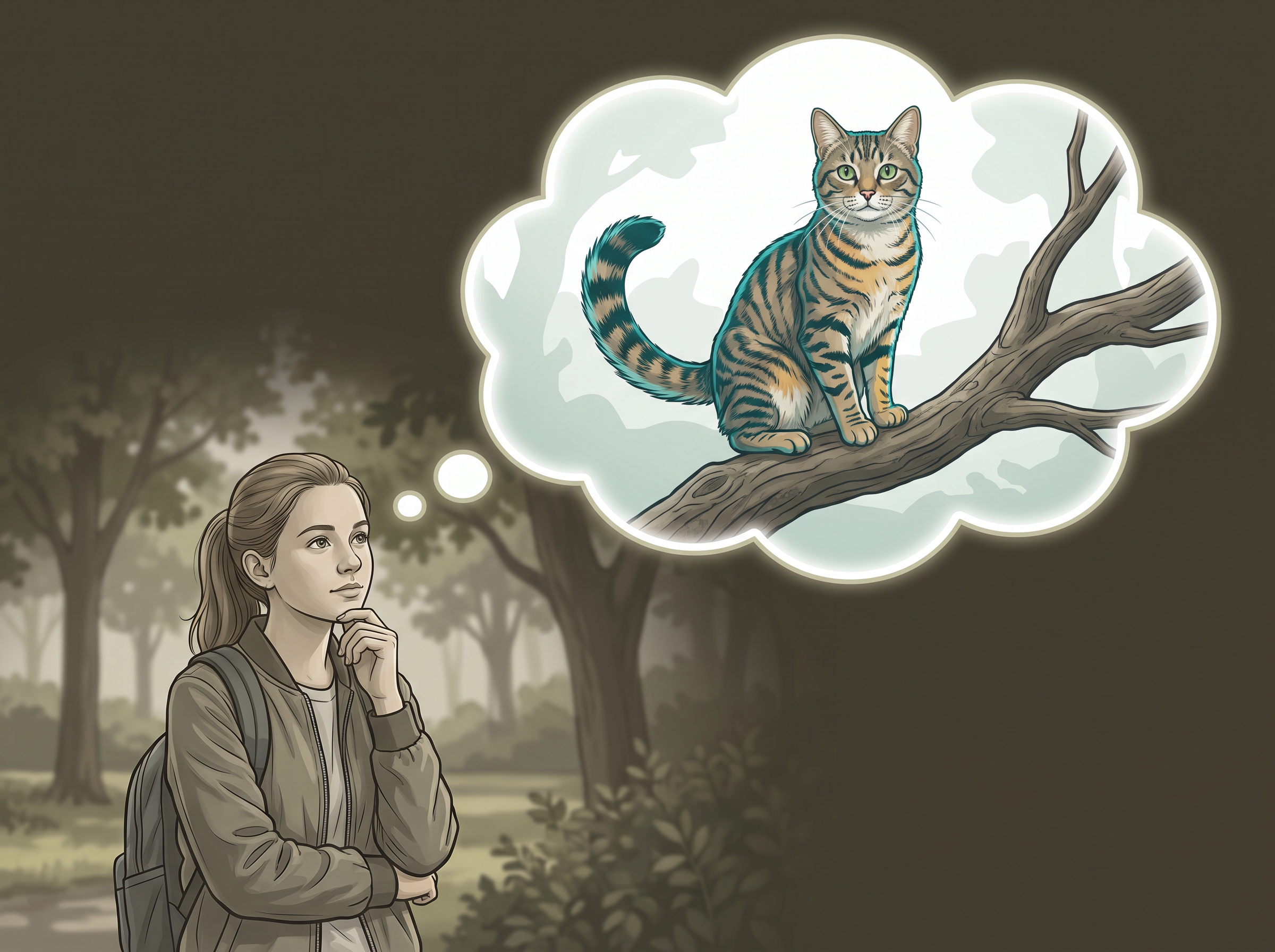
Fig. 7.2 – Forming a mental image.
Or take another situation. Imagine you are standing in front of the Taj Mahal, and describe what you see. As you do this, you are actually forming a visual image of the event. You are seeing through your mind’s eye, much as you would look at a picture.
Why is it useful to draw a map when you are giving someone directions? Think back to your own experience of studying a map, remembering where the places sat on it, and then locating them in a blank map in an examination. You were forming and using mental images. The map on paper was converted into a map in the head.
An image is a mental representation of a sensory experience. It can be used to think about things, places and events even when they are nowhere near you.
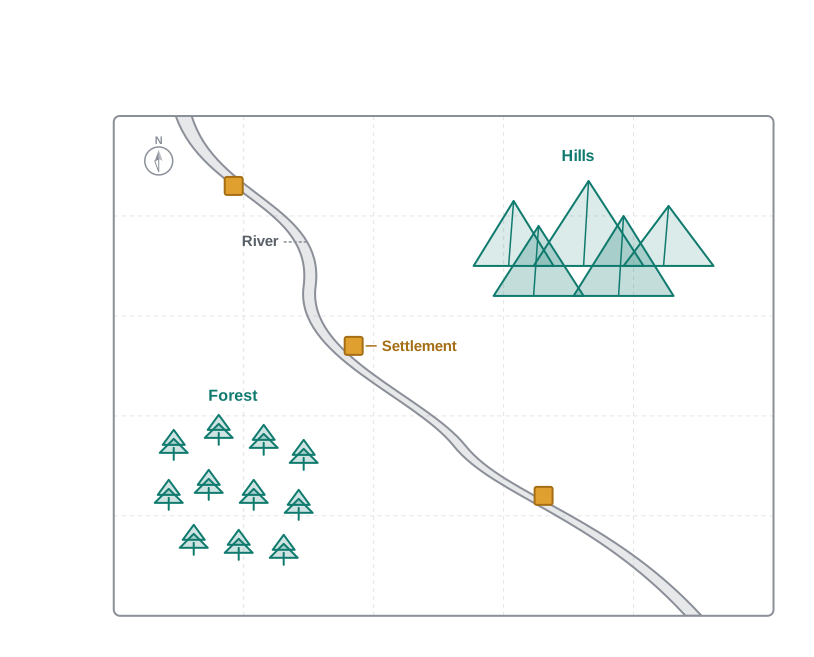
Fig. 7.3a – Map with landmarks.

Fig. 7.3b – Blank outline map.
7.2.1.2 Concepts
Whenever we come across an object or an event, familiar or unfamiliar, we try to identify it. We extract its characteristics and match them with an already existing category of objects and events. When we see an apple, we place it in the category fruit. A table goes into furniture. A dog goes into animal.
Watch what happens with something new. Walking along a road, you come across an unfamiliar quadruped, very small, with a face like a dog’s, wagging its tail and barking at strangers. You look for its characteristics, match them against an existing category, and — since the match is good — you give it the name of that category. You identify it as a dog, and probably decide it is a breed you have not seen before. You also conclude, without ever having met this animal, that it would bite strangers.
That last step is the point. The category did work for you. It supplied a prediction that went beyond anything you actually observed.
A concept, then, is a mental representation of a category. It refers to a class of objects, ideas or events that share common properties.
Why do we form concepts?
Concept formation helps us organise our knowledge, so that whenever we need to reach for it, we can do so with less time and effort.
It is much like organising things at home. A child who is systematic keeps books, notebooks, pens, pencils and other accessories in fixed places in the cupboard. In the morning there is no struggle to find a particular book or the geometry box. In a library, too, books are arranged by subject area and labelled, so that a reader can find them quickly and with less effort.
Concepts do the same for the mind. Because objects and events are already sorted into categories, the thought process becomes quick and efficient. Without concepts, every dog on every street would have to be worked out from scratch.
7.3 The Processes of Thinking
So far we have asked what thinking means and what its nature is. We have also seen that thinking works on two kinds of raw material: mental images and concepts.
That settles what thinking is made of. It does not yet tell us what thinking does. Knowing that a mind holds images and categories is a little like knowing that a kitchen holds vegetables and utensils; the interesting question is what gets cooked.
The rest of the chapter therefore turns to the complex processes through which thought actually proceeds — problem solving, reasoning, judgment and decision-making, and creative thinking. We begin with the first of them: how thinking proceeds when there is a problem to be solved.
7.4 Problem Solving
How do you proceed while repairing a broken cycle, planning a summer tour, or patching up a broken friendship? In some cases the solution arrives almost at once — a loose chain is put back on the sprocket using the cues available on the spot. Other cases are far more complex and demand time, effort and several attempts.
What all of them share is a direction. Problem solving is thinking that is goal-directed. Almost every one of our day-to-day activities is aimed at some goal, and problem solving is what happens when reaching that goal takes mental work.
Here it is important to correct a common misunderstanding. A “problem”, in psychology, is not always an obstacle or a hurdle that has been placed in your way. It can be any activity, however ordinary, that you perform in order to reach a defined goal — preparing a quick snack for a friend who has just arrived at your house is a problem in exactly this sense.
The structure of a problem
Every problem has two anchors. There is an initial state — the situation as it now stands, the problem itself. And there is an end state — the situation as you want it to be, the goal. Between the two lie several steps, or mental operations, which connect one anchor to the other.
Solving a problem is essentially the work of building that bridge. Fig. 7.6 shows the sequence of mental operations through which a problem is normally solved, and Table 7.1 works the same sequence out on a concrete task.
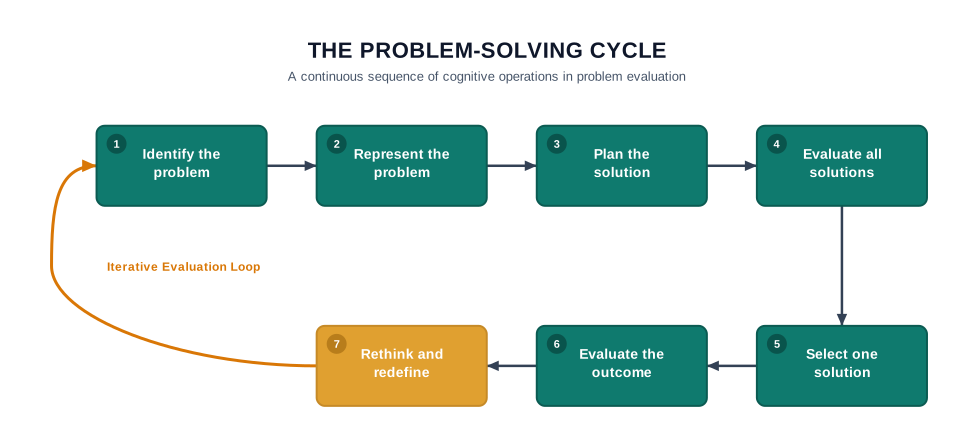
Fig. 7.6 – Mental operations in problem solving.
Table 7.1: Mental Operations Involved in Solving a Problem
Let us take the problem of organising a play in school on the occasion of Teachers’ Day. Problem solving would involve the following sequence.
| Mental operation | Nature of problem |
|---|---|
| 1. Identify the problem | A week is left for Teachers’ Day and you are given the task of organising a play. |
| 2. Represent the problem | Organising a play would involve identification of an appropriate theme, screening of actors and actresses, arranging money, and so on. |
| 3. Plan the solution: set sub-goals | Search and survey the available themes for a play, and consult teachers and friends who have the expertise. The play is to be decided on considerations such as cost, duration and suitability for the occasion. |
| 4. Evaluate all solutions (plays) | Collect all the information; hold a stage rehearsal. |
| 5. Select one solution and execute it | Compare and verify the various options to arrive at the best solution (the play). |
| 6. Evaluate the outcome | If the play is appreciated, think about the steps you followed, for future reference — for yourself as well as for your friends. |
| 7. Rethink and redefine problems and solutions | Even after the occasion is over, you can think about ways of planning a better play in future. |
Notice that the sequence does not simply stop at step 5, where the play is staged. Steps 6 and 7 turn the finished task back into knowledge. That is why a good problem solver improves with each problem, while someone who merely reaches the answer and walks away does not.

Fig. 7.7 – The nine-dot problem.
7.4.1 Obstacles to Solving Problems
Two major obstacles stand in the way of solving a problem: mental set and lack of motivation.
7.4.1.1 Mental Set
Mental set is the tendency of a person to solve problems by following the mental operations or steps that have already been tried. Prior success with a particular strategy makes it the first thing the mind reaches for.
Sometimes this is a genuine help. A strategy that worked before may work again, and in day-to-day life we rely constantly on our past experience with similar or related problems. But the same tendency creates a mental rigidity that obstructs the problem solver from thinking of any new rules or strategies.
You have almost certainly experienced this while solving mathematical problems. After completing a couple of questions, you form an idea of the steps needed for that type of question, and you go on applying the same steps — until you reach a point where they fail. At that moment you find it strangely difficult to let go of the steps you have been using. They keep interfering with your search for new ones.
So mental set cuts both ways. In some situations it enhances the quality and speed of problem solving. In others, it hinders problem solving altogether.
Functional fixedness
Like mental set, functional fixedness in problem solving occurs when people fail to solve a problem because they are fixed on a thing’s usual function.
A brick is for building; a book is for reading. If you have ever picked up a hardbound book and used it to hammer a nail into a wall, then you have overcome functional fixedness — you saw the book not as a book but as a heavy flat object, which is what the problem actually required.
7.4.1.2 Lack of Motivation
People might be very good at solving problems, but all their skills and talents are of no use if they are not motivated to use them.
Sometimes people give up easily. They meet a problem, or fail while implementing the very first step, and abandon the effort. Ability is only half the story; there is a need to persist in the effort to find a solution.
7.5 Reasoning
Suppose you are standing on a railway platform and you see a man running desperately along it. Immediately, without being asked, your mind begins to supply explanations. He is running to catch a train that is about to leave. He wants to see off a friend who is already seated in the train. He has left his bag in the compartment and wants to get in before the train pulls out.
Each of these is an inference — a conclusion that goes beyond what you actually saw. To work out which one is right, you could use different kinds of reasoning: deductive or inductive.
7.5.1 Deductive and Inductive Reasoning
7.5.1.1 Deductive Reasoning
Your previous experience tells you that people run on a platform in order to catch a train. Starting from that, you conclude that this man is getting late and is running for his train.
Reasoning that begins with an assumption is called deductive reasoning. It starts by making a general assumption that you know or believe to be true, and then draws a specific conclusion from it. In other words, it reasons from the general to the particular.
Set out plainly, your reasoning ran like this. General assumption: people run on a railway platform only when they are getting late for a train. Particular observation: this man is running on the platform. Conclusion: he is getting late for his train.
There is a mistake buried in that sequence — and it is the mistake people commonly commit in deductive reasoning. You have assumed the general statement, but you do not actually know that it is true. If the base information is false — if people also run on platforms for other reasons — then your conclusion, however neatly it follows, is invalid or wrong.
Look at the mouse in Fig. 7.8 and check its logic step by step. Each step follows from the one before, and yet the animal arrives somewhere absurd.
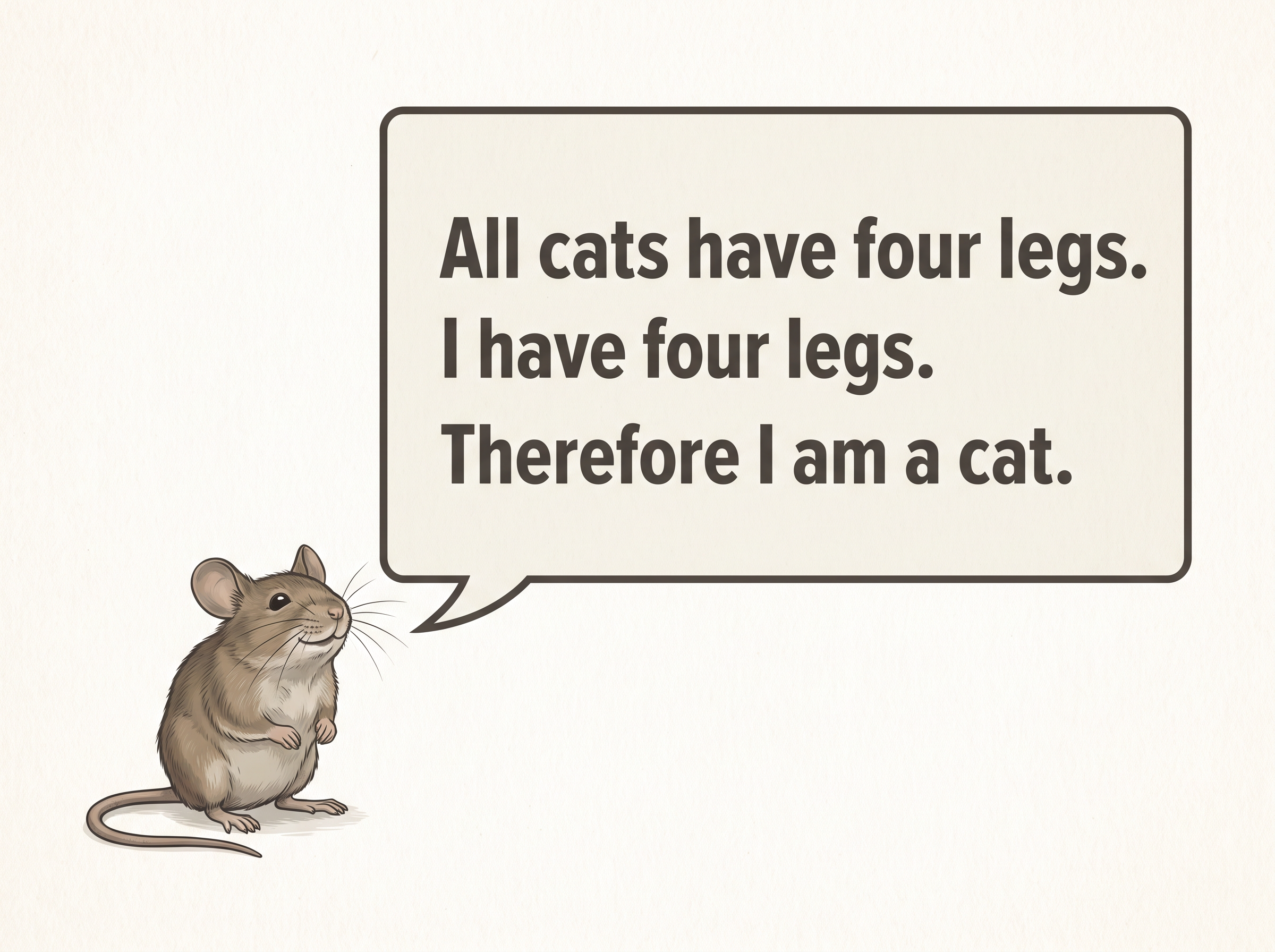
Fig. 7.8 – An error in deductive reasoning.
7.5.1.2 Inductive Reasoning
There is another way of figuring out why the man is running. Instead of starting from a general belief, you could watch him. You could consider other possible reasons, observe what he actually does next, and only then draw a conclusion about his behaviour.
Reasoning that is based on specific facts and observation is called inductive reasoning. It draws a general conclusion from particular observations.
Return to the platform. You observe the man’s subsequent actions — he enters a compartment and comes out again carrying a bag. From this you conclude that he had left his bag in the train. The conclusion is now grounded in what you saw rather than in what you had assumed.
Inductive reasoning has its own characteristic error. Because it moves from a few observations to a general conclusion, it is always possible to jump to a conclusion without knowing all the possible facts. The man might have been collecting a bag that was never his.
What reasoning is, and what it is for
From this discussion we can now say what reasoning is. It is the process of gathering and analysing information in order to arrive at conclusions.
Seen this way, reasoning is itself a form of problem solving. Like problem solving, it is goal-directed; the goal here is to determine what conclusion can be drawn from certain given information.
Most cases of scientific reasoning are inductive in nature. Scientists — and lay persons too — consider a number of instances and try to determine what general rule covers them all. You do this yourself more often than you notice. When you use your knowledge of problem-solving steps to plan a play, or to conduct a project, you are applying inductive reasoning: you have generalised a rule from several past cases and are now using it.
Reasoning by analogy
Analogy is another form of reasoning. It involves four parts, in the form A is to B as C is to D, where the relation between the first two parts is the same as the relation between the last two.
Water is to fish as air is to human. White is to snow as black is to coal. In each case, it is not the objects that match but the relationship between them — the fish lives in water as the human lives in air; snow is characteristically white as coal is characteristically black.
Analogies can be genuinely helpful in solving problems. By setting one situation against another, they help us identify and visualise the salient attributes of an object or event, which would otherwise go unnoticed. A familiar case throws light on an unfamiliar one.
7.6 Decision-making
Inductive and deductive reasoning allow us to make judgments. In judgment we draw conclusions, form opinions and evaluate events and objects, on the basis of our knowledge and the evidence available to us.
Take an example. A man is very talkative, likes to mix with people, and can convince others with ease. He would be most suitable, you decide, for a salesperson’s job. That opinion is a judgment, and it has been arrived at by matching what you observe in this man against the specific characteristics you associate with an expert salesperson.
Judgments differ in how much thought they need
Some judgments are automatic. They require no conscious effort at all and occur as a matter of habit — applying the brakes on seeing a red light is a judgment, but not one you deliberate over.
Others demand a great deal. Evaluating a novel or a literary text requires you to bring in your past knowledge and experience. Judging the beauty of a painting brings in your personal preferences as well.
This tells us something important: our judgments are not independent of our beliefs and attitudes. What you already hold to be true, and what you already value, enter into the judgment you make.
Judgments are also revised. Consider a new teacher who joins the school. On the very first day, students make an on-the-spot judgment that she is very strict. In the classes that follow, they interact with her closely, and their evaluation changes. Now they judge her to be extremely student-friendly. Newly acquired information has reshaped the earlier judgment.
From judgment to decision
Many of the problems you solve each day require you to make decisions. What to wear for the party? What to eat for dinner? What to say to a friend who is upset with you? The answer to each of these lies in picking or choosing one out of several available choices.
In decision-making, we sometimes choose among options on the basis of choices of personal significance. Judgment and decision-making are therefore interrelated processes: the options must first be evaluated (judgment) before one of them can be selected (decision).
In decision-making, the problem before us is to choose among alternatives by evaluating the cost and the benefit associated with each alternative.
Suppose you have the option of choosing between psychology and economics as subjects in Class XI. Your decision would rest on your interest, the future prospects each subject offers, the availability of books, the efficiency of the teachers, and so on. You could gather this information by talking to seniors and faculty members, and by attending a few classes of each.
How decision-making differs from other problem solving
Decision-making differs from other types of problem solving in one crucial respect. In decision-making, the various solutions or choices are already known to us; the task is to select one of them. In ordinary problem solving, the solution itself has to be worked out.
Consider a friend who is a very good badminton player. She is getting an opportunity to play at the state level. At the same time, the final examination is approaching and she needs to study hard for it. She has to choose between two options: practising for badminton, or studying for the final examination. In this situation, her decision will rest on an evaluation of all the possible outcomes of each choice.
You would observe, then, that people differ in their priorities, and therefore their decisions will differ too. Nor is careful evaluation always possible. In real-life situations we very often take quick decisions, and it is not always possible to evaluate every situation thoroughly and exhaustively.
7.7 Nature and Process of Creative Thinking
You may have wondered, at some time, how anyone first thought of putting a seed into the ground and waiting. Or of shaping a wheel. Or of decorating the walls of a cave with drawings. Somebody, at some point, was not satisfied with the old ways of carrying out day-to-day activities, and thought of something original.
There are countless others of the same kind, and the scientific and technological progress we now enjoy is the accumulated result of their thinking. Music, painting, poetry and the other forms of art that give us pleasure and joy are products of creative thinking too.
Creativity is not reserved for the extraordinary
It is important to remember that creative thinking is not always expressed in extraordinary work. One does not have to be a scientist or an artist to be a creative thinker. Everyone has the potential to be creative.
Creative thinking can be applied in almost any area of human activity, at different levels. It shows itself in writing, teaching, cooking, enacting a role, telling a story, holding a conversation, asking a question, playing a game, solving a day-to-day problem, organising an activity, or helping others resolve a conflict.
This is the idea of “everyday creativity” — creativity as it appears in an ordinary person’s way of perceiving, thinking and solving problems. It is different from the “special talent creativity” seen in outstanding creative achievements, but it is creativity all the same, and it is available to you.
7.7.1 Nature of Creative Thinking
Creative thinking is distinguished from other kinds of thinking by the fact that it involves the production of novel and original ideas or solutions to problems.
Sometimes creative thinking is understood simply as a new way of thinking, or thinking differently. That is not quite enough. Besides novelty, originality is an important characteristic of creative thinking. Every year, new models of household appliances, tape-recorders, cars, scooters and television sets are produced, but they may not be original unless genuinely unique features have been added to them. A new colour is new; it is not original.
Creativity, therefore, refers to originality and uniqueness of ideas or solutions that did not previously exist.
Creative thinking is also generally characterised by what Bruner calls “effective surprise”. If a product or an idea is truly unusual, the response of most people who encounter it is one of instant surprise, of being startled — the sense that this could have been done all along, and yet nobody did it.
Creativity must also be appropriate
A second criterion characterises creative thinking: its appropriateness in a particular context.
Simply being different for its own sake is often mistaken for creativity. Doing things in one’s own way, being non-conformist, indulging in fantasy without any purpose, or coming out with a bizarre idea — none of these is creative thinking by itself.
Researchers tend to agree that thinking is said to be creative when it is reality-oriented, appropriate, constructive, and socially desirable. A solution that startles but does not work, or works but harms, has not met the test.
7.7.1.1 Convergent and Divergent Thinking
J.P. Guilford, a pioneer in creativity research, proposed two types of thinking: convergent thinking and divergent thinking.
Convergent thinking is the thinking required to solve problems that have only one correct answer. The mind converges — narrows down — on that single correct solution. Look at the question below, based on a number series, in which the next number has to be found. Only one right answer is expected.
Q. 3, 6, 9 … what will come next? Ans. 12.
Now try to think of questions for which there is no single right answer, but many. Here are a few:
- What are the various uses of cloth?
- What improvements would you suggest in a chair, so that it becomes more comfortable and aesthetically pleasing?
- What will happen if examinations are abolished in schools?
Answering questions of this kind requires divergent thinking — an open-ended thinking in which the individual can produce different answers to the same question or problem, drawing on her or his own experience. This is the kind of thinking that produces novel and original ideas, and Fig. 7.9 catches a mind in the middle of it.
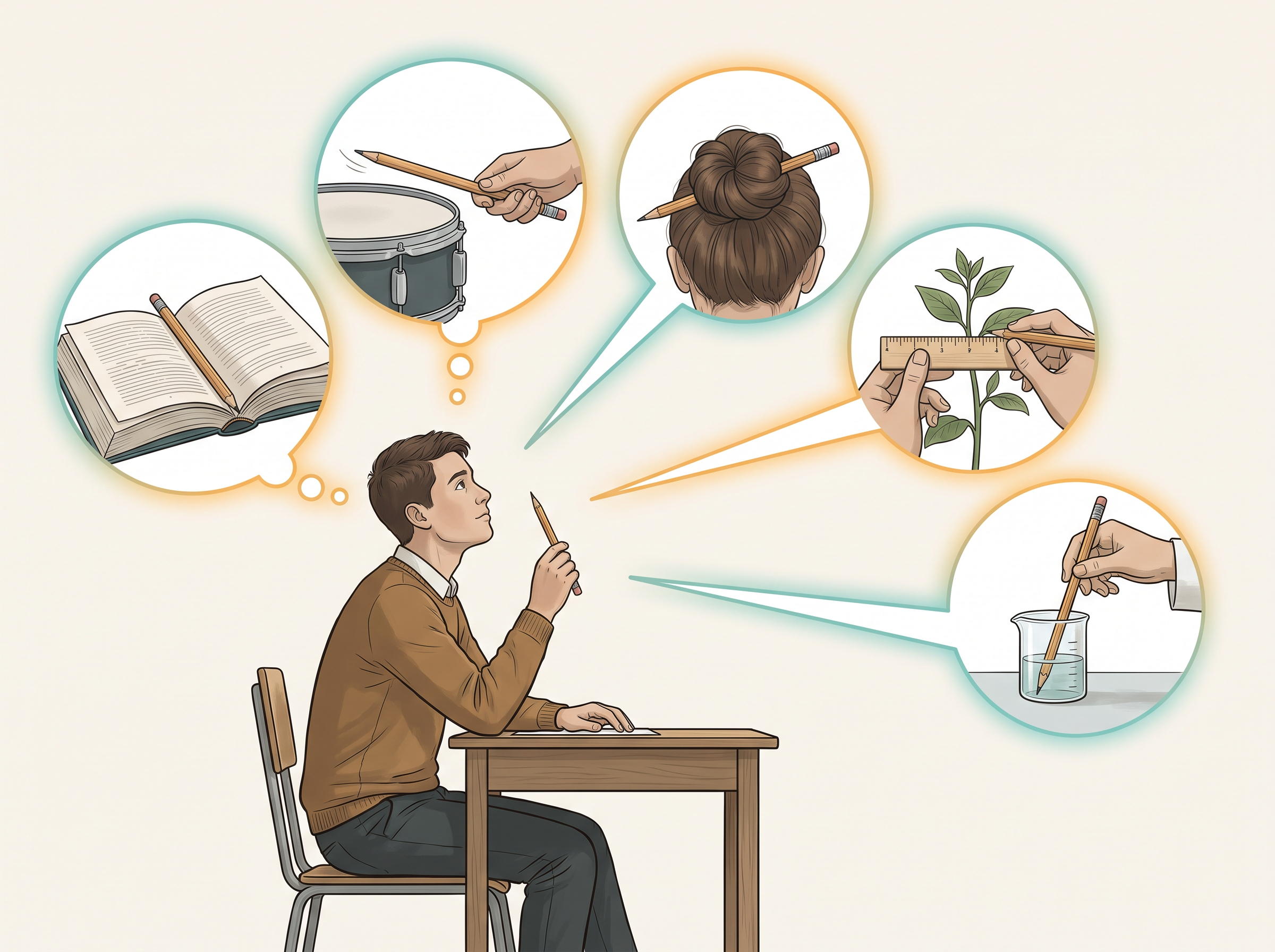
Fig. 7.9 – Divergent thinking.
7.7.1.2 Abilities Involved in Divergent Thinking
Divergent thinking abilities generally include fluency, flexibility, originality and elaboration.
- Fluency is the ability to produce many ideas for a given task or problem. The more ideas a person produces, the higher the fluency. If you can list twenty uses of a paper cup where another person lists six, your fluency is greater.
- Flexibility indicates variety in thinking. It may show itself in thinking of different kinds of uses of an object, or different interpretations of a picture or a story, or different ways of solving a problem. With the paper cup, one may suggest using it as a container, and also as a template to draw a circle — two quite different categories of use.
- Originality is the ability to produce ideas that are rare or unusual, by seeing new relationships, combining old ideas with new ones, and looking at things from different perspectives. Research has shown that fluency and flexibility are the necessary conditions for originality: the more ideas one produces, and the more varied they are, the greater the likelihood that an original one will appear among them.
- Elaboration is the ability that enables a person to go into details and work out the implications of new ideas. An idea that is never elaborated remains a hunch.
Note the relationship the third point states. Originality is not a separate gift that some people are born with and others are not. It grows out of quantity and variety — which is precisely why creativity can be practised.
Remote association
Divergent thinking abilities help generate a variety of ideas that may not seem to be related to one another at all.
Take a question: what are the common ideas for enhancing food production? The likely answers would concern the quality of seeds, fertilizers, irrigation, and so on. But suppose someone thinks of cultivation in a desert, for extracting protein from weeds. That would be a remote idea. The association here is between “food production” and “desert” or “weeds” — things we do not ordinarily associate at all. A remote association is exactly this: a link between ideas that are normally kept far apart.
If we let the mind range freely in search of new and remote associations, a great many combinations of ideas may arise, out of which one or two may turn out to be original.
You must remember, finally, that both convergent and divergent thinking are important for creative thinking. Divergent thinking is essential for generating a wide range of ideas. Convergent thinking is essential for identifying which of them is the most useful or appropriate. Creativity needs both the wide net and the sharp knife.
7.7.2 Process of Creative Thinking
In recent years, more and more attention has been given to the way the human mind operates while producing something new. Research has made it clear that thinking of new and unusual ideas involves much more than a flash of insight. There are stages before the new idea arrives, and stages after it.
Where does the process begin? Not with the idea, but with a need — the need to think or bring out something new, which initiates the whole effort. Not everyone experiences this need. One can be perfectly happy and contented carrying out routine work. The need to search for new ideas and solutions arises from sensing problems and gaps in information: from noticing that something is missing.
Preparation
The process of creative thinking begins with the preparation stage. This requires one to understand the task or problem in hand, to analyse it, and to become aware of the background facts and related information.
Preparation is not passive collection. The process evokes curiosity and excitement, pushing the person to think more and more in different directions, and to look at the task or problem from different angles and viewpoints. Here the divergent thinking abilities discussed earlier come into play, helping one extend in new directions.
Incubation
Now the person is trying to generate alternative ideas and to view the problem from an unusual perspective — and there may be a feeling of getting stuck. One may even become disgusted with failure and leave the problem or the task aside for some time.
This is the stage of incubation. Research shows that creative ideas may occur during incubation, when the individual is not consciously thinking about the problem but is seeking relaxation from conscious effort. They may strike when a person is doing something else altogether — going to sleep, waking up, taking a bath, or just walking along.
The path in Fig. 7.10 is worth studying for this reason: the search effort winds, meets a dead end, is asked to think again, turns in a new direction, and only then arrives at the creative solution. The detour is part of the route, not a failure of it.
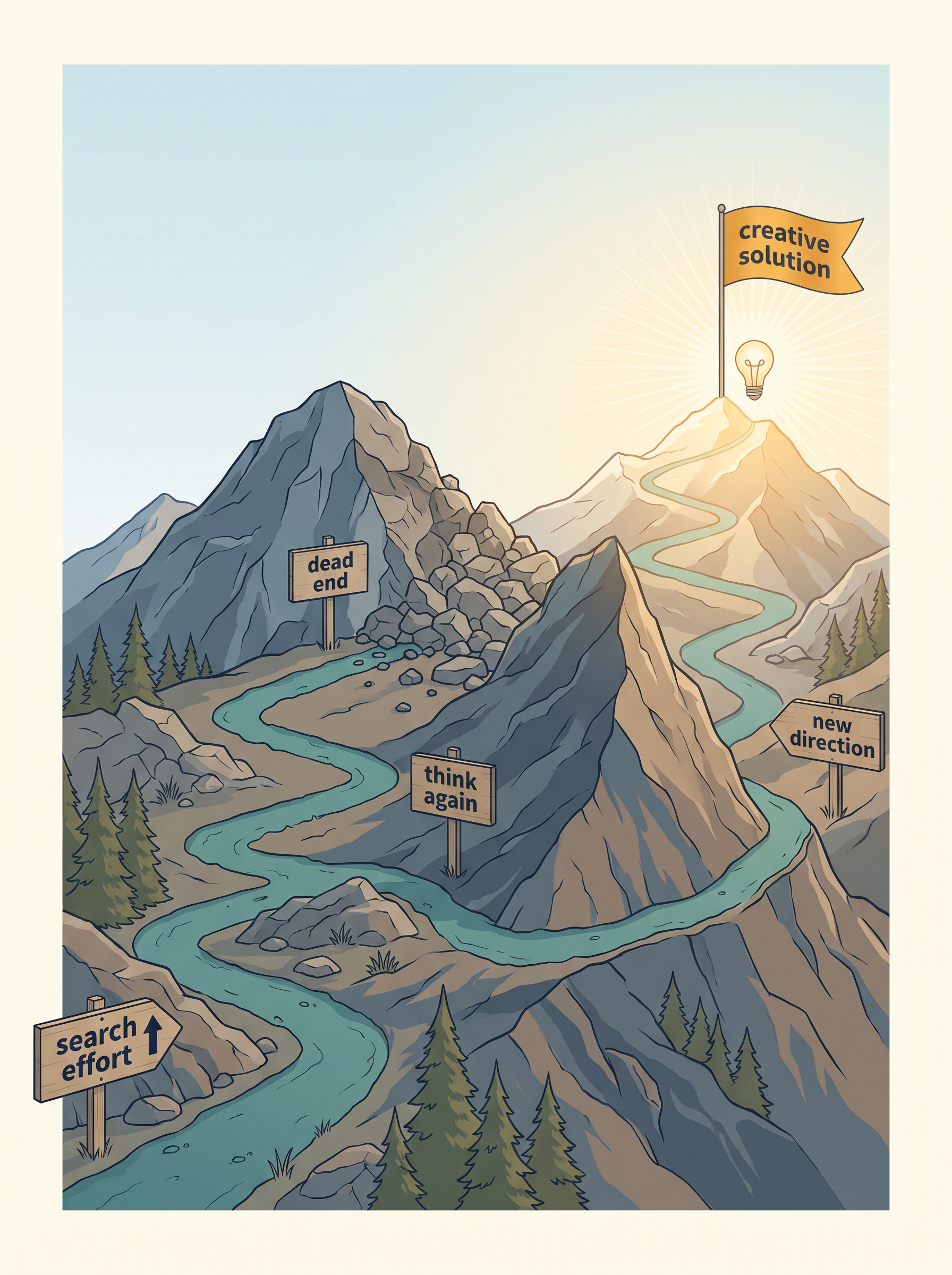
Fig. 7.10 – The winding path of creative thinking.
Illumination
Following incubation is the stage of illumination — the “Aha!” or “I have found it” experience, the moment we normally associate with the emergence of creative ideas. There is usually a feeling of excitement, even of satisfaction, at having found a creative idea.
This is the moment that popular accounts of creativity treat as the whole story. It is, in fact, one stage of four, and it is the one that can least be forced.
Verification
Last is the stage of verification, when the worth or the appropriateness of the ideas or solutions is tested and judged. Here convergent thinking plays its role, in selecting the appropriate idea or solution that actually works.
An idea that survives verification is a creative solution. An idea that does not is simply an idea.
7.7.3 Strategies for Creative Thinking
Research on the characteristics of creative people has revealed certain attitudes, dispositions and skills that facilitate creative thinking. The following strategies can help you enhance your own creative thinking abilities.
Become more aware and sensitive. Train yourself to notice and respond to the feelings, sights, sounds and textures around you. Spot problems, missing information, anomalies, gaps and deficiencies. Try to notice contradictions and incompleteness in situations where others notice nothing at all. For this, cultivate the habit of wider reading, expose yourself to a variety of information, and develop the art of asking questions — pondering over the mysteries of ordinary situations and objects.
Generate as many ideas as you can. Produce many responses, solutions or suggestions for a given task or situation, so as to increase the flow of your thoughts. Deliberately look for multiple angles on a task, so as to increase flexibility in your thinking. It might be thinking of alternative arrangements of furniture in a room to generate more space; different ways of conversing with people; the costs and benefits of a course of study or a career; or different ways of dealing with an angry friend.
Use brainstorming. Osborn’s brainstorming technique can be used to increase the fluency and flexibility of ideas in open-ended situations. Brainstorming rests on a single principle: the production of ideas must be kept separate from the evaluation of their worth.
The basic assumption is to let the mind think freely, and to postpone the tendency to pass judgment on the worth of ideas — imagination is given priority over judgment until all the ideas are exhausted. This helps increase the fluency of ideas and pile up alternatives. Brainstorming can be practised by playing brainstorming games with family members and friends, keeping its principles in mind.
Use checklists and questions. Questions often provide a new twist to an idea. What other changes could be made? What else? In how many ways could it be done? What could be the other uses of this object?
7.8 Thought and Language
Till now we have discussed the nature and meaning of thinking, the images and concepts on which it is based, and the various processes of thought. Through all of it, one question has been waiting in the background. Did you feel, as you read, that words are essential to express what we think — and perhaps even to have the thought in the first place?
This section examines the relationship between language and thought. Three viewpoints have been offered: that language determines thought, that thought determines language, and that thought and language have different origins altogether. We take each in turn.
7.8.1 Language as Determinant of Thought
Begin with an observation about your own language. In Hindi and other Indian languages, we use a large number of different words for kinship relationships. There are separate terms for mother’s brother, father’s elder brother, father’s younger brother, mother’s sister’s husband, father’s sister’s husband, and so on. An English speaker uses a single word — uncle — for all of them.
The reverse also happens. English has dozens of words for colours, whereas some tribal languages have only two to four colour terms.
Do such differences matter for how we think? Does an Indian child find it easier to think about, and to tell apart, various kinship relationships than her English-speaking counterpart does? Does our thinking process depend on how our language describes the world?
Benjamin Lee Whorf held that language determines the contents of thought. This view is known as the linguistic relativity hypothesis. In its strong version, the hypothesis holds that what and how individuals can possibly think is determined by the language and the linguistic categories they use — a position called linguistic determinism.
Experimental evidence, however, maintains something more moderate. It is possible to have the same level or quality of thought in all languages, depending on the availability of linguistic categories and structures. Some thoughts may simply be easier in one language than in another. The language you speak, on this evidence, shapes the road; it does not decide the destination.
7.8.2 Thought as Determinant of Language
The noted Swiss psychologist Jean Piaget held the opposite view: thought not only determines language, it also precedes it.
Piaget argued that children form an internal representation of the world through thinking. Watch a young child see something and then copy it later — a process called imitation. Thinking has clearly taken place, and yet no language has been involved. A child’s observation of another’s behaviour, and imitation of that behaviour, undoubtedly involves thinking, but not language.
On this view, language is lift one of the vehicles of thinking. As actions become internalised, language may extend the range of a child’s symbolic thinking, but it is not necessary for the origins of thought.
Piaget also pointed to something you can see in any classroom. Language can certainly be taught to children — but understanding the words requires knowledge of the underlying concepts, which is to say, thinking. A child can be taught to say “half” long before she can be taught to mean it. Thought, therefore, is basic, and it is necessary if language is to be understood at all.
7.8.3 Different Origins of Language and Thought
The Russian psychologist Lev Vygotsky argued for a third position: that thought and language develop separately in a child until about two years of age, when they merge.
Before the age of two, thought is preverbal and is experienced more in action — this corresponds to Piaget’s sensory-motor stage. The child’s utterances during this period are closer to automatic reflexes, such as crying when uncomfortable, than to anything thought-based.
Around two years of age, something changes. The child begins to express thought verbally, and her speech begins to reflect rationality. Children are now able to manipulate thoughts using soundless speech — the inner speech that you use yourself when you work a problem out silently in your head.
Vygotsky believed that during this period the development of language and the development of thinking become interdependent. The development of conceptual thinking depends on the quality of inner speech, and the quality of inner speech in turn depends on conceptual thinking. Each feeds the other.
The two can still come apart, and this is the strength of his account. Thought is used without language whenever the vehicle of thinking is non-verbal — visual, or movement-related. You do not need words to picture the route from your home to the market, or to judge whether a cupboard will fit through a doorway. Language, equally, is used without thought when we express feelings or exchange pleasantries: “Good morning! How are you?” “Very well, I am fine.” Very little thinking is going on there.
When the two functions overlap, however, they can be used together to produce verbal thought and rational speech — which is what most of your schooling asks of you.
7.9 Development of Language and Language Use
In the previous section we discussed the relationship between language and thought. Here we examine something more concrete: how human beings actually acquire language, and how they use it at different ages.
7.9.1 Meaning and Nature of Language
Think for a moment about what would have happened if you had no language in which to say what you wanted to say. You would not be able to communicate your ideas and your feelings. Just as seriously, you would have no way of knowing what others think and feel. Language is not only an instrument for sending; it is an instrument for receiving.
As a child, when you first began saying “ma..ma..ma”, it gave you a tremendous push to go on repeating the activity — and it was a moment of great joy for your parents and other care-givers. Slowly you learnt to say ‘ma’ and ‘papa’, and some time later you combined two or more words to communicate your needs, feelings and thoughts. You learnt which words suited which situations, and you learnt the rules for putting words into sentences.
The journey continued. First you learnt to communicate in the language used at home — usually the mother tongue. Then you went to school and learnt the formal language of instruction, which in many cases is different from the mother tongue. Then you were promoted to higher grades and learnt other languages. Looking back, the movement from crying and “ma..ma..ma” to competence in not one but several languages is a remarkable one.
Now try to define accurately the thing you have been using all your life.
Language consists of a system of symbols, organised by means of certain rules, that we use to communicate with each other. From this definition, three basic characteristics follow: (a) the presence of symbols, (b) a set of rules to organise these symbols, and (c) communication.
Symbols
The first characteristic of language is that it involves symbols. A symbol represents something or someone else. The place where you live is called ‘home’, the place where you study is called ‘school’, the thing that you eat is called ‘food’.
Notice that words like home, school and food do not, in themselves, carry any meaning. There is nothing house-like about the sound “home”. These words acquire meaning only when they become associated with certain objects and events, after which we begin to recognise those objects and events through those words. And it is these symbols that we then use while thinking.
Rules
The second characteristic is that language involves rules. While combining two or more words, we follow a definite and accepted order of presenting them. One would most likely say “I am going to school”, and certainly not “school am going I”. The words are the same; only one arrangement carries the meaning.
Communication
The third characteristic is that language is used for communicating one’s thoughts, ideas, intentions and feelings to others.
Words are not the only means of doing this. On many occasions we communicate through the use of our body — through gestures and postures. This kind of communication is called non-verbal communication. And people who cannot use oral speech, such as those who have severe hearing and speech impairments, communicate through signs. Sign language, with its own symbols and its own rules, is also a form of language in the full sense of the definition above.
7.9.2 Development of Language
Language is a complex system, and it is unique to human beings. Psychologists have tried to teach sign language and the use of symbols to chimpanzees, dolphins and parrots. Some success has been achieved. But it is observed that human language is far more complex, more creative and more spontaneous than the systems of communication that other animals can be taught.
There is also a striking regularity in the way children all over the world learn the language or languages to which they are exposed. Compare individual children, and you will find that they differ a great deal in the rate of their language development, and in how they go about it. Take a general view of children’s acquisition of language across the world, however, and a predictable pattern appears, along which children move from almost no use of language to becoming competent language users.
Language develops through the stages described below, and Fig. 7.11 lays them out in order.
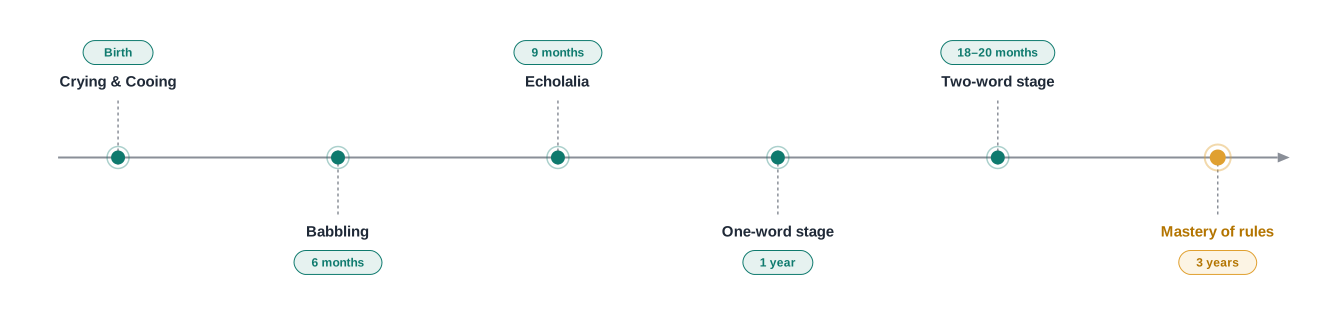
Fig. 7.11 – Stages of language development.
Crying and cooing
Newborn babies and young infants make a variety of sounds, which gradually get modified to resemble words. The first sound produced by babies is crying.
Initial crying is undifferentiated: it sounds much the same across various situations. Gradually, however, the pattern of crying begins to vary in its pitch and intensity, signalling different states such as hunger, pain and sleepiness — which is how parents come to say, quite accurately, that they can tell one cry from another.
These differentiated crying sounds gradually become the more meaningful cooing sounds (‘aaa’, ‘uuu’), usually used to express happiness.
Babbling
At around six months of age, children enter the babbling stage. Babbling involves the prolonged repetition of a variety of consonant and vowel sounds — da—, aa—, ba—.
By about nine months of age, these sounds get elaborated into strings of sound combinations, such as ‘dadadadadada’. These repetitive patterns are called echolalia.
An important shift occurs within this stage. The early babblings are random or accidental in nature; the later babblings seem to be imitative of adult voices — the child is beginning to shape her sounds towards the language she hears around her. Children also show some understanding of a few words by the time they are six months old.
The one-word stage
Around the first birthday — and the exact age varies from child to child — most children enter the one-word stage. Their first word usually contains one syllable: ma or da, for instance.
Gradually, one word comes to do the work of a whole sentence or phrase. Such single words that carry the meaning of an entire sentence are called holophrases. “Milk”, said with the right urgency, means “I want milk now”.
The two-word stage
When they are 18 to 20 months of age, children enter the two-word stage and begin to use two words together.
This stage exemplifies telegraphic speech. Like the telegrams of an earlier era — got admission, send money — it contains mostly nouns and verbs, with the small connecting words stripped away. The child says “want water”, not “I would like some water”.
Close to their third birthday, that is, beyond two-and-a-half years, children’s language development becomes focused on the rules of the language they hear around them.
7.9.2.1 How is Language Acquired?
You must be wondering: how do we learn to speak at all?
As with many other topics in psychology, the question here is one of nature and nurture. Does language develop as a result of inherited characteristics, or from the effects of learning? Most psychologists accept that both nature and nurture are important in language acquisition. But the two great accounts of language pull in different directions, and it is worth seeing each at its strongest.
The learning account
The behaviourist B.F. Skinner believed that we learn language in the same way as animals learn to peck keys or press bars.
For the behaviourists, language development follows the ordinary principles of learning. There is association — the sight of a bottle is paired with the word ‘bottle’. There is imitation — the child copies the adult’s use of the word “bottle”. And there is reinforcement — smiles and hugs follow when the child says something right.
There is evidence for this. Children produce sounds that are appropriate to the language of the parent or care-giver, and are reinforced for having done so. The principle of shaping leads to successive approximation of the desired responses, so that the child eventually speaks as well as the adult does. Regional differences in pronunciation and phrasing illustrate the point neatly: different patterns are reinforced in different areas, and the child ends up speaking as her area speaks.
The innate account
The linguist Noam Chomsky put forward the innate proposition of language development.
His argument begins with what learning cannot explain. The rate at which children acquire words and grammar, without being taught, cannot be accounted for by learning principles alone. Children also create all sorts of sentences that they have never heard, and which they therefore cannot be imitating.
Two further observations support him. Children throughout the world seem to have a critical period for learning language — a period during which learning must occur if it is to occur successfully at all. And children across the world go through the same stages of language development, regardless of the language they are learning.
Chomsky believed that language development is much like physical maturation: given adequate care, it “just happens to the child”. Children, he held, are born with a “universal grammar”, and readily learn the grammar of whatever language they happen to hear.
The two accounts, then, answer different questions, and this is why most psychologists keep both. Skinner’s emphasis on learning explains why infants acquire the language they hear around them, and how they go on adding new words to their vocabularies. Chomsky’s emphasis on our built-in readiness to learn grammar explains why children acquire language so readily, without any direct teaching at all.
7.9.3 Language Use
Language use involves knowing the socially appropriate ways of communicating. This is a further step, and it is easy to underestimate.
Knowledge of the vocabulary and the syntax of a language — its words, and the rules by which they are arranged — does not by itself ensure that the language will be used properly to achieve the purpose of communication in the variety of social situations one meets.
When we use language, we have various pragmatic intentions: we are requesting, asking, thanking, demanding, and so on. To serve these social goals effectively, language use must be pragmatically correct — contextually appropriate — besides being grammatical and meaningful. “Give me the water” and “Could you pass the water, please?” are both perfectly grammatical. Only one of them will do at a stranger’s table.
Children often have difficulty here. They struggle with the choice of appropriate utterances for politeness or for requests, so that their use of language conveys a demand or a command instead of a polite request. When children are engaged in conversations, they also have difficulty in taking turns at speaking and listening the way adults do — they interrupt, or fall silent at the wrong moment.
7.10 Summary
- Thinking is a complex mental process in which we manipulate information, whether newly acquired or already stored. It is an internal process, and it can only be inferred from behaviour.
- Thinking works on mental representations, which take two forms: mental images and concepts. An image stands for a particular sensory experience; a concept stands for a whole category of objects, ideas or events sharing common properties.
- The complex thought processes are problem solving, reasoning, decision-making, judgment and creative thinking.
- Problem solving is thinking directed towards the solution of a specific problem. It moves from an initial state to a goal through a series of mental operations.
- Mental set, functional fixedness, lack of motivation and lack of persistence are some of the hindrances to effective problem solving.
- Reasoning, like problem solving, is goal directed and involves inference. It may be deductive — moving from a general assumption to a particular conclusion — or inductive — moving from particular observations to a general conclusion.
- In making a judgment, we draw conclusions, form opinions and make evaluations about objects or events, using our knowledge and the available evidence.
- In decision-making, one must choose among several alternatives that are already available, by weighing the cost and the benefit of each.
- Judgment and decision-making are interrelated processes: the alternatives must be judged before one of them can be chosen.
- Creative thinking involves the production of something new and original — an idea, an object, or a solution to a problem — which is also appropriate to its context.
- Convergent thinking narrows many possibilities down to one correct answer; divergent thinking opens a problem out into many possible answers. Both are needed for creativity.
- The creative process passes through preparation, incubation, illumination and verification.
- Developing creative thinking requires overcoming the blocks to creative expression and using strategies — greater awareness, generating many ideas, brainstorming, and the use of checklists and questions — to enhance creative skills and abilities.
- Language is distinctly human. It consists of symbols, organised on the basis of certain rules, used to communicate intentions, feelings, motives and desires among human beings.
- Major development in language occurs during the first two to three years of age, passing through crying, cooing, babbling, the one-word stage and the two-word stage.
- Language and thought are intricately related. Whorf held that language determines thought, Piaget held that thought precedes and determines language, and Vygotsky held that the two begin separately and later merge.
7.11 Key Terms
Bilingualism — Proficiency in communicating through any two languages.
Brainstorming — A technique, given by Osborn, for generating many ideas by keeping the production of ideas strictly separate from the evaluation of their worth.
Concepts — Mental representations of categories; a concept refers to a class of objects, ideas or events that share common properties.
Convergent thinking — Thinking required for problems that have only one correct answer, in which the mind narrows down to that single solution.
Creativity — The ability to produce ideas or solutions that are novel, original, and at the same time appropriate and useful.
Decision-making — Choosing among known alternatives by evaluating the cost and the benefit associated with each.
Deductive reasoning — Reasoning that starts from a general assumption and draws a specific conclusion from it; reasoning from the general to the particular.
Divergent thinking — Open-ended thinking in which many different answers are generated for the same question or problem.
Functional fixedness — The failure to solve a problem because one is fixed on the usual function of an object.
Illumination — The stage of the creative process in which the idea suddenly appears; the “Aha!” experience.
Images — Mental representations of sensory experiences, used to think about things, places and events.
Incubation — The stage of the creative process in which the problem is set aside, and ideas may occur while one is not consciously working on it.
Inductive reasoning — Reasoning that draws a general conclusion from particular facts and observations.
Judgment — Drawing conclusions, forming opinions and evaluating objects and events on the basis of knowledge and available evidence.
Language — A system of symbols, organised by certain rules, used to communicate thoughts, ideas, intentions and feelings.
Mental representation — The form in which knowledge is held in the mind, either as an image or as a concept.
Mental set — The tendency to solve a problem using mental operations that have been tried successfully before, even when they no longer fit.
Multilingualism — Proficiency in communicating through more than two languages.
Problem solving — Goal-directed thinking that moves from an initial state to a goal state through a series of mental operations.
Reasoning — The process of gathering and analysing information in order to arrive at conclusions.
Remote association — A link formed between ideas that are not ordinarily associated with each other, often the source of original ideas.
Syntax — The set of rules that govern how words are arranged into meaningful sentences in a language.
Thinking — A higher mental process in which acquired or existing information is manipulated and analysed to reach a goal.
7.12 Points to Ponder
Mental set makes you faster at problems you have met before and slower at problems you have not. If both effects come from the same habit of mind, is mental set an obstacle to thinking, or a necessary cost of being efficient at it?
The chapter says that everyone has the potential to be creative. If that is true, why do we still speak of some people as “creative types” and others as not? What might schools be doing that turns everyday creativity on in some students and off in others?
Concepts let you predict what a new object will do before you have any evidence about it — the small barking creature will bite strangers. When the same shortcut is applied to people rather than animals, what does it become? Is stereotyping a failure of thinking, or thinking working exactly as it was designed to?
Whorf held that the language you speak shapes what you can think. Most Indian students think, argue, and sit examinations in at least two languages. Do you find that certain ideas come to you more easily in one of your languages than in another — and if so, what does that tell you about how far Whorf was right?
Brainstorming asks you to postpone judgment until all the ideas are out. In a real classroom or a real group of friends, what makes this so difficult to actually do? What would have to change in a group for genuinely strange ideas to be spoken aloud?
Chomsky argued that language “just happens to the child”, the way physical growth does. If that is so, why does a child still need people around her in order for it to happen at all?
A project to try. Observe children of one year, two years and three years of age over a period of one week. Record their speech, and note how each child is learning words, and how many new words the child has picked up over that period. Then set your observations against the stages described in this chapter. Where do the children fit the predicted pattern, and where do they depart from it?
7.13 NCERT Questions
Explain the nature of thinking.
What is a concept? Explain the role of concepts in the thinking process.
Identify the obstacles that one may encounter in problem solving.
How does reasoning help in solving problems?
Are judgment and decision-making interrelated processes? Explain.
Why is divergent thinking important in the creative thinking process?
How can creative thinking be enhanced?
Does thinking take place without language? Discuss.
How is language acquired in human beings?
7.14 Objective Questions
- An image is best described as a mental representation of:
- a category of objects sharing common properties
- a sensory experience
- a set of grammatical rules
- a goal-directed plan [1 mark]
- Using a hardbound book to hammer a nail shows that a person has overcome:
- mental set
- lack of motivation
- functional fixedness
- linguistic determinism [1 mark]
- “All cats have four legs. I have four legs. Therefore I am a cat.” This illustrates an error in:
- inductive reasoning
- deductive reasoning
- divergent thinking
- elaboration [1 mark]
- Which of the following questions calls for convergent thinking?
- What are the various uses of cloth?
- What will happen if examinations are abolished in schools?
- 3, 6, 9 … what will come next?
- What improvements will you suggest in a chair? [1 mark]
- The stage of the creative process in which the person sets the problem aside and ideas may strike while doing something else is called:
- preparation
- incubation
- illumination
- verification [1 mark]
- The repetitive sound patterns such as ‘dadadadadada’, produced at about nine months of age, are called:
- holophrases
- telegraphic speech
- cooing
- echolalia [1 mark]
- The view that what and how individuals can possibly think is determined by the language they use is known as:
- linguistic determinism
- universal grammar
- telegraphic speech
- remote association [1 mark]
- Assertion (A): Mental set can sometimes improve the speed of problem solving. Reason (R): A strategy that has succeeded in the past is often applicable to a new but similar problem.
- Both A and R are true, and R is the correct explanation of A.
- Both A and R are true, but R is not the correct explanation of A.
- A is true, but R is false.
- A is false, but R is true. [1 mark]
- Assertion (A): Fluency and flexibility are regarded as necessary conditions for originality. Reason (R): The more numerous and varied the ideas a person produces, the greater the likelihood that an original idea appears among them.
- Both A and R are true, and R is the correct explanation of A.
- Both A and R are true, but R is not the correct explanation of A.
- A is true, but R is false.
- A is false, but R is true. [1 mark]
- Assertion (A): According to Chomsky, language development is like physical maturation. Reason (R): Children are reinforced with smiles and hugs whenever they pronounce a word correctly.
- Both A and R are true, and R is the correct explanation of A.
- Both A and R are true, but R is not the correct explanation of A.
- A is true, but R is false.
- A is false, but R is true. [1 mark]
- Match the theorist in Column A with the idea in Column B.
| Column A | Column B |
|---|---|
| a. J.P. Guilford | i. Universal grammar |
| b. Benjamin Lee Whorf | ii. Lateral thinking and the six thinking hats |
| c. Noam Chomsky | iii. Convergent and divergent thinking |
| d. Edward de Bono | iv. Linguistic relativity hypothesis |
[1 mark]
- Match the term in Column A with its description in Column B.
| Column A | Column B |
|---|---|
| a. Holophrase | i. A link between ideas not ordinarily associated |
| b. Telegraphic speech | ii. A single word used to convey a whole sentence |
| c. Remote association | iii. Going into details and working out implications of an idea |
| d. Elaboration | iv. Two-word utterances made up mostly of nouns and verbs |
[1 mark]
Fill in the blank: Thinking that moves from a general assumption to a specific conclusion is called ______ reasoning. [1 mark]
Fill in the blank: The technique of ______, given by Osborn, rests on the principle that the production of ideas must be kept separate from the evaluation of their worth. [1 mark]
Fill in the blank: The period during which language learning must occur if it is to occur successfully is called the ______ period. [1 mark]
True or False: In decision-making, the alternatives are already known and one of them has to be selected. [1 mark]
True or False: According to Piaget, language precedes thought and is necessary for it. [1 mark]
True or False: Sign language is not considered a form of language, because it does not involve symbols. [1 mark]
7.15 Check Your Concepts
Define thinking. State any two of its characteristics. [2 marks]
What is a mental image? Give one example of a situation in which you would use one. [2 marks]
List the four abilities that make up divergent thinking. [2 marks]
What is meant by functional fixedness? Give one example. [2 marks]
State the three basic characteristics of language. [2 marks]
Differentiate between an image and a concept. [3 marks]
Differentiate between mental set and functional fixedness, with one example of each. [3 marks]
Explain briefly why the formation of concepts makes thinking quick and efficient. [3 marks]
Give reasons: a conclusion drawn by deductive reasoning may be logically neat and still be wrong. [3 marks]
Distinguish between convergent and divergent thinking, giving one example of a question that calls for each. [3 marks]
Arrange the stages of language development in the correct order — one-word stage, babbling, crying, two-word stage, cooing — and state the approximate age at which each appears. [4 marks]
Describe the mental operations involved in solving a problem, using any one example from school life. [4 marks]
Explain, with an example, how judgment and decision-making are interrelated processes. [4 marks]
Why is originality alone not enough for an idea to be called creative? Evaluate this claim using the criteria of creative thinking discussed in the chapter. [4 marks]
What would happen to a group’s output if, during a brainstorming session, every idea were evaluated as soon as it was offered? Explain your answer with reference to fluency, flexibility and originality. [4 marks]
Describe the four stages of the creative process in full, explaining the role of divergent and convergent thinking in them. [6 marks]
Compare the views of Whorf, Piaget and Vygotsky on the relationship between thought and language. Which of the three do you find best supported by the evidence, and why? [6 marks]
Discuss Skinner’s and Chomsky’s accounts of language acquisition. State the evidence for each, and explain why most psychologists accept a role for both nature and nurture. [6 marks]
Discuss the strategies that can be used to enhance creative thinking, and explain how each of them works on an ability involved in divergent thinking. [6 marks]
7.16 Case-Based Questions
Meera is preparing for her mathematics test. She solves five problems on simple interest, all of which yield to the same sequence of steps. The sixth problem looks similar, and she applies the same steps — but the answer will not come out. She tries the same route a second and a third time, growing more frustrated, unable to think of any other way of approaching it. Her friend, glancing at the question, points out that it can be solved in two lines by a different method.
- Identify the obstacle to problem solving that Meera is facing, and define it.
- Explain why her earlier success made this obstacle more likely, not less.
- Suggest one thing Meera could do at the moment she gets stuck, and justify it in terms of what you know about problem solving. [6 marks]
The students of Class XI have been asked to reduce the waste generated in their school canteen. In the first meeting, the group leader writes every suggestion on the board without comment — reusable steel plates, a compost pit, a “bring your own box” day, selling peels to a nearby dairy, even a suggestion that the canteen serve only food that can be eaten by hand. Nobody is allowed to criticise anything for the first twenty minutes. Only afterwards does the group sit down to work out which suggestions are actually workable within their budget.
- Name the technique the group leader is using, and state the principle on which it rests.
- Identify the kind of thinking at work in the first twenty minutes, and the kind at work afterwards.
- Explain how the suggestion about selling peels to a dairy illustrates remote association. [6 marks]
Rohit sees his neighbour hurrying out of the building at six in the morning, carrying a suitcase. He immediately concludes that she is going out of town, because in his experience people who leave home early with a suitcase are catching a train. Later, his sister tells him that she watched the neighbour hand the suitcase to a man at the gate, take a smaller bag from him, and return upstairs — from which his sister concluded that the neighbour was simply exchanging luggage with a relative.
- Identify the kind of reasoning used by Rohit, and the kind used by his sister.
- State the characteristic error to which each kind of reasoning is liable.
- Whose conclusion is better grounded, and why? Justify your answer. [6 marks]
Ananya is two years old. At home she hears Marathi, at her grandmother’s house she hears Konkani, and at the crèche the caregivers speak Hindi. Her speech at present consists mostly of two-word utterances — “want doodh”, “papa gaya” — with the small connecting words missing. Her parents are anxious that three languages will confuse her and delay her speech.
- Name the stage of language development Ananya is in, and identify the kind of speech her utterances illustrate.
- Explain, using the concept of universal grammar, why she is able to pick up the rules of three languages without being taught any of them.
- What does the evidence on multilingualism in the Indian context suggest about her parents’ anxiety? [6 marks]