Chapter 4: Sensory, Attentional and Perceptual Processes
In 1910, a young psychologist named Max Wertheimer was travelling by train across Germany. Something about the flickering lights he had been thinking about would not leave him alone. He got off at Frankfurt, bought a simple toy from a shop at the station, and began to experiment in his hotel room.
The toy showed still pictures one after another in quick succession. There was no movement in it at all. Each picture was frozen, separate, complete. Yet when the pictures followed one another at the right speed, Wertheimer saw something that was not there: motion.
That gap between what was on the card and what he saw fascinated him. His eyes had received a series of still images. His mind had delivered a moving one. Wertheimer worked on the problem with two colleagues, Wolfgang Köhler and Kurt Koffka, and out of this small puzzle grew one of the most influential schools of psychology of the twentieth century.
Their conclusion was unsettling and simple. We do not perceive the world as our sense organs record it. We perceive the world as our mind organises it.
You depend on that organising every second of your life. When you read this line, cross a busy road, or pick your friend’s voice out of a noisy corridor, three processes are at work together — sensing, attending, and perceiving. This chapter is about how they work, and about the surprising moments when they get things wrong.
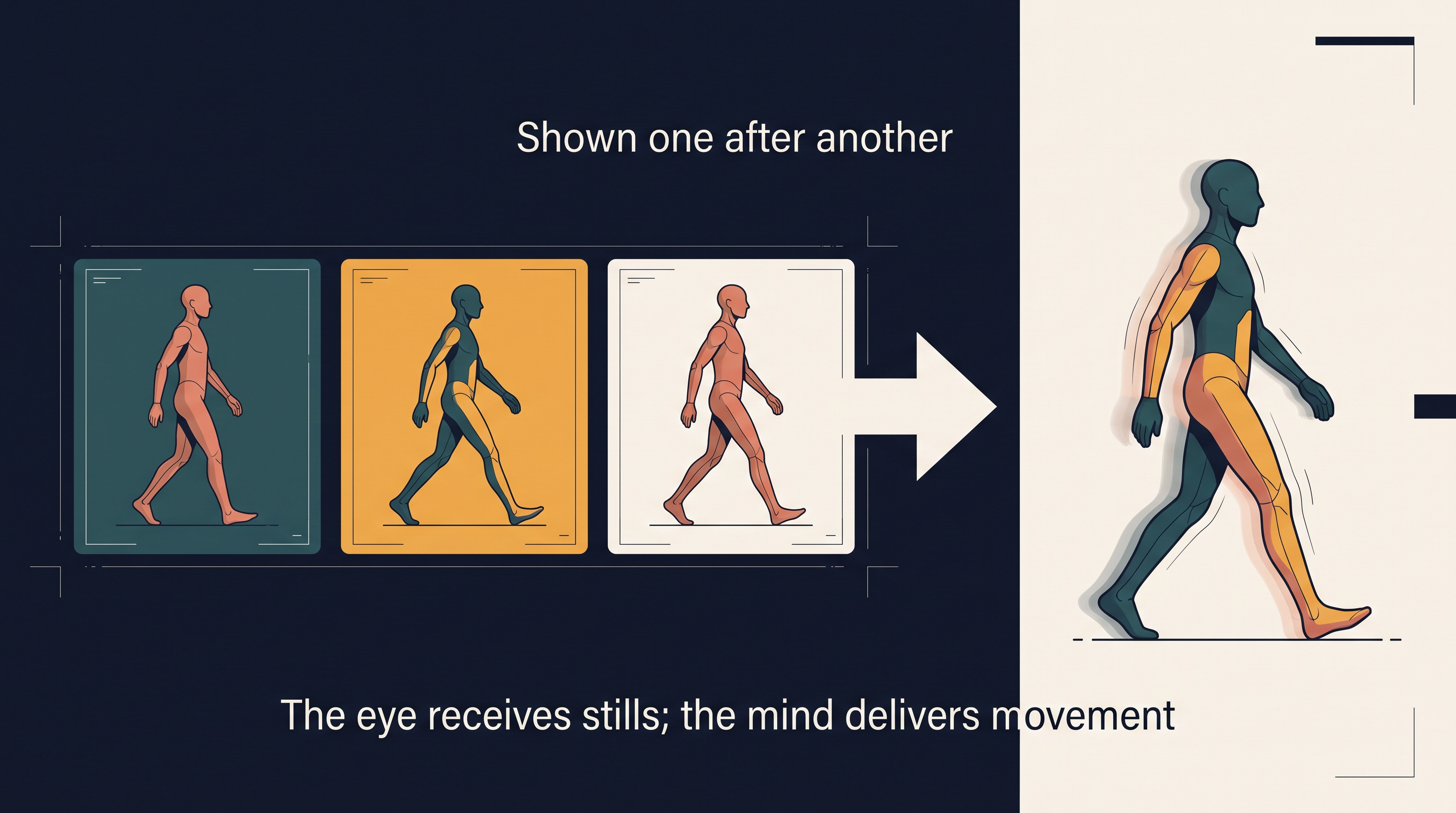
Fig. 4.15 – Apparent motion from static frames.
Keep these questions in mind as you read. This chapter will give you the answer to every one of them.
4.1 Introduction
Some of the organs that collect information for you are easy to see. You can look at your eyes in a mirror; you can see another person’s ears. But not every receptor is visible in this way. Several of them lie deep inside the body and cannot be observed at all without the help of electrical or mechanical instruments.
This chapter will introduce you to these receptors — the ones that gather information from the outside world, and the ones that quietly report on what is happening inside your own body.
You will then learn something important about attention. A great deal of information arrives at your sense organs at every moment, but you notice only a little of it. Attention is what decides what gets noticed and registered. The chapter describes its different types and the factors that influence each of them.
Finally, we turn to perception — the process that allows you to understand the world in a meaningful way, rather than merely receiving it. You will also see how certain stimuli, such as figures and pictures, can quietly deceive us.
4.2 Knowing the World
The world you live in is full of variety — objects, people and events, each different from the next. Look around the room you are sitting in right now. You will find far more in it than you usually bother to notice.
There is a table, a chair, your books, your bag, the watch on your wrist, a picture on the wall. Their sizes differ, their shapes differ, their colours differ. Walk into another room of the house and a fresh set of things appears — pots and pans, an almirah, a television. Step outside the house and the list grows longer still: trees, animals, buses, buildings.
What is striking is how little effort any of this costs you. You do not have to work at knowing that the chair is a chair. Such experiences are so ordinary that we almost never stop to ask how they are possible.
Where does this knowledge come from?
Suppose someone asked you, “How can you be sure that all these things really exist — in your room, in your house, in the street outside?” You would most likely answer that you can see them, hear them, touch them.
That answer is more important than it looks. Without meaning to, you have pointed to the source of all your knowledge: your sense organs. Eyes, ears and the rest are the channels through which the world reaches you. Take them away and the world does not reach you at all.
These organs collect information not only from the world outside, but also from inside your own body. The ache in a tired leg, the sense of where your arm is even when your eyes are shut — these too are reports from sense organs. The information they gather forms the basis of everything you know.
Three processes, one chain
Your sense organs register a great many qualities of the objects around you. But registering is only the first step, and by itself it settles nothing.
For an object and its qualities — its size, its shape, its colour — to be registered at all, they must first be able to draw your attention. And even after that, the registered information has to travel to the brain, which constructs some meaning out of it. A patch of brown and grey on the road becomes a stray dog crossing.
So our knowledge of the world rests on three basic processes: sensation, attention and perception. Sensation is the initial registering of a stimulus by a sense organ. Attention is the selecting of some of that information and the ignoring of the rest. Perception is the giving of meaning to what has been selected. Each of these gets a full treatment later in this chapter.
These three are not separate stages in a factory queue, neatly finishing one before the next begins. They are highly interrelated, and they influence one another constantly. For this reason psychologists often treat them not as three processes but as different elements of a single larger process, called cognition — the whole set of mental activities through which we come to know.
4.3 Nature and Varieties of Stimulus
The environment around you does not send you one kind of signal. It sends many. Anything in the environment that acts on a sense organ, and can be registered by it, is a stimulus.
Some stimuli can only be seen — a house across the road. Some can only be heard — music from a passing car. Others reach you as a smell, such as the fragrance of a flower, or as a taste, such as the sweetness of a laddoo. Still others are known only by touching, like the softness of a piece of cloth.
Each of these carries a different kind of information about the world. And for each of them we possess a highly specialised organ, built to deal with that kind of information and no other. Your eyes cannot taste; your tongue cannot see.
The seven sense organs
Human beings are equipped with a set of seven sense organs. These are also called sensory receptors, or information gathering systems, because their work is precisely to receive and gather information from a variety of sources.
Five of them collect information from the external world, as shown in Fig. 4.16:
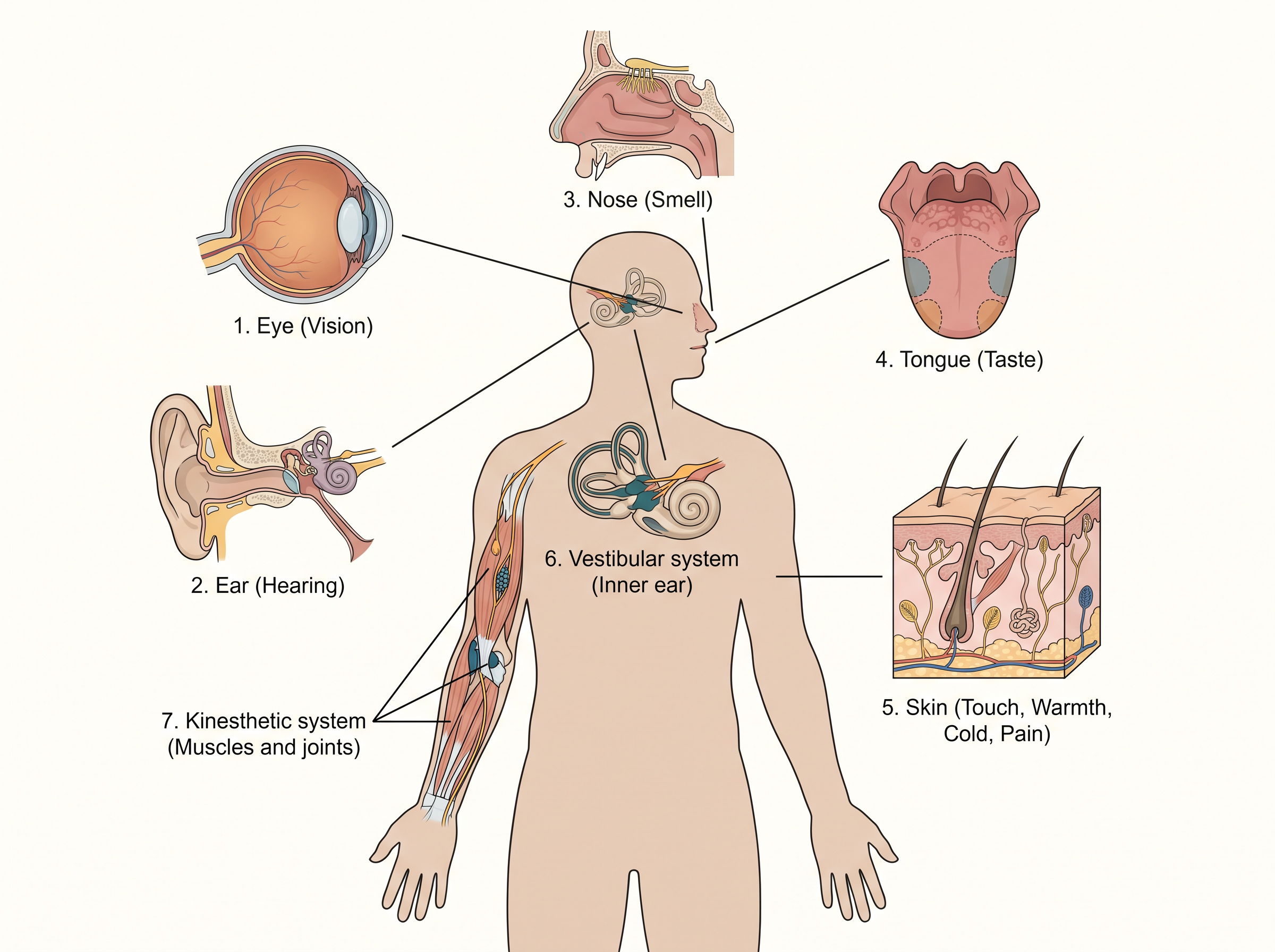
Fig. 4.16 – The seven human sense organs.
- the eyes, which are primarily responsible for vision
- the ears, for hearing
- the nose, for smell
- the tongue, for taste
- the skin, which is responsible for the experiences of touch, warmth, cold and pain
Notice that the skin is doing more work than the rest. Specialised receptors for warmth, cold and pain lie inside it, which is why a single organ can tell you that a cup is hot, that the floor is cold, and that a thorn has pricked you.
The two deep senses
Besides these five external sense organs, we also have two deep senses. They are called the kinesthetic system and the vestibular system.
They do not report on the outside world at all. They report on you. They provide important information about the position of your body, and about the movement of your body parts in relation to each other. When you climb a staircase in the dark without looking at your feet, or stay upright on a crowded bus that lurches forward, these two systems are doing the work.
Seven organs, ten varieties of stimuli
With these seven sense organs we register ten different varieties of stimuli. The number is larger than seven because a single organ may register more than one variety — the skin alone accounts for touch, warmth, cold and pain.
Our sense organs also register the different qualities within each variety. Looking at a light, you notice not merely that there is light, but whether it is bright or dim, and whether it is yellow, red or green. Listening to a sound, you notice whether it is loud or faint, and whether it is melodious or distracting. These finer qualities of stimuli are registered by the sense organs just as the stimuli themselves are.
4.4 Sense Modalities
Our sense organs give us first-hand information about the external world and about our own internal world. They are the only direct contact we have with either.
When a particular sense organ registers a stimulus or an object, the experience that results is the very first thing we know about it — before we have named it, judged it, or made anything of it. That initial experience is called sensation. It is the process through which we detect and encode a variety of physical stimuli.
Sensation also refers to the immediate, basic experiences of stimulus attributes — that something is “hard”, “warm”, “loud”, or “blue”. These experiences arise when a sensory organ is appropriately stimulated. They are simple, direct and, in themselves, meaningless: “blue” by itself does not tell you that you are looking at the sky.
Each sense is a modality of its own
Different sense organs deal with different forms of stimuli, and they serve different purposes. Each one is highly specialised for handling one particular kind of information, and is useless for the others. Light means nothing to the ear; a sound wave means nothing to the eye.
Because of this specialisation, each sense organ, together with the particular kind of information it handles and the kind of experience it produces, is known as a sense modality. Vision is one sense modality, hearing is another, taste a third, and so on.
4.4.1 Functional Limitations of Sense Organs
Before we go further, one point must be made clearly. Our sense organs do not register everything. They function with definite limitations.
Your eyes cannot see things that are very dim, and they cannot cope with things that are very bright. Your ears cannot hear sounds that are very faint, and very loud sounds cause pain rather than clear hearing. The same is true of every other sense organ. As human beings we operate within a limited range of stimulation, and a great deal of the physical world simply passes us by.
It follows that a stimulus must be of an optimal intensity or magnitude to be noticed by a sensory receptor at all. Too little, and it does not register; too much, and the system is overwhelmed. The relationship between physical stimuli and the sensations they evoke is studied in a branch of the discipline called psychophysics.
How weak can a stimulus be and still be noticed?
To be noticed, a stimulus has to carry a certain minimum value or weight. The minimum value of a stimulus that is required to activate a given sensory system is called the absolute threshold, or absolute limen (AL).
Take a familiar example. Add a single granule of sugar to a glass of water and stir. You will taste no sweetness at all. Add a second granule, and the water still tastes plain. But if you keep adding granules one after another, a point will arrive when you say — now the water is sweet. The minimum number of sugar granules needed before you can say the water is sweet is the AL of sweetness.
Here, however, a complication appears. The AL is not a fixed point. It varies considerably from one person to another, and even in the same person from one situation to another, depending on their organic conditions and their motivational states. A person who has just eaten a plate of jalebi will need more sugar to call the water sweet than someone who has eaten nothing sweet all day.
Because of this variation, the AL cannot be settled by a single trial. It has to be assessed over a number of trials. The number of sugar granules that produces the experience of “sweetness” on 50 per cent of occasions is called the AL of sweetness, as Fig. 4.17 shows. Add more granules than that, and the chances become greater that the water will be reported as sweet rather than plain.
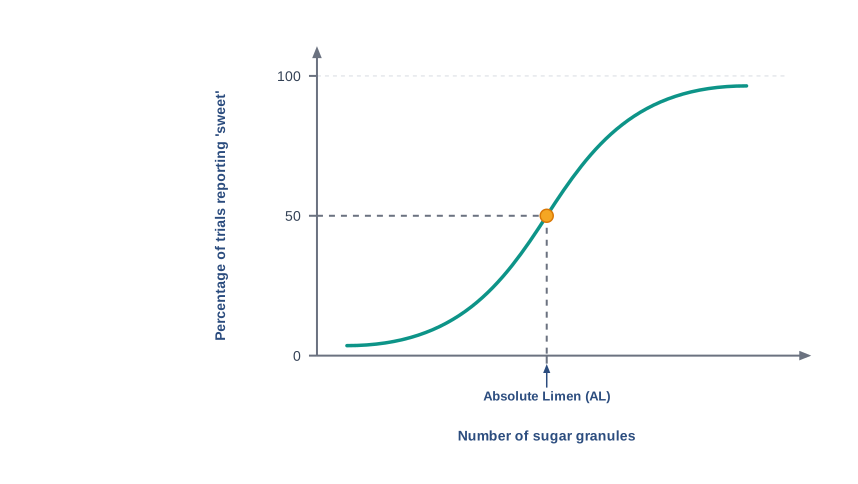
Fig. 4.17 – Graph of the absolute limen.
How different must two stimuli be before we can tell them apart?
Just as we cannot notice all stimuli, we cannot tell all stimuli apart. For two stimuli to be noticed as different from each other, there has to be some minimum difference between their values. The smallest difference in the value of two stimuli that is necessary for us to notice them as different is called the difference threshold, or difference limen (DL).
Continue with the sugar-water experiment. You have already reached the point at which the water tastes sweet. Hold on to that sweetness. The next question is: how many more granules must be added before the water tastes different from that first sweetness?
Go on adding granules one at a time, tasting the water after each addition. After a few more granules, you will notice that the water is now sweeter than before. The number of granules that must be added to produce a sweetness different from the previous sweetness on 50 per cent of the occasions is the DL of sweetness.
Sensation depends on more than the stimulus
You may realise by now that we cannot understand sensations without understanding the AL and the DL of different types of stimuli — visual, auditory, and the rest. But that is still not enough.
Sensory processes do not depend on the characteristics of the stimulus alone. The sense organs, and the neural pathways that connect them to the various brain centres, also play a vital role. A sense organ receives the stimulus and encodes it as an electrical impulse. For that impulse to be noticed, it must travel along its pathway and reach the higher brain centres.
This is why the chain matters as much as the stimulus. Any structural or functional defect, or any damage in the receptor organ, in its neural pathway, or in the concerned area of the brain, may lead to a partial or a complete loss of sensation. A person may have a perfectly healthy eye and still not see, if the pathway or the brain area behind it has been damaged.
4.5 Attentional Processes
In the previous sections we looked at the sensory modalities that collect information for us, both from the external world and from our internal system. But collecting is not the same as noticing.
A very large number of stimuli fall upon our sense organs at the same moment, and we do not notice all of them. Only a selected few are noticed. Walk into your classroom and consider everything that is physically there: doors, walls, windows, paintings, tables, chairs, students, schoolbags, water bottles. Your eyes receive all of it. Yet at any one moment you focus on only one or two of these things.
The process through which certain stimuli are selected from a group of others is generally referred to as attention.
Attention is more than selection
Selection is the heart of attention, but the word covers several other properties as well — alertness, concentration and search.
Alertness refers to an individual’s readiness to deal with the stimuli that appear before her or him. Think of a school race. The runners on the starting line are not doing anything yet, but they are in a state of alertness, waiting for the whistle to blow.
Concentration refers to the focusing of awareness on certain specific objects while excluding others for the moment. In the classroom, a student concentrates on the teacher’s lecture and, for that period, ignores the many noises coming from other corners of the school.
Search refers to a situation in which an observer looks for some specified subset of objects among a set of objects. When you go to fetch your younger sister and brother from school, you scan innumerable boys and girls, looking only for those two faces.
All of these activities demand something of the person: they require effort. In this sense, attention is also described as “effort allocation” — the mind deciding where to spend a limited resource.
The focus and the fringe
Attention has a focus as well as a fringe. When the field of awareness is centred on a particular object or event, that object is said to be at the focus, or the focal point, of attention.
Other objects and events are not entirely absent from awareness; they are simply pushed to the edges. When objects or events lie away from the centre of awareness, and one is only vaguely aware of them, they are said to be at the fringe of attention. As you read this line, the words are at your focus; the sounds outside the room and the feel of the chair against your back are at the fringe.
Types of attention
Attention has been classified in a number of ways. A process-oriented view divides it into two types: selective attention and sustained attention. We shall look at the main features of both.
Sometimes, though, we manage to attend to two different things at the same time. When this happens, it is called divided attention. The Side Note below describes when and how such a division of attention becomes possible.
4.5.1 Selective Attention
Selective attention is concerned mainly with the selection of a limited number of stimuli or objects from a large number of stimuli.
We have already noted that our perceptual system has a limited capacity to receive and process information. It can deal with only a few stimuli at any given moment of time. This immediately raises a question: of all the stimuli present, which ones will get selected and processed? Psychologists have identified a number of factors that determine the selection.
4.5.1.1 Factors Affecting Selective Attention
Several factors influence selective attention. Some belong to the stimulus itself; others belong to the person doing the attending. They are generally classified as “external” and “internal” factors.
External factors are related to the features of the stimuli. Other things being held constant, the size, intensity and motion of a stimulus are important determinants of attention:
- Large, bright and moving stimuli catch our attention easily.
- Stimuli that are novel and moderately complex also get into our focus easily.
- Studies indicate that photographs of human beings are more likely to be attended to than photographs of inanimate objects.
- Rhythmic auditory stimuli are more readily attended to than verbal narrations.
- Sudden and intense stimuli have a remarkable capacity to draw attention.
Internal factors lie within the individual, and may be divided into two main categories — motivational factors and cognitive factors.
Motivational factors relate to our biological or social needs. When we are hungry, we notice even a faint smell of food that we would otherwise walk past. A student sitting for an examination is likely to focus on the teacher’s instructions far more closely than the other students in the room.
Cognitive factors include interest, attitude and preparatory set. Objects or events that appear interesting are readily attended to. We also pay quick attention to objects or events towards which we are favourably disposed. Preparatory set generates a mental state to act in a certain way — a readiness to respond to one kind of stimulus and not to others. A wicketkeeper standing up to the stumps is in a preparatory set for the ball, and for nothing else.
4.5.1.2 Theories of Selective Attention
A number of theories have been developed to explain how this selection actually happens. We shall discuss three of them. Fig. 4.18 shows how each pictures the fate of the stimuli that are not selected.
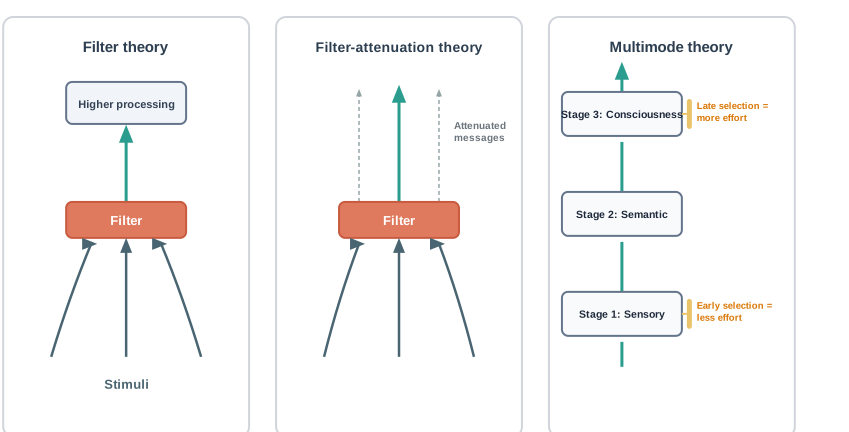
Fig. 4.18 – Theories of selective attention.
Filter theory was developed by Broadbent (1956). According to this theory, many stimuli enter our receptors simultaneously and create a kind of “bottleneck” situation — far more traffic arrives than the road ahead can carry.
Moving through the short-term memory system, these stimuli enter a selective filter. The filter allows only one stimulus to pass through for higher levels of processing. All the other stimuli are screened out at that moment of time. We therefore become aware only of the stimulus that gains access through the selective filter.
Filter-attenuation theory was developed by Triesman (1962), by modifying Broadbent’s theory. It proposes that the stimuli which do not gain access to the selective filter at a given moment are not completely blocked. The filter only attenuates — that is, weakens — their strength.
This small change has a large consequence. Because the unselected stimuli are weakened rather than shut out, some of them manage to escape through the selective filter and reach higher levels of processing. Personally relevant stimuli, such as one’s own name spoken at a collective dinner, can be noticed even at a very low level of sound. Such stimuli, although fairly weak, may occasionally generate a response by slipping through the filter.
Multimode theory was developed by Johnston and Heinz (1978). This theory holds that attention is a flexible system, one that allows a stimulus to be selected over others at three different stages.
At stage one, the sensory representations of stimuli — visual images, for instance — are constructed. At stage two, the semantic representations are constructed: the names and meanings of objects. At stage three, the sensory and the semantic representations enter consciousness.
The theory further suggests that more processing requires more mental effort. When messages are selected on the basis of stage one processing, which is called early selection, less mental effort is required. When the selection is based on stage three processing, which is called late selection, more mental effort is required. Selecting a friend’s shirt by its colour is cheap; selecting her by understanding what she is saying is expensive.
4.5.2 Sustained Attention
Selective attention is mainly concerned with the selection of stimuli. Sustained attention is concerned with concentration.
Sustained attention refers to our ability to maintain attention on an object or an event for longer durations. It is also known as “vigilance”. Sometimes people have to concentrate on a single task for many hours together.
Air traffic controllers and radar readers are good examples of this. They have to watch and monitor signals on screens constantly. The signals appear unpredictably, and an error in detecting one may be fatal. A great deal of vigilance is required in such situations — not brilliance, but the ability to stay attentive when nothing is happening.
4.5.2.1 Factors Influencing Sustained Attention
Several factors can facilitate or inhibit a person’s performance on tasks of sustained attention.
Sensory modality is one of them. Performance is found to be superior when the stimuli — called signals in such tasks — are auditory rather than visual. An alarm that sounds is harder to miss than a light that merely blinks.
Clarity of stimuli is another factor. Intense and long-lasting stimuli facilitate sustained attention and result in better performance.
Temporal uncertainty is a third factor. When stimuli appear at regular intervals of time, they are attended to better than when they appear at irregular intervals. Uncertainty about when something will happen wears attention down.
Spatial uncertainty is a fourth factor. Stimuli that appear at a fixed place are readily attended to, whereas those that appear at random locations are difficult to attend to. Uncertainty about where it will happen does the same damage as uncertainty about when.
Why attention matters in practice
Attention has several practical implications. The number of objects a person can readily take in at a single glance is used, for instance, to design the number plates of motorbikes and cars, so that the traffic police can register them easily in cases of traffic rule violation. The Side Note on the span of attention explains the limit on which this design rests.
A number of children fail to perform well in school not because of any lack of ability, but simply because of a problem of attention. The second Side Note below describes one such disorder of attention.
4.6 Perceptual Processes
In the previous section we saw that the stimulation of a sense organ leads us to experience something — a flash of light, a sound, a smell. This elementary experience is sensation, and by itself it does not carry us very far.
Sensation does not provide us with any understanding of the stimulus that stimulated the sense organ. It does not tell you the source of the light, the sound, or the fragrance. A flash of light is only a flash of light; it is not yet a motorcycle turning into your lane at night.
To make sense of the raw material supplied by the sensory system, we process it further. In doing so, we give meaning to stimuli by drawing on our learning, our memory, our motivation, our emotions and other psychological processes. The process by which we recognise, interpret or give meaning to the information provided by the sense organs is called perception.
Perception is construction, not just interpretation
There is something more here than interpretation. In interpreting stimuli or events, individuals often construct them in their own ways.
Perception is therefore not merely an interpretation of objects or events of the external or internal world as they exist. It is also a construction of those objects and events from one’s own point of view. Two people looking at the same crowded street will not perceive quite the same street, because each brings a different set of memories, motives and expectations to it.
This meaning-making does not happen in a single leap. It involves certain sub-processes, which are shown together in Fig. 4.1.
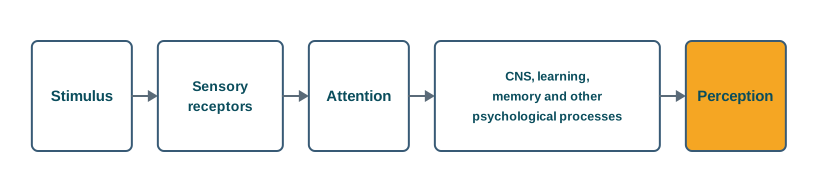
Fig. 4.1 – The process of cognition.
4.6.1 Processing Approaches in Perception
How exactly do we identify an object? Consider a simple question. Do we identify a dog because we have first recognised its furry coat, its four legs, its eyes and its ears — or do we recognise these different parts because we have already identified a dog?
Both answers have been seriously defended, and each has given rise to an approach.
The idea that the recognition process begins from the parts, which then serve as the basis for the recognition of the whole, is known as bottom-up processing. The features come first, and the object is assembled out of them.
The notion that the recognition process begins from the whole, which then leads to the identification of its various components, is known as top-down processing. The object is grasped first, and its features are filled in afterwards.
The two approaches differ in where they place the weight of explanation. The bottom-up approach lays emphasis on the features of stimuli in perception, and considers perception as a process of mental construction. The top-down approach lays emphasis on the perceiver, and considers perception as a process of recognition or identification of stimuli.
Which of the two is correct? Studies show that in perception both processes interact with each other to provide us with an understanding of the world. Neither works alone. The features on the page and the expectations in the head meet somewhere in the middle, and what we perceive is the result of that meeting.
4.7 The Perceiver
Human beings are not just mechanical and passive recipients of stimuli from the external world. If they were, everyone standing at the same bus stop would perceive exactly the same bus stop.
We are creative beings, and we try to understand the external world in our own ways. In doing so, our motivations and expectations, our cultural knowledge, our past experiences and memories, as well as our values, beliefs and attitudes, all play an important part in giving meaning to the world outside. Some of these factors are described here.
4.7.1 Motivation
The needs and desires of a perceiver strongly influence her or his perception.
People want to fulfil their needs and desires through various means, and one of those means is surprisingly direct: they perceive objects in a picture as something that will satisfy their need. The need does not merely make us search for food or company — it quietly shapes what we take an ambiguous object to be.
Experiments have been conducted to examine the influence of hunger on perception. When hungry persons were shown ambiguous pictures — pictures that could be read in more than one way — they were found to perceive them as pictures of food objects more often than satiated, that is, non-hungry, persons did. The picture on the wall was the same for both groups. The state of the perceiver was not.
4.7.2 Expectations or Perceptual Sets
What we expect to perceive in a given situation also influences what we actually perceive. This phenomenon of perceptual familiarisation, or perceptual generalisation, reflects a strong tendency to see what we expect to see — even when the results do not accurately reflect external reality.
Suppose your milkman delivers milk daily at about 5.30 in the morning. Any knocking at the door around that hour is likely to be perceived as the milkman’s arrival, even when it is somebody else altogether. You have not examined the knock; you have recognised it in advance.
4.7.3 Cognitive Styles
Cognitive style refers to a consistent way of dealing with our environment. It is not a passing mood but a settled habit of mind, and it significantly affects the way we perceive the world.
There are several cognitive styles that people use in perceiving their environment. The one most extensively used in studies is the “field dependent and field independent” cognitive style.
Field dependent people perceive the external world in its totality — that is, in a global or holistic manner. They take in the scene as a single whole. Field independent people perceive the external world by breaking it into smaller units — that is, in an analytic or differentiated manner. They separate a part from the field in which it is embedded.
This difference can be seen in a simple task. Look at Fig. 4.2. Can you find the triangle hidden in the picture?
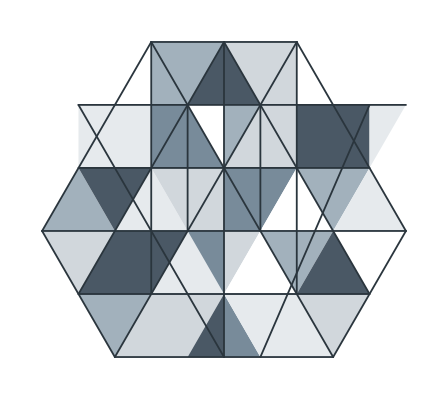
Fig. 4.2 – Embedded-figure test item.
4.7.4 Cultural Background and Experiences
The different experiences and learning opportunities available to people in different cultural settings also influence their perception.
Consider something we take entirely for granted — reading a picture. People coming from a pictureless environment fail to recognise objects in pictures. Hudson studied the perception of pictures by African subjects and noted several difficulties. Many of them were unable to identify the objects depicted in the pictures, such as an antelope or a spear. They also failed to perceive distance in pictures, and interpreted the pictures incorrectly.
The influence runs in the other direction too. What our environment makes important to us, we learn to perceive with great precision. Eskimos have been found to make fine distinctions among varieties of snow that the rest of us would be unable to notice at all. Some aboriginal groups of the Siberian region have been found to differentiate among dozens of skin colours of reindeer, which we would not be able to do.
Taken together, these studies indicate that the perceiver plays a key role in the process of perception. People process and interpret stimuli in their own ways, depending on their personal, social and cultural conditions. Because of these factors, our perceptions are not only finely tuned — sharpened for what matters in our world — but also modified, so that what one person sees plainly, another may not see at all.
4.8 Principles of Perceptual Organisation
Look closely at anything in your visual field and you will find that, physically speaking, it is a collection of different elements — points, lines and colours. That is all the eye receives.
Yet that is never what we experience. We perceive these elements as organised wholes, as complete objects. You see a bicycle as one thing, not as a loose collection of a saddle, two wheels and a handle sitting near one another. The process of organising the visual field into meaningful wholes is known as form perception.
This raises an obvious question. How exactly do the different parts of an object get organised into a meaningful whole? And are there certain factors that help this organisation along, or that get in its way?
The Gestalt answer
Several scholars have tried to answer such questions, but the most widely accepted answer has been given by a group of researchers called the Gestalt psychologists. Prominent among them are Köhler, Koffka and Wertheimer — the same Wertheimer whose puzzle over apparent movement opened this chapter. The German word Gestalt means a regular figure or a form.
According to the Gestalt psychologists, we perceive different stimuli not as discrete elements, but as an organised “whole” that carries a definite form. They hold that the form of an object lies in its whole, and that this whole is different from the sum of its parts.
Take a flower pot with a bunch of flowers in it. It is a whole. Remove the flowers, and the flower pot still remains a whole — it has not become a heap of fragments. What has changed is the configuration. A flower pot with flowers is one configuration; without flowers it is another.
The Gestalt psychologists also indicate that our cerebral processes are always oriented towards the perception of a good figure, or pragnanz — a form that is as simple, regular and stable as the stimulus allows. That is the reason why we perceive everything in an organised form, and rarely as a jumble.
Figure and ground
The most primitive organisation takes place in the form of figure-ground segregation.
When we look at a surface, certain aspects of it clearly stand out as separate entities, whereas others do not. When we see words on a page, a painting on a wall, or birds flying in the sky, the words, the painting and the birds stand out from their background and are perceived as figures. The page, the wall and the sky stay behind them and are perceived as background.
To test this experience for yourself, look at Fig. 4.3. You will see either the white part of the figure, which looks like a vase or flower pot, or the black part of the figure, which looks like two faces.

Fig. 4.3 – Rubin’s vase reversible figure.
We distinguish the figure from the ground on the basis of the following characteristics:
The discussion so far indicates that human beings perceive the world in organised wholes rather than in discrete parts. The Gestalt psychologists have given us several laws to explain how and why different stimuli in our visual field are organised into meaningful whole objects. Let us look at some of these principles.
4.8.1 The Principle of Proximity
Objects that are close together in space or in time are perceived as belonging together, or as a group.
For example, the dots in Fig. 4.4 do not look like a square pattern of dots. They look like a series of columns of dots, because the dots within a column lie closer to one another than to the dots on either side. The same figure also looks like a group of dots gathered together in rows.

Fig. 4.4 – The principle of proximity.
4.8.2 The Principle of Similarity
Objects that are similar to one another, and have similar characteristics, are perceived as a group.
In Fig. 4.5, little circles and squares are spaced evenly both horizontally and vertically, so that proximity does not come into play at all — no item is closer to one neighbour than to another. Even so, we do not see a random field. We tend to see alternating columns of circles and columns of squares. When distance has nothing to say, likeness decides the grouping.

Fig. 4.5 – The principle of similarity.
4.8.3 The Principle of Continuity
This principle states that we tend to perceive objects as belonging together if they appear to form a continuous pattern.
For instance, in Fig. 4.6 we are far more likely to identify two lines, a-b and c-d, crossing each other than to identify four separate lines meeting at the centre, p. Both descriptions fit the ink on the page equally well. Only one of them is smooth and continuous, and that is the one we perceive.
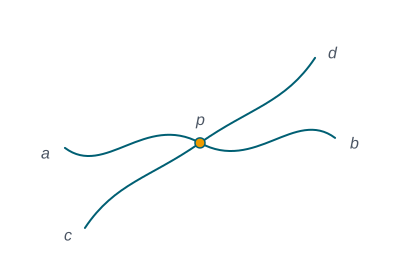
Fig. 4.6 – The principle of continuity.
4.8.4 The Principle of Smallness
According to this principle, smaller areas tend to be seen as figures against a larger background.
In Fig. 4.7 we are more likely to see a black cross within the circle than a white cross, because the black areas are the smaller ones.

Fig. 4.7 – The principle of smallness.
4.8.5 The Principle of Symmetry
This principle suggests that symmetrical areas tend to be seen as figures against asymmetrical backgrounds.
For example, in Fig. 4.8 the black areas are seen as figures, as they have symmetrical properties, against their white asymmetrical background.
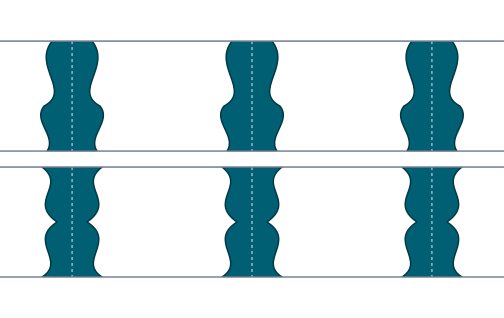
Fig. 4.8 – The principle of symmetry.
4.8.6 The Principle of Surroundedness
According to this principle, the areas that are surrounded by others tend to be perceived as figures.
For example, the image in Fig. 4.9 looks like five separate black figures against a white background, rather than like the word ‘LIFT’ — although the word is quite literally there, written in the white spaces that the black shapes surround.

Fig. 4.9 – The principle of surroundedness.
4.8.7 The Principle of Closure
We tend to fill the gaps in stimulation and to perceive objects as wholes rather than as their separate parts.
For example, in Fig. 4.10 the small angles are seen as a triangle. No triangle has been drawn; there is no continuous outline anywhere on the page. We supply what is missing, because our tendency is to close the gaps in the object provided by our sensory input.

Fig. 4.10 – The principle of closure.
4.9 Perception of Space, Depth, and Distance
The visual field or surface in which things exist, move, or can be placed is called space. The space in which we live is organised in three dimensions.
In such a space we perceive not only the spatial attributes of objects — their size, shape and direction — but also the distance between the objects found in it. You do not merely see a bus and a cyclist. You see that the bus is well behind the cyclist, and you cross the road accordingly.
A flat image, a solid world
Here lies a genuine puzzle. The images of objects projected on to our retina are flat and two dimensional. The retina can code left, right, up and down — and nothing else. It has no way of recording “far”.
Yet we perceive three dimensions in space. Why does this happen? It occurs because of our ability to transfer a two-dimensional retinal vision into a three-dimensional perception. The process of viewing the world in three dimensions is called distance perception, or depth perception.
Depth perception matters a great deal in daily life. When we drive, we use depth to assess the distance of an approaching automobile. When we decide to call out to a person walking down the street, we use the same information to determine how loudly to call.
In perceiving depth we depend on two main sources of information, called cues. One kind is called binocular cues, because they require both eyes. The other is called monocular cues, because they allow us to perceive depth with just one eye. A number of such cues are used to change a two-dimensional image into a three-dimensional perception.
4.9.1 Monocular Cues (Psychological Cues)
Monocular cues of depth perception are effective when objects are viewed with only one eye.
Because a single flat image is enough for them, these cues are often used by artists to induce depth in two-dimensional paintings. For this reason they are also known as pictorial cues — they are exactly the tricks by which a painter puts distance on a flat canvas. Some important monocular cues that help us judge distance and depth on two-dimensional surfaces are described below. You will find several of them at work in Fig. 4.11.

Fig. 4.11 – Monocular depth cues on a road.
Relative Size: The size of the retinal image allows us to judge distance on the basis of our past and present experience with similar objects. As objects move away, the retinal image they cast becomes smaller and smaller. We therefore tend to perceive an object as farther away when it appears small, and as closer when it appears bigger.
Interposition or Overlapping: These cues occur when some portion of an object is covered by another object. The overlapped object is considered to be farther away, whereas the object that covers it appears nearer. Nothing else about the two objects needs to be known — the covering settles the order.
Linear Perspective: This reflects a phenomenon by which distant objects appear to be closer together than nearer objects. Parallel lines, such as rail tracks, appear to converge as they recede, with a vanishing point at the horizon. The more the lines converge, the farther away they appear.
Aerial Perspective: The air contains microscopic particles of dust and moisture that make distant objects look hazy or blurry. This effect is called aerial perspective. Distant mountains appear blue because of the scattering of blue light in the atmosphere, whereas the same mountains are perceived to be closer when the atmosphere is clear.
Light and Shade: In light, some parts of an object get highlighted while other parts become darker. These highlights and shadows provide us with information about an object’s distance, and about which of its surfaces stand nearer to us.
Relative Height: Larger objects are perceived as being closer to the viewer, and smaller objects as being farther away. When we expect two objects to be of the same size and they are not, the larger of the two will appear closer and the smaller will appear farther away.
Texture Gradient: This represents a phenomenon by which a visual field with a greater density of elements is seen as farther away. In Fig. 4.12, the density of the stones increases as we look farther along the wall — the stones near us are large and well separated, while those in the distance crowd together into a fine grain.

Fig. 4.12 – Texture gradient on a stone wall.
Motion Parallax: This is a kinetic monocular cue, and hence it is not considered a pictorial cue — a still painting cannot use it. It occurs when objects at different distances move at different relative speeds. Distant objects appear to move more slowly than objects that are close, and the rate of an object’s apparent movement therefore provides a cue to its distance.
You have felt this without naming it. When you travel in a bus, the closer objects — a hoarding, a lamp post — sweep past in the direction opposite to that of the bus, whereas the farther objects, such as a distant hill, seem to move along “with” the bus.
4.9.2 Binocular Cues (Physiological Cues)
Some important cues to depth perception in three-dimensional space are provided by both the eyes working together. Three of them have particularly been found to be interesting.
Retinal or Binocular Disparity: Retinal disparity occurs because the two eyes have different locations in our head. They are separated from each other horizontally by a distance of about 6.5 centimetres.
Because of this distance, the image formed on the retina of each eye, even of the very same object, is slightly different. This difference between the two images is called retinal disparity. The brain interprets a large retinal disparity to mean a close object, and a small retinal disparity to mean a distant object — for the disparity is less for distant objects and more for near ones.
Convergence: When we look at a nearby object, our eyes converge inward in order to bring its image on to the fovea of each eye. A group of muscles sends messages to the brain regarding the degree to which the eyes are turning inward, and these messages are interpreted as cues to the perception of depth.
The degree of convergence decreases as the object moves further away from the observer. You can experience convergence for yourself by holding a finger in front of your nose and slowly bringing it closer. The more your eyes turn inward, or converge, the nearer the object appears in space.
Accommodation: Accommodation refers to the process by which we focus the image on the retina with the help of the ciliary muscle. These muscles change the thickness of the lens of the eye.
If the object gets away — more than 2 metres from the eye — the muscle is relaxed. As the object moves nearer, the muscle contracts and the thickness of the lens increases. The signal about the degree of contraction of the muscle is sent to the brain, which uses it as a cue for distance.
4.10 Perceptual Constancies
The sensory information we receive from our environment is never still. It changes constantly as we move around — a step forward, a turn of the head, a shift from sunlight into a room, and the pattern falling on the retina is a different pattern.
Yet the world does not swell, shrink and change shape as we walk through it. We form a stable perception of an object seen from any position and in any intensity of light. This perception of objects as relatively stable, in spite of the changes in the stimulation of our sensory receptors, is called perceptual constancy.
Here we will examine three types of perceptual constancy that we commonly experience in our visual domain.
4.10.1 Size Constancy
The size of the image on our retina changes with a change in the distance of the object from the eye. The further away the object is, the smaller is the image it casts.
Our experience, however, shows something quite different. Within limits, the object appears to be about the same size irrespective of its distance.
Consider a friend walking towards you from the far end of the school ground, as in Fig. 4.19. Your perception of your friend’s size does not change much, despite the fact that the retinal image is steadily becoming larger. You do not see a small person growing into a large one. You see the same person coming nearer.
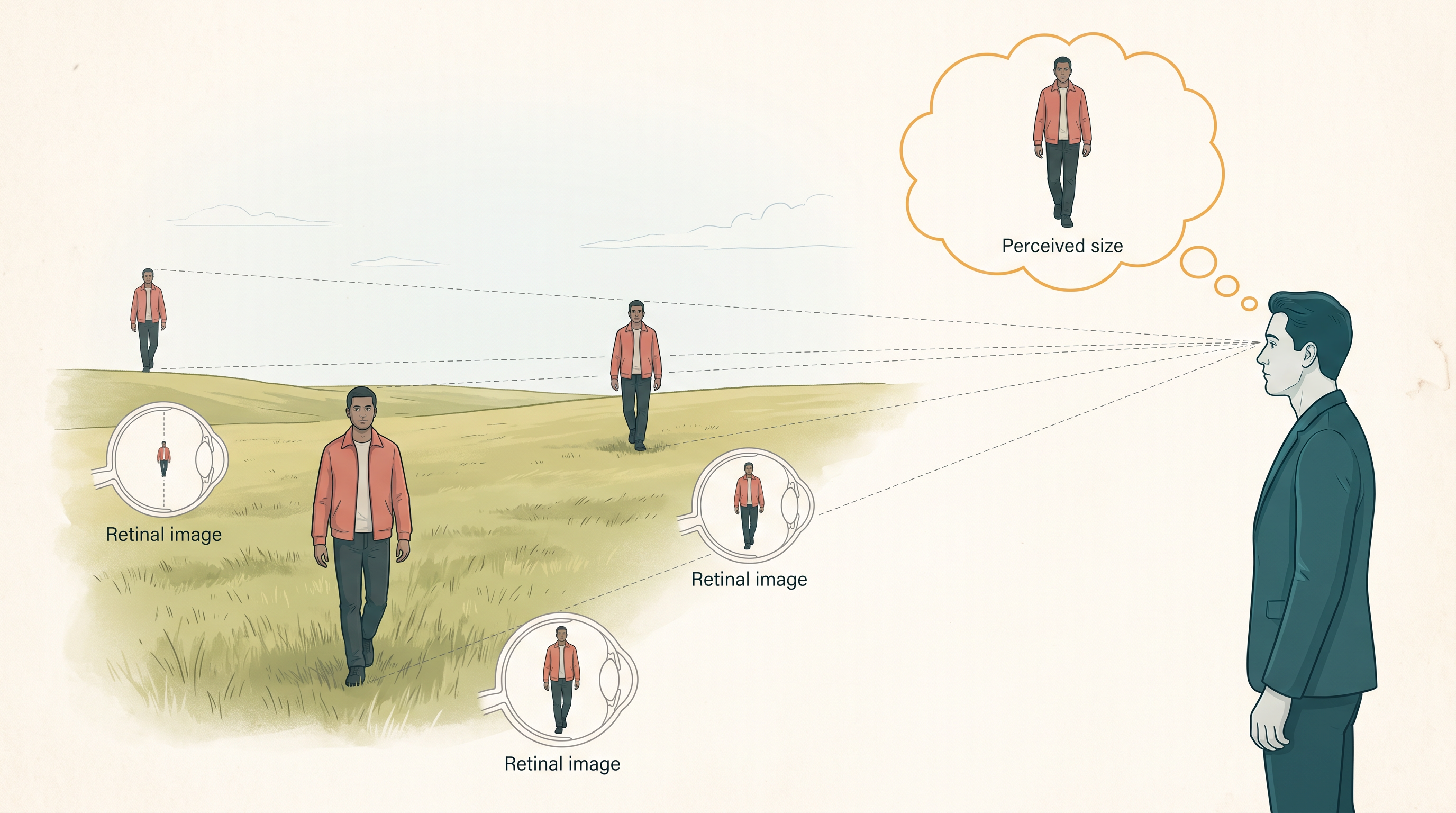
Fig. 4.19 – The mechanism of size constancy.
This tendency for the perceived size of objects to remain relatively unchanged, in spite of changes in their distance from the observer and in the size of the retinal image, is called size constancy.
4.10.2 Shape Constancy
In our perceptions, the shapes of familiar objects remain unchanged despite changes in the pattern of the retinal image that result from differences in their orientation.
Take a dinner plate. Seen from directly above, it casts a circle on the retina. Tilt it a little, and the retinal image becomes an ellipse. Hold it exactly edge-on, and the image is reduced to roughly a short line. The retinal images could hardly be more different from one another.
All the same, the plate looks like the same round plate throughout. This is shape constancy, and it is also called form constancy.
4.10.3 Brightness Constancy
Visual objects appear constant not only in their shape and size. They also appear constant in their degree of whiteness, greyness or blackness — even though the amount of physical energy reflected from them changes considerably from one situation to another.
In other words, our experience of brightness does not change in spite of the changes in the amount of reflected light that reaches our eyes. This tendency to maintain apparent brightness as constant under different amounts of illumination is called brightness constancy.
The surface of a sheet of paper that appears white in bright sunlight is still perceived as white in the dim light of a room. In the same way, a piece of coal that looks black in the sun also looks black in room light — although the coal in sunlight may well be reflecting more light into your eyes than the paper in the room does.
4.11 Illusions
Our perceptions are not always veridical — that is, they do not always correspond to what is actually there. Sometimes we fail to interpret the sensory information correctly, and the result is a mismatch between the physical stimulus and our perception of it.
Such misperceptions, resulting from the misinterpretation of information received by our sense organs, are generally known as illusions.
Illusions are experienced, more or less, by all of us. They result from an external stimulus situation, and they generate the same kind of experience in every individual who looks at them. It is for this reason that illusions are also called “primitive organisations” — the mind organises the figure in a particular way before we have any say in the matter.
Although illusions can be experienced through the stimulation of any of our senses, psychologists have studied visual illusions far more commonly than illusions in other sense modalities.
Universal and personal illusions
Some perceptual illusions are universal, and are found in all individuals. Railway tracks appear to converge in the distance for every one of us. Such illusions are called universal illusions, or permanent illusions, because they do not change with experience or with practice — you cannot train yourself out of them.
Some other illusions seem to vary from individual to individual. These are called personal illusions.
In this section we will describe some important visual illusions.
4.11.1 Geometrical Illusions
In Fig. 4.13 the Muller-Lyer illusion has been shown. All of us perceive line A as shorter than line B, although both the lines are in fact equal in length. The arrowheads at the ends have done all the work.

Fig. 4.13 – The Muller-Lyer illusion.
This illusion is experienced even by children. There are also some studies suggesting that even animals experience it more or less as we do — which tells us that it does not depend on any elaborate learning or reasoning.
Besides the Muller-Lyer illusion, several other visual illusions are experienced by human beings, and by birds and animals as well. In Fig. 4.14 you can see the illusion of vertical and horizontal lines. Although both the lines are equal, we perceive the vertical line as longer than the horizontal one.
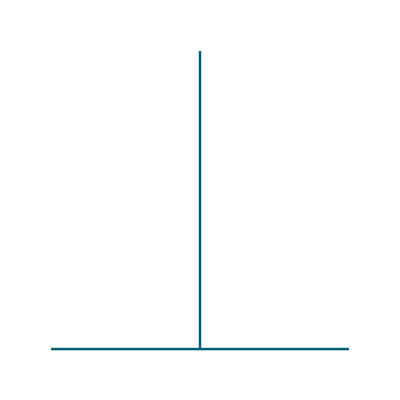
Fig. 4.14 – The vertical-horizontal illusion.
4.11.2 Apparent Movement Illusion
This illusion is experienced when some motionless pictures are projected one after another at an appropriate rate. The illusion is referred to as the “phi-phenomenon”.
When we watch moving pictures in a cinema show, we are influenced by this kind of illusion. So are we when we look at the succession of flickering electrical lights on a decorated shopfront, where a single light appears to run along a strip.
The phenomenon can be studied experimentally with the help of an instrument that presents two or more lights in succession. Wertheimer — whose puzzlement over exactly this experience opened the present chapter — reported that four conditions matter for the illusion to occur: an appropriate level of brightness, an appropriate size, an appropriate spatial gap between the lights, and their temporal contiguity, that is, the right interval of time between them.
In the absence of these conditions, the light points will not appear to move at all. They will appear either as one single point, or as different points appearing one after another, with no experience of motion whatsoever.
What illusions teach us
The experience of illusions indicates something important, and it is worth stating plainly. People do not always perceive the world as it is. Instead, they engage in its construction — sometimes on the basis of the features of the stimuli themselves, and sometimes on the basis of their own experiences in a given environment.
That second source raises a further question. If our experience of an environment shapes what we perceive, then people who grow up in very different environments might not construct the world in quite the same way. The section that follows examines exactly this possibility.
4.12 Socio-Cultural Influences on Perception
Several psychologists have studied the processes of perception in different socio-cultural settings. The questions they try to answer through such studies are direct ones.
Does perceptual organisation take place in a uniform manner among people living in different cultural settings? Are the perceptual processes universal, or do they vary from one cultural setting to another?
Because people living in different parts of the world live differently, many psychologists hold the view that their ways of perceiving the world must also differ in some respects. To find out, we may examine studies of two kinds — studies of illusion figures, and studies of pictorial material.
Do people everywhere fall for the same illusions?
You are already familiar with the Muller-Lyer and the Vertical-Horizontal illusion figures. Psychologists have presented these very figures to several groups of people living in Europe, in Africa, and in many other places.
Segall, Campbell and Herskovits carried out the most extensive study of illusion susceptibility, comparing samples drawn from remote African villages with samples from Western urban settings. The result was not uniform at all. The African participants showed greater susceptibility to the horizontal-vertical illusion, whereas the Western participants showed greater susceptibility to the Muller-Lyer illusion. Similar findings have been reported in other studies as well.
The explanation offered turns on what each group’s environment had taught it to expect. Living in dense forests, the African participants regularly experienced verticality — long trees rising around them — and had developed a tendency to overestimate it. The Westerners, who lived in an environment characterised by right angles, had developed a tendency to underestimate the length of lines characterised by enclosure, such as lines closed off by an arrowhead.
This conclusion has been confirmed in several studies. It suggests something that would have surprised the early Gestalt psychologists: the habits of perception are learnt, and they are learnt differently in different cultural settings.
Reading a picture is a learnt skill
The second line of evidence comes from studies in which people living in different cultural settings were given pictures, and were asked to identify the objects in them and to interpret the depth or other events represented in them.
We met Hudson’s work earlier in this chapter, when we saw that people from a pictureless environment fail to recognise objects in pictures. His seminal study in Africa found something further. People who had never seen pictures had great difficulty not only in recognising the objects depicted in them, but also in interpreting the depth cues within them — superimposition, for instance, which we have studied as interposition.
What this indicates is easily missed. It is not that these participants could not see depth in the world; they could. It is that seeing depth in a picture is a separate, learnt skill. Informal instruction at home, and habitual exposure to pictures, were found to be necessary to sustain the skill of pictorial depth perception.
4.13 Summary
Our knowledge of the internal and the external world becomes possible only through the senses. We have seven sense organs: five external senses (eyes, ears, nose, tongue and skin) and two internal, or deep, senses (the kinesthetic and the vestibular systems). The sense organs receive various stimuli and send them, in the form of neural impulses, to specialised areas of the brain for interpretation.
Sense organs work within limits. A stimulus must reach the absolute limen (AL) to be detected at all, and two stimuli must differ by at least the difference limen (DL) to be told apart. Both thresholds are measured at the 50 per cent point, because they vary from person to person and from occasion to occasion.
Attention is the process through which we select certain information while filtering out much that appears irrelevant at a given moment of time. Alertness (activation), concentration and search are important properties of attention, and all of them require effort.
Selective attention and sustained attention are the two major types of attention. Selective attention is explained by the filter theory, the filter-attenuation theory and the multimode theory. Divided attention is evident in the case of highly practised tasks, in which there is a great deal of automaticity of information processing.
The span of attention is the magical number of seven plus and minus two.
Perception refers to the processes of interpretation and informed construction of the information received from the sense organs. Recognition may proceed from the parts to the whole (bottom-up processing) or from the whole to the parts (top-down processing), and the two interact.
Human beings perceive their world in terms of their motivations, their expectations, their cognitive styles and their cultural background. The perceiver is therefore an active participant in perception, not a passive receiver.
Form perception refers to the perception of a visual field that is set off from the rest of the field by visible contours. The most primitive form of organisation takes place as figure-ground segregation.
Gestalt psychologists have identified several principles that determine our perceptual organisation, including proximity, similarity, continuity, smallness, symmetry, surroundedness and closure.
The image of an object projected on to the retina is two dimensional. Three-dimensional perception is a psychological process that depends on the correct utilisation of certain monocular cues (which need one eye) and binocular cues (which need both).
Perceptual constancies refer to the invariance of our perceptions of an object seen from any position and in any intensity of light. There is good evidence for size, shape and brightness constancies.
Illusions are examples of nonveridical perceptions. They are misperceptions that result from the misinterpretation of information received by our sense organs. Some illusions, such as the Muller-Lyer illusion, are universal; others are more personal and culture-specific. The phi-phenomenon is an illusion of apparent movement.
Socio-cultural factors play an important role in our perceptions. They do so by generating differential familiarity with stimuli, differential salience of stimuli, and certain habits of perceptual inference among people.
4.14 Key Terms
Absolute threshold (absolute limen, AL) — The minimum value of a stimulus needed to activate a given sensory system, measured as the value detected on 50 per cent of trials.
Attention — The process through which certain stimuli are selected for further processing from among the many others present at that moment.
Automatic processing — Processing that occurs without intention, takes place unconsciously, and involves very little or no thought, as in highly practised activities.
Binocular cues — Cues to depth that require both eyes: retinal disparity, convergence and accommodation.
Bottom-up processing — Recognition that begins from the parts of a stimulus and builds up to the identification of the whole.
Cognition — The whole set of interrelated mental processes — sensation, attention, perception and others — through which we come to know the world.
Depth perception — The process of viewing the world in three dimensions, transforming a flat retinal image into a perception of distance and solidity.
Difference threshold (difference limen, DL) — The minimum amount of change in a stimulus that produces a difference in sensation on 50 per cent of trials.
Divided attention — Attending to two or more activities at the same time, possible mainly when the activities are highly practised and largely automatic.
Figure-ground segregation — The most primitive form of perceptual organisation, in which a part of the visual field stands out as figure while the rest recedes as ground.
Filter theory — Broadbent’s theory that a selective filter allows only one stimulus through for higher processing and screens the rest out completely.
Filter-attenuation theory — Triesman’s theory that unattended stimuli are not blocked but only weakened, so that personally relevant ones can still slip through.
Form perception — The process of organising the elements of the visual field into meaningful wholes or complete objects.
Gestalt — A German word meaning a regular figure or form; the school of psychology holding that we perceive organised wholes whose form is different from the sum of their parts.
Kinesthetic system — The deep sense that informs us about the position and movement of our body parts in relation to each other.
Monocular cues — Cues to depth that need only one eye, such as relative size, interposition, linear perspective and texture gradient; also called pictorial cues.
Multimode theory — Johnston and Heinz’s theory that attention is flexible and selection may occur at the sensory, the semantic, or the conscious stage, with later selection costing more effort.
Perception — The process by which we recognise, interpret and give meaning to the information provided by our sense organs.
Perceptual constancies — The tendency to perceive an object as stable in size, shape and brightness despite changes in the stimulation it produces.
Phi-phenomenon — The illusion of apparent movement produced when motionless pictures or lights are presented one after another at an appropriate rate.
Psychophysics — The branch of psychology that studies the relationship between physical stimuli and the sensations they evoke.
Selective attention — Attention concerned with the selection of a limited number of stimuli from among a large number of stimuli.
Sensation — The process by which a sense organ detects and encodes a physical stimulus, giving rise to a basic experience such as “loud”, “warm” or “blue”.
Sense modality — A particular sense organ together with the specific kind of information it is specialised to handle, such as vision or hearing.
Sensory receptors — The sense organs, or information gathering systems, that receive stimuli from the external world and from within the body.
Span of attention — The amount of information an observer can grasp from a complex array of stimuli in a single momentary exposure; reported by Miller as seven plus or minus two.
Sustained attention — The ability to maintain attention on an object or event for long durations; also known as vigilance.
Top-down processing — Recognition that begins from the whole and leads to the identification of its various components.
Vestibular system — The deep sense that informs us about the position and balance of the body as a whole.
Visual illusions — Misperceptions in the visual field, arising from a misinterpretation of sensory information, in which the perception does not match the physical stimulus.
4.15 Points to Ponder
Collect ten advertisements from magazines or newspapers. Which attentional factors — size, intensity, motion, novelty, human faces — has each one used, and which perceptual principles has the designer relied on? Is an advertisement that captures attention necessarily one that persuades?
A person who has been blind from birth builds a rich and accurate knowledge of objects through touch, hearing and the deep senses. If you gave a toy elephant to a child who cannot see and to a sighted child, and asked each to describe it, how might their descriptions differ — and would either description be less true? What does your answer suggest about the relationship between a sense modality and the knowledge it yields?
Our sense organs register only a narrow band of what physically exists. Bats hear what we cannot; bees see what we cannot. In what sense, then, can we say that we perceive “the world” at all?
If perception is a construction rather than a copy, what stops two people from constructing entirely different worlds out of the same street? Where exactly does the stimulus set the limit?
Illusions like the Muller-Lyer do not disappear even after we measure the lines with a ruler. What does this stubbornness tell us about the relationship between what we know and what we see? Can a person be trained out of an illusion?
Cross-cultural studies show that perceptual habits are learnt. Does this mean there is no such thing as perceiving something “correctly” — or only that correctness must be judged in relation to the environment a person actually lives in?
Attention is described in this chapter as “effort allocation” from a limited pool. If that pool is genuinely limited, what should follow for the way you study, and for the common claim that one can revise while replying to messages?
4.16 NCERT Questions
Explain the functional limitations of sense organs.
Define attention. Explain its properties.
State the determinants of selective attention. How does selective attention differ from sustained attention?
What is the main proposition of the Gestalt psychologists with respect to the perception of the visual field?
How does the perception of space take place?
What are the monocular cues of depth perception? Explain the role of binocular cues in the perception of depth.
Why do illusions occur?
How do socio-cultural factors influence our perceptions?
4.17 Objective Questions
- The minimum value of a stimulus required to activate a given sensory system is called:
- the difference threshold
- the absolute threshold
- the span of attention
- the sense modality [1 mark]
- Human beings are said to possess how many sense organs in all?
- Five
- Six
- Seven
- Ten [1 mark]
- The filter theory of selective attention was developed by:
- Triesman
- Broadbent
- Johnston and Heinz
- Wertheimer [1 mark]
- Which of the following is NOT a monocular cue of depth perception?
- Interposition
- Linear perspective
- Convergence
- Texture gradient [1 mark]
- Miller reported that the span of attention varies within the limit of:
- five plus or minus two
- seven plus or minus two
- nine plus or minus two
- four plus or minus one [1 mark]
- In a circle made of alternating black and white sectors, we tend to see a black cross rather than a white one. This is best explained by the principle of:
- proximity
- closure
- smallness
- continuity [1 mark]
- The phi-phenomenon is an example of:
- perceptual constancy
- an apparent movement illusion
- figure-ground segregation
- motion parallax [1 mark]
- The two deep senses that inform us about body position and movement are:
- the visual and the auditory systems
- the olfactory and the gustatory systems
- the kinesthetic and the vestibular systems
- the tactile and the thermal systems [1 mark]
- Recognition that begins from the whole and leads to the identification of its parts is known as:
- bottom-up processing
- top-down processing
- automatic processing
- divided attention [1 mark]
- Assertion (A): A person can notice her own name spoken softly at a noisy gathering, even while she is attending to a different conversation. Reason (R): According to filter theory, stimuli that do not gain access to the selective filter are completely screened out.
- Both A and R are true, and R is the correct explanation of A.
- Both A and R are true, but R is not the correct explanation of A.
- A is true, but R is false.
- A is false, but R is true. [1 mark]
- Assertion (A): A dinner plate is perceived as round even when it is held at an angle and casts an elliptical image on the retina. Reason (R): Perceptual constancy allows us to perceive an object as relatively stable in spite of changes in the stimulation of our sensory receptors.
- Both A and R are true, and R is the correct explanation of A.
- Both A and R are true, but R is not the correct explanation of A.
- A is true, but R is false.
- A is false, but R is true. [1 mark]
- Assertion (A): Monocular cues are also known as pictorial cues. Reason (R): Monocular cues can be used by artists to create an impression of depth on a flat, two-dimensional surface.
- Both A and R are true, and R is the correct explanation of A.
- Both A and R are true, but R is not the correct explanation of A.
- A is true, but R is false.
- A is false, but R is true. [1 mark]
- Match the theorist in Column A with the contribution in Column B.
| Column A | Column B |
|---|---|
| a. Broadbent | i. Multimode theory of attention |
| b. Triesman | ii. Span of attention as seven plus or minus two |
| c. Johnston and Heinz | iii. Filter theory of attention |
| d. Miller | iv. Cross-cultural study of illusion susceptibility |
| e. Segall, Campbell and Herskovits | v. Filter-attenuation theory of attention |
[1 mark]
- Match the term in Column A with its meaning in Column B.
| Column A | Column B |
|---|---|
| a. Psychophysics | i. The deep sense that informs us about the balance of the body as a whole |
| b. Vestibular system | ii. An instrument used to determine the span of attention |
| c. Tachistoscope | iii. The study of the relationship between stimuli and the sensations they evoke |
| d. Pragnanz | iv. The kinetic monocular cue that is not a pictorial cue |
| e. Motion parallax | v. The tendency of the brain to organise a stimulus into a good figure |
[1 mark]
- Fill in the blanks:
- The smallest difference in the value of two stimuli that is necessary for us to notice them as different is called the ____________.
- Attention has a focus as well as a ____________.
- The most primitive form of perceptual organisation takes place in the form of ____________.
- The two eyes are separated horizontally by a distance of about ____________ centimetres, which gives rise to retinal disparity.
- Sustained attention is also known as ____________. [1 mark]
- State whether each of the following is true or false:
- The absolute limen is a fixed point that is the same for every individual.
- Divided attention becomes possible mainly in the case of highly practised activities.
- Accommodation is a monocular cue to depth perception.
- The Muller-Lyer illusion disappears once a person measures the two lines with a ruler.
- Field independent people perceive the external world in a global, holistic manner. [1 mark]
4.18 Check Your Concepts
Define sensation. Give one example of a stimulus attribute registered by it. [2 marks]
What is meant by a sense modality? Name any two sense modalities. [2 marks]
State any two external factors that affect selective attention, with one example of each. [2 marks]
What is the span of attention? State the limit reported by Miller. [2 marks]
Define perceptual constancy. Name the three constancies studied in the visual domain. [2 marks]
What is motion parallax? Why is it not regarded as a pictorial cue? [2 marks]
Differentiate between the absolute limen and the difference limen, using the sugar-water example. [3 marks]
State the three main characteristics of automatic processing, and explain why divided attention is possible only for highly practised activities. [3 marks]
Differentiate between the field dependent and the field independent cognitive style. How would the two differ in the time taken to find a triangle hidden in a complex figure? [3 marks]
Explain the principle of figure-ground segregation. State any three characteristics on which we distinguish a figure from its ground. [3 marks]
Why does a stimulus that appears at a fixed place and at regular intervals get attended to better than one that appears randomly? Answer with reference to the factors influencing sustained attention. [3 marks]
Differentiate between bottom-up and top-down processing. Give one everyday example of each, and state why perception needs both. [4 marks]
Explain the filter-attenuation theory of selective attention. What could it explain that Broadbent’s filter theory could not? [4 marks]
Describe the three perceptual constancies with one example of each. What would our experience of the world be like if these constancies did not operate? [4 marks]
Explain, with examples, how the motivation and the expectations of a perceiver influence what is perceived. [4 marks]
“Illusions show that we do not perceive the world as it is, but construct it.” Discuss this statement with reference to the geometrical illusions and the apparent movement illusion. [4 marks]
Describe the three theories of selective attention. For each, state its central claim and one limitation. [6 marks]
What is form perception? Describe the principles of perceptual organisation identified by the Gestalt psychologists, with an example of each. [6 marks]
The image formed on the retina is two dimensional, yet we perceive a three-dimensional world. Explain how monocular and binocular cues together make depth perception possible. [6 marks]
Discuss the role of socio-cultural factors in perception, with reference to studies of illusion susceptibility and of pictorial perception. What caution should be exercised in interpreting such cross-cultural differences? [6 marks]
4.19 Case-Based Questions
Ritu is sitting in her Class XI classroom. The fan is creaking, a cricket match is being played in the ground outside, and two students are whispering behind her — but for the past forty minutes she has followed nothing except the teacher’s explanation on the board. Then, from the corridor outside, a peon says her name quietly to another teacher. Ritu turns her head at once, although she was not listening to the corridor at all.
- Name and explain the type of attention Ritu was showing during the forty minutes of the lecture. [2 marks]
- Which theory of selective attention best explains her turning her head when her name was spoken? Explain how it does so. [3 marks]
- Why would Broadbent’s filter theory find Ritu’s behaviour difficult to account for? [1 mark] [6 marks]
Arun is travelling by bus from his village to the district town. Looking out of the window, he notices that the electric poles beside the road rush past in the direction opposite to that of the bus, while a distant hill seems to travel gently along with it. Ahead of the bus, the two edges of the straight road appear to come closer and closer together and finally meet at the horizon. A truck partly hides a tractor behind it, and Arun is in no doubt about which of the two is nearer.
- Identify the depth cue at work in the movement of the poles and the hill, and explain it. [2 marks]
- Identify and explain the two other depth cues described in the passage. [3 marks]
- To which broad category do all three of these cues belong, and what does that category require of the perceiver? [1 mark] [6 marks]
Every morning at about 6.30, the newspaper is pushed under the door of Meera’s flat. One morning at 6.30 there is a knock, and Meera calls out, “Just leave it there, bhaiya” — only to find her neighbour standing outside with a courier packet. Later the same day, walking to the market, she reads the shop’s signboard as ‘SWEETS’ although a branch of a tree hides part of two letters.
- Identify and explain the factor in the perceiver that led Meera to expect the newspaper boy at the door. [2 marks]
- Which principle of perceptual organisation allowed her to read the partly hidden signboard? Explain how it works. [2 marks]
- What do these two incidents together suggest about the relationship between the stimulus and the perceiver? [2 marks] [6 marks]
Nikhil is eight years old. His class teacher reports that he cannot stay with a task for more than a few minutes, moves about the room constantly, rarely follows instructions, and does poorly in reading — although in conversation he is quick and clearly able. Some of his classmates have begun to call him “the mad one”. His teacher tells his parents that the boy is simply lazy and that they should stop worrying.
- Which aspect of attention is Nikhil having difficulty with, and why is his performance in school affected by it? [2 marks]
- The teacher has drawn two conclusions — that the boy is lazy, and that the parents need not worry. Evaluate both, using what you have studied about attention deficit hyperactivity disorder. [3 marks]
- Suggest one classroom measure, of the kind described in this chapter, that has been found useful for children with attention difficulties. Explain why it should be a qualified professional, and not a teacher or a classmate, who decides whether a disorder is present. [3 marks] [8 marks]