Chapter 6: Human Memory
In the 1880s, a German psychologist named Hermann Ebbinghaus set out to study memory in the only way he trusted: on himself. Until then, memory was thought to be too private and too slippery for laboratory science. Ebbinghaus disagreed.
His difficulty was that ordinary words are never neutral. The word mother already carries meaning and feeling for you, so if you remember it, we cannot tell whether your memory is good or whether the word simply mattered to you. To get around this, Ebbinghaus invented material that meant nothing at all — nonsense syllables such as NOK or SEP, each made of a consonant, a vowel and a consonant.
Alone, and with a metronome ticking beside him, he learned list after list of these syllables until he could repeat them perfectly. Then he waited — twenty minutes, an hour, a day, a week — and measured how much work it took him to learn the same list again. The extra work told him exactly how much had slipped away.
The pattern he found is one you have felt yourself. Forgetting is not a slow, steady leak. Most of what he lost, he lost almost at once; what survived the first day tended to stay for a long time afterwards. With nothing but nonsense syllables and patience, Ebbinghaus had turned forgetting into a curve — and made memory a subject that could be measured.
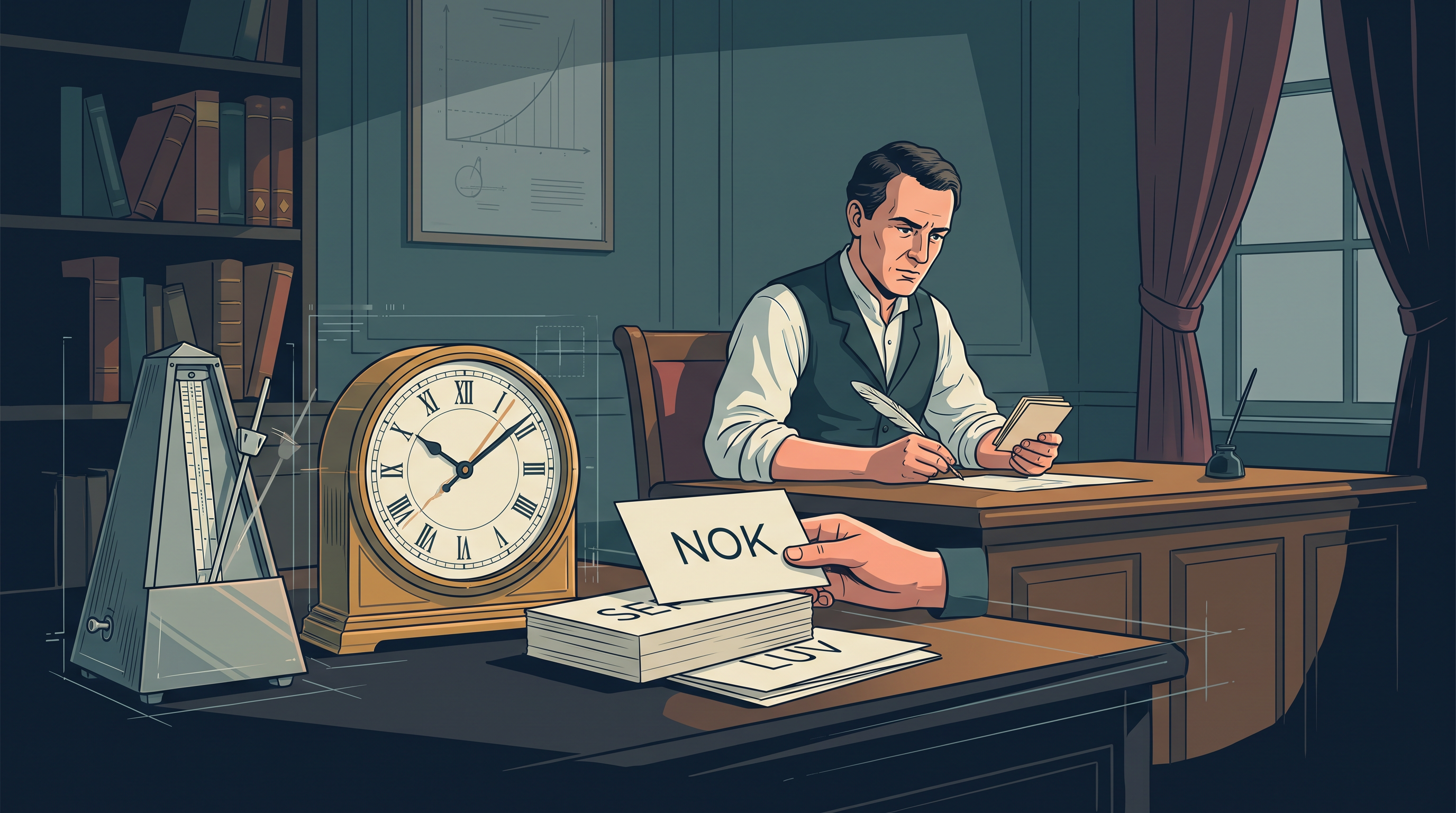
Fig. 6.3 – Ebbinghaus and the measurement of memory over time.
This chapter will answer each of these questions.
6.1 Introduction
You are talking to someone whose face you know perfectly well — you have met them a dozen times — and their name simply will not come. Or you walk into an examination hall having revised thoroughly the night before, and for a few terrible minutes the material you had mastered seems to have been wiped clean. Or, quite unexpectedly, you find yourself reciting a poem you learnt in Class III without a single mistake.
All three experiences belong to the same faculty, and that faculty is memory. It plays tricks on us, and it does so all our lives. It fails when we most want it and works when we least expect it. Understanding why is one of the oldest projects in psychology.
What Memory Does for Us
It is tempting to think of memory as a convenience — useful for examinations, phone numbers and shopping lists. It is far more than that.
Memory preserves your sense of who you are. Your name, your childhood, the people you belong to, the promises you have made — all of this is held in memory, and a person who loses it loses a great deal of themselves. Memory also holds your relationships together: you recognise a friend, recall what she told you last week, and remember what she does not like being teased about. And memory is what allows you to solve problems and take decisions, because every decision draws on what you already know.
Memory and the Rest of Thinking
Memory is not one cognitive process sitting neatly beside the others. It runs through almost all of them.
Perception depends on it — you can only recognise a face or a word because something matching it is already stored. Thinking depends on it, since you cannot reason about facts you cannot bring to mind. Problem solving depends on it, because a method that worked earlier is of no use to you if it cannot be retrieved. This is why psychologists have treated memory as a central topic rather than a specialised one.
Their questions have been remarkably consistent for over a century, and they organise this chapter:
- How does information get into the memory system in the first place?
- By what mechanisms is it held there over minutes, days or decades?
- Why is it sometimes lost — or seemingly lost?
- And what can be done to improve it?
A Hundred Years of Research
Psychological research on memory is over a hundred years old. Its starting point is the work of Hermann Ebbinghaus, the German psychologist you met at the opening of this chapter, who in 1885 published the first systematic experimental study of memory — conducted, patiently and single-handedly, on himself.
His central finding is worth stating plainly at the outset, because the rest of the chapter keeps returning to it. We do not forget learned material at an even pace, and we do not forget it completely. The rate of forgetting is fastest soon after learning; after that it slows down and eventually stabilises, so that what survives the early loss tends to survive for a long time.
Ebbinghaus is not the only figure who shaped this field. Several other psychologists — some of whom proposed the models of memory you will study here, and some of whom challenged them — have influenced memory research in major ways. Their contributions appear at the appropriate places in the chapter, in each case attached to the problem they were trying to solve.
6.2 Nature of Memory
Think about how differently memory serves you across a single day. You are given an unfamiliar telephone number and you hold on to it just long enough to walk across the room and dial it — after which it is gone, and you would not claim otherwise. Yet the techniques of addition and subtraction you learnt in early schooling are still with you, years later, and will probably stay with you for life.
Both are memory. What differs is how long the information must be kept, and that depends on the cognitive task you are required to perform. Memory, in other words, is not a single act of storage; it is the retaining and recalling of information over a period of time, and the period is set by the demands of the task.
Memory as a Sequence of Three Stages
Psychologists do not treat memory as a single event but as a process made up of three stages: encoding, storage and retrieval. The three are independent — each can be studied and can fail on its own — yet they are interrelated, because any information we receive must pass through all three, in this order, as shown in Fig. 6.4.
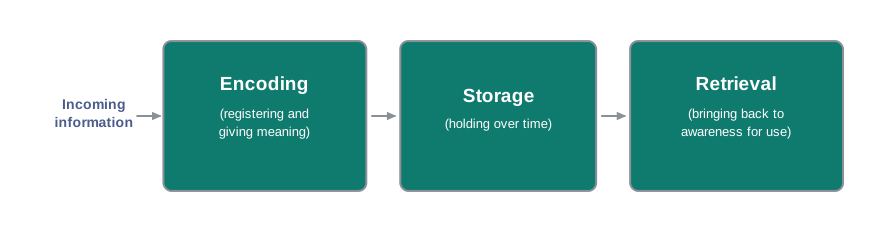
Fig. 6.4 – The three stages of memory processing.
(a) Encoding
Encoding is the first stage. It is the process by which information is recorded and registered for the first time, so that it becomes usable by the memory system.
Consider what actually happens when an external stimulus — a voice, a printed word, the smell of food — impinges on your sensory organs. It generates neural impulses, and these are received in different areas of the brain for further processing. Encoding is what happens next: the incoming information is received, some meaning is derived from it, and it is then represented in a form the memory system can work with.
Notice the word represented. Nothing physical enters your head. What is stored is not the sound or the sight itself but a representation of it, produced by the encoding process.
(b) Storage
Information that has been encoded must also be kept, or it would be of no use later. Storage is the process through which information is retained and held over a period of time.
(c) Retrieval
Stored information is useless until you can get it back. Retrieval is the process of bringing stored information into awareness, so that it can be used for cognitive tasks such as problem solving or decision-making.
When you recognise a classmate in a crowded corridor, work out a sum, or answer a question in class, you are retrieving. The information was already there; retrieval is what makes it available to you now.
Where Memory Fails
Splitting memory into three stages is not a tidy classroom exercise. It has a direct payoff: it tells you that memory failure can occur at any one of the three stages, and that “I forgot” is therefore not one problem but three.
You may fail to recall something because you never encoded it properly — you were half-listening while the teacher explained it, so it was never registered in a usable form. Or the encoding was fine but the storage was weak, so the information faded. Or the encoding and storage were both sound, and you simply cannot access or retrieve the material when it is required — which is what happens in the examination hall when an answer you certainly knew refuses to come.
6.3 Information Processing Approach: The Stage Model
For a long time, memory was pictured as a storehouse. Everything a person acquired through learning and experience was thought to be kept in one vast space, from which it could be taken out and used as and when needed. On this view, remembering was simply a matter of going in and finding the right item, and forgetting meant the item had somehow gone missing.
The picture is intuitive, and it is inadequate. A storehouse does nothing to what it holds. Human memory clearly does — it selects, reshapes, organises and works on information rather than merely keeping it.
The Computer Analogy
What changed the picture was a machine. With the advent of the computer, psychologists began to see human memory not as a storehouse but as a system that processes information, in much the same way a computer does.
The parallels are close. Both a computer and a human being register large amounts of information, store it, manipulate it, and act on the outcome of those manipulations. If you have worked on a computer, you know that it has a temporary memory (random access memory, or RAM) and a permanent memory (for example, a hard disk). Following the commands of a programme, the computer manipulates the contents of its memories and displays the output on the screen.
Human beings do something recognisably similar. We register information, store it, and manipulate what is stored according to the task we have to perform. Suppose you are asked to solve a mathematical problem. The memory relating to mathematical operations — division or subtraction, say — is activated and put to use, the operations are carried out, and you arrive at the output, which is the solution to the problem.
This way of thinking about the mind is called the information processing approach: the view that the human being takes in information, processes it through a series of operations, and produces an output — and that memory is best understood by tracing what happens to information at each step along the way.
The First Model of Memory
The analogy did more than change how psychologists talked about memory. It produced the first proper model of it.
That model was proposed by Atkinson and Shiffrin in 1968, and it is known as the Stage Model. Its central claim is that incoming information does not enter memory in a single step. It passes through a sequence of distinct stages, each with its own capacity, its own duration and its own way of holding information — and what survives one stage is all that is available to the next.
The next section examines those stages one by one.
6.4 Memory Systems: Sensory, Short-term and Long-term Memories
According to the Stage Model, information passes through three memory systems: the sensory memory, the short-term memory and the long-term memory. Each of these has different features and performs a different function with respect to the sensory inputs it receives, as shown in Fig. 6.1.
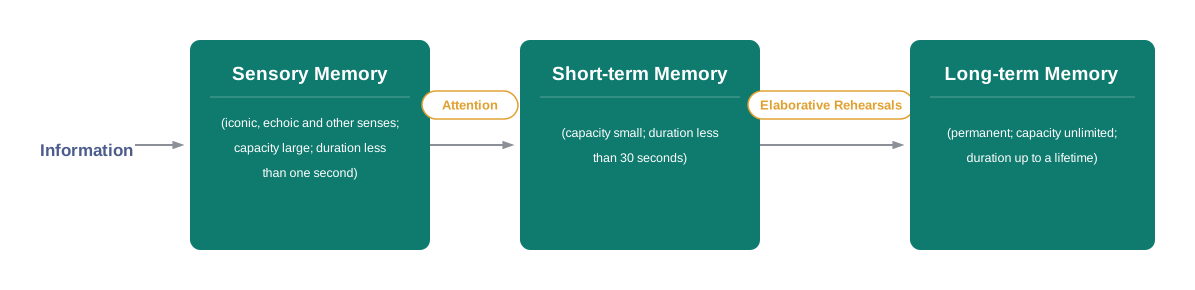
Fig. 6.1 – The Stage Model of memory.
Read the figure carefully before going further, because it makes one point that the words can easily hide. The three systems are not three names for the same thing. They differ in how much they can hold, how long they can hold it, and what form the information takes inside them — and each store passes on only a fraction of what it receives.
6.4.1 Sensory Memory
Incoming information first enters the sensory memory. Its capacity is large — it takes in a great deal at once. But it is of very short duration: less than a second.
Sensory memory is the system that registers information from each of the senses with reasonable accuracy. It is often referred to in the plural, as sensory memories or sensory registers, because information from all the senses is registered here as an exact replica of the stimulus. Nothing has yet been selected, interpreted or reduced; the record is faithful, and it is fleeting.
You have met this store already, without naming it. Switch off a bulb in a dark room and a trail of light seems to stay behind for an instant — a visual after-image. When a sound stops, you can sometimes still hear it reverberating for a moment. Those brief survivals are the iconic (visual) and echoic memory (auditory) sensory registers at work.
6.4.2 Short-term Memory
You will perhaps agree that we do not attend to all the information that impinges on our senses. Information that is attended to enters the second memory store, the short-term memory, abbreviated as STM.
STM holds a small amount of information for a brief period of time — usually 30 seconds or less. Atkinson and Shiffrin proposed that information in STM is primarily encoded acoustically, that is, in terms of sound. This is why an unfamiliar phone number tends to be held as a sound pattern you keep saying under your breath, rather than as a picture of the digits.
Unless it is rehearsed continuously, material may be lost from the STM in less than 30 seconds. The STM is therefore fragile — but note that it is not as fragile as the sensory registers, where information decays automatically in less than a second whether you want it to or not.
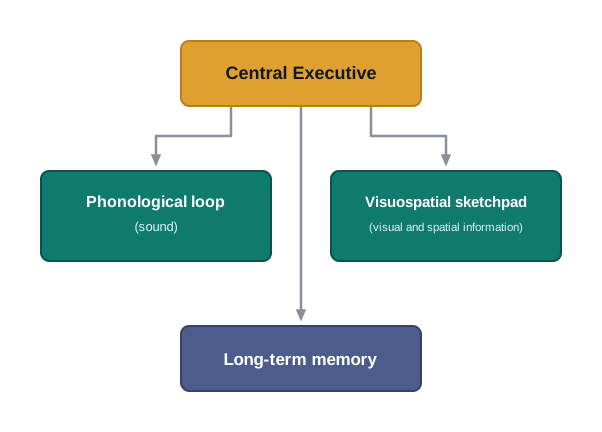
Fig. 6.5 – Baddeley’s multi-component working memory model.
6.4.3 Long-term Memory
Materials that survive the capacity and duration limitations of the STM finally enter the long-term memory, abbreviated as LTM, which has a vast capacity.
The LTM is a permanent storehouse of all information — as recent as what you ate for breakfast yesterday, and as distant as how you celebrated your sixth birthday. It has been shown that once information enters the long-term memory store, it is never forgotten, because it gets encoded semantically, that is, in terms of the meaning the information carries.
That claim deserves a second look, because it sounds plainly false. You forget things from long ago all the time. The model’s answer is that what you experience as forgetting is in fact retrieval failure: the information is still stored, but for various reasons you cannot get it back at the moment you need it. Forgetting of this kind is discussed later in the chapter.
How Information Travels: The Control Processes
So far we have discussed only the structural features of the stage model — the three stores and their properties. Two questions remain. How does information travel from one store to another? And by what mechanisms does it continue to stay in a particular store?
Atkinson and Shiffrin answered both by proposing control processes, which function to monitor the flow of information through the various memory stores.
Selective attention
All the information our senses receive is not registered — and it is worth pausing on why that is a mercy rather than a defect. Imagine the pressure on a memory system that had to keep everything: every face in a crowded bus, every horn, every advertisement on every wall.
Only the information that is attended to enters the STM from the sensory registers. In that sense selective attention, which you have already studied in the previous chapter, is the first control process: it decides what will travel from the sensory registers onward. Sense impressions that do not receive attention fade away quickly.
Maintenance rehearsal
Once information is in the STM, another control process is set in motion to keep it there for as long as it is needed: maintenance rehearsal.
As the name suggests, this kind of rehearsal simply maintains information through repetition — saying the phone number over and over, silently or aloud. Its weakness is built into its definition. When the repetitions stop, the information is lost.
Chunking
A third control process operates within the STM to expand its capacity: chunking.
The capacity of the STM is otherwise about \(7 \pm 2\) items — that is, most people can hold between five and nine separate items at once. Chunking works by grouping smaller units into larger, meaningful ones, so that what counts as “one item” becomes bigger.
Take the string of digits 194719492004. Twelve separate digits far exceed the capacity of the STM. But you may create the chunks 1947, 1949 and 2004, and remember them as the year in which India became independent, the year in which the Indian Constitution was adopted, and the year in which the tsunami hit the coastal regions of India and South East Asian countries. Twelve items have become three — and three is comfortably within reach.
Elaborative Rehearsal: The Route into Long-term Memory
Maintenance rehearsal keeps information alive in the STM, but it does not carry it any further. Information enters the long-term memory through elaborative rehearsals.
As against maintenance rehearsals, which are carried out through silent or vocal repetition, elaborative rehearsal attempts to connect the “to-be-retained information” to information already existing in long-term memory. Consider the task of remembering the meaning of the word humanity. It becomes much easier if the meanings of concepts such as compassion, truth and benevolence are already in place, because the new word can be tied to them.
The number of associations you can create around new information will determine how permanent it becomes. In elaborative rehearsal one attempts to analyse the information in terms of the various associations it arouses. This involves organising the incoming information in as many ways as possible — expanding it within some logical framework, linking it to similar memories, or creating a mental image of it. The arrows in Fig. 6.1 show this manner of travel from one stage to the next.
How Well Does the Stage Model Hold Up?
Experiments carried out to test the stage model have produced mixed results, and a good student of psychology should know both sides.
Some experiments show unequivocally that the STM and the LTM are indeed two separate memory stores. Other evidence has questioned their distinctiveness. It was shown earlier, for instance, that information in the STM is encoded acoustically while in the LTM it is encoded semantically. Later experimental evidence showed that information can also be encoded semantically in the STM and acoustically in the LTM — which blurs a line the model had drawn quite sharply.
A second and sharper challenge came from a single patient.
Several other studies have shown, in the same direction, that memory processes are similar irrespective of whether information is retained for a few seconds or for many years — and that memory can be adequately understood without positing separate memory stores at all.
Taken together, this evidence led to a different way of conceptualising memory: not as a set of stores through which information moves, but as the outcome of how deeply information is processed in the first place. That is the second model of memory, and it is the subject of the next section.
6.5 Levels of Processing
If separate stores are not needed to explain memory, what is? The answer offered by the second model is: the depth at which information is handled when it first comes in.
The levels of processing view was proposed by Craik and Lockhart in 1972. It suggests that the processing of any new information depends on the manner in which that information is perceived, analysed and understood — and that this, in turn, determines the extent to which it will eventually be retained. The view has undergone many revisions since 1972, but its basic idea has remained the same.
Notice how sharply this differs from the stage model. There, what mattered was where information had reached — which store it had got into. Here, what matters is what you did with it when it arrived.
Three Levels of Analysis
Craik and Lockhart proposed that incoming information can be analysed at more than one level. Take a single word, cat, and watch what can be done with it, as set out in Fig. 6.6.
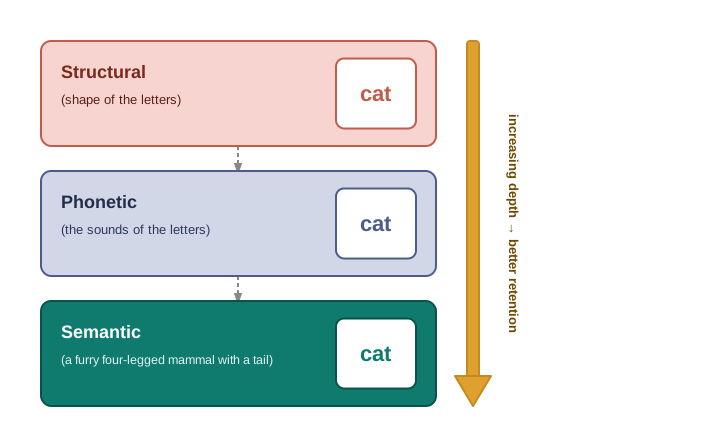
Fig. 6.6 – Levels of processing for the word cat.
Structural level. One may analyse information in terms of its physical or structural features. Here one might attend only to the shape of the letters in the word cat — noticing nothing more than that, regardless of whether the word is written in capital or small letters, or the colour of the ink in which it is written. This is the first and the shallowest level of processing.
Phonetic level. At an intermediate level, one might consider and attend to the phonetic sounds that are attached to the letters. The structural features are then transformed into at least one meaningful word — the word cat, made of three specific letters that together make a sound you can pronounce.
Analysing information at these two levels produces memory that is fragile and likely to decay rather quickly. You have seen the shape; you have heard the sound; you have done nothing with the meaning.
Semantic level. There is, however, a third and deepest level at which information can be processed. To ensure that information is retained for a longer period, it must be analysed and understood in terms of its meaning. You may think of cat as an animal that has fur, has four legs, has a tail, and is a mammal. You can also invoke an image of a cat and connect that image with your own experiences.
To sum up: analysing information in terms of its structural and phonetic features amounts to shallower processing, while encoding it in terms of the meaning it carries — semantic encoding — is the deepest level of processing, and leads to memory that resists forgetting considerably.
What This Means for the Way You Learn
Understanding memory as an outcome of the manner in which information is encoded in the first place has an important implication for learning, and it is worth taking seriously.
While you are learning a new lesson, you must focus on elaborating the meaning of its contents in as much detail as possible, and must not depend on rote memorisation. Rote repetition works on the surface of the material — the sounds of the words, the look of the page — and the surface is exactly the level at which memory is most fragile.
Attempt the alternative and you will soon realise it for yourself: understanding the meaning of information, and reflecting on how it relates to other facts, to other concepts, and to your own life experiences, is a sure route to long-term retention.
6.6 Types of Long-term Memory
You have already seen that the short-term memory is now regarded as consisting of more than one component — the working memory, with its loop, its sketchpad and its executive. The same doubt has been raised, with equal force, about the store at the other end.
Is the long-term memory a single thing? It seems unlikely, because it contains such a wide variety of information: the capital of Karnataka, the smell of your grandmother’s kitchen, and the ability to balance on a bicycle are all “in long-term memory”, yet they behave very differently. In view of this, contemporary formulations envisage long-term memory as consisting of various types, as set out in Fig. 6.7.
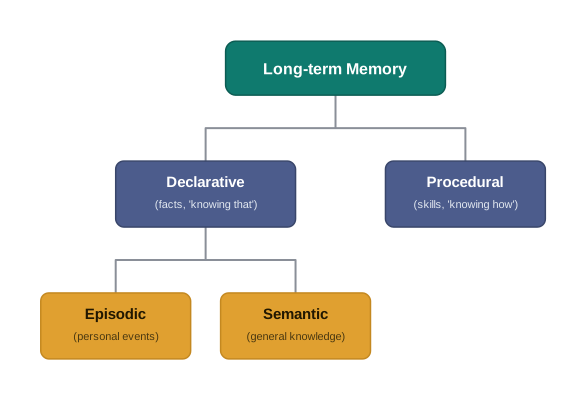
Fig. 6.7 – A hierarchy of long-term memory.
Declarative and Procedural Memory
One major classification within the LTM is that of declarative and procedural (sometimes called nondeclarative) memories.
All information pertaining to facts, names and dates is part of declarative memory. That a rickshaw has three wheels; that India became independent on August 15, 1947; that a frog is an amphibian; that you and your friend share the same name — these are declarative memories.
Procedural memory, on the other hand, refers to memories relating to procedures for accomplishing various tasks and skills: how to ride a bicycle, how to make tea, how to play basketball.
The clearest difference between the two is what happens when you are asked to put them into words. Facts retained in declarative memory are amenable to verbal description, while the contents of procedural memory cannot be described easily. When asked, you can describe how the game of cricket is played. But if someone asks you how you ride a bicycle — how, exactly, you keep your balance — you may find it very difficult to narrate, even though your body performs the whole thing without hesitation.
Episodic and Semantic Memory
Tulving has proposed yet another classification, and has suggested that declarative memory can itself be of two kinds: episodic or semantic.
Episodic memory contains the biographical details of our lives. Memories relating to our personal life experiences constitute episodic memory, and it is for this reason that its contents are generally emotional in nature. How did you feel when you stood first in your class? How angry was your friend, and what exactly did she say, when you did not fulfil a promise? If such incidents actually happened in your life, you will probably be able to answer these questions with reasonable accuracy.
Such experiences are hard to forget. Yet it is equally true that events take place continuously in our lives and we do not remember all of them. And there is a further pattern worth noticing: painful and unpleasant experiences are not remembered in as much detail as pleasant life experiences.
Semantic memory, on the other hand, is the memory of general awareness and knowledge. All concepts, ideas and rules of logic are stored in semantic memory. It is because of semantic memory that you remember the meaning of a word such as ‘non-violence’, that \(2 + 6 = 8\), that the STD code of New Delhi is 011, or that the word ‘elaphant’ is misspelt.
Unlike episodic memory, this kind of memory is not dated. You will probably not be able to say when you learnt the meaning of non-violence, or on which date you came to know that Bangalore is the capital of Karnataka. You simply know it. Because the contents of semantic memory relate to facts and ideas of general awareness and knowledge, it is affect-neutral — it carries no emotional charge — and it is not susceptible to forgetting.
6.7 Nature and Causes of Forgetting
Every one of us has experienced forgetting, and its consequences, almost routinely. The interesting question is not whether we forget but why.
Is it because the information we commit to our long-term memory is somehow lost? Is it because we did not memorise it well enough in the first place? Is it because we did not encode it correctly — or because, during storage, it got distorted or misplaced? Each of these suggestions has been turned into a theory, and many theories of forgetting have been forwarded over the years. In this section you will read about those that seem plausible and that have received considerable attention.
The Shape of Forgetting
Before asking why we forget, it helps to know how we forget — that is, what forgetting looks like when it is plotted over time.
The first systematic attempt to describe it was made by Hermann Ebbinghaus, whose method you met at the beginning of this chapter. He memorised lists of nonsense syllables — CVC trigrams such as NOK or SEP — and then measured the number of trials he needed to relearn the same list after varying intervals of time. If relearning took many trials, much had been forgotten; if it took few, much had survived. He observed that the course of forgetting follows a definite pattern, which you can see in Fig. 6.2.
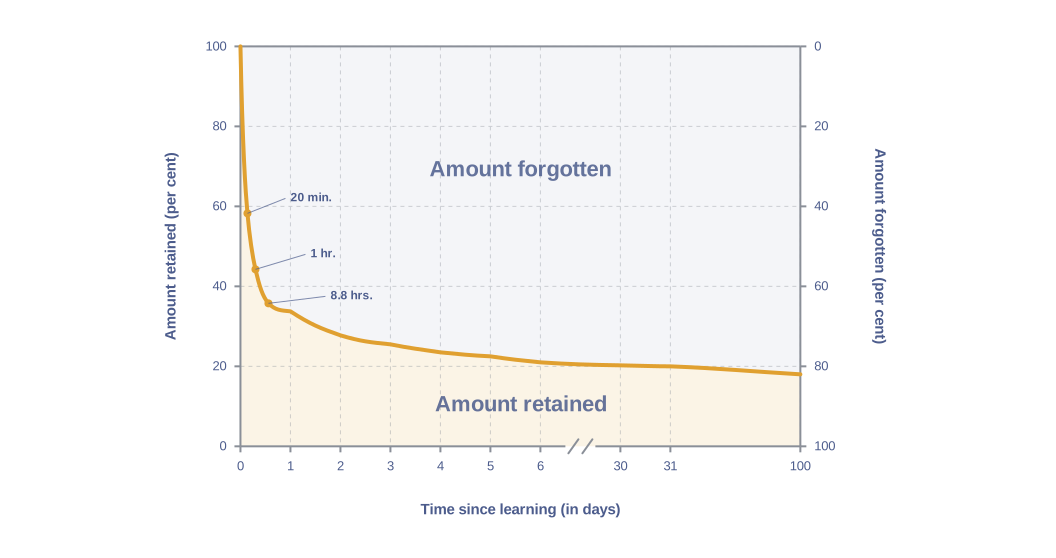
Fig. 6.2 – Ebbinghaus’s curve of forgetting.
As the figure indicates, the rate of forgetting is maximum in the first nine hours, and particularly during the first hour. After that the rate slows down, and not much more is forgotten even after many days.
Ebbinghaus’s experiments were initial explorations and were not very sophisticated by present standards — he was his own only participant, and nonsense syllables are a long way from the meaningful material we usually learn. Yet they influenced memory research in many important ways, and their central finding is now upheld almost unanimously: after learning, there is always a sharp drop in memory, and thereafter the decline is very gradual.
Forgetting due to Trace Decay
Trace decay, also called disuse theory, is the earliest theory of forgetting.
Its assumption is that learning leads to a modification in the central nervous system — something akin to a physical change in the brain, called a memory trace. When these memory traces are not used for a long time, they simply fade away and become unavailable. On this view, forgetting is what time does to an unused trace, much as an unused path through a field grows over.
The theory has been proved inadequate on several grounds, and the neatest of them turns the theory’s own logic against it. If forgetting takes place because memory traces decay through disuse, then people who go to sleep after memorising should forget more than those who stay awake — because during sleep there is no way in which memory traces can be put to use at all.
The results show just the opposite. Those who remain awake after memorising (the waking condition) show greater forgetting than those who sleep (the sleeping condition). Something that happens during waking hours, and not the mere passage of time, must therefore be doing the damage.
Because trace decay did not explain forgetting adequately, it was soon replaced by another theory: that new information entering the long-term memory interferes with the recall of earlier memories, and that interference, rather than decay, is the main cause of forgetting.
Forgetting due to Interference
If forgetting is not due to trace decay, then why does it take place? The theory that has perhaps been the most influential is interference theory, which suggests that forgetting is due to interference between the various pieces of information that the memory store contains.
The theory begins from an assumption about learning. Learning and memorising involve the forming of associations between items, and once acquired, these associations remain intact in memory. People keep acquiring numerous such associations, and each of them rests independently, without any mutual conflict.
The trouble comes at the moment of retrieval. It is then that the various sets of associations compete with each other, and the competition is what we experience as forgetting. Nothing has been erased; the wrong association simply arrives first.
The process becomes clearer with a simple exercise. Request a friend to learn two separate lists of nonsense syllables — list A and list B — one after the other, and after a while ask her to recall the syllables of list A. If, while trying to recall the items of list A, she produces some items from list B, it is because the associations formed while learning list B are interfering with the earlier associations formed while learning list A.
Two directions of interference
There are at least two kinds of interference that may result in forgetting, and they are distinguished by the direction in which the interference travels.
Interference can be proactive — forward-moving — which means that what you have learnt earlier interferes with the recall of your subsequent learning. Or it can be retroactive — backward-moving — which refers to difficulty in recalling what you learnt earlier because of learning new material. In other words, in proactive interference, past learning interferes with the recall of later learning; in retroactive interference, the later learning interferes with the recall of past learning.
A language example makes both concrete. If you know English and find it difficult to learn French, that is proactive interference — the older learning is obstructing the newer. If, on the other hand, you cannot recall the English equivalents of the French words you are currently memorising, that is retroactive interference — the newer learning is obstructing the older.
The logic of the two designs, shown above and originally set out in Table 6.1, is worth reading slowly. In each design, the experimental group and the control group differ in exactly one respect — whether or not an extra list was learnt — and both are then tested on the same list. If the experimental group recalls less, the extra learning must be what caused the loss.
Forgetting due to Retrieval Failure
Forgetting can occur not only because memory traces have decayed over time, as the disuse theory suggests, and not only because independent sets of stored associations compete at the time of recall, as the interference theory suggests. It can also occur because, at the moment of recall, the retrieval cues are either absent or inappropriate.
Retrieval cues are aids that help us recover information stored in memory. This view was advanced by Tulving and his associates, who carried out several experiments to show that the contents of memory may become inaccessible either because of the absence of retrieval cues, or because the cues that are available and employed at the time of recall are the wrong ones.
An example makes the mechanism visible. Suppose you have memorised a list of meaningful words — hut, wasp, cottage, gold, bronze, ant, and so on — in which the words belong to six categories, such as places of living, names of insects and types of metal. If you are asked to recall them after a while, you may produce only a couple. But if, at a second recall attempt, you are also given the category names, you may find that your recall is close to total.
The words did not return to your memory in the interval; they were there all along. What changed is that the category names acted as retrieval cues and gave you a route back to them. Besides category names, the physical context in which you learn also provides effective retrieval cues — the room, the desk, the sounds around you at the time of learning.
6.8 Enhancing Memory
All of us would like to possess a memory system that is robust and dependable. Nobody enjoys the anxiety and embarrassment of a memory failure — the blank in the examination hall, the name that will not come, the instruction that was heard and lost.
Having studied how memory works, you are now in a position to ask the practical question: how can it be improved? There are a number of strategies for improving memory, called mnemonics (pronounced ni-mo-nicks). Some of these involve the use of images; others emphasise the self-induced organisation of the material that has been learnt. We shall look at both kinds, and then at a more comprehensive approach that goes beyond mnemonics altogether.
Notice, before we begin, that none of these techniques is magic. Every one of them works by doing something the earlier sections have already explained — deepening the encoding, expanding the capacity of the short-term store, or building better retrieval cues.
Mnemonics Using Images
Mnemonics of this kind require you to create vivid and interacting images of and around the material you wish to remember. The two prominent devices that make interesting use of images are the keyword method and the method of loci.
(a) The Keyword Method
Suppose you want to learn the words of a foreign language. In the keyword method, you first identify an English word — the assumption here is that you know English — that sounds similar to the foreign word you are trying to learn. This English word functions as the keyword.
You then evoke images of the keyword and of the target word, and imagine the two interacting.
Take an example. If you want to remember the Spanish word for duck, which is Pato, you may choose ‘pot’ as the keyword, because it sounds similar. Now picture a duck sitting in a pot full of water. The image links the sound of the Spanish word to the meaning of the English one, and both come back together. This method of learning the words of a foreign language is much superior to any kind of rote memorisation.
(b) The Method of Loci
In the method of loci, the items you want to remember are placed, as visual images, at objects arranged in a physical space. This method is particularly helpful when you must remember items in a serial order.
It requires you first to visualise objects or places that you know well, in a specific sequence. You then imagine the objects you want to remember and associate them, one by one, with those physical locations.
Suppose you want to remember bread, eggs, tomatoes and soap on your way to the market. You may visualise a loaf of bread and eggs placed in your kitchen, tomatoes kept on a table, and soap in the bathroom, as in Fig. 6.8. When you enter the market, all you need to do is take a mental walk along the route from your kitchen to the bathroom, collecting the items of your shopping list in sequence as you go.
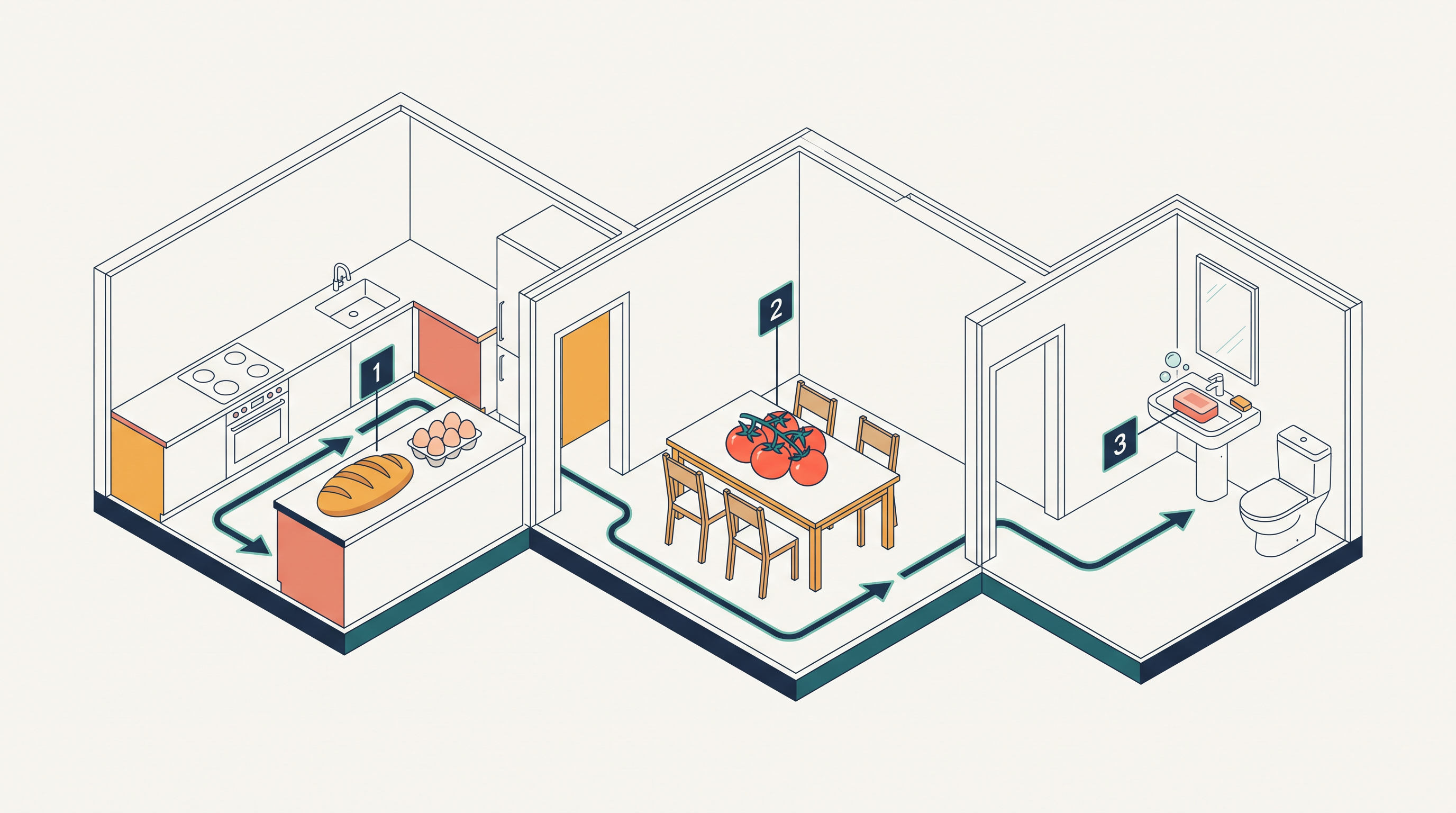
Fig. 6.8 – The method of loci memory technique.
Mnemonics Using Organisation
Organisation refers to imposing a certain order on the material you want to remember. Mnemonics of this kind are helpful because of the framework you create: once the material has a structure, the retrieval task becomes fairly easy.
(a) Chunking
While describing the features of short-term memory, we noted how chunking can increase its capacity. In chunking, several smaller units are combined to form large chunks. To create chunks, it is important to discover some organisational principles that can link the smaller units — the digits in 194719492004 were linked by being three events in India’s history.
Chunking is therefore more than a control mechanism inside the short-term store. It can also be used deliberately, as a strategy, to improve memory for material you wish to retain.
(b) The First Letter Technique
To employ the first letter technique, you pick up the first letter of each word you want to remember and arrange those letters to form another word, or a sentence.
The colours of the rainbow are remembered in exactly this way: VIBGYOR, which stands for Violet, Indigo, Blue, Green, Yellow, Orange and Red.
Beyond Mnemonics: Working With What We Know About Memory
Mnemonic strategies have a real limitation, and it should be stated plainly. They are too simplistic, and they perhaps underestimate the complexity of memory tasks and the difficulties people actually experience while memorising. A keyword will help you with Pato; it will not help you understand a chapter.
In place of mnemonics, many psychologists have suggested a more comprehensive approach to memory improvement — one in which the emphasis is laid on applying what we know about memory processes to the task of improving memory. Three suggestions follow directly from what you have already studied.
(a) Engage in deep level processing
If you want to memorise any information well, engage in deep level processing. Craik and Lockhart demonstrated that processing information in terms of the meaning it conveys leads to better memory than attending to its surface features.
In practice, deep processing means asking as many questions about the information as possible, considering what it means, and examining how it relates to facts you already know. Done this way, the new information becomes part of your existing knowledge framework — and the chances that it will be remembered increase accordingly.
(b) Minimise interference
Interference, as you have read, is a major cause of forgetting, and you should try to avoid it as far as possible.
You now know the condition under which interference is greatest: when very similar materials are learned one after the other. So arrange your study in such a way that you do not learn similar subjects in sequence. Follow one subject with an unrelated one instead. And where that is not possible, distribute your learning and practice — that is, give yourself intermittent rest periods while studying, so that fresh material is not piled directly onto material that resembles it.
(c) Give yourself enough retrieval cues
While you are learning something, think about the retrieval cues that are inherent in the study material itself. Identify them, and link parts of the material to those cues.
The logic is economical. Cues are easier to remember than the entire content, and the links you have created between the cues and the content will carry you back to the content when you need it.
The PQRST Method
Thomas and Robinson developed another strategy to help students remember more, which they called the method of PQRST. The acronym stands for Preview, Question, Read, Self-recitation and Test — and, as you will notice, it is itself an application of the first letter technique.
- Preview: give the chapter a cursory look and familiarise yourself with its contents.
- Question: raise questions to which you will seek answers from the lesson.
- Read: now read, looking for the answers to the questions you had raised.
- Self-recitation: after reading, try to rewrite in your own words what you have read.
- Test: at the end, test how much you have actually been able to understand.
The sequence is not arbitrary. Previewing gives you a framework to attach details to; questioning turns reading from a passive activity into a search; self-recitation and testing force you to retrieve rather than merely re-read — and retrieval, unlike rereading, tells you honestly what you do not yet know.
A Note of Caution
At the end, a note of caution must be sounded. There is no one method that can solve all problems related to retention, and none that will bring about an overnight improvement in memory.
Improving your memory means attending to a wide variety of factors that affect it — your health, your interest and motivation, your familiarity with the subject matter, and so on. And it means learning to choose your strategy according to the nature of the memory task you are required to accomplish. The method of loci is excellent for a shopping list and useless for an argument; deep processing is indispensable for an argument and unnecessary for a shopping list. Knowing which to use, and when, is itself part of what this chapter has taught you.
6.9 Summary
Memory is seen as consisting of three interrelated processes: encoding, storage and retrieval. A failure in any one of them shows up as “forgetting”.
Encoding is the registering of incoming information in a form the memory system can work with. Storage is the holding of that information over a period of time, and retrieval is the bringing of it back into awareness so that it can be used.
The Stage Model of Memory, proposed by Atkinson and Shiffrin, compares memory processes with the working of a computer. It suggests that incoming information is processed through three distinct stages — sensory memory, short-term memory and long-term memory — each with its own capacity, duration and form of encoding. Control processes such as attention, maintenance rehearsal, chunking and elaborative rehearsal move information from one store to the next and keep it there.
The levels of processing view, proposed by Craik and Lockhart, contends that information can be encoded at any of three levels: the structural, the phonetic and the semantic. If information is analysed and encoded semantically, which is the deepest level of processing, it leads to better retention.
Long-term memory has been classified in many ways. One major classification is that of declarative and procedural memory; another, proposed by Tulving, divides declarative memory into episodic and semantic memory.
Forgetting refers to the loss of stored information over a period of time. Ebbinghaus showed that after material is learnt there is a sharp drop in memory, and that the decline thereafter is very gradual.
Forgetting has been explained as resulting from trace decay and from interference, which may be proactive or retroactive. It may also be caused by the absence of appropriate cues at the time of retrieval, in which case the information is still stored but cannot be reached.
Mnemonics are strategies for improving memory. Some mnemonics use images, such as the keyword method and the method of loci, while others emphasise organisation of the learnt material, such as chunking and the first letter technique. Beyond mnemonics, memory can be improved by processing material deeply, minimising interference, and building in retrieval cues.
6.10 Key Terms
Childhood amnesia — The absence of reported memories from the first four to five years of life.
Chunking — Combining several smaller units of information into larger meaningful units, so that more can be held in short-term memory.
Control process — A process, such as attention, rehearsal or chunking, that monitors the flow of information between the memory stores.
Declarative memory — Memory for facts, names and dates, which can be put into words.
Echoic memory — The auditory sensory register, which briefly holds sound exactly as it was received.
Elaborative rehearsals — Rehearsal that connects new information to what is already stored in long-term memory, and so carries it into that store.
Encoding — The first stage of memory, in which incoming information is registered, given meaning, and represented in a usable form.
Episodic memory — Memory for the personal, dated events of one’s own life, generally emotional in nature.
Fugue state — A rare condition, following severe stress, in which a person loses access to their identity and assumes a new one; it is identified only by a trained professional.
Iconic memory — The visual sensory register, which briefly holds an exact replica of what was seen.
Information processing approach — The view that the human being takes in information, processes it through a series of operations, and produces an output, much as a computer does.
Interference — Forgetting caused by competition between different sets of stored associations at the time of retrieval.
Long-term memory (LTM) — The permanent memory store, of vast capacity, in which information is encoded mainly in terms of meaning.
Maintenance rehearsals — Rehearsal that holds information in short-term memory by simple repetition; the information is lost when the repetition stops.
Memory — The retaining and recalling of information over a period of time, the period depending on the task at hand.
Memory trace — The physical modification in the central nervous system that learning is supposed to leave behind.
Mnemonics — Strategies for improving memory, some using images and others using organisation.
PQRST method — A study strategy — Preview, Question, Read, Self-recitation, Test — developed by Thomas and Robinson.
Proactive interference — Forward-moving interference, in which earlier learning obstructs the recall of later learning.
Procedural memory — Memory for skills and procedures, such as riding a bicycle, which is difficult to put into words.
Retrieval — The third stage of memory: bringing stored information back into awareness so that it can be used.
Retrieval cues — Aids, such as category names or the original context of learning, that help recover information stored in memory.
Retrieval failure — The inability to reach stored information because the cues needed to access it are absent or inappropriate.
Retroactive interference — Backward-moving interference, in which later learning obstructs the recall of earlier learning.
Selective attention — The first control process, which decides what information passes from the sensory registers into short-term memory.
Semantic encoding — Encoding information in terms of the meaning it carries; the deepest level of processing.
Semantic memory — Memory for general knowledge, concepts and rules of logic; undated and affect-neutral.
Sensory memory — The first memory store, of large capacity but a duration of less than a second, which registers information sense by sense.
Short-term memory (STM) — The second memory store, which holds a small amount of information — about \(7 \pm 2\) items — for 30 seconds or less unless rehearsed.
Stage Model — Atkinson and Shiffrin’s model of memory as three sequential stores: sensory, short-term and long-term memory.
Storage — The second stage of memory: retaining and holding encoded information over a period of time.
Trace decay — The earliest theory of forgetting, which holds that unused memory traces fade away with time.
Working memory — Baddeley’s multi-component view of short-term memory as an active work bench, made up of the phonological loop, the visuospatial sketchpad and the central executive.
6.11 Points to Ponder
Recall an event from your own life that you remember very clearly, and write down your account of it. Now ask someone else who was present — a sibling, a parent, a friend — to write down theirs. Where do the two versions agree, and where do they differ? If long-term memory is a permanent store from which nothing is lost, why should two accounts of the same event differ at all?
The stage model says that what you experience as forgetting is really retrieval failure — the information is still there, out of reach. Is such a claim testable? What evidence could ever show that a memory you can never recover is nonetheless still stored?
Semantic memory is described as affect-neutral and not susceptible to forgetting, while episodic memory is emotional and easier to lose in detail. Yet you probably remember your first day in Class XI better than most of the definitions you learnt that week. What does that tell you about the relationship between emotion and memory?
Ebbinghaus deliberately used nonsense syllables so that meaning would not interfere with his results. But almost nothing we learn in real life is meaningless. Does his method make his findings more scientific, or less relevant?
If deep processing is what produces lasting memory, why do students so often fall back on rote repetition the night before a test? What does the answer suggest about the difference between knowing a strategy and using one?
Suppose a technology existed that let you record and replay every experience of your life exactly as it happened. Would that be an improvement on human memory — or would something valuable be lost along with the forgetting?
6.12 NCERT Questions
What is meant by the terms ‘encoding’, ‘storage’ and ‘retrieval’?
How is information processed through the sensory, short-term and long-term memory systems?
How are maintenance rehearsals different from elaborative rehearsals?
Differentiate between declarative and procedural memories.
Why does forgetting take place?
How is retrieval related forgetting different from forgetting due to interference?
Define mnemonics. Suggest a plan to improve your own memory.
6.13 Objective Questions
- The Stage Model of memory was proposed by:
- Craik and Lockhart
- Atkinson and Shiffrin
- Baddeley
- Tulving [1 mark]
- The duration of sensory memory is:
- less than one second
- about 30 seconds
- about two minutes
- up to a lifetime [1 mark]
- The capacity of short-term memory is usually stated as:
- \(5 \pm 2\) items
- \(7 \pm 2\) items
- \(9 \pm 2\) items
- unlimited [1 mark]
- According to the levels of processing view, the deepest level of processing is:
- structural
- phonetic
- semantic
- acoustic [1 mark]
- Remembering the colours of the rainbow as VIBGYOR is an example of:
- the method of loci
- the keyword method
- the first letter technique
- maintenance rehearsal [1 mark]
- The component of working memory that allocates attentional resources and monitors, plans and controls behaviour is the:
- phonological loop
- visuospatial sketchpad
- central executive
- echoic register [1 mark]
- Memory for how to ride a bicycle is an example of:
- semantic memory
- episodic memory
- declarative memory
- procedural memory [1 mark]
- Assertion (A): The trace decay theory of forgetting has been proved inadequate. Reason (R): People who remain awake after memorising show greater forgetting than those who sleep.
- Both A and R are true, and R is the correct explanation of A.
- Both A and R are true, but R is not the correct explanation of A.
- A is true, but R is false.
- A is false, but R is true. [1 mark]
- Assertion (A): Semantic memory is not dated. Reason (R): Semantic memory stores facts and general knowledge rather than personal life events.
- Both A and R are true, and R is the correct explanation of A.
- Both A and R are true, but R is not the correct explanation of A.
- A is true, but R is false.
- A is false, but R is true. [1 mark]
- Assertion (A): Maintenance rehearsal carries information into long-term memory. Reason (R): Repetition creates associations between new information and existing knowledge.
- Both A and R are true, and R is the correct explanation of A.
- Both A and R are true, but R is not the correct explanation of A.
- A is true, but R is false.
- A is false, but R is false. [1 mark]
- Match the psychologist in Column I with the contribution in Column II.
| Column I | Column II |
|---|---|
| a. Hermann Ebbinghaus | i. Multi-component view of working memory |
| b. Craik and Lockhart | ii. Curve of forgetting, using nonsense syllables |
| c. Baddeley | iii. Episodic and semantic memory; retrieval cues |
| d. Tulving | iv. Levels of processing |
[1 mark]
- Match the term in Column I with its description in Column II.
| Column I | Column II |
|---|---|
| a. Iconic memory | i. Grouping smaller units into larger meaningful units |
| b. Echoic memory | ii. Placing items to be remembered at familiar locations |
| c. Chunking | iii. The visual sensory register |
| d. Method of loci | iv. The auditory sensory register |
[1 mark]
Fill in the blank: The rehearsal that connects new information to information already present in long-term memory is called __________. [1 mark]
Fill in the blank: Difficulty in recalling earlier learning because of newly learnt material is called __________ interference. [1 mark]
Fill in the blank: The absence of reported memories from the first four to five years of life is known as __________. [1 mark]
True or False: According to Atkinson and Shiffrin, information in short-term memory is primarily encoded semantically. [1 mark]
True or False: In the recognition method, participants are asked to generate the memorised items themselves, without being shown any of them. [1 mark]
True or False: Retrieval cues can include the physical context in which the material was learnt. [1 mark]
6.14 Check Your Concepts
Define memory. State the three stages through which any information must pass. [2 marks]
What are mnemonics? Name any two mnemonic devices that make use of images. [2 marks]
State two features of sensory memory, and give one example of a sensory register. [2 marks]
What is a retrieval cue? Give one example of a cue that improves recall. [2 marks]
Give one example each of episodic memory and semantic memory from your own school life. [2 marks]
What is chunking? Explain, with one example, how it expands the capacity of short-term memory. [3 marks]
Differentiate between proactive and retroactive interference, giving one example of each. [3 marks]
Explain the difference between declarative and procedural memory. Why is procedural memory difficult to describe in words? [3 marks]
Why does information disappear from short-term memory within about 30 seconds unless it is rehearsed? Give reasons. [3 marks]
Name the three components of working memory as proposed by Baddeley, and state the function of each. [3 marks]
Arrange the following in the correct sequence and explain why the order cannot be changed: elaborative rehearsal, sensory registers, attention, long-term memory, short-term memory. [3 marks]
Explain the levels of processing view with the help of an example. Why does semantic encoding lead to better retention than phonetic encoding? [4 marks]
Describe the control processes that move information through the memory system, according to Atkinson and Shiffrin. [4 marks]
Evaluate the claim that “once information enters long-term memory, it is never forgotten”. What evidence supports this claim, and what makes it difficult to test? [4 marks]
Draw and label the Stage Model of memory, marking the capacity and duration of each store and the process that carries information from one store to the next. [4 marks]
What would happen to a student’s recall if she revised History immediately after revising Political Science, with no break between them? Explain, using the theory of forgetting that applies, and suggest two ways of rearranging her study. [4 marks]
Describe the Stage Model of memory in full. State the evidence that supports it and the evidence that has been used to question it. [6 marks]
Compare the Stage Model of memory with the levels of processing view. On what fundamental point do the two disagree, and which of them better explains why understanding a lesson works better than repeating it? [6 marks]
Discuss the three theories of forgetting explained in this chapter. For each, state its central claim, the evidence for it, and one limitation. [6 marks]
Describe the various types of long-term memory, with one example of each, and explain why psychologists no longer treat long-term memory as a single, unitary store. [6 marks]
A school wants to run a workshop on “how to study better”. Using what you have learnt in this chapter, discuss the strategies you would recommend, including both mnemonic devices and the broader suggestions psychologists have made. [6 marks]
6.15 Case-Based Questions
- Ananya prepared thoroughly for her Psychology test. On the night before, she read each answer aloud again and again until she could repeat it perfectly. In the examination hall the next morning, she looked at the first question, knew that she had studied it, and could not produce a single line of the answer. Twenty minutes after handing in her paper, standing in the corridor, the whole answer came back to her at once.
- At which stage of memory did Ananya’s failure occur? Justify your answer.
- Which theory of forgetting best explains what happened to her in the hall?
- Suggest two specific changes to the way she prepares, drawn from this chapter, and say why each should help. [6 marks]
- Rohit has to learn a set of Hindi verses on Monday and a set of Sanskrit verses on Tuesday. He decides to save time by learning both sets on Sunday night, one immediately after the other, with no gap. On Monday he finds that while reciting the Hindi verses he keeps slipping into lines from the Sanskrit set, and he can recall fewer Hindi verses than usual.
- Identify the process that is causing Rohit’s difficulty, and name the specific kind he is experiencing.
- Explain why learning two similar sets of material back to back makes this worse.
- How should Rohit rearrange his study so as to minimise the problem? [6 marks]
- Meera’s grandfather is 78. He can describe his wedding day in vivid detail — the weather, the food, what he felt when he saw the crowd — although it took place more than fifty years ago. He often cannot recall what he ate for breakfast this morning. He has not ridden a bicycle in twenty years, but when Meera brought one home last week, he rode it down the lane without difficulty. He cannot explain to her how he balances on it.
- Identify the type of long-term memory involved in each of the three abilities described.
- Why is his grandfather able to ride the bicycle but unable to explain how he does it?
- Meera concludes from all this that her grandfather “has a good memory for some things and a bad memory for others”. Is that the best way to describe what is going on? Explain. [6 marks]
- A shopkeeper in a busy market does not write down his customers’ phone numbers. He remembers a ten-digit number by breaking it into a familiar year, a familiar bus route number and a pair of digits that make up his shop number. He also remembers his morning list of tasks by imagining each one placed in a different corner of his own house, and walking through the house in his mind when he reaches the shop.
- Name the technique he uses for the phone numbers, and explain the principle that makes it work.
- Name the technique he uses for the task list, and state the kind of memory task it is best suited to.
- Would either technique help him understand a new government tax rule that he has to explain to his customers? Give reasons. [4 marks]
6.16 Practice With Data
- A class carried out a memory experiment. Students learnt a list of 20 words and were tested for recall at different intervals. The mean percentage of words retained was:
| Time since learning | Words retained (per cent) |
|---|---|
| 20 minutes | 58 |
| 1 hour | 44 |
| 9 hours | 36 |
| 1 day | 34 |
| 6 days | 25 |
| 31 days | 21 |
a. Plot these values as a curve, with time since learning on the x-axis and per cent retained on the y-axis.
b. In which interval is the drop in retention steepest? Calculate the fall in percentage points in that interval.
c. Between 1 day and 31 days, by how many percentage points does retention fall? What does the shape of the whole curve tell you about the course of forgetting?
[6 marks]
- A student read out digit strings of increasing length to a friend, at the rate of one digit per second, and recorded whether the friend could repeat the whole string in order.
| Length of string | Repeated correctly? |
|---|---|
| 6 digits | Yes |
| 7 digits | Yes |
| 8 digits | Yes |
| 10 digits | No |
| 12 digits | No |
a. What is the friend's memory span, as far as this data allows you to say?
b. Is this result consistent with the stated capacity of short-term memory? Justify your answer with reference to that figure.
c. The friend is now told that the 12-digit string is 194719492004. Explain why she may now succeed, even though the number of digits has not changed.
[4 marks]
Two groups of students learnt the same list of 20 words. Group I was then asked to recall as many words as they could, in any order. Group II was shown the 20 words mixed with 20 words they had never seen, and asked to pick out the ones from the original list. The mean scores were: Group I — 9 words; Group II — 17 words.
- Name the method of memory measurement used with each group.
- Group I and Group II learnt exactly the same list. Why, then, does Group II score so much higher?
- What does this comparison suggest about the difference between information being stored and information being accessible? [4 marks]
An experiment on interference was set up as follows.
| Group | Phase 1 | Phase 2 | Testing phase | Mean words recalled |
|---|---|---|---|---|
| Experimental | Learns list A | Learns list B | Recalls list A | 8 |
| Control | Learns list A | Rests | Recalls list A | 14 |
a. Which kind of interference does this design demonstrate? Give a reason for your answer.
b. Calculate the difference in mean recall between the two groups, and state what that difference is being attributed to.
c. What single change to the design would turn it into a test of the other kind of interference?
[4 marks]