In the late 1780s, in Bologna, the anatomist Luigi Galvani was dissecting a frog when he noticed something strange. Whenever a metal instrument touched the exposed nerve of the frog’s leg, the muscle twitched — as though the dead limb had come briefly back to life. Galvani was convinced he had discovered a special “animal electricity” stored inside living tissue.
A few hundred kilometres away, the physicist Alessandro Volta read Galvani’s report and disagreed. He noticed a detail Galvani had treated as unimportant: the twitch appeared when two different metals touched the moist tissue. The electricity, Volta argued, was not coming from the frog at all. It was coming from the metals, and the frog’s fluids were merely completing the circuit.
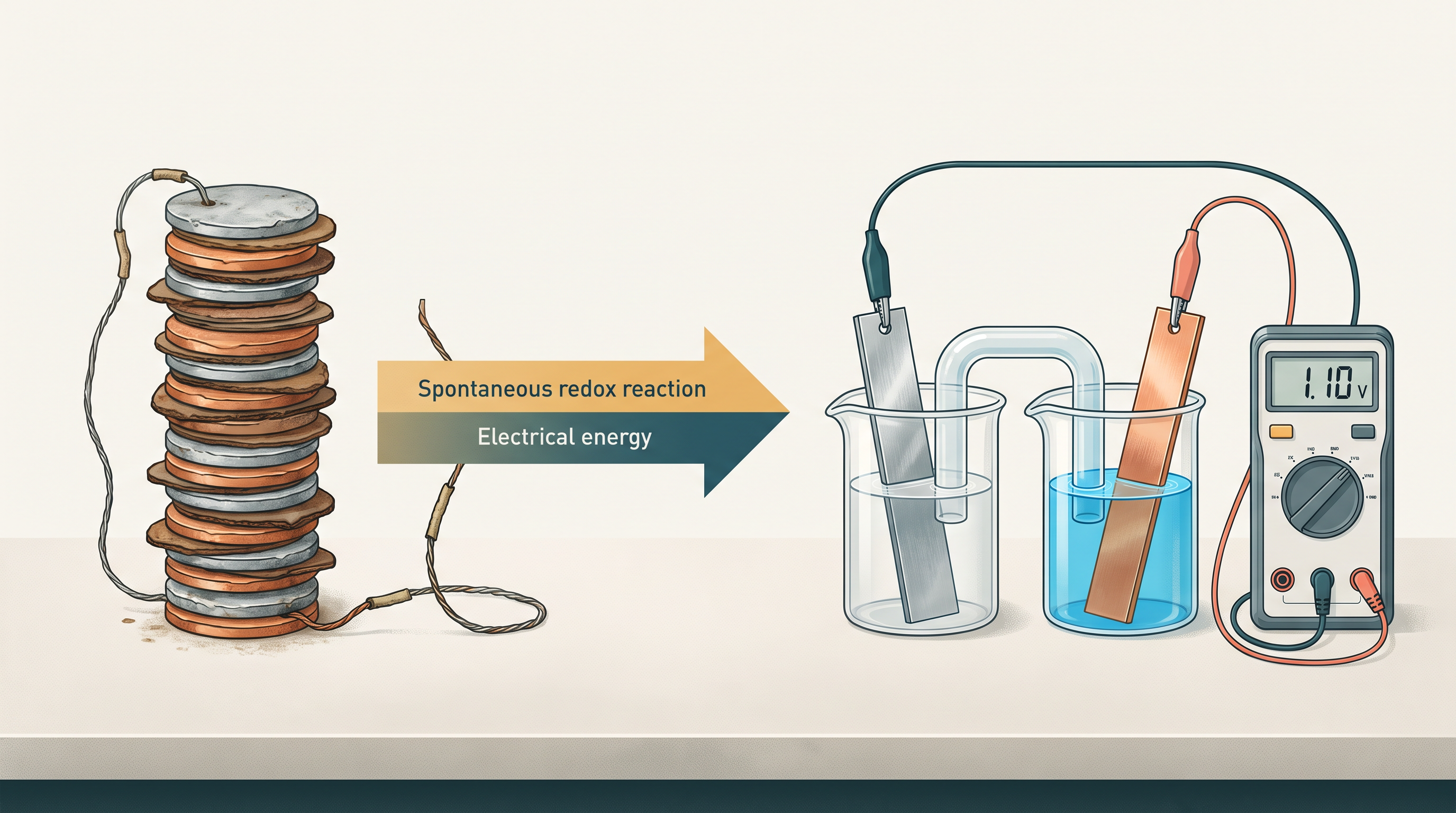
To prove it, Volta removed the frog entirely. Around 1800 he stacked discs of zinc and copper, separated by cardboard soaked in salt solution, into a tall pile. The pile delivered a steady, continuous current — the first true battery. Chemistry had been made to push electrons through a wire.
Both men left their names behind in the language we still use: a cell that produces electricity from a spontaneous chemical reaction is called a galvanic or voltaic cell. Two centuries later, the same two ideas — a metal that gives up electrons, another that accepts them — power your phone, start a car, and rust a bridge.
Q1. A voltmeter always has two leads. Why can we never measure the potential of a single electrode by itself, no matter how good our instrument is? Q2. A galvanic cell is left connected for a long time, and one day the voltmeter reads exactly zero. The zinc and copper are still there. So what has actually run out? Q3. When you dilute an electrolyte solution, the number of ions in every cubic centimetre goes down — yet chemists say the molar conductivity goes up. How can both statements be true at once? Q4. A torch cell is thrown away when it dies, but a car battery is charged again and again. What is chemically different about the two? Q5. Ship builders deliberately bolt blocks of zinc onto a steel hull and allow them to corrode away. Why does letting one metal rot protect the other?
Keep these questions in mind. As you work through this chapter, you will meet the ideas needed to reason each of them out for yourself.
2.1 Electrochemical Cells
An electrochemical cell is any device in which a redox reaction and an electric current are linked to each other. In some cells a chemical reaction happens on its own and pushes electrons through a wire. In others, we push electrons in from outside and force a chemical reaction to happen. This section looks at both, using a single familiar cell as the example.
The Daniell Cell
You have already studied the construction and working of the Daniell cell, drawn in Fig. 2.1. It has a zinc rod dipping in a solution of a zinc salt and a copper rod dipping in a solution of a copper salt, with the two solutions joined by a salt bridge.
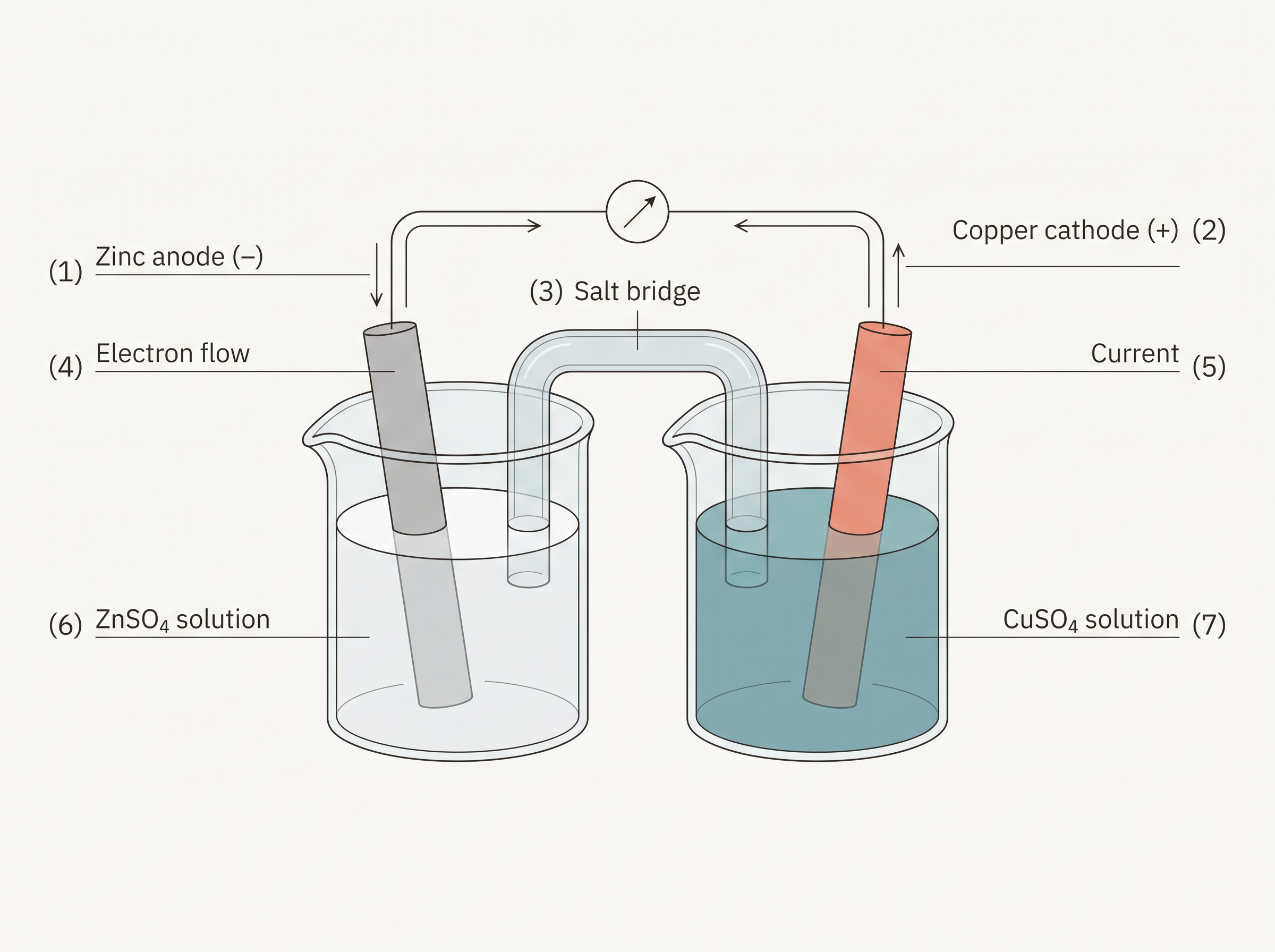
The cell converts the chemical energy liberated during the redox reaction
\[\mathrm{Zn}\text{(s)} + \mathrm{Cu^{2+}}\text{(aq)} \rightarrow \mathrm{Zn^{2+}}\text{(aq)} + \mathrm{Cu}\text{(s)} \qquad (2.1)\]
into electrical energy. When the concentration of both \(\mathrm{Zn^{2+}}\) and \(\mathrm{Cu^{2+}}\) ions is unity, that is \(1\ \text{mol dm}^{-3}\), the cell has an electrical potential equal to 1.1 V. A device of this kind — one that produces electricity from a spontaneous redox reaction — is called a galvanic or a voltaic cell.
Strictly speaking, the quantity that should be used here is not concentration but activity, which you will study in higher classes. Activity is directly proportional to concentration, and in dilute solutions the two are equal, so using concentration causes no error at our level.
A galvanic (voltaic) cell is an electrochemical cell in which the chemical energy released by a spontaneous redox reaction is converted into electrical energy.
The cell is named after John Frederic Daniell, a British chemist working in London in the 1830s. Batteries of that time — piles of two metals separated by brine — lost voltage quickly as the reaction proceeded. Daniell’s design kept each metal in a solution of its own salt, and the cell held a steady potential for hours. This reliability mattered enormously: the electric telegraph was being built at exactly that time, and it needed a current source that did not fade halfway through a message. The Daniell cell became the standard power supply of early telegraph lines.
Reversing the Cell with an External Voltage
Now suppose we do something deliberately awkward. We connect an external source of voltage, \(E_{\text{ext}}\), across the Daniell cell, but connect it the wrong way round — so that it opposes the cell’s own potential [Fig. 2.2(a)]. Then we increase this opposing voltage slowly and watch what happens.
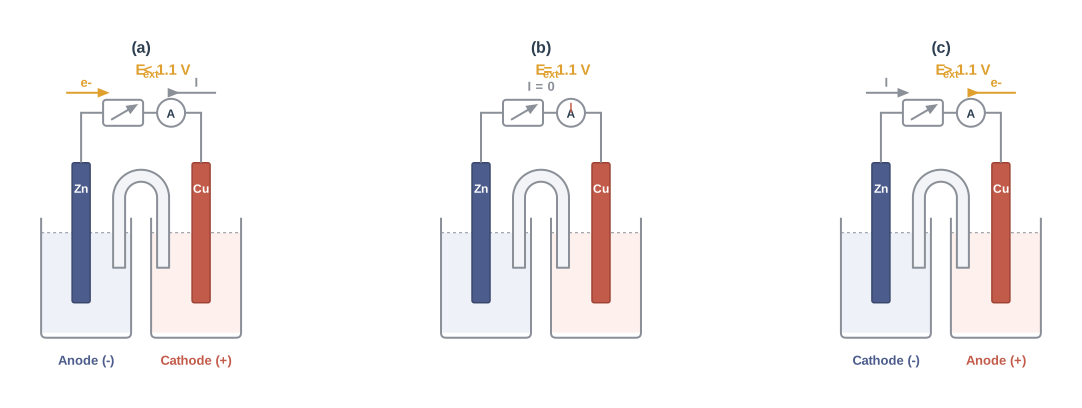
As long as the opposing voltage is less than 1.1 V [Fig. 2.2(a)], the cell wins the tug-of-war. The reaction continues to take place in its natural direction: electrons flow from the zinc rod to the copper rod, so conventional current flows from copper to zinc in the external circuit. Zinc dissolves at the anode and copper is deposited at the cathode.
When the opposing voltage reaches exactly 1.1 V [Fig. 2.2(b)], the two potentials balance each other perfectly. The reaction stops altogether and no current flows through the cell.
Any further increase in the external potential beyond 1.1 V starts the reaction again — but now in the opposite direction [Fig. 2.2(c)]. Electrons are forced from copper to zinc, so current flows from zinc to copper. Zinc is now deposited at the zinc electrode, and copper dissolves at the copper electrode. The reaction of equation (2.1) has been driven backwards, against its natural tendency, by electrical energy supplied from outside.
A cell working in this way is called an electrolytic cell — a device that uses electrical energy to carry out a non-spontaneous chemical reaction. The three situations are collected in FC 2.1.
An electrolytic cell is an electrochemical cell in which electrical energy from an external source is used to drive a non-spontaneous redox reaction.
Notice what this experiment really shows: the same pair of electrodes and solutions can behave as a galvanic cell or as an electrolytic cell, depending only on whether the chemistry is driving the electricity or the electricity is driving the chemistry. Both types of cell are extremely important, and we shall study the main features of each in the pages that follow.
Galvanic (voltaic) cell vs Electrolytic cell
| Energy conversion |
Chemical energy → electrical energy |
Electrical energy → chemical energy |
| Nature of the redox reaction |
Spontaneous |
Non-spontaneous |
| External power source |
Not needed; the cell is the source |
Essential; the cell is driven by it |
| In the Daniell cell above |
Works when \(E_{\text{ext}} < 1.1\) V |
Works when \(E_{\text{ext}} > 1.1\) V |
| Zinc electrode |
Anode; zinc dissolves |
Cathode; zinc is deposited |
| Copper electrode |
Cathode; copper deposits |
Anode; copper dissolves |
This reversal is not a laboratory curiosity — it is how every rechargeable device works. When your phone battery runs down, the cell has been acting as a galvanic cell, converting chemical energy into electrical energy. Plugging in the charger applies an external voltage larger than the cell’s own potential and drives the chemistry backwards, rebuilding the original reactants on the electrodes. The charger is simply doing to the battery what Fig. 2.2(c) does to the Daniell cell. A safety point follows directly from this. Ordinary non-rechargeable cells are not built to be driven in reverse; their reaction products cannot be cleanly converted back, and forcing current through them can generate gas inside a sealed casing, causing the cell to leak or rupture. This is why only cells specifically labelled rechargeable should ever be put on a charger.
A Daniell cell with unit concentrations of \(\mathrm{Zn^{2+}}\) and \(\mathrm{Cu^{2+}}\) (cell potential 1.1 V) is connected to an external source of 1.5 V applied in opposition to the cell.
(i) Is the cell now galvanic or electrolytic?
(ii) Write the reaction occurring at each electrode.
(iii) In which direction do electrons flow in the external wire?
The applied voltage, 1.5 V, is greater than the cell’s own potential of 1.1 V. The external source therefore overpowers the cell’s chemical driving force and pushes the reaction backwards. The cell is now working as an electrolytic cell.
Because the reaction is reversed, each electrode does the opposite of what it does in the working Daniell cell. Copper is now oxidised (it dissolves) and zinc is now reduced (it is deposited):
\[\text{At the copper electrode (anode, oxidation): } \mathrm{Cu}\text{(s)} \rightarrow \mathrm{Cu^{2+}}\text{(aq)} + 2\,\mathrm{e^-}\]
\[\text{At the zinc electrode (cathode, reduction): } \mathrm{Zn^{2+}}\text{(aq)} + 2\,\mathrm{e^-} \rightarrow \mathrm{Zn}\text{(s)}\]
- Electrons are released at the copper electrode and consumed at the zinc electrode, so in the external wire electrons flow from copper to zinc. Conventional current, being opposite to electron flow, runs from zinc to copper.
(question only — no solution)
The same Daniell cell (cell potential 1.1 V) is now connected to an external opposing source of 0.9 V. (i) State whether the cell behaves as a galvanic or an electrolytic cell. (ii) Name the electrode at which zinc metal is consumed. (iii) State the direction of electron flow in the external circuit, and the direction of conventional current.
2.2 Galvanic Cells
As mentioned earlier, a galvanic cell is an electrochemical cell that converts the chemical energy of a spontaneous redox reaction into electrical energy. In this device the Gibbs energy of the spontaneous redox reaction is converted into electrical work, which may be used for running a motor or other electrical gadgets like a heater, fan or geyser.
Gibbs energy, which you met in thermodynamics, is the part of a reaction’s energy that is free to do useful work. A spontaneous reaction has a negative \(\Delta G\), and it is exactly this “spare” energy that a galvanic cell captures and delivers as electricity instead of wasting it as heat.
Splitting a Redox Reaction into Halves
The Daniell cell discussed earlier is one such cell, in which the following redox reaction occurs:
\[\mathrm{Zn}\text{(s)} + \mathrm{Cu^{2+}}\text{(aq)} \rightarrow \mathrm{Zn^{2+}}\text{(aq)} + \mathrm{Cu}\text{(s)}\]
This reaction is a combination of two half reactions whose addition gives the overall cell reaction:
\[\text{(i)}\quad \mathrm{Cu^{2+}} + 2\,\mathrm{e^-} \rightarrow \mathrm{Cu}\text{(s)} \qquad \text{(reduction half reaction)} \qquad (2.2)\]
\[\text{(ii)}\quad \mathrm{Zn}\text{(s)} \rightarrow \mathrm{Zn^{2+}} + 2\,\mathrm{e^-} \qquad \text{(oxidation half reaction)} \qquad (2.3)\]
The key point is that these two reactions occur in two different portions of the Daniell cell. The reduction half reaction occurs on the copper electrode, while the oxidation half reaction occurs on the zinc electrode. Because the two halves are physically separated, the electrons released by zinc cannot jump straight to \(\mathrm{Cu^{2+}}\) ions in solution — they are forced to travel through the external wire, and that travelling stream of electrons is the current we use.
These two portions of the cell are also called half-cells or redox couples. The copper electrode may be called the reduction half-cell and the zinc electrode, the oxidation half-cell.
Building Any Galvanic Cell
We can construct innumerable galvanic cells on the pattern of the Daniell cell by taking combinations of different half-cells. Each half-cell consists of a metallic electrode dipped into an electrolyte.
The two half-cells are connected by a metallic wire through a voltmeter and a switch externally. The electrolytes of the two half-cells are connected internally through a salt bridge, as shown in Fig. 2.1. The salt bridge completes the circuit inside the cell and keeps each solution electrically neutral as ions are formed and consumed. Sometimes both the electrodes dip in the same electrolyte solution, and in such cases we do not require a salt bridge at all.
How an Electrode Acquires a Potential
Look closely at the boundary between a metal and the solution it dips in — the electrode–electrolyte interface. Two opposite tendencies compete there.
At each electrode–electrolyte interface there is a tendency of metal ions from the solution to deposit on the metal electrode, trying to make it positively charged. At the same time, metal atoms of the electrode have a tendency to go into the solution as ions, leaving behind their electrons at the electrode and trying to make it negatively charged.
At equilibrium, there is a separation of charges, and depending on the relative tendencies of the two opposing reactions, the electrode may be positively or negatively charged with respect to the solution. A potential difference develops between the electrode and the electrolyte, which is called electrode potential.
Electrode potential is the potential difference that develops between an electrode and its electrolyte solution at equilibrium, because of the separation of charge at the electrode–electrolyte interface.
When the concentrations of all the species involved in a half-cell are unity, then the electrode potential is known as standard electrode potential. According to IUPAC convention, standard reduction potentials are now called standard electrode potentials — so whenever you see an \(E^\circ\) value quoted, it refers to the half-reaction written as a reduction.
Standard electrode potential is the electrode potential of a half-cell measured when the concentration of every species involved in that half-cell is unity (and, for a gas, its pressure is 1 bar), the half-reaction being written as a reduction.
In a galvanic cell, the half-cell in which oxidation takes place is called the anode, and it has a negative potential with respect to the solution. The other half-cell, in which reduction takes place, is called the cathode, and it has a positive potential with respect to the solution.
Thus, there exists a potential difference between the two electrodes, and as soon as the switch is in the on position, the electrons flow from the negative electrode to the positive electrode. The direction of current flow is opposite to that of electron flow.
Anode vs Cathode in a galvanic cell
| Half reaction occurring |
Oxidation (loss of electrons) |
Reduction (gain of electrons) |
| Sign of the electrode |
Negative |
Positive |
| In the Daniell cell |
Zinc electrode |
Copper electrode |
| Electrons |
Released here, leave into the wire |
Arrive here from the wire, are consumed |
| Position in cell notation |
Written on the left |
Written on the right |
The words anode and cathode were coined by Michael Faraday, working with the scholar William Whewell, from Greek roots: ana meaning “up” and kathodos meaning “a way down”, combined with hodos, “a path”. Faraday pictured the current entering the solution by one path and leaving by the other. The names have outlived his picture of current, but they still tell you the same thing they told him — these are the two doorways through which electricity enters and leaves the chemistry.
Cell Potential and Cell Notation
The potential difference between the two electrodes of a galvanic cell is called the cell potential and is measured in volts. The cell potential is the difference between the electrode potentials (reduction potentials) of the cathode and the anode.
It is called the cell electromotive force (emf) of the cell when no current is drawn through the cell. The condition “no current drawn” matters: the moment current flows, some potential is lost inside the cell itself, and the reading drops below the true value. The emf is therefore the maximum potential the cell can offer.
The emf of a cell is the potential difference between its two electrodes when no current is being drawn from the cell.
cell potential / emf (\(E_{\text{cell}}\)) (SI unit: volt, V. It is an intensive property — doubling the size of the cell does not change it. Sign convention: with the anode written on the left and the cathode on the right, \(E_{\text{cell}} = E_{\text{right}} - E_{\text{left}}\), and a positive value means the cell reaction as written is spontaneous.)
It is now an accepted convention that we keep the anode on the left and the cathode on the right while representing a galvanic cell. A galvanic cell is generally represented by putting a vertical line between the metal and the electrolyte solution, and a double vertical line between the two electrolytes connected by a salt bridge. Under this convention the emf of the cell is positive and is given by the potential of the half-cell on the right hand side minus the potential of the half-cell on the left hand side, i.e.,
\[E_{\text{cell}} = E_{\text{right}} - E_{\text{left}}\]
This is illustrated by the following example.
Cell reaction:
\[\mathrm{Cu}\text{(s)} + 2\,\mathrm{Ag^{+}}\text{(aq)} \longrightarrow \mathrm{Cu^{2+}}\text{(aq)} + 2\,\mathrm{Ag}\text{(s)} \qquad (2.4)\]
Half-cell reactions:
\[\text{Cathode (\emph{reduction}):}\quad 2\,\mathrm{Ag^{+}}\text{(aq)} + 2\,\mathrm{e^-} \rightarrow 2\,\mathrm{Ag}\text{(s)} \qquad (2.5)\]
\[\text{Anode (\emph{oxidation}):}\quad \mathrm{Cu}\text{(s)} \rightarrow \mathrm{Cu^{2+}}\text{(aq)} + 2\,\mathrm{e^-} \qquad (2.6)\]
It can be seen that the sum of (2.5) and (2.6) leads to the overall reaction (2.4) in the cell, and that the silver electrode acts as a cathode while the copper electrode acts as an anode. The cell can be represented as:
\[\mathrm{Cu}\text{(s)} \,|\, \mathrm{Cu^{2+}}\text{(aq)} \,\|\, \mathrm{Ag^{+}}\text{(aq)} \,|\, \mathrm{Ag}\text{(s)}\]
and we have
\[E_{\text{cell}} = E_{\text{right}} - E_{\text{left}} = E_{\mathrm{Ag^{+}|Ag}} - E_{\mathrm{Cu^{2+}|Cu}} \qquad (2.7)\]
2.2.1 Measurement of Electrode Potential
The potential of an individual half-cell cannot be measured. We can measure only the difference between the two half-cell potentials, which gives the emf of the cell. If we arbitrarily choose the potential of one electrode (half-cell), then that of the other can be determined with respect to this.
Q1. A voltmeter always has two leads. Why can we never measure the potential of a single electrode by itself, no matter how good our instrument is?
A. Because a potential is always a difference between two points. To read anything at all, the voltmeter must be connected at two places, and the moment you touch the second lead to the solution you have created a second electrode–electrolyte interface with a potential of its own. Every measurement therefore returns the sum total of the cell, never one half of it. The way round the problem is not a better instrument but a shared reference: we pick one half-cell, declare its potential to be zero, and quote every other electrode as a difference from it. The standard hydrogen electrode is that agreed zero — the electrochemical equivalent of measuring every mountain from sea level.
The Standard Hydrogen Electrode
According to convention, a half-cell called the standard hydrogen electrode (SHE), represented by \(\mathrm{Pt}\text{(s)} \,|\, \mathrm{H_2}\text{(g)} \,|\, \mathrm{H^{+}}\text{(aq)}\), is assigned a zero potential at all temperatures, corresponding to the reaction
\[\mathrm{H^{+}}\text{(aq)} + \mathrm{e^-} \rightarrow \tfrac{1}{2}\,\mathrm{H_2}\text{(g)}\]
The standard hydrogen electrode consists of a platinum electrode coated with platinum black. The electrode is dipped in an acidic solution and pure hydrogen gas is bubbled through it, as shown in Fig. 2.3. The platinum black is a finely divided deposit of platinum, and its very large surface area lets the electrode reaction reach equilibrium quickly.
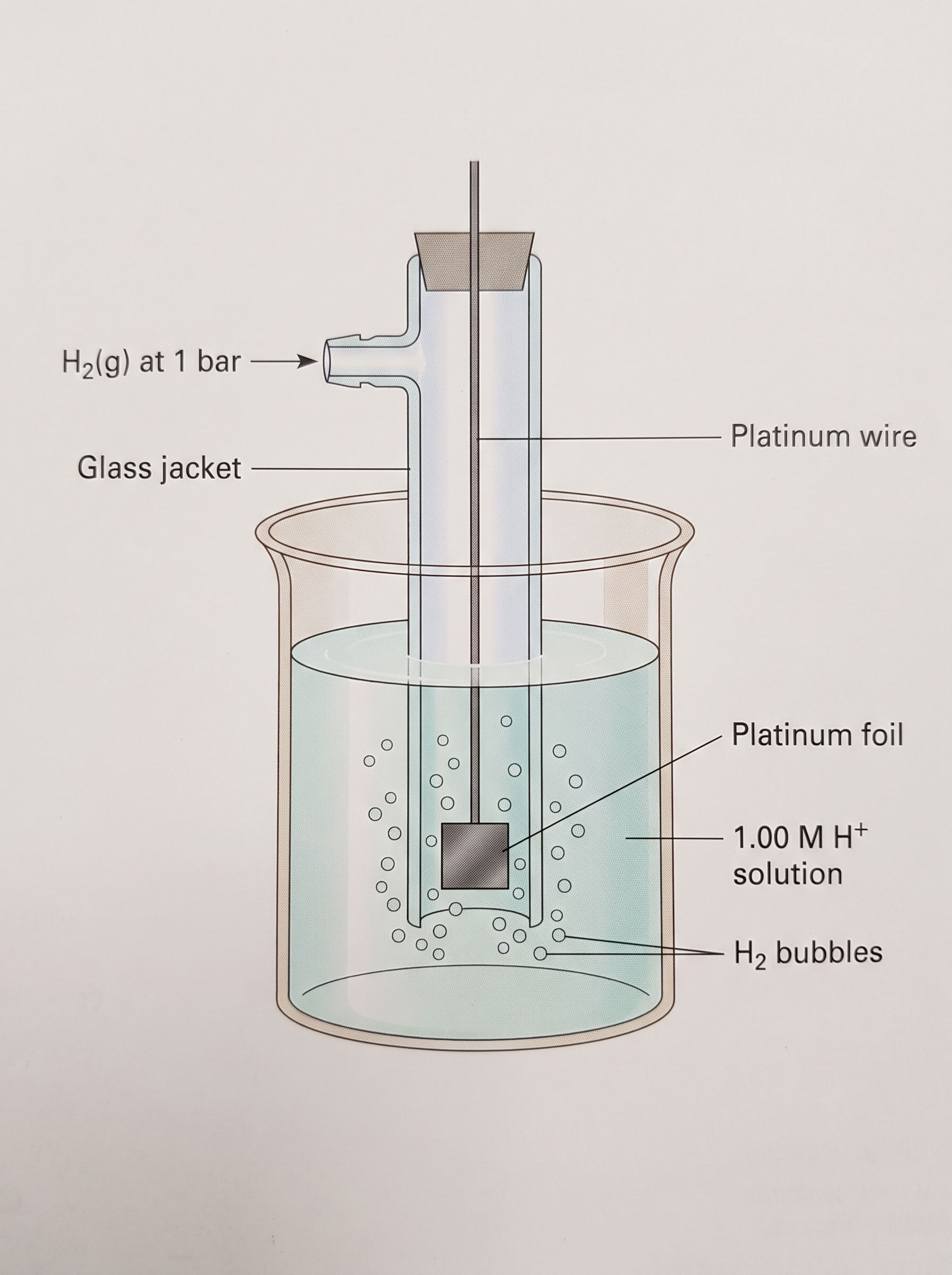
The concentration of both the reduced and the oxidised forms of hydrogen is maintained at unity (Fig. 2.3). This implies that the pressure of hydrogen gas is one bar and the concentration of hydrogen ion in the solution is one molar.
Measuring a Standard Electrode Potential
At 298 K, the emf of the cell “standard hydrogen electrode \(\|\) second half-cell”, constructed by taking the standard hydrogen electrode as the anode (the reference half-cell) and the other half-cell as the cathode, gives the reduction potential of the other half-cell. If the concentrations of the oxidised and the reduced forms of the species in the right hand half-cell are unity, then the cell potential is equal to the standard electrode potential, \(E^\circ_{\mathrm{R}}\), of the given half-cell. The procedure is summarised in FC 2.2.
\[E^\circ = E^\circ_{\mathrm{R}} - E^\circ_{\mathrm{L}}\]
As \(E^\circ_{\mathrm{L}}\) for the standard hydrogen electrode is zero,
\[E^\circ = E^\circ_{\mathrm{R}} - 0 = E^\circ_{\mathrm{R}}\]
The measured emf of the cell
\[\mathrm{Pt}\text{(s)} \,|\, \mathrm{H_2}\text{(g, 1 bar)} \,|\, \mathrm{H^{+}}\text{(aq, 1 M)} \,\|\, \mathrm{Cu^{2+}}\text{(aq, 1 M)} \,|\, \mathrm{Cu}\]
is 0.34 V, and it is also the value for the standard electrode potential of the half-cell corresponding to the reaction:
\[\mathrm{Cu^{2+}}\text{(aq, 1 M)} + 2\,\mathrm{e^-} \rightarrow \mathrm{Cu}\text{(s)}\]
Similarly, the measured emf of the cell
\[\mathrm{Pt}\text{(s)} \,|\, \mathrm{H_2}\text{(g, 1 bar)} \,|\, \mathrm{H^{+}}\text{(aq, 1 M)} \,\|\, \mathrm{Zn^{2+}}\text{(aq, 1 M)} \,|\, \mathrm{Zn}\]
is –0.76 V, corresponding to the standard electrode potential of the half-cell reaction:
\[\mathrm{Zn^{2+}}\text{(aq, 1 M)} + 2\,\mathrm{e^-} \rightarrow \mathrm{Zn}\text{(s)}\]
What the Sign of E° Tells You
The positive value of the standard electrode potential in the first case indicates that \(\mathrm{Cu^{2+}}\) ions get reduced more easily than \(\mathrm{H^{+}}\) ions. The reverse process cannot occur — that is, hydrogen ions cannot oxidise Cu (or, put the other way round, hydrogen gas can reduce copper ion) under the standard conditions described above.
This is not an abstract statement; it explains a fact you can see in the laboratory. Thus, Cu does not dissolve in HCl, because the \(\mathrm{H^{+}}\) ions of the acid are simply not strong enough oxidising agents to attack copper. In nitric acid, copper is attacked — but it is oxidised by the nitrate ion and not by the hydrogen ion.
The negative value of the standard electrode potential in the second case indicates that hydrogen ions can oxidise zinc (or that zinc can reduce hydrogen ions). This is why zinc dissolves in dilute acid with brisk effervescence of hydrogen, while copper does not.
In view of this convention, the half reactions for the Daniell cell in Fig. 2.1 can be written as:
\[\text{Left electrode:}\quad \mathrm{Zn}\text{(s)} \rightarrow \mathrm{Zn^{2+}}\text{(aq, 1 M)} + 2\,\mathrm{e^-}\]
\[\text{Right electrode:}\quad \mathrm{Cu^{2+}}\text{(aq, 1 M)} + 2\,\mathrm{e^-} \rightarrow \mathrm{Cu}\text{(s)}\]
The overall reaction of the cell is the sum of the above two reactions, and we obtain the equation:
\[\mathrm{Zn}\text{(s)} + \mathrm{Cu^{2+}}\text{(aq)} \rightarrow \mathrm{Zn^{2+}}\text{(aq)} + \mathrm{Cu}\text{(s)}\]
\[\text{emf of the cell} = E^\circ_{\text{cell}} = E^\circ_{\mathrm{R}} - E^\circ_{\mathrm{L}} = 0.34\ \text{V} - (-0.76)\ \text{V} = 1.10\ \text{V}\]
Notice that this calculated value is the 1.1 V we simply quoted for the Daniell cell in Section 2.1. It has now been derived from two independently measured half-cell potentials.
Inert Electrodes
Sometimes metals like platinum or gold are used as inert electrodes. They do not participate in the reaction but provide their surface for oxidation or reduction reactions and for the conduction of electrons. Such an electrode is needed whenever the redox couple contains no solid metal of its own — a gas, or two ions in solution, cannot by itself serve as a wire.
For example, Pt is used in the following half-cells:
Hydrogen electrode: \(\mathrm{Pt}\text{(s)} \,|\, \mathrm{H_2}\text{(g)} \,|\, \mathrm{H^{+}}\text{(aq)}\)
\[\text{With half-cell reaction:}\quad \mathrm{H^{+}}\text{(aq)} + \mathrm{e^-} \rightarrow \tfrac{1}{2}\,\mathrm{H_2}\text{(g)}\]
Bromine electrode: \(\mathrm{Pt}\text{(s)} \,|\, \mathrm{Br_2}\text{(aq)} \,|\, \mathrm{Br^{-}}\text{(aq)}\)
\[\text{With half-cell reaction:}\quad \tfrac{1}{2}\,\mathrm{Br_2}\text{(aq)} + \mathrm{e^-} \rightarrow \mathrm{Br^{-}}\text{(aq)}\]
Reading the Table of Standard Potentials
The standard electrode potentials are very important and we can extract a lot of useful information from them. The values of standard electrode potentials for some selected half-cell reduction reactions are given in Table 2.1.
If the standard electrode potential of an electrode is greater than zero, then its reduced form is more stable compared to hydrogen gas. Similarly, if the standard electrode potential is negative, then hydrogen gas is more stable than the reduced form of the species.
It can be seen that the standard electrode potential for fluorine is the highest in the Table, indicating that fluorine gas (\(\mathrm{F_2}\)) has the maximum tendency to get reduced to fluoride ions (\(\mathrm{F^{-}}\)), and therefore fluorine gas is the strongest oxidising agent and fluoride ion is the weakest reducing agent.
Lithium has the lowest electrode potential, indicating that lithium ion is the weakest oxidising agent, while lithium metal is the most powerful reducing agent in an aqueous solution.
It may be seen that as we go from top to bottom in Table 2.1, the standard electrode potential decreases, and with this, the oxidising power of the species on the left decreases and the reducing power of the species on the right hand side of the reaction increases.
Table 2.1: Standard Electrode Potentials at 298 K
Ions are present as aqueous species and \(\mathrm{H_2O}\) as liquid; gases and solids are shown by g and s.
| \(\mathrm{F_2}\text{(g)} + 2\mathrm{e^-} \rightarrow 2\mathrm{F^-}\) |
2.87 |
| \(\mathrm{Co^{3+}} + \mathrm{e^-} \rightarrow \mathrm{Co^{2+}}\) |
1.81 |
| \(\mathrm{H_2O_2} + 2\mathrm{H^+} + 2\mathrm{e^-} \rightarrow 2\mathrm{H_2O}\) |
1.78 |
| \(\mathrm{MnO_4^-} + 8\mathrm{H^+} + 5\mathrm{e^-} \rightarrow \mathrm{Mn^{2+}} + 4\mathrm{H_2O}\) |
1.51 |
| \(\mathrm{Au^{3+}} + 3\mathrm{e^-} \rightarrow \mathrm{Au}\text{(s)}\) |
1.40 |
| \(\mathrm{Cl_2}\text{(g)} + 2\mathrm{e^-} \rightarrow 2\mathrm{Cl^-}\) |
1.36 |
| \(\mathrm{Cr_2O_7^{2-}} + 14\mathrm{H^+} + 6\mathrm{e^-} \rightarrow 2\mathrm{Cr^{3+}} + 7\mathrm{H_2O}\) |
1.33 |
| \(\mathrm{O_2}\text{(g)} + 4\mathrm{H^+} + 4\mathrm{e^-} \rightarrow 2\mathrm{H_2O}\) |
1.23 |
| \(\mathrm{MnO_2}\text{(s)} + 4\mathrm{H^+} + 2\mathrm{e^-} \rightarrow \mathrm{Mn^{2+}} + 2\mathrm{H_2O}\) |
1.23 |
| \(\mathrm{Br_2} + 2\mathrm{e^-} \rightarrow 2\mathrm{Br^-}\) |
1.09 |
| \(\mathrm{NO_3^-} + 4\mathrm{H^+} + 3\mathrm{e^-} \rightarrow \mathrm{NO}\text{(g)} + 2\mathrm{H_2O}\) |
0.97 |
| \(2\mathrm{Hg^{2+}} + 2\mathrm{e^-} \rightarrow \mathrm{Hg_2^{2+}}\) |
0.92 |
| \(\mathrm{Ag^+} + \mathrm{e^-} \rightarrow \mathrm{Ag}\text{(s)}\) |
0.80 |
| \(\mathrm{Fe^{3+}} + \mathrm{e^-} \rightarrow \mathrm{Fe^{2+}}\) |
0.77 |
| \(\mathrm{O_2}\text{(g)} + 2\mathrm{H^+} + 2\mathrm{e^-} \rightarrow \mathrm{H_2O_2}\) |
0.68 |
| \(\mathrm{I_2} + 2\mathrm{e^-} \rightarrow 2\mathrm{I^-}\) |
0.54 |
| \(\mathrm{Cu^+} + \mathrm{e^-} \rightarrow \mathrm{Cu}\text{(s)}\) |
0.52 |
| \(\mathrm{Cu^{2+}} + 2\mathrm{e^-} \rightarrow \mathrm{Cu}\text{(s)}\) |
0.34 |
| \(\mathrm{AgCl}\text{(s)} + \mathrm{e^-} \rightarrow \mathrm{Ag}\text{(s)} + \mathrm{Cl^-}\) |
0.22 |
| \(\mathrm{AgBr}\text{(s)} + \mathrm{e^-} \rightarrow \mathrm{Ag}\text{(s)} + \mathrm{Br^-}\) |
0.10 |
| \(\mathbf{2\mathrm{H^+} + 2\mathrm{e^-} \rightarrow \mathrm{H_2}\text{(g)}}\) |
0.00 |
| \(\mathrm{Pb^{2+}} + 2\mathrm{e^-} \rightarrow \mathrm{Pb}\text{(s)}\) |
–0.13 |
| \(\mathrm{Sn^{2+}} + 2\mathrm{e^-} \rightarrow \mathrm{Sn}\text{(s)}\) |
–0.14 |
| \(\mathrm{Ni^{2+}} + 2\mathrm{e^-} \rightarrow \mathrm{Ni}\text{(s)}\) |
–0.25 |
| \(\mathrm{Fe^{2+}} + 2\mathrm{e^-} \rightarrow \mathrm{Fe}\text{(s)}\) |
–0.44 |
| \(\mathrm{Cr^{3+}} + 3\mathrm{e^-} \rightarrow \mathrm{Cr}\text{(s)}\) |
–0.74 |
| \(\mathrm{Zn^{2+}} + 2\mathrm{e^-} \rightarrow \mathrm{Zn}\text{(s)}\) |
–0.76 |
| \(2\mathrm{H_2O} + 2\mathrm{e^-} \rightarrow \mathrm{H_2}\text{(g)} + 2\mathrm{OH^-}\text{(aq)}\) |
–0.83 |
| \(\mathrm{Al^{3+}} + 3\mathrm{e^-} \rightarrow \mathrm{Al}\text{(s)}\) |
–1.66 |
| \(\mathrm{Mg^{2+}} + 2\mathrm{e^-} \rightarrow \mathrm{Mg}\text{(s)}\) |
–2.36 |
| \(\mathrm{Na^+} + \mathrm{e^-} \rightarrow \mathrm{Na}\text{(s)}\) |
–2.71 |
| \(\mathrm{Ca^{2+}} + 2\mathrm{e^-} \rightarrow \mathrm{Ca}\text{(s)}\) |
–2.87 |
| \(\mathrm{K^+} + \mathrm{e^-} \rightarrow \mathrm{K}\text{(s)}\) |
–2.93 |
| \(\mathrm{Li^+} + \mathrm{e^-} \rightarrow \mathrm{Li}\text{(s)}\) |
–3.05 |
- A negative \(E^\circ\) means that the redox couple is a stronger reducing agent than the \(\mathrm{H^+}/\mathrm{H_2}\) couple.
- A positive \(E^\circ\) means that the redox couple is a weaker reducing agent than the \(\mathrm{H^+}/\mathrm{H_2}\) couple.
oxidising and reducing power down the table of standard electrode potentials (the electrochemical series) (Down the table ↓: \(E^\circ\) falls steadily, from \(+2.87\) V for \(\mathrm{F_2}\) to \(-3.05\) V for \(\mathrm{Li^+}\). Going down, the species on the left become weaker oxidising agents — they hold on to their electrons less eagerly — while the species on the right become stronger reducing agents, because a metal that is reluctant to be formed by reduction is exactly a metal that is eager to be oxidised. Hence \(\mathrm{F_2}\), at the top, is the strongest oxidising agent listed, and Li, at the bottom, is the most powerful reducing agent in aqueous solution. A practical consequence: a species on the left of any row can oxidise a species on the right of any row below it — this single sentence answers most “is this reaction feasible?” questions.)
Electrochemical cells are extensively used for determining the pH of solutions, the solubility product, the equilibrium constant and other thermodynamic properties, and for potentiometric titrations. A modern pH meter, for instance, is nothing more than a very sensitive voltmeter: it measures the emf of a cell in which one electrode responds to the hydrogen ion concentration of the sample, and the instrument then converts that voltage into a pH reading on the display. In a potentiometric titration, the emf of such a cell is tracked as titrant is added, and the sharp jump in voltage marks the end point — which means the end point can be found in a coloured or cloudy solution where no indicator would ever be visible.
Using the standard electrode potentials in Table 2.1, set up the galvanic cell based on the spontaneous reaction between zinc metal and silver ions.
(i) Write the two half-reactions and the overall cell reaction.
(ii) Represent the cell in the accepted notation.
(iii) Calculate \(E^\circ_{\text{cell}}\) and state which electrode is negatively charged.
From Table 2.1: \(E^\circ_{\mathrm{Ag^+|Ag}} = 0.80\ \text{V}\) and \(E^\circ_{\mathrm{Zn^{2+}|Zn}} = -0.76\ \text{V}\).
The couple with the higher (more positive) \(E^\circ\) is reduced, so \(\mathrm{Ag^{+}}\) is reduced and Zn is oxidised.
- The half-reactions are:
\[\text{Anode (oxidation):}\quad \mathrm{Zn}\text{(s)} \rightarrow \mathrm{Zn^{2+}}\text{(aq)} + 2\,\mathrm{e^-}\]
\[\text{Cathode (reduction):}\quad 2\,\mathrm{Ag^{+}}\text{(aq)} + 2\,\mathrm{e^-} \rightarrow 2\,\mathrm{Ag}\text{(s)}\]
The silver half-reaction is multiplied by 2 so that the electrons cancel when the two halves are added. Adding them gives the overall cell reaction:
\[\mathrm{Zn}\text{(s)} + 2\,\mathrm{Ag^{+}}\text{(aq)} \rightarrow \mathrm{Zn^{2+}}\text{(aq)} + 2\,\mathrm{Ag}\text{(s)}\]
- The anode goes on the left and the cathode on the right:
\[\mathrm{Zn}\text{(s)} \,|\, \mathrm{Zn^{2+}}\text{(aq)} \,\|\, \mathrm{Ag^{+}}\text{(aq)} \,|\, \mathrm{Ag}\text{(s)}\]
- Using \(E^\circ_{\text{cell}} = E^\circ_{\text{right}} - E^\circ_{\text{left}}\):
\[E^\circ_{\text{cell}} = 0.80\ \text{V} - (-0.76)\ \text{V} = 1.56\ \text{V}\]
The value is positive, confirming that the reaction as written is spontaneous. The zinc electrode is the anode, and it is therefore the negatively charged electrode; electrons leave it and travel through the wire to the silver electrode.
Note that multiplying the silver half-reaction by 2 did not change its \(E^\circ\) value. Electrode potential is an intensive property — it depends on the tendency of the reaction, not on how many moles we choose to write.
(question only — no solution)
Using Table 2.1, decide whether an aqueous solution of nickel sulphate can safely be stored in a container made of tin. Support your answer by writing the relevant half-reactions and the \(E^\circ_{\text{cell}}\) value of the possible reaction.
(question only — no solution)
For the cell \(\mathrm{Cr}\text{(s)} \,|\, \mathrm{Cr^{3+}}\text{(aq, 1 M)} \,\|\, \mathrm{Pb^{2+}}\text{(aq, 1 M)} \,|\, \mathrm{Pb}\text{(s)}\), use Table 2.1 to (i) identify the anode and the cathode, (ii) write the balanced overall cell reaction, and (iii) calculate \(E^\circ_{\text{cell}}\).
2.1 How would you determine the standard electrode potential of the system \(\mathrm{Mg^{2+}}\,|\,\mathrm{Mg}\)?
2.2 Can you store copper sulphate solution in a zinc pot?
2.3 Consult the table of standard electrode potentials and suggest three substances that can oxidise ferrous ions under suitable conditions.
2.3 Nernst Equation
We have assumed in the previous section that the concentration of all the species involved in the electrode reaction is unity. This need not always be true. In a real cell the ions get used up or built up as the reaction proceeds, so we need a relation that tells us the electrode potential at any concentration, not just at 1 M.
Nernst showed that for the electrode reaction
\[\mathrm{M^{n+}}\text{(aq)} + n\,\mathrm{e^-} \rightarrow \mathrm{M}\text{(s)}\]
the electrode potential at any concentration, measured with respect to the standard hydrogen electrode, can be represented by
\[E_{(\mathrm{M^{n+}/M})} = E^\circ_{(\mathrm{M^{n+}/M})} - \frac{RT}{nF}\,\ln\frac{[\mathrm{M}]}{[\mathrm{M^{n+}}]}\]
But the concentration of the solid M is taken as unity — a pure solid has a fixed, unchanging “concentration”, so it contributes nothing to the ratio — and we have
\[E_{(\mathrm{M^{n+}/M})} = E^\circ_{(\mathrm{M^{n+}/M})} - \frac{RT}{nF}\,\ln\frac{1}{[\mathrm{M^{n+}}]} \qquad (2.8)\]
Here \(E^\circ_{(\mathrm{M^{n+}/M})}\) has already been defined, \(R\) is the gas constant (\(8.314\ \text{J K}^{-1}\text{mol}^{-1}\)), \(F\) is the Faraday constant (\(96487\ \text{C mol}^{-1}\)), \(T\) is the temperature in kelvin, and \([\mathrm{M^{n+}}]\) is the concentration of the species \(\mathrm{M^{n+}}\).
Nernst equation: the potential of an electrode (or of a cell) at any concentration equals its standard value minus \(\dfrac{RT}{nF}\ln Q\), where \(Q\) is the reaction quotient for the electrode (or cell) reaction written as a reduction, \(n\) is the number of electrons transferred, and \(T\) is the absolute temperature.
Applying the Equation to the Daniell Cell
In the Daniell cell, for any given concentration of \(\mathrm{Cu^{2+}}\) and \(\mathrm{Zn^{2+}}\) ions, we write
For the cathode:
\[E_{(\mathrm{Cu^{2+}/Cu})} = E^\circ_{(\mathrm{Cu^{2+}/Cu})} - \frac{RT}{2F}\,\ln\frac{1}{\left[\mathrm{Cu^{2+}}\text{(aq)}\right]} \qquad (2.9)\]
For the anode:
\[E_{(\mathrm{Zn^{2+}/Zn})} = E^\circ_{(\mathrm{Zn^{2+}/Zn})} - \frac{RT}{2F}\,\ln\frac{1}{\left[\mathrm{Zn^{2+}}\text{(aq)}\right]} \qquad (2.10)\]
Both half-cells involve two electrons, so \(n = 2\) in each case. The cell potential is the cathode potential minus the anode potential:
\[E_{(\text{cell})} = E_{(\mathrm{Cu^{2+}/Cu})} - E_{(\mathrm{Zn^{2+}/Zn})}\]
\[= E^\circ_{(\mathrm{Cu^{2+}/Cu})} - \frac{RT}{2F}\,\ln\frac{1}{\left[\mathrm{Cu^{2+}}\text{(aq)}\right]} - E^\circ_{(\mathrm{Zn^{2+}/Zn})} + \frac{RT}{2F}\,\ln\frac{1}{\left[\mathrm{Zn^{2+}}\text{(aq)}\right]}\]
\[= E^\circ_{(\mathrm{Cu^{2+}/Cu})} - E^\circ_{(\mathrm{Zn^{2+}/Zn})} - \frac{RT}{2F}\left[\ln\frac{1}{\left[\mathrm{Cu^{2+}}\text{(aq)}\right]} - \ln\frac{1}{\left[\mathrm{Zn^{2+}}\text{(aq)}\right]}\right]\]
The first two terms are together the standard cell potential, \(E^\circ_{(\text{cell})}\). The bracket is simplified using \(\ln x - \ln y = \ln (x/y)\), which turns the difference of the two logarithms into a single logarithm of the ratio \([\mathrm{Zn^{2+}}]/[\mathrm{Cu^{2+}}]\). Hence
\[E_{(\text{cell})} = E^\circ_{(\text{cell})} - \frac{RT}{2F}\,\ln\frac{[\mathrm{Zn^{2+}}]}{[\mathrm{Cu^{2+}}]} \qquad (2.11)\]
It can be seen that \(E_{(\text{cell})}\) depends on the concentration of both \(\mathrm{Cu^{2+}}\) and \(\mathrm{Zn^{2+}}\) ions. It increases with an increase in the concentration of \(\mathrm{Cu^{2+}}\) ions and with a decrease in the concentration of \(\mathrm{Zn^{2+}}\) ions. This is chemically sensible: more \(\mathrm{Cu^{2+}}\) means a stronger pull on electrons at the cathode, while more \(\mathrm{Zn^{2+}}\) already in solution makes it harder for zinc to keep dissolving.
By converting the natural logarithm in Eq. (2.11) to the base 10 and substituting the values of \(R\), \(F\) and \(T = 298\ \text{K}\), it reduces to
\[E_{(\text{cell})} = E^\circ_{(\text{cell})} - \frac{0.059}{2}\,\log\frac{[\mathrm{Zn^{2+}}]}{[\mathrm{Cu^{2+}}]} \qquad (2.12)\]
The conversion uses \(\ln x = 2.303 \log x\); the constant \(0.059\) V is simply the number you get for \(2.303\,RT/F\) once \(R\), \(F\) and \(T = 298\) K are put in. This is why the tidy \(0.059\) shortcut is valid only at 298 K — at any other temperature you must go back to the full \(RT/nF\) form.
2.3.1 Equilibrium Constant from Nernst Equation
If the circuit in the Daniell cell (Fig. 2.1) is closed, then we note that the reaction
\[\mathrm{Zn}\text{(s)} + \mathrm{Cu^{2+}}\text{(aq)} \rightarrow \mathrm{Zn^{2+}}\text{(aq)} + \mathrm{Cu}\text{(s)} \qquad (2.1)\]
takes place, and as time passes, the concentration of \(\mathrm{Zn^{2+}}\) keeps on increasing while the concentration of \(\mathrm{Cu^{2+}}\) keeps on decreasing. At the same time, the voltage of the cell as read on the voltmeter keeps on decreasing — exactly as Eq. (2.12) says it must, since the ratio \([\mathrm{Zn^{2+}}]/[\mathrm{Cu^{2+}}]\) is growing.
After some time, we shall note that there is no change in the concentration of \(\mathrm{Cu^{2+}}\) and \(\mathrm{Zn^{2+}}\) ions, and at the same time, the voltmeter gives a zero reading. This indicates that equilibrium has been attained.
In this situation the Nernst equation may be written as
\[E_{(\text{cell})} = 0 = E^\circ_{(\text{cell})} - \frac{2.303\,RT}{2F}\,\log\frac{[\mathrm{Zn^{2+}}]}{[\mathrm{Cu^{2+}}]}\]
or
\[E^\circ_{(\text{cell})} = \frac{2.303\,RT}{2F}\,\log\frac{[\mathrm{Zn^{2+}}]}{[\mathrm{Cu^{2+}}]}\]
But at equilibrium,
\[\frac{[\mathrm{Zn^{2+}}]}{[\mathrm{Cu^{2+}}]} = K_c \quad \text{for the reaction 2.1}\]
and at \(T = 298\ \text{K}\) the above equation can be written as
\[E^\circ_{(\text{cell})} = \frac{0.059\ \text{V}}{2}\,\log K_C = 1.1\ \text{V} \qquad (E^\circ_{(\text{cell})} = 1.1\ \text{V})\]
\[\log K_C = \frac{(1.1\ \text{V} \times 2)}{0.059\ \text{V}} = 37.288\]
\[K_C = 2 \times 10^{37} \quad \text{at 298 K}\]
In general,
\[E^\circ_{(\text{cell})} = \frac{2.303\,RT}{nF}\,\log K_C \qquad (2.14)\]
Thus, Eq. (2.14) gives a relationship between the equilibrium constant of the reaction and the standard potential of the cell in which that reaction takes place. Thus, equilibrium constants of reactions, difficult to measure otherwise, can be calculated from the corresponding \(E^\circ\) value of the cell.
Q2. A galvanic cell is left connected for a long time, and one day the voltmeter reads exactly zero. The zinc and copper are still there. So what has actually run out?
A. What has run out is not the metal but the imbalance. As the cell works, \(\mathrm{Zn^{2+}}\) builds up and \(\mathrm{Cu^{2+}}\) is used up, so the ratio \([\mathrm{Zn^{2+}}]/[\mathrm{Cu^{2+}}]\) climbs, and by Eq. (2.12) the emf falls steadily. When that ratio finally reaches \(K_c\), the logarithm term exactly cancels \(E^\circ_{(\text{cell})}\) and the emf becomes zero. The cell has reached equilibrium: the forward and backward reactions now go at the same rate, so no net electron flow is left to drive through the wire. A “dead” cell is simply a cell that has come to chemical equilibrium — which is also why \(E^\circ_{(\text{cell})}\) and \(K_c\) are two ways of saying the same thing.
Look again at the number just obtained: \(K_C = 2 \times 10^{37}\). No chemist could ever measure such an equilibrium constant directly — it would mean detecting a few \(\mathrm{Cu^{2+}}\) ions surviving in an entire tank of solution. Yet it was obtained from a single, easy measurement: a voltmeter reading of about 1.1 V. This is one of the quiet triumphs of electrochemistry. A quantity far beyond the reach of ordinary analysis is delivered by an instrument found in every school laboratory, because the logarithm in Eq. (2.14) compresses an astronomically large constant into an ordinary-sized voltage.
Calculate the equilibrium constant of the reaction:
\[\mathrm{Cu}\text{(s)} + 2\,\mathrm{Ag^{+}}\text{(aq)} \rightarrow \mathrm{Cu^{2+}}\text{(aq)} + 2\,\mathrm{Ag}\text{(s)}\]
\[E^\circ_{(\text{cell})} = 0.46\ \text{V}\]
\[E^\circ_{(\text{cell})} = \frac{0.059\ \text{V}}{2}\,\log K_C = 0.46\ \text{V}\]
or
\[\log K_C = \frac{0.46\ \text{V} \times 2}{0.059\ \text{V}} = 15.6\]
\[K_C = 3.92 \times 10^{15}\]
Here \(n = 2\), because two electrons are transferred when one copper atom reduces two silver ions.
2.3.2 Electrochemical Cell and Gibbs Energy of the Reaction
Electrical work done in one second is equal to the electrical potential multiplied by the total charge passed. If we want to obtain the maximum work from a galvanic cell, then charge has to be passed reversibly — that is, so slowly that the cell is never pushed away from balance, and none of its energy is wasted as heat.
The reversible work done by a galvanic cell is equal to the decrease in its Gibbs energy. Therefore, if the emf of the cell is \(E\), \(nF\) is the amount of charge passed and \(\Delta_r G\) is the Gibbs energy of the reaction, then
\[\Delta_r G = -\,nFE_{(\text{cell})} \qquad (2.15)\]
Gibbs energy of a cell reaction (\(\Delta_r G\)) (SI unit: J mol\(^{-1}\), usually quoted in kJ mol\(^{-1}\). Sign convention: \(\Delta_r G\) negative = spontaneous reaction. Since \(F\) and \(n\) are always positive, Eq. (2.15) means a positive \(E_{\text{cell}}\) always corresponds to a negative \(\Delta_r G\) — a cell that gives a positive voltage is a cell whose reaction is spontaneous. Unlike \(E_{\text{cell}}\), which is intensive, \(\Delta_r G\) is extensive and its value depends on how the equation is written.)
It may be remembered that \(E_{(\text{cell})}\) is an intensive parameter, but \(\Delta_r G\) is an extensive thermodynamic property and its value depends on \(n\). Thus, if we write the reaction
\[\mathrm{Zn}\text{(s)} + \mathrm{Cu^{2+}}\text{(aq)} \longrightarrow \mathrm{Zn^{2+}}\text{(aq)} + \mathrm{Cu}\text{(s)} \qquad (2.1)\]
\[\Delta_r G = -\,2FE_{(\text{cell})}\]
but when we write the reaction
\[2\,\mathrm{Zn}\text{(s)} + 2\,\mathrm{Cu^{2+}}\text{(aq)} \longrightarrow 2\,\mathrm{Zn^{2+}}\text{(aq)} + 2\,\mathrm{Cu}\text{(s)}\]
\[\Delta_r G = -\,4FE_{(\text{cell})}\]
Doubling the equation doubles the number of moles of electrons, and so doubles the Gibbs energy — but the voltmeter reading does not change at all.
If the concentration of all the reacting species is unity, then \(E_{(\text{cell})} = E^\circ_{(\text{cell})}\) and we have
\[\Delta_r G^\circ = -\,nFE^\circ_{(\text{cell})} \qquad (2.16)\]
Thus, from the measurement of \(E^\circ_{(\text{cell})}\) we can obtain an important thermodynamic quantity, \(\Delta_r G^\circ\), the standard Gibbs energy of the reaction. From the latter we can calculate the equilibrium constant by the equation:
\[\Delta_r G^\circ = -RT\ln K\]
The standard electrode potential for the Daniell cell is 1.1 V. Calculate the standard Gibbs energy for the reaction:
\[\mathrm{Zn}\text{(s)} + \mathrm{Cu^{2+}}\text{(aq)} \longrightarrow \mathrm{Zn^{2+}}\text{(aq)} + \mathrm{Cu}\text{(s)}\]
\[\Delta_r G^\circ = -\,nF\,E^\circ_{(\text{cell})}\]
\(n\) in the above equation is 2, \(F = 96487\ \text{C mol}^{-1}\) and \(E^\circ_{(\text{cell})} = 1.1\ \text{V}\)
\[\text{Therefore,}\quad \Delta_r G^\circ = -\,2 \times 1.1\ \text{V} \times 96487\ \text{C mol}^{-1}\]
\[= -\,21227\ \text{J mol}^{-1}\]
\[= -\,212.27\ \text{kJ mol}^{-1}\]
The negative sign confirms that the Daniell cell reaction is spontaneous — which we already knew, since the cell delivers a positive emf without any external help.
(question only — no solution)
For the reaction \(\mathrm{Zn}\text{(s)} + 2\,\mathrm{Ag^{+}}\text{(aq)} \rightarrow \mathrm{Zn^{2+}}\text{(aq)} + 2\,\mathrm{Ag}\text{(s)}\), use the standard electrode potentials of Table 2.1 to calculate (i) \(E^\circ_{\text{cell}}\), (ii) \(\Delta_r G^\circ\) in kJ mol\(^{-1}\), and (iii) the equilibrium constant \(K_C\) at 298 K. Take \(F = 96500\ \text{C mol}^{-1}\).
The equation is named after Walther Nernst, a German physical chemist working at the close of the nineteenth century, who showed how the potential of an electrode must depend on the concentration of the ions around it. Nernst went on to formulate the statement about the behaviour of matter as absolute zero is approached that we now call the third law of thermodynamics, and he received the Nobel Prize in Chemistry in 1920 for his work in thermochemistry. It is a fitting link: the same man gave us the bridge between a voltmeter reading and a Gibbs energy, and much of the thermodynamics that bridge stands on.
2.4 Calculate the potential of hydrogen electrode in contact with a solution whose pH is 10.
2.5 Calculate the emf of the cell in which the following reaction takes place:
\[\mathrm{Ni}\text{(s)} + 2\,\mathrm{Ag^{+}}(0.002\ \text{M}) \rightarrow \mathrm{Ni^{2+}}(0.160\ \text{M}) + 2\,\mathrm{Ag}\text{(s)}\]
Given that \(E^\circ_{\text{cell}} = 1.05\ \text{V}\).
2.6 The cell in which the following reaction occurs:
\[2\,\mathrm{Fe^{3+}}\text{(aq)} + 2\,\mathrm{I^{-}}\text{(aq)} \rightarrow 2\,\mathrm{Fe^{2+}}\text{(aq)} + \mathrm{I_2}\text{(s)}\]
has \(E^\circ_{\text{cell}} = 0.236\ \text{V}\) at 298 K. Calculate the standard Gibbs energy and the equilibrium constant of the cell reaction.
2.4 Conductance of Electrolytic Solutions
It is necessary to define a few terms before we consider the subject of conductance of electricity through electrolytic solutions. Some of these you have already met in physics; here we shall connect them to what is happening among the ions in a beaker.
Resistance, Resistivity and Conductivity
The electrical resistance is represented by the symbol ‘\(R\)’ and it is measured in ohm (\(\Omega\)), which in terms of SI base units is equal to \((\text{kg m}^2)/(\text{S}^3\ \text{A}^2)\). It can be measured with the help of a Wheatstone bridge, with which you are familiar from your study of physics.
The electrical resistance of any object is directly proportional to its length, \(l\), and inversely proportional to its area of cross section, \(A\). That is,
\[R \propto \frac{l}{A} \quad \text{or} \quad R = \rho\,\frac{l}{A} \qquad (2.17)\]
The constant of proportionality, \(\rho\) (Greek, rho), is called resistivity (specific resistance). Its SI units are ohm metre (\(\Omega\) m), and quite often its submultiple, ohm centimetre (\(\Omega\) cm), is also used. IUPAC recommends the use of the term resistivity over specific resistance, and hence in the rest of the book we shall use the term resistivity.
Physically, the resistivity of a substance is its resistance when it is one metre long and its area of cross section is one m\(^2\). It can be seen that:
\[1\ \Omega\ \text{m} = 100\ \Omega\ \text{cm} \quad \text{or} \quad 1\ \Omega\ \text{cm} = 0.01\ \Omega\ \text{m}\]
The inverse of resistance, \(R\), is called conductance, \(G\), and we have the relation:
\[G = \frac{1}{R} = \frac{A}{\rho\,l} = \kappa\,\frac{A}{l} \qquad (2.18)\]
The SI unit of conductance is siemens, represented by the symbol ‘S’ and equal to ohm\(^{-1}\) (also known as mho) or \(\Omega^{-1}\).
The inverse of resistivity, called conductivity (specific conductance), is represented by the symbol \(\kappa\) (Greek, kappa). IUPAC has recommended the use of the term conductivity over specific conductance, and hence we shall use the term conductivity in the rest of the book.
The SI units of conductivity are S m\(^{-1}\), but quite often \(\kappa\) is expressed in S cm\(^{-1}\). Conductivity of a material in S m\(^{-1}\) is its conductance when it is 1 m long and its area of cross section is 1 m\(^2\). It may be noted that \(1\ \text{S cm}^{-1} = 100\ \text{S m}^{-1}\).
Conductivity (\(\kappa\)) is the conductance of a conductor of unit length and unit area of cross section. It is the reciprocal of resistivity.
conductivity (\(\kappa\)) (SI unit: S m\(^{-1}\); also widely quoted in S cm\(^{-1}\), with \(1\ \text{S cm}^{-1} = 100\ \text{S m}^{-1}\). It is always positive. Take care with the two unit systems — mixing them is the single commonest source of error in this chapter’s numericals, so convert everything to one system before substituting into a formula.)
Table 2.2: The values of Conductivity of some Selected Materials at 298.15 K
| Conductors |
|
Aqueous Solutions |
|
| Sodium |
\(2.1\times10^{3}\) |
Pure water |
\(3.5\times10^{-5}\) |
| Copper |
\(5.9\times10^{3}\) |
0.1 M HCl |
3.91 |
| Silver |
\(6.2\times10^{3}\) |
0.01 M KCl |
0.14 |
| Gold |
\(4.5\times10^{3}\) |
0.01 M NaCl |
0.12 |
| Iron |
\(1.0\times10^{3}\) |
0.1 M HAc |
0.047 |
| Graphite |
\(1.2\times10\) |
0.01 M HAc |
0.016 |
| Insulators |
|
Semiconductors |
|
| Glass |
\(1.0\times10^{-16}\) |
CuO |
\(1\times10^{-7}\) |
| Teflon |
\(1.0\times10^{-18}\) |
Si |
\(1.5\times10^{-2}\) |
|
|
Ge |
2.0 |
Classifying Materials by Conductivity
It can be seen from Table 2.2 that the magnitude of conductivity varies a great deal and depends on the nature of the material. It also depends on the temperature and pressure at which the measurements are made. Look at the sheer range: from \(10^{-18}\) S m\(^{-1}\) for Teflon to \(10^{3}\) S m\(^{-1}\) for silver — more than twenty powers of ten.
Materials are classified into conductors, insulators and semiconductors depending on the magnitude of their conductivity.
Metals and their alloys have very large conductivity and are known as conductors. Certain non-metals like carbon-black, graphite and some organic polymers are also electronically conducting.
Substances like glass, ceramics, etc., having very low conductivity, are known as insulators.
Substances like silicon, doped silicon and gallium arsenide, having conductivity between conductors and insulators, are called semiconductors and are important electronic materials.
Certain materials called superconductors by definition have zero resistivity or infinite conductivity. Earlier, only metals and their alloys at very low temperatures (0 to 15 K) were known to behave as superconductors, but nowadays a number of ceramic materials and mixed oxides are also known to show superconductivity at temperatures as high as 150 K.
That an organic polymer could conduct electricity at all was a genuine surprise. In 1977 MacDiarmid, Heeger and Shirakawa discovered that acetylene gas can be polymerised to produce a polymer, polyacetylene, which on exposure to vapours of iodine acquires metallic lustre and conductivity. Since then several organic conducting polymers have been made, such as polyaniline, polypyrrole and polythiophene. These organic polymers, which have properties like metals while being composed wholly of elements like carbon, hydrogen and occasionally nitrogen, oxygen or sulphur, are much lighter than normal metals and can be used for making light-weight batteries. Besides, they have the mechanical properties of polymers, such as flexibility, so that one can make electronic devices such as transistors that can bend like a sheet of plastic. For the discovery of conducting polymers, MacDiarmid, Heeger and Shirakawa were awarded the Nobel Prize in Chemistry for the year 2000.
Two Ways of Carrying Current
Electrical conductance through metals is called metallic or electronic conductance and is due to the movement of electrons. The electronic conductance depends on
the nature and structure of the metal
the number of valence electrons per atom
temperature (it decreases with increase of temperature).
As the electrons enter at one end and go out through the other end, the composition of the metallic conductor remains unchanged. A copper wire that has carried current for twenty years is still copper. The mechanism of conductance through semiconductors is more complex.
We already know that even very pure water has small amounts of hydrogen and hydroxyl ions (\(\sim 10^{-7}\) M), which lend it very low conductivity (\(3.5 \times 10^{-5}\) S m\(^{-1}\)). When electrolytes are dissolved in water, they furnish their own ions in the solution, hence its conductivity also increases.
The conductance of electricity by ions present in the solutions is called electrolytic or ionic conductance. The conductivity of electrolytic (ionic) solutions depends on:
the nature of the electrolyte added
size of the ions produced and their solvation
the nature of the solvent and its viscosity
concentration of the electrolyte
temperature (it increases with the increase of temperature).
Here the current is carried by whole ions swimming through the liquid, and an ion is far heavier and far more hindered than an electron. This is why a solution conducts so much more poorly than a metal, and why the size of the ion, the solvent’s viscosity and the temperature all matter — anything that slows an ion down lowers the conductivity.
Passage of direct current through an ionic solution over a prolonged period can lead to a change in its composition due to electrochemical reactions (Section 2.4.1). The current-carrying ions are actually discharged at the electrodes; the solution does not survive the measurement unchanged, as a metal wire does.
Electronic (metallic) conductance vs Ionic (electrolytic) conductance
| Charge carriers |
Electrons |
Cations and anions |
| Where it occurs |
Metals, alloys, graphite, conducting polymers |
Solutions and melts of electrolytes |
| Effect on the conductor |
Composition unchanged |
Composition changes on prolonged DC (ions discharged at electrodes) |
| Effect of raising temperature |
Conductance decreases |
Conductance increases |
| Depends on |
Nature and structure of metal; valence electrons per atom |
Nature of electrolyte; ion size and solvation; solvent viscosity; concentration |
2.4.1 Measurement of the Conductivity of Ionic Solutions
We know that accurate measurement of an unknown resistance can be performed on a Wheatstone bridge. However, for measuring the resistance of an ionic solution we face two problems.
Firstly, passing direct current (DC) changes the composition of the solution. Secondly, a solution cannot be connected to the bridge like a metallic wire or other solid conductor.
The first difficulty is resolved by using an alternating current (AC) source of power. With AC the ions are pushed one way, then the other, thousands of times a second, so no net electrolysis has time to build up and the solution’s composition is preserved.
The second problem is solved by using a specially designed vessel called a conductivity cell. It is available in several designs, and two simple ones are shown in Fig. 2.4.
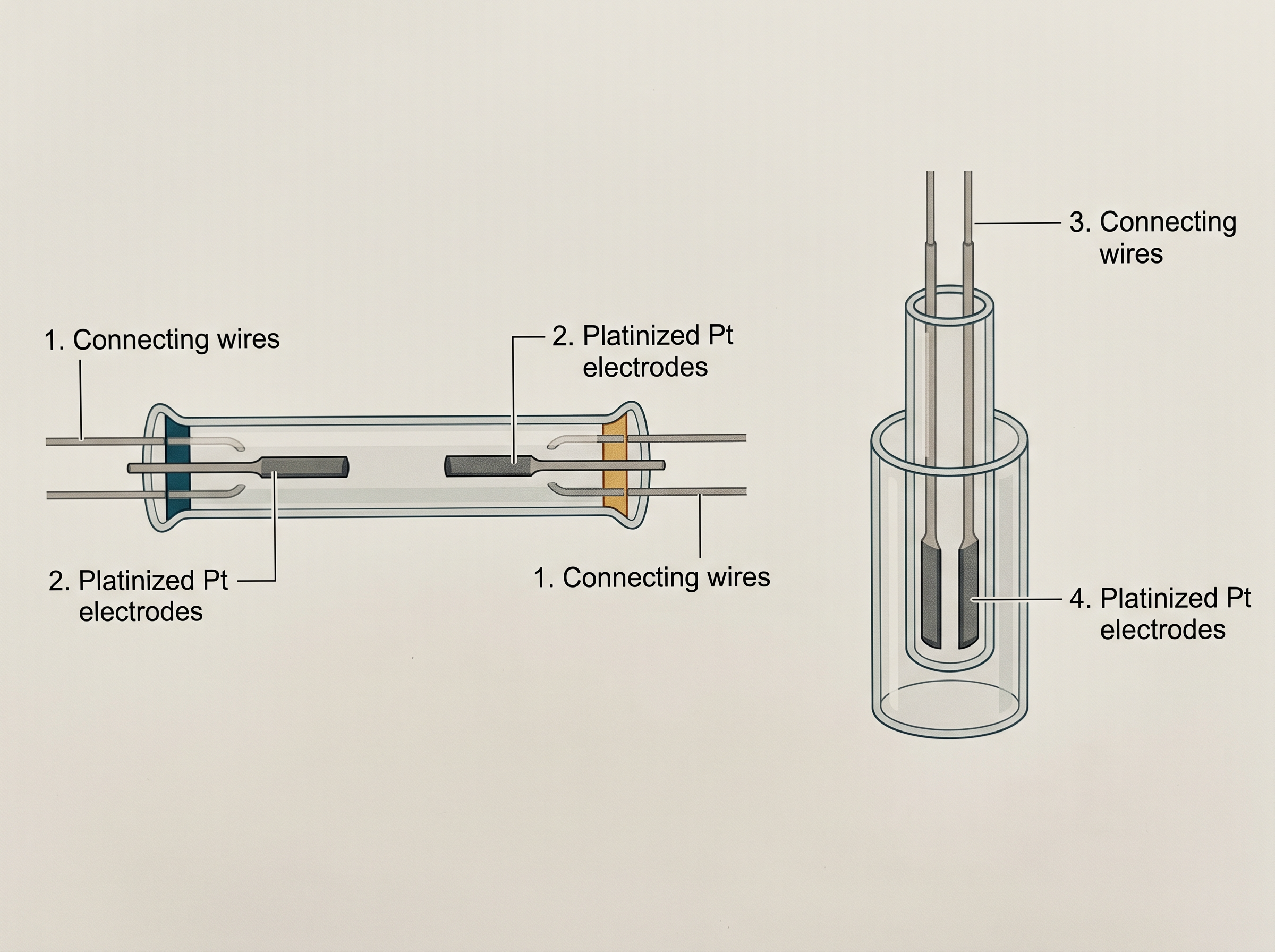
Basically it consists of two platinum electrodes coated with platinum black (finely divided metallic Pt is deposited on the electrodes electrochemically). These have an area of cross section equal to ‘\(A\)’ and are separated by a distance ‘\(l\)’. Therefore, the solution confined between these electrodes is a column of length \(l\) and area of cross section \(A\). The resistance of such a column of solution is then given by the equation:
\[R = \rho\,\frac{l}{A} = \frac{l}{\kappa A} \qquad (2.17)\]
The Cell Constant
The quantity \(l/A\) is called the cell constant, denoted by the symbol \(G^*\). It depends on the distance between the electrodes and their area of cross-section, and has the dimension of length\(^{-1}\), and can be calculated if we know \(l\) and \(A\).
But measurement of \(l\) and \(A\) is not only inconvenient but also unreliable — the electrodes are small, not perfectly flat and not perfectly parallel. So we determine \(G^*\) indirectly, by turning the problem around: instead of measuring the cell’s geometry, we put a solution of known conductivity into it.
The cell constant is usually determined by measuring the resistance of the cell containing a solution whose conductivity is already known. For this purpose, we generally use KCl solutions, whose conductivity is known accurately at various concentrations (Table 2.3) and at different temperatures. The cell constant, \(G^*\), is then given by the equation:
\[G^* = \frac{l}{A} = R\,\kappa \qquad (2.18)\]
Table 2.3: Conductivity and Molar conductivity of KCl solutions at 298.15 K
| 1.000 |
1000 |
0.1113 |
11.13 |
111.3 |
\(111.3\times10^{-4}\) |
| 0.100 |
100.0 |
0.0129 |
1.29 |
129.0 |
\(129.0\times10^{-4}\) |
| 0.010 |
10.00 |
0.00141 |
0.141 |
141.0 |
\(141.0\times10^{-4}\) |
Once the cell constant is determined, we can use it for measuring the resistance or conductivity of any solution. The set up for the measurement of the resistance is shown in Fig. 2.5.
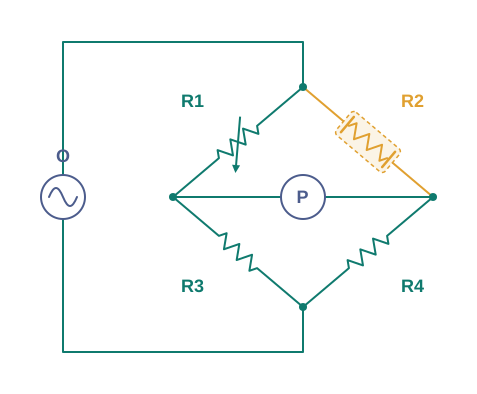
It consists of two resistances \(R_3\) and \(R_4\), a variable resistance \(R_1\) and the conductivity cell having the unknown resistance \(R_2\). The Wheatstone bridge is fed by an oscillator O (a source of a.c. power in the audio frequency range 550 to 5000 cycles per second). P is a suitable detector (a headphone or other electronic device), and the bridge is balanced when no current passes through the detector. Under these conditions:
\[\text{Unknown resistance } R_2 = \frac{R_1\,R_4}{R_3} \qquad (2.19)\]
These days, inexpensive conductivity meters are available which can directly read the conductance or resistance of the solution in the conductivity cell. Once the cell constant and the resistance of the solution in the cell are determined, the conductivity of the solution is given by the equation:
\[\kappa = \frac{\text{cell constant}}{R} = \frac{G^*}{R} \qquad (2.20)\]
A conductivity meter is the quickest honest test of how much dissolved ionic matter a water sample carries. Municipal supplies, boiler feed water and effluent leaving a factory are all monitored this way, because a rise in conductivity means a rise in dissolved salts, and it can be read in seconds by an instrument left permanently in the pipeline. Water for laboratory and pharmaceutical use is specified by an upper limit on conductivity — recall from Table 2.2 that pure water manages only \(3.5\times10^{-5}\) S m\(^{-1}\), so any appreciable reading tells you at once that the water is not pure. The same principle drives conductometric titrations, in which the end point is located by the sharp change in slope of a conductivity-versus-volume plot, and so can be found in a dark or coloured solution where no indicator could be seen.
Molar Conductivity
The conductivity of solutions of different electrolytes in the same solvent and at a given temperature differs due to the charge and size of the ions in which they dissociate, the concentration of ions, and the ease with which the ions move under a potential gradient.
This makes \(\kappa\) an awkward quantity for comparison: a concentrated solution will always out-conduct a dilute one, simply because it has more ions per unit volume, even if its ions are intrinsically poor carriers. It therefore becomes necessary to define a physically more meaningful quantity called molar conductivity, denoted by the symbol \(\Lambda_m\) (Greek, lambda). It is related to the conductivity of the solution by the equation:
\[\text{Molar conductivity} = \Lambda_m = \frac{\kappa}{c} \qquad (2.21)\]
Dividing by concentration is what removes the “how many ions are present” factor and leaves behind a measure of how well one mole of the electrolyte conducts.
Molar conductivity (\(\Lambda_m\)) of a solution is its conductivity divided by the molar concentration of the electrolyte, \(\Lambda_m = \kappa/c\).
In the above equation, if \(\kappa\) is expressed in S m\(^{-1}\) and the concentration, \(c\), in mol m\(^{-3}\), then the units of \(\Lambda_m\) are in S m\(^2\) mol\(^{-1}\). It may be noted that:
\[1\ \text{mol m}^{-3} = 1000\,(\text{L/m}^3) \times \text{molarity (mol/L)}\]
and hence
\[\Lambda_m\,(\text{S cm}^2\ \text{mol}^{-1}) = \frac{\kappa\ (\text{S cm}^{-1})}{1000\ \text{L m}^{-3} \times \text{molarity (mol L}^{-1})}\]
If we use S cm\(^{-1}\) as the units for \(\kappa\) and mol cm\(^{-3}\) as the units of concentration, then the units for \(\Lambda_m\) are S cm\(^2\) mol\(^{-1}\). It can be calculated by using the equation:
\[\Lambda_m\,(\text{S cm}^2\ \text{mol}^{-1}) = \frac{\kappa\ (\text{S cm}^{-1}) \times 1000\ (\text{cm}^3/\text{L})}{\text{molarity (mol/L)}}\]
Both types of units are used in the literature and are related to each other by the equations:
\[1\ \text{S m}^2\text{mol}^{-1} = 10^{4}\ \text{S cm}^2\text{mol}^{-1} \quad \text{or} \quad 1\ \text{S cm}^2\text{mol}^{-1} = 10^{-4}\ \text{S m}^2\text{mol}^{-1}\]
molar conductivity (\(\Lambda_m\)) (SI unit: S m\(^2\) mol\(^{-1}\); commonly quoted in S cm\(^2\) mol\(^{-1}\), with \(1\ \text{S cm}^2\text{mol}^{-1} = 10^{-4}\ \text{S m}^2\text{mol}^{-1}\). When working in cm-based units, remember the factor of 1000 that converts litres to cm\(^3\) — it is not a fudge factor but a unit conversion, and forgetting it is the classic mistake in these problems.)
Resistance of a conductivity cell filled with \(0.1\ \text{mol L}^{-1}\) KCl solution is \(100\ \Omega\). If the resistance of the same cell when filled with \(0.02\ \text{mol L}^{-1}\) KCl solution is \(520\ \Omega\), calculate the conductivity and molar conductivity of the \(0.02\ \text{mol L}^{-1}\) KCl solution. The conductivity of \(0.1\ \text{mol L}^{-1}\) KCl solution is 1.29 S/m.
The known KCl solution is used first, only to find the cell constant. The cell constant is given by the equation:
\[\text{Cell constant} = G^* = \text{conductivity} \times \text{resistance}\]
\[= 1.29\ \text{S/m} \times 100\ \Omega = 129\ \text{m}^{-1} = 1.29\ \text{cm}^{-1}\]
Conductivity of \(0.02\ \text{mol L}^{-1}\) KCl solution = cell constant / resistance
\[= \frac{G^*}{R} = \frac{129\ \text{m}^{-1}}{520\ \Omega} = 0.248\ \text{S m}^{-1}\]
\[\text{Concentration} = 0.02\ \text{mol L}^{-1}\]
\[= 1000 \times 0.02\ \text{mol m}^{-3} = 20\ \text{mol m}^{-3}\]
\[\text{Molar conductivity} = \Lambda_m = \frac{\kappa}{c}\]
\[= \frac{248 \times 10^{-3}\ \text{S m}^{-1}}{20\ \text{mol m}^{-3}} = 124 \times 10^{-4}\ \text{S m}^2\text{mol}^{-1}\]
Alternatively, working entirely in centimetre units,
\[\kappa = \frac{1.29\ \text{cm}^{-1}}{520\ \Omega} = 0.248 \times 10^{-2}\ \text{S cm}^{-1}\]
and
\[\Lambda_m = \kappa \times 1000\ \text{cm}^3\ \text{L}^{-1}\ \text{molarity}^{-1}\]
\[= \frac{0.248\times10^{-2}\ \text{S cm}^{-1} \times 1000\ \text{cm}^3\ \text{L}^{-1}}{0.02\ \text{mol L}^{-1}}\]
\[= 124\ \text{S cm}^2\ \text{mol}^{-1}\]
Both routes give the same physical answer, as the conversion \(1\ \text{S cm}^2\text{mol}^{-1} = 10^{-4}\ \text{S m}^2\text{mol}^{-1}\) confirms.
The electrical resistance of a column of \(0.05\ \text{mol L}^{-1}\) NaOH solution of diameter 1 cm and length 50 cm is \(5.55 \times 10^{3}\) ohm. Calculate its resistivity, conductivity and molar conductivity.
The column of solution is a cylinder, so its area of cross section comes from \(A = \pi r^2\) with \(r = 0.5\) cm (half the diameter).
\[A = \pi r^2 = 3.14 \times 0.5^2\ \text{cm}^2 = 0.785\ \text{cm}^2 = 0.785 \times 10^{-4}\ \text{m}^2\]
\[l = 50\ \text{cm} = 0.5\ \text{m}\]
\[R = \frac{\rho\,l}{A} \quad \text{or} \quad \rho = \frac{RA}{l} = \frac{5.55\times10^{3}\ \Omega \times 0.785\ \text{cm}^2}{50\ \text{cm}} = 87.135\ \Omega\ \text{cm}\]
\[\text{Conductivity} = \kappa = \frac{1}{\rho} = \left(\frac{1}{87.135}\right)\ \text{S cm}^{-1} = 0.01148\ \text{S cm}^{-1}\]
\[\text{Molar conductivity},\ \Lambda_m = \frac{\kappa \times 1000}{c}\ \text{cm}^3\ \text{L}^{-1}\]
\[= \frac{0.01148\ \text{S cm}^{-1} \times 1000\ \text{cm}^3\ \text{L}^{-1}}{0.05\ \text{mol L}^{-1}} = 229.6\ \text{S cm}^2\ \text{mol}^{-1}\]
If we want to calculate the values of the different quantities in terms of ‘m’ instead of ‘cm’,
\[\rho = \frac{RA}{l} = \frac{5.55\times10^{3}\ \Omega \times 0.785\times10^{-4}\ \text{m}^2}{0.5\ \text{m}} = 87.135 \times 10^{-2}\ \Omega\ \text{m}\]
\[\kappa = \frac{1}{\rho} = \frac{100}{87.135}\ \Omega\ \text{m} = 1.148\ \text{S m}^{-1}\]
and
\[\Lambda_m = \frac{\kappa}{c} = \frac{1.148\ \text{S m}^{-1}}{50\ \text{mol m}^{-3}} = 229.6 \times 10^{-4}\ \text{S m}^2\ \text{mol}^{-1}\]
(question only — no solution)
A conductivity cell has a cell constant of \(1.25\ \text{cm}^{-1}\). When filled with a \(0.05\ \text{mol L}^{-1}\) solution of an electrolyte, its resistance is \(250\ \Omega\). Calculate (i) the conductivity of the solution in S cm\(^{-1}\) and (ii) its molar conductivity in S cm\(^2\) mol\(^{-1}\).
2.4.2 Variation of Conductivity and Molar Conductivity with Concentration
Both conductivity and molar conductivity change with the concentration of the electrolyte. The two, however, change in opposite directions, and keeping the reason straight is the whole point of this subsection.
Conductivity always decreases with a decrease in concentration, both for weak and strong electrolytes. This can be explained by the fact that the number of ions per unit volume that carry the current in a solution decreases on dilution.
The conductivity of a solution at any given concentration is the conductance of one unit volume of solution kept between two platinum electrodes with unit area of cross section and at a distance of unit length. This is clear from the equation:
\[G = \frac{\kappa A}{l} = \kappa \quad \text{(both } A \text{ and } l \text{ are unity in their appropriate units in m or cm)}\]
Molar conductivity of a solution at a given concentration is the conductance of the volume \(V\) of solution containing one mole of electrolyte kept between two electrodes with area of cross section \(A\) and distance of unit length. Therefore,
\[\Lambda_m = \frac{\kappa A}{l} = \kappa\]
Since \(l = 1\) and \(A = V\) (the volume containing 1 mole of electrolyte),
\[\Lambda_m = \kappa\,V \qquad (2.22)\]
Molar conductivity increases with a decrease in concentration. This is because the total volume, \(V\), of solution containing one mole of electrolyte also increases. It has been found that the decrease in \(\kappa\) on dilution of a solution is more than compensated by the increase in its volume.
Physically, it means that at a given concentration, \(\Lambda_m\) can be defined as the conductance of the electrolytic solution kept between the electrodes of a conductivity cell at unit distance, but having an area of cross section large enough to accommodate sufficient volume of solution that contains one mole of the electrolyte.
Q3. When you dilute an electrolyte solution, the number of ions in every cubic centimetre goes down — yet chemists say the molar conductivity goes up. How can both statements be true at once?
A. Because the two quantities count different things. Conductivity, \(\kappa\), asks: “how well does one cubic centimetre of this solution conduct?” Dilute the solution and that cubic centimetre holds fewer ions, so \(\kappa\) falls. Molar conductivity asks a different question: “how well does the solution containing one mole of electrolyte conduct?” On dilution, that one mole is spread through a much larger volume \(V\), and by Eq. (2.22), \(\Lambda_m = \kappa V\). The fall in \(\kappa\) is more than made up for by the rise in \(V\), so \(\Lambda_m\) increases. In short: fewer ions per cm\(^3\), but the same one mole of ions, now less crowded and freer to move. Both statements are true because they are answers to different questions.
When the concentration approaches zero, the molar conductivity is known as limiting molar conductivity and is represented by the symbol \(\Lambda^\circ_m\). The variation in \(\Lambda_m\) with concentration is different (Fig. 2.6) for strong and weak electrolytes.
Limiting molar conductivity (\(\Lambda^\circ_m\)) is the molar conductivity of an electrolyte solution as its concentration approaches zero, i.e., at infinite dilution.
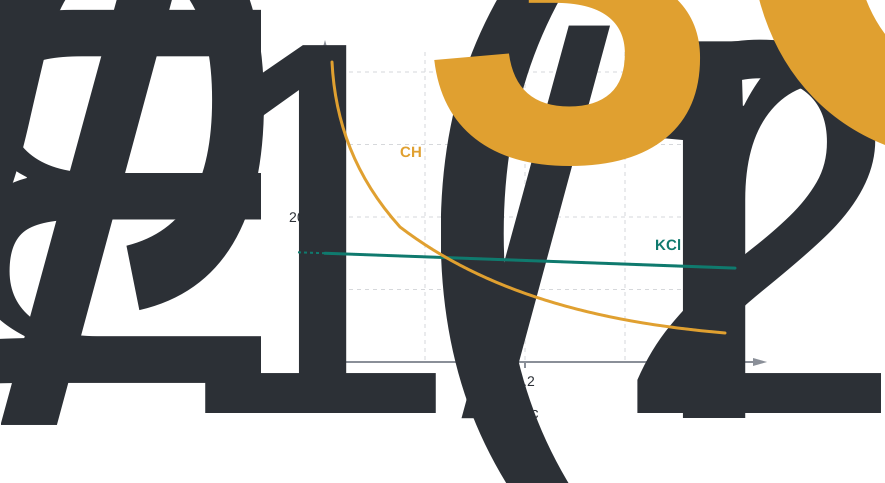
the two curves of Fig. 2.6 — molar conductivity of KCl and of acetic acid against \(c^{1/2}\) (Study Fig. 2.6 and answer: (i) Which curve allows \(\Lambda^\circ_m\) to be read off simply by extending the line to the y-axis, and why does that trick fail for the other one? (ii) The acetic acid curve shoots up sharply only when the solution is very dilute. What is happening to the acetic acid molecules in that region that is not happening to KCl? (iii) At a moderate concentration, KCl has a far higher \(\Lambda_m\) than acetic acid — yet at infinite dilution the gap between them is much smaller. What does this tell you about the number of ions each electrolyte actually supplies at ordinary concentrations?)
Strong Electrolytes
For strong electrolytes, \(\Lambda_m\) increases slowly with dilution and can be represented by the equation:
\[\Lambda_m = \Lambda^\circ_m - A\,c^{1/2} \qquad (2.23)\]
It can be seen that if we plot (Fig. 2.6) \(\Lambda_m\) against \(c^{1/2}\), we obtain a straight line with intercept equal to \(\Lambda^\circ_m\) and slope equal to ‘\(-A\)’. This is exactly why we plot against the square root of concentration rather than against concentration itself: only then does the data fall on a straight line whose intercept can be read off with confidence.
The value of the constant ‘\(A\)’ for a given solvent and temperature depends on the type of electrolyte, i.e., the charges on the cation and anion produced on the dissociation of the electrolyte in the solution. Thus, NaCl, CaCl\(_2\) and MgSO\(_4\) are known as 1-1, 2-1 and 2-2 electrolytes respectively. All electrolytes of a particular type have the same value for ‘\(A\)’.
The molar conductivity of KCl solutions at different concentrations at 298 K are given below:
| \(c\) / mol L\(^{-1}\) | \(\Lambda_m\) / S cm\(^2\) mol\(^{-1}\) |
|—|—|
| 0.000198 | 148.61 |
| 0.000309 | 148.29 |
| 0.000521 | 147.81 |
| 0.000989 | 147.09 |
Show that a plot between \(\Lambda_m\) and \(c^{1/2}\) is a straight line. Determine the values of \(\Lambda^\circ_m\) and A for KCl.
Taking the square root of concentration we obtain:
\(c^{1/2}\) / (mol L\(^{-1}\))\(^{1/2}\) | \(\Lambda_m\) / S cm\(^2\) mol\(^{-1}\) |
|—|—|
0.01407 | 148.61 |
0.01758 | 148.29 |
0.02283 | 147.81 |
0.03145 | 147.09 |
A plot of \(\Lambda_m\) (y-axis) and \(c^{1/2}\) (x-axis) is shown in Fig. 2.7.
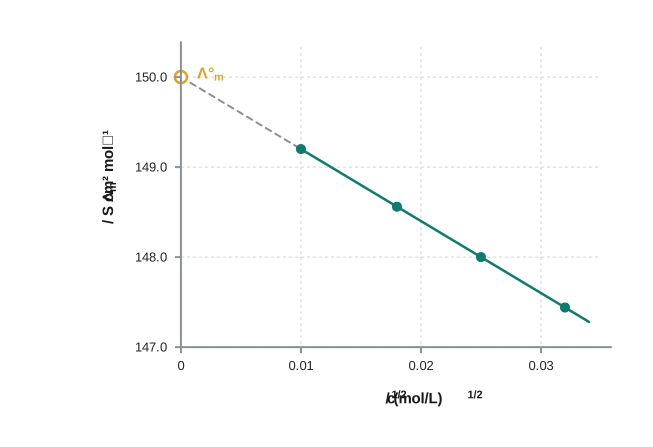
It can be seen that it is nearly a straight line. From the intercept (\(c^{1/2} = 0\)), we find that
\[\Lambda^\circ_m = 150.0\ \text{S cm}^2\ \text{mol}^{-1}\]
and
\[A = -\,\text{slope} = 87.46\ \text{S cm}^2\ \text{mol}^{-1}/(\text{mol/L}^{-1})^{1/2}\]
Kohlrausch’s Observation and His Law
Kohlrausch examined \(\Lambda^\circ_m\) values for a number of strong electrolytes and observed certain regularities. He noted that the difference in \(\Lambda^\circ_m\) of the electrolytes NaX and KX for any X is nearly constant. For example at 298 K:
\[\Lambda^\circ_{m\,(\mathrm{KCl})} - \Lambda^\circ_{m\,(\mathrm{NaCl})} = \Lambda^\circ_{m\,(\mathrm{KBr})} - \Lambda^\circ_{m\,(\mathrm{NaBr})}\]
\[= \Lambda^\circ_{m\,(\mathrm{KI})} - \Lambda^\circ_{m\,(\mathrm{NaI})} \simeq 23.4\ \text{S cm}^2\ \text{mol}^{-1}\]
and similarly it was found that
\[\Lambda^\circ_{m\,(\mathrm{NaBr})} - \Lambda^\circ_{m\,(\mathrm{NaCl})} = \Lambda^\circ_{m\,(\mathrm{KBr})} - \Lambda^\circ_{m\,(\mathrm{KCl})} \simeq 1.8\ \text{S cm}^2\ \text{mol}^{-1}\]
Read those two lines carefully, because the conclusion is hiding in plain sight. Swapping \(\mathrm{Na^{+}}\) for \(\mathrm{K^{+}}\) always changes the total by the same amount, no matter which anion is present; swapping \(\mathrm{Cl^{-}}\) for \(\mathrm{Br^{-}}\) always changes it by the same amount, no matter which cation is present. Each ion, at infinite dilution, must therefore be making its own fixed contribution, quite independently of its partner.
On the basis of the above observations he enunciated Kohlrausch’s law of independent migration of ions.
Kohlrausch’s law of independent migration of ions: at infinite dilution, the limiting molar conductivity of an electrolyte is the sum of the individual contributions of its cation and its anion, each ion migrating independently of the other.
Thus, if \(\lambda^\circ_{\mathrm{Na^{+}}}\) and \(\lambda^\circ_{\mathrm{Cl^{-}}}\) are the limiting molar conductivities of the sodium and chloride ions respectively, then the limiting molar conductivity for sodium chloride is given by the equation:
\[\Lambda^\circ_{m\,(\mathrm{NaCl})} = \lambda^\circ_{\mathrm{Na^{+}}} + \lambda^\circ_{\mathrm{Cl^{-}}} \qquad (2.24)\]
In general, if an electrolyte on dissociation gives \(\nu_{+}\) cations and \(\nu_{-}\) anions, then its limiting molar conductivity is given by:
\[\Lambda^\circ_m = \nu_{+}\,\lambda^\circ_{+} + \nu_{-}\,\lambda^\circ_{-} \qquad (2.25)\]
Here, \(\lambda^\circ_{+}\) and \(\lambda^\circ_{-}\) are the limiting molar conductivities of the cation and anion respectively. The numbers \(\nu_{+}\) and \(\nu_{-}\) are simply how many of each ion one formula unit releases — for \(\mathrm{CaCl_2}\), \(\nu_{+} = 1\) and \(\nu_{-} = 2\). Forgetting these multipliers is a standard slip in examinations.
The values of \(\lambda^\circ\) for some cations and anions at 298 K are given in Table 2.4.
Table 2.4: Limiting Molar Conductivity for some Ions in Water at 298 K
| \(\mathrm{H^{+}}\) |
349.6 |
\(\mathrm{OH^{-}}\) |
199.1 |
| \(\mathrm{Na^{+}}\) |
50.1 |
\(\mathrm{Cl^{-}}\) |
76.3 |
| \(\mathrm{K^{+}}\) |
73.5 |
\(\mathrm{Br^{-}}\) |
78.1 |
| \(\mathrm{Ca^{2+}}\) |
119.0 |
\(\mathrm{CH_3COO^{-}}\) |
40.9 |
| \(\mathrm{Mg^{2+}}\) |
106.0 |
\(\mathrm{SO_4^{2-}}\) |
160.0 |
Weak Electrolytes
Weak electrolytes like acetic acid have a lower degree of dissociation at higher concentrations, and hence for such electrolytes, the change in \(\Lambda_m\) with dilution is due to an increase in the degree of dissociation and consequently the number of ions in the total volume of solution that contains 1 mol of electrolyte.
So for a weak electrolyte, dilution does not merely spread existing ions out — it actually creates more ions, by pushing the dissociation equilibrium forward. In such cases \(\Lambda_m\) increases steeply (Fig. 2.6) on dilution, especially near lower concentrations.
Therefore, \(\Lambda^\circ_m\) cannot be obtained by extrapolation of \(\Lambda_m\) to zero concentration. The curve for acetic acid in Fig. 2.6 is rising almost vertically as it approaches the axis, and there is simply no straight portion to extend.
At infinite dilution (i.e., concentration \(c \rightarrow\) zero), the electrolyte dissociates completely (\(\alpha = 1\)), but at such low concentration the conductivity of the solution is so low that it cannot be measured accurately. Therefore, \(\Lambda^\circ_m\) for weak electrolytes is obtained by using Kohlrausch’s law of independent migration of ions (Example 2.11). We build the value up from ions rather than trying to measure it.
At any concentration \(c\), if \(\alpha\) is the degree of dissociation, then it can be approximated to the ratio of molar conductivity \(\Lambda_m\) at the concentration \(c\) to the limiting molar conductivity, \(\Lambda^\circ_m\). Thus we have:
\[\alpha = \frac{\Lambda_m}{\Lambda^\circ_m} \qquad (2.26)\]
The logic is straightforward: \(\Lambda^\circ_m\) is what the electrolyte would conduct if every molecule were dissociated; \(\Lambda_m\) is what it actually conducts. The ratio of the two is therefore the fraction actually dissociated.
But we know that for a weak electrolyte like acetic acid (Class XI, Chapter 7),
\[K_a = \frac{c\,\alpha^2}{(1 - \alpha)} = \frac{c\,\Lambda_m^2}{\Lambda_m^{\circ\,2}\left(1 - \dfrac{\Lambda_m}{\Lambda^\circ_m}\right)} = \frac{c\,\Lambda_m^2}{\Lambda^\circ_m\left(\Lambda^\circ_m - \Lambda_m\right)} \qquad (2.27)\]
Strong electrolyte vs Weak electrolyte (conductivity behaviour)
| Dissociation in solution |
Essentially complete at all concentrations |
Partial; degree of dissociation \(\alpha < 1\) |
| Why \(\Lambda_m\) rises on dilution |
Ions already present move more freely (less interionic attraction) |
More ions are actually produced, as \(\alpha\) increases |
| Shape of \(\Lambda_m\) vs \(c^{1/2}\) plot |
Nearly straight line, small slope |
Rises very steeply near zero concentration |
| Obtaining \(\Lambda^\circ_m\) |
By extrapolating the straight line to \(c^{1/2} = 0\) |
Extrapolation fails; use Kohlrausch’s law instead |
| Governing equation |
\(\Lambda_m = \Lambda^\circ_m - A\,c^{1/2}\) |
\(\alpha = \Lambda_m/\Lambda^\circ_m\); \(K_a = c\alpha^2/(1-\alpha)\) |
Applications of Kohlrausch’s Law
Using Kohlrausch’s law of independent migration of ions, it is possible to calculate \(\Lambda^\circ_m\) for any electrolyte from the \(\lambda^\circ\) of individual ions. Moreover, for weak electrolytes like acetic acid it is possible to determine the value of its dissociation constant once we know the \(\Lambda^\circ_m\) and \(\Lambda_m\) at a given concentration \(c\).
Calculate \(\Lambda^\circ_m\) for \(\mathrm{CaCl_2}\) and \(\mathrm{MgSO_4}\) from the data given in Table 2.4.
We know from Kohlrausch’s law that
\[\Lambda^\circ_{m(\mathrm{CaCl_2})} = \lambda^\circ_{\mathrm{Ca^{2+}}} + 2\lambda^\circ_{\mathrm{Cl^{-}}} = 119.0\ \text{S cm}^2\ \text{mol}^{-1} + 2(76.3)\ \text{S cm}^2\ \text{mol}^{-1}\]
\[= (119.0 + 152.6)\ \text{S cm}^2\ \text{mol}^{-1}\]
\[= 271.6\ \text{S cm}^2\ \text{mol}^{-1}\]
\[\Lambda^\circ_{m(\mathrm{MgSO_4})} = \lambda^\circ_{\mathrm{Mg^{2+}}} + \lambda^\circ_{\mathrm{SO_4^{2-}}} = 106.0\ \text{S cm}^2\ \text{mol}^{-1} + 160.0\ \text{S cm}^2\ \text{mol}^{-1}\]
\[= 266\ \text{S cm}^2\ \text{mol}^{-1}\]
Notice the factor of 2 in the first calculation and its absence in the second: \(\mathrm{CaCl_2}\) gives two chloride ions per formula unit, while \(\mathrm{MgSO_4}\) gives one of each.
\(\Lambda^\circ_m\) for NaCl, HCl and NaAc are 126.4, 425.9 and 91.0 S cm\(^2\) mol\(^{-1}\) respectively. Calculate \(\Lambda^\circ\) for HAc.
\[\Lambda^\circ_{m(\mathrm{HAc})} = \lambda^\circ_{\mathrm{H^{+}}} + \lambda^\circ_{\mathrm{Ac^{-}}} = \lambda^\circ_{\mathrm{H^{+}}} + \lambda^\circ_{\mathrm{Cl^{-}}} + \lambda^\circ_{\mathrm{Ac^{-}}} + \lambda^\circ_{\mathrm{Na^{+}}} - \lambda^\circ_{\mathrm{Cl^{-}}} - \lambda^\circ_{\mathrm{Na^{+}}}\]
\[= \Lambda^\circ_{m(\mathrm{HCl})} + \Lambda^\circ_{m(\mathrm{NaAc})} - \Lambda^\circ_{m(\mathrm{NaCl})}\]
\[= (425.9 + 91.0 - 126.4)\ \text{S cm}^2\ \text{mol}^{-1}\]
\[= 390.5\ \text{S cm}^2\ \text{mol}^{-1}\]
The trick, worth learning, is that \(\mathrm{Na^{+}}\) and \(\mathrm{Cl^{-}}\) have been added and then subtracted again. Kohlrausch’s law lets us assemble a weak electrolyte’s \(\Lambda^\circ_m\) out of three strong electrolytes whose values can be measured directly.
The conductivity of \(0.001028\ \text{mol L}^{-1}\) acetic acid is \(4.95 \times 10^{-5}\) S cm\(^{-1}\). Calculate its dissociation constant if \(\Lambda^\circ_m\) for acetic acid is 390.5 S cm\(^2\) mol\(^{-1}\).
\[\Lambda_m = \frac{\kappa}{c} = \frac{4.95\times10^{-5}\ \text{S cm}^{-1}}{0.001028\ \text{mol L}^{-1}} \times \frac{1000\ \text{cm}^3}{\text{L}} = 48.15\ \text{S cm}^2\ \text{mol}^{-1}\]
\[\alpha = \frac{\Lambda_m}{\Lambda^\circ_m} = \frac{48.15\ \text{S cm}^2\text{mol}^{-1}}{390.5\ \text{S cm}^2\text{mol}^{-1}} = 0.1233\]
\[K_a = \frac{c\,\alpha^2}{(1-\alpha)} = \frac{0.001028\ \text{mol L}^{-1} \times (0.1233)^2}{1 - 0.1233} = 1.78 \times 10^{-5}\ \text{mol L}^{-1}\]
Only about 12% of the acetic acid molecules are dissociated even in this very dilute solution — which is precisely what “weak electrolyte” means, and why its \(\Lambda_m\) (48.15) is so far below its \(\Lambda^\circ_m\) (390.5).
Using Table 2.4, calculate the limiting molar conductivity of potassium sulphate, \(\mathrm{K_2SO_4}\).
First write the dissociation, so that the number of each ion is clear:
\[\mathrm{K_2SO_4}\text{(aq)} \rightarrow 2\,\mathrm{K^{+}}\text{(aq)} + \mathrm{SO_4^{2-}}\text{(aq)}\]
So \(\nu_{+} = 2\) and \(\nu_{-} = 1\). By Kohlrausch’s law, Eq. (2.25):
\[\Lambda^\circ_{m(\mathrm{K_2SO_4})} = 2\,\lambda^\circ_{\mathrm{K^{+}}} + \lambda^\circ_{\mathrm{SO_4^{2-}}}\]
\[= 2(73.5)\ \text{S cm}^2\ \text{mol}^{-1} + 160.0\ \text{S cm}^2\ \text{mol}^{-1}\]
\[= 147.0 + 160.0 = 307.0\ \text{S cm}^2\ \text{mol}^{-1}\]
The step that decides the answer is writing the dissociation equation first. A student who reaches straight for “\(\lambda^\circ_{+} + \lambda^\circ_{-}\)” without it would obtain 233.5 and be wrong by exactly one potassium ion.
(question only — no solution)
Using Table 2.4, calculate the limiting molar conductivity of (i) \(\mathrm{MgCl_2}\) and (ii) \(\mathrm{Ca(OH)_2}\). In each case, write the dissociation equation first and state the values of \(\nu_{+}\) and \(\nu_{-}\) you have used.
2.7 Why does the conductivity of a solution decrease with dilution?
2.8 Suggest a way to determine the \(\Lambda^\circ_m\) value of water.
2.9 The molar conductivity of \(0.025\ \text{mol L}^{-1}\) methanoic acid is 46.1 S cm\(^2\) mol\(^{-1}\). Calculate its degree of dissociation and dissociation constant. Given \(\lambda^\circ(\mathrm{H^{+}}) = 349.6\ \text{S cm}^2\ \text{mol}^{-1}\) and \(\lambda^\circ(\mathrm{HCOO^{-}}) = 54.6\ \text{S cm}^2\ \text{mol}^{-1}\).
2.5 Electrolytic Cells and Electrolysis
In an electrolytic cell, an external source of voltage is used to bring about a chemical reaction. We met this idea in Section 2.1, when an opposing voltage larger than 1.1 V drove the Daniell cell backwards. We now look at what such cells are used for, and how much electricity a given amount of chemical change actually costs.
The electrochemical processes are of great importance in the laboratory and in the chemical industry.
Electrolysis of Copper Sulphate
One of the simplest electrolytic cells consists of two copper strips dipping in an aqueous solution of copper sulphate. If a DC voltage is applied to the two electrodes, then \(\mathrm{Cu^{2+}}\) ions discharge at the cathode (negatively charged) and the following reaction takes place:
\[\mathrm{Cu^{2+}}\text{(aq)} + 2\,\mathrm{e^-} \rightarrow \mathrm{Cu}\text{(s)} \qquad (2.28)\]
Copper metal is deposited on the cathode. At the anode, copper is converted into \(\mathrm{Cu^{2+}}\) ions by the reaction:
\[\mathrm{Cu}\text{(s)} \rightarrow \mathrm{Cu^{2+}}\text{(aq)} + 2\,\mathrm{e^-} \qquad (2.29)\]
Thus copper is dissolved (oxidised) at the anode and deposited (reduced) at the cathode. Net chemical change in the solution is nil — copper is simply being transported from one electrode to the other. That apparently pointless shuffle is in fact extremely valuable.
Electrolysis in Industry
This is the basis for an industrial process in which impure copper is converted into copper of high purity. The impure copper is made an anode that dissolves on passing current, and pure copper is deposited at the cathode. The impurities either stay behind as an insoluble sludge or remain dissolved in the electrolyte, because the applied voltage is chosen so that only copper is discharged.
Many metals like Na, Mg, Al, etc., are produced on a large scale by the electrochemical reduction of their respective cations, where no suitable chemical reducing agent is available for this purpose. Their cations hold on to electrons so strongly (look again at the very negative \(E^\circ\) values in Table 2.1) that no ordinary reducing agent such as carbon can pull the metal out — but a sufficiently large applied voltage always can.
Sodium and magnesium metals are produced by the electrolysis of their fused chlorides, and aluminium is produced by the electrolysis of aluminium oxide in the presence of cryolite.
Aluminium is the most abundant metal in the Earth’s crust, yet through most of the nineteenth century it was a luxury item, costlier than silver, because no cheap way existed to prise it away from oxygen. Aluminium oxide melts only at a punishing temperature, which made straightforward electrolysis of the molten oxide impractical. In 1886, Charles Martin Hall in the United States and Paul Héroult in France independently hit on the same answer: dissolve the alumina in molten cryolite, which brings the working temperature down to something a furnace can hold, and then electrolyse the melt. The two men were the same age, and their process — still called the Hall–Héroult process — turned aluminium from a precious metal into the material of window frames and aeroplanes within a generation.
Quantitative Aspects of Electrolysis
Michael Faraday was the first scientist who described the quantitative aspects of electrolysis. Now Faraday’s laws also flow from what has been discussed earlier — once you accept that each ion needs a definite number of electrons to be discharged, the laws are almost inevitable.
Faraday’s Laws of Electrolysis
After his extensive investigations on the electrolysis of solutions and melts of electrolytes, Faraday published his results during 1833-34 in the form of the following well known Faraday’s two laws of electrolysis:
(i) First Law: The amount of chemical reaction which occurs at any electrode during electrolysis by a current is proportional to the quantity of electricity passed through the electrolyte (solution or melt).
Faraday’s first law of electrolysis: the amount of substance chemically changed at an electrode is directly proportional to the quantity of electricity (charge) passed through the electrolyte.
(ii) Second Law: The amounts of different substances liberated by the same quantity of electricity passing through the electrolytic solution are proportional to their chemical equivalent weights (Atomic Mass of Metal ÷ Number of electrons required to reduce the cation).
Faraday’s second law of electrolysis: when the same quantity of electricity is passed through different electrolytes, the masses of the substances liberated are proportional to their chemical equivalent weights (atomic mass ÷ number of electrons needed to reduce the cation).
The second law is really just stoichiometry in disguise. The same charge delivers the same number of moles of electrons to every cell in the series; a cation needing three electrons therefore yields only one-third as many moles of metal as a cation needing one.
Charge, the Faraday, and the Electrode Reaction
There were no constant current sources available during Faraday’s times. The general practice was to put a coulometer (a standard electrolytic cell) in the circuit for determining the quantity of electricity passed, from the amount of metal (generally silver or copper) deposited or consumed.
However, coulometers are now obsolete, and we now have constant current (\(I\)) sources available, so the quantity of electricity \(Q\) passed is given by
\[Q = It\]
\(Q\) is in coulombs when \(I\) is in amperes and \(t\) is in seconds. Note the “seconds” carefully: a time given in minutes or hours must always be converted before use.
quantity of electricity (\(Q\)) and the Faraday constant (\(F\)) (Charge \(Q\): SI unit coulomb, C; \(Q = It\) with \(I\) in ampere and \(t\) in second. Faraday constant \(F = 96487\ \text{C mol}^{-1}\) — the charge carried by one mole of electrons; for approximate calculations \(1\,\text{F} \simeq 96500\ \text{C mol}^{-1}\). The bridge between the electrical world and the chemical world is: moles of electrons \(= Q/F\).)
The amount of electricity (or charge) required for oxidation or reduction depends on the stoichiometry of the electrode reaction. For example, in the reaction:
\[\mathrm{Ag^{+}}\text{(aq)} + \mathrm{e^-} \rightarrow \mathrm{Ag}\text{(s)} \qquad (2.30)\]
One mole of electrons is required for the reduction of one mole of silver ions.
We know that the charge on one electron is equal to \(1.6021 \times 10^{-19}\) C. Therefore, the charge on one mole of electrons is equal to:
\[N_A \times 1.6021 \times 10^{-19}\ \text{C} = 6.02 \times 10^{23}\ \text{mol}^{-1} \times 1.6021 \times 10^{-19}\]
\[\text{C} = 96487\ \text{C mol}^{-1}\]
This quantity of electricity is called a Faraday and is represented by the symbol F.
For approximate calculations we use \(1\,\text{F} \simeq 96500\ \text{C mol}^{-1}\).
For the electrode reactions:
\[\mathrm{Mg^{2+}}\text{(l)} + 2\,\mathrm{e^-} \longrightarrow \mathrm{Mg}\text{(s)} \qquad (2.31)\]
\[\mathrm{Al^{3+}}\text{(l)} + 3\,\mathrm{e^-} \longrightarrow \mathrm{Al}\text{(s)} \qquad (2.32)\]
it is obvious that one mole of \(\mathrm{Mg^{2+}}\) and \(\mathrm{Al^{3+}}\) require 2 mol of electrons (2F) and 3 mol of electrons (3F) respectively.
The charge passed through the electrolytic cell during electrolysis is equal to the product of current in amperes and time in seconds. In commercial production of metals, currents as high as 50,000 amperes are used, which amounts to about 0.518 F per second.
A solution of \(\mathrm{CuSO_4}\) is electrolysed for 10 minutes with a current of 1.5 amperes. What is the mass of copper deposited at the cathode?
The time must first be put into seconds, because the ampere is a coulomb per second.
\[t = 600\ \text{s} \qquad \text{charge} = \text{current} \times \text{time} = 1.5\ \text{A} \times 600\ \text{s} = 900\ \text{C}\]
According to the reaction:
\[\mathrm{Cu^{2+}}\text{(aq)} + 2\,\mathrm{e^-} = \mathrm{Cu}\text{(s)}\]
We require 2F or \(2 \times 96487\) C to deposit 1 mol or 63 g of Cu.
For 900 C, the mass of Cu deposited
\[= (63\ \text{g mol}^{-1} \times 900\ \text{C})/(2 \times 96487\ \text{C mol}^{-1}) = 0.2938\ \text{g}\]
A current of 2.0 A is passed for 30 minutes through molten aluminium chloride. Calculate the mass of aluminium deposited at the cathode. (Atomic mass of Al = 27 g mol\(^{-1}\); take \(F = 96500\ \text{C mol}^{-1}\).)
Step 1 — charge passed. Convert the time to seconds:
\[t = 30 \times 60 = 1800\ \text{s}\]
\[Q = It = 2.0\ \text{A} \times 1800\ \text{s} = 3600\ \text{C}\]
Step 2 — moles of electrons.
\[n(\mathrm{e^-}) = \frac{Q}{F} = \frac{3600\ \text{C}}{96500\ \text{C mol}^{-1}} = 0.0373\ \text{mol}\]
Step 3 — moles of aluminium. The electrode reaction is
\[\mathrm{Al^{3+}}\text{(l)} + 3\,\mathrm{e^-} \rightarrow \mathrm{Al}\text{(s)}\]
so three moles of electrons are needed per mole of aluminium:
\[n(\mathrm{Al}) = \frac{0.0373}{3} = 0.0124\ \text{mol}\]
Step 4 — mass.
\[m(\mathrm{Al}) = 0.0124\ \text{mol} \times 27\ \text{g mol}^{-1} = 0.34\ \text{g}\]
About a third of a gram — which quietly explains why aluminium smelters are built next to power stations, and why the currents quoted above run to tens of thousands of amperes.
(question only — no solution)
For how long must a current of 2.0 A be passed through an aqueous solution of \(\mathrm{CuSO_4}\) to deposit 1.0 g of copper at the cathode? (Atomic mass of Cu = 63.5 g mol\(^{-1}\); \(F = 96500\ \text{C mol}^{-1}\).)
2.5.1 Products of Electrolysis
Products of electrolysis depend on the nature of the material being electrolysed and the type of electrodes being used.
If the electrode is inert (e.g., platinum or gold), it does not participate in the chemical reaction and acts only as a source or sink for electrons. On the other hand, if the electrode is reactive, it participates in the electrode reaction — as the copper anode did in Eq. (2.29). Thus, the products of electrolysis may be different for reactive and inert electrodes.
The products of electrolysis depend on the different oxidising and reducing species present in the electrolytic cell and their standard electrode potentials. In other words, several reactions are usually possible at each electrode, and they compete; Table 2.1 tells us which one wins.
Moreover, some of the electrochemical processes, although feasible, are so slow kinetically that at lower voltages these do not seem to take place, and extra potential (called overpotential) has to be applied, which makes such processes more difficult to occur. Overpotential is a reminder that thermodynamics tells us what can happen, not how fast — and a reaction that is too sluggish can be beaten to the electrode by a thermodynamically less favourable rival.
Molten Sodium Chloride
For example, if we use molten NaCl, the products of electrolysis are sodium metal and \(\mathrm{Cl_2}\) gas. Here we have only one cation (\(\mathrm{Na^{+}}\)), which is reduced at the cathode (\(\mathrm{Na^{+}} + \mathrm{e^-} \rightarrow \mathrm{Na}\)), and one anion (\(\mathrm{Cl^{-}}\)), which is oxidised at the anode (\(\mathrm{Cl^{-}} \rightarrow \tfrac{1}{2}\mathrm{Cl_2} + \mathrm{e^-}\)). With no water present, there is no competition at all, and the outcome is decided for us.
Aqueous Sodium Chloride
During the electrolysis of aqueous sodium chloride solution, the products are NaOH, \(\mathrm{Cl_2}\) and \(\mathrm{H_2}\). In this case, besides \(\mathrm{Na^{+}}\) and \(\mathrm{Cl^{-}}\) ions, we also have \(\mathrm{H^{+}}\) and \(\mathrm{OH^{-}}\) ions along with the solvent molecules, \(\mathrm{H_2O}\). Water changes everything, because it offers a rival reaction at each electrode.
At the cathode there is competition between the following reduction reactions:
\[\mathrm{Na^{+}}\text{(aq)} + \mathrm{e^-} \rightarrow \mathrm{Na}\text{(s)} \qquad E^\circ_{(\text{cell})} = -2.71\ \text{V}\]
\[\mathrm{H^{+}}\text{(aq)} + \mathrm{e^-} \rightarrow \tfrac{1}{2}\,\mathrm{H_2}\text{(g)} \qquad E^\circ_{(\text{cell})} = 0.00\ \text{V}\]
The reaction with the higher value of \(E^\circ\) is preferred, and therefore the reaction at the cathode during electrolysis is:
\[\mathrm{H^{+}}\text{(aq)} + \mathrm{e^-} \rightarrow \tfrac{1}{2}\,\mathrm{H_2}\text{(g)} \qquad (2.33)\]
but \(\mathrm{H^{+}}\) (aq) is produced by the dissociation of \(\mathrm{H_2O}\), i.e.,
\[\mathrm{H_2O}\text{(l)} \rightarrow \mathrm{H^{+}}\text{(aq)} + \mathrm{OH^{-}}\text{(aq)} \qquad (2.34)\]
Therefore, the net reaction at the cathode may be written as the sum of (2.33) and (2.34), and we have
\[\mathrm{H_2O}\text{(l)} + \mathrm{e^-} \rightarrow \tfrac{1}{2}\,\mathrm{H_2}\text{(g)} + \mathrm{OH^{-}} \qquad (2.35)\]
This is the origin of the sodium hydroxide: the \(\mathrm{OH^{-}}\) left behind accumulates around the cathode, and the \(\mathrm{Na^{+}}\) ions that were never discharged remain in solution as its partner.
At the anode the following oxidation reactions are possible:
\[\mathrm{Cl^{-}}\text{(aq)} \rightarrow \tfrac{1}{2}\,\mathrm{Cl_2}\text{(g)} + \mathrm{e^-} \qquad E^\circ_{(\text{cell})} = 1.36\ \text{V} \qquad (2.36)\]
\[2\,\mathrm{H_2O}\text{(l)} \rightarrow \mathrm{O_2}\text{(g)} + 4\,\mathrm{H^{+}}\text{(aq)} + 4\,\mathrm{e^-} \qquad E^\circ_{(\text{cell})} = 1.23\ \text{V} \qquad (2.37)\]
The reaction at the anode with the lower value of \(E^\circ\) is preferred, and therefore water should get oxidised in preference to \(\mathrm{Cl^{-}}\) (aq). However, on account of the overpotential of oxygen, reaction (2.36) is preferred. Chlorine, not oxygen, is what actually bubbles off — a textbook case of kinetics overruling thermodynamics.
Thus, the net reactions may be summarised as:
\[\mathrm{NaCl}\text{(aq)} \xrightarrow{\ \mathrm{H_2O}\ } \mathrm{Na^{+}}\text{(aq)} + \mathrm{Cl^{-}}\text{(aq)}\]
\[\text{Cathode:}\quad \mathrm{H_2O}\text{(l)} + \mathrm{e^-} \rightarrow \tfrac{1}{2}\,\mathrm{H_2}\text{(g)} + \mathrm{OH^{-}}\text{(aq)}\]
\[\text{Anode:}\quad \mathrm{Cl^{-}}\text{(aq)} \rightarrow \tfrac{1}{2}\,\mathrm{Cl_2}\text{(g)} + \mathrm{e^-}\]
Net reaction:
\[\mathrm{NaCl}\text{(aq)} + \mathrm{H_2O}\text{(l)} \rightarrow \mathrm{Na^{+}}\text{(aq)} + \mathrm{OH^{-}}\text{(aq)} + \tfrac{1}{2}\,\mathrm{H_2}\text{(g)} + \tfrac{1}{2}\,\mathrm{Cl_2}\text{(g)}\]
The reasoning at both electrodes is collected in FC 2.4.
Electrolysis of molten NaCl vs aqueous NaCl
| Species available |
\(\mathrm{Na^{+}}\), \(\mathrm{Cl^{-}}\) only |
\(\mathrm{Na^{+}}\), \(\mathrm{Cl^{-}}\), \(\mathrm{H^{+}}\), \(\mathrm{OH^{-}}\), \(\mathrm{H_2O}\) |
| Cathode product |
Sodium metal, Na |
Hydrogen gas, \(\mathrm{H_2}\) |
| Anode product |
Chlorine gas, \(\mathrm{Cl_2}\) |
Chlorine gas, \(\mathrm{Cl_2}\) (because of oxygen overpotential) |
| Left in the cell |
Molten salt, depleted |
Sodium hydroxide, NaOH |
| Reason for the difference |
No competing species present |
Water competes at both electrodes and wins at the cathode |
The electrolysis of aqueous sodium chloride is not a demonstration — it is the chlor-alkali industry, one of the largest chemical industries in the world, and it delivers three saleable products from brine and electricity: sodium hydroxide for soaps, paper and alumina refining; chlorine for water treatment and PVC; and hydrogen as a fuel and feedstock. The green and safety angles are inseparable from the chemistry. Chlorine is a toxic gas and the cell must keep it strictly apart from the hydrogen being made a few centimetres away, since the two form an explosive mixture. Older plants used flowing mercury cathodes, and mercury losses from those plants were a serious source of pollution; the industry has largely moved to membrane cells, in which a selective membrane separates the compartments and no mercury is used at all — a rare case where the cleaner process also turned out to be the cheaper one to run.
Electrolysis of Sulphuric Acid
The standard electrode potentials are replaced by electrode potentials given by the Nernst equation (Eq. 2.8) to take into account the concentration effects. This matters whenever the solution is far from 1 M, and the electrolysis of sulphuric acid is the standard illustration.
During the electrolysis of sulphuric acid, the following processes are possible at the anode:
\[2\,\mathrm{H_2O}\text{(l)} \rightarrow \mathrm{O_2}\text{(g)} + 4\,\mathrm{H^{+}}\text{(aq)} + 4\,\mathrm{e^-} \qquad E^\circ_{(\text{cell})} = +1.23\ \text{V} \qquad (2.38)\]
\[2\,\mathrm{SO_4^{2-}}\text{(aq)} \rightarrow \mathrm{S_2O_8^{2-}}\text{(aq)} + 2\,\mathrm{e^-} \qquad E^\circ_{(\text{cell})} = 1.96\ \text{V} \qquad (2.39)\]
For dilute sulphuric acid, reaction (2.38) is preferred, but at higher concentrations of \(\mathrm{H_2SO_4}\), reaction (2.39) is preferred. The reason is exactly the concentration correction just mentioned: a large \([\mathrm{SO_4^{2-}}]\) shifts the effective potential of reaction (2.39) enough to let the sulphate ion compete, and the product then is peroxodisulphate, \(\mathrm{S_2O_8^{2-}}\).
(question only — no solution)
An aqueous solution of \(\mathrm{CuSO_4}\) is electrolysed using platinum electrodes. Using the standard electrode potentials of Table 2.1, predict the product formed at the cathode and the product formed at the anode, writing the electrode reaction in each case, and explain why the products would be different if copper electrodes were used instead.
2.10 If a current of 0.5 ampere flows through a metallic wire for 2 hours, then how many electrons would flow through the wire?
2.11 Suggest a list of metals that are extracted electrolytically.
2.12 Consider the reaction: \(\mathrm{Cr_2O_7^{2-}} + 14\,\mathrm{H^{+}} + 6\,\mathrm{e^-} \rightarrow 2\,\mathrm{Cr^{3+}} + 7\,\mathrm{H_2O}\)
What is the quantity of electricity in coulombs needed to reduce 1 mol of \(\mathrm{Cr_2O_7^{2-}}\)?
2.6 Batteries
Any battery (actually it may have one or more than one cell connected in series) or cell that we use as a source of electrical energy is basically a galvanic cell, where the chemical energy of the redox reaction is converted into electrical energy. Everything you learnt in Section 2.2 therefore applies unchanged to the cell in a torch or a car — the only new questions are practical ones.
However, for a battery to be of practical use, it should be reasonably light, compact, and its voltage should not vary appreciably during its use. A Daniell cell fails all three tests: it is a pair of open beakers full of solution, and its voltage sags steadily as \([\mathrm{Zn^{2+}}]\) climbs, exactly as the Nernst equation predicts. The batteries that succeed commercially are the ones that solve these problems.
There are mainly two types of batteries.
The word battery did not begin as an electrical term at all. It meant a group of guns firing together, and Benjamin Franklin borrowed it in the eighteenth century to describe a set of Leyden jars — early charge-storing devices — wired up as a group so that they would discharge in concert. The name stuck. Strictly, then, a single torch cell is not a “battery” at all but a cell; a battery is what you get when several cells are joined in series, as in the six-cell block under a car bonnet.
2.6.1 Primary Batteries
In primary batteries, the reaction occurs only once, and after use over a period of time the battery becomes dead and cannot be reused again. The reactants are simply used up, and the products cannot be turned back into reactants inside the cell.
The Dry Cell (Leclanché Cell)
The most familiar example of this type is the dry cell (known as the Leclanché cell after its discoverer), which is used commonly in our transistors and clocks.
The cell consists of a zinc container that also acts as the anode, and the cathode is a carbon (graphite) rod surrounded by powdered manganese dioxide and carbon (Fig. 2.8). The space between the electrodes is filled by a moist paste of ammonium chloride (\(\mathrm{NH_4Cl}\)) and zinc chloride (\(\mathrm{ZnCl_2}\)). The cell is called “dry” only because there is no free-flowing liquid to spill — the paste is certainly not dry, and the ions in it are what carry the current.
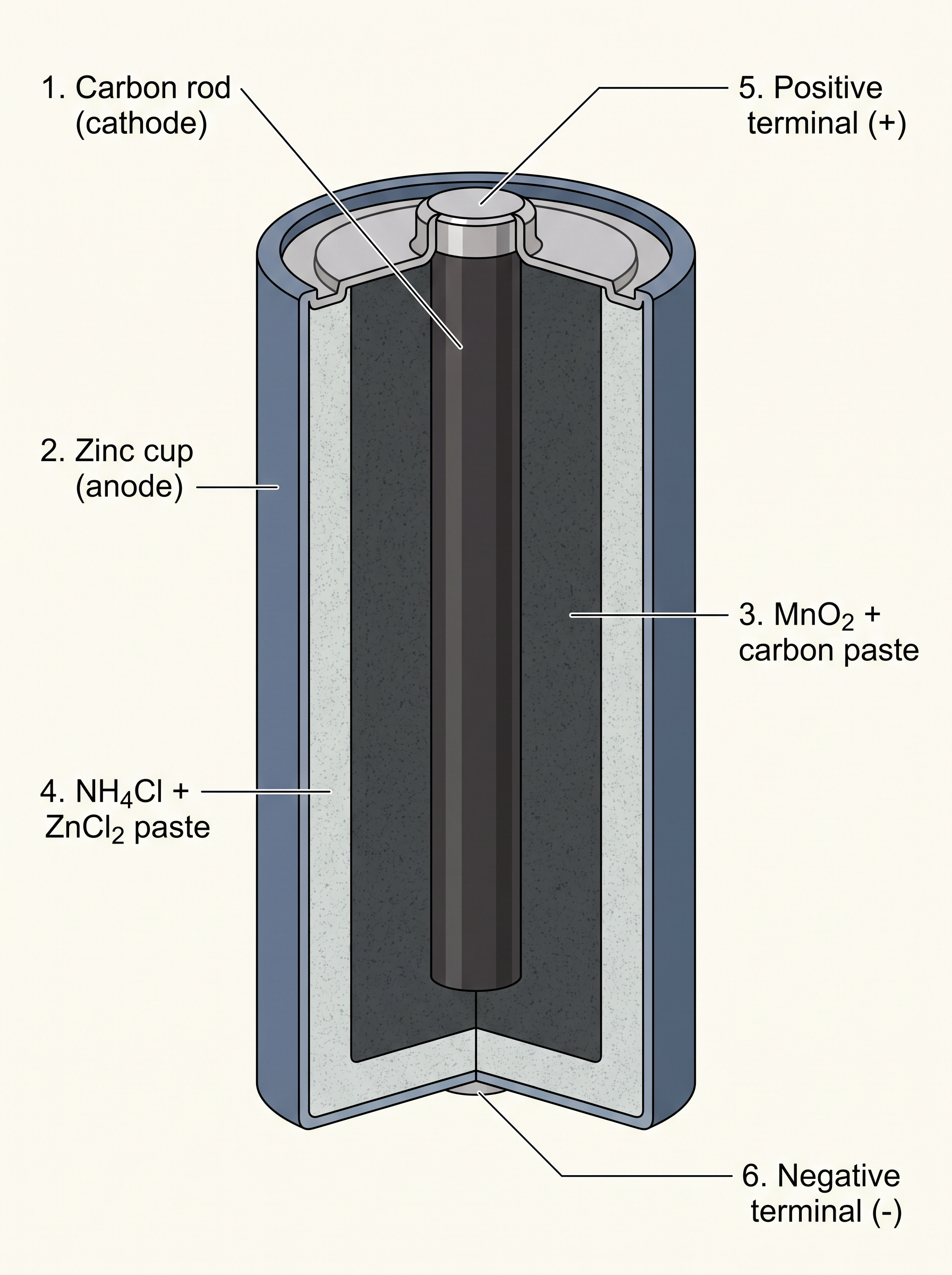
The electrode reactions are complex, but they can be written approximately as follows:
\[\text{Anode:}\quad \mathrm{Zn}\text{(s)} \longrightarrow \mathrm{Zn^{2+}} + 2\,\mathrm{e^-}\]
\[\text{Cathode:}\quad \mathrm{MnO_2} + \mathrm{NH_4^{+}} + \mathrm{e^-} \longrightarrow \mathrm{MnO(OH)} + \mathrm{NH_3}\]
In the reaction at the cathode, manganese is reduced from the +4 oxidation state to the +3 state. The ammonia produced in the reaction forms a complex with \(\mathrm{Zn^{2+}}\) to give \([\mathrm{Zn(NH_3)_4}]^{2+}\). This mopping-up of ammonia matters: a gas released inside a sealed cell would build up pressure, and tying it into a complex ion prevents that.
The cell has a potential of nearly 1.5 V.
For the dry cell described above:
(i) Verify, by assigning oxidation numbers, that manganese is indeed reduced at the cathode.
(ii) A dry cell delivers a steady current of 0.50 A for 30 minutes. Calculate the mass of zinc consumed at the anode. (Atomic mass of Zn = 65.4 g mol\(^{-1}\); \(F = 96500\ \text{C mol}^{-1}\).)
(i) In \(\mathrm{MnO_2}\), each oxygen is \(-2\), and the compound is neutral:
\[x + 2(-2) = 0 \quad \Rightarrow \quad x = +4\]
In \(\mathrm{MnO(OH)}\), the oxide oxygen is \(-2\) and the hydroxide group \(\mathrm{OH}\) is \(-1\) overall:
\[x + (-2) + (-1) = 0 \quad \Rightarrow \quad x = +3\]
The oxidation number of manganese falls from \(+4\) to \(+3\), a gain of one electron per manganese atom. Manganese is therefore reduced, which is consistent with the single electron appearing on the left of the cathode half-reaction.
(ii) Charge passed:
\[t = 30 \times 60 = 1800\ \text{s}, \qquad Q = It = 0.50\ \text{A} \times 1800\ \text{s} = 900\ \text{C}\]
Moles of electrons:
\[n(\mathrm{e^-}) = \frac{900\ \text{C}}{96500\ \text{C mol}^{-1}} = 9.33 \times 10^{-3}\ \text{mol}\]
From the anode reaction, each mole of zinc releases 2 mol of electrons:
\[n(\mathrm{Zn}) = \frac{9.33 \times 10^{-3}}{2} = 4.66 \times 10^{-3}\ \text{mol}\]
\[m(\mathrm{Zn}) = 4.66 \times 10^{-3}\ \text{mol} \times 65.4\ \text{g mol}^{-1} = 0.305\ \text{g}\]
About 0.3 g of the zinc casing has been eaten away — and since the casing is also the container, a heavily used dry cell eventually develops holes and leaks its paste. That is exactly the corrosion you see on a torch cell left in place too long.
The Mercury Cell
The mercury cell (Fig. 2.9), suitable for low current devices like hearing aids, watches, etc., consists of zinc–mercury amalgam as the anode and a paste of HgO and carbon as the cathode. The electrolyte is a paste of KOH and ZnO.
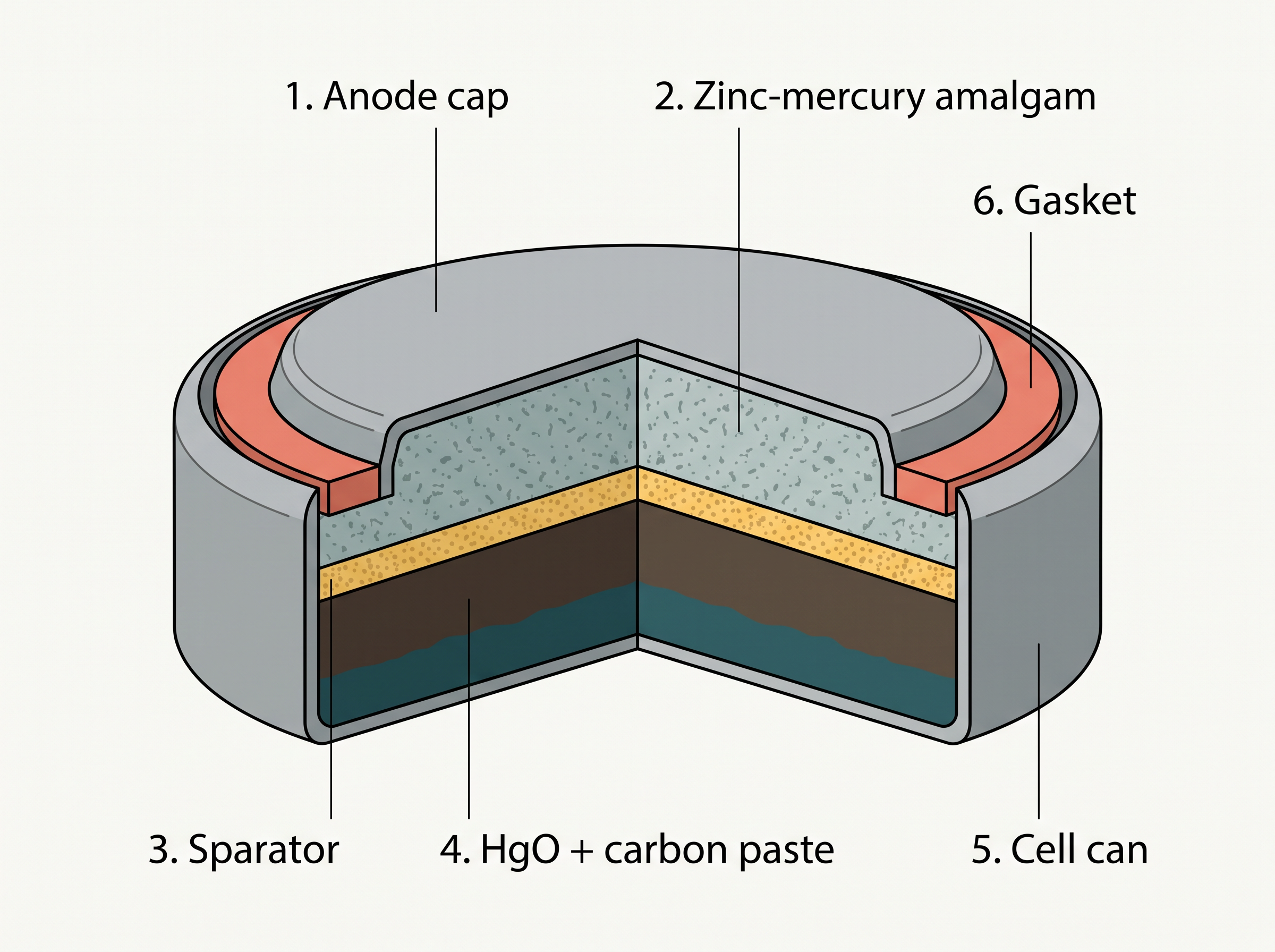
The electrode reactions for the cell are given below:
\[\text{Anode:}\quad \mathrm{Zn(Hg)} + 2\,\mathrm{OH^{-}} \longrightarrow \mathrm{ZnO}\text{(s)} + \mathrm{H_2O} + 2\,\mathrm{e^-}\]
\[\text{Cathode:}\quad \mathrm{HgO} + \mathrm{H_2O} + 2\,\mathrm{e^-} \longrightarrow \mathrm{Hg}\text{(l)} + 2\,\mathrm{OH^{-}}\]
The overall reaction is represented by
\[\mathrm{Zn(Hg)} + \mathrm{HgO}\text{(s)} \longrightarrow \mathrm{ZnO}\text{(s)} + \mathrm{Hg}\text{(l)}\]
The cell potential is approximately 1.35 V and remains constant during its life, as the overall reaction does not involve any ion in solution whose concentration can change during its lifetime.
2.6.2 Secondary Batteries
A secondary cell after use can be recharged by passing current through it in the opposite direction, so that it can be used again. A good secondary cell can undergo a large number of discharging and charging cycles.
Q4. A torch cell is thrown away when it dies, but a car battery is charged again and again. What is chemically different about the two?
A. The difference is whether the products of the cell reaction can be turned back into the reactants in place. In a dry cell they cannot: the zinc casing is eaten away, and the ammonia produced escapes into a complex ion, so there is nothing coherent left to rebuild — the cell is primary, and its reaction runs once. In a lead storage battery, both electrodes convert into the same solid, \(\mathrm{PbSO_4}\), and that solid stays stuck exactly where it formed. Feed current in the reverse direction, as in Fig. 2.2(c), and the \(\mathrm{PbSO_4}\) on one plate is turned back into Pb and on the other back into \(\mathrm{PbO_2}\). The cell has been driven backwards as an electrolytic cell, and it is ready to work as a galvanic cell again. Rechargeability, in short, is not a property of the metal but of whether the products stay put and can be reversed.
The Lead Storage Battery
The most important secondary cell is the lead storage battery (Fig. 2.10), commonly used in automobiles and inverters. It consists of a lead anode and a grid of lead packed with lead dioxide (\(\mathrm{PbO_2}\)) as the cathode. A 38% solution of sulphuric acid is used as an electrolyte.
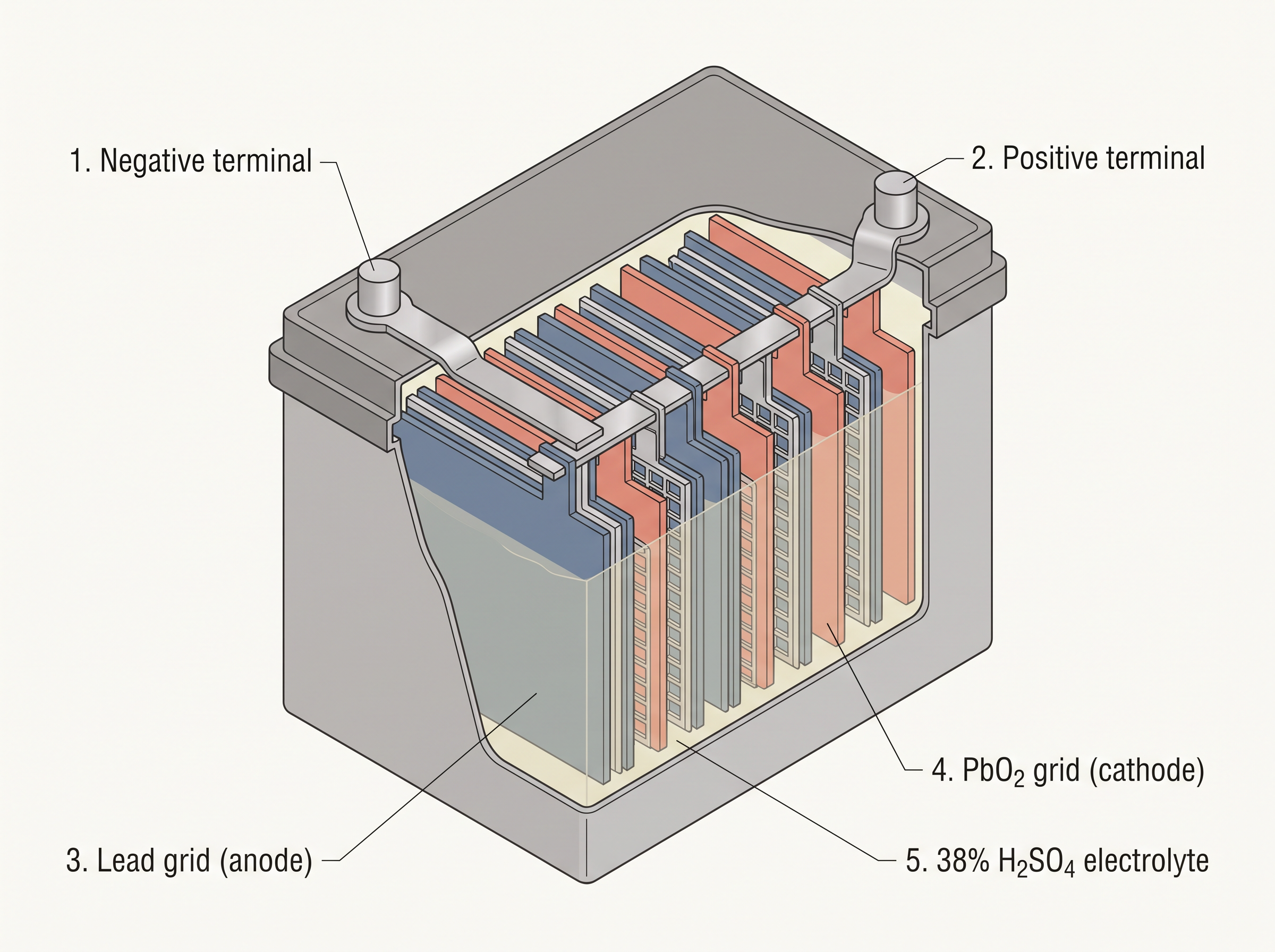
The cell reactions when the battery is in use are given below:
\[\text{Anode:}\quad \mathrm{Pb}\text{(s)} + \mathrm{SO_4^{2-}}\text{(aq)} \rightarrow \mathrm{PbSO_4}\text{(s)} + 2\,\mathrm{e^-}\]
\[\text{Cathode:}\quad \mathrm{PbO_2}\text{(s)} + \mathrm{SO_4^{2-}}\text{(aq)} + 4\,\mathrm{H^{+}}\text{(aq)} + 2\,\mathrm{e^-} \rightarrow \mathrm{PbSO_4}\text{(s)} + 2\,\mathrm{H_2O}\text{(l)}\]
i.e., the overall cell reaction, consisting of the cathode and anode reactions, is:
\[\mathrm{Pb}\text{(s)} + \mathrm{PbO_2}\text{(s)} + 2\,\mathrm{H_2SO_4}\text{(aq)} \rightarrow 2\,\mathrm{PbSO_4}\text{(s)} + 2\,\mathrm{H_2O}\text{(l)}\]
On charging the battery the reaction is reversed, and \(\mathrm{PbSO_4}\)(s) on the anode and cathode is converted into Pb and \(\mathrm{PbO_2}\), respectively.
The Nickel–Cadmium Cell
Another important secondary cell is the nickel–cadmium cell (Fig. 2.11), which has a longer life than the lead storage cell but is more expensive to manufacture. We shall not go into the details of the working of the cell and the electrode reactions during charging and discharging.
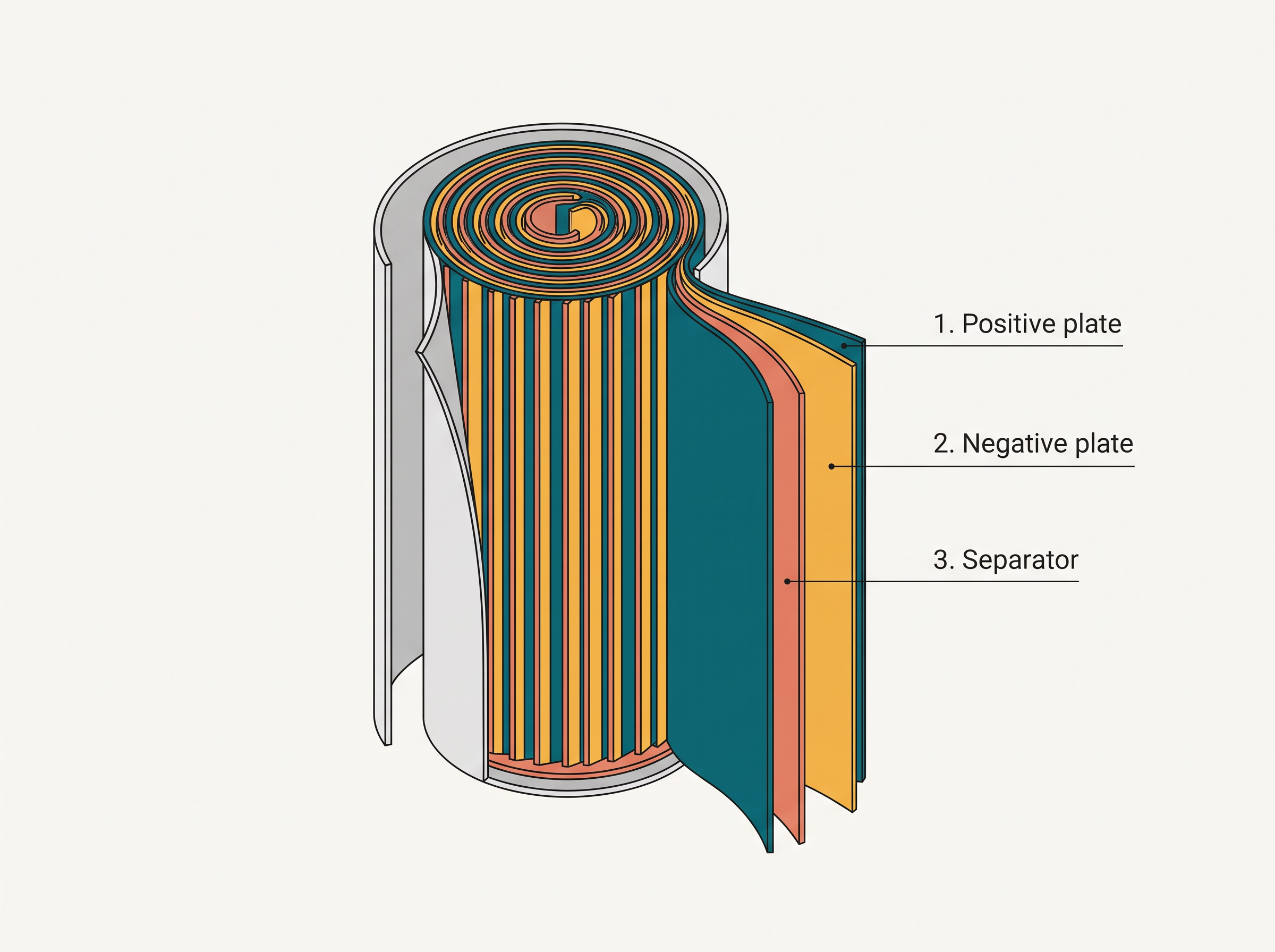
The overall reaction during discharge is:
\[\mathrm{Cd}\text{(s)} + 2\,\mathrm{Ni(OH)_3}\text{(s)} \rightarrow \mathrm{CdO}\text{(s)} + 2\,\mathrm{Ni(OH)_2}\text{(s)} + \mathrm{H_2O}\text{(l)}\]
Dry cell vs Mercury cell vs Lead storage battery vs Nickel–cadmium cell
| Type |
Primary |
Primary |
Secondary |
Secondary |
| Anode |
Zinc container |
Zinc–mercury amalgam |
Lead |
Cadmium |
| Cathode |
Graphite rod in \(\mathrm{MnO_2}\) + carbon |
HgO + carbon paste |
Lead grid packed with \(\mathrm{PbO_2}\) |
Nickel(III) hydroxide |
| Electrolyte |
Moist paste of \(\mathrm{NH_4Cl}\) and \(\mathrm{ZnCl_2}\) |
Paste of KOH and ZnO |
38% \(\mathrm{H_2SO_4}\) |
Moist NaOH or KOH |
| Cell potential |
About 1.5 V |
About 1.35 V, and steady |
About 2 V per cell (six in series in a car) |
— |
| Typical use |
Transistors, clocks, torches |
Hearing aids, watches (low current) |
Automobiles, inverters |
Devices needing long cycle life |
Both secondary cells here are built around a toxic heavy metal, and that has shaped how they are handled. Lead-acid batteries are among the most heavily recycled manufactured objects in the world — the lead and the \(\mathrm{PbSO_4}\) are worth recovering, and a battery returned to a proper smelter yields lead that goes straight back into new plates. The danger lies in the informal recycling that happens outside such plants: batteries broken open by hand release lead dust and acid, and lead poisoning damages the developing nervous system of children in particular. Cadmium is similarly toxic and accumulates in the kidneys, which is why nickel–cadmium cells have steadily been displaced in consumer electronics by other rechargeable chemistries. The chemistry lesson is a civic one too: a used battery is not household rubbish, and should be returned to a collection point rather than thrown into a bin.
(question only — no solution)
A lead storage battery delivers a steady current of 2.0 A for 1 hour. Using the cathode half-reaction given above, calculate the mass of \(\mathrm{PbO_2}\) consumed at the cathode during this time. (Molar mass of \(\mathrm{PbO_2} = 239\ \text{g mol}^{-1}\); \(F = 96500\ \text{C mol}^{-1}\).)
(question only — no solution)
In the nickel–cadmium cell, assign the oxidation number of nickel in \(\mathrm{Ni(OH)_3}\) and in \(\mathrm{Ni(OH)_2}\), and of cadmium in Cd and in CdO. Hence identify the oxidising agent and the reducing agent in the discharge reaction, and state the number of electrons transferred per mole of cadmium.
2.7 Fuel Cells
Production of electricity by thermal plants is not a very efficient method, and is a major source of pollution. In such plants, the chemical energy (heat of combustion) of fossil fuels (coal, gas or oil) is first used for converting water into high pressure steam. This is then used to run a turbine to produce electricity.
Notice how indirect that chain is. The energy is passed from chemical bonds to heat, from heat to mechanical motion, and only then to electricity — and something is lost at every handover.
We know that a galvanic cell directly converts chemical energy into electricity and is highly efficient. It skips the heat and the turbine altogether. The problem with an ordinary galvanic cell, however, is that it carries its reactants sealed inside it, and once they are consumed the cell is finished.
It is now possible to make such cells in which reactants are fed continuously to the electrodes and products are removed continuously from the electrolyte compartment. Such a cell need never run down, so long as it is fed.
Galvanic cells that are designed to convert the energy of combustion of fuels like hydrogen, methane, methanol, etc., directly into electrical energy are called fuel cells.
A fuel cell is a galvanic cell in which the reactants (a fuel and an oxidant) are supplied continuously to the electrodes, so that the energy of combustion of the fuel is converted directly into electrical energy.
The Hydrogen–Oxygen Fuel Cell
One of the most successful fuel cells uses the reaction of hydrogen with oxygen to form water (Fig. 2.12). The cell was used for providing electrical power in the Apollo space programme. The water vapours produced during the reaction were condensed and added to the drinking water supply for the astronauts — a striking piece of design, in which the exhaust of the power supply is drinkable.
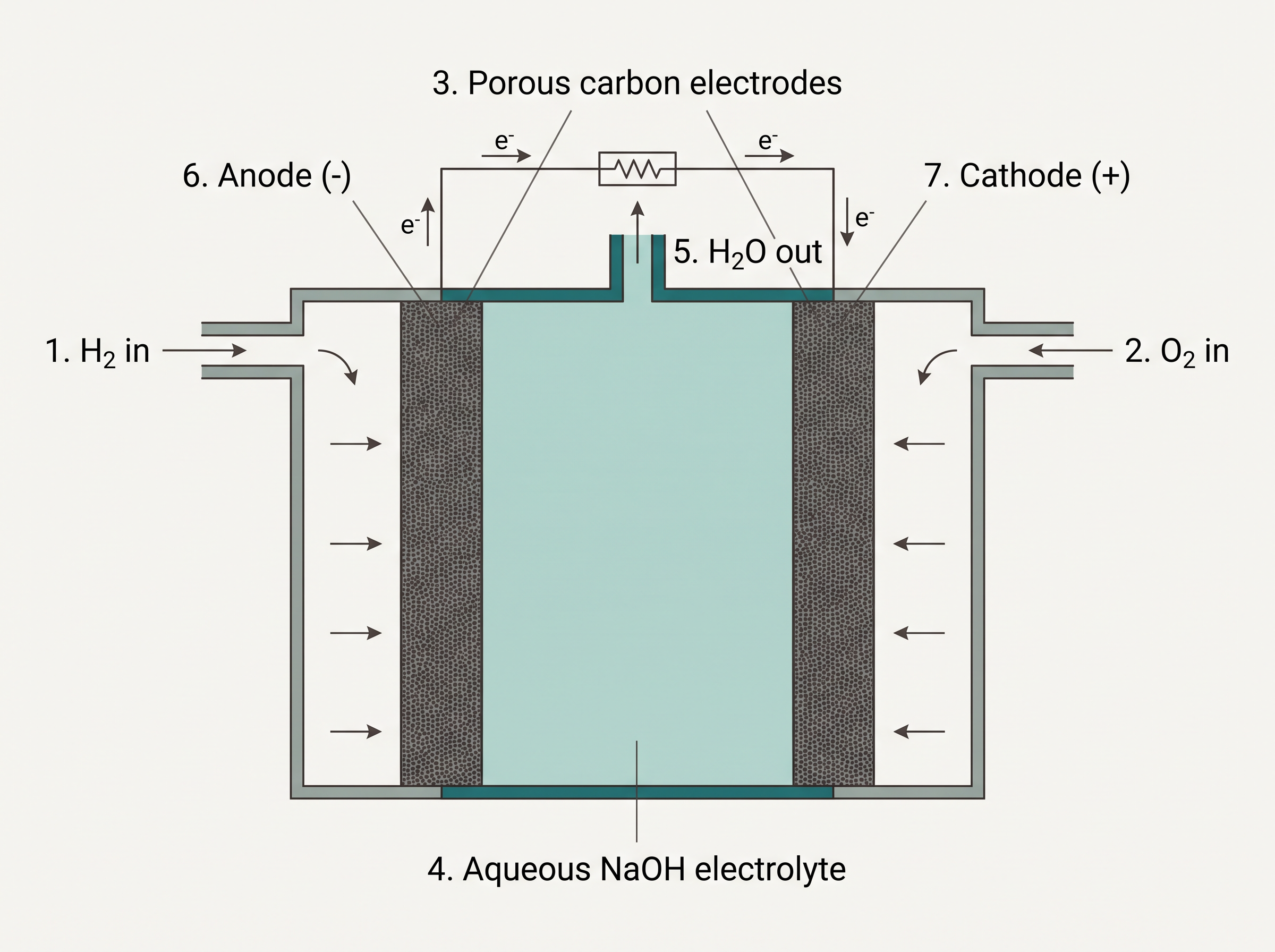
In the cell, hydrogen and oxygen are bubbled through porous carbon electrodes into concentrated aqueous sodium hydroxide solution. The electrodes are porous so that gas, liquid electrolyte and solid electrode surface all meet in the same place — without that three-way contact, the reaction has nowhere to happen.
Catalysts like finely divided platinum or palladium metal are incorporated into the electrodes for increasing the rate of the electrode reactions.
The electrode reactions are given below:
\[\text{Cathode:}\quad \mathrm{O_2}\text{(g)} + 2\,\mathrm{H_2O}\text{(l)} + 4\,\mathrm{e^-} \longrightarrow 4\,\mathrm{OH^{-}}\text{(aq)}\]
\[\text{Anode:}\quad 2\,\mathrm{H_2}\text{(g)} + 4\,\mathrm{OH^{-}}\text{(aq)} \longrightarrow 4\,\mathrm{H_2O}\text{(l)} + 4\,\mathrm{e^-}\]
Overall reaction being:
\[2\,\mathrm{H_2}\text{(g)} + \mathrm{O_2}\text{(g)} \longrightarrow 2\,\mathrm{H_2O}\text{(l)}\]
The overall reaction is simply the combustion of hydrogen — but it has been made to happen without a flame, with the electrons taking a detour through a wire on their way from hydrogen to oxygen.
The cell runs continuously as long as the reactants are supplied.
Efficiency and Prospects
Fuel cells produce electricity with an efficiency of about 70%, compared to thermal plants whose efficiency is about 40%.
There has been tremendous progress in the development of new electrode materials, better catalysts and electrolytes for increasing the efficiency of fuel cells. These have been used in automobiles on an experimental basis. Fuel cells are pollution free, and in view of their future importance, a variety of fuel cells have been fabricated and tried.
The idea is older than most people assume. In 1839 the Welsh scientist and judge William Grove built what he called a gas voltaic battery: platinum strips in dilute acid, one bathed in hydrogen and the other in oxygen, generating a current from the recombination of the two gases into water. He had reasoned it out by running the electrolysis of water backwards — if electricity could split water into hydrogen and oxygen, then hydrogen and oxygen ought to be able to make electricity. Grove’s device was a curiosity for over a century, too feeble to compete with the steam engine. It took the Apollo programme, where weight mattered more than cost, to give it its first serious job.
Thermal power plant vs Hydrogen–oxygen fuel cell
| Energy path |
Chemical → heat → mechanical → electrical |
Chemical → electrical (direct) |
| Approximate efficiency |
About 40% |
About 70% |
| Fuel |
Coal, gas or oil |
Hydrogen (also methane, methanol) |
| Products |
\(\mathrm{CO_2}\), oxides of sulphur and nitrogen, ash |
Water only |
| Operation |
Runs while fuel is burnt in a furnace |
Runs continuously while reactants are fed in |
Two practical obstacles stand between fuel cells and the family car, and both are chemistry problems. The first is the catalyst: the electrode reactions are sluggish without finely divided platinum or palladium, and these are among the costliest metals on earth, so a great deal of current research goes into either using far less of them or replacing them entirely. The second is handling the fuel. Hydrogen is the lightest of gases, so a useful quantity of it must be stored compressed to high pressure or held in a solid absorbent, and it burns over an unusually wide range of mixtures with air. Fuel-cell vehicles are therefore built with strongly reinforced tanks and with leak sensors, and hydrogen is vented upward — being far lighter than air, it disperses rapidly rather than pooling, which is an advantage petrol vapour does not share.
In a hydrogen–oxygen fuel cell, 1.0 g of hydrogen gas is consumed at the anode.
(i) Calculate the quantity of charge that passes through the external circuit.
(ii) Calculate the mass of water produced.
(Molar mass of \(\mathrm{H_2} = 2.0\ \text{g mol}^{-1}\), of \(\mathrm{H_2O} = 18\ \text{g mol}^{-1}\); \(F = 96500\ \text{C mol}^{-1}\).)
(i) Moles of hydrogen consumed:
\[n(\mathrm{H_2}) = \frac{1.0\ \text{g}}{2.0\ \text{g mol}^{-1}} = 0.50\ \text{mol}\]
From the anode reaction, \(2\,\mathrm{H_2} + 4\,\mathrm{OH^{-}} \rightarrow 4\,\mathrm{H_2O} + 4\,\mathrm{e^-}\), two moles of \(\mathrm{H_2}\) release four moles of electrons — that is, 2 mol of electrons per mole of \(\mathrm{H_2}\):
\[n(\mathrm{e^-}) = 2 \times 0.50 = 1.0\ \text{mol}\]
\[Q = n(\mathrm{e^-}) \times F = 1.0\ \text{mol} \times 96500\ \text{C mol}^{-1} = 96500\ \text{C}\]
(ii) From the overall reaction \(2\,\mathrm{H_2}\text{(g)} + \mathrm{O_2}\text{(g)} \rightarrow 2\,\mathrm{H_2O}\text{(l)}\), each mole of \(\mathrm{H_2}\) gives one mole of water:
\[n(\mathrm{H_2O}) = 0.50\ \text{mol} \qquad m(\mathrm{H_2O}) = 0.50 \times 18 = 9.0\ \text{g}\]
So a single gram of hydrogen delivers a full faraday of charge — and nine grams of clean water. On Apollo, both numbers mattered.
(question only — no solution)
In a hydrogen–oxygen fuel cell, 0.32 g of oxygen is consumed at the cathode. Using the cathode half-reaction, calculate (i) the number of moles of electrons transferred and (ii) the charge in coulombs that flows through the external circuit. (Molar mass of \(\mathrm{O_2} = 32\ \text{g mol}^{-1}\); \(F = 96500\ \text{C mol}^{-1}\).)
2.8 Corrosion
Corrosion slowly coats the surfaces of metallic objects with oxides or other salts of the metal. The rusting of iron, the tarnishing of silver, and the development of a green coating on copper and bronze are some of the examples of corrosion.
It causes enormous damage to buildings, bridges, ships and to all objects made of metals, especially that of iron. We lose crores of rupees every year on account of corrosion.
Corrosion is the slow, natural oxidation of a metal at its surface by substances in its environment, converting the metal into its oxide or another salt.
Rusting as an Electrochemical Process
In corrosion, a metal is oxidised by loss of electrons to oxygen and formation of oxides. Corrosion of iron (commonly known as rusting) occurs in the presence of water and air — both are needed, which is why iron kept in dry air, or under boiled-out water free of dissolved oxygen, does not rust.
The chemistry of corrosion is quite complex, but it may be considered essentially as an electrochemical phenomenon. In other words, a rusting nail is a tiny short-circuited galvanic cell that has set itself up on the metal’s own surface, with no wire and no salt bridge in sight.
At a particular spot (Fig. 2.13) of an object made of iron, oxidation takes place, and that spot behaves as the anode. We can write the reaction
\[\text{Anode:}\quad 2\,\mathrm{Fe}\text{(s)} \longrightarrow 2\,\mathrm{Fe^{2+}} + 4\,\mathrm{e^-} \qquad E^\circ_{(\mathrm{Fe^{2+}/Fe})} = -0.44\ \text{V}\]
Electrons released at the anodic spot move through the metal and go to another spot on the metal, where they reduce oxygen in the presence of \(\mathrm{H^{+}}\) (which is believed to be available from \(\mathrm{H_2CO_3}\) formed due to the dissolution of carbon dioxide from air into water; hydrogen ion in water may also be available due to the dissolution of other acidic oxides from the atmosphere).
The metal itself is the “wire” of this cell, and the thin film of moisture on its surface is the electrolyte. This spot behaves as the cathode, with the reaction
\[\text{Cathode:}\quad \mathrm{O_2}\text{(g)} + 4\,\mathrm{H^{+}}\text{(aq)} + 4\,\mathrm{e^-} \longrightarrow 2\,\mathrm{H_2O}\text{(l)} \qquad E^\circ_{\mathrm{H^{+}|O_2|H_2O}} = 1.23\ \text{V}\]
The overall reaction being:
\[2\,\mathrm{Fe}\text{(s)} + \mathrm{O_2}\text{(g)} + 4\,\mathrm{H^{+}}\text{(aq)} \longrightarrow 2\,\mathrm{Fe^{2+}}\text{(aq)} + 2\,\mathrm{H_2O}\text{(l)} \qquad E^\circ_{(\text{cell})} = 1.67\ \text{V}\]
That large positive \(E^\circ_{\text{cell}}\) is the whole trouble in a single number: rusting is a strongly spontaneous reaction, and no amount of wishing will stop it. All we can do is get in its way.
The ferrous ions are further oxidised by atmospheric oxygen to ferric ions, which come out as rust in the form of hydrated ferric oxide (\(\mathrm{Fe_2O_3}\cdot x\,\mathrm{H_2O}\)), and with further production of hydrogen ions:
\[\text{Atmospheric oxidation:}\quad 2\,\mathrm{Fe^{2+}}\text{(aq)} + 2\,\mathrm{H_2O}\text{(l)} + \tfrac{1}{2}\,\mathrm{O_2}\text{(g)} \longrightarrow \mathrm{Fe_2O_3}\text{(s)} + 4\,\mathrm{H^{+}}\text{(aq)}\]
Note that this step regenerates \(\mathrm{H^{+}}\) — the very ions the cathode reaction needs. Rusting, once started, quietly supplies its own reagent, which is part of why it keeps going. The full sequence is set out in FC 2.6.
Standing in the Qutub complex in Delhi is an iron pillar, some seven metres tall, forged well over a thousand years ago and still virtually free of rust. It has been studied closely, and the answer lies partly in the metal itself: the iron is unusually rich in phosphorus, which, in Delhi’s dry climate, helps a thin, dense, protective layer form on the surface and seal the metal from further attack. The pillar is a reminder that corrosion is a surface reaction — deny the reaction the moisture and oxygen at that surface, whether by a coat of paint or by a self-forming protective film, and even iron can outlast empires.
Preventing Corrosion
Prevention of corrosion is of prime importance. It not only saves money but also helps in preventing accidents, such as a bridge collapse or the failure of a key component due to corrosion.
One of the simplest methods of preventing corrosion is to prevent the surface of the metallic object from coming in contact with the atmosphere. This can be done by covering the surface with paint or with some chemicals (e.g. bisphenol). No oxygen and no water at the surface means no cathode reaction, and the little corrosion cell cannot run.
Another simple method is to cover the surface by other metals (Sn, Zn, etc.) that are inert or react to save the object.
An electrochemical method is to provide a sacrificial electrode of another metal (like Mg, Zn, etc.), which corrodes itself but saves the object. Here we do not try to defeat the corrosion cell; we deliberately give it a different anode.
Q5. Ship builders deliberately bolt blocks of zinc onto a steel hull and allow them to corrode away. Why does letting one metal rot protect the other?
A. Because corrosion needs an anode, and whichever metal is the better reducing agent will volunteer for the job. Compare the standard electrode potentials in Table 2.1: \(E^\circ_{(\mathrm{Zn^{2+}/Zn})} = -0.76\ \text{V}\) is more negative than \(E^\circ_{(\mathrm{Fe^{2+}/Fe})} = -0.44\ \text{V}\), so zinc is the more easily oxidised of the two. Bolt zinc to the hull and the two metals, joined electrically and sitting in sea water, form one large corrosion cell in which the zinc is the anode and the iron becomes the cathode. Electrons flow from the zinc into the steel, and iron that is being fed electrons cannot lose them — so it cannot rust. The zinc dissolves away in the iron’s place, which is why it is called a sacrificial anode, and why it is designed to be unbolted and replaced when it is eaten away.
Iron objects are sometimes coated with zinc (galvanised iron) and sometimes with tin (tin plate). Using the standard electrode potentials of Table 2.1, explain what happens in each case when the coating gets scratched, exposing the iron beneath.
Given: \(E^\circ_{(\mathrm{Zn^{2+}/Zn})} = -0.76\ \text{V}\), \(E^\circ_{(\mathrm{Fe^{2+}/Fe})} = -0.44\ \text{V}\), \(E^\circ_{(\mathrm{Sn^{2+}/Sn})} = -0.14\ \text{V}\).
Once the coating is scratched, both metals are exposed together to the moisture film and are in electrical contact — a corrosion cell of the two metals is set up. The metal with the more negative \(E^\circ\) is the more easily oxidised, and therefore becomes the anode.
Zinc coating (galvanised iron). Compare \(-0.76\) V (Zn) with \(-0.44\) V (Fe). Zinc is more negative, so zinc is the anode:
\[\mathrm{Zn}\text{(s)} \rightarrow \mathrm{Zn^{2+}}\text{(aq)} + 2\,\mathrm{e^-}\]
Iron is forced to be the cathode and is protected, even at the scratch. Galvanised iron therefore keeps protecting the object after the coating is broken — the zinc goes on being sacrificed.
Tin coating (tin plate). Compare \(-0.14\) V (Sn) with \(-0.44\) V (Fe). Now it is iron that is more negative, so iron becomes the anode:
\[\mathrm{Fe}\text{(s)} \rightarrow \mathrm{Fe^{2+}}\text{(aq)} + 2\,\mathrm{e^-}\]
The iron corrodes preferentially, and the tin, acting as cathode, actually makes matters worse than bare iron would be. Tin protects only as long as the coating is a perfect, unbroken barrier; once scratched, it accelerates rusting.
The lesson is worth stating plainly: a coating can protect either as a barrier or as a sacrifice, and only the sacrificial kind survives being scratched.
Barrier protection vs Sacrificial (cathodic) protection
| How it works |
Keeps air and moisture away from the metal surface |
Supplies a more easily oxidised metal to act as the anode |
| Examples |
Paint, grease, bisphenol coating, tin plating |
Zinc coating (galvanising); blocks of Mg or Zn attached to the object |
| What decides the choice |
Nothing chemical — only the completeness of the covering |
The \(E^\circ\) value: the protecting metal must be more negative than iron |
| If the covering is scratched |
Protection fails; with tin, corrosion is even accelerated |
Protection continues; the sacrificial metal keeps corroding in the iron’s place |
Cathodic protection is used on a scale most people never see. Buried steel pipelines carrying water or gas are wired to blocks of magnesium buried alongside them at intervals; the magnesium slowly dissolves and the pipeline does not. Ships, harbour piles, offshore platforms and the steel reinforcement inside concrete are all protected the same way. The blocks are inspected and replaced on a schedule — a small, planned, cheap loss of magnesium standing in for a large, unplanned, expensive loss of steel. Meanwhile the everyday version of the same chemistry sits on the roof over your head: the corrugated sheet is galvanised, that is, coated with zinc, and it is the zinc that is quietly corroding on your behalf.
(question only — no solution)
An underground iron pipeline is to be protected by attaching a sacrificial anode. Using Table 2.1, decide which of magnesium and nickel is suitable for the purpose. Quote the relevant \(E^\circ\) values, write the half-reaction occurring at the sacrificial anode you have chosen, and explain why the other metal would fail to protect the pipeline.
2.13 Write the chemistry of recharging the lead storage battery, highlighting all the materials that are involved during recharging.
2.14 Suggest two materials other than hydrogen that can be used as fuels in fuel cells.
2.15 Explain how rusting of iron is envisaged as setting up of an electrochemical cell.
The Hydrogen Economy. At present the main source of energy that is driving our economy is fossil fuels such as coal, oil and gas. As more people on the planet aspire to improve their standard of living, their energy requirement will increase. In fact, the per capita consumption of energy used is a measure of development — assuming, of course, that the energy is used for a productive purpose and not merely wasted.
We are already aware that carbon dioxide produced by the combustion of fossil fuels is resulting in the ‘Greenhouse Effect’. This is leading to a rise in the temperature of the Earth’s surface, causing polar ice to melt and ocean levels to rise. This will flood low-lying areas along the coast, and some island nations such as the Maldives face total submergence. In order to avoid such a catastrophe, we need to limit our use of carbonaceous fuels.
Hydrogen provides an ideal alternative, as its combustion results in water only. Hydrogen production must come from splitting water using solar energy. Therefore, hydrogen can be used as a renewable and non-polluting source of energy. This is the vision of the Hydrogen Economy. Both the production of hydrogen by electrolysis of water and hydrogen combustion in a fuel cell will be important in the future — and both these technologies are based on electrochemical principles.
2.9 Summary
Electrochemical cells
- An electrochemical cell consists of two metallic electrodes dipping in electrolytic solution(s). An essential component of every such cell is the ionic conductor — the electrolyte — which carries charge through the solution while the wire carries it outside.
- Electrochemical cells are of two types. In a galvanic cell, the chemical energy of a spontaneous redox reaction is converted into electrical work. In an electrolytic cell, electrical energy from outside is used to carry out a non-spontaneous redox reaction.
- Ions conduct electricity through the solution, but the actual oxidation and reduction of the ions take place at the electrodes: oxidation at the anode, reduction at the cathode.
Electrode potential and cell potential
- The standard electrode potential of any electrode dipping in an appropriate solution is defined with respect to the standard electrode potential of the hydrogen electrode, which is taken as zero.
- The standard potential of a cell is obtained by taking the difference of the standard potentials of the cathode and the anode:
\[E^\circ_{(\text{cell})} = E^\circ_{\text{cathode}} - E^\circ_{\text{anode}}\]
- The standard potential of a cell is related to the standard Gibbs energy of the cell reaction, and through it to the equilibrium constant:
\[\Delta_r G^\circ = -\,nF\,E^\circ_{(\text{cell})} \qquad \Delta_r G^\circ = -\,RT\ln K\]
- The dependence of electrode and cell potentials on concentration is given by the Nernst equation:
\[E_{(\text{cell})} = E^\circ_{(\text{cell})} - \frac{RT}{nF}\,\ln Q\]
Conductance of electrolytic solutions
- The conductivity, \(\kappa\), of an electrolytic solution depends on the concentration of the electrolyte, the nature of the solvent and the temperature.
- Molar conductivity, \(\Lambda_m\), is defined by
\[\Lambda_m = \frac{\kappa}{c}\]
where \(c\) is the concentration. 10. On dilution, conductivity decreases (fewer ions per unit volume) but molar conductivity increases (the same one mole of electrolyte now occupies a larger volume, \(\Lambda_m = \kappa V\)). 11. The increase in \(\Lambda_m\) on dilution is slow for strong electrolytes, following \(\Lambda_m = \Lambda^\circ_m - A\,c^{1/2}\), but is very steep for weak electrolytes in very dilute solutions, because dilution actually increases their degree of dissociation. 12. Kohlrausch found that the molar conductivity at infinite dilution of an electrolyte is the sum of the contributions of the ions into which it dissociates. This is the law of independent migration of ions:
\[\Lambda^\circ_m = \nu_{+}\,\lambda^\circ_{+} + \nu_{-}\,\lambda^\circ_{-}\]
It has many applications — in particular, it gives \(\Lambda^\circ_m\) for a weak electrolyte, which cannot be obtained by extrapolation, and hence its degree of dissociation \(\alpha = \Lambda_m/\Lambda^\circ_m\) and its dissociation constant.
Electrolysis
- Faraday’s laws relate the amount of chemical change at an electrode to the quantity of electricity passed: moles of electrons \(= Q/F\), with \(Q = It\) and \(F = 96487\ \text{C mol}^{-1}\) (\(\simeq 96500\ \text{C mol}^{-1}\) for approximate work).
- The products of electrolysis depend on the species present, their electrode potentials, whether the electrodes are inert or reactive, and — sometimes decisively — on overpotential.
Applications
- Batteries and fuel cells are very useful forms of the galvanic cell. Primary batteries (dry cell, mercury cell) run once; secondary batteries (lead storage, nickel–cadmium) can be recharged by driving the reaction backwards. A fuel cell is fed its reactants continuously and converts the energy of combustion directly into electricity, at much higher efficiency than a thermal plant.
- Corrosion of metals is essentially an electrochemical phenomenon: an anodic spot and a cathodic spot set up a tiny cell on the metal’s own surface. It is prevented by barrier coatings or, more robustly, by sacrificial (cathodic) protection with a more easily oxidised metal such as zinc or magnesium.
- Electrochemical principles are relevant to the Hydrogen Economy: hydrogen made by the electrolysis of water and burnt in a fuel cell would give a renewable, non-polluting energy cycle whose only product is water.
The chapter’s central logic — one redox reaction, run in two directions — is condensed in FC 2.7.
2.10 NCERT Questions
Arrange the following metals in the order in which they displace each other from the solution of their salts: Al, Cu, Fe, Mg and Zn.
Given the standard electrode potentials, \(\mathrm{K^{+}}/\mathrm{K} = -2.93\ \text{V}\), \(\mathrm{Ag^{+}}/\mathrm{Ag} = 0.80\ \text{V}\), \(\mathrm{Hg^{2+}}/\mathrm{Hg} = 0.79\ \text{V}\), \(\mathrm{Mg^{2+}}/\mathrm{Mg} = -2.37\ \text{V}\), \(\mathrm{Cr^{3+}}/\mathrm{Cr} = -0.74\ \text{V}\), arrange these metals in their increasing order of reducing power.
Depict the galvanic cell in which the reaction \(\mathrm{Zn}\text{(s)} + 2\,\mathrm{Ag^{+}}\text{(aq)} \rightarrow \mathrm{Zn^{2+}}\text{(aq)} + 2\,\mathrm{Ag}\text{(s)}\) takes place. Further show: (i) Which of the electrodes is negatively charged? (ii) The carriers of the current in the cell. (iii) Individual reaction at each electrode.
Calculate the standard cell potentials of galvanic cells in which the following reactions take place: (i) \(2\,\mathrm{Cr}\text{(s)} + 3\,\mathrm{Cd^{2+}}\text{(aq)} \rightarrow 2\,\mathrm{Cr^{3+}}\text{(aq)} + 3\,\mathrm{Cd}\); (ii) \(\mathrm{Fe^{2+}}\text{(aq)} + \mathrm{Ag^{+}}\text{(aq)} \rightarrow \mathrm{Fe^{3+}}\text{(aq)} + \mathrm{Ag}\text{(s)}\). Calculate the \(\Delta_r G^\circ\) and equilibrium constant of the reactions.
Write the Nernst equation and emf of the following cells at 298 K:
- \(\mathrm{Mg}\text{(s)}\,|\,\mathrm{Mg^{2+}}(0.001\ \text{M})\,\|\,\mathrm{Cu^{2+}}(0.0001\ \text{M})\,|\,\mathrm{Cu}\text{(s)}\)
- \(\mathrm{Fe}\text{(s)}\,|\,\mathrm{Fe^{2+}}(0.001\ \text{M})\,\|\,\mathrm{H^{+}}(1\ \text{M})\,|\,\mathrm{H_2}\text{(g)}(1\ \text{bar})\,|\,\mathrm{Pt}\text{(s)}\)
- \(\mathrm{Sn}\text{(s)}\,|\,\mathrm{Sn^{2+}}(0.050\ \text{M})\,\|\,\mathrm{H^{+}}(0.020\ \text{M})\,|\,\mathrm{H_2}\text{(g)}\ (1\ \text{bar})\,|\,\mathrm{Pt}\text{(s)}\)
- \(\mathrm{Pt}\text{(s)}\,|\,\mathrm{Br^{-}}(0.010\ \text{M})\,|\,\mathrm{Br_2}\text{(l)}\,\|\,\mathrm{H^{+}}(0.030\ \text{M})\,|\,\mathrm{H_2}\text{(g)}\ (1\ \text{bar})\,|\,\mathrm{Pt}\text{(s)}\)
In the button cells widely used in watches and other devices the following reaction takes place: \(\mathrm{Zn}\text{(s)} + \mathrm{Ag_2O}\text{(s)} + \mathrm{H_2O}\text{(l)} \rightarrow \mathrm{Zn^{2+}}\text{(aq)} + 2\,\mathrm{Ag}\text{(s)} + 2\,\mathrm{OH^{-}}\text{(aq)}\). Determine \(\Delta_r G^\circ\) and \(E^\circ\) for the reaction.
Define conductivity and molar conductivity for the solution of an electrolyte. Discuss their variation with concentration.
The conductivity of 0.20 M solution of KCl at 298 K is \(0.0248\ \text{S cm}^{-1}\). Calculate its molar conductivity.
The resistance of a conductivity cell containing 0.001 M KCl solution at 298 K is \(1500\ \Omega\). What is the cell constant if the conductivity of 0.001 M KCl solution at 298 K is \(0.146 \times 10^{-3}\ \text{S cm}^{-1}\)?
The conductivity of sodium chloride at 298 K has been determined at different concentrations and the results are given below:
| \(10^{2} \times \kappa\) / S m\(^{-1}\) |
1.237 |
11.85 |
23.15 |
55.53 |
106.74 |
Calculate \(\Lambda_m\) for all concentrations and draw a plot between \(\Lambda_m\) and \(c^{1/2}\). Find the value of \(\Lambda^\circ_m\).
Conductivity of 0.00241 M acetic acid is \(7.896 \times 10^{-5}\ \text{S cm}^{-1}\). Calculate its molar conductivity. If \(\Lambda^\circ_m\) for acetic acid is \(390.5\ \text{S cm}^2\ \text{mol}^{-1}\), what is its dissociation constant?
How much charge is required for the following reductions: (i) 1 mol of \(\mathrm{Al^{3+}}\) to Al? (ii) 1 mol of \(\mathrm{Cu^{2+}}\) to Cu? (iii) 1 mol of \(\mathrm{MnO_4^{-}}\) to \(\mathrm{Mn^{2+}}\)?
How much electricity in terms of Faraday is required to produce (i) 20.0 g of Ca from molten \(\mathrm{CaCl_2}\)? (ii) 40.0 g of Al from molten \(\mathrm{Al_2O_3}\)?
How much electricity is required in coulomb for the oxidation of (i) 1 mol of \(\mathrm{H_2O}\) to \(\mathrm{O_2}\)? (ii) 1 mol of FeO to \(\mathrm{Fe_2O_3}\)?
A solution of \(\mathrm{Ni(NO_3)_2}\) is electrolysed between platinum electrodes using a current of 5 amperes for 20 minutes. What mass of Ni is deposited at the cathode?
Three electrolytic cells A, B, C containing solutions of \(\mathrm{ZnSO_4}\), \(\mathrm{AgNO_3}\) and \(\mathrm{CuSO_4}\), respectively, are connected in series. A steady current of 1.5 amperes was passed through them until 1.45 g of silver deposited at the cathode of cell B. How long did the current flow? What mass of copper and zinc were deposited?
Using the standard electrode potentials given in Table 2.1, predict if the reaction between the following is feasible: (i) \(\mathrm{Fe^{3+}}\text{(aq)}\) and \(\mathrm{I^{-}}\text{(aq)}\); (ii) \(\mathrm{Ag^{+}}\text{(aq)}\) and \(\mathrm{Cu}\text{(s)}\); (iii) \(\mathrm{Fe^{3+}}\text{(aq)}\) and \(\mathrm{Br^{-}}\text{(aq)}\); (iv) \(\mathrm{Ag}\text{(s)}\) and \(\mathrm{Fe^{3+}}\text{(aq)}\); (v) \(\mathrm{Br_2}\text{(aq)}\) and \(\mathrm{Fe^{2+}}\text{(aq)}\).
Predict the products of electrolysis in each of the following: (i) An aqueous solution of \(\mathrm{AgNO_3}\) with silver electrodes. (ii) An aqueous solution of \(\mathrm{AgNO_3}\) with platinum electrodes. (iii) A dilute solution of \(\mathrm{H_2SO_4}\) with platinum electrodes. (iv) An aqueous solution of \(\mathrm{CuCl_2}\) with platinum electrodes.
2.11 Check Your Concepts
A single galvanic cell is built from a zinc half-cell and a copper half-cell. Explain why the electrons are forced to travel through the external wire instead of passing directly from the zinc metal to the \(\mathrm{Cu^{2+}}\) ions in solution.
What is the function of the salt bridge in a galvanic cell? Under what circumstance can a galvanic cell be built without one?
The same Daniell cell can behave as a galvanic cell or as an electrolytic cell. Explain how, and state what determines which of the two it is at any moment. Name the electrode at which zinc is deposited in each case.
Assertion (A): The potential of a single electrode cannot be measured. Reason (R): A voltmeter can only respond to a difference of potential between two points. Choose whether both A and R are true and R is the correct explanation of A, whether both are true but R is not the correct explanation, or whether one of them is false. Justify your choice.
The standard hydrogen electrode is assigned a potential of exactly zero. Is this an experimental result or a convention? Explain what would change, and what would not change, if the SHE were assigned a value of 1.00 V instead.
Copper does not dissolve in hydrochloric acid but does dissolve in nitric acid. Explain this using standard electrode potentials, identifying the species that actually oxidises the copper in each case.
Fluorine gas is described as the strongest oxidising agent and lithium metal as the strongest reducing agent in aqueous solution, yet both statements come from the same table. Explain how a single column of \(E^\circ\) values can support both claims.
When a galvanic cell is allowed to run until the voltmeter reads zero, has the cell reaction stopped? Answer using the Nernst equation and the idea of equilibrium.
Why is \(E_{\text{cell}}\) unchanged when a cell reaction is multiplied by 2, while \(\Delta_r G\) is doubled? Which of these two quantities would change if you built a physically larger cell using the same chemistry?
A resistance measurement on an electrolyte solution is made using alternating current and not direct current, and in a specially designed conductivity cell rather than by connecting the solution like a wire. Explain the reason behind each of these two departures from the usual Wheatstone bridge practice.
“On dilution the conductivity of a solution falls but its molar conductivity rises.” Explain why these two statements are not contradictory, using \(\Lambda_m = \kappa V\).
Sketch and compare the shape of the \(\Lambda_m\) versus \(c^{1/2}\) plots for KCl and for acetic acid. Explain why \(\Lambda^\circ_m\) can be obtained by extrapolation for one of them but not for the other, and state how it is obtained in the second case.
The limiting molar conductivity of the \(\mathrm{H^{+}}\) ion (\(349.6\ \text{S cm}^2\ \text{mol}^{-1}\)) is far larger than that of the \(\mathrm{Na^{+}}\) ion (\(50.1\ \text{S cm}^2\ \text{mol}^{-1}\)), even though a hydrated proton is not a small particle. Suggest a reason, and predict which anion in Table 2.4 shows the same unusual behaviour.
Raising the temperature increases the conductance of an electrolyte solution but decreases the conductance of a copper wire. Account for this difference in terms of the charge carriers involved.
During the electrolysis of aqueous sodium chloride, the reaction with the higher \(E^\circ\) is preferred at the cathode, but the reaction with the lower \(E^\circ\) is expected at the anode. Explain why these are not two contradictory rules. Then explain why chlorine, and not oxygen, is in fact obtained at the anode.
Electrolysis of molten NaCl gives sodium metal, but electrolysis of aqueous NaCl gives hydrogen instead. Explain the difference, and name the third product obtained in the aqueous case, stating where in the cell it is formed.
What is meant by overpotential? Give one example from this chapter where overpotential decides the product of an electrolysis, and state what would have been obtained in its absence.
Explain why sodium, magnesium and aluminium are extracted by electrolysis rather than by reduction with a chemical reducing agent such as carbon. Support your answer with reference to their standard electrode potentials.
Distinguish between a primary and a secondary cell, giving one example of each. Explain, in terms of the products formed at the electrodes, why one can be recharged and the other cannot.
The mercury cell maintains a nearly constant potential of about 1.35 V throughout its life, while the potential of a dry cell falls steadily during use. Explain this difference using the Nernst equation and the overall cell reactions.
A mechanic judges the state of charge of a lead storage battery by measuring the density of the electrolyte. Explain the chemical basis of this test, writing the overall discharge reaction in support.
In what respects does a fuel cell differ from an ordinary galvanic cell? Explain why a fuel cell achieves a higher efficiency than a thermal power plant burning the same fuel.
Write the anode reaction, the cathode reaction and the overall reaction for the rusting of iron, and explain the role played by each of the following: water, dissolved oxygen, and dissolved carbon dioxide.
Iron sheets are coated with zinc in one case and with tin in another. Predict what happens to the iron in each case when the coating is scratched, quoting the relevant \(E^\circ\) values, and identify which coating provides sacrificial protection.
Blocks of magnesium are buried alongside an underground steel pipeline and connected to it. Explain how this protects the pipeline, name the electrode that the magnesium becomes, and explain why the blocks must be replaced periodically.
Iron rusts much faster in a coastal city than in a dry inland one. Give two distinct chemical reasons, each linked to a step of the corrosion mechanism.
Explain how a measurement of the emf of a suitable cell can be used to obtain (i) the equilibrium constant of a reaction and (ii) the standard Gibbs energy of that reaction. Why is this route valuable for reactions whose equilibrium constants are extremely large?
2.12 Practice With Numericals
Using the standard electrode potentials of Table 2.1, calculate \(E^\circ_{\text{cell}}\) for the cell \(\mathrm{Mg}\text{(s)}\,|\,\mathrm{Mg^{2+}}\text{(aq)}\,\|\,\mathrm{Ag^{+}}\text{(aq)}\,|\,\mathrm{Ag}\text{(s)}\), and state whether the cell reaction is spontaneous.
Calculate the emf at 298 K of the cell \(\mathrm{Zn}\text{(s)}\,|\,\mathrm{Zn^{2+}}(0.50\ \text{M})\,\|\,\mathrm{Cu^{2+}}(0.010\ \text{M})\,|\,\mathrm{Cu}\text{(s)}\), given \(E^\circ_{\text{cell}} = 1.10\ \text{V}\).
For the reaction \(\mathrm{Cd}\text{(s)} + \mathrm{Cu^{2+}}\text{(aq)} \rightarrow \mathrm{Cd^{2+}}\text{(aq)} + \mathrm{Cu}\text{(s)}\), \(E^\circ_{\text{cell}} = 0.74\ \text{V}\). Calculate \(\Delta_r G^\circ\) in kJ mol\(^{-1}\) and the equilibrium constant \(K_C\) at 298 K. (Take \(F = 96500\ \text{C mol}^{-1}\).)
The emf of the cell \(\mathrm{Zn}\text{(s)}\,|\,\mathrm{Zn^{2+}}(1.0\ \text{M})\,\|\,\mathrm{Cu^{2+}}(c)\,|\,\mathrm{Cu}\text{(s)}\) at 298 K is found to be 1.04 V. Taking \(E^\circ_{\text{cell}} = 1.10\ \text{V}\), calculate the concentration \(c\) of the \(\mathrm{Cu^{2+}}\) ions.
Calculate the potential at 298 K of a hydrogen electrode (\(\mathrm{H_2}\) at 1 bar) dipping in a solution of pH 4.
A conductivity cell filled with \(0.01\ \text{mol L}^{-1}\) KCl solution has a resistance of \(200\ \Omega\). The conductivity of this KCl solution at 298 K is \(0.141\ \text{S m}^{-1}\). Calculate the cell constant. If the same cell filled with another electrolyte solution shows a resistance of \(520\ \Omega\), calculate the conductivity of that solution.
The conductivity of a \(0.05\ \text{mol L}^{-1}\) solution of an electrolyte is \(2.5 \times 10^{-3}\ \text{S cm}^{-1}\) at 298 K. Calculate its molar conductivity in (i) S cm\(^2\) mol\(^{-1}\) and (ii) S m\(^2\) mol\(^{-1}\).
Using the values of \(\lambda^\circ\) given in Table 2.4, calculate \(\Lambda^\circ_m\) for (i) \(\mathrm{KBr}\), (ii) \(\mathrm{MgCl_2}\) and (iii) \(\mathrm{Ca(OH)_2}\). Write the dissociation equation in each case.
The molar conductivity of a \(0.010\ \text{mol L}^{-1}\) solution of a weak monobasic acid is \(19.5\ \text{S cm}^2\ \text{mol}^{-1}\). If \(\Lambda^\circ_m\) for the acid is \(390.0\ \text{S cm}^2\ \text{mol}^{-1}\), calculate its degree of dissociation and its dissociation constant \(K_a\).
A current of 3.0 A is passed through a solution of silver nitrate for 15 minutes using inert electrodes. Calculate the mass of silver deposited at the cathode. (Atomic mass of Ag = 108 g mol\(^{-1}\); \(F = 96500\ \text{C mol}^{-1}\).)
How many coulombs of electricity are required to reduce 1 mol of \(\mathrm{Cr^{3+}}\) to Cr, and how many faradays are required to liberate 1 mol of \(\mathrm{Cl_2}\) gas from molten sodium chloride?
Molten magnesium chloride is electrolysed with a current of 10.0 A for 1 hour. Calculate the mass of magnesium deposited at the cathode and the volume of chlorine gas liberated at the anode at STP. (Atomic mass of Mg = 24 g mol\(^{-1}\); molar volume at STP = 22.4 L mol\(^{-1}\); \(F = 96500\ \text{C mol}^{-1}\).)
Two electrolytic cells, one containing \(\mathrm{CuSO_4}\) solution and the other \(\mathrm{AgNO_3}\) solution, are connected in series and the same quantity of electricity is passed through both. If 1.27 g of copper is deposited in the first cell, calculate the mass of silver deposited in the second. (Atomic masses: Cu = 63.5, Ag = 108 g mol\(^{-1}\).)
In a hydrogen–oxygen fuel cell, 2.0 g of hydrogen is consumed at the anode. Calculate (i) the moles of electrons transferred, (ii) the total charge that flows through the external circuit, and (iii) the mass of water produced. (\(F = 96500\ \text{C mol}^{-1}\).)
A dry cell delivers a steady current of 0.20 A for 2.0 hours. Calculate the mass of zinc oxidised at the anode. (Atomic mass of Zn = 65.4 g mol\(^{-1}\); \(F = 96500\ \text{C mol}^{-1}\).)