Chapter 9: Amines
In the spring of 1856, an eighteen-year-old student named William Henry Perkin was working in a makeshift laboratory at his home in London. His teacher had set him a hard target: make quinine, the anti-malarial drug, from cheap coal-tar chemicals. Perkin’s route failed, as such guesses usually do. What he got instead was a sticky black mess at the bottom of his flask.
Most chemists would have rinsed the flask and moved on. Perkin washed the residue with alcohol — and the liquid turned a brilliant purple. The colour clung to silk and did not wash out. The starting material he had been oxidising was aniline, the simplest aromatic amine, and the dye he had stumbled upon became known as mauveine. Within a few years Perkin had left college, built a factory, and launched the synthetic dye industry. Purple, until then a colour squeezed from shellfish and reserved for royalty, became something anyone could wear.
That accident sits at the heart of this chapter. Amines are compounds in which one, two, or all three hydrogen atoms of ammonia have been replaced by alkyl or aryl groups. They give us dyes and drugs, adrenaline and ephedrine, anaesthetics and antihistamines, nylon and surfactants. And a single family of amine-derived compounds — the diazonium salts — turns out to be the master key to building aromatic compounds that cannot be made any other way.
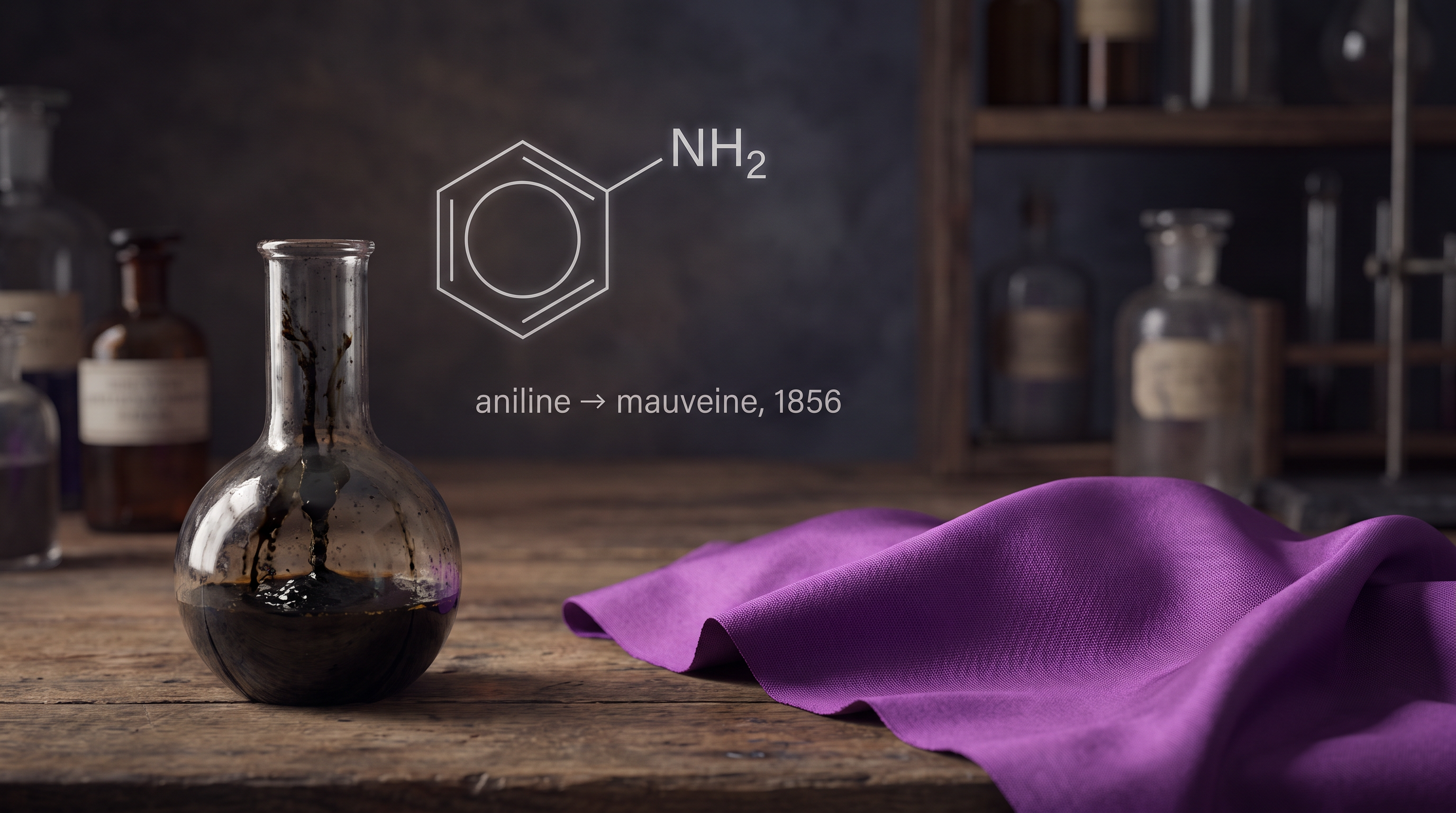
Fig. 9.0 – Perkin’s mauveine dye and the structure of aniline.
Hold on to these questions as you read. Each one is answered by the chemistry developed in this chapter.
9.1 Structure of Amines
Amines as Derivatives of Ammonia
Amines form one of the most important classes of organic compounds. They are obtained, at least on paper, by taking a molecule of ammonia, \(\mathrm{NH\_3}\), and replacing one, two, or all three of its hydrogen atoms by alkyl and/or aryl groups. Everything else about the nitrogen — its three bonds and its lone pair — stays as it was in ammonia, and that is why so much of the behaviour of amines echoes the behaviour of ammonia.
A few examples make the pattern clear. In each of these, count how many hydrogen atoms of ammonia have been replaced:
\[\mathrm{CH\_3!-!NH\_2}, \qquad \mathrm{C\_6H\_5!-!NH\_2}, \qquad \mathrm{CH\_3!-!NH!-!CH\_3}, \qquad \mathrm{CH\_3!-!N(CH\_3)\_2}\]
The first two have one hydrogen replaced (by a methyl group and by a phenyl group respectively), the third has two replaced, and the last has all three replaced. Note also that the replacing group may be an alkyl group (a chain, such as \(\mathrm{-CH\_3}\)) or an aryl group (an aromatic ring, such as \(\mathrm{-C\_6H\_5}\)). This distinction will matter a great deal later, because an aromatic ring attached to nitrogen changes the chemistry of the lone pair completely.
Where Amines Are Found
Amines are not laboratory curiosities. In nature they occur among proteins, vitamins, alkaloids and hormones. Among synthetic examples are polymers, dye stuffs and drugs. Two biologically active compounds, adrenaline and ephedrine, both of which contain a secondary amino group, are used to increase blood pressure. Novocain, a synthetic amino compound, is used as an anaesthetic in dentistry, and Benadryl, a well known antihistaminic drug, contains a tertiary amino group. Quaternary ammonium salts are used as surfactants. Diazonium salts, which are made from amines, are intermediates in the preparation of a variety of aromatic compounds including dyes — and they are taken up in the second half of this chapter.
The Shape Around Nitrogen
Like ammonia, the nitrogen atom of an amine is trivalent — it forms three bonds — and it carries an unshared pair of electrons, also called a lone pair. This lone pair is the single most important feature of an amine; almost every reaction in this chapter can be traced back to it.
To hold four electron groups (three bonds plus one lone pair), nitrogen mixes one \(2s\) and three \(2p\) orbitals to give four equivalent \(sp^3\) hybridised orbitals. Recall from Class 11 that \(sp^3\) hybridisation points the four orbitals towards the corners of a tetrahedron, with an ideal angle of \(109.5^\circ\) between them.
Three of these \(sp^3\) hybridised orbitals of nitrogen overlap with orbitals of hydrogen or of carbon, depending on the composition of the amine — with hydrogen in \(\mathrm{CH\_3NH\_2}\), with carbon in \(\mathrm{(CH\_3)\_3N}\). The fourth \(sp^3\) orbital, in every amine without exception, holds the unshared pair of electrons.
Because only three of the four orbitals are used for bonding, the shape we actually see — the arrangement of the atoms alone — is not tetrahedral but pyramidal. The nitrogen sits at the apex and the three attached atoms form the triangular base, as shown for trimethylamine in Fig. 9.1.
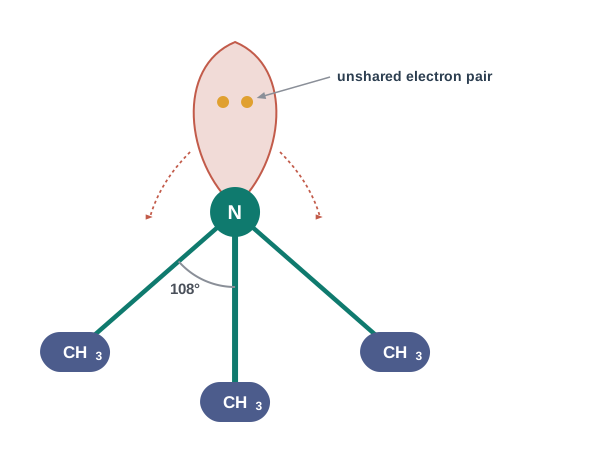
Fig. 9.1 – Pyramidal shape and bond angle of trimethylamine.
Why the Bond Angle Shrinks
A lone pair is held by only one nucleus, so it spreads out more than a bonding pair, which is pinned between two nuclei. The fatter lone pair therefore pushes the three bonding pairs closer together. As a result, the angle C–N–E (where E is C or H) is less than \(109.5^\circ\). In trimethylamine, for instance, it is \(108^\circ\), as shown in Fig. 9.1.
This is the same lone-pair repulsion argument you met in VSEPR theory in Class 11, and it is worth remembering as a general rule: whenever a lone pair replaces a bond around a central atom, the remaining bond angles close in slightly.
9.2 Classification
Counting the Replaced Hydrogens
Amines are classified as primary (1°), secondary (2°) and tertiary (3°), depending on how many hydrogen atoms of the ammonia molecule have been replaced by alkyl or aryl groups. The count is made at nitrogen, and nowhere else.
Start with ammonia. If one hydrogen atom of ammonia is replaced by R or Ar, we get \(\mathrm{RNH\_2}\) or \(\mathrm{ArNH\_2}\) — a primary amine (1°). Here two hydrogen atoms still remain on nitrogen.
Now replace a second hydrogen. Two hydrogen atoms of ammonia — or, which comes to the same thing, one hydrogen atom of \(\mathrm{R!-!NH\_2}\) — may be replaced by another alkyl/aryl group R′. What do you get? You get \(\mathrm{R!-!NHR'}\), a secondary amine (2°), with just one hydrogen left on nitrogen. The second alkyl or aryl group may be the same as the first or different from it.
Replacement of the remaining hydrogen atom by another alkyl/aryl group leads to the formation of a tertiary amine (3°), in which nitrogen carries three carbon groups and no hydrogen at all. The lone pair, of course, survives every one of these replacements — it is never touched.
The whole sequence is summarised in FC 9.2, and the general structures are drawn in Fig. 9.3.
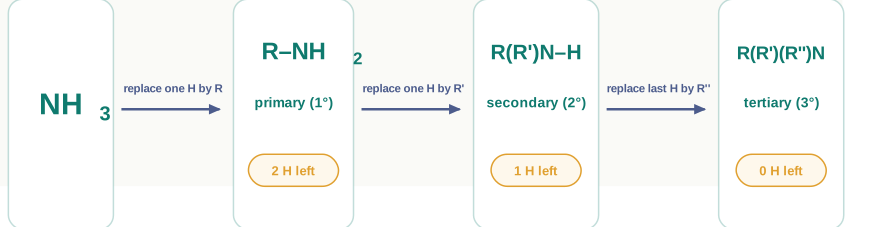
FC 9.2 – Successive replacement of hydrogen in ammonia.
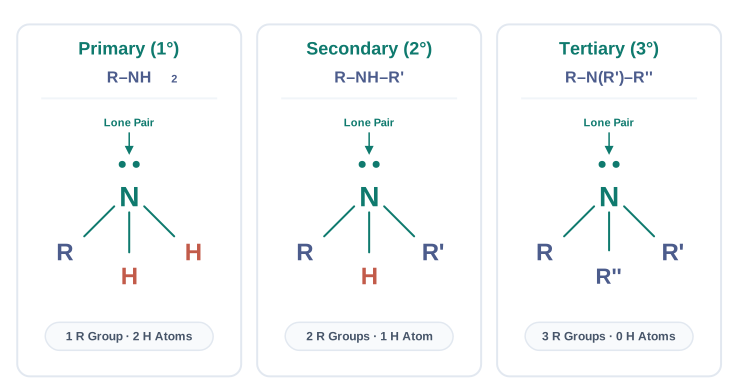
Fig. 9.3 – General structures of primary, secondary and tertiary amines.
Simple and Mixed Amines
Within the secondary and tertiary classes there is a further, smaller distinction. Amines are said to be ‘simple’ when all the alkyl or aryl groups on nitrogen are the same, and ‘mixed’ when they are different.
So \(\mathrm{(CH\_3)\_2NH}\) is a simple secondary amine, while \(\mathrm{CH\_3!-!NH!-!C\_2H\_5}\), carrying one methyl group and one ethyl group, is a mixed secondary amine. In the same way \(\mathrm{(C\_2H\_5)\_3N}\) is a simple tertiary amine, whereas \(\mathrm{CH\_3!-!N(C\_2H\_5)\_2}\) is mixed.
A Trap Worth Avoiding
Students often carry over the habit learnt with alcohols and alkyl halides, where “primary, secondary, tertiary” refers to the carbon atom bearing the functional group. For amines that habit gives the wrong answer. The classification of an amine is decided by the nitrogen atom, never by the carbon attached to it.
Take \(\mathrm{(CH\_3)\_3C!-!NH\_2}\). The carbon carrying the \(\mathrm{-NH\_2}\) group is a tertiary carbon, since it is joined to three other carbon atoms. But nitrogen here bears only one alkyl group and still holds two hydrogen atoms — so the compound is a primary amine. This distinction is a standing favourite in board and entrance examinations.
9.3 Nomenclature
Every amine has two names in common use — an older common name and a systematic IUPAC name — and examination papers freely use both. It is worth learning the two systems side by side rather than one after the other.
The Common System
In the common system, an aliphatic amine is named by prefixing the name of the alkyl group to the word “amine”, written as one word: alkylamine. Thus \(\mathrm{CH\_3NH\_2}\) is methylamine and \(\mathrm{C\_2H\_5NH\_2}\) is ethylamine.
In secondary and tertiary amines, when two or more of the groups on nitrogen are the same, the prefix di or tri is appended before the name of that alkyl group. So \(\mathrm{(CH\_3)\_2NH}\) is dimethylamine and \(\mathrm{(CH\_3)\_3N}\) is trimethylamine. If the groups are different, they are simply listed, as in ethylmethylamine for \(\mathrm{CH\_3!-!NH!-!C\_2H\_5}\).
The IUPAC System
In the IUPAC system, primary amines are named as alkanamines. The name is derived by replacing the final ‘e’ of the parent alkane by the word amine. Alkane \(\to\) alkan + amine. For example, \(\mathrm{CH\_3NH\_2}\) comes from methane and is named methanamine; \(\mathrm{CH\_3CH\_2CH\_2NH\_2}\) comes from propane and, since the \(\mathrm{-NH\_2}\) sits on carbon 1, is named propan-1-amine.
The position of the amino group on the chain is given by a locant, exactly as you learnt for alcohols. The chain is numbered so that the carbon bearing \(\mathrm{-NH\_2}\) gets the lowest possible number: \(\mathrm{CH\_3!-!CH(NH\_2)!-!CH\_3}\) is therefore propan-2-amine, not propan-3-amine.
In case more than one amino group is present at different positions in the parent chain, their positions are specified by giving numbers to the carbon atoms bearing the \(\mathrm{-NH\_2}\) groups, and a suitable prefix such as di, tri, etc. is attached to the word amine. Here comes a small but examinable twist: the letter ‘e’ of the suffix of the hydrocarbon part is retained. For example, \(\mathrm{H\_2N!-!CH\_2!-!CH\_2!-!NH\_2}\) is named as ethane-1,2-diamine — the ‘e’ of “ethane” stays, and “diamine” follows.
Naming Secondary and Tertiary Amines
To name secondary and tertiary amines, we use the locant N to designate a substituent attached to the nitrogen atom. The largest alkyl group is chosen as the parent alkanamine, and the remaining groups on nitrogen are named as N-substituents.
For example, \(\mathrm{CH\_3NHCH\_2CH\_3}\) is named as N-methylethanamine: the two-carbon chain is the parent (ethanamine), and the methyl group sitting on nitrogen becomes the N-methyl substituent. Similarly, \(\mathrm{(CH\_3CH\_2)\_3N}\) is named as N,N-diethylethanamine — one ethyl group serves as the parent chain, and the other two are reported as N,N-diethyl.
Arylamines
In arylamines, the \(\mathrm{-NH\_2}\) group is directly attached to the benzene ring. \(\mathrm{C\_6H\_5NH\_2}\) is the simplest example of an arylamine. In the common system it is known as aniline, and this name is also an accepted IUPAC name.
While naming arylamines according to the IUPAC system, the suffix ‘e’ of the arene is replaced by ‘amine’. Thus, in the IUPAC system, \(\mathrm{C\_6H\_5!-!NH\_2}\) is named as benzenamine (benzene \(-\) e \(+\) amine).
Common and IUPAC names of some alkylamines and arylamines are given in Table 9.1.
Table 9.1: Nomenclature of Some Alkylamines and Arylamines
| Amine | Common name | IUPAC name |
|---|---|---|
| \(\mathrm{CH\_3!-!CH\_2!-!NH\_2}\) | Ethylamine | Ethanamine |
| \(\mathrm{CH\_3!-!CH\_2!-!CH\_2!-!NH\_2}\) | n-Propylamine | Propan-1-amine |
| \(\mathrm{CH\_3!-!CH(NH\_2)!-!CH\_3}\) | Isopropylamine | Propan-2-amine |
| \(\mathrm{CH\_3!-!NH!-!CH\_2!-!CH\_3}\) | Ethylmethylamine | N-Methylethanamine |
| \(\mathrm{CH\_3!-!N(CH\_3)!-!CH\_3}\) | Trimethylamine | N,N-Dimethylmethanamine |
| \(\mathrm{C\_2H\_5!-!N(C\_2H\_5)!-!CH\_2CH\_2CH\_2CH\_3}\) | N,N-Diethylbutylamine | N,N-Diethylbutan-1-amine |
| \(\mathrm{NH\_2!-!CH\_2!-!CH=CH\_2}\) | Allylamine | Prop-2-en-1-amine |
| \(\mathrm{NH\_2!-!(CH\_2)\_6!-!NH\_2}\) | Hexamethylenediamine | Hexane-1,6-diamine |
| \(\mathrm{C\_6H\_5!-!NH\_2}\) | Aniline | Aniline or Benzenamine |
| \(\mathrm{2\text{-}CH\_3!-!C\_6H\_4!-!NH\_2}\) | o-Toluidine | 2-Methylaniline |
| \(\mathrm{4\text{-}Br!-!C\_6H\_4!-!NH\_2}\) | p-Bromoaniline | 4-Bromobenzenamine or 4-Bromoaniline |
| \(\mathrm{C\_6H\_5!-!N(CH\_3)\_2}\) | N,N-Dimethylaniline | N,N-Dimethylbenzenamine |
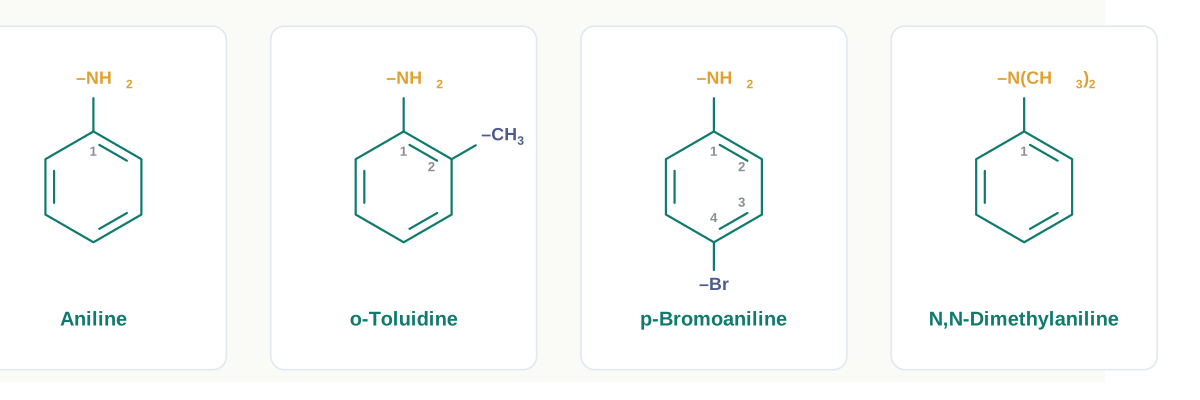
Fig. 9.4 – Structures of selected arylamines.
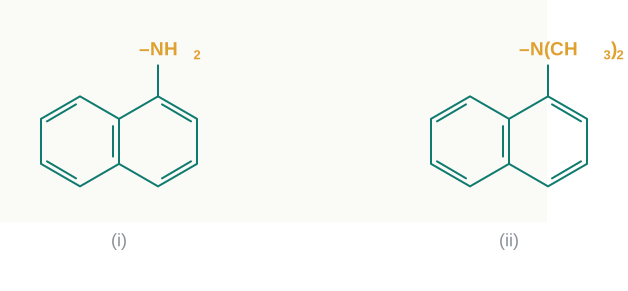
Fig. 9.5 – Naphthylamine structures for NCERT Asks 9.1.
9.2 (i) Write structures of the different isomeric amines corresponding to the molecular formula \(\mathrm{C\_4H\_{11}N}\). (ii) Write the IUPAC names of all the isomers. (iii) What type of isomerism is exhibited by different pairs of these amines?
9.4 Preparation of Amines
Amines are prepared by the following methods. As you read through them, keep two questions in mind for every route: which class of amine does it give, and does the carbon count of the molecule change? Examiners build most of their conversion problems out of exactly those two points.
1. Reduction of Nitro Compounds
Nitro compounds are reduced to amines by passing hydrogen gas in the presence of finely divided nickel, palladium or platinum, and also by reduction with metals in acidic medium. Nitroalkanes can also be similarly reduced to the corresponding alkanamines.
\[(\text{i})\quad \mathrm{C\_6H\_5NO\_2} \xrightarrow{\ \mathrm{H\_2}/\mathrm{Pd},\ \text{Ethanol}\ } \mathrm{C\_6H\_5NH\_2}\]
\[(\text{ii})\quad \mathrm{C\_6H\_5NO\_2} \xrightarrow{\ \mathrm{Sn}+\mathrm{HCl}\ \text{ or }\ \mathrm{Fe}+\mathrm{HCl}\ } \mathrm{C\_6H\_5NH\_2}\]
Nitrobenzene is thus turned into aniline — the industrial route by which most of the world’s aniline is still made.
Reduction with iron scrap and hydrochloric acid is preferred because \(\mathrm{FeCl\_2}\) formed gets hydrolysed to release hydrochloric acid during the reaction. Thus, only a small amount of hydrochloric acid is required to initiate the reaction. The acid is, in effect, regenerated as the reaction proceeds, which makes the process cheaper and less corrosive on a large scale.
2. Ammonolysis of Alkyl Halides
You have read (Chapter 6, Class XII) that the carbon–halogen bond in alkyl or benzyl halides can be easily cleaved by a nucleophile. Ammonia has an unshared electron pair on nitrogen, so it is a nucleophile too. Hence, an alkyl or benzyl halide on reaction with an ethanolic solution of ammonia undergoes a nucleophilic substitution reaction in which the halogen atom is replaced by an amino (\(\mathrm{-NH\_2}\)) group.
This process of cleavage of the C–X bond by an ammonia molecule is known as ammonolysis. The reaction is carried out in a sealed tube at 373 K.
\[\mathrm{NH\_3} + \mathrm{R!-!X} \longrightarrow \mathrm{R!-!NH\_3^+X^-}\]
The ammonia acts as the nucleophile and the substituted ammonium salt is the first product formed.
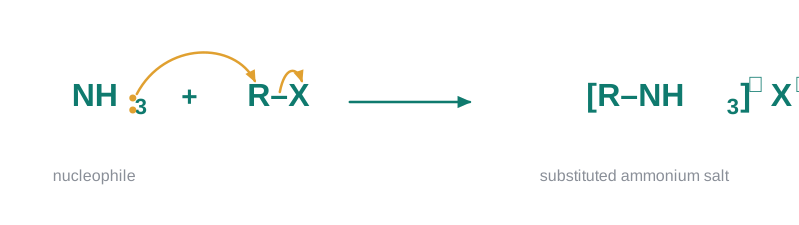
Fig. 9.6 – Nucleophilic attack of ammonia on an alkyl halide.
The primary amine thus obtained itself behaves as a nucleophile (its nitrogen still carries a lone pair) and can further react with alkyl halide to form secondary and tertiary amines, and finally a quaternary ammonium salt.
\[\mathrm{RNH\_2} \xrightarrow{\ \mathrm{RX}\ } \mathrm{R\_2NH} \xrightarrow{\ \mathrm{RX}\ } \mathrm{R\_3N} \xrightarrow{\ \mathrm{RX}\ } \mathrm{R\_4N^+X^-}\] \[(1^\circ) \qquad\qquad (2^\circ) \qquad\qquad (3^\circ) \qquad \text{Quaternary ammonium salt}\]
The free amine can be obtained from the ammonium salt by treatment with a strong base:
\[\mathrm{R!-!NH\_3^+X^-} + \mathrm{NaOH} \longrightarrow \mathrm{R!-!NH\_2} + \mathrm{H\_2O} + \mathrm{Na^+X^-}\]
Ammonolysis has the disadvantage of yielding a mixture of primary, secondary and tertiary amines and also a quaternary ammonium salt. However, primary amine is obtained as a major product by taking a large excess of ammonia.
The order of reactivity of halides with amines is \(\mathrm{RI} > \mathrm{RBr} > \mathrm{RCl}\).
3. Reduction of Nitriles
Nitriles on reduction with lithium aluminium hydride (\(\mathrm{LiAlH\_4}\)) or catalytic hydrogenation produce primary amines. This reaction is used for ascent of the amine series, i.e., for preparation of amines containing one carbon atom more than the starting amine.
\[\mathrm{R!-!C!\equiv!N} \xrightarrow{\ \mathrm{H\_2}/\mathrm{Ni}\ \text{ or }\ \mathrm{Na(Hg)}/\mathrm{C\_2H\_5OH}\ } \mathrm{R!-!CH\_2!-!NH\_2}\]
The extra carbon is the carbon of the \(\mathrm{-C!\equiv!N}\) group itself; reduction simply adds four hydrogen atoms across the triple bond. Since nitriles are themselves made from alkyl halides and \(\mathrm{KCN}\) or \(\mathrm{NaCN}\), this pairing gives a neat two-step way of lengthening a carbon chain by one atom.
4. Reduction of Amides
The amides on reduction with lithium aluminium hydride yield amines.
\[\mathrm{R!-!CO!-!NH\_2} \xrightarrow{\ \text{(i) } \mathrm{LiAlH\_4};\ \text{(ii) } \mathrm{H\_2O}\ } \mathrm{R!-!CH\_2!-!NH\_2}\]
Note carefully what happens to the carbon count. The C=O carbon of the amide stays in the product as a \(\mathrm{-CH\_2!-}\) group, so an amide with n carbon atoms gives an amine with n carbon atoms. Compare this with method 6 below, where the same starting amide loses a carbon — the reagent decides the outcome.
5. Gabriel Phthalimide Synthesis
Gabriel synthesis is used for the preparation of primary amines — and only primary amines, which is exactly why it is valued. Phthalimide on treatment with ethanolic potassium hydroxide forms the potassium salt of phthalimide, which on heating with an alkyl halide, followed by alkaline hydrolysis, produces the corresponding primary amine. The route is set out step by step in FC 9.7 and drawn in Fig. 9.8.
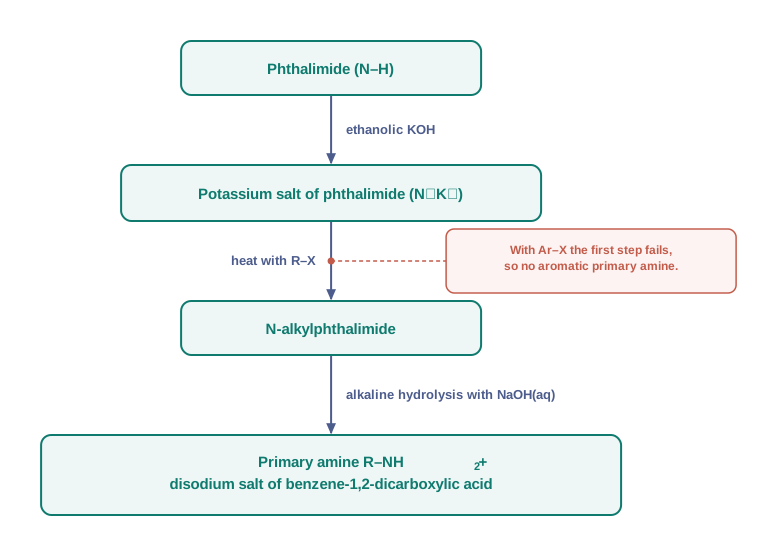
FC 9.7 – Gabriel phthalimide synthesis route.
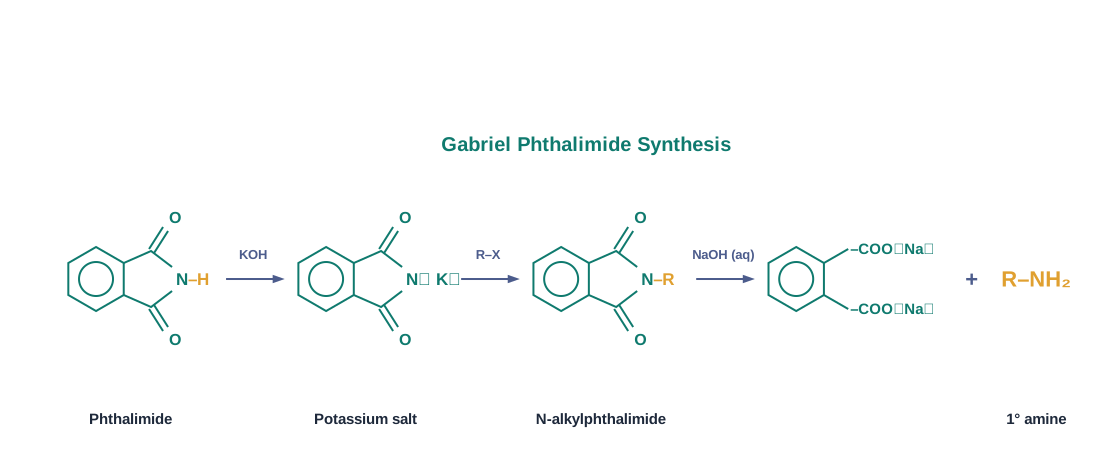
Fig. 9.8 – Structures in the Gabriel synthesis.
Aromatic primary amines cannot be prepared by this method because aryl halides do not undergo nucleophilic substitution with the anion formed by phthalimide. The carbon of an aryl halide is attached to an \(sp^2\) carbon of the ring and is deactivated towards nucleophilic attack, so the phthalimide anion simply cannot displace the halogen.
6. Hoffmann Bromamide Degradation Reaction
Hoffmann developed a method for the preparation of primary amines by treating an amide with bromine in an aqueous or ethanolic solution of sodium hydroxide. In this degradation reaction, migration of an alkyl or aryl group takes place from the carbonyl carbon of the amide to the nitrogen atom. The amine so formed contains one carbon less than that present in the amide.
\[\mathrm{R!-!CO!-!NH\_2} + \mathrm{Br\_2} + 4,\mathrm{NaOH} \longrightarrow \mathrm{R!-!NH\_2} + \mathrm{Na\_2CO\_3} + 2,\mathrm{NaBr} + 2,\mathrm{H\_2O}\]
The lost carbon is the carbonyl carbon, which leaves as carbonate. This makes the reaction the standard way of descending a series — of shortening a chain by one carbon — just as nitrile reduction was the standard way of ascending it.
9.5 Physical Properties
Physical State, Odour and Colour
The lower aliphatic amines are gases with a fishy odour. Primary amines with three or more carbon atoms are liquids, and still higher ones are solids — the usual pattern of rising melting and boiling points as the molecules get heavier.
Aniline and other arylamines are usually colourless, but they get coloured on storage due to atmospheric oxidation. A bottle of aniline that has stood open for some time turns yellow, then brown; the colour is not the amine itself but the oxidation products formed in it.
Solubility in Water
Lower aliphatic amines are soluble in water because they can form hydrogen bonds with water molecules. The nitrogen lone pair accepts a hydrogen bond from water, and the N–H hydrogens donate one in return.
However, solubility decreases with an increase in the molar mass of amines, due to the increase in the size of the hydrophobic alkyl part. The alkyl chain cannot hydrogen bond with water and simply gets in the way; as it lengthens, it dominates the molecule. Higher amines are essentially insoluble in water.
The strength of a hydrogen bond depends on how polar the X–H bond is, which in turn depends on electronegativity. Considering the electronegativity of the nitrogen of an amine and the oxygen of an alcohol as 3.0 and 3.5 respectively, you can predict the pattern of solubility of amines and alcohols in water. Out of butan-1-ol and butan-1-amine, which will be more soluble in water, and why?
Amines are also soluble in organic solvents like alcohol, ether and benzene. You may remember that alcohols are more polar than amines and form stronger intermolecular hydrogen bonds than amines — a fact that will explain the boiling points in a moment.
Boiling Points and Intermolecular Association
Primary and secondary amines are engaged in intermolecular association due to hydrogen bonding between the nitrogen of one molecule and the hydrogen of another. To hold two molecules together in this way you need both a lone pair (every amine has one) and an N–H hydrogen (not every amine has one).
This intermolecular association is greater in primary amines than in secondary amines, as there are two hydrogen atoms available for hydrogen bond formation in a primary amine, against only one in a secondary amine. Tertiary amines do not have intermolecular association, due to the absence of a hydrogen atom available for hydrogen bond formation — their nitrogen carries three alkyl groups and no N–H bond at all.
Since more hydrogen bonds mean more energy needed to pull the molecules apart, the order of boiling points of isomeric amines is as follows:
\[\text{Primary} > \text{Secondary} > \text{Tertiary}\]
Intermolecular hydrogen bonding in primary amines is shown in Fig. 9.9.
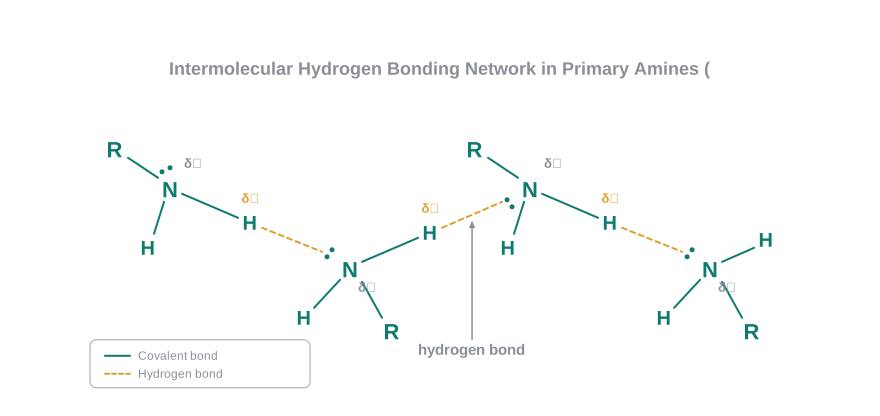
Fig. 9.9 – Intermolecular hydrogen bonding in primary amines.
Boiling points of amines, alcohols and alkanes of almost the same molar mass are shown in Table 9.2.
Table 9.2: Comparison of Boiling Points of Amines, Alcohols and Alkanes of Similar Molecular Masses
| Sl. No. | Compound | Molar mass | b.p./K |
|---|---|---|---|
| 1. | \(\mathrm{n\text{-}C\_4H\_9NH\_2}\) | 73 | 350.8 |
| 2. | \(\mathrm{(C\_2H\_5)\_2NH}\) | 73 | 329.3 |
| 3. | \(\mathrm{C\_2H\_5N(CH\_3)\_2}\) | 73 | 310.5 |
| 4. | \(\mathrm{C\_2H\_5CH(CH\_3)\_2}\) | 72 | 300.8 |
| 5. | \(\mathrm{n\text{-}C\_4H\_9OH}\) | 74 | 390.3 |
Read the table from the bottom up and the whole story falls out. The alkane (entry 4) has no hydrogen bonding at all and boils lowest. The tertiary amine (entry 3) has a lone pair but no N–H, so it too cannot associate, and boils only a little higher. The secondary amine (entry 2) has one N–H, the primary amine (entry 1) has two, and their boiling points rise accordingly. The alcohol (entry 5), with its far more polar O–H bond, forms the strongest hydrogen bonds of all and boils highest — nearly 40 K above the primary amine of almost the same molar mass.
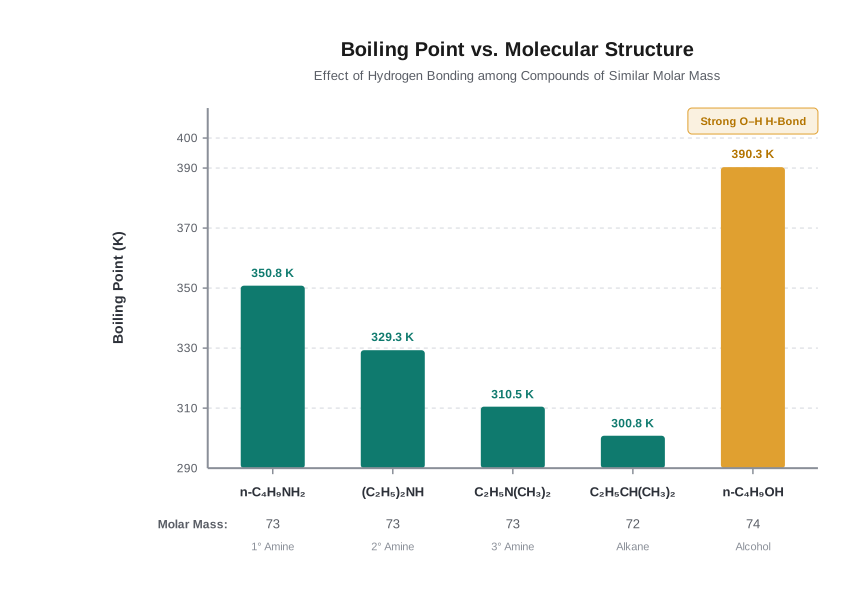
Fig. 9.10 – Boiling points of amines, alkanes and alcohols.
9.6 Chemical Reactions
What Makes an Amine React
Two features control everything an amine does. First, the difference in electronegativity between nitrogen and hydrogen atoms makes the N–H bond polar. Second, and far more important, the presence of the unshared pair of electrons over the nitrogen atom makes amines reactive — the lone pair is a site of high electron density looking for a positive centre to attack.
Because of that lone pair, amines behave as nucleophiles: electron-rich species that attack electron-poor carbon atoms. They are also, for exactly the same reason, bases: an electron pair offered to a proton is a base by the Lewis definition.
The number of hydrogen atoms attached to the nitrogen atom also decides the course of the reaction of amines. That is why primary amines (\(\mathrm{-NH\_2}\)), secondary amines (\(\mathrm{>N!-!H}\)) and tertiary amines (\(\mathrm{>N!-}\)) differ in many reactions. Some reactions need an N–H bond to proceed at all; a tertiary amine, having none, simply stands aside. This difference is not a nuisance — it is precisely what allows us to tell the three classes apart in the laboratory.
Some of the reactions of amines are described below.
1. Basic Character of Amines
Amines, being basic in nature, react with acids to form salts.
\[\mathrm{R!-!NH\_2} + \mathrm{H!-!X} \rightleftharpoons \mathrm{\[R!-!NH\_3]^+,X^-} \qquad \text{(salt)}\]
\[\mathrm{C\_6H\_5NH\_2} + \mathrm{HCl} \rightleftharpoons \mathrm{\[C\_6H\_5NH\_3]^+,Cl^-}\]
Aniline gives anilinium chloride in this way. Amine salts on treatment with a base like \(\mathrm{NaOH}\) regenerate the parent amine:
\[\mathrm{\[R!-!NH\_3]^+,X^-} + \mathrm{OH^-} \longrightarrow \mathrm{R!-!NH\_2} + \mathrm{H\_2O} + \mathrm{X^-}\]
Amine salts are soluble in water but insoluble in organic solvents like ether. This pair of facts is more useful than it looks: this reaction is the basis for the separation of amines from non-basic organic compounds that are insoluble in water. Shake the mixture with dilute acid and the amine leaves as its salt into the aqueous layer, while everything non-basic stays behind in the ether layer; add alkali to the aqueous layer afterwards and the free amine comes back.
Measuring the Strength of the Base
The reaction of amines with mineral acids to form ammonium salts shows that these are basic in nature. Amines have an unshared pair of electrons on the nitrogen atom, due to which they behave as a Lewis base.
The basic character of amines can be better understood in terms of their \(K\_b\) and \(\mathrm{p}K\_b\) values, as explained below. In water, an amine sets up the following equilibrium:
\[\mathrm{R!-!NH\_2} + \mathrm{H\_2O} \rightleftharpoons \mathrm{R!-!NH\_3^+} + \mathrm{OH^-}\]
Writing the equilibrium constant for this reaction,
\[K = \frac{\[\mathrm{R!-!NH\_3^+}]\[\mathrm{OH^-}]}{\[\mathrm{R!-!NH\_2}]\[\mathrm{H\_2O}]}\]
Water is present in enormous excess and its concentration hardly changes during the reaction, so \(\[\mathrm{H\_2O}]\) can be treated as a constant and absorbed into the equilibrium constant:
\[K\[\mathrm{H\_2O}] = \frac{\[\mathrm{R!-!NH\_3^+}]\[\mathrm{OH^-}]}{\[\mathrm{R!-!NH\_2}]}\]
The product \(K\[\mathrm{H\_2O}]\) is given its own name, the base dissociation constant \(K\_b\):
\[K\_b = \frac{\[\mathrm{R!-!NH\_3^+}]\[\mathrm{OH^-}]}{\[\mathrm{R!-!NH\_2}]}\]
\[\mathrm{p}K\_b = -\log K\_b\]
The logarithm appears simply because \(K\_b\) values are awkward numbers such as \(4.2\times10^{-4}\); taking the negative logarithm turns them into comfortable small numbers such as 3.38.
Larger the value of \(K\_b\), or smaller the value of \(\mathrm{p}K\_b\), stronger is the base. Note the reversal carefully — it is a standing source of error in examinations. The \(\mathrm{p}K\_b\) values of a few amines are given in Table 9.3.
\(\mathrm{p}K\_b\) value of ammonia is 4.75. Aliphatic amines are stronger bases than ammonia due to the +I effect (the electron-releasing inductive effect) of alkyl groups, which leads to a high electron density on the nitrogen atom. Their \(\mathrm{p}K\_b\) values lie in the range of 3 to 4.22. On the other hand, aromatic amines are weaker bases than ammonia, due to the electron withdrawing nature of the aryl group.
Table 9.3: p\(K\_b\) Values of Amines in Aqueous Phase
| Name of amine | p\(K\_b\) |
|---|---|
| Methanamine | 3.38 |
| N-Methylmethanamine | 3.27 |
| N,N-Dimethylmethanamine | 4.22 |
| Ethanamine | 3.29 |
| N-Ethylethanamine | 3.00 |
| N,N-Diethylethanamine | 3.25 |
| Benzenamine | 9.38 |
| Phenylmethanamine | 4.70 |
| N-Methylaniline | 9.30 |
| N,N-Dimethylaniline | 8.92 |
Look at the aromatic entries. Benzenamine (aniline) has \(\mathrm{p}K\_b\) 9.38 — thousands of times weaker as a base than methanamine at 3.38. But phenylmethanamine, in which the ring is one carbon away from the nitrogen, has \(\mathrm{p}K\_b\) 4.70, much closer to the aliphatic amines. Direct attachment of the ring to nitrogen is what does the damage, and the reason is given a little further on.
You may find some discrepancies while trying to interpret the \(K\_b\) values of amines on the basis of the +I or –I effect of the substituents present in amines. Besides the inductive effect, there are other effects like the solvation effect, steric hindrance, etc., which affect the basic strength of amines. Just ponder over this. You may get the answer in the following paragraphs.
Structure–Basicity Relationship of Amines
Basicity of amines is related to their structure. The basic character of an amine depends upon the ease of formation of the cation by accepting a proton from the acid. The more stable the cation is relative to the amine, the more basic is the amine.
This is the single idea from which everything below follows. Do not memorise the orders; derive them by asking, each time, “which side of the equilibrium is being stabilised — the amine or the cation it forms?”
(a) Alkanamines versus Ammonia
Let us consider the reaction of an alkanamine and of ammonia with a proton, so as to compare their basicity:
\[\mathrm{R!-!NH\_2} + \mathrm{H^+} \rightleftharpoons \mathrm{R!-!NH\_3^+}\]
\[\mathrm{H!-!NH\_2} + \mathrm{H^+} \rightleftharpoons \mathrm{H!-!NH\_3^+}\]
Due to the electron releasing nature of the alkyl group, it pushes electrons towards nitrogen and thus makes the unshared electron pair more available for sharing with the proton of the acid. Moreover, the substituted ammonium ion formed from the amine gets stabilised due to dispersal of the positive charge by the +I effect of the alkyl group. Hence, alkylamines are stronger bases than ammonia.
Thus, the basic nature of aliphatic amines should increase with an increase in the number of alkyl groups. This trend is followed in the gaseous phase. The order of basicity of amines in the gaseous phase follows the expected order:
\[\text{tertiary amine} > \text{secondary amine} > \text{primary amine} > \mathrm{NH\_3}\]
The trend is not regular in the aqueous state, as is evident from the \(\mathrm{p}K\_b\) values given in Table 9.3. Why should water change the answer?
In the aqueous phase, the substituted ammonium cations get stabilised not only by the electron releasing effect of the alkyl group (+I), but also by solvation with water molecules — each N–H hydrogen of the cation is hydrogen bonded to a water molecule, and each such bond stabilises the ion. The greater the size of the ion, the lesser will be the solvation, and the less stabilised is the ion. A tertiary ammonium ion has only one N–H hydrogen to offer, and its three alkyl groups crowd the water molecules out. The order of stability of the ions is as follows, and it is shown in Fig. 9.11.
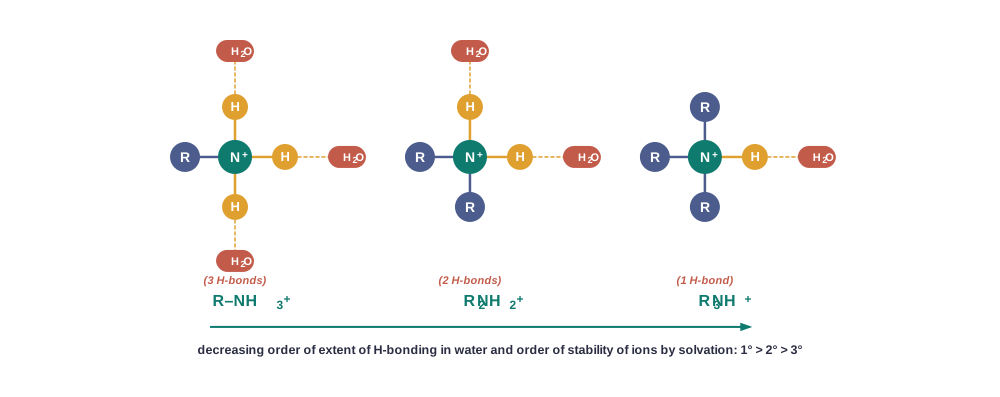
Fig. 9.11 – Hydrogen bonding of ammonium ions in water.
\[1^\circ > 2^\circ > 3^\circ\]
Greater is the stability of the substituted ammonium cation, stronger should be the corresponding amine as a base. Thus, on the solvation argument alone, the order of basicity of aliphatic amines should be:
\[\text{primary} > \text{secondary} > \text{tertiary}\]
which is opposite to the inductive-effect based order. Two effects are pulling in opposite directions, and the observed order is whatever compromise they reach.
Secondly, when the alkyl group is small, like the \(\mathrm{-CH\_3}\) group, there is no steric hindrance to H-bonding. In case the alkyl group is bigger than the \(\mathrm{CH\_3}\) group, there will be steric hindrance to H-bonding — the bulky groups physically block water molecules from reaching the N–H hydrogens. Therefore, the change of nature of the alkyl group, e.g., from \(\mathrm{-CH\_3}\) to \(\mathrm{-C\_2H\_5}\), results in a change of the order of basic strength.
Thus, there is a subtle interplay of the inductive effect, the solvation effect and the steric hindrance of the alkyl group, which decides the basic strength of alkylamines in the aqueous state. The order of basic strength in the case of methyl substituted amines and ethyl substituted amines in aqueous solution is as follows:
\[\mathrm{(C\_2H\_5)\_2NH} > \mathrm{(C\_2H\_5)\_3N} > \mathrm{C\_2H\_5NH\_2} > \mathrm{NH\_3}\]
\[\mathrm{(CH\_3)\_2NH} > \mathrm{CH\_3NH\_2} > \mathrm{(CH\_3)\_3N} > \mathrm{NH\_3}\]
Notice that in both series the secondary amine comes first — it enjoys a good share of the inductive effect while still keeping two N–H hydrogens for solvation. That is the compromise. Notice also that the two series then diverge: with the bulkier ethyl groups, the tertiary amine climbs above the primary, whereas with methyl groups it falls below it. You are not expected to predict such fine orders from first principles, but you are expected to be able to say why they cannot be predicted from the inductive effect alone.
(b) Arylamines versus Ammonia
The \(\mathrm{p}K\_b\) value of aniline is quite high (9.38 — see Table 9.3). Why is it so?
It is because in aniline, or in other arylamines, the \(\mathrm{-NH\_2}\) group is attached directly to the benzene ring. This results in the unshared electron pair on the nitrogen atom being in conjugation with the benzene ring — it is delocalised into the ring’s \(\pi\) system — and thus it is made less available for protonation. A lone pair that is busy being shared with the ring cannot also be handed to a proton.
If you write the different resonating structures of aniline, you will find that aniline is a resonance hybrid of the following five structures, drawn in Fig. 9.12.
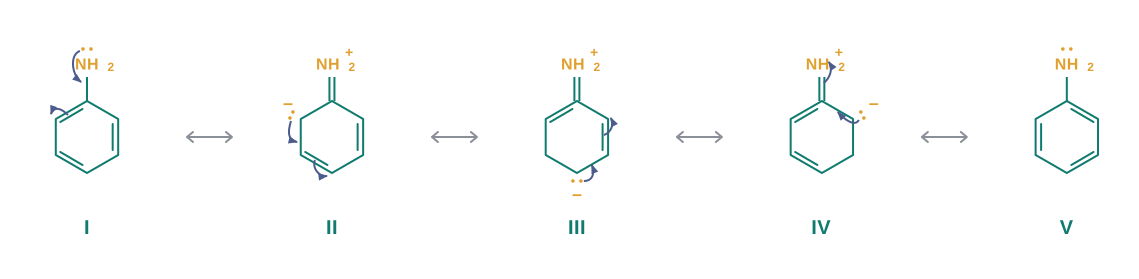
Fig. 9.12 – Resonating structures of aniline.
On the other hand, the anilinium ion obtained by accepting a proton can have only two resonating structures (the Kekulé structures), shown in Fig. 9.13. Once nitrogen has used its lone pair to bond the proton, it has nothing left to donate to the ring.
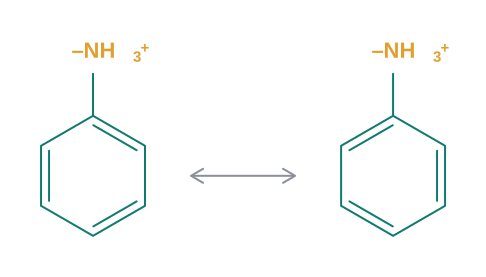
Fig. 9.13 – Resonating structures of the anilinium ion.
We know that the greater the number of resonating structures, the greater is the stability. Thus you can infer that aniline (five resonating structures) is more stable than the anilinium ion (two). Resonance stabilises the left-hand side of the protonation equilibrium far more than the right-hand side, and so the equilibrium sits to the left. Hence, the proton acceptability, or the basic nature, of aniline or other aromatic amines would be less than that of ammonia.
In the case of substituted anilines, it is observed that electron releasing groups like \(\mathrm{-OCH\_3}\) and \(\mathrm{-CH\_3}\) increase basic strength, whereas electron withdrawing groups like \(\mathrm{-NO\_2}\), \(\mathrm{-SO\_3H}\), \(\mathrm{-COOH}\) and \(\mathrm{-X}\) decrease it. The logic is the same in every case: a group that pushes electron density towards nitrogen makes the lone pair more available and the cation more stable; a group that pulls electron density away does the reverse.
2. Alkylation
Amines undergo alkylation on reaction with alkyl halides (refer Chapter 6, Class XII). The lone pair on nitrogen attacks the carbon bearing the halogen, exactly as in the ammonolysis reaction you met in Section 9.4 — and, as there, the alkylation does not stop cleanly at one stage, running on through the secondary and tertiary amines to the quaternary ammonium salt.
3. Acylation
Aliphatic and aromatic primary and secondary amines react with acid chlorides, anhydrides and esters by a nucleophilic substitution reaction. This reaction is known as acylation. You can consider this reaction as the replacement of a hydrogen atom of the \(\mathrm{-NH\_2}\) or \(\mathrm{>N!-!H}\) group by the acyl group (\(\mathrm{R!-!CO!-}\)). The products obtained by an acylation reaction are known as amides.
Since a hydrogen atom on nitrogen must be replaced, tertiary amines — which have none — do not undergo acylation. Keep that in mind; it will return as a test.
The reaction is carried out in the presence of a base stronger than the amine, like pyridine, which removes the HCl so formed and shifts the equilibrium to the right hand side. Without such a base, the liberated HCl would simply protonate the amine and take it out of play as a nucleophile.
\[\mathrm{C\_2H\_5!-!NH\_2} + \mathrm{CH\_3!-!CO!-!Cl} \xrightarrow{\ \text{Base}\ } \mathrm{C\_2H\_5!-!NH!-!CO!-!CH\_3} + \mathrm{H!-!Cl}\]
Ethanamine gives N-ethylethanamide.
\[\mathrm{(C\_2H\_5)\_2NH} + \mathrm{CH\_3!-!CO!-!Cl} \xrightarrow{\ \text{Base}\ } \mathrm{C\_2H\_5!-!N(C\_2H\_5)!-!CO!-!CH\_3} + \mathrm{H!-!Cl}\]
N-Ethylethanamine gives N,N-diethylethanamide.
\[\mathrm{C\_6H\_5!-!NH\_2} + \mathrm{(CH\_3CO)\_2O} \longrightarrow \mathrm{C\_6H\_5!-!NH!-!CO!-!CH\_3} + \mathrm{CH\_3COOH}\]
Benzenamine and ethanoic anhydride give N-phenylethanamide, better known as acetanilide. Remember this product — it is the key to controlling aniline’s reactivity in Section 7 below.
Amines also react with benzoyl chloride (\(\mathrm{C\_6H\_5COCl}\)). This reaction is known as benzoylation.
\[\mathrm{CH\_3NH\_2} + \mathrm{C\_6H\_5COCl} \longrightarrow \mathrm{CH\_3NHCOC\_6H\_5} + \mathrm{HCl}\]
Methanamine and benzoyl chloride give N-methylbenzamide.
What do you think is the product of the reaction of amines with carboxylic acids? They form salts with amines at room temperature. The acid simply protonates the amine; no amide is formed under such mild conditions.
4. Carbylamine Reaction
Aliphatic and aromatic primary amines, on heating with chloroform and ethanolic potassium hydroxide, form isocyanides or carbylamines, which are foul smelling substances.
\[\mathrm{R!-!NH\_2} + \mathrm{CHCl\_3} + 3,\mathrm{KOH} \xrightarrow{\ \text{Heat}\ } \mathrm{R!-!NC} + 3,\mathrm{KCl} + 3,\mathrm{H\_2O}\]
Secondary and tertiary amines do not show this reaction. This reaction is known as the carbylamine reaction or the isocyanide test, and is used as a test for primary amines.
The test is unusually easy to apply, because the answer arrives at the nose before it arrives at the eye: the isocyanide has an extremely offensive smell, and its appearance is proof that a primary amine was present.
5. Reaction with Nitrous Acid
The three classes of amines react differently with nitrous acid, which is prepared in situ from a mineral acid and sodium nitrite. Nitrous acid, \(\mathrm{HNO\_2}\), is too unstable to be bottled, so it is generated in the reaction vessel at the moment it is needed.
(a) Primary aliphatic amines react with nitrous acid to form aliphatic diazonium salts, which, being unstable, liberate nitrogen gas quantitatively, and alcohols.
\[\mathrm{R!-!NH\_2} + \mathrm{HNO\_2} \xrightarrow{\ \mathrm{NaNO\_2} + \mathrm{HCl}\ } \mathrm{\[R!-!N\_2]^+,Cl^-} \xrightarrow{\ \mathrm{H\_2O}\ } \mathrm{ROH} + \mathrm{N\_2} + \mathrm{HCl}\]
The word quantitatively is the important one. Every mole of primary aliphatic amine gives exactly one mole of nitrogen gas, so the volume of gas collected measures the amount of amine present. Quantitative evolution of nitrogen is used in the estimation of amino acids and proteins.
(b) Aromatic amines react with nitrous acid at low temperatures (273–278 K) to form diazonium salts, a very important class of compounds used for the synthesis of a variety of aromatic compounds, discussed in Section 9.7.
\[\mathrm{C\_6H\_5!-!NH\_2} \xrightarrow[\ 273-278\ \text{K}\ ]{\ \mathrm{NaNO\_2} + 2,\mathrm{HCl}\ } \mathrm{\[C\_6H\_5!-!N\_2]^+,Cl^-} + \mathrm{NaCl} + 2,\mathrm{H\_2O}\]
Aniline gives benzenediazonium chloride. Secondary and tertiary amines react with nitrous acid in a different manner.
6. Reaction with Arylsulphonyl Chloride
Benzenesulphonyl chloride (\(\mathrm{C\_6H\_5SO\_2Cl}\)), which is also known as Hinsberg’s reagent, reacts with primary and secondary amines to form sulphonamides.
(a) The reaction of benzenesulphonyl chloride with a primary amine yields N-ethylbenzenesulphonyl amide, as shown in Fig. 9.14.
\[\mathrm{C\_6H\_5SO\_2Cl} + \mathrm{H\_2N!-!C\_2H\_5} \longrightarrow \mathrm{C\_6H\_5SO\_2!-!NH!-!C\_2H\_5} + \mathrm{HCl}\]
The hydrogen attached to nitrogen in the sulphonamide is strongly acidic, due to the presence of the strong electron withdrawing sulphonyl group, which pulls electron density away from the N–H bond and stabilises the anion left behind when the hydrogen leaves. Hence, it is soluble in alkali.
(b) In the reaction with a secondary amine, N,N-diethylbenzenesulphonamide is formed.
\[\mathrm{C\_6H\_5SO\_2Cl} + \mathrm{HN(C\_2H\_5)\_2} \longrightarrow \mathrm{C\_6H\_5SO\_2!-!N(C\_2H\_5)\_2} + \mathrm{HCl}\]
Since N,N-diethylbenzenesulphonamide does not contain any hydrogen atom attached to the nitrogen atom, it is not acidic and hence insoluble in alkali.
(c) Tertiary amines do not react with benzenesulphonyl chloride at all — they have no N–H hydrogen to replace.
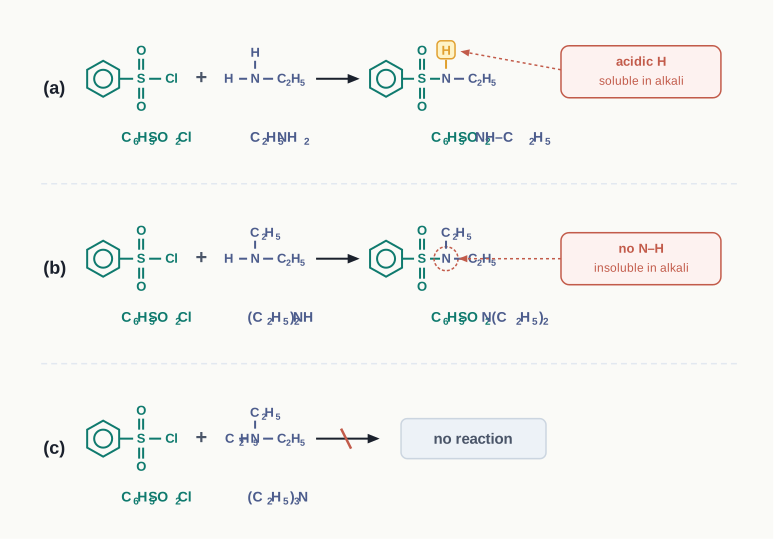
Fig. 9.14 – Reaction of amines with Hinsberg’s reagent.
This property of amines reacting with benzenesulphonyl chloride in a different manner is used for the distinction of primary, secondary and tertiary amines, and also for the separation of a mixture of amines. However, these days benzenesulphonyl chloride is replaced by p-toluenesulphonyl chloride. The logic of the test is set out in FC 9.15.
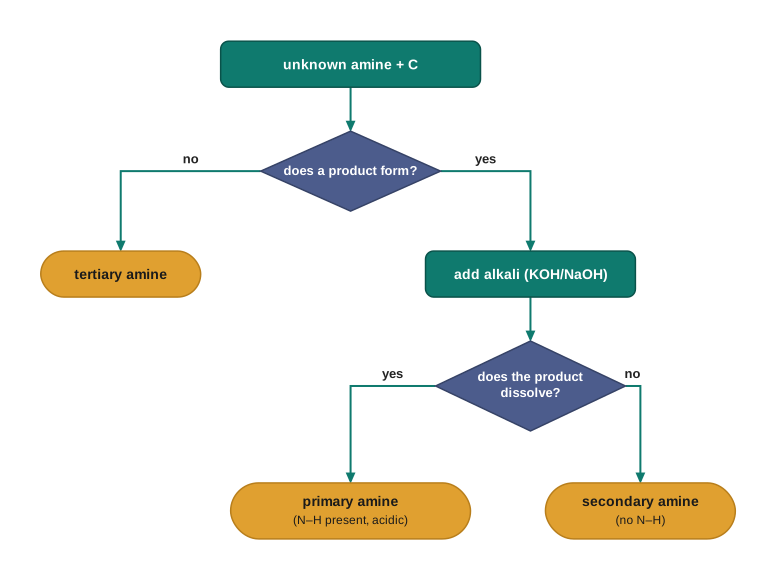
FC 9.15 – The Hinsberg test for amine classes.
7. Electrophilic Substitution
You have read earlier that aniline is a resonance hybrid of five structures (Fig. 9.12). Where do you find the maximum electron density in these structures? The ortho and para positions to the \(\mathrm{-NH\_2}\) group become centres of high electron density, because that is where the negative charge lands when the nitrogen lone pair is pushed into the ring.
An electrophile is an electron-seeking species; it will therefore attack precisely where the electrons have piled up. Thus the \(\mathrm{-NH\_2}\) group is ortho and para directing, and a powerful activating group — a ring carrying it reacts far faster than benzene itself.
(a) Bromination
Aniline reacts with bromine water at room temperature to give a white precipitate of 2,4,6-tribromoaniline, as shown in Fig. 9.16. No catalyst, no heating — the ring is that activated.
\[\mathrm{C\_6H\_5NH\_2} + 3,\mathrm{Br\_2} \xrightarrow{\ \mathrm{Br\_2}/\mathrm{H\_2O}\ } \mathrm{C\_6H\_2(Br)\_3NH\_2} + 3,\mathrm{HBr}\]
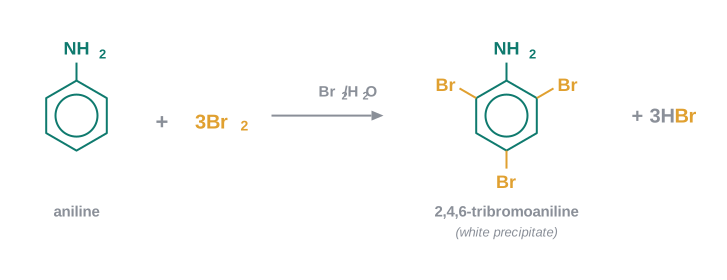
Fig. 9.16 – Uncontrolled bromination of aniline.
The main problem encountered during electrophilic substitution reactions of aromatic amines is that of their very high reactivity. Substitution tends to occur at the ortho and para positions — all of them at once. If we have to prepare a monosubstituted aniline derivative, how can the activating effect of the \(\mathrm{-NH\_2}\) group be controlled?
This can be done by protecting the \(\mathrm{-NH\_2}\) group by acetylation with acetic anhydride, then carrying out the desired substitution, followed by hydrolysis of the substituted amide back to the substituted amine. The three-step strategy is shown in Fig. 9.17 and summarised in FC 9.18.
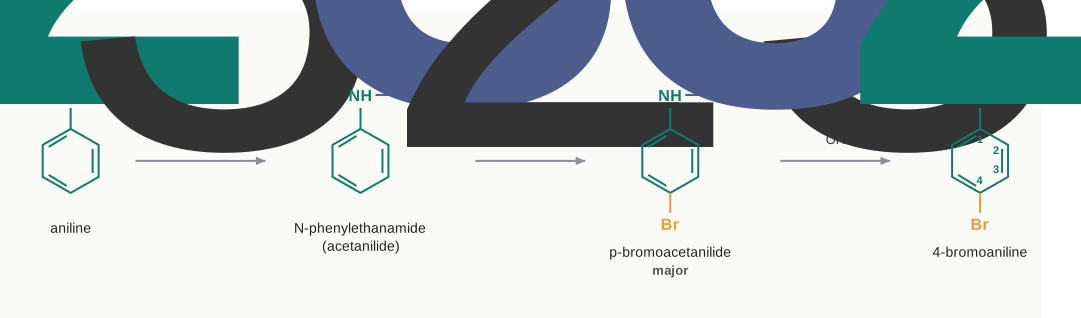
Fig. 9.17 – Controlled bromination of aniline.
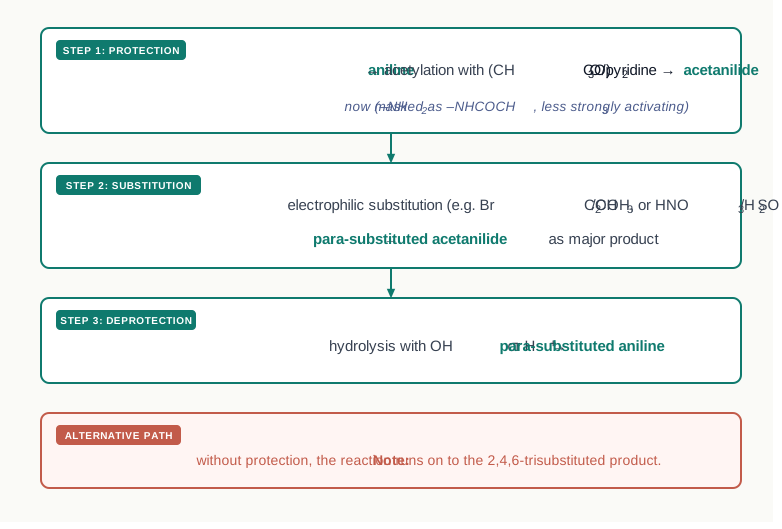
FC 9.18 – The protect-substitute-deprotect strategy.
Why does the protection work? The lone pair of electrons on the nitrogen of acetanilide interacts with the oxygen atom due to resonance, as shown in Fig. 9.19 — nitrogen must now share its lone pair with the carbonyl group as well as with the ring.
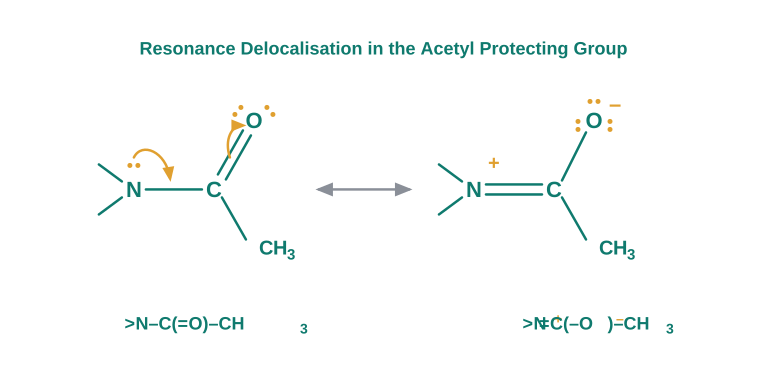
Fig. 9.19 – Resonance in acetanilide.
Hence, the lone pair of electrons on nitrogen is less available for donation to the benzene ring by resonance. Therefore, the activating effect of the \(\mathrm{-NHCOCH\_3}\) group is less than that of the amino group. The ring is still activated enough to react, but no longer so hungrily that it takes three bromines at once — and the bulky acetyl group also hinders attack at the ortho positions, so the para product dominates.
(b) Nitration
Direct nitration of aniline yields tarry oxidation products in addition to the nitro derivatives — nitric acid is an oxidising agent, and the electron-rich aniline ring is easily oxidised.
Moreover, in the strongly acidic medium, aniline is protonated to form the anilinium ion, which is meta directing. The positively charged \(\mathrm{-NH\_3^+}\) group withdraws electrons instead of releasing them. That is why, besides the ortho and para derivatives, a significant amount of the meta derivative is also formed, as shown in Fig. 9.20.
\[\mathrm{C\_6H\_5NH\_2} \xrightarrow{\ \mathrm{HNO\_3},\ \mathrm{H\_2SO\_4},\ 288\ \text{K}\ } \text{p-nitroaniline (51%)} + \text{m-nitroaniline (47%)} + \text{o-nitroaniline (2%)}\]
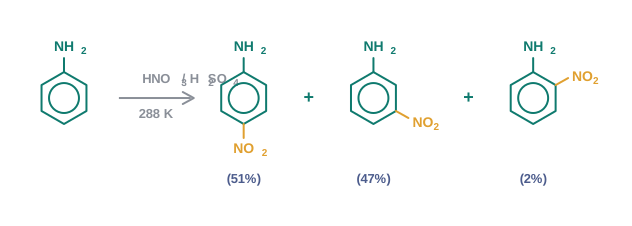
Fig. 9.20 – Direct nitration of aniline.
Notice that the mixture is a chemical fingerprint of two competing species in the flask: the free amine, which directs ortho and para, and the anilinium ion, which directs meta.
However, by protecting the \(\mathrm{-NH\_2}\) group by the acetylation reaction with acetic anhydride, the nitration reaction can be controlled and the p-nitro derivative can be obtained as the major product. The same protect–substitute–deprotect route of FC 9.18 is used:
\[\mathrm{C\_6H\_5NH\_2} \xrightarrow{\ \mathrm{(CH\_3CO)\_2O}/\text{pyridine}\ } \text{Acetanilide} \xrightarrow{\ \mathrm{HNO\_3},\ \mathrm{H\_2SO\_4},\ 288\ \text{K}\ } \text{p-Nitroacetanilide} \xrightarrow{\ \mathrm{OH^-}\ \text{or}\ \mathrm{H^+}\ } \text{p-Nitroaniline}\]
(c) Sulphonation
Aniline reacts with concentrated sulphuric acid to form anilinium hydrogensulphate, which on heating with sulphuric acid at 453–473 K produces p-aminobenzene sulphonic acid, commonly known as sulphanilic acid, as the major product.
\[\mathrm{C\_6H\_5NH\_2} \xrightarrow{\ \mathrm{H\_2SO\_4}\ } \mathrm{\[C\_6H\_5NH\_3]^+,\[HSO\_4]^-} \xrightarrow{\ 453-473\ \text{K}\ } \text{Sulphanilic acid}\]
Sulphanilic acid is unusual: it carries a basic \(\mathrm{-NH\_2}\) group at one end of the ring and an acidic \(\mathrm{-SO\_3H}\) group at the other. The acid simply hands its proton to the amine within the same molecule, and the compound exists largely as a zwitter ion — a species with a positive and a negative charge on the same molecule but no net charge, as shown in Fig. 9.21.
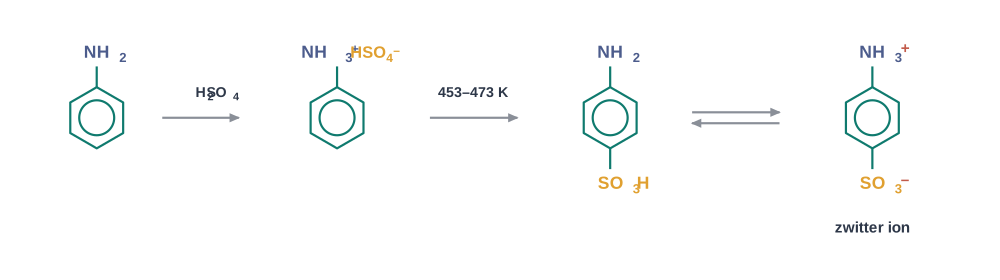
Fig. 9.21 – Sulphonation of aniline and zwitter ion formation.
Why Aniline Fails at Friedel–Crafts
Aniline does not undergo the Friedel–Crafts reaction (alkylation and acetylation), due to salt formation with aluminium chloride, the Lewis acid which is used as a catalyst. The nitrogen lone pair is donated to the electron-deficient aluminium.
\[\mathrm{C\_6H\_5NH\_2} + \mathrm{AlCl\_3} \longrightarrow \mathrm{C\_6H\_5\overset{+}{N}H\_2!-!\overset{-}{Al}Cl\_3}\]
Due to this, the nitrogen of aniline acquires a positive charge and hence acts as a strong deactivating group for further reaction. The very lone pair that makes aniline so reactive towards bromine is the lone pair that surrenders to the catalyst — and the ring, now carrying a positively charged substituent, refuses to react.
9.7 Method of Preparation of Diazonium Salts
What a Diazonium Salt Is
The diazonium salts have the general formula \(\mathrm{R!-!N\_2^+,X^-}\), where R stands for an aryl group, and the \(\mathrm{X^-}\) ion may be \(\mathrm{Cl^-}\), \(\mathrm{Br^-}\), \(\mathrm{HSO\_4^-}\), \(\mathrm{BF\_4^-}\), etc. The \(\mathrm{-N\_2^+}\) group — two nitrogen atoms bonded to each other and carrying a positive charge — is called the diazonium group.
They are named by suffixing diazonium to the name of the parent hydrocarbon from which they are formed, followed by the name of the anion, such as chloride, hydrogensulphate, etc. For example, \(\mathrm{C\_6H\_5N\_2^+,Cl^-}\) is named as benzenediazonium chloride, and \(\mathrm{C\_6H\_5N\_2^+,HSO\_4^-}\) is known as benzenediazonium hydrogensulphate. The parent hydrocarbon here is benzene, not aniline — the amine has done its work and is no longer part of the name.
Why Only Aromatic Diazonium Salts Survive
Primary aliphatic amines form highly unstable alkyldiazonium salts (refer to Section 9.6, where the salt fell apart at once, releasing nitrogen gas quantitatively and giving the alcohol).
Primary aromatic amines, in contrast, form arenediazonium salts which are stable for a short time in solution at low temperatures (273–278 K). The stability of the arenediazonium ion is explained on the basis of resonance: the positive charge is not trapped on the nitrogen atoms but is delocalised into the benzene ring, as shown in Fig. 9.22.
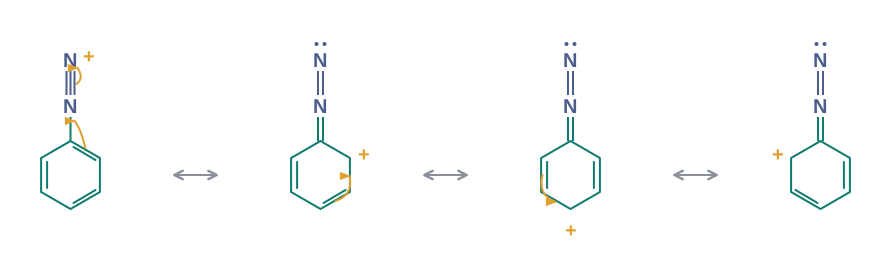
Fig. 9.22 – Resonating structures of the benzenediazonium ion.
Spreading a charge out always lowers the energy of an ion. The aryl ring can do this; a simple alkyl chain cannot, so the alkyldiazonium ion has no way to survive and immediately loses nitrogen.
Preparation: Diazotisation
Benzenediazonium chloride is prepared by the reaction of aniline with nitrous acid at 273–278 K. As you saw in Section 9.6, nitrous acid cannot be stored, so it is produced in the reaction mixture itself by the reaction of sodium nitrite with hydrochloric acid.
\[\mathrm{C\_6H\_5NH\_2} + \mathrm{NaNO\_2} + 2,\mathrm{HCl} \xrightarrow{\ 273-278\ \text{K}\ } \mathrm{C\_6H\_5N\_2^+,Cl^-} + \mathrm{NaCl} + 2,\mathrm{H\_2O}\]
Note that two moles of hydrochloric acid are needed: one to generate the nitrous acid from sodium nitrite, and one to supply the chloride ion of the salt and the acidic medium the reaction requires.
The conversion of primary aromatic amines into diazonium salts is known as diazotisation.
Due to its instability, the diazonium salt is not generally stored and is used immediately after its preparation. In practice, the flask is kept in an ice bath throughout, and the cold solution is carried straight on to the next reaction.
9.8 Physical Properties
Benzenediazonium chloride is a colourless crystalline solid. It is readily soluble in water and is stable in the cold, but reacts with water when warmed — which is exactly why the diazotisation flask is kept in an ice bath and the solution used at once.
It decomposes easily in the dry state. The salt is therefore never isolated and dried; it is kept, and used, in cold aqueous solution.
Benzenediazonium fluoroborate, \(\mathrm{C\_6H\_5N\_2^+,BF\_4^-}\), behaves quite differently. It is water insoluble and stable at room temperature — stable enough to be filtered off, dried and stored, which no other common diazonium salt allows.
9.9 Chemical Reactions
The reactions of diazonium salts can be broadly divided into two categories, namely (A) reactions involving displacement of nitrogen and (B) reactions involving retention of the diazo group. In the first, the two nitrogen atoms leave as \(\mathrm{N\_2}\) gas and something else takes their place on the ring; in the second, the \(\mathrm{-N{=}N!-}\) unit survives and becomes part of the product.
A. Reactions Involving Displacement of Nitrogen
The diazonium group, being a very good leaving group, is substituted by other groups such as \(\mathrm{Cl^-}\), \(\mathrm{Br^-}\), \(\mathrm{I^-}\), \(\mathrm{CN^-}\) and \(\mathrm{OH^-}\), which displace nitrogen from the aromatic ring. The nitrogen formed escapes from the reaction mixture as a gas.
That escape is the driving force of every reaction in this group. \(\mathrm{N\_2}\) is exceptionally stable and, being a gas, leaves the solution altogether; a reaction whose product bubbles out of the flask cannot go backwards. The whole variety of substituted benzenes below rests on that one fact.
The reactions of this category are collected in FC 9.23, which is worth learning as a single map rather than as six separate equations.
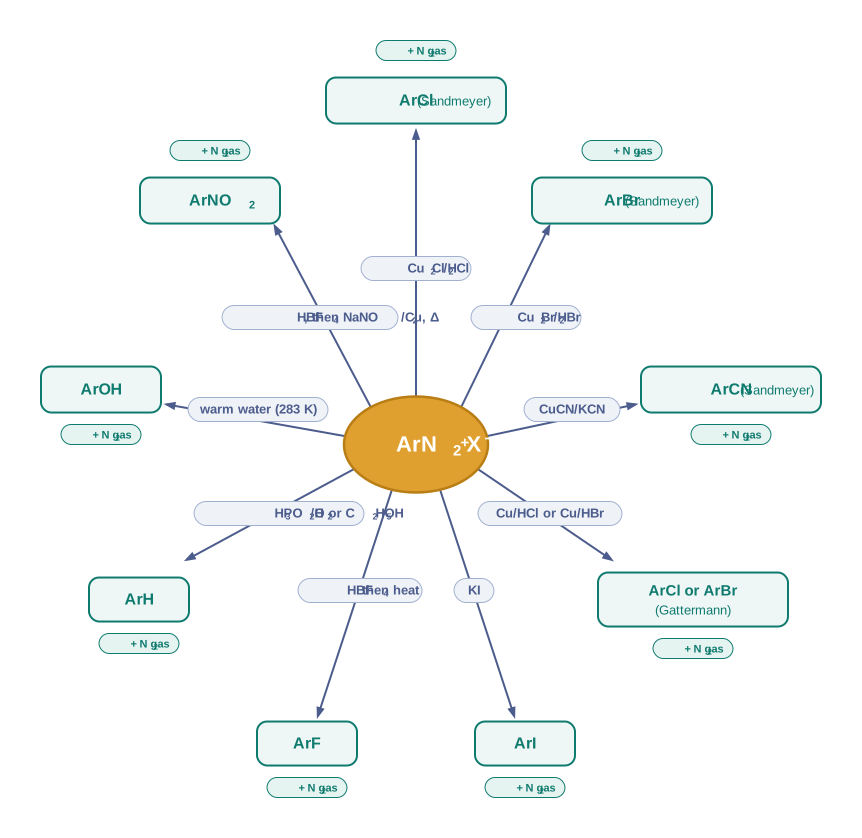
FC 9.23 – Reactions of diazonium salts involving nitrogen displacement.
1. Replacement by Halide or Cyanide Ion
The \(\mathrm{Cl^-}\), \(\mathrm{Br^-}\) and \(\mathrm{CN^-}\) nucleophiles can easily be introduced in the benzene ring in the presence of a Cu(I) ion. This reaction is called the Sandmeyer reaction.
\[\mathrm{Ar!-!N\_2^+X^-} \xrightarrow{\ \mathrm{Cu\_2Cl\_2}/\mathrm{HCl}\ } \mathrm{Ar!-!Cl} + \mathrm{N\_2}\]
\[\mathrm{Ar!-!N\_2^+X^-} \xrightarrow{\ \mathrm{Cu\_2Br\_2}/\mathrm{HBr}\ } \mathrm{Ar!-!Br} + \mathrm{N\_2}\]
\[\mathrm{Ar!-!N\_2^+X^-} \xrightarrow{\ \mathrm{CuCN}/\mathrm{KCN}\ } \mathrm{Ar!-!CN} + \mathrm{N\_2}\]
Alternatively, chlorine or bromine can also be introduced in the benzene ring by treating the diazonium salt solution with the corresponding halogen acid in the presence of copper powder. This is referred to as the Gatterman reaction.
\[\mathrm{Ar!-!N\_2^+X^-} \xrightarrow{\ \mathrm{Cu}/\mathrm{HCl}\ } \mathrm{Ar!-!Cl} + \mathrm{N\_2} + \mathrm{CuX}\]
\[\mathrm{Ar!-!N\_2^+X^-} \xrightarrow{\ \mathrm{Cu}/\mathrm{HBr}\ } \mathrm{Ar!-!Br} + \mathrm{N\_2} + \mathrm{CuX}\]
The yield in the Sandmeyer reaction is found to be better than in the Gattermann reaction.
2. Replacement by Iodide Ion
Iodine is not easily introduced into the benzene ring directly, but when the diazonium salt solution is treated with potassium iodide, iodobenzene is formed. No copper is needed here — the iodide ion is nucleophilic enough on its own.
\[\mathrm{Ar!-!N\_2^+Cl^-} + \mathrm{KI} \longrightarrow \mathrm{Ar!-!I} + \mathrm{KCl} + \mathrm{N\_2}\]
3. Replacement by Fluoride Ion
When arenediazonium chloride is treated with fluoroboric acid, arenediazonium fluoroborate is precipitated, which on heating decomposes to yield aryl fluoride. Here the room-temperature stability of the fluoroborate salt, met in Section 9.8, is exactly what makes the reaction possible: the salt can be filtered off dry and then heated deliberately.
\[\mathrm{Ar!-!N\_2^+Cl^-} + \mathrm{HBF\_4} \longrightarrow \mathrm{Ar!-!N\_2^+BF\_4^-} \xrightarrow{\ \Delta\ } \mathrm{Ar!-!F} + \mathrm{BF\_3} + \mathrm{N\_2}\]
4. Replacement by H
Certain mild reducing agents like hypophosphorous acid (phosphinic acid) or ethanol reduce diazonium salts to arenes, and themselves get oxidised to phosphorous acid and ethanal, respectively.
\[\mathrm{Ar!-!N\_2^+Cl^-} + \mathrm{H\_3PO\_2} + \mathrm{H\_2O} \longrightarrow \mathrm{Ar!-!H} + \mathrm{N\_2} + \mathrm{H\_3PO\_3} + \mathrm{HCl}\]
\[\mathrm{Ar!-!N\_2^+Cl^-} + \mathrm{CH\_3CH\_2OH} \longrightarrow \mathrm{Ar!-!H} + \mathrm{N\_2} + \mathrm{CH\_3CHO} + \mathrm{HCl}\]
This reaction looks pointless — you put a group on the ring and then take it off again — but it is one of the most useful tools in aromatic synthesis. The amino group can be introduced, used to direct an incoming substituent to the position you want, and then removed without trace. Section 9.10 shows this strategy in action.
5. Replacement by Hydroxyl Group
If the temperature of the diazonium salt solution is allowed to rise up to 283 K, the salt gets hydrolysed to phenol.
\[\mathrm{Ar!-!N\_2^+Cl^-} + \mathrm{H\_2O} \longrightarrow \mathrm{Ar!-!OH} + \mathrm{N\_2} + \mathrm{HCl}\]
This is the very decomposition that ruins a carelessly warmed diazotisation — turned, by choosing to let it happen, into a preparation of phenol.
6. Replacement by the \(\mathrm{-NO\_2}\) Group
When diazonium fluoroborate is heated with aqueous sodium nitrite solution in the presence of copper, the diazonium group is replaced by the \(\mathrm{-NO\_2}\) group.
\[\mathrm{C\_6H\_5N\_2^+Cl^-} + \mathrm{HBF\_4} \longrightarrow \mathrm{C\_6H\_5N\_2^+BF\_4^-} \xrightarrow[\ \mathrm{Cu},\ \Delta\ ]{\ \mathrm{NaNO\_2}\ } \mathrm{C\_6H\_5NO\_2} + \mathrm{N\_2} + \mathrm{NaBF\_4}\]
B. Reactions Involving Retention of the Diazo Group: Coupling Reactions
In this second family, the \(\mathrm{-N{=}N!-}\) unit is not lost at all. The azo products obtained have an extended conjugate system, having both the aromatic rings joined through the \(\mathrm{-N{=}N!-}\) bond. These compounds are often coloured and are used as dyes.
Benzenediazonium chloride reacts with phenol, in which the phenol molecule at its para position is coupled with the diazonium salt to form p-hydroxyazobenzene. This type of reaction is known as a coupling reaction. The two couplings are drawn in Fig. 9.24.
\[\mathrm{C\_6H\_5N\_2^+Cl^-} + \mathrm{C\_6H\_5OH} \xrightarrow{\ \mathrm{OH^-}\ } \mathrm{C\_6H\_5!-!N{=}N!-!C\_6H\_4!-!OH} + \mathrm{Cl^-} + \mathrm{H\_2O}\]
p-Hydroxyazobenzene is an orange dye.
Similarly, the reaction of a diazonium salt with aniline yields p-aminoazobenzene, a yellow dye.
\[\mathrm{C\_6H\_5N\_2^+Cl^-} + \mathrm{C\_6H\_5NH\_2} \xrightarrow{\ \mathrm{H^+}\ } \mathrm{C\_6H\_5!-!N{=}N!-!C\_6H\_4!-!NH\_2} + \mathrm{Cl^-} + \mathrm{H\_2O}\]
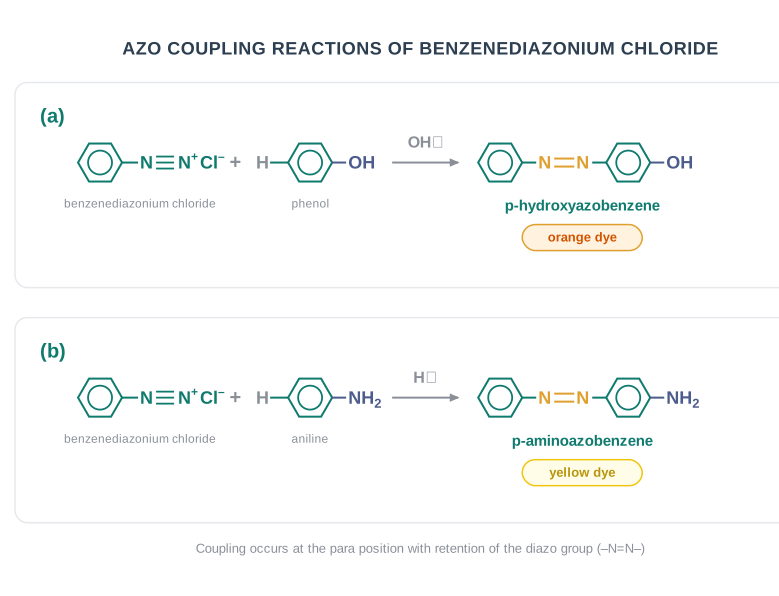
Fig. 9.24 – Coupling reactions of benzenediazonium chloride.
This is an example of an electrophilic substitution reaction. The diazonium ion is the electrophile — weak, as electrophiles go — and it can therefore attack only a ring that is strongly activated. That is precisely why the coupling partners are phenol and aniline, whose \(\mathrm{-OH}\) and \(\mathrm{-NH\_2}\) groups pour electron density into the ring, and why the attack occurs at the para position, where that electron density is greatest.
9.10 Importance of Diazonium Salts in Synthesis of Aromatic Compounds
The Group That Can Become Anything
From the reactions of Section 9.9, it is clear that the diazonium salts are very good intermediates for the introduction of \(\mathrm{-F}\), \(\mathrm{-Cl}\), \(\mathrm{-Br}\), \(\mathrm{-I}\), \(\mathrm{-CN}\), \(\mathrm{-OH}\) and \(\mathrm{-NO\_2}\) groups into the aromatic ring. An intermediate is a compound made not for its own sake but as a staging post: it is prepared, used at once, and never appears in the final product.
The value of such a staging post is that it does what direct substitution cannot. Aryl fluorides and iodides cannot be prepared by direct halogenation. The cyano group cannot be introduced by nucleophilic substitution of the chlorine in chlorobenzene — the C–Cl bond of an aryl halide is too strong and too shielded to be displaced — but cyanobenzene can be easily obtained from a diazonium salt.
Thus, the replacement of the diazo group by other groups is helpful in preparing those substituted aromatic compounds which cannot be prepared by direct substitution in benzene or in substituted benzene.
That last row of the table is worth a second look. Because the diazonium group can also be replaced by hydrogen, an amino group can be introduced onto a ring purely to steer the next substituent to the position you want, and then be removed without leaving any trace. The next example shows exactly this kind of planning.
How will you convert 4-nitrotoluene to 2-bromobenzoic acid?
Work backwards for a moment. The target has \(\mathrm{-COOH}\) at position 1 and \(\mathrm{-Br}\) at position 2 — the bromine is ortho to the carbon that will become the acid group. The starting material has a \(\mathrm{-CH\_3}\) group (which can be oxidised to \(\mathrm{-COOH}\) at the end) and a \(\mathrm{-NO\_2}\) group at the para position, which is not wanted in the product at all. The nitro group is therefore the temporary director: it must be converted to \(\mathrm{-NH\_2}\), then to \(\mathrm{-N\_2^+}\), and finally replaced by hydrogen.
The full route is shown in Fig. 9.25:
Step 1 — Bromination. 4-Nitrotoluene is brominated. Bromine enters ortho to the methyl group, giving 2-bromo-4-nitrotoluene.
\[\text{4-Nitrotoluene} \xrightarrow{\ \mathrm{Br\_2}\ } \text{2-Bromo-4-nitrotoluene}\]
Step 2 — Reduction. The nitro group is reduced to an amino group with tin and hydrochloric acid.
\[\xrightarrow{\ \mathrm{Sn}/\mathrm{HCl}\ } \text{2-Bromo-4-methylaniline}\]
Step 3 — Diazotisation. The primary aromatic amine is converted into its diazonium salt at 273–278 K.
\[\xrightarrow[\ 273-278\ \text{K}\ ]{\ \mathrm{NaNO\_2}/\mathrm{HCl}\ } \text{the corresponding diazonium chloride}\]
Step 4 — Replacement by H. The diazonium group is removed with hypophosphorous acid and water, leaving 2-bromotoluene. The nitrogen has done its job and departs as \(\mathrm{N\_2}\).
\[\xrightarrow{\ \mathrm{H\_2O},\ \mathrm{H\_3PO\_2}\ } \text{2-Bromotoluene}\]
Step 5 — Oxidation. The methyl group is oxidised to a carboxylic acid group with alkaline potassium permanganate.
\[\xrightarrow[\ \mathrm{OH^-}\ ]{\ \mathrm{KMnO\_4}\ } \text{2-Bromobenzoic acid}\]
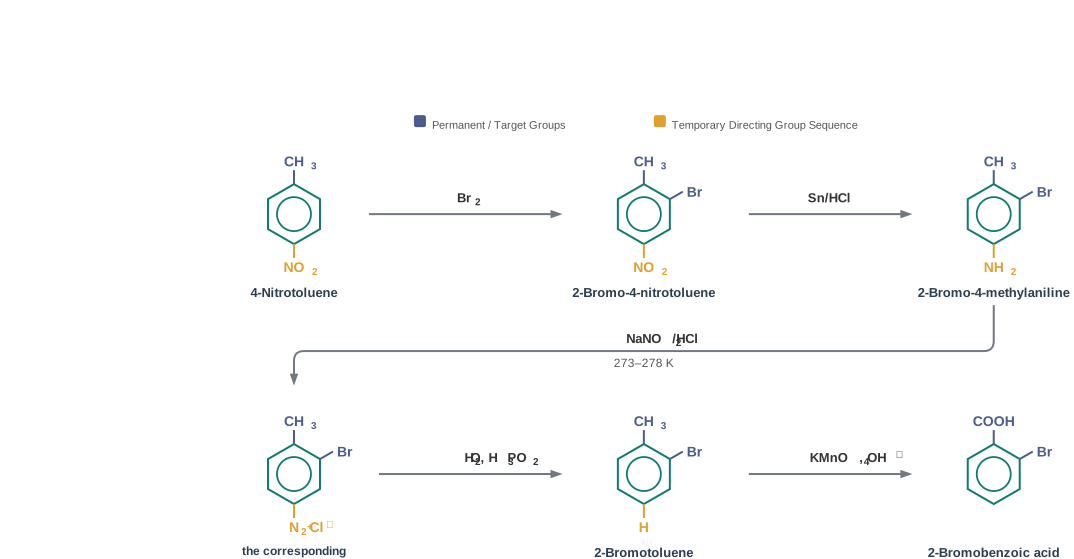
[Caption:] Fig. 9.25 – Conversion of 4-nitrotoluene to 2-bromobenzoic acid. [/Caption:]
9.11 Summary
- Amines can be considered as derivatives of ammonia, obtained by replacement of hydrogen atoms with alkyl or aryl groups.
- Replacement of one hydrogen atom of ammonia gives a structure of the type \(\mathrm{R!-!NH\_2}\), known as a primary amine. Secondary amines are characterised by the structure \(\mathrm{R\_2NH}\) or \(\mathrm{R!-!NHR'}\), and tertiary amines by \(\mathrm{R\_3N}\), \(\mathrm{RNR'R''}\) or \(\mathrm{R\_2NR'}\).
- Secondary and tertiary amines are known as simple amines if the alkyl or aryl groups are the same, and mixed amines if the groups are different.
- Like ammonia, all three types of amines have one unshared electron pair on the nitrogen atom, due to which they behave as Lewis bases.
- Amines are usually formed from nitro compounds, halides, amides, imides, etc. The six methods of the chapter are: reduction of nitro compounds; ammonolysis of alkyl halides; reduction of nitriles (one carbon more); reduction of amides; Gabriel phthalimide synthesis (pure primary amines, aliphatic only); and the Hoffmann bromamide degradation reaction (one carbon less).
- Amines exhibit hydrogen bonding, which influences their physical properties. Primary amines have two N–H hydrogens available, secondary amines one, and tertiary amines none, so the boiling points of isomeric amines fall in the order primary > secondary > tertiary.
- In alkylamines, a combination of electron releasing, steric and H-bonding factors influences the stability of the substituted ammonium cations in protic polar solvents, and thus affects the basic nature of the amines. Alkylamines are found to be stronger bases than ammonia.
- The strength of a base is measured by \(K\_b\), or more conveniently by \(\mathrm{p}K\_b\); the larger the \(K\_b\), or the smaller the \(\mathrm{p}K\_b\), the stronger the base:
\[K\_b = \frac{\[\mathrm{R!-!NH\_3^+}]\[\mathrm{OH^-}]}{\[\mathrm{R!-!NH\_2}]}, \qquad \mathrm{p}K\_b = -\log K\_b\]
- In aromatic amines, electron releasing and electron withdrawing groups respectively increase and decrease their basic character. Aniline is a weaker base than ammonia, because its lone pair is delocalised into the benzene ring.
- Reactions of amines are governed by the availability of the unshared pair of electrons on nitrogen. The influence of the number of hydrogen atoms at the nitrogen atom on the type of reactions and the nature of the products is responsible for the identification and distinction between primary, secondary and tertiary amines.
- p-Toluenesulphonyl chloride is used for the identification of primary, secondary and tertiary amines (the sulphonamide from a primary amine dissolves in alkali, that from a secondary amine does not, and a tertiary amine does not react). The carbylamine reaction and the reaction with nitrous acid serve the same purpose.
- The presence of the amino group in an aromatic ring enhances the reactivity of aromatic amines: \(\mathrm{-NH\_2}\) is a powerful activating, ortho- and para-directing group. The reactivity of aromatic amines can be controlled by the acylation process, i.e., by treating with acetyl chloride or acetic anhydride, so that a monosubstituted product can be obtained.
- Tertiary amines like trimethylamine are used as insect attractants.
- Aryldiazonium salts, usually obtained from arylamines by diazotisation at 273–278 K, undergo replacement of the diazonium group with a variety of nucleophiles. This provides advantageous methods for producing aryl halides, cyanides, phenols and arenes (by reductive removal of the diazo group):
\[\mathrm{C\_6H\_5NH\_2} + \mathrm{NaNO\_2} + 2,\mathrm{HCl} \xrightarrow{\ 273-278\ \text{K}\ } \mathrm{C\_6H\_5N\_2^+,Cl^-} + \mathrm{NaCl} + 2,\mathrm{H\_2O}\]
- The coupling reaction of aryldiazonium salts with phenols or arylamines gives rise to the formation of azo dyes, in which the two rings are joined by the \(\mathrm{-N{=}N!-}\) bond of an extended conjugated system.
The route from an aromatic amine to any of these products is condensed in FC 9.26.
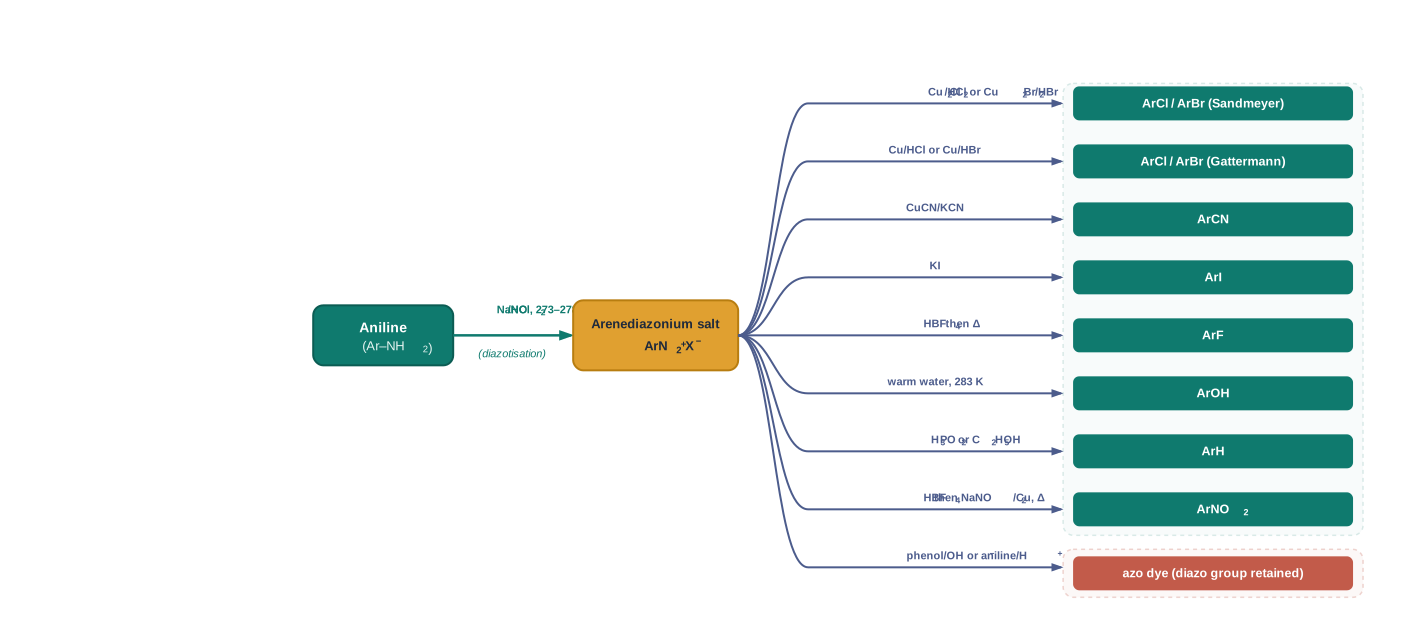
FC 9.26 – Synthetic routes from aniline via diazonium salts.
9.12 NCERT Questions
- Write IUPAC names of the following compounds and classify them into primary, secondary and tertiary amines.
- \(\mathrm{(CH\_3)\_2CHNH\_2}\) (ii) \(\mathrm{CH\_3(CH\_2)\_2NH\_2}\) (iii) \(\mathrm{CH\_3NHCH(CH\_3)\_2}\)
- \(\mathrm{(CH\_3)\_3CNH\_2}\) (v) \(\mathrm{C\_6H\_5NHCH\_3}\) (vi) \(\mathrm{(CH\_3CH\_2)\_2NCH\_3}\)
- \(\mathrm{m\text{-}BrC\_6H\_4NH\_2}\)
- Give one chemical test to distinguish between the following pairs of compounds.
- Methylamine and dimethylamine
- Secondary and tertiary amines
- Ethylamine and aniline
- Aniline and benzylamine
- Aniline and N-methylaniline
- Account for the following:
- \(\mathrm{p}K\_b\) of aniline is more than that of methylamine.
- Ethylamine is soluble in water whereas aniline is not.
- Methylamine in water reacts with ferric chloride to precipitate hydrated ferric oxide.
- Although the amino group is o- and p-directing in aromatic electrophilic substitution reactions, aniline on nitration gives a substantial amount of m-nitroaniline.
- Aniline does not undergo Friedel–Crafts reaction.
- Diazonium salts of aromatic amines are more stable than those of aliphatic amines.
- Gabriel phthalimide synthesis is preferred for synthesising primary amines.
- Arrange the following:
- In decreasing order of the \(\mathrm{p}K\_b\) values: \(\mathrm{C\_2H\_5NH\_2}\), \(\mathrm{C\_6H\_5NHCH\_3}\), \(\mathrm{(C\_2H\_5)\_2NH}\) and \(\mathrm{C\_6H\_5NH\_2}\)
- In increasing order of basic strength: \(\mathrm{C\_6H\_5NH\_2}\), \(\mathrm{C\_6H\_5N(CH\_3)\_2}\), \(\mathrm{(C\_2H\_5)\_2NH}\) and \(\mathrm{CH\_3NH\_2}\)
- In increasing order of basic strength:
- Aniline, p-nitroaniline and p-toluidine
- \(\mathrm{C\_6H\_5NH\_2}\), \(\mathrm{C\_6H\_5NHCH\_3}\), \(\mathrm{C\_6H\_5CH\_2NH\_2}\)
- In decreasing order of basic strength in gas phase: \(\mathrm{C\_2H\_5NH\_2}\), \(\mathrm{(C\_2H\_5)\_2NH}\), \(\mathrm{(C\_2H\_5)\_3N}\) and \(\mathrm{NH\_3}\)
- In increasing order of boiling point: \(\mathrm{C\_2H\_5OH}\), \(\mathrm{(CH\_3)\_2NH}\), \(\mathrm{C\_2H\_5NH\_2}\)
- In increasing order of solubility in water: \(\mathrm{C\_6H\_5NH\_2}\), \(\mathrm{(C\_2H\_5)\_2NH}\), \(\mathrm{C\_2H\_5NH\_2}\)
- How will you convert:
- Ethanoic acid into methanamine
- Hexanenitrile into 1-aminopentane
- Methanol to ethanoic acid
- Ethanamine into methanamine
- Ethanoic acid into propanoic acid
- Methanamine into ethanamine
- Nitromethane into dimethylamine
- Propanoic acid into ethanoic acid?
- Describe a method for the identification of primary, secondary and tertiary amines. Also write chemical equations of the reactions involved.
- Write short notes on the following:
- Carbylamine reaction (ii) Diazotisation
- Hofmann’s bromamide reaction (iv) Coupling reaction
- Ammonolysis (vi) Acetylation
- Gabriel phthalimide synthesis
- Accomplish the following conversions:
- Nitrobenzene to benzoic acid
- Benzene to m-bromophenol
- Benzoic acid to aniline
- Aniline to 2,4,6-tribromofluorobenzene
- Benzyl chloride to 2-phenylethanamine
- Chlorobenzene to p-chloroaniline
- Aniline to p-bromoaniline
- Benzamide to toluene
- Aniline to benzyl alcohol
- Give the structures of A, B and C in the following reactions:
- \(\mathrm{CH\_3CH\_2I} \xrightarrow{\ \mathrm{NaCN}\ } A \xrightarrow[\ \text{Partial hydrolysis}\ ]{\ \mathrm{OH^-}\ } B \xrightarrow{\ \mathrm{NaOH} + \mathrm{Br\_2}\ } C\)
- \(\mathrm{C\_6H\_5N\_2Cl} \xrightarrow{\ \mathrm{CuCN}\ } A \xrightarrow{\ \mathrm{H\_2O}/\mathrm{H^+}\ } B \xrightarrow[\ \Delta\ ]{\ \mathrm{NH\_3}\ } C\)
- \(\mathrm{CH\_3CH\_2Br} \xrightarrow{\ \mathrm{KCN}\ } A \xrightarrow{\ \mathrm{LiAlH\_4}\ } B \xrightarrow[\ 0^\circ\mathrm{C}\ ]{\ \mathrm{HNO\_2}\ } C\)
- \(\mathrm{C\_6H\_5NO\_2} \xrightarrow{\ \mathrm{Fe}/\mathrm{HCl}\ } A \xrightarrow[\ 273\ \text{K}\ ]{\ \mathrm{NaNO\_2} + \mathrm{HCl}\ } B \xrightarrow{\ \mathrm{H\_2O}/\mathrm{H^+}\ } C\)
- \(\mathrm{CH\_3COOH} \xrightarrow[\ \Delta\ ]{\ \mathrm{NH\_3}\ } A \xrightarrow{\ \mathrm{NaOBr}\ } B \xrightarrow{\ \mathrm{NaNO\_2}/\mathrm{HCl}\ } C\)
- \(\mathrm{C\_6H\_5NO\_2} \xrightarrow{\ \mathrm{Fe}/\mathrm{HCl}\ } A \xrightarrow[\ 273\ \text{K}\ ]{\ \mathrm{HNO\_2}\ } B \xrightarrow{\ \mathrm{C\_6H\_5OH}\ } C\)
- An aromatic compound ‘A’ on treatment with aqueous ammonia and heating forms compound ‘B’, which on heating with \(\mathrm{Br\_2}\) and KOH forms a compound ‘C’ of molecular formula \(\mathrm{C\_6H\_7N}\). Write the structures and IUPAC names of compounds A, B and C.
- Complete the following reactions:
- \(\mathrm{C\_6H\_5NH\_2} + \mathrm{CHCl\_3} + \text{alc. KOH} \rightarrow\)
- \(\mathrm{C\_6H\_5N\_2Cl} + \mathrm{H\_3PO\_2} + \mathrm{H\_2O} \rightarrow\)
- \(\mathrm{C\_6H\_5NH\_2} + \mathrm{H\_2SO\_4}\ (\text{conc.}) \rightarrow\)
- \(\mathrm{C\_6H\_5N\_2Cl} + \mathrm{C\_2H\_5OH} \rightarrow\)
- \(\mathrm{C\_6H\_5NH\_2} + \mathrm{Br\_2}\text{(aq)} \rightarrow\)
- \(\mathrm{C\_6H\_5NH\_2} + \mathrm{(CH\_3CO)\_2O} \rightarrow\)
- \(\mathrm{C\_6H\_5N\_2Cl} \xrightarrow[\ \text{(ii) } \mathrm{NaNO\_2}/\mathrm{Cu},\ \Delta\ ]{\ \text{(i) } \mathrm{HBF\_4}\ }\)
- Why cannot aromatic primary amines be prepared by Gabriel phthalimide synthesis?
- Write the reactions of (i) aromatic and (ii) aliphatic primary amines with nitrous acid.
- Give plausible explanation for each of the following:
- Why are amines less acidic than alcohols of comparable molecular masses?
- Why do primary amines have higher boiling point than tertiary amines?
- Why are aliphatic amines stronger bases than aromatic amines?
9.13 Check Your Concepts
- \(\mathrm{(CH\_3)\_3C!-!NH\_2}\) is called a primary amine although the carbon carrying the \(\mathrm{-NH\_2}\) group is tertiary. Explain why the classification of an amine cannot be decided by looking at the carbon skeleton.
- The C–N–C bond angle in trimethylamine is \(108^\circ\), not \(109.5^\circ\). Account for this, and state what the shape of the molecule is and why it is not described as tetrahedral.
- Assertion: In the gas phase, the basic strength of amines follows the order tertiary > secondary > primary > \(\mathrm{NH\_3}\). Reason: The inductive effect of alkyl groups increases the electron density on nitrogen. State whether the assertion and the reason are true, and whether the reason correctly explains the assertion in the aqueous phase.
- Assertion: Aniline does not undergo the Friedel–Crafts reaction. Reason: The \(\mathrm{-NH\_2}\) group is a powerful activating group. Are both statements true? Does the reason explain the assertion? Justify your answer.
- An amide is treated in two separate experiments: (a) with \(\mathrm{LiAlH\_4}\) followed by water, and (b) with \(\mathrm{Br\_2}\) and aqueous NaOH. Why do the two amines obtained differ in the number of carbon atoms? Illustrate with \(\mathrm{CH\_3CH\_2CONH\_2}\).
- Ammonolysis of an alkyl halide is said to have a serious disadvantage. What is it, why does it arise, and how is a primary amine still obtained as the major product?
- Arrange the following in order of increasing reactivity towards ammonolysis and give a reason: \(\mathrm{CH\_3Cl}\), \(\mathrm{CH\_3Br}\), \(\mathrm{CH\_3I}\).
- Predict the major organic product in each case and give a reason:
- Aniline + bromine water at room temperature
- Acetanilide + \(\mathrm{Br\_2}\) in \(\mathrm{CH\_3COOH}\), then hydrolysis
- Aniline + benzoyl chloride
- \(\mathrm{(C\_2H\_5)\_3N}\) + benzenesulphonyl chloride
- Complete the following reaction and name the product: \[\mathrm{C\_6H\_5N\_2^+Cl^-} + \mathrm{C\_6H\_5OH} \xrightarrow{\ \mathrm{OH^-}\ } ?\] Identify the electrophile, explain why the attack takes place at the para position, and state why the product is coloured.
- Phenylmethanamine (\(\mathrm{p}K\_b\) 4.70) is a much stronger base than benzenamine (\(\mathrm{p}K\_b\) 9.38), although both contain a benzene ring and an \(\mathrm{-NH\_2}\) group. Explain the difference in terms of structure.
- Match the reagent in Column I with the observation or use in Column II.
| Column I | Column II |
|---|---|
| a. \(\mathrm{CHCl\_3}\) + ethanolic KOH, heat | i. Distinguishes 1°, 2° and 3° amines by solubility in alkali |
| b. Benzenesulphonyl chloride | ii. Foul-smelling isocyanide from a primary amine |
| c. \(\mathrm{NaNO\_2}\) + HCl at 273–278 K on aniline | iii. Protects the \(\mathrm{-NH\_2}\) group before substitution |
| d. Acetic anhydride/pyridine on aniline | iv. Benzenediazonium chloride |
- Explain why a diazonium salt must be prepared at 273–278 K and used immediately, whereas benzenediazonium fluoroborate can be filtered, dried and stored.
- Why is the departure of the diazonium group irreversible? Use this to explain why iodobenzene can be made from a diazonium salt but not by direct iodination of benzene.
- Nitration of aniline gives 51% para, 47% meta and 2% ortho product. Explain the unexpectedly large meta fraction, and state how the reaction can be modified so that the para product dominates.
- Aniline gives a white precipitate with bromine water without any catalyst, whereas benzene requires a Lewis acid catalyst for bromination. Explain in terms of resonance and electron density.
- Arrange in increasing order of basic strength and justify: aniline, N-methylaniline, N,N-dimethylaniline, p-nitroaniline.
- Two bottles are labelled only “amine”. One reacts with \(\mathrm{HNO\_2}\) to give brisk effervescence of a gas and an alcohol; the other, an aromatic amine, gives a solution which, when added to alkaline phenol, produces an orange dye. Identify the class of each amine, write the equations, and name the reactions.
- Sulphanilic acid exists largely as a zwitter ion. Draw the zwitter ion, and explain why this compound has both an acidic and a basic group in the same molecule.
- Explain why the tertiary amine \(\mathrm{(CH\_3)\_3N}\) is a weaker base in aqueous solution than \(\mathrm{(CH\_3)\_2NH}\), although it has more electron-releasing alkyl groups.
- Complete the sequence and name each product: \[\mathrm{C\_6H\_5NO\_2} \xrightarrow{\ \mathrm{Sn}/\mathrm{HCl}\ } A \xrightarrow[\ 273-278\ \text{K}\ ]{\ \mathrm{NaNO\_2}/\mathrm{HCl}\ } B \xrightarrow{\ \mathrm{Cu\_2Cl\_2}/\mathrm{HCl}\ } C\] Name the reaction in the last step and state why it is preferred over the copper-powder route.
9.14 Practice With Numericals
- The \(\mathrm{p}K\_b\) of methanamine is 3.38 (Table 9.3). Calculate its \(K\_b\). Do the same for benzenamine (\(\mathrm{p}K\_b\) 9.38), and hence find how many times stronger a base methanamine is than benzenamine.
- The \(\mathrm{p}K\_b\) of ammonia is 4.75 and that of N-ethylethanamine is 3.00. Calculate the \(K\_b\) of each and comment on which is the stronger base and by what factor.
- 4.5 g of ethanamine (\(\mathrm{C\_2H\_5NH\_2}\), molar mass \(45\ \text{g mol}^{-1}\)) is treated with excess nitrous acid. Calculate (i) the volume of nitrogen gas evolved at STP (molar volume \(22.4\ \text{L mol}^{-1}\)) and (ii) the mass of ethanol formed, assuming the reaction is quantitative.
- A sample of a primary aliphatic amine, on treatment with nitrous acid, evolves 1.12 L of nitrogen gas at STP. Calculate the number of moles of the amine present in the sample. If the molar mass of the amine is \(59\ \text{g mol}^{-1}\), what mass of amine was taken?
- 8.7 g of butanamide (\(\mathrm{CH\_3CH\_2CH\_2CONH\_2}\), molar mass \(87\ \text{g mol}^{-1}\)) undergoes the Hoffmann bromamide degradation reaction. Using the balanced equation, calculate (i) the moles of \(\mathrm{Br\_2}\) and of NaOH required and (ii) the mass of propan-1-amine (molar mass \(59\ \text{g mol}^{-1}\)) formed at 100% yield.
- 9.3 g of aniline (molar mass \(93\ \text{g mol}^{-1}\)) is treated with excess bromine water. Calculate (i) the moles of \(\mathrm{Br\_2}\) consumed and (ii) the mass of 2,4,6-tribromoaniline (molar mass \(330\ \text{g mol}^{-1}\)) obtained, assuming complete reaction.
- What mass of aniline is required to prepare 0.20 mol of benzenediazonium chloride by diazotisation? Calculate also the moles of sodium nitrite and of hydrochloric acid needed, using the balanced equation.
- The \(K\_b\) of methanamine may be taken from its \(\mathrm{p}K\_b\) value of 3.38. For a 0.10 M aqueous solution of methanamine, calculate \([\mathrm{OH^-}]\) and hence the pH of the solution at 298 K. (Take \(K\_w = 1.0\times10^{-14}\) and assume that the amine is only slightly ionised.)
- An amine has the molecular formula \(\mathrm{C\_4H\_{11}N}\). Calculate its degree of unsaturation and state what this tells you about the structure. How many structural isomers of this formula are possible, and how many of them are primary amines?
— CHANGES MADE —
Fig. 9.0 (Perkin’s mauveine dye and the structure of aniline) → Fig. 9.0
Fig. 9.1 (Pyramidal shape and bond angle of trimethylamine) → Fig. 9.1
FC 9.1 (Successive replacement of hydrogen in ammonia) → FC 9.2
Fig. 9.3 (General structures of primary, secondary and tertiary amines) → Fig. 9.3
Fig. 9.4 (Structures of selected arylamines) → Fig. 9.4
Fig. 9.5 (Naphthylamine structures for NCERT Asks 9.1) → Fig. 9.5
Fig. 9.6 (Nucleophilic attack of ammonia on an alkyl halide) → Fig. 9.6
FC 9.2 (Gabriel phthalimide synthesis route) → FC 9.7
Fig. 9.7 (Structures in the Gabriel synthesis) → Fig. 9.8
Fig. 9.2 (Intermolecular hydrogen bonding in primary amines) → Fig. 9.9
Fig. 9.7 (Boiling points of amines, alkanes and alcohols) → Fig. 9.10
Fig. 9.8 (Hydrogen bonding of ammonium ions in water) → Fig. 9.11
Fig. 9.9 (Resonating structures of aniline) → Fig. 9.12
Fig. 9.10 (Resonating structures of the anilinium ion) → Fig. 9.13
Fig. 9.11 (Reaction of amines with Hinsberg’s reagent) → Fig. 9.14
FC 9.3 (The Hinsberg test for amine classes) → FC 9.15
Fig. 9.12 (Uncontrolled bromination of aniline) → Fig. 9.16
Fig. 9.13 (Controlled bromination of aniline) → Fig. 9.17
FC 9.4 (The protect-substitute-deprotect strategy) → FC 9.18
Fig. 9.14 (Resonance in acetanilide) → Fig. 9.19
Fig. 9.15 (Direct nitration of aniline) → Fig. 9.20
Fig. 9.16 (Sulphonation of aniline and zwitter ion formation) → Fig. 9.21
Fig. 9.17 (Resonating structures of the benzenediazonium ion) → Fig. 9.22
FC 9.5 (Reactions of diazonium salts involving nitrogen displacement) → FC 9.23
Fig. 9.18 (Coupling reactions of benzenediazonium chloride) → Fig. 9.24
Fig. 9.19 (Conversion of 4-nitrotoluene to 2-bromobenzoic acid) → Fig. 9.25
FC 9.6 (Synthetic routes from aniline via diazonium salts) → FC 9.26
Note: Every figure and flowchart reference in this file corresponds to an existing
\[Diagram:]/\[Caption:]block; no text-only missing artwork entries were present in this chapter.