Chapter 5: Coordination Compounds
In the mid-1960s, a biophysicist named Barnett Rosenberg, working at Michigan State University in the United States, set out to test a simple idea: does an electric field disturb the way bacteria divide? He passed a current through a culture of Escherichia coli using electrodes made of platinum — a metal chosen precisely because it was expected to be inert and to sit quietly in the background of the experiment.
The bacteria stopped dividing. They did not die; they simply kept growing longer and longer, stretching into strange filaments. Something was blocking cell division.
The electric field turned out to be innocent. The real agent was a compound that had formed in the solution from the “inert” platinum electrodes themselves — a small, square, flat molecule in which a platinum ion sat at the centre with two ammonia molecules and two chloride ions arranged around it. Today we call it cisplatin, and it became one of the most important anticancer drugs ever developed.
The most remarkable part of the story is this: a molecule containing exactly the same platinum, the same two ammonia molecules and the same two chlorides — but arranged differently around the metal — is medically useless. The arrangement is everything.
Compounds of this kind, in which a central metal atom or ion is surrounded by a definite number of ions or molecules, are called coordination compounds. Chlorophyll, haemoglobin and vitamin B12 are coordination compounds of magnesium, iron and cobalt respectively, and this unit explains how such structures are built, named and understood.
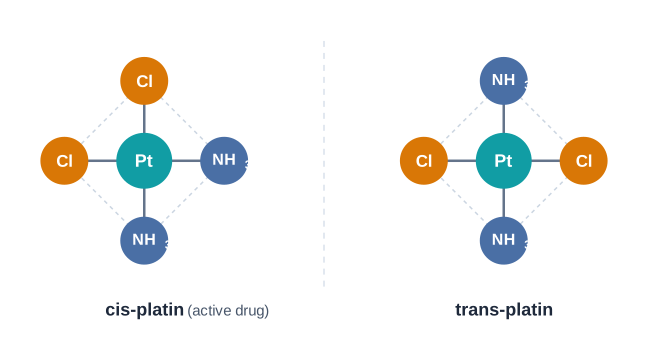
Fig. 5.0 – Cis and trans isomers of cisplatin.
This chapter will give you the tools to reason out each of these questions for yourself.
5.1 Werner’s Theory of Coordination Compounds
Why This Class of Compounds Matters
In the previous Chapter you learnt that the transition metals form a very large number of complex compounds, in which the metal atom is bound to several anions or neutral molecules by the sharing of electron pairs. In modern language such compounds are called coordination compounds, and their chemistry is one of the most important and challenging areas of modern inorganic chemistry.
New ideas about chemical bonding and molecular structure grew out of the study of these compounds, and they in turn explained how coordination compounds work as vital components of biological systems. A wide variety of metallurgical processes, industrial catalysts and analytical reagents depend on coordination compounds, and they are also used in electroplating, textile dyeing and medicinal chemistry.
Before any of this could be understood, however, somebody had to work out what these compounds actually are. That work was done by Alfred Werner.
The Puzzle Werner Faced
Alfred Werner (1866–1919), a Swiss chemist, was the first to formulate clear ideas about the structures of coordination compounds. He prepared and characterised a large number of them and studied their physical and chemical behaviour using simple experimental techniques available in his time.
Werner realised that a metal ion seems to hold groups in two quite different ways, and he gave these two kinds of holding two different names — a primary valence and a secondary valence.
The primary valence is the familiar combining capacity we already use for simple binary compounds (compounds of only two elements). Binary compounds such as \(\mathrm{CrCl_3}\), \(\mathrm{CoCl_2}\) or \(\mathrm{PdCl_2}\) have primary valences of 3, 2 and 2 respectively — that is, the metal ion in each carries a charge that is neutralised by that many negative ions.
The interesting behaviour appeared in a series of compounds of cobalt(III) chloride with ammonia. When excess silver nitrate solution was added in the cold to solutions of these compounds, some of the chloride ions were at once precipitated as silver chloride, while other chloride ions present in the very same compound stayed in solution and refused to be precipitated.
The results were strikingly regular:
| Compound (1 mol) | Colour | AgCl obtained |
|---|---|---|
| \(\mathrm{CoCl_3 \cdot 6NH_3}\) | Yellow | 3 mol |
| \(\mathrm{CoCl_3 \cdot 5NH_3}\) | Purple | 2 mol |
| \(\mathrm{CoCl_3 \cdot 4NH_3}\) | Green | 1 mol |
| \(\mathrm{CoCl_3 \cdot 4NH_3}\) | Violet | 1 mol |
The logic Werner used to move from this precipitation test to a structure is set out in FC 5.1.
Flowchart
FC 5.1 – Werner’s deduction: dissolve 1 mol of the cobalt–ammonia chloride → add excess AgNO₃ in cold → count moles of AgCl formed → these Cl⁻ were free (ionisable) → remaining Cl⁻ must be held firmly to Co → measure solution conductivity → number of ions confirms the count → write formula with firmly held groups inside square brackets and free ions outside.
Reading the Data: Six Groups Around Cobalt
These observations, taken together with the results of conductivity measurements in solution, can be explained if we accept two ideas:
six groups in all — either chloride ions, or ammonia molecules, or both — remain bonded to the cobalt ion during the reaction; and
the compounds are formulated as shown in Table 5.1, where the atoms written within the square brackets form a single entity that does not dissociate under the reaction conditions.
Conductivity measurement is the second piece of evidence, and it is worth understanding why it is used. The electrical conductivity of a solution depends on how many ions the dissolved compound releases. A compound that splits into one cation and three anions (a 1:3 electrolyte) puts four ions into solution and conducts much better than one that splits into just two ions (a 1:1 electrolyte). So conductivity independently counts the free ions, and it agrees exactly with the silver chloride count.
Werner proposed the term secondary valence for the number of groups bound directly to the metal ion; in each of these examples the secondary valence is six.
Table 5.1: Formulation of Cobalt(III) Chloride-Ammonia Complexes
| Colour | Formula | Solution conductivity corresponds to |
|---|---|---|
| Yellow | \([\mathrm{Co(NH_3)_6}]^{3+}\,3\mathrm{Cl^-}\) | 1:3 electrolyte |
| Purple | \([\mathrm{CoCl(NH_3)_5}]^{2+}\,2\mathrm{Cl^-}\) | 1:2 electrolyte |
| Green | \([\mathrm{CoCl_2(NH_3)_4}]^{+}\,\mathrm{Cl^-}\) | 1:1 electrolyte |
| Violet | \([\mathrm{CoCl_2(NH_3)_4}]^{+}\,\mathrm{Cl^-}\) | 1:1 electrolyte |
Notice the pattern down the table. As one ammonia molecule is lost, one chloride ion steps in to take its place inside the bracket — so the count inside the bracket always stays at six, while the number of free chlorides outside the bracket falls from three to two to one.
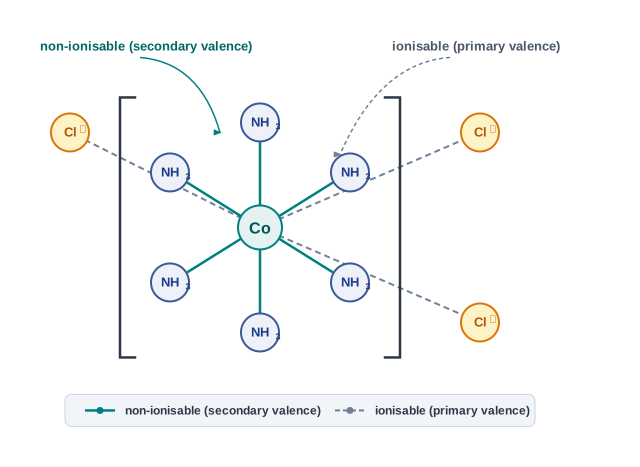
Fig. 5.1A – Primary and secondary valences in [Co(NH₃)₆]Cl₃.
Isomers, and Werner’s Postulates
Look again at the last two entries in Table 5.1. Both have the identical empirical formula \(\mathrm{CoCl_3 \cdot 4NH_3}\) and both give 1 mol of AgCl, yet one is green and the other is violet — they have distinctly different properties. Compounds like this, with the same formula but different properties, are termed isomers. Their existence was itself a clue that the six groups must occupy definite positions in space around the metal, because only a difference in arrangement could explain a difference in colour.
Werner, in 1898, propounded his theory of coordination compounds. The main postulates are:
The fourth postulate is the boldest one, and it is the reason Werner’s theory survived. He was insisting that the groups held by secondary valence are not scattered at random but sit at fixed positions in three-dimensional space.
The Modern Vocabulary
In modern formulations, such spatial arrangements are called coordination polyhedra. The species written within the square bracket are called coordination entities or complexes, and the ions written outside the square bracket are called counter ions. So in \([\mathrm{Co(NH_3)_6}]\mathrm{Cl_3}\), the coordination entity is \([\mathrm{Co(NH_3)_6}]^{3+}\) and the three chloride ions are counter ions. (These terms, along with several others, are defined carefully in the next section.)
Werner further postulated that octahedral, tetrahedral and square planar geometrical shapes are the more common shapes in coordination compounds of transition metals. Thus, \([\mathrm{Co(NH_3)_6}]^{3+}\), \([\mathrm{CoCl(NH_3)_5}]^{2+}\) and \([\mathrm{CoCl_2(NH_3)_4}]^{+}\) are octahedral entities, while \([\mathrm{Ni(CO)_4}]\) and \([\mathrm{PtCl_4}]^{2-}\) are tetrahedral and square planar, respectively.
Difference Between a Double Salt and a Complex
Both double salts and complexes are formed by the combination of two or more stable compounds in a stoichiometric ratio, so on paper their formulae look alike. The difference shows up the moment they are dissolved in water.
Double salts such as carnallite, \(\mathrm{KCl \cdot MgCl_2 \cdot 6H_2O}\), Mohr’s salt, \(\mathrm{FeSO_4 \cdot (NH_4)_2SO_4 \cdot 6H_2O}\), and potash alum, \(\mathrm{KAl(SO_4)_2 \cdot 12H_2O}\), dissociate into simple ions completely when dissolved in water. Mohr’s salt in water is simply a mixture of \(\mathrm{Fe^{2+}}\)), \(\mathrm{NH_4^{+}}\) and \(\mathrm{SO_4^{2-}}\) ions, and it gives every test that an ordinary iron(II) salt gives.
A complex behaves quite differently. Complex ions such as \([\mathrm{Fe(CN)_6}]^{4-}\) of \(\mathrm{K_4[Fe(CN)_6]}\) do not dissociate into \(\mathrm{Fe^{2+}}\) and \(\mathrm{CN^-}\) ions. The coordination entity survives dissolution as one unit, and so a solution of potassium hexacyanidoferrate(II) does not give the ordinary tests of the iron(II) ion.
This distinction is a favourite in board and entrance examinations, usually phrased as “why does Mohr’s salt give the test for \(\mathrm{Fe^{2+}}\) while potassium hexacyanidoferrate(II) does not?” The answer always comes back to whether the metal ion is free in solution or locked inside a coordination entity.
At the age of 29 he became a full professor at the Technische Hochschule in Zurich, in 1895. A chemist and an educationist, his greatest accomplishment was the development of the theory of coordination compounds — a theory containing revolutionary ideas about how atoms and molecules are linked together, formulated in a span of only three years, from 1890 to 1893. The remainder of his career was spent gathering the experimental support needed to validate those ideas. Werner became the first Swiss chemist to win the Nobel Prize, in 1913, for his work on the linkage of atoms and the coordination theory.
5.2 Definitions of Some Important Terms Pertaining to Coordination Compounds
Werner’s theory gave chemists a picture of what a coordination compound is. To talk about that picture precisely — and to name, draw and predict these compounds later in this Chapter — we need a small, exact vocabulary. Every term below is used constantly in the rest of the chapter, so it is worth learning them properly the first time.
(a) Coordination entity
A coordination entity constitutes a central metal atom or ion bonded to a fixed number of ions or molecules. For example, \([\mathrm{CoCl_3(NH_3)_3}]\) is a coordination entity in which the cobalt ion is surrounded by three ammonia molecules and three chloride ions. Other examples are \([\mathrm{Ni(CO)_4}]\), \([\mathrm{PtCl_2(NH_3)_2}]\), \([\{Fe(CN)_6}]^{4-}\) and \([\mathrm{Co(NH_3)_6}]^{3+}\).
Notice that a coordination entity may be neutral (as in the first two examples), negatively charged, or positively charged. Whatever its charge, it behaves as a single unit in solution — this is exactly the “does not dissociate” idea that came out of Werner’s silver chloride experiments.
(b) Central atom/ion
In a coordination entity, the atom or ion to which a fixed number of ions/groups are bound in a definite geometrical arrangement around it is called the central atom or central ion.
For example, the central atom/ion in the coordination entities \([\mathrm{NiCl_2(H_2O)_4}]\), \([\mathrm{CoCl(NH_3)_5}]^{2+}\) and \([\mathrm{Fe(CN)_6}]^{3-}\) are \(\mathrm{Ni^{2+}}\)), \(\mathrm{Co^{3+}}\) and \(\mathrm{Fe^{3+}}\) respectively.
These central atoms/ions are also referred to as Lewis acids. Recall from earlier study that a Lewis acid is an electron-pair acceptor. A metal ion is short of electrons and has empty orbitals available, so it is ideally placed to accept lone pairs — which is precisely what it does when a coordination entity forms.
(c) Ligands
The ions or molecules bound to the central atom/ion in the coordination entity are called ligands. They are the electron-pair donors, that is, Lewis bases, and the atom of the ligand that actually donates the lone pair is called the donor atom.
Ligands may be simple ions such as \(\mathrm{Cl^-}\), small molecules such as \(\mathrm{H_2O}\) or \(\mathrm{NH_3}\), larger molecules such as \(\mathrm{H_2NCH_2CH_2NH_2}\) or \(\mathrm{N(CH_2CH_2NH_2)_3}\), or even macromolecules, such as proteins.
Classifying ligands by the number of donor atoms
When a ligand is bound to a metal ion through a single donor atom, as with \(\mathrm{Cl^-}\), \(\mathrm{H_2O}\) or \(\mathrm{NH_3}\), the ligand is said to be unidentate.
When a ligand can bind through two donor atoms, as in \(\mathrm{H_2NCH_2CH_2NH_2}\) (ethane-1,2-diamine, abbreviated en) or \(\mathrm{C_2O_4^{2-}}\) (oxalate), the ligand is said to be didentate.
When several donor atoms are present in a single ligand, as in \(\mathrm{N(CH_2CH_2NH_2)_3}\), the ligand is said to be polydentate. Ethylenediaminetetraacetate ion (\(\mathrm{EDTA^{4-}}\)) is an important hexadentate ligand: it can bind through two nitrogen atoms and four oxygen atoms to a central metal ion, and its structure is shown in Fig. 5.2A.
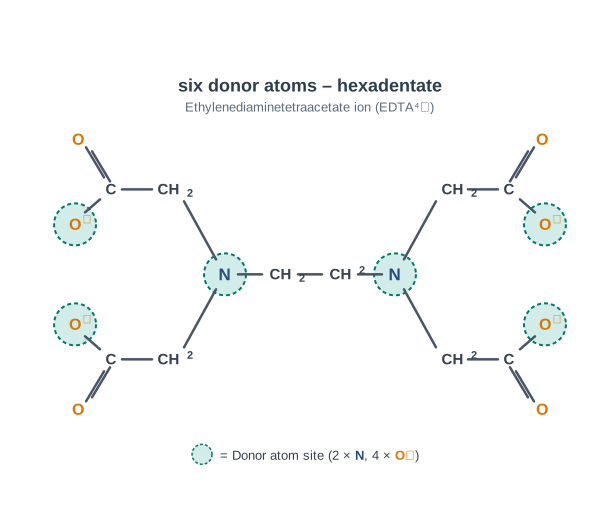
Fig. 5.2A – Structure of the hexadentate EDTA⁴⁻ ion.
Chelation and denticity
When a di- or polydentate ligand uses its two or more donor atoms simultaneously to bind a single metal ion, it is said to be a chelate ligand. The word describes a grip: the ligand closes around the metal ion like a claw, forming a ring that includes the metal atom itself, as drawn in Fig. 5.3B.
The number of such ligating groups is called the denticity of the ligand. Such complexes, called chelate complexes, tend to be more stable than similar complexes containing unidentate ligands. The reason is easy to appreciate: a unidentate ligand has only one bond to break before it leaves, whereas a chelating ligand is anchored at two or more points at once, and all of those bonds would have to break together for it to escape.
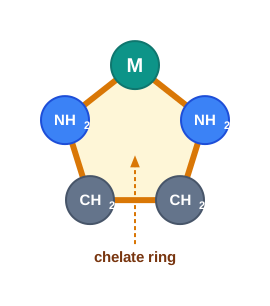
Fig. 5.3B – Chelate ring formation by ethane-1,2-diamine.
Ambidentate ligands
A ligand which has two different donor atoms and can bind (ligate) through either of the two in the complex is called an ambidentate ligand. Only one of the two donor atoms is used at a time — the ligand chooses which end to attach by, and once attached it is still a unidentate ligand.
Examples of such ligands are the \(\mathrm{NO_2^{-}}\) and \(\mathrm{SCN^{-}}\) ions. The \(\mathrm{NO_2^{-}}\) ion can coordinate either through nitrogen or through oxygen to a central metal atom/ion; the two possibilities are called nitrito-N and nitrito-O respectively. Similarly, the \(\mathrm{SCN^{-}}\) ion can coordinate through the sulphur or the nitrogen atom, giving thiocyanato-S and thiocyanato-N. The four binding modes are drawn in Fig. 5.4C.
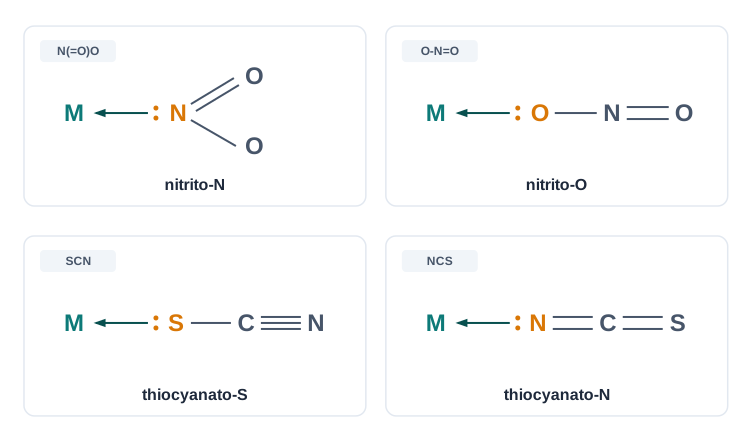
Fig. 5.4C – Binding modes of ambidentate ligands.
Keep this idea safe — it returns in Section 5.4, where the two ways of attaching an ambidentate ligand give rise to a whole type of isomerism.
(d) Coordination number
The coordination number (CN) of a metal ion in a complex can be defined as the number of ligand donor atoms to which the metal is directly bonded.
For example, in the complex ions \([\mathrm{PtCl_6}]^{2-}\) and \([\mathrm{Ni(NH_3)_4}]^{2+}\), the coordination numbers of Pt and Ni are 6 and 4 respectively.
Similarly, in the complex ions \([\mathrm{Fe(C_2O_4)_3}]^{3-}\) and \([\mathrm{Co(en)_3}]^{3+}\), the coordination number of both Fe and Co is 6 — not 3 — because \(\mathrm{C_2O_4^{2-}}\) and en (ethane-1,2-diamine) are didentate ligands. This is the single most common slip students make: coordination number counts donor atoms, not ligand molecules.
It is important to note here that the coordination number of the central atom/ion is determined only by the number of sigma bonds formed by the ligand with the central atom/ion. Pi bonds, if formed between the ligand and the central atom/ion, are not counted for this purpose.
(e) Coordination sphere
The central atom/ion and the ligands attached to it are enclosed in a square bracket and are collectively termed as the coordination sphere. The ionisable groups are written outside the bracket and are called counter ions.
For example, in the complex \(\mathrm{K_4[Fe(CN)_6]}\), the coordination sphere is \([\mathrm{Fe(CN)_6}]^{4-}\) and the counter ion is \(\mathrm{K^{+}}\).
The square bracket is therefore not decoration. It is a statement about chemistry: everything inside it stays together in solution, everything outside it goes free.
(f) Coordination polyhedron
The spatial arrangement of the ligand atoms which are directly attached to the central atom/ion defines a coordination polyhedron about the central atom.
The most common coordination polyhedra are octahedral, square planar and tetrahedral. For example, \([\mathrm{Co(NH_3)_6}]^{3+}\) is octahedral, \([\mathrm{Ni(CO)_4}]\) is tetrahedral and \([\mathrm{PtCl_4}]^{2-}\) is square planar. Fig. 5.5 shows the shapes of the different coordination polyhedra.
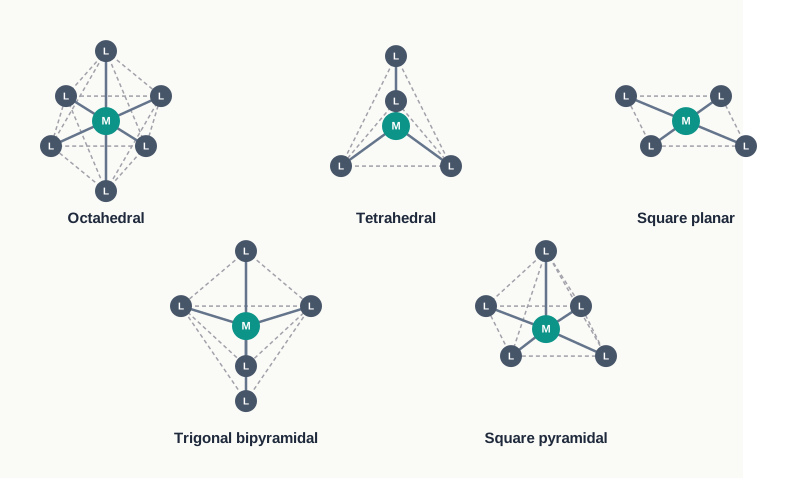
Fig. 5.5 – Shapes of different coordination polyhedra.
Note that a coordination number of 4 does not fix the shape by itself — it may be tetrahedral or square planar. Deciding between the two requires the bonding theories of Section 5.5.
(g) Oxidation number of central atom
The oxidation number of the central atom in a complex is defined as the charge it would carry if all the ligands are removed along with the electron pairs that are shared with the central atom. The oxidation number is represented by a Roman numeral in parenthesis following the name of the coordination entity.
For example, the oxidation number of copper in \([\mathrm{Cu(CN)_4}]^{3-}\) is \(+1\) and it is written as Cu(I).
Working it out is straightforward arithmetic once you remember the rule that ligands leave with their electron pairs. Take the charge on the whole coordination entity, subtract the total charge contributed by the ligands, and what is left belongs to the metal. For \([\mathrm{Cu(CN)_4}]^{3-}\): four cyanide ligands each carry \(-1\), giving \(-4\); the entity carries \(-3\); so the metal must be \((-3) - (-4) = +1\). Neutral ligands such as \(\mathrm{NH_3}\), \(\mathrm{H_2O}\), en and CO contribute nothing to this sum.
(h) Homoleptic and heteroleptic complexes
Complexes in which a metal is bound to only one kind of donor group, e.g., \([\mathrm{Co(NH_3)_6}]^{3+}\), are known as homoleptic.
Complexes in which a metal is bound to more than one kind of donor group, e.g., \([\mathrm{Co(NH_3)_4Cl_2}]^{+}\), are known as heteroleptic.
This distinction looks like a mere label, but it decides something important: a homoleptic complex has all its ligands identical, so shuffling them around changes nothing. Only heteroleptic complexes can have their ligands arranged in genuinely different ways — which is why, in Section 5.4, geometrical isomerism arises only in heteroleptic complexes.
5.3 Nomenclature of Coordination Compounds
Nomenclature is important in coordination chemistry because of the need to have an unambiguous method of describing formulas and writing systematic names, particularly when dealing with isomers. Two compounds may contain exactly the same metal, the same ligands and the same counter ions, and still be different substances — so the name has to say not merely what is present, but where it is present.
The formulas and names adopted for coordination entities are based on the recommendations of the International Union of Pure and Applied Chemistry (IUPAC).
5.3.1 Formulas of Mononuclear Coordination Entities
The formula of a compound is a shorthand tool used to provide basic information about the constitution of the compound in a concise and convenient manner. Mononuclear coordination entities contain a single central metal atom. The following rules are applied while writing the formulas:
The central atom is listed first.
The ligands are then listed in alphabetical order. The placement of a ligand in the list does not depend on its charge.
Polydentate ligands are also listed alphabetically. In case of an abbreviated ligand, the first letter of the abbreviation is used to determine the position of the ligand in the alphabetical order.
The formula for the entire coordination entity, whether charged or not, is enclosed in square brackets. When ligands are polyatomic, their formulas are enclosed in parentheses. Ligand abbreviations are also enclosed in parentheses.
There should be no space between the ligands and the metal within a coordination sphere.
When the formula of a charged coordination entity is to be written without that of the counter ion, the charge is indicated outside the square brackets as a right superscript, with the number before the sign. For example, \([\mathrm{Co(CN)_6}]^{3-}\), \([\mathrm{Cr(H_2O)_6}]^{3+}\), etc.
The charge of the cation(s) is balanced by the charge of the anion(s).
Note: The 2004 IUPAC draft recommends that ligands will be sorted alphabetically, irrespective of charge.
Rule (vii) is the one that quietly does the most work, because it lets you deduce a formula you were never given. If the name tells you the complex ion and the counter ion, the requirement of overall electrical neutrality fixes how many counter ions there must be — you never have to be told the number.
5.3.2 Naming of Mononuclear Coordination Compounds
The names of coordination compounds are derived by following the principles of additive nomenclature. Thus, the groups that surround the central atom must be identified in the name. They are listed as prefixes to the name of the central atom along with any appropriate multipliers.
The following rules are used when naming coordination compounds:
The cation is named first in both positively and negatively charged coordination entities.
The ligands are named in alphabetical order before the name of the central atom/ion. (This procedure is reversed from writing the formula, where the metal comes first.)
Names of the anionic ligands end in –o; those of neutral and cationic ligands are the same, except aqua for \(\mathrm{H_2O}\), ammine for \(\mathrm{NH_3}\), carbonyl for CO and nitrosyl for NO. While writing the formula of the coordination entity, these are enclosed in brackets ( ).
Prefixes mono, di, tri, etc., are used to indicate the number of the individual ligands in the coordination entity. When the names of the ligands themselves include a numerical prefix, then the terms bis, tris, tetrakis are used, the ligand to which they refer being placed in parentheses. For example, \([\mathrm{NiCl_2(PPh_3)_2}]\) is named as dichloridobis(triphenylphosphine)nickel(II).
The oxidation state of the metal in a cationic, anionic or neutral coordination entity is indicated by a Roman numeral in parenthesis.
If the complex ion is a cation, the metal is named the same as the element. For example, Co in a complex cation is called cobalt and Pt is called platinum. If the complex ion is an anion, the name of the metal ends with the suffix –ate. For example, Co in a complex anion, \(\left[\mathrm{Co(SCN)_4}\right]^{2-}\), is called cobaltate. For some metals, the Latin names are used in the complex anions, e.g., ferrate for Fe.
The neutral complex molecule is named similar to that of the complex cation.
Note: The 2004 IUPAC draft recommends that anionic ligands will end with –ido, so that chloro would become chlorido, etc.
Notice how the name of the metal differs in a cation and an anion even though they contain the same metal ion. This is not a decorative rule — it is a piece of information. The moment you read “…ate” at the end of a metal name, you already know that the coordination entity carries a negative charge and that whatever was named before it must be the cation.
A Working Vocabulary of Ligand Names
Before naming anything, you need the names the ligands go by inside a coordination sphere. Most of them are predictable once you see the pattern: an anionic ligand simply takes an –o (or, in the newer usage, –ido) ending.
For the metal itself, the name changes only when the coordination entity is an anion:
How to Build a Name, Step by Step
The steps are always the same, and following them in order removes almost all the guesswork; they are set out in FC 5.2.
Flowchart
FC 5.2 – Naming a coordination compound: identify the coordination sphere inside [ ] and the counter ion outside → name the cation first (whichever it is) → within the sphere, name the ligands in alphabetical order with prefixes (di, tri… or bis, tris… if the ligand name has numerals) → name the metal: element name if the sphere is a cation or neutral, element name + “–ate” if the sphere is an anion → work out the oxidation number from the charge on the sphere and the ligand charges → add it as a Roman numeral in parentheses → finally name the anion.
Reversing the process — going from a name to a formula — is just as mechanical, as shown in FC 5.3.
Flowchart
FC 5.3 – Writing a formula from a name: read the metal and its Roman-numeral oxidation number → read the ligands and their counts → compute the charge on the coordination sphere = oxidation number + total ligand charge → write the metal first inside [ ], then the ligands in alphabetical order, with polyatomic ligands and abbreviations in parentheses → add counter ions outside the bracket in the number needed to make the compound electrically neutral.
Worked Illustrations from the Text
The following examples illustrate the nomenclature for coordination compounds.
1. \([\mathrm{Cr(NH_3)_3(H_2O)_3}]\mathrm{Cl_3}\) is named as: triamminetriaquachromium(III) chloride
Explanation: The complex ion is inside the square bracket, and it is a cation. The ammine ligands are named before the aqua ligands according to alphabetical order. Since there are three chloride ions in the compound, the charge on the complex ion must be \(+3\) (since the compound is electrically neutral). From the charge on the complex ion and the charge on the ligands, we can calculate the oxidation number of the metal. In this example, all the ligands are neutral molecules. Therefore, the oxidation number of chromium must be the same as the charge of the complex ion, \(+3\).
2. \([\mathrm{Co(H_2NCH_2CH_2NH_2)_3}]_2(\mathrm{SO_4})_3\) is named as: tris(ethane-1,2–diamine)cobalt(III) sulphate
Explanation: The sulphate is the counter anion in this molecule. Since it takes 3 sulphates to bond with two complex cations, the charge on each complex cation must be \(+3\). Further, ethane-1,2–diamine is a neutral molecule, so the oxidation number of cobalt in the complex ion must be \(+3\). Remember that you never have to indicate the number of cations and anions in the name of an ionic compound.
3. \([\mathrm{Ag(NH_3)_2}][\mathrm{Ag(CN)_2}]\) is named as: diamminesilver(I)dicyanidoargentate(I)
Example 3 is the one to dwell on. The same element, silver, appears in both halves of the compound and in the same oxidation state — yet it is called silver in the cation and argentate in the anion. The name is telling you which silver is which.
5.4 Isomerism in Coordination Compounds
Isomers are two or more compounds that have the same chemical formula but a different arrangement of atoms. Because of the different arrangement of atoms, they differ in one or more physical or chemical properties — in colour, in solubility, in the ions they release in water, sometimes even in whether they work as a medicine.
Two principal types of isomerism are known among coordination compounds, and each of them can be further subdivided:
(a) Stereoisomerism (i) Geometrical isomerism (ii) Optical isomerism
(b) Structural isomerism (i) Linkage isomerism (ii) Coordination isomerism (iii) Ionisation isomerism (iv) Solvate isomerism
Stereoisomers have the same chemical formula and the same chemical bonds, but they have a different spatial arrangement. Structural isomers have different bonds altogether. A detailed account of these isomers is given below, and the whole classification is summarised in FC 5.4.
Flowchart
FC 5.4 – Isomerism in coordination compounds: Isomerism → branch A: Stereoisomerism (same bonds, different arrangement in space) → geometrical (cis/trans, fac/mer) and optical (d and l enantiomers); branch B: Structural isomerism (different bonds) → linkage, coordination, ionisation, solvate (hydrate).
5.4.1 Geometric Isomerism
This type of isomerism arises in heteroleptic complexes due to different possible geometric arrangements of the ligands. (Recall from Section 5.2 that a homoleptic complex has only one kind of ligand, so shuffling its ligands changes nothing.) Important examples of this behaviour are found with coordination numbers 4 and 6.
In a square planar complex of formula \([\mathrm{MX_2L_2}]\) (X and L are unidentate), the two ligands X may be arranged adjacent to each other in a cis isomer, or opposite to each other in a trans isomer, as depicted in Fig. 5.6.
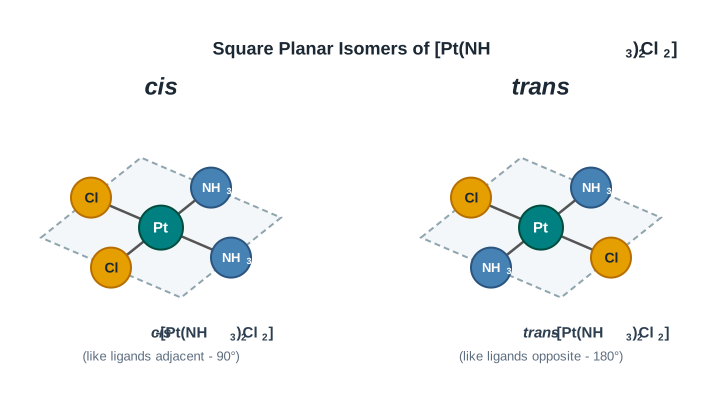
Fig. 5.6 – Geometrical isomers of [Pt(NH₃)₂Cl₂].
Another square planar complex of the type MABXL (where A, B, X, L are unidentates) shows three isomers — two cis and one trans. You may attempt to draw these structures for yourself, taking each of the four ligands in turn to be opposite to A.
Such isomerism is not possible for a tetrahedral geometry, but similar behaviour is possible in octahedral complexes of formula \([\mathrm{MX_2L_4}]\), in which the two ligands X may be oriented cis or trans to each other (Fig. 5.7).
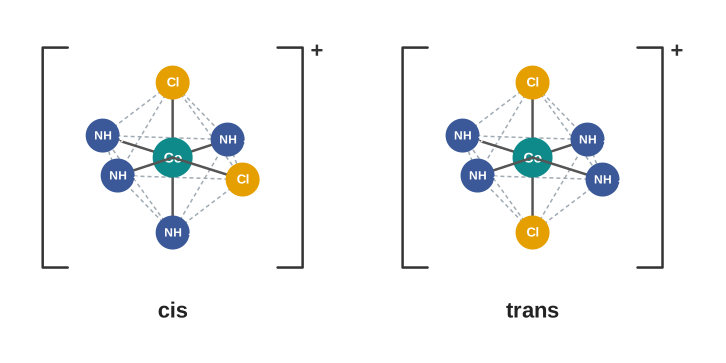
Fig. 5.7 – Geometrical isomers of [Co(NH₃)₄Cl₂]⁺.
This type of isomerism also arises when didentate ligands L–L [e.g., \(\mathrm{NH_2CH_2CH_2NH_2}\) (en)] are present in complexes of formula \([\mathrm{MX_2(L\!-\!L)_2}]\) (Fig. 5.8). A didentate ligand cannot stretch across the octahedron, so it must always occupy two adjacent positions; the two X ligands then take whatever positions are left, and these can be either cis or trans.
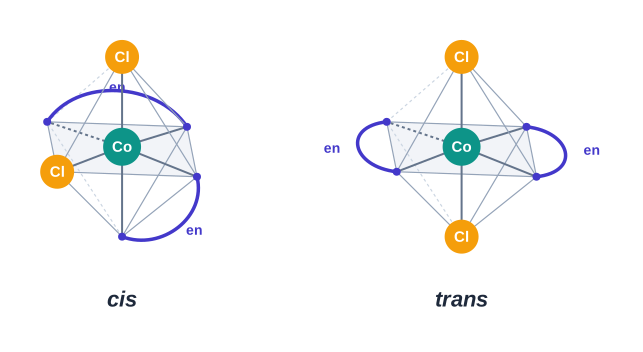
Fig. 5.8 – Geometrical isomers of [CoCl₂(en)₂].
Facial and meridional isomers
Another type of geometrical isomerism occurs in octahedral coordination entities of the type \([\mathrm{Ma_3b_3}]\), like \([\mathrm{Co(NH_3)_3(NO_2)_3}]\). Here three ligands of one kind and three of another must be distributed over six positions, and there are exactly two ways to do it.
If three donor atoms of the same ligands occupy adjacent positions at the corners of an octahedral face, we have the facial (fac) isomer. When the positions are around the meridian of the octahedron, we get the meridional (mer) isomer (Fig. 5.9).
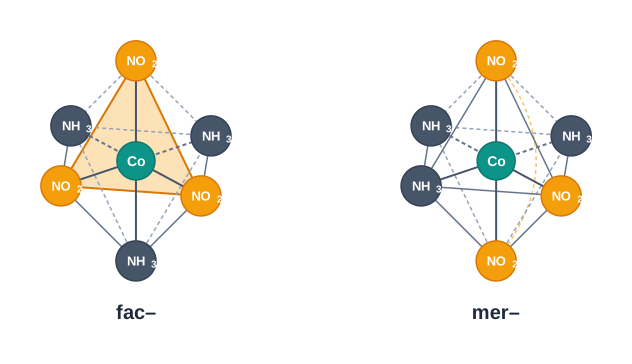
Fig. 5.9 – Facial and meridional isomers of [Co(NH₃)₃(NO₂)₃].
5.4.2 Optical Isomerism
Optical isomers are mirror images that cannot be superimposed on one another. These are called enantiomers. The molecules or ions that cannot be superimposed on their mirror images are called chiral.
Chirality is easiest to grasp through your own hands: your left hand is the mirror image of your right, and no matter how you turn it, you cannot lay one exactly on top of the other. A chiral complex is “handed” in exactly this sense.
The two forms are called dextro (d) and laevo (l) depending upon the direction in which they rotate the plane of polarised light in a polarimeter — d rotates it to the right, l to the left. This rotation is the experimental signature by which the two forms are told apart, since in almost every physical property they are identical.
Optical isomerism is common in octahedral complexes involving didentate ligands (Fig. 5.10). The chelate rings twist around the metal like the threads of a screw, and a screw thread is the classic chiral object — it is either right-handed or left-handed.
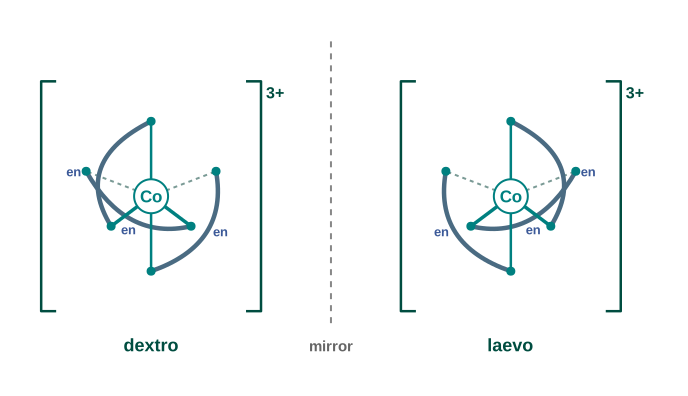
Fig. 5.10 – Optical isomers of [Co(en)₃]³⁺.
In a coordination entity of the type \([\mathrm{PtCl_2(en)_2}]^{2+}\), only the cis isomer shows optical activity (Fig. 5.11).
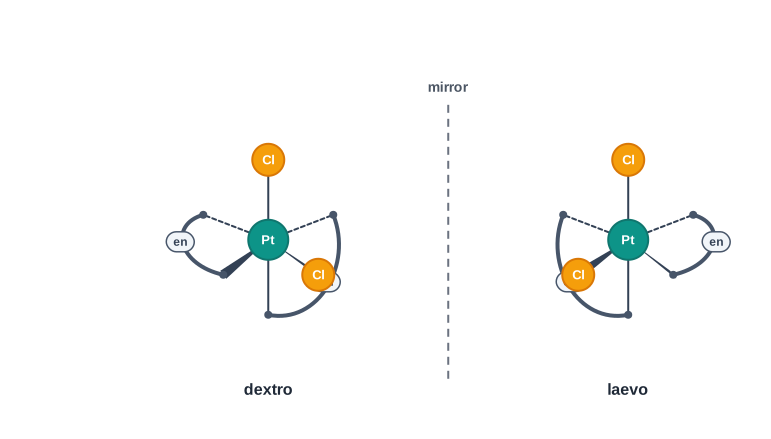
Fig. 5.11 – Optical isomers of cis-[PtCl₂(en)₂]²⁺.
Draw structures of geometrical isomers of \([\mathrm{Fe(NH_3)_2(CN)_4}]^{-}\)
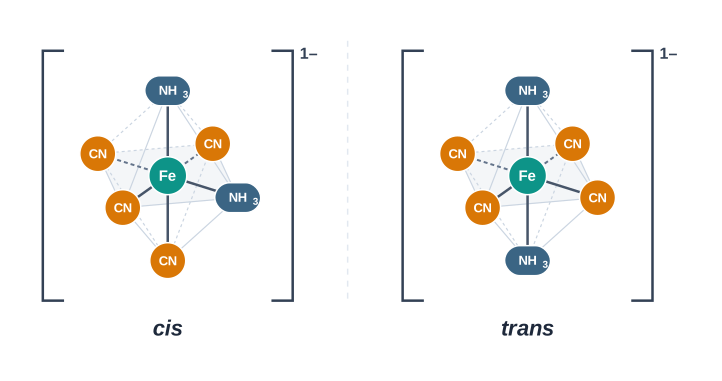
[Caption:] Fig. 5.12A – Geometrical isomers of [Fe(NH₃)₂(CN)₄]⁻. [/Caption:]
The complex is octahedral and of the type \([\mathrm{MX_2L_4}]\), so exactly two geometrical isomers are possible: the cis form, with the two ammine ligands at adjacent positions, and the trans form, with the two ammine ligands opposite each other.
Out of the following two coordination entities which is chiral (optically active)?
(a) cis-\([\mathrm{CrCl_2(ox)_2}]^{3-}\) (b) trans-\([\mathrm{CrCl_2(ox)_2}]^{3-}\)
The two entities are represented as shown in Fig. 5.13B.
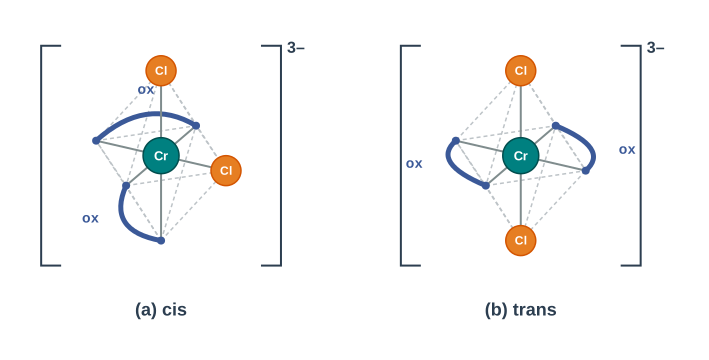
[Caption:] Fig. 5.13B – Isomers of [CrCl₂(ox)₂]³⁻: (a) cis and (b) trans. [/Caption:]
Out of the two, (a) cis-\([\mathrm{CrCl_2(ox)_2}]^{3-}\) is chiral (optically active).
5.4.3 Linkage Isomerism
Linkage isomerism arises in a coordination compound containing an ambidentate ligand. A simple example is provided by complexes containing the thiocyanate ligand, \(\mathrm{NCS^-}\), which may bind through the nitrogen to give M–NCS or through sulphur to give M–SCN.
Jørgensen discovered such behaviour in the complex \([\mathrm{Co(NH_3)_5(NO_2)}]\mathrm{Cl_2}\), which is obtained as the red form, in which the nitrite ligand is bound through oxygen (–ONO), and as the yellow form, in which the nitrite ligand is bound through nitrogen (\(-\mathrm{NO_2}\)).
The colour difference is the giveaway. The metal is the same and the formula is the same; only the atom through which the ligand is attached has changed, and that is enough to change the compound.
5.4.4 Coordination Isomerism
This type of isomerism arises from the interchange of ligands between the cationic and anionic entities of different metal ions present in a complex. It can therefore appear only when both the cation and the anion are coordination entities.
An example is provided by \([\mathrm{Co(NH_3)_6}][\mathrm{Cr(CN)_6}]\), in which the \(\mathrm{NH_3}\) ligands are bound to \(\mathrm{Co^{3+}}\) and the \(\mathrm{CN^-}\) ligands to \(\mathrm{Cr^{3+}}\). In its coordination isomer \([\mathrm{Cr(NH_3)_6}][\mathrm{Co(CN)_6}]\), the \(\mathrm{NH_3}\) ligands are bound to \(\mathrm{Cr^{3+}}\) and the \(\mathrm{CN^-}\) ligands to \(\mathrm{Co^{3+}}\). The two metals have, in effect, swapped their sets of ligands.
5.4.5 Ionisation Isomerism
This form of isomerism arises when the counter ion in a complex salt is itself a potential ligand and can displace a ligand, which can then become the counter ion. The ion that was inside the bracket moves out, and the ion that was outside moves in.
An example is provided by the ionisation isomers \([\mathrm{Co(NH_3)_5(SO_4)}]\mathrm{Br}\) and \([\mathrm{Co(NH_3)_5Br}]\mathrm{SO_4}\).
Because the two compounds release different ions into solution, they are easy to tell apart experimentally: only one of them will give a precipitate with a reagent that detects the free ion.
5.4.6 Solvate Isomerism
This form of isomerism is known as ‘hydrate isomerism’ in the case where water is involved as a solvent. It is similar to ionisation isomerism. Solvate isomers differ by whether or not a solvent molecule is directly bonded to the metal ion, or merely present as a free solvent molecule in the crystal lattice.
An example is provided by the aqua complex \([\mathrm{Cr(H_2O)_6}]\mathrm{Cl_3}\) (violet) and its solvate isomer \([\mathrm{Cr(H_2O)_5Cl}]\mathrm{Cl_2 \cdot H_2O}\) (grey-green). In the first, all six water molecules are ligands; in the second, one of them has been pushed out of the coordination sphere into the lattice, and a chloride has taken its place inside the bracket.
5.5 Bonding in Coordination Compounds
Werner was the first to describe the bonding features in coordination compounds. He told us that a metal holds six groups around it in fixed positions, and he told us where those groups sit. What his theory could not answer were the basic questions of why:
- Why do only certain elements possess the remarkable property of forming coordination compounds?
- Why do the bonds in coordination compounds have directional properties?
- Why do coordination compounds have characteristic magnetic and optical properties?
Many approaches have been put forth to explain the nature of bonding in coordination compounds, viz. Valence Bond Theory (VBT), Crystal Field Theory (CFT), Ligand Field Theory (LFT) and Molecular Orbital Theory (MOT). We shall focus our attention on an elementary treatment of the application of VBT and CFT to coordination compounds.
The two theories start from opposite assumptions, and it is worth holding that contrast in mind from the beginning: VBT treats the metal–ligand bond as covalent (a shared electron pair donated into a hybrid orbital), while CFT treats it as purely ionic (an electrostatic attraction and repulsion between charges).
5.5.1 Valence Bond Theory
According to this theory, the metal atom or ion, under the influence of ligands, can use its \((n-1)d\), \(ns\), \(np\) or \(ns\), \(np\), \(nd\) orbitals for hybridisation to yield a set of equivalent orbitals of definite geometry, such as octahedral, tetrahedral, square planar and so on (Table 5.2). These hybridised orbitals are allowed to overlap with ligand orbitals that can donate electron pairs for bonding.
This one sentence already answers Werner’s second question. Hybrid orbitals point in fixed directions in space, so a bond formed by overlap with a hybrid orbital must also point in a fixed direction — which is exactly why coordination bonds are directional and why the complex has a definite shape.
Table 5.2: Number of Orbitals and Types of Hybridisations
| Coordination number | Type of hybridisation | Distribution of hybrid orbitals in space |
|---|---|---|
| 4 | \(sp^3\) | Tetrahedral |
| 4 | \(dsp^2\) | Square planar |
| 5 | \(sp^3d\) | Trigonal bipyramidal |
| 6 | \(sp^3d^2\) | Octahedral |
| 6 | \(d^2sp^3\) | Octahedral |
Read the last two rows carefully. Both give an octahedron, but they use different d orbitals: \(d^2sp^3\) uses the inner \((n-1)d\) orbitals, while \(sp^3d^2\) uses the outer \(nd\) orbitals. This single difference turns out to control the magnetism of the complex, as the examples below show.
An octahedral complex with inner d orbitals: \([\mathrm{Co(NH_3)_6}]^{3+}\)
It is usually possible to predict the geometry of a complex from a knowledge of its magnetic behaviour on the basis of the valence bond theory.
In the diamagnetic octahedral complex \([\mathrm{Co(NH_3)_6}]^{3+}\), the cobalt ion is in the \(+3\) oxidation state and has the electronic configuration \(3d^6\). The hybridisation scheme is shown in Fig. 5.14A.
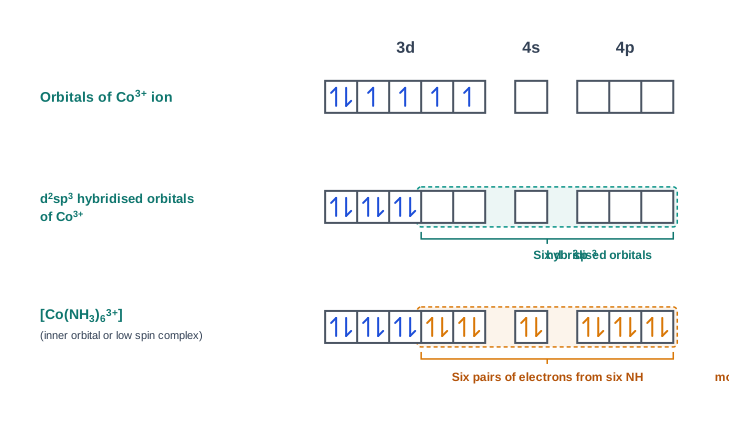
Fig. 5.14A – Hybridisation scheme for [Co(NH₃)₆]³⁺.
Six pairs of electrons, one from each \(\mathrm{NH_3}\) molecule, occupy the six hybrid orbitals. Thus, the complex has octahedral geometry and is diamagnetic because of the absence of unpaired electrons. (A diamagnetic substance has no unpaired electrons and is weakly repelled by a magnetic field; a paramagnetic substance has one or more unpaired electrons and is attracted into a magnetic field.)
In the formation of this complex, since the inner d orbital (\(3d\)) is used in hybridisation, the complex \([\mathrm{Co(NH_3)_6}]^{3+}\) is called an inner orbital or low spin or spin paired complex.
An octahedral complex with outer d orbitals: \([\mathrm{CoF_6}]^{3-}\)
The paramagnetic octahedral complex \([\mathrm{CoF_6}]^{3-}\) uses outer orbitals (\(4d\)) in hybridisation (\(sp^3d^2\)). It is thus called an outer orbital or high spin or spin free complex. The scheme is shown in Fig. 5.15B.
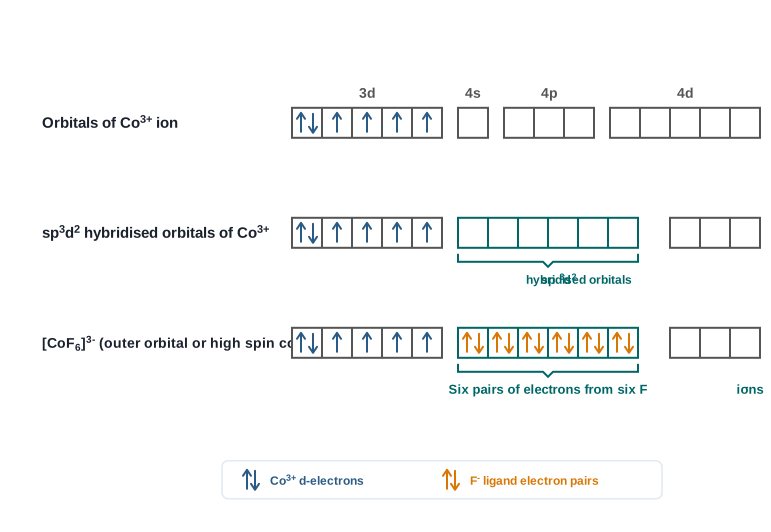
Fig. 5.15B – Hybridisation scheme for [CoF₆]³⁻.
Compare the two cobalt(III) complexes. The metal ion, its oxidation state and its \(3d^6\) configuration are identical in both. Only the ligand has changed — and with it, whether the \(3d\) electrons were forced to pair up or not. Ammonia forces the pairing and frees two inner \(3d\) orbitals for hybridisation; fluoride does not, so the metal must reach outward to its \(4d\) orbitals instead, leaving four unpaired electrons behind. Valence bond theory records this difference faithfully, though it does not explain why one ligand can force pairing and the other cannot; that gap is filled by crystal field theory later in this section.
Tetrahedral complexes: \([\mathrm{NiCl_4}]^{2-}\) and \([\mathrm{Ni(CO)_4}]\)
In tetrahedral complexes, one \(s\) and three \(p\) orbitals are hybridised to form four equivalent orbitals oriented tetrahedrally. This is illustrated for \([\mathrm{NiCl_4}]^{2-}\) in Fig. 5.16C. Here nickel is in the \(+2\) oxidation state and the ion has the electronic configuration \(3d^8\).
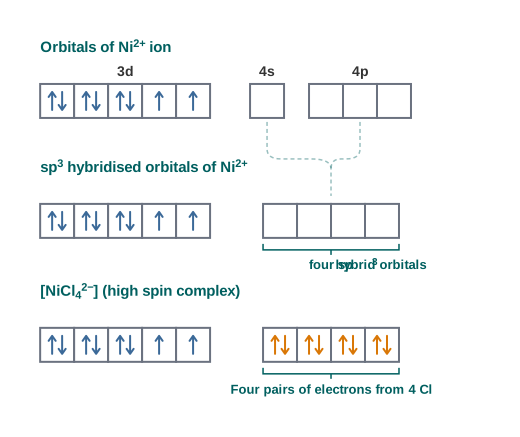
Fig. 5.16C – Hybridisation scheme for [NiCl₄]²⁻.
Each \(\mathrm{Cl^-}\) ion donates a pair of electrons. The compound is paramagnetic since it contains two unpaired electrons.
Similarly, \([\mathrm{Ni(CO)_4}]\) has tetrahedral geometry but is diamagnetic, since nickel is in the zero oxidation state and contains no unpaired electron.
Square planar complexes: \([\mathrm{Ni(CN)_4}]^{2-}\)
In the square planar complexes, the hybridisation involved is \(dsp^2\). An example is \([\mathrm{Ni(CN)_4}]^{2-}\). Here nickel is in the \(+2\) oxidation state and has the electronic configuration \(3d^8\). The hybridisation scheme is shown in Fig. 5.17D.
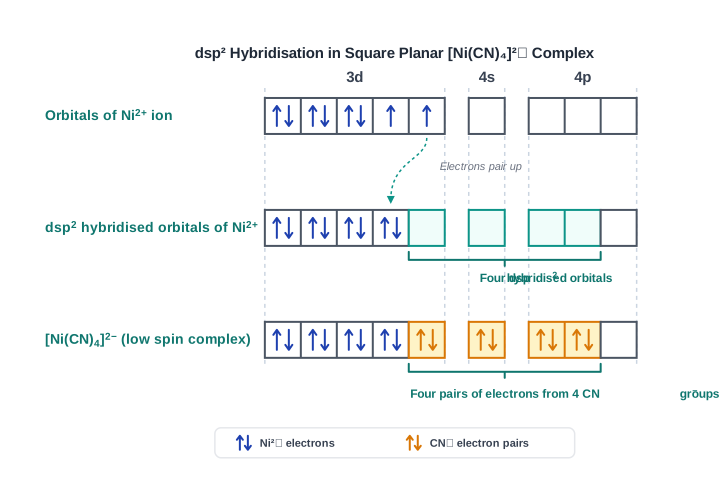
Fig. 5.17D – Hybridisation scheme for [Ni(CN)₄]²⁻.
Each of the hybridised orbitals receives a pair of electrons from a cyanide ion. The compound is diamagnetic, as is evident from the absence of unpaired electrons.
Notice what nickel(II) has done here. In \([\mathrm{NiCl_4}]^{2-}\) it kept its two unpaired \(3d\) electrons and used only \(sp^3\) hybridisation, giving a tetrahedron; with cyanide it paired those electrons, freeing one \(3d\) orbital for \(dsp^2\) hybridisation and giving a square plane. The ligand has decided the shape.
It is important to note that the hybrid orbitals do not actually exist. In fact, hybridisation is a mathematical manipulation of the wave equation for the atomic orbitals involved — a convenient and successful bookkeeping device, not a physical object one could isolate.
5.5.2 Magnetic Properties of Coordination Compounds
The magnetic moment of coordination compounds can be measured by magnetic susceptibility experiments. The results can be used to obtain information about the number of unpaired electrons, and hence about the structures adopted by metal complexes. Magnetism, in other words, is an experimental window into the electron arrangement.
The link between the two is the spin-only formula, which you have met earlier: \[\mu = \sqrt{n(n+2)}\ \text{BM}\] where \(n\) is the number of unpaired electrons and BM stands for Bohr magneton. Measure \(\mu\), and you can count \(n\); count \(n\), and you can decide between two possible structures.
A critical study of the magnetic data of coordination compounds of metals of the first transition series reveals some complications.
For metal ions with up to three electrons in the \(d\) orbitals, like \(\mathrm{Ti^{3+}}\) (\(d^1\)), \(\mathrm{V^{3+}}\) (\(d^2\)) and \(\mathrm{Cr^{3+}}\) (\(d^3\)), two vacant \(d\) orbitals are available for octahedral hybridisation with \(4s\) and \(4p\) orbitals. The magnetic behaviour of these free ions and of their coordination entities is similar — no rearrangement is needed, so nothing changes.
When more than three \(3d\) electrons are present, the required pair of \(3d\) orbitals for octahedral hybridisation is not directly available (as a consequence of Hund’s rule, which spreads electrons singly across the five \(d\) orbitals before any pairing occurs). Thus, for \(d^4\) (\(\mathrm{Cr^{2+}}\)), \(\mathrm{Mn^{3+}}\)), \(d^5\) (\(\mathrm{Mn^{2+}}\)), \(\mathrm{Fe^{3+}}\)) and \(d^6\) (\(\mathrm{Fe^{2+}}\)), \(\mathrm{Co^{3+}}\)) cases, a vacant pair of \(d\) orbitals results only by pairing of the \(3d\) electrons, which leaves two, one and zero unpaired electrons, respectively.
The magnetic data agree with maximum spin pairing in many cases, especially with coordination compounds containing \(d^6\) ions. However, with species containing \(d^4\) and \(d^5\) ions there are complications:
- \([\mathrm{Mn(CN)_6}]^{3-}\) has the magnetic moment of two unpaired electrons, while \([\mathrm{MnCl_6}]^{3-}\) has a paramagnetic moment of four unpaired electrons.
- \([\mathrm{Fe(CN)_6}]^{3-}\) has the magnetic moment of a single unpaired electron, while \([\mathrm{FeF_6}]^{3-}\) has a paramagnetic moment of five unpaired electrons.
- \([\mathrm{CoF_6}]^{3-}\) is paramagnetic with four unpaired electrons, while \([\mathrm{Co(C_2O_4)_3}]^{3-}\) is diamagnetic.
This apparent anomaly is explained by valence bond theory in terms of the formation of inner orbital and outer orbital coordination entities. \([\mathrm{Mn(CN)_6}]^{3-}\), \([\mathrm{Fe(CN)_6}]^{3-}\) and \([\mathrm{Co(C_2O_4)_3}]^{3-}\) are inner orbital complexes involving \(d^2sp^3\) hybridisation; the former two complexes are paramagnetic and the latter diamagnetic. On the other hand, \([\mathrm{MnCl_6}]^{3-}\), \([\mathrm{FeF_6}]^{3-}\) and \([\mathrm{CoF_6}]^{3-}\) are outer orbital complexes involving \(sp^3d^2\) hybridisation and are paramagnetic, corresponding to four, five and four unpaired electrons.
Read across those three pairs and a pattern jumps out: in every case the cyanide or oxalate complex has fewer unpaired electrons than the chloride or fluoride complex of the same metal ion. The ligand is doing something to the metal’s electrons. Naming this — inner versus outer orbital — is not the same as explaining it, and that honest gap is the reason the next theory was needed.
5.5.3 Limitations of Valence Bond Theory
While the VB theory, to a large extent, explains the formation, structures and magnetic behaviour of coordination compounds, it suffers from the following shortcomings:
- It involves a number of assumptions.
- It does not give a quantitative interpretation of magnetic data.
- It does not explain the colour exhibited by coordination compounds.
- It does not give a quantitative interpretation of the thermodynamic or kinetic stabilities of coordination compounds.
- It does not make exact predictions regarding the tetrahedral and square planar structures of 4-coordinate complexes.
- It does not distinguish between weak and strong ligands.
Shortcomings (iii) and (vi) are the ones that hurt most, and they are related. A theory that cannot say why \(\mathrm{CN^-}\) is a “strong” ligand and \(\mathrm{F^-}\) a “weak” one is also, unsurprisingly, unable to say why one complex is violet and another is pale yellow. Crystal field theory was developed to supply exactly what is missing here.
5.5.4 Crystal Field Theory
The crystal field theory (CFT) is an electrostatic model which considers the metal–ligand bond to be ionic, arising purely from electrostatic interactions between the metal ion and the ligand. Ligands are treated as point charges in the case of anions, or as point dipoles in the case of neutral molecules.
The five \(d\) orbitals in an isolated gaseous metal atom/ion have the same energy, i.e., they are degenerate. This degeneracy is maintained if a spherically symmetrical field of negative charges surrounds the metal atom/ion — because then every \(d\) orbital is repelled to exactly the same extent.
However, when this negative field is due to ligands (either anions or the negative ends of dipolar molecules like \(\mathrm{NH_3}\) and \(\mathrm{H_2O}\)) in a complex, it becomes asymmetrical, and the degeneracy of the \(d\) orbitals is lifted. It results in splitting of the \(d\) orbitals. The pattern of splitting depends upon the nature of the crystal field. Let us explain this splitting in different crystal fields.
(a) Crystal field splitting in octahedral coordination entities
In an octahedral coordination entity with six ligands surrounding the metal atom/ion, there will be repulsion between the electrons in the metal \(d\) orbitals and the electrons (or negative charges) of the ligands. Such a repulsion is more when the metal \(d\) orbital is directed towards the ligand than when it is away from the ligand.
Thus, the \(d_{x^2-y^2}\) and \(d_{z^2}\) orbitals, which point towards the axes along the direction of the ligands, will experience more repulsion and will be raised in energy; and the \(d_{xy}\), \(d_{yz}\) and \(d_{xz}\) orbitals, which are directed between the axes, will be lowered in energy relative to the average energy in the spherical crystal field.
Thus, the degeneracy of the \(d\) orbitals has been removed due to ligand electron–metal electron repulsions in the octahedral complex, to yield three orbitals of lower energy, the \(t_{2g}\) set, and two orbitals of higher energy, the \(e_g\) set. This splitting of the degenerate levels due to the presence of ligands in a definite geometry is termed as crystal field splitting, and the energy separation is denoted by \(\Delta_o\) (the subscript o is for octahedral), as shown in Fig. 5.18.
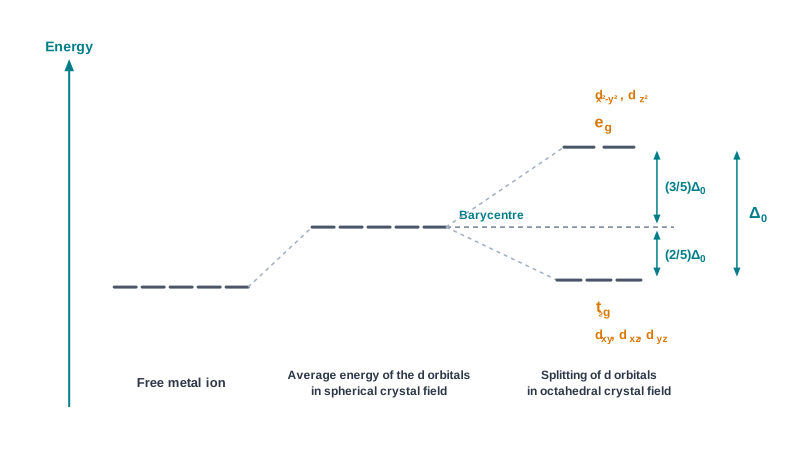
Fig. 5.18 – Octahedral crystal field splitting.
Thus, the energy of the two \(e_g\) orbitals will increase by \((3/5)\Delta_o\) and that of the three \(t_{2g}\) will decrease by \((2/5)\Delta_o\). This keeps the average energy unchanged, which is why the dashed line in Fig. 5.18 is called the barycentre — the “centre of gravity” of the five orbital energies: two orbitals go up by three-fifths, three go down by two-fifths, and \(2 \times (3/5) = 3 \times (2/5)\), so the books balance.
The crystal field splitting, \(\Delta_o\), depends upon the field produced by the ligand and the charge on the metal ion. Some ligands are able to produce strong fields, in which case the splitting will be large, whereas others produce weak fields and consequently result in small splitting of the \(d\) orbitals.
In general, ligands can be arranged in a series in the order of increasing field strength, as given below:
\[\mathrm{I^-} < \mathrm{Br^-} < \mathrm{SCN^-} < \mathrm{Cl^-} < \mathrm{S^{2-}} < \mathrm{F^-} < \mathrm{OH^-} < \mathrm{C_2O_4^{2-}} < \mathrm{H_2O} < \mathrm{NCS^-} < \mathrm{edta^{4-}} < \mathrm{NH_3} < \mathrm{en} < \mathrm{CN^-} < \mathrm{CO}\]
Such a series is termed as the spectrochemical series. It is an experimentally determined series based on the absorption of light by complexes with different ligands — it was not predicted from theory but read off from spectra, and this is worth remembering, because it is also one of the weaknesses of CFT that it cannot derive the order it uses.
Filling the split d orbitals
Let us assign electrons in the \(d\) orbitals of the metal ion in octahedral coordination entities. Obviously, the single \(d\) electron occupies one of the lower energy \(t_{2g}\) orbitals. In \(d^2\) and \(d^3\) coordination entities, the \(d\) electrons occupy the \(t_{2g}\) orbitals singly, in accordance with Hund’s rule.
For \(d^4\) ions, two possible patterns of electron distribution arise: (i) the fourth electron could either enter the \(t_{2g}\) level and pair with an existing electron, or (ii) it could avoid paying the price of the pairing energy by occupying the \(e_g\) level.
Which of these possibilities occurs depends on the relative magnitude of the crystal field splitting, \(\Delta_o\), and the pairing energy, P (P represents the energy required for electron pairing in a single orbital). Every electron faces the same choice, and it is a straightforward economic one: is it cheaper to climb the energy gap \(\Delta_o\), or to pay the pairing penalty P?
The two options are:
If \(\Delta_o < \mathrm{P}\), the fourth electron enters one of the \(e_g\) orbitals, giving the configuration \(t_{2g}^3 e_g^1\). Ligands for which \(\Delta_o < \mathrm{P}\) are known as weak field ligands and form high spin complexes.
If \(\Delta_o > \mathrm{P}\), it becomes more energetically favourable for the fourth electron to occupy a \(t_{2g}\) orbital, with the configuration \(t_{2g}^4 e_g^0\). Ligands which produce this effect are known as strong field ligands and form low spin complexes.
Calculations show that \(d^4\) to \(d^7\) coordination entities are more stable for strong field as compared to weak field cases.
Here at last is the answer to the question VBT could not touch. Ammonia and cyanide are strong field ligands: they produce a large \(\Delta_o\), so the \(3d\) electrons pair up, inner \(d\) orbitals fall vacant, and we get the inner orbital, low spin complexes of Section 5.5.2. Fluoride and chloride are weak field ligands: \(\Delta_o\) is small, no pairing occurs, and we get the outer orbital, high spin complexes. “Inner/outer orbital” and “low spin/high spin” describe the same two situations in two different languages.
(b) Crystal field splitting in tetrahedral coordination entities
In tetrahedral coordination entity formation, the \(d\) orbital splitting (Fig. 5.19) is inverted and is smaller as compared to the octahedral field splitting. The inversion happens because in a tetrahedron no ligand points directly along an axis; the ligands come in between the axes, so it is now the \(d_{xy}\), \(d_{yz}\) and \(d_{xz}\) orbitals that are repelled more strongly and raised in energy.
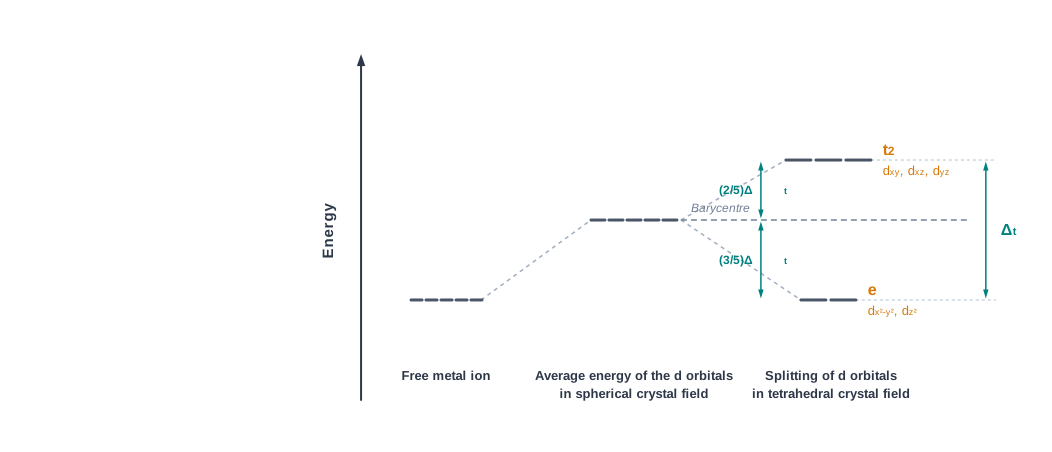
Fig. 5.19 – Tetrahedral crystal field splitting.
For the same metal, the same ligands and the same metal–ligand distances, it can be shown that \[\Delta_t = \frac{4}{9}\,\Delta_o\]
Consequently, the orbital splitting energies are not sufficiently large for forcing pairing and, therefore, low spin configurations are rarely observed in tetrahedral complexes. In practical terms: if a complex is tetrahedral, expect it to be high spin.
The ‘g’ subscript is used for octahedral and square planar complexes, which have a centre of symmetry. Since tetrahedral complexes lack this symmetry, the ‘g’ subscript is not used with their energy levels — hence \(e\) and \(t_2\), not \(e_g\) and \(t_{2g}\).
5.5.5 Colour in Coordination Compounds
In the previous Chapter, we learnt that one of the most distinctive properties of transition metal complexes is their wide range of colours. This means that some of the visible spectrum is being removed from white light as it passes through the sample, so the light that emerges is no longer white.
The colour of the complex is complementary to that which is absorbed. The complementary colour is the colour generated from the wavelength left over; if green light is absorbed by the complex, it appears red. Table 5.3 gives the relationship of the different wavelengths absorbed and the colour observed.
Table 5.3: Relationship between the Wavelength of Light absorbed and the Colour observed in some Coordination Entities
| Coordination entity | Wavelength of light absorbed (nm) | Colour of light absorbed | Colour of coordination entity |
|---|---|---|---|
| \([\mathrm{CoCl(NH_3)_5}]^{2+}\) | 535 | Yellow | Violet |
| \([\mathrm{Co(NH_3)_5(H_2O)}]^{3+}\) | 500 | Blue Green | Red |
| \([\mathrm{Co(NH_3)_6}]^{3+}\) | 475 | Blue | Yellow Orange |
| \([\mathrm{Co(CN)_6}]^{3-}\) | 310 | Ultraviolet (not in visible region) | Pale Yellow |
| \([\mathrm{Cu(H_2O)_4}]^{2+}\) | 600 | Red | Blue |
| \([\mathrm{Ti(H_2O)_6}]^{3+}\) | 498 | Blue Green | Violet |
The colour in the coordination compounds can be readily explained in terms of the crystal field theory. Consider, for example, the complex \([\mathrm{Ti(H_2O)_6}]^{3+}\), which is violet in colour.
This is an octahedral complex where the single electron (\(\mathrm{Ti^{3+}}\) is a \(3d^1\) system) in the metal \(d\) orbital is in the \(t_{2g}\) level in the ground state of the complex. The next higher state available for the electron is the empty \(e_g\) level.
If light corresponding to the energy of the blue-green region is absorbed by the complex, it would excite the electron from the \(t_{2g}\) level to the \(e_g\) level (\(t_{2g}^1 e_g^0 \rightarrow t_{2g}^0 e_g^1\)). Consequently, the complex appears violet in colour (Fig. 5.20). The crystal field theory attributes the colour of the coordination compounds to the \(d\)-\(d\) transition of the electron.
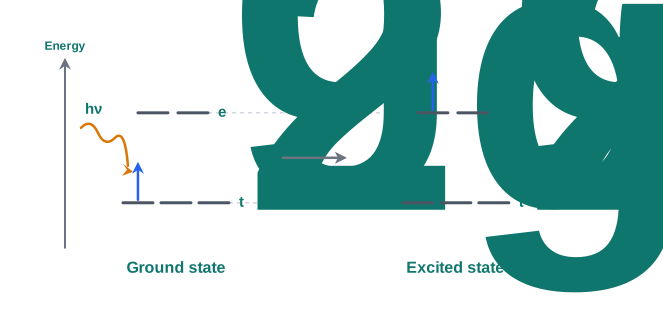
Fig. 5.20 – Electron transition in [Ti(H₂O)₆]³⁺.
The photon that is absorbed must carry exactly the energy \(\Delta_o\) — no more and no less. That is why the colour is a direct read-out of the crystal field splitting: change the ligand, change \(\Delta_o\), change the wavelength absorbed, and the complex changes colour before your eyes.
When there is no ligand, there is no colour
It is important to note that in the absence of a ligand, crystal field splitting does not occur, and hence the substance is colourless. Without a splitting, there is no gap of the right size for a \(d\)-\(d\) transition, so no visible light is absorbed.
For example, removal of water from \([\mathrm{Ti(H_2O)_6}]\mathrm{Cl_3}\) on heating renders it colourless. Similarly, anhydrous \(\mathrm{CuSO_4}\) is white, but \(\mathrm{CuSO_4 \cdot 5H_2O}\) is blue in colour — the water molecules in the hydrated salt are ligands, and it is their crystal field that creates the colour.
The ligand decides the colour: the nickel–en series
The influence of the ligand on the colour of a complex may be illustrated by considering the \([\mathrm{Ni(H_2O)_6}]^{2+}\) complex, which forms when nickel(II) chloride is dissolved in water. If the didentate ligand, ethane-1,2-diamine (en), is progressively added in the molar ratios en : Ni of 1:1, 2:1 and 3:1, the following series of reactions and their associated colour changes occur:
\[[\mathrm{Ni(H_2O)_6}]^{2+}\text{(aq)} + \mathrm{en}\text{(aq)} = [\mathrm{Ni(H_2O)_4(en)}]^{2+}\text{(aq)} + 2\,\mathrm{H_2O}\] (green → pale blue)
\[[\mathrm{Ni(H_2O)_4(en)}]^{2+}\text{(aq)} + \mathrm{en}\text{(aq)} = [\mathrm{Ni(H_2O)_2(en)_2}]^{2+}\text{(aq)} + 2\,\mathrm{H_2O}\] (→ blue/purple)
\[[\mathrm{Ni(H_2O)_2(en)_2}]^{2+}\text{(aq)} + \mathrm{en}\text{(aq)} = [\mathrm{Ni(en)_3}]^{2+}\text{(aq)} + 2\,\mathrm{H_2O}\] (→ violet)
This sequence is shown in Fig. 5.21.
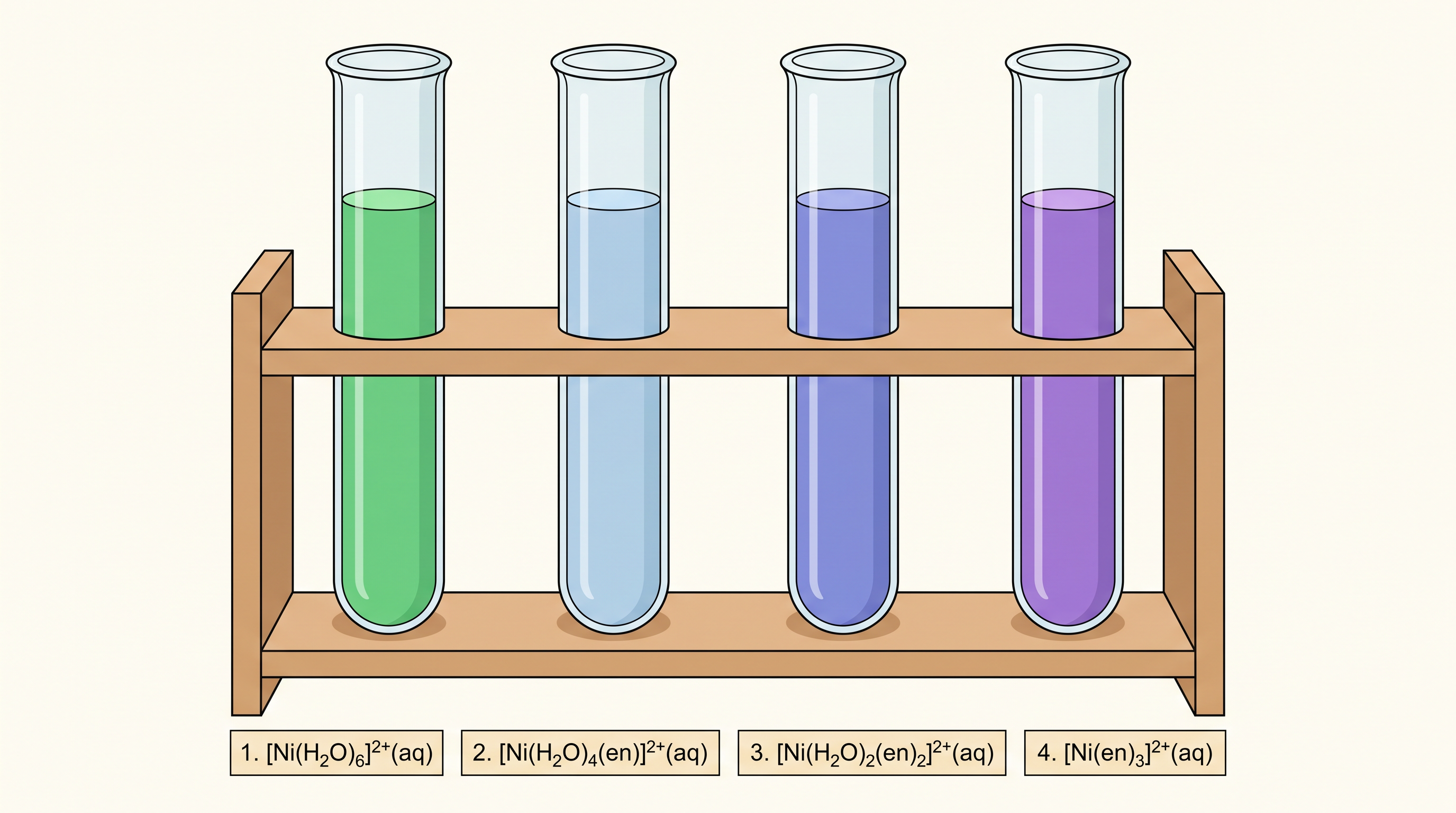
Fig. 5.21 – Colour changes in nickel(II) complexes.
In emerald [Fig. 5.22(b)], \(\mathrm{Cr^{3+}}\) ions occupy octahedral sites in the mineral beryl (\(\mathrm{Be_3Al_2Si_6O_{18}}\)). The absorption bands seen in the ruby shift to longer wavelength, namely yellow-red and blue, causing emerald to transmit light in the green region. The same chromium ion, in a different crystal field, gives a red gemstone in one mineral and a green one in another — the point of this whole section, written in stone.
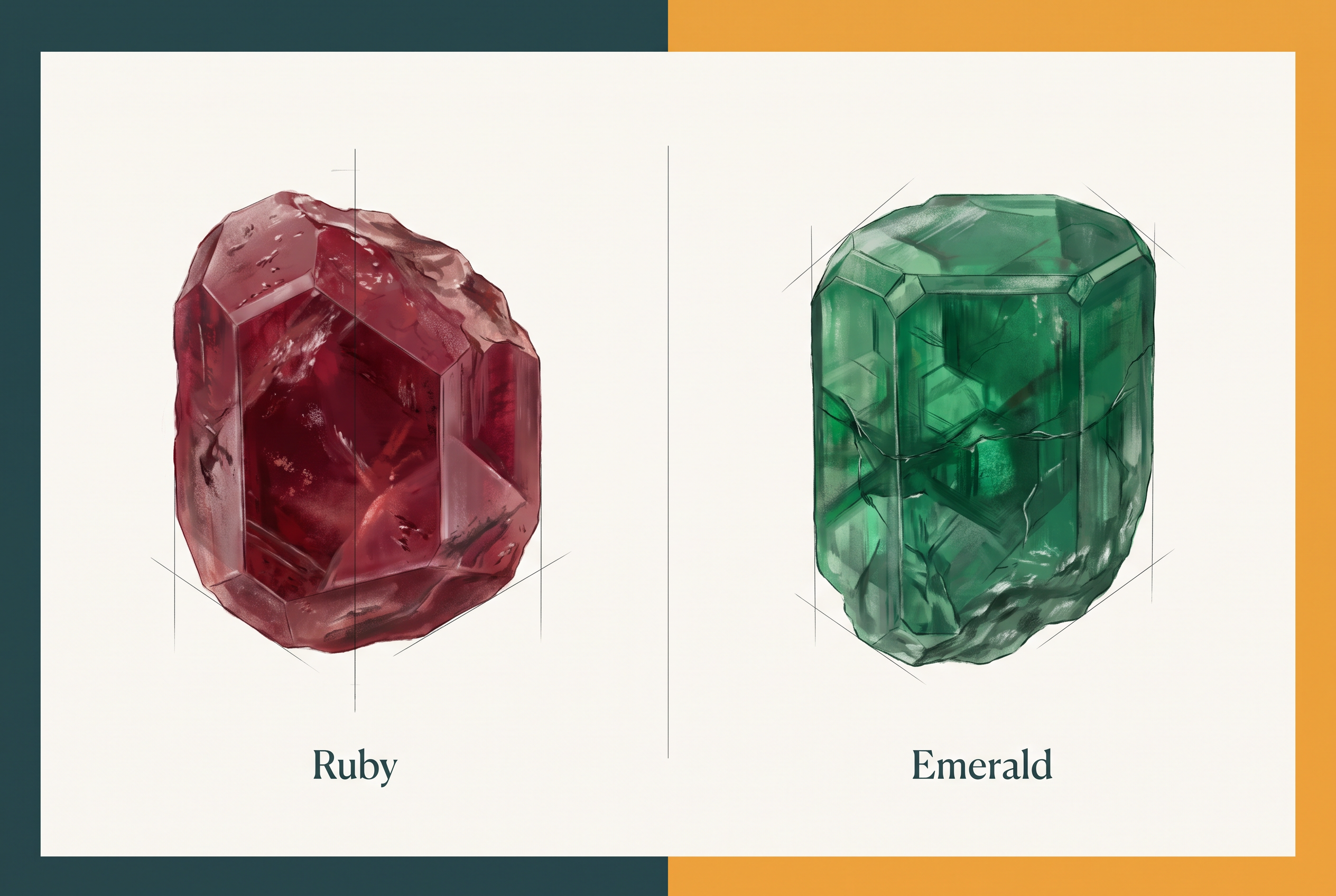
Fig. 5.22 – Gemstones coloured by chromium(III): (a) ruby and (b) emerald.
5.5.6 Limitations of Crystal Field Theory
The crystal field model is successful in explaining the formation, structures, colour and magnetic properties of coordination compounds to a large extent. However, it too has its weak points.
From the assumption that the ligands are point charges, it follows that anionic ligands should exert the greatest splitting effect — a negative ion should repel the \(d\) electrons more strongly than a neutral molecule can. The experimental facts contradict this squarely: the anionic ligands are actually found at the low end of the spectrochemical series, while neutral molecules such as \(\mathrm{NH_3}\) and CO sit at the strong end.
Further, CFT does not take into account the covalent character of the bonding between the ligand and the central atom — it insists the bond is purely ionic, which is an oversimplification.
These are some of the weaknesses of CFT, which are explained by ligand field theory (LFT) and molecular orbital theory, which are beyond the scope of the present study.
5.6 Bonding in Metal Carbonyls
The homoleptic carbonyls — compounds containing carbonyl ligands only — are formed by most of the transition metals. (Recall from Section 5.2 that a homoleptic complex has just one kind of ligand; here, every ligand is a CO molecule and the metal is usually in the zero oxidation state.) These carbonyls have simple, well-defined structures.
Tetracarbonylnickel(0) is tetrahedral, pentacarbonyliron(0) is trigonal bipyramidal, while hexacarbonyl chromium(0) is octahedral. Notice how neatly these match Table 5.2: coordination numbers 4, 5 and 6 give exactly the shapes that the corresponding hybridisations predict.
Some carbonyls contain more than one metal atom. Decacarbonyldimanganese(0) is made up of two square pyramidal \(\mathrm{Mn(CO)_5}\) units joined by a Mn–Mn bond. Octacarbonyldicobalt(0) has a Co–Co bond bridged by two CO groups — that is, two of the carbonyl ligands do not belong to one metal alone but sit between the two cobalt atoms, holding both. These structures are shown in Fig. 5.23.
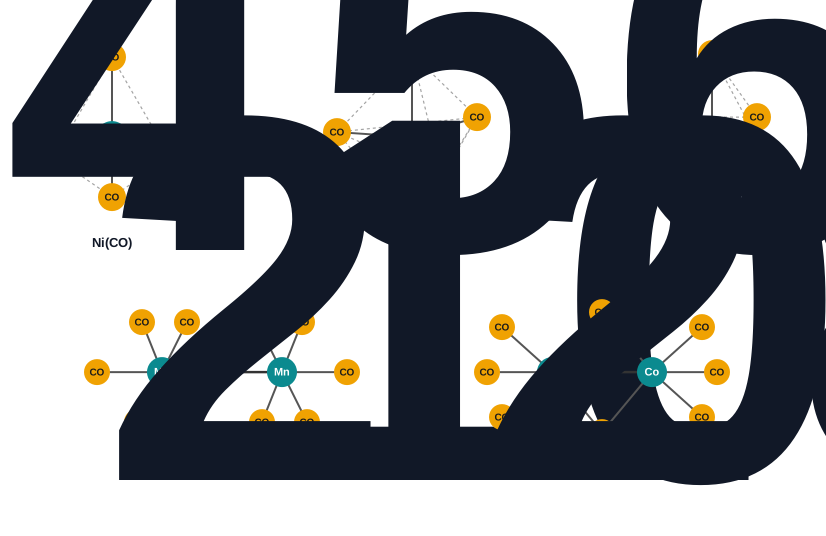
Fig. 5.23 – Structures of representative homoleptic metal carbonyls.
The Metal–Carbon Bond: Two Bonds in One
The metal–carbon bond in metal carbonyls possesses both \(\sigma\) and \(\pi\) character, and this dual nature is the whole secret of why these compounds are so stable.
The M–C \(\sigma\) bond is formed by the donation of the lone pair of electrons on the carbonyl carbon into a vacant orbital of the metal. This is the ordinary coordinate bond you have met throughout the chapter: the ligand acts as a Lewis base, the metal as a Lewis acid.
The M–C \(\pi\) bond is formed by the donation of a pair of electrons from a filled \(d\) orbital of the metal into the vacant antibonding \(\pi^*\) orbital of carbon monoxide. This is the unusual part, and it runs the other way — from metal to ligand — so it is often called back donation.
A word about the \(\pi^*\) orbital, since the term is easy to skip over. When two atoms combine, their atomic orbitals produce a bonding molecular orbital (lower in energy, filled) and an antibonding one (higher in energy, marked with an asterisk, and empty in free CO). Putting electrons into an antibonding orbital weakens the bond between C and O — and that is exactly what back donation does. The C–O bond is slightly weakened; the M–C bond is strengthened.
The metal-to-ligand bonding creates a synergic effect, which strengthens the bond between CO and the metal (Fig. 5.24).
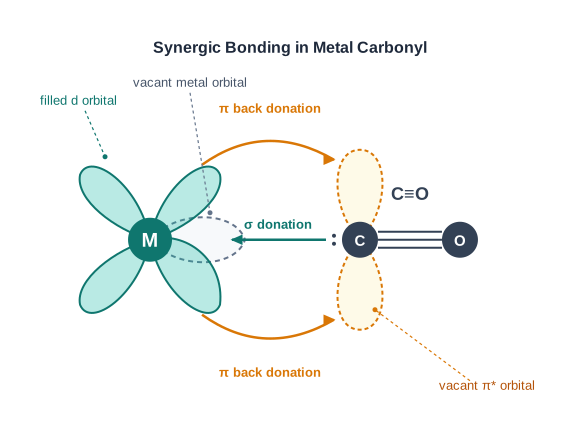
Fig. 5.24 – Synergic bonding in a metal carbonyl.
The word “synergic” is the key. The two donations are not independent: the more the carbon donates its lone pair, the more electron-rich the metal becomes, and the more readily it pushes electron density back into the \(\pi^*\) orbital of CO. That back donation in turn drains negative charge away from the metal, leaving it hungry for more \(\sigma\) donation. Each process feeds the other, and the cycle is set out in FC 5.5.
Flowchart
FC 5.5 – The synergic cycle in metal carbonyls: CO carbon lone pair → donated into a vacant metal orbital (σ bond) → metal becomes electron-rich → filled metal d orbital → donates into the vacant π* orbital of CO (π back donation) → C–O bond weakened, M–C bond strengthened → metal loses excess negative charge → CO can donate its σ pair even more effectively → cycle returns to the start.
5.7 Importance and Applications of Coordination Compounds
The coordination compounds are of great importance. These compounds are widely present in the mineral, plant and animal worlds, and are known to play many important functions in the areas of analytical chemistry, metallurgy, biological systems, industry and medicine. These are described below.
In Analytical Chemistry
Coordination compounds find use in many qualitative and quantitative chemical analyses. The familiar colour reactions given by metal ions with a number of ligands (especially chelating ligands), as a result of the formation of coordination entities, form the basis for their detection and estimation by classical and instrumental methods of analysis.
Examples of such reagents include EDTA, DMG (dimethylglyoxime), \(\alpha\)–nitroso–\(\beta\)–naphthol and cupron. The logic behind all of them is same: a metal ion that is invisible in solution becomes a brightly coloured, often insoluble, chelate the moment the right ligand is added — and both the colour and the amount of precipitate can be measured.
The hardness of water is estimated by simple titration with \(\mathrm{Na_2EDTA}\). The \(\mathrm{Ca^{2+}}\) and \(\mathrm{Mg^{2+}}\) ions form stable complexes with EDTA. The selective estimation of these ions can be done due to the difference in the stability constants of the calcium and magnesium complexes — the two chelates are not equally stable, and that difference in stability is what allows one ion to be titrated in the presence of the other.
In Extraction and Purification of Metals
Some important extraction processes of metals, like those of silver and gold, make use of complex formation.
Gold, for example, combines with cyanide in the presence of oxygen and water to form the coordination entity \([\mathrm{Au(CN)_2}]^{-}\) in aqueous solution. Gold can be separated in metallic form from this solution by the addition of zinc. The whole sequence is set out in FC 5.6.
Flowchart
FC 5.6 – Cyanide extraction of gold: crushed gold-bearing ore → treated with dilute NaCN solution in the presence of air (O₂) and water → gold dissolves as [Au(CN)₂]⁻ (aq) → solution separated from the residue → zinc dust added → zinc displaces the gold → metallic gold precipitated, zinc passes into solution as [Zn(CN)₄]²⁻.
Similarly, the purification of metals can be achieved through the formation and subsequent decomposition of their coordination compounds. For example, impure nickel is converted to \([\mathrm{Ni(CO)_4}]\), which is decomposed to yield pure nickel. The trick here is reversibility: the carbonyl forms readily under one set of conditions and falls apart under another, so the metal can be carried away from its impurities as a volatile complex and then set free again.
In Biological Systems
Coordination compounds are of great importance in biological systems.
The pigment responsible for photosynthesis, chlorophyll, is a coordination compound of magnesium. Haemoglobin, the red pigment of blood which acts as the oxygen carrier, is a coordination compound of iron. Vitamin \(\mathrm{B_{12}}\), cyanocobalamine, the anti–pernicious anaemia factor, is a coordination compound of cobalt.
Among the other compounds of biological importance with coordinated metal ions are the enzymes like carboxypeptidase A and carbonic anhydrase, which act as catalysts of biological systems.
Look at the pattern rather than at the list. In every one of these, a single metal ion sits at the centre of a large organic ligand that holds it in exactly the right geometry — and the entire biological function, whether it is capturing sunlight, carrying oxygen or catalysing a reaction, depends on that geometry being what it is.
As Catalysts in Industry
Coordination compounds are used as catalysts for many industrial processes. Examples include the rhodium complex \([(\mathrm{Ph_3P})_3\mathrm{RhCl}]\), a Wilkinson catalyst, which is used for the hydrogenation of alkenes.
In Electroplating and Photography
Articles can be electroplated with silver and gold much more smoothly and evenly from solutions of the complexes \([\mathrm{Ag(CN)_2}]^{-}\) and \([\mathrm{Au(CN)_2}]^{-}\) than from a solution of simple metal ions. The reason is a matter of control: the complex releases the metal ion slowly and steadily, so the metal is deposited as a fine, uniform, adherent film instead of as a rough, patchy layer.
In black and white photography, the developed film is fixed by washing with hypo solution, which dissolves the undecomposed AgBr to form a complex ion, \([\mathrm{Ag(S_2O_3)_2}]^{3-}\). The unexposed silver bromide, which would otherwise darken later and ruin the image, is thus carried away in solution as a soluble complex.
In Medicinal Chemistry
There is growing interest in the use of chelate therapy in medicinal chemistry. An example is the treatment of problems caused by the presence of metals in toxic proportions in plant/animal systems.
Thus, an excess of copper and iron is removed by the chelating ligands D–penicillamine and desferrioxime B, via the formation of coordination compounds. EDTA is used in the treatment of lead poisoning.
Some coordination compounds of platinum effectively inhibit the growth of tumours. Examples are: cis–platin and related compounds — and here the geometrical isomerism of Section 5.4 returns with real consequences, since it is the cis arrangement, and not the trans, that carries the anticancer activity.
5.8 Summary
The chemistry of coordination compounds is an important and challenging area of modern inorganic chemistry. Advances in this area over the last fifty years have produced new concepts and models of bonding and molecular structure, novel breakthroughs in chemical industry, and vital insights into the functioning of critical components of biological systems.
A coordination compound contains a central metal atom or ion bonded to a fixed number of ions or molecules called ligands. The metal and its ligands, written inside a square bracket, form the coordination sphere; the ions written outside it are counter ions.
Werner’s Theory
The first systematic attempt at explaining the formation, reactions, structure and bonding of a coordination compound was made by A. Werner. His theory postulated the use of two types of linkages — primary and secondary — by a metal atom/ion in a coordination compound.
In the modern language of chemistry these linkages are recognised as the ionisable (ionic) and non-ionisable (covalent) bonds, respectively. The secondary valence equals the coordination number and is fixed for a metal.
Using the property of isomerism, Werner predicted the geometrical shapes of a large number of coordination entities — most commonly octahedral, tetrahedral and square planar.
Key Terms to Carry Forward
Ligands are classified by the number of donor atoms they use: unidentate, didentate and polydentate. A di- or polydentate ligand that grips a single metal ion through two or more donor atoms at once is a chelate ligand, and chelate complexes are unusually stable. A ligand with two different donor atoms, only one of which is used at a time, is ambidentate.
The oxidation number of the central atom is the charge it would carry if all the ligands were removed along with their shared electron pairs; it is shown as a Roman numeral in the name.
A complex with only one kind of donor group is homoleptic; one with more than one kind is heteroleptic.
Names and formulas follow IUPAC rules: in a formula, the metal comes first and the ligands follow in alphabetical order; in a name, the ligands are named first (alphabetically), then the metal, with its oxidation number in parentheses — and the metal takes the suffix –ate whenever the coordination entity is an anion.
Isomerism
Stereoisomers have the same bonds but a different arrangement in space: geometrical isomers (cis/trans, and fac/mer) and optical isomers (non-superimposable mirror images, called enantiomers, which rotate the plane of polarised light in opposite directions).
Structural isomers have different bonds: linkage, coordination, ionisation and solvate (hydrate) isomerism.
Valence Bond Theory
The Valence Bond Theory (VBT) explains with reasonable success the formation, magnetic behaviour and geometrical shapes of coordination compounds. The metal uses hybridised orbitals — \(sp^3\) (tetrahedral), \(dsp^2\) (square planar), \(sp^3d\) (trigonal bipyramidal), \(d^2sp^3\) and \(sp^3d^2\) (both octahedral) — which overlap with ligand orbitals that donate electron pairs.
A complex using inner \((n-1)d\) orbitals (\(d^2sp^3\)) is an inner orbital / low spin complex; one using outer \(nd\) orbitals (\(sp^3d^2\)) is an outer orbital / high spin complex.
The number of unpaired electrons, \(n\), is found from the measured magnetic moment: \[\mu = \sqrt{n(n+2)}\ \text{BM}\]
VBT, however, fails to provide a quantitative interpretation of magnetic behaviour and has nothing to say about the optical properties of these compounds; it also does not distinguish weak from strong ligands.
Crystal Field Theory
The Crystal Field Theory (CFT) applied to coordination compounds is based on the effect of different crystal fields (provided by the ligands, taken as point charges) on the degeneracy of the \(d\) orbital energies of the central metal atom/ion.
In an octahedral field the \(d\) orbitals split into a lower \(t_{2g}\) set and a higher \(e_g\) set, separated by the crystal field splitting energy \(\Delta_o\); the \(e_g\) orbitals rise by \((3/5)\Delta_o\) and the \(t_{2g}\) orbitals fall by \((2/5)\Delta_o\). In a tetrahedral field the splitting is inverted and smaller: \[\Delta_t = \frac{4}{9}\,\Delta_o\]
The splitting of the \(d\) orbitals provides different electronic arrangements in strong and weak crystal fields: if \(\Delta_o < \mathrm{P}\) (weak field ligand) the complex is high spin; if \(\Delta_o > \mathrm{P}\) (strong field ligand) it is low spin. Ligands are ranked by field strength in the experimentally determined spectrochemical series.
CFT also explains colour, which arises from a \(d\)-\(d\) transition of an electron across \(\Delta_o\); the observed colour is complementary to the colour of the light absorbed.
The treatment provides for quantitative estimations of orbital separation energies, magnetic moments, and spectral and stability parameters. However, the assumption that ligands constitute point charges creates many theoretical difficulties — most obviously, it wrongly predicts that anionic ligands should split the \(d\) orbitals most strongly.
Metal Carbonyls
- The metal–carbon bond in metal carbonyls possesses both \(\sigma\) and \(\pi\) character. The ligand-to-metal bond is a \(\sigma\) bond and the metal-to-ligand bond is a \(\pi\) bond. This unique synergic bonding provides stability to metal carbonyls.
Flowchart
FC 5.7 – The chapter in sequence: metal ion + ligands → coordination entity (Werner: primary + secondary valence) → describe it (coordination number, oxidation number, homoleptic/heteroleptic) → name it (IUPAC rules) → arrange it in space (geometrical, optical, linkage, coordination, ionisation, solvate isomerism) → explain its bonding (branch A: VBT → hybridisation → shape and magnetism, inner vs outer orbital; branch B: CFT → d orbital splitting Δ → strong vs weak field → high spin vs low spin → colour) → special case: metal carbonyls → synergic σ + π bonding → apply it (analysis, extraction, biology, catalysis, medicine).
Importance
Coordination compounds are of great importance. They provide critical insights into the functioning and structures of vital components of biological systems — chlorophyll (Mg), haemoglobin (Fe) and vitamin \(\mathrm{B_{12}}\) (Co).
They also find extensive applications in metallurgical processes, and in analytical and medicinal chemistry — from the estimation of water hardness with EDTA and the extraction of gold as \([\mathrm{Au(CN)_2}]^{-}\), to chelate therapy for metal poisoning and platinum-based anticancer drugs.
5.9 NCERT Questions
Explain the bonding in coordination compounds in terms of Werner’s postulates.
\(\mathrm{FeSO_4}\) solution mixed with \((\mathrm{NH_4})_2\mathrm{SO_4}\) solution in a 1:1 molar ratio gives the test of \(\mathrm{Fe^{2+}}\) ion, but \(\mathrm{CuSO_4}\) solution mixed with aqueous ammonia in a 1:4 molar ratio does not give the test of \(\mathrm{Cu^{2+}}\) ion. Explain why.
Explain with two examples each of the following: coordination entity, ligand, coordination number, coordination polyhedron, homoleptic and heteroleptic.
What is meant by unidentate, didentate and ambidentate ligands? Give two examples for each.
Specify the oxidation numbers of the metals in the following coordination entities: (i) \([\mathrm{Co(H_2O)(CN)(en)_2}]^{2+}\) (ii) \([\mathrm{CoBr_2(en)_2}]^{+}\) (iii) \([\mathrm{PtCl_4}]^{2-}\) (iv) \(\mathrm{K_3[Fe(CN)_6]}\) (v) \([\mathrm{Cr(NH_3)_3Cl_3}]\)
Using IUPAC norms, write the formulas for the following: (i) Tetrahydroxidozincate(II) (ii) Potassium tetrachloridopalladate(II) (iii) Diamminedichloridoplatinum(II) (iv) Potassium tetracyanidonickelate(II) (v) Pentaamminenitrito-O-cobalt(III) (vi) Hexaamminecobalt(III) sulphate (vii) Potassium tri(oxalato)chromate(III) (viii) Hexaammineplatinum(IV) (ix) Tetrabromidocuprate(II) (x) Pentaamminenitrito-N-cobalt(III)
Using IUPAC norms, write the systematic names of the following: (i) \([\mathrm{Co(NH_3)_6}]\mathrm{Cl_3}\) (ii) \([\mathrm{Pt(NH_3)_2Cl(NH_2CH_3)}]\mathrm{Cl}\) (iii) \([\mathrm{Ti(H_2O)_6}]^{3+}\) (iv) \([\mathrm{Co(NH_3)_4Cl(NO_2)}]\mathrm{Cl}\) (v) \([\mathrm{Mn(H_2O)_6}]^{2+}\) (vi) \([\mathrm{NiCl_4}]^{2-}\) (vii) \([\mathrm{Ni(NH_3)_6}]\mathrm{Cl_2}\) (viii) \([\mathrm{Co(en)_3}]^{3+}\) (ix) \([\mathrm{Ni(CO)_4}]\)
List the various types of isomerism possible for coordination compounds, giving an example of each.
How many geometrical isomers are possible in the following coordination entities? (i) \([\mathrm{Cr(C_2O_4)_3}]^{3-}\) (ii) \([\mathrm{Co(NH_3)_3Cl_3}]\)
Draw the structures of the optical isomers of: (i) \([\mathrm{Cr(C_2O_4)_3}]^{3-}\) (ii) \([\mathrm{PtCl_2(en)_2}]^{2+}\) (iii) \([\mathrm{Cr(NH_3)_2Cl_2(en)}]^{+}\)
Draw all the isomers (geometrical and optical) of: (i) \([\mathrm{CoCl_2(en)_2}]^{+}\) (ii) \([\mathrm{Co(NH_3)Cl(en)_2}]^{2+}\) (iii) \([\mathrm{Co(NH_3)_2Cl_2(en)}]^{+}\)
Write all the geometrical isomers of \([\mathrm{Pt(NH_3)(Br)(Cl)(py)}]\), and state how many of these will exhibit optical isomers.
Aqueous copper sulphate solution (blue in colour) gives: (i) a green precipitate with aqueous potassium fluoride, and (ii) a bright green solution with aqueous potassium chloride. Explain these experimental results.
What is the coordination entity formed when excess of aqueous KCN is added to an aqueous solution of copper sulphate? Why is it that no precipitate of copper sulphide is obtained when \(\mathrm{H_2S}\)(g) is passed through this solution?
Discuss the nature of bonding in the following coordination entities on the basis of valence bond theory: (i) \([\mathrm{Fe(CN)_6}]^{4-}\) (ii) \([\mathrm{FeF_6}]^{3-}\) (iii) \([\mathrm{Co(C_2O_4)_3}]^{3-}\) (iv) \([\mathrm{CoF_6}]^{3-}\)
Draw a figure to show the splitting of \(d\) orbitals in an octahedral crystal field.
What is the spectrochemical series? Explain the difference between a weak field ligand and a strong field ligand.
What is crystal field splitting energy? How does the magnitude of \(\Delta_o\) decide the actual configuration of \(d\) orbitals in a coordination entity?
\([\mathrm{Cr(NH_3)_6}]^{3+}\) is paramagnetic while \([\mathrm{Ni(CN)_4}]^{2-}\) is diamagnetic. Explain why.
A solution of \([\mathrm{Ni(H_2O)_6}]^{2+}\) is green but a solution of \([\mathrm{Ni(CN)_4}]^{2-}\) is colourless. Explain.
\([\mathrm{Fe(CN)_6}]^{4-}\) and \([\mathrm{Fe(H_2O)_6}]^{2+}\) are of different colours in dilute solutions. Why?
Discuss the nature of bonding in metal carbonyls.
Give the oxidation state, \(d\) orbital occupation and coordination number of the central metal ion in the following complexes: (i) \(\mathrm{K_3[Co(C_2O_4)_3]}\) (ii) cis-\([\mathrm{CrCl_2(en)_2}]\mathrm{Cl}\) (iii) \((\mathrm{NH_4})_2[\mathrm{CoF_4}]\) (iv) \([\mathrm{Mn(H_2O)_6}]\mathrm{SO_4}\)
Write down the IUPAC name for each of the following complexes and indicate the oxidation state, electronic configuration and coordination number. Also give the stereochemistry and magnetic moment of the complex: (i) \(\mathrm{K[Cr(H_2O)_2(C_2O_4)_2] \cdot 3H_2O}\) (ii) \([\mathrm{Co(NH_3)_5Cl}]\mathrm{Cl_2}\) (iii) \([\mathrm{CrCl_3(py)_3}]\) (iv) \(\mathrm{Cs[FeCl_4]}\) (v) \(\mathrm{K_4[Mn(CN)_6]}\)
Explain the violet colour of the complex \([\mathrm{Ti(H_2O)_6}]^{3+}\) on the basis of crystal field theory.
What is meant by the chelate effect? Give an example.
Discuss briefly, giving an example in each case, the role of coordination compounds in: (i) biological systems (ii) medicinal chemistry (iii) analytical chemistry (iv) extraction/metallurgy of metals
How many ions are produced from the complex \(\mathrm{Co(NH_3)_6Cl_2}\) in solution? (i) 6 (ii) 4 (iii) 3 (iv) 2
Amongst the following ions, which one has the highest magnetic moment value? (i) \([\mathrm{Cr(H_2O)_6}]^{3+}\) (ii) \([\mathrm{Fe(H_2O)_6}]^{2+}\) (iii) \([\{Zn(H_2O)_6}]^{2+}\)
Amongst the following, the most stable complex is: (i) \([\mathrm{Fe(H_2O)_6}]^{3+}\) (ii) \([\mathrm{Fe(NH_3)_6}]^{3+}\) (iii) \([\mathrm{Fe(C_2O_4)_3}]^{3-}\) (iv) \([\mathrm{FeCl_6}]^{3-}\)
What will be the correct order for the wavelengths of absorption in the visible region for the following? \([\mathrm{Ni(NO_2)_6}]^{4-}\), \([\mathrm{Ni(NH_3)_6}]^{2+}\), \([\mathrm{Ni(H_2O)_6}]^{2+}\)
5.10 Check Your Concepts
A solution of Mohr’s salt gives the usual tests for \(\mathrm{Fe^{2+}}\)), but a solution of \(\mathrm{K_4[Fe(CN)_6]}\) does not. Both contain iron in the \(+2\) state. Explain the difference in terms of what happens to each compound when it is dissolved in water.
One mole each of \(\mathrm{CoCl_3 \cdot 6NH_3}\) and \(\mathrm{CoCl_3 \cdot 4NH_3}\) is dissolved in water and treated with excess silver nitrate solution. Predict the number of moles of AgCl obtained in each case, and explain how this experiment reveals the difference between primary and secondary valence.
Assertion: The coordination number of cobalt in \([\mathrm{Co(en)_3}]^{3+}\) is 6. Reason: Ethane-1,2-diamine is a didentate ligand. State whether both the assertion and the reason are correct, and whether the reason correctly explains the assertion.
Why is a chelate complex such as \([\mathrm{Ni(en)_3}]^{2+}\) more stable than \([\mathrm{Ni(NH_3)_6}]^{2+}\), even though the donor atom is nitrogen in both?
Explain, with reasons, why geometrical isomerism is not possible in a tetrahedral complex of the type \([\mathrm{MA_2B_2}]\), but is possible in a square planar complex of the same formula.
\([\mathrm{Co(NH_3)_5(NO_2)}]\mathrm{Cl_2}\) exists in a red form and a yellow form. Name the type of isomerism involved, draw the structures of the two forms, and state what property of the nitrite ion makes this possible.
Match each pair of compounds with the type of isomerism it illustrates:
| Column A | Types |
|---|---|
| a. \([\mathrm{Co(NH_3)_6}][\mathrm{Cr(CN)_6}]\) and \([\mathrm{Cr(NH_3)_6}][\mathrm{Co(CN)_6}]\) | i. ionisation |
| b. \([\mathrm{Cr(H_2O)_6}]\mathrm{Cl_3}\) and \([\mathrm{Cr(H_2O)_5Cl}]\mathrm{Cl_2 \cdot H_2O}\) | ii. coordination |
| c. \([\mathrm{Co(NH_3)_5(SO_4)}]\mathrm{Br}\) and \([\mathrm{Co(NH_3)_5Br}]\mathrm{SO_4}\) | iii. geometrical |
| d. **cis- and trans-\([\mathrm{CoCl_2(en)_2}]^{+}\) | iv. solvate |
Why does only the cis* isomer of \([\mathrm{PtCl_2(en)_2}]^{2+}\) show optical activity, while the trans isomer does not? Support your answer with the idea of a plane of symmetry.*
Both \([\mathrm{NiCl_4}]^{2-}\) and \([\mathrm{Ni(CN)_4}]^{2-}\) have nickel in the \(+2\) oxidation state and a coordination number of 4, yet one is tetrahedral and paramagnetic and the other is square planar and diamagnetic. Explain this difference using valence bond theory.
Assertion: \([\mathrm{CoF_6}]^{3-}\) is an outer orbital complex. Reason: \(\mathrm{F^-}\) is a weak field ligand and cannot force the \(3d\) electrons of \(\mathrm{Co^{3+}}\) to pair up. State whether both the assertion and the reason are correct, and whether the reason correctly explains the assertion.
Arrange the following ligands in increasing order of the crystal field splitting they produce, and state the experimental basis on which this order was established: \(\mathrm{Cl^-}\), \(\mathrm{CN^-}\), \(\mathrm{H_2O}\), \(\mathrm{NH_3}\), \(\mathrm{F^-}\), CO
State two important limitations of valence bond theory that crystal field theory is able to overcome, and one important limitation of crystal field theory itself.
Why are low spin configurations rarely observed in tetrahedral complexes? Support your answer with the relationship between \(\Delta_t\) and \(\Delta_o\).
Anhydrous copper sulphate is white, but \(\mathrm{CuSO_4 \cdot 5H_2O}\) is blue. Similarly, \([\mathrm{Ti(H_2O)_6}]\mathrm{Cl_3}\) becomes colourless on heating. Explain both observations on the basis of crystal field theory.
Ruby and emerald both owe their colour to \(\mathrm{Cr^{3+}}\) ions, yet one is red and the other green. Explain how the same metal ion can produce two different colours.
Explain the term “synergic bonding” in metal carbonyls. Why does back donation weaken the C–O bond while strengthening the M–C bond?
Why is the metal in most homoleptic carbonyls found in the zero oxidation state? Relate your answer to the requirement of \(\pi\) back donation.
Gold is a noble metal that does not react with most reagents, yet it dissolves readily in an aerated solution of sodium cyanide. Explain the chemistry involved, and state the role of zinc in the recovery step.
Explain why silver and gold are electroplated from solutions of their cyanide complexes rather than from solutions of their simple salts.
Name the metal ion present in chlorophyll, haemoglobin and vitamin \(\mathrm{B_{12}}\), and state the biological function of each. What common structural feature do all three share?
5.11 Practice With Numericals
(Use standard atomic masses where required: H = 1, C = 12, N = 14, O = 16, Cl = 35.5, Co = 59, Ni = 58.7. Take \(h = 6.626 \times 10^{-34}\ \text{J s}\), \(c = 3.0 \times 10^{8}\ \text{m s}^{-1}\) and \(N_A = 6.022 \times 10^{23}\ \text{mol}^{-1}\) where needed.)
Determine the oxidation number of the central metal in each of the following: (i) \([\mathrm{Cr(H_2O)_4Cl_2}]^{+}\) (ii) \(\mathrm{Na_3[Co(NO_2)_6]}\) (iii) \([\mathrm{Ni(CO)_4}]\) (iv) \(\mathrm{K_2[PtCl_6]}\) (v) \([\{Cu(en)_2}]^{2+}\)
Calculate the spin-only magnetic moment (in BM) of each of the following, first working out the number of unpaired electrons: (i) \([\mathrm{Cr(NH_3)_6}]^{3+}\) (ii) \([\mathrm{Mn(H_2O)_6}]^{2+}\) (iii) \([\mathrm{Ni(CN)_4}]^{2-}\)
The measured spin-only magnetic moment of a four-coordinate complex of cobalt(II) is 3.87 BM. How many unpaired electrons does it contain? What does this tell you about its geometry?
One mole of a compound of empirical formula \(\mathrm{PtCl_4 \cdot 3NH_3}\) gives 1 mol of AgCl on treatment with excess silver nitrate solution. Write the formula of the compound showing the coordination sphere, and state the primary and secondary valences of platinum.
For an octahedral complex, the crystal field splitting energy is \(\Delta_o = 180\ \text{kJ mol}^{-1}\). Calculate \(\Delta_t\) for a tetrahedral complex of the same metal with the same ligands at the same metal–ligand distance.
In an octahedral crystal field, the \(e_g\) orbitals are raised by \((3/5)\Delta_o\) and the \(t_{2g}\) orbitals are lowered by \((2/5)\Delta_o\) relative to the barycentre. Calculate the net change in energy (in units of \(\Delta_o\)) for a \(d^3\) ion and for a low spin \(d^6\) ion in an octahedral field.
\([\mathrm{Ti(H_2O)_6}]^{3+}\) absorbs light of wavelength 498 nm. Calculate the crystal field splitting energy \(\Delta_o\) for this complex (i) in joules per photon and (ii) in \(\text{kJ mol}^{-1}\).
Calculate the percentage by mass of cobalt in \([\mathrm{Co(NH_3)_6}]\mathrm{Cl_3}\).
A solution containing 1 mol of \([\mathrm{Cr(NH_3)_5Cl}]\mathrm{Cl_2}\) is treated with excess silver nitrate solution. How many moles of AgCl are precipitated? How many moles of ions does 1 mol of this compound furnish in aqueous solution?
For \(\mathrm{Fe^{3+}}\) (\(d^5\)) in an octahedral field, write the \(t_{2g}\) and \(e_g\) configurations for (i) a weak field ligand and (ii) a strong field ligand. Calculate the spin-only magnetic moment in each case, and state which corresponds to \([\mathrm{FeF_6}]^{3-}\) and which to \([\mathrm{Fe(CN)_6}]^{3-}\).
The coordination entity \([\mathrm{M(en)_2(C_2O_4)}]^{+}\) contains a metal ion M. Determine (i) the coordination number of M, (ii) the oxidation number of M, and (iii) the total number of donor atoms supplied by the chelating ligands.