Chapter 7: Alcohols, Phenols and Ethers
In the 1860s, a surgeon’s biggest enemy was not the knife but what came after it. Operations often succeeded, yet patients died days later of wound infection — so reliably that hospital wards had a grim reputation. Joseph Lister, working in Glasgow, had read Louis Pasteur’s argument that decay and putrefaction were caused by living micro-organisms. If invisible organisms were entering wounds, Lister reasoned, then killing them before they multiplied should save the patient.
He needed a chemical that destroyed micro-organisms. He chose carbolic acid — the compound we now call phenol, \(\mathrm{C_6H_5OH}\) — which was already being used to treat foul-smelling sewage. Lister soaked dressings in it, sprayed it in the operating theatre, and washed instruments and hands with it. Deaths from post-surgical infection in his wards fell sharply, and antiseptic surgery was born.
What is striking is the chemistry behind it. Phenol carries a single –OH group on a benzene ring. Take that same –OH group and attach it instead to an ordinary carbon chain, and you get ethanol — a compound so mild that it is present in bread dough and fruit juice. Move the hydrogen of that –OH onto another carbon, and you get an ether, once used to send patients to sleep on the operating table.
One oxygen atom. Three families of compounds. Utterly different behaviour.
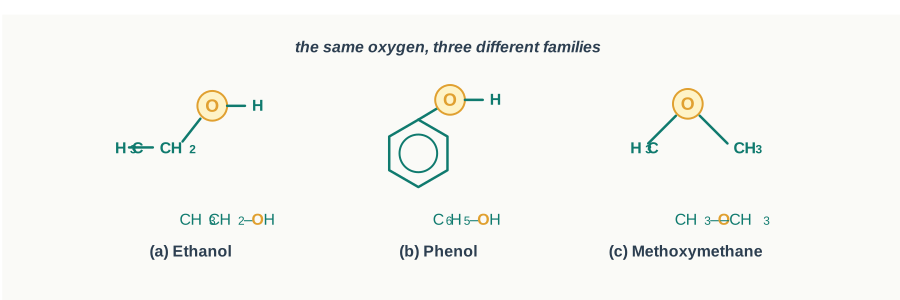
Fig. 7.0 – The same oxygen in three different families.
This chapter will give you the reasoning you need to answer each of these questions for yourself.
7.1 Classification
Meeting the Three Families
You already know that if one or more hydrogen atoms of a hydrocarbon are replaced by another atom or group of atoms, an entirely new compound is formed — one with different properties and different uses. The group that replaces the hydrogen is called a functional group, and it controls almost everything the new compound does.
Alcohols and phenols are formed when a hydrogen atom of a hydrocarbon is replaced by the hydroxyl group, –OH. If the hydrocarbon part is aliphatic (an open chain or a non-aromatic ring), the product is an alcohol. If the –OH goes on to an aromatic ring, the product is a phenol.
A third family appears if we replace the hydrogen of a hydrocarbon by an alkoxy group (–OR) or an aryloxy group (–OAr). These compounds are called ethers — for example, dimethyl ether, \(\mathrm{CH_3OCH_3}\). It also helps to picture an ether the other way round: take an alcohol or a phenol and replace the hydrogen of its –OH group by an alkyl or aryl group, and you have an ether.
These three classes are everywhere. Ordinary spirit used for polishing wooden furniture is chiefly ethanol, a compound of the hydroxyl group. The sugar we eat, the cotton in our fabrics and the paper we write on are all built from molecules carrying –OH groups. Think of life without paper: no note-books, no newspapers, no currency notes, no cheques or certificates, and none of the magazines that carry photographs and stories. It would have been a very different world.
In this unit we shall study the chemistry of these three classes of compounds — alcohols, phenols and ethers.
Why Classify at All
Classifying compounds makes their study systematic and therefore simpler. Once you know which box a compound belongs to, you can already predict a good deal about how it will be named, how it will boil and dissolve, and what it will react with. So before anything else, let us learn how alcohols, phenols and ethers are classified.
7.1.1 Alcohols — Mono, Di, Tri or Polyhydric Alcohols
The first and most obvious way to sort alcohols and phenols is simply to count the hydroxyl groups in the molecule. A compound with one –OH group is monohydric, with two it is dihydric, with three it is trihydric, and with many such groups it is called polyhydric.
Ethanol, \(\mathrm{C_2H_5OH}\), has a single –OH group and is monohydric. Ethane-1,2-diol, \(\mathrm{HO\!-\!CH_2\!-\!CH_2\!-\!OH}\), carries two and is dihydric. Glycerol, in which each of the three carbon atoms of a propane chain bears an –OH group, is trihydric. The structures are compared in Fig. 7.1.
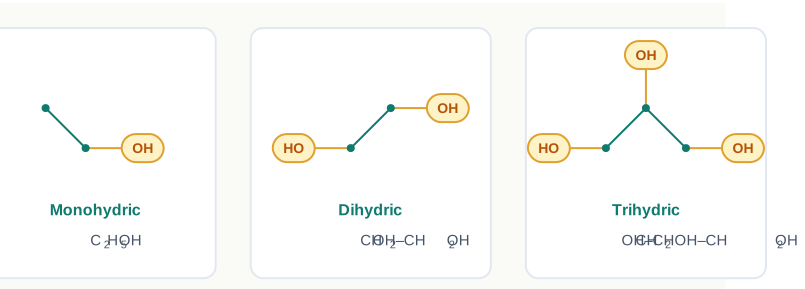
Fig. 7.1 – Monohydric, dihydric and trihydric alcohols.
Sorting Monohydric Alcohols by Hybridisation
Monohydric alcohols can be classified further, this time according to the hybridisation of the carbon atom that actually carries the hydroxyl group. This is a more useful division than it first appears, because a carbon’s hybridisation decides how tightly it holds electrons, and that in turn decides how the O–H bond behaves.
(i) Compounds containing a \(\mathrm{C}_{sp^3}\)–OH bond. In this class, the –OH group is attached to an \(sp^3\) hybridised carbon atom of an alkyl group. These are further classified as follows.
Primary, secondary and tertiary alcohols: here the –OH group is attached to a primary (1°), secondary (2°) or tertiary (3°) carbon atom respectively. Recall from earlier work that a primary carbon is joined to one other carbon, a secondary carbon to two, and a tertiary carbon to three. So we simply look at the carbon bearing the –OH and count how many carbon atoms are attached to it. These three types are drawn in Fig. 7.2.
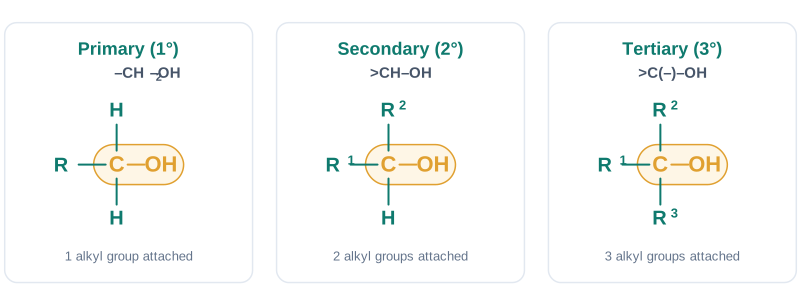
Fig. 7.2 – Primary, secondary and tertiary alcohols.
Allylic alcohols: in these, the –OH group is attached to an \(sp^3\) hybridised carbon that is next to a carbon–carbon double bond — that is, to an allylic carbon. The simplest example is \(\mathrm{CH_2{=}CH\!-\!CH_2\!-\!OH}\), prop-2-en-1-ol. Notice carefully that the carbon holding the –OH is not itself part of the double bond; it is the neighbour of the double-bonded carbon.
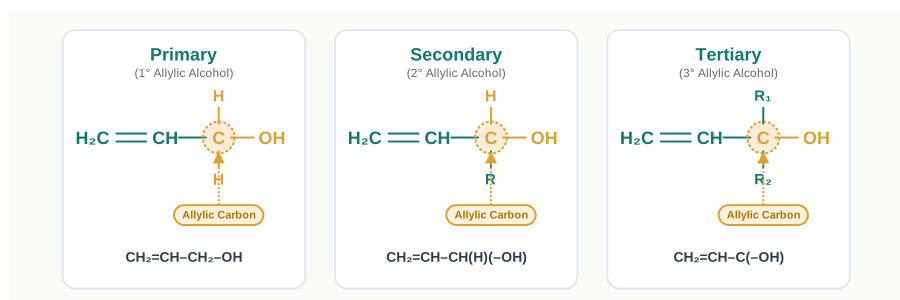
Fig. 7.3 – Allylic alcohols.
Benzylic alcohols: in these, the –OH group is attached to an \(sp^3\) hybridised carbon atom that is next to an aromatic ring. Again the –OH carbon is not part of the ring but attached to it, as shown in Fig. 7.4.
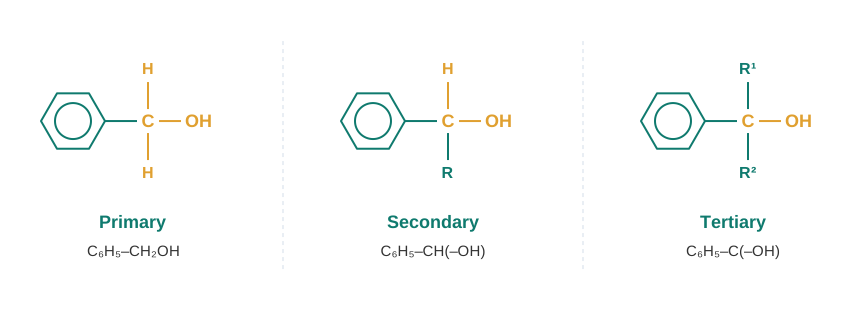
Fig. 7.4 – Benzylic alcohols.
Allylic and benzylic alcohols may themselves be primary, secondary or tertiary — the two labels describe different things and are used together. “Allylic” or “benzylic” tells you what sits next to the –OH carbon; “primary, secondary or tertiary” tells you how many carbon atoms are attached to the –OH carbon itself.
(ii) Compounds containing a \(\mathrm{C}_{sp^2}\)–OH bond. In these alcohols the –OH group is bonded to a carbon that is part of a carbon–carbon double bond (a vinylic carbon) or to an aryl carbon. Such alcohols are known as vinylic alcohols.
Vinylic alcohol: \(\mathrm{CH_2{=}CH\!-\!OH}\)
7.1.2 Phenols — Mono, Di and Trihydric Phenols
Phenols are counted in exactly the same way as alcohols — by the number of hydroxyl groups attached to the aromatic ring.
Phenol itself, with one –OH on the benzene ring, is monohydric; so is a cresol, in which the ring carries one –OH group and one methyl group. A benzene ring bearing two –OH groups is dihydric, and a ring bearing three –OH groups is trihydric. These examples are collected in Fig. 7.5.
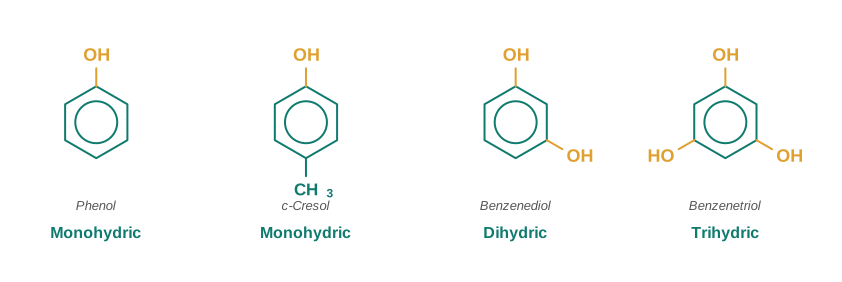
Fig. 7.5 – Mono, di and trihydric phenols.
7.1.3 Ethers
Ethers are classified by looking at the two groups sitting on either side of the oxygen atom.
If the two alkyl or aryl groups attached to the oxygen atom are the same, the ether is called simple or symmetrical. If the two groups are different, the ether is called mixed or unsymmetrical.
Diethyl ether, \(\mathrm{C_2H_5OC_2H_5}\), is a symmetrical ether, since both groups on the oxygen are ethyl. On the other hand, \(\mathrm{C_2H_5OCH_3}\) (ethyl on one side, methyl on the other) and \(\mathrm{C_2H_5OC_6H_5}\) (ethyl on one side, phenyl on the other) are unsymmetrical ethers.
7.2 Nomenclature
A compound may be known by more than one name. The older common (trivial) names grew up in laboratories and workshops, while the IUPAC system was designed so that a single, unambiguous name can be built from the structure — and the structure rebuilt from the name. For each of our three families we shall look at both systems.
(a) Alcohols
The common name of an alcohol is derived from the common name of the alkyl group, followed by the word alcohol. For example, \(\mathrm{CH_3OH}\) is methyl alcohol.
In the IUPAC system, the name of an alcohol is derived from the name of the alkane from which the alcohol comes, by replacing the final ‘e’ of the alkane with the suffix ‘ol’. So ethane becomes ethanol.
The positions of substituents are indicated by numerals. For this, the longest carbon chain containing the –OH group (the parent chain) is numbered starting from the end nearest to the hydroxyl group. The positions of the –OH group and of any other substituents are then shown by the numbers of the carbon atoms to which they are attached.
Polyhydric alcohols are named a little differently. Here the ‘e’ of the alkane is retained and the ending ‘ol’ is added. The number of –OH groups is shown by adding the multiplicative prefix di, tri, and so on, before ‘ol’, and the positions of the –OH groups are shown by appropriate locants. For example, \(\mathrm{HO\!-\!CH_2\!-\!CH_2\!-\!OH}\) is named ethane–1, 2-diol. (Keeping the ‘e’ is what makes “ethane-1,2-diol” easy to pronounce — “ethandiol” would be awkward.)
Table 7.1 gives common and IUPAC names of a few alcohols as examples.
Table 7.1: Common and IUPAC Names of Some Alcohols
| Compound | Common name | IUPAC name |
|---|---|---|
| \(\mathrm{CH_3\!-\!OH}\) | Methyl alcohol | Methanol |
| \(\mathrm{CH_3\!-\!CH_2\!-\!CH_2\!-\!OH}\) | n-Propyl alcohol | Propan-1-ol |
| \(\mathrm{CH_3\!-\!CH(OH)\!-\!CH_3}\) | Isopropyl alcohol | Propan-2-ol |
| \(\mathrm{CH_3\!-\!CH_2\!-\!CH_2\!-\!CH_2\!-\!OH}\) | n-Butyl alcohol | Butan-1-ol |
| \(\mathrm{CH_3\!-\!CH(OH)\!-\!CH_2\!-\!CH_3}\) | sec-Butyl alcohol | Butan-2-ol |
| \(\mathrm{CH_3\!-\!CH(CH_3)\!-\!CH_2\!-\!OH}\) | Isobutyl alcohol | 2-Methylpropan-1-ol |
| \(\mathrm{CH_3\!-\!C(CH_3)_2\!-\!OH}\) | tert-Butyl alcohol | 2-Methylpropan-2-ol |
| \(\mathrm{HO\!-\!H_2C\!-\!CH_2\!-\!OH}\) | Ethylene glycol | Ethane-1,2-diol |
| \(\mathrm{CH_2(OH)\!-\!CH(OH)\!-\!CH_2(OH)}\) | Glycerol | Propane -1, 2, 3-triol |
Cyclic alcohols are named using the prefix cyclo, and the carbon carrying the —OH group is taken as C–1. Two examples are drawn in Fig. 7.6: cyclohexanol, and 2-methylcyclopentanol, in which the methyl group sits on the carbon next to the one bearing the hydroxyl group.
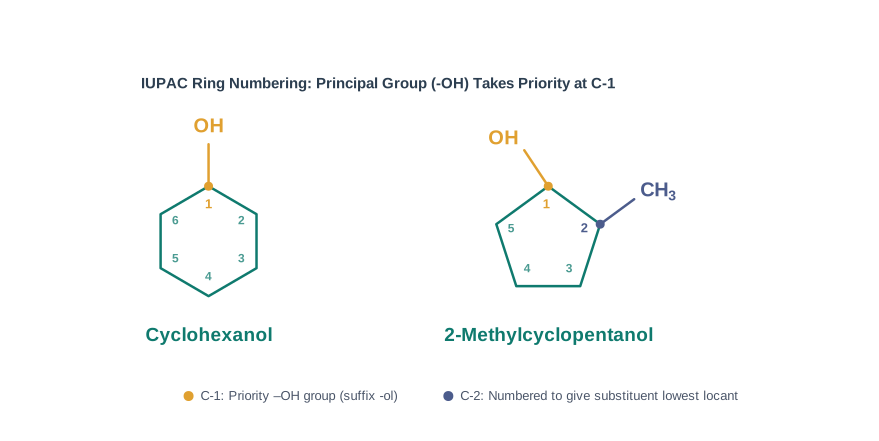
Fig. 7.6 – Cyclic alcohols.
(b) Phenols
The simplest hydroxy derivative of benzene is phenol. “Phenol” is its common name and also an accepted IUPAC name — one of the few cases where the two systems agree exactly.
Since the structure of phenol involves a benzene ring, the terms ortho (1,2-disubstituted), meta (1,3-disubstituted) and para (1,4-disubstituted) are often used in the common names of its substituted compounds. The methylphenols, shown in Fig. 7.7, illustrate this well.

Fig. 7.7 – Methylphenols (cresols).
Dihydroxy derivatives of benzene are known as 1, 2-, 1, 3- and 1, 4-benzenediol, and each also has a well-established common name, as collected in Fig. 7.8.
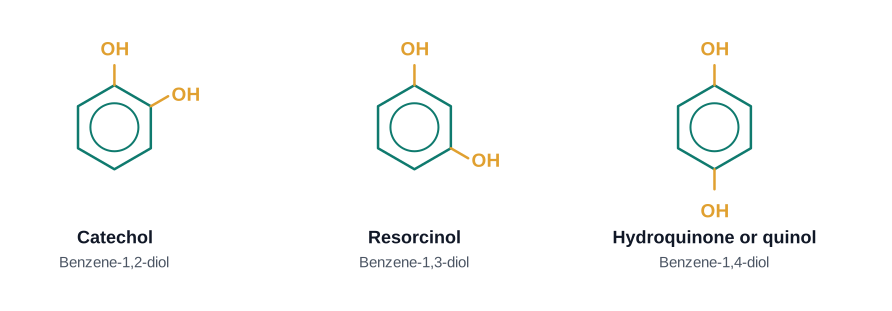
Fig. 7.8 – Dihydric phenols.
(c) Ethers
Common names of ethers are derived from the names of the alkyl or aryl groups on either side of the oxygen. The two group names are written as separate words in alphabetical order, and the word ‘ether’ is added at the end. For example, \(\mathrm{CH_3OC_2H_5}\) is ethylmethyl ether.
If both the alkyl groups are the same, the prefix ‘di’ is added before the alkyl group. For example, \(\mathrm{C_2H_5OC_2H_5}\) is diethyl ether.
According to the IUPAC system of nomenclature, ethers are regarded as hydrocarbon derivatives in which a hydrogen atom is replaced by an –OR or –OAr group, where R and Ar represent alkyl and aryl groups respectively. The larger (R) group is chosen as the parent hydrocarbon; the smaller one, together with the oxygen, becomes an alkoxy substituent named methoxy, ethoxy, propoxy, and so on. The names of a few ethers are given as examples in Table 7.2.
Flowchart
FC 7.1 – Naming an ether by IUPAC: identify the two groups on oxygen → choose the larger group as the parent hydrocarbon → treat the smaller group + O as an alkoxy substituent (methoxy, ethoxy, …) → number the parent chain to give the alkoxy group the lowest locant → write locant + alkoxy prefix + parent alkane name.
Table 7.2: Common and IUPAC Names of Some Ethers
| Compound | Common name | IUPAC name |
|---|---|---|
| \(\mathrm{CH_3OCH_3}\) | Dimethyl ether | Methoxymethane |
| \(\mathrm{C_2H_5OC_2H_5}\) | Diethyl ether | Ethoxyethane |
| \(\mathrm{CH_3OCH_2CH_2CH_3}\) | Methyl n-propyl ether | 1-Methoxypropane |
| \(\mathrm{C_6H_5OCH_3}\) | Methyl phenyl ether (Anisole) | Methoxybenzene (Anisole) |
| \(\mathrm{C_6H_5OCH_2CH_3}\) | Ethyl phenyl ether (Phenetole) | Ethoxybenzene |
| \(\mathrm{C_6H_5O(CH_2)_6\!-\!CH_3}\) | Heptyl phenyl ether | 1-Phenoxyheptane |
| \(\mathrm{CH_3O\!-\!CH(CH_3)\!-\!CH_3}\) | Methyl isopropyl ether | 2-Methoxypropane |
| \(\mathrm{C_6H_5\!-\!O\!-\!CH_2\!-\!CH_2\!-\!CH(CH_3)\!-\!CH_3}\) | Phenyl isopentyl ether | 3- Methylbutoxybenzene |
| \(\mathrm{CH_3\!-\!O\!-\!CH_2\!-\!CH_2\!-\!OCH_3}\) | — | 1,2-Dimethoxyethane |
| A cyclohexane ring carrying two \(\mathrm{CH_3}\) groups on C-1 and an \(\mathrm{OC_2H_5}\) group on C-2 | — | 2-Ethoxy–1,1-dimethylcyclohexane |
7.3 Structures of Functional Groups
In alcohols, the oxygen of the –OH group is attached to carbon by a sigma (\(\sigma\)) bond. This bond is formed by the overlap of an \(sp^3\) hybridised orbital of carbon with an \(sp^3\) hybridised orbital of oxygen. A sigma bond, remember, is one formed by head-on overlap of orbitals, so the two atoms are free to rotate about it. Fig. 7.9 depicts the structural aspects of methanol, phenol and methoxymethane.
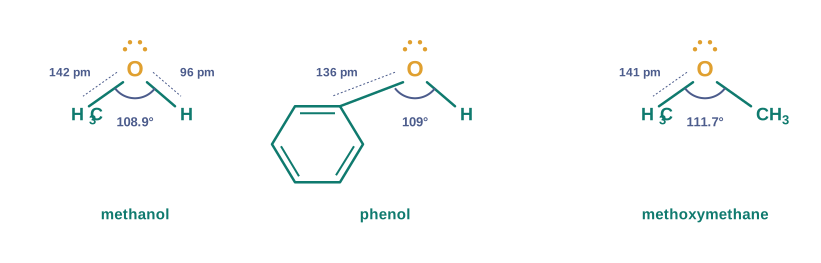
Fig. 7.9 – Bond angles and lengths in methanol, phenol and methoxymethane.
Why the Bond Angle in Alcohols is Small
The C–O–H bond angle in alcohols is slightly less than the tetrahedral angle (109°-28′). This happens because the oxygen atom carries two unshared (lone) pairs of electrons in addition to its two bond pairs. Lone pairs are held closer to the oxygen nucleus and spread out more than bond pairs, so they push the bonding pairs together. The repulsion between the unshared electron pairs of oxygen therefore squeezes the C–O–H angle a little below the ideal tetrahedral value.
The Shorter C–O Bond in Phenol
In phenols, the –OH group is attached to an \(sp^2\) hybridised carbon of an aromatic ring. The carbon–oxygen bond length in phenol (136 pm) is slightly less than that in methanol (142 pm) — a small but meaningful difference, because a shorter bond means a stronger, tighter bond.
Two reasons account for this shortening.
First, there is partial double bond character in the C–O bond. The oxygen’s unshared electron pair is conjugated with the aromatic ring, that is, it is delocalised into the ring’s \(\pi\) system, so the C–O bond is no longer a pure single bond. Any double bond character pulls the two atoms closer together. You will see this conjugation drawn out as resonance structures in Section 7.4.4, where it also explains the acidity and the reactivity of phenol.
Second, the carbon to which the oxygen is attached is in the \(sp^2\) hybridised state. An \(sp^2\) orbital has one-third s character, compared with one-quarter in an \(sp^3\) orbital. Electrons in an s orbital lie closer to the nucleus, so greater s character means a shorter, tighter bond.
The Shape of an Ether
In ethers, the oxygen atom again has four electron pairs around it — two bond pairs (to the two carbon groups) and two lone pairs. These four pairs are arranged approximately in a tetrahedral arrangement, so the ether oxygen is bent, not linear.
The C–O–C bond angle, however, is slightly greater than the tetrahedral angle. The reason is the repulsive interaction between the two bulky (–R) groups attached to oxygen: two alkyl groups take up far more space than the two hydrogen atoms of, say, water, and they push each other apart. This is why the angle in methoxymethane is 111.7°, above the tetrahedral value, whereas in methanol it falls below it.
The C–O bond length in ethers (141 pm) is almost the same as in alcohols, which tells us that replacing the hydrogen of an alcohol’s –OH by an alkyl group does not disturb the C–O bond itself very much.
7.4 Alcohols and Phenols
7.4.1 Preparation of Alcohols
Alcohols are prepared by the following methods.
1. From alkenes
(i) By acid catalysed hydration. Alkenes react with water in the presence of an acid as catalyst to form alcohols. In the case of unsymmetrical alkenes, the addition reaction takes place in accordance with Markovnikov’s rule.
\[\mathrm{{>}C{=}C{<}} + \mathrm{H_2O} \overset{\mathrm{H^+}}{\rightleftharpoons} \mathrm{{>}C(H)\!-\!C(OH){<}}\]
\[\mathrm{CH_3CH{=}CH_2} + \mathrm{H_2O} \overset{\mathrm{H^+}}{\rightleftharpoons} \mathrm{CH_3\!-\!CH(OH)\!-\!CH_3}\]
The reason behind the rule is worth stating, because it will be used again and again in this chapter: the proton adds first, and it adds in whichever way produces the more stable carbocation. In propene, adding \(\mathrm{H^+}\) to the terminal \(\mathrm{CH_2}\) leaves a secondary carbocation, which is more stable than the primary one that would form the other way round. The water then attacks that carbon, so the –OH ends up on the middle carbon and the product is propan-2-ol.
Mechanism
The mechanism of the reaction involves the following three steps, drawn out in Fig. 7.10.
Step 1: Protonation of the alkene to form a carbocation by electrophilic attack of \(\mathrm{H_3O^+}\).
\[\mathrm{H_2O} + \mathrm{H^+} \rightarrow \mathrm{H_3O^+}\]
The \(\pi\) electrons of the double bond are loosely held and act as a source of electrons; they reach out to the proton. The double bond breaks, one carbon gains the hydrogen, and the other carbon is left with only six electrons — a carbocation.
Step 2: Nucleophilic attack of water on the carbocation. Water has lone pairs on oxygen, and the carbocation is electron-deficient, so oxygen donates a lone pair to that carbon. This gives a protonated alcohol (an oxonium ion) carrying a positive charge on oxygen.
Step 3: Deprotonation to form the alcohol. Another water molecule removes the extra proton from the oxygen, and the neutral alcohol is left. Notice that the \(\mathrm{H^+}\) used in Step 1 is regenerated here — which is exactly what we mean by calling the acid a catalyst.
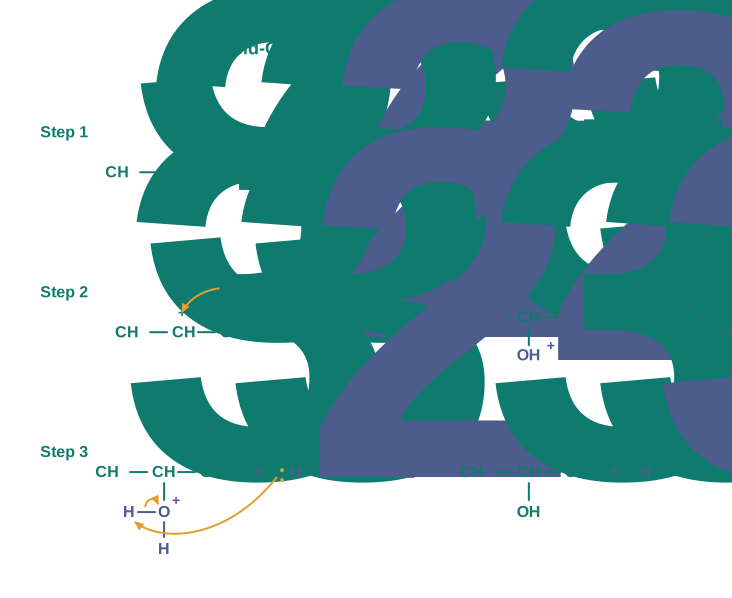
Fig. 7.10 – Mechanism of acid catalysed hydration of an alkene.
Flowchart
FC 7.2 – Acid catalysed hydration of an alkene: alkene + H₃O⁺ → protonation of C=C → carbocation (more stable one forms, Markovnikov) → nucleophilic attack by H₂O → protonated alcohol (oxonium ion) → loss of H⁺ to a second H₂O molecule → alcohol + H⁺ regenerated.
(ii) By hydroboration–oxidation. Diborane, \(\mathrm{(BH_3)_2}\), reacts with alkenes to give trialkyl boranes as the addition product. This is then oxidised to an alcohol by hydrogen peroxide in the presence of aqueous sodium hydroxide.
\[\mathrm{CH_3\!-\!CH{=}CH_2} + \mathrm{(H\!-\!BH_2)_2} \rightarrow \mathrm{CH_3\!-\!CH_2\!-\!CH_2\!-\!BH_2}\]
The borane keeps adding to further molecules of propene, one alkyl group at a time:
\[\mathrm{CH_3\!-\!CH_2\!-\!CH_2\!-\!BH_2} \xrightarrow{\ \mathrm{CH_3\!-\!CH{=}CH_2}\ } \mathrm{(CH_3\!-\!CH_2\!-\!CH_2)_2BH} \xrightarrow{\ \mathrm{CH_3\!-\!CH{=}CH_2}\ } \mathrm{(CH_3\!-\!CH_2\!-\!CH_2)_3B}\]
The trialkyl borane is then oxidised:
\[\mathrm{(CH_3\!-\!CH_2\!-\!CH_2)_3B} \xrightarrow{\ 3\,\mathrm{H_2O_2},\ \mathrm{\overline{O}H}\ } 3\,\mathrm{CH_3\!-\!CH_2\!-\!CH_2\!-\!OH} + \mathrm{B(OH)_3}\]
The product here is propan-1-ol.
The addition of borane to the double bond takes place in such a manner that the boron atom gets attached to the \(sp^2\) carbon carrying the greater number of hydrogen atoms. The alcohol so formed looks as if it has been formed by the addition of water to the alkene in a way opposite to Markovnikov’s rule — the –OH ends up on the less substituted carbon. In this reaction, alcohol is obtained in excellent yield.
2. From carbonyl compounds
(i) By reduction of aldehydes and ketones. Aldehydes and ketones are reduced to the corresponding alcohols by the addition of hydrogen in the presence of catalysts — this is catalytic hydrogenation. The usual catalyst is a finely divided metal such as platinum, palladium or nickel.
Alcohols are also prepared by treating aldehydes and ketones with sodium borohydride (\(\mathrm{NaBH_4}\)) or lithium aluminium hydride (\(\mathrm{LiAlH_4}\)). Aldehydes yield primary alcohols, whereas ketones give secondary alcohols. The reason is simply arithmetic of substituents: the carbon of an aldehyde’s \(\mathrm{{>}C{=}O}\) carries one alkyl group, so after reduction its carbon bears one alkyl group and becomes a primary alcohol carbon; a ketone carbon carries two, so it becomes a secondary alcohol carbon.
\[\mathrm{RCHO} + \mathrm{H_2} \xrightarrow{\ \mathrm{Pd}\ } \mathrm{RCH_2OH}\]
\[\mathrm{RCOR'} \xrightarrow{\ \mathrm{NaBH_4}\ } \mathrm{R\!-\!CH(OH)\!-\!R'}\]
(ii) By reduction of carboxylic acids and esters. Carboxylic acids are reduced to primary alcohols in excellent yields by lithium aluminium hydride, a strong reducing agent.
\[\mathrm{RCOOH} \xrightarrow{\ \text{(i) } \mathrm{LiAlH_4};\ \text{(ii) } \mathrm{H_2O}\ } \mathrm{RCH_2OH}\]
The numbers in front of the reagents along the arrow indicate that the second reagent is added only when the reaction with the first is complete. Water is added afterwards to break up the aluminium–oxygen intermediate and release the free alcohol; adding it too early would simply destroy the \(\mathrm{LiAlH_4}\).
However, \(\mathrm{LiAlH_4}\) is an expensive reagent, and is therefore used for preparing special chemicals only. Commercially, acids are reduced to alcohols by first converting them to the esters (Section 7.4.4), followed by their reduction using hydrogen in the presence of a catalyst (catalytic hydrogenation).
\[\mathrm{RCOOH} \xrightarrow[\ \mathrm{H^+}\ ]{\ \mathrm{R'OH}\ } \mathrm{RCOOR'} \xrightarrow[\ \text{Catalyst}\ ]{\ \mathrm{H_2}\ } \mathrm{RCH_2OH} + \mathrm{R'OH}\]
3. From Grignard reagents
Alcohols are produced by the reaction of Grignard reagents (Chapter 6, Class XII) with aldehydes and ketones.
The first step of the reaction is the nucleophilic addition of the Grignard reagent to the carbonyl group to form an adduct. The reason this works is the polarity of the two partners, shown in Fig. 7.11: in \(\mathrm{R\!-\!Mg\!-\!X}\) the carbon carries a partial negative charge (\(\delta-\)) because carbon is more electronegative than magnesium, so this carbon behaves as a nucleophile. The carbonyl carbon of \(\mathrm{{>}C{=}O}\) carries a partial positive charge (\(\delta+\)), because oxygen pulls the \(\pi\) electrons towards itself. Opposite charges attract, and the carbon–carbon bond forms.
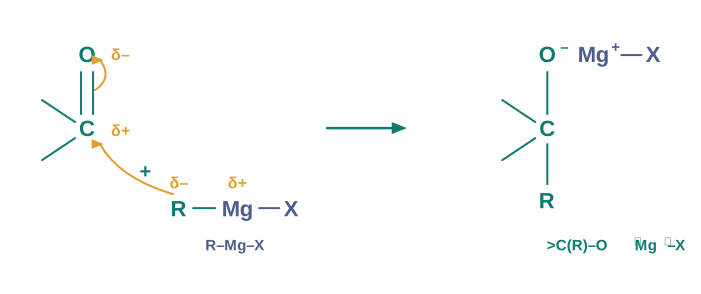
Fig. 7.11 – Nucleophilic addition of a Grignard reagent.
Hydrolysis of the adduct yields an alcohol.
\[\mathrm{{>}C{=}O} + \mathrm{R\!-\!MgX} \rightarrow \mathrm{{>}C(R)\!-\!OMgX} \qquad \dots\text{(i)}\]
\[\mathrm{{>}C(R)\!-\!OMgX} \xrightarrow{\ \mathrm{H_2O}\ } \mathrm{{>}C(R)\!-\!OH} + \mathrm{Mg(OH)X} \qquad \dots\text{(ii)}\]
The overall reactions using different aldehydes and ketones are as follows.
\[\mathrm{HCHO} + \mathrm{RMgX} \rightarrow \mathrm{R\!-\!CH_2\!-\!OMgX} \xrightarrow{\ \mathrm{H_2O}\ } \mathrm{R\!-\!CH_2\!-\!OH} + \mathrm{Mg(OH)X}\]
\[\mathrm{RCHO} + \mathrm{R'MgX} \rightarrow \mathrm{R\!-\!CH(R')\!-\!OMgX} \xrightarrow{\ \mathrm{H_2O}\ } \mathrm{R\!-\!CH(R')\!-\!OH} + \mathrm{Mg(OH)X}\]
\[\mathrm{RCOR} + \mathrm{R'MgX} \rightarrow \mathrm{R\!-\!C(R)(R')\!-\!OMgX} \xrightarrow{\ \mathrm{H_2O}\ } \mathrm{R\!-\!C(R)(R')\!-\!OH} + \mathrm{Mg(OH)X}\]
You will notice that the reaction produces a primary alcohol with methanal, a secondary alcohol with other aldehydes, and a tertiary alcohol with ketones. This is a genuinely useful piece of planning: if you are asked to build a particular alcohol, count the groups on the carbon that will carry the –OH and work backwards to the right carbonyl compound and the right Grignard reagent.
7.4.2 Preparation of Phenols
Phenol, also known as carbolic acid, was first isolated in the early nineteenth century from coal tar. Nowadays, phenol is commercially produced synthetically. In the laboratory, phenols are prepared from benzene derivatives by any of the following methods.
1. From haloarenes
Chlorobenzene is fused with \(\mathrm{NaOH}\) at 623 K and 320 atmospheric pressure. Phenol is obtained by acidification of the sodium phenoxide so produced (Chapter 6, Class XII).
\[\mathrm{C_6H_5Cl} + \mathrm{NaOH} \xrightarrow{\ 623\ \text{K},\ 300\ \text{atm}\ } \mathrm{C_6H_5\overset{-}{O}Na^{+}} \xrightarrow{\ \mathrm{HCl}\ } \mathrm{C_6H_5OH}\]
The severe conditions tell you something important: the C–Cl bond of a haloarene is unusually strong and hard to replace, because the halogen’s lone pair is in conjugation with the ring. Only very high temperature and pressure will push the substitution through.
2. From benzenesulphonic acid
Benzene is sulphonated with oleum, and the benzene sulphonic acid so formed is converted to sodium phenoxide on heating with molten sodium hydroxide. Acidification of the sodium salt gives phenol.
\[\mathrm{C_6H_6} \xrightarrow{\ \text{Oleum}\ } \mathrm{C_6H_5SO_3H} \xrightarrow{\ \text{(i) } \mathrm{NaOH};\ \text{(ii) } \mathrm{H^+}\ } \mathrm{C_6H_5OH}\]
3. From diazonium salts
A diazonium salt is formed by treating an aromatic primary amine with nitrous acid (\(\mathrm{NaNO_2} + \mathrm{HCl}\)) at 273–278 K. The low temperature matters: diazonium salts are unstable and decompose if allowed to warm up. Diazonium salts are hydrolysed to phenols by warming with water or by treating with dilute acids (Chapter 9, Class XII).
\[\mathrm{C_6H_5NH_2} \xrightarrow{\ \mathrm{NaNO_2} + \mathrm{HCl},\ 273\text{--}278\ \text{K}\ } \mathrm{C_6H_5\overset{+}{N_2}\overset{-}{Cl}} \xrightarrow[\ \text{Warm}\ ]{\ \mathrm{H_2O}\ } \mathrm{C_6H_5OH} + \mathrm{N_2} + \mathrm{HCl}\]
Here aniline is the starting amine, and the intermediate is benzene diazonium chloride. The escape of nitrogen gas, \(\mathrm{N_2}\), is what drives this reaction forward — once the very stable \(\mathrm{N_2}\) molecule leaves, the reaction cannot go back.
4. From cumene
Phenol is manufactured from the hydrocarbon cumene. Cumene (isopropylbenzene) is oxidised in the presence of air to cumene hydroperoxide. This is converted to phenol and acetone by treating it with dilute acid. Acetone, a by-product of this reaction, is also obtained in large quantities by this method. The sequence is drawn in Fig. 7.12 and summarised in FC 7.3.
\[\mathrm{C_6H_5\!-\!CH(CH_3)_2} \xrightarrow{\ \mathrm{O_2}\ } \mathrm{C_6H_5\!-\!C(CH_3)_2\!-\!O\!-\!O\!-\!H} \xrightarrow[\ \mathrm{H_2O}\ ]{\ \mathrm{H^+}\ } \mathrm{C_6H_5OH} + \mathrm{CH_3COCH_3}\]
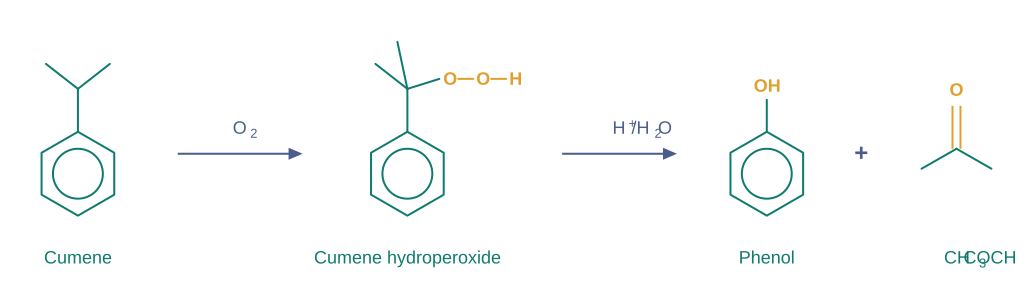
Fig. 7.12 – Preparation of phenol from cumene.
Flowchart
FC 7.3 – Industrial manufacture of phenol from cumene: cumene (isopropylbenzene) → air oxidation (O₂) → cumene hydroperoxide → treat with dilute acid (H⁺) → phenol + acetone (by-product) → both products separated by distillation.
7.4.3 Physical Properties
Alcohols and phenols consist of two parts: an alkyl/aryl group, and a hydroxyl group. The properties of alcohols and phenols are chiefly due to the hydroxyl group. The nature of the alkyl and aryl groups simply modifies these properties.
Boiling Points
The boiling points of alcohols and phenols increase with an increase in the number of carbon atoms. This is because van der Waals forces — the weak attractions between neighbouring molecules — grow stronger as the molecule gets bigger.
In alcohols, the boiling points decrease with an increase of branching in the carbon chain. A branched molecule is more compact and nearly spherical, so its surface area is smaller; with less surface in contact, the van der Waals forces between molecules are weaker and less energy is needed to pull them apart.
The –OH group in alcohols and phenols is involved in intermolecular hydrogen bonding, as shown in Fig. 7.13. A hydrogen bond forms when a hydrogen atom already bonded to a highly electronegative atom (here oxygen) is attracted to a lone pair on the oxygen of a neighbouring molecule. These bonds are far weaker than covalent bonds, but there are many of them, and together they hold the molecules in a loose network.
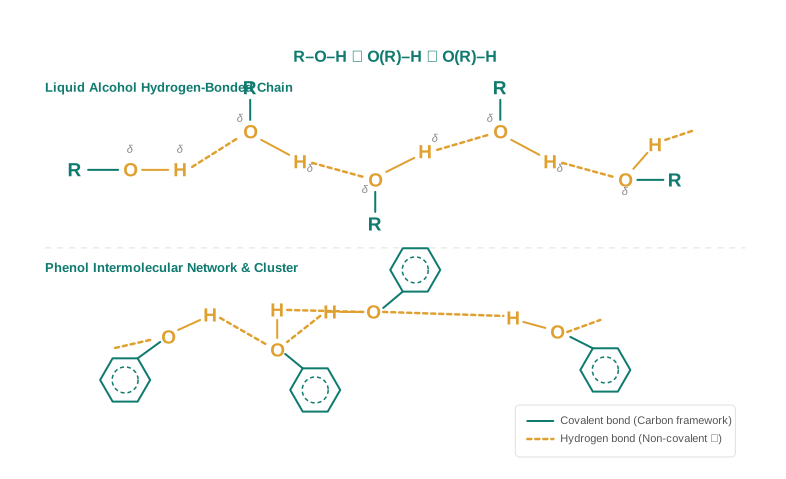
Fig. 7.13 – Intermolecular hydrogen bonding in alcohols and phenols.
It is interesting to note that boiling points of alcohols and phenols are higher in comparison to other classes of compounds — namely hydrocarbons, ethers, haloalkanes and haloarenes — of comparable molecular masses. For example, ethanol and propane have comparable molecular masses but their boiling points differ widely. The boiling point of methoxymethane lies in between the two, as Fig. 7.14 shows.
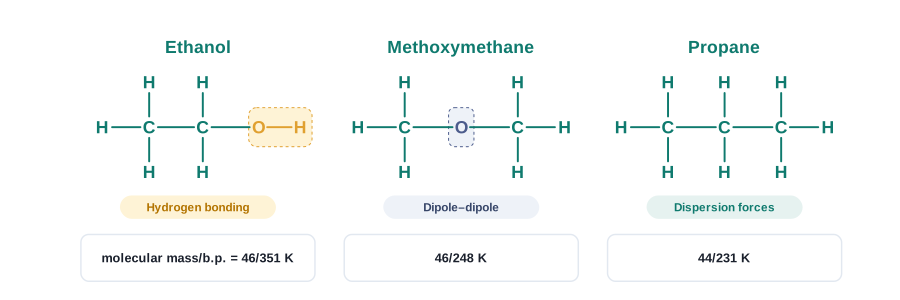
Fig. 7.14 – Boiling points of ethanol, methoxymethane and propane.
The high boiling points of alcohols are mainly due to the presence of intermolecular hydrogen bonding in them, which is lacking in ethers and hydrocarbons. An ether has no hydrogen attached to its oxygen, so although it has lone pairs, it has nothing with which to donate a hydrogen bond to another ether molecule.
Solubility
Solubility of alcohols and phenols in water is due to their ability to form hydrogen bonds with water molecules, as shown in Fig. 7.15. The –OH group can both donate a hydrogen bond to water and accept one from it, so the alcohol molecule slips comfortably into water’s own hydrogen-bonded network.
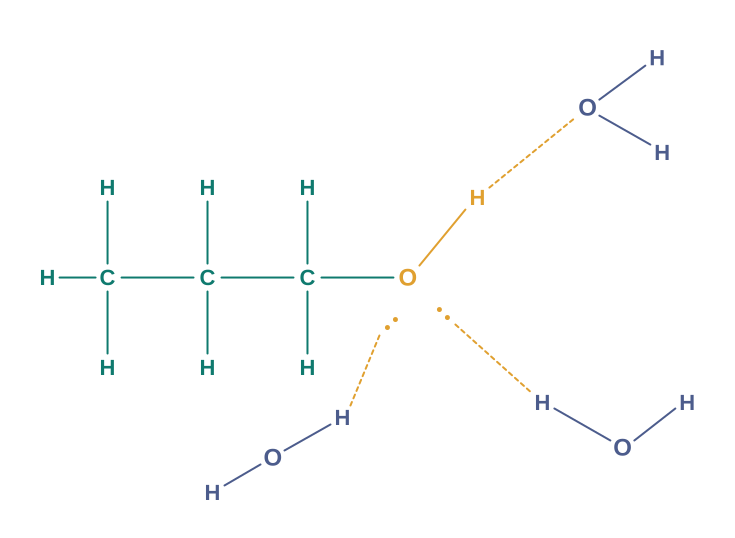
Fig. 7.15 – Hydrogen bonding between alcohol and water.
The solubility decreases with an increase in the size of the alkyl/aryl (hydrophobic) group. The hydrocarbon part cannot hydrogen bond with water; as it grows, it makes up more and more of the molecule, and it drags the compound out of solution. Several of the lower molecular mass alcohols are miscible with water in all proportions.
7.4.4 Chemical Reactions
Alcohols are versatile compounds. They react both as nucleophiles and as electrophiles — a rare double life, and it comes entirely from the oxygen atom. A nucleophile is an electron-rich species that attacks a positive centre; an electrophile is an electron-poor species that seeks electrons.
The bond between O–H is broken when alcohols react as nucleophiles. Here the lone pair on the alcohol’s oxygen reaches out to an electron-deficient carbon; the O–H hydrogen is then lost as \(\mathrm{H^+}\).
The bond between C–O is broken when they react as electrophiles. Protonated alcohols react in this manner: once the –OH is protonated to \(\mathrm{-\overset{+}{O}H_2}\), it becomes an excellent leaving group (a water molecule), and a nucleophile such as \(\mathrm{Br^-}\) can attack the carbon and displace it.
\[\mathrm{R\!-\!CH_2\!-\!OH} + \mathrm{H^+} \rightarrow \mathrm{R\!-\!CH_2\!-\!\overset{+}{O}H_2}\]
\[\mathrm{Br^-} + \mathrm{R\!-\!CH_2\!-\!\overset{+}{O}H_2} \rightarrow \mathrm{Br\!-\!CH_2\!-\!R} + \mathrm{H_2O}\]
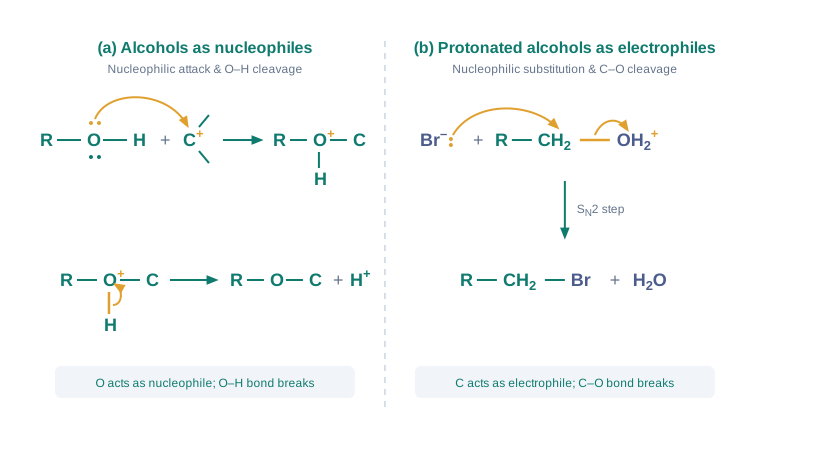
Fig. 7.16 – Alcohols reacting as (a) nucleophiles and (b) electrophiles.
Based on the cleavage of the O–H and the C–O bonds, the reactions of alcohols and phenols may be divided into two groups.
(a) Reactions involving cleavage of the O–H bond
1. Acidity of alcohols and phenols
(i) Reaction with metals. Alcohols and phenols react with active metals such as sodium, potassium and aluminium to yield the corresponding alkoxides/phenoxides and hydrogen.
\[2\,\mathrm{R\!-\!O\!-\!H} + 2\,\mathrm{Na} \rightarrow 2\,\mathrm{R\!-\!O\!-\!Na} + \mathrm{H_2}\]
The product \(\mathrm{R\!-\!O\!-\!Na}\) is a sodium alkoxide. With aluminium and tert-butyl alcohol:
\[6\,\mathrm{CH_3\!-\!C(CH_3)_2\!-\!OH} + 2\,\mathrm{Al} \rightarrow 2\,\mathrm{[(CH_3)_3C\!-\!O]_3Al} + 3\,\mathrm{H_2}\]
The product here is aluminium tert-butoxide. Phenol behaves in the same way:
\[2\,\mathrm{C_6H_5OH} + 2\,\mathrm{Na} \rightarrow 2\,\mathrm{C_6H_5ONa} + \mathrm{H_2}\]
giving sodium phenoxide. In addition to this, phenols react with aqueous sodium hydroxide to form sodium phenoxides:
\[\mathrm{C_6H_5OH} + \mathrm{NaOH} \rightarrow \mathrm{C_6H_5ONa} + \mathrm{H_2O}\]
The above reactions show that alcohols and phenols are acidic in nature. In fact, alcohols and phenols are Brönsted acids — that is, they can donate a proton to a stronger base (B:).
\[\mathrm{B{:}} + \mathrm{H\!-\!O\!-\!R} \rightarrow \mathrm{B\!-\!H} + \mathrm{{^-}O\!-\!R}\]
In this equation, B: is the base and the alcohol is the acid; B–H is the conjugate acid and \(\mathrm{{^-}O\!-\!R}\), the alkoxide ion, is the conjugate base.
(ii) Acidity of alcohols. The acidic character of alcohols is due to the polar nature of the O–H bond. Oxygen is far more electronegative than hydrogen, so it pulls the shared electrons towards itself, leaving the hydrogen slightly positive and therefore able to leave as \(\mathrm{H^+}\).
Now bring in the alkyl group. An electron-releasing group (\(\mathrm{-CH_3}\), \(\mathrm{-C_2H_5}\)) increases the electron density on oxygen, and this tends to decrease the polarity of the O–H bond. A less polar O–H bond releases its proton less readily, so the acid strength decreases. For this reason, the acid strength of alcohols decreases in the following order — the more alkyl groups, the weaker the acid:
\[\mathrm{RCH_2OH} > \mathrm{R_2CHOH} \gg \mathrm{R_3C\!-\!OH}\]
\[\text{Primary} > \text{Secondary} \gg \text{Tertiary}\]
Alcohols are, however, weaker acids than water. This can be illustrated by the reaction of water with an alkoxide.
\[\mathrm{R\!-\!\overset{-}{O}{:}} + \mathrm{H\!-\!O\!-\!H} \rightarrow \mathrm{R\!-\!O\!-\!H} + \mathrm{{:}\overset{-}{O}H}\]
This reaction shows that water is a better proton donor (i.e., a stronger acid) than an alcohol. Also, in the above reaction, we note that an alkoxide ion is a better proton acceptor than the hydroxide ion, which suggests that alkoxides are stronger bases — sodium ethoxide is a stronger base than sodium hydroxide.
Alcohols act as Brönsted bases as well. This is due to the presence of unshared electron pairs on oxygen, which makes them proton acceptors. (This is exactly the property used when an alcohol is protonated before substitution or dehydration.)
(iii) Acidity of phenols. The reactions of phenol with metals (e.g., sodium, aluminium) and with sodium hydroxide indicate its acidic nature.
The hydroxyl group in phenol is directly attached to the \(sp^2\) hybridised carbon of the benzene ring, which acts as an electron withdrawing group. Due to this, the charge distribution in the phenol molecule — as depicted in its resonance structures in Fig. 7.17 — causes the oxygen of the –OH group to be positive.
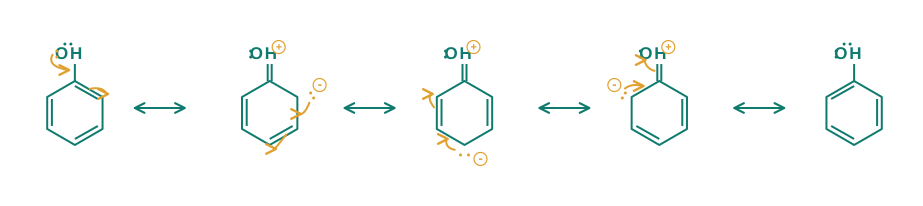
Fig. 7.17 – Resonance structures of phenol.
The reaction of phenol with aqueous sodium hydroxide indicates that phenols are stronger acids than alcohols and water. Let us examine how a compound in which the hydroxyl group is attached to an aromatic ring is more acidic than one in which the hydroxyl group is attached to an alkyl group.
The ionisation of an alcohol and a phenol takes place as follows:
\[\mathrm{R\!-\!O\!-\!H} \rightleftharpoons \mathrm{R\!-\!\overset{-}{O}{:}} + \mathrm{H^+}\]
\[\mathrm{C_6H_5\!-\!O\!-\!H} \rightleftharpoons \mathrm{C_6H_5\!-\!\overset{-}{O}} + \mathrm{H^+}\]
Two separate arguments explain why the second equilibrium lies much further to the right.
Argument one — the starting molecule. Due to the higher electronegativity of the \(sp^2\) hybridised carbon of phenol to which –OH is attached, electron density decreases on oxygen. This increases the polarity of the O–H bond and results in an increase in ionisation of phenols compared with that of alcohols.
Argument two — the ion left behind. Now let us examine the stabilities of the alkoxide and phenoxide ions. In the alkoxide ion, the negative charge is localised on oxygen. In the phenoxide ion, the charge is delocalised — it is spread over the ring, as the resonance structures I–V of Fig. 7.18 show. The delocalisation of negative charge (structures I–V) makes the phenoxide ion more stable and favours the ionisation of phenol. Although there is also charge delocalisation in phenol itself, its resonance structures have charge separation (a positive oxygen and a negative ring carbon), due to which the phenol molecule is less stable than the phenoxide ion.
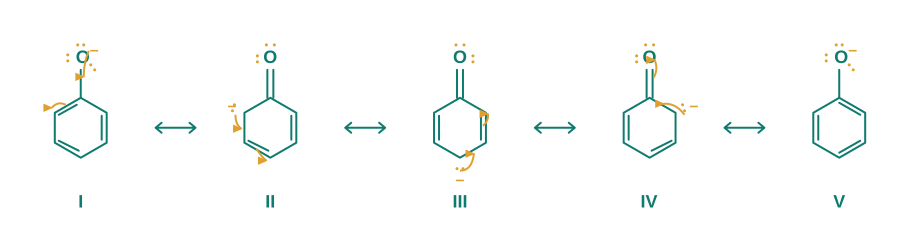
Fig. 7.18 – Resonance structures of the phenoxide ion.
The effect of substituents. In substituted phenols, the presence of electron withdrawing groups such as the nitro group enhances the acidic strength of phenol. This effect is more pronounced when such a group is present at the ortho and para positions. It is due to the effective delocalisation of the negative charge in the phenoxide ion when the substituent is at the ortho or para position — from those positions, the \(\mathrm{-NO_2}\) group can directly soak up the negative charge through resonance.
On the other hand, electron releasing groups, such as alkyl groups, in general do not favour the formation of the phenoxide ion, resulting in a decrease in acid strength. Cresols, for example, are less acidic than phenol.
Table 7.3: p\(K_a\) Values of some Phenols and Ethanol
| Compound | Formula | p\(K_a\) |
|---|---|---|
| o-Nitrophenol | \(o\text{-}\mathrm{O_2N\!-\!C_6H_4\!-\!OH}\) | 7.2 |
| m-Nitrophenol | \(m\text{-}\mathrm{O_2N\!-\!C_6H_4\!-\!OH}\) | 8.3 |
| p-Nitrophenol | \(p\text{-}\mathrm{O_2N\!-\!C_6H_4\!-\!OH}\) | 7.1 |
| Phenol | \(\mathrm{C_6H_5\!-\!OH}\) | 10.0 |
| o-Cresol | \(o\text{-}\mathrm{CH_3\!-\!C_6H_4\!-\!OH}\) | 10.2 |
| m-Cresol | \(m\text{-}\mathrm{CH_3C_6H_4\!-\!OH}\) | 10.1 |
| p-Cresol | \(p\text{-}\mathrm{CH_3\!-\!C_6H_4\!-\!OH}\) | 10.2 |
| Ethanol | \(\mathrm{C_2H_5OH}\) | 15.9 |
The greater the p\(K_a\) value, the weaker the acid. From the above data, you will note that phenol is a million times more acidic than ethanol. That “million times” is not a figure of speech: p\(K_a\) is a logarithmic scale, so a difference of about 6 units in p\(K_a\) means a difference of about \(10^6\) in the ability to release \(\mathrm{H^+}\).
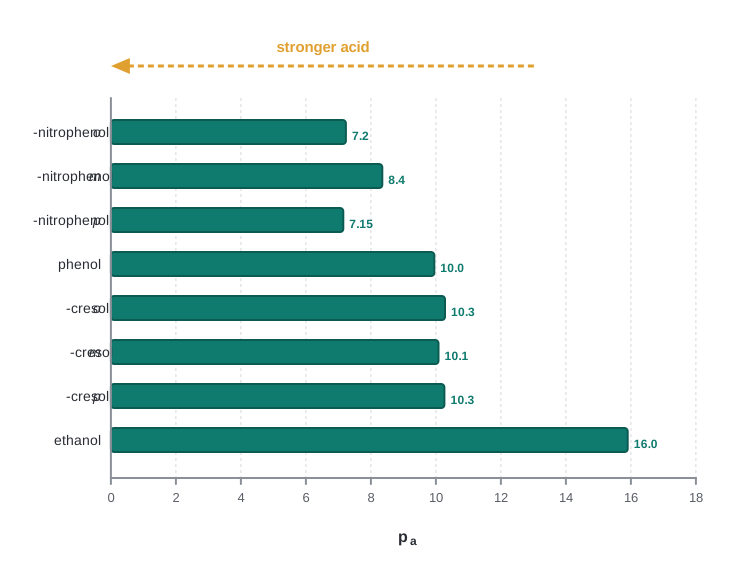
Fig. 7.19 – pKa values of phenols and ethanol.
2. Esterification
Alcohols and phenols react with carboxylic acids, acid chlorides and acid anhydrides to form esters.
\[\mathrm{Ar/R\!-\!OH} + \mathrm{R'\!-\!COOH} \overset{\mathrm{H^+}}{\rightleftharpoons} \mathrm{Ar/R\!-\!OCOR'} + \mathrm{H_2O}\]
\[\mathrm{Ar/R\!-\!OH} + \mathrm{(R'CO)_2O} \overset{\mathrm{H^+}}{\rightleftharpoons} \mathrm{Ar/R\!-\!OCOR'} + \mathrm{R'COOH}\]
\[\mathrm{R/Ar\!-\!OH} + \mathrm{R'COCl} \xrightarrow{\ \text{Pyridine}\ } \mathrm{R/Ar\!-\!OCOR'} + \mathrm{HCl}\]
The reaction with carboxylic acid and with acid anhydride is carried out in the presence of a small amount of concentrated sulphuric acid. The reaction is reversible, and therefore water is removed as soon as it is formed — by Le Chatelier’s principle, taking away a product keeps pulling the equilibrium towards the ester.
The reaction with acid chloride is carried out in the presence of a base (pyridine), so as to neutralise the \(\mathrm{HCl}\) which is formed during the reaction. This shifts the equilibrium to the right hand side, for the same reason: a product is being removed as fast as it appears.
The introduction of an acetyl (\(\mathrm{CH_3CO}\)) group into alcohols or phenols is known as acetylation. Acetylation of salicylic acid produces aspirin, as shown in Fig. 7.20.
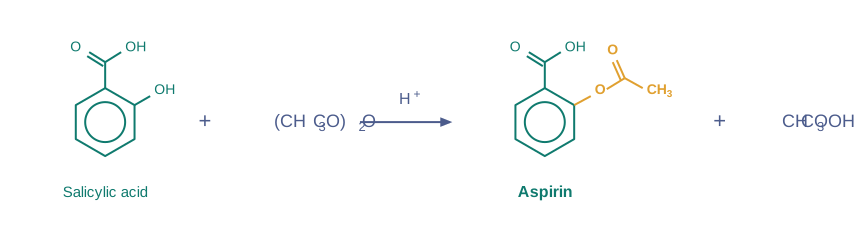
Fig. 7.20 – Acetylation of salicylic acid to aspirin.
(b) Reactions involving cleavage of the carbon–oxygen (C–O) bond in alcohols
The reactions involving cleavage of the C–O bond take place only in alcohols. Phenols show this type of reaction only with zinc. The reason is the one met in Section 7.3: the C–O bond in phenol has partial double bond character and joins an \(sp^2\) carbon, so it is short, strong and very reluctant to break.
1. Reaction with hydrogen halides
Alcohols react with hydrogen halides to form alkyl halides (Refer Chapter 6, Class XII).
\[\mathrm{ROH} + \mathrm{HX} \rightarrow \mathrm{R\!-\!X} + \mathrm{H_2O}\]
The difference in reactivity of the three classes of alcohols with \(\mathrm{HCl}\) distinguishes them from one another — this is the Lucas test. Alcohols are soluble in the Lucas reagent (concentrated \(\mathrm{HCl}\) and \(\mathrm{ZnCl_2}\)), while their halides are immiscible and produce turbidity in the solution. In the case of tertiary alcohols, turbidity is produced immediately, as they form the halides easily. Primary alcohols do not produce turbidity at room temperature. Secondary alcohols sit between the two: they react, but only after standing for a few minutes, so the cloudiness appears after a delay.
2. Reaction with phosphorus trihalides
Alcohols are converted to alkyl bromides by reaction with phosphorus tribromide (Refer Chapter 6, Class XII).
\[3\,\mathrm{R\!-\!OH} + \mathrm{PBr_3} \rightarrow 3\,\mathrm{R\!-\!Br} + \mathrm{H_3PO_3}\]
3. Dehydration
Alcohols undergo dehydration (removal of a molecule of water) to form alkenes on treating with a protic acid — for example, concentrated \(\mathrm{H_2SO_4}\) or \(\mathrm{H_3PO_4}\) — or with catalysts such as anhydrous zinc chloride or alumina.
\[\mathrm{{-}C(H)\!-\!C(OH){-}} \xrightarrow[\ \text{Heat}\ ]{\ \mathrm{H^+}\ } \mathrm{{>}C{=}C{<}} + \mathrm{H_2O}\]
Note carefully what leaves: the –OH from one carbon and an H from the adjacent carbon. Ethanol undergoes dehydration by heating it with concentrated \(\mathrm{H_2SO_4}\) at 443 K.
\[\mathrm{C_2H_5OH} \xrightarrow{\ \mathrm{H_2SO_4},\ 443\ \text{K}\ } \mathrm{CH_2{=}CH_2} + \mathrm{H_2O}\]
Secondary and tertiary alcohols are dehydrated under milder conditions. For example:
\[\mathrm{CH_3CH(OH)CH_3} \xrightarrow{\ 85\%\ \mathrm{H_3PO_4},\ 440\ \text{K}\ } \mathrm{CH_3\!-\!CH{=}CH_2} + \mathrm{H_2O}\]
\[\mathrm{CH_3\!-\!C(CH_3)_2\!-\!OH} \xrightarrow{\ 20\%\ \mathrm{H_3PO_4},\ 358\ \text{K}\ } \mathrm{CH_3\!-\!C(CH_3){=}CH_2} + \mathrm{H_2O}\]
Look at the conditions rather than the products for a moment: the tertiary alcohol needs only a dilute acid and a much lower temperature. Thus, the relative ease of dehydration of alcohols follows the following order:
\[\text{Tertiary} > \text{Secondary} > \text{Primary}\]
Tertiary carbocations are more stable and therefore are easier to form than secondary and primary carbocations; tertiary alcohols are the easiest to dehydrate.
Mechanism
The mechanism of dehydration of ethanol involves the following steps, drawn in Fig. 7.21 and listed in FC 7.4.
Step 1: Formation of the protonated alcohol. Ethanol picks up a proton from the acid to give the ethyl oxonium ion. This step is fast and reversible.
Step 2: Formation of the carbocation. The protonated alcohol loses a water molecule, leaving a carbocation. It is the slowest step and hence the rate determining step of the reaction — the overall speed of the reaction is set here, which is precisely why carbocation stability decides the order 3° > 2° > 1°.
Step 3: Formation of ethene by elimination of a proton. A base (a water molecule) removes a hydrogen from the carbon next to the positive carbon, and those two electrons become the \(\pi\) bond of the alkene.
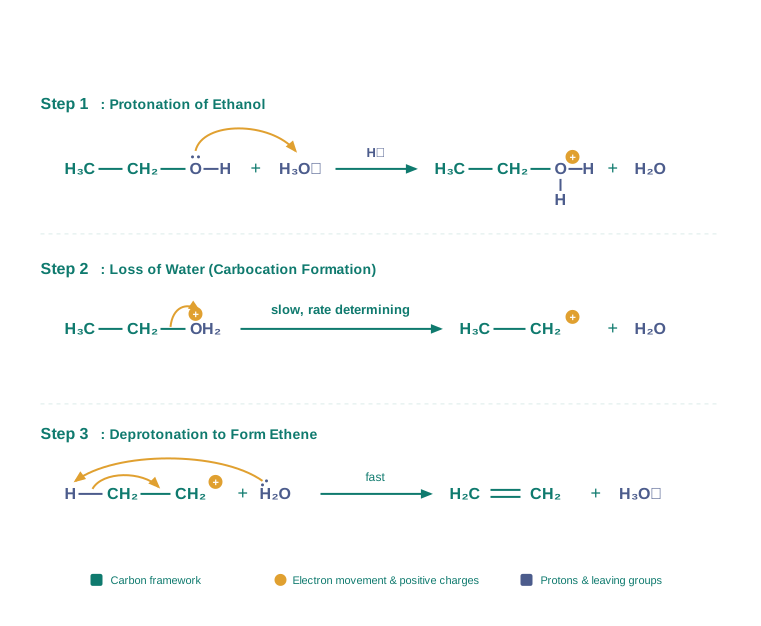
Fig. 7.21 – Acid dehydration of ethanol.
Flowchart
FC 7.4 – Acid dehydration of ethanol: ethanol + H⁺ → (fast) protonated alcohol (ethyl oxonium ion) → (slow, rate determining) loss of H₂O → carbocation → (fast) loss of H⁺ from the adjacent carbon → ethene; the H⁺ used in step 1 is released in step 3; ethene removed as formed to drive the equilibrium right.
The acid used in step 1 is released in step 3, so it is a true catalyst. To drive the equilibrium to the right, ethene is removed as it is formed.
4. Oxidation
Oxidation of alcohols involves the formation of a carbon–oxygen double bond with cleavage of an O–H and a C–H bond.
\[\mathrm{H\!-\!C(H)\!-\!O\!-\!H} \rightarrow \mathrm{{>}C{=}O}\]
Such a cleavage and formation of bonds occur in oxidation reactions. These are also known as dehydrogenation reactions, as these involve loss of dihydrogen from an alcohol molecule. This also explains, in one stroke, why tertiary alcohols resist oxidation: their –OH carbon has no hydrogen on it, so there is no C–H bond to break.
Depending on the oxidising agent used, a primary alcohol is oxidised to an aldehyde, which in turn is oxidised to a carboxylic acid.
\[\mathrm{RCH_2OH} \xrightarrow{\ \text{Oxidation}\ } \mathrm{RCHO} \rightarrow \mathrm{RCOOH}\]
Strong oxidising agents such as acidified potassium permanganate are used for getting carboxylic acids from alcohols directly. If the aldehyde is what you want, you must stop the reaction halfway — and for that, \(\mathrm{CrO_3}\) in anhydrous medium is used as the oxidising agent for the isolation of aldehydes.
\[\mathrm{RCH_2OH} \xrightarrow{\ \mathrm{CrO_3}\ } \mathrm{RCHO}\]
A better reagent for the oxidation of primary alcohols to aldehydes in good yield is pyridinium chlorochromate (PCC), a complex of chromium trioxide with pyridine and \(\mathrm{HCl}\).
\[\mathrm{CH_3\!-\!CH{=}CH\!-\!CH_2OH} \xrightarrow{\ \text{PCC}\ } \mathrm{CH_3\!-\!CH{=}CH\!-\!CHO}\]
Secondary alcohols are oxidised to ketones by chromic anhydride (\(\mathrm{CrO_3}\)).
\[\mathrm{R\!-\!CH(OH)\!-\!R'} \xrightarrow{\ \mathrm{CrO_3}\ } \mathrm{R\!-\!CO\!-\!R'}\]
Tertiary alcohols do not undergo oxidation reaction. Under strong reaction conditions, such as strong oxidising agents (\(\mathrm{KMnO_4}\)) and elevated temperatures, cleavage of various C–C bonds takes place and a mixture of carboxylic acids containing a lesser number of carbon atoms is formed.
When the vapours of a primary or a secondary alcohol are passed over heated copper at 573 K, dehydrogenation takes place and an aldehyde or a ketone is formed, while tertiary alcohols undergo dehydration.
\[\mathrm{RCH_2OH} \xrightarrow{\ \mathrm{Cu},\ 573\ \text{K}\ } \mathrm{RCHO}\]
\[\mathrm{R\!-\!CH(OH)\!-\!R'} \xrightarrow{\ \mathrm{Cu},\ 573\ \text{K}\ } \mathrm{R\!-\!CO\!-\!R'}\]
\[\mathrm{CH_3\!-\!C(CH_3)_2\!-\!OH} \xrightarrow{\ \mathrm{Cu},\ 573\ \text{K}\ } \mathrm{CH_3\!-\!C(CH_3){=}CH_2}\]
(c) Reactions of phenols
The following reactions are shown by phenols only.
1. Electrophilic aromatic substitution
In phenols, the reactions that take place on the aromatic ring are electrophilic substitution reactions (Chapter 9, Class XI). The –OH group attached to the benzene ring activates it towards electrophilic substitution — that is, it makes the ring react faster than benzene itself does.
Also, it directs the incoming group to the ortho and para positions in the ring, as these positions become electron rich due to the resonance effect caused by the –OH group. The resonance structures are shown under acidity of phenols (Fig. 7.17): notice that the negative charge lands exactly on the ortho and para carbons, and an electrophile — being electron-seeking — attacks precisely where the electrons are.
Common electrophilic aromatic substitution reactions taking place in phenol are as follows.
(i) Nitration. With dilute nitric acid at low temperature (298 K), phenol yields a mixture of ortho and para nitrophenols.
\[\mathrm{C_6H_5OH} \xrightarrow{\ \text{Dilute } \mathrm{HNO_3},\ 298\ \text{K}\ } o\text{-}\mathrm{O_2N\!-\!C_6H_4\!-\!OH} + p\text{-}\mathrm{O_2N\!-\!C_6H_4\!-\!OH}\]
The ortho and para isomers can be separated by steam distillation. o-Nitrophenol is steam volatile due to intramolecular hydrogen bonding, while p-nitrophenol is less volatile due to intermolecular hydrogen bonding, which causes the association of molecules. The difference is shown in Fig. 7.22.
The logic is worth pausing over. In the ortho isomer the –OH and the \(\mathrm{-NO_2}\) are next-door neighbours, so the hydrogen bond forms within the same molecule; the molecule is therefore self-contained and can escape into the vapour easily. In the para isomer the two groups are on opposite sides of the ring and cannot reach each other, so each molecule hydrogen bonds to other molecules instead. Those molecules cling together, and a great deal more energy is needed to send them into the vapour.
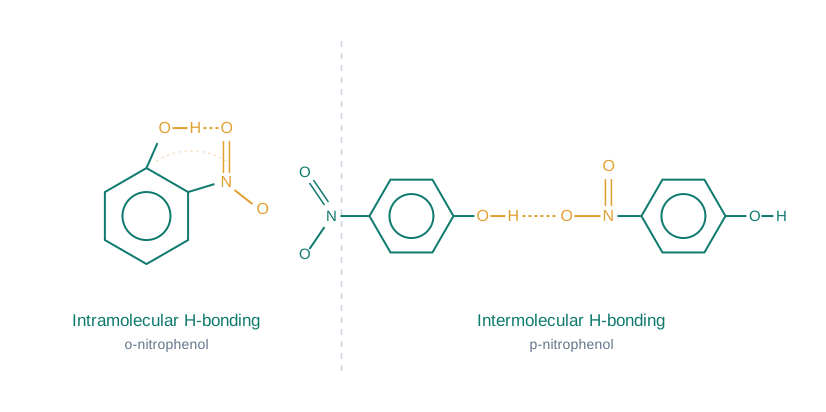
Fig. 7.22 – Intramolecular and intermolecular hydrogen bonding.
With concentrated nitric acid, phenol is converted to 2,4,6-trinitrophenol. The product is commonly known as picric acid. The yield of the reaction product is poor.
\[\mathrm{C_6H_5OH} \xrightarrow{\ \text{Conc. } \mathrm{HNO_3}\ } \mathrm{C_6H_2(NO_2)_3OH}\]
Nowadays picric acid is prepared by treating phenol first with concentrated sulphuric acid, which converts it to phenol-2,4-disulphonic acid, and then with concentrated nitric acid to get 2,4,6-trinitrophenol. Can you write the equations of the reactions involved?
2,4,6-Trinitrophenol is a strong acid due to the presence of three electron withdrawing \(\mathrm{-NO_2}\) groups, which facilitate the release of the hydrogen ion.
(ii) Halogenation. On treating phenol with bromine, different reaction products are formed under different experimental conditions.
(a) When the reaction is carried out in solvents of low polarity such as \(\mathrm{CHCl_3}\) or \(\mathrm{CS_2}\), and at low temperature, monobromophenols are formed. The para product is the major one and the ortho the minor one, as shown in Fig. 7.23.
\[\mathrm{C_6H_5OH} \xrightarrow{\ \mathrm{Br_2}\ \text{in}\ \mathrm{CS_2},\ 273\ \text{K}\ } o\text{-bromophenol (minor)} + p\text{-bromophenol (major)}\]
The usual halogenation of benzene takes place in the presence of a Lewis acid, such as \(\mathrm{FeBr_3}\) (Chapter 6, Class XII), which polarises the halogen molecule. In the case of phenol, the polarisation of the bromine molecule takes place even in the absence of a Lewis acid. This is due to the highly activating effect of the –OH group attached to the benzene ring: the ring is so electron rich that it can polarise the \(\mathrm{Br\!-\!Br}\) bond by itself.
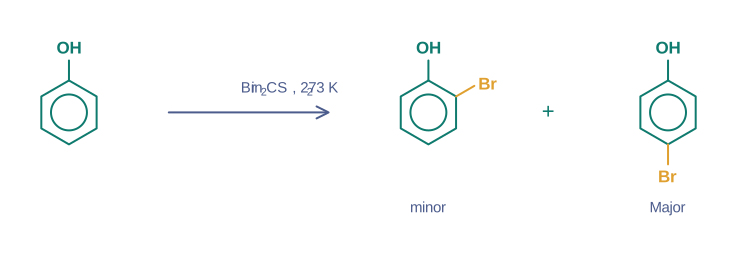
Fig. 7.23 – Halogenation of phenol in carbon disulphide.
(b) When phenol is treated with bromine water, 2,4,6-tribromophenol is formed as a white precipitate.
\[\mathrm{C_6H_5OH} + 3\,\mathrm{Br_2} \rightarrow \mathrm{C_6H_2(Br)_3OH} + 3\,\mathrm{HBr}\]
Write the structures of the major products expected from the following reactions:
(a) Mononitration of 3-methylphenol
(b) Dinitration of 3-methylphenol
(c) Mononitration of phenyl methanoate.
The combined influence of the –OH and \(\mathrm{-CH_3}\) groups determines the position of the incoming group.
Two products are obtained: 3-methyl-4-nitrophenol and 3-methyl-6-nitrophenol (the ring carrying –OH, \(\mathrm{-CH_3}\) and one \(\mathrm{-NO_2}\) group at the positions activated by both).
The ring carries –OH, \(\mathrm{-CH_3}\) and two \(\mathrm{-NO_2}\) groups at the positions activated by both substituents.
A benzene ring carrying the \(\mathrm{-OCOCH_3}\)-type ester group with the \(\mathrm{-NO_2}\) group at the para position.
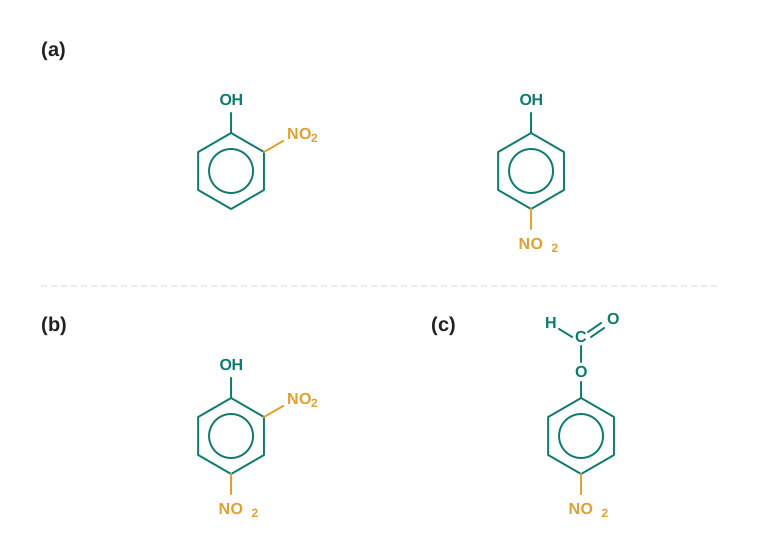
[Caption:] Fig. 7.24 – Products of mononitration and dinitration. [/Caption:]
2. Kolbe’s reaction
The phenoxide ion generated by treating phenol with sodium hydroxide is even more reactive than phenol towards electrophilic aromatic substitution. That should make sense by now: phenoxide carries a full negative charge delocalised into the ring, whereas phenol only has a lone pair partly delocalised, so phenoxide is the more electron-rich of the two.
Hence, phenoxide undergoes electrophilic substitution with carbon dioxide — a weak electrophile that phenol itself would ignore. Ortho hydroxybenzoic acid is formed as the main reaction product.
\[\mathrm{C_6H_5OH} \xrightarrow{\ \mathrm{NaOH}\ } \mathrm{C_6H_5ONa} \xrightarrow{\ \text{(i) } \mathrm{CO_2};\ \text{(ii) } \mathrm{H^+}\ } o\text{-}\mathrm{HO\!-\!C_6H_4\!-\!COOH}\]
The product is 2-hydroxybenzoic acid — salicylic acid, the very compound that is acetylated to make aspirin.
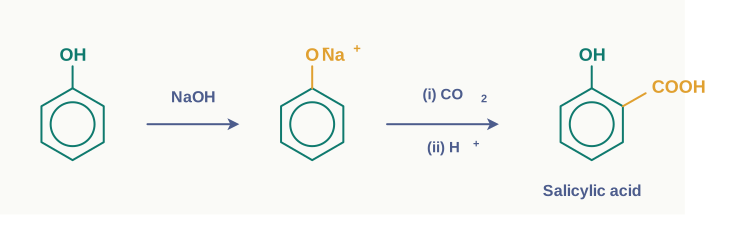
Fig. 7.25 – Kolbe’s reaction.
3. Reimer-Tiemann reaction
On treating phenol with chloroform in the presence of sodium hydroxide, a –CHO group is introduced at the ortho position of the benzene ring. This reaction is known as the Reimer-Tiemann reaction.
The intermediate substituted benzal chloride is hydrolysed in the presence of alkali to produce salicylaldehyde. The sequence is drawn in Fig. 7.26.
\[\mathrm{C_6H_5OH} \xrightarrow{\ \mathrm{CHCl_3} + \text{aq. } \mathrm{NaOH}\ } \text{[substituted benzal chloride]} \xrightarrow{\ \mathrm{NaOH}\ } \xrightarrow{\ \mathrm{H^+}\ } o\text{-}\mathrm{HO\!-\!C_6H_4\!-\!CHO}\]
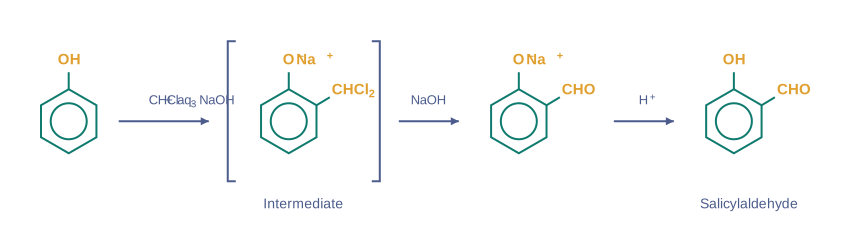
Fig. 7.26 – Reimer-Tiemann reaction.
Flowchart
FC 7.5 – Reimer-Tiemann reaction: phenol → aq NaOH → phenoxide ion → attack on CHCl₃-derived electrophile at the ortho position → substituted benzal chloride intermediate (–CHCl₂) → alkaline hydrolysis → –CHO group → acidification (H⁺) → salicylaldehyde.
4. Reaction of phenol with zinc dust
Phenol is converted to benzene on heating with zinc dust.
\[\mathrm{C_6H_5OH} + \mathrm{Zn} \rightarrow \mathrm{C_6H_6} + \mathrm{ZnO}\]
This is the one and only reaction in which the strong C–O bond of a phenol is broken — the zinc takes the oxygen away as zinc oxide.
5. Oxidation
Oxidation of phenol with chromic acid produces a conjugated diketone known as benzoquinone.
\[\mathrm{C_6H_5OH} \xrightarrow{\ \mathrm{Na_2Cr_2O_7} / \mathrm{H_2SO_4}\ } \text{benzoquinone}\]
In the presence of air, phenols are slowly oxidised to dark coloured mixtures containing quinones. This is why a bottle of phenol that has been standing open for a long time turns pink or brown.
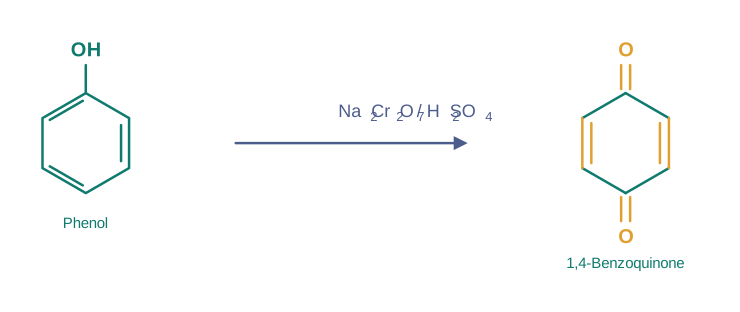
Fig. 7.27 – Oxidation of phenol to benzoquinone.
7.5 Some Commercially Important Alcohols
Methanol and ethanol are among the two commercially important alcohols. They are the first two members of the same homologous series, they differ by a single \(\mathrm{CH_2}\) group — and yet one of them is a familiar constituent of fermented drinks while the other can blind a person who swallows a small quantity. It is worth keeping that contrast in mind as we look at each.
1. Methanol
Methanol, \(\mathrm{CH_3OH}\), also known as ‘wood spirit’, was produced by destructive distillation of wood — that is, by heating wood strongly in the absence of air and collecting the volatile products that distil over.
Today, most of the methanol is produced by catalytic hydrogenation of carbon monoxide at high pressure and temperature, and in the presence of a \(\mathrm{ZnO}\)–\(\mathrm{Cr_2O_3}\) catalyst.
\[\mathrm{CO} + 2\,\mathrm{H_2} \xrightarrow[\ 573\text{--}673\ \text{K}\ ]{\ \mathrm{ZnO\text{-}Cr_2O_3},\ 200\text{--}300\ \text{atm}\ } \mathrm{CH_3OH}\]
Notice how the equation balances: one carbon and one oxygen come from carbon monoxide, and all four hydrogen atoms of methanol come from the two molecules of dihydrogen.
Methanol is a colourless liquid and boils at 337 K. It is highly poisonous in nature. Ingestion of even small quantities of methanol can cause blindness, and large quantities cause even death. Methanol is used as a solvent in paints and varnishes, and chiefly for making formaldehyde.
2. Ethanol
Ethanol, \(\mathrm{C_2H_5OH}\), is obtained commercially by fermentation, the oldest method being from sugars.
The sugar in molasses, sugarcane or fruits such as grapes is converted to glucose and fructose — both of which have the formula \(\mathrm{C_6H_{12}O_6}\) — in the presence of an enzyme, invertase. Glucose and fructose then undergo fermentation in the presence of another enzyme, zymase, which is found in yeast. An enzyme, remember, is simply a biological catalyst: it speeds the reaction up without being used up itself.
\[\mathrm{C_{12}H_{22}O_{11}} + \mathrm{H_2O} \xrightarrow{\ \text{Invertase}\ } \underset{\text{Glucose}}{\mathrm{C_6H_{12}O_6}} + \underset{\text{Fructose}}{\mathrm{C_6H_{12}O_6}}\]
\[\mathrm{C_6H_{12}O_6} \xrightarrow{\ \text{Zymase}\ } 2\,\mathrm{C_2H_5OH} + 2\,\mathrm{CO_2}\]
Flowchart
FC 7.6 – Preparation of ethanol by fermentation: molasses/sugarcane/grape juice (source of sucrose) → invertase → glucose + fructose → zymase (from yeast), anaerobic conditions → 2 C₂H₅OH + 2 CO₂ → fermentation stops once ethanol exceeds about 14% (zymase inhibited) → ethanol separated by distillation. Branch: if air leaks in → O₂ oxidises ethanol → ethanoic acid → taste of the drink spoiled.
Fermentation in Wine Making
In wine making, grapes are the source of both the sugars and the yeast. As grapes ripen, the quantity of sugar increases and yeast grows on the outer skin. When the grapes are crushed, the sugar and the enzyme come into contact and fermentation starts.
Fermentation takes place in anaerobic conditions, that is, in the absence of air. Carbon dioxide is released during fermentation — the steady stream of bubbles from a fermenting vat is the \(\mathrm{CO_2}\) of the second equation escaping.
The action of zymase is inhibited once the percentage of alcohol formed exceeds 14 percent. This is why fermentation alone can never produce a very strong spirit: the enzyme is poisoned by its own product, and the process shuts itself down.
If air gets into the fermentation mixture, the oxygen of air oxidises ethanol to ethanoic acid, which in turn destroys the taste of alcoholic drinks. This is the same primary-alcohol-to-carboxylic-acid oxidation met in Section 7.4.4, and it is precisely why fermentation vessels are kept closed.
Properties and Uses of Ethanol
Ethanol is a colourless liquid with a boiling point of 351 K. It is used as a solvent in the paint industry, and in the preparation of a number of carbon compounds.
The commercial alcohol is made unfit for drinking by mixing in it some copper sulphate — to give it a colour — and pyridine, a foul smelling liquid. This process is known as denaturation of alcohol. The purpose is practical: industrial ethanol is sold without the heavy tax on drinkable spirit, and denaturation ensures it cannot be diverted for drinking.
Nowadays, large quantities of ethanol are obtained by hydration of ethene (Section 7.4).
The margin of safety with ethanol is narrower than social habit suggests. Ingestion of ethanol acts on the central nervous system. In moderate amounts, it affects judgment and lowers inhibitions. Higher concentrations cause nausea and loss of consciousness. At even higher concentrations, it interferes with spontaneous respiration and can be fatal.
7.6 Ethers
7.6.1 Preparation of Ethers
1. By dehydration of alcohols
Alcohols undergo dehydration in the presence of protic acids (\(\mathrm{H_2SO_4}\), \(\mathrm{H_3PO_4}\)). The formation of the reaction product — alkene or ether — depends on the reaction conditions. For example, ethanol is dehydrated to ethene in the presence of sulphuric acid at 443 K. At 413 K, ethoxyethane is the main product.
\[\mathrm{CH_3CH_2OH} \xrightarrow[\ 443\ \text{K}\ ]{\ \mathrm{H_2SO_4}\ } \mathrm{CH_2{=}CH_2}\]
\[\mathrm{CH_3CH_2OH} \xrightarrow[\ 413\ \text{K}\ ]{\ \mathrm{H_2SO_4}\ } \mathrm{C_2H_5OC_2H_5}\]
The same starting material and the same acid give two entirely different products, and only the temperature separates them. The lower temperature favours substitution (the ether); the higher temperature favours elimination (the alkene).
The formation of ether is a nucleophilic bimolecular reaction (\(\mathrm{S_N2}\)) involving the attack of an alcohol molecule on a protonated alcohol, as indicated below and drawn out in Fig. 7.28.
- The alcohol is protonated by the acid:
\[\mathrm{CH_3\!-\!CH_2\!-\!O\!-\!H} + \mathrm{H^+} \rightarrow \mathrm{CH_3\!-\!CH_2\!-\!\overset{+}{O}H_2}\]
- A second, un-protonated alcohol molecule now acts as the nucleophile. Its oxygen lone pair attacks the carbon of the protonated alcohol, and water leaves from the other side in the same step:
\[\mathrm{CH_3CH_2\!-\!\overset{..}{O}H} + \mathrm{CH_3\!-\!CH_2\!-\!\overset{+}{O}H_2} \rightarrow \mathrm{CH_3CH_2\!-\!\overset{+}{O}(H)\!-\!CH_2CH_3} + \mathrm{H_2O}\]
- Loss of the proton gives the neutral ether:
\[\mathrm{CH_3CH_2\!-\!\overset{+}{O}(H)\!-\!CH_2CH_3} \rightarrow \mathrm{CH_3CH_2\!-\!O\!-\!CH_2CH_3} + \mathrm{H^+}\]
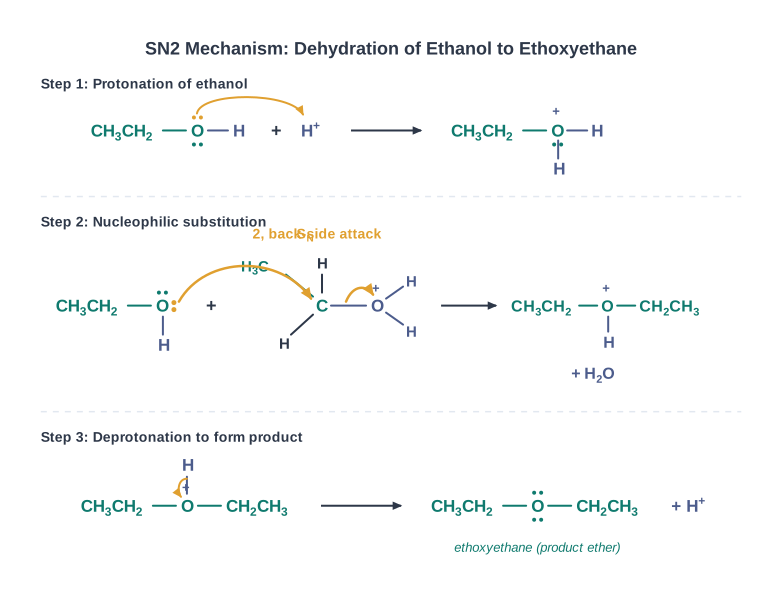
Fig. 7.28 – Bimolecular dehydration of ethanol to ethoxyethane.
Acidic dehydration of alcohols, to give an alkene, is thus also associated with a substitution reaction that gives an ether — the two compete with each other in the same flask.
The method is suitable for the preparation of ethers having primary alkyl groups only. The alkyl group should be unhindered and the temperature should be kept low. Otherwise, the reaction favours the formation of an alkene.
The reaction follows the \(\mathrm{S_N1}\) pathway when the alcohol is secondary or tertiary, about which you will learn in higher classes. However, the dehydration of secondary and tertiary alcohols to give the corresponding ethers is unsuccessful, as elimination competes over substitution, and as a consequence alkenes are easily formed.
There is a further, quite separate limitation. Can you explain why bimolecular dehydration is not appropriate for the preparation of ethyl methyl ether? (Think about what happens when two different alcohols are heated together with acid — each can attack the other, and each can attack its own kind.)
2. Williamson synthesis
This is an important laboratory method for the preparation of symmetrical and unsymmetrical ethers. In this method, an alkyl halide is allowed to react with a sodium alkoxide.
\[\mathrm{R\!-\!X} + \mathrm{R'\!-\!\overset{-}{O}Na^{+}} \rightarrow \mathrm{R\!-\!O\!-\!R'} + \mathrm{Na\,X}\]
Ethers containing substituted alkyl groups (secondary or tertiary) may also be prepared by this method. The reaction involves \(\mathrm{S_N2}\) attack of an alkoxide ion on a primary alkyl halide — and that phrase is the key to the whole method. It does not matter how bulky the alkoxide is; what matters is that the halide be primary, because the alkoxide must reach the carbon of the halide from behind.
\[\mathrm{(CH_3)_3C\!-\!\overset{-}{O}Na^{+}} + \mathrm{CH_3\!-\!Br} \rightarrow \mathrm{(CH_3)_3C\!-\!O\!-\!CH_3} + \mathrm{NaBr}\]
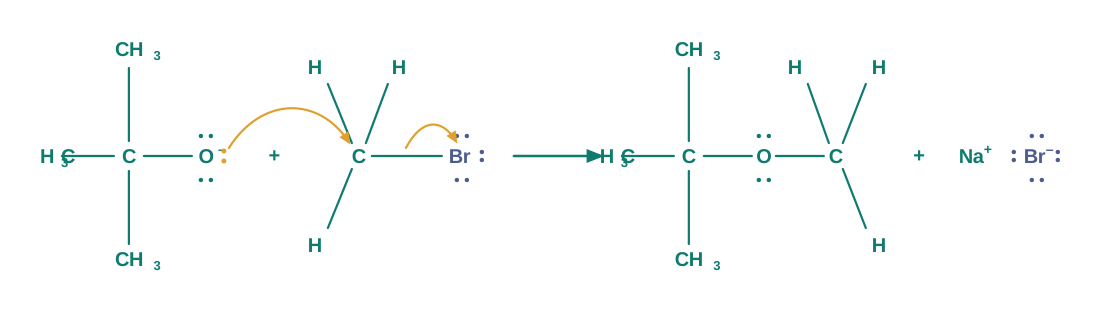
Fig. 7.29 – Williamson synthesis of an ether.
Better results are obtained if the alkyl halide is primary. In the case of secondary and tertiary alkyl halides, elimination competes over substitution. If a tertiary alkyl halide is used, an alkene is the only reaction product and no ether is formed. For example, the reaction of \(\mathrm{CH_3ONa}\) with \(\mathrm{(CH_3)_3C\!-\!Br}\) gives exclusively 2-methylpropene.
\[\mathrm{CH_3\!-\!C(CH_3)_2\!-\!Br} + \mathrm{Na\overset{-}{O}\!-\!CH_3} \rightarrow \mathrm{CH_3\!-\!C(CH_3){=}CH_2} + \mathrm{NaBr} + \mathrm{CH_3OH}\]
It is because alkoxides are not only nucleophiles but strong bases as well. They react with alkyl halides leading to elimination reactions. A bulky, crowded carbon is hard to attack from behind, but the hydrogen on the neighbouring carbon is out in the open — so the alkoxide takes that hydrogen instead, and an alkene results.
7.6.2 Physical Properties
The C–O bonds in ethers are polar, and thus ethers have a net dipole moment. The two C–O bonds are set at an angle to each other (Section 7.3), so their individual dipoles do not cancel out.
The weak polarity of ethers does not appreciably affect their boiling points, which are comparable to those of the alkanes of comparable molecular masses but are much lower than the boiling points of alcohols, as shown in the following cases.
| Formula | \(\mathrm{CH_3(CH_2)_3CH_3}\) | \(\mathrm{C_2H_5\!-\!O\!-\!C_2H_5}\) | \(\mathrm{CH_3(CH_2)_3\!-\!OH}\) |
|---|---|---|---|
| n-Pentane | Ethoxyethane | Butan-1-ol | |
| b.p./K | 309.1 | 307.6 | 390 |
The large difference in boiling points of alcohols and ethers is due to the presence of hydrogen bonding in alcohols. Ethoxyethane and n-pentane boil within two degrees of each other; butan-1-ol, of similar size, boils some 80 K higher, purely because its molecules can hold on to one another through O–H⋯O hydrogen bonds.
The miscibility of ethers with water resembles that of alcohols of the same molecular mass. Both ethoxyethane and butan-1-ol are miscible to almost the same extent, i.e., 7.5 and 9 g per 100 mL of water respectively, while pentane is essentially immiscible with water. Can you explain this observation?
This is due to the fact that, just like alcohols, the oxygen of an ether can also form hydrogen bonds with a water molecule, as shown in Fig. 7.30. The ether cannot donate a hydrogen bond — it has no O–H — but it can accept one, because its oxygen still carries two lone pairs. That is enough to dissolve it appreciably. Pentane has neither an O–H bond nor a lone pair, and therefore no way of joining water’s hydrogen-bonded network at all.
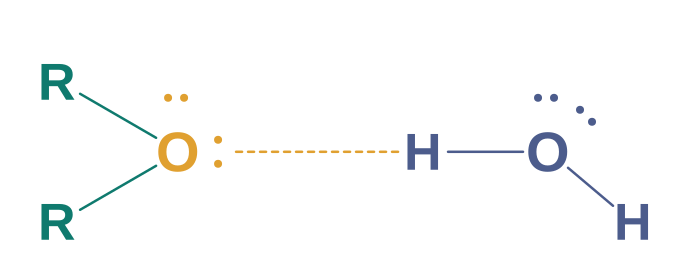
Fig. 7.30 – Hydrogen bonding between ether and water.
7.6.3 Chemical Reactions
1. Cleavage of the C–O bond in ethers
Ethers are the least reactive of the functional groups — they have no acidic hydrogen and no easily attacked carbon, which is exactly why they are so useful as solvents. The cleavage of the C–O bond in ethers takes place only under drastic conditions, with an excess of hydrogen halides.
The reaction of a dialkyl ether gives two alkyl halide molecules, one from each side of the oxygen, but it does so in two stages:
\[\mathrm{R\!-\!O\!-\!R} + \mathrm{HX} \rightarrow \mathrm{RX} + \mathrm{R\!-\!OH}\]
\[\mathrm{R\!-\!OH} + \mathrm{HX} \rightarrow \mathrm{R\!-\!X} + \mathrm{H_2O}\]
Alkyl aryl ethers are cleaved at the alkyl–oxygen bond, due to the more stable aryl–oxygen bond. The reaction yields a phenol and an alkyl halide.
\[\mathrm{C_6H_5\!-\!O\!-\!R} + \mathrm{H\!-\!X} \rightarrow \mathrm{C_6H_5\!-\!OH} + \mathrm{R\!-\!X}\]
Ethers with two different alkyl groups are also cleaved in the same manner.
\[\mathrm{R\!-\!O\!-\!R'} + \mathrm{HX} \rightarrow \mathrm{R\!-\!X} + \mathrm{R'\!-\!OH}\]
The order of reactivity of hydrogen halides is as follows: \(\mathrm{HI} > \mathrm{HBr} > \mathrm{HCl}\). The cleavage of ethers takes place with concentrated \(\mathrm{HI}\) or \(\mathrm{HBr}\) at high temperature.
Mechanism
The reaction of an ether with concentrated \(\mathrm{HI}\) starts with protonation of the ether molecule.
Step 1:
\[\mathrm{CH_3\!-\!O\!-\!CH_2CH_3} + \mathrm{H\!-\!I} \rightleftharpoons \mathrm{CH_3\!-\!\overset{+}{O}(H)\!-\!CH_2CH_3} + \mathrm{I^-}\]
The reaction takes place with \(\mathrm{HBr}\) or \(\mathrm{HI}\) because these reagents are sufficiently acidic. Protonation matters for the same reason as with alcohols: it converts a hopeless leaving group (an alkoxide) into an acceptable one (an alcohol).
Step 2: Iodide is a good nucleophile. It attacks the least substituted carbon of the oxonium ion formed in Step 1 and displaces an alcohol molecule by an \(\mathrm{S_N2}\) mechanism.
\[\mathrm{I^-} + \mathrm{CH_3\!-\!\overset{+}{O}(H)\!-\!CH_2CH_3} \rightarrow \mathrm{CH_3\!-\!I} + \mathrm{CH_3CH_2\!-\!OH}\]
Thus, in the cleavage of mixed ethers with two different alkyl groups, the alcohol and the alkyl iodide formed depend on the nature of the alkyl groups. When primary or secondary alkyl groups are present, it is the lower alkyl group that forms the alkyl iodide (\(\mathrm{S_N2}\) reaction) — because the less crowded carbon is the one the iodide can reach.
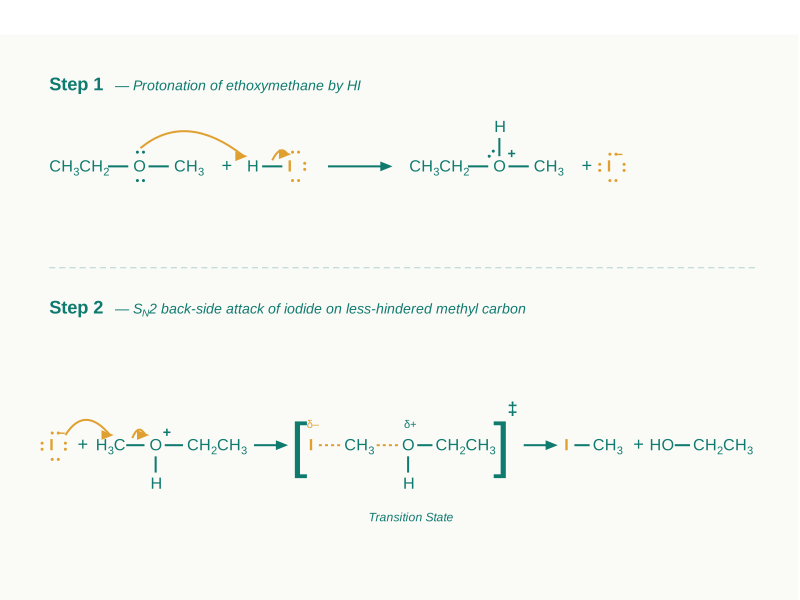
Fig. 7.31 – Cleavage of an ether by hydrogen iodide.
When \(\mathrm{HI}\) is in excess and the reaction is carried out at high temperature, the ethanol produced reacts with another molecule of \(\mathrm{HI}\) and is converted to ethyl iodide.
Step 3:
\[\mathrm{CH_3CH_2\!-\!O\!-\!H} + \mathrm{H\!-\!I} \rightleftharpoons \mathrm{CH_3CH_2\!-\!\overset{+}{O}H_2} + \mathrm{I^-}\]
\[\mathrm{I^-} + \mathrm{CH_3CH_2\!-\!\overset{+}{O}H_2} \rightarrow \mathrm{CH_3CH_2I} + \mathrm{H_2O}\]
When the Ether has a Tertiary Group
However, when one of the alkyl groups is a tertiary group, the halide formed is a tertiary halide.
\[\mathrm{CH_3\!-\!C(CH_3)_2\!-\!O\!-\!CH_3} + \mathrm{HI} \rightarrow \mathrm{CH_3OH} + \mathrm{CH_3\!-\!C(CH_3)_2\!-\!I}\]
At first sight this contradicts the rule just given — the iodide seems to have attacked the more substituted carbon. It has not. The mechanism has changed. In step 2 of the reaction, the departure of the leaving group (\(\mathrm{HO\!-\!CH_3}\)) creates a more stable carbocation, \(\mathrm{[(CH_3)_3C^+]}\), and the reaction follows an \(\mathrm{S_N1}\) mechanism.
\[\mathrm{CH_3\!-\!C(CH_3)_2\!-\!\overset{+}{O}(H)\!-\!CH_3} \xrightarrow{\ \text{slow}\ } \mathrm{(CH_3)_3C^+} + \mathrm{CH_3OH}\]
\[\mathrm{(CH_3)_3C^+} + \mathrm{I^-} \xrightarrow{\ \text{fast}\ } \mathrm{(CH_3)_3C\!-\!I}\]
So the ether breaks at whichever bond gives the more stable intermediate: \(\mathrm{S_N2}\) at the less hindered carbon when both groups are primary or secondary, and \(\mathrm{S_N1}\) at the tertiary carbon when one is available.
Flowchart
FC 7.7 – Cleavage of an ether by concentrated HI: ether + HI → protonation → oxonium ion → branch A: both groups primary/secondary → I⁻ attacks the smaller, less hindered carbon (SN2) → lower alkyl iodide + alcohol; branch B: one group tertiary → C–O breaks to give the stable 3° carbocation (SN1) → tertiary alkyl iodide + alcohol; branch C: alkyl aryl ether → alkyl–O bond breaks → alkyl iodide + phenol (phenol does not react further). With excess HI and high temperature, the alcohol formed in branch A reacts with a second HI → a second alkyl iodide.
Why Anisole Breaks Where it Does
In the case of anisole, the methylphenyl oxonium ion, \(\mathrm{C_6H_5\!-\!\overset{+}{O}(H)\!-\!CH_3}\), is formed by protonation of the ether. The bond between \(\mathrm{O\!-\!CH_3}\) is weaker than the bond between \(\mathrm{O\!-\!C_6H_5}\), because the carbon of the phenyl group is \(sp^2\) hybridised and there is a partial double bond character — exactly the shortening met in Section 7.3.
Therefore the attack by the \(\mathrm{I^-}\) ion breaks the \(\mathrm{O\!-\!CH_3}\) bond to form \(\mathrm{CH_3I}\).
\[\mathrm{C_6H_5\!-\!O\!-\!CH_3} + \mathrm{HI} \rightarrow \mathrm{C_6H_5\!-\!OH} + \mathrm{CH_3I}\]
Phenols do not react further to give halides, because the \(sp^2\) hybridised carbon of phenol cannot undergo the nucleophilic substitution reaction needed for conversion to the halide. This is why the reaction stops cleanly at phenol and does not go on to give a second molecule of alkyl iodide.
2. Electrophilic substitution
The alkoxy group (–OR) is ortho, para directing and activates the aromatic ring towards electrophilic substitution in the same way as in phenol. The oxygen’s lone pair is delocalised into the ring, building up electron density at the ortho and para positions, as the resonance structures I–V of Fig. 7.32 show.
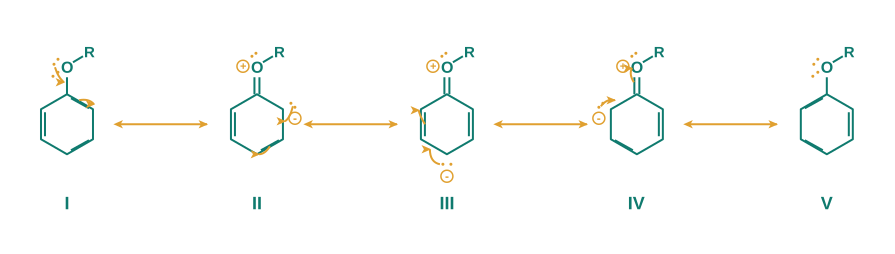
Fig. 7.32 – Resonance structures of an aryl alkyl ether.
(i) Halogenation. Phenylalkyl ethers undergo the usual halogenation in the benzene ring. For example, anisole undergoes bromination with bromine in ethanoic acid even in the absence of an iron (III) bromide catalyst. This is due to the activation of the benzene ring by the methoxy group. The para isomer is obtained in 90% yield.
\[\mathrm{C_6H_5OCH_3} \xrightarrow[\ \text{Ethanoic acid}\ ]{\ \mathrm{Br_2}\ } p\text{-bromoanisole (Major)} + o\text{-bromoanisole (minor)}\]
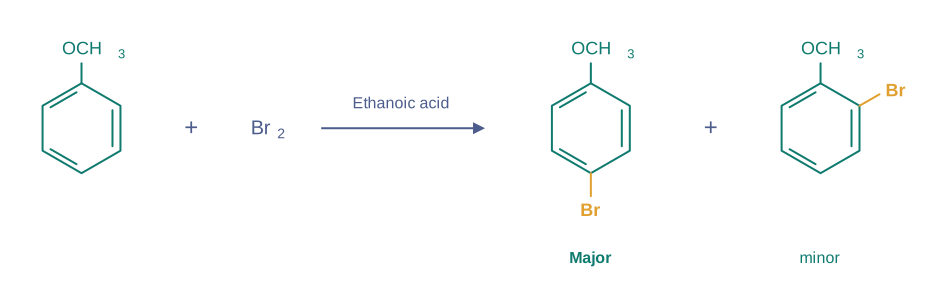
Fig. 7.33 – Bromination of anisole.
(ii) Friedel-Crafts reaction. Anisole undergoes the Friedel-Crafts reaction — that is, alkyl and acyl groups are introduced at the ortho and para positions by reaction with an alkyl halide and an acyl halide respectively, in the presence of anhydrous aluminium chloride (a Lewis acid) as catalyst.
\[\mathrm{C_6H_5OCH_3} + \mathrm{CH_3Cl} \xrightarrow[\ \mathrm{CS_2}\ ]{\ \text{Anhyd. } \mathrm{AlCl_3}\ } \text{2-Methoxytoluene (Minor)} + \text{4-Methoxytoluene (Major)}\]
\[\mathrm{C_6H_5OCH_3} + \mathrm{CH_3COCl} \xrightarrow{\ \text{Anhyd. } \mathrm{AlCl_3}\ } \text{2-Methoxyacetophenone (Minor)} + \text{4-Methoxyacetophenone (Major)}\]
The acyl chloride used here, \(\mathrm{CH_3COCl}\), is ethanoyl chloride.
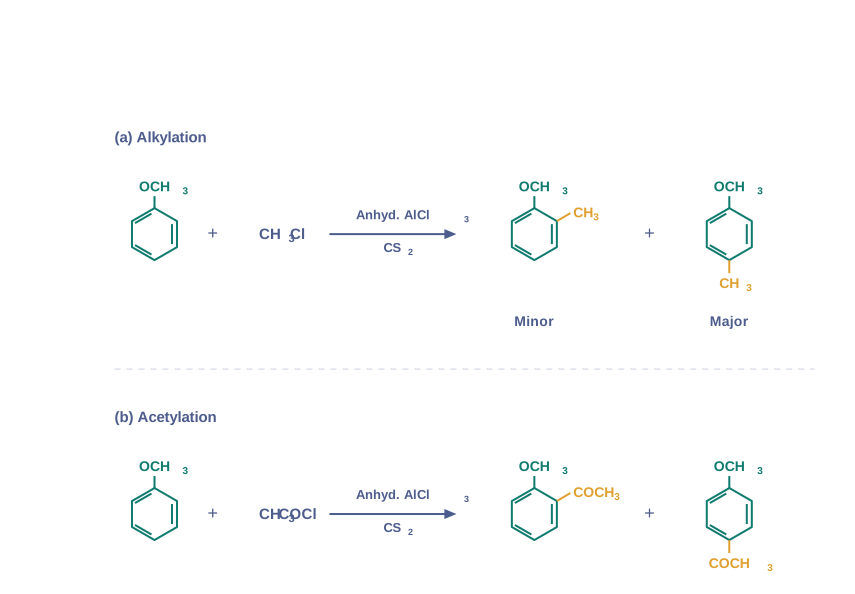
Fig. 7.34 – Friedel-Crafts alkylation and acetylation of anisole.
(iii) Nitration. Anisole reacts with a mixture of concentrated sulphuric and nitric acids to yield a mixture of ortho and para nitroanisole.
\[\mathrm{C_6H_5OCH_3} \xrightarrow[\ \mathrm{HNO_3}\ ]{\ \mathrm{H_2SO_4}\ } \text{2-Nitroanisole (Minor)} + \text{4-Nitroanisole (Major)}\]
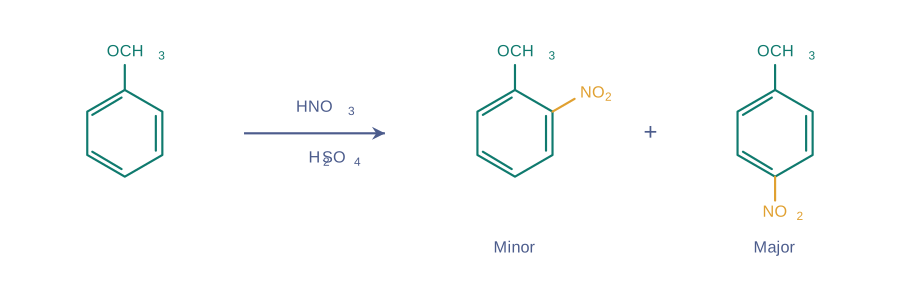
Fig. 7.35 – Nitration of anisole.
In every one of these three reactions the same pattern appears: the para product dominates and the ortho product is minor. The reason is steric — both positions are electron rich, but the ortho position sits right beside the bulky \(\mathrm{-OCH_3}\) group, and the incoming electrophile finds the para position easier to reach.
7.7 Summary
Classification
- Alcohols and phenols are classified in two ways: (i) on the basis of the number of hydroxyl groups they carry (mono-, di-, tri- or polyhydric), and (ii) according to the hybridisation of the carbon atom, \(sp^3\) or \(sp^2\), to which the –OH group is attached.
- Ethers are classified on the basis of the groups attached to the oxygen atom — simple (symmetrical) if the two groups are the same, mixed (unsymmetrical) if they are different.
Preparation of alcohols
- From alkenes, by (i) hydration in the presence of an acid, which follows Markovnikov’s rule, and (ii) hydroboration–oxidation, which places the –OH on the less substituted carbon.
- From carbonyl compounds, by (i) catalytic reduction of aldehydes and ketones, and (ii) the action of Grignard reagents. Methanal gives a primary alcohol, other aldehydes give secondary alcohols, and ketones give tertiary alcohols.
Preparation of phenols
- By substitution of (i) the halogen atom in haloarenes and (ii) the sulphonic acid group in aryl sulphonic acids, by the –OH group.
- By hydrolysis of diazonium salts.
- Industrially, from cumene.
Flowchart
FC 7.8 – Routes to phenol: chlorobenzene → (NaOH, 623 K, high pressure) → sodium phenoxide → (H⁺) → phenol; benzene → (oleum) → benzenesulphonic acid → (molten NaOH, then H⁺) → phenol; aniline → (NaNO₂ + HCl, 273–278 K) → benzene diazonium chloride → (warm H₂O) → phenol + N₂ + HCl; cumene → (O₂) → cumene hydroperoxide → (dilute H⁺) → phenol + acetone (the industrial route).
Physical properties
- Alcohols are higher boiling than other classes of compounds — hydrocarbons, ethers and haloalkanes — of comparable molecular masses, because of intermolecular hydrogen bonding.
- The ability of alcohols, phenols and ethers to form intermolecular hydrogen bonding with water makes them soluble in it. Solubility falls as the hydrophobic alkyl/aryl group grows larger.
- Boiling points of ethers resemble those of alkanes, since ether molecules cannot hydrogen bond to one another; their solubility is comparable to that of alcohols of the same molecular mass, since the ether oxygen can still accept a hydrogen bond from water.
Acidity
- Alcohols and phenols are acidic in nature; both react with active metals to liberate hydrogen, and phenols additionally react with aqueous \(\mathrm{NaOH}\).
- Electron withdrawing groups in phenol increase its acidic strength, and electron releasing groups decrease it. Phenol is a million times more acidic than ethanol, because the phenoxide ion is stabilised by delocalisation of its negative charge into the ring.
Reactions of alcohols
- Alcohols undergo nucleophilic substitution with hydrogen halides to yield alkyl halides.
- Dehydration of alcohols gives alkenes; the ease of dehydration follows tertiary > secondary > primary, because the rate-determining step forms a carbocation.
\[\mathrm{C_2H_5OH} \xrightarrow{\ \mathrm{H_2SO_4},\ 443\ \text{K}\ } \mathrm{CH_2{=}CH_2} + \mathrm{H_2O}\]
- On oxidation, primary alcohols yield aldehydes with mild oxidising agents (\(\mathrm{CrO_3}\), PCC) and carboxylic acids with strong oxidising agents, while secondary alcohols yield ketones. Tertiary alcohols are resistant to oxidation, since their –OH carbon carries no hydrogen.
Reactions of phenols
- The presence of the –OH group in phenols activates the aromatic ring towards electrophilic substitution, and directs the incoming group to the ortho and para positions due to the resonance effect.
- The Reimer-Tiemann reaction of phenol yields salicylaldehyde.
- In the presence of sodium hydroxide, phenol generates the phenoxide ion, which is even more reactive than phenol. Thus, in alkaline medium, phenol undergoes Kolbe’s reaction, giving 2-hydroxybenzoic acid.
Ethers
- Ethers may be prepared by (i) dehydration of alcohols (suitable for primary alkyl groups only) and (ii) Williamson synthesis, in which an alkoxide attacks a primary alkyl halide by an \(\mathrm{S_N2}\) reaction.
\[\mathrm{R\!-\!X} + \mathrm{R'\!-\!\overset{-}{O}Na^{+}} \rightarrow \mathrm{R\!-\!O\!-\!R'} + \mathrm{Na\,X}\]
- The C–O bond in ethers can be cleaved by hydrogen halides, the order of reactivity being \(\mathrm{HI} > \mathrm{HBr} > \mathrm{HCl}\). In an alkyl aryl ether, it is the alkyl–oxygen bond that breaks, giving a phenol and an alkyl halide.
- In electrophilic substitution, the alkoxy group activates the aromatic ring and directs the incoming group to the ortho and para positions.
7.8 NCERT Questions
- Write IUPAC names of the following compounds:
- \(\mathrm{CH_3\!-\!CH(CH_3)\!-\!CH(OH)\!-\!C(CH_3)_2\!-\!CH_3}\)
- \(\mathrm{H_3C\!-\!CH(OH)\!-\!CH_2\!-\!CH(OH)\!-\!CH(C_2H_5)\!-\!CH_2\!-\!CH_3}\)
- \(\mathrm{CH_3\!-\!CH(OH)\!-\!CH(OH)\!-\!CH_3}\)
- \(\mathrm{HO\!-\!CH_2\!-\!CH(OH)\!-\!CH_2\!-\!OH}\)
- a benzene ring carrying a \(\mathrm{-CH_3}\) group and an –OH group on adjacent carbons
- a benzene ring carrying a \(\mathrm{-CH_3}\) group and an –OH group in the 1,4-relationship
- a benzene ring carrying two \(\mathrm{-CH_3}\) groups and one –OH group, as drawn
- a benzene ring carrying two \(\mathrm{-CH_3}\) groups and one –OH group, as drawn
- \(\mathrm{CH_3\!-\!O\!-\!CH_2\!-\!CH(CH_3)\!-\!CH_3}\)
- \(\mathrm{C_6H_5\!-\!O\!-\!C_2H_5}\)
- \(\mathrm{C_6H_5\!-\!O\!-\!C_7H_{15}}\) (n–)
- \(\mathrm{CH_3\!-\!CH_2\!-\!O\!-\!CH(CH_3)\!-\!CH_2\!-\!CH_3}\)
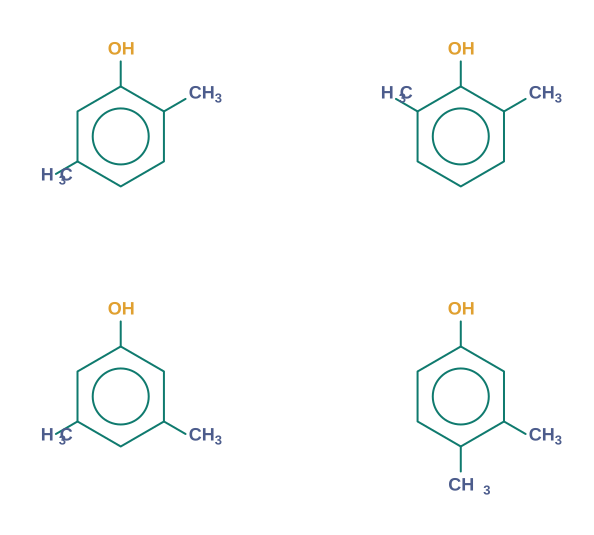
Fig. 7.36 – Structures for Question 7.1.
Write structures of the compounds whose IUPAC names are as follows:
- 2-Methylbutan-2-ol
- 1-Phenylpropan-2-ol
- 3,5-Dimethylhexane –1, 3, 5-triol
- 2,3 – Diethylphenol
- 1 – Ethoxypropane
- 2-Ethoxy-3-methylpentane
- Cyclohexylmethanol
- 3-Cyclohexylpentan-3-ol
- Cyclopent-3-en-1-ol
- 4-Chloro-3-ethylbutan-1-ol.
Answer the following:
- Draw the structures of all isomeric alcohols of molecular formula \(\mathrm{C_5H_{12}O}\) and give their IUPAC names.
- Classify the isomers of alcohols in a. above as primary, secondary and tertiary alcohols.
Explain why propanol has a higher boiling point than that of the hydrocarbon, butane?
Alcohols are comparatively more soluble in water than hydrocarbons of comparable molecular masses. Explain this fact.
What is meant by hydroboration-oxidation reaction? Illustrate it with an example.
Give the structures and IUPAC names of monohydric phenols of molecular formula \(\mathrm{C_7H_8O}\).
While separating a mixture of ortho and para nitrophenols by steam distillation, name the isomer which will be steam volatile. Give reason.
Give the equations of reactions for the preparation of phenol from cumene.
Write the chemical reaction for the preparation of phenol from chlorobenzene.
Write the mechanism of hydration of ethene to yield ethanol.
You are given benzene, conc. \(\mathrm{H_2SO_4}\) and \(\mathrm{NaOH}\). Write the equations for the preparation of phenol using these reagents.
Show how will you synthesise:
- 1-phenylethanol from a suitable alkene.
- cyclohexylmethanol using an alkyl halide by an \(\mathrm{S_N2}\) reaction.
- pentan-1-ol using a suitable alkyl halide?
Give two reactions that show the acidic nature of phenol. Compare the acidity of phenol with that of ethanol.
Explain why is ortho nitrophenol more acidic than ortho methoxyphenol?
Explain how does the –OH group attached to a carbon of benzene ring activate it towards electrophilic substitution?
Give equations of the following reactions:
- Oxidation of propan-1-ol with alkaline \(\mathrm{KMnO_4}\) solution.
- Bromine in \(\mathrm{CS_2}\) with phenol.
- Dilute \(\mathrm{HNO_3}\) with phenol.
- Treating phenol with chloroform in presence of aqueous \(\mathrm{NaOH}\).
Explain the following with an example.
- Kolbe’s reaction.
- Reimer-Tiemann reaction.
- Williamson ether synthesis.
- Unsymmetrical ether.
Write the mechanism of acid dehydration of ethanol to yield ethene.
How are the following conversions carried out?
- Propene \(\rightarrow\) Propan-2-ol.
- Benzyl chloride \(\rightarrow\) Benzyl alcohol.
- Ethyl magnesium chloride \(\rightarrow\) Propan-1-ol.
- Methyl magnesium bromide \(\rightarrow\) 2-Methylpropan-2-ol.
Name the reagents used in the following reactions:
- Oxidation of a primary alcohol to carboxylic acid.
- Oxidation of a primary alcohol to aldehyde.
- Bromination of phenol to 2,4,6-tribromophenol.
- Benzyl alcohol to benzoic acid.
- Dehydration of propan-2-ol to propene.
- Butan-2-one to butan-2-ol.
Give reason for the higher boiling point of ethanol in comparison to methoxymethane.
Give IUPAC names of the following ethers:
- \(\mathrm{C_2H_5OCH_2\!-\!CH(CH_3)\!-\!CH_3}\)
- \(\mathrm{CH_3OCH_2CH_2Cl}\)
- \(p\text{-}\mathrm{O_2N\!-\!C_6H_4\!-\!OCH_3}\)
- \(\mathrm{CH_3CH_2CH_2OCH_3}\)
- a cyclohexane ring carrying two \(\mathrm{CH_3}\) groups on one carbon and an \(\mathrm{OC_2H_5}\) group on the adjacent carbon
- a benzene ring carrying an \(\mathrm{OC_2H_5}\) group
Write the names of reagents and equations for the preparation of the following ethers by Williamson’s synthesis:
- 1-Propoxypropane
- Ethoxybenzene
- 2-Methoxy-2-methylpropane
- 1-Methoxyethane
Illustrate with examples the limitations of Williamson synthesis for the preparation of certain types of ethers.
How is 1-propoxypropane synthesised from propan-1-ol? Write the mechanism of this reaction.
Preparation of ethers by acid dehydration of secondary or tertiary alcohols is not a suitable method. Give reason.
Write the equation of the reaction of hydrogen iodide with:
- 1-propoxypropane (ii) methoxybenzene and (iii) benzyl ethyl ether.
Explain the fact that in aryl alkyl ethers (i) the alkoxy group activates the benzene ring towards electrophilic substitution and (ii) it directs the incoming substituents to ortho and para positions in the benzene ring.
Write the mechanism of the reaction of \(\mathrm{HI}\) with methoxymethane.
Write equations of the following reactions:
- Friedel-Crafts reaction – alkylation of anisole.
- Nitration of anisole.
- Bromination of anisole in ethanoic acid medium.
- Friedel-Craft’s acetylation of anisole.
Show how would you synthesise the following alcohols from appropriate alkenes?
- 1-methylcyclohexanol (a cyclohexane ring bearing \(\mathrm{CH_3}\) and –OH on the same carbon)
- a skeletal chain with an OH on a fully substituted carbon
- a skeletal pentane chain with OH on the second carbon
- a cyclohexane ring attached to a carbon bearing OH, a methyl group and an ethyl group
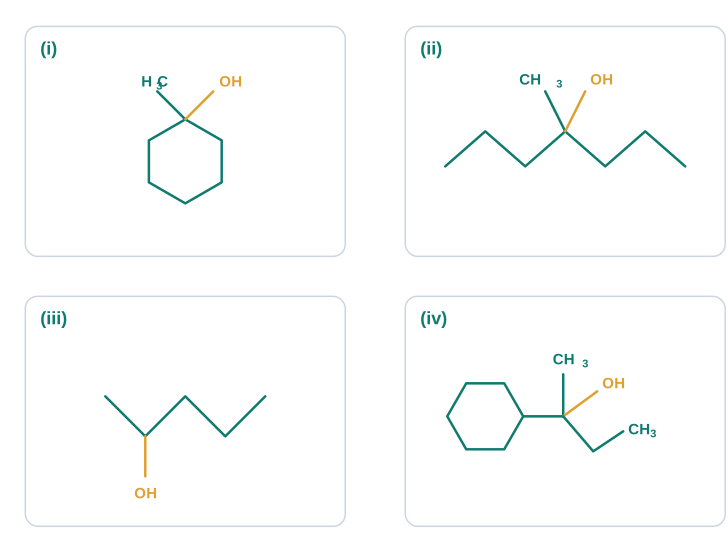
Fig. 7.37 – Target alcohols for Question 7.32.
- When 3-methylbutan-2-ol is treated with \(\mathrm{HBr}\), the following reaction takes place:
\[\mathrm{CH_3\!-\!CH(CH_3)\!-\!CH(OH)\!-\!CH_3} \xrightarrow{\ \mathrm{HBr}\ } \mathrm{CH_3\!-\!C(CH_3)(Br)\!-\!CH_2\!-\!CH_3}\]
Give a mechanism for this reaction. (Hint: The secondary carbocation formed in step II rearranges to a more stable tertiary carbocation by a hydride ion shift from the 3rd carbon atom.)
7.9 Check Your Concepts
Assertion: Phenol dissolves in aqueous sodium hydroxide but ethanol does not. Reason: The phenoxide ion is stabilised by delocalisation of its negative charge into the benzene ring. State whether the assertion and the reason are true, and whether the reason correctly explains the assertion.
Assertion: Tertiary alcohols give an immediate turbidity with Lucas reagent at room temperature. Reason: Tertiary carbocations are more stable than secondary and primary carbocations. State whether the assertion and the reason are true, and whether the reason correctly explains the assertion.
Arrange the following in increasing order of acid strength and justify your order: ethanol, water, phenol, 4-nitrophenol, 2,4,6-trinitrophenol.
Both o-cresol and o-nitrophenol are substituted phenols, yet one is a weaker acid than phenol and the other is stronger. Explain, using the effect of each substituent on the stability of the phenoxide ion.
Why does the C–O bond in phenol (136 pm) not break with \(\mathrm{HBr}\), whereas the C–O bond in ethanol (142 pm) does? Give two reasons.
Predict the major product in each case and name the mechanism involved:
- 2-methylpropan-2-ol heated with 20% \(\mathrm{H_3PO_4}\) at 358 K
- \(\mathrm{CH_3ONa} + \mathrm{(CH_3)_3C\!-\!Br}\)
- \(\mathrm{(CH_3)_3C\!-\!ONa} + \mathrm{CH_3Br}\)
Complete the following reactions:
- \(\mathrm{CH_3\!-\!CH{=}CH\!-\!CH_2OH} \xrightarrow{\ \text{PCC}\ } ?\)
- \(\mathrm{CH_3\!-\!CH(OH)\!-\!CH_3} \xrightarrow{\ \mathrm{CrO_3}\ } ?\)
- \(\mathrm{C_6H_5OH} + 3\,\mathrm{Br_2}\ (\text{bromine water}) \rightarrow ?\)
- \(\mathrm{C_6H_5\!-\!O\!-\!CH_3} + \mathrm{HI} \rightarrow ?\)
How would you distinguish between the members of each pair by a simple chemical test?
- Phenol and ethanol
- Butan-1-ol and 2-methylpropan-2-ol
- Propan-1-ol and propan-2-ol (after oxidation)
Ethanol, when heated with concentrated \(\mathrm{H_2SO_4}\), gives ethene at 443 K but ethoxyethane at 413 K. Explain why a single change of temperature alters the product completely.
An unknown compound of molecular formula \(\mathrm{C_2H_6O}\) boils at 351 K and reacts with sodium metal to liberate a gas. A second compound of the same molecular formula boils at 248 K and does not react with sodium. Identify both compounds and explain both observations.
Why is o-nitrophenol steam volatile while p-nitrophenol is not? How is this difference used to separate the two isomers?
Cumene is oxidised in air and then treated with dilute acid. Write the sequence of reactions, name both products, and explain why this route is preferred industrially over the fusion of chlorobenzene with \(\mathrm{NaOH}\).
Give reasons:
- Phenol undergoes bromination with bromine water without any Lewis acid catalyst, whereas benzene requires \(\mathrm{FeBr_3}\).
- The alkoxy group of anisole directs an incoming electrophile mainly to the para position rather than the ortho position.
Suggest a suitable carbonyl compound and a Grignard reagent for the preparation of each alcohol, and state in each case whether the product will be primary, secondary or tertiary:
- butan-1-ol (ii) butan-2-ol (iii) 2-methylbutan-2-ol
Propene can be converted to propan-1-ol or to propan-2-ol depending on the method used. Name both methods, give the equations, and explain the orientation of the addition in each case.
Match the reagent in Column I with the transformation it brings about in Column II.
| Column I (Reagent) | Column II (Transformation) |
|---|---|
| a. PCC | i. Phenol → 2,4,6-tribromophenol |
| b. Acidified \(\mathrm{KMnO_4}\) | ii. Phenol → salicylaldehyde |
| c. \(\mathrm{CHCl_3}\) + aqueous \(\mathrm{NaOH}\) | iii. Primary alcohol → aldehyde |
| d. Bromine water | iv. Phenol → benzene |
| e. Zinc dust | v. Primary alcohol → carboxylic acid |
1-Methoxy-2,2-dimethylpropane is heated with excess concentrated \(\mathrm{HI}\). Predict the organic products, state which bond of the ether breaks, and name the mechanism (\(\mathrm{S_N1}\) or \(\mathrm{S_N2}\)) with a reason.
Salicylic acid is converted to aspirin by acetylation. Write the equation, name the reagent used, and explain in one line why the acetylated product is preferred as a medicine.
Explain why:
- Sodium ethoxide is a stronger base than sodium hydroxide.
- The acid strength of alcohols decreases in the order primary > secondary > tertiary.
Why is the boiling point of ethoxyethane (307.6 K) close to that of n-pentane (309.1 K), while its solubility in water (7.5 g per 100 mL) is close to that of butan-1-ol (9 g per 100 mL)? Explain both observations in terms of hydrogen bonding.
An alcohol A of molecular formula \(\mathrm{C_4H_{10}O}\) gives no turbidity with Lucas reagent at room temperature, and on oxidation with acidified \(\mathrm{KMnO_4}\) gives an acid B of molecular formula \(\mathrm{C_4H_8O_2}\). Identify A and B, and write the equations involved.
A compound X (\(\mathrm{C_6H_6O}\)) turns blue litmus red, gives a violet colouration with neutral \(\mathrm{FeCl_3}\), and on heating with zinc dust gives Y (\(\mathrm{C_6H_6}\)). On treatment with \(\mathrm{NaOH}\) followed by \(\mathrm{CO_2}\) and acidification, X gives Z. Identify X, Y and Z, and name the reaction that produces Z.