Chapter 8: Aldehydes, Ketones and Carboxylic Acids
In the nineteenth century, vanilla was one of the costliest flavours in the world. It came only from the cured pods of a climbing orchid, and each pod had to be pollinated by hand and slowly fermented before the familiar sweet aroma appeared. Confectioners and perfumers wanted more of it than the plant could ever supply.
The question chemists asked was a simple one: what exactly, inside that pod, carries the smell? In the 1870s, two German chemists, Ferdinand Tiemann and Wilhelm Haarmann, worked out the structure of the compound responsible — vanillin — and then prepared it in the laboratory from coniferin, a substance obtained from pine bark. A flavour that had depended on a tropical orchid could now be made on a bench, and later in a factory.
Look closely at vanillin and you find a familiar unit at its heart: a carbon atom joined to an oxygen atom by a double bond, written as >C=O. That single group, the carbonyl group, is the reason vanillin smells the way it does, the reason acetone dissolves nail polish, the reason vinegar tastes sharp, and the reason your body can burn sugar for energy. Learn how the carbonyl group behaves, and a very large part of organic chemistry falls into place.
The structure of vanillin, with the aldehyde group marked, is shown in Fig. 8.0.
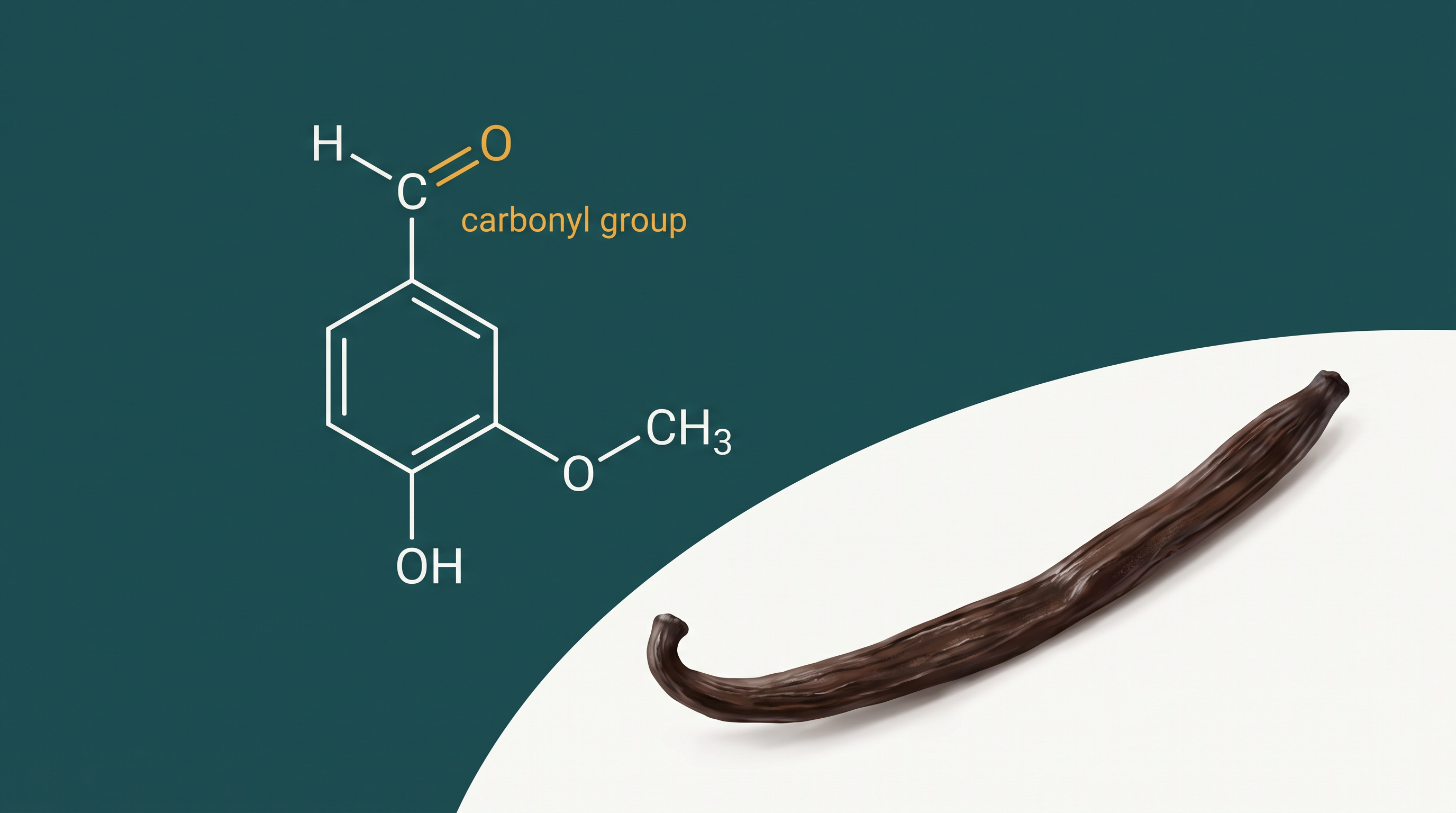
Fig. 8.0 – Vanillin and its source, the vanilla pod.
Keep these questions in mind as you read. The chapter will give you everything you need to reason your way to each answer.
8.1 Nomenclature and Structure of Carbonyl Group
The Carbonyl Family
In the previous Chapter you studied organic compounds whose functional groups contain a carbon–oxygen single bond — alcohols, phenols and ethers. In this Chapter we move to compounds that contain a carbon–oxygen double bond, written as >C=O. This group is called the carbonyl group, and it is one of the most important functional groups in the whole of organic chemistry.
What makes the carbonyl group so powerful is that the same >C=O unit appears in several different families of compounds. What changes from family to family is simply what the carbonyl carbon is attached to on its other two sides.
In aldehydes, the carbonyl group is bonded to a carbon and a hydrogen. In ketones, it is bonded to two carbon atoms. When the carbon of the carbonyl group is bonded to carbon or hydrogen on one side and to the oxygen of a hydroxyl moiety (–OH) on the other, the compound is a carboxylic acid.
The family widens further. If the carbonyl carbon is attached to carbon or hydrogen and to the nitrogen of an –NH₂ moiety, the compound is an amide; if it is attached to a halogen, it is an acyl halide. Esters and anhydrides are derivatives of carboxylic acids. The general formulas of all these classes are drawn together in Fig. 8.1, and it is worth spending a minute comparing them side by side, because almost every reaction in this chapter can be traced back to what sits next to that C=O.
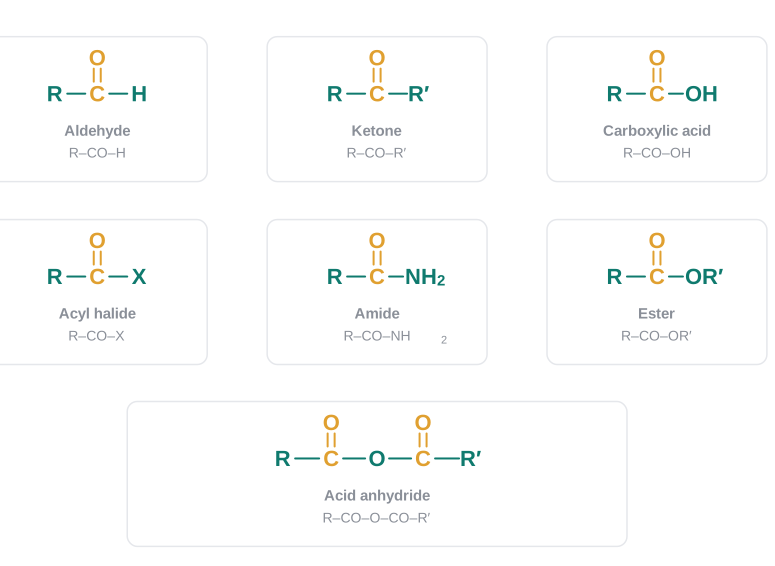
Fig. 8.1 – General formulas of the carbonyl classes.
Carbonyl Compounds Around Us
Aldehydes, ketones and carboxylic acids are widespread in the plant and animal kingdom, and they play an important role in the biochemical processes of life. They also add fragrance and flavour to nature. Vanillin (from vanilla beans), salicylaldehyde (from meadow sweet) and cinnamaldehyde (from cinnamon) all have very pleasant fragrances, and all three carry a –CHO group on an aromatic ring, as shown in Fig. 8.2.
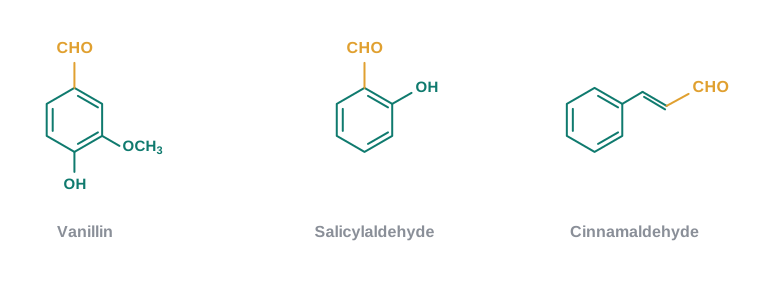
Fig. 8.2 – Structures of three naturally occurring aromatic aldehydes.
These compounds are used in many food products and pharmaceuticals to add flavours. Some members of these families are manufactured for use as solvents (for example, acetone) and for preparing materials such as adhesives, paints, resins, perfumes, plastics and fabrics.
8.1.1 Nomenclature
I. Aldehydes and ketones
Aldehydes and ketones are the simplest and most important carbonyl compounds. There are two systems of nomenclature for them: the older common (trivial) system, still in wide use, and the IUPAC system, which is systematic and never ambiguous. You need both, because reagents in a laboratory bottle and questions in an examination paper may use either.
(a) Common names
Aldehydes and ketones are often called by their common names instead of their IUPAC names. The common names of most aldehydes are derived from the common names of the corresponding carboxylic acids (Section 8.6.1) by replacing the ending –ic of the acid with aldehyde. So acetic acid gives acetaldehyde, and formic acid gives formaldehyde.
At the same time, these names reflect the Latin or Greek term for the original source of the acid or the aldehyde. This is why the common names sound nothing like the structures — they were coined when chemists knew where a substance came from long before they knew what it looked like.
The location of a substituent in the carbon chain is indicated by the Greek letters α, β, γ, δ, and so on. The α-carbon is the one directly linked to the aldehyde group, the β-carbon is the next one, and so on down the chain. Three examples — acetaldehyde, benzaldehyde and β-bromobutyraldehyde — are drawn in Fig. 8.3.
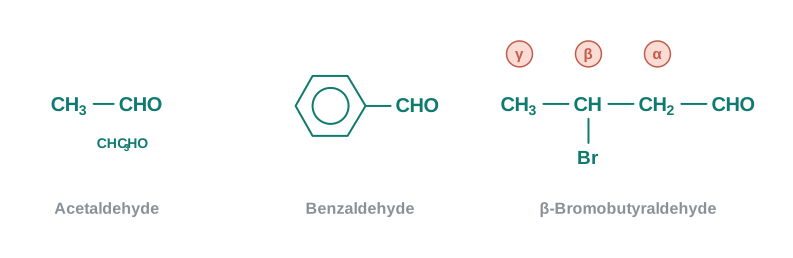
Fig. 8.3 – Common names and positional notation for aldehydes.
The common names of ketones are derived by simply naming the two alkyl or aryl groups bonded to the carbonyl group, followed by the word ketone. Here the locations of substituents are indicated by the Greek letters α α′, β β′ and so on, beginning with the carbon atoms next to the carbonyl group on either side — these two neighbouring carbons are indicated as αα′. A ketone has two sides, so the counting has to start twice, once on each side; hence the primed letters.
Some ketones have historical common names. The simplest one, dimethyl ketone, is called acetone. Alkyl phenyl ketones are usually named by adding the name of the acyl group as a prefix to the word phenone. Acetone, acetophenone, propiophenone and benzophenone are shown in Fig. 8.4.
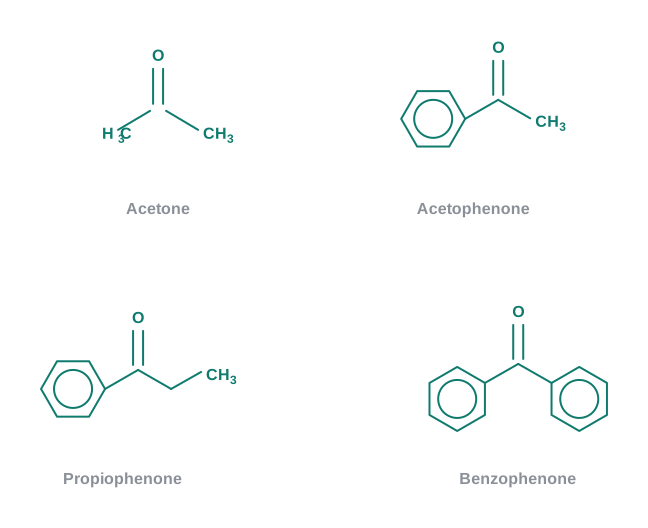
Fig. 8.4 – Common names of representative ketones.
(b) IUPAC names
The IUPAC names of open-chain aliphatic aldehydes and ketones are derived from the names of the corresponding alkanes by replacing the ending –e with –al for aldehydes and –one for ketones. Thus the three-carbon alkane propane gives propanal (aldehyde) and propanone (ketone).
Numbering follows a simple logic. In aldehydes, the longest carbon chain is numbered starting from the carbon of the aldehyde group — the –CHO carbon is always C-1, because an aldehyde group can only sit at the end of a chain. In ketones, the numbering begins from the end nearer to the carbonyl group, so that the carbonyl gets the lowest possible number.
Substituents are prefixed in alphabetical order along with numerals indicating their positions in the carbon chain. The same rule applies to cyclic ketones, where the carbonyl carbon is numbered one.
When the aldehyde group is attached to a ring, the suffix carbaldehyde is added after the full name of the cycloalkane, and the numbering of the ring carbon atoms starts from the carbon atom attached to the aldehyde group. The name of the simplest aromatic aldehyde, carrying the aldehyde group on a benzene ring, is benzenecarbaldehyde; however, the common name benzaldehyde is also accepted by IUPAC. Other aromatic aldehydes are hence named as substituted benzaldehydes.
Worked examples of IUPAC names — ethanal, 4-bromo-3-methylheptanal, 3-methylcyclopentanone, cyclohexanecarbaldehyde, pent-2-enal and 1-phenylpropan-1-one — are collected in Fig. 8.5.
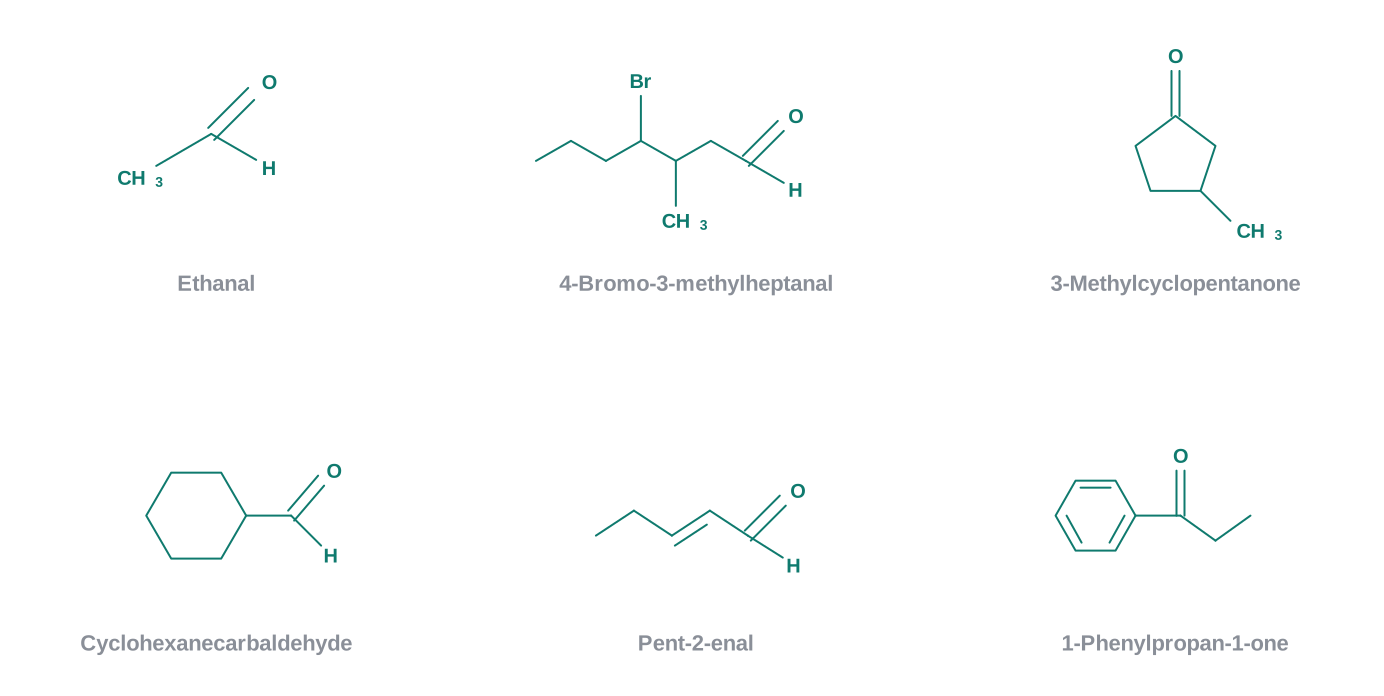
Fig. 8.5 – IUPAC names of aliphatic and cyclic carbonyl compounds.
When a molecule carries two carbonyl groups, only one of them can be the principal suffix; the other is expressed as the prefix oxo–. This is how CH₃CH₂–CO–CH₂–CHO becomes 3-oxopentanal: the –CHO group takes the suffix –al and fixes C-1, and the ketone carbonyl at C-3 becomes “3-oxo”. A branched ketone such as (CH₃)₂CH–CO–CH(CH₃)₂ is named 2,4-dimethylpentan-3-one. An aromatic aldehyde carrying a nitro group para to the –CHO is 4-nitrobenzenecarbaldehyde, also acceptable as 4-nitrobenzaldehyde. These, together with propane-1,2,3-tricarbaldehyde, are shown in Fig. 8.6.
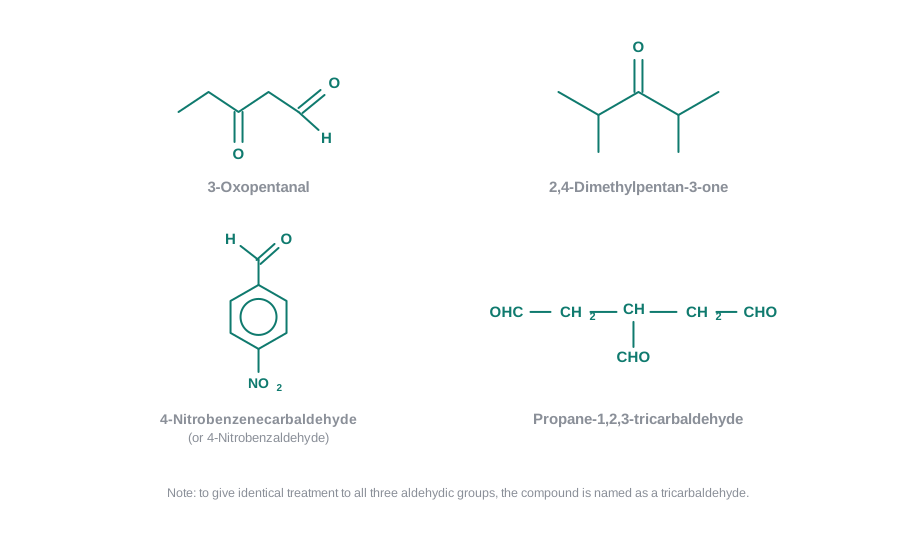
Fig. 8.6 – IUPAC names for polyfunctional and substituted carbonyls.
Notice the last example carefully. In propane-1,2,3-tricarbaldehyde, all three –CHO groups are treated alike, as carbaldehyde groups hanging off a three-carbon propane chain, rather than forcing one of them to be C-1 of the main chain. Giving identical groups identical treatment is a guiding idea of IUPAC naming, and it is exactly why this compound is named as shown.
The common and IUPAC names of some aldehydes and ketones are given in Table 8.1.
Table 8.1: Common and IUPAC Names of Some Aldehydes and Ketones
| Structure | Common name | IUPAC name |
|---|---|---|
| Aldehydes | ||
| \(\\mathrm{HCHO}\) | Formaldehyde | Methanal |
| \(\\mathrm{CH\_3CHO}\) | Acetaldehyde | Ethanal |
| \(\\mathrm{(CH\_3)\_2CHCHO}\) | Isobutyraldehyde | 2-Methylpropanal |
| Cyclohexane ring with –CHO and a –CH₃ at the γ-position | γ-Methylcyclohexanecarbaldehyde | 3-Methylcyclohexanecarbaldehyde |
| \(\\mathrm{CH\_3CH(OCH\_3)CHO}\) | α-Methoxypropionaldehyde | 2-Methoxypropanal |
| \(\\mathrm{CH\_3CH\_2CH\_2CH\_2CHO}\) | Valeraldehyde | Pentanal |
| \(\\mathrm{CH\_2{=}CHCHO}\) | Acrolein | Prop-2-enal |
| Benzene ring with two –CHO groups in the ortho positions | Phthaldehyde | Benzene-1,2-dicarbaldehyde |
| Benzene ring with –CHO and –Br in the meta positions | m-Bromobenzaldehyde | 3-Bromobenzenecarbaldehyde or 3-Bromobenzaldehyde |
| Ketones | ||
| \(\\mathrm{CH\_3COCH\_2CH\_2CH\_3}\) | Methyl n-propyl ketone | Pentan-2-one |
| \(\\mathrm{(CH\_3)\_2CHCOCH(CH\_3)\_2}\) | Diisopropyl ketone | 2,4-Dimethylpentan-3-one |
| Cyclohexanone ring with a –CH₃ on the carbon next to C=O | α-Methylcyclohexanone | 2-Methylcyclohexanone |
| \(\\mathrm{(CH\_3)\_2C{=}CHCOCH\_3}\) | Mesityl oxide | 4-Methylpent-3-en-2-one |
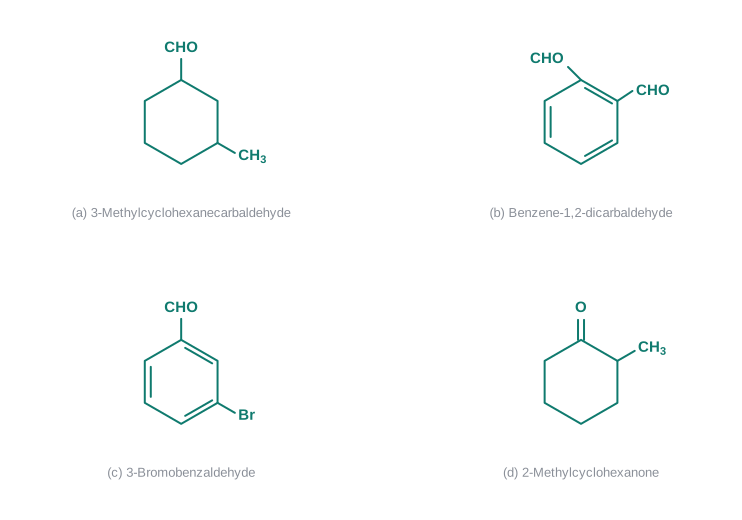
Fig. 8.7 – Ring structures corresponding to entries in Table 8.1.
Read Table 8.1 across the rows and a pattern emerges: the common name usually tells you a source or a substituent position in Greek letters, while the IUPAC name tells you the chain length and the exact locant. That is why IUPAC names, though longer, are the ones an examiner can mark unambiguously.
8.1.2 Structure of the Carbonyl Group
A name tells you what a molecule is called; its structure tells you what it will do. Everything the carbonyl group does in the rest of this chapter follows from two structural facts: its shape and its polarity.
Shape: trigonal and planar
The carbonyl carbon atom is \(sp^2\)-hybridised and forms three sigma (σ) bonds. The fourth valence electron of carbon remains in its p-orbital and forms a π-bond with oxygen by overlapping with a p-orbital of the oxygen atom. In addition, the oxygen atom also has two non-bonding electron pairs (lone pairs).
The consequence is that the carbonyl carbon and the three atoms attached to it all lie in the same plane, and the π-electron cloud lies above and below this plane. The bond angles are approximately 120°, as expected of a trigonal coplanar structure. The orbital picture is drawn in Fig. 8.8.
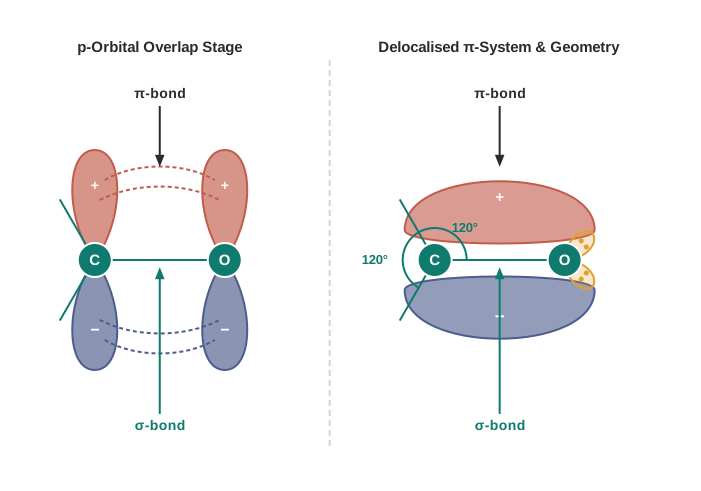
Fig. 8.8 – Orbital diagram of the carbonyl group.
This flat, open geometry matters enormously. Because the carbonyl carbon is planar, a reagent can approach it from above or below the plane with nothing in the way — an invitation that alkanes and alkenes simply do not offer. You will see in Section 8.4 that this is exactly how nucleophilic addition begins.
Polarity: two reactive centres in one bond
The carbon–oxygen double bond is polarised, because oxygen is considerably more electronegative than carbon and pulls the shared electrons towards itself. The result is a permanent separation of charge: a partial positive charge (δ+) on carbon and a partial negative charge (δ−) on oxygen.
Hence the carbonyl carbon is an electrophilic (Lewis acid) centre — electron-poor, and therefore hungry for electrons — while the carbonyl oxygen is a nucleophilic (Lewis base) centre, since it is electron-rich and carries lone pairs. A nucleophile is a species that donates an electron pair; an electrophile is a species that accepts one. One functional group thus offers a site for each kind of attack.
Because of this charge separation, carbonyl compounds have substantial dipole moments and are more polar than ethers, in which the two C–O bonds are single and the polarity is far smaller. The high polarity of the carbonyl group is explained on the basis of resonance involving a neutral structure (A) and a dipolar structure (B), shown in Fig. 8.9.
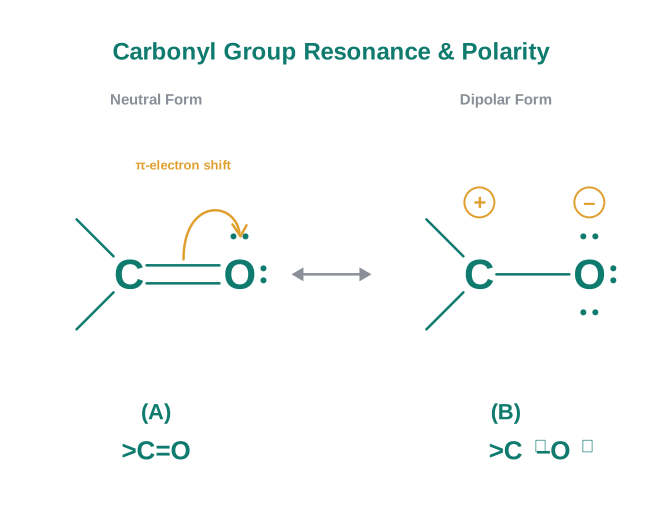
Fig. 8.9 – Resonance in the carbonyl group.
The dipolar structure (B) is a genuine contributor, not a decoration. It says, in the language of resonance, that some of the π-electron density really does sit on oxygen, leaving carbon short of electrons. That is the structural root of almost every reaction of aldehydes and ketones you will meet.
8.2 Preparation of Aldehydes and Ketones
Some important methods for the preparation of aldehydes and ketones are given below. As you read them, keep one idea in mind: an aldehyde sits halfway between an alcohol and a carboxylic acid on the oxidation ladder. It is easy to make and easy to destroy, because the very reagent that produces it can go on to oxidise it further. Much of the ingenuity in this section lies in stopping at the right rung. The overall picture is summarised in FC 8.1.
Flowchart
FC 8.1 – Routes to carbonyl compounds: primary alcohol → (controlled oxidation / dehydrogenation) → aldehyde → (further oxidation) → carboxylic acid; secondary alcohol → (oxidation / dehydrogenation) → ketone; alkene → (O₃, then Zn/H₂O) → aldehyde and/or ketone; alkyne → (H₂O, H₂SO₄/HgSO₄) → ethanal (from ethyne) or ketone (all other alkynes).
8.2.1 Preparation of Aldehydes and Ketones
These first methods work for both classes; which product you get depends only on the starting material you choose.
1. By oxidation of alcohols
Aldehydes and ketones are generally prepared by the oxidation of primary and secondary alcohols respectively (Chapter 7, Class XII). A primary alcohol has its –OH carbon bearing two hydrogens, and removing two of them gives the –CHO group. A secondary alcohol has only one hydrogen on the –OH carbon, so oxidation can only take it as far as >C=O, and no further — which is precisely why ketones are the easier of the two to prepare cleanly.
2. By dehydrogenation of alcohols
This method is suitable for volatile alcohols and is of industrial application. In this method, alcohol vapours are passed over heavy metal catalysts (Ag or Cu). Primary and secondary alcohols give aldehydes and ketones respectively (Chapter 7, Class XII).
Note the difference from the previous method: here no oxidising agent is consumed at all. The catalyst simply strips two hydrogen atoms from the alcohol and releases them as \(\\mathrm{H\_2}\). That is why the industry likes it — the hot vapour meets a metal gauze, the product leaves, and the catalyst stays behind to work again.
3. From hydrocarbons
(i) By ozonolysis of alkenes. As you know, ozonolysis of alkenes followed by reaction with zinc dust and water gives aldehydes, ketones, or a mixture of both, depending on the substitution pattern of the alkene (Chapter 9, Class XI). The C=C double bond is cut open, and each carbon of the old double bond ends up as the carbon of a new carbonyl group. A doubly substituted carbon must become a ketone; a carbon carrying a hydrogen must become an aldehyde.
Zinc dust is not decoration. It is there to reduce the hydrogen peroxide formed during the workup, which would otherwise oxidise the aldehyde straight through to a carboxylic acid.
(ii) By hydration of alkynes. Addition of water to ethyne in the presence of \(\\mathrm{H\_2SO\_4}\) and \(\\mathrm{HgSO\_4}\) gives acetaldehyde. All other alkynes give ketones in this reaction (Chapter 9, Class XI). Ethyne is the only alkyne with a hydrogen on each of the triple-bonded carbons, which is why it alone can yield an aldehyde.
8.2.2 Preparation of Aldehydes
The methods that follow are chosen for one reason: they deliver an aldehyde and then stop.
1. From acyl chloride (acid chloride)
Acyl chloride (acid chloride) is hydrogenated over a catalyst, palladium supported on barium sulphate. This reaction is called Rosenmund reduction.
\[\\mathrm{C\_6H\_5COCl} \\xrightarrow{\\ \\mathrm{H\_2}\\ /\\ \\mathrm{Pd}-\\mathrm{BaSO\_4}\\ } \\mathrm{C\_6H\_5CHO}\]
Benzoyl chloride thus gives benzaldehyde.
2. From nitriles and esters
Nitriles are reduced to the corresponding imine with stannous chloride in the presence of hydrochloric acid, which on hydrolysis gives the corresponding aldehyde.
\[\\mathrm{RCN} + \\mathrm{SnCl\_2} + \\mathrm{HCl} \\rightarrow \\mathrm{RCH{=}NH} \\xrightarrow{\\ \\mathrm{H\_3O^{+}}\\ } \\mathrm{RCHO}\]
This reaction is called the Stephen reaction. The carbon–nitrogen triple bond is reduced only as far as the C=N double bond, and water then replaces the nitrogen to leave a C=O.
Alternatively, nitriles are selectively reduced by diisobutylaluminium hydride (DIBAL-H) to imines, followed by hydrolysis to aldehydes:
\[\\mathrm{RCN} \\xrightarrow\[\\ 2.\\ \\mathrm{H\_2O}\\ ]{\\ 1.\\ \\mathrm{AlH(i\\text{-}Bu)\_2}\\ } \\mathrm{R!-!CHO}\]
\[\\mathrm{CH\_3!-!CH{=}CH!-!CH\_2CH\_2!-!CN} \\xrightarrow\[\\ 2.\\ \\mathrm{H\_2O}\\ ]{\\ 1.\\ \\mathrm{AlH(i\\text{-}Bu)\_2}\\ } \\mathrm{CH\_3!-!CH{=}CH!-!CH\_2CH\_2!-!CHO}\]
Look at what survives in that second example: the C=C double bond is left completely untouched. That is the meaning of the word selective.
Similarly, esters are also reduced to aldehydes with DIBAL-H.
\[\\mathrm{CH\_3(CH\_2)\_9!-!COOC\_2H\_5} \\xrightarrow\[\\ 2.\\ \\mathrm{H\_2O}\\ ]{\\ 1.\\ \\text{DIBAL-H}\\ } \\mathrm{CH\_3(CH\_2)\_9!-!CHO}\]
3. From hydrocarbons
Aromatic aldehydes (benzaldehyde and its derivatives) are prepared from aromatic hydrocarbons by the following methods. The routes from toluene are collected in FC 8.2.
Flowchart
FC 8.2 – Toluene to benzaldehyde: toluene → (CrO₂Cl₂ / CS₂) → chromium complex → (H₃O⁺) → benzaldehyde [Etard reaction]; toluene → (CrO₃ + (CH₃CO)₂O, 273–283 K) → benzylidene diacetate → (H₃O⁺, Δ) → benzaldehyde; toluene → (Cl₂ / hν) → benzal chloride → (H₂O, 373 K) → benzaldehyde [commercial route]; separately, benzene → (CO + HCl, anhyd. AlCl₃/CuCl) → benzaldehyde [Gattermann–Koch].
(i) By oxidation of methylbenzene. Strong oxidising agents oxidise toluene and its derivatives all the way to benzoic acids. However, it is possible to stop the oxidation at the aldehyde stage with suitable reagents that convert the methyl group into an intermediate that is difficult to oxidise further. The following methods are used for this purpose.
(a) Use of chromyl chloride (\(\\mathrm{CrO\_2Cl\_2}\)). Chromyl chloride oxidises the methyl group to a chromium complex, which on hydrolysis gives the corresponding benzaldehyde.
\[\\mathrm{C\_6H\_5CH\_3} + \\mathrm{CrO\_2Cl\_2} \\xrightarrow{\\ \\mathrm{CS\_2}\\ } \\mathrm{C\_6H\_5CH(OCrOHCl\_2)\_2} \\xrightarrow{\\ \\mathrm{H\_3O^{+}}\\ } \\mathrm{C\_6H\_5CHO}\]
This reaction is called the Etard reaction. The trick is clear if you look at the middle compound: the chromium complex protects the carbon from further attack until water is added, and only then is the aldehyde released.
(b) Use of chromic oxide (\(\\mathrm{CrO\_3}\)). Toluene or substituted toluene is converted to benzylidene diacetate on treatment with chromic oxide in acetic anhydride. The benzylidene diacetate can be hydrolysed to the corresponding benzaldehyde with aqueous acid.
\[\\mathrm{C\_6H\_5CH\_3} + \\mathrm{CrO\_3} + \\mathrm{(CH\_3CO)\_2O} \\xrightarrow{\\ 273-283\\ \\text{K}\\ } \\mathrm{C\_6H\_5CH(OCOCH\_3)\_2} \\xrightarrow\[\\ \\Delta\\ ]{\\ \\mathrm{H\_3O^{+}}\\ } \\mathrm{C\_6H\_5CHO}\]
Again, the same strategy: the methyl carbon is first locked up as a diacetate, and only released as –CHO at the hydrolysis step.
(ii) By side-chain chlorination followed by hydrolysis. Side-chain chlorination of toluene gives benzal chloride, which on hydrolysis gives benzaldehyde. This is a commercial method of manufacture of benzaldehyde.
\[\\mathrm{C\_6H\_5CH\_3} \\xrightarrow{\\ \\mathrm{Cl\_2}\\ /\\ h\\nu\\ } \\mathrm{C\_6H\_5CHCl\_2} \\xrightarrow{\\ \\mathrm{H\_2O},\\ 373\\ \\text{K}\\ } \\mathrm{C\_6H\_5CHO}\]
Two chlorine atoms on the same carbon is the key. A carbon carrying two halogens and, after hydrolysis, two –OH groups (a gem-diol) simply loses water to give the C=O group.
(iii) By Gattermann–Koch reaction. When benzene or its derivative is treated with carbon monoxide and hydrogen chloride in the presence of anhydrous aluminium chloride or cuprous chloride, it gives benzaldehyde or substituted benzaldehyde.
\[\\mathrm{C\_6H\_6} \\xrightarrow\[\\ \\text{Anhyd. } \\mathrm{AlCl\_3}/\\mathrm{CuCl}\\ ]{\\ \\mathrm{CO},\\ \\mathrm{HCl}\\ } \\mathrm{C\_6H\_5CHO}\]
This reaction is known as the Gattermann–Koch reaction. In effect, CO and HCl together behave as though they were formyl chloride (HCOCl), a compound too unstable to bottle — the Lewis acid generates the attacking formyl species in situ, and ordinary electrophilic substitution on the ring does the rest.
8.2.3 Preparation of Ketones
1. From acyl chlorides
Treatment of acyl chlorides with dialkylcadmium, prepared by the reaction of cadmium chloride with a Grignard reagent, gives ketones.
\[2,\\mathrm{R!-!Mg!-!X} + \\mathrm{CdCl\_2} \\rightarrow \\mathrm{R\_2Cd} + 2,\\mathrm{Mg(X)Cl}\]
\[2,\\mathrm{R'!-!CO!-!Cl} + \\mathrm{R\_2Cd} \\rightarrow 2,\\mathrm{R'!-!CO!-!R} + \\mathrm{CdCl\_2}\]
Why go to the trouble of converting the Grignard reagent into a cadmium compound at all? Because a Grignard reagent is too reactive: it would add to the ketone as soon as it is formed and carry on to a tertiary alcohol. Dialkylcadmium is a milder carbon nucleophile — reactive enough to attack the acyl chloride, but not reactive enough to attack the ketone product. Once more, the chemistry is about stopping in time.
2. From nitriles
Treating a nitrile with a Grignard reagent, followed by hydrolysis, yields a ketone.
\[\\mathrm{CH\_3CH\_2!-!C{\\equiv}N} + \\mathrm{C\_6H\_5MgBr} \\xrightarrow{\\ \\text{ether}\\ } \\mathrm{CH\_3CH\_2!-!C(C\_6H\_5){=}NMgBr} \\xrightarrow{\\ \\mathrm{H\_3O^{+}}\\ } \\mathrm{C\_2H\_5!-!CO!-!C\_6H\_5}\]
The product is propiophenone (1-phenylpropanone). Here the Grignard reagent adds only once, because the intermediate formed is a magnesium salt of an imine, and it is unreactive towards a second attack until water is added.
3. From benzene or substituted benzenes
When benzene or a substituted benzene is treated with an acid chloride in the presence of anhydrous aluminium chloride, it affords the corresponding ketone. This reaction is known as the Friedel–Crafts acylation reaction.
\[\\mathrm{C\_6H\_6} + \\mathrm{Ar/R!-!CO!-!Cl} \\xrightarrow{\\ \\text{Anhyd. } \\mathrm{AlCl\_3}\\ } \\mathrm{C\_6H\_5!-!CO!-!Ar/R}\]
Anhydrous \(\\mathrm{AlCl\_3}\) acts as a Lewis acid: it pulls the chloride away from the acid chloride to generate an acylium ion, \(\\mathrm{R!-!C^{+}{=}O}\), which is the electrophile that attacks the benzene ring. The word anhydrous is not optional — even traces of water destroy the Lewis acid.
8.3 Physical Properties
The physical properties of aldehydes and ketones follow directly from the structure you met in Section 8.1.2: a polar C=O group, with a δ+ carbon and a δ− oxygen, and no hydrogen attached to that oxygen. Hold on to that second fact — nearly everything below turns on it.
Physical state and boiling points
Methanal is a gas at room temperature. Ethanal is a volatile liquid. Other aldehydes and ketones are liquids or solids at room temperature.
The boiling points of aldehydes and ketones are higher than those of hydrocarbons and ethers of comparable molecular masses. This is due to the weak molecular association in aldehydes and ketones arising out of dipole–dipole interactions: the δ+ carbon of one molecule is attracted to the δ− oxygen of a neighbour, so the molecules cling together a little, and extra energy is needed to pull them apart.
At the same time, their boiling points are lower than those of alcohols of similar molecular masses, because of the absence of intermolecular hydrogen bonding. A hydrogen bond needs a hydrogen atom bonded to a strongly electronegative atom (O, N or F). An alcohol has an O–H bond and can form such a bridge to a neighbouring molecule; an aldehyde or a ketone has an oxygen but no O–H hydrogen of its own, so no such bridge can form between two carbonyl molecules.
The following compounds of molecular masses 58 and 60 are ranked in order of increasing boiling points.
Boiling points of some compounds of comparable molecular mass
| Compound | b.p. (K) | Molecular Mass |
|---|---|---|
| n-Butane | 273 | 58 |
| Methoxyethane | 281 | 60 |
| Propanal | 322 | 58 |
| Acetone | 329 | 58 |
| Propan-1-ol | 370 | 60 |
Read the table as a story about forces, not about sizes. The molecular masses barely change, yet the boiling point climbs by nearly a hundred kelvin. n-Butane has only weak van der Waals forces; methoxyethane is slightly polar; propanal and acetone have genuine dipole–dipole attraction; propan-1-ol adds hydrogen bonding on top of everything else — and it boils highest of all. The strength of the intermolecular force, not the mass, decides the boiling point here.
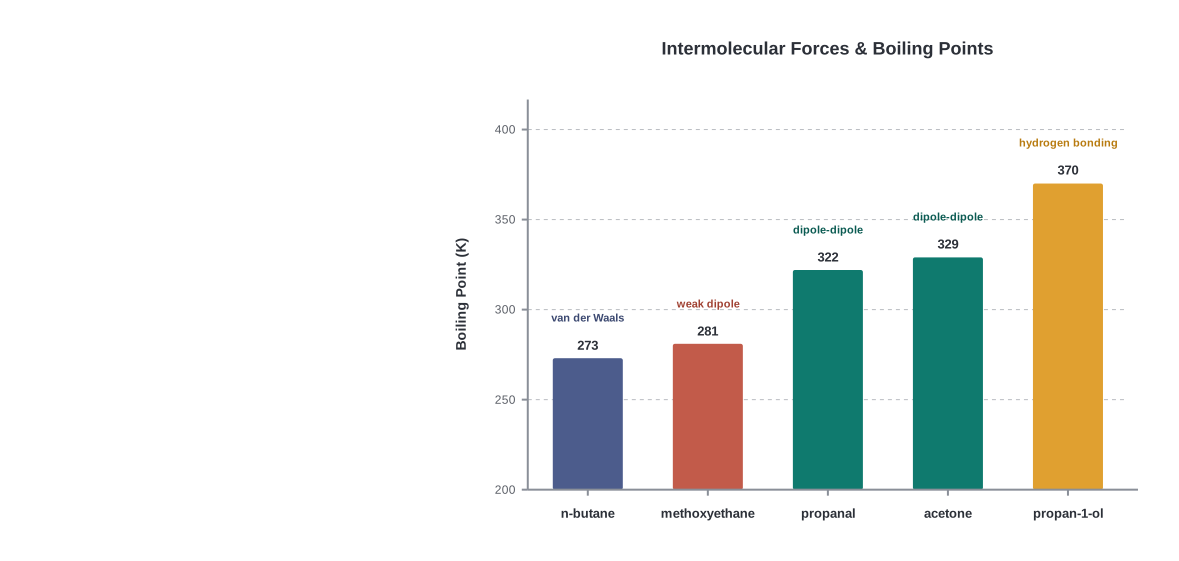
Fig. 8.10 – Boiling points of compounds with comparable molecular masses.
Solubility
The lower members of aldehydes and ketones — such as methanal, ethanal and propanone — are miscible with water in all proportions, because they form hydrogen bonds with water.
This may look like a contradiction of what was just said, but it is not. Two carbonyl molecules cannot hydrogen-bond to each other, because neither supplies the required O–H hydrogen. Water, however, supplies it happily: the O–H of water bonds to the lone pair on the δ− carbonyl oxygen. The carbonyl compound is a hydrogen-bond acceptor, not a donor. This bonding is shown in Fig. 8.11.
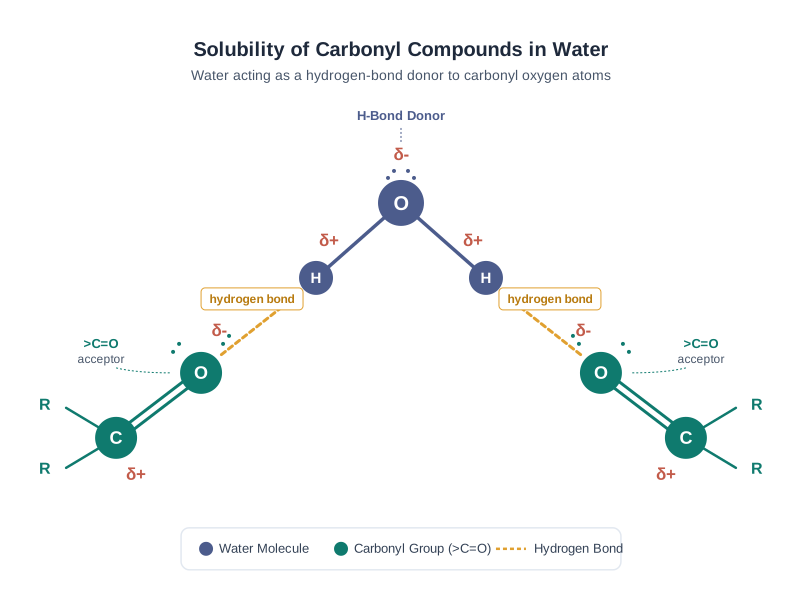
Fig. 8.11 – Hydrogen bonding between a carbonyl group and water.
However, the solubility of aldehydes and ketones decreases rapidly on increasing the length of the alkyl chain. The long hydrocarbon tail cannot hydrogen-bond with water and pushes water molecules apart; the small polar head can no longer carry the molecule into solution.
All aldehydes and ketones are fairly soluble in organic solvents like benzene, ether, methanol, chloroform, etc.
Odour
The lower aldehydes have sharp, pungent odours. As the size of the molecule increases, the odour becomes less pungent and more fragrant. In fact, many naturally occurring aldehydes and ketones are used in the blending of perfumes and flavouring agents.
8.4 Chemical Reactions
Since aldehydes and ketones both possess the carbonyl functional group, they undergo similar chemical reactions. Their reactions fall into five groups: nucleophilic addition, reduction, oxidation, reactions due to the α-hydrogen, and a few special reactions. Every one of them can be traced back to the two structural facts from Section 8.1.2 — the planar, electrophilic carbon and the electron-withdrawing power of the C=O group.
1. Nucleophilic addition reactions
Contrary to the electrophilic addition reactions observed in alkenes, aldehydes and ketones undergo nucleophilic addition reactions. The reason is a matter of charge. In an alkene the C=C π-electrons are exposed and electron-rich, so an electrophile attacks. In a carbonyl compound the π-electrons are pulled towards oxygen, leaving the carbon electron-poor, so a nucleophile attacks instead.
(i) Mechanism of nucleophilic addition reactions
A nucleophile attacks the electrophilic carbon atom of the polar carbonyl group from a direction approximately perpendicular to the plane of the \(sp^2\) hybridised orbitals of the carbonyl carbon (Fig. 8.12). Approaching from above or below the plane keeps the incoming nucleophile as far as possible from the groups already attached to the carbon.
The hybridisation of the carbon changes from \(sp^2\) to \(sp^3\) in this process, and a tetrahedral alkoxide intermediate is produced. This intermediate captures a proton from the reaction medium to give the electrically neutral product. The net result is the addition of \(\\mathrm{Nu^{-}}\) and \(\\mathrm{H^{+}}\) across the carbon–oxygen double bond, as shown in Fig. 8.12.
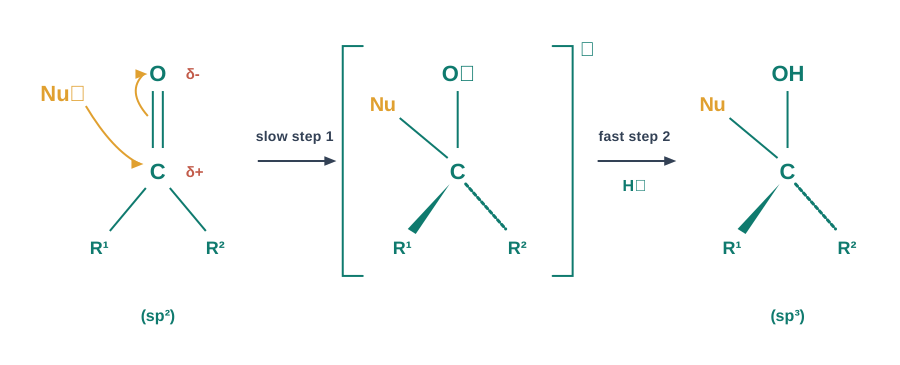
Fig. 8.12 – Mechanism of nucleophilic attack on a carbonyl carbon.
Flowchart
FC 8.3 – Nucleophilic addition, step by step: >C=O (planar, sp², δ+ C) → slow attack by Nu⁻ perpendicular to the plane → tetrahedral alkoxide intermediate (sp³ C, O⁻) → fast capture of H⁺ from the medium → neutral addition product >C(Nu)(OH); note: net addition of Nu⁻ and H⁺ across C=O.
Notice which step is slow. The first step, in which the π-bond breaks and a negative charge builds up on oxygen, is the rate-determining one; the proton capture that follows is fast. So anything that makes the carbonyl carbon more electron-poor, or easier to reach, speeds up the whole reaction — and that is exactly what the next paragraph is about.
(ii) Reactivity
Aldehydes are generally more reactive than ketones in nucleophilic addition reactions, for two reasons — one about size, one about charge.
Sterically, the presence of two relatively large substituents in ketones hinders the approach of the nucleophile to the carbonyl carbon, compared with aldehydes, which have only one such substituent (the other position being occupied by a small hydrogen atom).
Electronically, aldehydes are more reactive than ketones because two alkyl groups reduce the electrophilicity of the carbonyl carbon more effectively than one. Alkyl groups are electron-releasing: they push electron density towards the δ+ carbon and partially satisfy it. Two such groups do this better than one, so a ketone’s carbonyl carbon is less electron-poor, and hence less attractive to a nucleophile, than an aldehyde’s.
Would you expect benzaldehyde to be more reactive or less reactive in nucleophilic addition reactions than propanal? Explain your answer.
The carbon atom of the carbonyl group of benzaldehyde is less electrophilic than the carbon atom of the carbonyl group present in propanal. The polarity of the carbonyl group is reduced in benzaldehyde due to resonance, as shown in Fig. 8.13, and hence it is less reactive than propanal.

[Caption:] Fig. 8.13 – Resonance stabilization in benzaldehyde. [/Caption:]
The benzene ring feeds electron density into the carbonyl group through conjugation. The carbonyl carbon is therefore less positive than in an ordinary aliphatic aldehyde, and a nucleophile finds it less inviting.
(iii) Some important examples of nucleophilic addition and nucleophilic addition–elimination reactions
(a) Addition of hydrogen cyanide (HCN). Aldehydes and ketones react with hydrogen cyanide (HCN) to yield cyanohydrins. This reaction occurs very slowly with pure HCN. Therefore, it is catalysed by a base, and the generated cyanide ion (\(\\mathrm{CN^{-}}\)), being a stronger nucleophile, readily adds to carbonyl compounds to yield the corresponding cyanohydrin.
\[\\mathrm{HCN} + \\mathrm{OH^{-}} \\rightleftharpoons \\mathrm{CN^{-}} + \\mathrm{H\_2O}\]
\[\\mathrm{{>}C{=}O} + \\mathrm{CN^{-}} \\rightleftharpoons \\mathrm{{>}C(O^{-})!-!CN} \\xrightarrow{\\ \\mathrm{H^{+}}\\ } \\mathrm{{>}C(OH)!-!CN}\]
Cyanohydrins are useful synthetic intermediates, because the –CN group they carry can later be hydrolysed to –COOH or reduced to –CH₂NH₂, adding a whole new carbon to the molecule.
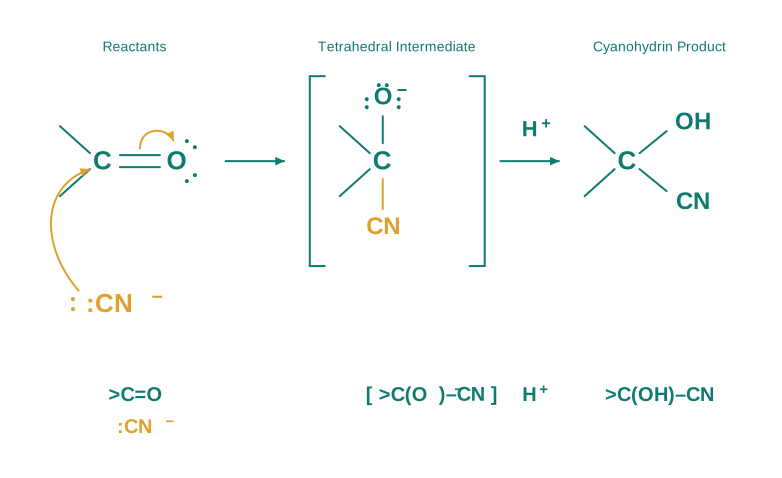
Fig. 8.14 – Formation of a cyanohydrin.
(b) Addition of sodium hydrogensulphite. Sodium hydrogensulphite adds to aldehydes and ketones to form addition products.
\[\\mathrm{{>}C{=}O} + \\mathrm{NaHSO\_3} \\rightleftharpoons \\mathrm{{>}C(OSO\_2H)!-!ONa} \\xrightarrow{\\ \\text{proton transfer}\\ } \\mathrm{{>}C(OH)!-!OSO\_2Na}\]
The product is the crystalline bisulphite addition compound. The position of the equilibrium lies largely to the right-hand side for most aldehydes and to the left for most ketones, due to steric reasons — the bulky \(\\mathrm{-SO\_3^{-}}\) group simply cannot fit comfortably onto a carbon that already carries two alkyl groups.
The hydrogensulphite addition compound is water soluble and can be converted back to the original carbonyl compound by treating it with dilute mineral acid or alkali. Therefore, these compounds are useful for the separation and purification of aldehydes.
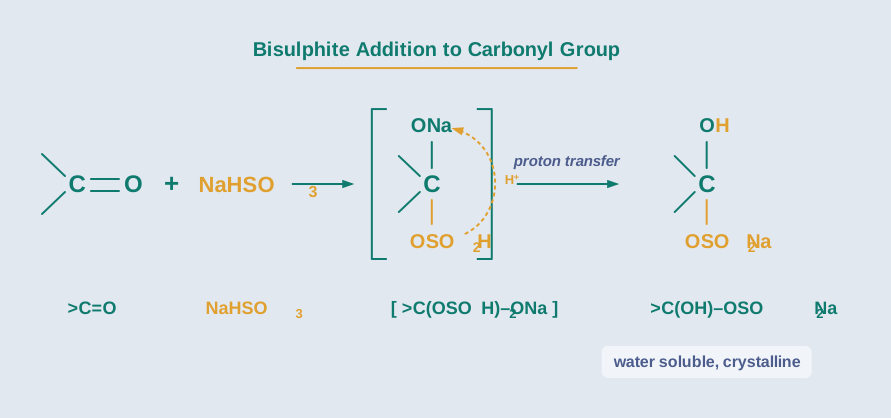
Fig. 8.15 – Bisulphite addition to a carbonyl group.
(c) Addition of Grignard reagents (refer Chapter 7, Class XII). The carbanion-like carbon of \(\\mathrm{R!-!Mg!-!X}\) adds to the carbonyl carbon and, after hydrolysis, gives an alcohol.
(d) Addition of alcohols. Aldehydes react with one equivalent of a monohydric alcohol in the presence of dry hydrogen chloride to yield an alkoxyalcohol intermediate, known as a hemiacetal, which further reacts with one more molecule of the alcohol to give a gem-dialkoxy compound known as an acetal.
\[\\mathrm{R!-!CHO} \\xrightarrow\[\\ \\mathrm{HCl}\\ \\text{gas}\\ ]{\\ \\mathrm{R'OH}\\ } \\mathrm{R!-!CH(OH)(OR')} \\xrightarrow\[\\ \\mathrm{H^{+}}\\ ]{\\ \\mathrm{R'OH}\\ } \\mathrm{R!-!CH(OR')\_2} + \\mathrm{H\_2O}\]
Ketones react with ethylene glycol under similar conditions to form cyclic products known as ethylene glycol ketals.
\[\\mathrm{{>}C{=}O} + \\mathrm{HOCH\_2CH\_2OH} \\xrightarrow\[\\ \\text{dil. } \\mathrm{HCl}\\ ]{\\ \\mathrm{HCl}\\ \\text{gas}\\ } \\text{cyclic ethylene glycol ketal} + \\mathrm{H\_2O}\]
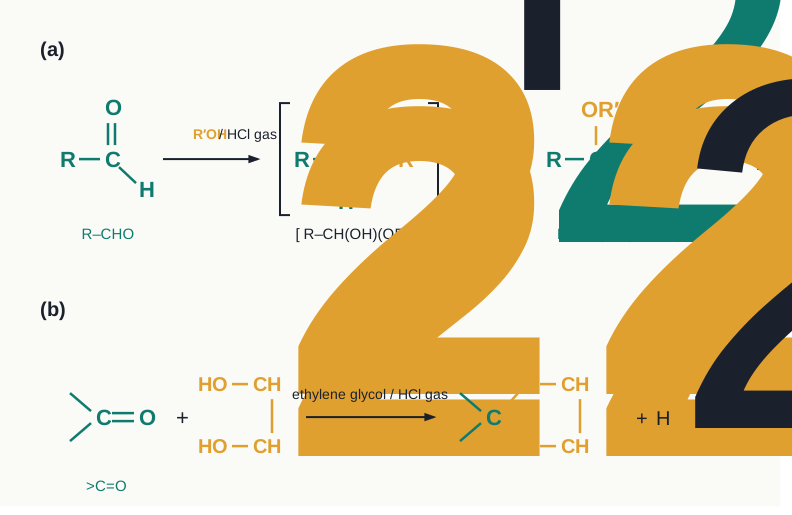
Fig. 8.16 – Formation of acetals and cyclic ketals.
Dry hydrogen chloride protonates the oxygen of the carbonyl compound and therefore increases the electrophilicity of the carbonyl carbon, facilitating the nucleophilic attack of ethylene glycol. This is worth pausing on: an alcohol is a rather weak nucleophile, so the carbonyl group has to be activated before it will accept one. Protonation of the oxygen does exactly that, by pulling still more electron density away from the carbon.
Acetals and ketals are hydrolysed with aqueous mineral acids to yield the corresponding aldehydes and ketones respectively. Because the whole process is reversible, an acetal or ketal can be used as a protecting group: a carbonyl group is temporarily converted into a ketal, other parts of the molecule are worked on, and the carbonyl is set free again by aqueous acid.
(e) Addition of ammonia and its derivatives. Nucleophiles such as ammonia and its derivatives \(\\mathrm{H\_2N!-!Z}\) add to the carbonyl group of aldehydes and ketones. The reaction is reversible and catalysed by acid.
\[\\mathrm{{>}C{=}O} + \\mathrm{H\_2N!-!Z} \\rightleftharpoons \\mathrm{{>}C(OH)!-!NHZ} \\rightarrow \\mathrm{{>}C{=}N!-!Z} + \\mathrm{H\_2O}\]
The equilibrium favours the product formation due to the rapid dehydration of the intermediate to form >C=N–Z. So this is really a two-stage reaction: addition first, then elimination of water — which is why it is called a nucleophilic addition–elimination reaction.
Here \(\\mathrm{Z}\) = alkyl, aryl, OH, \(\\mathrm{NH\_2}\), \(\\mathrm{C\_6H\_5NH}\), \(\\mathrm{NHCONH\_2}\), etc.
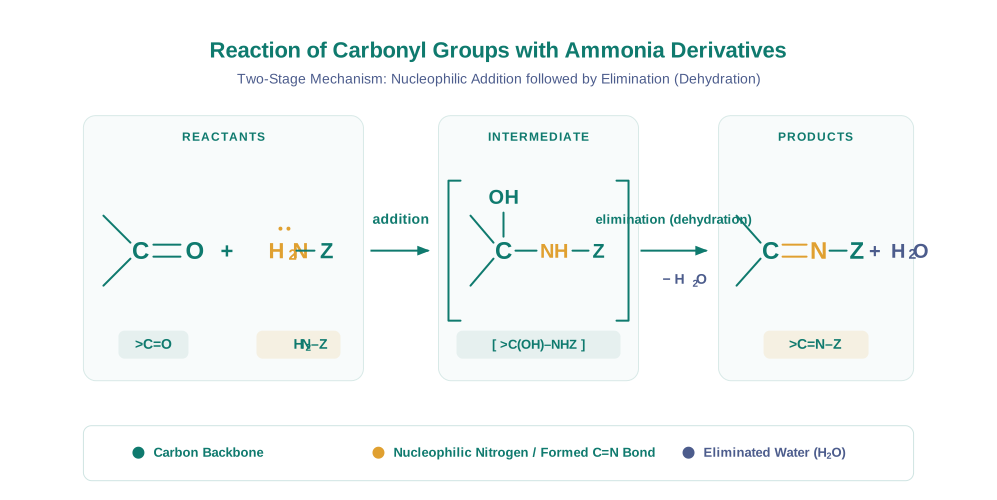
Fig. 8.17 – Addition–elimination mechanism for ammonia derivatives.
Table 8.2: Some N-Substituted Derivatives of Aldehydes and Ketones (>C=N–Z)
| Z | Reagent name | Carbonyl derivative | Product name |
|---|---|---|---|
| –H | Ammonia | >C=NH | Imine |
| –R | Amine | >C=NR | Substituted imine (Schiff’s base) |
| —OH | Hydroxylamine | >C=N–OH | Oxime |
| —NH₂ | Hydrazine | >C=N–NH₂ | Hydrazone |
| —HN–C₆H₅ (phenyl) | Phenylhydrazine | >C=N–NH–C₆H₅ | Phenylhydrazone |
| —HN–C₆H₃(NO₂)₂ (2,4-dinitrophenyl) | 2,4-Dinitrophenylhydrazine | >C=N–NH–C₆H₃(NO₂)₂ | 2,4-Dinitrophenylhydrazone |
| —NH–CO–NH₂ | Semicarbazide | >C=N–NH–CO–NH₂ | Semicarbazone |
* 2,4-DNP-derivatives are yellow, orange or red solids, useful for characterisation of aldehydes and ketones.
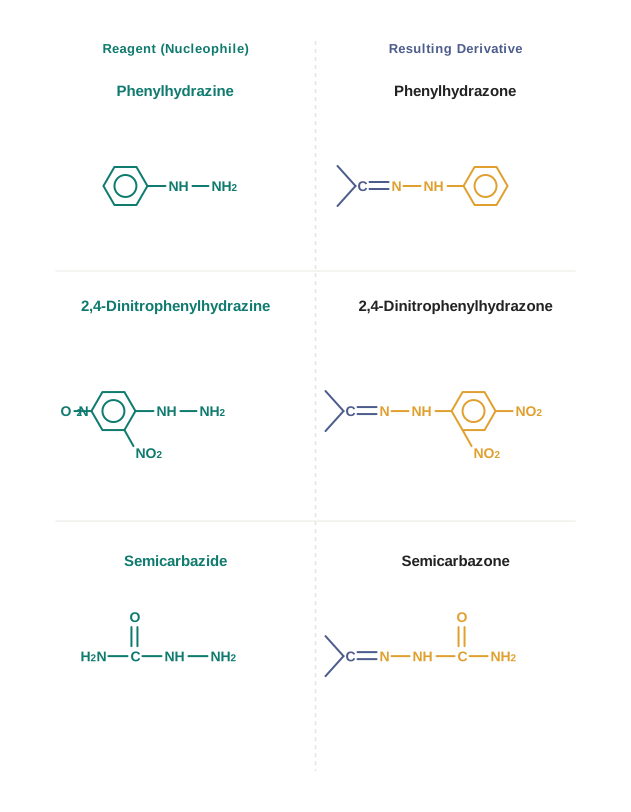
Fig. 8.18 – Reagents for nitrogen derivatives of carbonyls.
2. Reduction
(i) Reduction to alcohols
Aldehydes and ketones are reduced to primary and secondary alcohols respectively by sodium borohydride (\(\\mathrm{NaBH\_4}\)) or lithium aluminium hydride (\(\\mathrm{LiAlH\_4}\)), as well as by catalytic hydrogenation (Chapter 7, Class XII).
\[\\mathrm{R!-!CHO} \\xrightarrow{\\ \\mathrm{NaBH\_4}\\ \\text{or}\\ \\mathrm{LiAlH\_4}\\ } \\mathrm{R!-!CH\_2OH}\]
\[\\mathrm{R!-!CO!-!R'} \\xrightarrow{\\ \\mathrm{NaBH\_4}\\ \\text{or}\\ \\mathrm{LiAlH\_4}\\ } \\mathrm{R!-!CH(OH)!-!R'}\]
Chemically, these reagents are hydride donors: they supply \(\\mathrm{H^{-}}\), which is itself a nucleophile, to the carbonyl carbon. So a reduction is simply a nucleophilic addition in which the nucleophile happens to be a hydride ion — the same mechanism as in Fig. 8.12.
(ii) Reduction to hydrocarbons
The carbonyl group of aldehydes and ketones is reduced all the way to a \(\\mathrm{CH\_2}\) group — that is, the oxygen is removed completely — on treatment with zinc amalgam and concentrated hydrochloric acid (Clemmensen reduction), or with hydrazine followed by heating with sodium or potassium hydroxide in a high-boiling solvent such as ethylene glycol (Wolff–Kishner reduction).
\[\\mathrm{{>}C{=}O} \\xrightarrow\[\\ \\mathrm{HCl}\\ ]{\\ \\mathrm{Zn}\\text{-}\\mathrm{Hg}\\ } \\mathrm{{>}CH\_2} + \\mathrm{H\_2O} \\qquad \\text{(Clemmensen reduction)}\]
\[\\mathrm{{>}C{=}O} \\xrightarrow\[\\ -\\mathrm{H\_2O}\\ ]{\\ \\mathrm{NH\_2NH\_2}\\ } \\mathrm{{>}C{=}N!-!NH\_2} \\xrightarrow\[\\ \\text{heat}\\ ]{\\ \\mathrm{KOH}/\\text{ethylene glycol}\\ } \\mathrm{{>}CH\_2} + \\mathrm{N\_2} \\qquad \\text{(Wolff–Kishner reduction)}\]
Note how the Wolff–Kishner route begins with a reaction you already know: hydrazine (\(\\mathrm{H\_2N!-!NH\_2}\)) is one of the \(\\mathrm{H\_2N!-!Z}\) nucleophiles of Table 8.2, and the first step is nothing but hydrazone formation. Strong base and heat then expel nitrogen gas, leaving a \(\\mathrm{CH\_2}\) group behind.
3. Oxidation
Aldehydes differ sharply from ketones in their oxidation reactions, and this difference is the basis of every test used to tell the two apart. The reason is structural: an aldehyde has a hydrogen atom directly attached to the carbonyl carbon, and that C–H bond can be replaced by a C–O bond without breaking the carbon skeleton. A ketone has no such hydrogen.
Aldehydes are easily oxidised to carboxylic acids on treatment with common oxidising agents like nitric acid, potassium permanganate, potassium dichromate, etc. Even mild oxidising agents, mainly Tollens’ reagent and Fehling’s reagent, also oxidise aldehydes.
\[\\mathrm{R!-!CHO} \\xrightarrow{\\ \[\\mathrm{O}]\\ } \\mathrm{R!-!COOH}\]
Ketones are generally oxidised only under vigorous conditions, that is, with strong oxidising agents and at elevated temperatures. Their oxidation involves carbon–carbon bond cleavage to afford a mixture of carboxylic acids having a smaller number of carbon atoms than the parent ketone.
For a ketone \(\\mathrm{R!-!CH\_2!-!CO!-!CH\_2!-!R'}\), numbering the carbons around the carbonyl as C₁, C₂ (the carbonyl carbon) and C₃:
\[\\mathrm{R!-!CH\_2!-!CO!-!CH\_2!-!R'} \\xrightarrow{\\ \[\\mathrm{O}]\\ } \\mathrm{R!-!COOH} + \\mathrm{R'!-!CH\_2COOH} \\quad (\\text{by cleavage of the } \\mathrm{C\_1!-!C\_2} \\text{ bond})\]
\[\\mathrm{R!-!CH\_2!-!CO!-!CH\_2!-!R'} \\xrightarrow{\\ \[\\mathrm{O}]\\ } \\mathrm{R!-!CH\_2COOH} + \\mathrm{R'!-!COOH} \\quad (\\text{by cleavage of the } \\mathrm{C\_2!-!C\_3} \\text{ bond})\]
Because either C–C bond next to the carbonyl may break, a mixture of acids is obtained — which is precisely why the oxidation of ketones is of little use in synthesis, but is very useful when you are trying to deduce the structure of an unknown ketone from its oxidation products.
The mild oxidising agents given below are used to distinguish aldehydes from ketones. The decision logic is set out in FC 8.4.
Flowchart
FC 8.4 – Distinguishing an unknown carbonyl compound: unknown gives 2,4-DNP derivative → it is an aldehyde or a ketone → warm with Tollens’ reagent → if silver mirror forms → aldehyde; if not → heat with Fehling’s reagent → red-brown precipitate → aliphatic aldehyde; no precipitate → ketone (or aromatic aldehyde, which does not respond to Fehling’s) → test with I₂/NaOH → yellow precipitate of CHI₃ → methyl ketone (CH₃CO– group present); no precipitate → not a methyl ketone.
(i) Tollens’ test
On warming an aldehyde with freshly prepared ammoniacal silver nitrate solution (Tollens’ reagent), a bright silver mirror is produced due to the formation of silver metal. The aldehyde is oxidised to the corresponding carboxylate anion. The reaction occurs in alkaline medium.
\[\\mathrm{RCHO} + 2,\[\\mathrm{Ag(NH\_3)\_2}]^{+} + 3,\\mathrm{OH^{-}} \\rightarrow \\mathrm{RCOO^{-}} + 2,\\mathrm{Ag} + 2,\\mathrm{H\_2O} + 4,\\mathrm{NH\_3}\]
Read the equation as an electron transfer: the aldehyde gives up electrons (it is oxidised to the carboxylate ion), and \(\\mathrm{Ag^{+}}\) takes them up (it is reduced to silver metal, which deposits on the glass as a mirror). A ketone has no C–H bond on the carbonyl carbon to surrender, so nothing happens.
(ii) Fehling’s test
Fehling’s reagent comprises two solutions. Fehling solution A is aqueous copper sulphate, and Fehling solution B is alkaline sodium potassium tartrate (Rochelle salt). These two solutions are mixed in equal amounts before the test. On heating an aldehyde with Fehling’s reagent, a reddish-brown precipitate is obtained. Aldehydes are oxidised to the corresponding carboxylate anion. Aromatic aldehydes do not respond to this test.
\[\\mathrm{R!-!CHO} + 2,\\mathrm{Cu^{2+}} + 5,\\mathrm{OH^{-}} \\rightarrow \\mathrm{RCOO^{-}} + \\mathrm{Cu\_2O} + 3,\\mathrm{H\_2O}\]
The red-brown precipitate is cuprous oxide, \(\\mathrm{Cu\_2O}\): copper(II) has been reduced to copper(I) by the aldehyde. The tartrate in solution B has a quiet but essential job — it keeps the copper(II) ions in solution as a complex, so that they do not simply precipitate as copper(II) hydroxide in the alkaline medium before the test can be performed.
(iii) Oxidation of methyl ketones by haloform reaction
Aldehydes and ketones having at least one methyl group linked to the carbonyl carbon atom (methyl ketones) are oxidised by sodium hypohalite to sodium salts of the corresponding carboxylic acids having one carbon atom less than that of the carbonyl compound. The methyl group is converted to haloform.
\[\\mathrm{R!-!CO!-!CH\_3} \\xrightarrow{\\ \\mathrm{NaOX}\\ } \\mathrm{R!-!COONa} + \\mathrm{CHX\_3} \\qquad (\\mathrm{X = Cl,\\ Br,\\ I})\]
This oxidation does not affect a carbon–carbon double bond, if present in the molecule. Mesityl oxide, for example, keeps its C=C intact:
\[\\mathrm{(CH\_3)\_2C{=}CH!-!CO!-!CH\_3} \\xrightarrow{\\ \\mathrm{NaOCl}\\ } \\mathrm{(CH\_3)\_2C{=}CH!-!COONa} + \\mathrm{CHCl\_3}\]
The iodoform reaction with sodium hypoiodite is also used for the detection of the \(\\mathrm{CH\_3CO}\) group, or of the \(\\mathrm{CH\_3CH(OH)}\) group, which produces the \(\\mathrm{CH\_3CO}\) group on oxidation. Iodoform, \(\\mathrm{CHI\_3}\), is a yellow solid with a characteristic smell, and its appearance is the positive signal.
An organic compound (A) with molecular formula \(\\mathrm{C\_8H\_8O}\) forms an orange-red precipitate with 2,4-DNP reagent and gives a yellow precipitate on heating with iodine in the presence of sodium hydroxide. It neither reduces Tollens’ or Fehling’s reagent, nor does it decolourise bromine water or Baeyer’s reagent. On drastic oxidation with chromic acid, it gives a carboxylic acid (B) having molecular formula \(\\mathrm{C\_7H\_6O\_2}\). Identify the compounds (A) and (B) and explain the reactions involved.
- forms a 2,4-DNP derivative. Therefore, it is an aldehyde or a ketone. Since it does not reduce Tollens’ or Fehling’s reagent, (A) must be a ketone. (A) responds to the iodoform test. Therefore, it should be a methyl ketone. The molecular formula of (A) indicates a high degree of unsaturation, yet it does not decolourise bromine water or Baeyer’s reagent. This indicates the presence of unsaturation due to an aromatic ring.
Compound (B), being an oxidation product of a ketone, should be a carboxylic acid. The molecular formula of (B) indicates that it should be benzoic acid, and compound (A) should, therefore, be a monosubstituted aromatic methyl ketone. The molecular formula of (A) indicates that it should be phenyl methyl ketone (acetophenone).
The reactions are as follows:
\[\\mathrm{C\_6H\_5COCH\_3} + \\mathrm{H\_2N!-!NH!-!C\_6H\_3(NO\_2)\_2} \\xrightarrow{\\ -\\mathrm{H\_2O}\\ } \\mathrm{C\_6H\_5C(CH\_3){=}N!-!NH!-!C\_6H\_3(NO\_2)\_2}\]
(A), \(\\mathrm{C\_8H\_8O}\) + 2,4-dinitrophenylhydrazine → 2,4-DNP derivative
\[\\mathrm{C\_6H\_5COCH\_3} \\xrightarrow{\\ \\mathrm{NaOH}/\\mathrm{I\_2}\\ } \\mathrm{C\_6H\_5COONa} + \\mathrm{CHI\_3}\]
\[\\mathrm{C\_6H\_5COCH\_3} \\xrightarrow{\\ \\mathrm{H\_2CrO\_4}\\ } \\mathrm{C\_6H\_5COOH}\\ \\ (\\text{B}),\\ \\mathrm{C\_7H\_6O\_2}\]
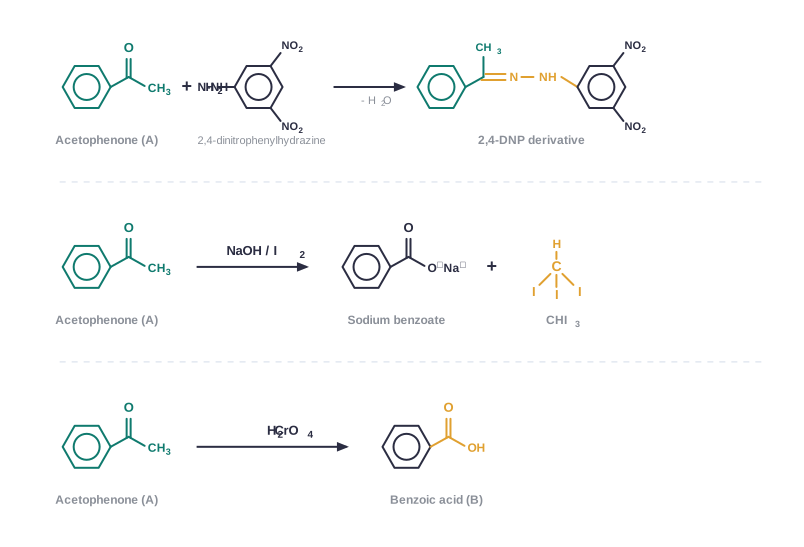
[Caption:] Fig. 8.19 – Chemical identification reactions for acetophenone. [/Caption:]
Notice how each clue eliminates possibilities: 2,4-DNP narrows it to a carbonyl compound; the negative Tollens’/Fehling’s tests narrow it to a ketone; iodoform narrows it to a methyl ketone; the failure to decolourise bromine water tells you the unsaturation is aromatic, not olefinic. This is exactly how identification questions are built in board and entrance examinations — as a chain of eliminations.
4. Reactions due to α-hydrogen
Acidity of α-hydrogens of aldehydes and ketones
The aldehydes and ketones undergo a number of reactions due to the acidic nature of the α-hydrogen — the hydrogen atom on the carbon next to the carbonyl group.
The acidity of the α-hydrogen atoms of carbonyl compounds is due to the strong electron-withdrawing effect of the carbonyl group and the resonance stabilisation of the conjugate base. Once a base removes an α-hydrogen, the negative charge left behind on the α-carbon does not stay there: it spreads onto the electronegative carbonyl oxygen, as shown in Fig. 8.20. A charge that is shared is a charge that is stabilised — and a conjugate base that is stabilised means an acid that ionises more readily.

Fig. 8.20 – Formation and resonance stabilization of the enolate ion.
Ordinary C–H bonds in an alkane are not acidic at all. It is the presence of the carbonyl group next door — and only that — which makes these particular hydrogens removable by dilute alkali. Everything in the rest of this section flows from that one fact.
(i) Aldol condensation
Aldehydes and ketones having at least one α-hydrogen undergo a reaction in the presence of dilute alkali as catalyst to form β-hydroxy aldehydes (aldol) or β-hydroxy ketones (ketol) respectively. This is known as the Aldol reaction.
\[2,\\mathrm{CH\_3CHO} \\xrightleftharpoons\[\\ ]{\\ \\text{dil. } \\mathrm{NaOH}\\ } \\mathrm{CH\_3CH(OH)CH\_2CHO} \\xrightarrow\[\\ -\\mathrm{H\_2O}\\ ]{\\ \\Delta\\ } \\mathrm{CH\_3CH{=}CH!-!CHO}\] ethanal → 3-hydroxybutanal (aldol) → but-2-enal (aldol condensation product)
\[2,\\mathrm{CH\_3!-!CO!-!CH\_3} \\xrightleftharpoons\[\\ ]{\\ \\mathrm{Ba(OH)\_2}\\ } \\mathrm{CH\_3!-!C(CH\_3)(OH)!-!CH\_2!-!CO!-!CH\_3} \\xrightarrow\[\\ -\\mathrm{H\_2O}\\ ]{\\ \\Delta\\ } \\mathrm{(CH\_3)\_2C{=}CH!-!CO!-!CH\_3}\] propanone → 4-hydroxy-4-methylpentan-2-one (ketol) → 4-methylpent-3-en-2-one (aldol condensation product)
The name aldol is derived from the names of the two functional groups, aldehyde and alcohol, present in the product. The aldol and the ketol readily lose water to give α,β-unsaturated carbonyl compounds, which are the aldol condensation products, and the reaction is called Aldol condensation. Though ketones give ketols (compounds containing a keto and an alcohol group), the general name aldol condensation still applies to the reactions of ketones due to their similarity with aldehydes.
Follow the logic of the reaction once and you will never need to memorise the product. The base removes an α-hydrogen from one molecule, generating a carbanion. That carbanion is a nucleophile, and it attacks the carbonyl carbon of a second molecule — an ordinary nucleophilic addition. The alkoxide formed picks up a proton to give the β-hydroxy carbonyl compound. On heating, water is eliminated across the α and β carbons, and the C=C thus formed is conjugated with the C=O, which is what makes the final product stable.
Flowchart
FC 8.5 – Aldol condensation: carbonyl compound with α-H → dilute alkali removes α-H → resonance-stabilised carbanion (enolate) → carbanion attacks the carbonyl carbon of a second molecule → alkoxide → protonation → β-hydroxy carbonyl compound (aldol/ketol) → heat, –H₂O → α,β-unsaturated carbonyl compound.
(ii) Cross aldol condensation
When aldol condensation is carried out between two different aldehydes and/or ketones, it is called cross aldol condensation. If both of them contain α-hydrogen atoms, it gives a mixture of four products. This is illustrated below by the aldol reaction of a mixture of ethanal and propanal.
\[\\mathrm{CH\_3CHO} + \\mathrm{CH\_3CH\_2CHO} \\xrightarrow\[\\ 2.\\ \\Delta\\ ]{\\ 1.\\ \\mathrm{NaOH}\\ } \\text{four α,β-unsaturated products}\]
- Simple (self) aldol products: \(\\mathrm{CH\_3!-!CH{=}CH!-!CHO}\), but-2-enal (from two molecules of ethanal), and \(\\mathrm{CH\_3CH\_2!-!CH{=}C(CH\_3)!-!CHO}\), 2-methylpent-2-enal (from two molecules of propanal).
- Cross aldol products: \(\\mathrm{CH\_3!-!CH{=}C(CH\_3)!-!CHO}\), 2-methylbut-2-enal, and \(\\mathrm{CH\_3CH\_2!-!CH{=}CH!-!CHO}\), pent-2-enal (each from one molecule of ethanal and one molecule of propanal).
Why four? Because either compound can supply the carbanion (act as the nucleophile) and either can supply the carbonyl carbon (act as the electrophile). Two choices at each role gives 2 × 2 = 4 combinations. That is why a cross aldol between two α-hydrogen-bearing partners is a poor synthetic reaction — a mixture is unavoidable.

Fig. 8.21 – Cross aldol condensation of ethanal and propanal.
Ketones can also be used as one component in the cross aldol reactions.
\[\\mathrm{C\_6H\_5CHO} + \\mathrm{C\_6H\_5!-!CO!-!CH\_3} \\xrightarrow\[\\ 293\\ \\text{K}\\ ]{\\ \\mathrm{OH^{-}}\\ } \\mathrm{C\_6H\_5!-!CH{=}CH!-!CO!-!C\_6H\_5}\]
The major product is 1,3-diphenylprop-2-en-1-one (benzalacetophenone). Here the mixture problem disappears, because benzaldehyde has no α-hydrogen: it cannot form a carbanion, and can only act as the electrophile. Acetophenone, which does have α-hydrogens, supplies the carbanion. Only one combination is possible, so a single major product results.
5. Other reactions
(i) Cannizzaro reaction
Aldehydes which do not have an α-hydrogen atom undergo self-oxidation and reduction (disproportionation) reaction on heating with concentrated alkali. In this reaction, one molecule of the aldehyde is reduced to an alcohol while another is oxidised to a carboxylic acid salt.
\[2,\\mathrm{HCHO} + \\text{conc. } \\mathrm{KOH} \\xrightarrow{\\ \\Delta\\ } \\mathrm{CH\_3OH} + \\mathrm{HCOOK}\] formaldehyde → methanol + potassium formate
\[2,\\mathrm{C\_6H\_5CHO} + \\text{conc. } \\mathrm{NaOH} \\xrightarrow{\\ \\Delta\\ } \\mathrm{C\_6H\_5CH\_2OH} + \\mathrm{C\_6H\_5COONa}\] benzaldehyde → benzyl alcohol + sodium benzoate
The condition “no α-hydrogen” is not an arbitrary rule. It is what forces this pathway. An aldehyde with an α-hydrogen, offered a base, will take the easy road and form a carbanion — aldol condensation. An aldehyde with no α-hydrogen has no such road available, so the hydroxide ion instead attacks the carbonyl carbon directly, and the resulting intermediate transfers a hydride ion to a second aldehyde molecule. One molecule loses hydrogen (is oxidised); the other gains it (is reduced). Hence disproportionation.
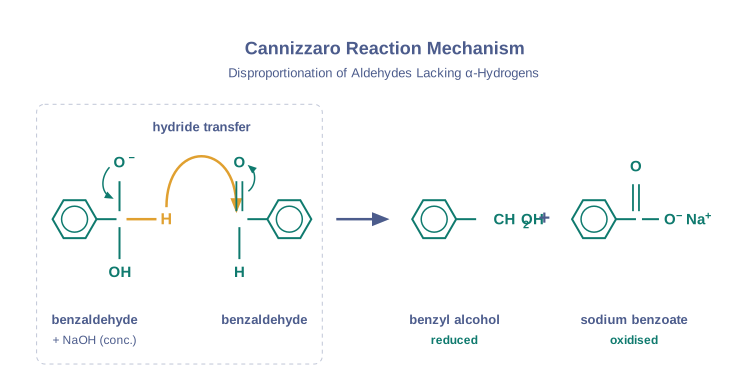
Fig. 8.22 – Cannizzaro reaction of benzaldehyde.
(ii) Electrophilic substitution reaction
Aromatic aldehydes and ketones undergo electrophilic substitution at the ring, in which the carbonyl group acts as a deactivating and meta-directing group.
\[\\mathrm{C\_6H\_5CHO} \\xrightarrow\[\\ 273-283\\ \\text{K}\\ ]{\\ \\mathrm{HNO\_3}/\\mathrm{H\_2SO\_4}\\ } \\textit{m}\\text{-nitrobenzaldehyde}\]
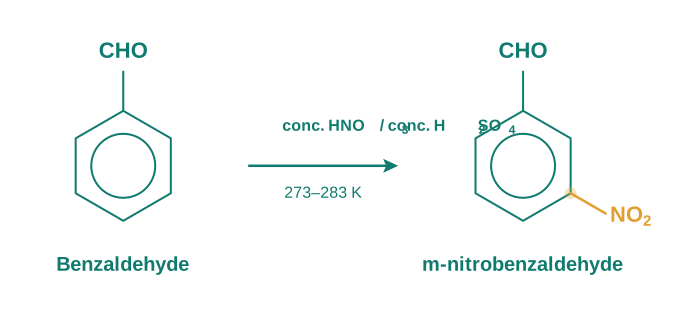
Fig. 8.23 – Electrophilic nitration of benzaldehyde.
The behaviour follows from the polarity you already know. The carbonyl carbon carries a δ+ charge and pulls electron density out of the ring, so the ring becomes electron-poor and less willing to accept an electrophile — that is deactivation. The withdrawal is felt most strongly at the ortho and para positions, leaving the meta position comparatively the richest in electrons, so the incoming electrophile attacks there.
8.5 Uses of Aldehydes and Ketones
In the chemical industry, aldehydes and ketones are used as solvents, as starting materials, and as reagents for the synthesis of other products. All three roles follow from what you have learned: the carbonyl group is polar enough to dissolve a wide range of substances, and reactive enough to be the doorway to many other functional groups.
Formaldehyde
Formaldehyde is well known as formalin, a 40% solution used to preserve biological specimens. It hardens the proteins in tissue, which is why a specimen kept in formalin does not decay.
It is also used to prepare bakelite (a phenol–formaldehyde resin), urea–formaldehyde glues, and other polymeric products. In each case the small, highly reactive formaldehyde molecule acts as a bridge, linking larger molecules together into a giant cross-linked network.
Acetaldehyde, benzaldehyde and the ketones
Acetaldehyde is used primarily as a starting material in the manufacture of acetic acid, ethyl acetate, vinyl acetate, polymers and drugs. It is a hub compound: one small aldehyde feeding several industrial streams, as shown in FC 8.6.
Flowchart
FC 8.6 – Acetaldehyde as an industrial hub: acetaldehyde (CH₃CHO) → branch 1: oxidation → acetic acid; branch 2: → ethyl acetate; branch 3: → vinyl acetate → poly(vinyl acetate) polymers; branch 4: → drugs and other fine chemicals.
Benzaldehyde is used in perfumery and in the dye industries. Acetone and ethyl methyl ketone are common industrial solvents — acetone in particular dissolves both polar and non-polar substances, because its molecule has a polar C=O group attached to two small hydrocarbon groups.
Many aldehydes and ketones — for example, butyraldehyde, vanillin, acetophenone and camphor — are well known for their odours and flavours, and are used accordingly in food products, perfumes and pharmaceuticals.
8.6 Nomenclature and Structure of Carboxyl Group
Carboxylic Acids
Carbon compounds containing a carboxyl functional group, –COOH, are called carboxylic acids. Look closely at the group and you will see that it is two familiar groups fused into one: a carbonyl group (>C=O) attached to a hydroxyl group (–OH). The name carboxyl is simply carb(onyl) + (hydr)oxyl.
Carboxylic acids may be aliphatic (RCOOH) or aromatic (ArCOOH), depending on whether the group attached to the carboxylic carbon is an alkyl or an aryl group.
A large number of carboxylic acids are found in nature. Some higher members of the aliphatic carboxylic acids (C₁₂–C₁₈), known as fatty acids, occur in natural fats as esters of glycerol. This is the chemical link between the food you eat and the chapter you are reading: a fat is, in essence, three long-chain carboxylic acid molecules joined to one glycerol molecule.
Carboxylic acids also serve as starting materials for several other important organic compounds, such as anhydrides, esters, acid chlorides and amides. All four of these are carboxylic acid derivatives — the –OH of the carboxyl group has simply been replaced by something else. You will meet each of them again in Section 8.9.
8.6.1 Nomenclature
Since carboxylic acids are amongst the earliest organic compounds to be isolated from nature, a large number of them are known by their common names. These common names end with the suffix –ic acid and have been derived from the Latin or Greek names of their natural sources.
For example, formic acid (HCOOH) was first obtained from red ants (Latin: formica, meaning ant); acetic acid (\(\\mathrm{CH\_3COOH}\)) comes from vinegar (Latin: acetum, meaning vinegar); and butyric acid (\(\\mathrm{CH\_3CH\_2CH\_2COOH}\)) was obtained from rancid butter (Latin: butyrum, meaning butter).
\[\\mathrm{HCOOH}\\text{(aq)} + \\mathrm{NaHCO\_3}\\text{(aq)} \\rightarrow \\mathrm{HCOONa}\\text{(aq)} + \\mathrm{H\_2O}\\text{(l)} + \\mathrm{CO\_2}\\text{(g)}\]
The fizz you see is carbon dioxide. In Section 8.9.1 you will learn why this reaction is also the standard laboratory test for a carboxyl group.
IUPAC names
In the IUPAC system, aliphatic carboxylic acids are named by replacing the ending –e in the name of the corresponding alkane with –oic acid. So ethane gives ethanoic acid, and propane gives propanoic acid.
In numbering the carbon chain, the carboxylic carbon is numbered one. This is not a choice but a rule — like the –CHO carbon of an aldehyde, the –COOH carbon can only be at the end of a chain, so it always takes the lowest locant.
For naming compounds containing more than one carboxyl group, the alkyl chain leaving out the carboxyl groups is numbered, and the number of carboxyl groups is indicated by adding the multiplicative prefix dicarboxylic acid, tricarboxylic acid, and so on, to the name of the parent alkyl chain. The positions of the –COOH groups are indicated by the arabic numerals placed before the multiplicative prefix.
Read that rule against an example and it becomes clear. In \(\\mathrm{HOOC!-!CH\_2!-!CH(COOH)!-!CH\_2!-!COOH}\), the chain that remains after removing the three –COOH groups is a three-carbon propane chain carrying carboxyl groups at C-1, C-2 and C-3. The name is therefore propane-1,2,3-tricarboxylic acid. Naming it as a “pentanedioic acid with an extra acid group” would have forced two of the three identical groups to be treated differently from the third — exactly the situation IUPAC nomenclature avoids.
Some of the carboxylic acids, along with their common and IUPAC names, are listed in Table 8.3.
Table 8.3 Names and Structures of Some Carboxylic Acids
| Structure | Common name | IUPAC name |
|---|---|---|
| \(\\mathrm{HCOOH}\) | Formic acid | Methanoic acid |
| \(\\mathrm{CH\_3COOH}\) | Acetic acid | Ethanoic acid |
| \(\\mathrm{CH\_3CH\_2COOH}\) | Propionic acid | Propanoic acid |
| \(\\mathrm{CH\_3CH\_2CH\_2COOH}\) | Butyric acid | Butanoic acid |
| \(\\mathrm{(CH\_3)\_2CHCOOH}\) | Isobutyric acid | 2-Methylpropanoic acid |
| \(\\mathrm{HOOC!-!COOH}\) | Oxalic acid | Ethanedioic acid |
| \(\\mathrm{HOOC!-!CH\_2!-!COOH}\) | Malonic acid | Propanedioic acid |
| \(\\mathrm{HOOC!-!(CH\_2)\_2!-!COOH}\) | Succinic acid | Butanedioic acid |
| \(\\mathrm{HOOC!-!(CH\_2)\_3!-!COOH}\) | Glutaric acid | Pentanedioic acid |
| \(\\mathrm{HOOC!-!(CH\_2)\_4!-!COOH}\) | Adipic acid | Hexanedioic acid |
| \(\\mathrm{HOOC!-!CH\_2!-!CH(COOH)!-!CH\_2!-!COOH}\) | Tricarballylic acid or carballylic acid | Propane-1,2,3-tricarboxylic acid |
| Benzene ring with –COOH | Benzoic acid | Benzenecarboxylic acid (Benzoic acid) |
| Benzene ring with –CH₂COOH | Phenylacetic acid | 2-Phenylethanoic acid |
| Benzene ring with two –COOH groups in the ortho positions | Phthalic acid | Benzene-1,2-dicarboxylic acid |
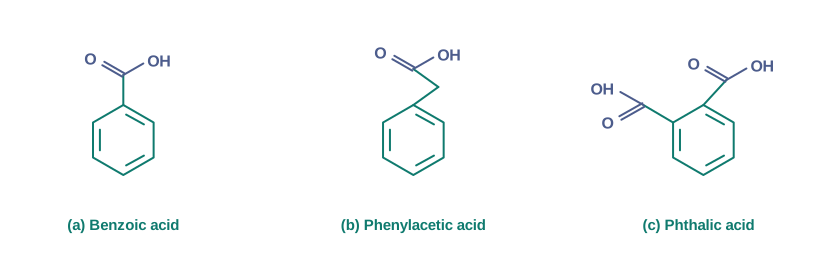
Fig. 8.24 – Structures of (a) benzoic, (b) phenylacetic and (c) phthalic acids.
8.6.2 Structure of Carboxyl Group
In carboxylic acids, the bonds to the carboxyl carbon lie in one plane and are separated by about 120°. This is the same trigonal planar arrangement you met for the carbonyl group in Section 8.1.2, and for the same reason — the carboxyl carbon is \(sp^2\)-hybridised.
But there is a crucial difference in reactivity. The carboxylic carbon is less electrophilic than a carbonyl carbon, because of the possible resonance structures shown in Fig. 8.25.
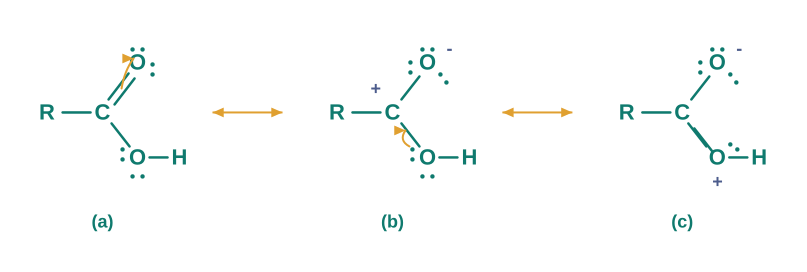
Fig. 8.25 – Resonance in the carboxyl group.
Follow the electrons in Fig. 8.25 and the reason becomes clear. The oxygen of the –OH group carries lone pairs, and one of these lone pairs is delocalised towards the carbonyl carbon. Electron density is therefore pushed back onto the carboxyl carbon, partially cancelling the δ+ charge that the carbonyl oxygen had created. A carbon that is less short of electrons is less attractive to a nucleophile.
This one structural fact explains a great deal of the chemistry ahead. Aldehydes and ketones react with nucleophiles by addition across the C=O bond; carboxylic acids, whose carbonyl carbon is a poorer electrophile and which carry a good leaving group in disguise (–OH), react instead by substitution at the carboxyl carbon, as you will see in Section 8.9.2.
8.7 Methods of Preparation of Carboxylic Acids
Some important methods of preparation of carboxylic acids are given below. Before you read them, notice one organising idea. A carboxylic acid stands at the top of the oxidation ladder for carbon compounds containing a single carbon–oxygen linkage — above alcohols and above aldehydes. So most routes to it are oxidations (methods 1 and 2), while the rest are hydrolyses of compounds that already have the carboxyl carbon in place at the right oxidation level: nitriles, amides, acyl halides, anhydrides and esters (methods 3, 5 and 6). Method 4 is different again — it builds the carboxyl carbon out of carbon dioxide.
1. From primary alcohols and aldehydes
Primary alcohols are readily oxidised to carboxylic acids with common oxidising agents such as potassium permanganate (\(\\mathrm{KMnO\_4}\)) in neutral, acidic or alkaline media, or by potassium dichromate (\(\\mathrm{K\_2Cr\_2O\_7}\)) and chromium trioxide (\(\\mathrm{CrO\_3}\)) in acidic media (Jones reagent).
\[\\mathrm{RCH\_2OH} \\xrightarrow\[\\ 2.\\ \\mathrm{H\_3O^+}\\ ]{\\ 1.\\ \\text{alkaline }\\mathrm{KMnO\_4}\\ } \\mathrm{RCOOH}\]
\[\\mathrm{CH\_3(CH\_2)\_8CH\_2OH} \\xrightarrow\[\\ \\text{Jones reagent}\\ ]{\\ \\mathrm{CrO\_3}\\text{-}\\mathrm{H\_2SO\_4}\\ } \\mathrm{CH\_3(CH\_2)\_8COOH}\]
Here 1-decanol gives decanoic acid. Compare this with Section 8.2.1: the same primary alcohol gives an aldehyde with a mild reagent such as PCC, and a carboxylic acid with a strong one. The starting material has not changed; only the vigour of the oxidising agent has, and that alone decides where the reaction stops.
Carboxylic acids are also prepared from aldehydes by the use of mild oxidising agents (Section 8.4) — Tollens’ and Fehling’s reagents both do exactly this, which is why they serve as tests for the aldehyde group.
2. From alkylbenzenes
Aromatic carboxylic acids can be prepared by the vigorous oxidation of alkylbenzenes with chromic acid, or with acidic or alkaline potassium permanganate. The entire side chain is oxidised to the carboxyl group, irrespective of the length of the side chain. Primary and secondary alkyl groups are oxidised in this manner, while a tertiary group is not affected. Suitably substituted alkenes are also oxidised to carboxylic acids with these oxidising reagents.
\[\\mathrm{C\_6H\_5CH\_3} \\xrightarrow\[\\ \\text{Heat}\\ ]{\\ \\mathrm{KMnO\_4}\\text{-}\\mathrm{KOH}\\ } \\mathrm{C\_6H\_5COOK} \\xrightarrow{\\ \\mathrm{H\_3O^+}\\ } \\mathrm{C\_6H\_5COOH}\]
\[\\mathrm{C\_6H\_5CH\_2CH\_2CH\_3} \\xrightarrow\[\\ \\Delta\\ ]{\\ \\mathrm{KMnO\_4}\\text{-}\\mathrm{KOH}\\ } \\mathrm{C\_6H\_5COOK} \\xrightarrow{\\ \\mathrm{H\_3O^+}\\ } \\mathrm{C\_6H\_5COOH}\]
Read those two equations together and the striking point emerges: a one-carbon side chain and a three-carbon side chain give the same product, benzoic acid. The whole chain is chopped away except for the carbon directly attached to the ring, which survives as the –COOH carbon.
Why is a tertiary alkyl group untouched? Because the carbon attached to the ring — the benzylic carbon — carries no hydrogen in a tertiary group. Oxidation of a side chain begins by attacking that benzylic C–H bond; with no such hydrogen to attack, the chain survives intact. This is a favourite point for assertion–reason questions.
3. From nitriles and amides
Nitriles are hydrolysed to amides, and then to acids, in the presence of \(\\mathrm{H^+}\) or \(\\mathrm{OH^-}\) as catalyst. Mild reaction conditions are used to stop the reaction at the amide stage.
\[\\mathrm{R!-!CN} \\xrightarrow\[\\ \\mathrm{H\_2O}\\ ]{\\ \\mathrm{H^+}\\ \\text{or}\\ \\mathrm{OH^-}\\ } \\mathrm{R!-!CONH\_2} \\xrightarrow\[\\ \\Delta\\ ]{\\ \\mathrm{H^+}\\ \\text{or}\\ \\mathrm{OH^-}\\ } \\mathrm{RCOOH}\]
\[\\mathrm{CH\_3CONH\_2} \\xrightarrow\[\\ \\Delta\\ ]{\\ \\mathrm{H\_3O^+}\\ } \\mathrm{CH\_3COOH} + \\mathrm{NH\_3}\]
Ethanamide gives ethanoic acid.
\[\\mathrm{C\_6H\_5CONH\_2} \\xrightarrow\[\\ \\Delta\\ ]{\\ \\mathrm{H\_3O^+}\\ } \\mathrm{C\_6H\_5COOH} + \\mathrm{NH\_3}\]
Benzamide gives benzoic acid. Notice the pattern common to all hydrolyses in this section: the group attached to the carboxyl carbon (–CN, –NH₂, –Cl, –OR′) is replaced by –OH, and the carbon’s oxidation level never changes.
4. From Grignard reagents
Grignard reagents react with carbon dioxide (dry ice) to form salts of carboxylic acids, which in turn give the corresponding carboxylic acids after acidification with a mineral acid.
\[\\mathrm{R!-!Mg!-!X} + \\mathrm{O{=}C{=}O} \\xrightarrow{\\ \\text{dry ether}\\ } \\mathrm{R!-!COO^-,MgX^+} \\xrightarrow{\\ \\mathrm{H\_3O^+}\\ } \\mathrm{RCOOH}\]
The carbanion-like carbon of the Grignard reagent is a strong nucleophile, and carbon dioxide is an excellent electrophile at its central carbon — so the new C–C bond forms readily. Solid carbon dioxide (“dry ice”) is used because it keeps the reaction cold and provides a large excess of \(\\mathrm{CO\_2}\).
As you know, Grignard reagents and nitriles can both be prepared from alkyl halides (Chapter 6, Class XII). Methods 3 and 4 are therefore useful for converting alkyl halides into carboxylic acids having one carbon atom more than that present in the alkyl halide — that is, for ascending the series. The two routes are set out side by side in FC 8.7.
Flowchart
FC 8.7 – Ascending the series from an alkyl halide R–X (n carbons) to an acid with n+1 carbons. Route A (via nitrile): R–X → KCN → R–CN → H⁺ or OH⁻, H₂O → R–CONH₂ (amide, mild conditions) → H⁺ or OH⁻, Δ → R–COOH. Route B (via Grignard): R–X → Mg, dry ether → R–MgX → CO₂ (dry ice) → R–COO⁻ MgX⁺ → H₃O⁺ → R–COOH. Note on both branches: the product has one carbon more than R–X.
5. From acyl halides and anhydrides
Acid chlorides, when hydrolysed with water, give carboxylic acids; they are hydrolysed more readily with aqueous base to give carboxylate ions, which on acidification provide the corresponding carboxylic acids.
\[\\mathrm{RCOCl} \\xrightarrow{\\ \\mathrm{H\_2O}\\ } \\mathrm{RCOOH} + \\mathrm{Cl^-}\]
\[\\mathrm{RCOCl} \\xrightarrow{\\ \\mathrm{OH^-}/\\mathrm{H\_2O}\\ } \\mathrm{RCOO^-} + \\mathrm{Cl^-} \\xrightarrow{\\ \\mathrm{H\_3O^+}\\ } \\mathrm{RCOOH}\]
Anhydrides, on the other hand, are hydrolysed to the corresponding acid(s) with water.
\[\\mathrm{(C\_6H\_5CO)\_2O} \\xrightarrow{\\ \\mathrm{H\_2O}\\ } 2,\\mathrm{C\_6H\_5COOH}\]
Benzoic anhydride gives two molecules of benzoic acid. A mixed anhydride gives two different acids:
\[\\mathrm{C\_6H\_5COOCOCH\_3} \\xrightarrow{\\ \\mathrm{H\_2O}\\ } \\mathrm{C\_6H\_5COOH} + \\mathrm{CH\_3COOH}\]
Benzoic ethanoic anhydride gives benzoic acid and ethanoic acid.
6. From esters
Acidic hydrolysis of esters gives carboxylic acids directly, while basic hydrolysis gives carboxylates, which on acidification give the corresponding carboxylic acids.
\[\\mathrm{C\_6H\_5COOC\_2H\_5} + \\mathrm{H\_2O} \\xrightleftharpoons\[\\ ]{\\ \\mathrm{H\_3O^+}\\ } \\mathrm{C\_6H\_5COOH} + \\mathrm{C\_2H\_5OH}\]
Ethyl benzoate gives benzoic acid.
\[\\mathrm{CH\_3CH\_2CH\_2COOC\_2H\_5} \\xrightleftharpoons\[\\ ]{\\ \\mathrm{NaOH}\\ } \\mathrm{CH\_3CH\_2CH\_2COONa} + \\mathrm{C\_2H\_5OH}\]
\[\\mathrm{CH\_3CH\_2CH\_2COONa} \\xrightarrow{\\ \\mathrm{H\_3O^+}\\ } \\mathrm{CH\_3CH\_2CH\_2COOH}\]
Ethyl butanoate thus gives butanoic acid. Note carefully the difference between the two arrows. Acidic hydrolysis is reversible — it is the reverse of esterification, which you will meet in Section 8.9.2 — whereas basic hydrolysis effectively runs to completion, because the carboxylate ion formed is not attacked by the alcohol and so cannot go back.
Write chemical reactions to affect the following transformations:
(i) Butan-1-ol to butanoic acid
(ii) Benzyl alcohol to phenylethanoic acid
(iii) 3-Nitrobromobenzene to 3-nitrobenzoic acid
(iv) 4-Methylacetophenone to benzene-1,4-dicarboxylic acid
(v) Cyclohexene to hexane-1,6-dioic acid
(vi) Butanal to butanoic acid.
- \[\\mathrm{CH\_3CH\_2CH\_2CH\_2OH} \\xrightarrow\[\\ \\text{Jones reagent}\\ ]{\\ \\mathrm{CrO\_3}\\text{-}\\mathrm{H\_2SO\_4}\\ } \\mathrm{CH\_3CH\_2CH\_2COOH}\]
Butan-1-ol → butanoic acid.
- \[\\mathrm{C\_6H\_5CH\_2OH} \\xrightarrow{\\ \\mathrm{HBr}\\ } \\mathrm{C\_6H\_5CH\_2Br} \\xrightarrow{\\ \\mathrm{KCN}\\ } \\mathrm{C\_6H\_5CH\_2CN} \\xrightarrow\[\\ \\Delta\\ ]{\\ \\mathrm{H\_3O^+}\\ } \\mathrm{C\_6H\_5CH\_2COOH}\]
Benzyl alcohol → benzyl bromide → benzyl cyanide → phenylethanoic acid. (One carbon atom has been gained, so the nitrile route is essential here.)
\[\\text{3-Nitrobromobenzene} \\xrightarrow\[\\ \\text{ether}\\ ]{\\ \\mathrm{Mg}\\ } \\text{3-nitrophenylmagnesium bromide} \\xrightarrow{\\ \\mathrm{CO\_2}\\ (\\text{dry ice})\\ } \\text{the } \\mathrm{-COOMgBr}\\ \\text{salt} \\xrightarrow{\\ \\mathrm{H\_3O^+}\\ } \\text{3-nitrobenzoic acid}\]
\[\\text{4-Methylacetophenone} \\xrightarrow{\\ \\mathrm{KMnO\_4}/\\mathrm{KOH}\\ } \\text{dipotassium benzene-1,4-dicarboxylate} \\xrightarrow{\\ \\text{dil. }\\mathrm{H\_2SO\_4}\\ } \\text{benzene-1,4-dicarboxylic acid (terephthalic acid)}\]
Both side chains — the methyl group and the acetyl group — are oxidised down to –COOH.
- \[\\text{Cyclohexene} \\xrightarrow\[\\ \\text{Heat}\\ ]{\\ \\mathrm{KMnO\_4}\\text{-}\\mathrm{H\_2SO\_4}\\ } \\text{hexane-1,6-dioic acid (adipic acid)}\]
The C=C bond is cleaved and both carbons become carboxyl carbons.
- \[\\mathrm{CH\_3CH\_2CH\_2CHO} \\xrightarrow\[\\ \\text{(Tollens' reagent)}\\ ]{\\ \\text{Ammoniacal }\\mathrm{AgNO\_3}\\ } \\mathrm{CH\_3CH\_2CH\_2COOH}\]
Butanal → butanoic acid.
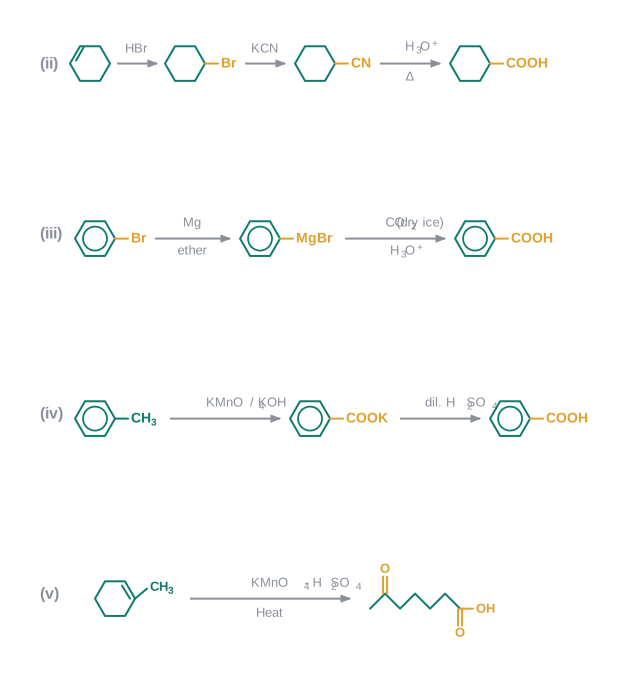
[Caption:] Fig. 8.26 – Reaction schemes for conversions to carboxylic acids. [/Caption:]
8.8 Physical Properties
Physical state and odour
Aliphatic carboxylic acids up to nine carbon atoms are colourless liquids at room temperature with unpleasant odours. The higher acids are wax-like solids and are practically odourless, because of their low volatility — a molecule you cannot smell is usually a molecule that does not readily reach your nose, and a large, strongly associated acid molecule simply does not escape into the vapour phase in significant amounts.
Boiling point: the hydrogen-bonded dimer
Carboxylic acids are higher-boiling liquids than aldehydes, ketones and even alcohols of comparable molecular masses. This is due to the more extensive association of carboxylic acid molecules through intermolecular hydrogen bonding.
The reason a carboxylic acid outdoes even an alcohol is worth stating plainly. An alcohol molecule has one O–H group to donate a hydrogen bond and one oxygen to accept one. A carboxylic acid molecule has an O–H group to donate and a separate carbonyl oxygen to accept, and the two groups are ideally placed to lock two molecules together through two hydrogen bonds at once, forming a closed ring — the dimer shown in Fig. 8.27.
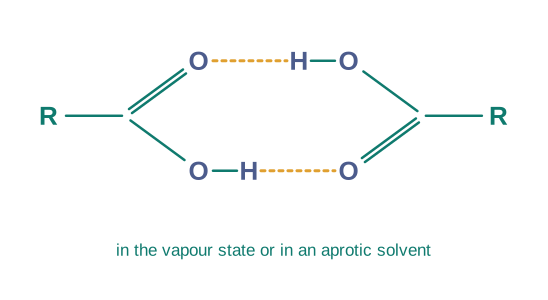
Fig. 8.27 – Cyclic hydrogen-bonded dimer of a carboxylic acid.
These hydrogen bonds are strong enough that they are not broken completely even in the vapour phase. In fact, most carboxylic acids exist as dimers in the vapour phase or in aprotic solvents (solvents such as benzene or chloroform, which have no O–H or N–H hydrogen of their own to offer, and so cannot break up the pairing).
Solubility in water
Simple aliphatic carboxylic acids having up to four carbon atoms are miscible in water, because they form hydrogen bonds with water. Here the acid can both donate a hydrogen bond (through its O–H) and accept one (through its C=O oxygen), so it fits neatly into the hydrogen-bonded network of water, as drawn in Fig. 8.28.
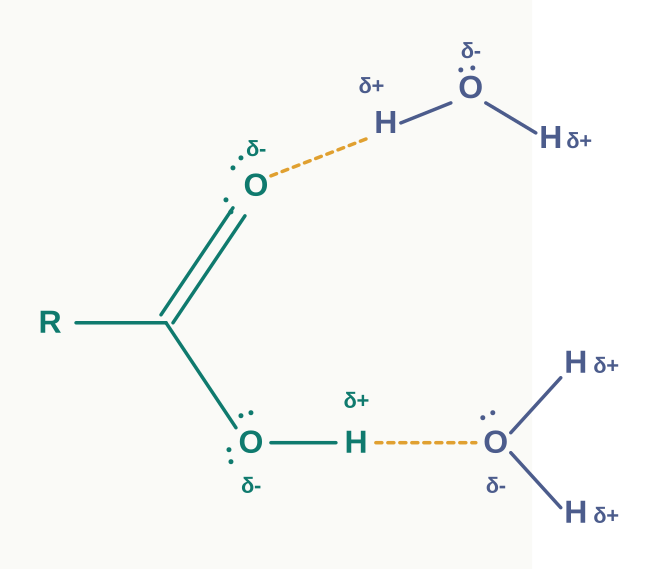
Fig. 8.28 – Hydrogen bonding of a carboxylic acid with water.
The solubility decreases with increasing number of carbon atoms. Higher carboxylic acids are practically insoluble in water, due to the increased hydrophobic interaction of the hydrocarbon part — the long chain cannot hydrogen-bond, and forcing it in among water molecules would disturb their own network. This is the same head-and-tail competition you met for aldehydes and ketones in Section 8.3, and it plays out here in exactly the same way.
Benzoic acid, the simplest aromatic carboxylic acid, is nearly insoluble in cold water: its bulky, non-polar benzene ring dominates over the single carboxyl group.
Carboxylic acids are also soluble in less polar organic solvents such as benzene, ether, alcohol and chloroform.
8.9 Chemical Reactions
The reactions of carboxylic acids are classified according to which bond breaks. Look at the carboxyl group and you will see three possibilities: the O–H bond can break (giving the acid its acidity), the C–OH bond can break (replacing –OH by something else), or the whole –COOH group can be attacked or removed. A fourth set of reactions leaves the carboxyl group alone and attacks the hydrocarbon part instead. The four subsections that follow are exactly these four cases, and FC 8.8 lays them out.
Flowchart
FC 8.8 – Reactions of carboxylic acids, classified by the bond broken: R–COOH → branch 1: cleavage of the O–H bond → acidity (with metals, alkalies, carbonates, hydrogencarbonates) → carboxylate salt; branch 2: cleavage of the C–OH bond → –OH replaced → anhydride, ester, acyl chloride, amide; branch 3: reactions of the whole –COOH group → reduction to primary alcohol; decarboxylation to hydrocarbon; branch 4: substitution in the hydrocarbon part → α-halogenation (HVZ) and ring substitution (nitration, bromination).
8.9.1 Reactions Involving Cleavage of O–H Bond
Acidity
Reactions with metals and alkalies
Carboxylic acids, like alcohols, evolve hydrogen with electropositive metals, and they form salts with alkalies in the same way as phenols do. However, unlike phenols, they react with weaker bases such as carbonates and hydrogencarbonates to evolve carbon dioxide. This reaction is used to detect the presence of a carboxyl group in an organic compound.
\[2,\\mathrm{R!-!COOH} + 2,\\mathrm{Na} \\longrightarrow 2,\\mathrm{R!-!COO^-Na^+} + \\mathrm{H\_2}\]
The product \(\\mathrm{R!-!COO^-Na^+}\) is a sodium carboxylate.
\[\\mathrm{R!-!COOH} + \\mathrm{NaOH} \\longrightarrow \\mathrm{R!-!COO^-Na^+} + \\mathrm{H\_2O}\]
\[\\mathrm{R!-!COOH} + \\mathrm{NaHCO\_3} \\longrightarrow \\mathrm{R!-!COO^-Na^+} + \\mathrm{H\_2O} + \\mathrm{CO\_2}\]
The last reaction is the practical test. A phenol will not release carbon dioxide from sodium hydrogencarbonate, but a carboxylic acid will — brisk effervescence with \(\\mathrm{NaHCO\_3}\) therefore tells you at once that a –COOH group is present. Behind this simple observation lies a strict logic: an acid can protonate the hydrogencarbonate ion only if it is a stronger acid than carbonic acid, and a carboxylic acid is, while a phenol is not.
Dissociation of a carboxylic acid in water
Carboxylic acids dissociate in water to give a resonance-stabilised carboxylate anion and a hydronium ion.
\[\\mathrm{R!-!COOH} + \\mathrm{H\_2O} \\rightleftharpoons \\mathrm{H\_3O^+} + \\mathrm{R!-!COO^-}\]
The two resonance structures of the carboxylate ion are drawn in Fig. 8.29. They are equivalent — the negative charge is shared equally between the two oxygen atoms, and both carbon–oxygen bonds become identical, intermediate between a single and a double bond.
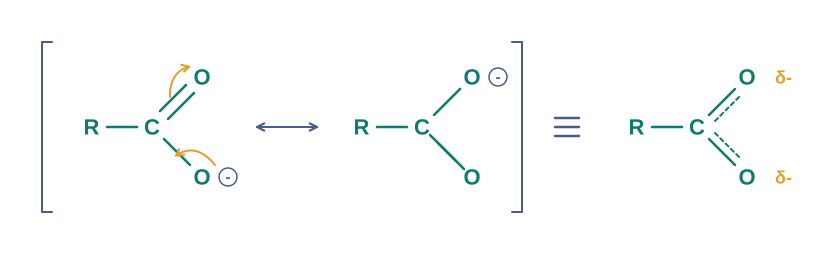
Fig. 8.29 – Resonance structures and hybrid of the carboxylate ion.
For the above reaction:
\[K\_{eq} = \\frac{\[\\mathrm{H\_3O^+}]\[\\mathrm{RCOO^-}]}{\[\\mathrm{H\_2O}]\[\\mathrm{RCOOH}]} \\qquad\\qquad K\_a = K\_{eq}\[\\mathrm{H\_2O}] = \\frac{\[\\mathrm{H\_3O^+}]\[\\mathrm{RCOO^-}]}{\[\\mathrm{RCOOH}]}\]
where \(K\_{eq}\) is the equilibrium constant and \(K\_a\) is the acid dissociation constant. Water is present in such large excess that its concentration is effectively constant, so it is absorbed into the constant — this is why \(K\_a\) has no \(\[\\mathrm{H\_2O}]\) term in it.
For convenience, the strength of an acid is generally indicated by its p\(K\_a\) value rather than its \(K\_a\) value.
\[\\mathrm{p}K\_a = -\\log K\_a\]
The logarithm appears for a simple reason: \(K\_a\) values for organic acids span many powers of ten, from about \(10^{-1}\) to \(10^{-16}\). Taking the negative logarithm turns that unwieldy range into small, comparable numbers — and, because of the minus sign, it reverses the order: a larger \(K\_a\) (stronger acid) becomes a smaller p\(K\_a\).
The p\(K\_a\) of hydrochloric acid is –7.0, whereas the p\(K\_a\) values of trifluoroacetic acid (the strongest carboxylic acid), benzoic acid and acetic acid are 0.23, 4.19 and 4.76 respectively.
Smaller the p\(K\_a\), the stronger the acid (the better it is as a proton donor). Strong acids have p\(K\_a\) values < 1; the acids with p\(K\_a\) values between 1 and 5 are considered to be moderately strong acids; weak acids have p\(K\_a\) values between 5 and 15; and extremely weak acids have p\(K\_a\) values > 15.
Why carboxylic acids are stronger acids than alcohols and phenols
Carboxylic acids are weaker than mineral acids, but they are stronger acids than alcohols and many simple phenols (p\(K\_a\) is ~16 for ethanol and 10 for phenol). In fact, carboxylic acids are amongst the most acidic organic compounds you have studied so far.
You already know why phenols are more acidic than alcohols: the phenoxide ion is resonance-stabilised, while an alkoxide ion is not. The higher acidity of carboxylic acids as compared to phenols is understood in the same way, by comparing the conjugate bases.
The conjugate base of a carboxylic acid, a carboxylate ion, is stabilised by two equivalent resonance structures in which the negative charge sits on the more electronegative oxygen atom. The conjugate base of phenol, a phenoxide ion, has non-equivalent resonance structures in which the negative charge is carried by the less electronegative carbon atoms of the ring. Therefore, resonance in the phenoxide ion is not as important as it is in the carboxylate ion.
Further, the negative charge is delocalised over two electronegative oxygen atoms in the carboxylate ion, whereas it is less effectively delocalised over one oxygen atom and less electronegative carbon atoms in the phenoxide ion (Chapter 7, Class XII). Thus, the carboxylate ion is more stabilised than the phenoxide ion, and so carboxylic acids are more acidic than phenols.
The general principle here is one you should carry into every acidity question in organic chemistry: an acid is strong when its conjugate base is stable. Stability of the anion, not some property of the acid itself, is what does the explaining.
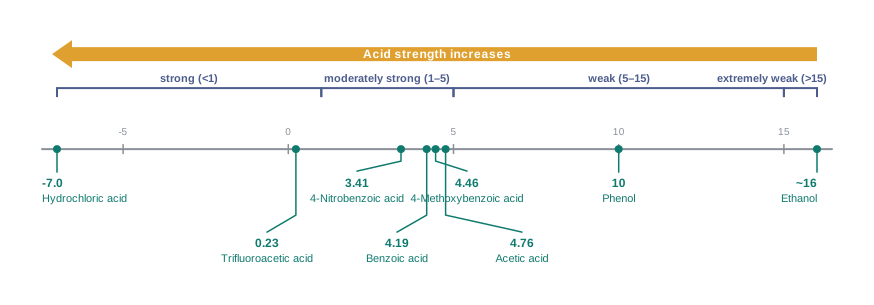
Fig. 8.30 – pKa scale of selected acids.
Effect of substituents on the acidity of carboxylic acids
Substituents may affect the stability of the conjugate base, and thus also affect the acidity of the carboxylic acid.
Electron-withdrawing groups (EWG) increase the acidity of carboxylic acids by stabilising the conjugate base through delocalisation of the negative charge by inductive and/or resonance effects — they pull electron density away from the carboxylate ion and help it carry the charge.
Conversely, electron-donating groups (EDG) decrease the acidity by destabilising the conjugate base — they push electron density towards an anion that is already negative, which is the last thing it wants.
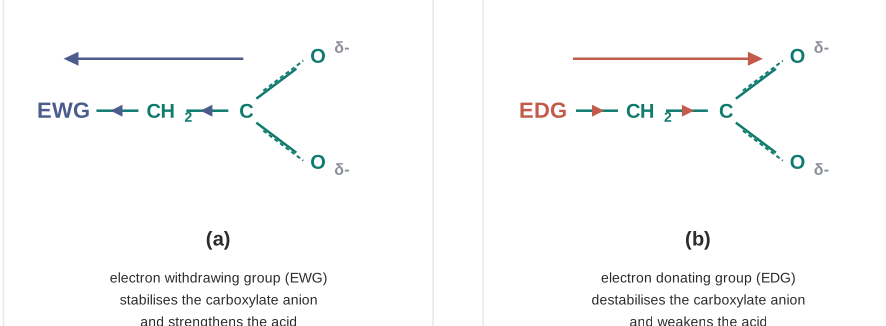
Fig. 8.31 – Effect of electron-withdrawing and donating groups on carboxylate stability.
The effect of the following groups, in increasing order of the acidity they confer, is:
\[\\mathrm{Ph} < \\mathrm{I} < \\mathrm{Br} < \\mathrm{Cl} < \\mathrm{F} < \\mathrm{CN} < \\mathrm{NO\_2} < \\mathrm{CF\_3}\]
Thus the following acids are arranged in order of increasing acidity (based on p\(K\_a\) values) — read the chain from right to left, since it is written here in order of decreasing acidity:
\[\\mathrm{CF\_3COOH} > \\mathrm{CCl\_3COOH} > \\mathrm{CHCl\_2COOH} > \\mathrm{NO\_2CH\_2COOH} > \\mathrm{NC\\text{-}CH\_2COOH} >\] \[\\mathrm{FCH\_2COOH} > \\mathrm{ClCH\_2COOH} > \\mathrm{BrCH\_2COOH} > \\mathrm{HCOOH} > \\mathrm{ClCH\_2CH\_2COOH} >\] \[\\mathrm{C\_6H\_5COOH} > \\mathrm{C\_6H\_5CH\_2COOH} > \\mathrm{CH\_3COOH} > \\mathrm{CH\_3CH\_2COOH}\]
Three separate lessons are hidden in that long series, and each is examined regularly.
The number of withdrawing groups matters. \(\\mathrm{CF\_3COOH}\) is stronger than \(\\mathrm{CCl\_3COOH}\) (fluorine is more electronegative than chlorine), and \(\\mathrm{CCl\_3COOH}\) is stronger than \(\\mathrm{CHCl\_2COOH}\), which is stronger than a monochloro acid — three withdrawing atoms pull harder than two, and two pull harder than one.
The distance matters. Compare \(\\mathrm{ClCH\_2COOH}\) with \(\\mathrm{ClCH\_2CH\_2COOH}\): the chlorine is the same, but in the second acid it sits one carbon further from the carboxyl group and is a much weaker acid. The inductive effect fades rapidly with distance, dying away after two or three bonds.
Alkyl groups weaken the acid. \(\\mathrm{CH\_3CH\_2COOH}\) is the weakest acid in the whole series, and \(\\mathrm{HCOOH}\) (with no alkyl group at all) is stronger than \(\\mathrm{CH\_3COOH}\). Alkyl groups are electron-donating, so they destabilise the carboxylate.
Phenyl and vinyl groups. Direct attachment of groups such as phenyl or vinyl to the carboxylic acid increases the acidity of the corresponding carboxylic acid — contrary to the decrease you might expect from the resonance effect shown in Fig. 8.32.
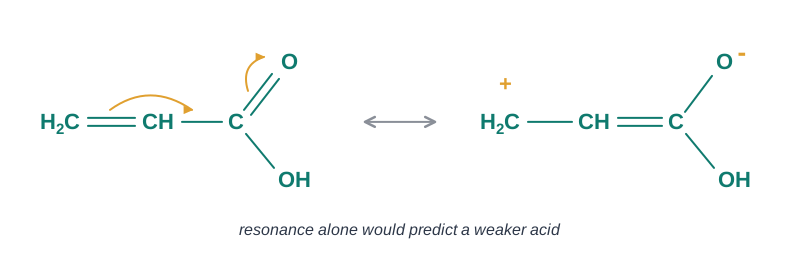
Fig. 8.32 – Resonance in a vinyl-substituted carboxylic acid.
This is because of the greater electronegativity of the \(sp^2\) hybridised carbon to which the carboxyl carbon is attached. An \(sp^2\) carbon has more s-character than an \(sp^3\) carbon, holds its electrons closer to its nucleus, and is therefore effectively electron-withdrawing — and this inductive withdrawal outweighs the opposing resonance donation. That is exactly why benzoic acid (p\(K\_a\) = 4.19) is a stronger acid than acetic acid (p\(K\_a\) = 4.76).
The presence of an electron-withdrawing group on the phenyl ring of an aromatic carboxylic acid increases their acidity, while electron-donating groups decrease their acidity. The p\(K\_a\) values make this quantitative:
| Acid | p\(K\_a\) | Substituent |
|---|---|---|
| 4-Methoxybenzoic acid | 4.46 | –OCH₃, electron donating |
| Benzoic acid | 4.19 | none |
| 4-Nitrobenzoic acid | 3.41 | –NO₂, electron withdrawing |
8.9.2 Reactions Involving Cleavage of C–OH Bond
In these reactions the –OH of the carboxyl group is replaced by another group. The carboxyl carbon keeps its oxidation level throughout; only its partner changes. Chemically, these are nucleophilic acyl substitutions.
1. Formation of anhydride
Carboxylic acids, on heating with mineral acids such as \(\\mathrm{H\_2SO\_4}\) or with \(\\mathrm{P\_2O\_5}\), give the corresponding anhydride.
\[2,\\mathrm{CH\_3COOH} \\xrightarrow\[\\ \\text{or}\\ \\mathrm{P\_2O\_5},\\ \\Delta\\ ]{\\ \\mathrm{H^+},\\ \\Delta\\ } \\mathrm{CH\_3CO!-!O!-!COCH\_3} + \\mathrm{H\_2O}\]
Ethanoic acid gives ethanoic anhydride. Both \(\\mathrm{H\_2SO\_4}\) and \(\\mathrm{P\_2O\_5}\) act here as dehydrating agents — one molecule of water is removed from between two acid molecules.
2. Esterification
Carboxylic acids are esterified with alcohols or phenols in the presence of a mineral acid such as concentrated \(\\mathrm{H\_2SO\_4}\) or HCl gas as a catalyst.
\[\\mathrm{RCOOH} + \\mathrm{R'OH} \\xrightleftharpoons\[\\ ]{\\ \\mathrm{H^+}\\ } \\mathrm{RCOOR'} + \\mathrm{H\_2O}\]
Note the double arrow: esterification is a reversible reaction, and the reverse reaction is the acid hydrolysis of an ester that you met in Section 8.7. To drive the equilibrium towards the ester, either the water or the ester must be removed as it is formed.
Mechanism of esterification of carboxylic acids
The esterification of carboxylic acids with alcohols is a kind of nucleophilic acyl substitution. It proceeds in four recognisable stages, set out in FC 8.9 and drawn with curly arrows in Fig. 8.33.
Protonation. Protonation of the carbonyl oxygen activates the carbonyl group towards nucleophilic addition of the alcohol. This is the key step to understand: adding H⁺ to the carbonyl oxygen makes the carbonyl carbon much more electrophilic, which it needs to be, since (as you learned in Section 8.6.2) the carboxyl carbon is a poor electrophile on its own.
Addition. The alcohol, acting as the nucleophile through a lone pair on its oxygen, adds to the activated carbonyl carbon to give a tetrahedral intermediate.
Proton transfer and elimination. Proton transfer in the tetrahedral intermediate converts the hydroxyl group into an \(\\mathrm{-!\\overset{+}{O}H\_2}\) group, which, being a better leaving group, is eliminated as a neutral water molecule. An –OH group is a poor leaving group; protonating it turns it into water, which leaves willingly. This trick — protonate a bad leaving group to make it a good one — recurs throughout organic chemistry.
Deprotonation. The protonated ester so formed finally loses a proton to give the ester, and the catalyst is regenerated.
Flowchart
FC 8.9 – Mechanism of esterification: RCOOH → protonation of the carbonyl oxygen by H⁺ → activated (protonated) acid → nucleophilic attack by R′–OH → tetrahedral intermediate → proton transfer converts –OH into –⁺OH₂ → elimination of H₂O → protonated ester → loss of H⁺ → ester RCOOR′ + H₂O; note: every step is reversible, and the catalyst H⁺ is regenerated.
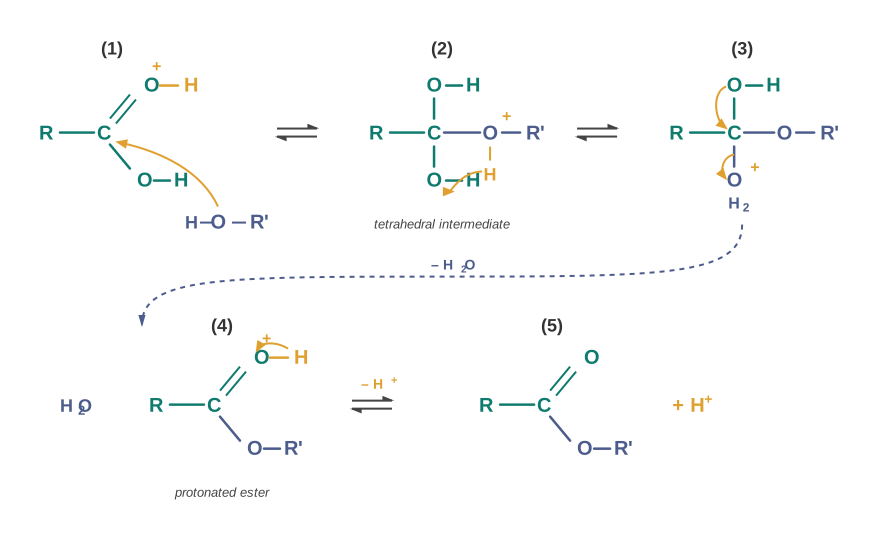
Fig. 8.33 – Mechanism of esterification of carboxylic acids.
3. Reactions with \(\\mathrm{PCl\_5}\), \(\\mathrm{PCl\_3}\) and \(\\mathrm{SOCl\_2}\)
The hydroxyl group of carboxylic acids behaves like that of alcohols and is easily replaced by a chlorine atom on treating with \(\\mathrm{PCl\_5}\), \(\\mathrm{PCl\_3}\) or \(\\mathrm{SOCl\_2}\).
\[\\mathrm{RCOOH} + \\mathrm{PCl\_5} \\longrightarrow \\mathrm{RCOCl} + \\mathrm{POCl\_3} + \\mathrm{HCl}\]
\[3,\\mathrm{RCOOH} + \\mathrm{PCl\_3} \\longrightarrow 3,\\mathrm{RCOCl} + \\mathrm{H\_3PO\_3}\]
\[\\mathrm{RCOOH} + \\mathrm{SOCl\_2} \\longrightarrow \\mathrm{RCOCl} + \\mathrm{SO\_2} + \\mathrm{HCl}\]
Thionyl chloride (\(\\mathrm{SOCl\_2}\)) is preferred because the other two products are gaseous and escape the reaction mixture, making the purification of the product easier.
4. Reaction with ammonia
Carboxylic acids react with ammonia to give an ammonium salt, which on further heating at high temperature gives an amide. For example:
\[\\mathrm{CH\_3COOH} + \\mathrm{NH\_3} \\rightleftharpoons \\mathrm{CH\_3COO^-\\overset{+}{N}H\_4} \\xrightarrow\[\\ -\\mathrm{H\_2O}\\ ]{\\ \\Delta\\ } \\mathrm{CH\_3CONH\_2}\]
Ammonium acetate gives acetamide.
\[\\mathrm{C\_6H\_5COOH} + \\mathrm{NH\_3} \\rightleftharpoons \\mathrm{C\_6H\_5COO^-\\overset{+}{N}H\_4} \\xrightarrow\[\\ -\\mathrm{H\_2O}\\ ]{\\ \\Delta\\ } \\mathrm{C\_6H\_5CONH\_2}\]
Ammonium benzoate gives benzamide.
A dicarboxylic acid can go one step further. Phthalic acid (benzene-1,2-dicarboxylic acid) with ammonia gives ammonium phthalate, which on heating loses two molecules of water to give phthalamide; on strong heating, phthalamide loses ammonia to give the cyclic imide, phthalimide, as shown in Fig. 8.34.
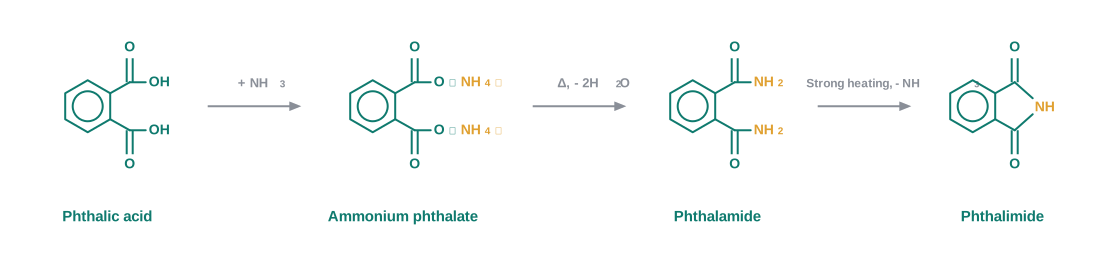
Fig. 8.34 – Formation of phthalimide from phthalic acid.
8.9.3 Reactions Involving –COOH Group
1. Reduction
Carboxylic acids are reduced to primary alcohols by lithium aluminium hydride, or better with diborane. Diborane does not easily reduce functional groups such as ester, nitro and halo, which is why it is the more selective choice when those groups are present elsewhere in the molecule. Sodium borohydride does not reduce the carboxyl group at all.
\[\\mathrm{R!-!COOH} \\xrightarrow\[\\ \\text{(ii)}\\ \\mathrm{H\_3O^+}\\ ]{\\ \\text{(i) }\\mathrm{LiAlH\_4}/\\text{ether}\\ \\text{or}\\ \\mathrm{B\_2H\_6}\\ } \\mathrm{R!-!CH\_2OH}\]
2. Decarboxylation
Carboxylic acids lose carbon dioxide to form hydrocarbons when their sodium salts are heated with sodalime (NaOH and CaO in the ratio 3 : 1). The reaction is known as decarboxylation.
\[\\mathrm{R!-!COONa} \\xrightarrow\[\\ \\text{Heat}\\ ]{\\ \\mathrm{NaOH}\\ \&\\ \\mathrm{CaO}\\ } \\mathrm{R!-!H} + \\mathrm{Na\_2CO\_3}\]
The product hydrocarbon has one carbon less than the acid — this is the standard way of descending the series, and it is the exact opposite of the ascending routes of Section 8.7.
Alkali metal salts of carboxylic acids also undergo decarboxylation on electrolysis of their aqueous solutions, forming hydrocarbons having twice the number of carbon atoms present in the alkyl group of the acid. The reaction is known as Kolbe electrolysis (Chapter 9, Class XI). Two alkyl groups, each left behind after the loss of \(\\mathrm{CO\_2}\), couple together — which is why the carbon count doubles.
8.9.4 Substitution Reactions in the Hydrocarbon Part
1. Halogenation
Carboxylic acids having an α-hydrogen are halogenated at the α-position on treatment with chlorine or bromine in the presence of a small amount of red phosphorus to give α-halocarboxylic acids. The reaction is known as the Hell–Volhard–Zelinsky (HVZ) reaction.
\[\\mathrm{R!-!CH\_2!-!COOH} \\xrightarrow\[\\ \\text{(ii) }\\mathrm{H\_2O}\\ ]{\\ \\text{(i) }\\mathrm{X\_2}/\\text{Red phosphorus}\\ } \\mathrm{R!-!CH(X)!-!COOH} \\qquad (\\mathrm{X} = \\mathrm{Cl},\\ \\mathrm{Br})\]
The product is an α-halocarboxylic acid. The requirement of an α-hydrogen should be familiar — it is the same structural condition that governed the aldol condensation in Section 8.4, and the halogen goes exactly where the α-hydrogen was.
Note also what the reaction gives you: an α-halo acid carries a strongly electron-withdrawing halogen right next to the carboxyl group, so it is a much stronger acid than its parent — the substituent effect of Section 8.9.1 made to order.
2. Ring substitution
Aromatic carboxylic acids undergo electrophilic substitution reactions in which the carboxyl group acts as a deactivating and meta-directing group. They however do not undergo the Friedel–Crafts reaction, because the carboxyl group is deactivating and the catalyst, aluminium chloride (a Lewis acid), gets bonded to the carboxyl group itself — the catalyst is thus tied up and cannot generate the electrophile.
\[\\mathrm{C\_6H\_5COOH} \\xrightarrow\[\\ \\text{Conc. }\\mathrm{H\_2SO\_4}\\ ]{\\ \\text{Conc. }\\mathrm{HNO\_3}\\ } \\textit{m}\\text{-nitrobenzoic acid}\]
\[\\mathrm{C\_6H\_5COOH} \\xrightarrow{\\ \\mathrm{Br\_2}/\\mathrm{FeBr\_3}\\ } \\textit{m}\\text{-bromobenzoic acid}\]
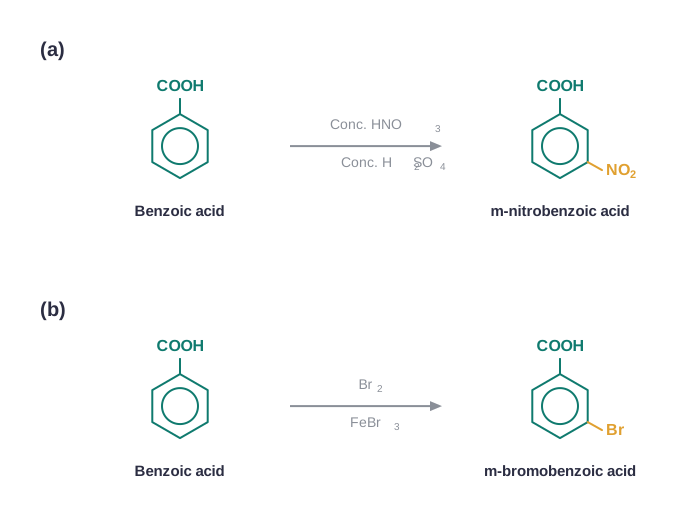
Fig. 8.35 – Electrophilic ring substitution of benzoic acid.
The reason is the one you met for aromatic aldehydes in Section 8.4: the carboxyl group withdraws electron density from the ring, most strongly from the ortho and para positions, leaving the meta position relatively the richest in electrons — so that is where an incoming electrophile attacks.
8.10 Uses of Carboxylic Acids
Every use listed below follows from a property you have already studied — acidity, the ability to be esterified, or the presence of a long hydrocarbon chain attached to a polar head.
The individual acids and their industries
Methanoic acid (formic acid) is used in the rubber, textile, dyeing, leather and electroplating industries. It is the simplest and one of the strongest of the ordinary carboxylic acids, and in most of these processes it is being used precisely as a cheap, strong, volatile acid — for coagulating latex rubber, for fixing dyes on fibre, and for treating hides.
Ethanoic acid (acetic acid) is used as a solvent and as vinegar in the food industry. Vinegar is a dilute aqueous solution of ethanoic acid, and its sharp taste is simply the taste of a weak acid at a safe concentration.
Hexanedioic acid (adipic acid) is used in the manufacture of nylon-6,6. Here the two carboxyl groups at opposite ends of the molecule are essential: each end can react with an amine group of a second molecule, so the units join end to end into a long polymer chain, as shown in FC 8.10.
Flowchart
FC 8.10 – Nylon-6,6 by condensation polymerisation: hexanedioic acid (adipic acid, HOOC–(CH₂)₄–COOH) + hexane-1,6-diamine (H₂N–(CH₂)₆–NH₂) → –COOH reacts with –NH₂ at each end, losing H₂O → amide (–CO–NH–) linkage formed → repeated many times → nylon-6,6 chain; note: a molecule of water is lost at every linkage, so this is a condensation polymerisation.
Esters of benzoic acid are used in perfumery. Esters, as a class, carry pleasant fruity or floral odours, which is why the reaction of Section 8.9.2 matters commercially as well as academically.
Sodium benzoate is used as a food preservative.
Higher fatty acids are used for the manufacture of soaps and detergents. A soap is the sodium (or potassium) salt of a long-chain fatty acid: the ionic –COO⁻Na⁺ head dissolves in water while the long hydrocarbon tail dissolves in grease, and that double personality — the very head-and-tail competition that made higher acids insoluble in Section 8.8 — is exactly what makes cleaning possible.
8.11 Summary
The three families
- Aldehydes, ketones and carboxylic acids are some of the most important classes of organic compounds, all of them built around the carbonyl group (>C=O). In aldehydes the carbonyl carbon carries a hydrogen; in ketones it carries two carbon groups; in carboxylic acids it carries an –OH group as well.
- These are highly polar molecules. Therefore they boil at higher temperatures than hydrocarbons and weakly polar compounds such as ethers of comparable molecular masses.
- The lower members are more soluble in water, because they form hydrogen bonds with water. The higher members, because of the large size of the hydrophobic chain of carbon atoms, are insoluble in water but soluble in common organic solvents.
Preparation of aldehydes
- By dehydrogenation or controlled oxidation of primary alcohols.
- By controlled or selective reduction of acyl halides (Rosenmund reduction), and of nitriles and esters with DIBAL-H.
- Aromatic aldehydes may also be prepared by:
- oxidation of methylbenzene with chromyl chloride (Etard reaction) or with \(\\mathrm{CrO\_3}\) in the presence of acetic anhydride;
- formylation of arenes with carbon monoxide and hydrochloric acid in the presence of anhydrous aluminium chloride and cuprous chloride (Gatterman–Koch reaction);
- hydrolysis of benzal chloride.
Preparation of ketones
- By oxidation of secondary alcohols and by hydration of alkynes.
- By the reaction of an acyl chloride with dialkylcadmium.
- A good method for aromatic ketones is the Friedel–Crafts acylation of aromatic hydrocarbons with acyl chlorides or anhydrides.
- Both aldehydes and ketones can be prepared by the ozonolysis of alkenes.
Reactions of aldehydes and ketones
- They undergo nucleophilic addition reactions onto the carbonyl group with a number of nucleophiles, such as HCN, \(\\mathrm{NaHSO\_3}\), alcohols (or diols), ammonia derivatives and Grignard reagents.
- The α-hydrogens in aldehydes and ketones are acidic. Therefore, aldehydes and ketones having at least one α-hydrogen undergo aldol condensation in the presence of a base to give α-hydroxyaldehydes (aldol) and α-hydroxyketones (ketol) respectively.
- Aldehydes having no α-hydrogen undergo the Cannizzaro reaction in the presence of concentrated alkali.
- Aldehydes and ketones are reduced to alcohols with \(\\mathrm{NaBH\_4}\), \(\\mathrm{LiAlH\_4}\), or by catalytic hydrogenation. The carbonyl group can be reduced all the way to a methylene group by Clemmensen reduction or Wolff–Kishner reduction.
- Aldehydes are easily oxidised to carboxylic acids by mild oxidising reagents such as Tollens’ reagent and Fehling’s reagent. These oxidation reactions are used to distinguish aldehydes from ketones.
Preparation of carboxylic acids
- By the oxidation of primary alcohols, aldehydes and alkenes.
- By the hydrolysis of nitriles, and by the treatment of Grignard reagents with carbon dioxide.
- Aromatic carboxylic acids are also prepared by the side-chain oxidation of alkylbenzenes.
Reactions of carboxylic acids
- Carboxylic acids are considerably more acidic than alcohols and most of the simple phenols, because the carboxylate ion formed on losing the proton is stabilised by two equivalent resonance structures.
- They are reduced to primary alcohols with \(\\mathrm{LiAlH\_4}\), or better with diborane in ether solution.
- They undergo α-halogenation with \(\\mathrm{Cl\_2}\) and \(\\mathrm{Br\_2}\) in the presence of red phosphorus (Hell–Volhard–Zelinsky reaction).
Uses
- Methanal, ethanal, propanone, benzaldehyde, formic acid, acetic acid and benzoic acid are highly useful compounds in industry.
The chapter in one sequence
Flowchart
FC 8.11 – The chapter at a glance. Alcohols/alkenes/alkynes/acyl chlorides/nitriles → preparation → aldehyde or ketone (>C=O). From the aldehyde/ketone node, four reaction branches: (1) nucleophilic addition (HCN → cyanohydrin; NaHSO₃ → bisulphite adduct; alcohol → hemiacetal → acetal; H₂N–Z → >C=N–Z); (2) reduction (NaBH₄/LiAlH₄ → alcohol; Clemmensen or Wolff–Kishner → –CH₂–); (3) oxidation (Tollens’/Fehling’s → carboxylic acid; aldehyde only); (4) α-hydrogen reactions (aldol condensation if α-H present; Cannizzaro if no α-H). Oxidation branch leads to the carboxylic acid node (also reached from primary alcohols, alkylbenzenes, nitriles and Grignard + CO₂). From the carboxylic acid node: O–H cleavage → salts (test: CO₂ with NaHCO₃); C–OH cleavage → anhydride, ester, acyl chloride, amide; –COOH group → reduction to primary alcohol, decarboxylation to hydrocarbon; hydrocarbon part → HVZ α-halogenation and meta ring substitution.
Key relations to remember
\[\\mathrm{RCOOH} + \\mathrm{H\_2O} \\rightleftharpoons \\mathrm{H\_3O^+} + \\mathrm{RCOO^-} \\qquad K\_a = \\frac{\[\\mathrm{H\_3O^+}]\[\\mathrm{RCOO^-}]}{\[\\mathrm{RCOOH}]} \\qquad \\mathrm{p}K\_a = -\\log K\_a\]
The smaller the p\(K\_a\), the stronger the acid: trifluoroacetic acid (0.23) > benzoic acid (4.19) > acetic acid (4.76), while phenol (10) and ethanol (~16) are weaker still.
8.12 NCERT Questions
- What is meant by the following terms? Give an example of the reaction in each case.
- Cyanohydrin (ii) Acetal (iii) Semicarbazone (iv) Aldol (v) Hemiacetal (vi) Oxime (vii) Ketal (viii) Imine (ix) 2,4-DNP-derivative (x) Schiff’s base
- Name the following compounds according to the IUPAC system of nomenclature:
- \(\\mathrm{CH\_3CH(CH\_3)CH\_2CH\_2CHO}\)
- \(\\mathrm{CH\_3CH\_2COCH(C\_2H\_5)CH\_2CH\_2Cl}\)
- \(\\mathrm{CH\_3CH{=}CHCHO}\)
- \(\\mathrm{CH\_3COCH\_2COCH\_3}\)
- \(\\mathrm{CH\_3CH(CH\_3)CH\_2C(CH\_3)\_2COCH\_3}\)
- \(\\mathrm{(CH\_3)\_3CCH\_2COOH}\)
- \(\\mathrm{OHCC\_6H\_4CHO}\)-p
- Draw the structures of the following compounds.
- 3-Methylbutanal (ii) p-Nitropropiophenone (iii) p-Methylbenzaldehyde (iv) 4-Methylpent-3-en-2-one (v) 4-Chloropentan-2-one (vi) 3-Bromo-4-phenylpentanoic acid (vii) p,p’-Dihydroxybenzophenone (viii) Hex-2-en-4-ynoic acid
- Write the IUPAC names of the following ketones and aldehydes. Wherever possible, give also common names.
- \(\\mathrm{CH\_3CO(CH\_2)\_4CH\_3}\)
- \(\\mathrm{CH\_3CH\_2CHBrCH\_2CH(CH\_3)CHO}\)
- \(\\mathrm{CH\_3(CH\_2)\_5CHO}\)
- \(\\mathrm{Ph!-!CH{=}CH!-!CHO}\)
- a cyclopentane ring carrying a –CHO group
- \(\\mathrm{PhCOPh}\)
- Draw structures of the following derivatives.
- The 2,4-dinitrophenylhydrazone of benzaldehyde
- Cyclopropanone oxime
- Acetaldehydedimethylacetal
- The semicarbazone of cyclobutanone
- The ethylene ketal of hexan-3-one
- The methyl hemiacetal of formaldehyde
- Predict the products formed when cyclohexanecarbaldehyde reacts with the following reagents.
- \(\\mathrm{PhMgBr}\) and then \(\\mathrm{H\_3O^+}\)
- Tollens’ reagent
- Semicarbazide and weak acid
- Excess ethanol and acid
- Zinc amalgam and dilute hydrochloric acid
- Which of the following compounds would undergo aldol condensation, which the Cannizzaro reaction, and which neither? Write the structures of the expected products of aldol condensation and Cannizzaro reaction.
- Methanal (ii) 2-Methylpentanal (iii) Benzaldehyde (iv) Benzophenone (v) Cyclohexanone (vi) 1-Phenylpropanone (vii) Phenylacetaldehyde (viii) Butan-1-ol (ix) 2,2-Dimethylbutanal
- How will you convert ethanal into the following compounds?
- Butane-1,3-diol (ii) But-2-enal (iii) But-2-enoic acid
- Write the structural formulas and names of four possible aldol condensation products from propanal and butanal. In each case, indicate which aldehyde acts as the nucleophile and which as the electrophile.
- An organic compound with the molecular formula \(\\mathrm{C\_9H\_{10}O}\) forms a 2,4-DNP derivative, reduces Tollens’ reagent and undergoes the Cannizzaro reaction. On vigorous oxidation it gives 1,2-benzenedicarboxylic acid. Identify the compound.
- An organic compound (A) (molecular formula \(\\mathrm{C\_8H\_{16}O\_2}\)) was hydrolysed with dilute sulphuric acid to give a carboxylic acid (B) and an alcohol (C). Oxidation of (C) with chromic acid produced (B). (C) on dehydration gives but-1-ene. Write equations for the reactions involved.
- Arrange the following compounds in increasing order of their property as indicated:
- Acetaldehyde, Acetone, Di-tert-butyl ketone, Methyl tert-butyl ketone (reactivity towards HCN)
- \(\\mathrm{CH\_3CH\_2CH(Br)COOH}\), \(\\mathrm{CH\_3CH(Br)CH\_2COOH}\), \(\\mathrm{(CH\_3)\_2CHCOOH}\), \(\\mathrm{CH\_3CH\_2CH\_2COOH}\) (acid strength)
- Benzoic acid, 4-Nitrobenzoic acid, 3,4-Dinitrobenzoic acid, 4-Methoxybenzoic acid (acid strength)
- Give simple chemical tests to distinguish between the following pairs of compounds.
- Propanal and Propanone (ii) Acetophenone and Benzophenone (iii) Phenol and Benzoic acid (iv) Benzoic acid and Ethyl benzoate (v) Pentan-2-one and Pentan-3-one (vi) Benzaldehyde and Acetophenone (vii) Ethanal and Propanal
- How will you prepare the following compounds from benzene? You may use any inorganic reagent and any organic reagent having not more than one carbon atom.
- Methyl benzoate (ii) m-Nitrobenzoic acid (iii) p-Nitrobenzoic acid (iv) Phenylacetic acid (v) p-Nitrobenzaldehyde
- How will you bring about the following conversions in not more than two steps?
- Propanone to Propene
- Benzoic acid to Benzaldehyde
- Ethanol to 3-Hydroxybutanal
- Benzene to m-Nitroacetophenone
- Benzaldehyde to Benzophenone
- Bromobenzene to 1-Phenylethanol
- Benzaldehyde to 3-Phenylpropan-1-ol
- Benzaldehyde to α-Hydroxyphenylacetic acid
- Benzoic acid to m-Nitrobenzyl alcohol
- Describe the following:
- Acetylation (ii) Cannizzaro reaction (iii) Cross aldol condensation (iv) Decarboxylation
- Complete each synthesis by giving the missing starting material, reagent or product.
- Ethylbenzene \(\\xrightarrow\[\\ \\mathrm{KOH},\\ \\text{heat}\\ ]{\\ \\mathrm{KMnO\_4}\\ }\) ?
- Benzene-1,2-dicarboxylic acid (phthalic acid) \(\\xrightarrow\[\\ \\text{heat}\\ ]{\\ \\mathrm{SOCl\_2}\\ }\) ?
- \(\\mathrm{C\_6H\_5CHO} \\xrightarrow{\\ \\mathrm{H\_2NCONHNH\_2}\\ }\) ?
- Benzene \(\\longrightarrow\) ? \(\\longrightarrow\) benzophenone (give the reagents)
- 4-Oxocyclohexanecarbaldehyde \(\\xrightarrow{\\ \[\\mathrm{Ag(NH\_3)*2}]^+\\ }\) ?
- 2-Formylbenzoic acid \(\\xrightarrow{\\ \\mathrm{NaCN}/\\mathrm{HCl}\\ }\) ?
- \(\\mathrm{C\_6H\_5CHO} + \\mathrm{CH\_3CH\_2CHO} \\xrightarrow\[\\ \\Delta\\ ]{\\ \\text{dil. }\\mathrm{NaOH}\\ }\) ?
- \(\\mathrm{CH\_3COCH\_2COOC\_2H\_5} \\xrightarrow\[\\ \\text{(ii) }\\mathrm{H^+}\\ ]{\\ \\text{(i) }\\mathrm{NaBH\_4}\\ }\) ?
- Cyclohexanol \(\\xrightarrow{\\ \\mathrm{CrO\_3}\\ }\) ?
- Methylenecyclohexane (\(\\mathrm{C\_6H*{10}{=}CH\_2}\)) \(\\longrightarrow\) cyclohexanecarbaldehyde (give the reagents)
- ? \(\\xrightarrow\[\\ \\text{(ii) Zn-}\\mathrm{H\_2O}\\ ]{\\ \\text{(i) }\\mathrm{O\_3}\\ } 2\) cyclohexanone
- Give a plausible explanation for each of the following:
- Cyclohexanone forms a cyanohydrin in good yield but 2,2,6-trimethylcyclohexanone does not.
- There are two \(\\mathrm{-NH\_2}\) groups in semicarbazide. However, only one is involved in the formation of semicarbazones.
- During the preparation of esters from a carboxylic acid and an alcohol in the presence of an acid catalyst, the water or the ester should be removed as soon as it is formed.
- An organic compound contains 69.77% carbon, 11.63% hydrogen and the rest oxygen. The molecular mass of the compound is 86. It does not reduce Tollens’ reagent but forms an addition compound with sodium hydrogensulphite and gives a positive iodoform test. On vigorous oxidation it gives ethanoic and propanoic acid. Write the possible structure of the compound.
- Although the phenoxide ion has a greater number of resonating structures than the carboxylate ion, carboxylic acid is a stronger acid than phenol. Why?
8.13 Check Your Concepts
- Aldehydes are more reactive than ketones towards nucleophilic addition. Explain this on the basis of both a steric and an electronic argument, and predict where benzaldehyde would fit in the order.
- Assertion: The Rosenmund reduction of benzoyl chloride uses palladium supported on barium sulphate rather than ordinary palladium. Reason: The support deliberately reduces the activity of the catalyst. State whether the assertion and the reason are true, and whether the reason correctly explains the assertion.
- Why does ethyne on hydration give an aldehyde, while every other alkyne gives a ketone?
- Toluene, ethylbenzene and propylbenzene all give the same product on vigorous oxidation with hot alkaline \(\\mathrm{KMnO\_4}\), but tert-butylbenzene does not react in this way. Name the common product and explain both observations.
- Arrange in increasing order and give a reason in each case:
- \(\\mathrm{HCOOH}\), \(\\mathrm{CH\_3COOH}\), \(\\mathrm{ClCH\_2COOH}\), \(\\mathrm{Cl\_3CCOOH}\) (acid strength)
- Methanal, ethanal, propanone, di-tert-butyl ketone (reactivity towards \(\\mathrm{CN^-}\))
- Butane, propanal, propan-1-ol, ethanoic acid (boiling point)
- Both benzaldehyde and 2,2-dimethylpropanal undergo the Cannizzaro reaction, but butanal does not. What structural feature decides this, and what does butanal do instead when treated with dilute alkali?
- Explain, with the help of the mechanism of esterification, why the –OH group of a carboxylic acid must be protonated before it can leave.
- A student is given two colourless liquids, one of which is propanal and the other propan-1-ol. Suggest two different chemical tests to tell them apart, stating the reagent and the observation in each case.
- Complete the reaction and name the product:
- \(\\mathrm{CH\_3CH\_2COOH} + \\mathrm{Br\_2}\)/red P, then \(\\mathrm{H\_2O}\)
- \(\\mathrm{C\_6H\_5COOH} + \\mathrm{SOCl\_2}\)
- \(\\mathrm{CH\_3COONa}\) + sodalime, heat
- Benzoic acid + conc. \(\\mathrm{HNO\_3}\)/conc. \(\\mathrm{H\_2SO\_4}\)
- Assertion: Benzoic acid does not undergo the Friedel–Crafts reaction. Reason: The –COOH group is deactivating, and the Lewis acid catalyst becomes bonded to the carboxyl group. State whether the assertion and the reason are true, and whether the reason correctly explains the assertion.
- Why is \(\\mathrm{SOCl\_2}\) preferred over \(\\mathrm{PCl\_5}\) and \(\\mathrm{PCl\_3}\) for converting a carboxylic acid into an acyl chloride?
- The carbonyl carbon of ethanal is a much better electrophile than that of ethanoic acid, although both contain a C=O group. Explain, using resonance structures.
- Match the reagent in Column I with the transformation it brings about in Column II.
| Column I (reagent) | Column II (transformation) |
|---|---|
| a. DIBAL-H | i. ketone → hydrocarbon (–CH₂–) |
| b. Zn-Hg/conc. HCl | ii. carboxylic acid → primary alcohol |
| c. Tollens’ reagent | iii. ester → aldehyde |
| d. \(\\mathrm{B\_2H\_6}\), then \(\\mathrm{H\_3O^+}\) | iv. aldehyde → carboxylate ion, with a silver mirror |
- Cross aldol condensation between ethanal and propanal gives four products, while that between benzaldehyde and acetophenone gives essentially one. Explain the difference, and name the single major product in the second case.
- Why do carboxylic acids show a higher boiling point than alcohols of comparable molecular mass, even though both form hydrogen bonds? Support your answer with a diagram of the species present in the vapour phase.
- Explain why a positive iodoform test is given by ethanol and by propan-2-ol, although neither of them contains a carbonyl group.
- An aromatic compound (A) of molecular formula \(\\mathrm{C\_7H\_6O}\) gives a silver mirror with Tollens’ reagent, undergoes the Cannizzaro reaction with concentrated NaOH, and on treatment with \(\\mathrm{HNO\_3}/\\mathrm{H\_2SO\_4}\) at 273–283 K gives a single meta-substituted product. Identify (A) and justify each observation.
- Sodium benzoate, and not benzoic acid, is added to soft drinks as a preservative, yet it is the acid that actually does the preserving. Explain both statements.
- Predict the major product and name the reaction type:
- Cyclohexanone + \(\\mathrm{NH\_2OH}/\\mathrm{H^+}\)
- Acetophenone + \(\\mathrm{NaOH}/\\mathrm{I\_2}\)
- Propanone + \(\\mathrm{NH\_2NH\_2}\), then \(\\mathrm{KOH}\)/ethylene glycol, heat
- Ethanal + dilute NaOH, then heat
- Chloroethanoic acid (\(\\mathrm{ClCH\_2COOH}\)) is a much stronger acid than 3-chloropropanoic acid (\(\\mathrm{ClCH\_2CH\_2COOH}\)), although both carry one chlorine atom. Explain.
8.14 Practice With Numericals
- An organic compound contains 62.1% carbon, 10.3% hydrogen and the rest oxygen. Its molar mass is \(58\\ \\text{g mol}^{-1}\). Determine its empirical and molecular formulae, and suggest two possible carbonyl compounds with this molecular formula.
- 4.4 g of ethanal (\(M = 44\\ \\text{g mol}^{-1}\)) is warmed with an excess of Tollens’ reagent. Calculate the mass of silver deposited (\(M(\\mathrm{Ag}) = 108\\ \\text{g mol}^{-1}\)), assuming the reaction goes to completion: \[\\mathrm{RCHO} + 2,\[\\mathrm{Ag(NH\_3)\_2}]^+ + 3,\\mathrm{OH^-} \\rightarrow \\mathrm{RCOO^-} + 2,\\mathrm{Ag} + 2,\\mathrm{H\_2O} + 4,\\mathrm{NH\_3}\]
- 5.8 g of propanone (\(M = 58\\ \\text{g mol}^{-1}\)) is treated with an excess of iodine and sodium hydroxide. Calculate the mass of iodoform, \(\\mathrm{CHI\_3}\) (\(M = 394\\ \\text{g mol}^{-1}\)), obtained if the yield is 100%, and then the mass obtained if the yield is only 75%.
- 0.58 g of a carbonyl compound on complete combustion gives 1.32 g of \(\\mathrm{CO\_2}\) and 0.54 g of \(\\mathrm{H\_2O}\). Its molar mass is \(58\\ \\text{g mol}^{-1}\). Find its molecular formula and calculate its degree of unsaturation.
- The dissociation constant of ethanoic acid at 298 K is \(K\_a = 1.74\\times10^{-5}\).
- Calculate its p\(K\_a\).
- Trifluoroacetic acid has p\(K\_a = 0.23\). By what factor is its \(K\_a\) greater than that of ethanoic acid?
- Which of the two is the stronger acid, and why?
- 6.1 g of benzoic acid (\(M = 122\\ \\text{g mol}^{-1}\)) is treated with an excess of aqueous sodium hydrogencarbonate. Calculate (i) the mass of sodium benzoate formed (\(M = 144\\ \\text{g mol}^{-1}\)) and (ii) the volume of \(\\mathrm{CO\_2}\) evolved at STP (molar volume \(= 22.4\\ \\text{L mol}^{-1}\)).
- 8.8 g of ethyl ethanoate (\(M = 88\\ \\text{g mol}^{-1}\)) is hydrolysed completely with dilute sulphuric acid. Calculate the masses of ethanoic acid (\(M = 60\\ \\text{g mol}^{-1}\)) and ethanol (\(M = 46\\ \\text{g mol}^{-1}\)) formed. Write the balanced equation first.
- 0.15 g of a monobasic carboxylic acid required exactly 25.0 mL of \(0.100\\ \\text{M}\) NaOH for complete neutralisation. Calculate the molar mass of the acid and identify it.
- The molar mass of ethanoic acid calculated from its formula is \(60\\ \\text{g mol}^{-1}\), but its experimentally determined molar mass in benzene solution is close to \(120\\ \\text{g mol}^{-1}\).
- What is the value of the ratio (experimental molar mass)/(formula molar mass)?
- What species must be present in benzene, and what holds it together?
- Would you expect the same experimental value in water? Give a reason.
- An organic compound (A), molecular formula \(\\mathrm{C\_8H\_8O}\), gives an orange-red precipitate with 2,4-DNP reagent, a yellow precipitate with \(\\mathrm{I\_2}\)/NaOH, and does not reduce Tollens’ reagent.
- Calculate the degree of unsaturation of (A).
- Identify (A).
- Calculate the mass of the carboxylic acid (\(\\mathrm{C\_7H\_6O\_2}\), \(M = 122\\ \\text{g mol}^{-1}\)) that would be obtained on the drastic oxidation of 12.0 g of (A) (\(M = 120\\ \\text{g mol}^{-1}\)), assuming complete conversion.