Chapter 1: Work, Livelihood and Career
The Lunch That Never Gets Lost
In 1890, a man named Mahadeo Havaji Bachche began carrying home-cooked lunches from houses in Bombay to offices in the city’s business district. Clerks worked far from home, trains were slow, and a hot meal at midday was worth paying for. He started with a handful of customers. What he began has never stopped running.
The dabbawalas of Mumbai still do that work today. Several thousand of them collect steel tiffin boxes from homes each morning, sort them at railway stations, hand them from one carrier to the next along the suburban lines, and place them on office desks before lunch. In the afternoon the empty boxes travel the whole way back. Most dabbawalas have had little formal schooling, and the boxes carry no barcodes — only a short code of colours, letters and numbers painted on the lid.
The system holds together because of things this chapter is about. Every carrier knows exactly which part of the chain is his. The load is shared so that no one person carries an impossible weight. Work is passed on within families and learnt on the job. And the men who do it speak of the work with pride, because a hot meal reaching the right desk on time is a promise kept.
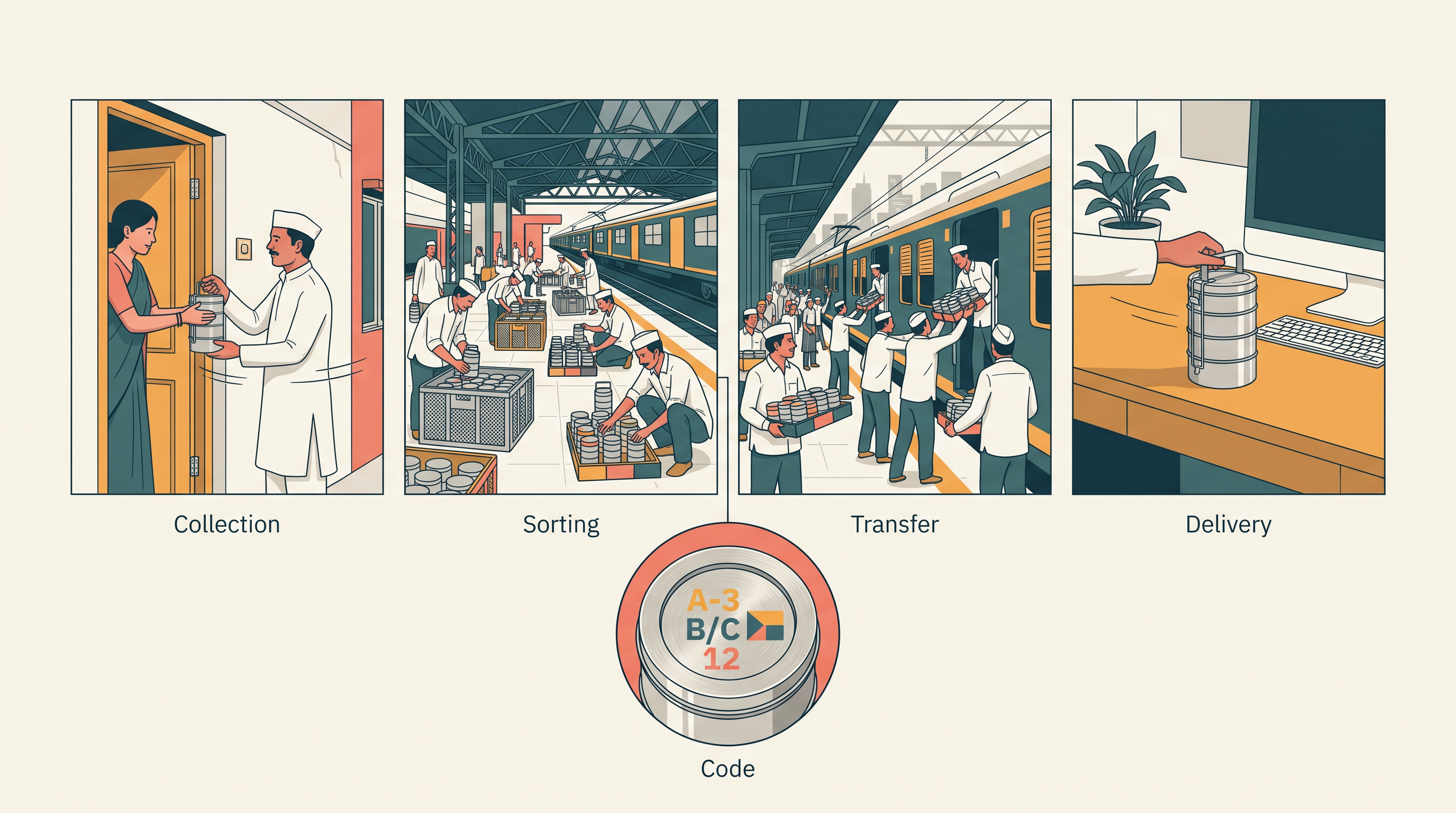
Fig. 1.0 – A dabbawala delivery chain in Mumbai.
1.1 Work And Its Place In Human Life
Think of everything that had to be done before you sat down to read this page. Someone grew the grain that became your breakfast, someone drove it to a market, someone cooked it, and someone washed the vessels afterwards. Some of these people were paid for what they did and some were not.
All of it was work. Work is the set of essential activities a person undertakes for a purpose or out of necessity. It is the one activity that fills the largest part of most people’s waking lives.
1.1.1 What Work Is
Work is not only a way of keeping busy or of earning. It is one of the main ways in which a person fits into the world around her, forms relationships, and finds a place in society.
Through work a person uses talents and skills that would otherwise stay unused. She also learns, and in learning she builds an identity — a sense of who she is and where she belongs.
Work is central in every culture, though each culture judges it differently. The same task may be honoured in one society and thought lowly in another, which tells us that the value placed on work is a social judgement, not a property of the task itself.
Notice what this definition leaves out. It does not say that work must be paid, and it does not say that work must be done outside the home. A volunteer teaching at a night school and a grandfather minding a toddler so that his daughter can attend her shift are both working.
Nor is work confined to human beings. Bees pollinate, earthworms turn the soil, rivers carry silt to fields. What we call our necessities, comforts and luxuries comes from the work of people and the work of nature together.
1.1.2 What Decides The Work A Person Does
Two people of the same age, living in the same town, often end up doing very different work. The difference is rarely a matter of talent alone. Several conditions decide what work is open to a person and what she finally takes up:
- education, and the qualifications it leads to;
- health, which sets what the body and mind can sustain;
- age, which decides both entry into work and retirement from it;
- access to opportunities, including information about what jobs exist;
- globalisation, which opens some kinds of work and closes others;
- geographic location, since coastal, hill, desert and city economies each offer different work;
- financial returns, which decide whether a person can afford to stay in a line of work;
- family background, including the occupation and contacts a family already has.
These conditions act together and not one at a time. A young person with the aptitude to become a laboratory technician may never meet anyone who does that job, and so may never learn that the training exists.
1.1.3 What Work Gives The Worker
Most people work in order to acquire money, provide for their families, and earn leisure, recreation, play and free time. That much is plain, and there is nothing small about it.
But money is only the first return. Work is also a catalyst for personal identity, and steady competence at a task is one of the surest sources of self-esteem — the quiet confidence that comes from being good at something that matters.
A person’s work reaches outward in widening circles. She contributes to herself, in confidence, well-being and income. She contributes to the organisation that employs her, by making its products better, its reputation stronger or its profits larger. Beyond that, her work affects the quality of life of everyone it touches.

Fig. 1.1 – The widening reach of one person’s work.
Fig. 1.1 is worth reading in both directions. A tailor’s careful stitching benefits her own income first and the customer last; a doctor’s carelessness harms the patient first and her own reputation later.
Work That Earns Nothing
Some people work ceaselessly for pleasure, for intellectual stimulation, or for the contribution itself, without earning any money at all. The work family members do for one another falls in this class, as does the work of volunteers.
This is why work cannot be measured by earnings alone. The real question is whether the work makes a contribution — to oneself, to one’s family, to one’s employer, to society, to the nation, or to the world.
1.1.4 The Many Ways Of Viewing Work
Ask ten people what work means to them and you will not get one answer. The same eight hours may be endured by one person and enjoyed by another, and both may be describing the same office. Work may be viewed as:
- a job and a means of making a living;
- a task or duty that carries a sense of obligation;
- a means of security of livelihood, through a secure job and a steady income;
- dharma or duty — an expression of one’s true self and of talents that shape the quality of life of oneself and of others;
- a part of spiritual practice;
- a vehicle for one’s creations;
- a source of joy and fulfilment;
- a source of hope, self-esteem and dignity, since earning one’s own livelihood offers all three;
- a symbol of status, power and control;
- a rewarding experience — a mental or physical workout that can end in success;
- a means of self development and self-actualisation, that is, the fullest use of one’s own abilities, reflecting what a person values and aspires to.
Why The View Matters
These are not eleven kinds of work. They are eleven ways of seeing work, and more than one may be true of the same person at the same time.
The view a person holds changes what the work does to her. Someone who sees her job only as an obligation will count the hours; someone who sees the same job as a vehicle for her own creations will look for ways to do it better. Attitude, as you will see in Section 1.6, is not a decoration on top of work — it is part of the work itself.
1.2 Meaningful Work
Section 1.1 ended with a question about contribution. That question leads straight to the idea of meaningful work, because work that contributes is exactly what people describe as meaningful.
When a person is involved in meaningful work, she develops a sense of identity, of worth, and of dignity. These three are not paid for and cannot be bought, yet they decide how a person feels about the years she spends working.
1.2.1 What Makes Work Meaningful
Meaningful work has three marks. It is useful to society or to other people, it is carried out responsibly, and it is enjoyable to the person doing it. Work that has only one of the three is not enough — useful work done resentfully wears a person down, and enjoyable work done carelessly helps nobody.
Meaningful work also draws on what the worker actually has to offer. It lets her use her skills and her judgement, and it gives her room to show creativity or problem-solving ability rather than repeating a fixed set of motions.
The surroundings matter as much as the task. Ideally, work is performed in an environment that helps positive professional relationships grow, and that brings the worker recognition, rewards, or both. A skilled worker whose contribution is never acknowledged soon stops offering it.
What Meaningful Work Returns
When the outcome of work is meaningful or successful, the returns run deeper than the wage. The person grows; confidence and self worth are strengthened; and over years, she may come closer to actualising her full potential — using the whole of what she is capable of.
The reach is wider than the worker herself. Work gives a person the chance to improve her own life conditions, and, in the larger picture, to improve the conditions of the society she lives in.
1.2.2 Matching Work To The Person
For any person, whether employed by someone else or self-employed, it matters greatly that the work suits her personal attributes, her aptitude — a natural capacity to learn or do something well — her competence and her skills.
This matching is what turns a first job into a life-long career. Work that fits sustains a person’s enthusiasm year after year, and enthusiasm is what carries anyone through the dull stretches that every occupation has.
Put positively, the work life of anyone and everyone should ideally be an expression of that person’s potentials and aspirations. That is a high standard, and few people meet it at their first attempt; it is still the standard worth aiming at.
Five Questions Worth Asking
A person entering work life, or thinking of building a career, can put the following questions to herself:
- What are my special talents, traits and interests, set against the occupation I am considering?
- Is the work stimulating and challenging?
- Is the occupation likely to give me a sense of being useful?
- Does the job make me feel that I am contributing to society?
- Are the ethos and the environment of the workplace likely to suit me?
The questions are in a deliberate order. The first looks inward at the person, the next three at the work itself, and the last at the place where the work will be done. An honest answer to all five is a better guide than an answer to any one of them.
1.3 Job, Livelihood And Career
In ordinary speech we use ‘job’, ‘livelihood’ and ‘career’ as though they meant the same thing. They do not. Each names something different, and a person who keeps them apart can think much more clearly about her own working life.
For most people, earning is not optional. It is necessary in order to meet the basic needs of oneself and one’s family, and that necessity is where the three ideas begin.
1.3.1 A Job And A Career
Work done in order to earn money is conventionally called a job. A job is an involvement in work for its own sake — the task is done, the wage is paid, and the arrangement is complete.
Many people choose to go beyond this. They work steadily along a chosen path, and what they build is a career — work driven by a deep desire to excel and by a need to grow, develop and prove oneself within a chosen field.
A career is therefore more than a job. The difference is not in the task but in the intention behind it: two people may do identical work at identical desks, and one of them may be building something while the other is simply completing what is asked.
1.3.2 Livelihood
Work itself is best understood as a set of activities with an intended set of outcomes. It is not necessarily tied to paid employment: entrepreneurship, consulting, volunteerism, contract work, social work for community welfare and other professional activities are all work.
Livelihood is narrower. It is the means and occupation by which a person supports herself, meets her basic needs, and sustains her way of living.
Securing a livelihood involves more than finding an employer. It involves choosing an occupation, choosing a career path, and designing a working lifestyle — the hours, the location, the travel and the demands a person is willing to live with year after year.
1.3.3 Career As A Life-Long Process
Careers are unique to each person. No two unfold in the same way, and none of them stands still — a career is dynamic, taking shape across a whole working life.
For this reason a career is best treated as a life management concept rather than a job title. Growing in one’s career is a life-long process, and it involves:
- managing the several roles a person holds at once;
- maintaining a balance between paid and unpaid work;
- learning, continuously and deliberately;
- carrying personal life roles alongside working ones;
- making transitions whenever and wherever they are needed, in order to move towards a future the person has determined for herself.
The last phrase is the important one. A career that is shaped only by whatever offers happen to arrive is not managed at all; it is drifted through.
1.3.4 Work As A Job, A Career And A Calling
Work carries several meanings for those who do it, and by and large three of them are common. The differences between them are set out in Table 1.1.
Three Stone-Breakers
An old story makes the same point in a few lines. Three men were breaking boulders with heavy hammers, and each was asked what he was doing.
The first said that this was his job, and that he was breaking rocks into smaller pieces. The second said that this was his livelihood, and that he broke rocks to earn a living and feed his family. The third said that he had a vision of becoming a sculptor, and that he was carving a statue out of the stone before him.
The hammers were identical and so was the stone. Only the third man saw each blow as shaping his career; the first two were describing, quite accurately, a job and a livelihood.
Calling is the name given to the third view. A person who sees her work as a calling derives satisfaction from the work itself, and feels drawn to it by an inner direction rather than by what it pays.
1.3.5 Choosing A Career And Keeping It Growing
How does a person decide what career to pursue? Many follow in their parents’ footsteps, entering an occupation they have watched from close quarters. Others choose paths quite different from their parents’, or different from what their parents had planned for them.
Either route can work. The criterion that matters most in selecting an avenue is a genuine interest in and desire for the chosen path. A person who assumes financial responsibility for a family will be in that work for a very long time, and enjoyment of it is not a luxury but a practical necessity.
Learning Does Not Stop
Ideas about careers have changed. It is no longer sufficient simply to get a job, because the knowledge and equipment of most fields change while a person is still working in them.
Success now depends on continually upgrading skills, learning new ones, updating knowledge and building competencies. Education therefore cannot stop in youth or early adulthood. It has to continue into a person’s middle career years, and where necessary into her later career years as well.
1.4 Traditional Occupations Of India
Few countries have a culture as old or as varied as India’s, and fewer still have kept that variety intact. Despite the diversity, there has been a social and cultural cohesiveness of an enduring kind, carried through everyday practice rather than through decree, and holding through long periods of invasion and upheaval.
Much of that culture survives inside occupations. Traditional occupations are lines of work carried on within a community over generations, with the skills passed from one generation to the next. They are worth studying not as heritage alone but as livelihoods that millions of households still depend on.
1.4.1 Agriculture And Fishing
Agriculture has been one of the major occupations for a large part of the population, because climatic conditions in most parts of India suit agricultural activity. According to the Census of India, 2011, close to seven persons in ten lived in rural areas, and farming remains the largest single source of employment in the country.
A considerable proportion of these farmers work small plots, many of which they do not own. The result is marginal production — a yield that may not even be sufficient for the family’s own consumption, leaving nothing to sell at a profit.
In most parts of the country, some farmers also grow cash crops, that is, crops grown for sale rather than for the household’s own use. In some areas tea, coffee, cardamom and rubber are of great economic importance, because they are exported and earn foreign exchange.
The scale of Indian agriculture shows in its output. India is the largest producer of milk in the world, and among the largest producers of ginger and turmeric, of fruits and vegetables, of spices and condiments, and of tea.
Fishing is the other great traditional occupation of this kind. India has a very long coastline, and the fishing communities along it — together with those working inland waters — have made a livelihood from it for centuries.
1.4.2 Handicrafts And Handloom Weaving
Handicrafts have long been a traditional occupation in Indian villages. Today many Indian crafts sell well in international markets, and for a large number of rural households they are the main means of livelihood.
The range is wide. It includes wood craft, pottery, metal craft, jewellery making, comb craft, glass and paper craft, embroidery, weaving, dyeing and printing, shell craft, sculpture, terracotta, sholapitha craft, dhurries, rugs and carpets, and articles of clay and iron. Ivory craft was once part of this list; trade in ivory is now prohibited by law in India, and the craftspeople who worked in it have moved to bone, wood and other materials.
Weaving is a cottage industry — production carried on in the home or in small units, using family labour rather than a factory workforce. Nearly every state has its own typical woven fabrics, embroideries and traditional costumes, suited to the climate and the way of life of that region, and different regions are known for entirely different kinds of weaving.
Indian hand-woven fabric has been admired for centuries. In the past much of it was made for daily use and some for decoration; the modern economy has carried the same craft items into the global market, where they earn the country considerable foreign exchange.
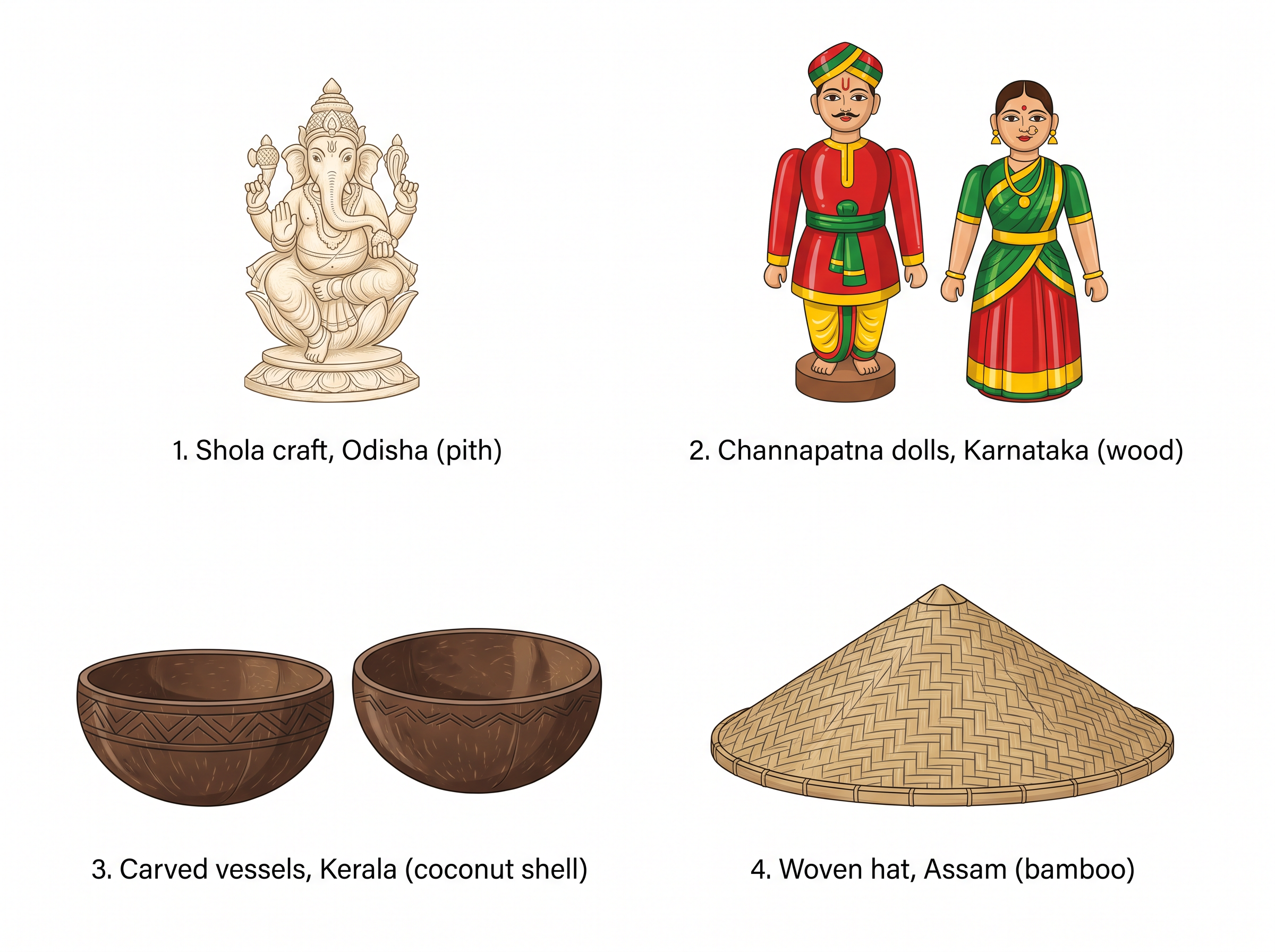
Fig. 1.2 – Handicrafts of four Indian states.
1.4.3 How Traditional Skills Were Passed On
Traditionally, the processes, techniques and skills of crafting and manufacture were handed down from one generation to the next, to members within the family. Training was home-based, and the know-how and its finer nuances were closely guarded secrets held within a closed group.
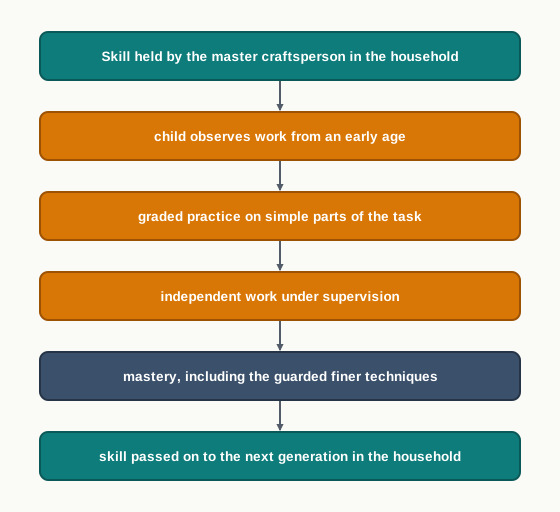
Fig. 1.3 – Traditional transmission of craft skills.
Fig. 1.3 explains both the strength and the weakness of the system. Learning inside the household produced very high skill, because the child began early and practised daily. But it also closed the craft to anyone born outside the household, and it left the craft with no way of surviving if one generation chose to leave.
In India, the dynamics of religion, caste and occupation have long been interwoven, with a hierarchy attached to different groups of occupations. There are hundreds of traditional occupations of this inter-generational kind — among them garland making, salt making, the tapping of neera or palm sap juice, mining, and brick and tile making. Priests, sweepers and leather workers have also followed occupations passed down in this way.
Some occupations once carried on in this manner are now restricted or prohibited outright. Hunting and trapping of wild birds and animals is prohibited for most species under wildlife law, and employment as a manual scavenger is prohibited by law in India, with provision for rehabilitation of those formerly engaged in it.
1.4.4 Regional Cuisines As A Livelihood
Like weaving, embroidery and the visual arts, cuisine differs from region to region. Each region cooks a wide variety of local foods with indigenous ingredients and its own combinations of spices.
Cooking has become a livelihood for very large numbers of people. The range runs from street food vendors to speciality restaurants and the themed food pavilions of large hotels. Many traditional preparations, spice mixes and masalas are now in demand in other countries as well, which has turned regional cooking knowledge into an export.
1.4.5 The Visual Arts
India has a multiplicity of visual arts, some of which have been practised for over four thousand years. Historically, artists and artisans were supported by two main categories of patrons: the larger Hindu temples, and the princely rulers of the various states.
The main visual arts arose in the context of religious worship. Distinctive regional styles of architecture developed across the country, reflecting Islam, Sikhism, Jainism, Christianity and Hinduism, which typically co-existed in the same regions.
In places of worship, in mausoleums — burial chambers — and in palaces, images were skilfully carved in stone, cast in bronze or silver, modelled in terracotta or wood, or brightly painted. Much of this work has been preserved and forms part of India’s heritage.
These arts are now preserved and promoted through the efforts of government and of several non-governmental organisations. That work is itself a source of occupational avenues, including entrepreneurship, for people trained in the arts.
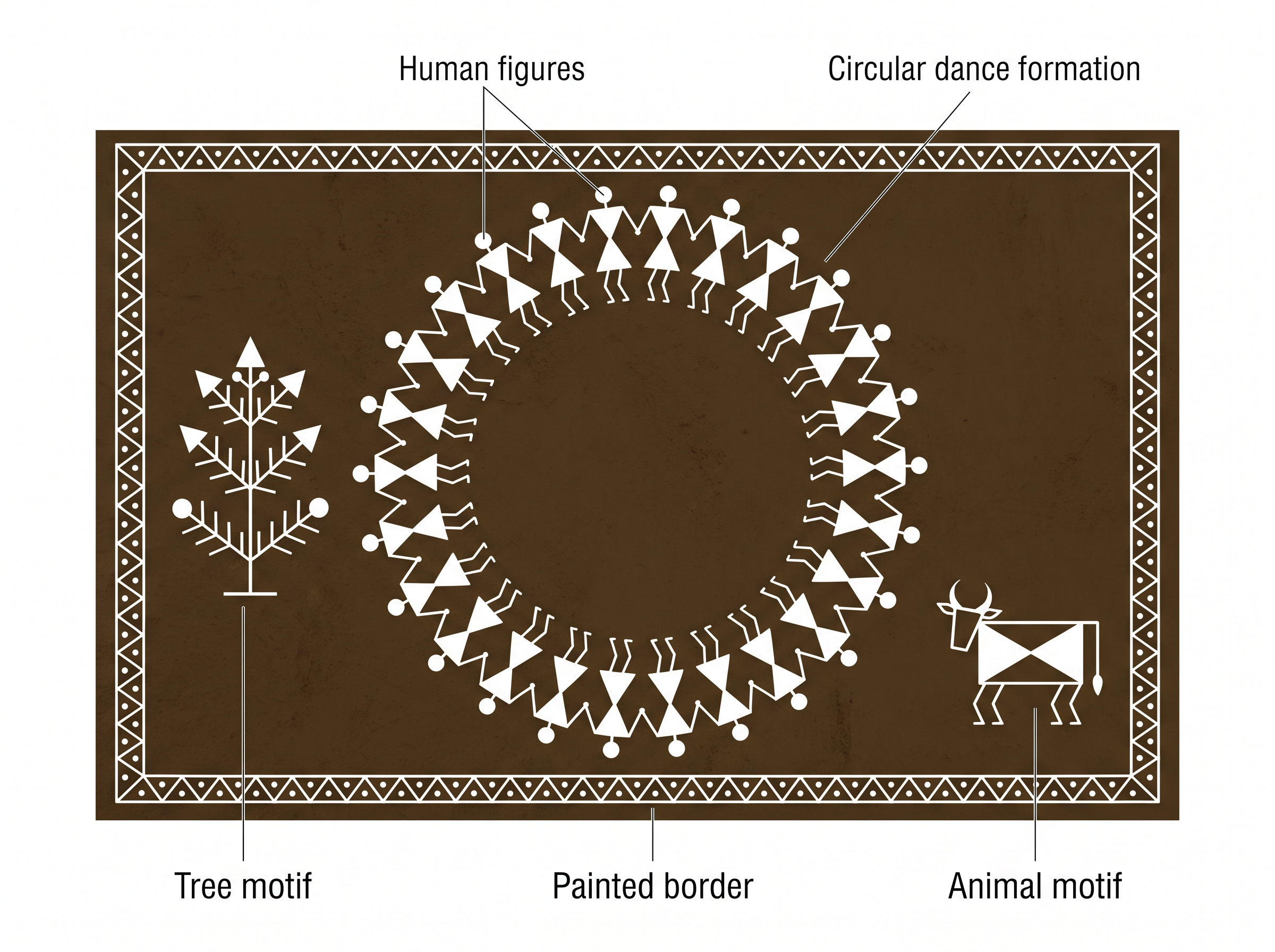
Fig. 1.4 – Motifs of a Warli painting.
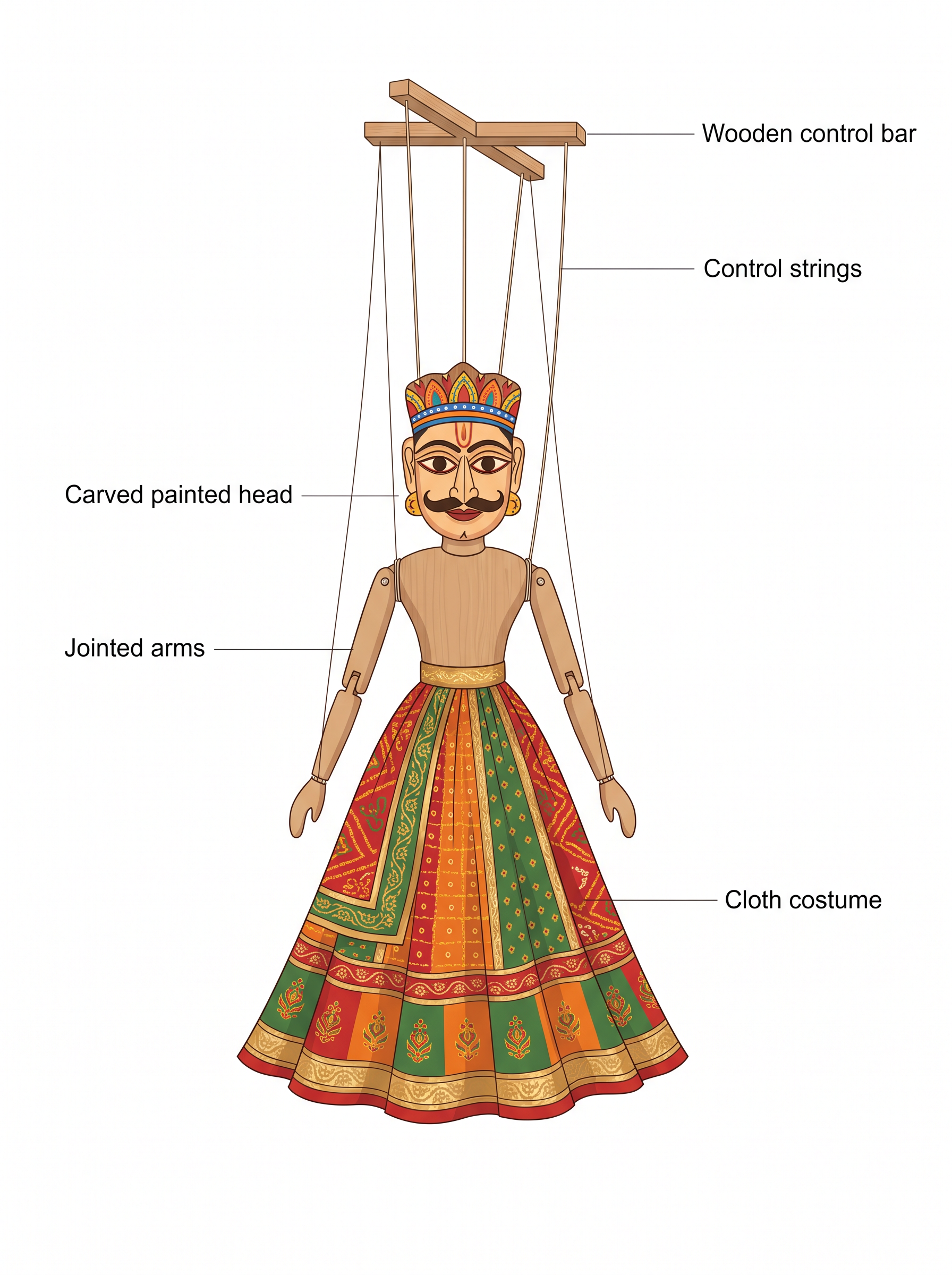
Fig. 1.5 – A traditional Indian string puppet.
1.4.6 Challenges Before Traditional Occupations
Despite this rich inheritance, traditional crafts are steadily losing ground to mass-produced goods. The artisan is left with a meagre income on one side, and on the other there is a gradual erosion of the public’s appreciation of fine craftsmanship.
Several constraints cause this trend together. Illiteracy and general socio-economic disadvantage limit what artisans can negotiate for themselves. Slow progress in implementing land reforms keeps many craft households insecure. Inadequate or inefficient finance and marketing services mean that the artisan sells cheap and the middleman sells dear.
The raw material base is shrinking as well. Shrinkage of forests, depletion of the resource base and general environmental degradation are responsible for many of the difficulties craftspeople now face — a bamboo worker without accessible bamboo has lost her occupation whatever her skill.
1.4.7 Reviving And Sustaining Indigenous Skills
These are serious challenges, and they point to an urgent need to revive and sustain indigenous knowledge, know-how and skills that are fast losing ground. Interventions are required in several areas:
- design innovations, so that traditional skills produce objects people want today;
- preservation and refinement strategies for the techniques themselves;
- use of eco-friendly raw materials;
- packaging, which decides whether a craft object survives transport and attracts a buyer;
- establishment of training facilities, so that the skill can be learnt outside the family;
- conservation of traditional knowledge;
- protection of intellectual property rights (IPR) — the legal rights that protect creations of the mind, including designs and the names of craft traditions.
Each of these is also a career avenue. It is important for young people and for communities to see the scope here, because design, marketing, packaging, training and documentation of crafts are occupations in their own right. Efforts of this kind also raise the income-generating potential of rural households, and the Government of India is making concerted efforts in this direction.
One challenge remains larger than the rest. Indian society has to maintain this diversity of occupations without the hierarchy, and without the caste-based divisions of work, that were historically attached to it. Diversity of craft is worth keeping; the ranking of people by the work their ancestors did is not.
1.5 Work, Age And Gender
The age and the sex of the people in a workforce shape working life in ways that a list of job titles never shows. They matter at two levels at once: for the individual, which is the micro perspective, and for society and the nation, which is the macro perspective.
The stakes are highest where a person is pushed into work that does not suit her physiological and psychological state. The health and development of children and of women is at risk when that happens, and older workers face pressures of their own. This section takes up the questions of gender that run through all of them.
1.5.1 Sex And Gender
Nature distinguishes the two sexes clearly in most forms of life, and the biological and functional differences are well established. In everyday speech people usually differentiate simply between men and women. The Supreme Court of India has recognised transgender persons as a third gender, and their rights are protected by law.
The words ‘sex’ and ‘gender’ are often used interchangeably, but strictly speaking they mean different things. Sex refers to the biological categorisation of a person, based on genetics and reproductive organs. Gender is based on social identity — on how a person is placed and understood within her society.
The external manifestation of sex is through the primary sexual organs, and the underlying difference arises from XX and XY chromosome combinations, or from other combinations that also occur. Table 1.2 sets the two ideas side by side.
1.5.2 How Gender Roles Are Constructed
In every society, social and cultural practices decide how people of different genders are expected to behave and what type of work they are expected to do. These expectations reach a child very early and continue to shape her right through her growth and development.
Members of a community are expected to perform their roles in the particular ways that social and cultural tradition demands. Out of this expectation come norms of gender role identity — the settled idea of what a person of a given gender does, wears, says and works at.
Over time these norms harden into stereotypes, and stereotyped behaviour comes to be treated as the normal and expected behaviour of everyone in that group. None of it is written down; there is no rule book. It is passed from one generation to the next and continues to be practised. This is why it is said that gender is socially constructed.
The test of a norm is what happens when someone departs from it. Any deviation from the normal and expected is treated as unconventional, non-traditional, and sometimes even as defiance — which tells us that the norm was an expectation, not a fact of nature.
Roles do change, though slowly, producing what may be called continuity with change. The age-old assignment of men as bread winners and women as home makers is visibly in transition today.
1.5.3 Women At Work In India
The idea that women have only recently begun to work is simply untrue. In India women have all along been engaged in production, and in some societies in marketing as well.
In rural India, women are intensively and extensively involved in agriculture and in animal husbandry. In urban areas they work in construction, and are employed as domestic workers. All of these are working women, and all of them contribute to the income of the family in one way or another. In many families, women are the sole bread-earners.
Despite this active participation in earning and in adding to family resources, freedom to make decisions and scope for independence are often denied to women, who therefore remain without power over the resources they help create. The need of the hour is to educate and empower women, and to give them their rightful voice and place in society.
Participation in the workforce outside the home has helped both the woman and her household — it has improved the family’s resources and widened her own life. Women now work in every sector of the economy, many of them in senior positions.
The Double Burden
There is a difficulty attached to this gain. A woman who takes up paid work is, in most households, still expected to perform most or all of the household chores and to be the primary caregiver. Carrying both loads at once is called the double burden.
The double burden is not solved by the woman working faster. It is solved by the household redistributing the unpaid work, which is a decision the whole family makes and not one she can make alone.
1.5.4 Valuing Unpaid Work At Home
Empowerment has a precondition that is easy to miss. Women cannot be empowered until the work done at home is valued, and treated as equivalent to paid work.
The work performed by homemakers has rarely been valued, and for a long time was not even counted as an economic activity. Yet the household chores and domestic work done to support a family — cooking, cleaning, laundering, marketing, care of children and of older members — demand energy every day, at every stage of the worker’s life.
Consider what that work does. It enables every other member of the family to perform his or her own roles and duties more efficiently. A meal cooked and a uniform washed are what allow another member to leave for work at all. On the same reasoning, money saved by work done at home is money earned by the household.
Domestic work therefore needs to be valued as an economic contribution and as a productive activity. It should also be shared: nothing in the work itself makes it the responsibility of one gender.
1.5.6 Constitutional Rights And Protective Legislation
The starting point for all of this is the Constitution of India, which guarantees equality to women and men in all walks of life. It guarantees equal opportunity for all citizens in matters relating to employment or appointment to any office under the State, and forbids discrimination in respect of any such employment or office on grounds that include caste, race, sex and place of birth.
The Constitution goes further than prohibition. It directs that women workers be provided just and humane conditions of work, that they be protected from exploitation, and that they be supported and encouraged in their educational and economic pursuits. It also empowers the State to make special provisions for women and children — which is why measures that apply only to women are not a breach of equality but an instrument of it.
The Protective Acts
Several Acts safeguard these constitutional rights in particular industries and situations:
- the Factories Act, 1948, the Plantation Labour Act, 1951 and the Mines Act, 1952, which provide protection to women working in those industrial sectors;
- the Employees’ State Insurance Act, 1948, which provides for sickness, maternity and employment injury benefits;
- the Maternity Benefit Act, 1961, which provides for paid maternity leave and related benefits, and which was amended in 2017 to extend that leave substantially;
- the Equal Remuneration Act, 1976, which required equal wages for the same work or work of a similar nature, and whose requirement of equal pay has since been carried into the Code on Wages, 2019.
The Factories Act also provides for child care at the workplace: under Section 48, a factory employing more than thirty women must maintain a creche for children below six years of age, and must maintain it at its own cost. The Maternity Benefit (Amendment) Act, 2017 extended a similar requirement to establishments employing fifty or more persons.
Read the last provision carefully and you will see a hidden assumption. A creche required only where women are employed treats child care as the mother’s concern rather than the family’s — which is exactly the kind of norm Section 1.5.2 described.
1.5.7 State Initiatives For Women
Beyond legislation, a series of administrative steps has been taken to improve the position of women in employment and of those seeking it.
- Women’s cells were created in the Ministry of Labour to look into the problems of women workers.
- A National Plan of Action for women was taken up by the Department of Social Welfare, to implement the requirement of equal remuneration.
- A working group on women’s employment was constituted to widen employment opportunities for rural women and to review the labour laws relating to women’s work and their participation in economic and productive activity.
- A steering committee was formed to build a database on women’s work, particularly in rural areas.
The last of these matters more than it may appear to. Policy follows data; work that is never recorded is work that no scheme is designed for.
A Shift In Approach
The thinking behind women’s programmes has itself changed over the decades, and the change is worth tracing.
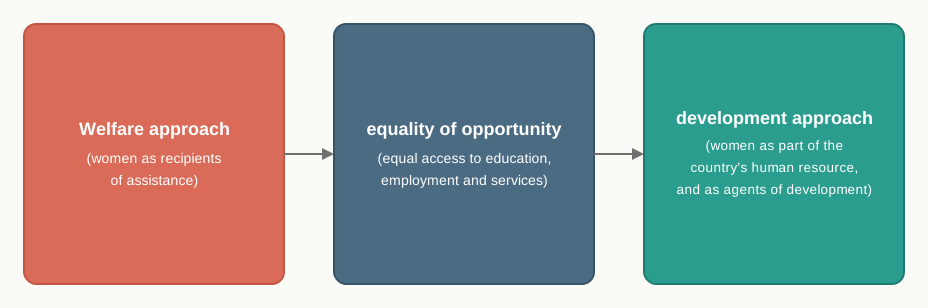
Fig. 1.6 – Shift in approach to women’s programmes.
Fig. 1.6 records a change of assumption at each step. Under the welfare approach, benefits were given to women; under the development approach, it was recognised that benefits cannot be reaped at all unless women’s development programmes are in full swing, because women are part of human resource.
Although women have been achievers in several fields, economically and financially there is still a long road to equal partnership. The mindset has to change; so do attitudes and approaches, if the way gender issues at work are dealt with is to be transformed.
Kasturba Gandhi Balika Vidyalaya
The Kasturba Gandhi Balika Vidyalaya (KGBV) is a scheme of the Government of India for girls’ schooling. It was initiated under Sarva Shiksha Abhiyan and is now subsumed under Samagra Shiksha, the umbrella programme of the Government of India for school education.
KGBV began as a scheme to bring never-enrolled and dropout girls from rural, remote and disadvantaged sections into school education up to the elementary level, through residential schools. It has since been extended up to Class XII, so that inclusive and equitable quality education is available at all levels of school education.
The entry level in a KGBV is Class VI, and every girl enrolled studies a Bridge Course that prepares her for it — necessary because a girl who has never been to school, or who left it years earlier, cannot simply be seated in a Class VI classroom. The schools have been opened in the educationally backward blocks of each district, and the scheme also assists implementation of the Right of Children to Free and Compulsory Education Act, 2009.
Women Who Built Enterprises
State initiative is only one route. Kiran Mazumdar-Shaw trained as a brewmaster and, in 1978, founded Biocon in Bengaluru, which grew into a major biopharmaceutical company; she was honoured with the Padma Shri in 1989 and the Padma Bhushan in 2005. Enterprises have also been built collectively, as the following case shows.
1.6 Attitudes And Approaches To Work
Two people can hold the same post, in the same office, on the same pay, and be entirely unalike in how they feel at the end of the day. The work is identical; the attitude brought to it is not.
Attitude towards work is not only about the work or the job itself. It is also about how a person perceives her own work situation, and how she handles the circumstances, the demands of the job and the various tasks it entails.
This has a direct consequence. A person’s experience of job satisfaction or dissatisfaction is considerably influenced by her attitude, rather than being determined entirely by the job itself. The job sets the conditions; the attitude decides much of what those conditions feel like.
The Trap Of Partial Comparison
Perception is also affected by the comparisons a person makes, and comparisons are easy to make badly. Suppose someone compares only the salary she receives with the salary of another person.
Left there, that comparison leaves out everything that explains the difference — the work responsibilities the other person carries, the qualifications her post required, the volume of work she produces, and the sincerity and dedication she brings to it. A comparison of one factor out of five gives ample scope for dissatisfaction.
The alternative is not to stop comparing but to compare honestly. Under a realistic scrutiny of all aspects of one’s own job, the negative ones as well as the positive, the possibility of satisfaction and happiness is greater.
Work And The Rest Of Life
Most people spend a considerable proportion of every day at work. Because the hours are so many, what surrounds them matters: settled work routines, and good health practices such as eating a wholesome balanced diet, sleeping well, and using leisure time proactively rather than letting it drain away.
These are not decorations on a working life. A person who is short of sleep and eating badly has fewer reserves for a difficult day at work, and a difficult day at work then makes the sleeping and eating worse.
Two Ways Of Meeting The Same Task
Some people perceive work as something that must be got through somehow or anyhow. Held in that way, work cannot be enjoyed, and the possibility of enjoying it is not even considered.
Others enjoy their jobs, look forward to challenges, and meet difficult tasks with a positive outlook — which in turn makes them feel good about the work. When a person perceives her work as a source of energy, fulfilment and learning, job satisfaction follows.
The organisation has its own part in this. Opportunities to progress in a career, and to use one’s abilities, skills and knowledge, contribute both to a person’s own happiness and to the quality of working life within the organisation — the idea taken up in Section 1.7.
1.7 Quality Of Work Life
Section 1.6 looked at working life from the worker’s side. The same working life can be looked at from the organisation’s side, and when it is, it goes by the name quality of work life.
1.7.1 What Quality Of Work Life Means
Quality of Work Life (QWL) is treated as important by organisations for a plain reason: in this approach employees are regarded as assets, and it is believed that people perform better when they are satisfied with the conditions they work in.
Behind that belief lies a broader one. It is generally accepted that satisfying employees’ social and psychological needs is as important as satisfying their economic needs, if they are to stay motivated. A wage alone motivates only up to a point.
QWL takes in several perspectives at once, and not all of them are work-based factors. Those that are work-based include:
- job and career satisfaction;
- satisfaction with pay;
- relationships with colleagues at work;
- absence of stress at work;
- opportunities for participative decision making — a share in the decisions that affect one’s own work.
Beyond these lie the factors that reach outside the workplace: the balance between work or career and home, and general feelings of well-being. An organisation that improves the first five and destroys the last two has not improved quality of work life at all.
1.7.2 Creating A Healthy Work Environment
All human beings like to survive and thrive in surroundings that encourage and motivate them to do the best work they are capable of. It is therefore crucial for an organisation to build a culture of happy and healthy work environments — not only in the physical and social sense, but in the deeper psychological, mental and emotional sense as well.
A healthy work environment is simply a positive work environment: one in which a person can do good work without being worn down by the place she does it in. Such an environment can be created by focusing on:
- paying adequate attention to the individual employee’s needs and expectations, in addition to organisational needs;
- building a positive work climate;
- motivating individuals;
- being fair and treating people equally;
- ensuring and facilitating technical competence;
- providing an attractive and safe work environment;
- making the job interesting and challenging;
- matching the person to the task;
- delegating wherever necessary;
- fostering team spirit and team responsibility;
- developing employees through training, building confidence, feedback, encouragement and praise, support, positive reinforcement and involvement;
- empowering employees, giving them authority wherever appropriate;
- sustained opportunities for self-development.
Notice how few of these cost money. Fairness, delegation, feedback and a well-matched task are matters of how an organisation is run, not of what it can afford, which is why small enterprises can offer as healthy an environment as large ones.
Why It Repays The Employer
All of this helps an employer to boost the morale — the confidence and willingness — of everyone in the workplace. Any wise employer or manager recognises that people are assets, and the ultimate valuable resource of the enterprise.
Creating surroundings in which employees feel a sense of loyalty to the organisation matters as much as anything else, because the development of the organisation and the development of the person working in it are not separate projects.
Looking At The Whole Life
For the worker, the same reasoning applies to her own choices. It is important not to focus on the pay package alone but to look at the entire life holistically.
What finally matters is not how much a person makes but whether she is able to live her life in a happy way. Free time, family and friends are part of that life, and they are the parts most easily surrendered to work without anyone deciding to surrender them.
Looking at life as a whole is a way of reaching retirement age without remorse or regret about the years that were not spent on the things that mattered more.
1.8 Life Skills For Livelihood
Section 1.7 ended with the whole of a life rather than the pay in it. Living that life well, with the least stress and the greatest productivity, calls for a set of abilities that no syllabus lists as a subject.
1.8.1 What Life Skills Are
Life skills are abilities for adaptive and positive behaviour that enable a person to deal effectively with the demands and challenges of everyday life. Adaptive means the person adjusts to the situation as it actually is; positive means she does so without harming herself or anyone else.
Why should they matter so much? Because they apply right across the life span, and because they promote and protect life, health and well-being in every kind of situation. The same skill that settles a quarrel at home settles one in a workshop.
The World Health Organisation describes life skills as thinking, coping and social skills — abilities that improve a person’s interactions with other people and with her environment, and that may give rise to greater individual resilience in situations of adversity.
1.8.2 The Ten Core Life Skills
Experts have identified ten core sets of skills. They are usually taken in pairs, because each of the pair supports the other:
- self-awareness — recognising one’s own character, strengths, weaknesses, likes and dislikes;
- empathy — understanding what another person’s situation feels like from inside it;
- communication — conveying information, ideas and feelings so that they are received as intended;
- interpersonal relationships — forming and keeping the relationships a person needs, and ending those that harm her;
- decision making — choosing between options after weighing what each is likely to lead to;
- problem solving — working out what the difficulty actually is and finding a workable way through it;
- creative thinking — generating fresh possibilities rather than repeating the familiar answer;
- critical thinking — examining information and claims before accepting them;
- coping with emotions — recognising one’s own feelings and those of others, and managing what one does with them;
- coping with stress — recognising sources of stress and reducing their effect on health and work.
The pairing is deliberate. Self-awareness without empathy leaves a person absorbed in herself; empathy without self-awareness leaves her unable to say what she needs. Creative thinking without critical thinking produces ideas that will not survive testing, and critical thinking without creative thinking produces no ideas to test.
What Life Skills Prevent
Life skills are abilities that enable people to behave in healthy ways, particularly in situations that challenge them. It is important to develop them for a preventive reason: they stop unhealthy or negative behaviour from appearing in the first place.
Knowledge, attitudes and values are the ground they grow from. Adequate knowledge, together with sound attitudes and values, allows a person to develop healthy life skills and so to avoid negative health behaviour. Fig. 1.7 sets out the chain.
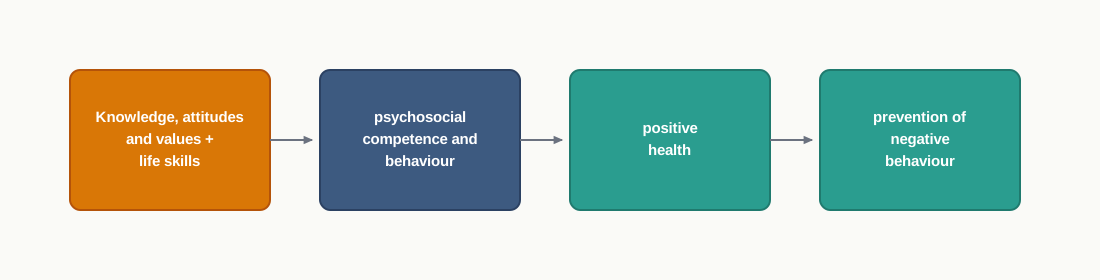
Fig. 1.7 – Role of life skills in preventing negative behaviour.
Read Fig. 1.7 as a chain of causes and it is easy to see where it can break. Knowledge alone does not reach the end of the chain — a person may know exactly what a habit is doing to her health and still be unable to refuse when pressed, because refusing is a skill and not a fact. Psychosocial competence, the ability to deal effectively with the demands of daily life, is what the middle of the chain supplies.
1.8.3 How Life Skills Are Acquired
Life skills enable people to act in ways that bring about personal and social change, promoting their own health and development and that of the communities they live in. They are what a person needs in order to function effectively and constructively in society.
They include both personal and social skills, and they help a person to function confidently and competently within her family as well as outside it. This is worth noticing: the same skills serve at home and at work, which is why they are called life skills and not work skills.
There is one difficulty. Life skills are competencies and actual behaviours, not items of information, and they cannot be taught in a classroom in the way a formula can. Experiential learning — learning by doing the thing, in a real or simulated situation, and reflecting on how it went — is what allows people to acquire them.
1.9 Improving One’s Own Work Life
Improving work life across a whole organisation is crucial for the organisation. But it is even more vital for each individual to improve her own work life consciously, because that is what secures her job satisfaction and improves both the quality and the quantity of what she produces.
From the worker’s own side, quality of work life is not so much about the job alone as about how the job is perceived. The direction of effort therefore is to look at one’s work as a source of energy, of fulfilment and of learning, rather than as a demand made on one’s time.
1.9.1 Habits And Attitudes That Help
Some general practices help, whatever the occupation.
Look After The Body And Mind
Develop healthy personal habits. Taking care of one’s body, mind and spirit means maintaining a healthy lifestyle — eating a wholesome diet, taking adequate and appropriate exercise, and getting enough sleep. Such a lifestyle is what allows a person to face challenges and pressures at the workplace instead of being flattened by them.
Work With People, Not Merely Beside Them
Be empathetic and compassionate. Interacting with peers, subordinates and supervisors is unavoidable, and an empathetic approach to those interactions yields positive outcomes.
Everyone at work is dependent on everyone else — personally, professionally and psychologically. Positive attitudes and behaviour towards peers, subordinates and supervisors generate goodwill all round, and people who help one another tend to experience greater satisfaction and reward. Good communication and interpersonal skills are vital both for completing tasks and for developing a career.
Encourage partnerships and work as a member of a team. Interactions with others should produce results of mutual benefit; work in collaboration, and respect and recognise what others contribute and achieve.
It is also important to maintain loyalty and commitment to the organisation, and to be professionally ethical at all times.
Respond, Do Not React
It is wise to be responsive to situations rather than reactive. The distinction is set out in Table 1.3.
Take the common case of a reprimand from a senior. The appropriate course is to examine the situation realistically and calmly, rather than to react with justifications and emotional outbursts. If the reprimand is deserved, the corrective measures should be taken — including an apology, if one is called for.
Flexibility, adaptability and a problem-solving attitude are core abilities in the work arena, whether a person is self-employed or working for someone else. No plan survives contact with a real workplace unaltered.
Build The Community Around You
Be a good citizen and create a healthy community around you. People who work in this way tend to attract like-minded persons, and together they often build a group that gets the job done while serving everybody’s needs.
Within one’s own organisation this means being a good citizen of it: recognising others for their achievements, and working with them to bring about responsible change.
Learn From The Lessons Of Life
Finally, learn from the lessons of life. Job satisfaction is largely a matter of taking the day-to-day challenges, pressures and upsetting situations and turning them into lessons that allow a person to grow and move on, better and more fulfilled.
This balance between life and work is not easy to achieve, and the ability to adapt positively to social and environmental change is essential to it.
1.9.2 Essential Soft Skills At The Workplace
In any occupation, certain core abilities are the basic requirements. They are called soft skills — the personal and interpersonal abilities that decide how well a person does work, as distinct from the technical knowledge of the work itself.
They cannot be taught as academic lessons in a school or a college, yet they are what make a person competent, and they have to be acquired and honed as she develops. Six sets are essential at the workplace.
- Working productively — applying effective work habits and attitudes to the job and its tasks. This calls for sufficient knowledge, skill and expertise as well as experience, and productivity is further influenced by enthusiasm, zeal and dynamism. Involvement with the job and a sense of belonging to the organisation are important factors.
- Learning effectively — the necessary skills in reading, writing and computing, along with skill in acquiring information within one’s field and the ability to use learning tools and strategies. Equally essential is the motivation to work hard and to keep pace with advances and developments in the field.
- Communicating clearly — applying appropriate writing, speaking and listening skills, so that information, ideas and opinions are conveyed precisely.
- Working cooperatively — working with others to complete tasks, solve problems, resolve conflicts, provide information and offer support, and cultivating a sense of belonging to the organisation.
- Thinking critically and creatively — applying the principles and strategies of analytical thinking and critical evaluation, and being innovative and creative.
- Other skills required — concentration, alertness, presence of mind, tactfulness, empathy, the ability to train others, to delegate and to get work done through them, forethought and vision, and the ability to handle several tasks at once.
Compare this list with the ten life skills in Section 1.8 and the overlap is obvious. Soft skills at work are largely life skills wearing working clothes, which is why the person who develops them gains at home as well as in the office.
1.10 Work, Ethics And Dignity Of Labour
Work — whether it is a paid job, unpaid work in the home, work done as a caregiver, or work done as a volunteer — is fundamental to human nature. Every human being is infinitely worthy, though in modern times wealth is given a great deal more importance than that worth.
The consequence is a simple rule. Whatever the type of work a person does, whatever position she holds and whatever her financial status, she deserves respect. Every individual, through her share of work, however large or small, contributes to the betterment of society.
1.10.1 Dignity Of Labour
Dignity of labour means that a person takes pride in whatever she does. It is an attitude held by the worker, and, equally, a respect owed to her by everyone else.
Two lives illustrate the idea from opposite directions. Abraham Lincoln was the son of a farmer and rose from a penniless boy to become President of the United States of America, which shows that no starting point closes a life off. Mahatma Gandhi, having every reason to be exempted from menial work, did sweeping, scavenging and cleaning at his ashram at Wardha, and cleaned his own toilet in order to demonstrate the dignity of labour.
Gandhi’s example is the sharper of the two, because it makes the point that dignity is not something a person acquires by rising out of certain work. It belongs to the work itself, and it is denied only by those who look down on it.
1.10.2 Values And Ethics At Work
Whatever a person does at work should be driven by values and ethics, both of which supply rules for behaviour.
Values are beliefs, preferences or assumptions about what is desirable or good for human beings. They shape how a person practises her occupation, usually without her stopping to notice them. Important values in this context include service, social justice, the dignity and worth of all persons, the importance of human relationships, and integrity.
Ethics are different in kind. They are a formal system or set of rules explicitly adopted by a group of people — professional ethics and medical ethics are familiar examples.
Table 1.4 shows why both are needed. Rules cannot cover every situation a worker will meet, so values decide what she does in the gaps; and values differ from person to person, so a common code is needed where the public must be able to rely on the outcome.
What Ethical Conduct Achieves
Being ethical at all times earns a person the respect of her colleagues and peers, and encourages them to be ethical in turn — which is how a standard spreads through a workplace without anyone issuing an instruction.
The gains are practical as well. At the workplace, values and ethics reduce the waste of time and money, and at the same time raise employee morale, confidence and productivity. Work that has to be redone because a corner was cut is expensive in both senses.
Where The General Norms Are Not Enough
Generic norms of ethics and dignity apply in all work settings. But some groups in the workforce need more than the general norm, because their presence at work carries consequences for their own quality of life and for society at large. Young workers and children, senior citizens, and the female workforce are all such groups, and the issues concerning women at work were taken up in Section 1.5.
1.11 Ergonomics
A tailor who bends over a low table for eight hours has a backache by evening, and the backache is not her fault. It is the table’s. The study of exactly this kind of mismatch is called ergonomics.
1.11.1 What Ergonomics Is
Ergonomics is the study of human beings at work. Its purpose is to understand the complex interrelationships between people and their job requirements, their methods of working, the tools and equipment they use, and the environment they work in.
The word is built from two Greek words — ‘ergon’, meaning work, and ‘nomics’, meaning natural laws. It is also spoken of as Human Factors Engineering.
Read the definition slowly, because the direction in it is the whole subject. Everywhere else, the worker adjusts: she stoops to the low table, stretches for the high shelf, squints at the poor light. Ergonomics reverses this, and asks the table, the shelf and the lamp to be altered instead.
The objective of all this is to generate working conditions that are not hazardous to human health, are acceptable to the workers, and are at the same time optimal for output and productivity. The three conditions must be met together; a workplace that is safe but unusable has not solved the problem.
1.11.2 The Four Pillars Of Ergonomics
Ergonomists consider three things together: the capacity of the worker, both physiological and psychological; the demands of the task, which include its nature and complexity, the force it requires, its duration and the posture it imposes; and the work environment, meaning noise, humidity, vibration, light and temperature.
To weigh all three, the science rests on four pillars:
- anthropometry — the measurement of body size and dimensions, which tells a designer how high a work surface should be and how far a control can be placed;
- biomechanics — the study of musculoskeletal activity and the forces the body exerts, which tells her how much may safely be lifted, pushed or held;
- physiology — the working of the body, which explains fatigue, heat load and recovery;
- industrial psychology — the mental side of work, including attention, error and motivation.
Each pillar answers a different question about the same worker, and a design that satisfies only one of them fails. A chair sized correctly for the body may still be unusable if the task it is meant for demands constant twisting.
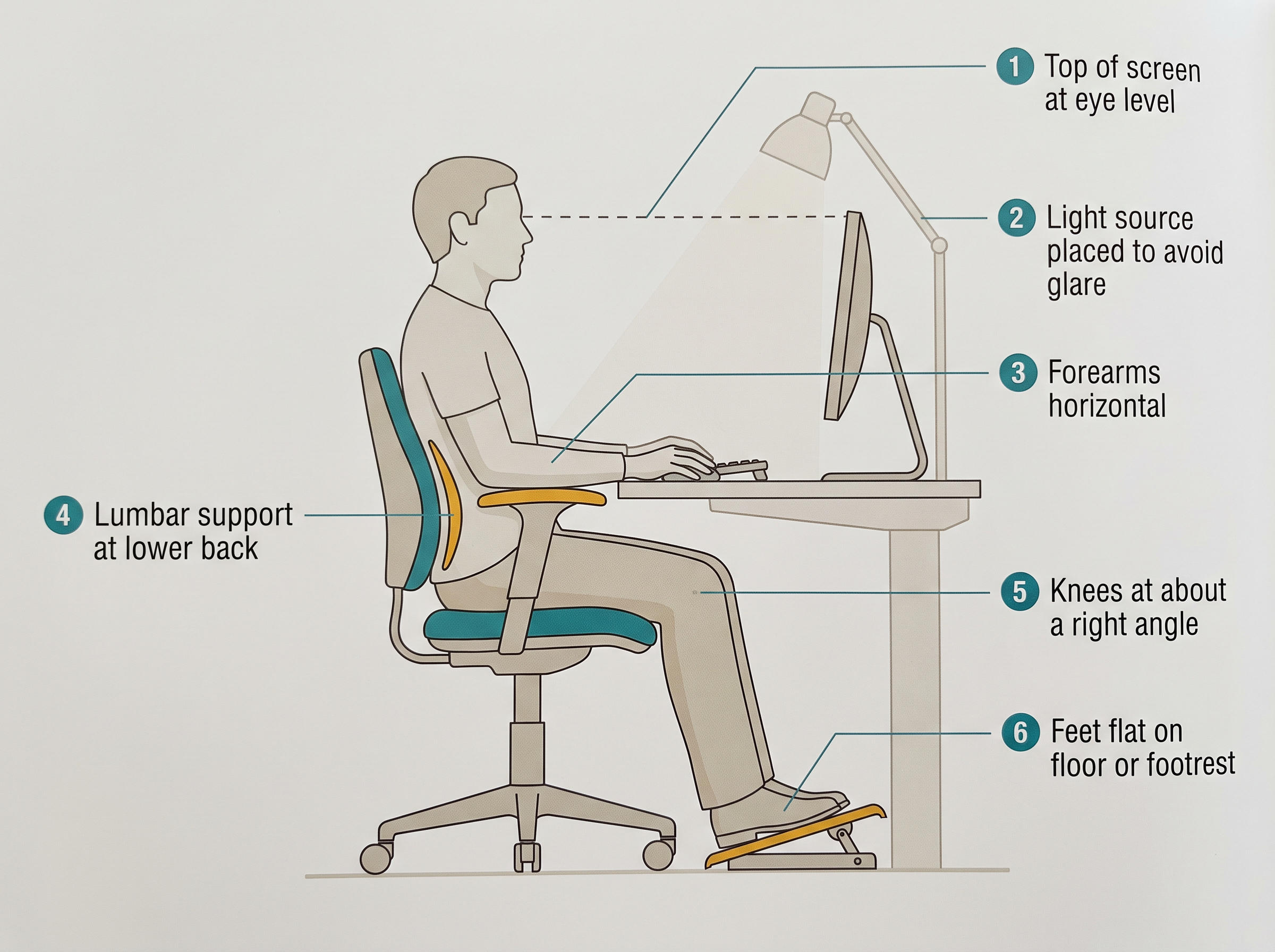
Fig. 1.8 – An ergonomically designed workstation.
1.11.3 Why Ergonomics Matters At Work
The use of ergonomics at the workplace is important for two broad purposes, each with its own consequences.
- Improving safety and health, by:
- reducing the number and the severity of workplace injuries;
- reducing the possibility of accidents caused by human error.
- Improving job effectiveness, by:
- increasing productivity;
- reducing errors;
- eliminating or reducing injuries;
- increasing job satisfaction through comfortable working conditions.
What Ergonomics Addresses
As a productivity tool, ergonomics deals with workplace and workstation design, task design and the design of work methods, equipment design, facilities, and the environment. Its benefits follow from these: it reduces the risk of injury and accident, increases productivity and efficiency, reduces mistakes and the need to do work over again, decreases absenteeism arising from ill health, accidents or stress, and improves the morale of workers.
A single example carries the whole idea. For a person doing office work, sitting on a chair that does not conform to ergonomic safety specifications can cause back pain. Ergonomic principles require that the height of the chair and its stand be adjustable to the user’s own height and body measurements, and that the number of legs be suitable to the size of the chair so that it does not topple.
Safety And Productivity Are Not Opposed
It is often assumed that making work safer must slow it down. Any ergonomics intervention should indeed be examined for its effect on productivity — and when it is, the best ergonomic solutions usually turn out to improve productivity rather than reduce it.
The reason is straightforward. Reducing unnecessary or awkward postures and exertions almost necessarily reduces the time a task takes, so the safer method is also the quicker one.
Creating a safe and productive work environment is critical for any workplace, because employees are an organisation’s most important asset. When a task is matched to the ability of the people who will perform it, they make fewer errors and produce less waste, and ergonomic design has been shown to influence both employee productivity and retention.
1.12 Entrepreneurship
So far this chapter has largely discussed employment — working for an organisation that already exists. There is another route to a livelihood, in which a person creates the organisation instead of joining one.
Self-employment and innovative enterprise can be challenging, stimulating and highly rewarding, and they deserve attention as an avenue for building a satisfying career.
1.12.1 What An Entrepreneur Does
Entrepreneurship is the act of creating a new and innovative enterprise, product or service. The word ‘new’ is doing real work in that sentence: buying an existing shop and running it as before is business, but it is not, in this sense, entrepreneurship.
The function of entrepreneurs is to change the pattern of production, or the design of a product, through innovation or invention. That may mean attempting new technological methods or modifications in order to produce a new commodity, or in order to produce an old one in a new way.
An entrepreneur is, above all, a person who can take risks in order to convert a novel idea into reality. She is innovative, creative and organised, and she is a risk taker. India has excellent examples of entrepreneurs who had vision and thought, among them Narayana Murthy, JRD Tata and Dhirubhai Ambani.
What the entrepreneur creates may be an entirely new organisation, or it may be part of revitalising one that already exists. An entrepreneurial mind inside an established company is as useful as one outside it.
Enterprises Of Every Size
Entrepreneurial activity differs with the type of organisation being started. At one end are small individual projects and micro units, sometimes run by the entrepreneur only part-time; at the other are major undertakings that provide jobs to many people besides the entrepreneur herself.
Nobody has to begin at the large end. A woman who begins by supplying pickles to two neighbourhood shops and a woman who begins a food-processing company are doing the same kind of thing at different scales.
Support is available for those starting out. Many kinds of organisation now exist to help aspiring entrepreneurs, including government agencies, scientific institutes and organisations, financial institutions such as banks, and some voluntary organisations.
1.12.2 Characteristics Of Entrepreneurs
An entrepreneur must necessarily have certain personal attributes that allow her to take on the challenges of an enterprise. These include:
- willingness to work hard;
- knowledge and skills for planning and implementation;
- skills of management of finances, materials, personnel and time;
- the courage to take calculated risks;
- ability and preparedness to handle many tasks simultaneously;
- ability to learn and acquire the skills a task demands;
- ability to deal with tough issues and find solutions;
- being realistic, and not expecting easy solutions;
- ability to cope with set-backs, challenges and failures;
- ability to develop partnerships, and to network well;
- ability to negotiate, strategise and prioritise;
- being flexible, and able to handle a crisis;
- good communication skills.
Two of these deserve a second look. A calculated risk is not the same as a gamble — it is a risk whose size has been estimated and whose failure the enterprise could survive. And the ability to cope with set-backs matters because most enterprises meet several; the entrepreneur who treats the first failure as final does not get to the venture that would have worked.
In short, to achieve her objectives an entrepreneur must be innovative, creative and goal-oriented. She must be ready to initiate direct action, and be motivated to seek out and adopt more effective ways of doing things.
1.13 Summary
- Work is the set of essential activities a person undertakes for a purpose or out of necessity, whether or not they are paid.
- Work is central in every culture, though each culture judges the same task differently.
- The work a person does is decided by several conditions acting together:
- education;
- health;
- age;
- access to opportunities;
- globalisation;
- geographic location;
- financial returns;
- family background.
- Work returns money, and also identity, self-esteem, skill and belonging.
- A person’s work reaches outward in widening circles — to herself, her family, her employer, her community, and the nation and world.
- Work that earns nothing, such as care of the family and volunteering, is still work, because work is measured by the contribution it makes and not by the money it brings.
- Work may be viewed in many ways at once — as a job and a living, a duty, security of livelihood, dharma, spiritual practice, a vehicle for one’s creations, a source of joy, a source of hope and dignity, a symbol of status, a rewarding workout, and a means of self-actualisation.
- Meaningful work is useful to society or others, is done responsibly, and is enjoyable to the worker.
- Meaningful work lets the worker use her skills, judgement, creativity and problem-solving ability.
- Work that suits a person’s attributes, aptitude, competence and skills sustains her enthusiasm and paves the way for a lifelong career.
- A job is work done for its own sake, usually for the income it brings.
- A career is driven by a desire to excel and to grow within a chosen field, and is therefore more than a job.
- Livelihood is the means and occupation by which a person supports herself, meets basic needs and sustains her lifestyle.
- A career is a life management concept, unfolding across a whole life and involving the management of roles, a balance of paid and unpaid work, continuous learning and deliberate transitions.
- Work is commonly seen as a job and livelihood, as a career, or as a calling, the difference lying in where the person’s satisfaction comes from.
- Since knowledge and skills in every field change, education must continue into a person’s middle and later career years.
- Traditional occupations are lines of work carried on within a community over generations, with skills passed down inside the family.
- Agriculture is the largest source of employment in India, though many farmers work small plots and produce only marginal yields.
- Cash crops such as tea, coffee, cardamom and rubber are economically important because they are exported and earn foreign exchange.
- Handicrafts and handloom weaving are cottage industries and remain the main livelihood of many rural households.
- Traditional transmission of skill within the household produced high skill but closed the craft to outsiders.
- Regional cuisines and the visual arts are both sources of livelihood, from street vending to conservation work in museums and institutions.
- Traditional crafts are losing ground to mass-produced goods, because of weak finance and marketing, socio-economic disadvantage, and a shrinking raw-material base.
- Reviving them requires design innovation, refinement of technique, eco-friendly materials, packaging, training facilities, conservation of traditional knowledge, and protection of intellectual property rights.
- The challenge is to keep the diversity of traditional occupations without the hierarchy and caste-based divisions of work attached to them.
- Sex is a biological categorisation; gender is social identity, learnt from early childhood and varying between societies.
- Gender norms are unwritten, passed from one generation to the next, and harden into stereotypes, which is why gender is said to be socially constructed.
- Women in India have always worked — in agriculture, animal husbandry, construction and domestic work — and in many families are the sole earners.
- Women who take up paid work commonly carry a double burden, because household work and caregiving are still expected of them.
- Unpaid household work is a productive activity and an economic contribution, because it enables every other member of the family to perform her or his own role.
- Concerns for women at work include declining opportunities, lower standing in the market, stress and health effects, safety without gender discrimination, maternity benefits and support for child care.
- The Constitution of India guarantees equality of opportunity in public employment, forbids discrimination on grounds including sex, and empowers the State to make special provisions for women and children.
- Protective legislation includes the Factories Act, 1948, the Plantation Labour Act, 1951, the Mines Act, 1952, the Employees’ State Insurance Act, 1948 and the Maternity Benefit Act, 1961.
- Approaches to women’s programmes have moved from welfare, to equality of opportunity, to a development approach that treats women as part of human resource.
- The Kasturba Gandhi Balika Vidyalaya scheme provides residential schooling for never-enrolled and dropout girls, with entry at Class VI through a Bridge Course, and now extends up to Class XII.
- Job satisfaction is influenced considerably by a person’s attitude, and not determined entirely by the job itself.
- Comparing only one feature of two jobs, such as salary, creates dissatisfaction; a realistic scrutiny of all aspects of one’s own job makes satisfaction more likely.
- Quality of Work Life treats employees as assets and holds that their social and psychological needs matter as much as their economic ones.
- A healthy work environment is built through fairness, motivation, technical competence, safety, delegation, team spirit, training, empowerment and opportunities for self-development.
- Life skills are abilities for adaptive and positive behaviour that enable a person to deal with the demands and challenges of everyday life.
- The ten core life skills are self-awareness, empathy, communication, interpersonal relationships, decision making, problem solving, creative thinking, critical thinking, coping with emotions and coping with stress.
- Knowledge, attitudes and values combined with life skills build psychosocial competence, which leads to positive health and prevents negative behaviour.
- Life skills cannot be taught as classroom information; they are acquired through experiential learning.
- A person improves her own work life through healthy personal habits, empathy, cooperation, professional ethics, teamwork, responsiveness rather than reaction, flexibility, good citizenship, and learning from experience.
- Essential soft skills at the workplace are working productively, learning effectively, communicating clearly, working cooperatively, thinking critically and creatively, and allied abilities such as tactfulness, delegation and forethought.
- Dignity of labour means taking pride in whatever work one does, and respecting every person whatever her work, position or financial status.
- Values are personal beliefs about what is good; ethics are a formal, explicitly adopted set of rules governing conduct.
- Ethical conduct at the workplace reduces waste of time and money and raises morale, confidence and productivity.
- Ergonomics is the study of work whose primary goal is to adapt the work environment to the worker, rather than the worker to the work.
- Ergonomics rests on four pillars — anthropometry, biomechanics, physiology and industrial psychology.
- Ergonomic design improves safety and health and improves job effectiveness, because removing awkward postures and unnecessary exertion also saves time.
- Entrepreneurship is the act of creating a new and innovative enterprise, product or service, and the entrepreneur is the person who takes the risk of converting a novel idea into reality.
- Entrepreneurs need hard work, planning and management skills, calculated risk taking, the ability to learn, realism, resilience after set-backs, networking, negotiation, flexibility and good communication.
- Social entrepreneurship aims at large-scale social benefit, particularly for underserved groups, and its success is measured by impact rather than by profit.
- Knowledge entrepreneurship builds an enterprise on the creation and application of knowledge rather than on a physical product.
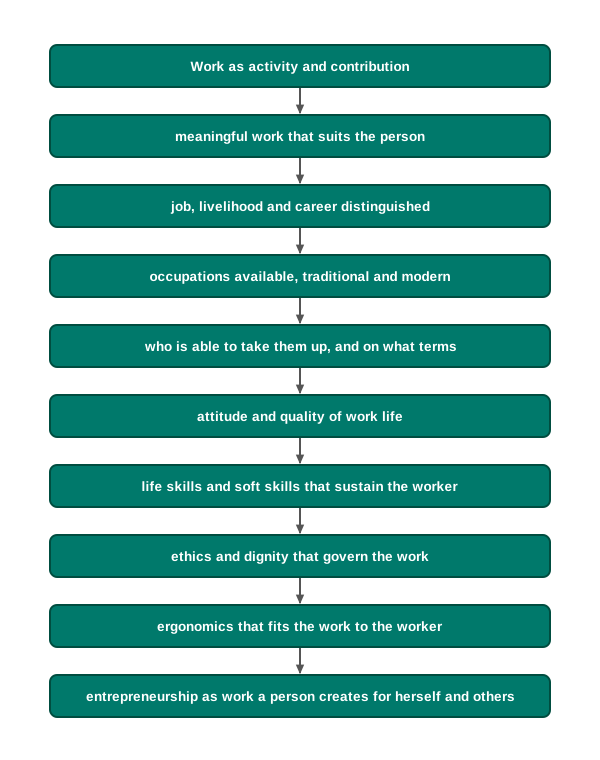
Fig. 1.9 – The argument of this chapter end to end.
1.14 Key Terms
- Anthropometry — the measurement of body size and dimensions, used to design work surfaces, tools and seating.
- Aptitude — a natural capacity to learn or to do something well.
- Attitude — the way a person perceives her work situation and handles its circumstances and demands.
- Biomechanics — the study of musculoskeletal activity and of the forces the body exerts while working.
- Calling — a view of work in which satisfaction comes from the work itself, followed from an inner direction.
- Career — work driven by a desire to excel and to grow within a chosen field, unfolding across a whole life.
- Cash crops — crops grown for sale rather than for the household’s own consumption.
- Cottage industry — production carried on in the home or in small units, using family labour rather than a factory workforce.
- Dignity of labour — taking pride in whatever work one does, and respecting every person whatever her work or position.
- Entrepreneur — a person who takes risks to convert a novel idea into a working enterprise, product or service.
- Entrepreneurship — the act of creating a new and innovative enterprise, product or service.
- Ergonomics — the study of work, whose goal is to adapt the work environment to the worker.
- Ethics — the rules or standards governing the conduct of a person or of the members of a profession.
- Gender — social identity, and the roles and expectations a society attaches to it.
- Gender role identity — the settled idea within a society of what a person of a given gender does, wears and works at.
- Healthy work environment — a positive workplace that supports a worker physically, socially, mentally and emotionally.
- Intellectual property rights (IPR) — legal rights that protect creations of the mind, including designs and traditional craft names.
- Job — work done for its own sake, conventionally for the income it earns.
- Job satisfaction — the contentment a person derives from her work, influenced heavily by her own attitude to it.
- Kasturba Gandhi Balika Vidyalaya (KGBV) — a Government of India scheme providing residential schooling for never-enrolled and dropout girls, with entry at Class VI.
- Life skills — abilities for adaptive and positive behaviour that enable a person to meet the demands and challenges of everyday life.
- Livelihood — the means and occupation by which a person supports herself, meets basic needs and sustains her lifestyle.
- Meaningful work — work that is useful to others, done responsibly, enjoyable to the worker, and demanding of her skills and judgement.
- Morale — the confidence and willingness with which people in a workplace do their work.
- Psychosocial competence — the ability to deal effectively with the demands and challenges of daily life.
- Quality of Work Life (QWL) — the overall quality of a person’s experience of work, covering social and psychological needs as well as economic ones.
- Self-actualisation — the fullest use of a person’s own abilities, reflecting what she values and aspires to.
- Sex — the biological categorisation of a person, based on genetics and reproductive organs.
- Social entrepreneurship — enterprise directed at large-scale social benefit, whose success is judged by impact rather than by profit.
- Soft skills — personal and interpersonal abilities that decide how well a person does work, as distinct from technical knowledge of it.
- Traditional occupations — lines of work carried on within a community over generations, with skills passed down within the family.
- Values — beliefs, preferences or assumptions about what is desirable or good for human beings.
- Work — the essential activities a person undertakes for a purpose or out of necessity, whether or not they are paid.
1.15 Points To Ponder
If work is measured by the contribution it makes rather than by the money it earns, how should a society decide what a piece of work is worth paying for?
A craft survives when its skill is guarded within a family, and it also dies when it is guarded within a family. How might a craft cluster keep the quality that closed training produced while opening the craft to people born outside it?
Gender norms are unwritten, yet they are followed more consistently than many written rules. What gives an unwritten expectation that kind of hold, and what weakens it?
Ergonomics asks the workplace to be redesigned around the worker. Whose responsibility is it when the worker is self-employed at home, and what would an ergonomic kitchen or workroom look like?
Social entrepreneurship is judged by impact rather than by profit. What difficulties does that create for a social enterprise that must still cover its costs, and how might impact be measured fairly?
Life skills are said to be unteachable in a classroom. If that is so, what should a school do about them — and does the same argument apply to soft skills at the workplace?
1.16 Objective Questions
- (MCQ) Work done in order to earn money, undertaken for its own sake, is conventionally called: [1]
- a calling
- a job
- a career
- an enterprise
- (MCQ) The pillar of ergonomics concerned with body size and measurements is: [1]
- biomechanics
- physiology
- anthropometry
- industrial psychology
- (MCQ) Under the Factories Act, 1948, a creche must be maintained in a factory employing more than: [1]
- ten women
- twenty women
- thirty women
- fifty women
- (MCQ) The success of social entrepreneurship is judged mainly by: [1]
- the profits earned by the enterprise
- the number of employees engaged
- the social benefit and impact achieved
- the export earnings generated
- (Assertion–Reason) Read the assertion and the reason and choose the correct option. [1] Assertion (A): Domestic work done at home is counted as an economic contribution. Reason (R): Work that is unpaid produces no value for the household.
- Both A and R are true, and R is the correct explanation of A.
- Both A and R are true, but R is not the correct explanation of A.
- A is true but R is false.
- A is false but R is true.
- (Assertion–Reason) Read the assertion and the reason and choose the correct option. [1] Assertion (A): Ergonomic improvements at a workstation often raise productivity. Reason (R): Removing awkward postures and unnecessary exertion reduces the time a task takes.
- Both A and R are true, and R is the correct explanation of A.
- Both A and R are true, but R is not the correct explanation of A.
- A is true but R is false.
- A is false but R is true.
- (Match The Following) Match each craft in Column A with its state in Column B. [1]
| Column A | Column B |
|---|---|
| a. Shola craft | i. Maharashtra |
| b. Channapatna dolls | ii. Odisha |
| c. Warli painting | iii. Karnataka |
(Fill In The Blank) The word ergonomics is derived from the Greek words ‘ergon’, meaning ______, and ‘nomics’, meaning natural laws. [1]
(Fill In The Blank) Production carried on in the home or in small units, using family labour rather than a factory workforce, is called a ______ industry. [1]
(True Or False) State whether the following is true or false: life skills are competencies that can be taught to a class in the same way as a formula. [1]
(Name The Following) Name the scheme of the Government of India that provides residential schooling from Class VI to never-enrolled and dropout girls from rural, remote and disadvantaged sections. [1]
(Odd One Out) Pick the odd one out and give a reason for your choice: self-awareness, empathy, anthropometry, decision making. [1]
1.17 Check Your Concepts
Define meaningful work, and state any two features that make work meaningful. [2]
Give a reason why a woollen shawl of a craft cluster may sell at a high price abroad while the artisan who made it earns very little. [2]
Differentiate between sex and gender, stating the basis of difference. [3]
Explain, with an example, what is meant by dignity of labour. [3]
Why does a career require a person to keep learning into her middle and later career years? Explain with reasons. [4]
List any four measures by which an employer can create a healthy work environment, and explain how each helps. [4]
Differentiate between values and ethics, stating the basis of difference, and explain why a workplace needs both. [5]
What would happen to a traditional craft if the raw material it depends on became scarce and no training facility existed outside the family? Explain the likely consequences and suggest two interventions. [5]
1.18 Identify & Label
Study Fig. 1.8. Identify any four features of the seated posture and workstation that make it ergonomically correct, and state what each feature protects. [4]
Look at Fig. 1.4. Identify the painting tradition shown, name the state it belongs to, and describe how its human figures are constructed. [3]
Fig. 1.2 shows craft objects from four states. Identify any three of them, and for each name the state and the raw material used. [3]
Study Fig. 1.0. Identify the four stages shown in the delivery chain, and state one skill the workers must have at the sorting stage. [3]
1.19 Case & Application Based
- Sunita has completed a course in textile design. She has two offers. The first is with a large exporter, at a good salary, checking finished consignments against a fixed checklist. The second is with a small weavers’ collective at a lower salary, where she would develop new designs with the weavers and help them price their fabric. She expects to work for many years and hopes eventually to start her own design unit. [4]
- Which of the two offers is more likely to be meaningful work for Sunita, and why?
- Which offer better supports the career she hopes to build? Give a reason.
- Name any two of the five questions a person should ask before choosing an occupation, and apply them to Sunita’s decision.
- Ravi runs a small unit that packs spice mixes. Eight people work there, standing at a low table for the whole shift. Complaints of back pain have increased, output has fallen, and two workers have been absent through illness this month. Ravi believes that any change to the workplace will slow production further. [5]
- Identify the ergonomic problem in Ravi’s unit and explain its cause.
- Is Ravi’s belief about production correct? Give a reason for your answer.
- Suggest two changes Ravi could make to the workstation, stating what each would achieve.
- State one benefit of ergonomics that Ravi’s unit is currently losing.
- Meera works full time in an office and is also expected to do most of the household work and the care of her younger brother. She is often exhausted, and her supervisor has recently reprimanded her for a delayed report. Meera’s first impulse is to respond to the supervisor with an angry justification. [4]
- Name the situation Meera faces at home, and explain why it is not solved by her working faster.
- Distinguish between reacting and responding to the reprimand, and state which course you would advise and why.
- Name any two life skills that would help Meera in this situation, and state how each would help.
1.12.3 Social And Knowledge Entrepreneurship
Recently, more comprehensive and holistic understandings of entrepreneurship have emerged. Entrepreneurship is now seen as a specific mindset, which can result in different forms of initiative — among them social entrepreneurship and knowledge entrepreneurship.
Social entrepreneurship focuses on doing social good. The social entrepreneur aims to achieve large-scale benefits through enterprise, either for a specific group or for society at large.
Generally, she works for the benefit of underserved, neglected or disadvantaged groups, or of individuals who do not have the financial resources to secure the benefit by themselves. Social entrepreneurs are social catalysts — visionaries who bring about basic social change and sustainable improvement.
Such action can have wide effect in whichever area it is directed at, be it education, health care, economic development, the environment, the arts, or any other social field. The crucial difference lies in the measure of success: for social entrepreneurship, success is judged not so much by the profits made as by the social benefit and impact achieved.
Knowledge entrepreneurship is the second of these forms. Here the enterprise is built on creating, organising and applying knowledge itself — in training, research, design or advisory services — rather than on manufacturing a physical product.
Table 1.5 — Business Entrepreneurship And Social Entrepreneurship | Feature | Business entrepreneurship | Social entrepreneurship | |—|—|—| | Main aim | To build a viable, profitable enterprise | To achieve large-scale social benefit | | Whom it primarily serves | Customers who can pay for the product or service | Underserved, neglected or disadvantaged groups | | How success is measured | Profits, growth and market position | Social benefit and impact achieved | | What is required of the founder | Innovation, risk taking, management | Innovation, risk taking, management, and sustained commitment to the cause | | Whether profit is earned | Yes, and it is the object | Often yes, but as the means of sustaining the work |
The last row is worth dwelling on. A social enterprise that never covers its costs closes, and closes on the people who came to depend on it — so earning is not opposed to the social purpose but is what allows the purpose to continue.
This section supports the enterprise-plan exercise: choose one product or service a Home Science student could supply locally, and set out the resources, skills, likely customers and main risks, stating for each risk what would reduce it.