Chapter 7: Management of Support Services, Institutions and Programmes for Children, Youth and Elderly
The Board That Backed The Volunteers In the years just after Independence, a great deal of welfare work for children and women in India was being done by small voluntary organisations. A group of women in a town would run a crèche, a trust would keep a home for orphaned children, a local society would teach a craft to widows. The work was real, but it was scattered, unevenly funded, and often collapsed when a founder moved away or a donation stopped coming.
In 1953 the Government of India set up the Central Social Welfare Board to change that. Its first chairperson was Durgabai Deshmukh, a lawyer and freedom fighter who had spent years in social work herself. The Board’s idea was simple and unusual for its time: the government would not run every service itself. It would find the voluntary organisations already doing good work on the ground, give them grants, train their workers, and hold them to standards.
That single decision shaped the pattern you still see today. When a child in your district attends an anganwadi, when an older person visits a day-care centre, when a youth club receives money for a camp, the arrangement behind it is usually the same one: government funds and rules on one side, a local organisation and its staff on the other, and somebody in the middle who has to plan the service, manage the money, and make it actually work.
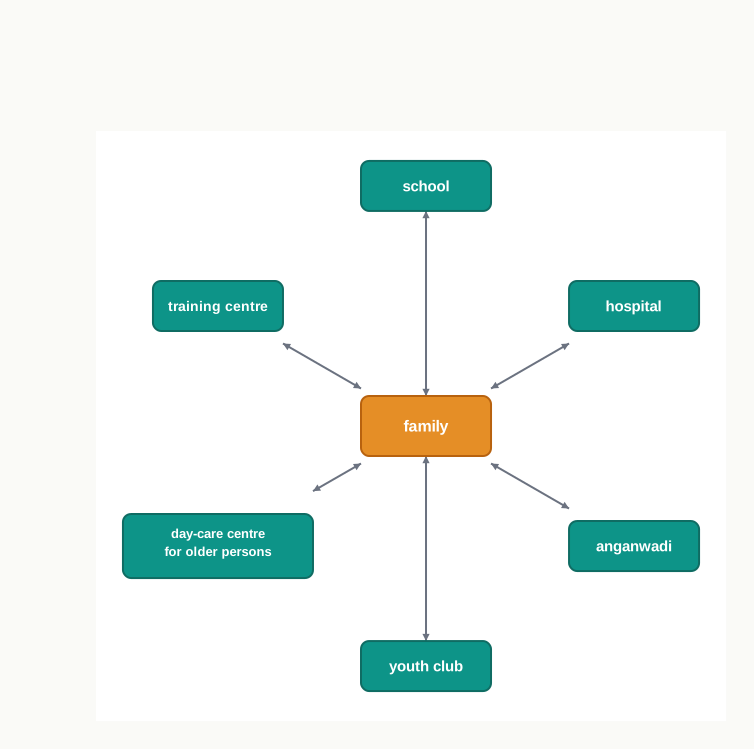
Fig. 7.0 – The family and community support services.
7.1 Why Support Services Are Needed
Every household looks after its members in some way. Yet no household, however willing, can do everything a person needs across a lifetime. This section explains why services outside the home exist at all, what happens when a family cannot reach them, and how the state, the private sector and voluntary organisations step in.
7.1.1 The Family And What It Can Provide
The family is the basic unit of society, and one of its chief functions is to look after the needs of its members. A family may include parents, their children of various ages, and grandparents. The composition varies from one household to another, and it also changes as the family moves through its life cycle.
At each stage the members try to meet one another’s needs. A young child is fed and comforted at home; an ill member is nursed there; an older person’s day is arranged around what the household can manage. Much of the care a person receives in a lifetime is given inside the home, without payment and without any formal training.
Where The Family Reaches Its Limit
But some needs call for skills, equipment or scale that a household simply does not have. A young child needs formal education, which needs trained teachers, a syllabus and a building. Every member needs health care, which needs doctors, laboratories and medicines.
For this reason each community creates other structures — schools, hospitals, universities, recreation centres and training centres. These provide the specialised services that different members of a family can use to meet their needs. Services of this kind, created outside the household to supplement what the family can do, are called support services.
Notice where this places the family on the scale ladder. Feeding a child is an individual and family task; running the school that child attends is a community task; funding schools across the country is a national one. The family does not disappear at the higher rungs — it decides which service to use, and whether to use one at all.
7.1.2 When Needs Go Unmet
In principle, a family together with the schools, hospitals and other structures around it should be able to meet its members’ needs. In practice many families in India cannot. Some cannot meet even basic needs of food, shelter and health care. Others cannot reach the services that exist, or cannot use them well once reached.
The commonest reason is a shortage of resources, particularly money. A family that cannot spare a day’s wages will postpone a hospital visit. But money is not the only barrier. The nearest health centre may be far away, the timings may clash with work, the forms may be in a language the family does not read, or the family may simply not know that a service exists.
The Scale Of Unmet Need
The indicators that measure these gaps have improved considerably over the past two decades, and they continue to be tracked through large national surveys such as the National Family Health Survey and the Census. Even so, the surveys still record a substantial share of households living below the official poverty line, households without adequate sanitation, and children whose growth is below the expected range for their age. Girls and women continue to show poorer outcomes than boys and men on several of these measures, in nutrition as well as in schooling.
Read those patterns carefully. Each one describes a need that a family is not able to meet, and each one names a place where a service could make a difference.
Members Who Are On Their Own
There is a further group whose needs no family is meeting, because there is no family at hand. Many children, youth and older persons are separated from their families — through death, migration, abandonment, disaster or conflict — and are left to cope alone. By themselves they find it very difficult to meet even ordinary daily needs.
7.1.3 How The State, The Private Sector And NGOs Respond
For families in difficult and challenging circumstances, and for members left to cope on their own, the state and society have to step in. This is not charity. It is the responsibility of the government and of society to ensure that all citizens have a decent life, and that children and youth get the chance to develop fully in a healthy and stimulating environment.
The government responds in two main ways. It sets up institutions dedicated to children, youth and older persons, and it initiates programmes for them. It also supports the efforts of the private sector and of the non-governmental organisation (NGO) sector — a voluntary, non-profit body working on a social cause outside government. Much of the actual service delivery in India is done this way, by organisations funded or regulated by government but run by others.
Institutions and programmes are not the same thing, and the difference matters when you come to manage either of them. Table 7.1 sets out how they differ.
Two Ways Of Designing A Service
Some institutions and programmes focus on meeting one specific need — a hostel provides shelter, a scholarship provides fees. Others adopt a holistic approach and provide several services together to the same person, so that health, nutrition, learning and care are addressed at one time and one place.
The holistic approach rests on a clear piece of reasoning. A child who is fed but not immunised falls ill and stops absorbing what she eats. A child who is taught but not fed cannot concentrate. Because the needs of a person act on one another, meeting them together has more impact than meeting them one at a time.
7.2 Understanding Vulnerability
Support services exist for everybody, but this chapter looks closely at three groups — children, youth and older persons. There is a reason for that choice. These three are described as vulnerable groups in our society.
The word has a precise meaning here. A vulnerable person or group is one that is more likely to be affected by adverse circumstances, and on whom those circumstances are likely to have a more harmful impact. Both halves of that sentence do work. A drought, a job loss or an illness in the household reaches these members sooner, and it damages them more.
What Makes A Group Vulnerable
The answer lies in needs. Every person has needs that must be met in the ordinary course of daily life — food, health care, safety, learning, company, a sense of worth. When those needs are not met, the person becomes vulnerable.
Children, youth and older persons are vulnerable because their needs are both large and, in different ways, hard for them to meet themselves. A young child cannot earn, cannot seek treatment, and cannot leave a harmful situation. A young person is being asked to prepare for adult life at the very moment her body and circumstances are changing fastest. An older person may have the judgement to act but not the health, income or company to do so.
Vulnerability is therefore not a permanent label. It rises and falls with circumstances, and it can be reduced. That is precisely what an institution or a programme is for: it meets the need that the person or the family could not meet, and the vulnerability shrinks.
7.3 Children As A Vulnerable Group
7.3.1 Why Children Are Vulnerable
Childhood is a period of rapid development in every domain at once — physical, motor, cognitive, language, social and emotional. What makes this period delicate is that the domains are linked. Development in one area influences development in all the others.
Follow that link through one example. A child who is often ill misses food, misses play and misses school. The physical setback becomes a cognitive one, and then a social one, because she falls behind the children she plays with. This is why a child’s needs — food, shelter, health care, love, nurturance and stimulation — have to be met together rather than one at a time.
The other feature of childhood is that its effects last. Adverse experiences in these years can leave a mark on development long after the circumstance itself has passed. A child cannot postpone growing until conditions improve.
Some Children Are More Vulnerable Than Others
All children are vulnerable in this sense. But some live in conditions so difficult that their basic needs of food, health, care and nurturance go unmet, and this prevents them from developing their full potential.
Surveys of Indian children continue to record large numbers whose growth falls short of the expected range for their age, who are out of school or who leave before completing the elementary stage, and who are at work in violation of the law. Each of those figures describes a childhood in which a basic need is going unmet.
7.3.2 Children In Need Of Care And Protection
All children in difficult circumstances need care and protection. Some of them may also break the law or be drawn into anti-social activity. The law has to deal with both situations, and it treats them differently.
The Juvenile Justice (Care and Protection of Children) Act, 2015 is the legal framework for juvenile justice in India. It replaced the Act of 2000, which was the first such framework in the country. The Act concerns itself with two categories of children, both defined as persons below eighteen years of age.
A child in conflict with the law is a child alleged or found to have committed an offence. A child in need of care and protection is a child whose circumstances place her at risk, whether or not any offence has occurred. For the first group the Act provides a child-friendly approach to inquiry and disposition, aimed at prevention and rehabilitation rather than punishment. For the second, it provides for proper care, protection and treatment catering to the child’s developmental needs, and for eventual rehabilitation through various institutions. The Act is in keeping with the Convention on the Rights of the Child.
Who Counts As A Child In Need Of Care And Protection
The Act identifies such children as those:
who are without any home or settled place of abode, or without any means of subsistence — this includes abandoned children, street children, runaway children and missing children;
who live with a person, guardian or not, who is unfit to exercise control over the child, or where there is a likelihood of the child being harmed, abused or neglected by that person;
who have a mental illness, a disability or a terminal or incurable illness, and have no one to support or look after them;
who are abused, tortured or exploited for the purpose of sexual abuse or illegal acts;
who are vulnerable to being drawn into substance abuse or trafficking;
who are victims of armed conflict, civil unrest or natural calamity;
who are likely to be abused for unconscionable gain — this includes abandoned and orphaned children, trafficked children who have been rescued, children rescued from child labour, lost and runaway children, children with special needs and children of prisoners.
Read the list as a set of situations, not as a set of labels for children. A child moves in and out of these categories as circumstances change, and the purpose of naming them is to fix responsibility for acting.
7.3.3 Institutions, Programmes And Initiatives For Children
Several programmes and services operate in the country to meet the needs of vulnerable children. Some are run by the government, some by non-governmental organisations, and many by the two working together. Four of them are described below.
7.3.3.1 Integrated Child Development Services
The Integrated Child Development Services (ICDS) of the Government of India was launched in 1975 and is the world’s largest programme for early childhood. It aims to meet the health, nutrition, stimulation and early learning needs of children below six years of age in an integrated manner, so that development in all domains is supported together.
The word integrated in its name is the whole design. The programme offers health, nutrition and hygiene education to mothers; non-formal pre-school education to children aged three to six; supplementary feeding for all children below six years and for pregnant and nursing mothers; growth monitoring; and basic health services such as immunisation and vitamin A supplementation. A child who receives only one of these gains far less than a child who receives all of them.
All these services are delivered at one point — the childcare centre called the anganwadi, staffed by an anganwadi worker and a helper drawn from the community itself. The programme reaches tens of millions of children and mothers, and since 2021–22 it has been implemented under the umbrella of Mission Saksham Anganwadi and Poshan 2.0.
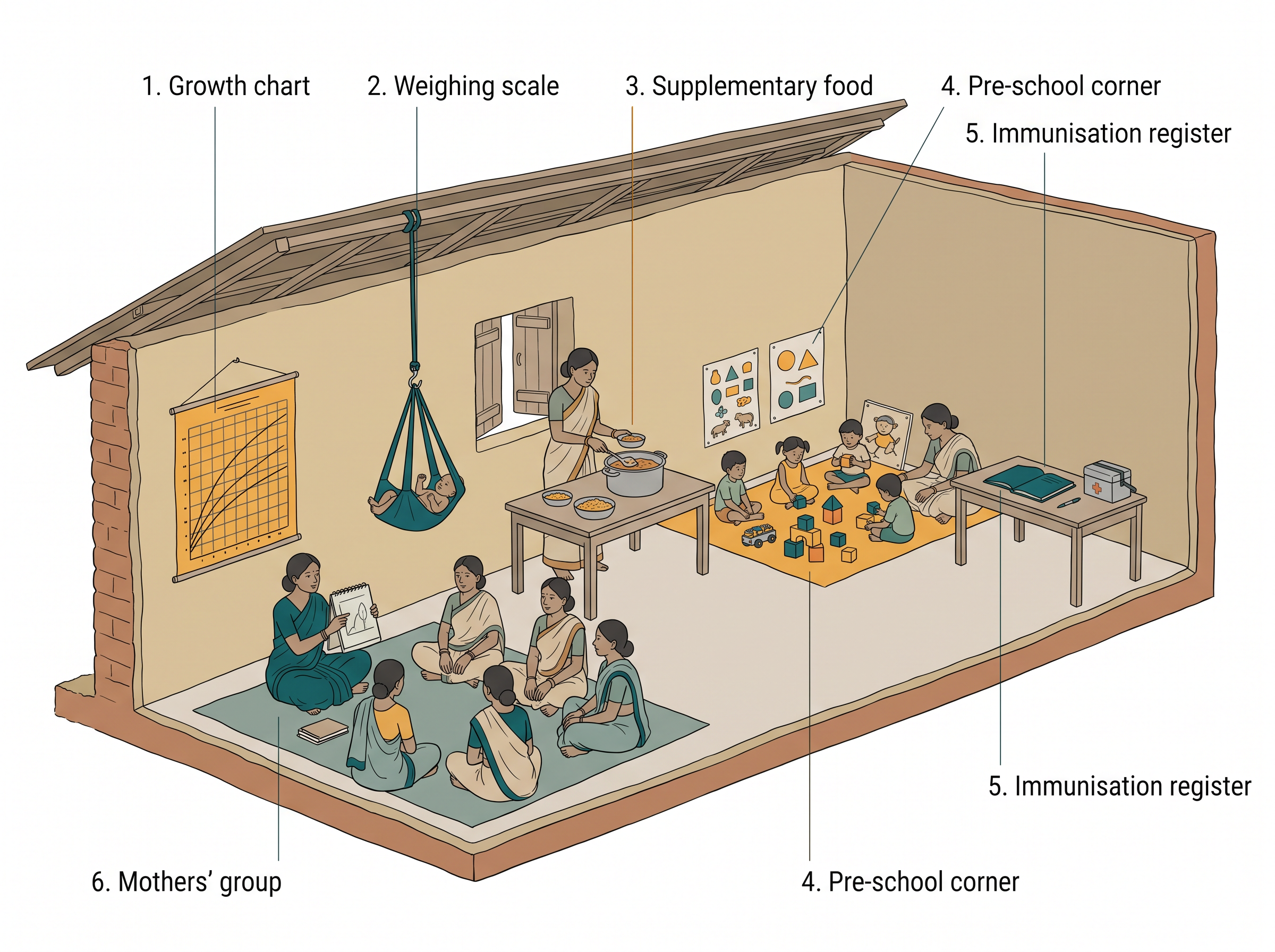
Fig. 7.1 – Services delivered at an anganwadi centre.
7.3.3.2 SOS Children’s Villages
SOS Children’s Villages is an independent, non-governmental social organisation that pioneered a family approach to the long-term care of children who have lost parental care. Its aim is not to house children but to give them a family setting they can grow up in.
In each SOS home a resident caregiver, traditionally called an SOS mother, looks after a small group of children who live together as a family. Children experience stable relationships and daily family life again, which helps them recover from earlier distressing experiences, and each child is supported individually until she becomes an independent young adult. Several such homes together form a village, which is integrated with the local community around it.
The first SOS village in India was set up in 1964, and the organisation now runs villages in many states. When India has faced natural disasters and other emergencies, SOS Children’s Villages has provided immediate relief for affected children, and some of those relief efforts were later converted into permanent facilities.
7.3.3.3 Children’s Homes
The Juvenile Justice Act provides for different kinds of homes, run by the government or by the government in partnership with NGOs. Which home a child goes to depends on which of the two categories she falls into, and at what stage. Fig. 7.2 shows the branching.
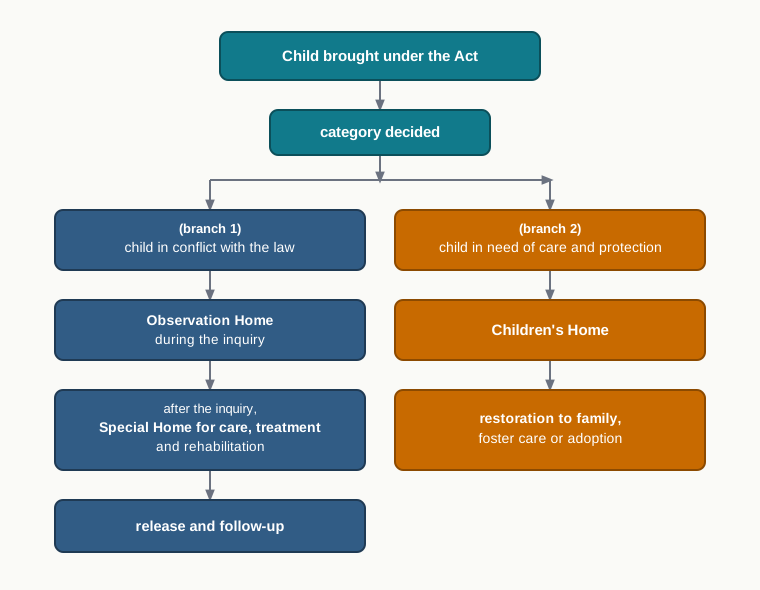
Fig. 7.2 – Placement of a child under the Juvenile Justice Act.
In every one of these homes the government is responsible for providing room, board, education and vocational training. The skills taught matter as much as the shelter, because a child who leaves at eighteen with a trade behind her leaves with an income ahead of her.
7.3.3.4 Adoption
Adoption is the process by which a child permanently becomes the child of parents other than the biological ones, with the same rights as a biological child. India has a long tradition of it, but for a long time adoption was arranged within the extended family and governed by social and religious practice.
With changing times, adoption beyond the family has been institutionalised and legalised. The Government of India and the state governments provide the policy framework, while much of the delivery — counselling families, preparing children, completing formalities — is done by specialised adoption agencies, many of them NGOs. The Central Adoption Resource Authority (CARA) is the central body that frames the guidelines and regulates the process, and it functions as a statutory authority under the Juvenile Justice Act, 2015. Its purpose throughout is to safeguard the welfare and rights of the child.
7.4 Youth As A Vulnerable Group
7.4.1 Who Are The Youth
The National Youth Policy, 2014 defines youth as persons in the age group of 15 to 29 years. This is the band used when the government plans schemes, allots funds and counts beneficiaries, so it is worth remembering exactly.
Youth overlaps with adolescence, the stage of transition from childhood to adulthood, which the World Health Organization takes as the period from 10 to 19 years. The two are not the same thing: a person of 17 is both an adolescent and a youth, while a person of 25 is a youth but not an adolescent. Fig. 7.3 shows how the two bands lie against each other.
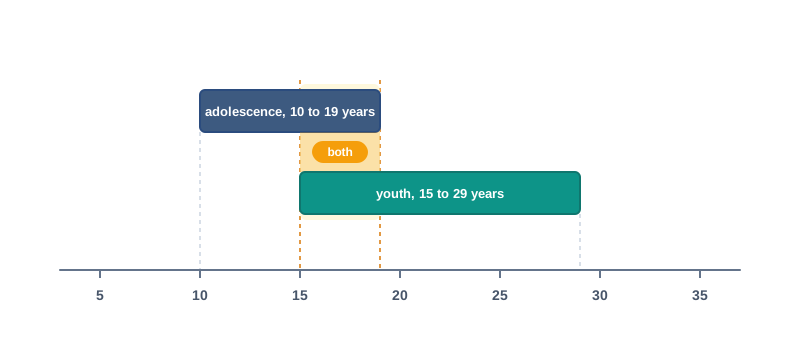
Fig. 7.3 – Overlap of adolescence and youth age bands.
India has a very large youth population, and national progress depends a great deal on how far young people are encouraged and enabled to contribute to social and economic development. That is the practical reason a country plans for this group rather than waiting for it to grow up.
7.4.2 Why Youth Are Vulnerable
Youth is a vulnerable period for several reasons at once, and they build on one another.
The first is biological. During these years a young person is coming to terms with substantial changes in her or his body, and those changes affect the person’s sense of well-being and identity. The second is the sheer weight of what is being prepared for. This is the stage at which a person takes on adult roles — foremost among them earning a livelihood and marriage, followed by raising a family — often before feeling ready for any of them.
The third is pressure. Peer pressure, and the pressure to excel in an increasingly competitive world, can cause a great deal of stress and turmoil. When the family or the surrounding environment is not able to give the young person positive support, some young people turn to alcohol or drugs, which is termed substance abuse. It is a maladjustive way of coping with stress — it does nothing about the stress and adds a serious health problem of its own — and it has been rising.
A young person under this kind of strain needs someone to talk to rather than something to take. A parent or other trusted adult, a school counsellor, a teacher or a doctor is the right place to begin, and asking for that help early is what makes it easy to give.
Health And Information
Health is a further area of concern. Young people face significant risks related to sexual and reproductive health, and many lack both the knowledge and the power to make informed choices about it. Notice that two different things are missing there. Information can be supplied by a health service or a school programme; the power to act on it depends on the young person’s standing in her family and community, which is slower to change.
Groups Within The Youth Who Are Especially Vulnerable
Within the broad category of youth, some groups face harsher circumstances than others. They are:
rural and tribal youth;
out-of-school youth;
adolescents, particularly female adolescents;
youth with disabilities;
youth in specially difficult circumstances, such as those who have been trafficked, orphans and street children.
7.4.3 What Youth Need
To be socially useful and economically productive, young people need appropriate education and training, gainful employment, and adequate opportunities for personal development and advancement. Each of the three depends on the one before it, which is why a scheme that trains without creating any route to work usually disappoints.
They also need requisite shelter and a clean environment, basic health services of good quality, social defence, and protection from exploitation of every kind. Beyond these come two needs that are easily forgotten: suitable participation in decision-making bodies dealing with youth and with social, economic and cultural matters; and access to sports, physical education, adventure and recreational opportunities.
The second of those is not a luxury. A young person with nowhere to spend energy and no say in decisions that affect her is exactly the person for whom stress has no outlet.
7.4.4 Youth Programmes In India
The Ministry of Youth Affairs and Sports is the nodal ministry for youth in India. It adopted a National Youth Policy in 2003, which was replaced by the National Youth Policy, 2014 referred to earlier. Several long-running programmes operate under and alongside these policies.
The National Service Scheme
The National Service Scheme (NSS) involves students at the college level in programmes of social service and national development. Its work includes construction and repair of roads, school buildings, village ponds and tanks; environmental and ecological improvement such as tree plantation, removal of weeds from lakes and digging of pits; and activities related to hygiene and sanitation, family welfare, child care and mass immunisation. It also runs vocational training in crafts, tailoring and knitting, and helps organise co-operatives. NSS volunteers additionally assist local authorities in carrying out relief and rehabilitation programmes for the economically and socially weaker sections of a community.
The National Service Volunteer Scheme And Nehru Yuva Kendras
The National Service Volunteer Scheme gives students who have completed their first degree the chance to work whole-time for a short period of one or two years on programmes of national development, mainly through Nehru Yuva Kendras. Volunteers work on adult education, establishment of youth clubs, organisation of work camps, youth leadership training, vocational training and the promotion of rural sports and games.
The Nehru Yuva Kendras themselves aim at the non-student youth of rural areas — young people who are not in college and are therefore out of reach of a scheme like the NSS. Their activities include non-formal education, social service camps, sports for young people, cultural and recreational programmes, vocational training, youth leadership training camps and the setting up of youth clubs. Through these the Kendras aim to popularise nationally accepted objectives such as self-reliance, secularism, socialism, democracy, national integration and the development of scientific temper.
The purpose of all this is stated plainly enough: to help non-student youth acquire literacy and numeracy for self-reliance, to upgrade their functional capabilities, and to make them aware of the possibilities of their own development, so that they become functionally efficient, economically productive and socially useful. Table 7.3 sets the two main routes side by side.
Promotion Of Adventure
Many youth clubs and voluntary organisations organise mountaineering, trekking, hiking, canoeing, coastal sailing, raft expeditions, swimming and cycling, as well as exploration for the collection of data and the study of flora and fauna in mountains, forests, deserts and the sea. This work is supported by financial assistance from the government for the promotion of adventure, and the government also assists in setting up institutions that make such activities possible.
The aim is not the activity in itself. It is to build the spirit of adventure and considered risk-taking, co-operative team-work, the capacity to respond readily to a challenging situation, and endurance — capacities that transfer directly to work and to difficulty in ordinary life.
Scouts And Guides
The government provides financial support for training scouts and guides and for organising rallies and jamborees. The movement aims at developing character, inculcating loyalty, patriotism and thoughtfulness for others, promoting balanced physical and mental development, and building a desire for social service.
The Commonwealth Youth Programme
India participates in the Commonwealth Youth Programme, which aims at making young people participants in the development of their own countries and provides a forum for co-operation and understanding among Commonwealth countries. Regional centres for advanced studies in youth work were established under it, including an Asia regional centre located at Chandigarh in India.
Promotion Of National Integration
Financial assistance is given by the government to voluntary agencies that organise visits by young people from one state to another with marked cultural differences. The purpose is to build a better understanding of the country’s historical and cultural heritage, of the environments in which people live in other regions, and of the difficulties they face. Camps and seminars are organised with the same objective.
7.5 The Elderly As A Vulnerable Group
7.5.1 Who Is A Senior Citizen
In a number of countries a senior citizen is a person aged 65 years and above. In India, senior citizens are persons in the age group of 60 years and above. The lower age is not an accident: it follows the age of superannuation in much formal employment, and it reflects the age at which health and earning capacity begin to change for many people in this country.
The number of older persons in India has been rising steadily, for two reasons working together. People are living longer, as life expectancy at birth has more than doubled since Independence, and the large birth cohorts of earlier decades are now reaching old age. The Census of India, 2011 recorded persons aged 60 and above as about 8.6 per cent of the population, and the United Nations Population Fund’s India Ageing Report, 2023 projects that this share will rise substantially over the coming decades. In absolute numbers, India has one of the largest older populations in the world.
7.5.2 Features Of The Elderly Population In India
Four features of this population matter for anyone planning a service for it.
The majority of older persons live in rural areas. This makes delivery a challenge, because services have to travel to scattered settlements rather than wait for people to arrive.
There is a feminisation of the elderly population. Women live longer than men on average, so with rising age the proportion of women in the group increases, and many of them are widowed.
The number of the older-old, that is, persons above 80 years, is increasing. Their needs are different in kind, not merely in degree, from those of a person of 62.
A substantial share of senior citizens are poor, and many have no independent income of their own.
Put those four together and you have the design brief for any programme in this field: it must reach rural areas, it must work for women living alone, it must be able to serve the very old, and it must not assume that the beneficiary can pay.
7.5.3 Why The Elderly Are Vulnerable
Health
Health is a major concern for many individuals at this age. Physiological reserves and defence mechanisms decrease with age, which makes an older person more vulnerable to disease and slower to recover from it.
Besides illness, the ageing process itself brings certain disabilities. Low vision and blindness result from cataract, deafness from impairment of the auditory nerve, and loss of mobility from arthritis. Each of these on its own can end a person’s ability to manage daily life independently, because moving about, hearing an instruction and seeing a step are what independence is built on.
Living Arrangements And Income
The second set of reasons has to do with circumstances rather than the body. In the family life cycle this is often the stage at which children have moved away, for marriage or for work, and an older couple or a single older person is left living alone. Loneliness and isolation follow, and so does anxiety about who will help in an emergency.
Many older persons have no earnings of their own and depend financially on the younger generation, which can be a source of stress for everyone concerned. In cities, features of urban life work in the same direction — households are smaller, homes have limited space, the cost of living is high, working hours are long, and adults are away for most of the day. Support that could once be assumed now has to be deliberately arranged, whether by the family, by a service or by both.
The result is that many older persons are left to manage for themselves at exactly the time when support matters most. Ageing has become a major social challenge, and meeting it means providing for the economic and health needs of older persons and creating a social setting that is sensitive to their emotional needs as well.
7.5.4 The Elderly As A Human Resource
None of this should leave you with the impression that old age is only a series of problems. Many older people live full and satisfying lives, are respected in their families, and continue to find purpose in what they do.
One striking feature of the older population in India is that a large proportion of persons aged 60 and above are economically active, because they work in occupations that have no fixed age of retirement — farming, artisanal work, trade, teaching, care work in the household. Their experience, judgement and remaining capacities are a resource, and recognising them as such is the beginning of good policy rather than a compliment.
What is needed, then, is twofold: to put that experience to use for the benefit of the community and the country, and to ensure that older persons can lead healthy and productive lives. The Government of India adopted the National Policy for Older Persons in 1999 with these aims.
7.5.5 Programmes For The Elderly
Government departments, non-governmental organisations, Panchayati Raj institutions and local bodies all run programmes for older persons in India. They fall into four broad kinds, and the grouping is worth holding on to, because a good service in a district usually combines more than one.
Meeting Basic Needs And Providing Care
Programmes catering to the basic needs of older persons, particularly food, shelter and health care for those who are destitute.
Old age homes, which provide food, care and shelter.
Respite care homes and continuous care homes, for older persons living in old age homes who are seriously ill and need continuous nursing care.
Multi-service centres for older persons, providing day care, educational and entertainment opportunities, health care and companionship.
Programmes providing institutional as well as non-institutional care and services.
Table 7.4 sets out the difference between the two forms of care named in the last item, since the choice between them is the first decision anyone planning such a service has to make.
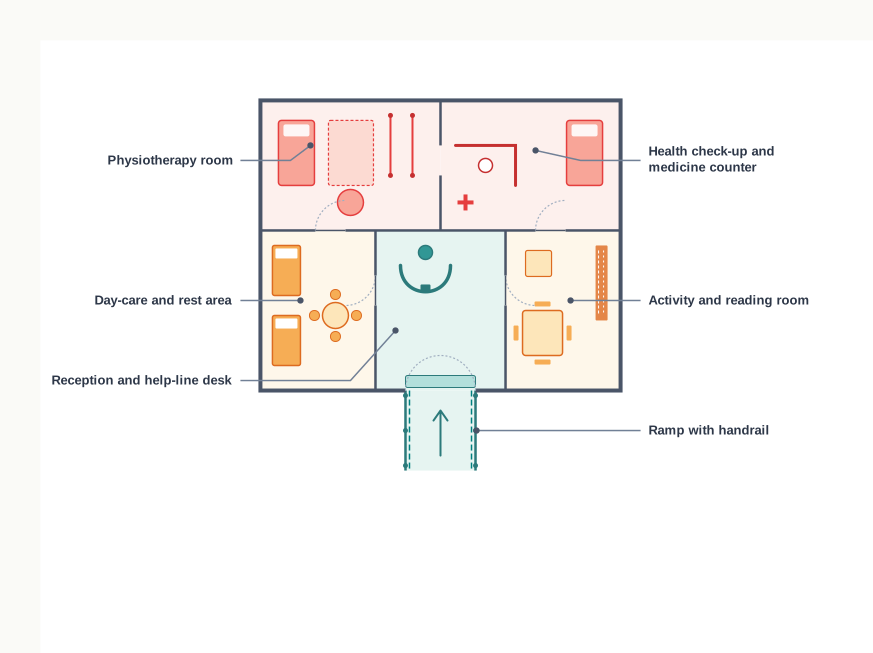
Fig. 7.4 – Plan view of a multi-service centre for older persons.
Health And Specialised Care
Mobile medicare units, which take medical care to older persons living in rural, isolated and remote areas.
Day care centres for persons living with Alzheimer’s disease or other forms of dementia, providing specialised day care.
Help-lines and counselling centres for older persons.
Mental health care and specialised care, through mental health intervention programmes for older persons.
Disability care and the provision of hearing aids.
Physiotherapy clinics.
Awareness, Training And Intergenerational Work
Programmes to build and strengthen intergenerational relationships, particularly between children or youth and older persons.
Programmes encouraging active and productive ageing.
Awareness generation programmes for older persons and their care givers, covering self-care, preventive health care, disease management, preparation for old age and intergenerational bonding.
Training of care givers for older persons.
Sensitising programmes for children, particularly in schools and colleges.
Research, advocacy and awareness building in the field of ageing.
Income Security
- The old age pension provided under the National Social Assistance Programme, for older persons who are destitute, that is, who have no regular means of subsistence of their own or through support from family members. The applicant must be aged 60 years and above and must belong to a household below the poverty line, and must furnish proof of age and of eligibility. The central pension amount is higher for those aged 80 and above, and state governments may add to it from their own resources.
7.6 Preparing For A Career In This Field
Everything described so far — the anganwadi, the home, the youth camp, the day-care centre — has to be run by somebody. That somebody is what this section is about.
In this career you may work as the in-charge or manager of certain activities in a programme or institution that is already functioning. Or you may choose to start an organisation or a programme of your own for children, youth or older persons. Either way it is a career that asks for a broad knowledge base and several distinct skills.
7.6.1 What Managing An Institution Involves
A career in the management of institutions and programmes calls for the abilities of three people in one — a planner, a manager and an evaluator — and sometimes of a fourth, an entrepreneur. Alongside these it needs strong knowledge of the target group: their needs, their characteristics, and the modes of care giving that suit them.
That knowledge is not decoration. A person who does not know what a three-year-old needs cannot judge whether an anganwadi is running well, however good her accounts are.
The three abilities are not separate jobs done by separate people. They form a cycle, shown in Fig. 7.5, which a working organisation goes round again and again.
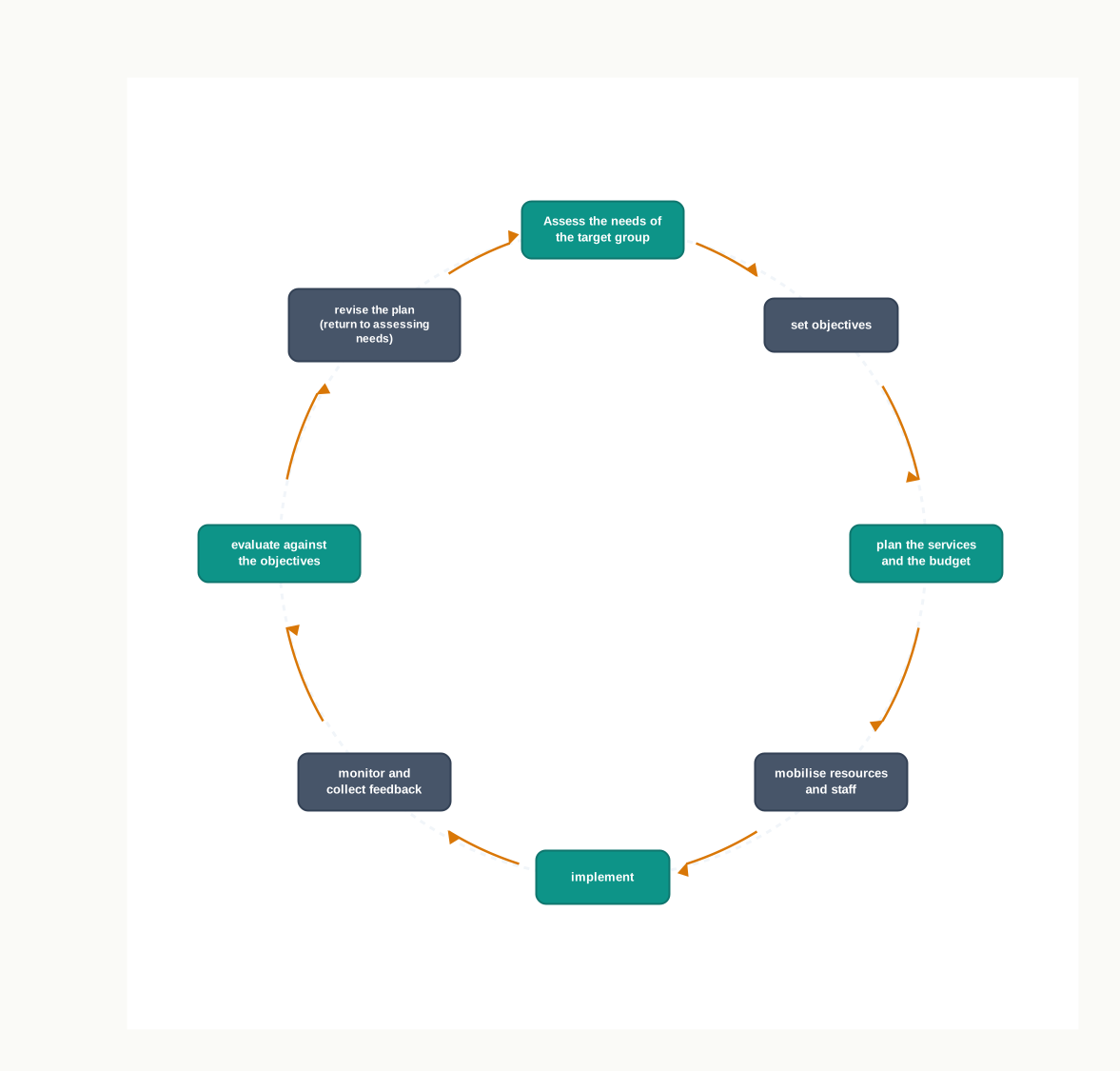
Fig. 7.5 – The management cycle.
Notice where evaluation sits. It is not the end of the work but the point at which the next round of planning begins, which is why an organisation that never evaluates keeps repeating the same year.
7.6.2 People Skills
Running or working in an organisation means interacting with people in different roles and from different backgrounds. The ability to do this well is called people skills, and four groups matter particularly.
The community. A programme or institution for children succeeds only if the community feels a sense of involvement and ownership in it. That happens when the people for whom the programme is intended are involved in planning it right from the start. Participatory planning, management and implementation are the pillars of an effective programme, so building linkages with the community and inviting its participation will be a major part of your work.
The private sector. Private financial institutions, companies and organisations have come forward substantially to support innovative programmes and institutions. This is an opportunity for the private sector to discharge its social responsibilities, and for the organisation it is a source of funds and expertise outside the government.
Officials in the government. You will need to deal with government departments for a range of purposes, including funding and the fulfilment of legal requirements. Knowing which department does what, and what it needs from you, saves months.
People within the organisation. For the organisation to function smoothly, the people in it — both the beneficiaries and the staff working there — need a harmonious relationship with one another. Cultivating cordial interpersonal relations is a major factor in the success of an organisation.
7.6.3 Administrative Skills
Running or managing an organisation or a programme also calls for administrative skills — handling finances, recruiting personnel, renting space, buying equipment, and maintaining records and stocks. Larger organisations employ specific people for each of these, but you will still need a basic understanding of the issues involved in every one of them.
The reason is simple. A manager who cannot read a set of accounts cannot tell whether the shortfall in the kitchen is theft, waste or a rise in prices, and cannot ask the right question of the person who can.
7.6.4 Setting Up A New Organisation
Some people go further and start a new organisation for a target group whose needs no one is meeting. Such an enterprising person has a set of decisions to make, and the order in which they are made matters, because each one narrows the next.
Last of all, and not least, comes vision. The person needs a clear idea of what she wants to achieve and of how the organisation will contribute to meeting the needs of the target group. A person with a vision is usually deeply committed to that cause and has a strong passion for the work.
7.6.5 Education And Training For This Career
The need for institutions and programmes that provide good-quality services to children, youth and older persons will remain a basic need of civil society. The first step in preparing for this career is to build a knowledge base and an understanding of these three groups.
For that, an undergraduate degree in Home Science — also known as Human Ecology and Family Sciences, or as Family and Community Sciences — is appropriate, as is a degree in Social Work or another of the social sciences. These degree programmes usually treat all three vulnerable groups. After the undergraduate degree you may enter employment or study further.
Alongside a programme of study in the conventional system, you can also use the open and distance learning route. The Indira Gandhi National Open University offers programmes that can be taken along with a regular degree, such as a certificate programme in NGO management and a diploma in youth development work. Several State Open Universities offer programmes through the distance mode as well. Course offerings change from year to year, so check the current listings on the universities’ websites before planning.
7.7 Scope And Career Avenues
Depending on the type of programme you wish to be involved with, and on your own inclination, this field offers a variety of possibilities. The four main career avenues are these:
Set up your own institution to provide services to any target group. This is the entrepreneurial route described in the previous section, and it suits a person who has identified a need no one in the area is meeting.
Be a manager in an established institution or programme. Here the service already exists and your work is to make it run well — the planning, the finances, the staff and the evaluation.
Be a functionary at any level or cadre. Every programme needs people at each rung, from the worker at the centre itself to the supervisor of a block or district, and each rung is a point of entry.
Be a researcher who consults with, assesses or evaluates existing programmes and institutions. Programmes are periodically studied to find out whether they are reaching the intended group and having the intended effect, and that work is done by people trained in this field.
These avenues open in more than one kind of organisation — government departments, non-governmental organisations, Panchayati Raj and local bodies, private companies supporting social work, and agencies working across countries. The knowledge base is the same in all of them; what changes is the scale you work at and whose rules you work under.
7.8 Summary
- The family is the basic unit of society and one of its chief functions is to look after the needs of its members.
- No family can meet every need on its own, because some needs require specialised skills, equipment and scale.
- Communities therefore create support services — schools, hospitals, universities, recreation centres and training centres — that members of a family can use.
- Many families are unable to meet basic needs or to reach and use existing services, most commonly because of a shortage of resources, particularly money.
- Many children, youth and older persons are separated from their families altogether and find it very difficult to meet their needs alone.
- The government and society have the responsibility of ensuring a decent life for all citizens, and respond by:
- setting up institutions for children, youth and older persons;
- initiating programmes for them;
- supporting the work of the private sector and of non-governmental organisations.
- An institution is a place with a resident or attending group; a programme is a planned set of activities delivered to a target group.
- Some services meet one specific need, while others take a holistic approach and meet several needs of the same person together, because the needs act upon one another.
- A vulnerable person or group is one more likely to be exposed to adverse circumstances and more harmed by them.
- Vulnerability arises when needs go unmet in the ordinary course of daily life, and it can be reduced by meeting those needs.
- Children are vulnerable because development in childhood is rapid in all domains at once, development in one domain affects the others, and adverse experience at this stage has lasting effects.
- The Juvenile Justice (Care and Protection of Children) Act, 2015 deals with two categories of children below eighteen years:
- a child in conflict with the law, alleged or found to have committed an offence;
- a child in need of care and protection, whose circumstances place her at risk.
- The Act identifies children in need of care and protection as those without a home or means of subsistence, living with an unfit or harmful guardian, having an illness or disability with no one to support them, abused or exploited, at risk of substance abuse or trafficking, affected by armed conflict, civil unrest or natural calamity, or likely to be abused for unconscionable gain.
- Three kinds of homes serve these children: Observation Homes during an inquiry, Special Homes after it, and Children’s Homes for children in need of care and protection.
- The Integrated Child Development Services, launched in 1975, meets the health, nutrition, stimulation and early learning needs of children below six years together, through the anganwadi.
- SOS Children’s Villages provides family-based long-term care, in which a resident caregiver looks after a small group of children living together as a family.
- Adoption beyond the family has been institutionalised and legalised, and is regulated by the Central Adoption Resource Authority, a statutory authority under the Juvenile Justice Act, 2015.
- The National Youth Policy, 2014 defines youth as persons aged 15 to 29 years; adolescence, taken as 10 to 19 years, overlaps this band.
- Youth are vulnerable because of biological change, the taking on of adult roles, peer pressure and the pressure to excel, and gaps in health knowledge and in the power to act on it.
- Some young people cope with stress through substance abuse, which addresses nothing and adds a health problem; talking to a trusted adult, teacher, counsellor or doctor is the step that helps.
- Rural and tribal youth, out-of-school youth, adolescents and particularly female adolescents, youth with disabilities, and youth in specially difficult circumstances are especially vulnerable.
- Youth need education and training, gainful employment, opportunities for advancement, shelter, a clean environment, quality health services, protection from exploitation, a say in decisions concerning them, and access to sports and recreation.
- Youth programmes in India include the National Service Scheme for students, the National Service Volunteer Scheme and the Nehru Yuva Kendras for non-student youth, promotion of adventure, Scouts and Guides, the Commonwealth Youth Programme, and the promotion of national integration.
- In India a senior citizen is a person aged 60 years and above, whereas many countries begin at 65.
- The older population is growing, is mostly rural, shows a rising proportion of women and of persons above 80, and includes a substantial share who are poor.
- Older persons are vulnerable because physiological reserves decline, ageing brings correctable disabilities such as cataract, hearing loss and arthritis, and because living arrangements and income often leave them without daily support.
- Many older persons live full lives and remain economically active in occupations with no fixed retirement age, and are a human resource; the National Policy for Older Persons was adopted in 1999.
- Programmes for older persons cover basic needs and care, health and specialised care, awareness, training and intergenerational work, and income security through the old age pension for destitute persons aged 60 and above below the poverty line.
- Institutional care houses the person; non-institutional care serves her at home or by day, with the family carrying the remaining hours.
- Managing an institution or programme requires the abilities of a planner, a manager and an evaluator, and knowledge of the target group’s needs, characteristics and modes of care giving.
- People skills are needed for working with the community, the private sector, government officials and people within the organisation.
- Administrative skills cover finances, recruitment, renting space, buying equipment, and maintaining records and stocks.
- Starting a new organisation means deciding the target group and its needs first, then the location, the services, the finances, the staff, registration, implementation and improvement through periodic evaluation and feedback.
- Preparation for this career begins with an undergraduate degree in Home Science, Social Work or another social science, with further study available through conventional and open and distance learning routes.
- The career avenues in this field are to set up your own institution, to manage an established one, to serve as a functionary at any level, or to research and evaluate existing programmes and institutions.
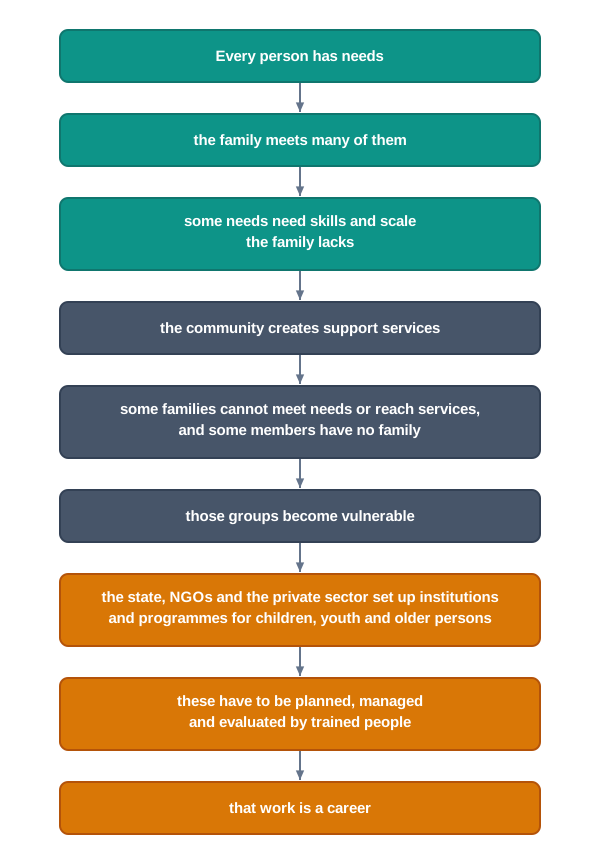
Fig. 7.6 – Chapter overview.
7.9 Key Terms
- Adolescence — the stage of transition from childhood to adulthood, taken by the World Health Organization as the years from 10 to 19.
- Administrative skills — the ability to handle an organisation’s finances, recruitment, space, equipment, records and stocks.
- Adoption — the process by which a child permanently becomes the child of parents other than the biological ones, with the same rights as a biological child.
- Anganwadi — the village or neighbourhood childcare centre at which all the services of the Integrated Child Development Services are delivered together.
- Child in conflict with the law — a child below eighteen years who is alleged or found to have committed an offence.
- Child in need of care and protection — a child below eighteen years whose circumstances, as listed in the Juvenile Justice Act, place her at risk.
- Holistic approach — meeting several needs of the same person together, rather than one at a time, because the needs act upon one another.
- Institution — a service with a fixed place and a resident or attending group, such as a children’s home or an old age home.
- Non-governmental organisation (NGO) — a voluntary, non-profit body working on a social cause outside the government.
- People skills — the ability to work with the community, the private sector, government officials, staff and beneficiaries.
- Programme — a planned set of activities delivered to a target group, usually across many locations and for a defined period.
- Senior citizen — in India, a person aged 60 years and above.
- Substance abuse — the use of alcohol or drugs as a way of coping, which does nothing about the stress and adds a health problem of its own.
- Support services — services created by the community, the state or voluntary organisations to meet needs a family cannot meet on its own.
- Vulnerable — describing persons or groups more likely to face adverse circumstances and more harmed by them than others.
- Youth — persons aged 15 to 29 years, as defined by the National Youth Policy, 2014.
7.10 Points To Ponder
If vulnerability arises whenever needs go unmet, could an adult of forty be vulnerable too? What does your answer suggest about designing services by age group rather than by need?
A district has enough funds either to run one service that meets several needs of a few hundred children, or to run one service that meets a single need of several thousand. What would you weigh in choosing between them?
A well-funded, well-staffed centre is built in a village and hardly anyone uses it. What might have gone wrong at the planning stage, and what would it take to set right?
SOS Children’s Villages deliberately recreates a family rather than running a hostel. What does a child gain from that arrangement that a larger institution finds hard to provide, and what does the arrangement demand in return?
Programmes for youth are often organised through colleges. What does this leave out, and how would you reach the young people it misses?
If older persons are a human resource, how might an institution for young children draw on them without turning the arrangement into unpaid labour?
7.11 Objective Questions
(MCQ) The National Youth Policy, 2014 defines youth as persons in the age group of: [1]
- 13 to 19 years
- 15 to 29 years
- 18 to 35 years
- 10 to 19 years
(MCQ) In India, a senior citizen is a person aged: [1]
- 55 years and above
- 58 years and above
- 60 years and above
- 65 years and above
(MCQ) Under the Juvenile Justice (Care and Protection of Children) Act, 2015, a child who has been found, after inquiry, to have committed an offence is placed in a: [1]
- Children’s Home
- Observation Home
- Special Home
- Multi-service centre
(MCQ) All the services of the Integrated Child Development Services are delivered at one point, namely the: [1]
- primary health centre
- anganwadi
- panchayat office
- primary school
(Fill) The central body that frames guidelines and regulates the adoption of children in India is the __________. [1]
(Fill) A service that is delivered to older persons at a day-care centre while they continue to live at home is an example of __________ care. [1]
(TF) State whether true or false: the Nehru Yuva Kendras were set up mainly to reach youth enrolled in colleges. [1]
(Name) Name the policy adopted by the Government of India in 1999 for older persons. [1]
(Odd) Odd one out, and give a reason: cataract, arthritis, impairment of the auditory nerve, feminisation of the elderly population. [1]
(AR) Assertion (A): A programme for children is planned by involving the community right from the start. Reason (R): A community that feels a sense of ownership in a programme is more likely to use and sustain it. [1]
- Both A and R are true, and R is the correct explanation of A.
- Both A and R are true, but R is not the correct explanation of A.
- A is true, but R is false.
- A is false, but R is true.
(AR) Assertion (A): Services for young children are designed to meet health, nutrition and early learning needs together. Reason (R): In childhood, development in one domain influences development in all the others. [1]
- Both A and R are true, and R is the correct explanation of A.
- Both A and R are true, but R is not the correct explanation of A.
- A is true, but R is false.
- A is false, but R is true.
(Match) Match the items in Column A with those in Column B: [1]
| Column A | Column B |
|---|---|
| a. National Service Scheme | i. Family-based long-term care for children |
| b. SOS Children’s Villages | ii. Medical care taken to older persons in remote areas |
| c. Mobile medicare unit | iii. Social service by students of colleges |
7.12 Check Your Concepts
(Concept) Define a support service, and give one example of a need it meets that a family cannot meet on its own. [2]
(Concept) State any four features of the elderly population in India. [2]
(Concept) Give a reason: an anganwadi provides supplementary food, immunisation and pre-school education at the same centre rather than through three separate services. [3]
(Concept) Differentiate between an institution and a programme, stating the basis of difference. [3]
(Concept) Why are children considered a vulnerable group? Explain with reference to the way development proceeds in childhood. [3]
(Concept) Differentiate between institutional and non-institutional care for older persons, stating the basis of difference. [4]
(Concept) Explain, with one example each, any four groups of people that a manager of an institution has to work with. [4]
(Concept) What would happen if an organisation implemented its programme year after year without any periodic evaluation and feedback? [4]
(Concept) Describe any five programmes available in India for older persons, naming the need each member meets. [5]
(Concept) Explain why youth is described as a vulnerable period, and state what young people need in order to be socially useful and economically productive. [5]
7.13 Identify And Label
(IdLabel) Study Fig. 7.1. Identify the centre shown and name any four services delivered there. [2]
(IdLabel) Study Fig. 7.3. Identify the two age bands shown, state the age range of each, and state the years in which they overlap. [2]
(IdLabel) Study Fig. 7.4. Identify the type of centre shown, and state which two of the labelled areas make it usable by a person who has difficulty walking. [2]
(IdLabel) Study Fig. 7.2. Name the home to which each of the two branches leads at the first stage, and state which category of child takes each branch. [2]
7.14 Case And Application Based
- (Case) A block in a hilly district has a scattered population of older persons. Most of them live in small settlements connected by rough roads, a large number are women living alone, and the proportion of persons above 80 years has been rising. A doctor visits the block headquarters once a week. The block officer has funds for one new service. [5]
- Would you advise institutional or non-institutional care as the main form of the new service? Give two reasons.
- Name two programmes described in this chapter that would suit this block, and state the need each would meet.
- Which single detail in the situation most changes your answer to (a)? Explain how.
- (Case) A young graduate wants to start an organisation for out-of-school youth in a small town. She has been offered a cheap plot of land eight kilometres outside the town and plans to build there first, decide the services afterwards, and find out later what the young people of the town actually need. [5]
- Identify the step that is out of order in her plan, and explain what is likely to go wrong.
- List, in the correct order, the first four decisions she should make.
- Name two groups of people whose support she will need, and state what each can provide.
- (Case) An eleven-year-old child is found alone at a bus stand. Her family cannot be traced, she has no place to stay, and she has not been accused of any offence. [4]
- Under the Juvenile Justice (Care and Protection of Children) Act, 2015, which category does she fall into? Give a reason.
- Name the kind of home in which she would be placed.
- State two things the government is responsible for providing her there, and explain why vocational training matters for a child who will leave such a home at eighteen.