Chapter 6: Early Childhood Care and Education
A Classroom In A Courtyard In 1945, a woman in her fifties moved from the city of Bombay to Bordi, a coastal village in what was then Thane district, to start a school for children who had never seen one. Her name was Tarabai Modak. She had read Maria Montessori, worked with the educationist Gijubhai Badheka in Bhavnagar, and trained teachers for years. What she found in Bordi, and later at Kosbad Hill where she shifted her centre in 1957, was that none of the ready-made equipment she had learnt about was of any use. There were no smooth wooden blocks, no printed cards, and no families who could pay for them.
So she and her long-time colleague Anutai Wagh built the class out of what was already there. Seeds, shells, feathers, dry leaves, clay, stones and old cloth became the learning material. Instead of asking Adivasi families to send small children down a forest path to a building, the teacher walked to the hamlet and held the class in a courtyard — an angan. Songs, stories, sorting, counting and free play happened where the children already lived.
Tarabai Modak received the Padma Bhushan in 1962. The courtyard class she and Anutai Wagh worked out is one of the ancestors of the anganwadi you can see in villages and towns across India today.
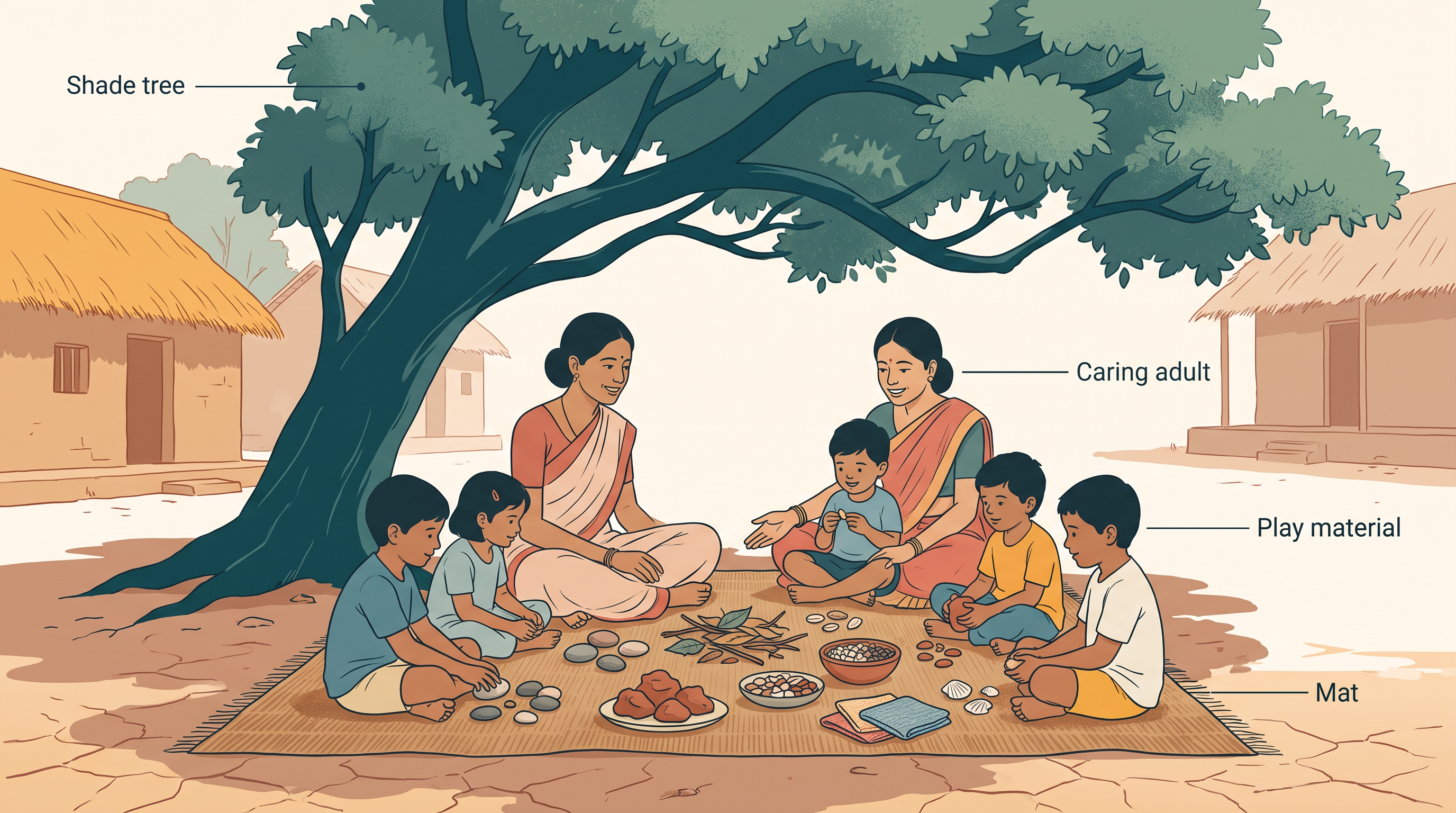
Fig. 6.0 – A courtyard preschool session.
6.1 Significance Of Early Childhood Care And Education
A child of four is not a smaller version of a child of ten. She learns in a different way, tires in a different way, and needs a different kind of adult beside her. Early childhood care and education (ECCE) — the organised care and learning provided to children in the years before formal schooling — is built on that difference.
This first section asks why those years deserve so much attention, and what happens in them that cannot simply wait. Everything that follows in the chapter, from the concepts to the career, rests on the answer.
6.1.1 Learning And Attachment In The Early Years
You read in Class XI that learning begins very early. Long before a child can speak, she is watching faces, following sounds, reaching for objects and working out how the world behaves.
Alongside this learning, something else is growing. The infant forms an attachment — a strong emotional bond with the people who care for her regularly. This is usually the mother and father, and also siblings and grandparents, and any other adult who is present day after day.
Recognising The Familiar
Attachment shows itself first as recognition. The child begins to tell apart the people she meets often from those she does not, and around 8 to 12 months a baby may show fear of an unknown person.
It is easy to read this only as an emotional display. It is better read as an achievement: to be wary of an unfamiliar face, the child must already hold familiar faces in mind.
The same ability explains what happens at about one year. The child clings to the primary caregiver and follows that person everywhere, and may cry when the caregiver leaves the room. The primary caregiver is the person who provides most of the child’s daily care — generally, though not always, the mother.
In most cases this clinging soon passes. The child works out that the caregiver has not vanished by walking into the next room, and builds a sense of security that lasts even while that person is absent.
Growing Control Over The Body
The same period brings rapid physical change. The child learns to walk, picks up small things with increasing precision, and manages her body in many new ways.
Control over bladder and bowel movements develops in these years too. Each of these gains widens what the child can do without help, and therefore widens what she can explore.
6.1.2 When The Family Needs Support In Child Care
In most cases children are brought up entirely within the family for the first few years. Where a parent is employed outside the home, the family has to arrange for someone else to care for the child during those hours.
Traditionally that arrangement was found inside the household itself. Another adult of the family, most often a woman, either lived with the family permanently, as in a joint family, or came and stayed for a while to help with the child.
In recent times the need for institutional child care has grown. It may take an informal shape, where a person in the neighbourhood runs a crèche at home as a small business, or a formal one, in a centre set up for the purpose.
It is worth being clear about what such an arrangement is for. Care of this kind stands in for the primary caregiver while she or he is away, and it is not by itself the enriching learning experience a young child needs.
6.1.3 Why The Years From Three To Six Matter
Once a child is around three, her activities and experiences begin to widen. Experts differ on the exact age up to which a child should be kept at home before entering formal school.
At this age a child still enjoys informal activity in small groups. But there is growing value in meeting people outside the family and the immediate neighbourhood.
These are the years for exploring. Once children can walk and run, handle things and speak, they are able to engage with their surroundings actively rather than only watch them.
Almost all of the information a child gathers now comes from interaction — with people, and with materials. Vocabulary in the mother tongue grows quickly, and so does the child’s understanding of sand, water, flowers, birds, machines and everything else within reach.
Curiosity And The Cost Of Forcing It
This is the age of the endless question. A child who sees something new asks an adult why it is so, and the adult’s answer decides whether she asks again.
The task, then, is to satisfy that curiosity without overburdening the child with more than she can manage. Both halves matter: too little to do starves curiosity, and too much defeats it.
Forcing a young child to sit in one place and learn as older children do is the clearest way to lose her. Curiosity fades, and the child becomes anxious and insecure in a setting she cannot meet.
The environment that works is described in Fig. 6.1. It is safe, secure and loving; it offers a variety of people and of play materials, whether bought toys or natural objects; and it contains a caring adult — a parent, a grandparent, a sibling or a preschool teacher.
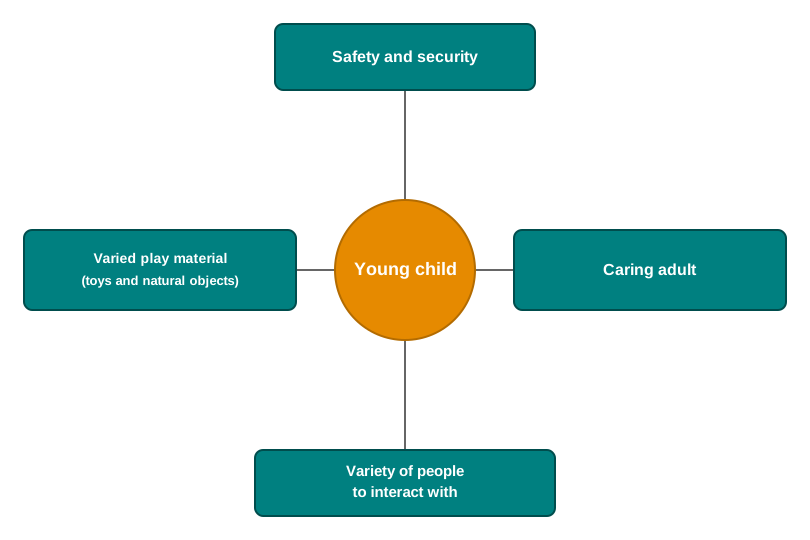
Fig. 6.1 – Elements of a good early learning environment.
6.1.4 What A Good Preschool Adds
The learning and other experiences a good preschool provides have been found to be very beneficial at this age. Two features explain why.
The first is the child-centred approach — planning the day around what children of this age are able and eager to do, rather than around a syllabus fixed in advance. The second is the play way method, in which the child learns through play, so that learning is enjoyable rather than demanded.
Children also enjoy the company of other children, and they learn from each other at a speed that often surprises the adults at home. Parents of young children are frequently astonished to find that their child eats by herself at the centre, and eats foods she refuses at home.
For a child living in difficult circumstances, or a child who needs extra support with learning, a good preschool environment is known to be especially valuable.
Complementing The Home, Not Replacing It
What a preschool does is extend the child’s world. It brings her into contact with other adults, other places and other materials, and it prepares her for the demands of formal schooling.
A programme that is child-centred and informal complements a good home environment rather than competing with it. And where the home environment falls short in some way, the preschool becomes an important support to the child’s growth and development outside the home.
6.1.5 Support To The Older Child, The Family And Society
The benefit of early childhood services does not stop with the young child. In several communities, especially in remote areas or where families have fewer resources, an older child of school-going age is given charge of the younger ones while the parents go out to work.
The consequence is that the older child cannot attend school. Institutional care for the young child therefore helps two children at once: the little one is looked after, and the older one is released to study. The chain is set out in Fig. 6.2.
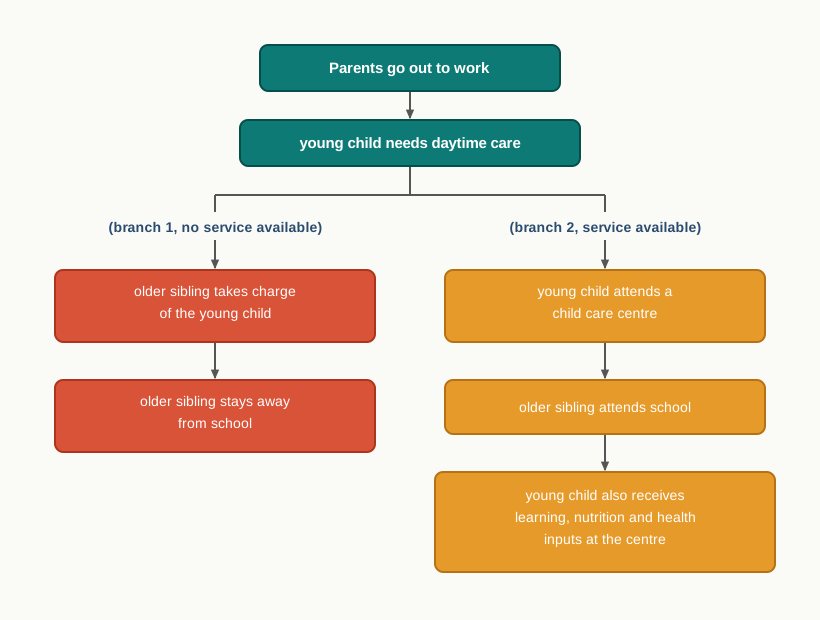
Fig. 6.2 – How a child care service reaches two children.
These services carry more than learning. Where there is a need, they also provide for interventions in nutrition and health, which reach the child at the age when such support does the most good.
Seen at the widest scale, this is society investing in the next generation. Early childhood care and education supports children growing up in very different circumstances, and it supports their families and communities in a task those families would otherwise carry alone.
6.1.6 Objectives Of ECCE
The National Curriculum Framework (2005) Position Paper on Early Childhood Education, published by NCERT, sets out three basic objectives for ECCE:
- holistic development of the child, so that she is enabled to realise her potential — that is, development of every aspect together, physical, cognitive, language, social and emotional;
- preparation for school;
- providing support services for women and children.
Notice how the three sit on different rungs of the same ladder. The first is about the individual child, the second about the child’s path through an institution, and the third about families and the community that surrounds them.
6.2 Basic Concepts In Early Childhood Care And Education
Before going further, a set of terms needs to be pinned down. Words like crèche, day care, toddler and preschool are used loosely in everyday speech, and in this field each of them means something exact.
6.2.1 Early Childhood, Infancy And The Toddler
Early childhood is the phase of life from birth until 8 years of age. It is commonly divided into two parts — birth to three years, and three to eight years — because the developmental changes that mark young children differ sharply between the two.
Infancy is the period between birth and one year, although some experts extend the term to two years. Through it, the child depends on adults for very nearly every everyday need.
This is a period of intense dependence. The adult in question is usually a parent, or another primary caregiver such as a grandparent or a helper who is present each day.
The child between two and three years is often called a toddler. The name comes from the jumpy, unsteady walk of a child at this age, who has recently begun to toddle about on her own.
The whole span, with its divisions, is laid out in Fig. 6.3.
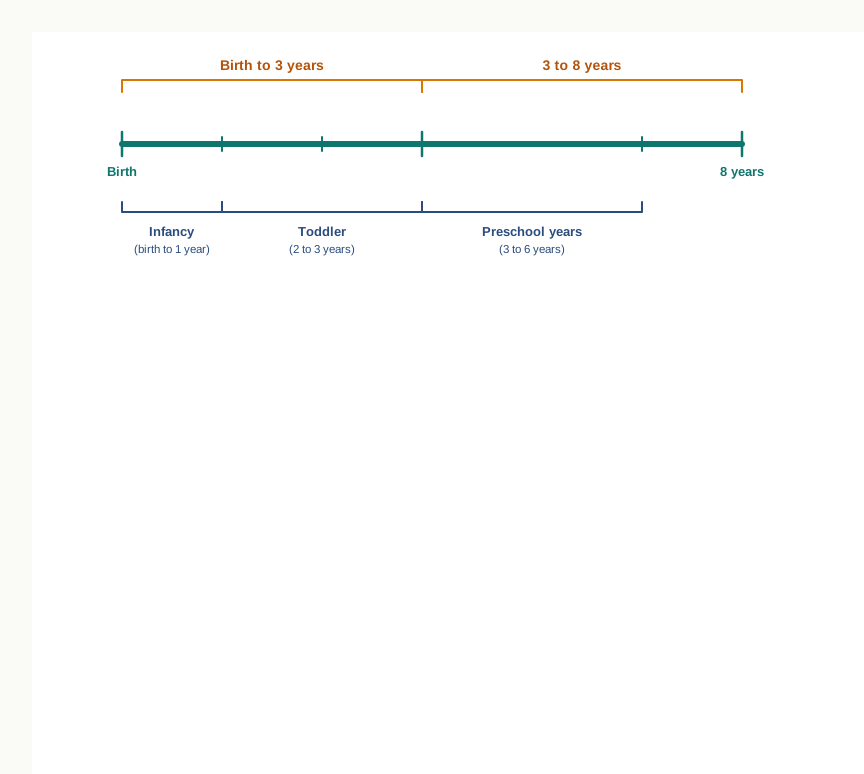
Fig. 6.3 – The early childhood period.
6.2.2 Substitute Care, Crèche And Day Care
Where a parent is employed outside the home, the infant has to be cared for by a substitute caregiver — a person who takes over the daily care of the child in the primary caregiver’s absence. This may be a family member or a hired person.
The arrangement can be located in several places. It may be the child’s own home, the caregiver’s home, or an institution set up for the purpose.
A crèche is an institutional setting designed particularly for the care of infants and young children when home care is not available. Day care, on the other hand, is the care of children in the preschool years, and may include both infants and preschoolers, again in the absence of a primary caregiver at home.
Both are usually all-day programmes, and both are compared with the nursery school in Table 6.1. What separates them from a nursery school is that their first duty is care; learning is built on top of it.
Because they hold very young children for long hours, teachers and helpers in a crèche or day care centre need training of a particular kind. They must know how to keep a small child safe, how to feed her, how to help with toilet habits, how to support her growing language, and how to meet her social and emotional needs alongside her learning.
Teachers who work with children above three years of age need a different skill set again. The younger the child, the larger the share of physical care in the adult’s work.
6.2.3 The Preschool Child And Preschool Settings
A preschool child is so called because she is now ready to experience an environment beyond that of her own family — an extra-familial setting. The readiness is what the word marks, not merely the age.
A teacher here also needs specific training, as a preschool or nursery school teacher. Being fond of children is not the same as knowing what a four-year-old can do and what she cannot.
Some preschools for young children are called Montessori schools. These work on the principles of early childhood education set out by the educationist Maria Montessori.
The Government of India has addressed the needs of this age group through the anganwadi, which offers preschool education under the Integrated Child Development Services (ICDS). Anganwadis operate in both rural and urban areas, so the service is not limited to villages.
6.2.4 How Young Children Understand Their World
A second group of concepts concerns the child’s own thinking. Children of this age do not understand events in a smaller or weaker version of the adult way; they understand them differently.
The developmental psychologist Jean Piaget spent his working life studying and explaining this. His central claim was that young children have their own ways of making sense of the world, and therefore need an environment that lets them explore things in those ways.
You studied these features of children’s development in Class XI. They are worth holding in mind here, because the principles of care and education that follow are built directly on them.
6.2.5 The Cultural Context Of An ECCE Setting
An ECCE institution does not stand outside the community it serves. It must recognise the cultural context in which it operates, and work along with the family rather than in opposition to it.
This is true at every age, but it matters most for the young child. An older child or an adult can hold two different perspectives at once and see that the school does things one way and the home another; a young child cannot yet make that distinction.
For her, a centre that contradicts her home is not offering a second point of view. It is simply confusing. Educational and care arrangements for young children must therefore be built to fit the family and the community around them.
6.2.6 Guiding Principles Of ECCE
The National Curriculum Framework (2005) on ECCE sets out the guiding principles on which good early childhood practice rests:
- play as the basis for learning;
- art as the basis of education;
- recognition of the special features of children’s thinking;
- primacy of experience rather than expertise, so that experiential learning is emphasised — the child does the thing rather than being told about it;
- experience of familiarity and challenge in everyday routines, so that the day is predictable but not dull;
- mix of formal and informal interactions;
- blend of textual and cultural sources, so that stories, songs and knowledge from the child’s own community sit beside printed material;
- use of local materials, arts and knowledge;
- developmentally appropriate practices, flexibility and plurality;
- health, well-being and healthy habits.
Read together, these ten are not ten separate rules. They describe one setting — a place that lets a young child act, that draws on what surrounds her, and that expects her to be different from the child sitting beside her.
6.3 Preparing For A Career In ECCE
Children under six years of age have their own ways of understanding the world and their own way of reading social relationships. They also have developmental needs that belong to no other stage of life.
It follows that any adult who sets out to work with them must be carefully and well trained in early child development and care. This section takes that claim apart and asks what the training is actually for.
6.3.1 Why Every Adult With Children Needs This Knowledge
A fair objection comes first. When people become parents, nobody asks them for a qualification in child care — so why should a teacher or a caregiver need one?
The answer begins by turning the question around. Parents too would gain a great deal from knowing more about how and why children behave as they do.
They would gain particularly from knowing what differences to expect between children of the same age. Children of one age are not one child repeated; each differs in pace and in manner, and these individual differences are ordinary rather than a sign of anything being wrong.
That single piece of knowledge changes behaviour at home. An adult who understands it stops making competitive comparisons — between one child and another, and between siblings — because she can see that the comparison measures nothing.
So the honest conclusion is not that parents need no knowledge. It is that every adult in contact with children benefits from a scientific understanding of growth and development, which is what produces realistic expectations and better interactions.
The Circle Of Responsibility
For an adult who chooses early childhood programmes as a career, training and scientific knowledge of childhood matter even more. Early child care professionals are responsible for children other than their own, and the activities they perform constitute their work rather than their family life.
Their responsibility runs outward in widening circles, as Fig. 6.4 shows. They are answerable to the children in their charge, to the large group of adults who are those children’s family members, to the institution they work for, and to the larger society.
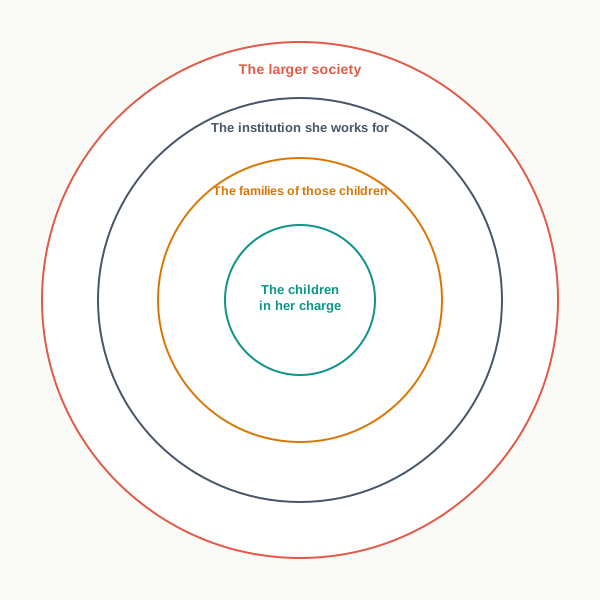
Fig. 6.4 – Widening circles of professional responsibility.
ECCE professionals therefore have to be committed to the children, to their well-being and to their learning. They also have to be aware and knowledgeable about what those children need, and about the difficulties of providing it.
6.3.2 What Is Expected Of A Preschool Teacher
What does the work look like once the child is past infancy? During the preschool years, the teacher keeps everything above in mind, but the balance of the day shifts.
There is less need to supervise physical care — cleaning, feeding, toilet activity — because the child can now speak, control her bowel and bladder movements, and eat independently. The time this frees is the point of the shift.
The teacher spends it on providing interesting and stimulating opportunities: chances to learn new things, to experience natural phenomena, and to take part in physical, language, social-emotional and other kinds of experience. The emphasis falls on creative expression and exploration, which matter in the earlier years too but can be pursued much further now.
Why Opportunities Have To Be Provided
Why should an adult have to arrange all this? Because a young child cannot arrange it for herself, and needs adult guidance far more than an older person does.
Consider the contrast. If we want to express ourselves creatively as adults, we can set up the conditions for it; if we want to talk to someone, we can take the initiative. A child in the preschool years depends on an adult for both.
The psychologist and educator Lev Vygotsky described exactly this need — the great need a child has for a concerned, caring and knowledgeable adult beside her. Notice which three words are doing the work: concern, care and knowledge, and not one of the three is enough on its own.
This is why the preschool educator’s knowledge must be about the child’s capabilities, more than about the world. Knowing how much a child actually knows, and how much she is capable of knowing, is what lets an adult build an environment in which learning is easy, enjoyable and meaningful.
The practical test is the level of the task. A task must be neither too easy nor too difficult, because a child who finds it either way loses interest, or loses the motivation to stay with the activity, or both.
6.3.3 Skills An Early Childhood Professional Needs
Some of the skills an early childhood professional needs to have are:
- an interest in children and their development;
- knowledge about the needs and capabilities of young children;
- capacity and motivation for interacting with children;
- skills for creative and interesting activities with children, in all areas of development;
- enthusiasm for activities like story-telling, exploration, nature and social interaction;
- willingness and interest in answering children’s queries;
- capacity for understanding individual differences;
- energy, and readiness for physical activity over considerably long periods of time.
The list is not a set of separate virtues. Items (a) to (c) describe an attitude towards children, (d) to (f) describe what the adult does with them through the day, and (g) and (h) describe what makes it possible to keep doing it with twenty different children at once.
6.3.4 Courses, Degrees And Training
To prepare for a career in this field, you need to have studied children’s development and the basic principles of care. The usual route is an undergraduate degree in a subject that carries child or human development, or child psychology, as part of the course.
There are shorter routes for those who wish to enter the field soon after school. A one-year diploma is available, as are Open University courses in the field, and Nursery Teacher Training is another course that offers training of this kind.
The routes do not end at entry. Higher study is possible through a postgraduate diploma or degree in early childhood education, and beyond it a doctoral degree for those who wish to do research. The paths are set out in Fig. 6.5.
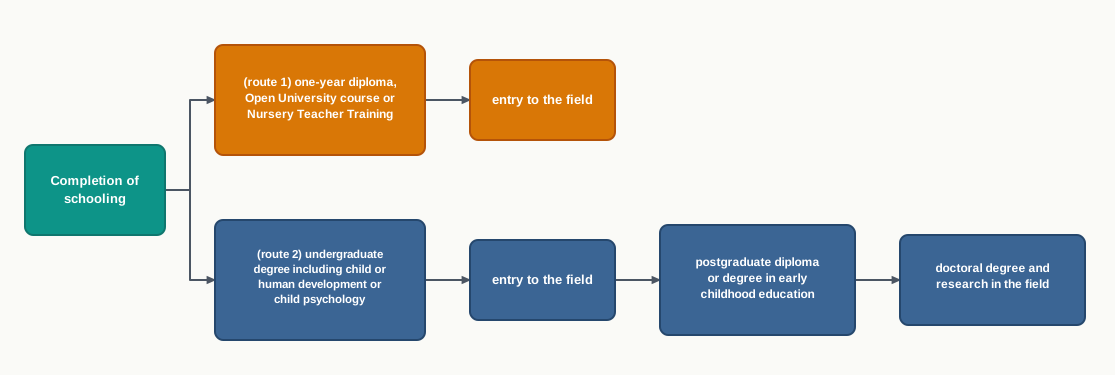
Fig. 6.5 – Educational routes to an ECCE career.
6.3.5 Personal Qualities Beyond The Qualification
A certificate settles only part of the matter. Anyone who wants to become an effective early childhood specialist also needs a predisposition to be open and interactive with children, and no course supplies that.
Awareness of the community and its culture is a second requirement. The activities a teacher plans should sit inside the culture and the regional environment in which the child is growing up, for the reason met earlier: a young child cannot yet hold the school’s world and the home’s world apart.
A third requirement is administrative. The teacher needs management skills for record keeping, accounting and report-writing, so that the institution’s records stay in order and its contact with the parent community remains effective and productive.
Skills In The Arts
It is also extremely helpful to be equipped with a good repertoire of skills in the arts. Story-telling, dance, music, voice modulation and the organising of playful indoor and outdoor activities are not decorations on the job; with this age group they are the job.
Training courses offer sessions in all of these. But the courses only supply the technique, and a person still has to be deeply engaged with children and willing to interact with them in several different ways.
Being Ready To Change The Plan
Young children have a short attention span — the length of time a person can stay engaged with one thing — compared with older children and adults. A group of four-year-olds will leave an activity long before the adult has finished it.
So it is not enough to arrive prepared with several activities. The teacher must also be adaptive and flexible with the children in front of her, rather than fixed on completing her own plan of action.
A preschool teacher often has to change her lesson plan, her strategies and her techniques on the spot to meet what the children need at that moment. That is exactly why a large repertoire of activities and skills has to be prepared in advance: you can only change course quickly if you have somewhere else to go.
6.4 Scope Of Work In ECCE
The scope of early childhood care and education is very widespread. Training as an educator or caregiver for young children opens more than one kind of workplace, and the work is not confined to standing in front of a class.
6.4.1 Where An ECCE Professional Works
The most familiar posts come first. A trained person may work as a teacher in a nursery school, as a caregiver in a crèche, or as a member of a team running a programme for young children.
Beyond these, several governmental and non-governmental organisations hire professionals to plan and promote campaigns or services for young children. Here the work is with the programme rather than directly with a group of children, and it draws on the same knowledge from the other end.
A person may also set up her own child care or education programme as an entrepreneur, either at home or in a separate space. Such an enterprise needs expertise in organising and managing an institution, over and beyond the training of a child care worker and educator — which is why the administrative skills discussed earlier matter so much here.
Depending on qualification and interest, two further roles open up. One is coordinator of a programme run by someone else; the other is trainer of teachers in the same subject. Those who go on to postgraduate and doctoral study, as set out in Fig. 6.5, move into research and into more senior professional work.
6.4.2 Services And Careers In The Field
Some of the commonly available services in this field are:
- crèches;
- day care centres;
- nursery schools;
- NGOs;
- ICDS;
- training institutes.
Each of these is a possible employer, and each asks for a slightly different combination of what you have learnt in this chapter. Table 6.2 sets the main ones side by side.
Read down the last column and a pattern appears. The further a role moves from the child, the more it asks of your organising and planning ability; the closer it stays to the child, the more it asks of your patience, energy and skill in the arts.
6.5 Summary
- Early childhood care and education is the organised care and learning provided to children in the years before formal schooling.
- Learning begins in infancy, and alongside it the child forms an attachment to the people who care for her regularly.
- Attachment shows itself in recognisable behaviour:
- fear of an unknown person at around 8 to 12 months, which shows that familiar faces are already held in mind;
- clinging to the primary caregiver at about one year;
- a settled sense of security once the child learns that an absent caregiver returns.
- The same period brings rapid physical gains — walking, precise handling of objects, control of the body, and control over bladder and bowel movements.
- Where a parent works outside the home, a substitute care arrangement is needed; it may be at the child’s own home, the caregiver’s home, or an institution.
- Such care stands in for the primary caregiver, and is not by itself the enriching learning experience a young child needs.
- From about three years, the child gains most from contact with people and materials beyond the family, because at this age she learns chiefly through interaction.
- Curiosity has to be satisfied without overburdening the child; forcing a young child into formal seated learning makes her anxious and insecure and dulls her curiosity.
- A good early learning environment is safe, secure and loving, offers varied people and play materials, and contains a caring adult.
- A good preschool works through the child-centred approach and the play way method, and adds other children, other adults, other materials and preparation for formal school.
- All children learn naturally; the preschool complements the home, and matters most where the home environment falls short or the child needs extra support.
- Child care services also release older siblings from care duties so that they can attend school, and can deliver nutrition and health interventions along with learning.
- As per the NCF (2005) Position Paper published by NCERT, the objectives of ECCE are holistic development of the child, preparation for school, and support services for women and children.
- Early childhood runs from birth to 8 years and is divided at three years; infancy is birth to one year; the toddler is the child between two and three.
- A crèche is designed for infants and young children in the absence of home care, while day care serves children of the preschool years and may include infants.
- Adults working with children under three need training in safety, feeding, toilet habits, language, and social and emotional needs; those working with older preschoolers need a different skill set.
- A preschool child is one ready for an extra-familial environment; Montessori schools follow the principles set out by Maria Montessori, and anganwadis under ICDS provide preschool education in rural and urban areas.
- Jean Piaget established that young children make sense of the world in their own ways and therefore need an environment that lets them explore in those ways.
- An ECCE institution must fit the cultural context and work along with the family, because a young child cannot yet hold two conflicting realities apart.
- The NCF (2005) guiding principles of ECCE are play as the basis for learning, art as the basis of education, recognition of children’s thinking, primacy of experience, familiarity and challenge in routines, a mix of formal and informal interaction, a blend of textual and cultural sources, use of local materials and knowledge, developmentally appropriate and plural practice, and health and well-being.
- Every adult in contact with children benefits from a scientific understanding of development, which produces realistic expectations and ends competitive comparison between children.
- The professional’s responsibility is wider than a parent’s: she is answerable to the children, their families, her institution and society, and receives formal recognition for the work.
- With preschool children, less time goes to physical care and more to stimulating opportunities for learning, creative expression and exploration.
- Lev Vygotsky described the child’s great need for a concerned, caring and knowledgeable adult; the educator’s knowledge must be of the child’s capabilities, and tasks must be neither too easy nor too difficult.
- An early childhood professional needs interest in children, knowledge of their needs and capabilities, motivation to interact, skills for creative activities, enthusiasm for story-telling and exploration, willingness to answer questions, understanding of individual differences, and physical energy.
- Preparation for the career may be through an undergraduate degree carrying child or human development, a one-year diploma, an Open University course or Nursery Teacher Training, with postgraduate and doctoral study beyond.
- Beyond qualifications, the work asks for openness with children, awareness of community and culture, administrative and management skills, a repertoire of skills in the arts, and flexibility with a group whose attention span is short.
- The field offers work in crèches, day care centres, nursery schools, NGOs, ICDS and training institutes, as teacher, caregiver, team member, campaign professional, coordinator, teacher trainer, researcher or entrepreneur.
- The whole argument of the chapter runs in one line, condensed in Fig. 6.6.
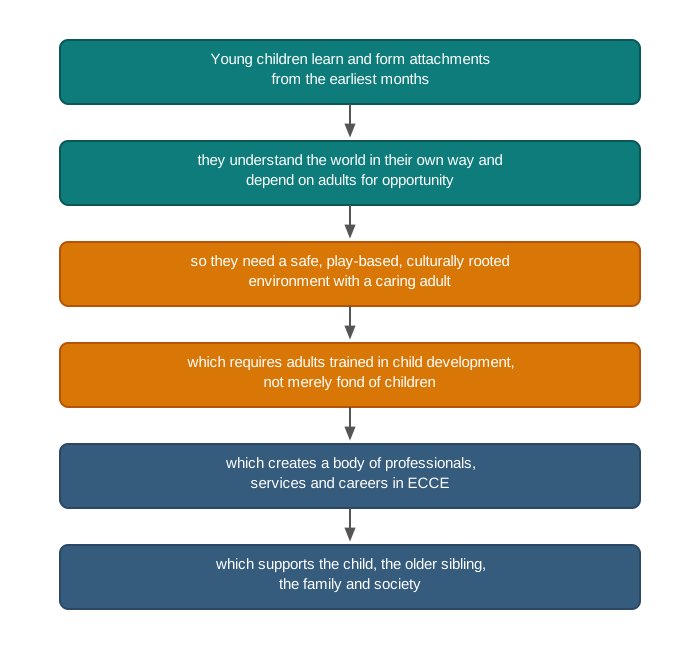
Fig. 6.6 – The argument of the chapter.
6.6 Key Terms
- Anganwadi — a centre run by the Government of India that provides preschool education for young children along with health and nutrition services, in rural and urban areas alike.
- Attachment — the strong emotional bond a child forms with the people who care for her regularly.
- Attention span — the length of time a person can stay engaged with one activity; it is short in young children.
- Child-centred approach — planning the day around what children of that age are able and eager to do, rather than around a fixed syllabus.
- Crèche — an institutional setting designed particularly for the care of infants and young children when home care is not available.
- Day care — the care of children of the preschool years, which may include infants, in the absence of a primary caregiver at home.
- Early childhood — the phase of life from birth until 8 years of age, commonly divided at three years.
- Early childhood care and education (ECCE) — the organised care and learning provided to children in the years before formal schooling.
- Extra-familial — belonging to an environment beyond the child’s own family.
- Holistic development — development of every aspect of the child together: physical, cognitive, language, social and emotional.
- Individual differences — the ordinary differences in pace and manner between children of the same age.
- Infancy — the period between birth and one year, during which the child depends on adults for nearly every everyday need.
- Montessori school — a preschool that works on the principles of early childhood education set out by Maria Montessori.
- Play way method — a method in which the child learns through play, so that learning is enjoyable rather than demanded.
- Preschool child — a child who is ready to experience an environment beyond that of her own family.
- Primary caregiver — the person who provides most of a child’s daily care.
- Substitute caregiver — a person who takes over the daily care of a child in the primary caregiver’s absence.
- Toddler — the child between two and three years of age, named from the unsteady walk of that age.
6.7 Points To Ponder
The chapter says a crèche stands in for the primary caregiver but is not by itself an enriching learning experience. What would have to change in a crèche before you would be willing to call it an educational setting as well as a caring one?
Experts differ on the exact age until which a child should be kept at home before entering formal school. What kinds of evidence would help settle such a disagreement, and why might the answer differ from one family’s circumstances to another?
A task given to a young child should be neither too easy nor too difficult. How could a teacher with twenty children in one room, all of slightly different capability, work at the right level for each of them at the same time?
An ECCE centre is asked to work along with the family’s culture rather than against it. What should a teacher do when a practice a child brings from home is one the centre cannot accept, such as an older child being kept back from school to mind a younger one?
If play is the basis of learning in early childhood, why does schooling largely stop using it after the first few years? Consider whether that shift is justified by how older children learn, or only by what schools are expected to produce.
Preschool education reaches children through nursery schools, anganwadis, day care centres and home-based arrangements, and these differ in cost, hours and training. What does that variety mean for the idea that every child should get a comparable start?
6.8 Objective Questions
- (MCQ) Early childhood is the phase of life from birth until: [1]
- three years
- six years
- eight years
- ten years
- (MCQ) A child of about 8 to 12 months shows fear of an unknown person. This behaviour indicates that the child: [1]
- has not formed an attachment with anyone
- can recognise familiar faces and tell them from unfamiliar ones
- is not developing normally for that age
- has been left alone too often
- (MCQ) The term ‘toddler’ is used for a child between: [1]
- birth and one year
- one and two years
- two and three years
- three and six years
- (MCQ) Which of the following is not one of the objectives of ECCE stated in the NCF (2005) Position Paper on Early Childhood Education? [1]
- holistic development of the child
- preparation for school
- providing support services for women and children
- early teaching of reading, writing and arithmetic
- (Assertion–Reason) Read the two statements and choose the correct option. [1] Assertion (A): A crèche or a substitute care arrangement is not by itself enough for a young child’s development. Reason (R): Such an arrangement is designed primarily to stand in for the primary caregiver rather than to enrich the child’s learning.
- Both A and R are true, and R is the correct explanation of A.
- Both A and R are true, but R is not the correct explanation of A.
- A is true but R is false.
- A is false but R is true.
- (Assertion–Reason) Read the two statements and choose the correct option. [1] Assertion (A): An ECCE centre must work along with the family’s cultural context rather than in opposition to it. Reason (R): A young child cannot yet make distinctions between different perspectives and different realities in the way an older child or adult can.
- Both A and R are true, and R is the correct explanation of A.
- Both A and R are true, but R is not the correct explanation of A.
- A is true but R is false.
- A is false but R is true.
- (Match the following) Match the term in Column A with its description in Column B. [1]
| Column A | Column B |
|---|---|
| a. Crèche | i. a preschool working on the principles set out by a well-known educationist |
| b. Anganwadi | ii. an institutional setting for infants and young children in the absence of home care |
| c. Montessori school | iii. a government centre offering preschool education in rural and urban areas |
(Fill in the blank) The method in which a young child learns through play, so that learning stays enjoyable, is called the ______ method. [1]
(True or false) A child who does not attend a nursery school does not learn during the preschool years. [1]
(Name the following) Name the psychologist and educator who described the young child’s great need for a concerned, caring and knowledgeable adult. [1]
(Odd one out) Crèche, day care centre, training institute, nursery school. Pick the odd one out and give a reason for your choice. [1]
6.9 Check Your Concepts
Define attachment, and state one behaviour through which it can be observed in a one-year-old child. [2]
List any four skills an early childhood professional needs to have. [2]
Give a reason why a young child should not be made to sit in one place and learn in the way older children do. [2]
Differentiate between a crèche and a nursery school, stating the basis of difference. [3]
State the guiding principles of ECCE laid down in the NCF (2005), and explain any two of them with an example. [3]
Why does a teacher of preschool children spend less time on physical care than a caregiver of infants, and what does she do with the time so freed? [3]
Explain, with an example, what is meant by the child-centred approach in early childhood education. [4]
What would happen if a preschool teacher arrived each day with only one planned activity and no others in reserve? Give your reasoning. [4]
Describe the routes through which a student may prepare for a career in ECCE after completing school, including the possibilities for higher study. [5]
Early childhood services are said to help the older child and the family as much as the young child. Explain this statement. [5]
6.10 Identify & Label
Look at Fig. 6.3. Identify the period marked from birth to one year, and state one characteristic of a child in that period. [2]
Look at Fig. 6.1. Name the four things a good early learning environment provides, and state why the presence of a caring adult is placed among them. [3]
Look at Fig. 6.4. Identify the four circles of responsibility shown, and explain why the professional’s responsibility extends beyond the children themselves. [3]
6.11 Case & Application Based
- A trained caregiver runs a day care centre where a group of two-year-olds and a group of four-year-olds are looked after in adjoining rooms. She finds that the helper assigned to the younger group spends most of the day on feeding, changing and settling the children, while the adult with the older group spends most of the day on stories, sorting games and outdoor play. A parent complains that the younger children are ‘not being taught anything’. [4]
- Explain to the parent why the two rooms look so different.
- State two areas of training the helper with the younger group must have.
- Suggest one change that would add learning to the younger group’s day without cutting into the care they need.
- A voluntary organisation opens a preschool centre in a settlement where most adults work as daily-wage labourers. In the first month, attendance is poor. The staff find that several six- and seven-year-olds in the settlement stay at home through the day to look after younger brothers and sisters, and that the centre’s songs and picture cards are all in a language the children do not speak at home. [5]
- Identify the two separate problems the centre is facing.
- Explain how admitting the youngest children could change what happens to the older ones.
- Using two of the guiding principles of ECCE, suggest how the staff should redesign the daily material.
- State one quality, apart from a qualification, that the staff of this centre particularly need, and give a reason.